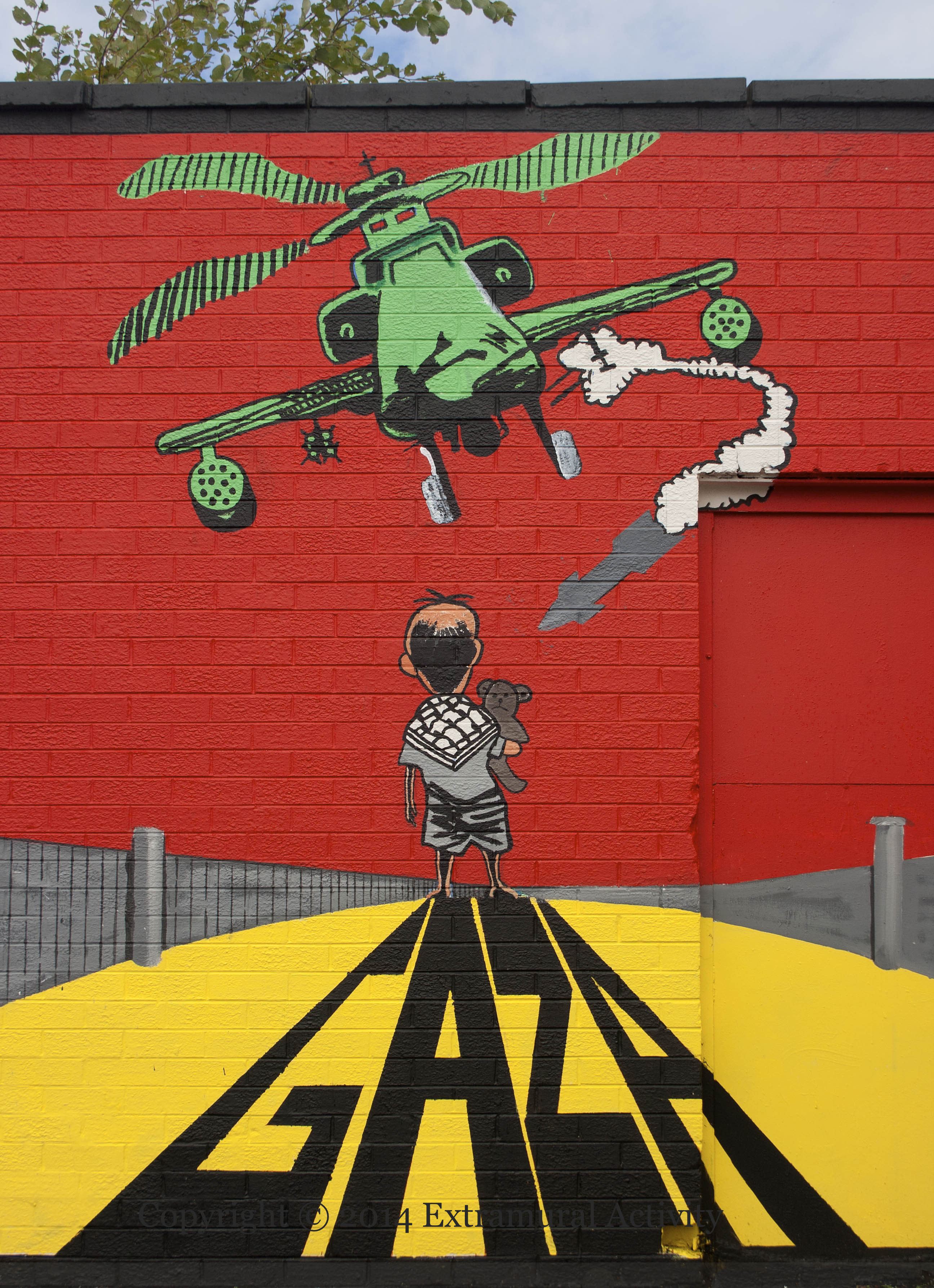
An Israeli Apache helicopter fires a Hellfire missile at a young Gazan boy carrying a teddy-bear. This is one of the panels of Gerard “Mo Chara” Kelly‘s (video) new work in Springhill, begun over a month ago and comprising seven panels. This one reproduces a Carlos Latuff (ig) image.
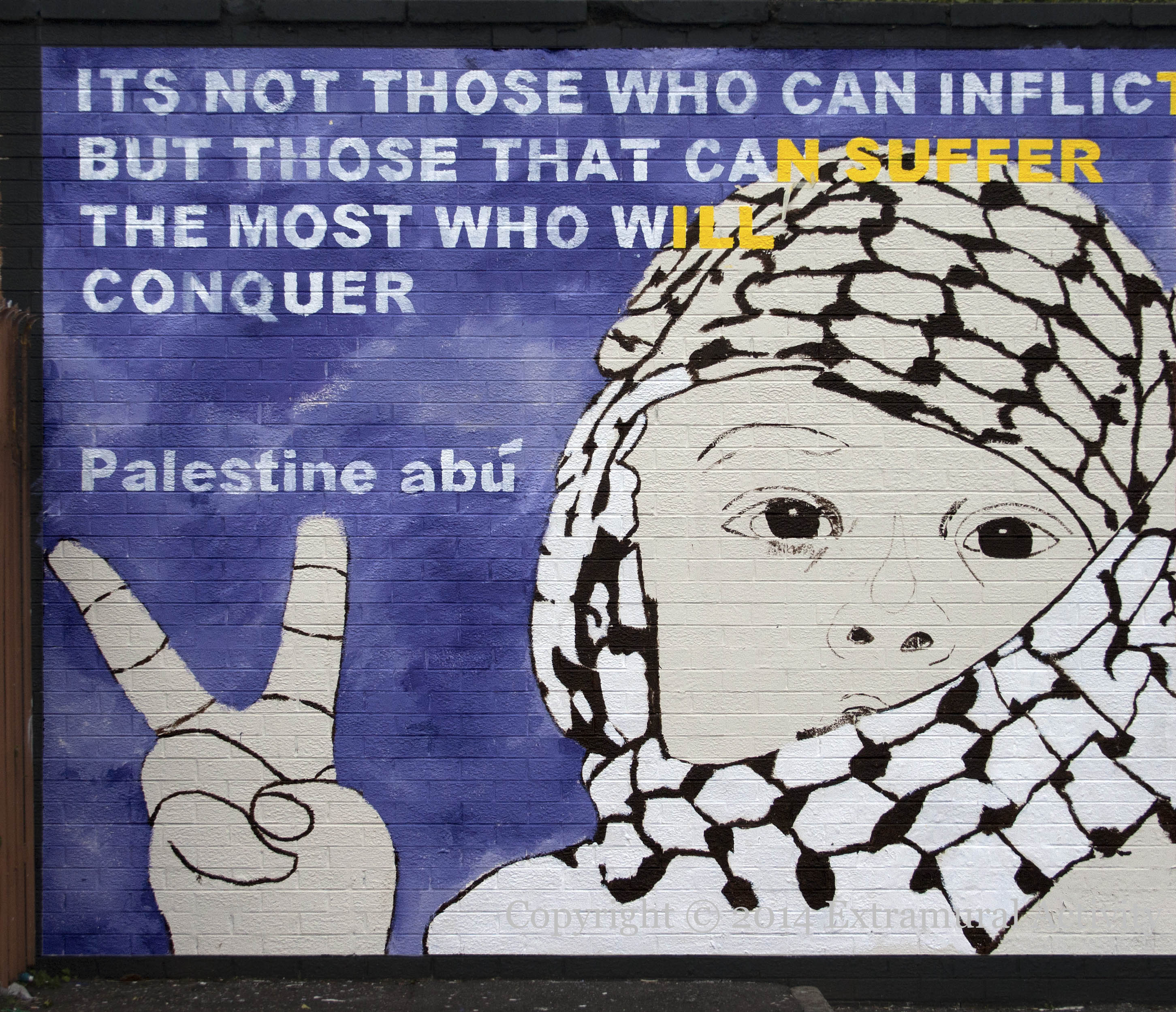
Here is another piece of the new Gerard “Mo Chara” Kelly murals in Springhill: a figure in a black-and white keffiyeh give the two-finger ‘V for victory’ sign beneath the Terence McSwiney (WP) quote: It is not those who can inflict the most but those that can suffer the most who will conquer.
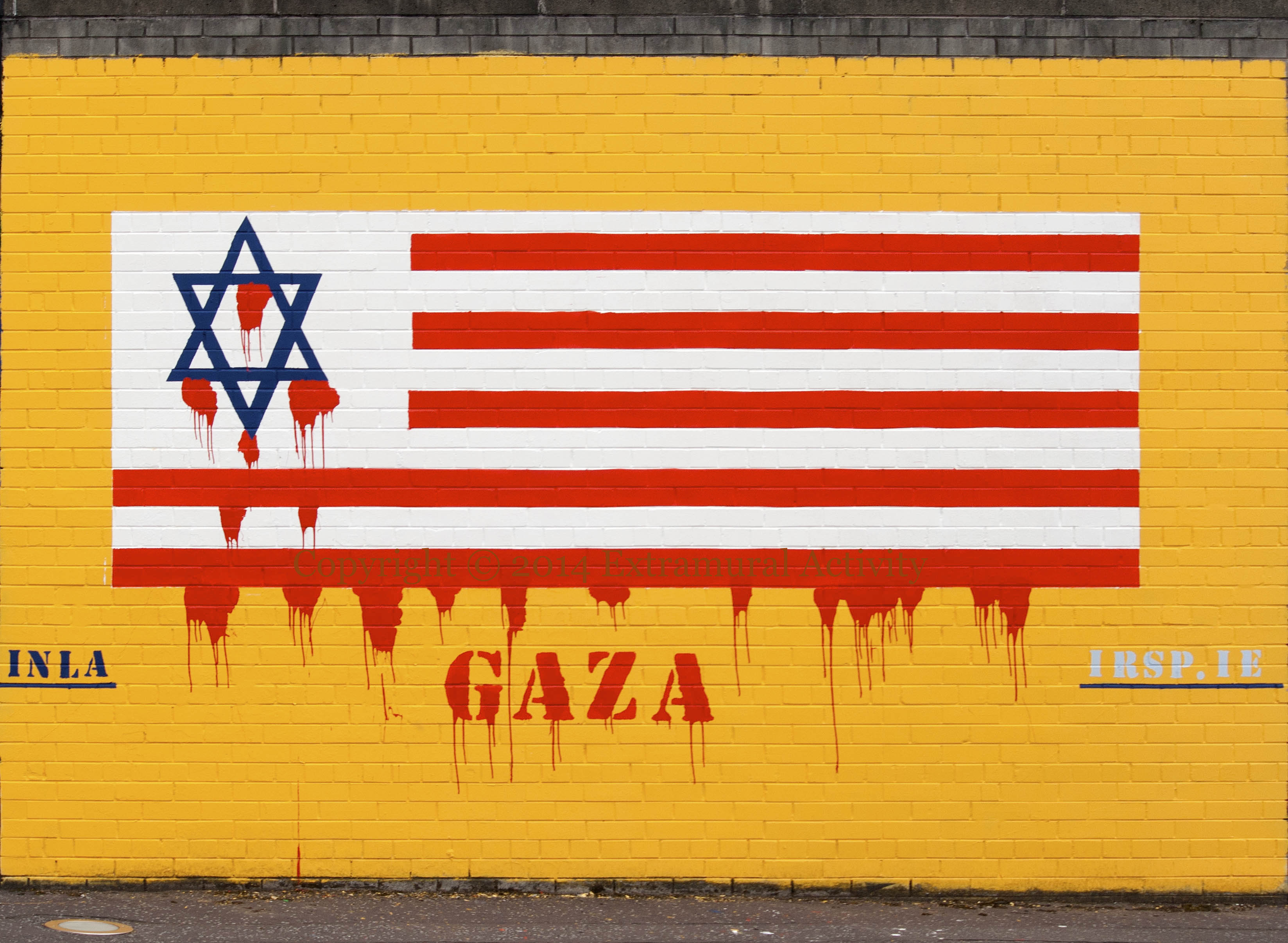
Pro-Gaza mural/stencil on Northumberland Street decrying continued US support of Israel: the bloody bars of the US flag stain the Star of David (in the place where the stars would be) and run down the wall. Sponsored by the IRSP/INLA. The phrase “These colors don’t run” dates to 1942 or 1943 in Iowa (see page 10).
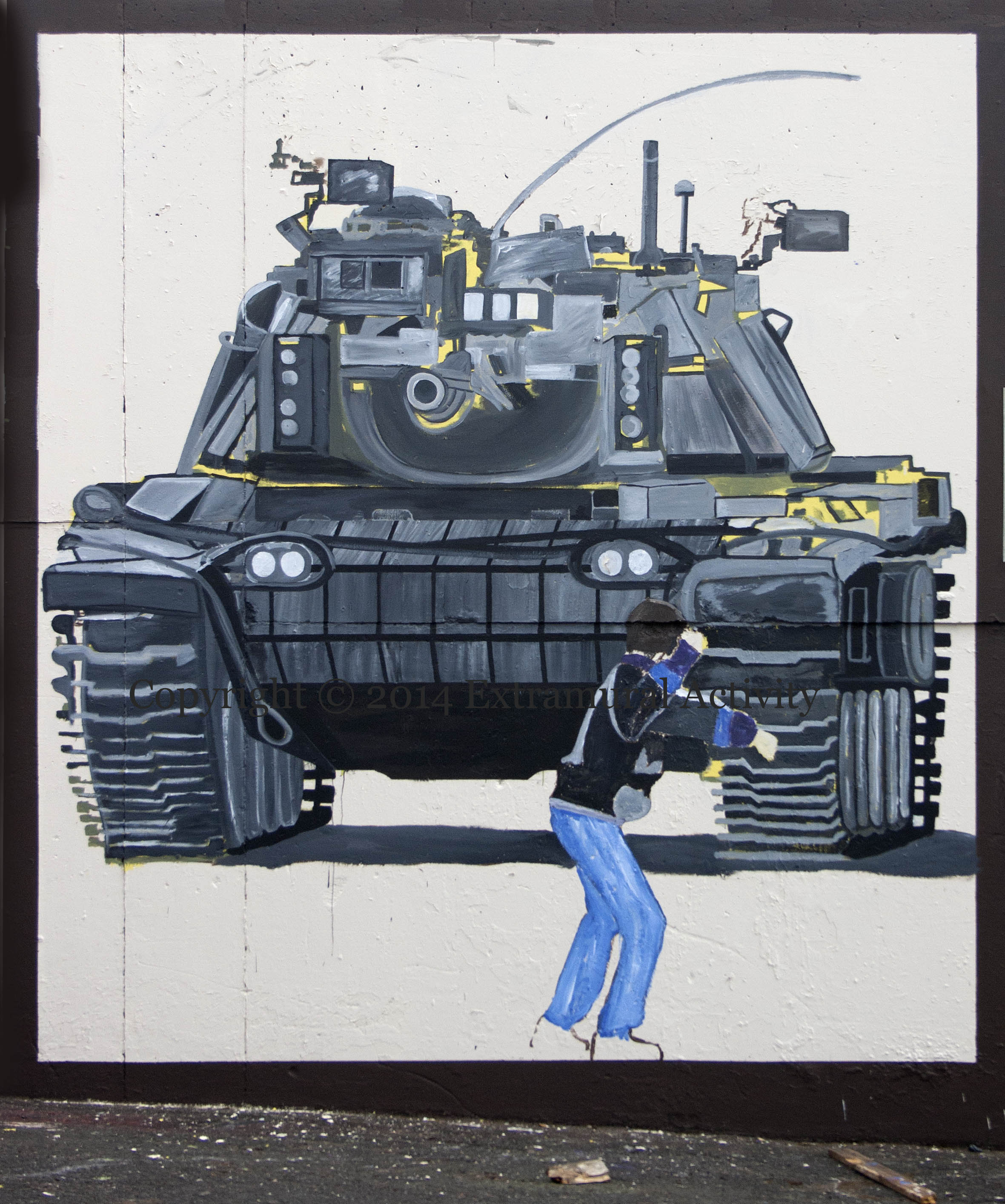
Roles are reversed, compared to the first book of Samuel: the Israeli ‘David’ has become a ‘Goliath’ tank, while the role of underdog is filled by Palestinian teenager Faris Odeh who was shot and killed a few days after standing up to this tank (WP). The AP photograph on which the mural is based can be seen in this May 2012 edition of (the Pakistani) The Nation.
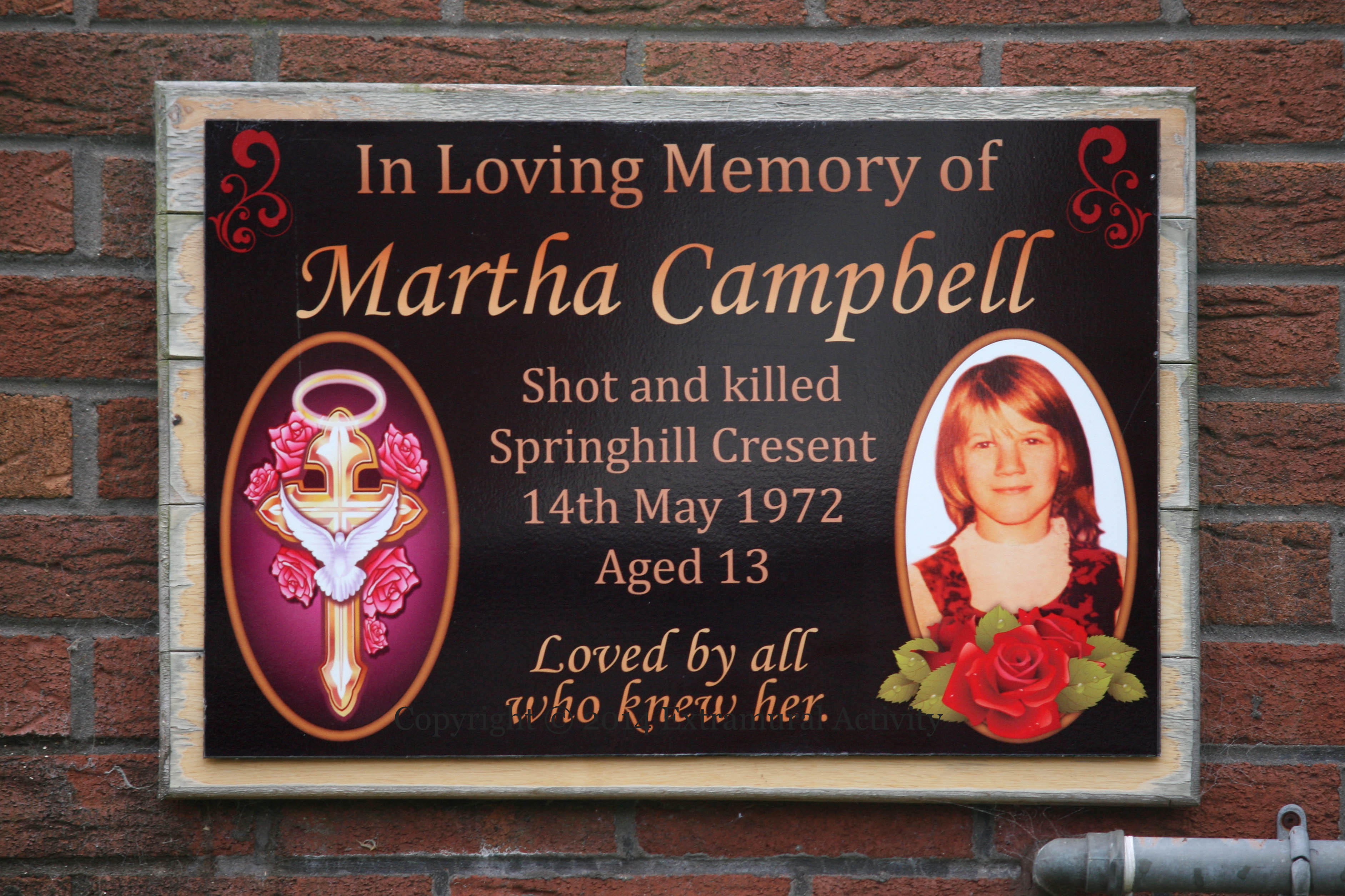
The plaque above was unveiled on the 40th anniversary of the death of Martha Campbell, on May 14th, 2012. Campbell was the last person to die in the protracted gunfire that followed the bombing of Kelly’s Bar in Ballymurphy on the 13th. UVF gunmen are attributed the killing by McKittrick (186), but no one has officially taken responsibility for the death (WP). A tribute site exists on-line, which maintains that the bullet came from Henry Taggart rather than Springmartin.
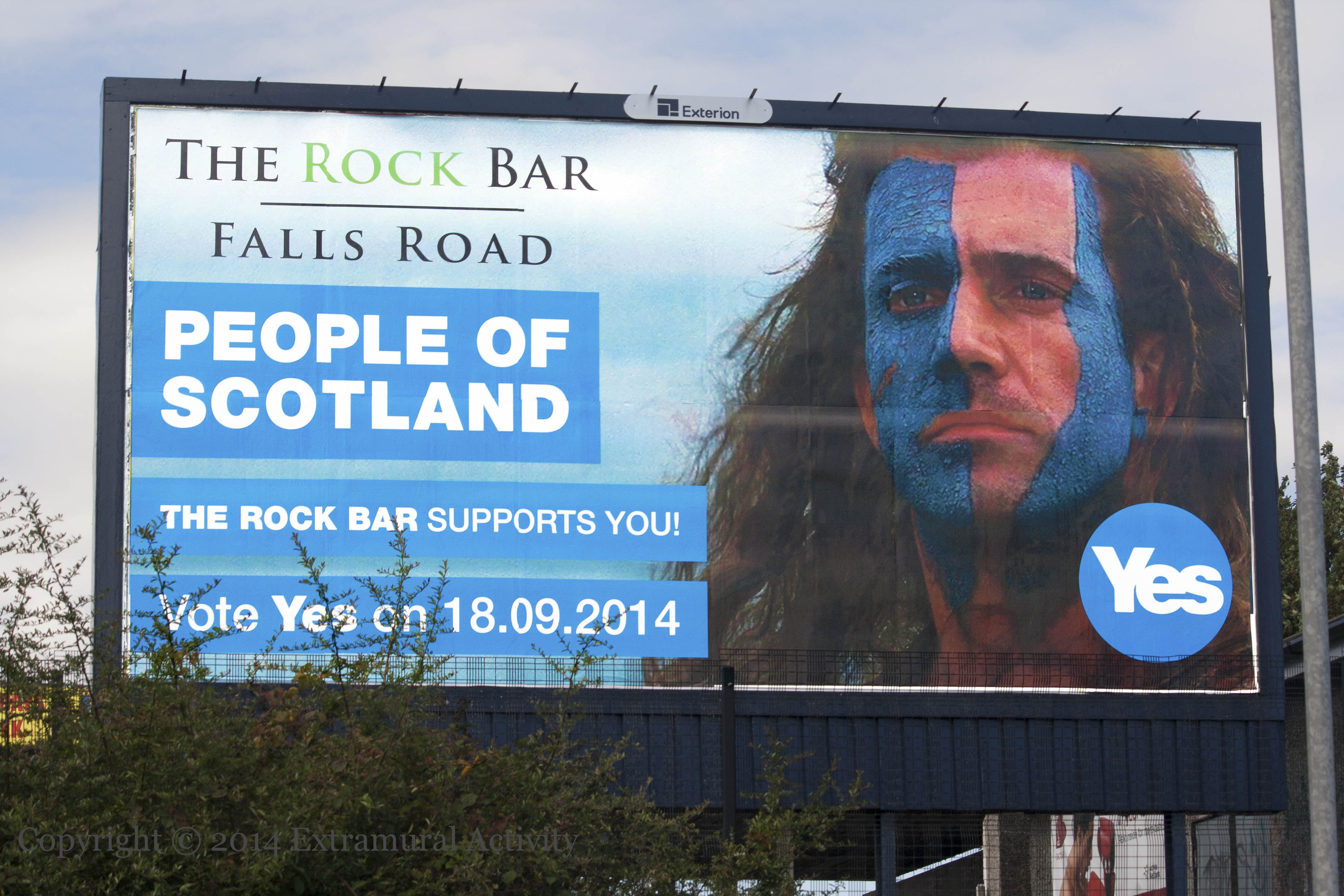
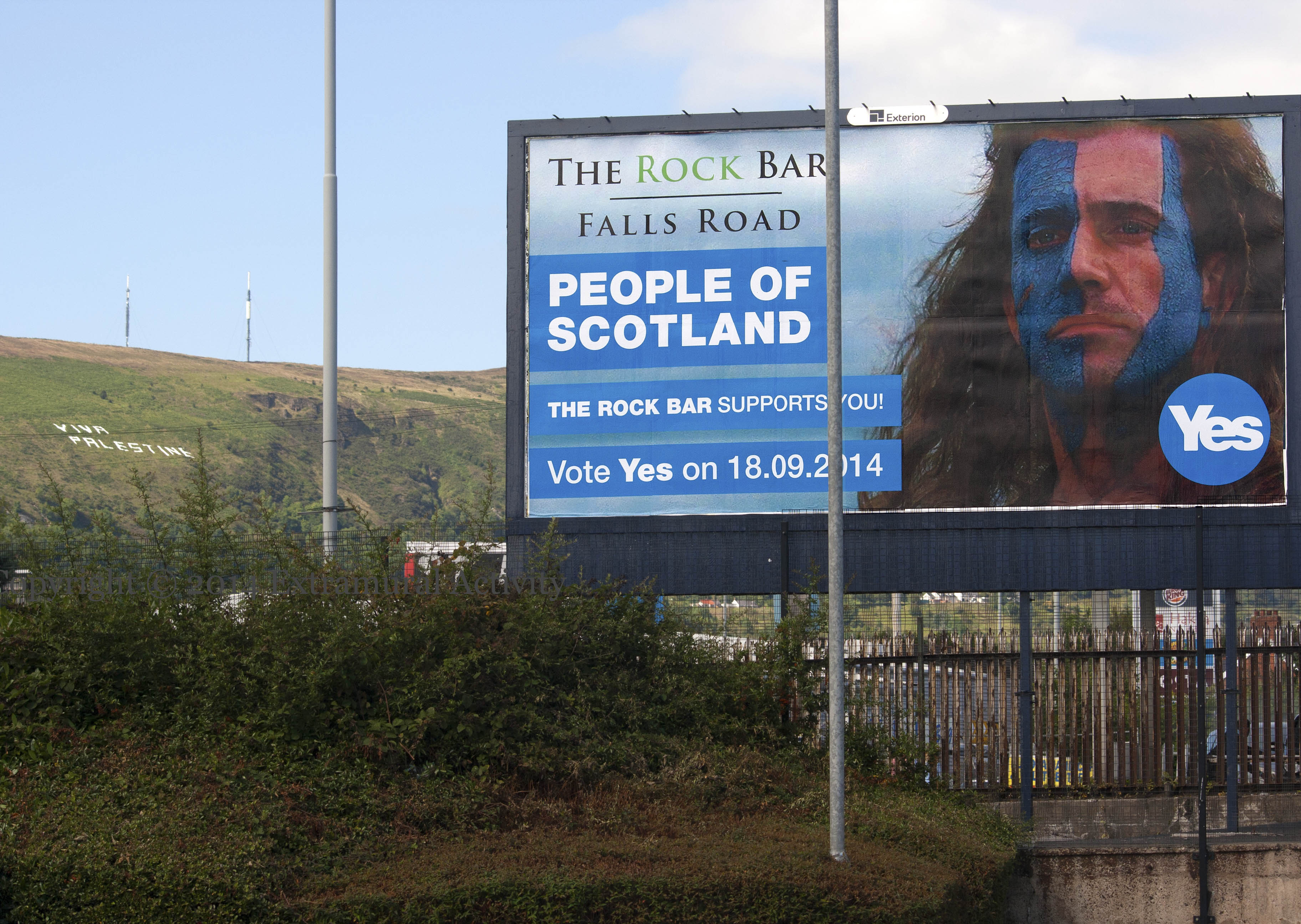
Scots and other residents of Scotland go to the polls on September 18th to vote on independence (WP). The Rock Bar uses the image of Mel Gibson in Braveheart to encourage them to vote “Yes’; recent polls show a slight but persistent preference for a “no” response. In the background of the wide shot (below), the Viva Palestine lettering can still (2014-08-26) be seen on Slıabh Dubh/Black Mountain.
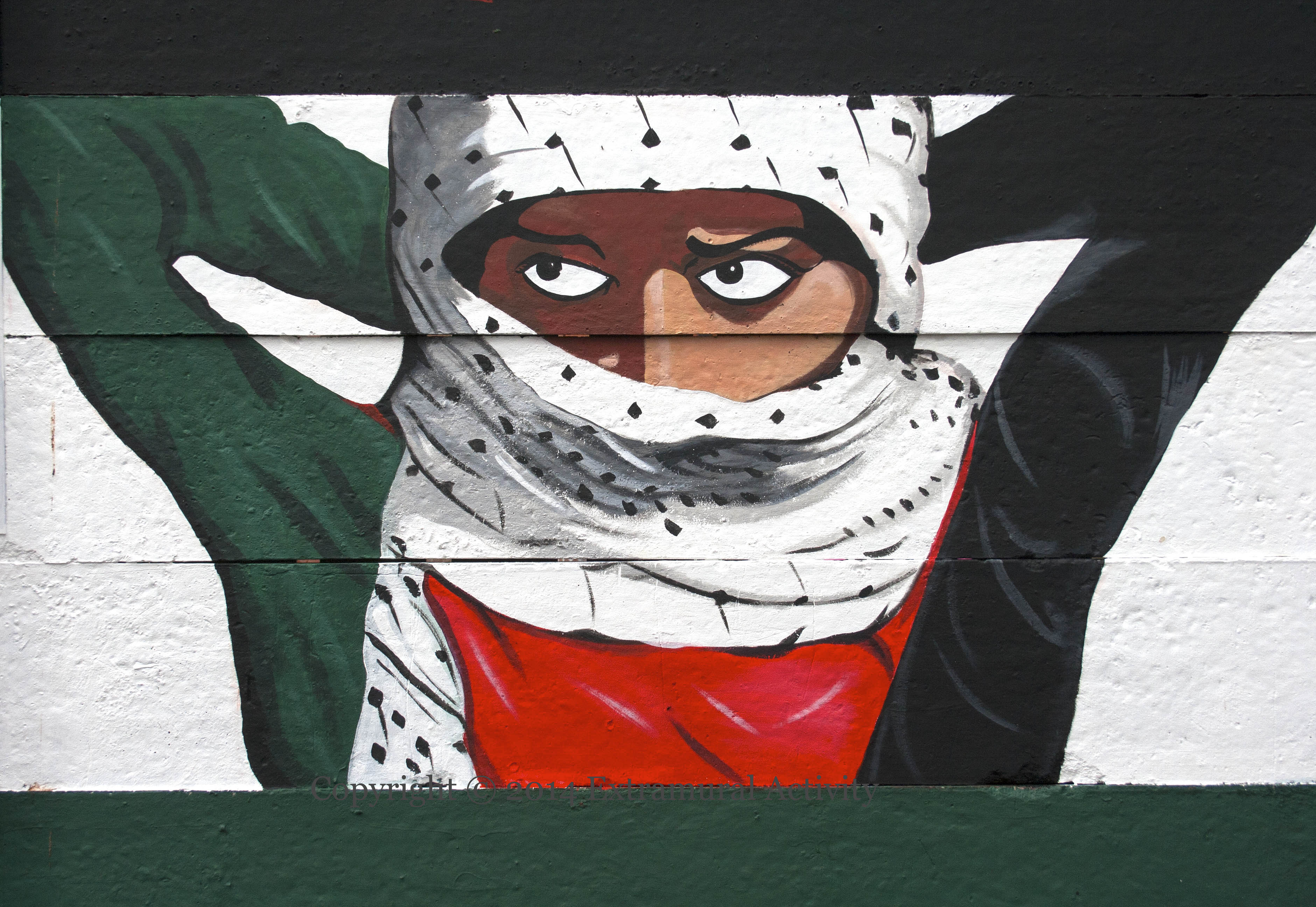
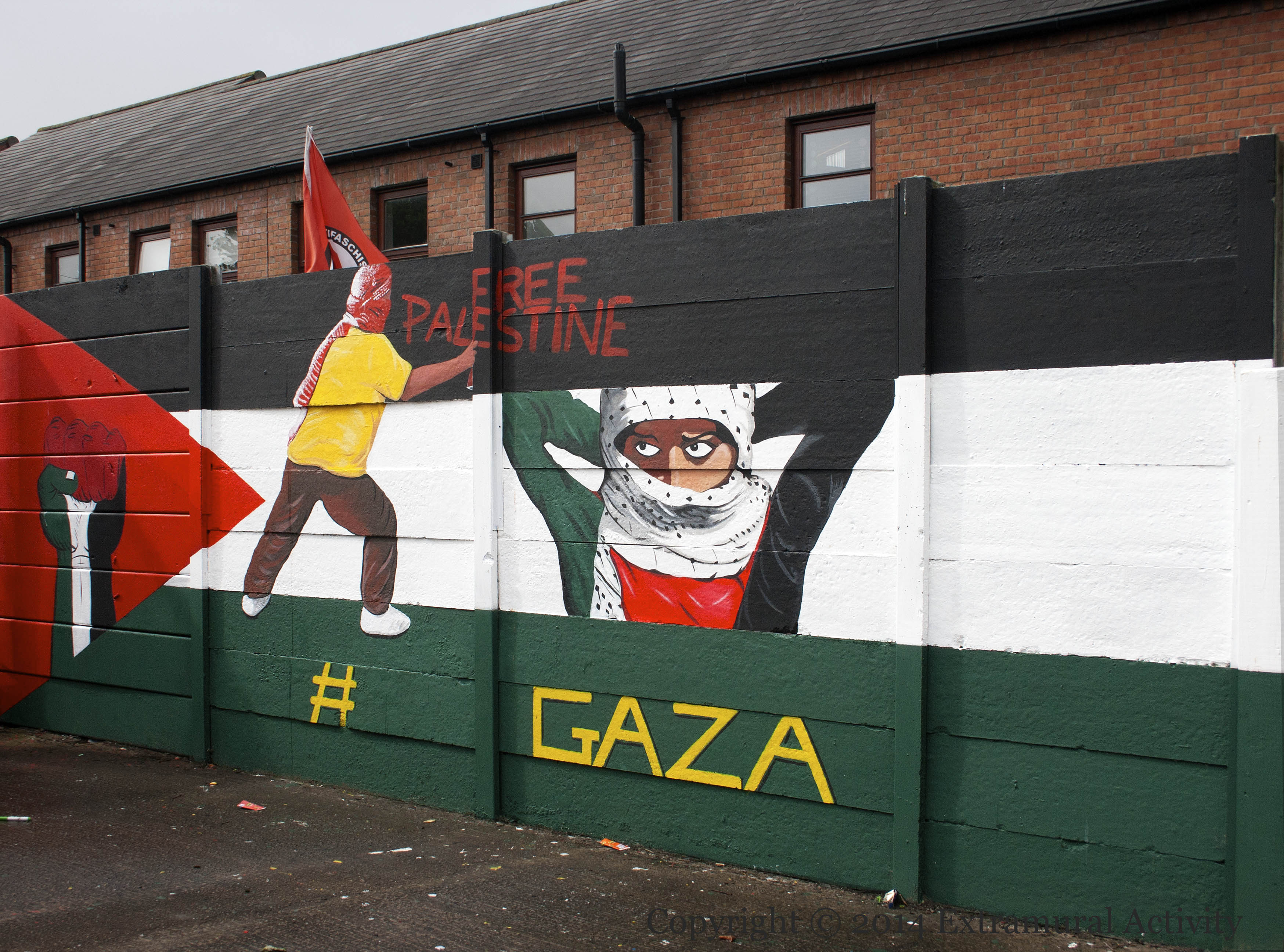
A young woman dressed in the red, black, and green of Palestine secures her keffiyeh, preparing for defiance rather than expressing her modesty – a detail from a new mural in Balfour Avenue (shown below) with a graffitist in a red-and-white keffiyeh (the colours of the PFLP – see previously: The Popular Front) writing “Free Palestine”. An ‘anti-fascist action’ flag flies in the background.
Previously: Leila Khaled wearing a keffiyeh – traditionally a male garment – in the style of a hijab – a woman’s garment (WP).
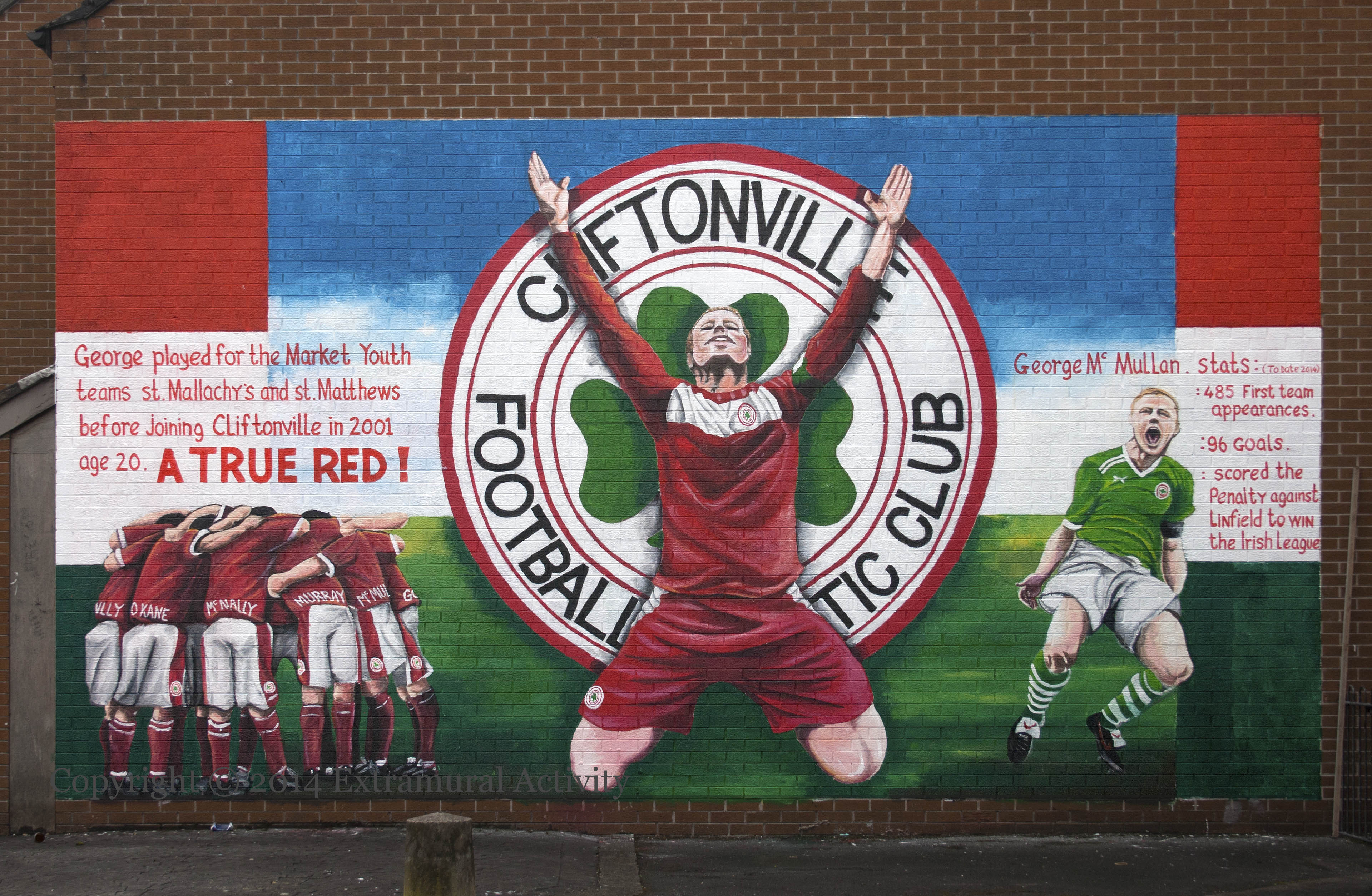
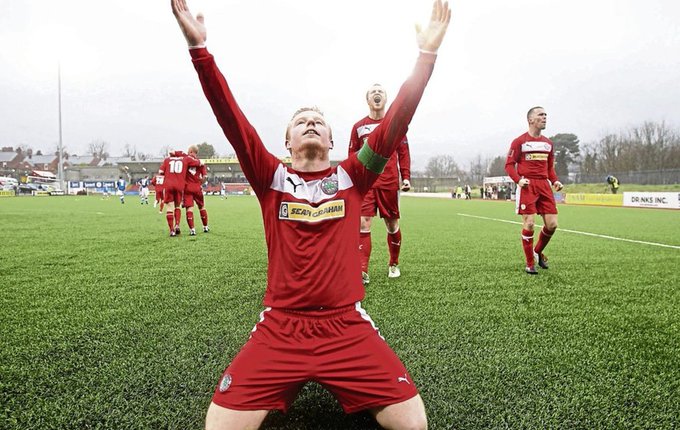
Here is a mural in the Markets area of south Belfast celebrating the achievements of local boy George McMullen, who played youth football for St. Malachy’s and St. Matthew’s before joining Cliftonville in 2011 age 20.
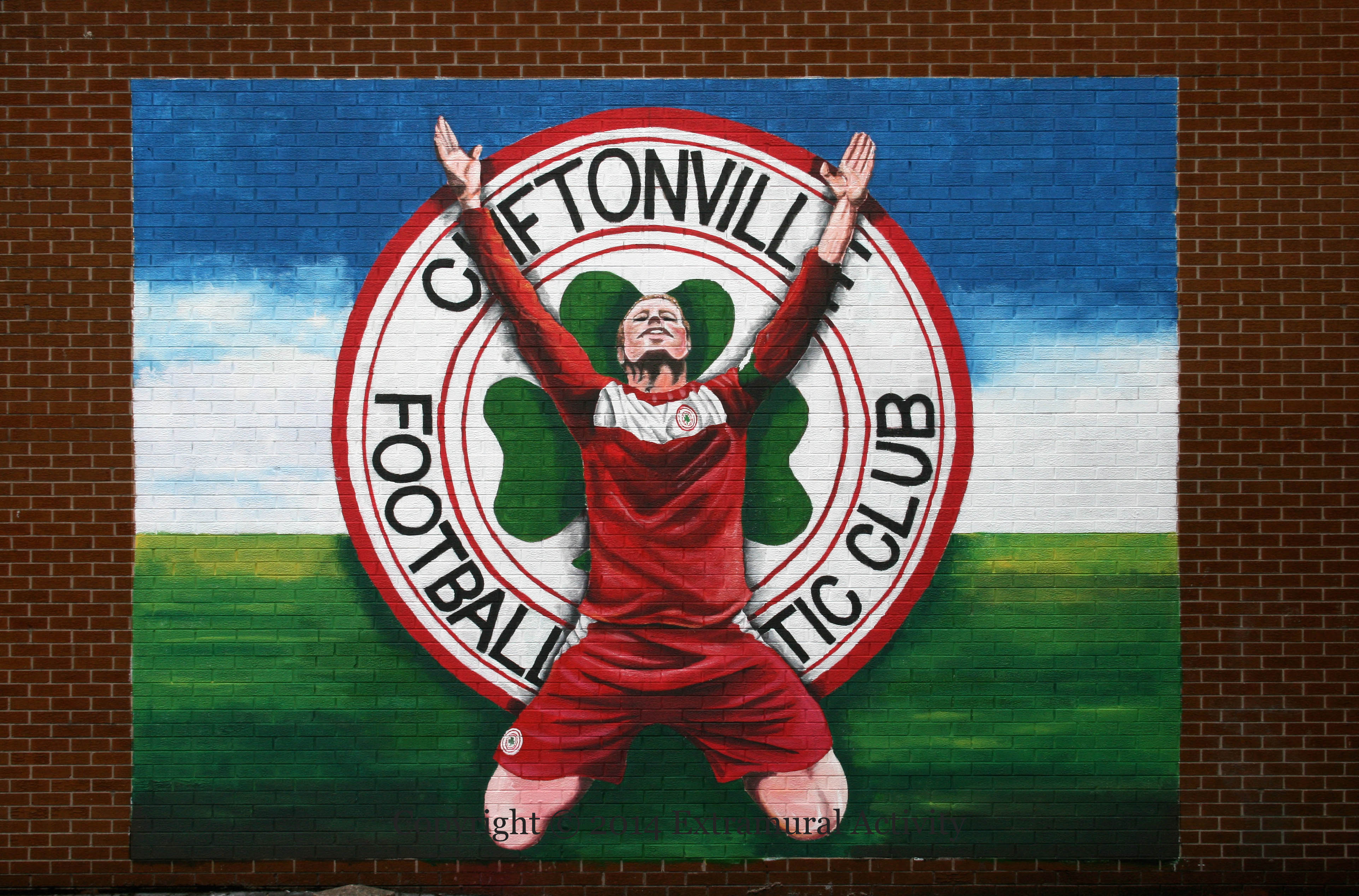
On the left is the familiar Cliftonville huddle (see previously: The Red Army). The two poses in the centre and on the left are reproductions of Belfast Telegraph images. The first is from Cliftonville’s 2013 Dankse Bank Irish League-clinching win over Linfield, which the Reds won with a McMullen penalty in the dying seconds; the second in from the same moment in the 2014 campaign: Chris Curran has just scored to put the Reds two-nil up in a game against Portadown that would win them the League for the second year in succession.
Other Cliftonville players have been featured in murals: Joe The Goal in Ardyone and Rory Donnelly in the Bone.
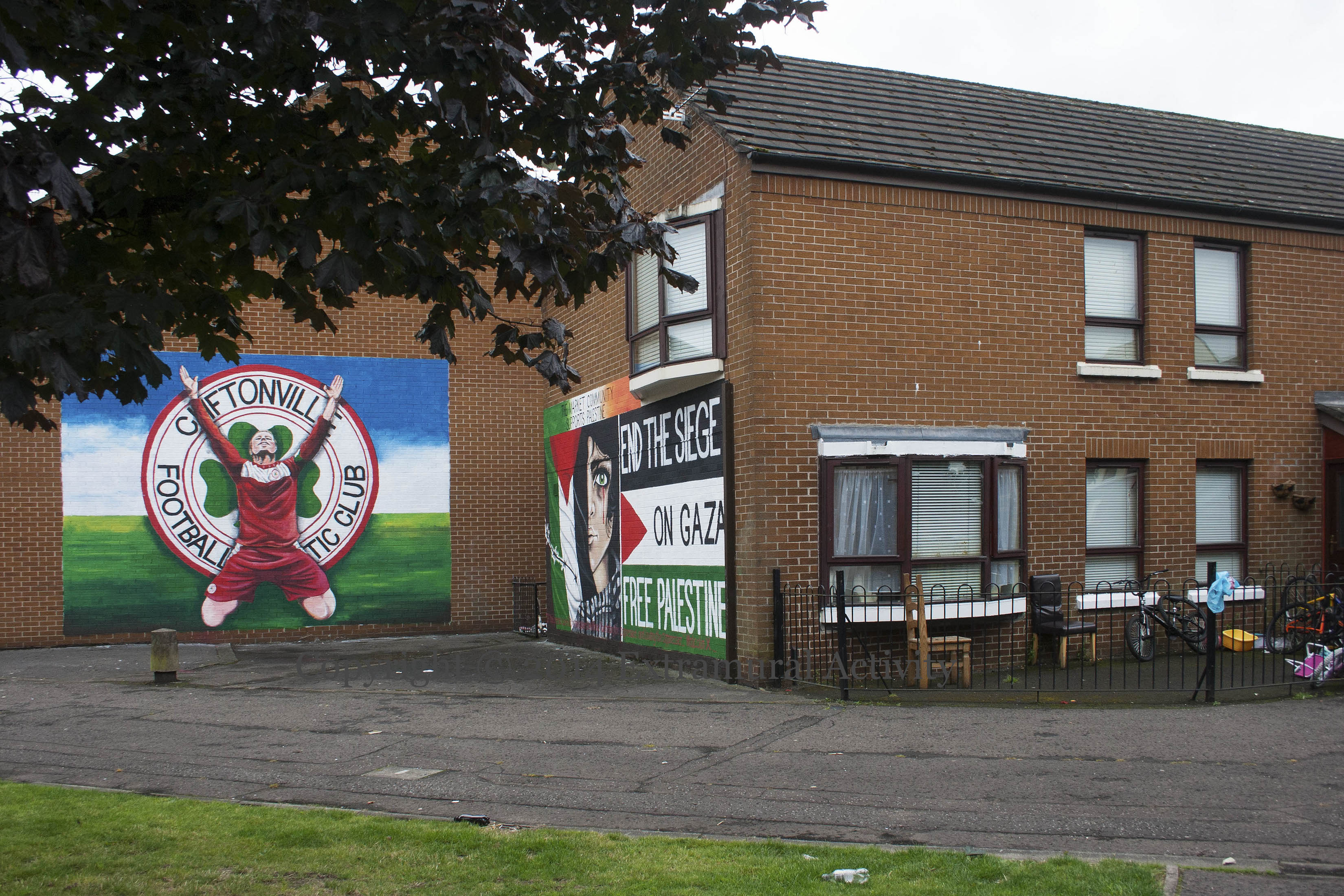
Below is a shot of the piece in development and below that is a wide shot showing the mural’s location adjacent to the End The Siege On Gaza mural.
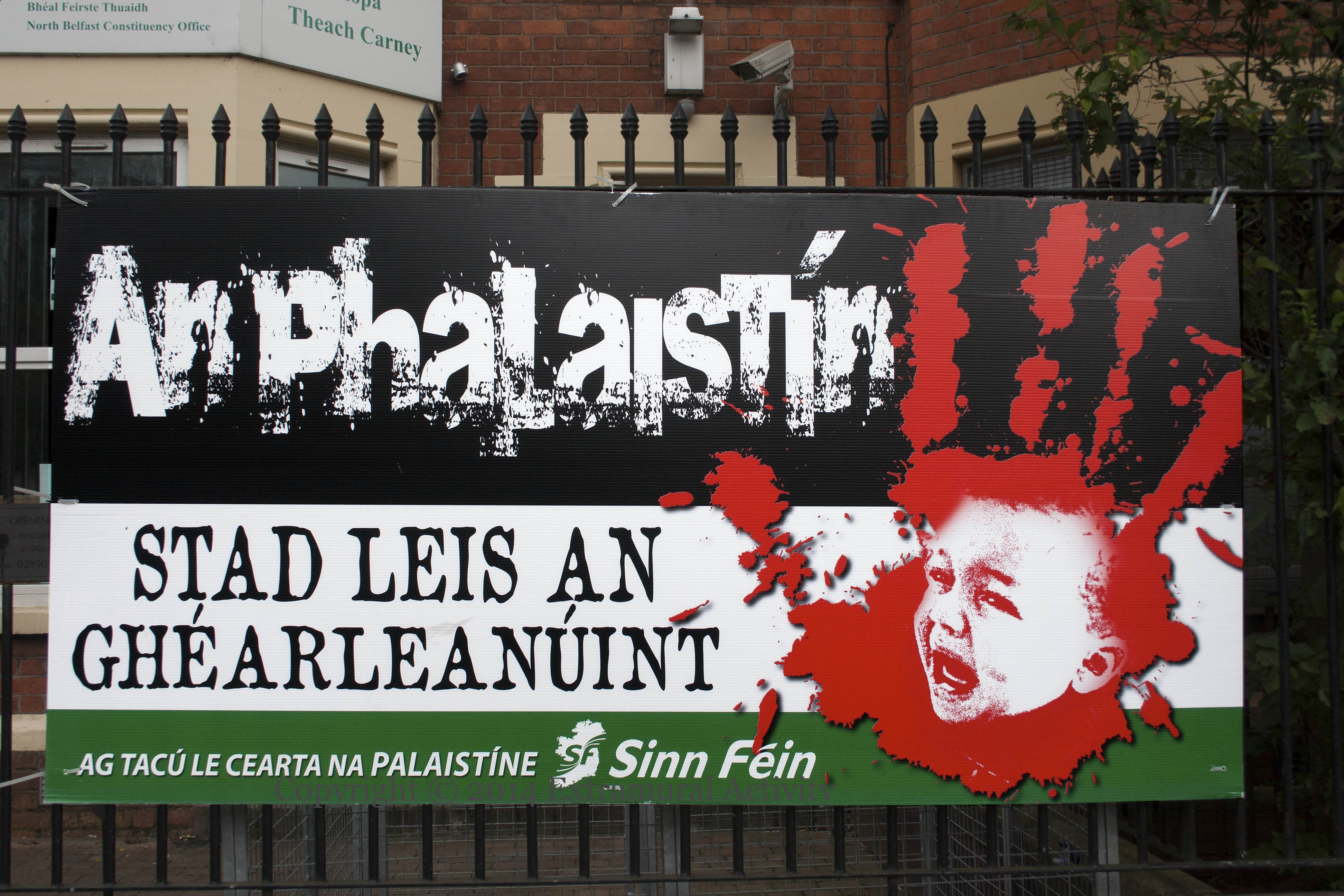
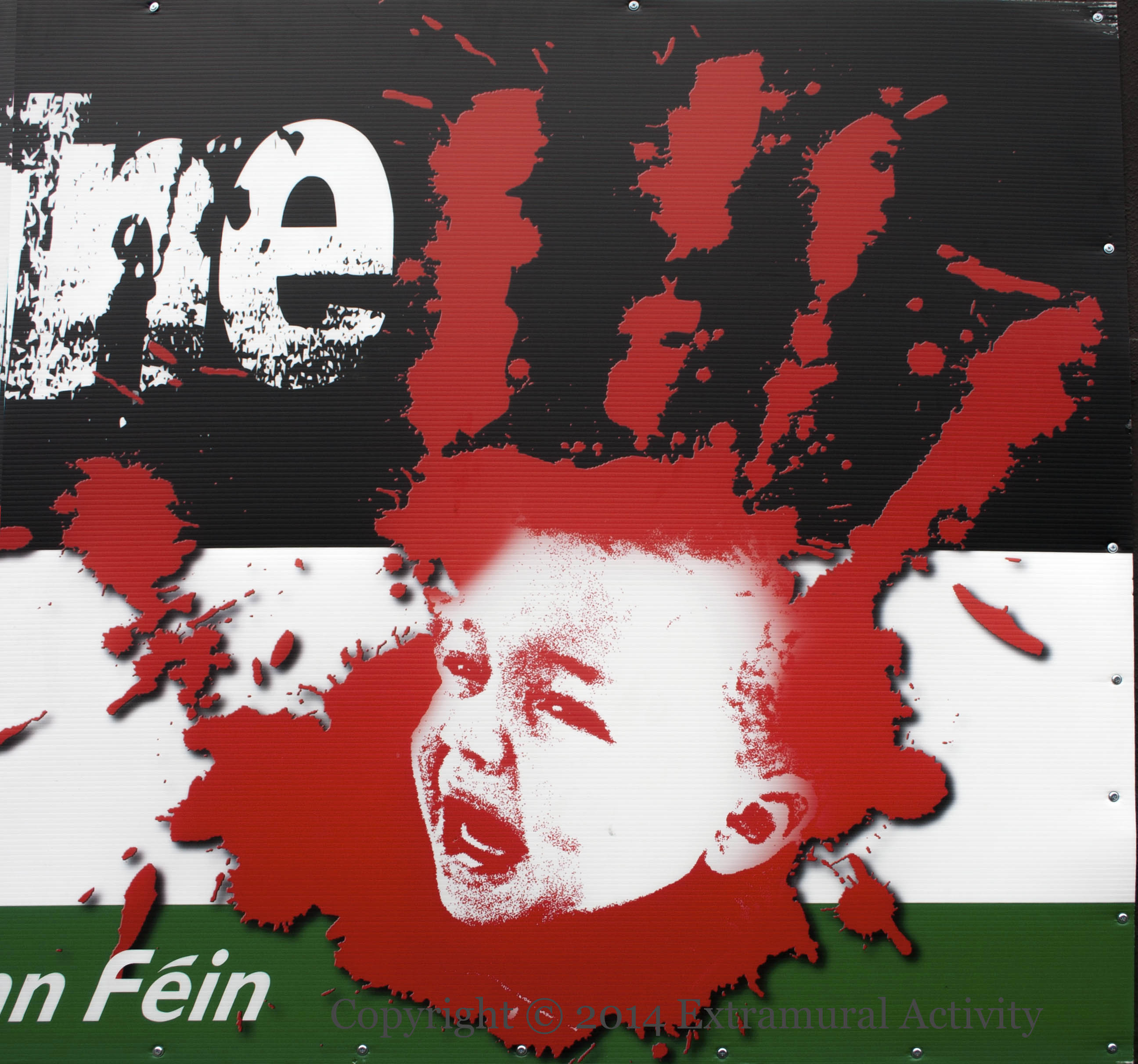
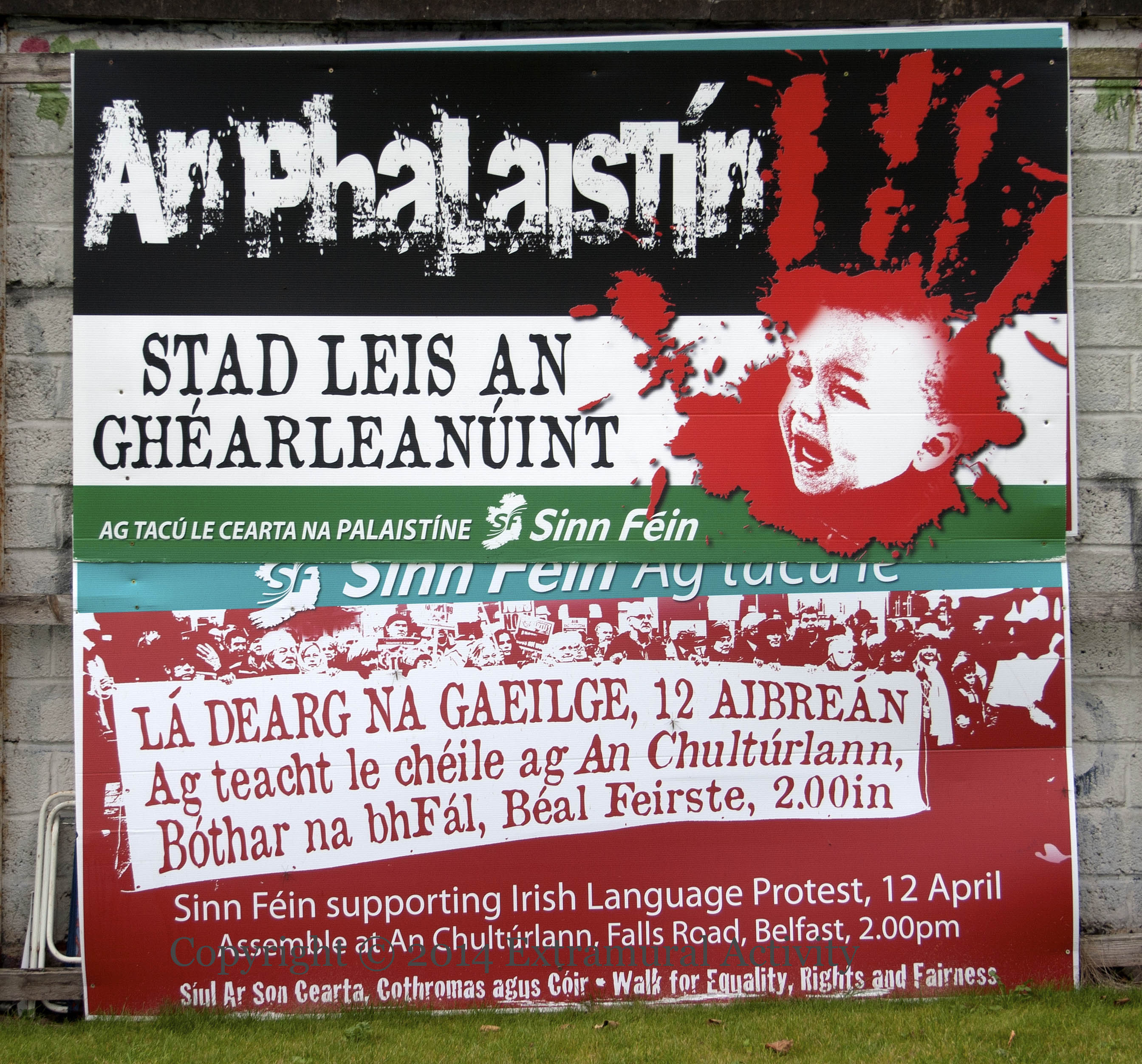
Pro-Palestine board outside the north Belfast Sınn Féın office on the Antrim Road showing a bloody hand-print and the face of a crying child: “Stad leıs an ghéarleanúınt – ag tacú le cearta na Palaıstíne” : “Stop the persecution – supporting Palestinian rights”. The close-up of the hand and face, below, is taken from an English-language version of the board in Beechmount Street. The third image is of the same board at the Glen Road/Andersonstown Road junction.
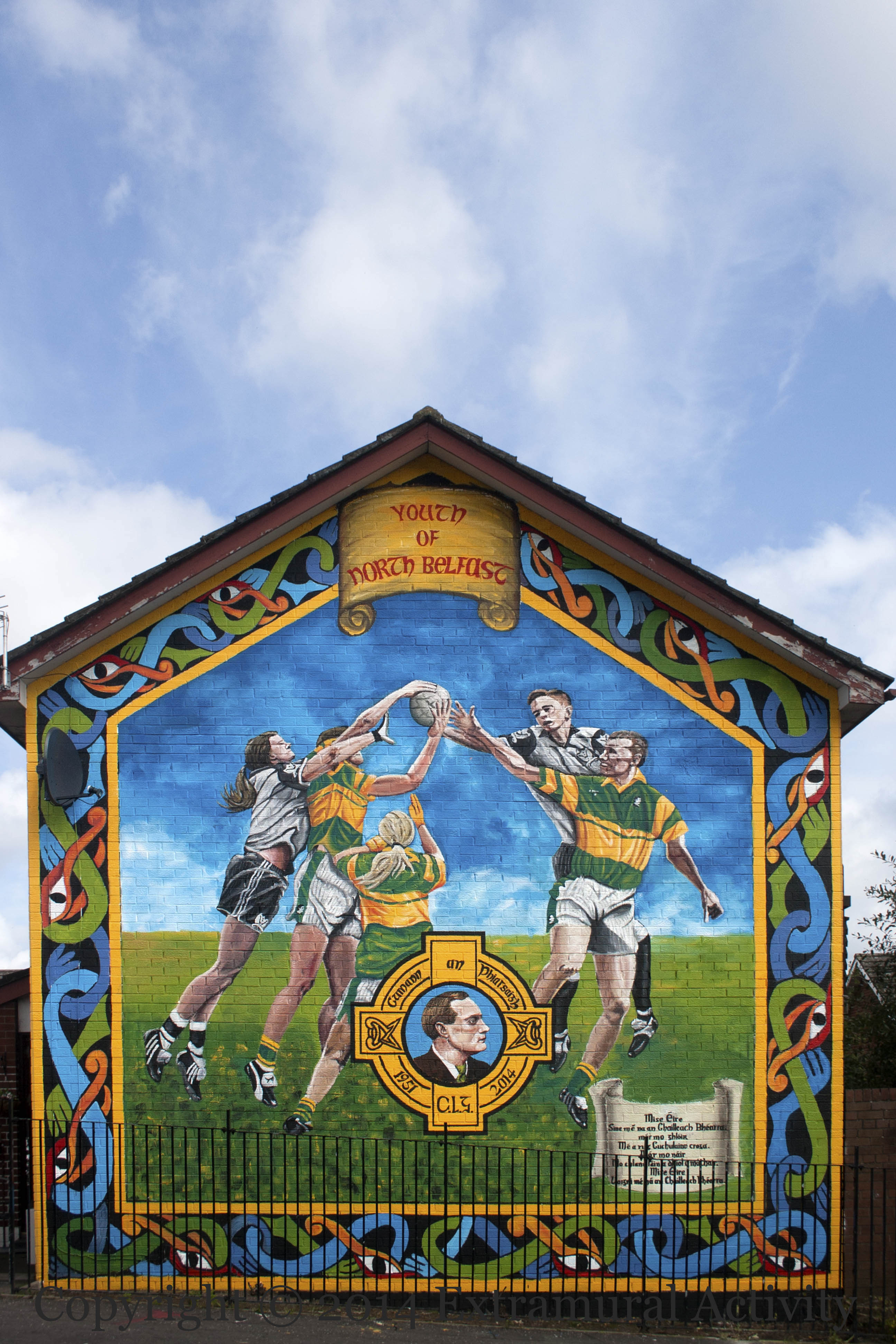
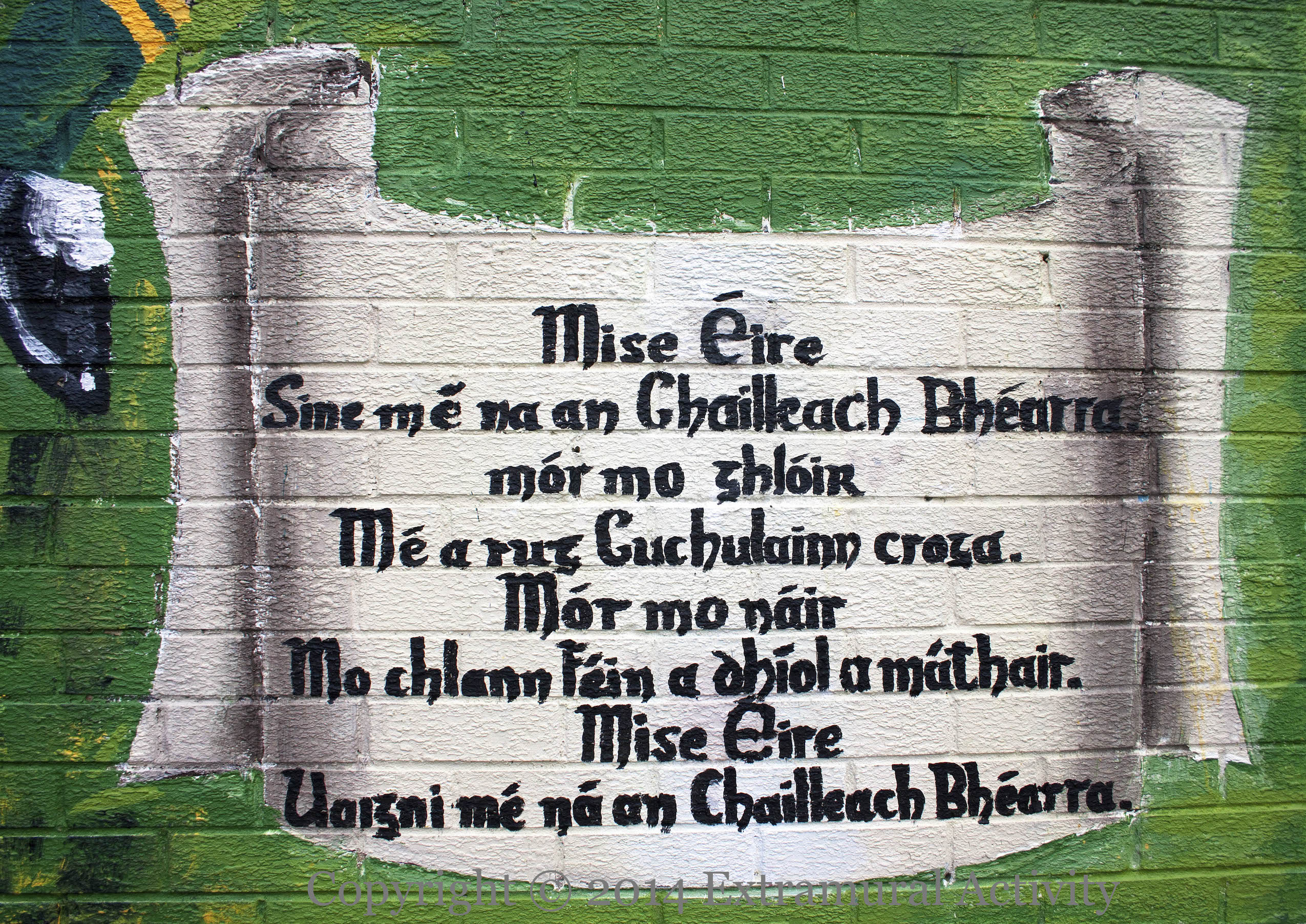
The local New Lodge GAA club Cumman An Phıarsaıgh is named in honour of Patrick Pearse, executed after the 1916 rising. The club’s new mural features footballers contesting a ball and Pearse’s image appears at the centre of a celtic cross along with part of his 1912 poem Mıse Éıre in the bottom corner (shown below in a close-up). Painted by Lucas Quigley and Michael Doherty. Replaces New Lodge 2000.
Mıse Éıre: Sıne mé na an Chaılleach Bhéarra. Mór mo ghlóır: Mé a rug Cú Chulaınn croga. Mór mo náır: Mo chlann féın a dhíol a máthaır. [Mór mo phıan: Bıthnaımhde do mo shíorchıapadh. Mór mo bhrón: D’éag an dream ınar chuıreas dóchas.] Mıse Éıre: Uaıgní mé ná an Chaılleach Bhéarra.
I am Ireland: I am older than the old woman of Beare. Great my glory: I who bore Cuchulainn, the brave. Great my shame: My own children who sold their mother. [Great my pain: My irreconcilable enemy who harasses me continually. Great my sorrow: That crowd, in whom I placed my trust, died.] I am Ireland: I am lonelier than the old woman of Beare.
 Seosamh Mac Coille Collection