The Influencer

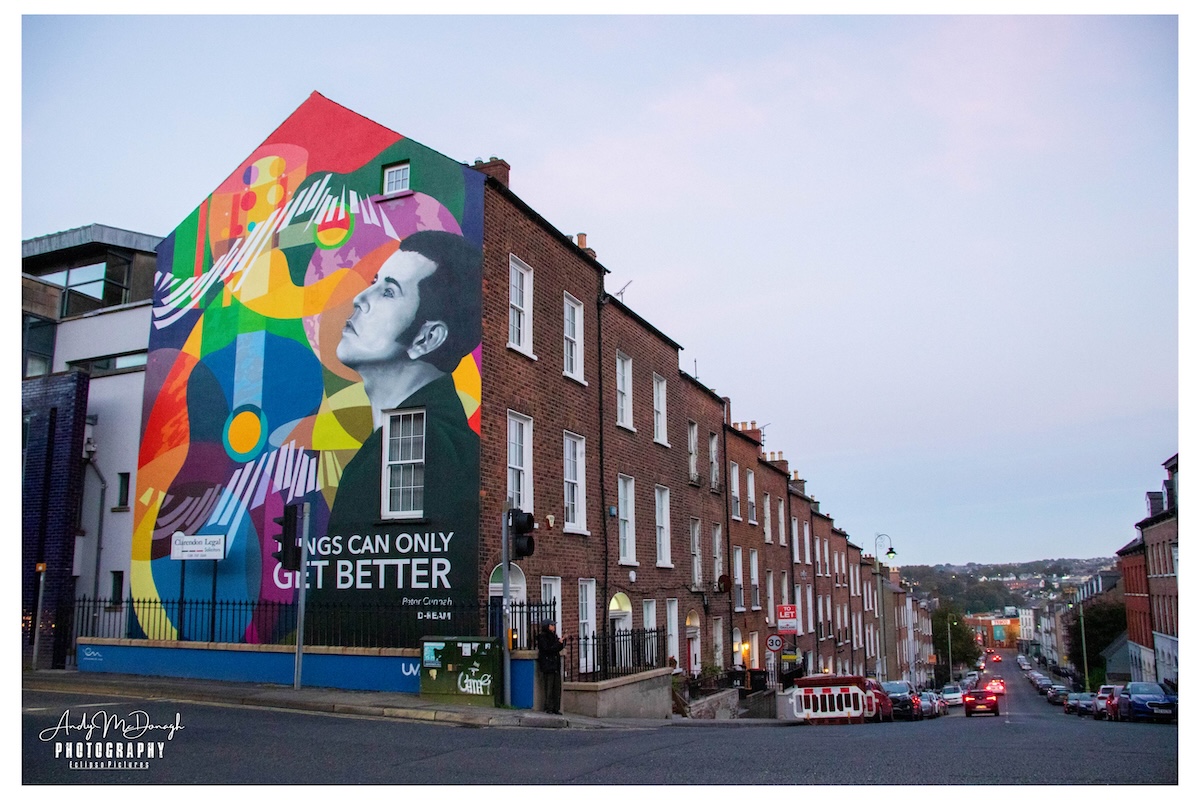
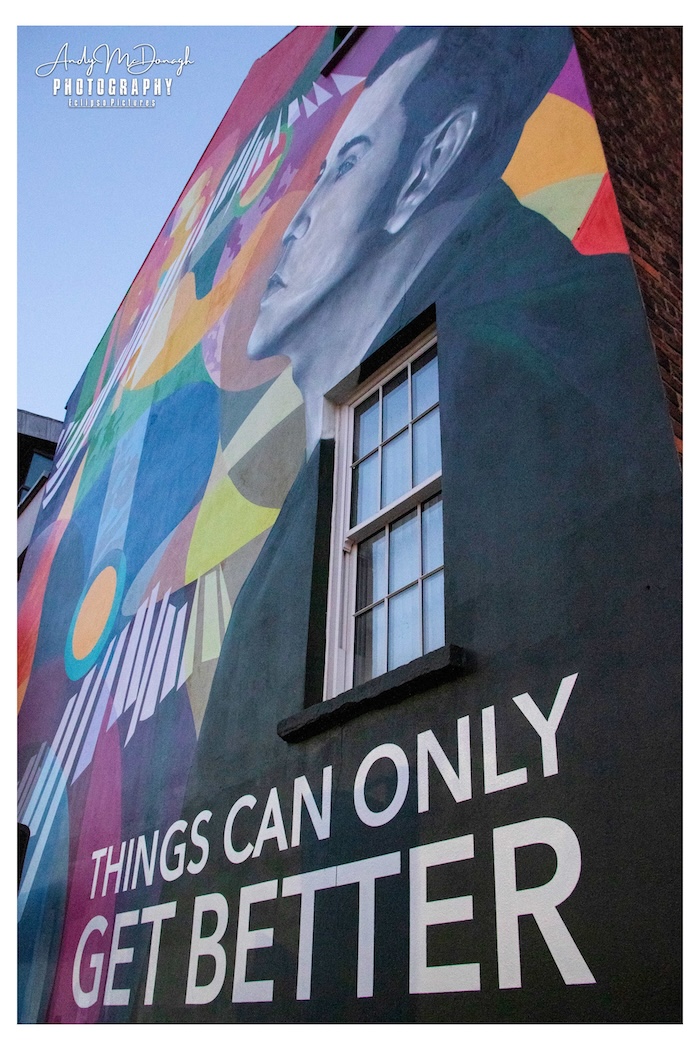
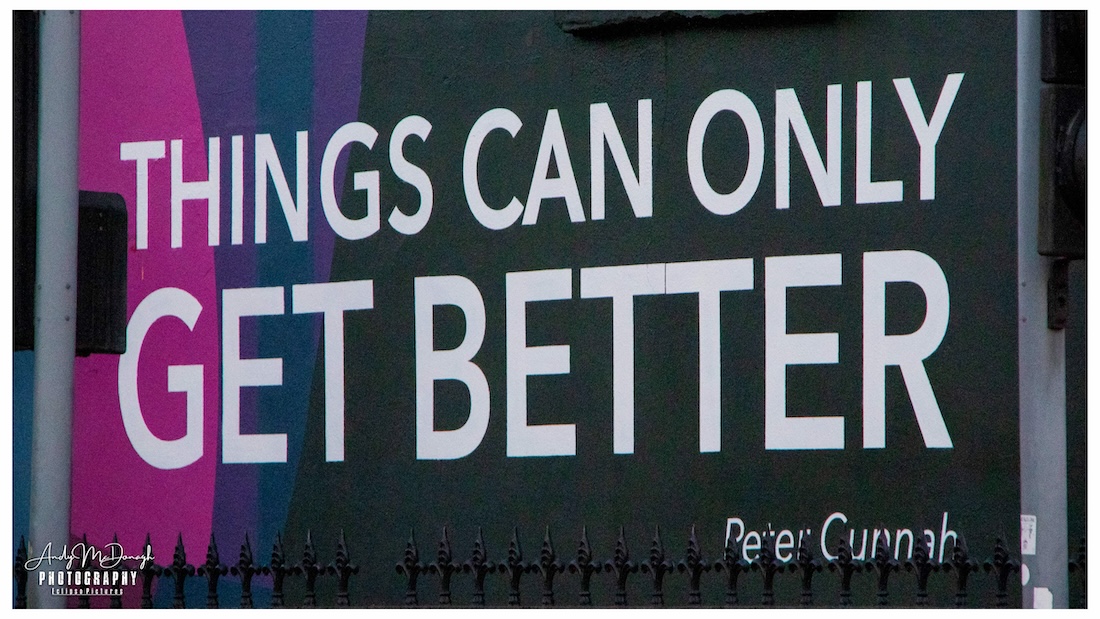
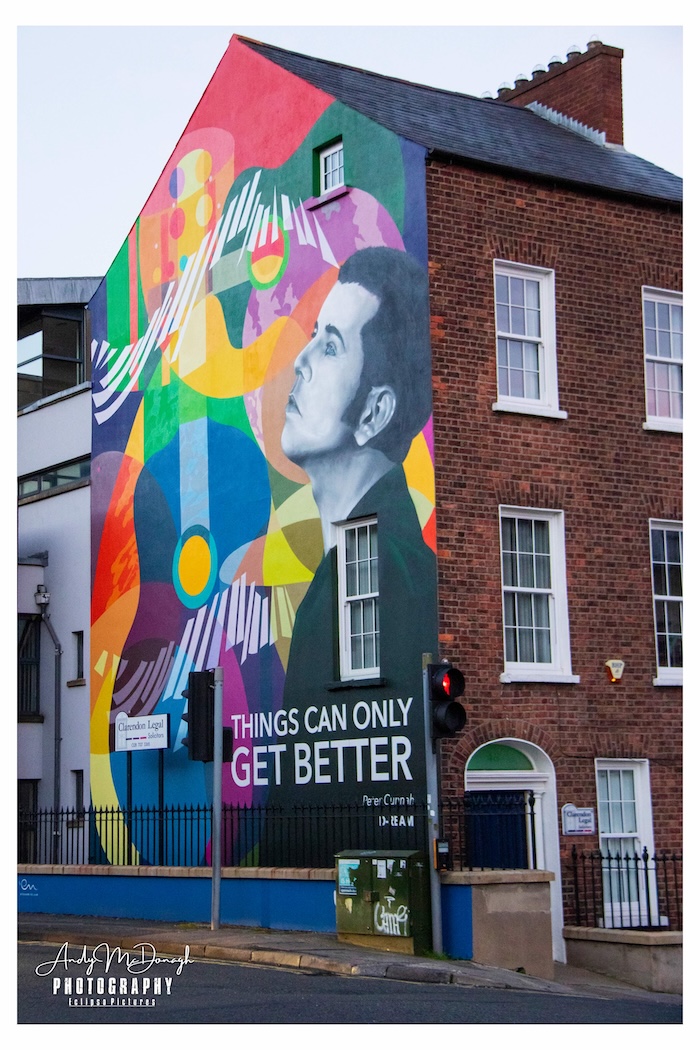
“Seamus Heaney 1929-2013.” Seamus Heaney was raised in Bellaghy and is buried in Bellaghy. Between these bookends, he attended boarding school in Derry and Queen’s in Belfast, and held academic positions in Belfast, California, Dublin, and Massachusetts. His poetry won him the Nobel Prize for Literature in 1995 and made him a household name. Although he largely pre-dates the social-media era, this new mural in Derry suggests that he is – or could be – an influencer.

Beneath Irish Skies (Inspired by Seamus Heaney) The grass is green when I step outside the door. The air is fresh like mint. The sun shines off the water like your eyes. The wind whistling like a flute. – by Jude Shiels, aged 12″

“Féile brought together young people from Bishop Street and Newbuildings youth clubs to work creatively alongside one another as part of a cross-community project. The young people worked with artists from Peaball [web] street art collective, helping to shape and influence the design of this mural. Through creative workshops and discussions the group explored the life of Seamus Heaney and how the landscape and the people within it influenced his work. What role in society does the modern influencer play … This project has been sponsored by PeacePlus, a programme managed by the Special EU Programmes body.”

Westland Street, Bogside, Derry

Click image to enlarge
Copyright © 2026 Andy McDonagh/Eclipso Pictures (ig | Fb)
X16410 X16411 X16412 [X16413] X16409 X16414 [X16415]

The Uncrowned King Of Ulster

Text above: “Sir Edward Carson 1854 – 1935 “Uncrowned King of Ulster” Founding member and leader of the Ulster Volunteers. Carson led Ulster Unionist resistance to the British Government’s attempts to introduce Home Rule for the whole of Ireland.”

The epithet “uncrowned King” seems to be generally used of Carson and not attributable to any one source. Here is a September 1912 newspaper article that calls Carson the “uncrowned King of the North” and relays criticisms of a Carson reception in Portadown as “a parody upon a royal reception” and “an insult to the King”. A May 1914 review of (the book) The Reign Of Edward Carson refers to “King Carson”. (Here is a postcard depicting Carson as a king upon a throne – Postcards Ireland. And a cartoon showing “The Ulster King-At-Arms“.)

The phrase is an echo of and response to the phrase “uncrowned king of Ireland”, which was used of both O’Connell and Parnell. Here is an 1847 article describing both O’Connell and the Napoleonic Governor-General of Algeria (WP) as “uncrowned monarch[s]”. According to WP, the epithet was first applied to Parnell in 1880, because he was so popular during a tour of the United States and Canada. At the end of James Joyce’s story ‘Ivy Day In The Committee Room’ a character recites a poem about Parnell, beginning “He is dead. Our uncrowned king is dead” (archive.com).

The wording “the British government’s attempts to introduce Home Rule” is more forthright than we are used to. Typically the resistance is simply to “Home Rule”. This wording makes clear that the Ulster Volunteers were a private militia preparing for the possibility of fighting the regular British Army and Navy. By being so explicit, this wording suggests that we are currently living through a time in which loyalists consider the “British government” to be insufficiently British, just as was the case in 1912.

Text below: “Sir Edward Carson being escorted by members of the Ulster Special Service Force on the Newtownards Road passing the Belvoir Bar in the company of Captain James Craig and the Officer Commanding of the Ulster Volunteer Force Sir George Richardson.”

According to a Regimental Band Fb post, “Sir Edward Carson was speaking at the Reform Club in Royal Avenue. There was an opinion that the British Government were going to try and arrest him so he was escorted to the safety of Craigavon House [shown on the right of the mural]. This photo was taken on the 20th March, 1914.” This October 1913 article, in addition to calling Carson “Ulster’s Uncrowned King”, notes that he travelled with a detective and carried a revolver.

By Dee Craig (Fb), presumably, replacing his hooded gunmen mural The Right To Defend Yourself, on the Newtownards Road at (the former) Bright Street.

The other two murals (visible in the wide shot) are We Are The Pilgrims and Nearer My God To Thee. The “UVF on parade” board next to the taxi office was previously across the street. For the banner above the Mace, see Henry Nowak.

Click image to enlarge
Copyright © 2026 Seosamh Mac Coılle
X16226 [X16227] X16228 X16229 X16230 X16231 [X16232] [X16233] [X16234] X16235

When All That Was Solid Melted Into Air

At its peak, the Harland & Wolff shipyard employed 35,000 people (IndustriAll) and the flat-capped worker became a symbol of east Belfast, along – much later – with Samson and Goliath, the two gantry cranes at the shipyard that were raised in 1974 and 1969 (WP) and which have become the symbol of Belfast.

The title of this entry is the first line of Martin Mooney’s poem ‘Launching The Whaler Juan Peron.

The silhouetted workers and cranes are on a mobile office in Fraser Pass, Newtownards Road, Belfast, at the end of the Pitt Stop next to the Belfast Bikes racks.

Click image to enlarge
Copyright © 2026 Seosamh Mac Coılle
X15986

Andersonstown Apache

Anto “The Apache” Cacace was pictured with two belts – IBF and IBO – in the 2024 mural celebrating his accomplishments. Since then, he has given up the IBF title, defended the IBO title – see The Ringmaster – and added the WBA title by defeating Jazza Dickens in March, 2026.

Click image to enlarge
Copyright © 2026 Seosamh Mac Coılle
X15971 X15970 X15972
X15973

The Magic Within

“The Shamrock supports Kneecap”. At the time this mural was originally painted, in June 2025, Kneecap member Mo Chara (Lıam Óg Ó hAnnaıdh) was facing charges of displaying a flag of a proscribed organisation (Hezbollah). That charge was thrown out on technical grounds and the appeal against that motion was denied in March (BBC).

The Scottish flags are flying over the Shamrock in support of the World Cup soccer team. Scotland is in Group C with Haiti, Morocco, and Brazil.

Ardoyne Avenue, north Belfast

Click image to enlarge
Copyright © 2026 Seosamh Mac Coılle
X15993 X15994

Gormley

Cliftonville striker Joe Gormley has been honoured with a new mural in his native Ardoyne. He is Cliftonville’s all-time leading goal-scorer, with more than 300 goals. He has recently signed for the forthcoming (2026-2027) season, which he says will be his last (BBC).

Velsheda Court, Ardoyne/Glenard, north Belfast. There was previously a board to Joe The Goal in Berwick Road.

Click image to enlarge
Copyright © 2026 Seosamh Mac Coılle
X15995 X15996 X15997

We Lead Across Time And Space

“Echoes of the Ulster-Scots across the United States Of America”, “The Ulster-Scots … their footprints and songs graced the Appalachian Trails”, “We don’t just inherit, we lead across time and space.”

This is a new Ulster-Scots (Visual History) mural on Ulster-Scots (or, Scotch-Irish) emigration in the 1700s to the British colonies that in time became the United States, painted in North Howard Street and Fifth Street.

Upon arrival at eastern sea-ports, many of the Scotch-Irish headed west across the Allegheny mountains and down into the Appalachians. By 1790, it is estimated, 6% of the population (or almost 200,000 people) of the recently-created United States Of America were (ultimately) from (nine-county) Ulster, a combination of Scotch-Irish, Celtic-Irish, and English-Irish (American Historical Association).

The remaining panels bring us from the founding of the United States in 1776 to the space age. The portrait is a rendition of John Trumbull’s painting ‘Declaration Of Independence’ (image at WP) along with (below the “250”) the signature of “Cha[rles] Thomson”, who was born in Maghera, served as Secretary of the Continental Congress, designed the Great Seal Of The United States (which appears next to the right), and signed the Declaration (Ulster Scots Agency pdf). The person third from the left is Robert R. Livingston, one of the Committee Of Five that prepared the Declaration; he also negotiated the Louisiana Purchase in 1803 (Discover Ulster Scots).

The flag is a combination of a proposed Ulster Scots flag and the Stars And Stripes of the United States.

North Howard Street/Fifth Street, west Belfast

Click image to enlarge
Copyright © 2026 Seosamh Mac Coılle
X15962 X15963 X15964 X15965 X15966 X15967 X15968
X15960 [X15961]

Sword Beach, June 6th 1944

The plaque in the bottom-right corner reads, “Dedicated to Sergeant George Arthur Horner 27/03/1927 Royal Ulster Rifles 14464865 — “Carrickfergus’ Oldest Veteran” and to all other veterans who served in HM Armed Forces.” Horner turned 99 a few days after this mural of D-Day was unveiled (on March 22nd) and he was awarded the freedom of Mid- And East-Antrim Borough (web). He served in the second battalion of the Royal Ulster Rifles, and landed on Sword Beach during the D-Day landings in June 1944 (Fb).

Painted by DanK (web) in Carnhill Walk, Castlemara, Carrickfergus, replacing 100 Years Of The Covenant.

Click image to enlarge
Copyright © 2026 Seosamh Mac Coılle
X15931 X15932 X15933 X15934 X15935

The Typist With The Webley

“The typist with the Webley: Winifred Carney – socialist, republican, freedom fighter, Irish Citizen Army, Cumann Na mBan, suffragist, trade unionist, revolutionary.”

Winifred Carney was a qualified secretary and typist, and became secretary of the Irish Textile Workers’ Union in 1912, in which position she met James Connolly, who was secretary of the Belfast branch of the ITGWU. She was a member of Cumann Na mBan and participated in the Easter Rising of 1916. Carney was in the GPO when it was taken over and was among those who surrendered at the end; during the occupation she typed up dispatches from the Moore Street headquarters – this is how she was portrayed in the the 1916 Centenary mural.

(DIB | Ulster Biography | A Century Of Women | BBC | WP)

Stencil from Lasaır Dhearg (web) in Glenveagh Drive, Lenadoon, west Belfast, replacing the simple graffiti Ní Saoırse Go Saoırse Na mBan.

Click image to enlarge
Copyright © 2025 Seosamh Mac Coılle
X15830 X15828 X15829