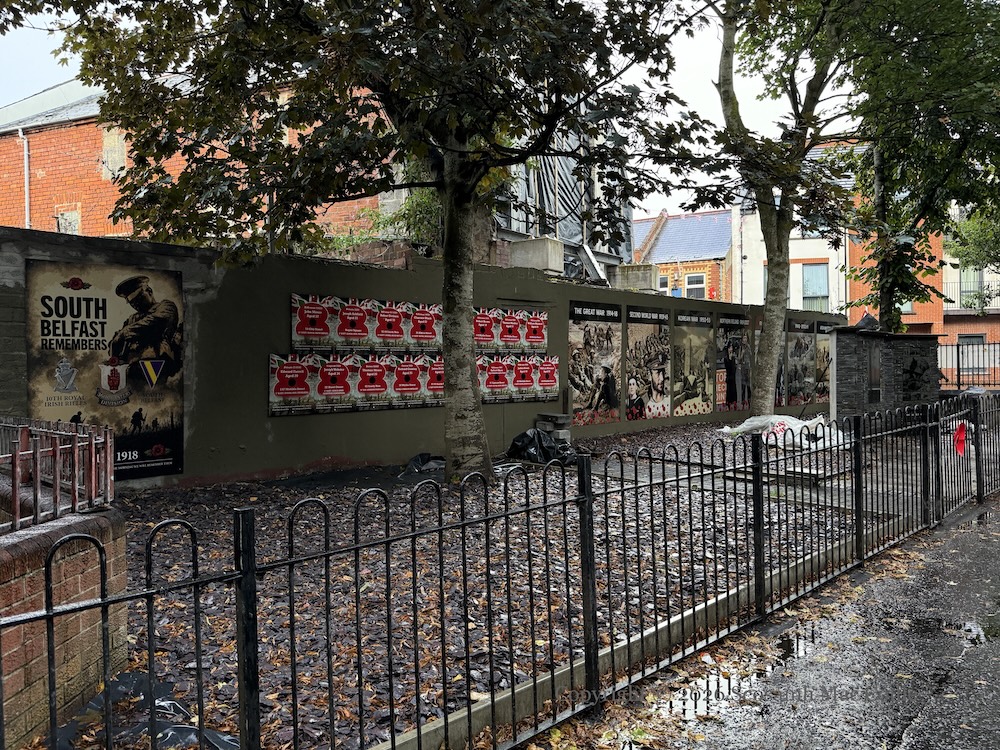
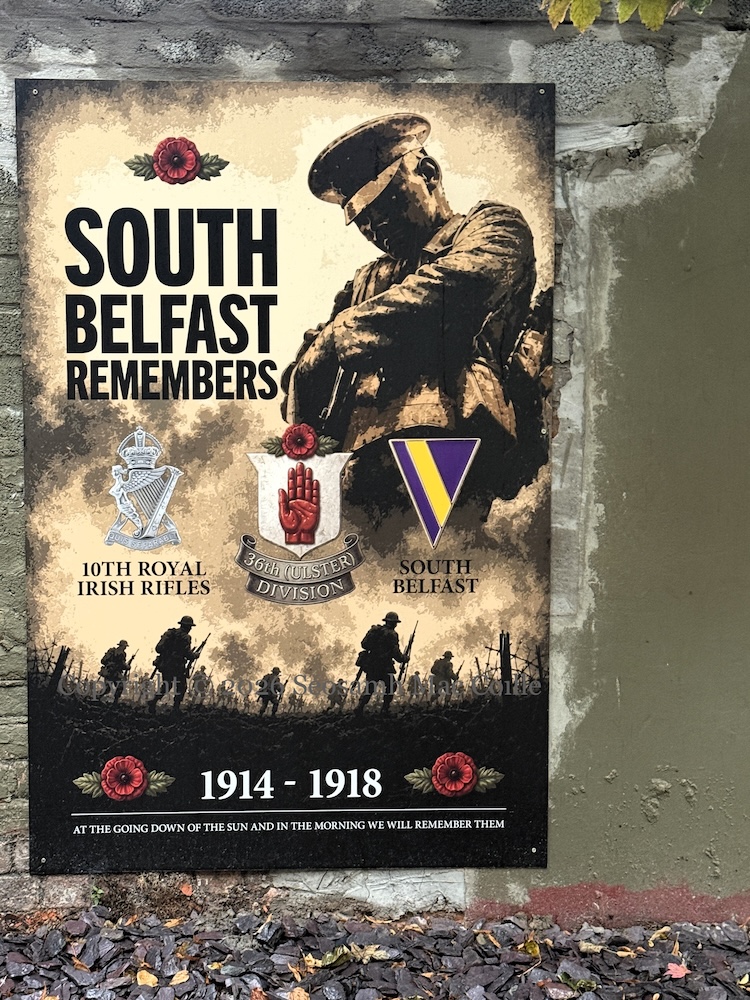
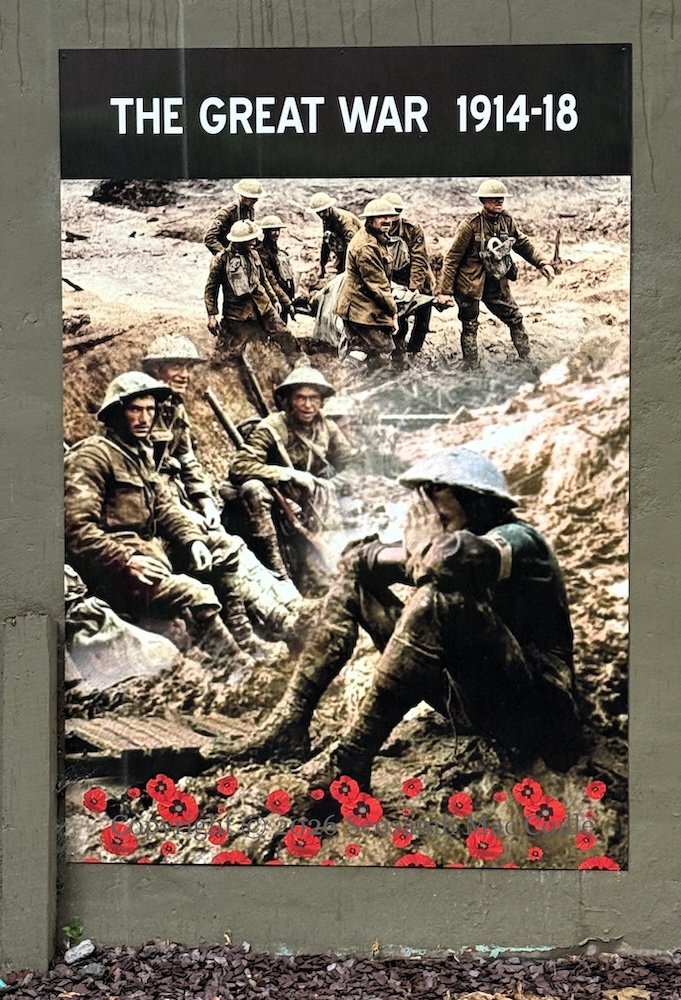
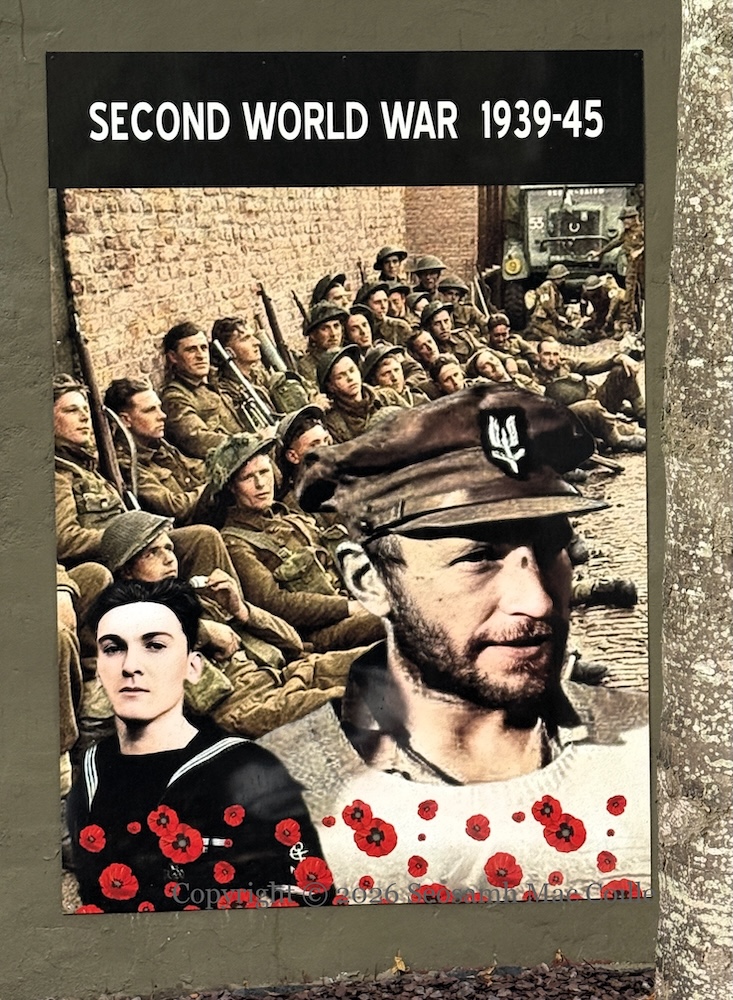
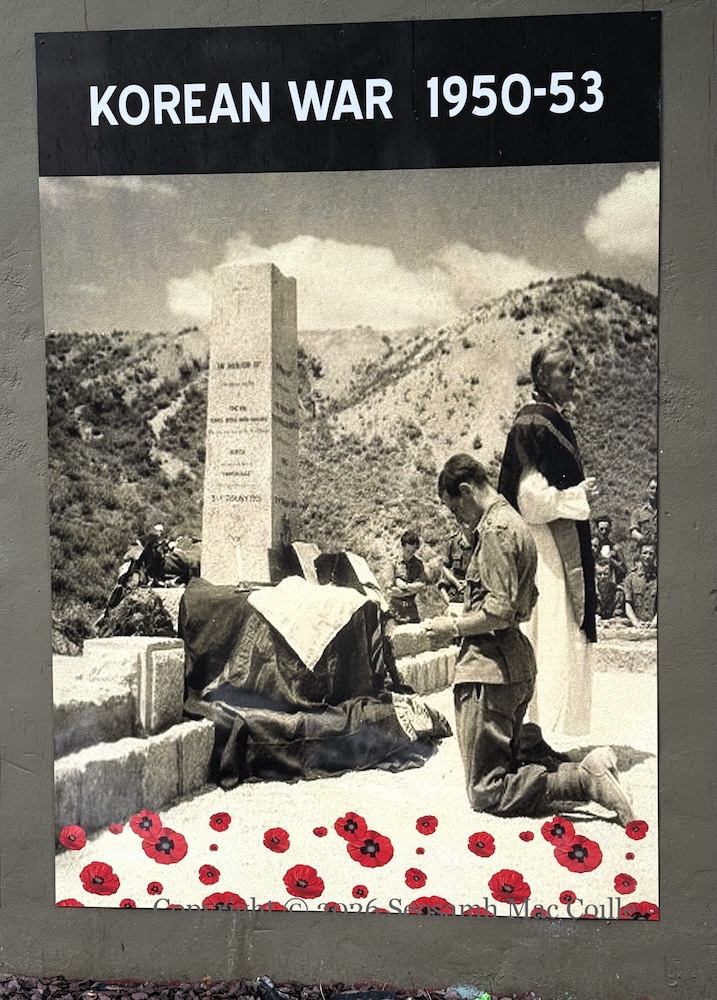
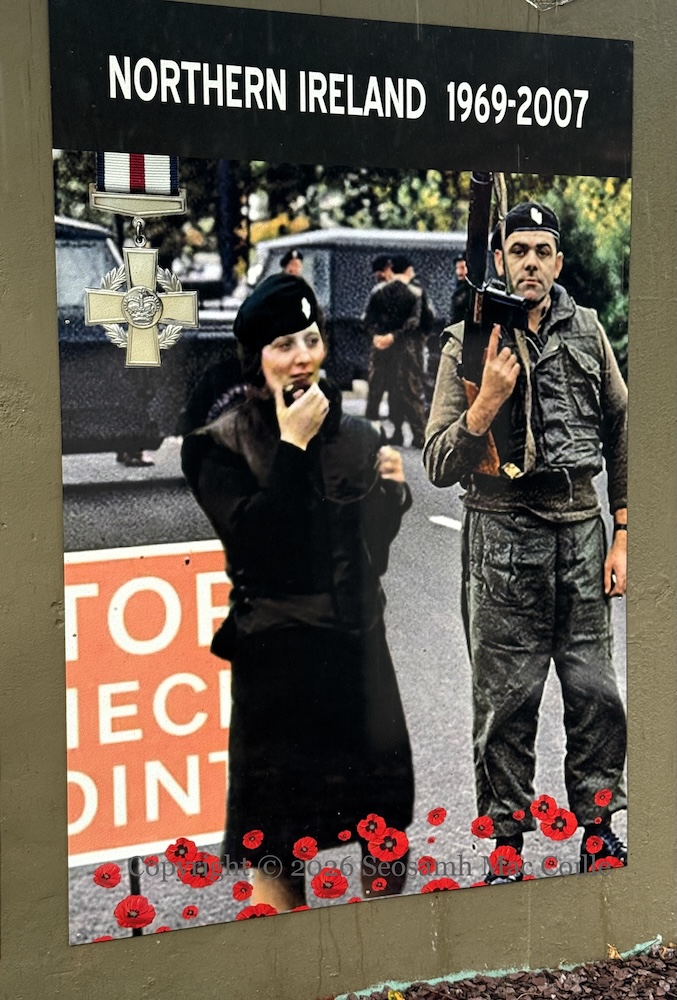
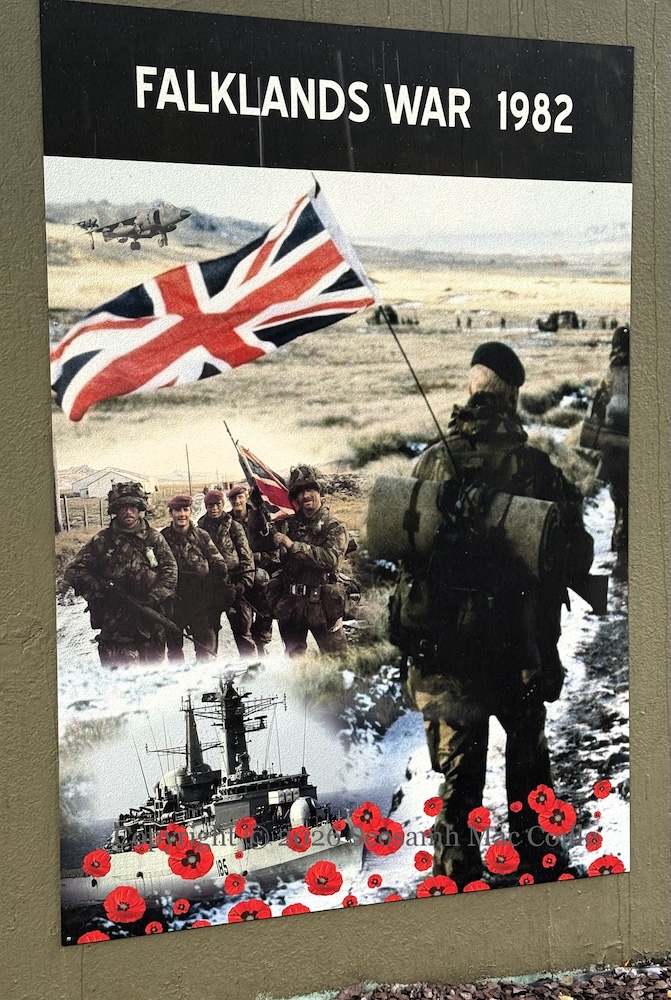
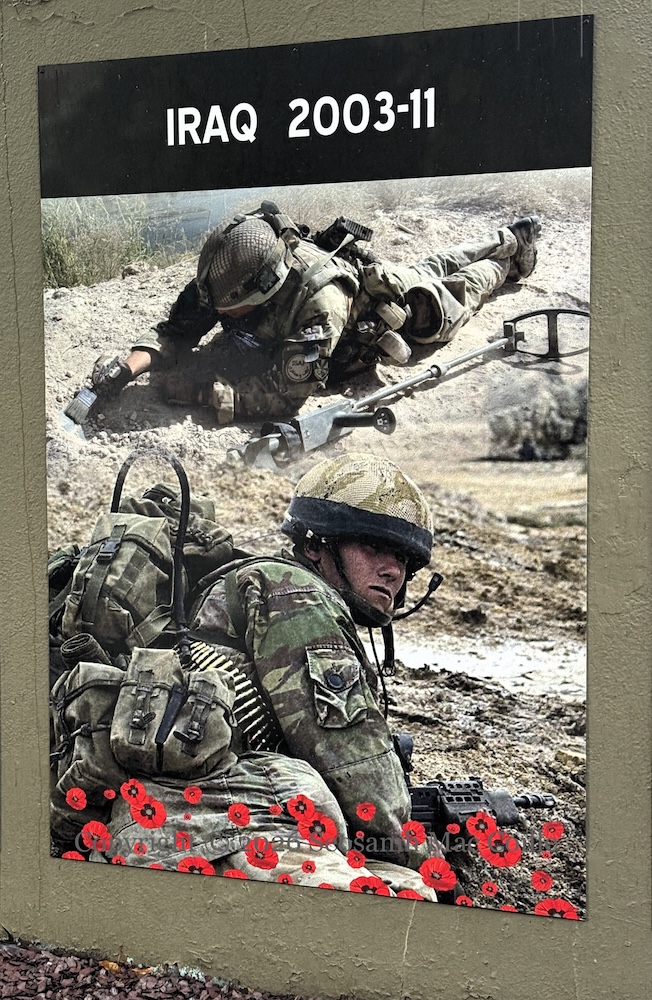
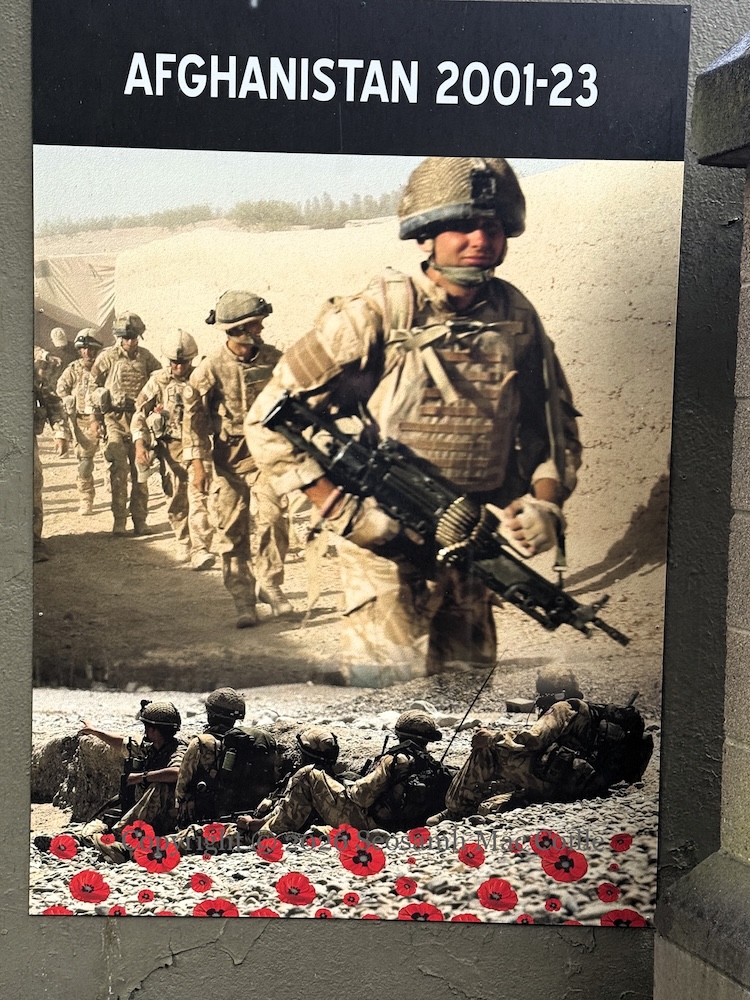
“South Belfast remembers [the] 10th Royal Irish Rifles, South Belfast, [and the] 36th (Ulster) Division.” Printed panels illustrating the engagements of the British Army in the twentieth and twenty-first centuries have been added to the three stones (seen in Continuing Conflicts) that marked the World Wars and “continuing conflicts”.
The conflicts depicted are the Great War 1914-1918, Second World War 1939-1945 (with individual photos of James Magennis and Blair Mayne, Korean War 1950-1953, Northern Ireland 1969-2007, Falklands War 1982 (the photo on the right is of troops “yomping”), Iraq 2003-2011, Afghanistan 2001-2023.
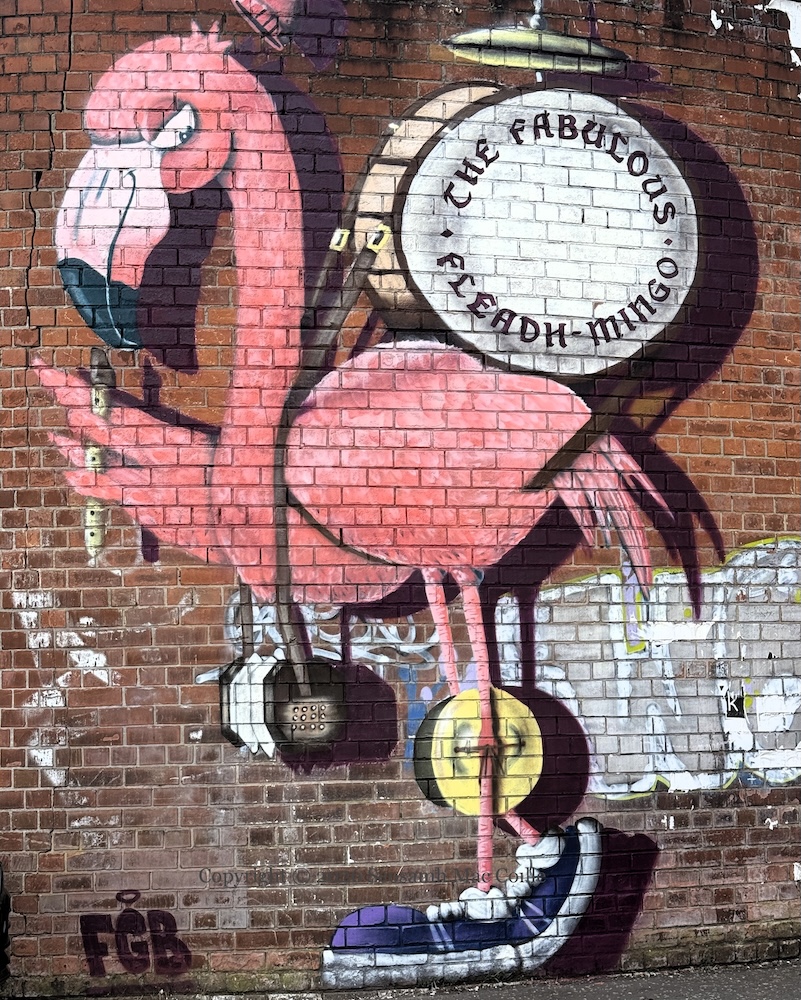
The Fabulous Fleadh-Mingo is a one-bird band, with drum, cymbals, concertina, and tin whistle. It was brought into being by FGB (web) in Dunbar Street, Belfast city centre, for Fleadh Cheoıl Na hÉıreann, alongside works in Commercial Court, the Dark Horse, Royal Avenue, and Writers’ Square.
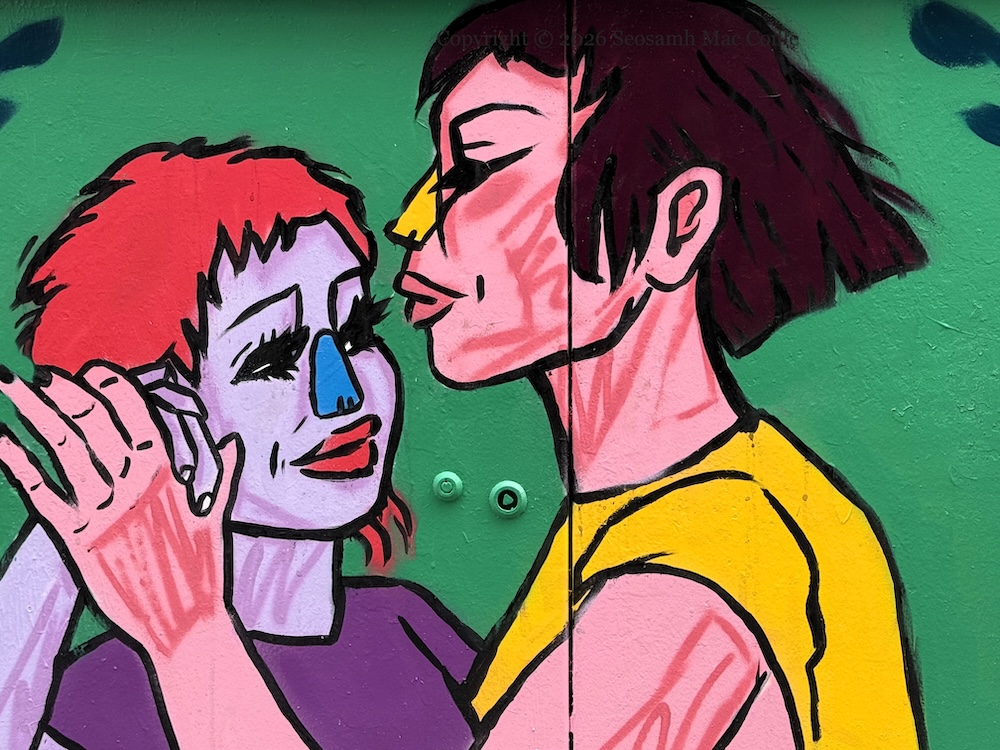
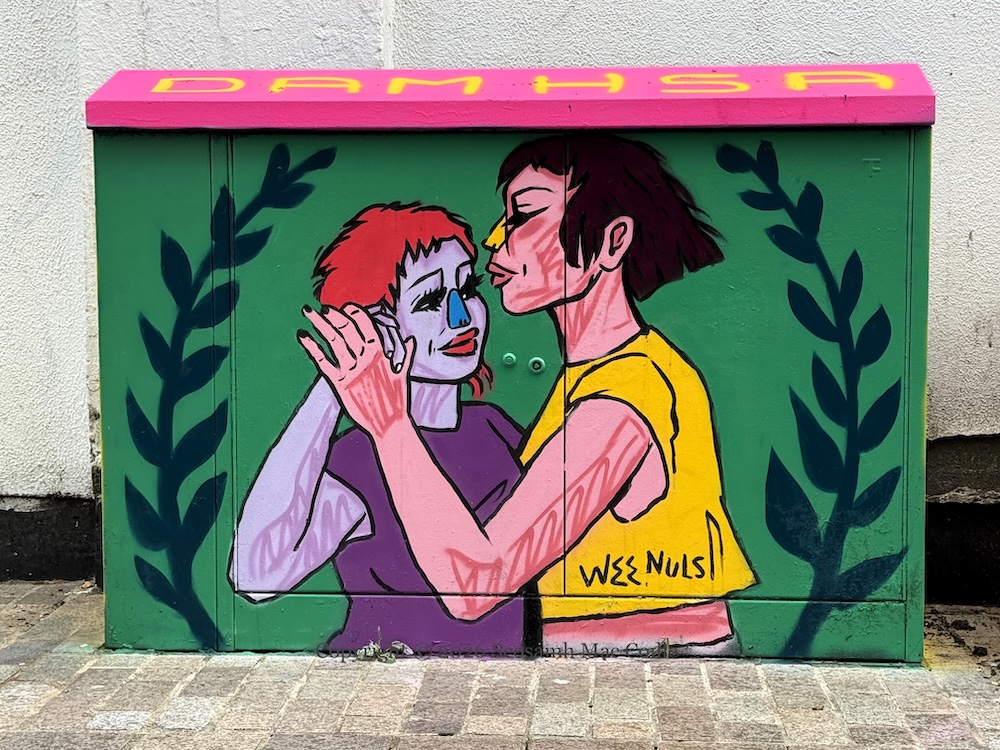
This junction box painted by Wee Nuls (web) during Fleadh Cheoıl Na hÉıreann is a tribute to céılí dancing and in particular to queer set dancing in the MAC.
Berry Street, just off Royal Avenue, Belfast city centre
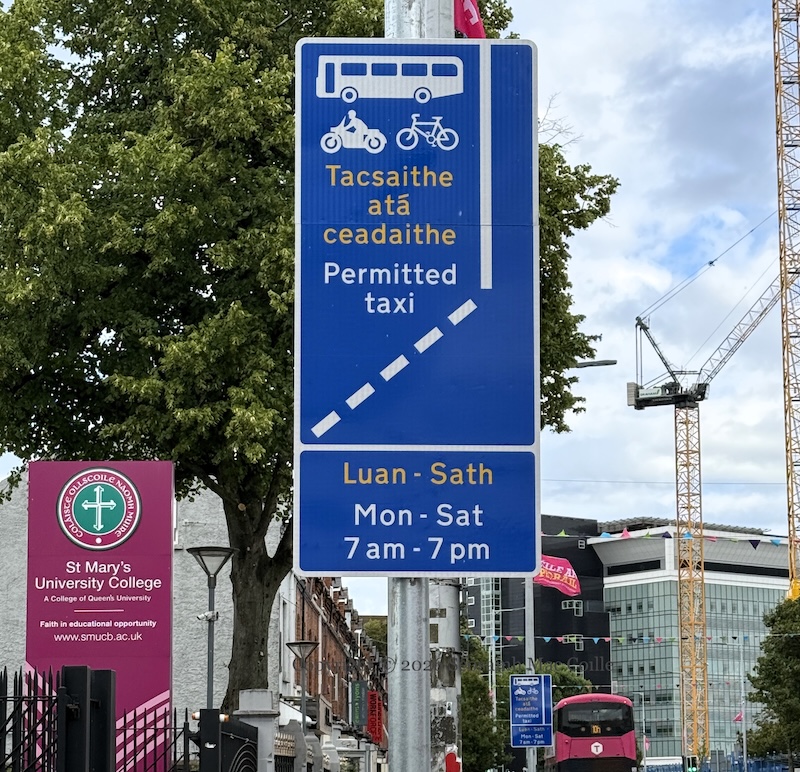
Dual-language (Irish and English) traffic signs and road-markings have been mounted/painted on the Falls Road in the Gaeltacht Quarter (specifically, between Springfield Road and Whiterock Road) by the Department Of Infrastructure/An Roinn Bonneagaır.
For other signs and markings – “Lána bus”, “Glanbhealach uırbeach, Luan go hAoıne [agus] ın am ar bıth ar an chosán”, “Deıreadh an lána bhus”, “Coınnıgh saor”, “Ceamaraí lána bus” – see the Paddy Duffy Collection.
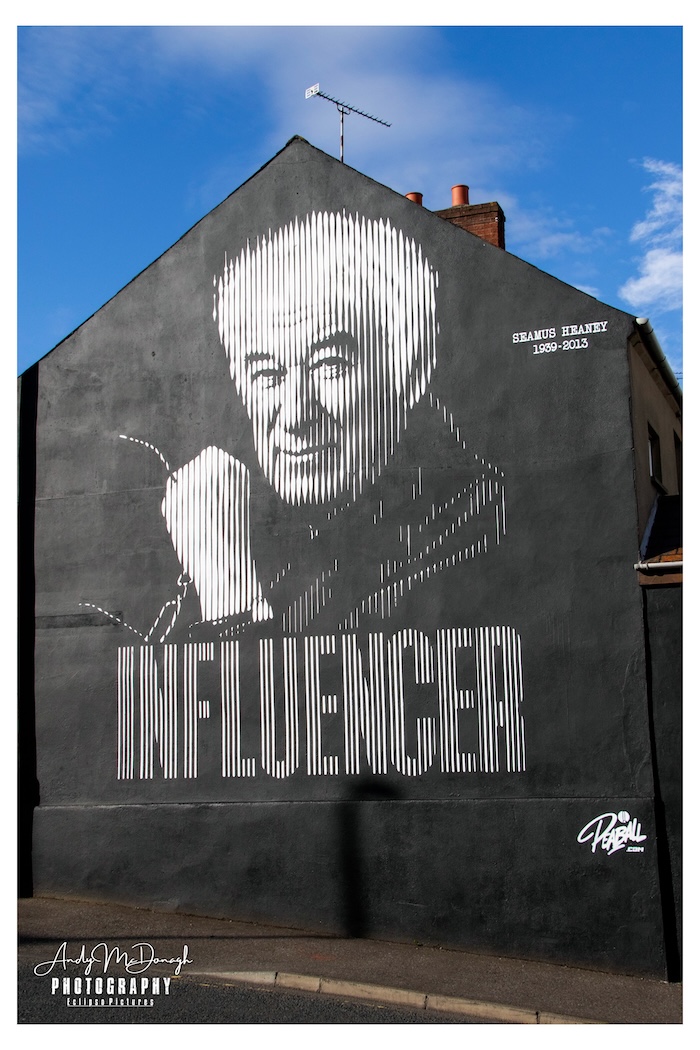
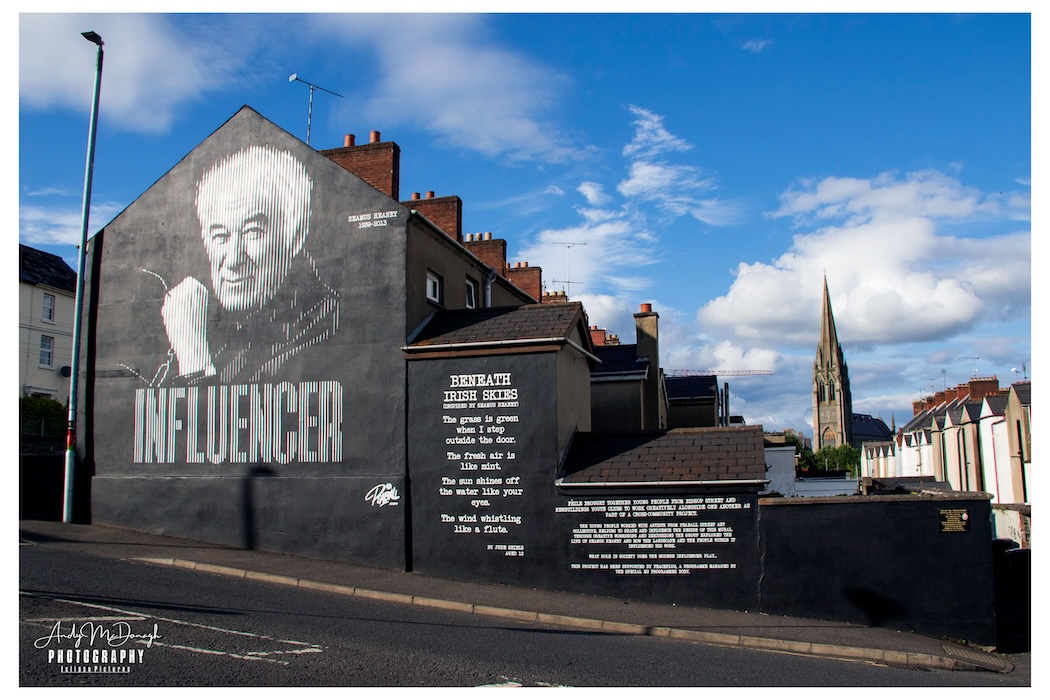
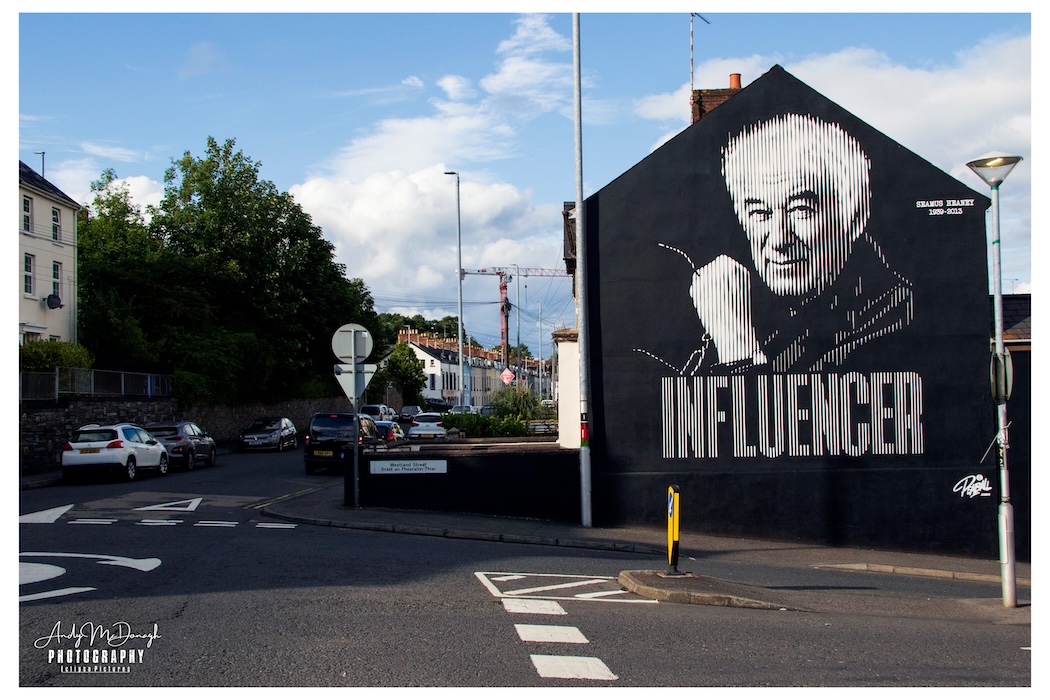
“Seamus Heaney 1929-2013.” Seamus Heaney was raised in Bellaghy and is buried in Bellaghy. Between these bookends, he attended boarding school in Derry and Queen’s in Belfast, and held academic positions in Belfast, California, Dublin, and Massachusetts. His poetry won him the Nobel Prize for Literature in 1995 and made him a household name. Although he largely pre-dates the social-media era, this new mural in Derry suggests that he is – or could be – an influencer.
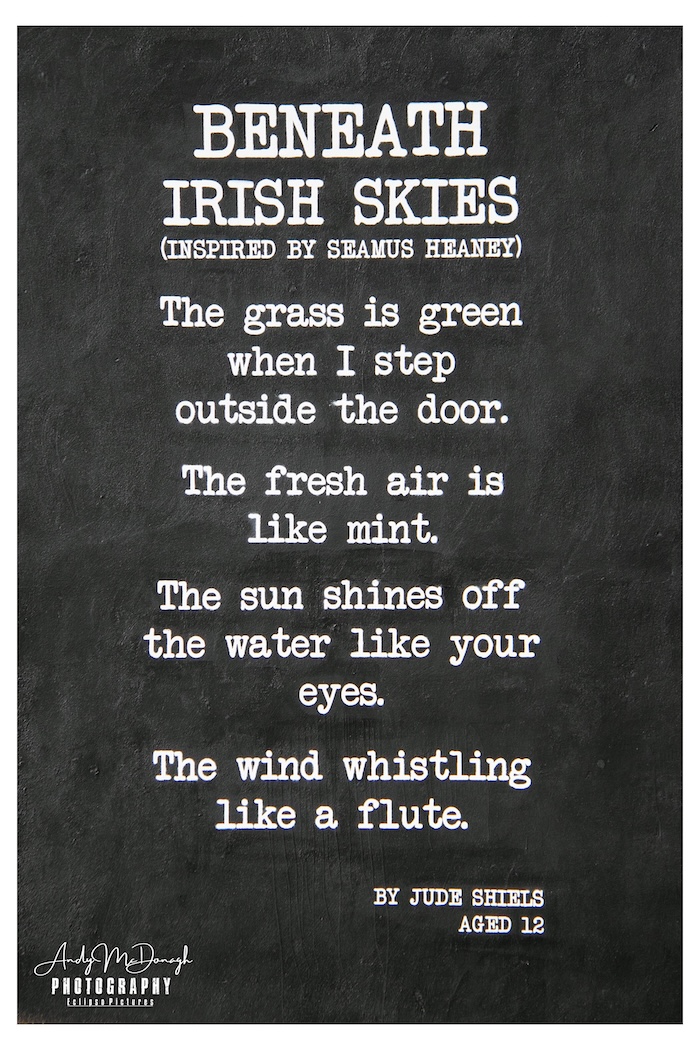
“Beneath Irish Skies (Inspired by Seamus Heaney) The grass is green when I step outside the door. The air is fresh like mint. The sun shines off the water like your eyes. The wind whistling like a flute. – by Jude Shiels, aged 12″
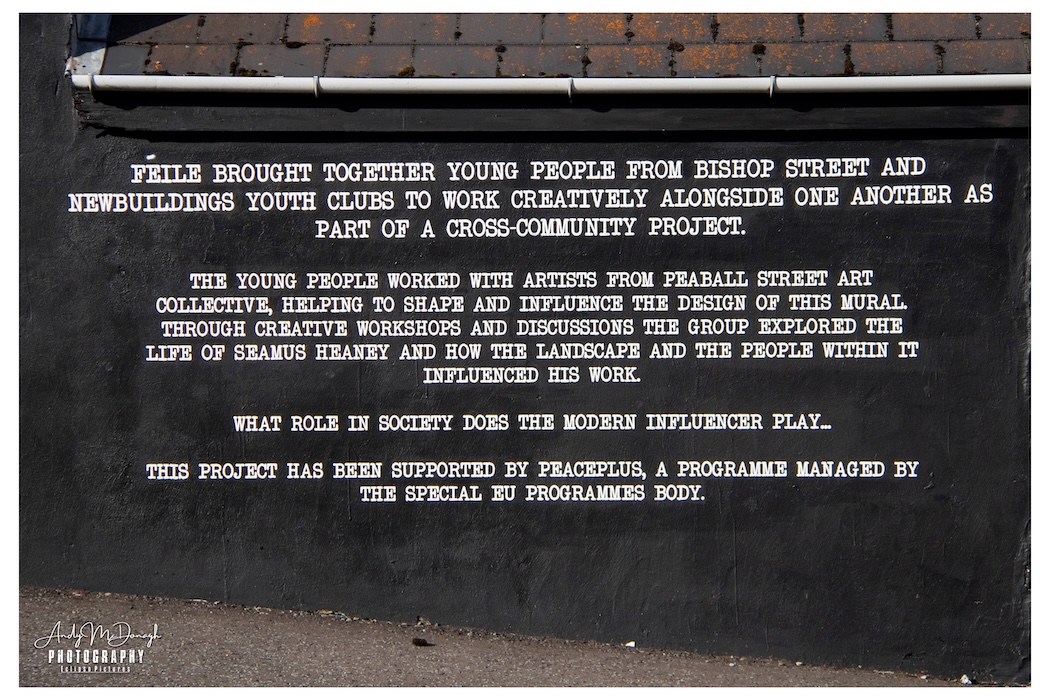
“Féile brought together young people from Bishop Street and Newbuildings youth clubs to work creatively alongside one another as part of a cross-community project. The young people worked with artists from Peaball [web] street art collective, helping to shape and influence the design of this mural. Through creative workshops and discussions the group explored the life of Seamus Heaney and how the landscape and the people within it influenced his work. What role in society does the modern influencer play … This project has been sponsored by PeacePlus, a programme managed by the Special EU Programmes body.”
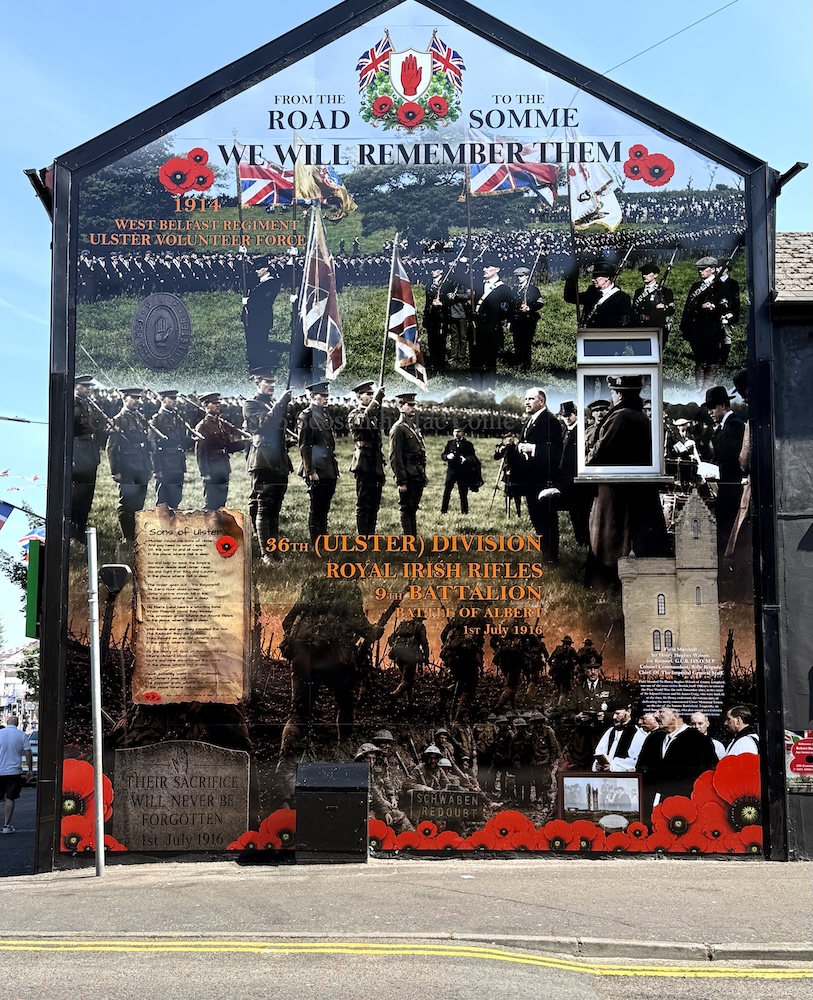
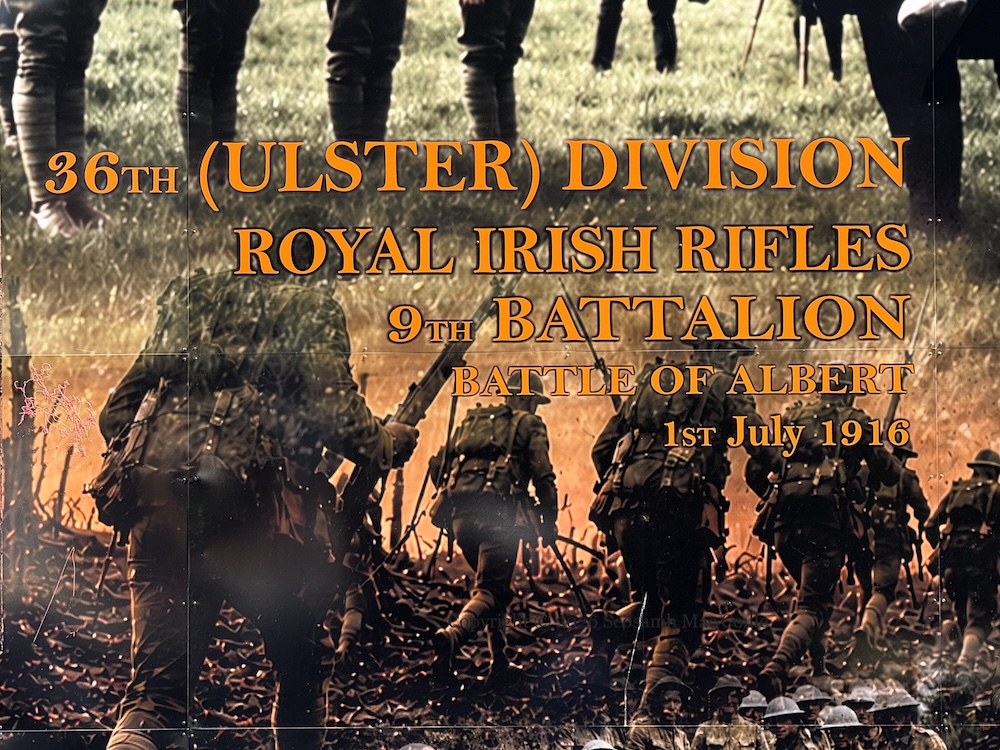
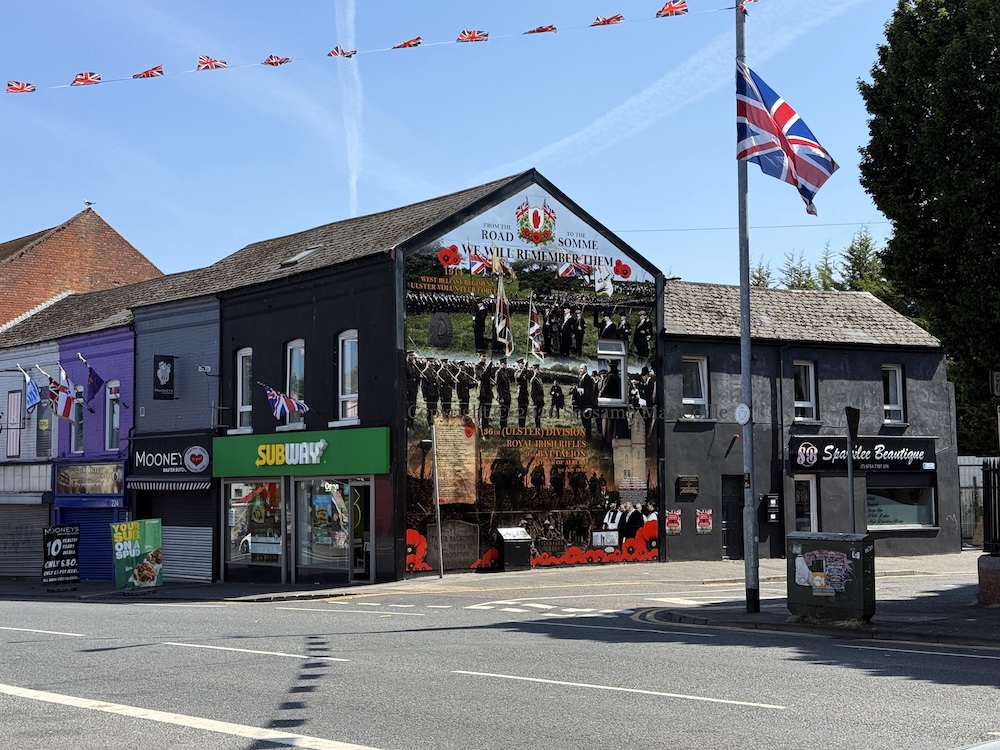
“1914 West Belfast regiment, Ulster Volunteer Force – 36th (Ulster) division, Royal Irish Rifles.” Men from the West Belfast Ulster Volunteers – which included the Shankill and Woodvale areas – joined the 9th battalion of the Royal Irish Rifles, which became part of the 107th brigade of the 36th division.
The main part of this new gable-sized board places two colourised photographs on top of each other. The first (upper) photo shows shows the first and second battalions of the West Down regiment being presented with their colours in May, 1914 (CyberProd). The second (lower) photo shows the first and second battalions of the West Belfast regiment receiving the Kings colours in May, 1914 (CyberProd).
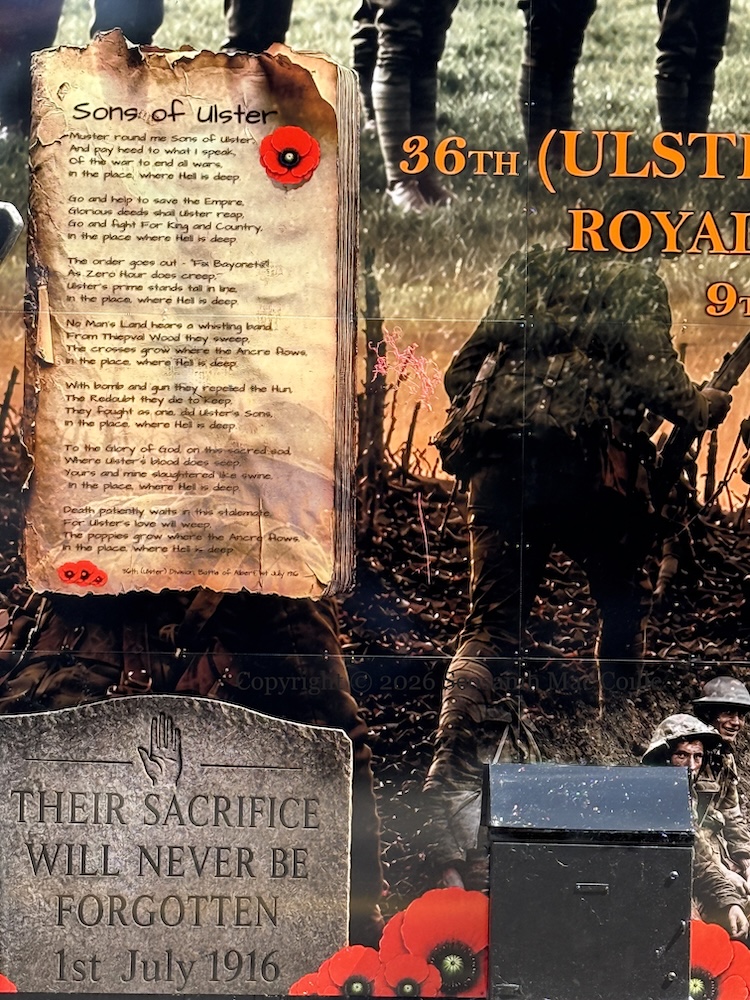
In the bottom left corner is a poem called “Sons of Ulster” written on a scroll: “Muster round me Sons of Ulster,/And pay heed to what I speak,/Of the war to end all wars,/In the place where hell is deep.//Go and help to save the Empire,/Glorious deeds shall Ulster reap./Go and fight for King and Country,/In the place where hell is deep.//The order goes out – “Fix Bayonets!”/As Zero Hour does creep,/Ulster’s prime stands tall in line,/In the place where hell is deep.//No-Man’s Land hears a whistling band,/From Thiepval Wood they sweep./The crosses grow where the Ancre flows,/In the place where hell is deep.//With bomb and gun they repelled the Hun,/The Redoubt they die to keep./They fought as one did Ulster’s Sons,/In the place where hell is deep.//To the Glory of God on this sacred sod,/Where Ulster’s Blood does seep,/Yours and mine slaughtered like swine,/In the place where hell is deep.//Death patiently waits in this stalemate,/For Ulster’s love will weep,/The poppies grow where the Ancre flows,/In the place where hell is deep.”
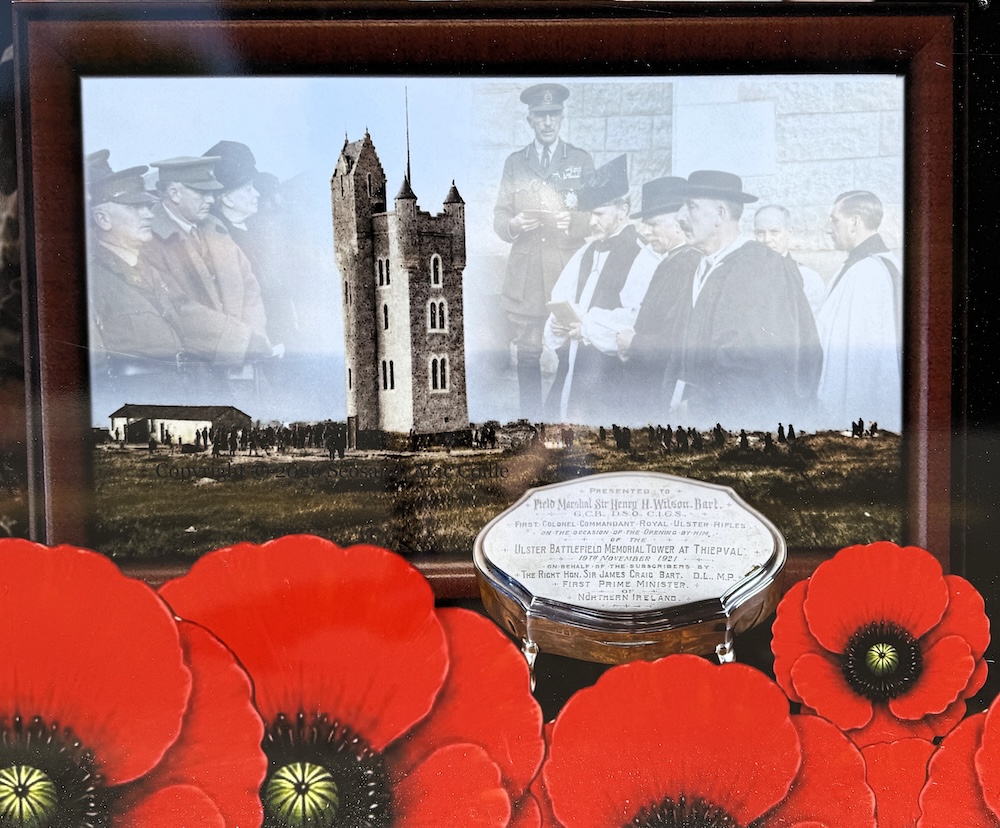
In the bottom right, the Ulster Tower is dedicated: “‘Field Marshall Sir Henry Hughes Wilson, 1st Baronet, GCB, DSO, MP, Colonel Commandant, Rifle Brigade, Chief Of The Imperial General Staff. Field Marshall Sir Henry Hughes Wilson of County Longford, was one of the most senior British Staff Officers to serve int he First World War. On 18th November 1921, in the stead of Sir Edward Carson and Sir James Craig, who were both ill at the time, Sir Henry undertook the solemn duty of dedicating the newly constructed Ulster Memorial Tower, on the site of the Somme battlefield. Tragically, on 22nd June 1922, Sir Henry, who also served as a Unionist politician, was assassinated outside his London home.”
Conway Street, Shankill, west Belfast, replacing Ulster Tower.
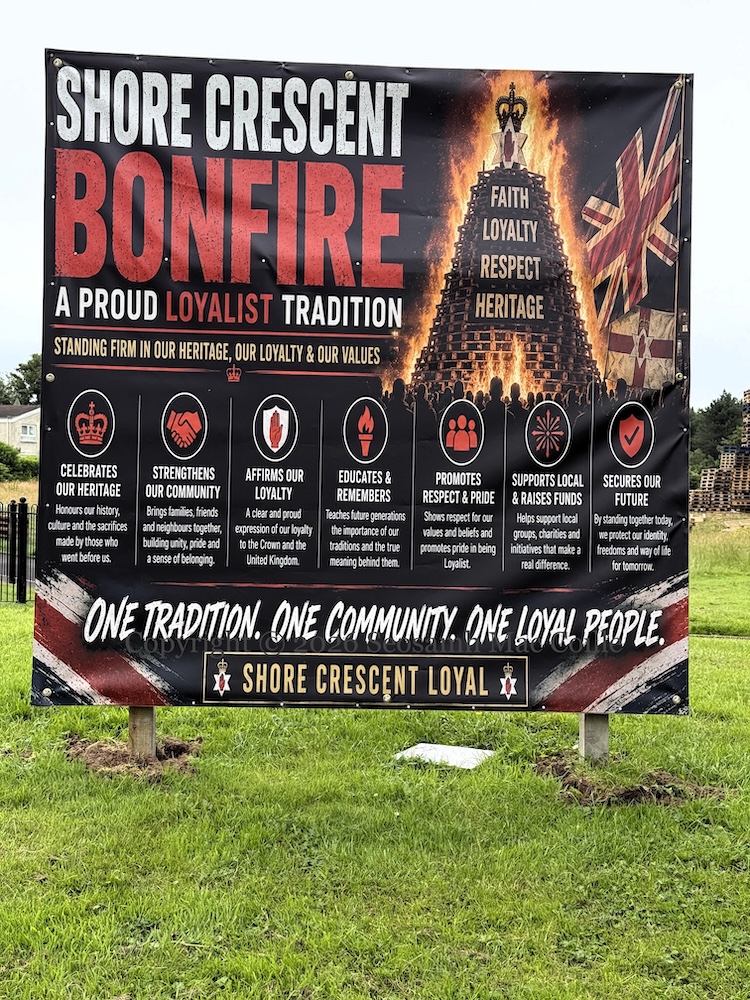
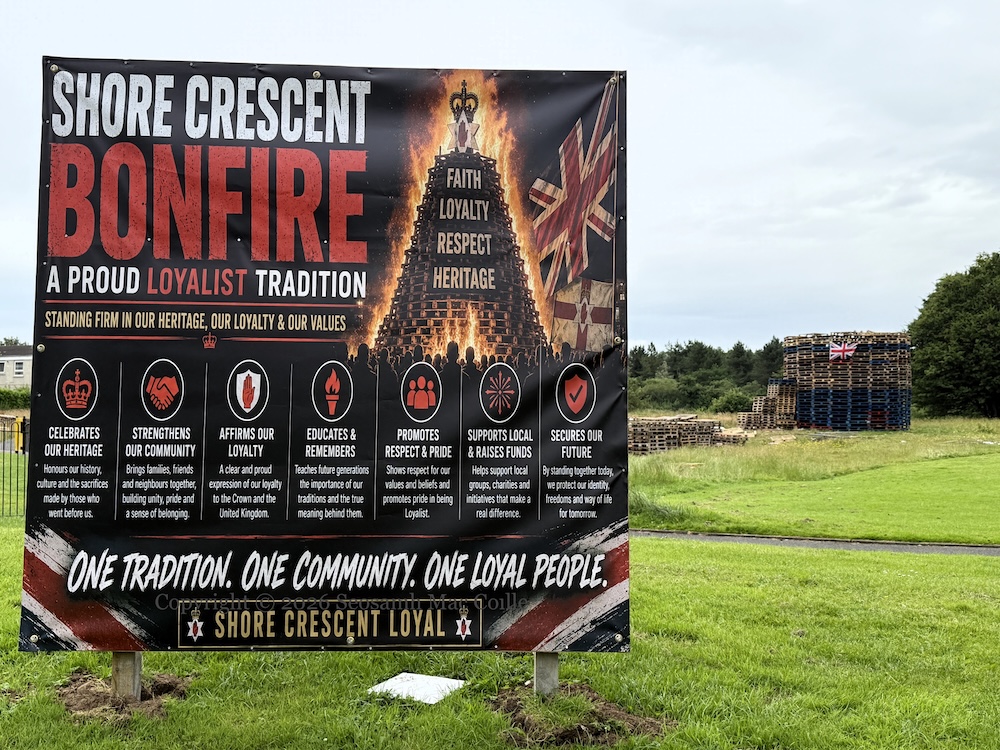
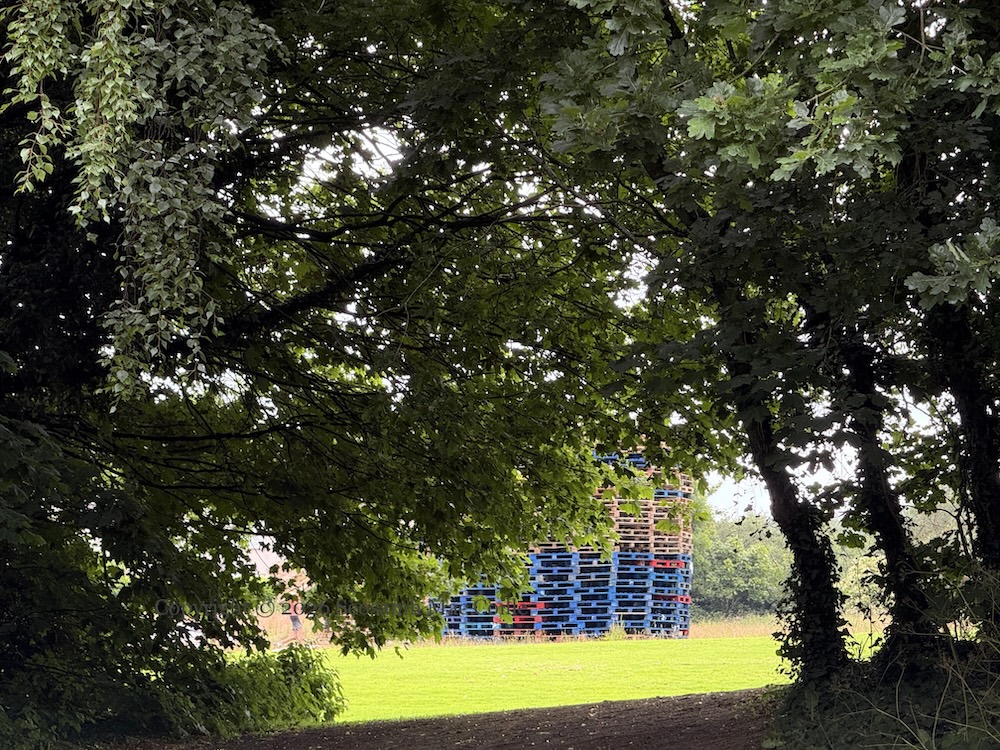
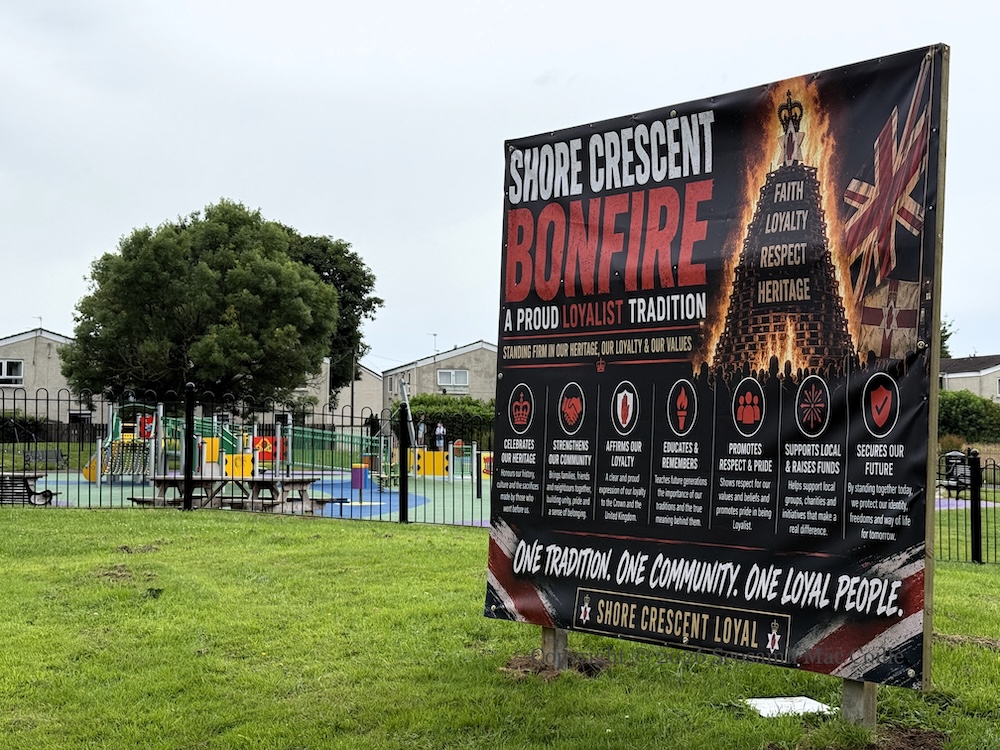
Shore Crescent prepares for Eleventh Night with a bonfire and a large sign explaining the positive impact of the tradition:
“Shore Crescent bonfire – a proud loyalist tradition. Standing firm in our heritage, our loyalty & our values. Faith – loyalty – respect – heritage. [The bonfire …] Celebrates our heritage – honours our history, culture and the sacrifices made by those who went before us; strengthens our community – brings families, friends and neighbours together, building unity, pride and a sense of belonging; affirms our loyalty – a clear and proud expression of our loyalty to the Crown and the United Kingdom; educates & remembers – teaches future generations the importance of our traditions and the true meaning behind them; promotes respect & pride – shows respect for our values and beliefs and promotes pride in being Loyalist; supports local [groups] & raises funds – helps support local groups, charities and initiatives that make a real difference; secures our future – by standing together today, we protect our identity, freedom and way of life for tomorrow. One tradition. One community. One loyal people. Shore Crescent loyal.”
Next to Loughside Playground, Shore Road, north Belfast
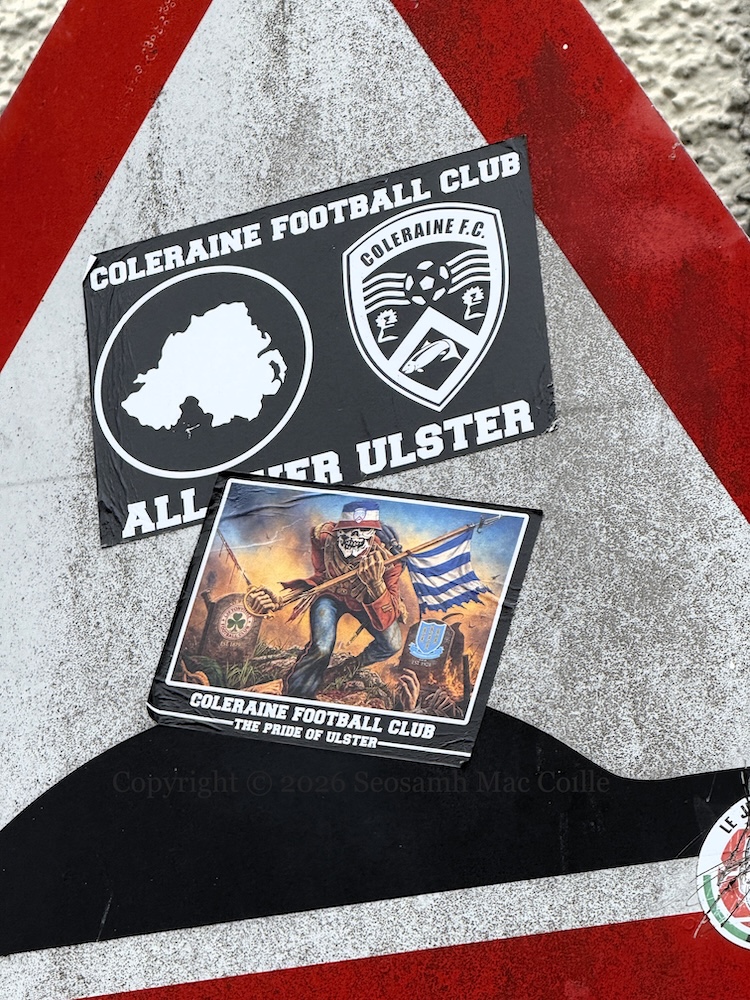
Eddie The Trooper makes an appearance as a Coleraine FC (“the pride of Ulster”) supporter, stomping on the grave of rival clubs Cliftonville (left) and Ballymena (right).
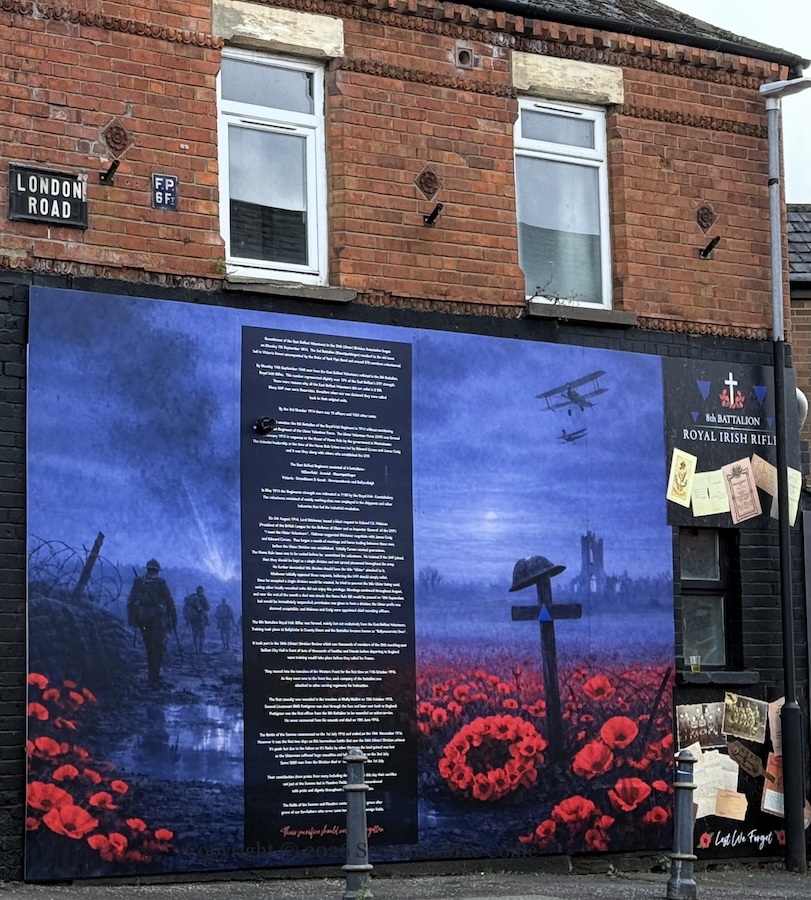
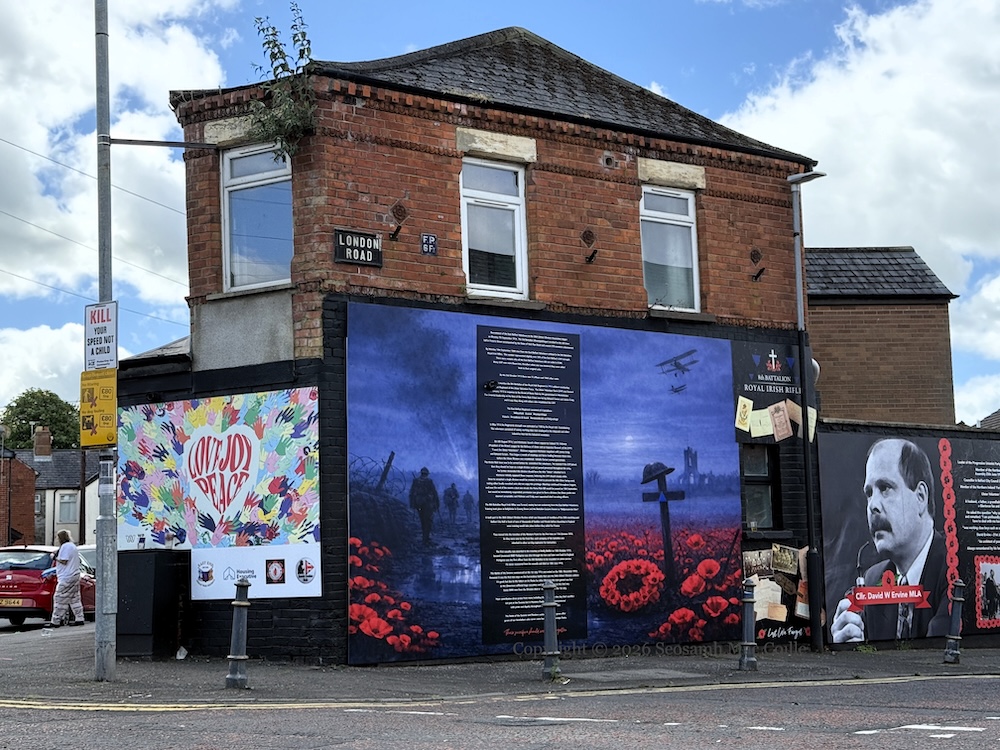
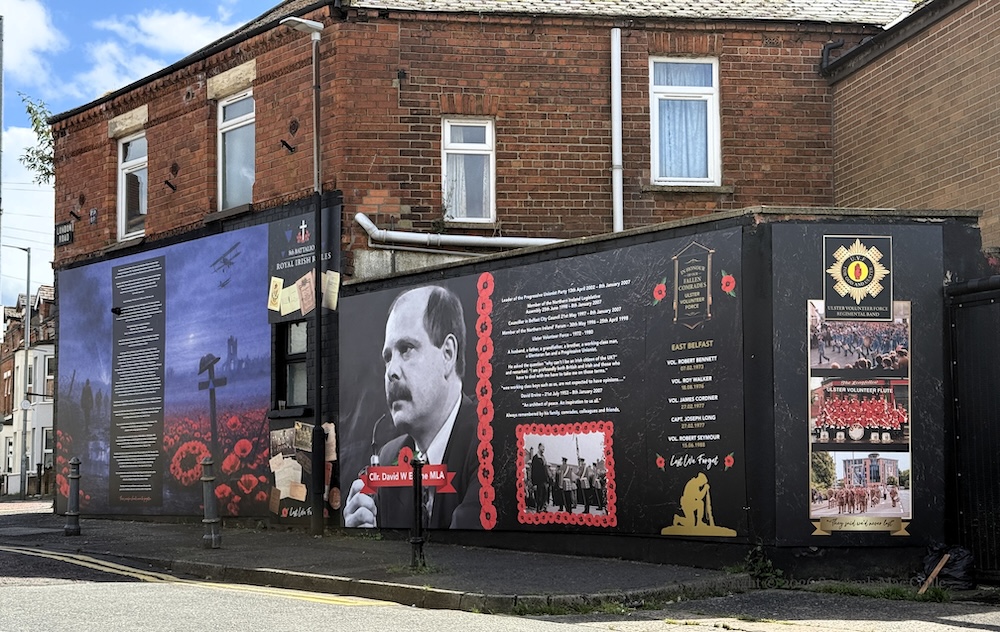
The UVF boards at the junction of London and My Lady’s roads in east Belfast have been completely replaced (compared to 2022). The hooded gunmen on the short side have been replaced by “Joy, peace, love” while a tribute to David Ervine now replaces the lettering reading “East Belfast Ulster Volunteer Force”. (For more about Ervine, and the UVF roll of honour, see the parallel entry in the Paddy Duffy Collection.)
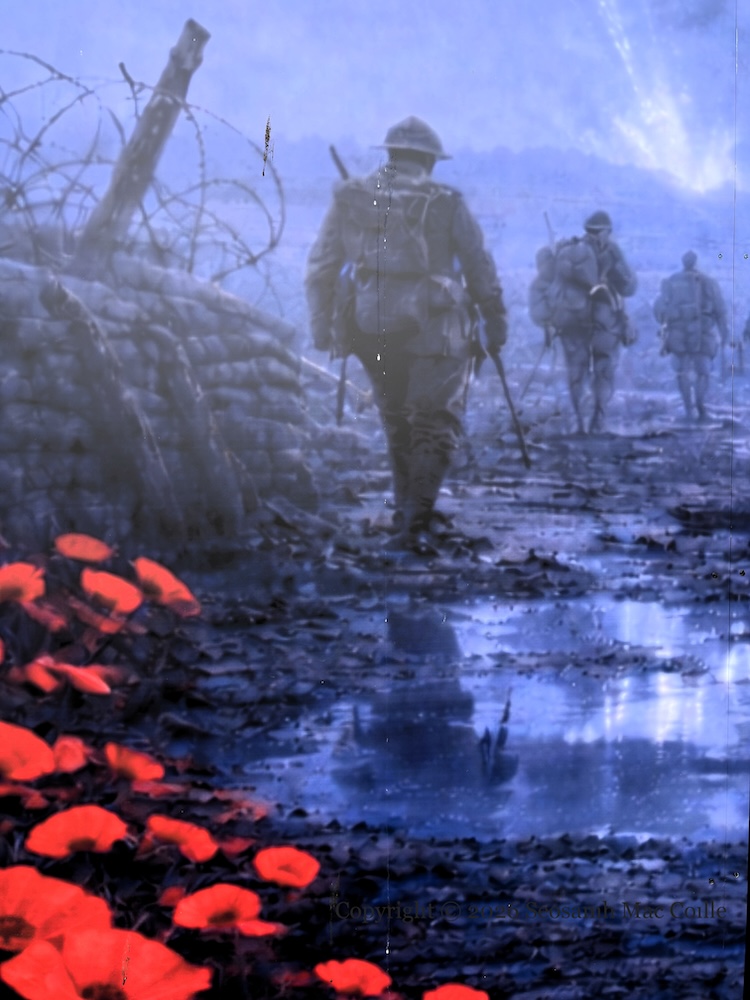
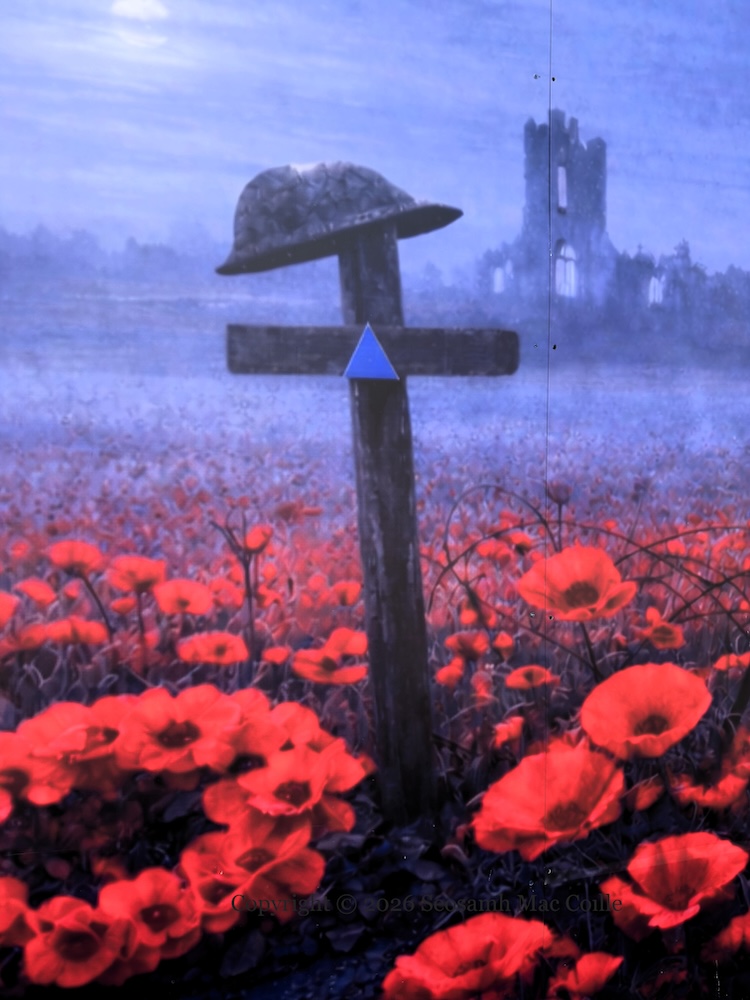
The largest panel remains a tribute to the dead of WWI, specifically now the “3rd battalion (Mountpottinger)” of the East Belfast regiment of the Ulster Volunteers who “marched to the old town hall in Victoria Street accompanied by the Duke Of York Pipe Band and around 270 members volunteered”. The long text explains the negotiation between Kitchener and Craig over the formation of the 36th Division, that the East Belfast volunteers joined the 8th Battalion of the Royal Irish Rifles, and that “training took place at Ballykinlar in County Down and the Battalion became known as “Ballymacarret’s Own”.”
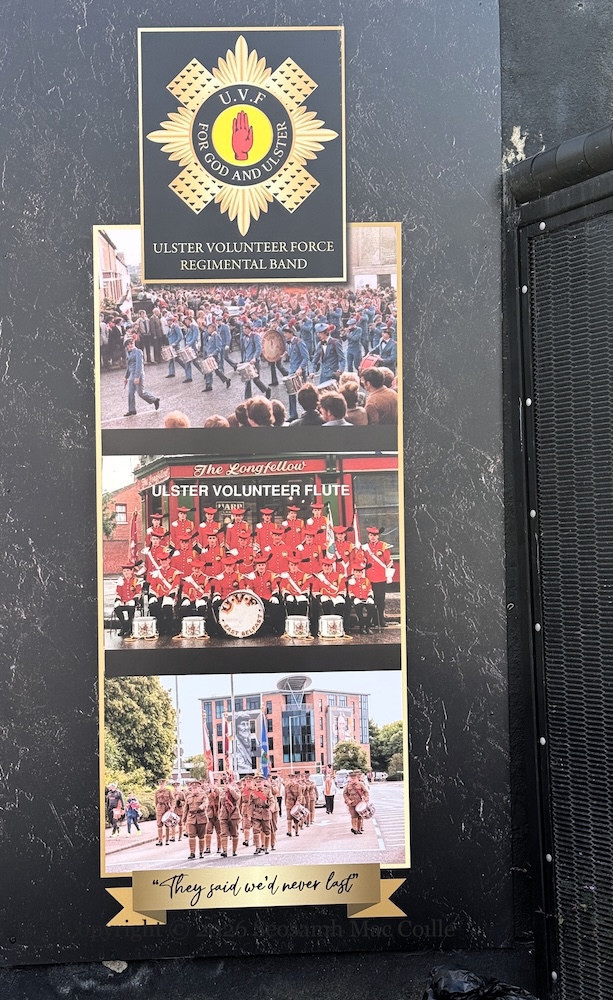
The final image shows the trio of photographs of the UVF flute band. The middle photograph has been changed since the launch, as it was of the band marching past the site of the 1992 Sean Graham bookies massacre to which family-members of the victims objected (Crime World) – again, see the parallel entry in the Paddy Duffy Collection. The photograph now in its place is of the band outside the Longfellow bar, which still stands in My Lady’s Road, facing these boards.
The full (and uncorrected) text of the central information board reads as follows: “Recruitment of the East Belfast Volunteers to the 36th (Ulster) Division Association began on Monday 7th September 1914. The 3rd Battalion (Mountpottinger) marched to the old town hall in Victoria Street accompanied by the Duke of York Pipe Band and around 270 members volunteered. By Monday 14th September 1044 men from the East Belfast Volunteers enlisted in the 8th Battalion, Royal Irish Rifles. This number represented slightly over 10% of the East Belfast’s UVF strength. There were reasons why all the East Belfast Volunteers did not enlist in 8 RIR. Many UVF men were Reservists, therefore when war was declared they were called back to their original units. By the 3rd October there was 15 officers and 1065 other ranks. [We] cannot mention the 8th Battalion of the Royal Irish Regiment in 1914 without mentioning th[e East] Belfast Regiment of the Ulster Volunteer Force. The Ulster Volunteer Force (UVF) was formed in January 1913 in response to the threat of Home Rule by the government in Westminster. The Unionist leadership at the time of the Home Rule Crises was led by Edward Carson and James Craig and it was they along with others who established the UVF. The East Belfast Regiment consisted of 6 battalions:– Willowfield, Avoniel, Mountpottinger, Victoria, Strandtown & Knock, Newtownbreda and Ballynafeigh. In May 1914 the Regiments strength as 7100 by the Royal Irish Constabulary. The volunteers consisted of mainly working-class men employed in the shipyards and other industries that fed the industrial revolution. On 6th August 1914, Lord Kitchener, issued a blunt request to Colonel T.E. Hickman (President of the British League for the Defence of Ulster and an Inspector General of the UVF): “I want the Ulster Volunteers”. Hickman suggested Kitchener negotiate with James Craig and Edward Carson. Thus began a month of meetings and horse trading between these men, before the Ulster Division was established. Initially Carson wanted guarantees. The Home Rule issue was to be sorted before he committed the volunteers. He insisted if the UVF joined, then they should be kept as a single division and not spread piecemeal throughout the army. He further demanded this division should have the title “Ulster” attached to it. Kitchener initially opposed these requests, believing the UVF should simply enlist. Once he accepted a single division would be created, he tried to prevent the title Ulster being used, noting other locally recruited units did not enjoy this privilege. Meetings continued throughout August, and near the end of the month a deal was struck: the Home Rule Bill would be passed on 18th September, but would be immediately suspended; permission was given to form a division; the Ulster prefix was deemed acceptable; and Hickman and Craig were appointed chief recruiting officers. The 8th Battalion Royal Irish Rifled was formed, mainly but not exclusively from the East Belfast Volunteers. Training took place at Ballykinlar in County Down and the Battalion became know as “Ballymacarrets Own”. It took part in the 36th (Ulster) Division Review which saw thousands of members of the 36th marching past Belfast City Hall in front of tens of thousands of families and friends before departing to England were training would take place before they sailed for France. They moved into the trenches of the Western Front for the first time on 11 October 1915. As they were new to the fron line, each company of the battalion was attached to other serving regiments for instruction. The first casualty was recorded in the trenches at Mailly-Maillet on 15th October 1915. Second Lieutenant RME Pettigrew was shot through the face later sent back to England. Pettigrew was the first officer from the 8th Battalion to be wounded on active service. He never recovered from his wounds and died on 10th June 1916. The Battle of the Somme commenced on the 1st July 1916 and ended on the 18th November 1916. However it was the first two days on the horrendous battle that saw the 36th (Ulster) Division achieve it’s goals but due to the failure on it’s flanks by other Divisions the land gained was lost as the Ulstermen suffered huge casualties and left the frontline on the 2nd July. Some 5000 men from the Division died or where injured on the 1st July. Their contribution drew priase from many including the King and to this day their sacrifice not just at the Somme but in Flanders Fields, Belgium is remembered with pride and dignity throughout the province of Ulster. The fields of the Somme and Flanders contain grave after grave after grave of our forefathers who never came home and lie in foreign fields. Their sacrifice should never be forgotten.”
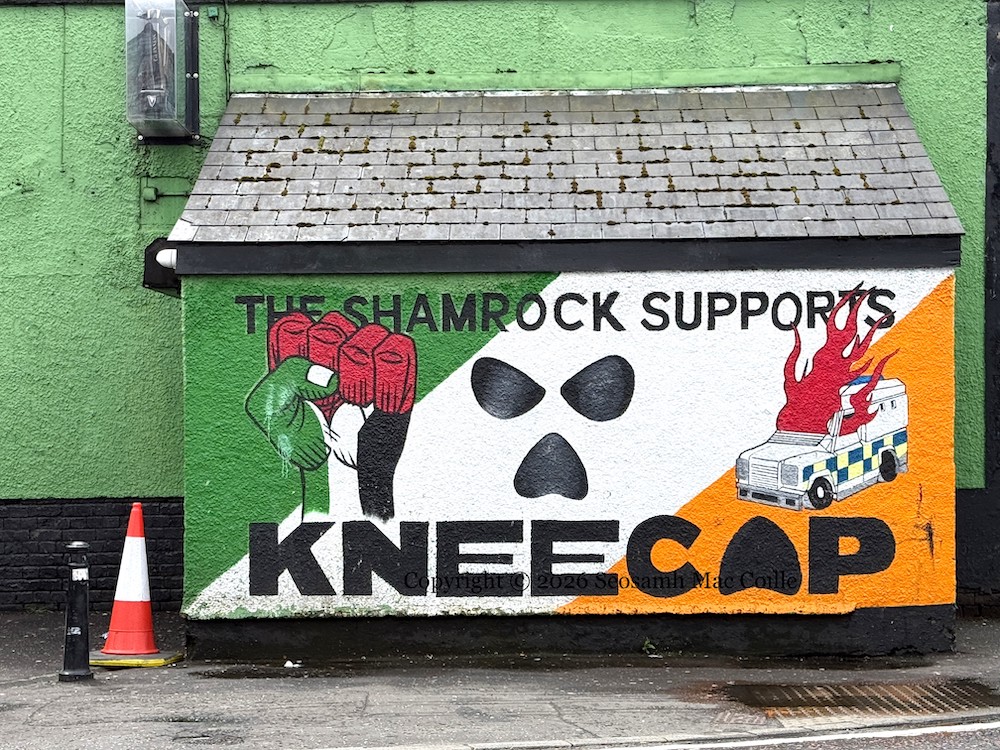
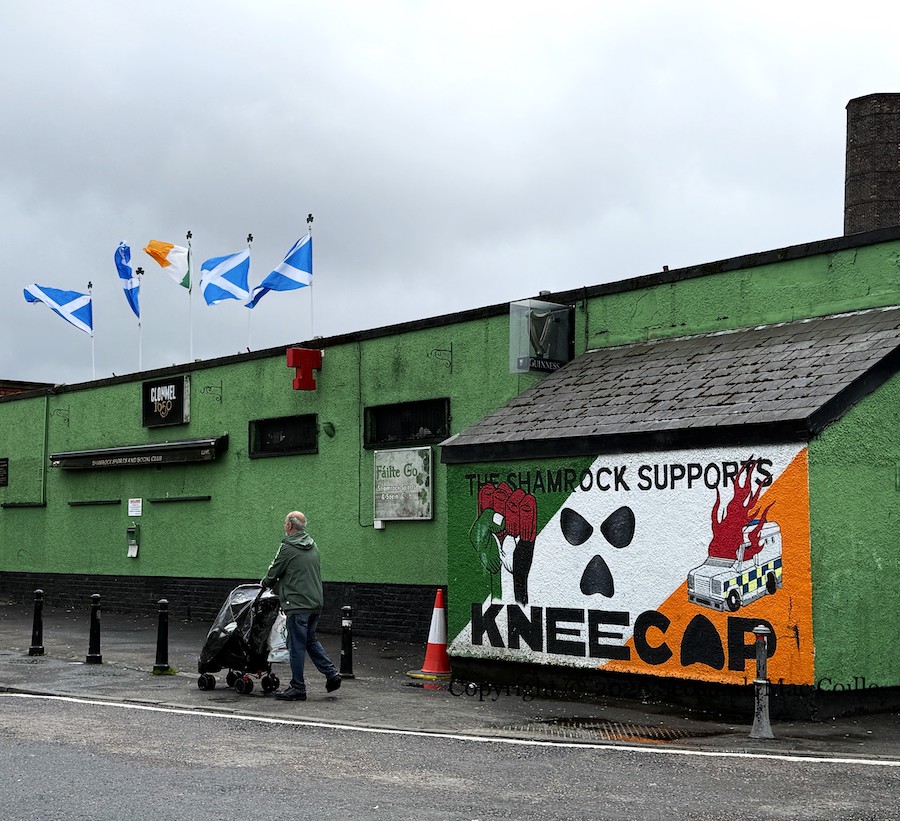
“The Shamrock supports Kneecap”. At the time this mural was originally painted, in June 2025, Kneecap member Mo Chara (Lıam Óg Ó hAnnaıdh) was facing charges of displaying a flag of a proscribed organisation (Hezbollah). That charge was thrown out on technical grounds and the appeal against that motion was denied in March (BBC).
The Scottish flags are flying over the Shamrock in support of the World Cup soccer team. Scotland is in Group C with Haiti, Morocco, and Brazil.