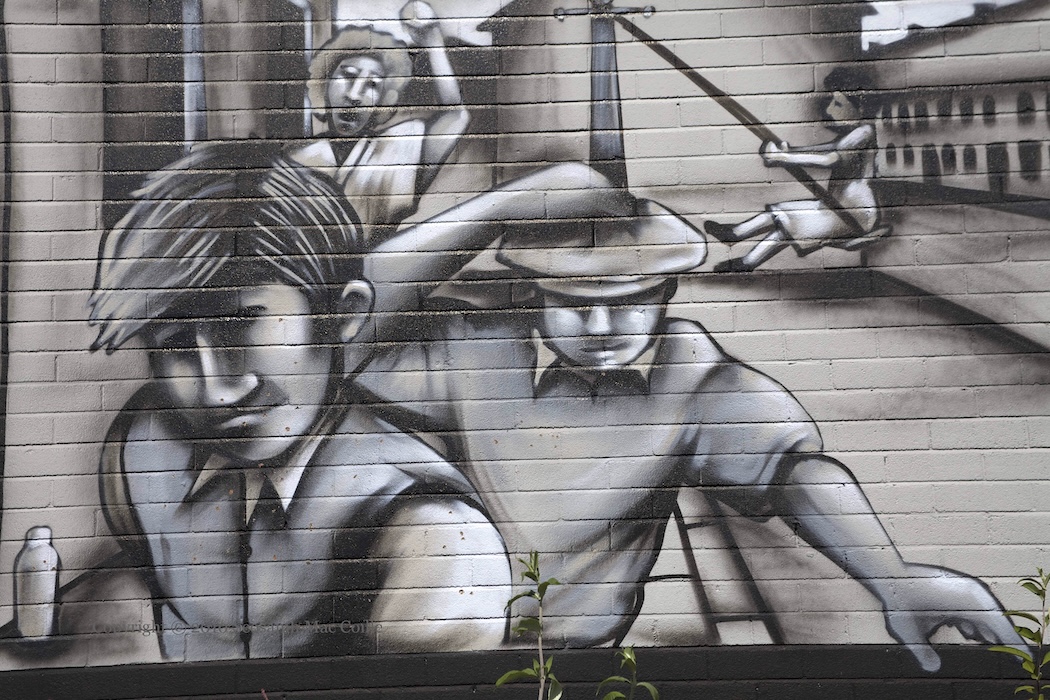
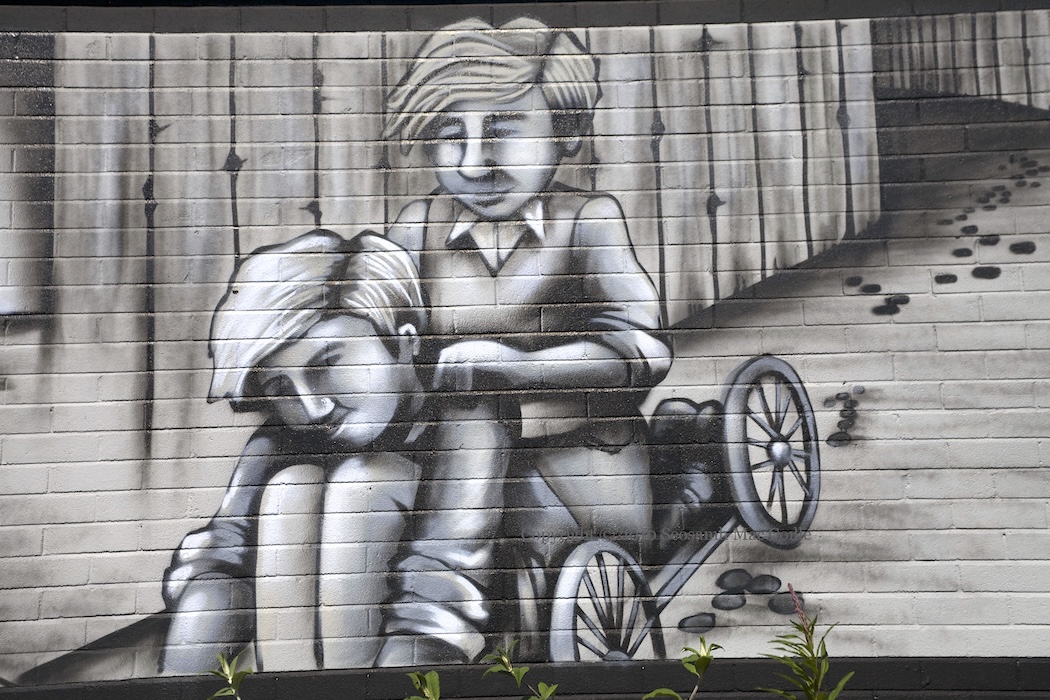
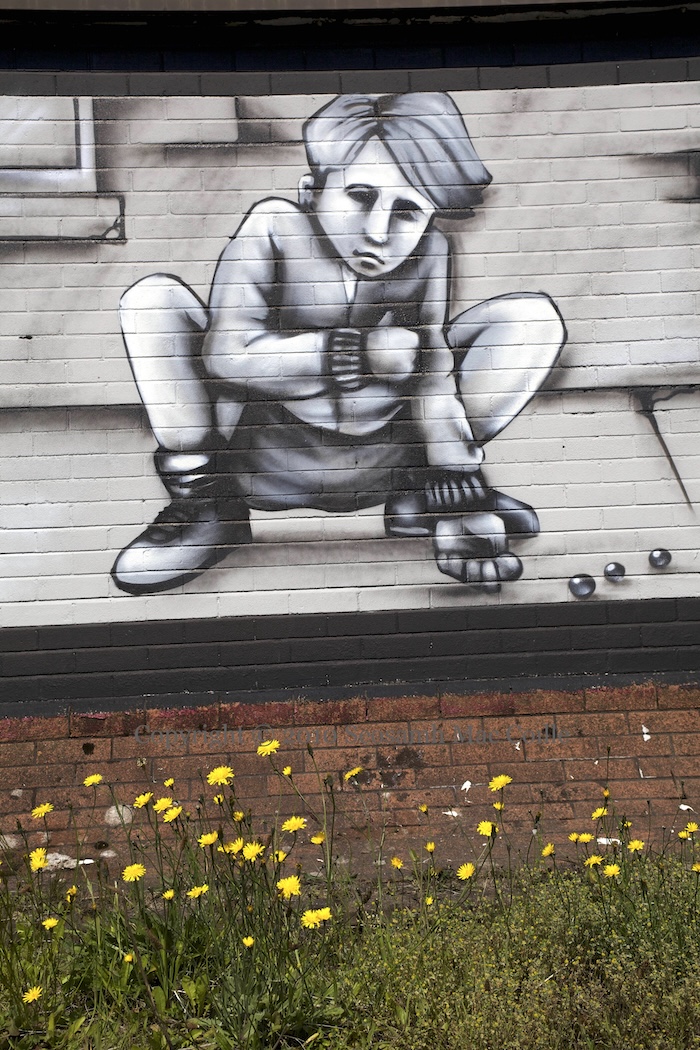
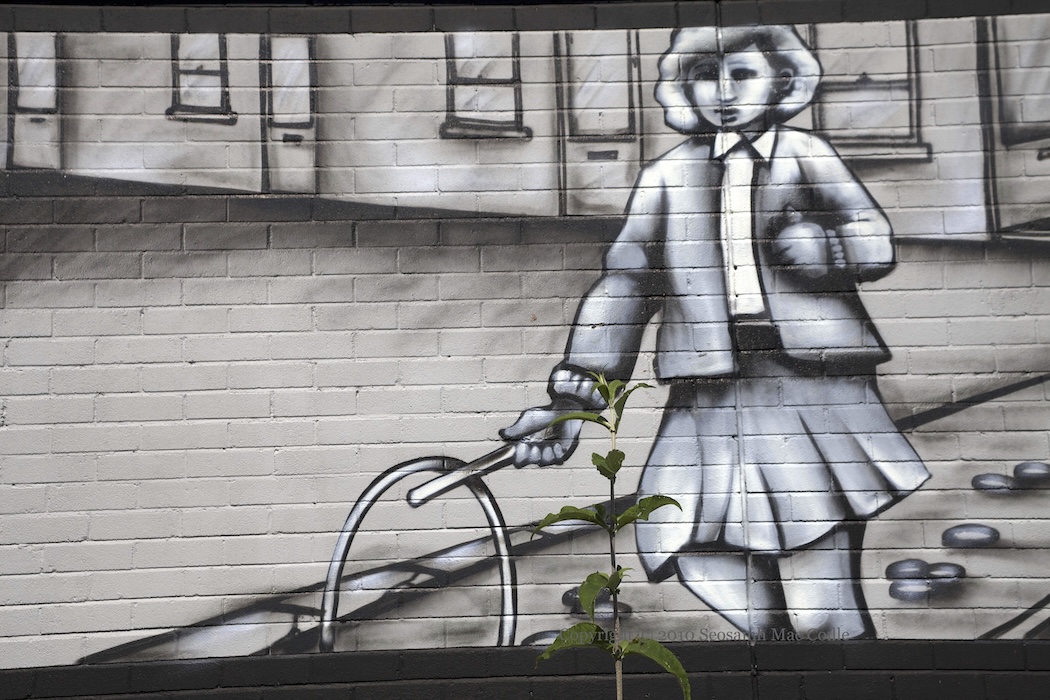
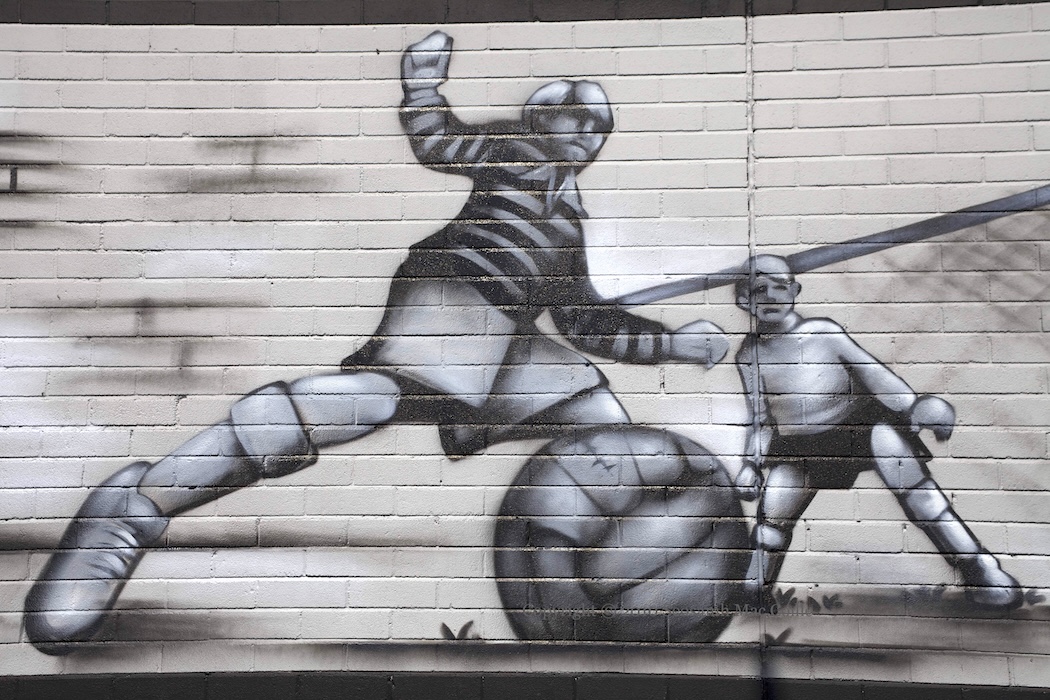
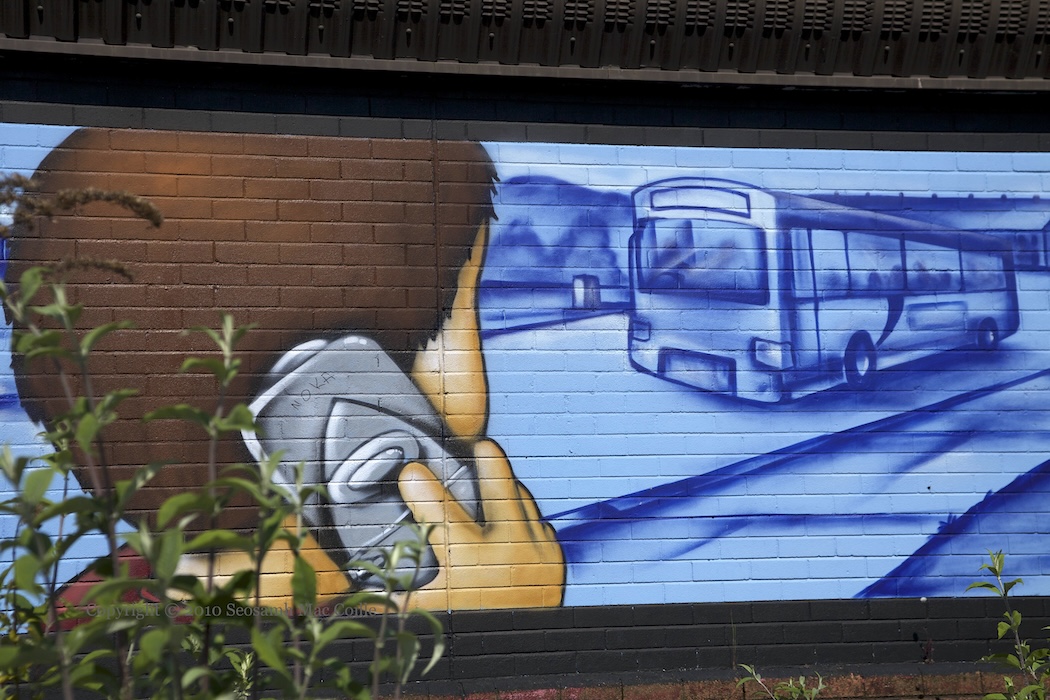
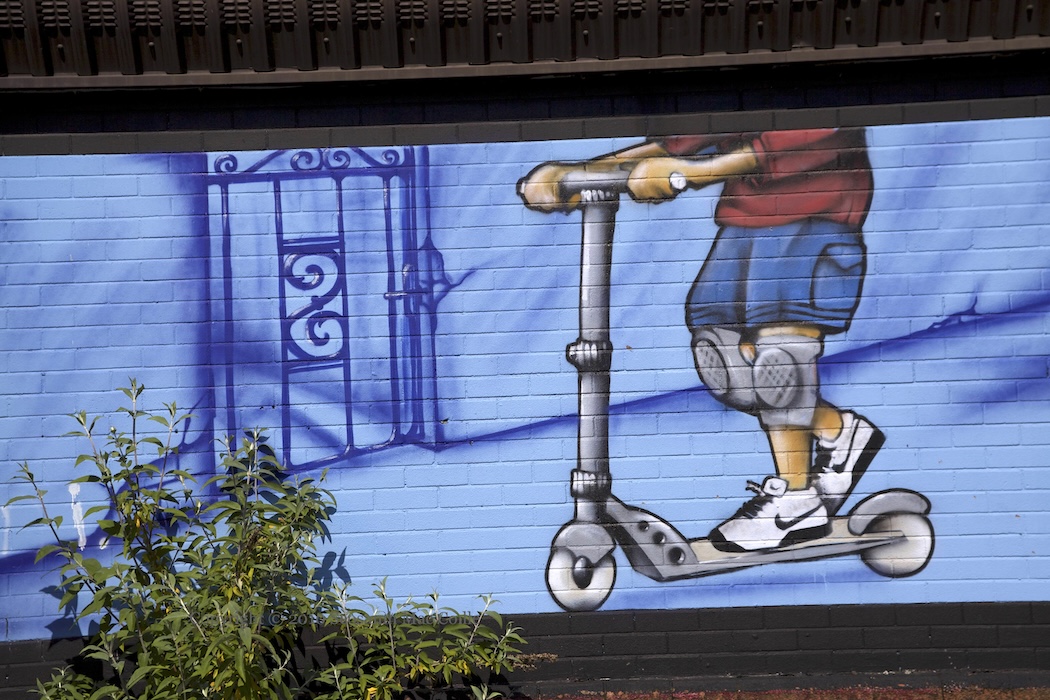
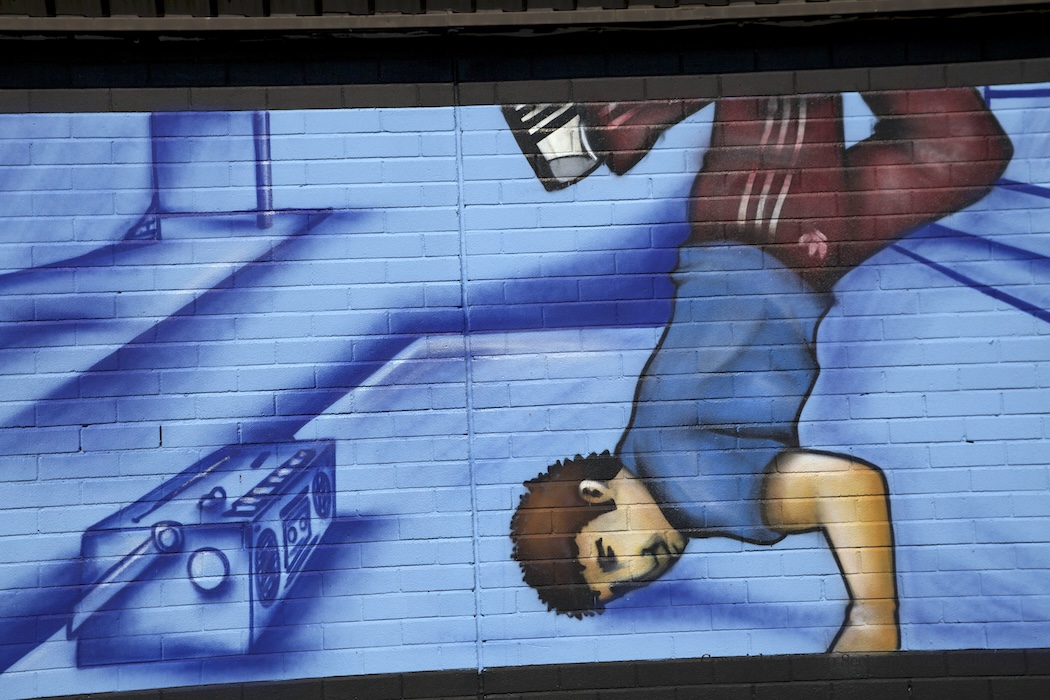
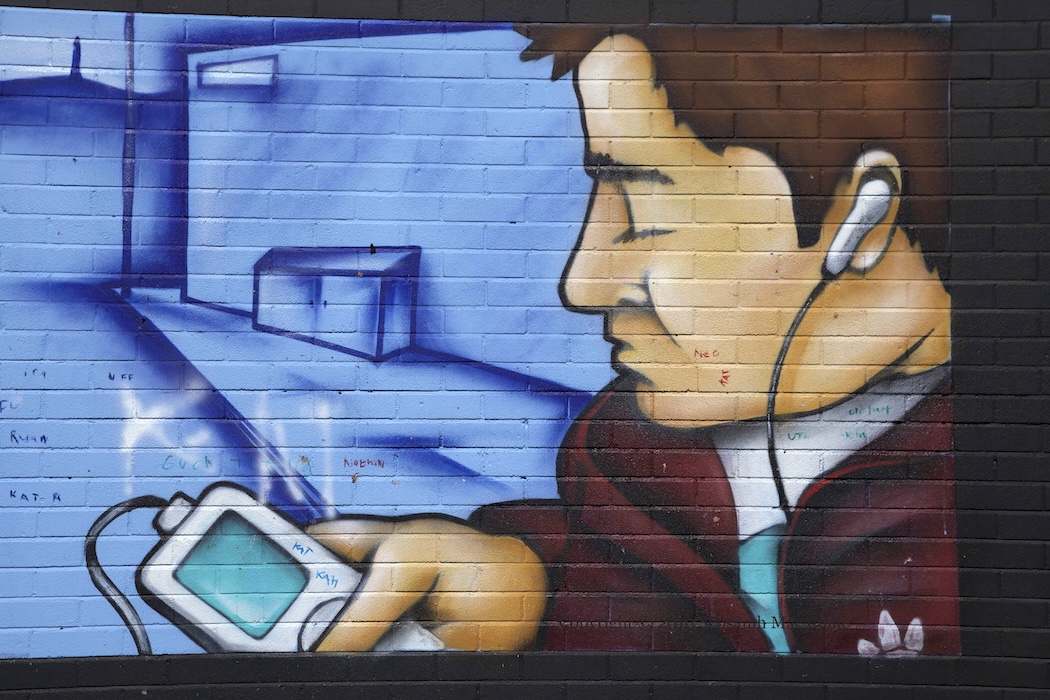
These are panels 1, 2, 6, 7, 8, 9, 12, 16, 17, and 19 (of 19) of the children’s mural in Hopewell Avenue. It shows kids at play across the century, from lamp-post swings and marbles to razor scooters and break-dancing. By Blaze FX.
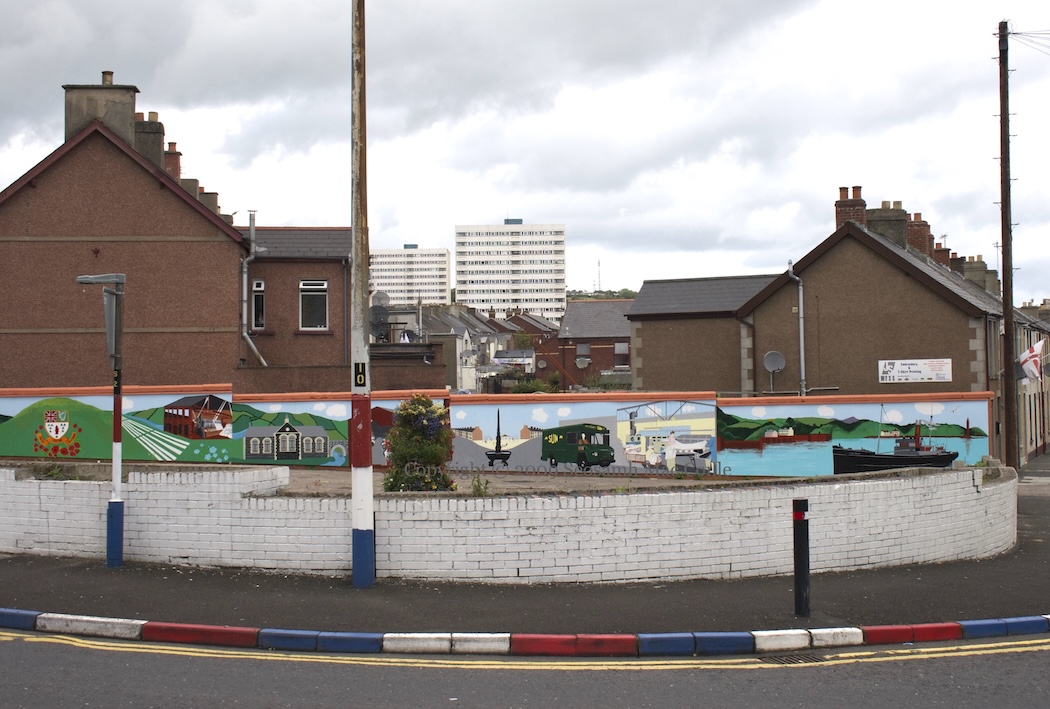
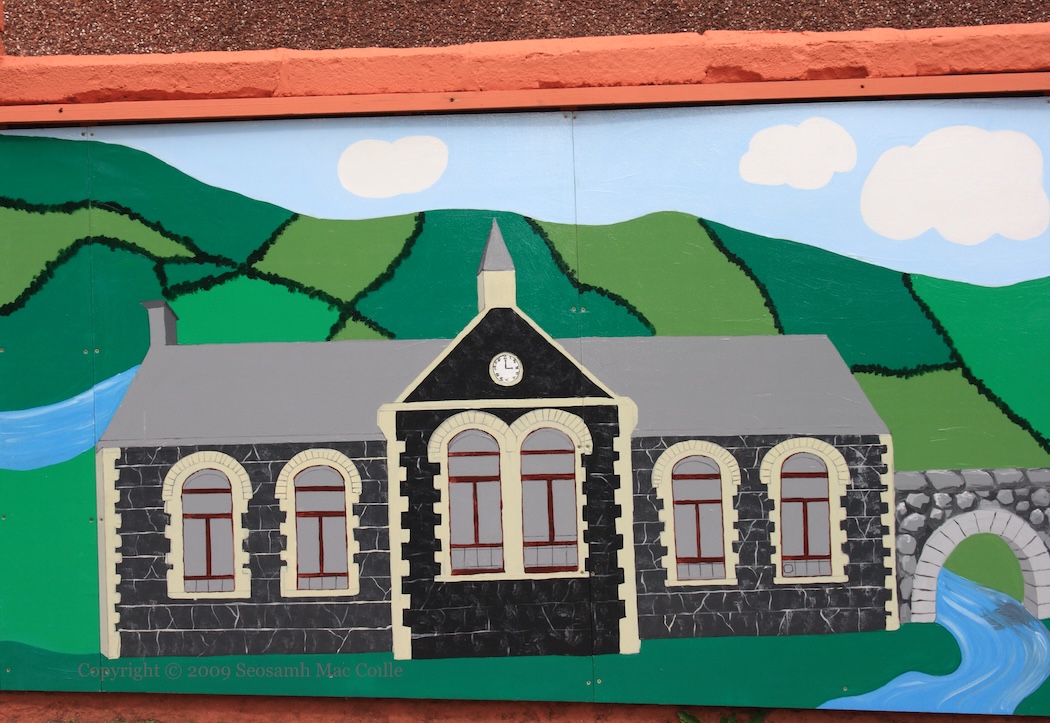
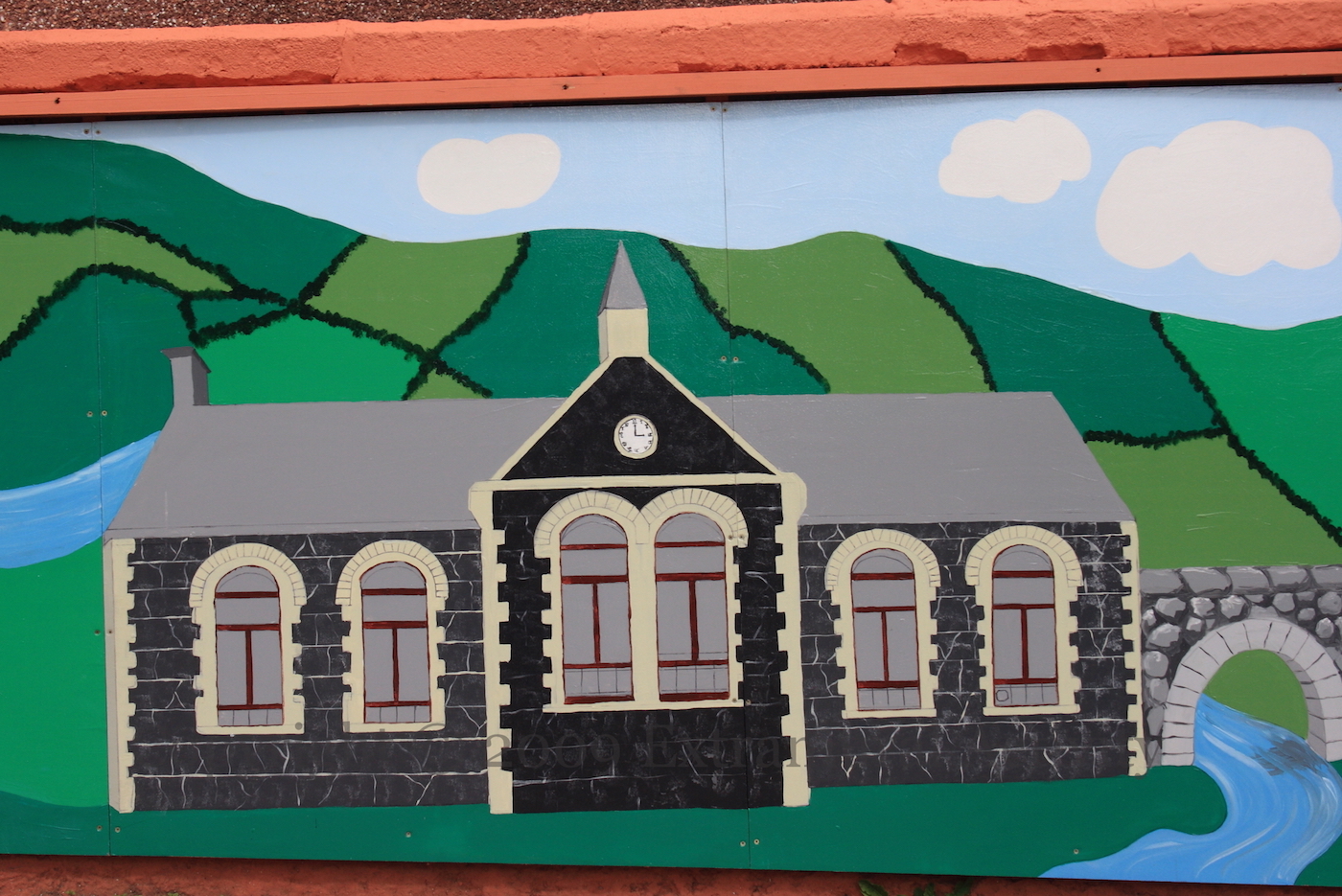
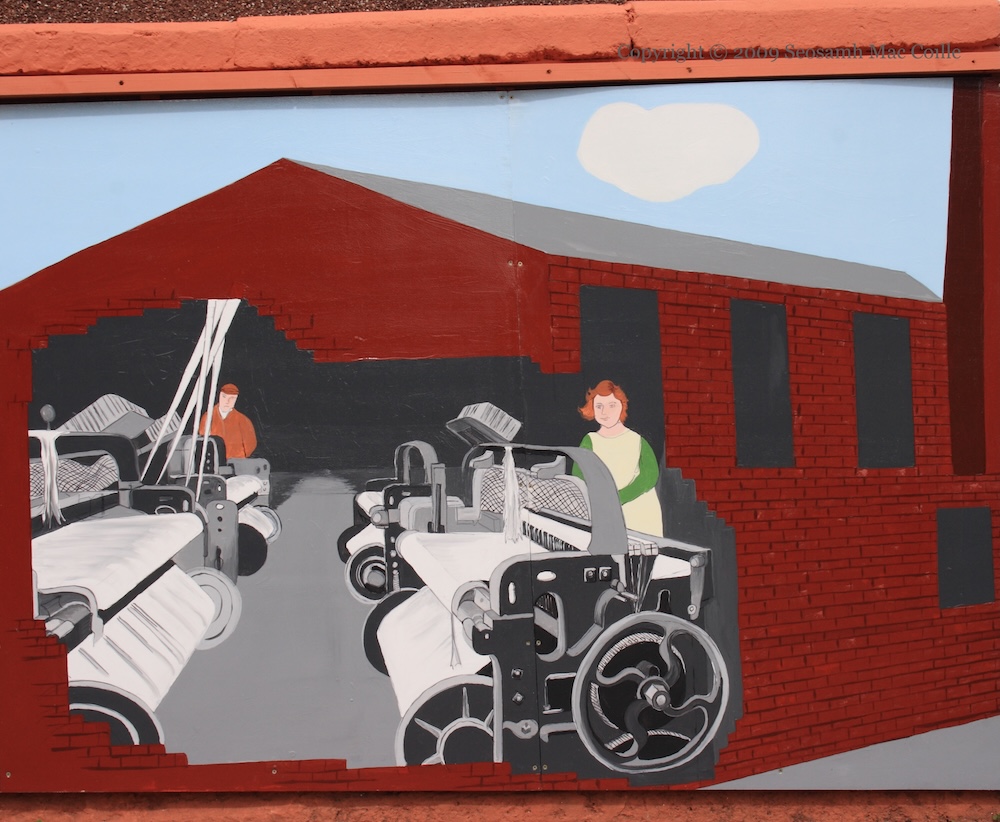
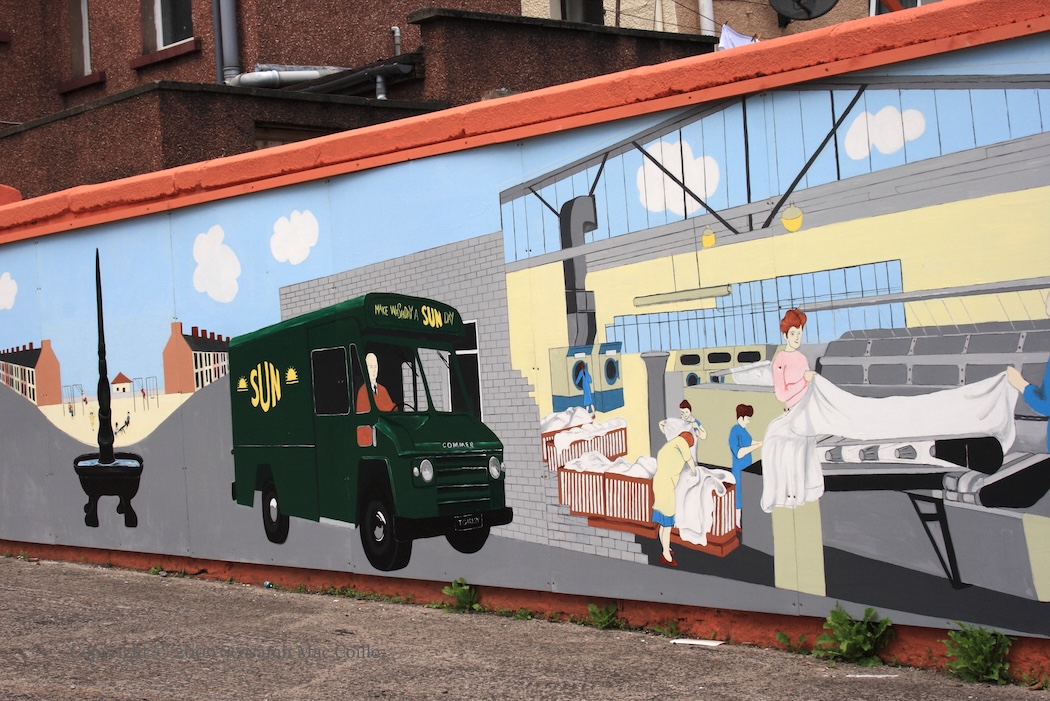
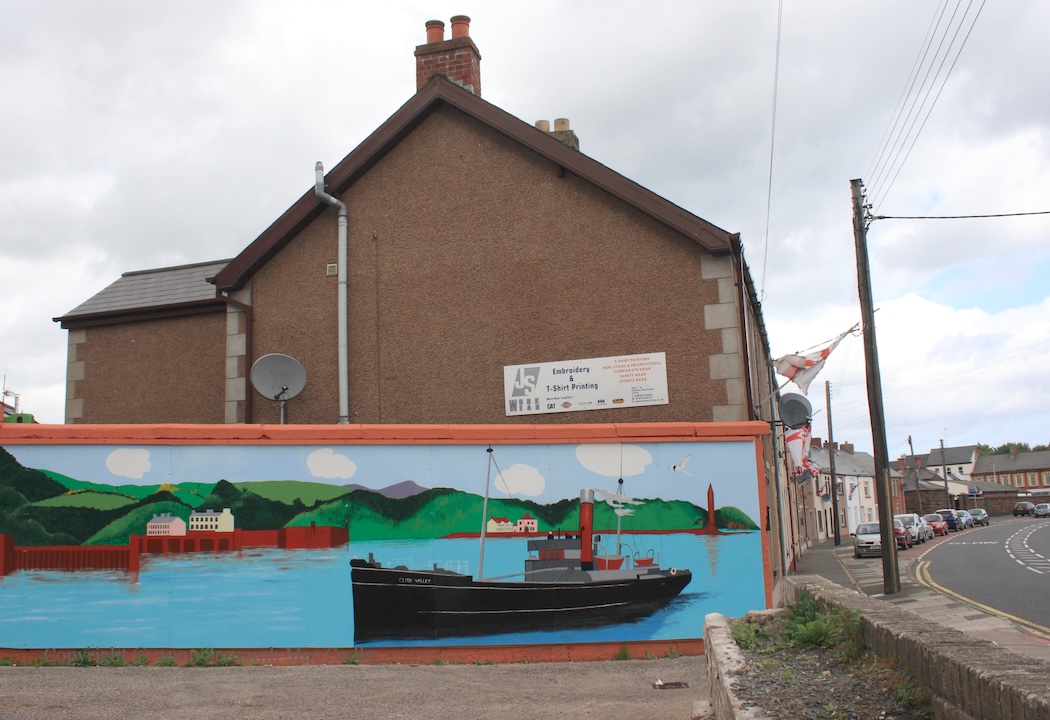
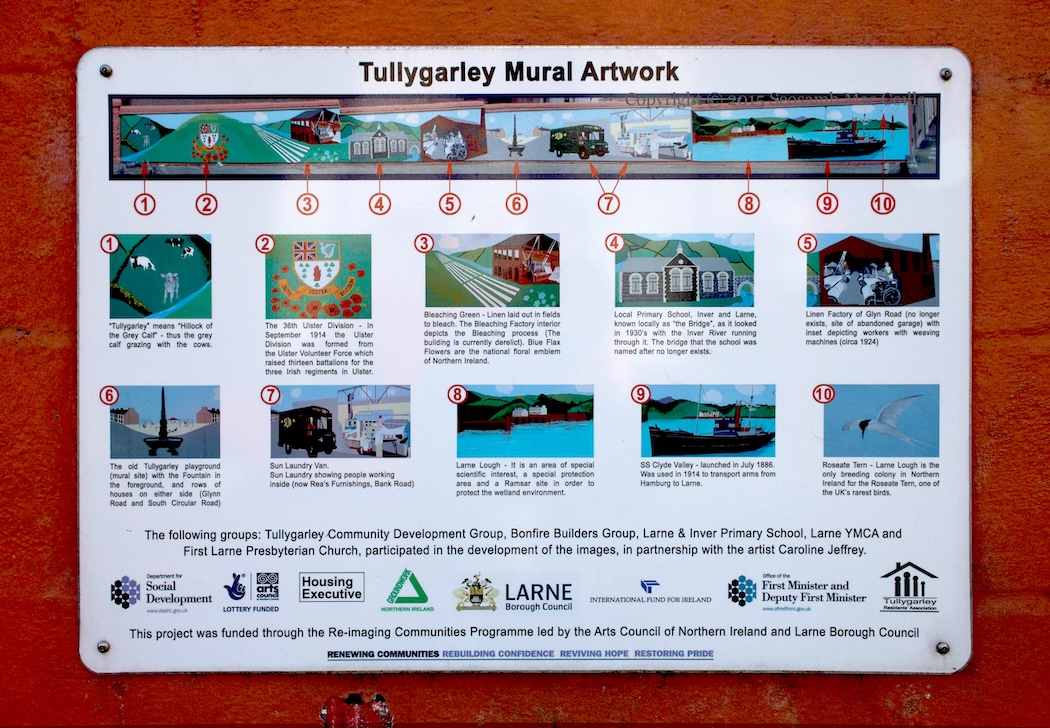
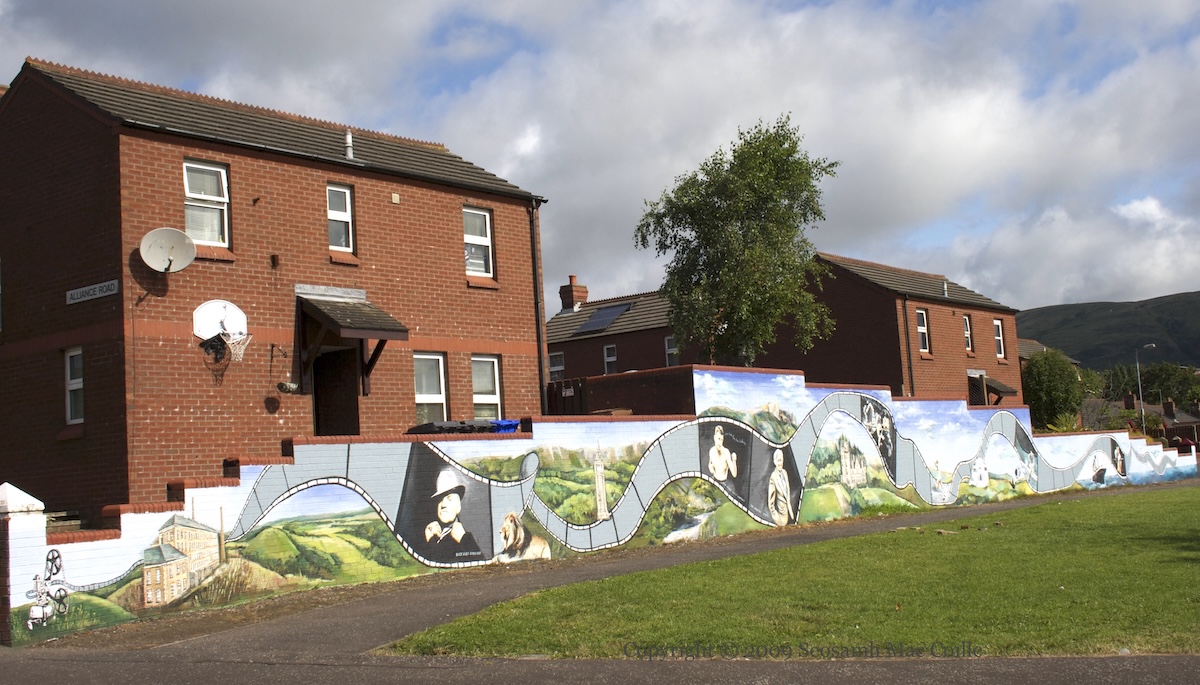
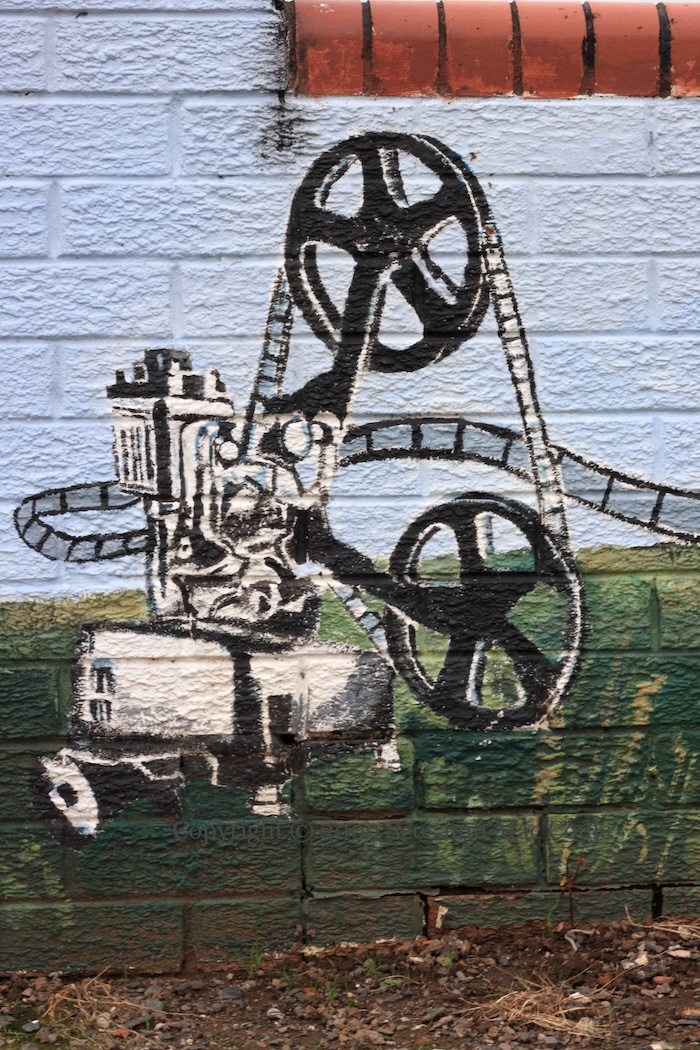
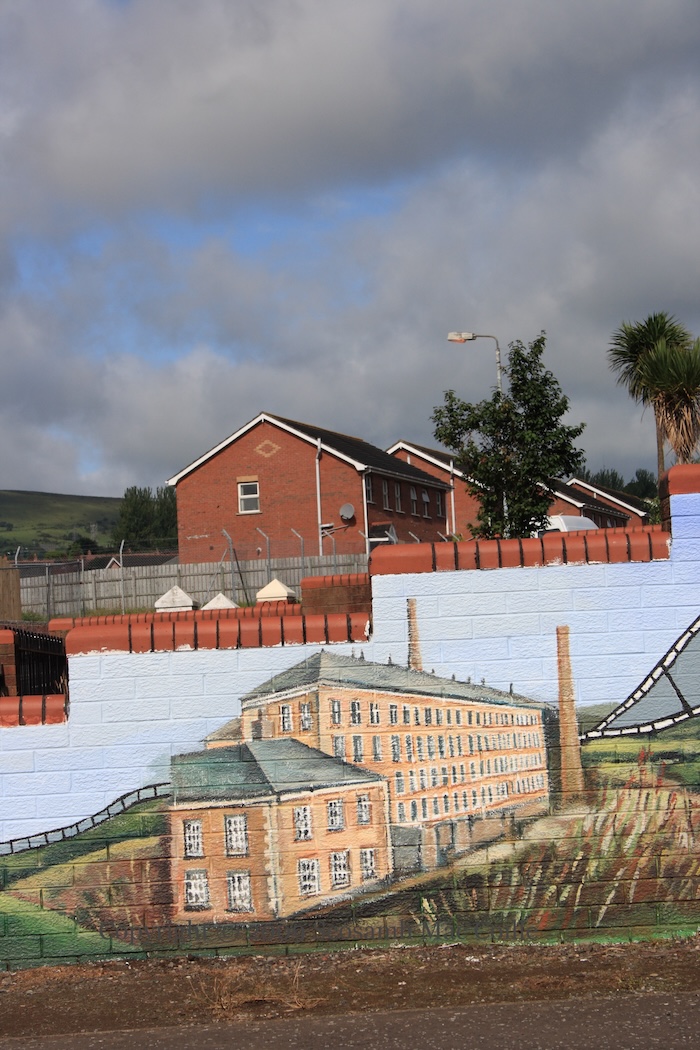
This series of boards, painted by Caroline Jeffrey, presents life in Larne from the early 20th century. As part of the 2009 Re-Imaging Project, it is largely non-sectarian, and begins with the derivation of the name “Tullygarley” from the Irish for “Hillock of the Grey Calf”, but includes the emblem of the 36th (Ulster) Division and the gunrunning ship Clyde Valley. It replaces a “God save the queen”/1690 mural, visible here.
Info board: “Tullygarley” means “Hillock of the Grey Calf” – thus the grey calf grazing with the cows.
The 36th Ulster Division – In September 1914 the Ulster Division was formed from the Ulster Volunteer Force which raised thirteen battalions for the three Irish regiments in Ulster.
Bleaching Green – Linen laid out in fields to bleach. The Bleaching Factory interior depicts the Bleaching process. (The building is currently derelict.) Blue Flax Flowers are the national floral emblem of Northern Ireland.
Local Primary School, Inver and Larne, known locally as “the Bridge”, as it looked in the 1930’s with the Inver River running through it. The bridge that the school was named after no longer exists.
Linen Factory of Glyn [Glynn] Road (no longer exists, site of abandoned garage) with inset depicting workers with weaving machines (circa 1924).
The old Tullygarley playground (mural site) with the Fountain in the foreground, and rows of houses on either side (Glynn Road and South Circular Road).
Sun Laundry Van. Sun Laundry showing people working inside (now Rea’s Furnishings, Bank Road).
Larne Lough – it is an area of special interest, a special protection area and a Ramsar site in order to protect the wetland environment.
SS Clyde Valley – launched in July 1886. Was used in 1914 to transport arms from Hamburg to Larne.
Roseate Tern – Larne Lough is the only breeding colony in Northern Ireland for the Roseate Tern, one of the UK’s rarest birds.
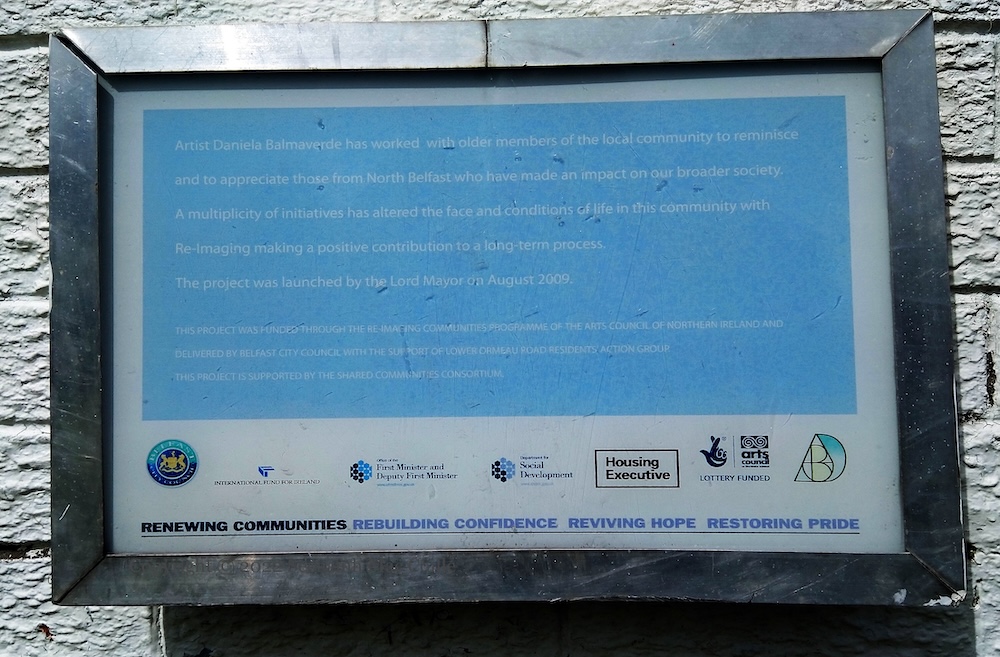
“Artist Daniela Balmaverde has worked with older members of the local community to reminisce and to appreciate those from North Belfast who have made an impact on our broader society. A multiplicity of initiatives has altered the face and conditions of life in this community with Re-Imaging making a positive contribution to a long-term process. The project was launched by the Lord Mayor on August 2009 This project was funded through the Re-Imaging Communities programme of the Arts Council of Northern Ireland and delivered by Belfast City Council with the support of Lower Ormeau Road Resident’s Action Group. This project is supported by the Shared Communities Consortium.”
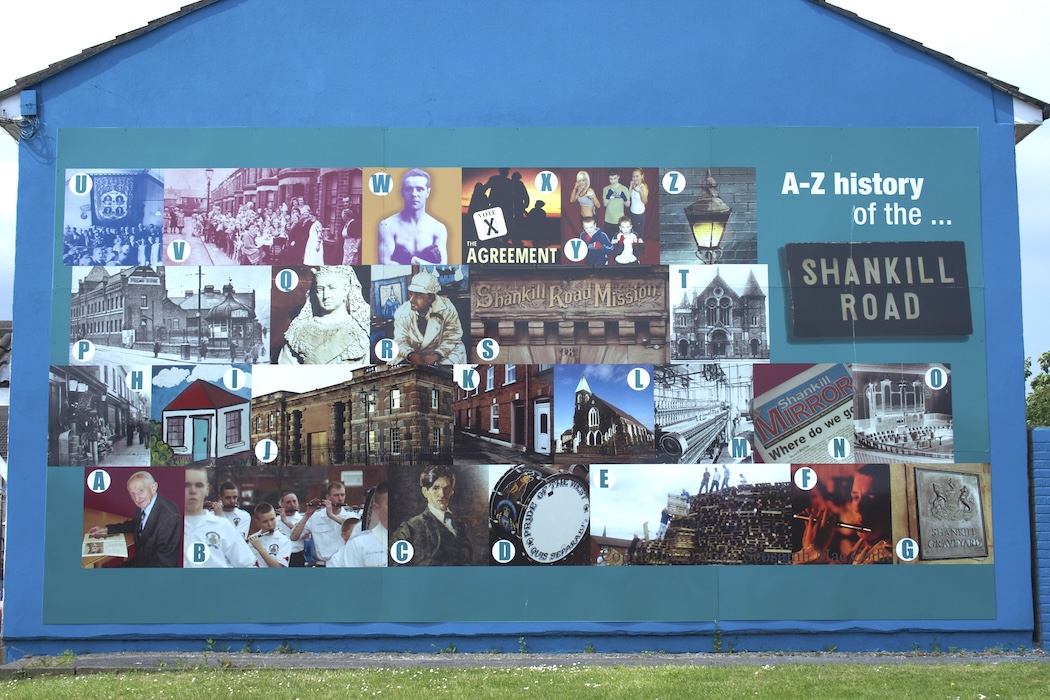
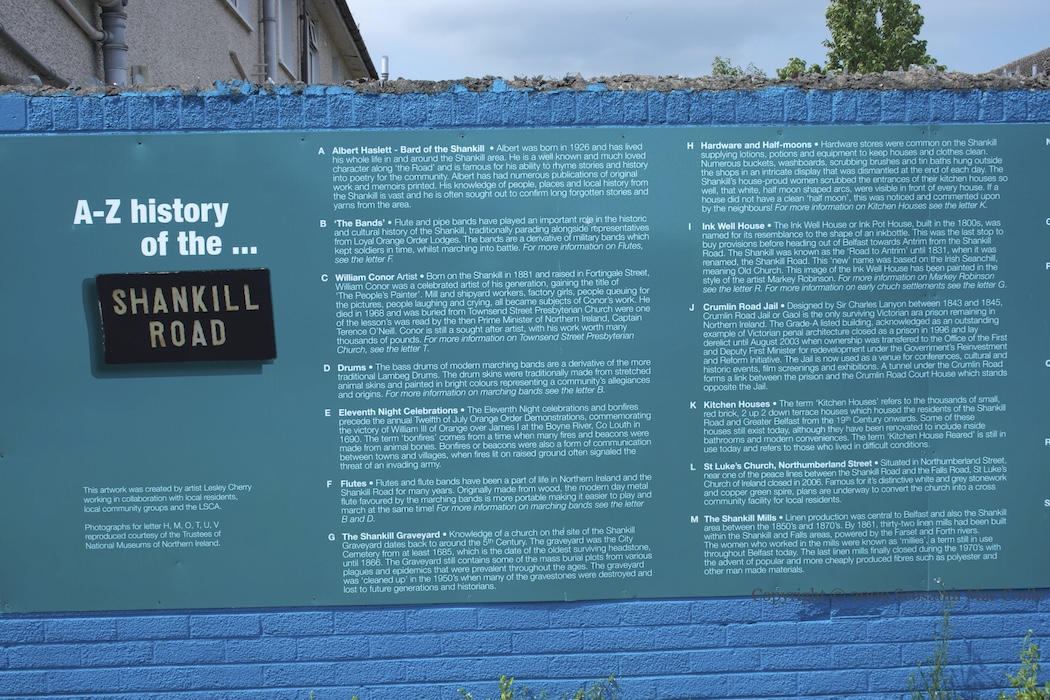
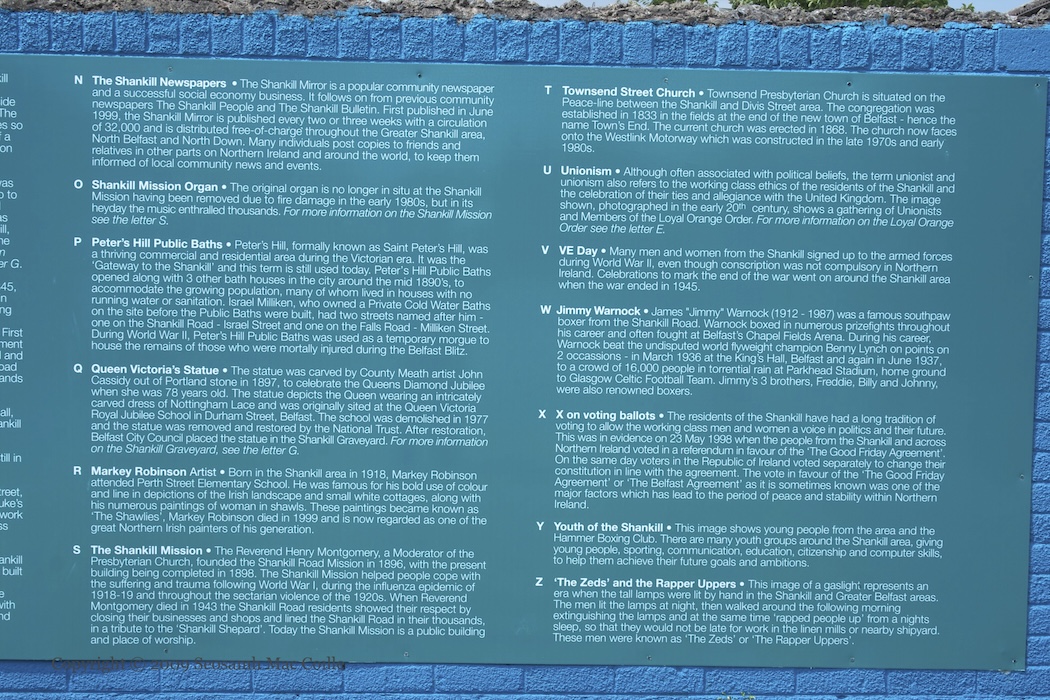
The Drumcree mural (2004 | 2008) is re-imaged in 2009 by this ‘Shankill A-Z’ board, designed by Lesley Cherry.
While bands get mentioned in three letters (“B” for “bands”, “D” for “drums” and “F” for “flutes”), “Unionism” is recast as “working-class ethics” and (perhaps the most striking “re-imaging”) under “X” it is claimed that the people of the lower Shankill voted for the Good Friday Agreement.
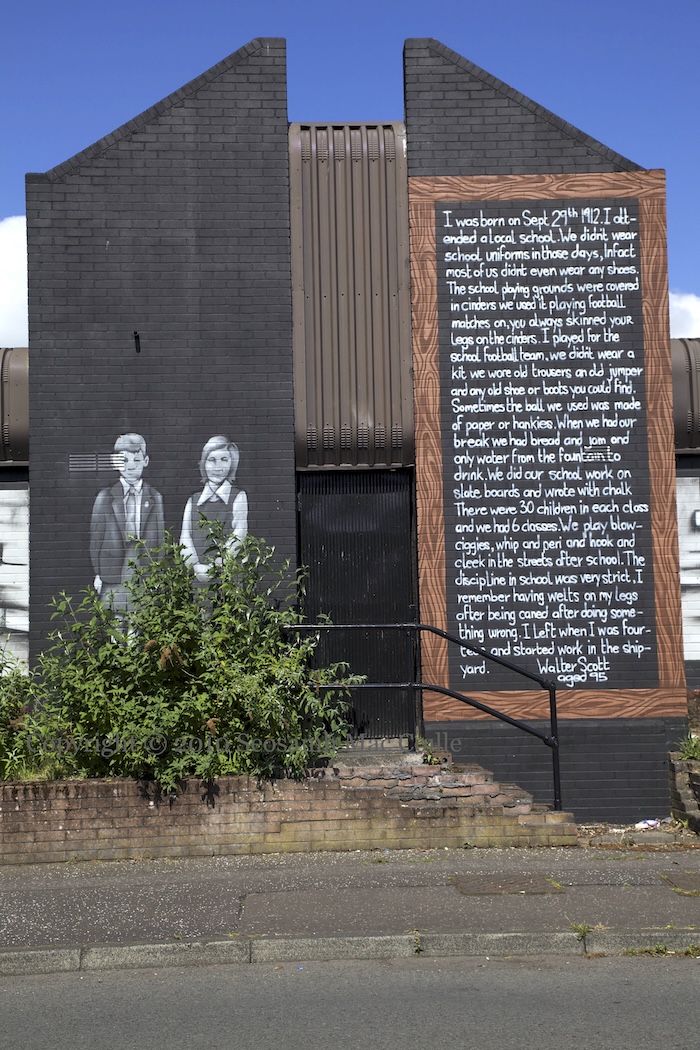
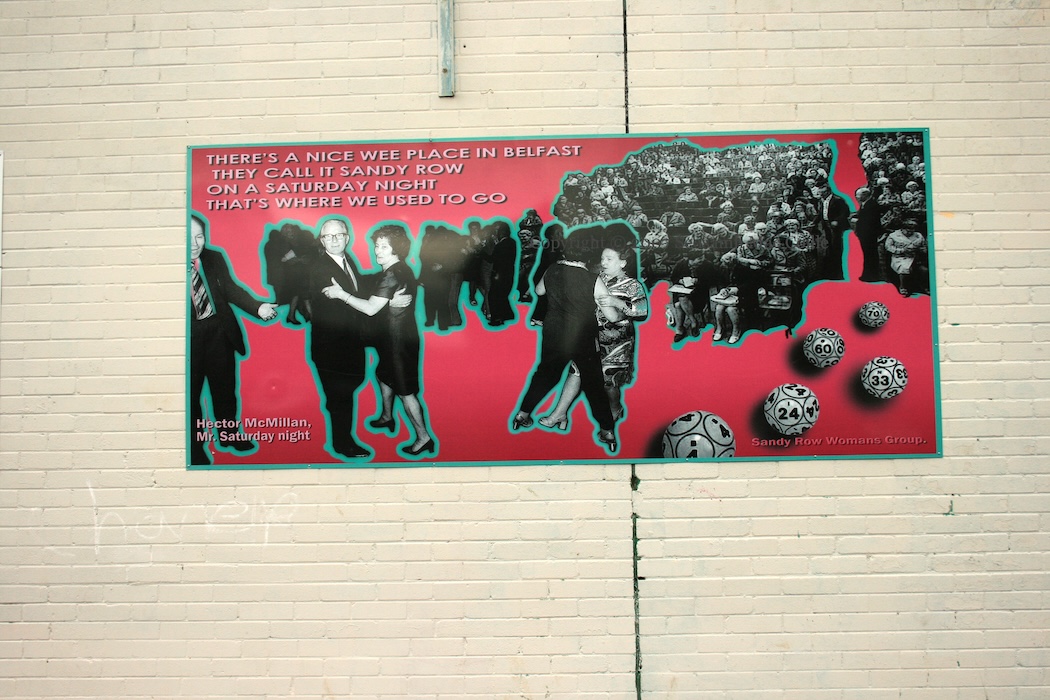
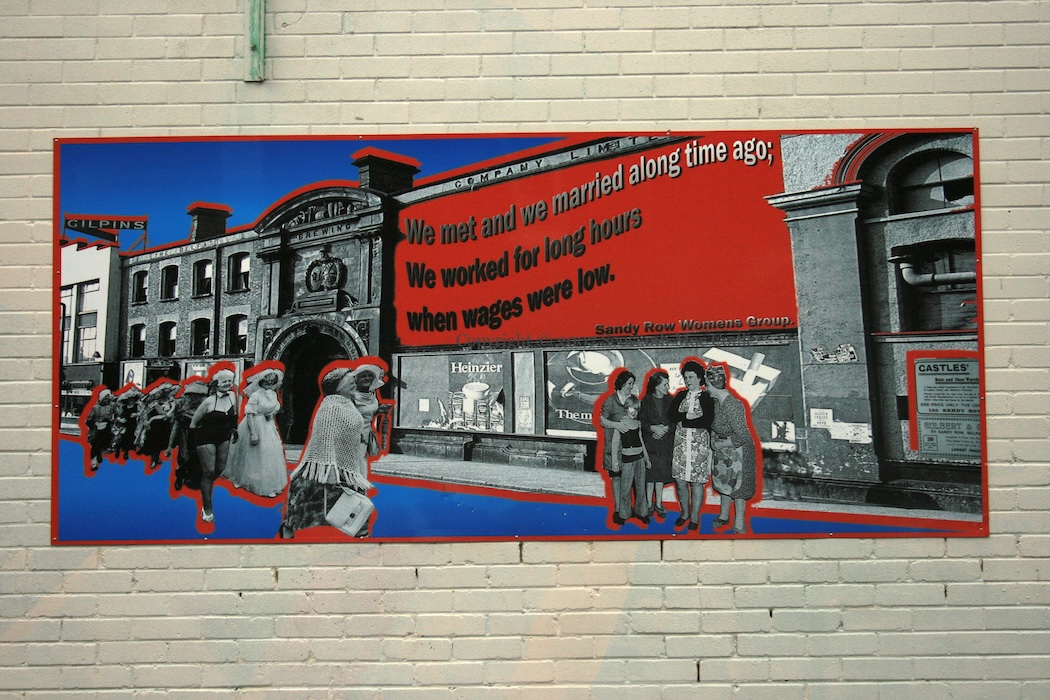
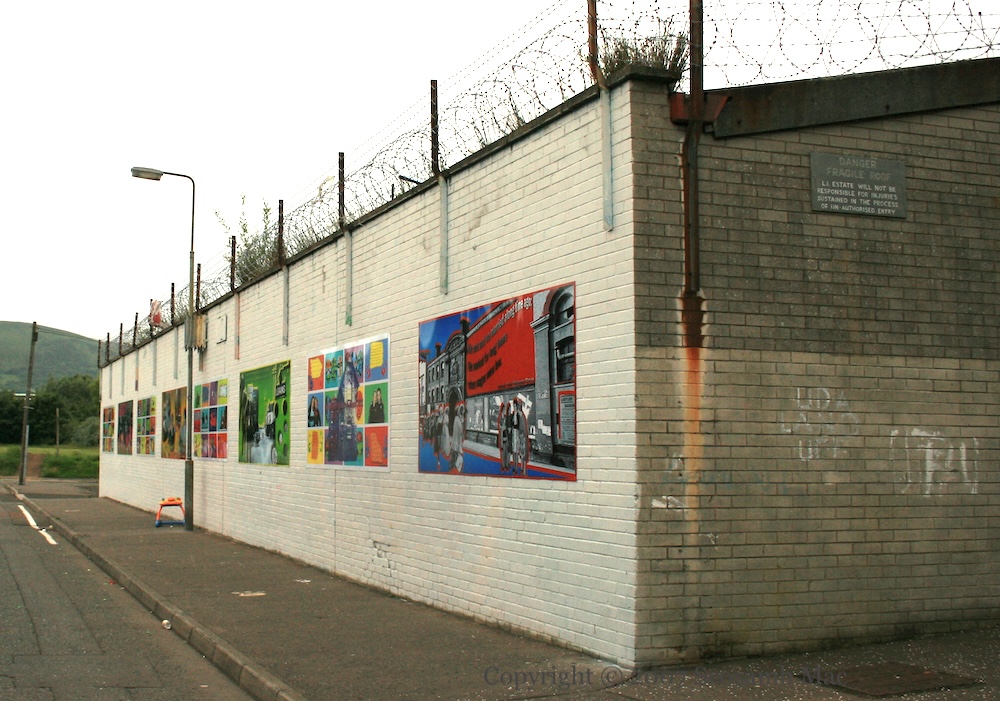
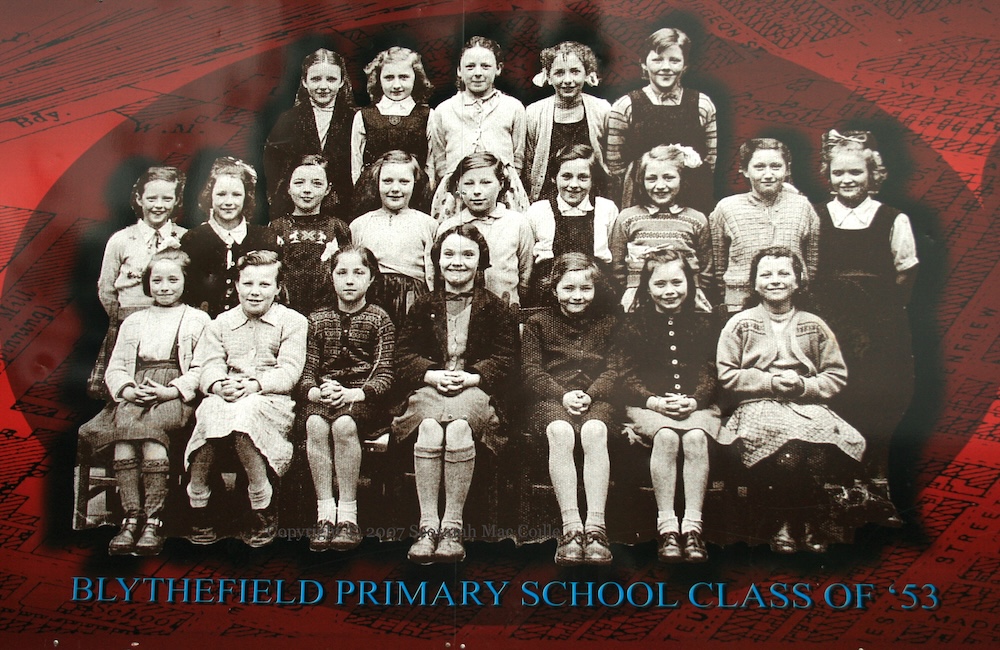
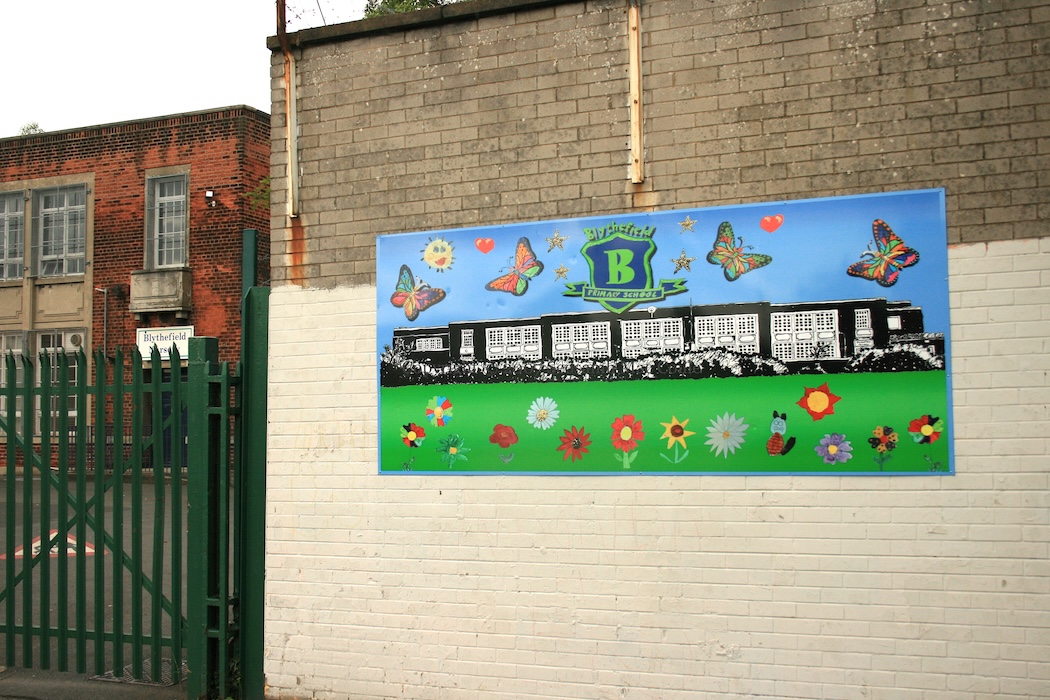
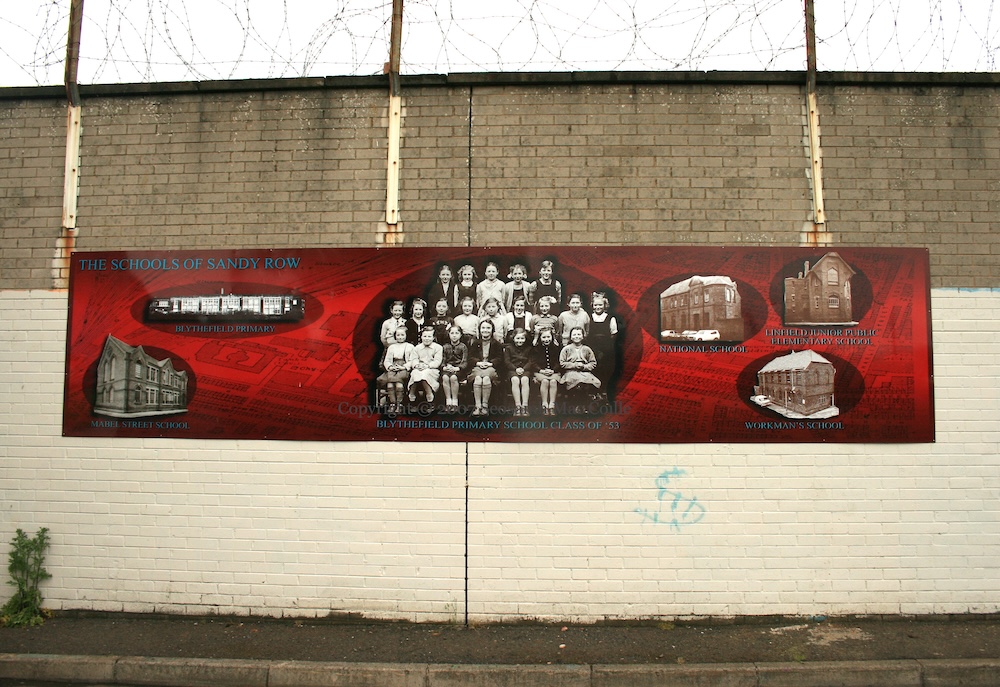
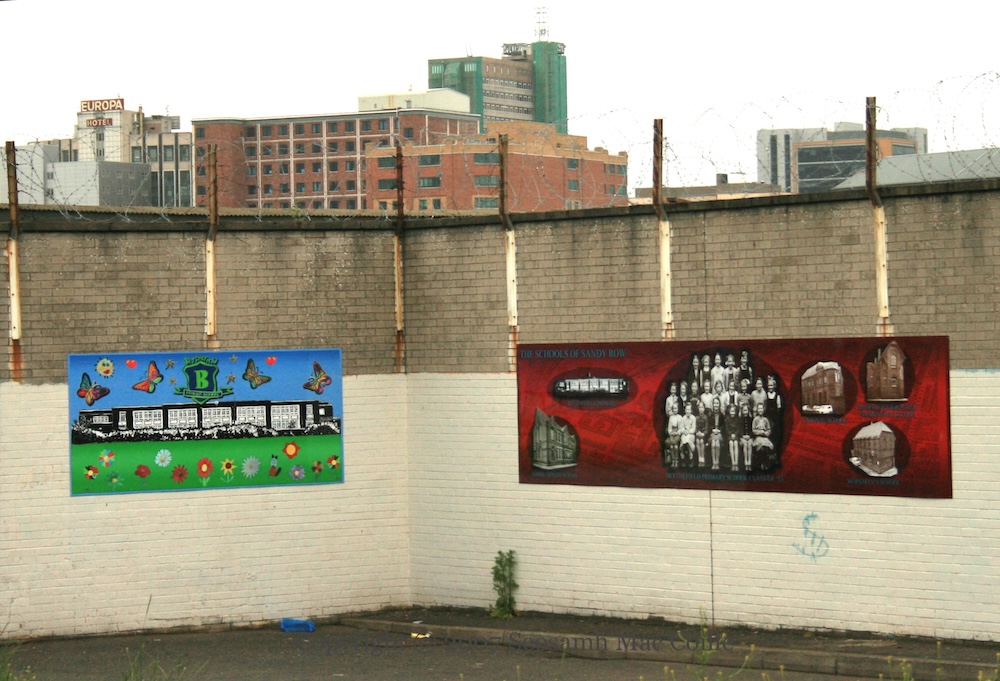
The schools of Sandy Row (in the third image) are Blythefield Primary (featured in the other images), Mabel Street School, National School, Linfield Junior Public Elementary School, and Workman’s School.
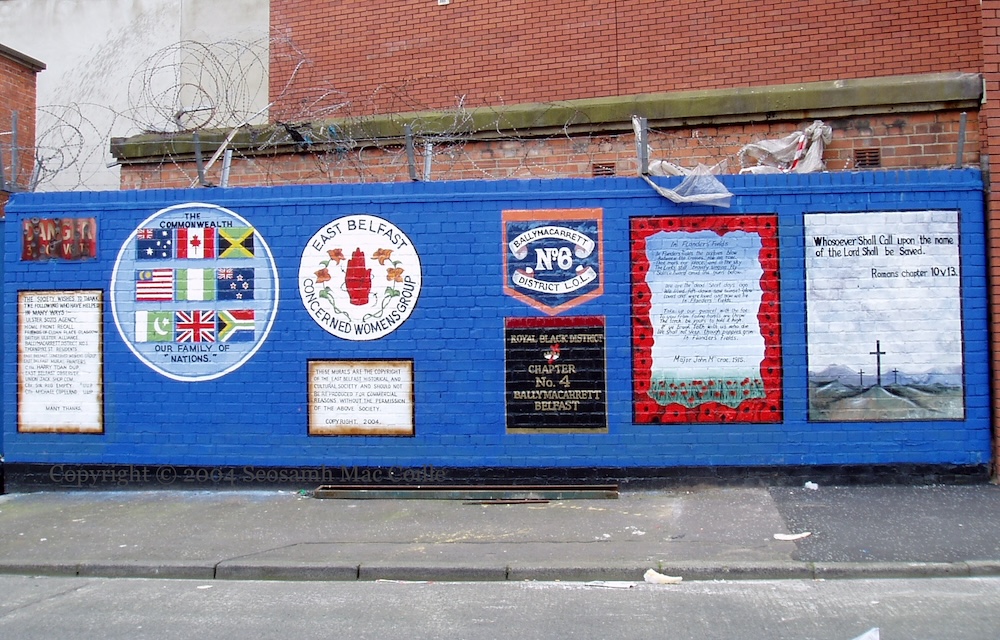
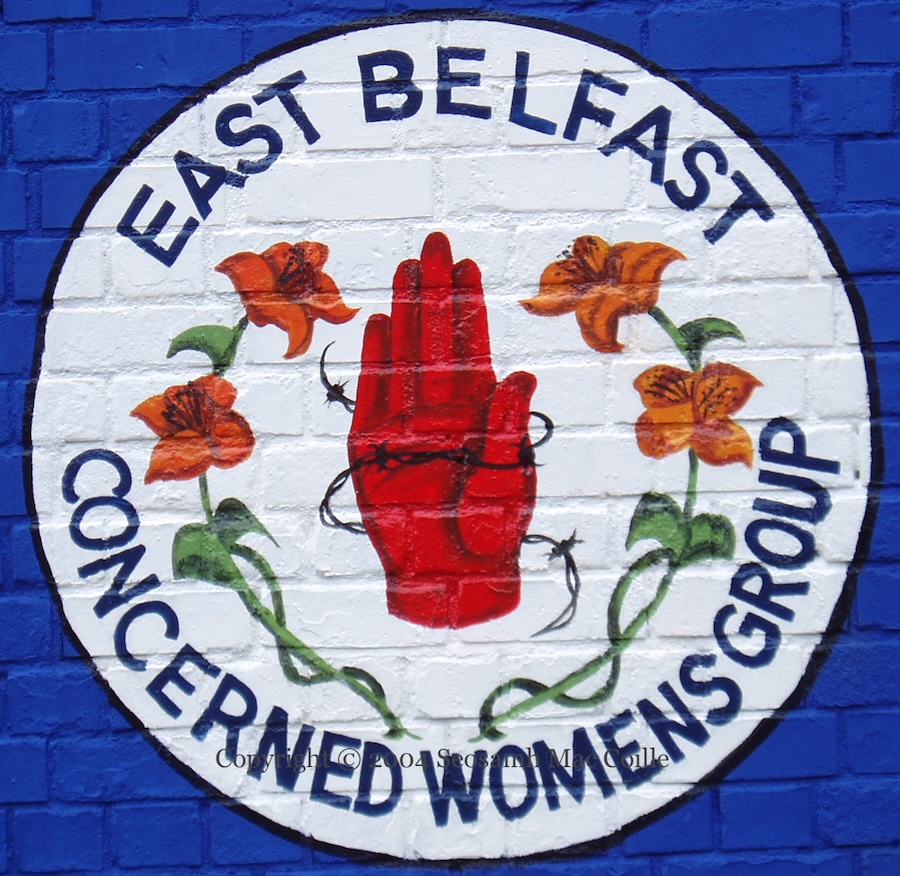
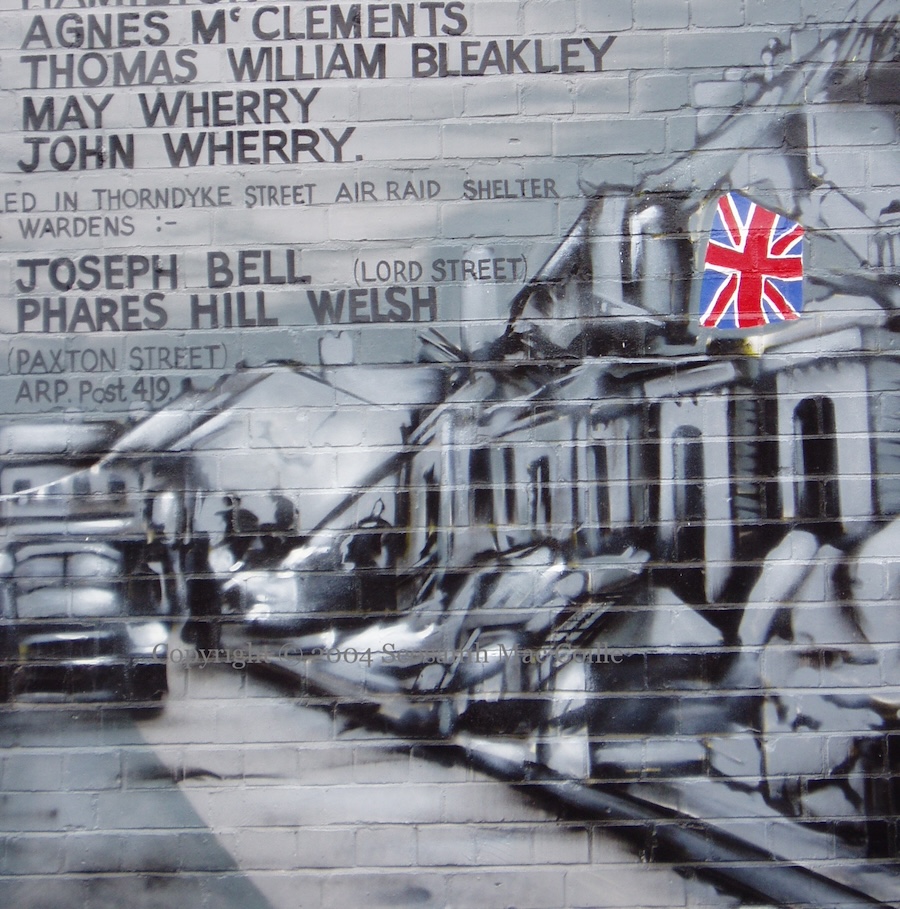
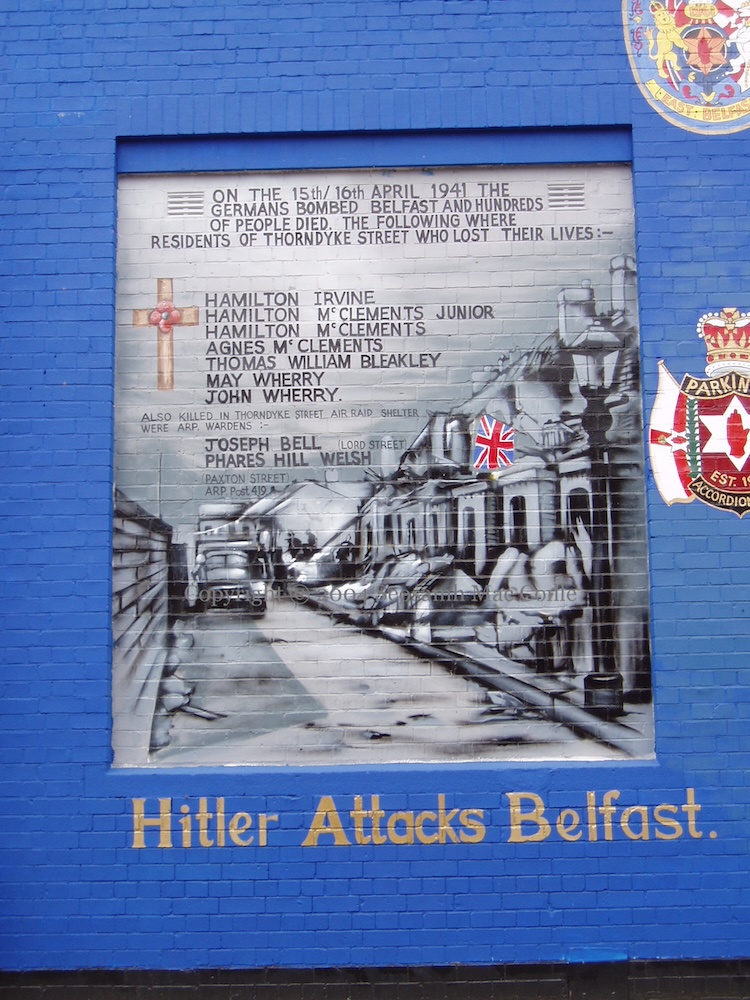
The fourteenth and final panel in Thorndyke Street contains a number of small panels, including the two above, along with emblems of local Orange and Black lodges, John McCrae’s In Flanders Fields, a list of acknowledgements, and a copyright claim.
From the info board, added later: In the blitz of 15/16th April 1941, “Across Belfast 745 civilians were killed, 420 were seriously injured and more than 1,000 less seriously. April and May 1941 an estimated 56,000 houses were damaged.”
 Seosamh Mac Coille Collection