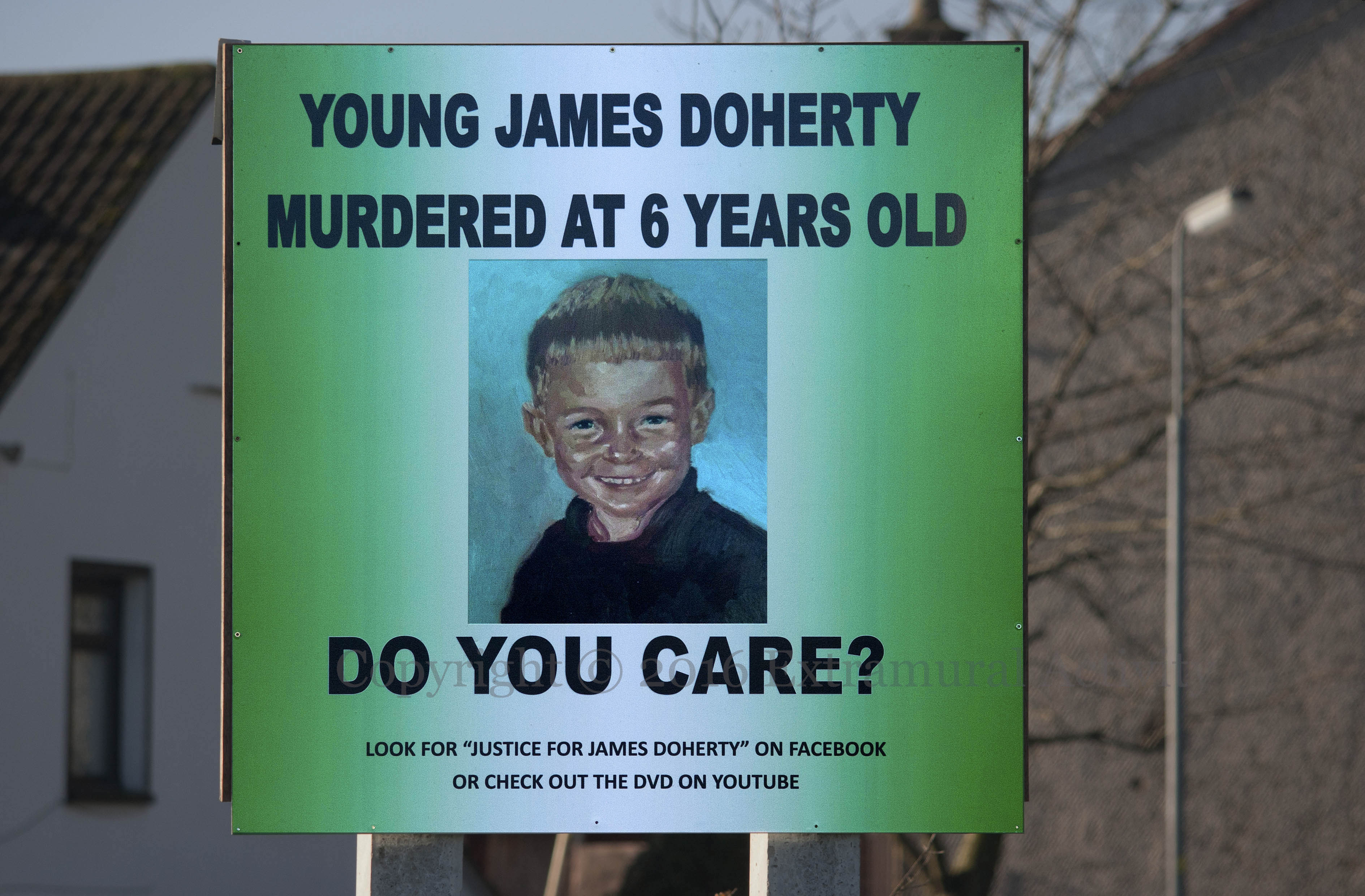
James “Jim” Doherty was six years old when he was shot while playing in the front garden of his Turf Lodge home in 1972. Relatives For Justice and the family launched the board shown above at the entrance to the estate last October in order to push for a new inquiry into the death due to the insufficiency of the original investigation and the disappearance of the bullet taken from the body. (Belfast Media Group)
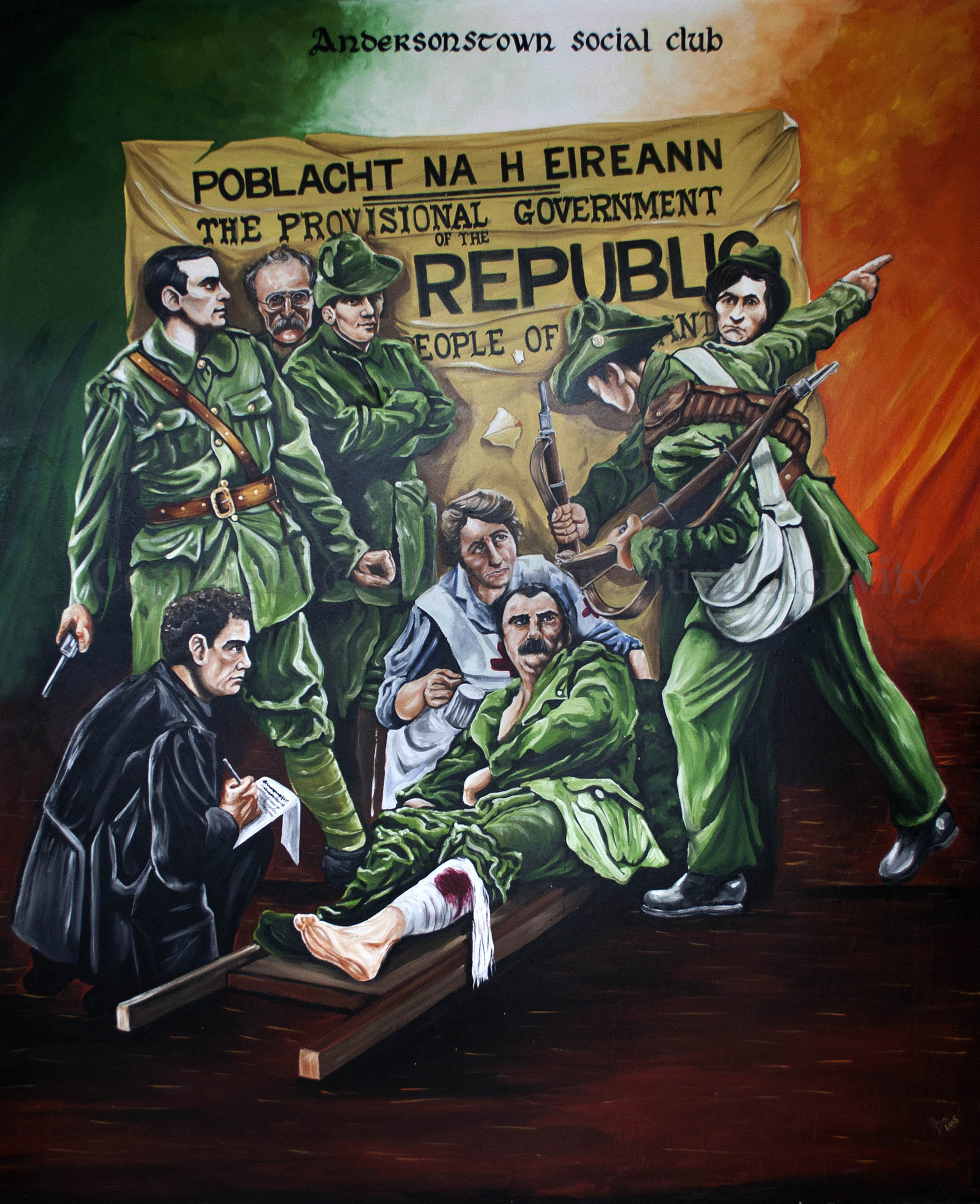
The ‘Revolution 1916’ exhibition – items from which were shown in Belfast earlier in February (see Revolution 1916) – opened in Dublin this weekend, including two murals (see this An Phoblacht article for one of them). The three painters also painted the mural above for the mini-exhibition in Andersonstown, reproducing the left-hand grouping from Walter Paget’s Birth Of The Irish Republic and putting the proclamation in the background. For Paget’s original oil painting and other version of it, see the painting’s Visual History page.
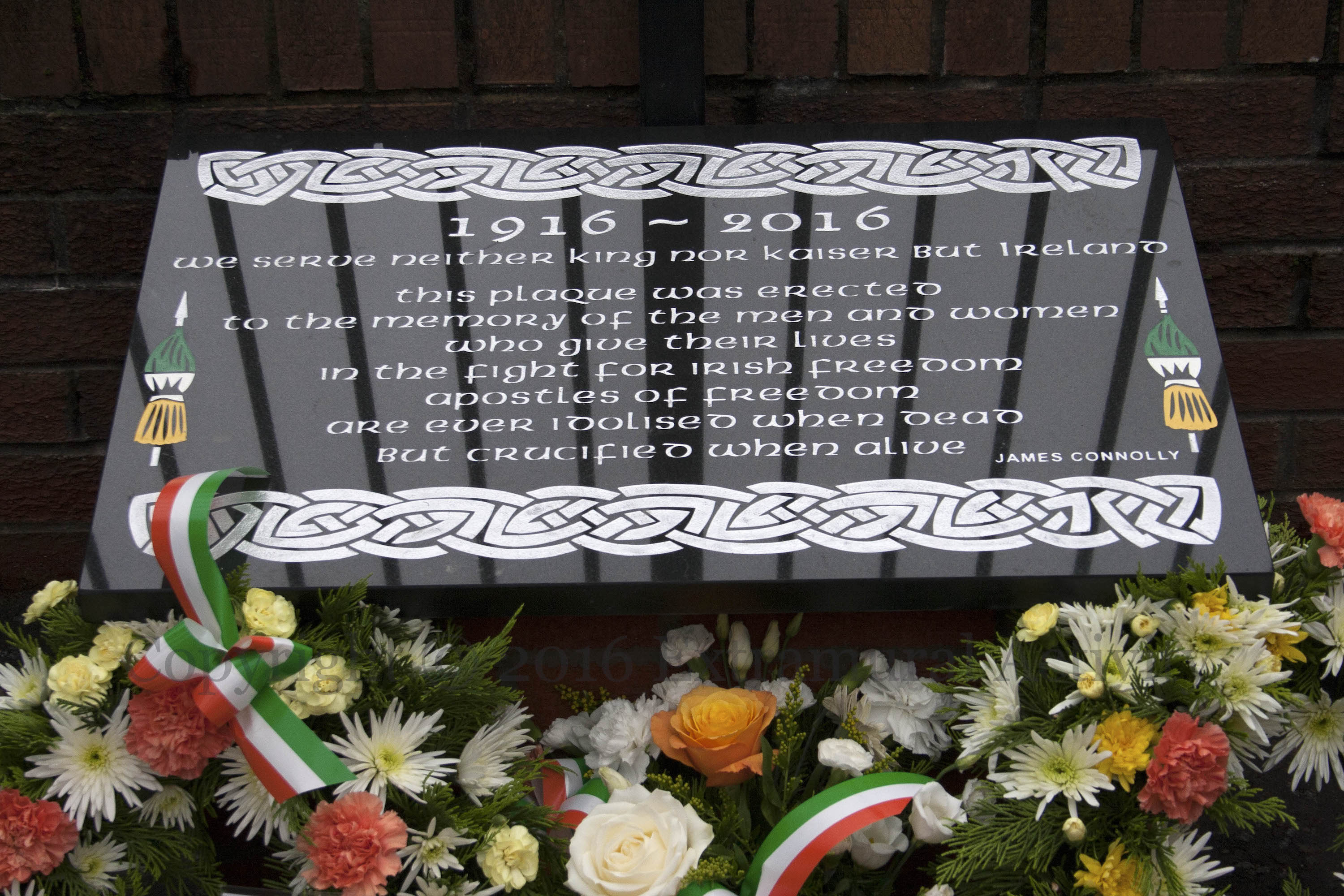
The plaque above is a new one outside the Andersonstown Social Club, mounted for the centenary of the Easter Rising: 1916-2016 – We serve neither king nor kaiser but Ireland. This plaque was erected to the memory of the men and women who give their lives in the fight for Irish freedom. “Apostles of freedom are ever idolised when dead but crucified when alive” – James Connolly (These are the opening lines of ‘The Men We Honour‘ 1898)
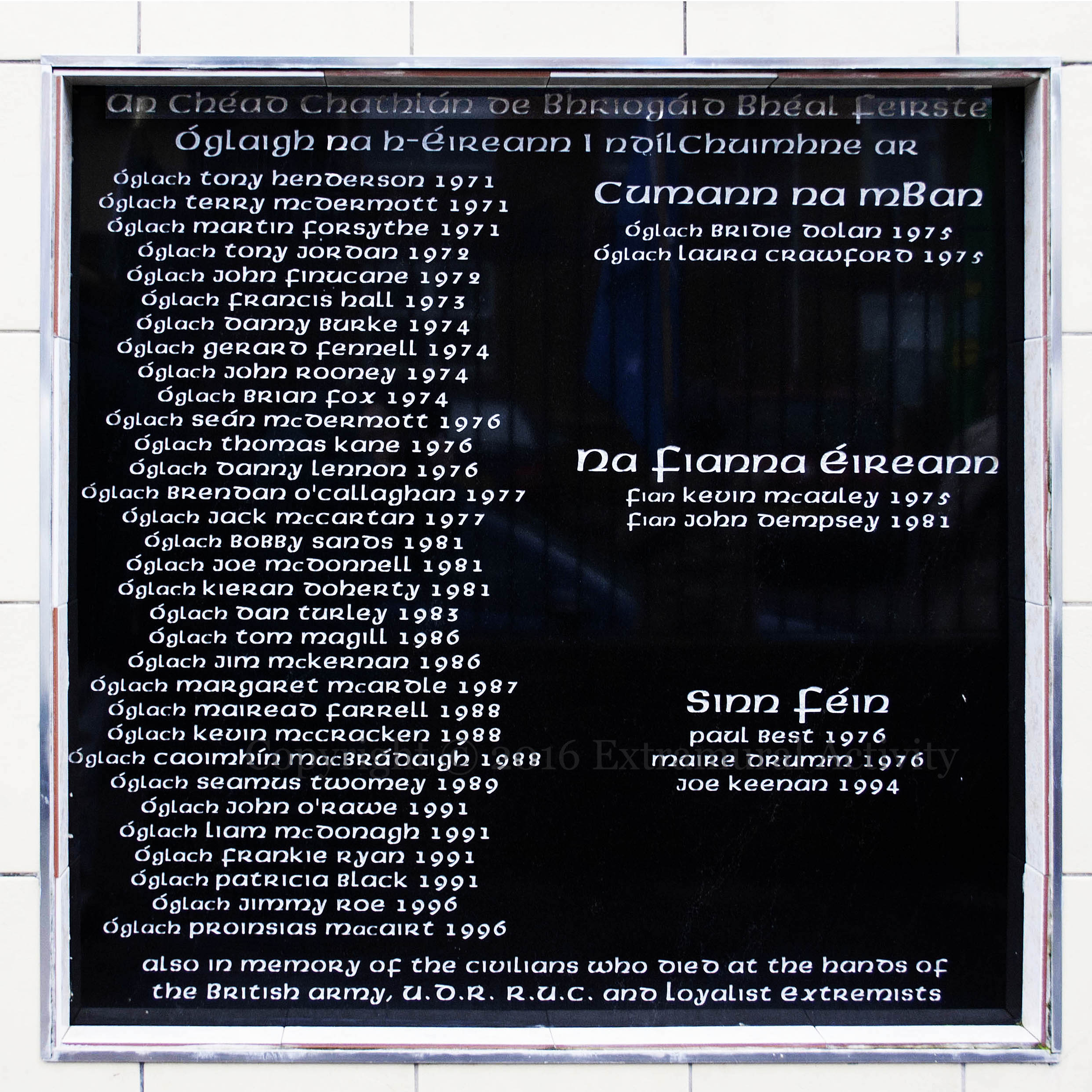
The plaque below is a previously existing one to volunteers from the First Battalion of the IRA’s Belfast Brigade and various other republicans and “also in memory of the civilians who died at the hands of the UDR, RUC, and loyalist extremists”.
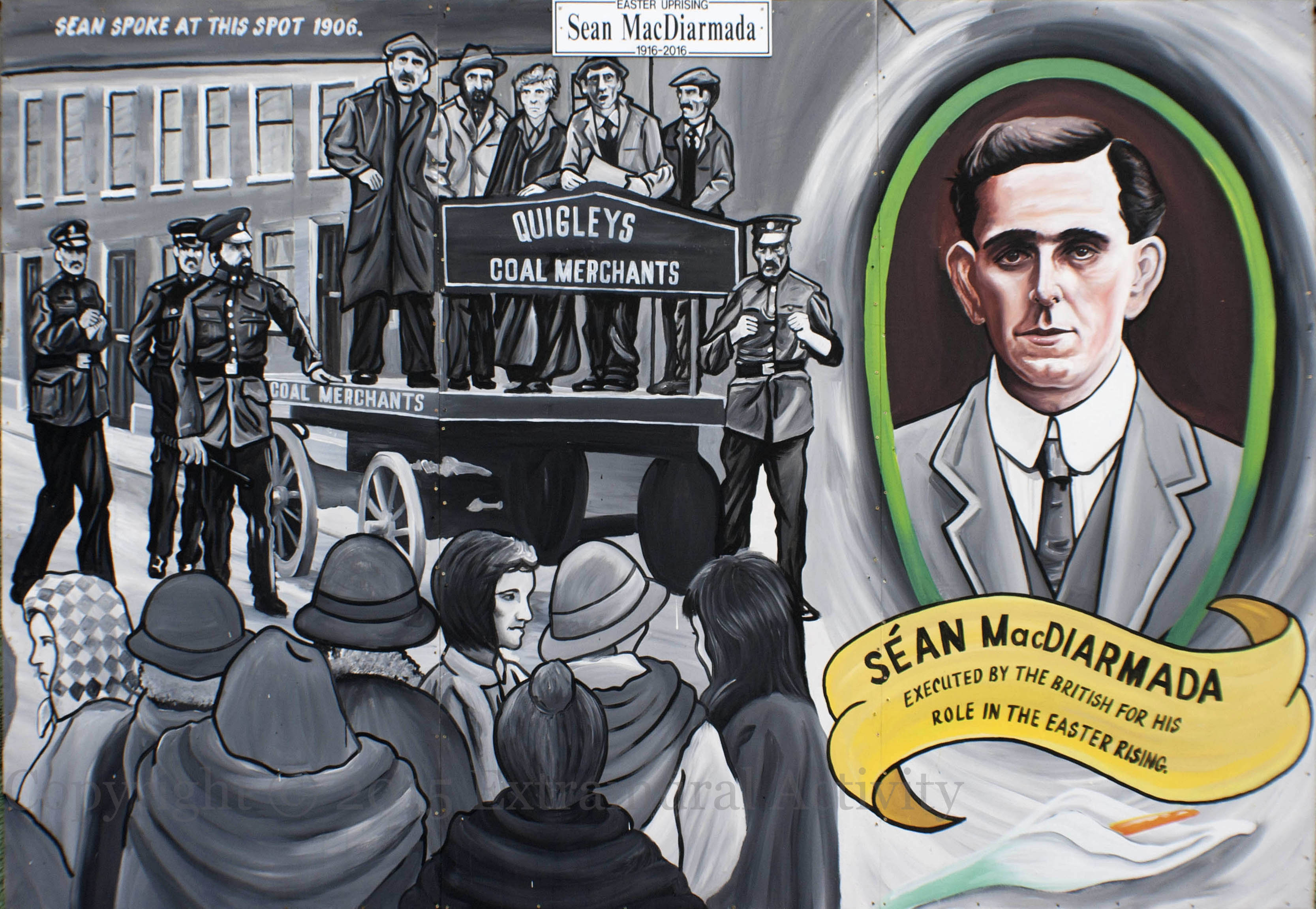
Seán Mac Dıarmada was born in Leitrim, left for Glasgow at age 15, and after two years returned to Belfast in 1905 and – according to the new mural above – spoke from the back of a coal lorry in Clonard Street, outside the Clonard branch of the Ancient Order Of Hibernians. Mac Dıarmada was for a short time an AOH member, before moving on to the Irish Republican Brotherhood and Irish Volunteers, which led to his participation in the 1916 Easter Rising and execution on May 12th of that year.
The title of today’s post is historian F.X. Martin’s assessment of Mac Dıarmada, quoted in a pamphlet on Mac Dıarmada from the National Library Of Ireland. The NLI made many letters from and to Mac Dıarmada available in 2016. (See also this Irish Times write-up).
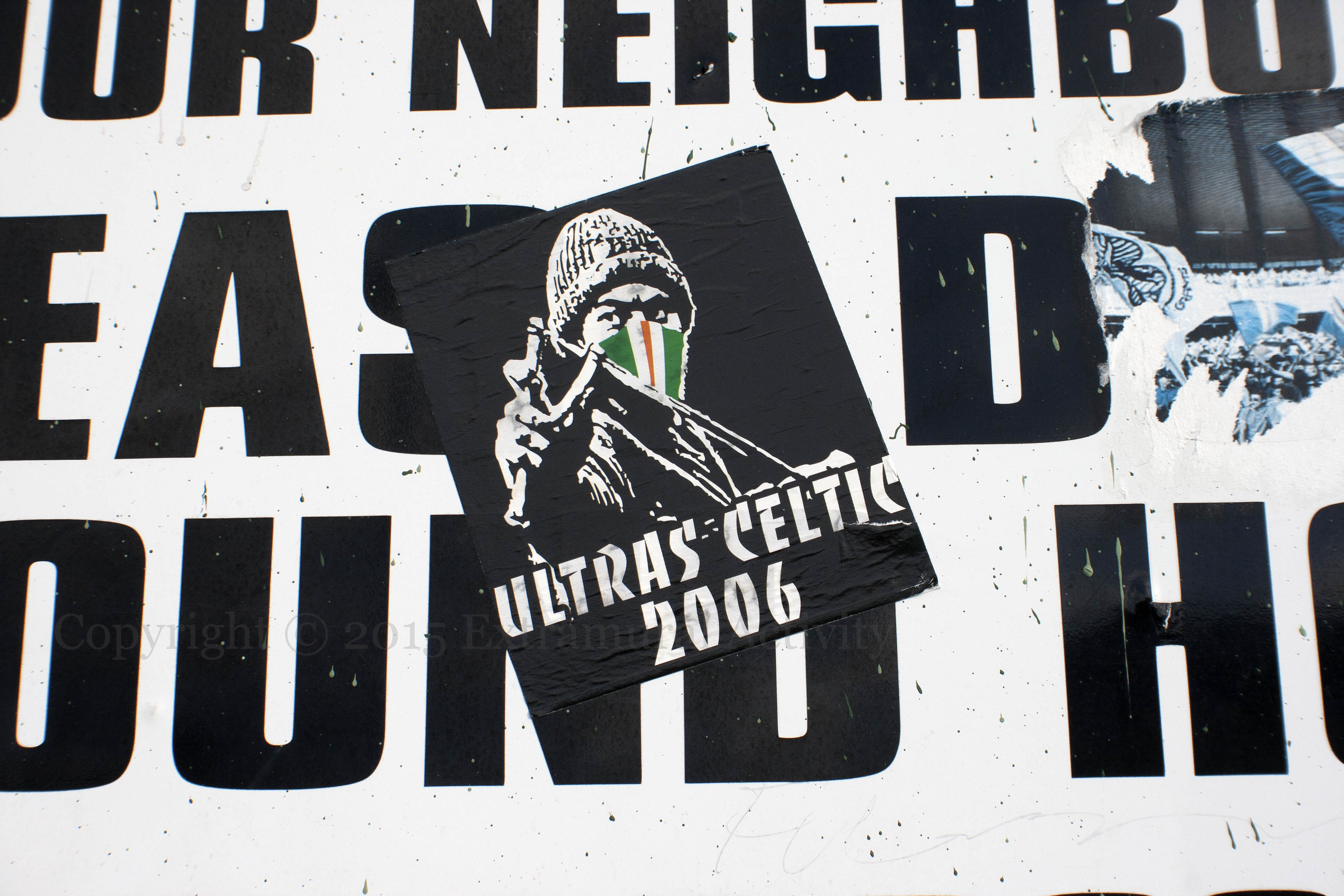
The Green Brigade, founded in 2006, (web | WP) is an ultra-fanatical supporters club for Scottish football team Celtic. The poster above, which shows a supporter with scarf over the lower part of his face and aiming a slingshot, is in the Clonard area of west Belfast.
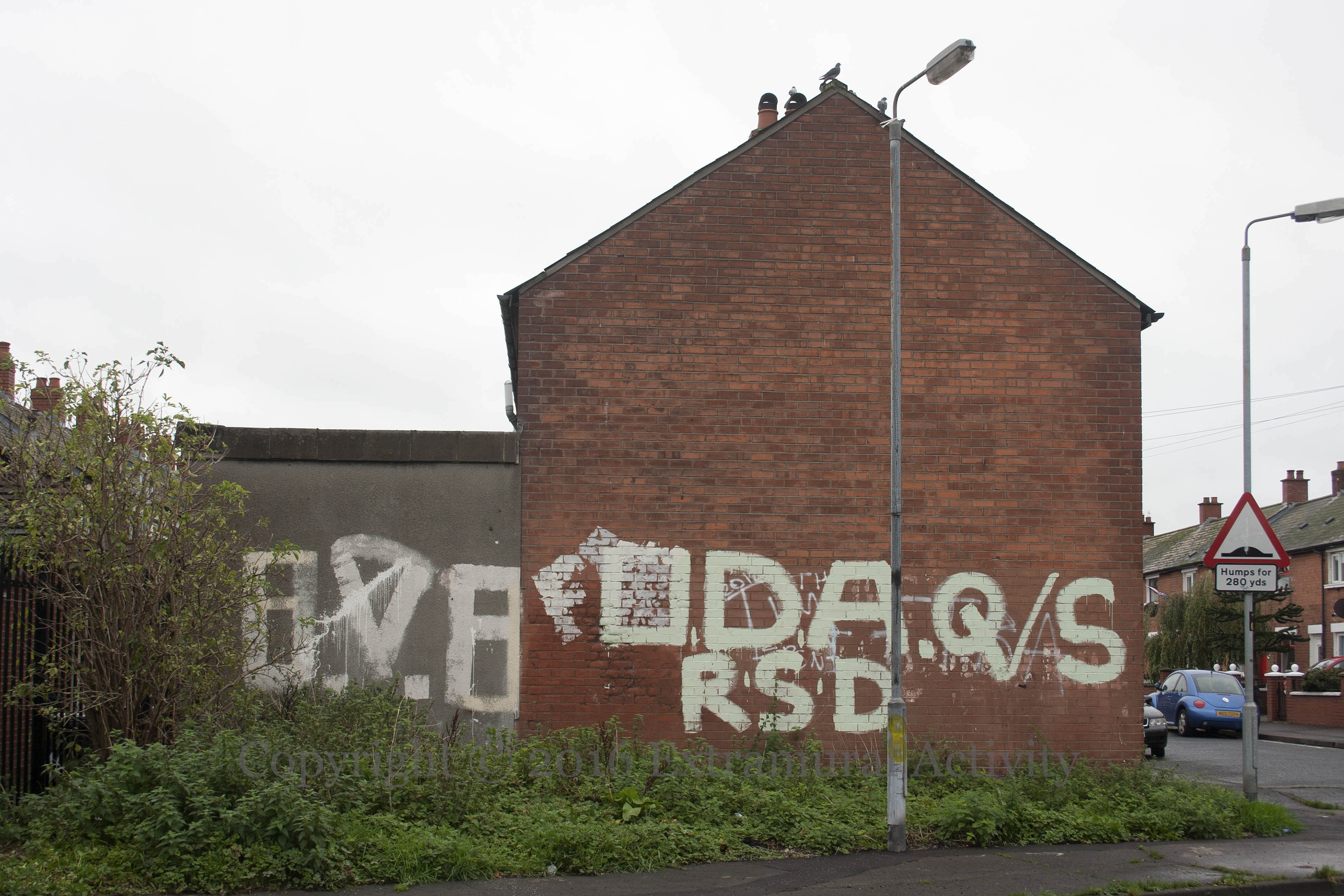
Three images of initialisms: Above in Milner Street, “UVF” [Ulster Volunteer Force] has been painted over but “UDA” [Ulster Defence Association], “Q/S” [quis separabit], and “RSD” [Roden Street Defenders] remain.
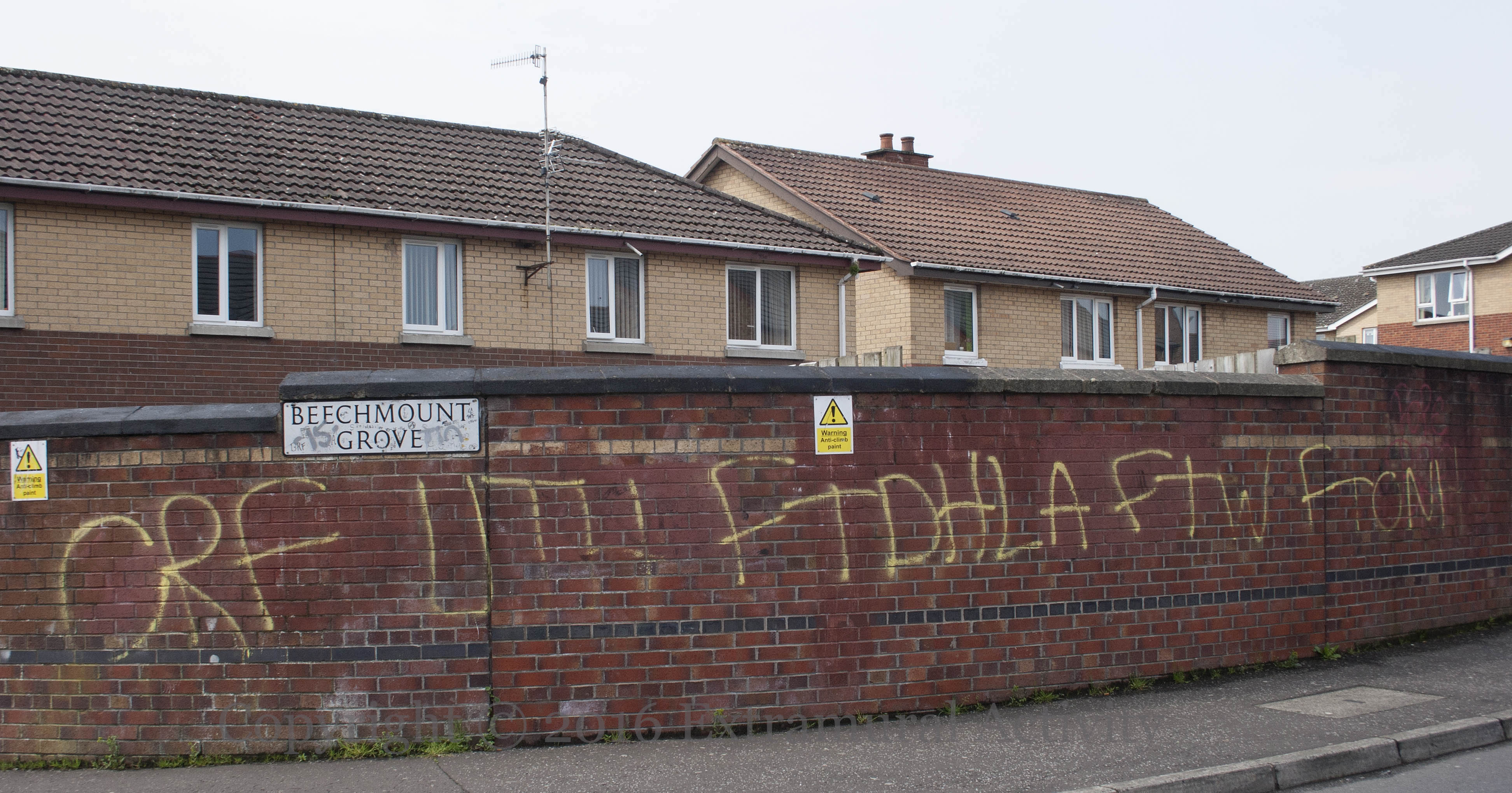
In the second image, in Beechmount Grove, we have “CRF” [Catholic Reaction Force?], “UTH” [Up the hoods], “FTDHLA”, [Eff the Divis Hoods Liberation Army”, FTW” [Free the weed?], “FTONH” [Eff the Óglaıgh Na hÉıreann]
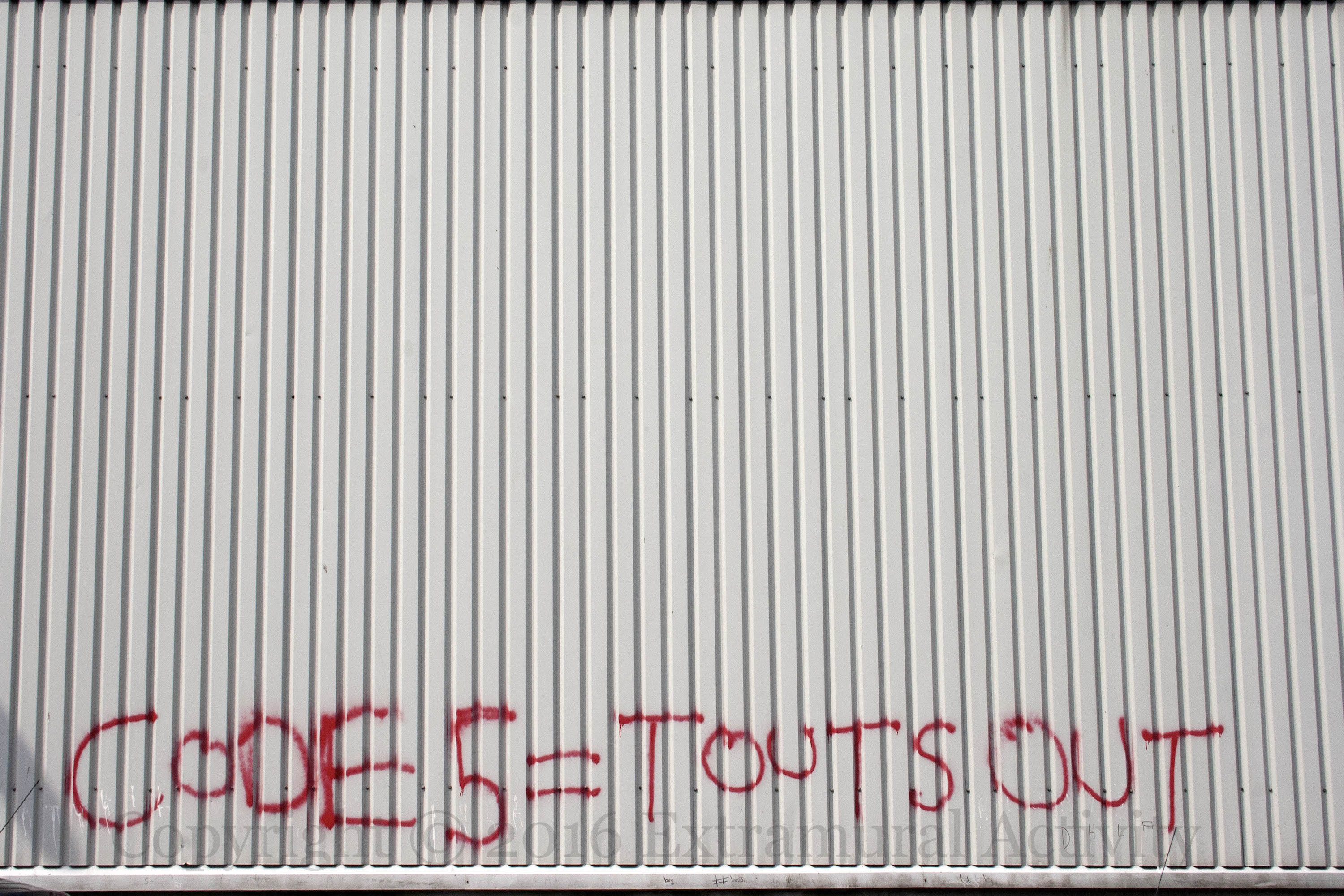
The last (in Percy St) is left as an exercise for the reader. (Or: we have no idea what “code 5” is.)
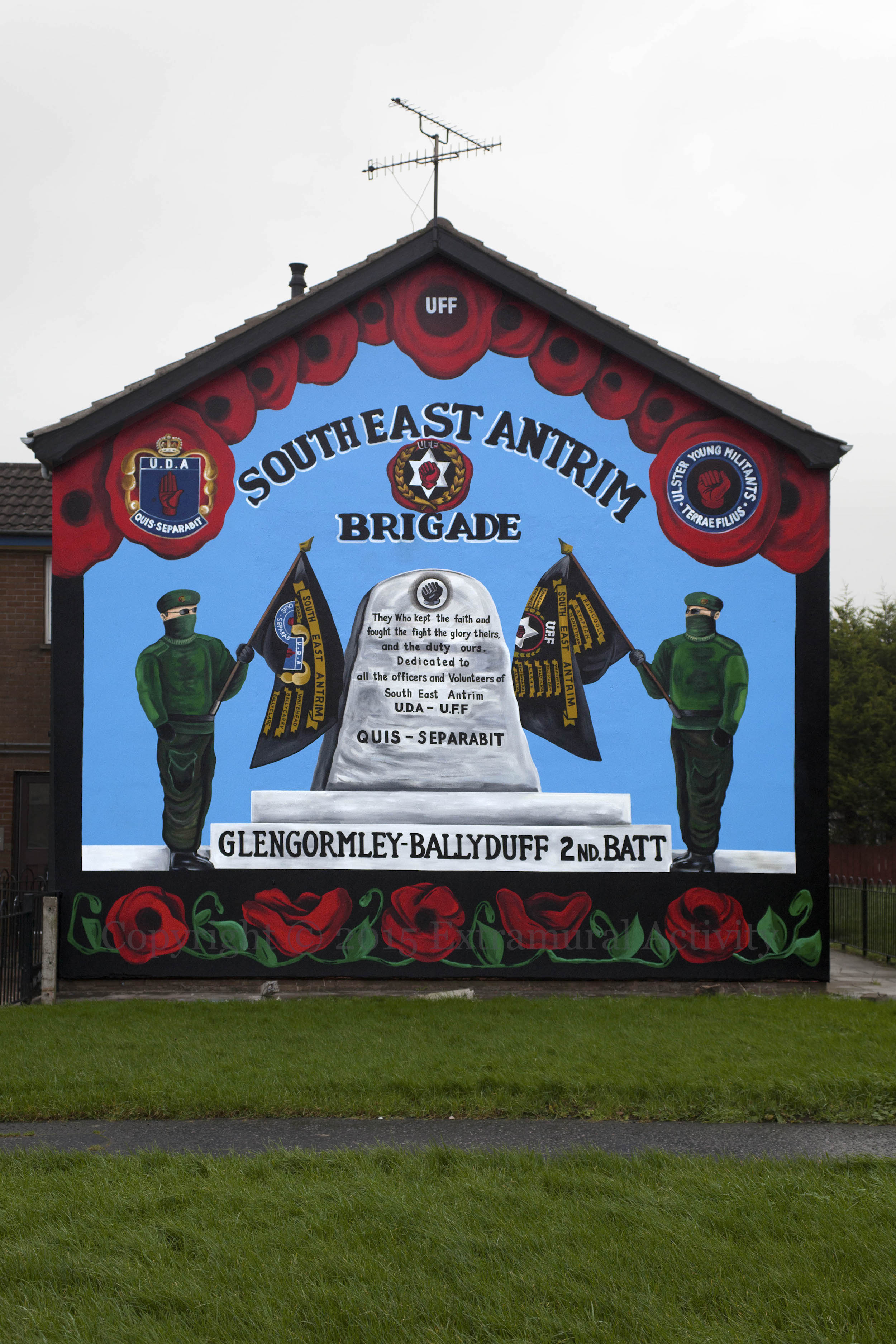
The new loyalist mural in Ballyduff shows volunteers in sunglasses and scarves standing with flags to either side of a monument which reads “They who kept the faith and fought the fight, the glory theirs and the duty ours. Dedicated to the officers and Volunteers of South East Antrim U.D.A. – U.F.F. Quis separabit.”
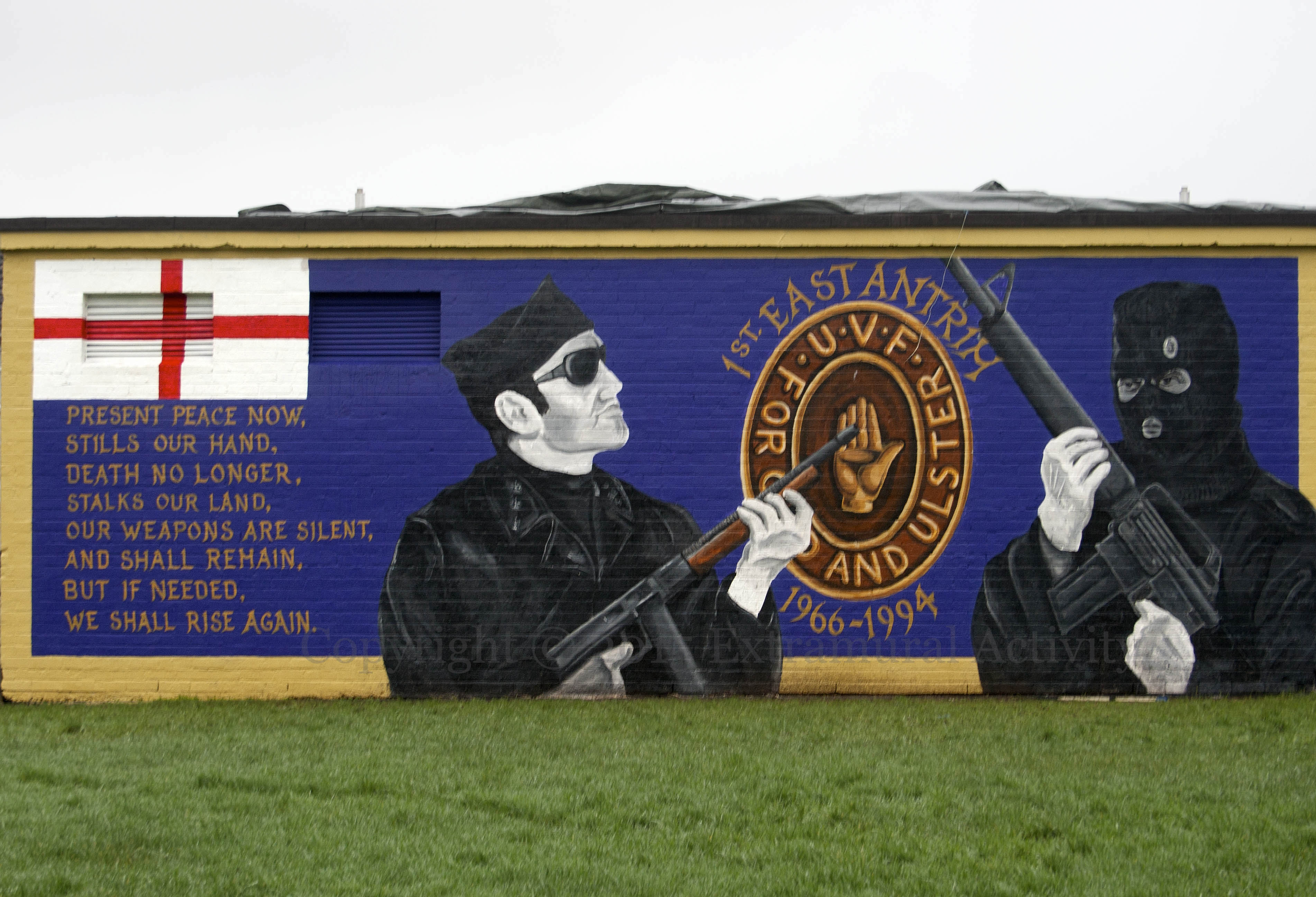
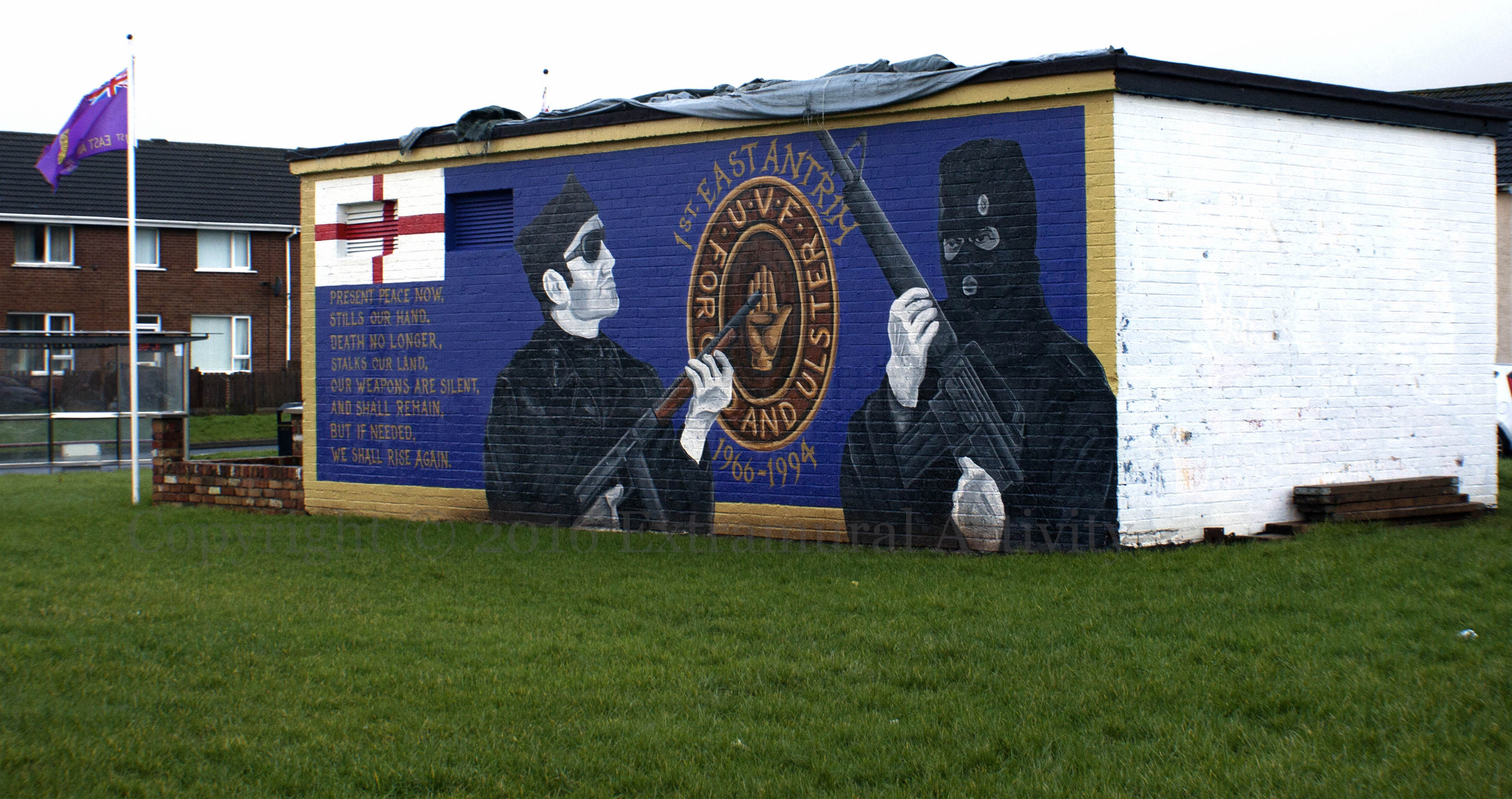
The years of operation of the UVF in this new Ballyduff mural are given as 1966-1994. The main loyalist paramilitaries began what was to be a lasting ceasefire on 13th of October, 1994. The ceasefire was announced by Gusty Spence, who was the organisation’s original leader in 1966.
“Present peace now, stills our hand, death no longer stalks our land, our weapons are silent, and shall remain, but if needed, we shall rise again.”
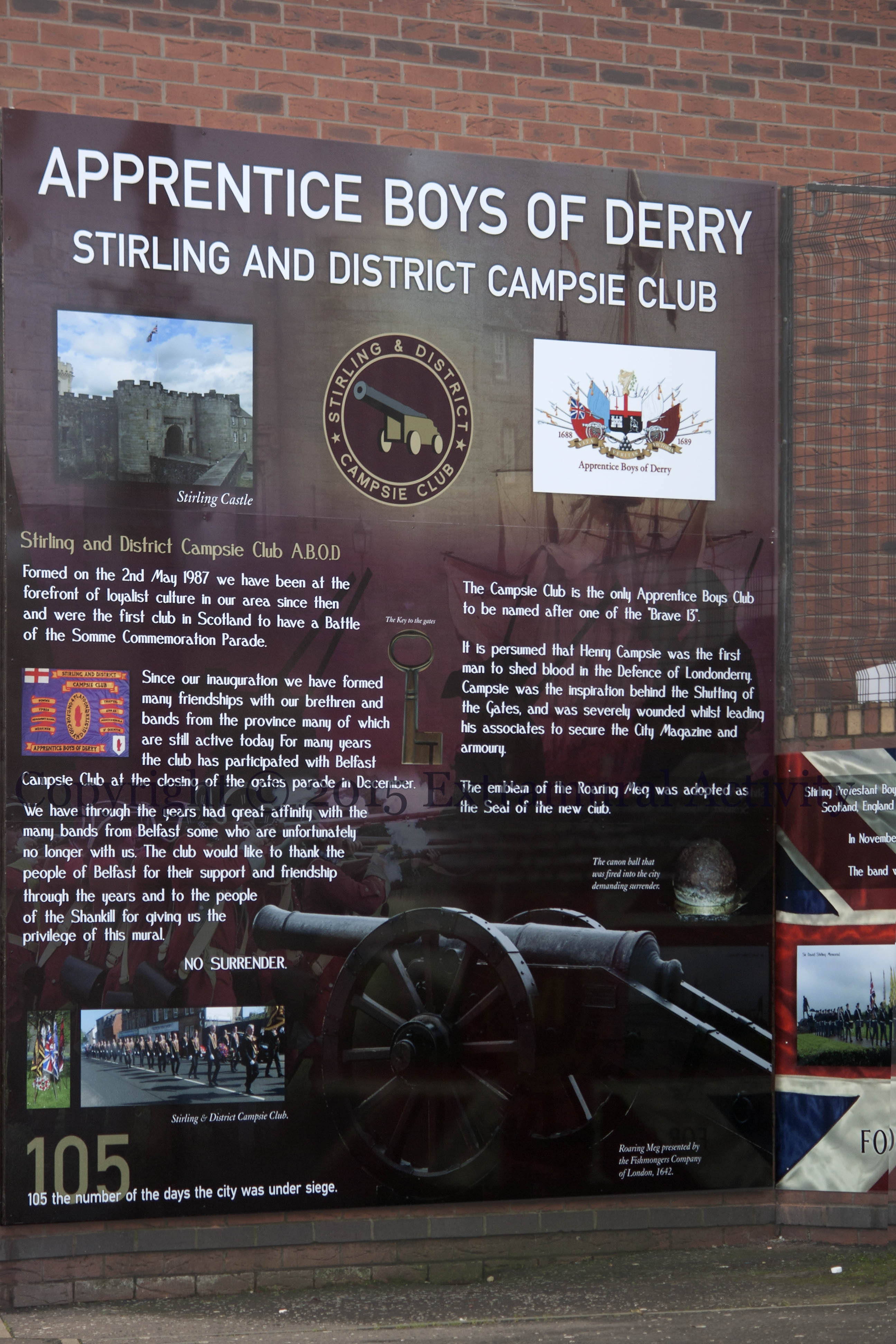
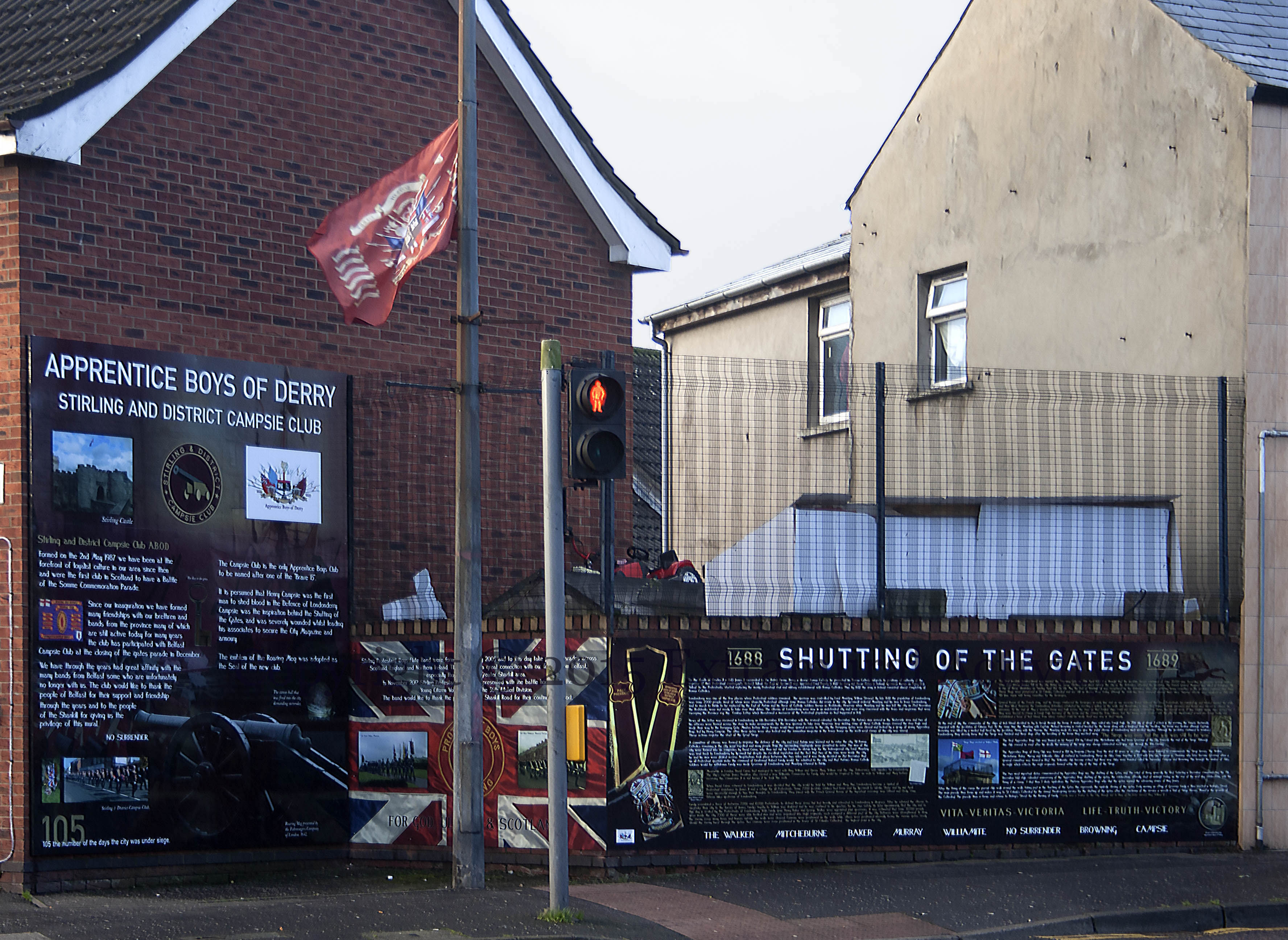
Here is the second of three panels from a new mural on the Shankill Road celebrating the ties between Belfast and the Stirling & District Campsie Club, a branch of one of the associated clubs of the Apprentice Boys Of Derry. It features the cannon “Roaring Meg” (“presented by the Fishmongers Company of London 1642″) which is used as the seal for the club, the club’s flag which includes a red hand of Ulster, the key to the gates, and the emblem and coat of arms of the Apprentice Boys.
“Formed on the 2nd May 1987 we have been at the forefront of loyalist culture in our area since then and were the first club in Scotland to have a Battle of the Somme Commemoration Parade. Since our inauguration we have formed many friendships with our brethren and bands from the province many of which are still active today. For many years the club has participated with Belfast Campsie Club at the closing of the gates parade in December. We have through the years had great affinity with the many bands from Belfast some who are unfortunately no longer with us. The club would like to thank the people of Belfast for their support and friendship through the years and to the people of the Shankill for giving us the privilege of this murals.
No surrender.
The Campsie Club is the only Apprentice Boys Club to be named after one of the “Brave 13″. It is persumed presumed that Henry Campsie was the first man to shed blood in the Defence of Londonderry. Campsie was the inspiration behind the Shutting of the Gates and was severely wounded whilst leading his associates to secure the City Magazine and armoury. The emblem of the Roaring Meg was adopted as the Seal of the new club.”
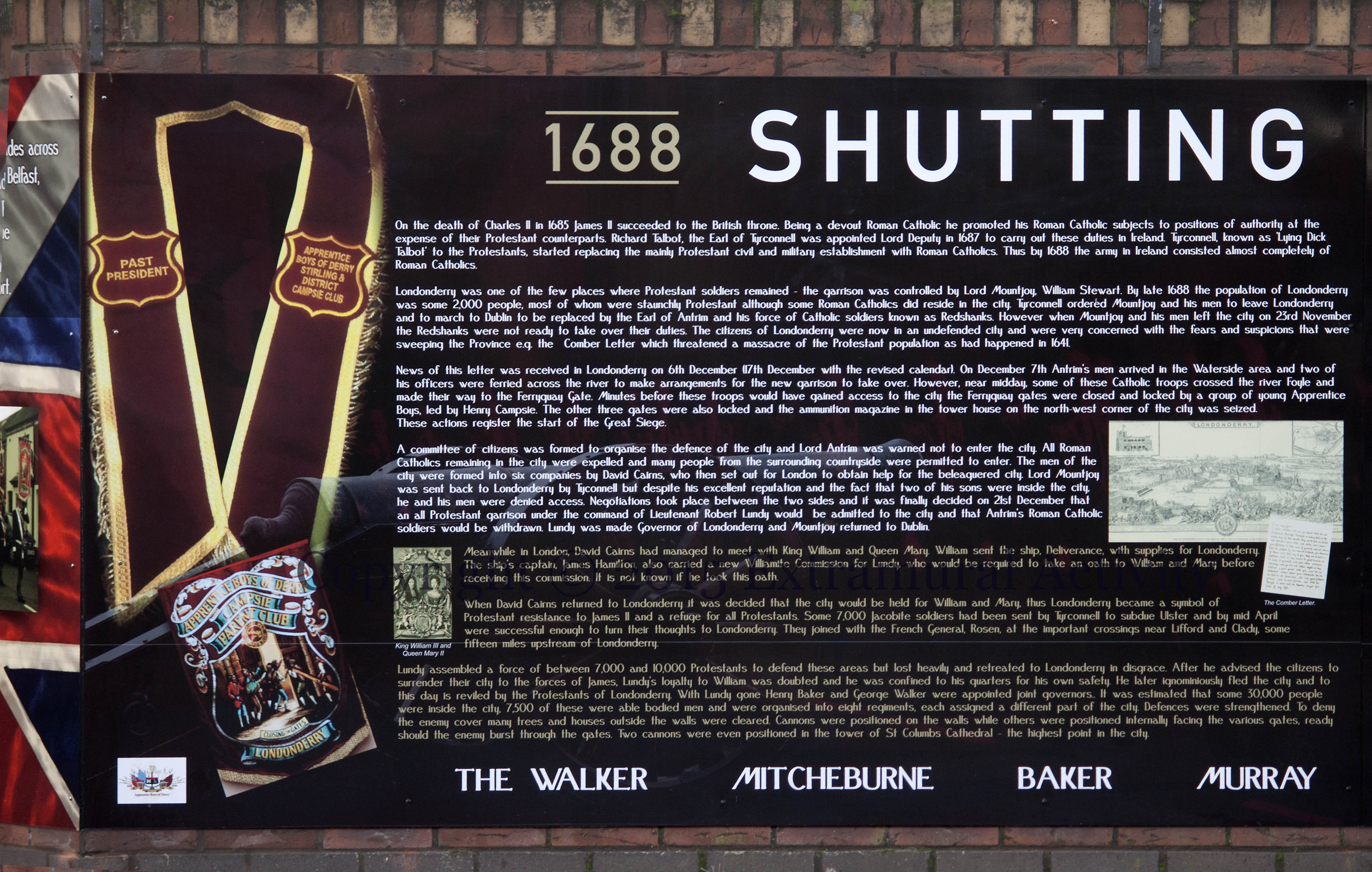
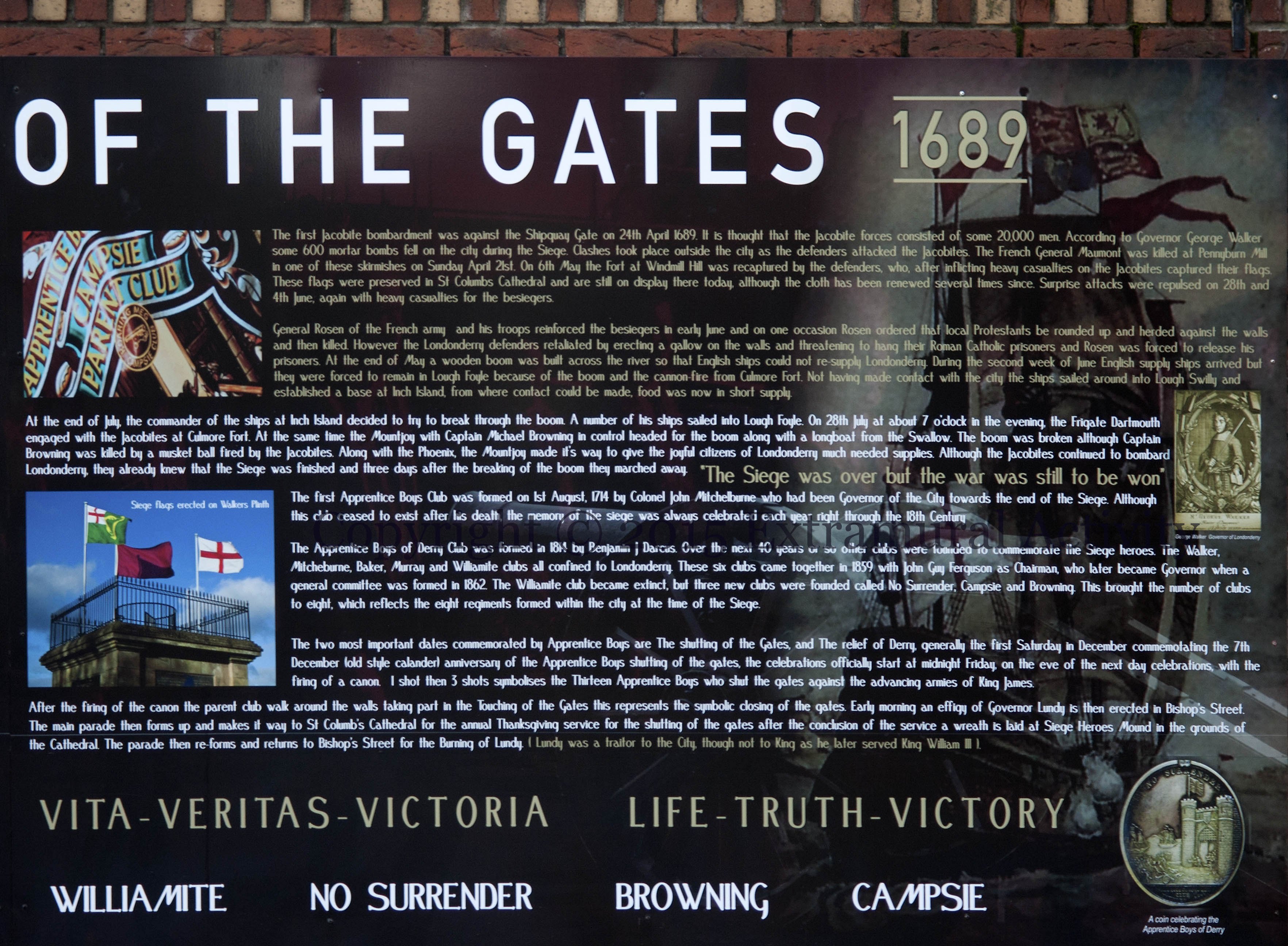
The third of three new panels celebrating the Apprentice Boys contains a long description of the Shutting Of The Gates in December 1688 and the Siege Of Derry, which was ended with the breaking of the boom of the river Foyle in July 1689.
 Seosamh Mac Coille Collection