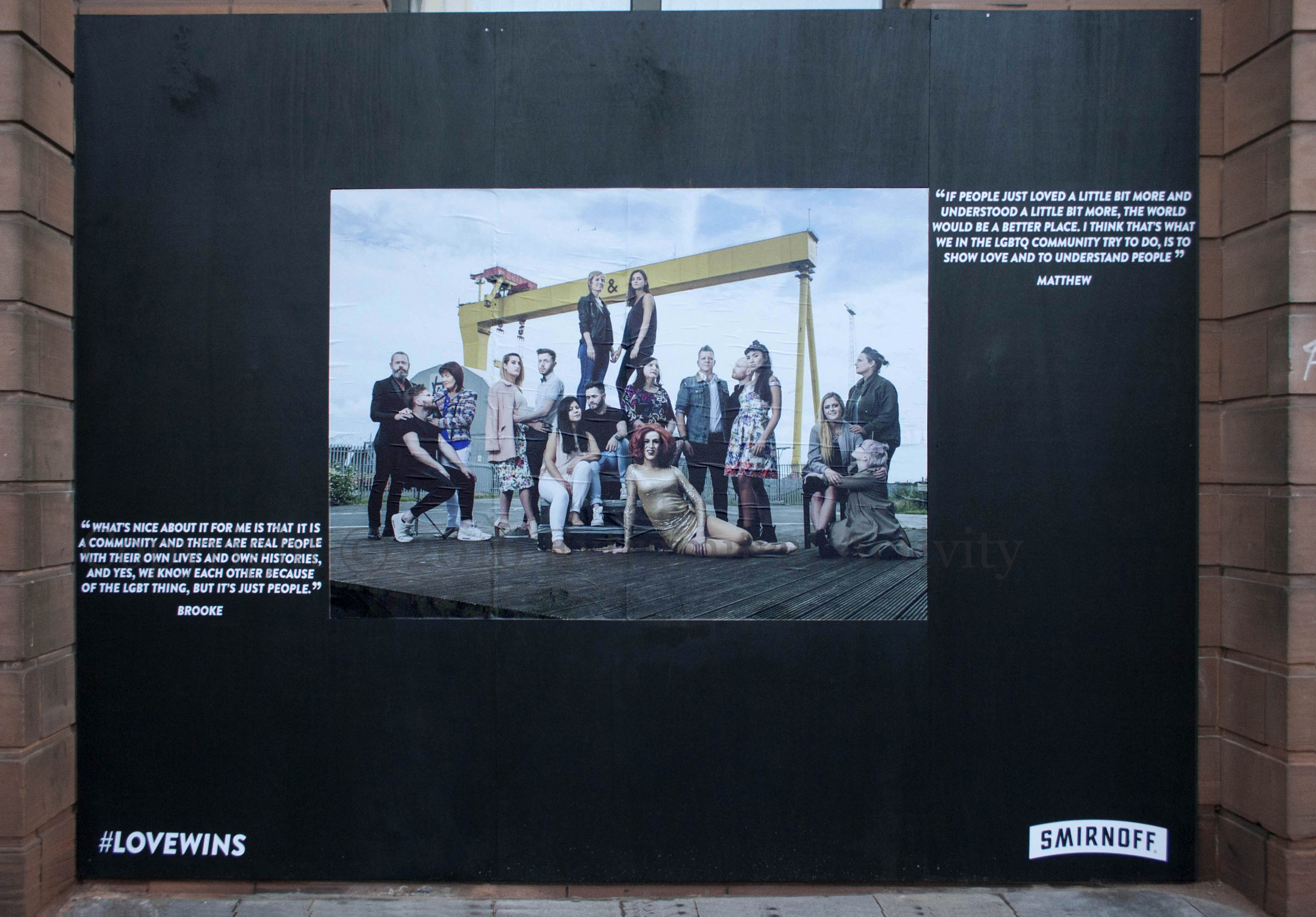
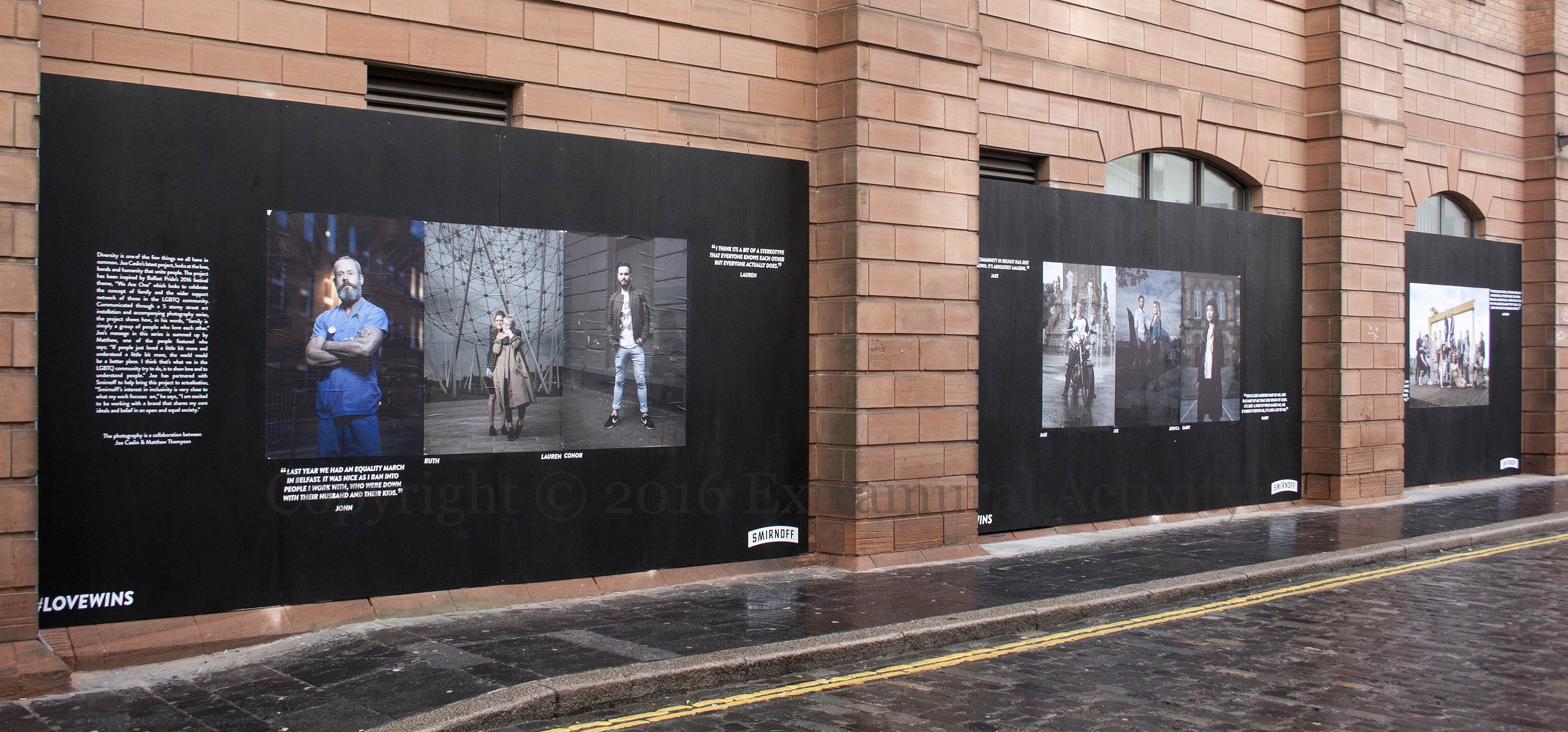
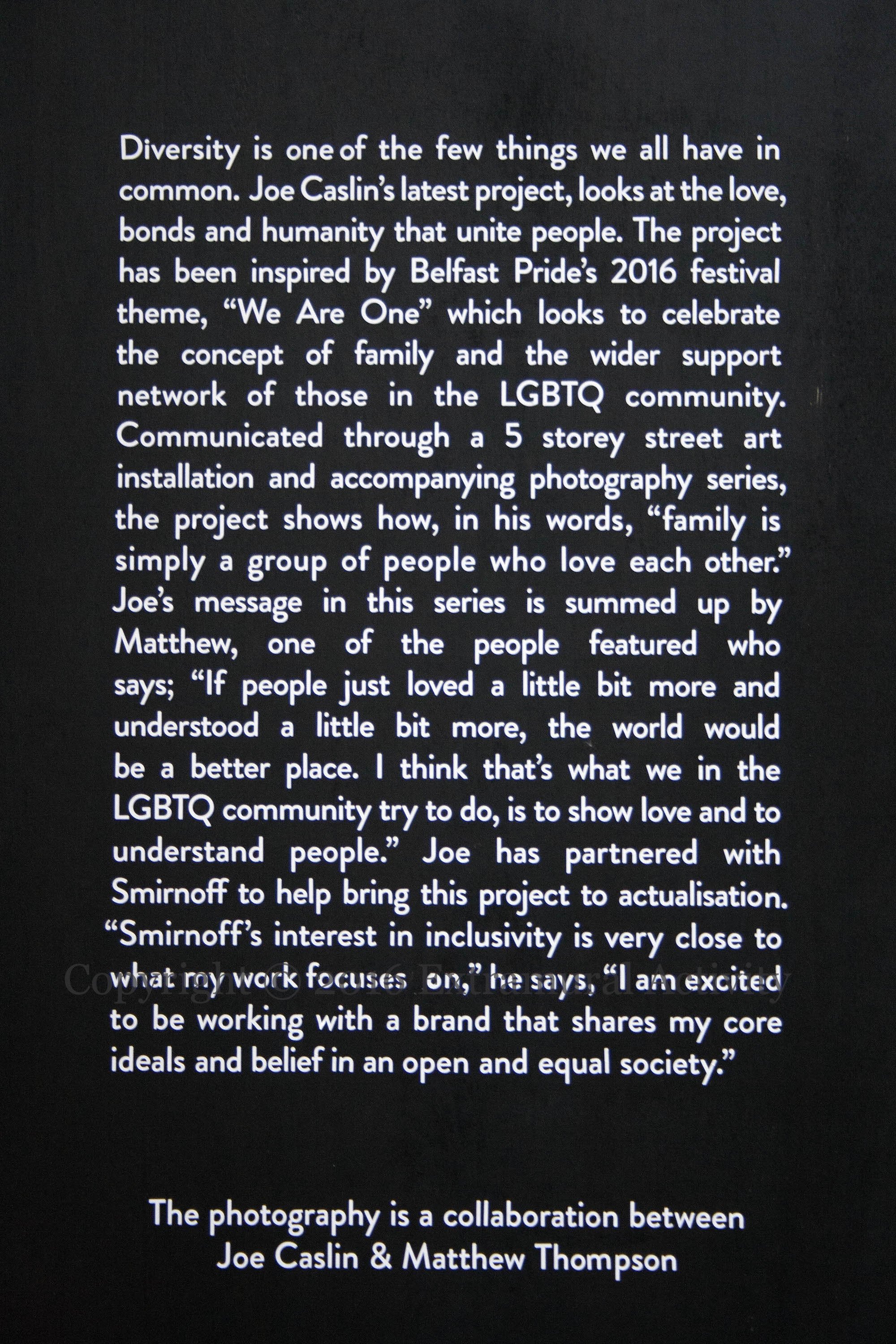
In addition to the ‘Love Wins’ paste-up (recorded separately), Joe Caslin and photographer Matthew Thompson (web) took photos of members of the LGBTQ community for an installation on Hill Street just below the mural. “We are one” is the theme of the festival this year, “which looks to celebrate the concept of family and the wider support network of those in the LGBTQ community.”
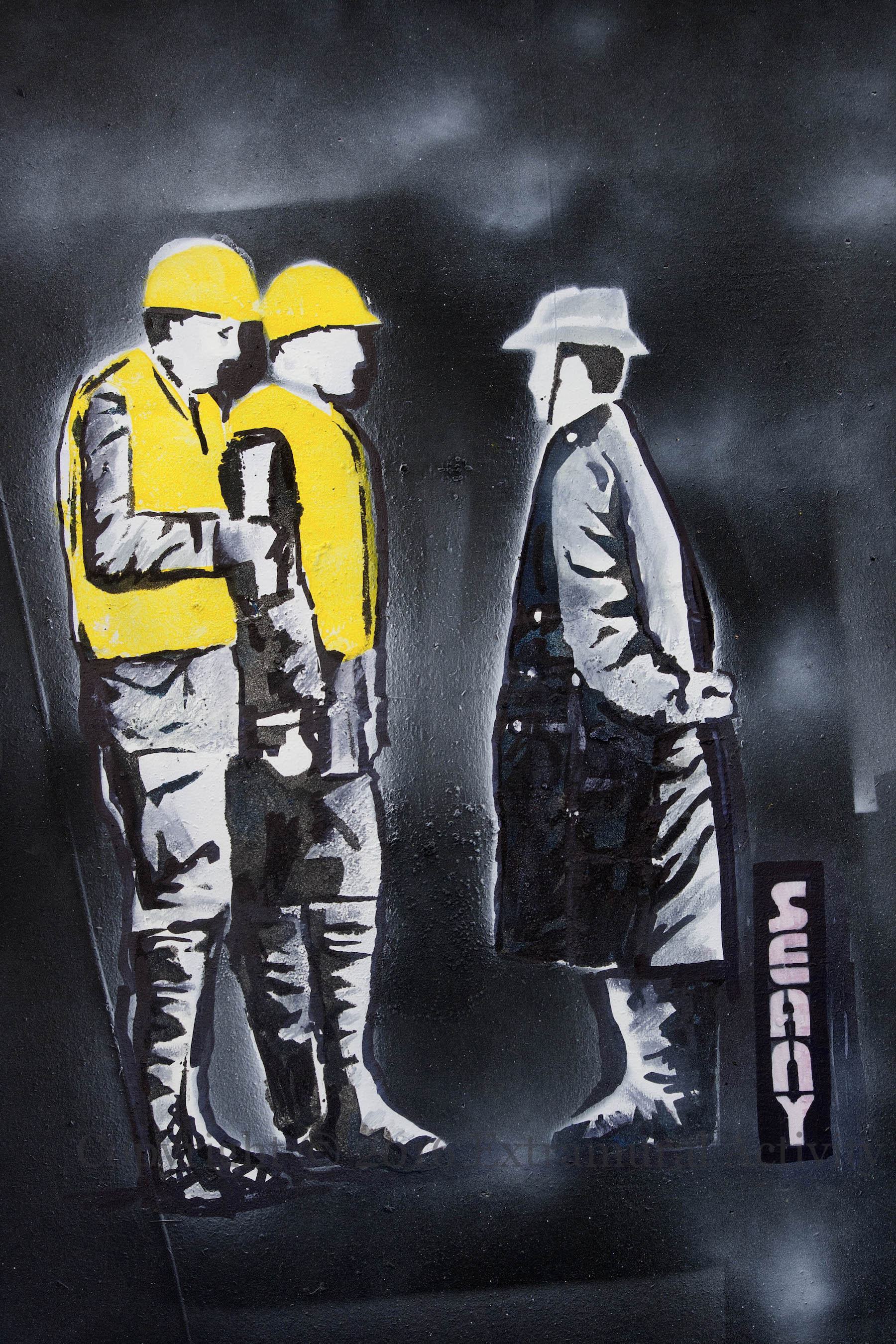
In January (2016) a stencil like the one above appeared in Moore Street, Dublin. Moore Street was the place of the last stand of the Easter Rising after the GPO caught fire and campaigners were thus fighting to save it from redevelopment (Irish Times). (Moore Street’s future is still uncertain at this time, late summer 2016.)
The stencil is based on a photograph of Padraig Pearse and Elizabeth O’Farrell surrendering to the British General Lowe. The piece was ‘signed’ by Banksy, though it was immediately suspected to be not by Banksy, as he had not signed any pieces for some years, and indeed, Banksy denied that it was his (e.g. Irish Times) and Will St Ledger wished that the artist had had the confidence to claim it as their own (RTÉ).
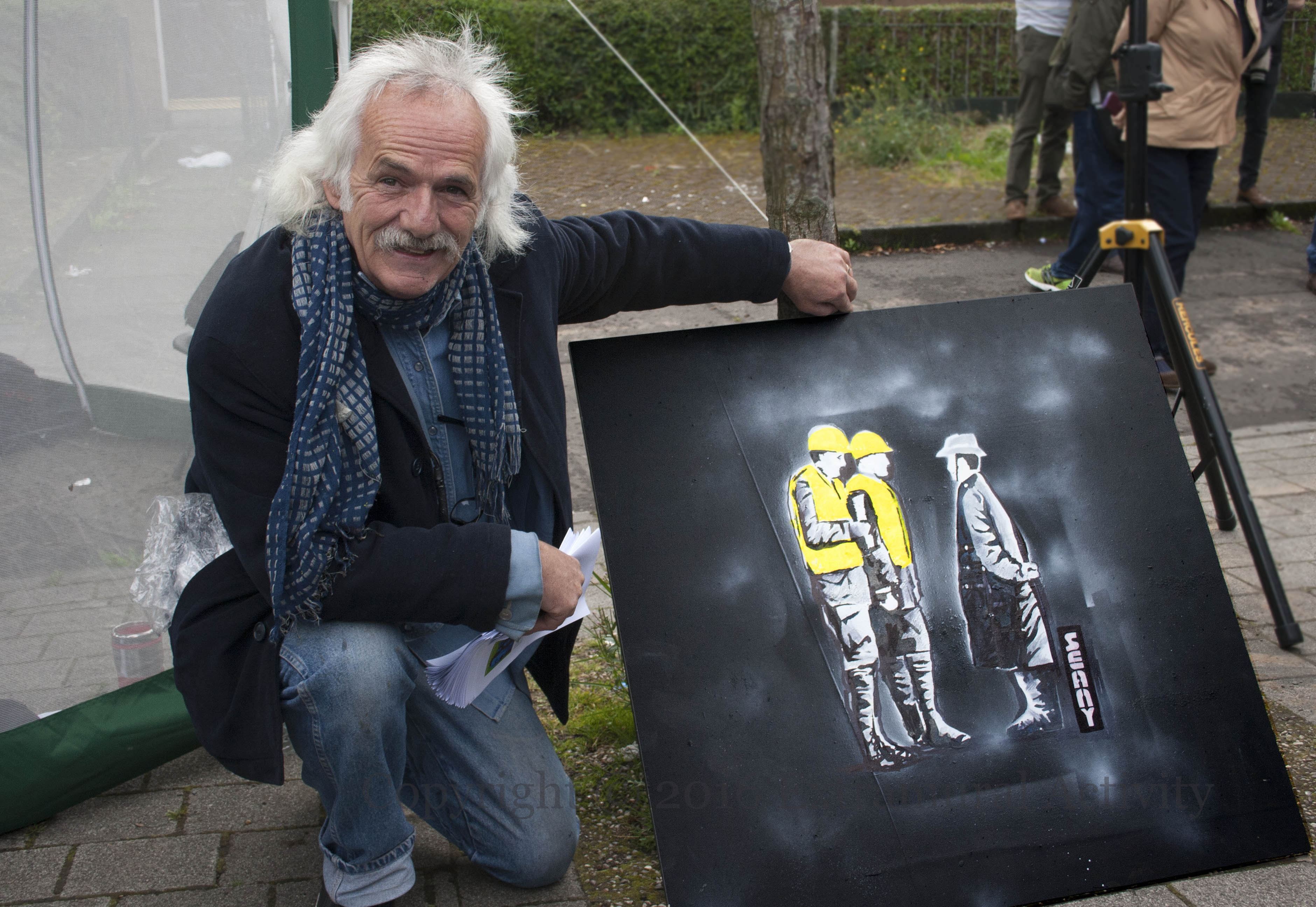
The artist was in fact Short Strand man Séan “Seany” McVeigh, who then died in June. In honour of his life, a fellow Short Strand resident (see second image, below) produced this version of McVeigh’s piece, with the name “Seany” proudly attached. (For his other “Banksy” see a Belfast version of Banksy’s Palestinian “peace” wall stencil.)
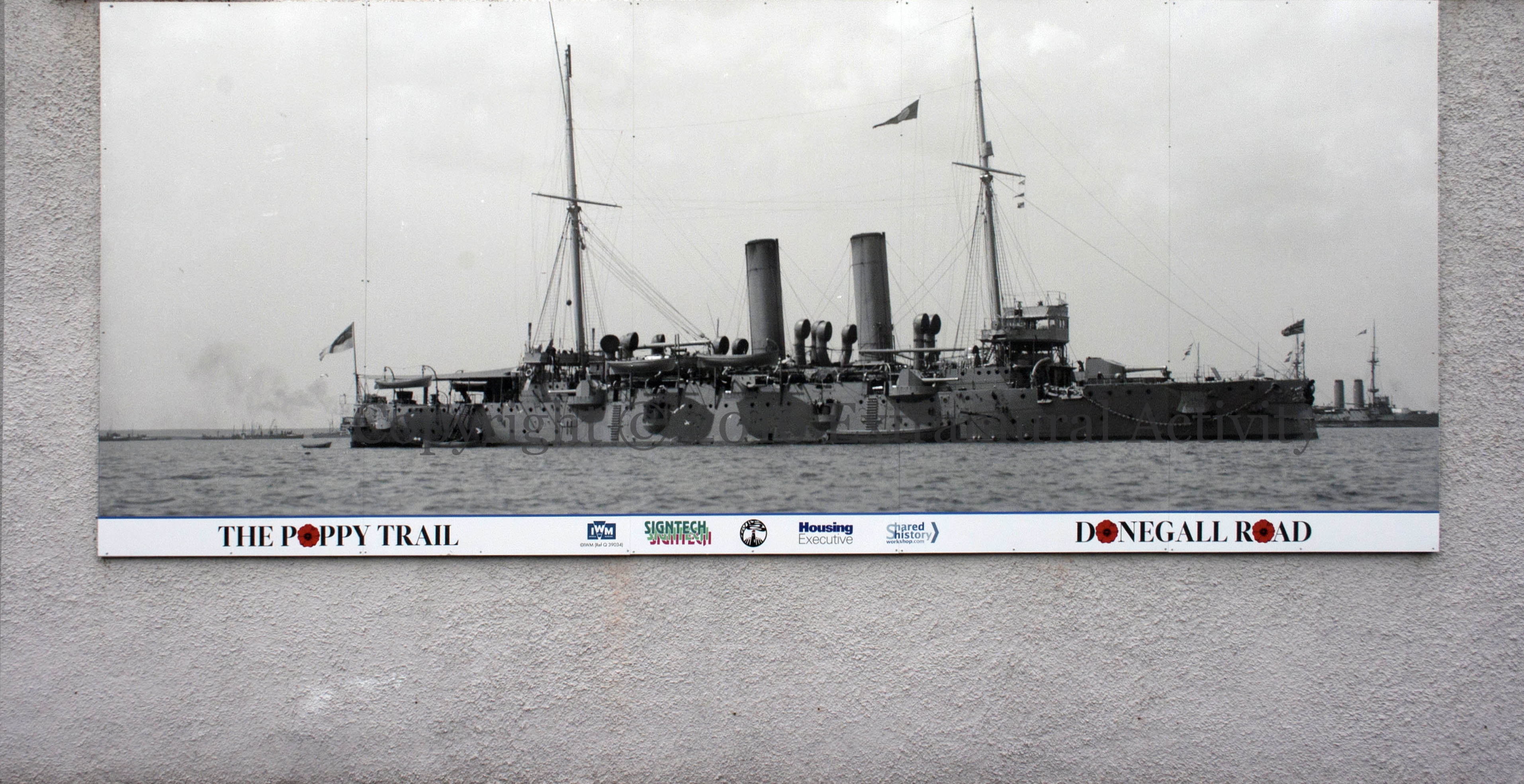
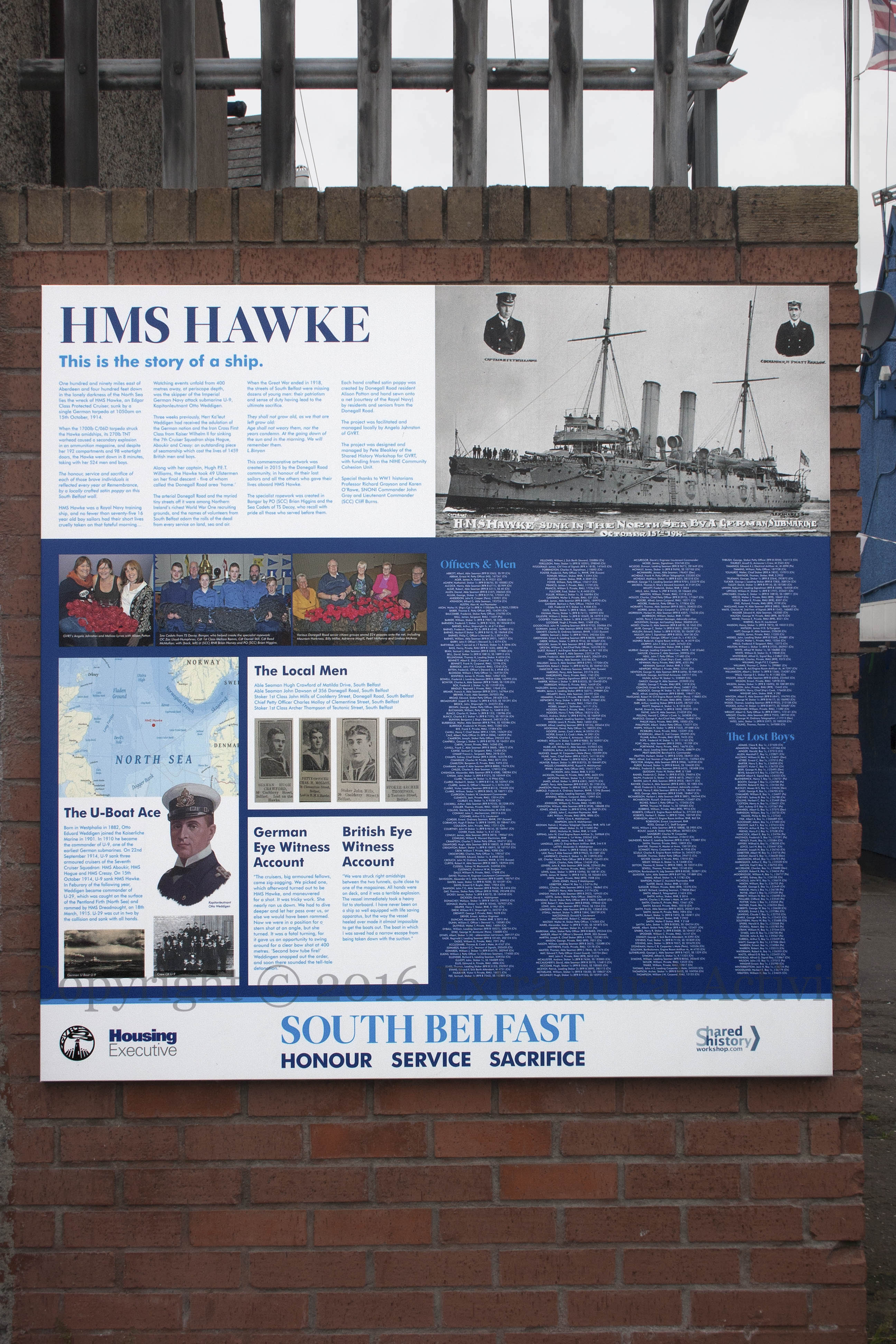
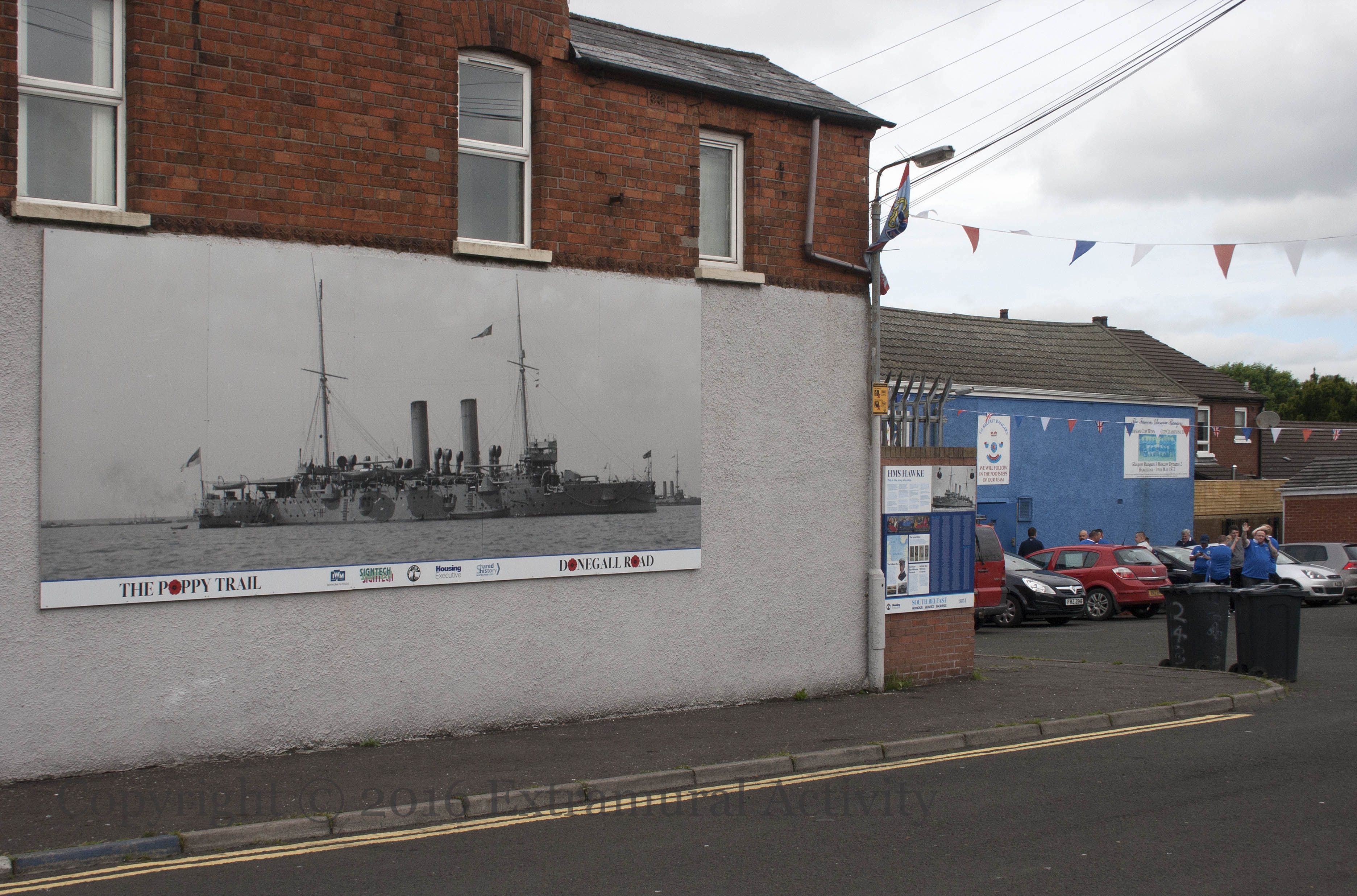
HMS Hawke was a Royal navy WWI cruiser sunk by German U-boat on October 1st, 1914. It was a training ship, which meant that among the 542 sailors who lost their lives on the Hawke, 75 of them were 16 year-old boys.
Five of the deceased were from the Donegall Road area. This is the first mural in south Belfast’s “Poppy Trail”; in addition to the Hawke, there will be a board for each year of the first world war, and perhaps others for WWII, on the streets off Donegall Road, from Barrington Gardens westward across into the Village.
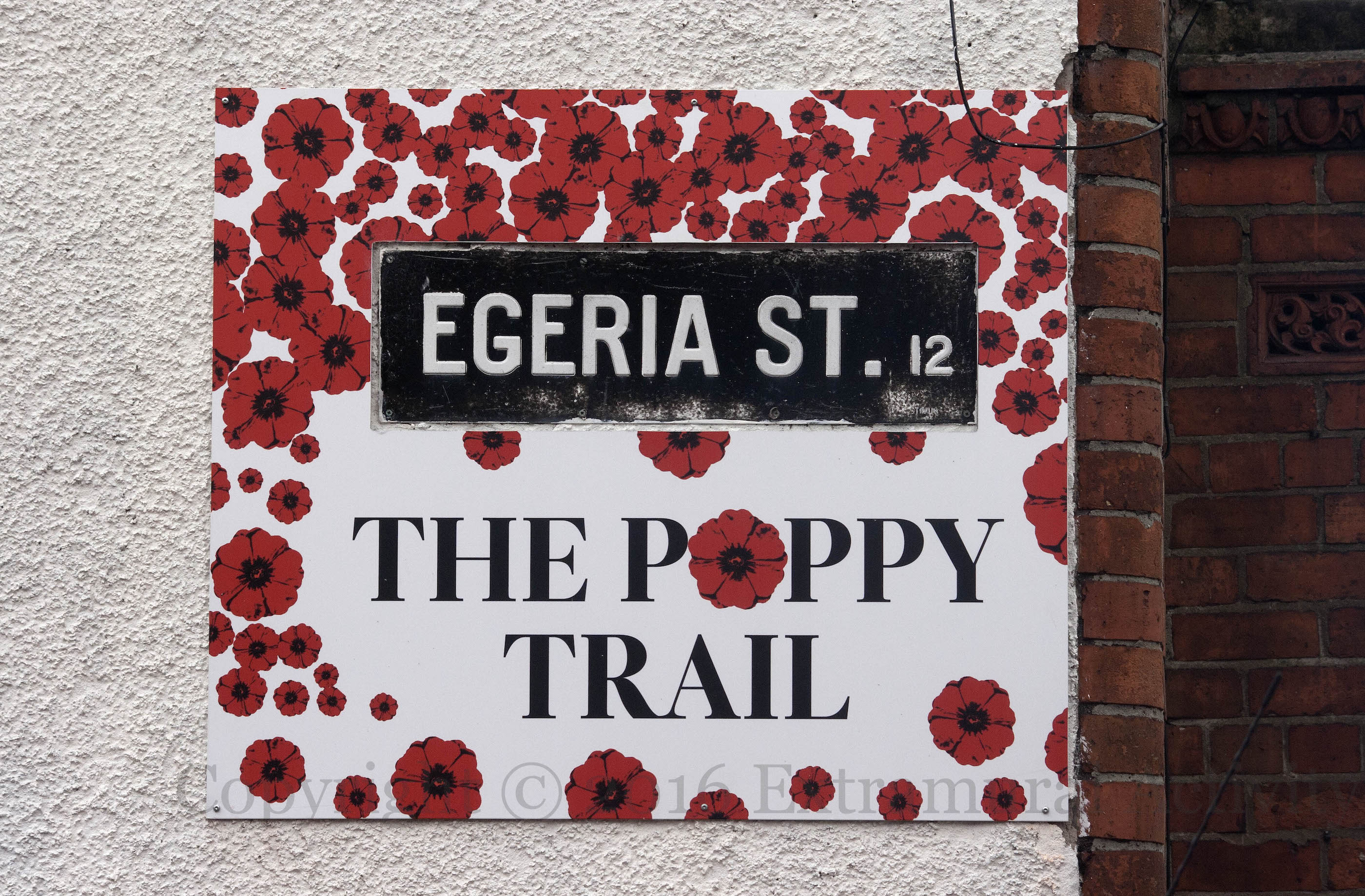
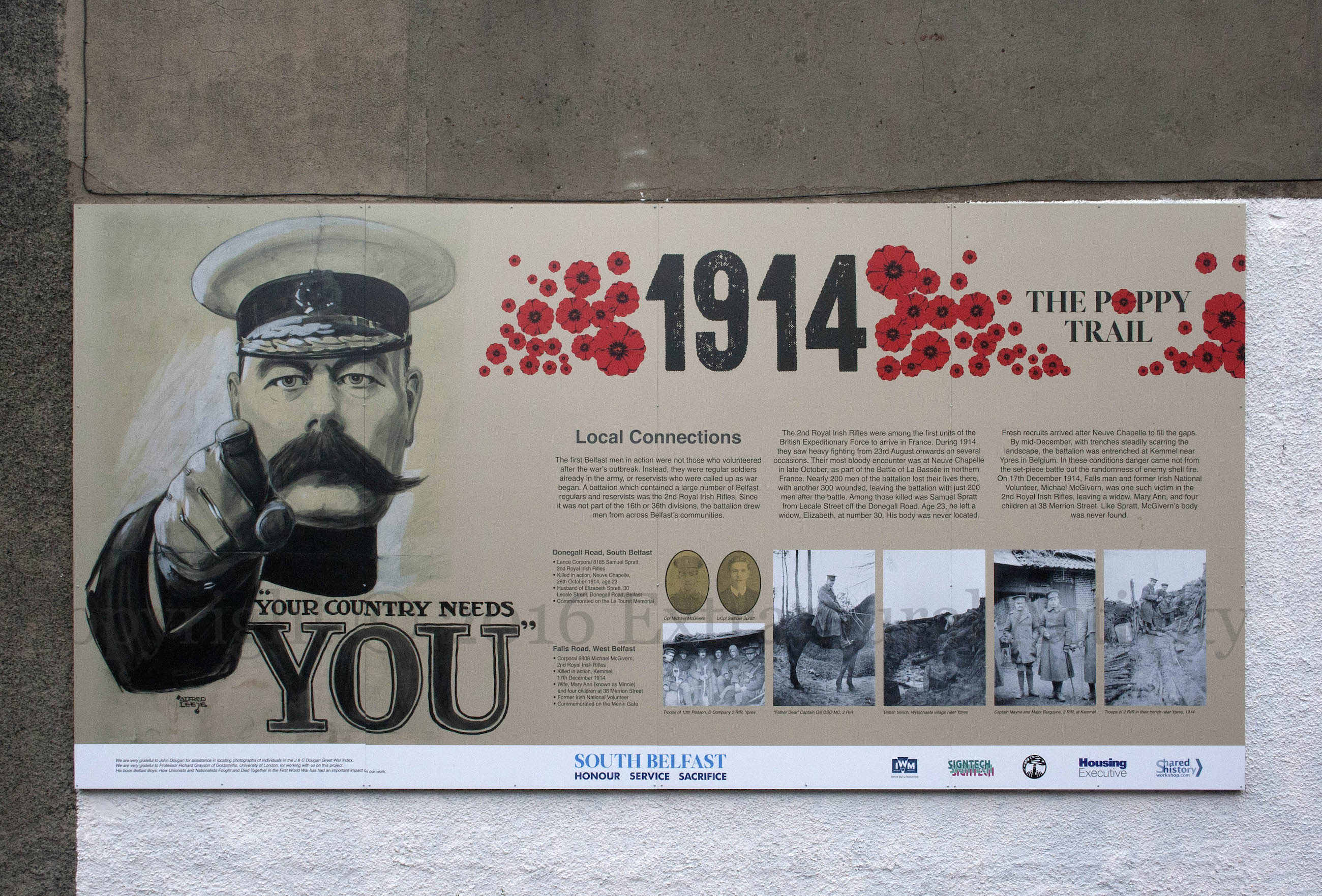
“The first Belfast men in action were not those who volunteered after the war’s outbreak. Instead, they were the regular soldiers already in the army, or reservists who were called up as war began. A battalion which contained a large number of Belfast regulars and reservists was the 2nd Royal Irish Rifles. Since it was not part of the 16th or 36th divisions, the battalion drew men from across Belfast’s communities.” Thus begins the 1914 board on south Belfast’s “Poppy Trail” launched on February 29th. The 1914 board, in Egeria Street, features the stories of Lance Corporal Samuel Spratt (from Lecale Street, off the Donegall Road) who died at Neuve Chappelle in August 1914 and Corporal Michael McGivern (from Merrion Street, off the Falls Road) who died at Kemmel in December.
See also: interviews from the launch on NVTv (starting at 13m44s)
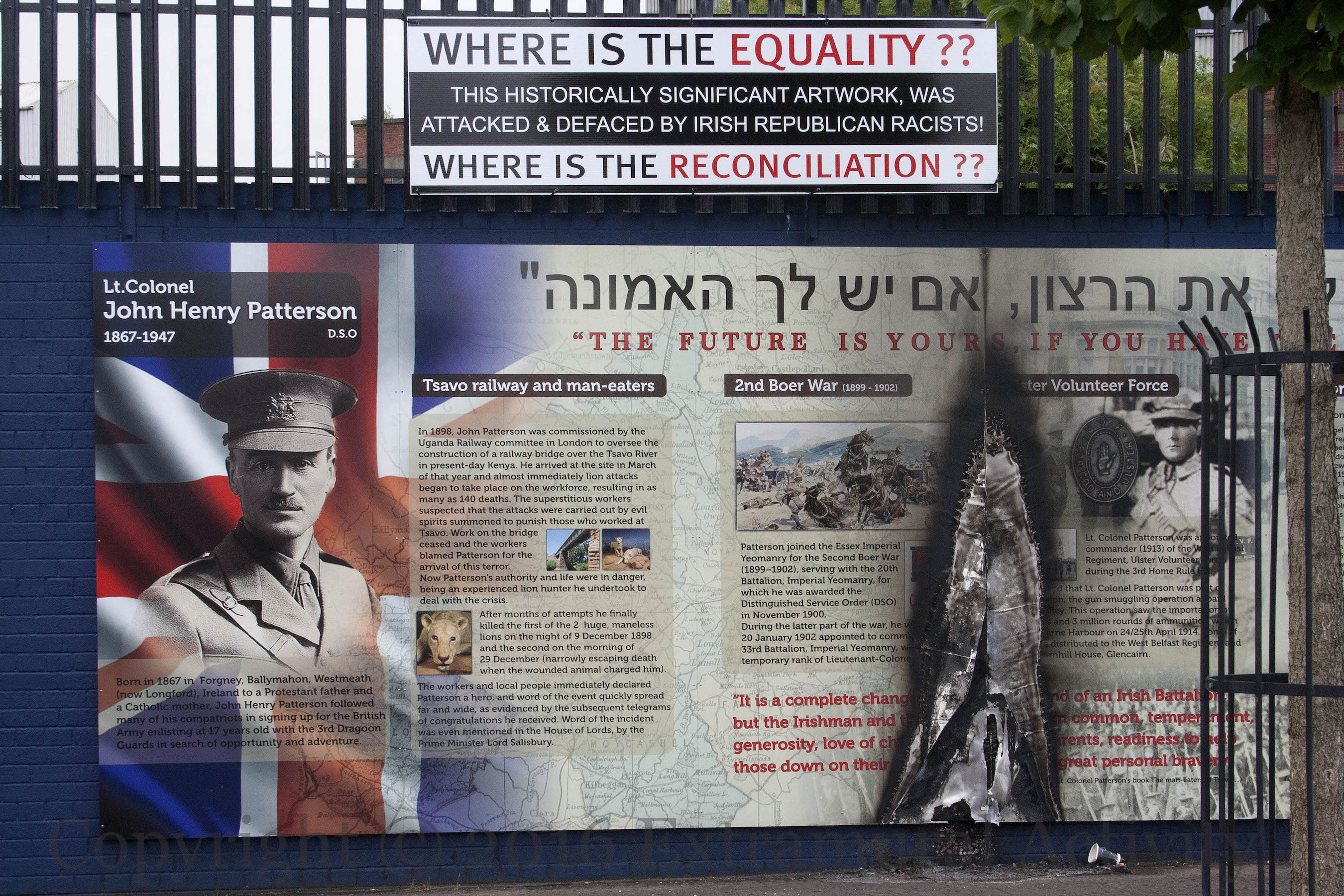
A fire was lit at the base of the John Henry Patterson mural (see Operation Lion | Godfather Of The Israeli Army) on Beverley Street, prompting the notice on the railings above: “Where is the equality? This historically significant artwork, was attacked & defaced by Irish Republican racists? Where is the reconciliation?”
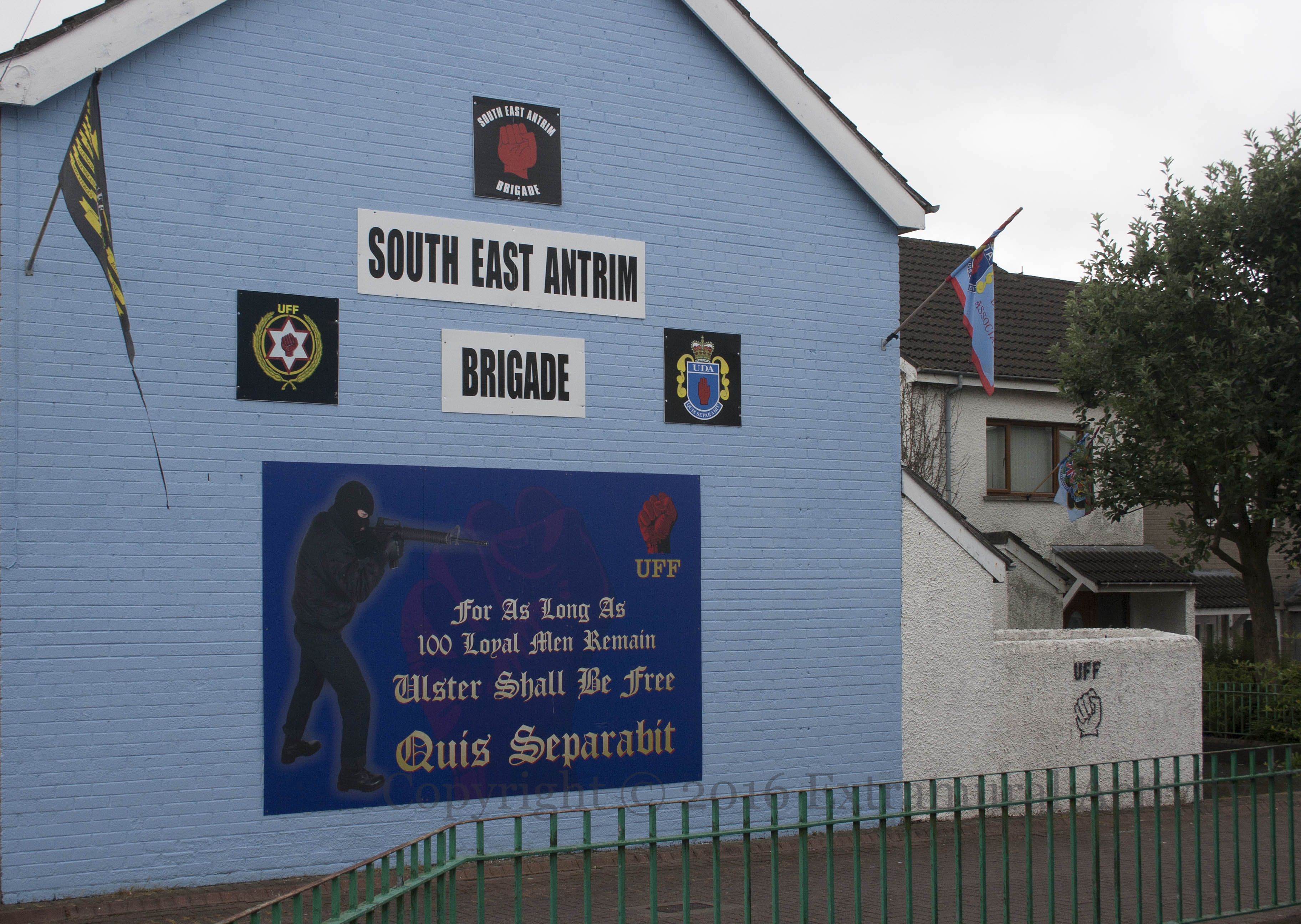
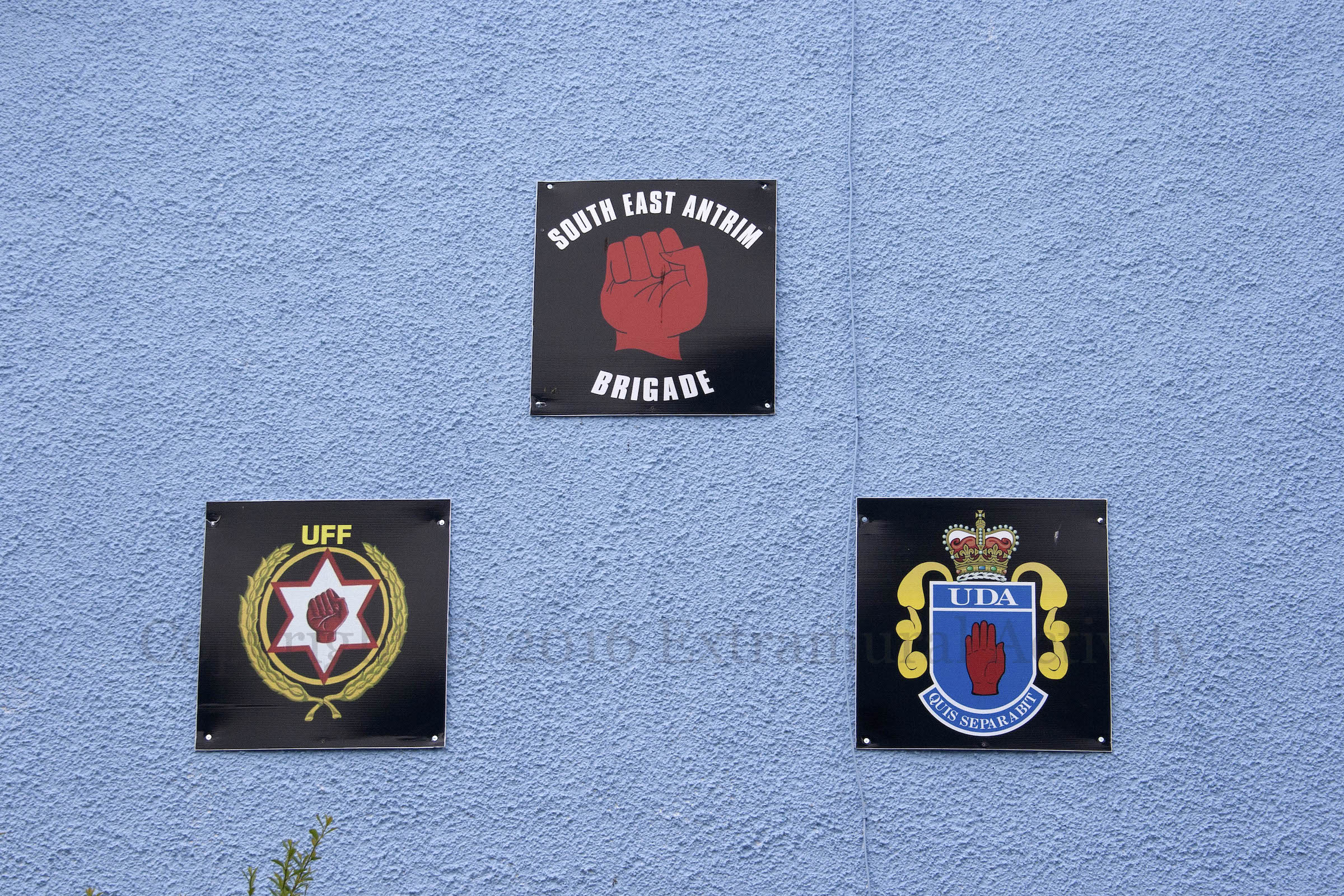
New South East Antrim UDA/UFF mural in Ballyclare, with the usual emblems and a central board featuring a photograph of a balaclava’ed volunteer: “For as long as 100 loyal men remain Ulster shall be free – Quis Separabit”.
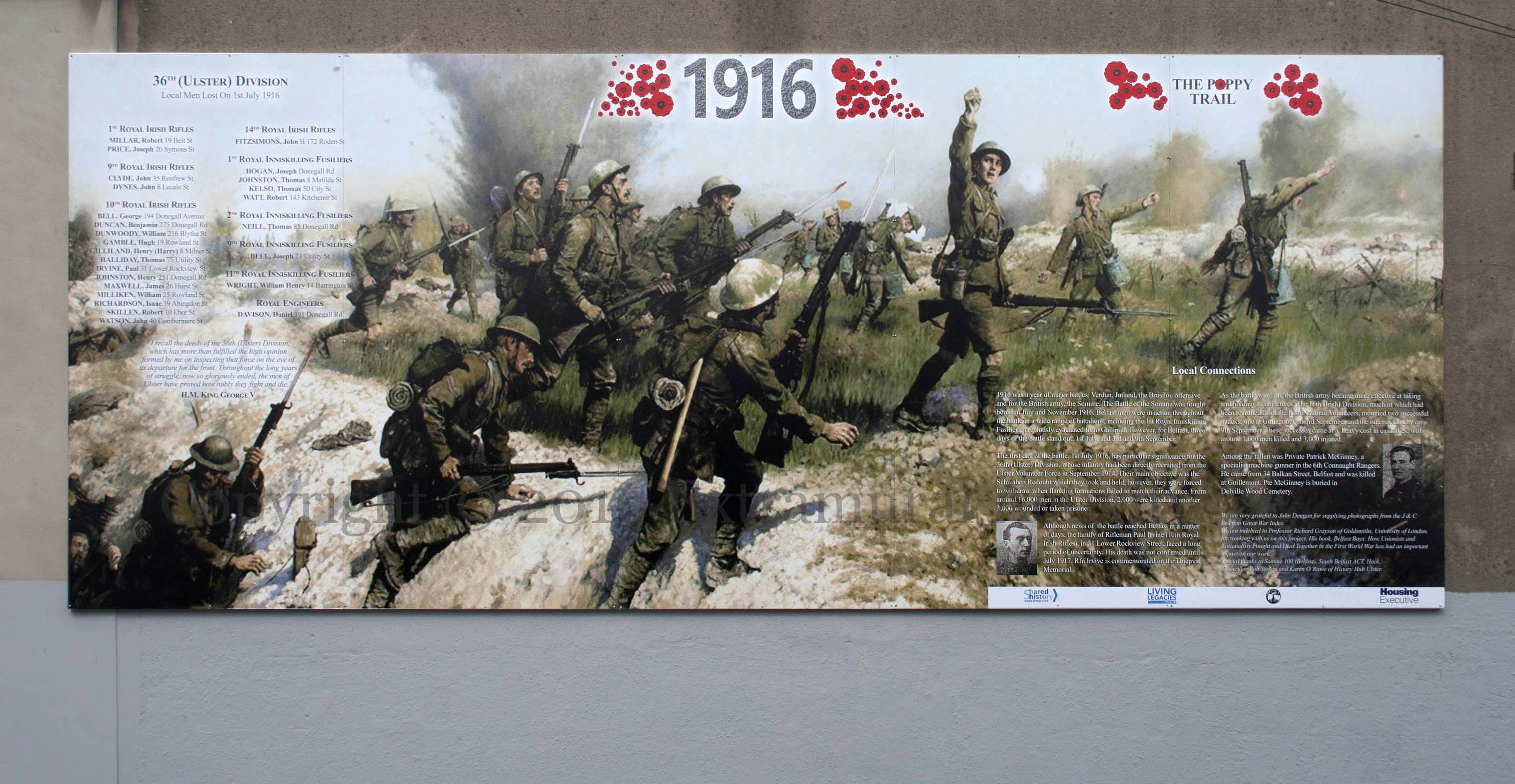
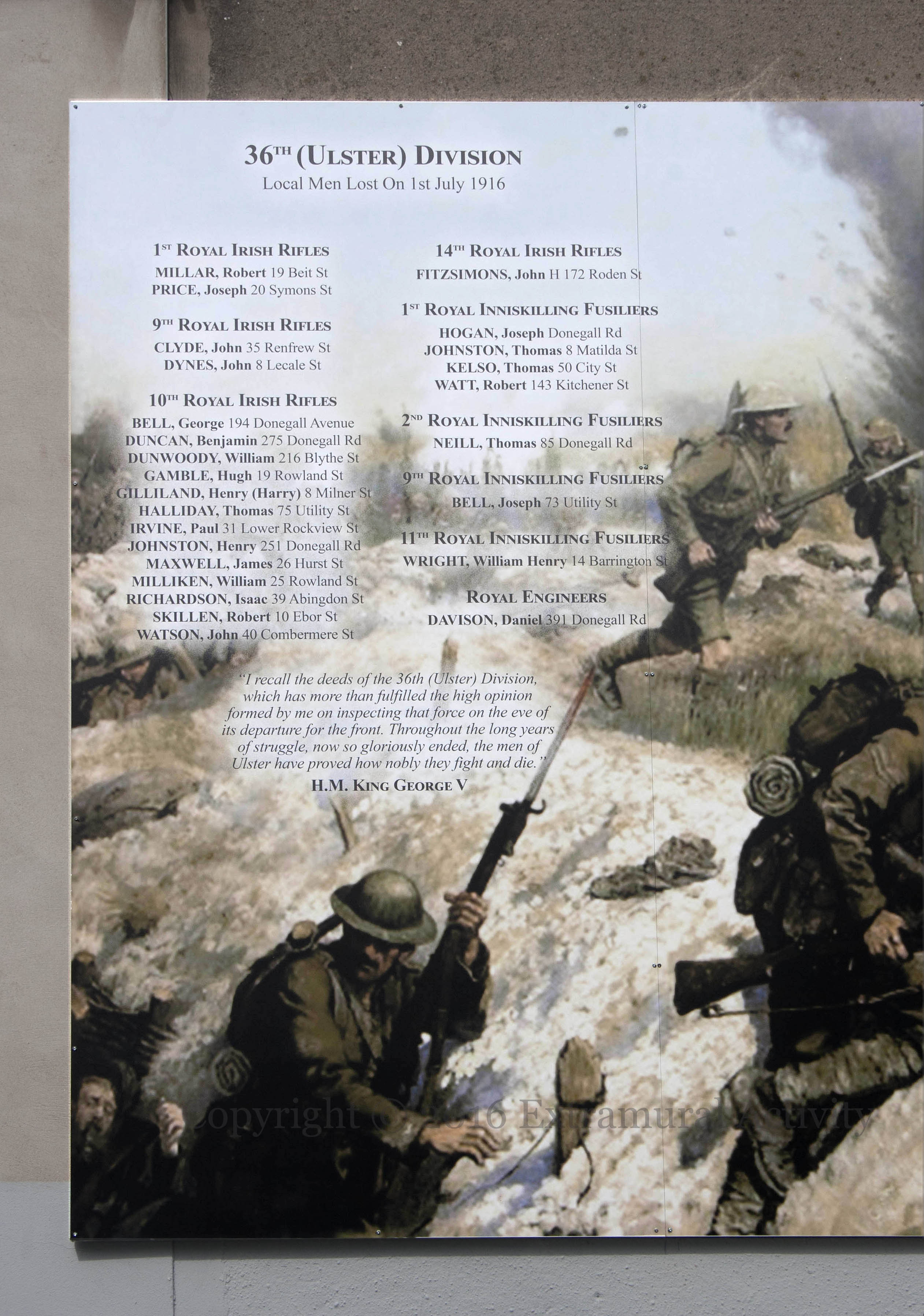
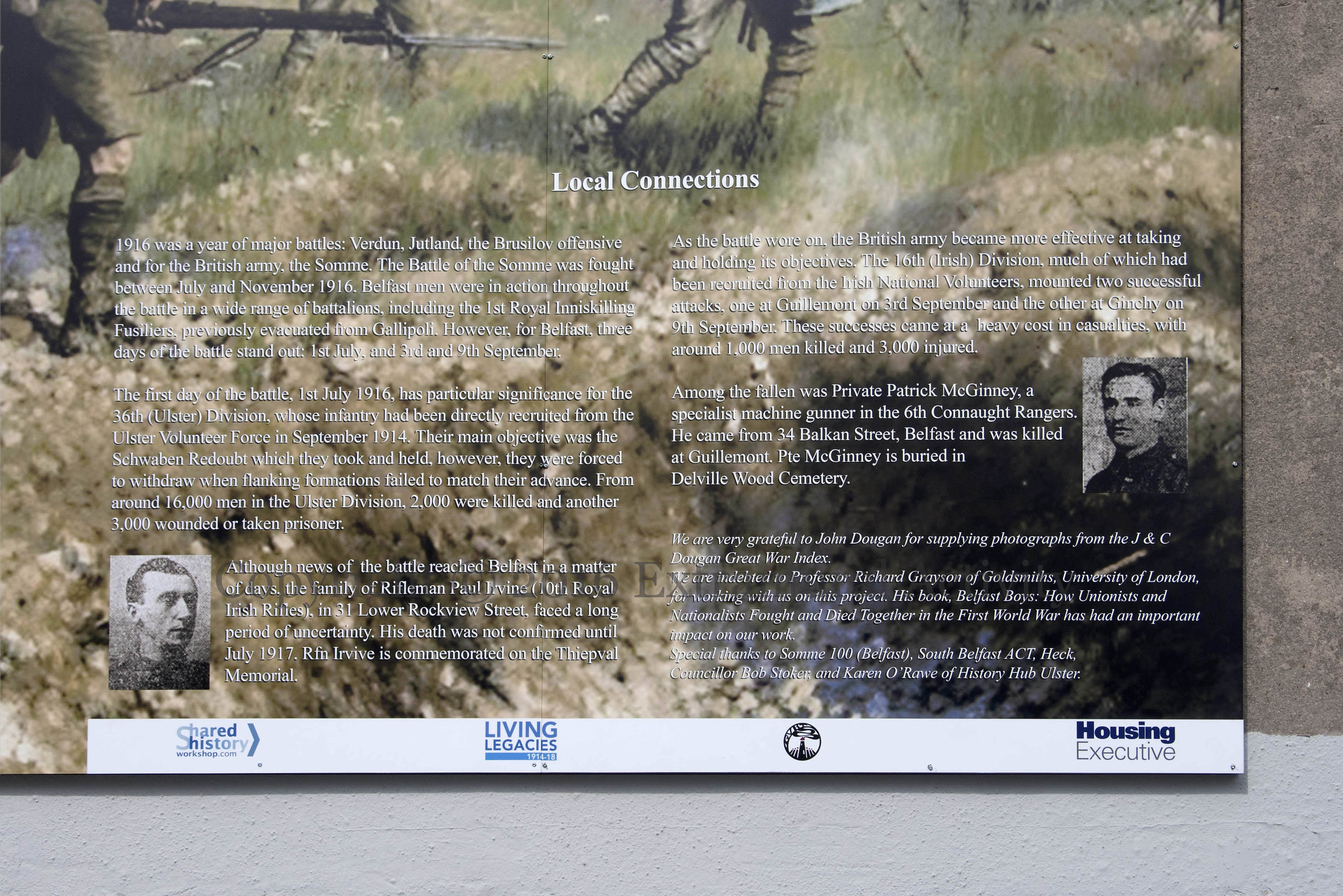
JP Beadle’s Battle Of The Somme, Attack Of The Ulster Division is reproduced in the 1916 installment of the Poppy Trail in south Belfast. (For more on the painting, see belfastsomme.com.) In addition to listing local men lost in on July 1st – from places such as Roden, Matilda, Kitchener, Barrington, Blythe, Ebor, Rowland, Abingdon, and Combermere Street – it also features an individual from each community who served and died, in this case, Rifleman Paul Irvine from Lower Rockview Street and Private Patrick McGinney from Balkan Street (in the Divis area).
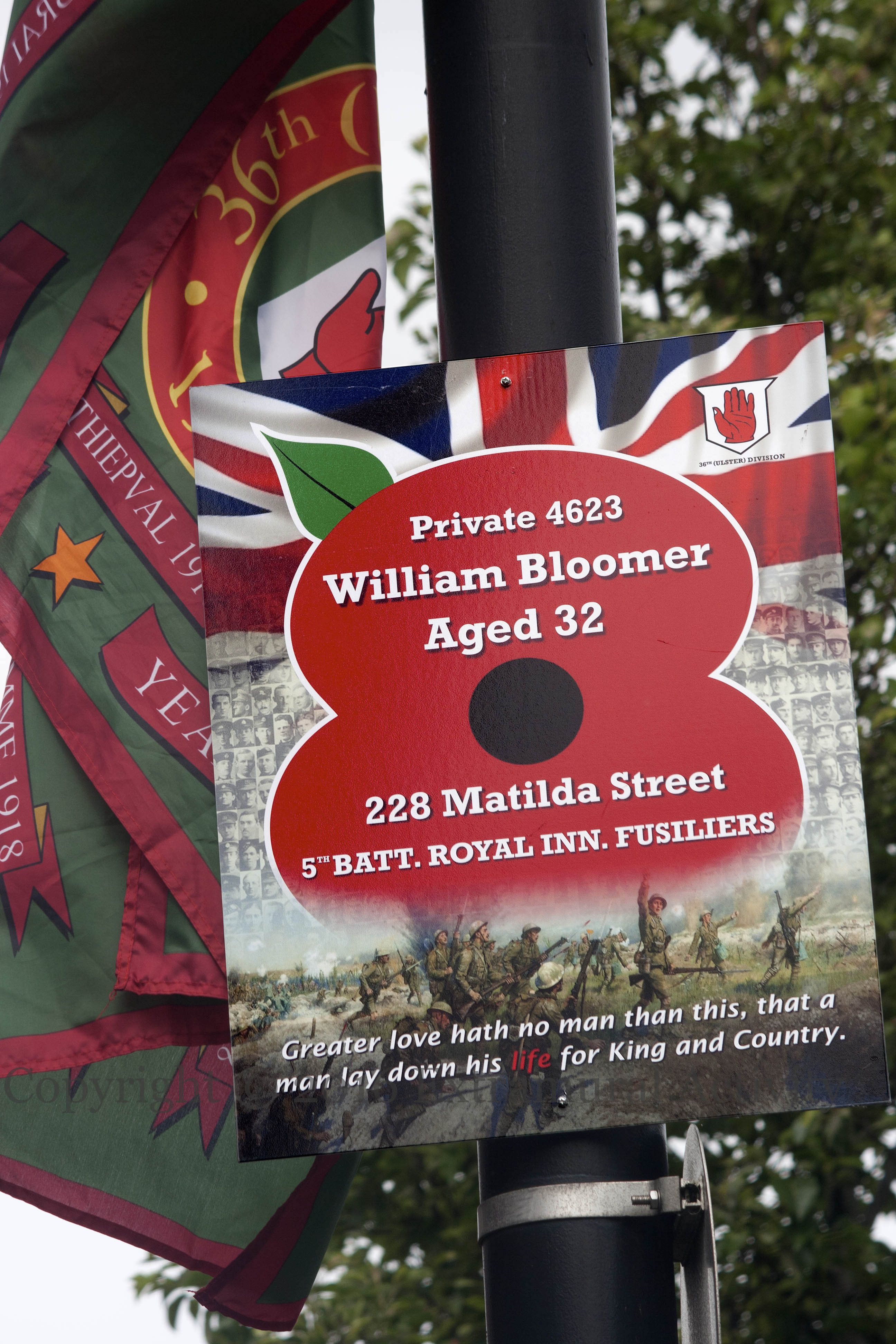
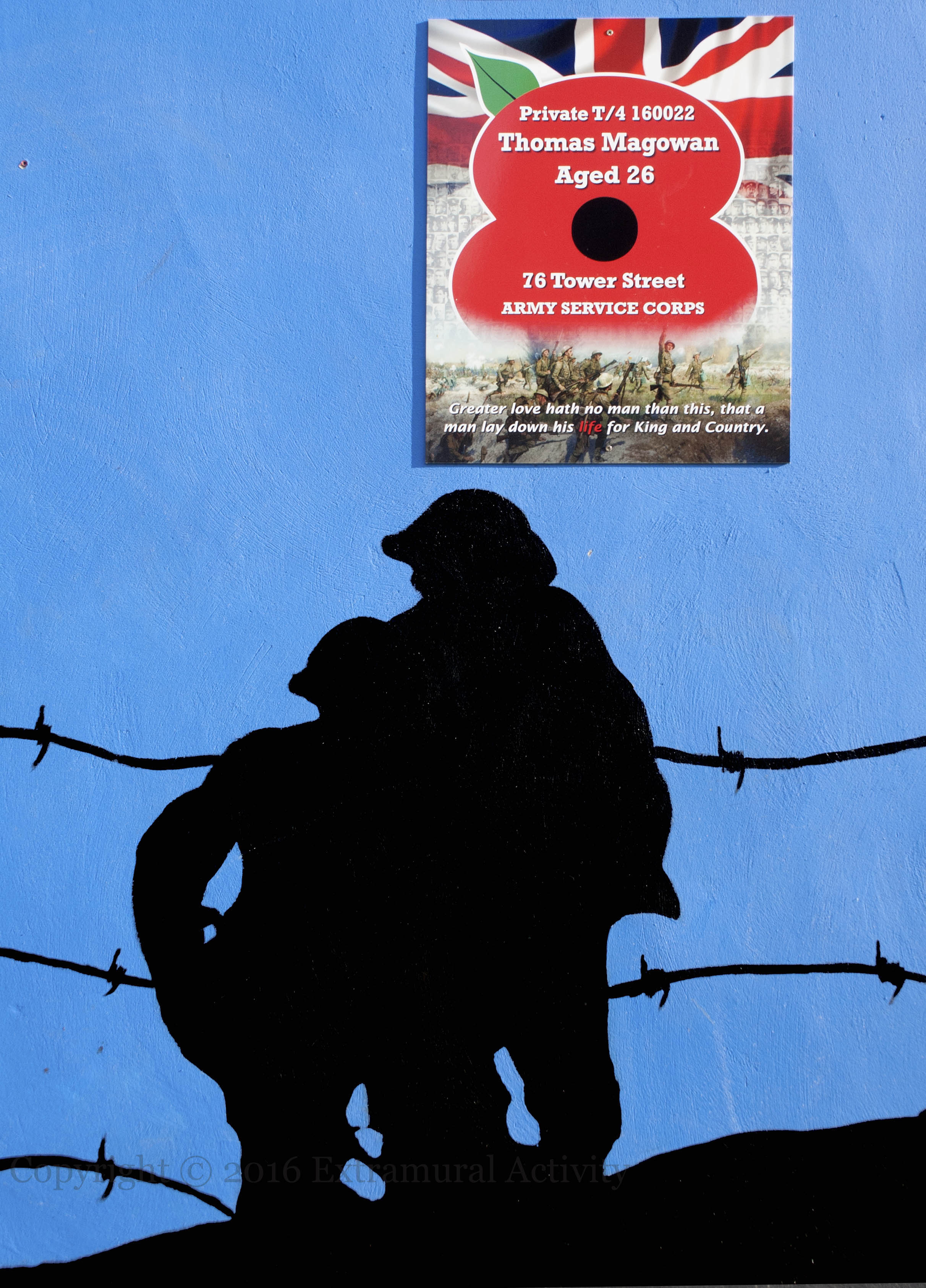
As part of the Poppy Trail, boards bearing the names, ages, addresses, and service units of Belfast casualties during WWI have been erected on walls and lampposts near their homes. Above: William Bloomer from Matilda Street in south Belfast. Below: Thomas Magowan from Tower Street in east Belfast.
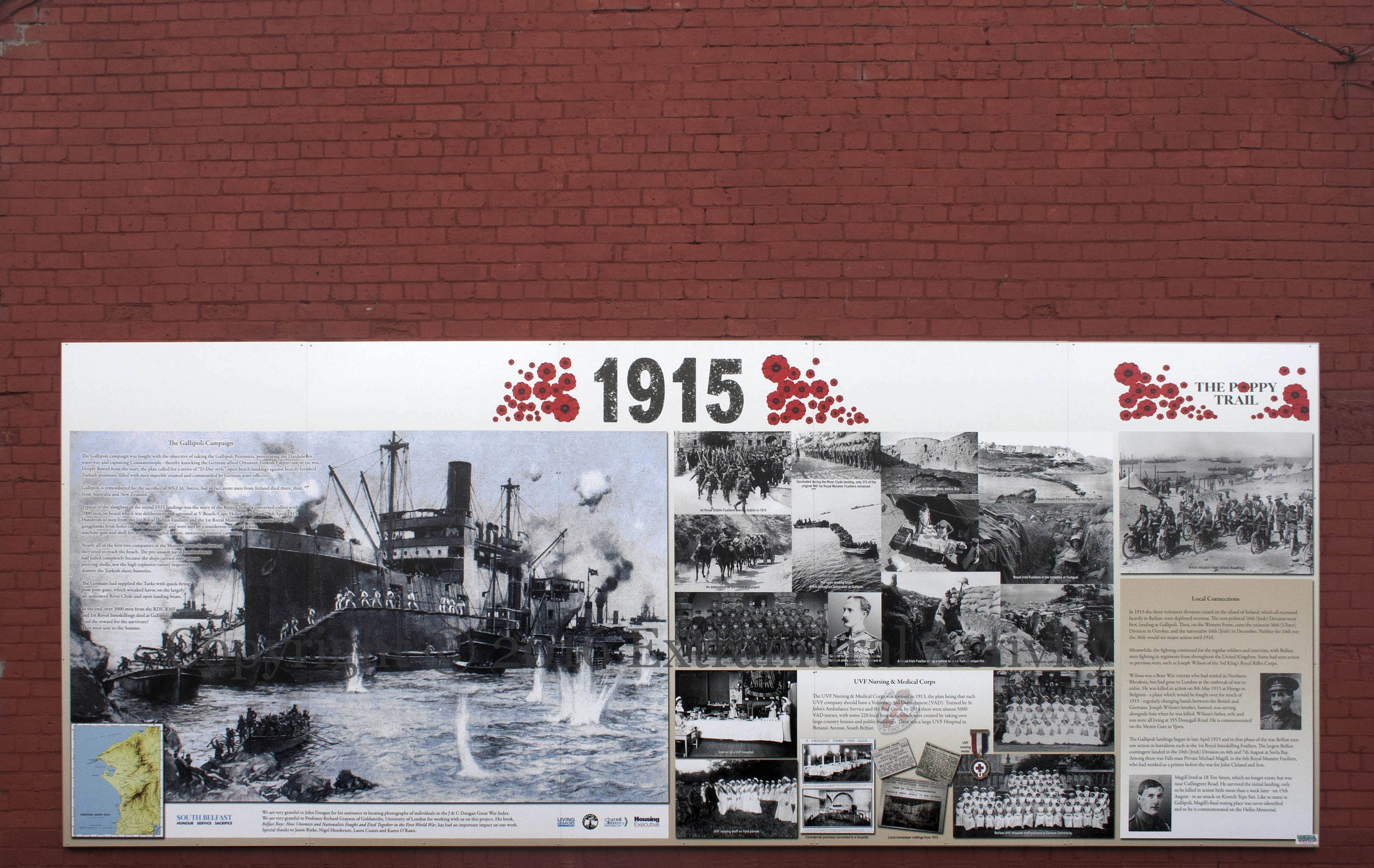
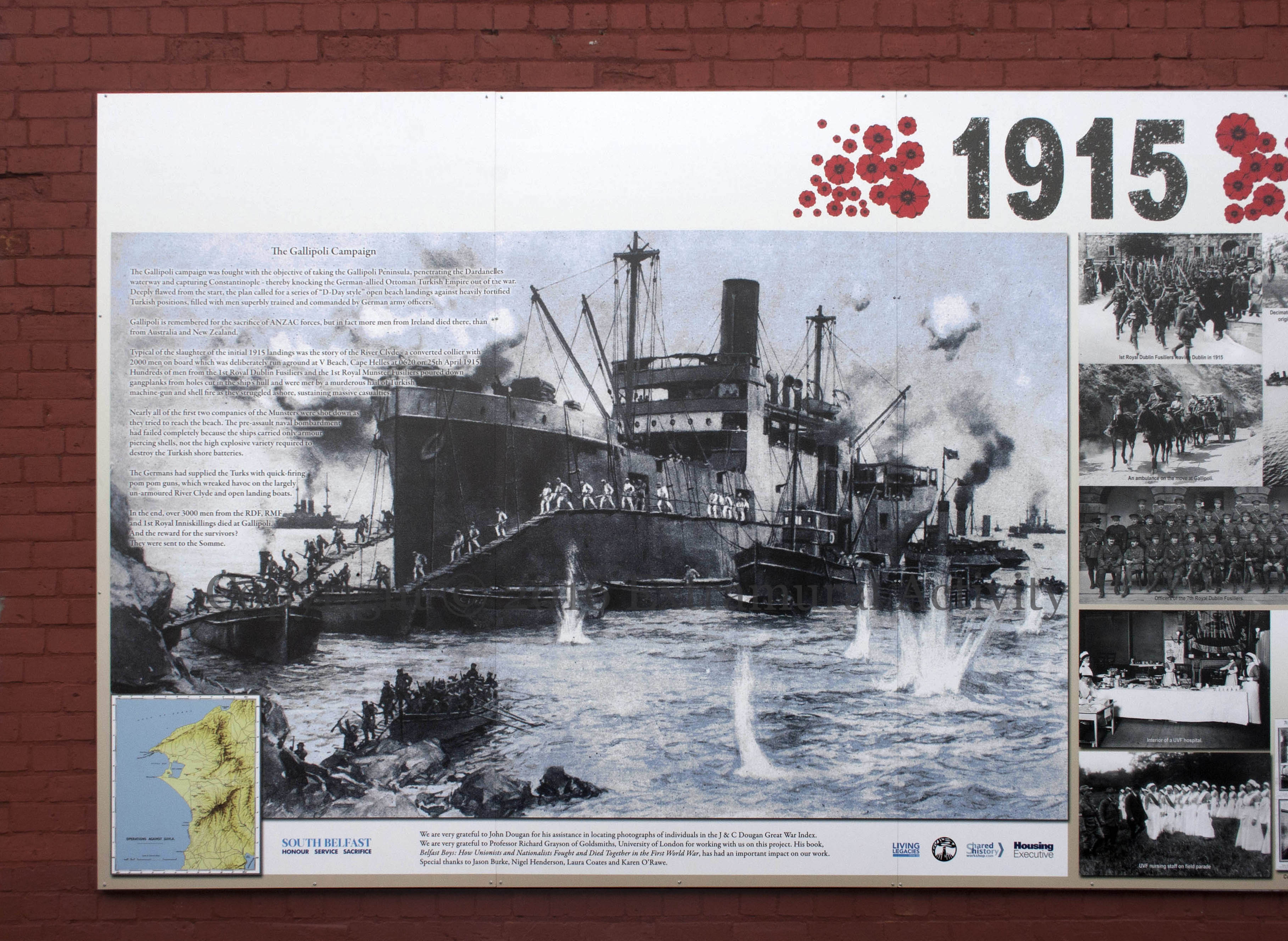
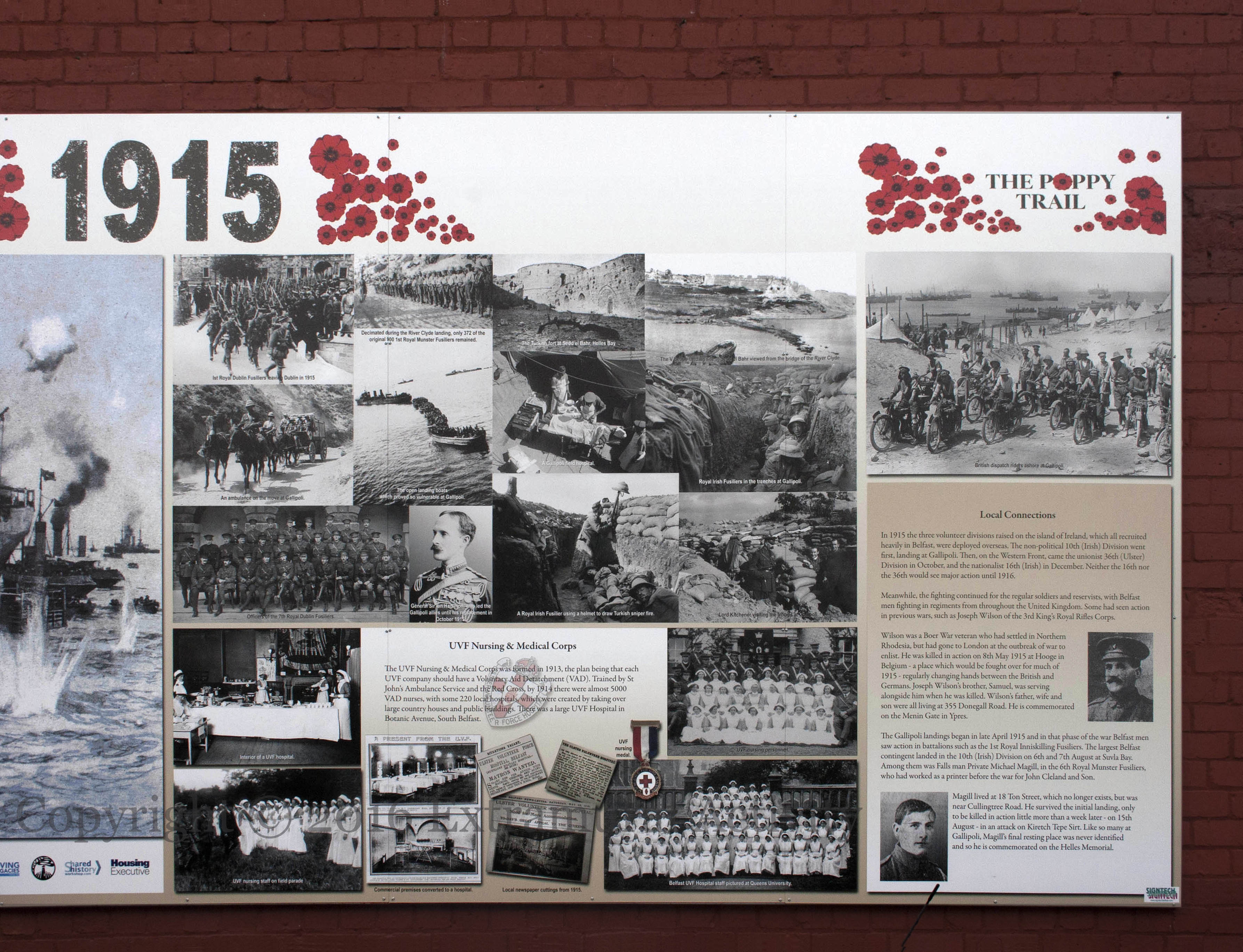
The 1915 board in the ‘Poppy Trail’ series in south Belfast focuses on the Gallipoli campaign, claiming that “more men from Ireland died there than from Australia and New Zealand.” The ship on the left-hand side is the River Clyde, a converted collier, carrying men from the 1st Royal Dublin and 1st Royal Munster Fusiliers, who were decimated as they tried to reach shore — “only 372 of the original 900 1st Royal Munster Fusiliers remained”.
As with the 1914 board, the 1915 board includes the stories of men from both south and west Belfast, in this case, Joseph Wilson, who hailed from Donegall Road and died in Belgium, and Michael Magill, from the Divis area, who died at Gallipoli.
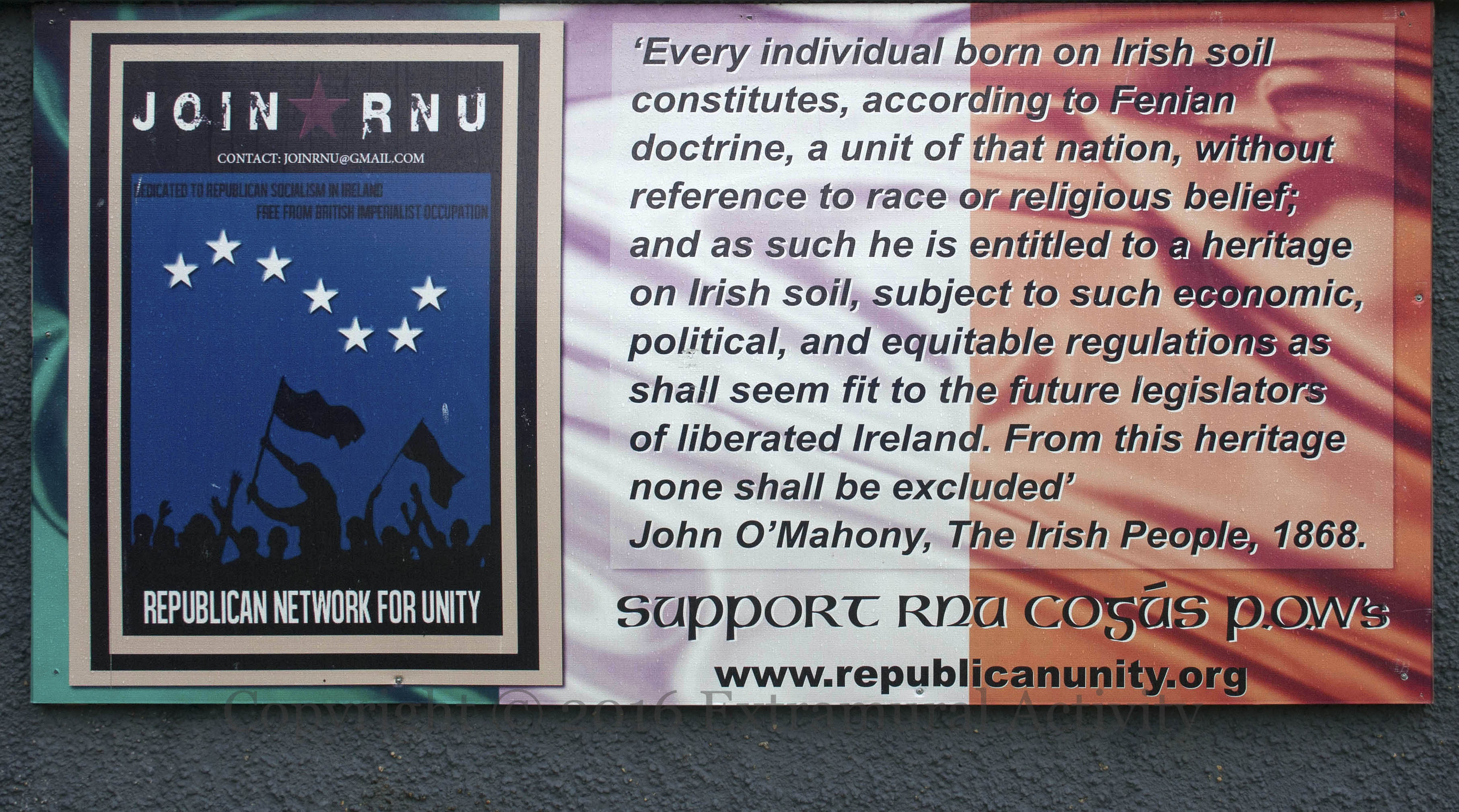
John O’Mahony was an Irish-born but American-based republican who founded the Fenian Brotherhood, whose goal was to send arms and financial support to the Irish Republican Brotherhood in Ireland (Brittanica).
His words from the IRB newspaper The Irish People are used in this RNU [“www.republicanunity.org“] board in Derry: “Every individual born on Irish soil constitutes, according to Fenian doctrine, a unit of that nation, without reference to race or religious belief; and as such he is entitled to a heritage on Irish soil, subject to such economic, political and equitable regulations as shall seem fit to the future legislators of liberated Ireland. From this heritage none shall be excluded.”
The date given is 1868, but the paper closed in 1865 when its offices were raided and its executives, including manager O’Donovan Rossa, were arrested.
 Seosamh Mac Coille Collection