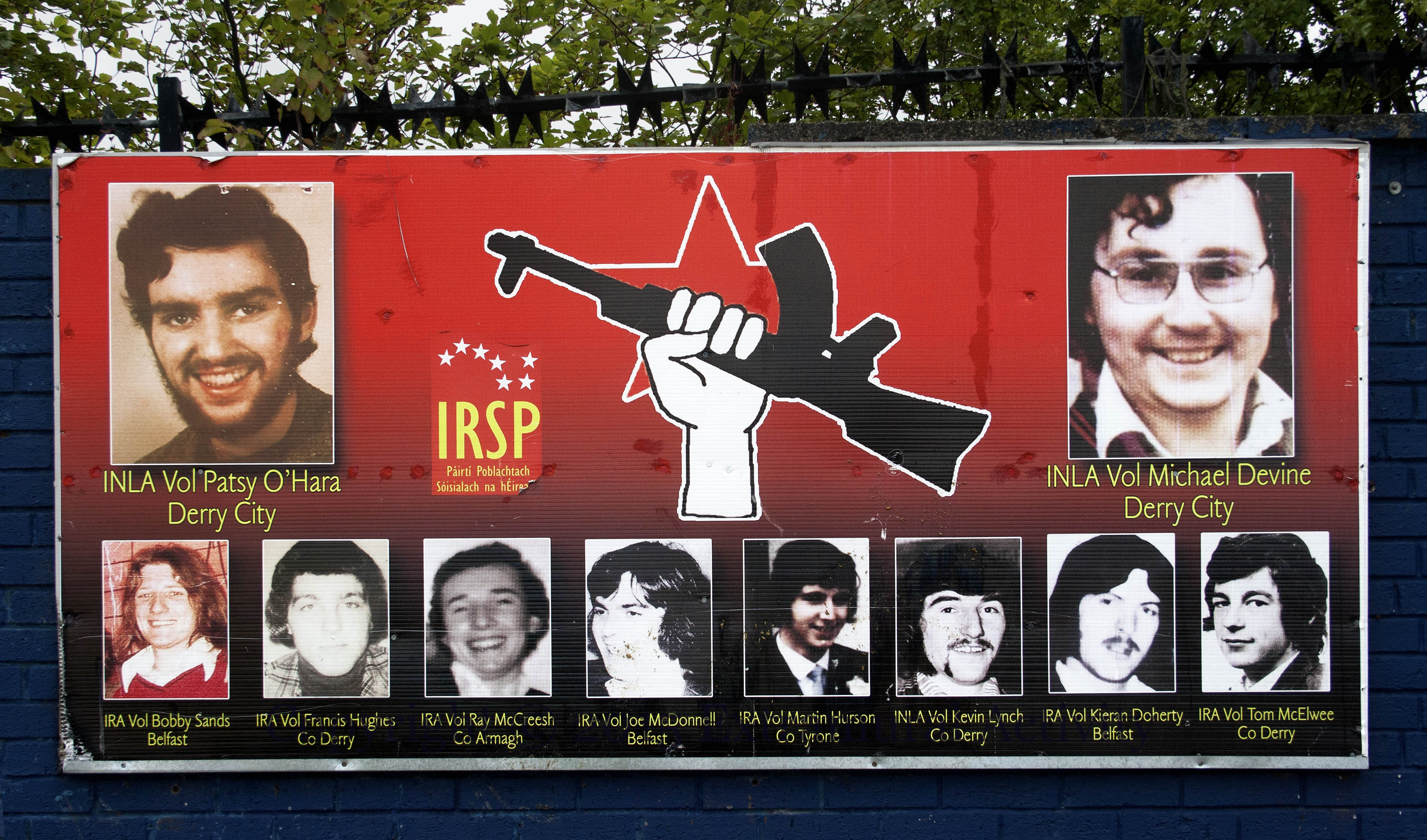
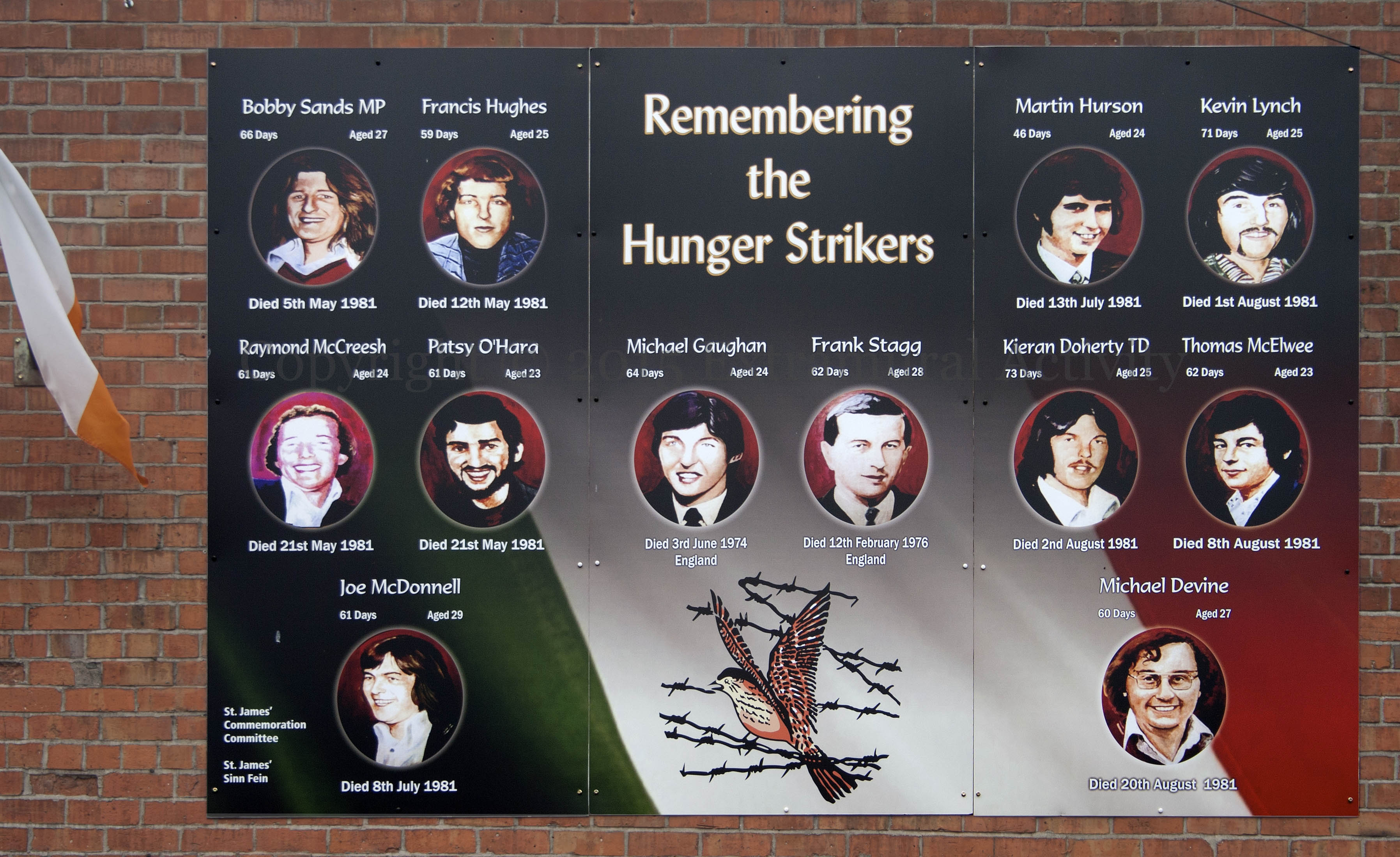
The board above, on Derry’s Racecourse Road, commemorates two hunger-strikers from Derry, Patsy O’Hara and Michael Devine, both members of the INLA; the third INLA hunger-striker was Kevin Lynch, from nearby Dungiven. The seven others who died were members of the IRA, whose political wing was Sınn Féın, while the Irish Republican Socialist Party, who sponsored this board, serves as the political face of the INLA.
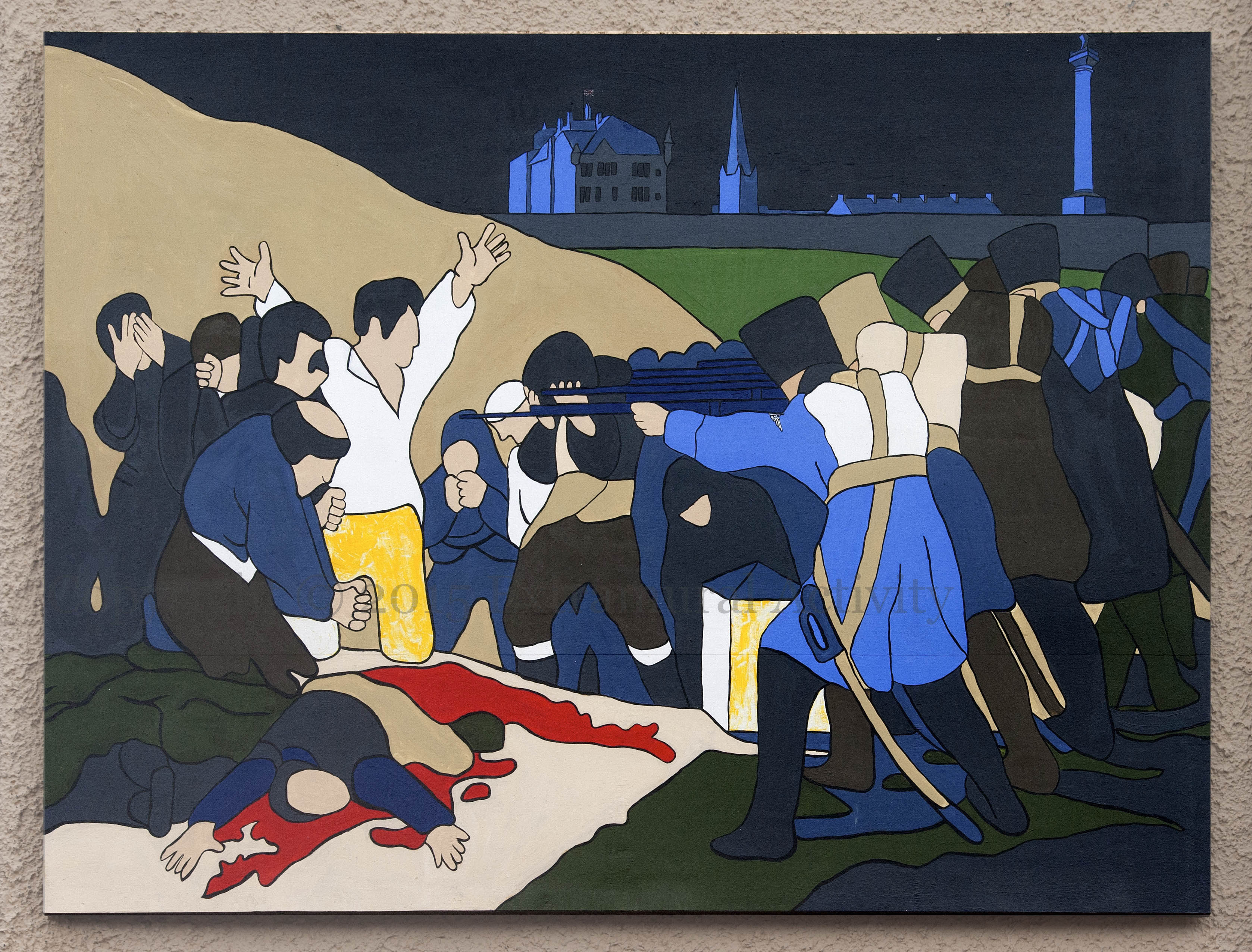
Above is a local interpretation of Robert Ballagh’s 1970 rendering of Goya’s The Third Of May 1808 in Glenfada Park, Derry/Doıre, site of four deaths on Bloody Sunday, 1972.
The original commemorates Spanish resistance to the forces of Napoleon (WP). For this Derry version, features from the city’s skyline – the Guildhall, St. Columb’s Cathedral, and an intact Governor Walker column – have replaced the original’s outline of Madrid, as well as an insignia of the Paras on the arm of a soldier.
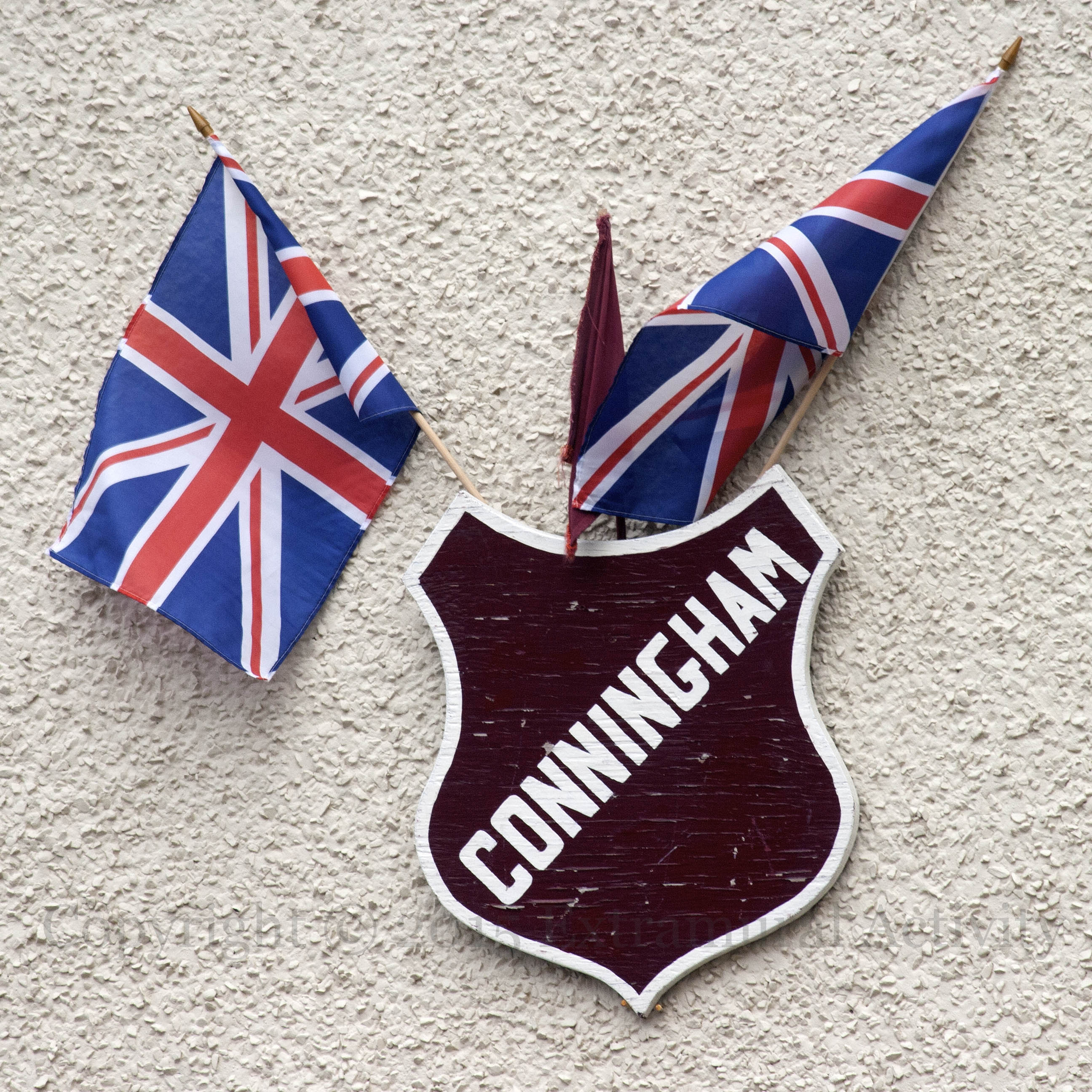
On December 7th, 1688, thirteen apprentice boys grabbed the keys to Derry city and locked the gates against the on-coming Jacobite Redshanks. Their names were William Cairnes, Henry Campsie, John Conningham (also given as Coningham), Alexander Cunningham, William Crookshanks, Samuel Harvy, Samuel Hunt, Alexander Irwin, Robert Morison, Robert Sherrard, Daniel Sherrard, James Spike, James Steward and they each have a small plaque in the Fountain area.
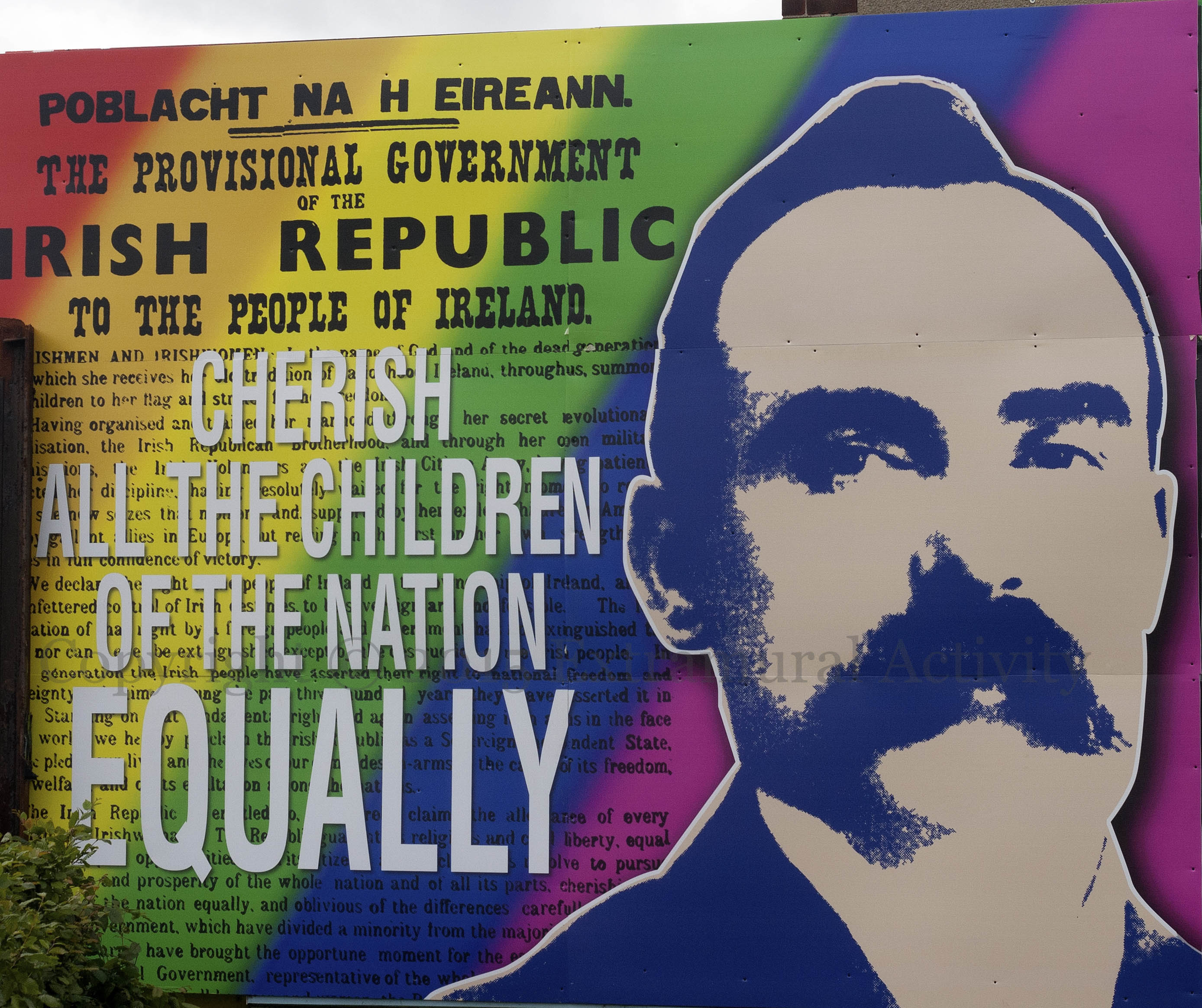
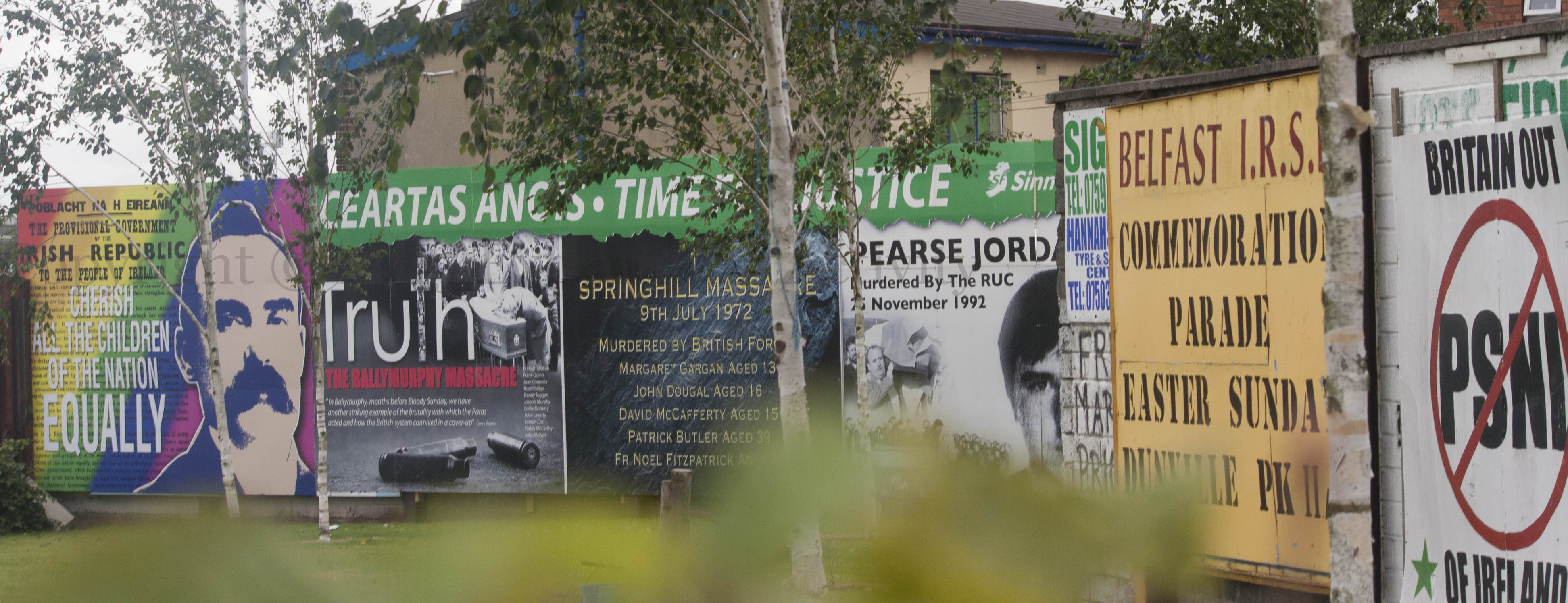
The 1916 Proclamation Of Irish Republic includes the sentence “The Republic guarantees religious and civil liberty, equal rights and equal opportunities to all its citizens, and declares its resolve to pursue the happiness and prosperity of the whole nation and of all its parts, cherishing all of the children of the nation equally, and oblivious of the differences carefully fostered by an alien Government, which have divided a minority from the majority in the past.” At the time, it had a political meaning, but it has since been pressed into service by advocates of children’s right and now, in the board above, by supporters of gay rights. James Connolly (leader of the Irish Citizen Army) and the text of the declaration are shown against a backdrop of the gay pride rainbow flag. Launched 2015-07-31
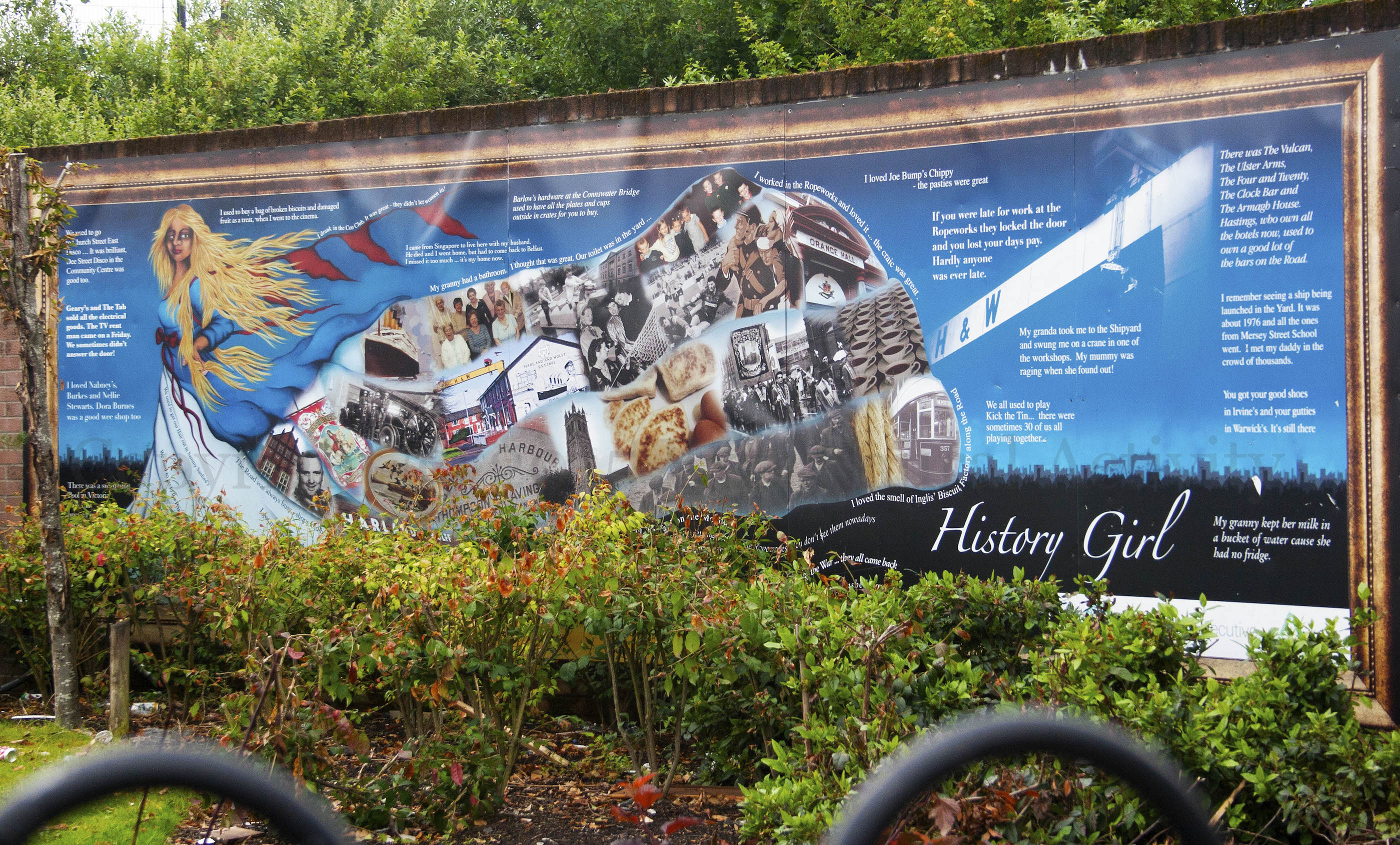
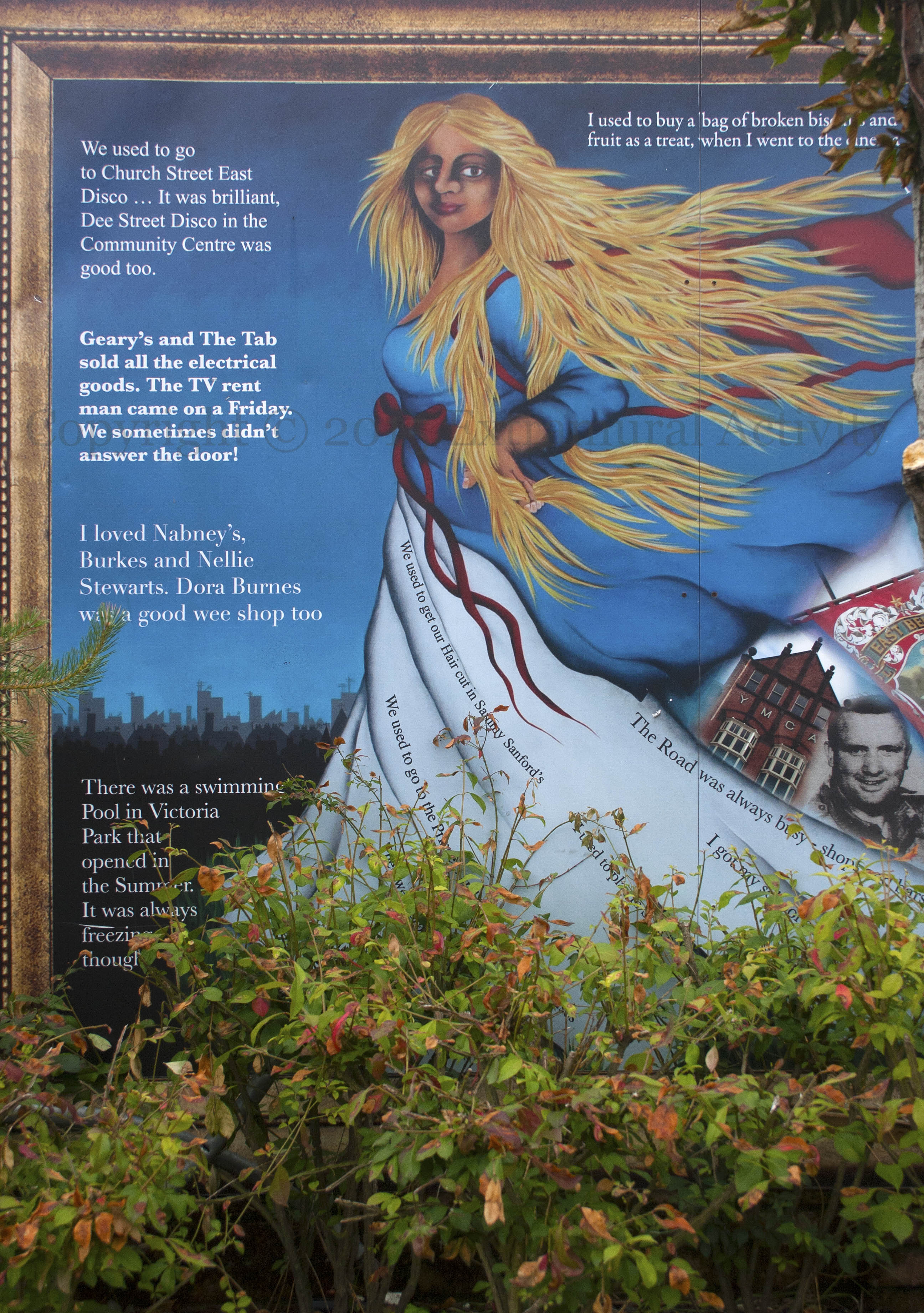
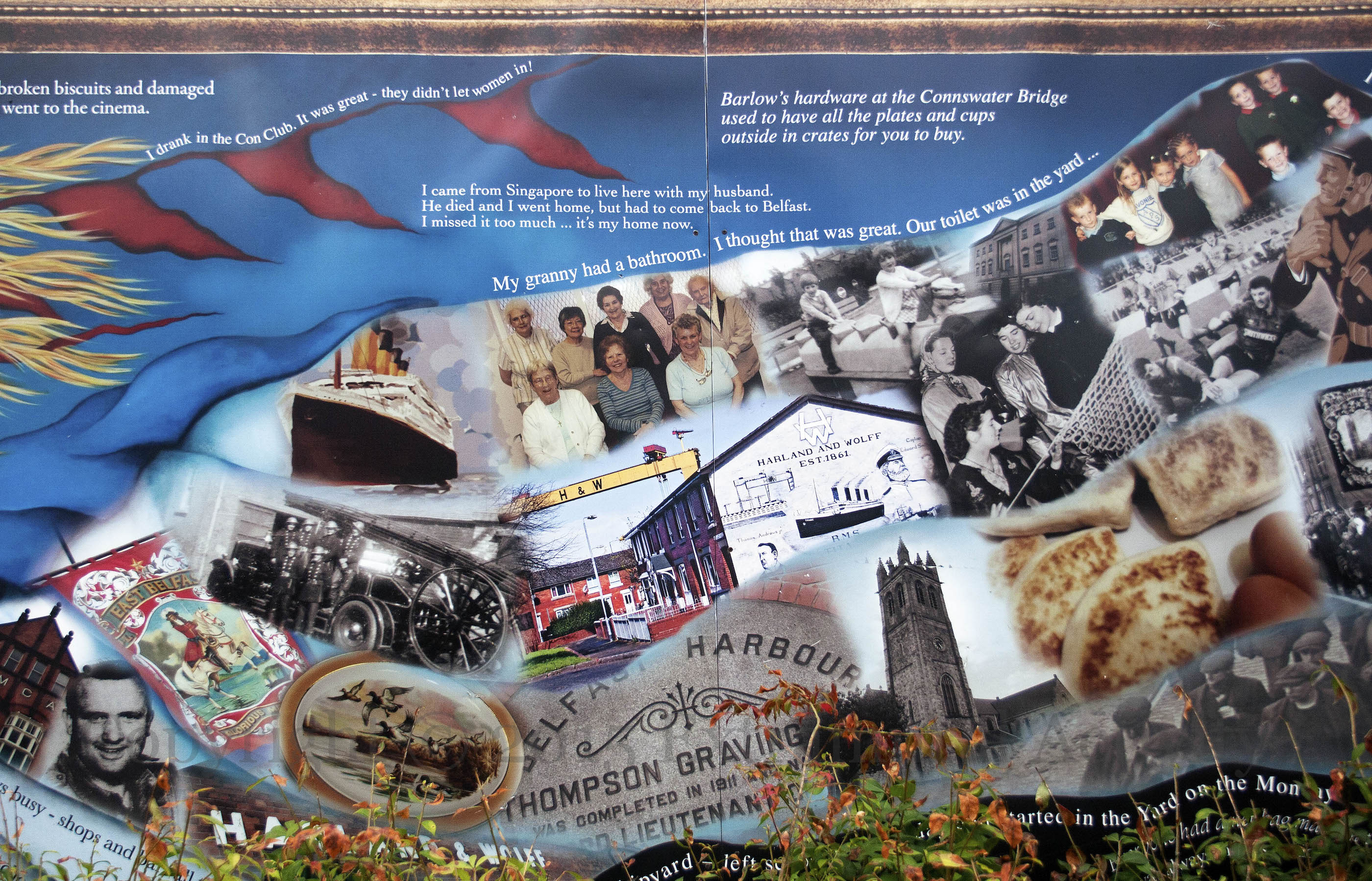
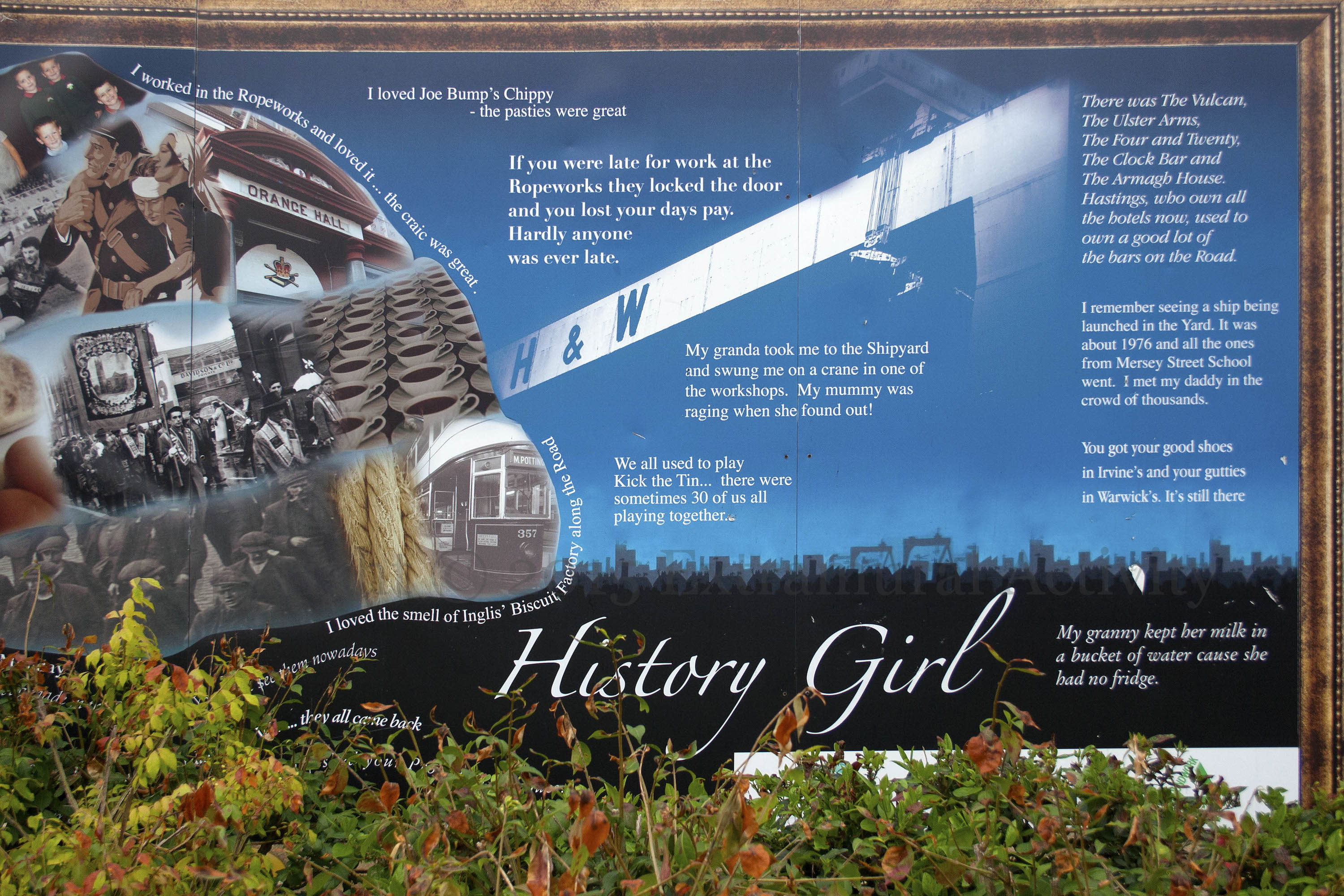
Memories from the History Girl mural in east Belfast’s Thistle Court. (Close-ups below.)
We used to go to Church Street East Disco … It was brilliant. Dee Street Disco in the Community Centre was good too.
Geary’s and The Tab sold all the electrical goods. The TV rent man came on a Friday. We sometimes didn’t answer the door!
I loved Nabney’s, Burkes and Nellie Stewarts. Dora Burnes was a good wee shop too.
There was a swimming pool in Victoria Park that opened in the summer. It was always freezing though!
I used to buy a bag of broken biscuits and and damaged fruit as a treat, when I went to the cinema.
We used to get our hair cut in Sammy Sanford’s.
The Road was always busy – shops and bars all the way along.
Barlow’s hardware at the Conswater Bridge used to have all the plates and cups outside in crates for you to buy.
I drank in the Con Club. It was great – they didn’t let women in!
I came from Singapore to live here with my husband. He died and I went home, but had to come back to Belfast. I missed it too much … it’s my home now.
My granny had a bathroom. I thought that was great. Our toilet was in the yard …
I worked in the Ropeworks and love it … the craic was great.
I loved Joe Bump’s chippy – the pasties were great.
If you were late for work at the Ropeworks they locked the door and you lost your pay. Hardly anyone was ever late.
My grandpa took me to the shipyard and swung me on a crane in one of the workshops. My mummy was raging when she found out!
We used to play Kick the Tin … there were sometimes 30 of us all playing together …
I loved the smell of Inglis’ Biscuit Factory along the Road.
The was The Vulcan, The Ulster Arms, The Four and Twenty, The Clock Bar and The Armagh House. Hastings, who own all the hotels now, used to own a good lot of the bars on the Road.
I remember seeing a ship being launched in the yard. It was about 1976 and all the ones from Mersey Street School went. I met my daddy in the crowd of thousands.
You got your good shoes in Irvine’s and your gutties in Warwick’s. It’s still there.
My granny kept her milk in a bucket of water because she had no fridge.
I worked in the shipyard – left school on a Friday and started in the Yard on Monday.
Everyone had a net bag made in the Ropeworks. You don’t see them nowadays.
We followed the Glens everywhere, but a home match in the Oval was always the best craic.
All my mummy’s brothers were in the Army or Navy during the War … they all came back.
I remember Stanley Brookes. They cashed your Providence Cheques.
We used to go to the cinema on a Saturday morning for the Kids Club. It was always bunged!!
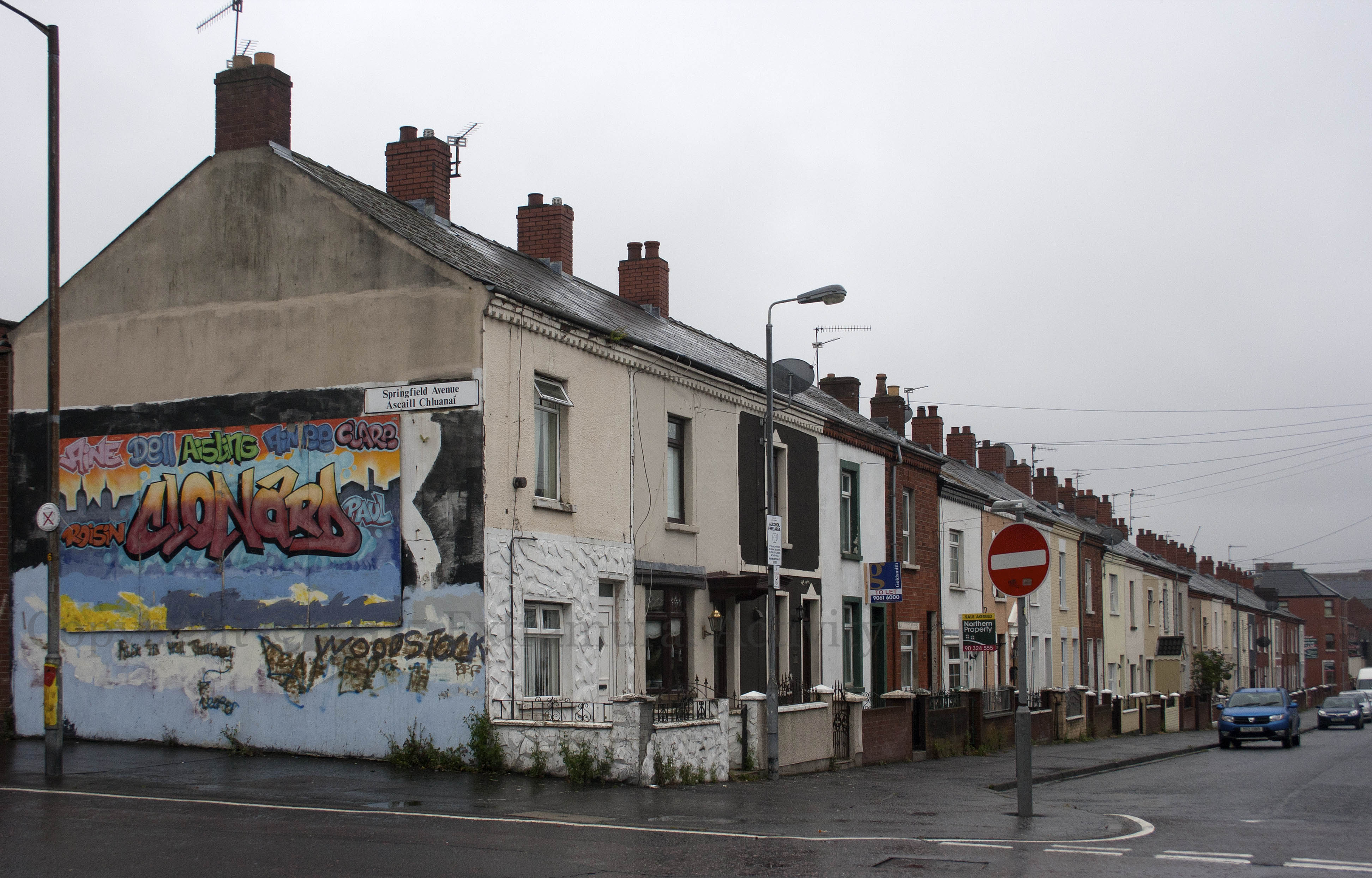
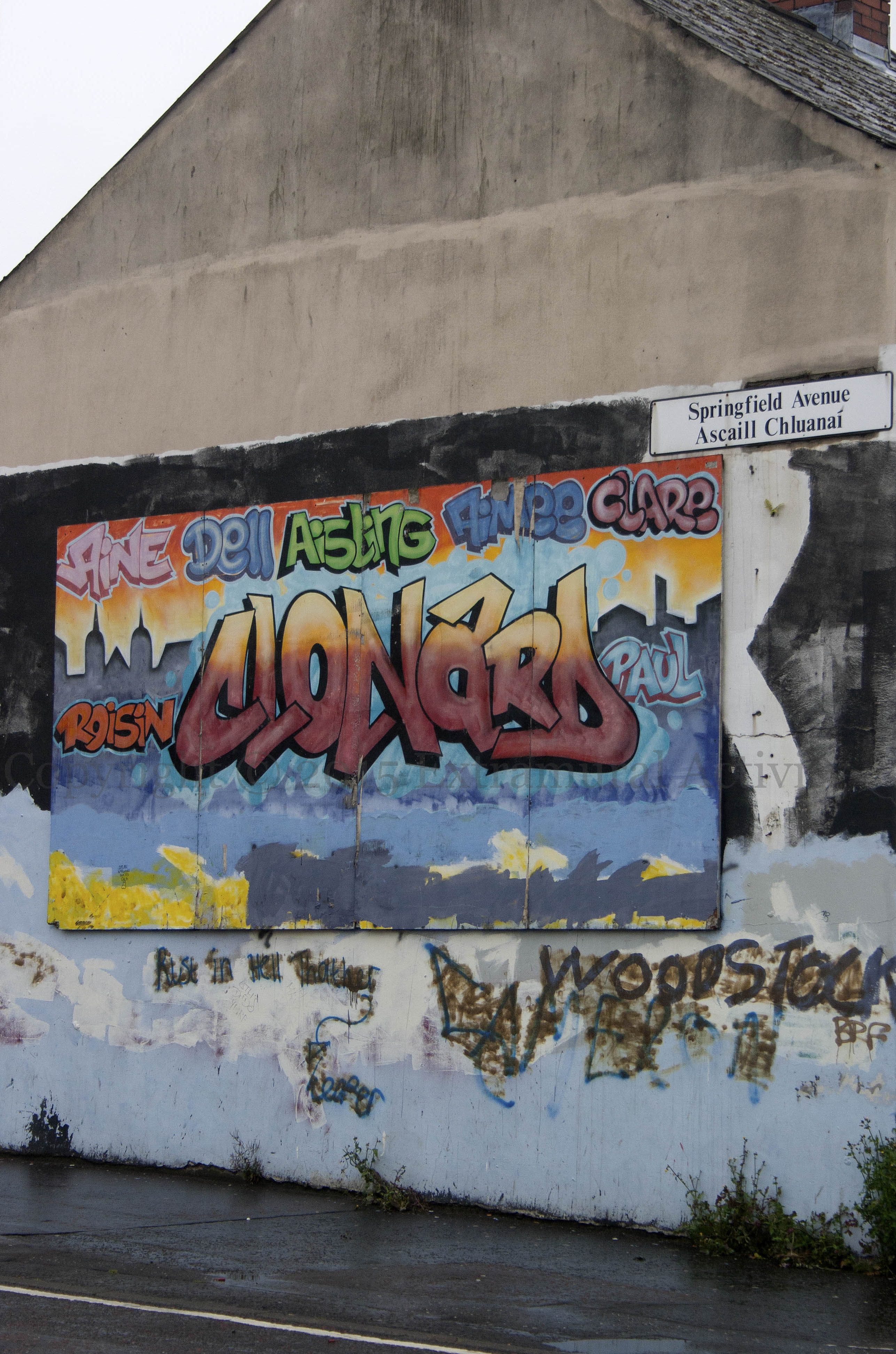
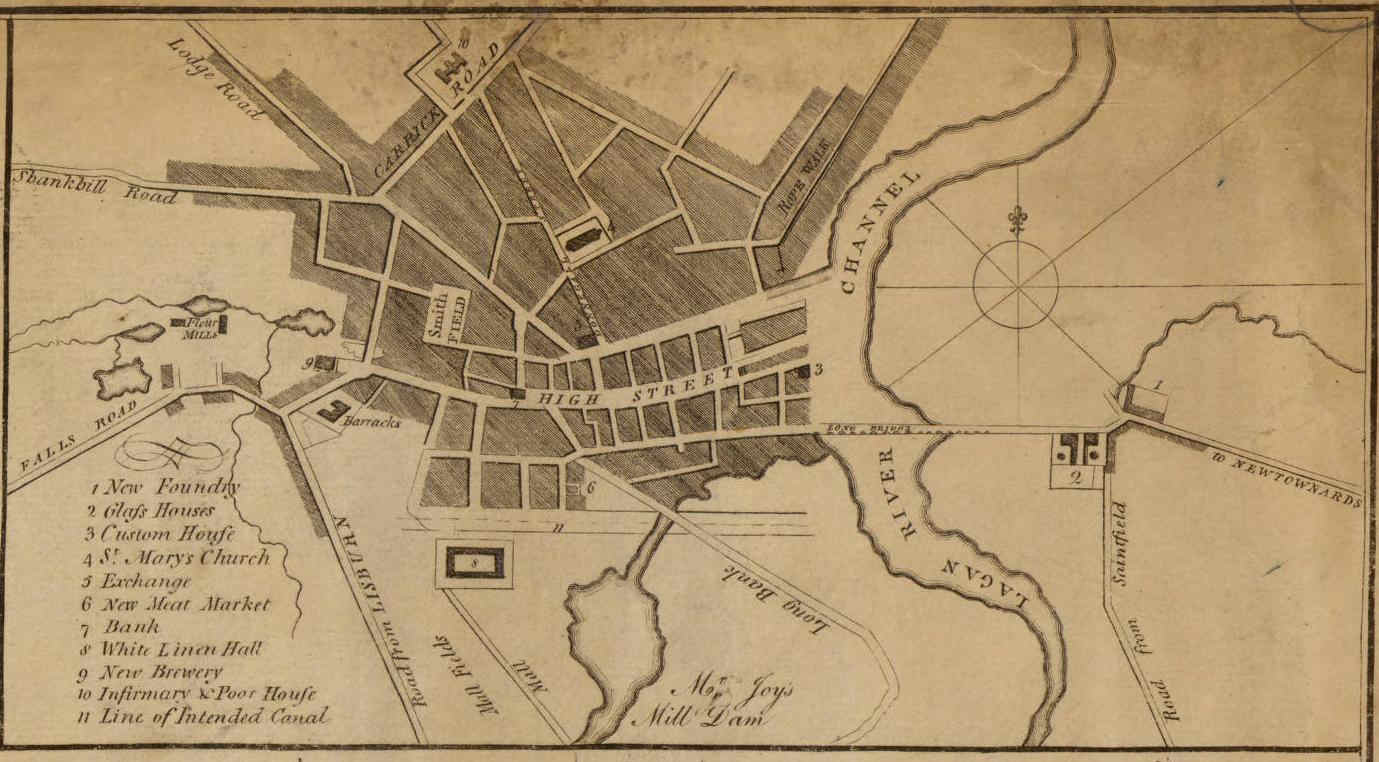
As the map below shows, the area between the Shankill and the Falls roads in 1789 was largely undeveloped and perhaps titles such as “Cluain Ard” (“Clonard”) were descriptions as well as names. The ‘White Linen Hall’ – on the site of the current City Hall – had been completed the year before. St. Mary’s was the first Catholic church in Belfast. Wikipedia reports that on the day of its first mass, May 30th, 1784, “the mostly Presbyterian 1st Belfast Volunteer Company paraded to the chapel yard and gave the parish priest a guard of honour, with many of the Protestants of Belfast also present and sharing the event”. (WP) The map also shows a series of ponds connected to the nearby Flush. A close-up of the board is below.
The six weeks from July 8th to August 20th 1981 saw the death of six hunger strikers – McDonnell, Hurson, Lynch, Doherty, McElwee, and Devine – adding to the four who began in March and died in May. All ten, along with Michael Gaughan and Frank Stagg from 1974 and 1976, are remembered in this recent (spring 2015?) board in Rockmore Road, west Belfast.
This is the fourth iteration of this board, which goes back (at least) to 1995. For two of the previous versions, see the Peter Moloney collection: third | first.
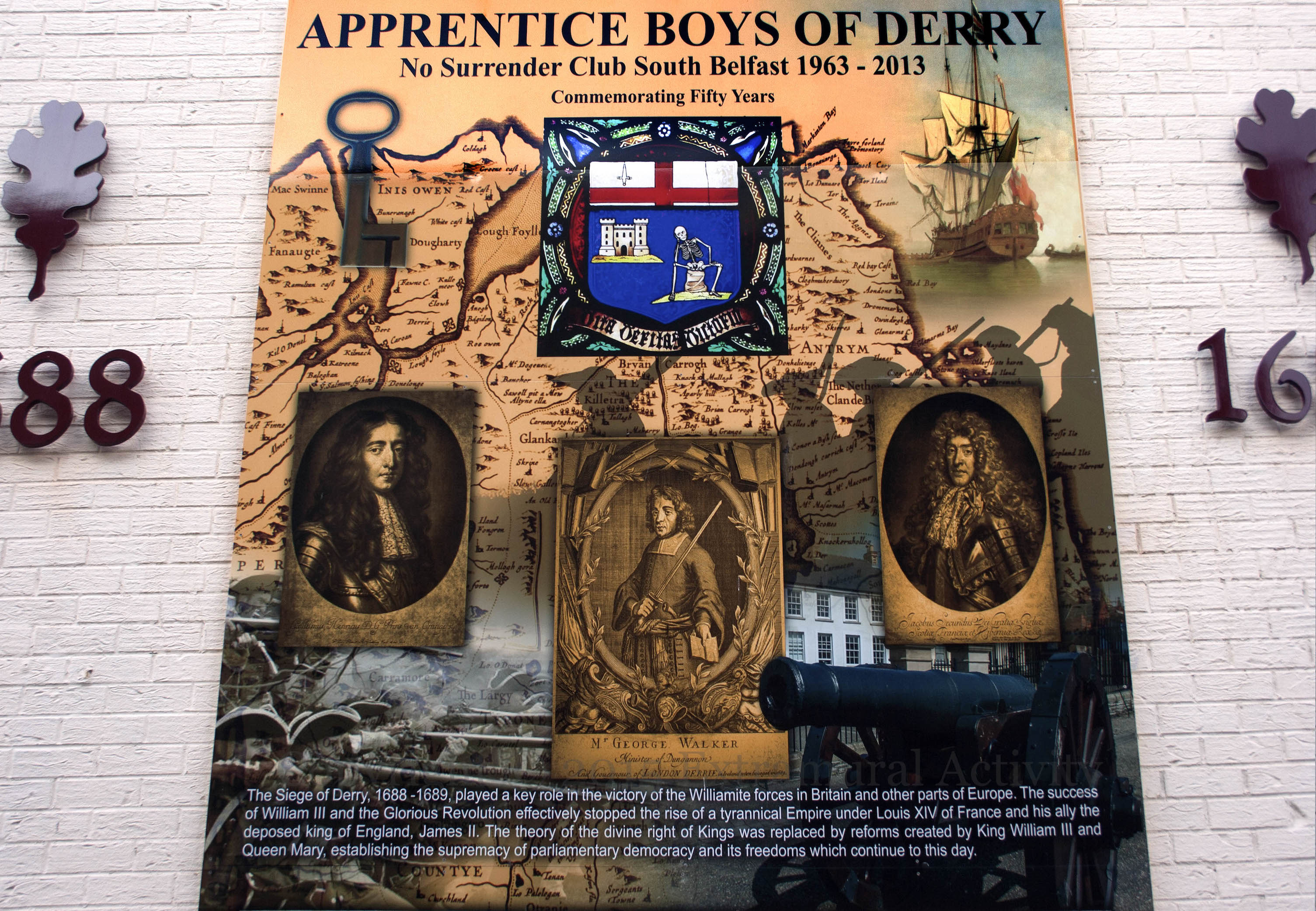
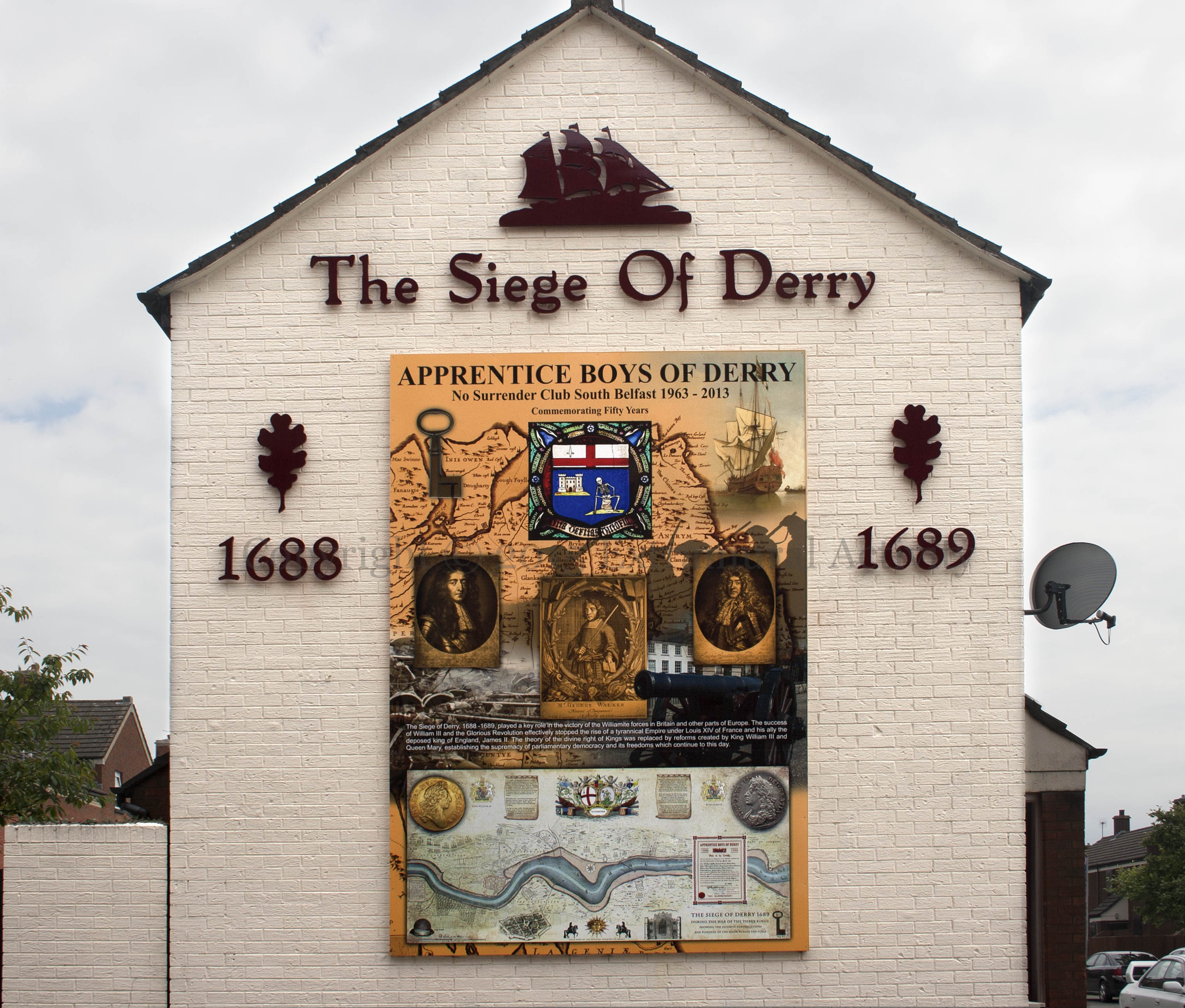
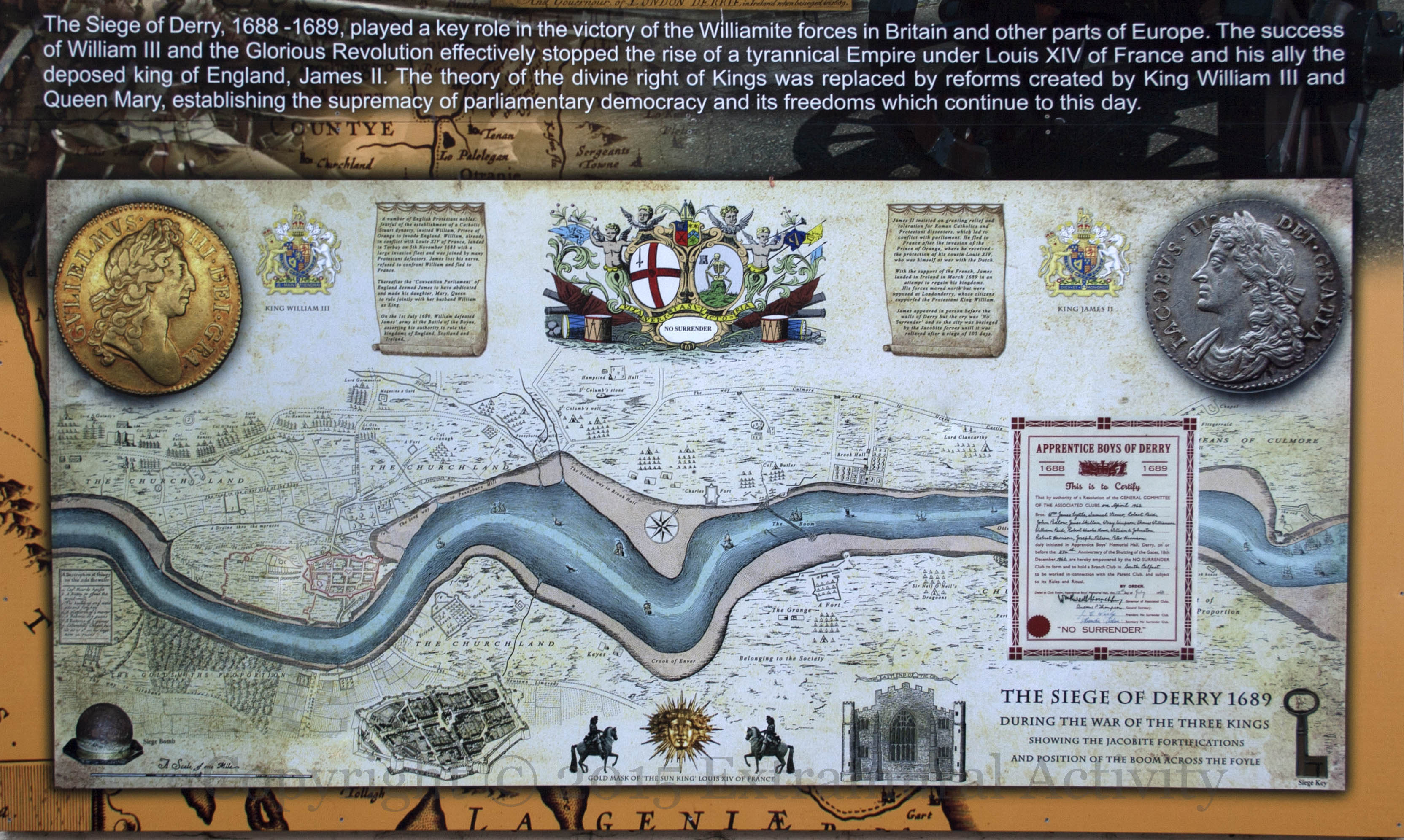
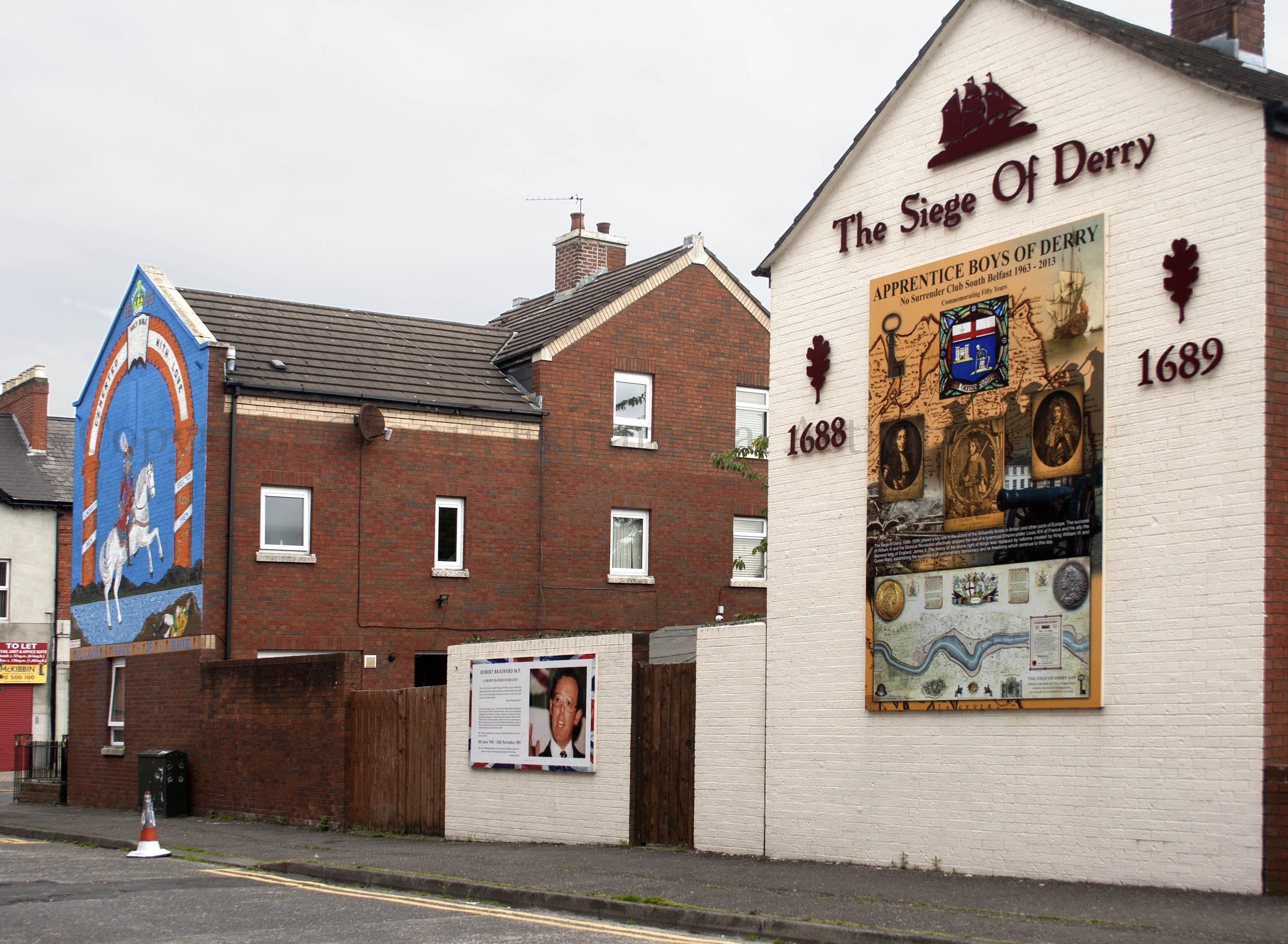
Oak Street is a fitting place for a mural about the Siege of Derry, as the oak leaf, shown to the left and right of the board above (and in the wide shot, below) is a symbol of the town, “doire” meaning an oak grove. The gates to the city were locked by thirteen apprentices, against the wishes of Governor Robert Lundy who wised to surrender the city. When the deposed king James II and his army arrived and demanded the surrender of the city of Derry, the cry from within was “No surrender!” The city was then besieged for 105 days until relief arrived in the form of ships of the navy of the newly crowned William & Mary.
The board shown above celebrates 50 years of the No Surrender Club South Belfast (1963-2013) a club affiliated with the Apprentice Boys Of Derry.
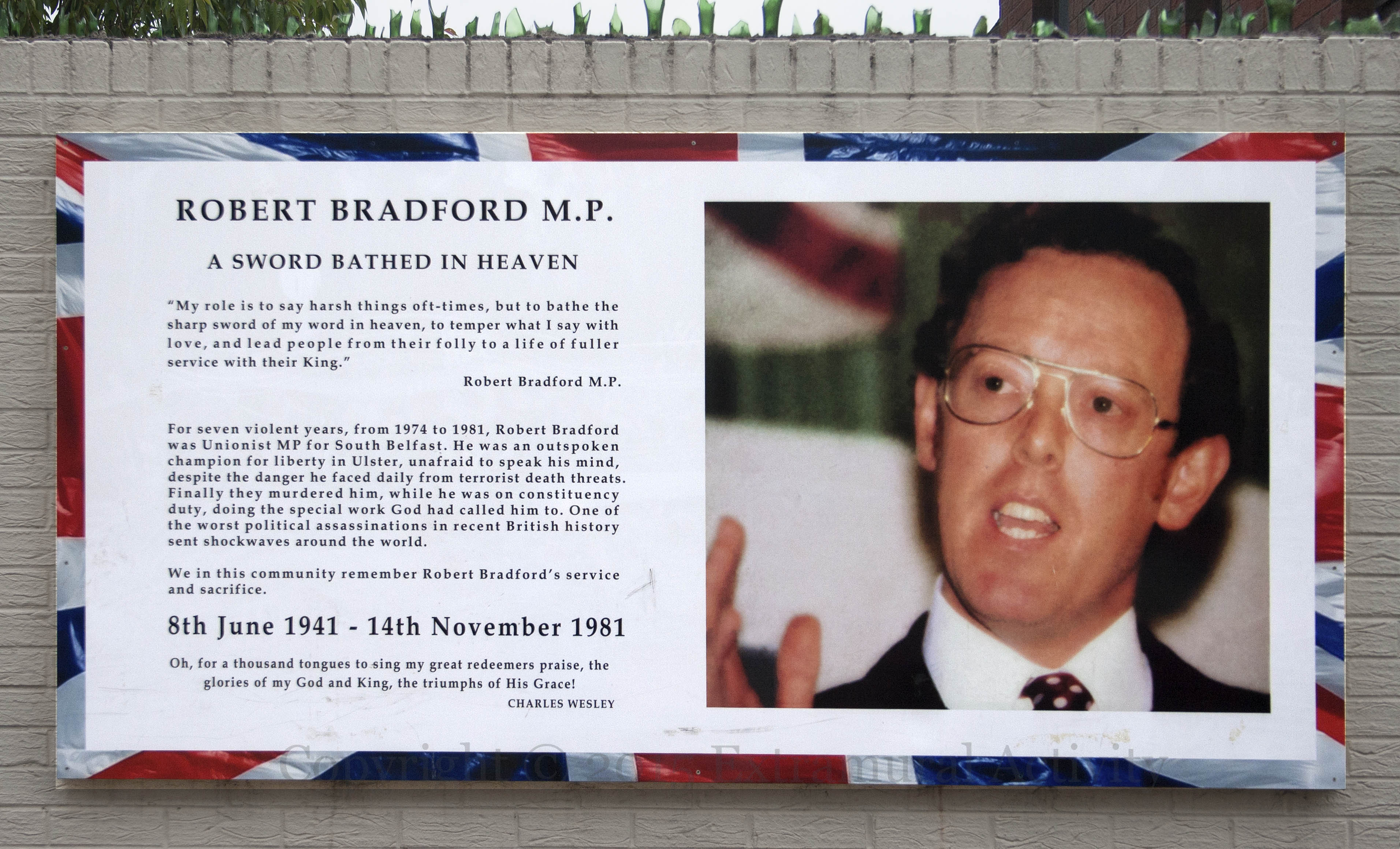
South Belfast MP Robert Bradford was assassinated by the Provisional IRA in Finaghy at a meeting with constituents; the caretaker of the community centre, Ken Campbell, was also killed by the fleeing attackers. Taking place in late 1981, with the hunger strikes having ended only a month before, the killing was noted around the world and raised fears of broad civil unrest (BBC | NYTimes). The board above serves as a substitute for an earlier mural to Bradford on the adjacent gable wall. See below for a wide shot of Oak Street with the Bradford board between the repainted Cemented With Love and No Surrender Club.
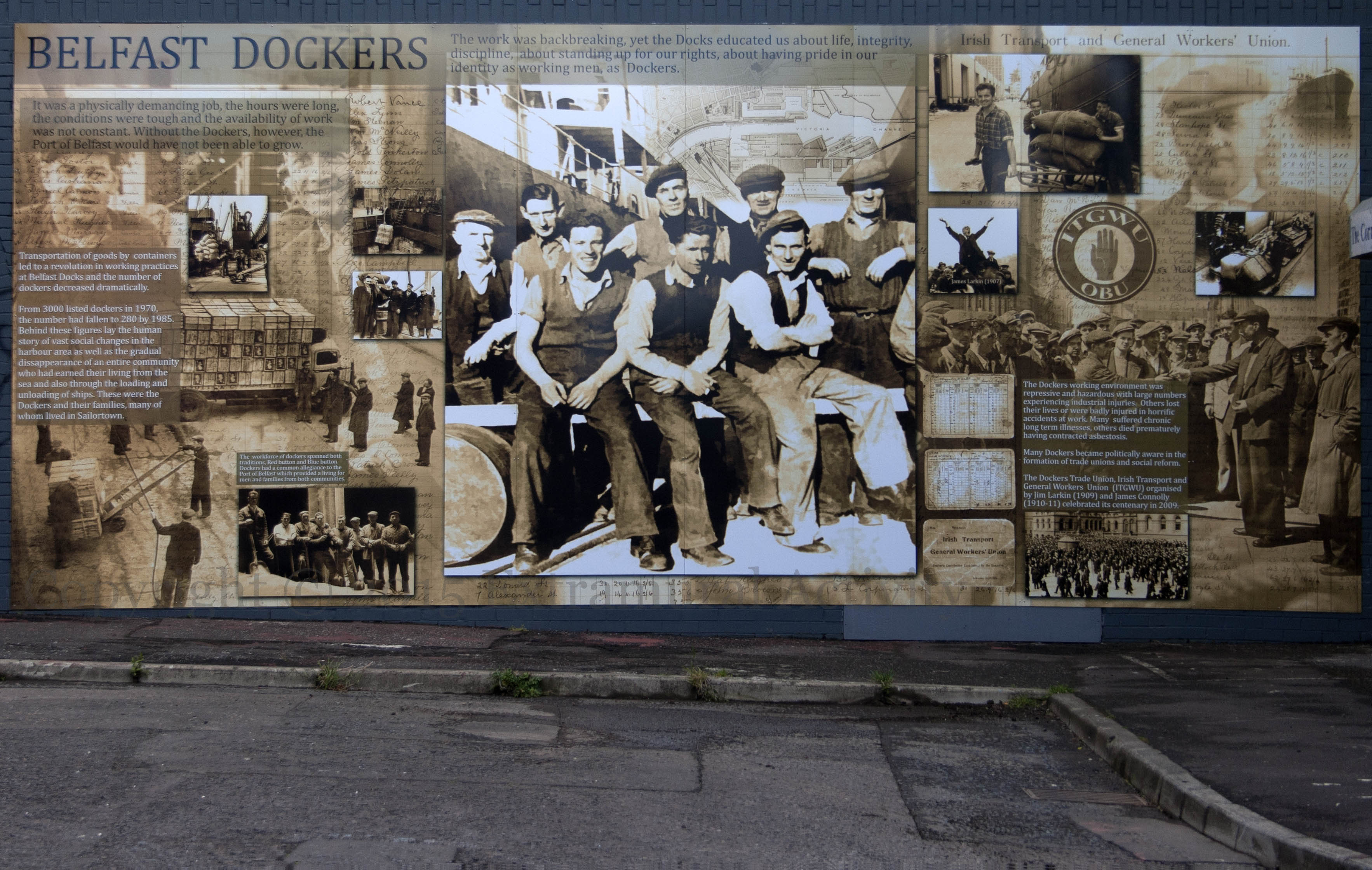
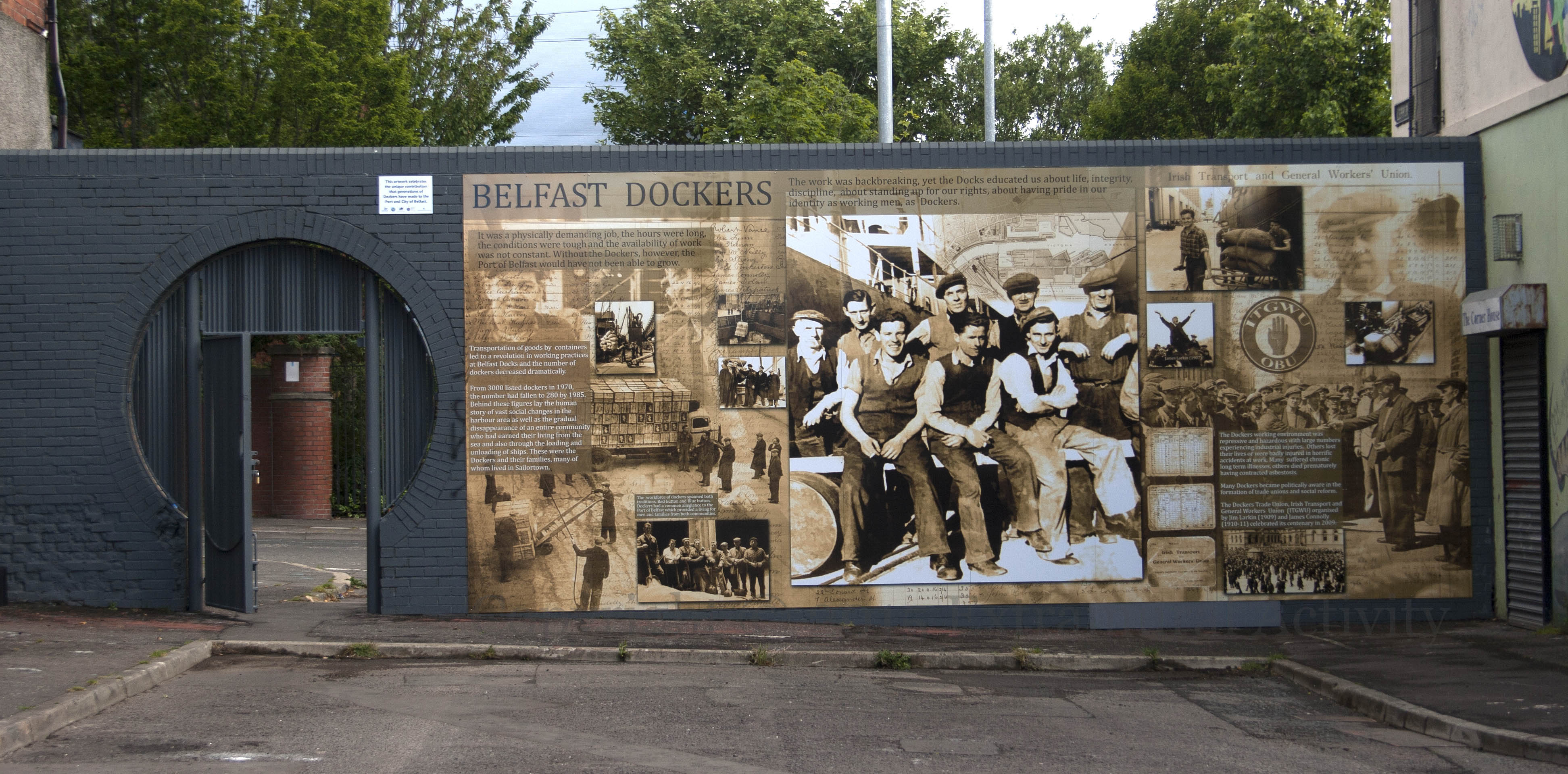
Every day, men would line up in schooling pens on the various docks of the port of Belfast to be hired by foremen. As mentioned on the left-hand side of the board above (recently erected on the New Lodge side of the Duncairn “peace” line) the rise of the shipping container in the 1970s spelled the end of the docker: “from 3000 listed dockers in 1970, the number had fallen to 280 by 1985.” Author and poet John Campbell recalls his first day on the docks in 1952, unloading cement, in this NVTv video.
“This artwork celebrates the unique contribution that generations of dockers have made to the port and City of Belfast.”
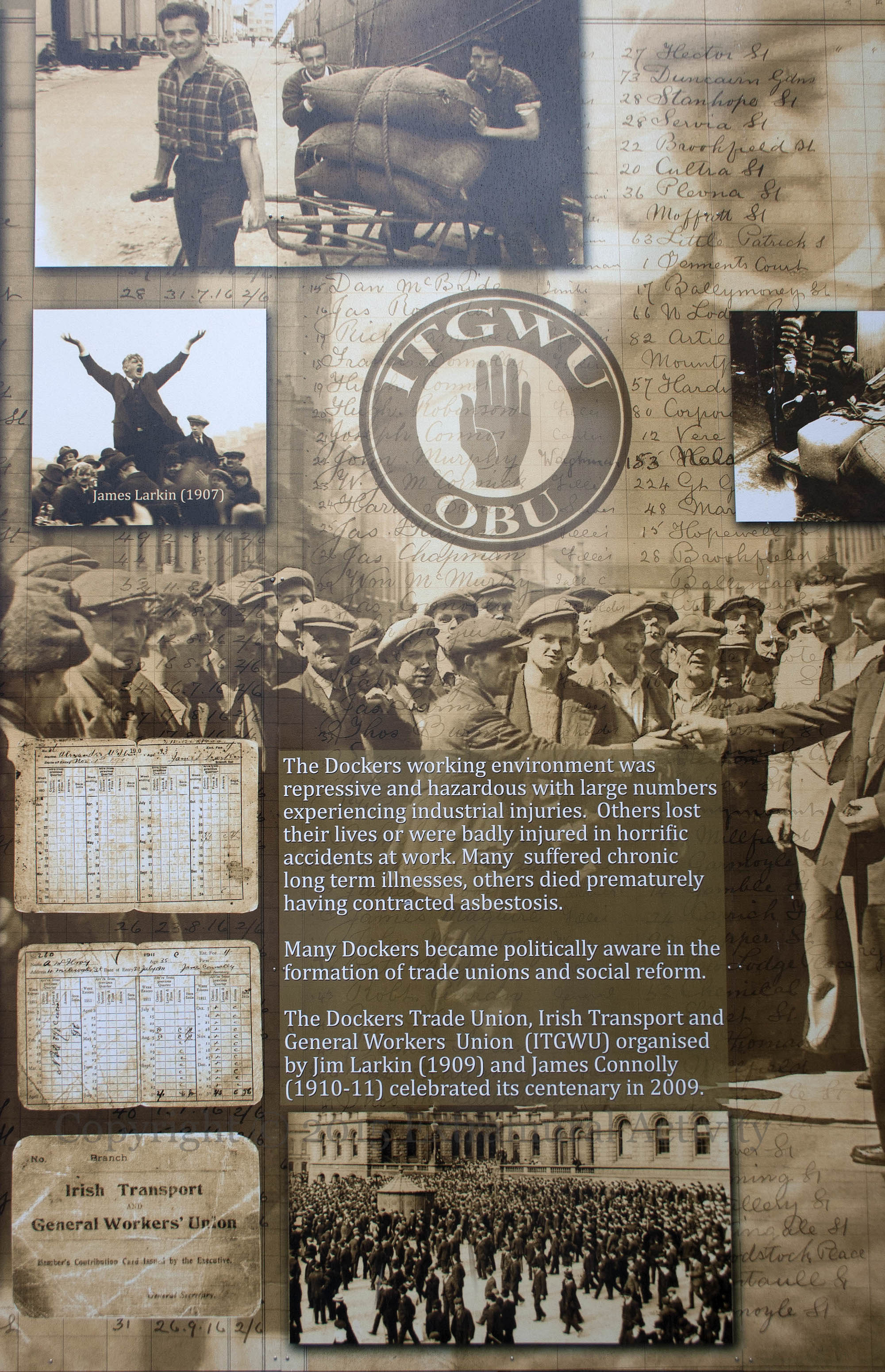
“It was a physically demanding job, the hours were long, the conditions were tough and the availability of work was not constant. Without the Dockers, however, the Port of Belfast would not have been able to grow. / Transportation of goods by containers led to a revolution in working practices at Belfast Docks and the number of dockers decreased dramatically. From 3000 listed dockers in 1970, the number had fallen to 280 by 1985. Behind these figures lay the human story of vast social changes in the harbour area as well as the gradual dissappearance [sic] of an entire community who had earned their living from the sea and also through the loading and unloading of ships. These were the Dockers and their families, many of whom lived in Sailortown. / The workforce of dockers spanned both traditions. Red button and Blue button. Dockers had a common allegiance to the Port of Belfast which provided a living for men and families from both communities. / The work was backbreaking, yet the Docks educated us about life, integrity, discipline, about standing up for our rights, about having pride in our identity as working men, as Dockers. / The Dockers[‘] working environment was repressive and hazardous with large numbers experiencing industrial injuries. Others lost their lives or were badly injured in horrific accidents at work. Many suffered chronic long term illnesses, others died prematurely having contracted asbestosis. Many Dockers became politically aware in the formation of trade unions and social reforms. The Dockers Trade Union, Irish Transport and General Workers[‘] Union (ITGWU) organised by Jim Larkin (1909) and James Connolly (1910-11) celebrated its centenary in 2009.” OBU one big union
 Seosamh Mac Coille Collection