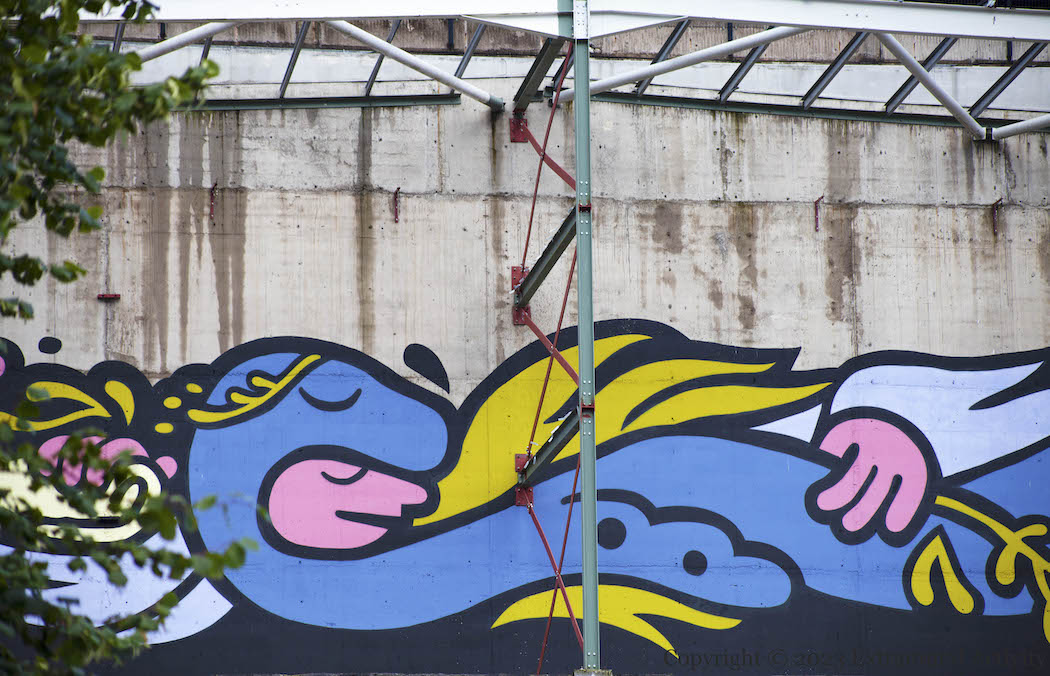
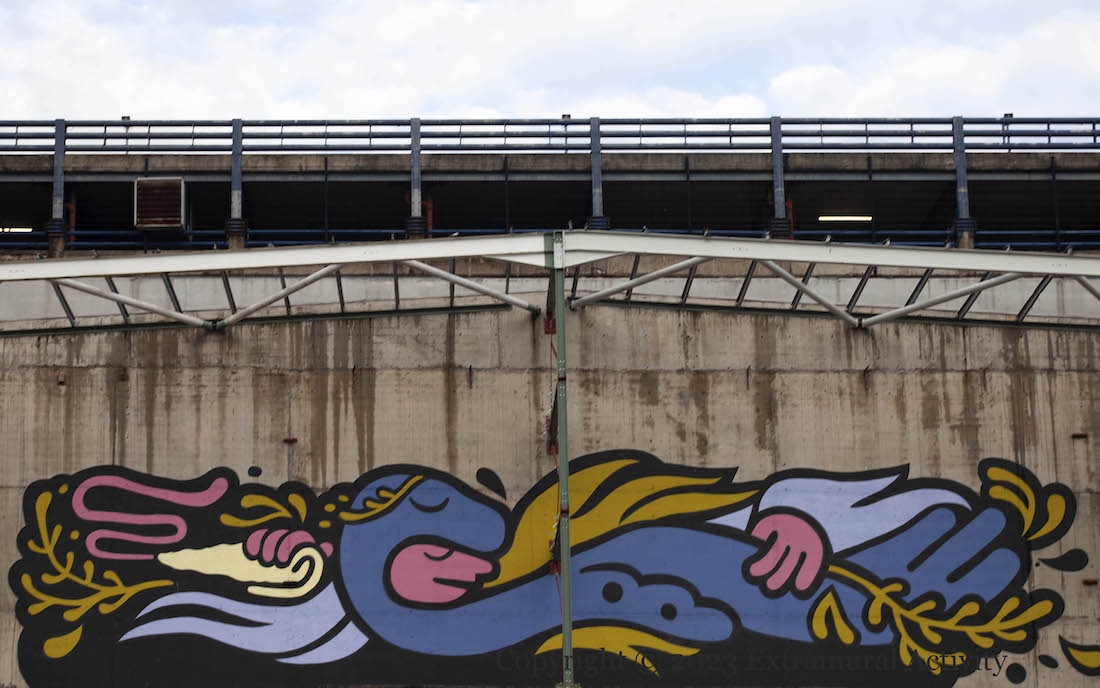
The Seal Folk or Selkies are shape-shifting creatures in island mythologies from Man to Ireland to the Scottish isles to the Faroes to Iceland. Seals in water, they can take off their skins and become (beautiful) humans on land. Without their skins, they cannot return, and so they can be captured by humans who hide their skins. A few tales can be found at Scotland’s Stories.
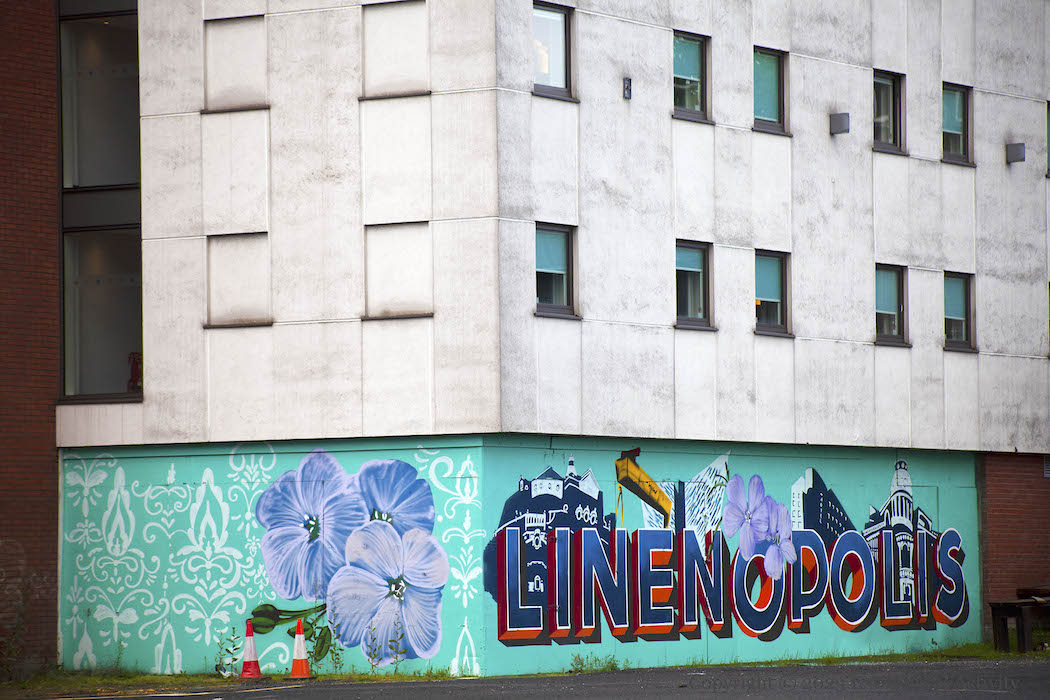
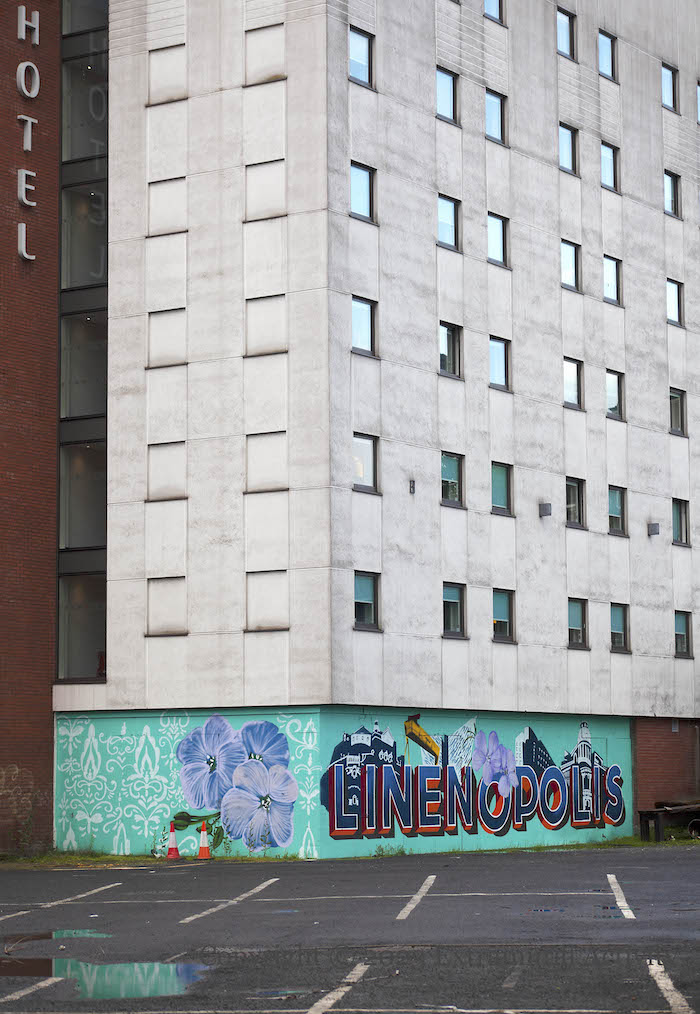
A celebration and exploration of Belfast’s most famous textile, the “linen biennale”, runs until October (web). The Linen Hall library also runs a tour of the “linen quarter” on Thursdays.
Visual Waste’s (ig) Great Victoria Street mural includes various linen quarter buildings: the Grand Opera House, the Europa hotel, and Inst., alongside the H&W cranes and the Titanic museum.
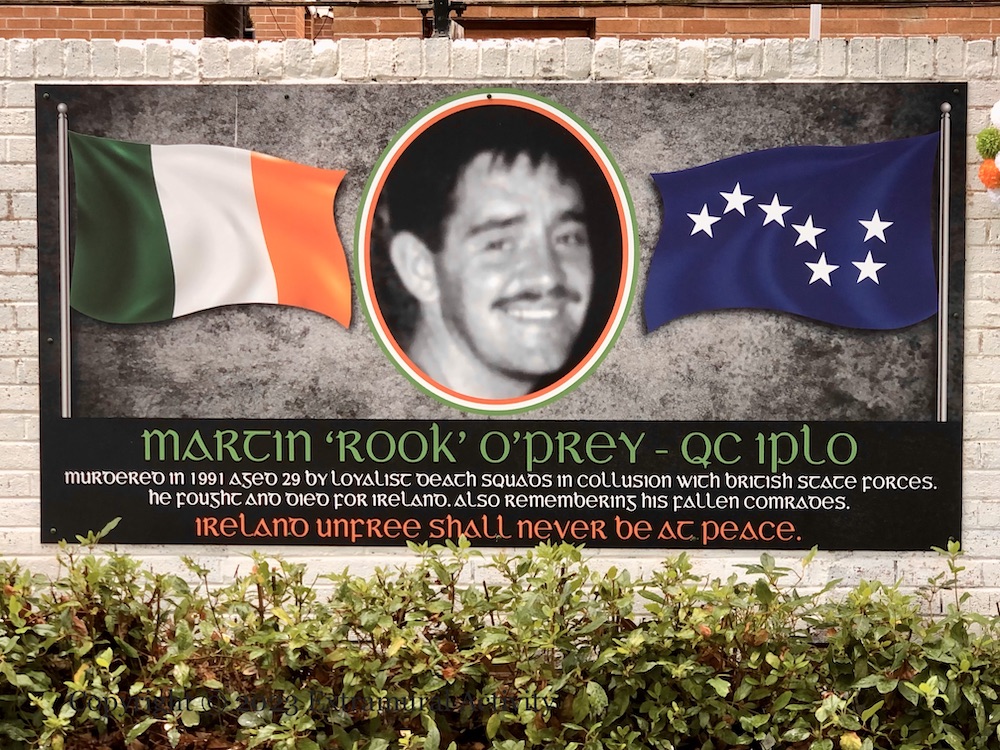
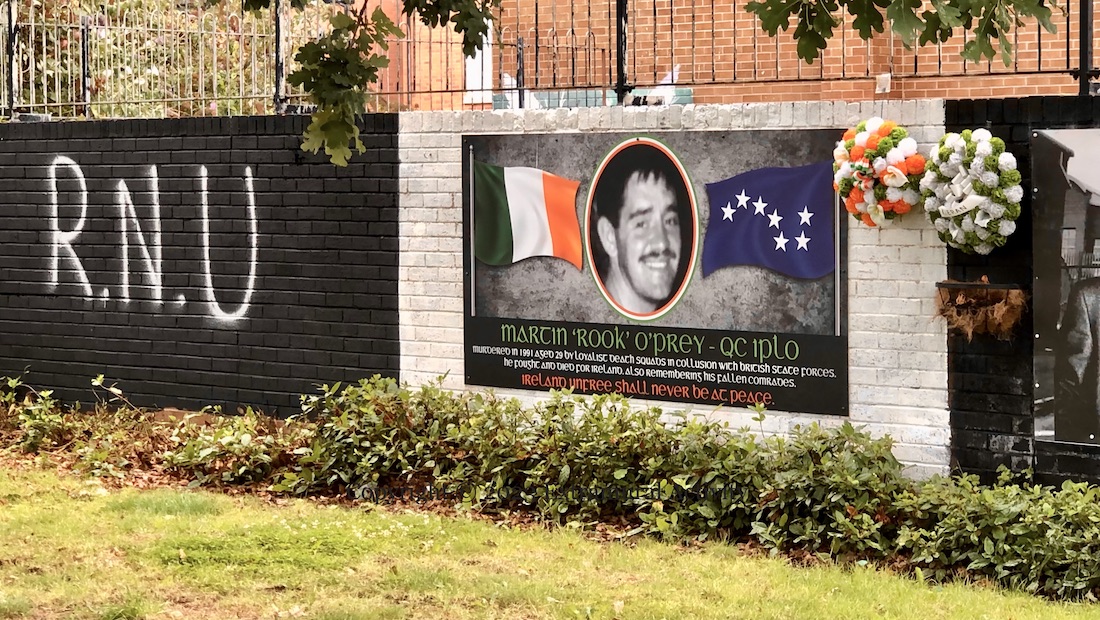
Martin “Rook” O’Prey was the Belfast brigade commander of the IPLO [Irish People’s Liberation Organisation], a breakaway INLA group responsible for killing George Seawright and attacking the Orange Cross social club (WP).
There is a plaque to O’Prey in Leeson Street (M07985).
The RNU has reserved the spot to the left; the edge of the Kieran Abram board is visible on the right.
“Martin ‘Rook’ O’Prey – OC IPLO. Murdered in 1991 aged 29 by loyalist death squads in collusion with British state forces. He fought and died for Ireland. Also remembering his fallen comrades. “Ireland unfree shall never be at peace.””
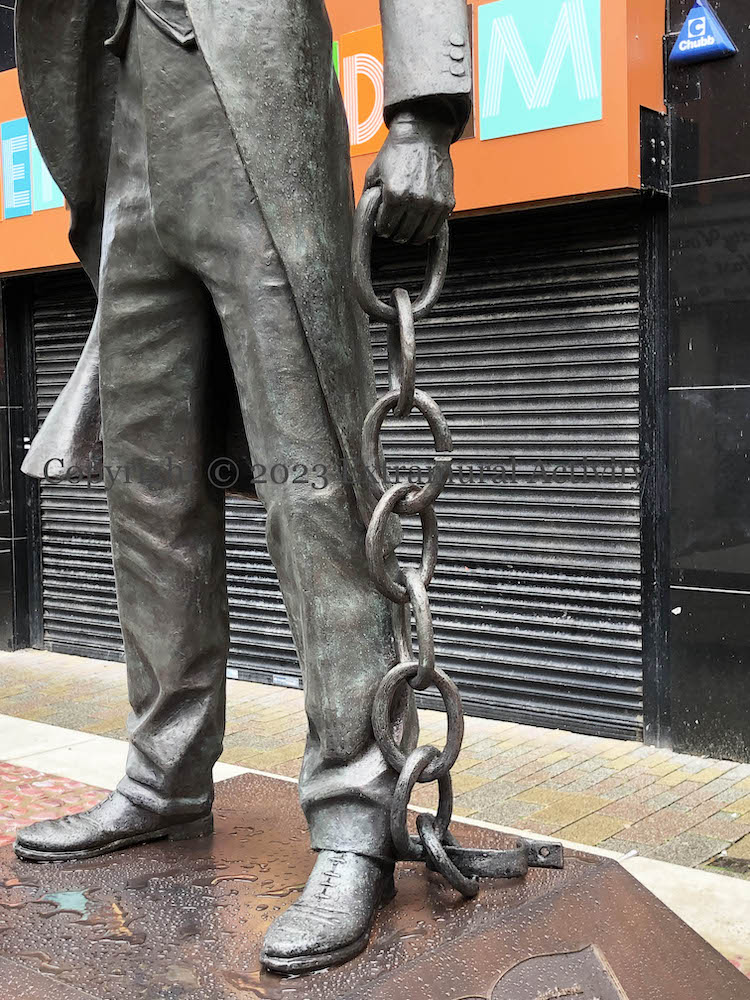
On this day in 1834, the Slavery Abolition Act came into effect (except territories managed by the East India Company), marking the beginning of the end for slavery in the British empire. Enslaved children below the age of six were freed; while enslave adults were designated as apprentices for a period of four or six years; 5% of British GDP went towards reimbursing owners (Independent | WP).
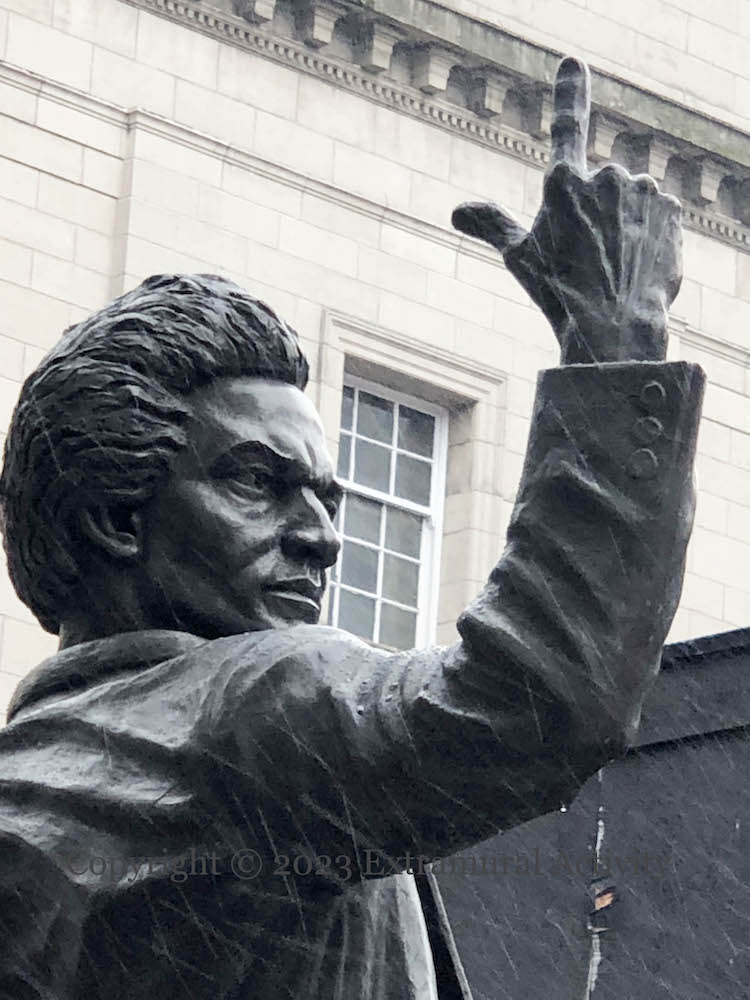
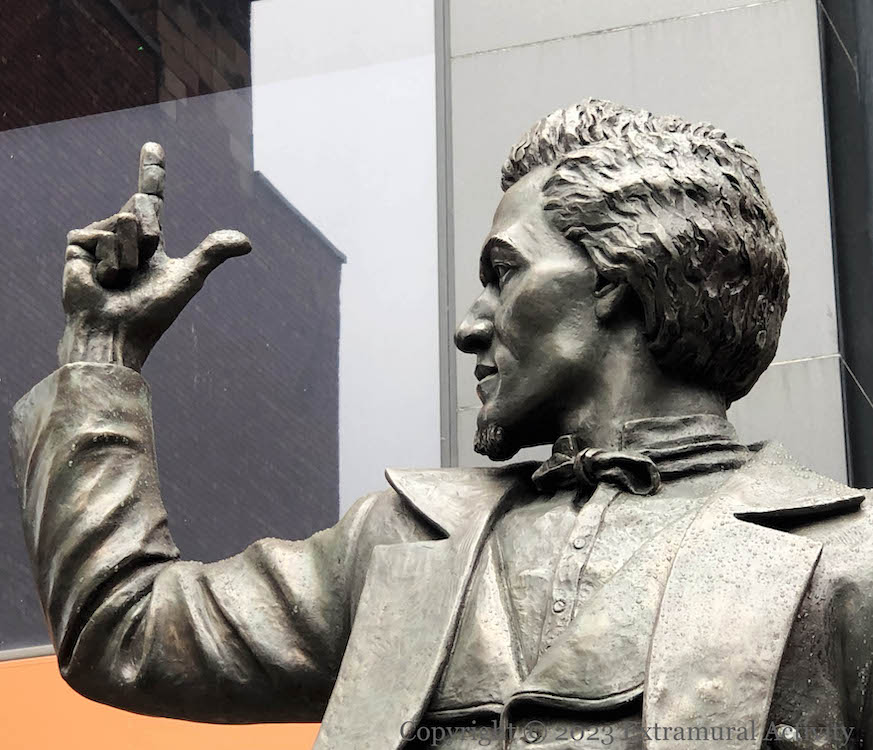
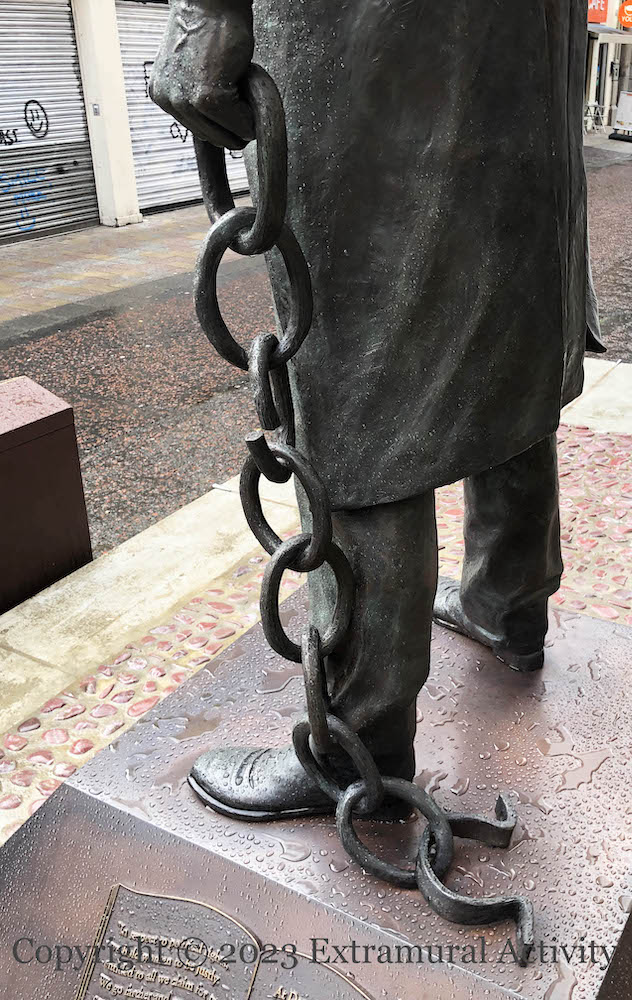
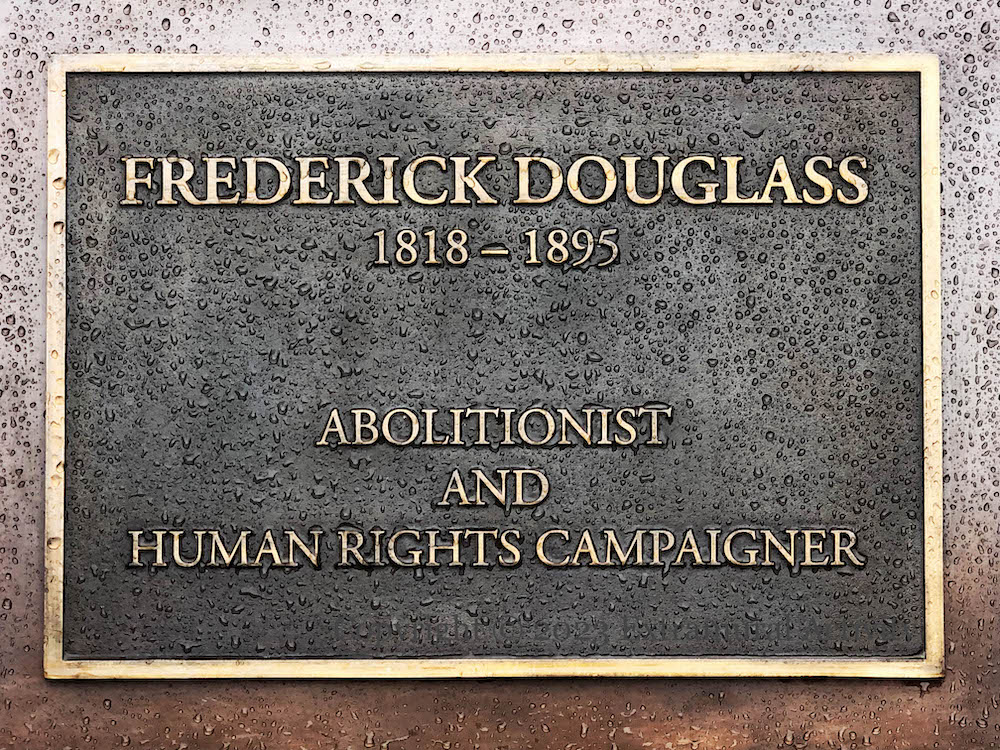
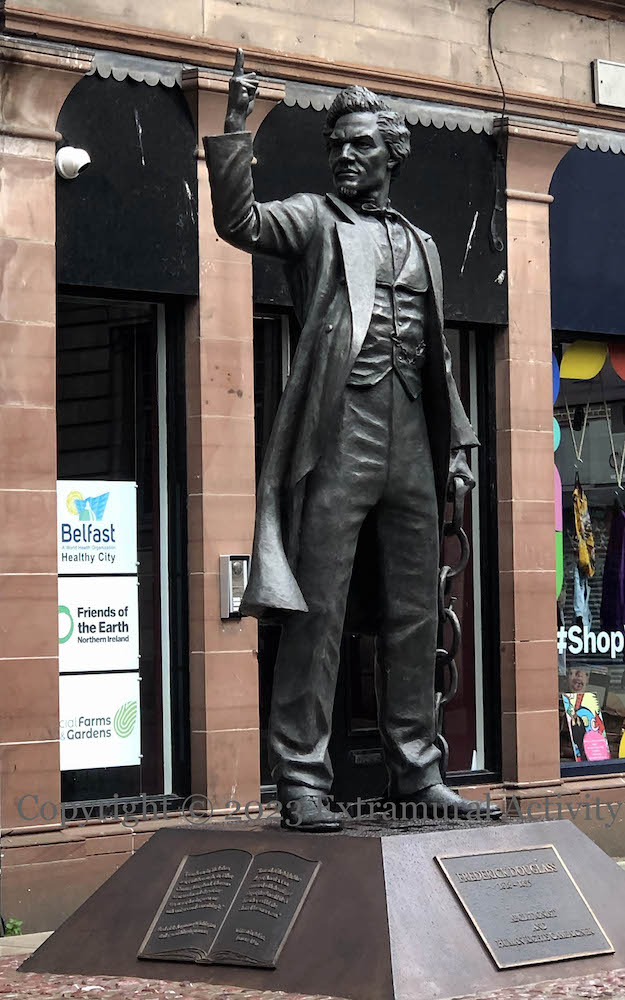
This made it safe for Frederick Douglass – “1818-1895, abolitionist and human rights campaigner” – to tour in Ireland and Britain when the success of his (first) auto-biography, Narrative Of The Life Of Frederick Douglass, might have allowed and encouraged his owner to re-capture him. Douglass had “illegally” escaped slavery in September, 1838, become a preacher in 1839, and by 1843, had joined a six-months-long speaking tour of the United States. (WP)
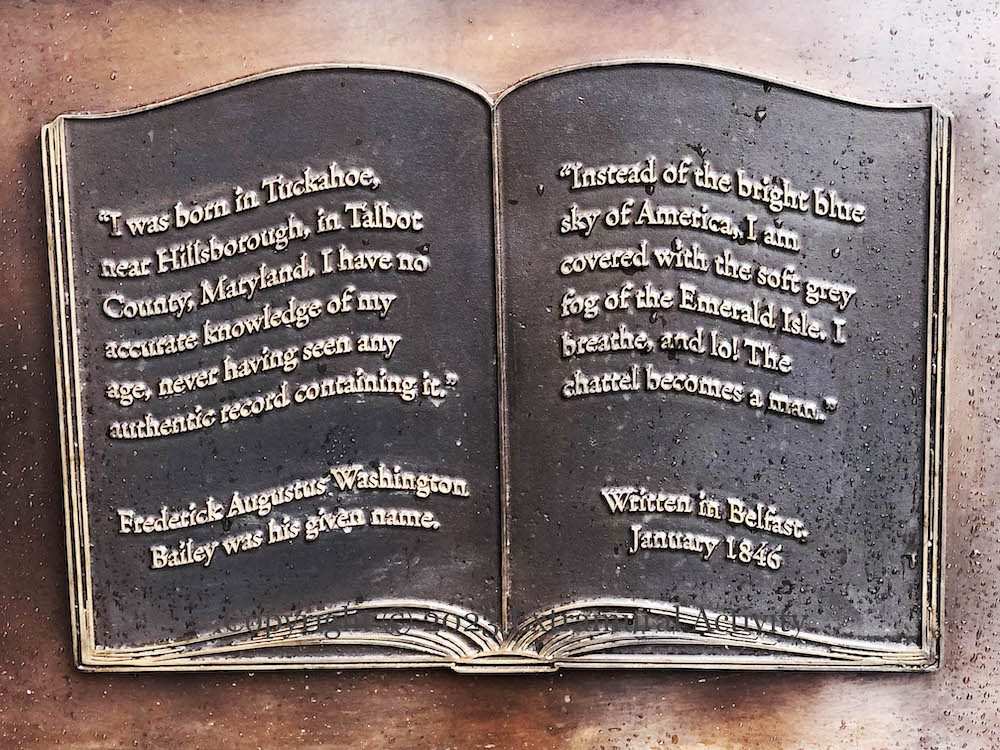
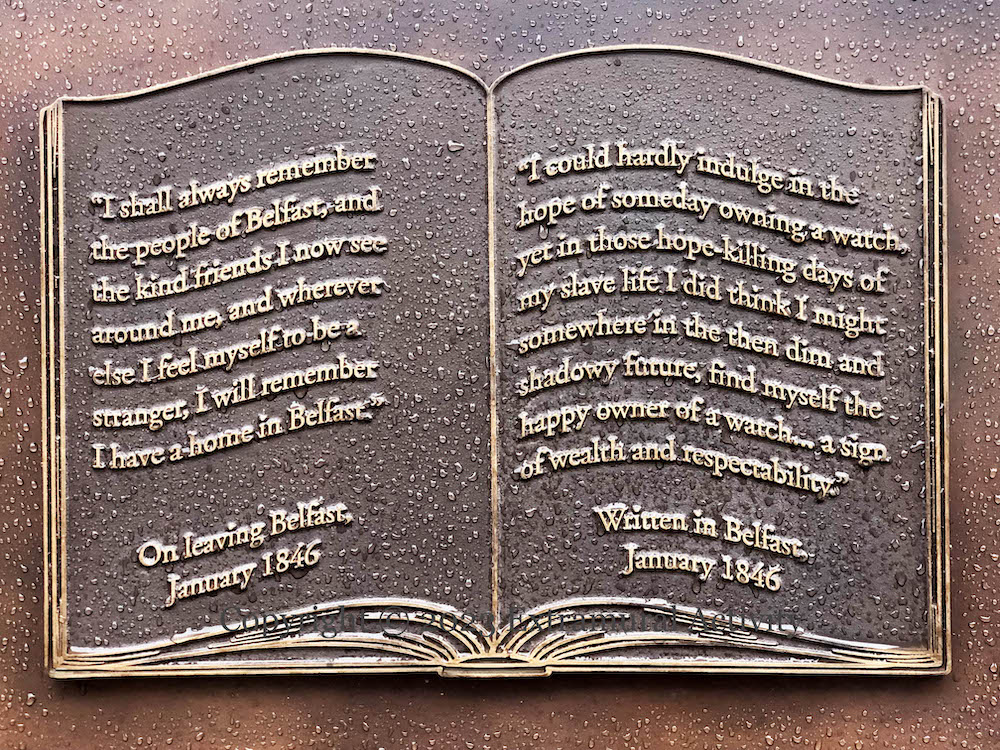
His tour of Ireland and Britain lasted two years and included speeches given in First Presbyterian Church in Rosemary Street and at the Assembly Rooms in Waring Street. In a letter to William Garrison he wrote, “Instead of the bright, blue sky of America, I am covered with the soft, grey fog of the Emerald Isle. I breathe, and lo! the chattel becomes a man.” And when leaving for Britain in January 1846 he wrote, “I shall always remember the people of Belfast, and the kind friends I now see around me, and wherever else I feel myself to be a stranger, I will remember I have a home in Belfast.”
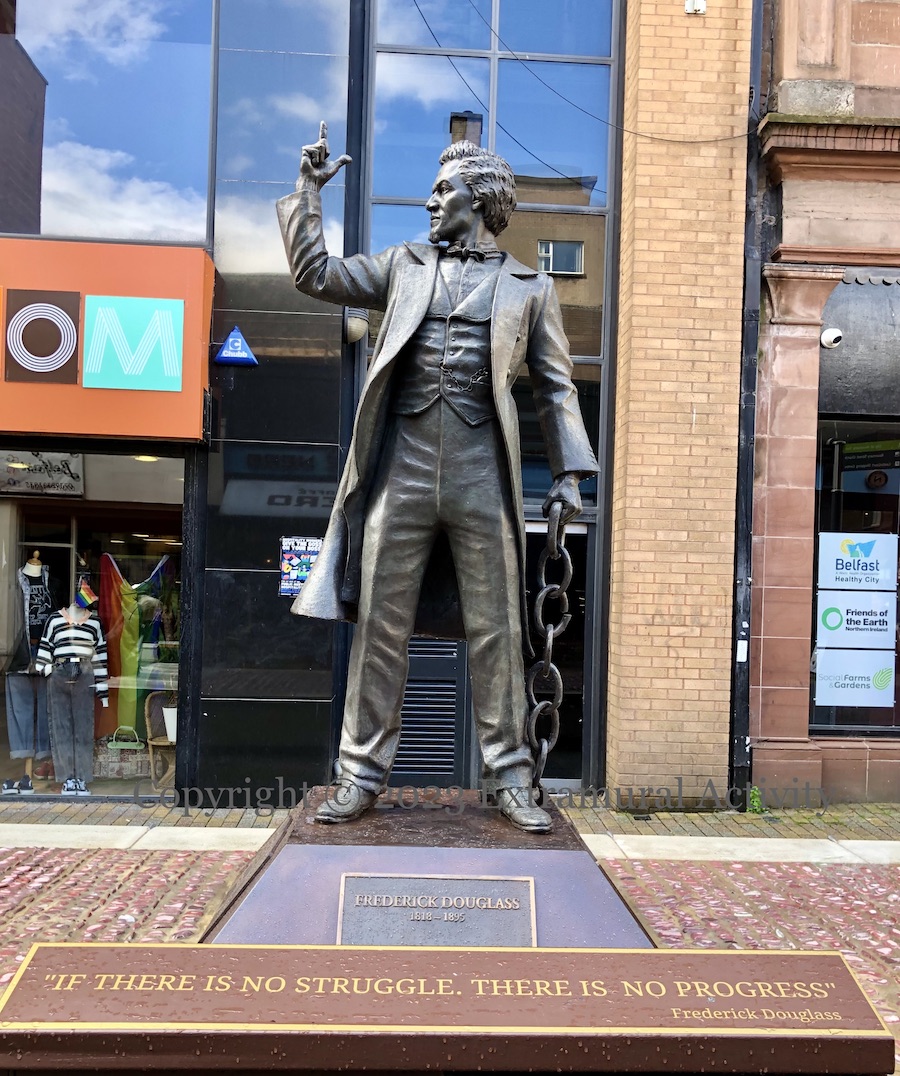
Douglass returned to the US in 1847, where millions were still enslaved (until the 13th Amendment of 1865). In an 1857 address concerning Jamaica and the West Indies, Douglass said, “If there is no struggle, there is no progress. Those who profess to favor freedom and yet deprecate agitation are men who want crops without plowing the ground. They want rain without thunder and lightning. They want the ocean without the roar of its mighty waters. The struggle may be a moral one or it may be a physical one, or it may both moral and physical, but it must be a struggle. Power concedes nothing without a demand. It never has and it never will.” (CUNY)
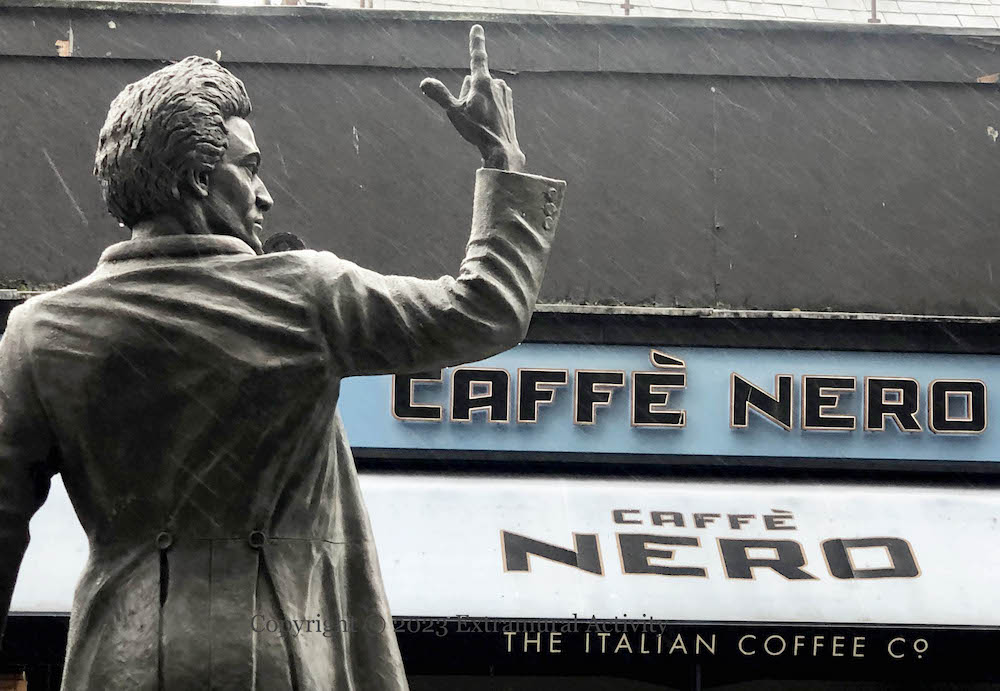
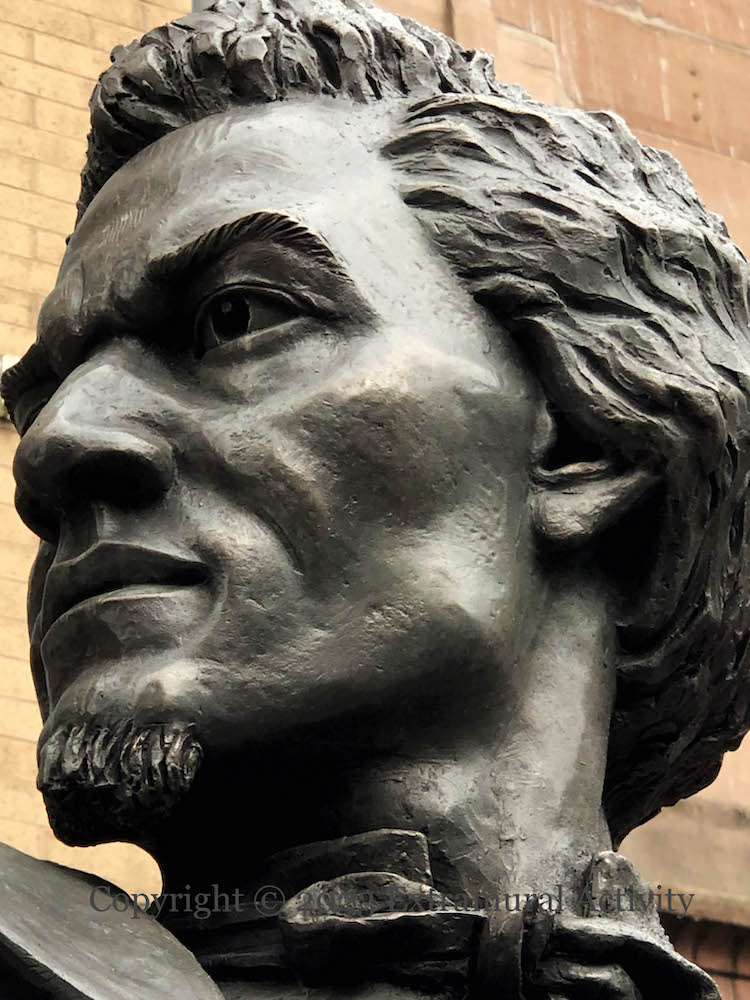
The piece was sculpted by Alan Beattie Herriot and Hector Guest (BBC) with funding from Belfast City Council and the Department For Communities (BelTel), and stands in Lombard Street. Douglass is presented as a 27-year-old; the old mural on Divis Street and the current mural on Northumberland Street portray him in later years.
Douglass carries a watch in his waistcoat pocket: “I could hardly indulge in the hope of someday owning a watch, yet in those hope-killing days of my slave life I did think I might somewhere in the dim and shadowy future, find myself the happy owner of a watch … a sign of wealth and respectability.”
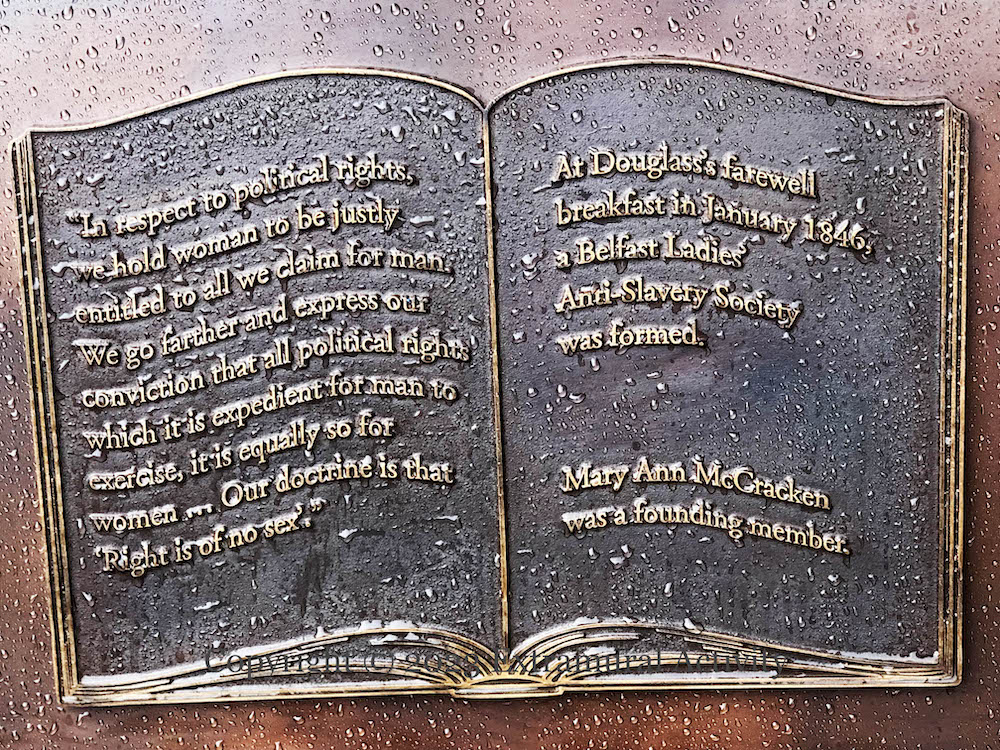
See also: Olaudah Equiano, who toured in Ireland in 1791-1792, and, for Mary Ann McCracken, The World Affords No Enjoyment Equal To That Of Promoting The Happiness Of Others. “”In respect to political rights, we hold woman to be justly entitled to all we claim for man. We go farther and express our conviction that all political rights which it is expedient for man to exercise, it is equally so for women … Our doctrine is that ‘Right is of no sex’.” At Douglass’s farewell breakfast in January 1846, a Belfast Ladies Anti-Slavery Society was formed. Mary Ann McCracken was a founding member.”
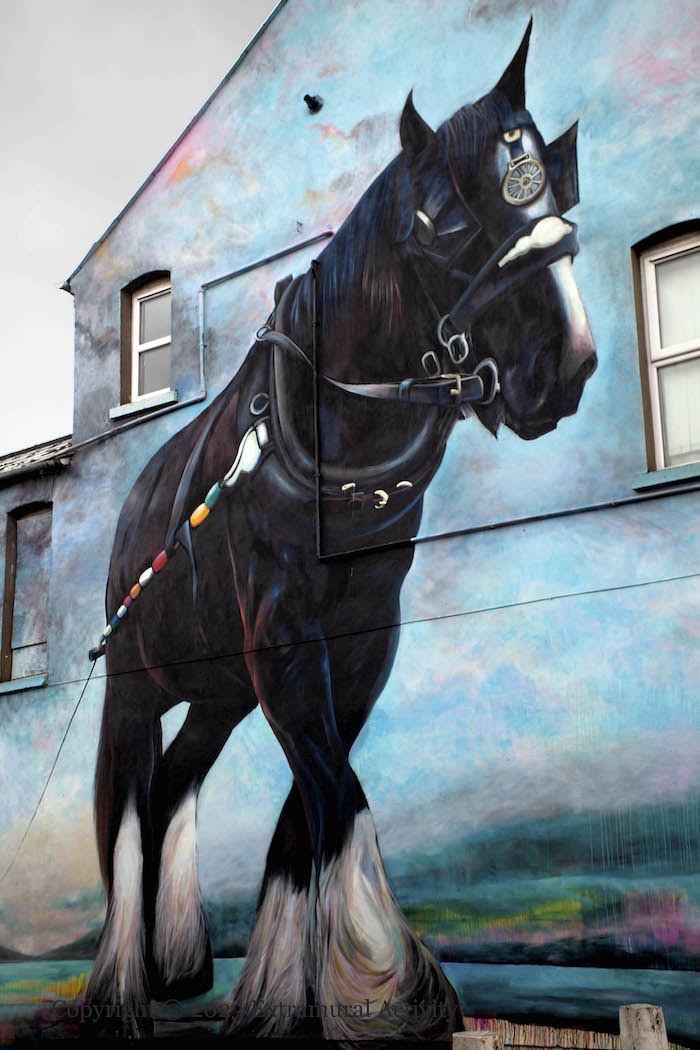
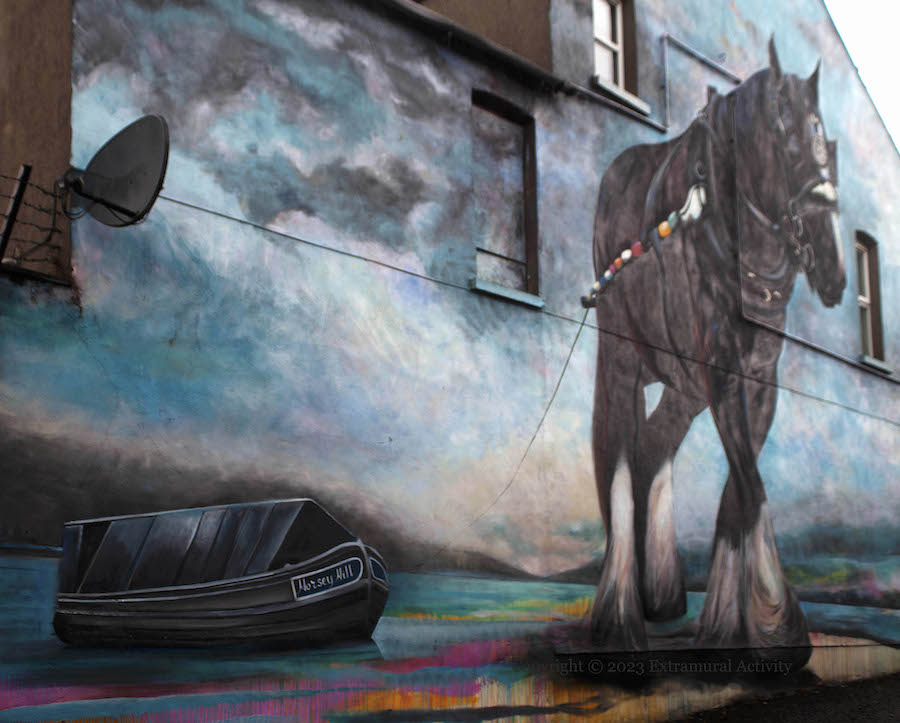
The Lagan river between Belfast and Lisburn was made navigable in 1763 after seven years of work. The remaining distance between there and Lough Neagh (and the coalfields of east Tyrone, which were connected to Lough Neagh and then Portadown and Newry) required a canal, which finally opened on January 1st, 1794. The were 27 locks on the route between Belfast and the lough, and horses walking on the tow-parth would pull the barges up river (WP | Lagan Valley | Lagan Navigation has photographs of horses at work). Horsey Hill was perhaps the site of stables in south Belfast; it is now the name of the alley that continues on towards the river from the Ukraine sunflower mural off Harrow Street in the Holylands.
Forward South Partnership/Connor McKernan’s video about the history of the Holylands, including Horsey Hill, can be seen on youtube.
Painted by Daniela Balmaverde (ig) and DMC. At the bottom of Horsey Hill, along the embankment, are Animals Two By Two.
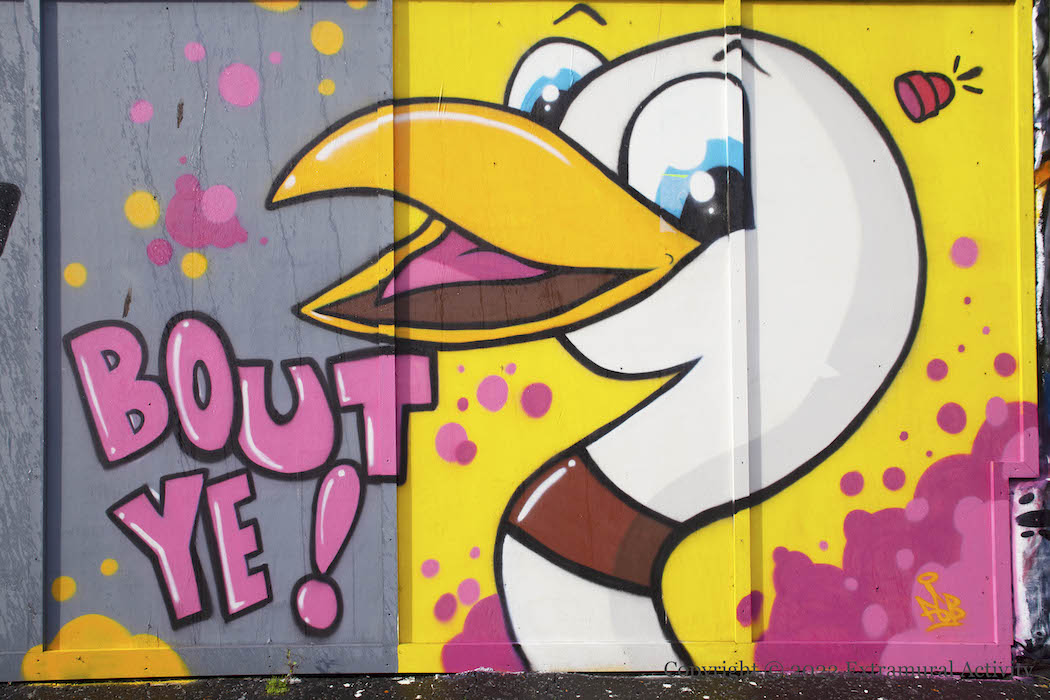
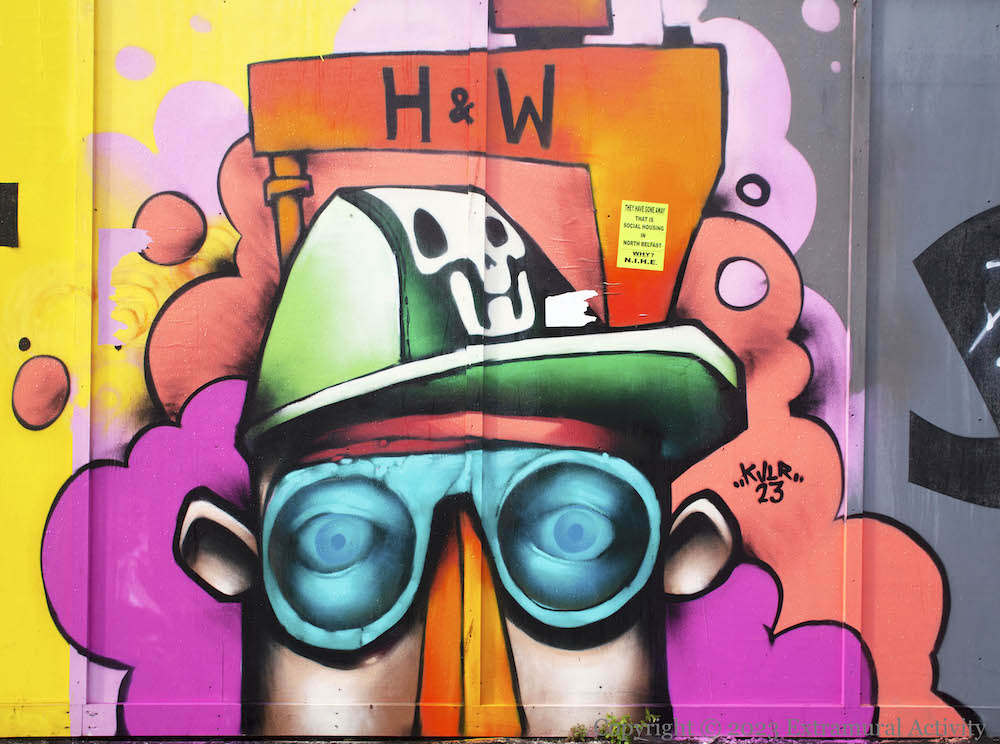
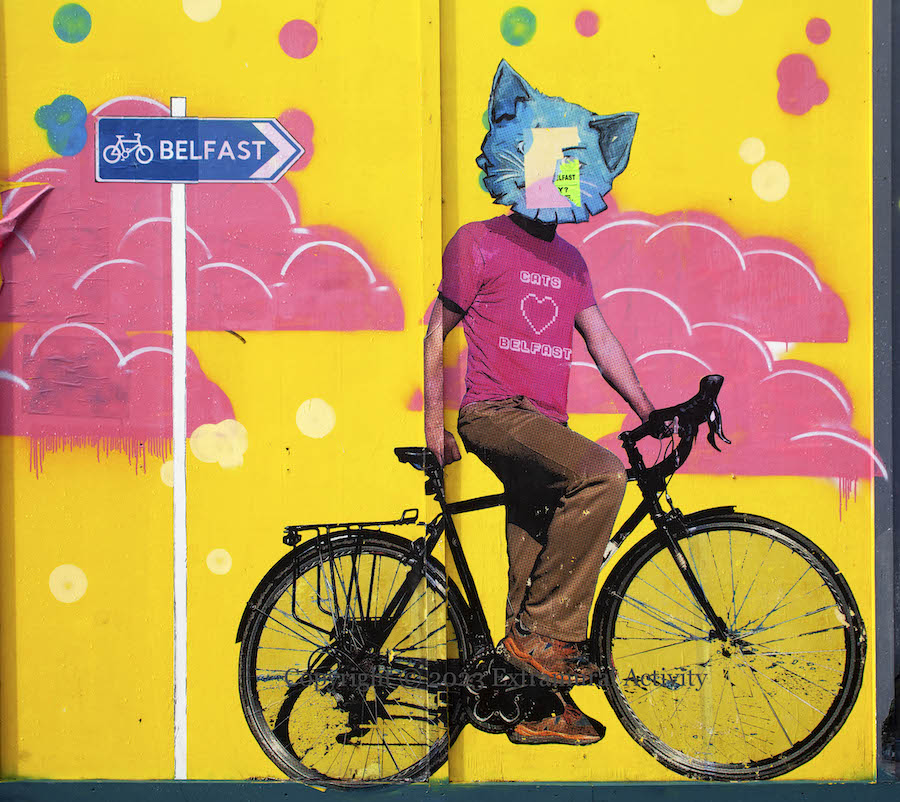
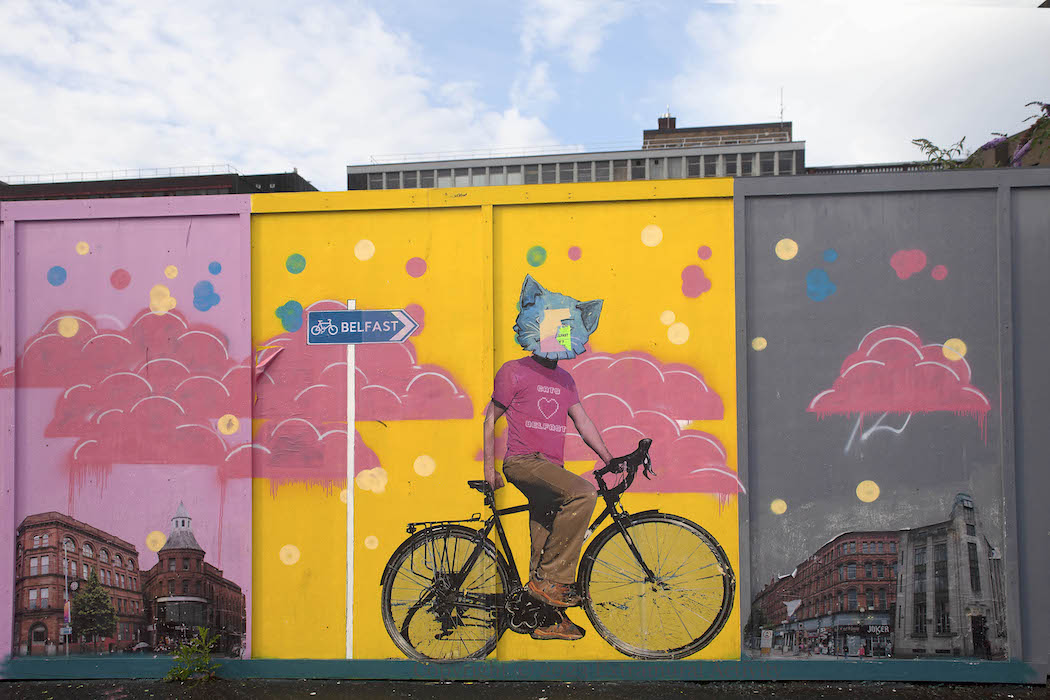
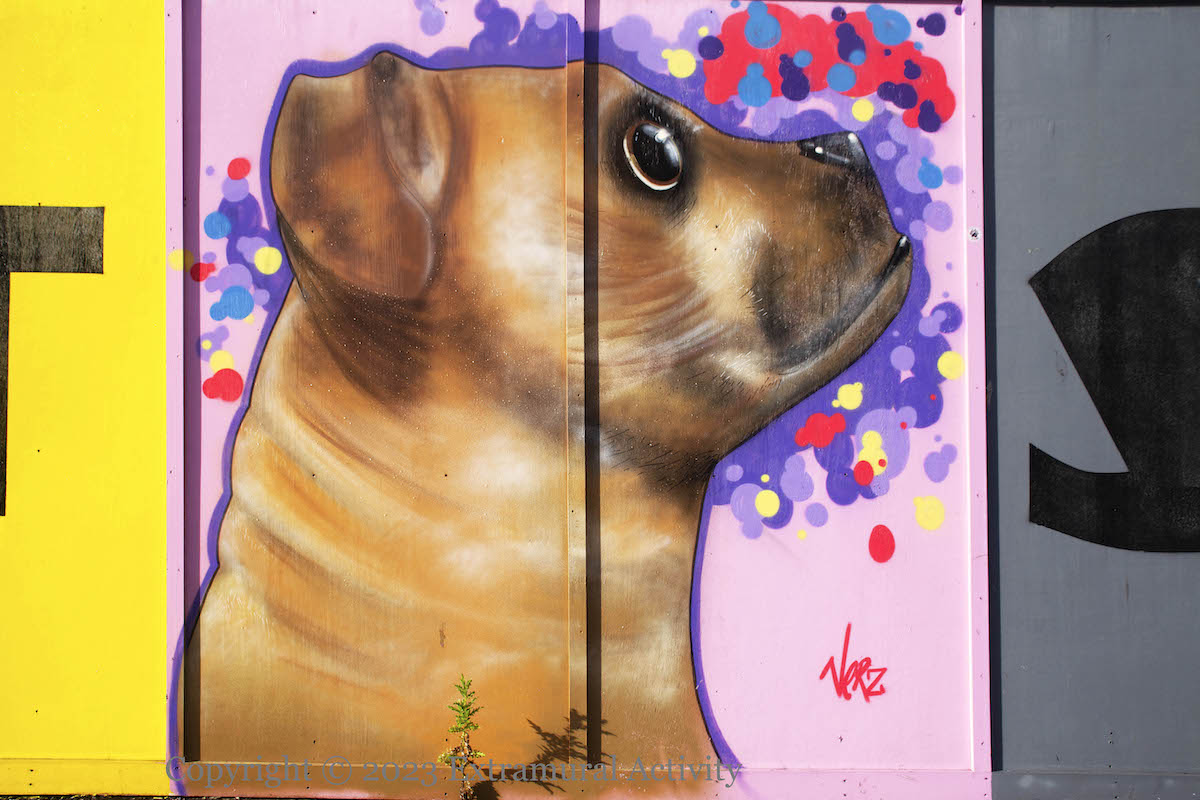
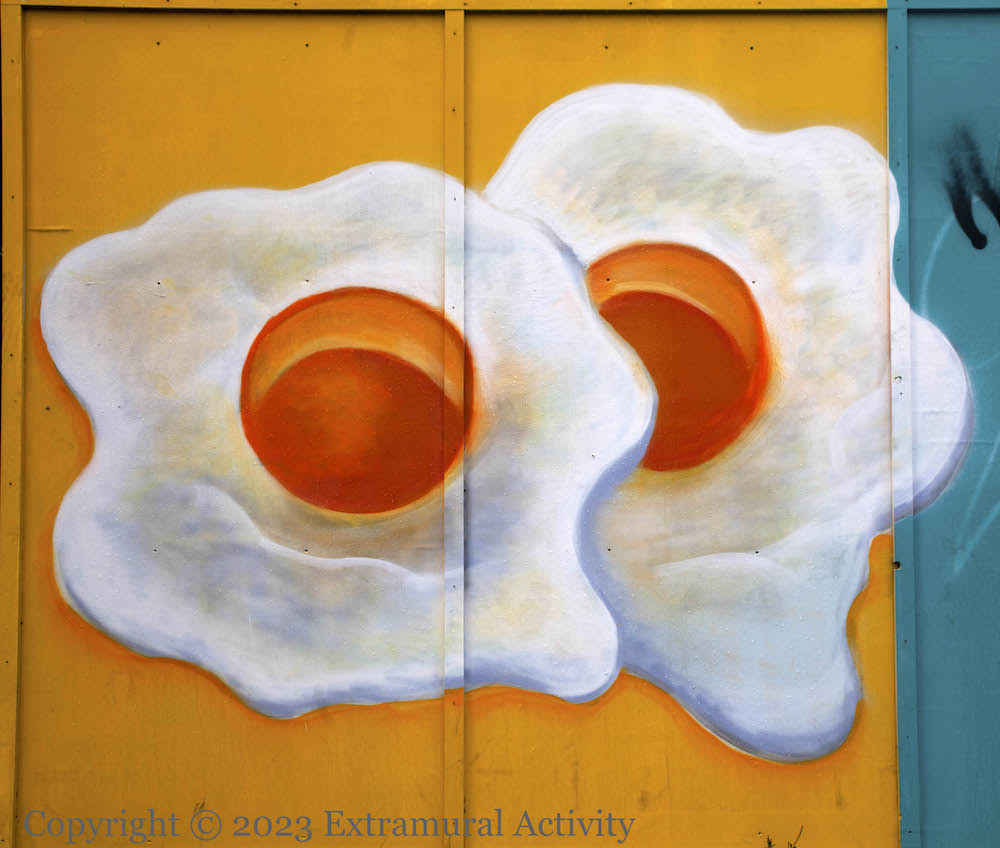
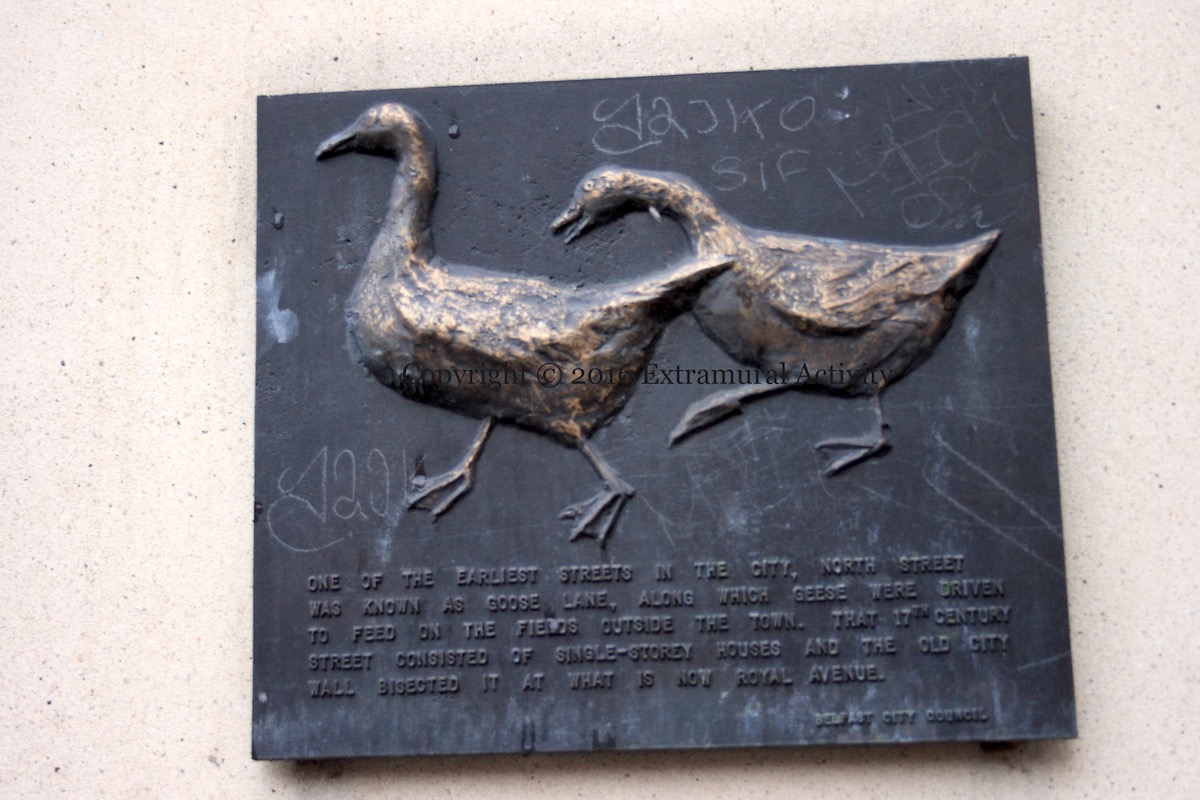
How’s about ye?! FGB (ig), Leo Boyd (ig), and KVLR (ig) added three pieces at the end of April to what is now the “Belfast Stories” construction hoarding. FGB’s piece, shown above, was inspired by the fact that the northern branch of North Street was called “Goose Lane” (tw) at the time of (Chichester’s) Belfast Castle, as herders headed through the north gate (see the map at Lennon Wylie). There is a “Goose Lane” plaque on just the other side of Royal Avenue; it is included below.
“One of the earliest streets in the city, North Street was known as Goose Lane, along which geese were driven to feed on the fields outside the town. That 17th century street consisted of single-storey houses and the old city wall bisected it at what is now Royal Avenue – Belfast City Council.”
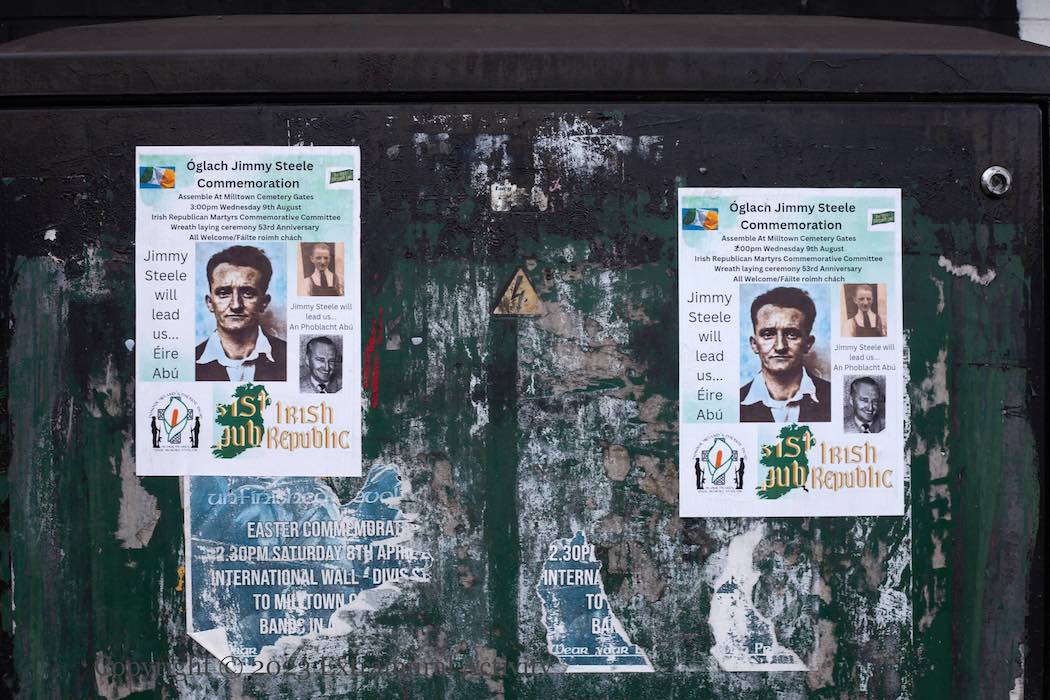
Over the course of a long career as a Fian, IRA volunteer, and Northern Command adjudtant, Jimmy Steele saw action in the S-Plan (see Joe Malone’s gravestone in Far Dearer The Grave Or The Prison) and the border campaign, went on hunger strike and “strip strike” (blanket), escaped from Crumlin Road gaol, and was the first editor of Republican News. (Treason Felony | WP) This poster (from the Irish Republican Martyrs’ Commemorative Committee – Fb) calls people to a commemoration of Steele on the anniversary of his death, August 9th, 1970.
“Óglach Jimmy Steele Commemoration. Assemble at Milltown Cemetery gates 3:00pm Wednesday 9th August. Irish Republican Martyrs Commemorative Committee wreath laying ceremony 53rd anniversary. All welcome/fáılte roımh chách.” “Jimmy Steele will lead us … Éıre abú. An Phoblacht abú.”
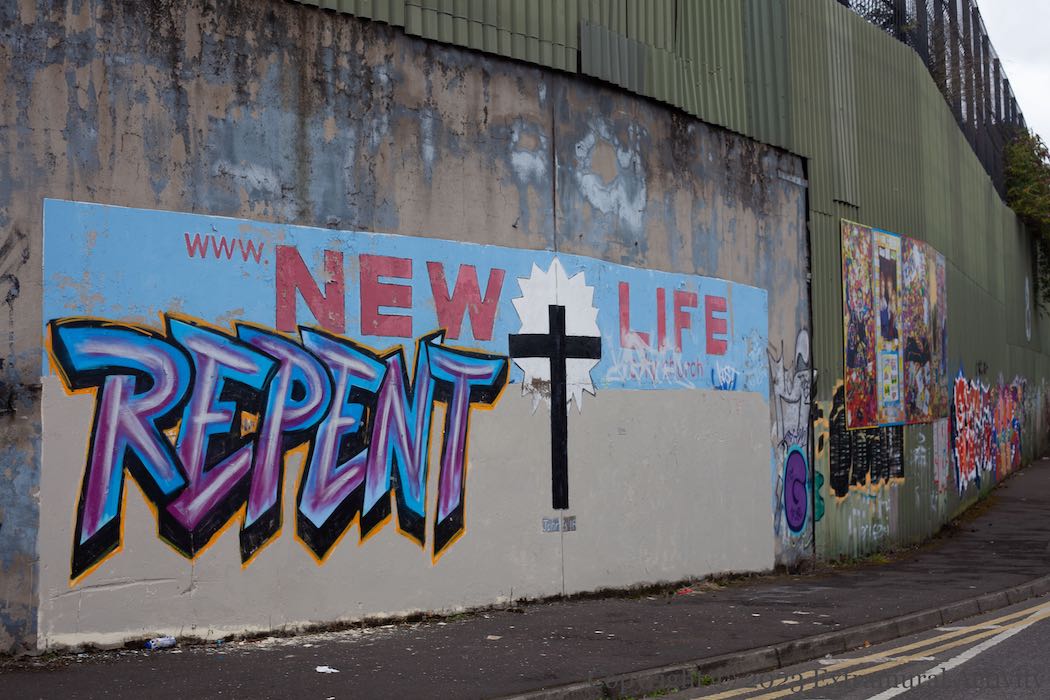
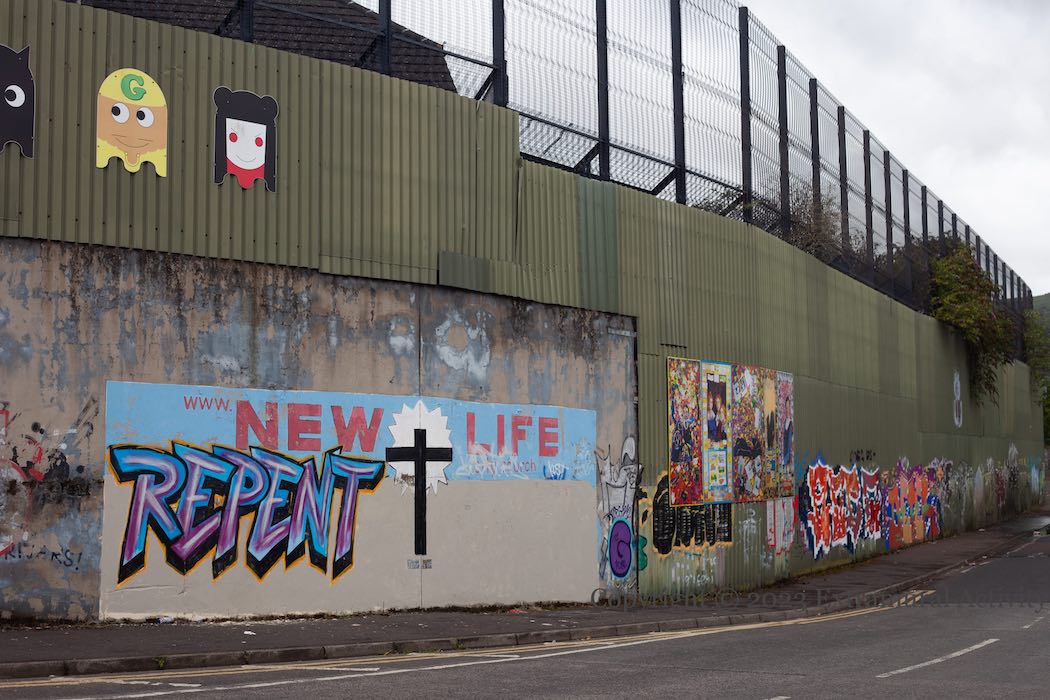
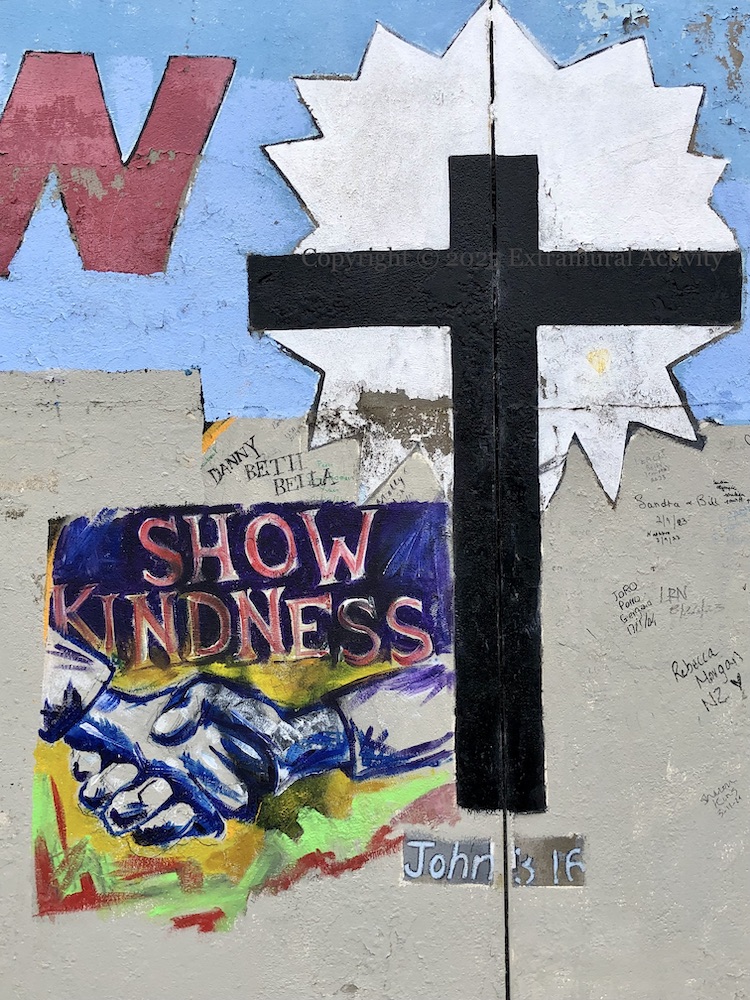
The graffiti on the bottom part of the New Life City Church (web) mural on the west Belfast “peace” line has been painted out and this mild wild-style “repent” added.
New Life murals in the area go back to at least 1997 and one on this stretch of the wall goes back to 2004 – see The Dividing Line Of Hostility.
Update, July 2014: “Show kindness” illustrated with a handshake has been added
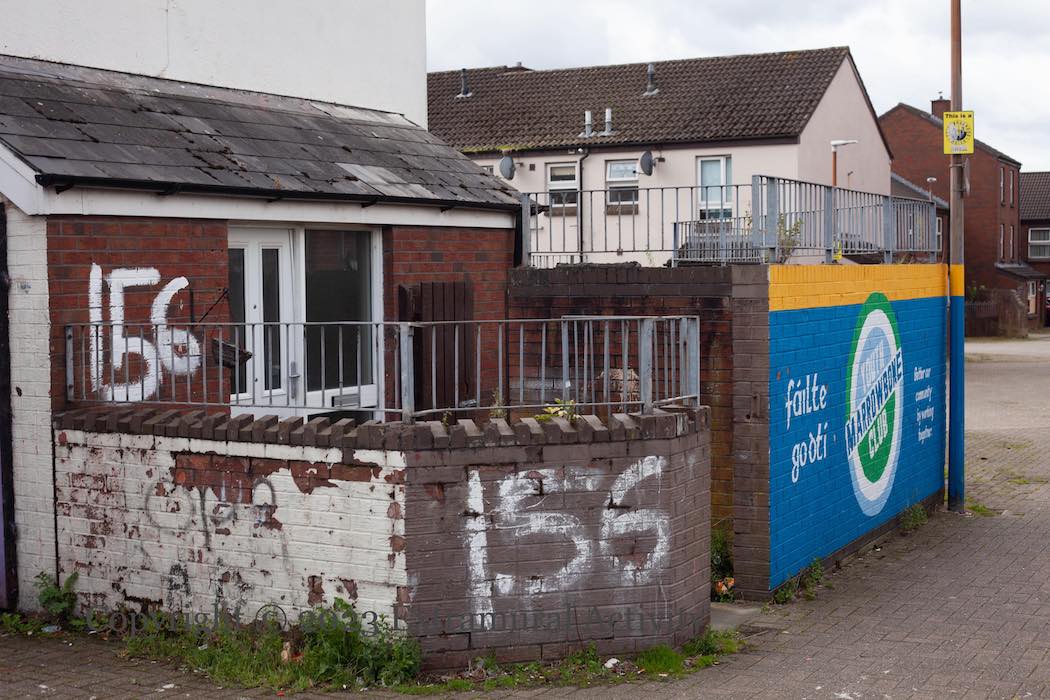
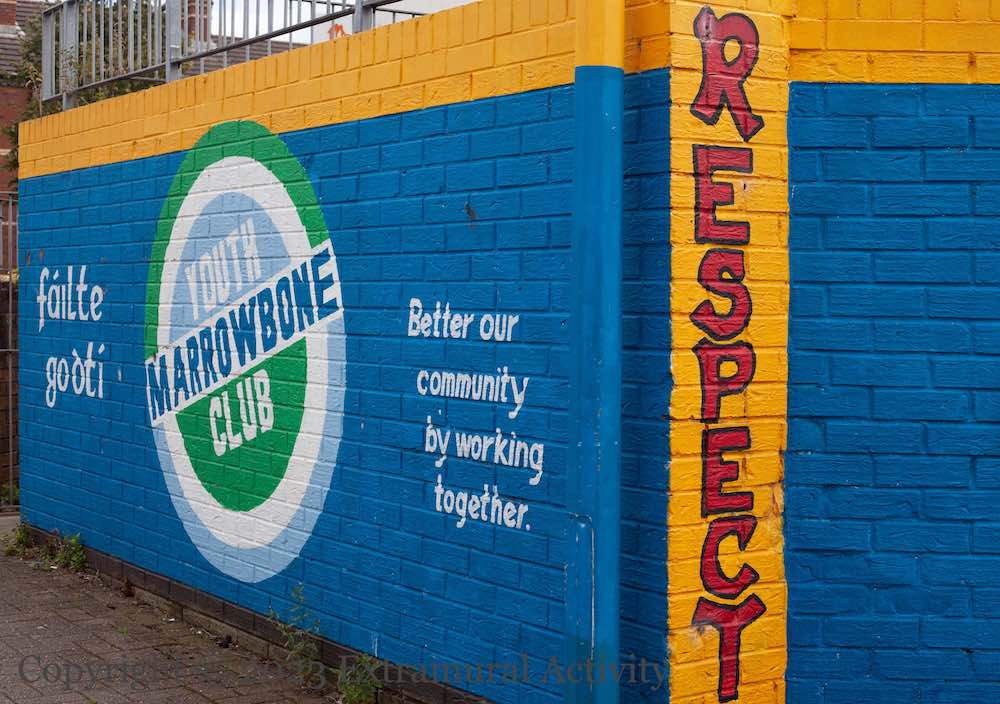
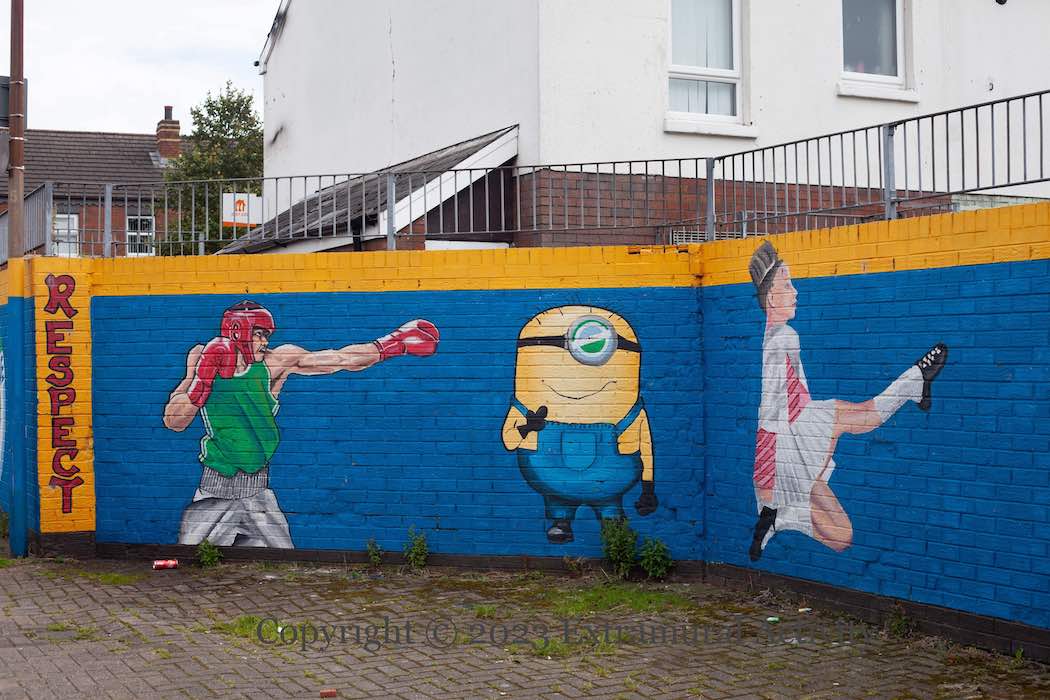
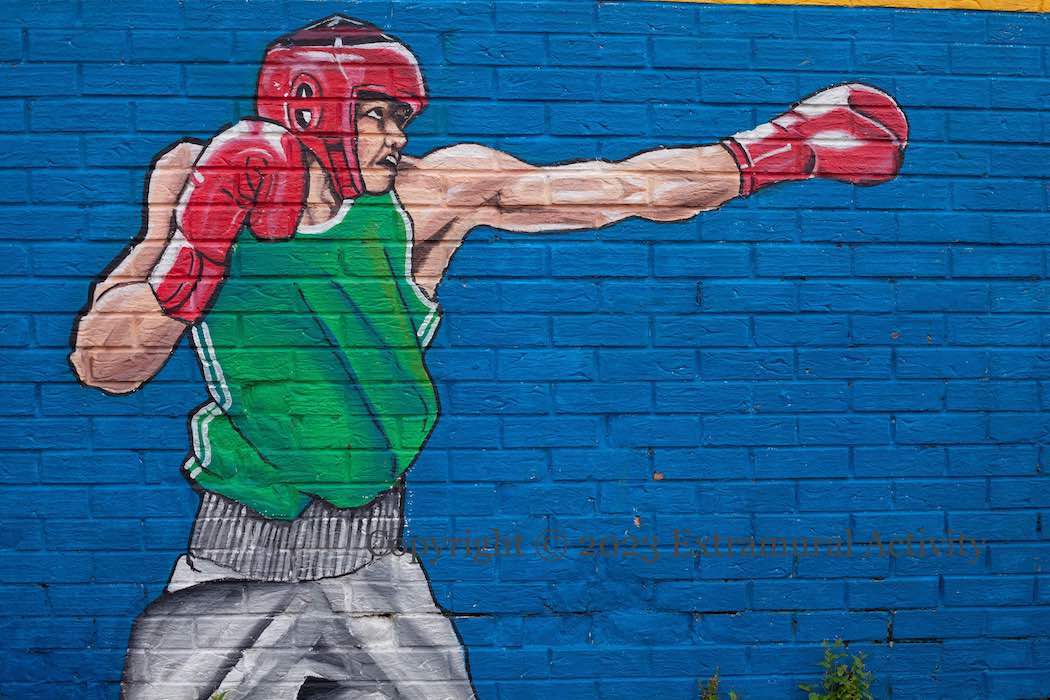
“Fáılte go dtí Marrowbone youth club [club óıge Mhachaıre Bothaın (Fb)] – better our community by working together.” The verbiage is a mix of Irish and English and the imagery is a mix of youth activities and … a minion.
The previous mural – which included Cliftonville (soccer) and Antrim (GAA) emblems – was seen previously in 2013 and in 2021.
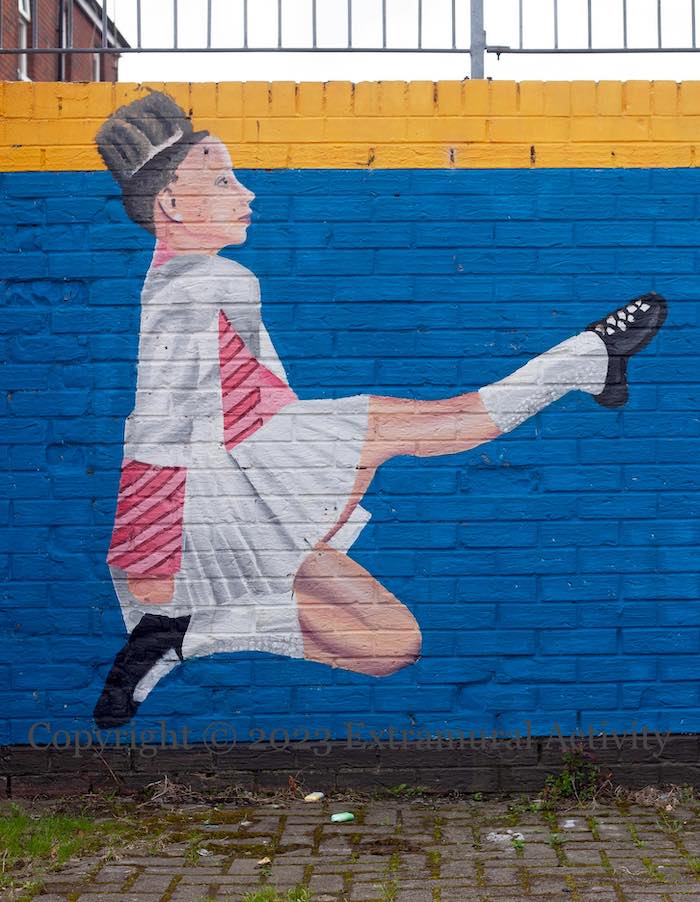
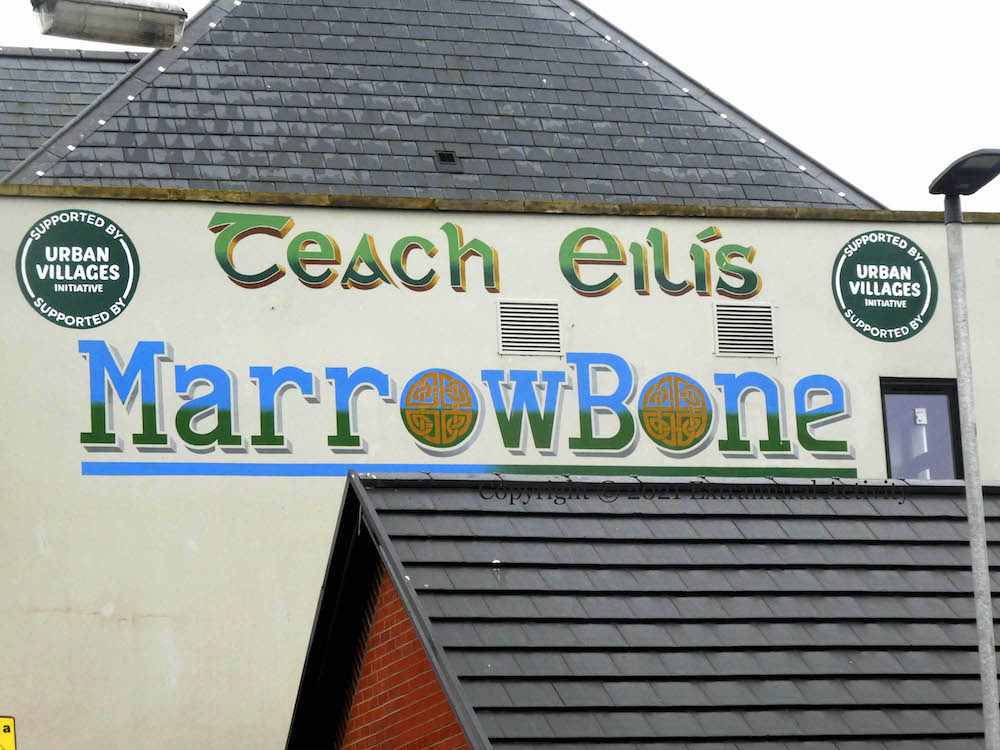
 Seosamh Mac Coille Collection