Ireland’s most famous export is not its music – including Fontaines D.C. (web) – or its stout – including Guinness – but its people, about 10 million of them since 1800 (WP). The youngster in this new mural by Dublin artist ACHES (ig) is torn in different directions.
Áras Uí Chonghaile has a “James Connolly Heritage Trail”, with a series of plaques and panels that interested parties can walk as members of a guided tour, or by themselves with the aid of an app (Android | Apple). One of the stops is in Corporation Street, site of the Belfast offices of the ITGWU from 1911-1941.
The nearby ITGWU board gives Connolly’s report from 1911: “The Branch has rented extensive premises at 122 Corporation Street and intend having a smoking and reading room in connection therewith; we are considering the organisation of a band and have in contemplation also the launching of many other schemes for the moral, social, and financial uplifting of the members. The Irish Transpost and General Workers’ Union is in the vanguard of that Irish branch of the Army of Labour, and we are honoured when we carry its banner.”
It then goes on to describe the arrest of Winnie Carney and the raiding of the Corporation Street offices in 1922.
What is now Coláıste Feırste began life as Meánscoıl Feırste in 1991, teaching a group of nine students a curriculum inspired by Patrick Pearse (discussed previously in An Tusa An Chéad Laoch Eıle?) and based in Cultúrlann MacAdam-Ó Fıaıch (Cultúrlann). It moved to Beechmount in 1998 and in 2018 expanded into new buildings that were meant to accommodate 600 pupils (Doherty Architects), which it has now exceeded (BBC) as it enters its thirty-third year in existence.
The theme of preserving and promoting the Irish language occurs in several places in the mural: next to Pearse we see his saying, “Máırtín Ó Chadháın ” [a land without a language [is] a land without a soul], in the classroom scene we have “Labhaır í agus maırfıdh sí” [speak it and it will endure], and finally we see the Dream Dearg protesting for an Irish-Language Act (see previously #AchtAnoıs).
The in-progress images included below among completed detailed shots date from May 6th and 20th.
Giant’s Foot/Beechview Park. Replaces the short-lived mural of Olympians, seen in Sporting Giants.
“Solidarity with the French riots against racism & police – justice for Nahel!” 17 year-old Nahel Merzouk was shot and killed on June 27th by a motor-cycle policeman in Nanterre, France. The scope of use of firearms by police was expanded in 2017 to include dangerous drivers who refused to stop; Merzouk was at the wheel of a Mercedes that had twice failed to stop and (according to police) was putting others in danger. Police specifically alleged that the car, after the second stop, was driving towards the officer; video evidence later disproved this. This cover-up, combined with long-running discontent over the use of deadly force by police, led to six nights of rioting in which two people were killed, more than 3,000 people arrested, and 800 police injured. (BBC includes video | Independent | WP)
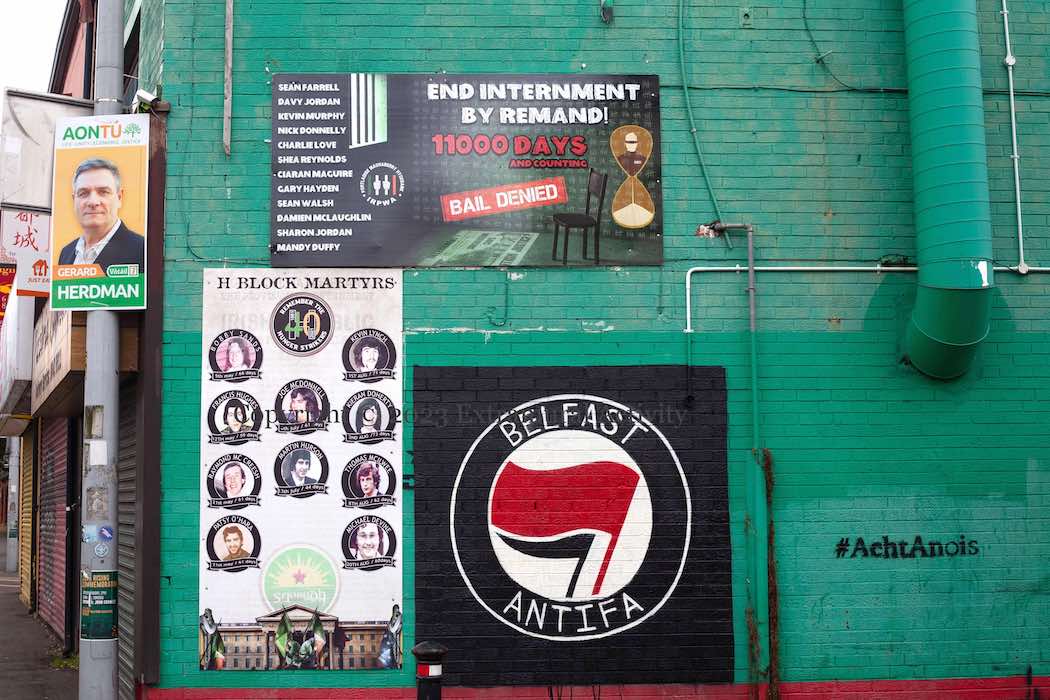
“Ní coırpıgh sınne! Éıreannaıgh sınne! [we are not criminals; we are Irish people] “There is that much to be done that no select or small portion of people can do; only the greater mass of the Irish nation will ensure the achievement of a socialist republic, and this can only be done by hard work and sacrifice.” – Bobby Sands [Hunger strike diary, March 14th, 1981]” With photographs of the ten deceased 1981 hunger strikers.
Kelly’s Bar at the top of the Rock was packed with punters watching a World Cup match between England and West Germany when a car bomb went off outside shortly after 5 p.m.. The bombing was followed by two nights of gun-battles, with loyalists firing from Springmartin, republicans (both PIRA and OIRA) from Ballymurphy, and British Army soldiers (the King’s Own and 1 Para) from Henry Taggart and other mobile locations. Within three hours following the explosion, barman Tommy McIlroy was killed in the gunfire from Springmartin as he helped with clean-up from the bomb, Alan Buckley of the King’s Own was killed by IRA fire, Michael Magee of Na Fıanna was killed by friendly fire, and Robert McMullan was killed by British Army fire. The next night (May 14th), John Pedlow was killed by British Army fire and Martha Campbell was shot by UVF fire from Springmartin (see her memorial plaque). (Lost Lives 352, 353, 354, 355, 358, 359 | Battle At Springmartin (WP))
As with the bombing of McGurk’s bar in north Belfast (see most recently Justice Delayed Is Justice Denied), the bombing was initially spun by the UK forces and government as an IRA attempt to stir up loyalists (An Phoblacht | Lost Lives 352). An inquest into Moran’s death (and thus into how the bombing was carried out) has been opened (BeTel | Independent).
The plaque dates back to 2004 (see M02243); the tarp was added for the 50th anniversary in 2022; the small mural is more recent.
“Far dearer the grave or the prison, Illumed by one patriot name, Than the trophies of all who have risen On Liberty’s ruins to fame.”
Thomas Moore’s lyrics were written for the air The Lamentation of Aughrim, in honour of the Jacobites who died on 12 July, 1691, but they are applied here to Joe Malone of the IRA’s “Expeditionary Force”.
In January 1939 the IRA declared war against Britain and carried out a bombing campaign called the “sabotage plan” (WP S-Plan). Malone was arrested in May when a tear-gas bomb intended for the New Victoria cinema in London exploded prematurely in the cloakroom, injuring his arm and wrist (Belfast Battalion p. 103 | West Australian).
Malone and other prisoners refused to co-operate with prison authorities and began a hunger strike in January 1941; on day five of the strike, force-feeding began and Malone was injured and ordered off the strike by OC Conor McNessa; despite stomach surgery, he died a year later. (Belfast Battalion p. 126, 136)
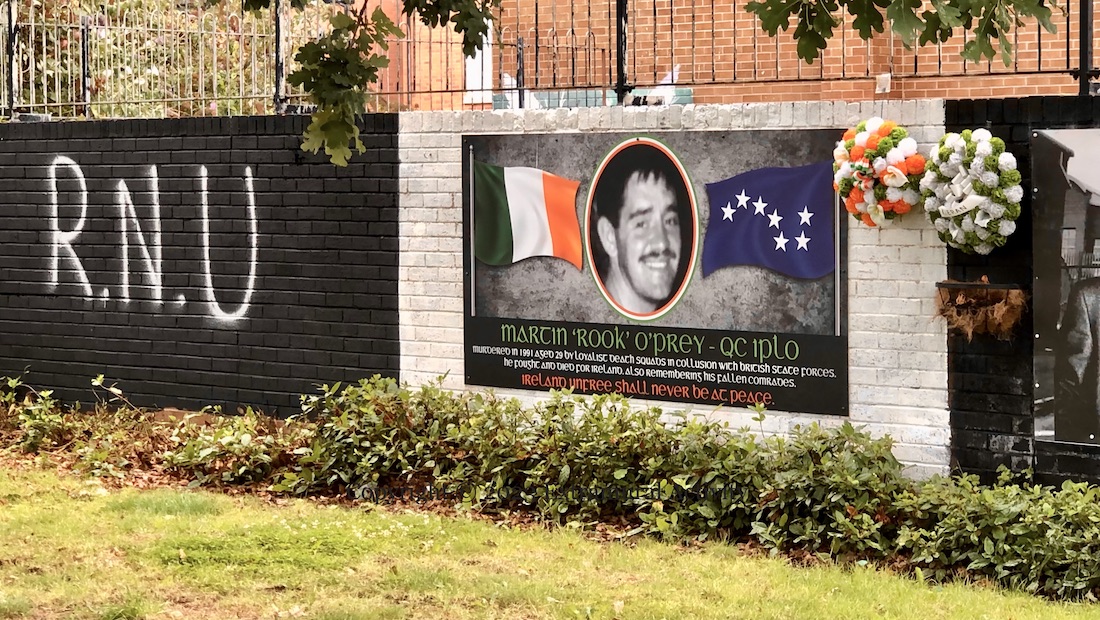
“In proud and loving memory of Volunteer Joseph Malone, No. 1 battalion, Irish Republican Expeditionary Force. Captured in London May 1939 and died in Parkhurst prison 21st January 1942. RIP.”
As the info board points out, the red hand is used to denote the graves in Milltown of volunteers from the 1920s to 1940s.
As part of the ‘Get Up Derry’ graffiti and street art jam, seven substantial panels were painted at the Tesco superstore in Quayside, including work by NOYS (ig), Zippy (ig), emic (ig), PENS (ig), Kyle McGinley (ig), Friz (ig), and Razer (ig).