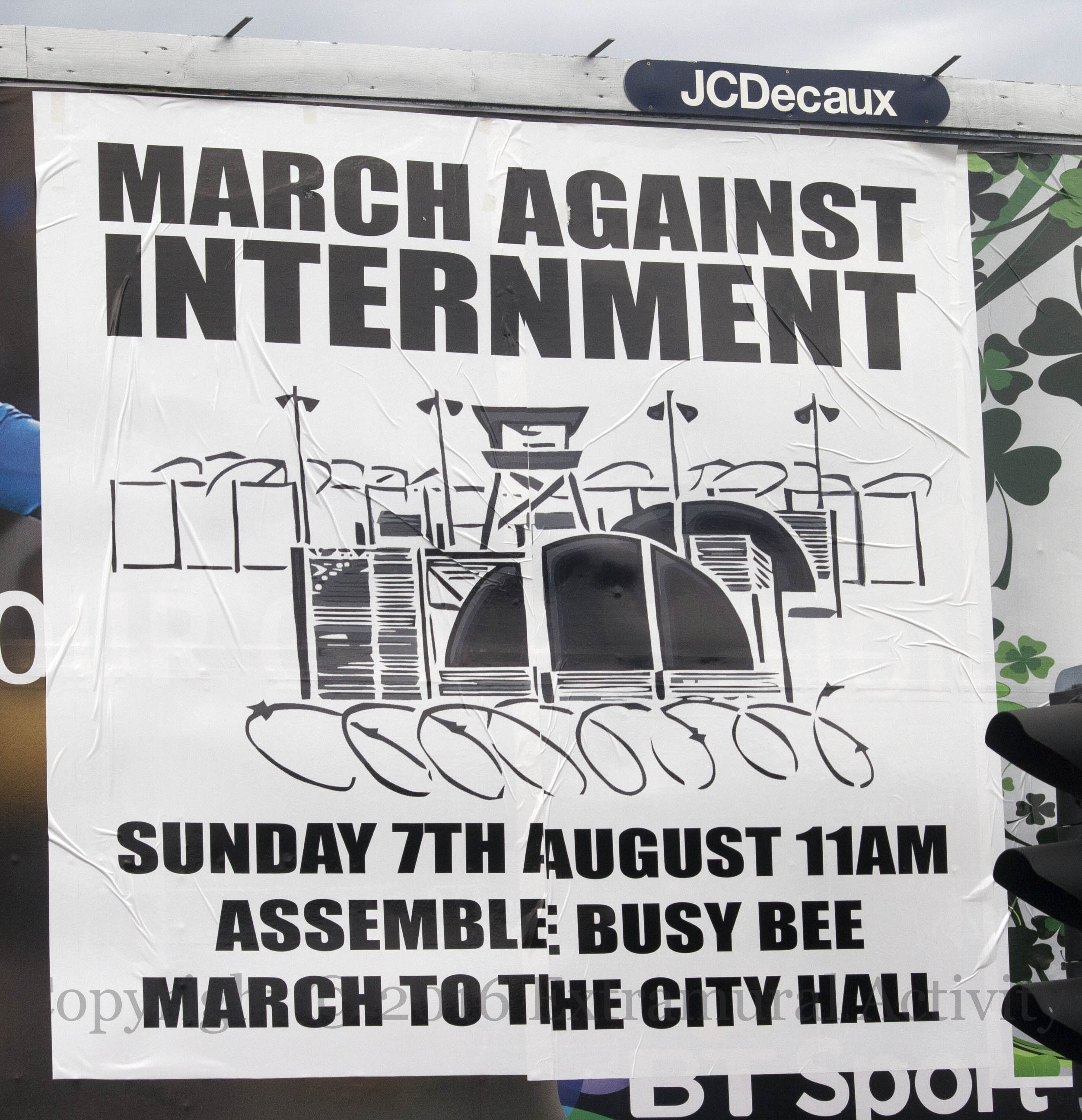
The old Nissen huts of Long Kesh are rendered in cartoon style of this ‘march against internment’ poster, which has been plastered over a commercial hoarding on Northumberland Street.
Click image to enlarge
Copyright © 2016 Seosamh Mac Coılle
X03728
The old Nissen huts of Long Kesh are rendered in cartoon style of this ‘march against internment’ poster, which has been plastered over a commercial hoarding on Northumberland Street.
Click image to enlarge
Copyright © 2016 Seosamh Mac Coılle
X03728
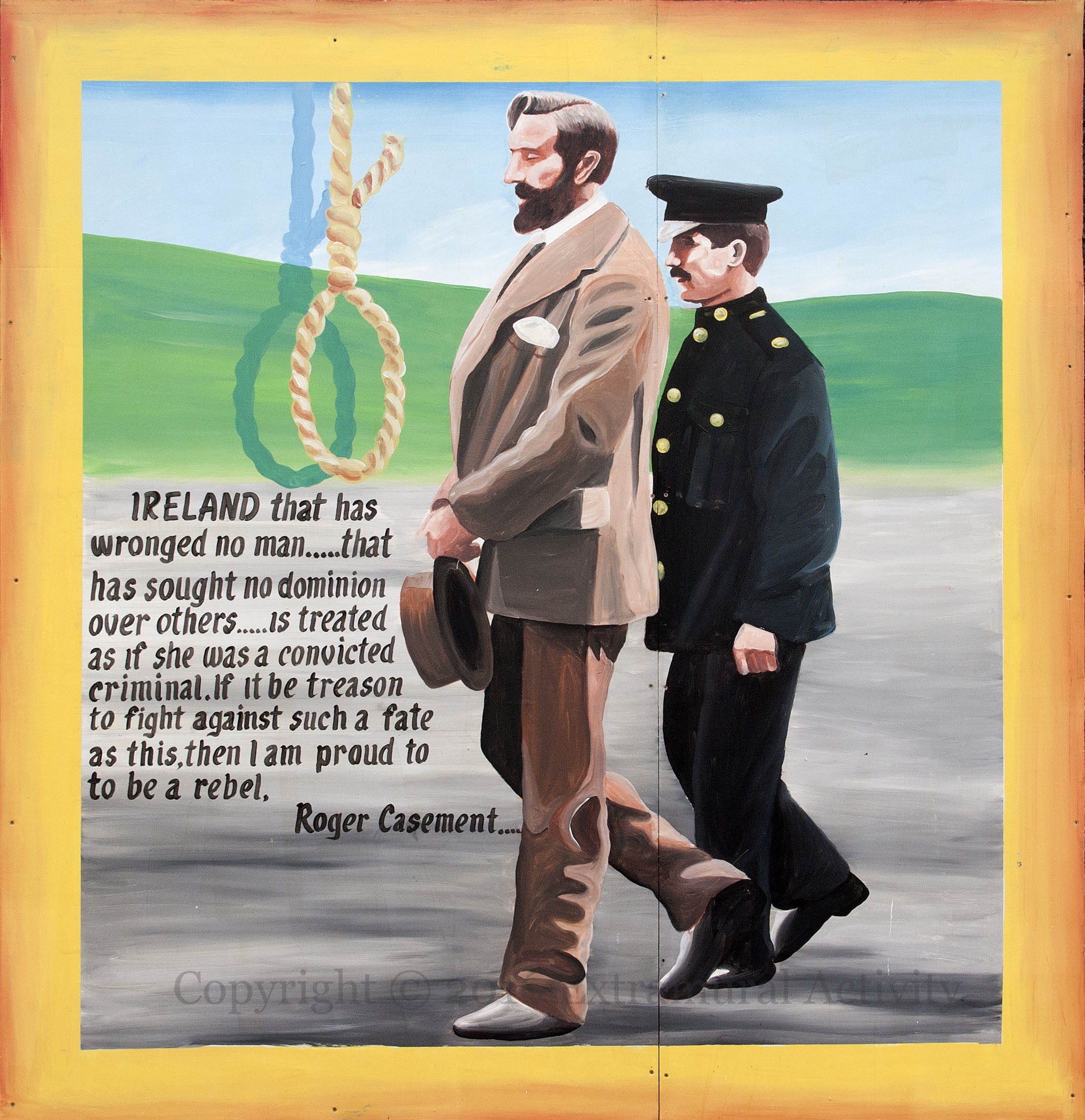
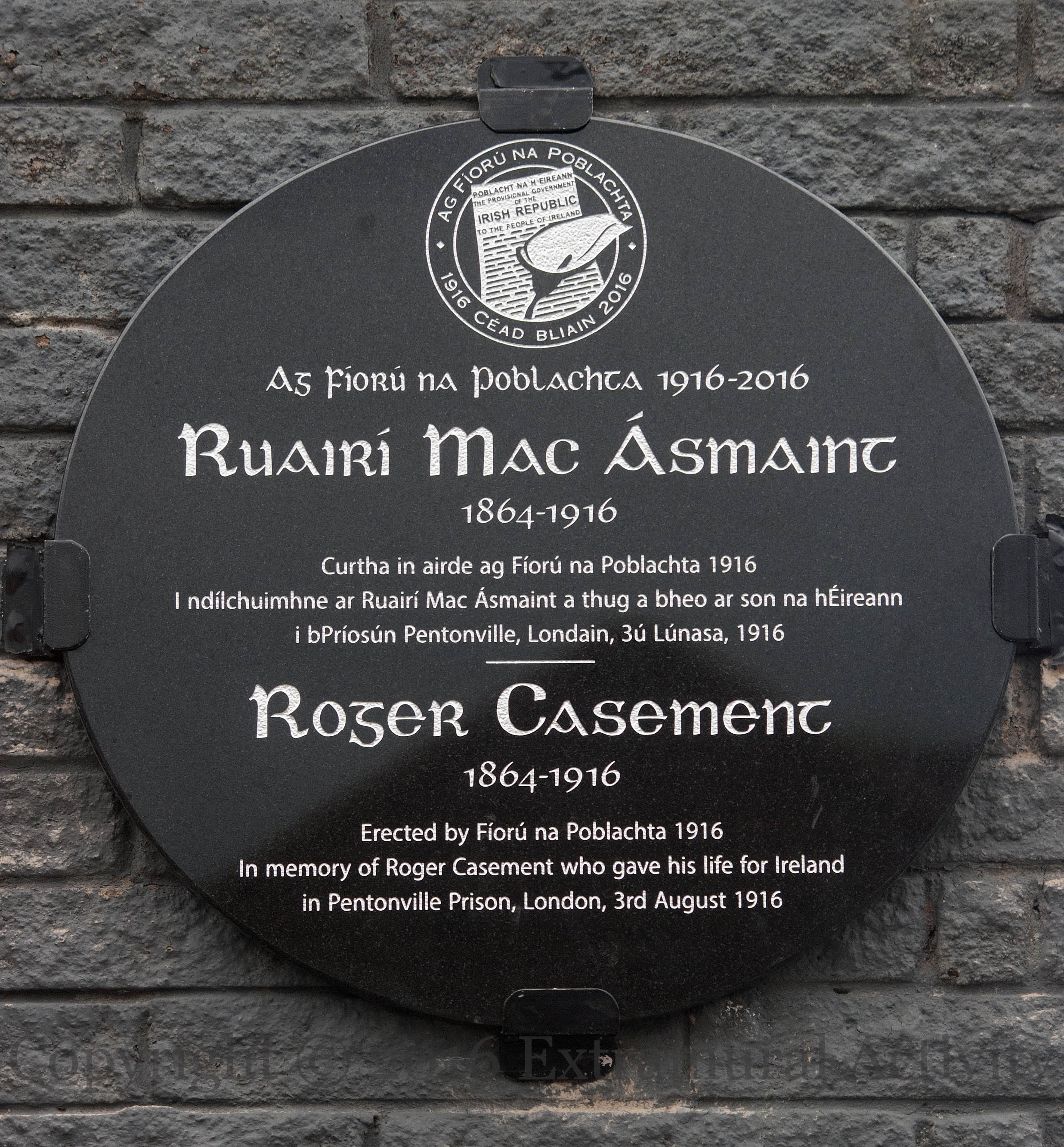
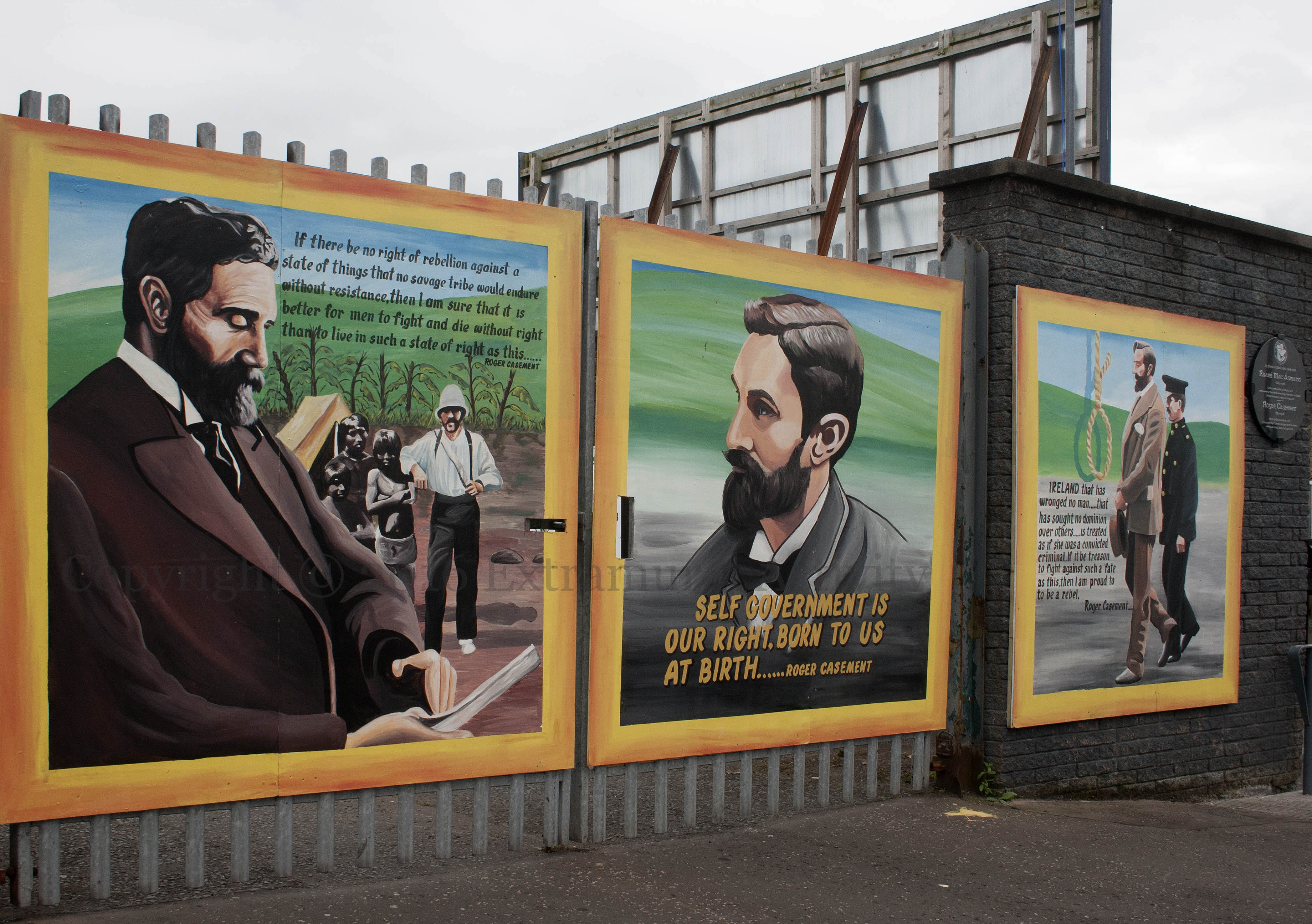
The third panel of three new paintings outside Casement Park continues the quote in the second, both coming from the end of Casement’s speech during his trial on charges of treason against the UK. “It is only from the convict these things [i.e. human rights] are withheld, for crime committed and proven and Ireland, that has wronged no man, has injured no land, that has sought no dominion over others — Ireland is being treated today among the nations of the world as if she were a convicted criminal. If it be treason to fight against such an unnatural fate as this, then I am proud to be a rebel, and shall cling to my “rebellion” with the last drop of my blood.”
The speech was unsuccessful; Casement was hanged in Pentonville prison, England on Augst 3rd, 1916.
The same image of Casement being led away was also painted on the recently repainted International Wall.
Click image to enlarge
Copyright © 2016 Seosamh Mac Coılle
X03725 X03727 X03726 Andersonstown Rd
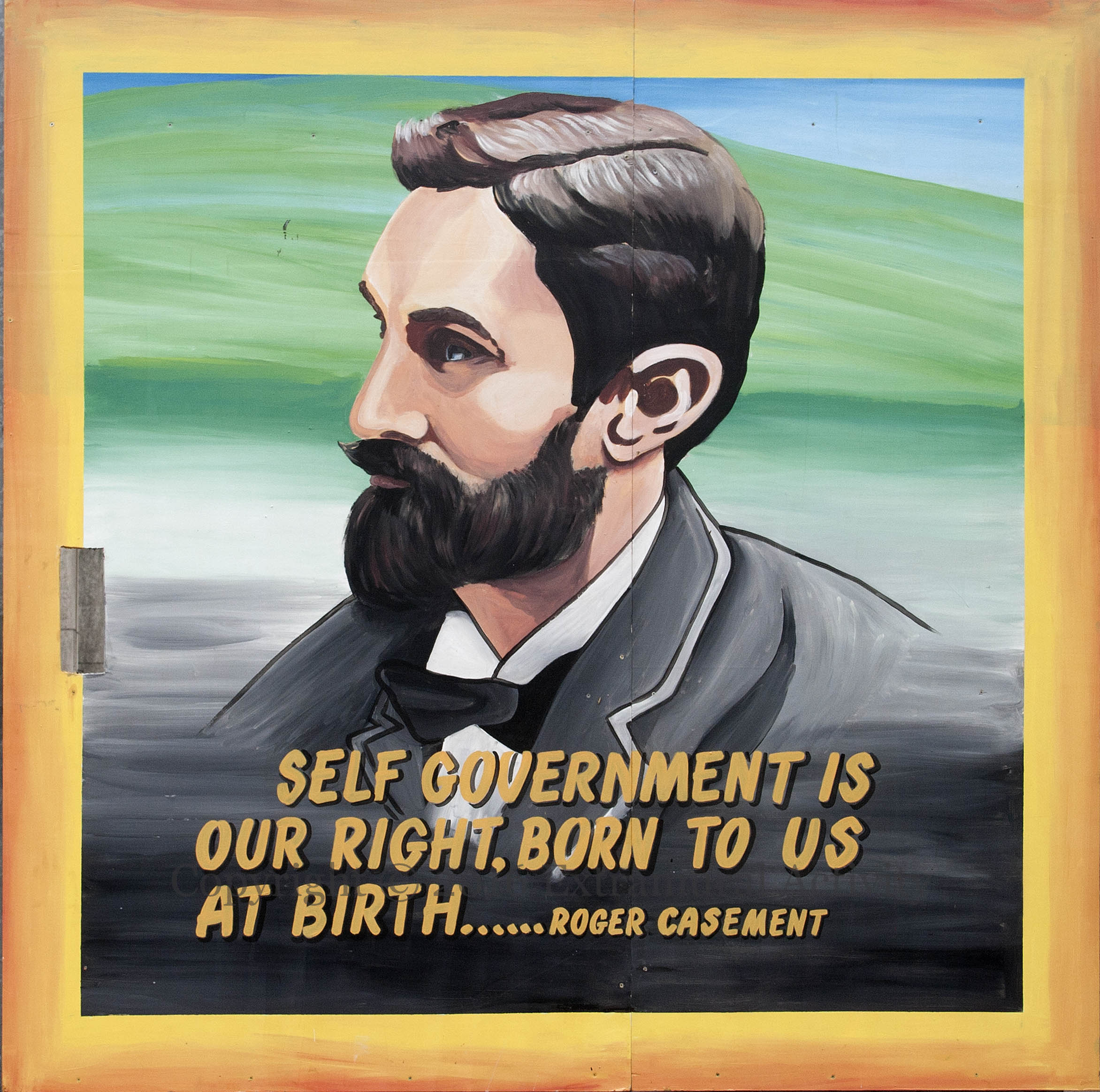
Here is the second (of three) new paintings on the exterior wall of Casement Park in Andersonstown, west Belfast celebrating the life and death of Roger Casement. The words come from Casement’s speech from the dock at his trial on charges of treason. The quote in fact reads “Self-government is our right, a thing born in us at birth; a thing no more to be doled out to us or withheld from us by another people than the right to life itself — than the right to feel the sun or smell the flowers or to love our kind.” As the post on the first painting (see It Is Better For Men To Fight And Die) noted, Casement made his name (and was knighted) for his reports into abuses of “human rights” in Congo and Peru.
Click image to enlarge
Copyright © 2016 Seosamh Mac Coılle
X03724 Andersonstown Rd
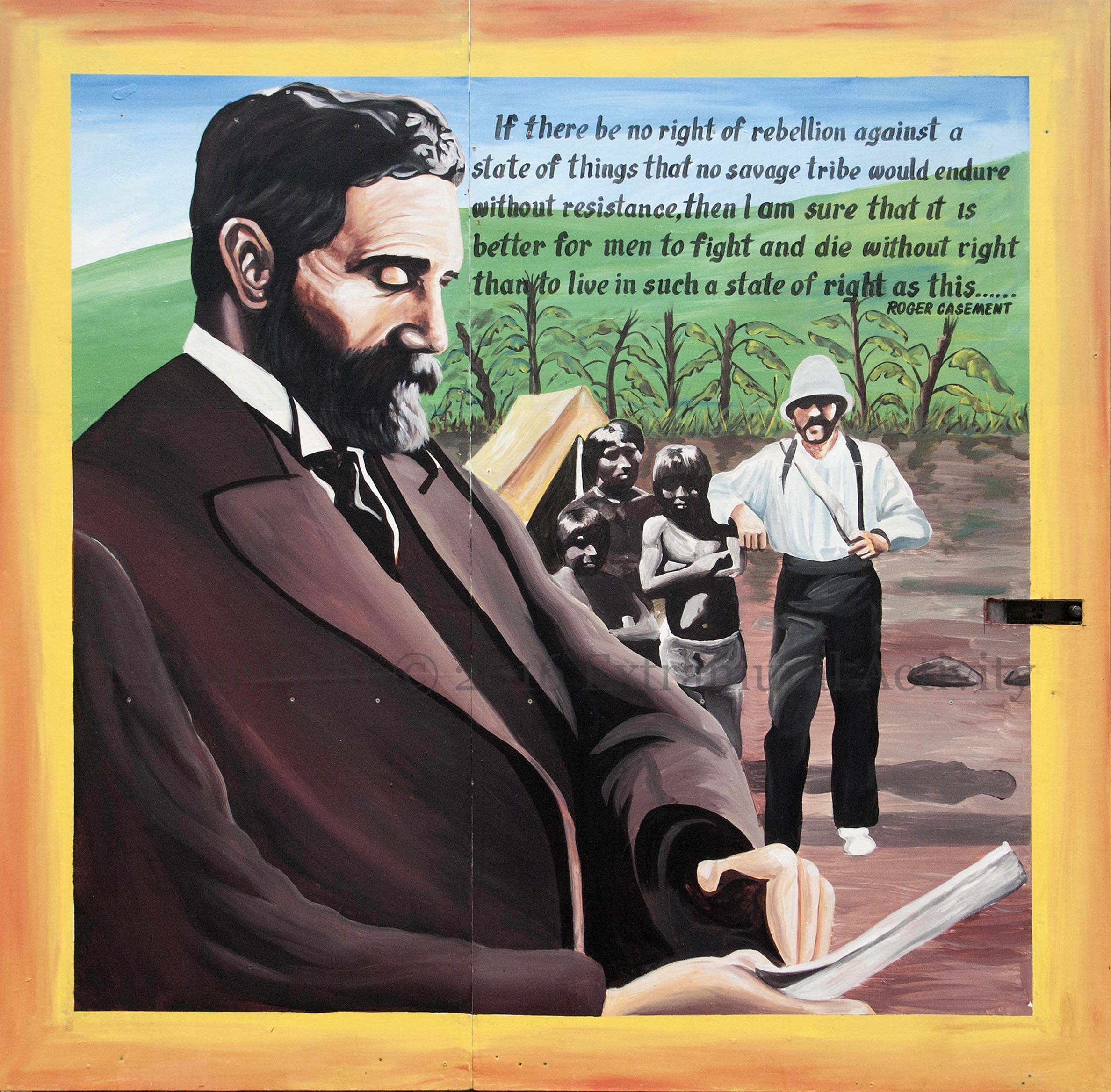
Shown above is the first of three new boards at Casement Park in west Belfast, named for Roger Casement. Working for the British Colonial Services, Roger Casement wrote extensive reports on the abuse of indigenous people in Congo Free State (1904) and in Peru (1910).
In Congo Free State, King Leopold II of Belgium was using a private force to suppress the locals while extracting rubber; Casement’s report (archive.org) led to the Belgian government taking over Leopold’s operation and creating the Belgian Congo.
In Peru, Casement investigated abuses against the Putumayo indians at the hands of the Peruvian Amazon Company. As a result of his report, the PAC gradually lost business and folded. (WP) Casement was knighted in 1911 for his human-rights work, though this title would be stripped shortly before his execution.
Click image to enlarge
Copyright © 2016 Seosamh Mac Coılle
X03723 Andersonstown Rd
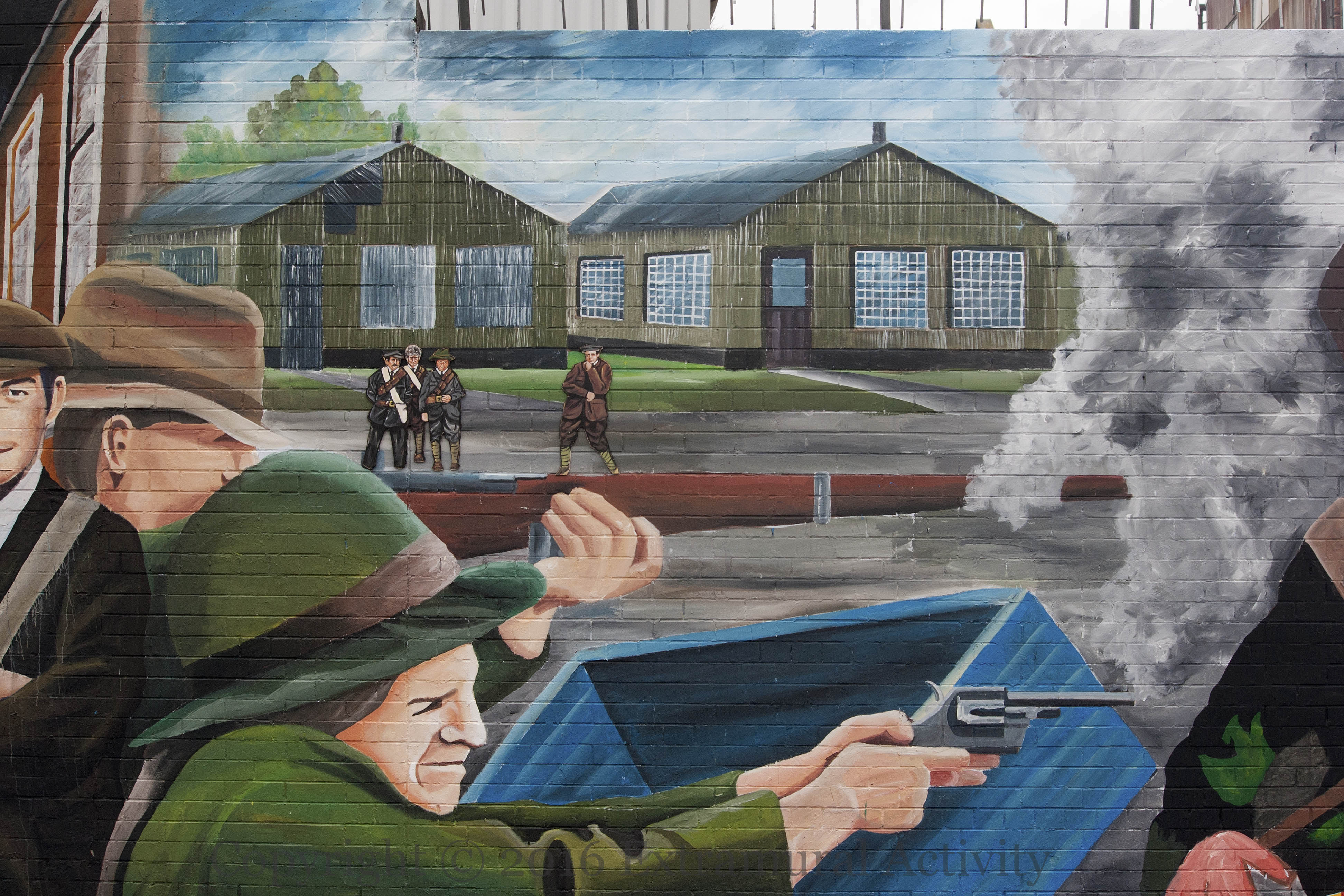
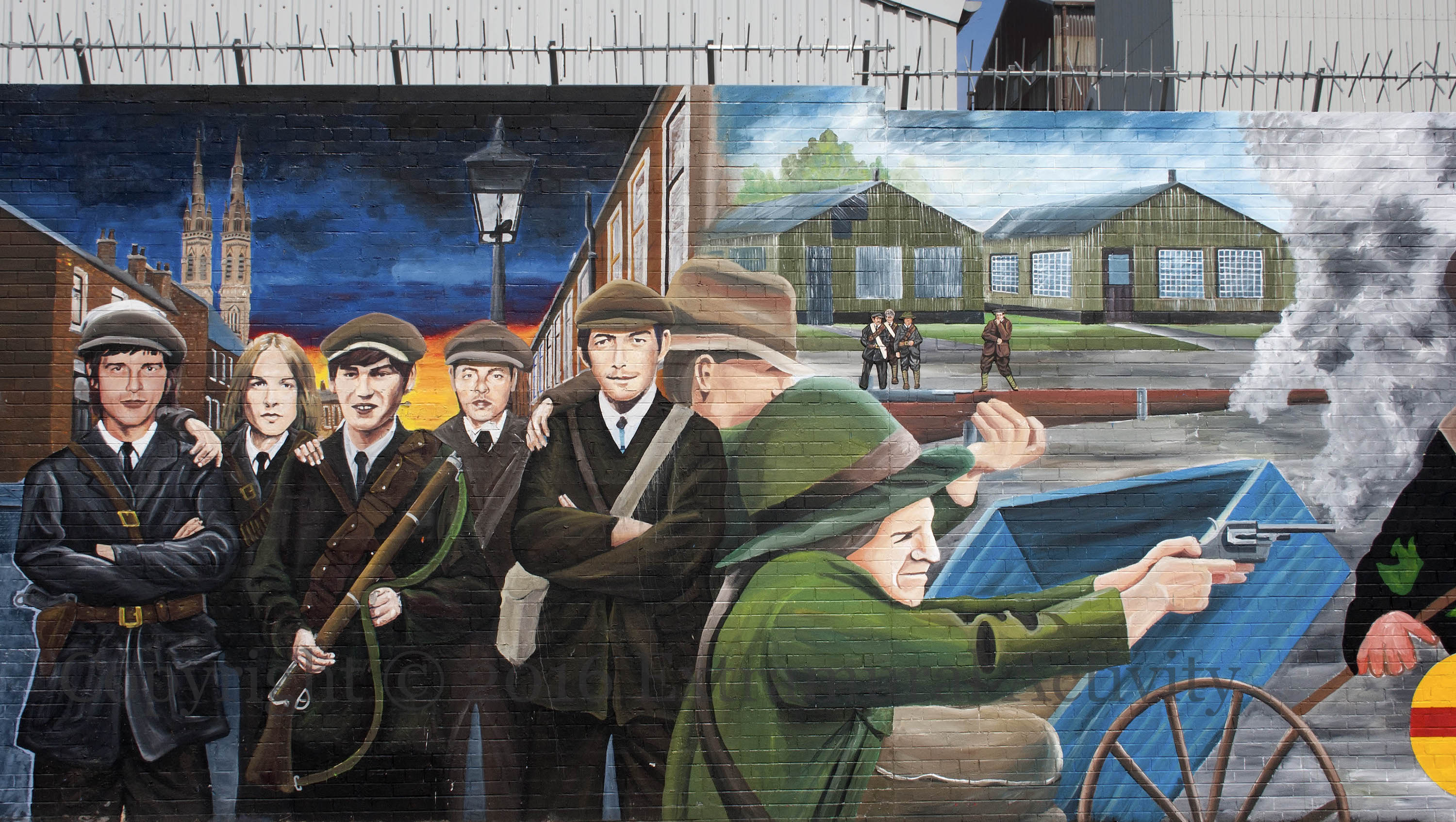
The old military huts at Willow Bank (or: Willowbank; the modern-day La Salle/Iveagh area on the Falls) – which were still in use in 1896 – provided a training ground for Cumann Na mBan and the Irish Volunteers in the run-up to the Easter Rising.
The small figures between the huts and the trainees in the foreground are Charlie Monahan (born in Ballymacarrett, raised in the Markets, who died in a car accident on the way to meet Casement’s arms on board the Aud (findagrave | An Phoblacht)), Manus O’Boyle (BMH witness statement), Jack White (who fought for Britain in the second Boer War and was later captain in the Irish Citizen Army (WP)), and Volunteer Sean O’Neill.
Click image to enlarge
Copyright © 2016 Seosamh Mac Coılle
X03714 X03738 Divis St
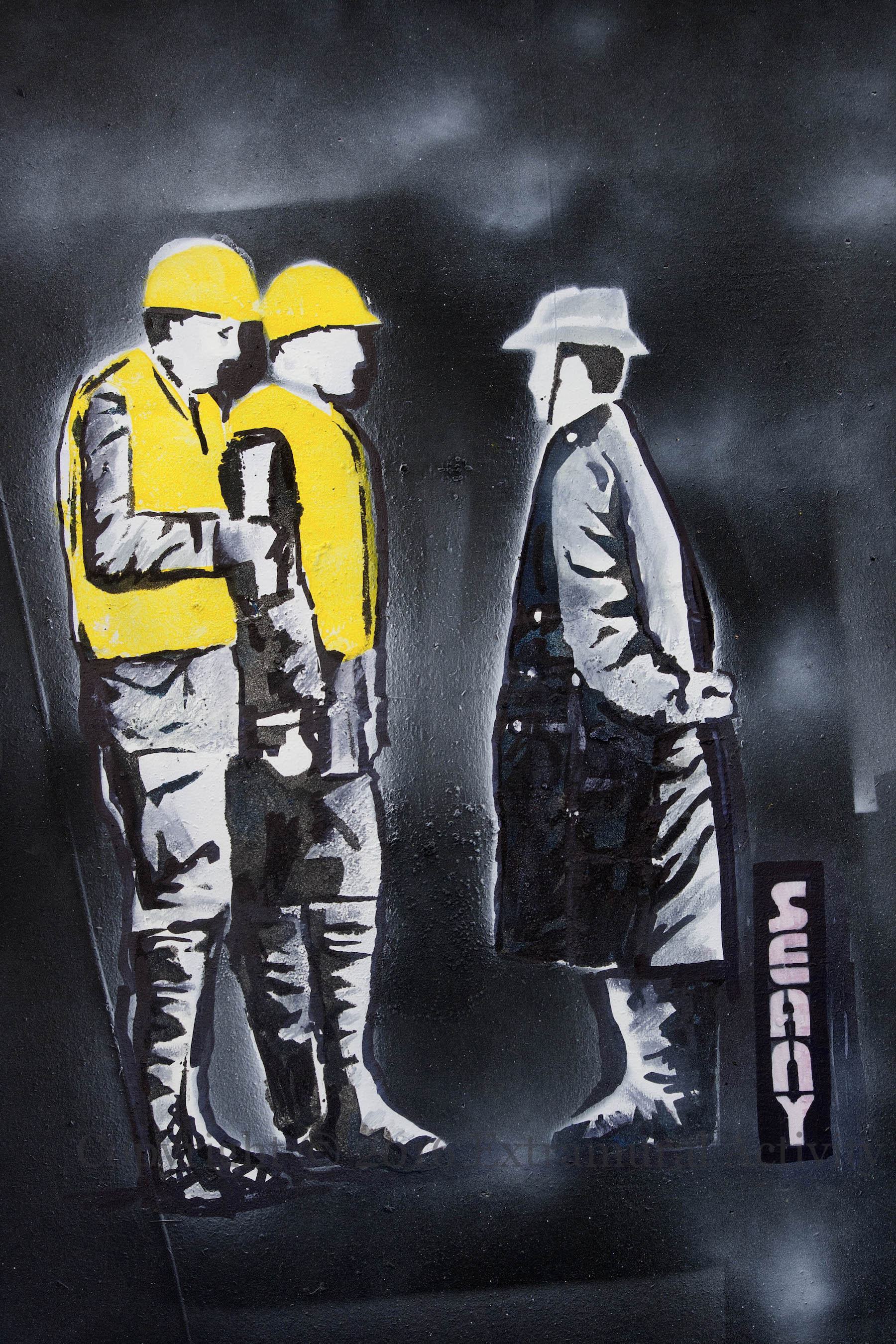
In January (2016) a stencil like the one above appeared in Moore Street, Dublin. Moore Street was the place of the last stand of the Easter Rising after the GPO caught fire and campaigners were thus fighting to save it from redevelopment (Irish Times). (Moore Street’s future is still uncertain at this time, late summer 2016.)
The stencil is based on a photograph of Padraig Pearse and Elizabeth O’Farrell surrendering to the British General Lowe. The piece was ‘signed’ by Banksy, though it was immediately suspected to be not by Banksy, as he had not signed any pieces for some years, and indeed, Banksy denied that it was his (e.g. Irish Times) and Will St Ledger wished that the artist had had the confidence to claim it as their own (RTÉ).
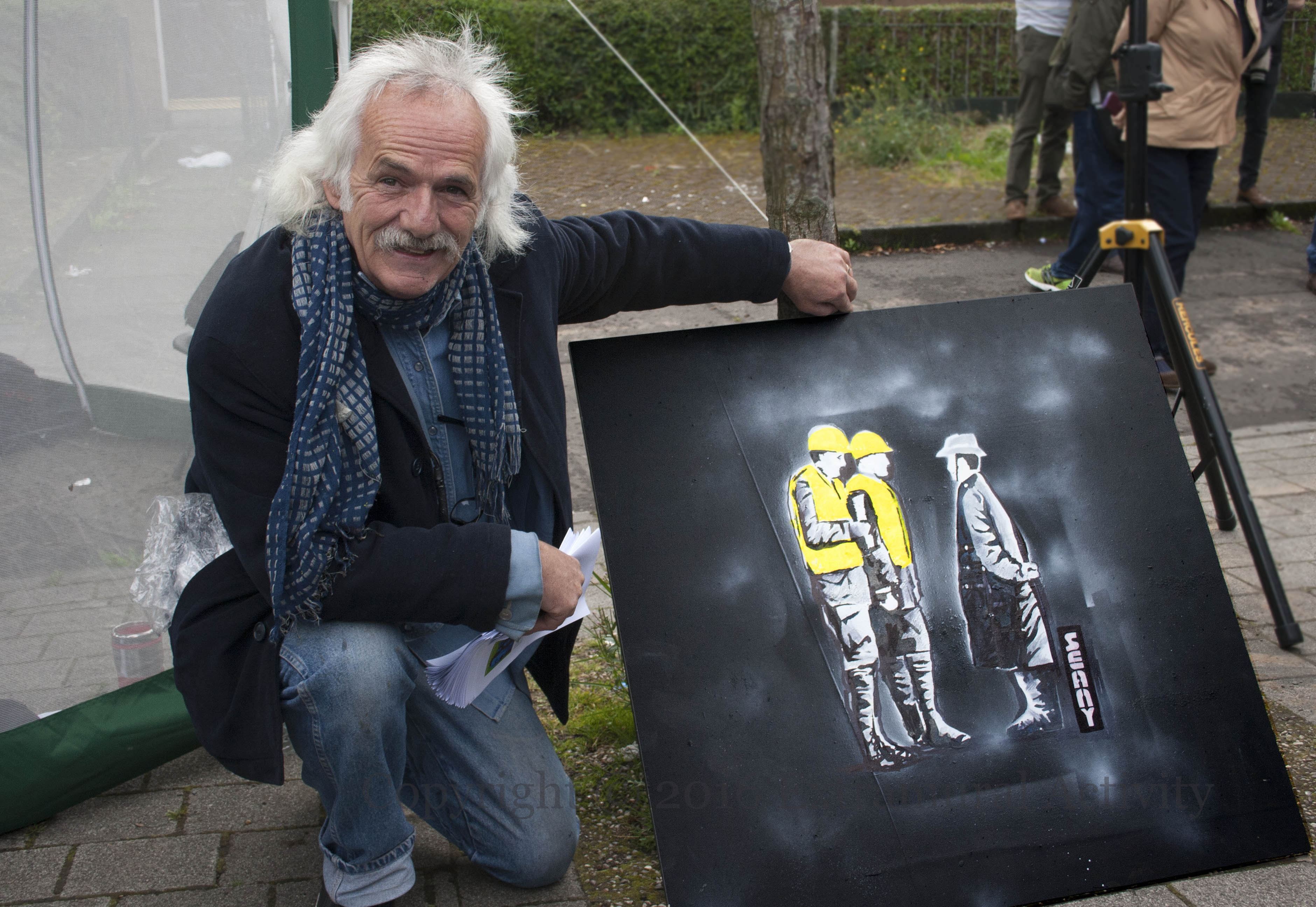
The artist was in fact Short Strand man Séan “Seany” McVeigh, who then died in June. In honour of his life, a fellow Short Strand resident (see second image, below) produced this version of McVeigh’s piece, with the name “Seany” proudly attached. (For his other “Banksy” see a Belfast version of Banksy’s Palestinian “peace” wall stencil.)
Click image to enlarge
Copyright © 2016 Seosamh Mac Coılle
X03794 X03705
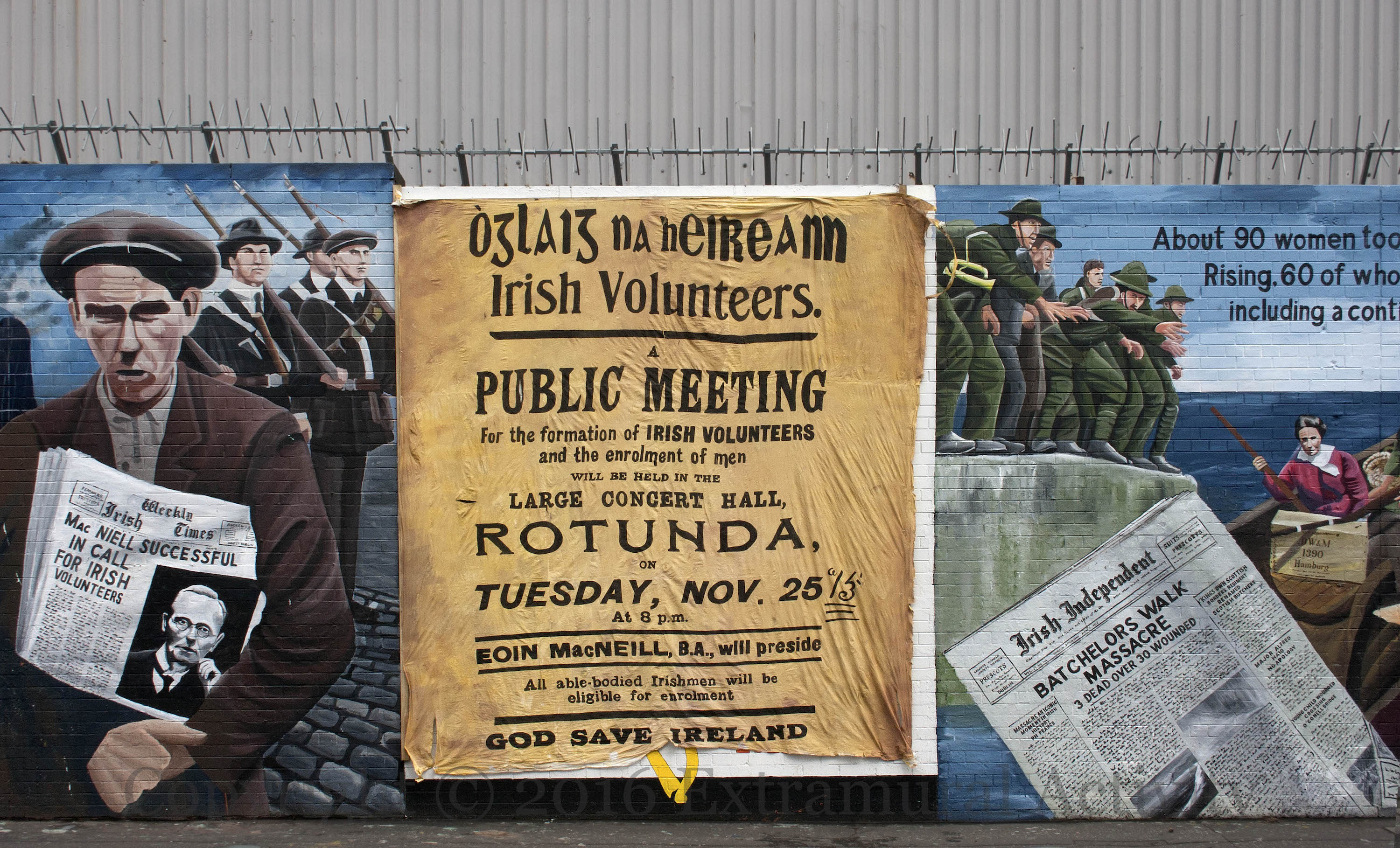
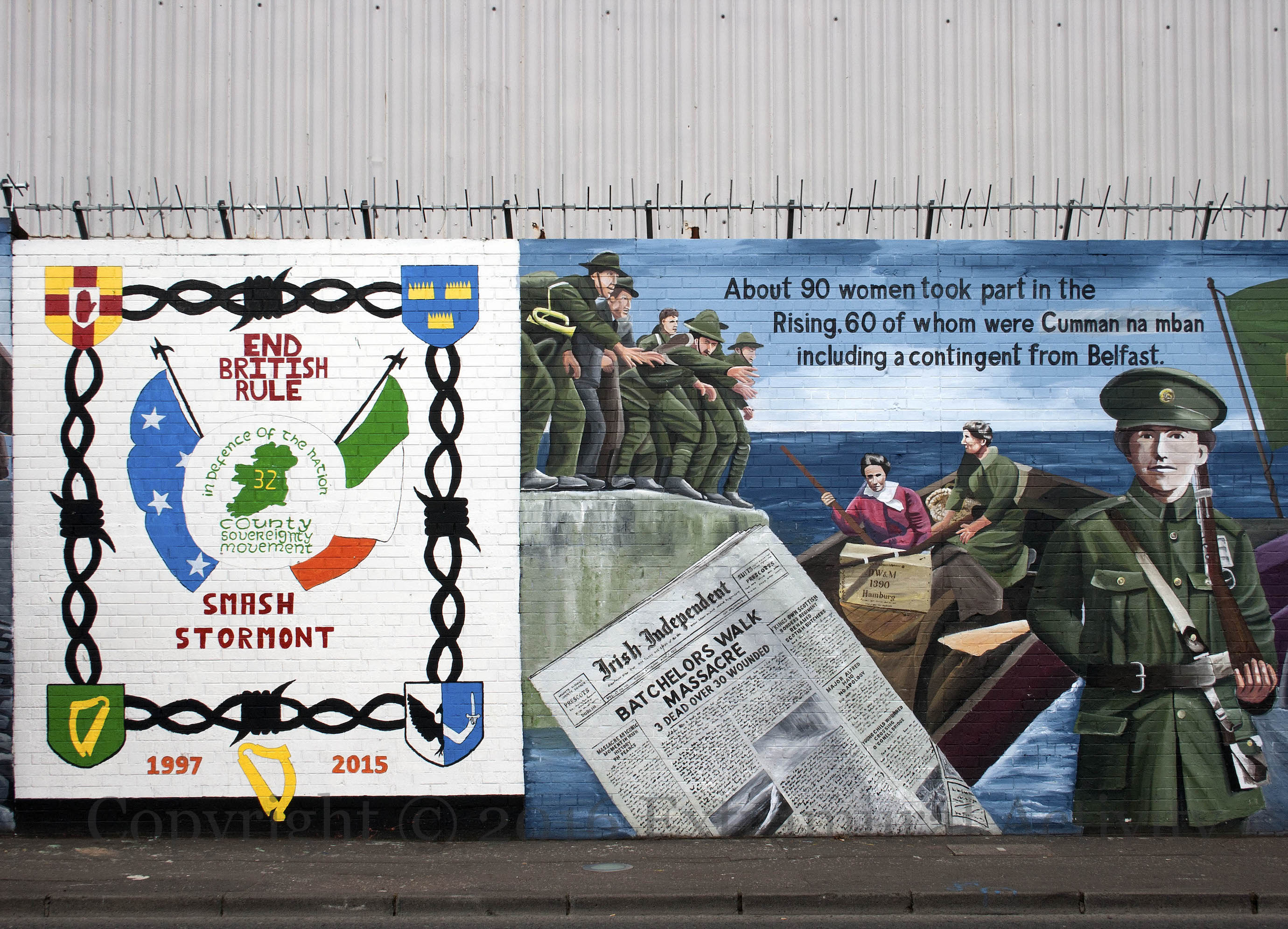
In addition to the defacing of Carson (see We Won’t Have Carson), a 32 County Sovereignty Movement mural remains about a quarter of the way along the newly repainted International Wall on Divis Street. (And as is covered in a separate entry, an IRPWA POW mural was in progress at the far right end of the wall.)
We understand that the painters offered to repaint the 32CSM mural after the historical mural had been in place for six months, but that this offer was turned down. For the purposes of the launch, then, a cloth sign, was hung over the 32CSM mural (as seen in the image above). It reproduces a poster (see the original) advertising “a public meeting for the formation of Irish Volunteers”; Eoin MacNeill, author in November 1913 of ‘The North Began’, presided at the meeting – here is the text of The North Began – and the newspaper carried by the hawker on the left reads “MacNeill successful in call for Irish Volunteers” (whereas it originally read “Rotunda rally – Irish volunteers now exceed 180,000” as can be seen in the Carson post). However, this cloth was removed immediately after the launch, meaning that the wall appears as in the image below.
Click image to enlarge
Copyright © 2016 Seosamh Mac Coılle
X03706 X02693
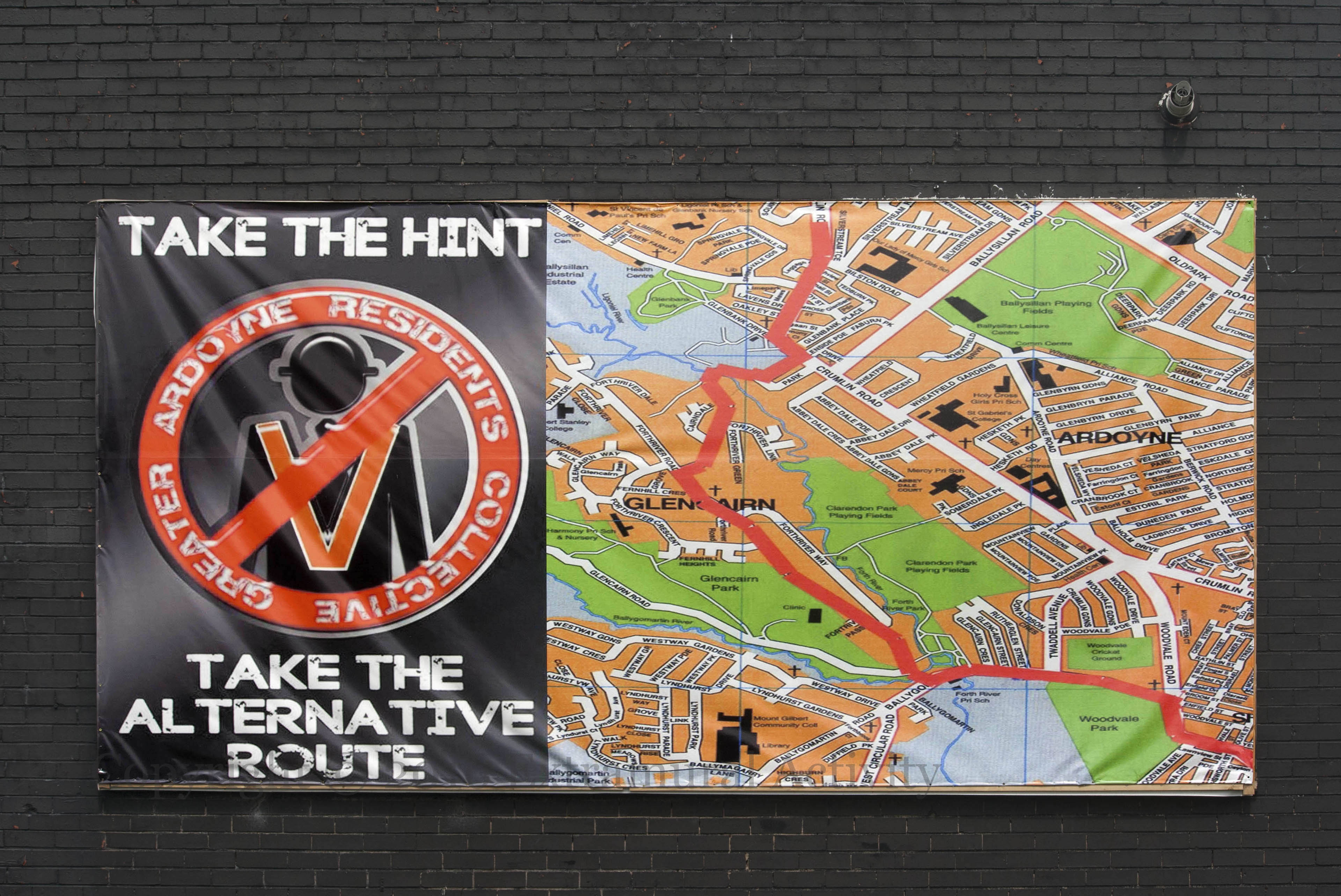
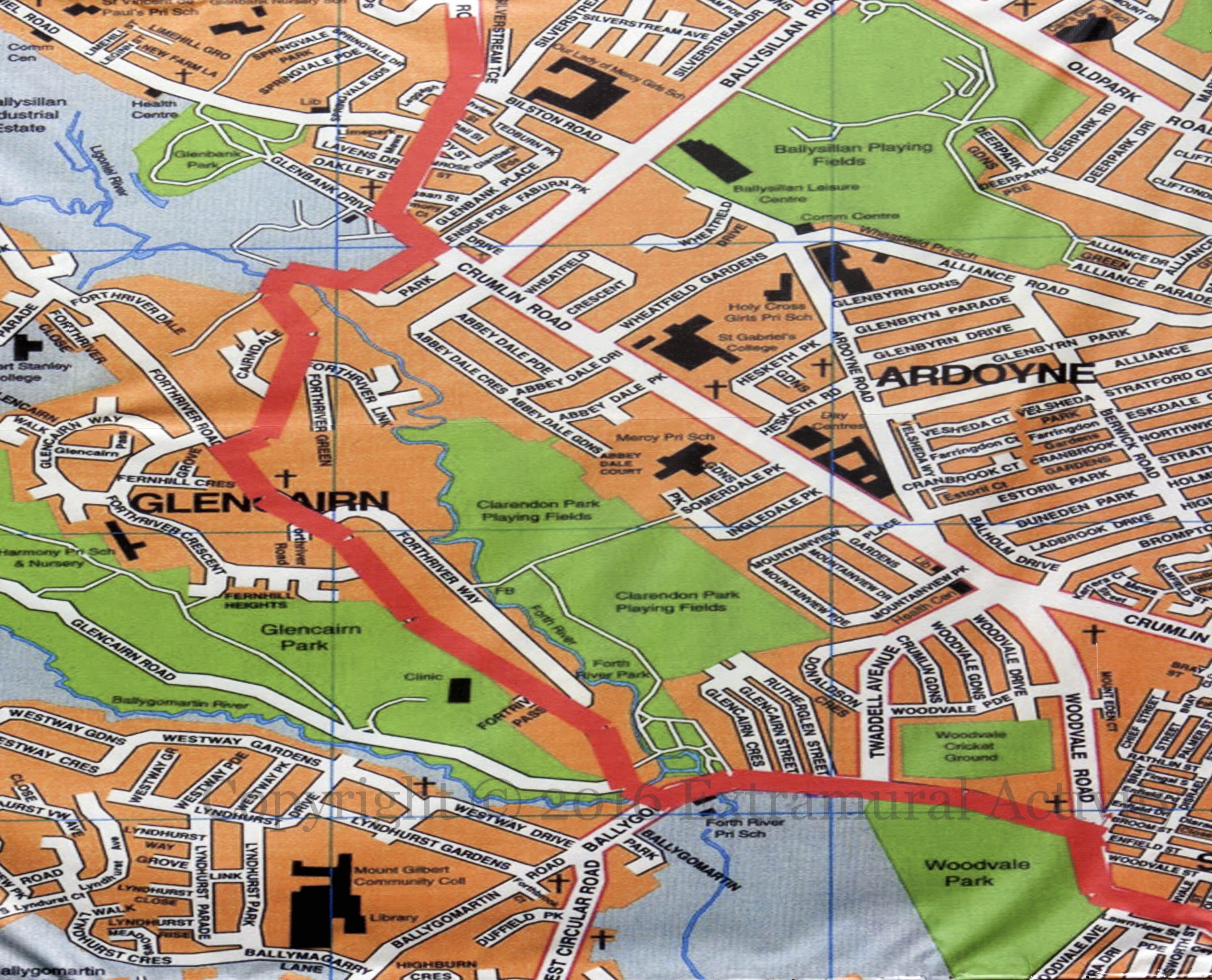
A deal to end the standoff at Twaddell Avenue, where an Orange Order parade was stopped in 2013, fell though a few days before the proposed July 1st march date (BelTel). The GARC (Greater Ardoyne Residents Collective) tarp shown above maps out an alternative route that would bypass the Ardoyne shops.
Replaces Putting The Boot In.
Click image to enlarge
Copyright © 2016 Seosamh Mac Coılle
X03695 X03696 Ardoyne Avenue
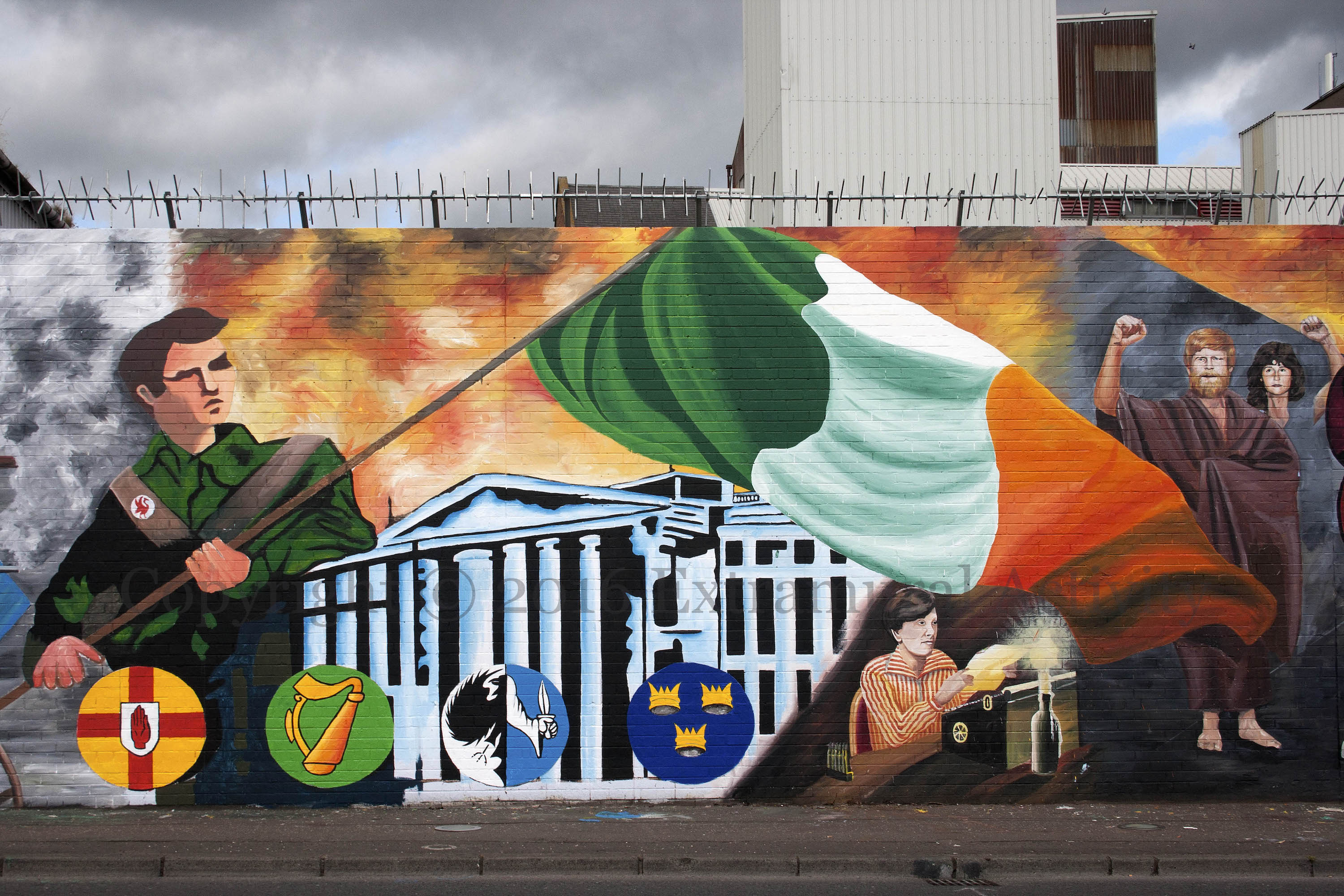
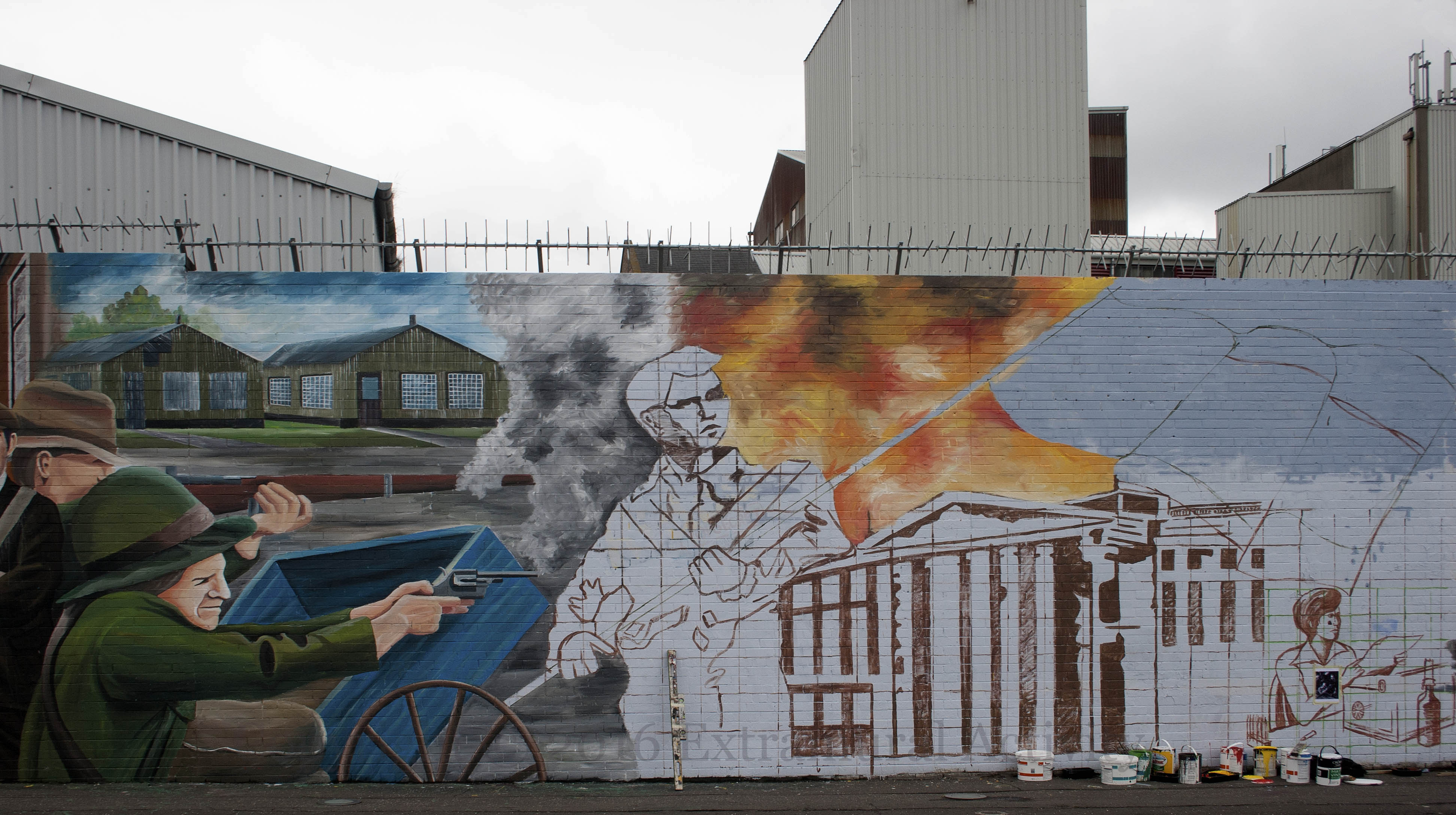
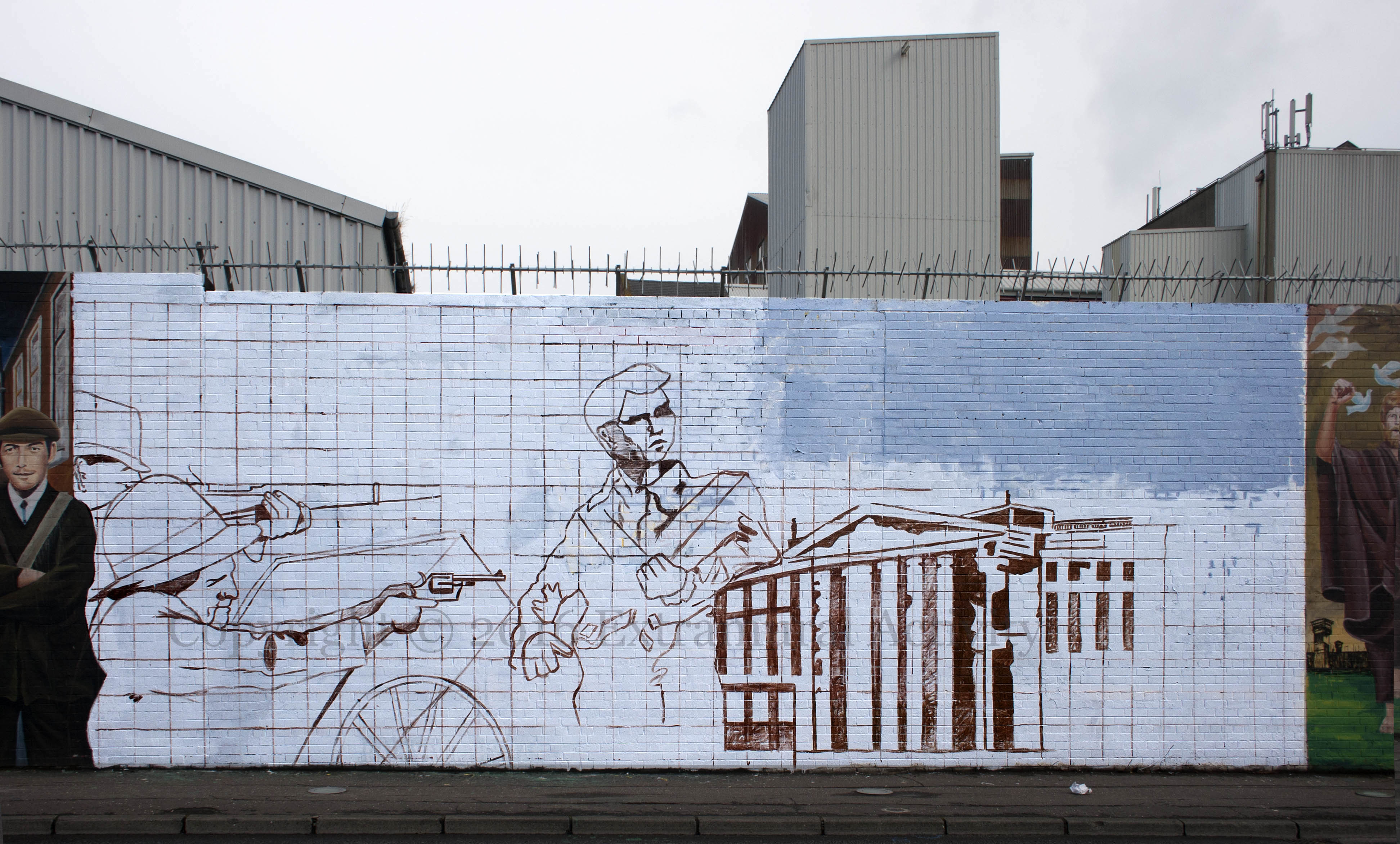
For the centenary of the 1916 Easter Rising, the whole of the International Wall on Divis Street (or, almost the whole wall, as will be explained in a subsequent post) has been repainted to depict a history of Irish republicanism, with special attention given to connections to Belfast.
As might be expected, a panel of the new mural depicts the GPO of 1916. A Tricolour is thought to have been raised over the Henry Street corner of the GPO by Liverpudlian Joe Gleeson – he sports a Liver bird badge on his bandolier – though he does not mention this in his statement to the Bureau of Military History: “We started out from Kimmage about 60 strong at about ten o’clock that Easter Monday morning …”. (A flag of the Irish Republic was raised by Harry Walpole (Irish Times) or Eamon Bulfin (Collins 22 Society, which states that Gearóıd O’Sullivan raised the Tricolour; Bulfin’s statement to the BMH says Gleeson did so).) Gleeson was one of 50 fighters from the Liverpool Irish Volunteers. (Caırde Liverpool has the names of 38 volunteers from Merseyside; this BBC article contains photographic portraits of a number.) The image here is a modified version of the 1941 stamp designed by Victor Brown showing an armed volunteer outside the GPO (stampboards).
The Belfast connection in this panel is supplied by Winifred Carney, member of Cumann Na mBan, assistant to James Connolly from 1912 until the Rising, and part of the occupying forces in the GPO during the rising, “armed with a typewriter and a Webley” (according to her WP page). She is seen here (on the right, beneath the flag) typing up communications by candlelight in the GPO.
Click image to enlarge
Copyright © 2016 Seosamh Mac Coılle
X03694 X03675 X03667
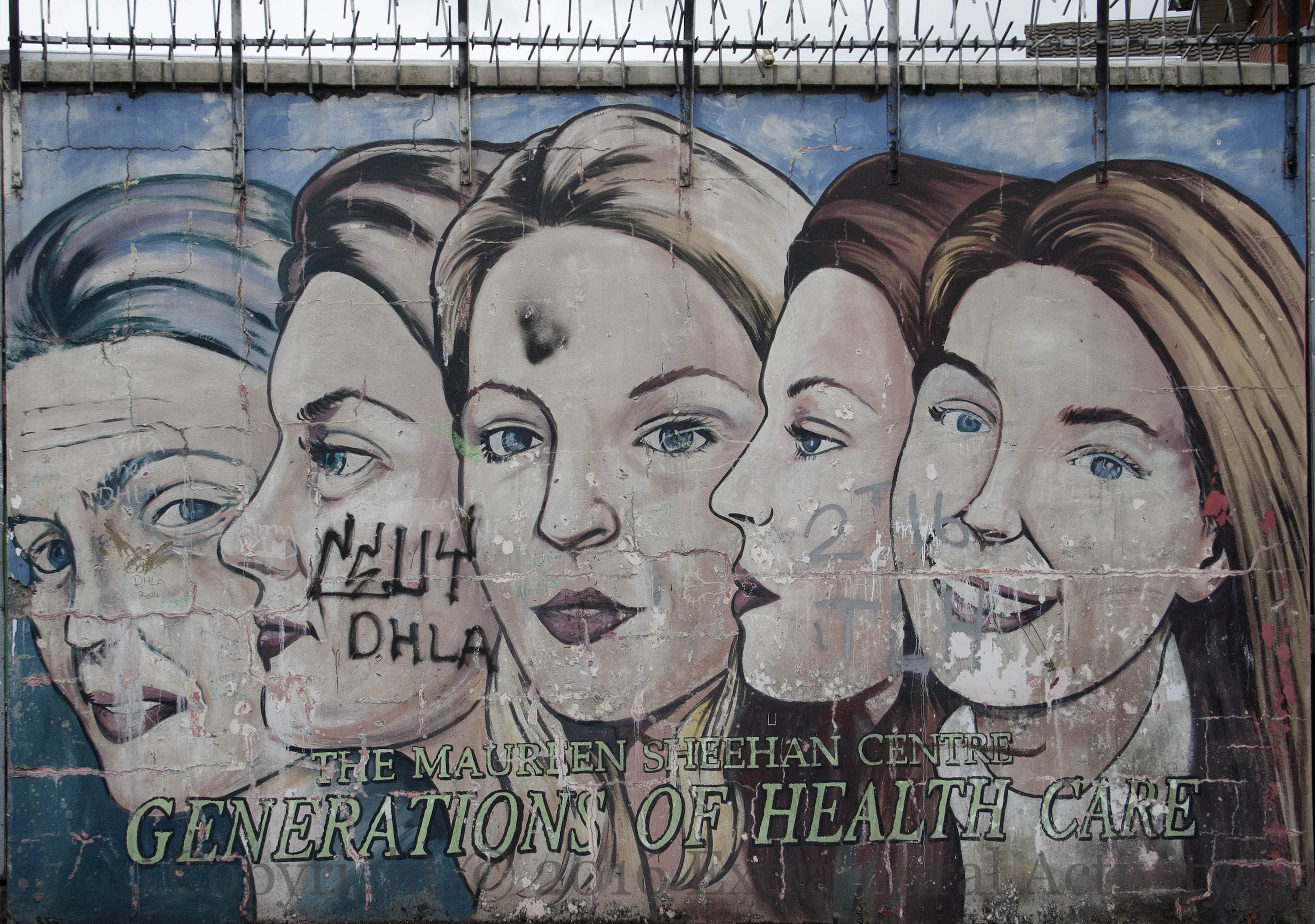
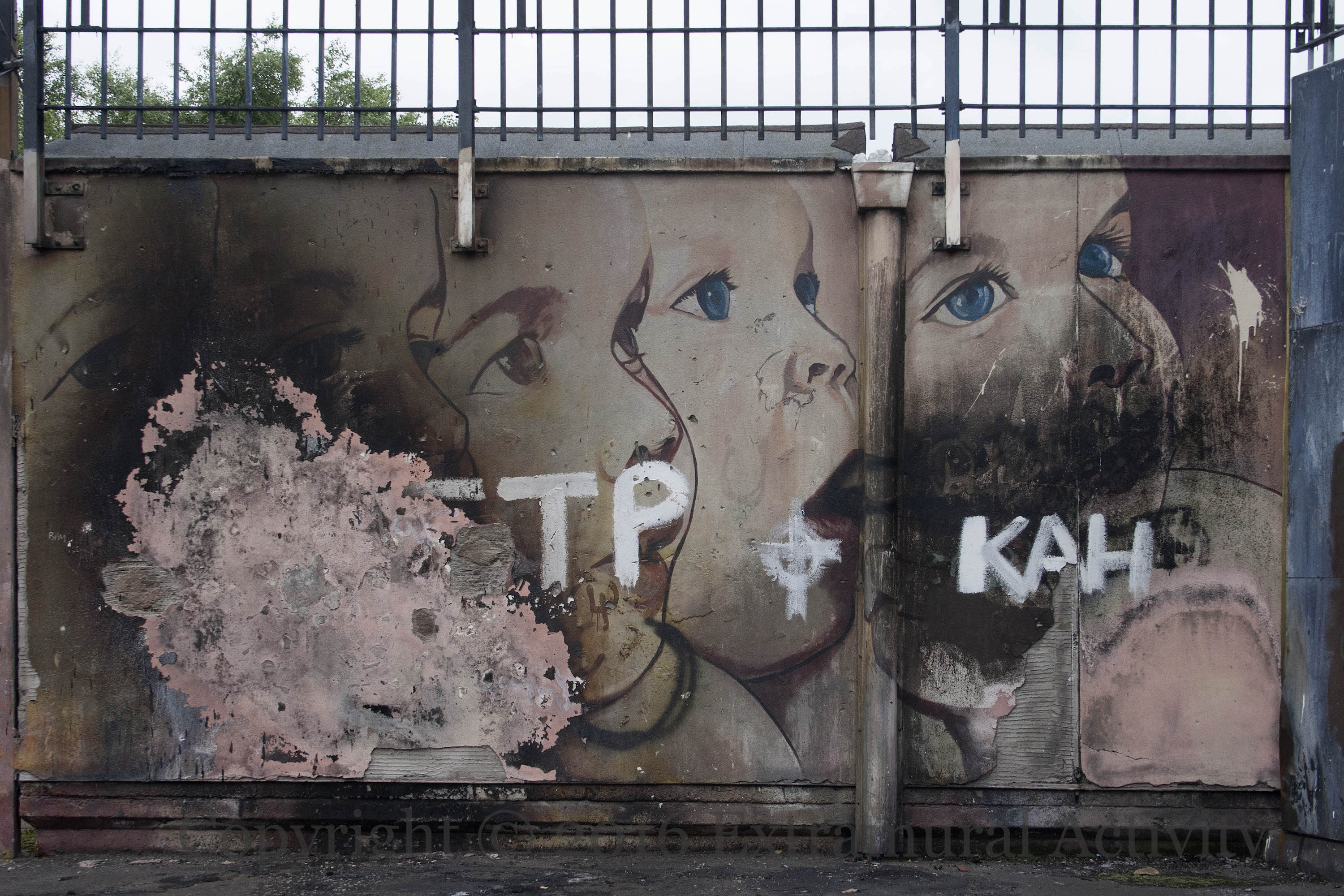
These two murals of five women and five babies at the rear of the Maureen Sheehan health care centre are entering (at least) their eighth year of existence and are showing their wear due to both the natural and human causes, such as graffiti and burning (see previously: A Philosophy of Liberation). For the murals in better condition (in 2010) see M05732 and M05733.
Click image to enlarge
Copyright © 2016 Seosamh Mac Coılle
X03676 X03677
 Seosamh Mac Coille Collection