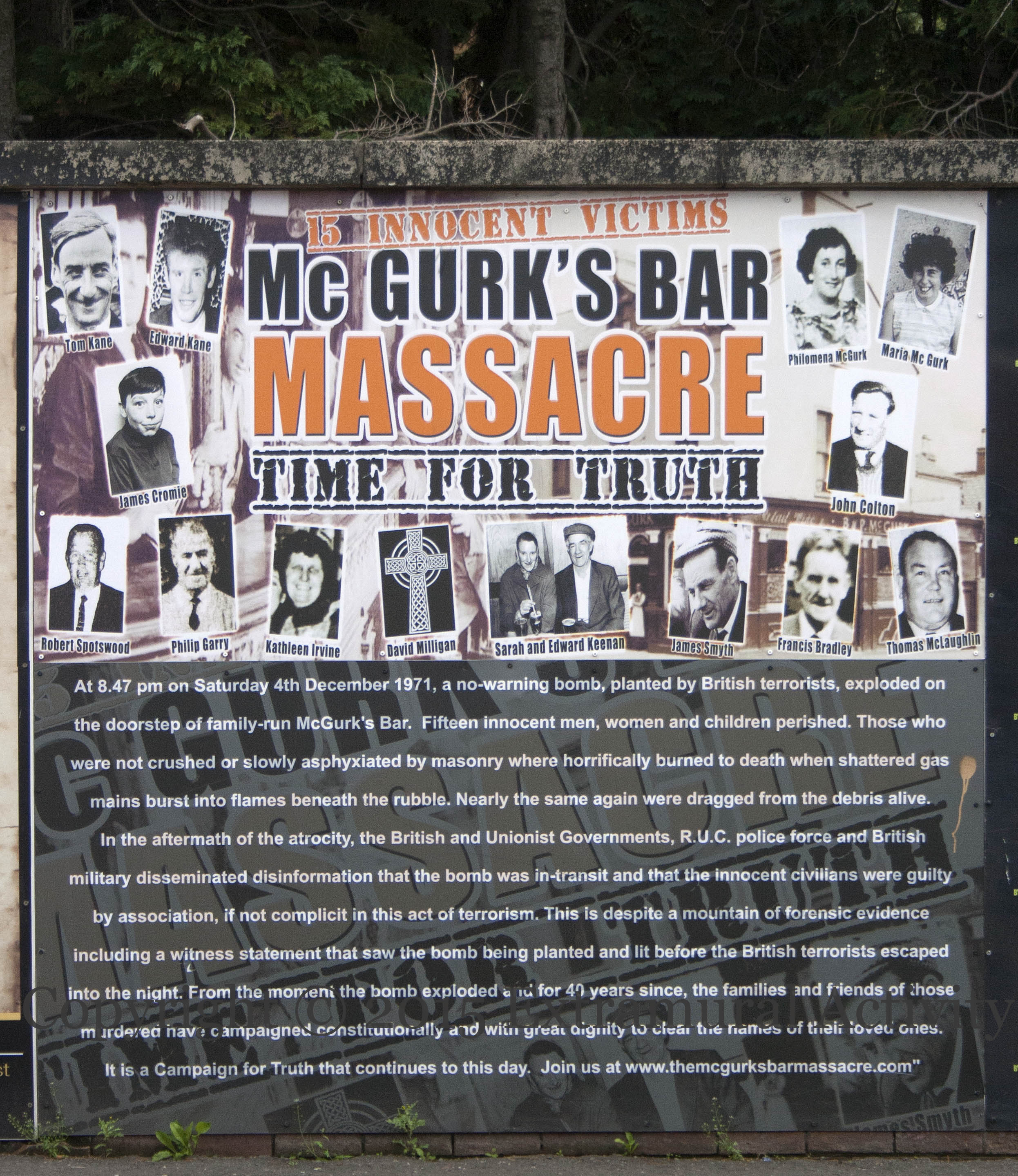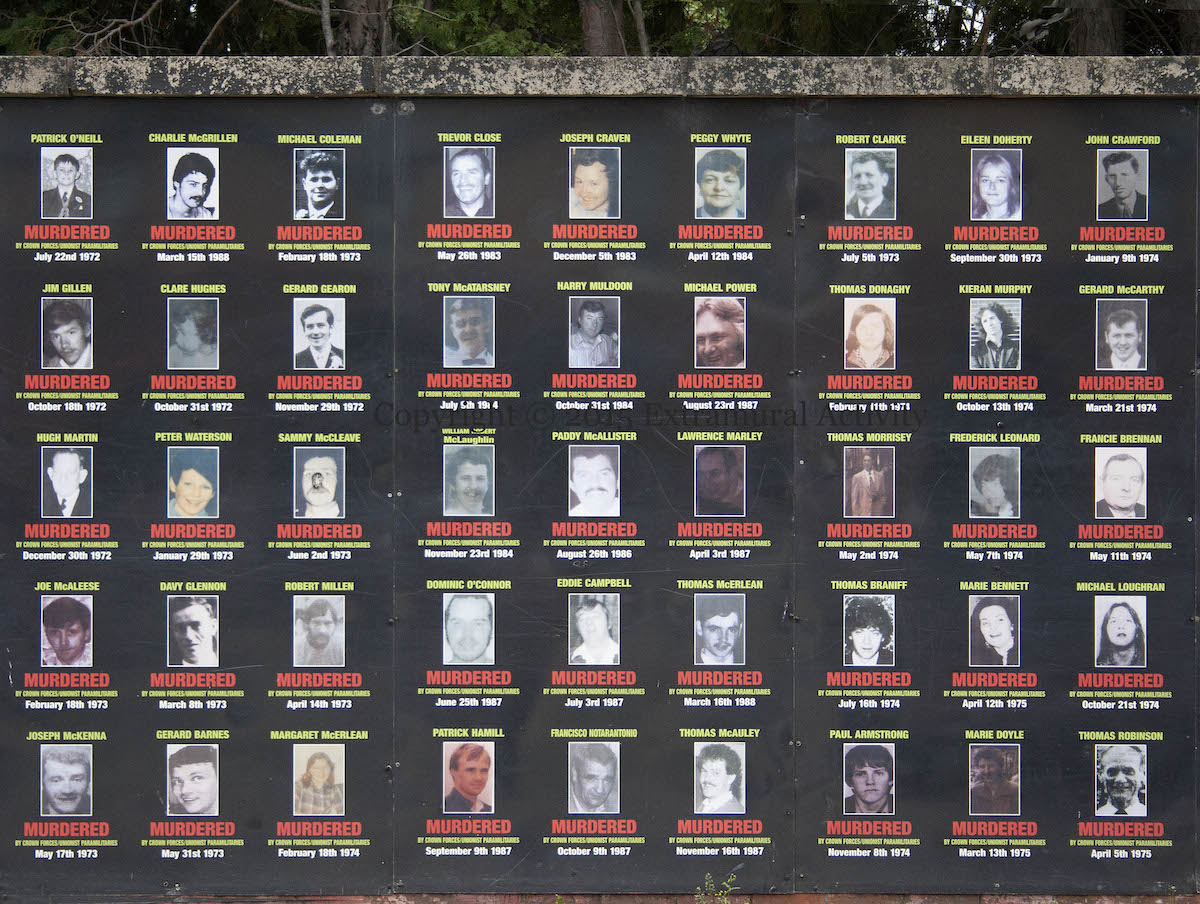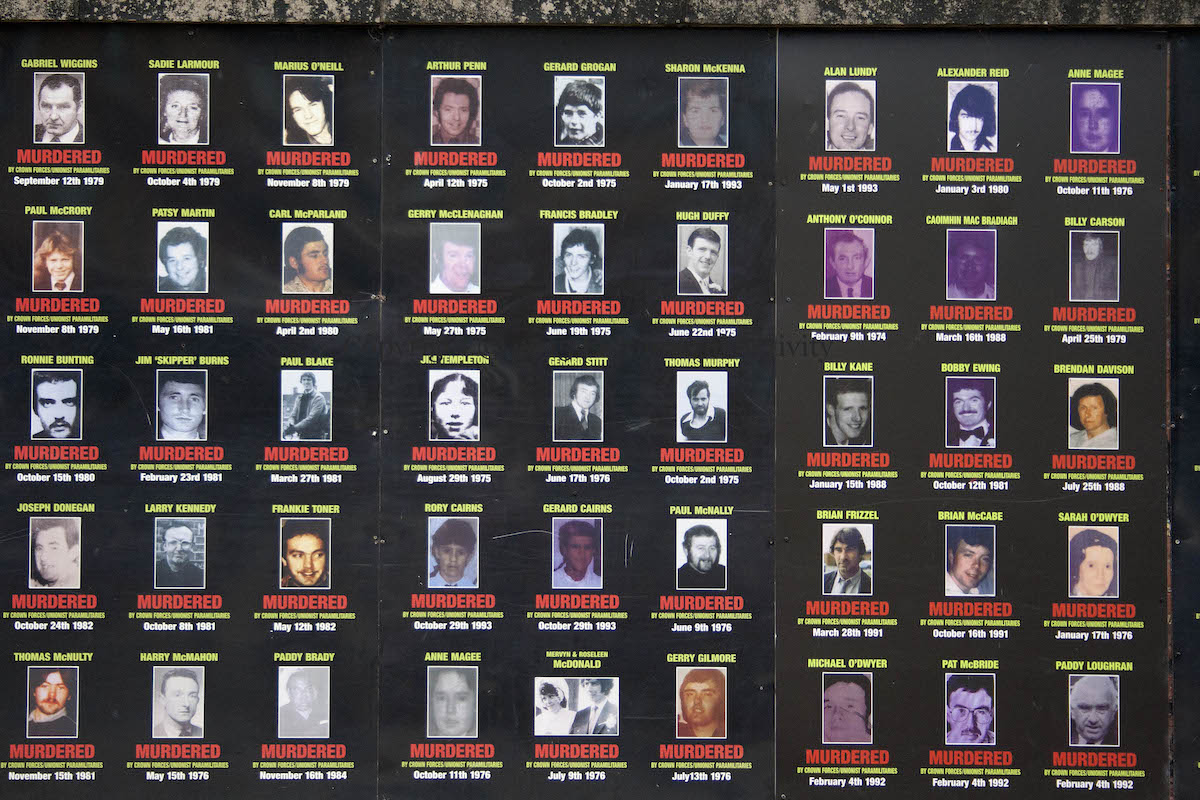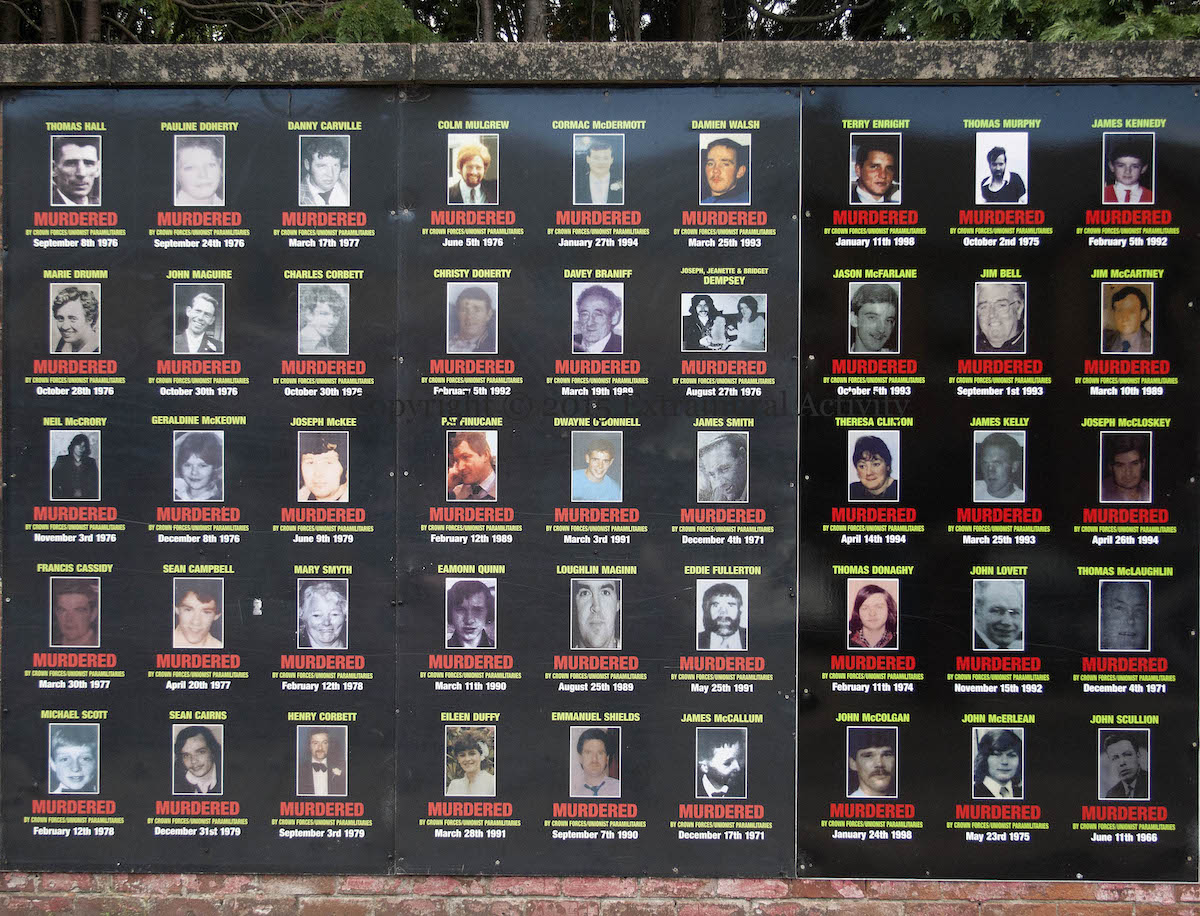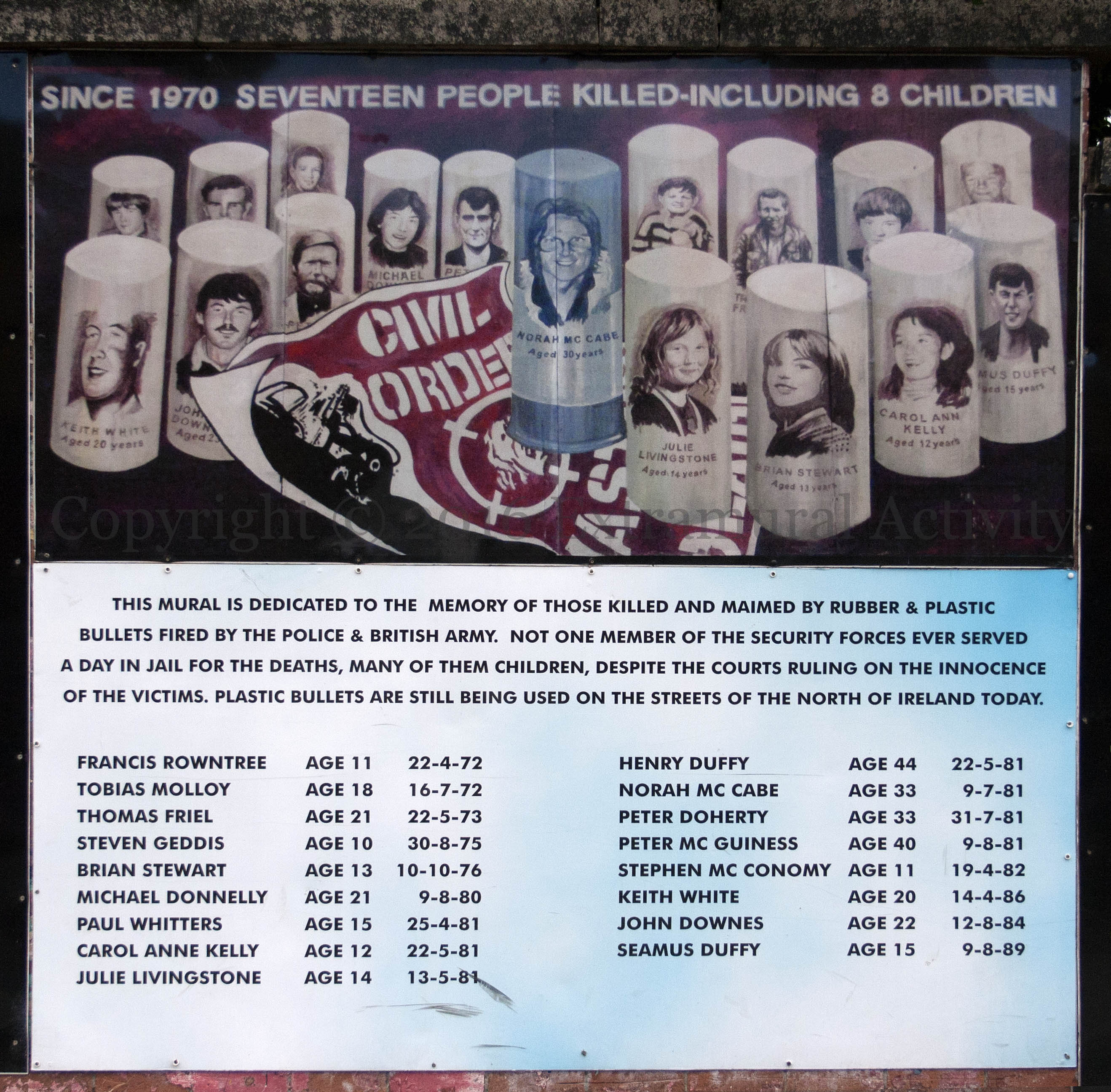
“Since 1970 seventeen people killed – including eight children”. A vintage poster against plastic bullets (see also Plastic Death in the Peter Moloney Collection for a mural) is part of this Beechmount Avenue mural showing a candle for each of the victims. The first listed (Rowntree, Molloy, Friel) were killed by rubber bullets, the rest by plastic; plastic bullets took over from rubber bullets in 1975 (WP).
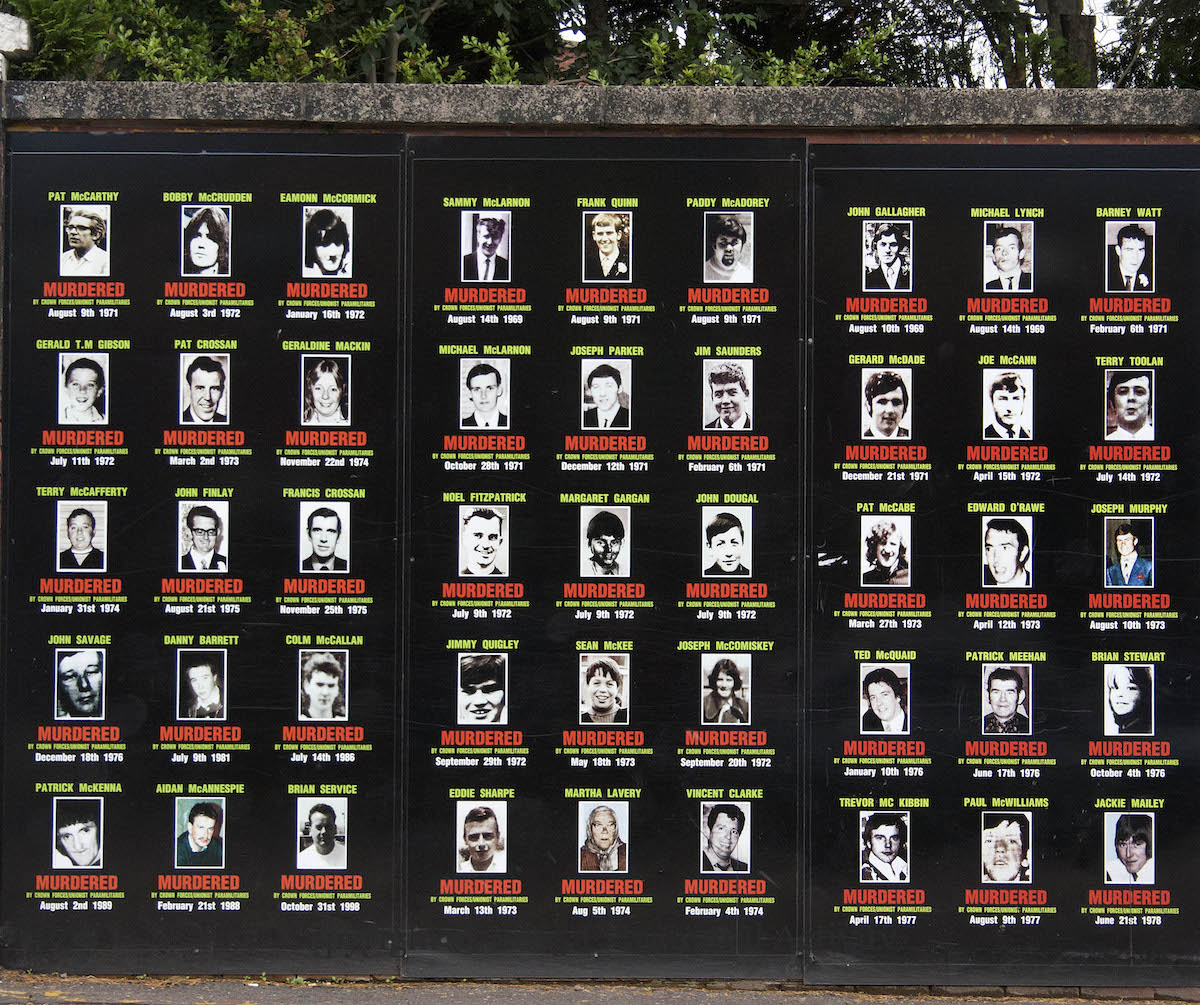
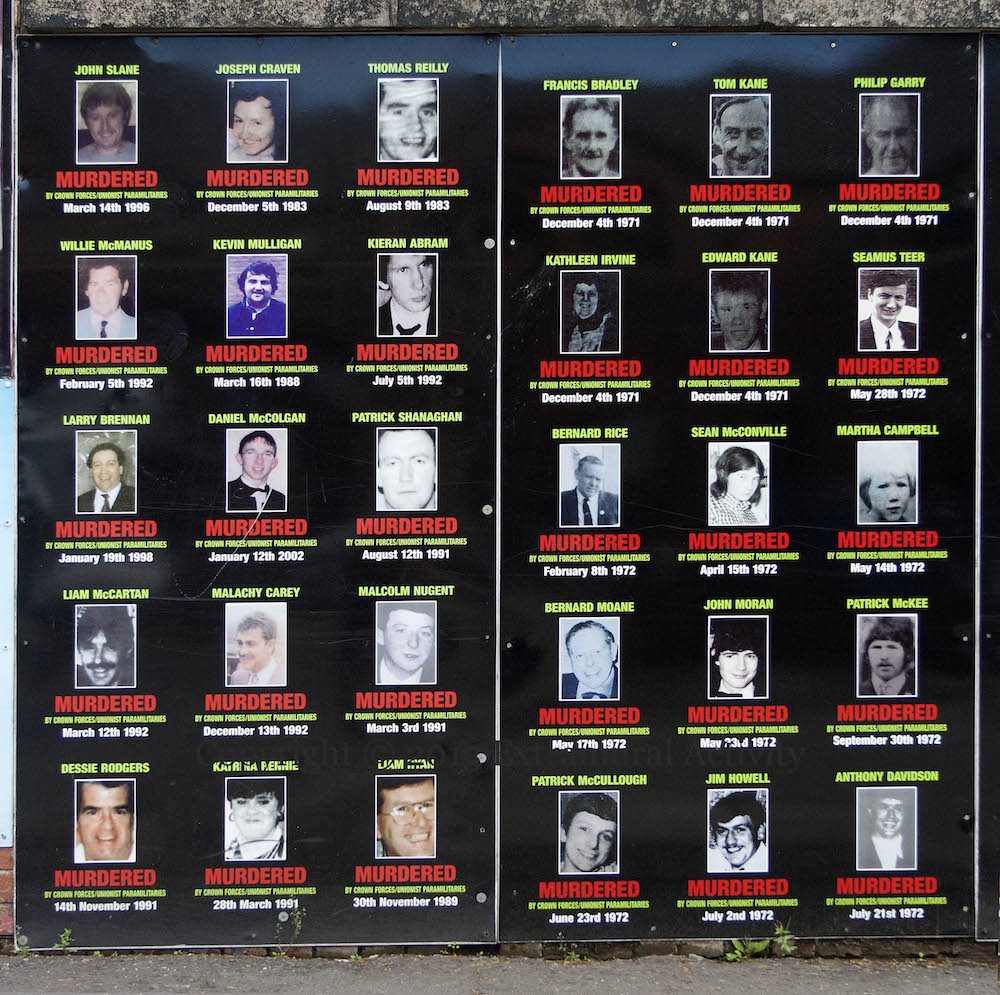
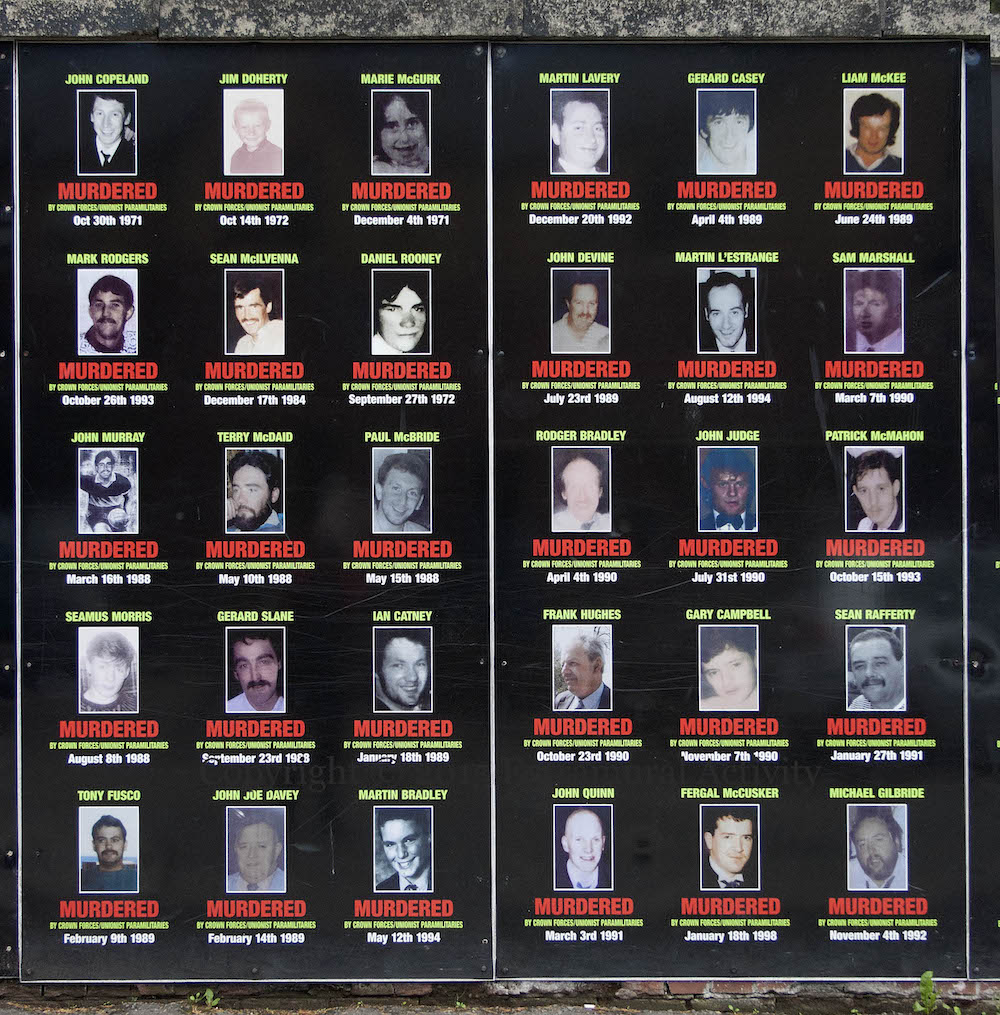
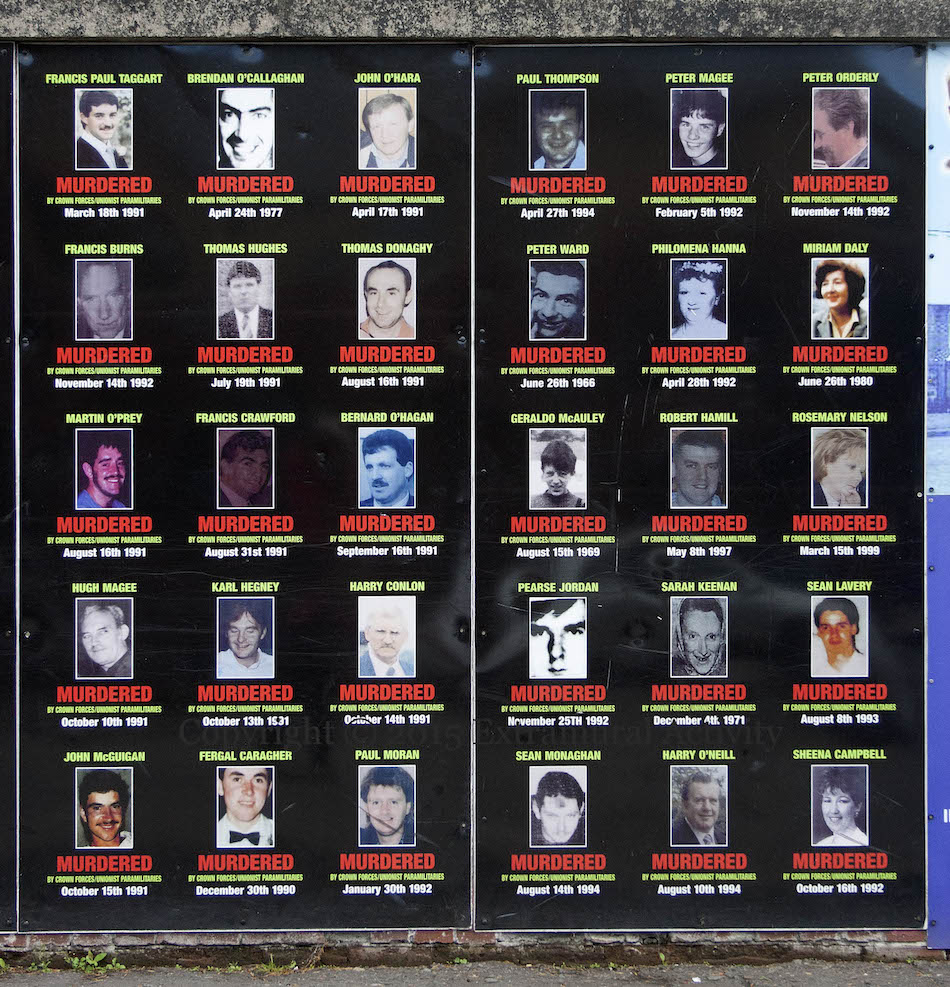
Panels 10-15 of the ‘murdered’ follow to the right of the Plastic Bullets board, here presented two-at-a-time. The 11th panel (the second one shown here, with Francis Bradley in top left) was previously the ninth panel; it is not clear why its position was swapped.
The British soldiers on the right of the board above are given red berets to indicate the Paratroop Regiment, which was the regiment involved in Derry’s Bloody Sunday.
“Springhill–Westrock massacre. Belfast’s Bloody Sunday. Time for truth! On the 9th July 1972 a team of British Army snipers took up firing positions in Corry’s timber yard overlooking the nationalist Springhill/Westrock estates. Within less than an hour five civilians lay dead and two critically wounded. Among the dead were three teenagers, a father of six and a priest on his way to administer the last rites to the dead and injured. There has never been a proper police investigation, and not one solider has spent a single day in prison in connection with their deaths. The families deserve, and demand the comprehensive facts be told by the British establishment. The truth costs nothing.”
Paul “Maxi” McVeigh scored over 200 goals during his career at Donegal Celtic – “The Wee Hoops” – the team he played his entire career with before retiring at the end of the 2012-2013 season. (Sunday World) The club grounds, and the mural shown above and below, are at the top of the Suffolk Road in west Belfast.
In black and white are scenes from yesteryear of children swinging on a lamp-post, riding a go-cart, playing hop-scotch, and walking down the alley between houses. In colour are more recent scenes: Rossville flats, the Dove Of Peace mural, children on bikes, and graffiti. Outside the Eden Place Arts centre (Fb) in Rossville Street.
This painted board (shown above) to INLA volunteer Neil McMonagle is in Leafair Park, Derry, close to the spot where McMonagle, aged 23, along with friend Liam Duffy, were shot by undercover British soldiers (specifically Sergeant Paul Oram of 14 Intelligence Company (WP)) on February 2, 1983. McMonagle died instantly while Duffy was wounded but survived. The official account alleged that both McMonagle and Duffy were armed; locals deny this. For an account of the killing and a tribute, see these obituaries from republican publications in 1983.
The board shows an armed McMonagle behind a stone wall with a Plough In The Stars flag with a blue background, with the view towards Buncrana (perhaps).
“Vol Neil McMonagle, Derry Brigade INLA. Killed in action 2nd February 1983. “They may kill the revolutionary but never the revolution.””
The Derry branch of the 1916 Societies (Fb) is named after Sean Dolan, an IRA volunteer interned at the outbreak of WWII on the prison ship Al Rawdah (WP | saoırse32) before being moved to Crumlin Road gaol. He was released on grounds of ill health shortly before dying in 1941 at age 28 in Derry. The title of today’s post comes from Dolan’s gravestone, which is in Ardmore (findagrave).
It was the 1916 Societies that hoisted an Irish tricolour from the roof of Stormont in June 2015 (BBC).
“In proud and loving memory of Óglach Mickey Devine. Died 20th August 1981 in the H-Blocks of Long Kesh after 60 days on hunger-strike. Mickey was waked and buried from this house [in Rathkeele Way, Derry], the family home of his sister Margaret. Also died 30th March 2005.” For an image of the open coffin within the house, see this An Phoblacht article. Here is a Guardian interview with Margaret (Devine) McCauley.