Messines 1917

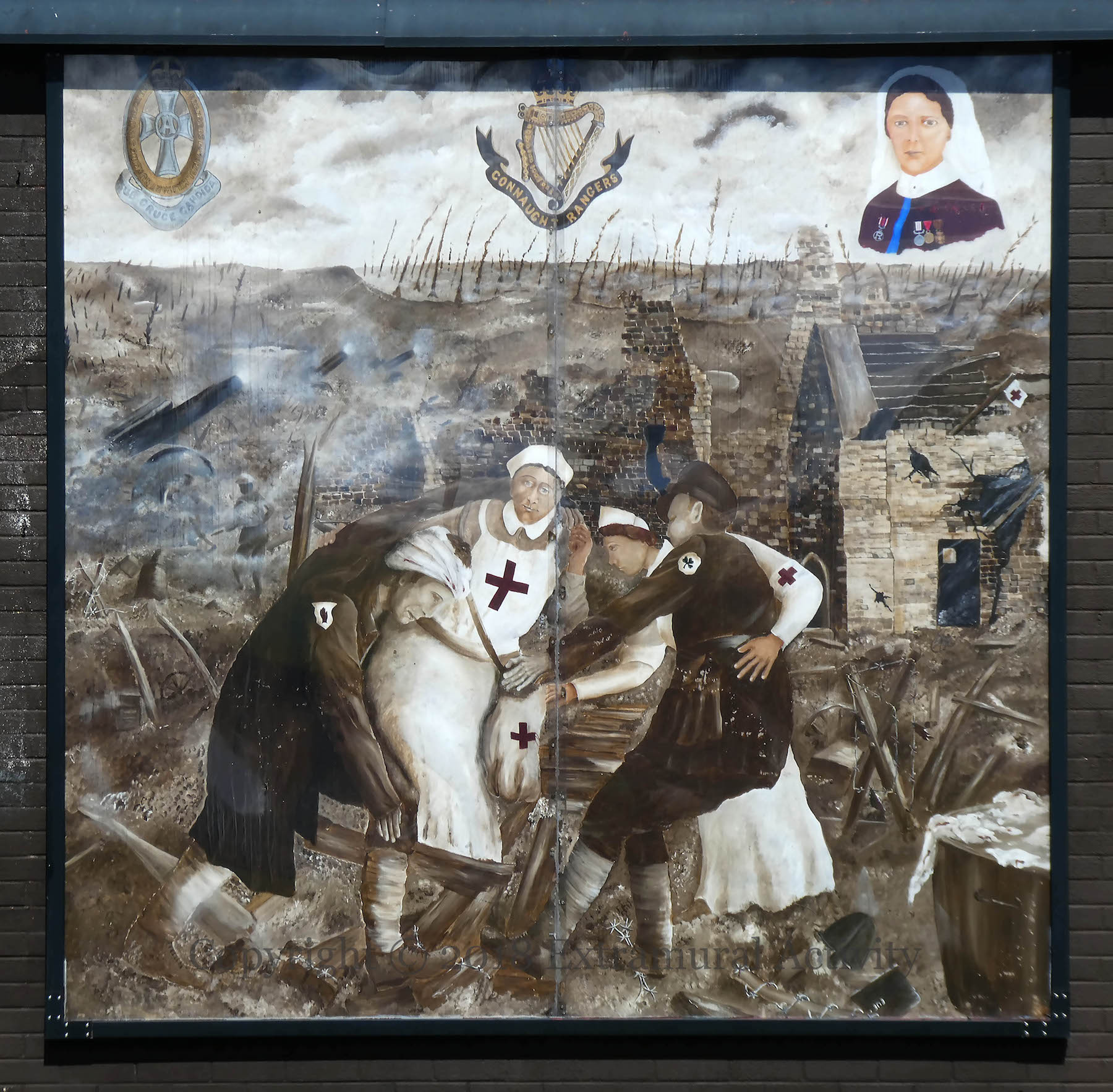
Two panels commemorate the Battle Of Messines in 1917 and the role of nurses in attending to the wounded. This NIHE article says that the two nurses depicted are Annie Colhoun from London-/Derry and Margaret Dewar from Glasgow. “Margaret Dewar lost her life during the battle whilst Annie Colhoun survived and was decorated for her work during the war by the French, Serbian and British Governments.” (This presumably makes her the decorated nurse in the right-hand panel.) An Army Nursing Service page says, however, that they were nurses at Monastir in Macedonia.

“Sub cruce candida” (“under a white cross”) is the motto of the Queen Alexandra’s Royal Army Nursing Corps, though at the time of WWI it was Queen Alexandra’s Imperial Military Nursing Service. “VAD” stands for “voluntary aid detachment” of the British Red Cross.

The soldiers wear red hands or shamrocks on their arms. The red hand is for the 36th (Ulster) Division and the cap badge in the left panel is of the 36th. The shamrock is the symbol of the 16th (Irish) Division, and the right panel shows the cap badge of the Connaught Rangers whose battalions served in both the 10th (Irish) and 16th (Irish) Divisions in WWI. Both the 36th and 16th fought at the Somme and at Messines (WP).
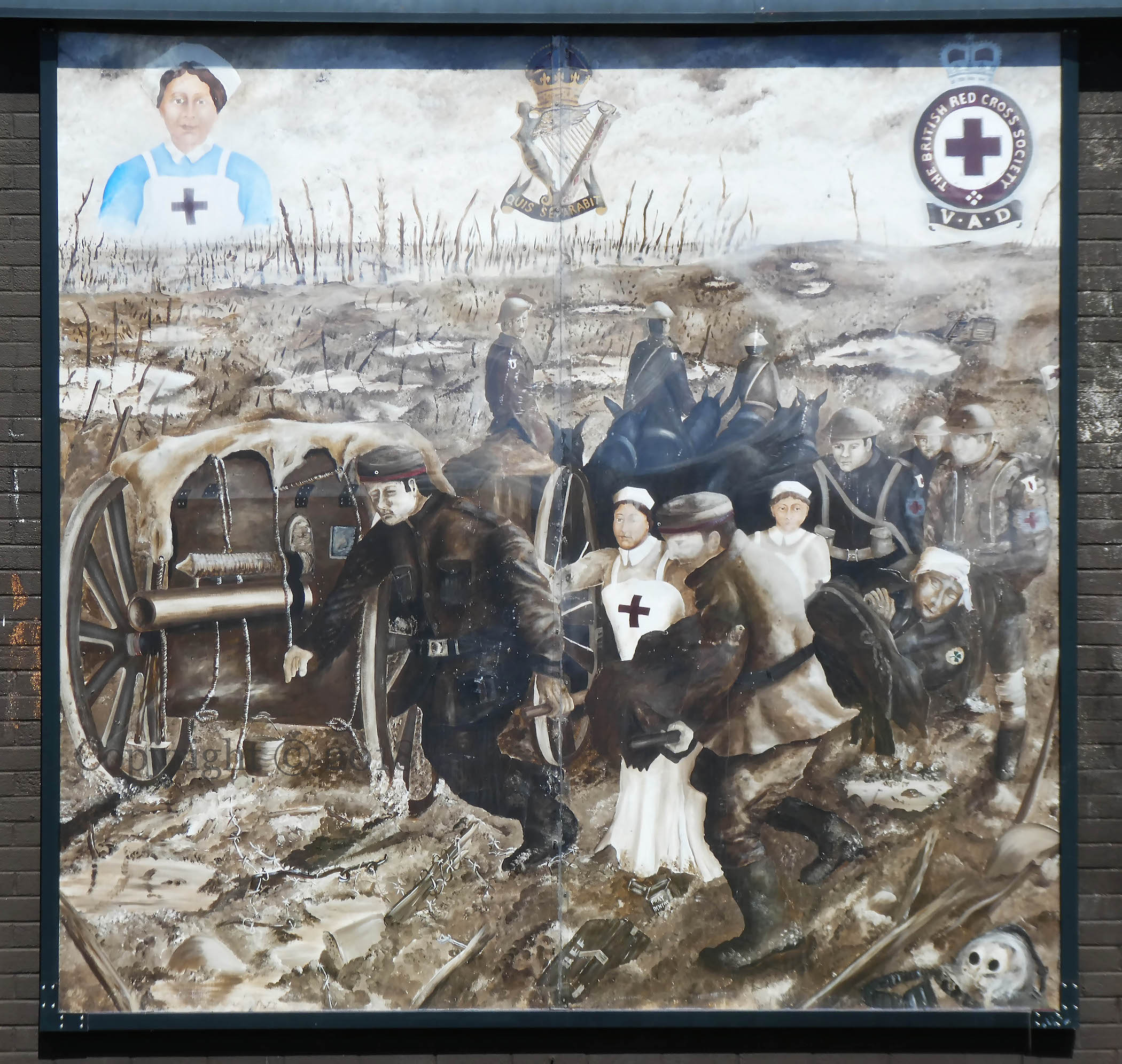
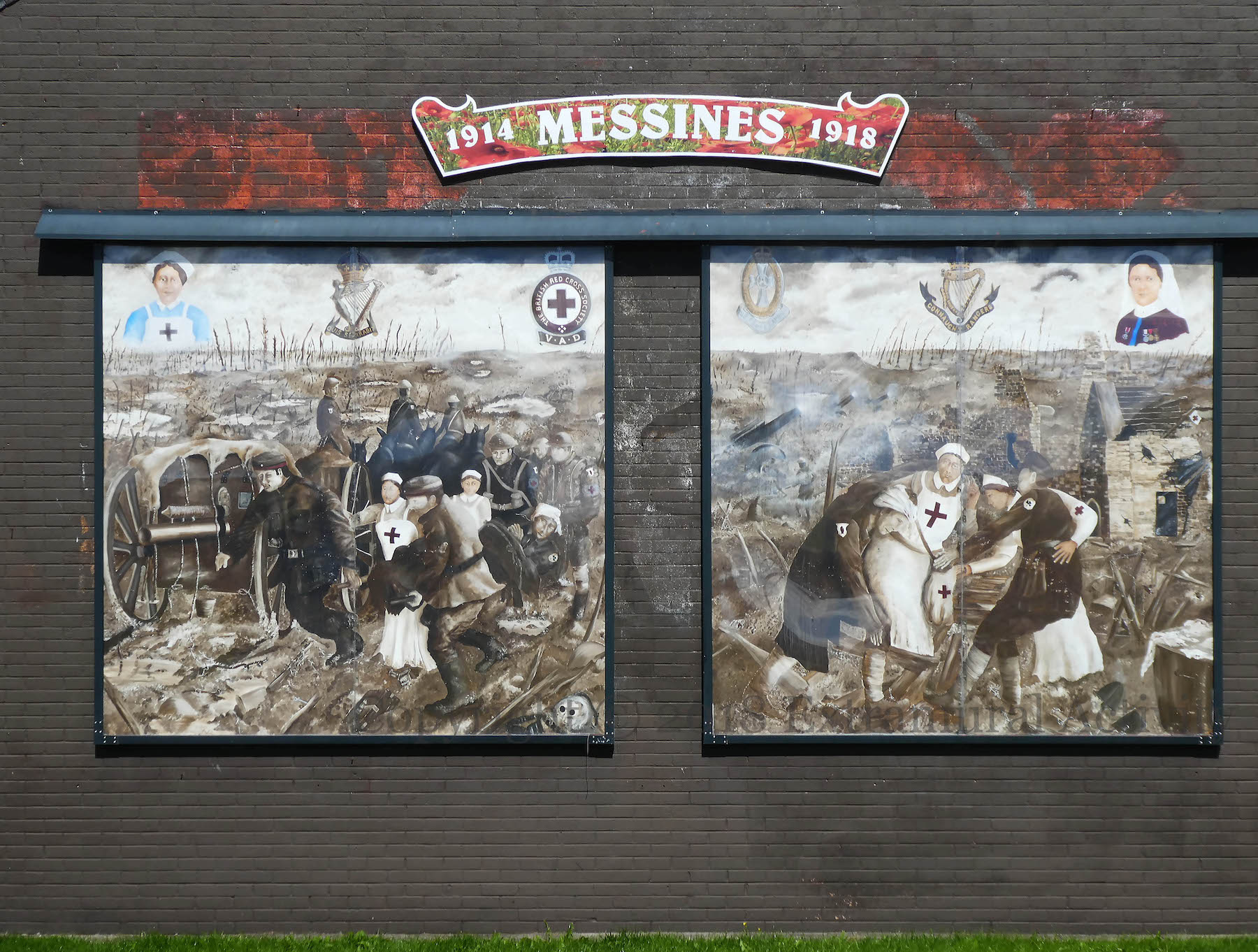
Click image to enlarge
Copyright © 2018 Seosamh Mac Coılle
X06067 X06066 X06065 abbot gdns
Brothers In Arms

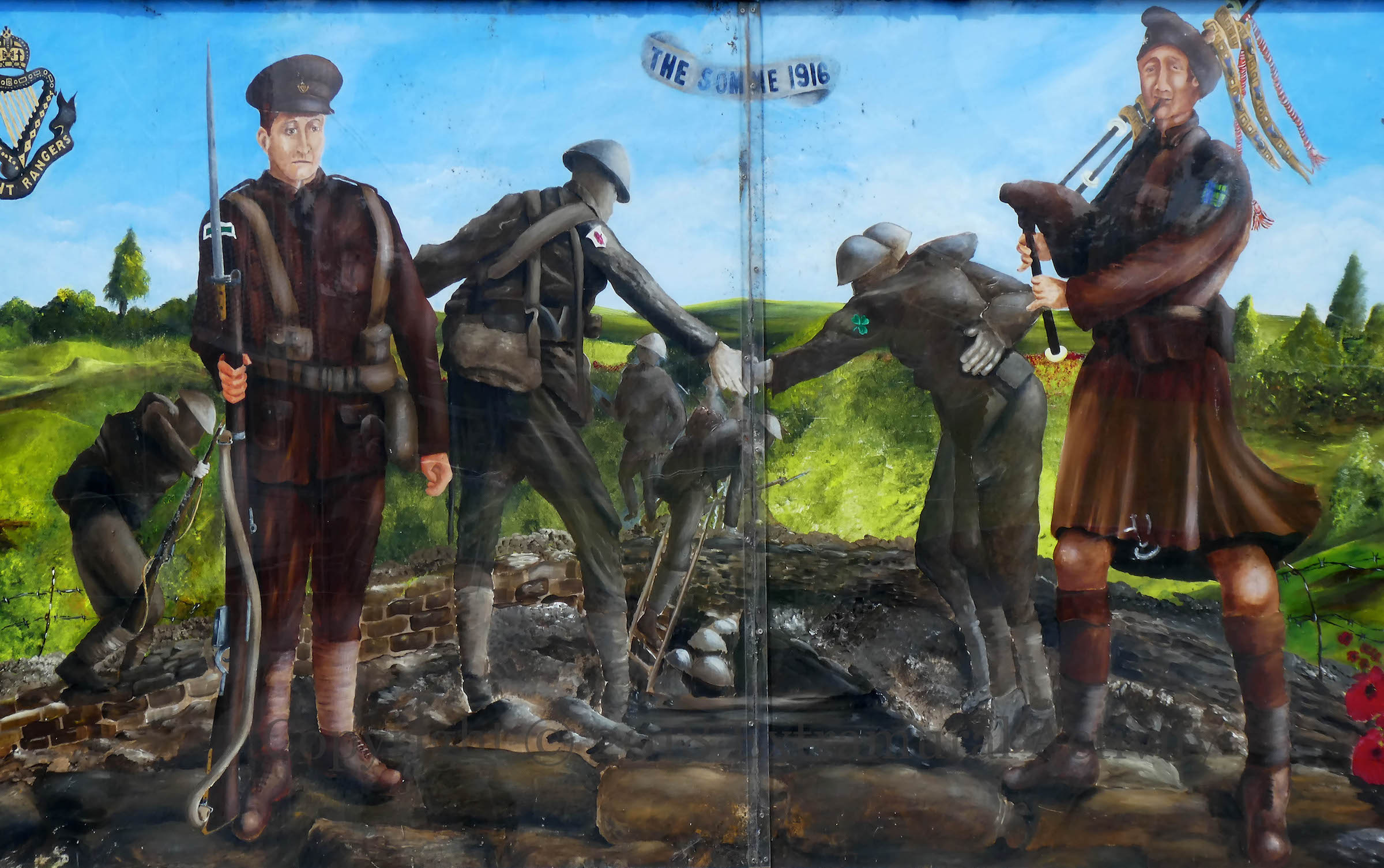
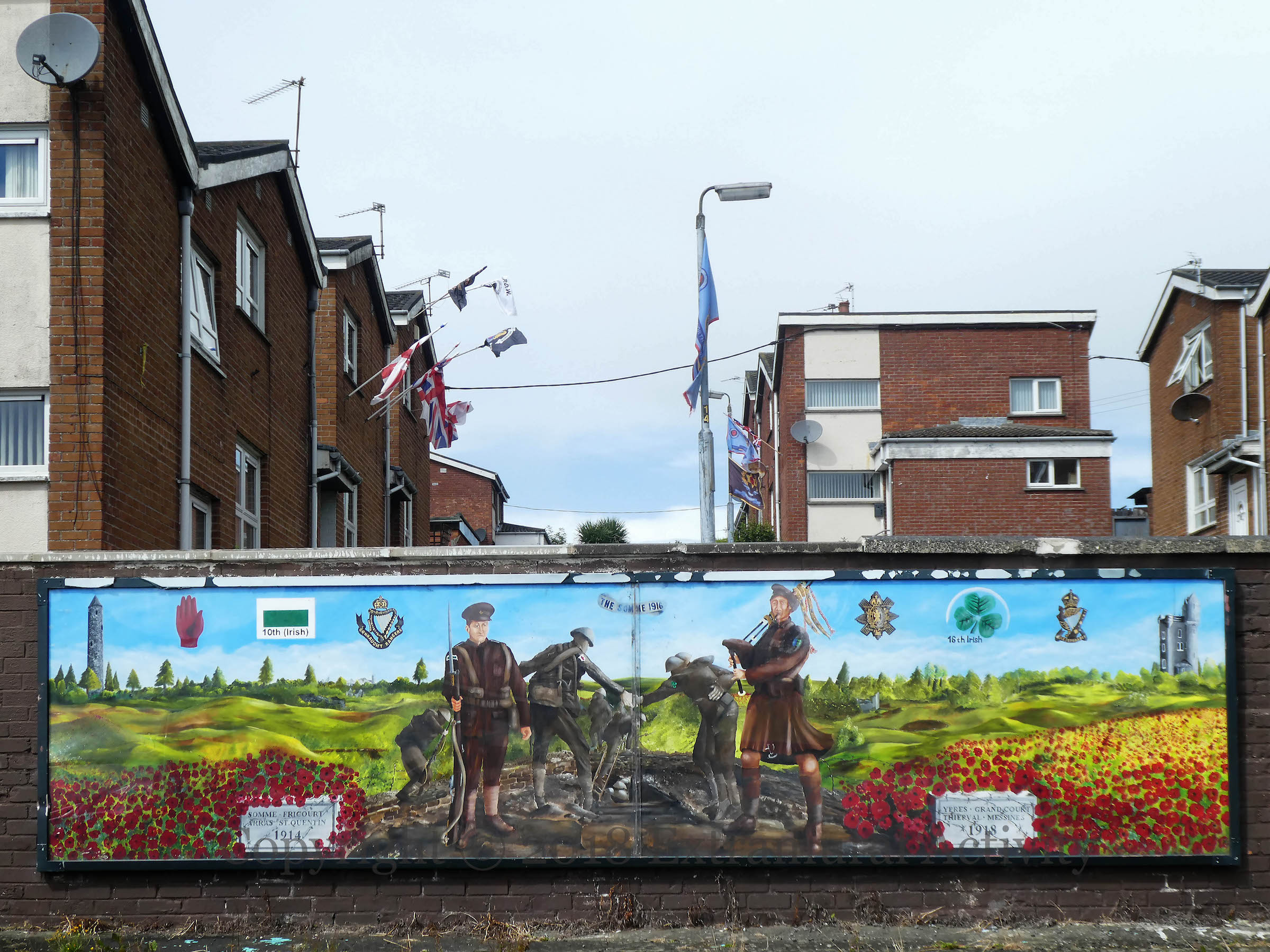
The 36th (Ulster) Division fought in the Battle Of Albert at the beginning of the Battle Of The Somme (July 1st-13th), and the 16th (Irish) in the battles of Guillemont and Ginchy in September (WP). The 10th (Irish) served at Gallipoli (and later in Macedonia and Palestine). The scene above shows soldiers from the 36th and 16th hand-in-hand at “The Somme 1916” – both division took part in the Battle – which lasted four and half months – but not at the same time; such scenes were instead reported of the battle at Messines in 1917 (see previously: Messines 1917).

Of the icons along the top, we see from left to right: Scrabo Tower; the red hand of the 36th; the green bar badge of the 10th (Irish) Division; the harp of the Connaught Rangers (battalions of which served in 10th and 16th Divisions); the emblem of the Black Watch – Royal Highlanders (the piping soldier right of centre wears a tartan patch of the Black Watch); the shamrock of the 16th (Irish) Division; the Maid Of Erin harp of the Royal Irish Rifles; Helen’s Tower/Thiepval Tower. It’s not clear why the Black Watch is included, as its battalions do not seem to have served with any of the 10th, 16th, or 36th and is a Scottish regiment rather than an Irish one. Please comment/get in touch if you can explain.

Click image to enlarge
Copyright © 2018 Seosamh Mac Coılle
X06054 X06055 [X06056] dicksonia dr

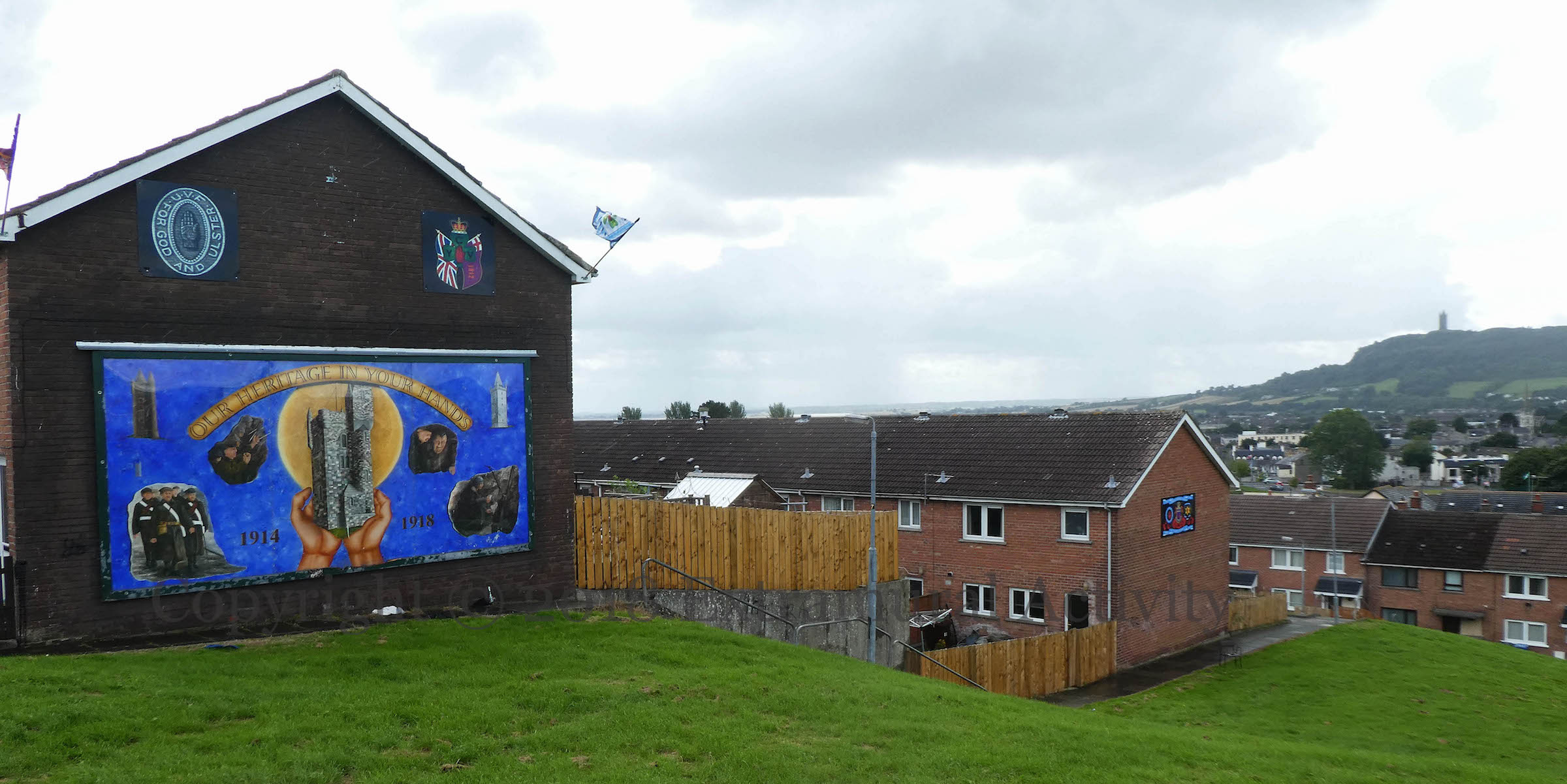
Our Heritage In Your Hands

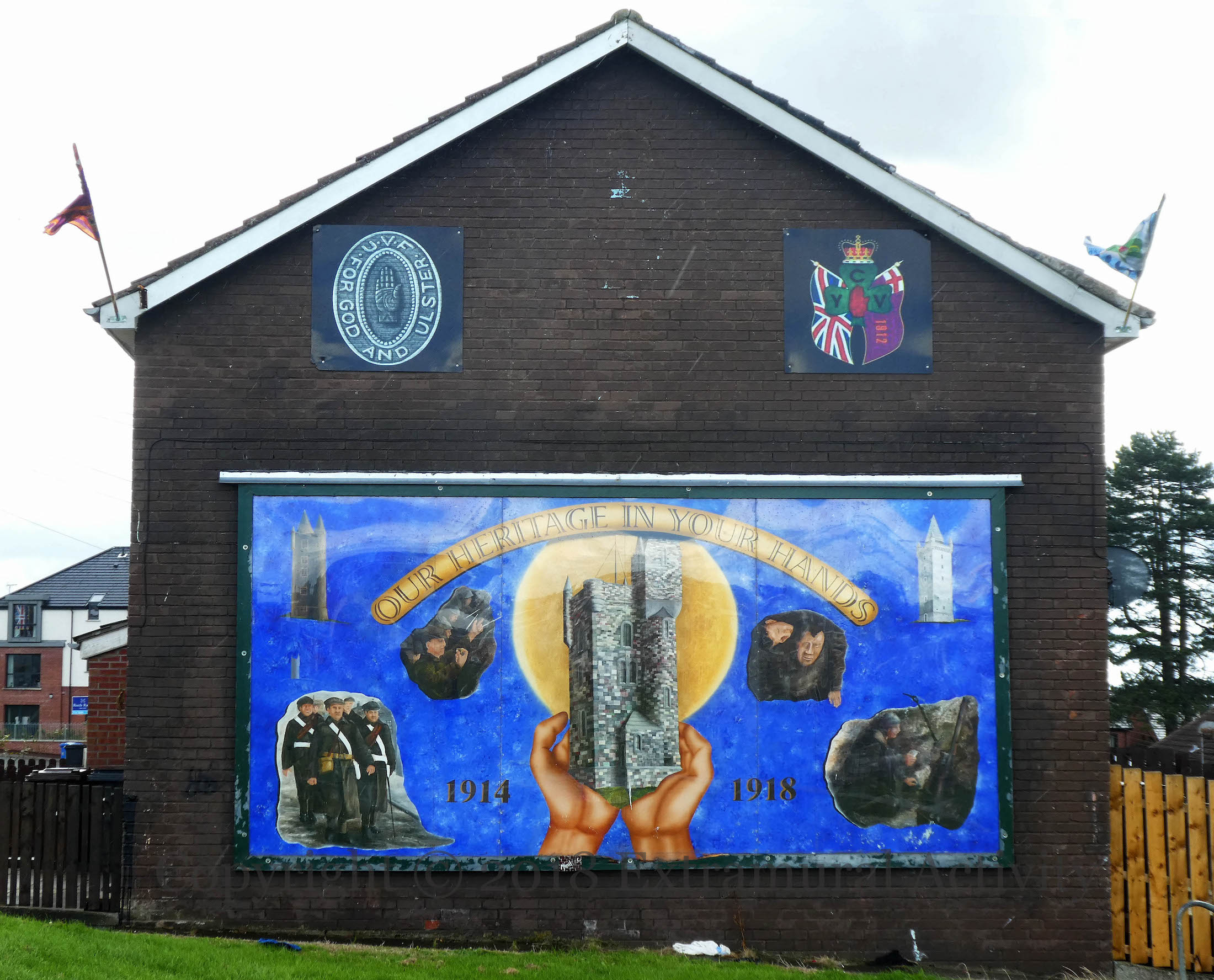
The Ulster Tower at Thiepval, France, is a replica of Helen’s Tower in Clandeboye, around which the 36th (Ulster) Brigade, formed in August 1914 from the Ulster Volunteers and Young Citizen Volunteers, began their training (see this gallery of images from North Down Museum at BBC-NI). After a year of training in Ireland and England, the Division was deployed to France in September 1915.

In the top corners are two views of the local Scrabo Tower, which can be seen to the right in the wide shot, below. Produced by muraltec.

X06057 2018-08-21 North Down West Belfast+

Click image to enlarge
Copyright © 2018 Seosamh Mac Coılle
X06049 [X06050] X06051 [X06052] [X06053] X06057 Ilex Ave

Heaven When I Die

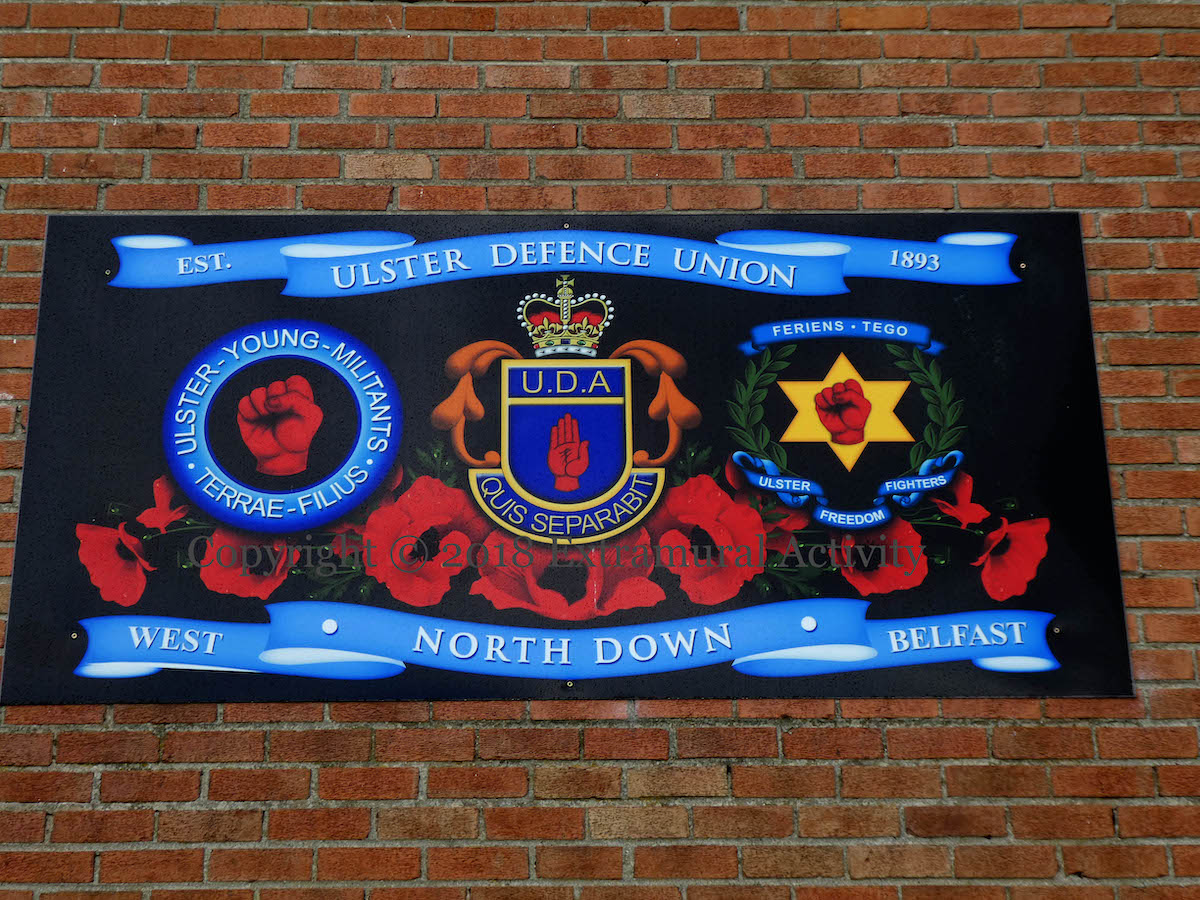
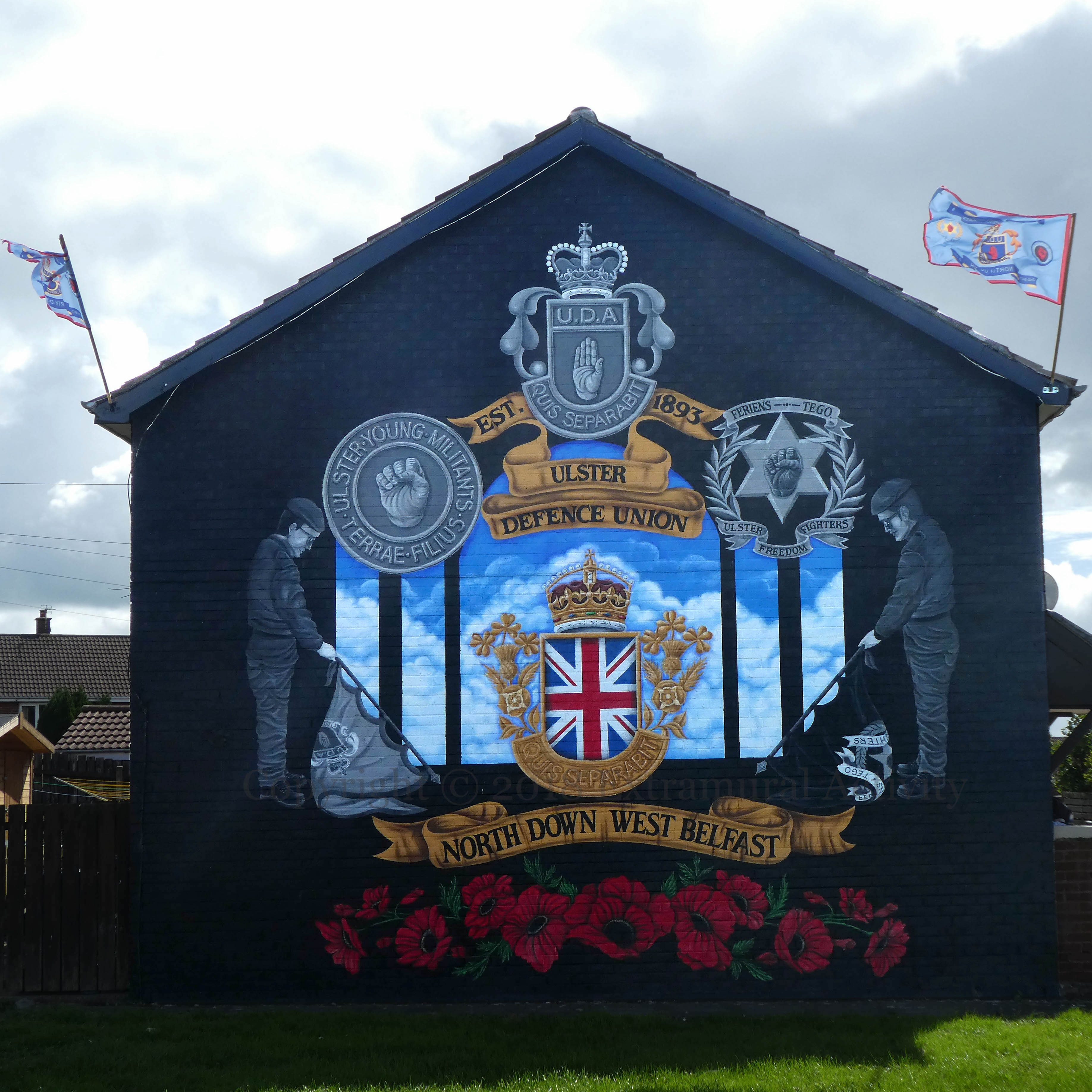
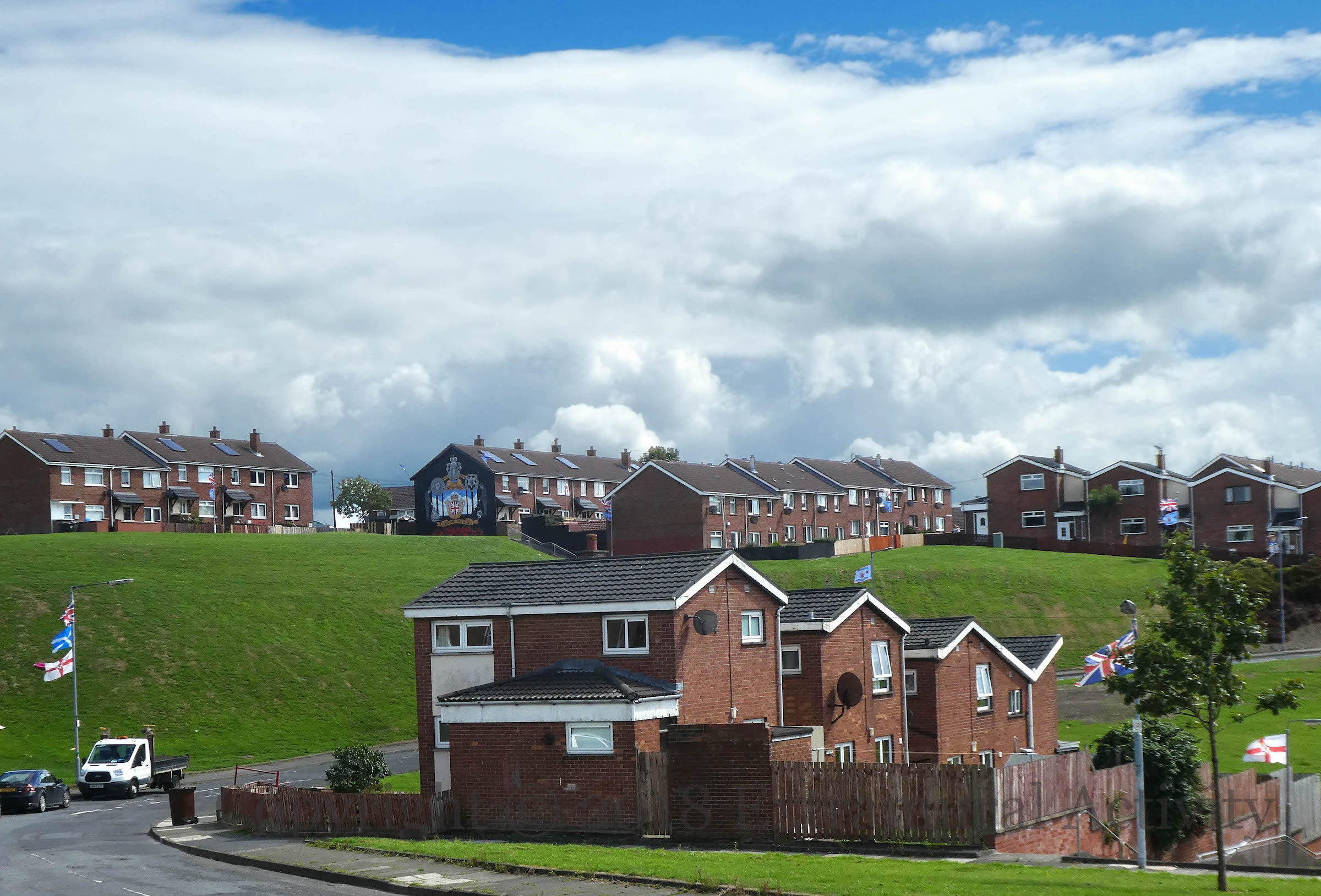
The poppy was used exclusively by the UVF (because of their shared named with the Ulster Volunteers, which became the 36th Division, which served on the western front in WWI, but in the last few years (2016-2018) it has been used frequently by the UDA in memorial murals (e.g. onetwo | three), indicated here by the lowered flags and absence of weapons. (The first UDA poppy, however, dates back to the 2012 (if not earlier) tribute to Benson Kingsberry.) For background on the inclusion of “West Belfast” alongside “North Down” in a Newtownards mural, see Ulster Defence Unions, which also contains poppies (and which in turn links to information about the Ulster Defence Union of 1893). “UDU” seems to be used here to represent a desire for greater unity among (at least some parts) of the UDA.

Click image to enlarge
Copyright © 2018 Seosamh Mac Coılle
X06046 X06047 Glenburn Rd

Digital Eddie

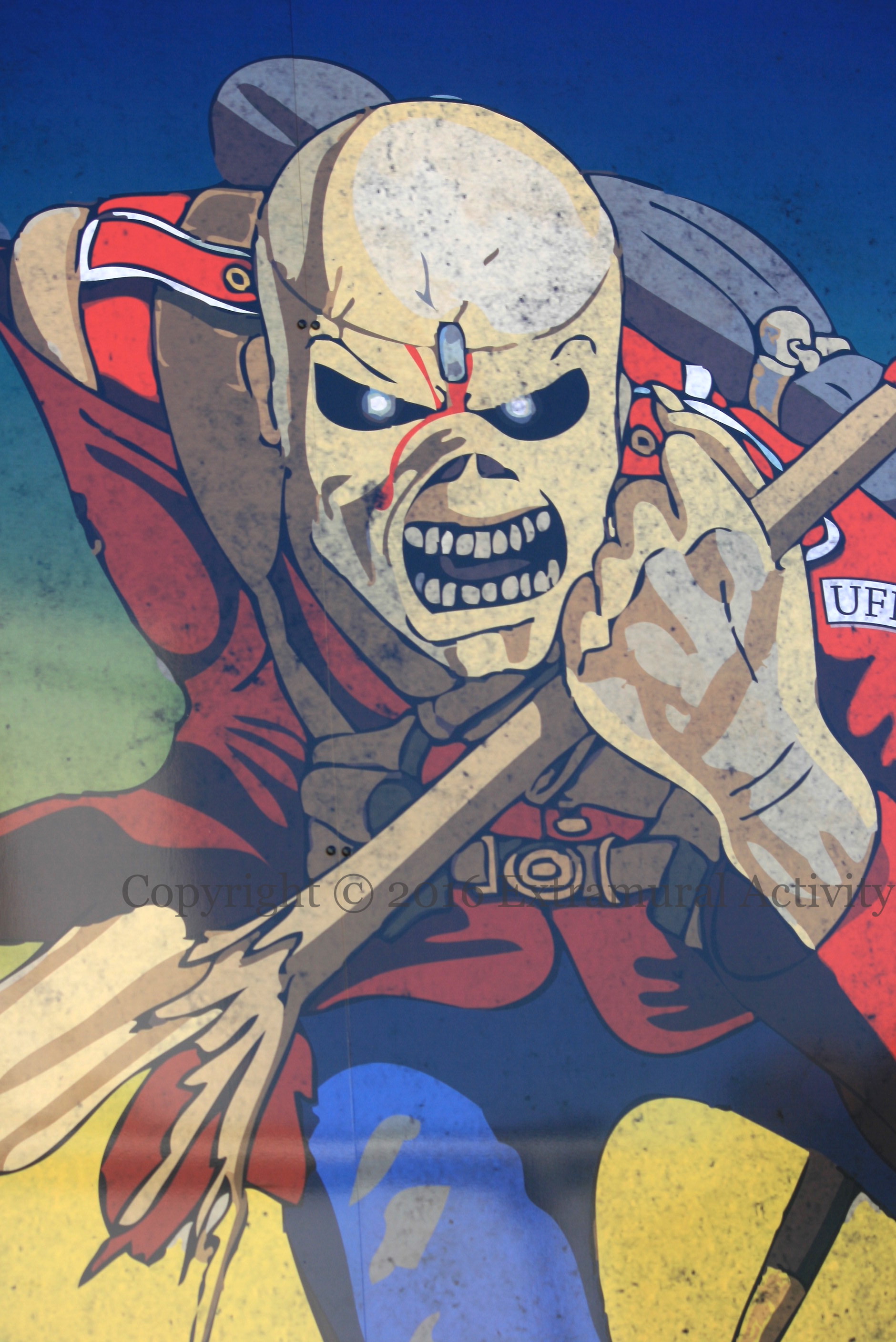
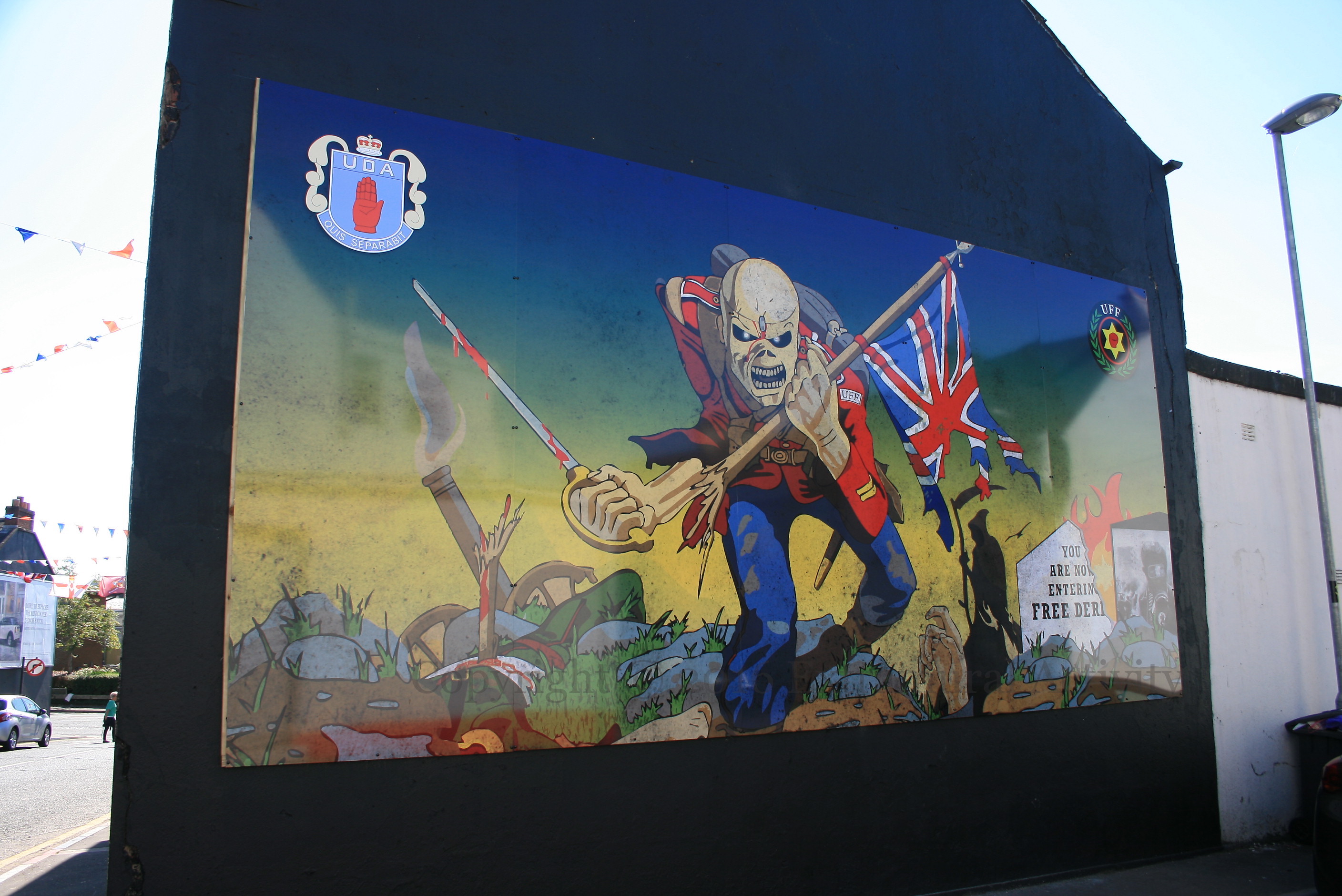
As a zombie skeleton, Eddie The Head (here in his guise as a Light Brigade ‘Trooper’) lived long enough to enter the digital age of muraling, with a cartoon-style version added at the site of the original Eddie mural – Ebrington Terrace, Londonderry, which can be seen on Eddie’s own Visual History page – in 2016. The mural, however, started falling apart immediately and is now entirely removed.

Click image to enlarge
Copyright © 2016 Seosamh Mac Coılle
X05365 X05364 [X05366] X03800

Ulster Defence Unions

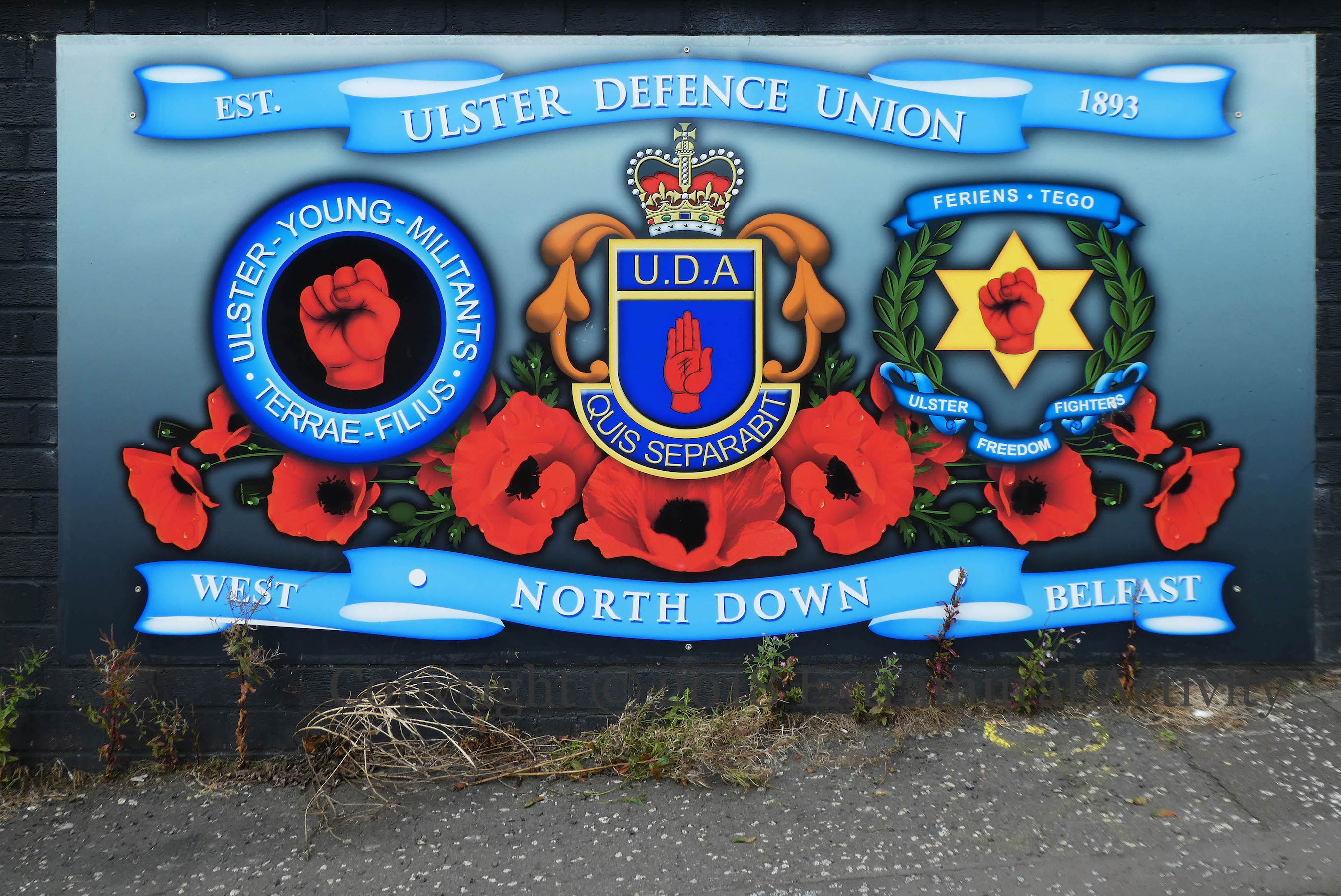
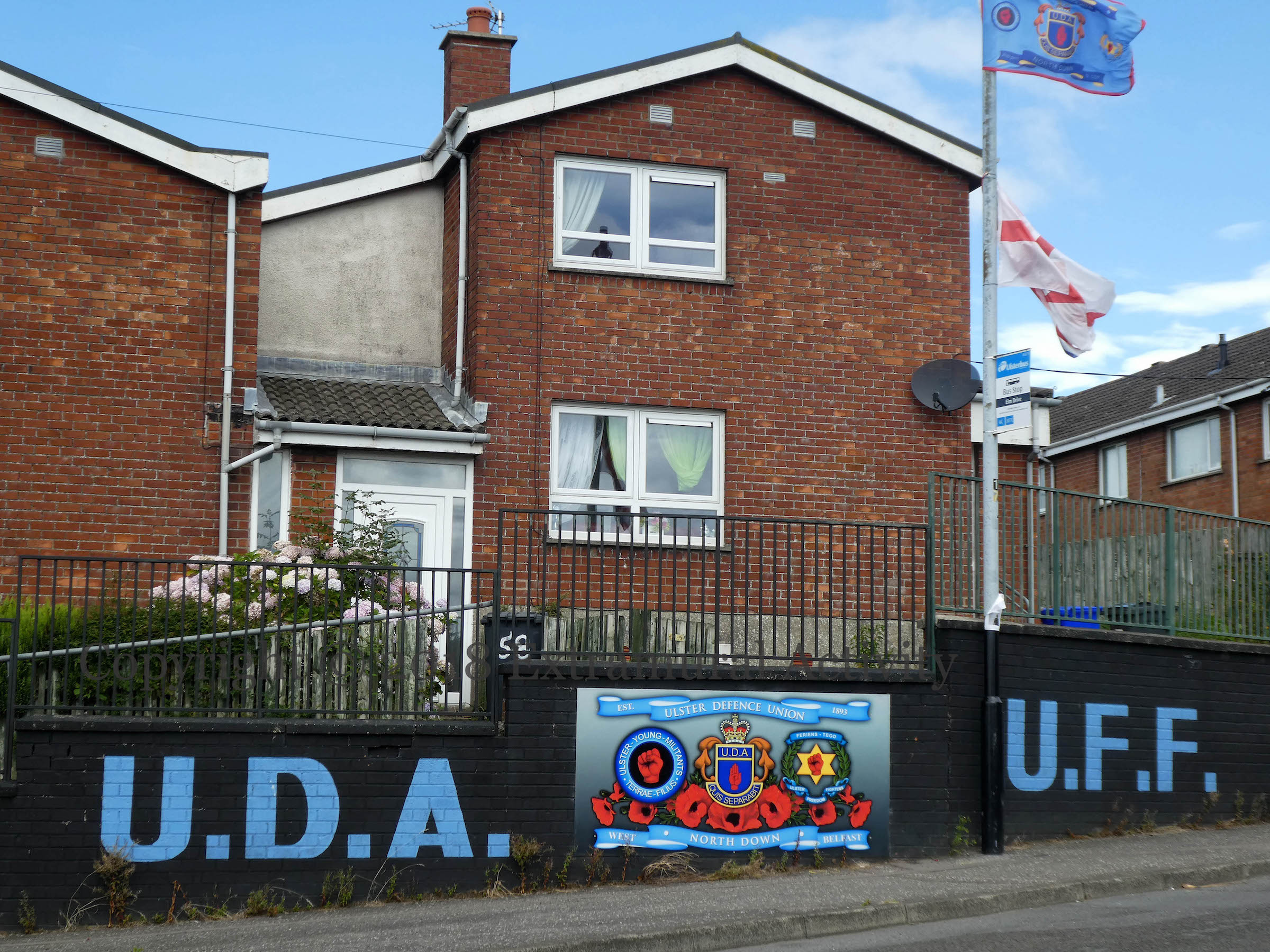
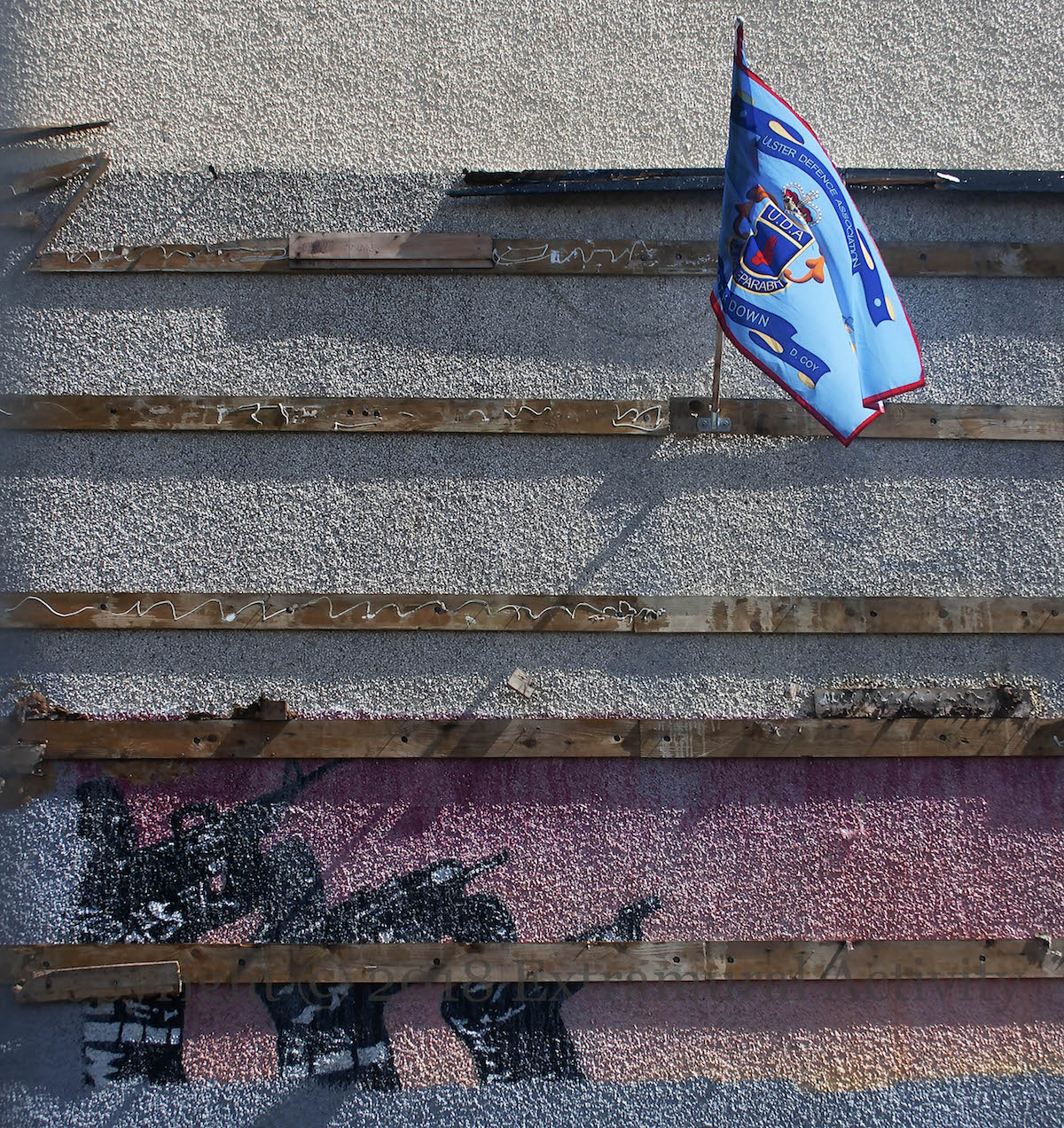
The UDA/UFF in North Down is divided into two factions, led by Dicky Barry in Newtownards and Dee Stitt in Bangor. Barry’s group is affiliated with the Shankill (west Belfast) UDA and Stitt’s with the East Belfast UDA. According to this BelTel article, their respective numbers are 600 to 150, respectively. The Peter Moloney Collection of murals has a 2007 image of a ‘west Belfast’ board in Bangor. For the UDU reference see UDU-UFF-UDF.

2024 Update: Barry is stood down (BelTel).

Click image to enlarge
Copyright © 2018 Seosamh Mac Coılle
X06044 X06045 Glenbrook Rd