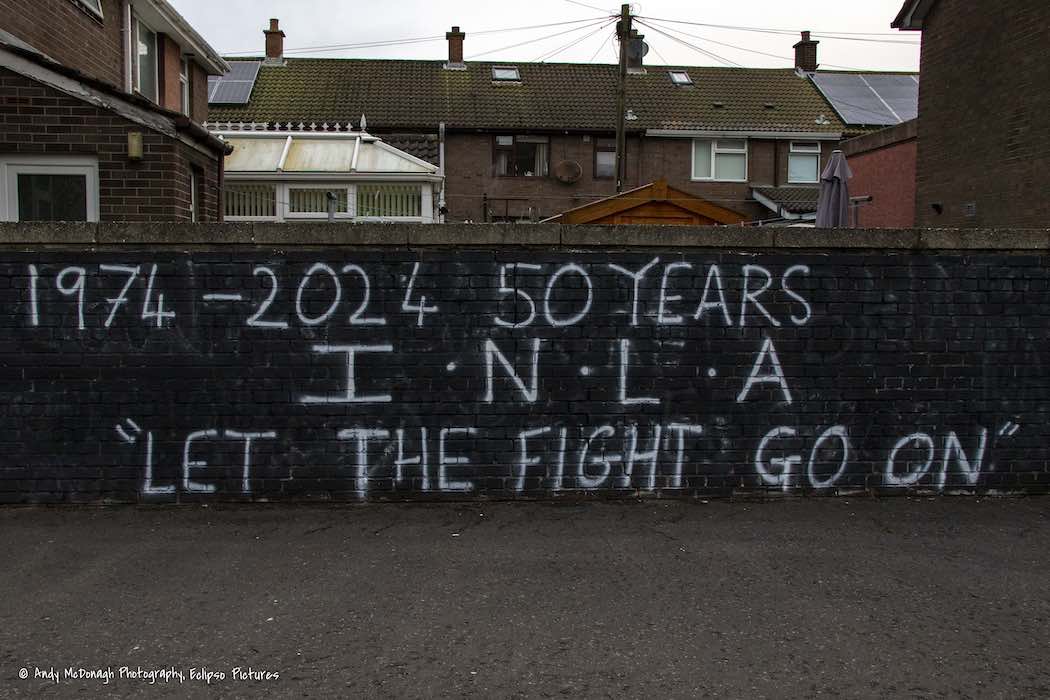
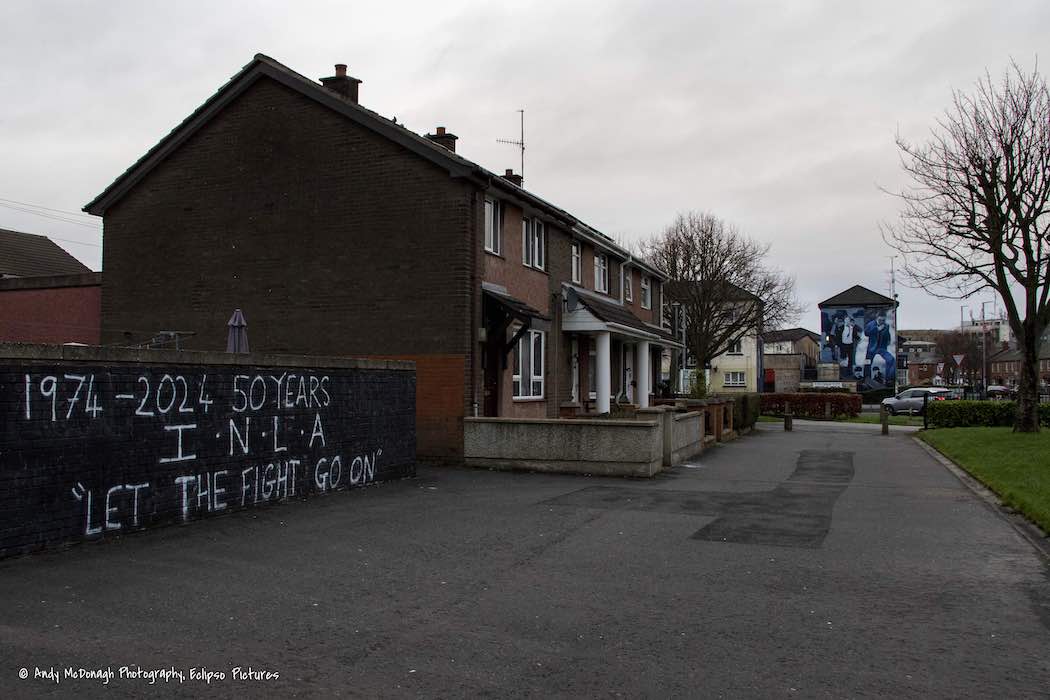
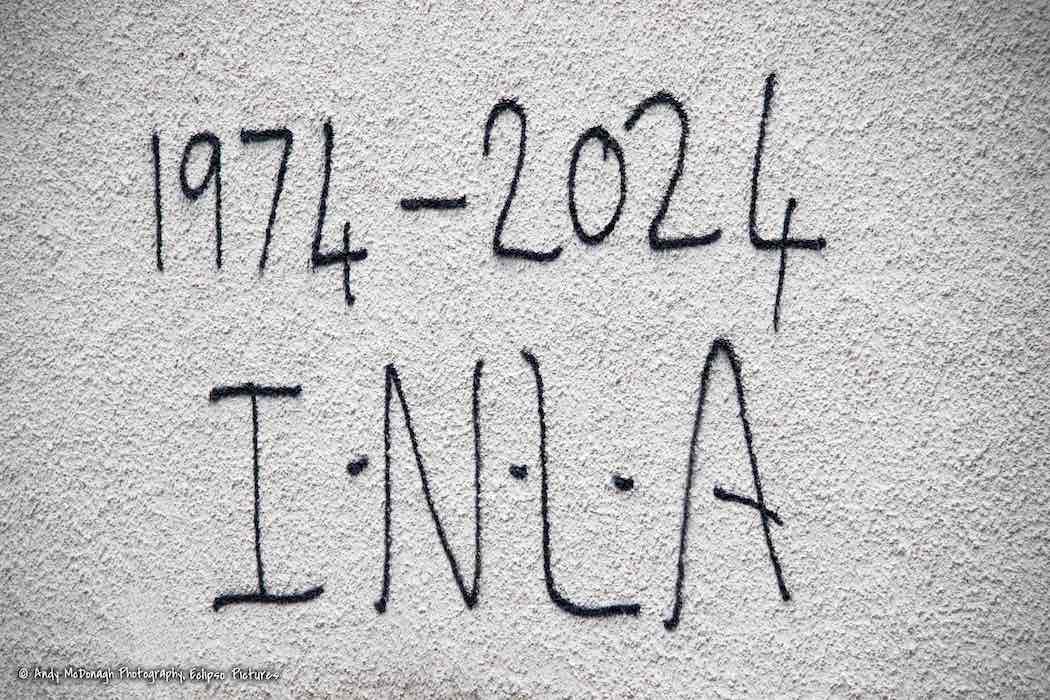
The INLA (Irish National Liberation Army), together with the IRSP (Irish Republican Socialist Party), was founded in December, 1974, splitting from the Officials over their on-going ceasefire. It called a ceasefire in 1998 and ended its armed campaign in 2009. “Let the fight go on”, by other means.
The three INLA members who died in the 1981 hunger strike – Patsy O’Hara, Kevin Lynch, Mickey Devine – were all from Derry.
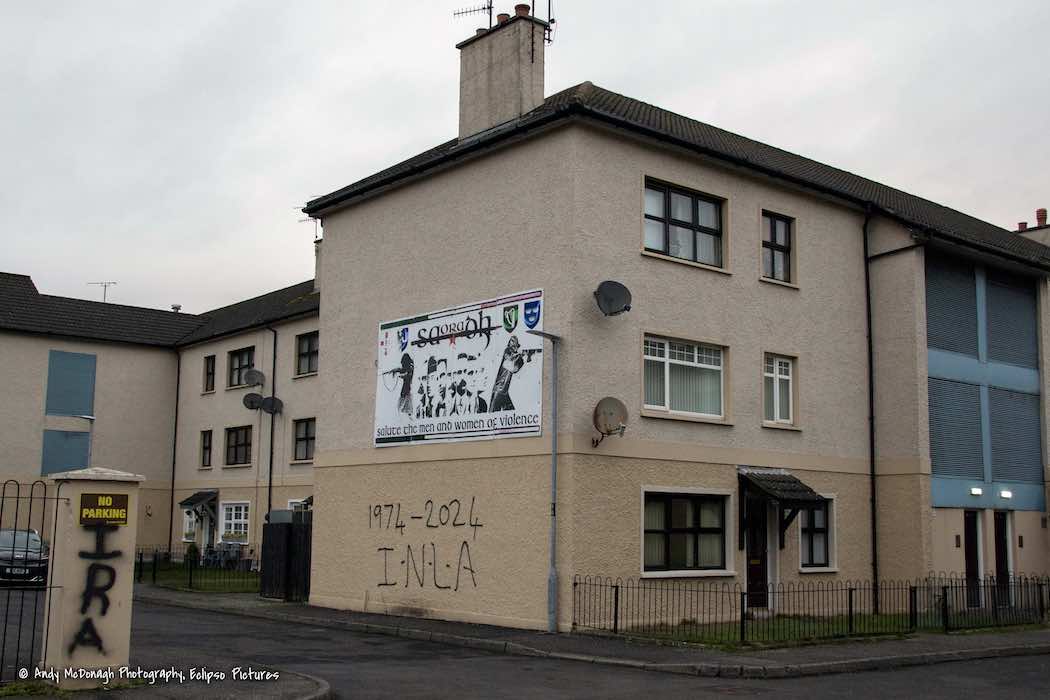
This graffiti is from Derry’s Bogside; The Runner is visible in the distance of the wide shot, immediately below. For the Saoradh board, see British Gaols In Ireland.
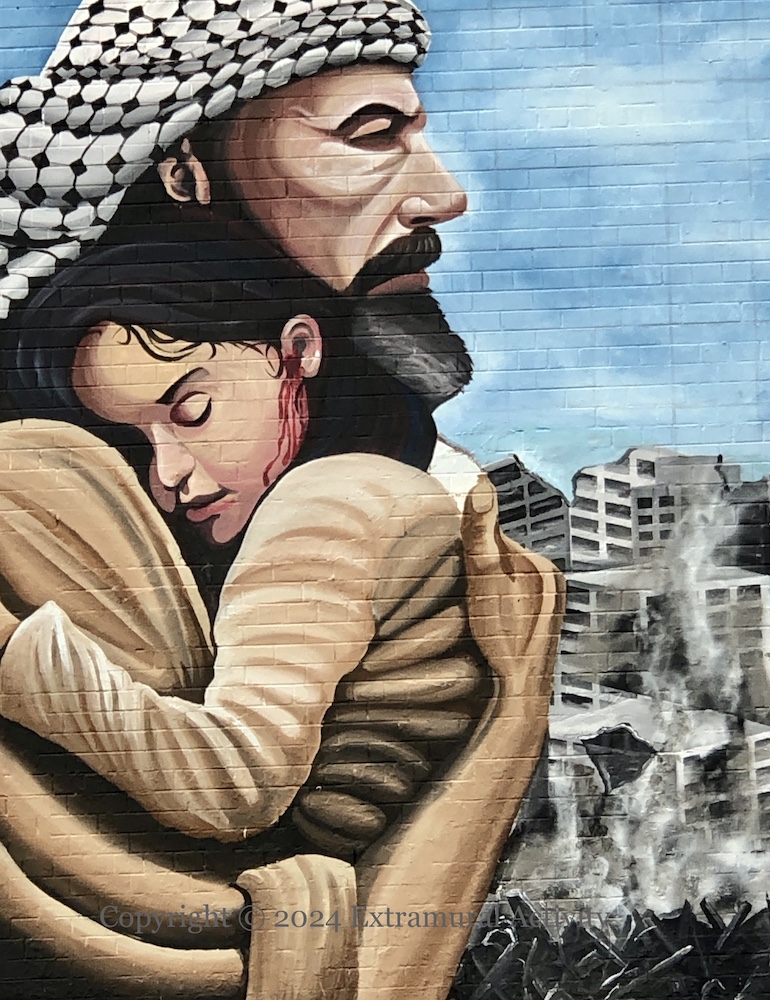
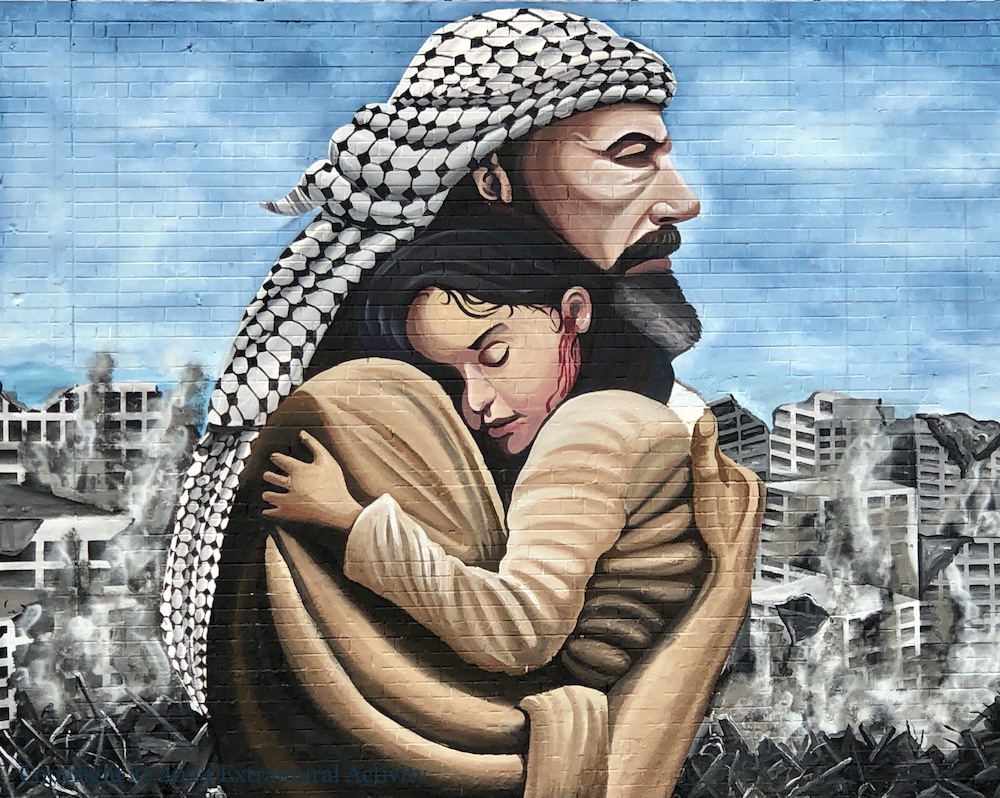
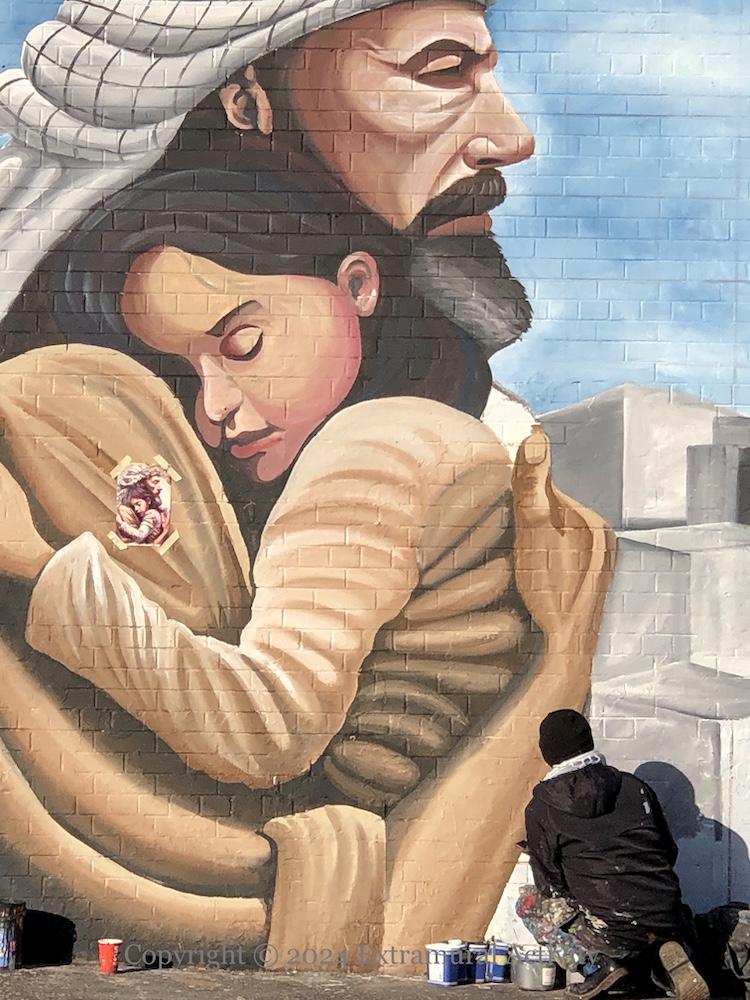
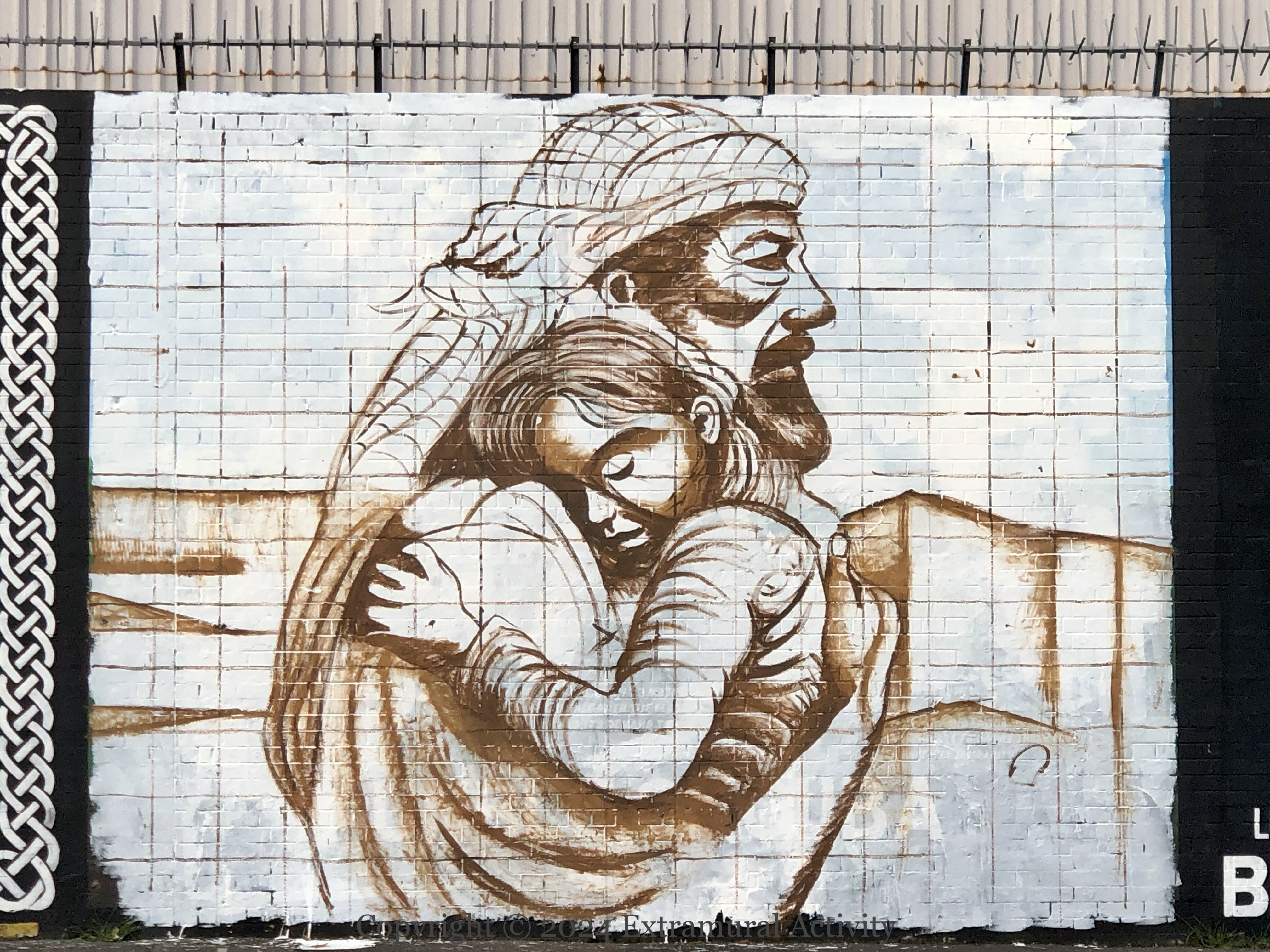
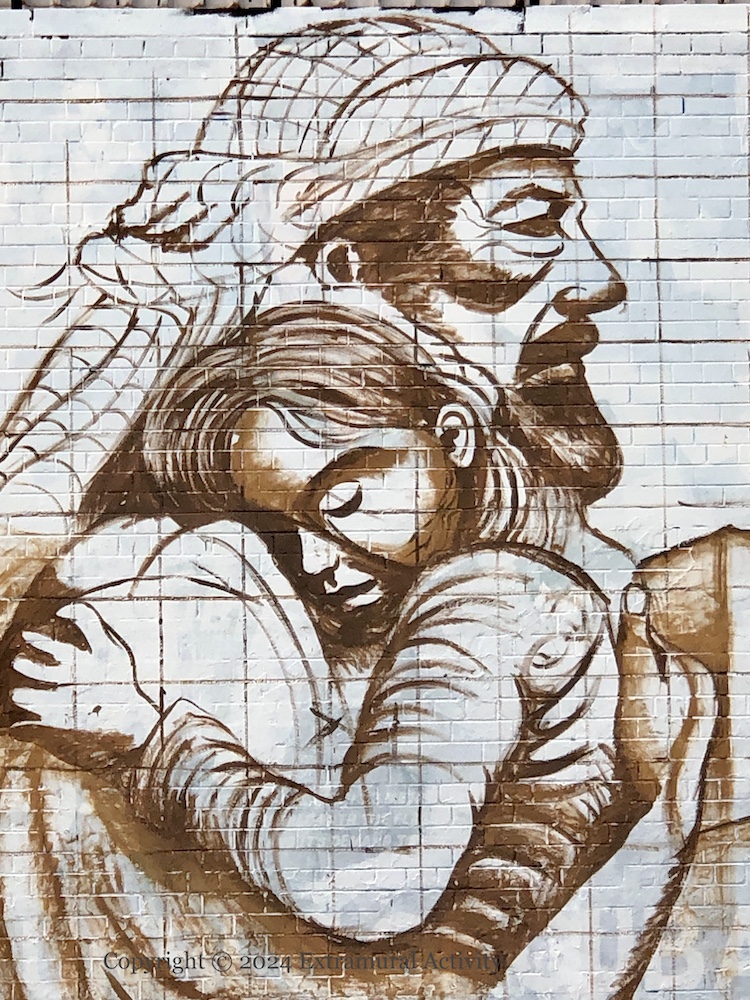
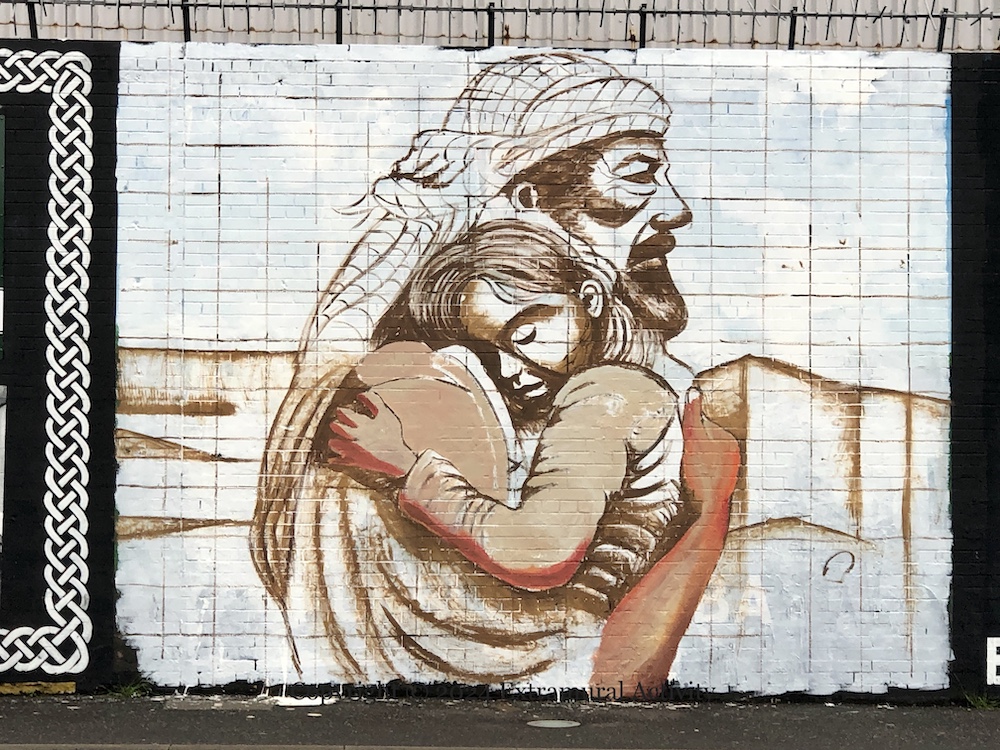
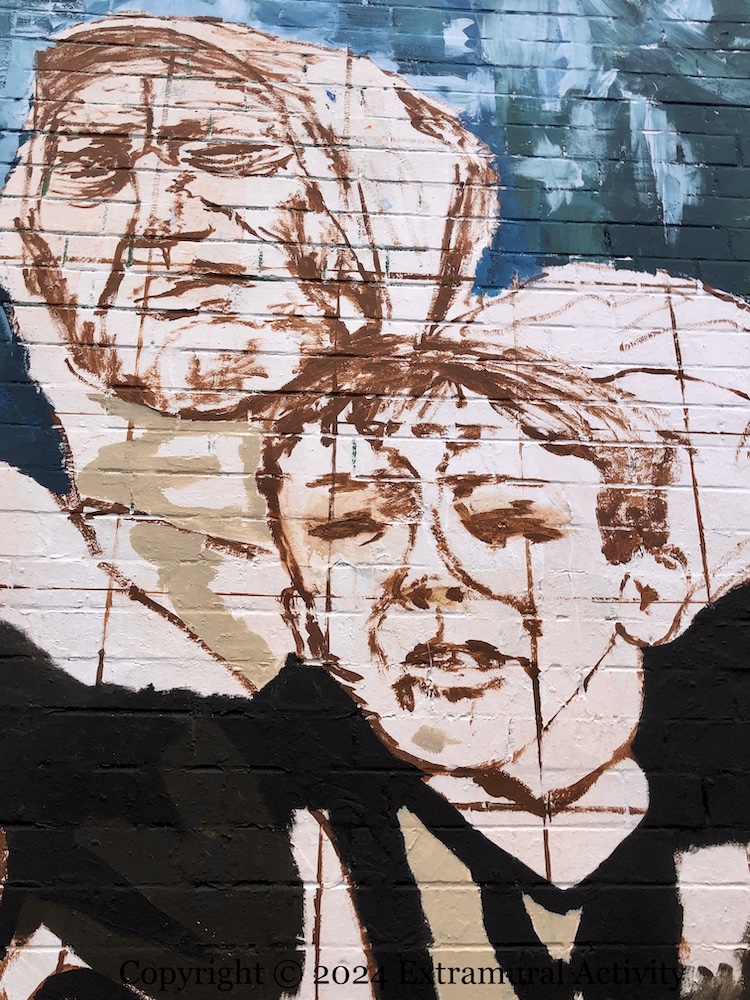
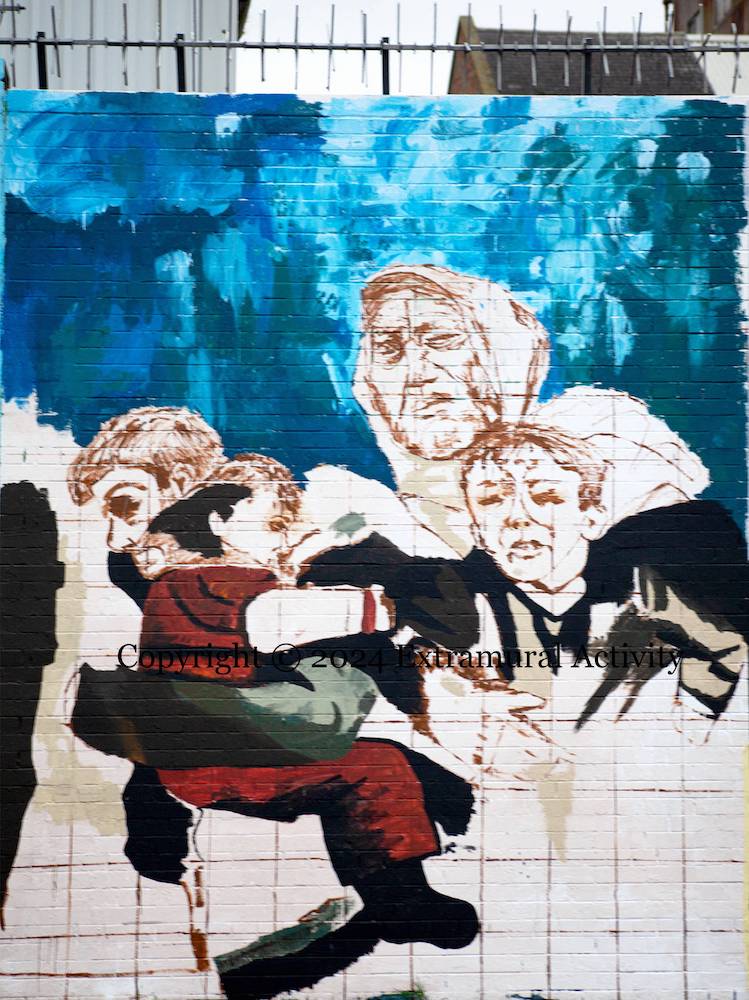
Here is a completed mural from the Painting For Palestine project (Fb) on the International Wall, Divis Street, Belfast, showing a man holding an injured child against a backdrop of razed buildings in Gaza. It is now 125 days since Israel began its war on Gaza in response to the Hamas attacks on October 7th and images of parents carrying their dead and injured children, and of the devastation of Gaza’s buildings, are now all too common – here is an Al Jazeera gallery from December.
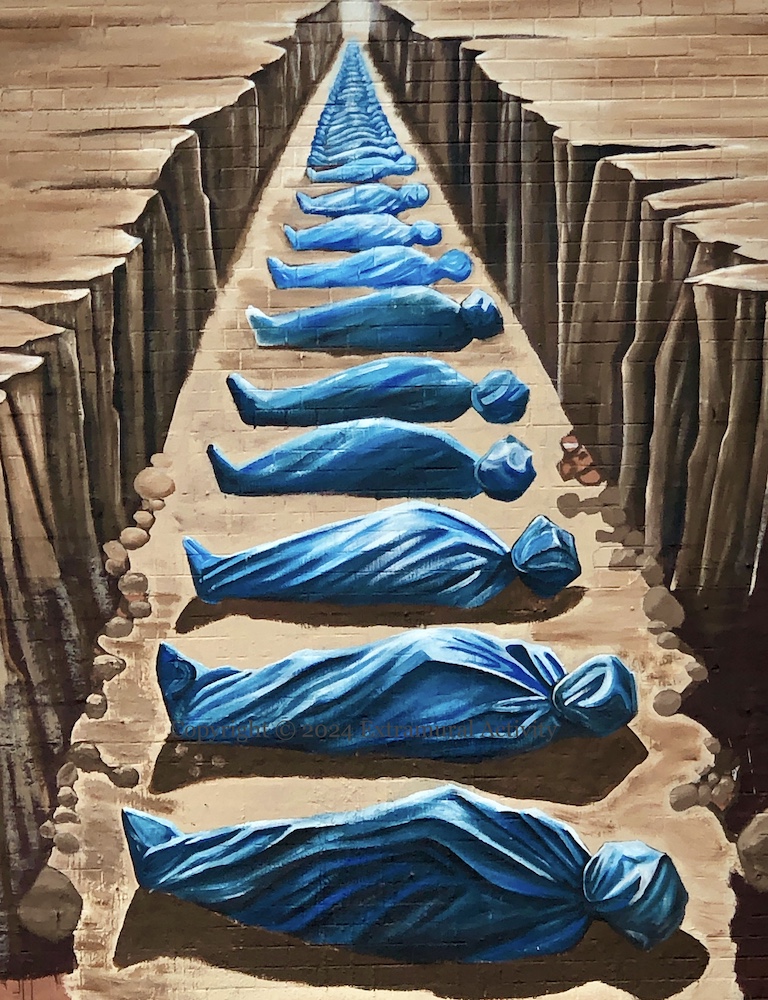
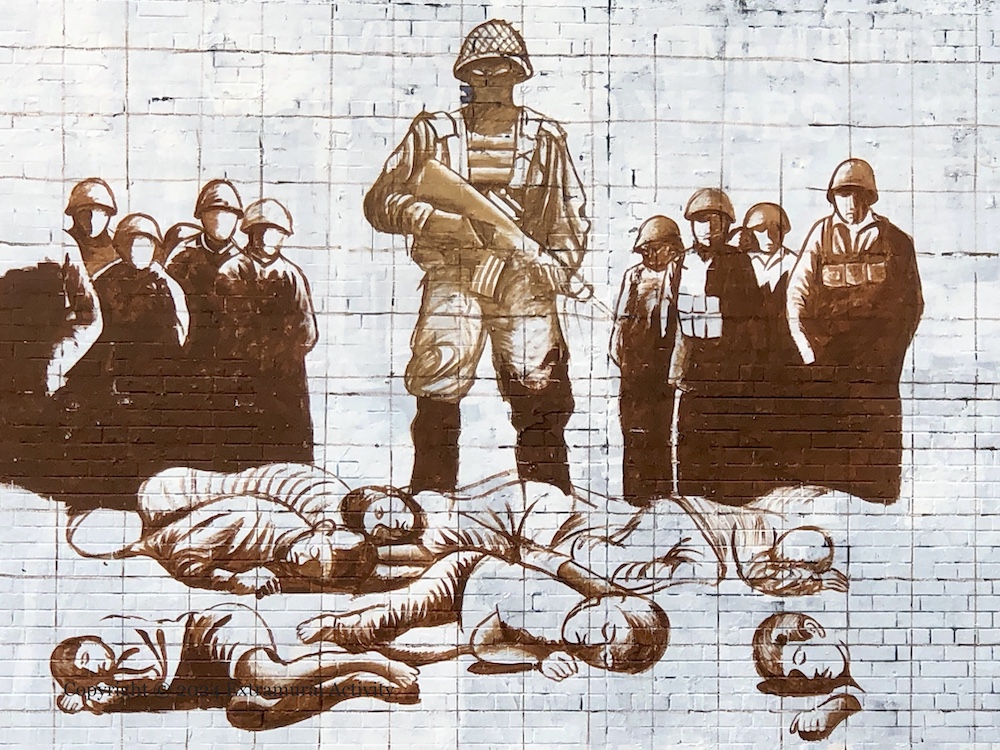
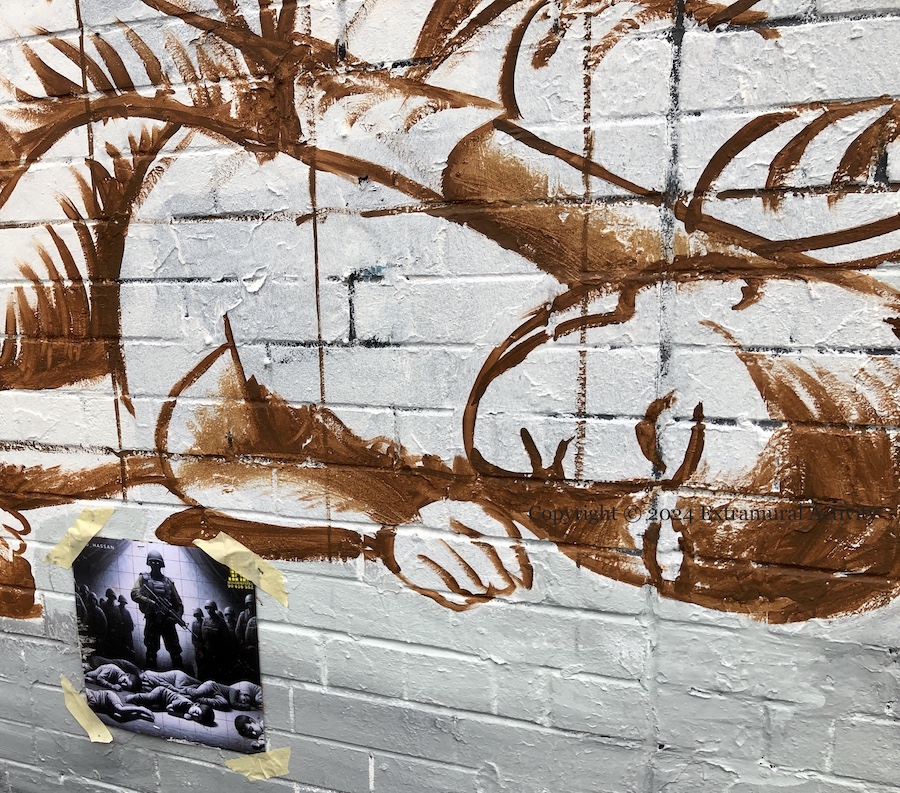
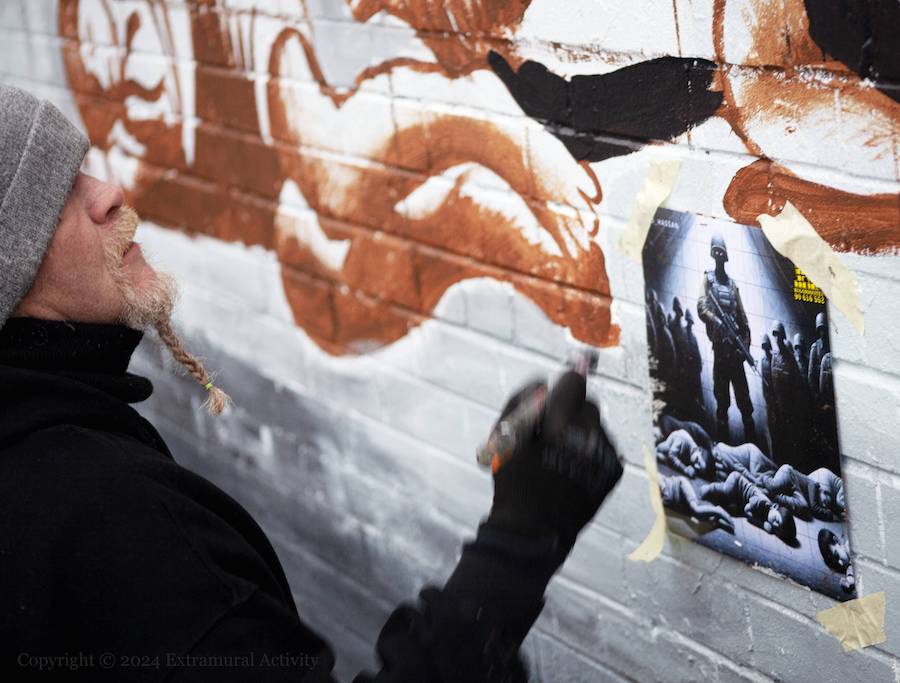
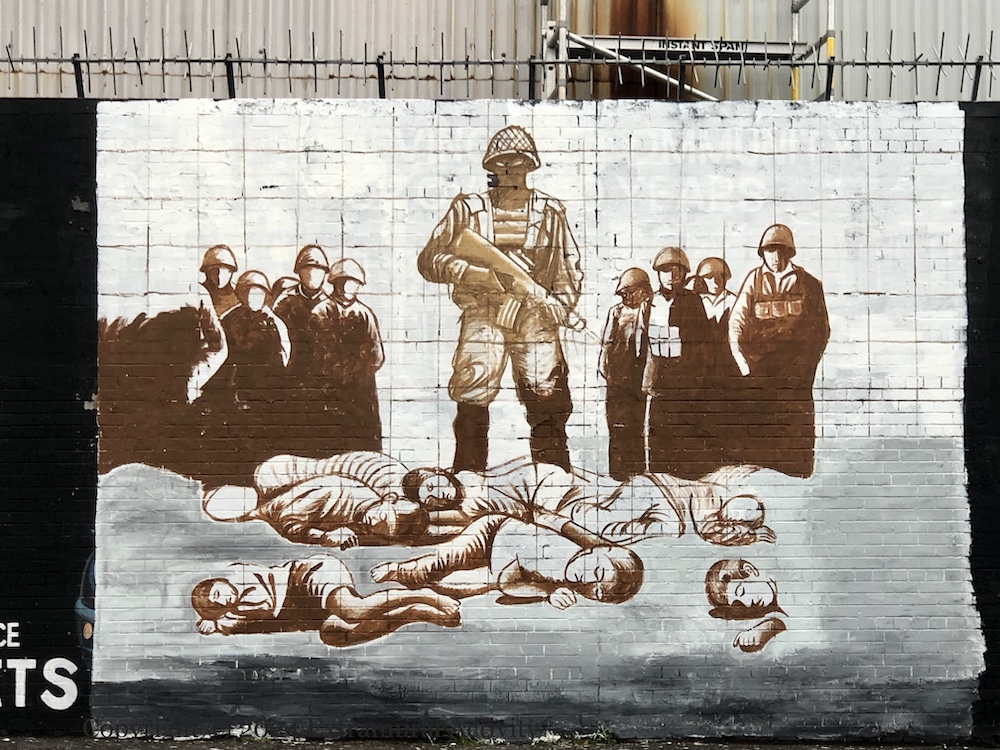
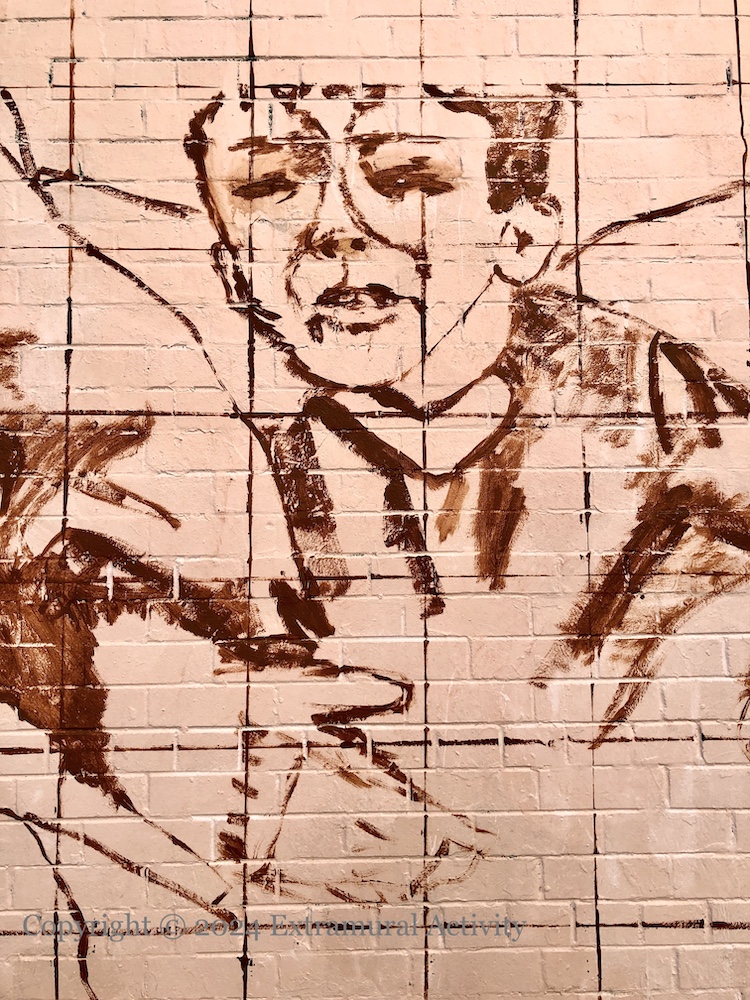
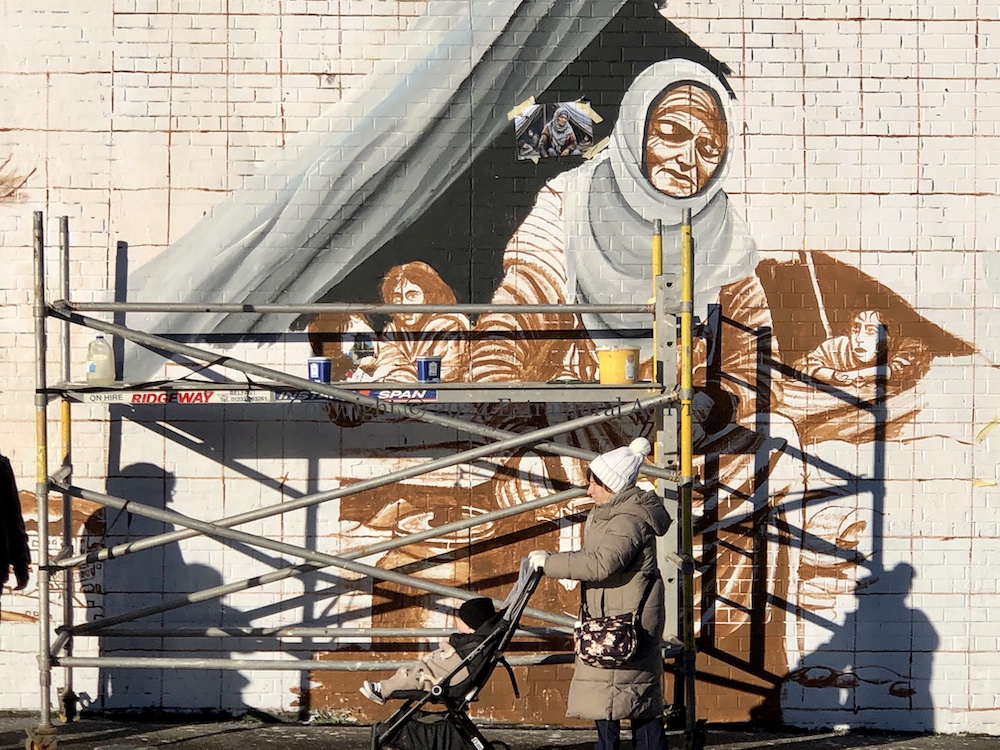
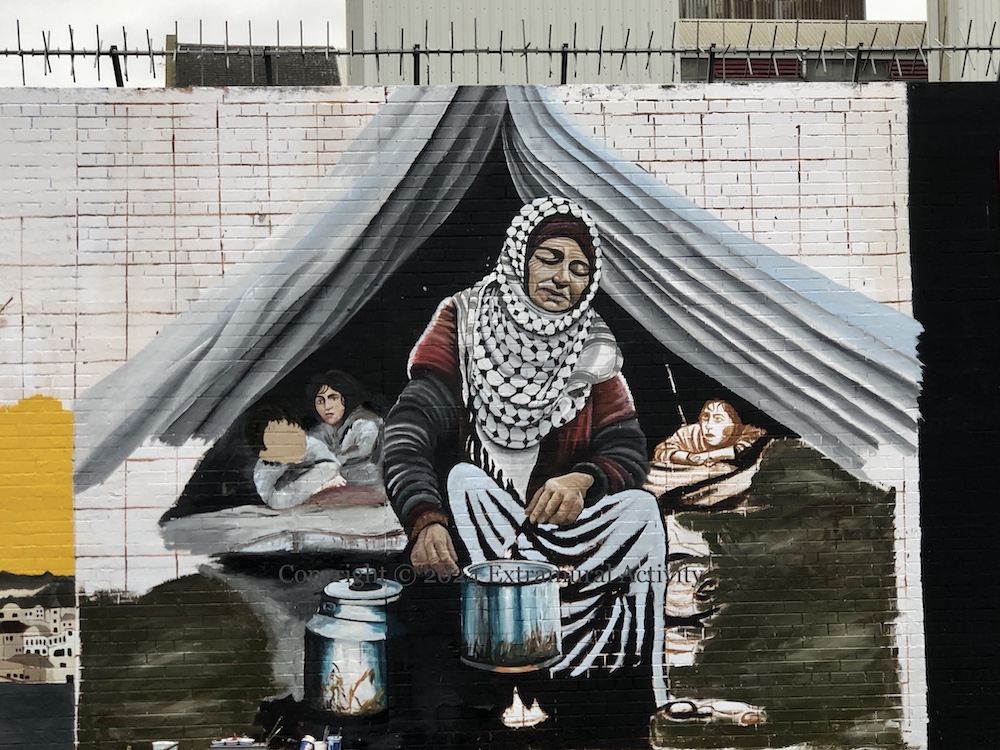
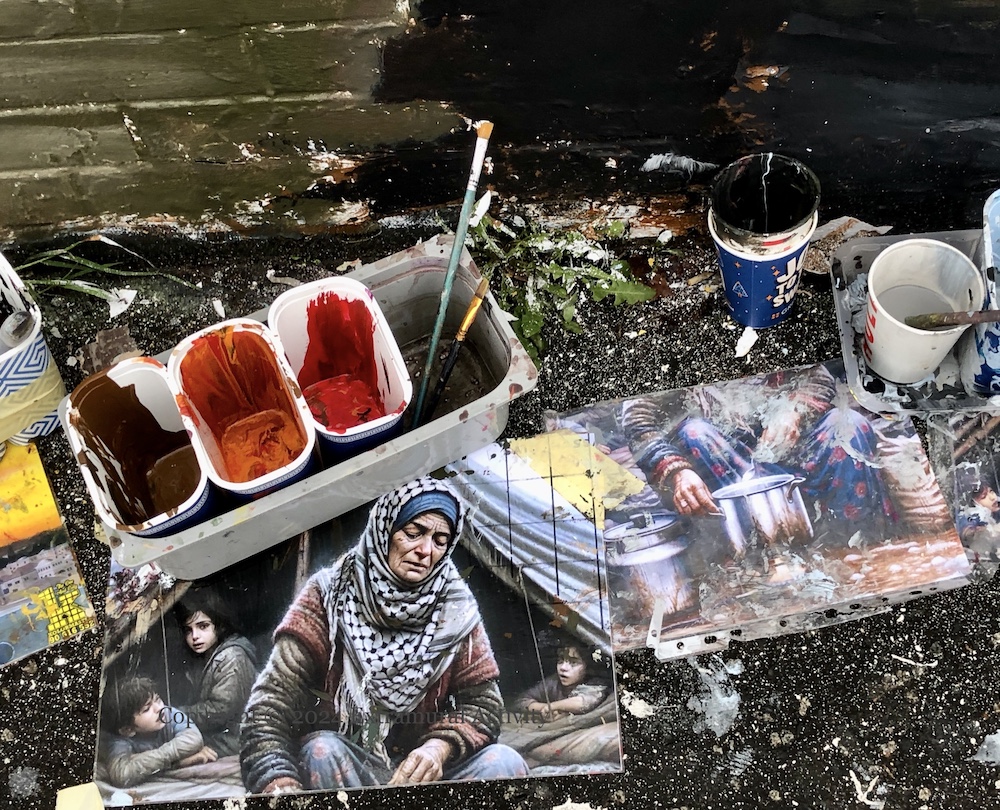
This entry chronicles (in reverse order/from latest to earliest) the painting of one of Saïd Hassan’s (ig) contributions to the Painting For Palestine (Fb) project that is currently transforming the International Wall on Divis Street in west Belfast. The piece appears to be inspired by the mass grave in Khan Younis (in the Gaza Strip) in which more than 100 corpses were buried in November (Al Jazeera video | Reuters gallery).
Hassan’s instagram post of his original artwork cites a few lines from Palestinian author Ghassan Kanafani (WP): “Let’s plant them as our martyrs in the womb of this soil thickened with bleeding … there is always room in the ground for another martyr.”
In January 2024, in response to the prolonged Israeli attack on Gaza, many murals on the “International Wall” on Divis Street were painted out and work began on reproductions of artworks by artists from Palestine and elsewhere in the region. The project was called Painting For Palestine and a Facebook page and GoFundMe page were launched.
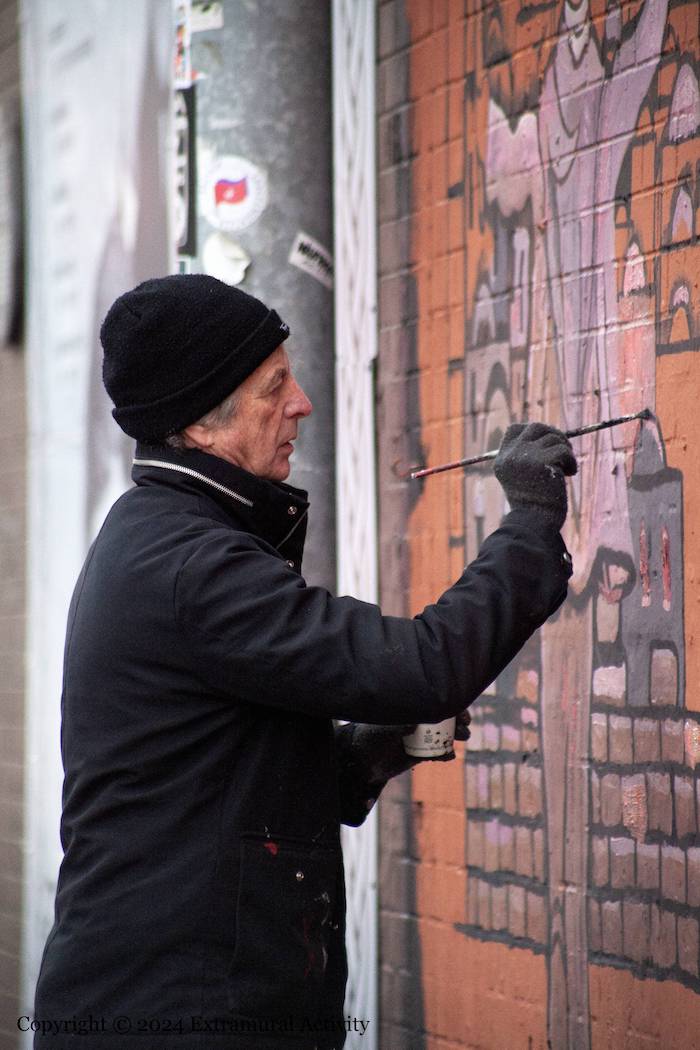
According to Bill Rolston (Fb) (who can be seen in the second image, below), there was a plan last Autumn that Palestinian artists would create their own “international wall” and include murals designed by CNR artists. The Hamas attack on October 7 and the subsequent Israeli invasion on Gaza – now ongoing for 108 days – put paid to that project, and instead art by Palestinian painters is being painted in Belfast in support of Palestine. (Here is an NVTv segment on the project.)
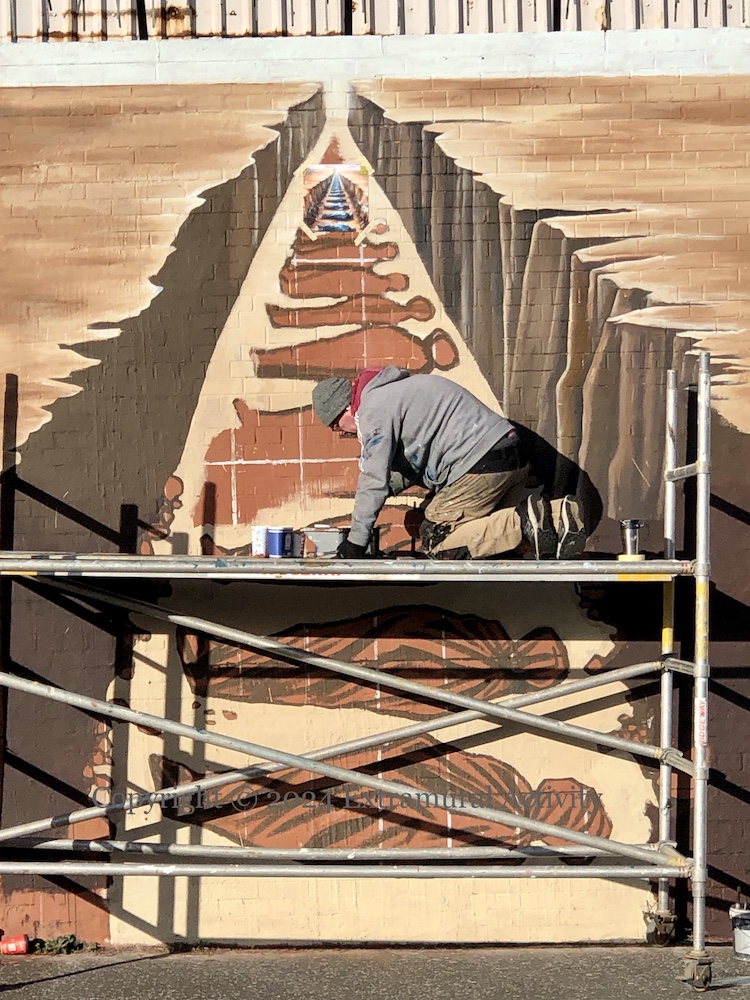
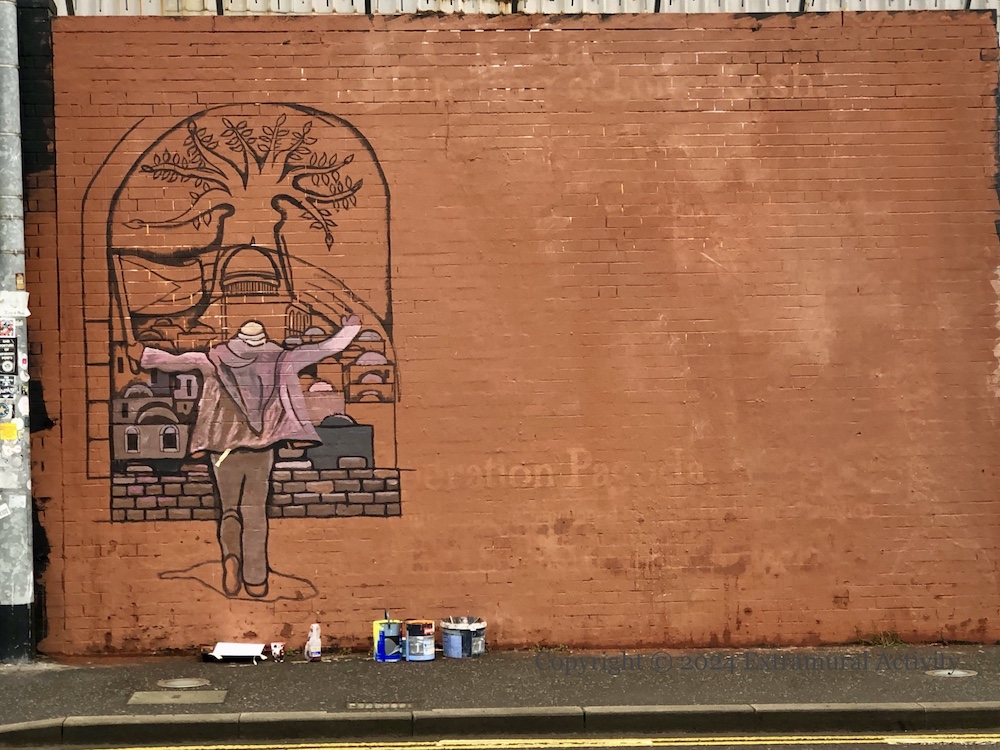
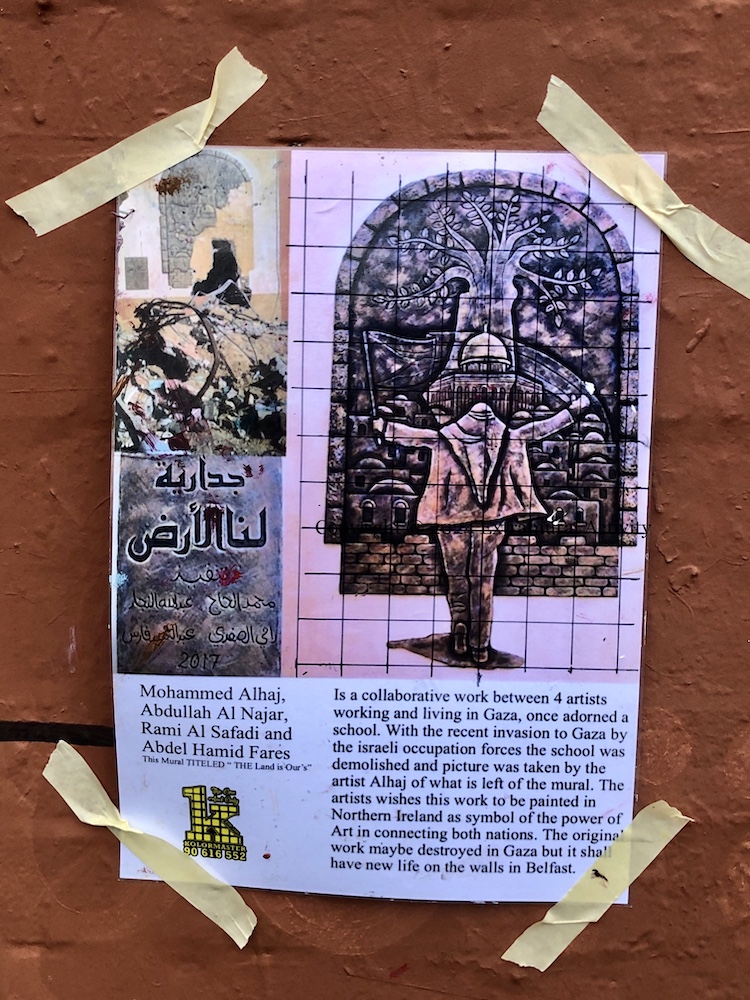
The first (left-most) panel will reproduce a mural called ‘The Land Is Ours’ by Mohammed Alhaj, Abdullah Al Najar, Rami Al Safadi, and Abdel Hamid Fares that once stood in a Gaza school; the second, next to the first, is currently blank (see the image above).
Bill Rolston working on The Land Is Ours:
The source image for The Land Is Ours:
The grid and cartoon for a mural from digital artist Saïd Hassan (web):
Another image by digital artist Saïd Hassan, showing soldiers standing over dead children:
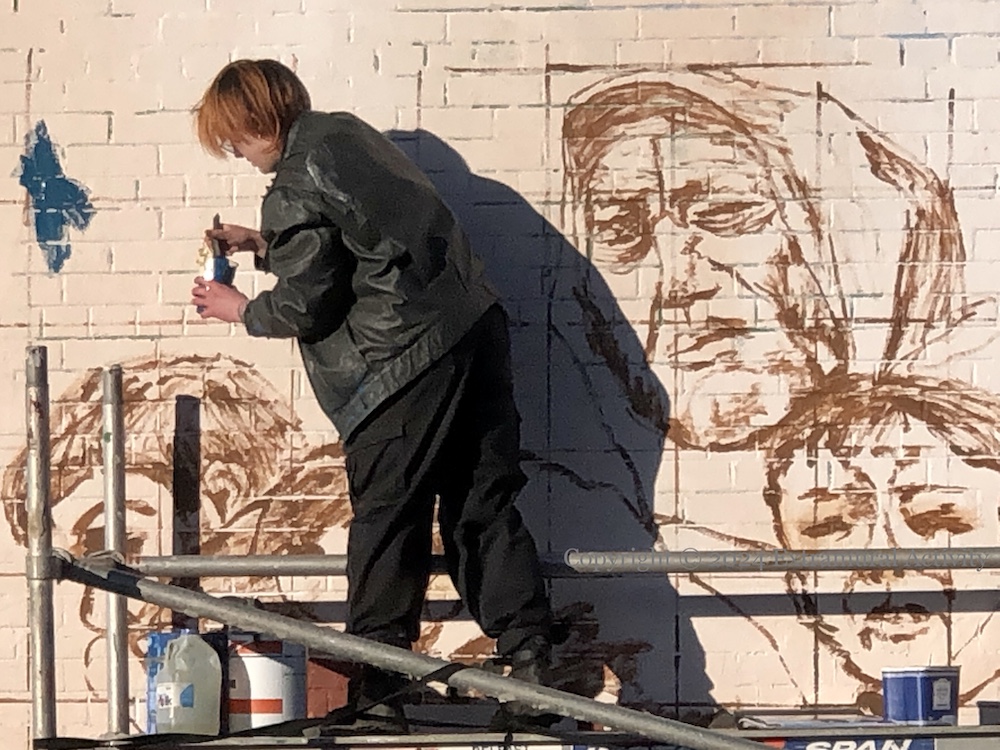
Marty Lyons at work on the mural:
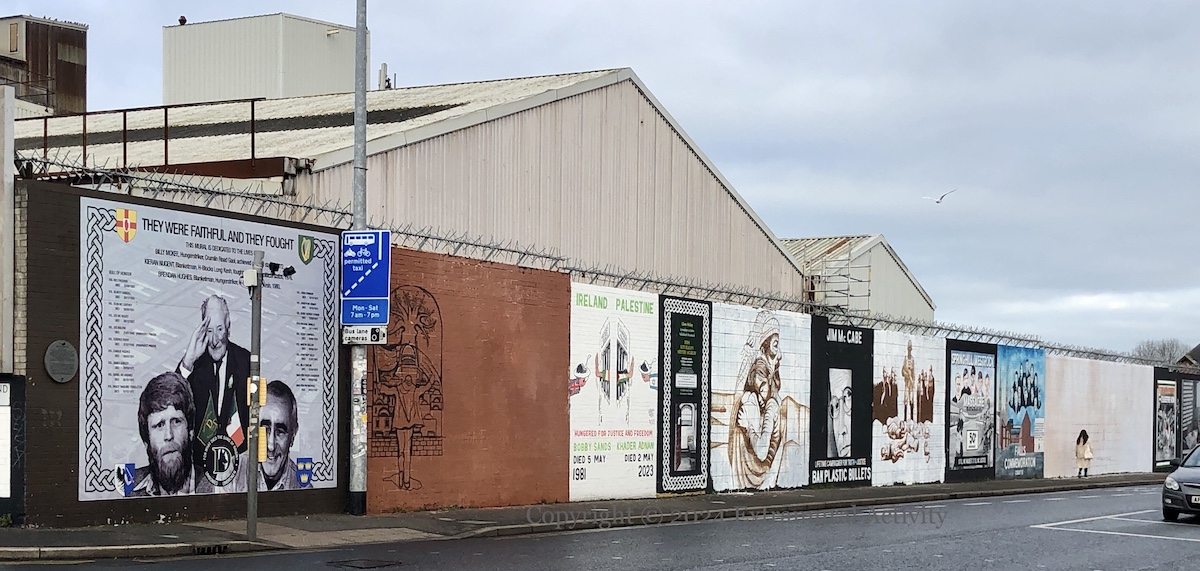
A wide shot with the left-hand side of the wall in the foreground:
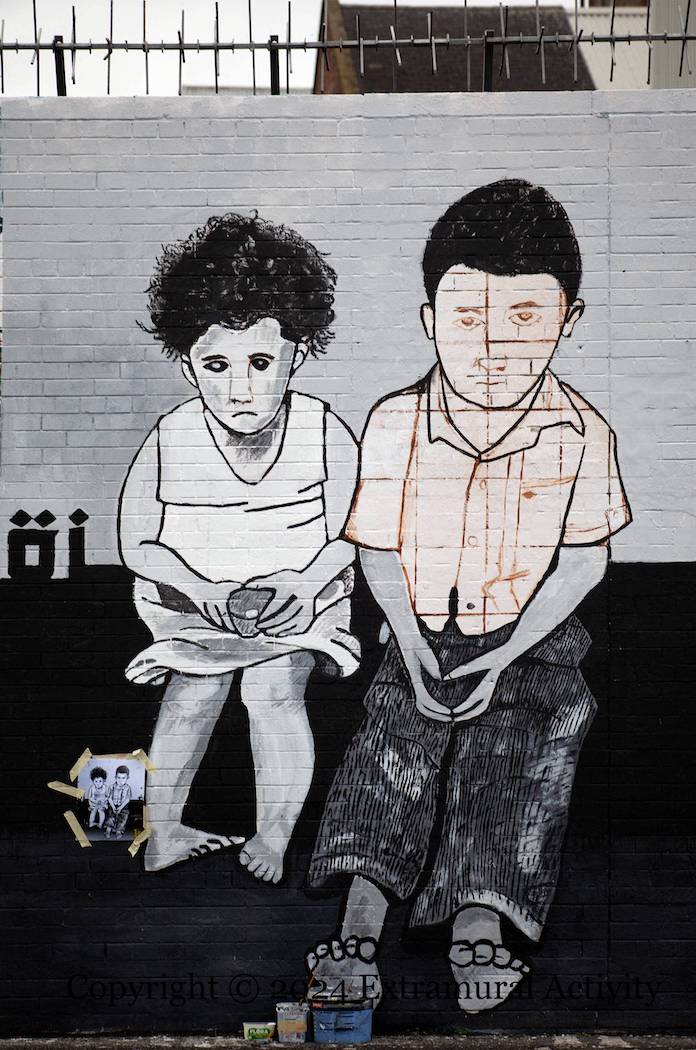
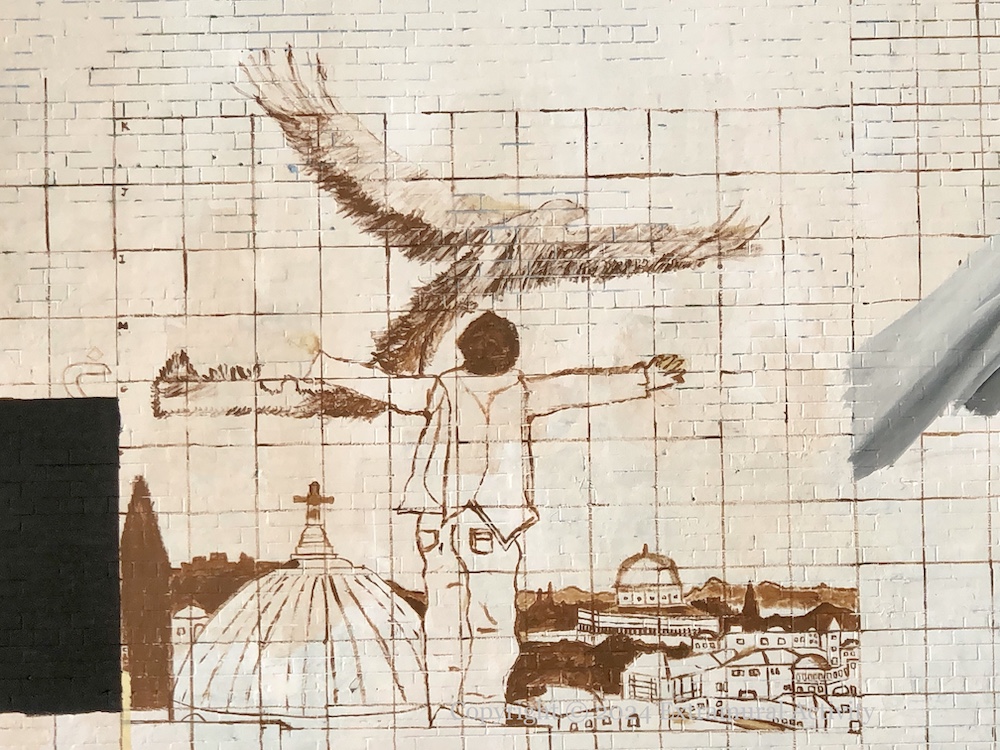
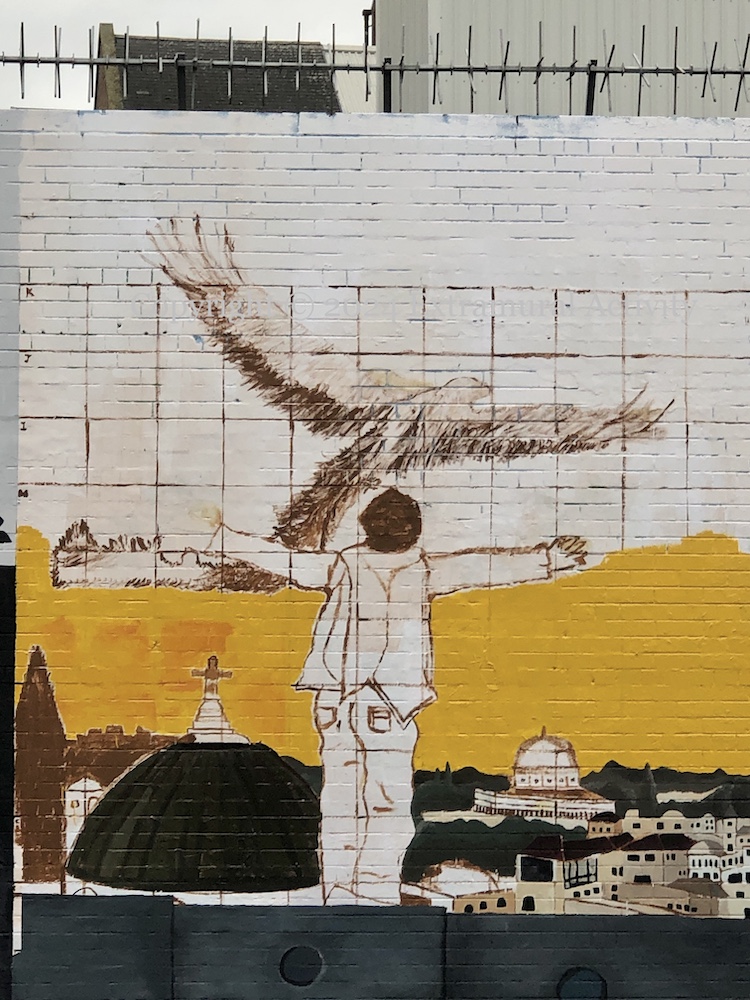
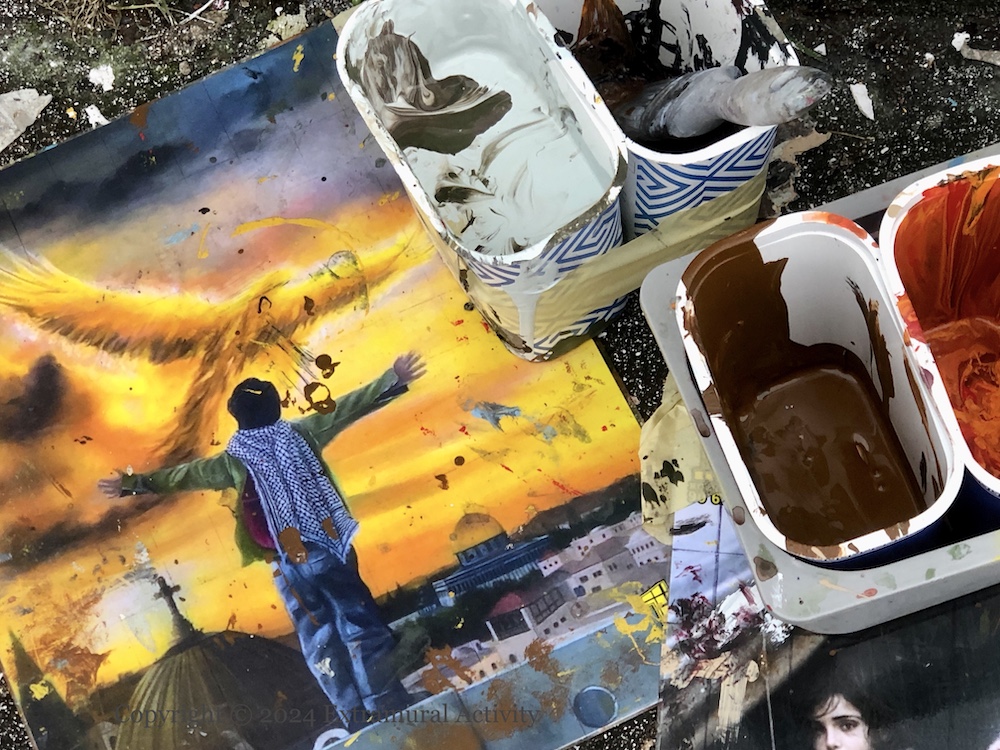
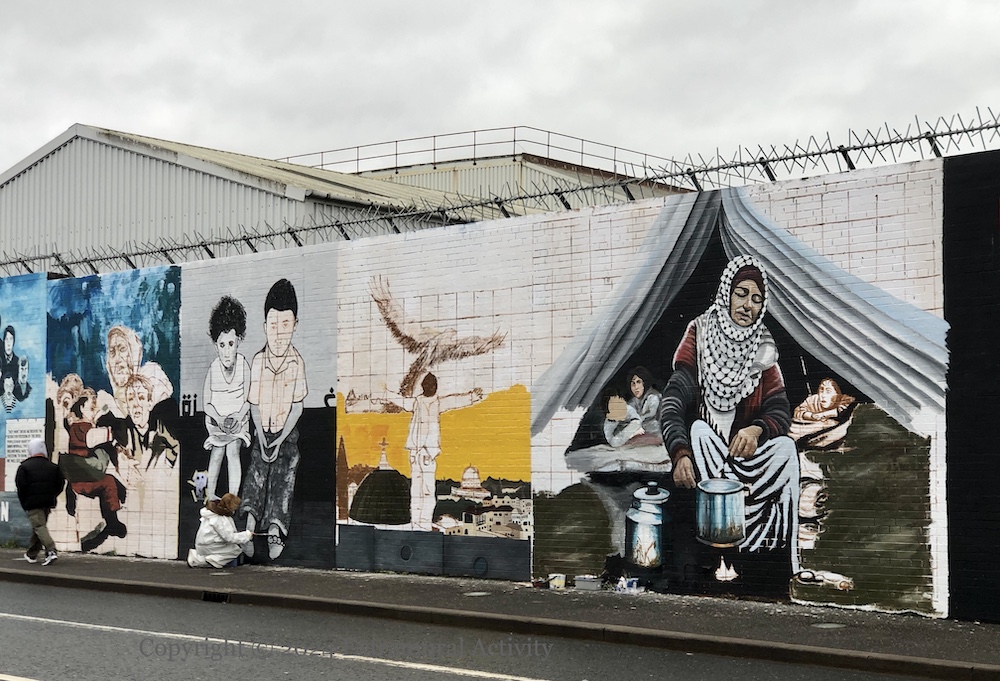
Four murals are being painted over what were previously Lenár Linn and Hunger Strikers (1916). The originals for these were designed by Ahmad Shaweesh (ig), Raed Qatanani (ig), ? [please get in touch], and Saïd Hassan (web).
Shaweesh’s piece is a deliberately unfinished image of a group of people, perhaps a family, in distress.
Qatanani’s image is a portrait of Soso and Omar Ashour as they sat in a Gaza hospital during the first week of the Israeli invasion.
The original artist of this figure with a phoenix is unknown.
The last of these four murals is by Hassan and shows a woman cooking over an open fire in front of a tent in a refugee camp.
January 17th:
January 20th:
Wide shot of the four pieces on the right-hand side:
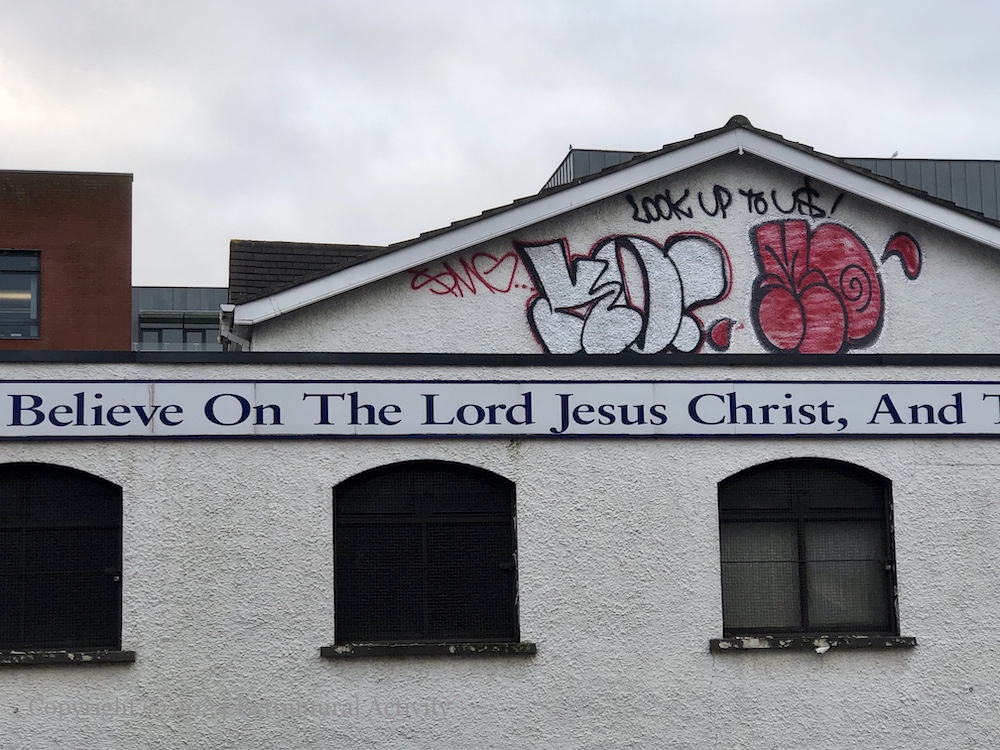
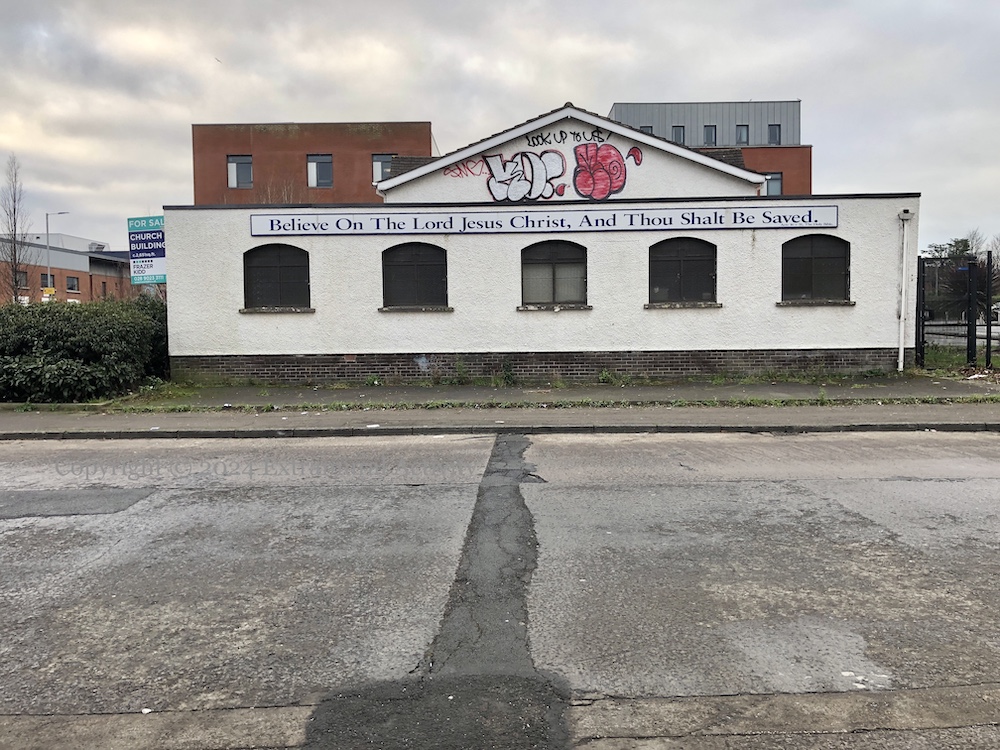
Sale has been agreed on the Shankill Gospel Hall (according to PropertyPal though not agents Frazer Kidd). High on the to-do list of the new owners will be removing the false gods in the apex on the Shankill Parade side.
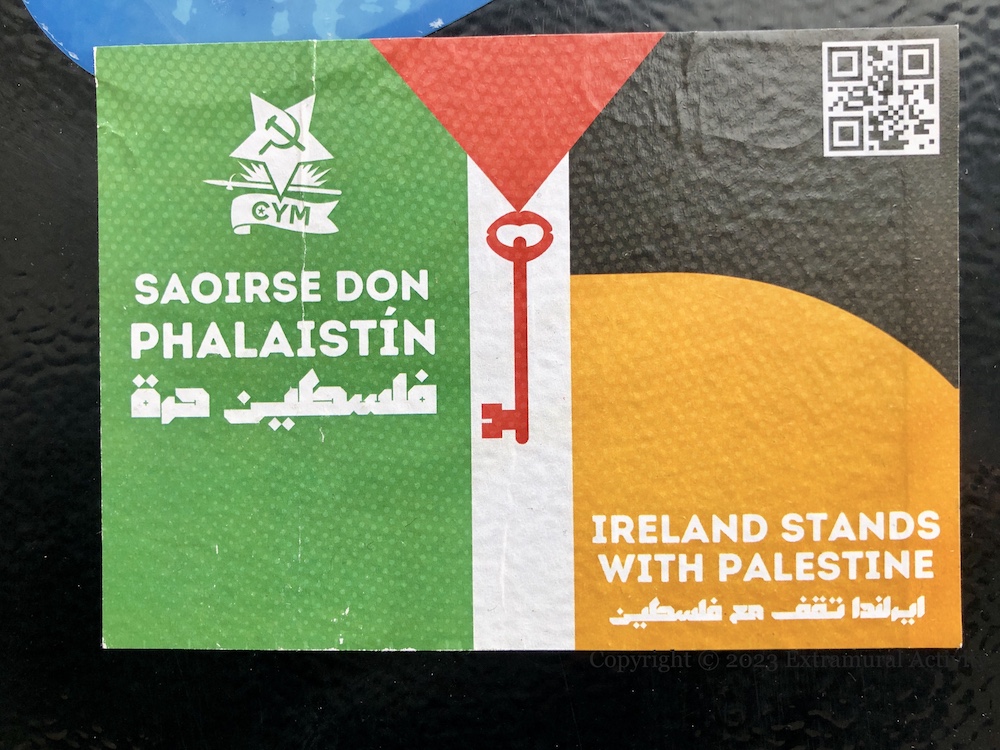
“Saoırse don Phalaıstín [freedom for Palestine]/فلسطين حرة [free Palestine]” and “Ireland stands with Palestine/ايرلندا تقف مع فلسطين” – CYM [Connolly Youth Movement (web)] sticker with a mash-up of the Palestinian and Irish flags and a key that represents the keys that about 700,000 Palestinian householders took with them when they fled their homes in the Nakba of 1948.
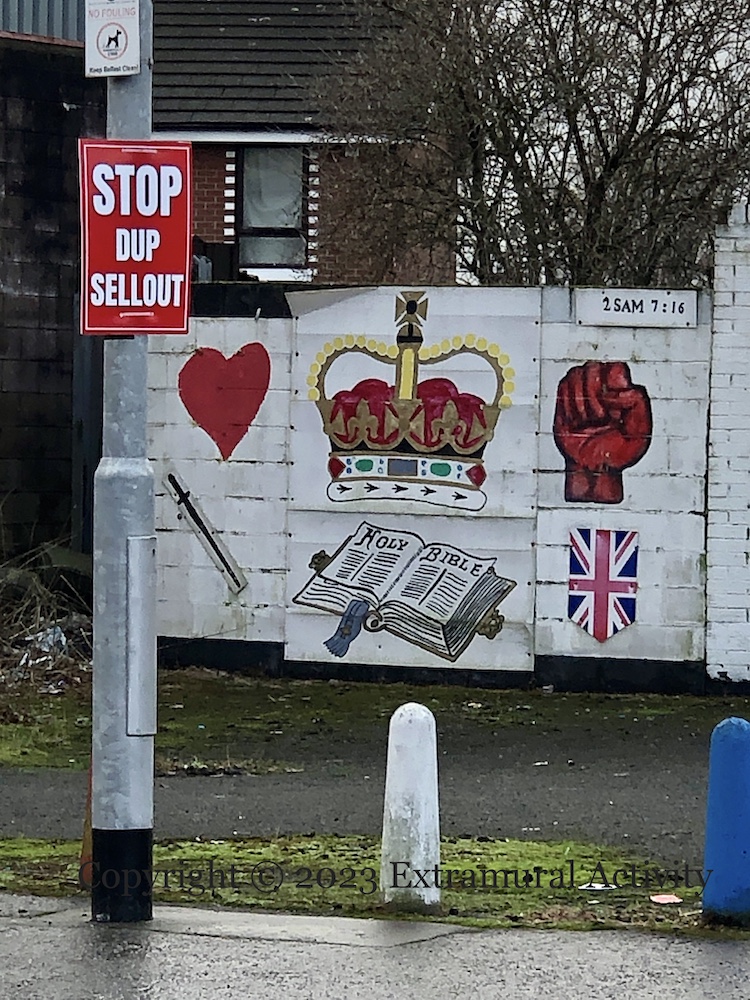
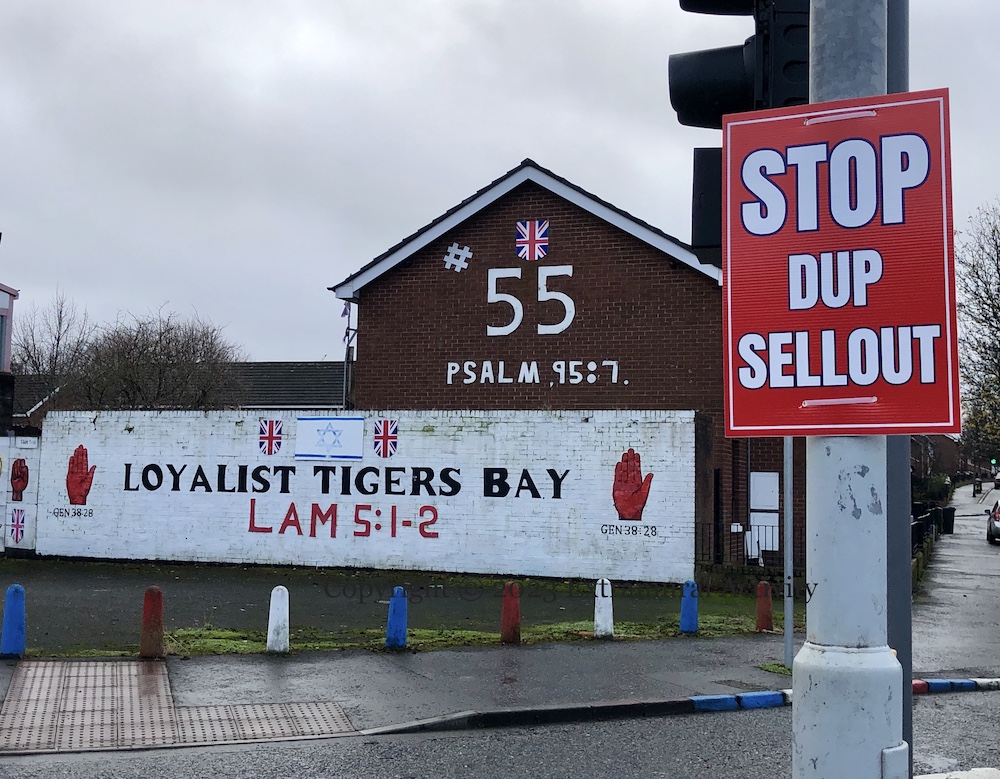
TUV (Traditional Unionist Voice) has put up placards attacking the DUP (Democratic Unionist Party) – including outside the office of DUP leader Jeffrey Donaldson – in response to the possibility that the DUP might re-enter Stormont – which has been defunct now for two years – and implement the NI Protocol (BBC | BelTel).
It hasn’t happened yet, but a combination of public dissatisfaction concerning inaction over strikes by transport workers on December 22 and a general strike planned for January 18 (ITv)) and a financial package for pay awards are keeping the pressure on (Shropshire Star).
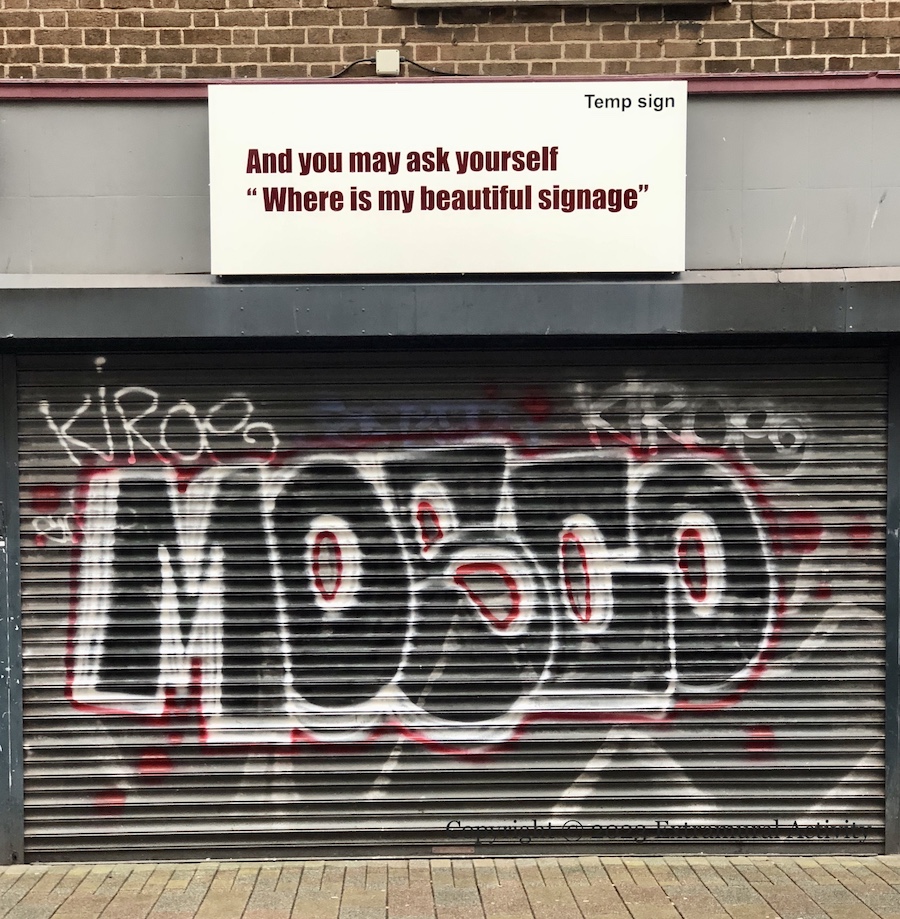
The Clements coffee shops in Belfast city centre closed in October, leaving only the two at Queen’s and UUJ (BelTel).
The abandonment of the Rosemary Street shop provides a space for art (see Visual History 11 on the rise of street art); replacing the Clements signage there is a “temp sign”: “And you may ask yourself, “Where is my beautiful signage[?]””.
Is this a plea for the return of Clements – a local chain – or investment in the city centre and a new business? Or perhaps it is meant ironically, as a protest against capitalism – the line is a modification of a lyric from the Talking Heads song ‘Once In A Lifetime’ (Stop Making Sense | Remain In Light), which describes a moment of awakening for the middle-aged and middle-classed: “How did I get here?”
On the permanently-closed shutters is a different kind of beautiful signage, a MOSCO throw-up.
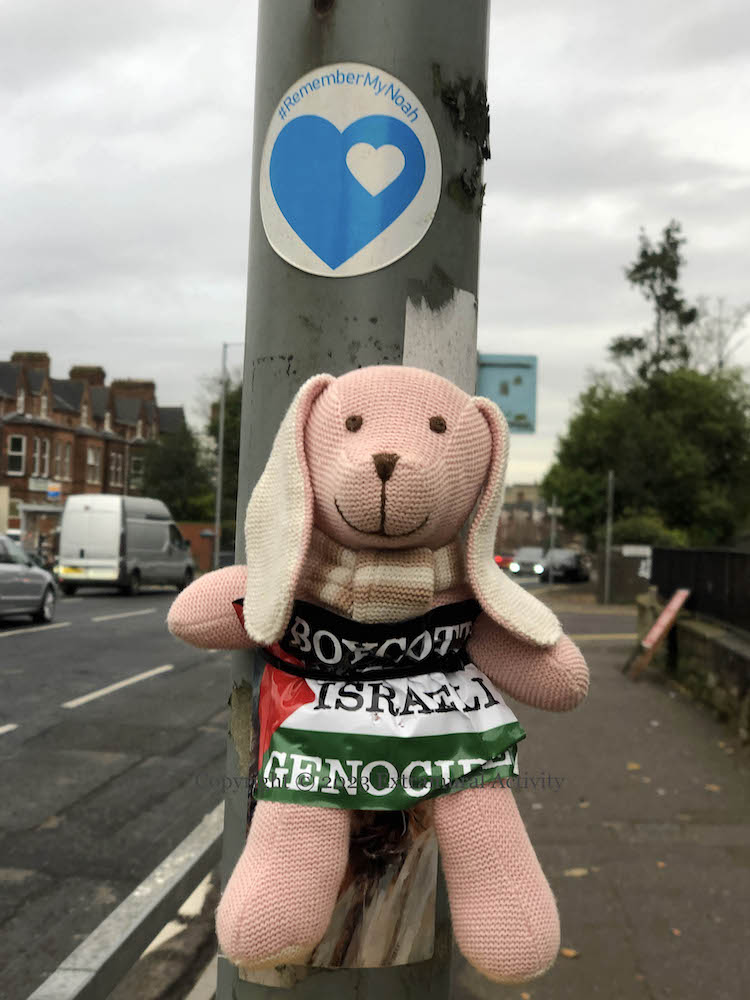
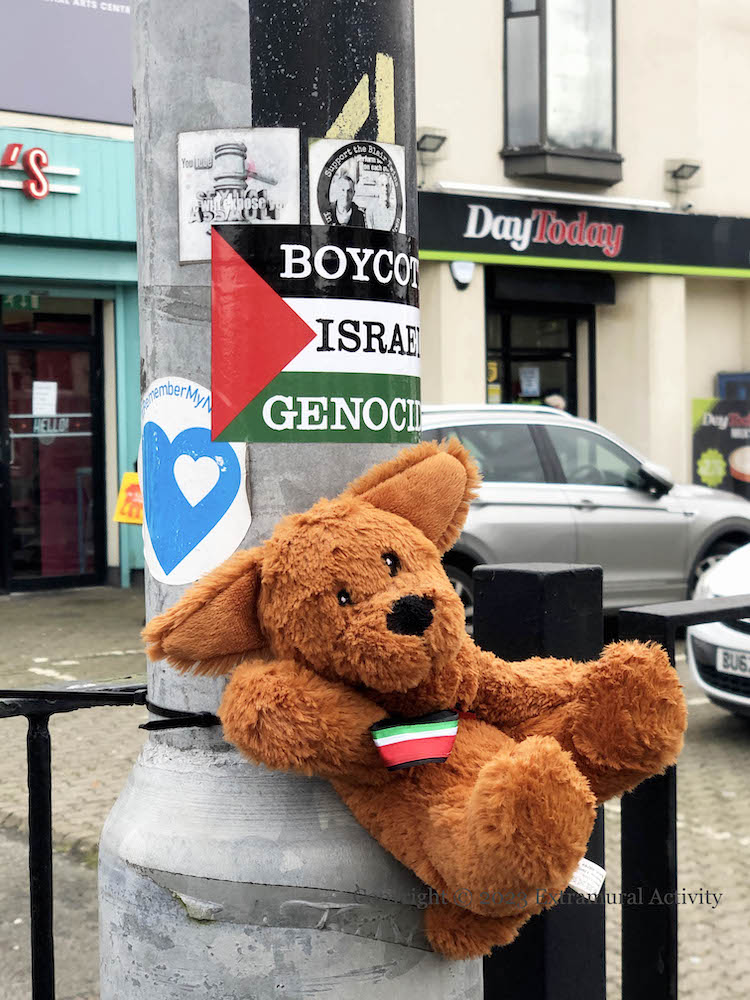
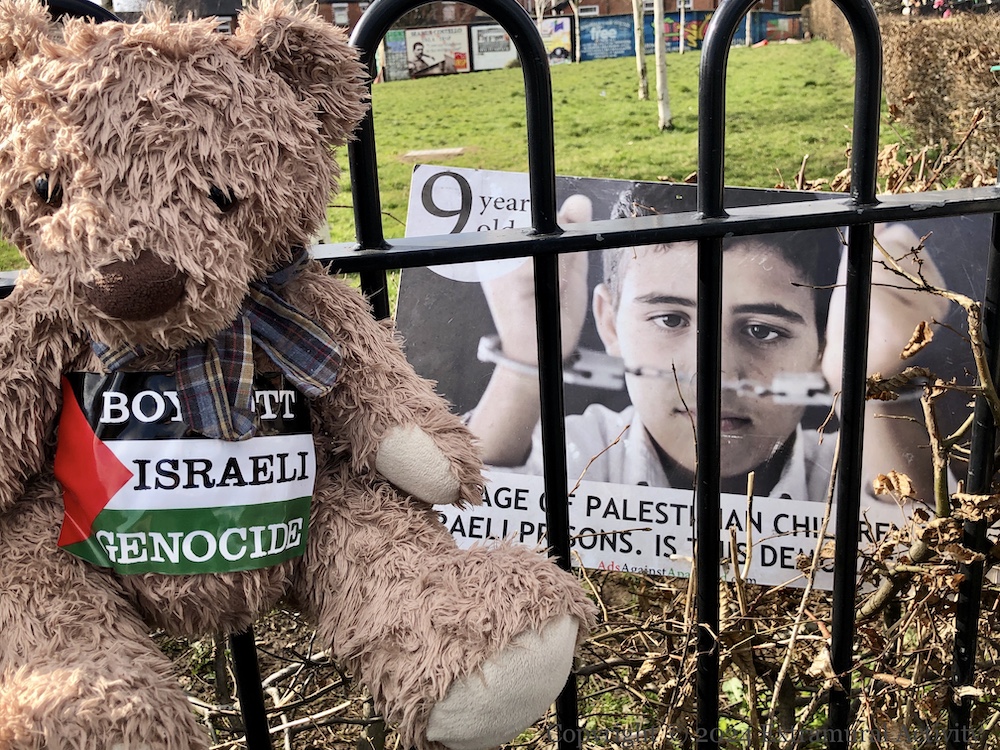
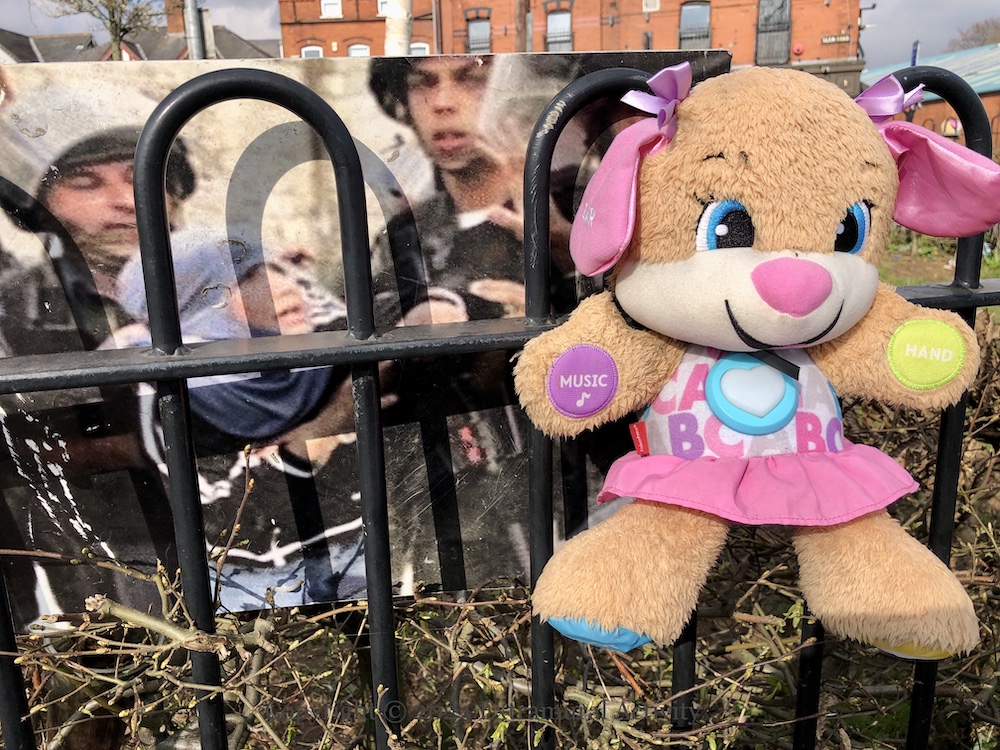
The UN Security Council last night passed resolution 2712 (UN), calling for extended humanitarian pauses in Israel’s assult on Gaza. The resolution was proposed by Malta, who wrote the resolution to focus on the plight of children. Today’s images show a selection of the teddy bears and other soft toys that have been placed on fences and lamp-posts in CNR west Belfast in memory of the children who have been killed in Gaza. It is estimated that a child dies in Gaza every 10 minutes (Reuters) and that 4,600 children have died so far (UN).
 Seosamh Mac Coille Collection