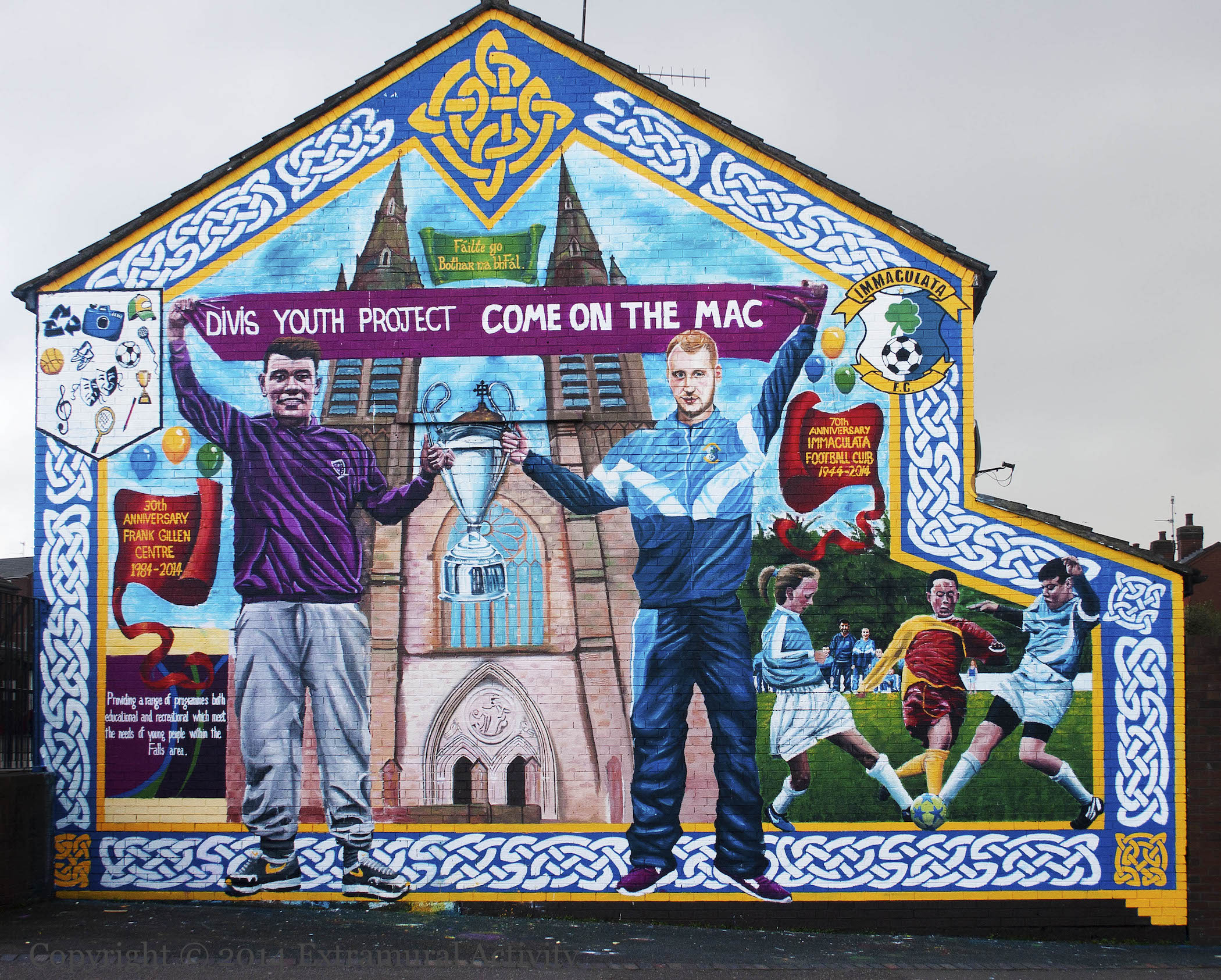
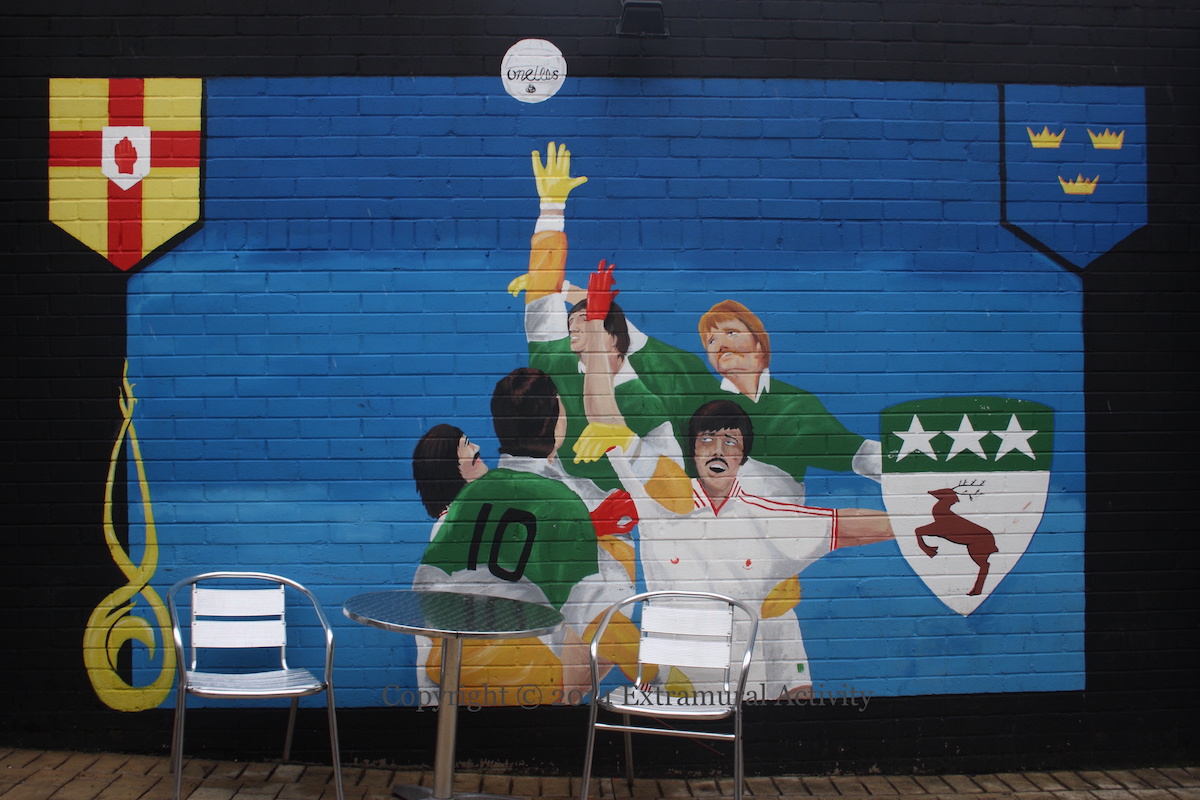
This new Albert Street mural in the lower Falls celebrates the 30th anniversary of the Frank Gillen Centre and the 70th anniversary of Immaculata Football Club. The figure on the right is current Cliftonville player Liam Boyce who grew up in the area and played for Immaculata as a youth. The team’s logo appears to the right of Boyce’s outstretched hand. (If you know the local player on the left, please leave a comment or send an e-mail.)
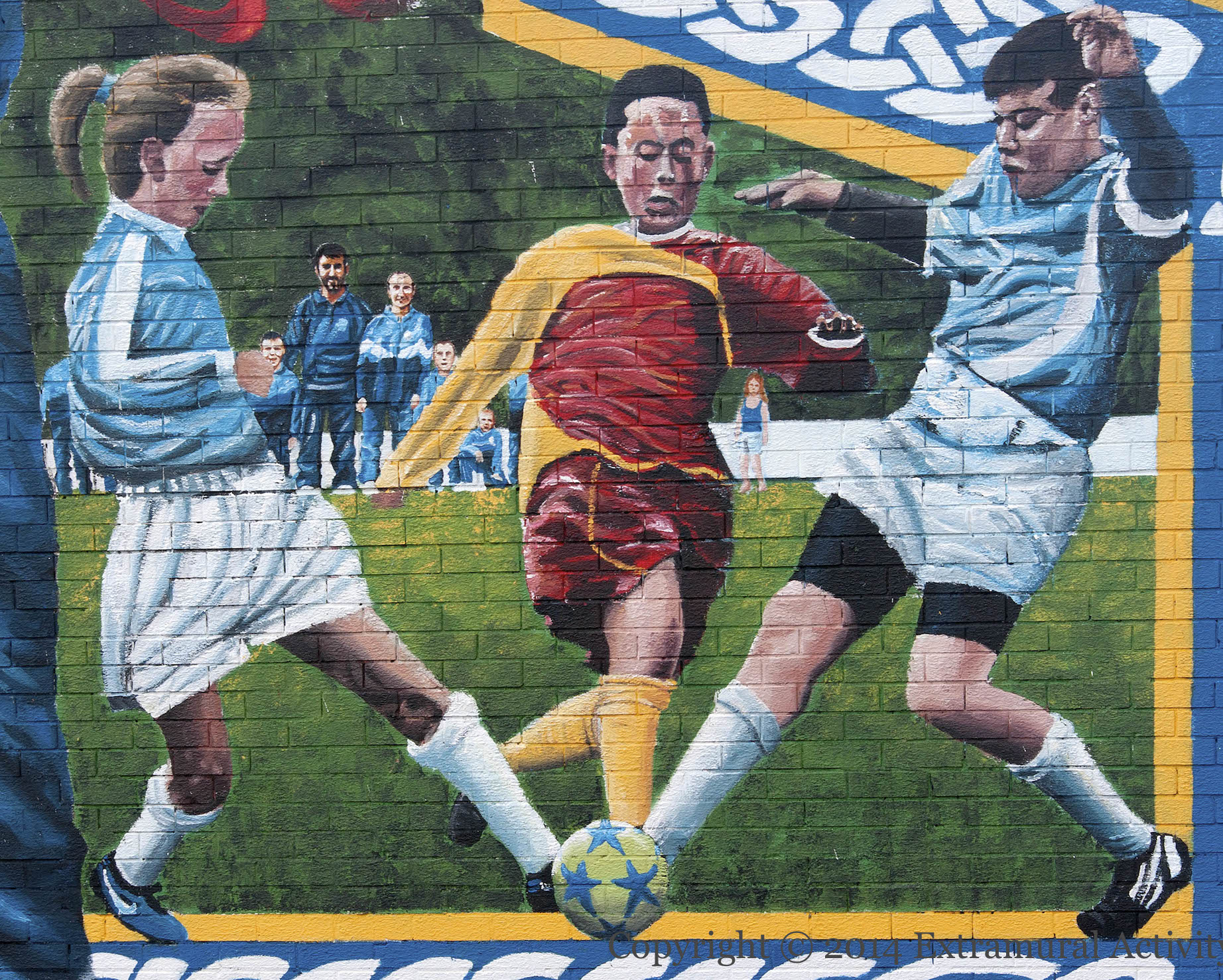
The piece was painted by Mickey Doherty and Lucas Quigley. Detail of the players in the lower right below.
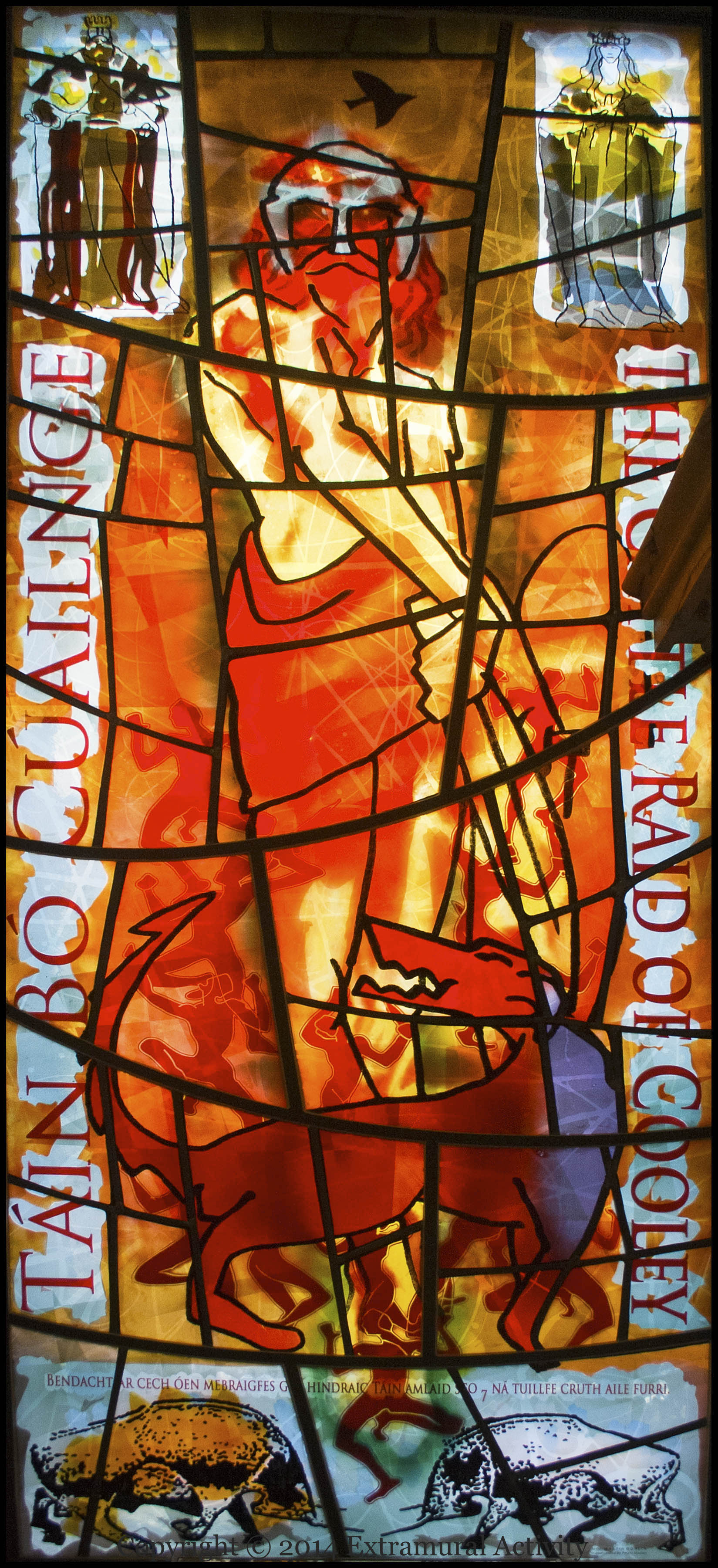
In the Cattle Raid of Cooley/Táın Bó Cúaılnge, the hero Cú Chulaınn, the main figure in the stained glass above, single-handedly defends Ulster by engaging in series of Queen Medb’s men in hand-to-hand combat as they attempt to secure the famous Ulster bull, which Medb wants in order to match her husband in possessions. Cú Chulaınn is eventually vanquished and the bull taken but, as can be seen at the bottom of the glass, the bulls fight each other and both die.
The piece is by Martin Donlin from East Sussex (pictured here at the unveiling in March 2012). According to Donlin’s Fb page, the old Irish at the bottom (“bendachtar cech óen mebraıgfes go hındraıc táın amlaıd seo ‘s ná tuıllfe cruth aıle furrı”) can be translated as “a blessing be upon all such as faithfully keep the Táın in memory as it stands here and shall not add any other form to it”. Here is a Flickr set of the piece in development.
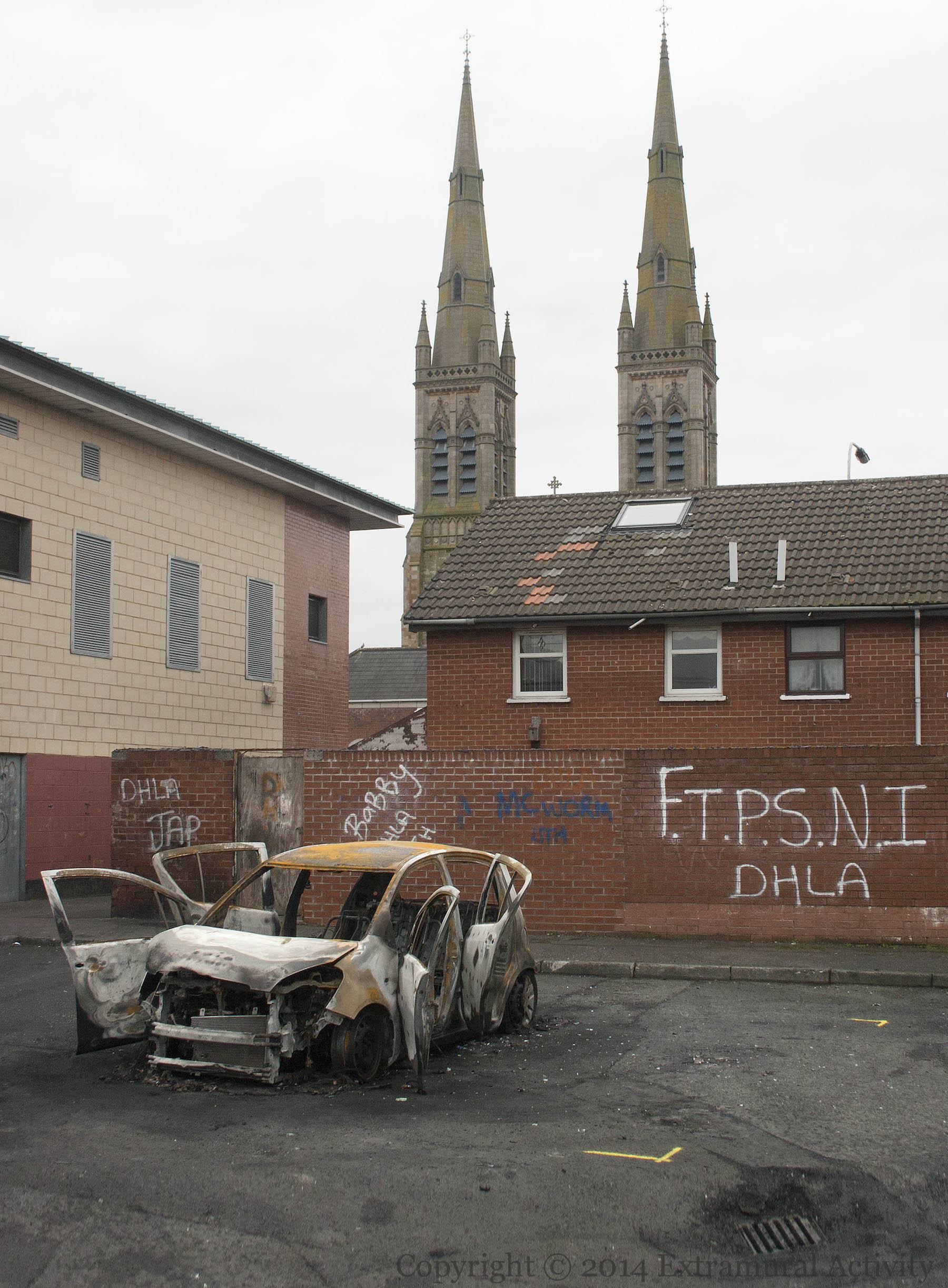
A burnt-out car in the shadow of St. Peter’s cathedral and at the back of the Maureen Sheehan Health Centre, just off Albert Street, which is infamous for “DHLA” (Divis Hoods Liberation Army) joyriding. The new murals in the area (such as Our Youth, Our Future) are part of an intervention project to improve it.
2014-12 update: there has been an upsurge in carjackings in late 2014 (BelTel).
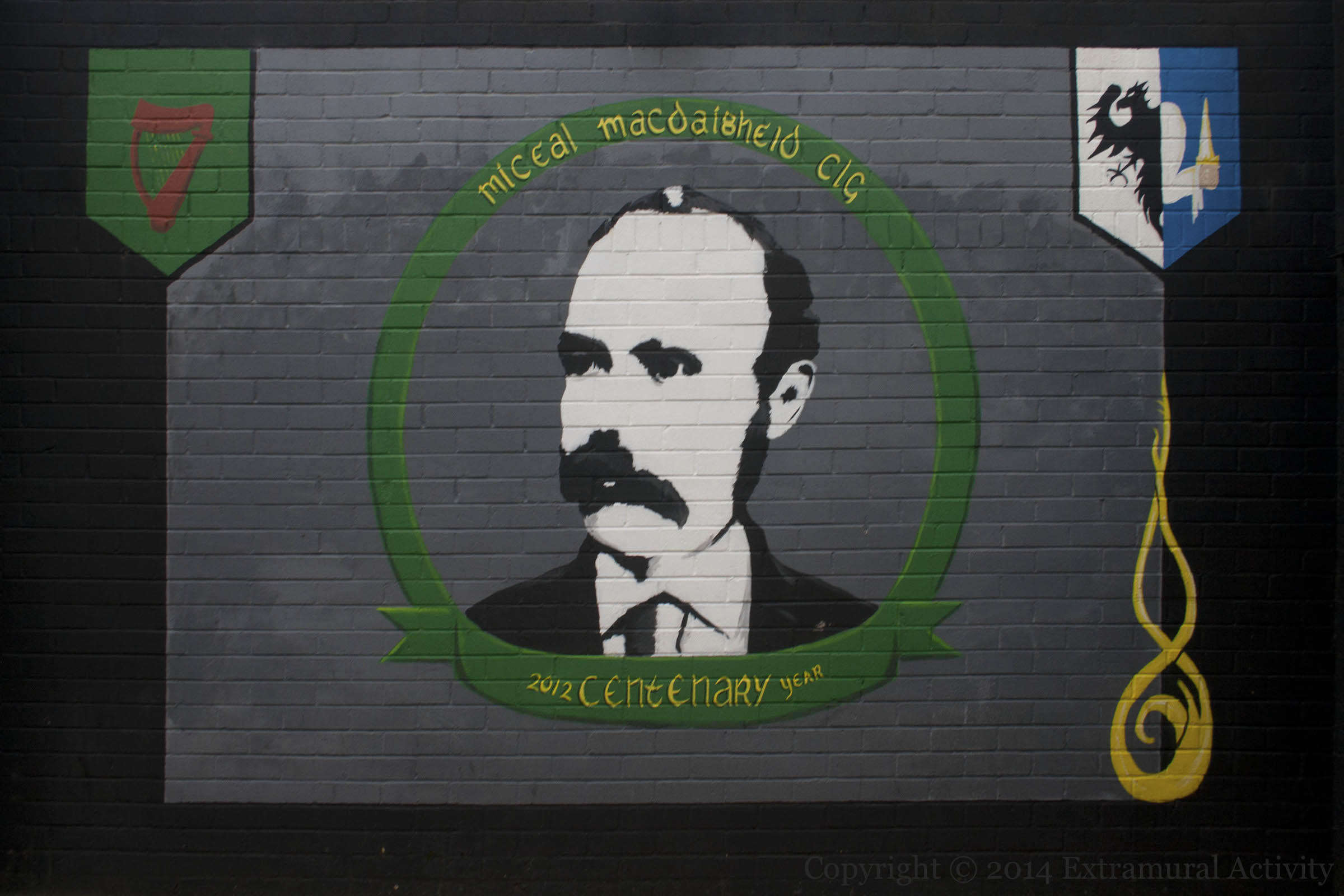
CLG Mac Daıbhéıd/Davitt’s GAA club is named for Mícheál Mac Daıbhéad/Michael Davitt, famous for leading the Irish Republican Brotherhood and the Land League. Mac Daıbhéad himself had his right arm amputated at age eleven after it got caught in the cogs of a spinning machine. The murals shown here are in the grounds of the social club on Clonard Street and celebrate the centenary of the club, 1912-2012.
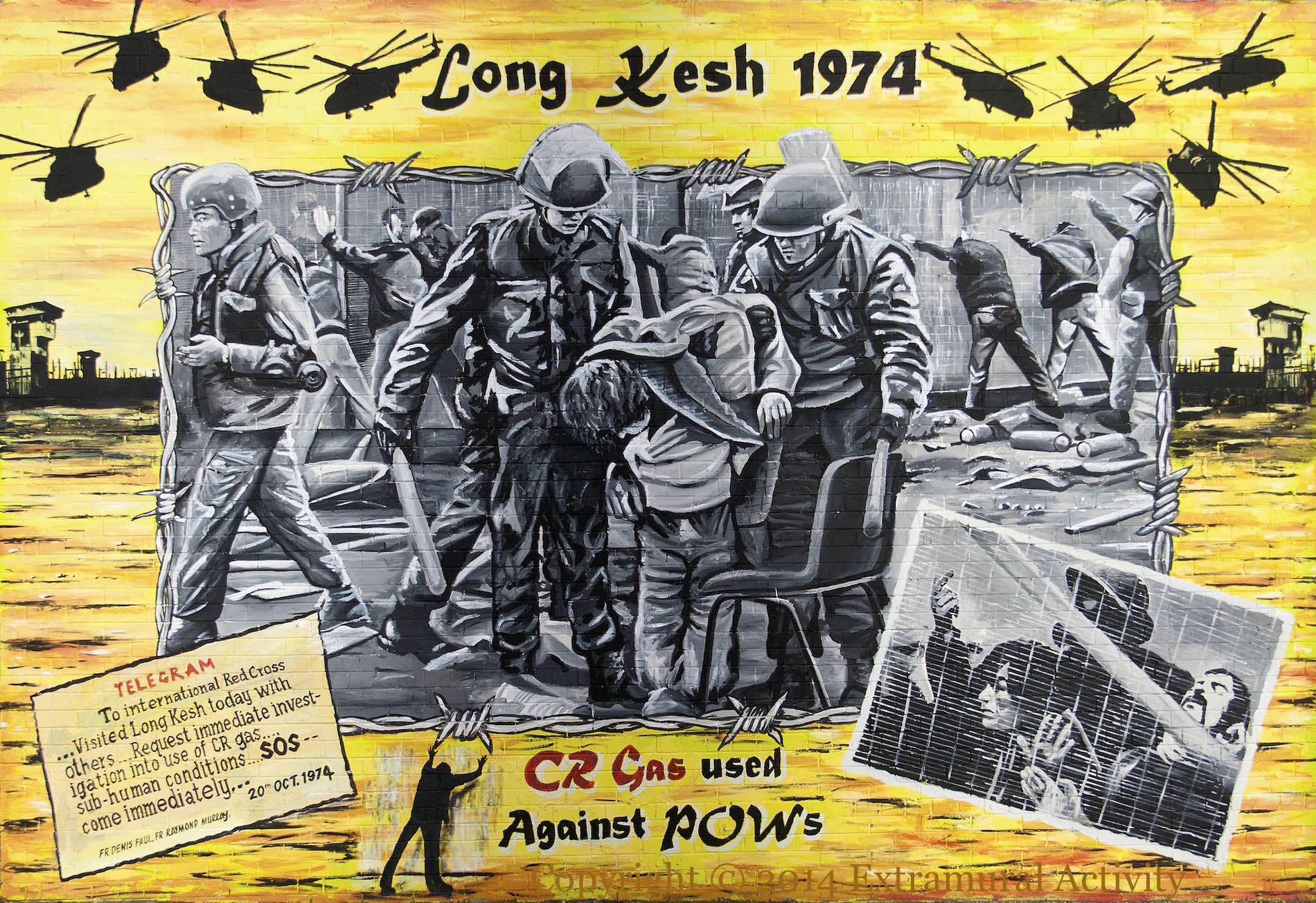
A new mural, above, on the International Wall commemorates the fortieth anniversary this year of the ‘Burning Of Long Kesh’ or the ‘Battle Of Long Kesh’, which took place on the night of October 15, 1974 and day of the 16th (when British Army units retook the camp).
The most comprehensive account available on-line of the conditions at the camp prior to the riot, the burning, and the battle on the morning of the 16th appears to be this 2004 piece in An Phoblacht by Joe Doherty and Christy Keenan. (For a virtual tour of the camp, see this video. Seamus Keenan’s Over The Wire (on again this month at the Derry Playhouse) attempts to recreate the scene.) Other accounts include those by Ronan Bennett, another inmate, in The Guardian, and by ‘Peter’, a British Army soldier, at Shared Troubles. Here is a brief BBC News report from the 16th.
All accounts mention the use of gas and republican accounts state that CR was used on the morning of the 16th in addition to CS, dropped from helicopters as at the top of the mural. The Guardian, in 2005, confirmed that CR had been authorized for use in controlling riots and was available at the prison. CR is a carcinogen (WP) and in a post on his blog Mairtin Óg Meehan suspects that exposure to CR is a cause of recent cancers among former prisoners. For some statistics based on interviews with prisoners, see this page at Clones Fáılte.
In the lower left corner is a quoted telegram from Fr. Denis Faul, Fr. Raymond Murray: “To international Red Cross … Visited Long Kesh today with others … Request immediate investigation into use of CR gas … sub-human conditions … SOS … come immediately …” 20 Oct. 1974. These two wrote an 80-page report on the conditions at the camp following the event, entitled The Flames Of Long Kesh. See this 1999 An Phoblacht page for an image of the shelters constructed after the battle.
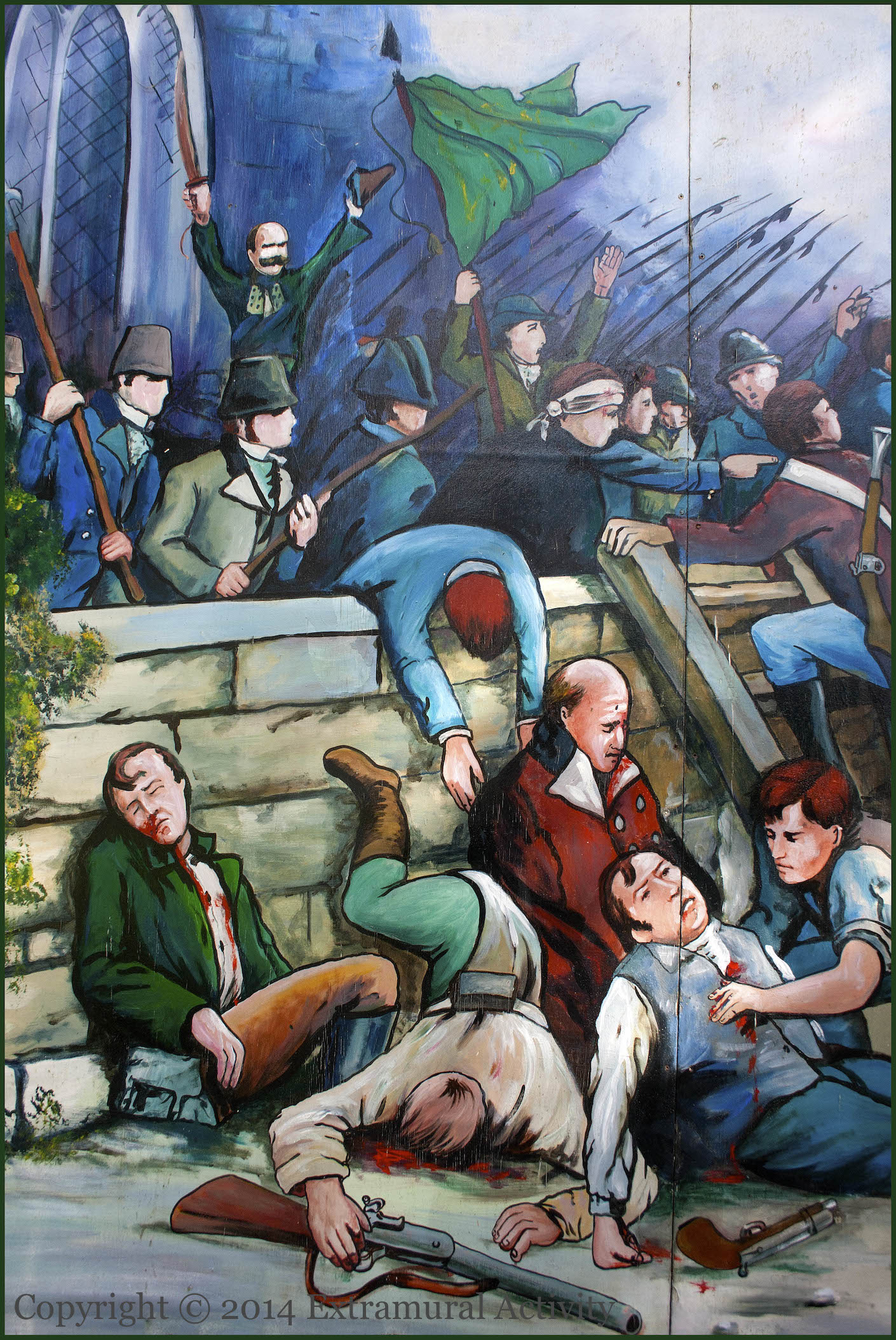
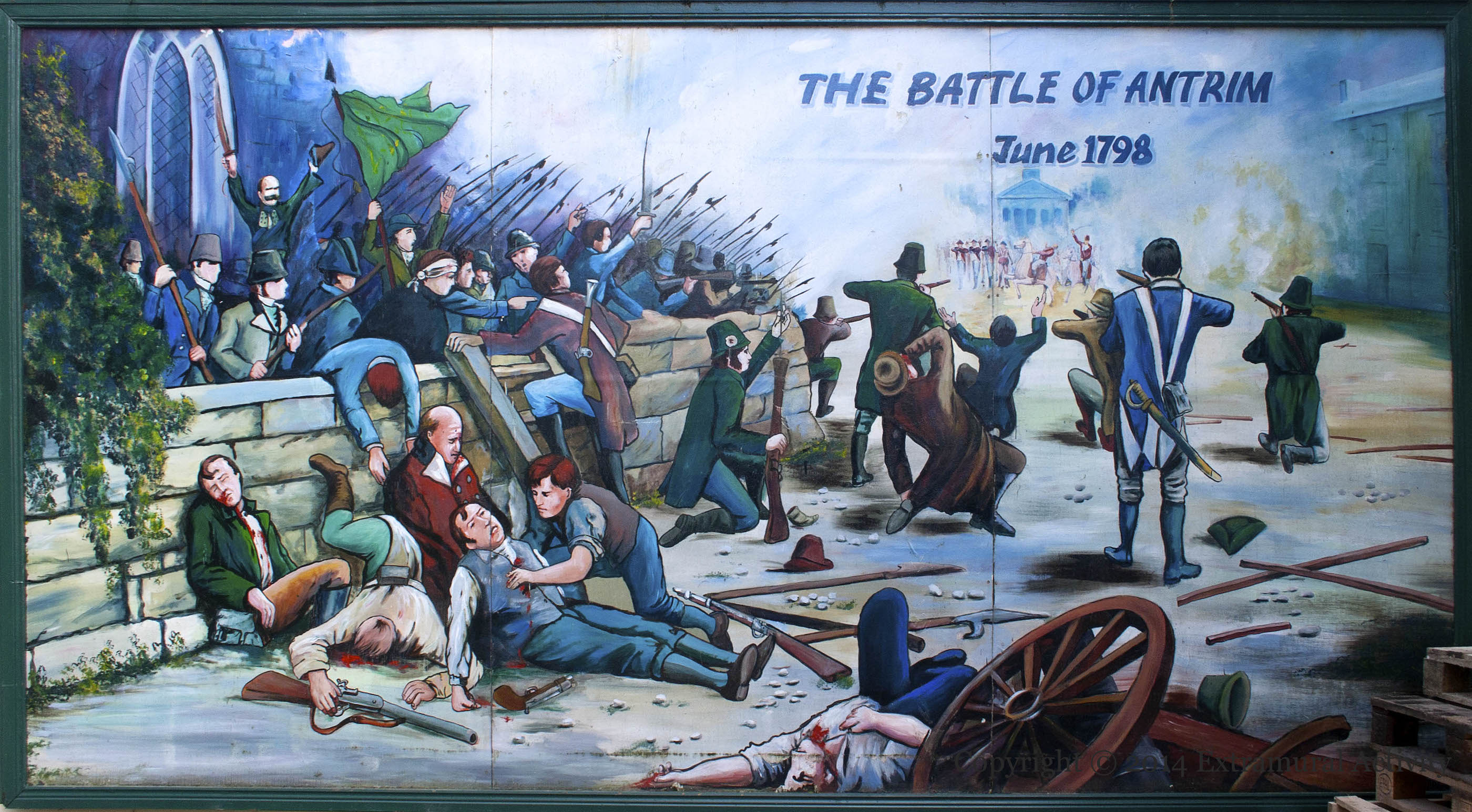
The Battle of Antrim took place on June 7th, 1798, as part of the Irish Rebellion of that summer. Led in the North by the Protestant Henry Joy McCracken, the rebellion met with initial successes in smaller towns, before failing in Antrim. In the full shot, below, the British soldiers can be seen in the distance.
The board above is in the grounds of The Roddy’s, a social club named after Roddy McCorley, another Protestant member of the United Irishmen, most famous for the song written about his hanging at the bridge of Toome in 1800. (Here’s a version by Tommy Makem.)
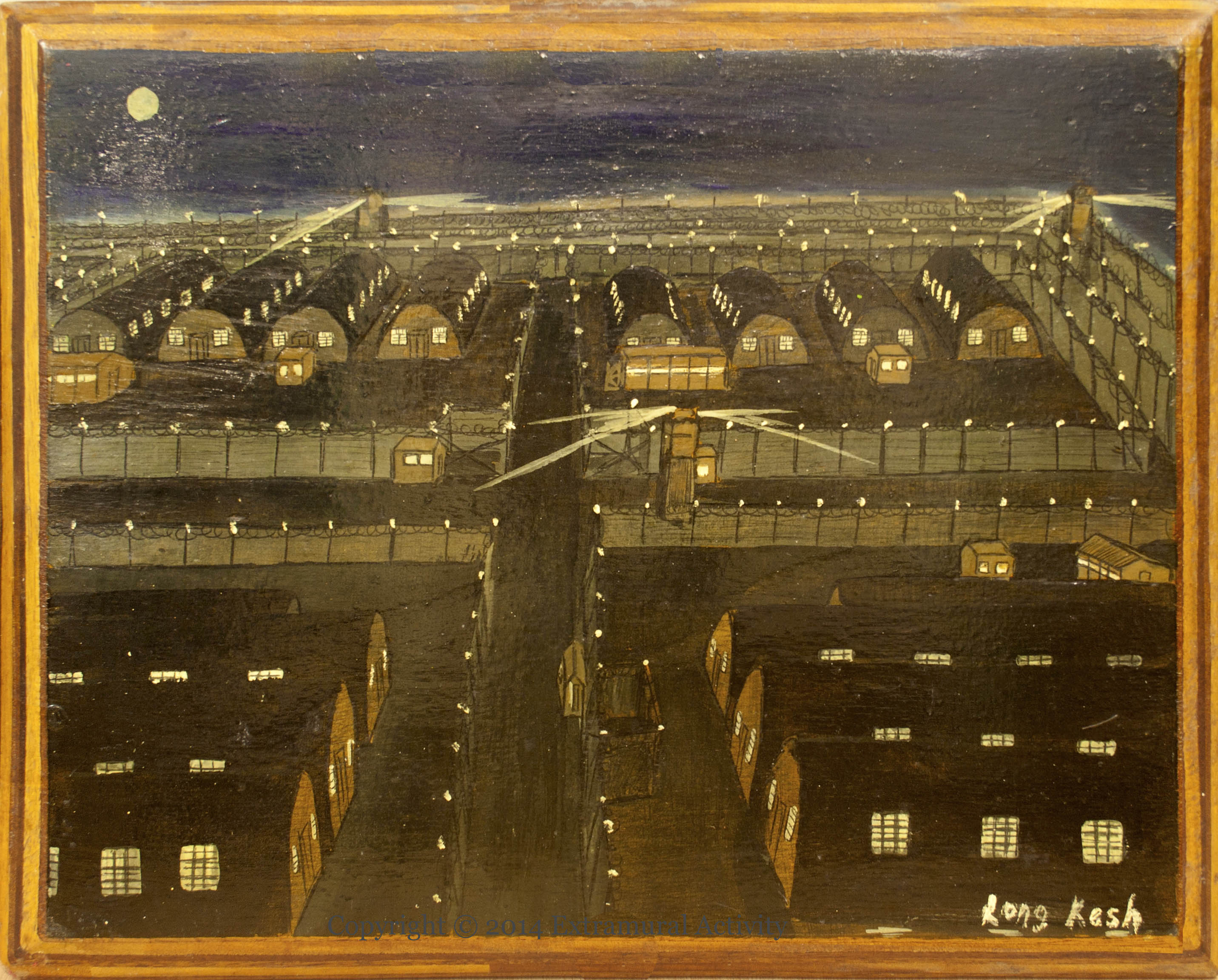
The image above of Long Kesh/HMP Maze is by Michael Mullen. The piece is paint on board; the autographs of all of Mullen’s fellow inmates in Cage 18 are on the reverse. The work is in the Eileen Hickey Republican Museum on Conway Street.
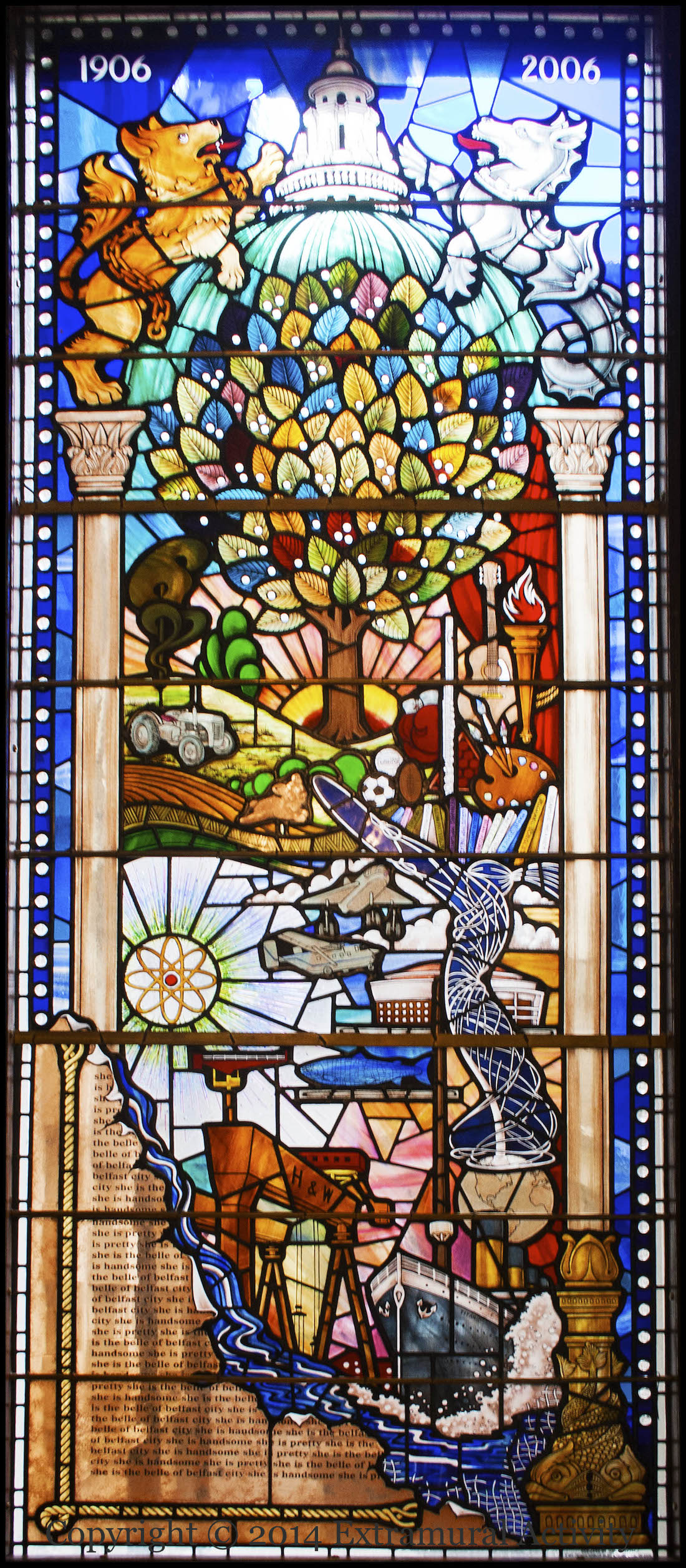
This stained glass by Ann Smyth was designed for the centenary of the construction of Belfast city hall, 1906-2006. At the top are the wolf and seahorse of the Belfast coat of arms, the city hall, and a tree of life. Below these we have a landscape in the style of John Luke’s The Fox, modified with a Massey Ferguson tractor and an electric hare (which CultureNI claims was invented by a Belfast man) instead of the fox. To the right of these stand a guitar, an artist’s palette, boxing gloves, various sports balls, and snooker’s fifteen reds. Ernest Walton smashed the atom in 1932. Short Brothers in 1957 produced the world’s first vertical take-off and landing aircraft and in 1963 the Skyvan. We also see the Waterfront, the Big Fish, the Thanksgiving Square Beacon, and Harland & Wolff’s Samson & Goliath and Titanic. In the bottom left corner is a town page upon which is repeated the refrain from I’ll Tell Me Ma: “She is handsome, she is pretty, she is the belle of Belfast city”.
 Seosamh Mac Coille Collection