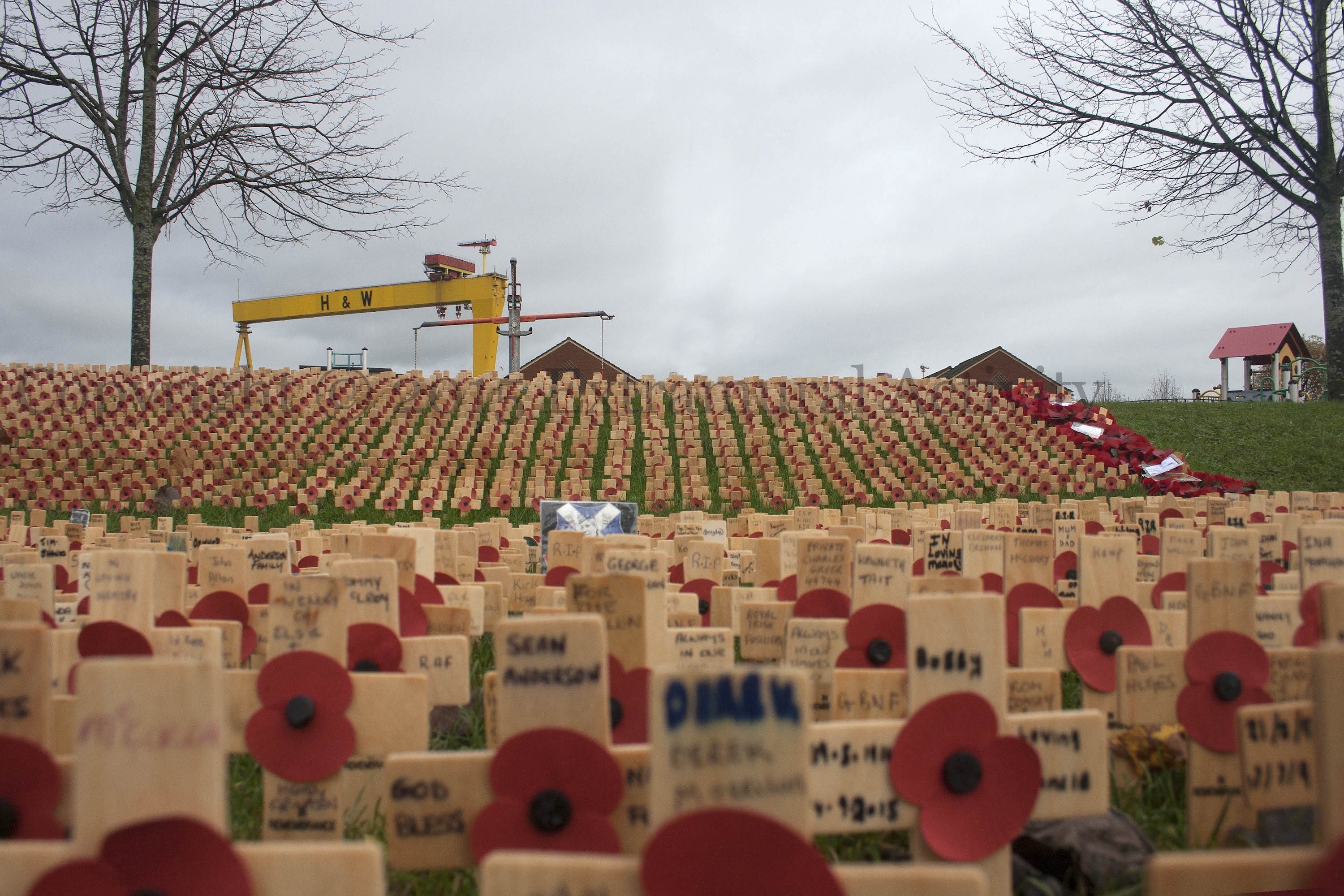
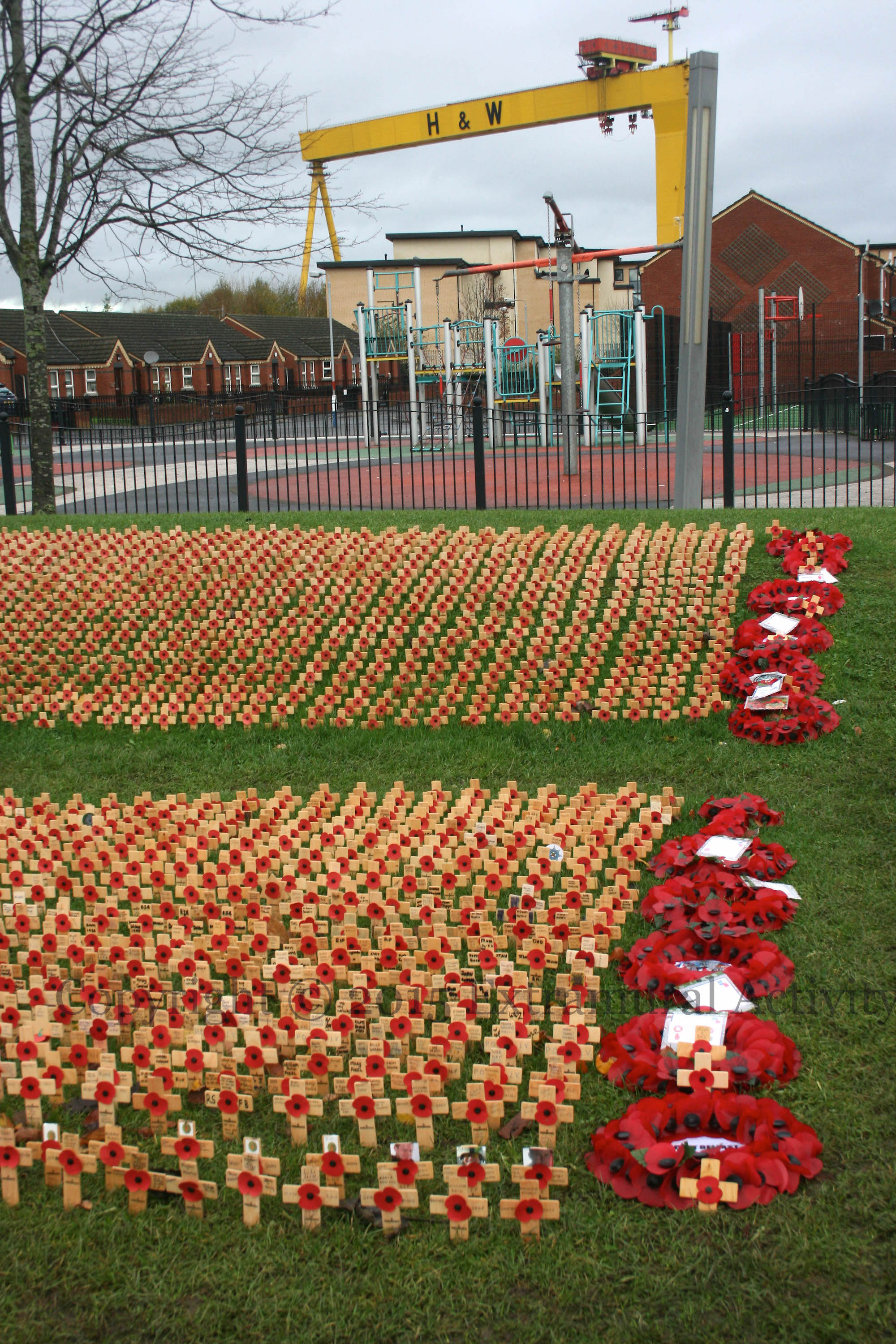
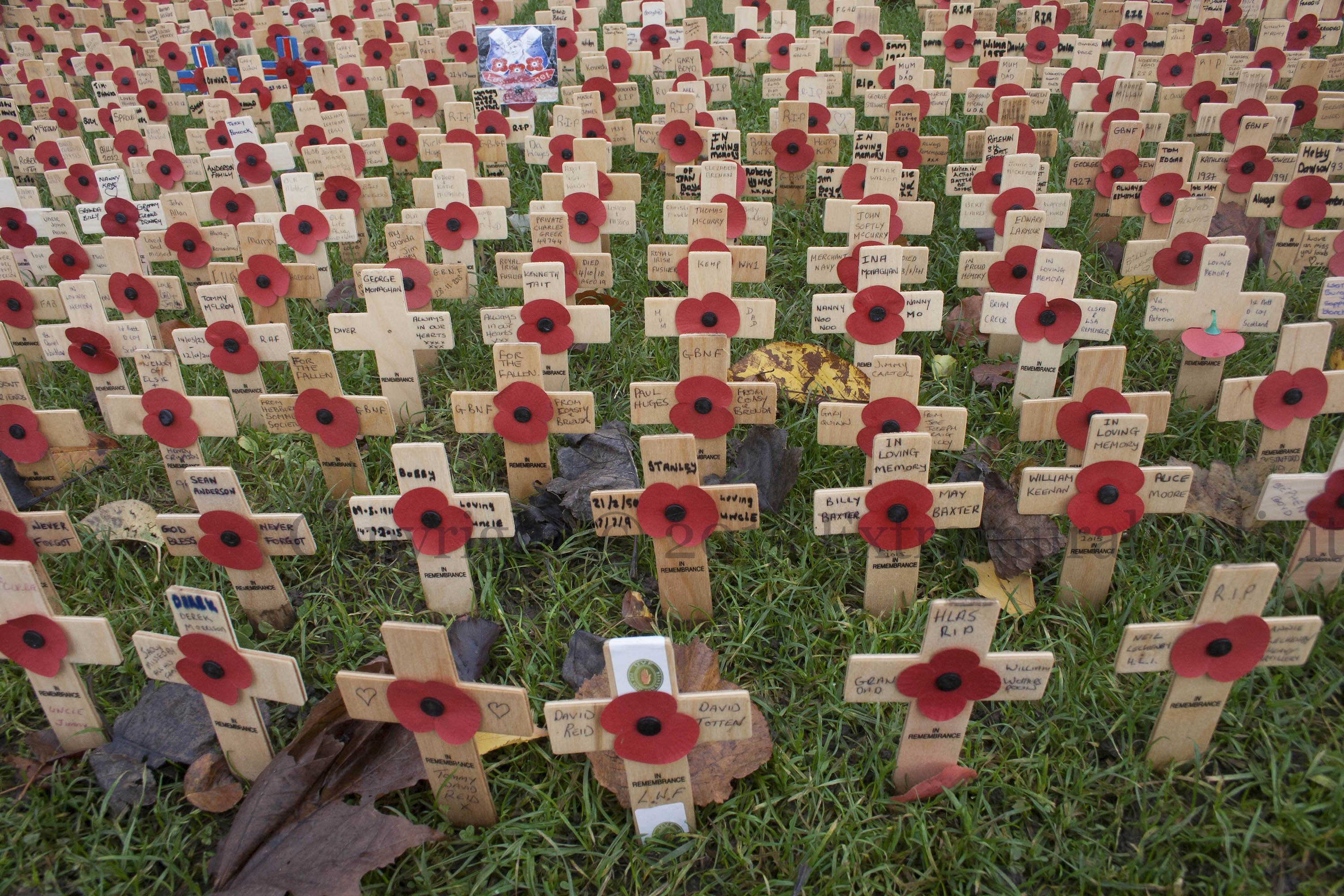
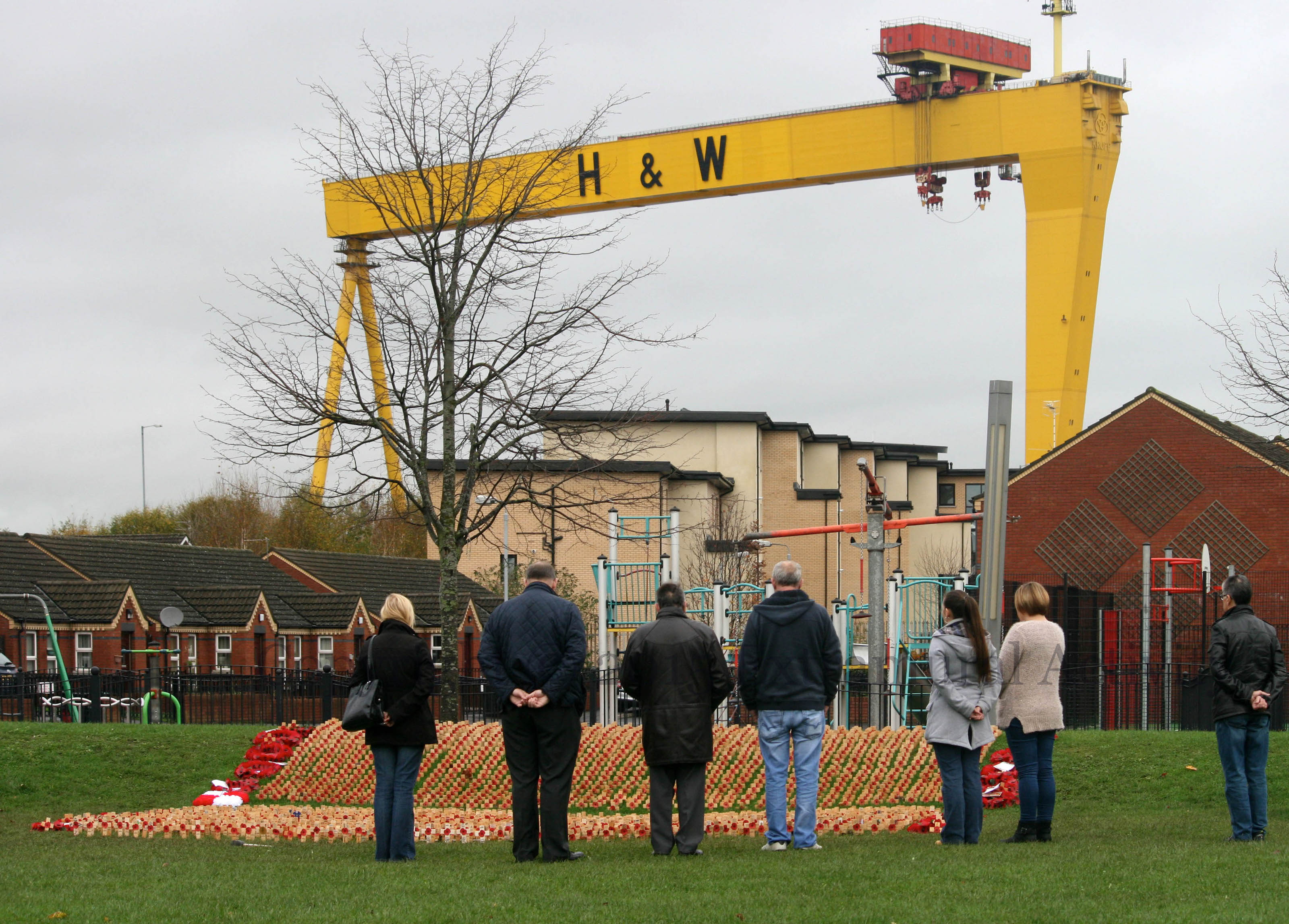
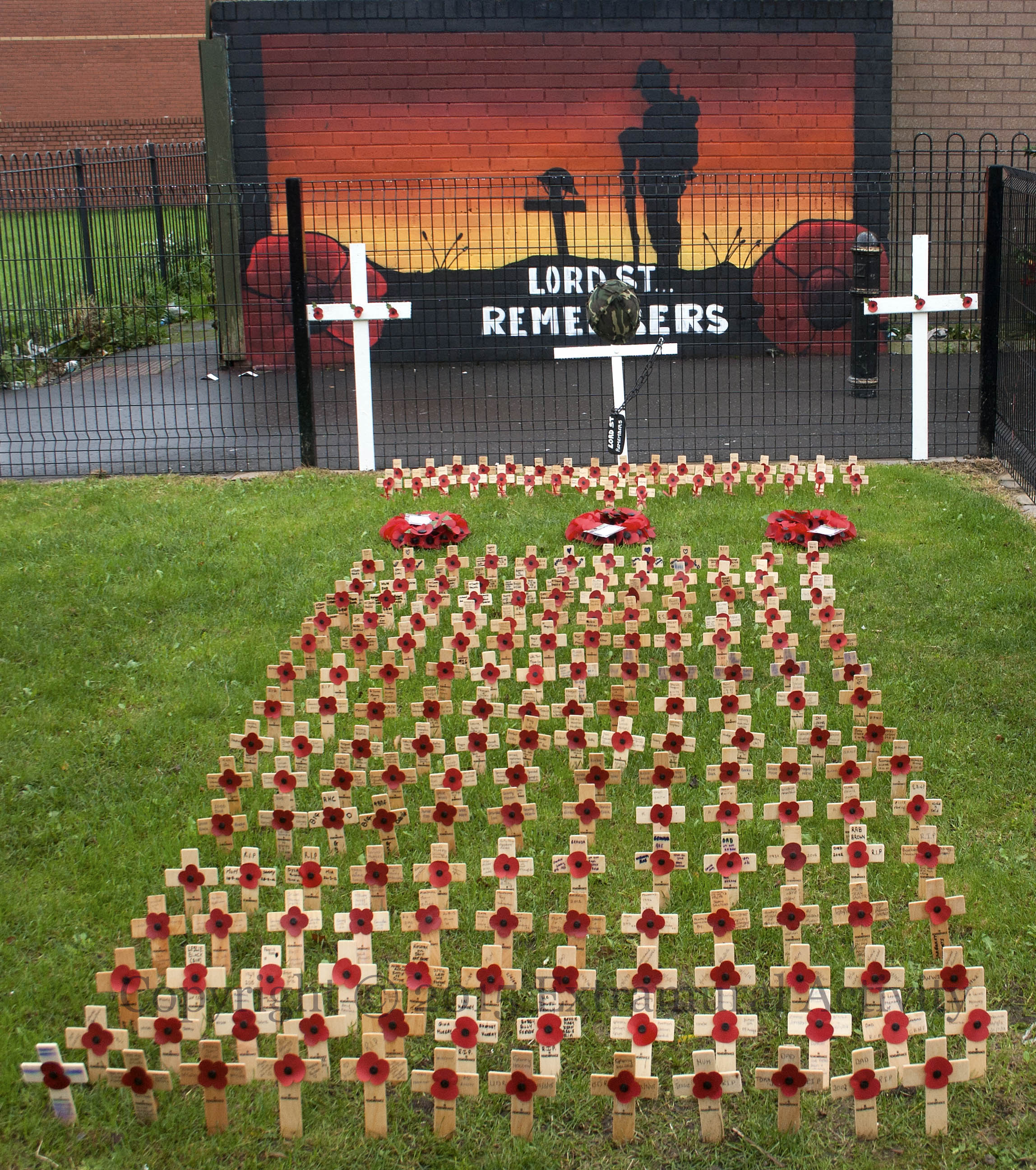
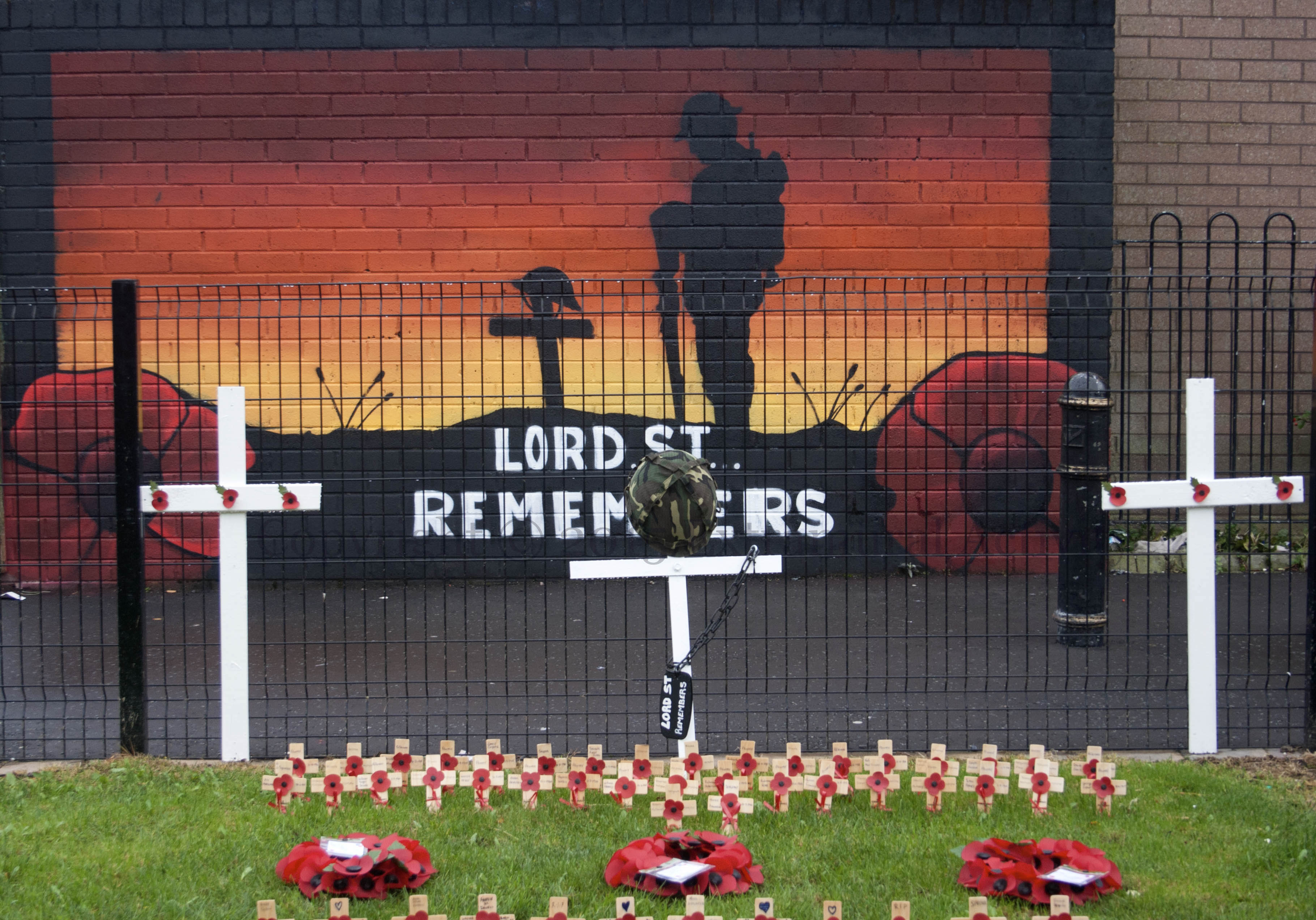
Thousands of small wooden crosses, with names and a poppy, were placed in Pitt Park, east Belfast, between November 1st and 11th to commemorate those who fell during WWI. The Last Post was sounded each night at 8. We present here four images of the scene. The event and a similar one on the Shankill (both going by the name Row By Row) were organised by the Dr. Pitt Park Centenary Committee and the Royal British Legion. (City Council minutes)
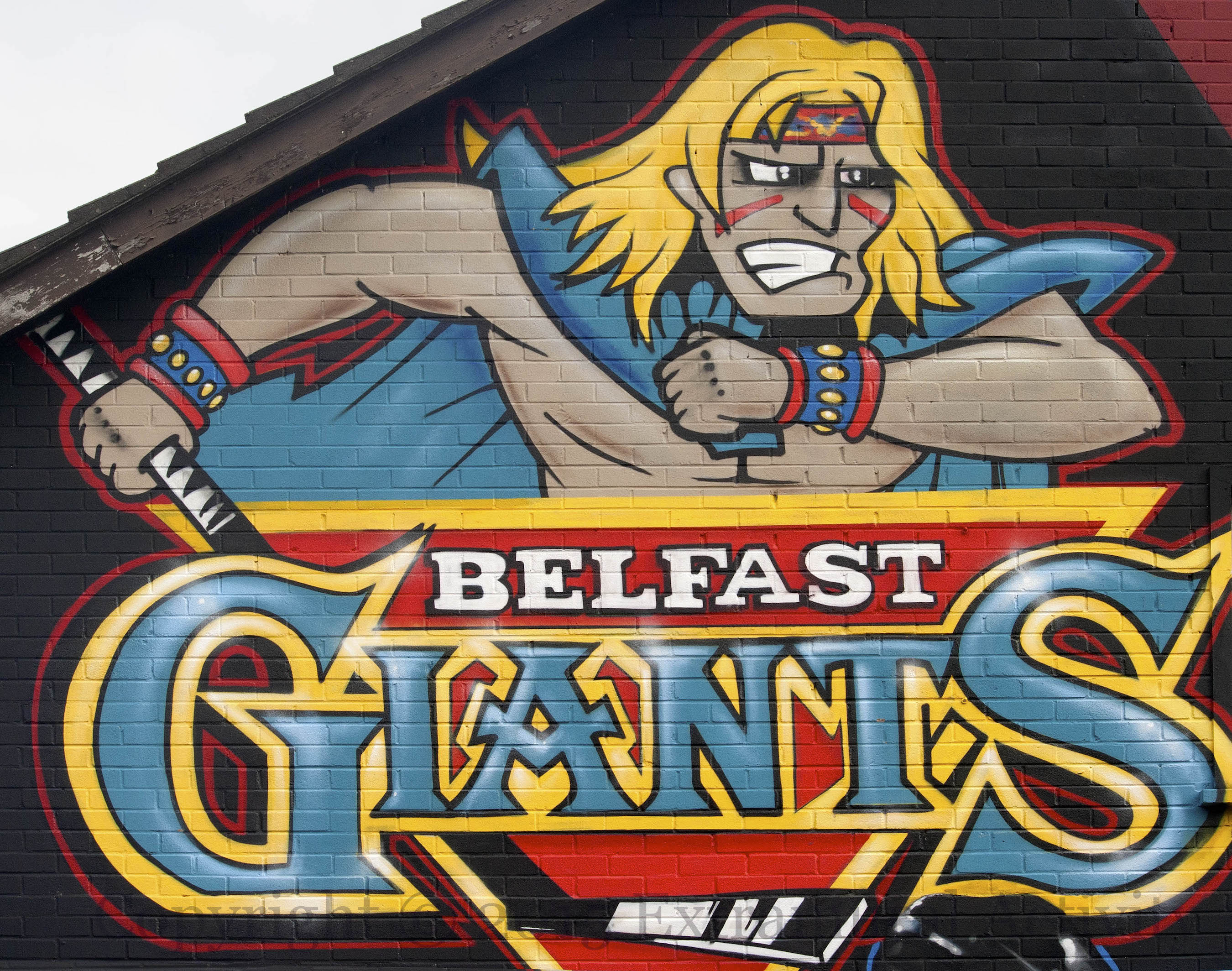
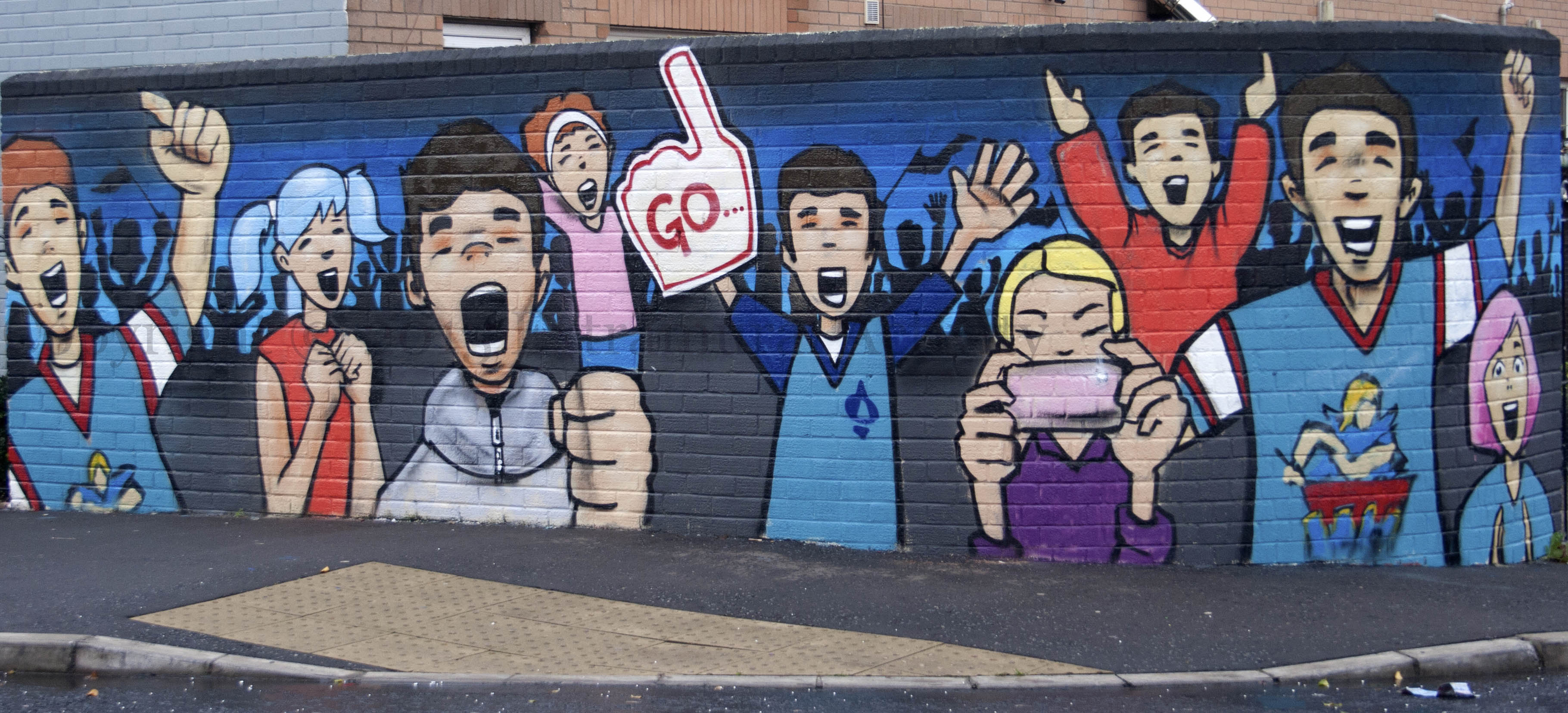
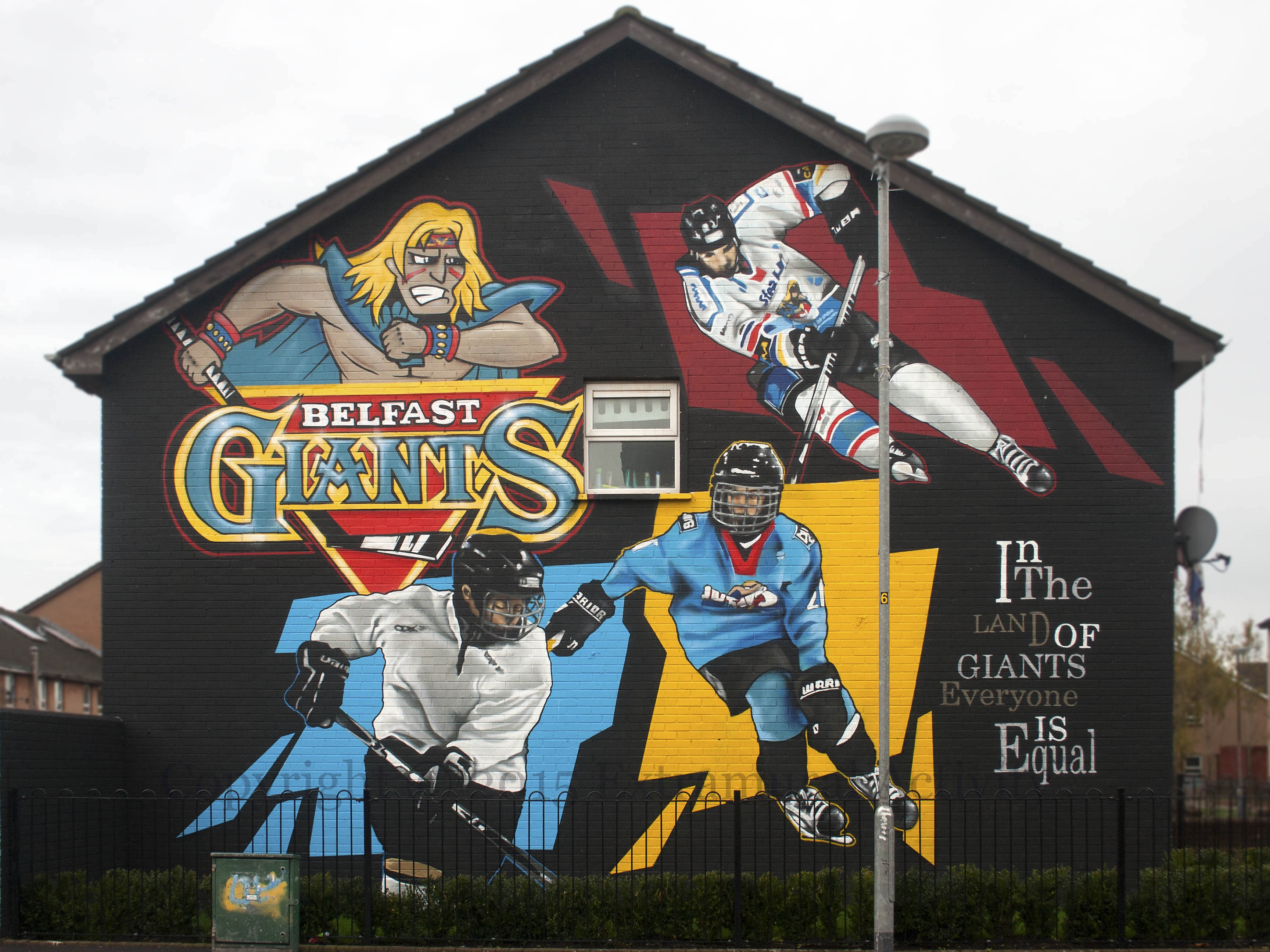
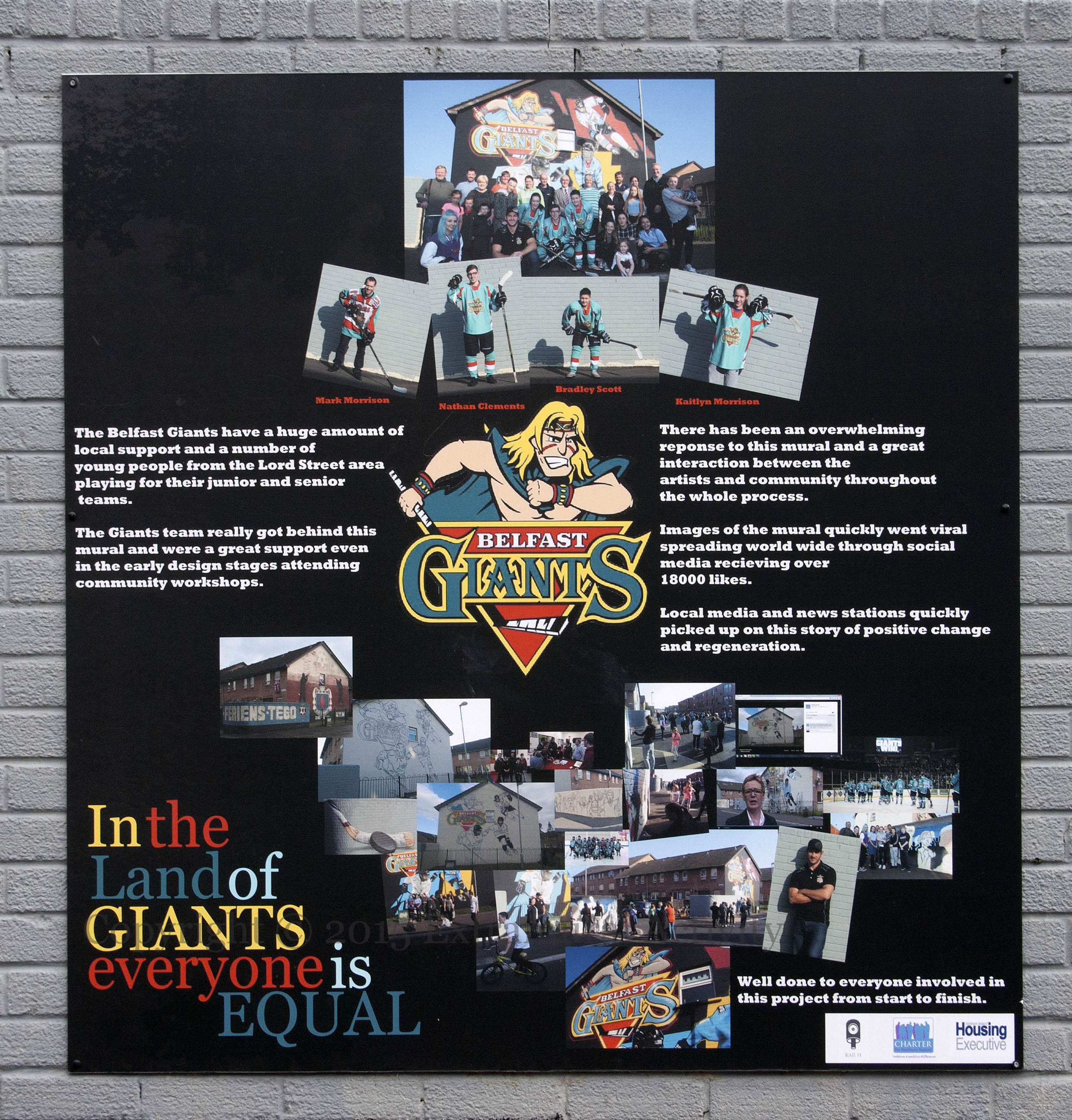
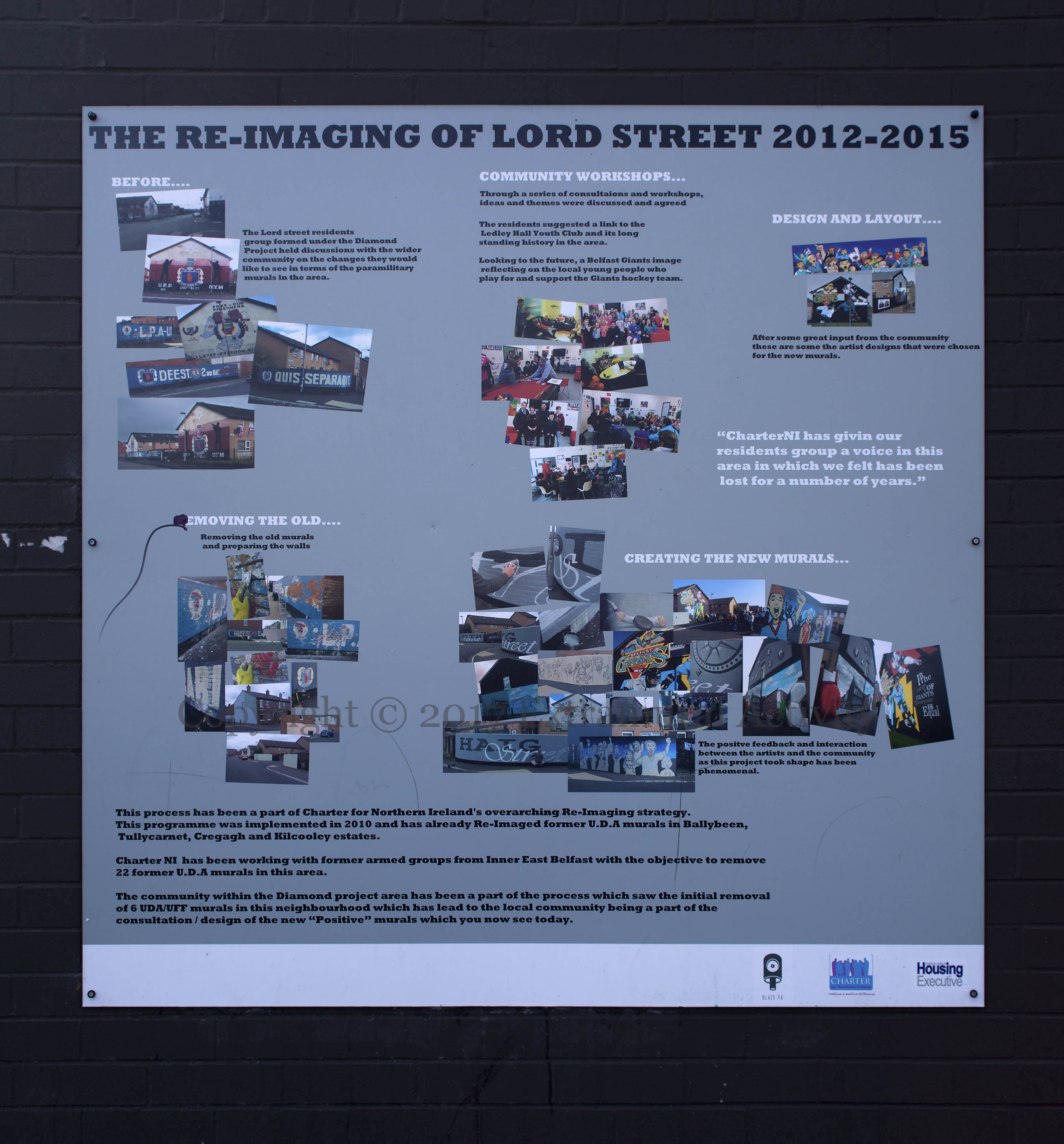
Here are three shots of the new Blaze Fx (web | Fb) “Belfast Giants” mural in east Belfast’s Lord Street. The Giants have been Belfast’s ice-hockey team for the last fifteen years, beginning in 2000. The detail above shows mascot Finn MacCool and the image of the full mural, below, includes the team motto, the (a)politically-motivated “In the land of the giants, everyone is equal.” The mural takes the place of a UDA mural (featured previously, Feriens Tego; see also the second info board, below, on “the re-imaging of Lord Street 2012-2015”) and is one of three large murals and various small murals to be replaced or painted out. (This News Letter article puts the total at nine.)
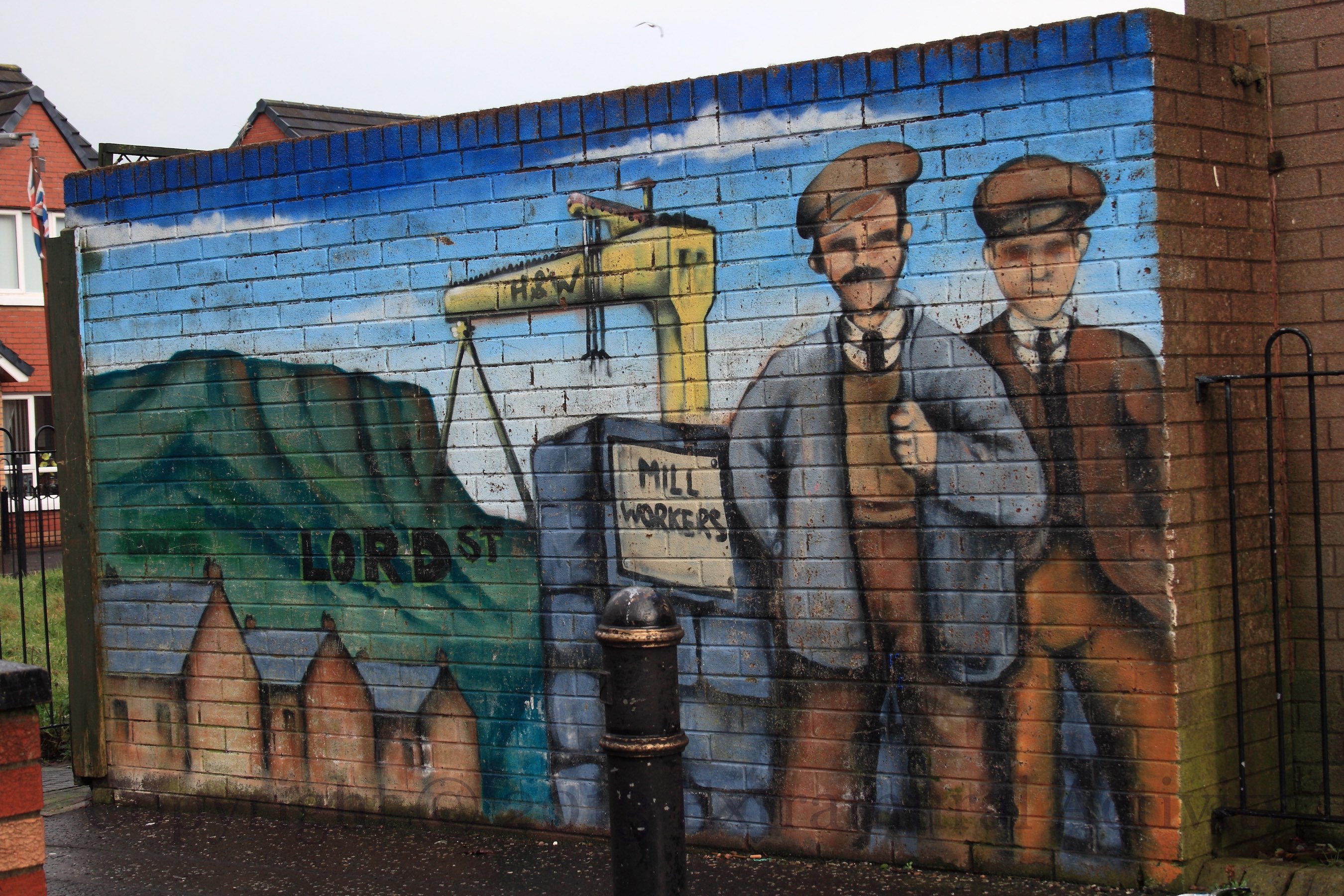
For Armistice Day commemorations 2015 an old mural (below) depicting east Belfast mill workers in cloth caps going to work beneath the H&W cranes was replaced with an image of a single soldier standing over a WWI burial cross with head bowed. In front are the same kind of small wooded crosses and poppies featured in Row On Row from Pitt Park. By Glenn Black and Ken Maze of Blaze FX (web).
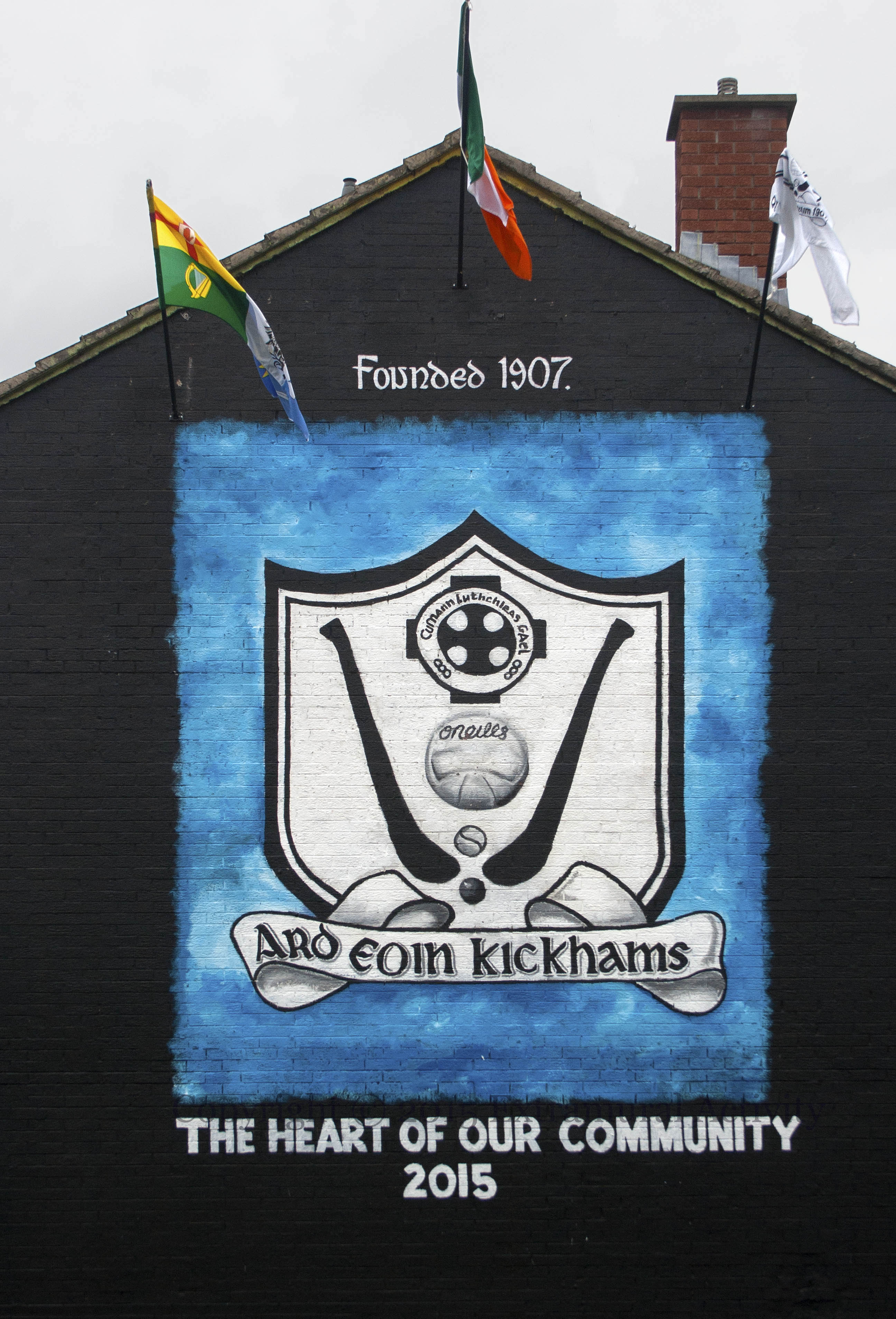
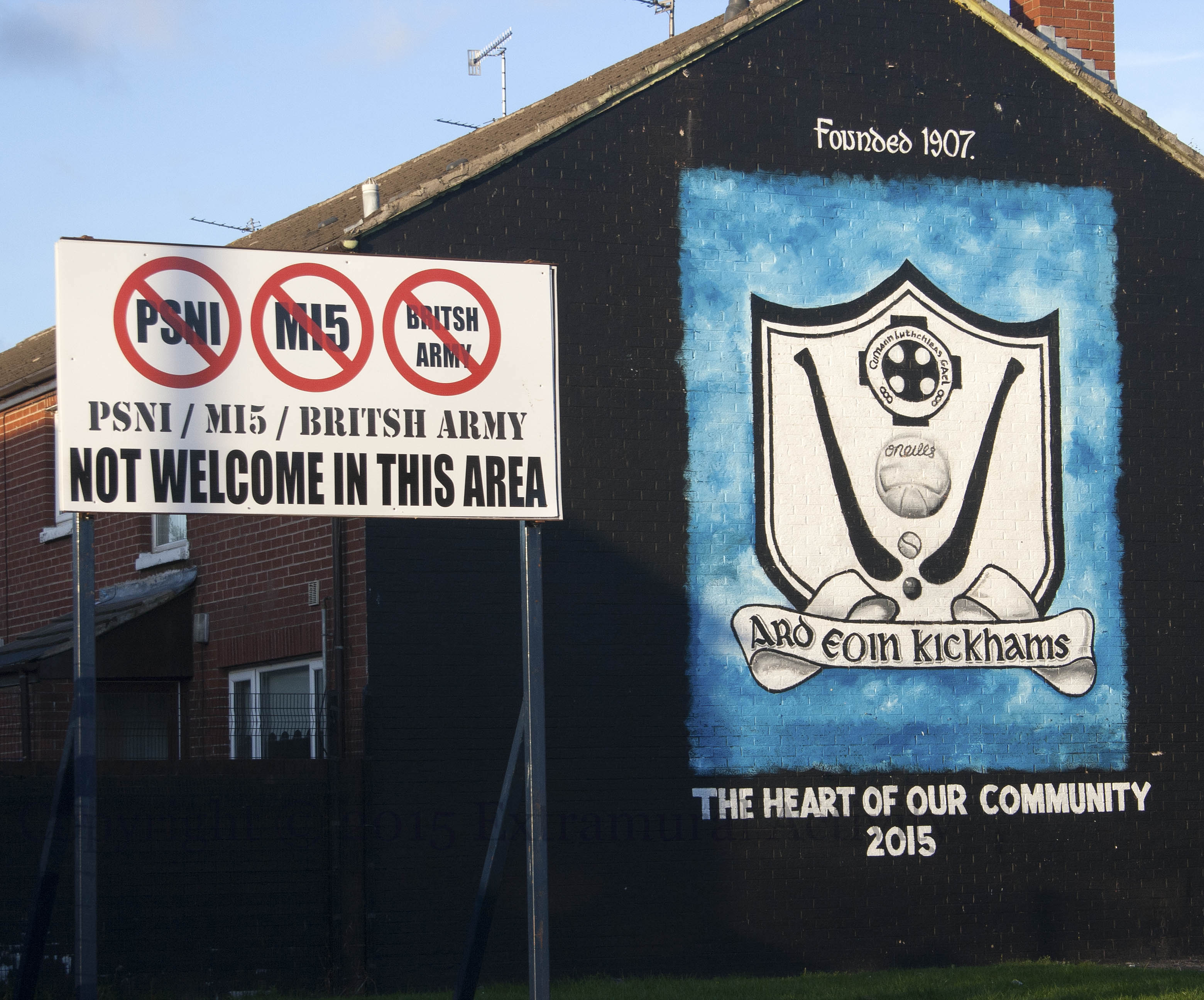
In early August the RNU blacked out an Ard Eoın Kickhams GAA mural in Ardoyne (featured previously) and replaced it with a tarp calling for the RUC/PSNI to be disbanded (see this Belfast Live article for an image). After complaint from the local community, the tarp was removed and the central part of the mural was repainted, showing the celtic cross of Cumann Lúthcleas Gael, a football, sliotars, and hurleys. Members of the RUC were forbidden from GAA membership until “Rule 21” (WP) until 2001; they are now permitted to join and play Gaelic games, even if they not welcome in the area – see the image below.
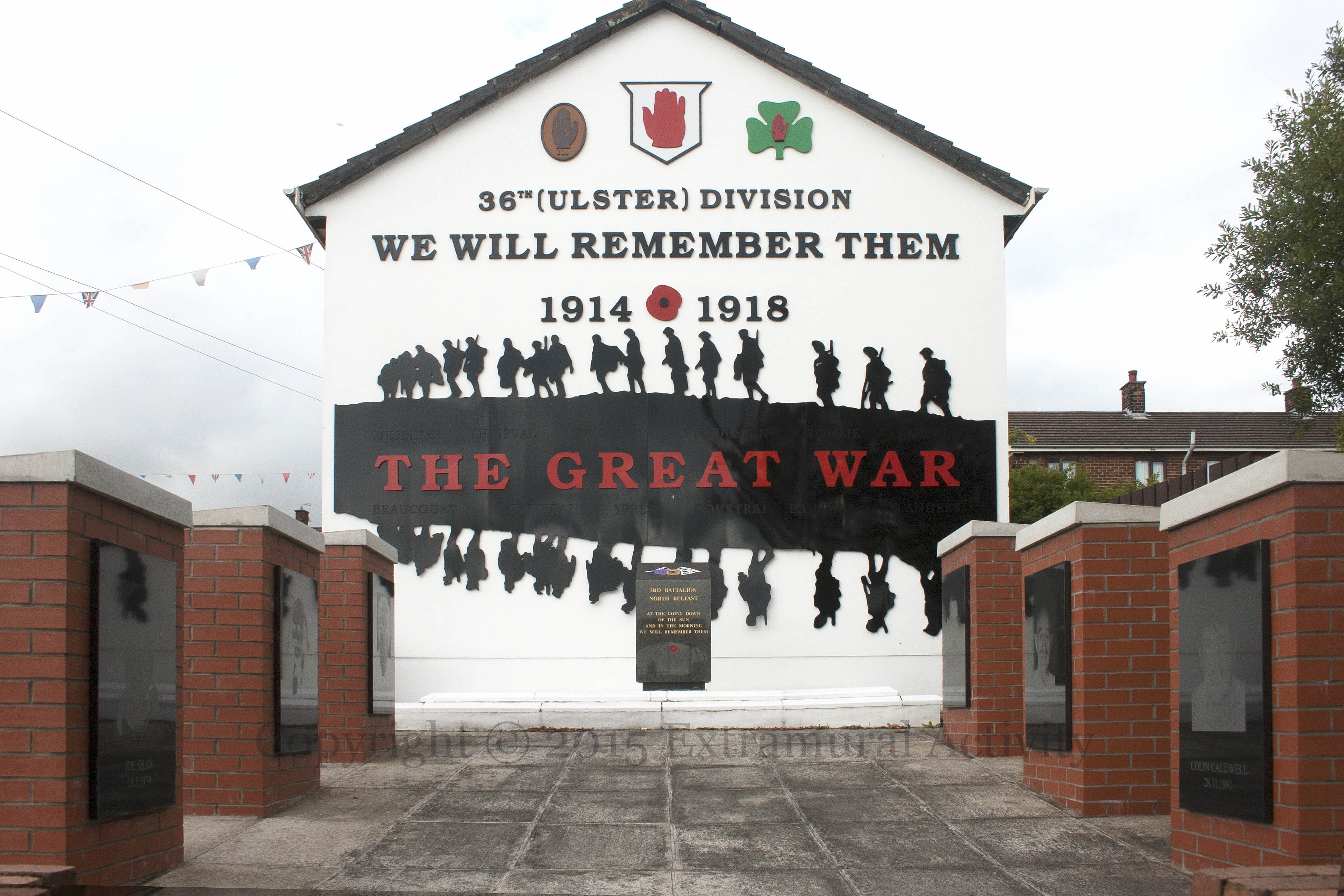
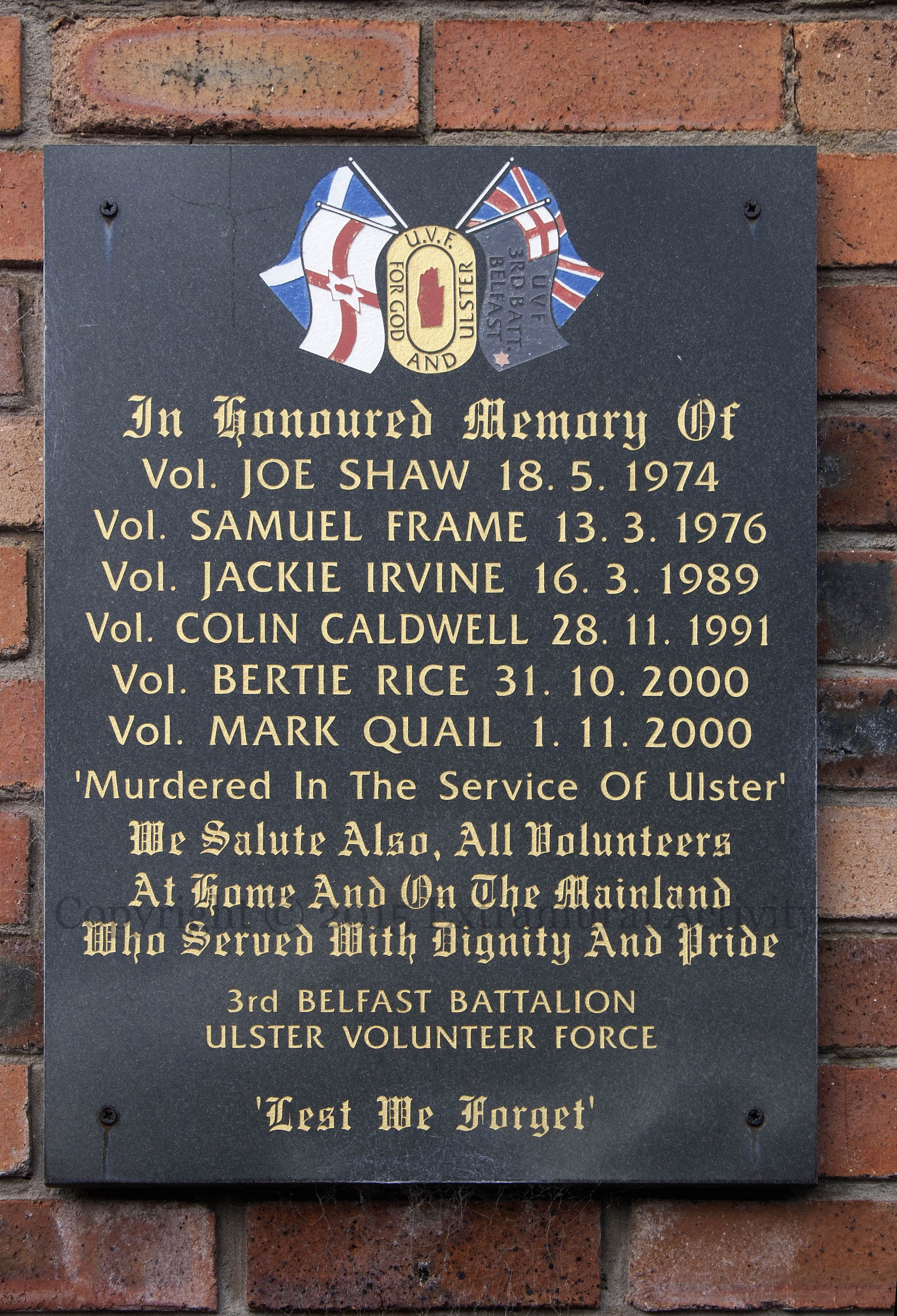
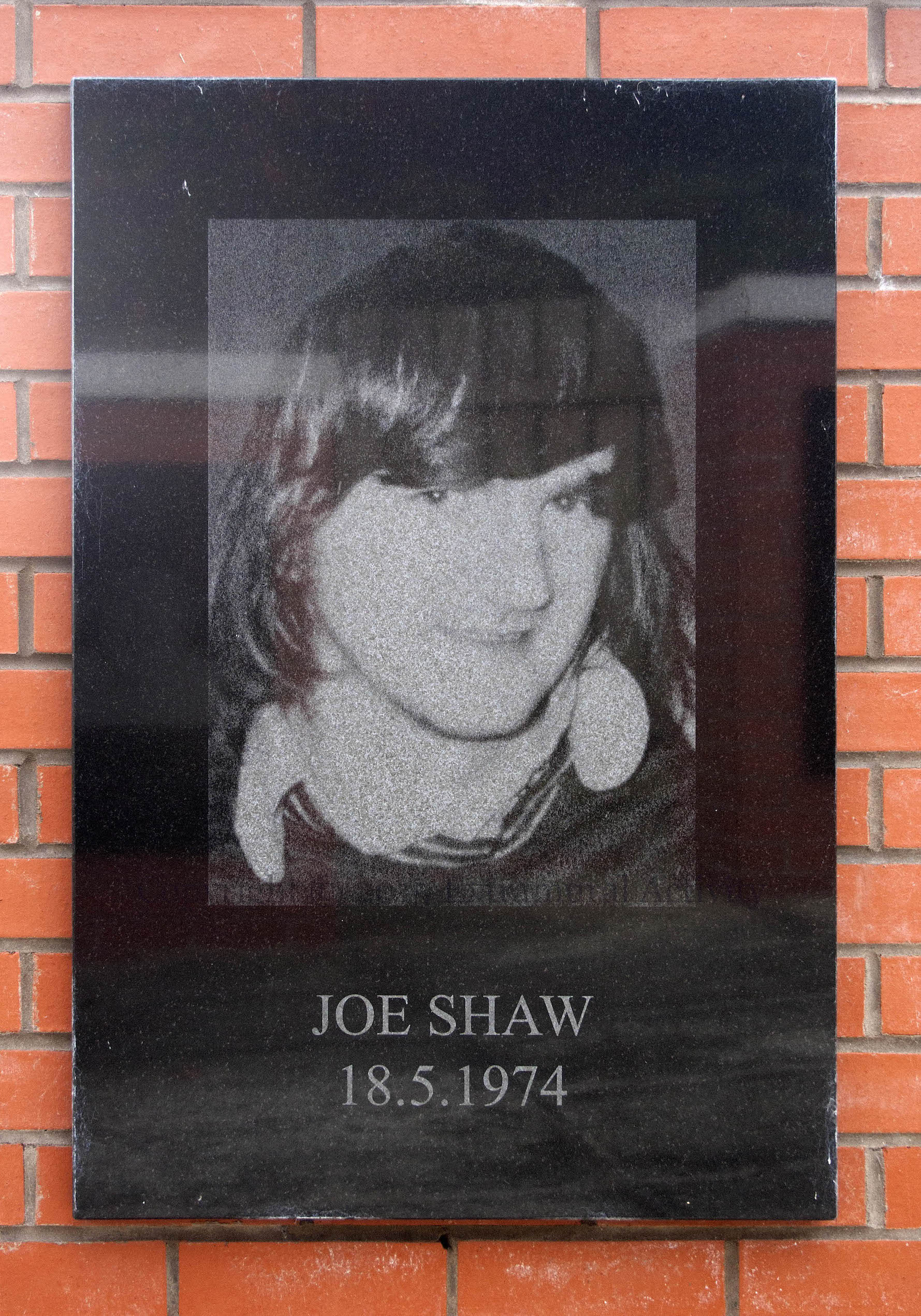
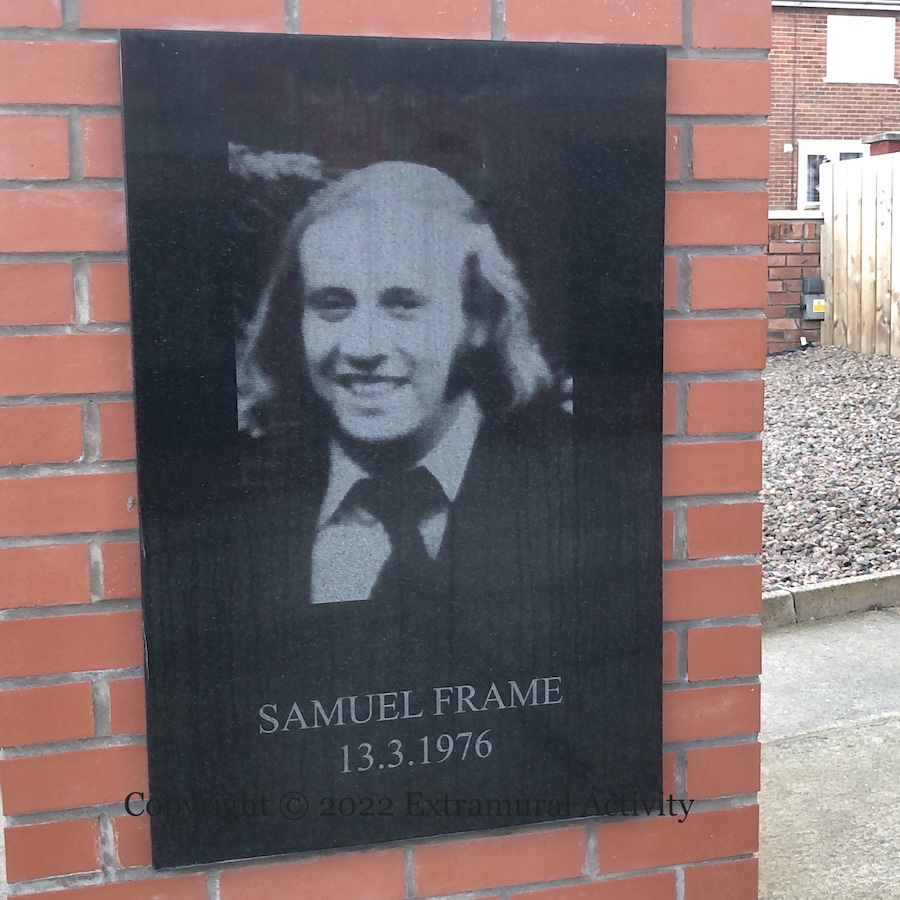
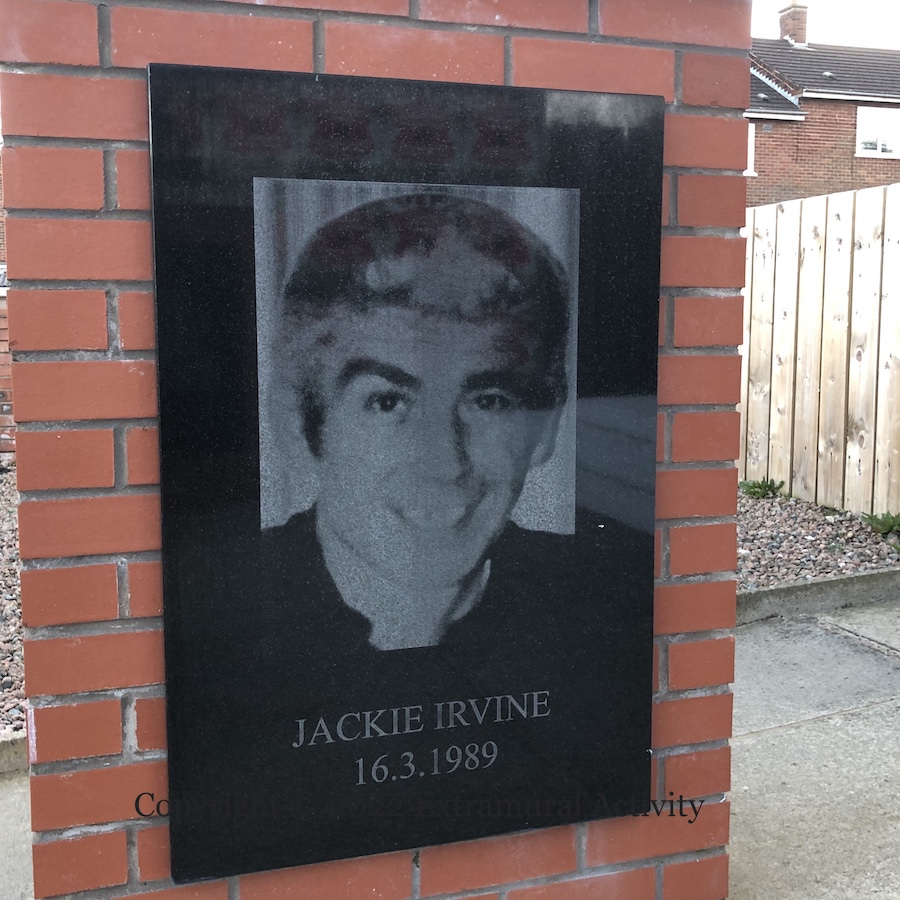
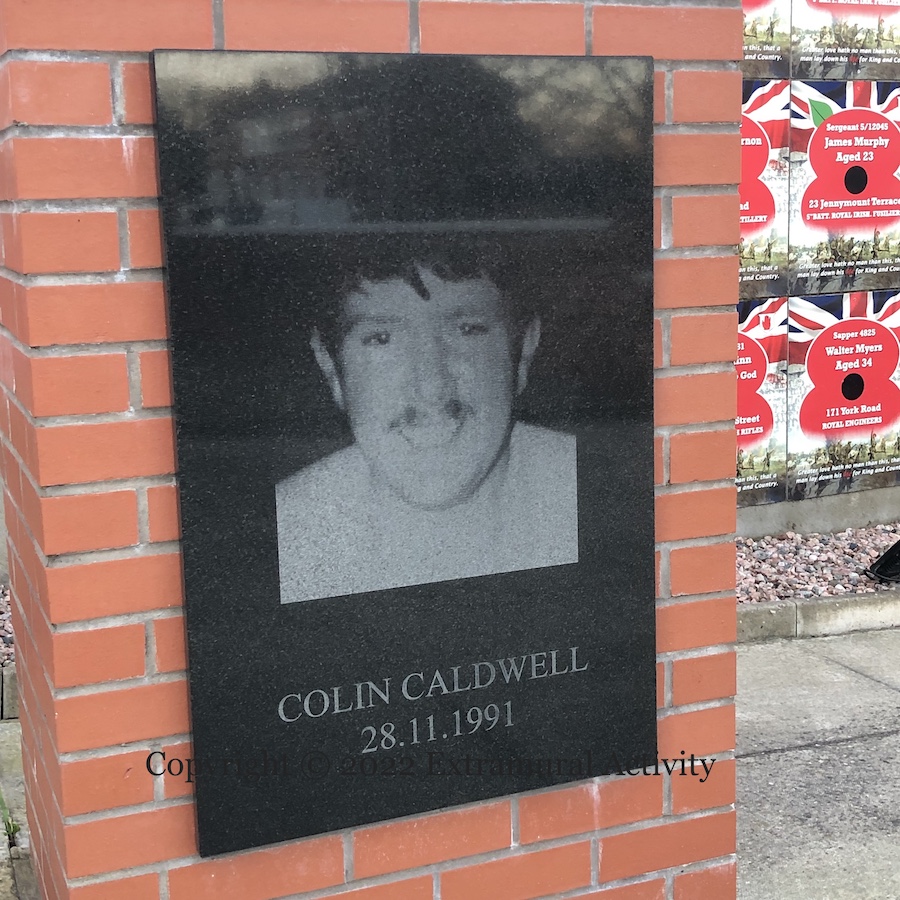
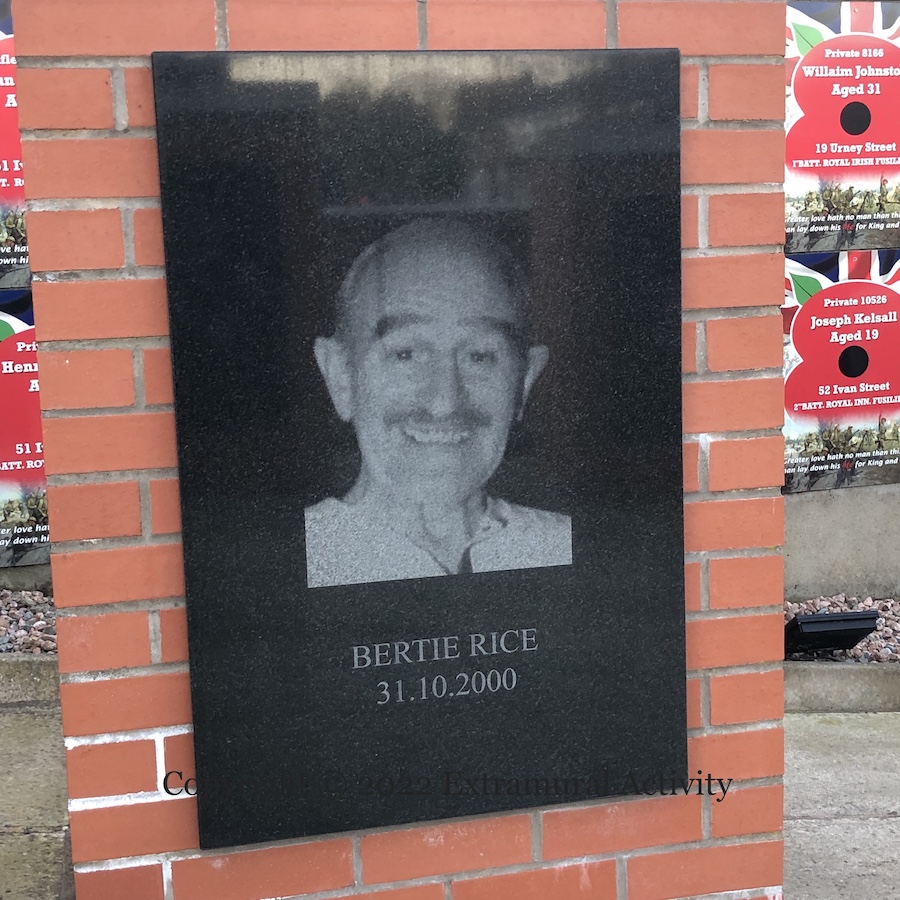
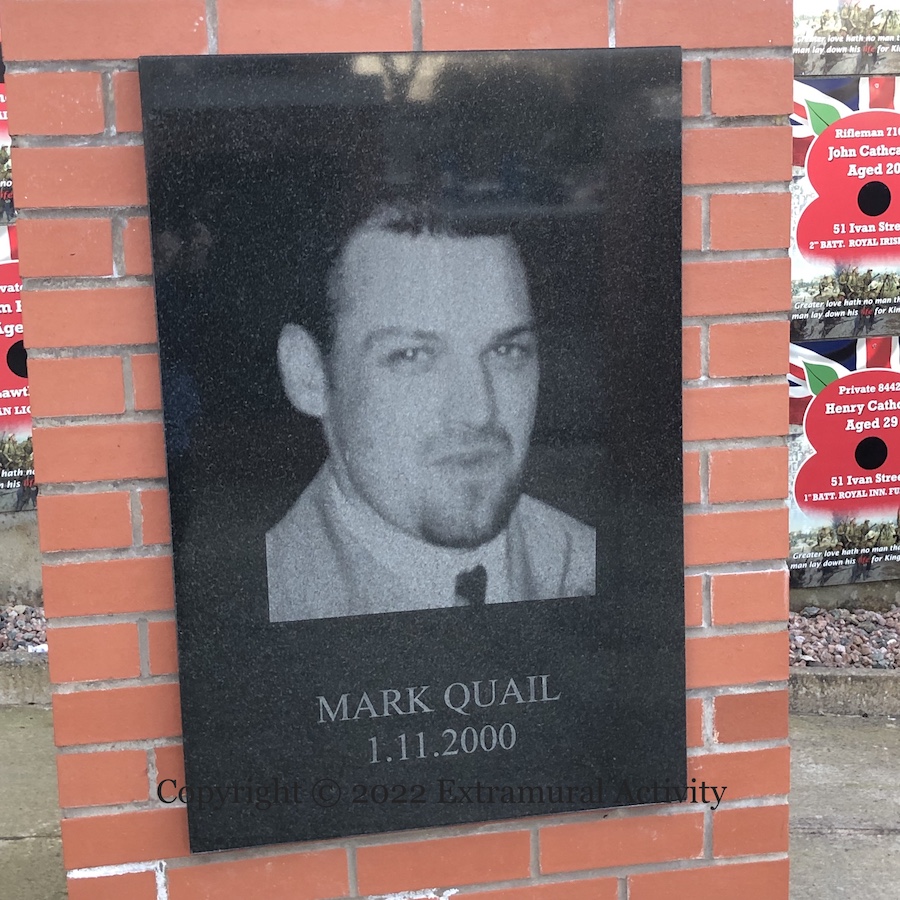
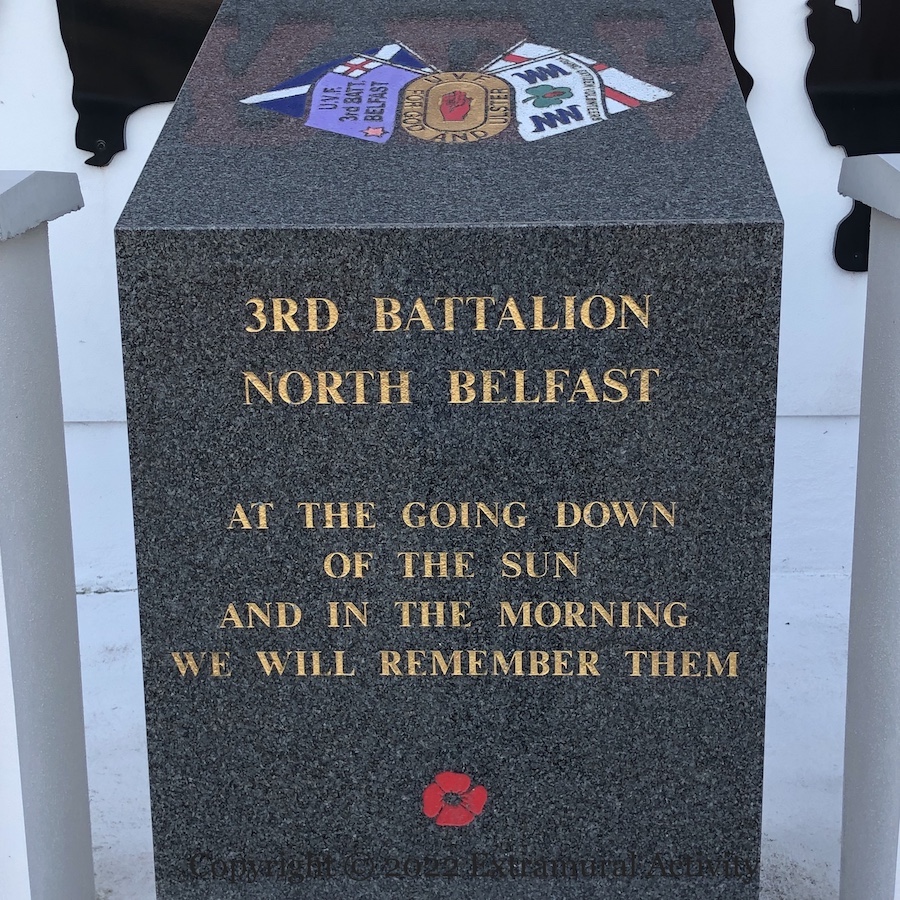
The memorial garden in Mount Vernon, which previously had and Ulster Volunteers mural and UVF stone has undergone a major redevelopment this year with a new “cut-out” mural to the 36th (Ulster) Division and memorial plaques to six UVF members who died between 1974 and 2000, including (in the second image) Joe Shaw, who was shot by the UDA during the 1974-1975 feud. (For details of the killings and its aftermath, see this Balaclava Street article.) See the final image, below, for the plaque on the outside wall of the garden listing all six members.
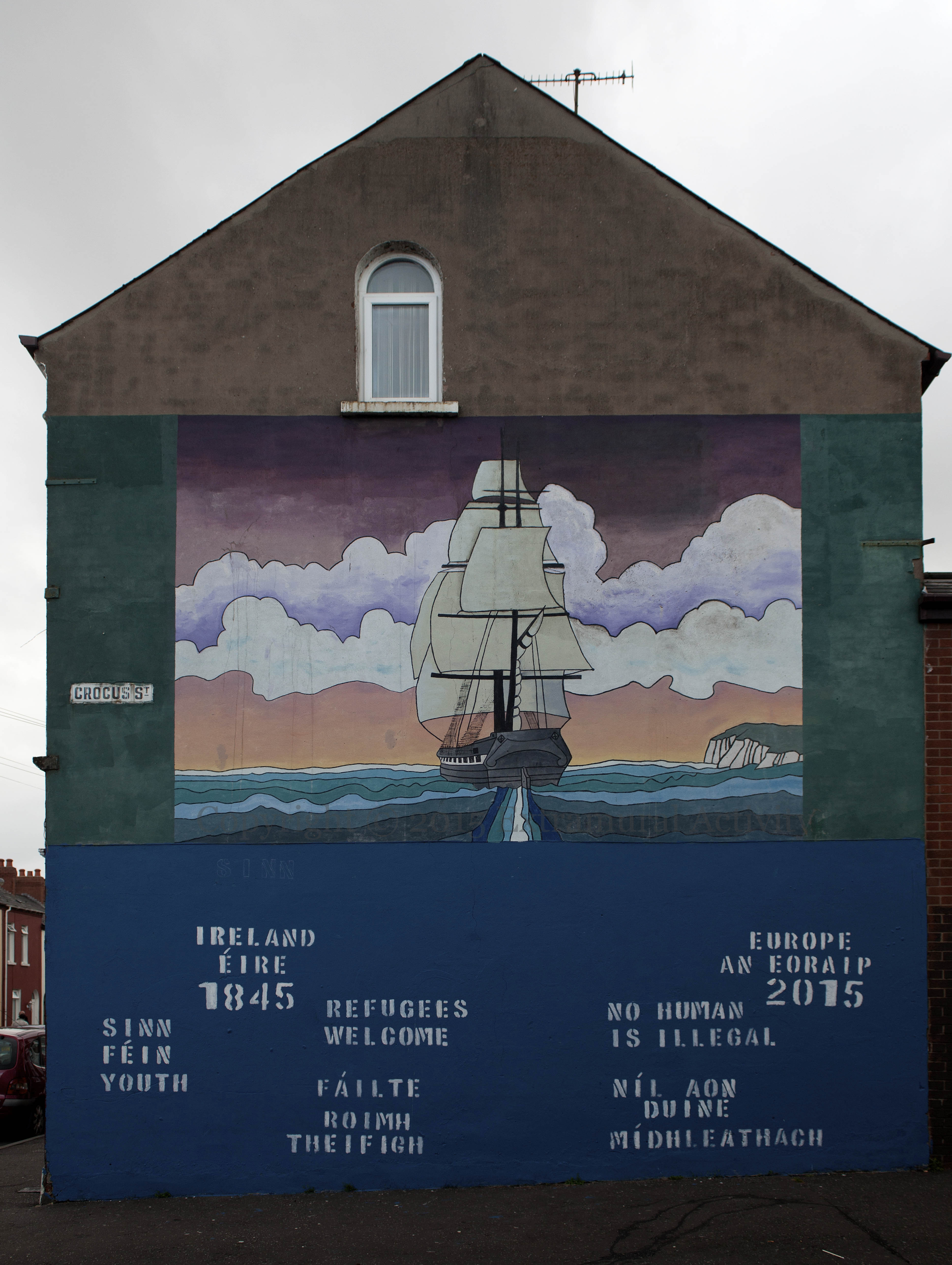
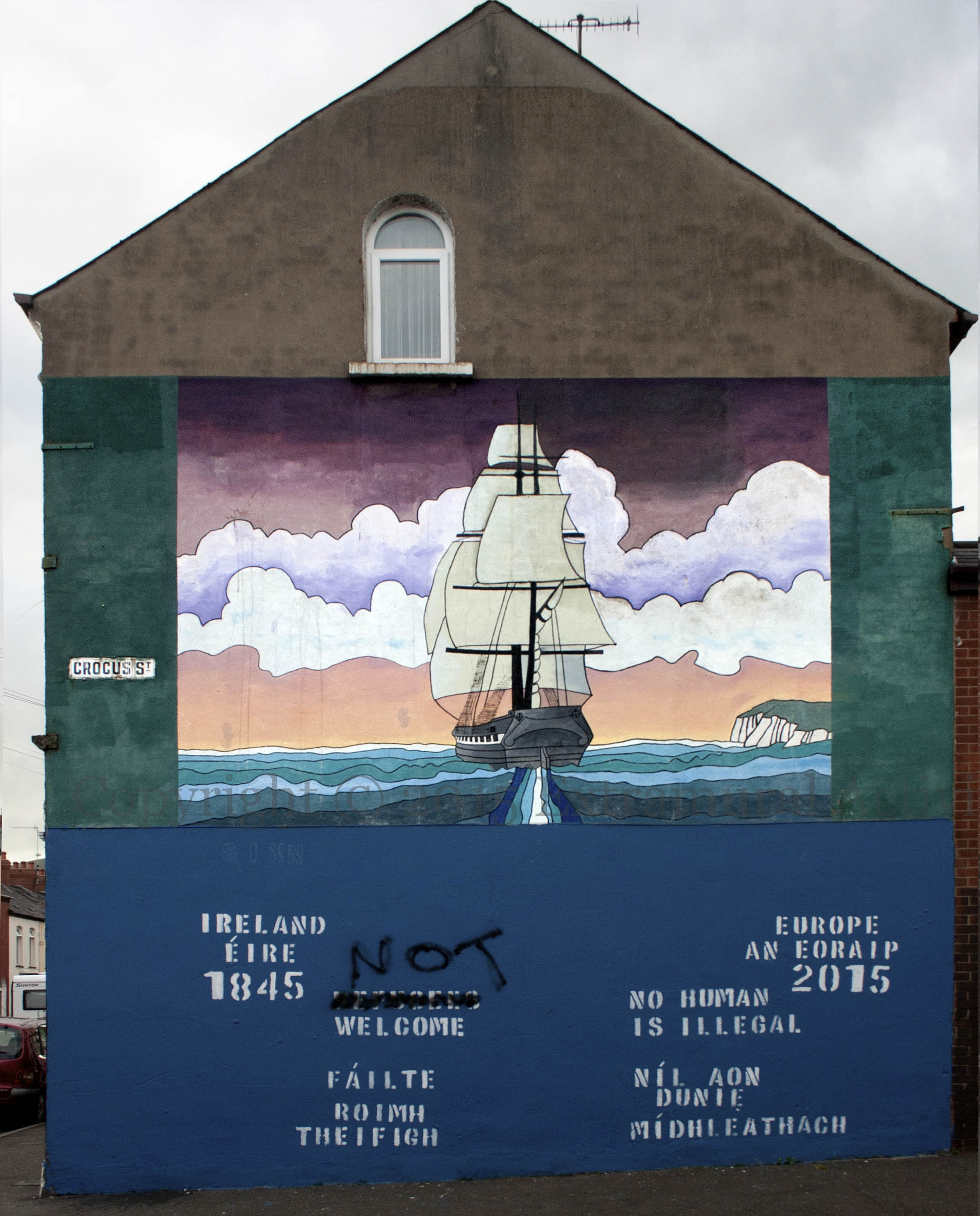
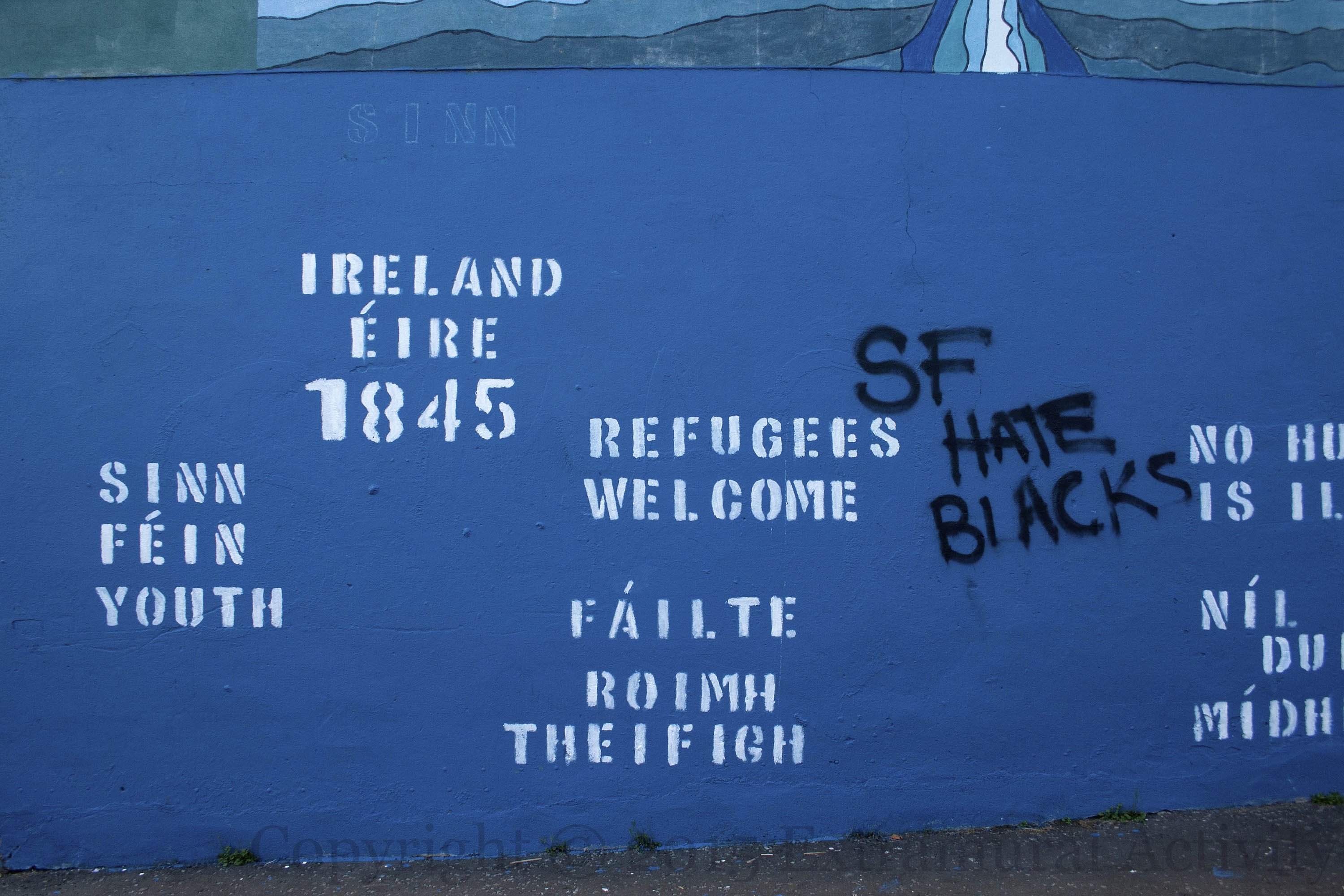
Incidents involving ships of African emigrants seeking refuge in Europe are so many that there is a separate Wikipedia page for them. In response to the crisis, an old mural in Crocus Street (see M01486) remembering the emigration of Irish to North America during the Great Hunger was repainted and the lower part (which had images of the Great Hunger) replaced by stencilling which makes reference to the 2015 situation: “Ireland/Éıre 1845 – Europe/An Eoraıp 2015”, “Refugees welcome – Fáılte roımh theıfıgh”, and “No human is illegal – Níl aon dunıe [duıne] mídhleathach”. It was immediately vandalized with a “not” (see the final image, below; Fb) but has now been repaired, along with the mis-spelling.
Update 2015-10-19: the mural has been graffitied with “SF hate blacks” – see the fourth image, below.
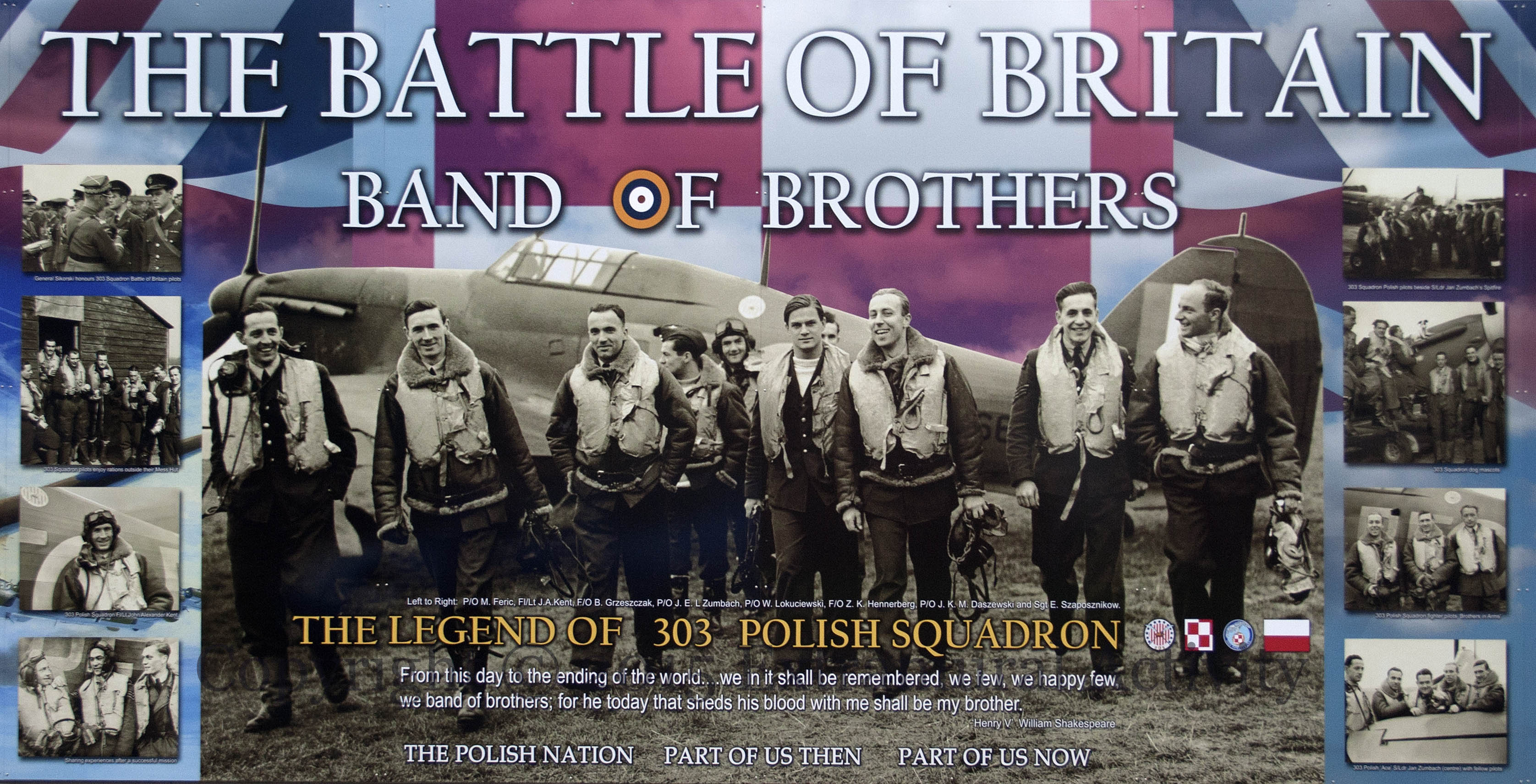
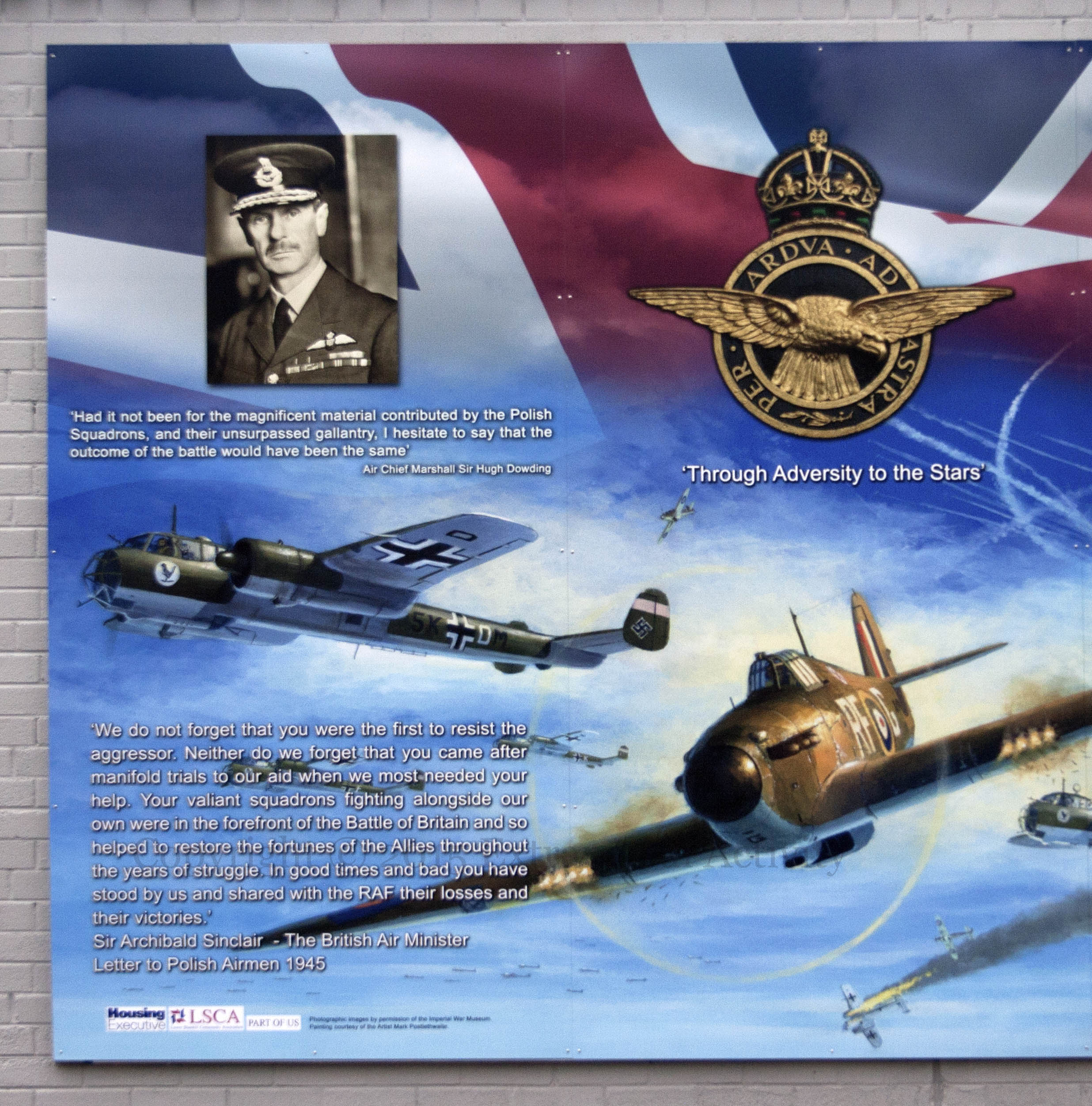
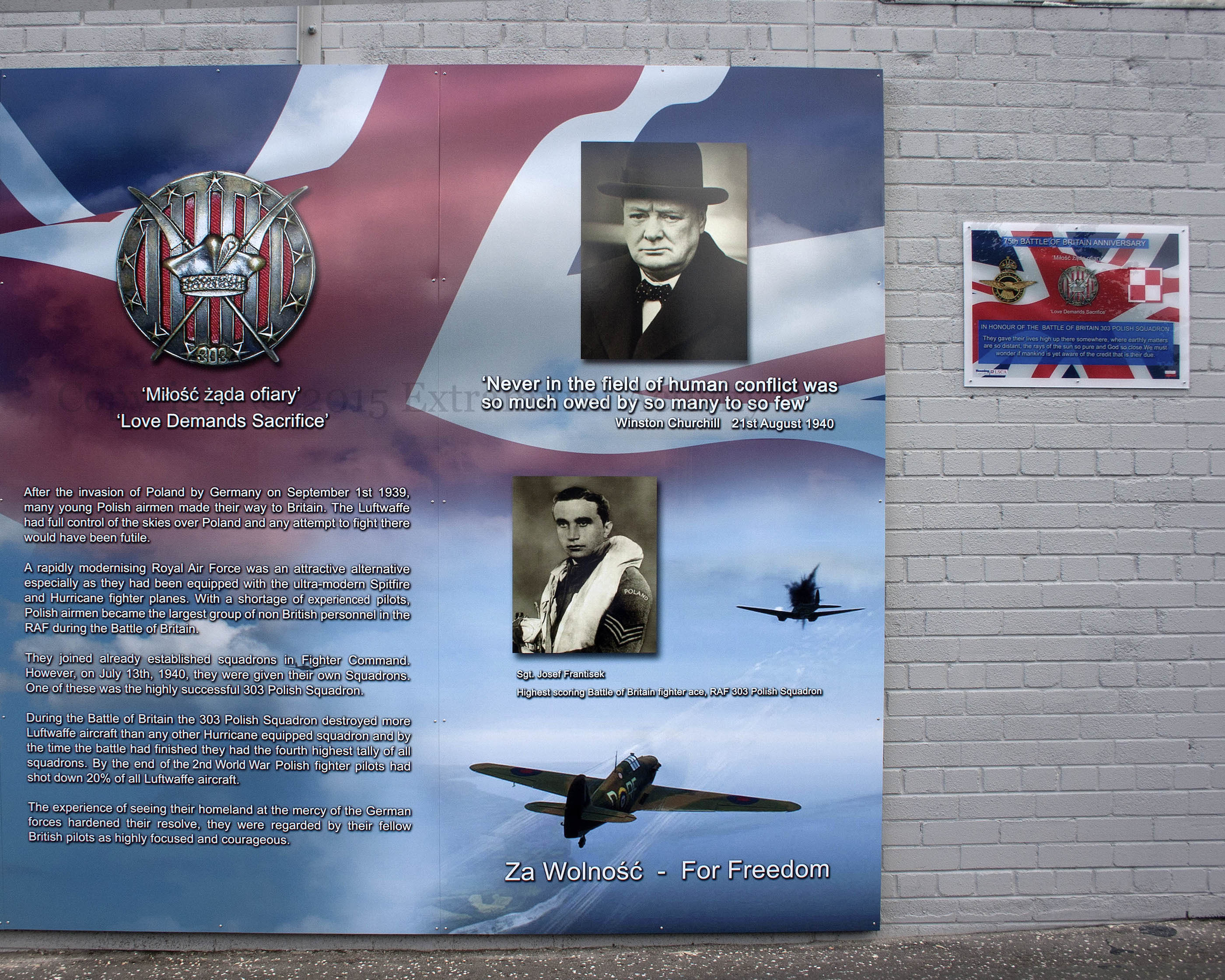
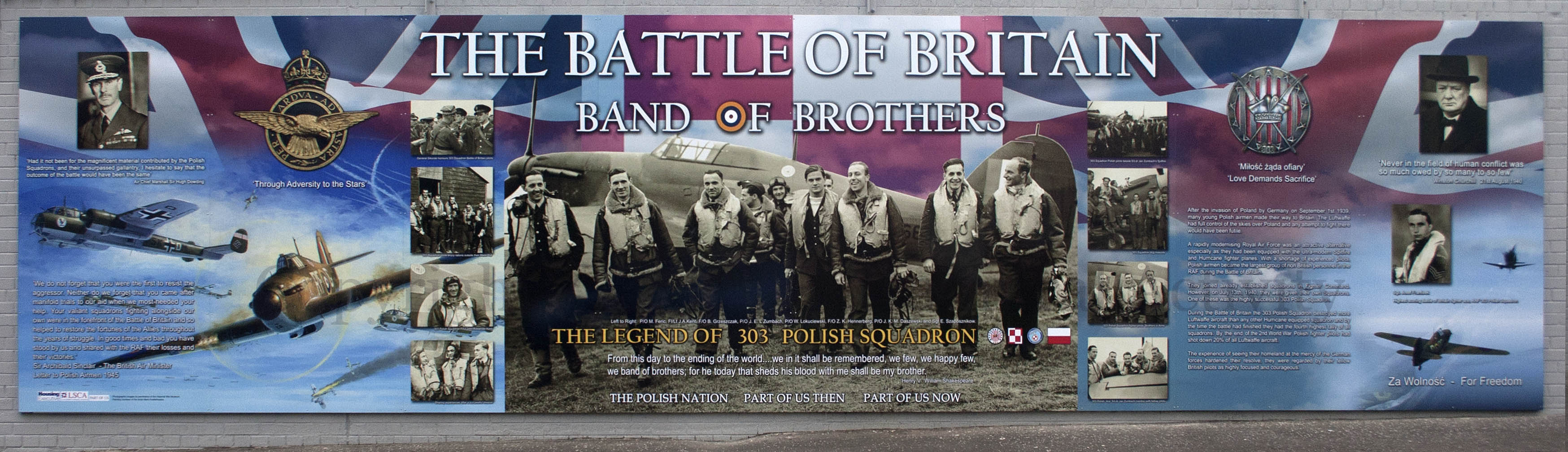
The board featured here (above and three shots below) has a dual purpose. On the one hand, it is part of celebrations marking the 75th anniversary of the Battle Of Britain, which was waged from July to October in 1940. On the other, it is part of an anti-racism project, celebrating in particular the contributions to the Battle made by roughly 145 Polish aviators (WP) and especially the 303 squadron: “The Polish nation – part of us then, part of us now”. The 303 was later stationed in Northern Ireland for a time. (BBC-NI)
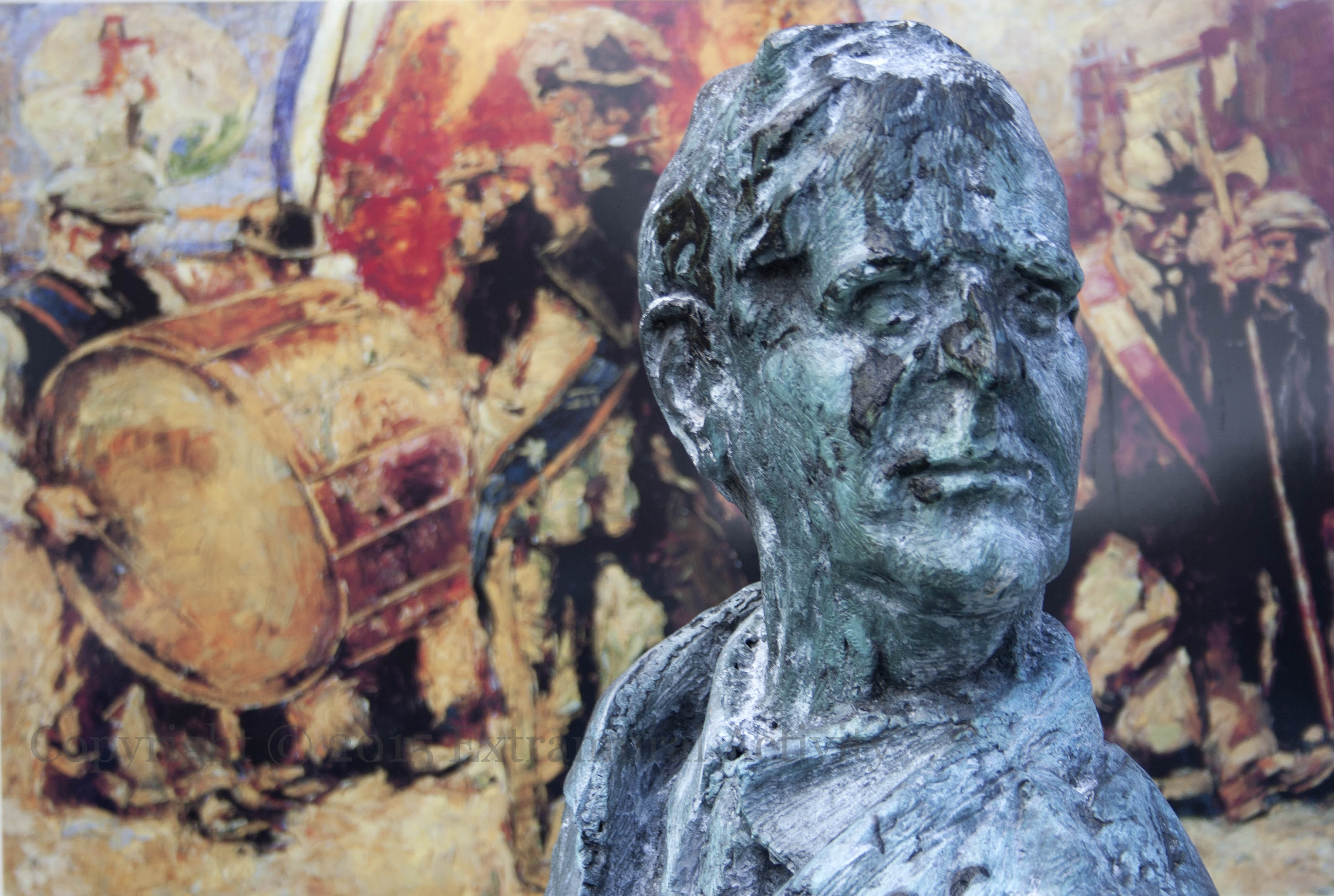
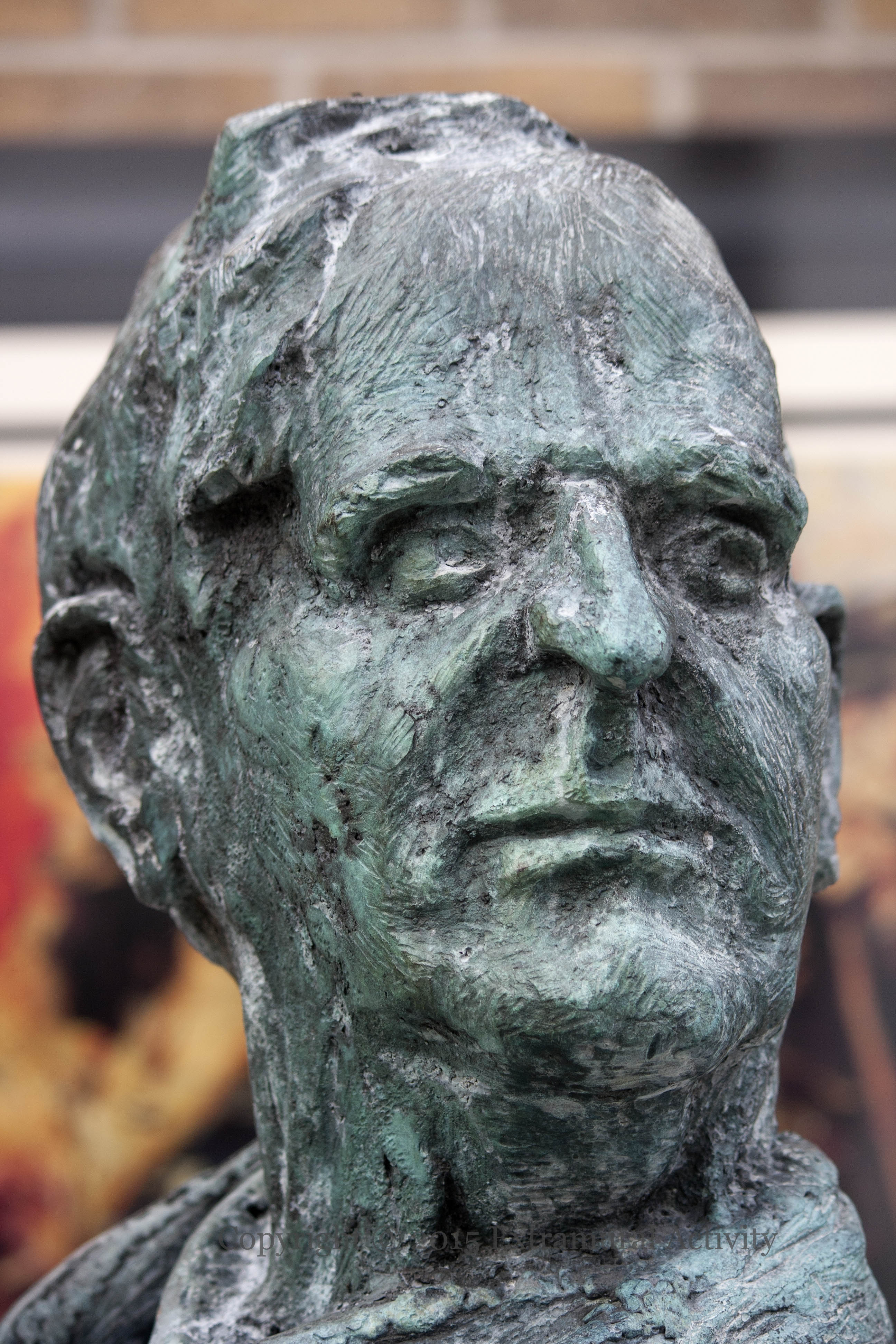
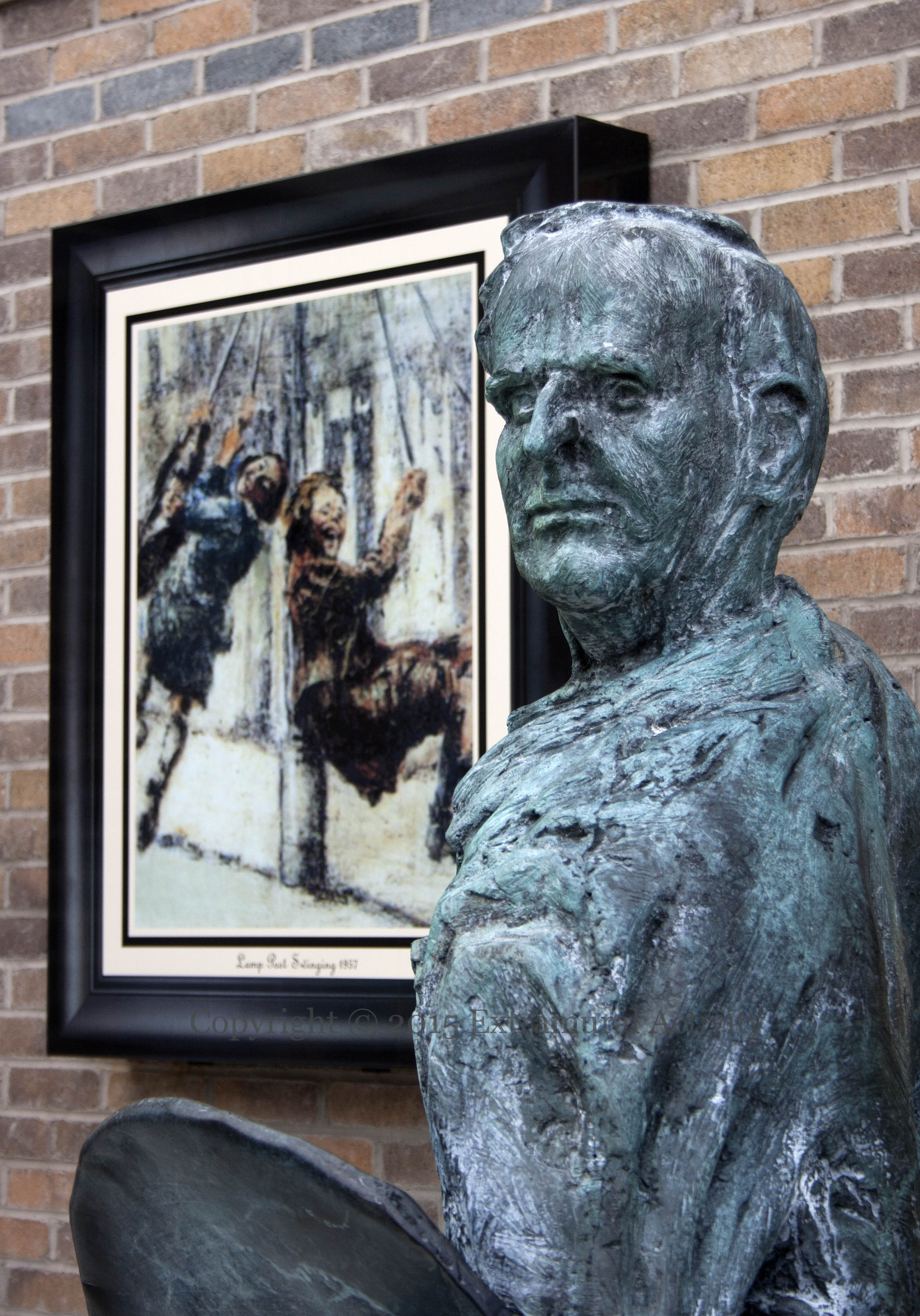
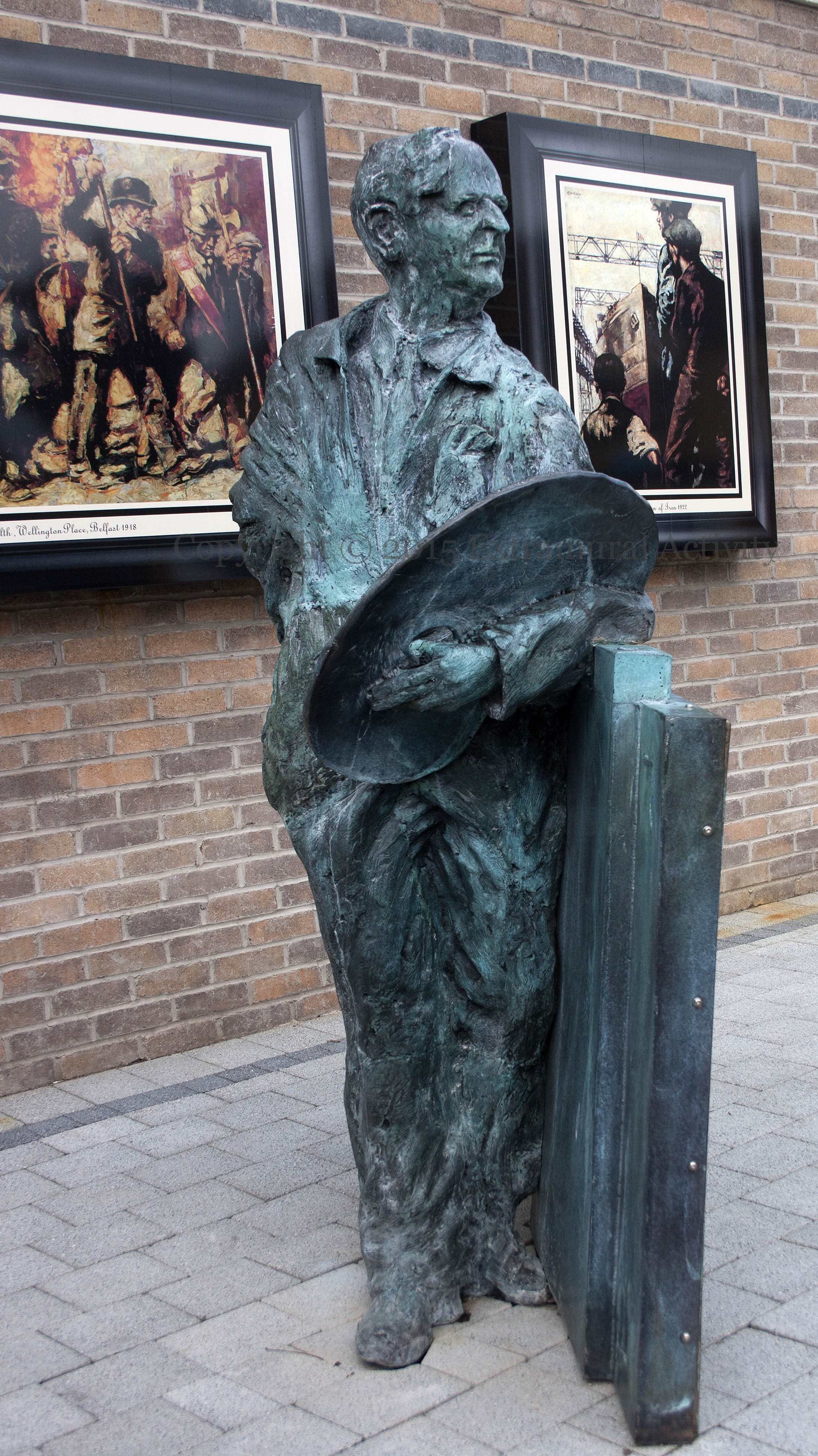
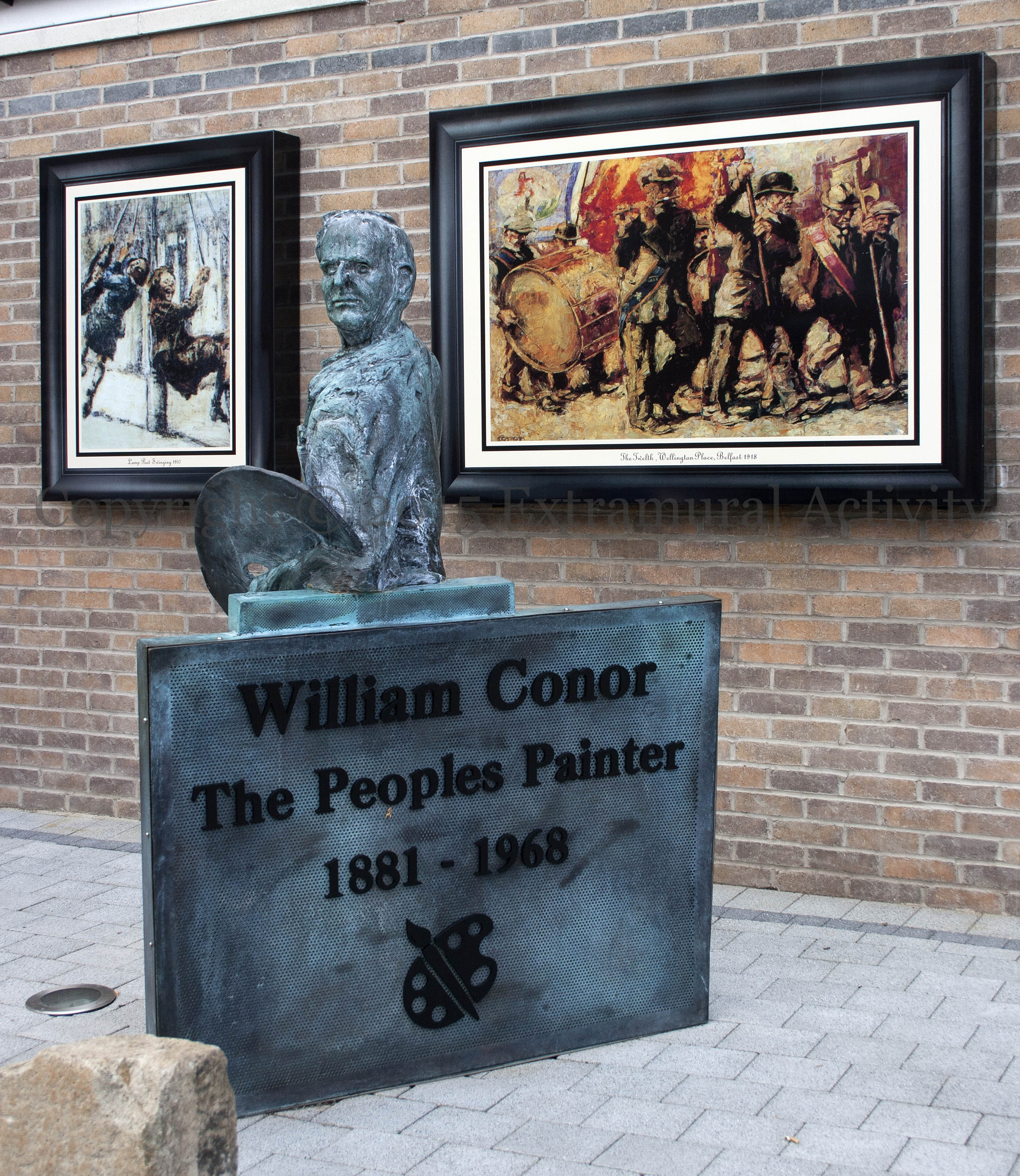
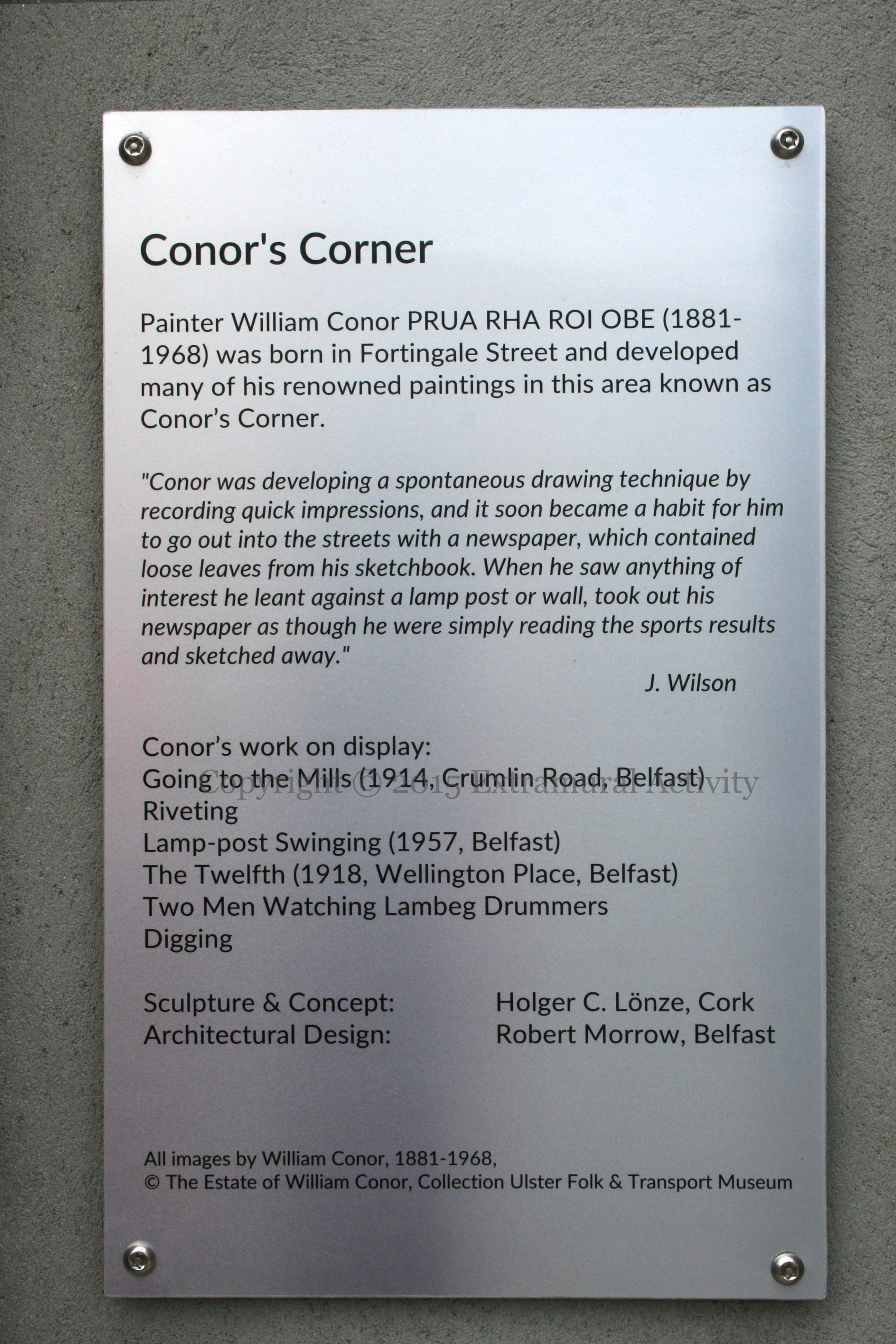
William Connor (later William Conor) was born in the Old Lodge area of Belfast (in 1881) close to the location of the new bronze statue shown in these images, which is at the corner of Northumberland Street and Shankill Road, replacing the UVF/Shankill Protestant Boys (see M02457). The info board (shown below) describes his methods in capturing the Belfast street scenes for which he is most famous: “Conor was developing a spontaneous drawing technique by recording quick impressions, and it soon became a habit for him to go out into the streets with a newspaper, which contained loose leaves from his sketchbook. When he saw anything of interest he leant against a lap post or wall, took out his newspaper as though he were simply reading the sports results and sketched away.”
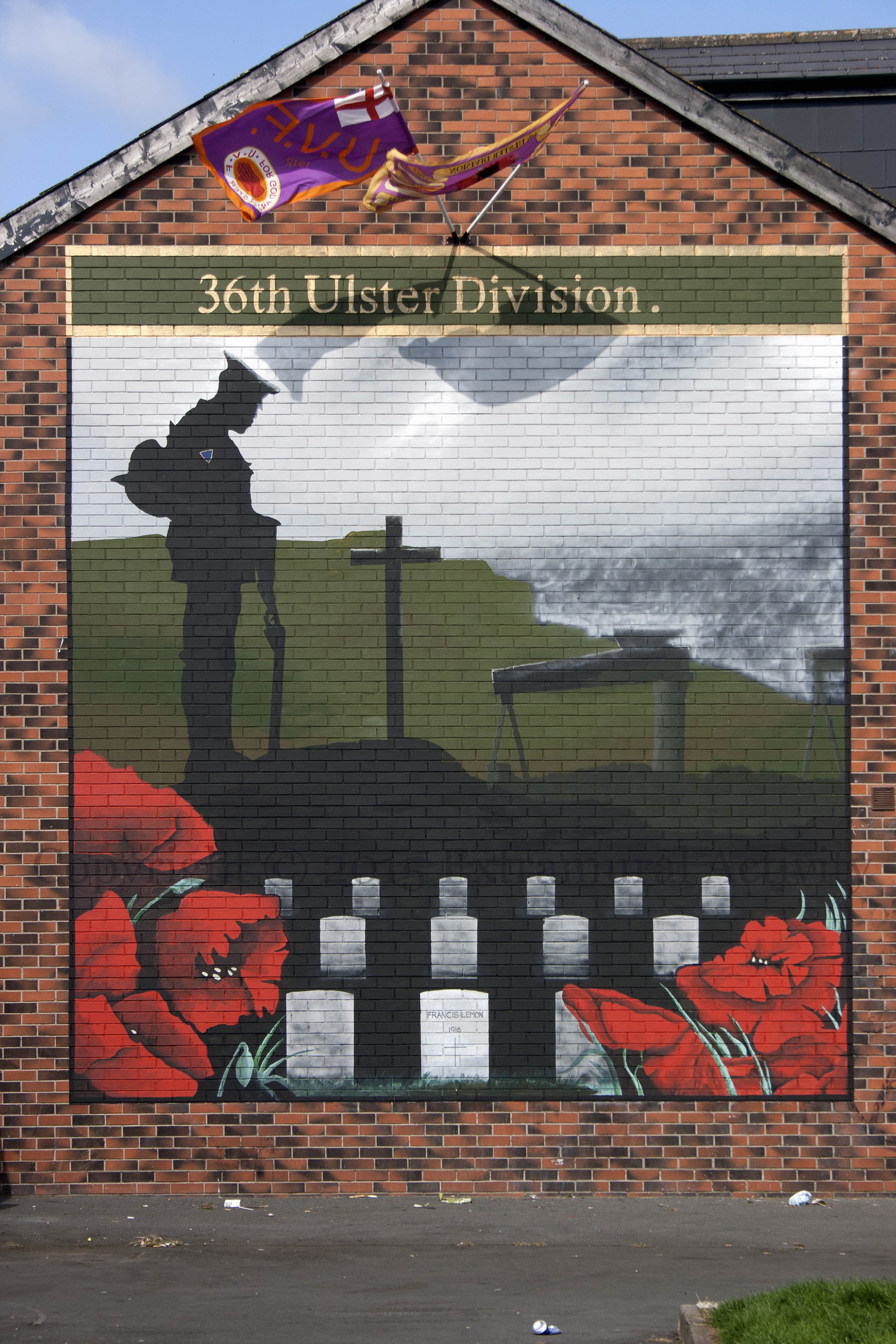
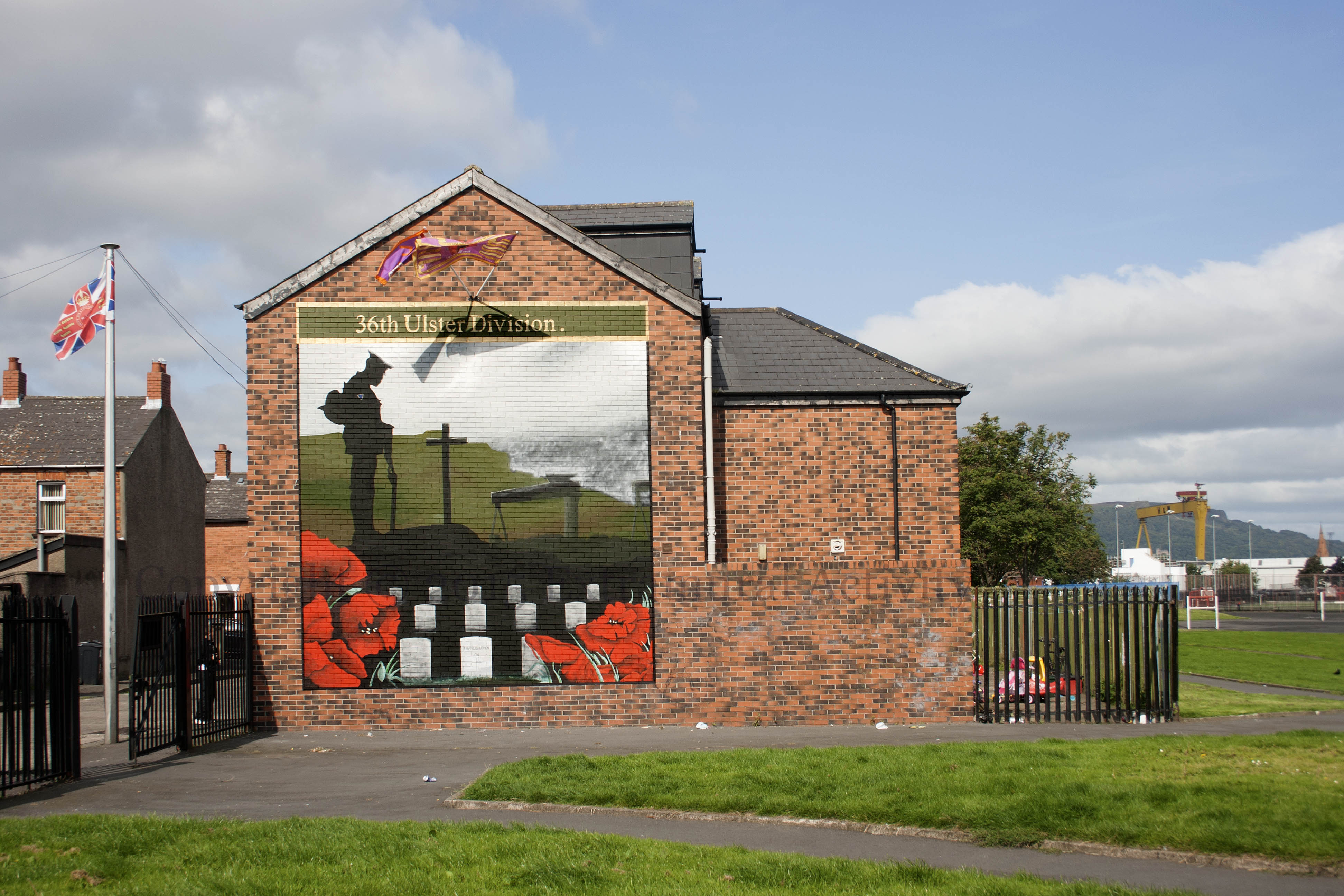
Samson and Goliath, the cranes of the Harland & Wolff shipyard in east Belfast, stand alongside crosses on the burial grounds of the 36th (Ulster) Division in Flanders (though Cave Hill might be in the background) in this Flora Street mural in east Belfast. UVF flags fly overhead. One of the cranes can be seen in the background of the wide shot, below.
On the headstone in the front-middle is written “Francis Lemon 1916”, perhaps this Francis Lemon, from Ballymacarrett, who died on July 2nd: FindAGrave | IWM.
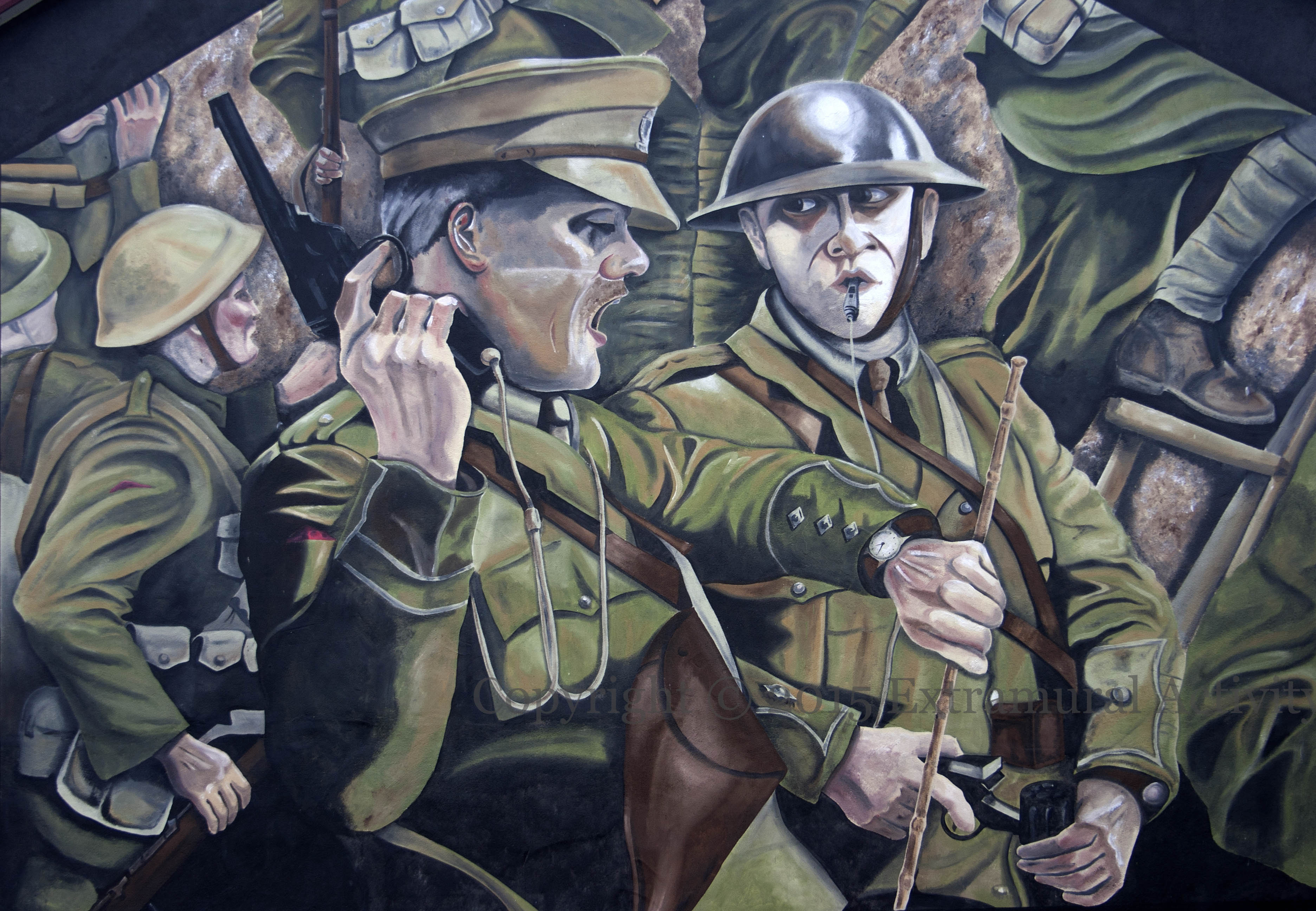
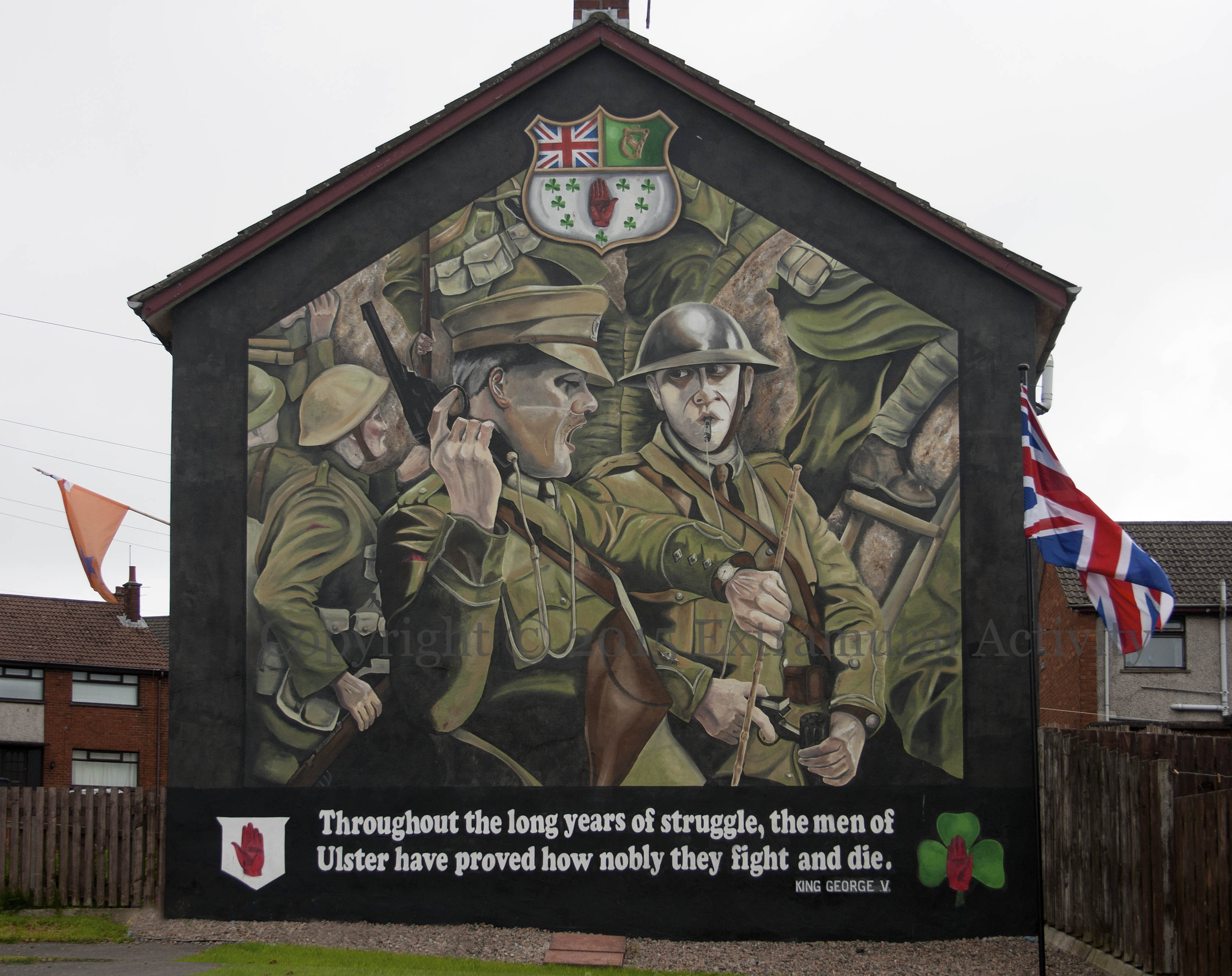
Soldiers from the 36th (Ulster) division in the trenches of WWI prepare to go ‘over the top’. One waits for the precise moment according to his watch, ready to fire a shot, while the other prepares to blow a whistle and launch a flare. “‘Throughout the long years of struggle, the men of Ulster have proved how nobly they fight and die.’ King George V”. The quote also appears on the Ulster Tower in Thiepval (Ulster Tower) and on the Cenotaph in Belfast (WP).