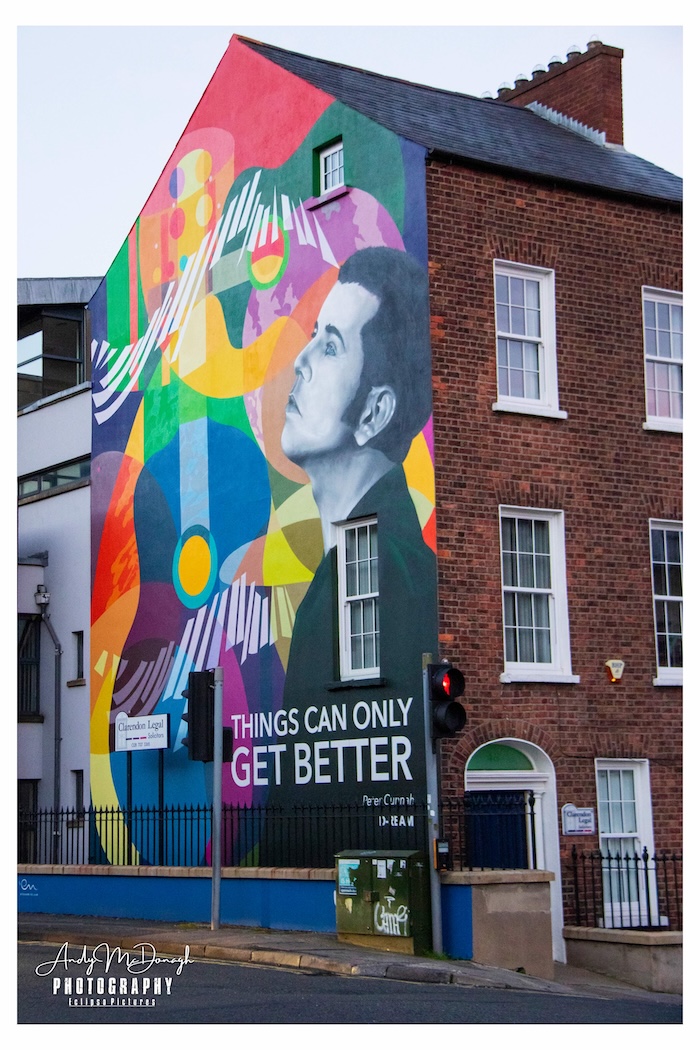
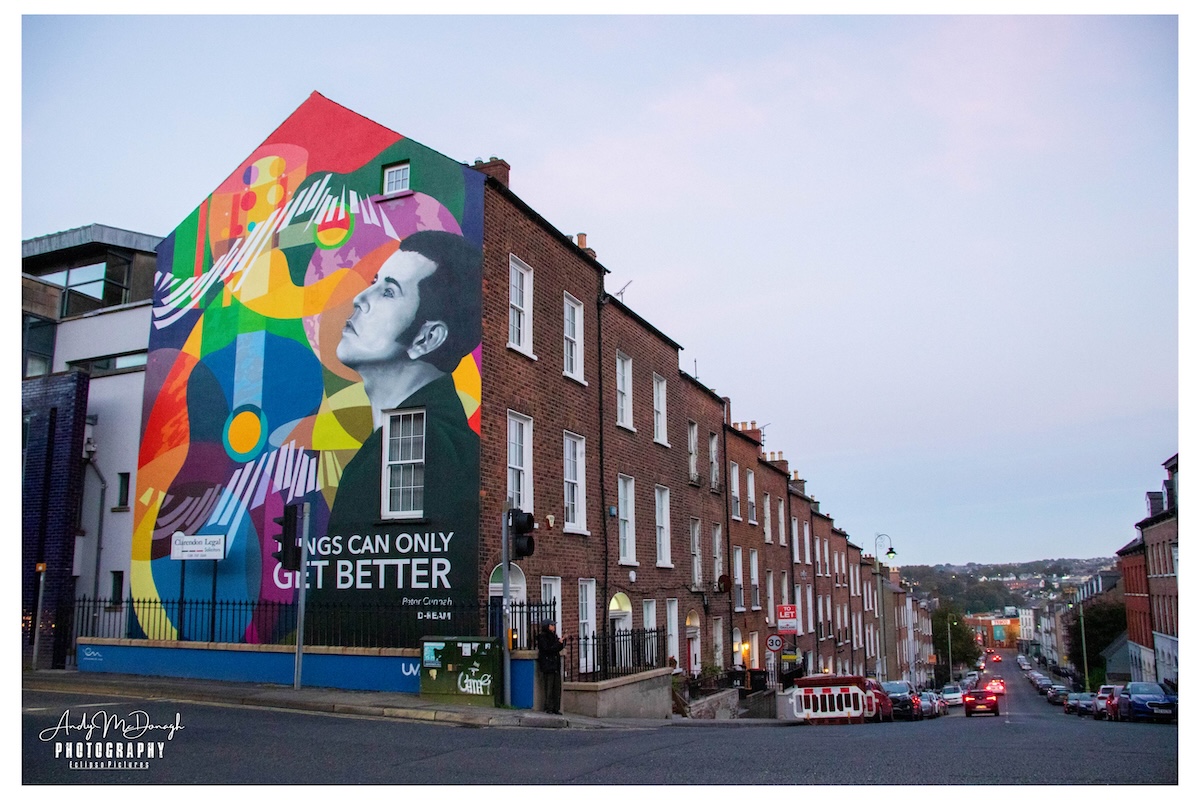
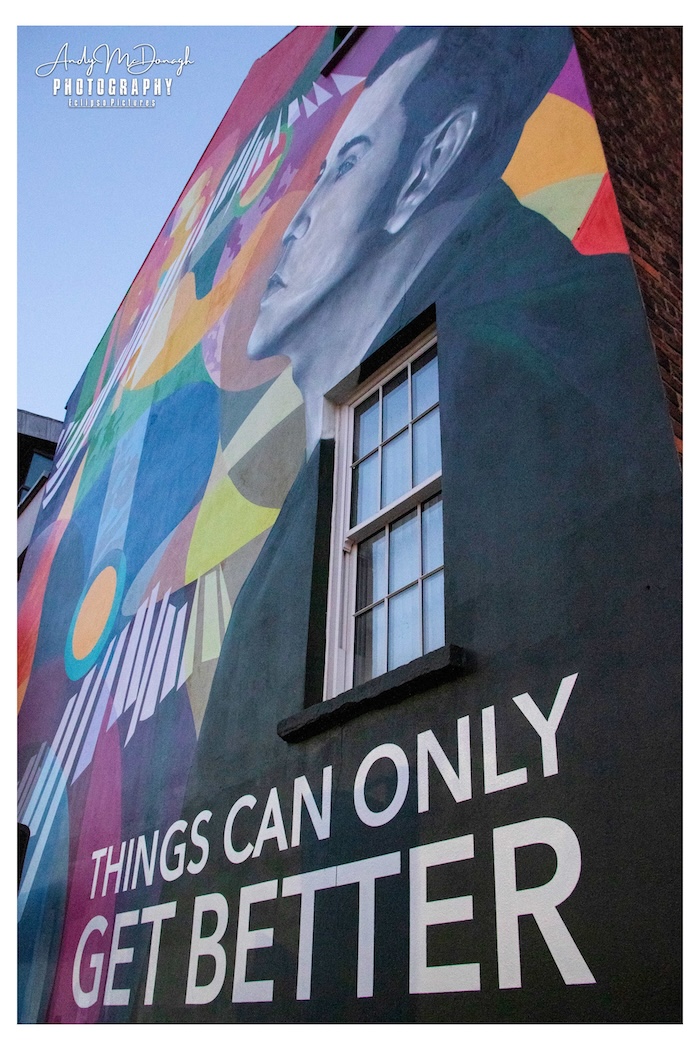
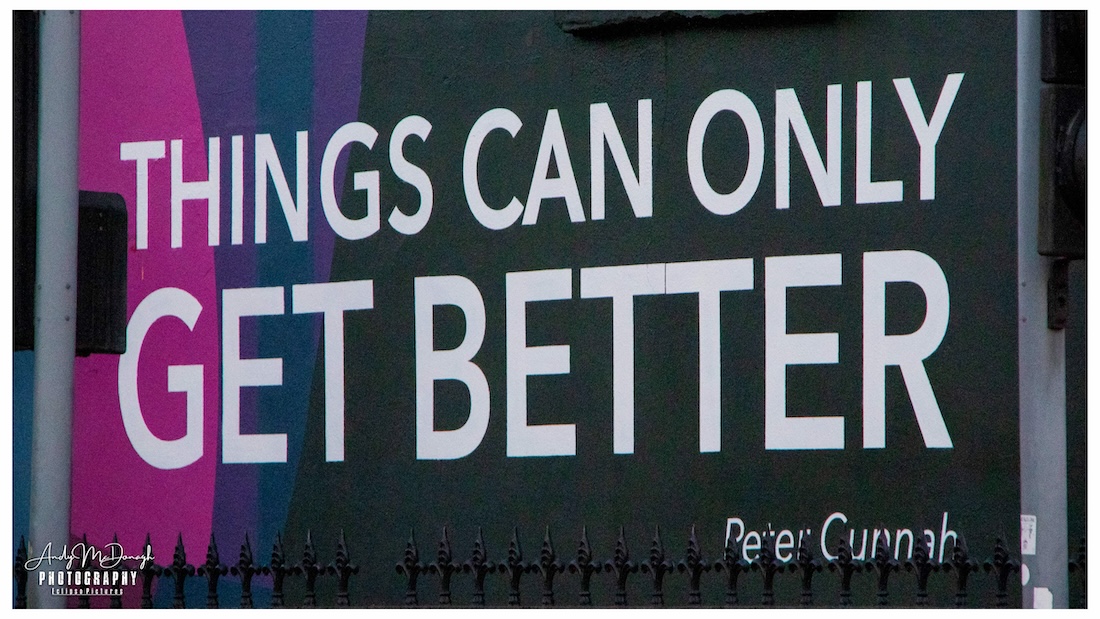
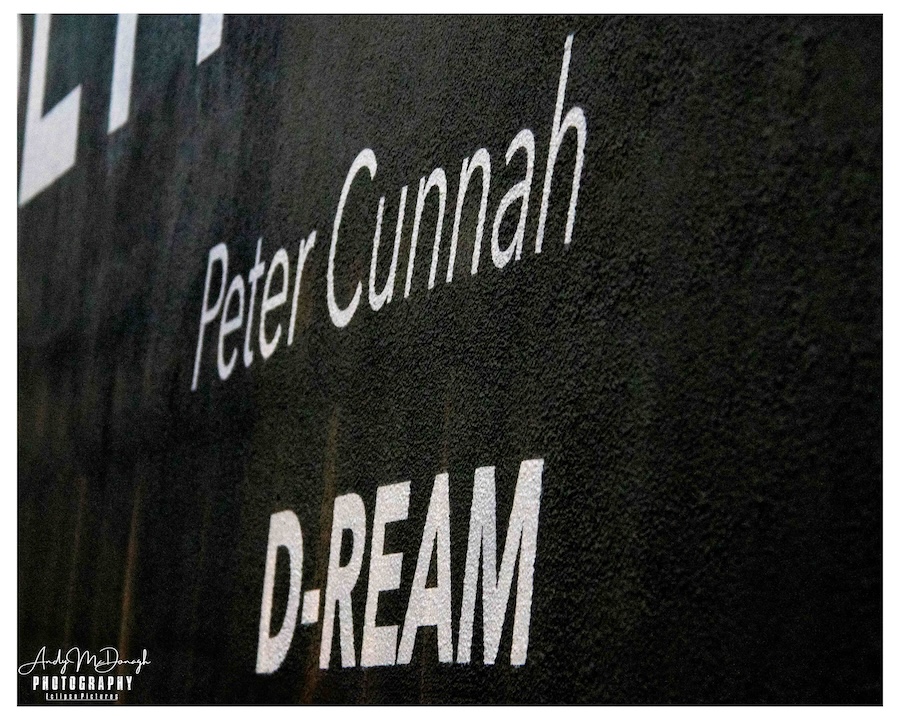
Peter Cunnah was the singer in D:Ream, which had a number-one hit in 1994 with “Things Can Only Get Better” (youtube). Cunnah was born in Belfast but adopted by parents in Derry (BBC).
This new mural was painted (by Karl Porter of UV Arts (web)) at the junction of Northland and Clarendon streets (in the Clarendon Conservation Area (pdf)), next to Cunnah’s home at 46 Clarendon Street, where he formed his first band, Tie The Boy (Derry Journal).
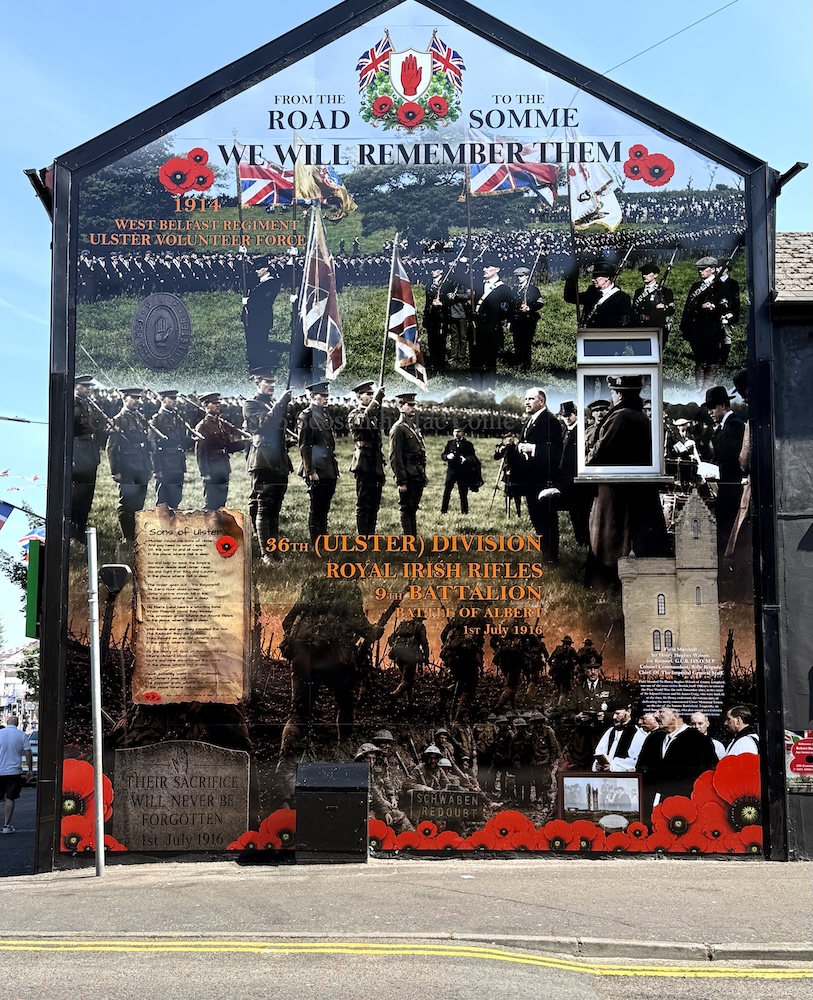
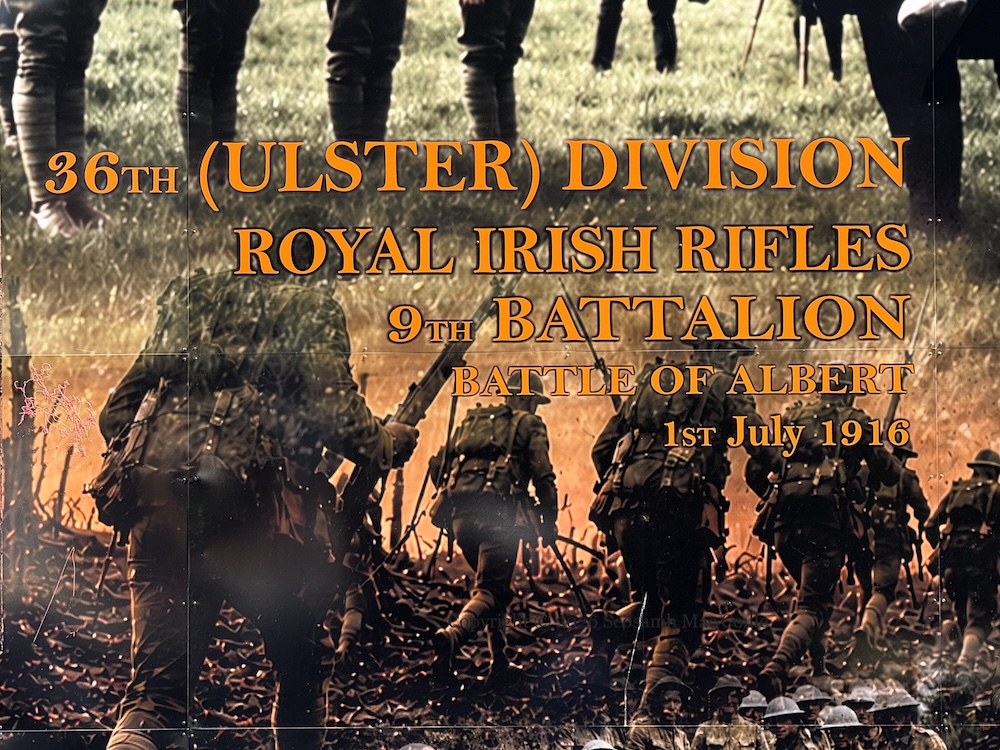
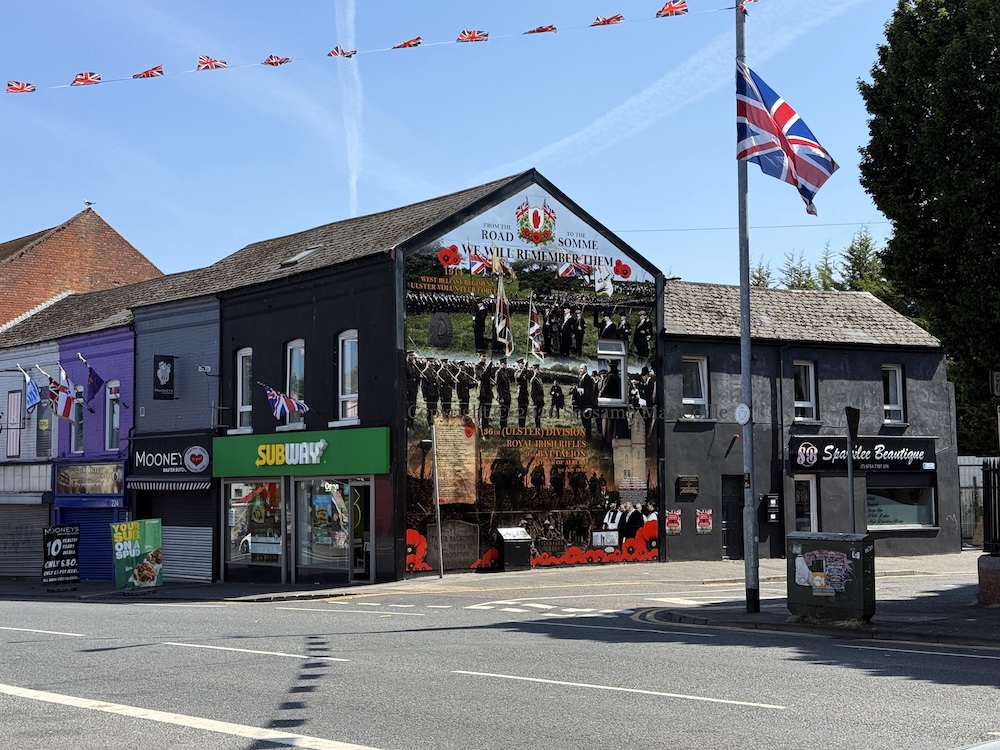
“1914 West Belfast regiment, Ulster Volunteer Force – 36th (Ulster) division, Royal Irish Rifles.” Men from the West Belfast Ulster Volunteers – which included the Shankill and Woodvale areas – joined the 9th battalion of the Royal Irish Rifles, which became part of the 107th brigade of the 36th division.
The main part of this new gable-sized board places two colourised photographs on top of each other. The first (upper) photo shows shows the first and second battalions of the West Down regiment being presented with their colours in May, 1914 (CyberProd). The second (lower) photo shows the first and second battalions of the West Belfast regiment receiving the Kings colours in May, 1914 (CyberProd).
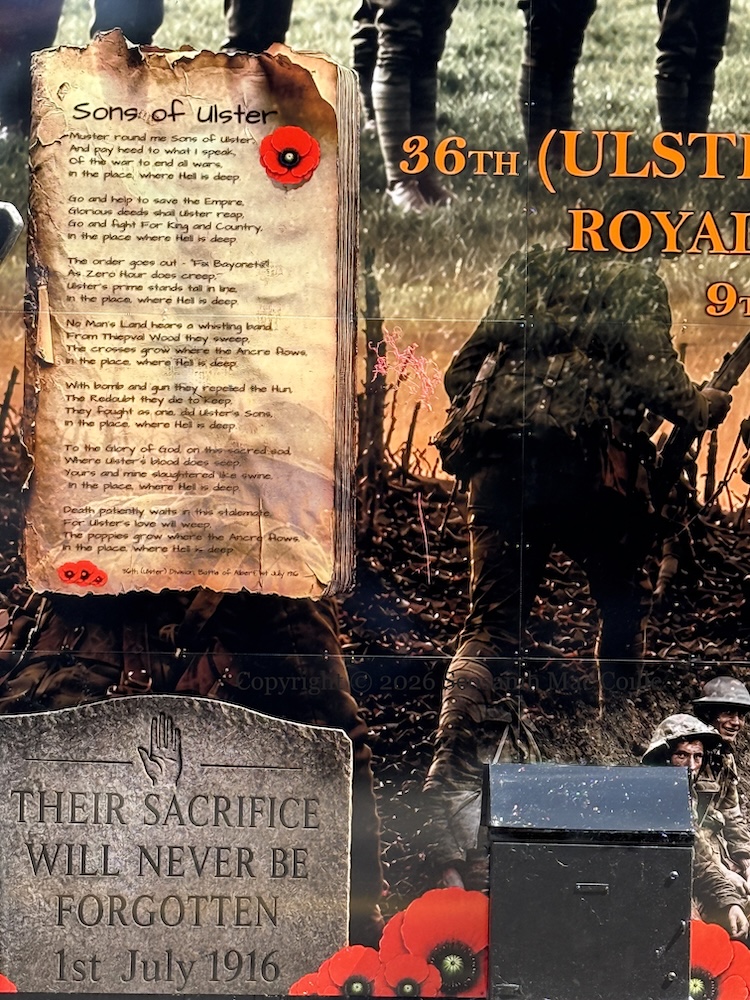
In the bottom left corner is a poem called “Sons of Ulster” written on a scroll: “Muster round me Sons of Ulster,/And pay heed to what I speak,/Of the war to end all wars,/In the place where hell is deep.//Go and help to save the Empire,/Glorious deeds shall Ulster reap./Go and fight for King and Country,/In the place where hell is deep.//The order goes out – “Fix Bayonets!”/As Zero Hour does creep,/Ulster’s prime stands tall in line,/In the place where hell is deep.//No-Man’s Land hears a whistling band,/From Thiepval Wood they sweep./The crosses grow where the Ancre flows,/In the place where hell is deep.//With bomb and gun they repelled the Hun,/The Redoubt they die to keep./They fought as one did Ulster’s Sons,/In the place where hell is deep.//To the Glory of God on this sacred sod,/Where Ulster’s Blood does seep,/Yours and mine slaughtered like swine,/In the place where hell is deep.//Death patiently waits in this stalemate,/For Ulster’s love will weep,/The poppies grow where the Ancre flows,/In the place where hell is deep.”
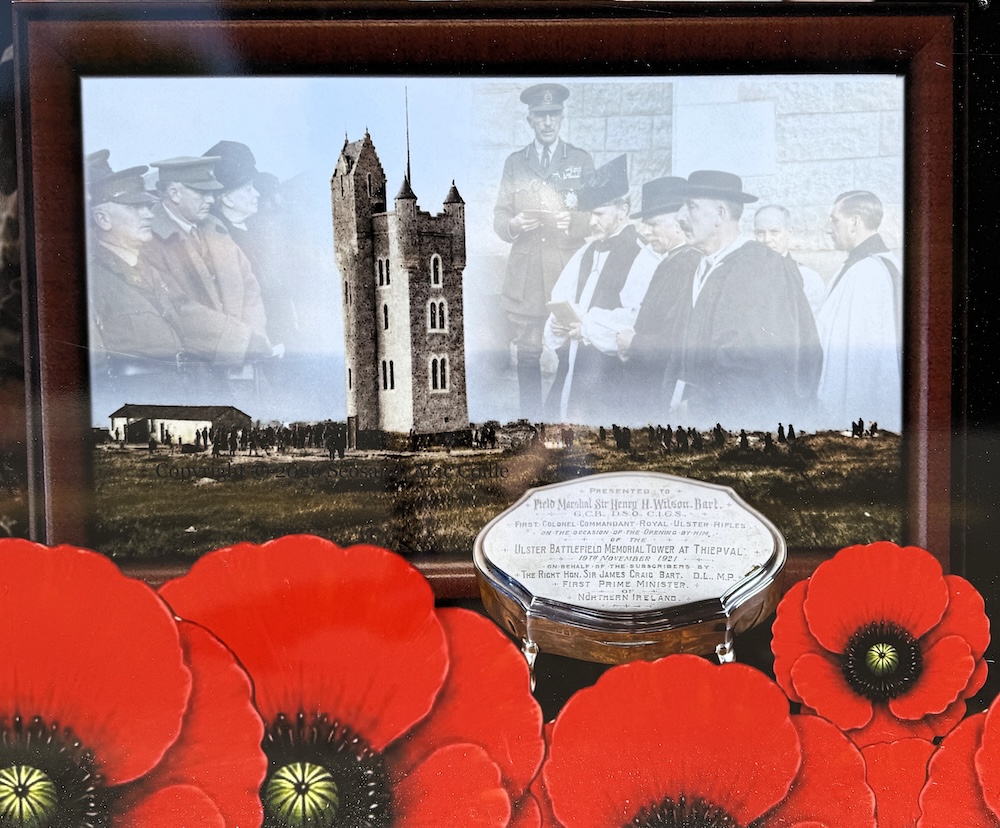
In the bottom right, the Ulster Tower is dedicated: “‘Field Marshall Sir Henry Hughes Wilson, 1st Baronet, GCB, DSO, MP, Colonel Commandant, Rifle Brigade, Chief Of The Imperial General Staff. Field Marshall Sir Henry Hughes Wilson of County Longford, was one of the most senior British Staff Officers to serve int he First World War. On 18th November 1921, in the stead of Sir Edward Carson and Sir James Craig, who were both ill at the time, Sir Henry undertook the solemn duty of dedicating the newly constructed Ulster Memorial Tower, on the site of the Somme battlefield. Tragically, on 22nd June 1922, Sir Henry, who also served as a Unionist politician, was assassinated outside his London home.”
Conway Street, Shankill, west Belfast, replacing Ulster Tower.
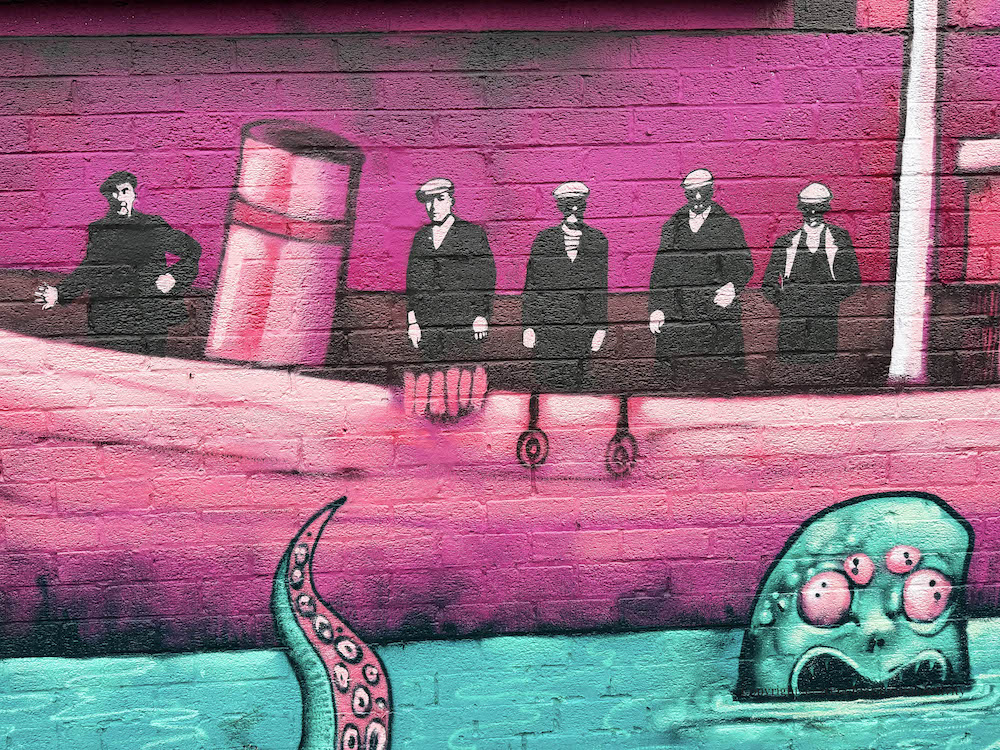
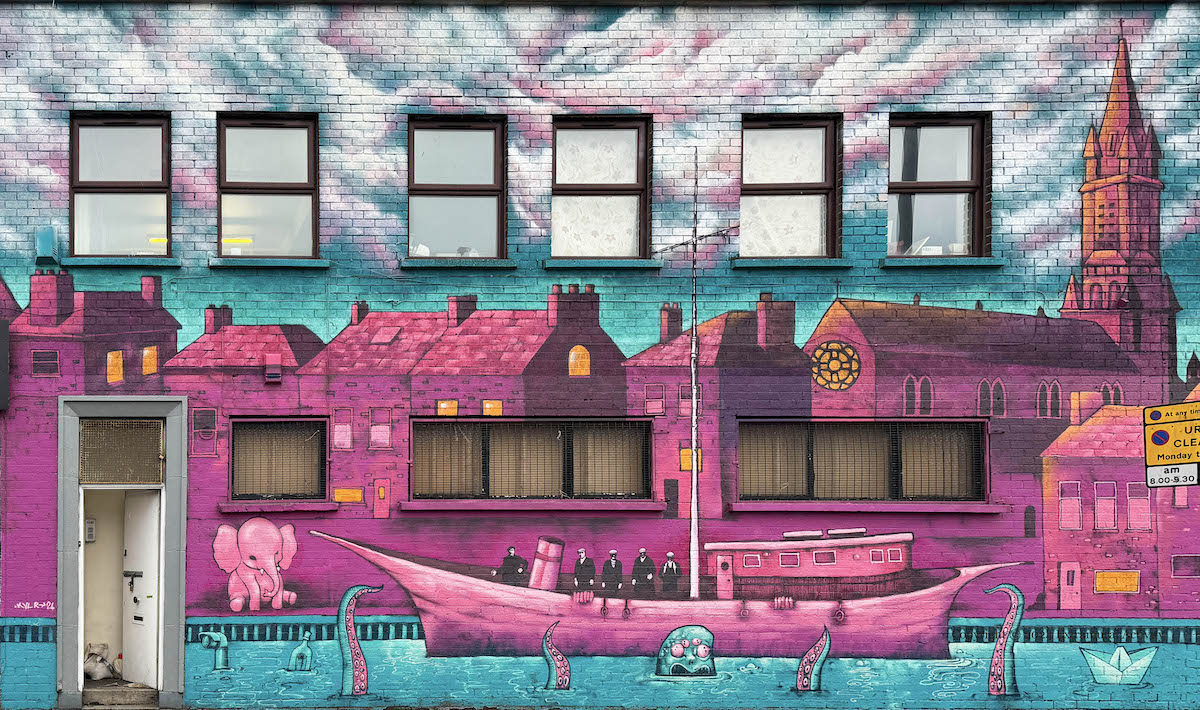
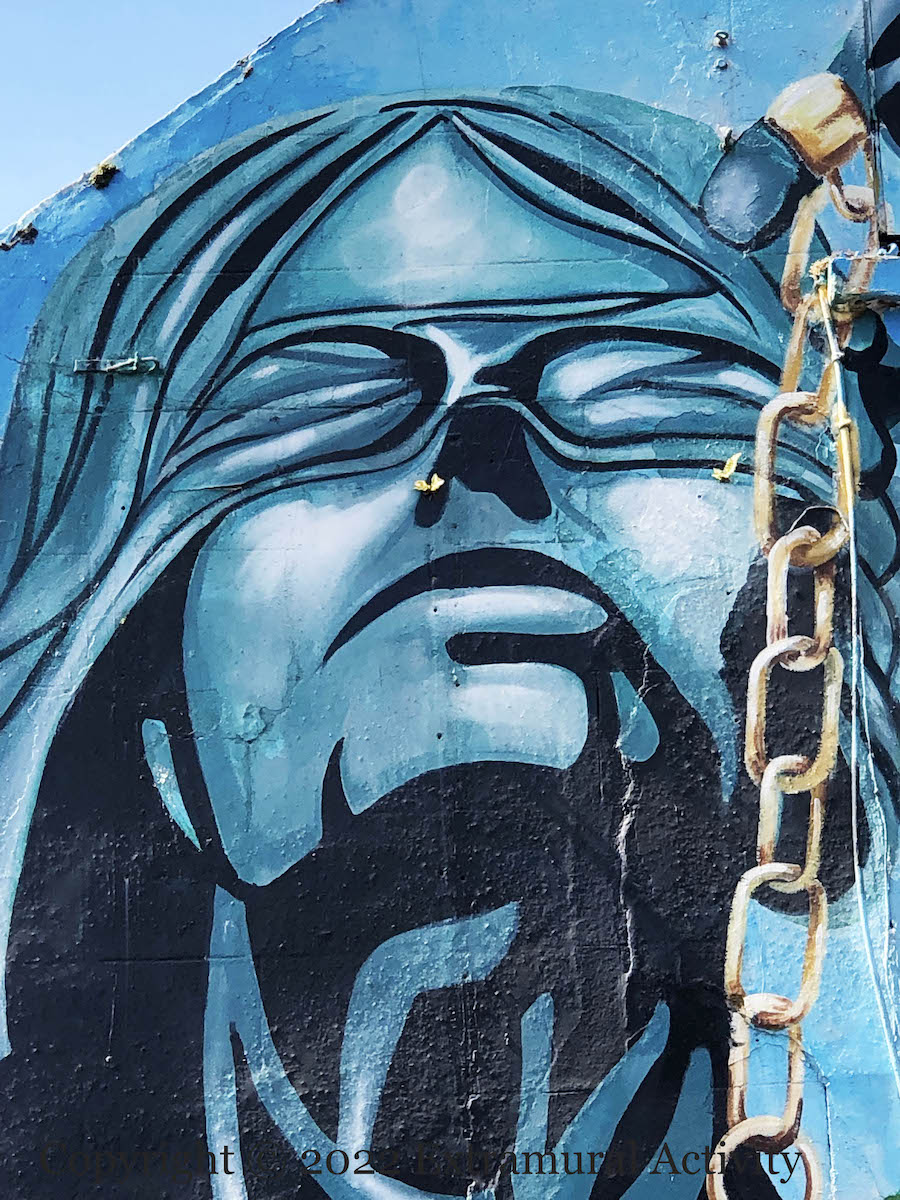
A kraken awakes in Belfast harbour, under the watchful eyes of working-class men on the waterfront in Belfast’s Sailortown, in front of local landmarks.
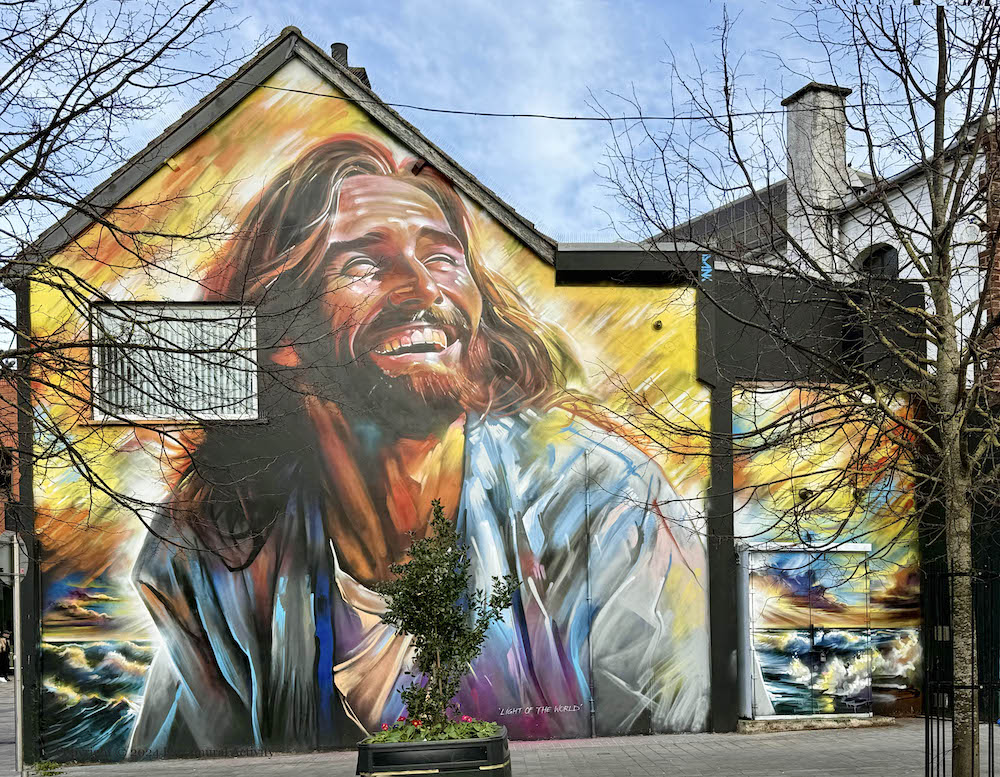
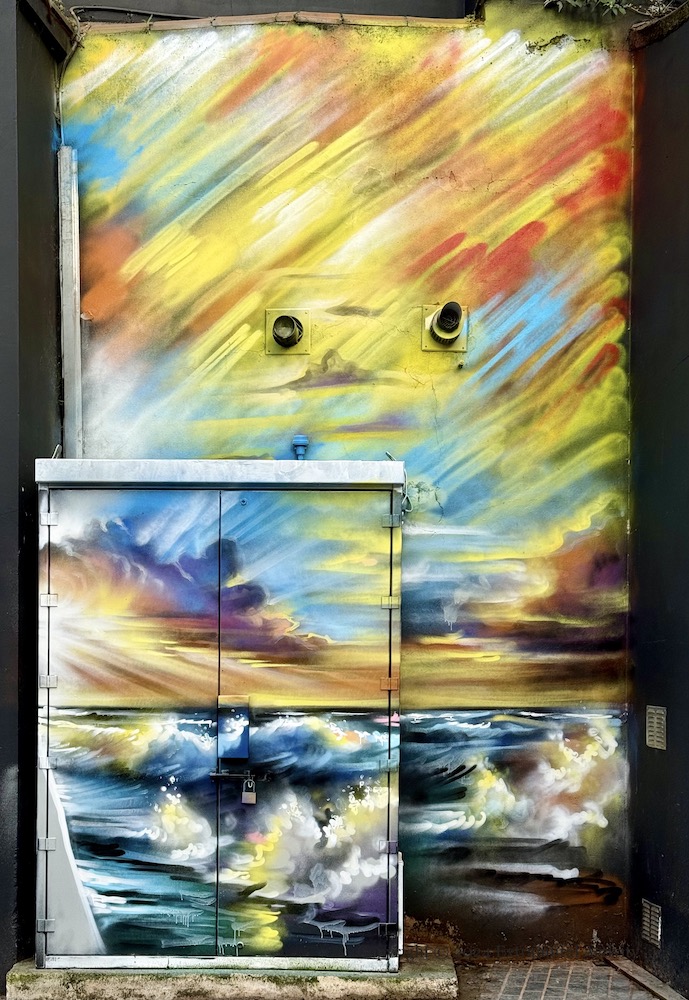
This is a second piece of street art by Dan Kitchener (web) in Bank Square, next to his painting of fast cars (Fast Enough So We Can Fly Away?): a painting of Jesus Of Nazareth for Crown Jesus Ministeries (web).
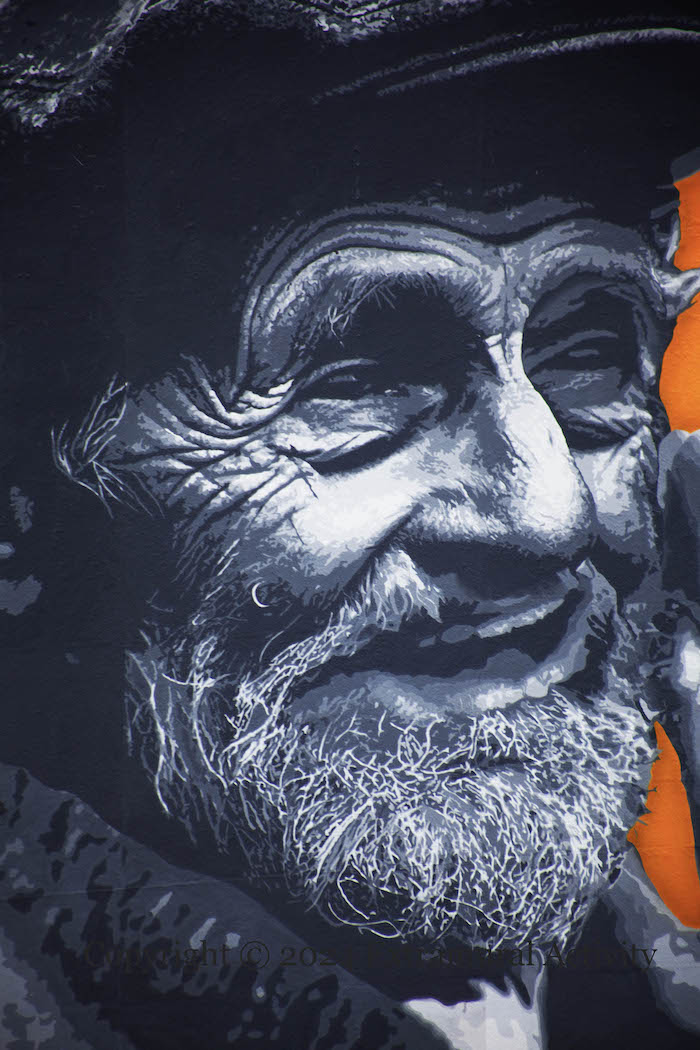
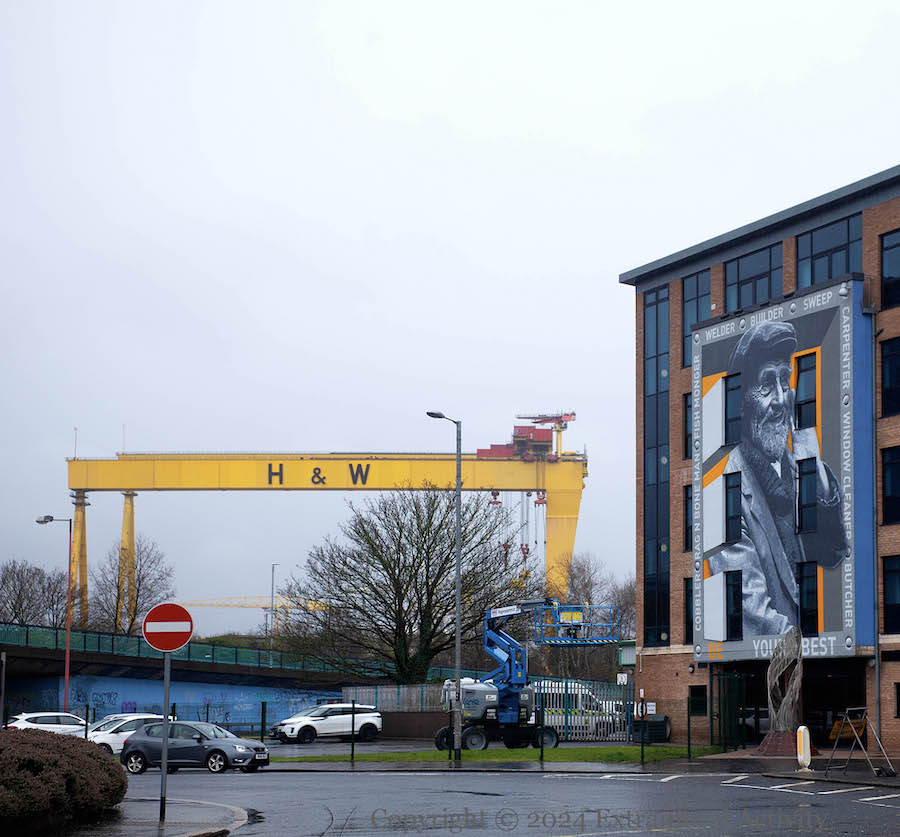
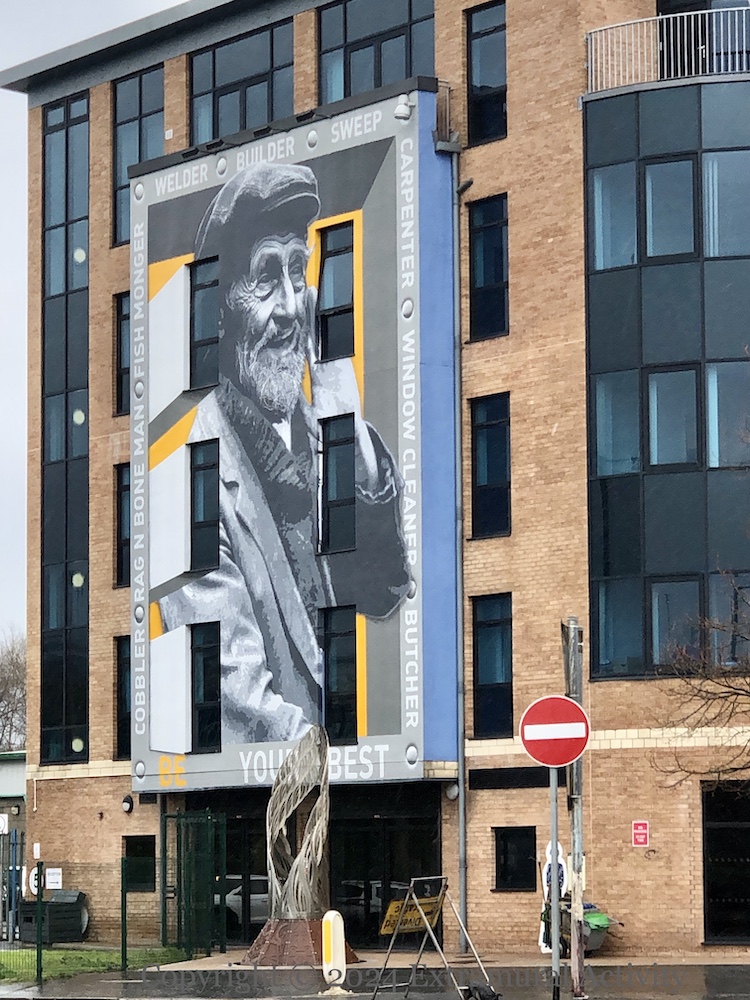
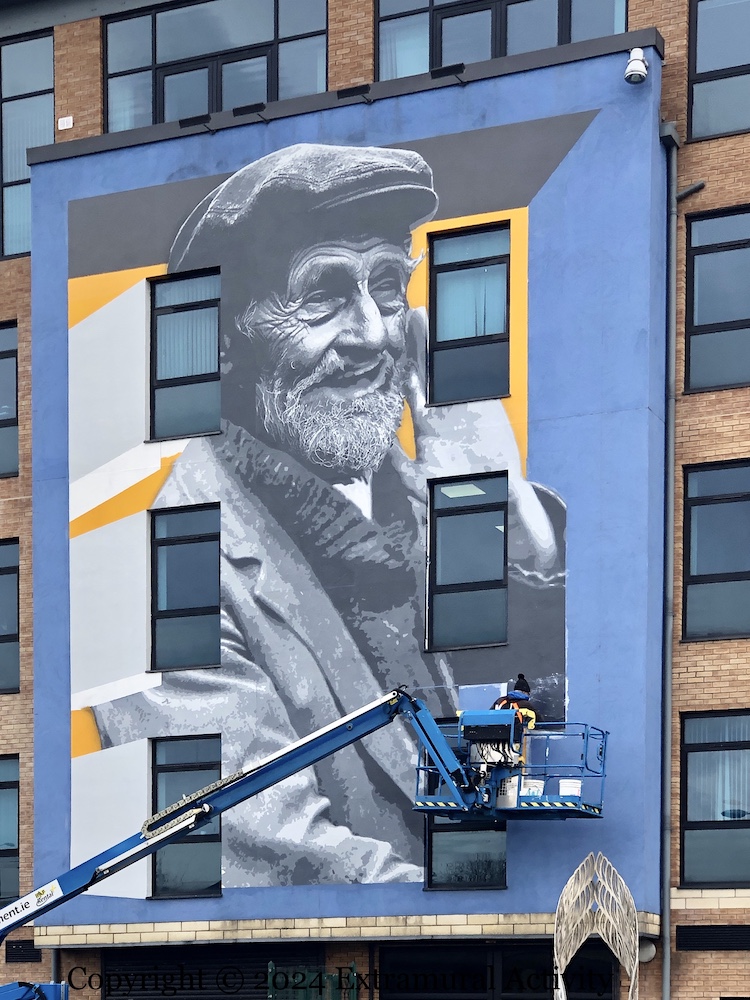
This new three-storey mural by Dee Craig (Fb) is at the city end of Newtownards Road and so serves as a highly-visible introduction to east Belfast. People arriving in the area are now greeted with a vintage image of a smiling bearded man in a cloth cap, surrounded by occupations from the industrial era: “Cobbler, rag’n’bone man, fish monger, welder, builder, sweep, carpenter, window cleaner, butcher”, capped off by an inspirational “Be your best”, with yellow highlights that match the colour of the shipyard cranes Samson and Goliath (see the third image).
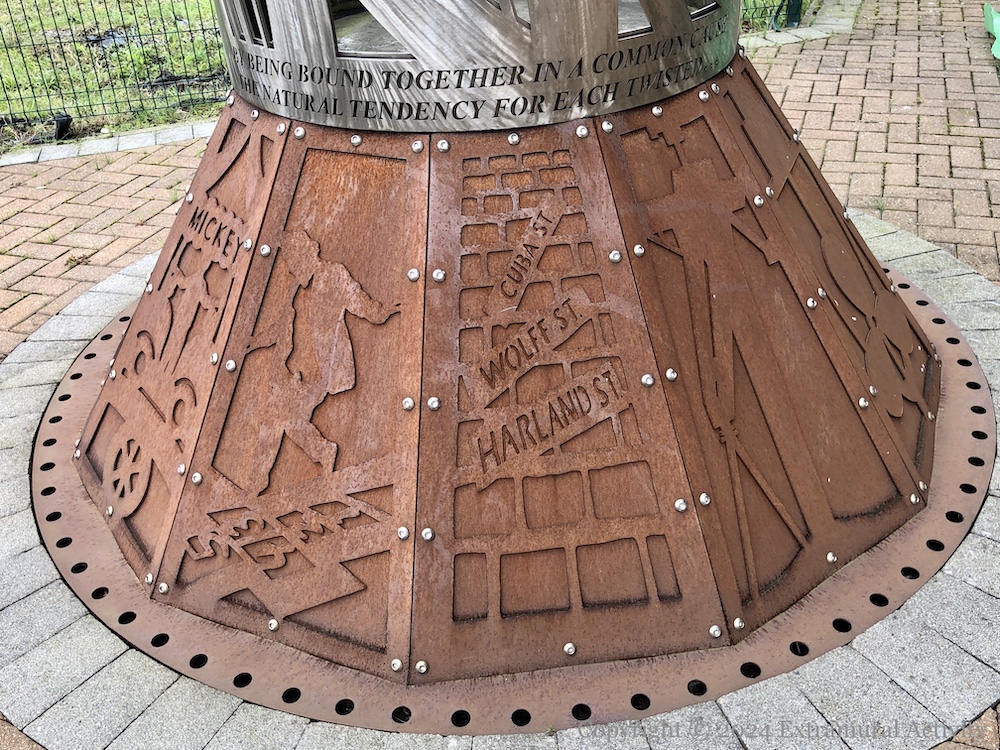
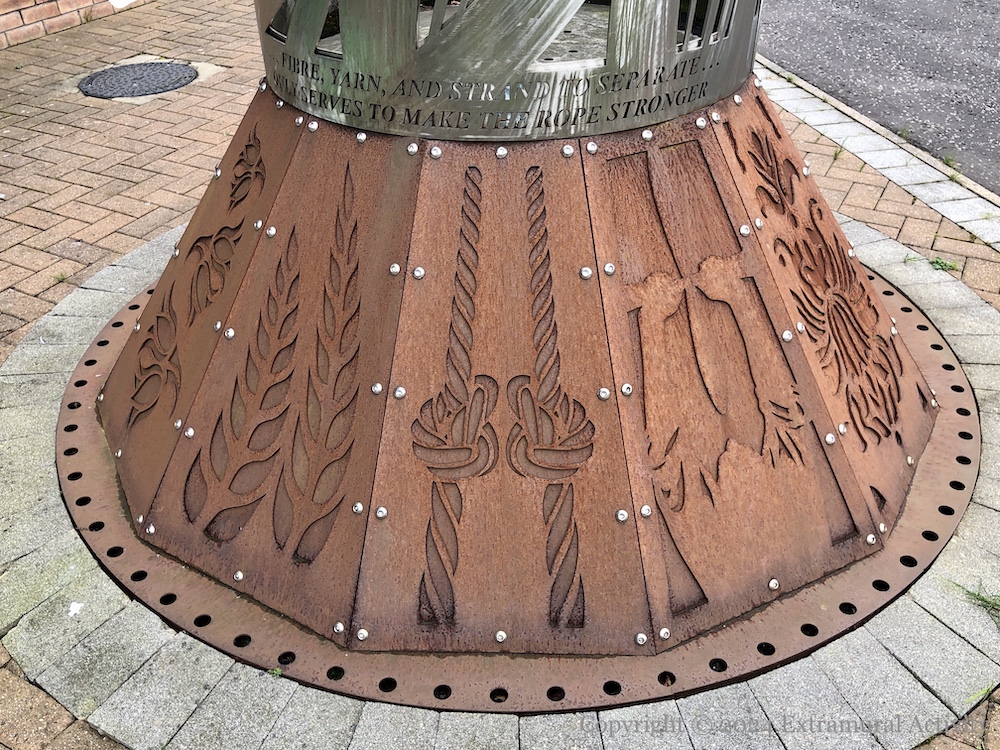
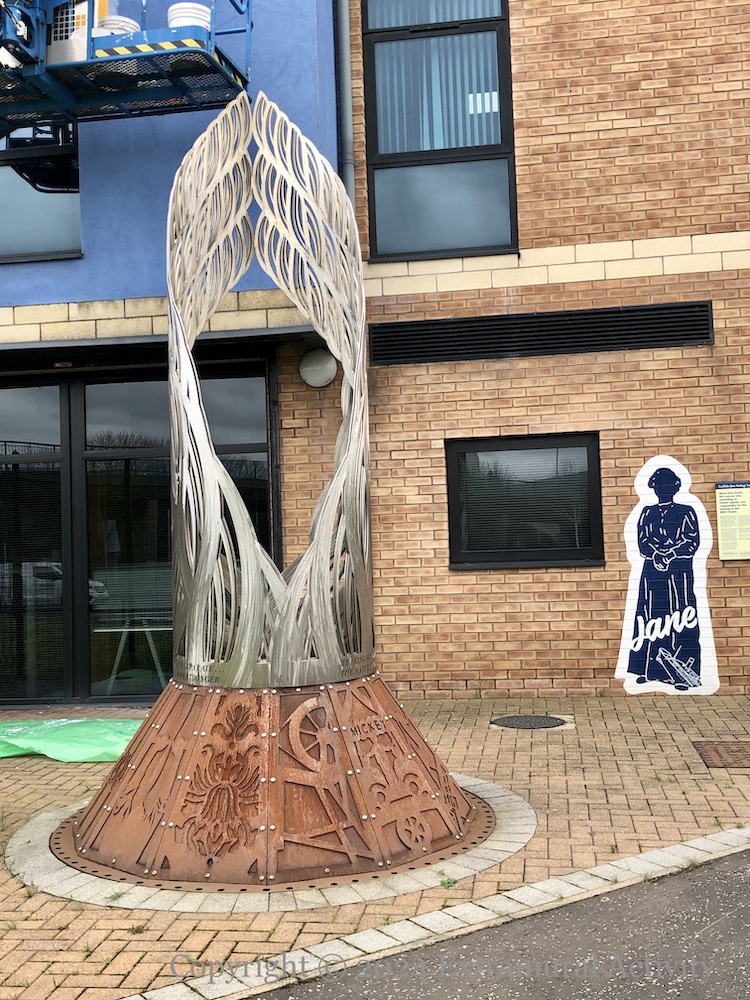
In being overshadowed by the mural, the “Let’s Twist Again” sculpture on the plaza in front of the business centre now becomes a symbol of east Belfast rather than the symbol. It too features east Belfast’s “industrial past” (BelTel), using rope as a metaphor for community: “By being bound together in a common cause, the natural tendency for each twist, fibre, yarn, and strand to separate, only serves to make the rope stronger.”
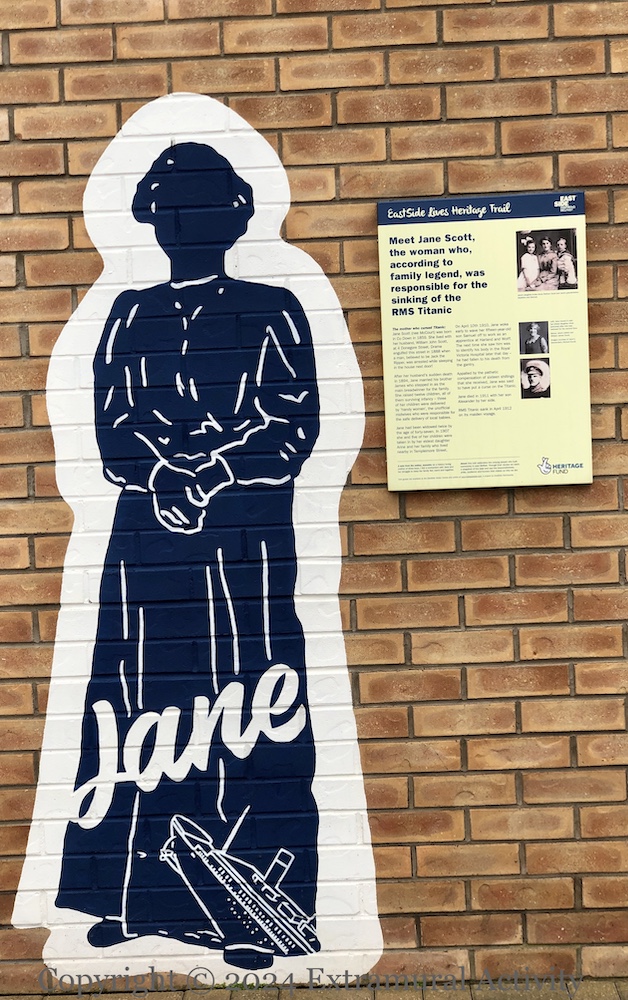
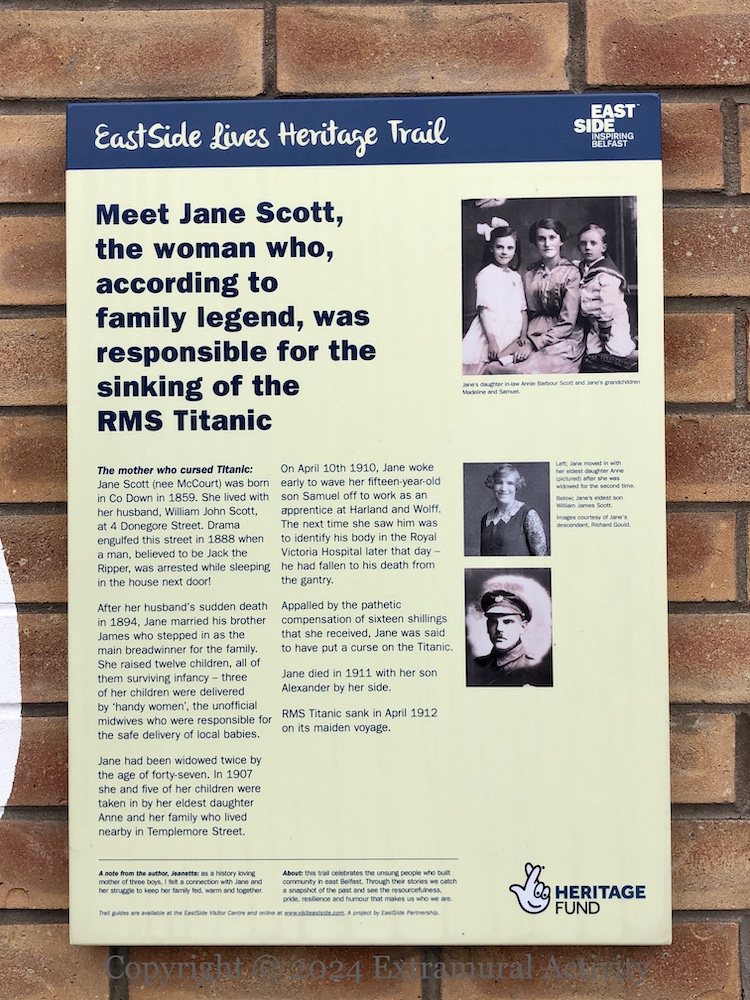
On the wall behind the sculpture and below the mural is one of the Eastside Lives Heritage Trail (pdf) figures, Jane Scott, whose fifteen-year-old son Samuel fell to his death from a ladder while working on the ship in 1910. She supposedly cursed the ship and it sank two years later. (See also Godfather Of Legal Betting and various others.)
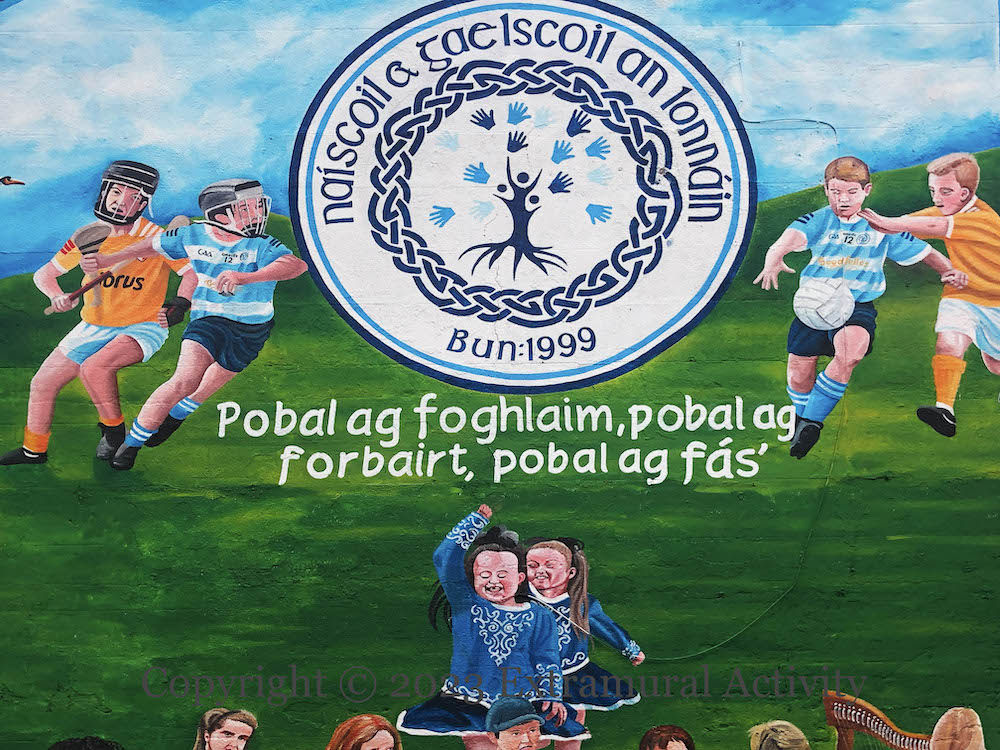
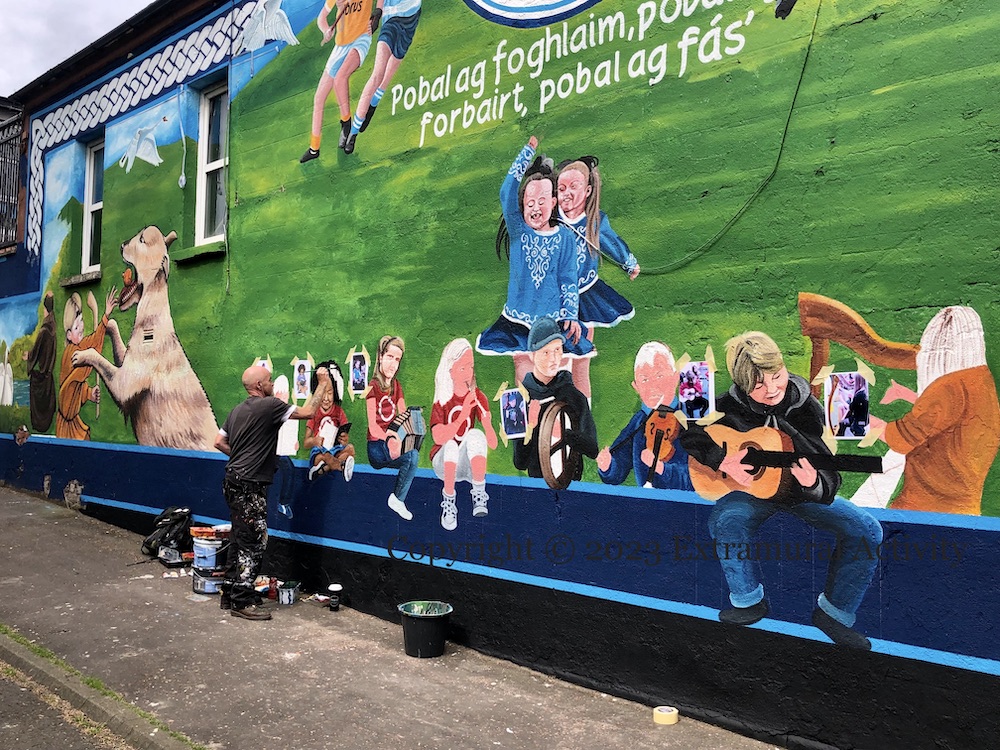
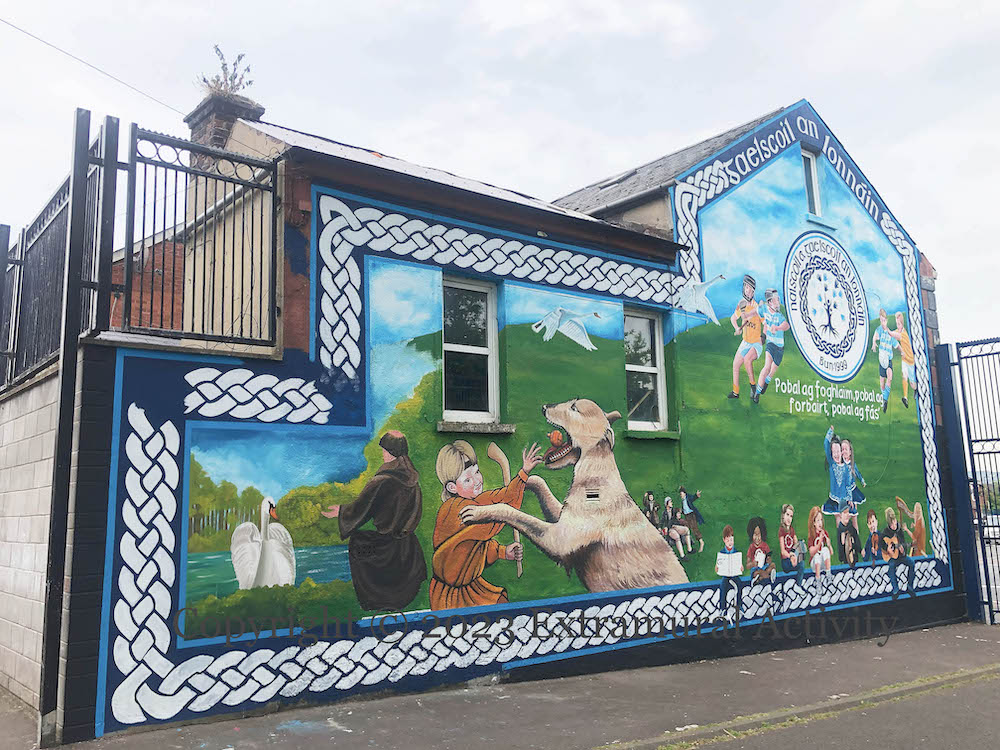
“Pobal ag foghlaım, pobal ag forbaırt, pobal ag fás” [a community learning, developing, growing]
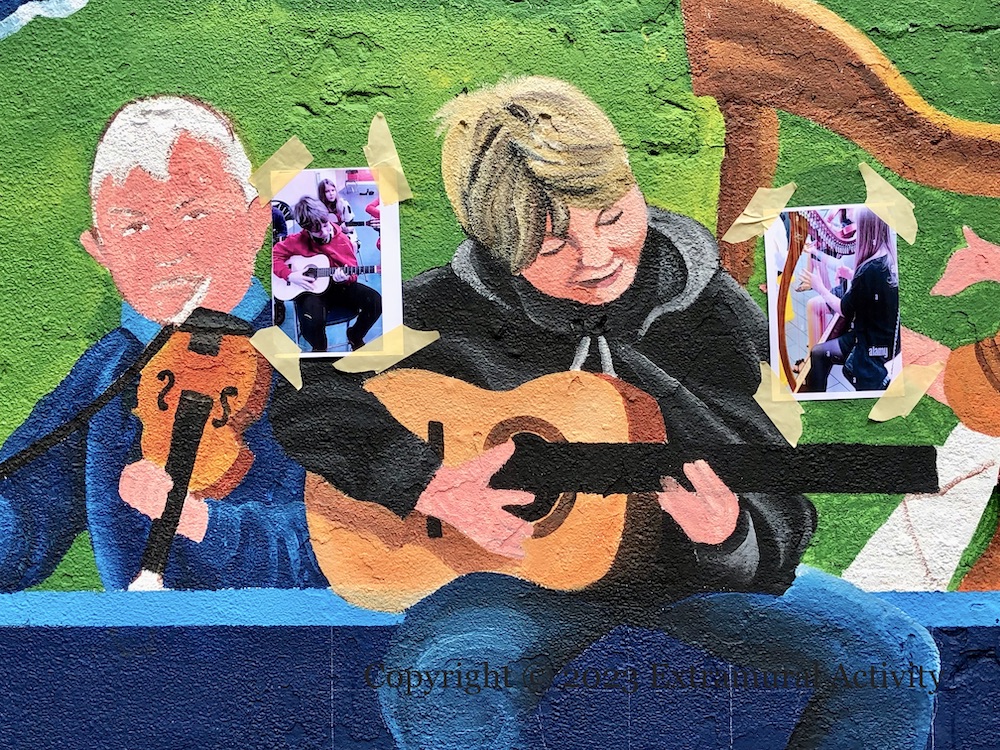
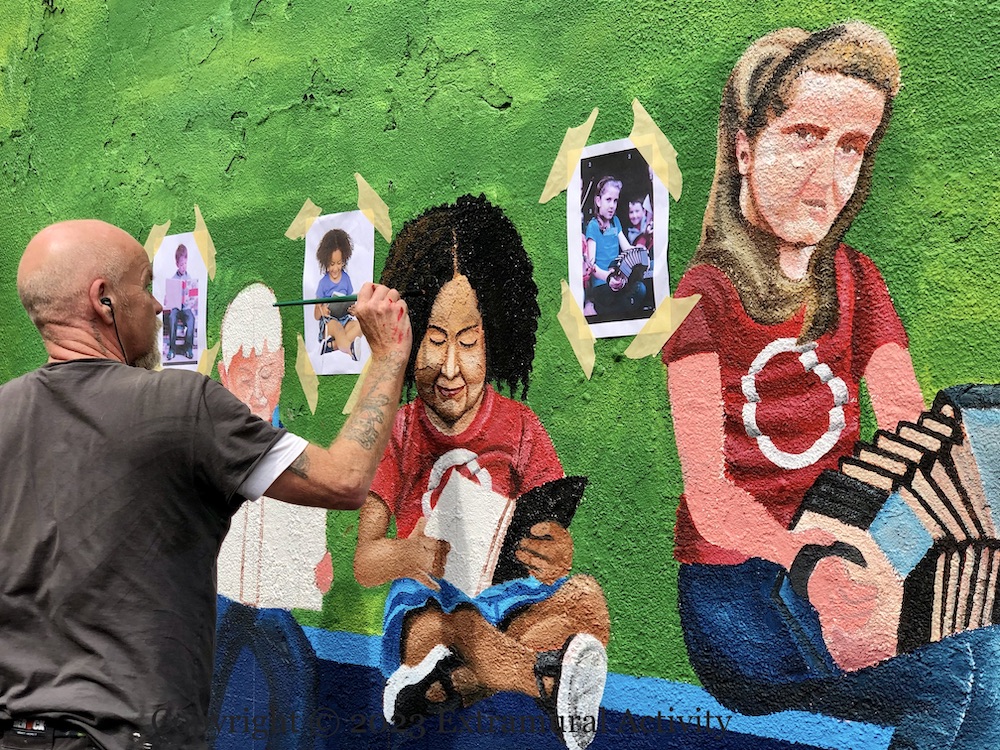
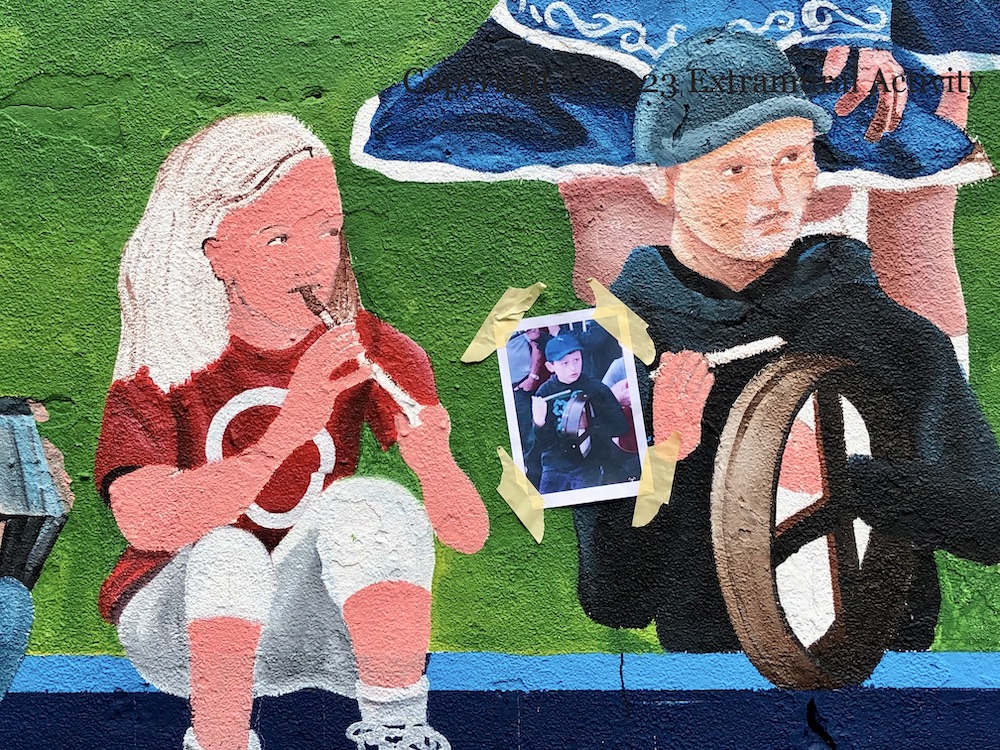
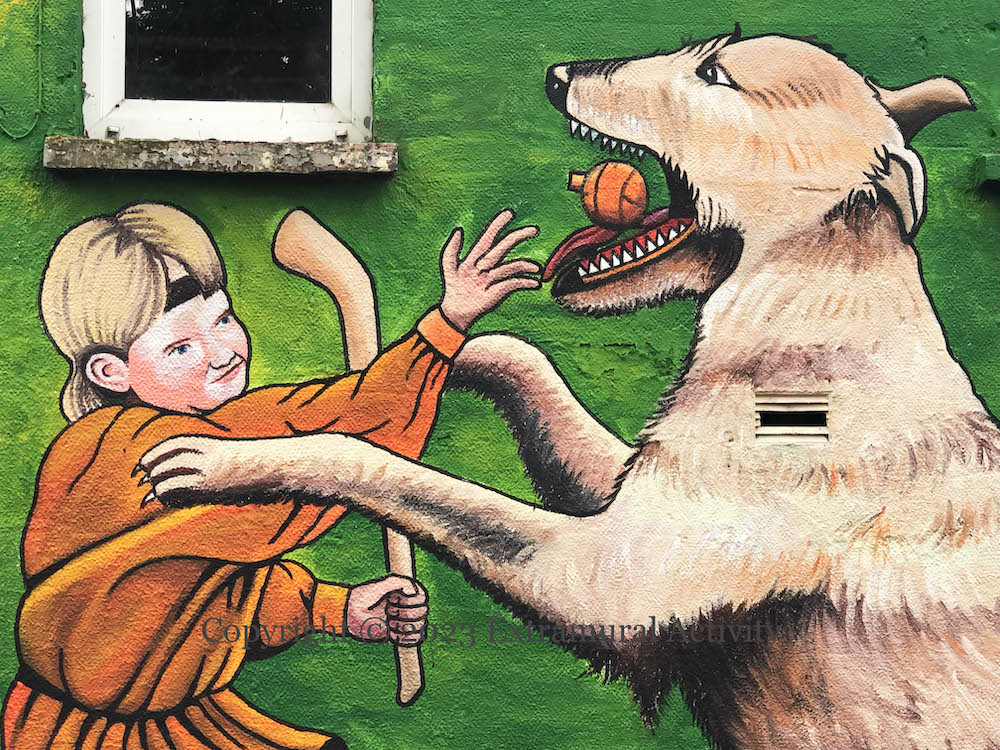
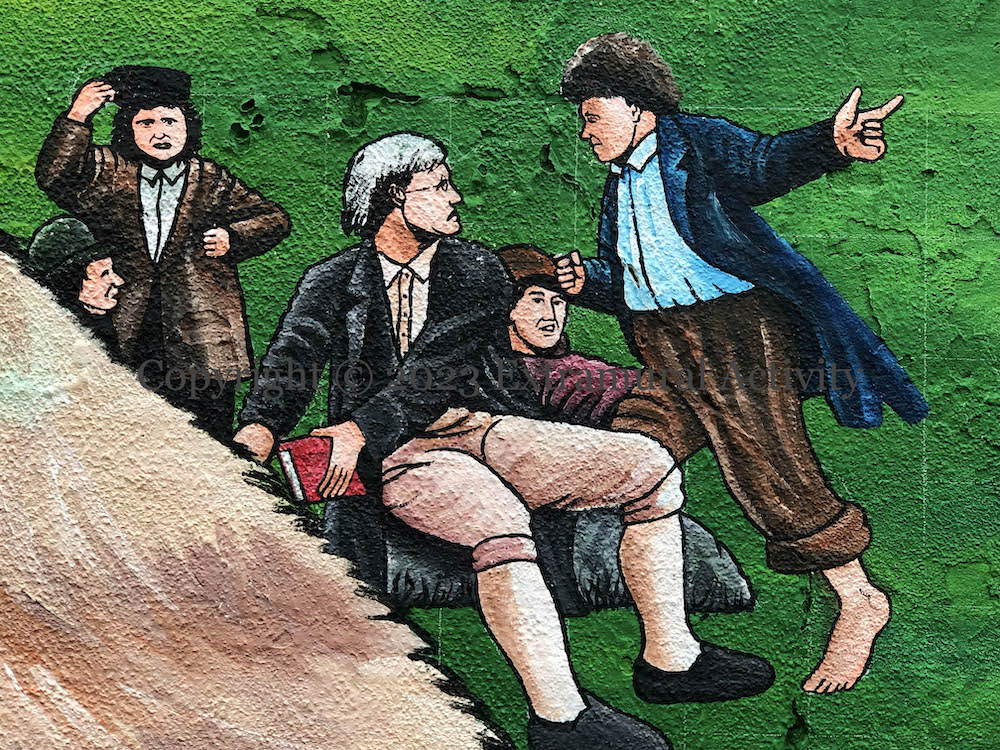
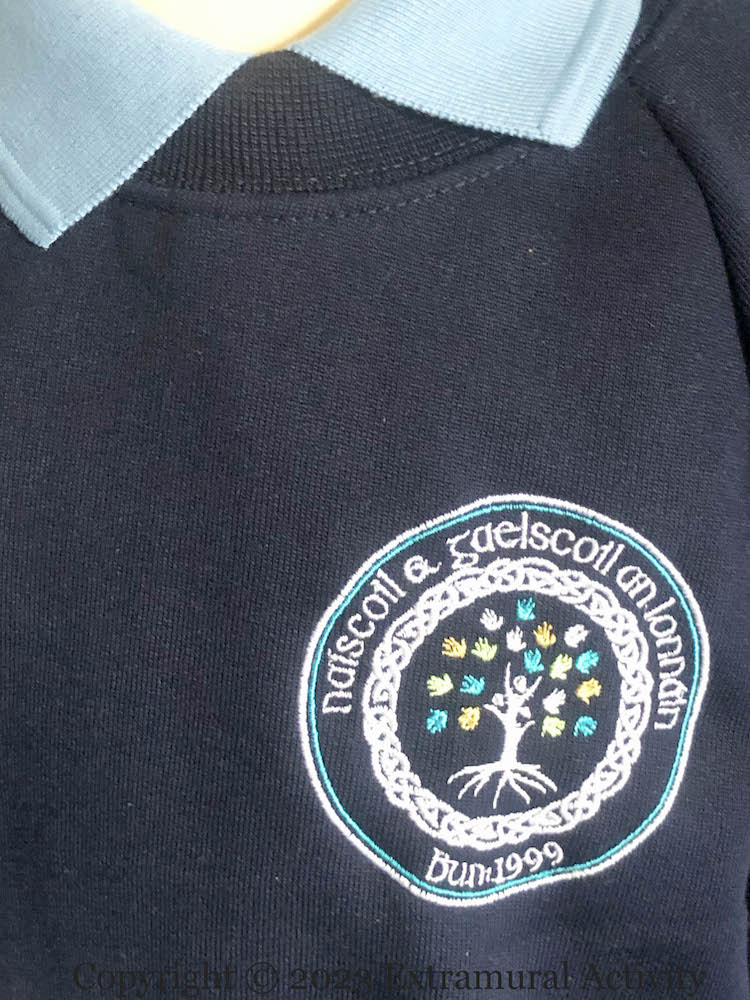
Students from “Naíscoıl & Gaelscoıl An Lonnáın (Fb) bun[aithe] 1999″ [Nursery-school and Irish-language [primary] school of the loney, founded 1999] are shown playing Gaelic games, Irish dancing, and playing traditional instruments (and the guitar). On the left are representations from Irish mythology: the Children Of Lear and Setanta killing Culann’s hound (and taking the name Cú Chulaınn in taking its place), along with hedge-row school (see Hedge Row School).
The origin of the name is unclear; the nearest loney [lane] was the “Pound” loney, so-called because of the animal pen just outside Barrack Street, used to store livestock before moving on to the markets the following day (Rushlight | Uachtar Na bhFál). (The Pound Loney is included in the mural in Durham Street – see Et In Arcadia Ego.)
The other well-known loney in Belfast is the “buttermilk loney” which was either/both what is now Ballysillan Park (that is, connecting Olpark with the horsehoe bend) or the top part of the loney that connected Wheatfield (the top of Ardoyne) to the Ligoniel junction and on towards the old Ligoneil House (there are a mixture of usages in this Belfast Forum thread); this image from the 1930s might show the lane in (what was still at the time) the hills above Oldpark; a new housing-development towards the top of the Ballysillan Park is euphemistically called “Buttermilk Loney”. (It is also said to have been a prior name of Skegoniell Avenue (Belfast History).)
(The Uachtar Na bhFál page also mentions “Turf” loney, “Mountain” loney, and “Killoney”.)
The history of the Irish word “lonnán” is unclear. Uachtar na bhFál says the word is of Scots origin (perhaps as “loanin”). (See this BelTel article on the opening of the Ulster-Scots centre in 2014.) Spelled “lonnen”, it is also a Geordie word (Heslop’s Northumberland Words | wiktionary). The Irish News and Belfast Live, working from the same (uncited) press-release about Páırc An Lonnáın (which is along the Westlink below Raıdıó Fáılte), state that “loney” comes from the English word “loaning”. The Irish word “lonnán” does not appear in Dinneen 1904; Dinneen 1953 defines it (hyper-specifically) as “a grassy recess running up into high basaltic cliffs”.
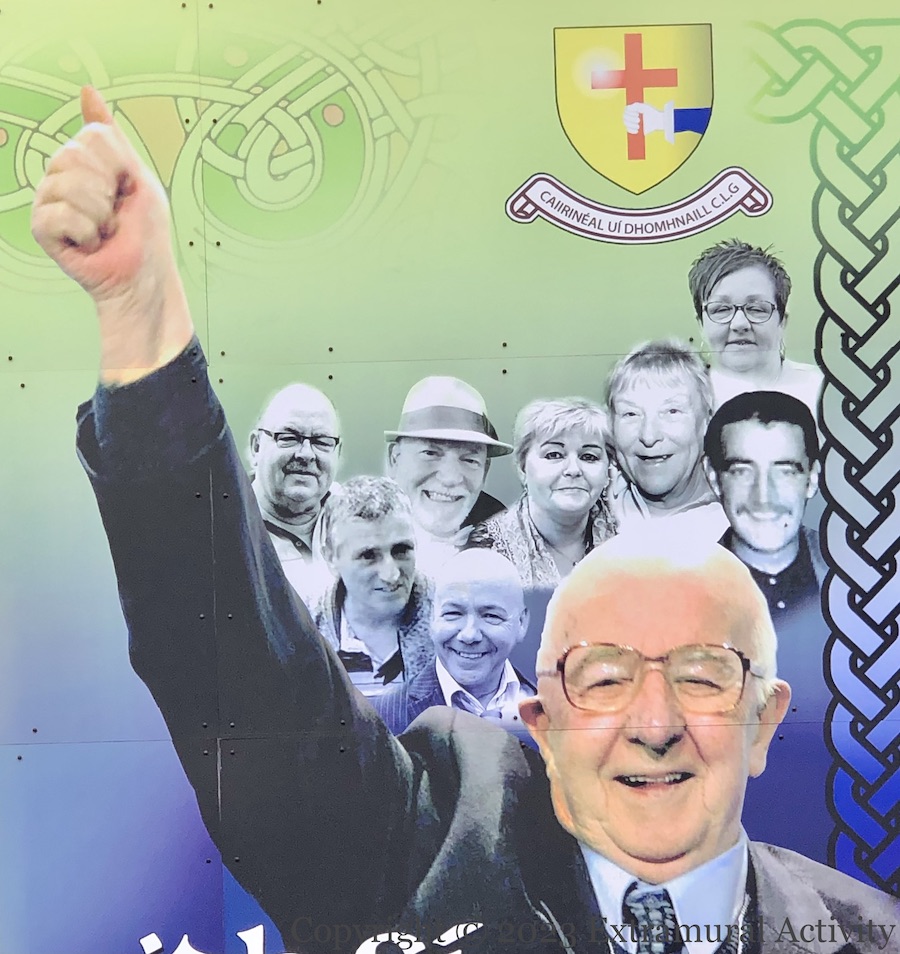
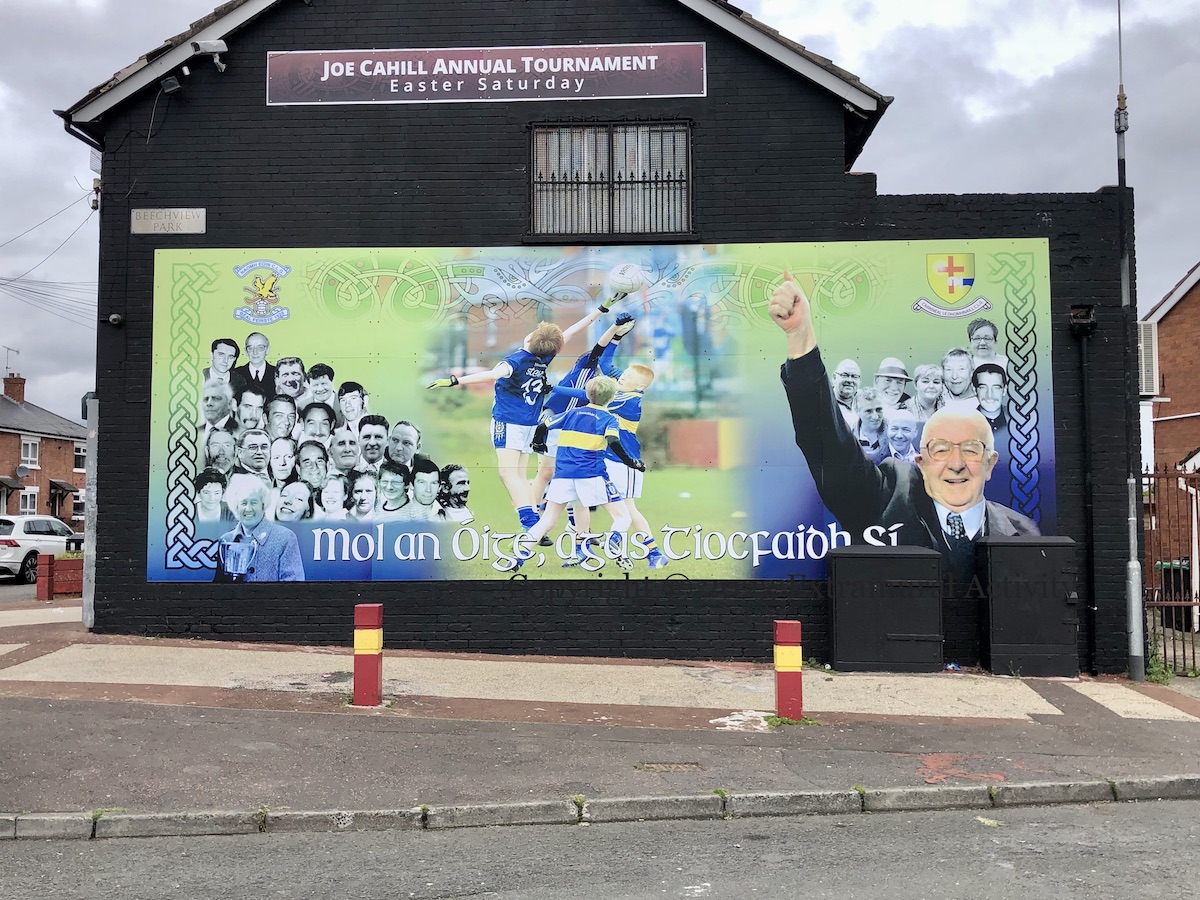
“Mol an óıge agus tıocfaıdh sí [encourage youth and it will flourish, or less literally, youth responds to praise].” The emblems in the corners are of two local GAA clubs “Naomh Eoın” and “Caıırınéal [Caırdınéal] Uí Dhomhnaıll” – the “Joe Cahill Annual Tournament” was held at Easter at their two pitches.
Joe Cahill joined the Fianna in 1937 and was involved in the republican movement from then until his death in 2004, including being in Tom Williams’s company in 1942, and was later a founder member and Chief of Staff of the Provisional IRA.
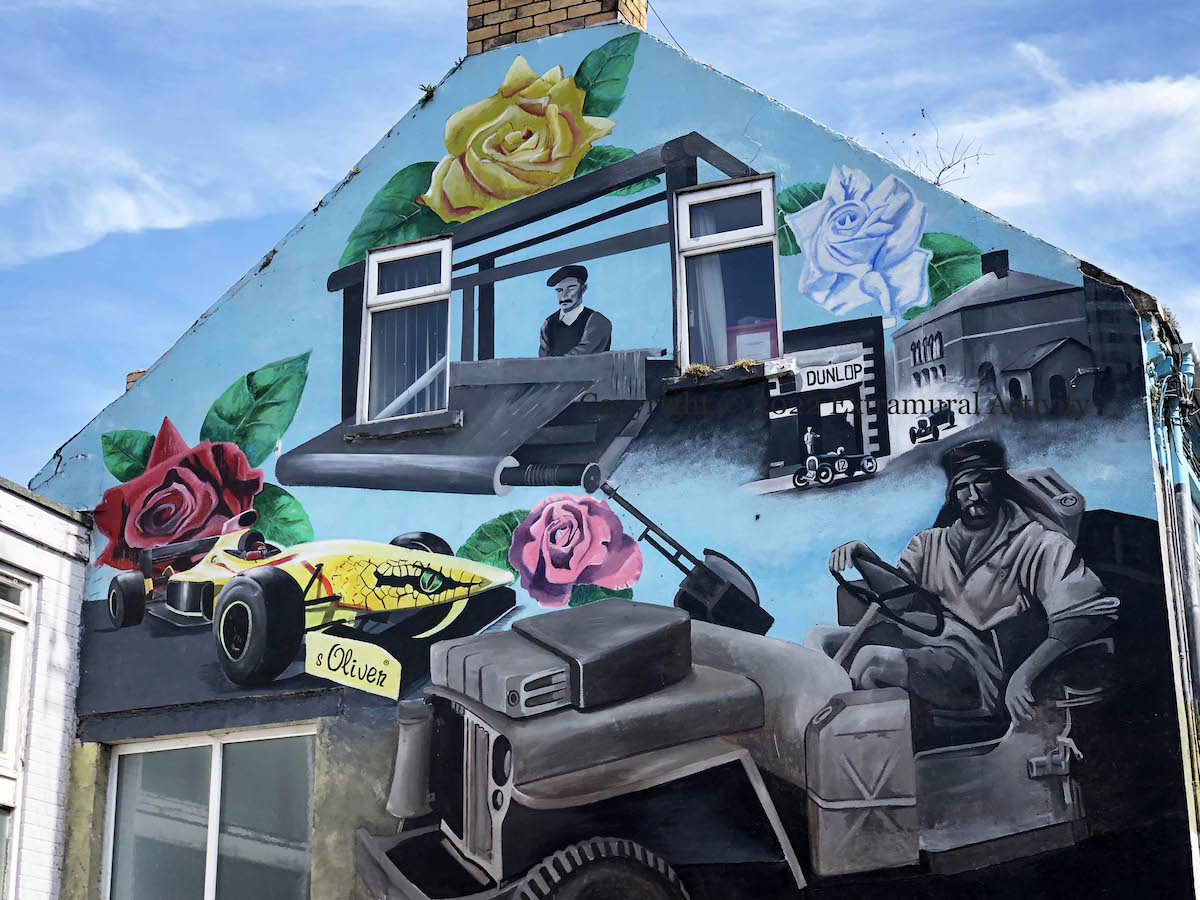
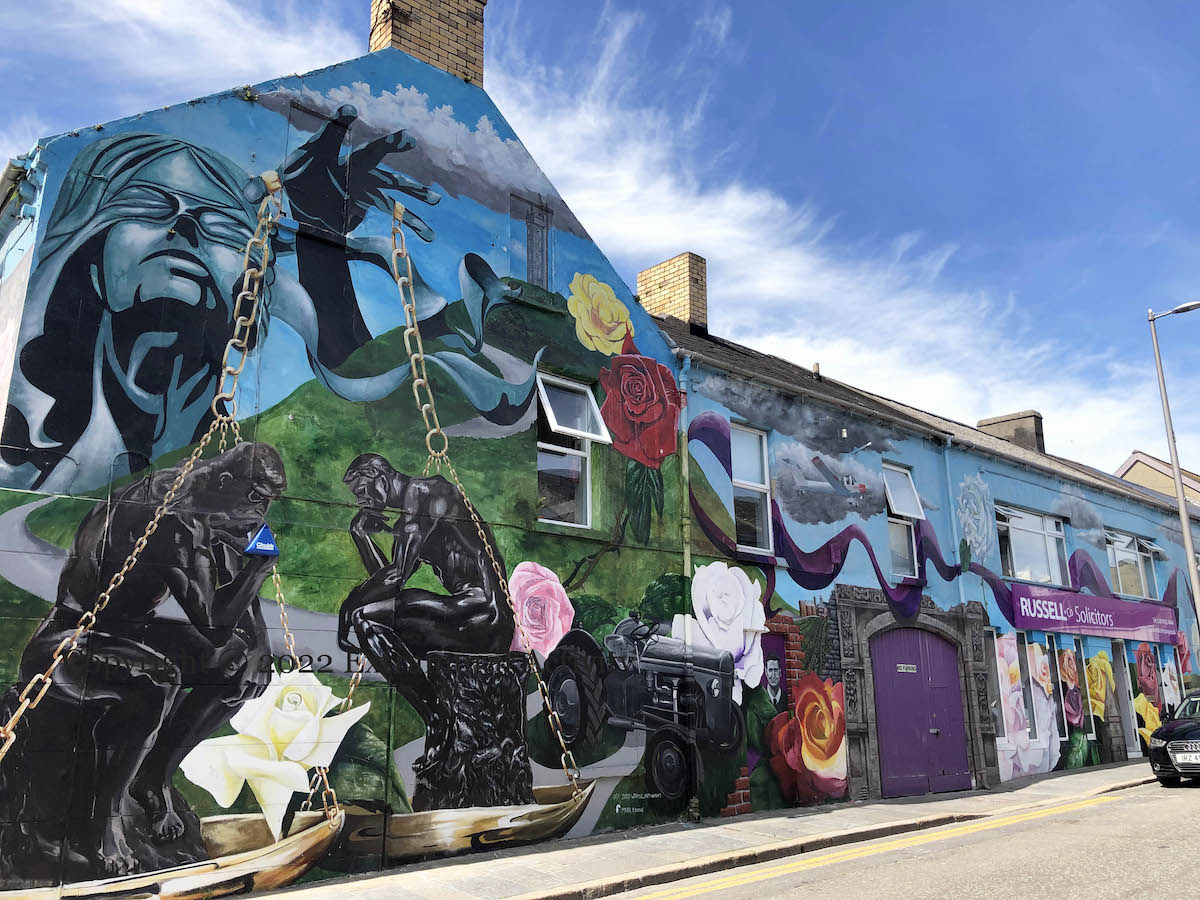
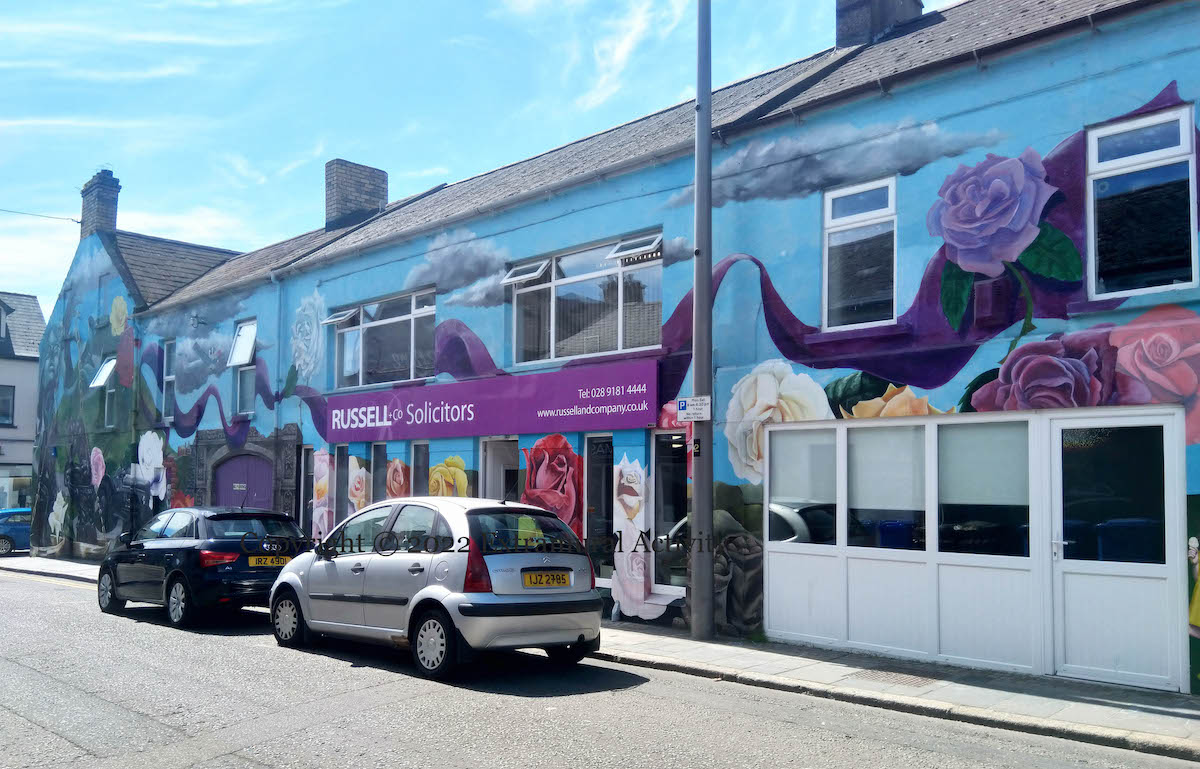
The giant mural around the offices of Russell & Co solicitors in Newtownards combines legal imagery with famous north Down sites and people.
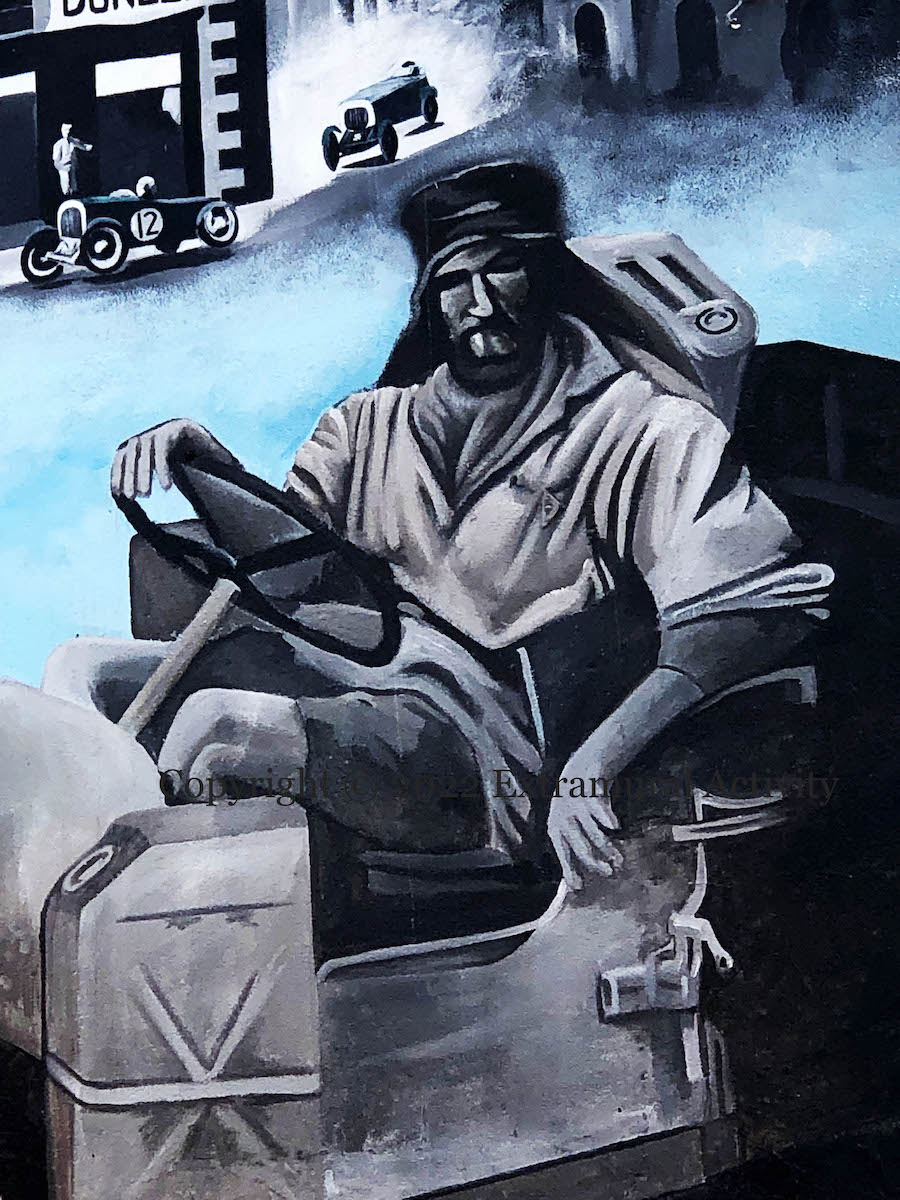
There are two main parts, in High Street and in Lower Mary Street. In High Street, we see Blair “Paddy” Mayne; the Jordan ‘Hissing Sid’ Formula 1 race-car (Eddie Irvine, who is from Newtownards, drove for Jordan until 1996); a weaver working a loom (the image is from Waringstown, but is perhaps meant to represent local mills such as Walker’s or Ards & Webb); an image of the Ards TT.
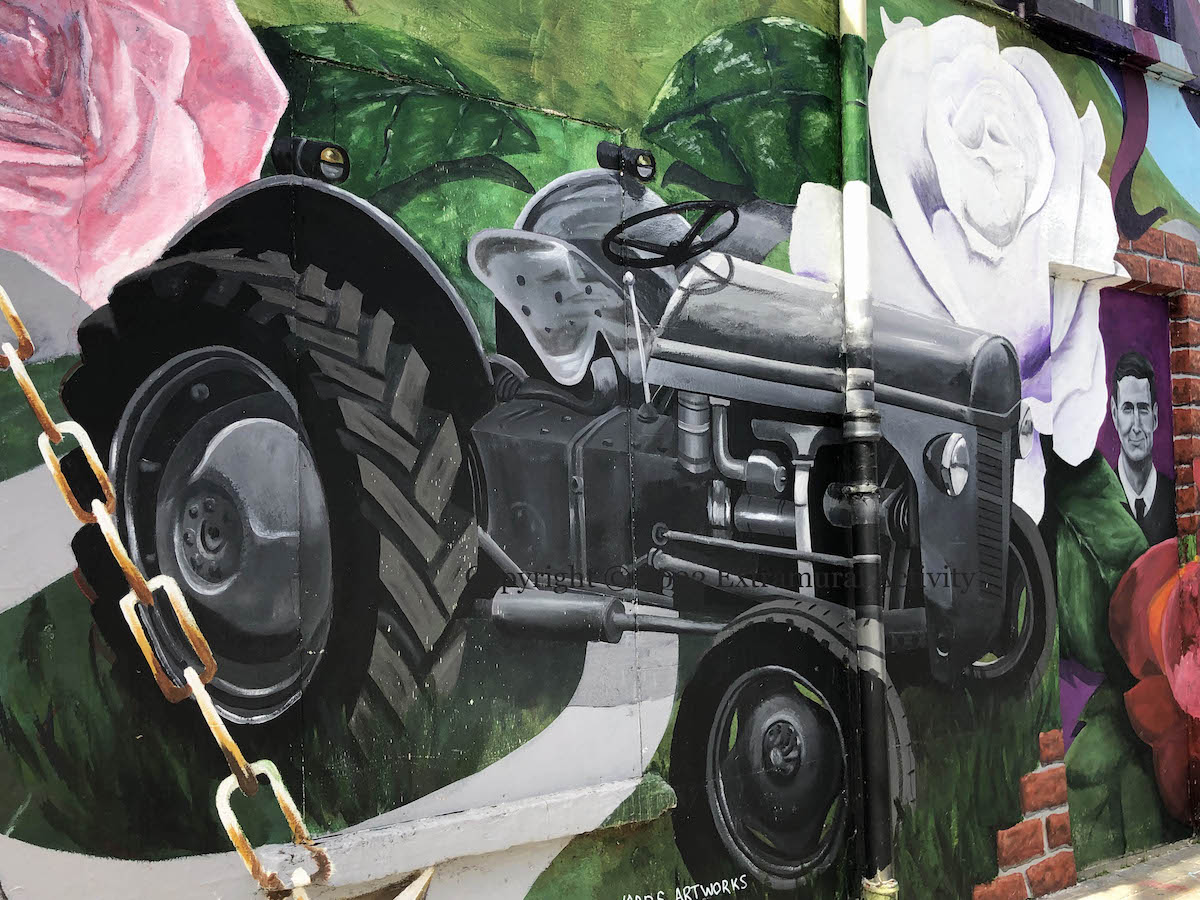
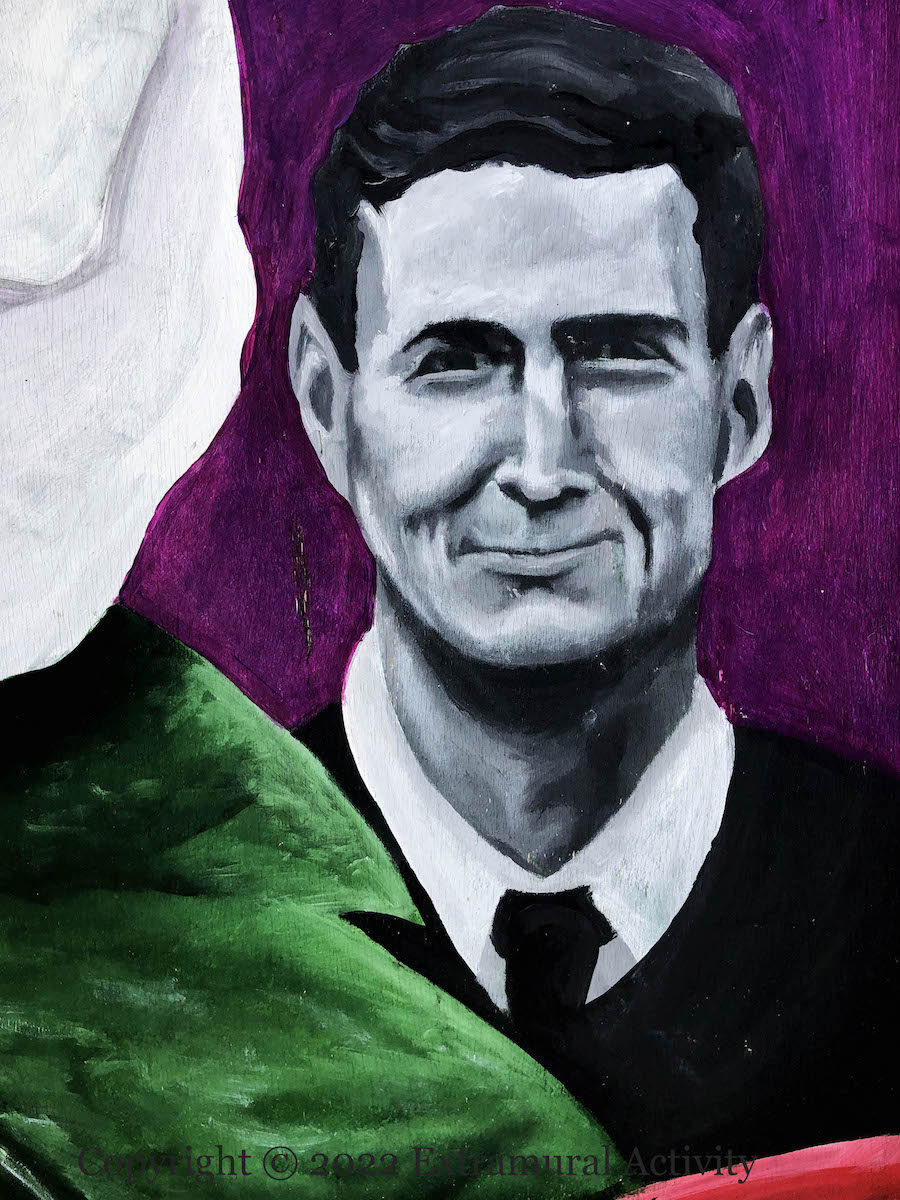
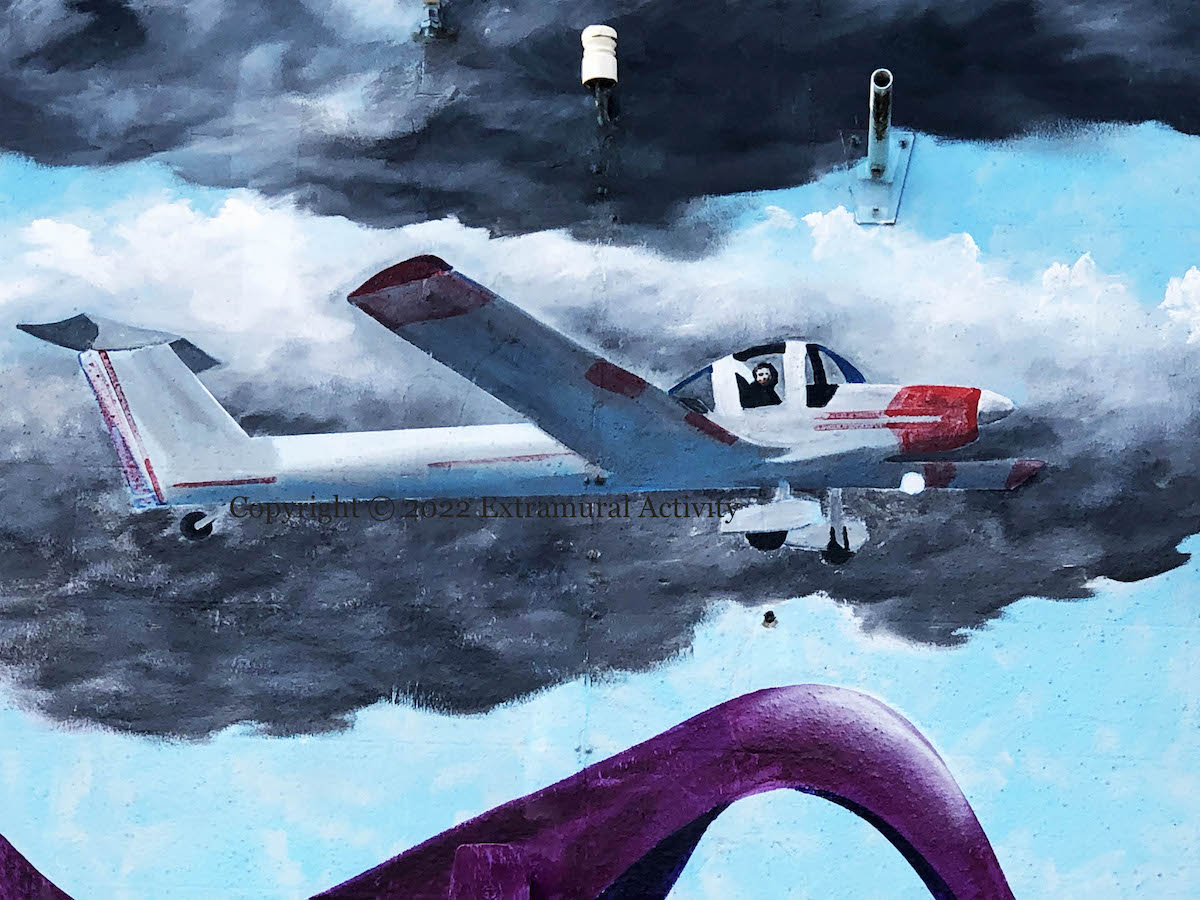
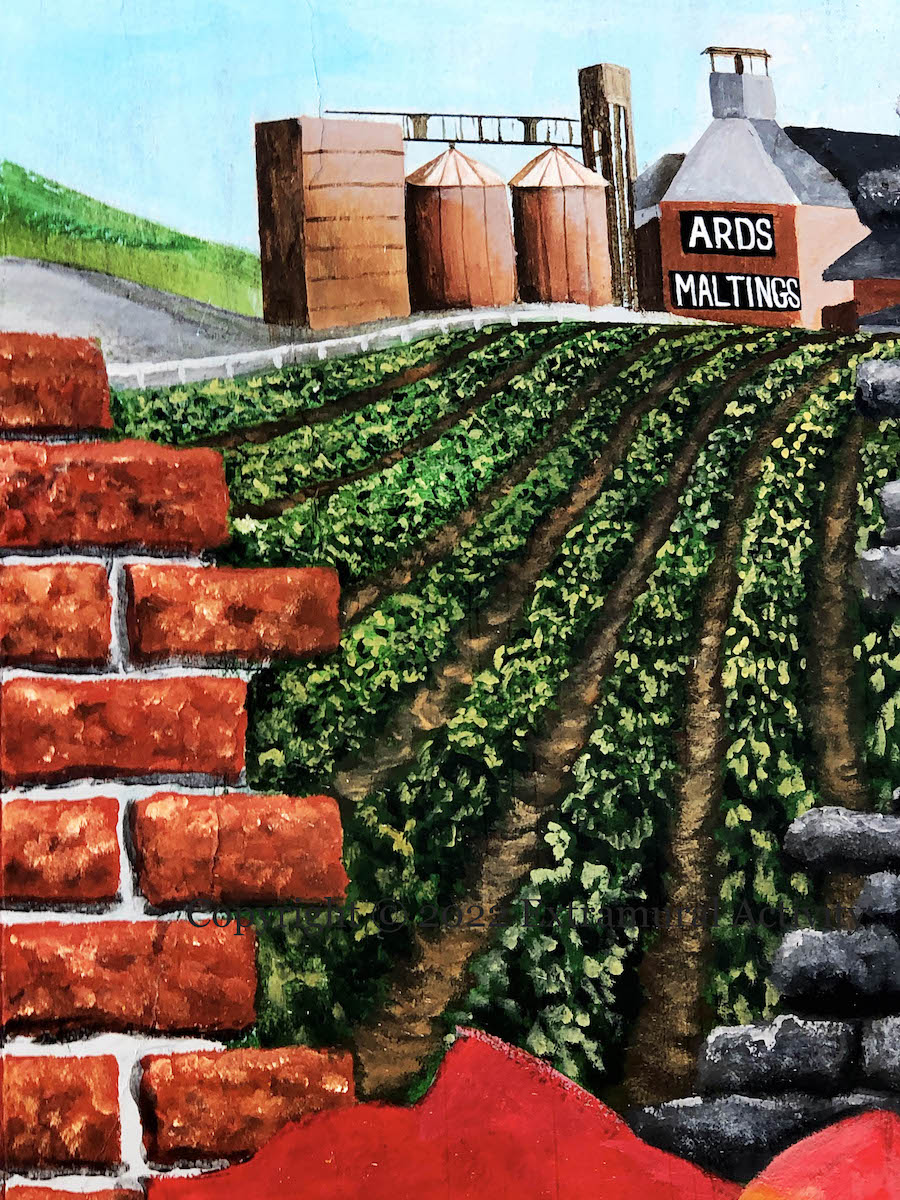
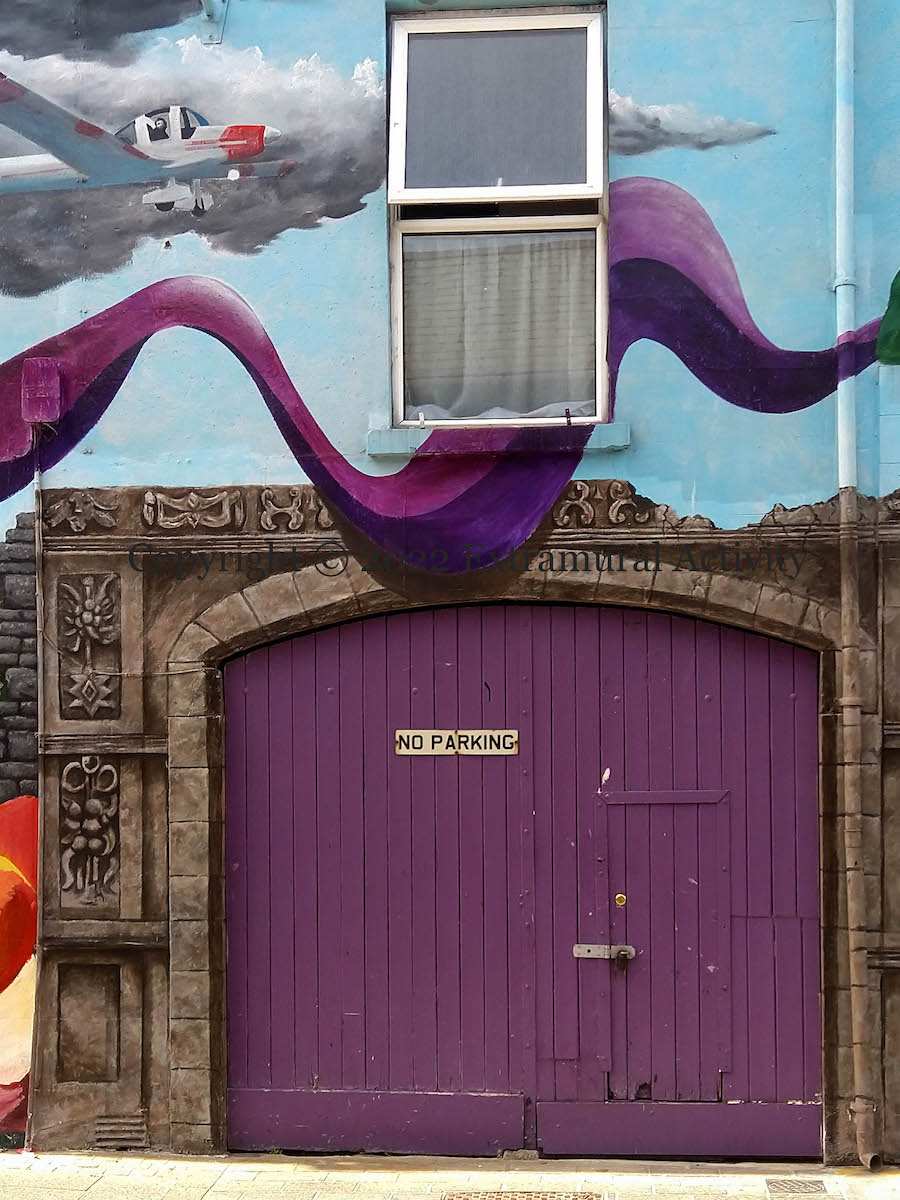
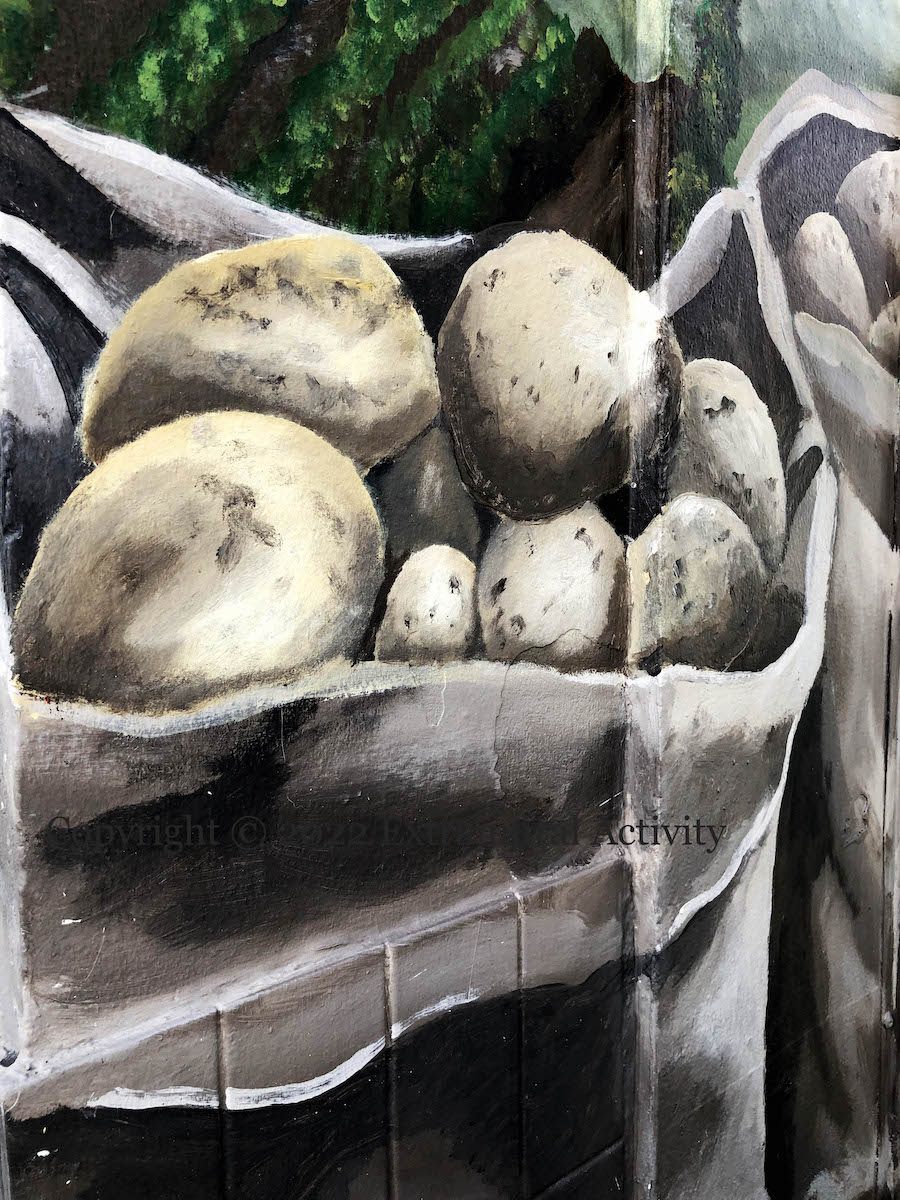
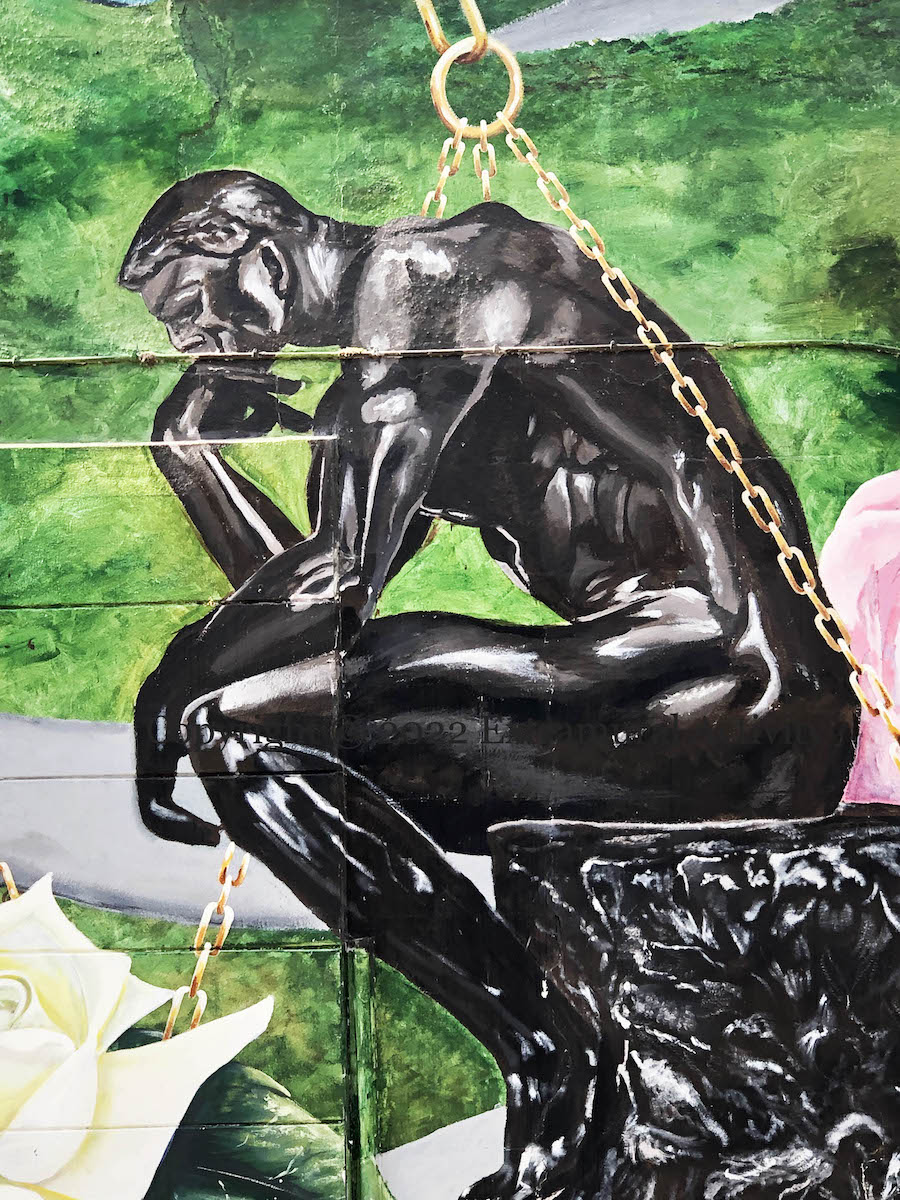
In Lower Mary Street, from behind Scrabo Hill, Lady Justice weighs scales each containing Rodin’s statue The Thinker. We also see a modern agricultural tractor, as designed by Harry Ferguson; a portrait of James Russell who founded the solicitors’ firm in 1948; a Cessna light aircraft, presumably at Newtownarrds airport, the first purpose-built airport on the island (Ulster Flying Club); the former Ards Maltings; a sack of Comber Earlies.
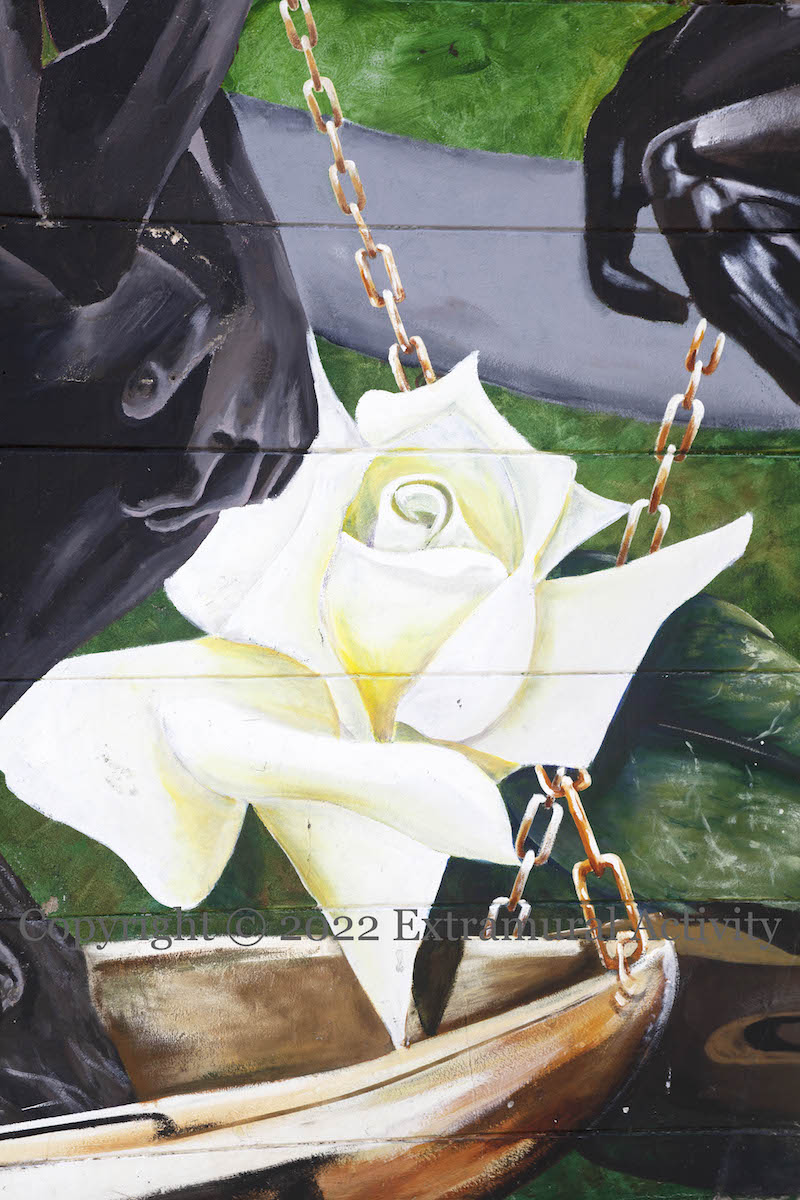
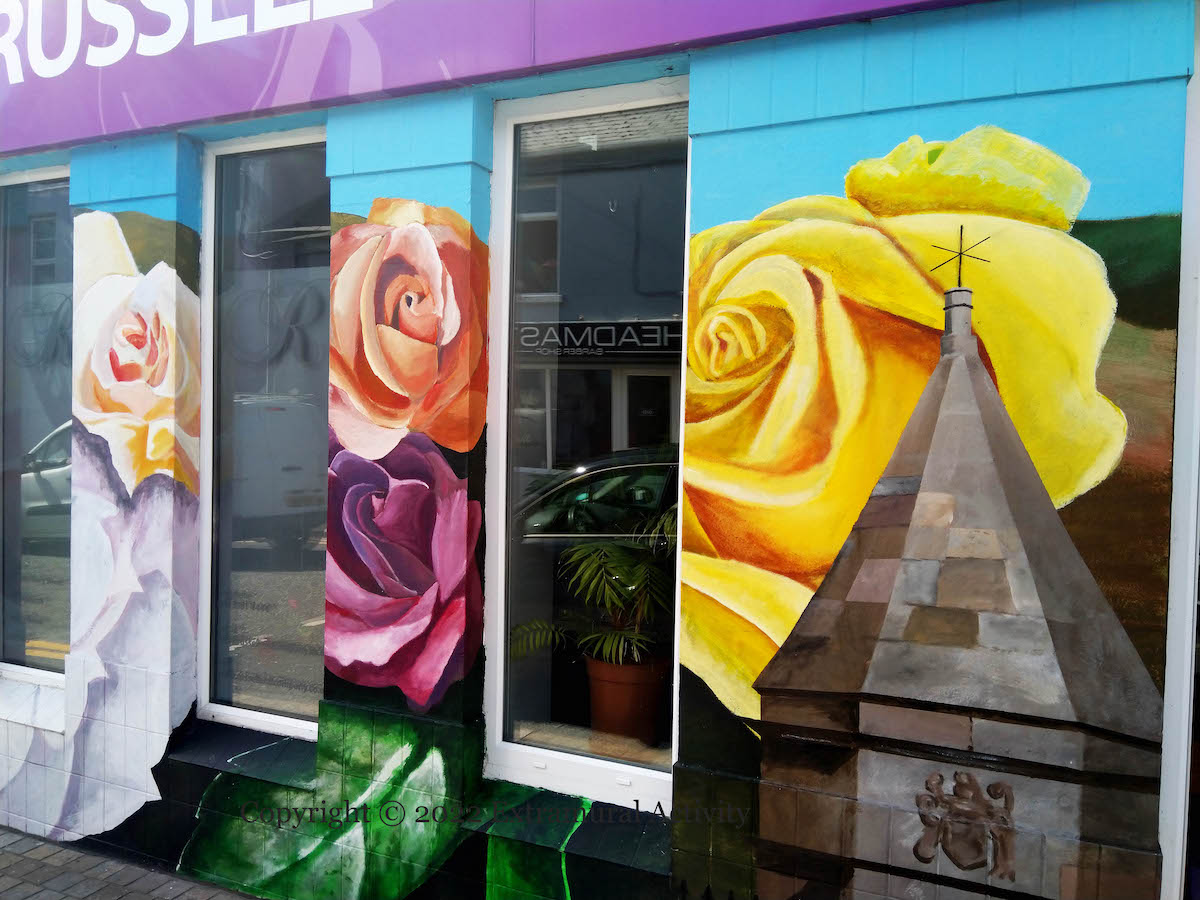
Acting as a joining motif on both sides of the building are roses from Dickson Nurseries.
The mural was painted by Mark Ervine. The partially-completed mural was featured in the Financial Times all the way back in November 2018; it was eventually finished in 2021 and given an anti-graffiti coating this (2022) summer.
Castle Arcade is so-called because it is the site of the original castle of Belfast, built by the Normans in the late 12th century and then rebuilt by Arthur Chichester in 1611. Chichester’s castle had “spacious gardens which extended from the river along to Cromac Woods and near Stranmillis” with “orchards, bowling greens and cherry gardens … fish ponds,” for “hunting, hawking, and other sports”. It was destroyed by fire in 1708 after which the area became commercialised as a market (ArchiSeek | Mary Lowry | BBC | Belfast Entries).
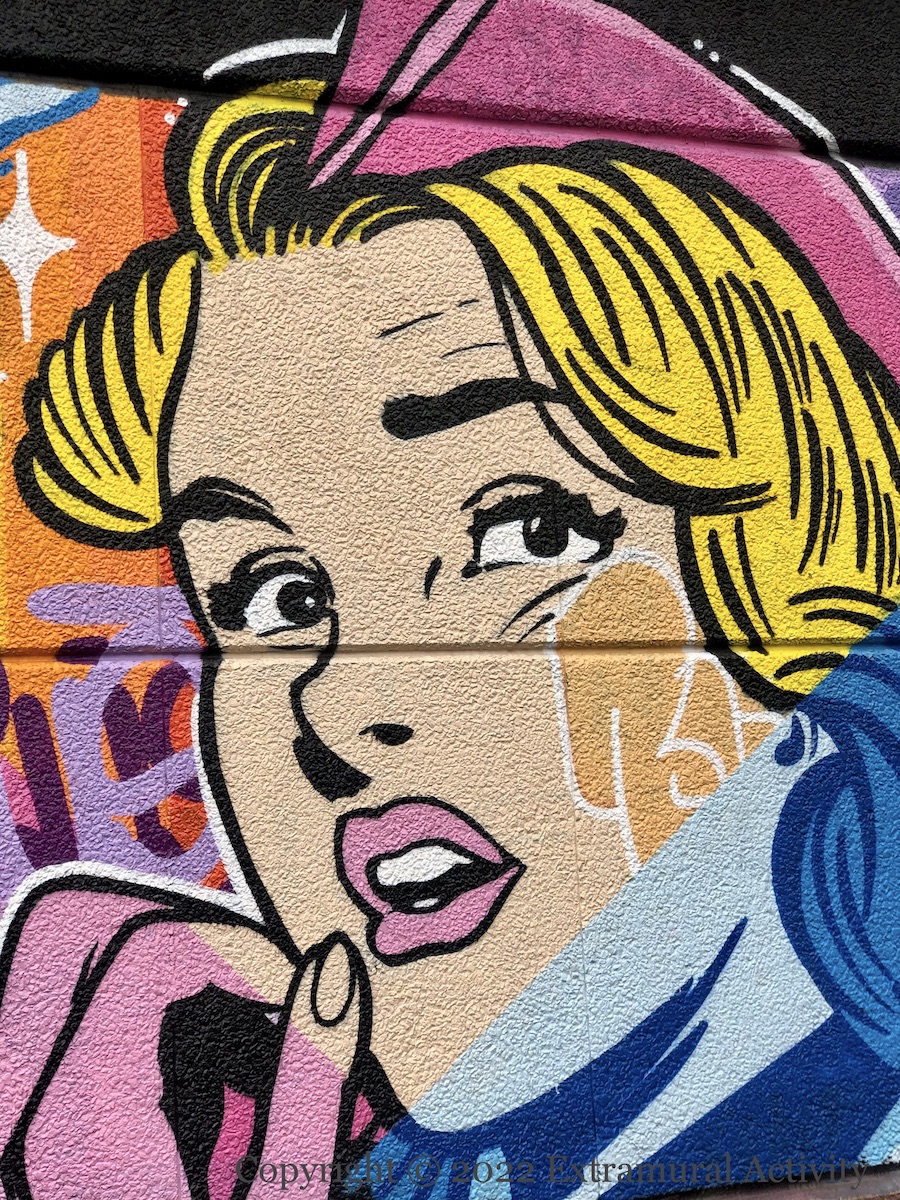
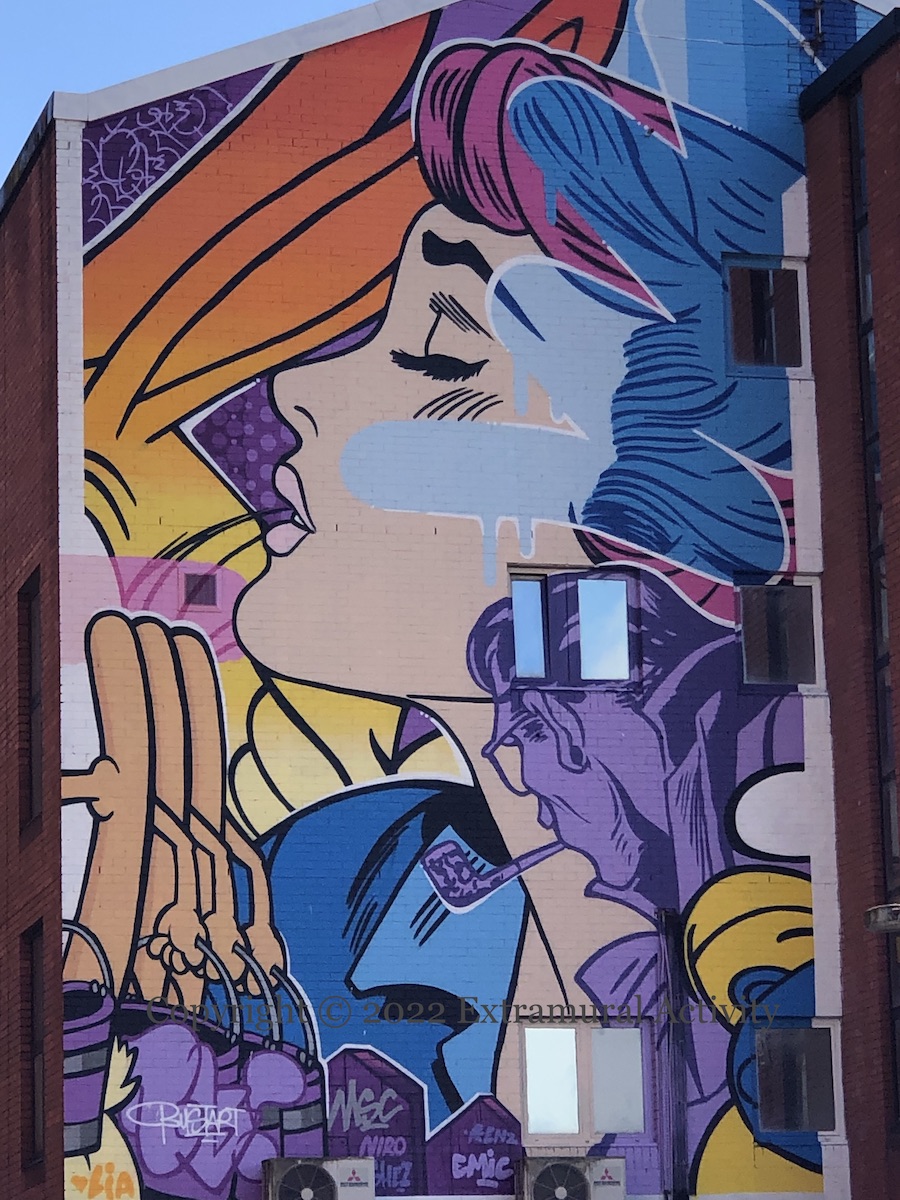
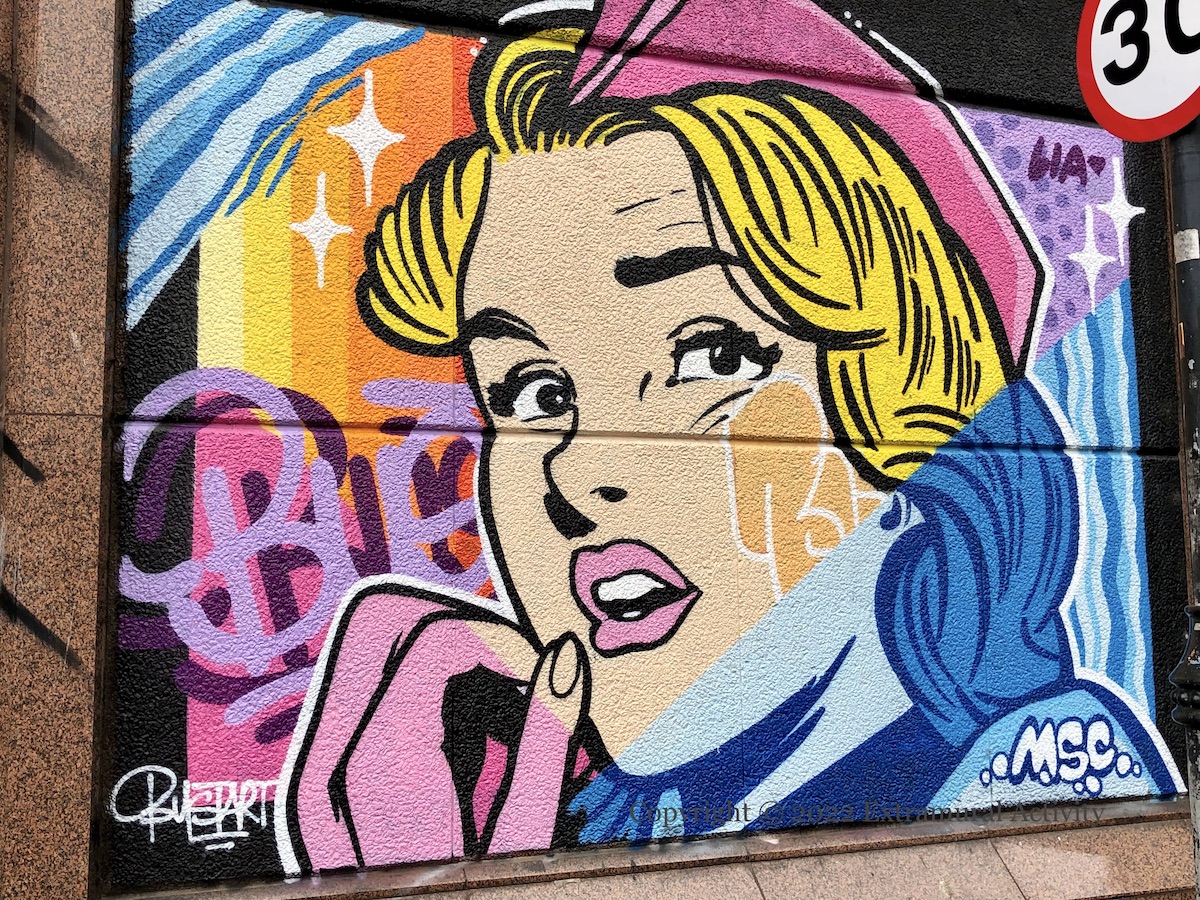
Two from Swiss artist Bust (ig | web) for HTN22, who describes his current work as “neo-pop”, combining pop art, cartoon characters, and traditional graffiti writing. The smaller piece is in Donegall Street, the multi-storey one can be seen from Kent St. A third, more casual, piece can be seen in Love, Loss, And Beyond .