Faugh A Ballagh

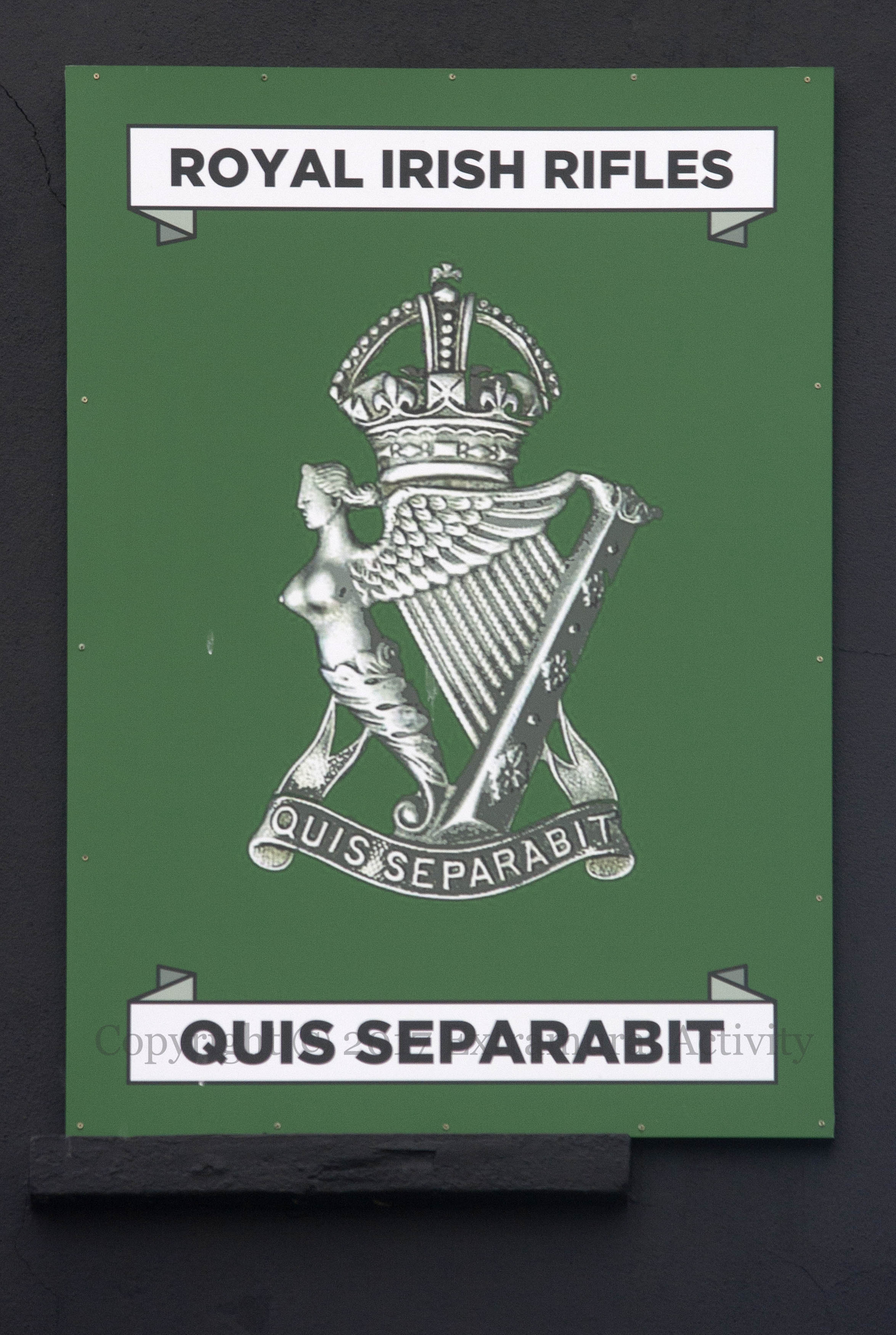
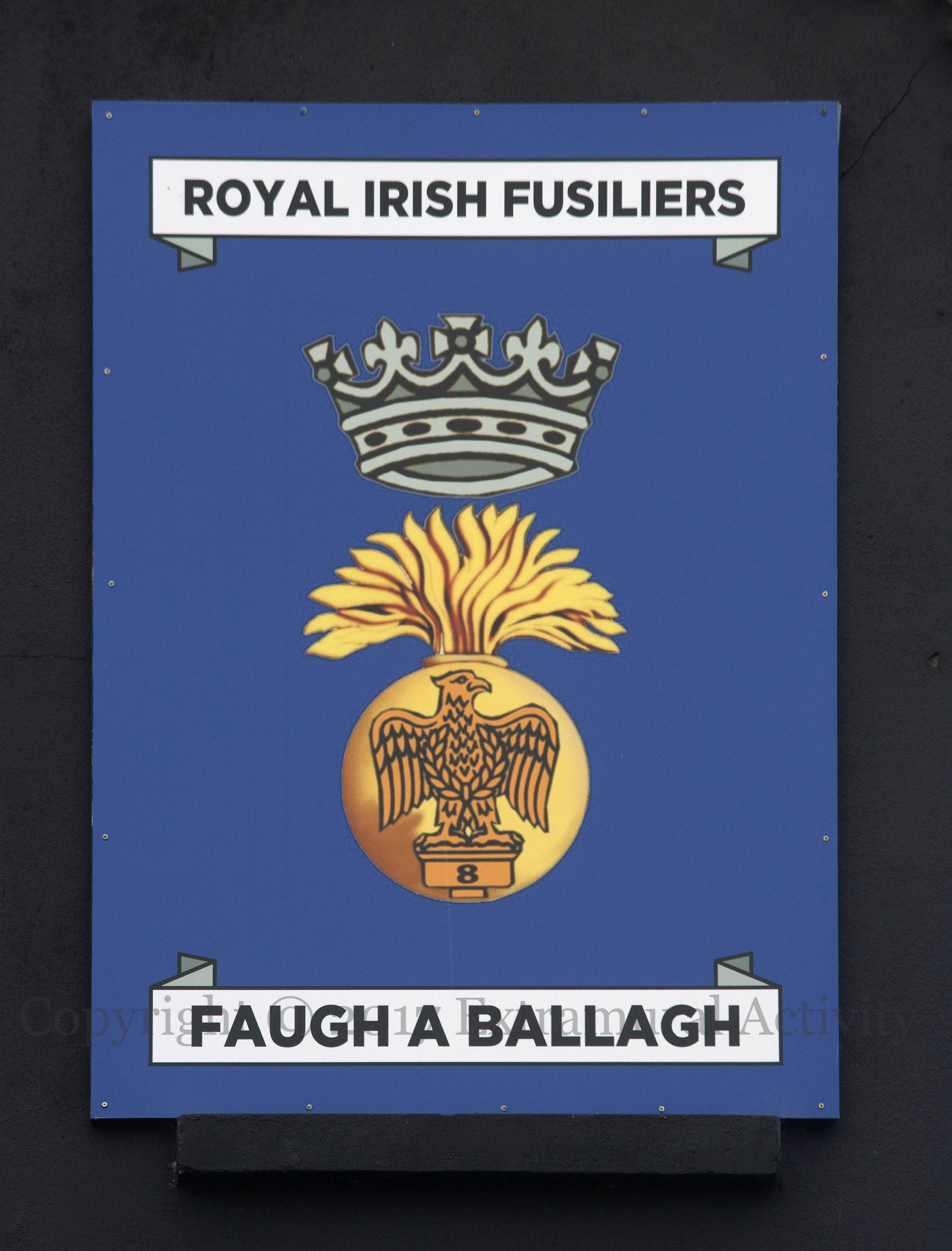
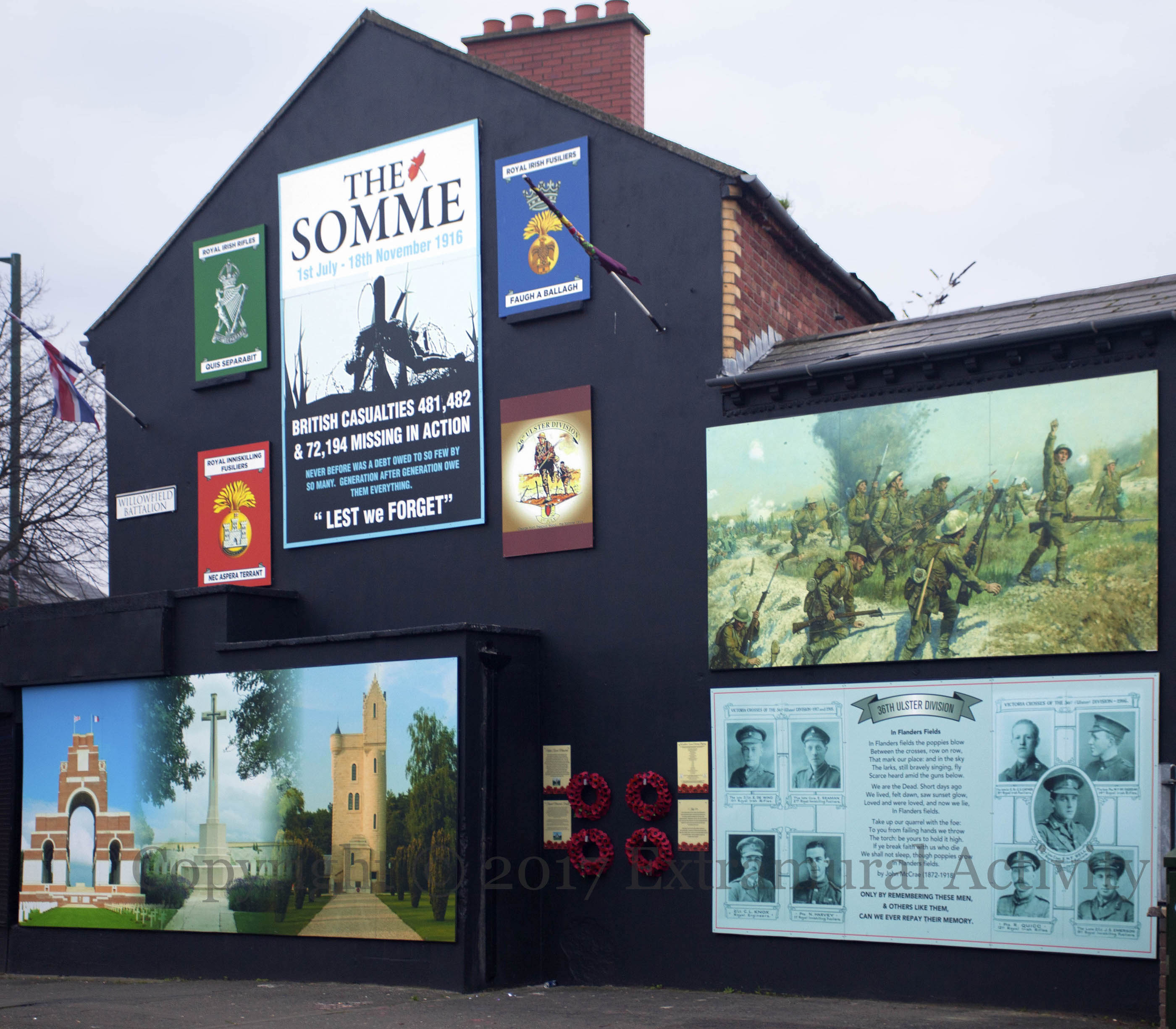
“Faugh a ballagh” (Clear the way) was the motto of the Royal Irish Fusiliers (and then of the Royal Irish Rangers and currently of the Royal Irish Regiment). The Fusiliers served on the western front during WWI – the first and ninth battalions serving in the 36th (Ulster) Division – and the 3rd battalion helped put down the Easter Rising in 1916. Its coat of arm are one of four panels along with the 36th, the Royal Irish Rifles, and the Royal Inniskilling Fusiliers.

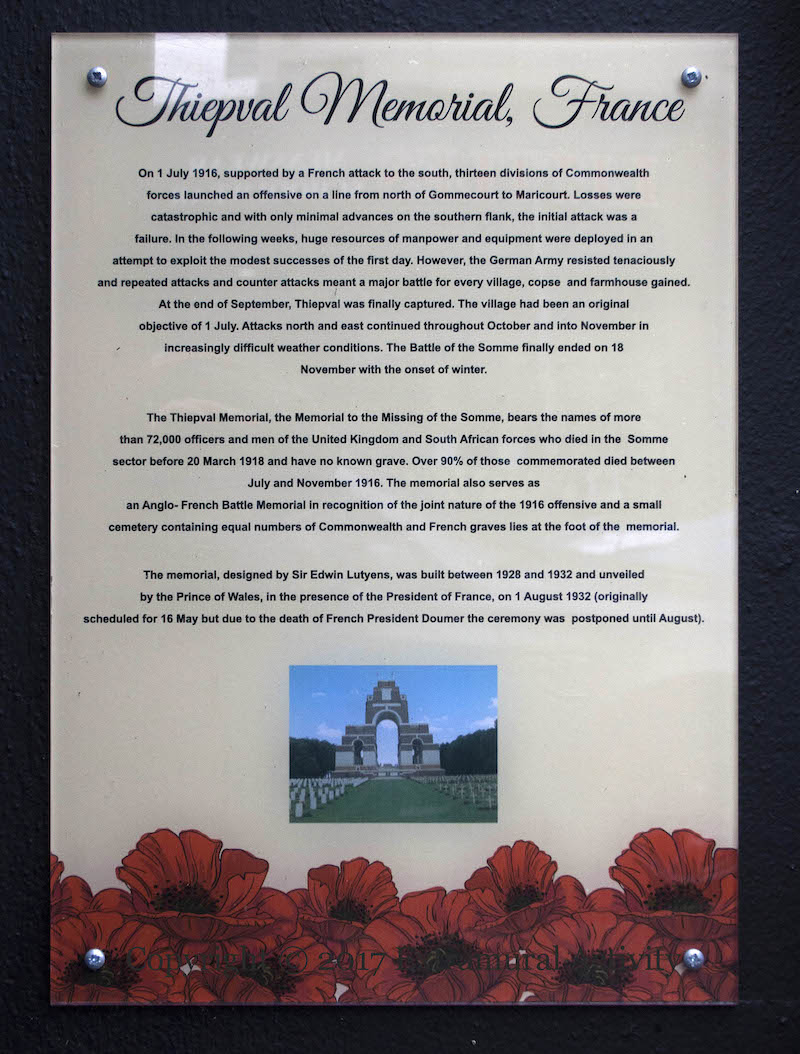
The Thiepval Memorial, the Cross of Sacrifice, and the Ulster Tower are pictured in the bottom left.

For the large upper board, see So Many; for the one in the bottom right, see Repaying Their Memory.

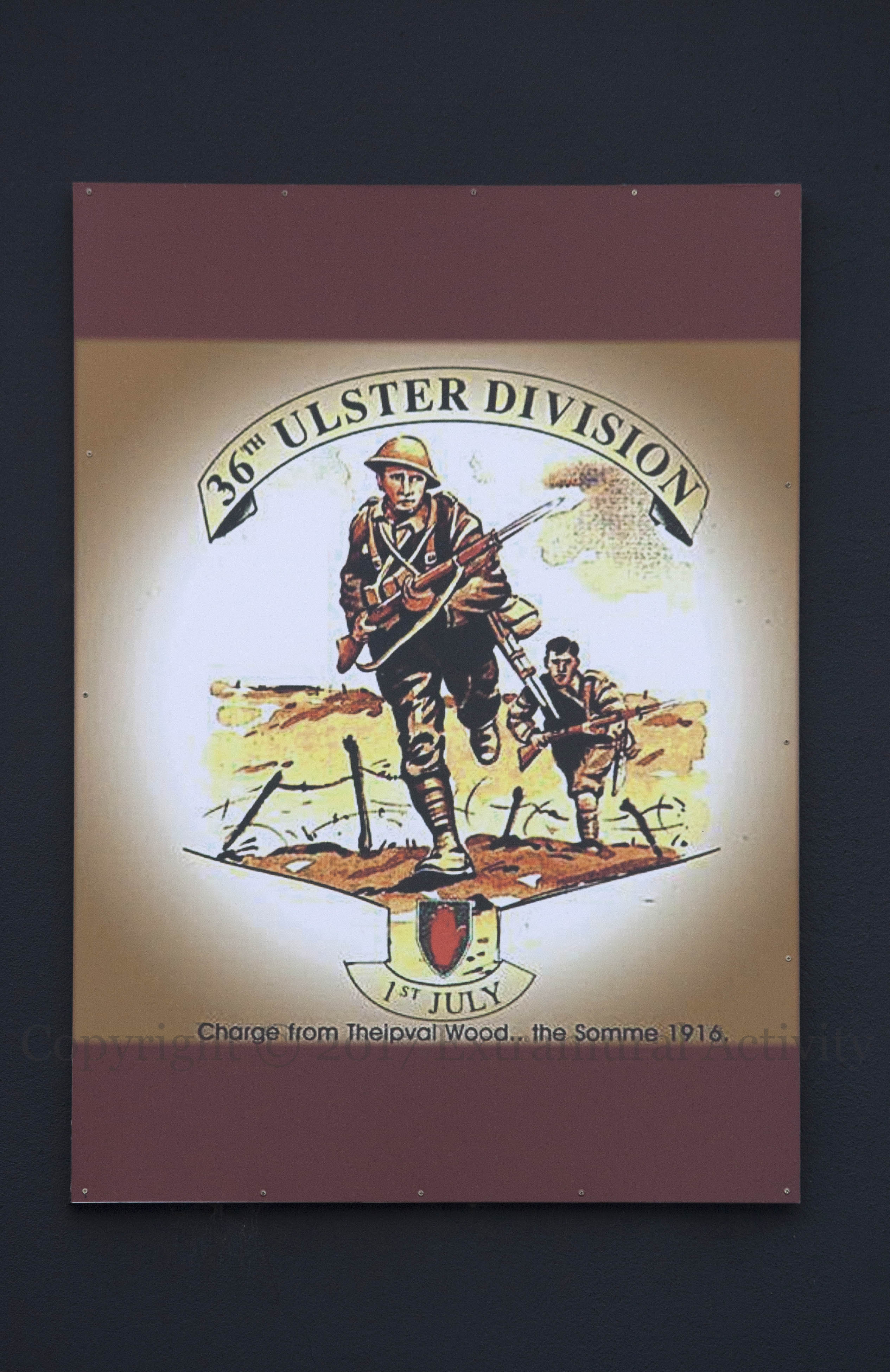
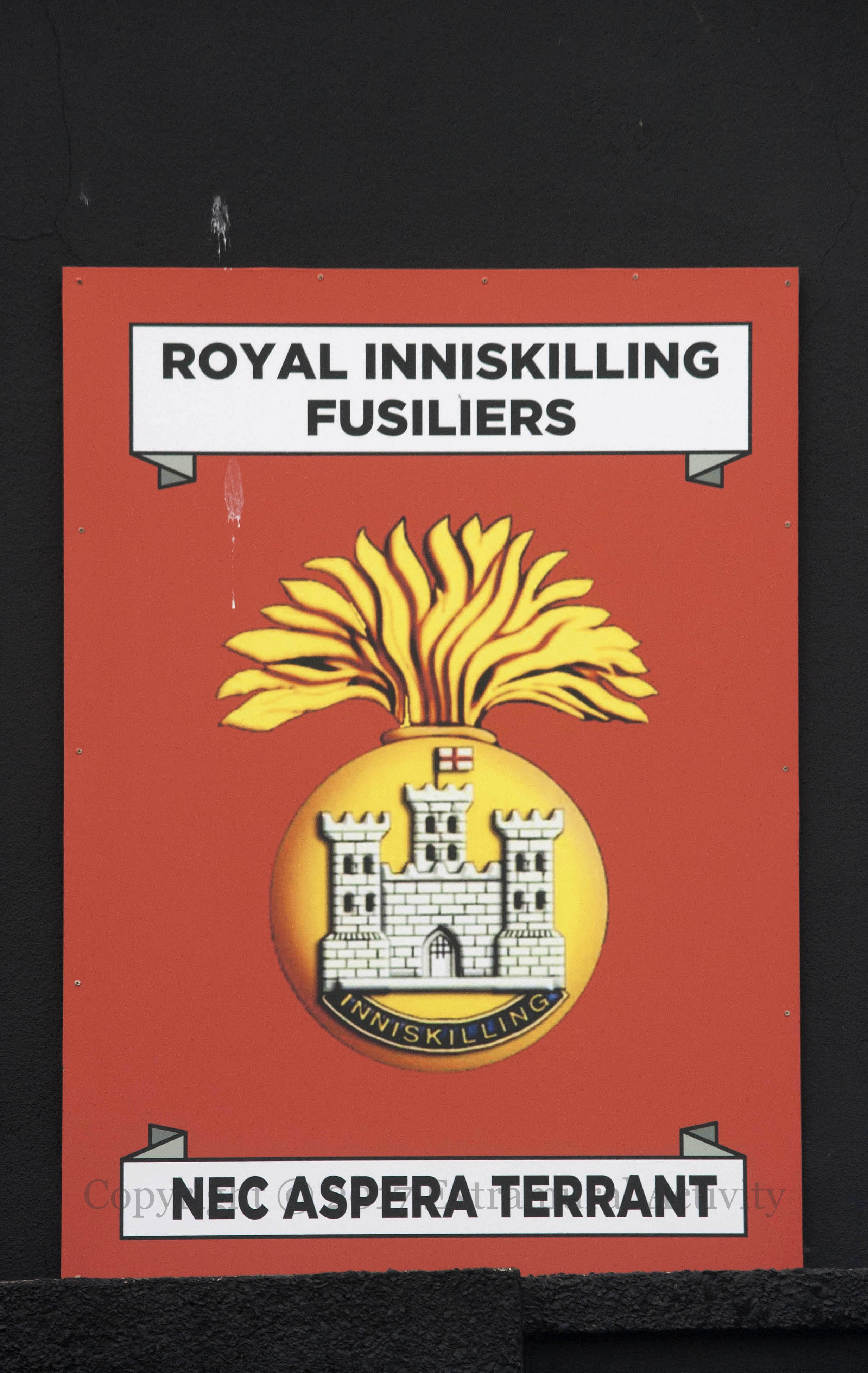
Close-ups of the four regimental insignia are included below. “Nec Aspera Terrant [sic, for “terrent”]”, meaning “frightened by no difficulties”, was the motto of the Inniskilling Fusiliers, who fought in both Boer Wars and both World Wars – its battalions saw action at Gallipoli and on the Western front – before being amalgamated in the Royal Irish Rangers in 1968, along with the Royal Ulster Rifles and the troop featured in the third image, the Royal Irish Fusiliers. Their arms are shown along with those of the Royal Irish Rifles and a board commemorating the charge from Thiepval Wood during the Somme

Willowfield Street, east Belfast
Click image to enlarge
Copyright © 2017 Seosamh Mac Coılle
X04010 X04171 X04170 X04172 X04173 “nec aspera terrent” 36th ulster division somme july 1st charge from thiepval wood willowfield charge from thiepval wood “Never before was a debt owed to so few by so many. Generation after generation owe them everything. Lest we forget.” faugh a ballagh nec aspera terrant terrent quis separabit
Repaying Their Memory

04011-2017-01-22-somme-board

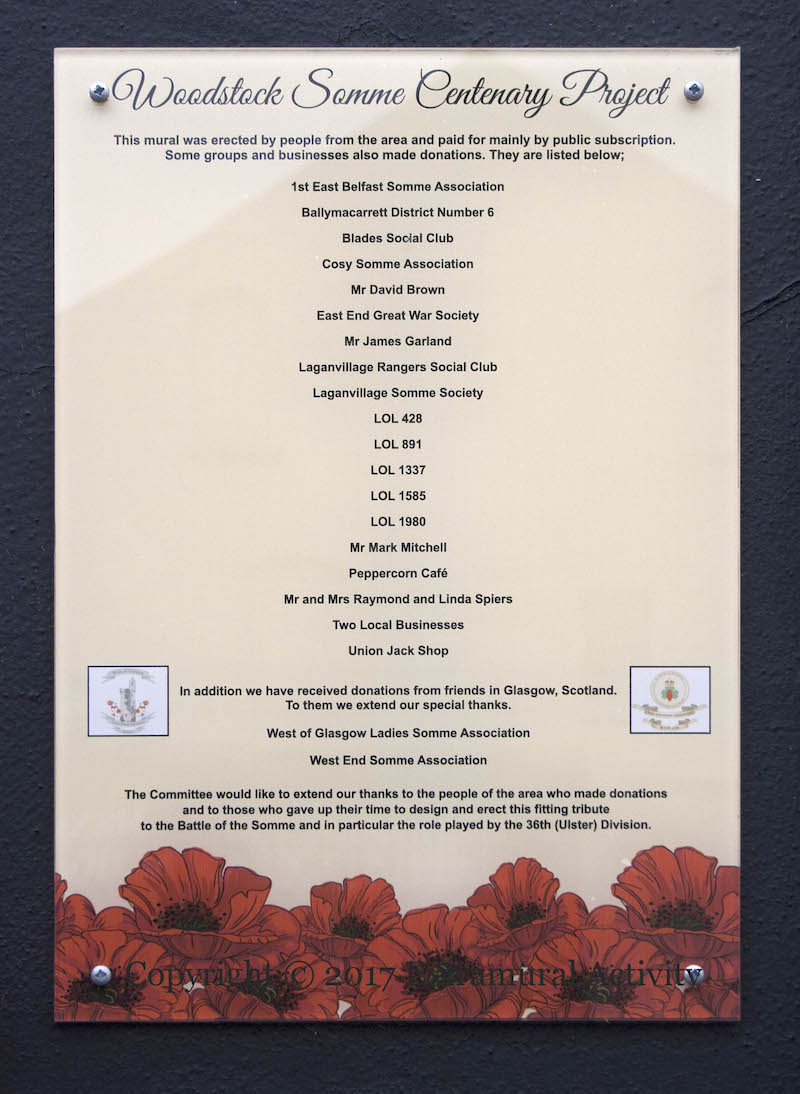
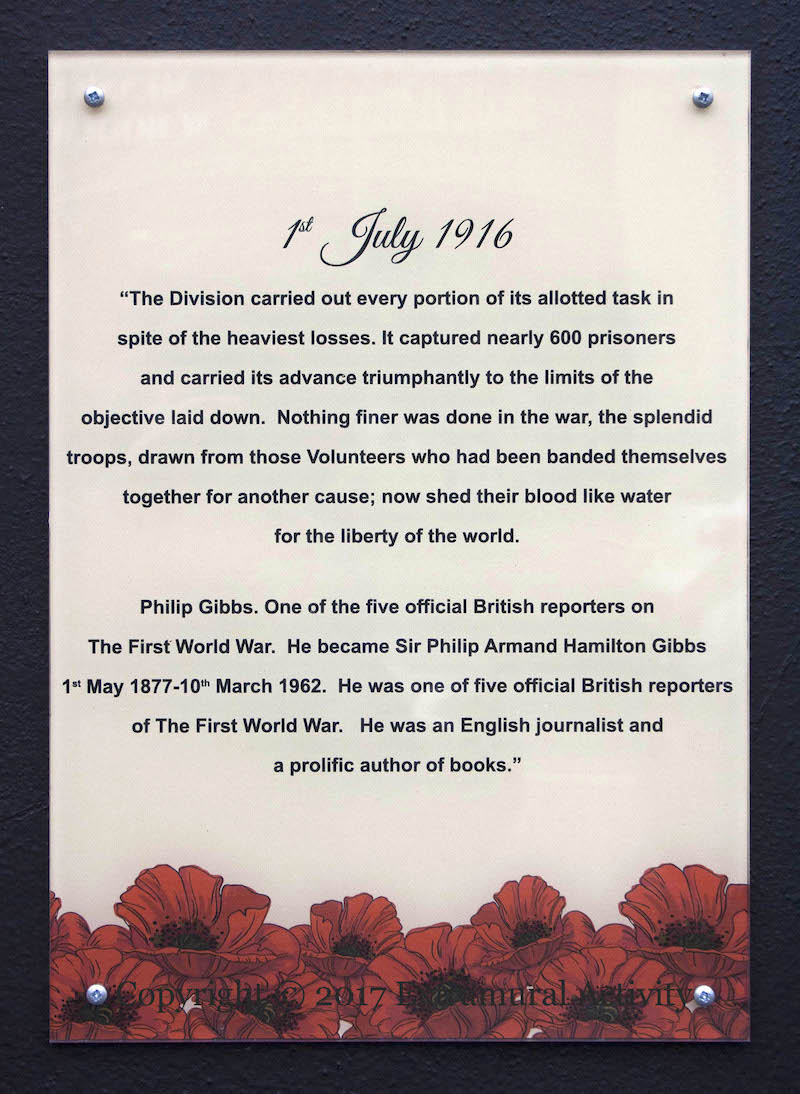
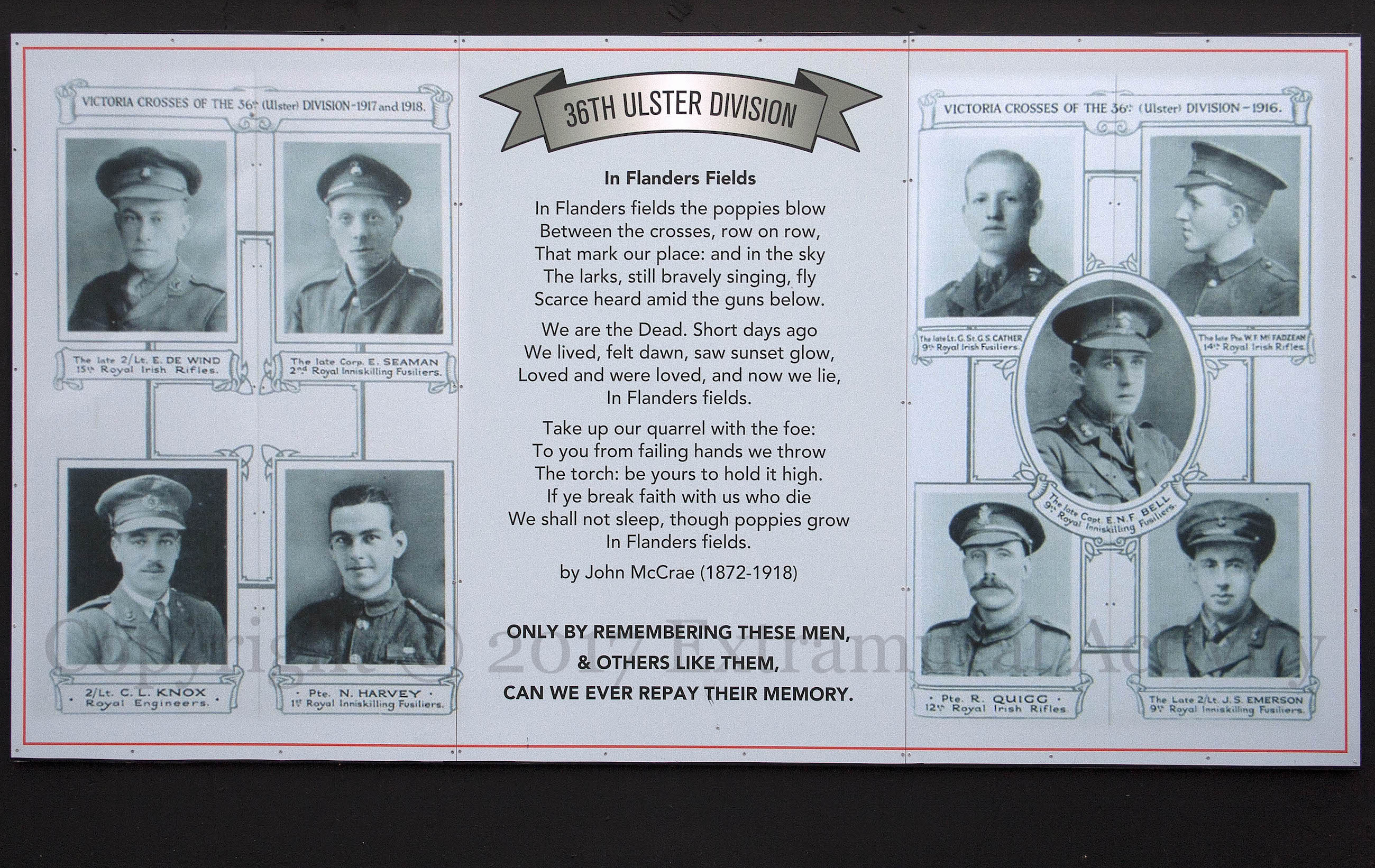
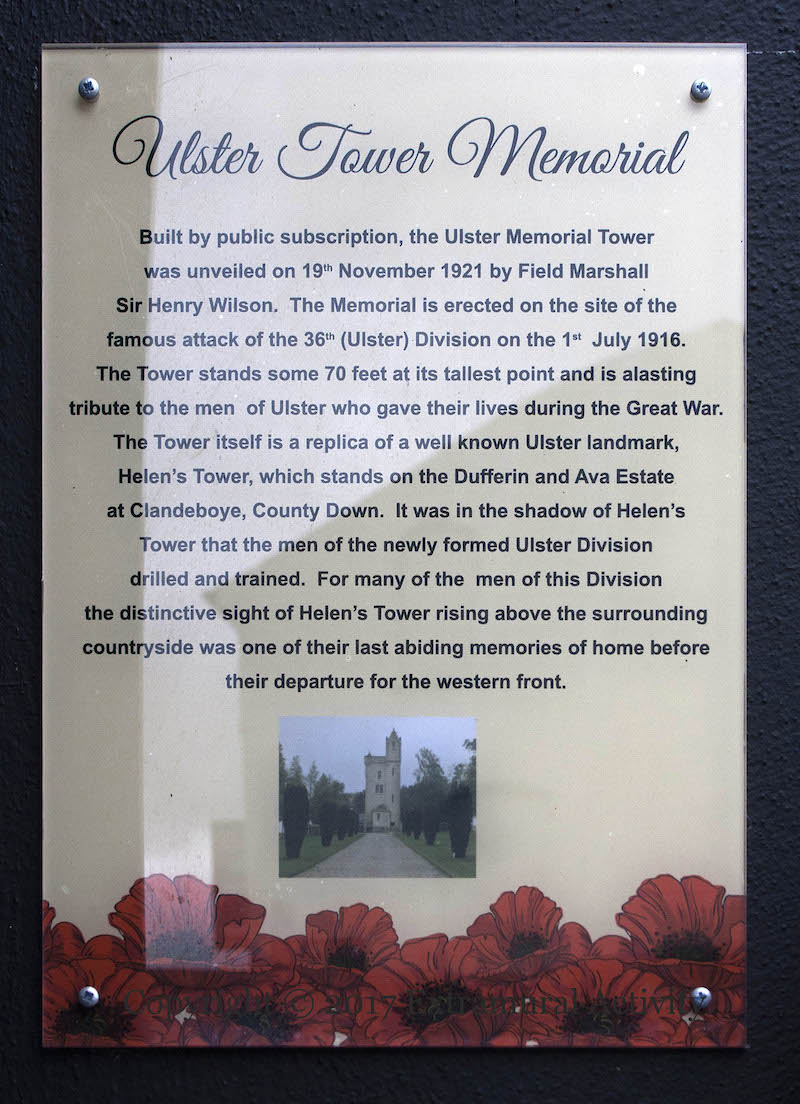
“Only by remembering these men, and others like them, can we ever repay their memory.” The Woodstock Somme Centenary Project aims to do that with a new collection of boards in Willowfield Street which includes (above) the nine Victoria Cross recipients from the 36th (Ulster) Division in World War I (from 1917 and 1918) – E[dmund] De Wind, E[rnest] Seaman, C[ecil] L[eonard] Knox, N[orman] Harvey, (from 1916) G[eoffrey] St. G[eorge] S[hillington] Cather, W[illiam] F[rederick] MacFadzean, E[ric] N[orman] F[rankland] Bell, R[obert] Quigg, and J[ames] S[amuel] Emerson – and information about the Ulster Tower and Thiepval memorials.

The illustrations come from Cyril Falls’s book The History Of The 36th (Ulster) Division (from Project Gutenberg).

For a wide shot, see Faugh-A-Ballagh.

X04174 2017-05-28 Willowfield Tower+

X04175 2017-05-28 Willowfield Thiepval+

X04176 2017-05-28 Willowfield info+

X04177 2017-05-28 Willowfield 1July+

Click image to enlarge
Copyright © 2017 Seosamh Mac Coılle
X04011 X04174 X04175 X04176 X04177 “In Flanders fields the poppies blow/Between the crosses, row on row/That mark our place; and in the sky/The larks, still bravely singing, fly/Scarce heard amid the guns below.//We are the Dead. Short days ago/We lived, felt dawn, saw sunset glow,/Loved and were loved, and now we lie/In Flanders fields//Take up our quarrel with the foe:/To you from failing hands we throw/The torch; be yours to hold it high./If ye break faith with us who die/We shall not sleep/Though poppies grow/In Flanders fields.” Canadian physician John McCrae 1872-1918
Henry Wilson Helen’s Tower Edward Lutyens President Doumer Philip Gibbs official british reporter

Culture Amid Commerce

03985-2017-01-06-welcome-to-york-st-10scottish

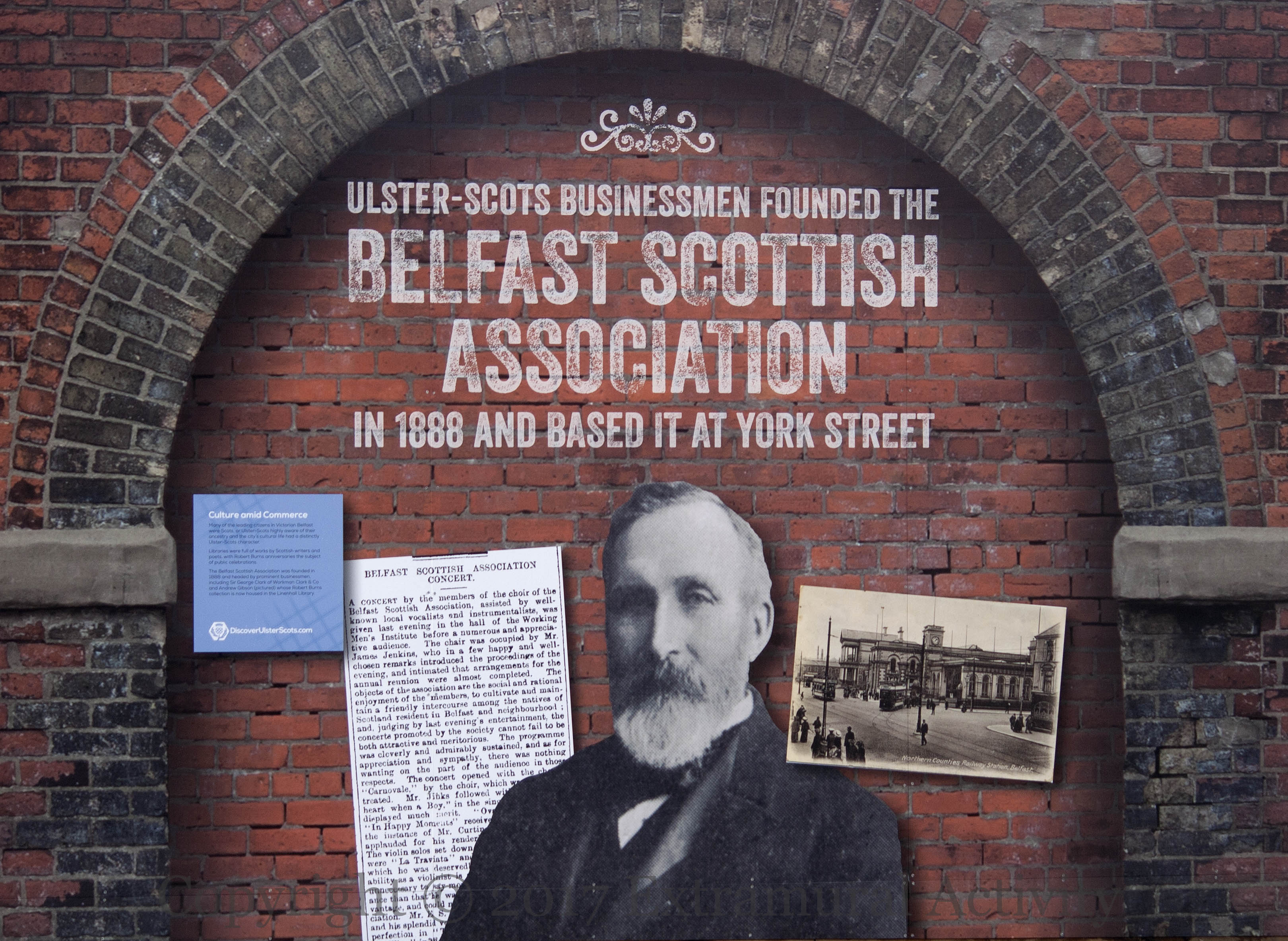
“The Belfast Scottish Association was founded in 1888 and headed by prominent businessmen, including Sir George Clark of Workman Clark and Andrew Gibson (pictured) whose Robert Burns collection is now housed in the Linenhall Library.”

This is the final entry in a series from discoverulsterscots.com about York Street businesses and Ulster Scots businessmen: Shipbuilding | London, Midland and Scottish | Workman Clark’s | Belfast Goods

03988-2017-01-06-welcome-to-york-st-13learn-more

Click image to enlarge
Copyright © 2017 Seosamh Mac Coılle
X03985 X03988

Belfast Goods

03984-2017-01-06-welcome-to-york-st-9goods

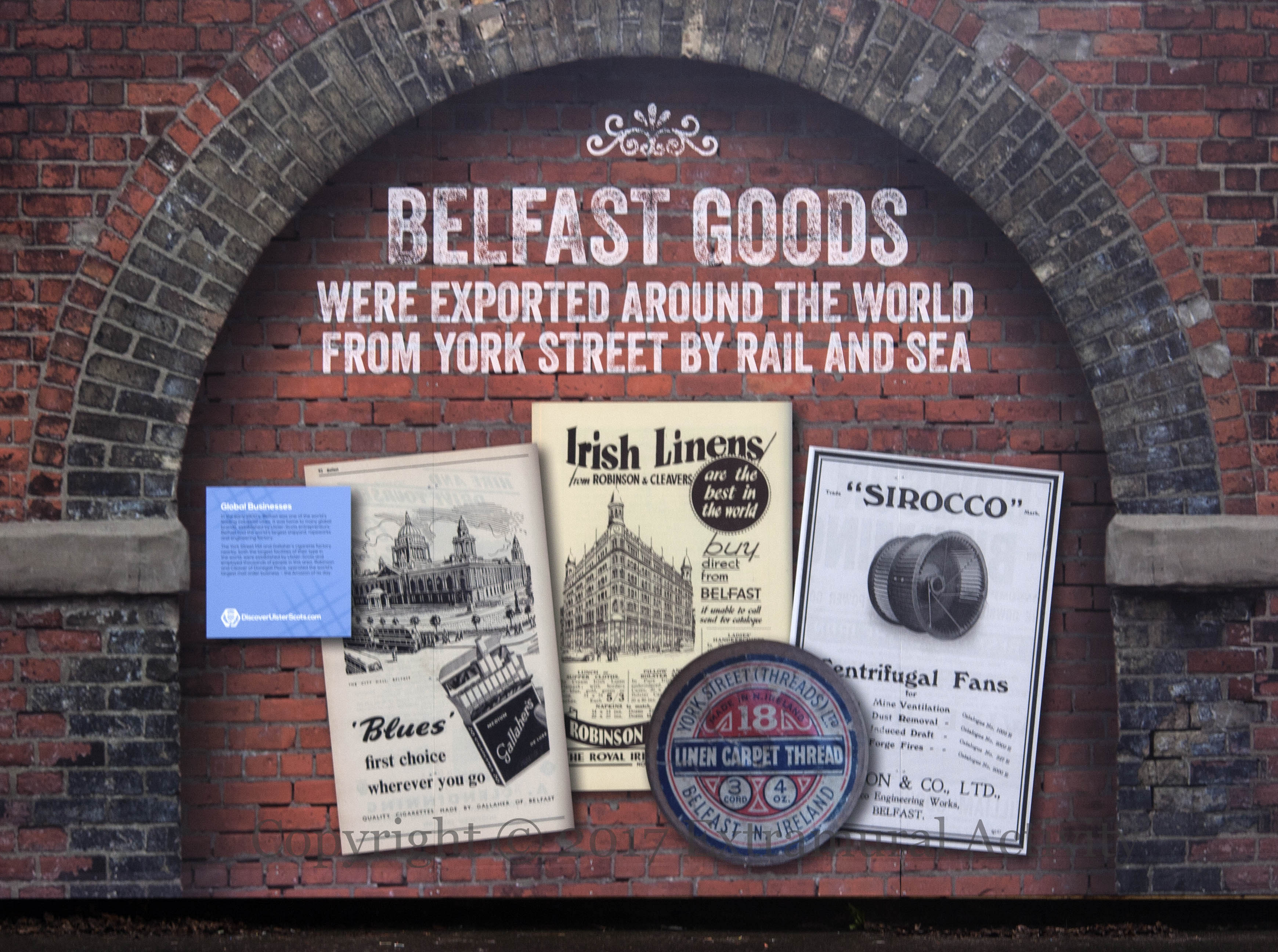
Among the Belfast goods “exported around the world from York Street by rail and sea” were Gallaher’s Blues (cigarettes), Irish linens, Davidson & Co (Samuel Davidson, born in County Down to an Ulster-Scots family, was the inventor of the Sirocco centrifugal fan “for mine ventilation, dust removal, induced draft, forge fires”), and linen carpet thread from York Street (Threads) Ltd. Robinson & Cleaver’s department store is now out of business. Gallaher’s is now the multinational Gallaher Group, but its factories in Belfast and Ballymena have closed. And Davidson’s company was bought by Howden UK in 1988.

Previously in the series: Shipbuilding | London, Midland and Scottish | Workman Clark’s

Click image to enlarge
Copyright © 2017 Seosamh Mac Coılle
X03984

Workman Clark’s

03991-2017-01-06-welcome-to-york-st-6-7-8

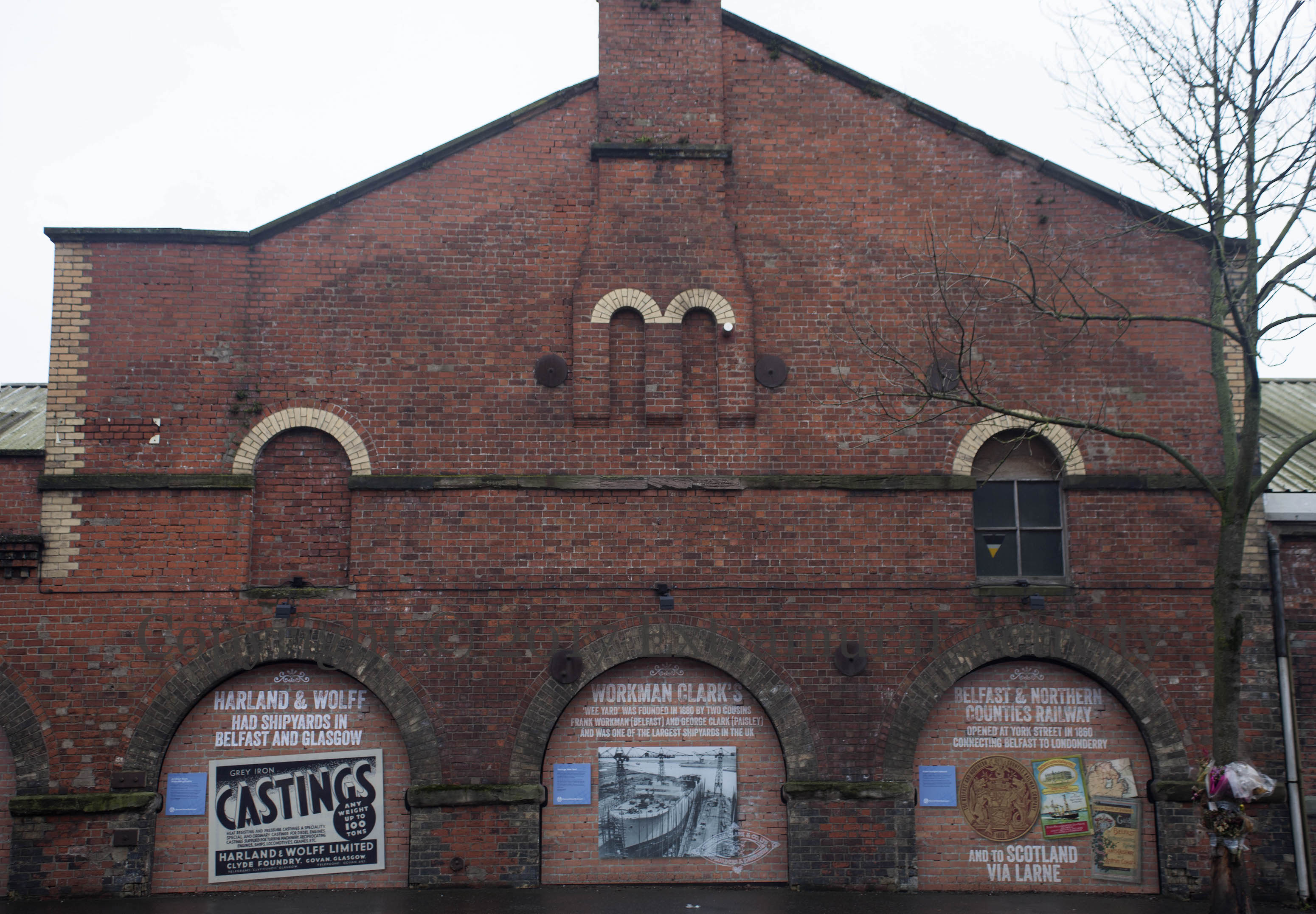
Workman & Clark’s (in the centre panel above) was a Belfast shipyard existing from 1880 to 1935. During the first world war it took over the construction of two monitor ships (specifically, M29 and M31) for the Royal Navy that H&W did not have space to build. For more, see Grace’s Guide | BBC audio on monitor ships and their construction, including a record for number of rivets hammered in by one John Moore at Workman Clark’s.

These are panels 6, 7, and 8 from the new boards along York Street on the outer wall of the NI Railways mechanical engineering workshop.

Click image to enlarge
Copyright © 2017 Seosamh Mac Coılle
X03991

Shipbuilding

03980-2017-01-06-welcome-to-york-st-2gateway

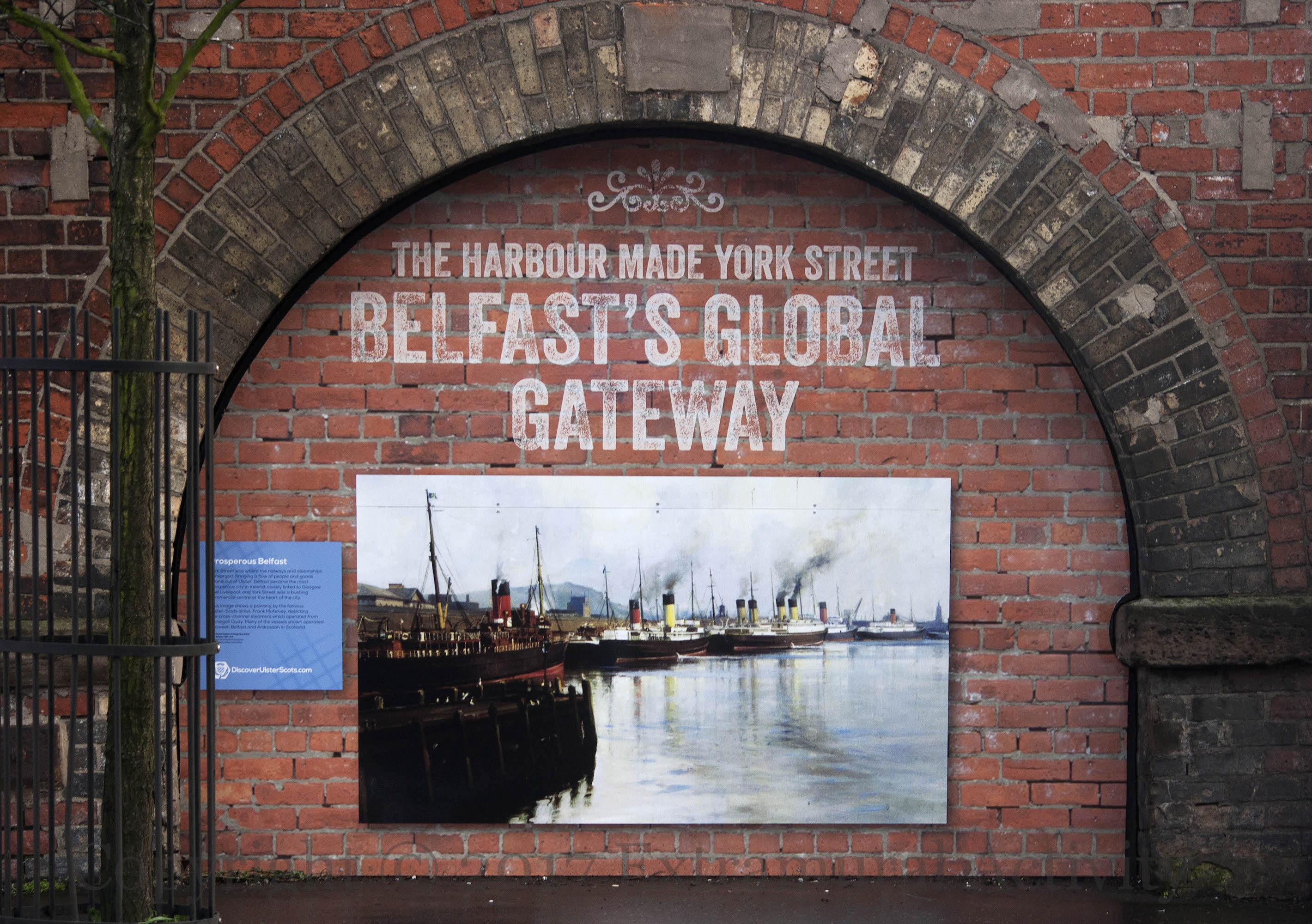
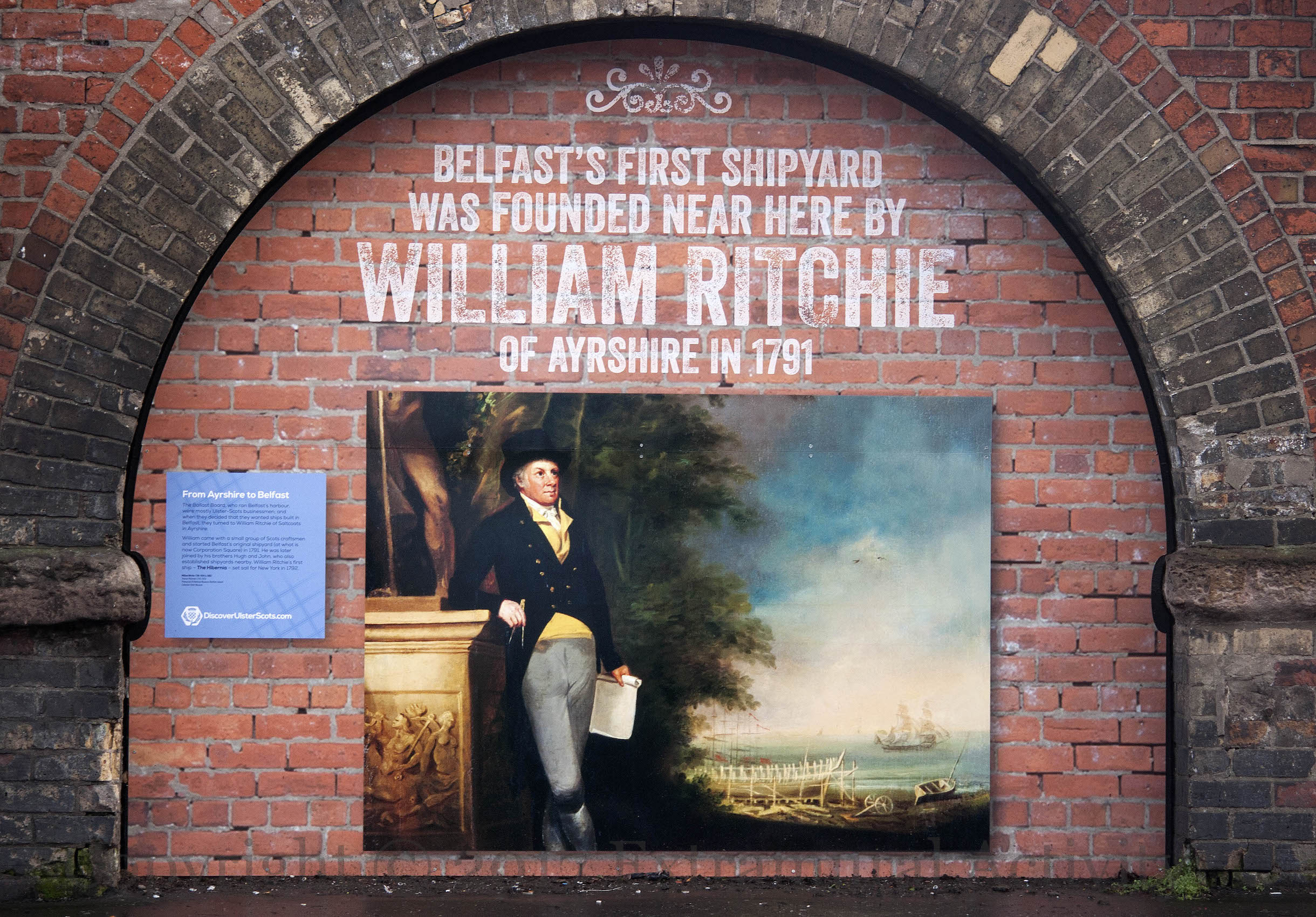
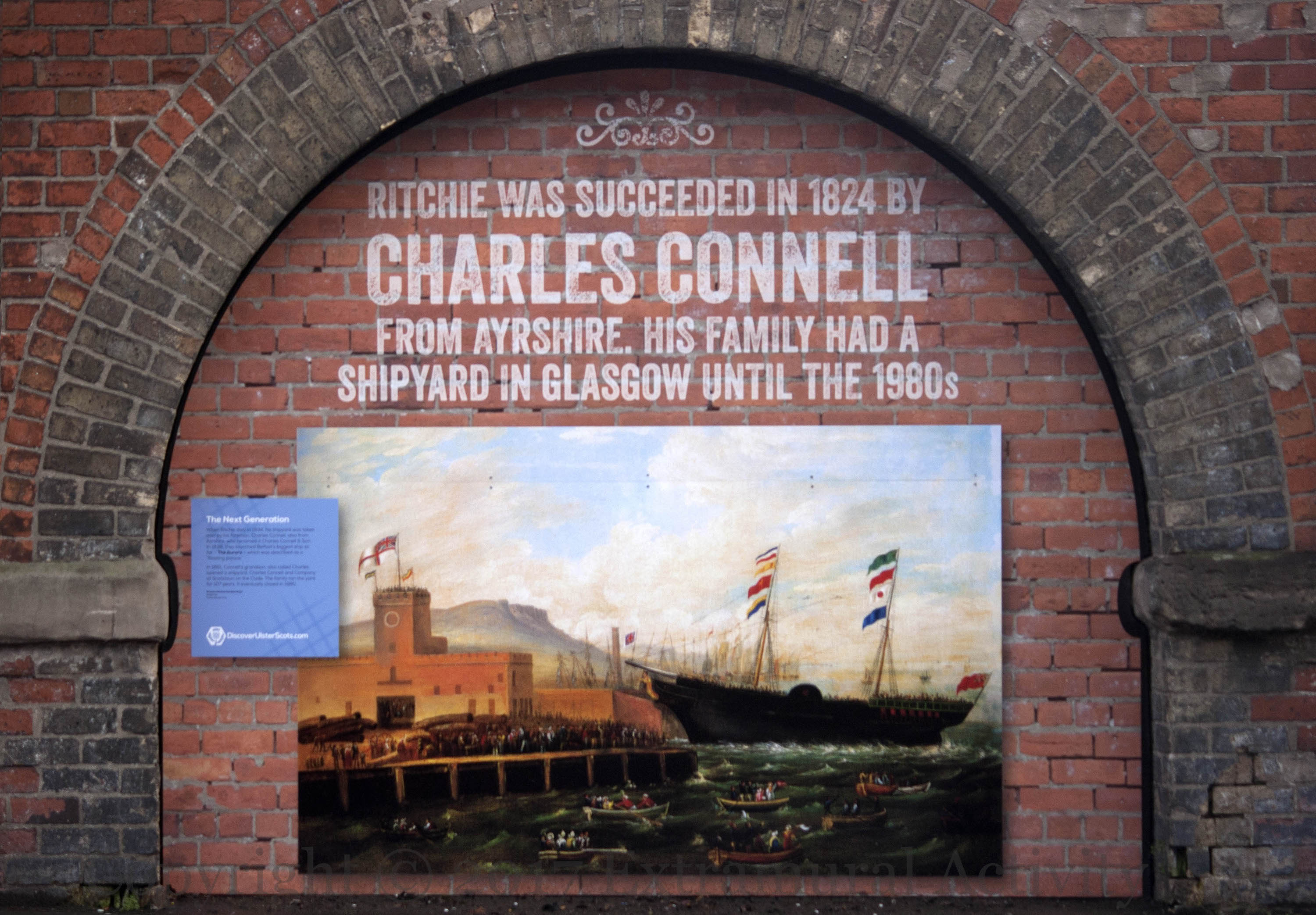
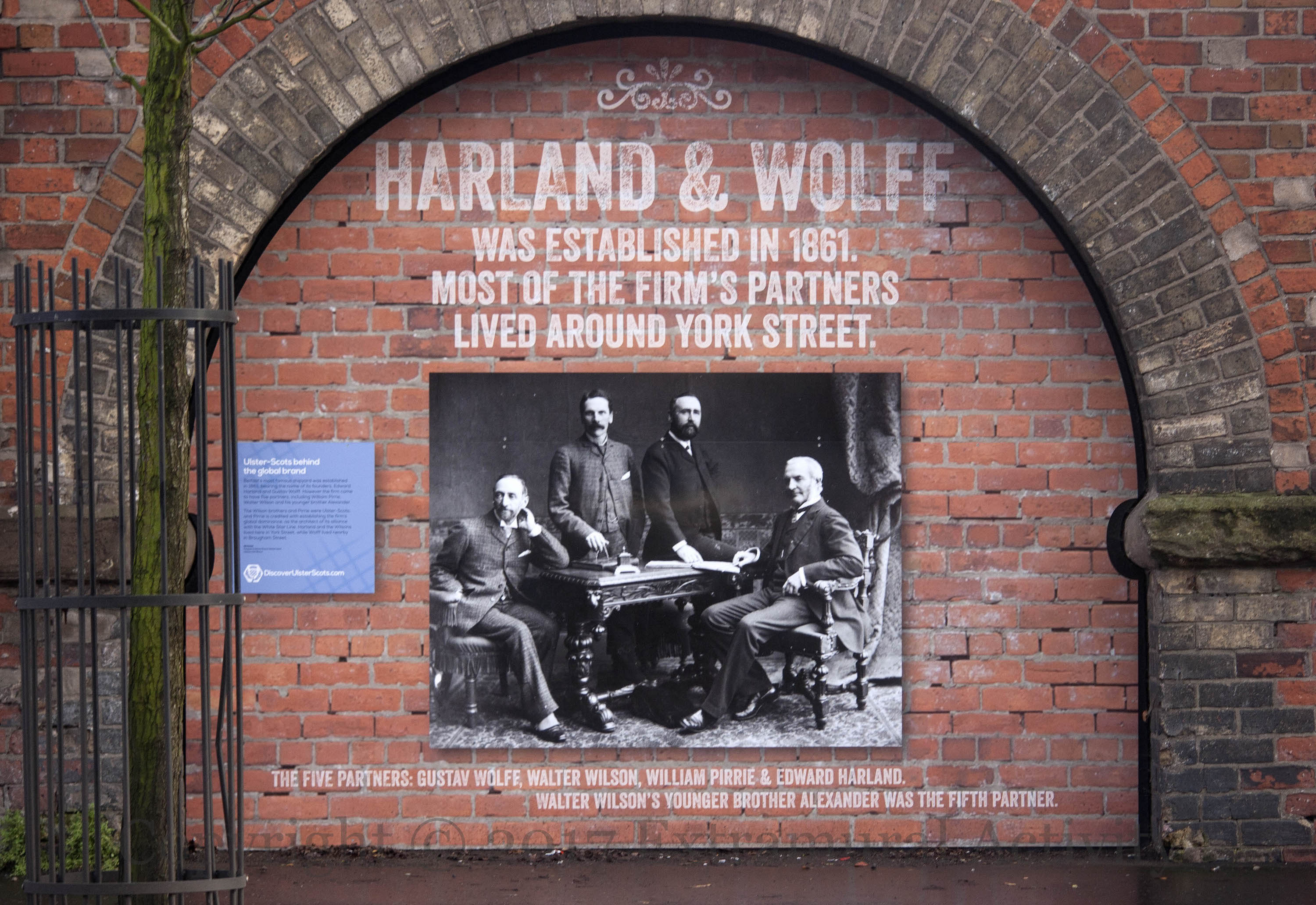
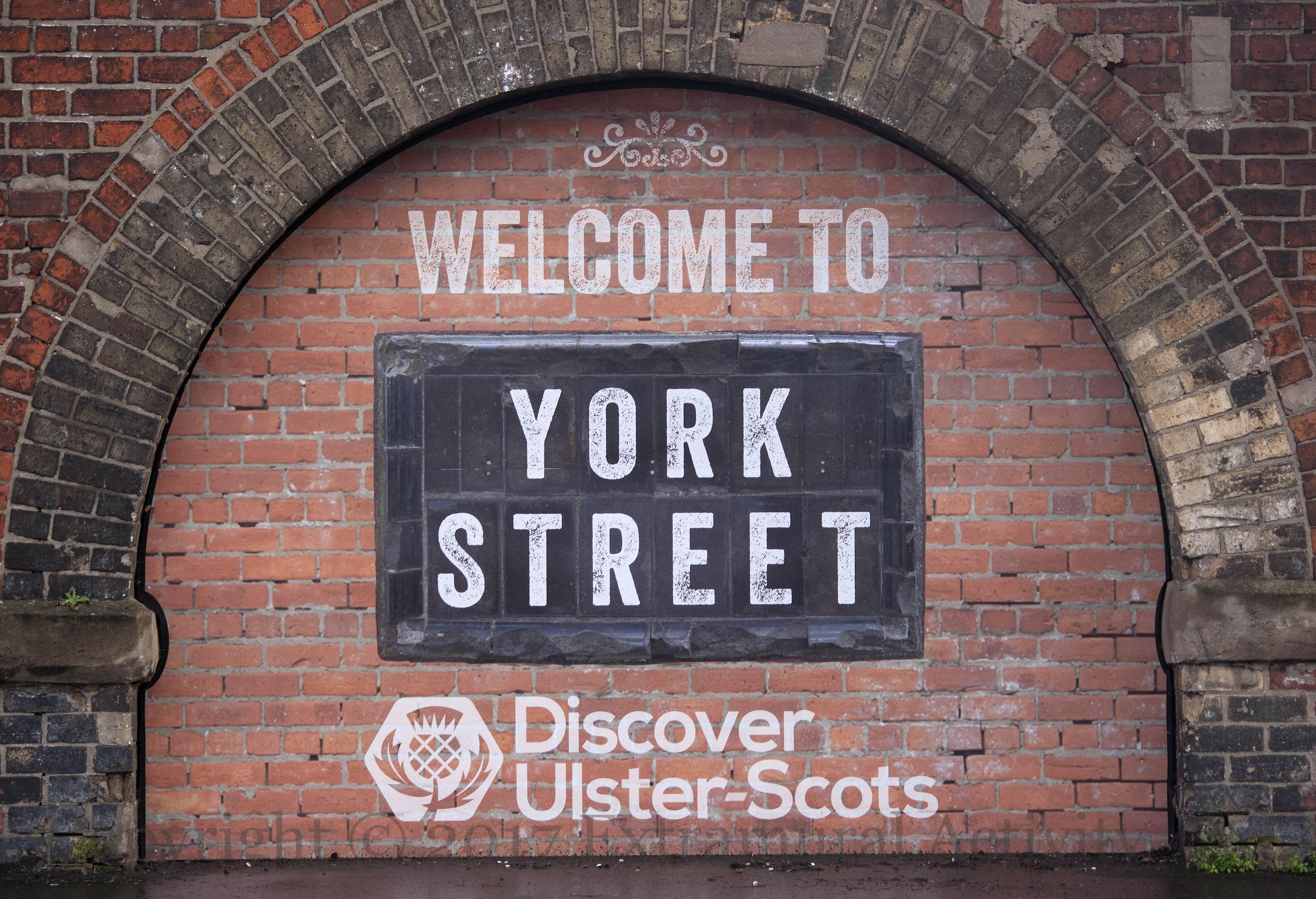
A history of shipbuilding and its role in Belfast’s industrial life is told in the first five panels of a 13-panel installation along York Road (“The harbour made York Street Belfast’s global gateway”) and in particular its connection with Scotland. (It is sponsored by Discover Ulster Scots.) Two Scots, William Ritchie (whose 1802 portrait by Thomas Robinson is shown) and Charles Connell (who oversaw the construction of the first wooden steamboat in Belfast – Aurora, pictured below) along with another Scot, Alexander MacLaine, were the leading shipbuilders in Belfast from 1791 until the 1860s, when Englishman Edward Harland (soon joined by German Gustav Wolff, and then in 1874 by William Pirrie and Wilson brothers Walter and Alexander) took over the rival Hickson yard (which included land on Queen’s Island and on the south side of the Lagan) and became dominant. Their connection to York Street is that all of them except Pirrie lived on or near York Street.

For potted histories (and a larger picture of Aurora) see LibraryIreland and Ulster-Scots.com.

03981-2017-01-06-welcome-to-york-st-3ritchie

03982-2017-01-06-welcome-to-york-st-4connell

03983-2017-01-06-welcome-to-york-st-5h_w

03979-2017-01-06-welcome-to-york-st-1

Click image to enlarge
Copyright © 2017 Seosamh Mac Coılle
X03980 X03981 X03982 X03983 X03979 York St

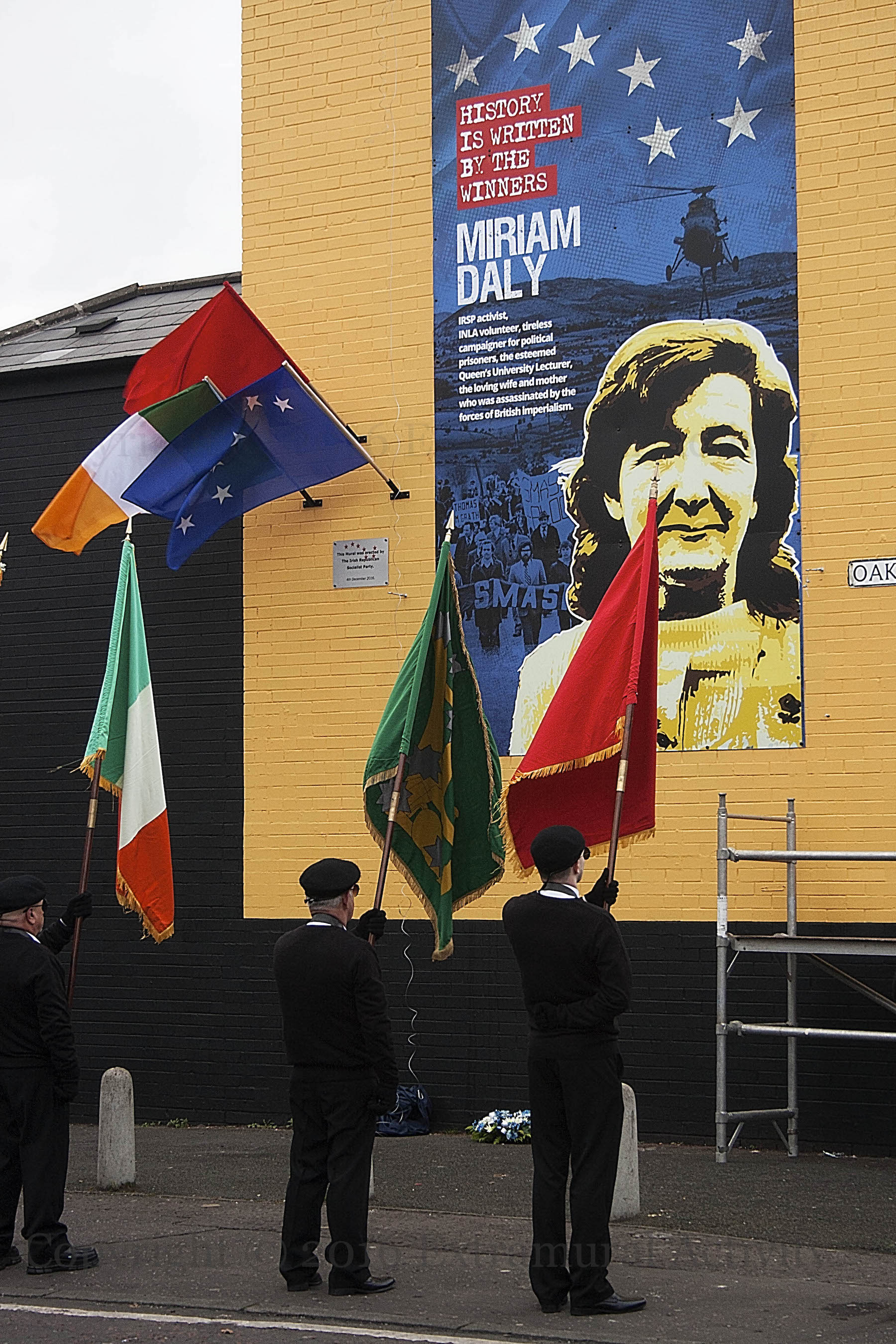
History Is Written By The Winners

03961-2016-12-04-miriamdaly-flags

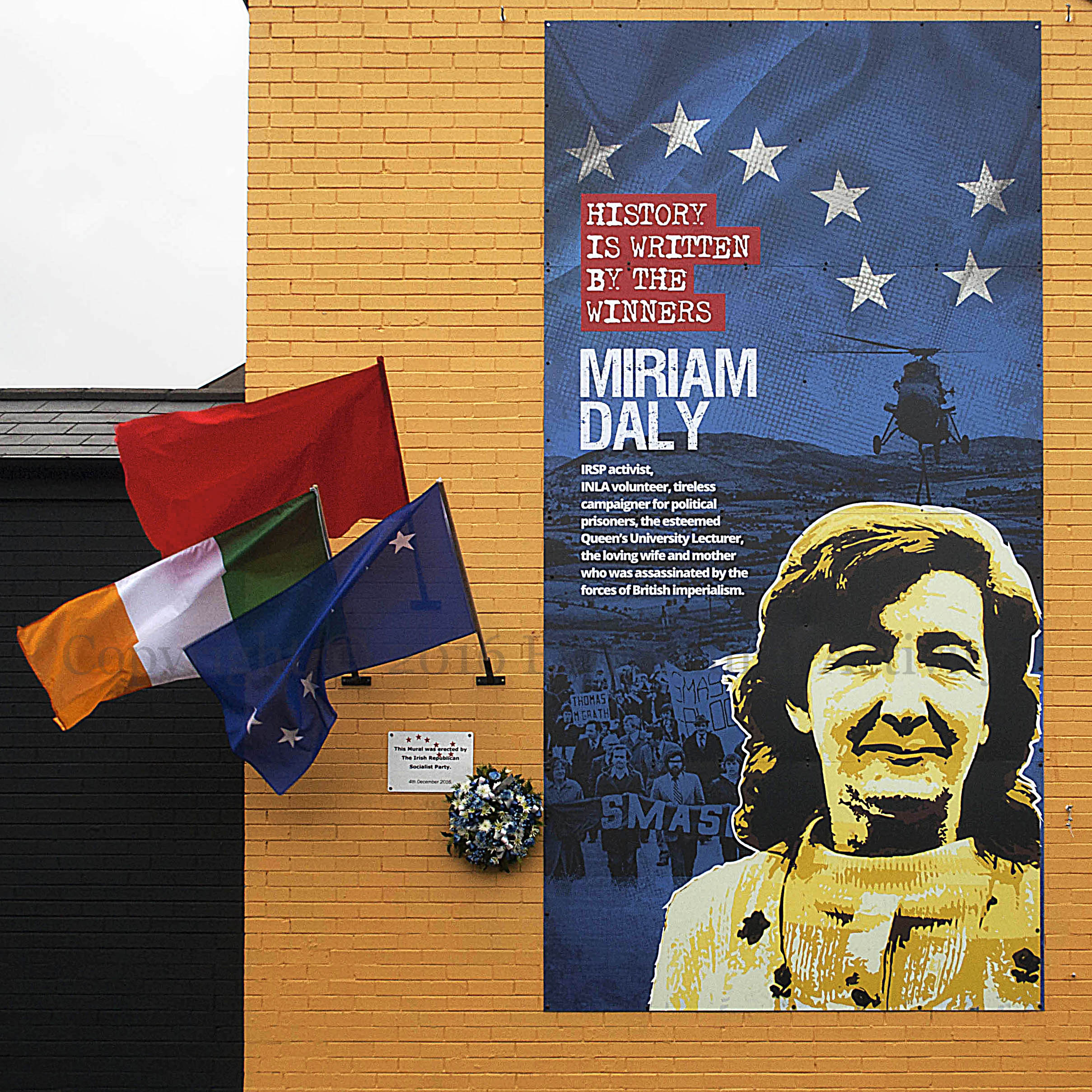
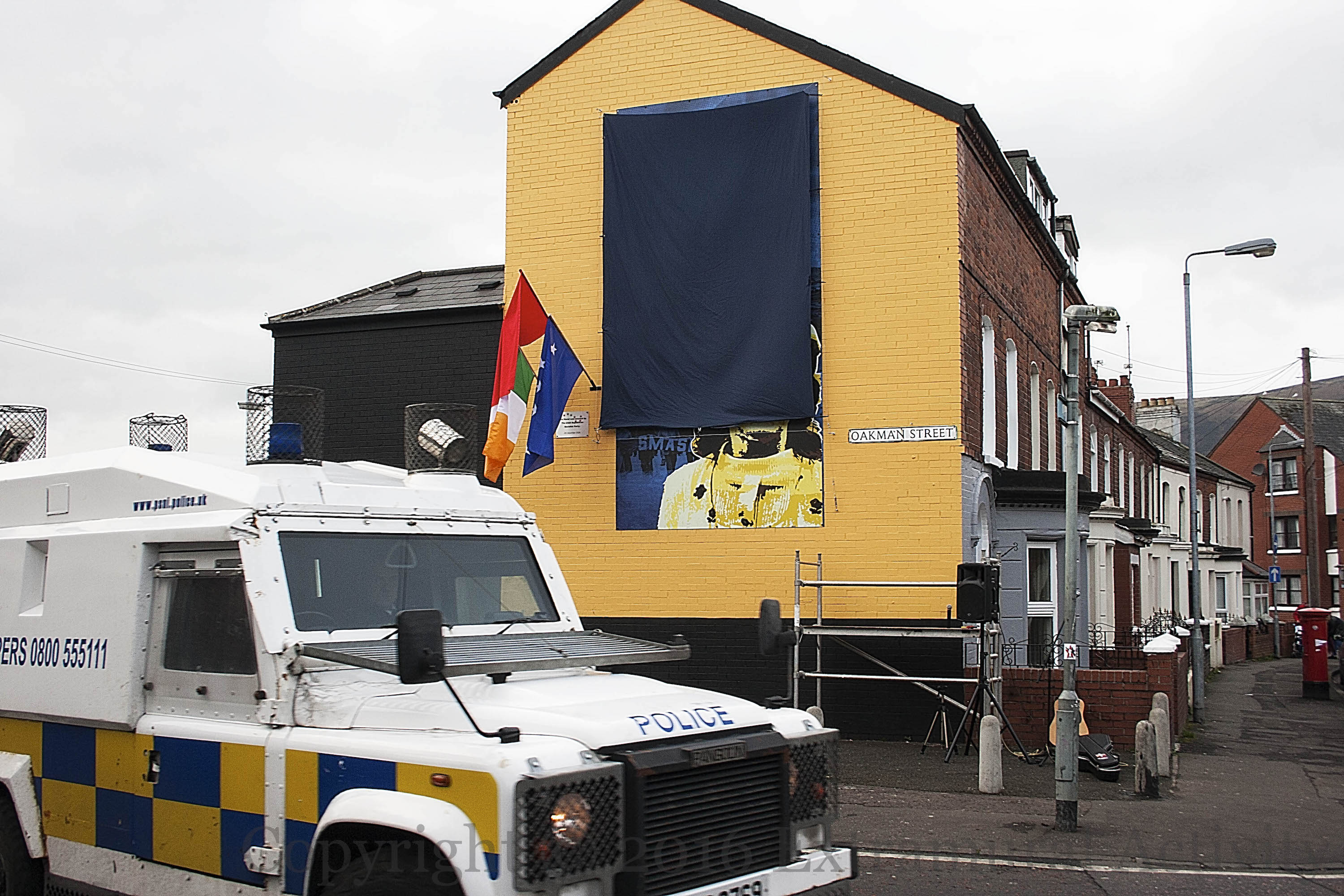
Queen’s University lecturer in economic history Miriam Daly took over as chairwoman of the IRSP (Irish Republican Socialist Party) after founder Seamus Costello was killed in a feud with the IRA. Daly was shot dead in 1980 by the UDA/UFF in her Andersonstown home in 1980. (Interview with husband Jim Daly.)

A long-standing and much-graffitied 1996 mural, History Is Written By The Winner (painted by son Donal Daly among others) was replaced in 2014 by a Joey Ramone mural for a U2 video competition (Murals Of Innocence). The new board shown in these images was launched on Sunday 2016-12-04 to a crowd of about 200. As the final image shows, the PSNI were also “in attendance”.

03959-2016-12-04-miriamdaly-party

03958-2016-12-04-miriamdaly-psni

Click image to enlarge
Copyright © 2016 Seosamh Mac Coılle
X03961 X03959 X03958

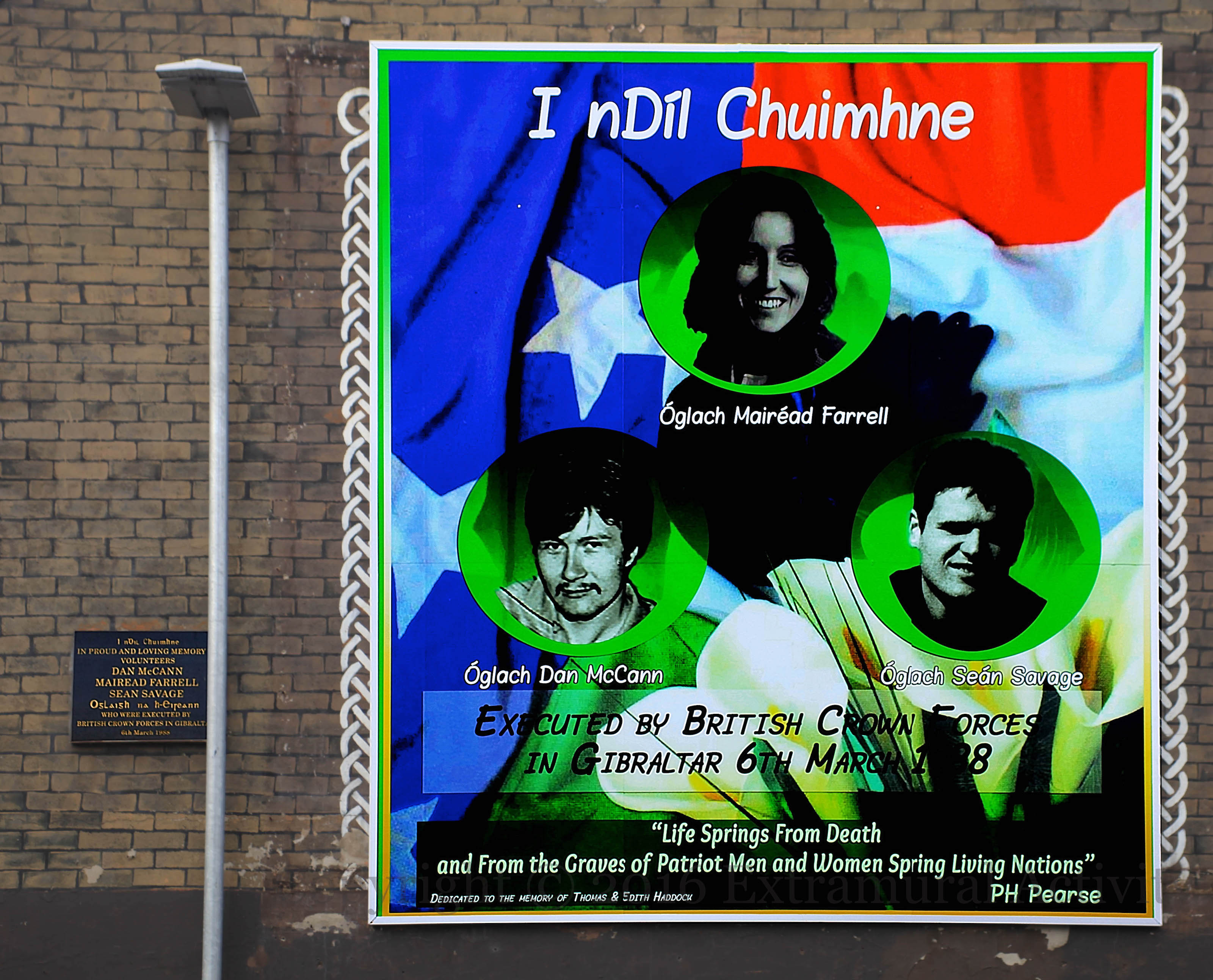
Life Springs From Death

03944-2016-11-15-gibraltar3

The new replacement board commemorating the Gibraltar 3 (Maıréad Farrell, Dan McCann, and Seán Savage “executed by British crown forces 6th March 1988) uses words from Pearse’s oration at the funeral of O’Donovan Rossa. Not the more common “the fools, the fools …” but “Life springs from death and from the graves of patriot men and women spring living nations” (used previously in Strabane in 1990 – M00860). The board is “dedicated to the memory of Thomas and Edith Haddock”.

Here is the previous board. The border in the image above is from the board before that – see The Gibraltar Three.

Click image to enlarge
Copyright © 2016 Seosamh Mac Coılle
X03944 Hawthorn St

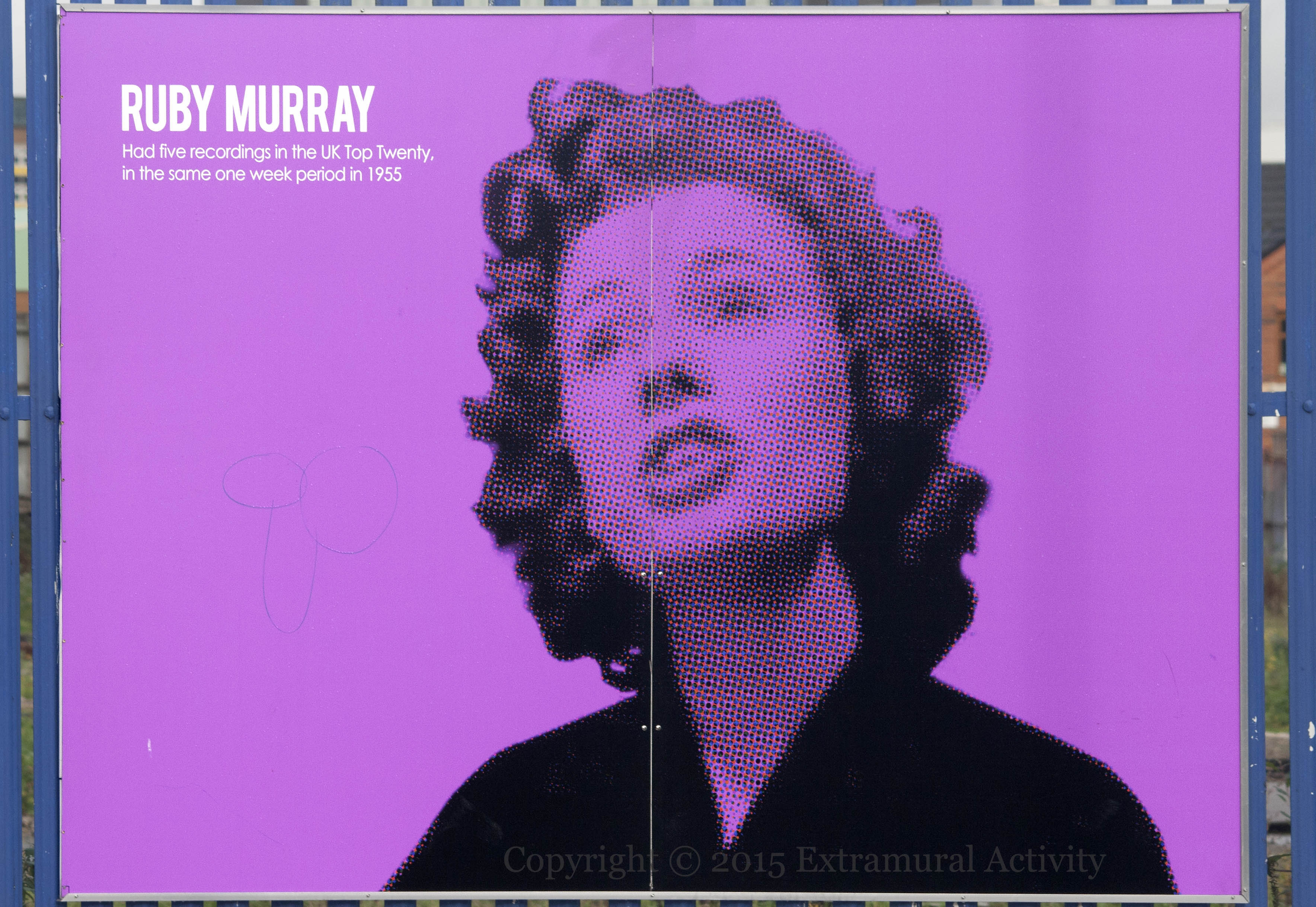
Top Of The Pops

03184 2015-11-12 Ruby Murray+

In 1955, Ruby Murray — who was born and raised on Donegall Road — had a #1 hit with Softly, Softly (youtube) and it stayed at the top for three weeks. She went on to have six other top-ten hits that year and in one week five of her songs were in the top twenty.

Donegall Road, Village, south Belfast

Click image to enlarge
Copyright © 2015 Seosamh Mac Coılle
X03184 donegall rd

Their Name Liveth Forevermore

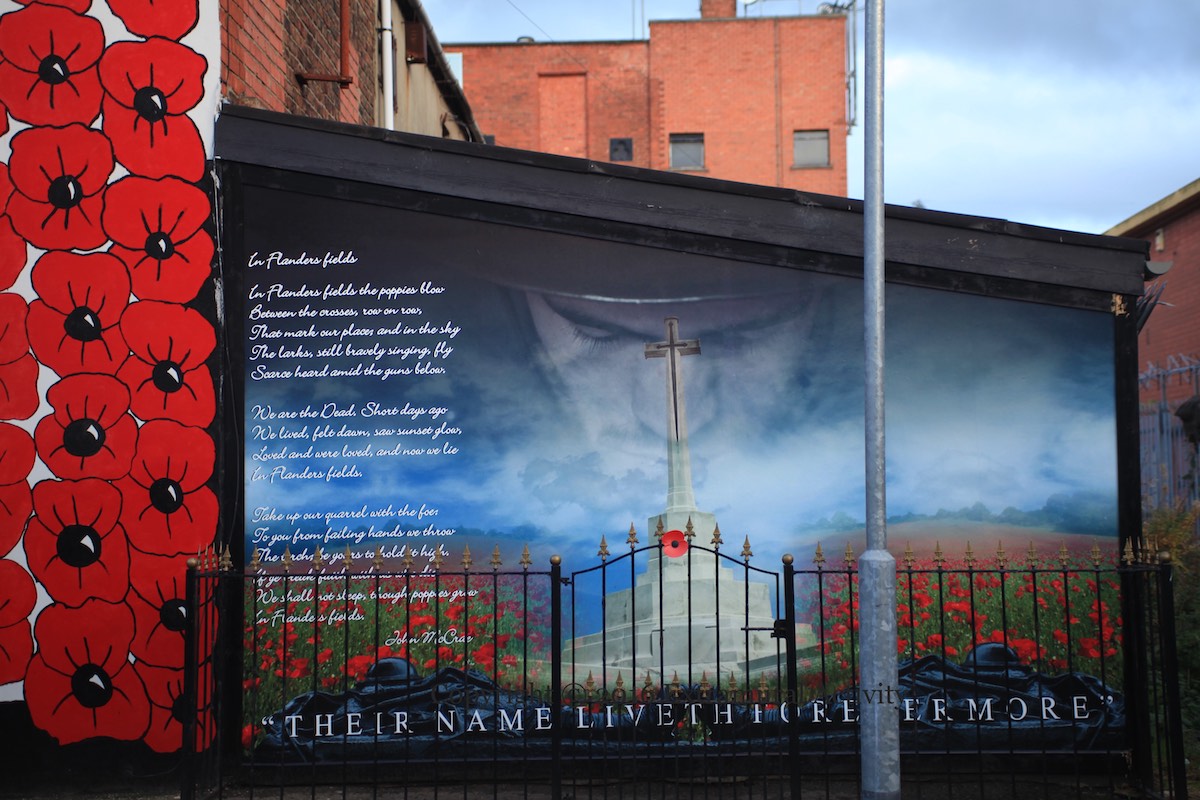
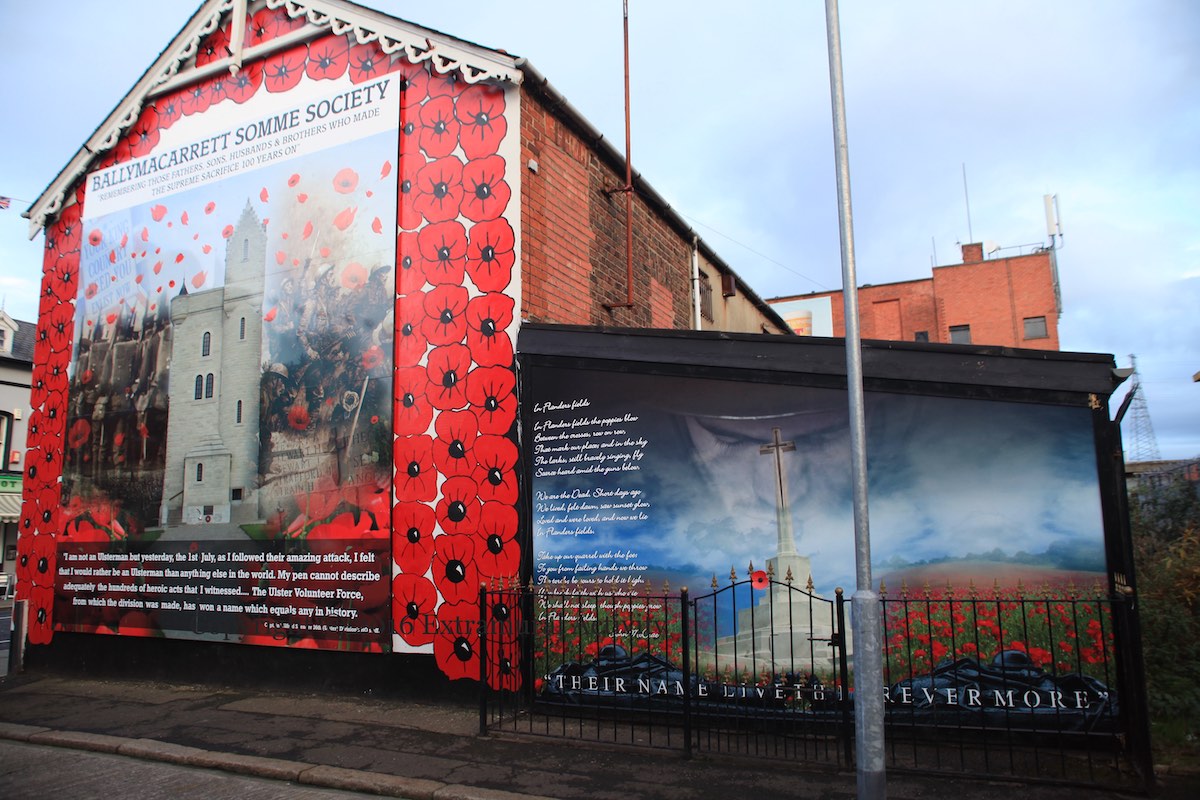
In May we reported that the RHC mural in Hunt Street had been replaced by a Ballymacarrett Somme Society mural, though the side wall remained a memorial to C Coy RHC. Now the side wall has also been turned into a Somme memorial, with John McCrae’s poem In Flanders Fields and an image of the Cross of Sacrifice in front of the Thiepval memorial. The larger of the two plaques has been moved to the nearby RHC memorial garden.

Click image to enlarge
Copyright © 2016 Seosamh Mac Coılle
X05371 X05370