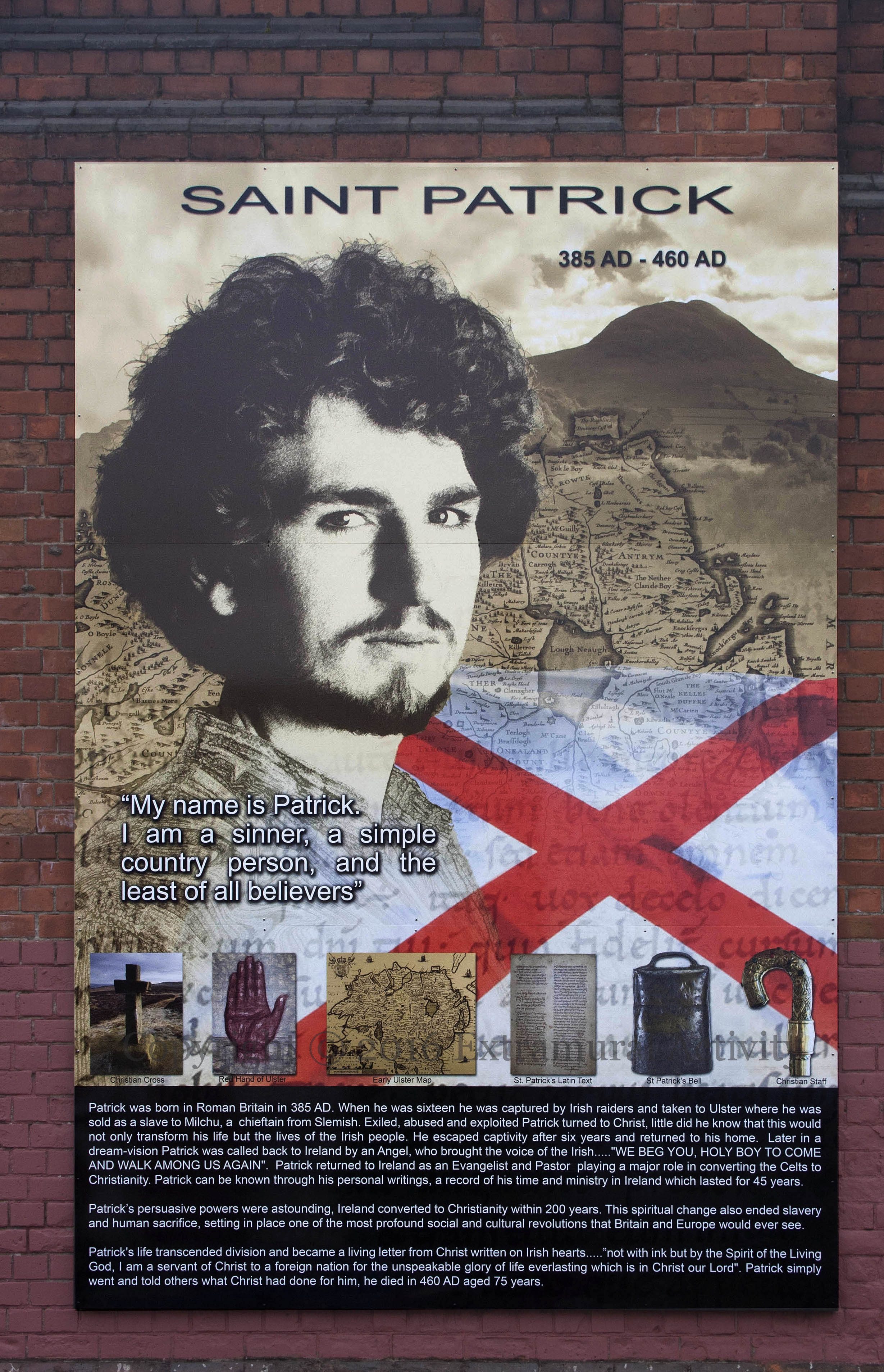
St Patricks

03324 2016-03-13 StPatricks mid+

Featured today are two (more) of the boards in a set on Tates Avenue. The central board, shown above, shows a young Patrick (without the clerical garb in which he is often portrayed) against the backdrop of Slemish mountain, where Patrick is thought to have tended sheep as a young slave to a local chieftain, c. 401 AD and developed his Christian faith.

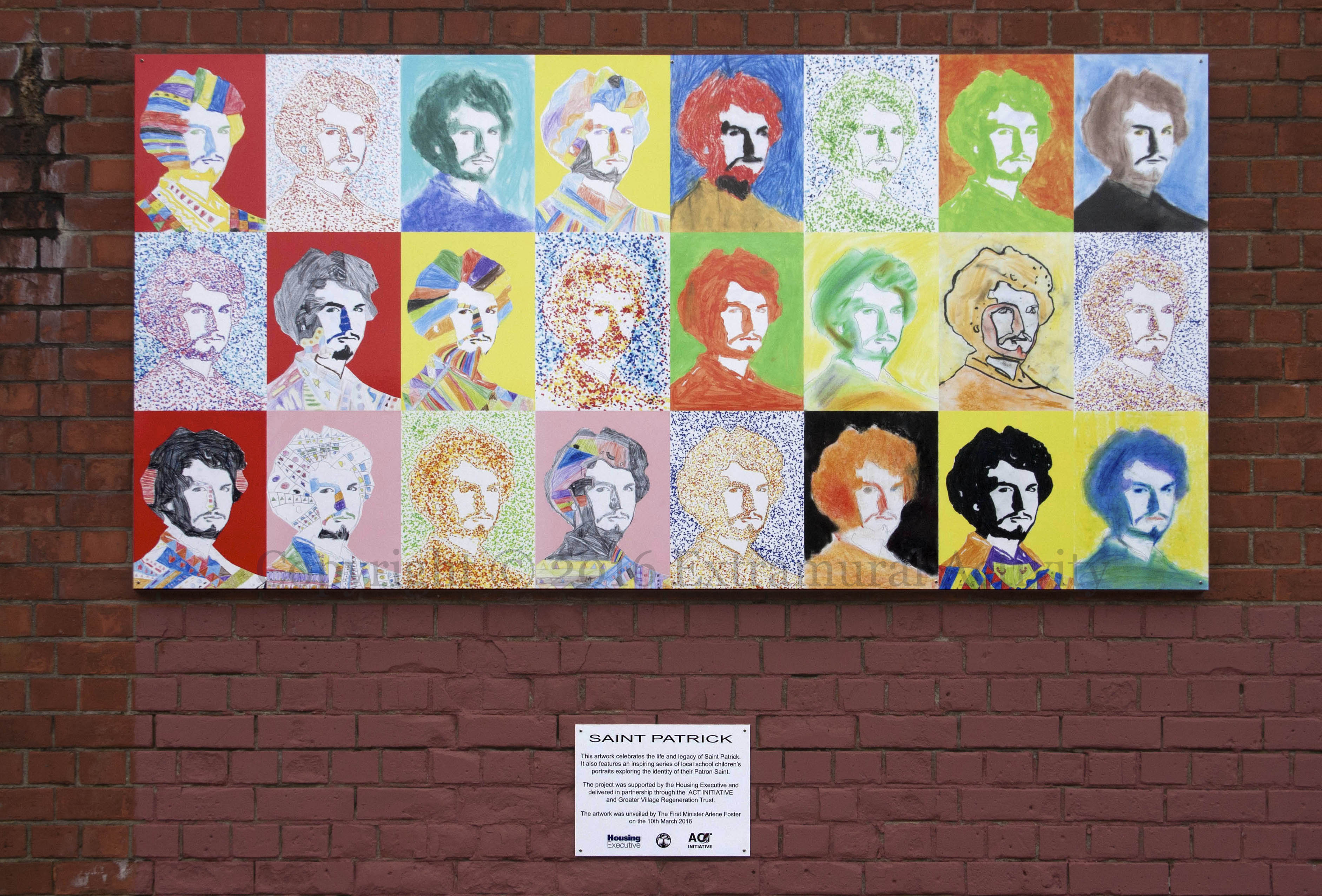
The second image is of colourings of the Saint Patrick profile by children from the nearby Donegall Road Primary School.

The boards were unveiled on March 10th, 2016 by first minister Arlene Foster who remarked that the saint had become “very Gaelicised” and this — and the presence of Irish tricolours at parades — deterred unionists from celebrating “the patron saint of everybody in Northern Ireland” (Belfast Telegraph; also contains video of the launch). Anglicanism venerates saints but Presbyterianism does not, generally taking the “communion of saints” to refer to all members of the church.

Previously from this set of boards: An Ancient And Powerful Symbol
03325 2016-03-13 StPatricks+

Click image to enlarge
Copyright © 2016 Seosamh Mac Coılle
X03324 X03325 Ross Wilson bell latin text staff red hand of ulster cross saltire My name is Patrick. I am a sinner, a simple country person, and the least of all believers. Patrick was born in Roman Britain in 385 AD. When he was sixteen he was captured by Irish raiders and taken to Ulster where he was sold as a slave to Milchu exiled abused exploited turned to Christ little did he know that this would not only transform his life but the lives of the Irish people he escaped captivity after size years and returned to his home. Later in a dream-vision Patrick was called back to Ireland by an Angel who brought the voice of the Irish … “We beg you, holy boy to come and walk among us again”. returned as an evangelist and pastor playing a major role in converting the celts to Christianity known through his personal writings a record of his time and ministry in ireland which lasted for 45 years persuasive powers were astounding within 200 years spiritual change ended slavery and human sacrifice setting in place one of the most profound social and cultural revolutions transcended division and became a living letter written on irish hearts “not with ink but by the spirit of the living god i am a servant of christ to a foreign nation for the unspeakable glory of life everlasting which is in christ our lord” simply went and told others died in 460 aged 75 years This artwork celebrates the life and legacy of Saint Patrick. It also features an inspiring series of local school children’s portraits exploring the identity of their Patron Saint. The project was supported by the Housing Executive and delivered in partnership through the ACT INITIATIVE and Greater Village Regeneration Trust. The artwork was unveiled by The First Minister Arlene Foster on the 10th March 2016.
An Ancient And Powerful Symbol

03327 2016-03-13 StPatricks RedHand+

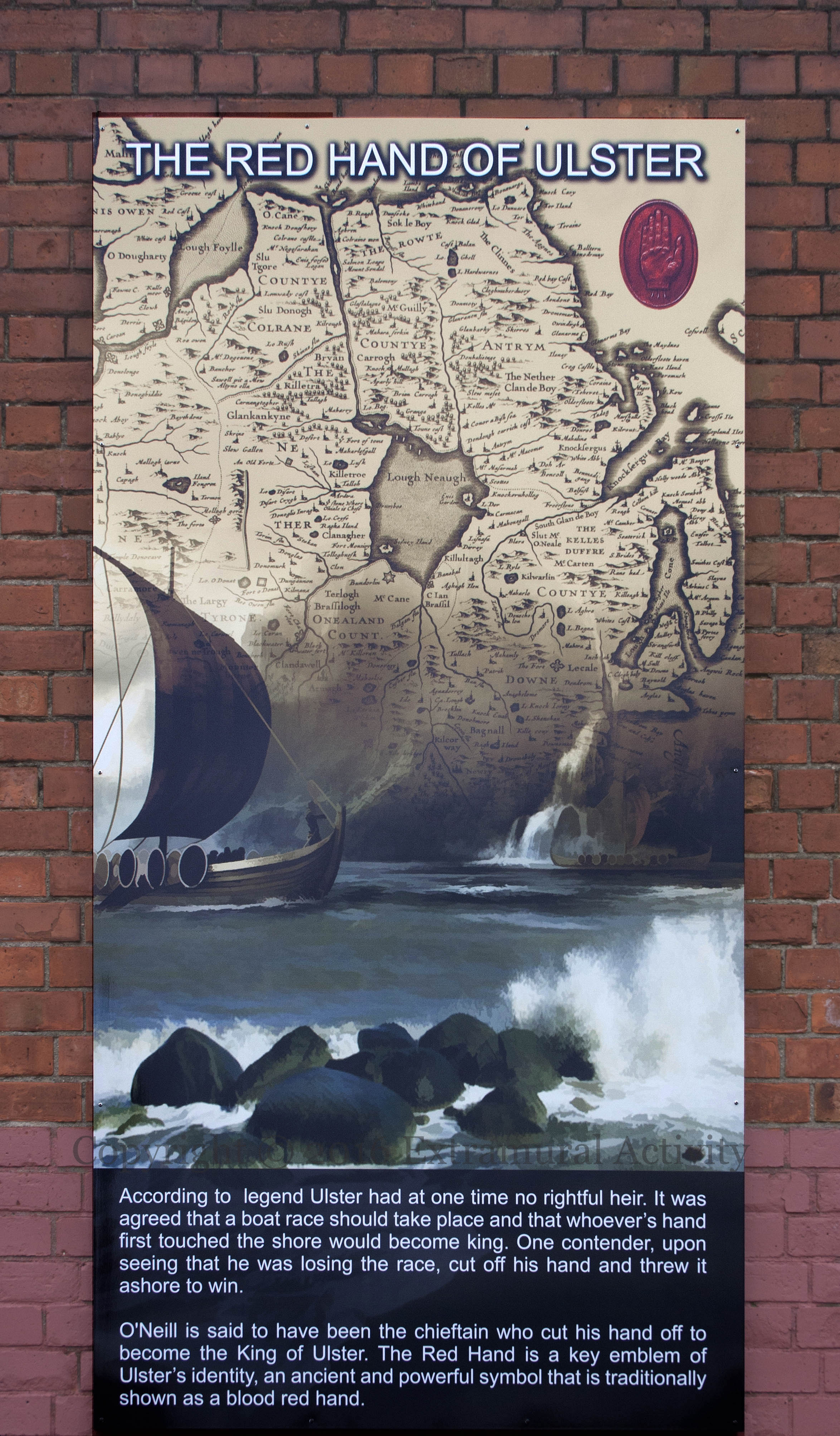
Here is one of the new boards on Tates Avenue (the others will be featured over the next two days). It shows a ship racing towards shore, superimposed over a 1659 map of Ulster by Blaeu.

“The Red Hand Of Ulster: According to legend Ulster had at one time no rightful heir. It was agree that a boat race should take place and that whoever’s hand first touched the shore would become king. One contended, upon seeing that he was losing the race, cut off his hand and threw it ashore to win. O’Neill is said to have been the chieftain who cut his hand off to become the King of Ulster. The Red Hand is a key emblem of Ulster’s identity, an ancient and powerful symbol that is traditionally shown as a blood red hand.”

Click image to enlarge
Copyright © 2016 Seosamh Mac Coılle
X03327

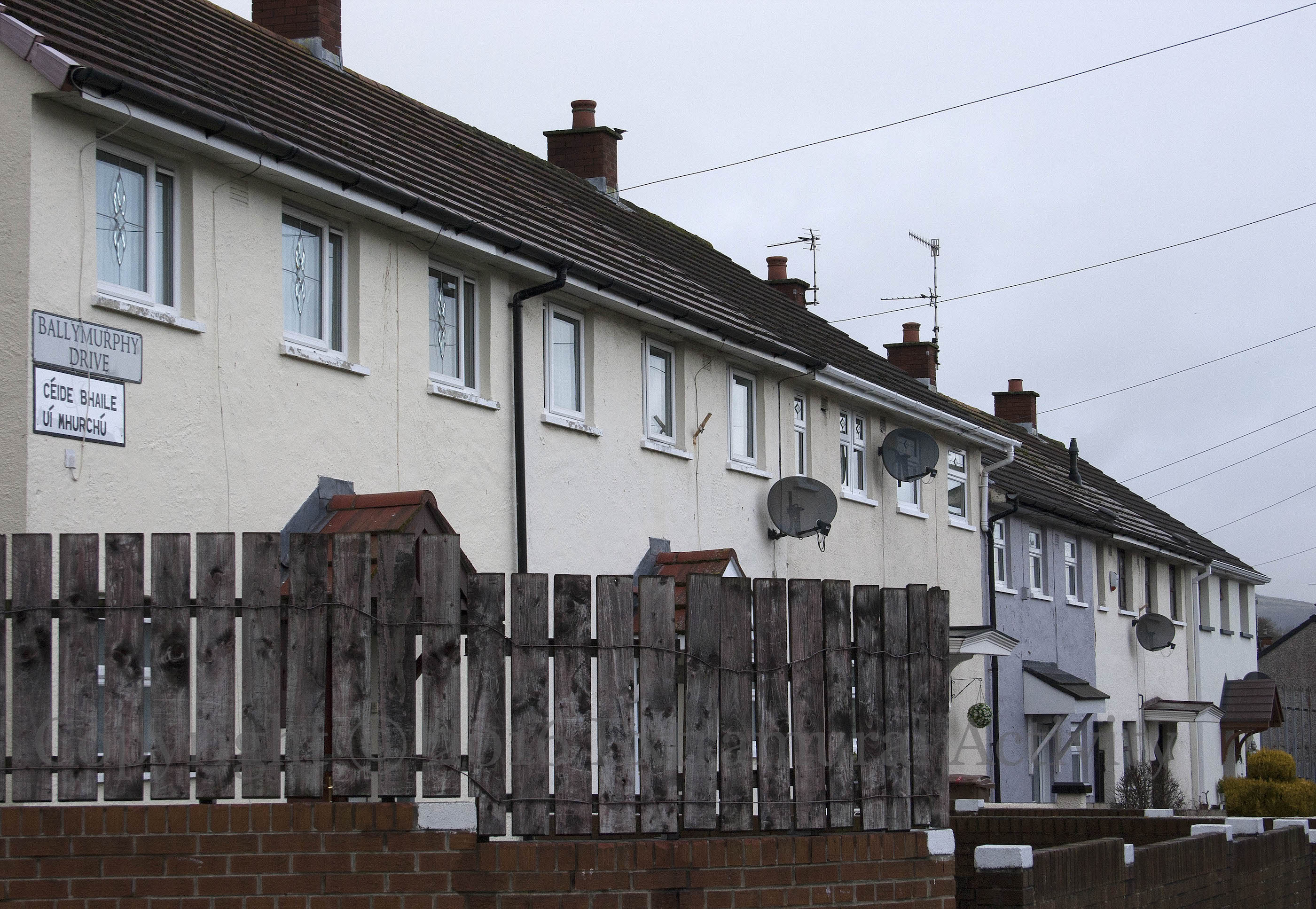
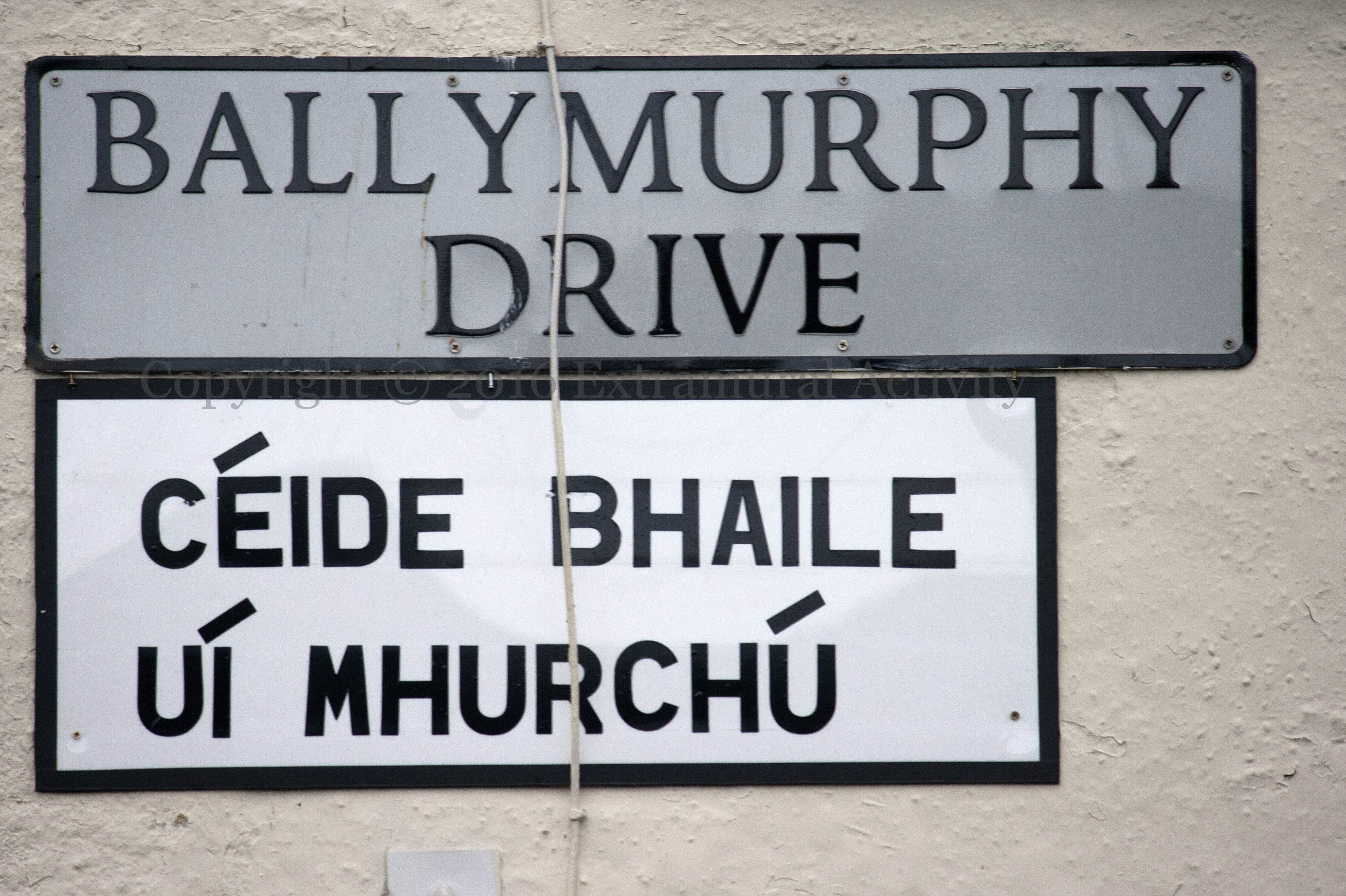
Céıde Bhaıle Uí Mhurchú

03298 2016-02-21 Céide Bhaile Uí Mhurchú+

Some residents of Ballymuprhy Drive have erected their own Irish-language street sign. The council has not erected one because a substantial number of residents did not respond to a survey. The primary resident behind the move, Eileen Reid, contends that the 2/3rds is unreasonable. (Irish Times | Belfast Live | Irish News)

03297 2016-02-21 Céide Bhaile Uí Mhurchú w+

Click image to enlarge
Copyright © 2016 Seosamh Mac Coılle
X03298 X03297

Roulette

03289 2016-02-16 McLean Bookies+

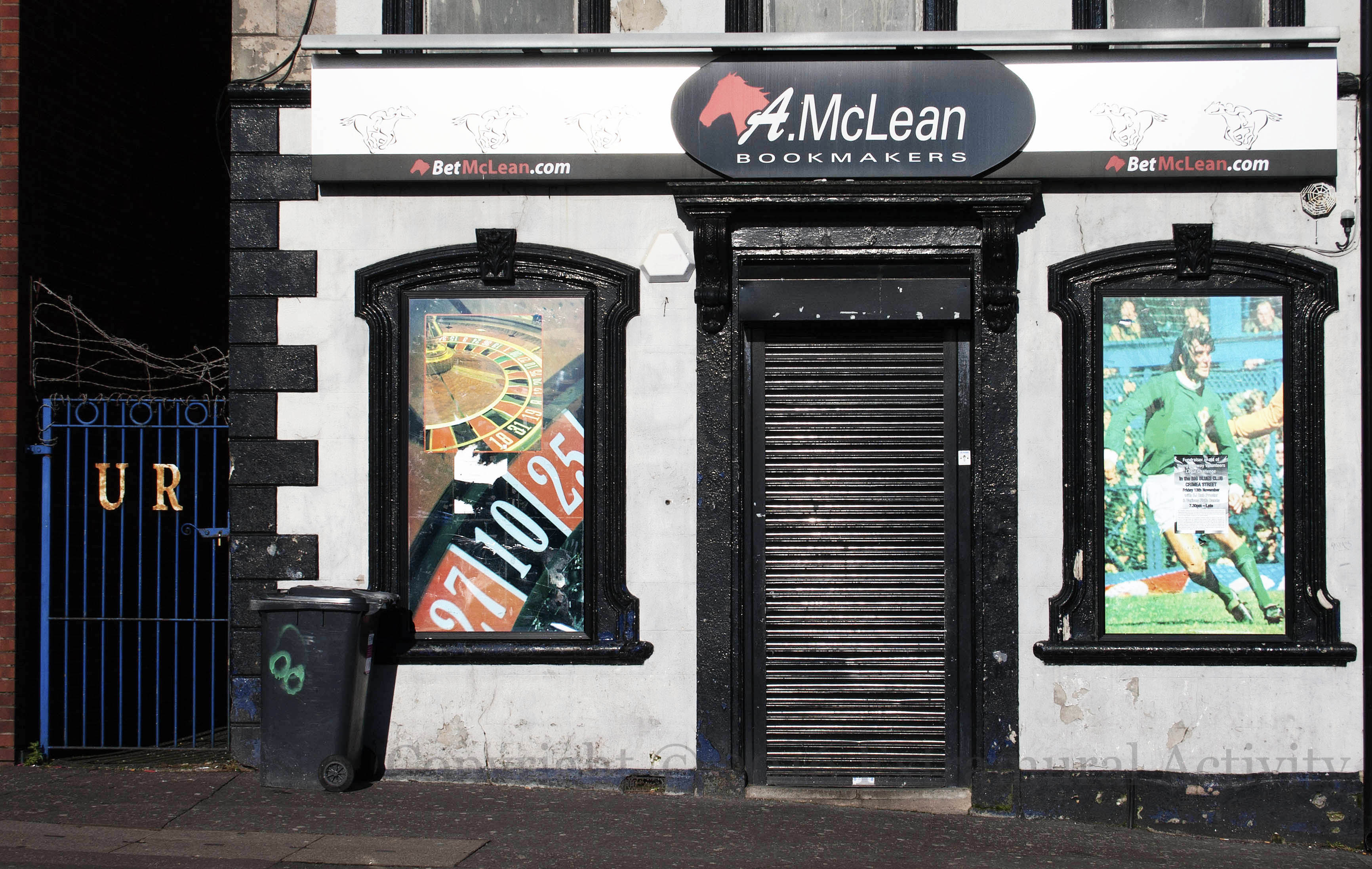
The images in the windows of the McLean’s bookies on the Shankill Road suggest that betting on sports – even on George Best – is like playing roulette. The gate to the left (with barbed wire on top) is marked with the letters “U” and “R” of the nearby Ulster Rangers supporters club. (For two murals there, see previously: Save The Shankill | Doing Her Duty).

Click image to enlarge
Copyright © 2016 Seosamh Mac Coılle
X03289 northern ireland football wheel

Do You Care?

03281 2016-02-10 Do You Care+

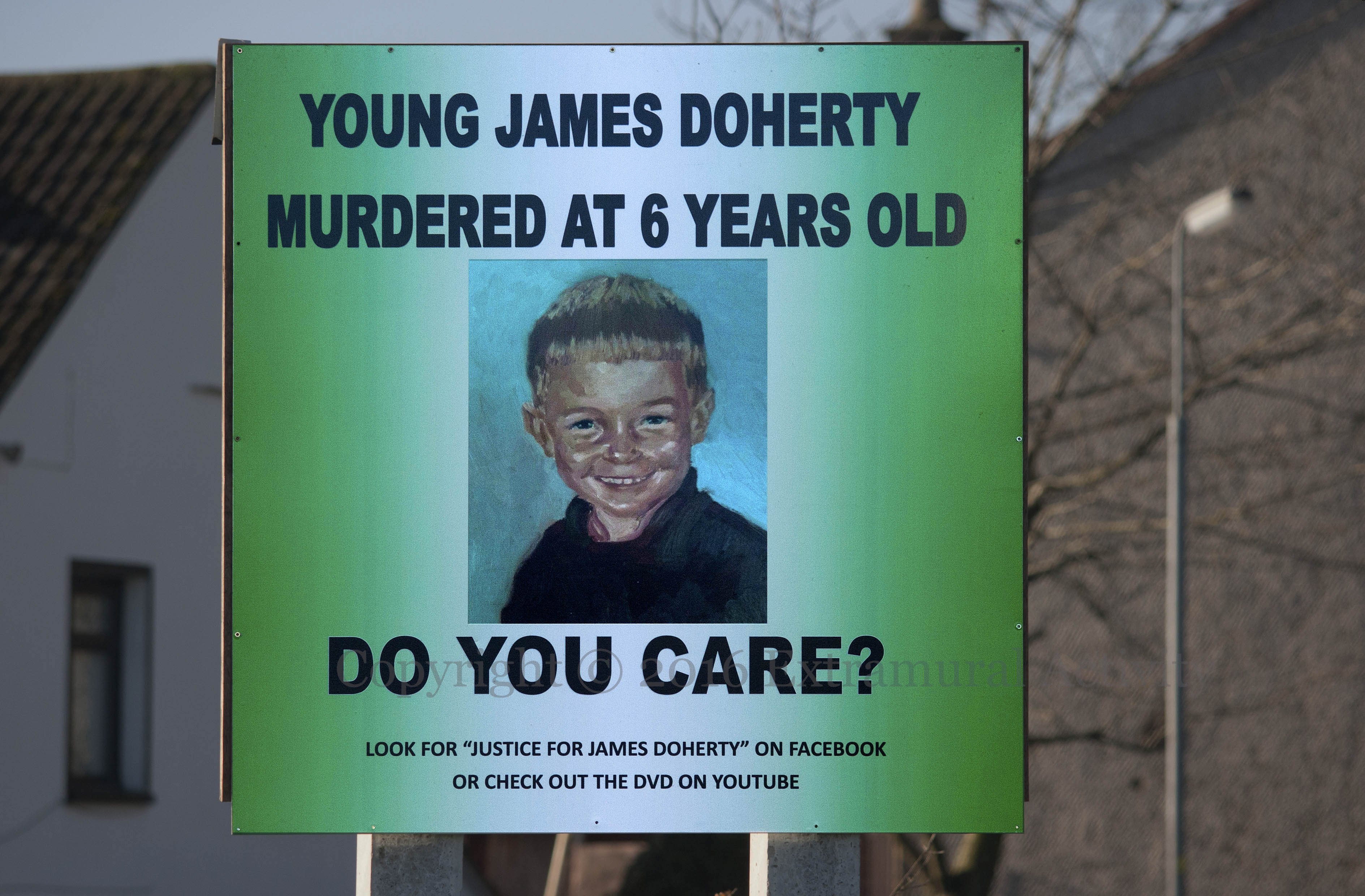
James “Jim” Doherty was six years old when he was shot while playing in the front garden of his Turf Lodge home in 1972. Relatives For Justice and the family launched the board shown above at the entrance to the estate last October in order to push for a new inquiry into the death due to the insufficiency of the original investigation and the disappearance of the bullet taken from the body. (Belfast Media Group)

Click image to enlarge
Copyright © 2016 Seosamh Mac Coılle
X03281 monagh rd

The Mainspring

03275 2016-02-03 MacDiarmada+

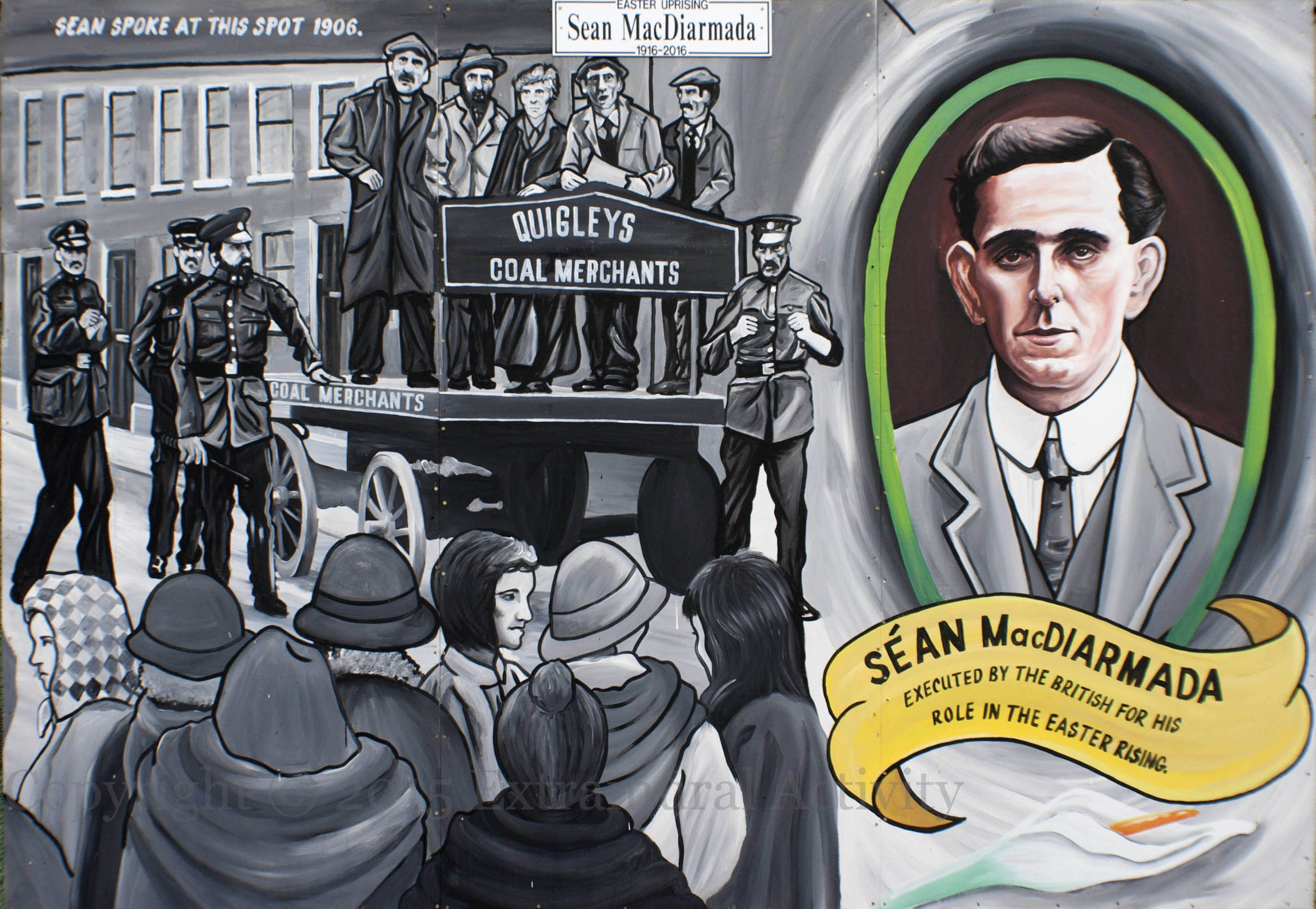
Seán Mac Dıarmada was born in Leitrim, left for Glasgow at age 15, and after two years returned to Belfast in 1905 and – according to the new mural above – spoke from the back of a coal lorry in Clonard Street, outside the Clonard branch of the Ancient Order Of Hibernians. Mac Dıarmada was for a short time an AOH member, before moving on to the Irish Republican Brotherhood and Irish Volunteers, which led to his participation in the 1916 Easter Rising and execution on May 12th of that year.

The title of today’s post is historian F.X. Martin’s assessment of Mac Dıarmada, quoted in a pamphlet on Mac Dıarmada from the National Library Of Ireland. The NLI made many letters from and to Mac Dıarmada available in 2016. (See also this Irish Times write-up).

Previously: A 2013 Mac Dıarmada mural in Ardoyne and a 2009 small board, also in Ardoyne.

Click image to enlarge
Copyright © 2015 Seosamh Mac Coılle
X03275 clonard st quigley’s coal merchants séan executed by the british for his role

Woodbourne Village

03274 2016-01-30 Woodbourne Village+

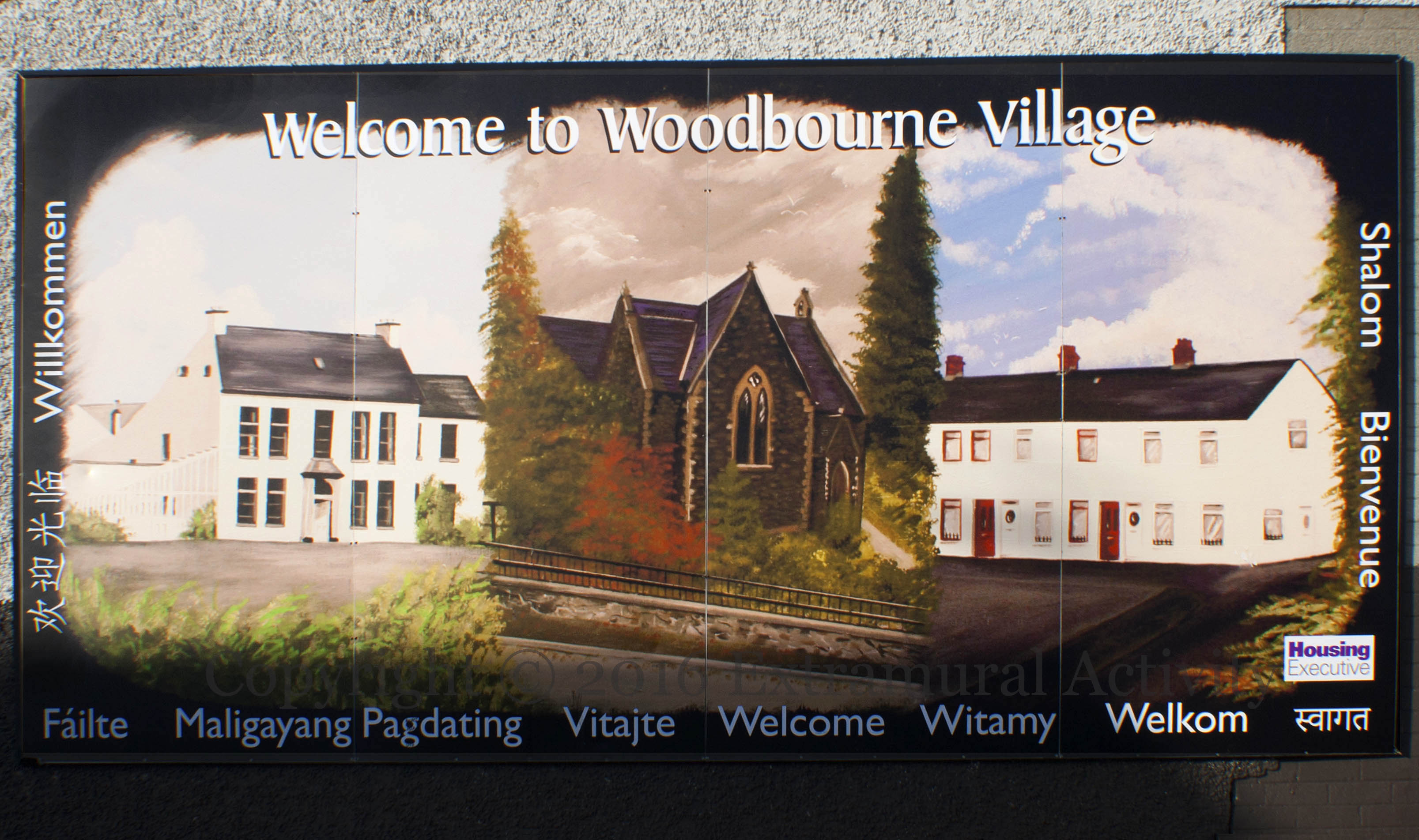
This new mural of local landmarks — including centrally St. John The Baptist Anglican church — by Fra Maher was erected last November (2015) as part of a re-imaging and re-development project sponsored by the Housing Executive, and joins the art on the Woodbourne police station in brightening up the area — see Only God Can Judge Me.

Click image to enlarge
Copyright © 2016 Seosamh Mac Coılle
X03274 woodbourne cr wilkommen fáilte maligayang pagdating vitajte welcome witamy welkom bienvenue shalom suffolk stewartstown

Over A Barrel

03228 2015-12-20 Orange Barrel+

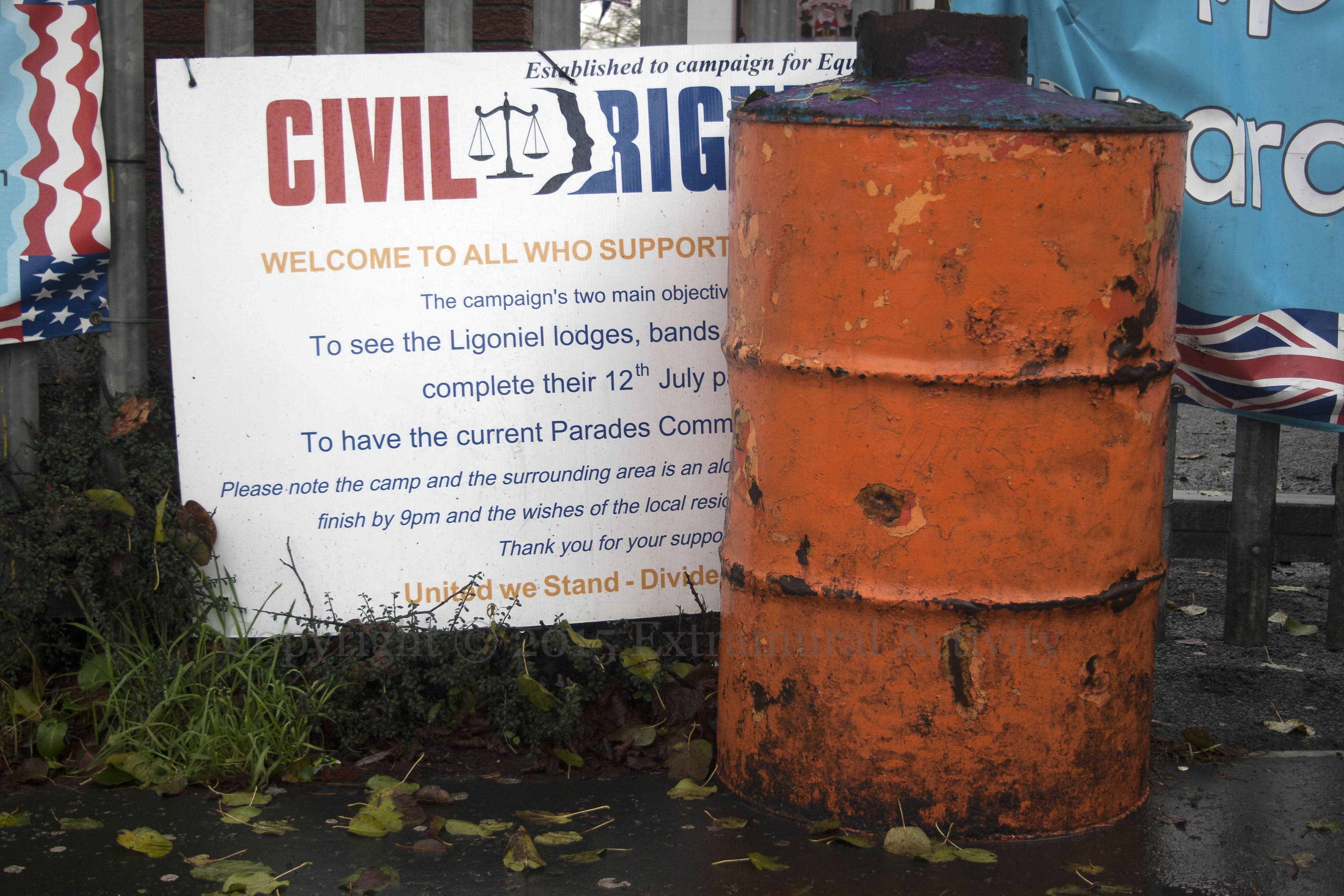
Here is a snapshot from the protest camp at Twaddell Avenue, established in July 2013, which remains in place at the junction with the Crumlin Road. The most recent newspaper mention of the protest appears to be this December 29th report in the Newsletter.

For more, including the “civil rights” board behind the barrel, see Twaddell Protest Camp | Civil Rights Camp | Supporters Club | Let Them Home.

Click image to enlarge
Copyright © 2015 Seosamh Mac Coılle
X03228

The Brave 13

03219 2015-12-11 Apprentice Boys+

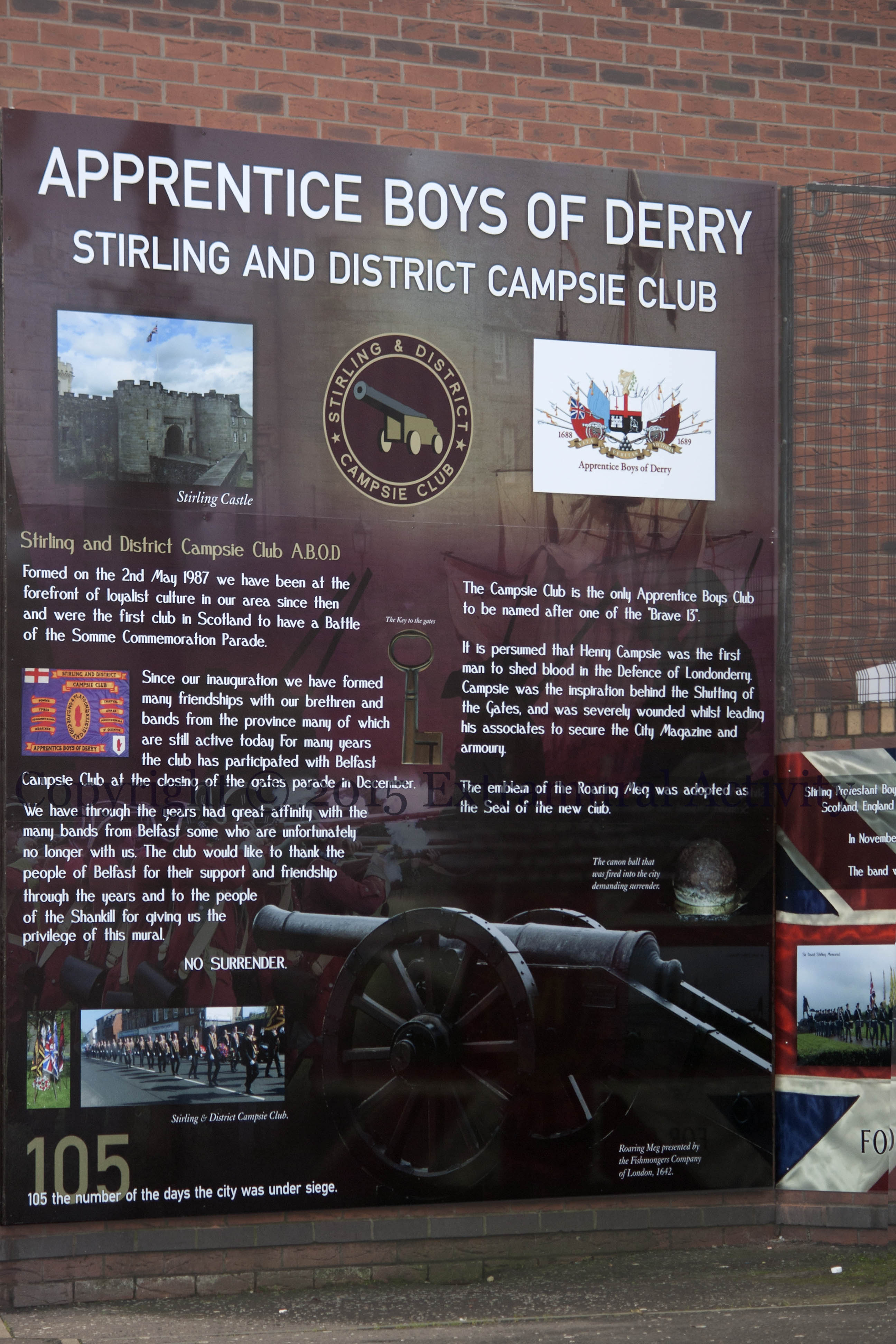
Here is one of three panels from a new three-part installation on the Shankill Road celebrating the ties between Belfast and the Stirling & District Campsie Club, a branch of one of the associated clubs of the Apprentice Boys Of Derry. It features the cannon “Roaring Meg” (“presented by the Fishmongers Company of London 1642″) which is used as the seal for the club, and includes the club’s flag, the key to the gates, and the emblem and coat of arms of the Apprentice Boys.

For the other panels, see For God, Ulster & Scotland and The Siege Was Over.

“Formed on the 2nd May 1987 we have been at the forefront of loyalist culture in our area since then and were the first club in Scotland to have a Battle of the Somme Commemoration Parade. Since our inauguration we have formed many friendships with our brethren and bands from the province many of which are still active today. For many years the club has participated with Belfast Campsie Club at the closing of the gates parade in December. We have through the years had great affinity with the many bands from Belfast some who are unfortunately no longer with us. The club would like to thank the people of Belfast for their support and friendship through the years and to the people of the Shankill for giving us the privilege of this murals.

No surrender.

The Campsie Club is the only Apprentice Boys Club to be named after one of the “Brave 13″. It is persumed presumed that Henry Campsie was the first man to shed blood in the Defence of Londonderry. Campsie was the inspiration behind the Shutting of the Gates and was severely wounded whilst leading his associates to secure the City Magazine and armoury. The emblem of the Roaring Meg was adopted as the Seal of the new club.”

Click image to enlarge
Copyright © 2015 Seosamh Mac Coılle
X03219 stirling castle 1688 1689 Henry Campsie, William Crookshanks, Robert Sherrard, Daniel Sherrard, Alexander Irwin, James Steward, Robert Morison, Alexander Cunningham, Samuel Hunt, James Spike, John Coningham, William Cairnes and Samuel Harvy 105 the number of days the city was under siege walker mitchelburne browning baker murray