Guernica

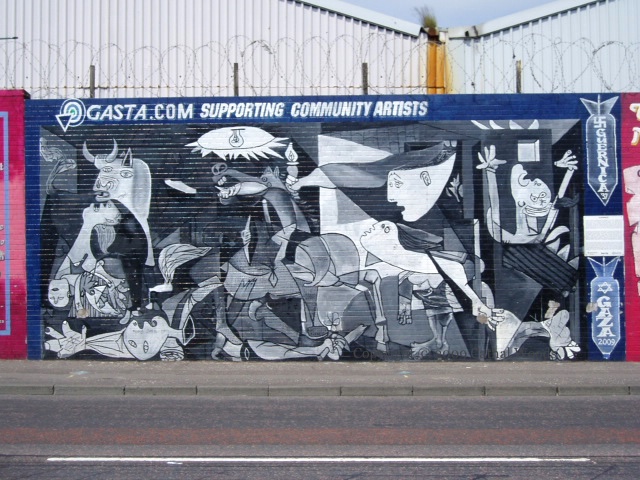
Picasso’s Guernica (WP) was recreated on The International Wall (Divis Street) in 2007 and now (2009) a reference to the deaths in Gaza has been added on the right, in the form of two bombs — one with a swastika and “Guernica ’37” and the other with a Star Of David and “Gaza 2009” — above and below the information plaque (which can be seen in the Peter Moloney Collection).

To the left of the Manchester Martyrs mural. Takes the place of the Bodenstown mural.

The mural was painted by local artists ME, DD, MD, with Conrad Atkinson (middle) and Robert Ballagh (right).
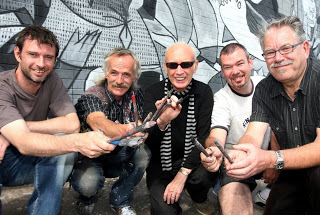
ConradGuernica
(Belfast Media Group picture no longer on-line, retrieved from the Léargas blog)

Click image to enlarge
Copyright © 2009 Cathal Woods
X00299 gasta.com supporting community artists basque guernica ’37 gaza 2009
Maghaberry Prisoners

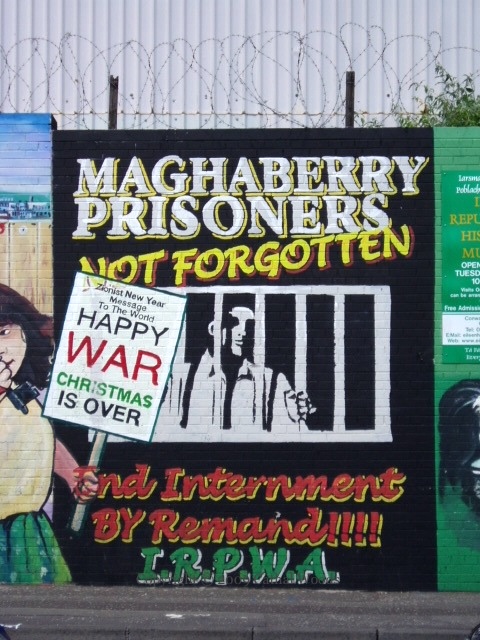
Mural on the International Wall to interned prisoners in Maghaberry, overlapped by the pro-Palestine mural to the left.

Previously Maghaberry (barbed wire) – M01758.

Click image to enlarge small image
Copyright © 2009 Cathal Woods
X00304 not forgotten end internment by remand, irpwa (irish republican prisoners welfare association), zionist new year message to the world happy war christmas is over

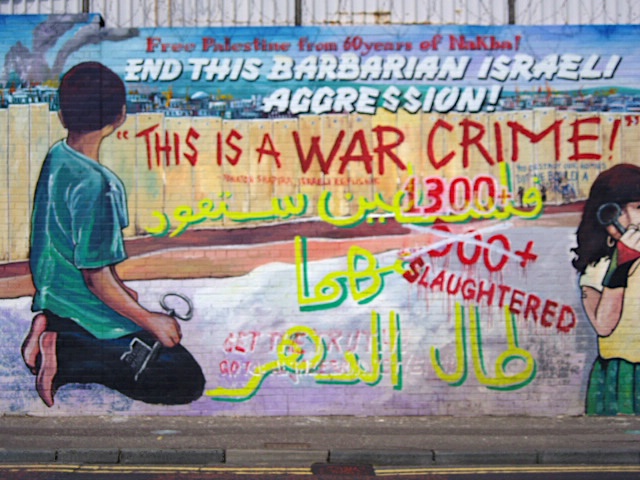
Barbarian Israeli Aggression

Last year’s pro-Palestine mural on the International Wall (see Free Palestine From 60 Years Of Nakba!) has been augmented with words in red reading “End this barbarian Israeli aggression! “This is a war crime!” – Yonaton Shapira, Israeli refusenik. 1300+ slaughtered. Get the truth! Go to aljazeera.net/english”

The number was originally 700 (Alamy); it was presumably changed to 1000 at some point, though no image has been found of this; in any case, here 1000 has been crossed out and replaced with 1300.

For the girl on the right-hand side, see Maghaberry Prisoners.

Click image to enlarge small image
Copyright © 2009 Cathal Woods
X00314

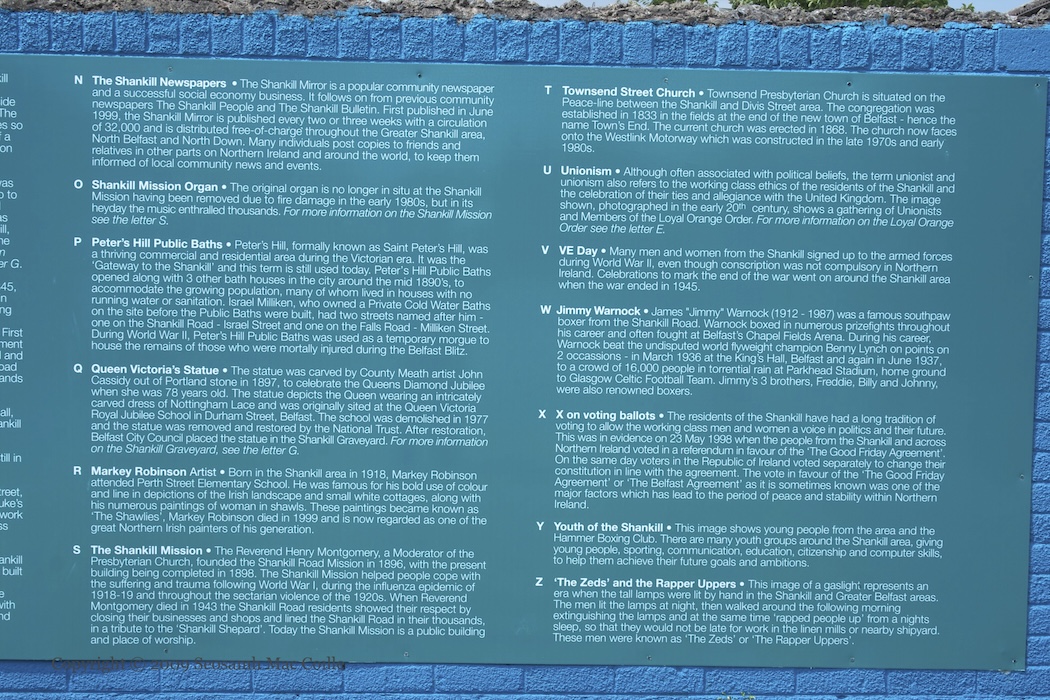
Shankill A-Z

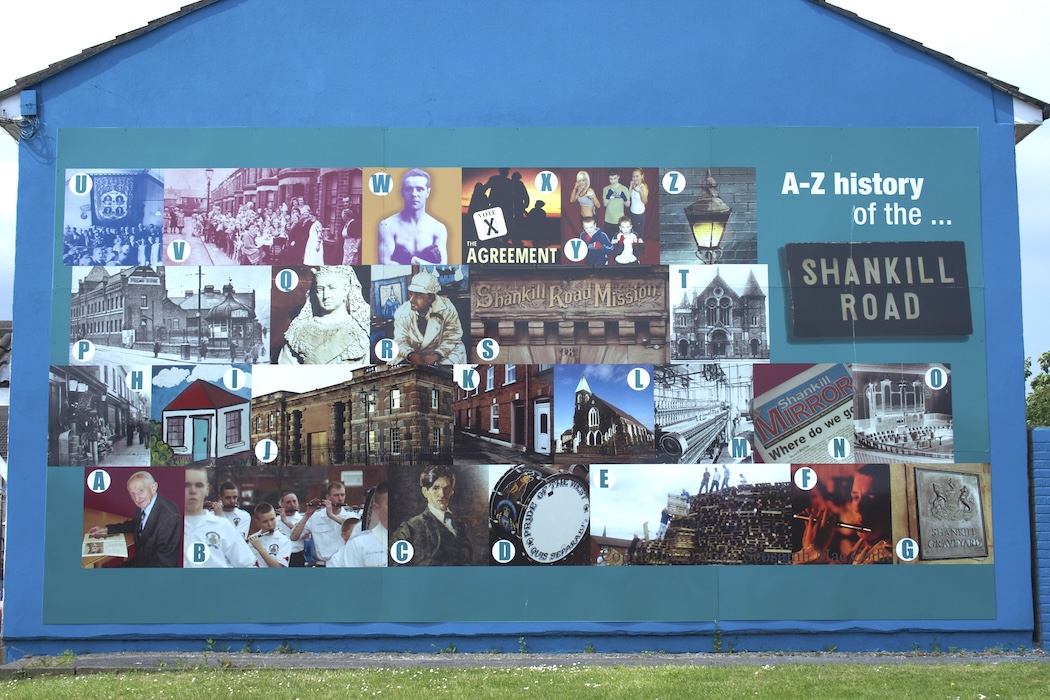
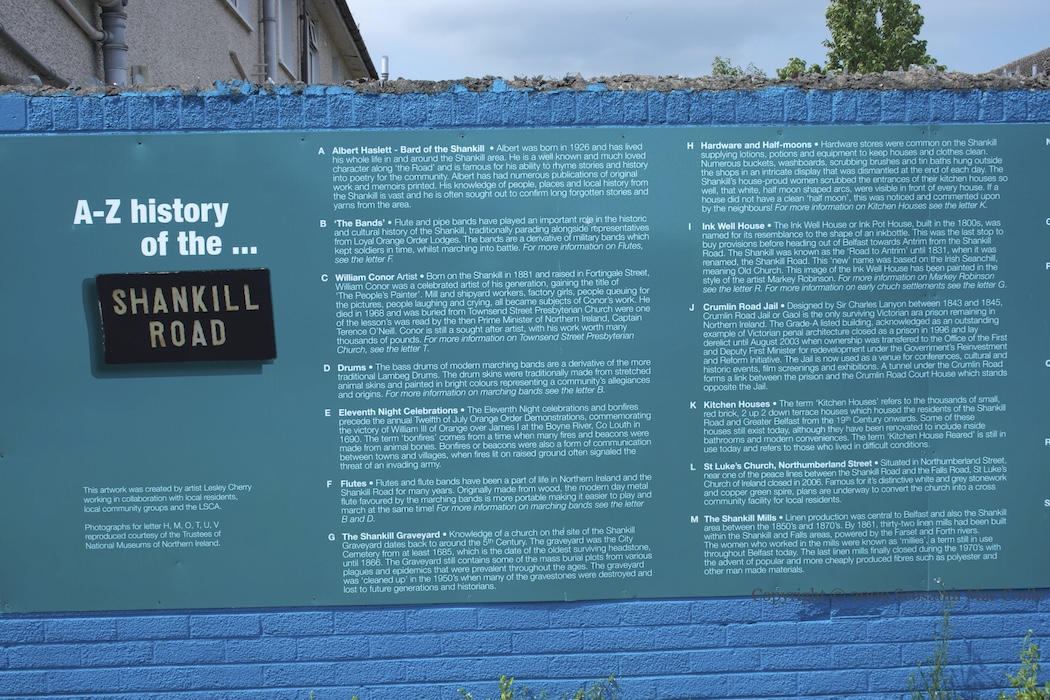
The Drumcree mural (2004 | 2008) is re-imaged in 2009 by this ‘Shankill A-Z’ board, designed by Lesley Cherry.

While bands get mentioned in three letters (“B” for “bands”, “D” for “drums” and “F” for “flutes”), “Unionism” is recast as “working-class ethics” and (perhaps the most striking “re-imaging”) under “X” it is claimed that the people of the lower Shankill voted for the Good Friday Agreement.

Click image to enlarge
Copyright © 2009 Seosamh Mac Coılle
X00336 X00337 X00338

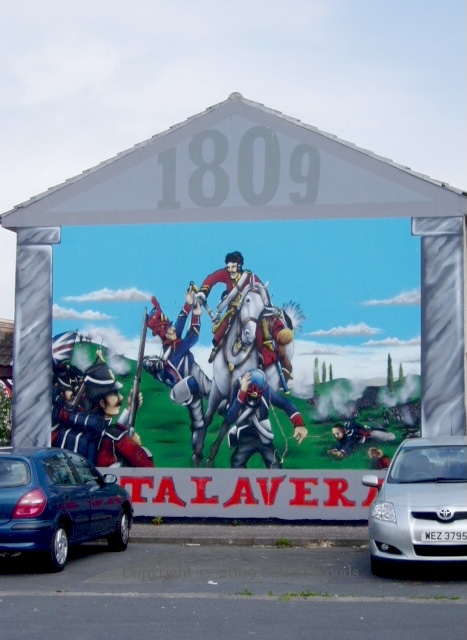
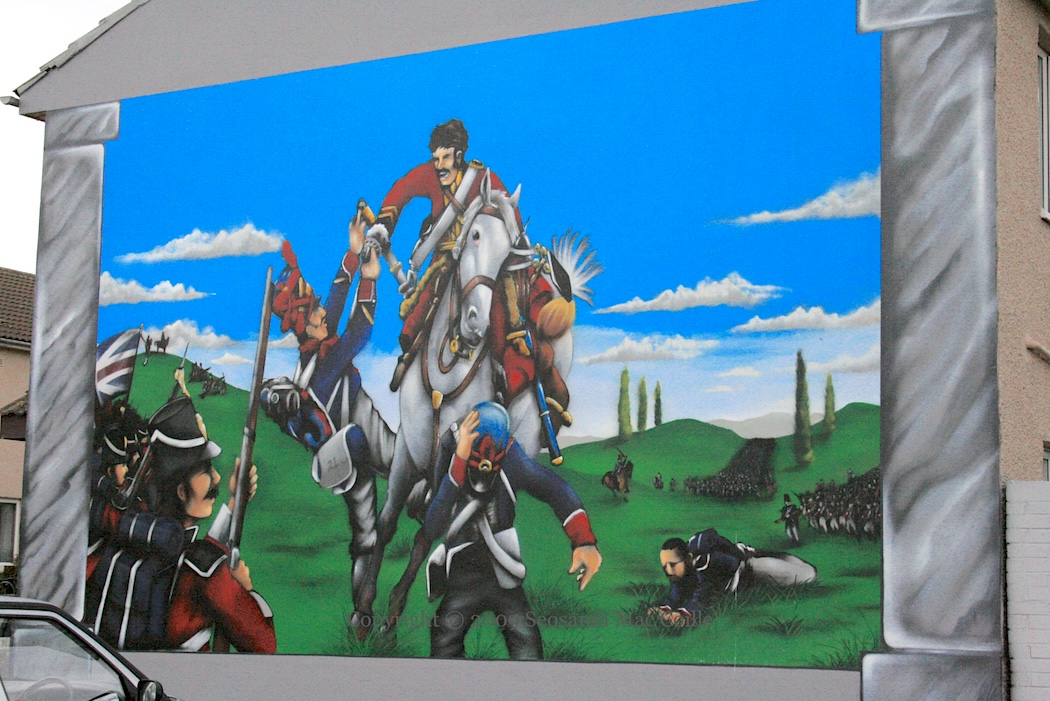
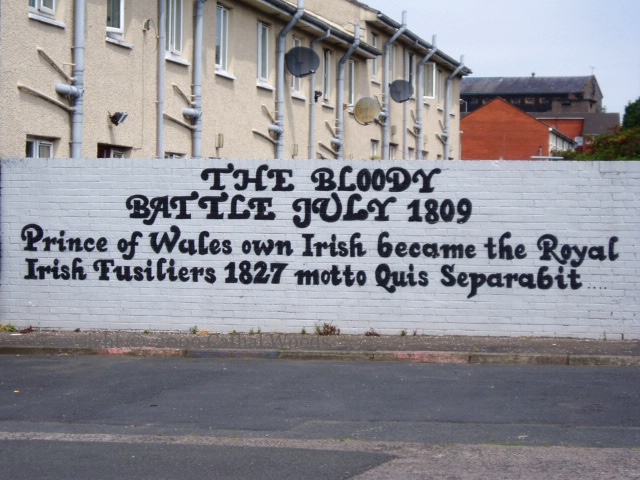
Talavera 1809

“The Bloody Battle, July 1809. Prince of Wales own Irish became the Royal Irish Fusiliers 1827, motto Quis separabit.”

Talavera de la Reina is southwest of Madrid, Spain. The French, who had invaded Portugal but been driven out by British forces under Wellesley, fought the combined forces of the Spanish (previously allies of the French in the Peninsular War) and British armies. The second battalion of the Prince Of Wales’s Irish fought at Talavera. It then became the Prince Of Wales’s Own Irish, the Prince Of Wales’s Own Irish Fusiliers, and finally the Royal Irish Fusiliers (after the prince had been king for seven years). Its motto seems to have been “Faugh A Ballagh” rather than “quis separabit” but sources are scarce.

Click image to enlarge
Copyright © 2009 Cathal Woods X00325 [X00326] X00327
Copyright © 2008 Seosamh Mac Coılle X00279

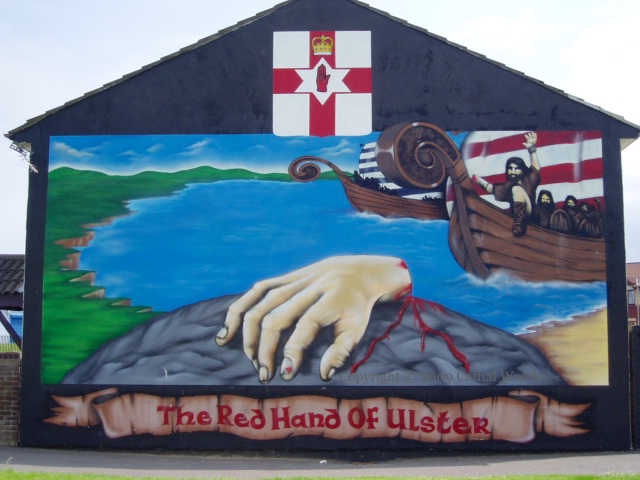
I Would Give My Right Hand …

Legend has it that Ulster was won in a competition among warriors to be the first to touch the land. In order to win the race, one contestant cut off his hand and threw it ahead of the others. The flag of Northern Ireland (the Ulster Banner) is in the apex.

WP entry on the legend.

Shankill Parade, lower Shankill estate, west Belfast

Click image to enlarge small image
Copyright © 2009 Cathal Woods
X00309 the red hand of ulster

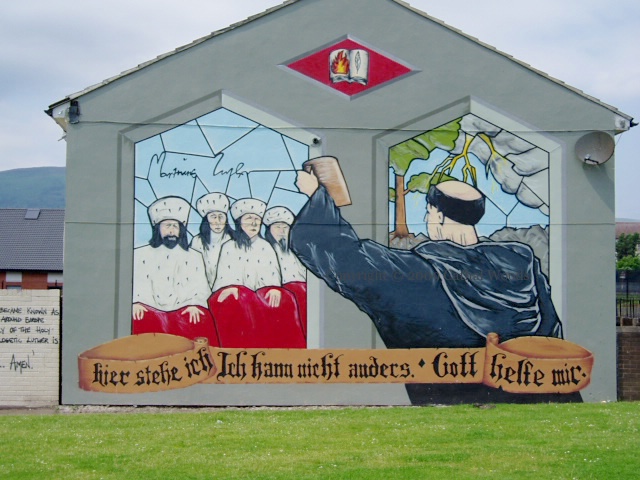
Here I Stand; I Can Do No Other

The Protestant Reformation is here attempted as a re-imaging theme in the lower Shankill. Luther’s signature is worked into the “stained glass” on the left.

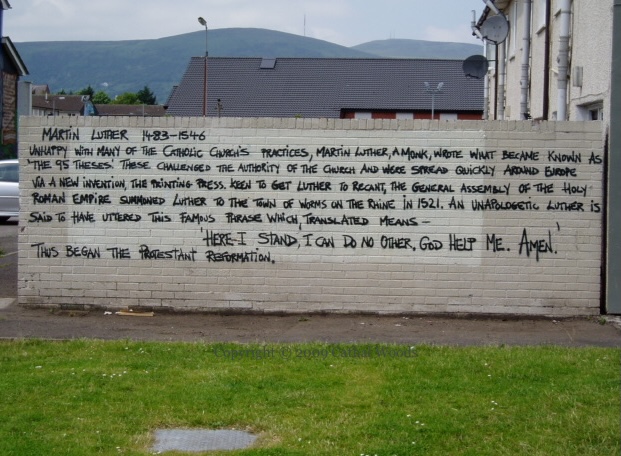
Below, the accompanying text … “Hier stehe ich, Ich kann nich anders, Gott helfe mir.” Martin Luther 1483-1546. Unhappy with many of the Catholic church’s practices, Martin Luther, a monk, wrote what became know as ‘the 95 theses’. These challenged the authority of the church and were spread quickly around Europe via a new invention, the printing press. Keen to get Luther to recant, the general assembly of the Holy Roman Empire summoned Luther to the town of Worms on the Rhine in 1521. An unapologetic Luther is said to have uttered this famous phrase which, translated means ‘Here I stand, I can do no other. God help me. Amen’. Thus began the Protestant Reformation.”

Click image to enlarge small image
Copyright © 2009 Cathal Woods
X00301 X00302

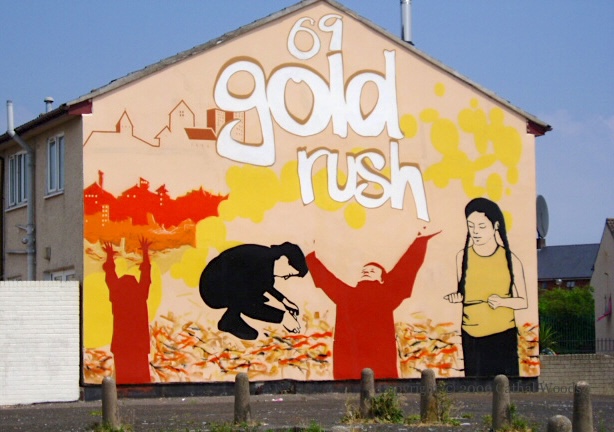
Gold Rush

From the info board, later added to the left: “The Gold Rush mural replaces a paramilitary image of two silhouetted gunmen representing Scottish Brigade. This new image by artist Tim McCarthy represents an event in July 1969 in Christopher Street when children digging in the rubble of the then demolished ‘Scotch Flats’ discovered a hoard of gold sovereigns. Word spread quickly and thus began ‘the Gold Rush’. The project was funded by the Re-imaging Communities programme of the Arts Council of Northern Ireland and delivered by Belfast City Council with the support of the Lower Shankill Community Association. The project would not have been possible without the support and participation of the local community.”

There is a short series of BBC radio programmes on the finding of the sovereigns and how they came to be in the chimney.

With support from the Arts Council, Belfast City Council, and Lower Shankill Community Association. By Tim McCarthy/Verz in Hopewell Crescent, lower Shankill, Belfast.

Click image to enlarge small image
Copyright © 2009 Cathal Woods
X00298 [X05054] ’69 gold rush