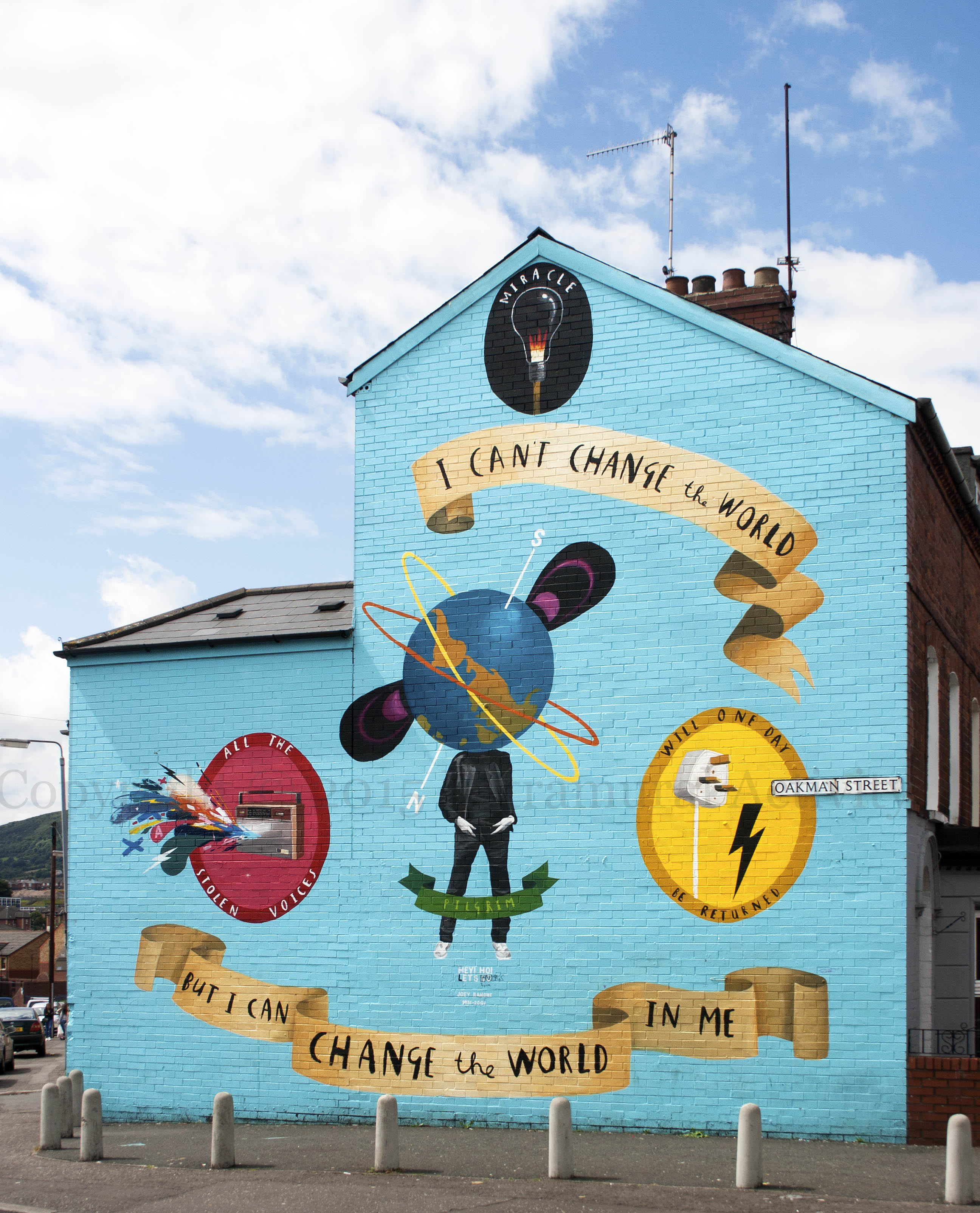
You Cannot Kill Ideas

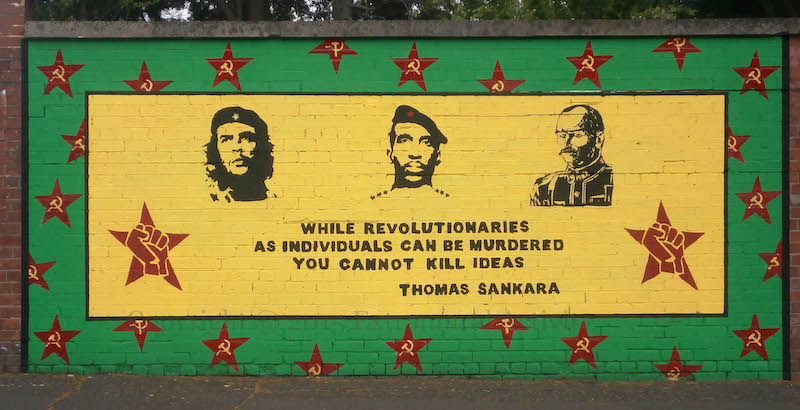
A week before he was assassinated and his government overthrown, Burkina Faso president Thomas Sankara asserted: “While revolutionaries as individuals can be murdered, you cannot kill ideas.” Sankara gained power of Burkina Faso (then Upper Volta) in a 1983 coup and launched an ambitious programme of literacy, feminism, public health, and agricultural self-sufficiency, in addition to launching a drive against corruption and of nationalizing natural resources. He attempted this all without the assistance of foreign aid or the IMF or World Bank. However, he wielded power outside the jurisdiction of the courts and controlled the press. He and twelve colleagues were killed in October 1987.

Click image to enlarge
Copyright © 2015 Seosamh Mac Coılle
X02695 Korda Fitzpatrick’s Che Guevara, Kernoff’s James Connolly, hammer sickle communism socialism

Our Community, Our Fleadh, Our People, Ardoyne

The Wolfe Tones will headline the 2015 Ardoyne Fleadh Cheoıl (Fb) on August 15th. Last year, The Druids caused controversy by advising British Army forces and loyalists to go “back to England” (BelTel).

Along the bottom are various of the posters/programme covers from years past: (left to right) the 1998 cover, by Sean Doran, was also painted in Ardoyne Avenue; Cú Chulaınn on the 1999 poster was painted in Ardoyne Avenue (S00089); the fiddler and bodhrán player appeared on a t-shirt; a classic Wolfe Tones poster shows the four faces in profile; Fleadh Érıu on the 1995 poster (under the go-kart’s left wheel) was painted on this wall in 1994; the 1996 Fleadh poster, also by Sean Doran; disappearing on the right is Doran’s 1997 cover.

The Ardoyne Fleadh Cheoıl emblem (on the go-karter’s t-shirt and under the text on the left) was used in Maıreann An Spıorad. The festival began in 1970.

A new mural will be launched as part of this year’s festival: Boxing Champions.

Click image to enlarge
Copyright © 2015 Seosamh Mac Coılle
[X02930] X02931 X02932

Never At Peace

03612 2016-07-07 Ireland Unfree+

Contemporary Republican stencil containing a trio of classic slogans: Patrick Pearse’s famous closing words at the funeral of O’Donovan Rossa (which was re-enacted this August on its centenary) — “Ireland unfree shall never be at peace”; “PSNI-RUC not welcome”; and – of the greatest vintage – “Tıocfaıdh ár lá. IRA”. Meenan Square, Derry.

02804 2015-08-23 IrelandUnfreeDerry+

Click image to enlarge
Copyright © 2015 Seosamh Mac Coılle
X03612 X02804 our day will come

100% British

2015-07-01 RUC Collusion+

For weeks (since April) a whitewashed panel on the International Wall sat empty, before being partly filled in with “RIC – RUC – PSNI”, “RUC -> Collusion covered up by PSNI”, but progress seems to have halted again and a 32-County Sovereignty Movement tarp has been placed on top: Oppose British political policing.

Previously in this spot: End British Internment | Scairt Amach

Click image to enlarge
Copyright © 2015 Seosamh Mac Coılle
X02686 in defence of the nation

From Celtic Park To Barcelona

2015-07-01 DonPatricioFull+

The stands of three football stadiums are shown in the background of the Don Patricio mural at the bottom of the Whiterock: Belfast Celtic’s Celtic Park (“Paradise”), Manchester United’s Old Trafford, and Barcelona’s Camp Nou. The Old Trafford stands bear the emblems of the teams Patrick O’Connell played for and managed: Liffey Wanderers (whose shirt is also featured, on the left), Sheffield Wednesday, Hull City (The Tigers), Manchester United, Dumbarton, Real Racing Club de Santander, Real Oviedo, and Real Betis Balompié (also shirt on the right).

Previously about Belfast Celtic: Know Your History | Reaching Out

Also from this mural: The Don | The Flea

2015-07-01 DonPatricioWide+

Click image to enlarge
Copyright © 2015 Seosamh Mac Coılle
X02683 X02685 cuando te lleves mi alma no robes mi orgullo when you take my soul, do not steal my pride est. 1891 irish football association limited international champion

The Flea

2015-07-01 DonPatricioMessi+

Yesterday we had ‘Barcelona Past’ in the form of Patrick “Don Patricio” McConnell (The Don); today we have ‘Barcelona Present’, in the form of Lionel Messi. The Argentinian forward is shown in front of the Spanish League cup, which Barcelona won this year (2014-2015) with a goal from “La Pulga” (“the flea”) – Messi is 5’7″ but four-time world player of the year.

Click image to enlarge
Copyright © 2015 Seosamh Mac Coılle
X02684 cirsa casino camp nou

The Don

2015-07-01 DonPatricioDon+

Here is part of the new Patrick O’Connell, “Don Patricio”, mural at the bottom of the Whiterock. As a player, the Dublin-born O’Connell started with Belfast Celtic before moving on to various English and Scottish clubs, including a period at Manchester United at the time of WWI. He then went on to manage a string of Spanish clubs. As manager of Barcelona during the Spanish civil war, he accompanied the club on their tour of Mexico and the United States. The money from the tour saved the club from bankruptcy but 12 of the 16 players went into exile in Mexico and France. (WP) Barcelona returns to the US this month (2015-07) for games against the LA Galaxy, Manchester United, and Chelsea. (FCBarcelona)

The newspaper in the mural above crams all of this news onto one page: “Civil war erupts in Spain – Barcelona bombed”, “Football suspended – President [of FC Barcelona] Josep Sunyol assassinated” [by Franco’s troops] (WP); “Irishman O’Connell takes players on tour – FC Barcelona saved from extinction”; “Funds lodged in Switzerland”. In the bottom left-hand corner of the newspaper is Robert Capa’s famous photograph of ‘The Falling Soldier’, purporting to show a Republican soldier at the very moment he is struck by a bullet and dies. The image is now thought to have been staged (WP).

The image on which the portrait is (perhaps) based can be seen in this Irish Times article on O’Connell.

Click image to enlarge
Copyright © 2015 Seosamh Mac Coılle
X02682

Harbour Schooling

2015-06-22 BelfastDockers+

Every day, men would line up in schooling pens on the various docks of the port of Belfast to be hired by foremen. As mentioned on the left-hand side of the board above (recently erected on the New Lodge side of the Duncairn “peace” line) the rise of the shipping container in the 1970s spelled the end of the docker: “from 3000 listed dockers in 1970, the number had fallen to 280 by 1985.” Author and poet John Campbell recalls his first day on the docks in 1952, unloading cement, in this NVTv video.

See previously: Unite The Union | OBU | International Workers’ Day

Lepper Street, New Lodge, north Belfast

2015-06-22 BelfastDockersDetail+

2015-06-22 BelfastDockersWide+

Click image to enlarge
Copyright © 2015 Seosamh Mac Coılle
X02664 X02665 X02666

“This artwork celebrates the unique contribution that generations of dockers have made to the port and City of Belfast.”

“It was a physically demanding job, the hours were long, the conditions were tough and the availability of work was not constant. Without the Dockers, however, the Port of Belfast would not have been able to grow. / Transportation of goods by containers led to a revolution in working practices at Belfast Docks and the number of dockers decreased dramatically. From 3000 listed dockers in 1970, the number had fallen to 280 by 1985. Behind these figures lay the human story of vast social changes in the harbour area as well as the gradual dissappearance [sic] of an entire community who had earned their living from the sea and also through the loading and unloading of ships. These were the Dockers and their families, many of whom lived in Sailortown. / The workforce of dockers spanned both traditions. Red button and Blue button. Dockers had a common allegiance to the Port of Belfast which provided a living for men and families from both communities. / The work was backbreaking, yet the Docks educated us about life, integrity, discipline, about standing up for our rights, about having pride in our identity as working men, as Dockers. / The Dockers[‘] working environment was repressive and hazardous with large numbers experiencing industrial injuries. Others lost their lives or were badly injured in horrific accidents at work. Many suffered chronic long term illnesses, others died prematurely having contracted asbestosis. Many Dockers became politically aware in the formation of trade unions and social reforms. The Dockers Trade Union, Irish Transport and General Workers[‘] Union (ITGWU) organised by Jim Larkin (1909) and James Connolly (1910-11) celebrated its centenary in 2009.” OBU one big union