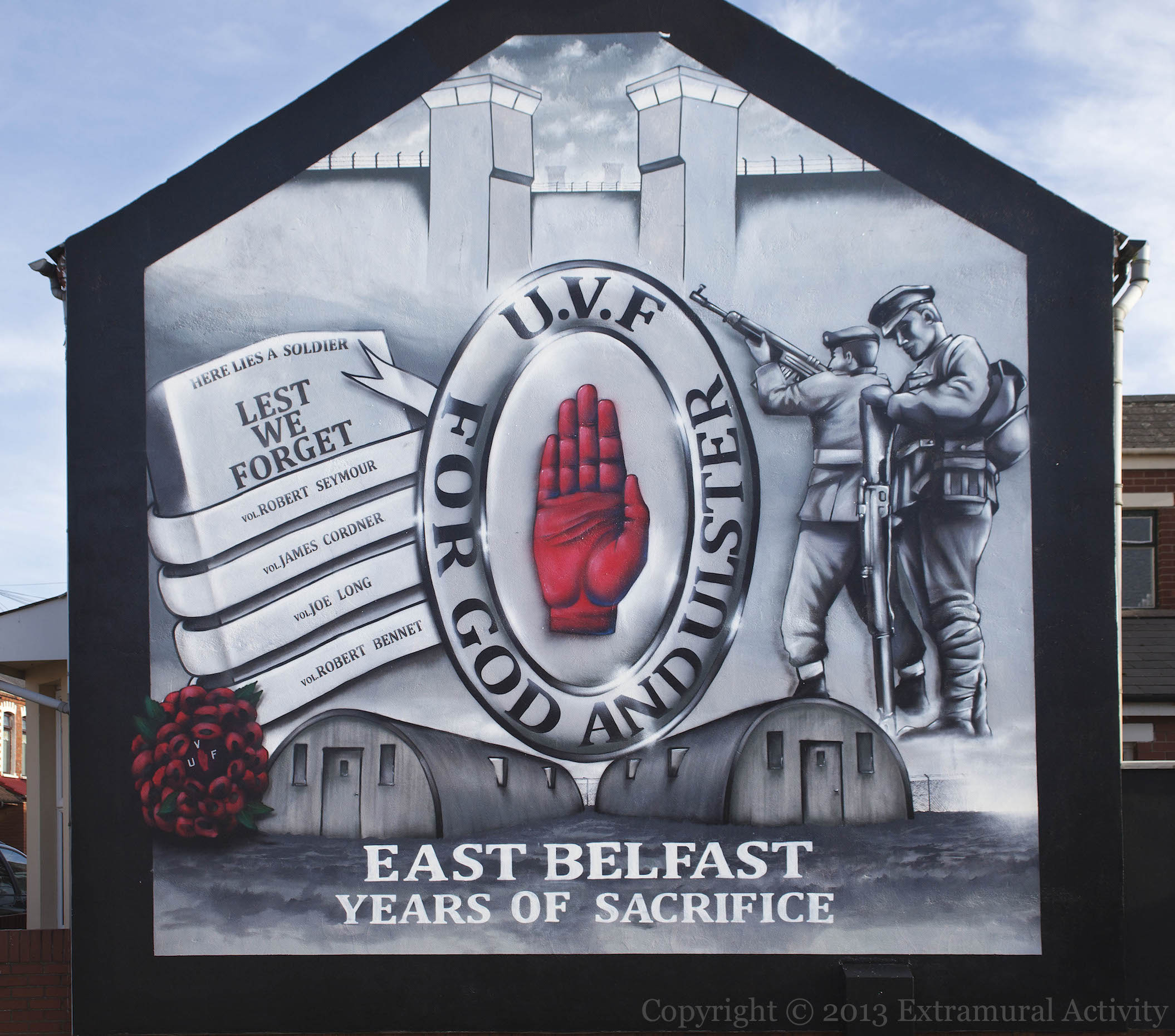
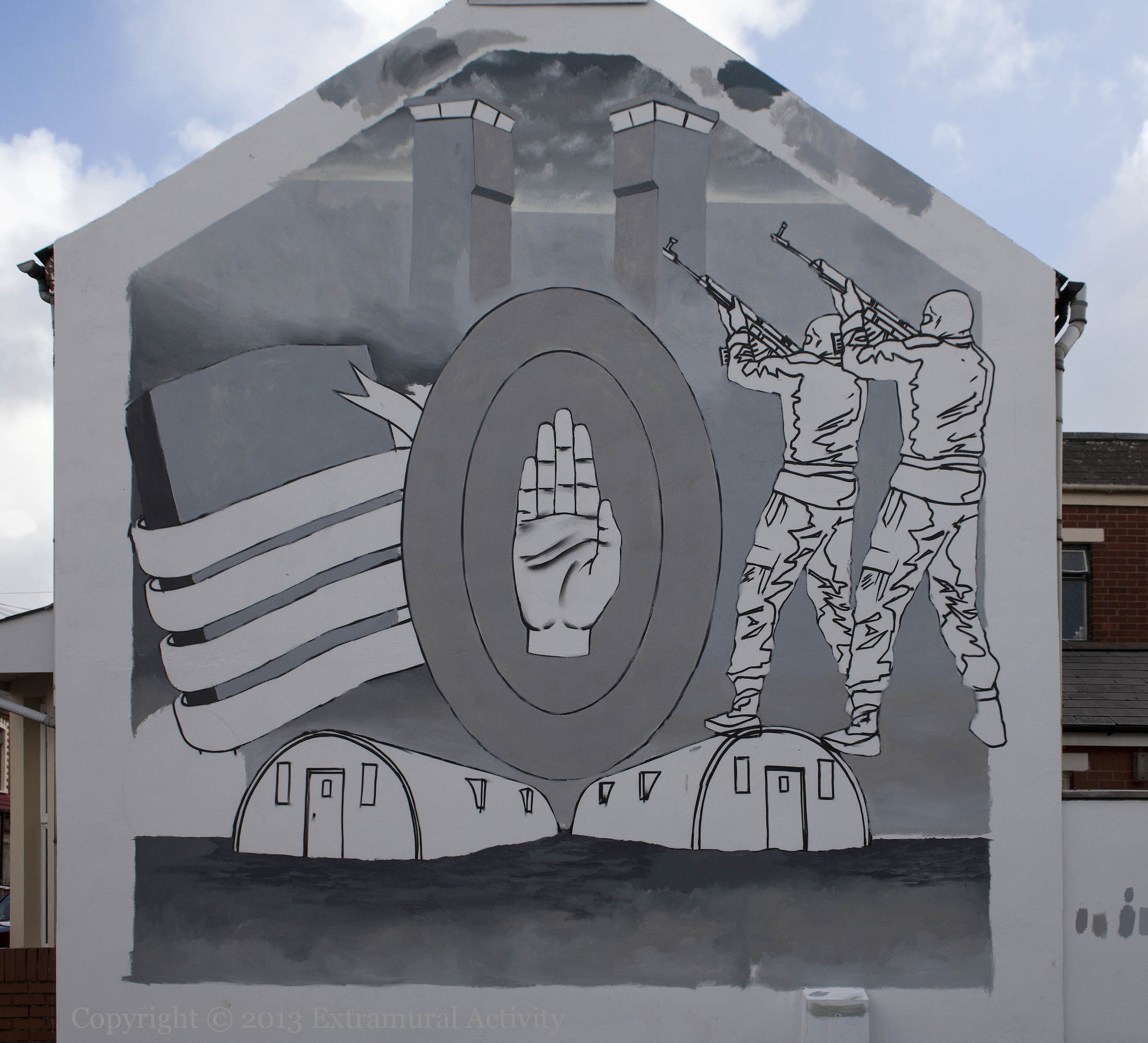
As can be seen from the initial cartoon for this mural, below, it was originally intended to have two hooded gunmen firing a funeral volley, but because of protest by locals (see, e.g. NewsLetter) this was changed to two unmasked men, one of whom is clearly of the WWI era. The Nissen huts and towers of Long Kesh, however, remain in the image, which thus expresses the complex relationship of loyalists (and especially the UVF, whose members Robert Seymour, James Cordner, Joe Long, and Robert Bennett are listed on the left-hand side) to the British army. As Bill Rolston put it: “How could one display visually the value of opposing British policies in the name of remaining British? What could be the symbols of such a schizophrenic message? (Drawing Support (1), p. ii).
The side-wall to the right of shot is painted solid black but otherwise remains unfinished as of the end of 2013.
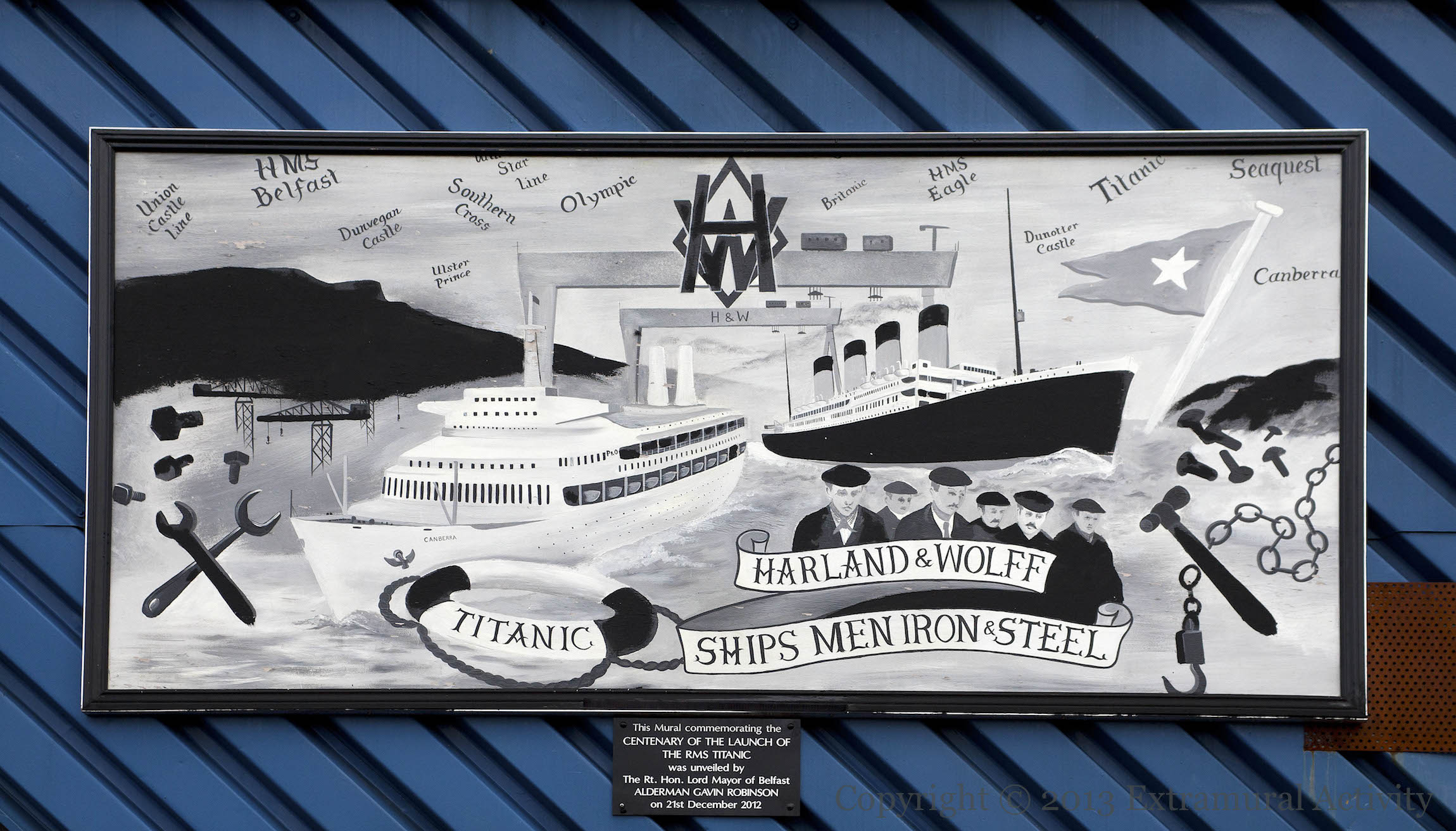
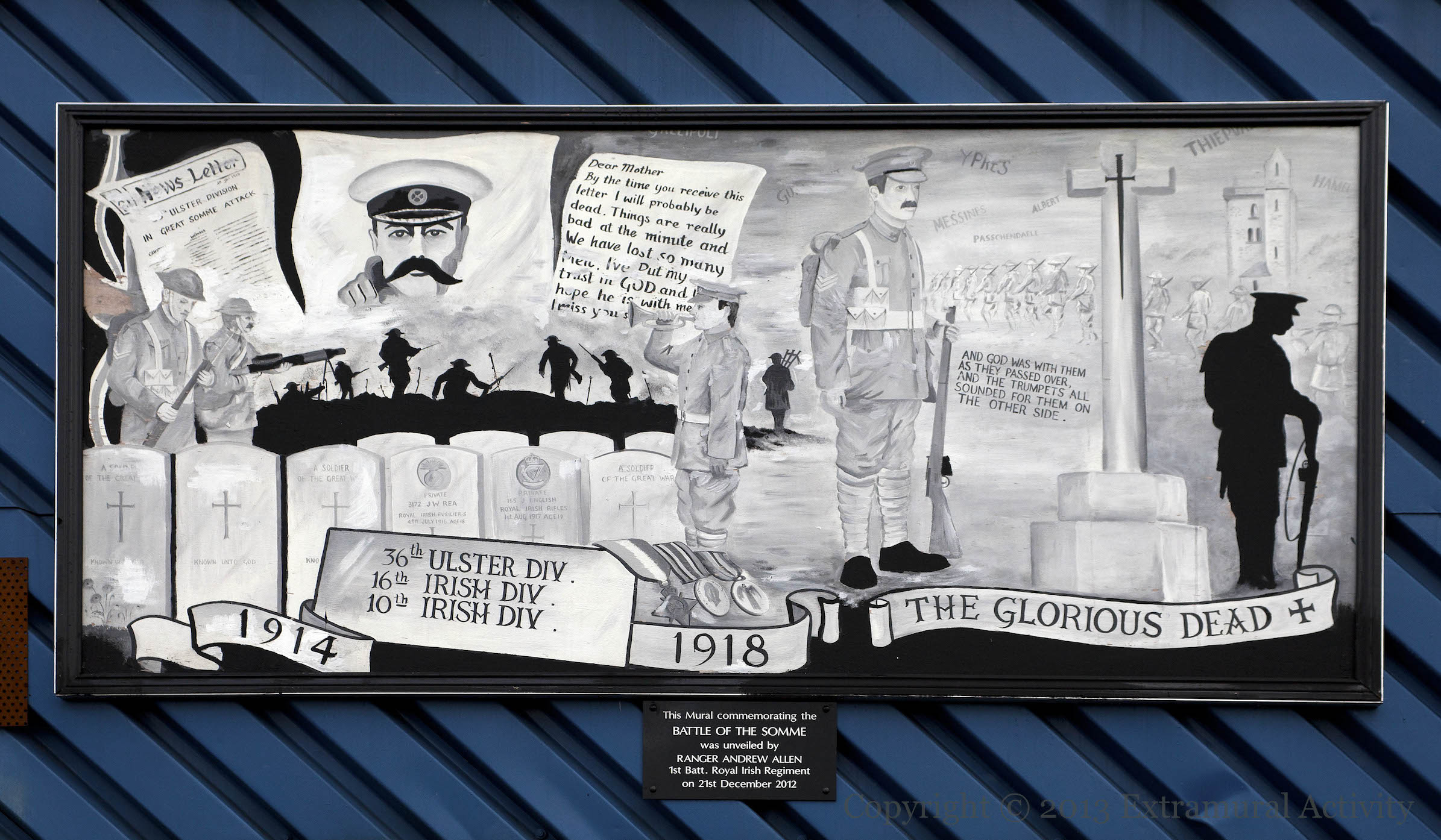
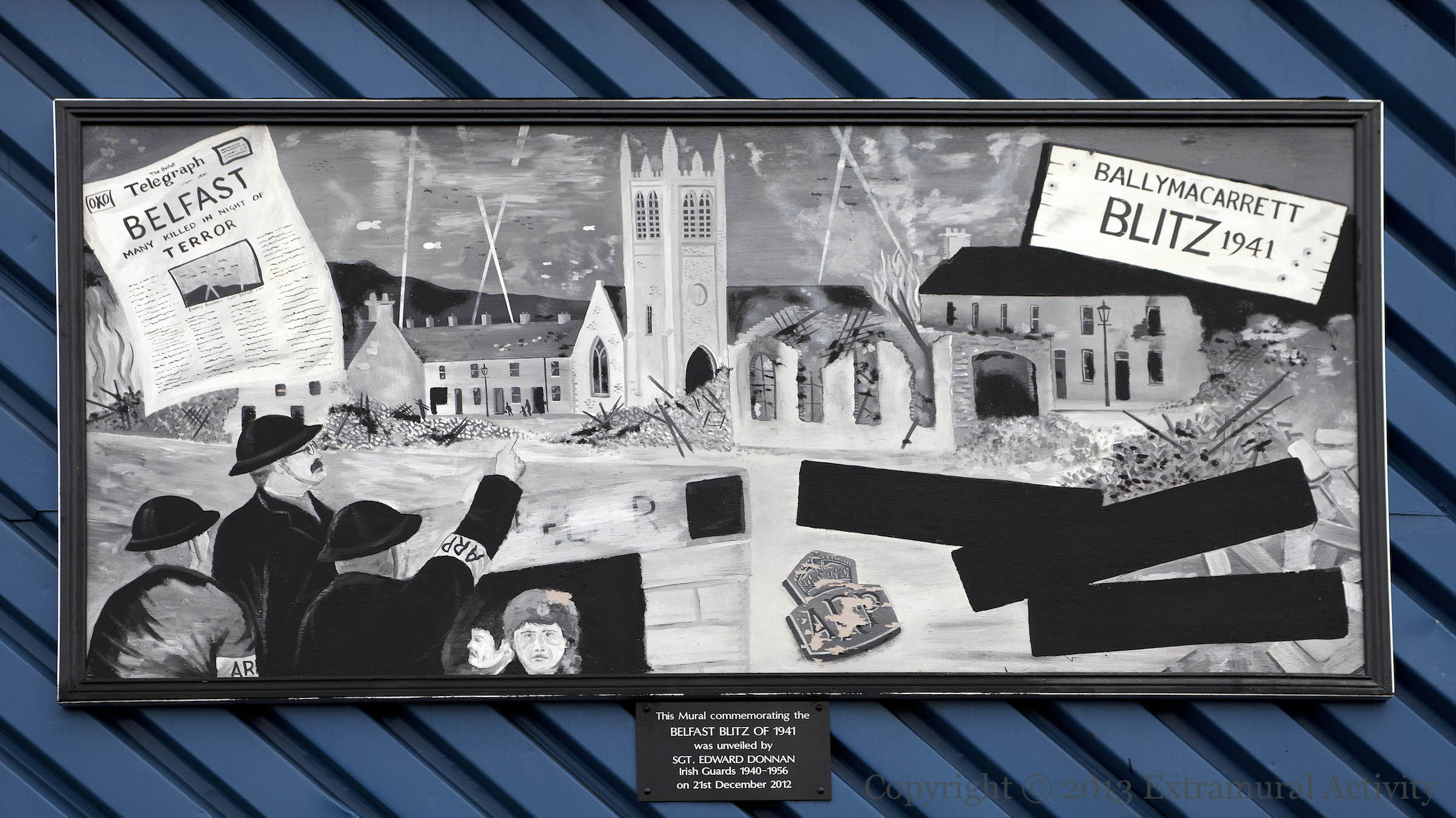
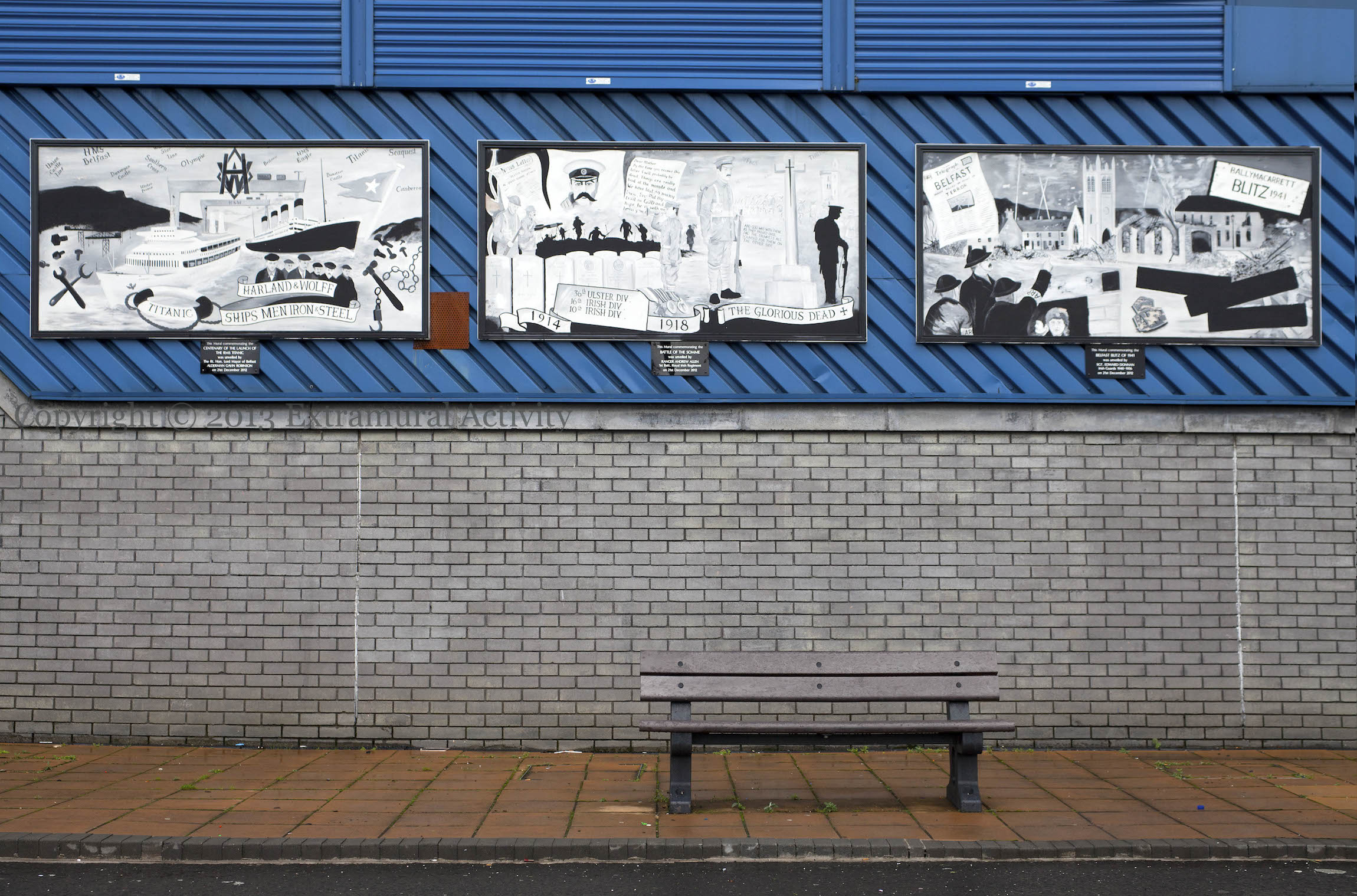
These three painted boards, in frames, on the exterior of the Connswater Community Centre, were unveiled this past December (2012). The first commemorates Titanic, the second the Somme, and the third the WWII Blitz.
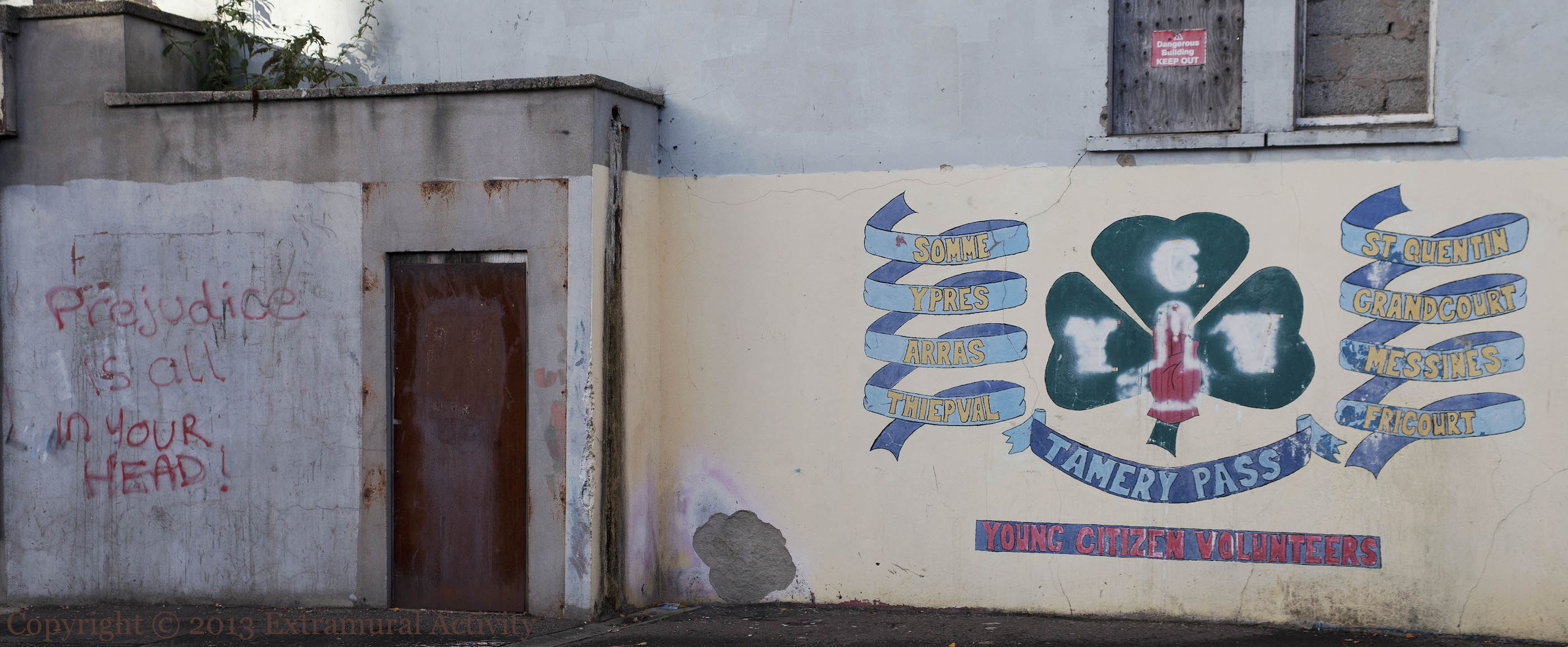
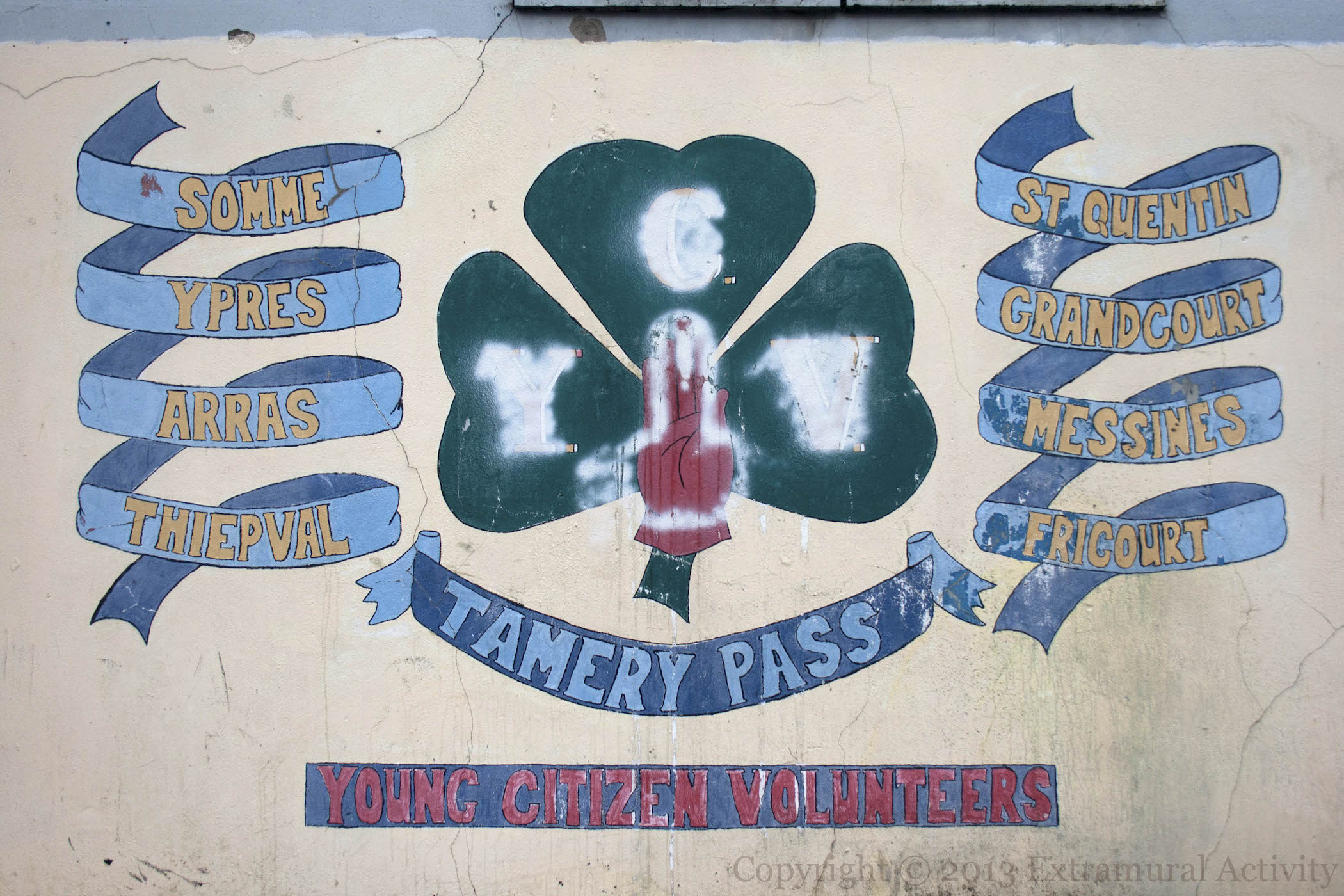
Graffiti next to a mural commemorating various battles of WWI reads “Prejudice is all in your head!” The Young Citizen Volunteers (YCV) were formed in 1912 and in 1914 became a battalion of the UVF.
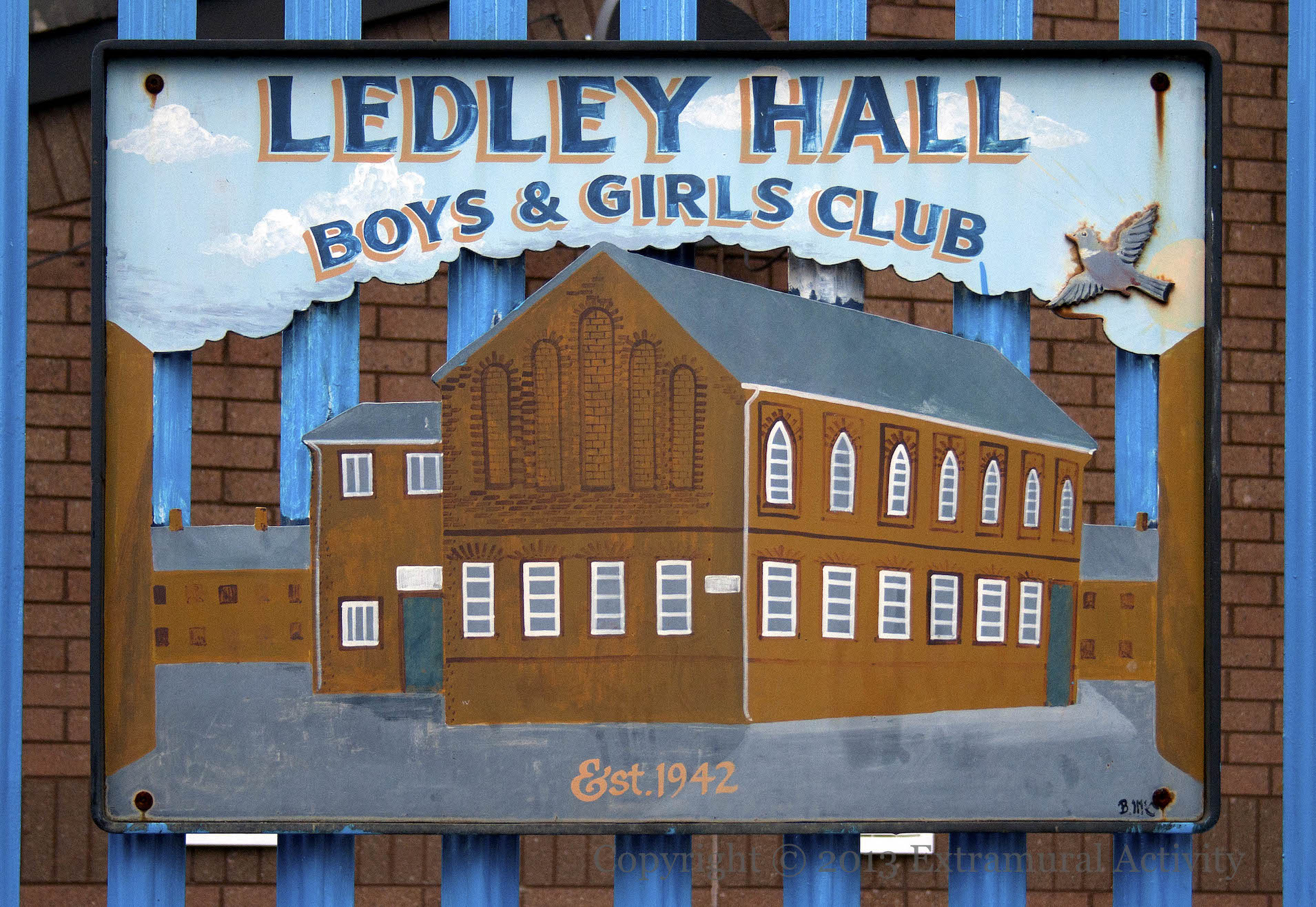
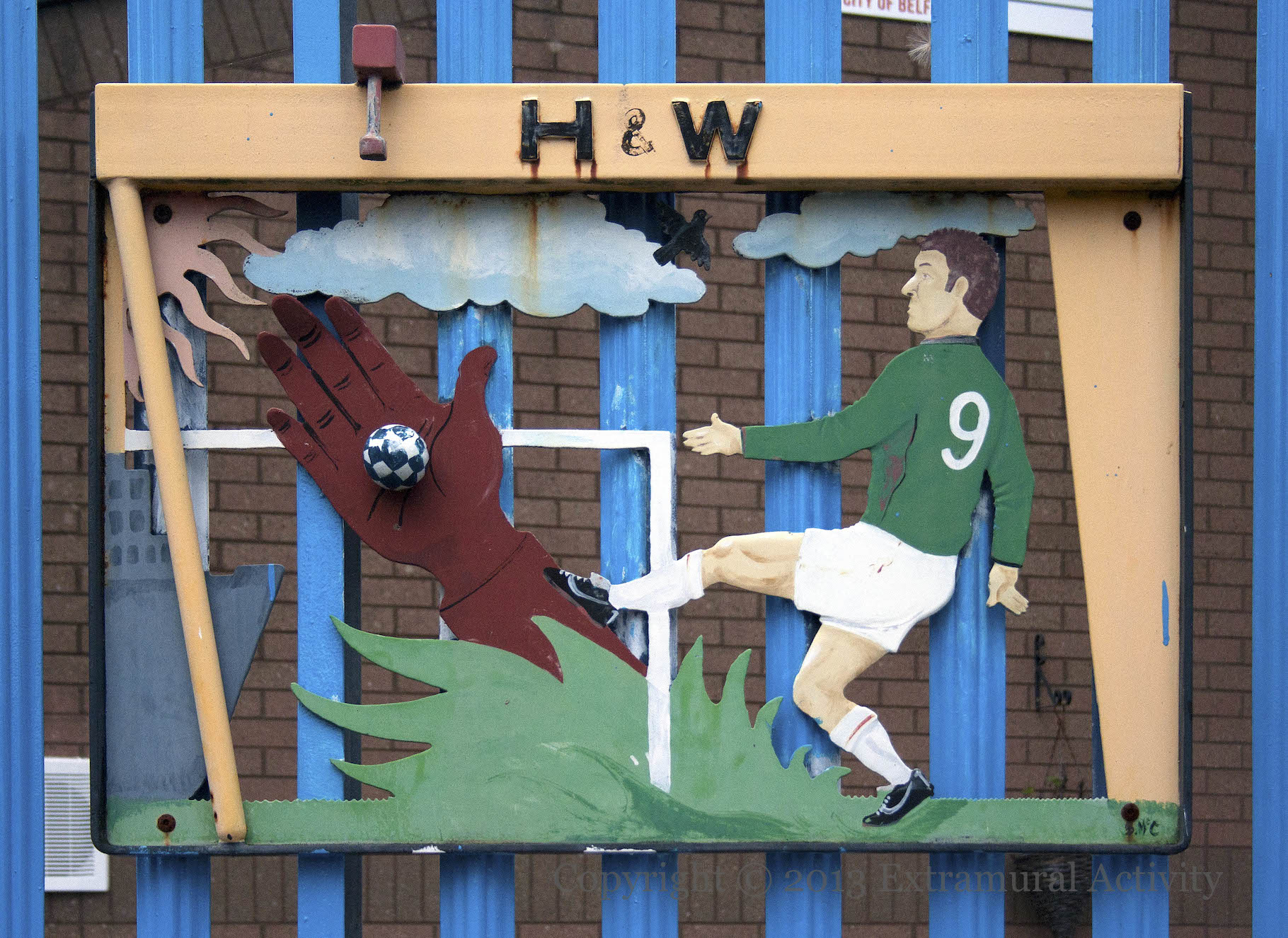
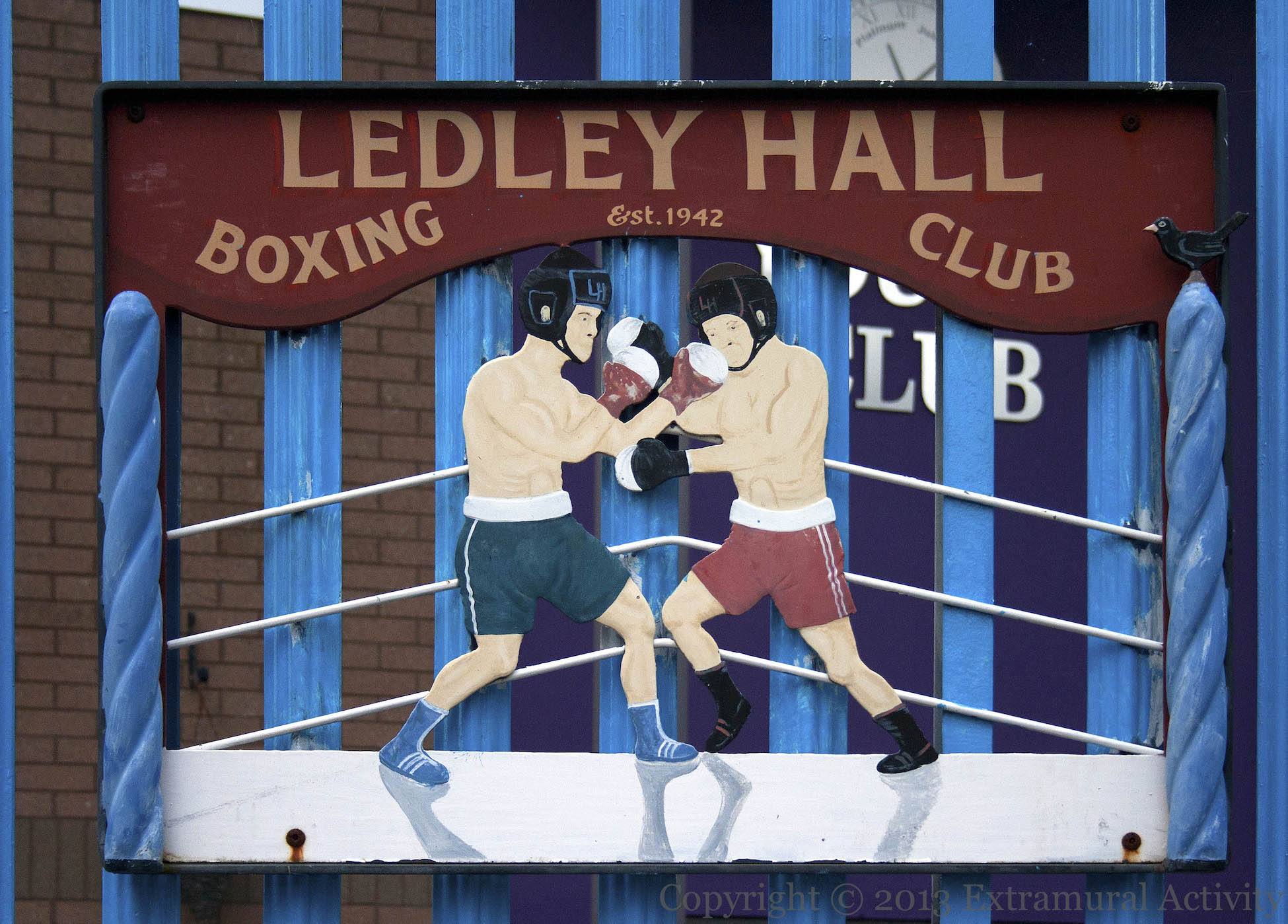
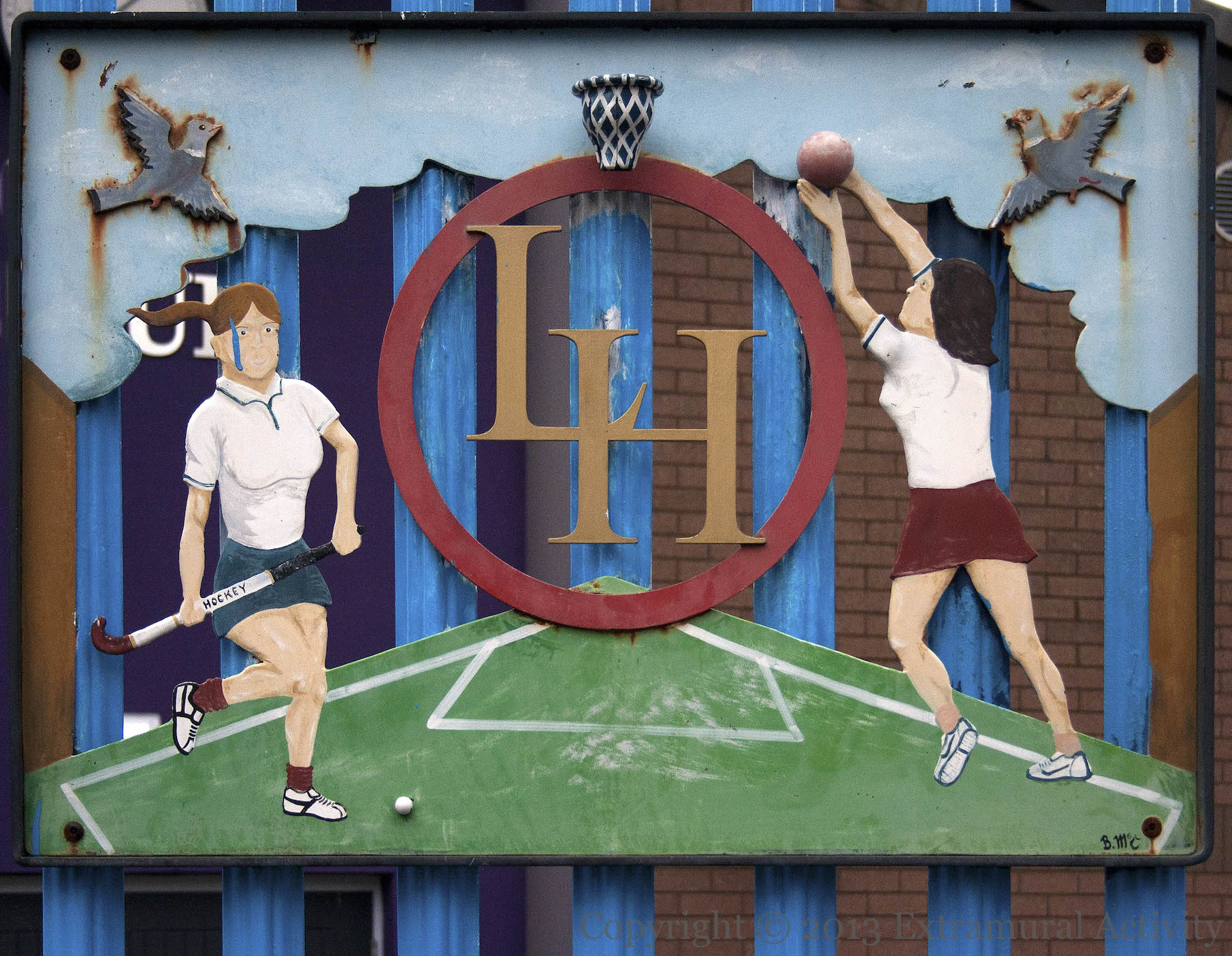
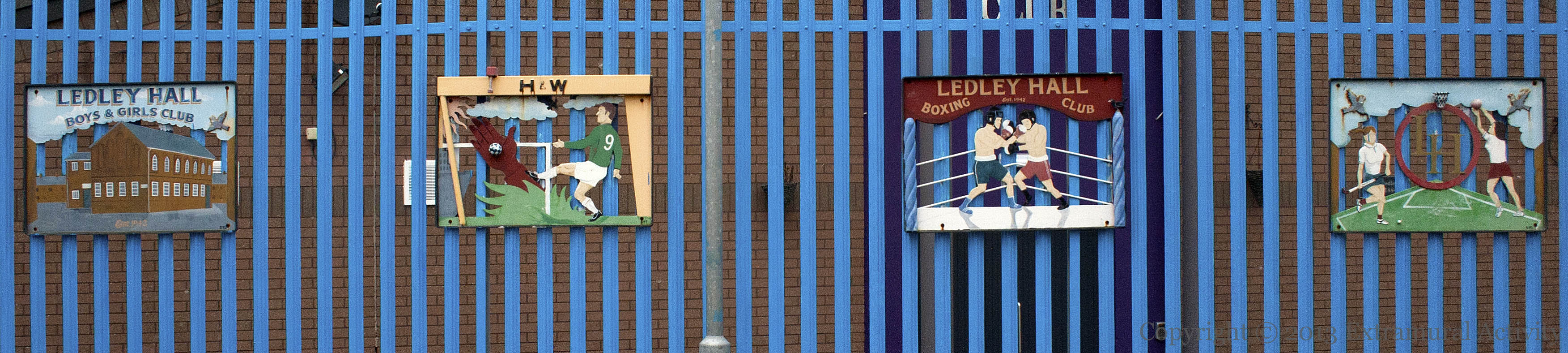
Here are four small painted metal-work pieces, signed “B McC”, on the railings of the Ledley Hall Boys & Girls Club, just off Beersbridge Road in east Belfast. The pieces show the building, soccer being played in the shadow of Harland & Wolff – the goal is prevented by a giant red hand – and two boxers boxing – the club was originally a boxing gym (est. 1942), and girls playing hockey and netball.
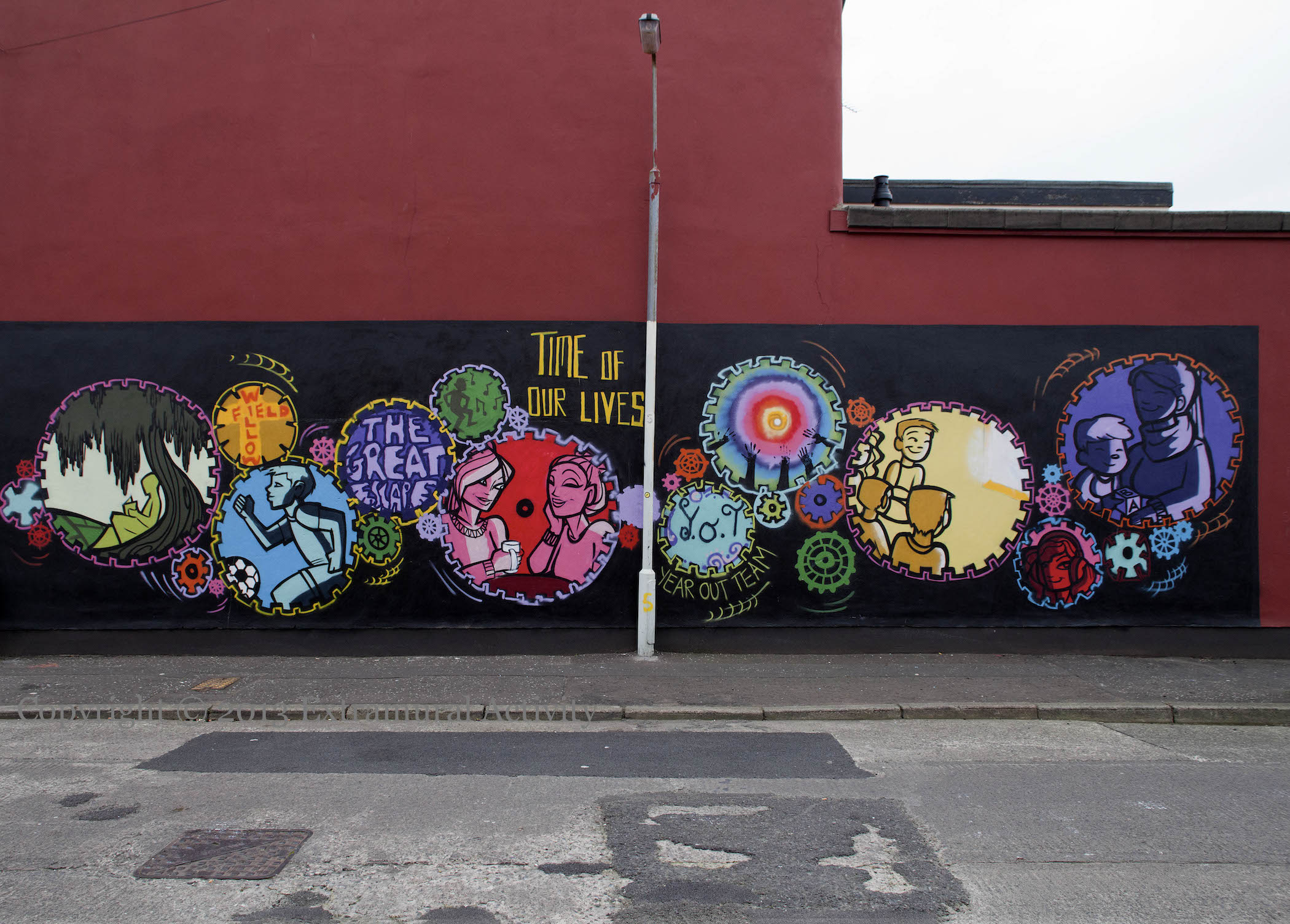
The colourful mural above is in Pearl Street, in the Willowfield area of east Belfast. It shows children playing and talking, depicted inside of a series of cogs.
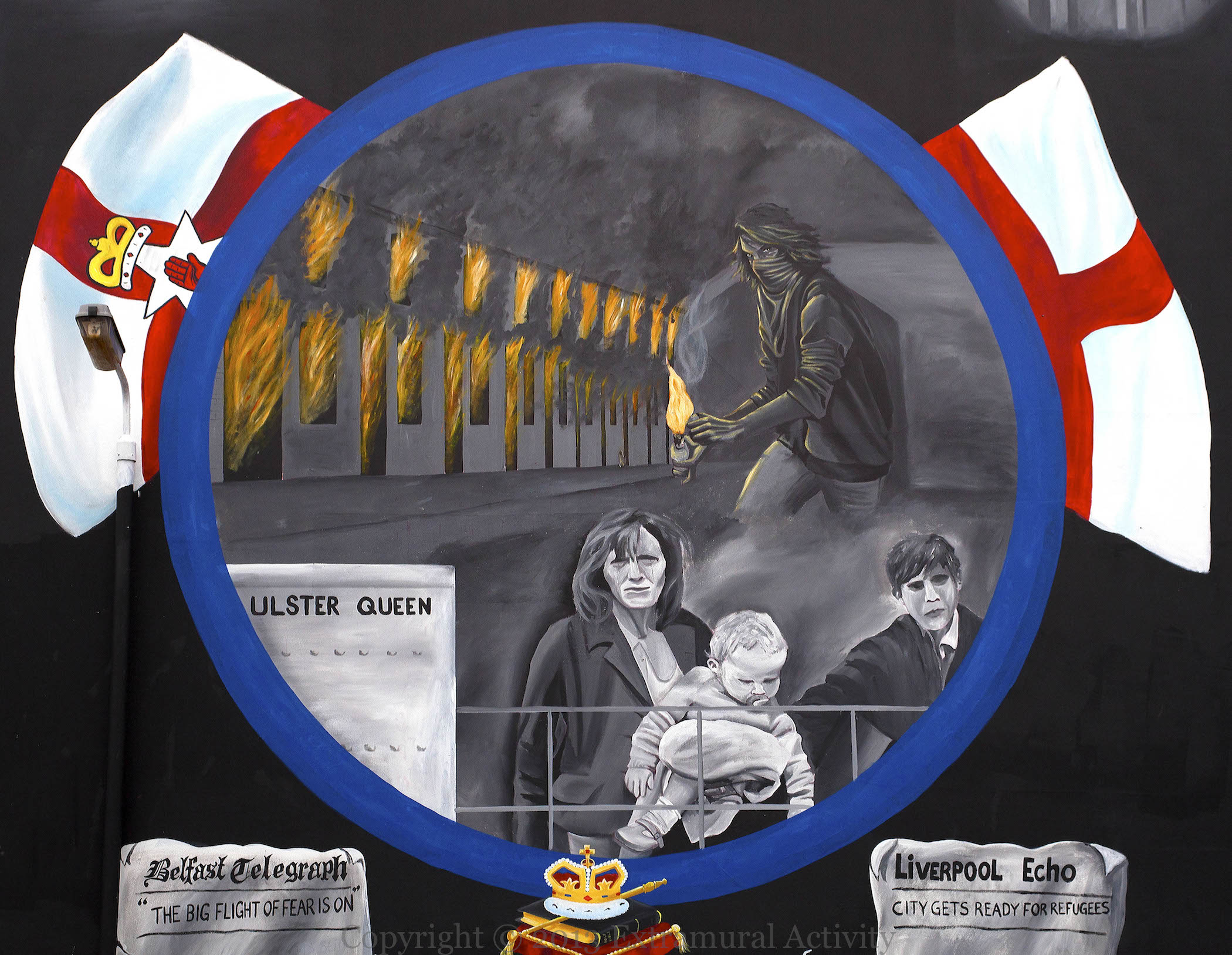
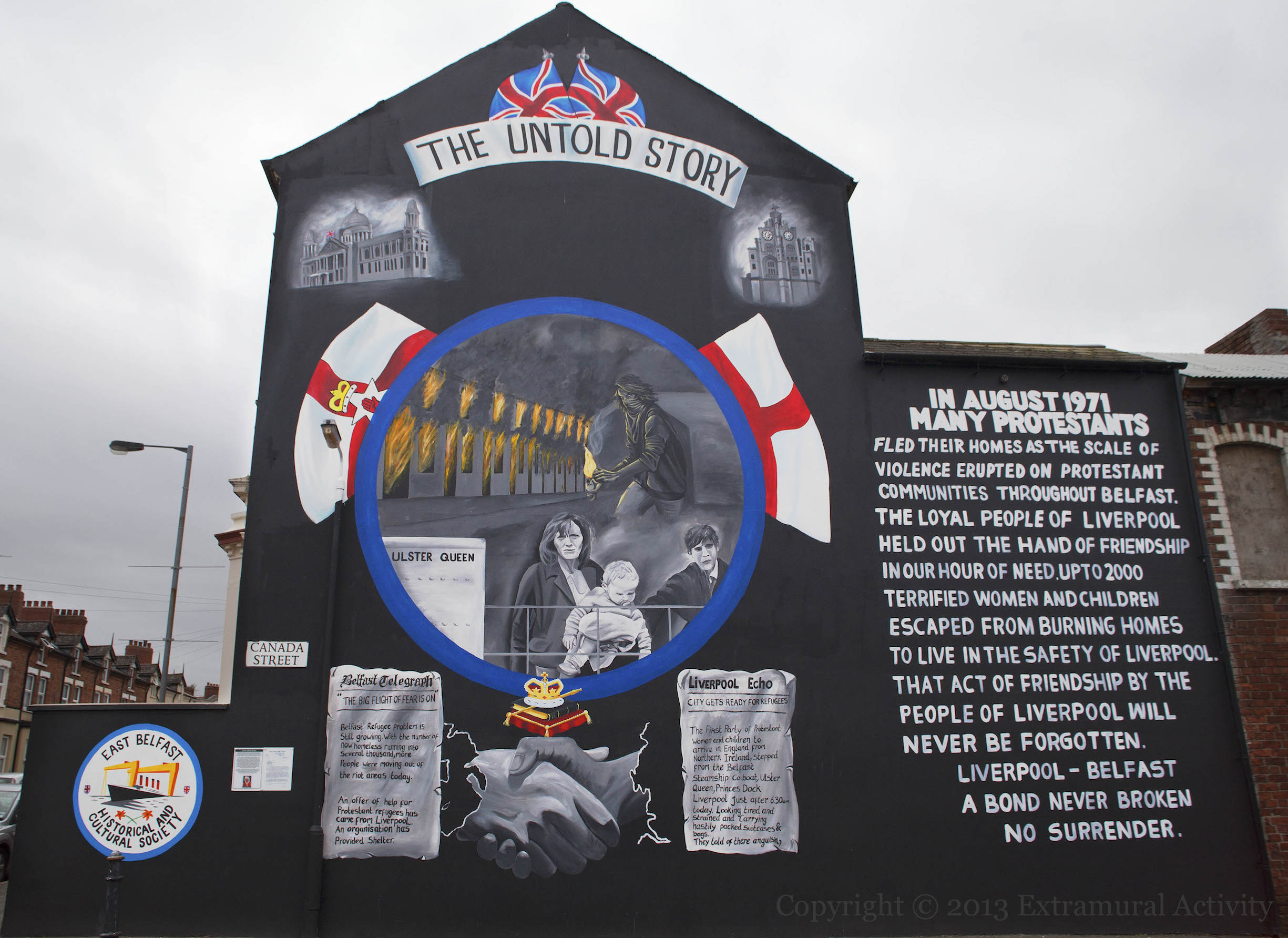
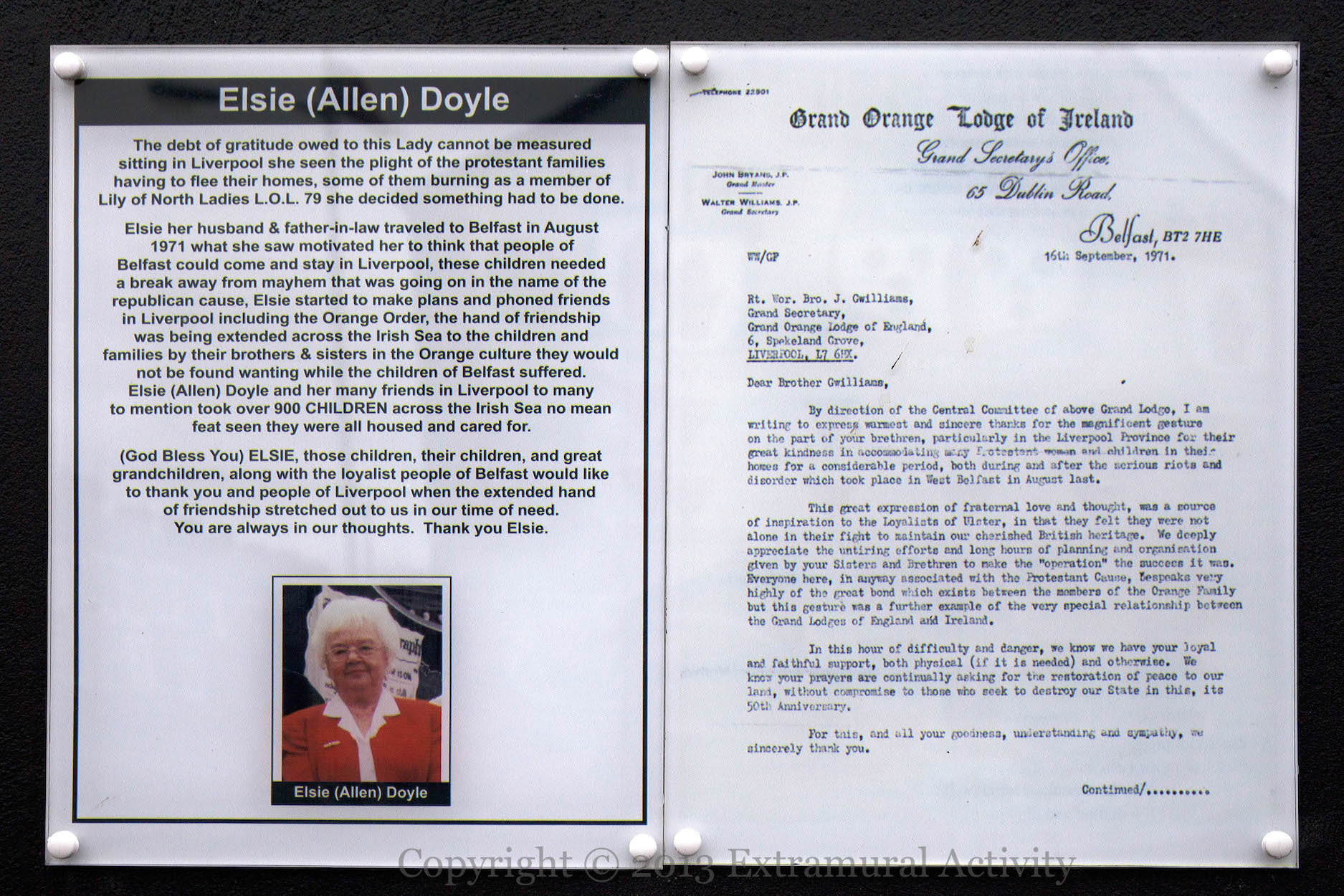
The image above shows the centre of a mural in Canada Street depicting Protestant women and children on-board a steamer, the Ulster Queen, leaving Belfast because of rioting and headed for Liverpool, where they were hosted by local Orange families. A shot of the whole is below, as well as a close-up of the laminated letter of thanks to Elsie (Allen) Doyle, one of the organisers in Liverpool.
A very similar mural was in this spot several years ago (though not immediately prior to this one – the wall was blank), featuring three youngsters on the boat, rather than a mother and children. The panel to the right began “In August 1971 many Protestants fled their homes as the IRA launched a bitter sectarian attack on Protestant communities throughout Belfast.” (See M04069.)
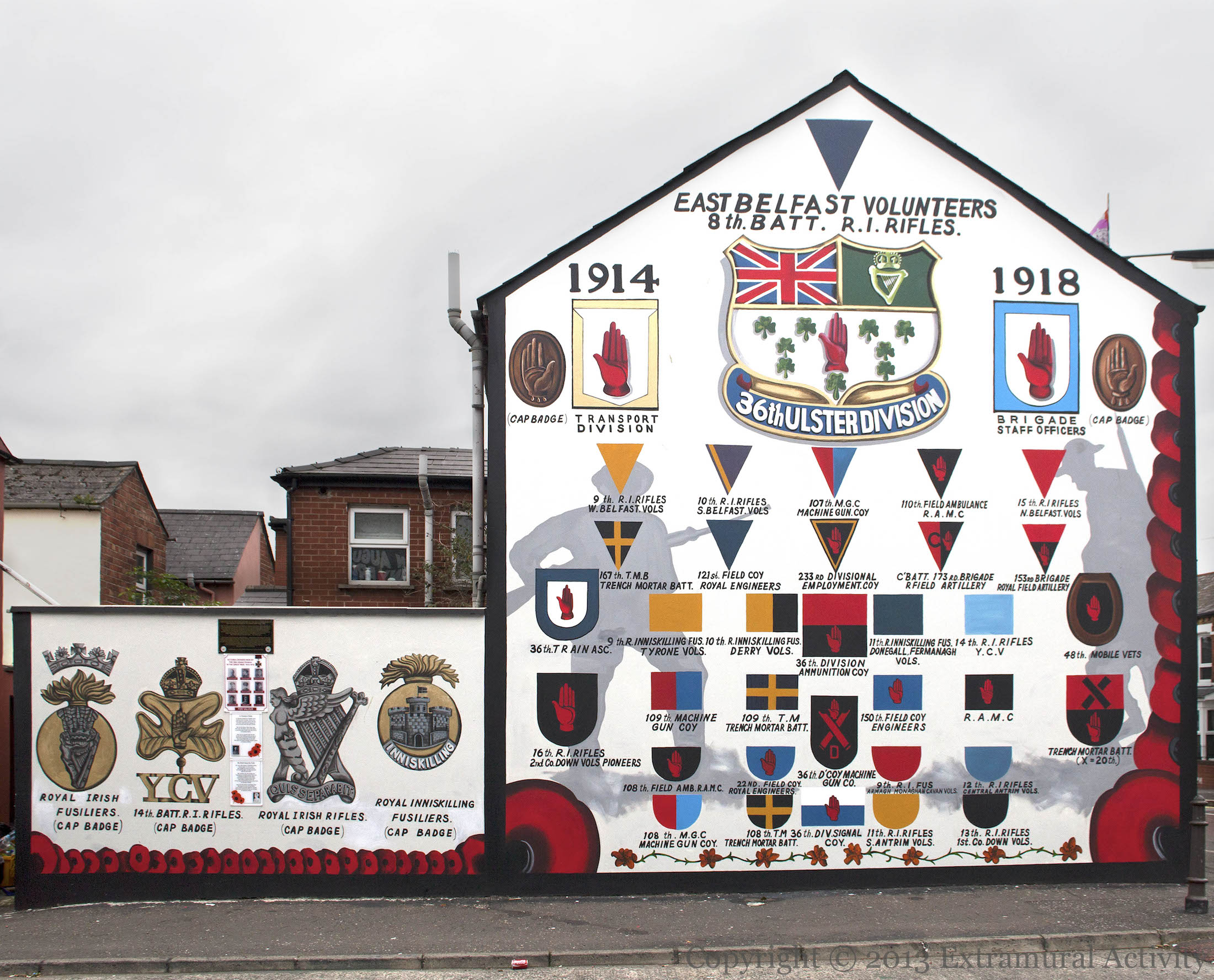
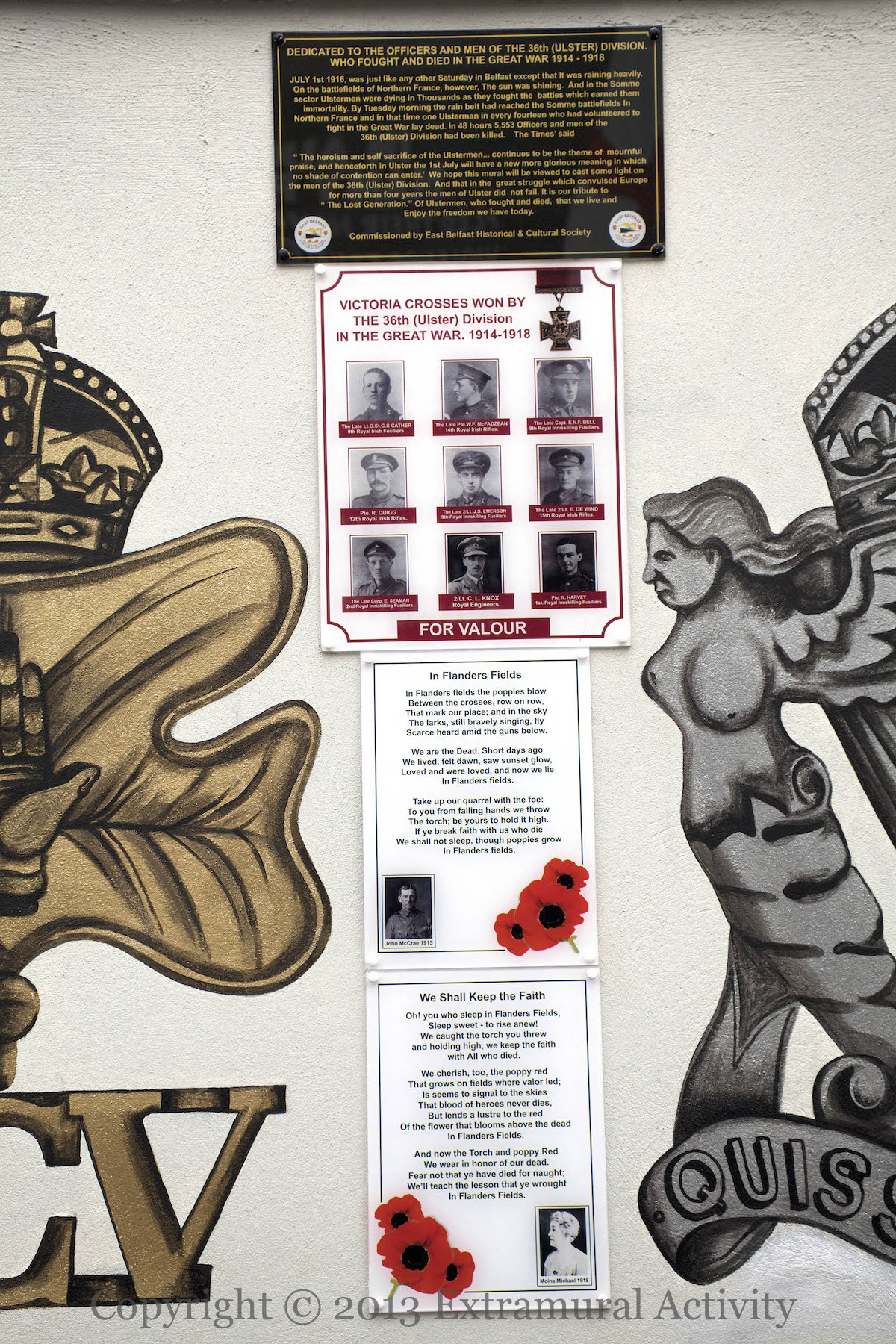
This mural and its accompanying plaques, at the mouth of Canada Street, commemorate WWI and celebrate the Victoria Crosses won by members of the 36th (Ulster) Division “For valour”: Cather, McFadzean, Bell, Quigg, Emerson, De Wind, Seaman, Knox, and Harvey. The main mural features insignia of more than thirty units of types ranging from machine gunners to vets.
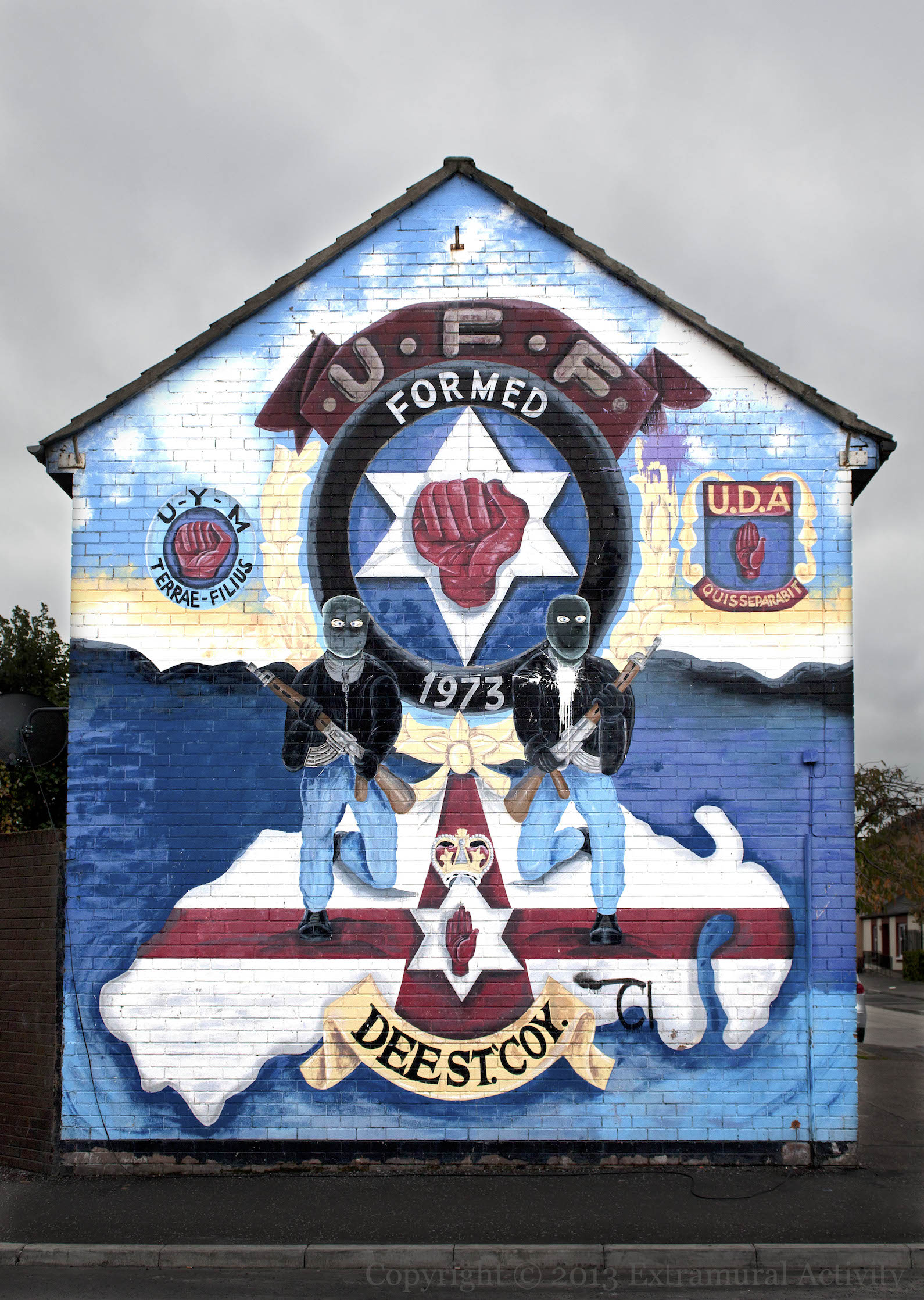
In the course of its history, the UDA has flirted with the idea of an independent Northern Ireland and of a repartitioned Northern Ireland. This mural in Avoniel Street, just off Albertbridge Road in east Belfast, shows a Northern Irish island, supporting two masked gunmen, beneath a red fist. The Ulster Freedom Fighters (and its youth organisation, the Ulster Young Militants) was formed in 1973 to give legal cover to the UDA; the UFF was banned immediately, the UDA in 1992.
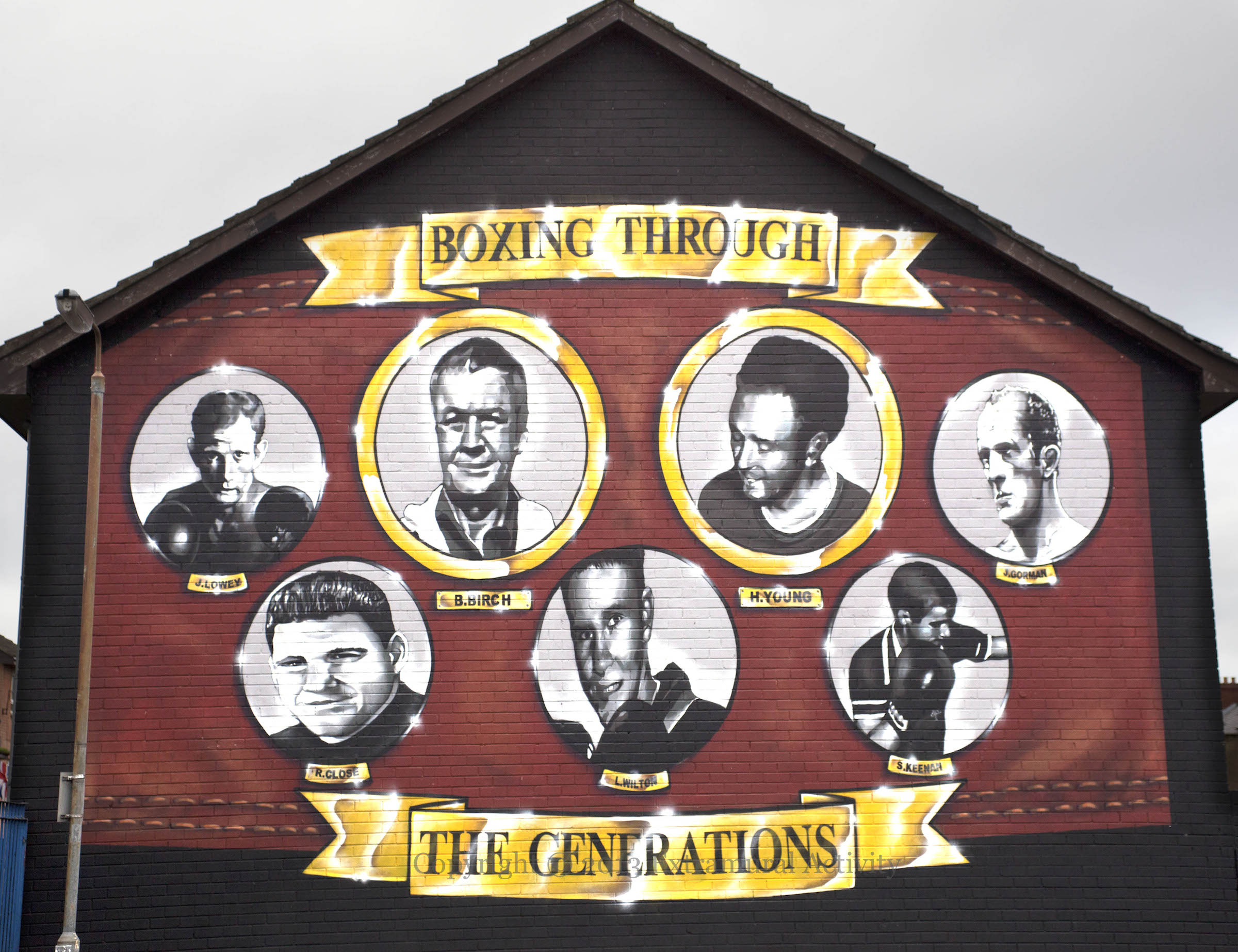
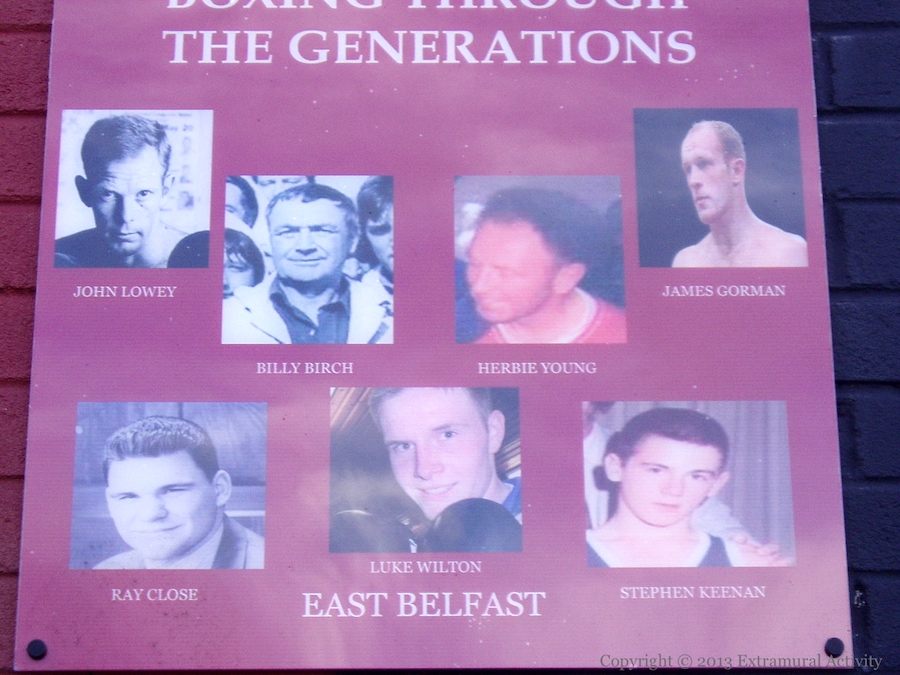
Above is a new mural in Templemore Street, at the eastern edge of the residential part of the Albertbridge Road. The mural features seven boxers: John Lowey, Billy Birch (’47-’54), Herbie Young, James Gorman, Ray Close (who fought Chris Eubanks to a draw for a World belt in 1993), Luke Wilton (’08-present), and Stephan Keenan. Information on-line is sparse, so please comment or e-mail.
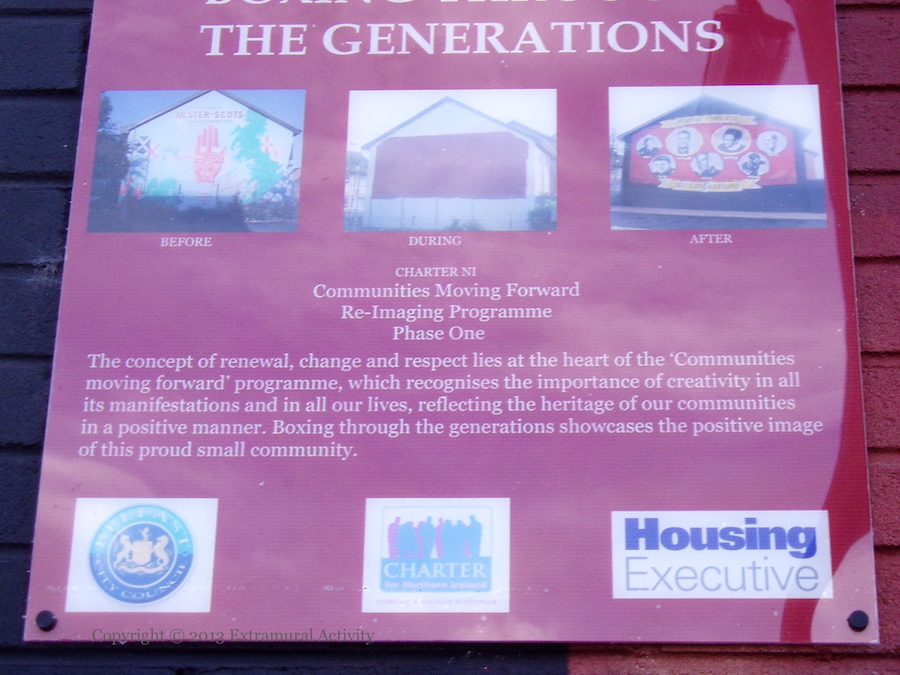
Update: 2013-12-24 Two plaques have been added to the piece above, one showing the photographs upon which the portraits in the mural were based (except Keenan’s), and the other describing the process by which the Ulster-Scots mural was replaced as part of a project by Charter NI (along with the city council and the housing executive). It reads: “Communities Moving Forward Re-Imaging Programme Phase One. The concept of renewal, change and respect lies at the heart of the ‘Communities moving forward’ programme, which recognises the importance of creativity in all its manifestations and in all our lives, reflecting the heritage of our communities in a positive manner. Boxing through the generations showcases the positive images of this proud small community.” (Also: NIHE press release)