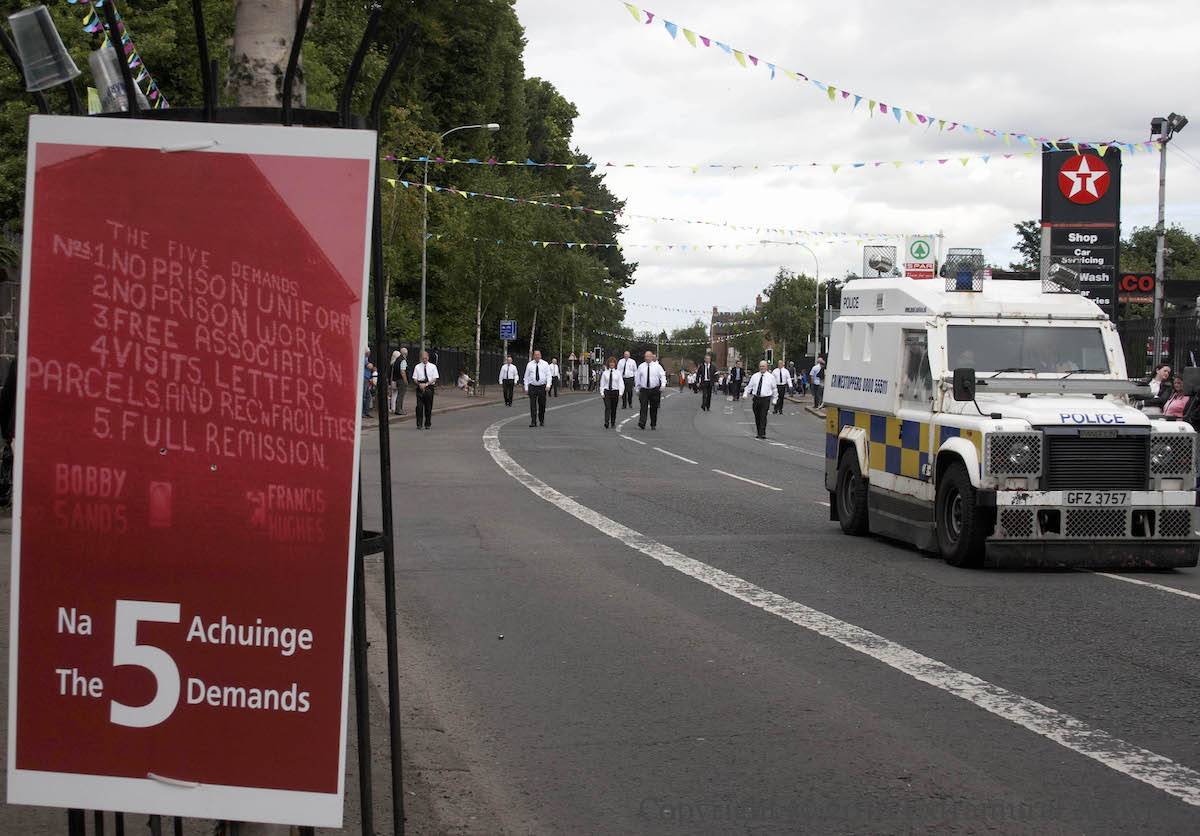
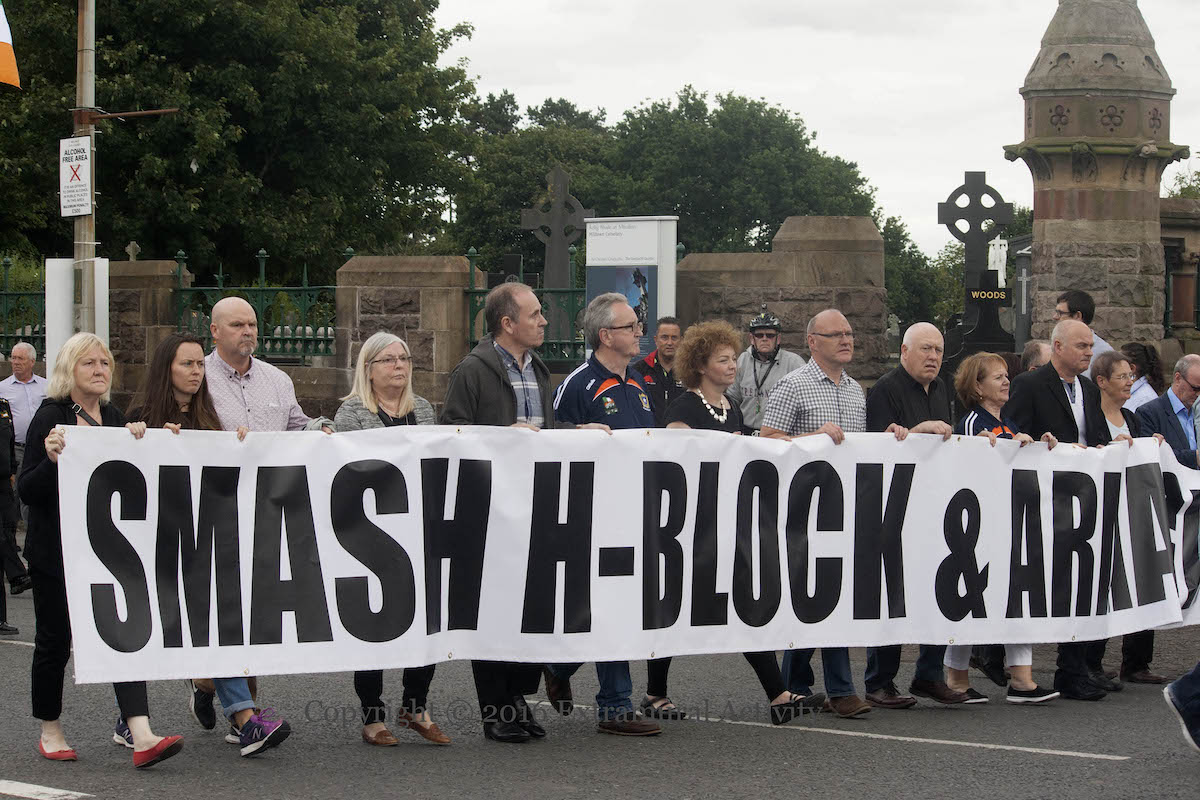
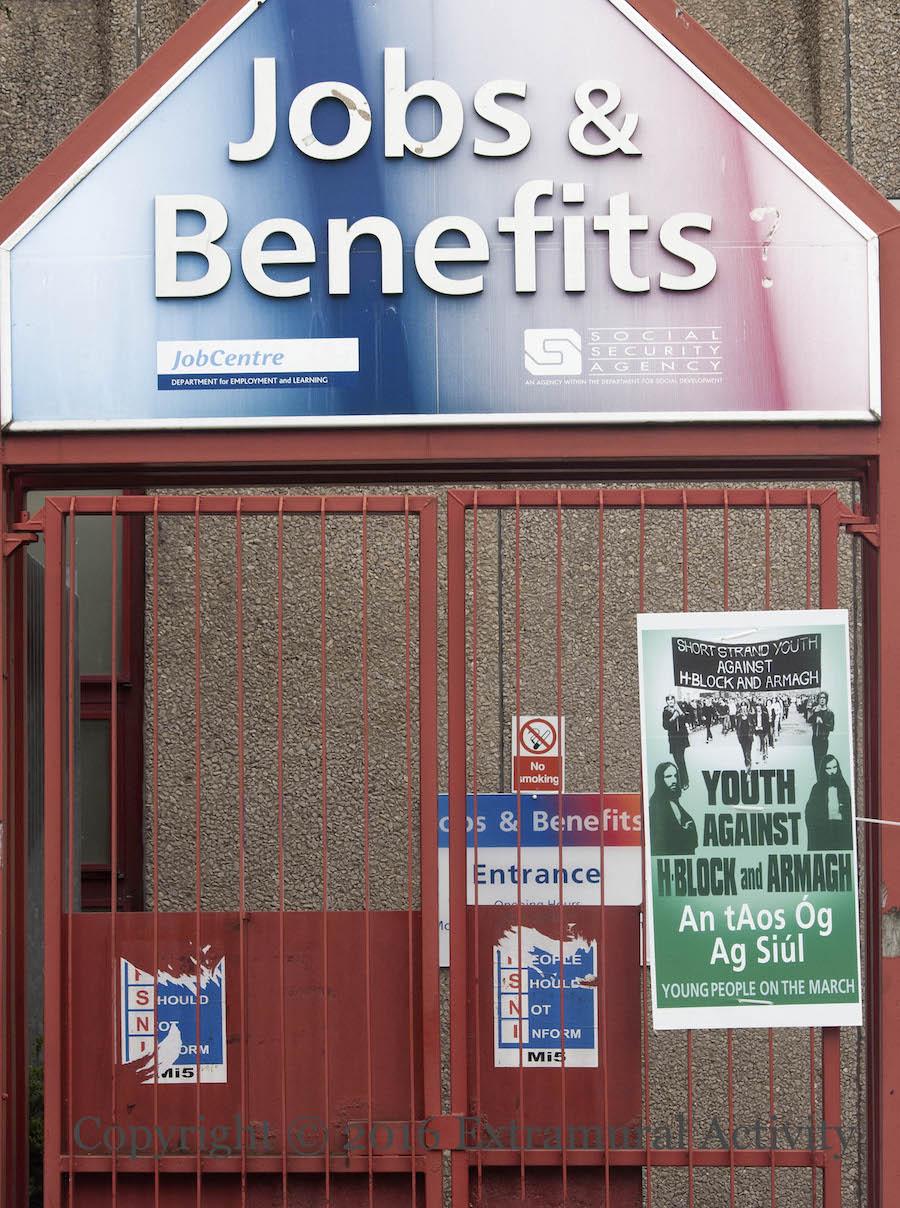
Some of the people on 35th anniversary march were perhaps among the “Short Strand Youth Against H-Block & Armagh” in 1981 but the speakers at the Dunville Park rally were intentionally drawn from the younger Sinn Féin leaders, including Nıall Ó Donnghaıle from the Short Strand (An Phoblacht).
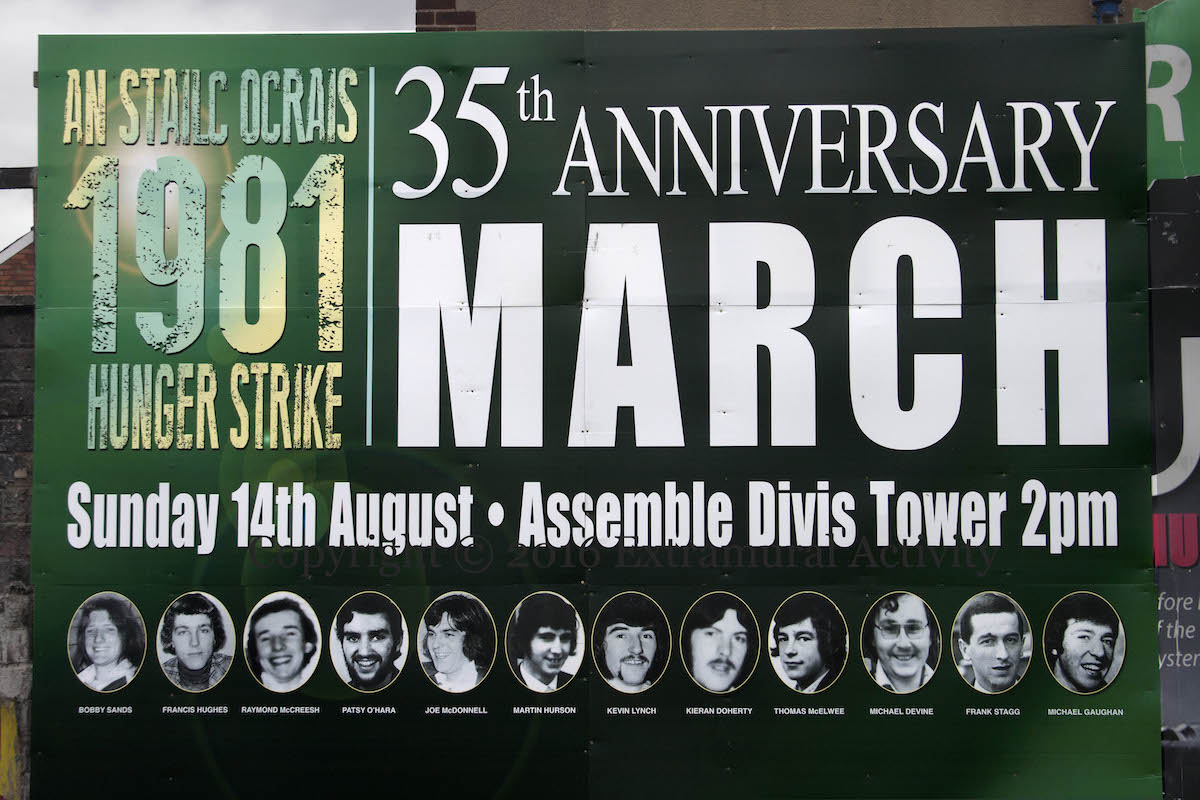
“An staılc ocraıs 1981 hunger strike – 35th anniversary march – Sunday 14th August – Assemble Divis tower 2pm”. With portraits of the deceased 1981 hunger strikers; Frank Stagg and Michael Gaughan are included even though they died in the 1970s.
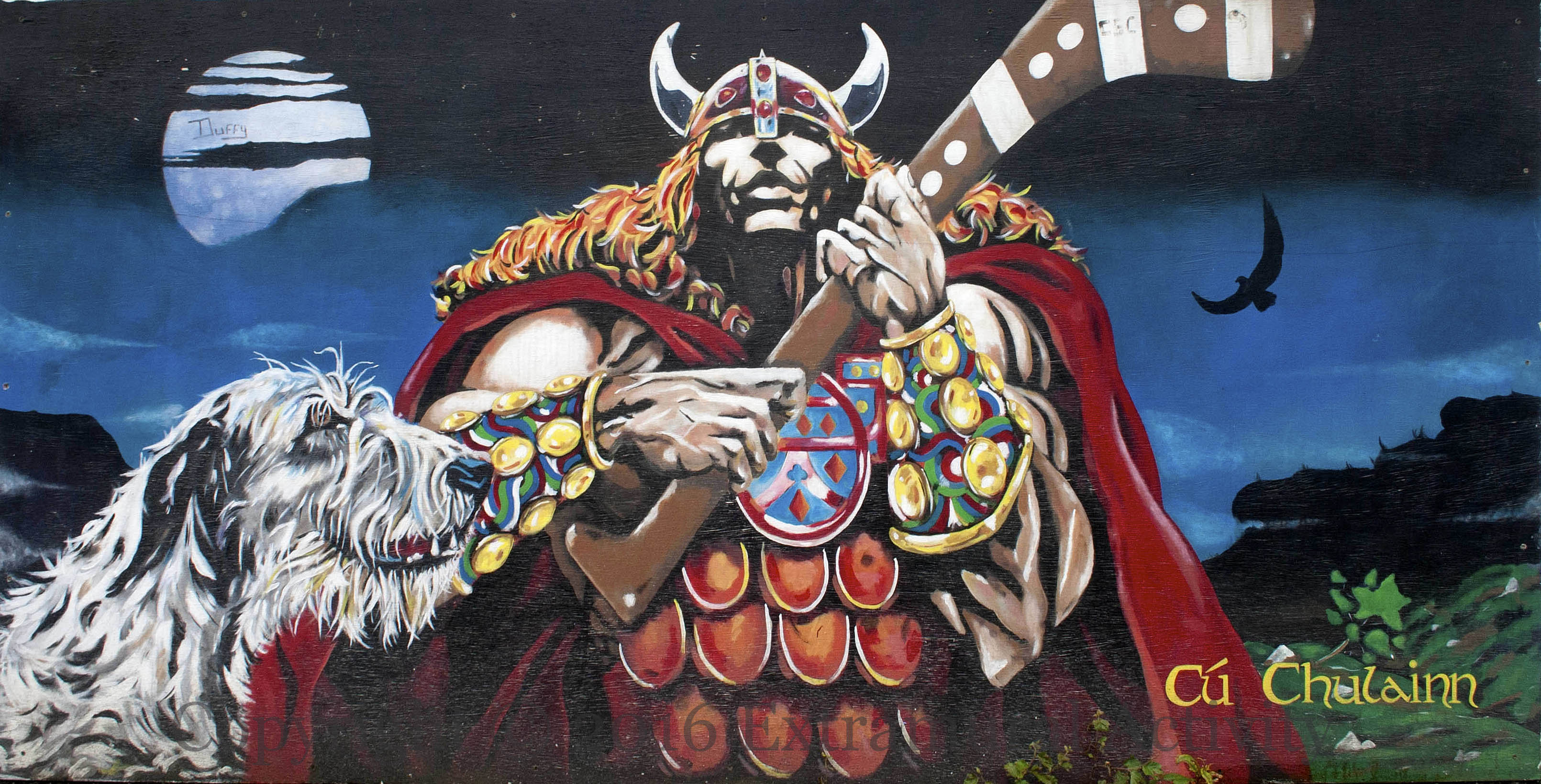
“Cú Chulaınn” is Irish for “Culann’s Hound” after the boy Setanta killed the smith’s hound and promised to take its place until another one was raised. In one version of the legend, Setanta kills the original hound by driving a slıotar (hurley ball) down its throat – hence the hero is shown here holding a camán (hurley stick) rather than a sword. In the original picture on which this mural is based, the hero is not Cú Chulaınn but Jim Fitzpatrick’s vision of Nuada Silverarm and he carries a sword.
On the right hand side, Tuan the hawk/eagle/sea-raven bears witness to all of Irish history.
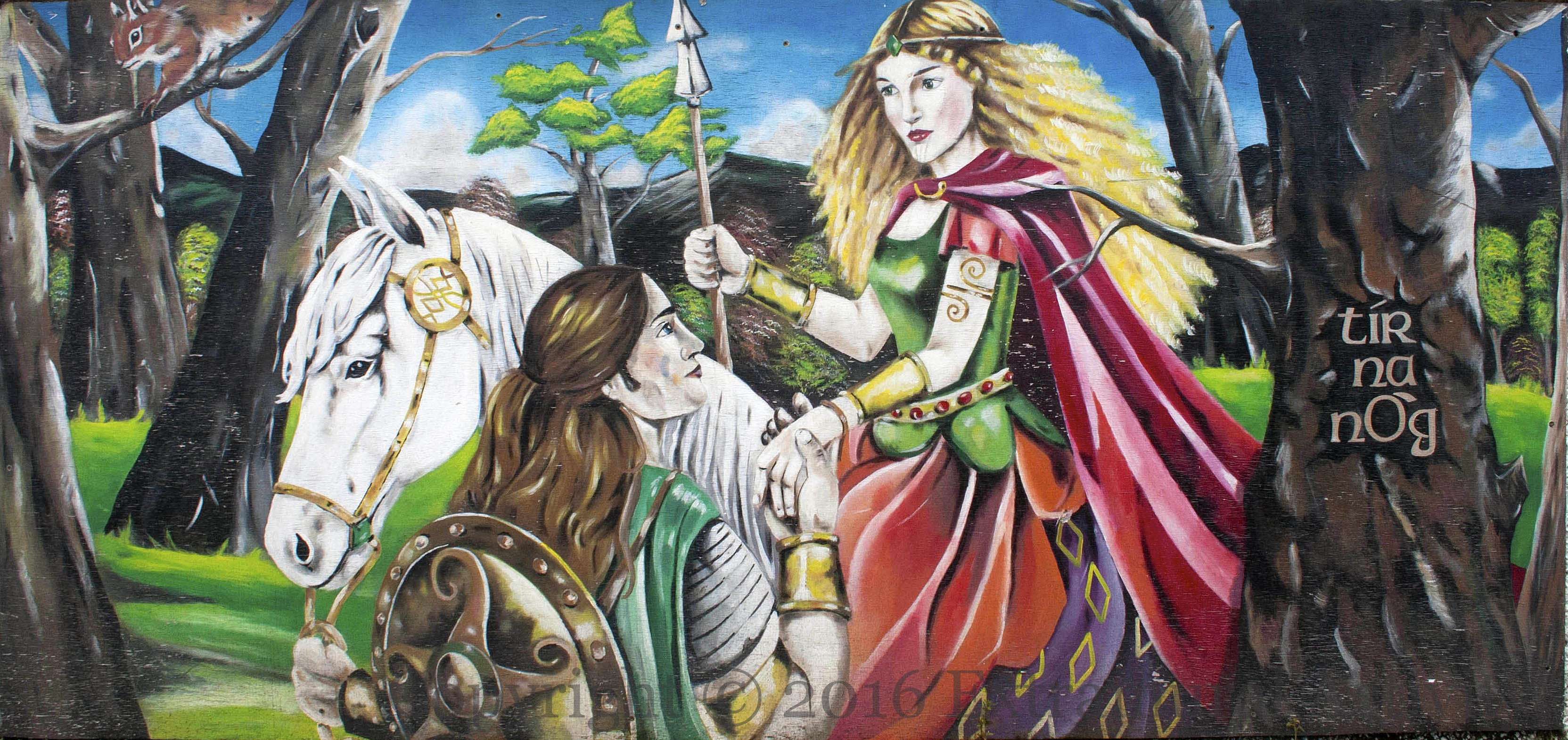
In the myths of the Tuatha Dé Danann, the Fıan Oısín falls in love with Nıamh from the Land Of Youth, but after three years — which is 300 human years — he yearns to return to Ireland. She gives him a magic horse that will preserve his youth while he remains on it. But he falls from it and dies of old age.
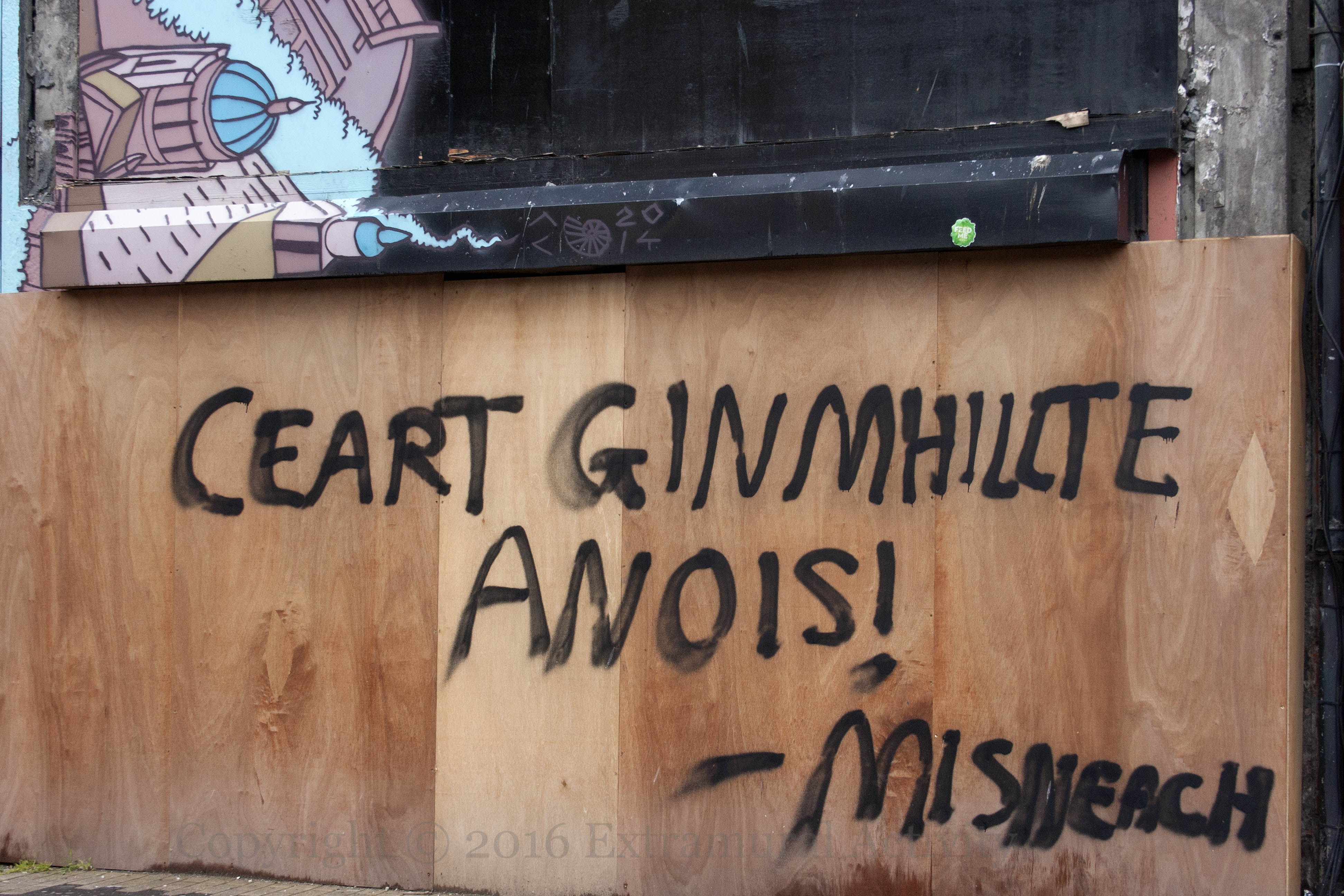
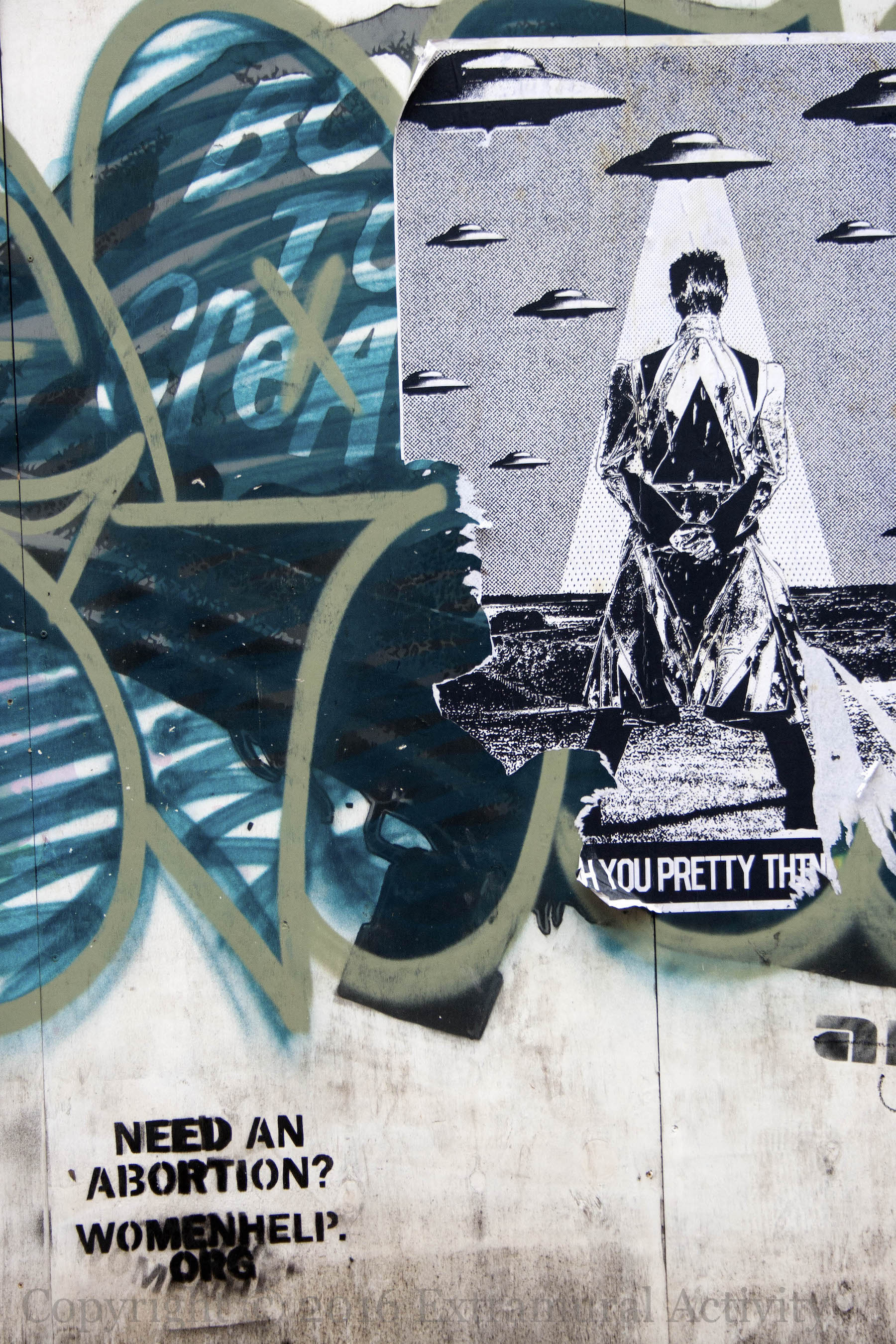
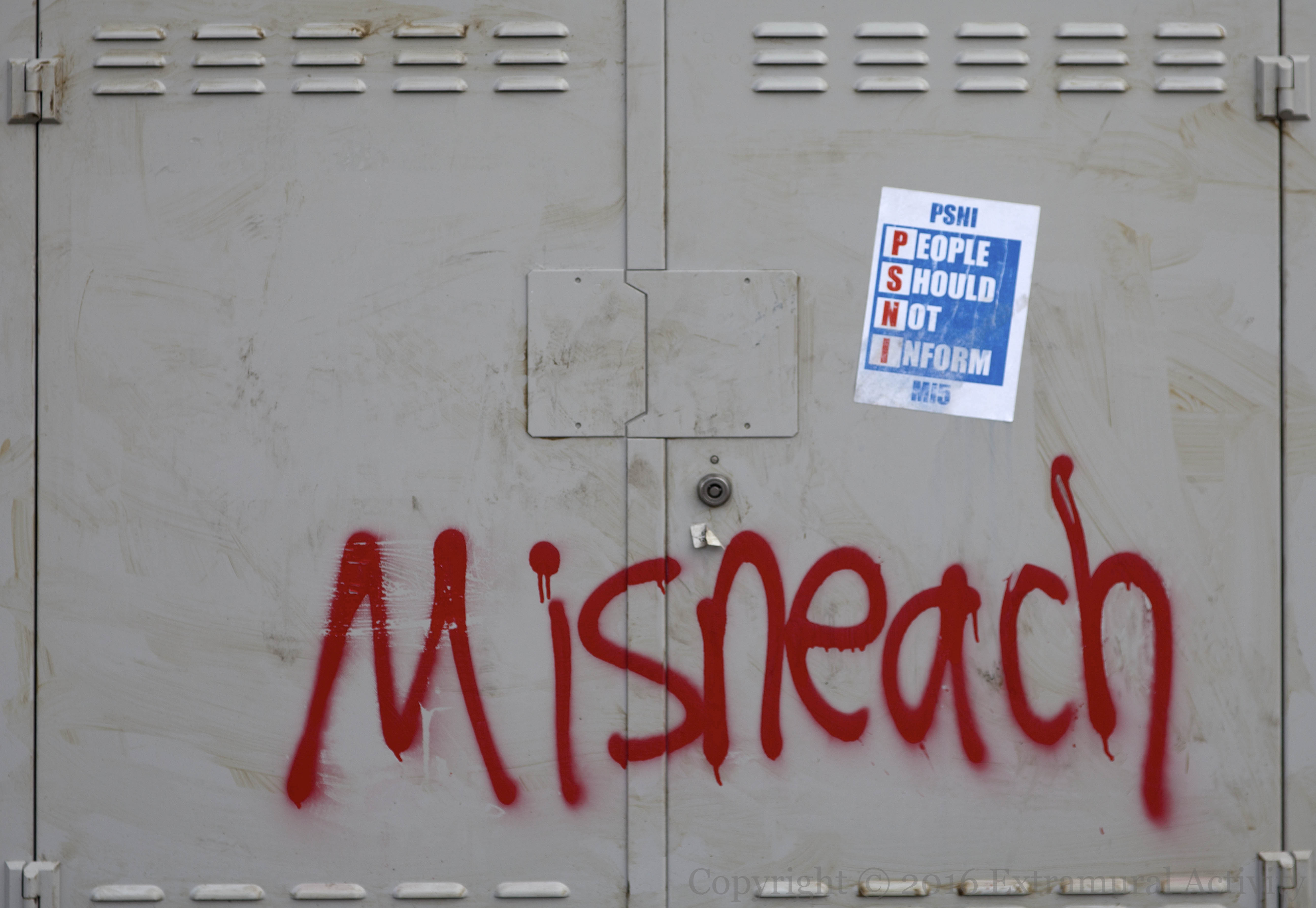
Two pieces relating to abortion rights. The first is a piece of Irish-language graffiti in North Street, below Andy Council’s CNB14 Phoenix, signed by “Mısneach” (“courage”). The second is a stencil in Garfield Street below Leo Boyd’s Bowie tribute Oh You Pretty Thing: “Need an abortion? Womenhelp.org.”
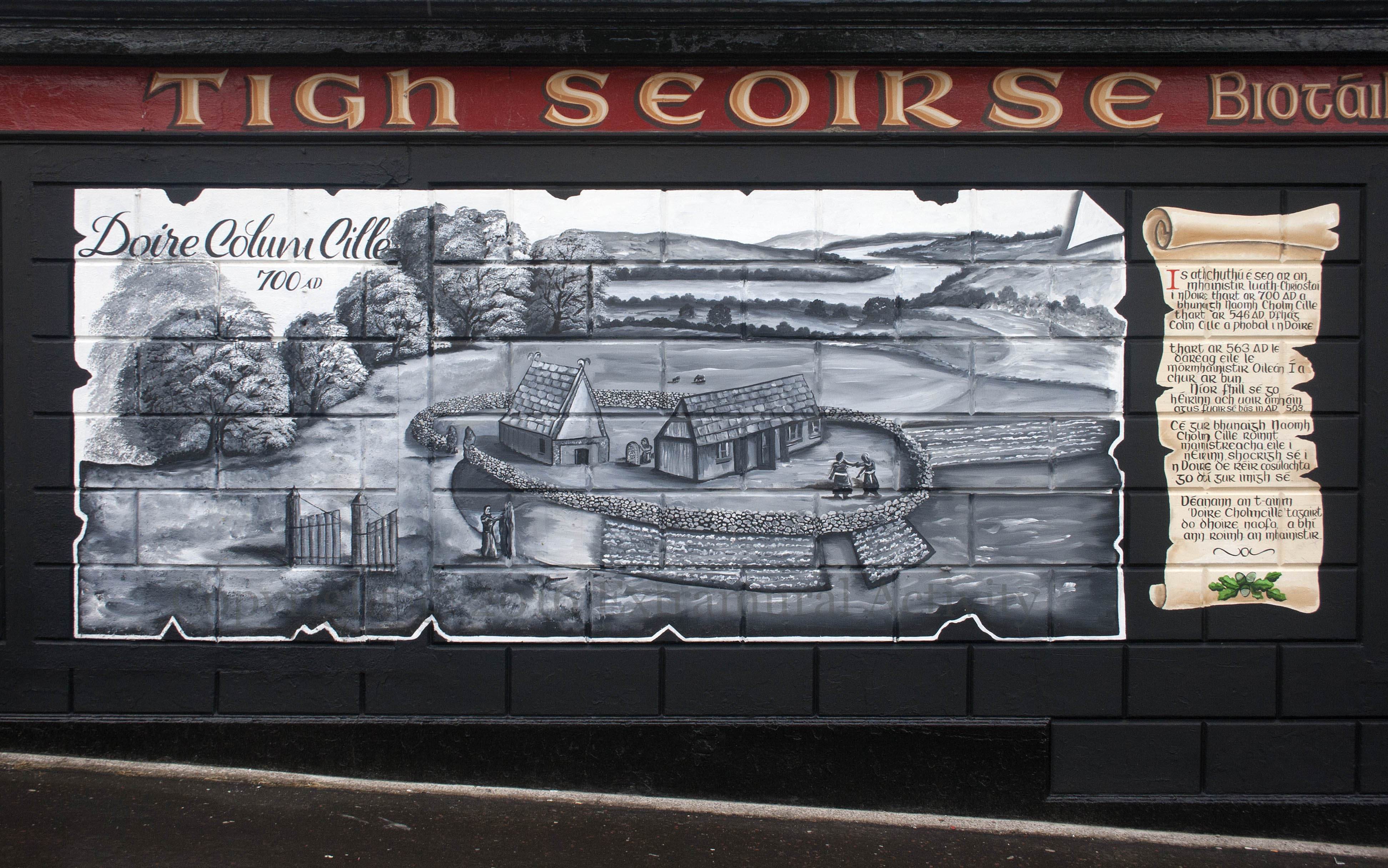
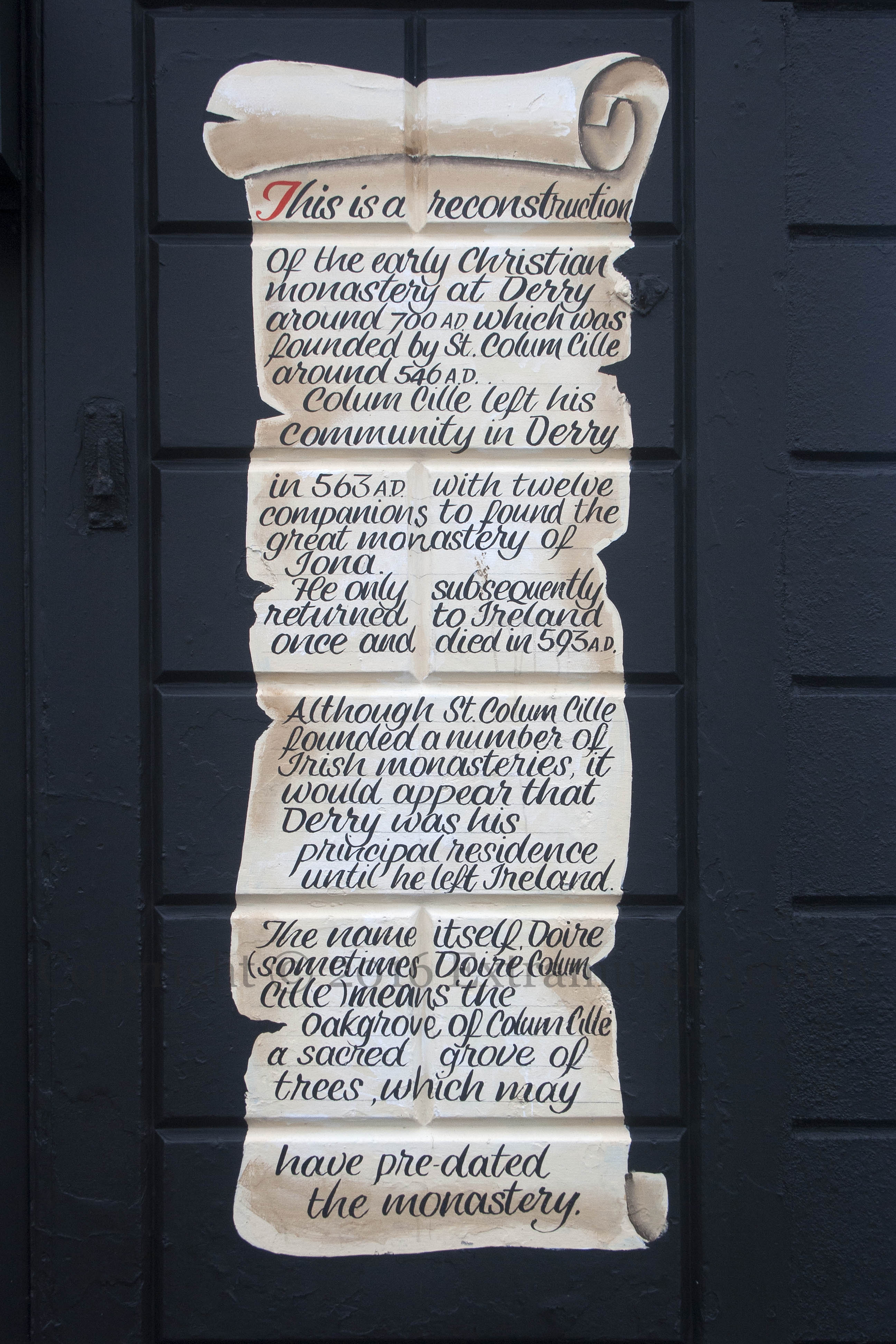
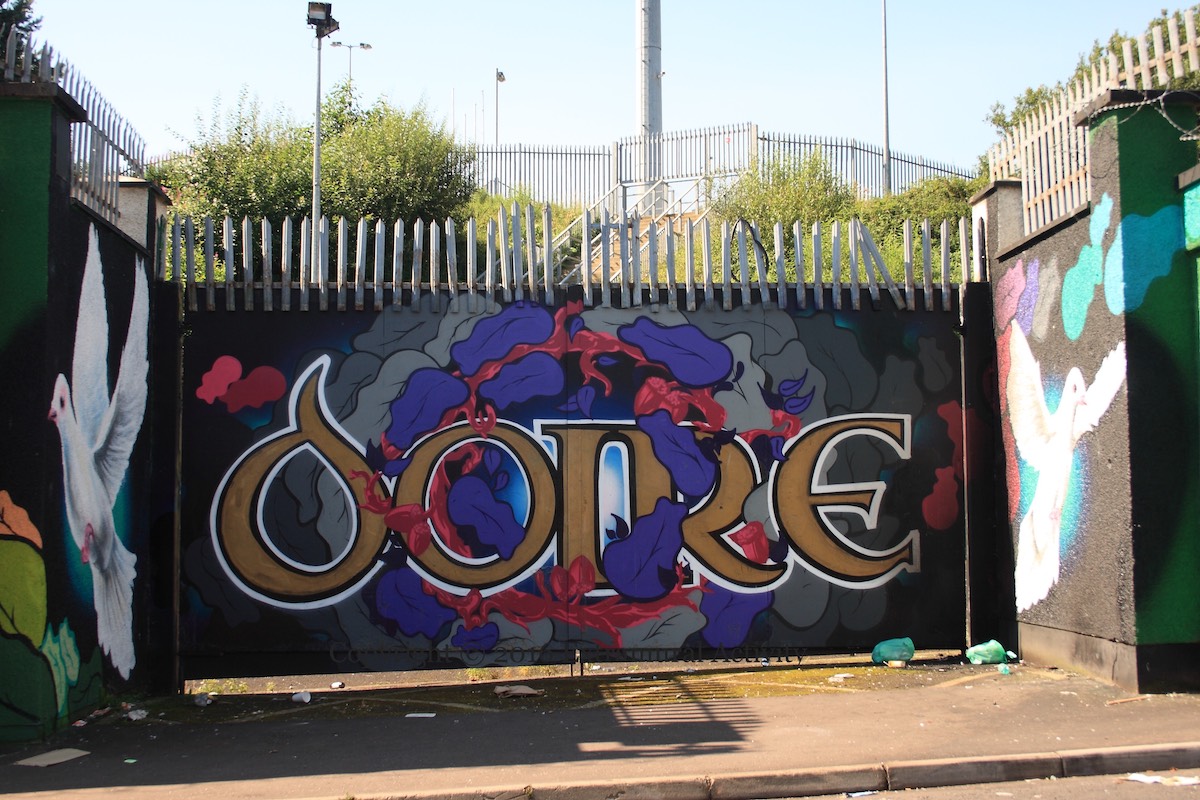
The Christian missionary Colm Cılle (in Latin, Columba), born in Donegal, founded a monastic settlement on the banks of the Foyle (then still part of Donegal) around 540 AD. The “Doıre” part of the name means “oak grove” and perhaps refers (as the information panel suggests) to “a sacred grove of trees, which may have pre-dated the monastery.” The mural above shows a reconstruction of the Derry monastery c. 700 AD. The name “Londonderry” dates to 1662.
Columba moved on to Scotland circa 563 and founded an abbey on the island of Iona. Among his reputed miracles is the banishment of a great water beast from the River Ness in 565.
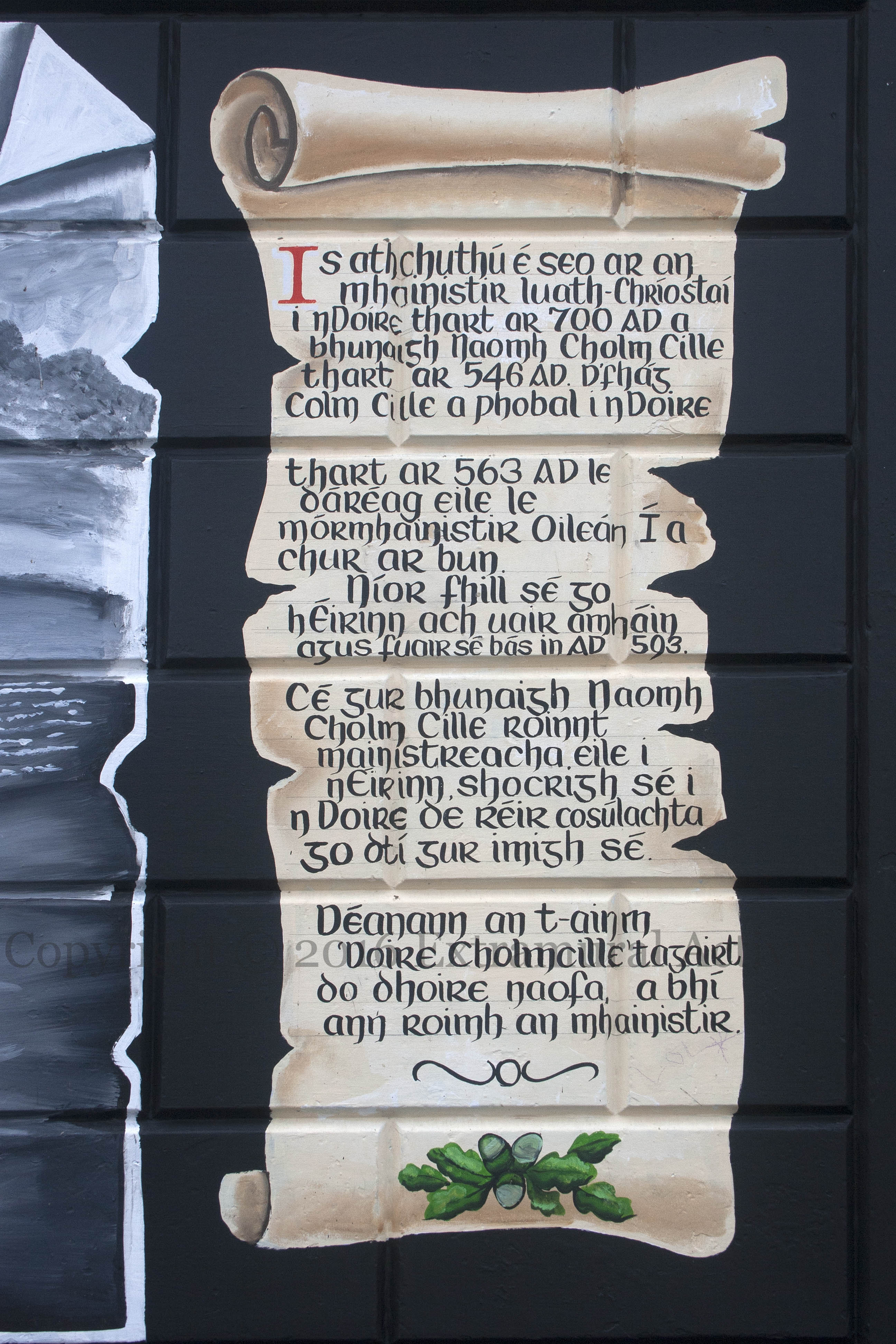
“Is athchuthú é seo ar an mhainistir luath-Chríostaí i nDoıre thart ar 700 AD a bhunaigh Naomh Cholm Cıille thart ar 546 AD. D’fhág Colm Cille a phobal ı nDoıre thart ar 563 AD le dáréag eıle le mómhaınıstır oıleán Í a chur ar bun. Níor fhill sé go hÉıreann ach uaır amháın agus fuaır sé bás in AD 593. Cé gur bhunaigh Naomh Cholm Cille roınnt maınıstreacha eıle ı nÉırınn, shocrıgh sé ı nDoıre de réır cosúlachta go dtí gut ımıgh sé. Déanann an t-aınm ‘Doıre Cholmcılle’ tagaırt do dhoıre naofa, a bhí ann roımh an mhaınıstir.”
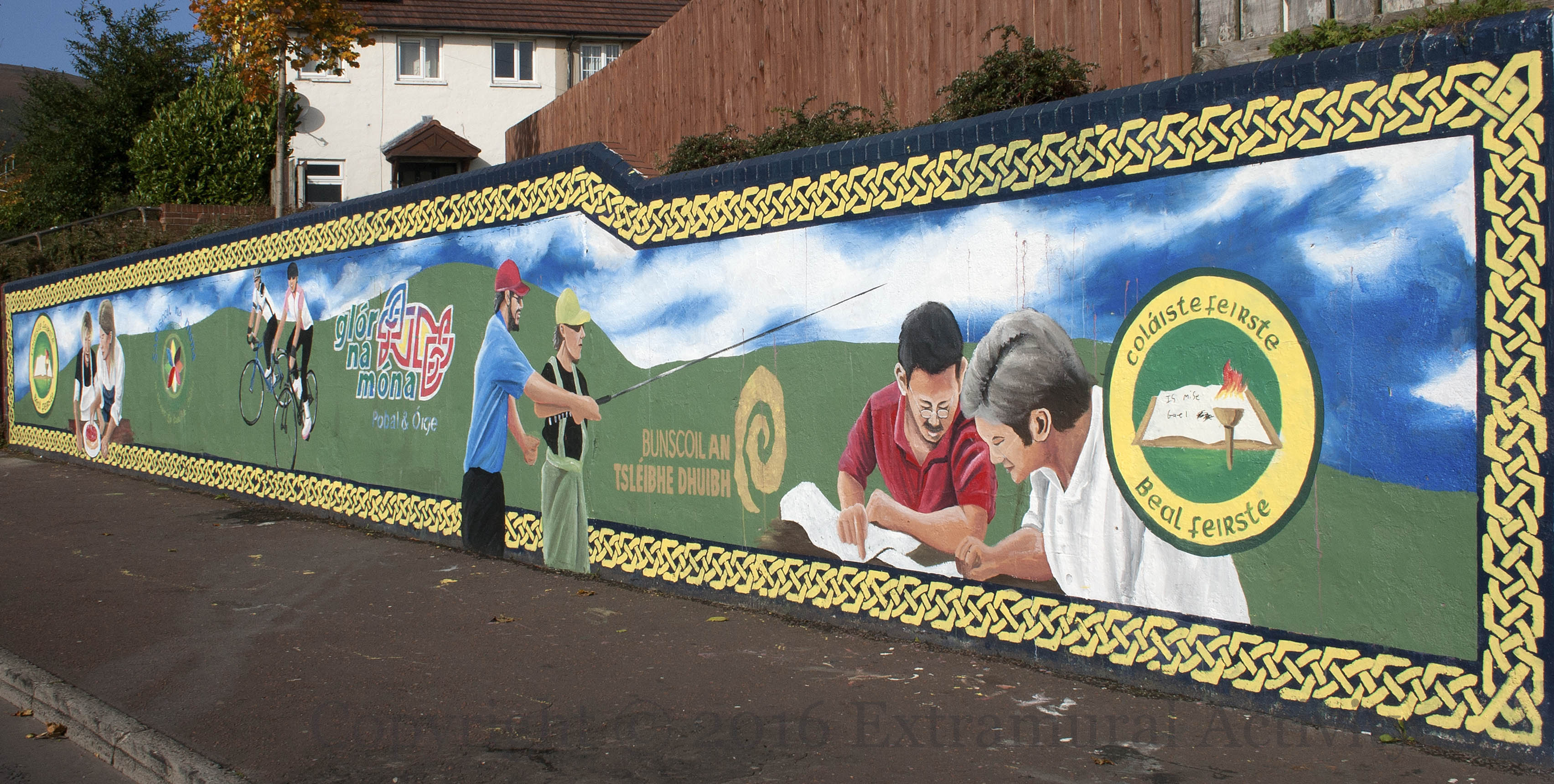
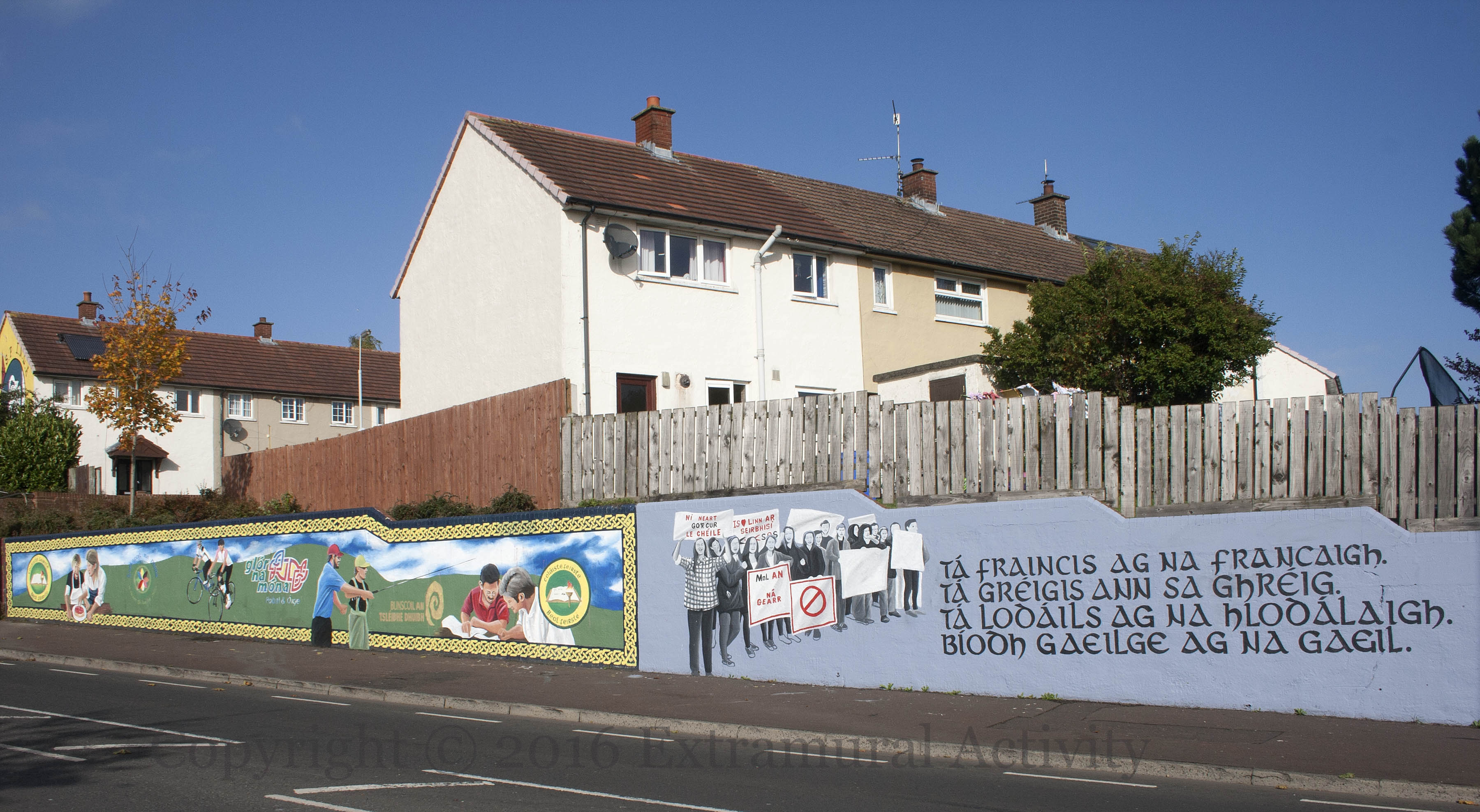
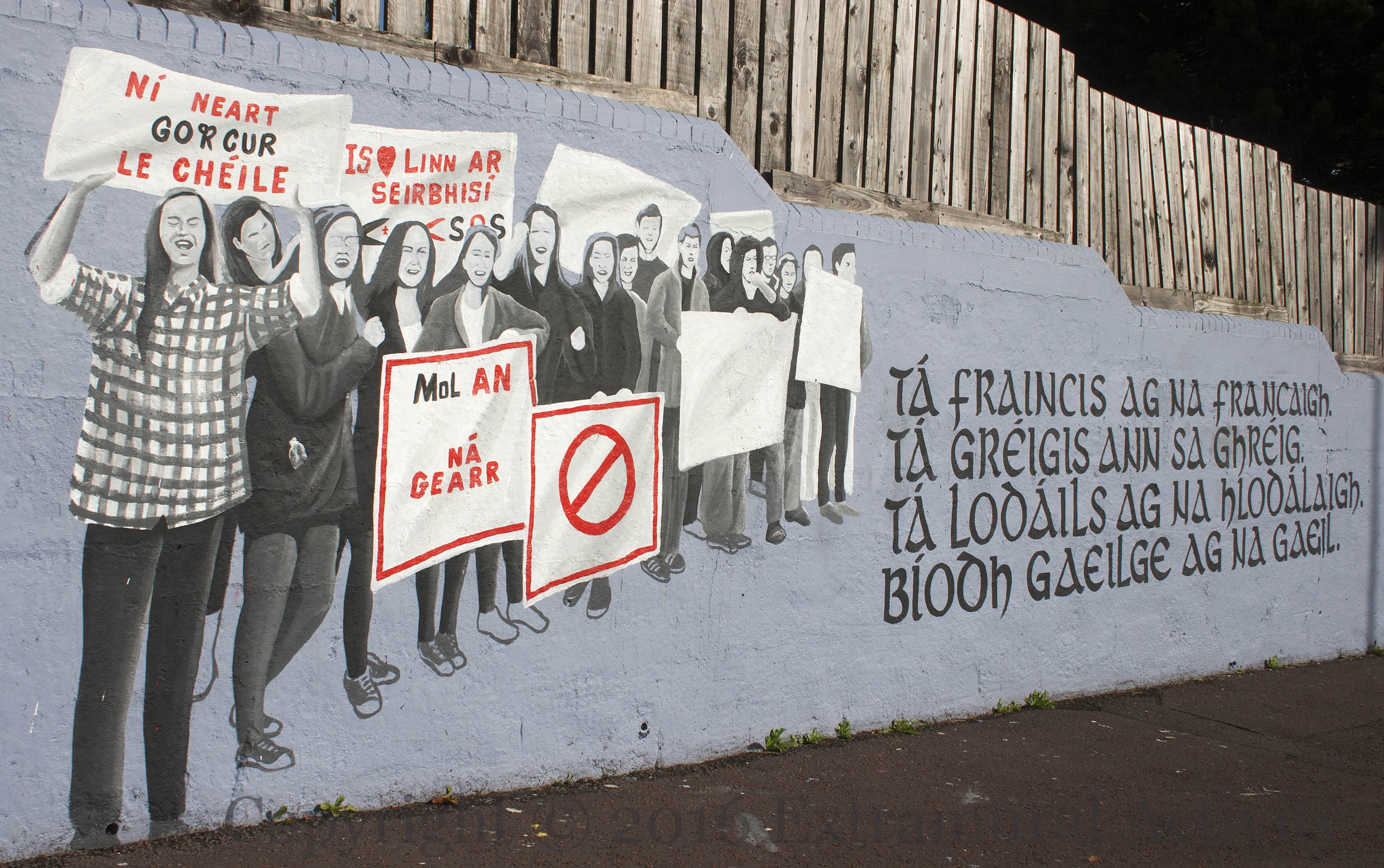
Above is a pro-Gaelic (Irish-language) mural on the Whiterock Road, with signs in Irish being held by young people protesting cuts to social services (on the left) and (on the right) a short poem: “Tá Fraıncıs ag na Francaıgh/Tá Gréıgıs ann sa Ghréıg/Tá Iodáıl[ı]s ag na hIodálaıgh/Bíodh Gaeılge ag na Gaeıl.” That is: the French have French, the Greeks Greek, the Italians Italian; let there be Irish for the Irish.
The mural has been in this (unfinished?) state since October, 2015. Loading? The third line in fact has initial “L”s rather than “I”, which suggests — if a fada is added over the “o”s and the final “s” removed from “Lodáıls” — “the loaders have loading“
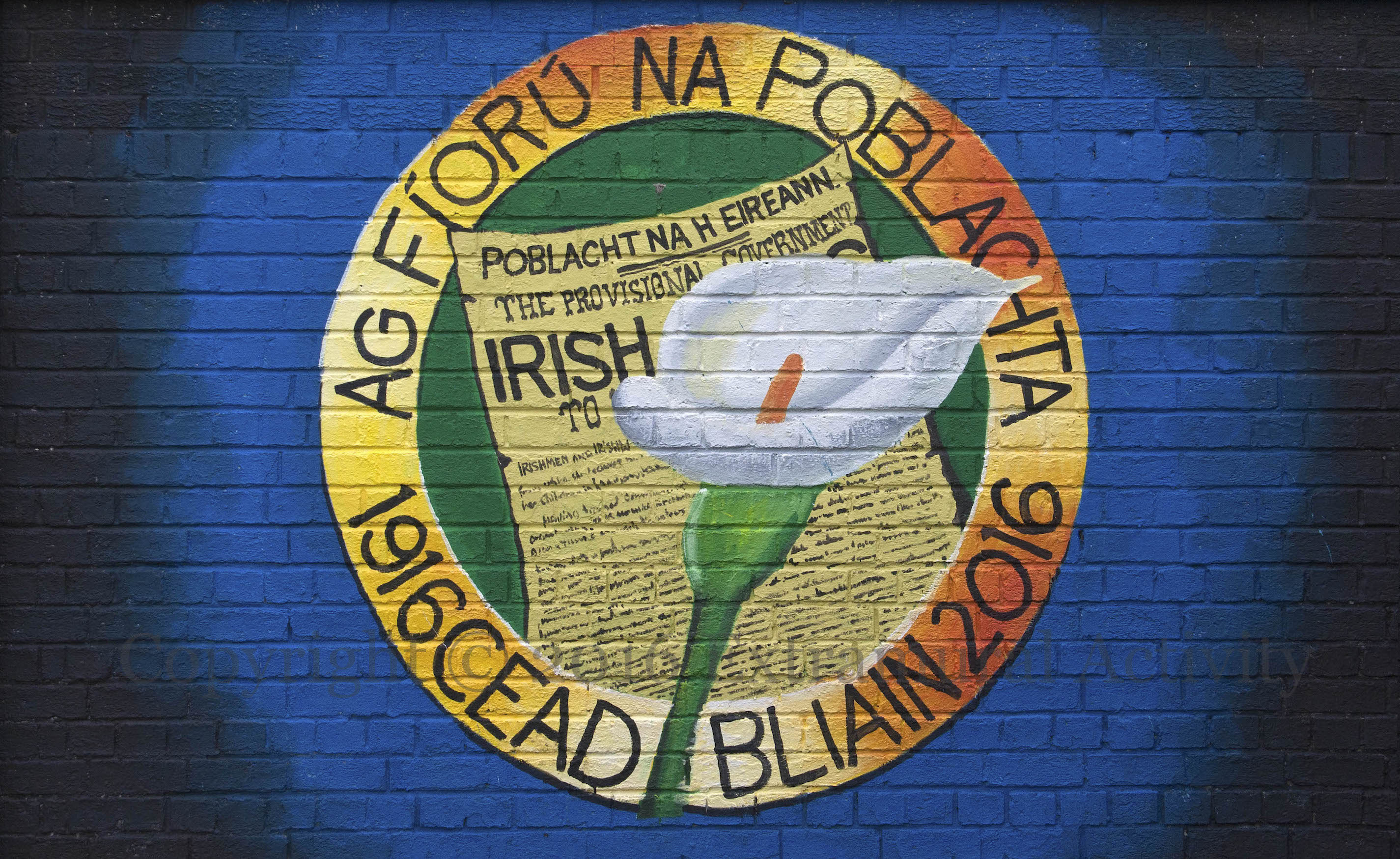
“Realising the Republic”. This is the first of three new murals side-by-side in Andersonstown. It celebrates the centenary (“Céad Blıaın 1916 – 2016”) of the Easter Rising and shows a copy of the proclamation of the republic and an Easter lily.
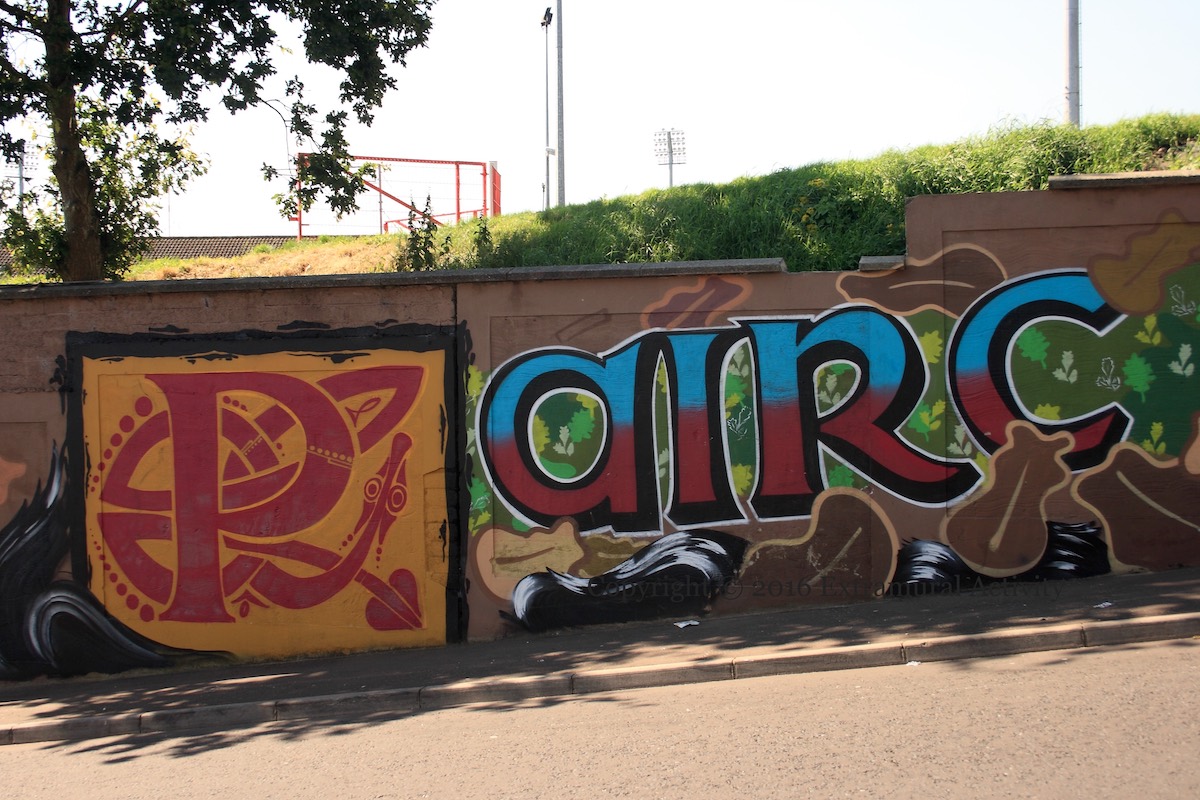
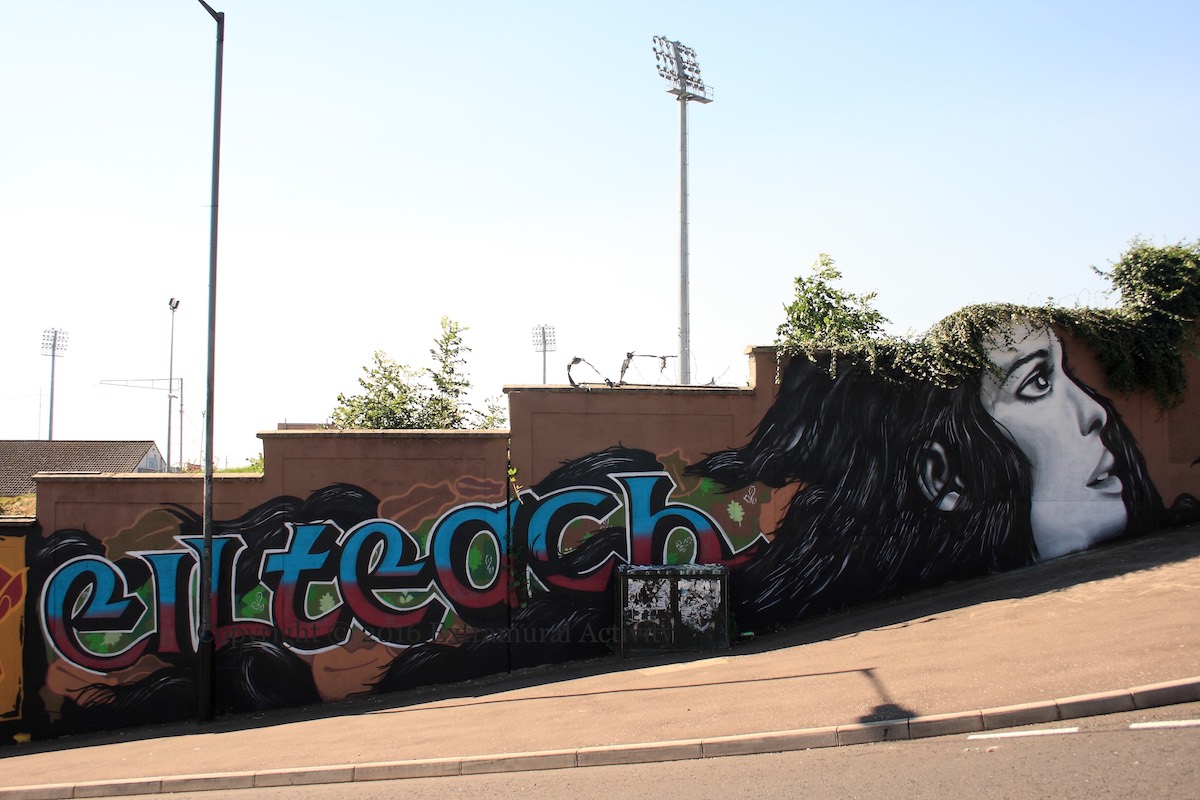
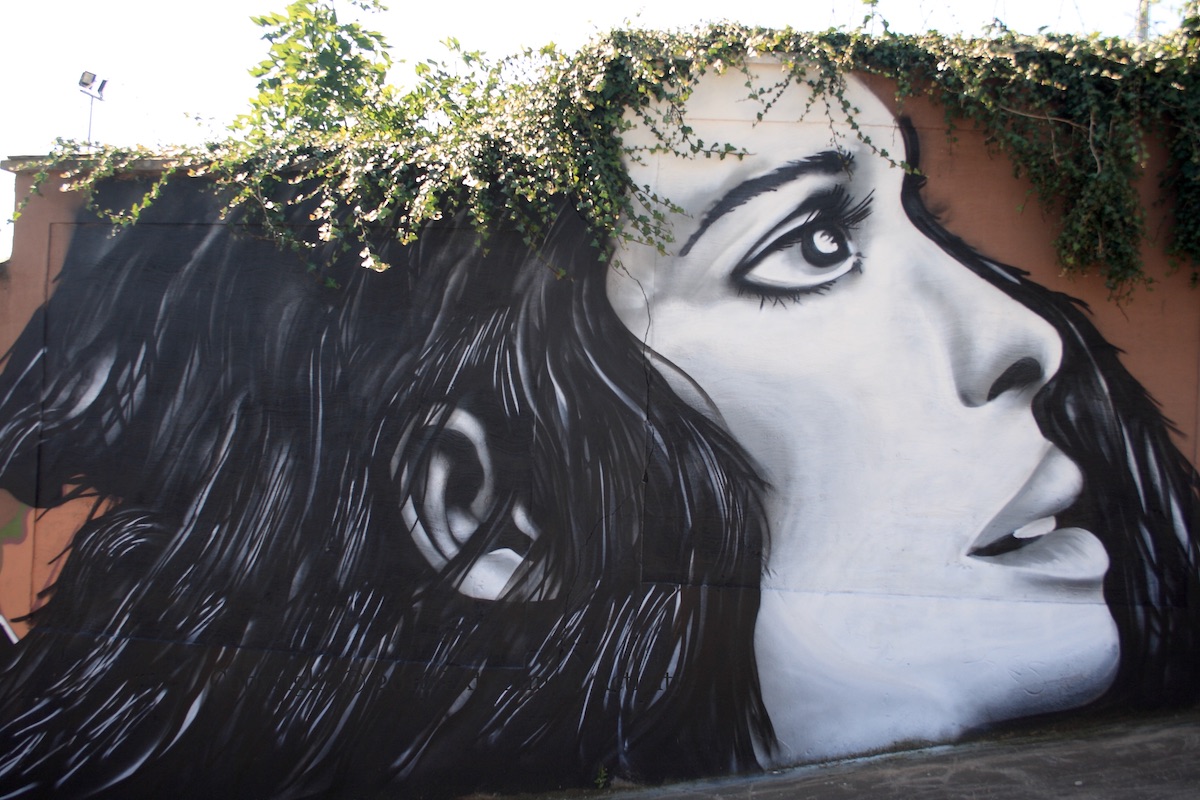
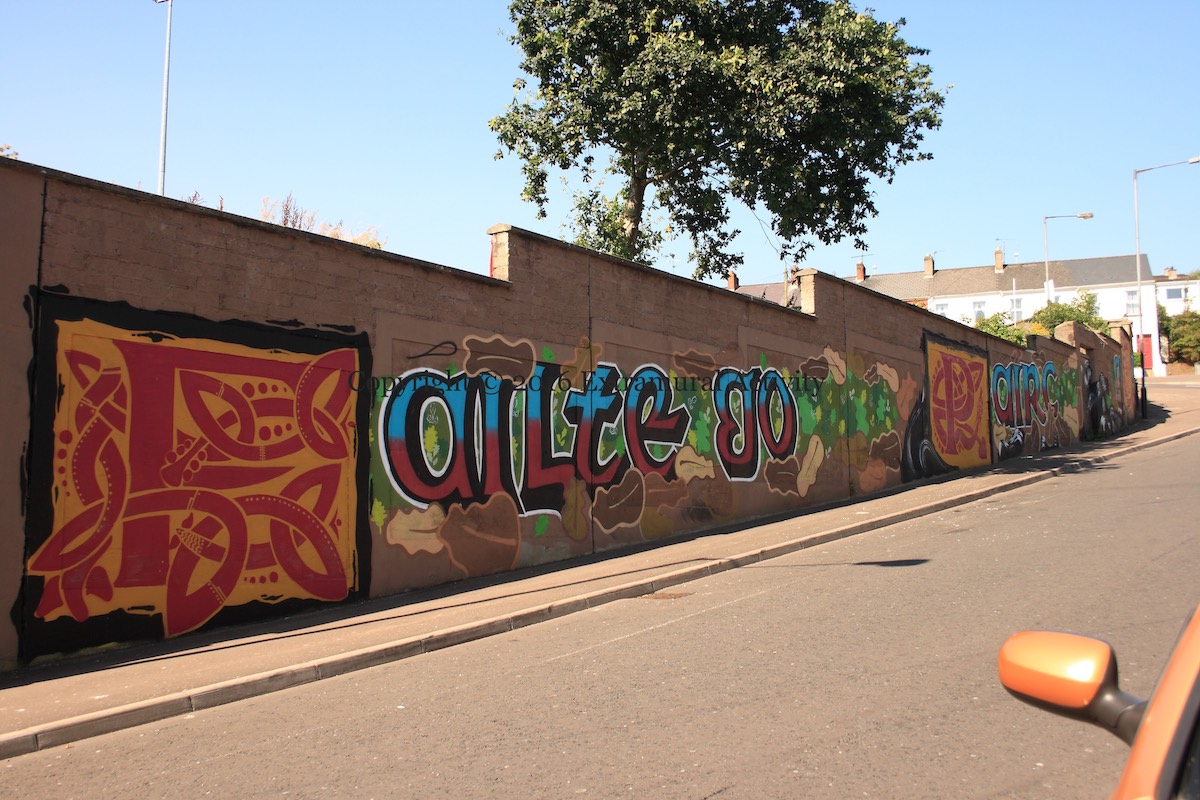
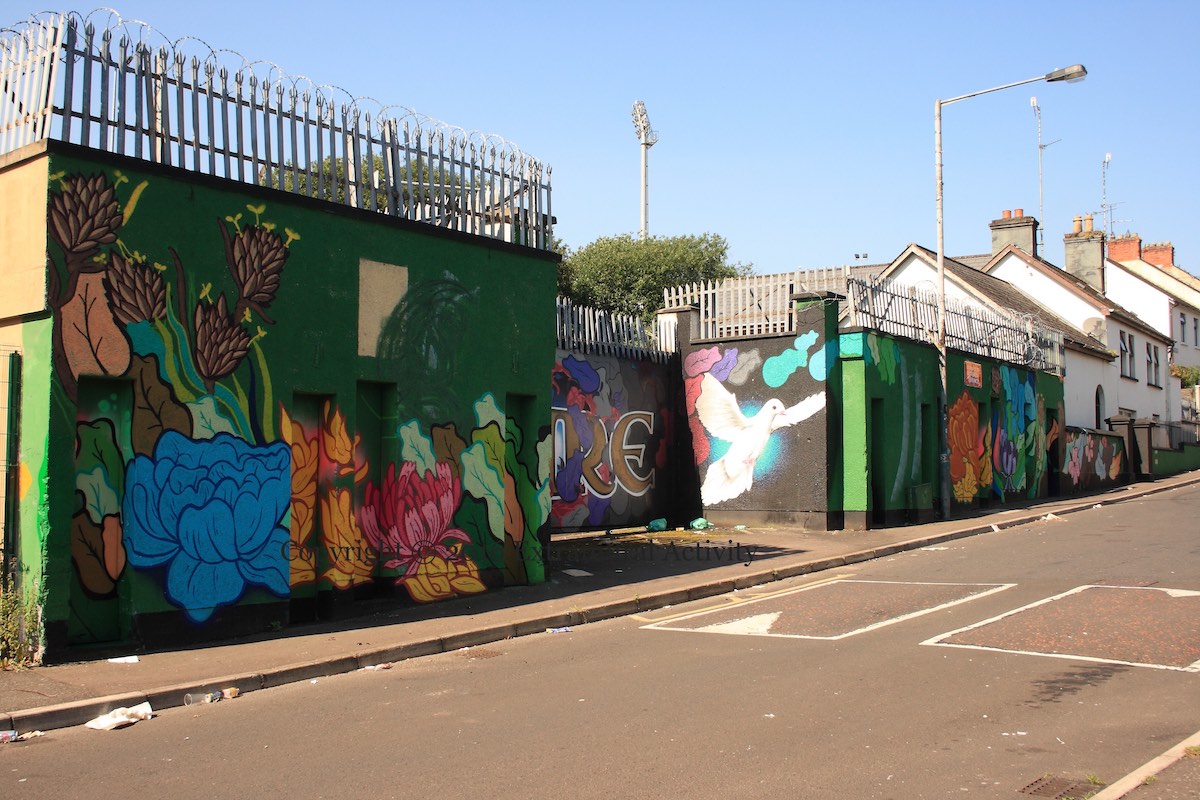
These images all come from Stanley’s Walk, along with eastern side of Celtic Park, which is home to Derry GAA games and has a capacity of 18,000 spectators.
 Seosamh Mac Coille Collection