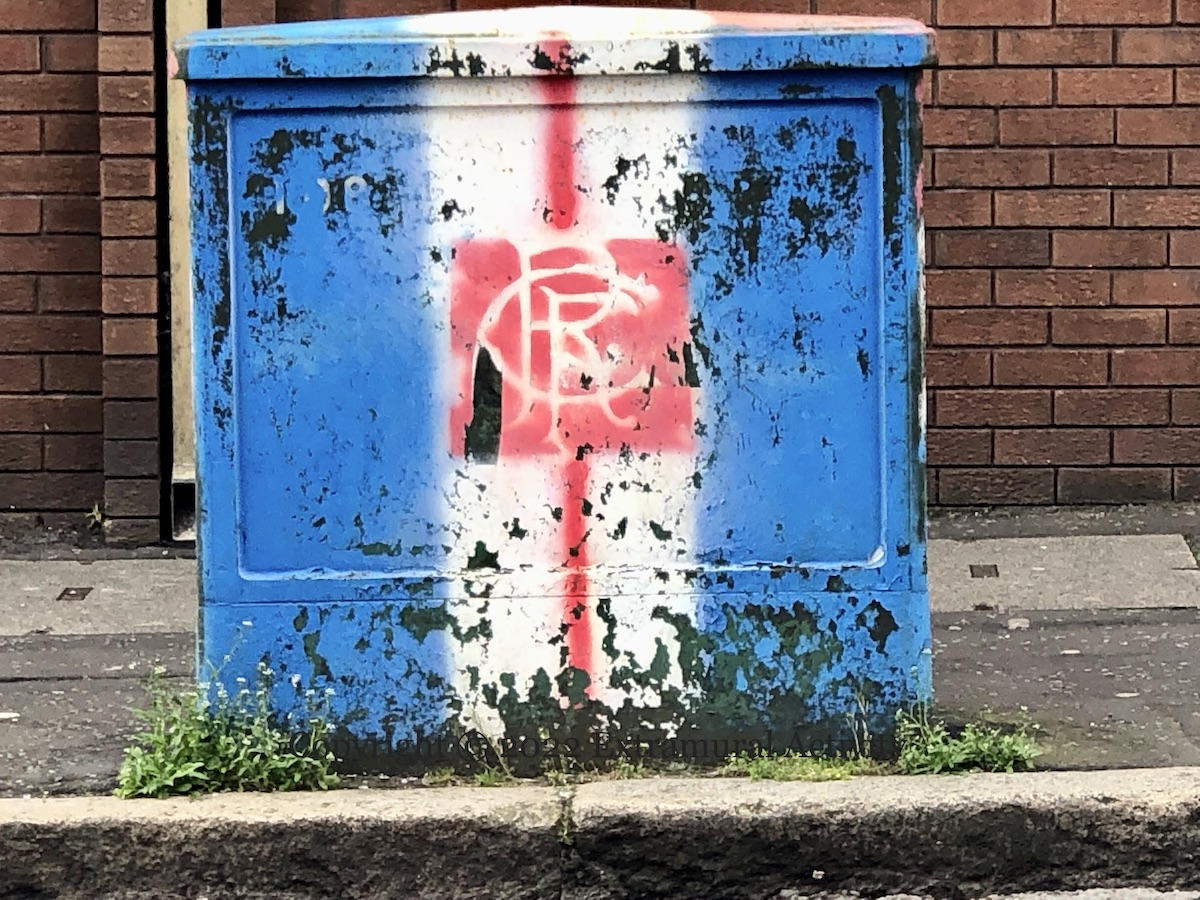
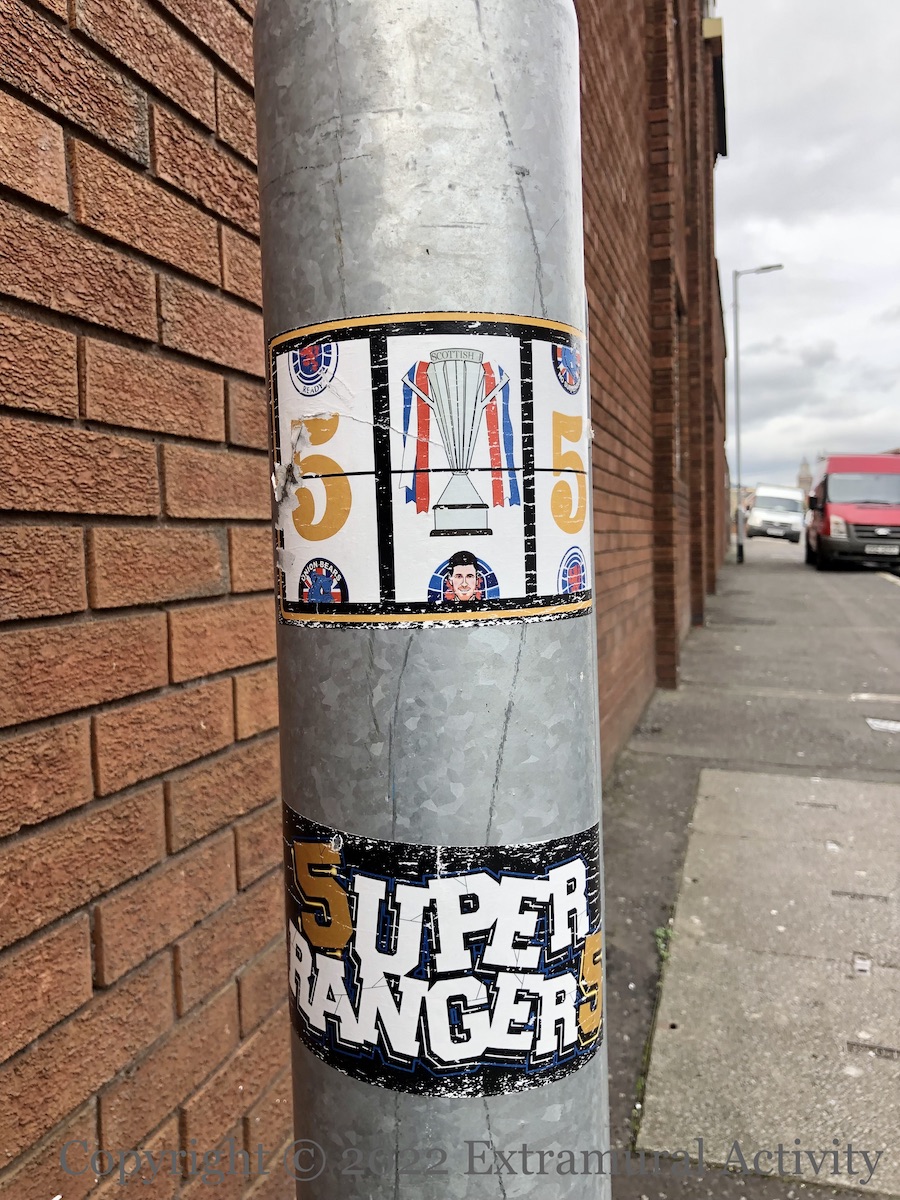
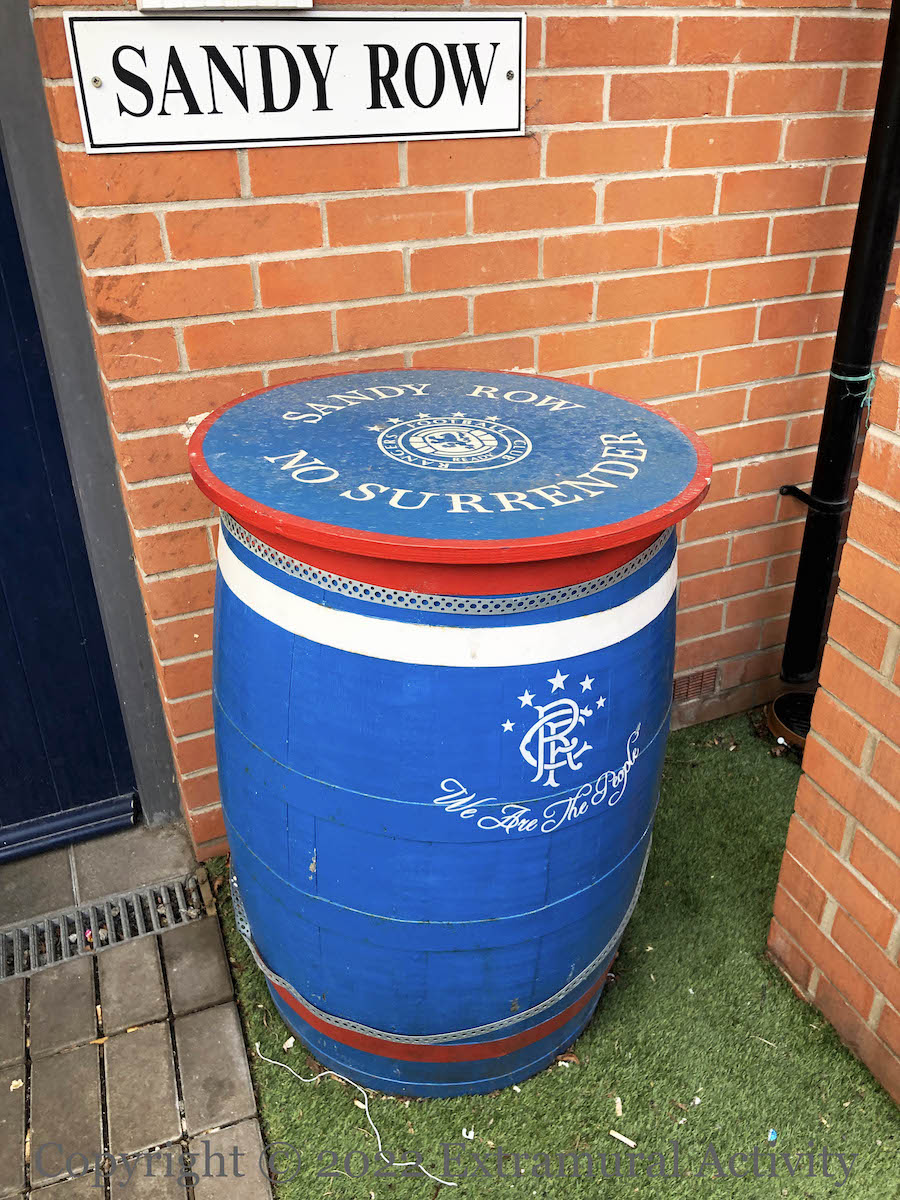
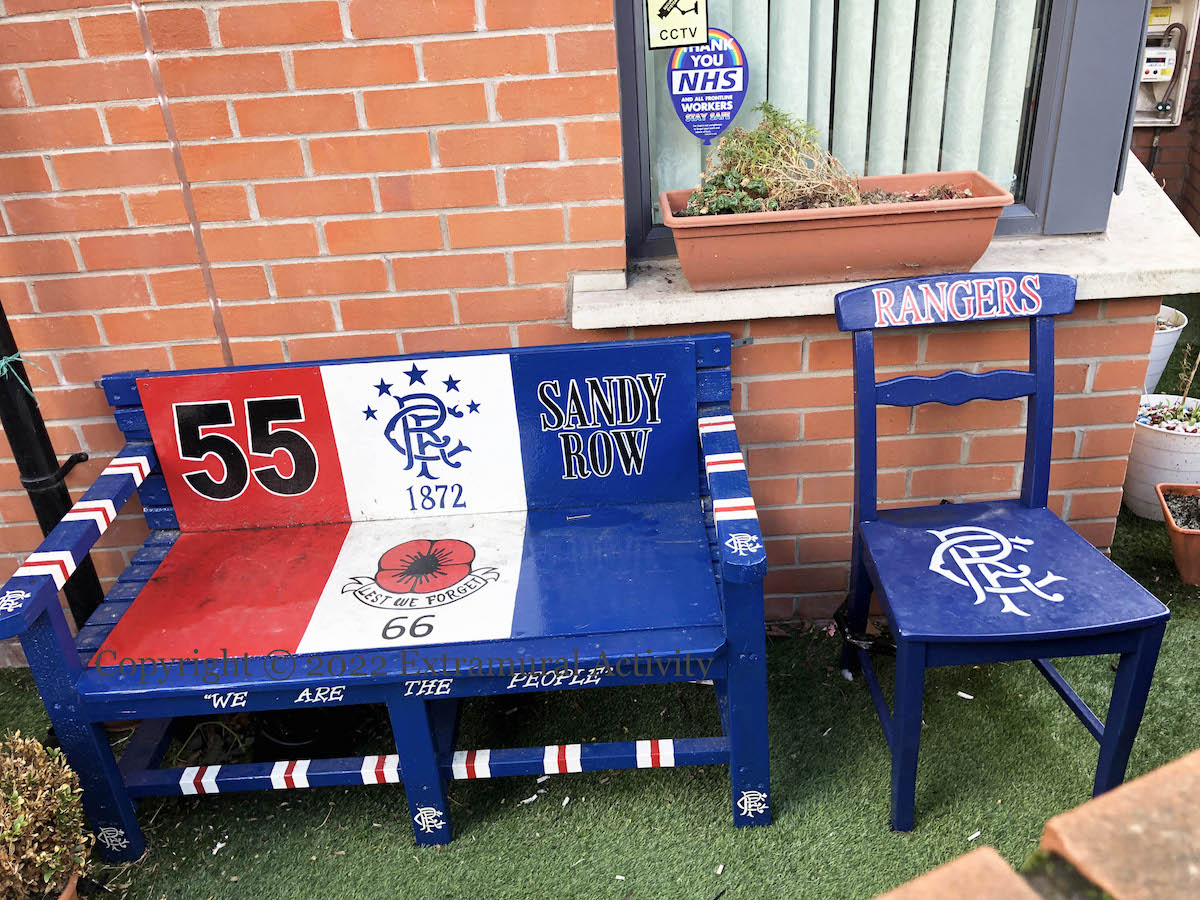
The slot machine last year came up with a 55 Scottish league title for Rangers and Rangers fans across Belfast celebrated with stickers and flags (Let Us Shout Joyfully | Order Restored | 55 | F*ck Your Ten In A Row | Blues Brothers | We’re Back | Legends Never Die) and also the stencilled electricity box from Berlin Street, west Belfast (above) and the furniture and barrel (below) from Sandy Row, south Belfast. This year is not looking so good, as they are six points down with three games to go (SkySports).
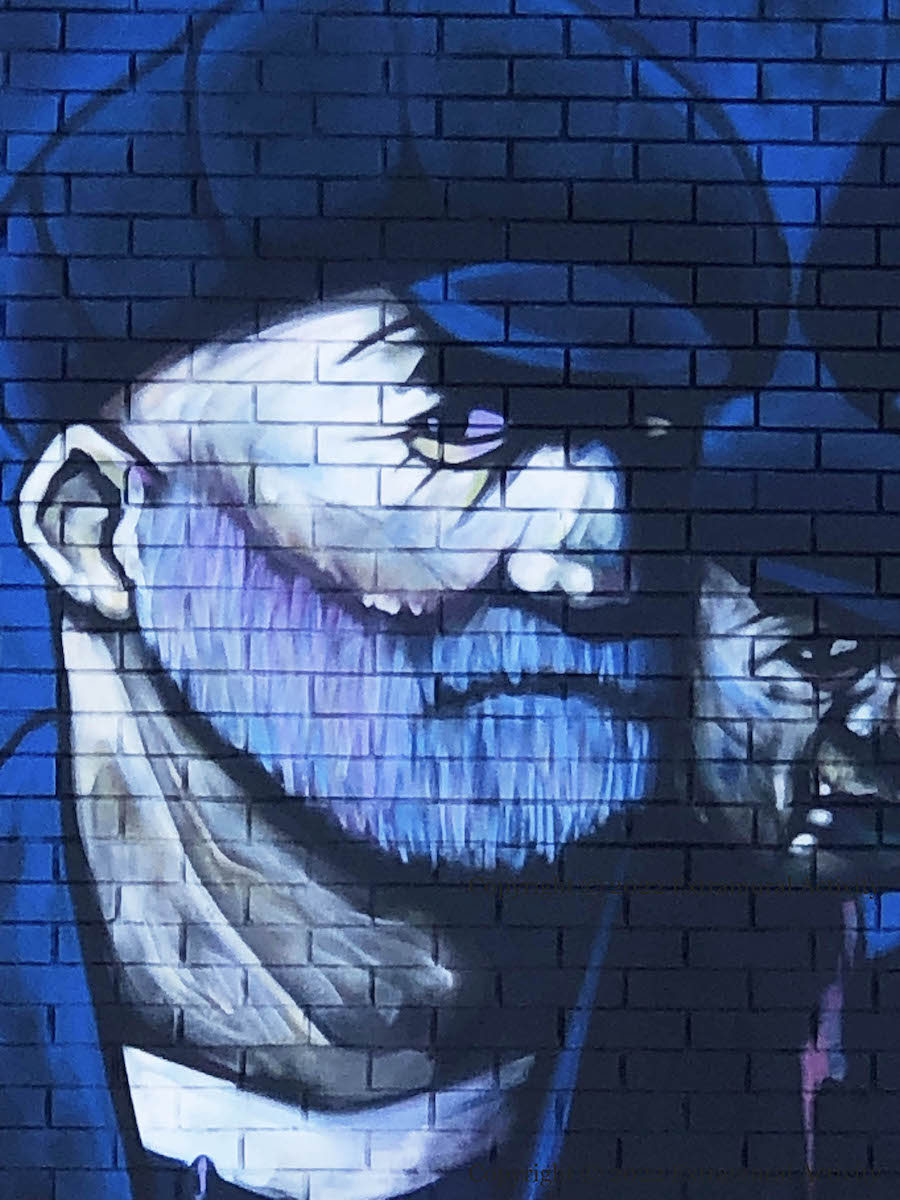
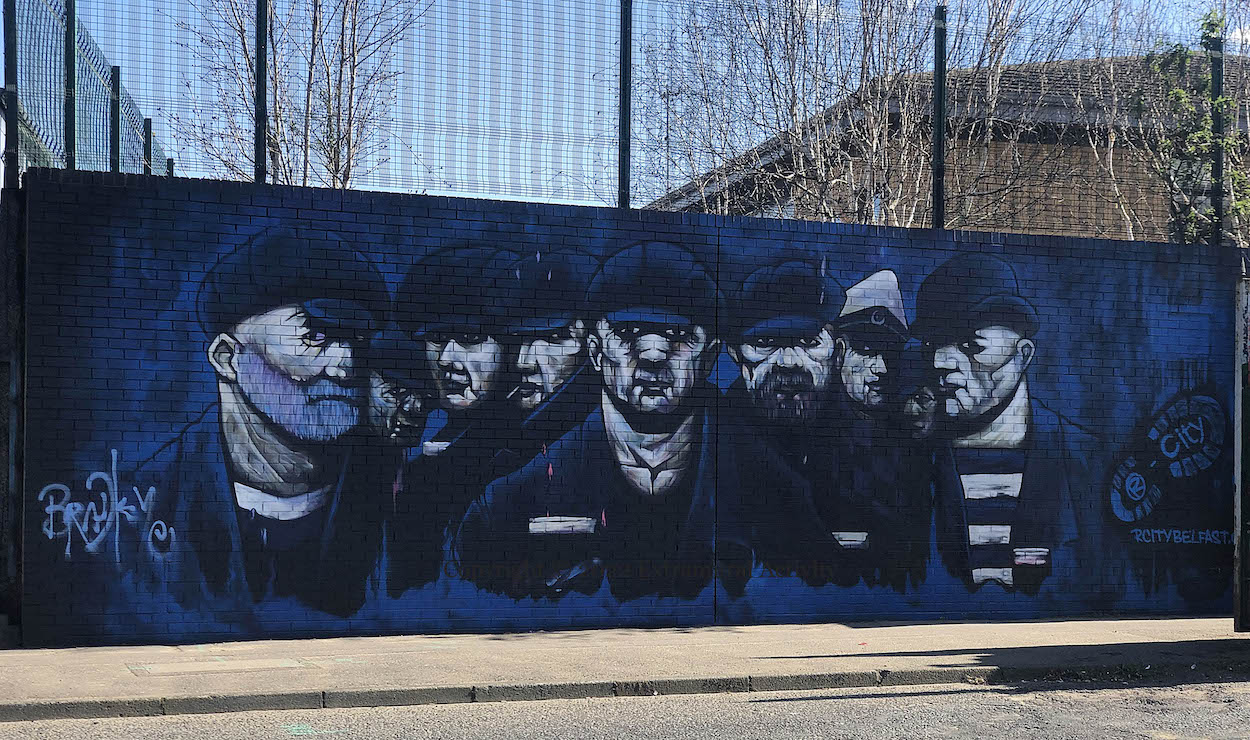
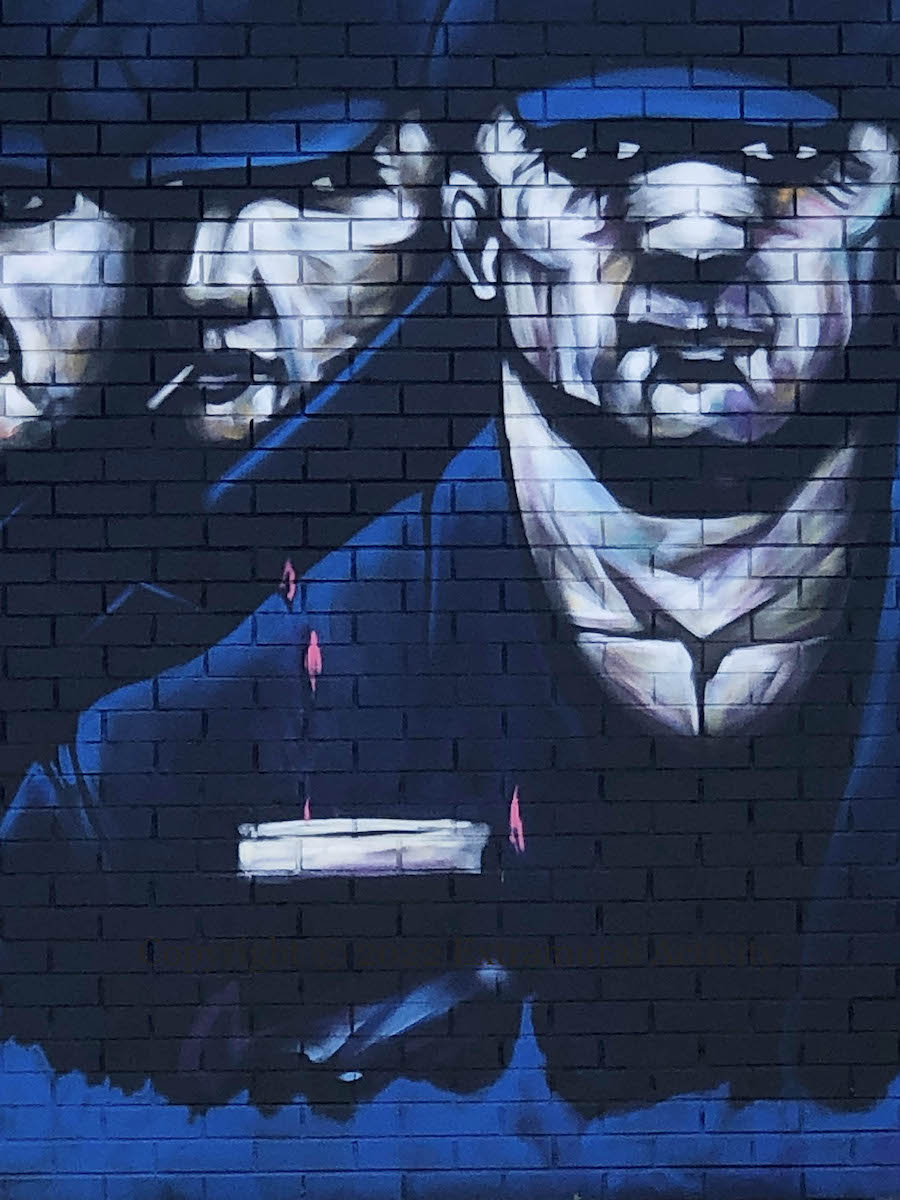
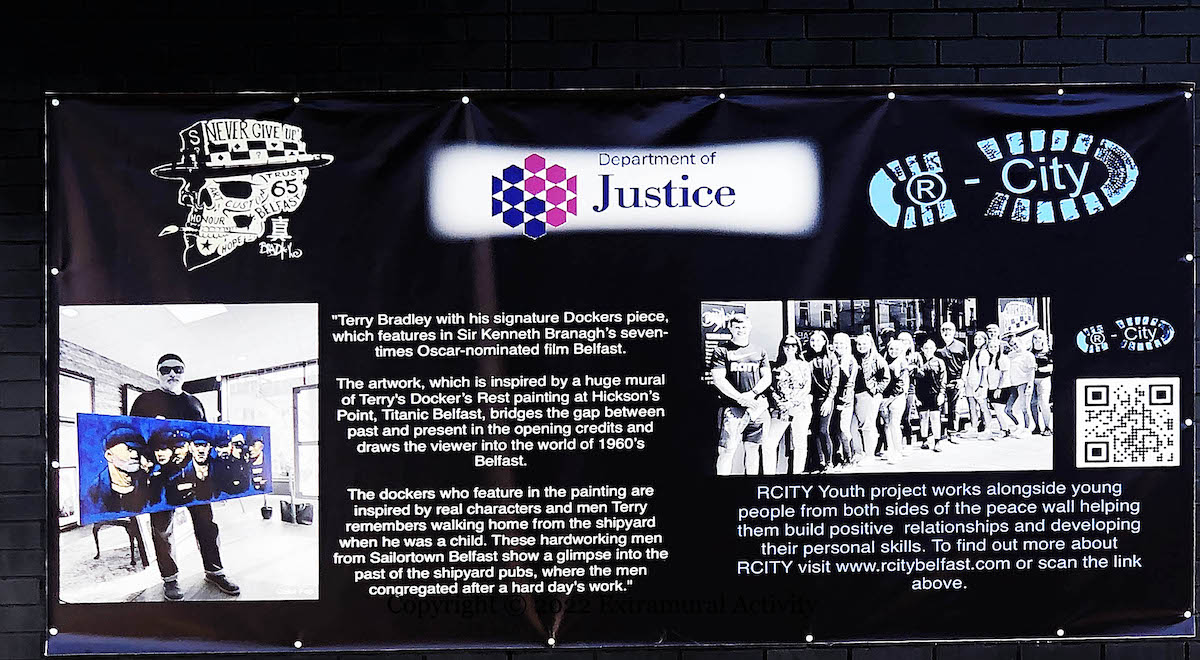
This is a mural of a painting of a mural of a mural. The original is the piece by Terry Bradley (web) and Friz (web) at the Titanic museum’s pub (see Dockers’ Rest), which was then reproduced in a different colour for the opening montage of the Kenneth Branagh film Belfast. The success of the film prompted the Department Of Justice to commission Bradley for a painting that could be turned into a mural and he reproduced the film version (BelTel). The mural that enlarges that painting was painted by DMC on Lanark Way, just above the security gates (Belfast Live).
“The dockers who feature in the painting are inspired by real characters and men Terry remembers walking home from the shipyard when he was a child. These hardworking men from Sailortown, Belfast, show a glimpse into the past of the shipyard pubs, where the men congregated after a hard day’s work.”
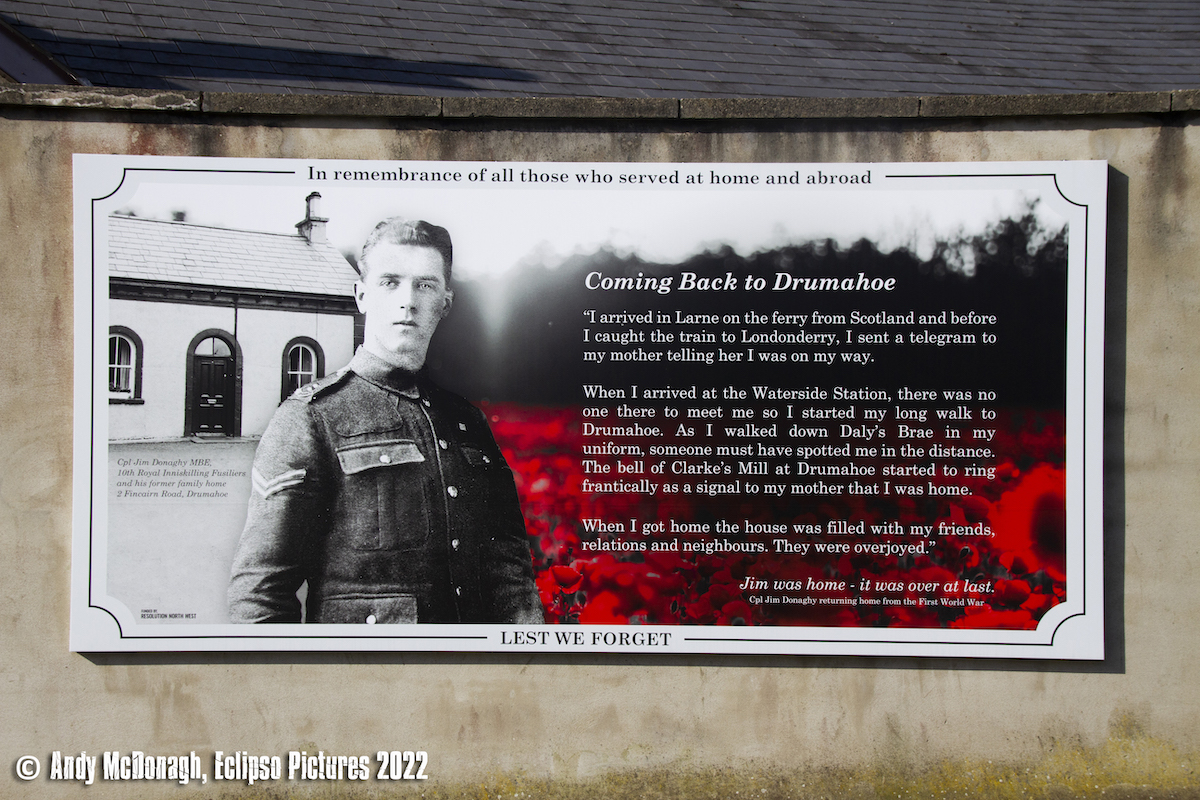
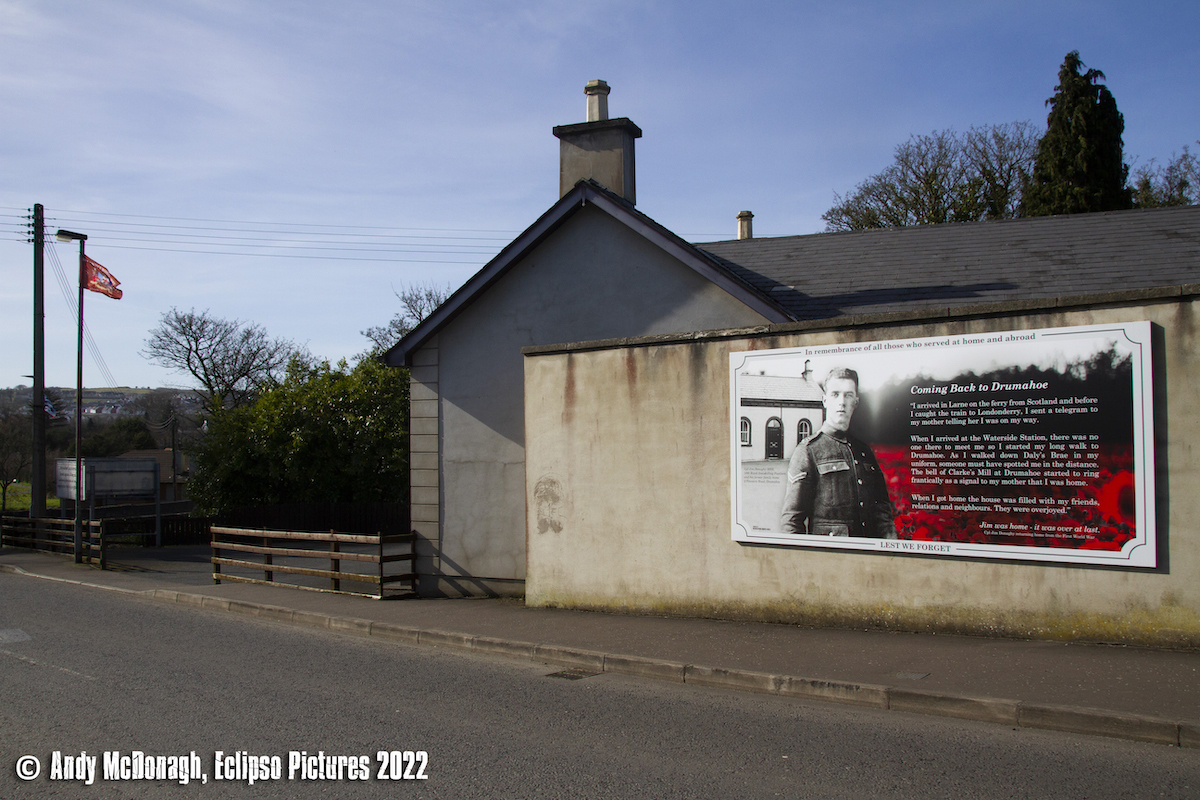
Jim Donaghy was born in the Bonds area of the Waterside but when he joined the 10th (Derry) Battalion his family was living in Drumahoe. It was to there that he returned after seeing action at The Battle Of Albert in 1916, as well as the Battle of Messines, the Battle of Langemarck, the Cambrai Operations, and the Capture Of Bourlon Wood (Reserves & Cadets | Three Cheers For The Derrys).
“”I arrived in Larne on the ferry from Scotland and before I caught the train to Londonderry, I sent a telegram to my mother telling her I was on my way. When I arrived in Waterside Station, there was no one there to meet me so I started my long walk to Drumahoe. As I walked down Daly’s Brae in my uniform, someone must have spotted me in the distance. The bell of Clarke’s Mill at Drumahoe started to ring frantically to my mother that I was home. When I got home the house was filled with my friends, relations and neighbours. They were overjoyed.” – Jim was home – it was over at least. Cpl Jim Donaghy returning home from the First World War.”
“Cpl Jim Donaghy MBE, 10th Royal Inniskilling Fusiliers and his former family home 2 Fincairn Road, Drumahoe.” The mural is on the yard wall of the house, which still stands.
“In remembrance of all those who served at home and abroad.”
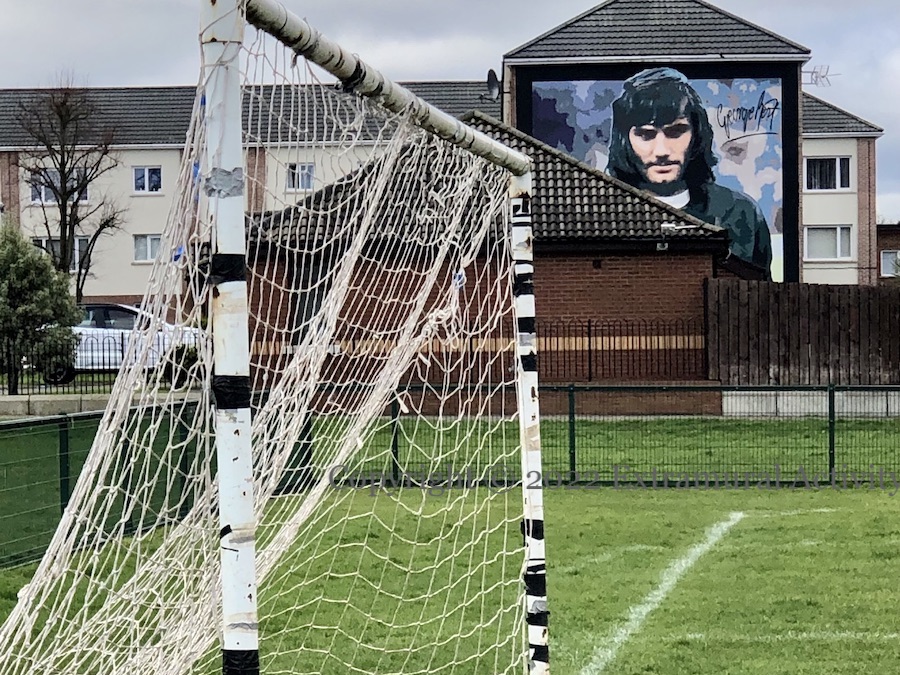
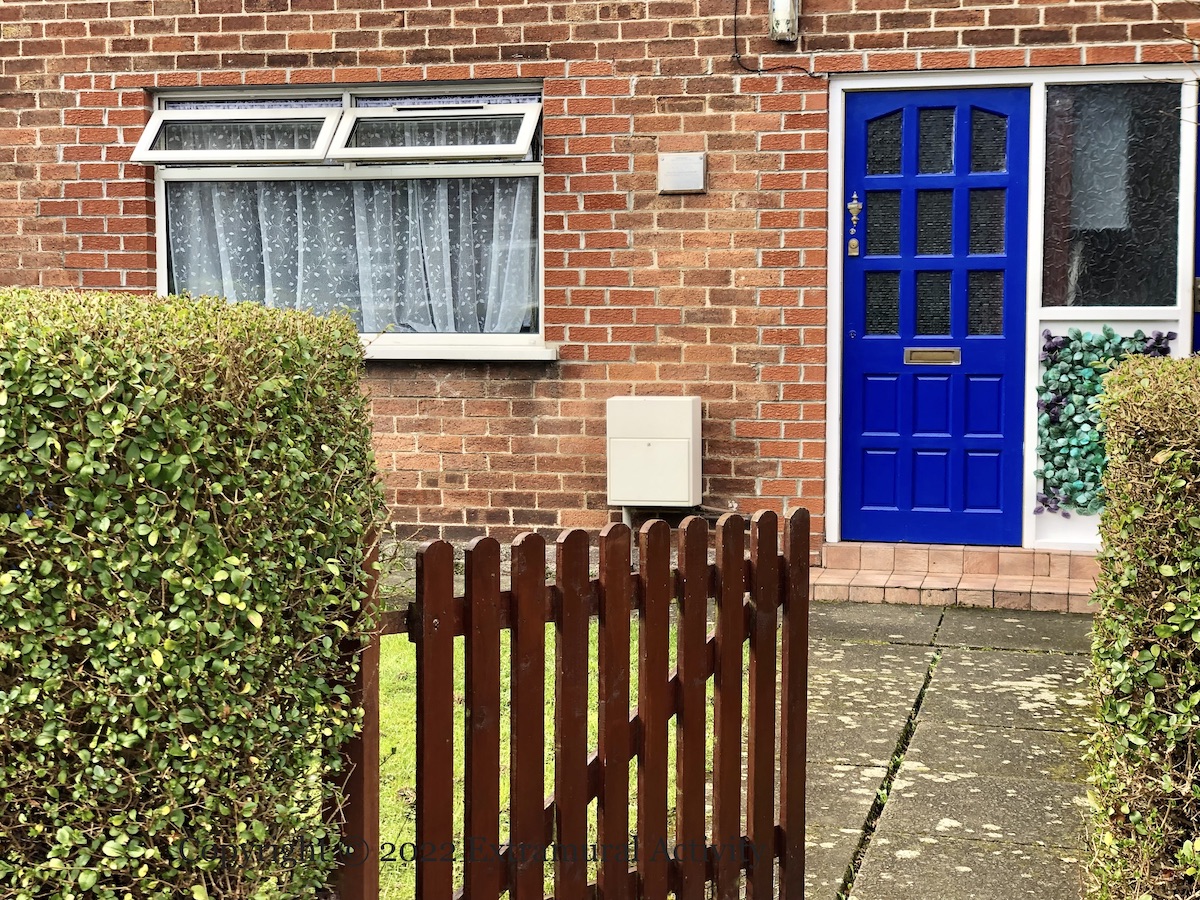
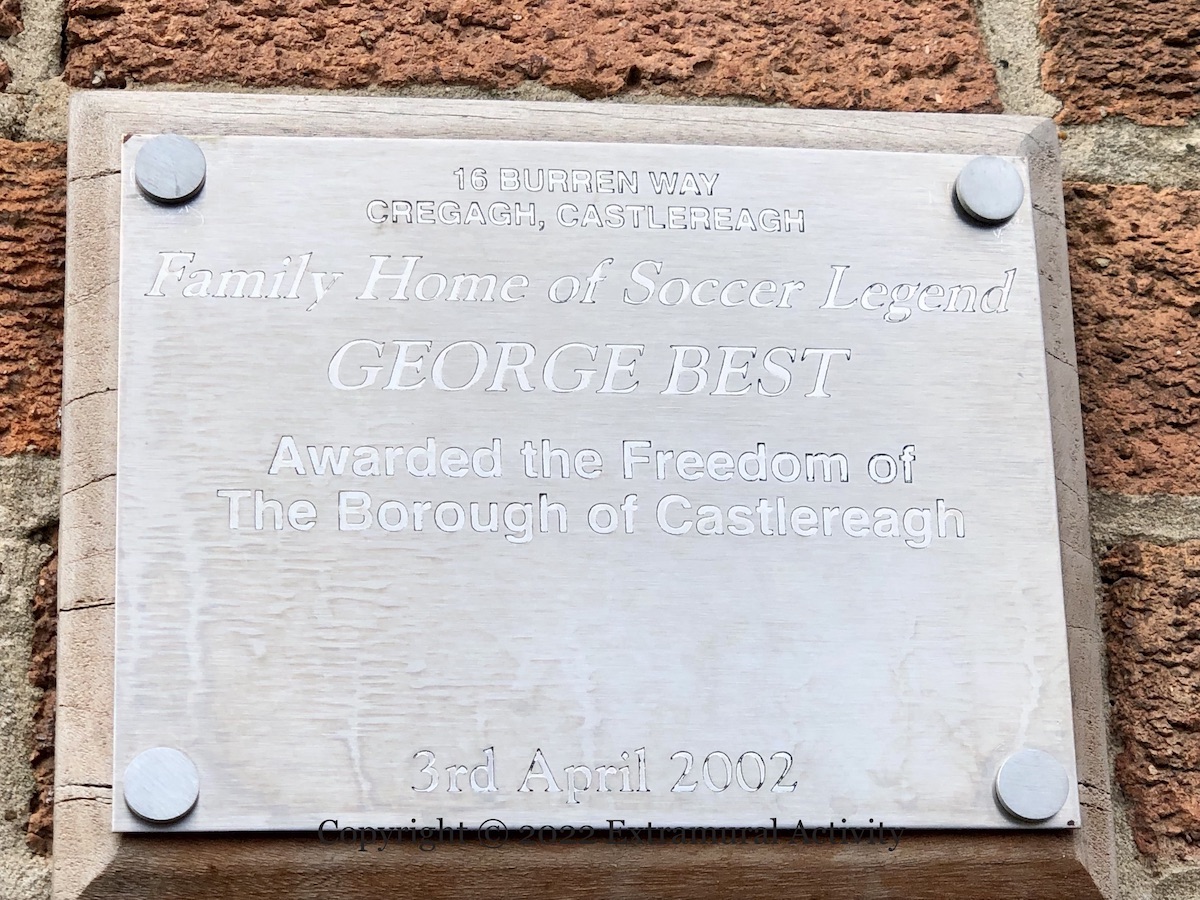
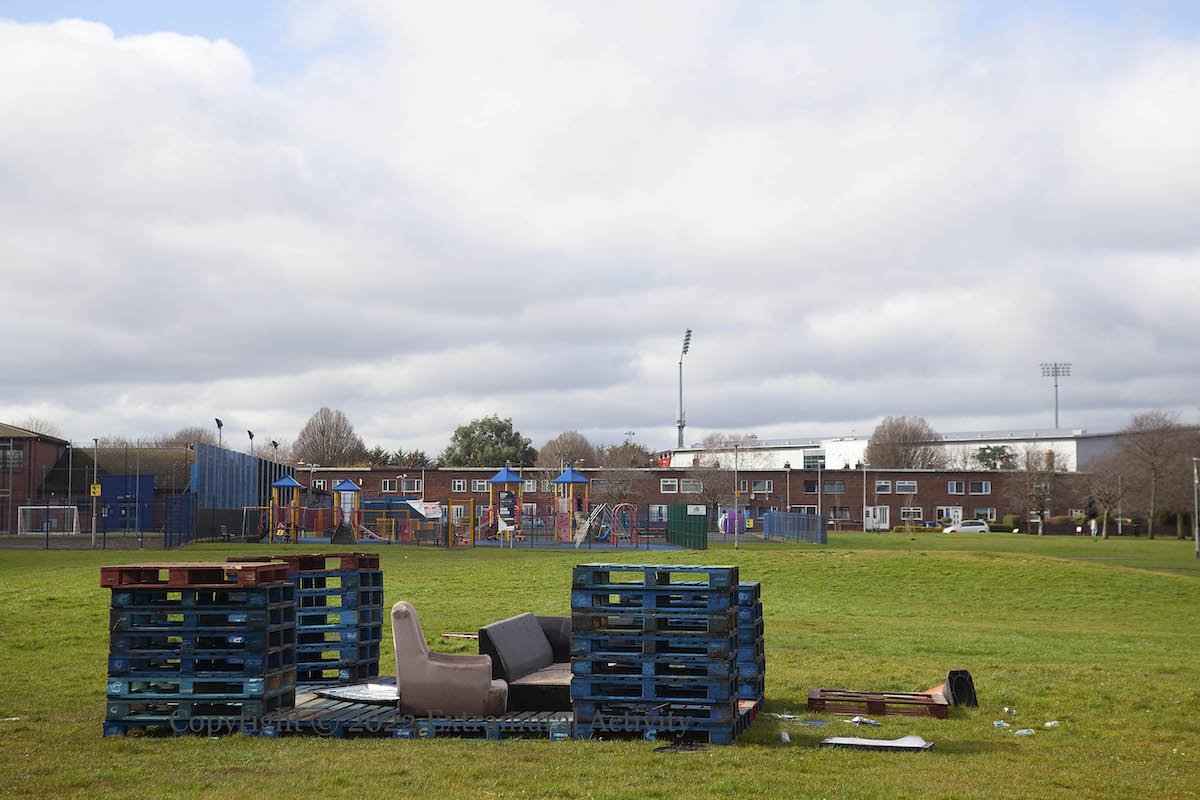
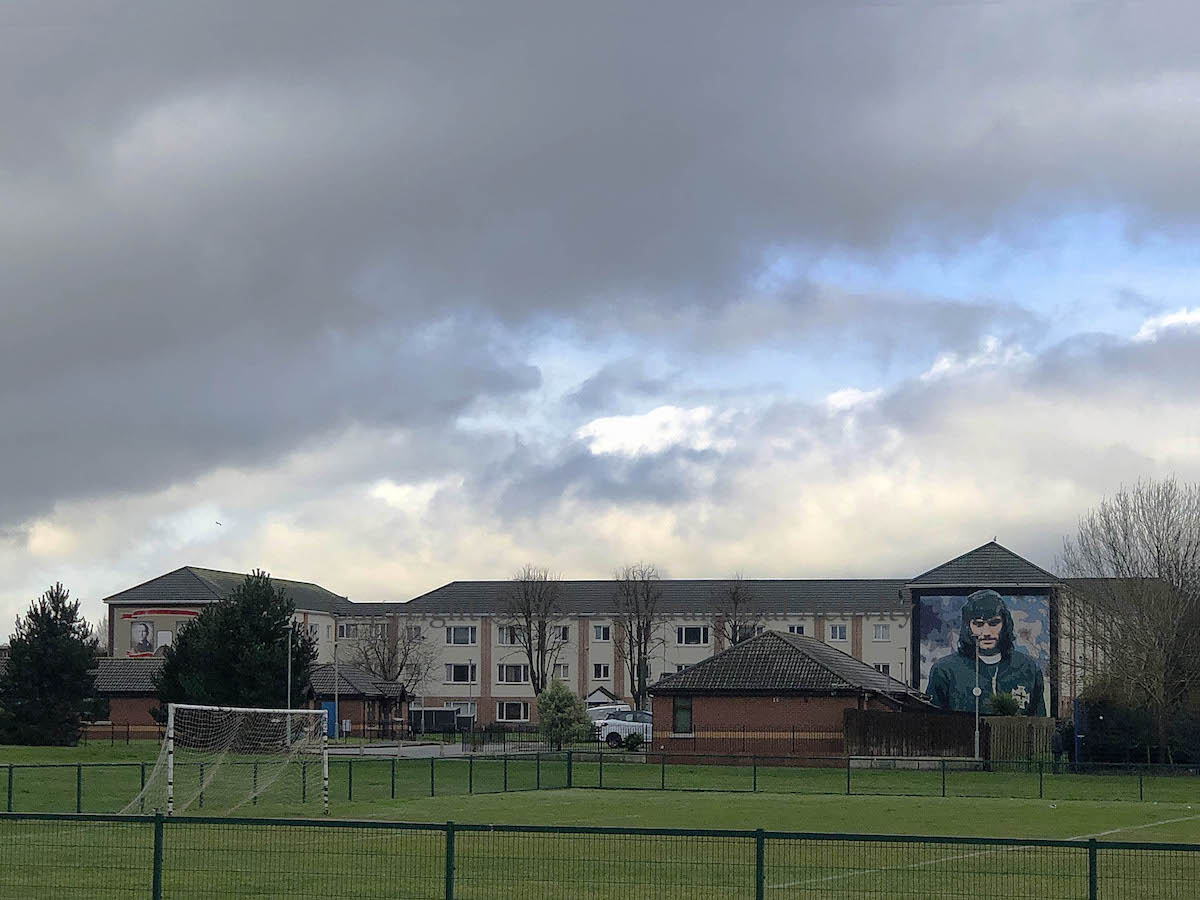
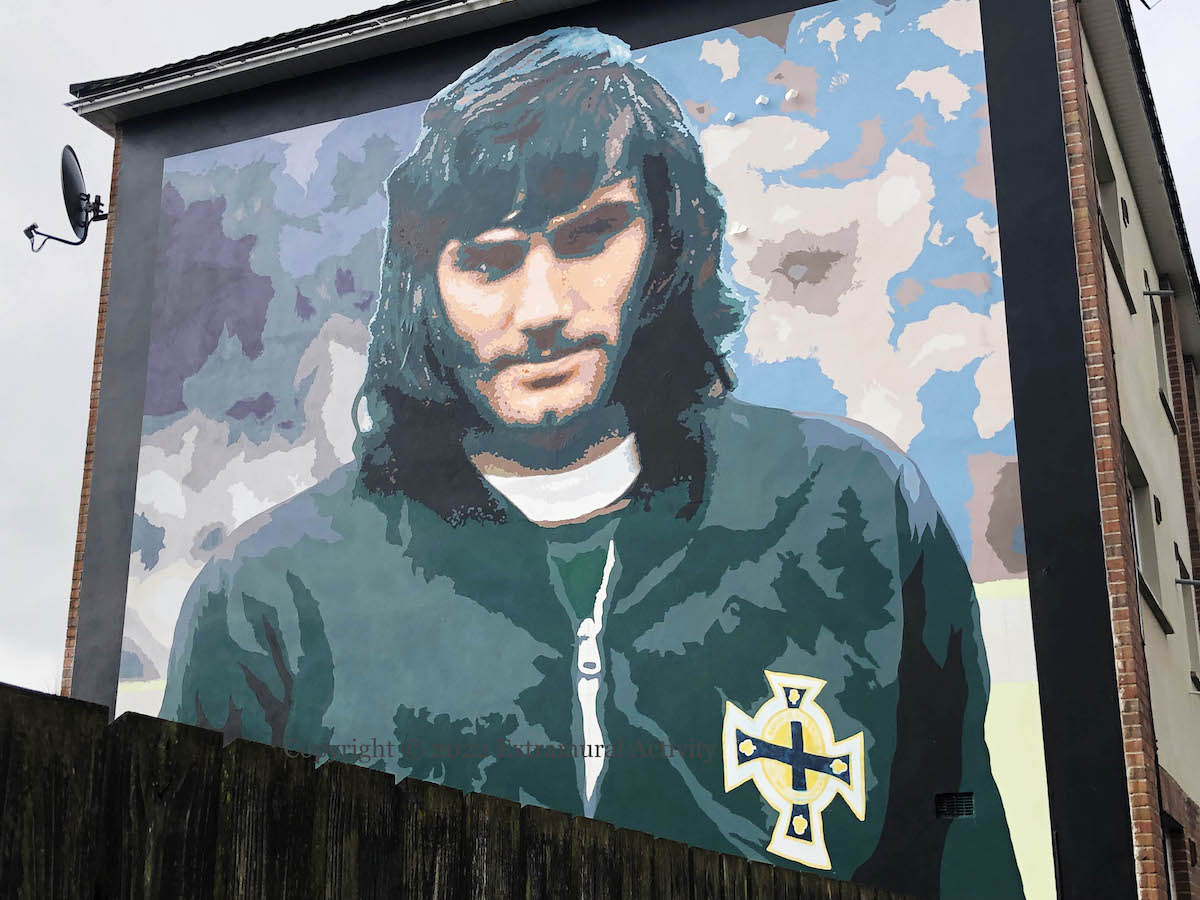
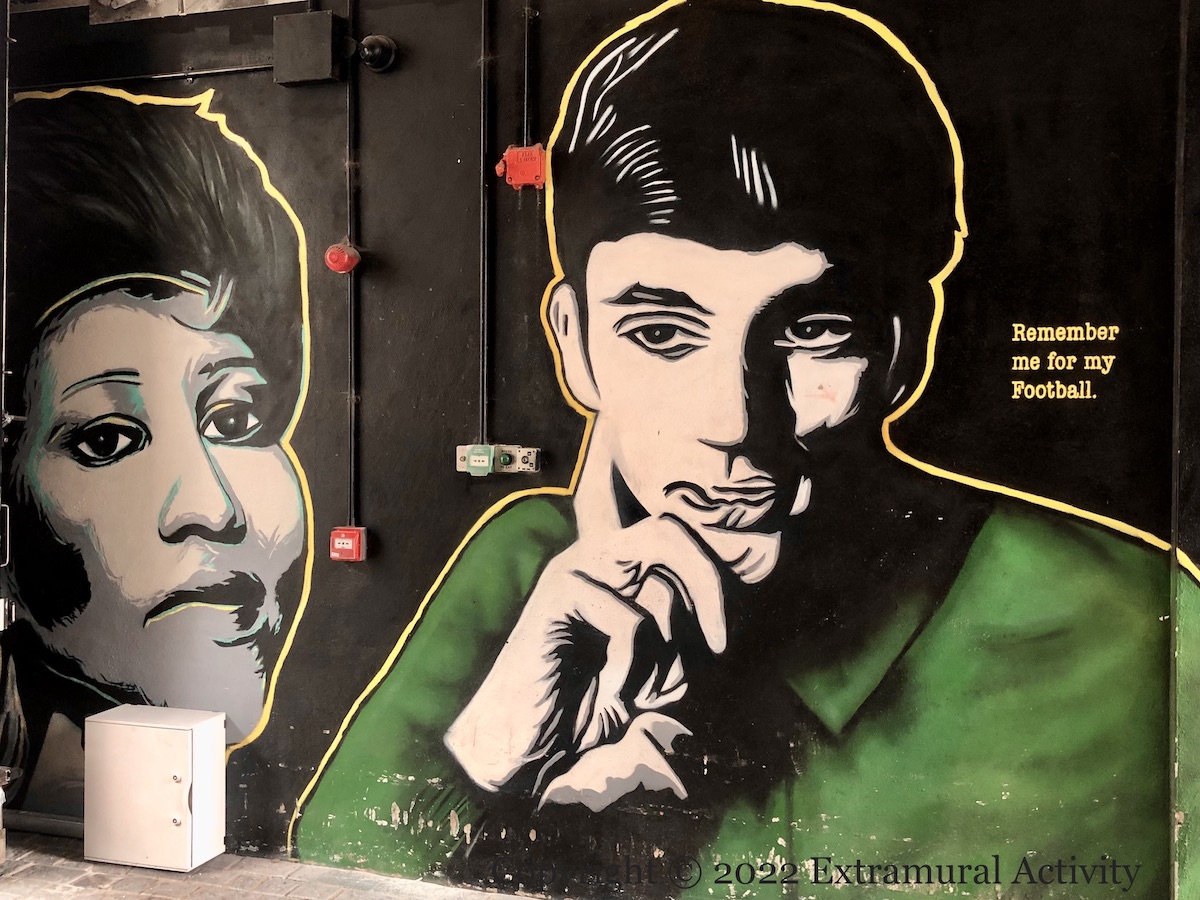
From the age of two-and-a-half George Best lived in Cregagh and played football on the pitch at the centre of the estate, where Cregagh Boys played their home games. After playing for Lisnasharragh Secondary he went to Manchester United at age fifteen – in 1961 – and from there to international stardom. When he died in 2005, he was remembered in the estate by a mural (that replaced a UFF mural). It stood for about ten years and now been updated with the mural shown in today’s images, along with the family home that has been returned to a 1960’s appearance – complete with George Best memorabilia – and is available to rent on AirBnb. The home and playing fields are also the starting part of the George Best Trail.
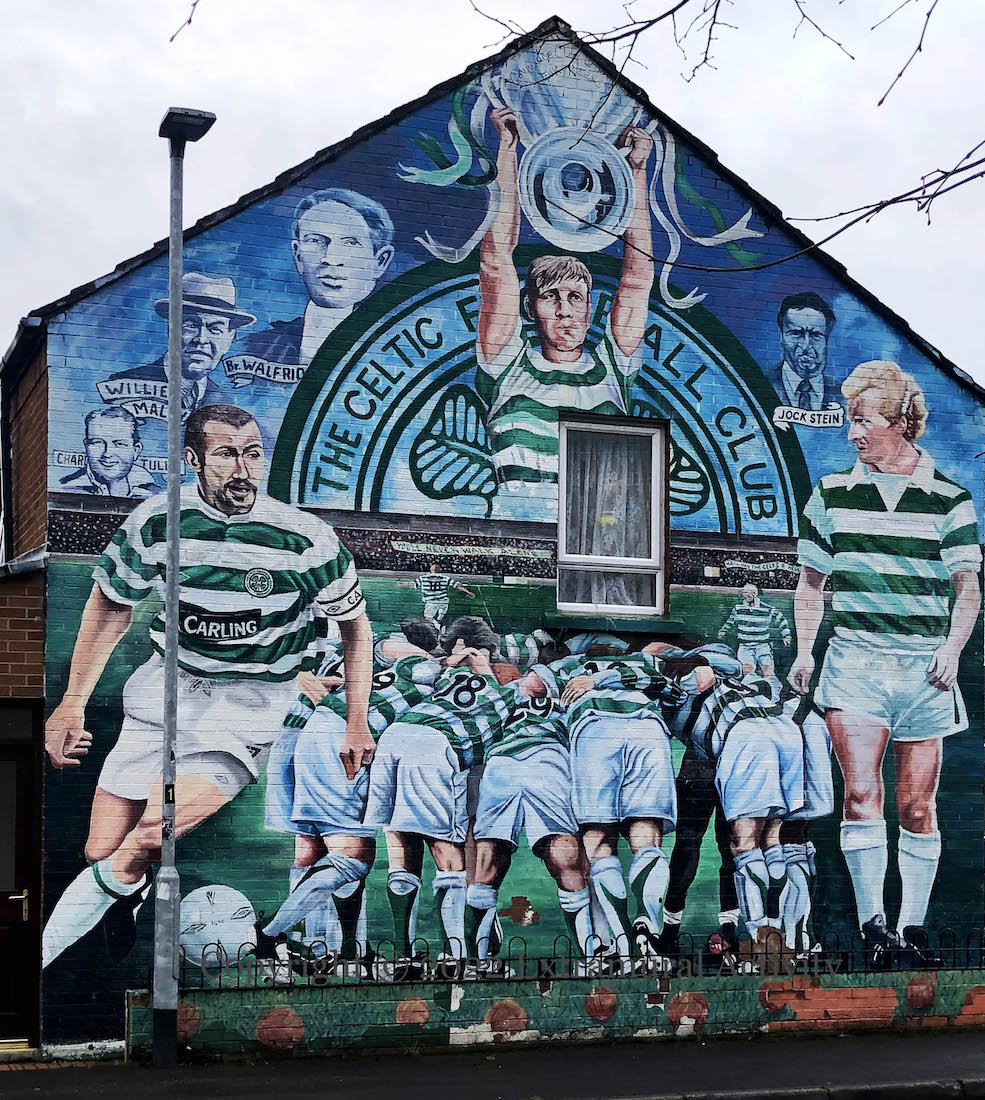
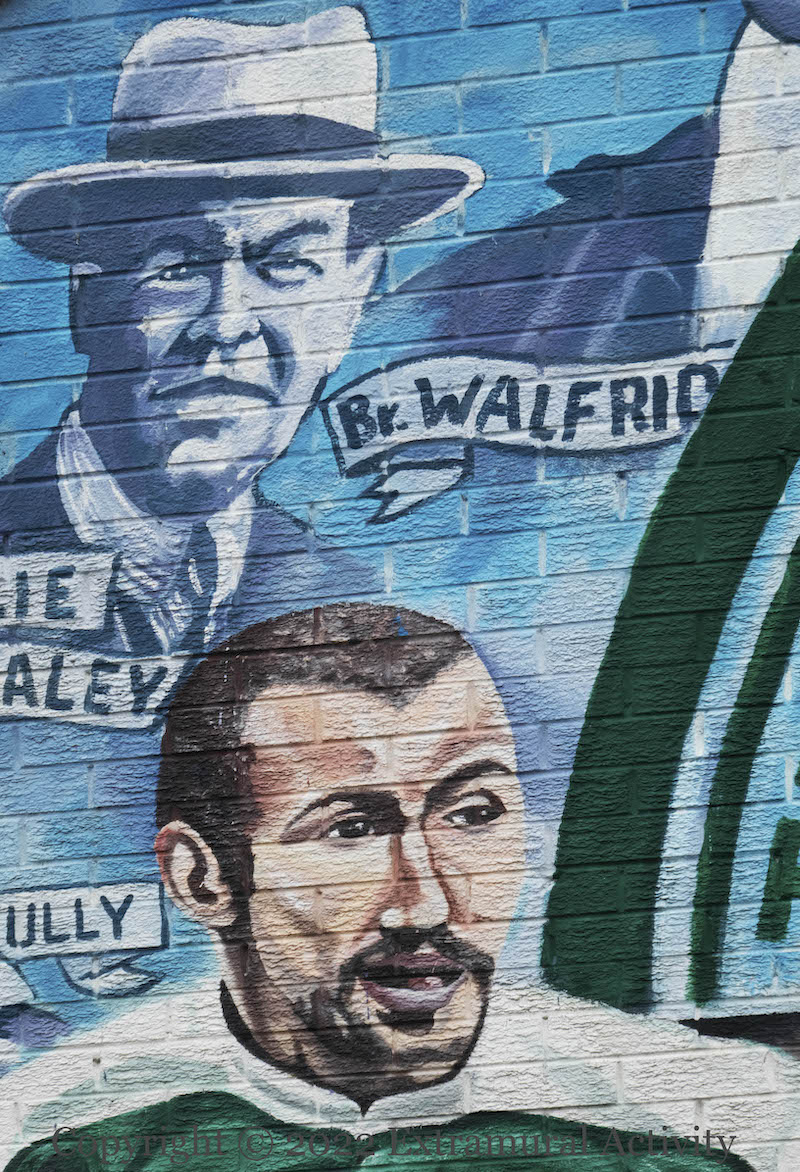
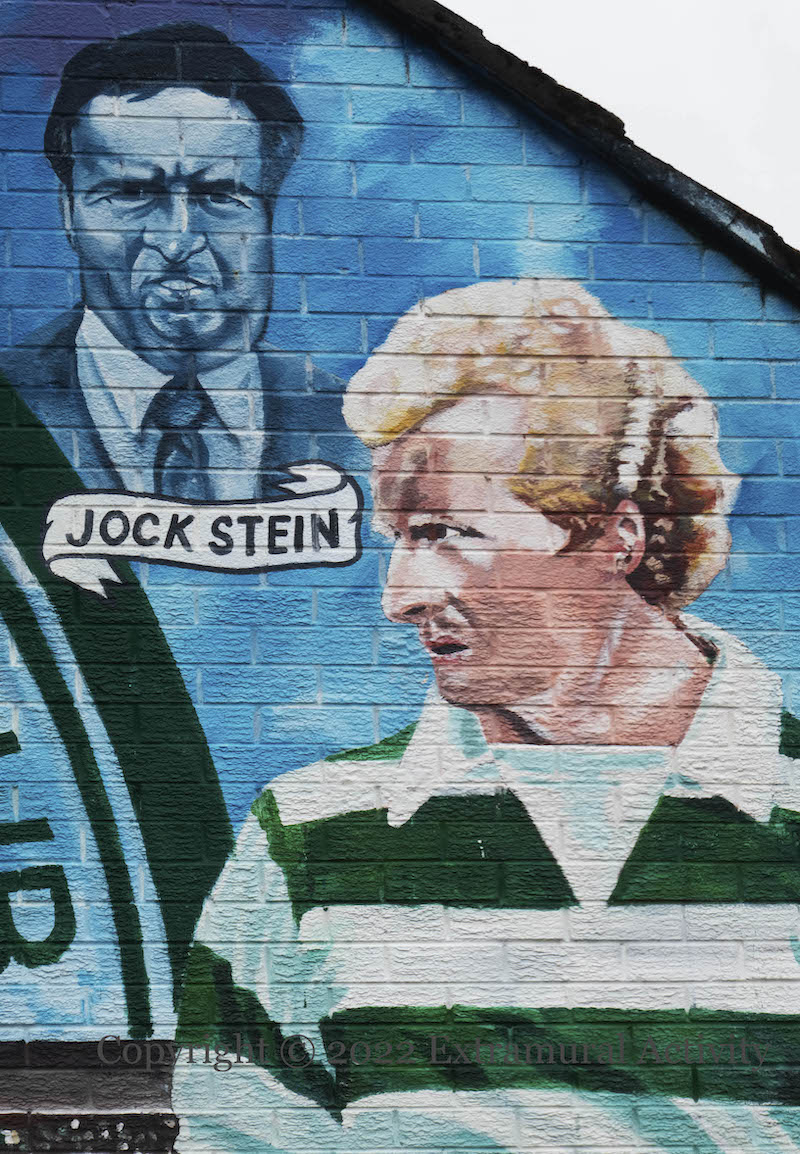
Carling last sponsored Celtic FC in the 2009-2010 season, which means that the heroes shown in this 2009 mural are another decade in the past. In the apex are Charlie Tully (of Belfast and Glasgow Celtic), Willie Maley (the first manager), Br. Walfrid (founder of the club in 1888), Billy McNeil lifting the European Cup in 1967, Jock Stein (player 1951-1957 and manager 1965-1978), while on the field are former players Henrik Larsson (1997-2004) and Jimmy Johnstone (1962-1965).
In the centre of the image, the team is “doing the huddle”, which is also practiced by Cliftonville.
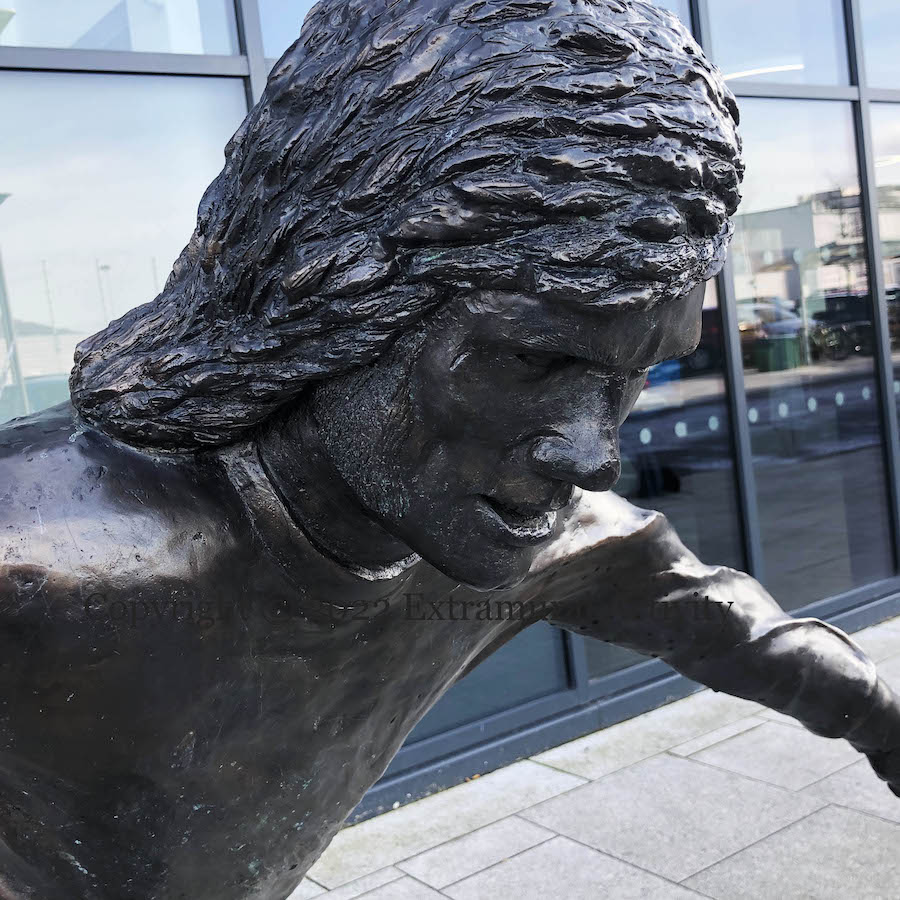
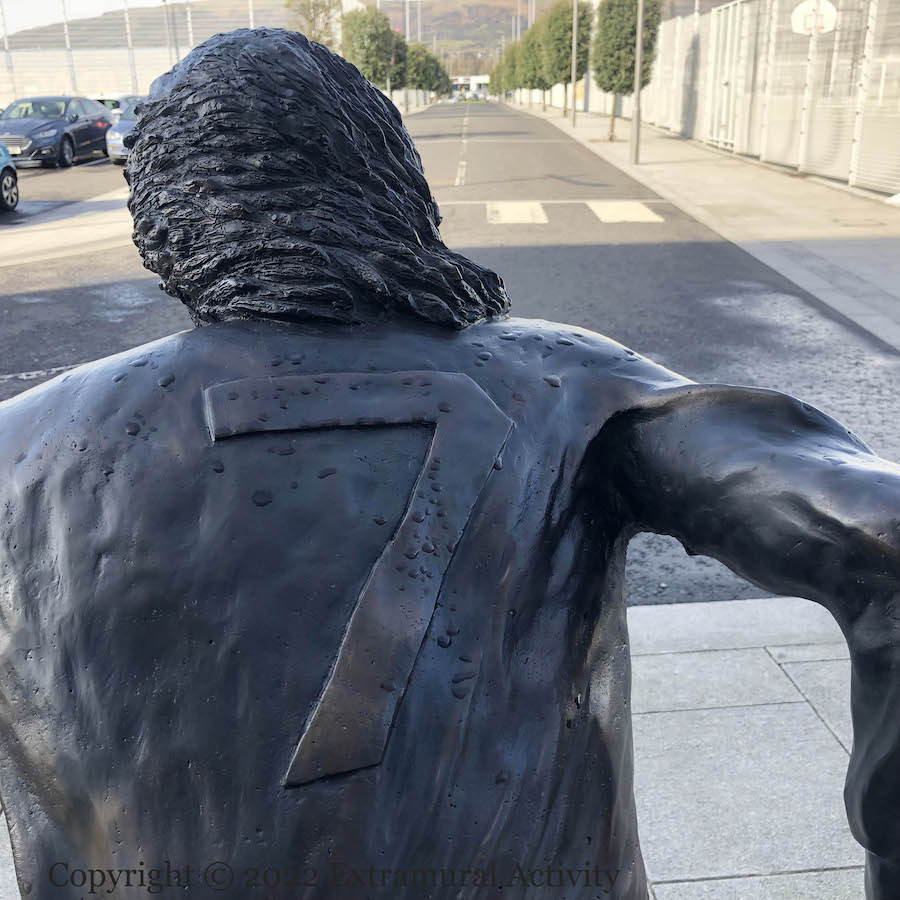
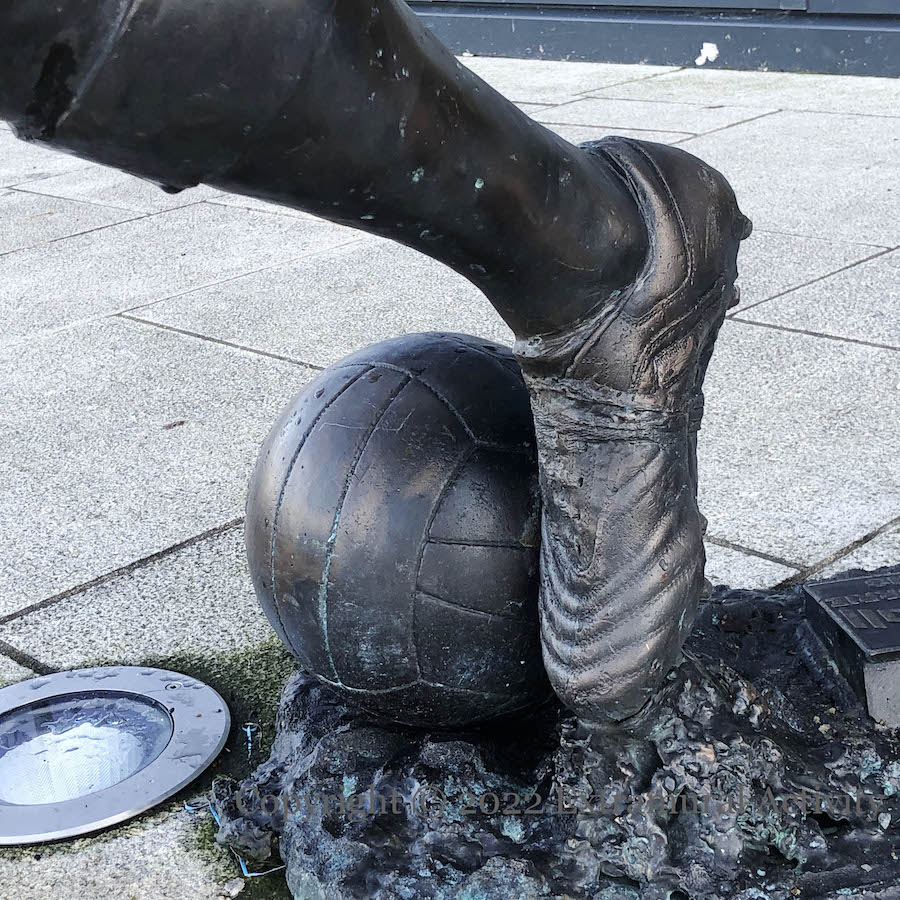
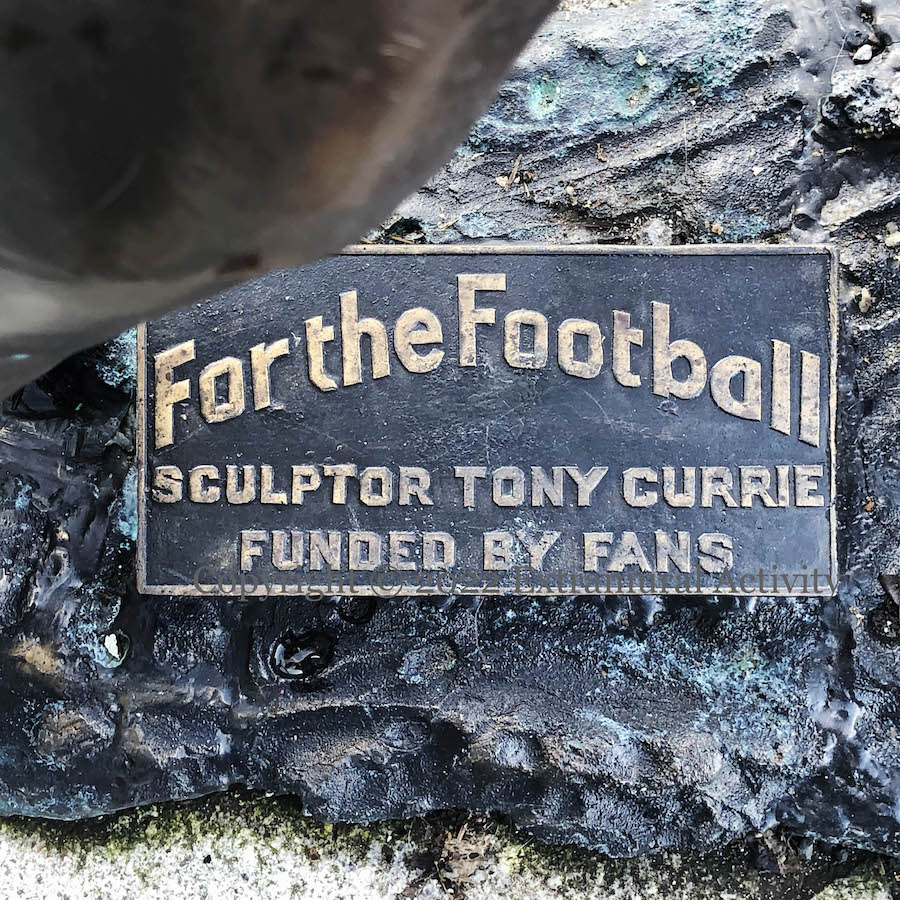
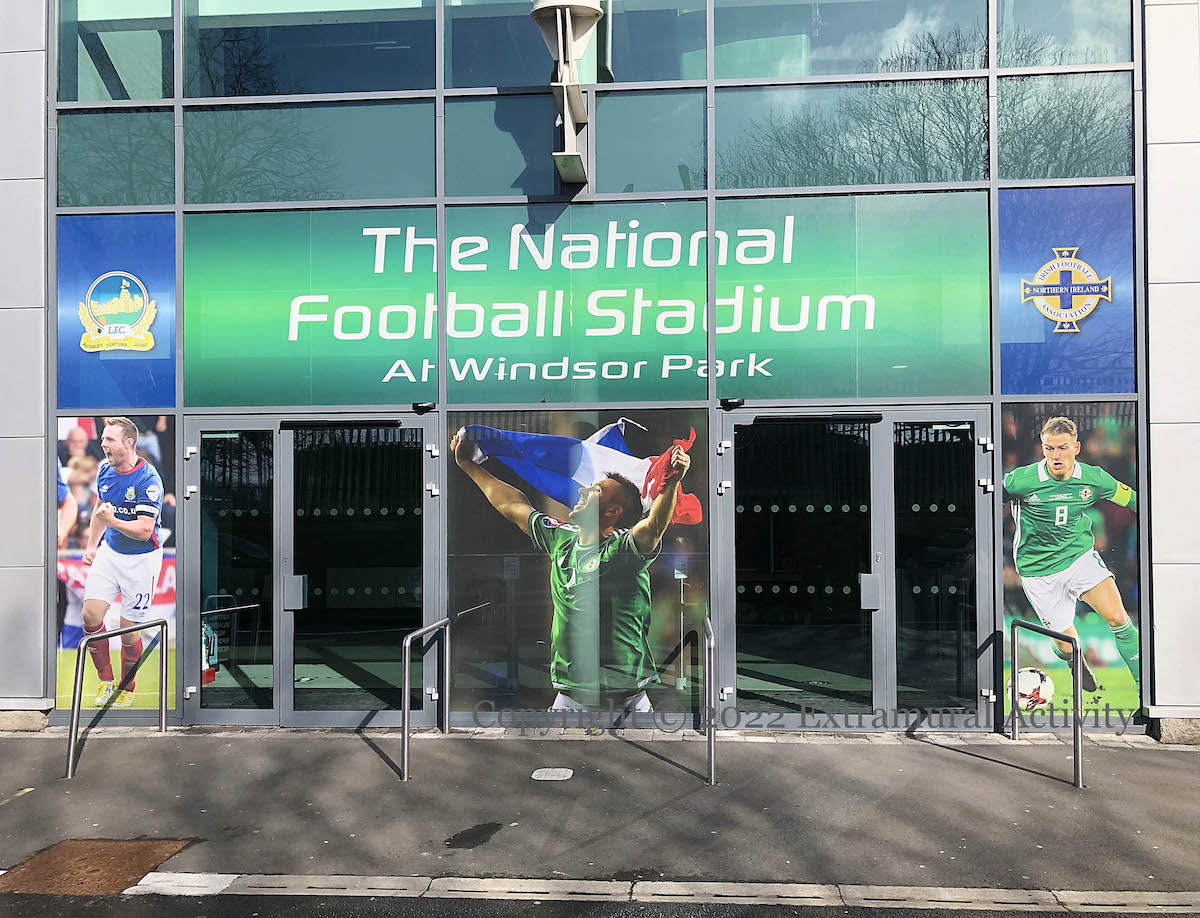
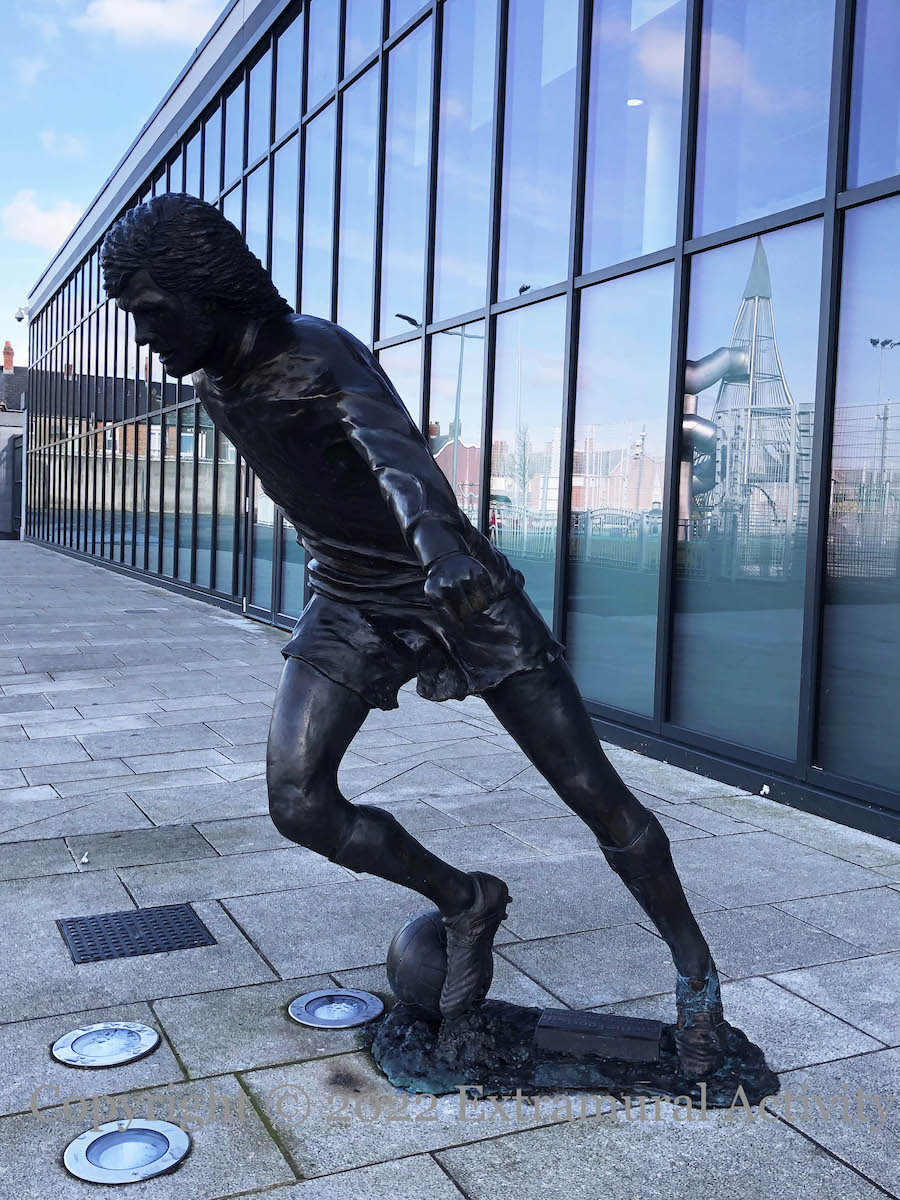
Before he died (in 2005), George Best asked that people “remember me for my football” and the phrase became the title of a Best retrospective. It is also inspired the life-size title of the statue of created by Tony Currie and funded by fans (Belfast Live) in front of Windsor Park (and the Glen Molly (ig) mural in Hill Street). When it was launched, the statue drew criticism for not looking like its subject (BBC | Newsletter). Soccer star sculptures are perhaps hard to do: here’s a list of ten questionable statues of soccer stars, including Maradona in Kolkata (Guardian) and Ronaldo in Madeira (BBC), but missing Mo Salah in Sharm al-Sheikh (BBC).
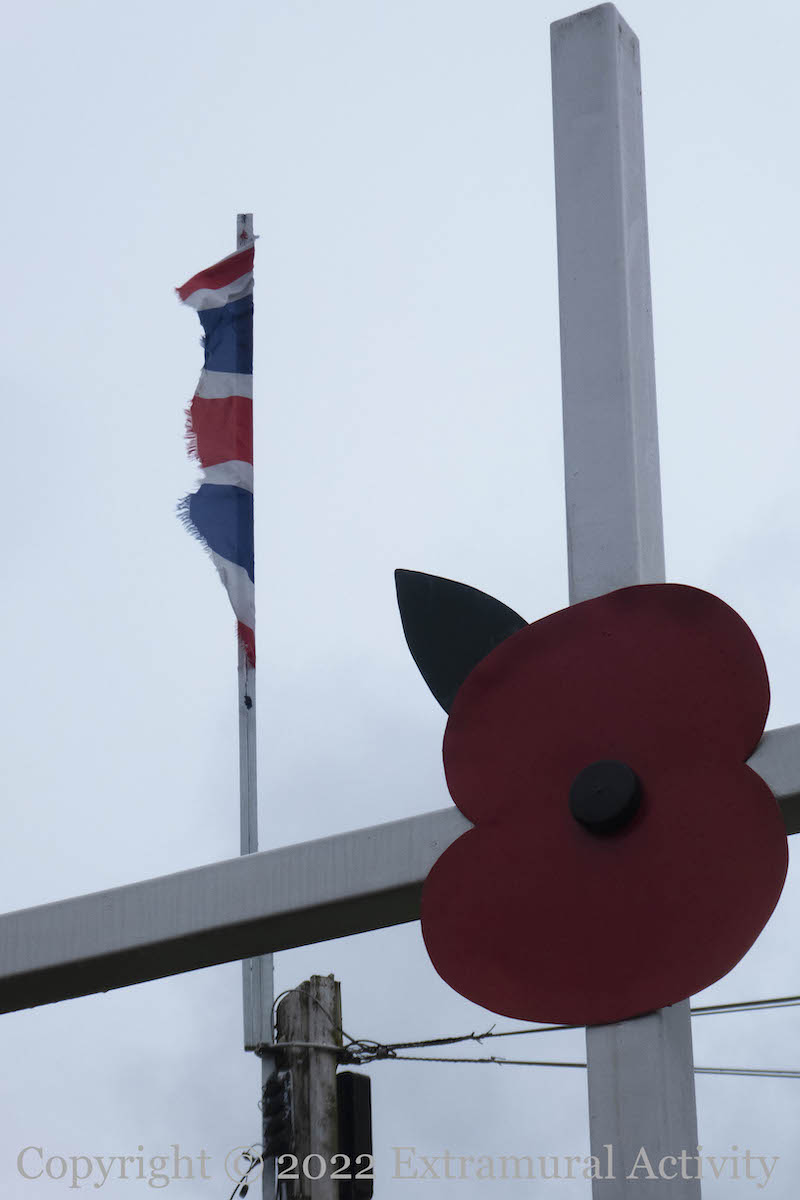
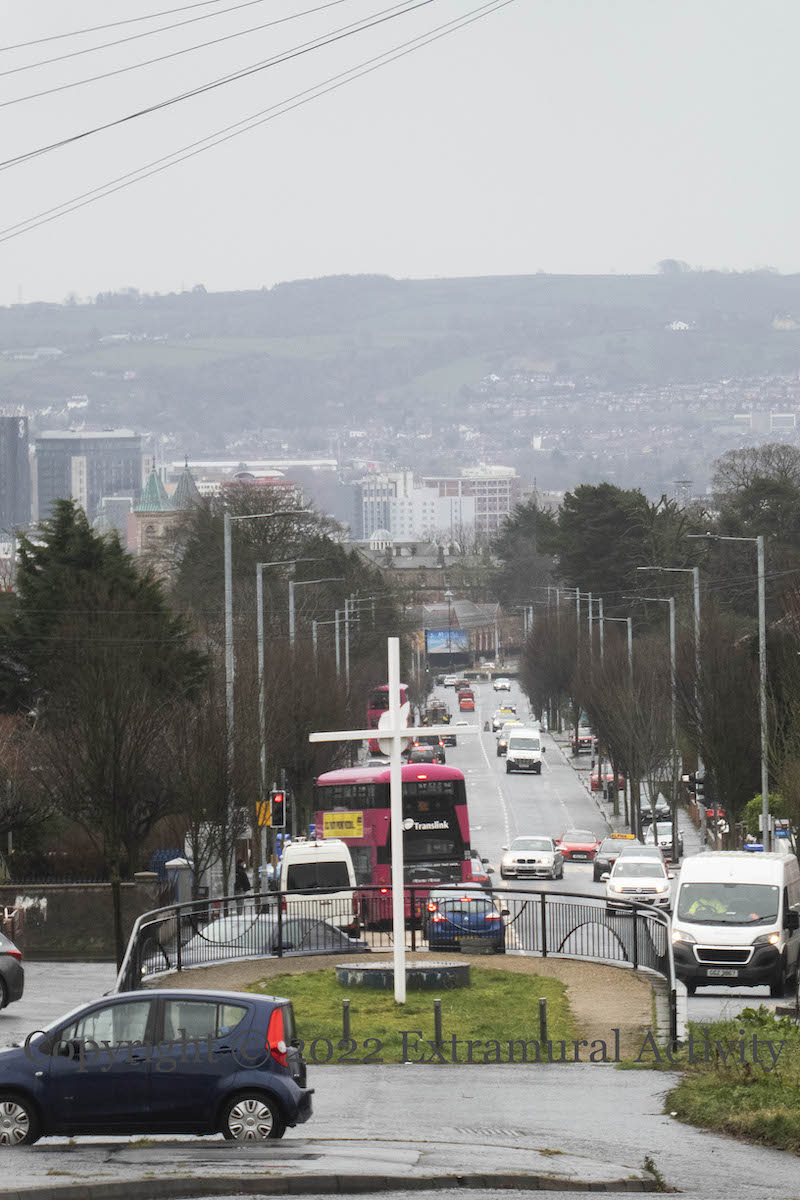
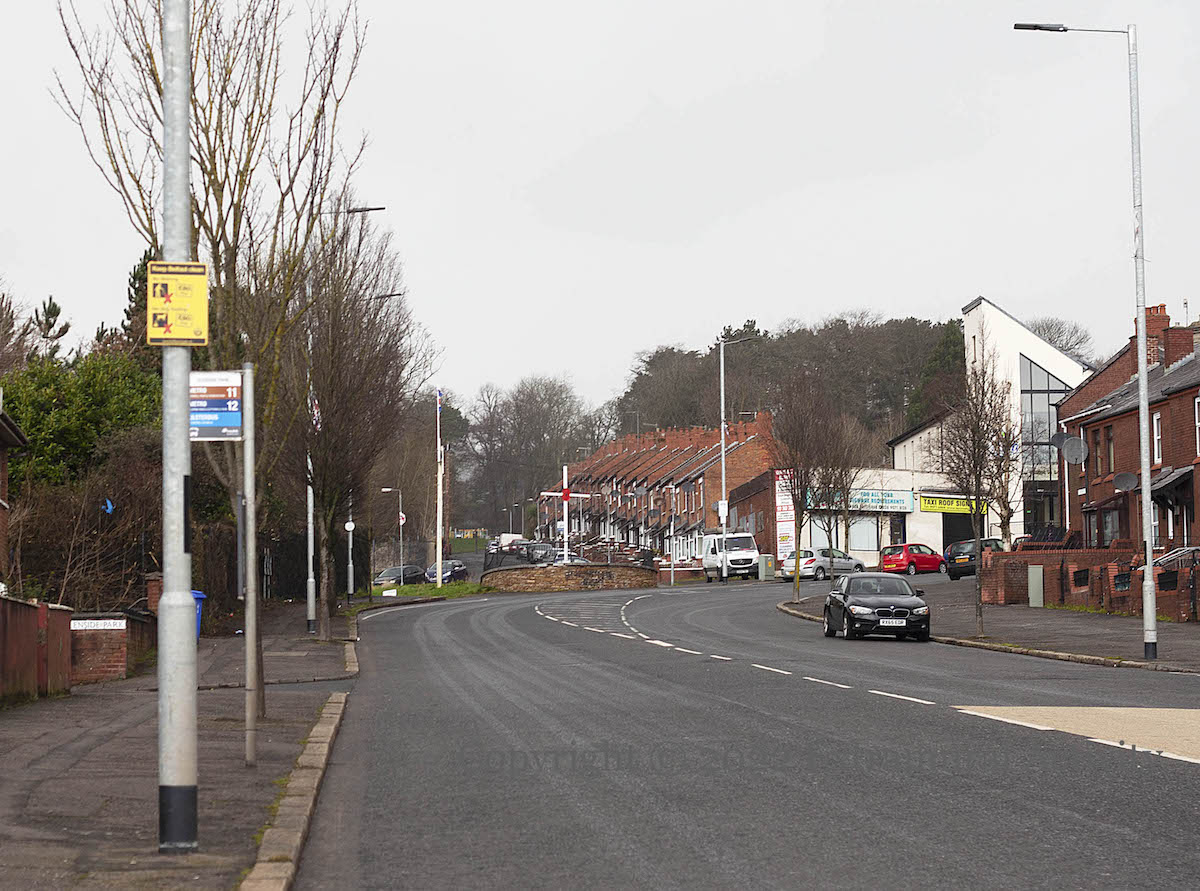
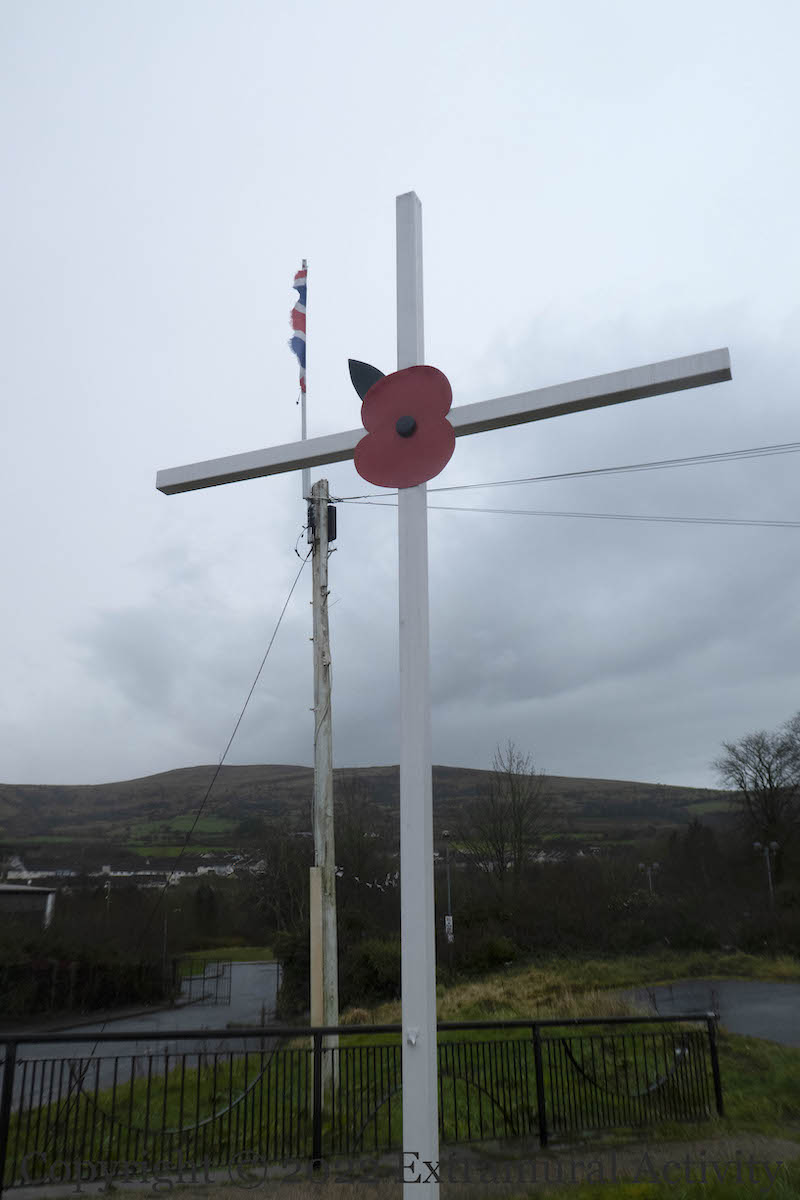
The ‘bend in the road’ (Crumlin Road, just before Ligoniel) is the site of the Somme Memorial Cross. It’s not clear who erected or maintains it and indeed the Union flag flying behind it has been reduced to a stump.
A little further up the road, a new ‘cultural hub’ has been proposed for the site of the old Ligoniel Orange hall (Belfast Live) which was destroyed in a fire in 2000 (BBC).
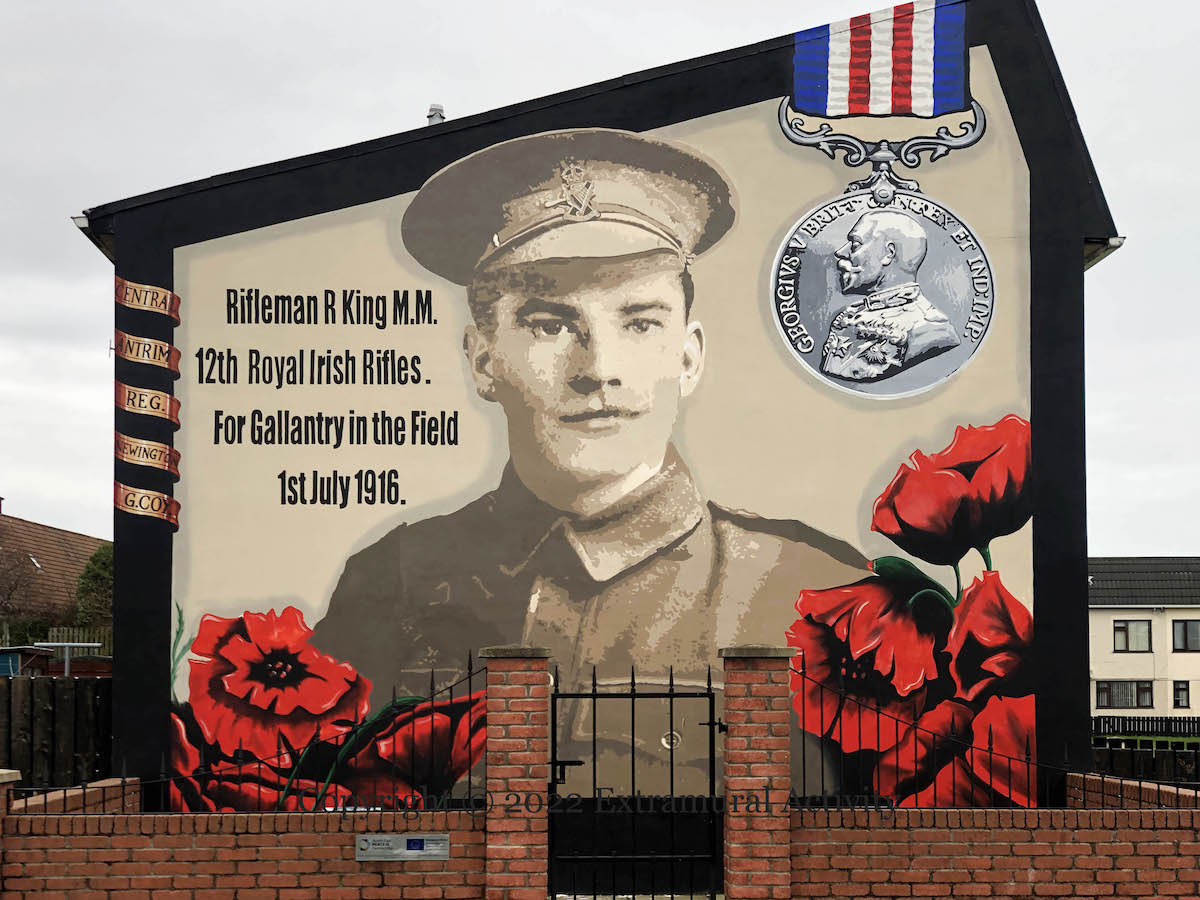
The Military Medal (“MM”) “for gallantry in the field” was awarded to Rifleman Robert King of the 12th Royal Irish Rifles in the dispatches of July 12th for his actions on July 1st, the first day of the Battle Of The Somme. King was from Ronald Street in Larne (RIR 12th Fb; there is also a 12th batt RIR memorial association).
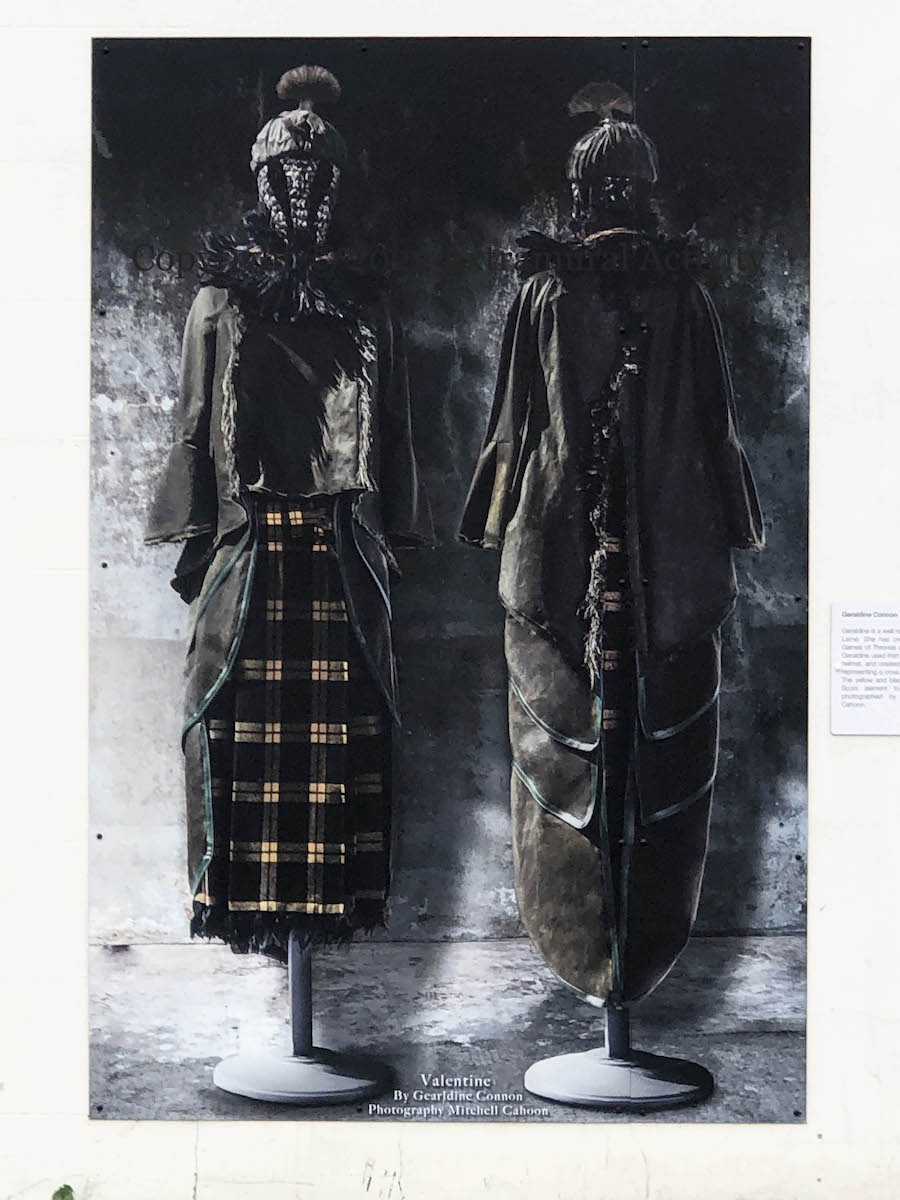
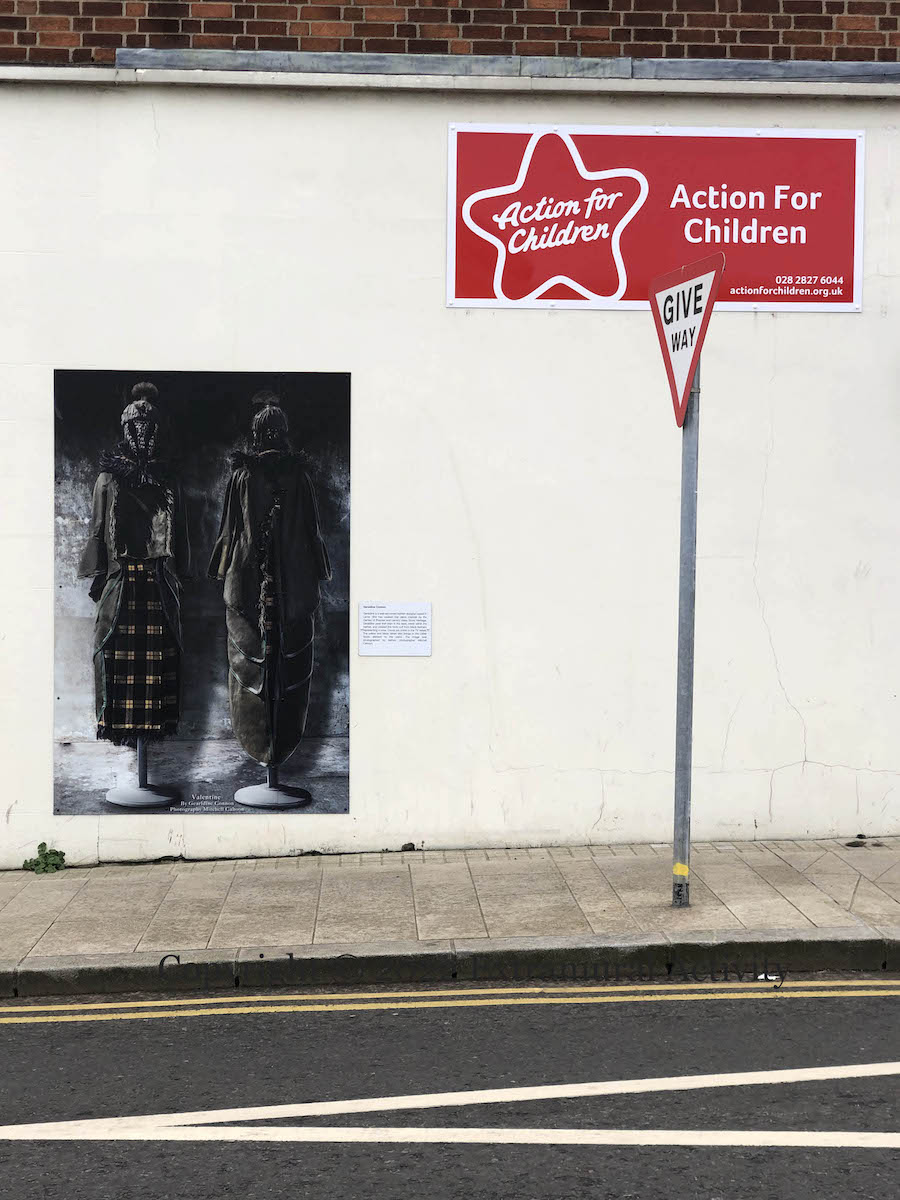
“Geraldine Connon [web] – Geraldine is a well renowned fashion designer based in Larne. She has created this piece inspired by the Games of Thrones and Larne’s Ulster Scots Heritage. Geraldine used Irish linen in the tasel [sic], mesh within the helmet, and created the neck cuff from black feathers representing a crow. Crows are iconic in the TV series. The yellow and black tartan skirt brings in the Ulster Scots element to the piece. The image was photographed by fashion photographer Mitchell Cahoon [ig].”
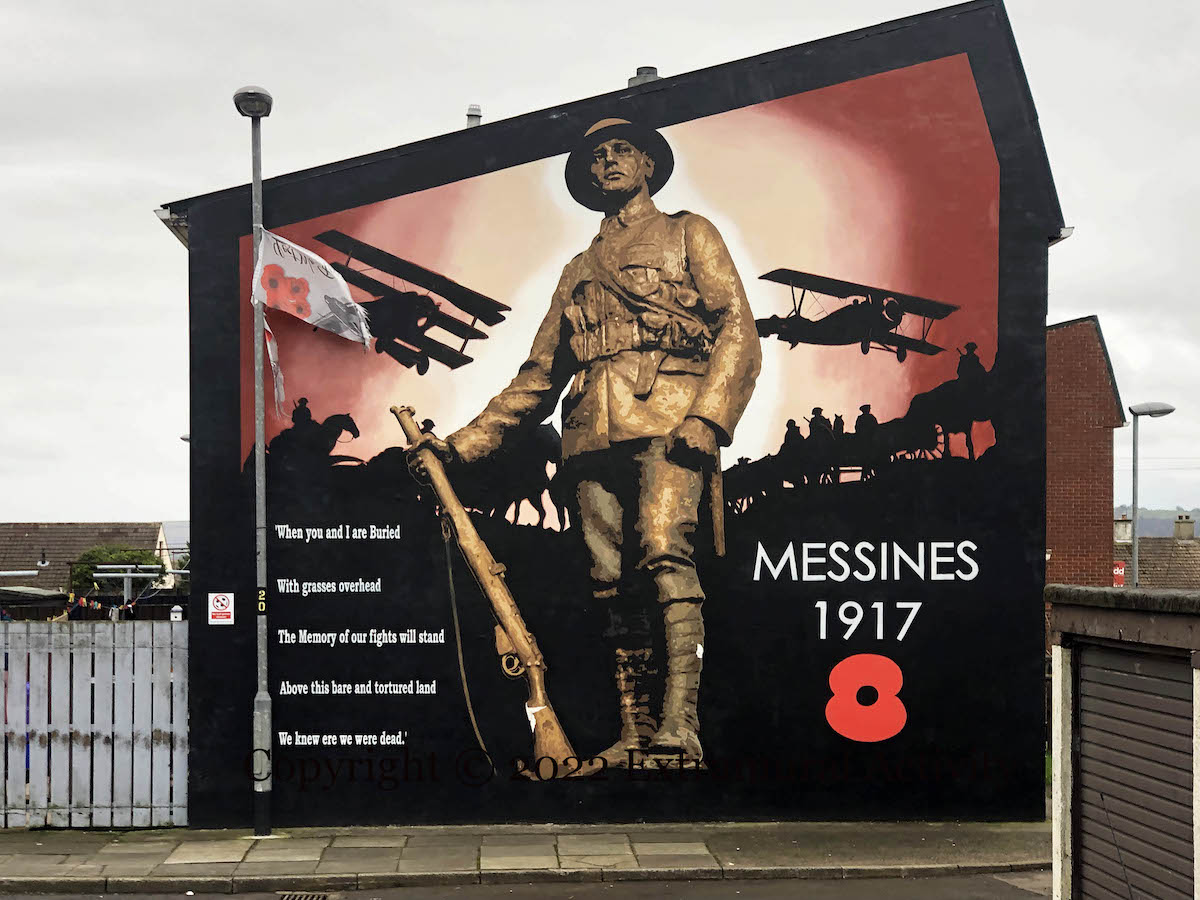
The ‘bare and tortured land’ is Messines (now Mesen) in West Flanders, Belgium, where approximately 25,000 soldiers on both sides were killed or injured at the start of June, 1917, as Allied forces retook the ridge between Messines and Wytschaete.
The central figure is the 1922 bronze statue in Winchester, England, by John Tweed, depicting a soldier from the Kings Royal Rifle Corps, which does not appear to have fought at Messines, though both the 36th (Ulster) and 16th (Irish) divisions were there (WP) and this is the reason for a number of Messines murals that have been painted in recent years: see Messines 1917 and Brothers In Arms in Newtownards | Comrades In Arms in Londonderry. During the battle, Sopwith Pups (biplanes – the triplane was used by naval squadrons (Military History)) were ordered to fly low and strafe enemy targets (Key Aero | FirstWorldWar | Vintage Aviator).
The poetry – “When you and I are buried/With grasses overhead/The memory of our fights will stand/Above this bare and tortured land/We knew ere we were dead.” – appears to be original.
There is a “No ball games allowed” notice on the left-hand side.
 Seosamh Mac Coille Collection