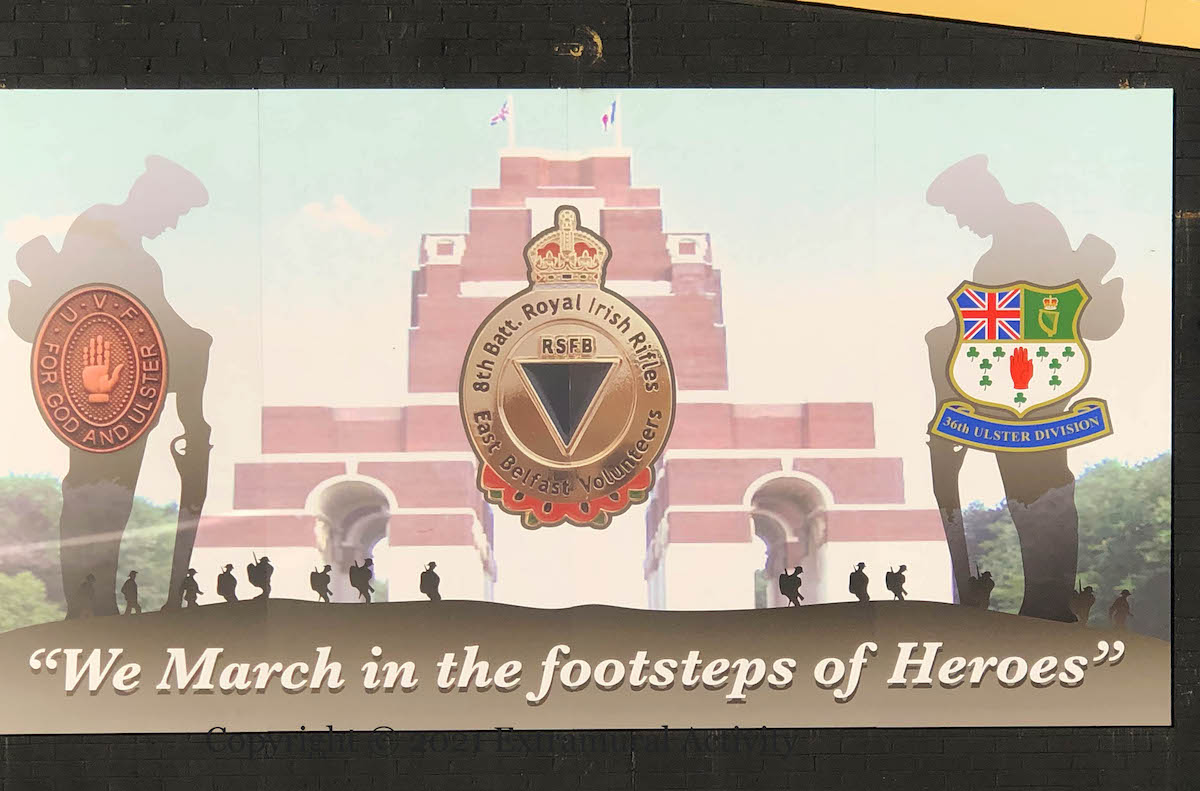
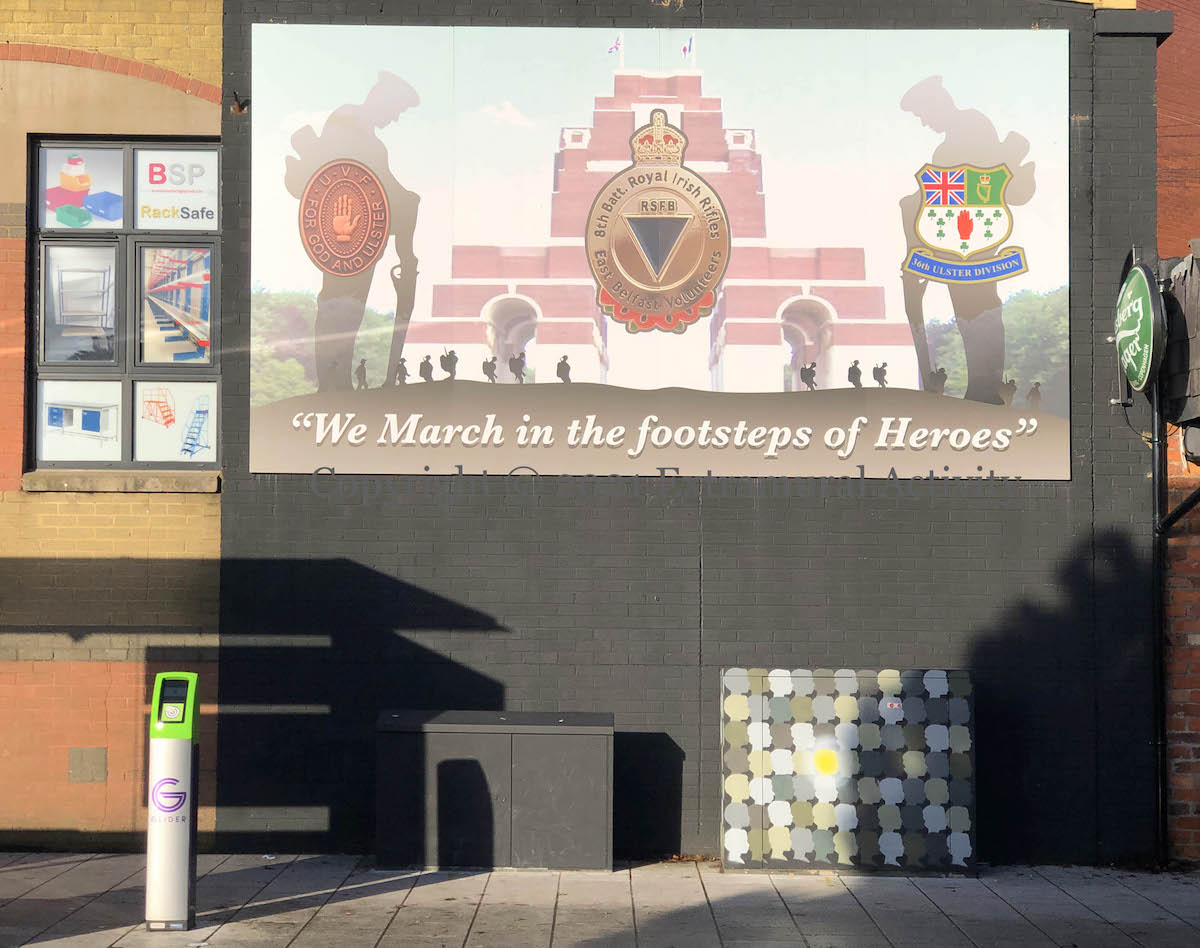
In this board the Rising Sons Flute Band (“RSFB”) portrays itself as following in the footsteps of the Ulster Volunteers who joined the British Army and specifically the 8th battalion of the Royal Irish Rifles in the 36th (Ulster) Division, which was drawn from east Belfast’s Ulster Volunteers in 1914. The insignia for the battalion is usually shown as dark blue rather than the black shown here – see the mural of 36th Division insignia in Canada Street. There is a similar board outside the band’s practice hall in Castlereagh Street.
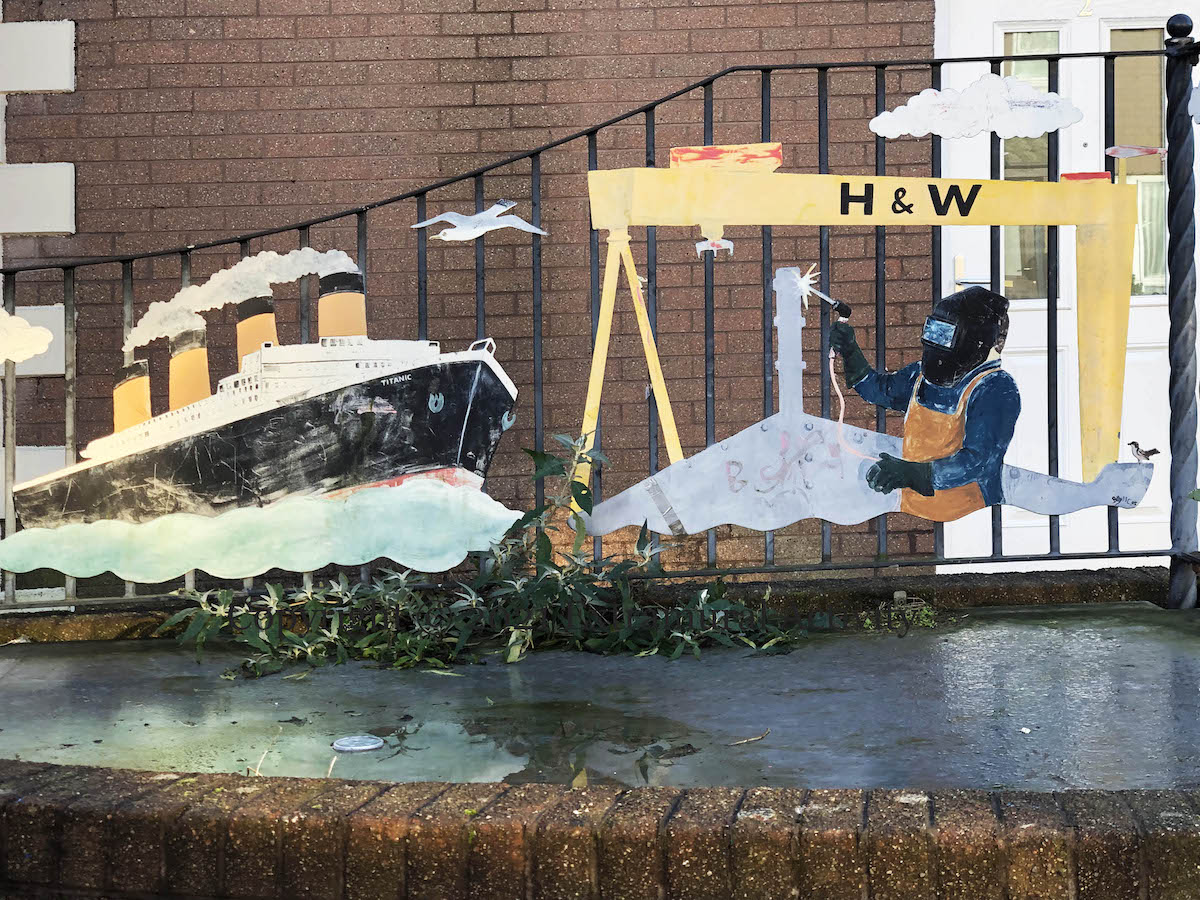
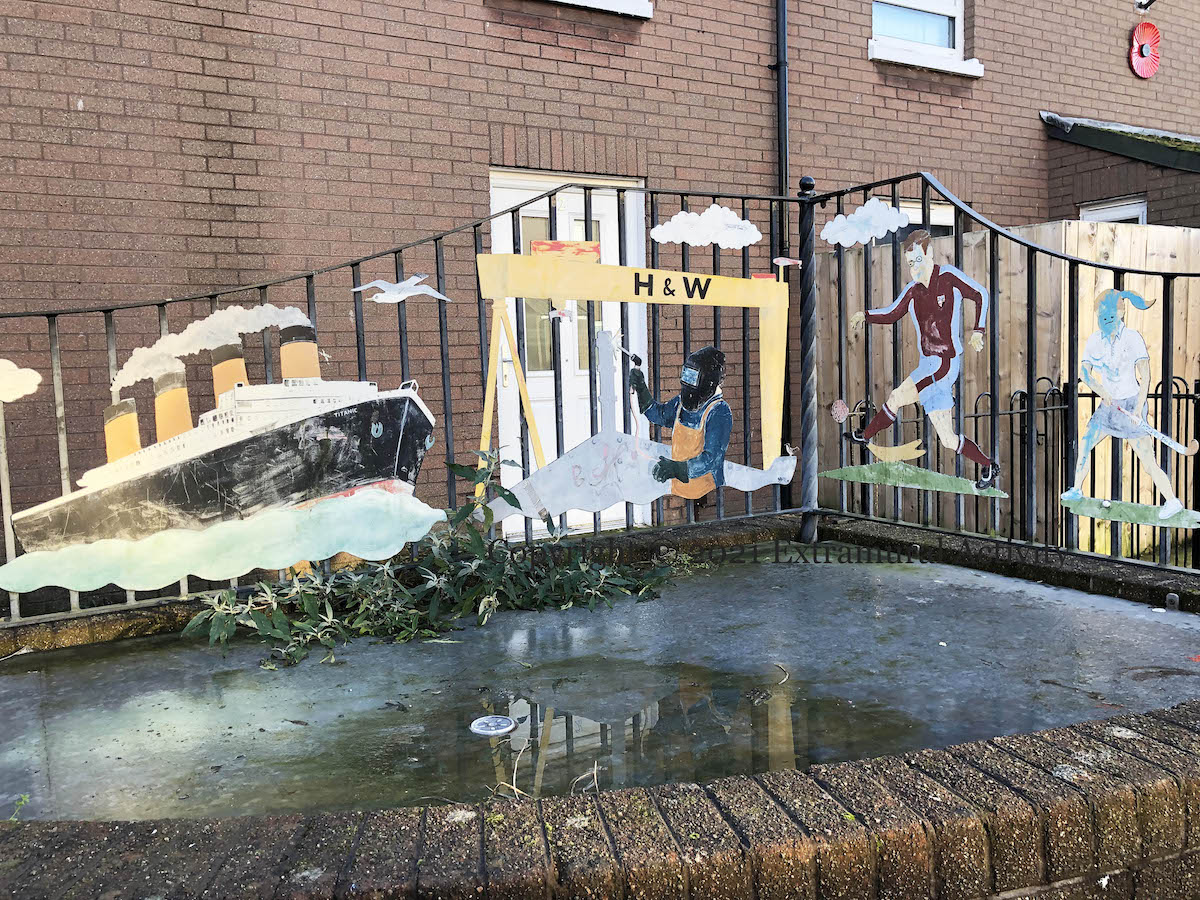
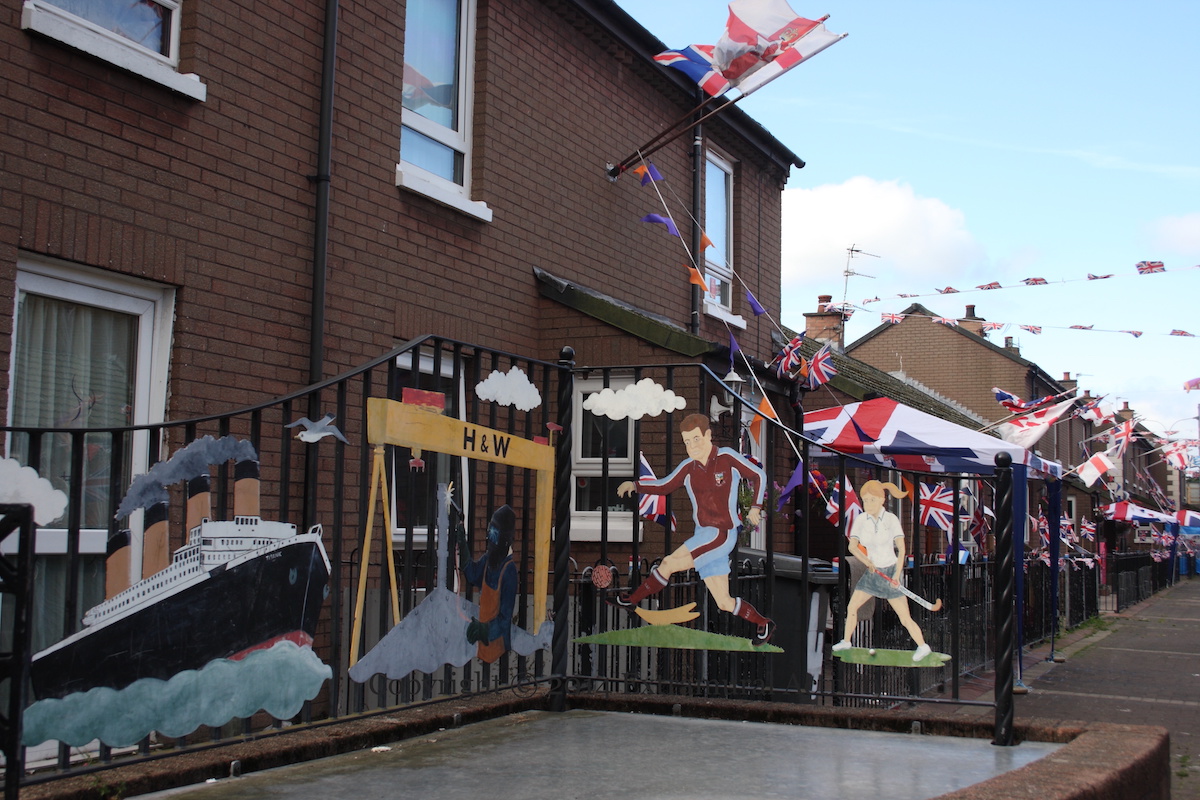
Titanic was built at Harland & Wolff shipyard in east Belfast; it took more than three years to build but was in service for only five days, as it famously hit an iceberg and sank in the North Atlantic ocean. The welders formed their own football club, in 1965. The football and hockey players on the right are perhaps associated with Ledley Hall.
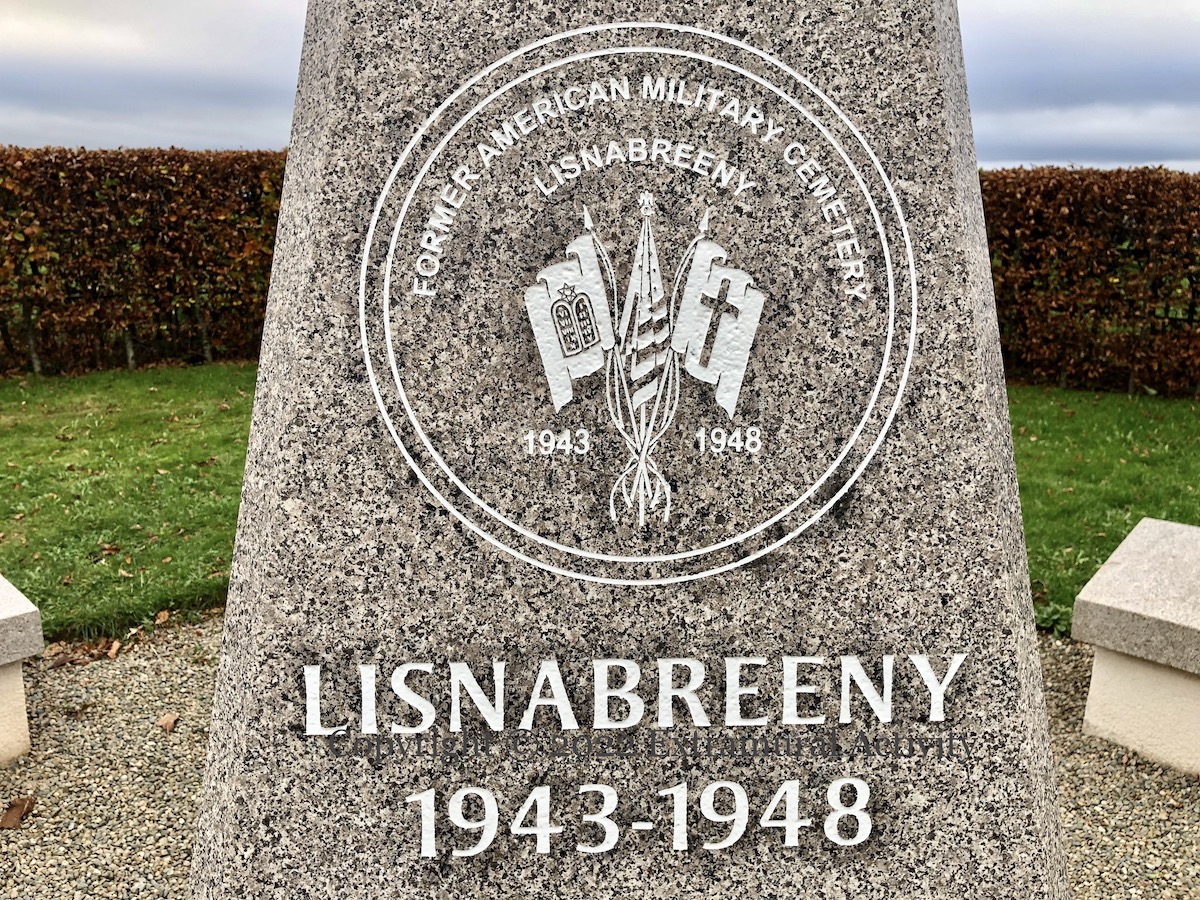
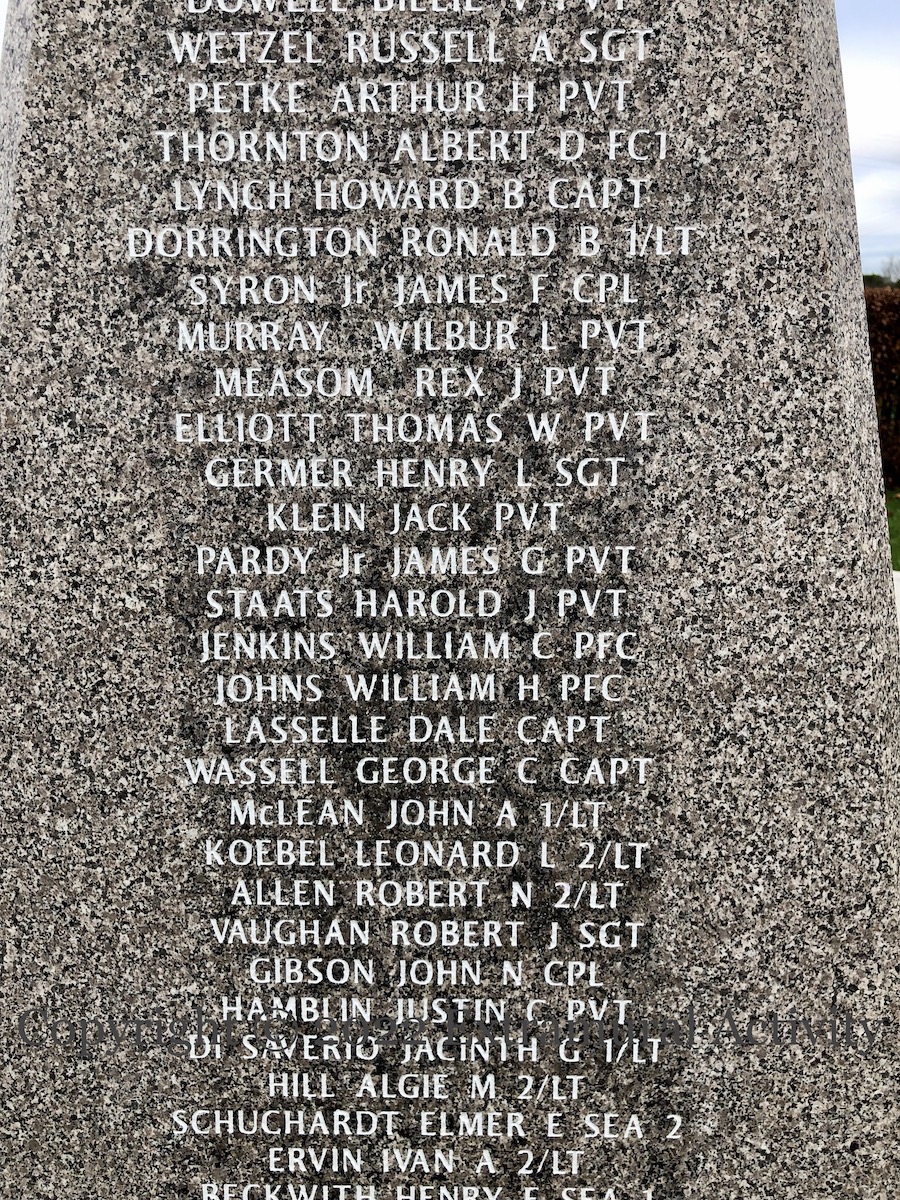
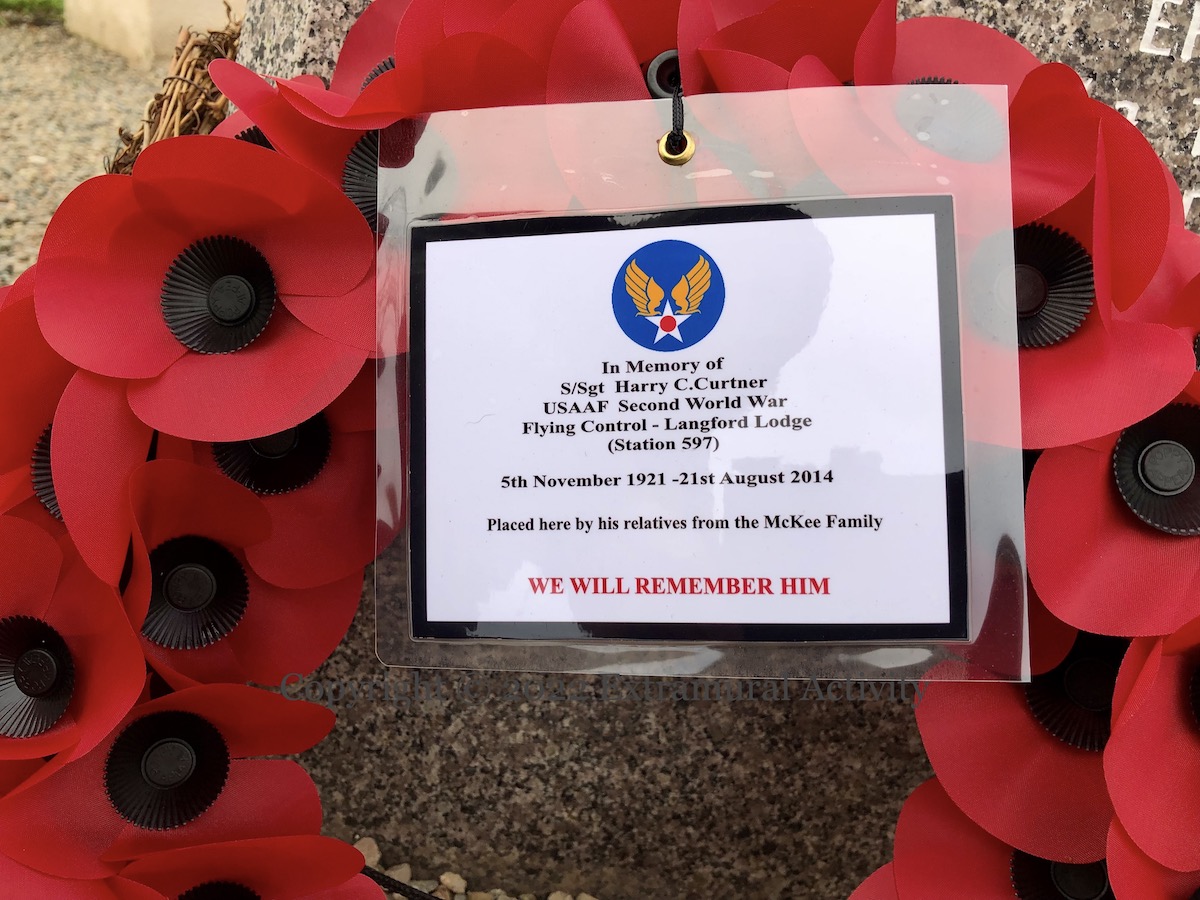
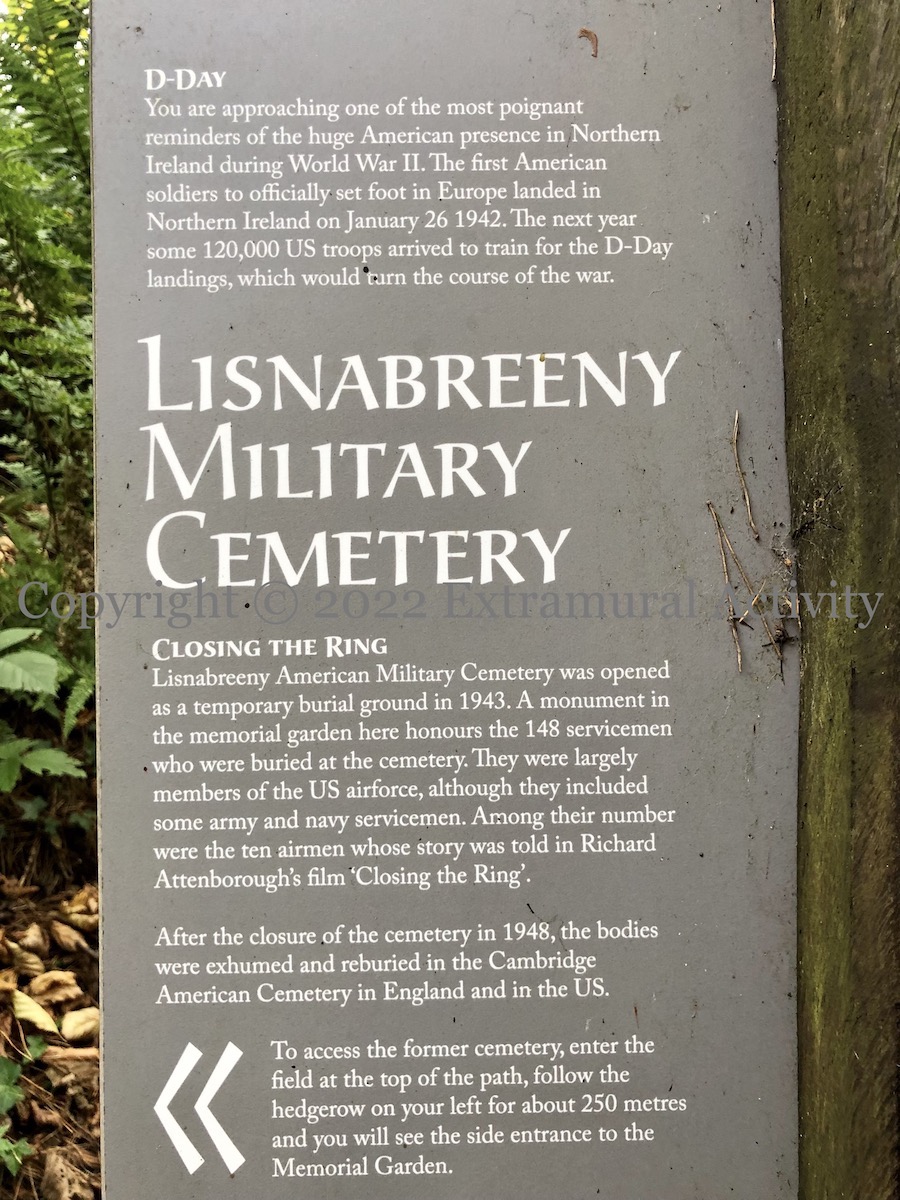
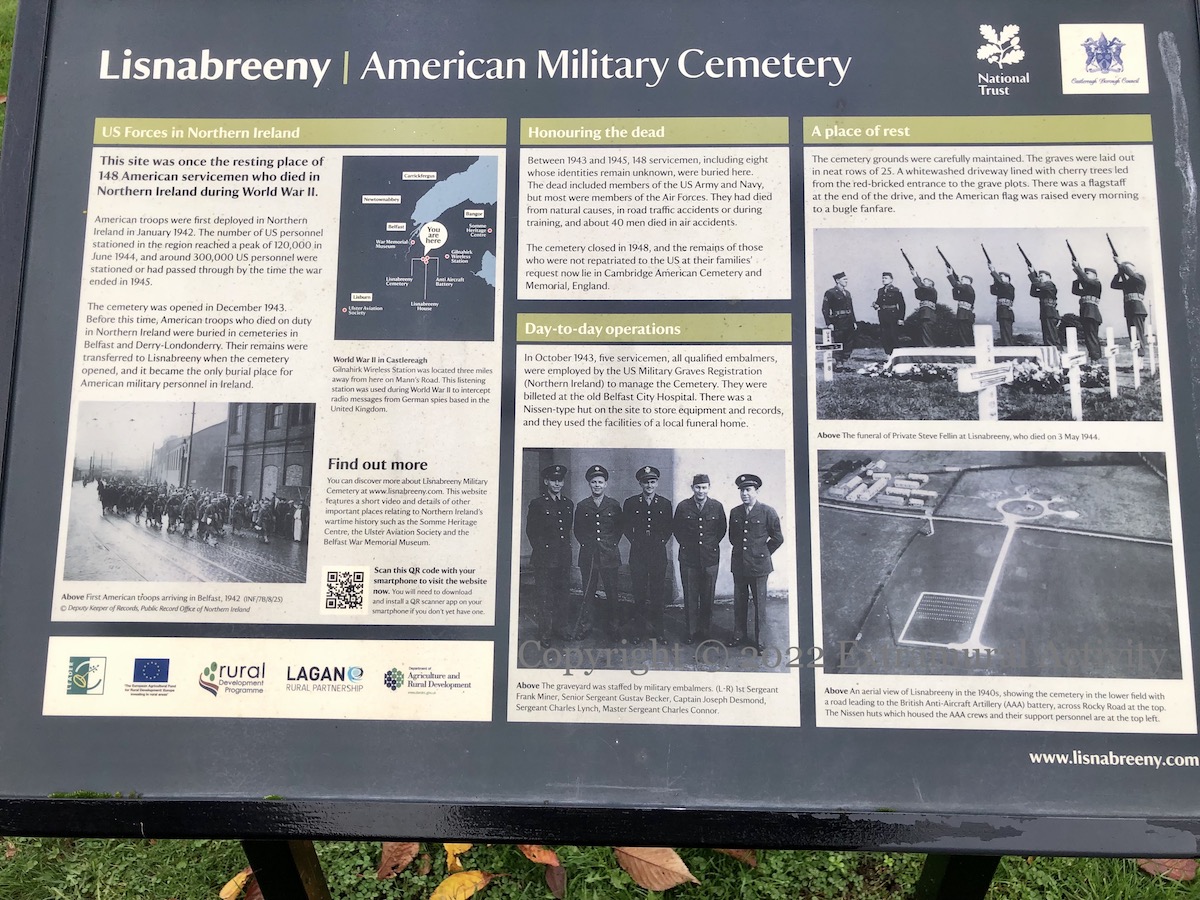
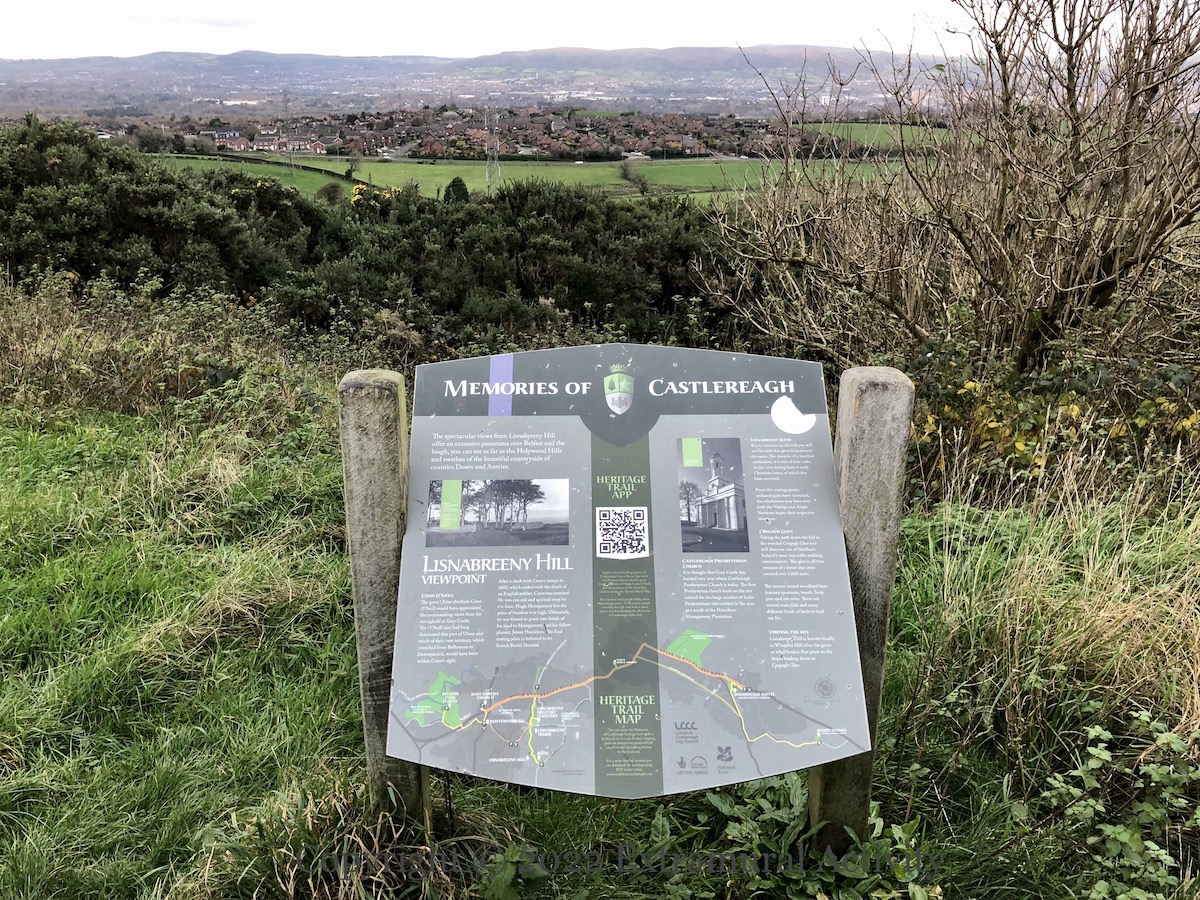
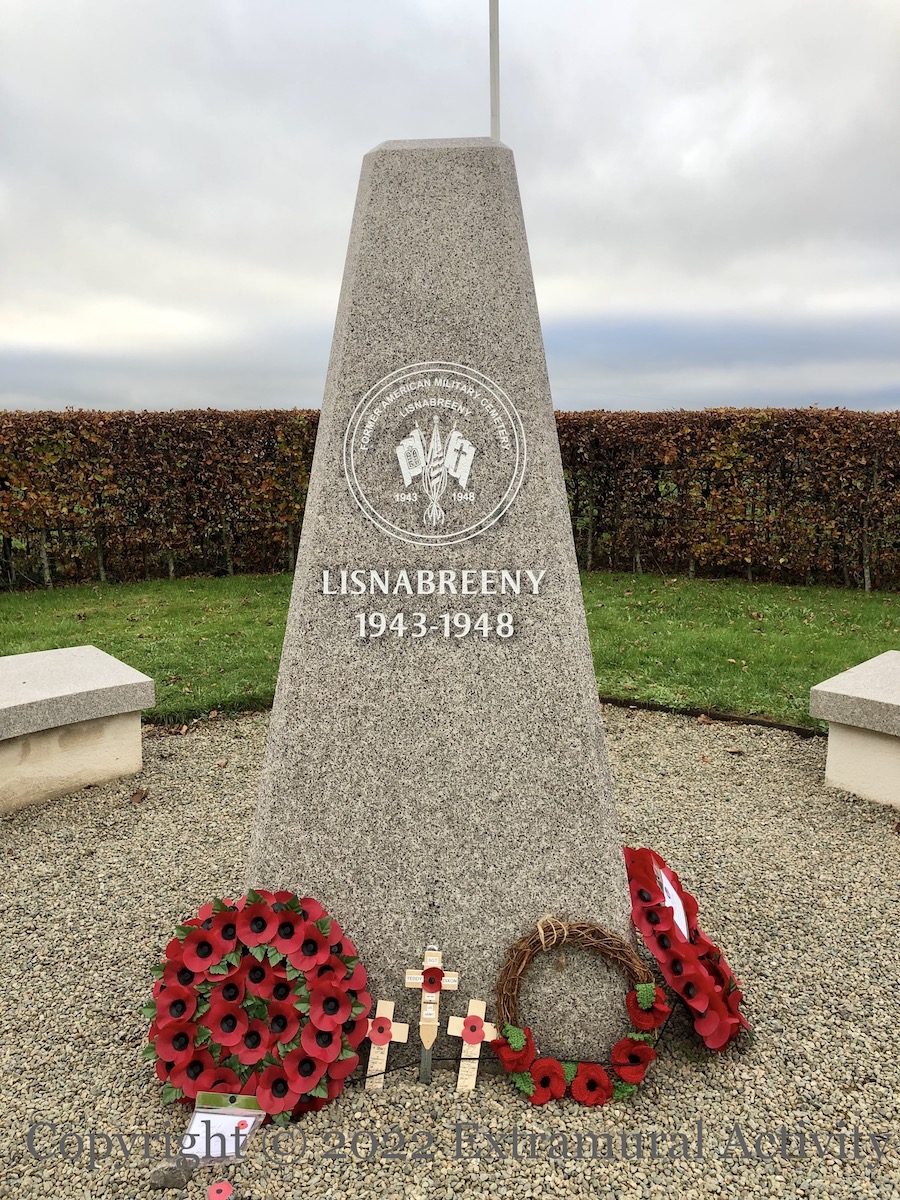
The 148 US servicemen who were buried at Lisnabreeny, in the Castlereagh hills, died in Northern Ireland, and about 40 of them in air accidents, including the ten who died on June 1st, 1944, when a B-17 travelling from Newfoundland crashed into Cave Hill, killing all ten men on board (Wartime NI). The names of all 148 are listed on three sides of the memorial stone; their remains were repatriated or moved to the cemetery in Cambridge, England in 1948.
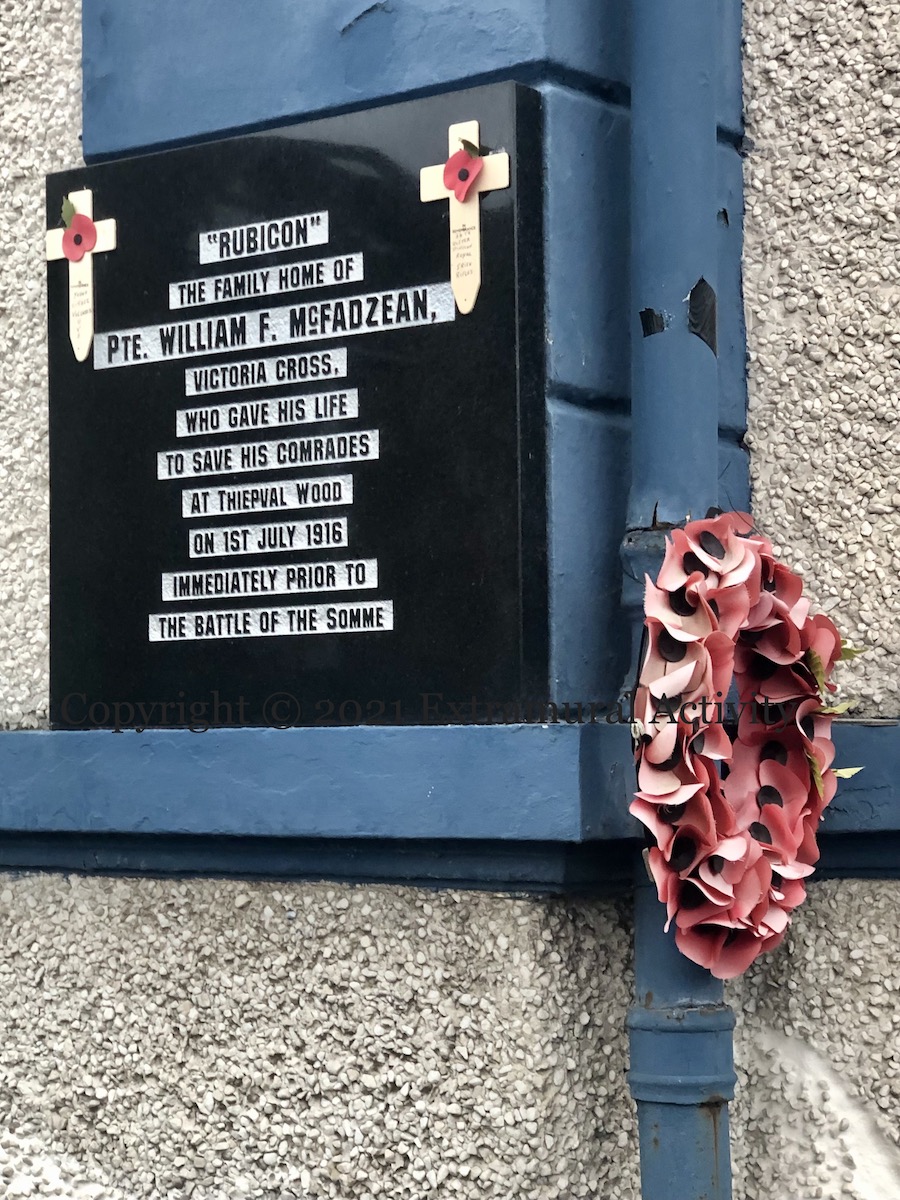
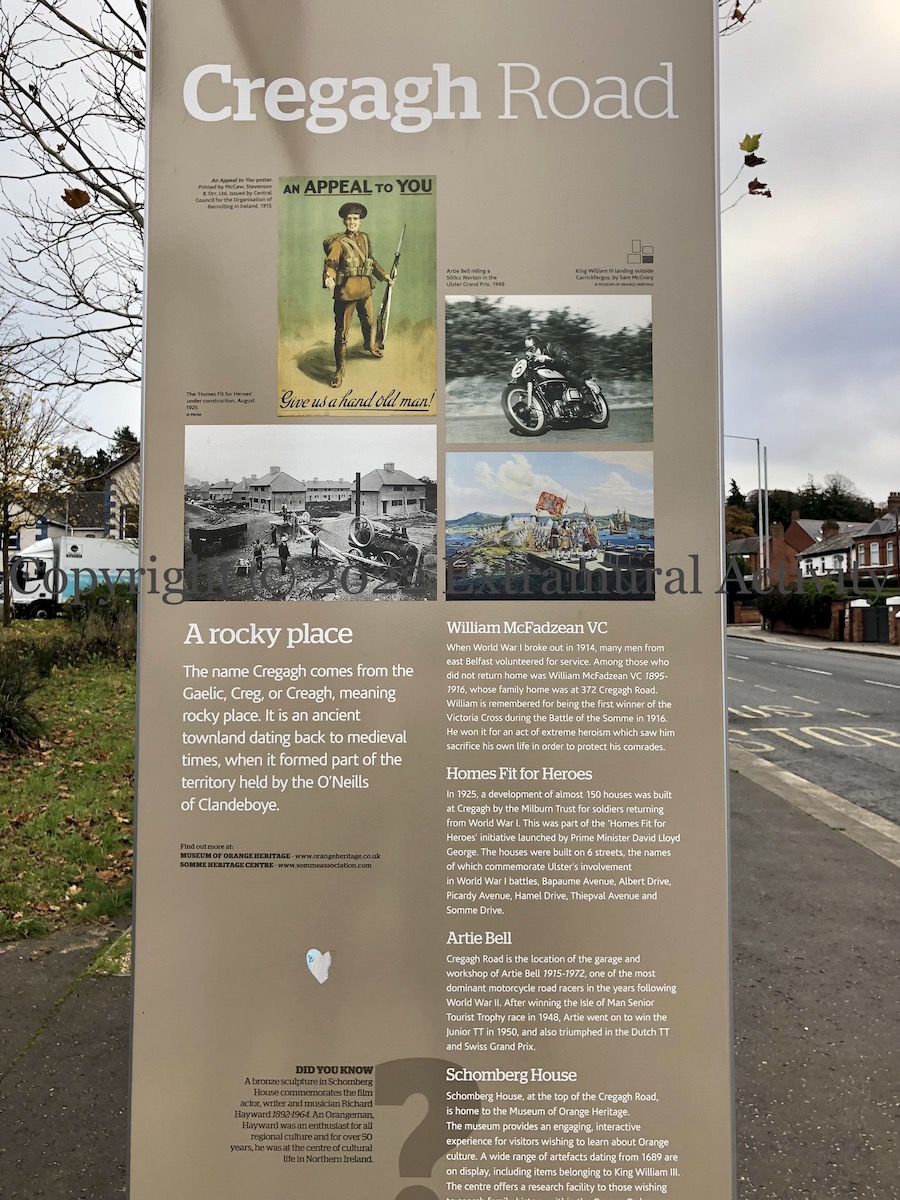
“‘Rubicon’ – the family home of Pte. William F. McFadzean, Victoria Cross, who gave his life to save his comrades at Thiepval Wood on 1st July 1916 immediately prior to the Battle Of The Somme.” McFadzean died when he threw himself on a fallen box of grenades; for this action he was awarded the VC (WP).
The plaque is on Cregagh Road at Cregagh Park. There’s a picture of McFadzean standing outside the house at Royal Irish.
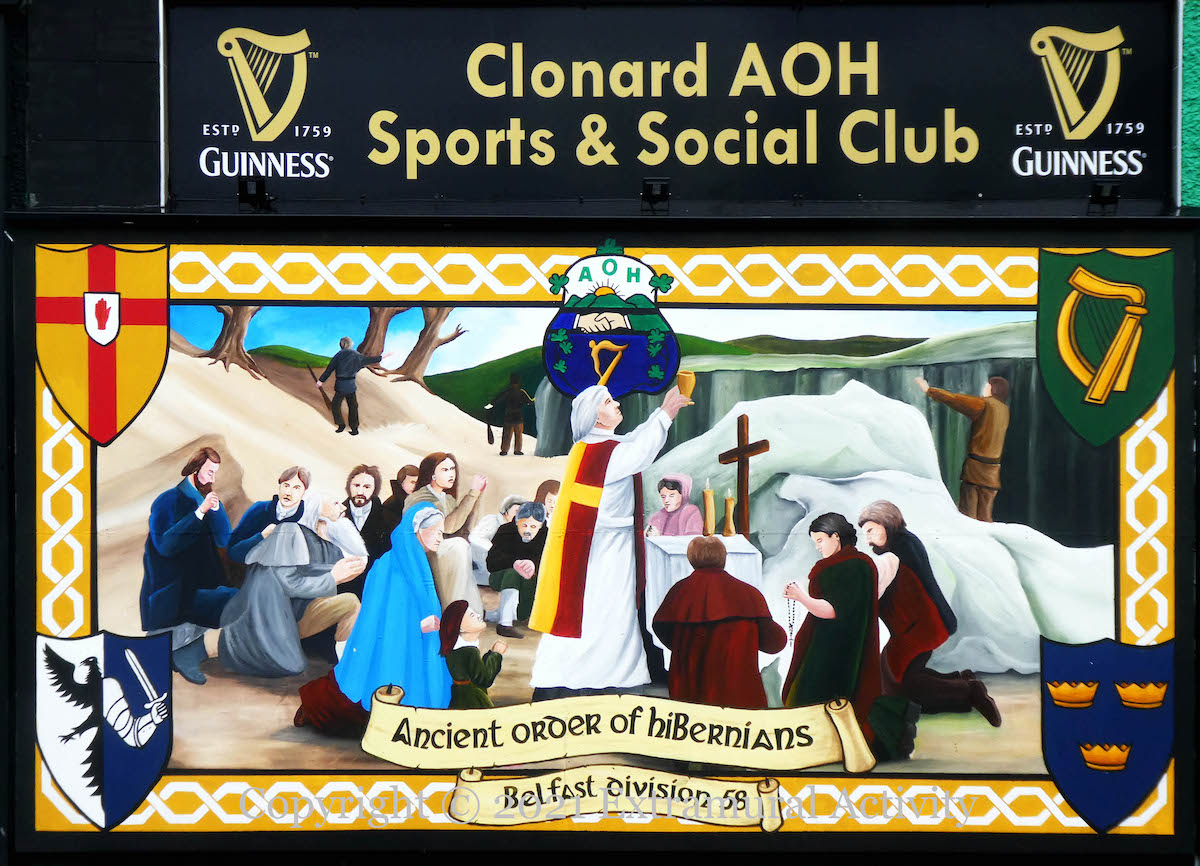
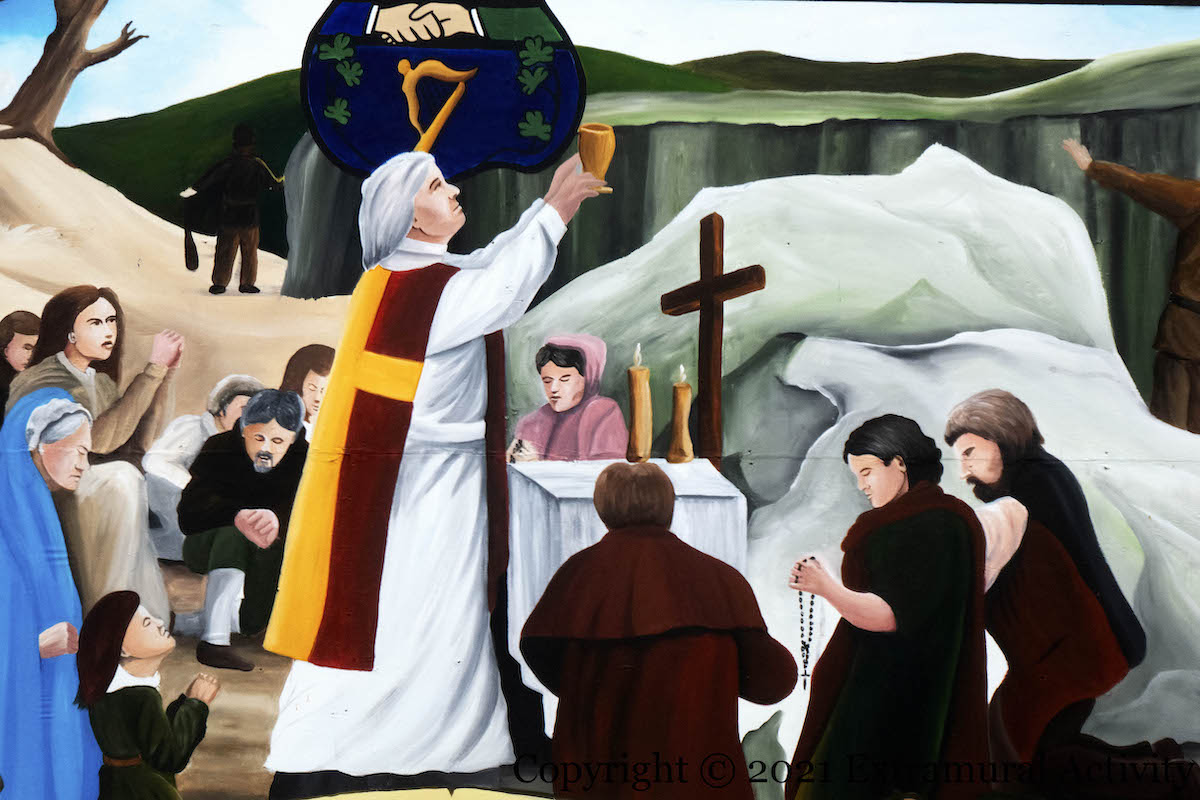
A Penal law of 1695 forbade the practice of Catholicism and “dissenter” forms of Protestantism –anything other than Anglicism, forcing people and priests to worship in secret. Although the precise date of the founding of the Ancient Order Of Hibernians is shrouded by the existence of various other Catholic fraternal and defensive organisations such as St Patrick’s Fraternal Society and the Ribbonmen – the AOH history page gives 1838 in Pennsylvania – the order traces its roots back to Penal times and in particular to the Defenders in 1784, which arose to protect Catholics from the (Protestant) Peep-O-Day Boys and in defiance of Penal laws forbidding Catholics to bear arms (WP). The Belfast division (58) of the AOH is in Clonard Street.
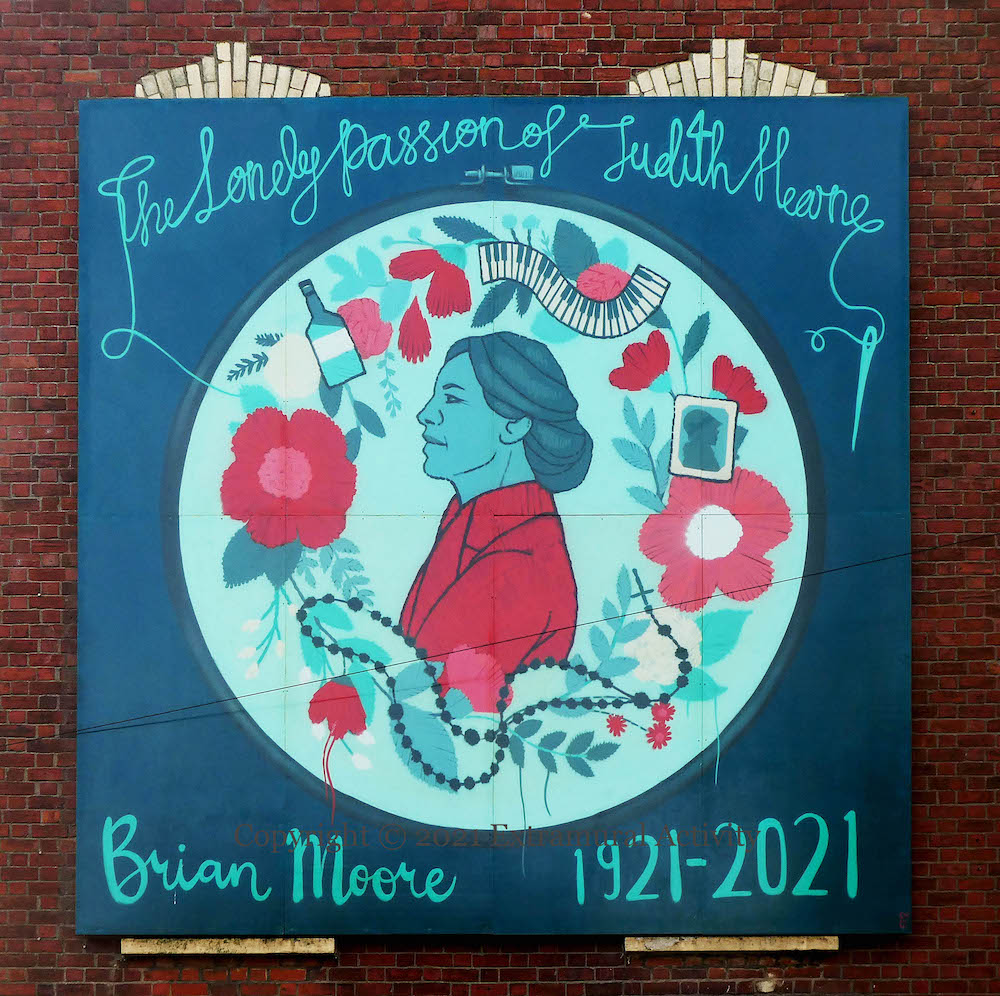
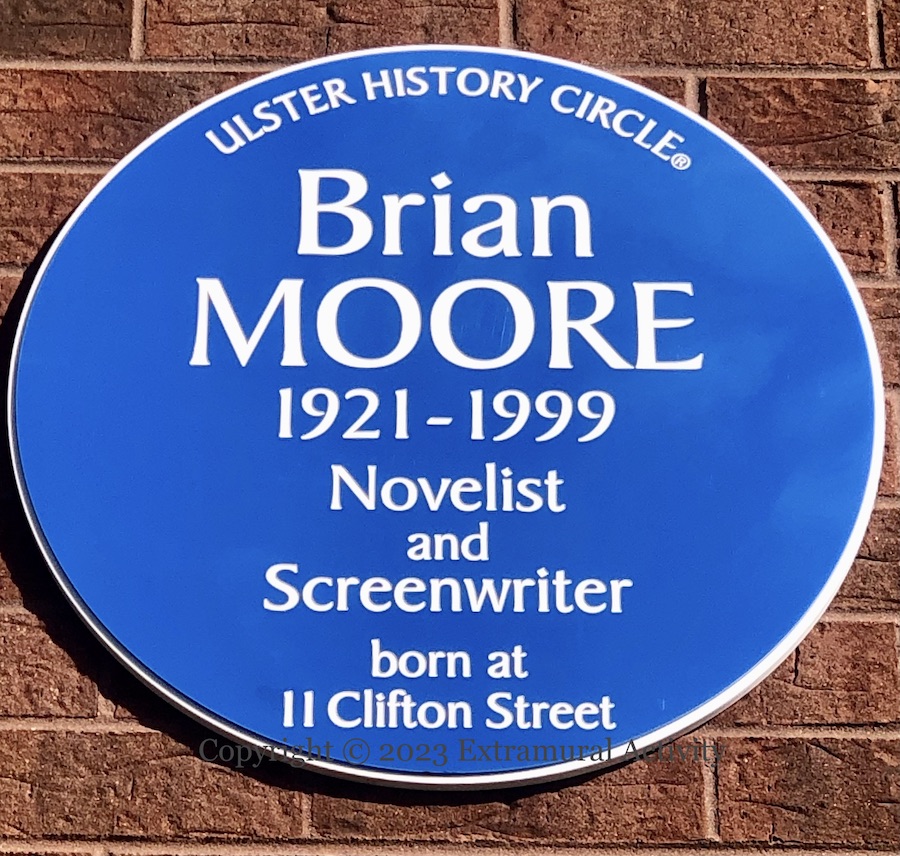
Novelist Brian Moore grew up on the Antrim Road and went to St Malachy’s, before emigrating to Canada in 1948. For the centenary of his birth in 1921, Paradosso Theatre adapted Moore’s best-known novel, (The Lonely Passion Of) Judith Hearne, for the stage and mounted this mural in Duncairn Avenue, showing the elements of Judith’s life: the bottle, the beads, the aunt who raised her, the piano used for lessons, and her red coat.
The board by Friz (ig) replaces the anti-joy-riding mural “Where’s The Joy?”, the last to go of the three, the others having been in CNR west Belfast and PUL west Belfast.
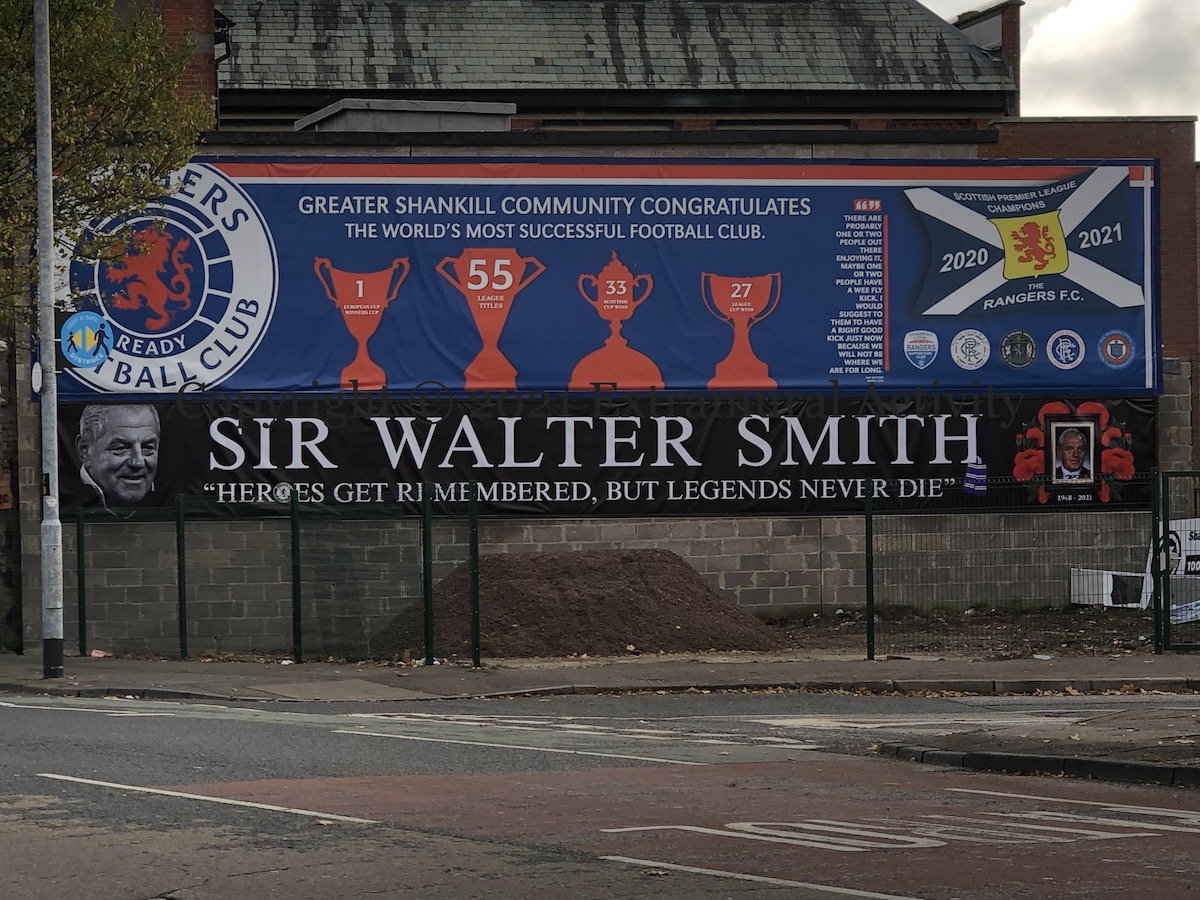
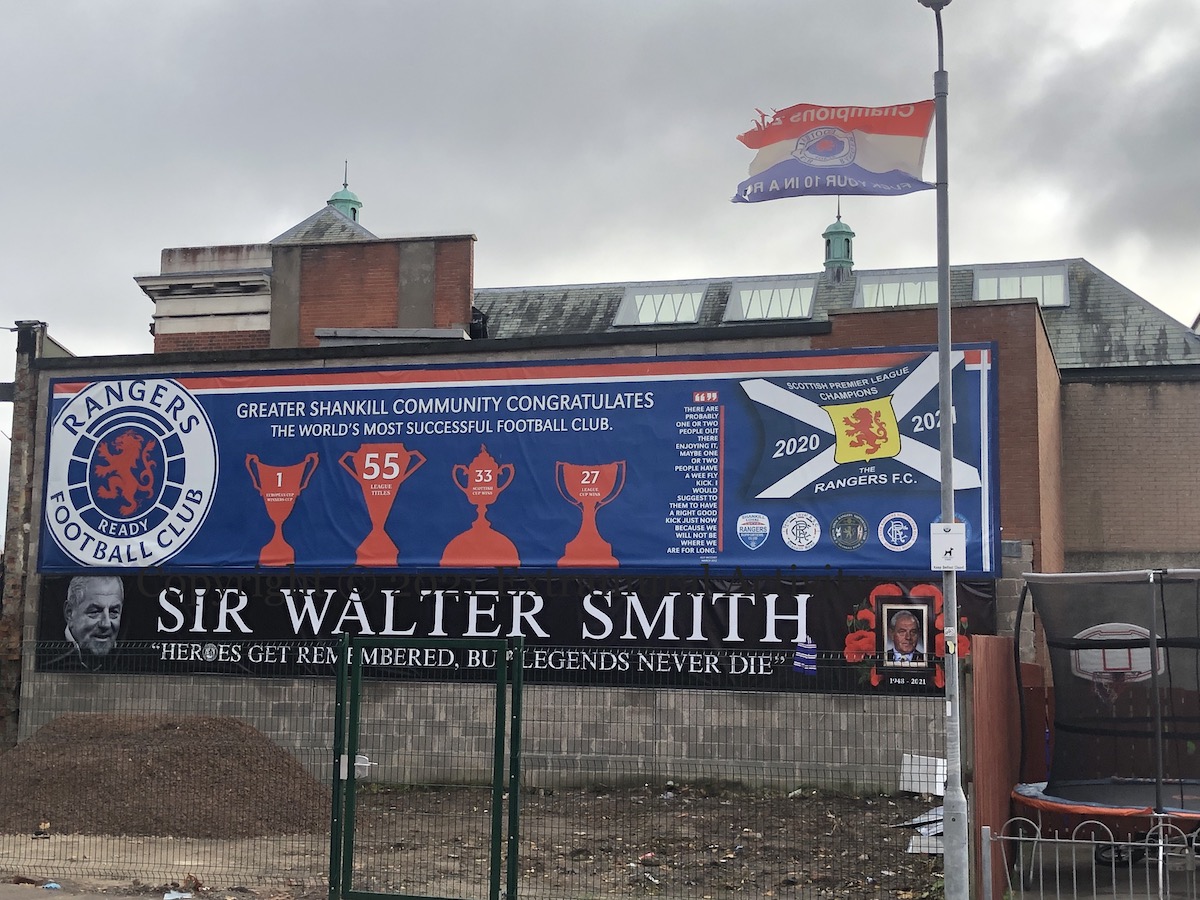
“Heroes get remembered, legends never die.” Walter Smith passed away on October 26th, after a managerial career spanning 33 years, including two stints at Rangers – winning 21 titles over 11 years – and the Scottish national squad. A tarp in his honour – with poppies around his portrait – has been added to the Shankill Road celebration of Rangers’ 2020-2021 league title.
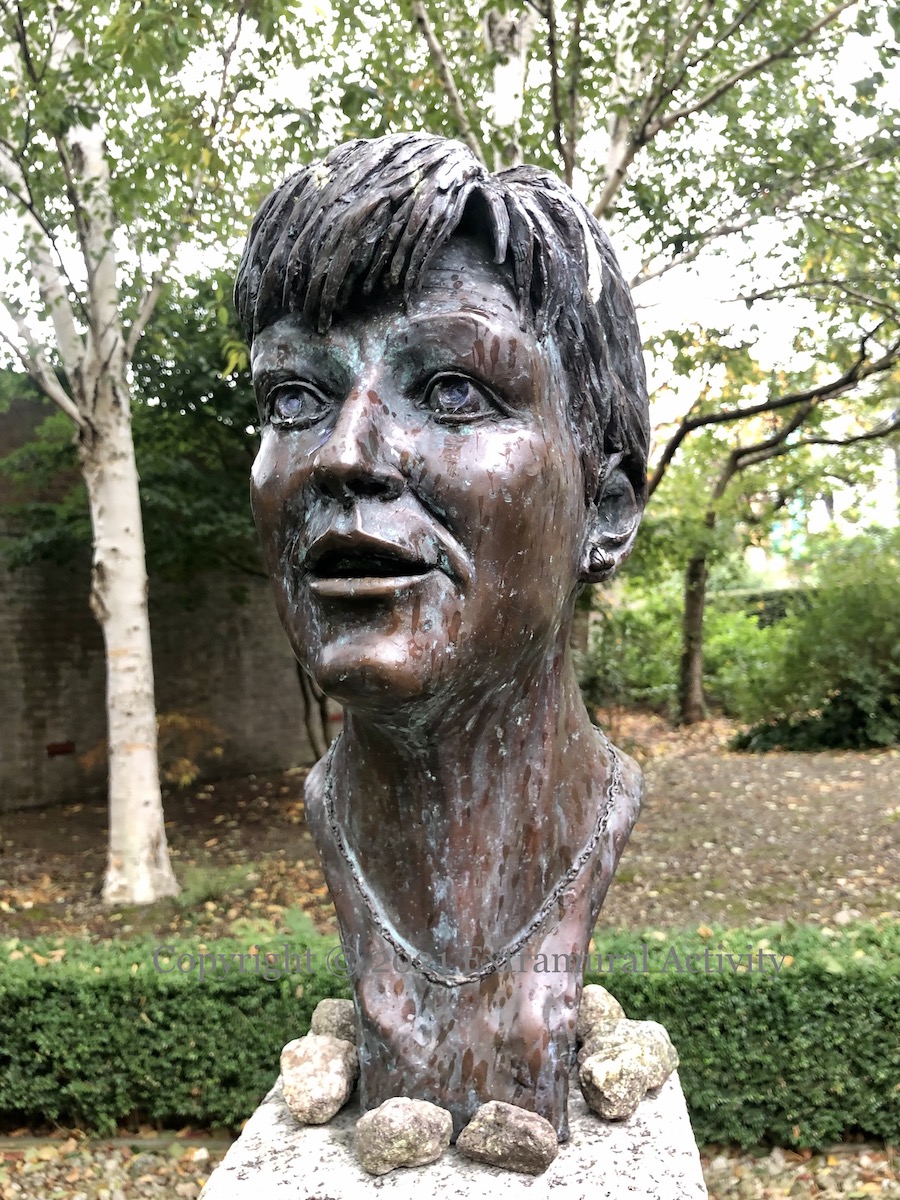
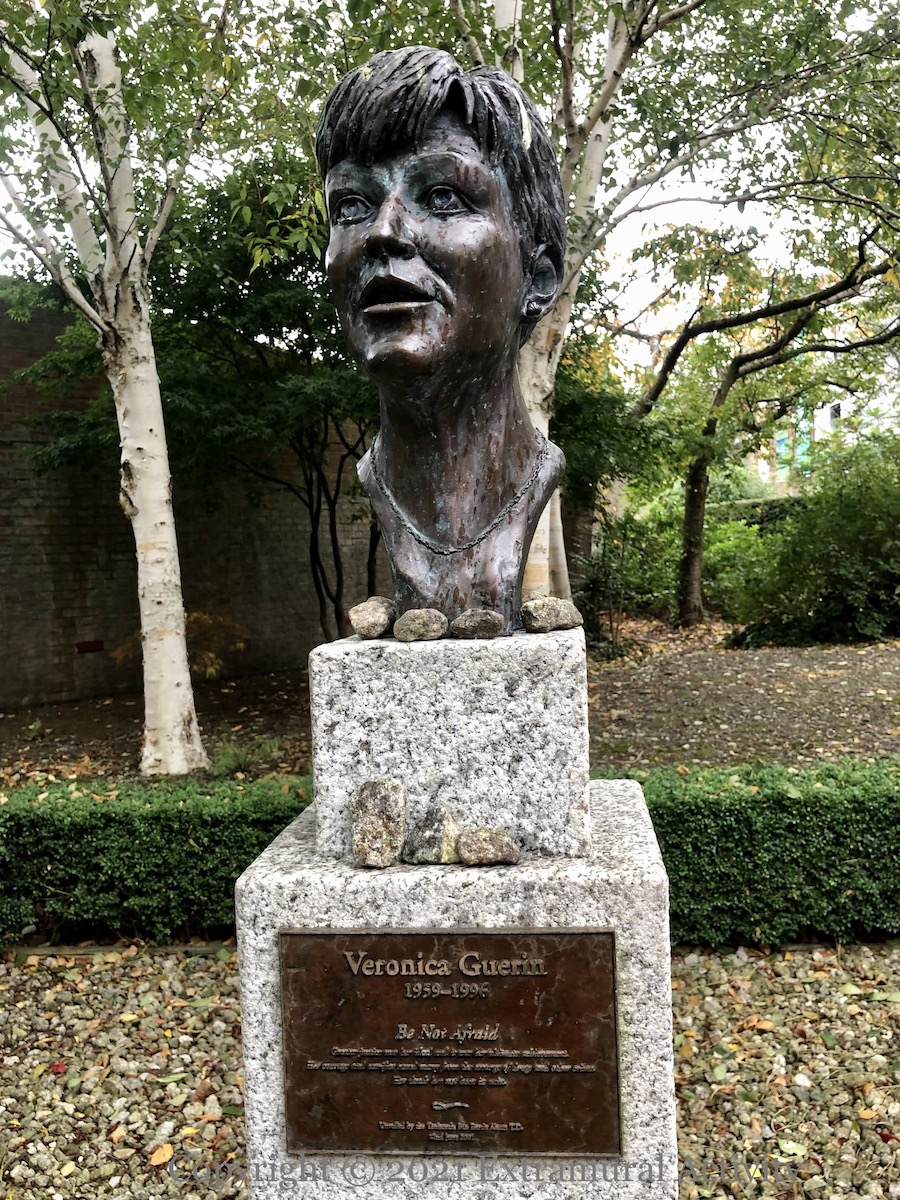
“Greater justice was her ideal and it was her ultimate achievement. Her courage and sacrifice saved many from the scourge of drugs and other crime. Her death has not been in vain.” Veronica Guerin was a Sunday Independent journalist who investigated drug trafficking in Ireland. She was shot and killed in 1996 while sitting at a traffic light on the Naas dual carriage-way by members of John Gilligan’s gang riding a motorcycle (WP).
The bronze bust, by sculptor John Coll, is in the grounds of Dublin Castle (Statues). “Unveiled by the Taoiseach, Mr Bernie Ahern, TD, 22nd June, 2001.”
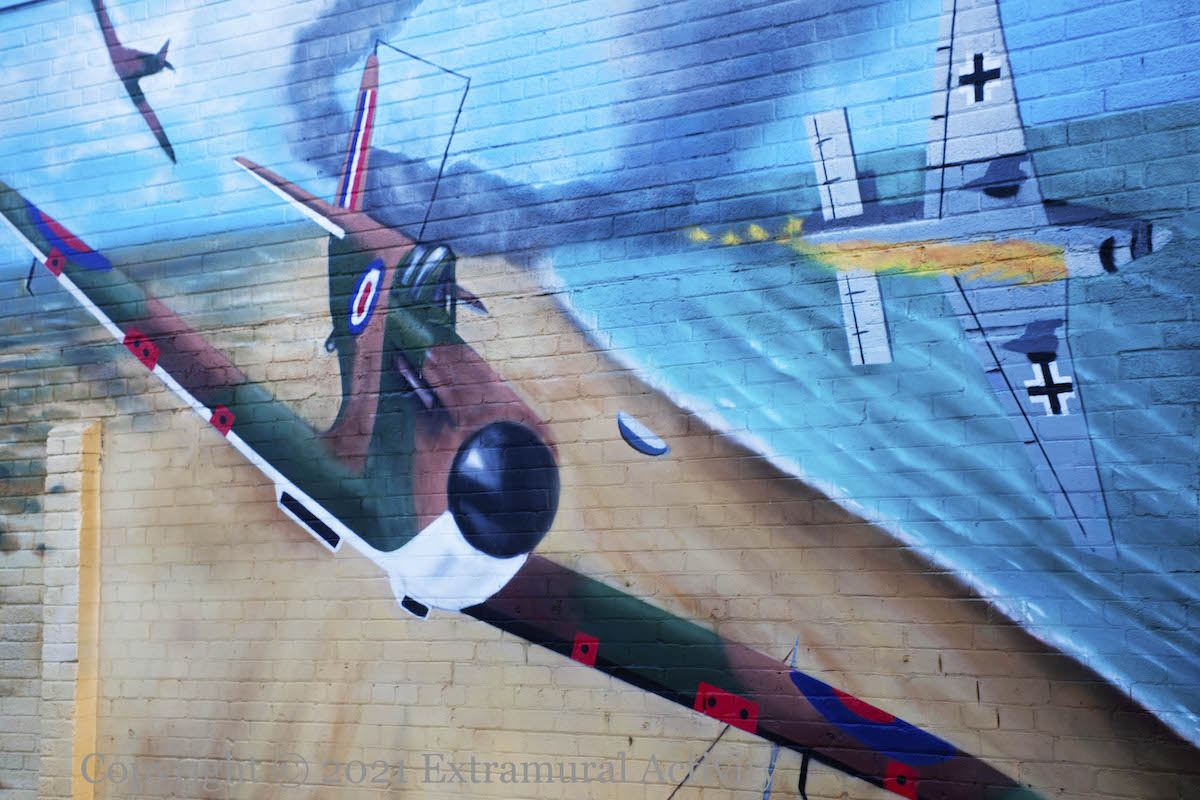
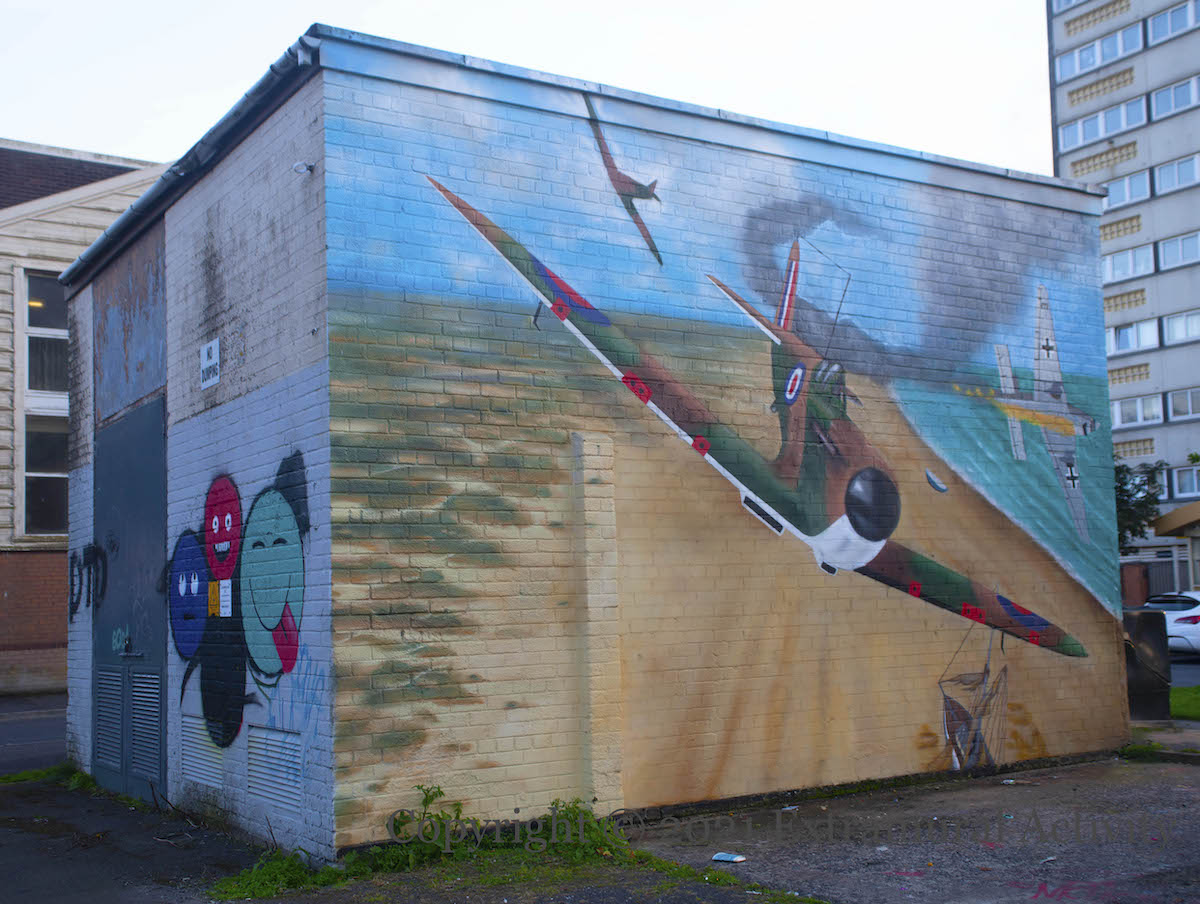
An RAF Spitfire sees off a Luftwaffe Ju87 Stukas over the beach at Dunkirk, France, as British troops are evacuated from the Continent. The fighter plane, designed and built by Supermarine Aviation from 1928 to 1948, became iconic during the Battle Of Britain as the faster counterpart to the Hurricane (WP).
The mural, by Glen Molloy, reproduces Mark Postlethwaite’s painting, Spitfires Over Dunkirk. Oddly, the mural is on the wall of the Clarawood substation that is not visible from any of the residences.
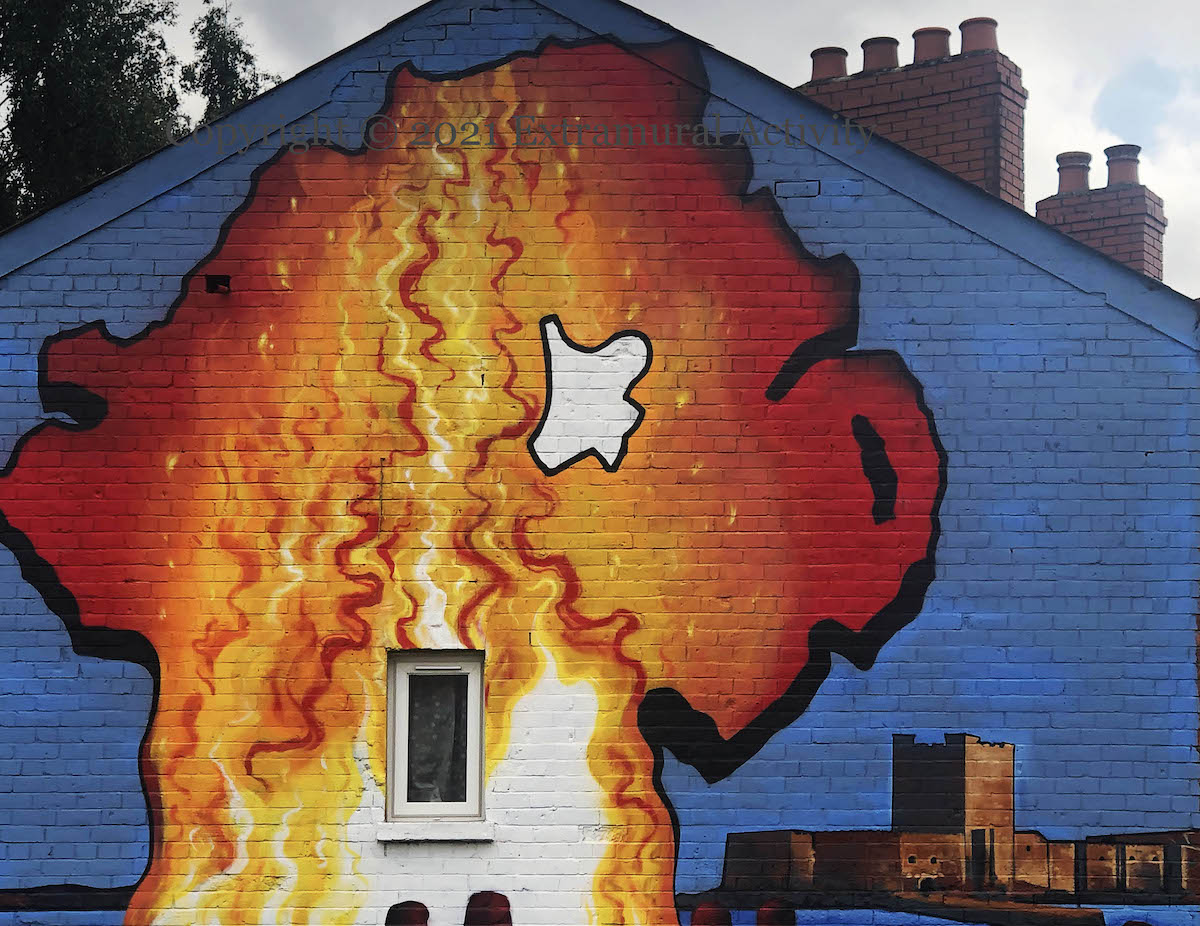
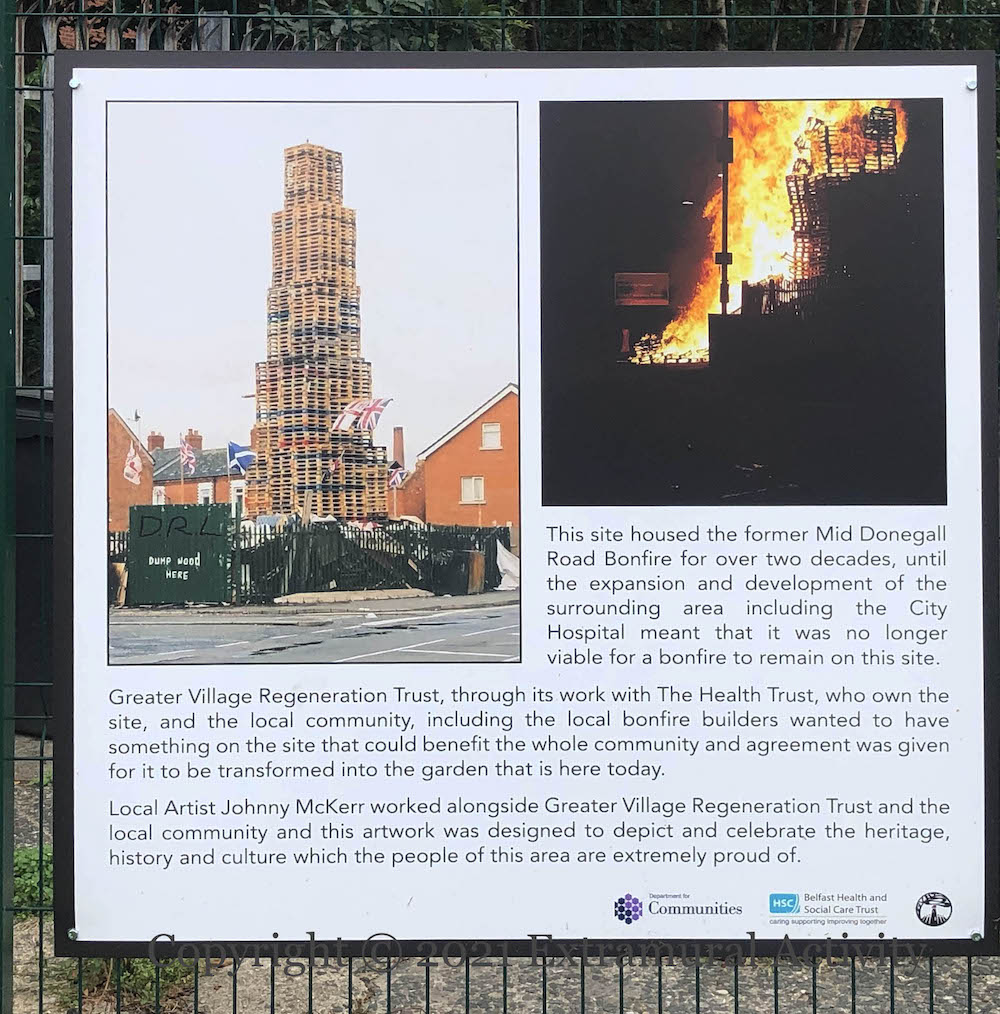
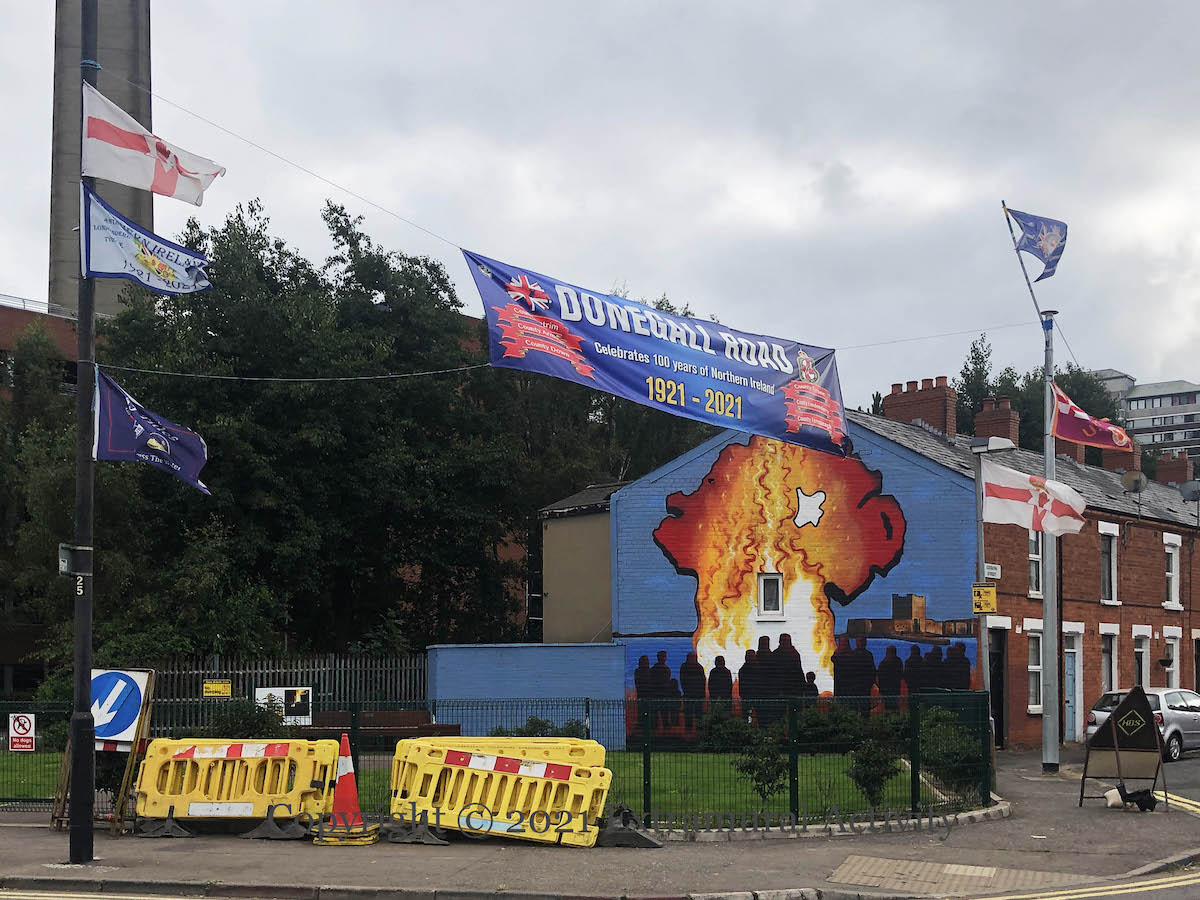
“This site housed the former Mid Donegall Road Bonfire for over two decades, until the expansion and development of the surrounding area including the City Hospital meant that it was no longer viable for a bonfire to remain on this site. Greater Village Regeneration Trust, through its work with The Health Trust, who own the site, and the local community, including the local bonfire builders wanted to have something on the site that could benefit the whole community and agreement was given for it to be transformed into the garden that is here today. Local Artist Johnny [sic] McKerr worked alongside Greater Village Regeneration Trust and the local community and this artwork was designed to depict and celebrate the heritage, history and culture which the people of this area are extremely proud of.”
The info board includes a photograph of the bonfire spilling out towards the car-park for the City. The other image is a photograph from the Peter Moloney Collection, used without permission, and photoshopped to add “DRL” – Donegall Road Loyalists.
According to Eddie Kelly of the GVRT, Carrickfergus castle is included because “This is where King William landed, and the annual bonfire is a symbol of a beacon lit across the coast to guide him” (Belfast Live).
Painted by JMK/Jonny McKerr (tw) at Coolfin St on Donegall Rd.