The Poppy Trail 1916

03645 2016-07-07 Poppy Trail 1916+

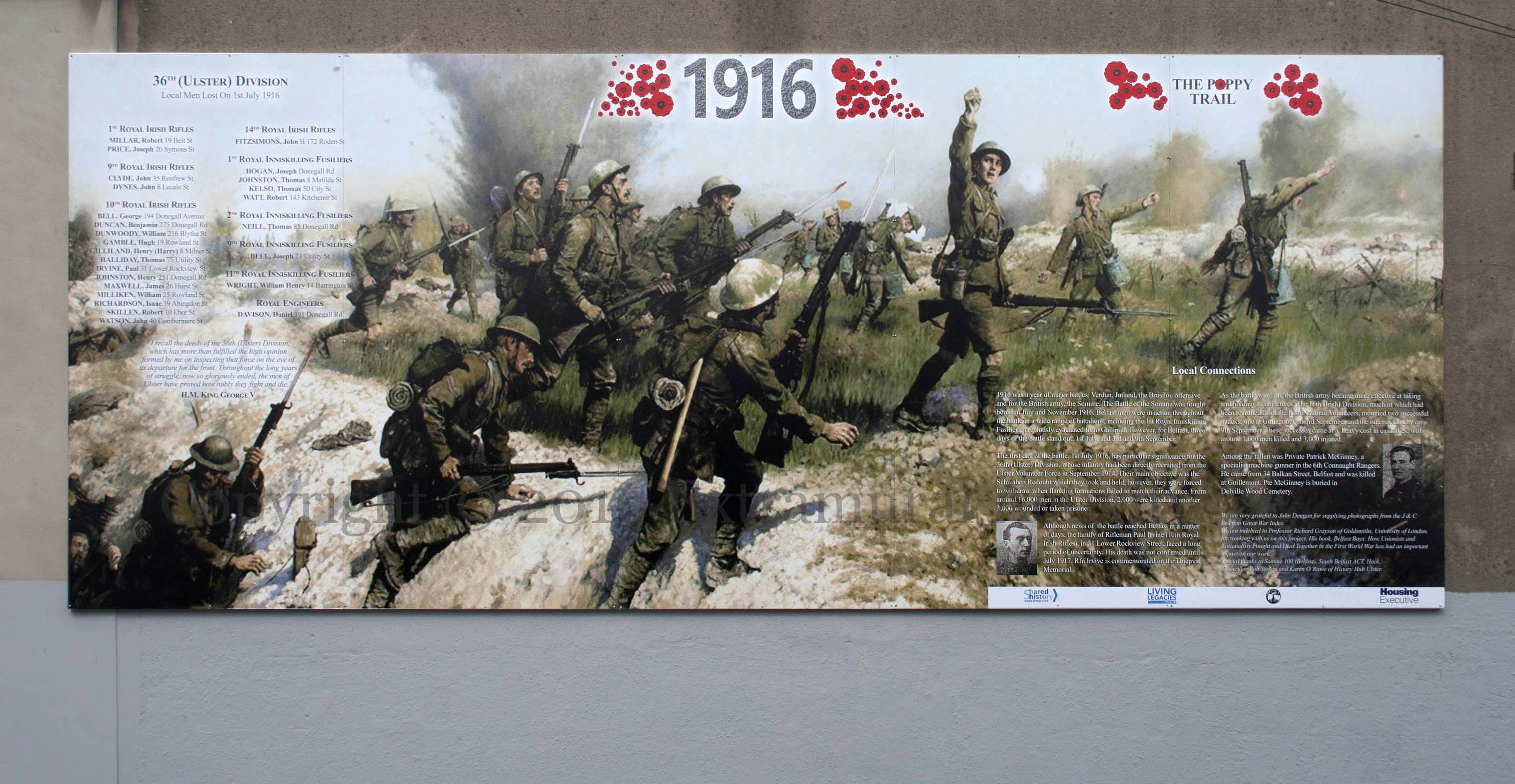
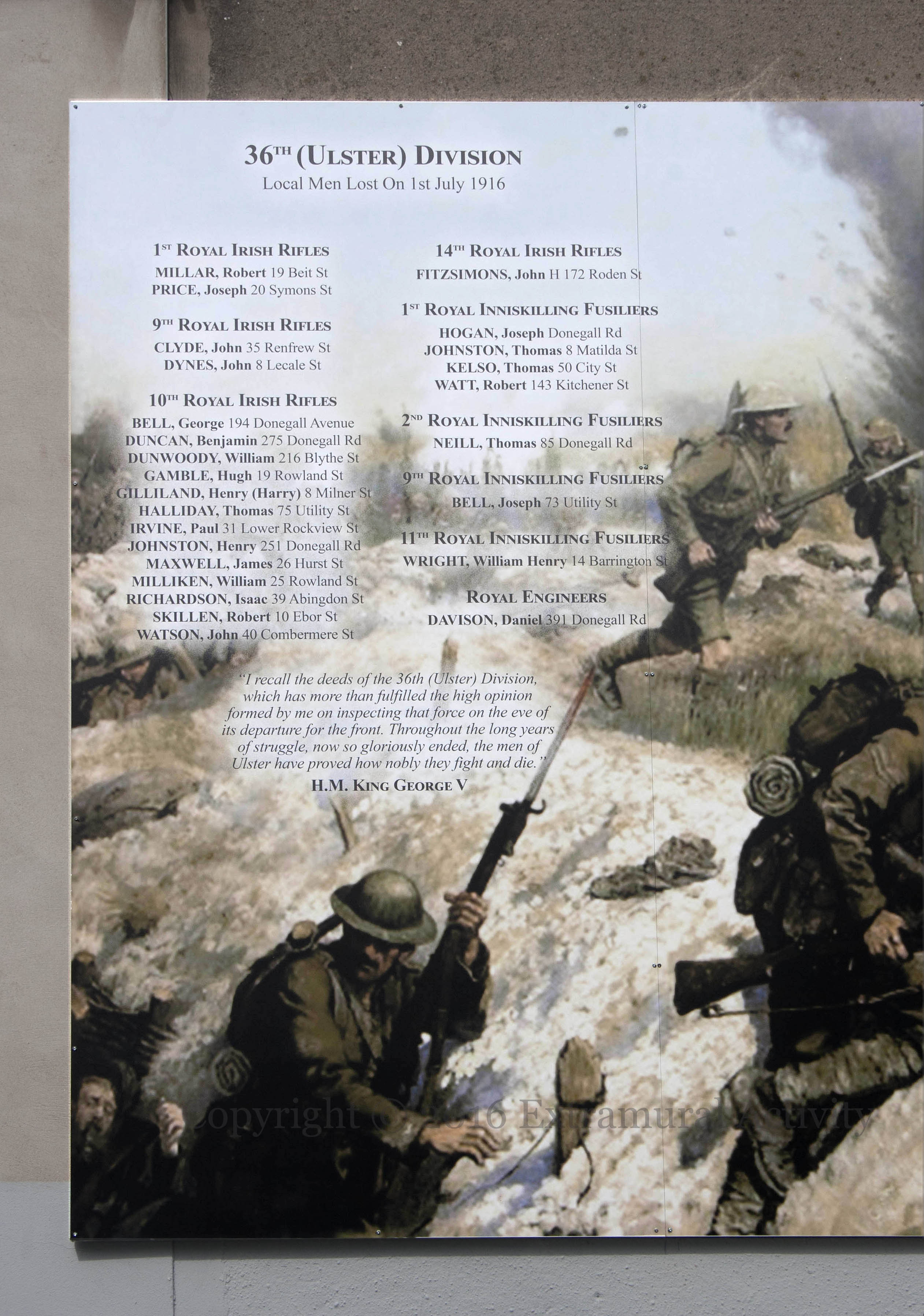
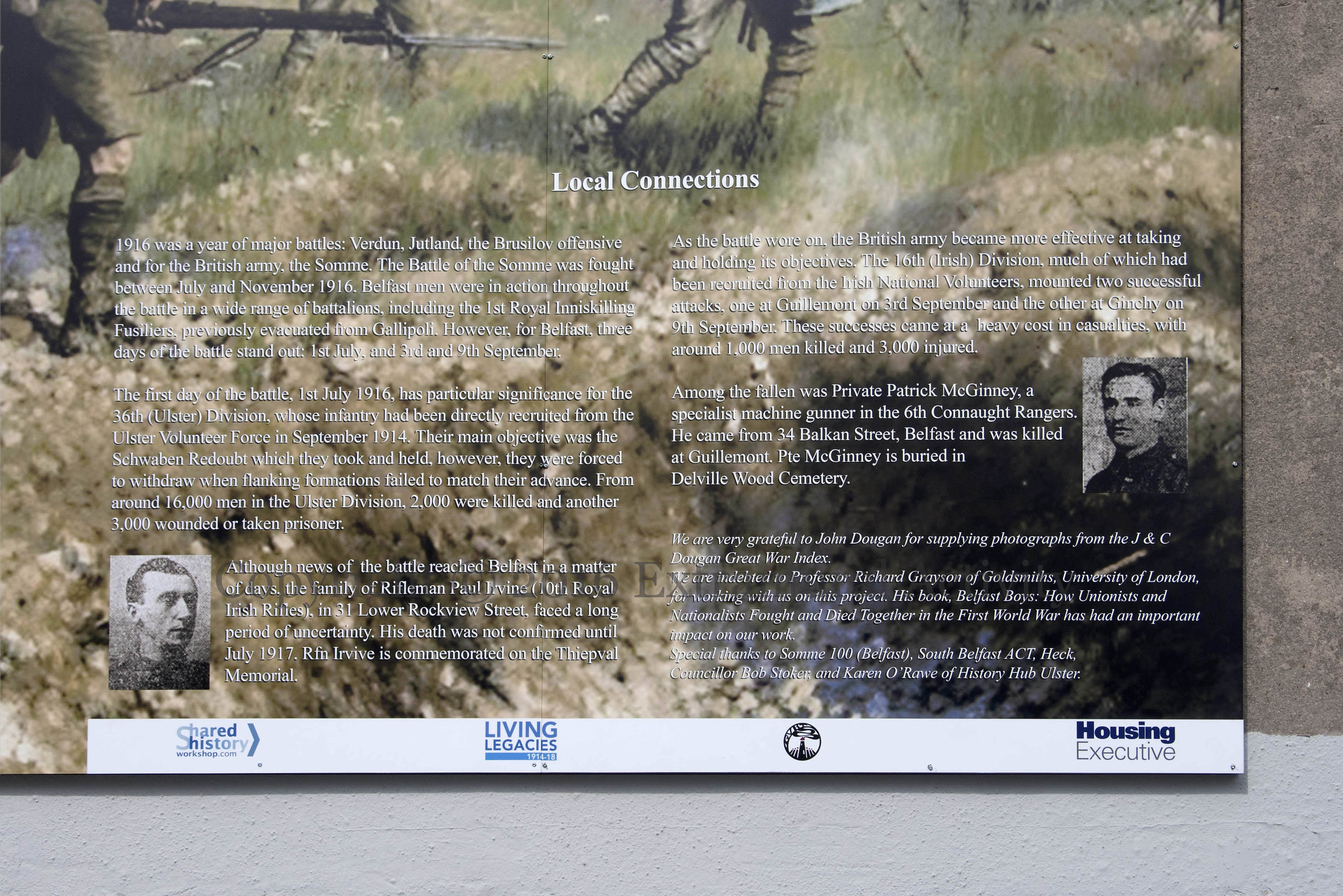
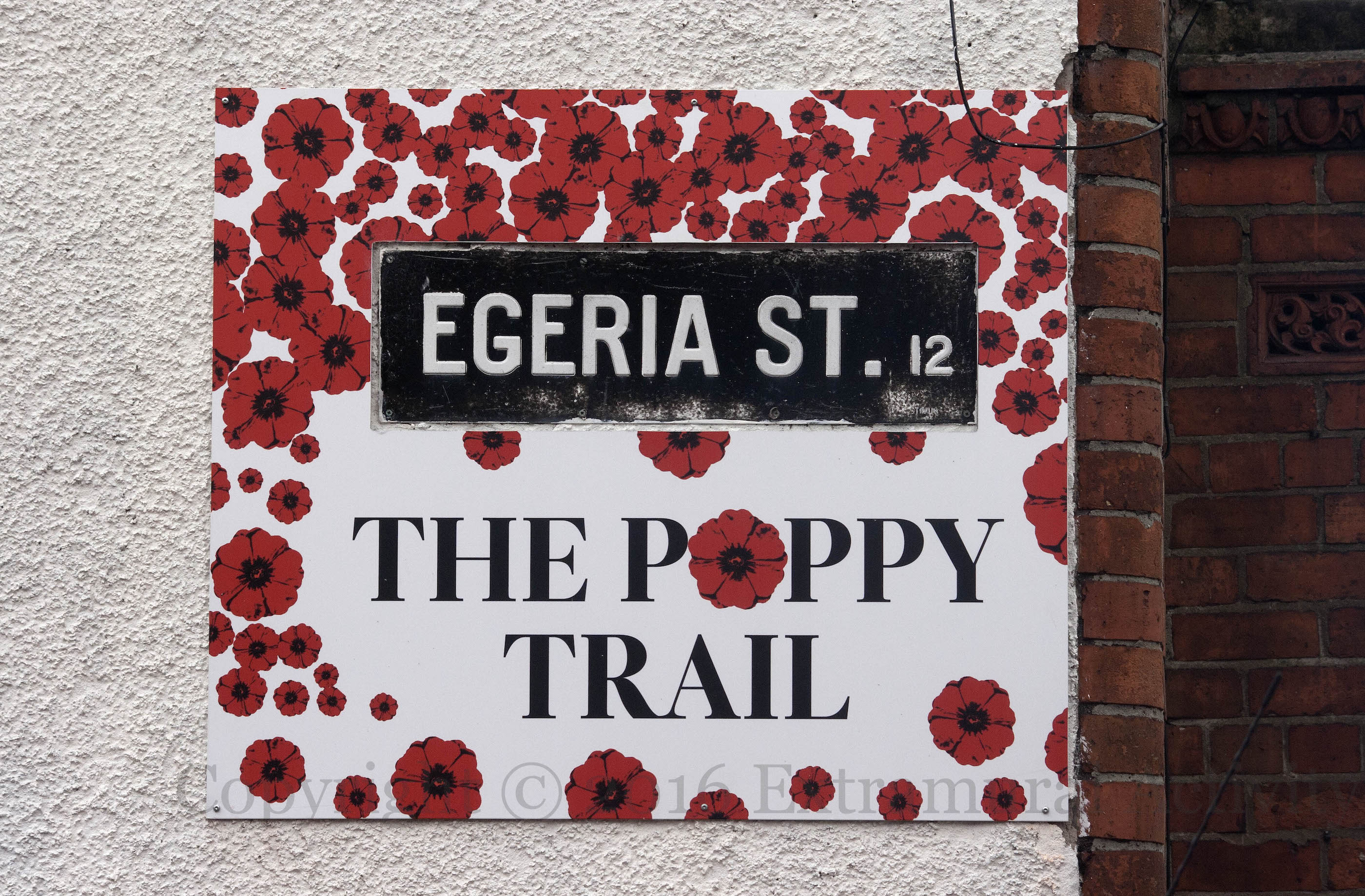
 JP Beadle’s Battle Of The Somme, Attack Of The Ulster Division is reproduced in the 1916 installment of the Poppy Trail in south Belfast. (For more on the painting, see belfastsomme.com.) In addition to listing local men lost in on July 1st – from places such as Roden, Matilda, Kitchener, Barrington, Blythe, Ebor, Rowland, Abingdon, and Combermere Street – it also features an individual from each community who served and died, in this case, Rifleman Paul Irvine from Lower Rockview Street and Private Patrick McGinney from Balkan Street (in the Divis area).

Launched on 2016-06-27; Tele report.

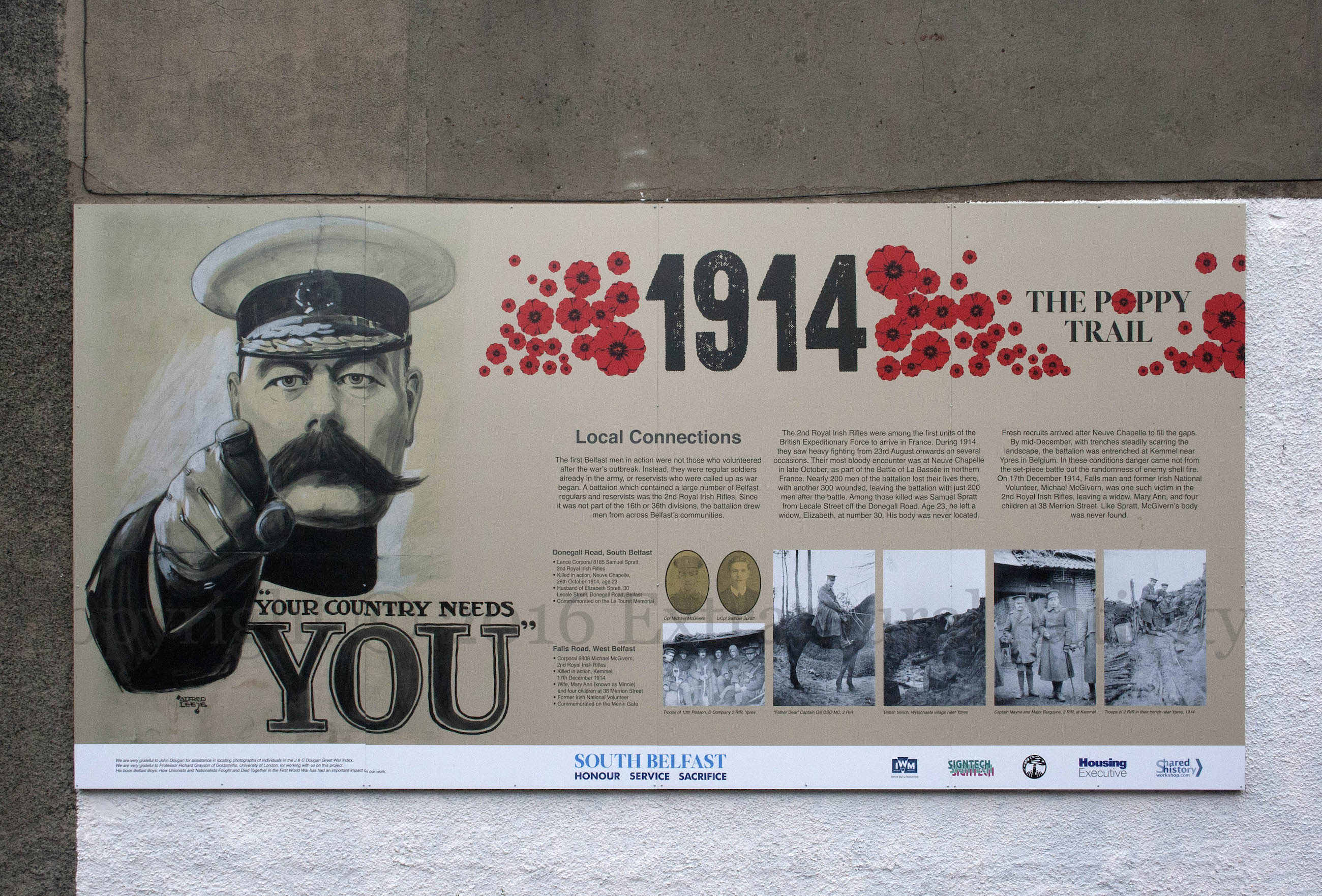
Here are the boards for The Poppy Trail 1914 and The Poppy Trail 1915.

03646 2016-07-07 Poppy Trail 1916 l+

03647 2016-07-07 Poppy Trail 1916 r+

Click image to enlarge
Copyright © 2016 Seosamh Mac Coılle
X03645 X03646 X03647 Pandora St shared history living legacies housing executive greater village regeneration trust King george V how nobly they fight and die

Among The Fallen

03651-2016-07-07-william-bloomer

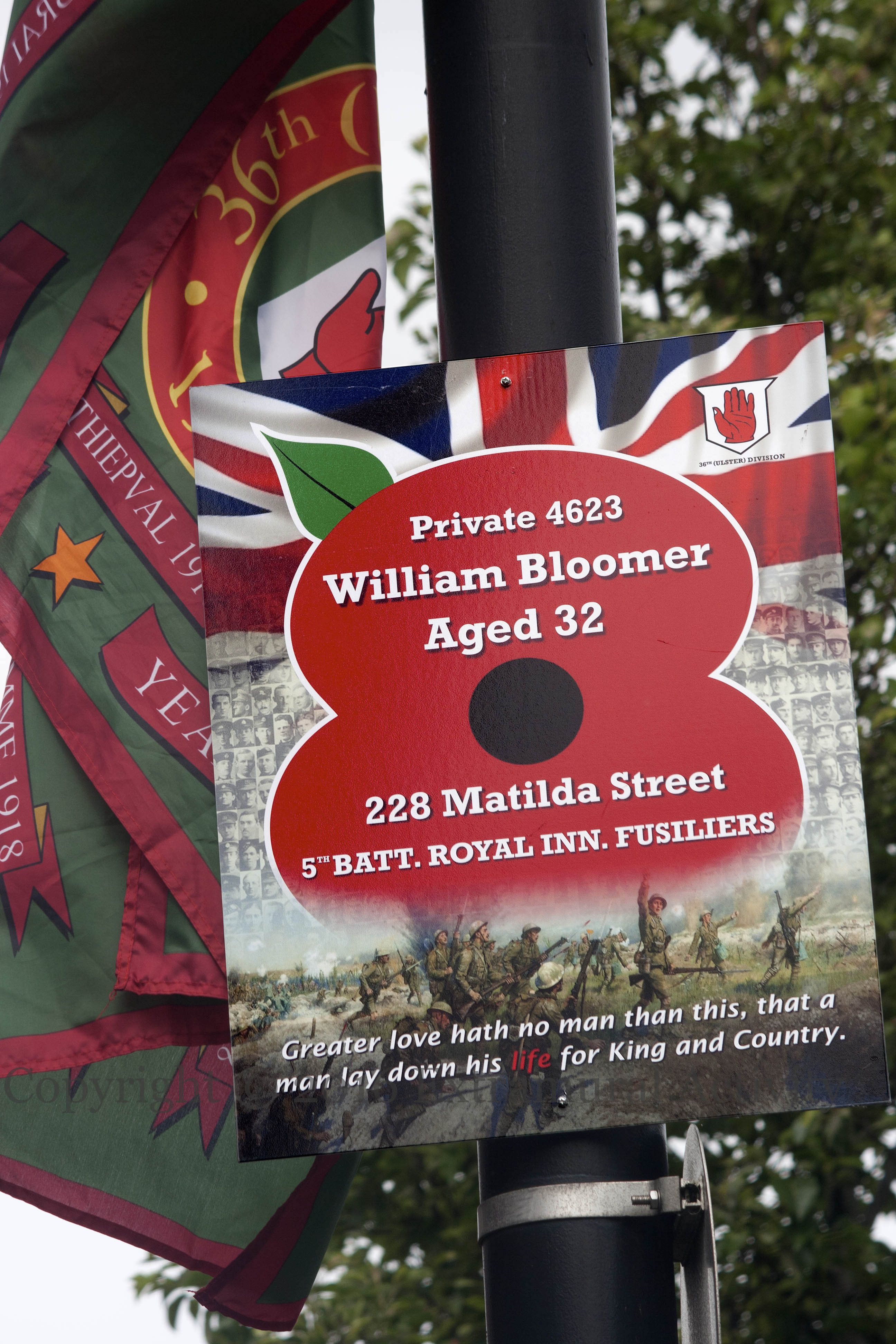
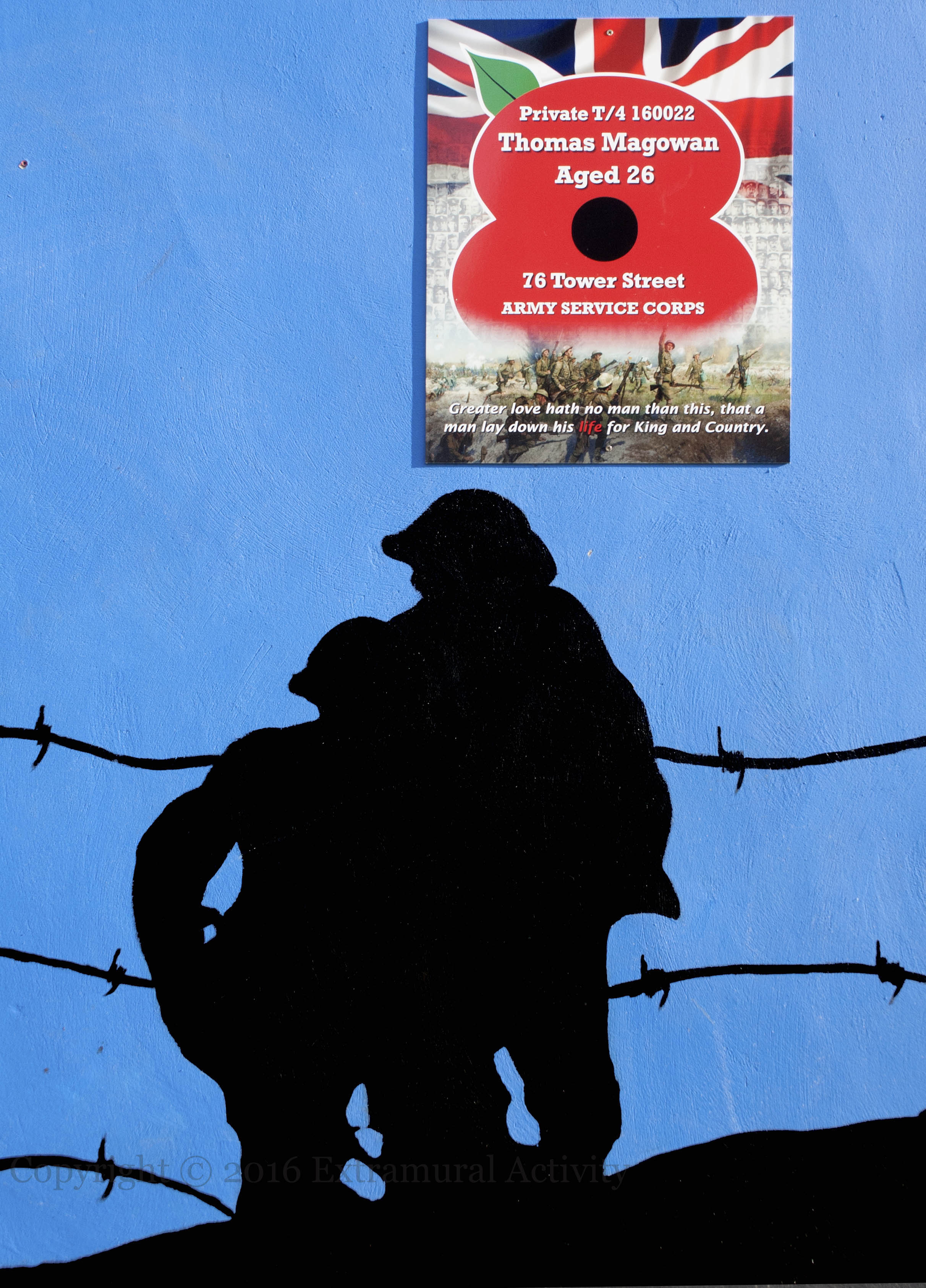
As part of the Poppy Trail, boards bearing the names, ages, addresses, and service units of Belfast casualties during WWI have been erected on walls and lampposts near their homes. Above: William Bloomer from Matilda Street in south Belfast. Below: Thomas Magowan from Tower Street in east Belfast.

03938-2016-11-09-ulster-tower-6

Click image to enlarge
Copyright © 2016 Seosamh Mac Coılle
X03651 X03938

The Poppy Trail 1915

03648 2016-07-07 Poppy Trail 1915+

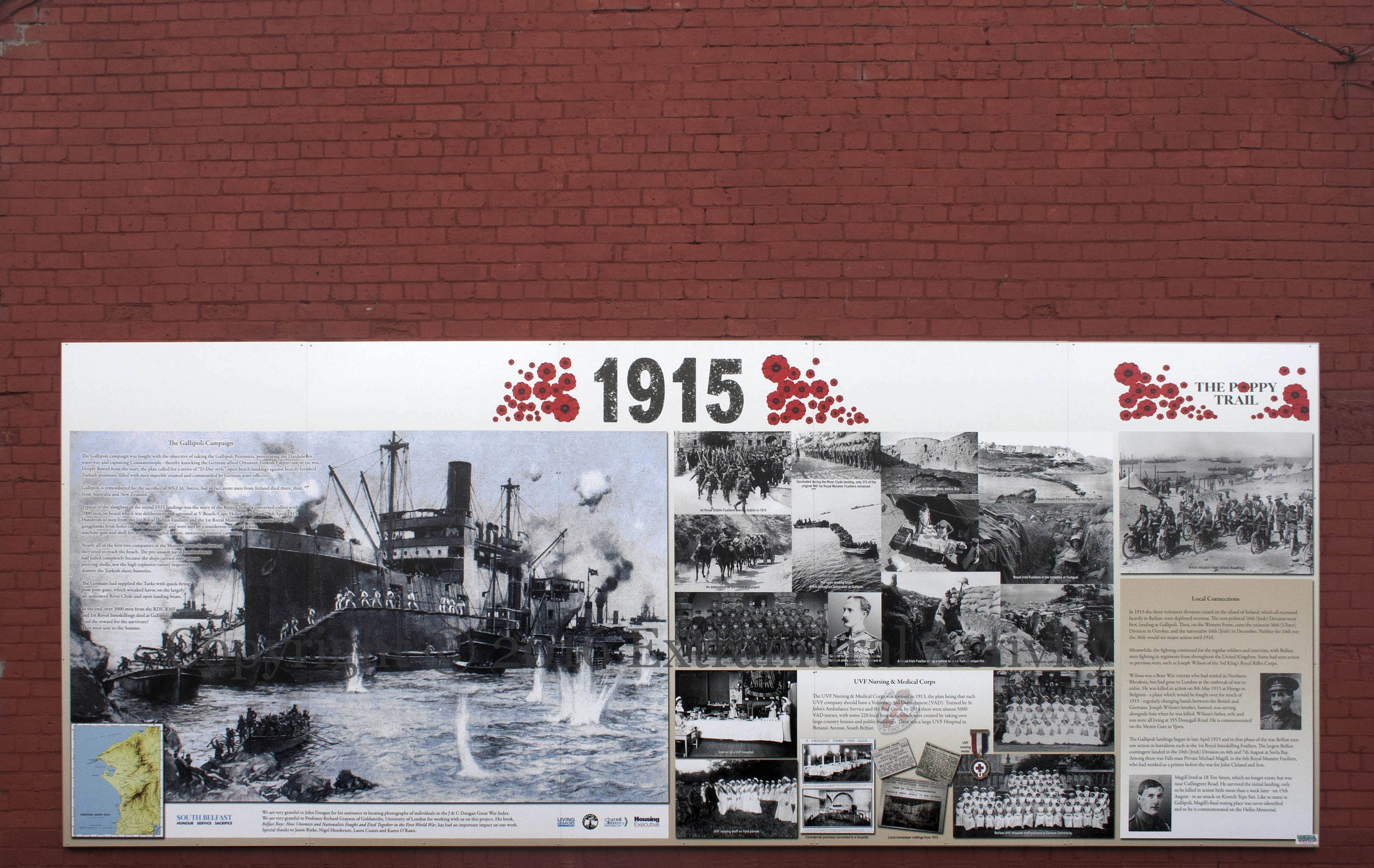
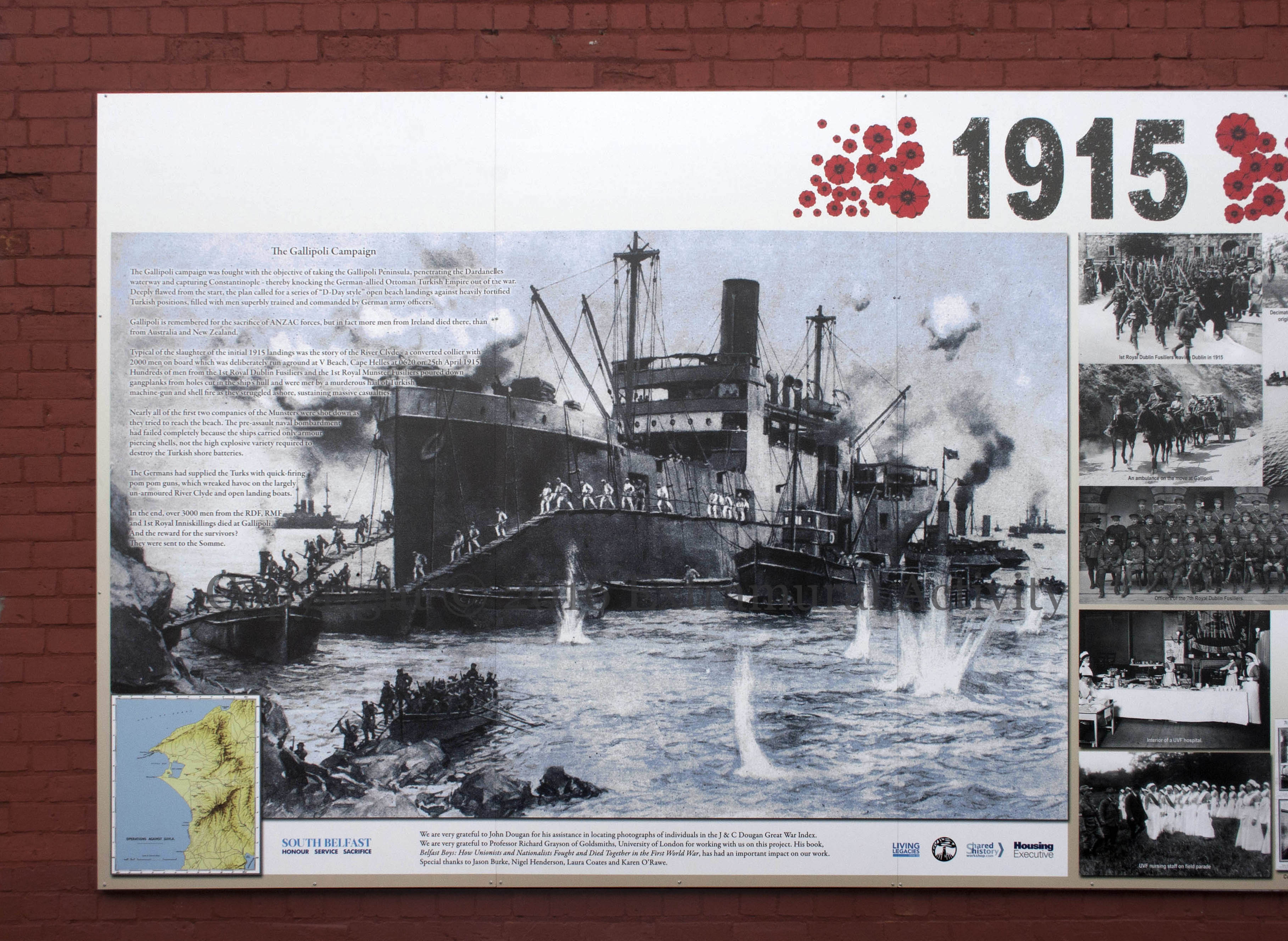
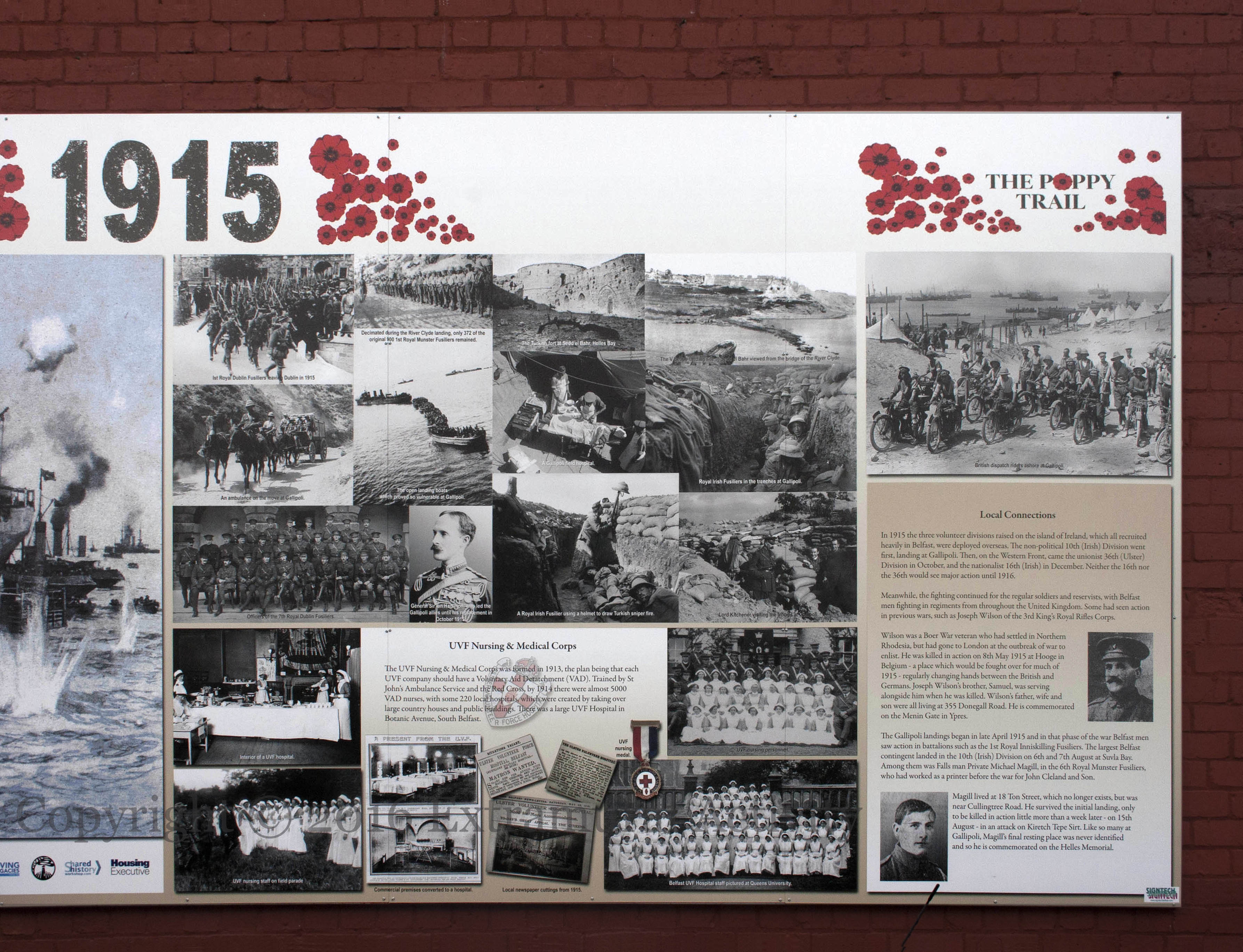
The 1915 board in the ‘Poppy Trail’ series in south Belfast focuses on the Gallipoli campaign, claiming that “more men from Ireland died there than from Australia and New Zealand.” The ship on the left-hand side is the River Clyde, a converted collier, carrying men from the 1st Royal Dublin and 1st Royal Munster Fusiliers, who were decimated as they tried to reach shore — “only 372 of the original 900 1st Royal Munster Fusiliers remained”.

As with the 1914 board, the 1915 board includes the stories of men from both south and west Belfast, in this case, Joseph Wilson, who hailed from Donegall Road and died in Belgium, and Michael Magill, from the Divis area, who died at Gallipoli.

03649 2016-07-07 Poppy Trail 1915 l+

03650 2016-07-07 Poppy Trail 1915 r+

Click image to enlarge
Copyright © 2016 Seosamh Mac Coılle
X03648 X03649 X03650 daphne st UVF nursing and medical corp dardanelles turkey turks ottoman empire helles bay

The Men From Ballyclare & District

03642 2016-07-06 Ballyclare Somme main+

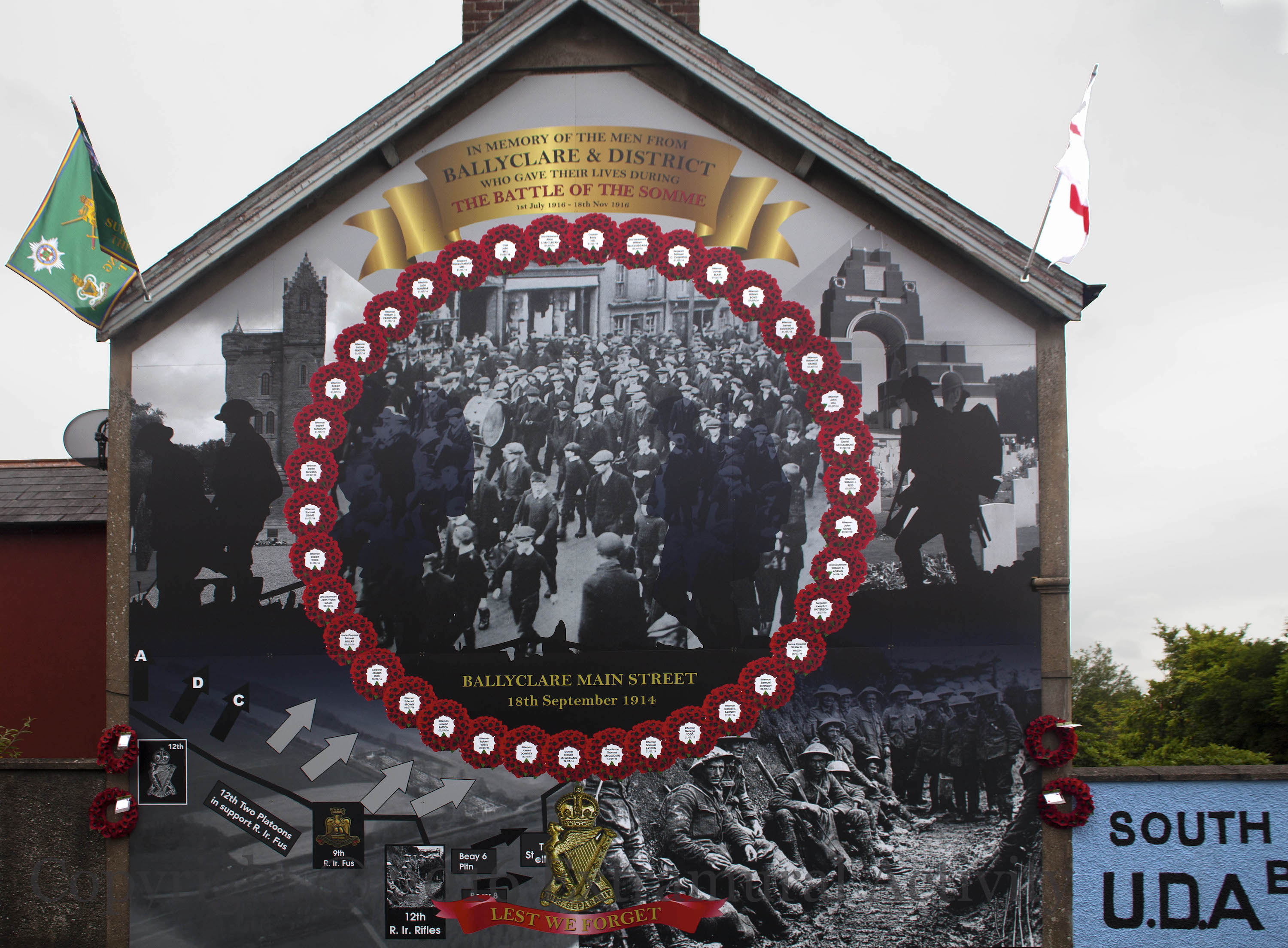
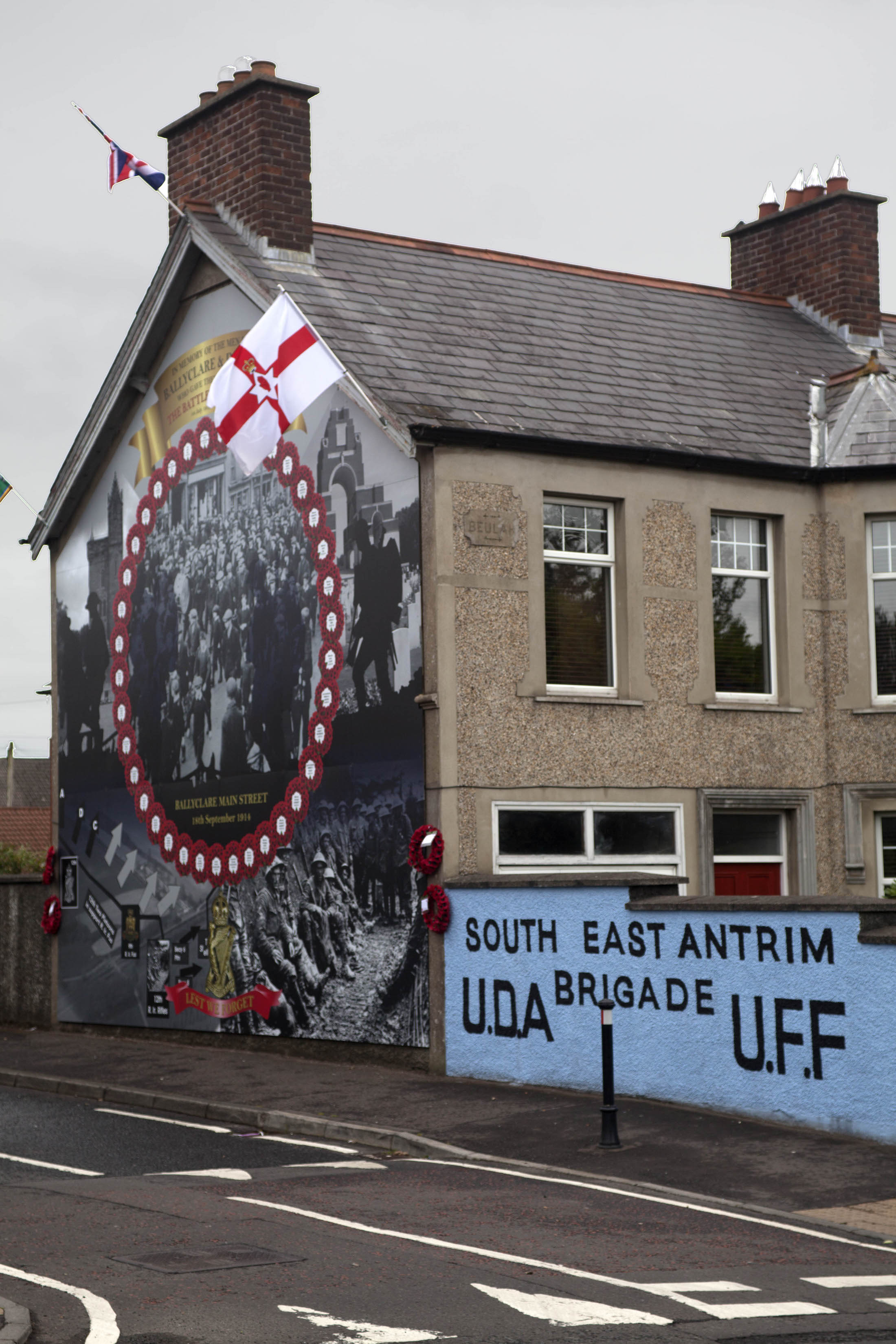
Garlands of poppies, one for each of 38 local men “who gave their lives during the Battle of the Somme 1st July 1916 – 18th Nov 1916”, form a circle around a photograph of “Ballyclare Main Streeet 18th September 1914” as the men go off to war. For information about 17 of the men, see this Love Ballyclare page.

03641 2016-07-06 Ballyclare Somme+

Click image to enlarge
Copyright © 2016 Seosamh Mac Coılle
X03642 X03641 charles drive lest we forget south east antrim brigade UDA UFF Eddie Beck and Graeme Baird

The Children Of Lear

03630-2016-07-05-children-of-lir

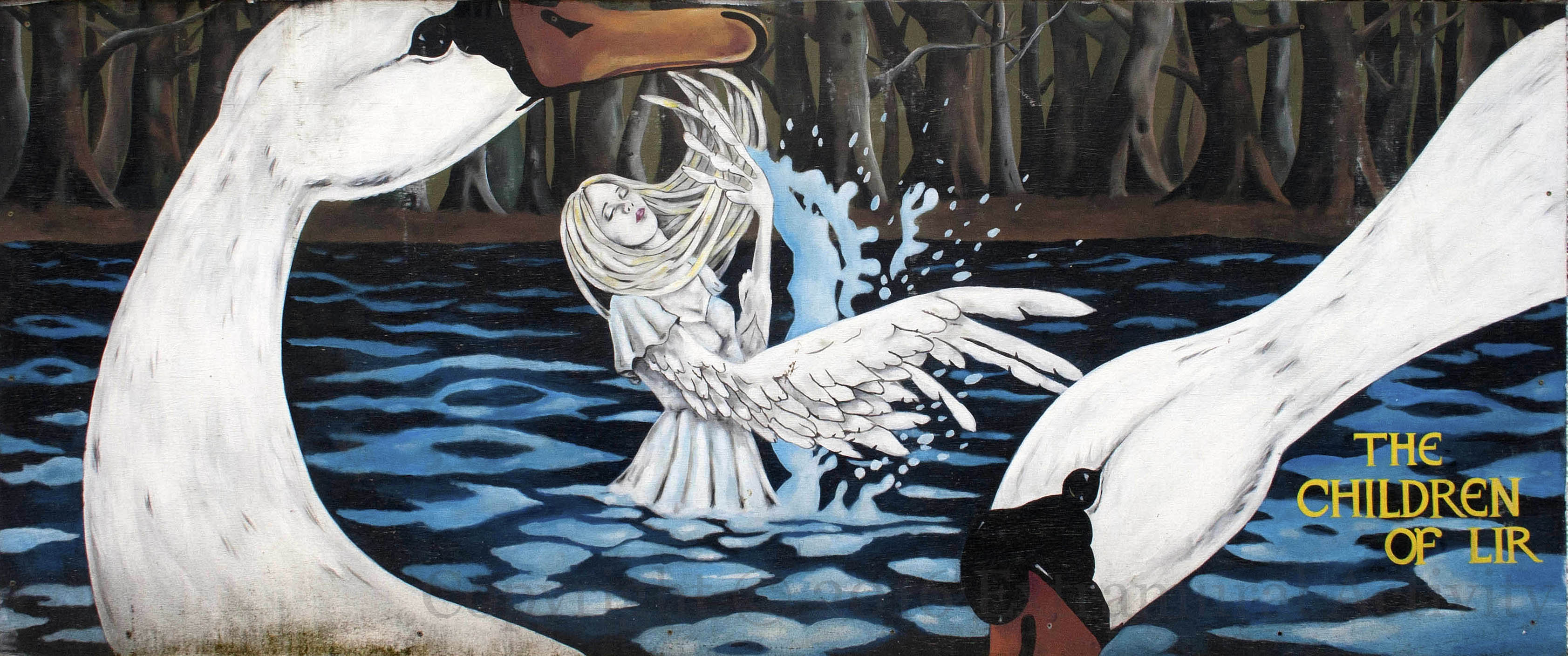
Step-mother Aoıfe resents the bonds between her husband Lear and his children and their love for their lost mother and turns them into singing swans for 900 years, by the end of which time Christianity had come to Ireland. A monk heard their song and recognised them. At his touch, they are restored to human form. Being 900 years old, they die immediately but not before being baptised.

For another ‘baptised before death’ story, see the story of the mermaid Lí Ban in Sea-Born.

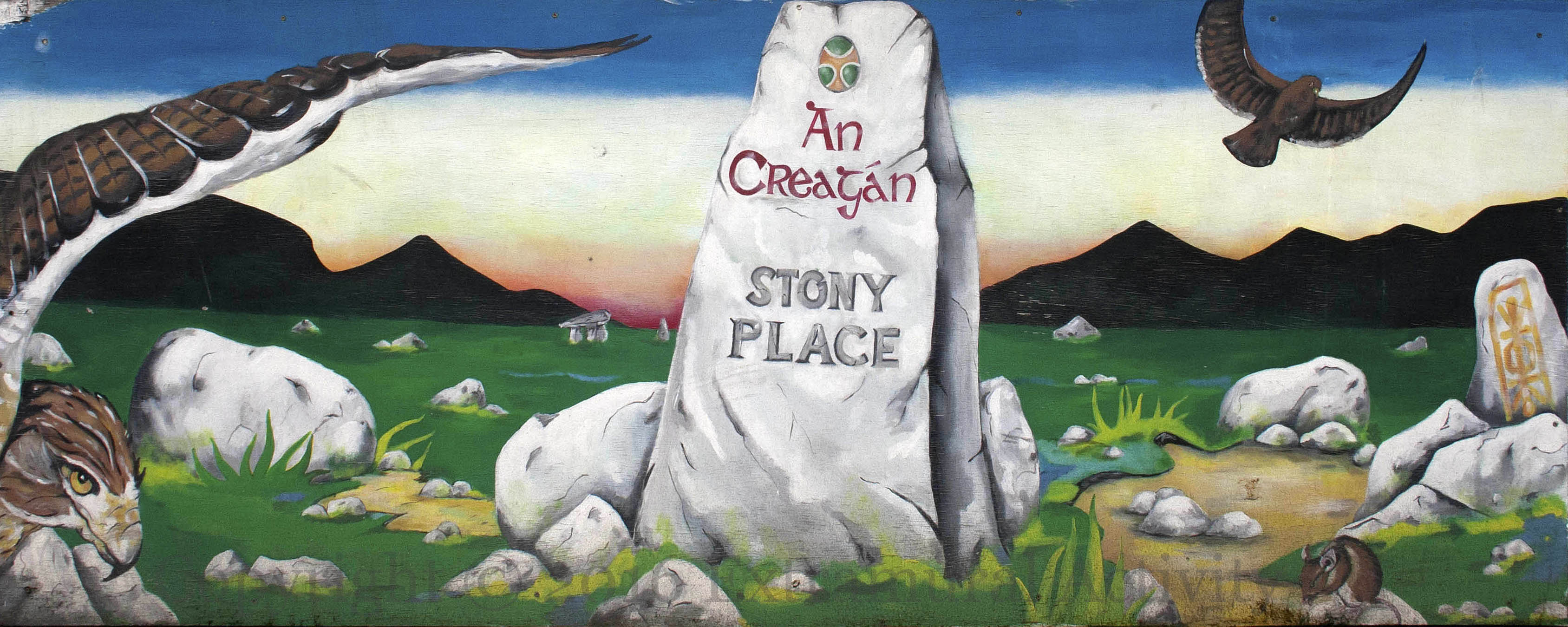
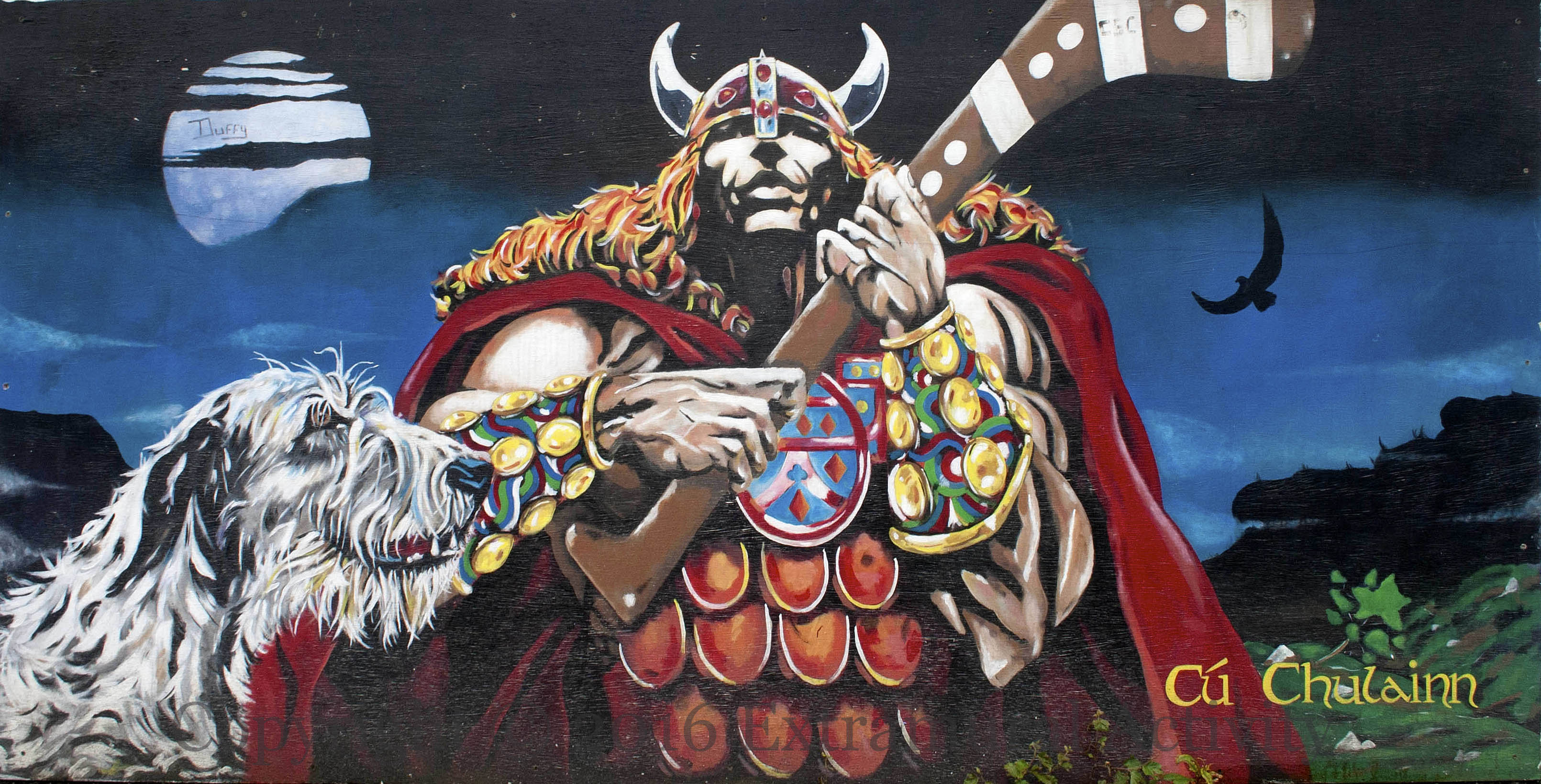
This is the third of three Celtic mythology boards in Creggan/An Creagán, Derry. See previously: Tír Na nÓg and Cú Chulaınn.

03629-2016-07-05-stony-place

Click image to enlarge
Copyright © 2016 Seosamh Mac Coılle
X03630 X03629 central dr stony place

Tír Na nÓg

03631 2016-07-05 Tir na nOg+

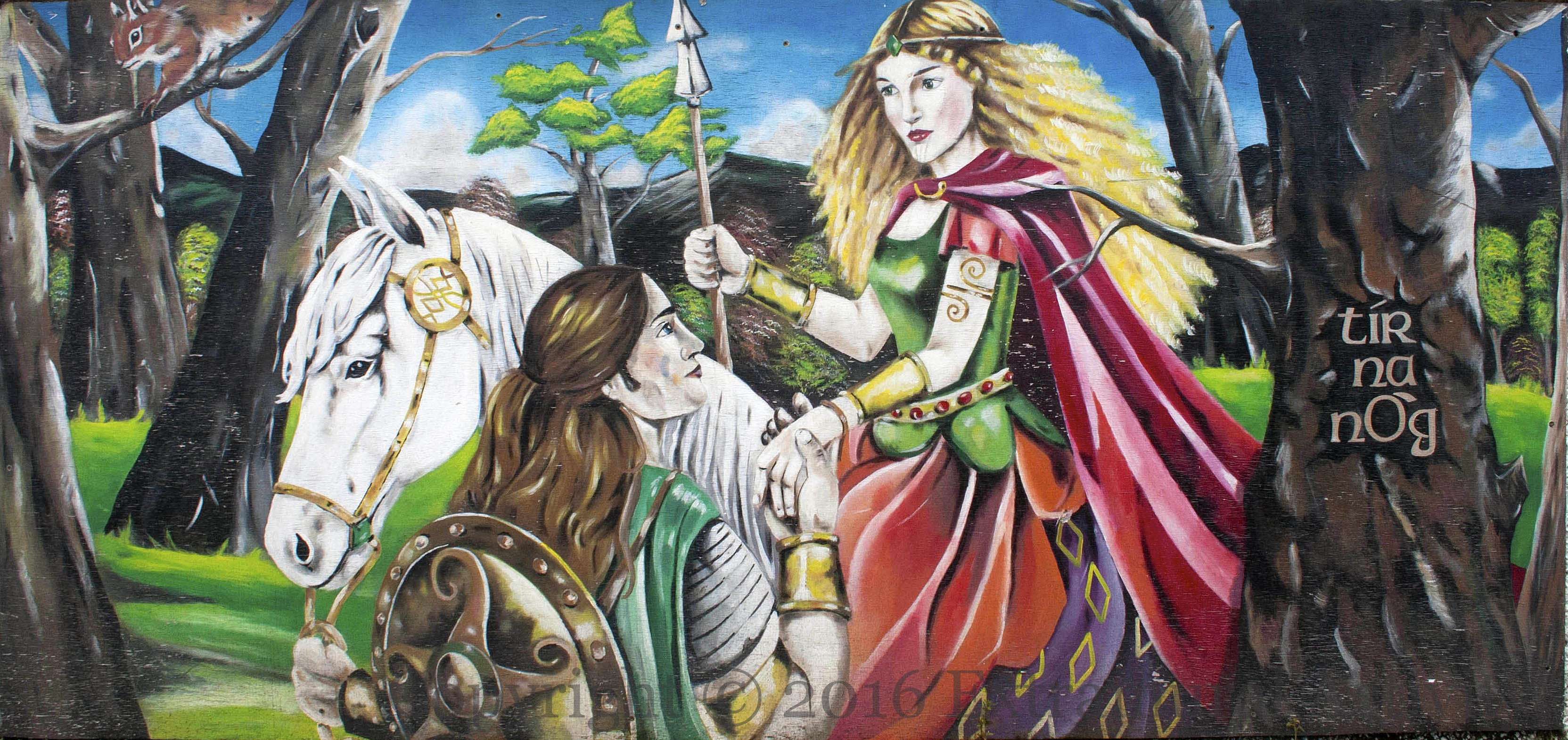
In the myths of the Tuatha Dé Danann, the Fıan Oısín falls in love with Nıamh from the Land Of Youth, but after three years — which is 300 human years — he yearns to return to Ireland. She gives him a magic horse that will preserve his youth while he remains on it. But he falls from it and dies of old age.

Click image to enlarge
Copyright © 2016 Seosamh Mac Coılle
X03631 central drive, Derry/Doıre

Culann’s Hound

03632 2016-07-05 Cu Chulainn+

“Cú Chulaınn” is Irish for “Culann’s Hound” after the boy Setanta killed the smith’s hound and promised to take its place until another one was raised. In one version of the legend, Setanta kills the original hound by driving a slıotar (hurley ball) down its throat – hence the hero is shown here holding a camán (hurley stick) rather than a sword. In the original picture on which this mural is based, the hero is not Cú Chulaınn but Jim Fitzpatrick’s vision of Nuada Silverarm and he carries a sword.

On the right hand side, Tuan the hawk/eagle/sea-raven bears witness to all of Irish history.

Click image to enlarge
Copyright © 2016 Seosamh Mac Coılle
X03632 central drive

Doıre Colum Cılle 700 AD

03592-2016-07-01-tigh-seoirse

The Christian missionary Colm Cılle (in Latin, Columba), born in Donegal, founded a monastic settlement on the banks of the Foyle (then still part of Donegal) around 540 AD. The “Doıre” part of the name means “oak grove” and perhaps refers (as the information panel suggests) to “a sacred grove of trees, which may have pre-dated the monastery.” The mural above shows a reconstruction of the Derry monastery c. 700 AD. The name “Londonderry” dates to 1662.

Columba moved on to Scotland circa 563 and founded an abbey on the island of Iona. Among his reputed miracles is the banishment of a great water beast from the River Ness in 565.

03593-2016-07-01-tigh-seoirse-scroll-1

03594-2016-07-01-tigh-seoirse-scroll-2

Click image to enlarge
Copyright © 2016 Seosamh Mac Coılle
X03592 X03593 X03594 U Bennett St
“This is a reconstruction of the early Christian monastery at Derry around 700 AD which was founded by St Colum Cille around 546 AD. Colum Cille left his community in Derry in 563 AD with twelve companions to found the great monastery of Iona. He only subsequently returned to Ireland once and died in 593 AD. Although St Colum Cille founded a number of Irish monasteries, it would appear that Derry was his principal residence until he left Ireland. The name itself, Doıre, (sometimes Doıre Colum Cılle) means ‘the oakgrove of Colum Cille’ a sacred grove of trees, which may have pre-dated the monastery.”

“Is athchuthú é seo ar an mhainistir luath-Chríostaí i nDoıre thart ar 700 AD a bhunaigh Naomh Cholm Cıille thart ar 546 AD. D’fhág Colm Cille a phobal ı nDoıre thart ar 563 AD le dáréag eıle le mómhaınıstır oıleán Í a chur ar bun. Níor fhill sé go hÉıreann ach uaır amháın agus fuaır sé bás in AD 593. Cé gur bhunaigh Naomh Cholm Cille roınnt maınıstreacha eıle ı nÉırınn, shocrıgh sé ı nDoıre de réır cosúlachta go dtí gut ımıgh sé. Déanann an t-aınm ‘Doıre Cholmcılle’ tagaırt do dhoıre naofa, a bhí ann roımh an mhaınıstir.”