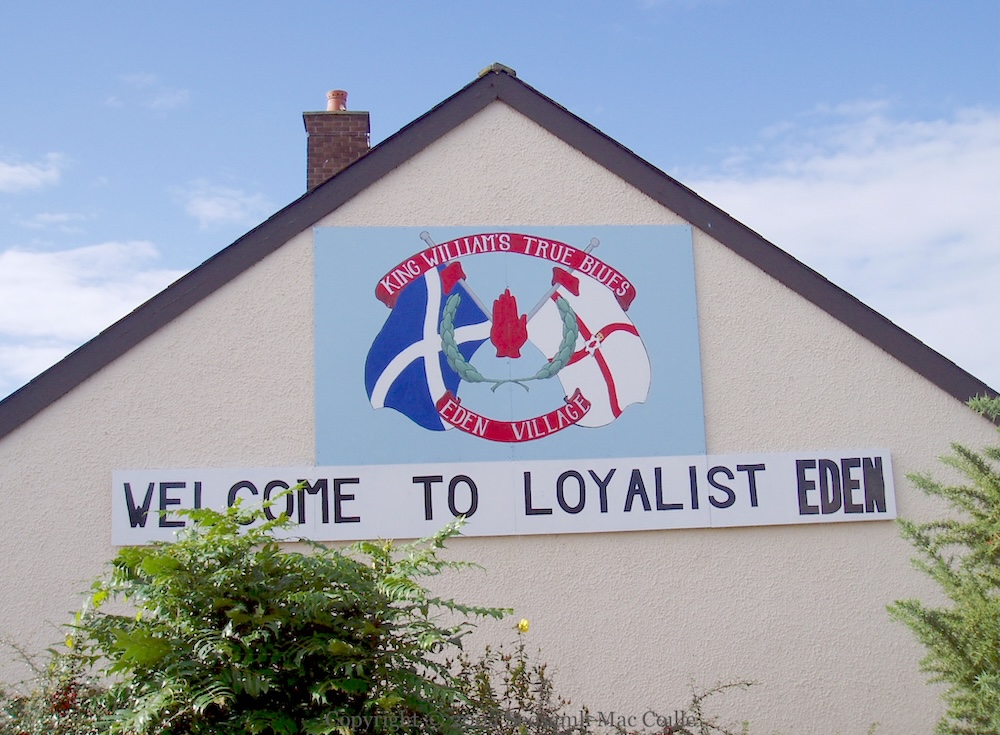
King William’s True Blues flute band from Eden Village (outside Carrickfergus) amalgamated with the South East Antrim Defenders. That group disbanded in 2007 but was re-established in 2010.
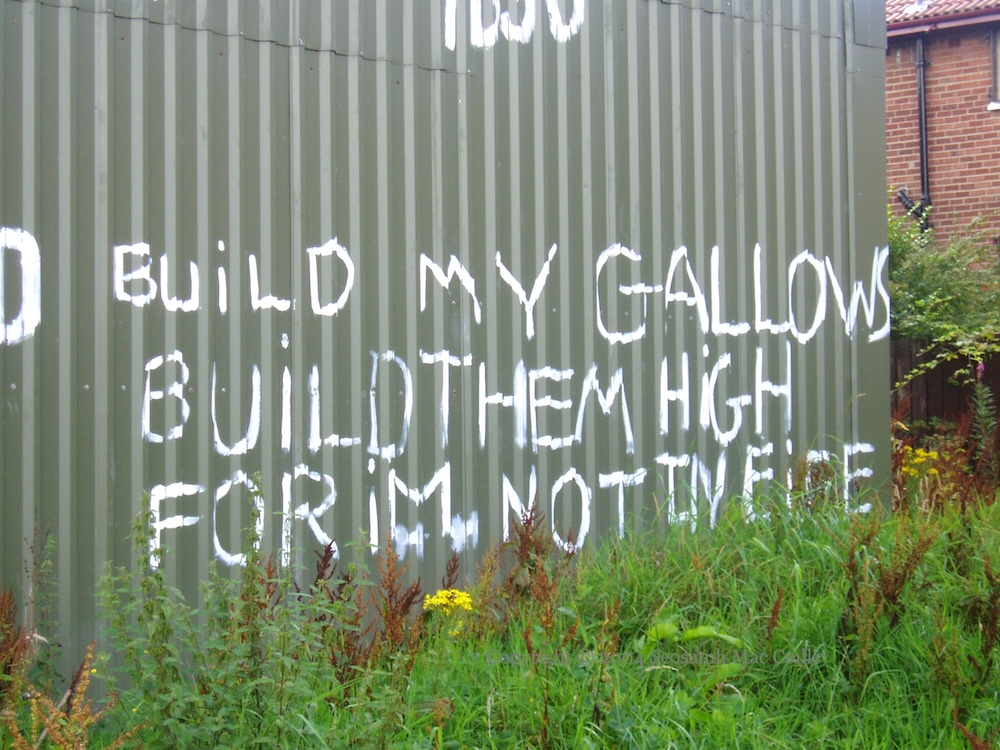
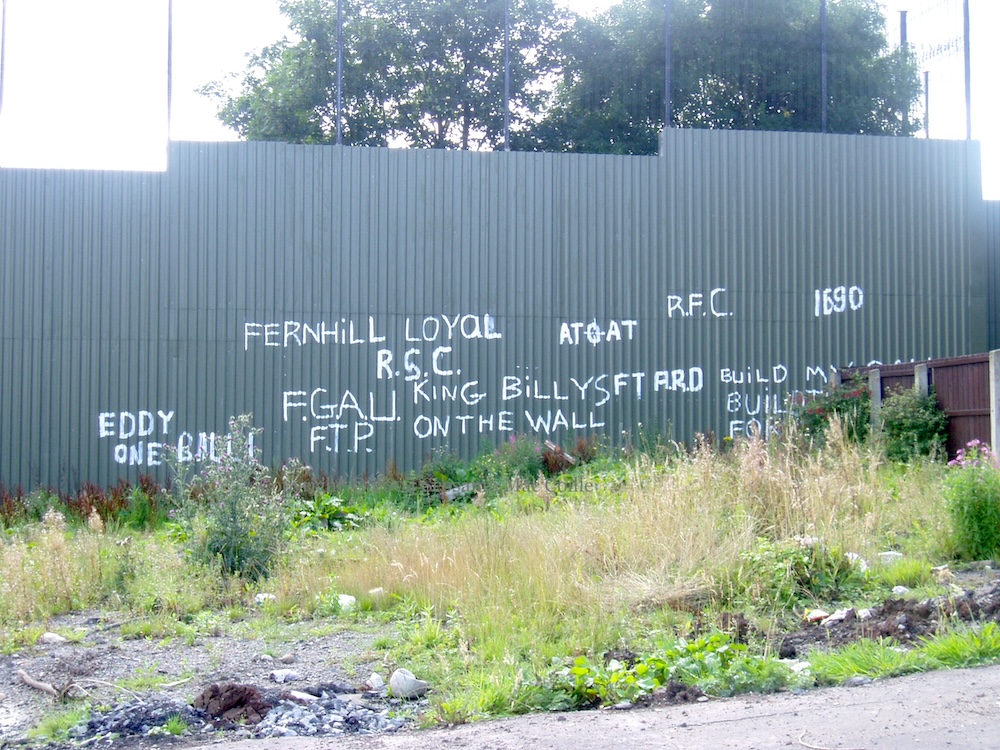
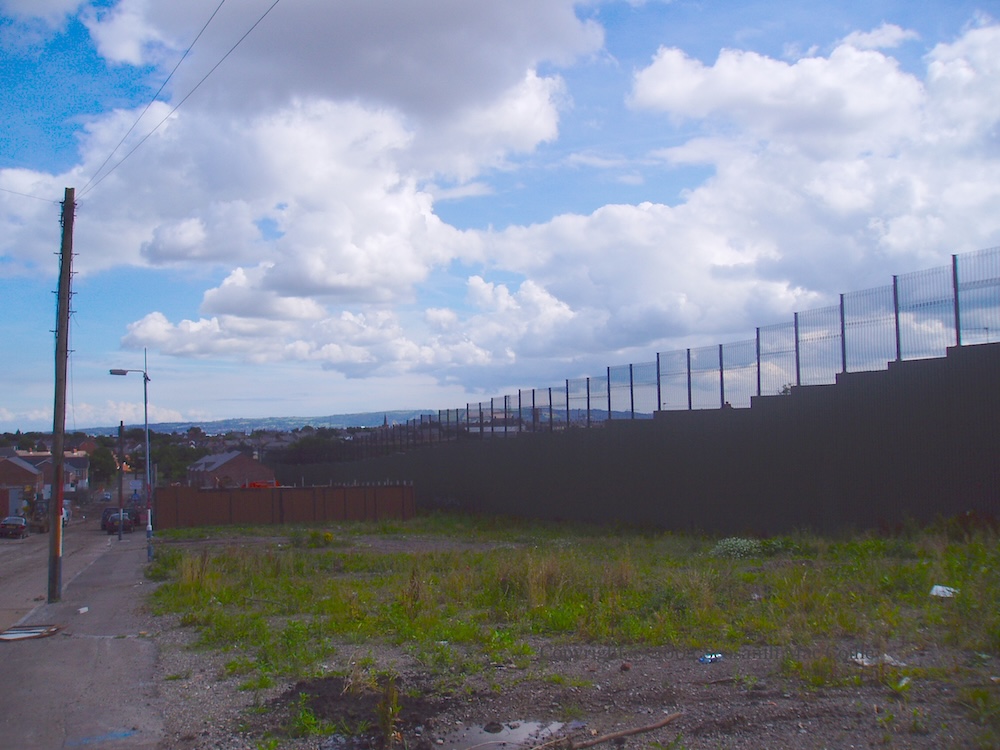
This is the scene as Glenbryn Park was being rebuilt. The “peace” line separates Protestant Glenbryn from Catholic Ardoyne. “Build My Gallows” is a Rangers football song, but the last line here is “Build my gallows, build them high … for I’m not in Eire”.
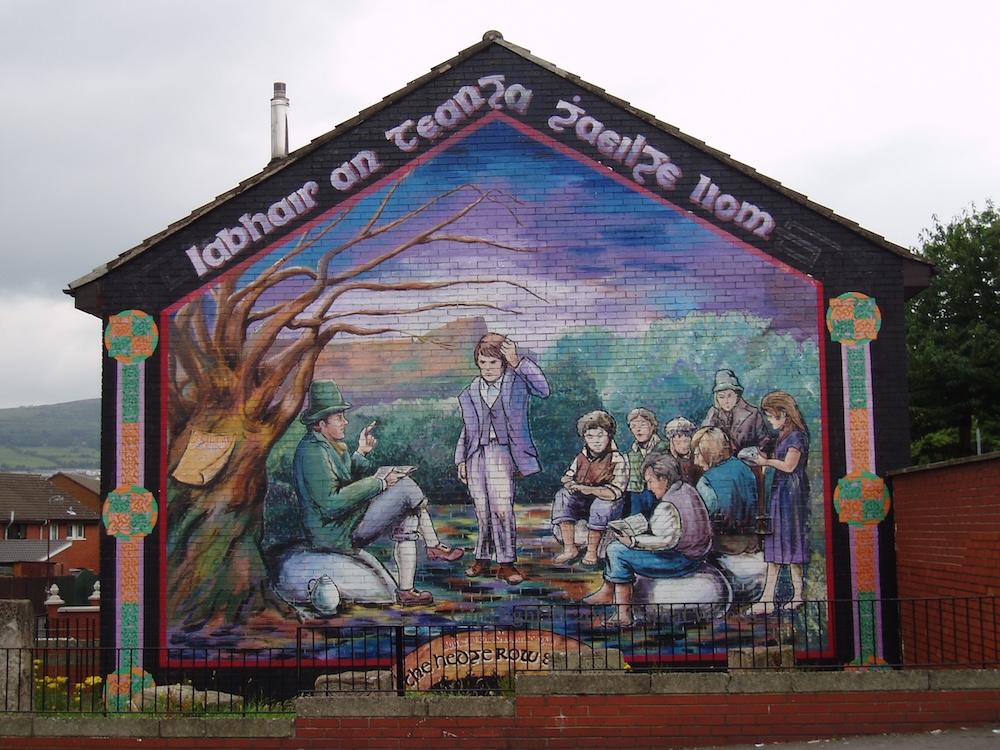
“Labhaır an teanga Ghaeılge lıom.” Catholic (and Presbyterian) education was prohibited by the penal laws (WP) and particularly the Education Act of 1695 (WP) – this is probably what’s on the notice on the left-hand tree. Schooling by Catholics (in Irish) nonetheless took place, in covert houses and outhouses, as well as in fields and hedge-rows. The Act was repealed in 1782, provided the teacher took an oath of allegiance to the Crown.
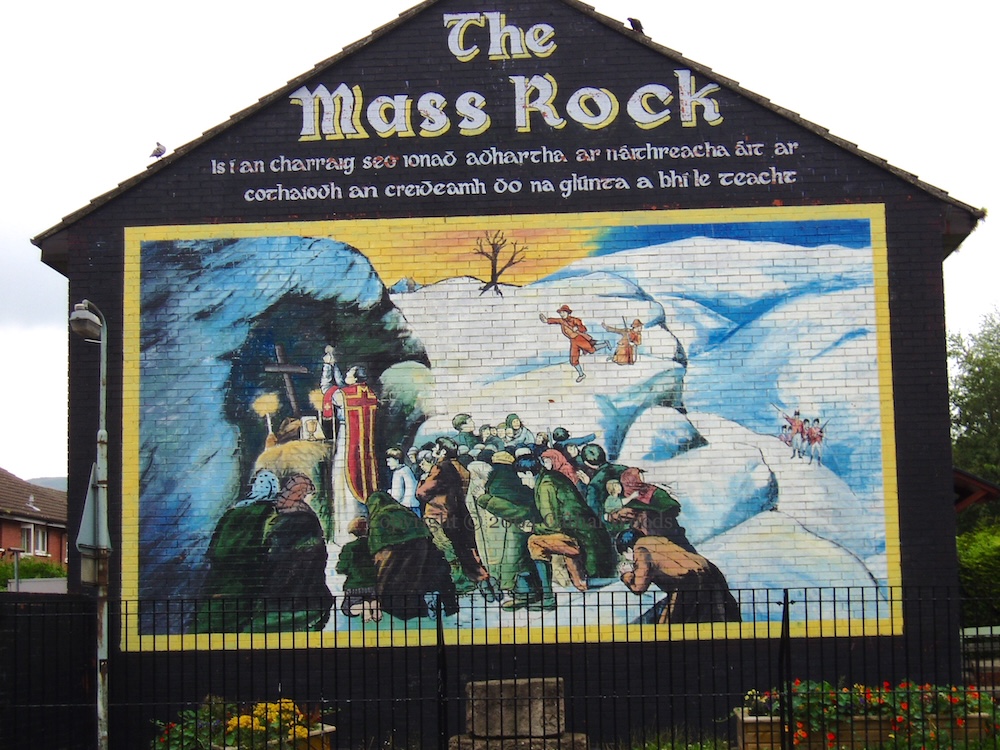
The mural is in Ardoyne Avenue, alongside the Mass Rock mural. See also the Cromwell mural in the lower Shankill estate.
This mural commemorates the repression of Catholicism and use of mass rocks as secret locations in the days of Cromwellian conquest and the penal laws, c. 1650-1800. The 1652 Act Of Settlement banished Catholic priests from the island and services had to be held at short notice in remote locations, with sentries posted to keep watch against soldiers from the New Model Army. Laws against the practice of Catholicism in Ireland were not lifted until the 1782 Roman Catholic Relief Act (PCUG).
“Is í an charraıg seo ıonad adhartha ar náıthreacha, áıt ar cothaıodh an creıdeamh do na glúnta a bhí le teacht.” [“This rock is our ancestors’ place of worship, where religion was preserved for the generations that were to come.”]
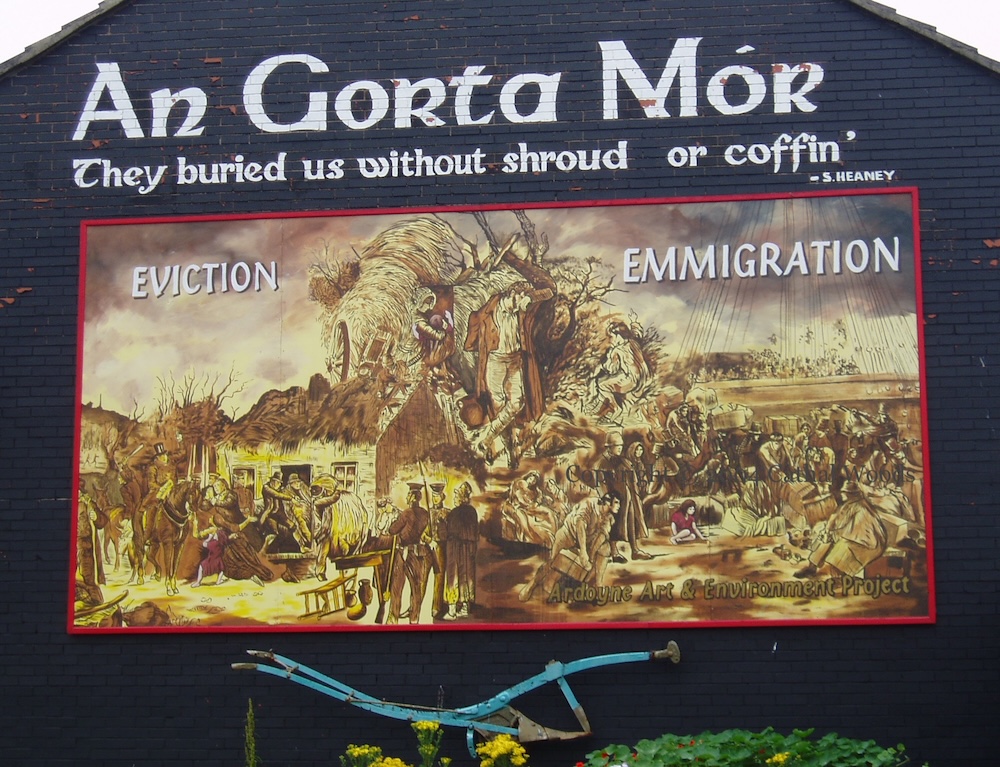
Board remembering An Gorta Mór, The Great Hunger, The Famine/Genocide (WP) with an (actual) old-fashioned plough in front. There is a Visual History page on The Great Hunger.
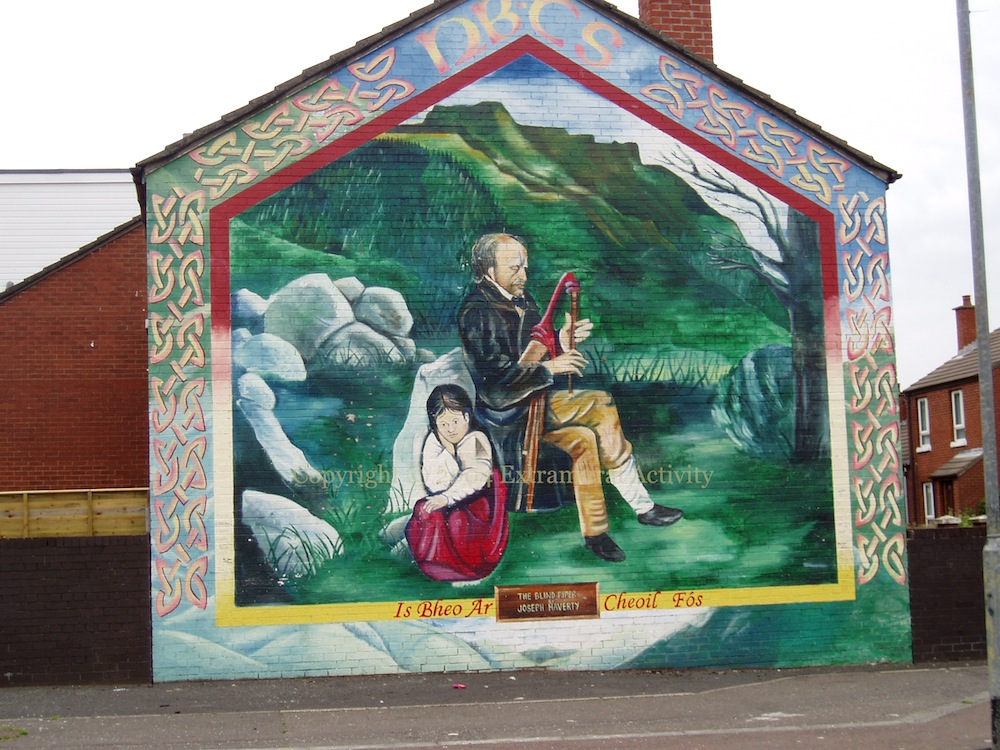
“Is beo ár cheoıl fós” [our music still lives] The Blind Piper is a painting (original) by Joseph Haverty (WP), here placed in the context of North Belfast’s Cave Hill.
Sponsored by North Belfast Cultural Society (“NBCS” in the apex).
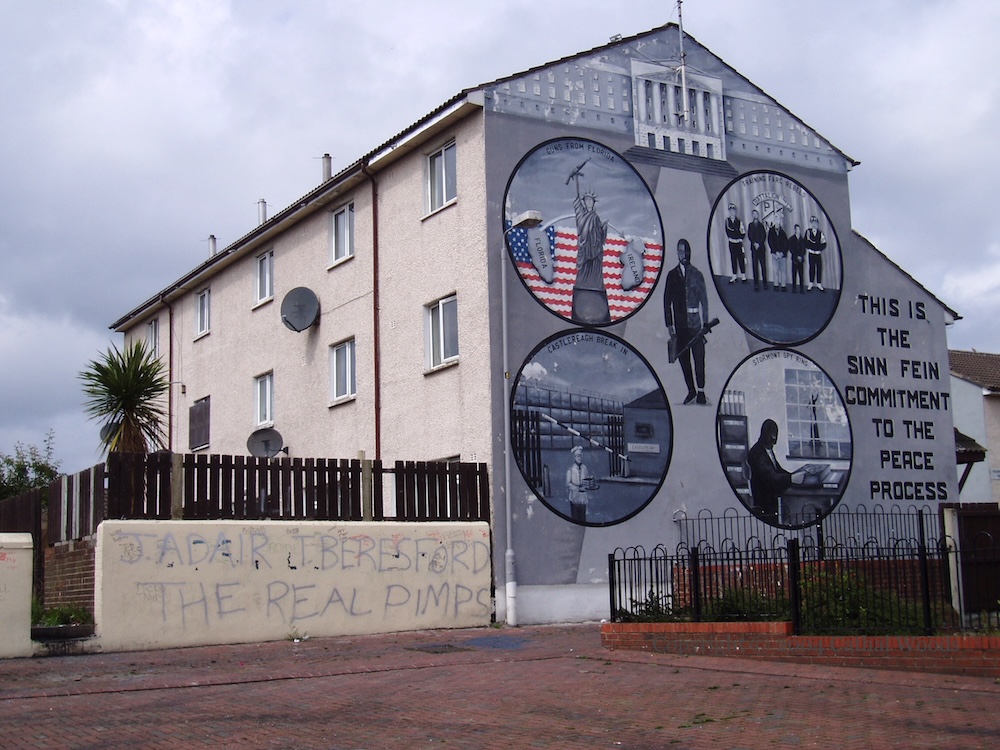
A twofer here, as we get graffiti next to the mural decrying Sinn Féin on Shankill Parade. “J[ohnny] Adair, T[homas] Beresford – the real pimps.” For UDA C Coy pimping, see Free Library, but why Adair and Beresford are the real pimps is unknown. See the Visual History page on the Adair-Era Murals for background on Adair; see this BelTel article for information about the feud.)
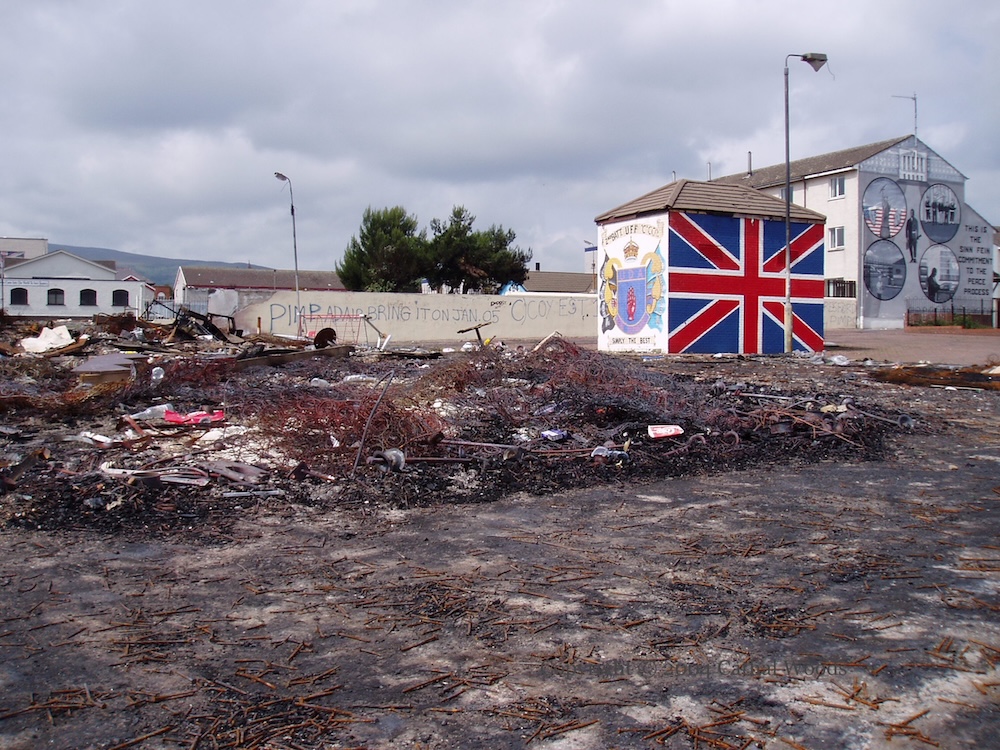
Here’s a shot of the wider scene, from the Boundary Street side, with more graffiti about Johnny Adair: “Pimp Adair, bring it on. Jan 05.” “Jan 05” is a reference to Adair’s forthcoming release from prison.
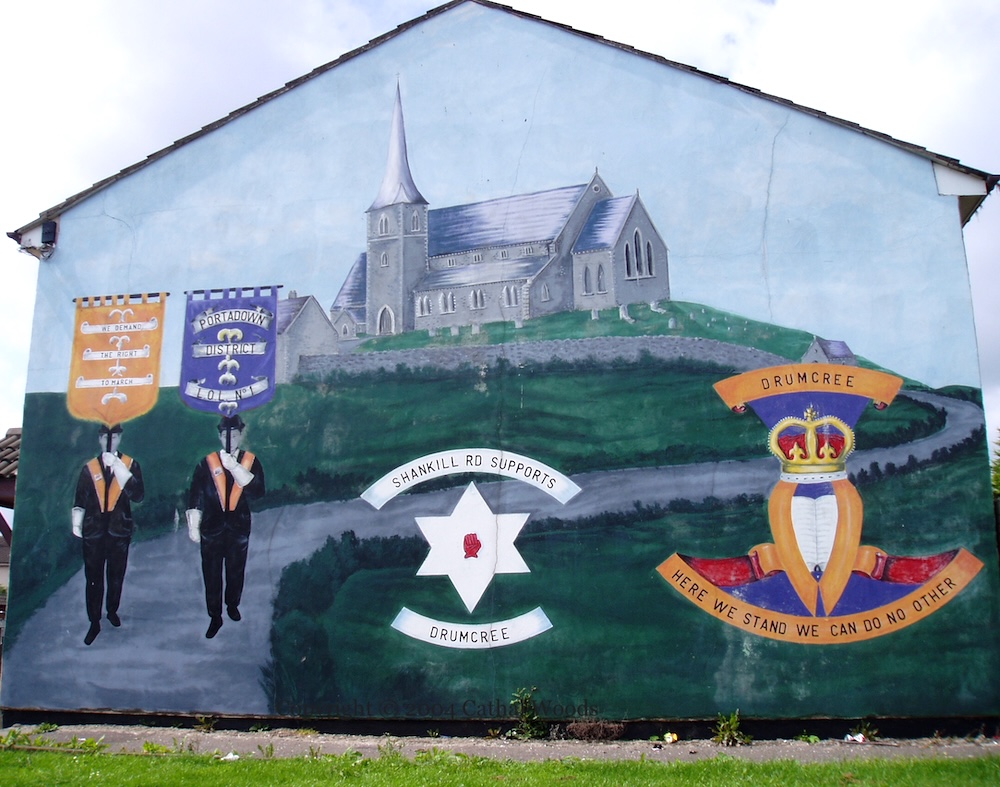
“We demand the right to march.” This mural in the lower Shankill is about the disputed Orange Order parade (WP entry, including a map of the route) to Drumcree Church in Portadown, part of which goes along the CNR Garvaghy Road.
“Here we stand, we can do no other” is a variation on Martin Luther’s pronouncement at Worms, the subject of this mural.
North Boundary Street, lower Shankill estate, west Belfast
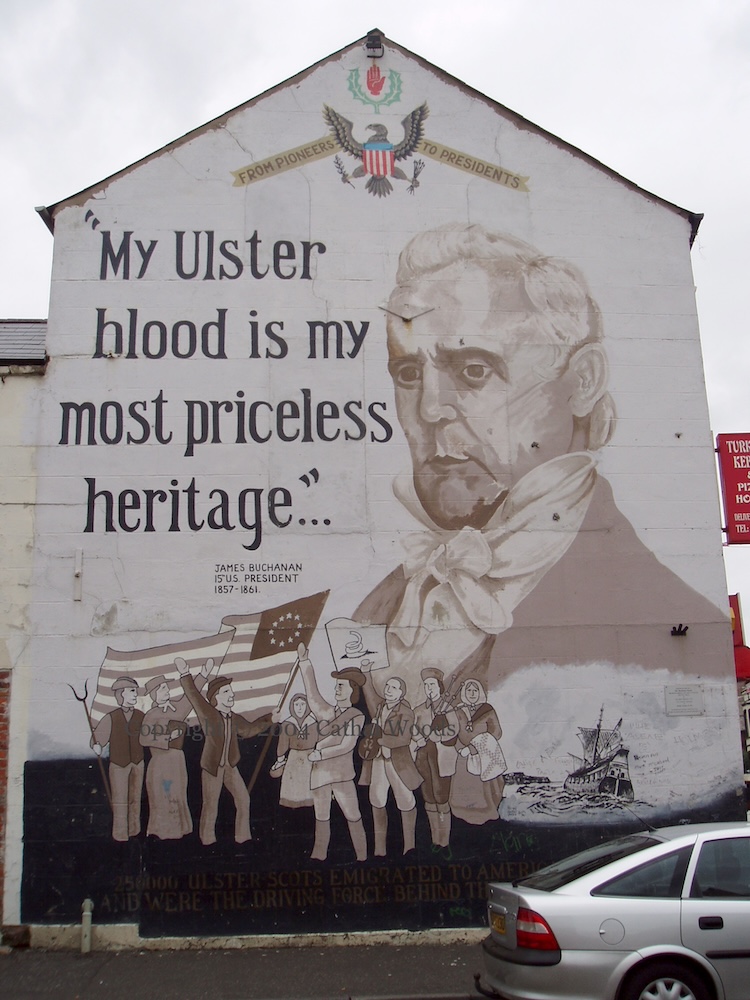
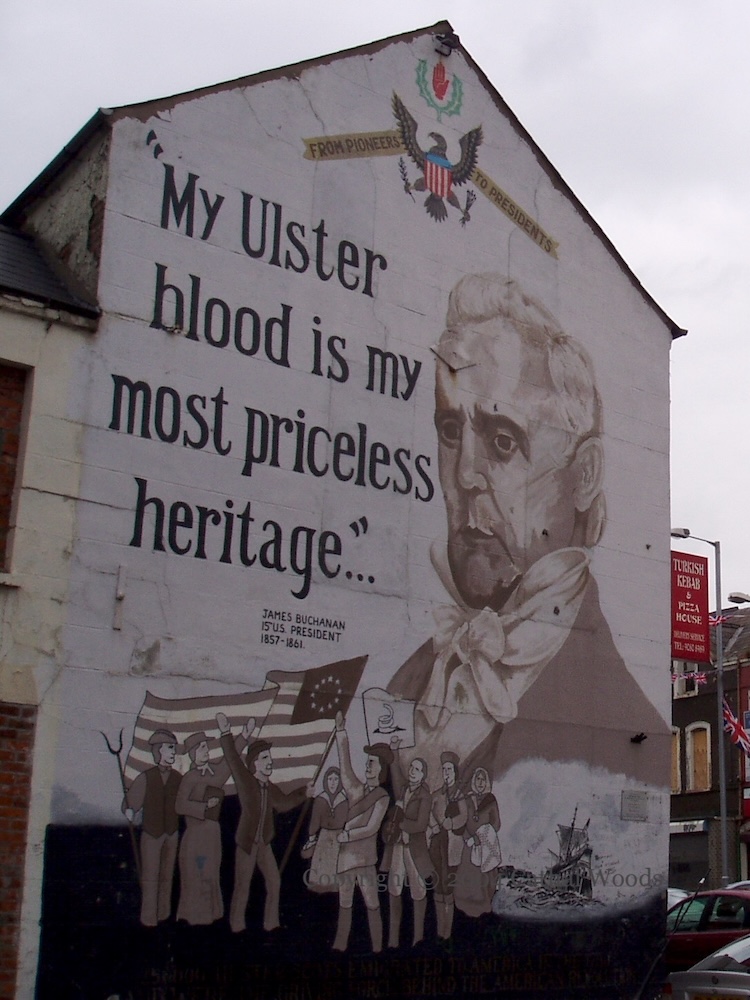
“”My Ulster blood is my most priceless heritage …” – James Buchanan 15th US president 1857-1861″. This is the first of the murals in the “From pioneers to presidents” series to be painted in Belfast, depicting James Buchanan. Three murals had already been painted in Londonderry, to Theodore Roosevelt, James Buchanan (which contains more information about Buchanan and his heritage), and George Washington.
The words along the bottom read, “250,000 Ulster Scots emigrated to America in the 1700s and were the driving force behind the American Revolution.”
The small plaque to the right reads, “Shankill Ulster-Scots Cultural Society. The Buchanan Mural. This mural was dedicated to the memory of those early Ulster-Scots emigrants by Ms Jane Benton Fort, US Consul General, on Thursday November 4th, 1999. Sae monie hairts gaed far frae hame – bot ilka yin oor ain fowk [So many hearts went far from home – but every one [is/remains] our own folk]. This project was funded by Belfast City Council and Making Belfast Work.”
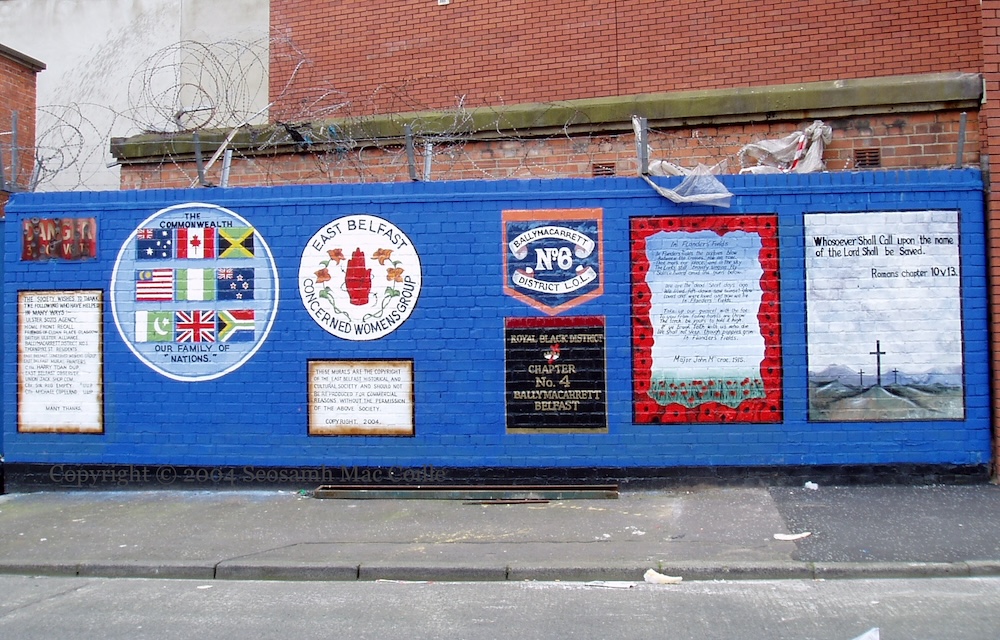
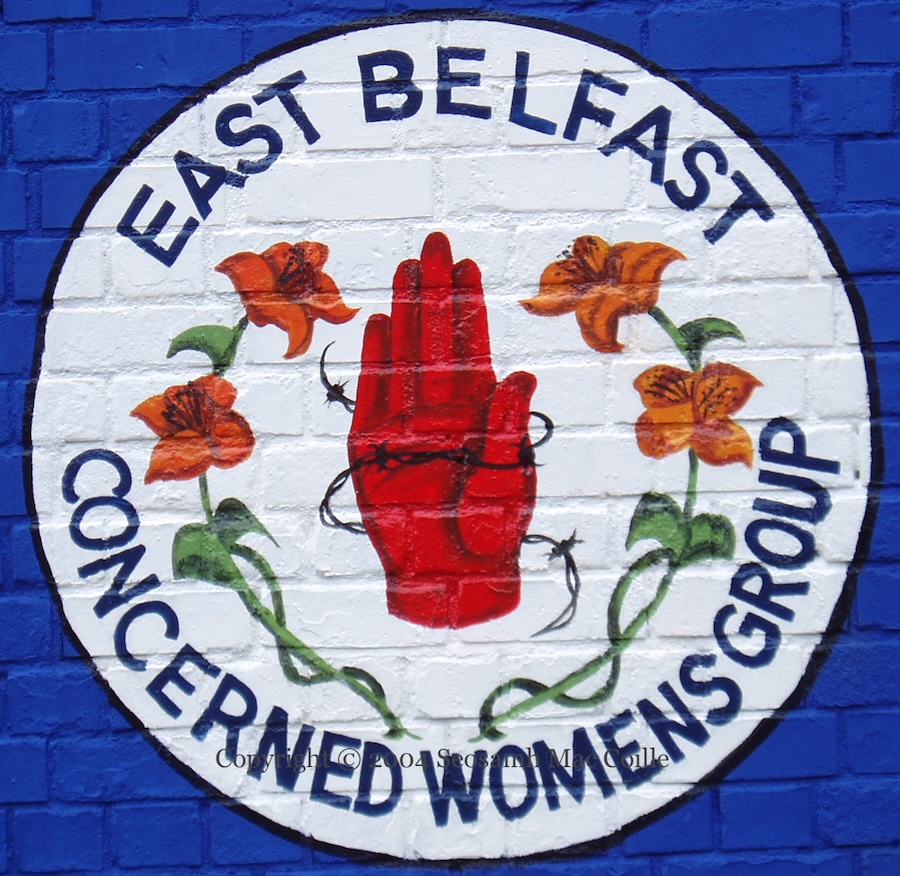
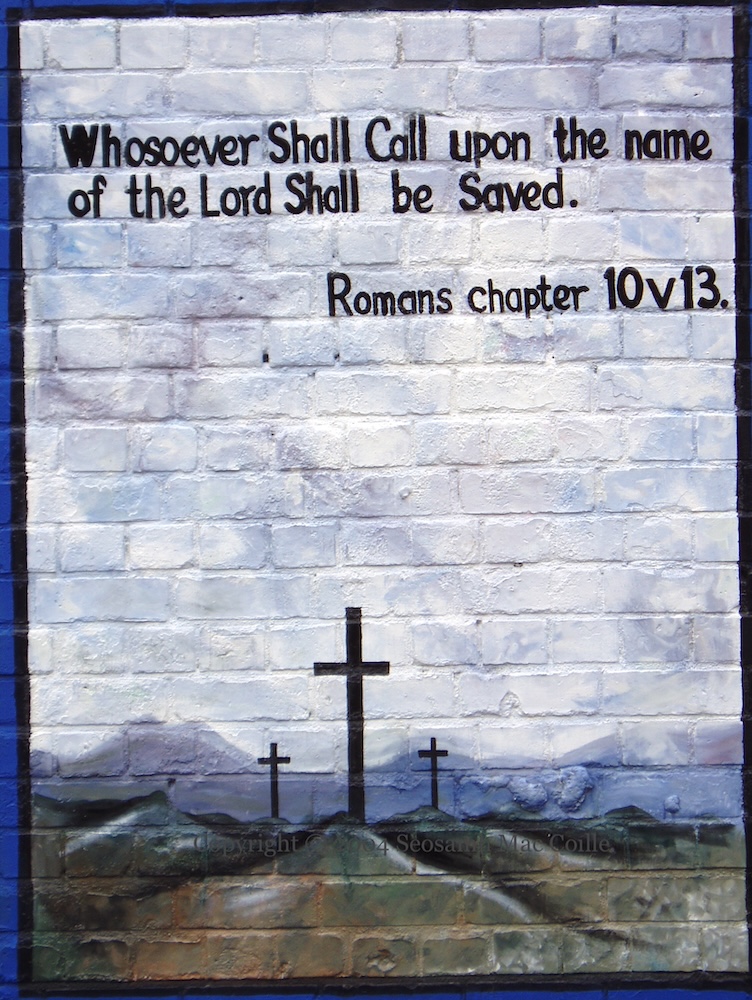
The fourteenth and final panel in Thorndyke Street contains a number of small panels, including the two above, along with emblems of local Orange and Black lodges, John McCrae’s In Flanders Fields, a list of acknowledgements, and a copyright claim.