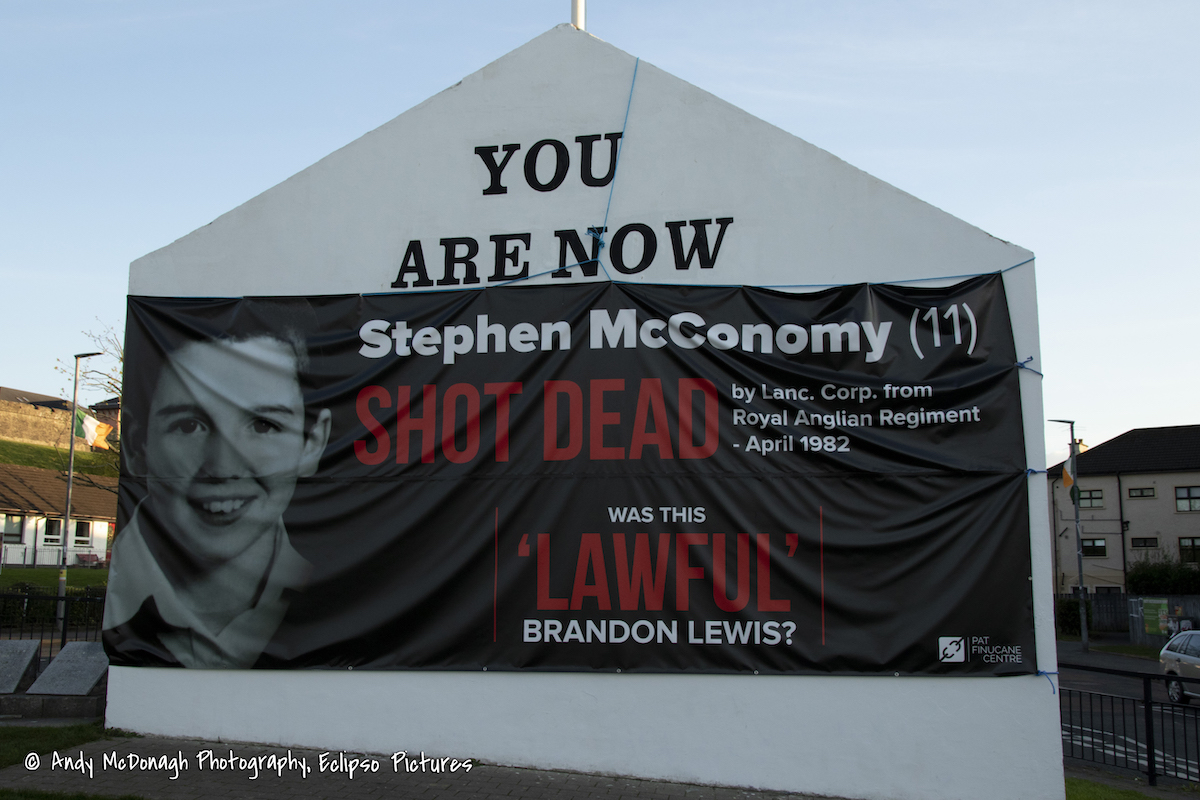
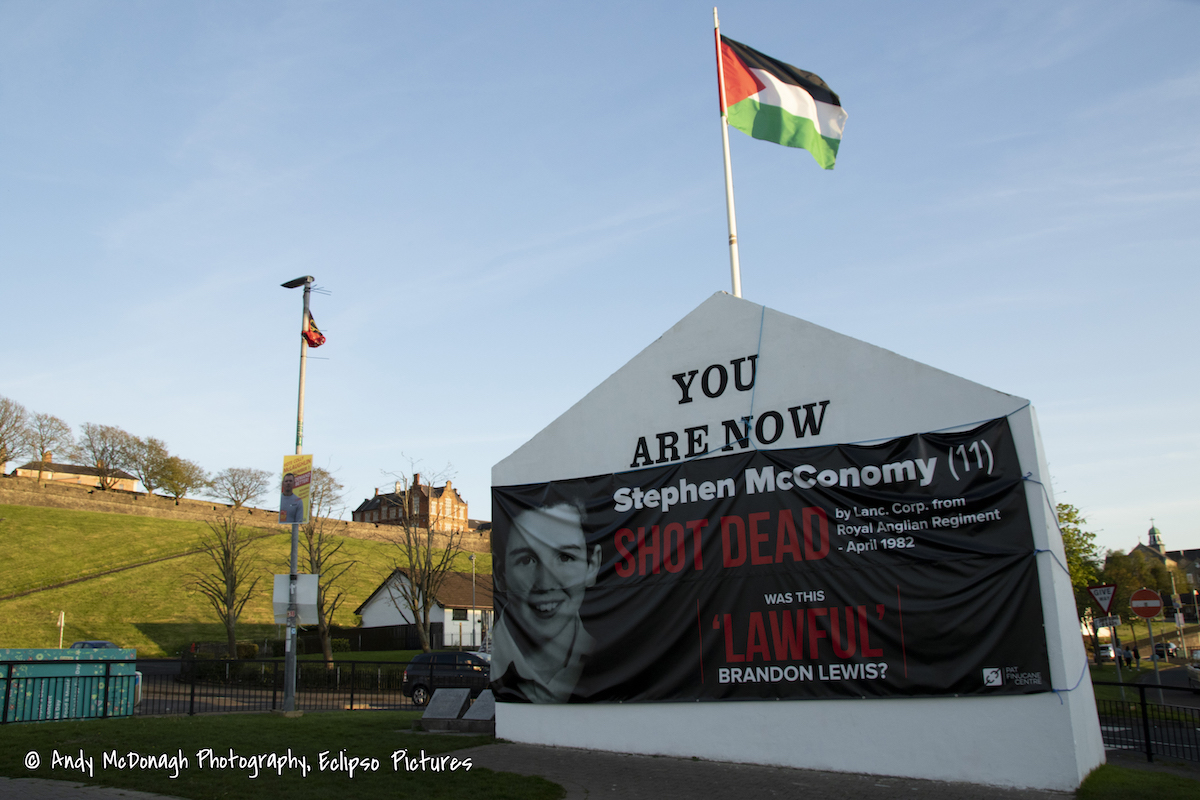
A 2021 command paper that proposed a statue of limitations and amnesty for so-called “legacy” killings included the claim that ‘the vast majority of security force killings were lawful’ (BelTel) and the comment has been attributed to NI Secretary Brandon Lewis (Pat Finucane Centre). (For background see e.g. this eamonnmallie.com piece.) The claim is used against him in this tarp commemorating Stephen McConomy was hit by a plastic bullet forty years ago this month, on April 16th, and died three days later: “Stephen McConomy (11) shot dead by Lanc. Corp. from Royal Anglian Regiment – April 1982. Was this ‘lawful’, Brandon Lewis?” Speaking at the memorial service, surviving family-members vowed to continue resisting the proposed limitations (Derry Journal).
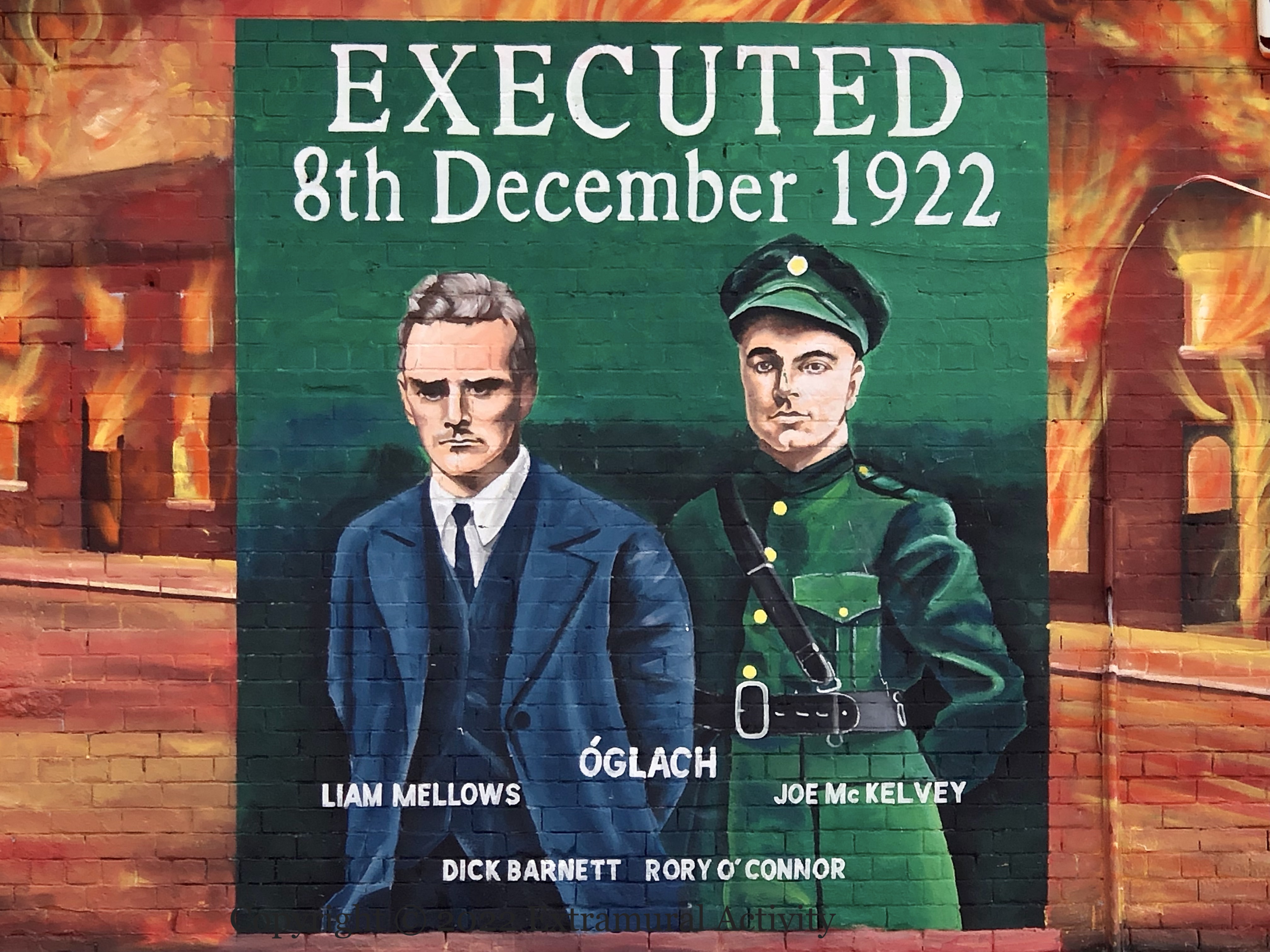
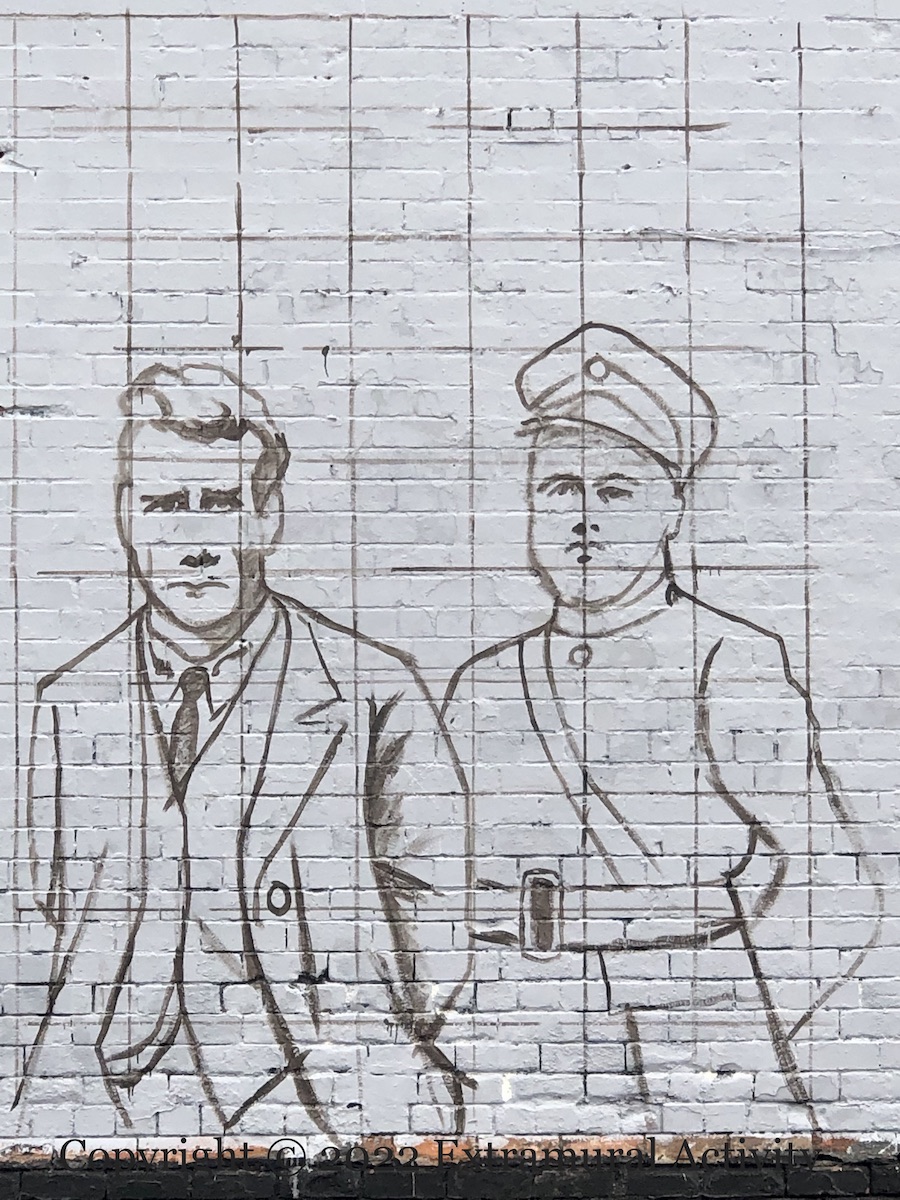
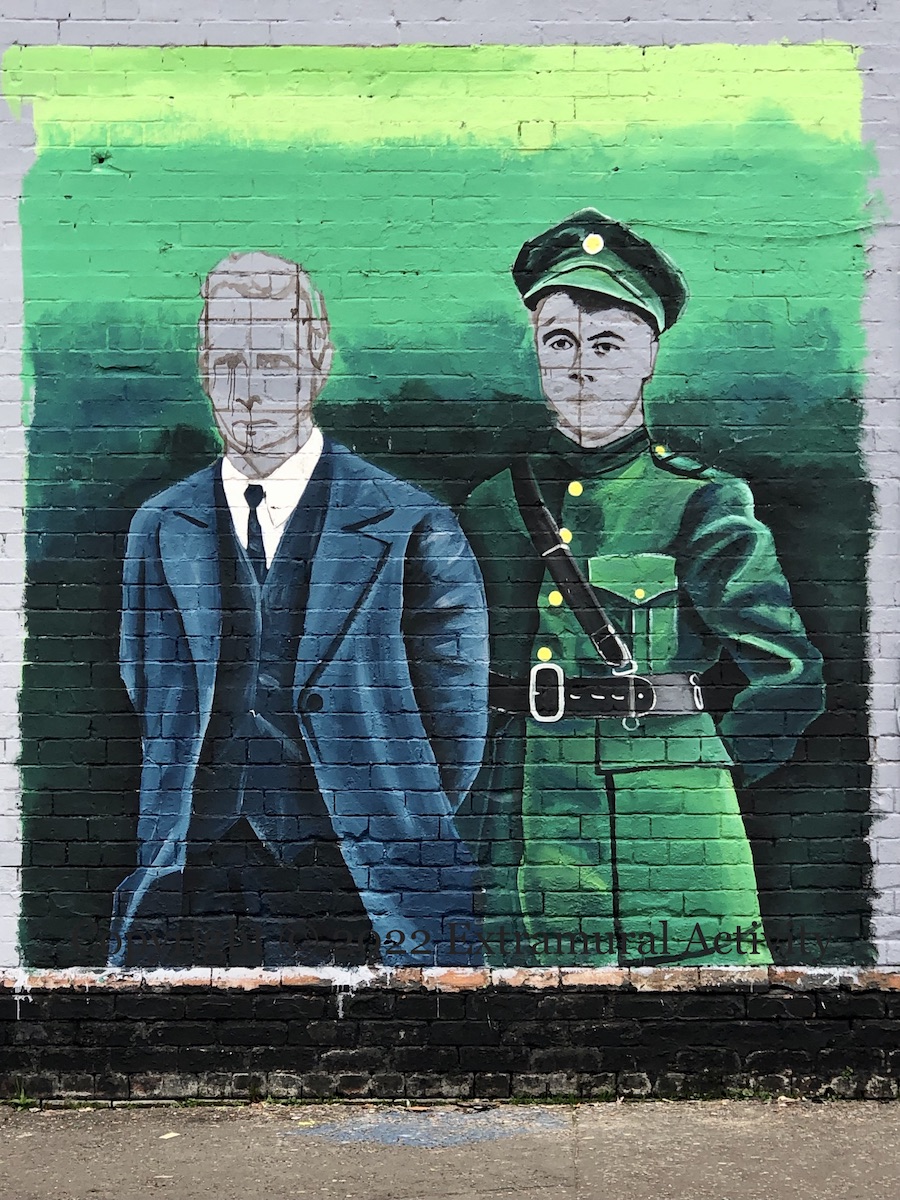
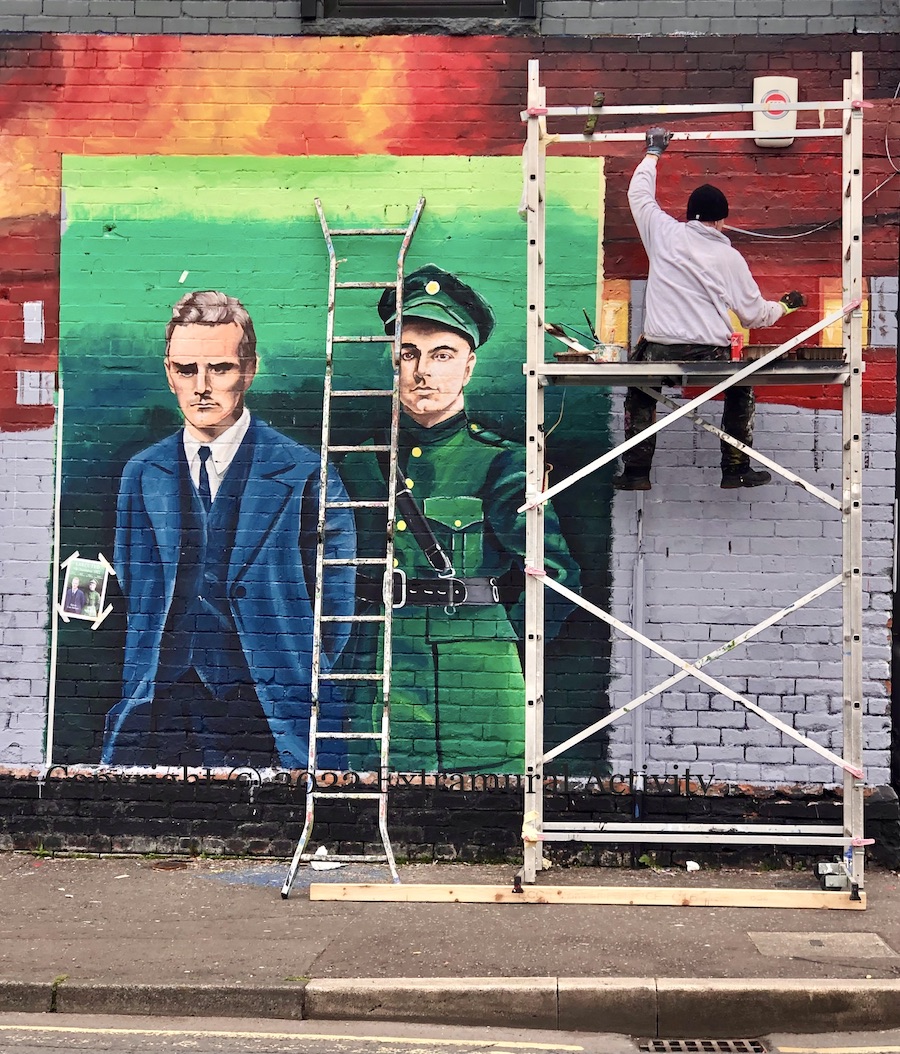
On October 18th, 1922, the third Dáıl/second Provisional Government Of Southern Ireland approved – in the absence of anti-Treaty members – a bill entitled the “Army Emergency Powers Resolution” which introduced martial law, including martial courts with the death penalty for anyone found in possession of an illegal firearm – “illegal” meaning not sanctioned by the nascent pro-Treaty Free State. Under these powers, seven IRA volunteers were executed on November 17th and 19th, followed on the 24th by Erskine Childers (a member of the team that negotiated the Treaty but subsequently against it). In response, the IRA declared that TDs who had voted for the bill were fair game, and on December 7th Seán Hales of Cork was shot and killed. In reprisal, the government ordered the execution of four more volunteers, one from each province: Liam Mellows, Joe McKelvey, Dick Barnett, Rory O’Connor. The four had been arrested five months earlier, on June 30th, 1922, at the start of the Civil War, after surrendering the Four Courts. By the end of the war, 81 executions had taken place. (An Phoblacht | Irish Times | The Irish Story | WP | WP)
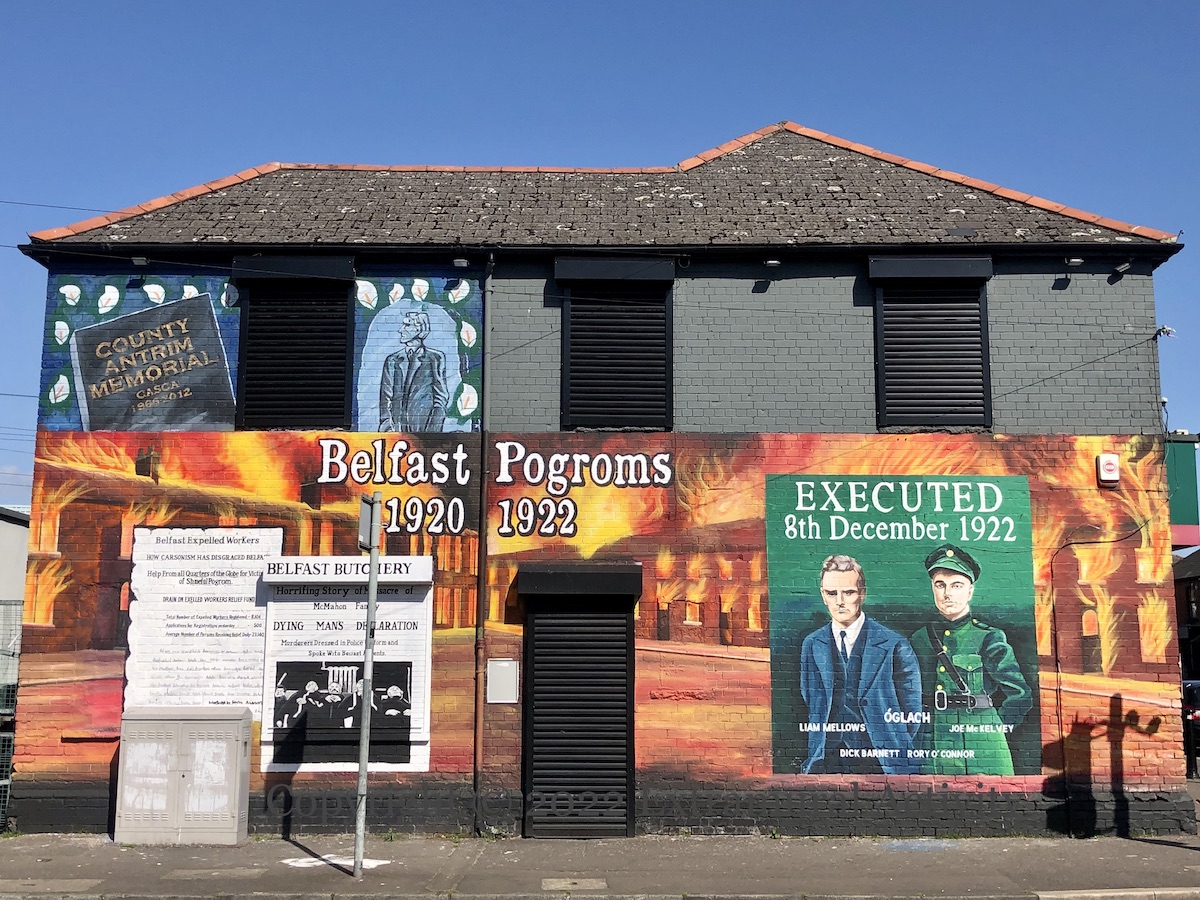
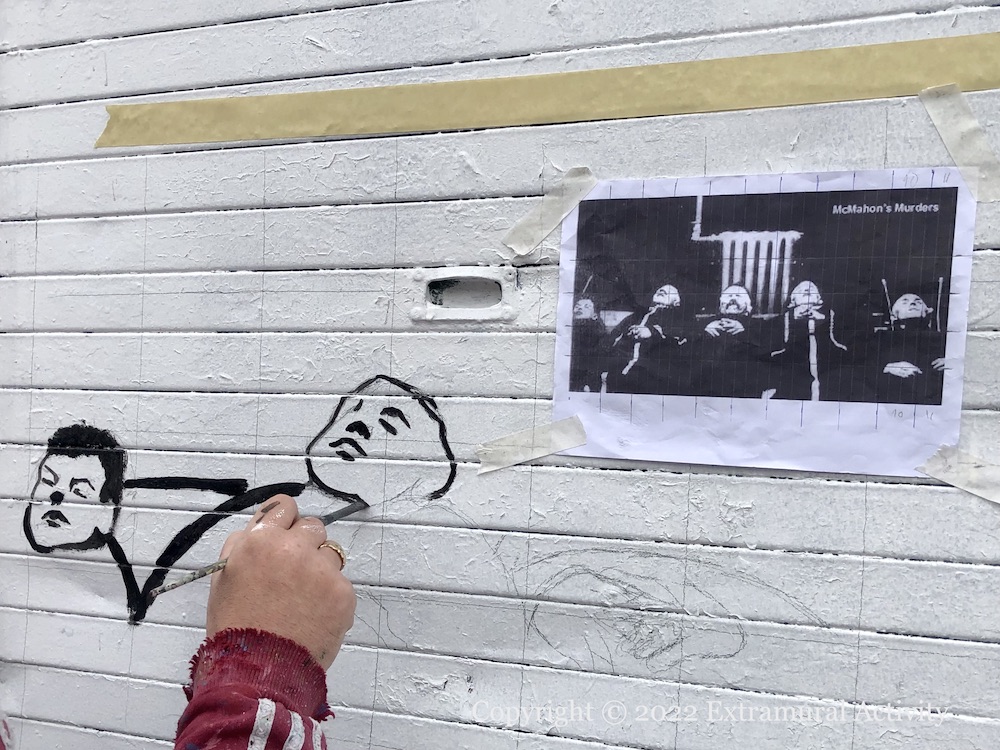
For the left-hand side of the wall, on the shipyard clearings and the McMahon murders, see Belfast Butchery.
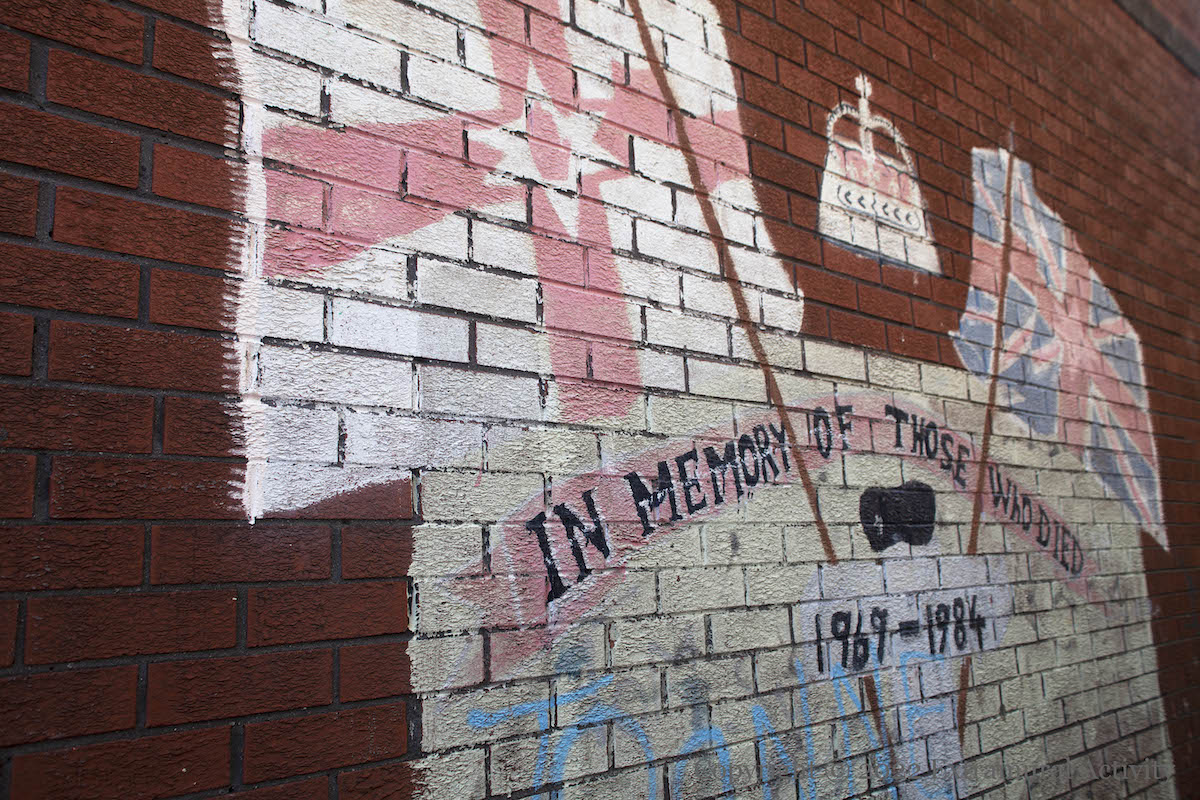
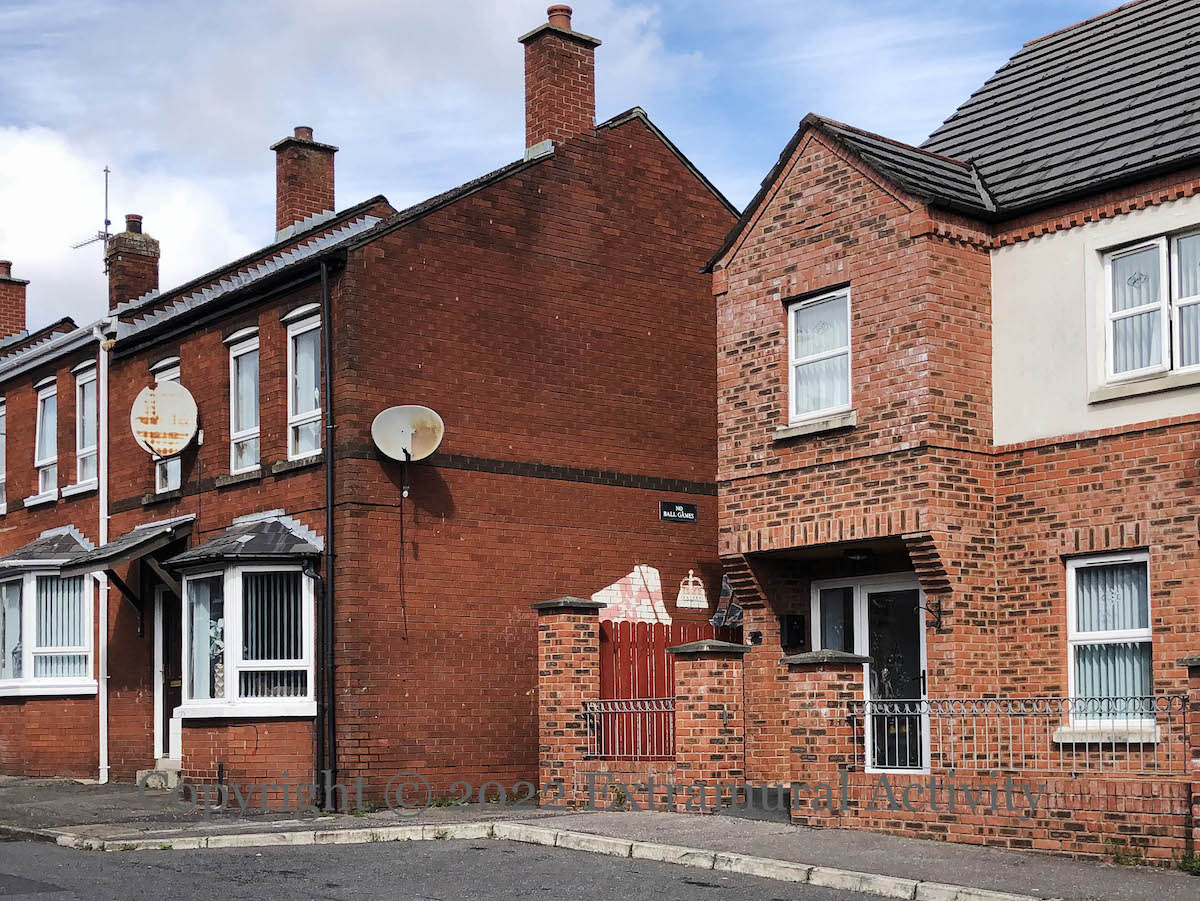
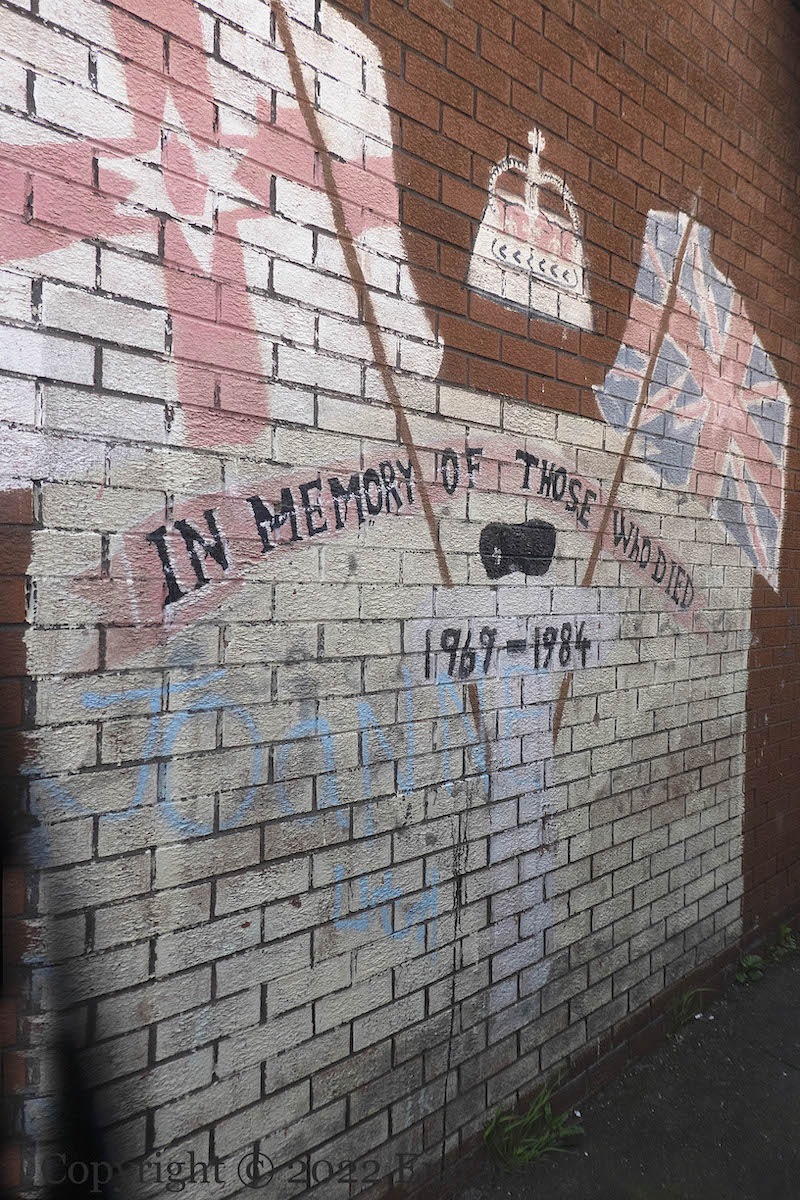
This mural – which perhaps memorialises the RUC in particular – has evidently been rolling since 1984 and the two different styles of house and brick (in the image below) explain its longevity – it’s in a narrow alley between two different stages of construction on Sydney Street West, initially to where the old Harrybrook Street used to be and then extended out to Snugville Street.
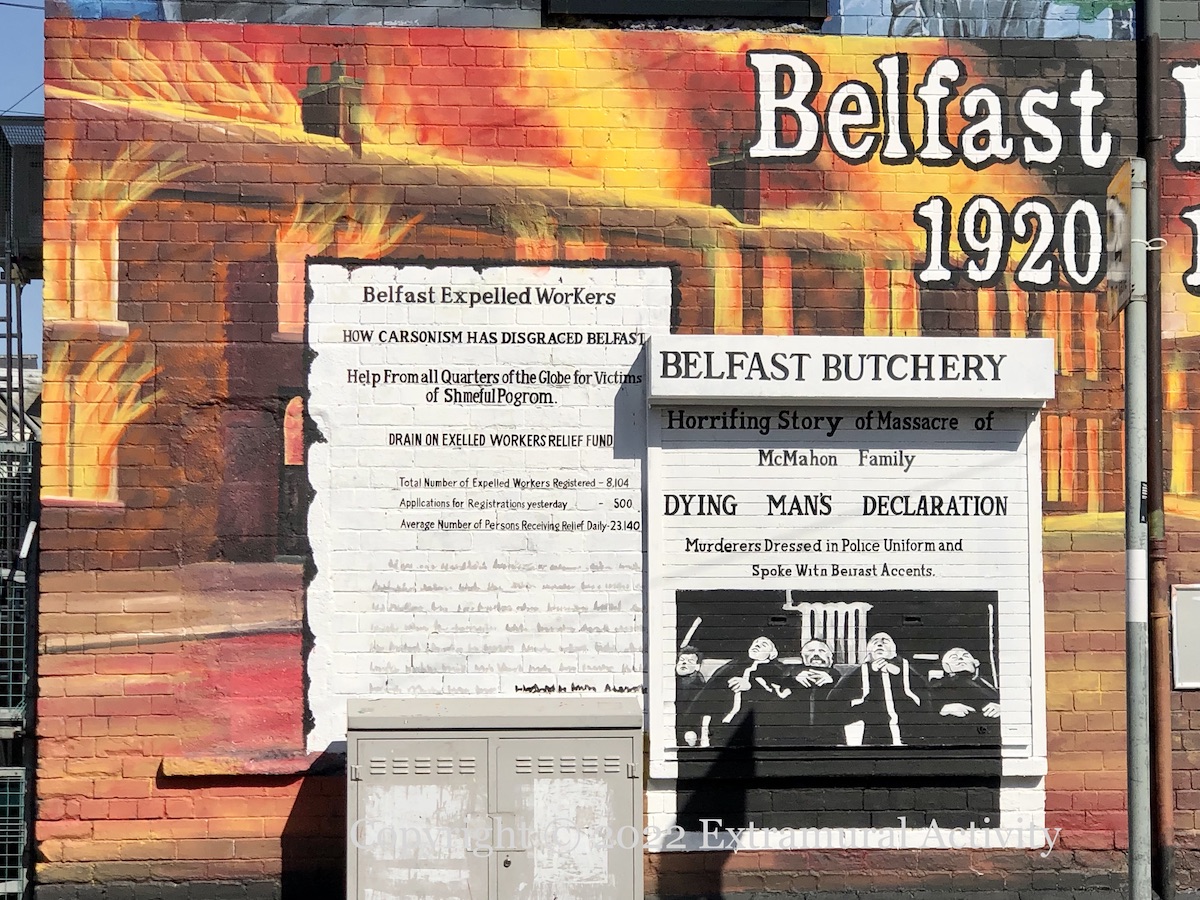
“Belfast Pogroms 1920-1922.” Against the backdrop of the first Dáıl, the War Of Independence, and the debate in Westminster over the fourth Home Rule bill (it would be passed in November 1920), northern Protestants began to assert their de facto independence from the rest of Ireland – both in economic and in military terms.
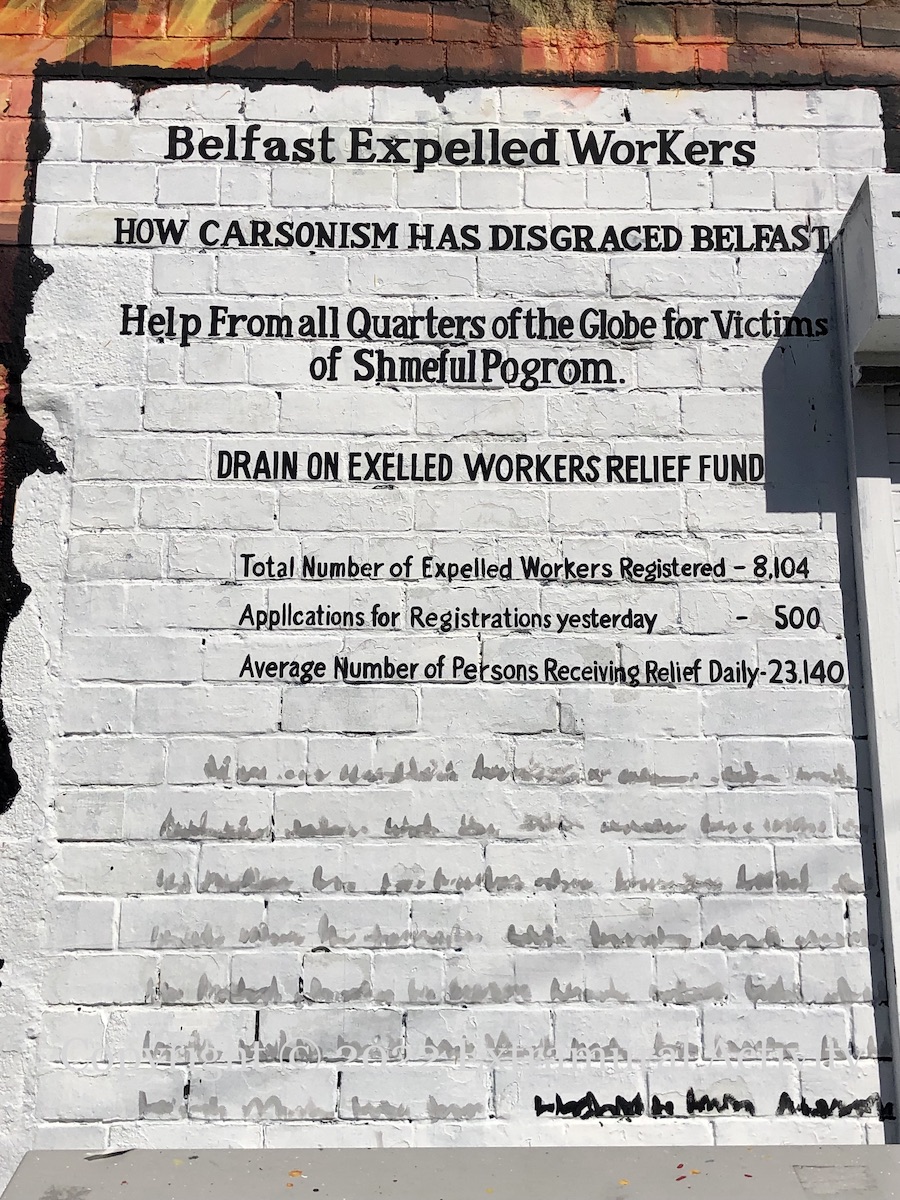
On July 12th, 1920, Edward Carson spoke to a crowd in Derry and, addressing the government in Westminster, said “if you are yourself unable to protect us from the machinations of Sınn Féın, and you won’t take our help; well, then, we tell you we will take the matter into our own hands.” (Treason Felony). Nine days later, the “clearings” of Catholics from Belfast shipyards and mills began, with about 5,700 Catholics and 1,850 socialists (“rotten Prods“) being expelled from Workman Clark and Harland & Wolff yards, and in total 10,000 workers from yards and mills over the next two weeks (History Ireland). In combination with the straitened economic circumstances of the time (post WWI) thousands (23,140 according to this mural, which reproduces a flyer derived from the Irish News of October 6th, 1920 – via The Irish Story’s account of the start of the “Belfast Pogrom”) were on relief.
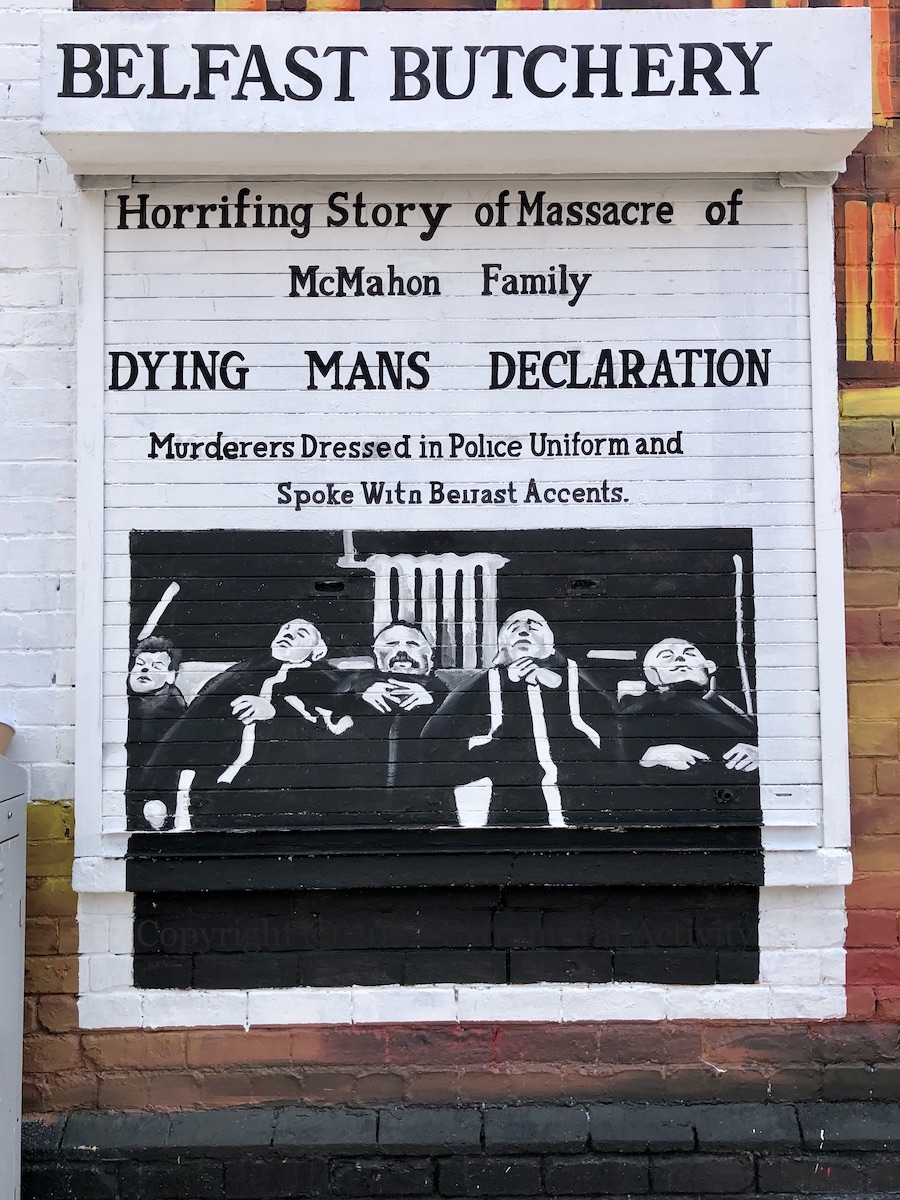
Militarily, in October, 1920, the Ulster Special Constabulary was established (drawing on members of the Ulster Volunteers, which had been reconstituted in June 1920, and the 21,000 members of the Ulster Imperial Guards (WP)) as an alternative to the Royal Irish Constabulary in fighting actions by the IRA in Belfast, Derry, and elsewhere in the north. On March 23rd, 1922, two officers of the Specials were killed in Belfast city centre by the IRA. In reprisal, two Catholic civilians were killed in the Short Strand, and in the early hours of March 24th, a party of five men, four dressed in RIC uniforms, burst into the home of Catholic businessman Owen McMahon and shot McMahon, his six sons, and one of his employees – only two of the sons survived. District Inspector John Nixon of the RIC was suspected of leading the attack on the McMahon household – see The RIC Murder Gang and Pat And Dan Duffin. (The headlines are from the Freeman’s Journal of March 25th, 1922 – see Joe Baker’s 80-page account of the murders of summer 1922; the photograph of the McMahon corpses that is reproduced in the mural can be seen at Slugger.)
This is the first half a new mural in Ascaıll Ard Na bhFeá; the “1922” part can be seen in Executed.
“Belfast Expelled Workers – How Carsonism has disgraced Belfast – Help from all quarters of the globe for victims of sh[a]meful pogrom – Drain on Ex[p]elled Workers[‘] Relief Fund. Total number of expelled workers registered – 8,104; Applications for registrations yesterday – 500; Average number of persons receiving relief daily – 23,140.”
“Belfast Butchery – Horrif[y]ing story of massacre of McMahon family – Dying man[‘]s declaration – Murderers dressed in police uniform and spoke with Belfast accents.”
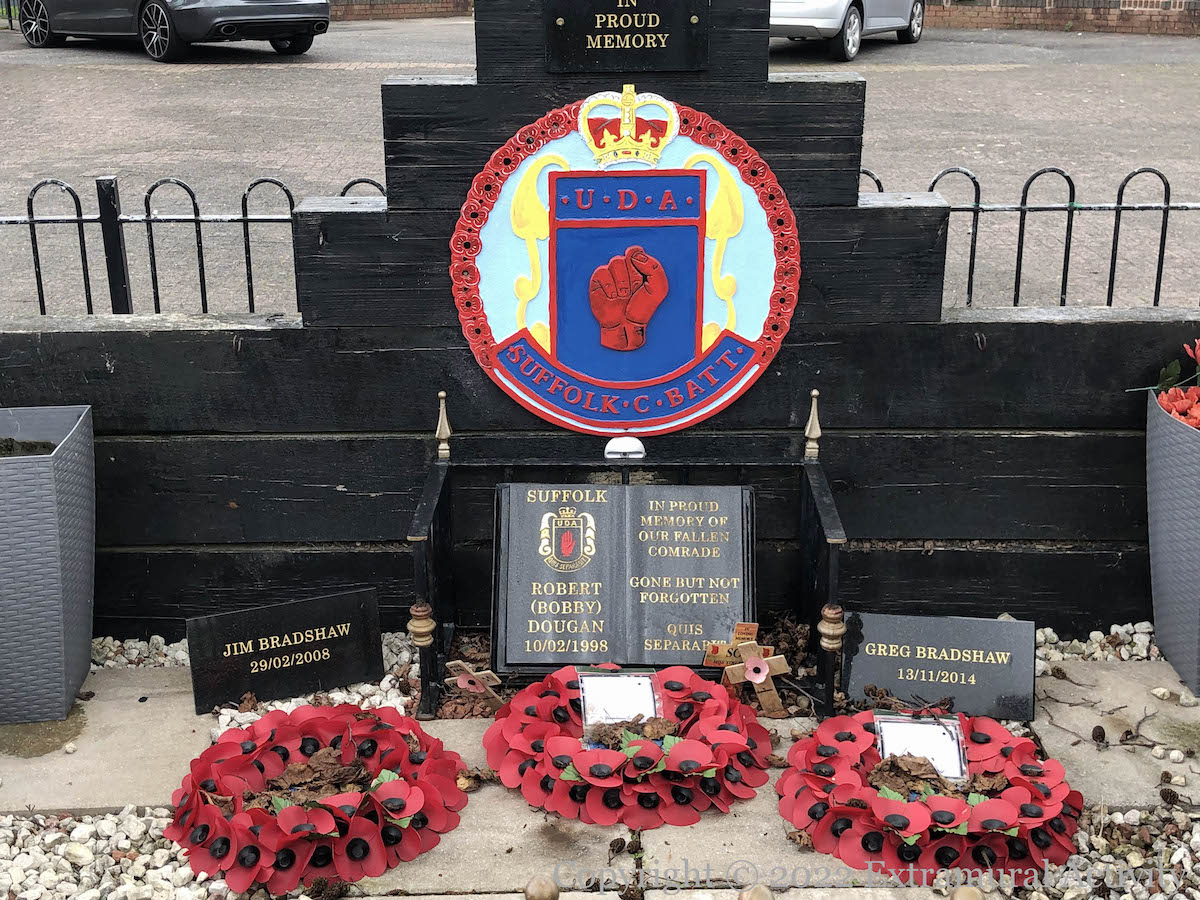
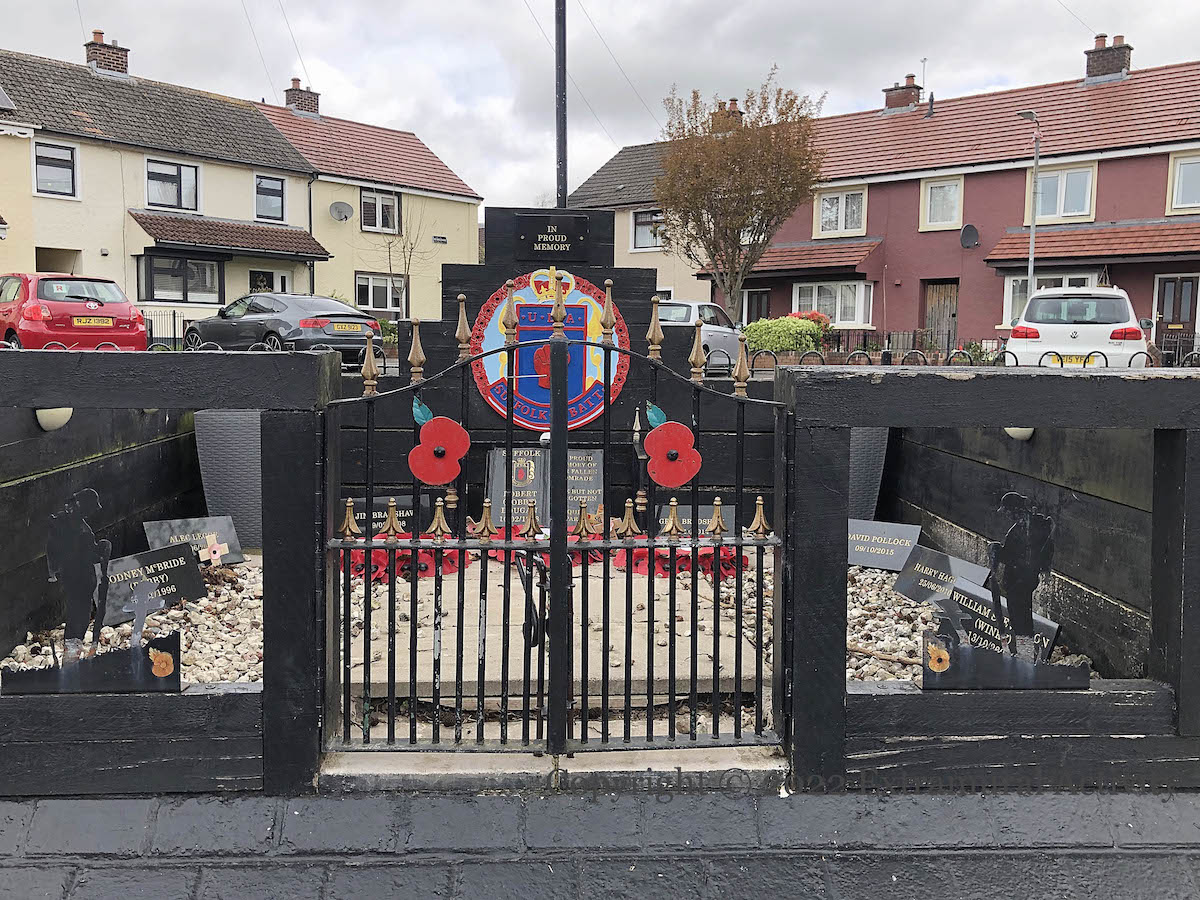
Robert Dougan was commander of the UDA South Belfast Brigade and lived Oranmore Drive (BelTel). He was killed by the IRA on February 10th, 1998 while sitting in a car outside Balmoral Textiles in Dunmurry, which led to a month-long expulsion of Sinn Féin from the peace talks taking place at the time (L.A. Times); two months later the Good Friday Agreement was signed. There had been attempts on his life in 1993 and 1994 (Irish Times).
The plaques, from left to right, are to Rodney McBride (1996), Alec Legge (2007), Jim Bradshaw (2008), Robert Dougan (1998), Greg Bradshaw (2014), David Pollock (2015). Harry Haggan (2010), William Stevenson (2008).
Tildarg Avenue. There is a mural to Dougan on Sandy Row – see Everyone’s Friend.
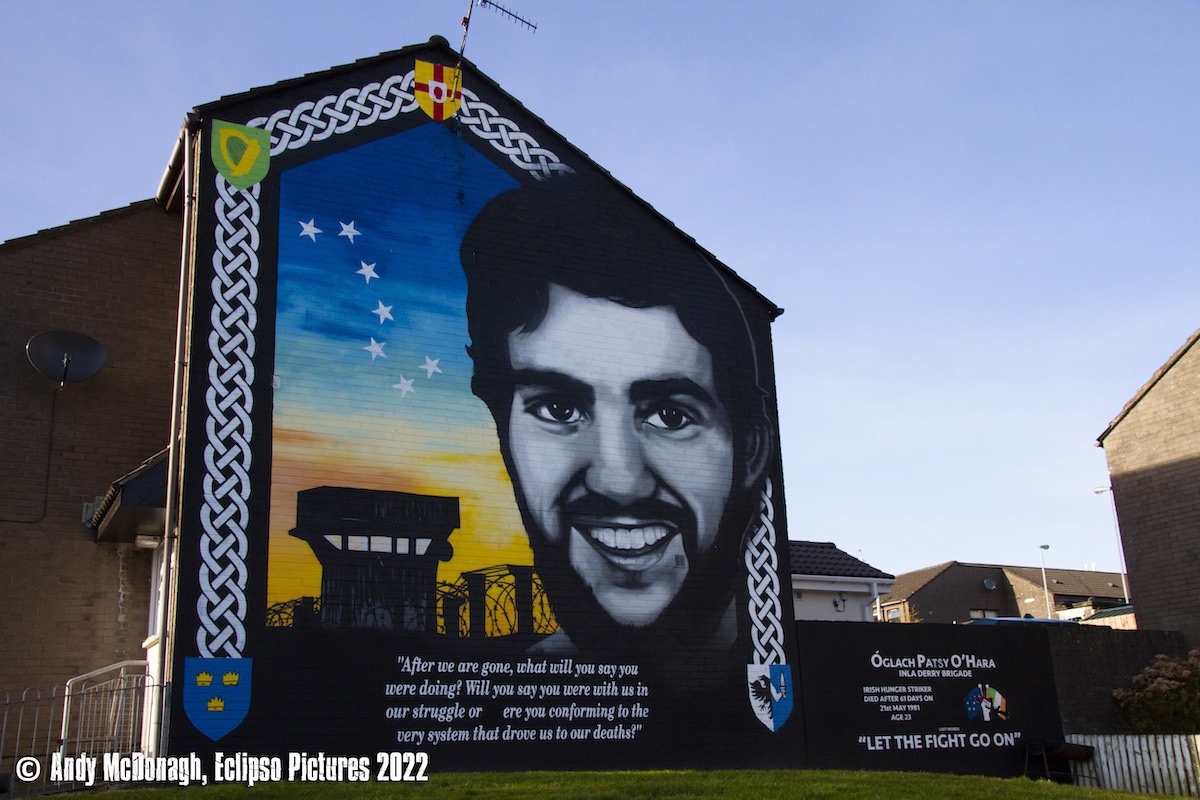
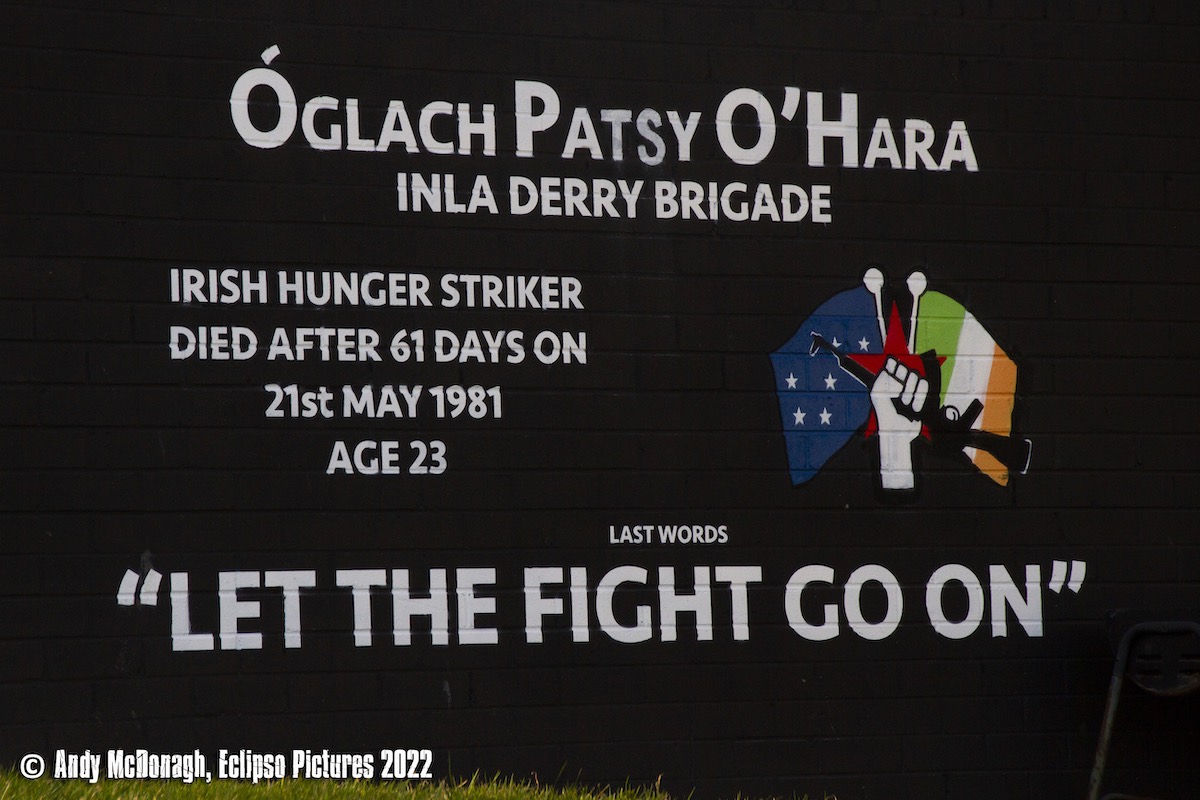
Patsy O’Hara was born in 1957 Bishop Street, Derry, and joined Na Fıanna in 1970 and the local Sınn Féın cumann in 1971 and, in August was shot in the leg by British soldiers. In 1972 he joined the Republican Clubs and in 1975 the IRSP. He was imprisoned multiple times, the final time being in January 1979 for possession of a hand grenade (Bobby Sands Trust). He went on hunger strike 41 years ago tomorrow (March 22nd) and was the first of the three INLA hunger strikers to die in 1981. The long-standing mural in Bishop Street was repainted for the 40th anniversary of his death. (For the previous version, see Let The Fight Go On.)
“Óglach Patsy O’Hara, INLA Derry Brigade, Irish hunger striker, who died after 61 days on 21st May 1981, age 23. Last words ‘Let the fight go on’.”
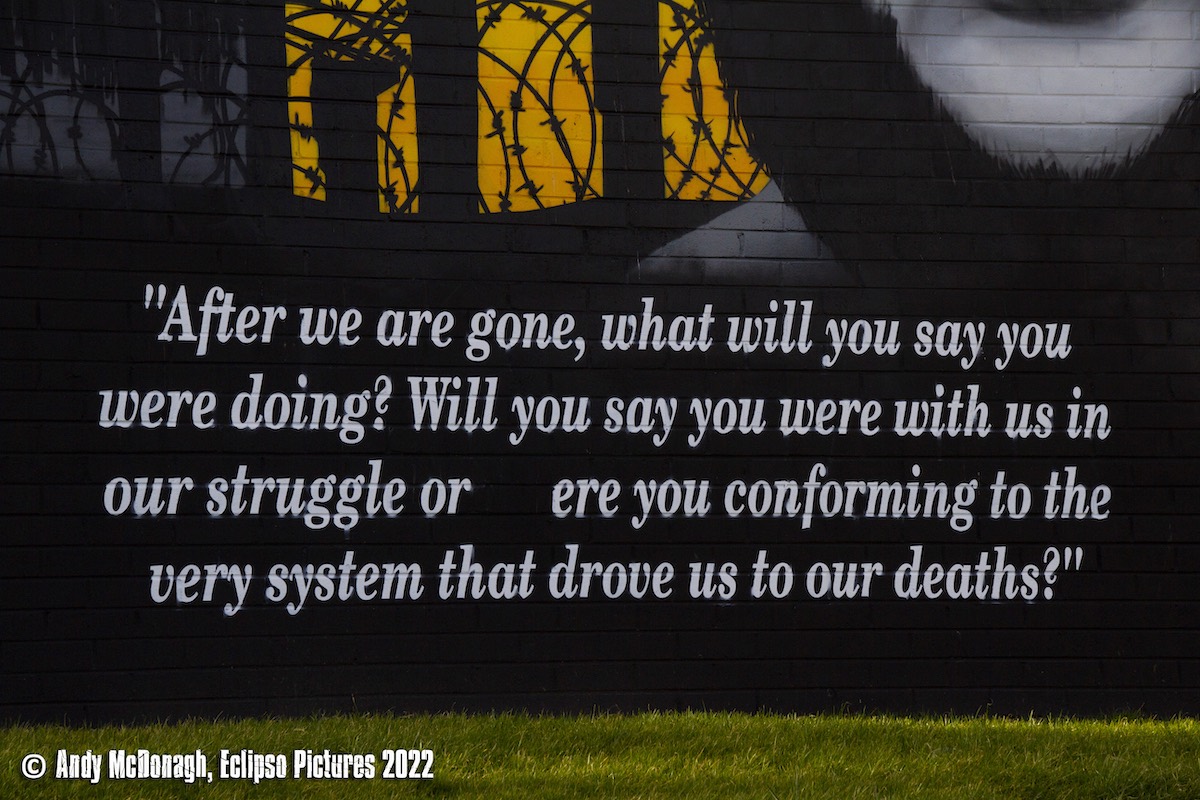
“After we are gone, what will you say you were doing? Will you say you were with us in our struggle or where you conforming to very system that drove us to our deaths?” – these words also appeared in the 2013 mural to O’Hara on Shaws Road, west Belfast.
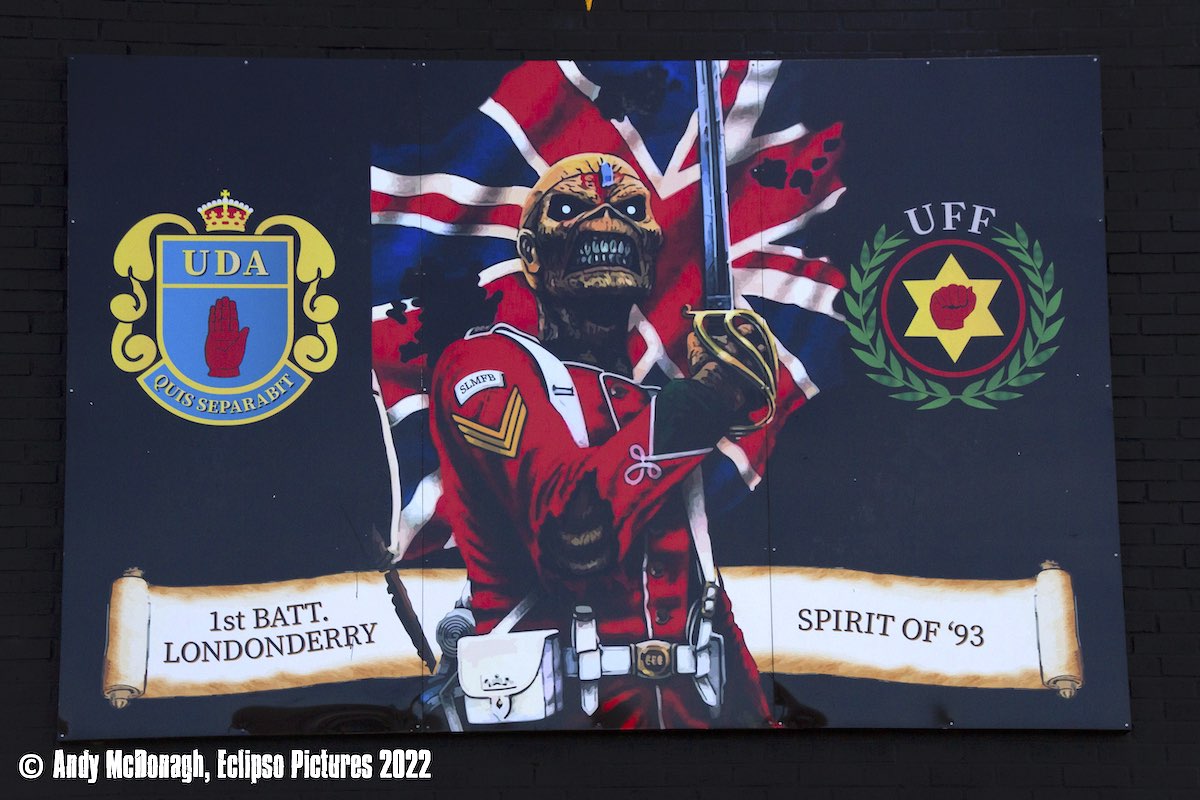
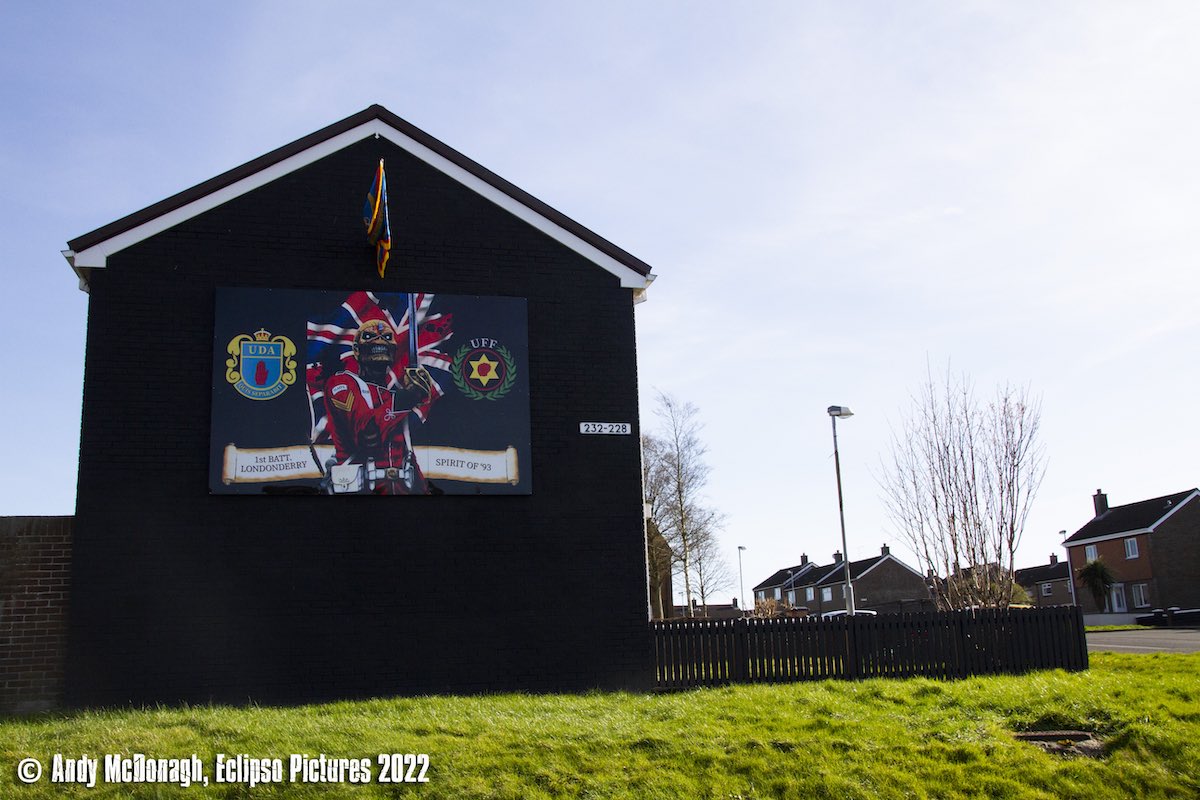
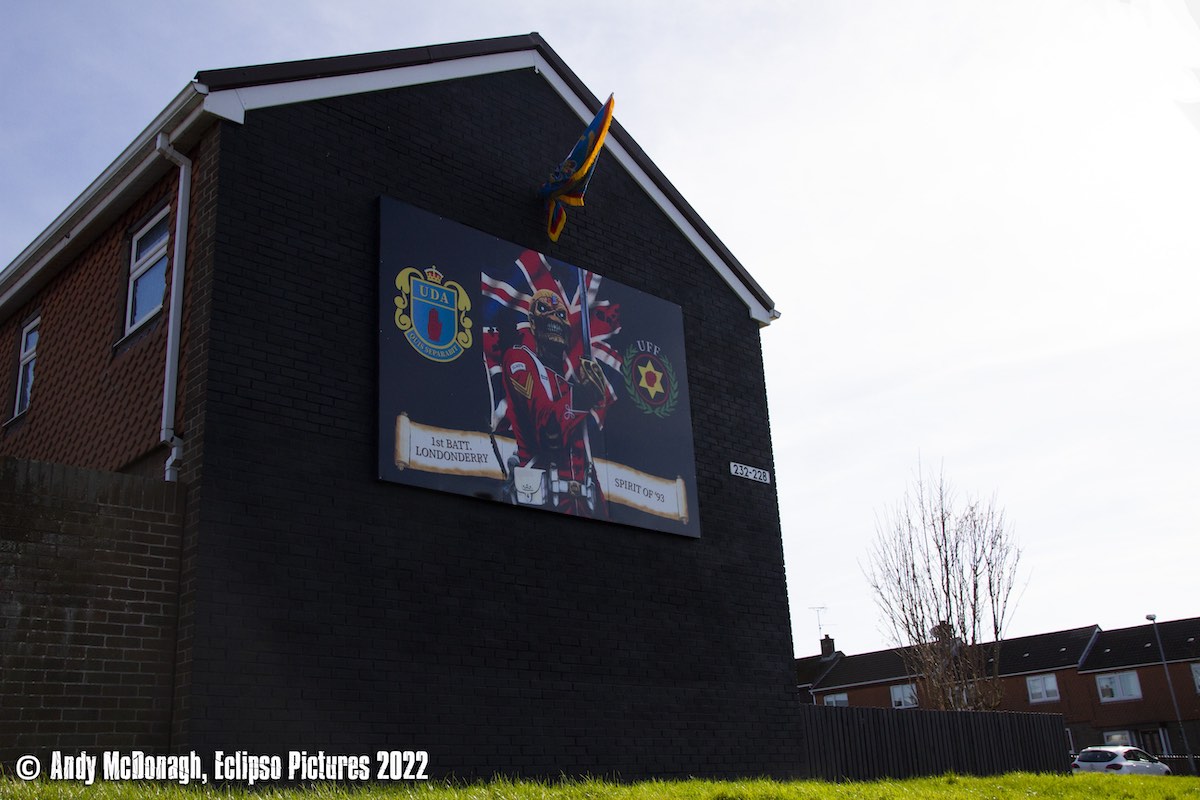
The house in Ebrington Terrace that had been home to an Eddie mural for many years was torn down last summer (see final image for the hoarding around the site of the absent gable); it had been used since at least 1982 for images of the Commonwealth, King Billy, and, since 1996, Eddie The Trooper.
The final Eddie board that was on the wall has been moved (or repeated) one neighbourhood over, into Lincoln Court. It was the first to include the words “Spirit Of ’93” – presumably a reference to the Greysteel Massacre in which eight people in the Rising Sun bar were killed in reprisal for the Shankill Bombing (BelTel). The “raid” was planned in – and both gunmen rented rooms at – the UDP office on Bond’s Place, just across Bonds Street (NI Judiciary).
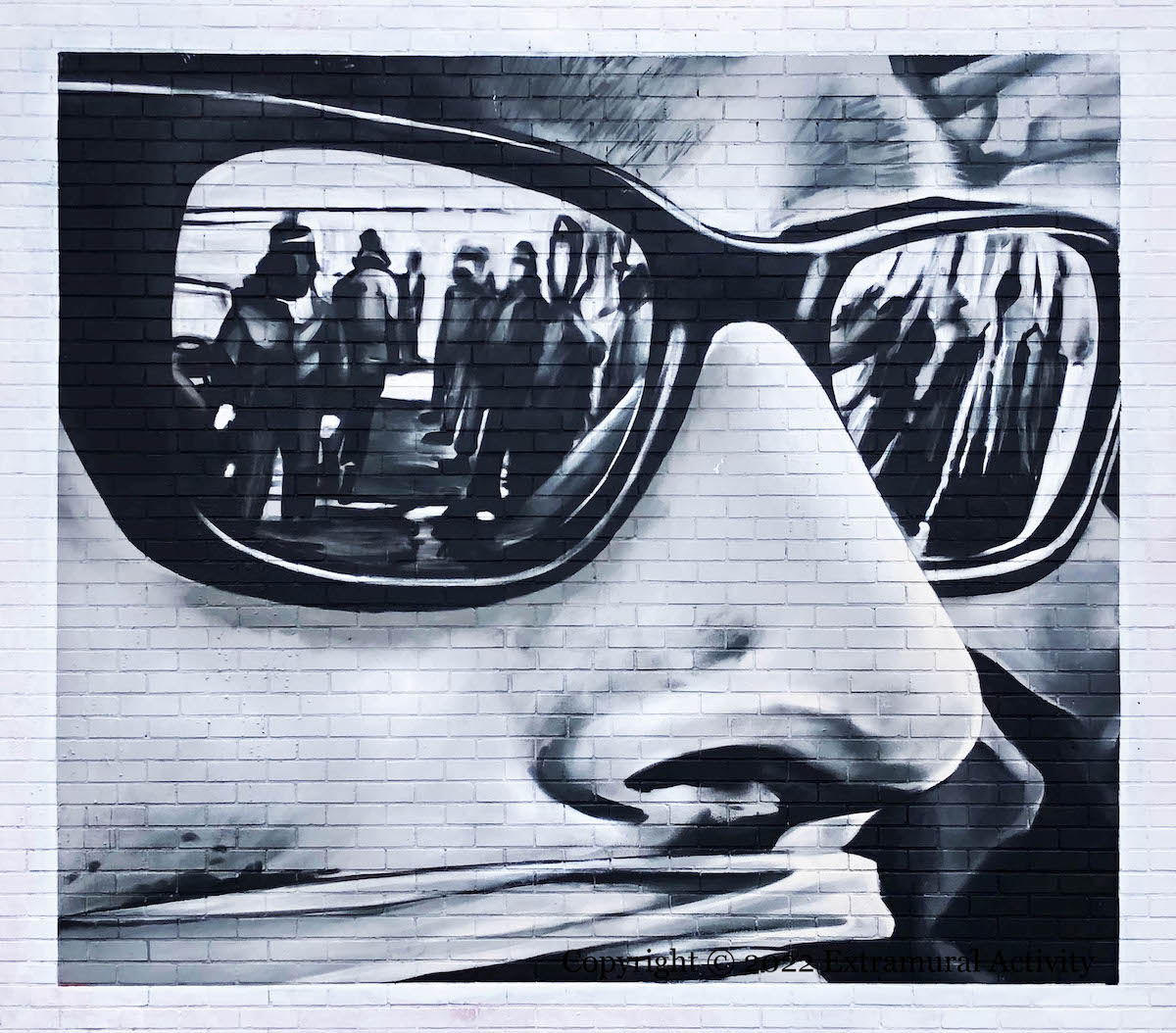
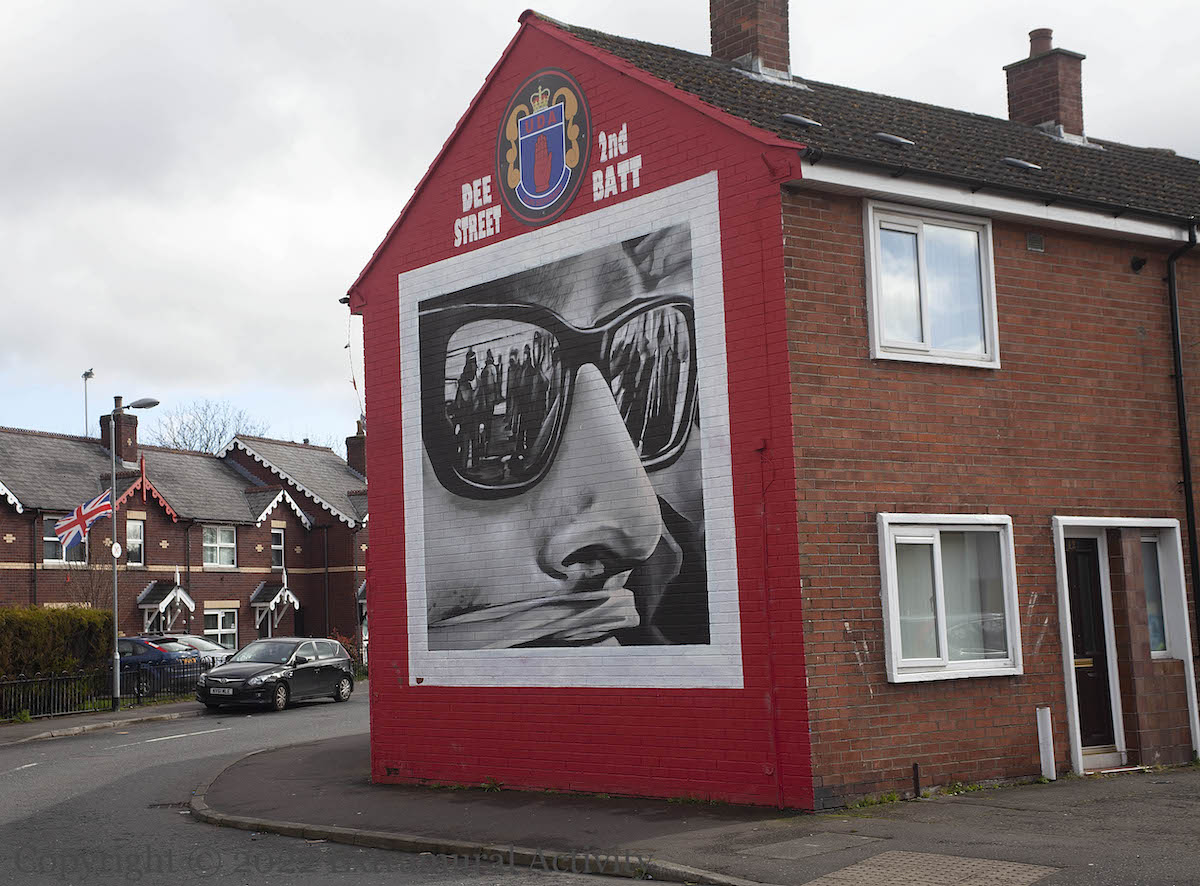
Perhaps because of the Covid pandemic, this mural of UDA volunteers on parade reflected in the sunglasses of one of their comrades took months to complete (it was started in late 2020 and was still unfinished last summer). It replaces the previous “UFF Formed 1973” mural – see Northern Island.
The photograph reproduced is from the 1974 Ulster Workers’ Strike; it appeared on the cover of Don Anderson’s Fourteen May Days (CAIN).
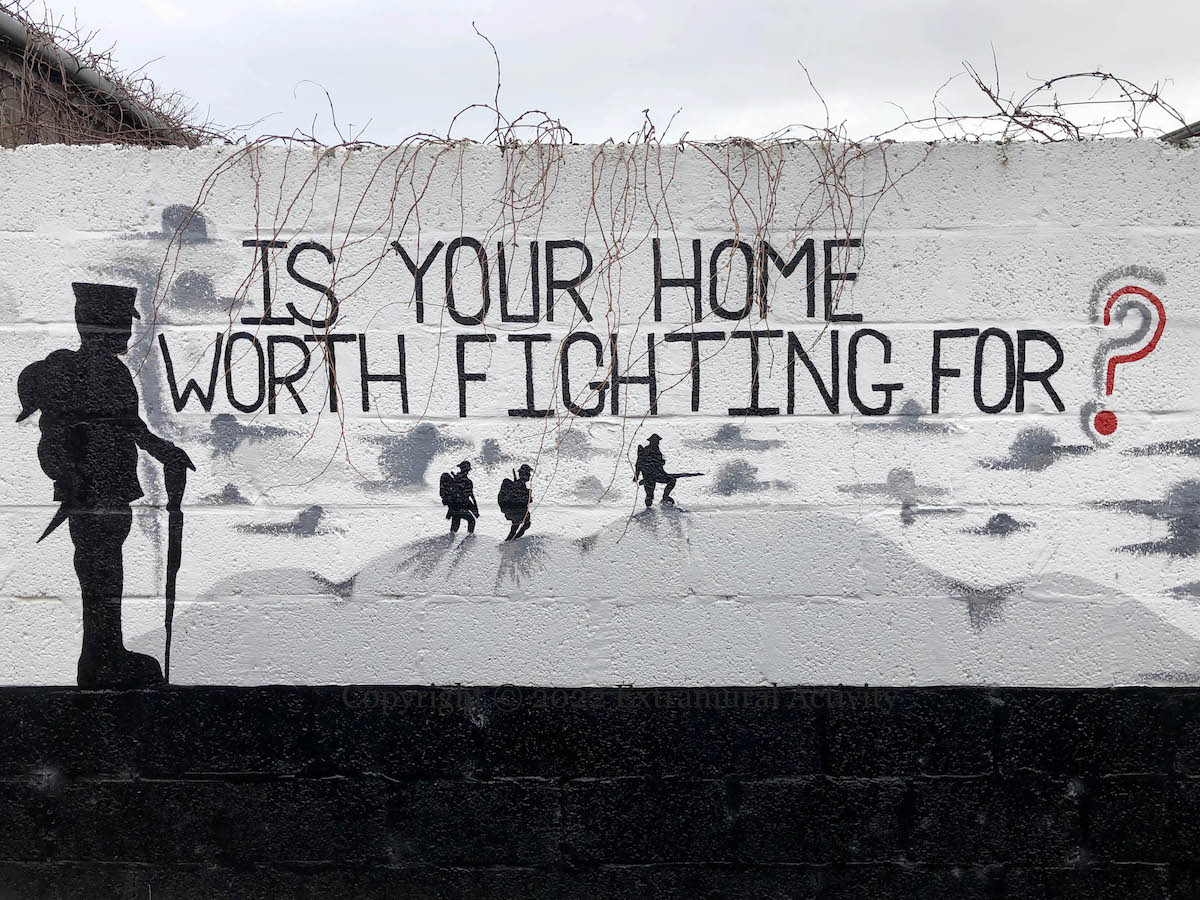
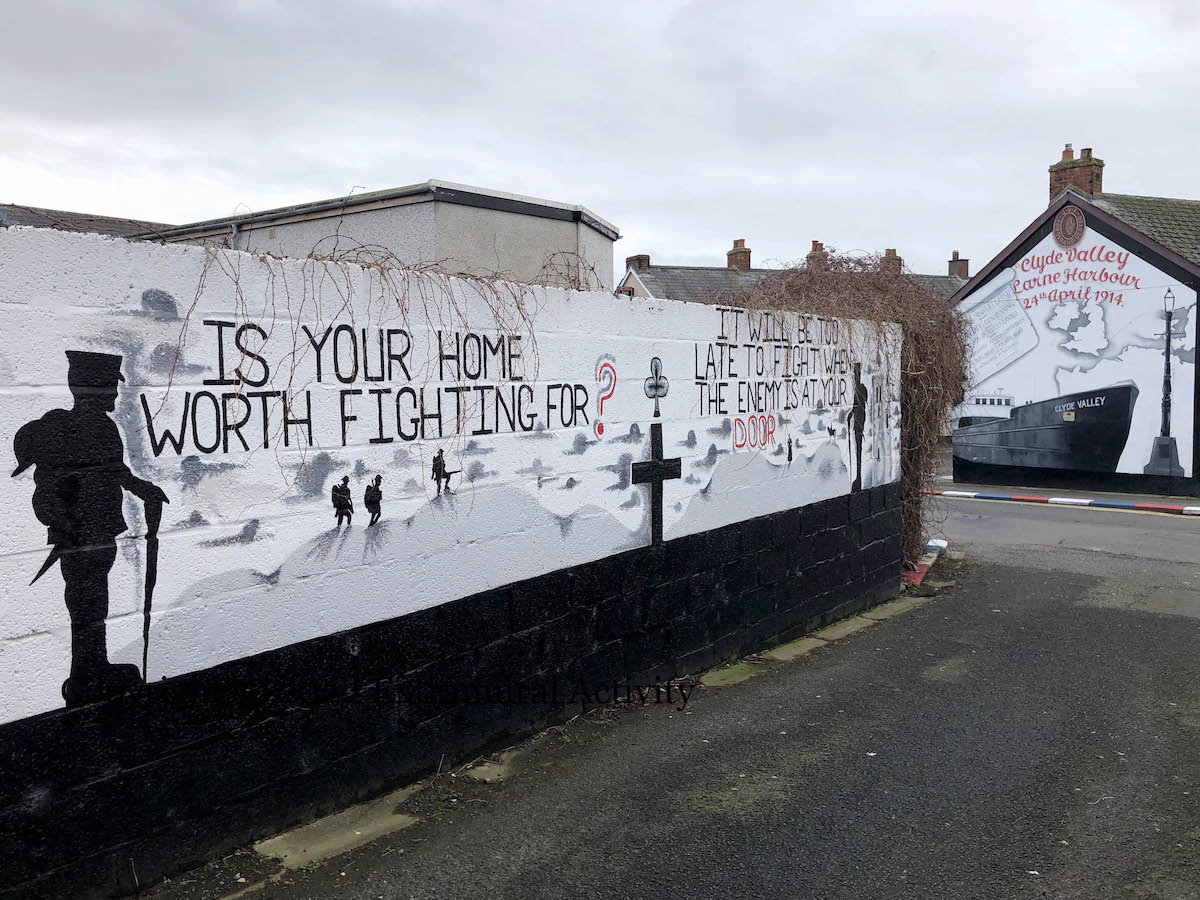
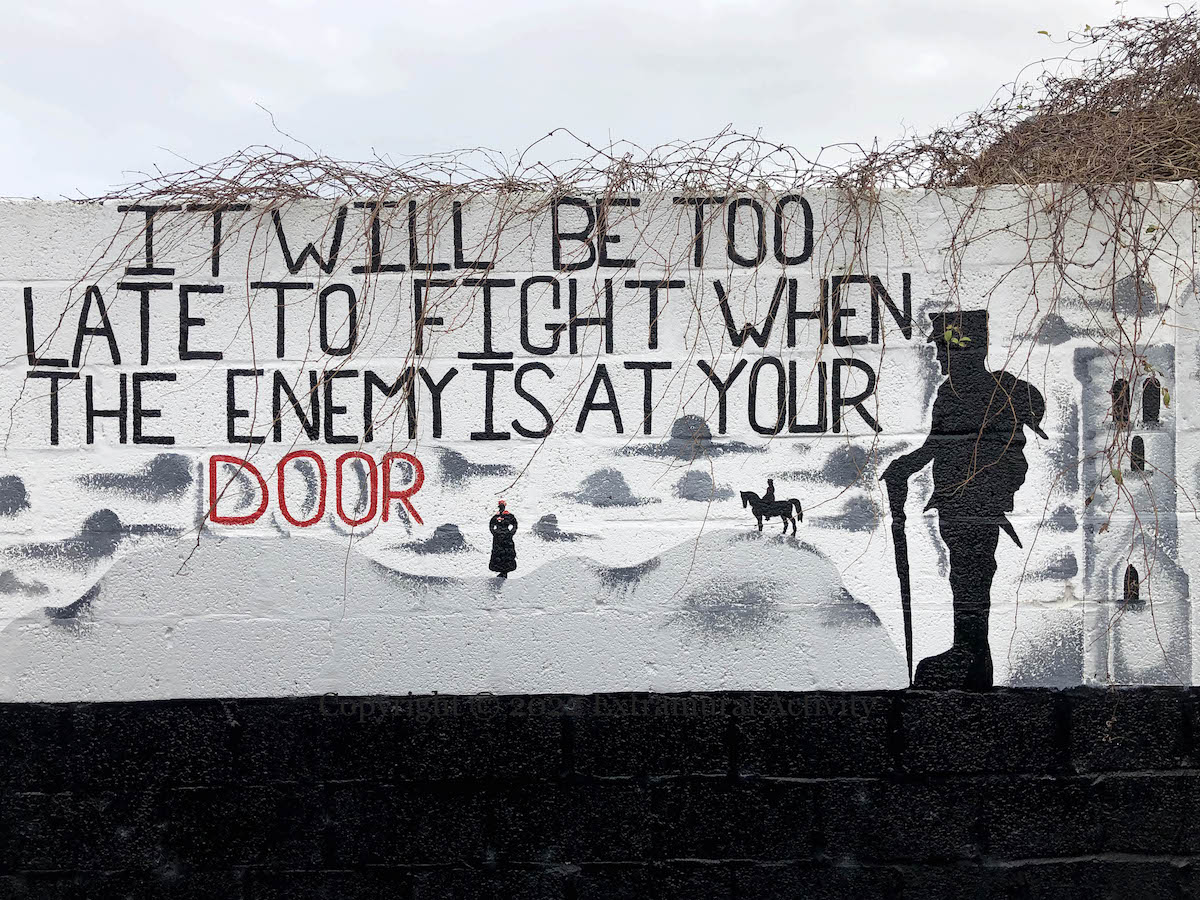
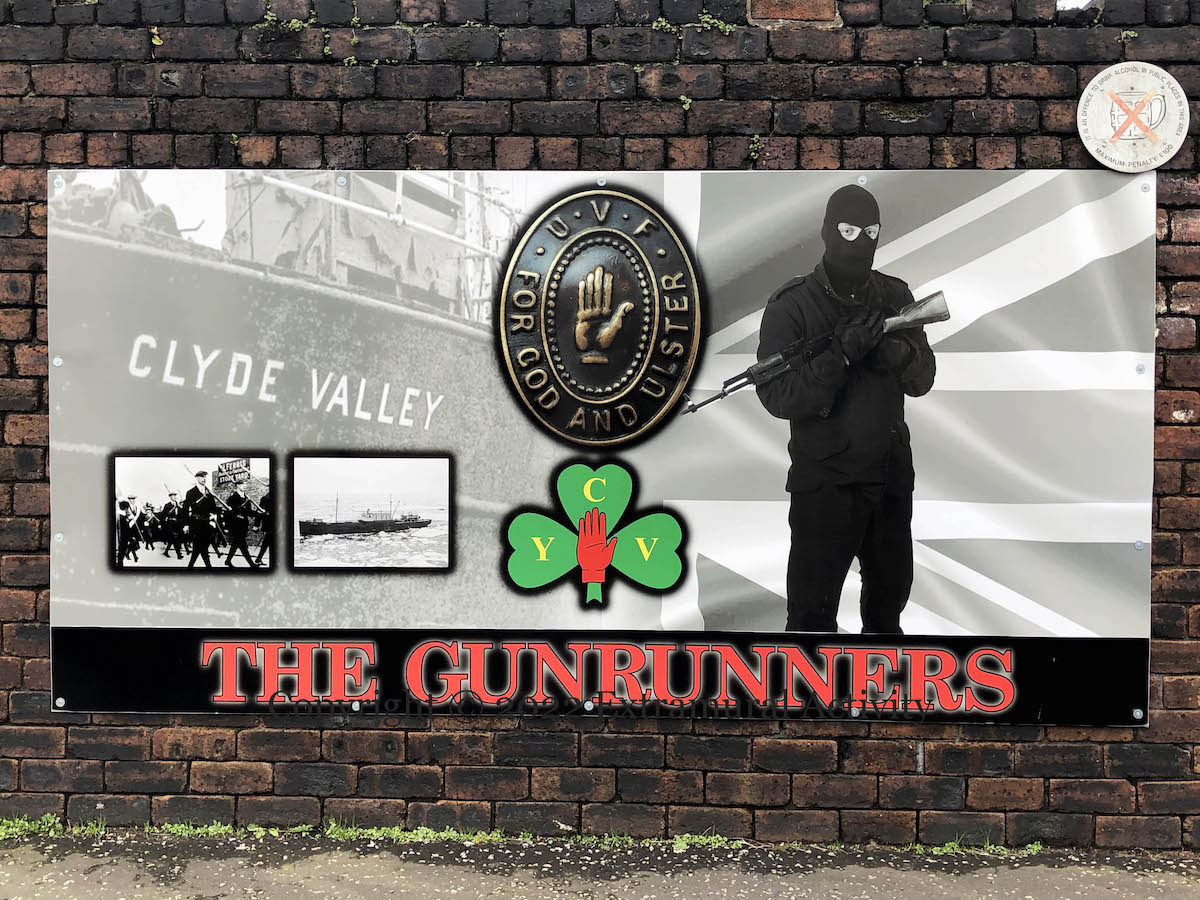
“… It will be too late to fight when the enemy is at your door.” In 1914, at the time of the Larne gun-running – see the mural in the second image and (previously) Amazing Night At Larne – the enemy was the threat of Home Rule and its enforcement by British Army forces and RIC that would remain under British control for at least three years after the commencement of home rule (Home Rule And Ulster’s Resistance p. 9). A bill to amend home rule by excluding some or all of the Ulster counties was introduced in July, 1914 (WP), but both Home Rule and the amendment were put aside when the Great War began; the enemy of Unionists then became the Central Powers. The contemporary enemy is the NI Protocol and Brexit, with the powers in Westminster again suggesting a separation of Britain and (Northern) Ireland.
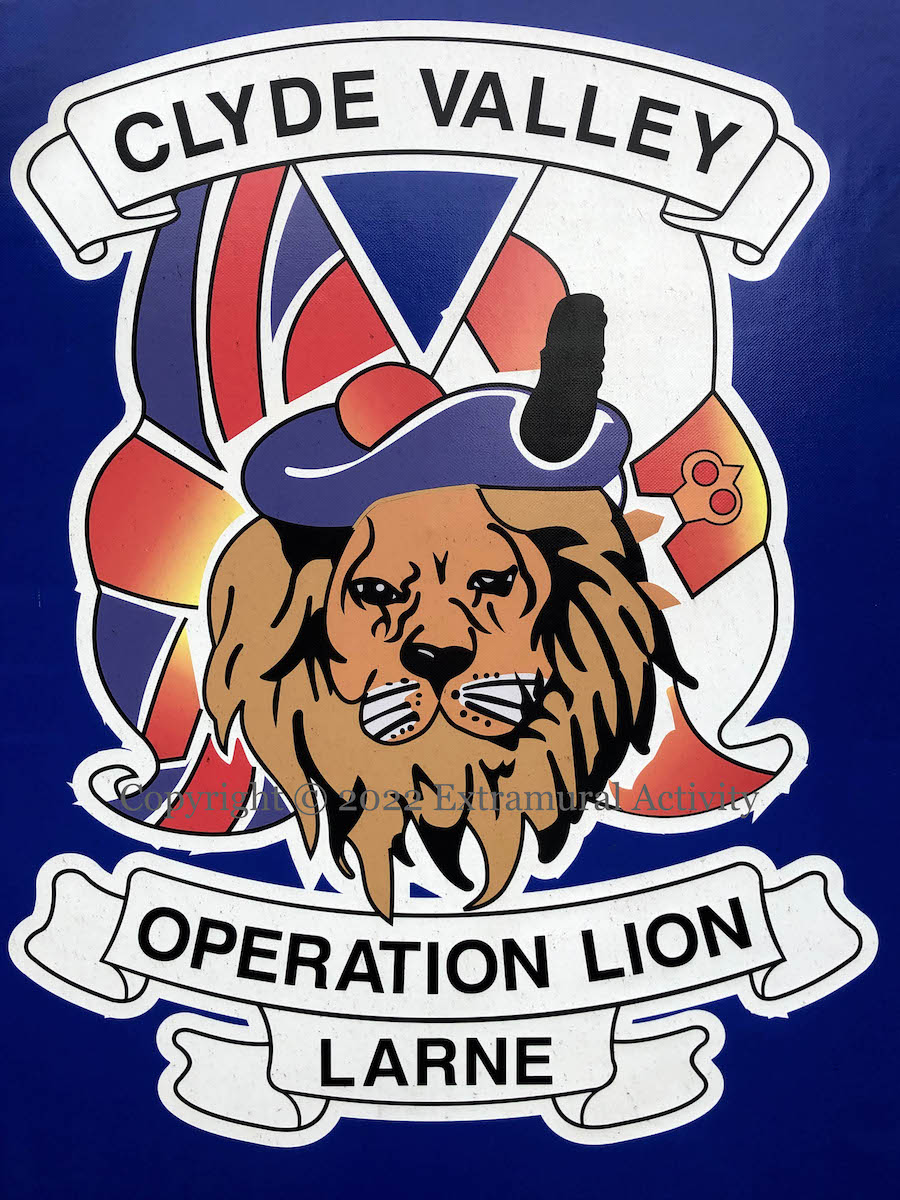
“Operation Lion” was the code named for what is commonly known as the Larne Gunrunning using the ship Clyde Valley which had been renamed Mountjoy II for the occasion (WP) and which now lends its name to a flute band in the area. The hooded gunman on the right is carrying a more modern rifle, rather than surplus German and Italian WWI rifles that came ashore in April, 1914 (Full 30).
For a wide shot containing both pieces, see Norman Anderson.