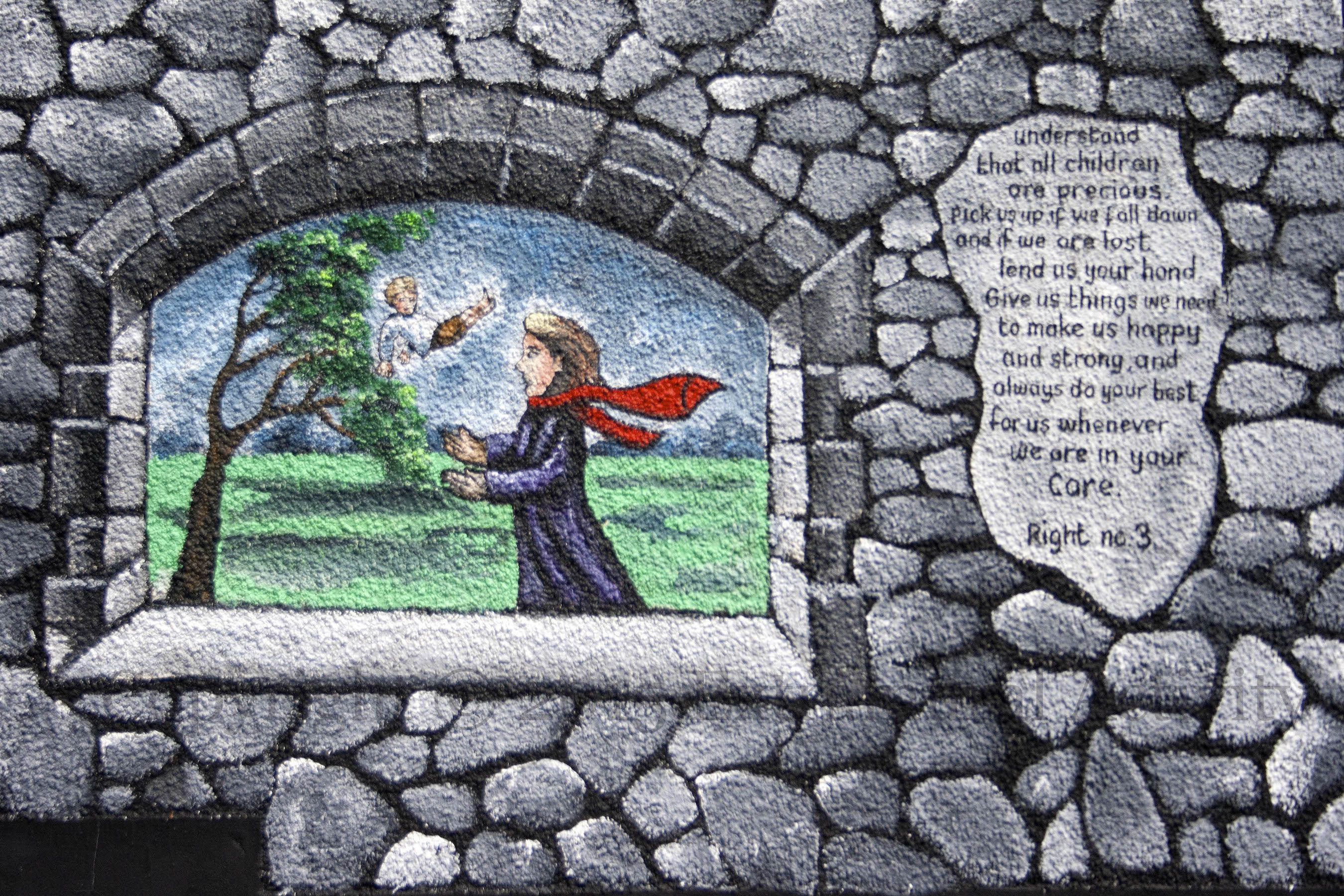
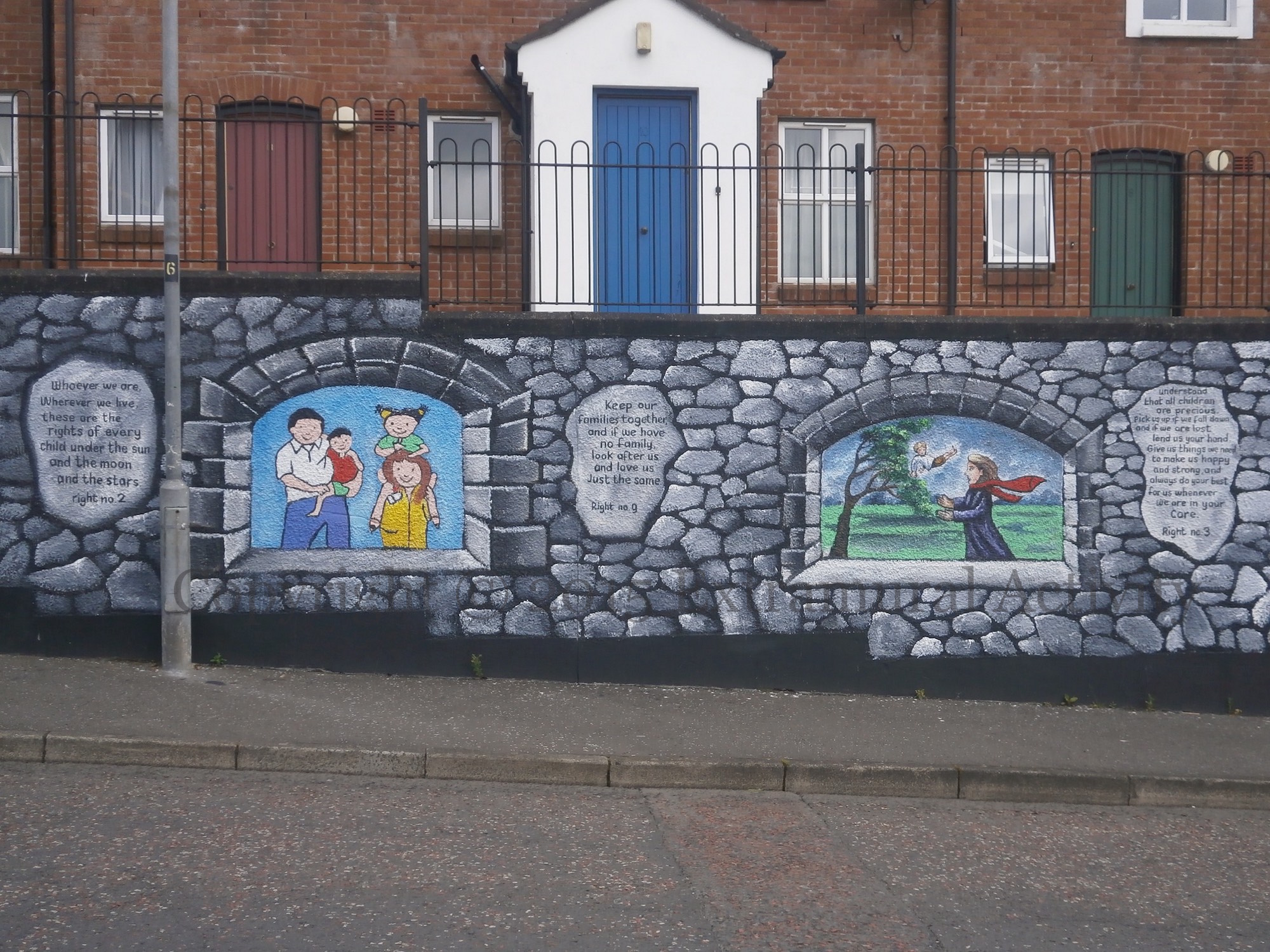
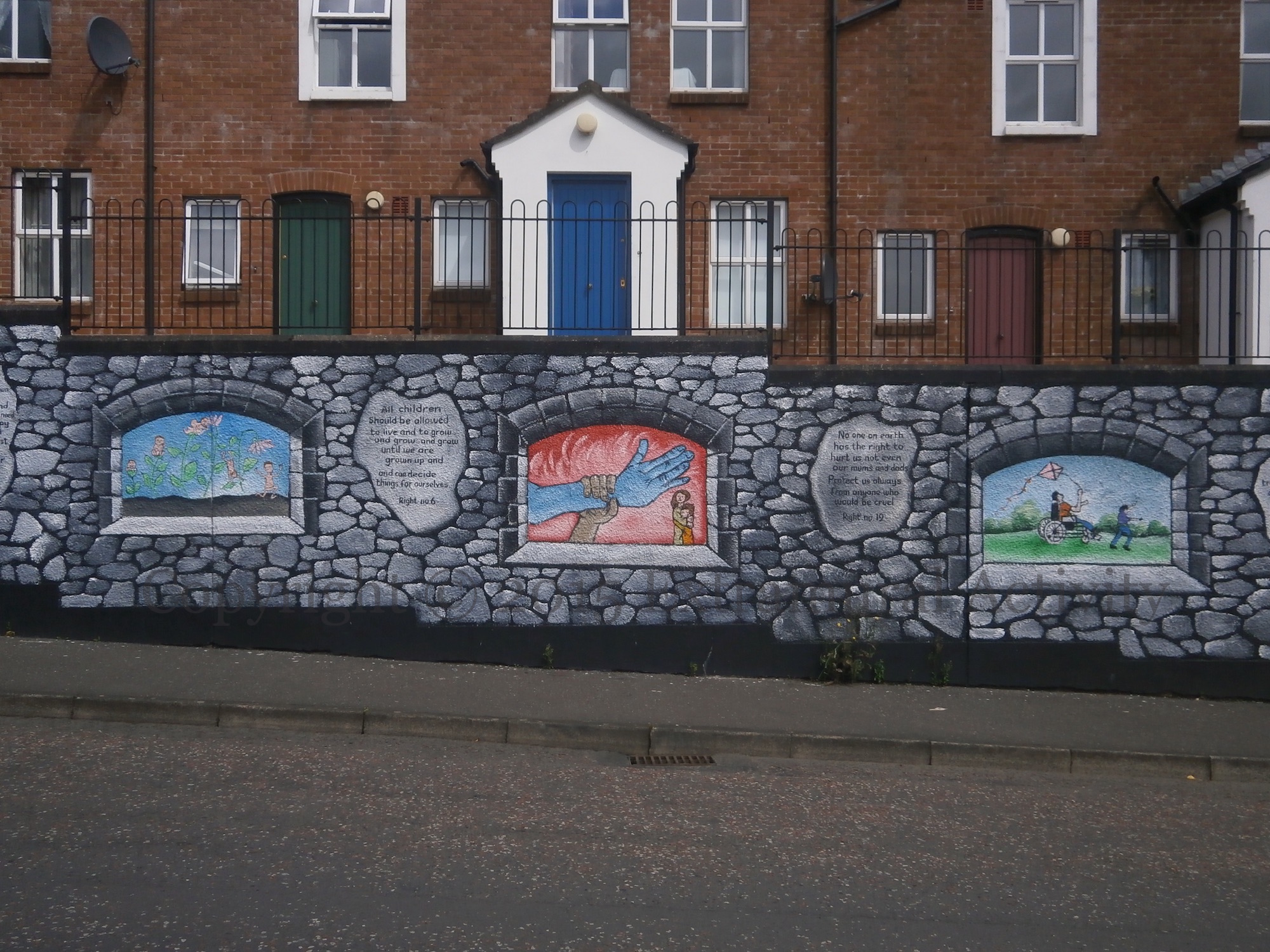
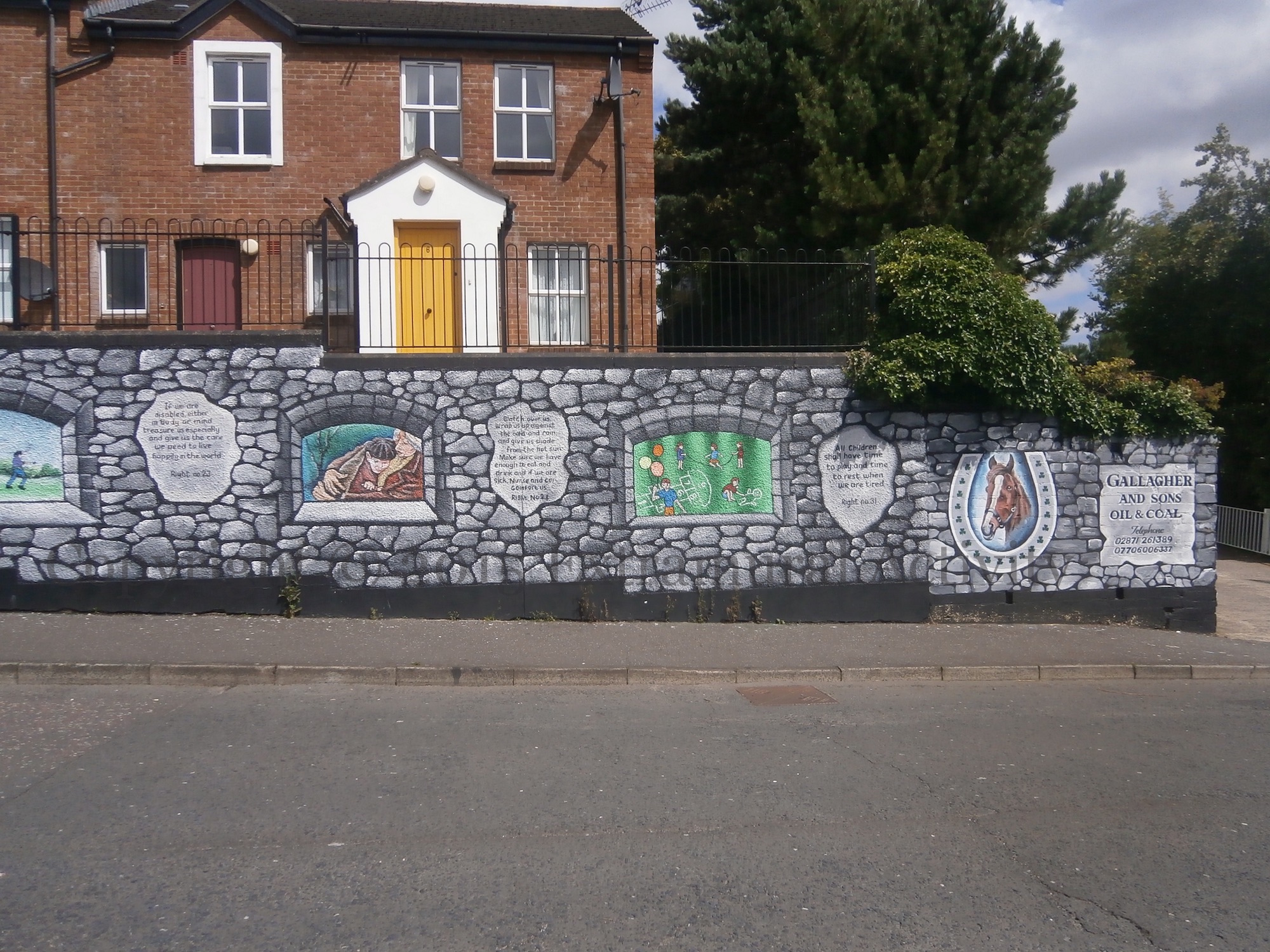
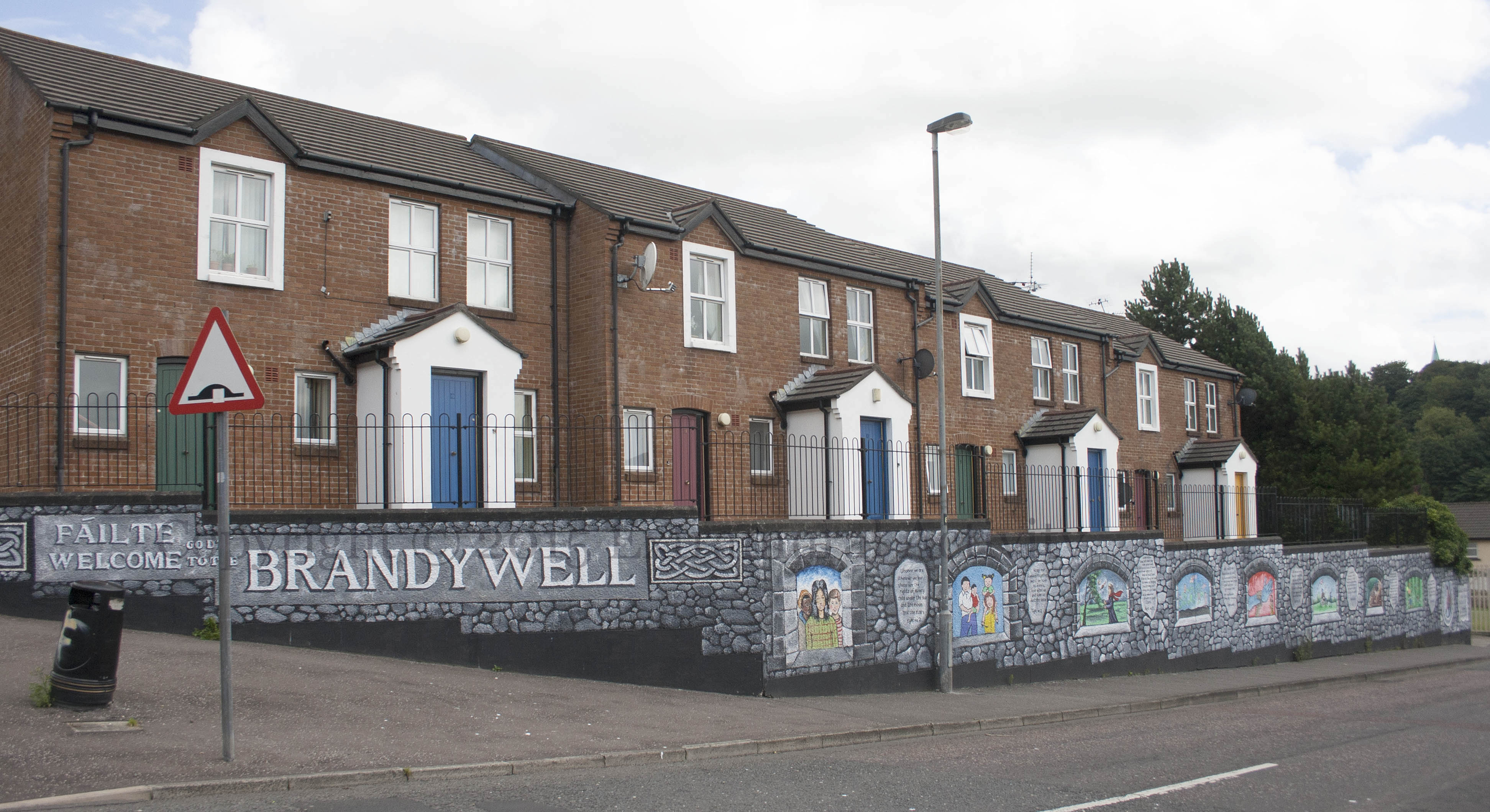
This mural featuring the rights of children was painted in Derry’s Brandywell area in 2014; it puts images alongside parts of Caroline Castle’s rendering of the UN’s Rights of the Child. The one above reads “Understand that all children are precious. Pick us up if we fall down and if we are lost lend us your hand. Give us things we need to make us happy and strong and always do your best for us whenever we are in your care. Right no. 3”.
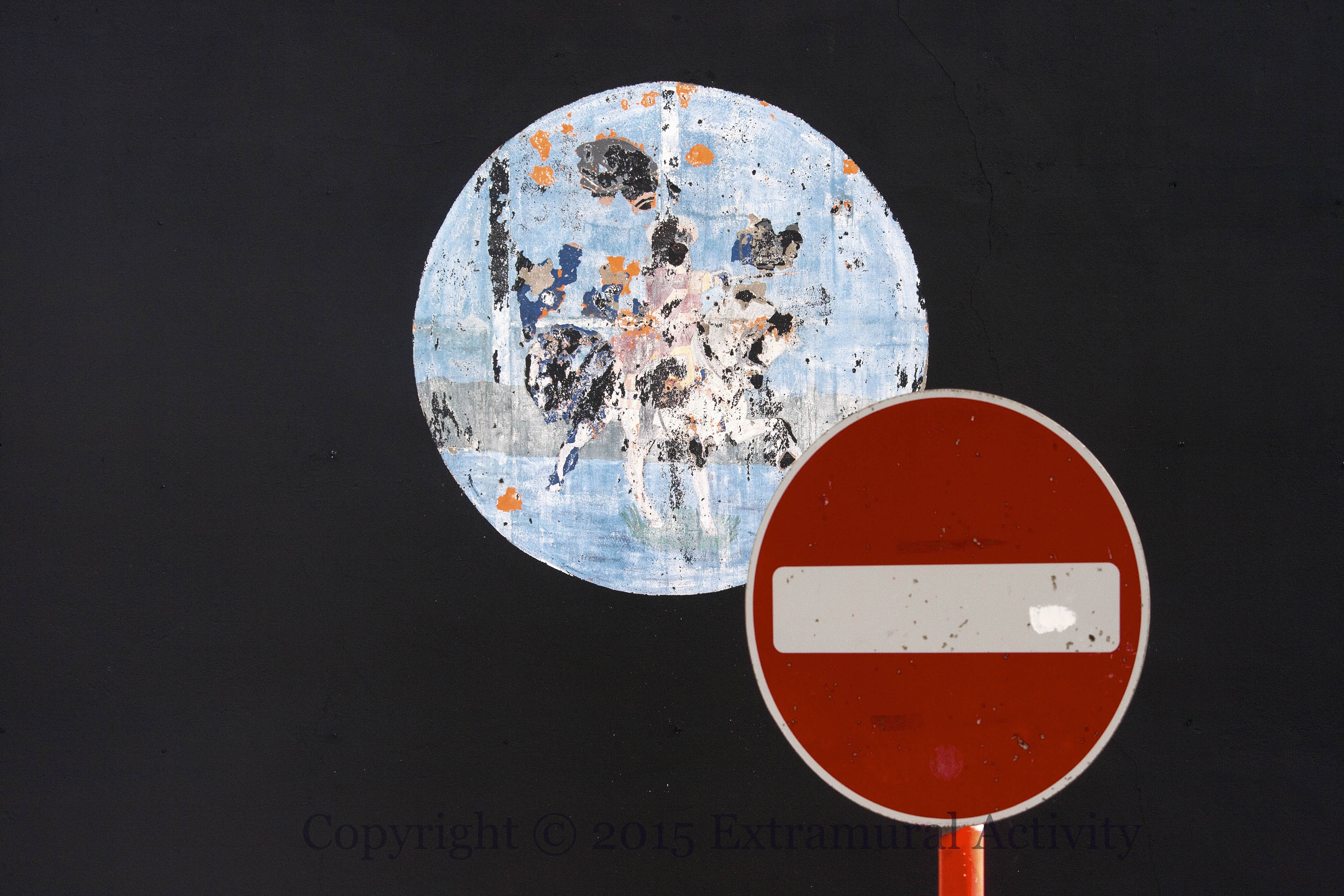
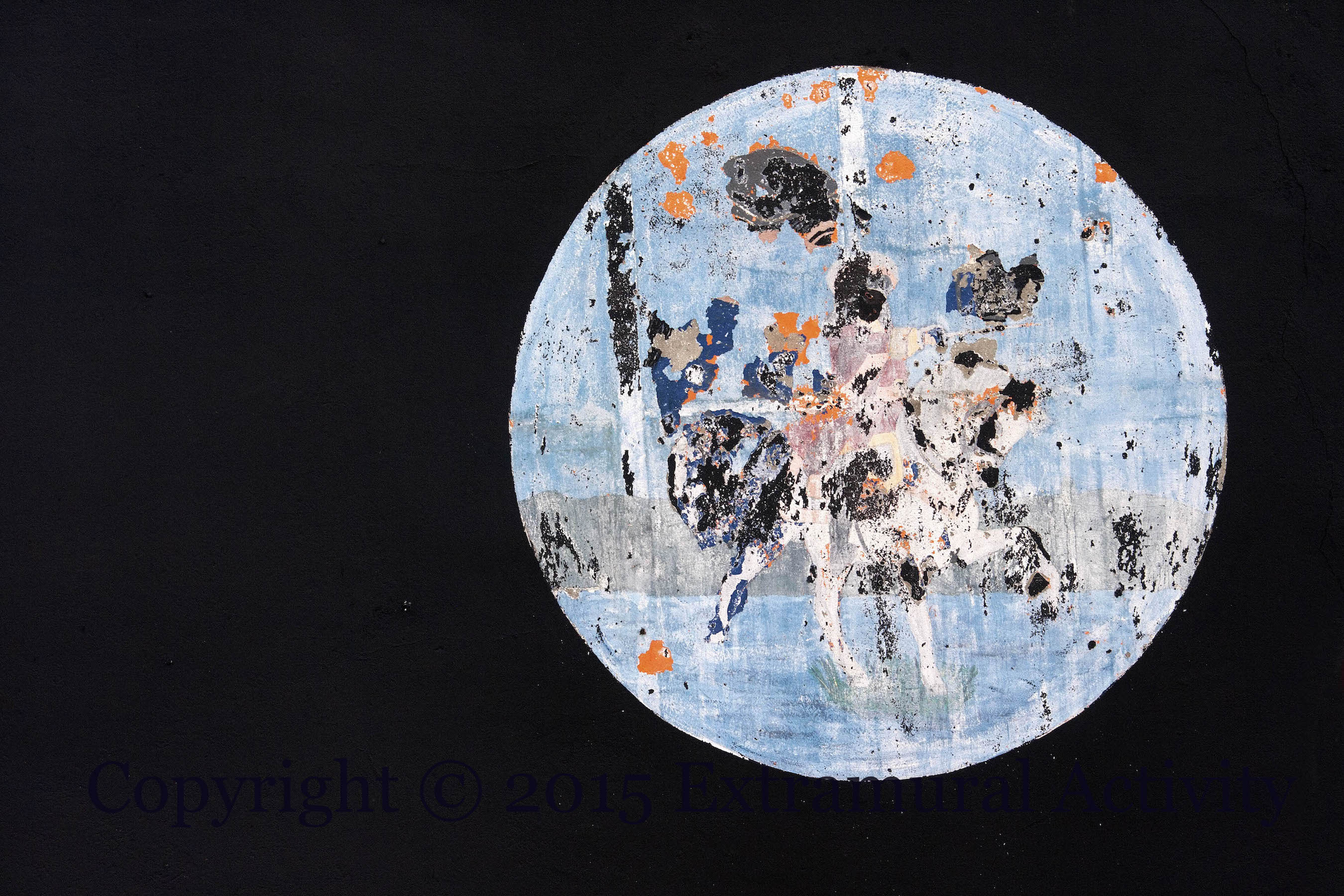
An old mural of King Billy crossing the Boyne, which was covered over first by a mural of President Theodore Roosevelt (see M01532) and then a mural of scenes from the old Fountain area (see Past The Gaol), has re-emerged on the wall in Wapping Lane.
For the original version, see M00939. Before the King Billy mural, there was one to Michael Stone from 1989 – see M00627.
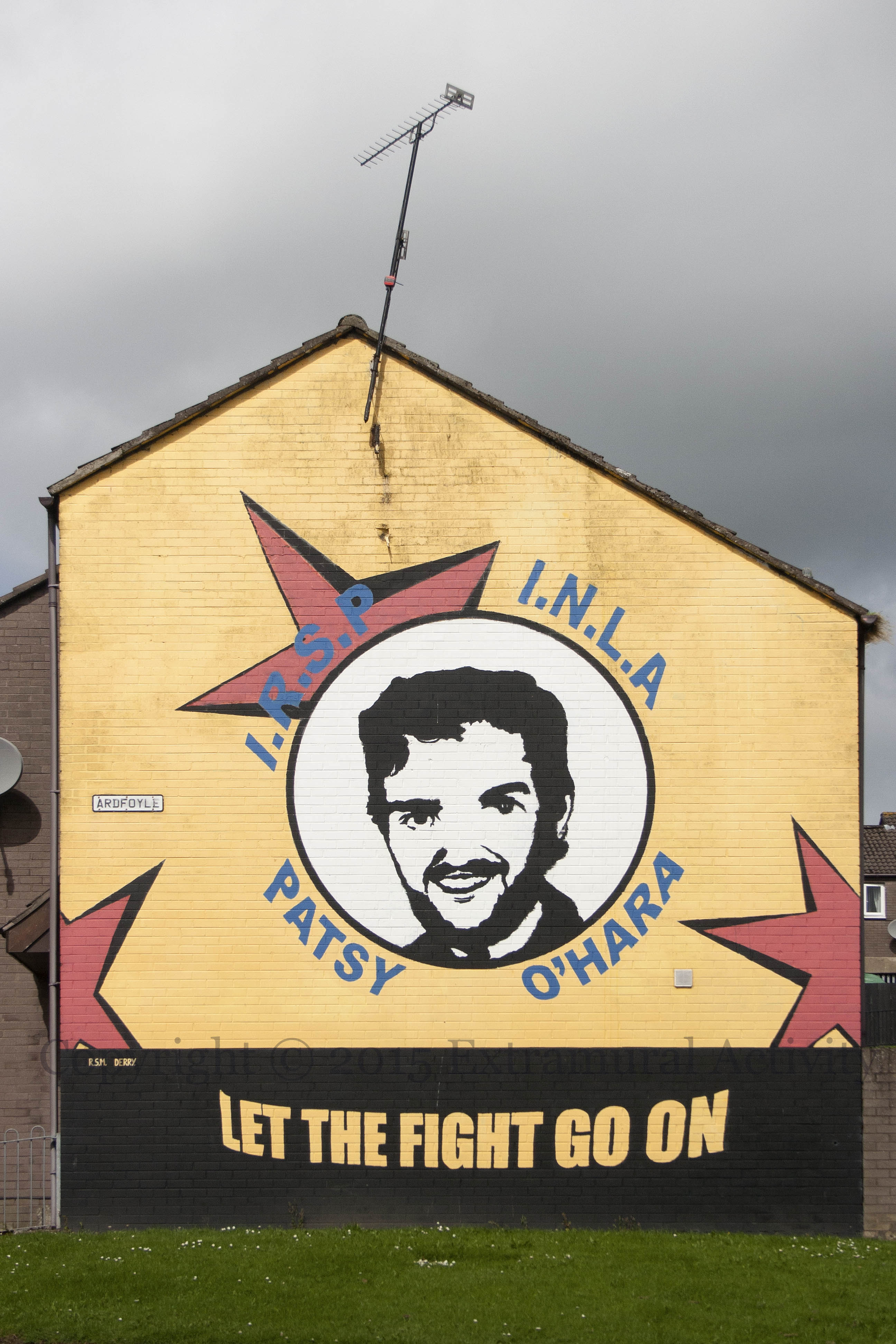
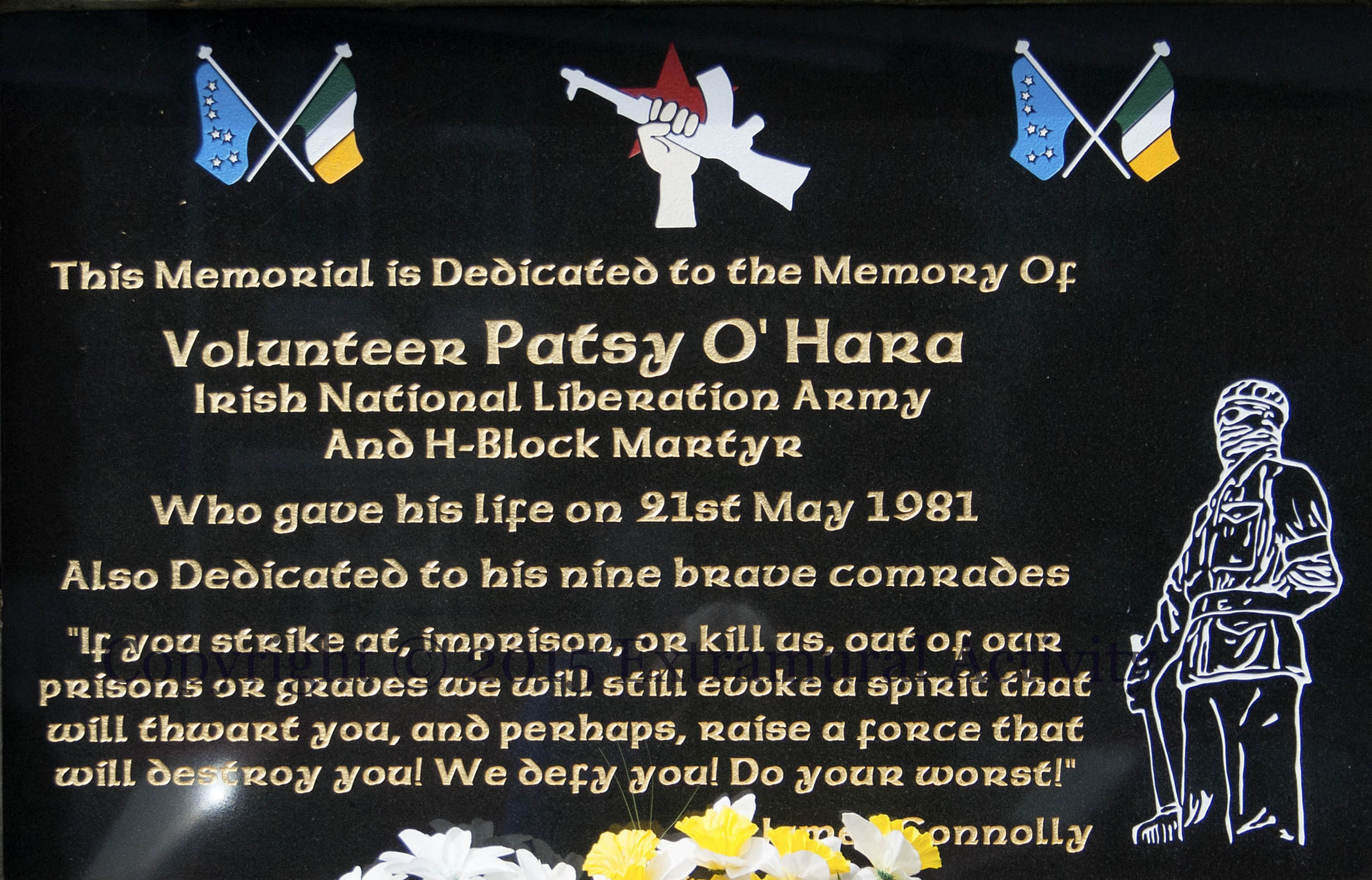
Patsy O’Hara mural and (out of shot to the left but shown in close-up below) memorial stone: This memorial is dedicated to the memory of Volunteer Patsy O’Hara, Irish National Liberation Army and H-Block martyr, who gave his life on 21st May 1981. Also dedicated to his nine brave comrades. “If you strike at, imprison, or kill us, out of our prisons or graves we will still evoke a spirit that will thwart you, and perhaps, raise a force that will destroy you! We defy you! Do your worst!” – James Connolly
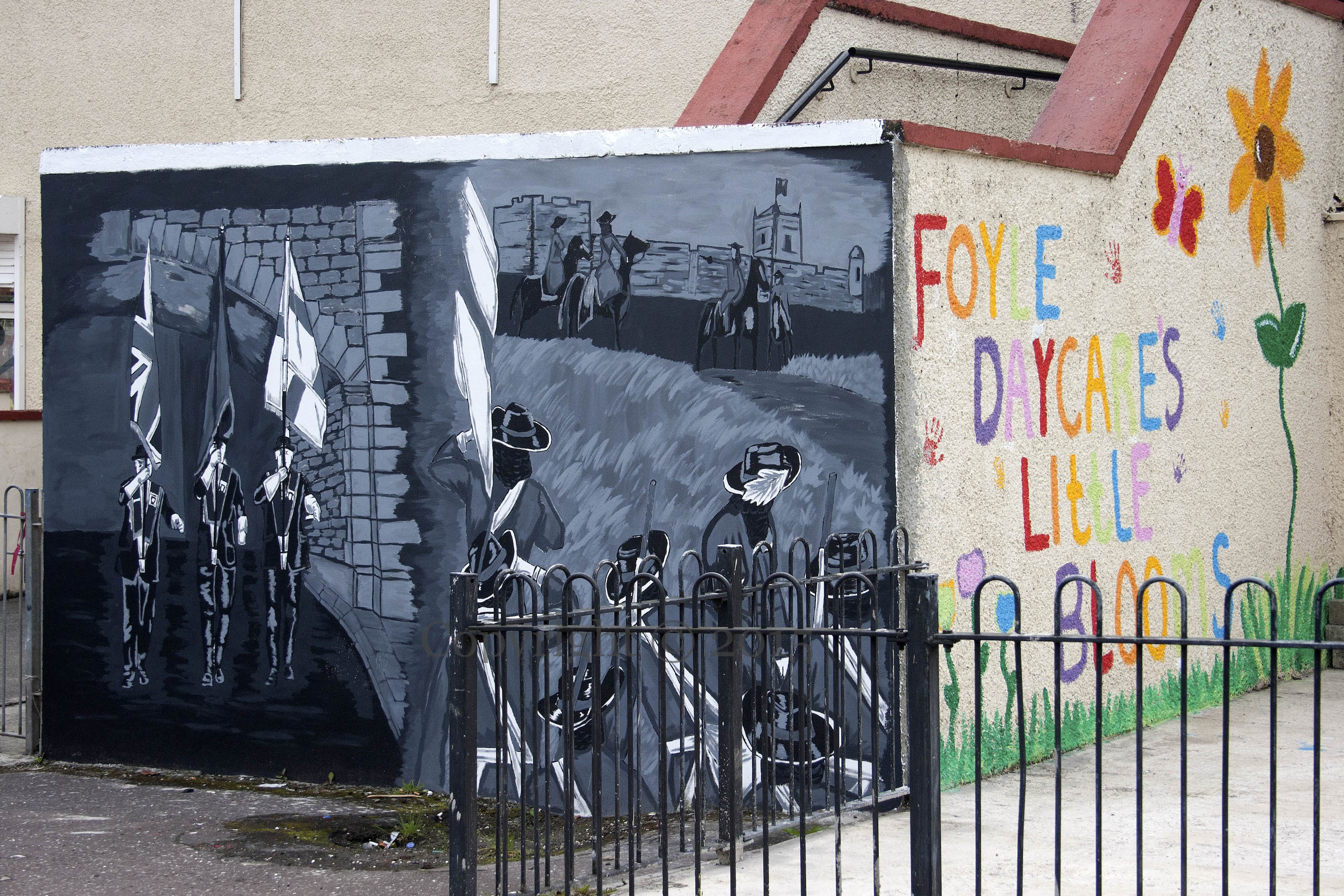
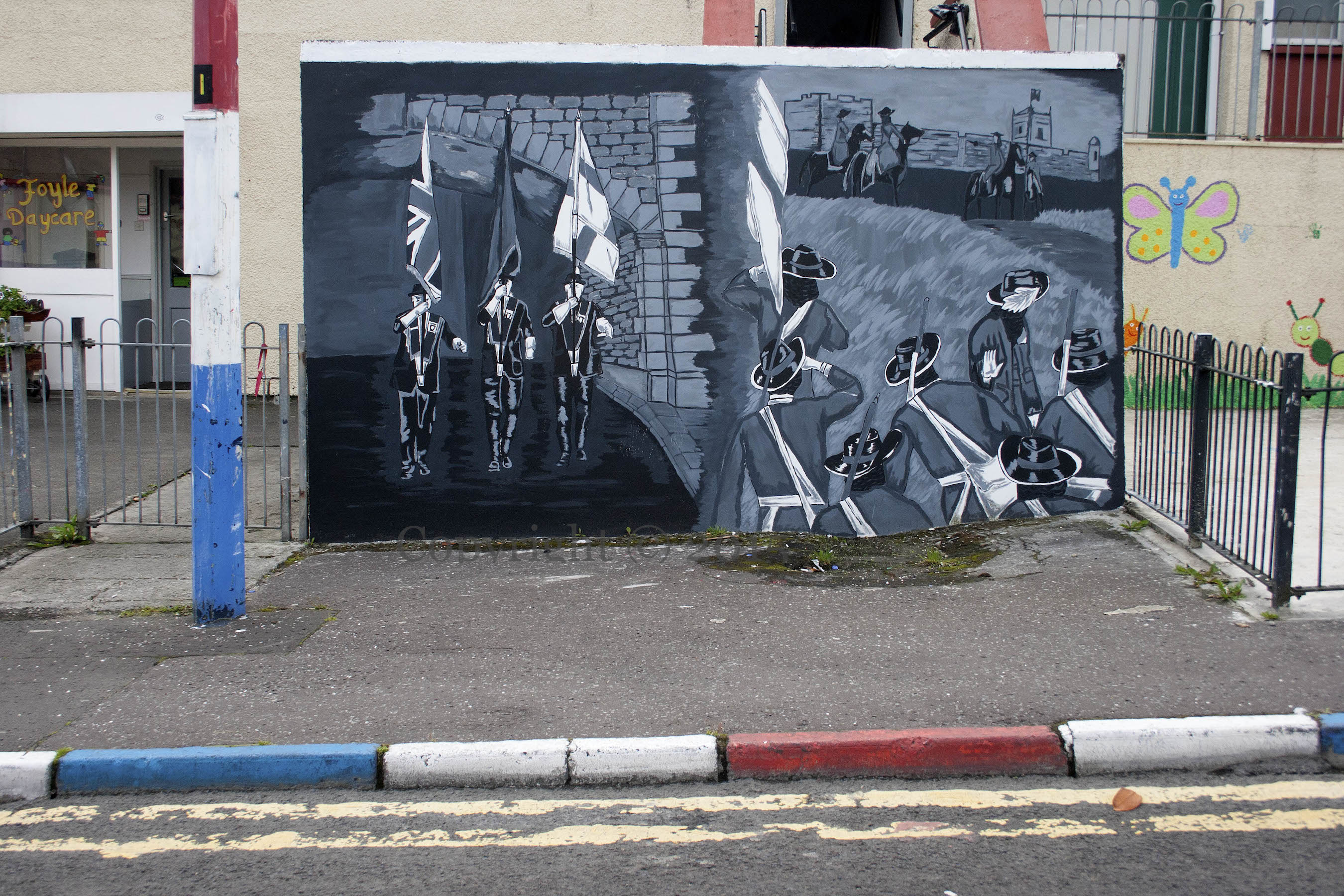
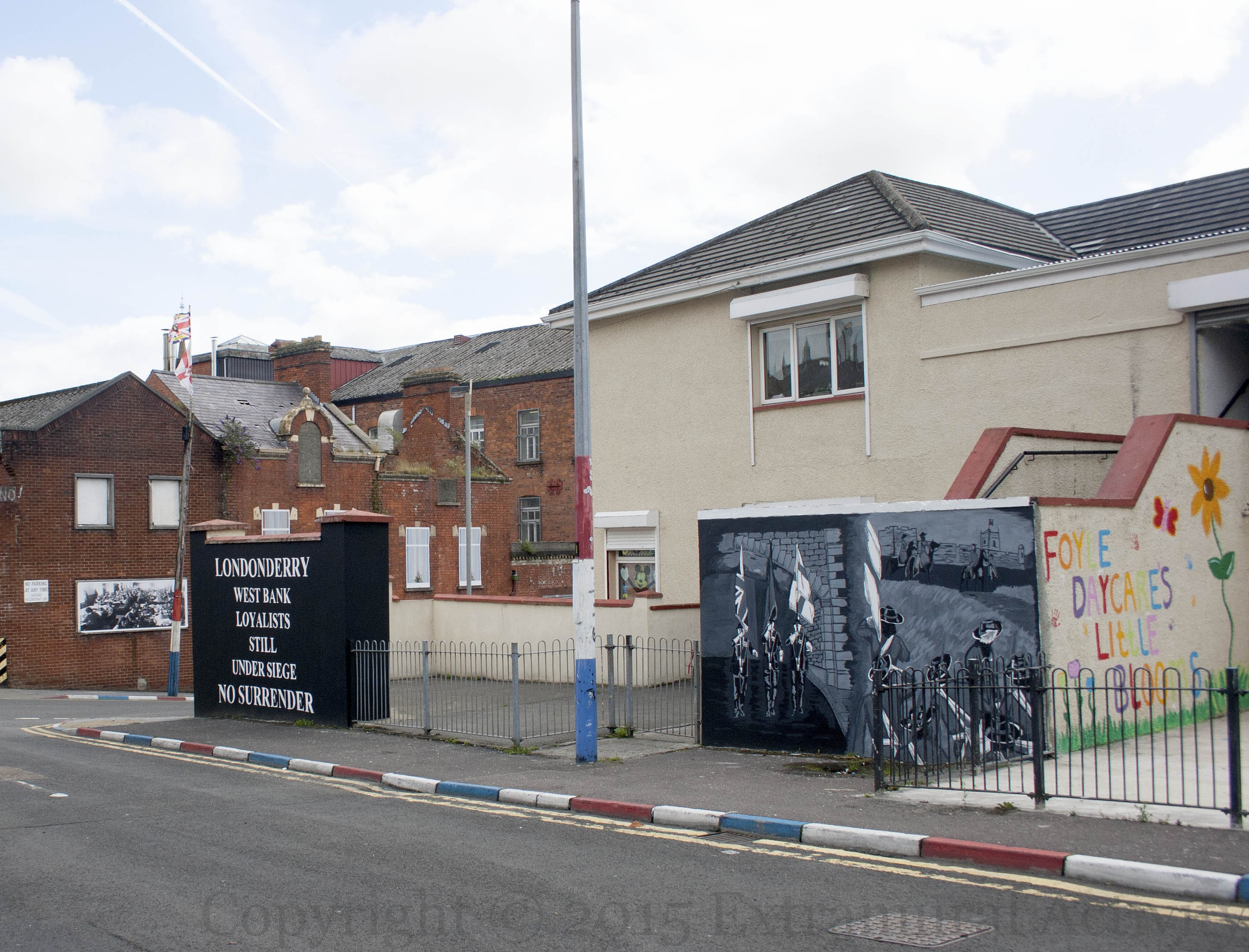
The “Little Blooms” receive a lecture in history and politics each day as they mount the painted kerb-stones and take in a mural of Orange Order flag-bearers and a scene from the Siege of Derry, perhaps of James II demanding the city and being rebuffed with cries of “No surrender”.
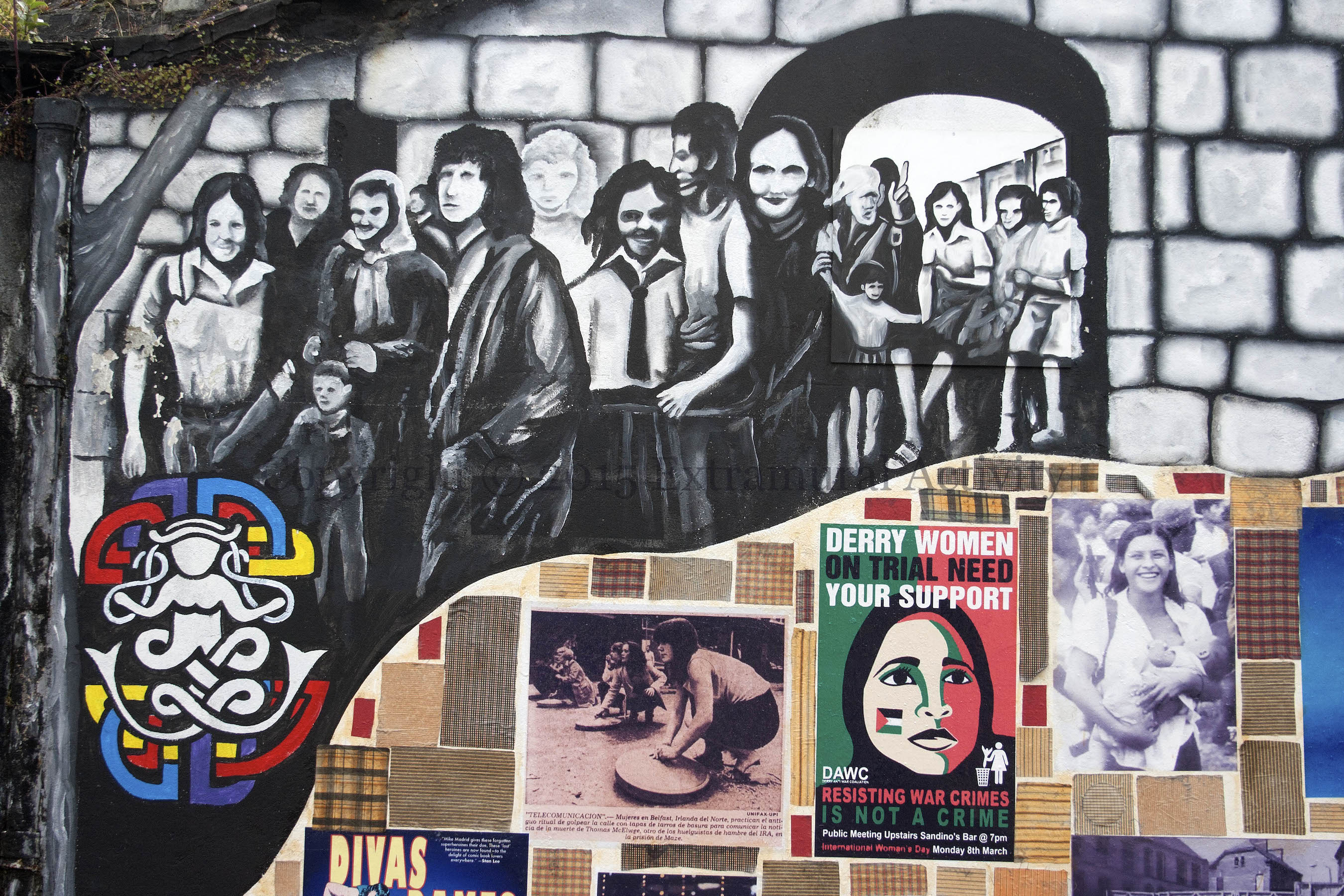
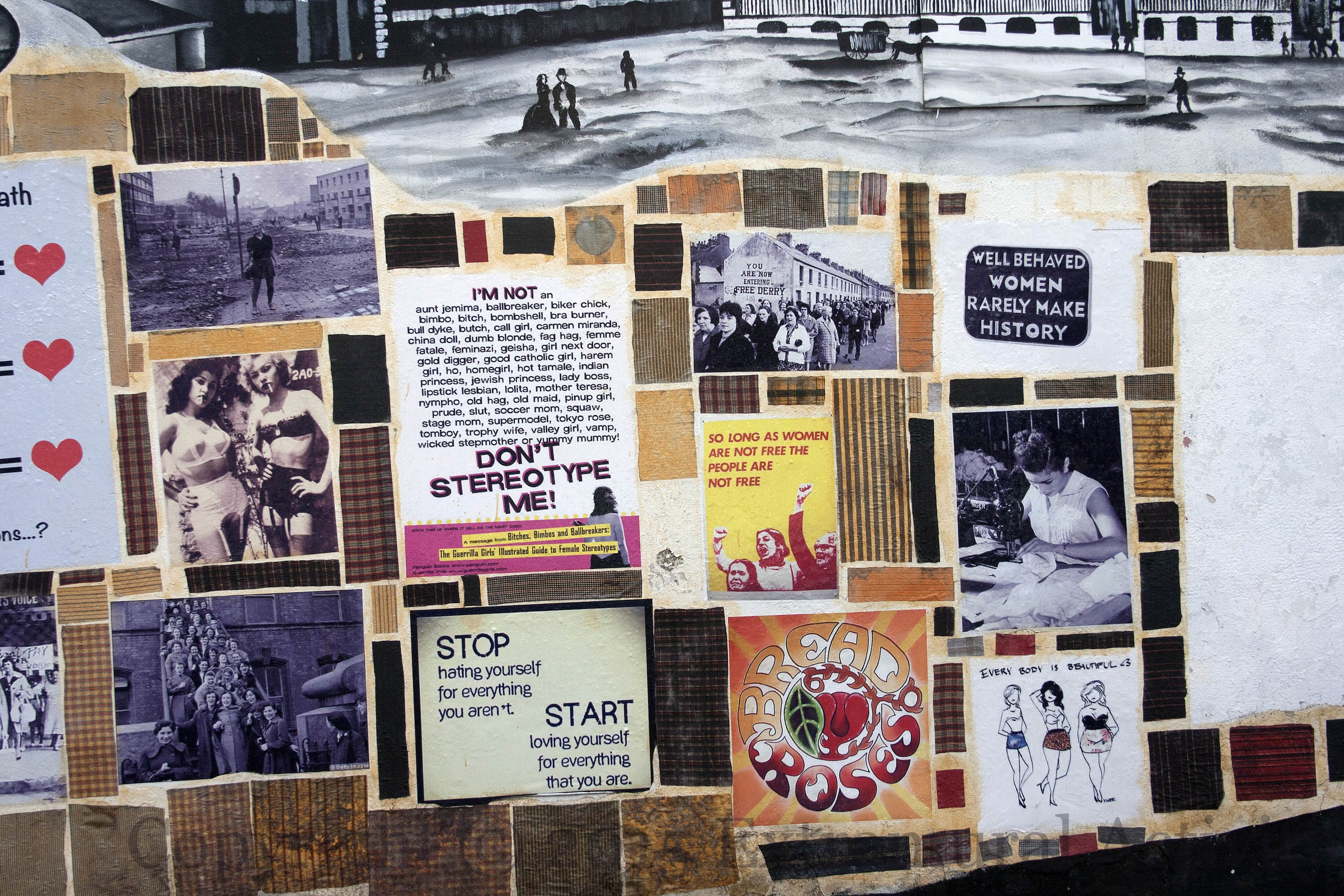
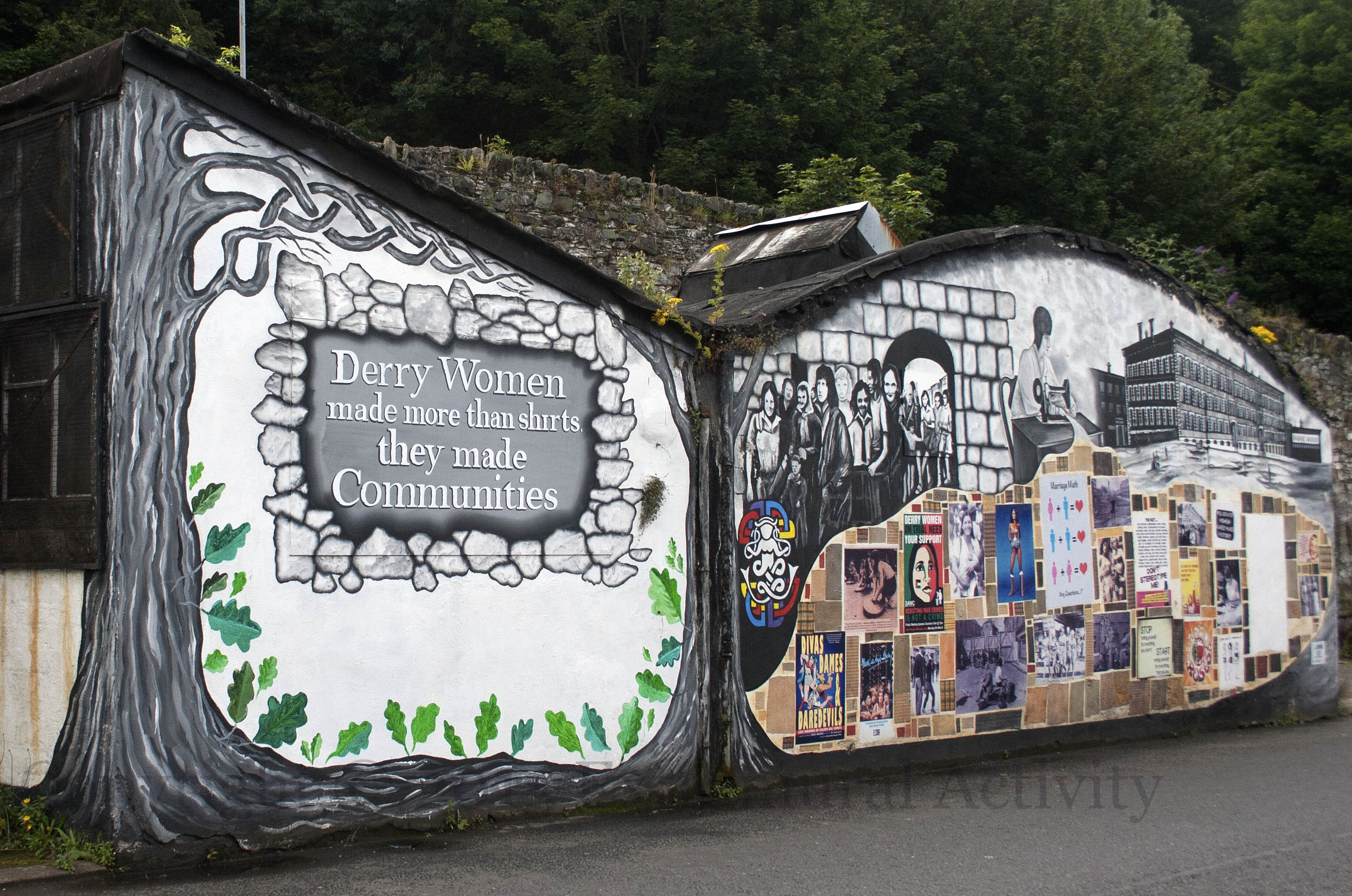
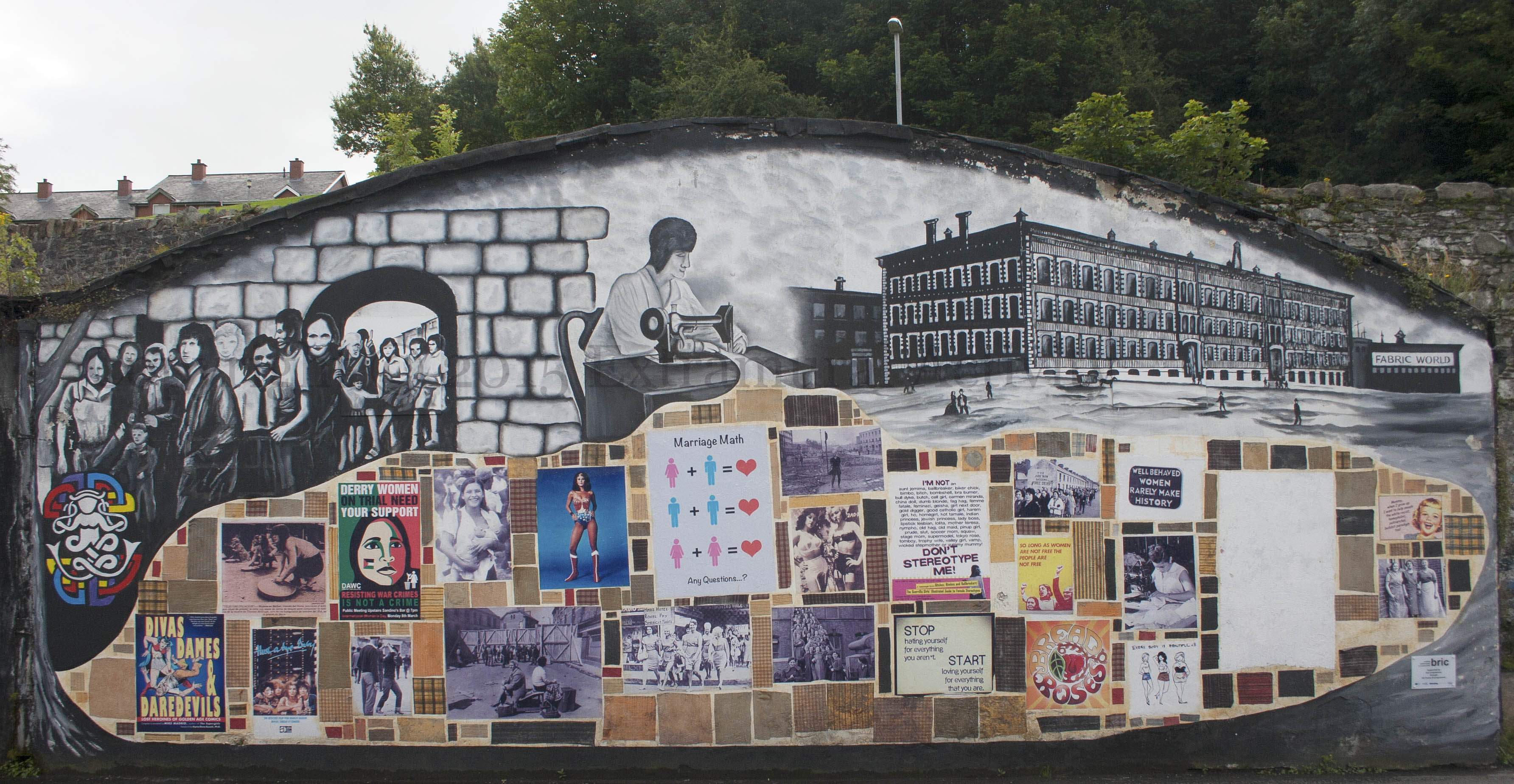
Historian Laurel Ulrich‘s 1976 phrase is one of a variety featured in this Derry mural celebrating the role of women both locally and world-wide. It includes images of local women banging bin lids, marching past the ‘Free Derry’ graffiti on 33 Lecky Road, and rioting; images of women striking and protesting; support for Palestine and gay rights; celebrations of femininity; and Wonder Woman. As the final image, below, shows, the tapestry of images and posters is being sewn by a woman at a sewing-machine in one of Derry’s large shirt- and collar-making factories. (For some history see these Derry Journal articles: one | two.) As the panel on the left-hand side notes, “Derry women made more than shirts; they made communities”.
On the left of the main panel, women march out of one of the city’s gates. The information sheet (which has fallen off) reads as follows: “On International Women’s Day, March 8th [1991, not 1981 as the hand-written addition suggests], the first ever women’s mural in Derry was unveiled on the back of Free Derry Wall. It was designed and painted by Patricia Hegarty and Joe Coyle, and helpers, both men and women. The mural takes its inspiration from a march in November 1968, after Minister for Home Affairs Bill Craig banned all civil rights marches in the walled city. Women factory workers walked out and spent the afternoon marching in and out of every gate in the city, deliberately “breaking the ban”. Men marched in from DuPont to join them, and a rally was held in the Diamond. In the mural you can find the faces of some of those marching on that historic day, as well as other women who played their part in the ongoing struggle for justice. Civil rights workers Bridget Bond and Women’s Aid refuge founder Cathy Harkin march alongside republicans such as Ethel Lynch, Bridget Sheils, Peggy Derry, prisoners’ rights activists Susie Coyle, and many others. You may find images of your granny, sister or aunt. The mural is dedicated to all those women whose energy and determination have changed their lives and the world about them.”
The board on FDC can be seen in Woods’s Seeing Is Believing?, plate 19.
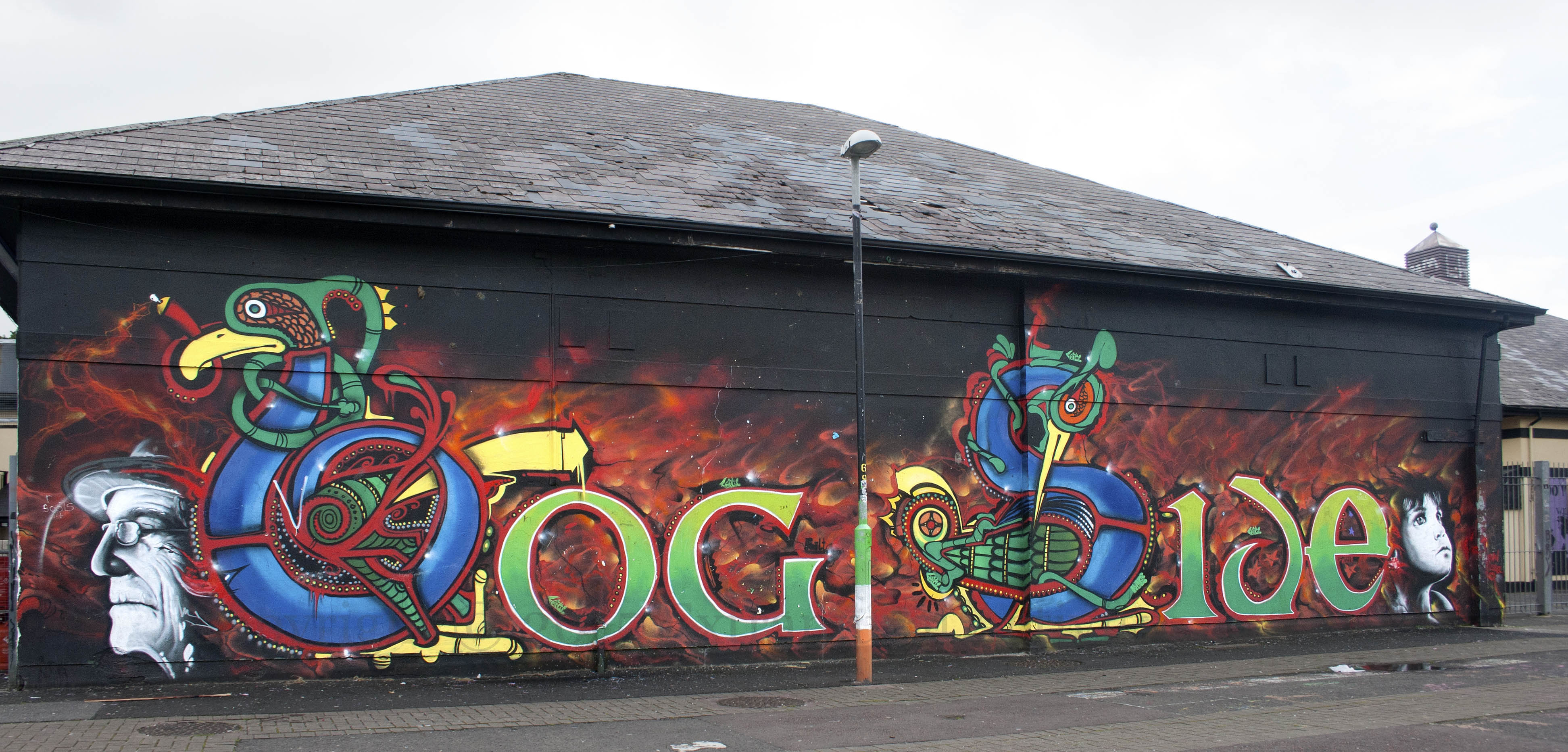
The eastern side of what was the island of Derry is called the Water side and the western side, although originally under water, became the Bog side in about 1600. The two murals shown here are on either side of the shops adjacent to the Bogside Inn. There is an excellent history of the area from 1162 to the construction of Rossville flats in 1966 at the Museum Of Free Derry.
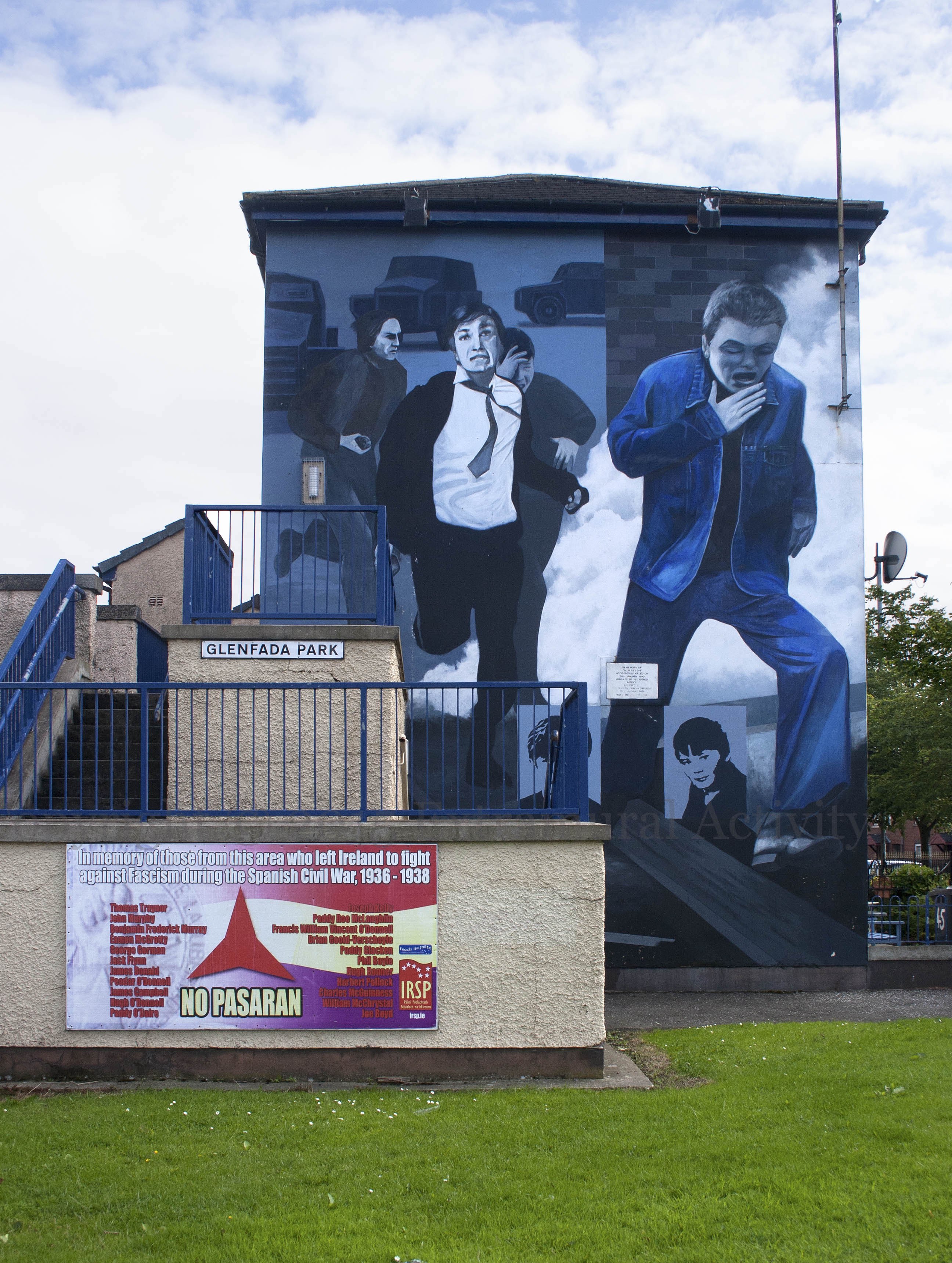
“No pasarán” is Spanish for “they shall not pass”, a phrase used by the Communists and Republicans as they tried (unsuccessfully) to defend the city of Madrid during the Spanish civil war. The board in front commemorates “those from this area who left Ireland to fight against Fascism during the Spanish Civil War 1936-1938”.
“The Runner” in the background mural (part of The People’s Gallery) is also having trouble holding his ground in the (repainted) famous Bogside Artists’ (web) work intended “to be a cautionary reminder to the young of the dangers inherent in civil conflict”. (CAIN)
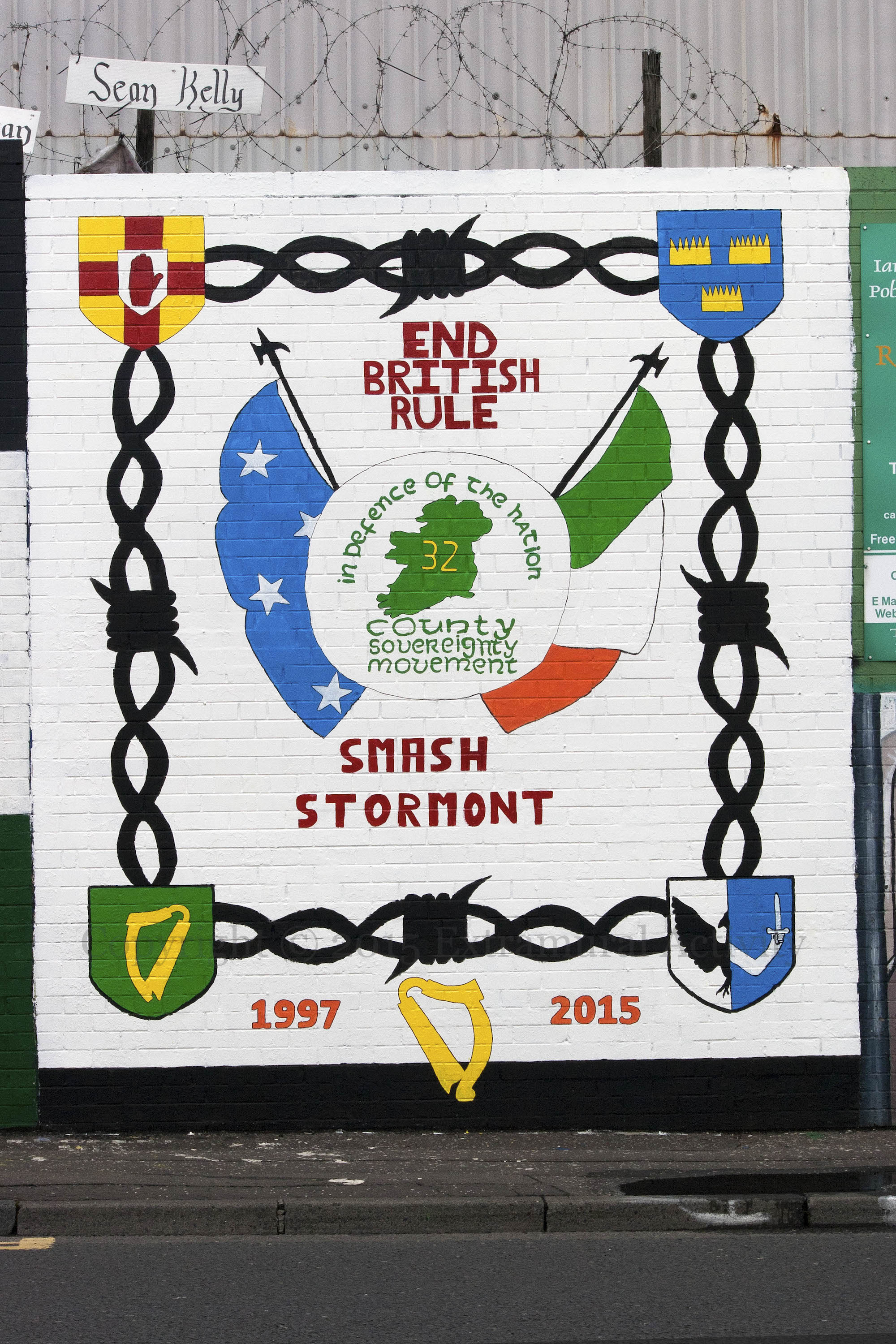
This is a new mural from the 32 County Sovereignty Movement (web) on the international wall, Divis Street, (Visual History) with symbols of nationalism (the crests of the four provinces, the harp, the tricolour), socialism (the plough in the stars) and support for republican POWs (the barbed wire).
For images of the mural being worked upon, see the Peter Moloney Collection; for an earlier version see 100% British.
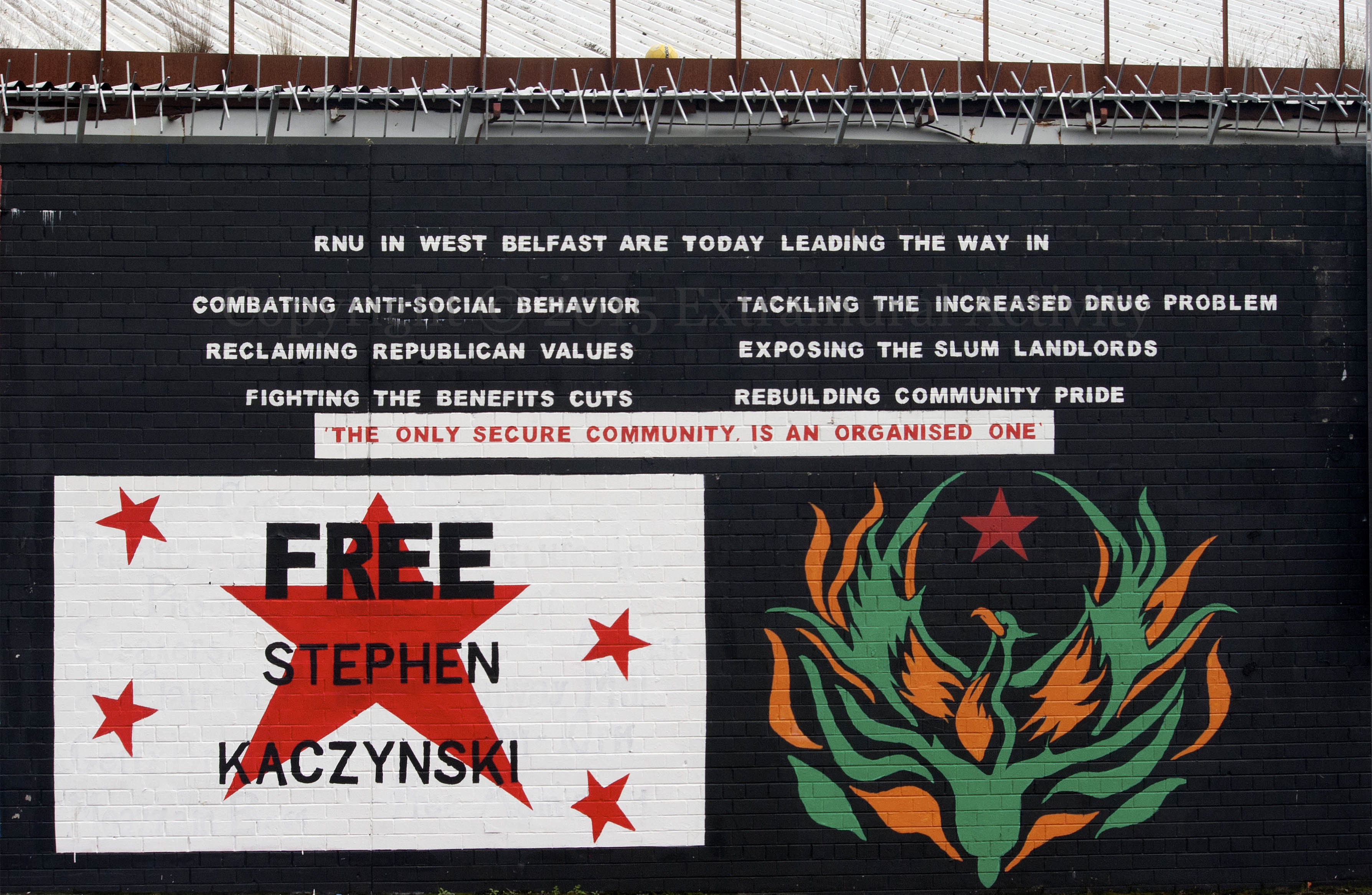
Stephen (or Stephan) “Steve” Kaczynski will go before a Turkish court on September 18th on charges of membership of the Marxist-Leninist ‘Revolutionary People’s Liberation Party-Front’ (DHKP-C). (WP) In April, members of the group took over a courtroom and held a state prosecutor hostage; when special forces stormed the building, the hostage and two of his captors died. (Independent) Kaczynski, a freelance journalist from Scotland, is alleged to be instrumental in financing the group. Alternatively, (according to various newspaper reports) he is an undercover agent of the Germans (Daily Sabah) or the British (Brian Shaw). He was on hunger-strike in protest at the conditions in Maltepe #3 from June 25th to August 12th.
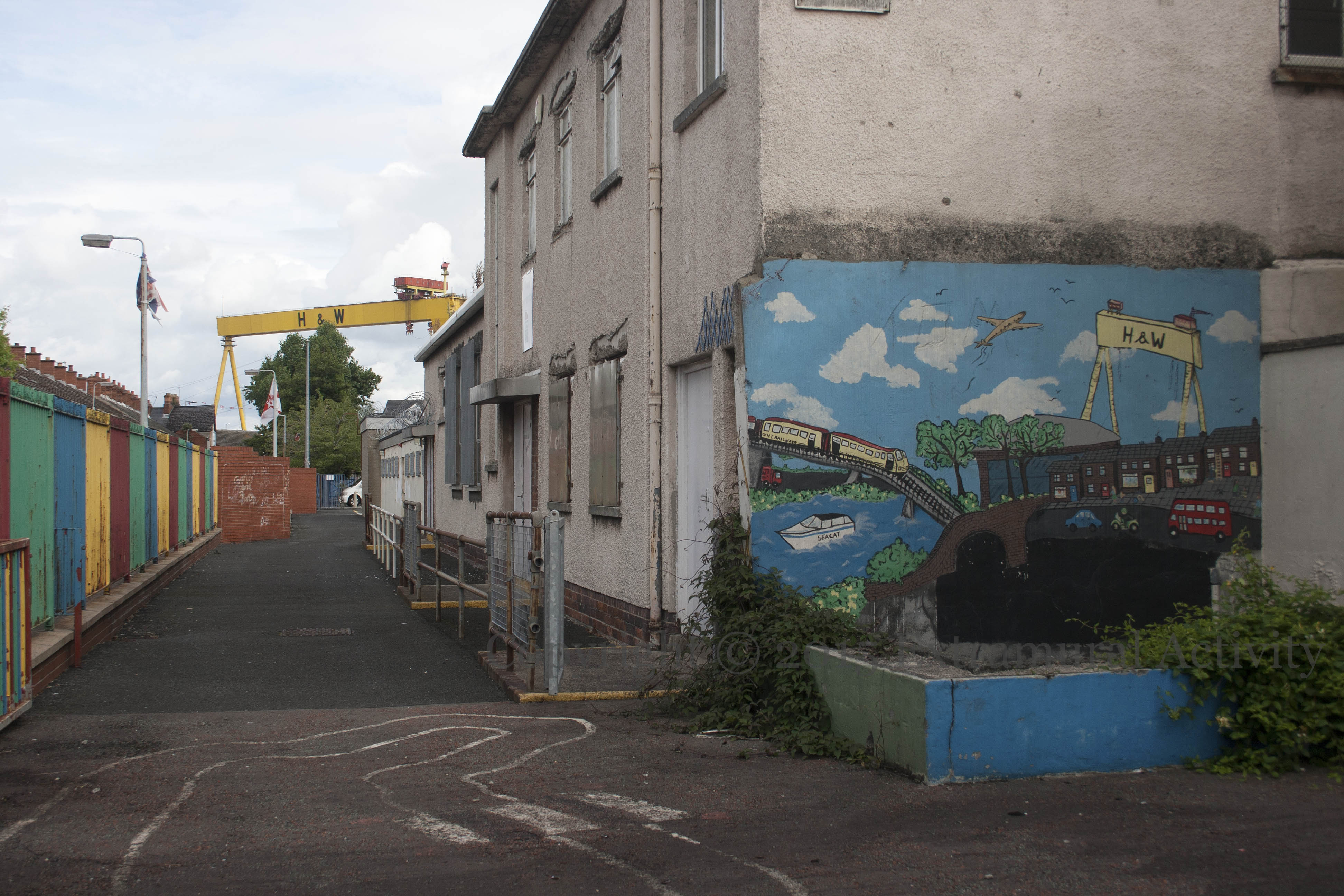
A view of east Belfast from the perspective of the children in a nursery school in Beechfield and Westbourne Streets: the modes of modern travel, including the Seacat, and a long-standing symbol of industry, the ever-present H&W crane.
 Seosamh Mac Coille Collection