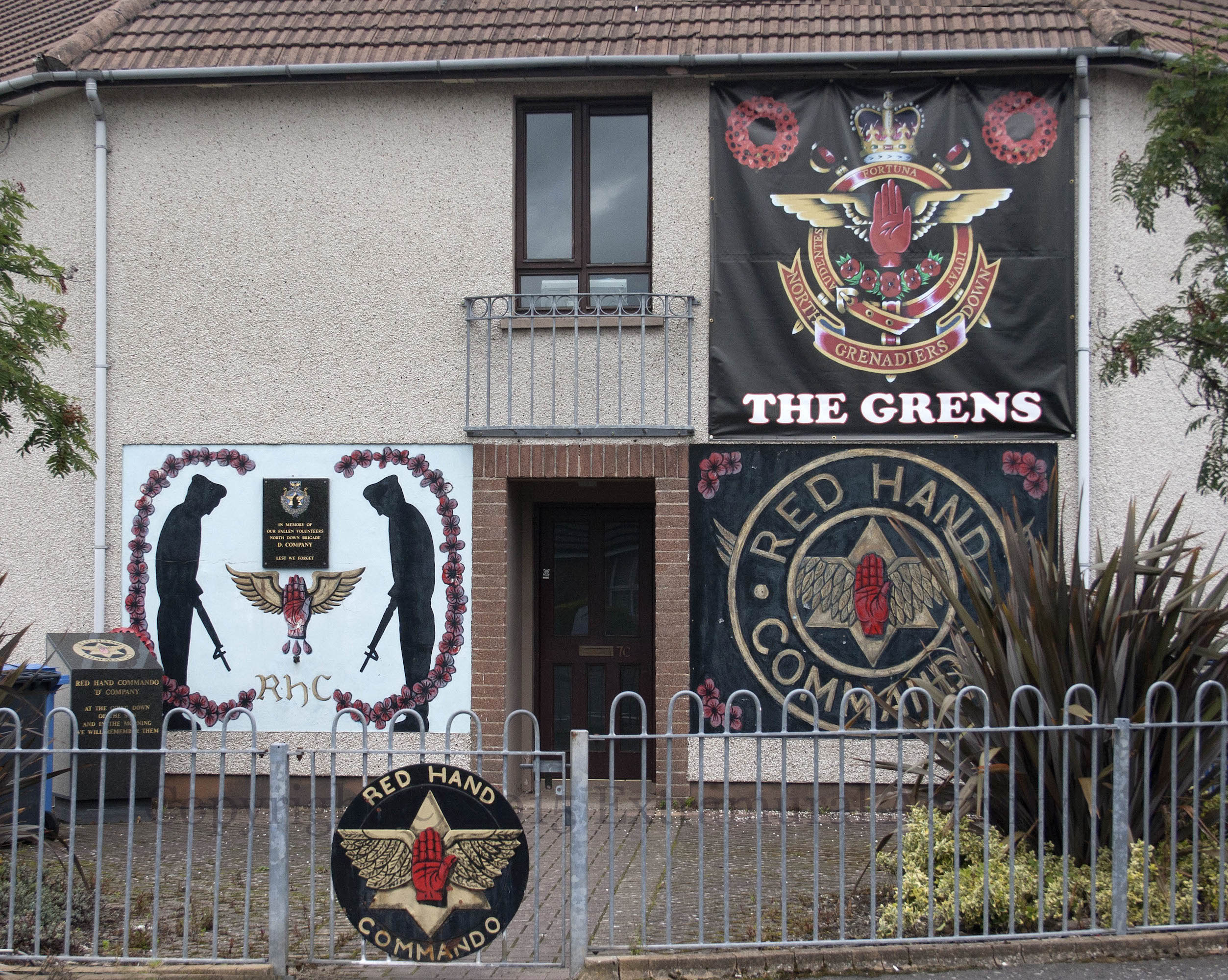
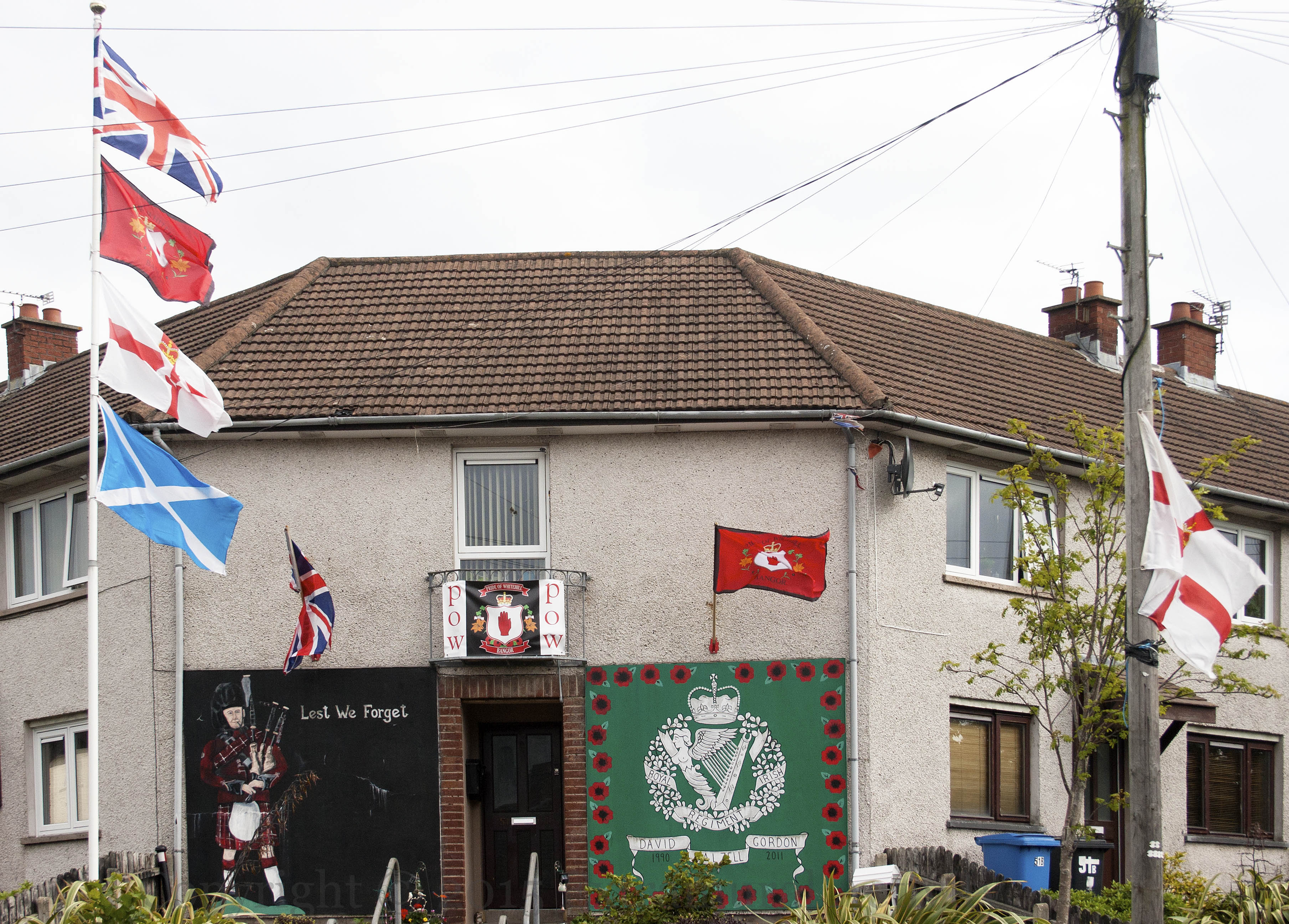
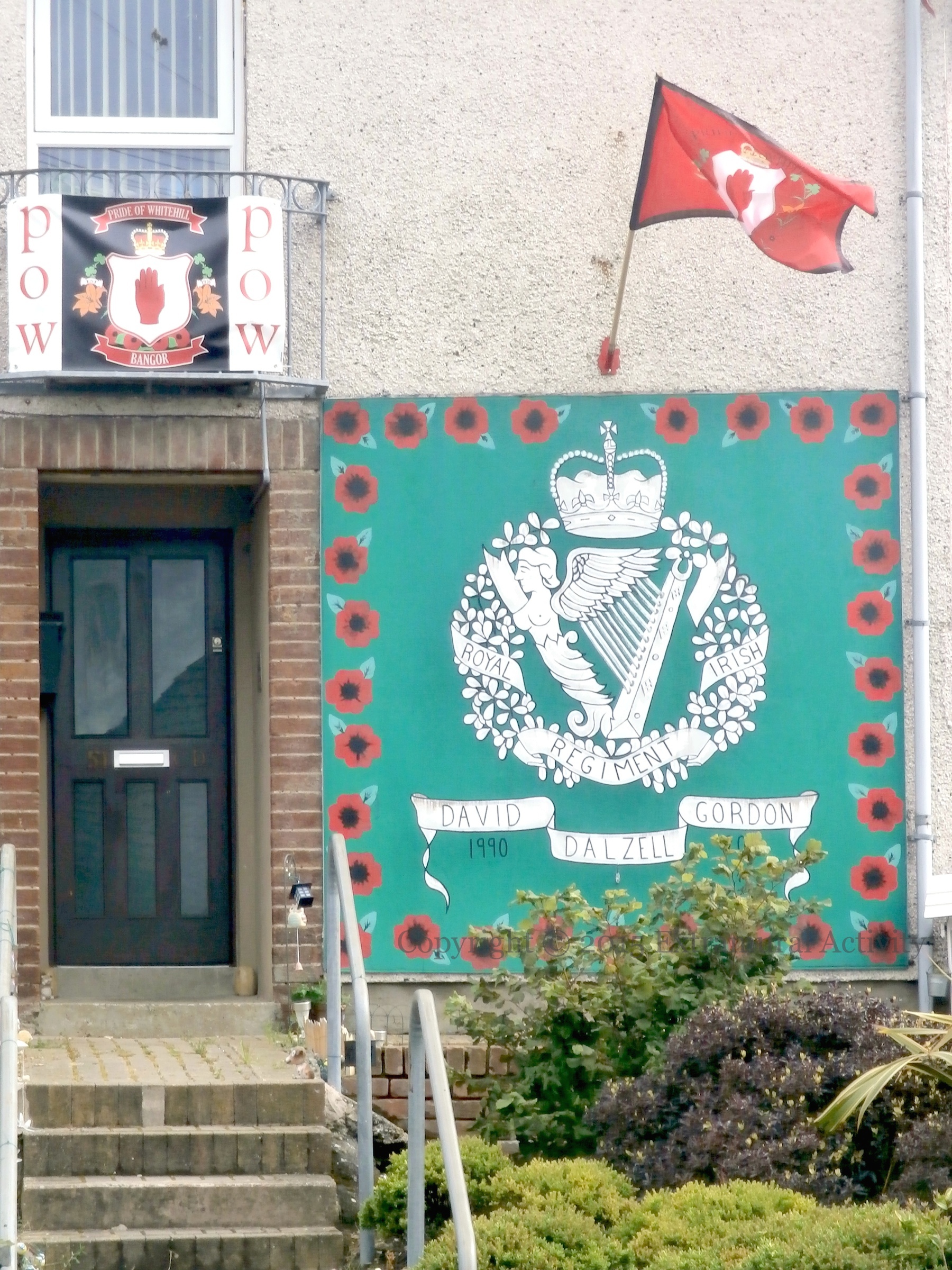
A tarpaulin celebrating the North Down Grenadiers (Fb) flute band has been added above the Red Hand Commando panels on the front of this house in Bangor’s Whitehill neighbourhood. (Compare the image above to M06398.) The emblems of both groups are very similar, featuring a red hand with wings. As well as the RHC emblem on the front gate, there is also a stone on the left dedicated to D. Company volunteers.
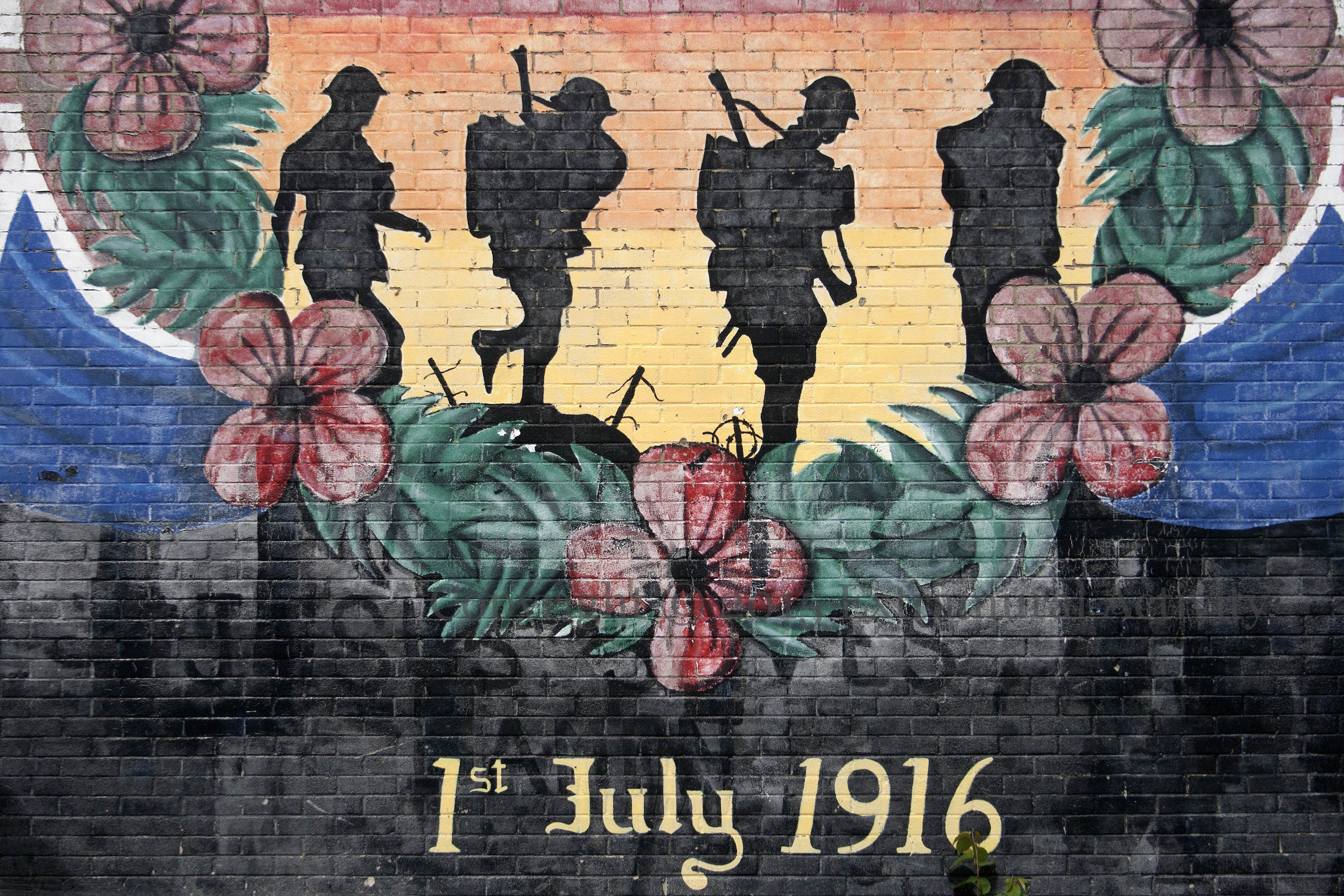
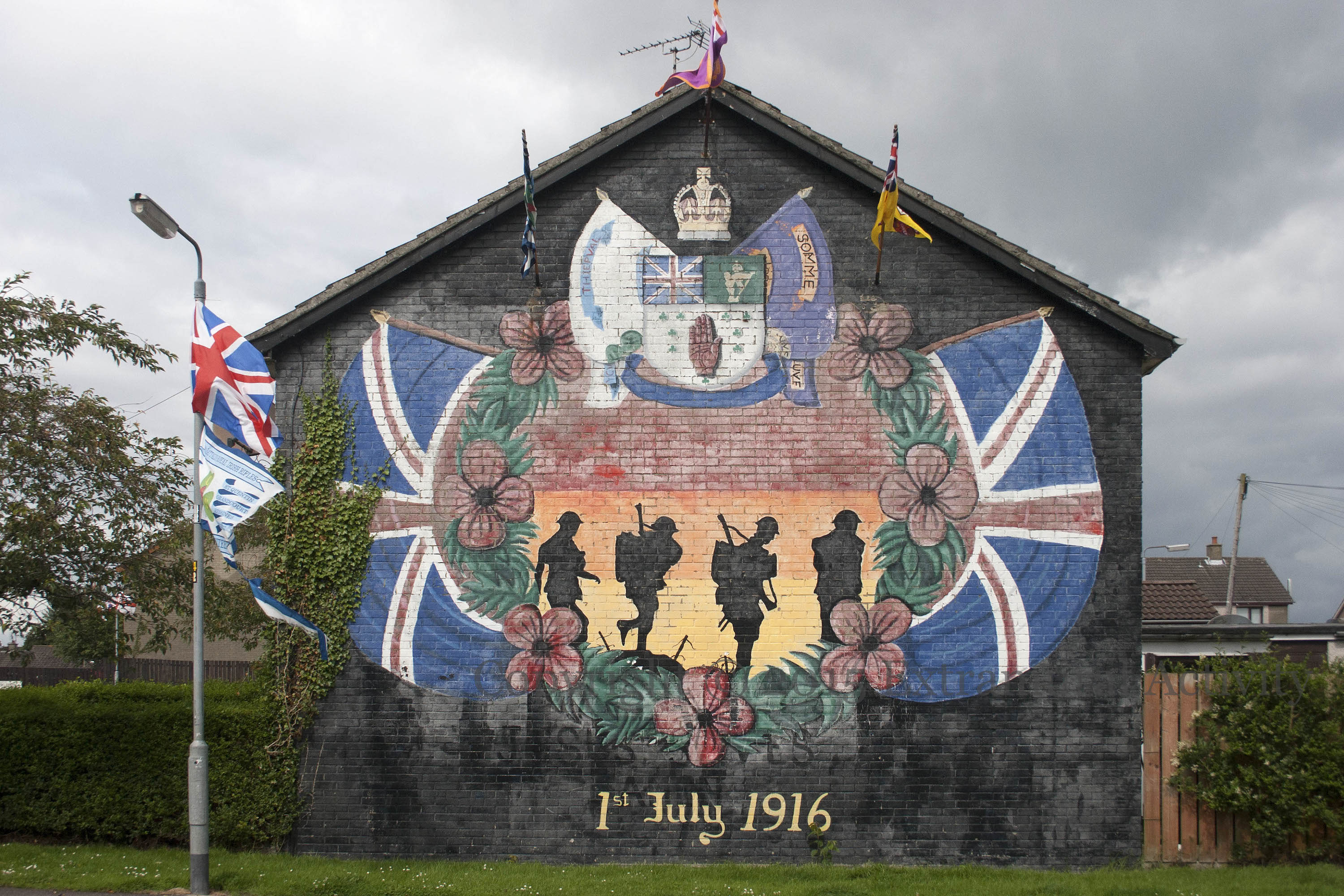
The Battle Of The Somme – named after a French river – began on July 1st, 1916 and went on until the 18th of November. In those four and half months more than one million soldiers were killed or wounded, including, on July 1st alone, about 60,000 British troops. The 36th (Ulster) Division, on the left flank, pushed ahead of other units and found itself unsupported; 5,240 of its soldiers died.
Bangor native David Gordon Dalzell was killed at age 20 in Helmland Province, Afghanistan, in 2011, shot accidentally by one of his comrades as he was cleaning his weapon. For an account of his death, see BBC-NI. Dalzell’s ‘fatality’ notice can be read at the MOD. In the image above (and detailed below), the front of this Whitehill house carries the emblem of Dalzell’s Royal Irish regiment and a funeral piper.
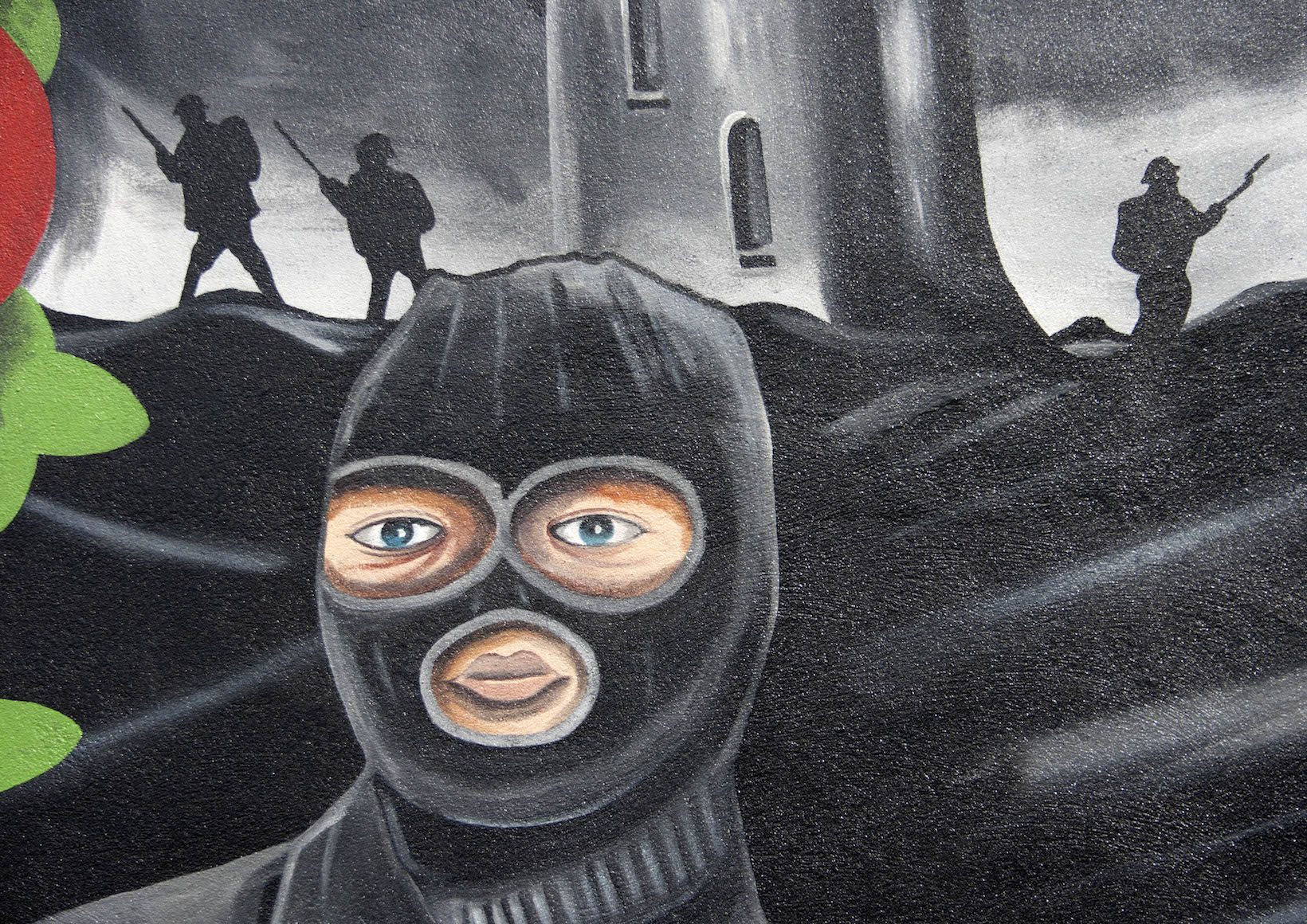
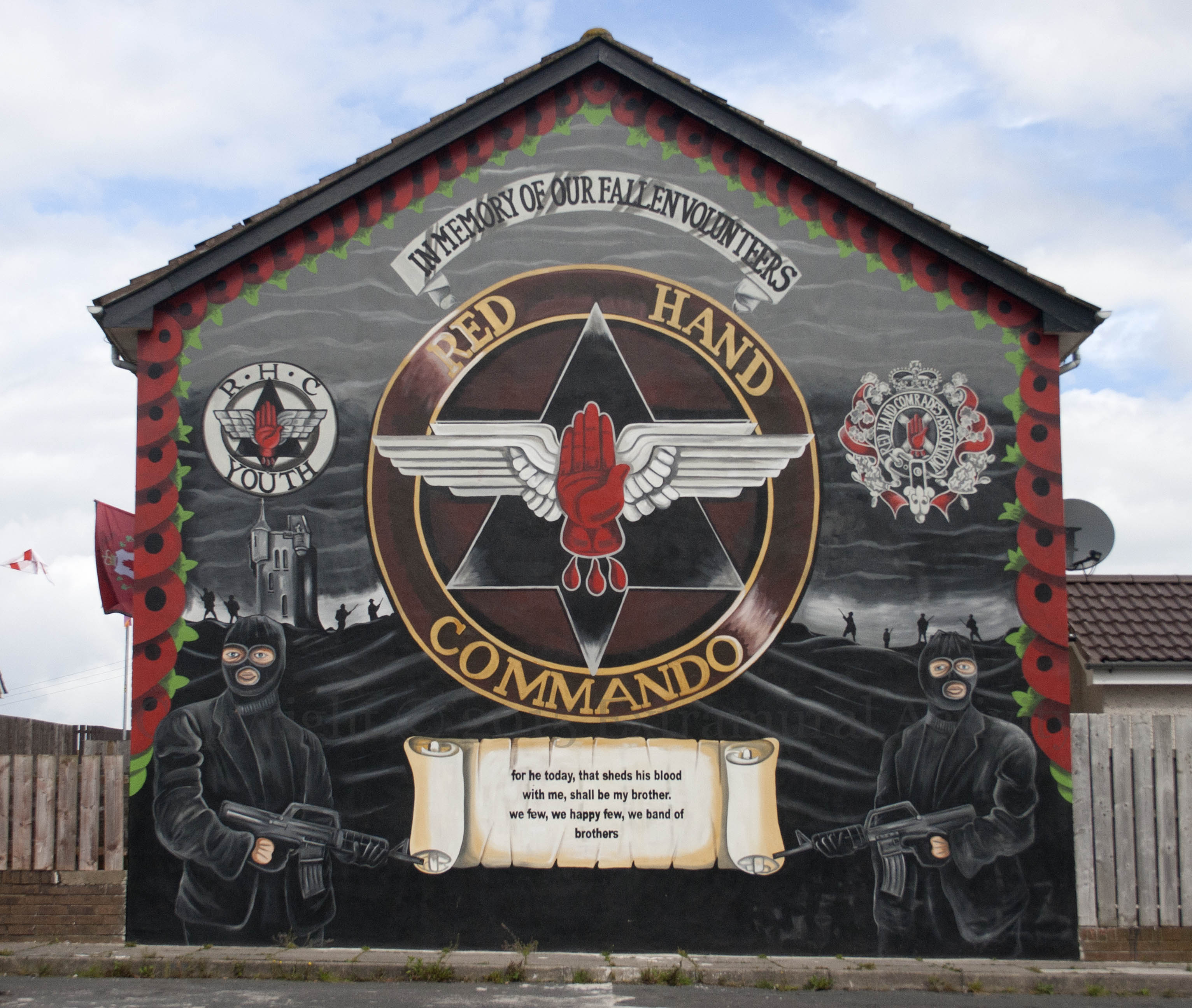
“For he today that sheds his blood with me shall be my brother. We few, we happy few, we band of brothers.” This is a new (July 2014) Red Hand Commando mural in Bangor with RHC Youth and Red Hand Comrades Association insignia against a backdrop of Thiepval Tower and the Somme, with masked gunmen in the foreground and a border of poppies.
The quote is from Shakespeare’s Henry V, act 4, though the lines are reversed (Folger).
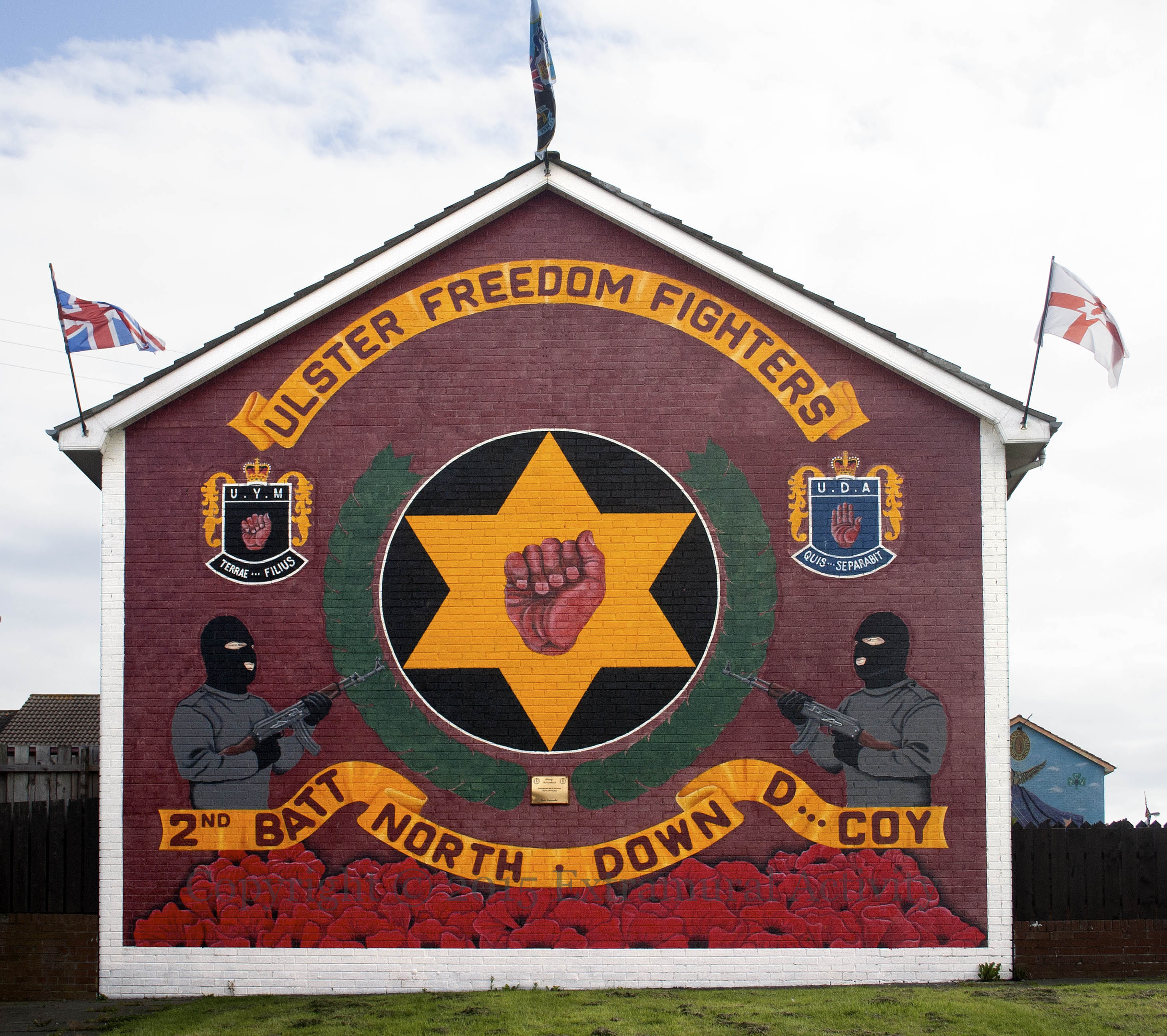
UFF/UDA/UYM (North Down, 2nd battalion, D company) memorial mural in Bloomfield estate, Bangor, to Andrew McIlvenny and Roy Officer, with hooded gunmen on a bed of poppies flanking the UFF clenched fist.
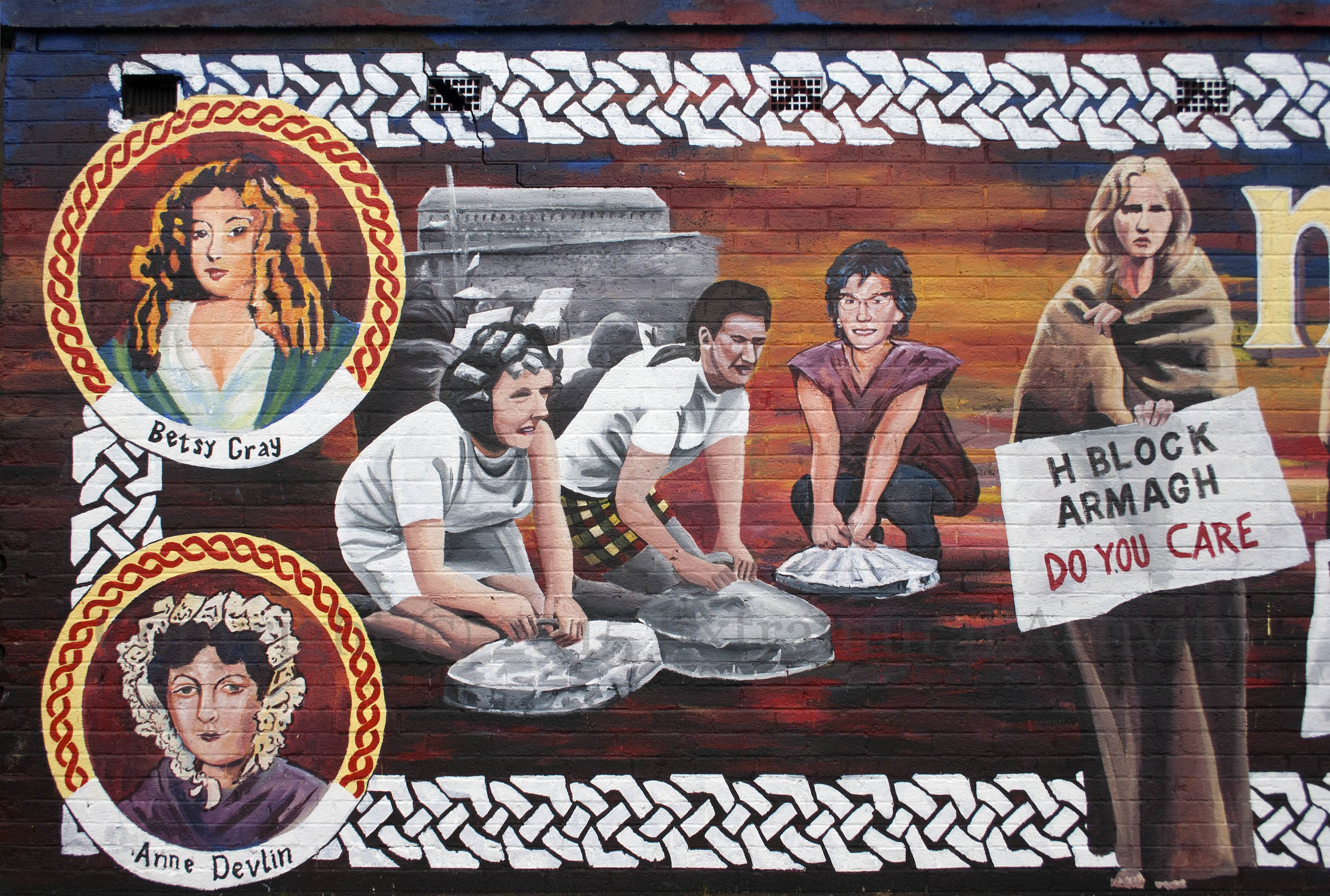
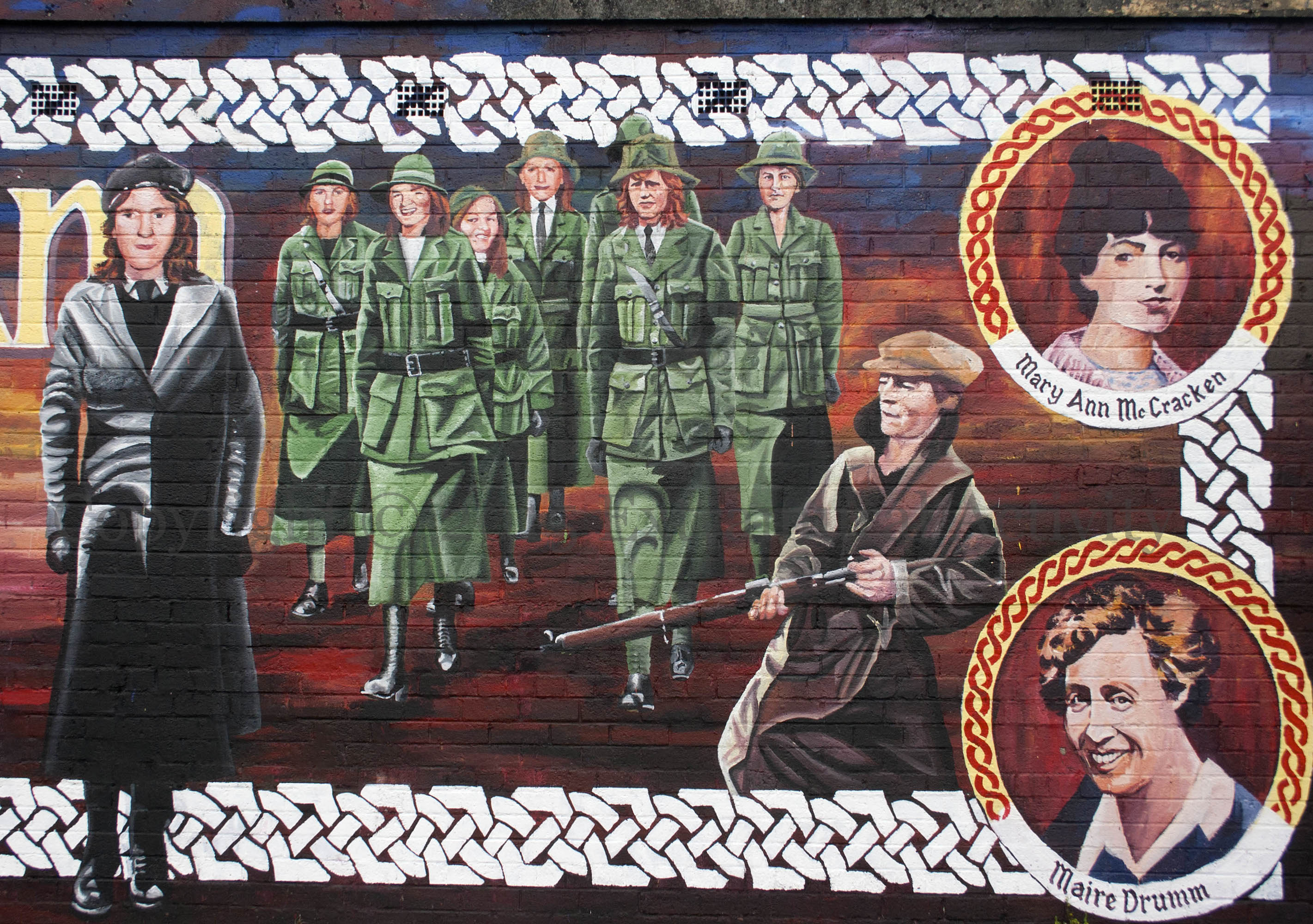
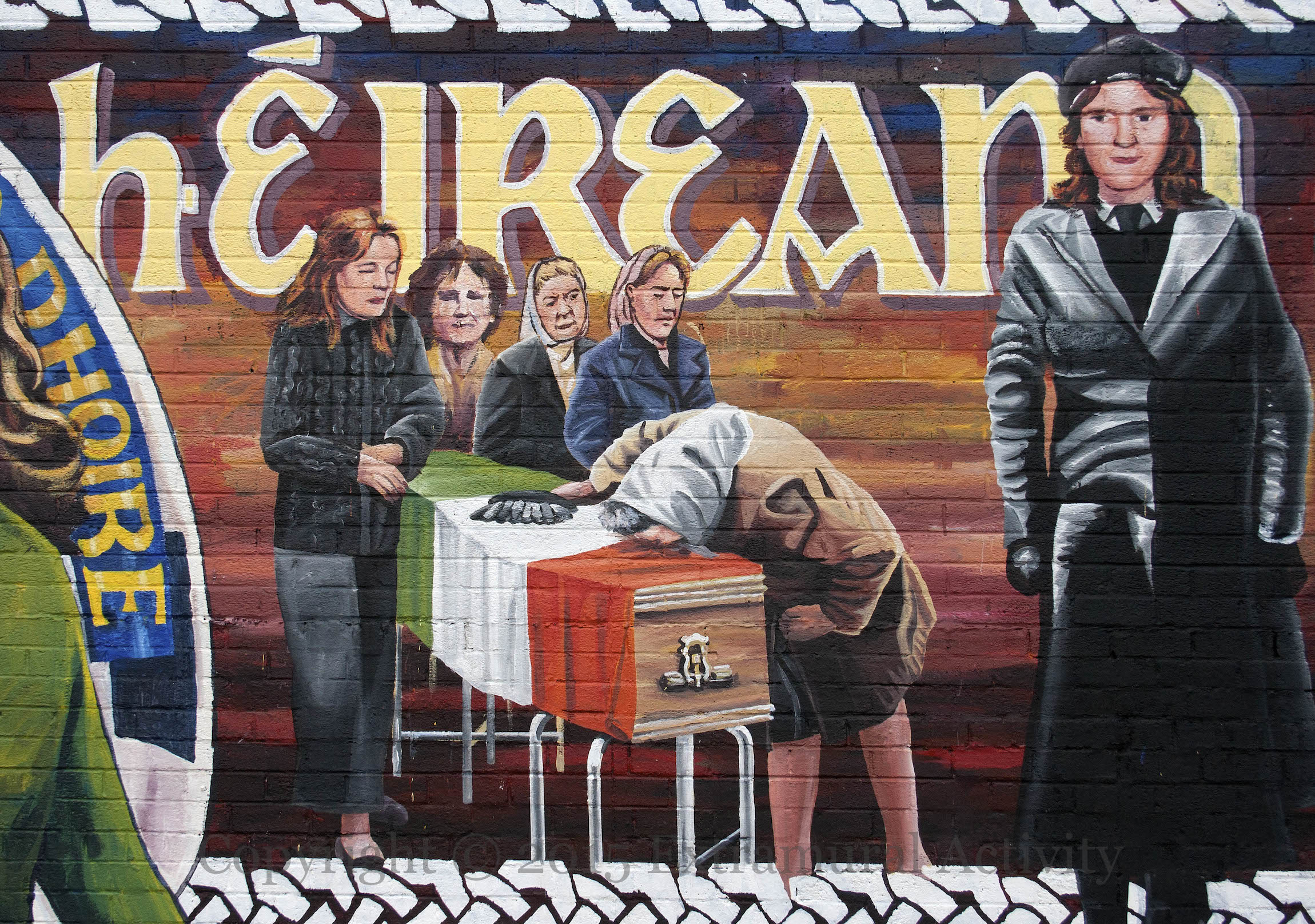
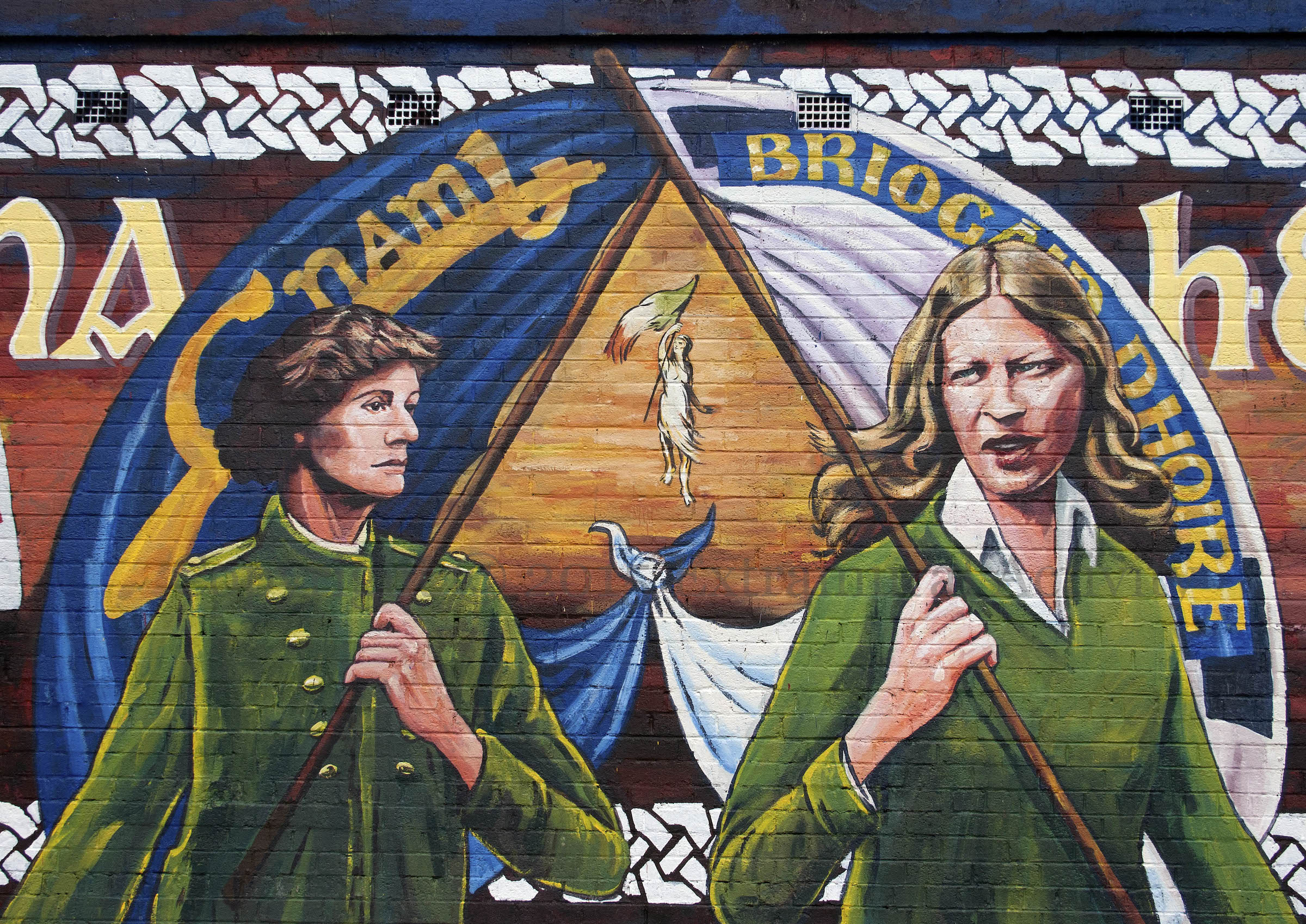
Here are two images of the extremes of the Mná Na hÉıreann mural.
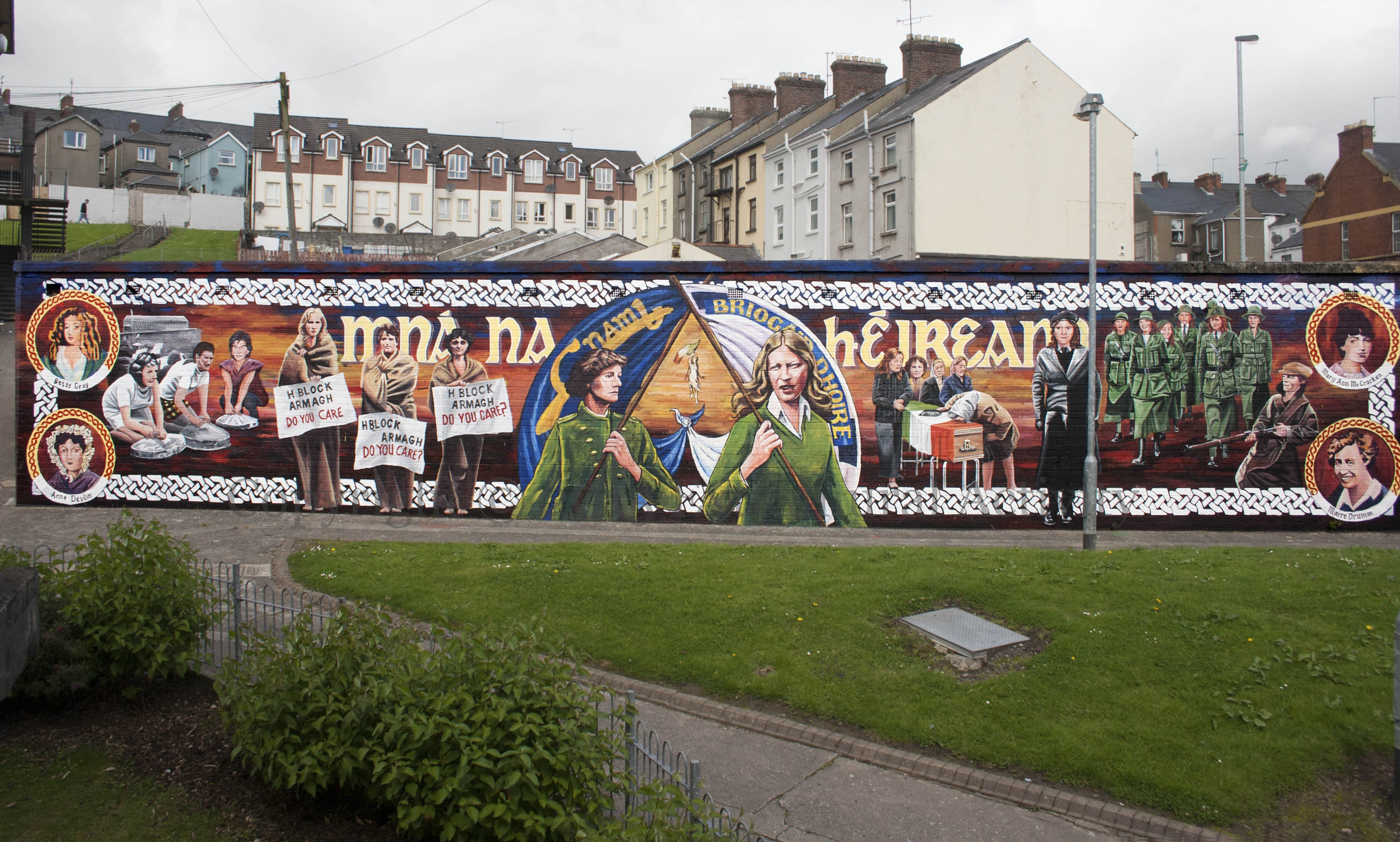
In the four corners are circles of Betsy Gray, Anne Devlin, Mary Ann McCracken, and Máıre Drumm. Gray and McCracken were Presbyterians; Gray fought (or at least, was killed) in the 1798 rebellion, as did McCracken’s brother Henry Joy; Mary Ann went on to work for the poor of Belfast and lobby against slavery. Anne Devlin assisted in Robert Emmet’s 1803 rising. (National Graves Assoc) Máıre Drumm was vice-president of Sınn Féın and commander of Cumann Na mBan, who are shown marching on the right-hand side.
In the cloth cap and holding a rifle is Eithne Coyle, a leader and later president of Cumann Na mBan, imprisoned both by the Black and Tans before the treaty and after it by the Provisional Irish government (WP). For the photograph on which her pose here is based, see An Phoblacht‘s History Of Cumann na mBan, which also includes the photo of marching women (discussed previously in Mothering Sunday In Beechmount) though the faces have been changed here, presumably to those of more contemporary volunteers. The same is probably true of the third woman with a bin lids on the left – leave a comment or send an e-mail if you can put a name to any of these faces.
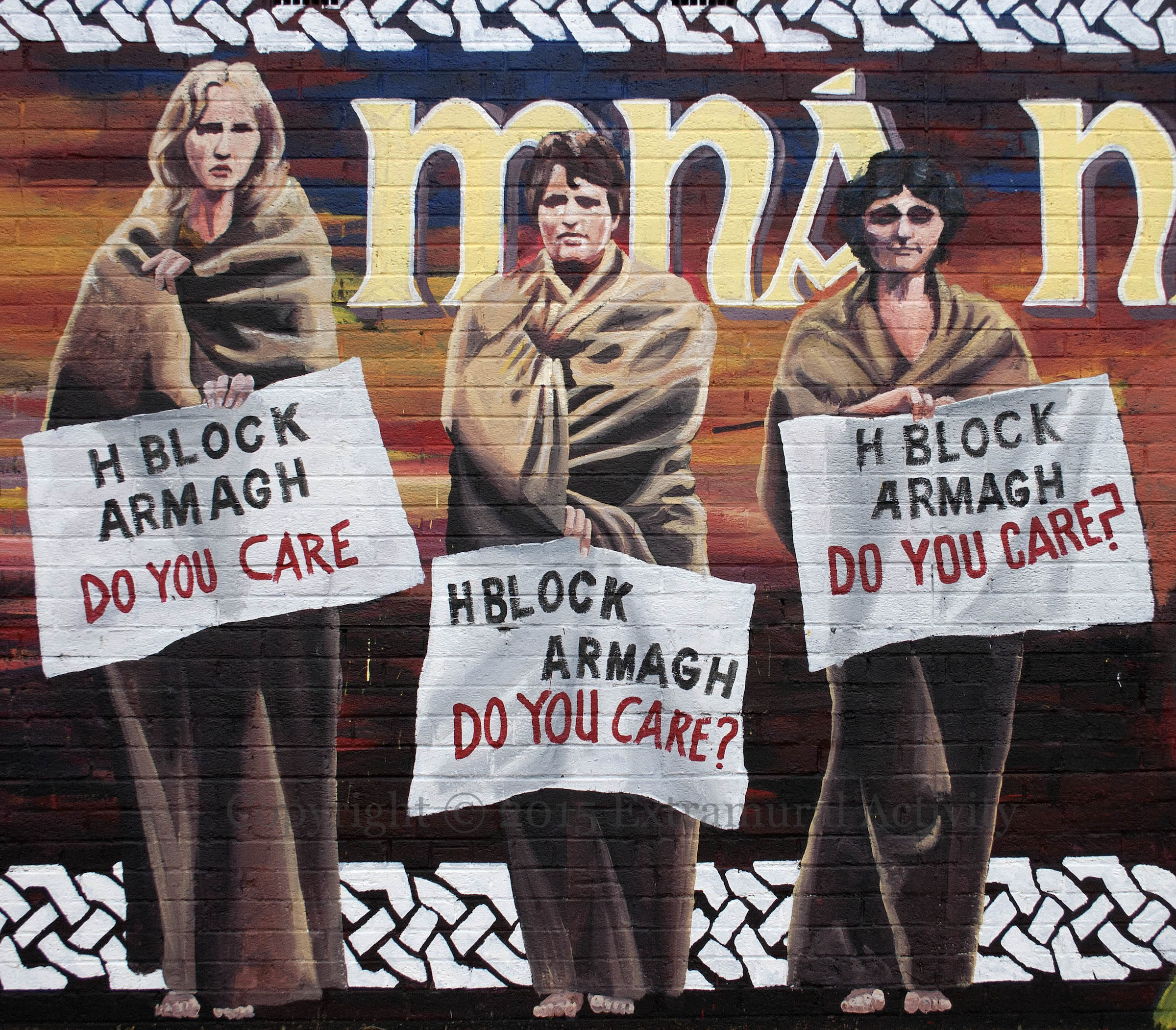
Here are two details from the Mná Na hÉıreann mural. This one shows three Derry women protesting the conditions in Armagh Women’s Prison and in the H-Blocks. This article on Mary Nelis (the protester on the right, with Kathleen Deeny and Theresa Deery) describes the photograph on which this part of the mural is based. The women in Armagh prison were allowed to wear their own clothes and so were not ‘on the blanket’ as their male counterparts in the H-Blocks of Long Kesh were. However, they did engage in a “no wash” protest, which lasted from February 1980 until March 1981, and three of them – Maıréad Farrell, Mary Doyle, and Margaret Nugent – joined the 1980 hunger strike.
In the second image, below, grieving mothers, wives, and sisters stand over a coffin draped in the Irish tricolour with paramilitary gloves and beret on top.
Countess Markievicz, carrying a flag of Cumann Na mBan, and Ethel Lynch, carrying a flag of the Derry IRA, take centre stage in the Mná Na hÉıreann mural in London-/Derry/Doıre’s bogside. Markievicz is famous for her role in the Easter Rising of 1916 (WP); Lynch died in December 1974 of injuries sustained when a bomb exploded prematurely. (Derry Journal – also contains the photo on which the painting above is based.) Between them, “Liberty leads the people” waving an Irish tricolour.
 Seosamh Mac Coille Collection