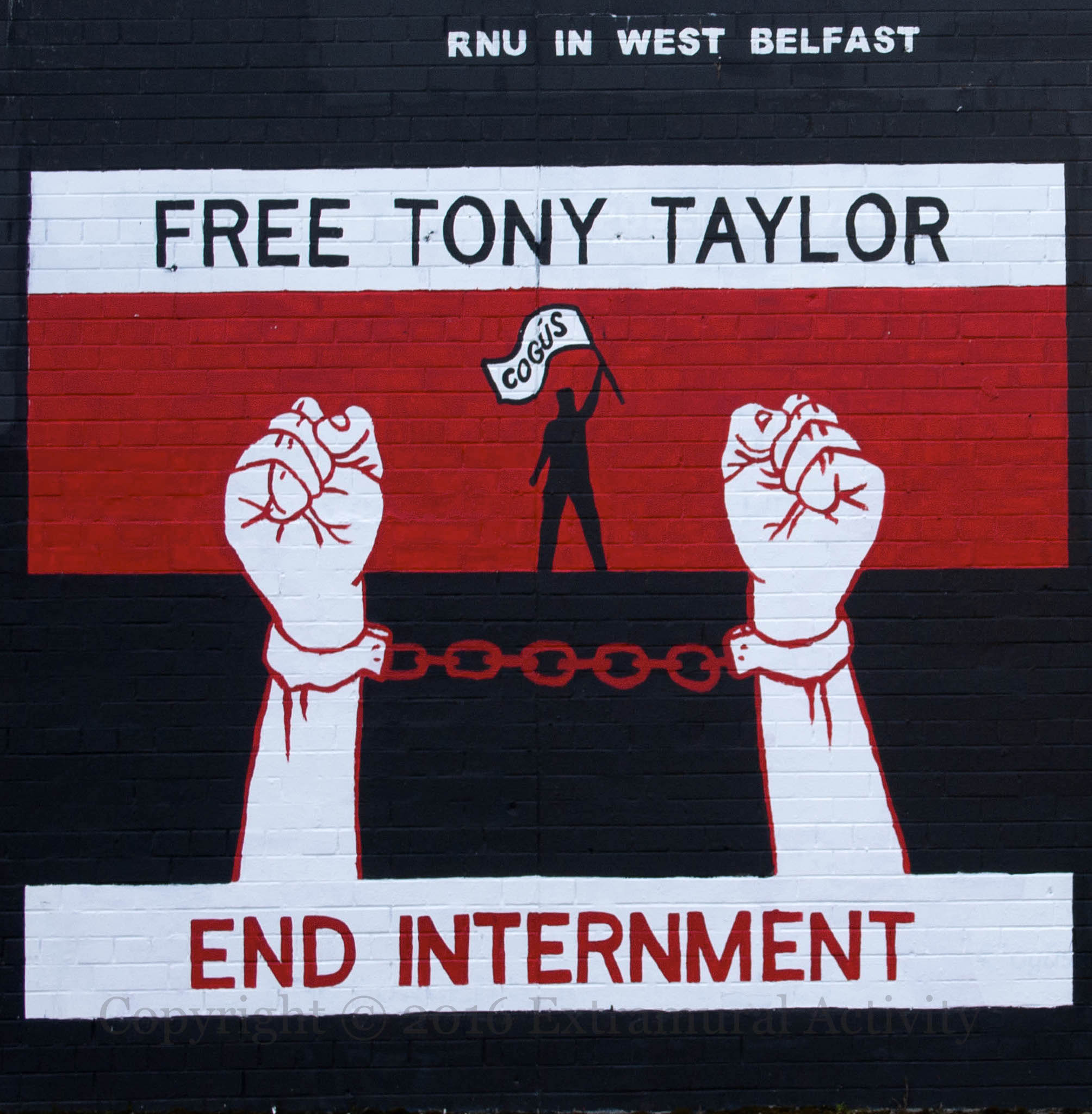
“Free Tony Taylor”, “End internment” – identical to the mural in Ardoyne, though without the “Cogús”. On the RNU “notice-board” on Northumberland Street.
Click image to enlarge
Copyright © 2016 Seosamh Mac Coılle
X04889
“Free Tony Taylor”, “End internment” – identical to the mural in Ardoyne, though without the “Cogús”. On the RNU “notice-board” on Northumberland Street.
Click image to enlarge
Copyright © 2016 Seosamh Mac Coılle
X04889
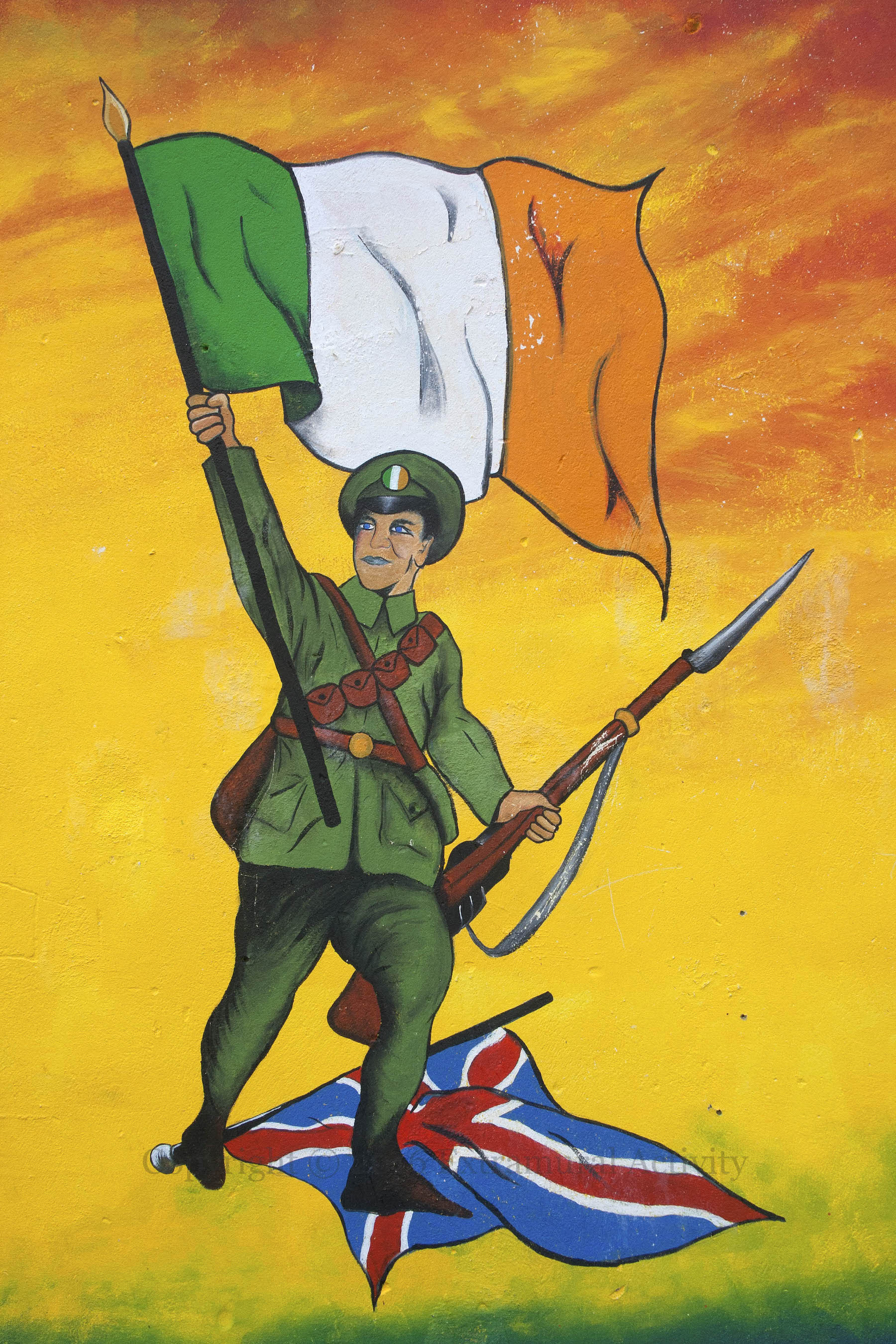
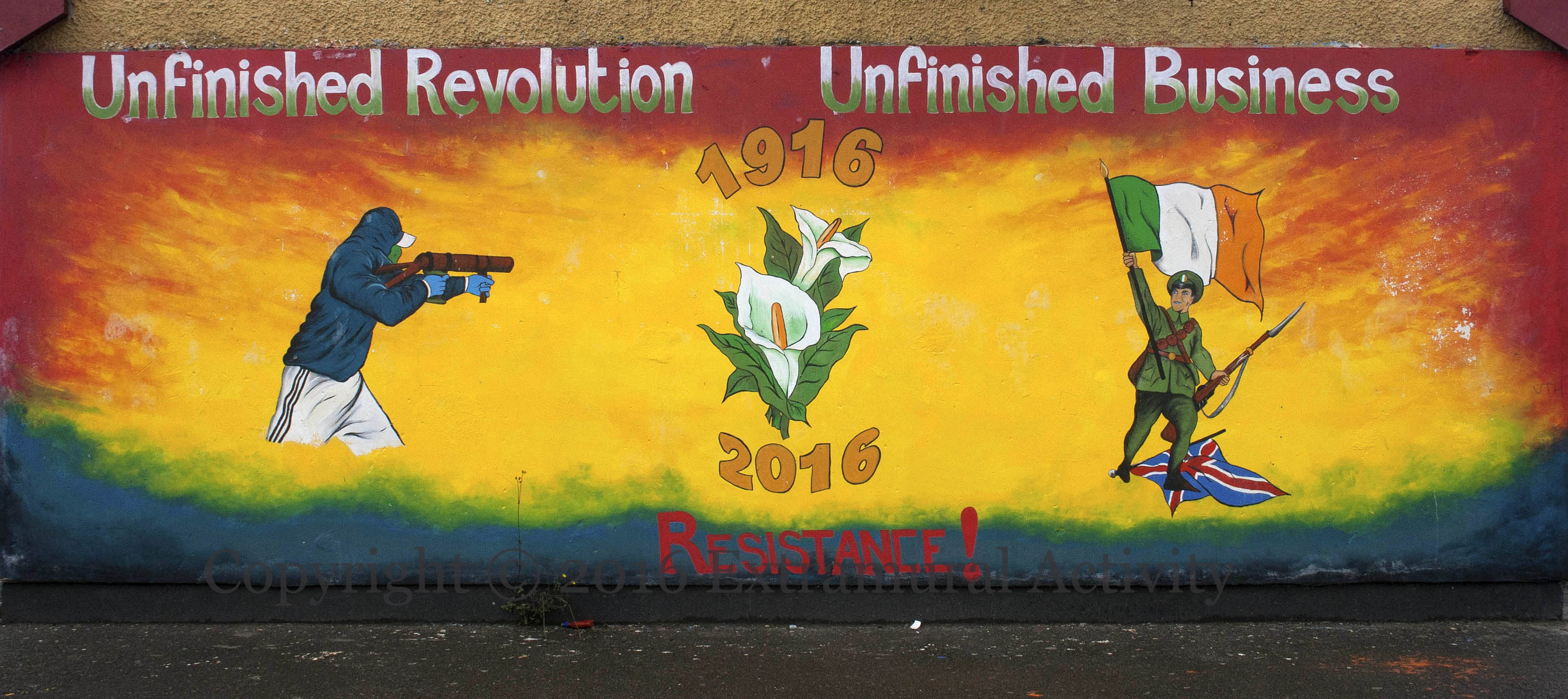
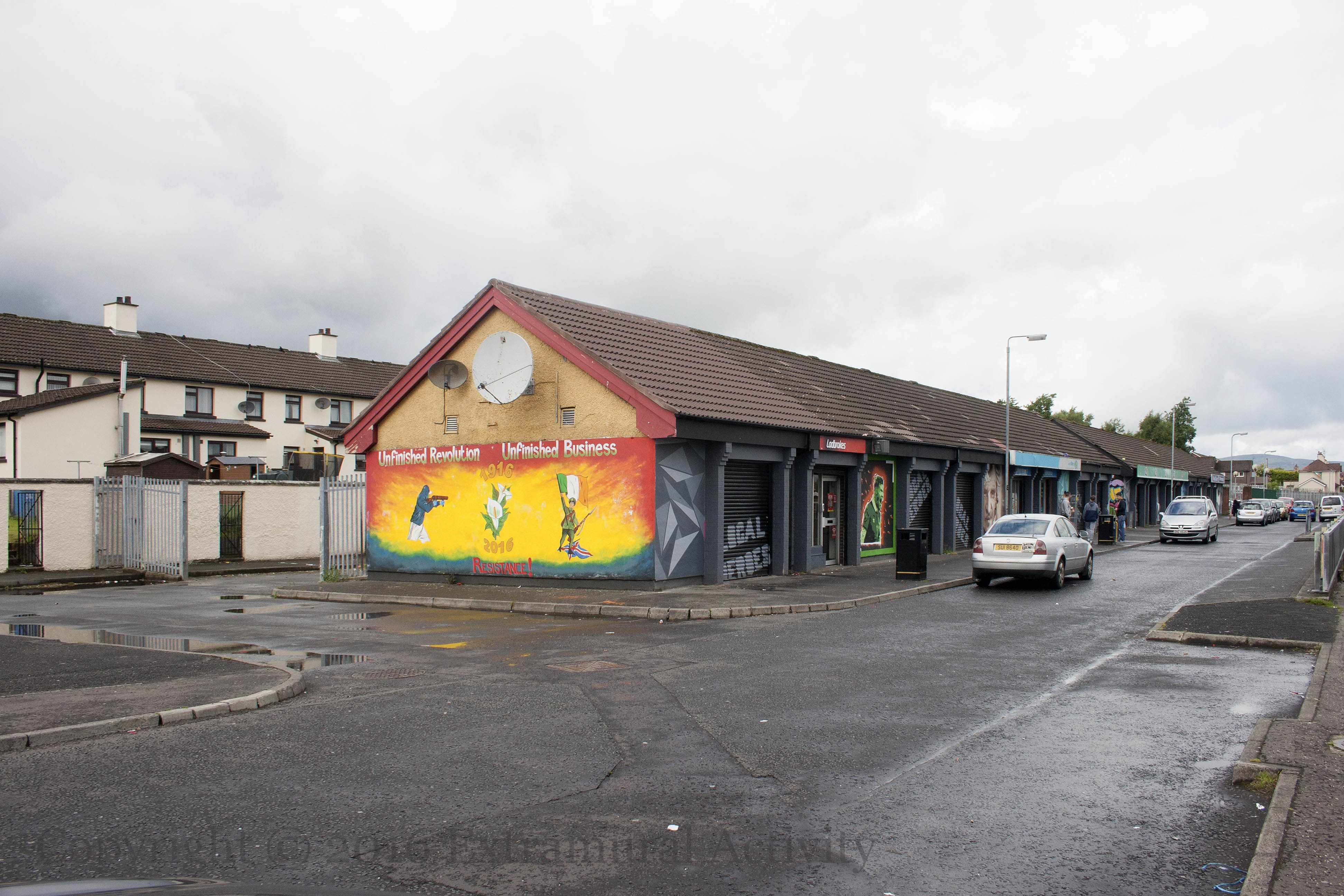
Here are three images of a new mural in the Creggan area of Derry preaching continued “Resistance!” on account of the “unfinished business” of raising the Irish Tricolour and trampling on Britain’s Union Flag and the “unfinished revolution” of 1916’s Easter Rising (reproducing a postcard of the era).
For the modern-day figure on the left, who is wielding a home-made rocket-launcher used in a 2014 attack on police, see 2015’s Resistance board in Ardoyne.
Click image to enlarge
Copyright © 2016 Seosamh Mac Coılle
X03574 X03573 X03610 central drive
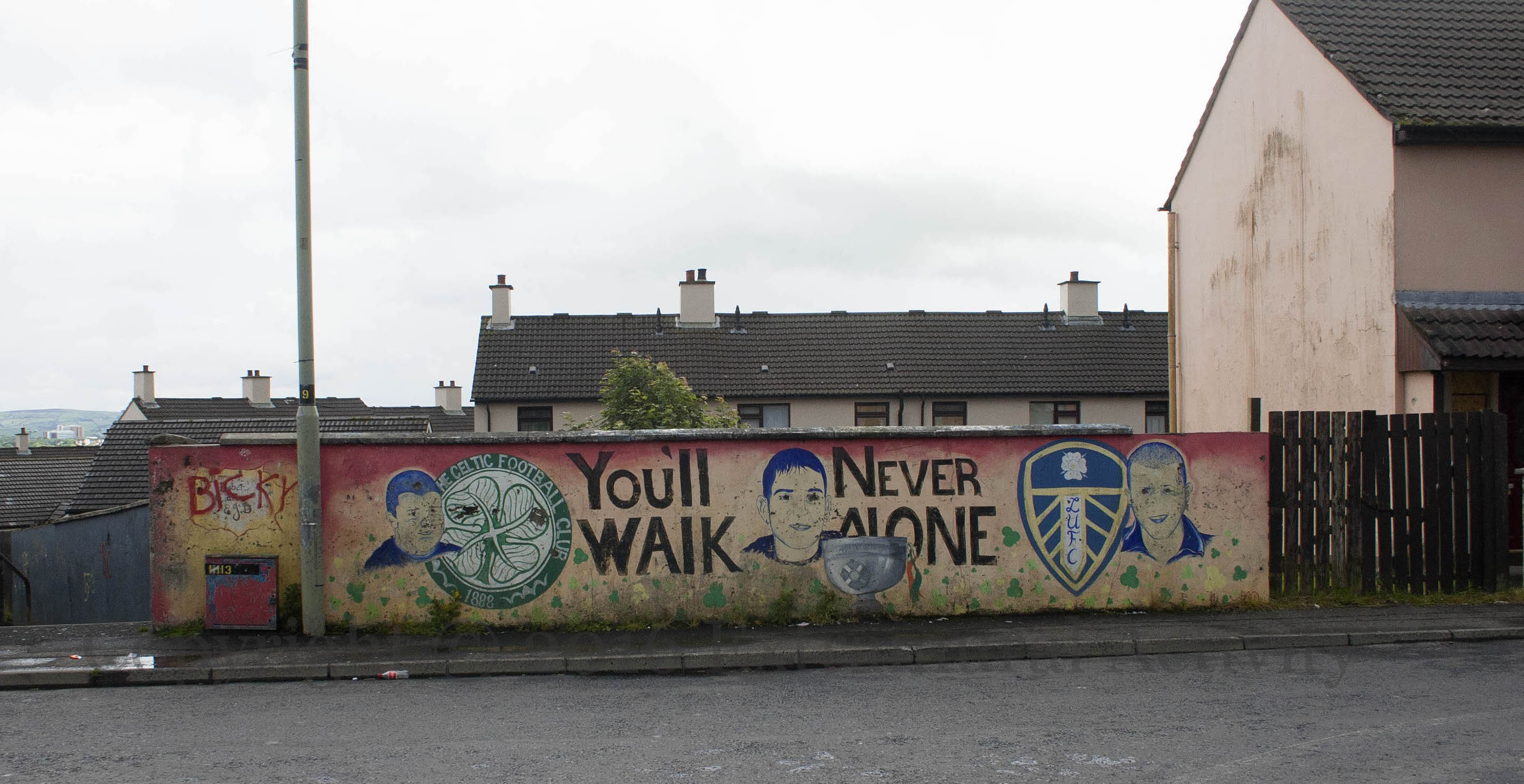
You’ll Never Walk Alone is most famously sung by the fans of Liverpool Football Club, but this Creggan mural draws on the song’s association with Celtic. Leeds United is the other club in the mural, at the right-hand end.
Click image to enlarge
Copyright © 2016 Seosamh Mac Coılle
X03658 creggan heights
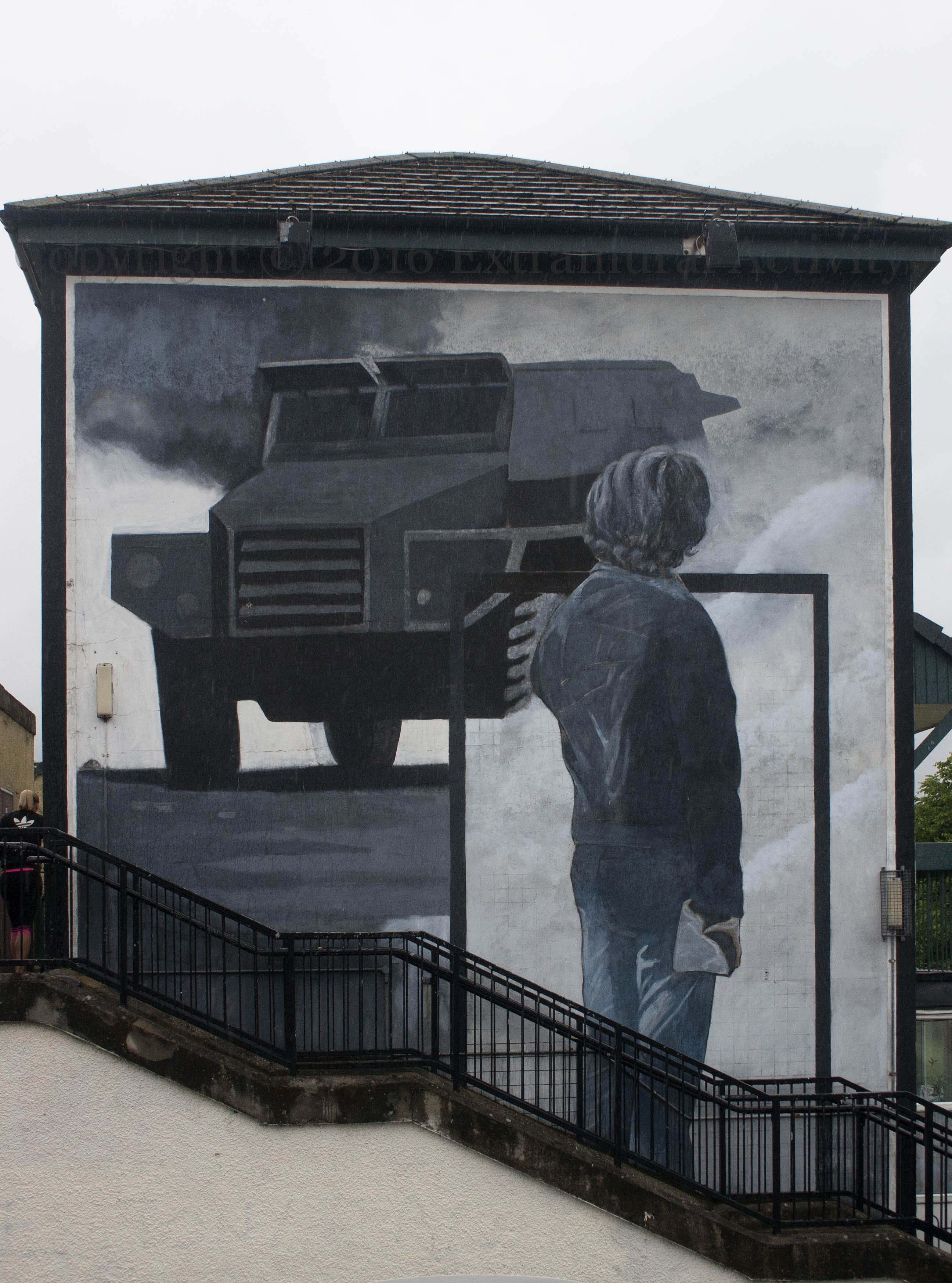
Young people in Derry would spend Saturdays (and many other days) rioting against the British Army presence in the city, which began in August 1969 after the Battle Of The Bogside. Thus, the popular name for this Bogside Artists mural ‘Saturday Matinee’; the official title is “The Rioter”. Part of The People’s Gallery.
The original photograph on which the mural is based is by Clive Limpkin. The rioter himself is perhaps Billy McVeigh.
Click image to enlarge
Copyright © 2016 Seosamh Mac Coılle
X03664
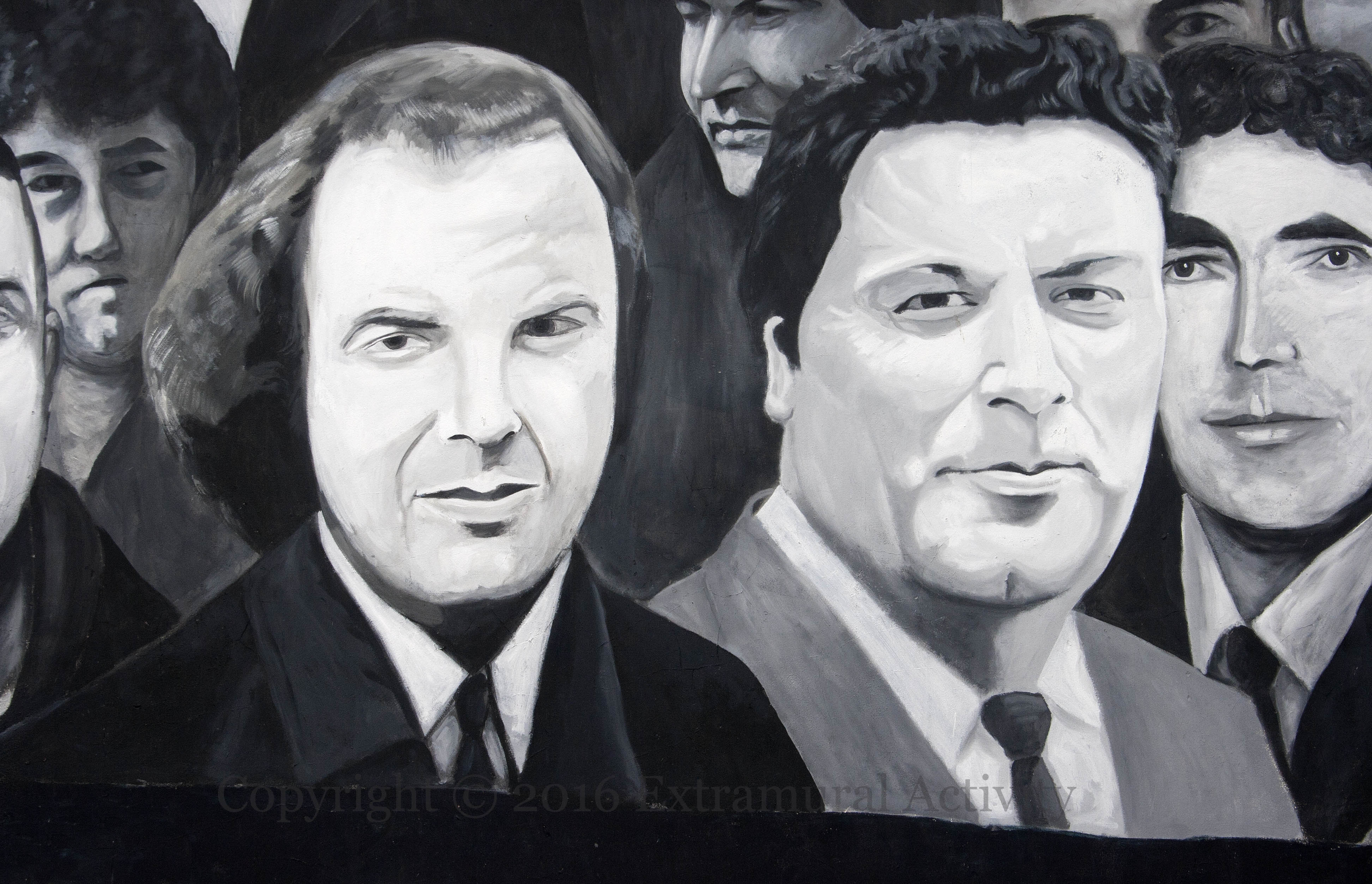
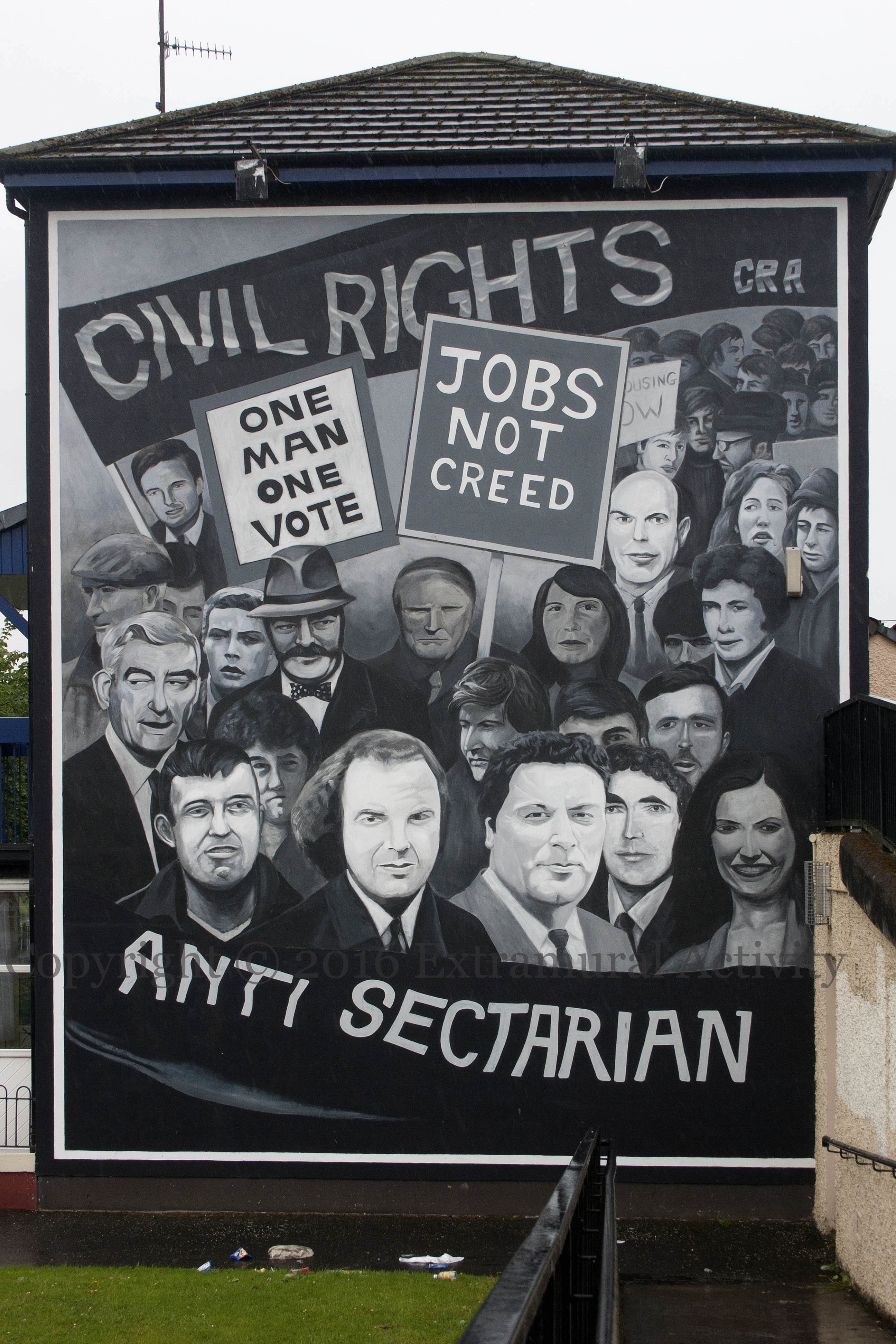
The Bogside Artists’ Civil Rights mural in Rossville Street, Derry/Doıre, which was originally painted in 2004, was repainted (in October 2015) and the portraits of Ivan Cooper and John Hume added. For video of the launch, see the Bogside Artists’ website. See also the Visual History page on the Bogside Artists.
Click image to enlarge
Copyright © 2016 Seosamh Mac Coılle
X03663 X03662 jobs not creed anti-sectarian one man one vote
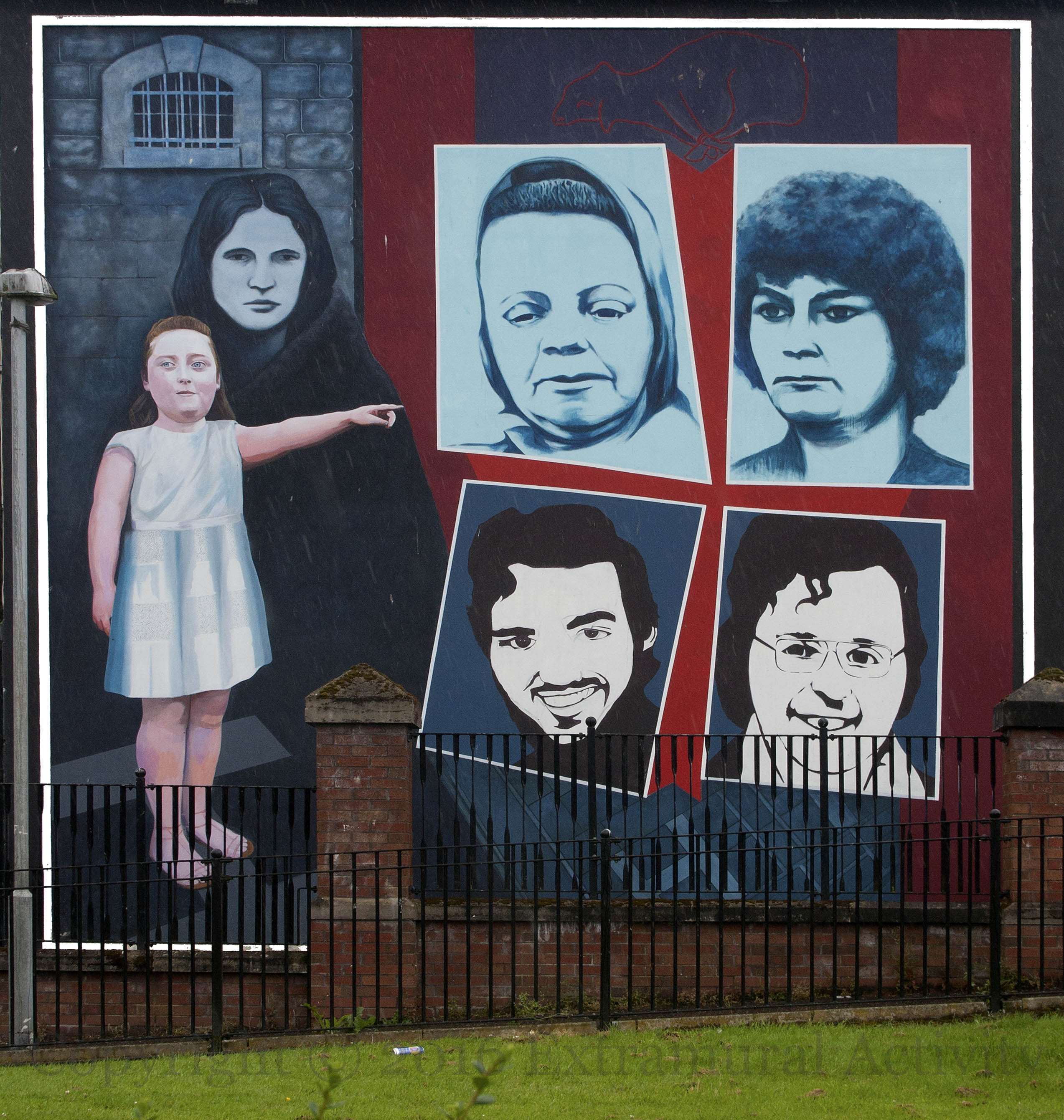
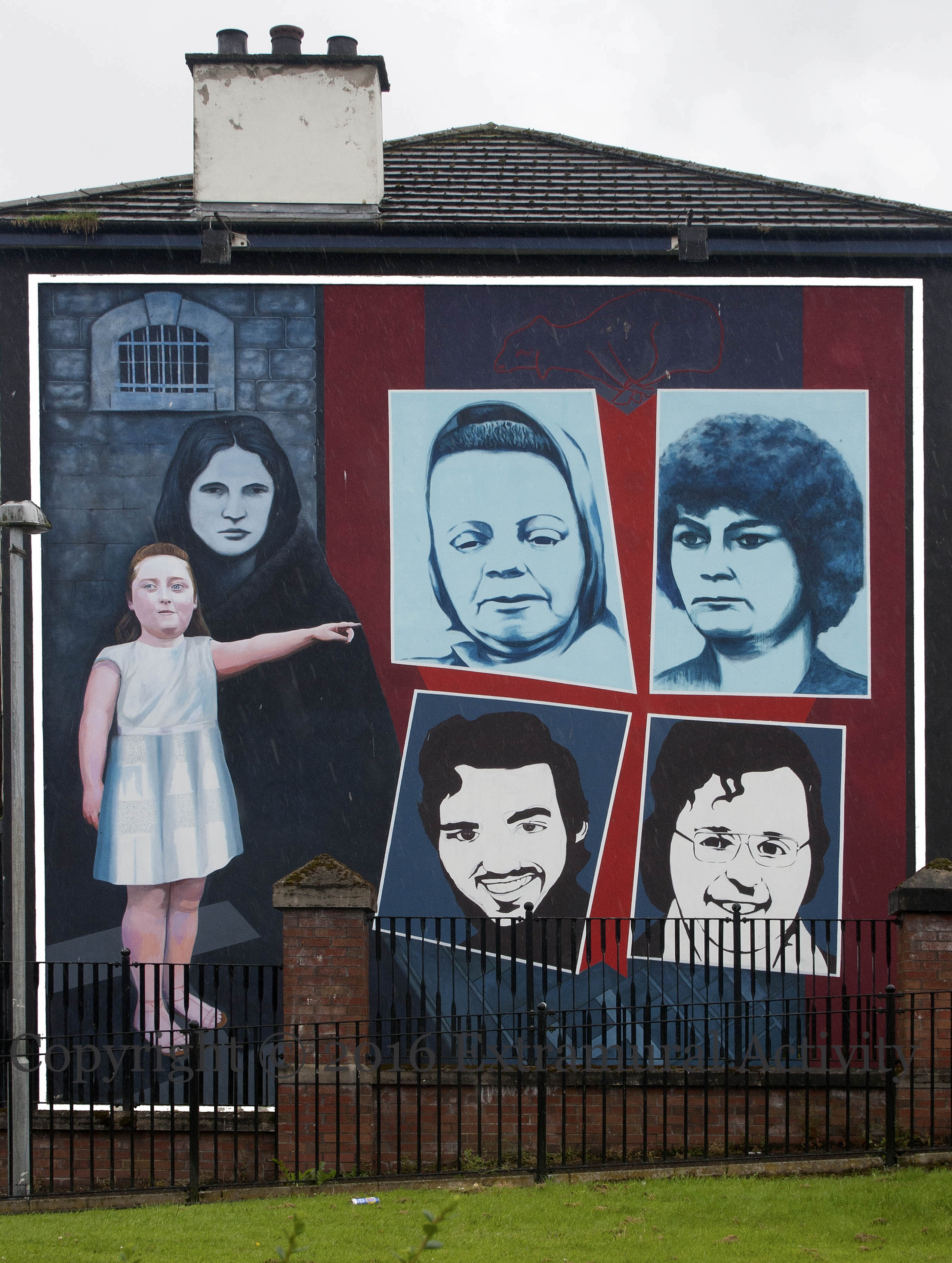
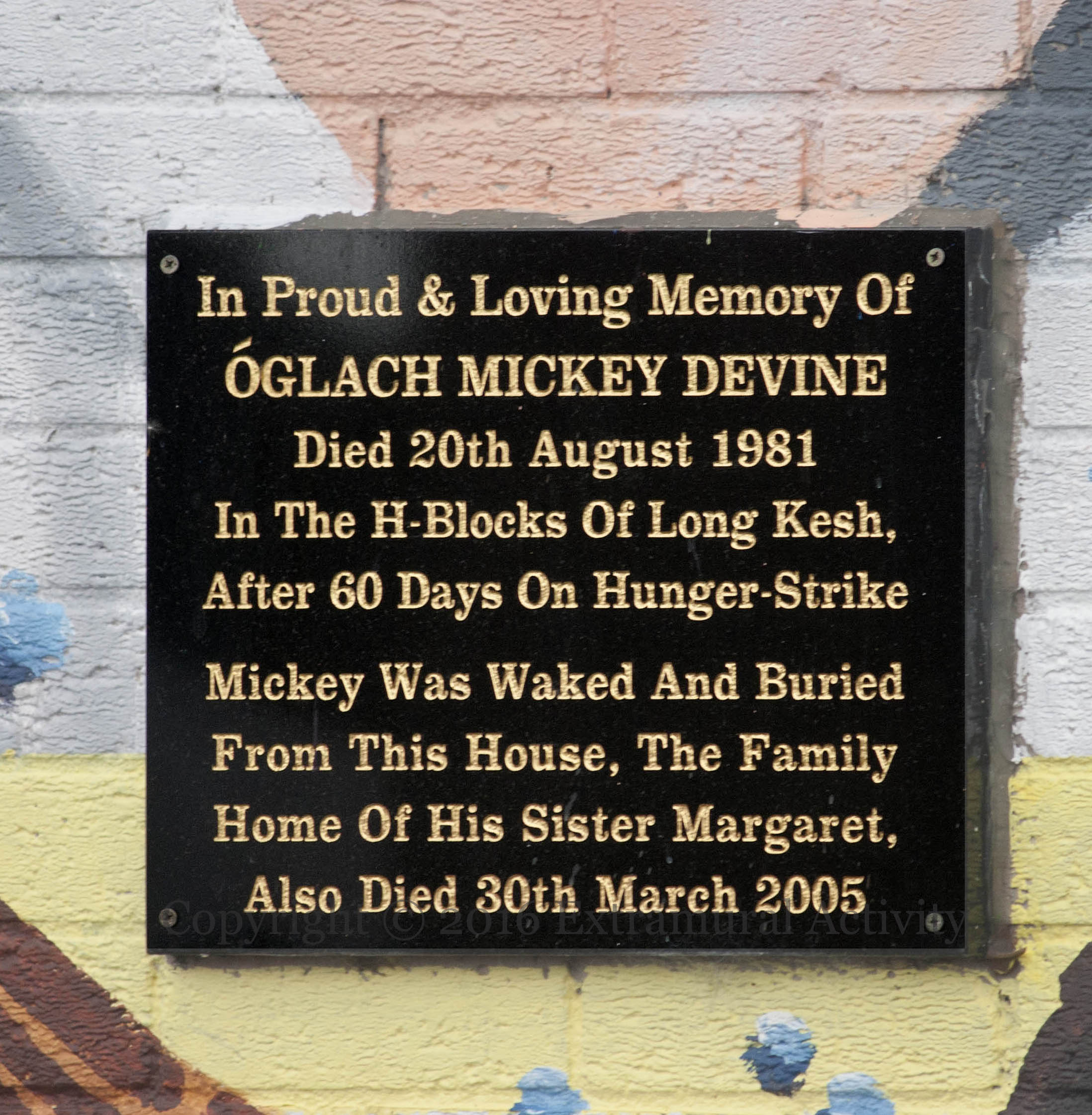
The figure in the centre of the mural above is Peggy O’Hara, mother of INLA hunger striker Patsy O’Hara, who remained active in socialist and republican circles and stood in the assembly elections in 2007 as an independent. She died in 2015 and was given a paramilitary funeral, including a volley of shots fired over the coffin. (For a description, and video, see this Derry Journal article.) The female above Mickey Devine (in the bottom right) is his sister Margaret, from whose house his coffin processed after his death in 1981. (See the plaque in Waked & Buried.) The girl on the left is pointing towards another mural, a dove of peace. (See Network.)
Click image to enlarge
Copyright © 2016 Extramural Activity
X03644 X03643 rossville st
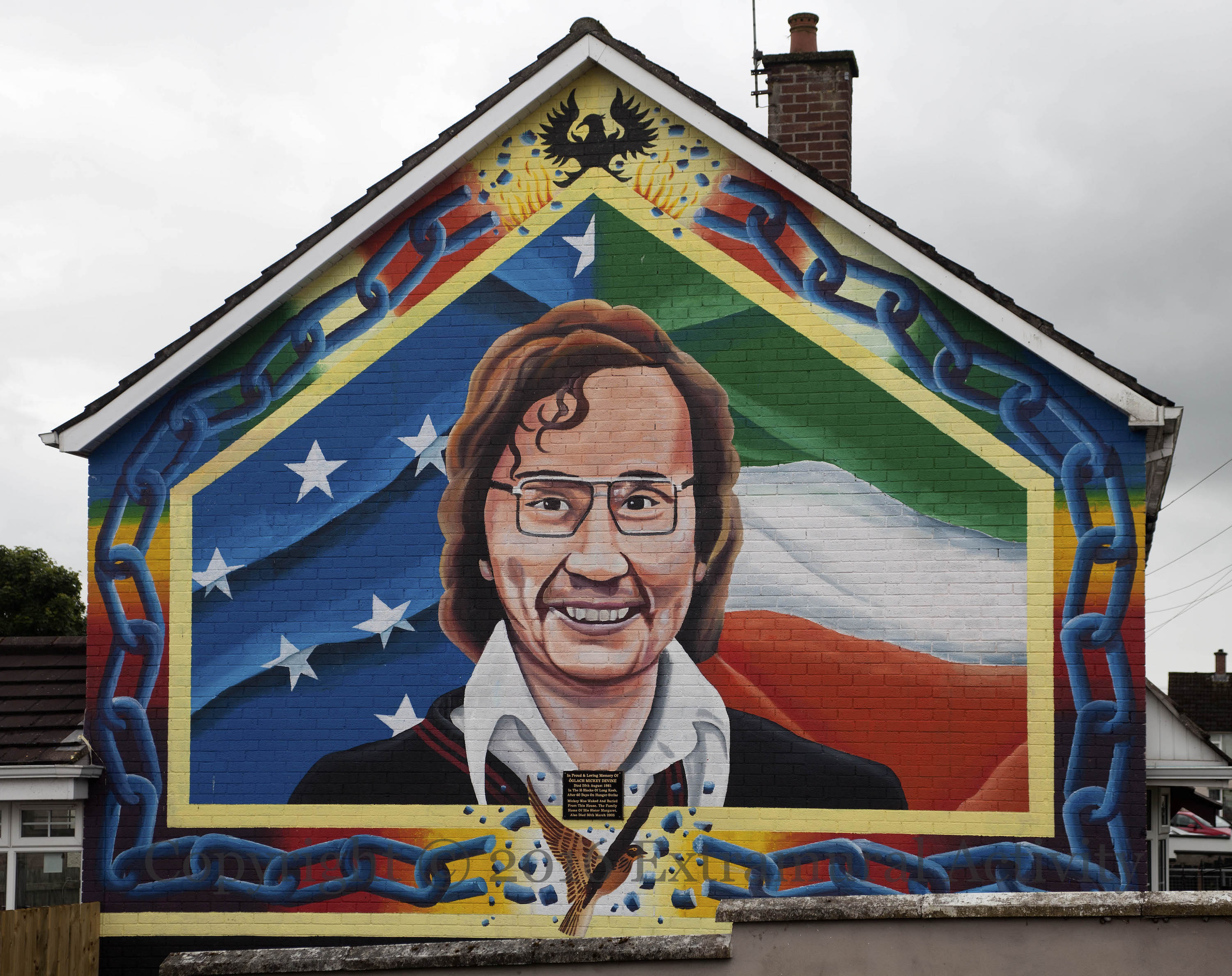
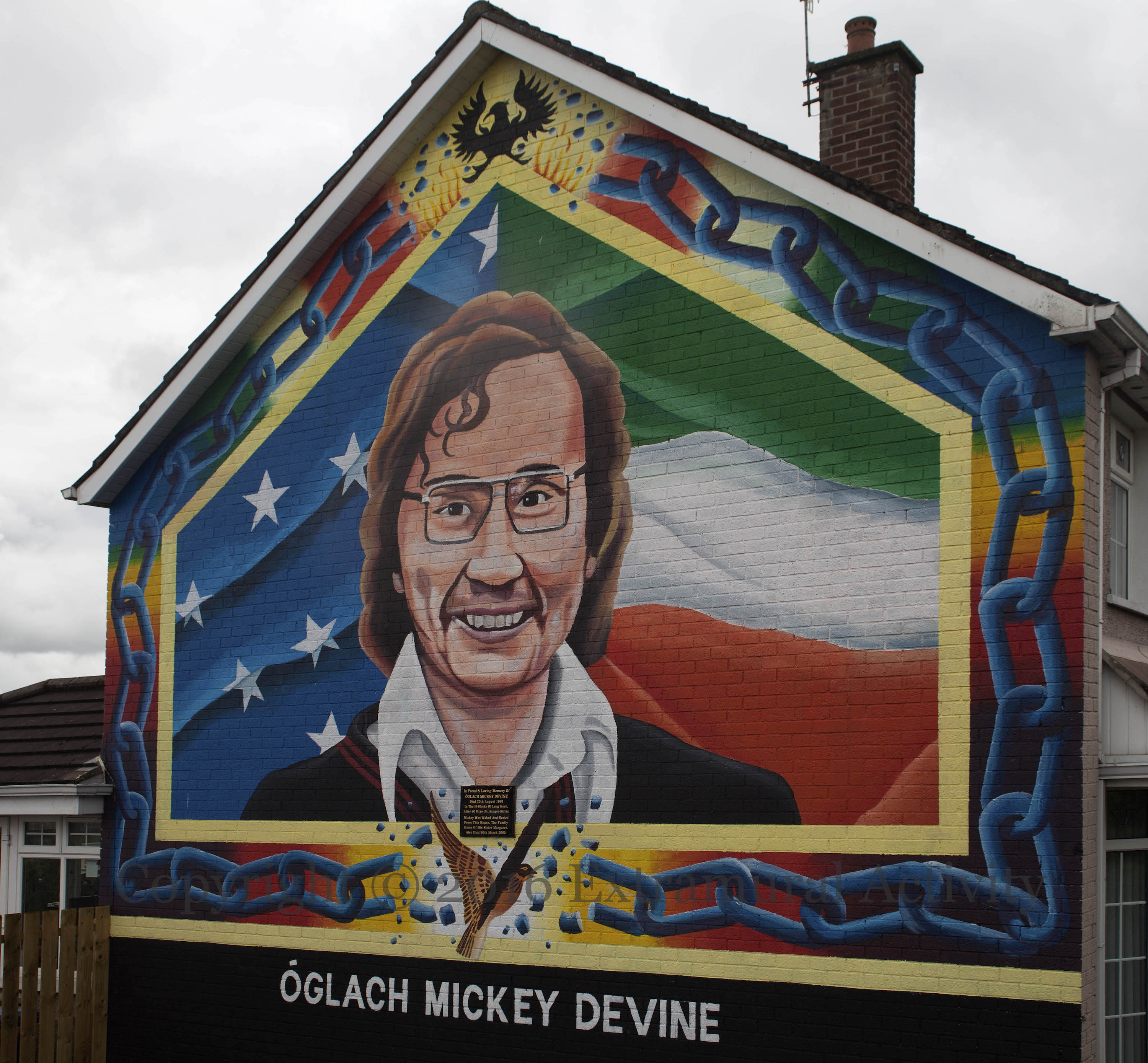
This new full-size mural to INLA hunger striker Mickey Devine replaces a smaller black-and-white board (for which see Waked & Buried).
Click image to enlarge
Copyright © 2016 Seosamh Mac Coılle
X03624 X03625 X03621 Rathkeele Way In proud and loving memory of Óglach Mickey Devine. Died 20th August 1981 in the H-Blocks of Long Kesh after 60 days on hunger-strike. Mickey was waked and buried from this house, the family home of his sister Margaret. Also died 30th March 2005.
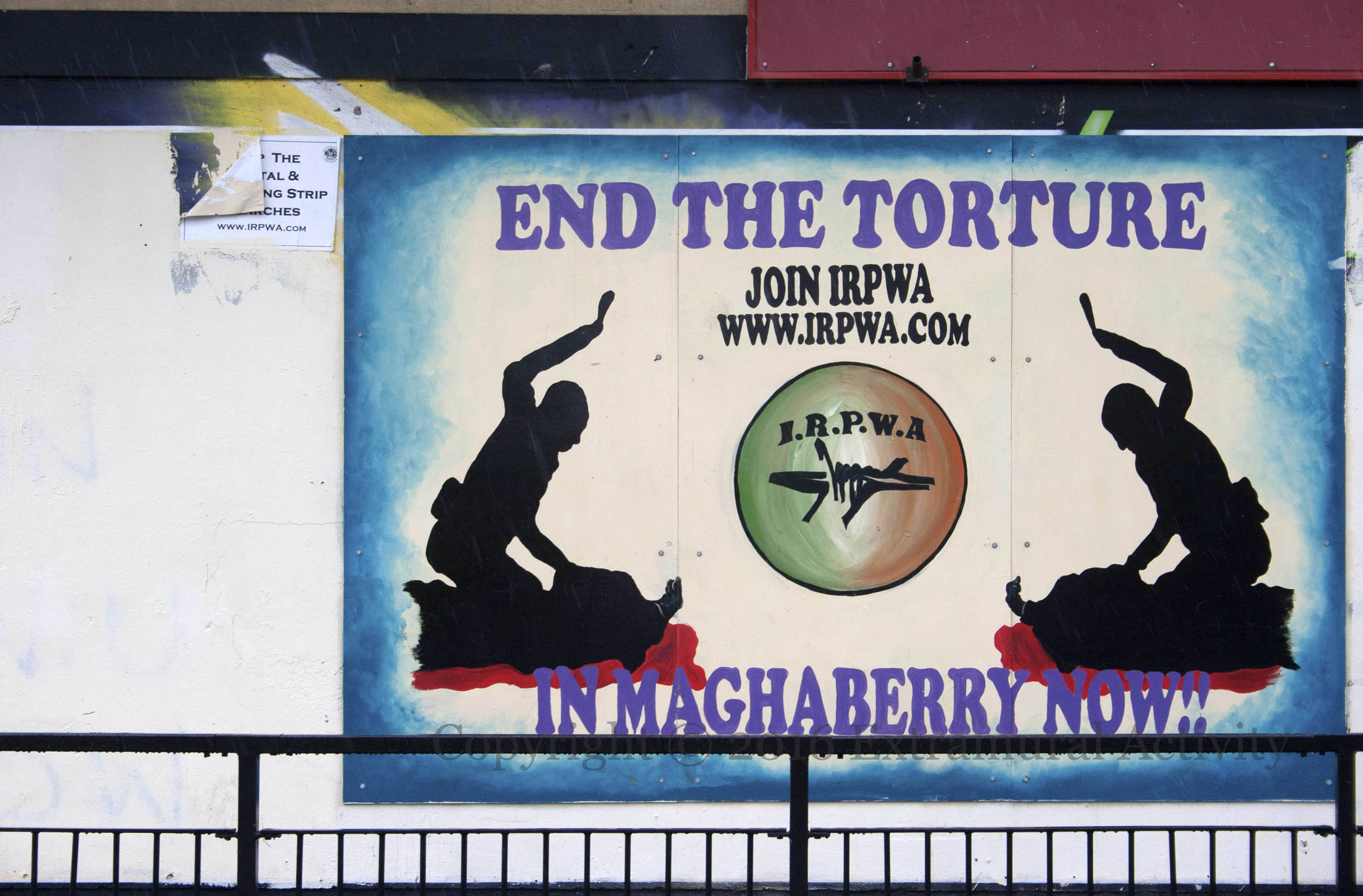
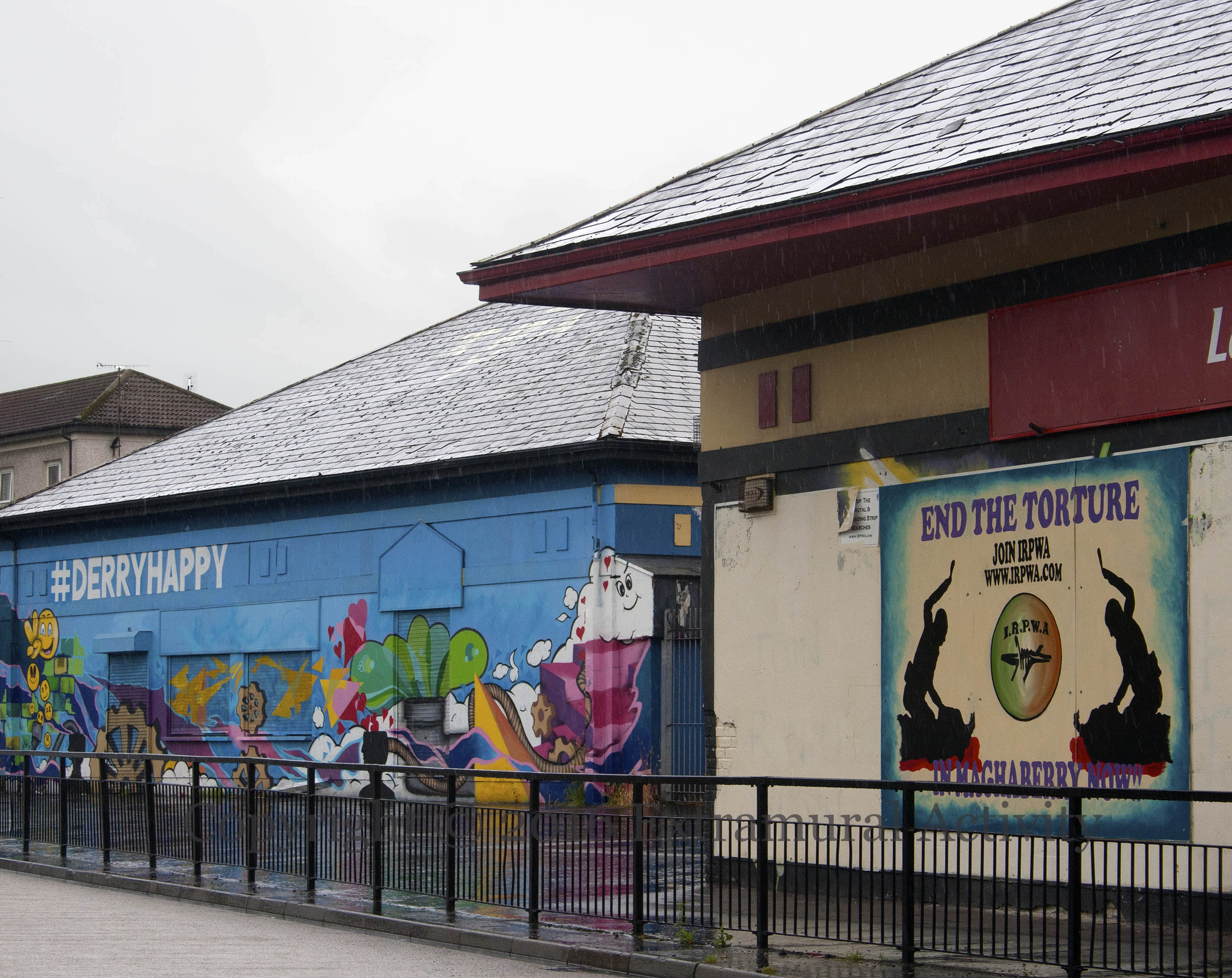
IRPWA mural showing prisoners being beaten and lying in a pool of blood, next to the “#DerryHappy” mural in Lecky Road: “End the torture in Maghaberry now!!”
Click image to enlarge
Copyright © 2016 Seosamh Mac Coılle
X03614 X03659
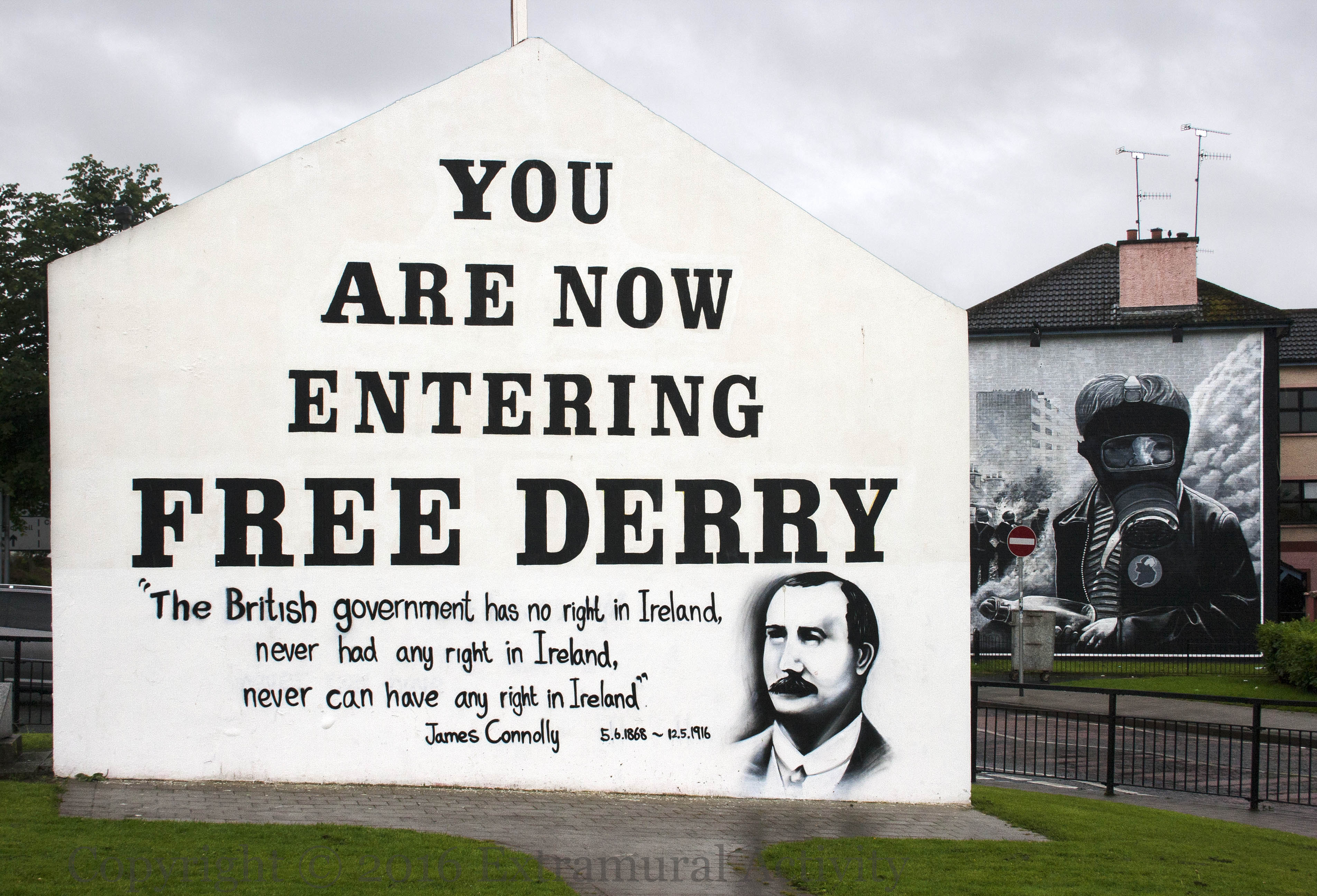
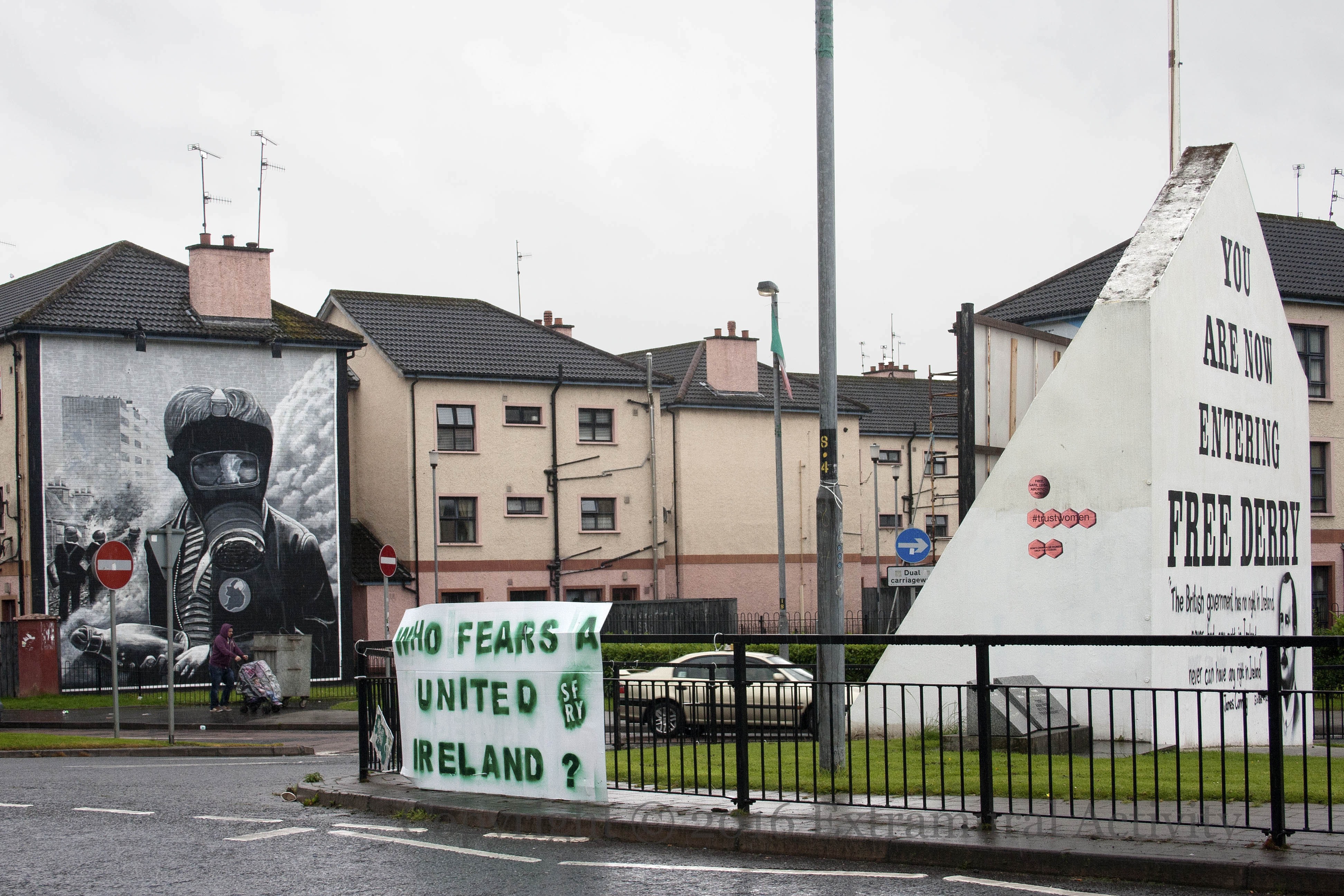
The night before he was executed for his part in the Easter Rising, republican leader James Connolly (5.6.1888-12.5.1916) penned a brief statement calling the British presence in Ireland “a usurpation and a crime against human progress” and declaring “The British government has no right in Ireland, never had any right in Ireland, never can have any right in Ireland”. Here are two images of Free Derry corner with Connolly’s quote, including The Petrol Bomber by the Bogside Artists and and “SFRY” (Sinn Féin Republican Youth) banner on the railings.
Click image to enlarge
Copyright © 2016 Seosamh Mac Coılle
X03602 X03601 lecky rd
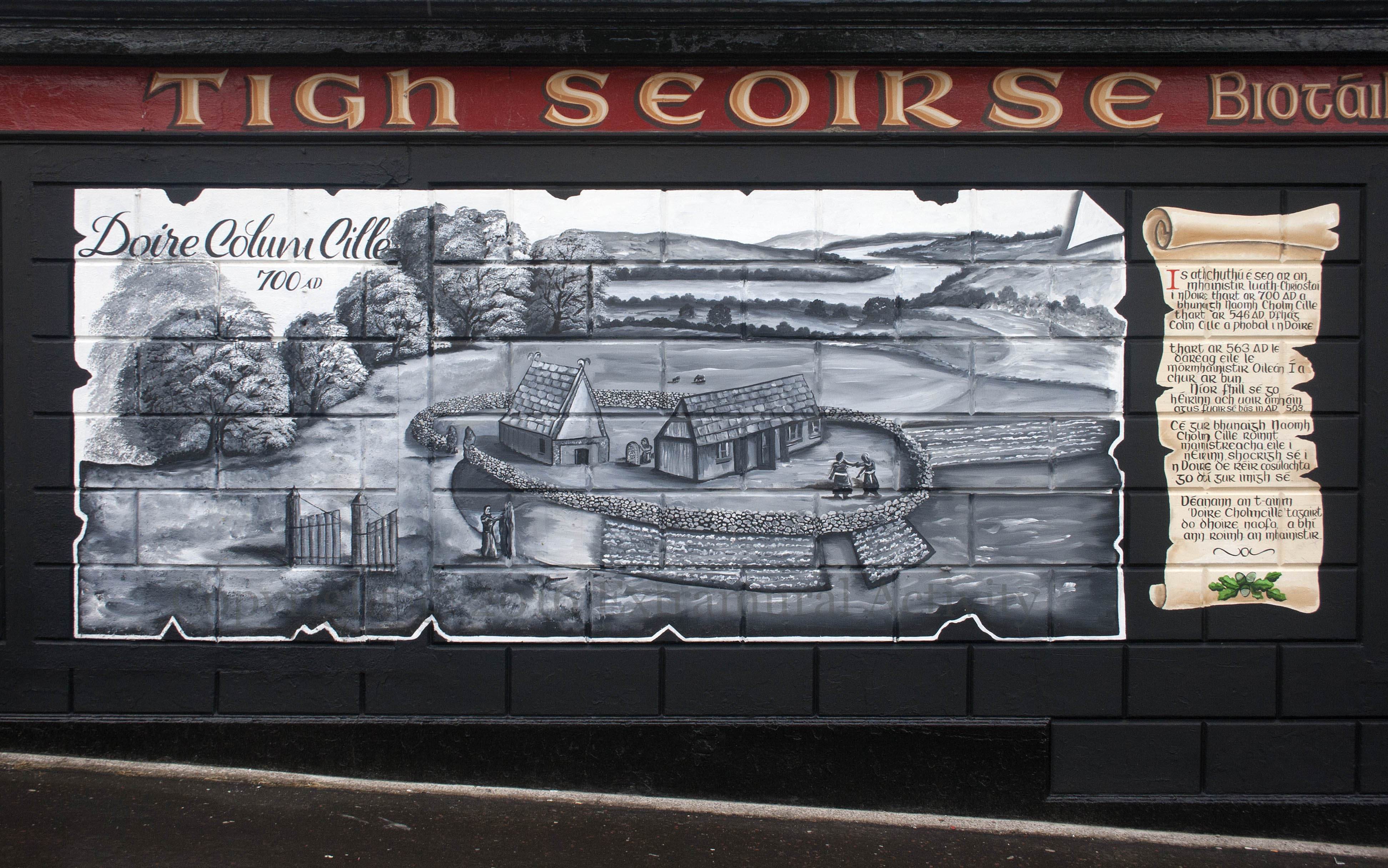
The Christian missionary Colm Cılle (in Latin, Columba), born in Donegal, founded a monastic settlement on the banks of the Foyle (then still part of Donegal) around 540 AD. The “Doıre” part of the name means “oak grove” and perhaps refers (as the information panel suggests) to “a sacred grove of trees, which may have pre-dated the monastery.” The mural above shows a reconstruction of the Derry monastery c. 700 AD. The name “Londonderry” dates to 1662.
Columba moved on to Scotland circa 563 and founded an abbey on the island of Iona. Among his reputed miracles is the banishment of a great water beast from the River Ness in 565.
Click image to enlarge
Copyright © 2016 Seosamh Mac Coılle
X03592 X03593 X03594 U Bennett St
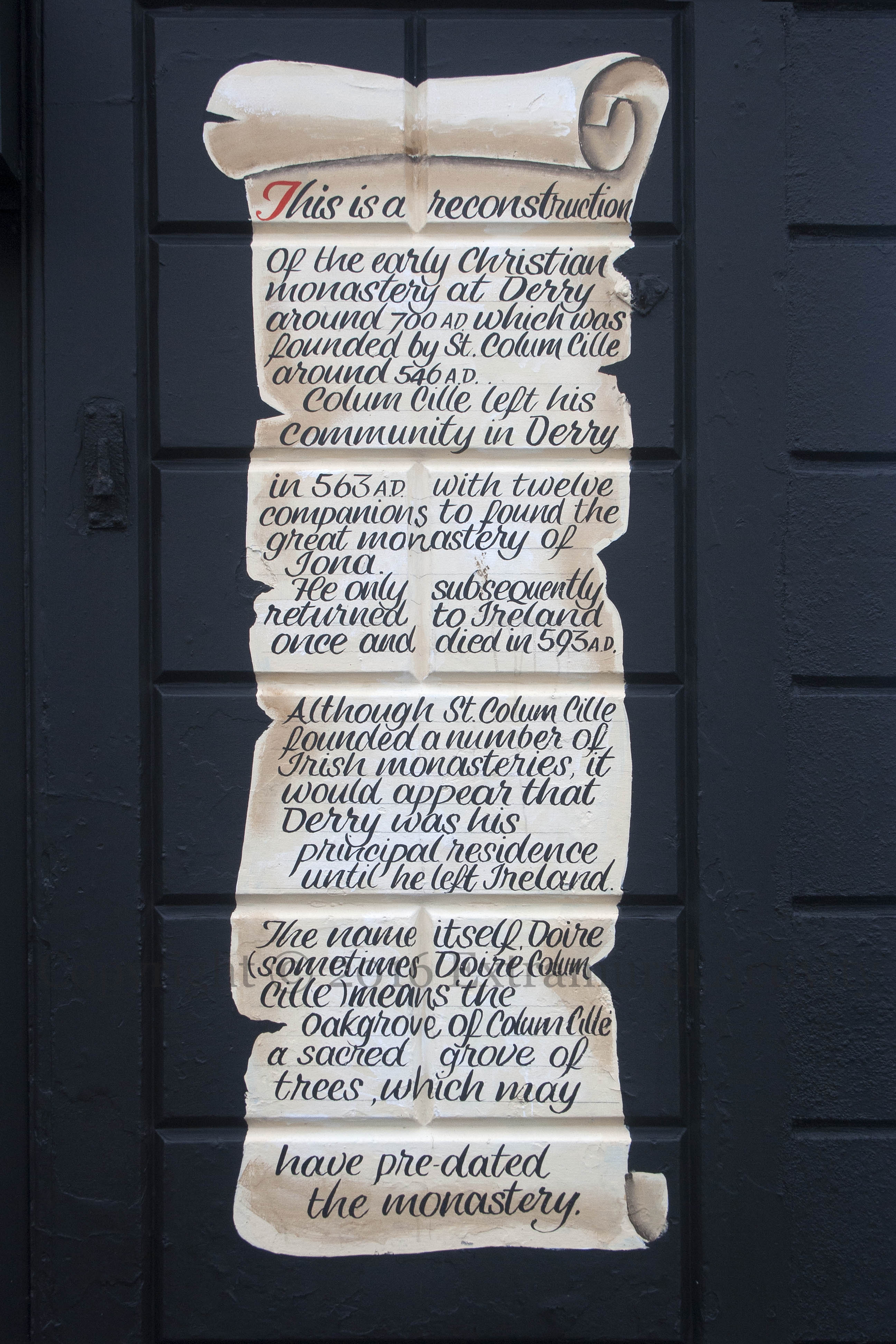
“This is a reconstruction of the early Christian monastery at Derry around 700 AD which was founded by St Colum Cille around 546 AD. Colum Cille left his community in Derry in 563 AD with twelve companions to found the great monastery of Iona. He only subsequently returned to Ireland once and died in 593 AD. Although St Colum Cille founded a number of Irish monasteries, it would appear that Derry was his principal residence until he left Ireland. The name itself, Doıre, (sometimes Doıre Colum Cılle) means ‘the oakgrove of Colum Cille’ a sacred grove of trees, which may have pre-dated the monastery.”
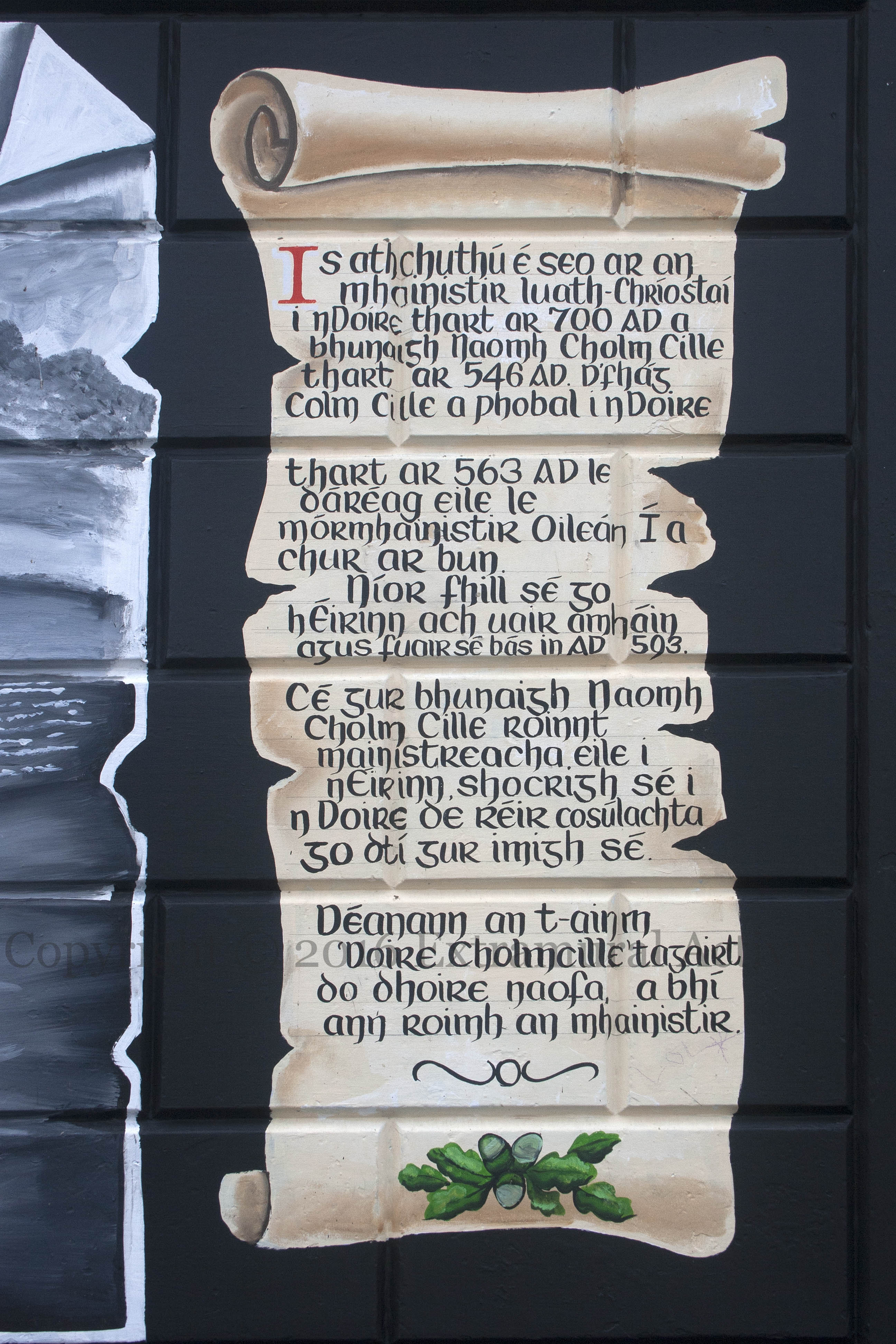
“Is athchuthú é seo ar an mhainistir luath-Chríostaí i nDoıre thart ar 700 AD a bhunaigh Naomh Cholm Cıille thart ar 546 AD. D’fhág Colm Cille a phobal ı nDoıre thart ar 563 AD le dáréag eıle le mómhaınıstır oıleán Í a chur ar bun. Níor fhill sé go hÉıreann ach uaır amháın agus fuaır sé bás in AD 593. Cé gur bhunaigh Naomh Cholm Cille roınnt maınıstreacha eıle ı nÉırınn, shocrıgh sé ı nDoıre de réır cosúlachta go dtí gut ımıgh sé. Déanann an t-aınm ‘Doıre Cholmcılle’ tagaırt do dhoıre naofa, a bhí ann roımh an mhaınıstir.”
 Seosamh Mac Coille Collection