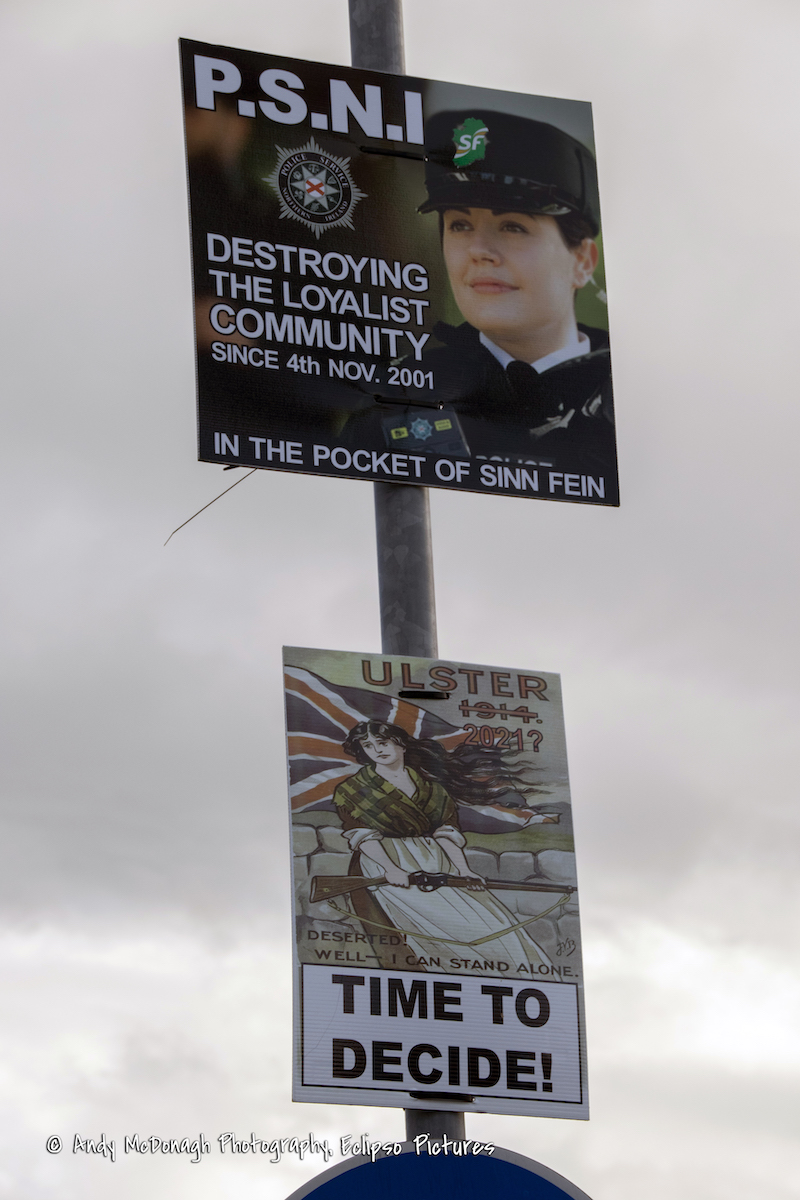
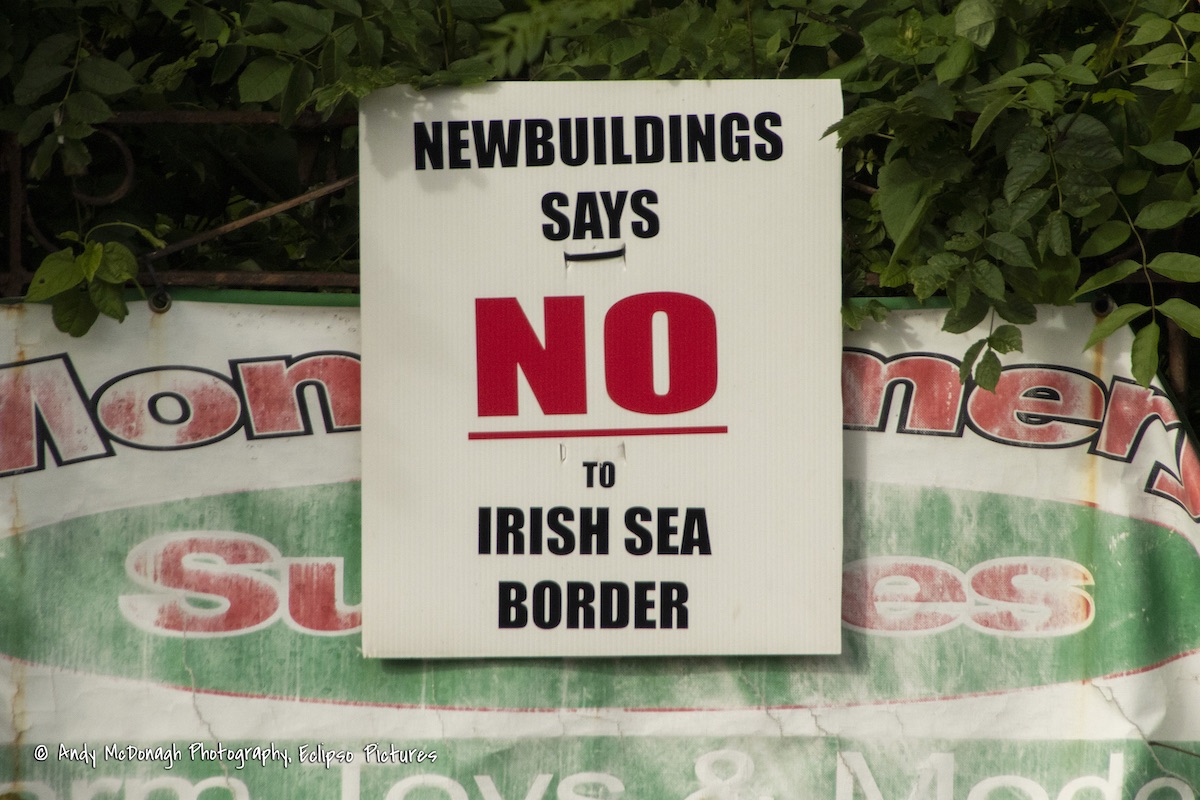
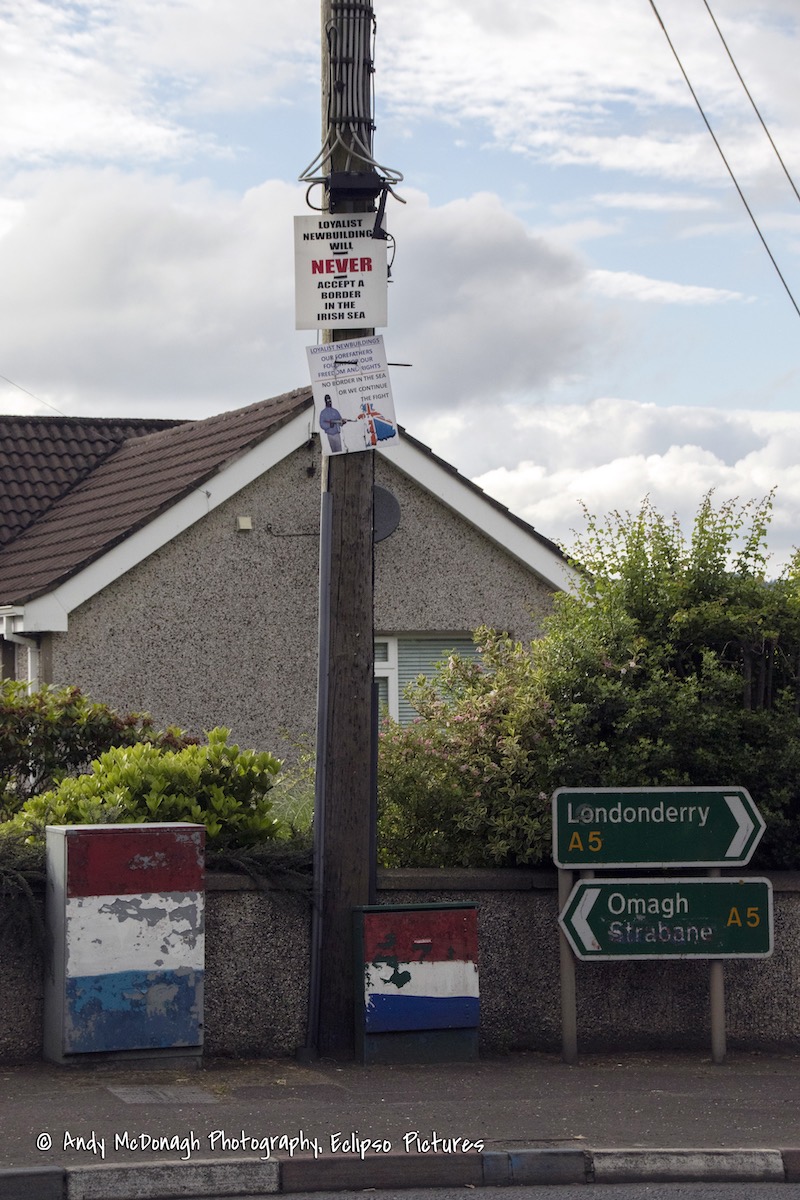
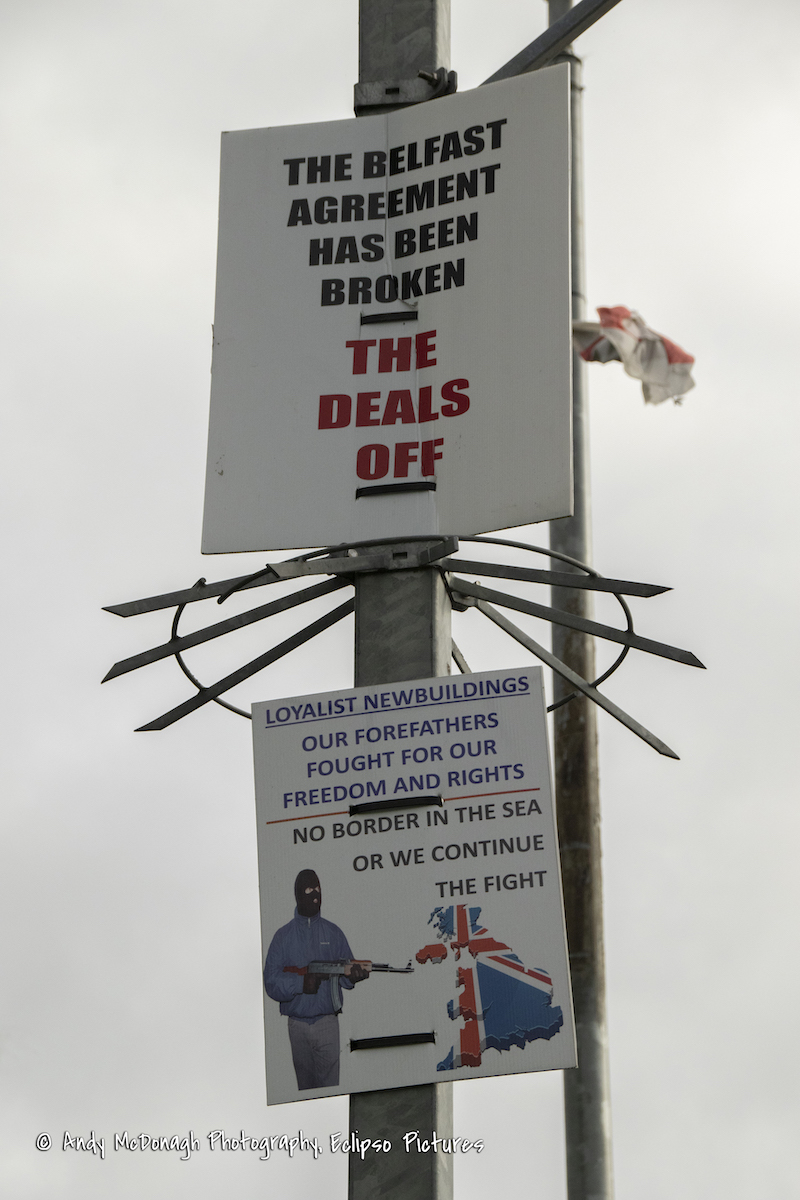
Here is a selection of anti-Protocol placards from the Caw, Londonderry and Newbuildings. Above: a PSNI officer with a Sinn Féin badge – “PSNI – destroying the loyalist community since 4th Nov. 2001. In the pocket of Sinn Féin.” (November 4th, 2001 is the date the PSNI was created.) For the farmer’s wife protecting the farm, see Deserted, Well I Can Stand Alone. Below: “Newbuildings says No to Irish Sea border”, “Loyalist Newbuildings will never accept a border in the Irish Sea”, “The Belfast Agreement has been broken – the deal’s off”, and “Our forefathers fought for our freedom and rights/No border in the sea or we continue the fight”.
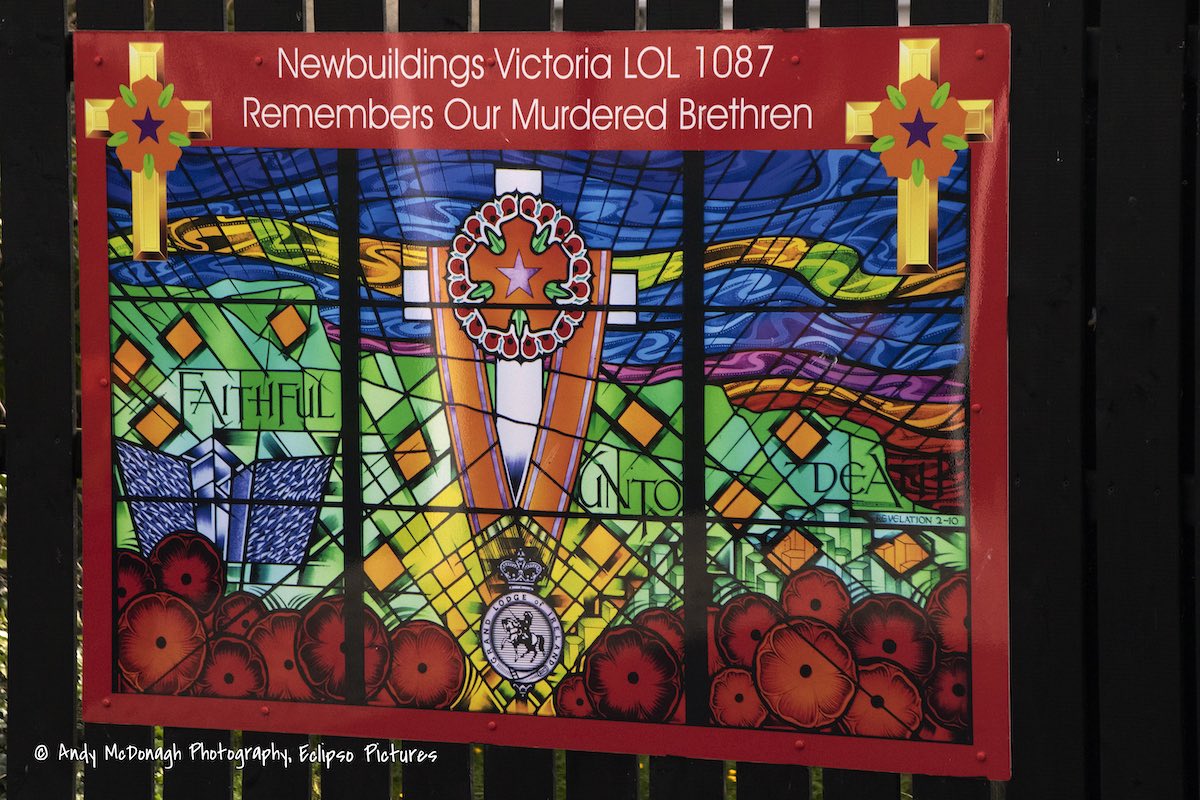
Orange Order Victims day is an annual commemoration (on September 1st) of the 339 members who were killed during the Troubles. The stained glass window reproduced in a board on the Newbuildings memorial garden is in the Museum of Orange Heritage in Schomberg House, south Belfast.
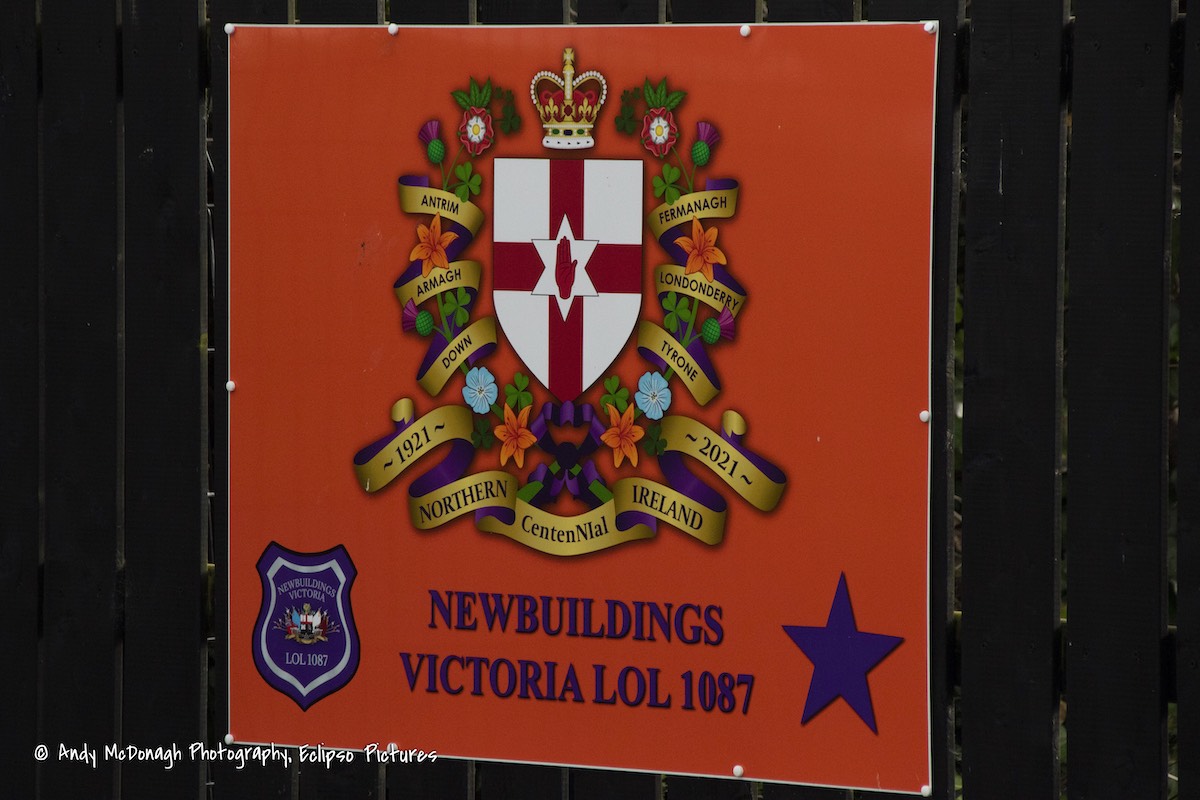
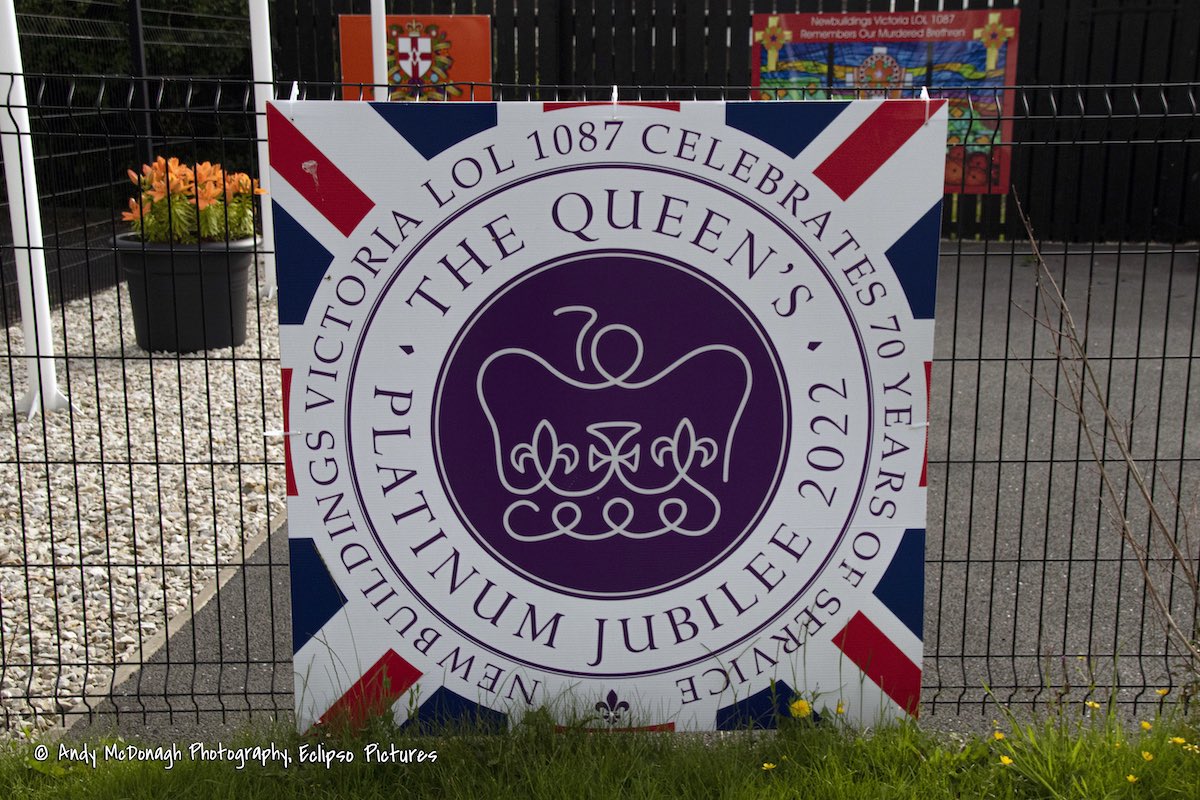
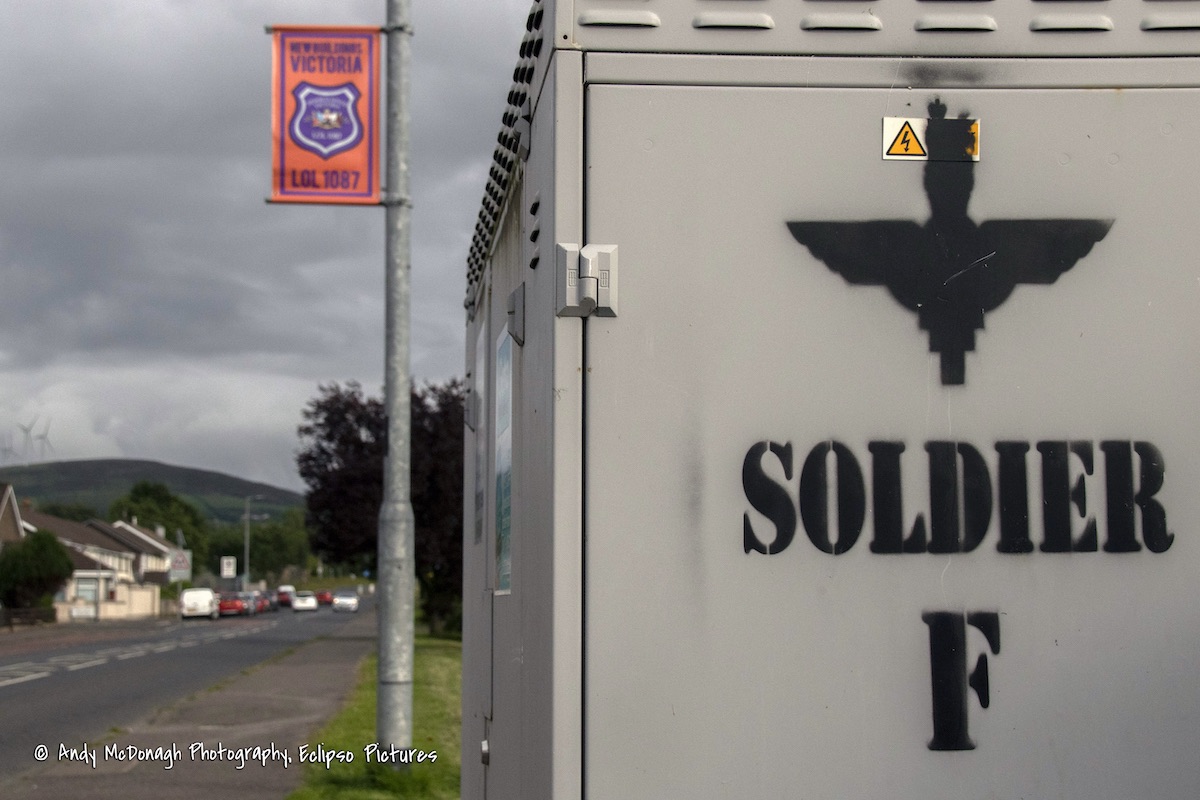
Compared with the garden in 2020 (see Newbuildings Victoria), there is a new NI Centenary board, and on the outside (replacing the tarps giving thanks for the NHS and commemorating the 75th anniversary of VE day) there is a celebration of the platinum jubilee of Queen Elizabeth II. On the electrical box, there is a stencil in support of Bloody Sunday’s “Soldier F”, who continues to face murder charges (for the killings of William McKinney and James Wray) and five attempted murder charges after the PPS’s decision to discontinue prosecution was quashed in March (Guardian); the PPS has appealed (News Letter).
339 Orange Order members killed during the Troubles.
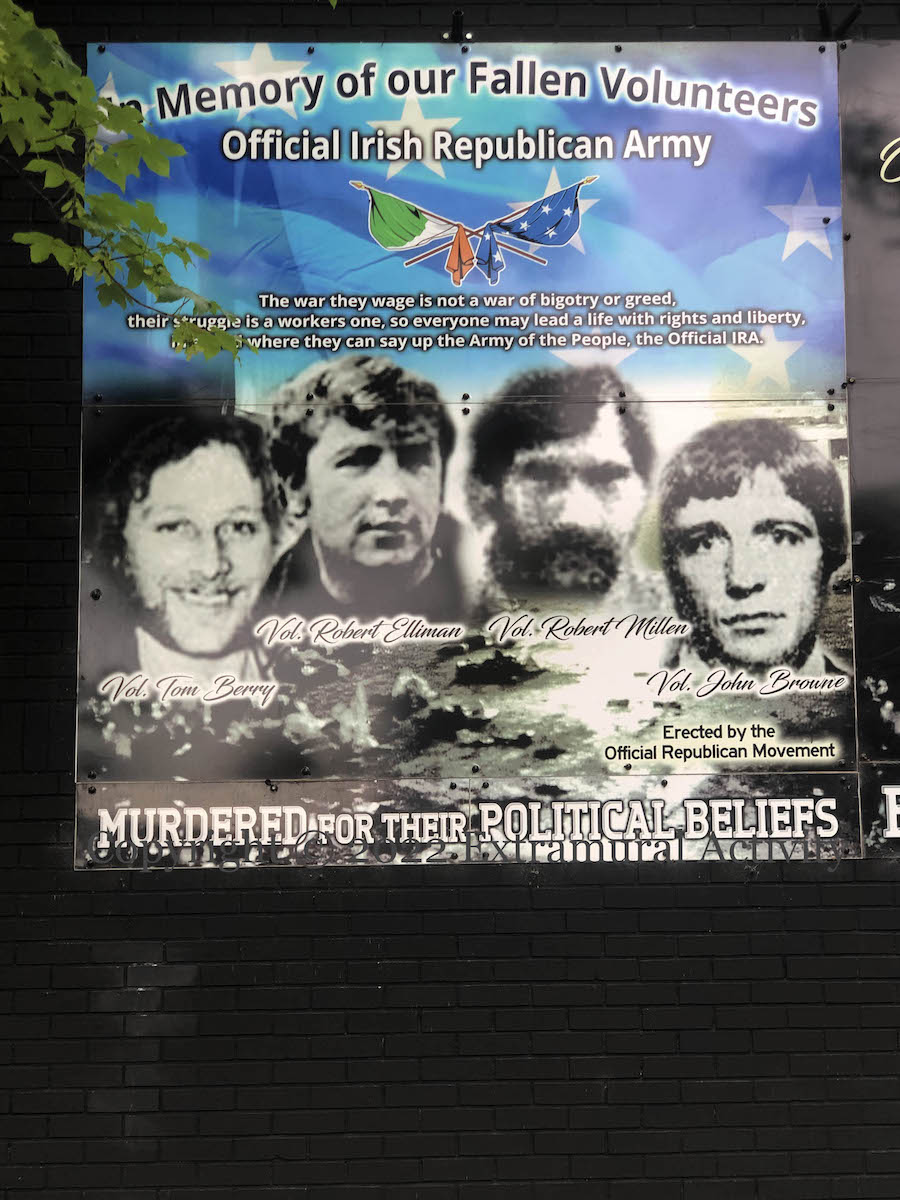
“Murdered for their political beliefs: Tom Berry, Robert Elliman, Robert Millen, John Browne”. All four had a connection Markets or Ormeau area of south Belfast. Millen, from the Ormeau area, was shot in 1973 by the UVF; he played on the same soccer team (Bankmore Star) as Thomas Berry, who was shot in a Short Strand GAA club; Elliman was shot in a Markets pub; John Brown (without the “e”) was shot in his Cooke Street home in front of his family. The first three were all Protestants; the latter three were among 11 people who died in the 1975 feud between the Officials and the Provisionals. (Lost Lives)
“The war they wage is not a war of bigotry or greed, their struggle is a workers one, so everyone may lead a life with rights and liberty, in a land where they can say “Up the Army of the people, the Official IRA”.” “Erected by the Official Republican Movement.”
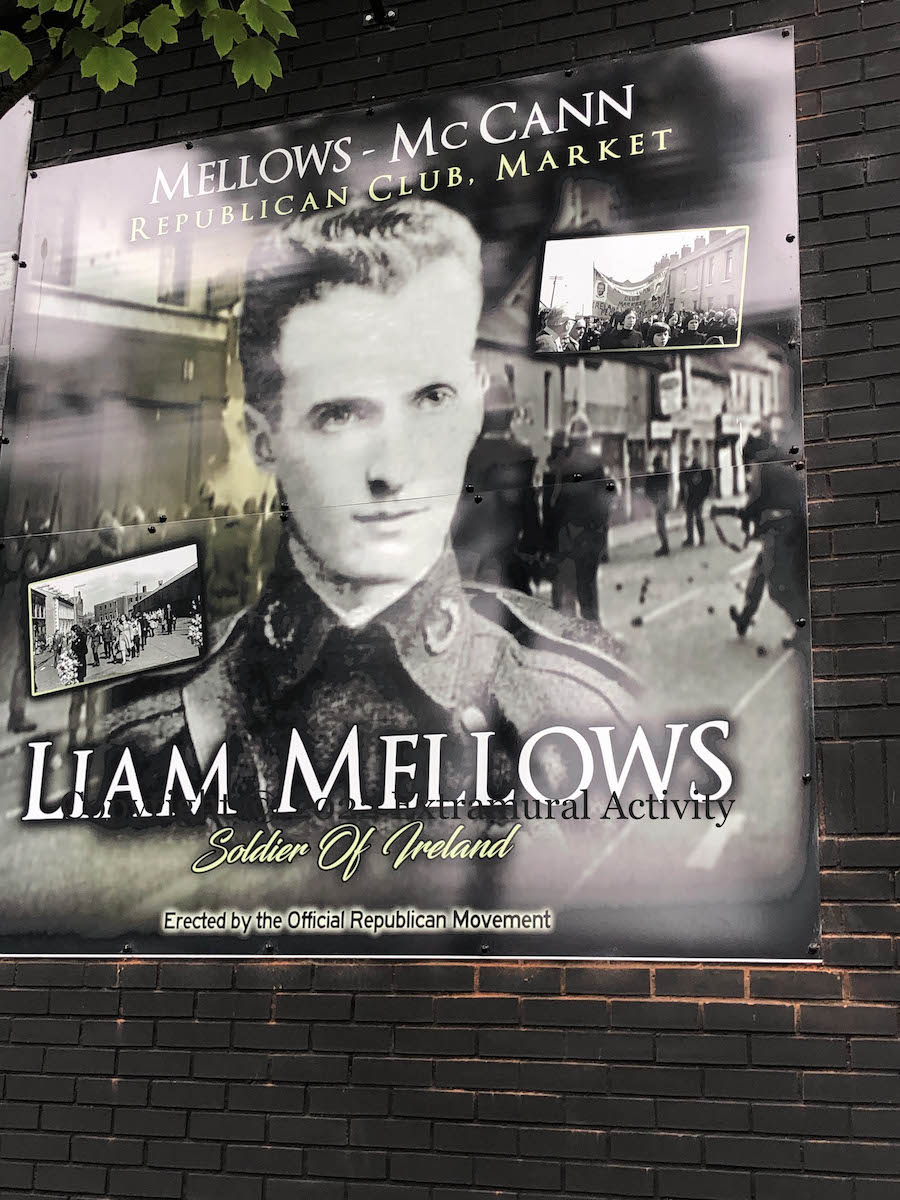
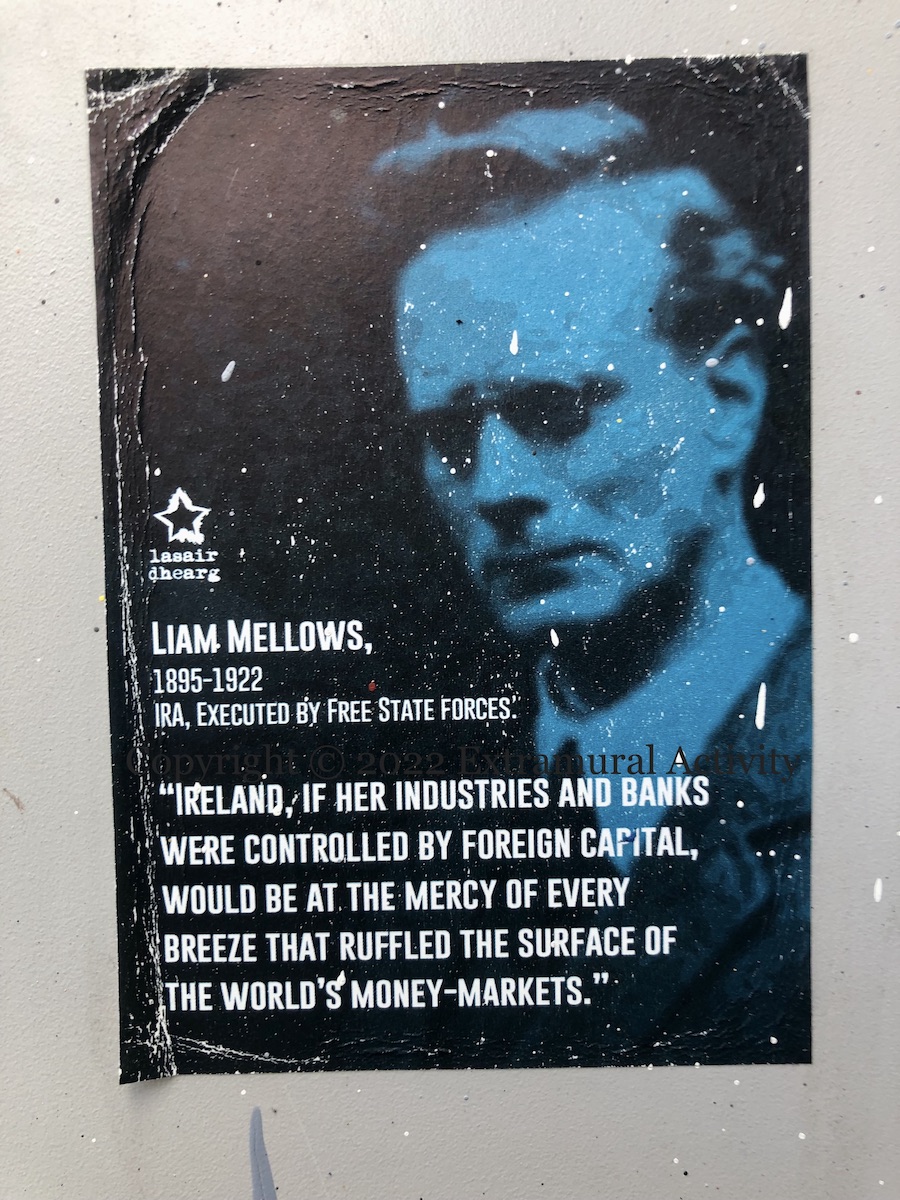
After serving in the IRA in the War Of Independence, Liam Mellows was elected to the First Dáil and as a member of the second Dáil voted against the Treaty in January 1922 (his speech is recorded in Oireachtas.ie under the name “Liam Mellowes”). In the Civil War that followed, he served as IRA quartermaster in the force in the Four Courts that surrendered to Free State forces on June 30th, 1922. He was imprisoned in Mountjoy and executed in December, in reprisal for the killing of Seán Hayes (see Executed). (WP | An Phoblacht) His proposals for government were published posthumously as ‘Mellows Testament’ (NLI) and include state ownership of heavy industry, large estates, the transport system, and the banks. The sticker below quotes from that document: “Ireland, if her industries and banks were controlled by foreign capital, would be at the mercy of every breeze that ruffled the surface of the world’s money-markets.”
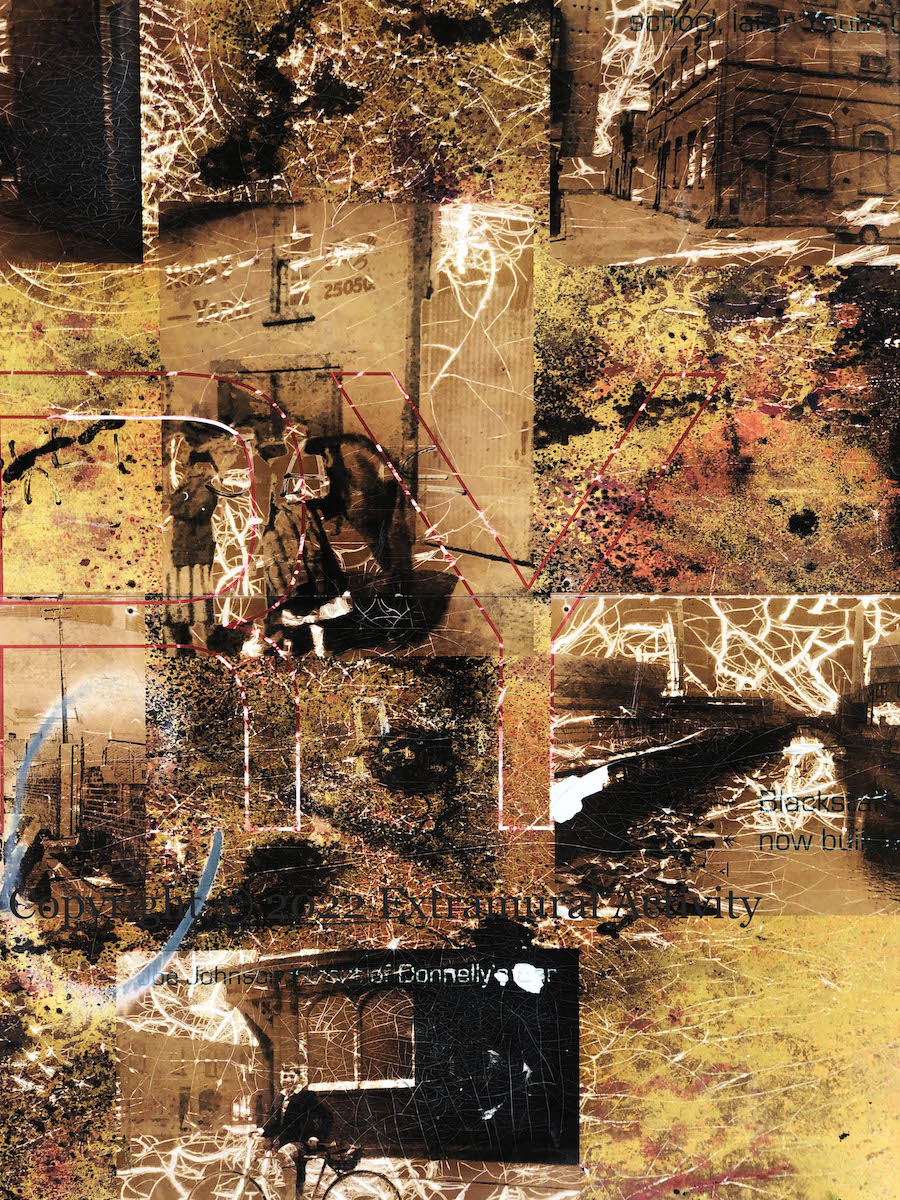
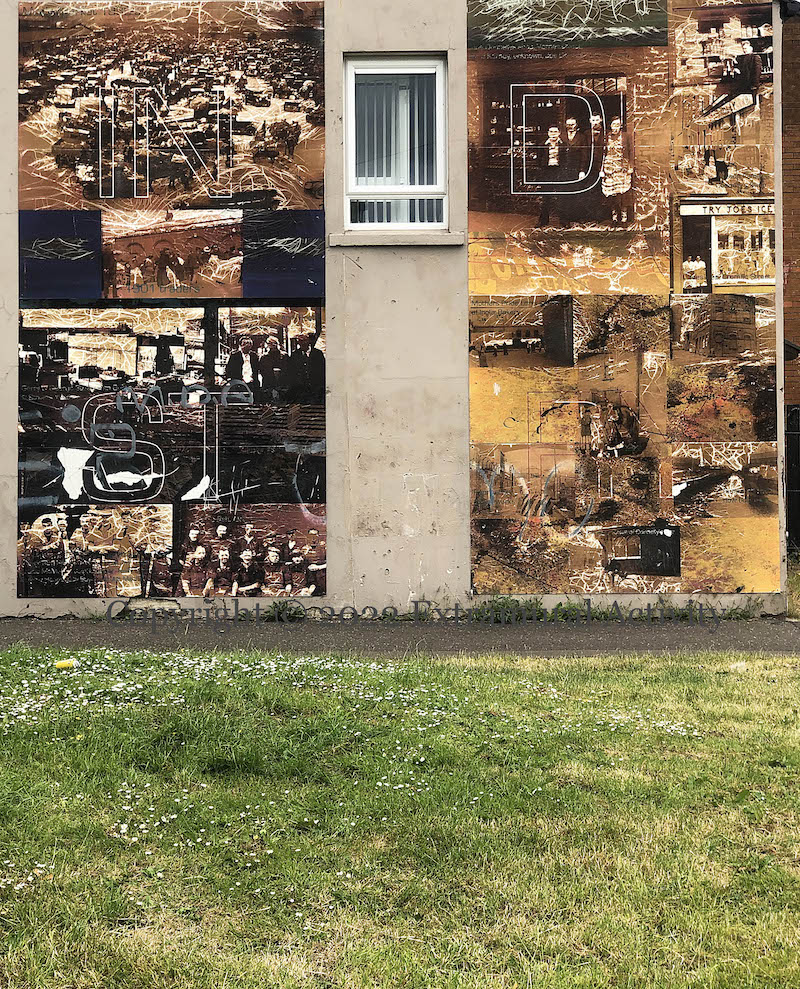
Artist Raymond Henshaw produced a series of Markets-related boards in 2008-2009 with support from the Arts Council and despite being printed on laminates they are not indestructible; there is crazing – as well as human-caused damage – on some of them, the worst of which is the ‘Industry’ board in Upper Stanfield Street.
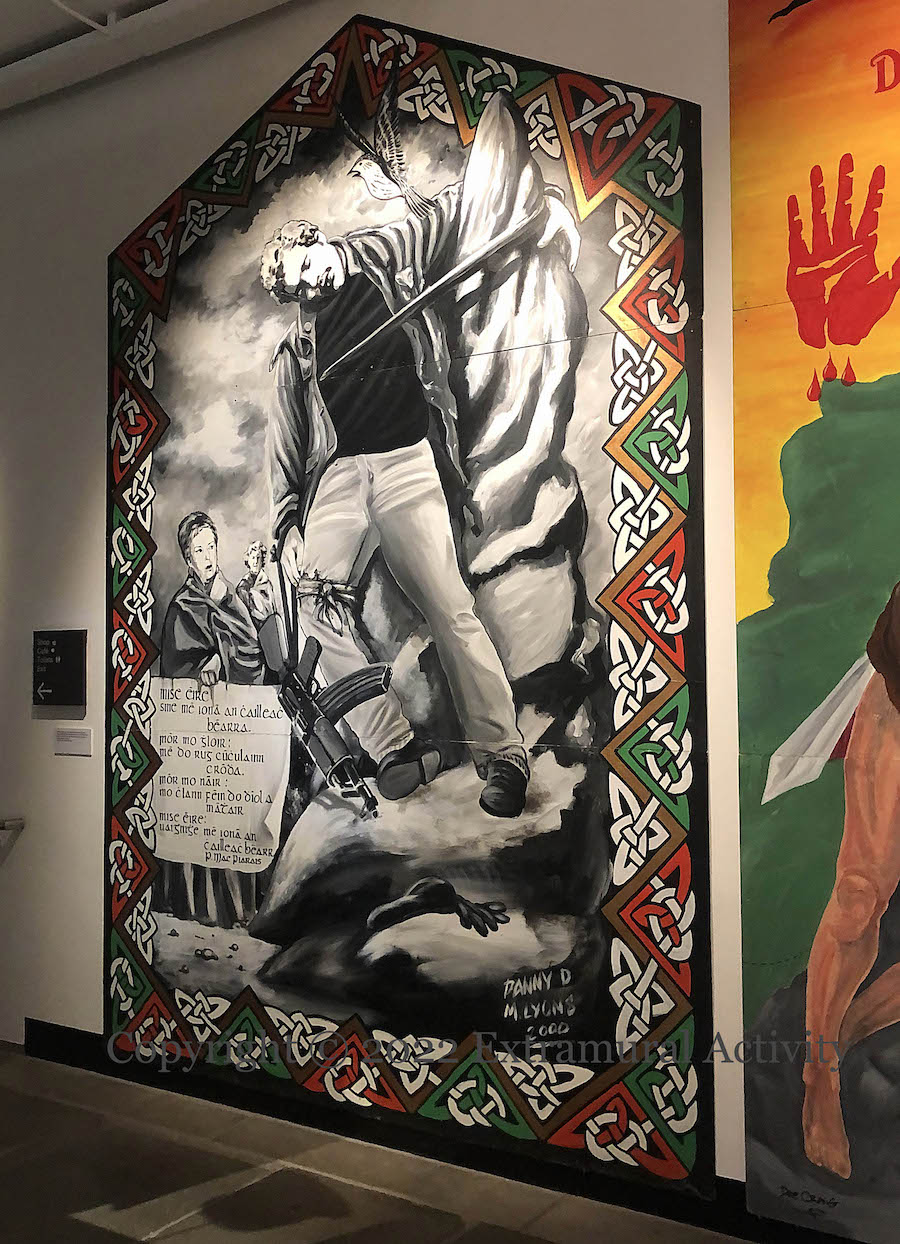
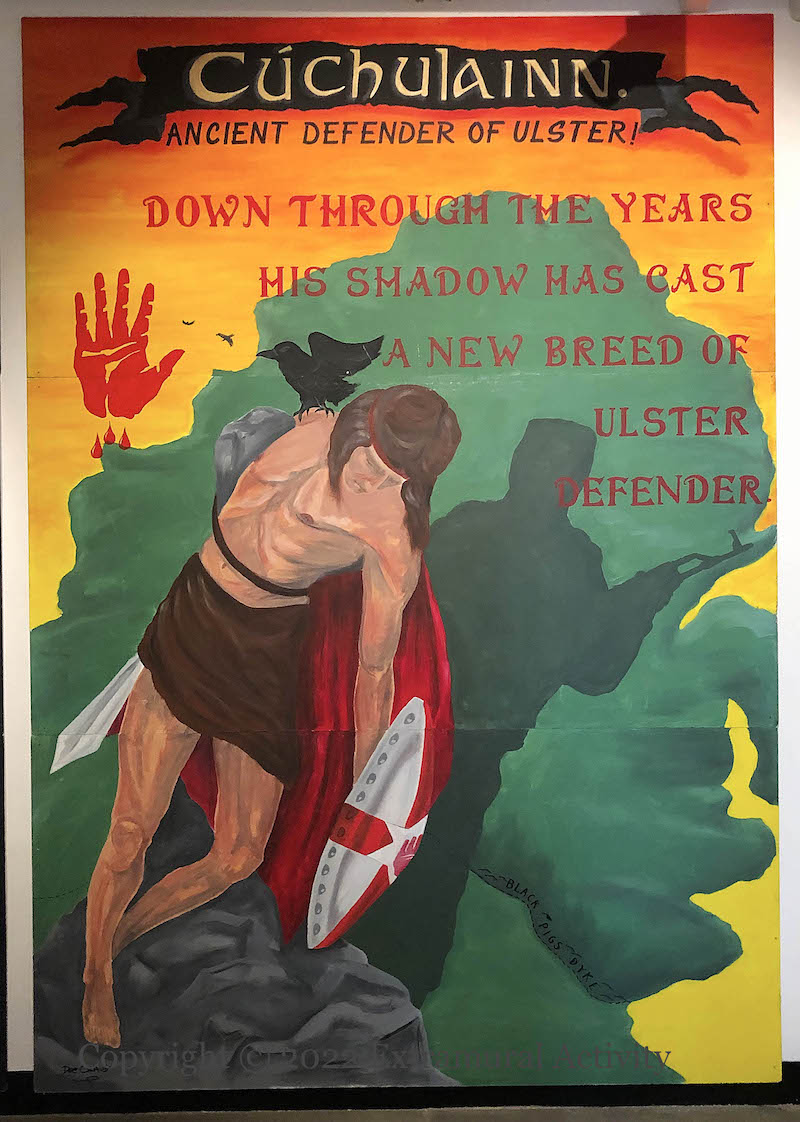
Here are a pair of large boards in the Ulster Museum on the theme of Cú Chulainn, one from each sect.
In the left-hand painting – the CNR piece, by Marty Lyons and a Short Strand artist – Francis Hughes of the IRA – in what we think is a unique break with tradition – takes the place of Cú Chulaınn, who became a symbol of the 1916 Easter Rising when Oliver Sheppard’s statue of Cú Chulaınn’s death was placed in the re-built GPO. Hughes has a tourniquet on his right leg, an assault rifle dangling from his wrist, and instead of the raven that signified Cú Chulaınn’s death there is the symbol of republican political prisoner, the lark, which appears in the apex of many other republican murals.
In the second of the pieces – the PUL piece, painted by Dee Craig – the raven sits on the shoulder of a Cú Chulainn who has a red cloak and carries a Northern Ireland shield. “Down through the years, his shadow has cast a new breed of Ulster defender”: a (loyalist) hooded gunman. Thus while Cú Chulaınn is the (surprising) “Ancient defender of Ulster!”, the UVF and UDA are its modern defenders, now that the B Specials and UDR are gone.
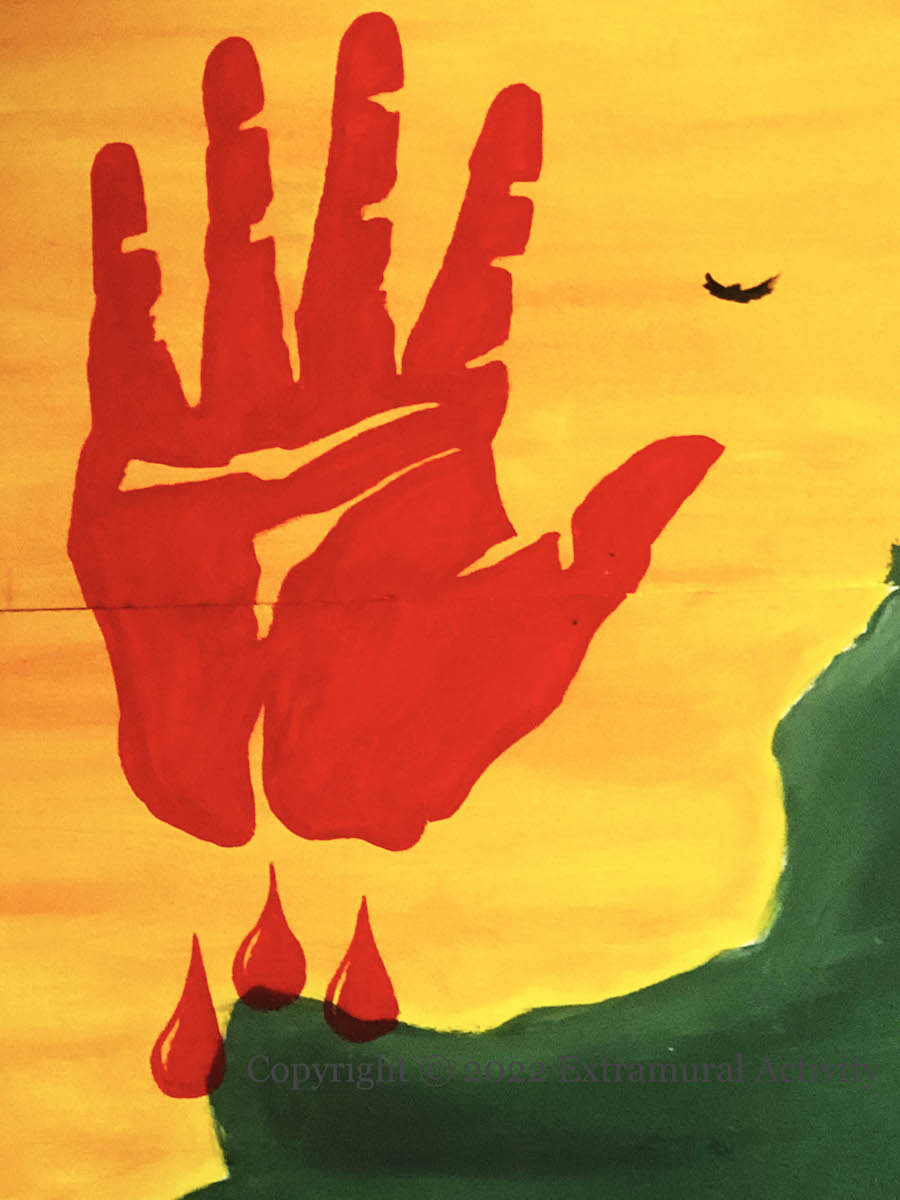
The dripping red hand in the top left is the ‘red hand of Ulster’; one version of the origin-story for the red hand is that the man who avenged Cú Chulaınn’s death made a bloody hand-print to indicate his completion of the deed. Most people, however, will think of the legend that in a race to be first to touch the land of Ulster one contestant (perhaps Érımón Uí Néıll) cut off his hand and threw it ahead of the others. (This legend was depicted in a lower Shankill mural and narrated in an east Belfast mural: The Strangest Victory In All History.)
The Black Pig’s Dyke is the collective name for a number of ditches built around 400 BCE, perhaps to prevent cattle-raiding. They share a common mythology: that they were created by huge black boar; they are on the Ulster-Connacht border, rather than the Ulster-Leinster border as shown in the painting, though there are similar earthworks in Down, Armagh (and Cork) (WP).
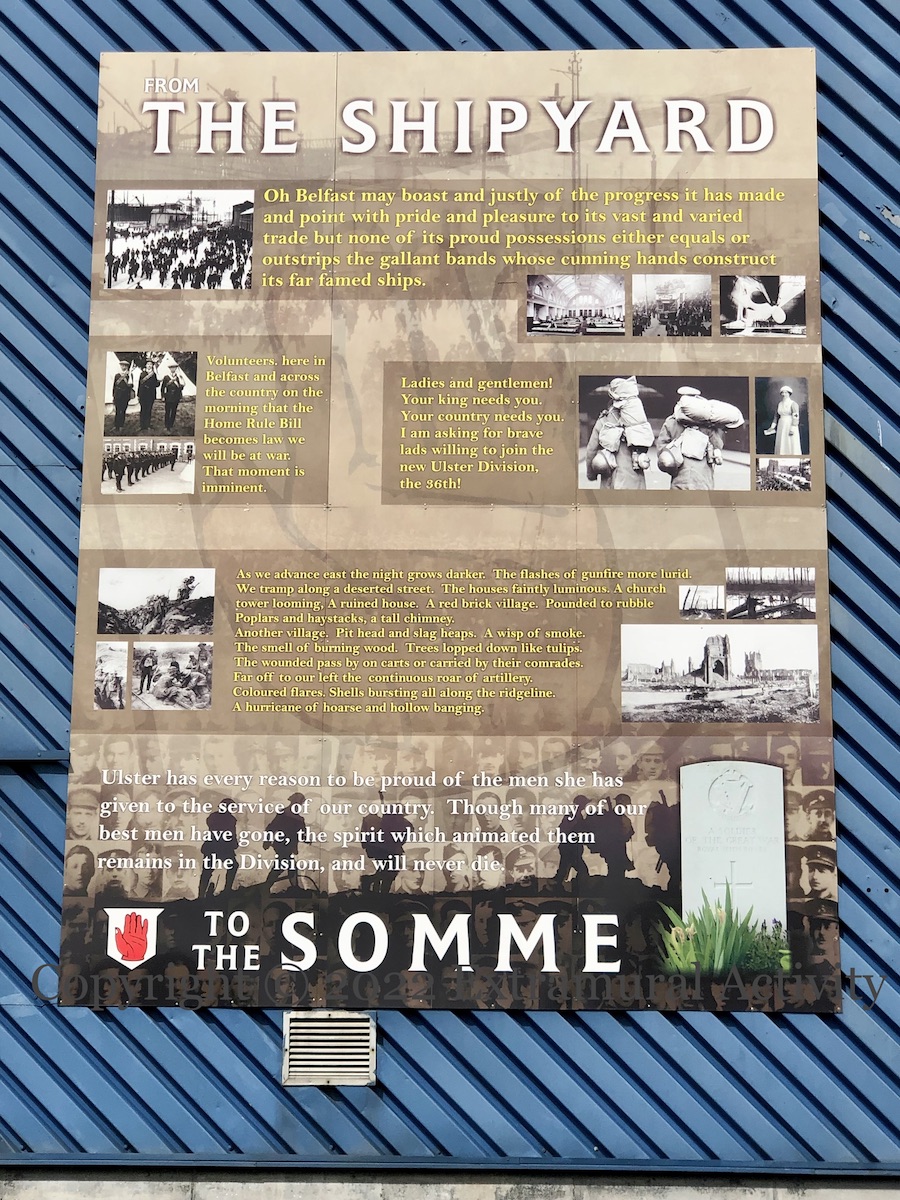
The 36th (Ulster) Division Memorial Association (Fb) put on a play called From The Shipyard To The Somme (Fb | watch on youtube) in Connswater Community Centre in 2013. It follows a group of men from east Belfast who joined the Ulster Volunteers in Belfast but are now training at Abercorn barracks in Ballykinlar (later an internment camp) as members of the 36th Division, before going to the Battle Of The Somme in France.
Belfast – with one tenth of the population – provided about a third of the Irish soldier to participate in WWI. In the shipyards, Harland & Wolff responded to the slow-down in production not by putting everyone on short time but by letting go of employees, particularly unskilled employees, for whom the wages of soldiering were competitive (particularly if married), while skilled men were reclassified as “munitions workers” needed to fulfill war contracts (History Ireland | Long Kesh Inside Out).
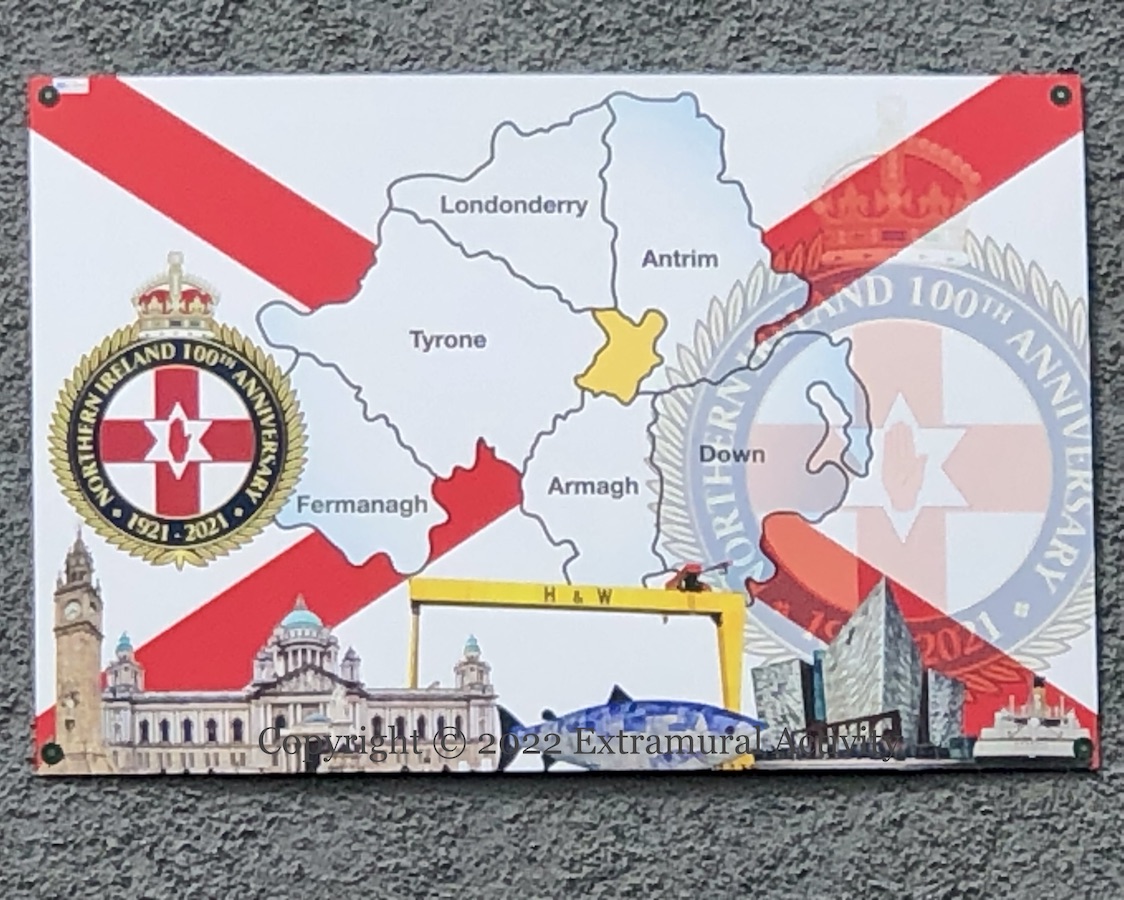
Of some interest in this Mersey Street NI Centenary board is the use of St Patrick’s saltire (in the background). The saltire is an anglo symbol of Ireland and was included in the Union Flag when the union was between Britain and Ireland and thus – like the word “Ulster” – has been reduced to meaning Northern Ireland after partition.
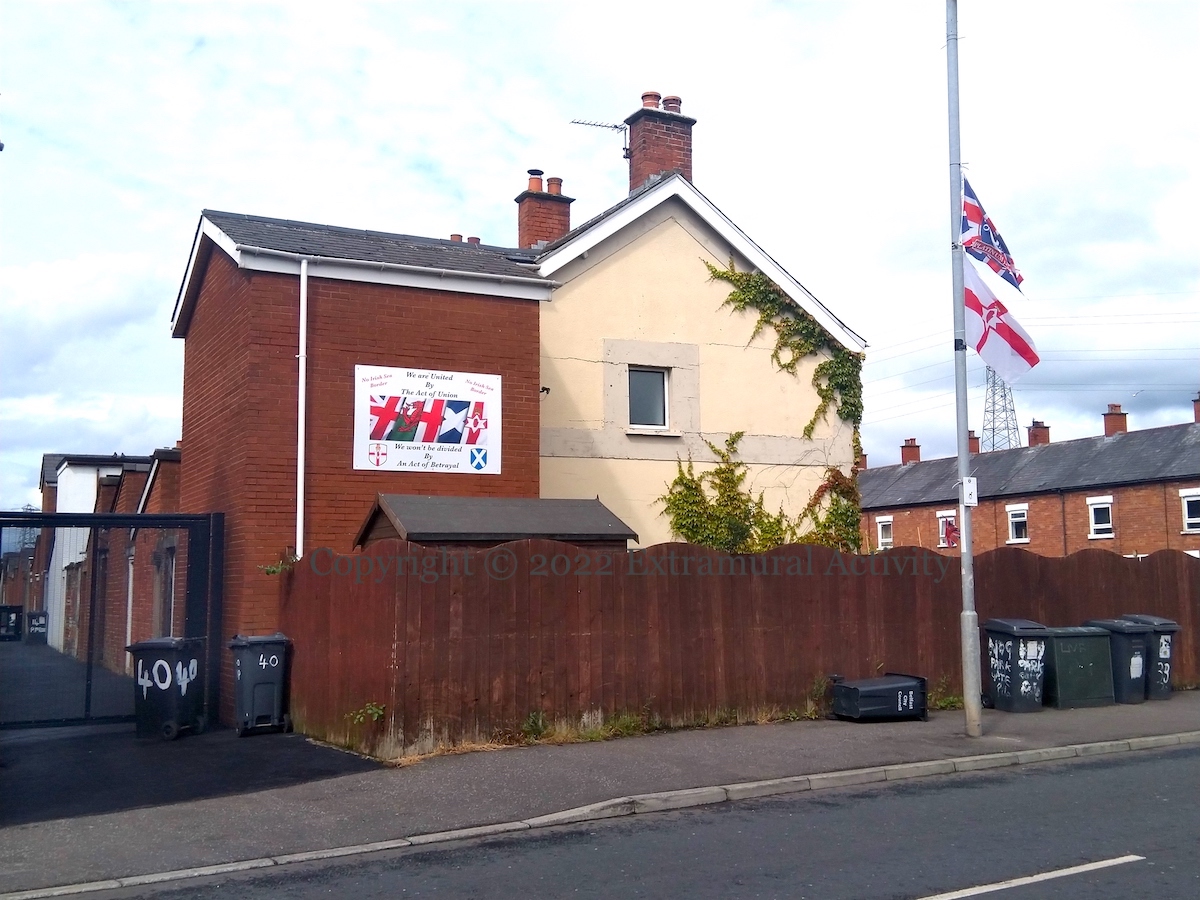
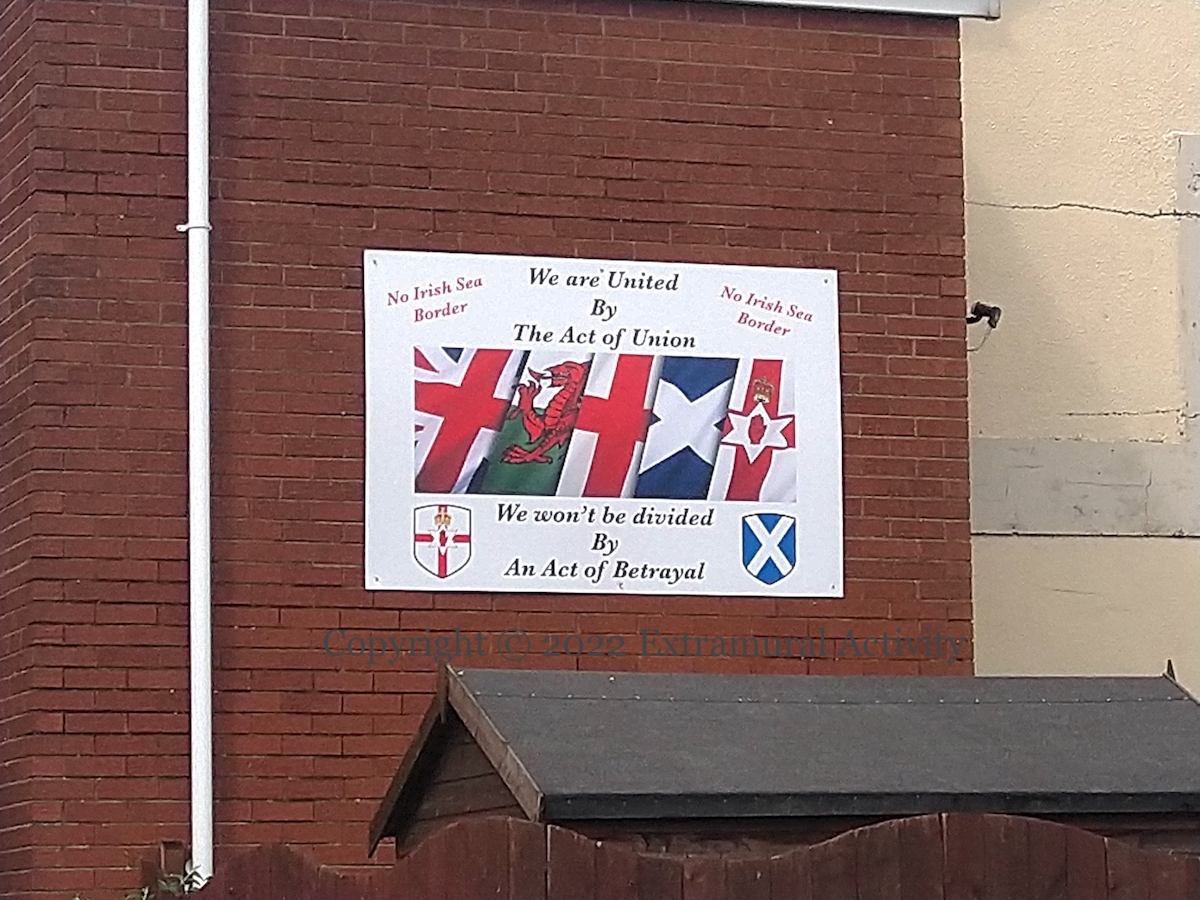
There is also an anti-Irish Sea border board on the next house along – see An Act Of Betrayal. This features the Union Flag together with flags representing the “home countries”: the Welsh dragon, the English St George’s Cross, the Scots St Andrew’s Saltire, and the Northern Irish Ulster Banner.
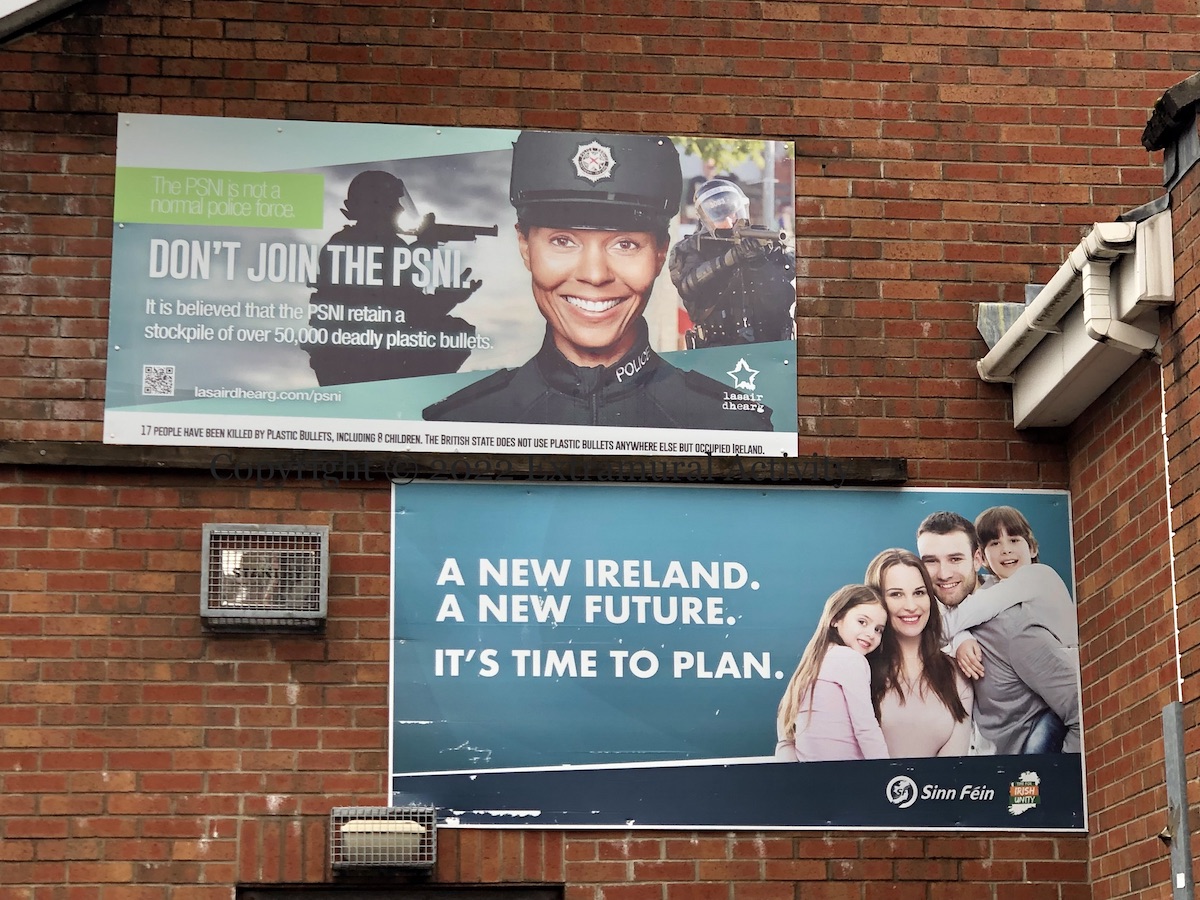
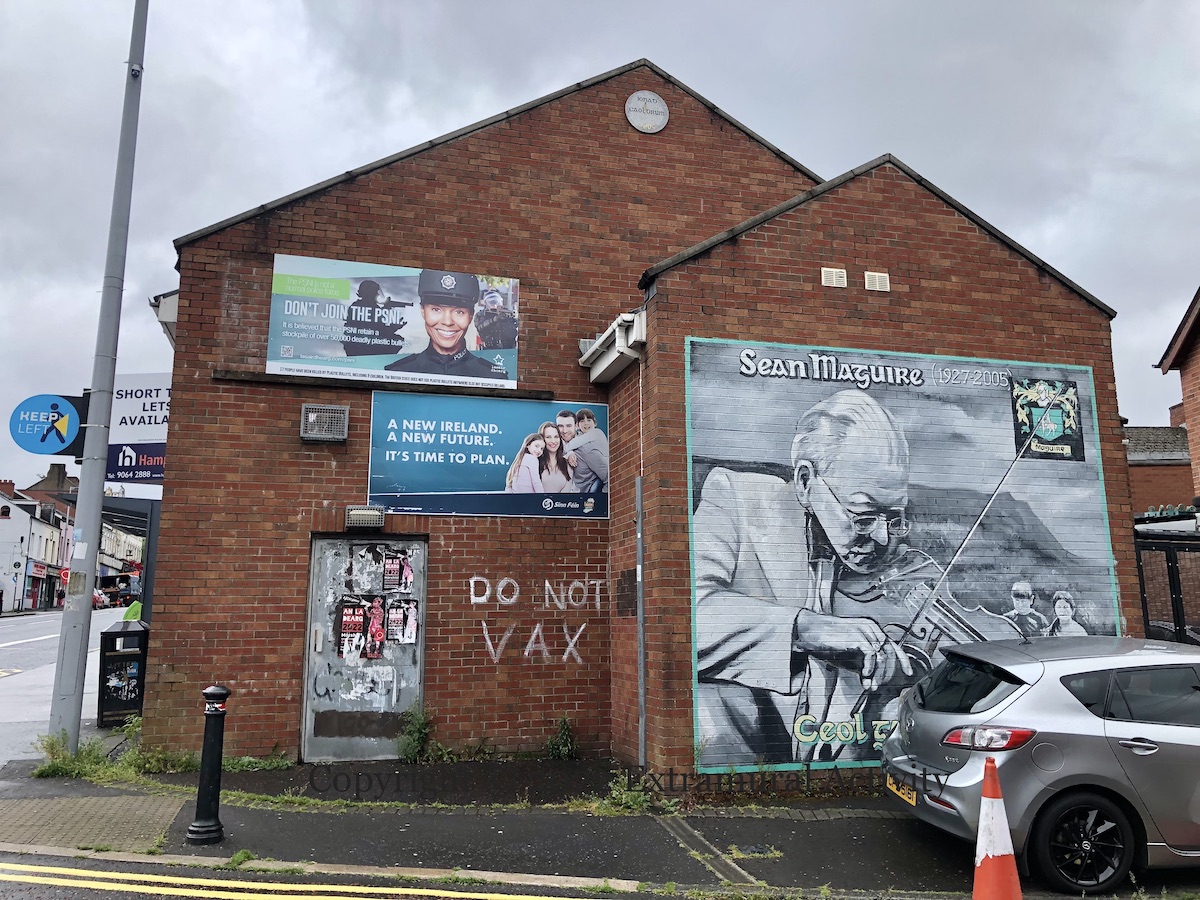
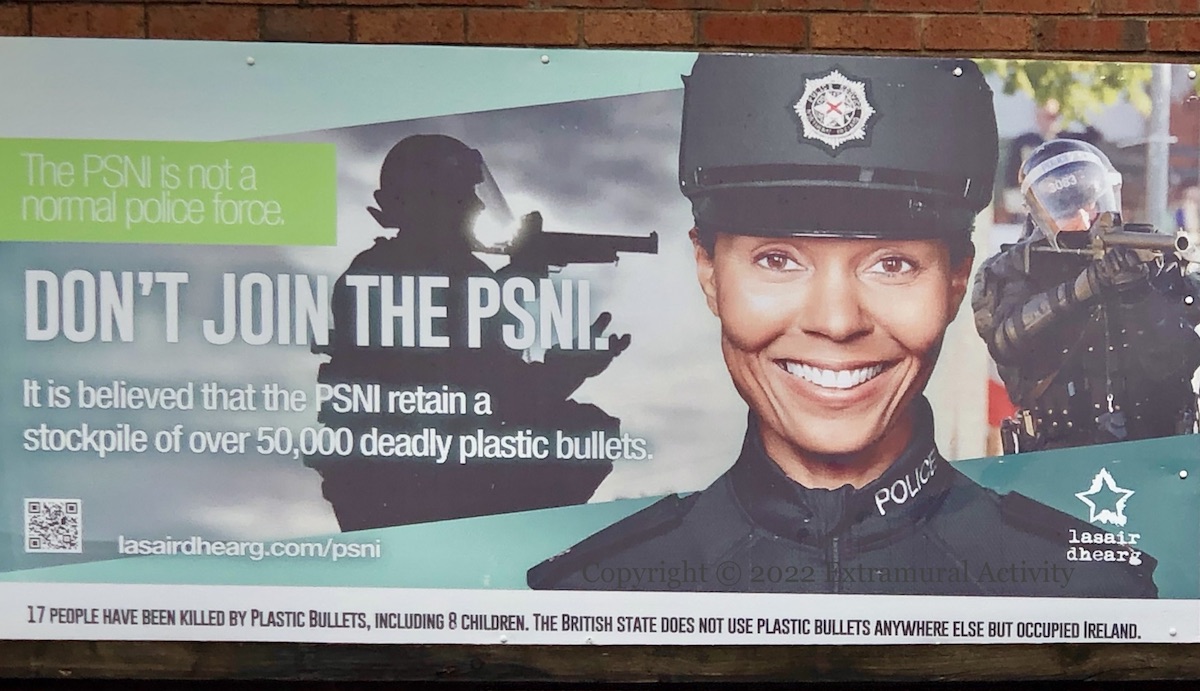
The Lasaır Dhearg board takes the “poster officer” from the 2021 recruitment campaign and puts them against a backdrop of riot officers firing plastic bullets. “17 people have been killed by plastic bullets, including 8 children.” “It is believed that the PSNI retain a stockpile of over 50,000 deadly plastic bullets.” The British state does not use plastic bullets anywhere but occupied Ireland.” “The PSNI is not a normal police force.” Here is the 2021 Amnesty report on the use of water cannon and “Attenuating Energy Projectiles” in the north. In November, relatives of Carol Ann Kelly went to Stormont to call for an end to the use of plastic bullets (BelTel).
The Sınn Féın board appears to involve stock photography, as we have noted before in Will This Work For You?