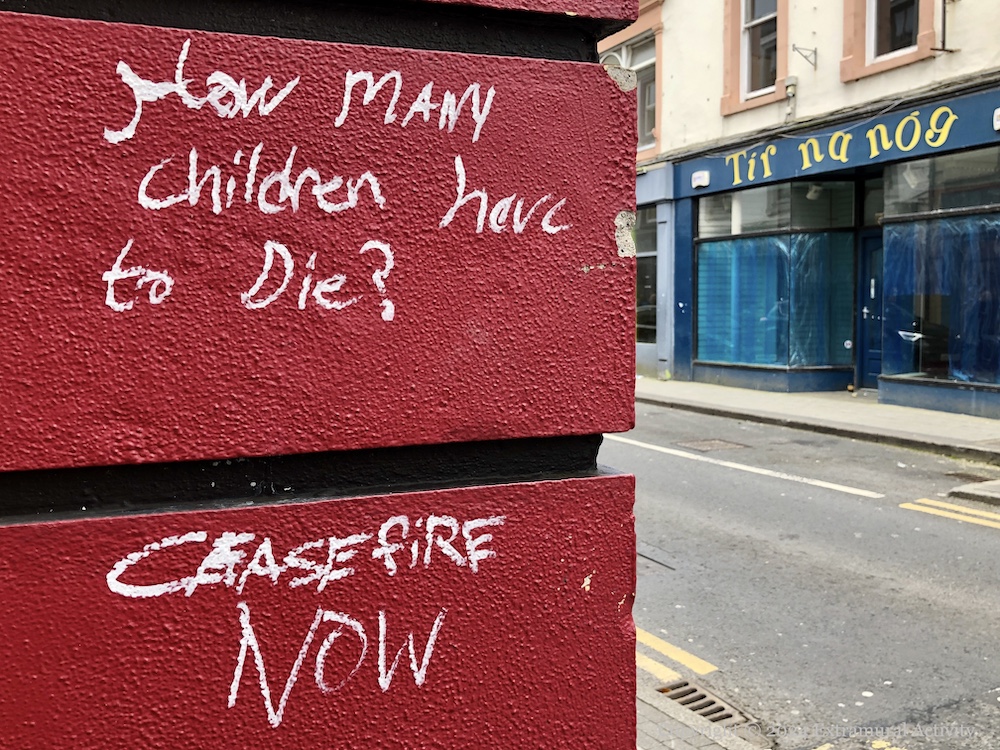
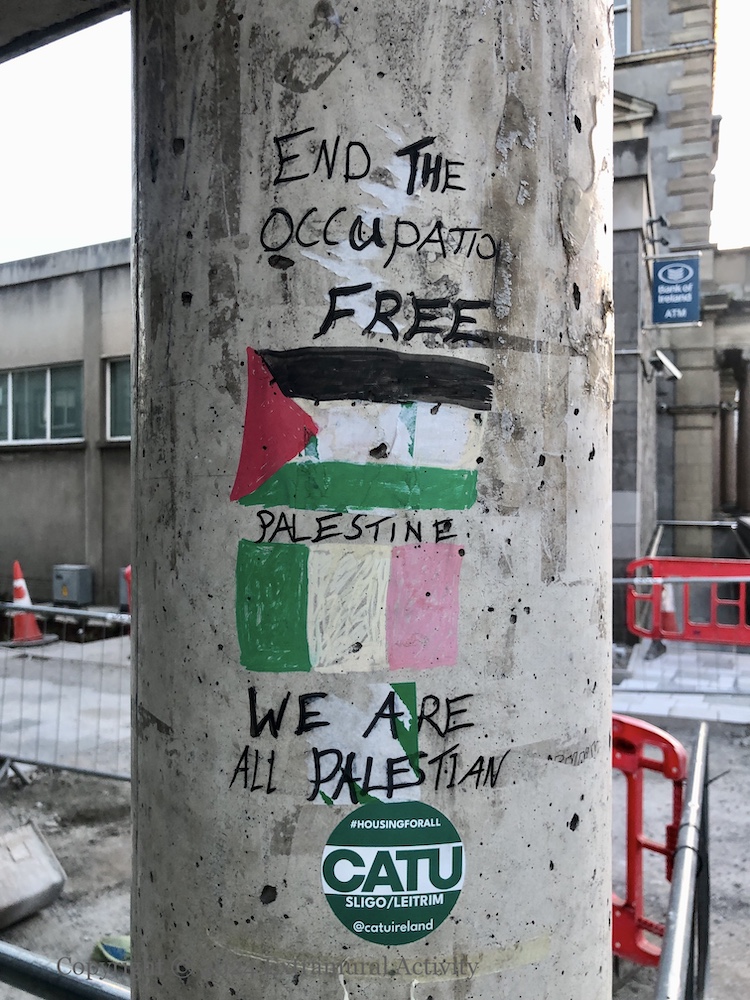
Above, “How many [Palestinian] children have to die? Ceasefire now” opposite a (former) shop called Tír Na nÓg [County/Land Of Young People], and, below, “End the occupation. Free Palestine. We are all Palest[in]ian” with drawings of Palestinian and Irish flags.
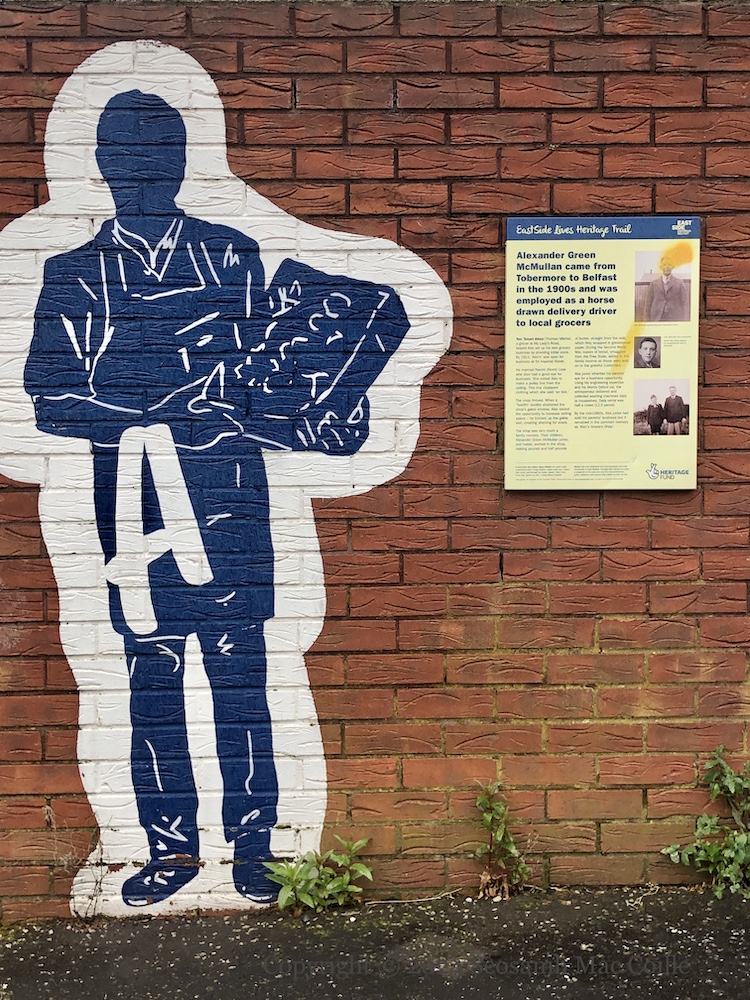
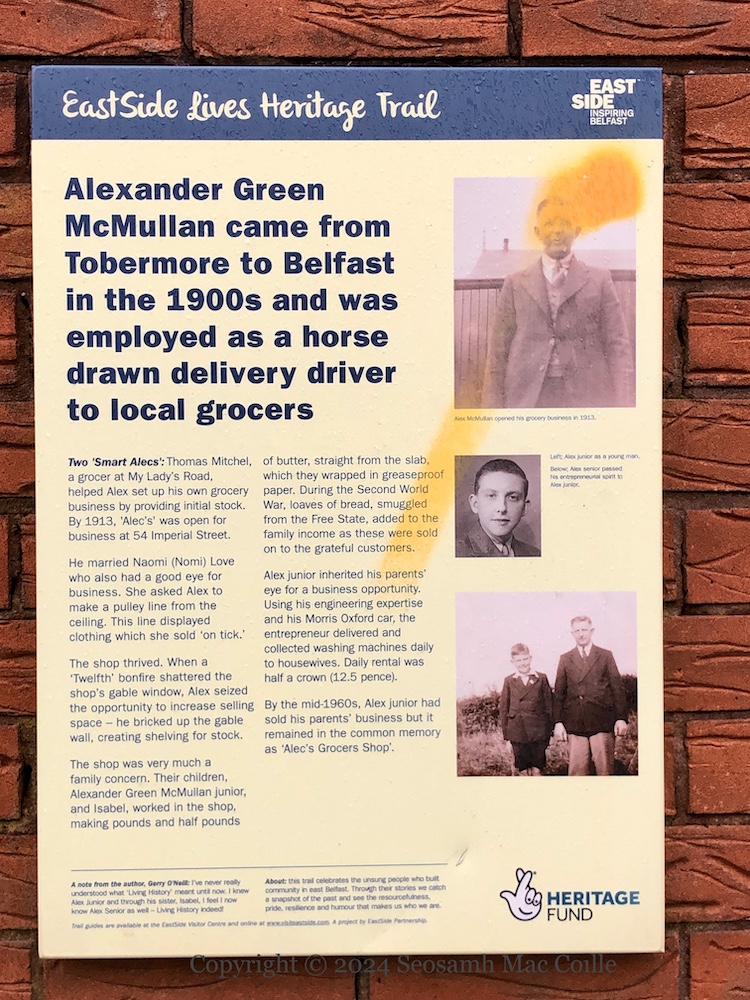
“Alexander Green McMullan came from Tobermore to Belfast in the 1900s and was employed as a horse drawn delivery driver to local grocers. Two ‘Smart Alecs’: Thomas Mitchel, a grocer at My Lady’s Road, helped Alex set up his own grocery business by providing initial stock. By 1913, ‘Alec’s’ was open for business at 54 Imperial Street. He married Naomi (Nomi) Love who also had a good eye for business. She asked Alex to make a pulley line from the ceiling. This line displayed clothing which she sold ‘on tick’. The shop thrived. When a ‘Twelfth’ bonfire shattered the shop’s gable window, Alex seized the opportunity to increase selling space – he bricked up the gable wall, creating shelving for stock. The shop was very much a family concern. Their children, Alexander Green McMullan junior, and Isabel, worked in the shop, making pounds and pounds of butter, straight from the slab, which they wrapped in greaseproof paper. During the Second World War, loaves of bread, smuggled from the Free State, added to the family income as these were sold on to the grateful customers. Alex junior inherited his parents’ eye for a business opportunity. Using his engineering expertise and his Morris Oxford car, the entrepreneur delivered and collected washing machines daily to housewives. Daily rental was half a crown (12.5 pence). By the mid-1960s, Alex junior had sold his parents’ business but it remained in the common memory as ‘Alec’s Grocers Shop’.
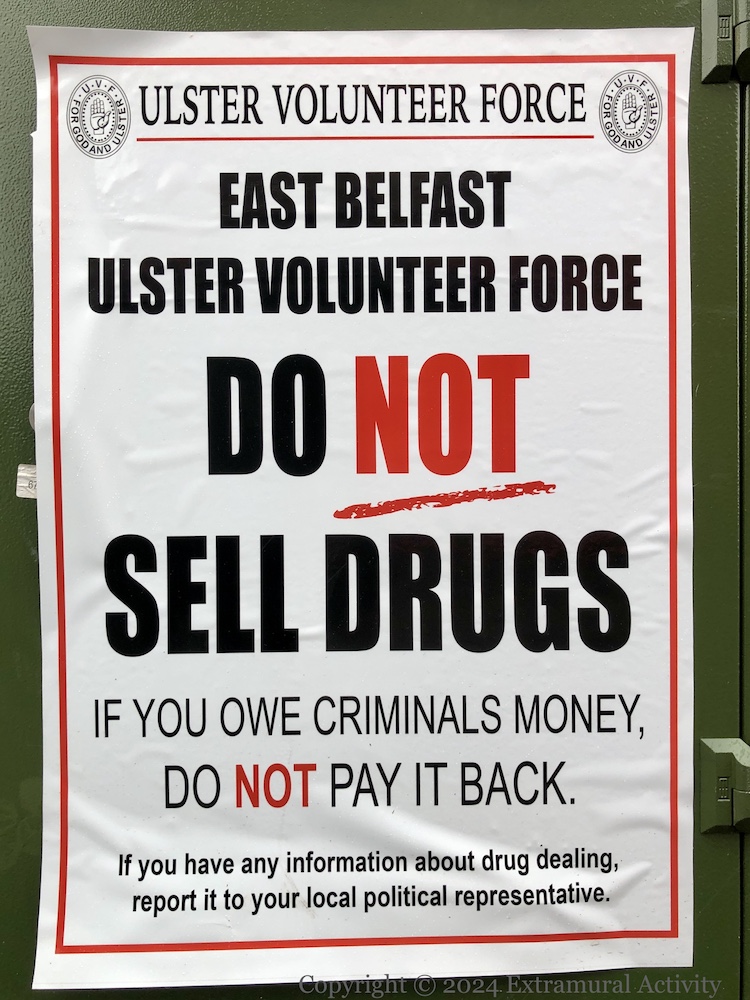
This UVF poster urges residents of east Belfast who owe money to loan sharks not to sell drugs or find some other way to pay it back, but instead to get in touch with a political representative.
The Sunday World reported that repayments are being withheld after the Shankill UVF ordered the leadership in East Belfast UVF to stand down (in November 2023 – IRN | BBC) and took over the operation. The posters thus come from the old (East Belfast) guard, trying to thwart the new bosses and hoping to resume collection themselves.
SDLP councillor Séamus De Faoıte commented (in the Irish News), “Anyone who has knowledge of criminal activity or exploitation of vulnerable people should report it to the relevant authorities, but people do not need to take any lessons from the UVF when it comes to upholding the law.” (Also: BelTel)
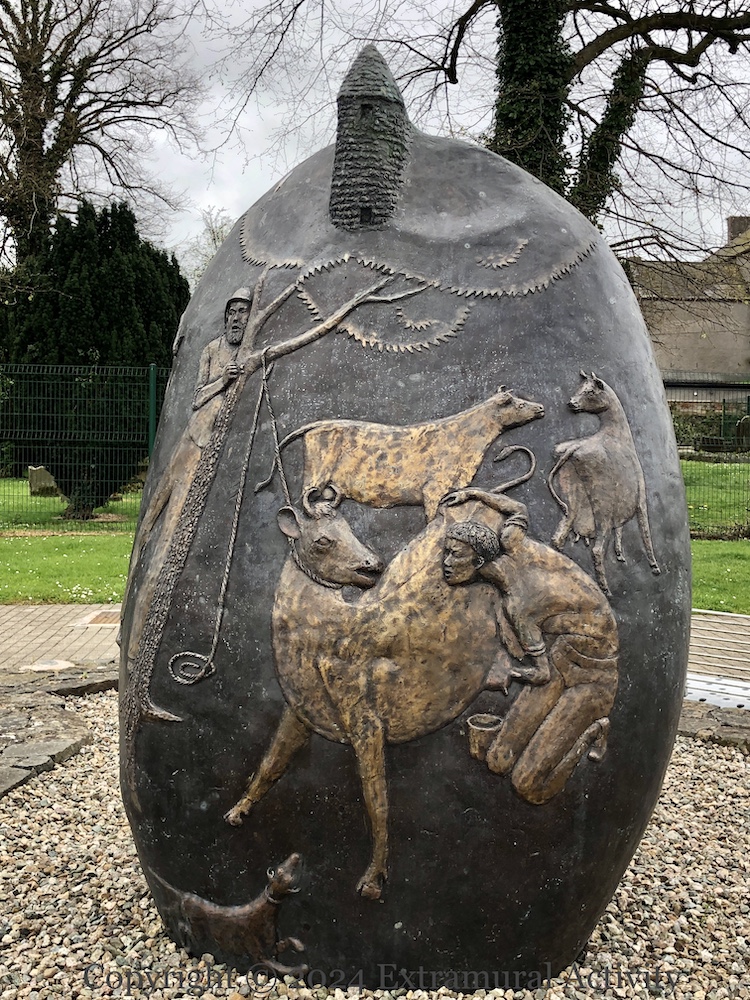
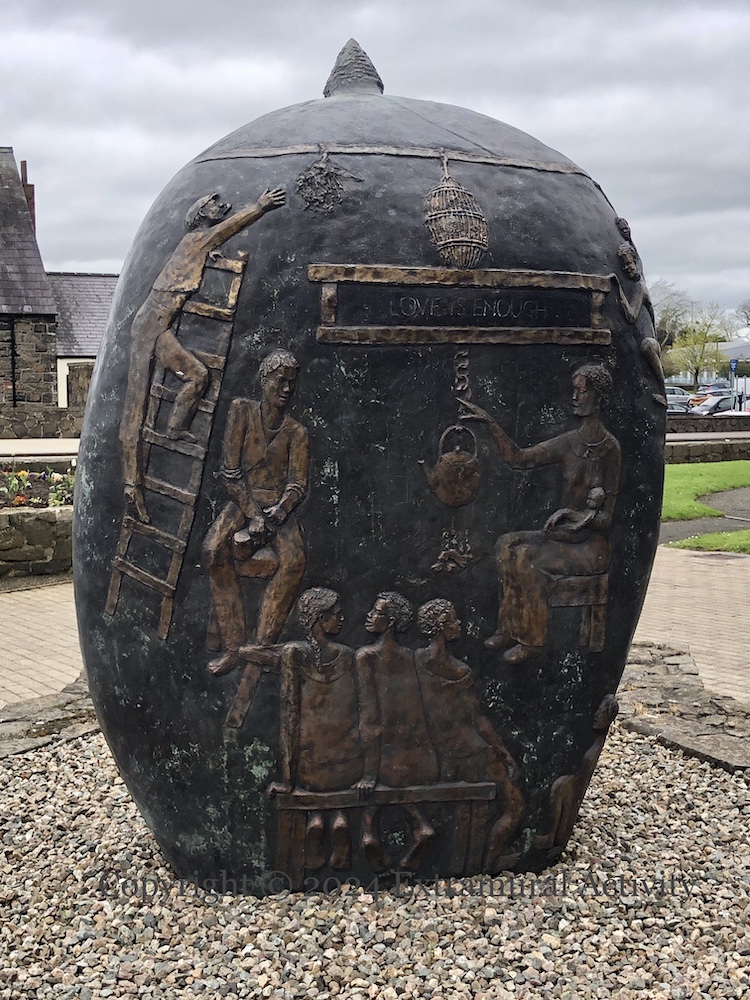
Sculptor Anna Cheyne (WP) produced the piece ‘My Lady Of The Chimney-Corner’ for Antrim Council in 1998, inspired by the domestic and farming scenes in the 1913 book of the same name by Antrim native Alexander Irvine. The book is subtitled “A story of love and poverty in Irish peasant life” – Irvine’s parents were in a mixed marriage. (You can read the book at Project Gutenberg or at Google Books).
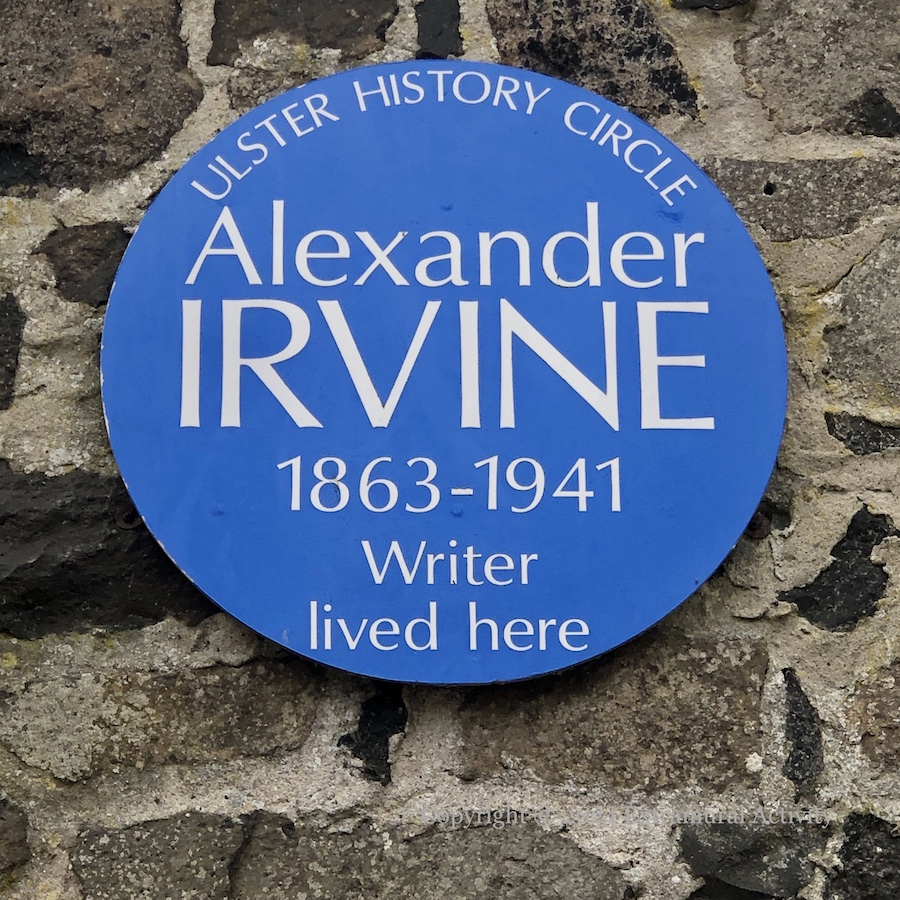
For more information on Irvine and the mural next to his Pogue’s Entry home (which is also the location of the blue plaque, below), see A Tale Of Ireland.
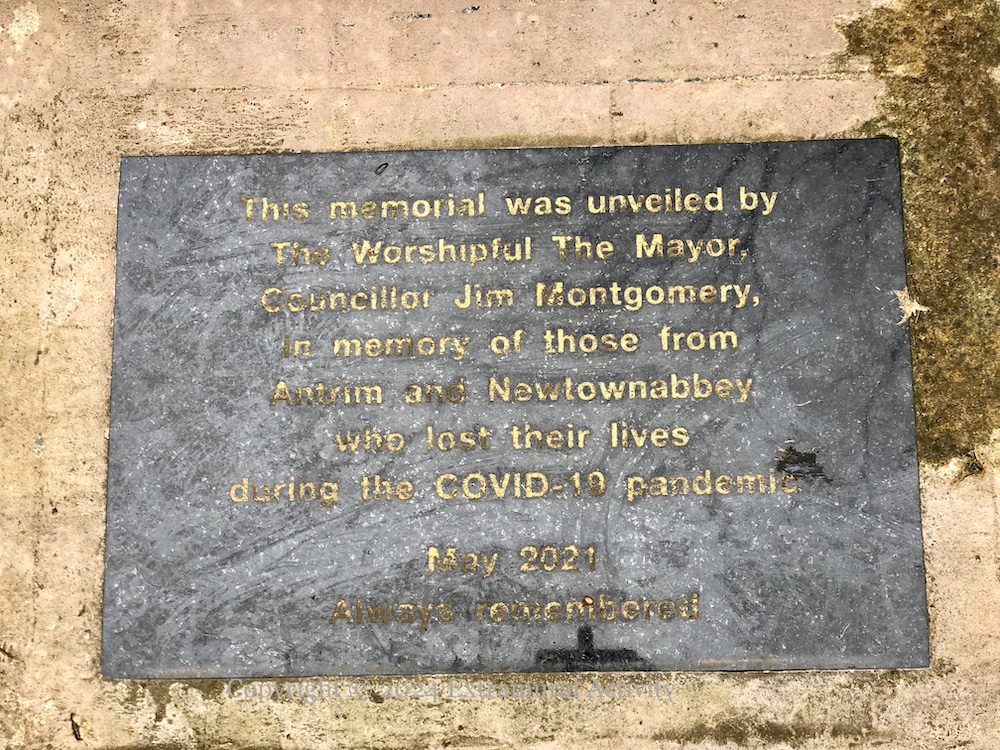
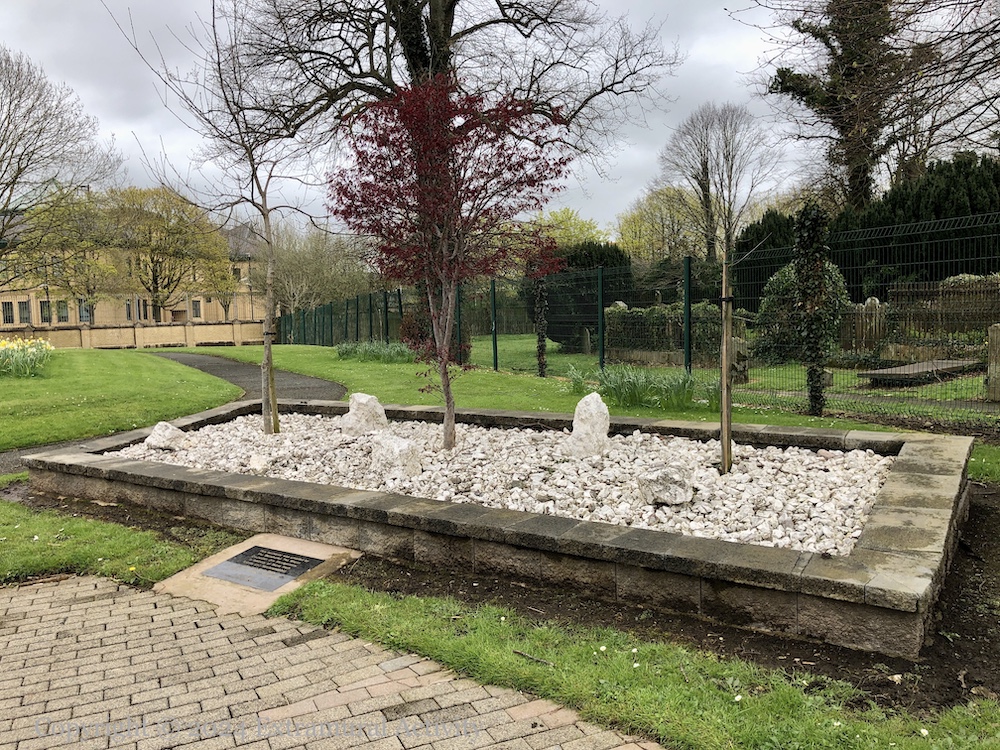
The two sides of Cheyne’s sculpture are shown above and immediately below. ‘Alexander Irvine Park’ is also home to a memorial garden to the victims of the covid-19 pandemic in the park – see the final two images, below. (A similar garden was installed at the Whiteabbey/Jordanstown foreshore.)
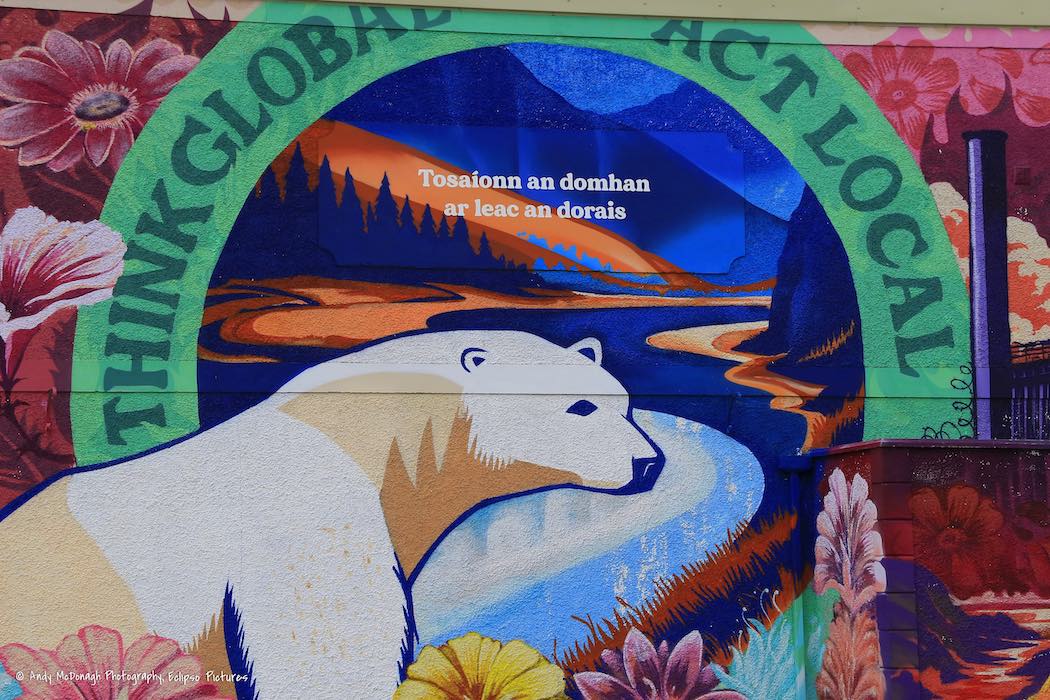
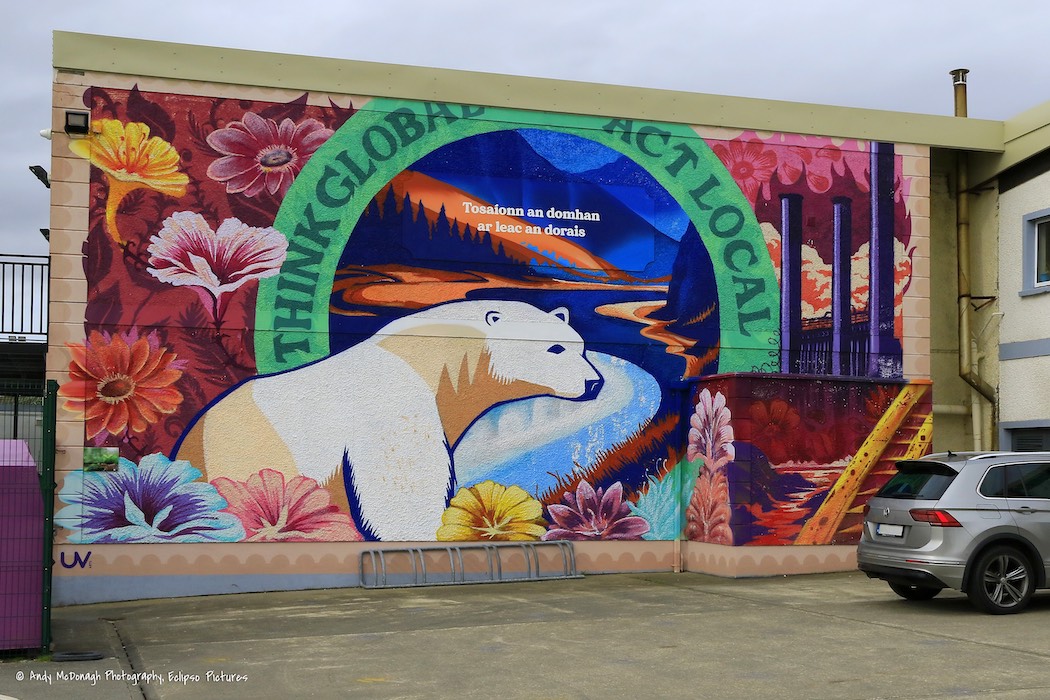
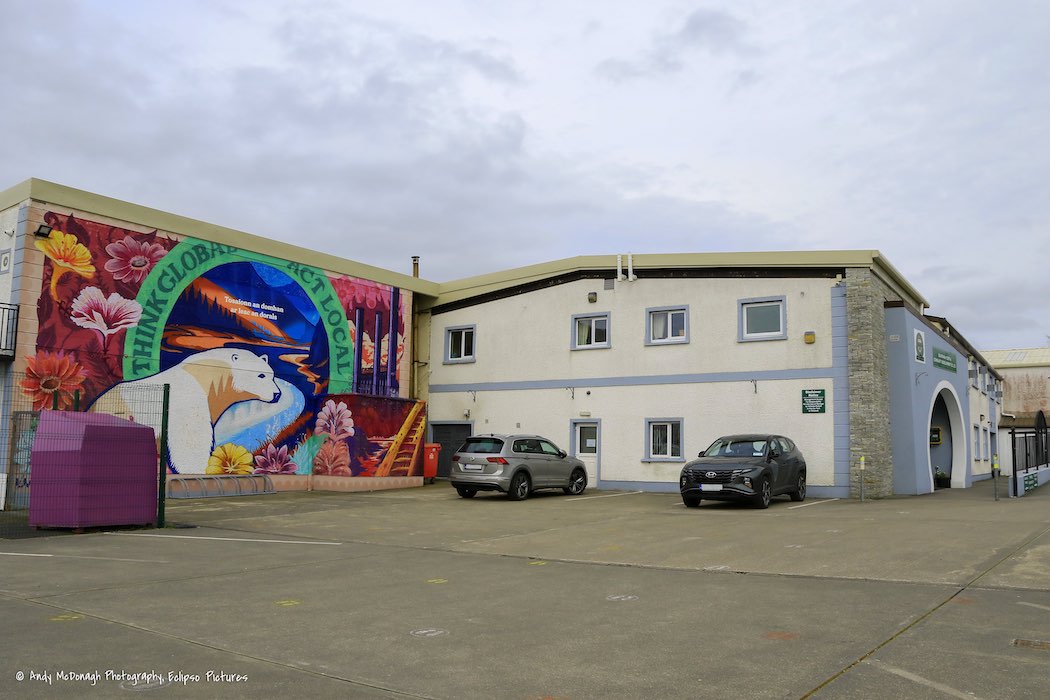
“Think global, act local – [the world begins on the doorstep]”. This environmental message is by UV Arts (ig) at Buncrana Youth Club, Castle Avenue, Buncrana, Co. Donegal (Inish Live), painted for Children In Crossfire (web | see also Derry Lama, A Wall For All, and Break The Bias).
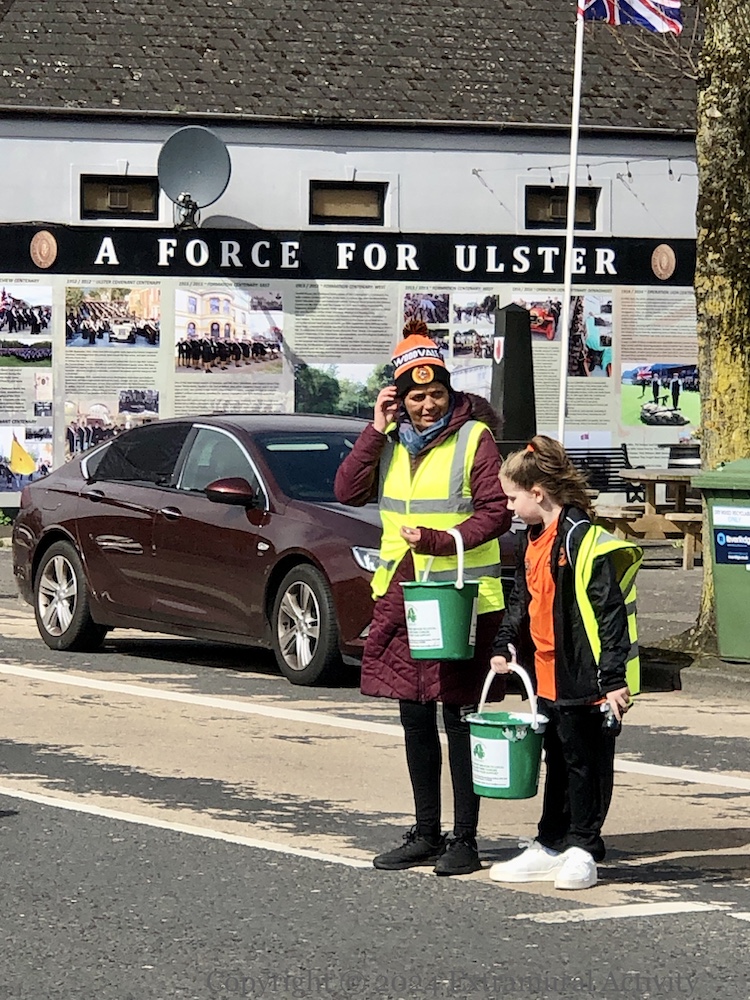
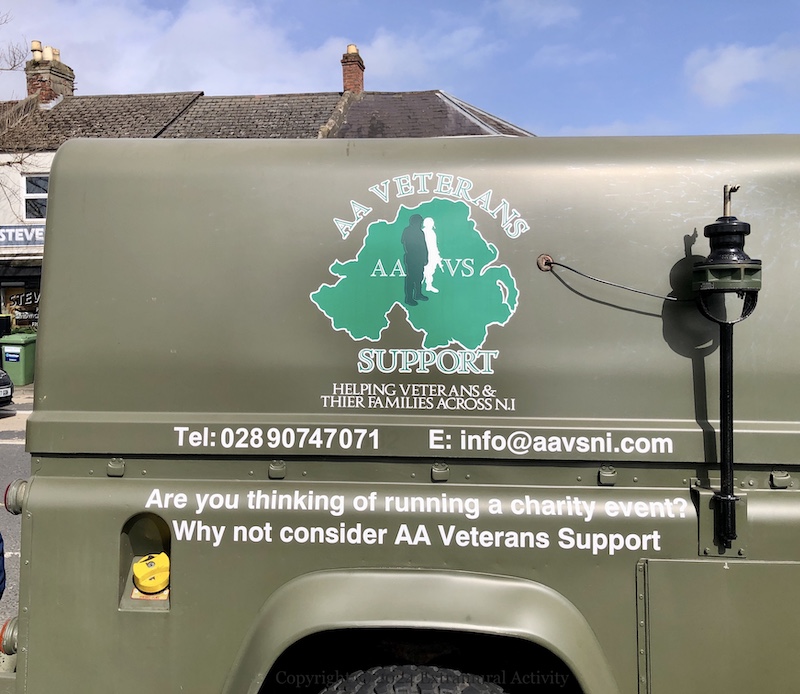
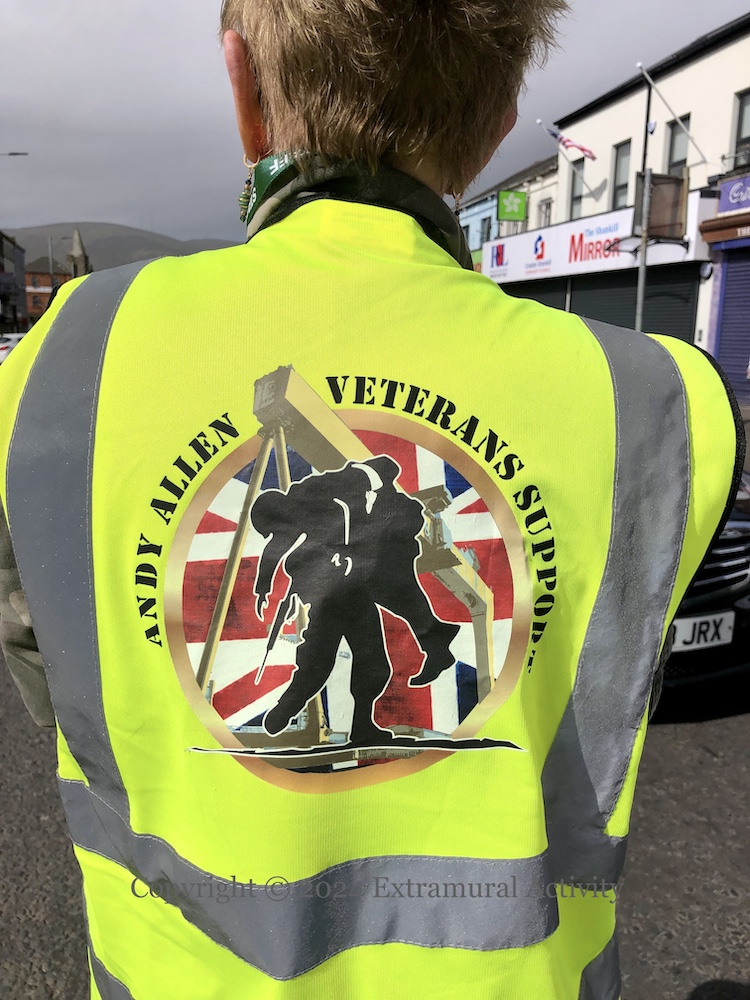
These are images of people collecting for Andy Allen Veterans Support (web) on the Shankill, Belfast. At its peak (in 1973) the UDR had more than 9,000 personnel (Statista). The UDR was amalgamated into the Royal Irish Regiment in 1992 and a 2005 estimate put the number of its veterans at about 58,000 (Veterans Services NI).
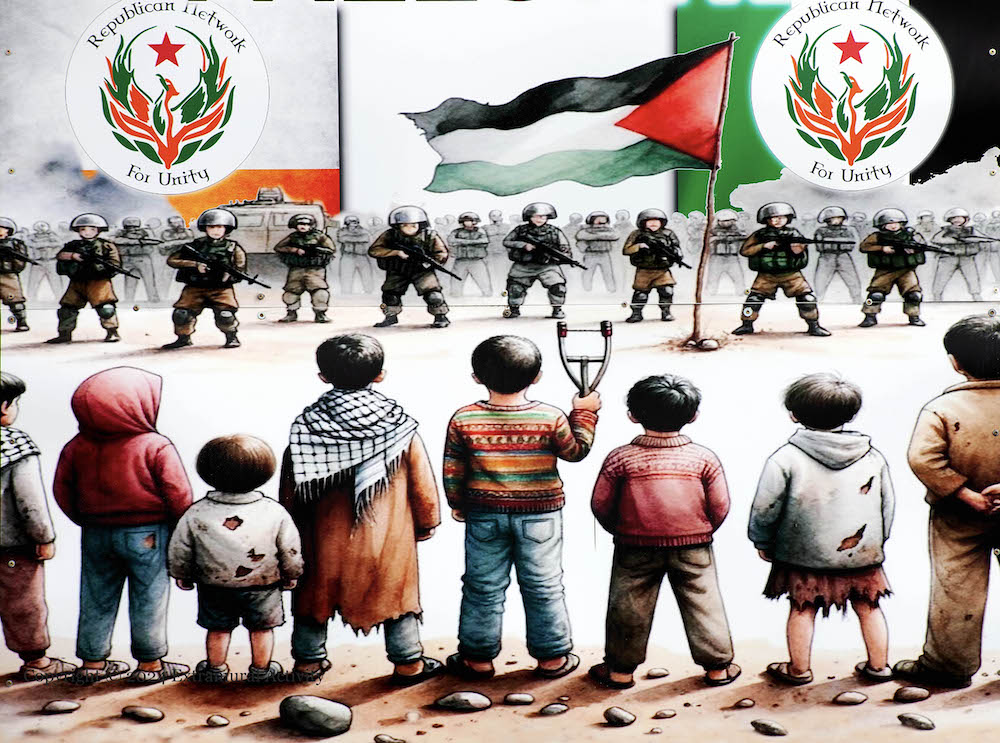
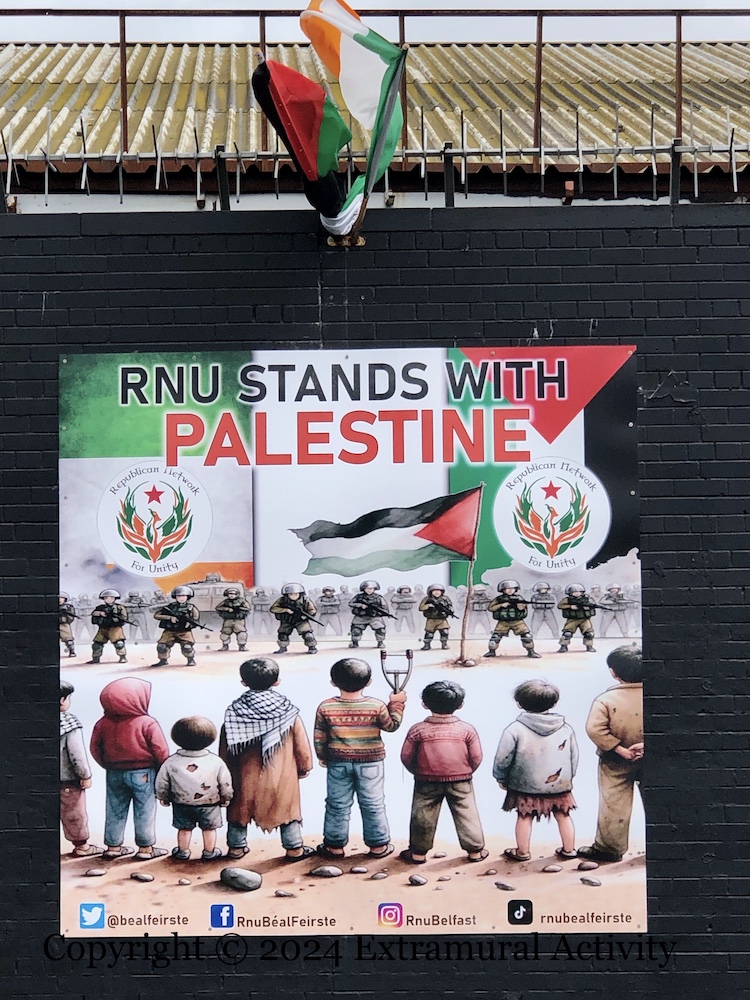
The WHO and UNRWA now estimates that of the 34,000 Palestinians killed in Gaza, about 14,000 were children (Egypt Today). 18 were killed in a single explosion in Rafah yesterday (AP). This new board in west Belfast illustrates the disparity between Israeli forces and ordinary Palestinians by showing children in ragged clothing armed only with a single, odd-looking (AI hallucinated?), slingshot facing off against other children armed with assault rifles and wearing riot gear.
Of the RNU social-media handles along the bottom, only the Facebook and TikTok ones actually work.
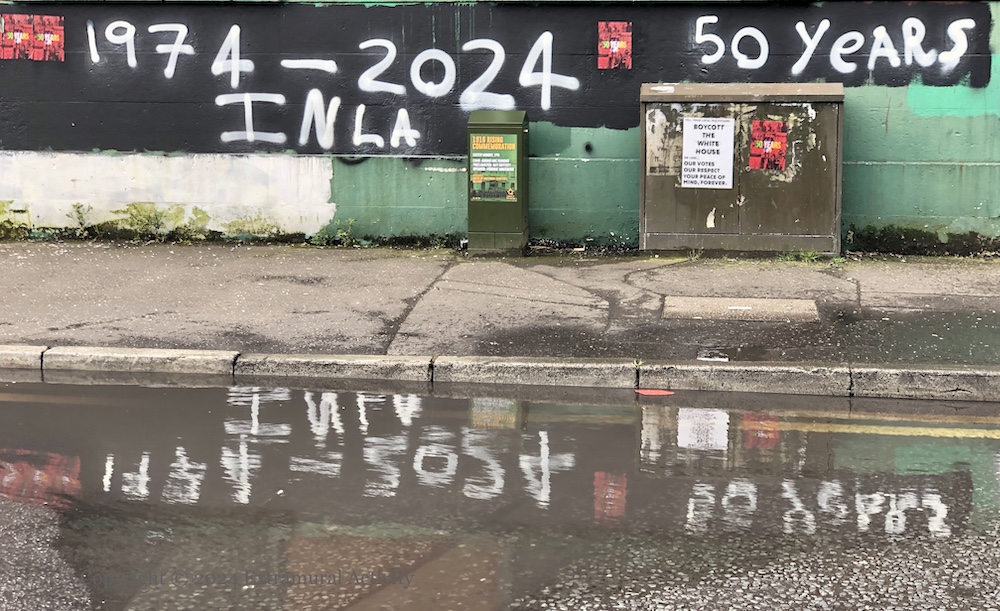
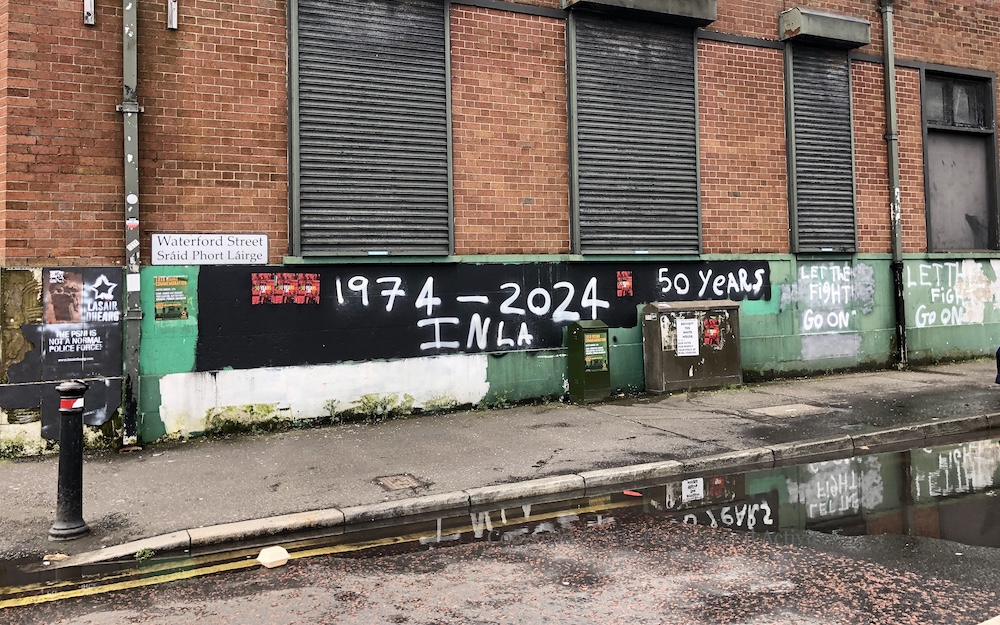
This is a west Belfast instance of INLA graffiti – seen previously in Derry (Saoırse Go Deo) – celebrating the fiftieth anniversary of the group’s founding, in December, 1974.
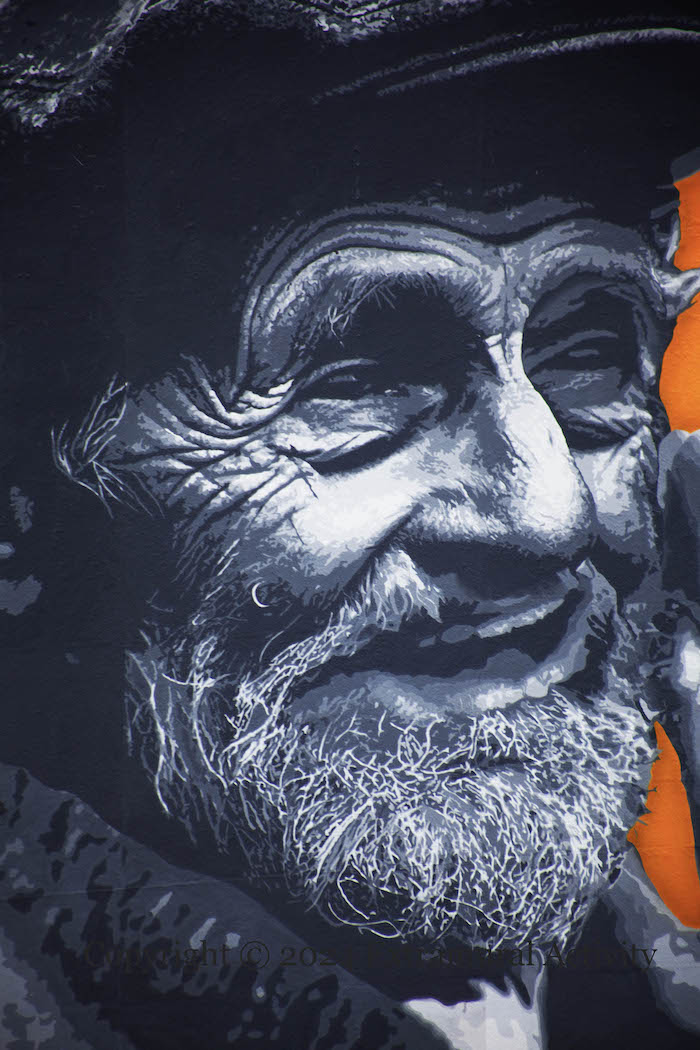
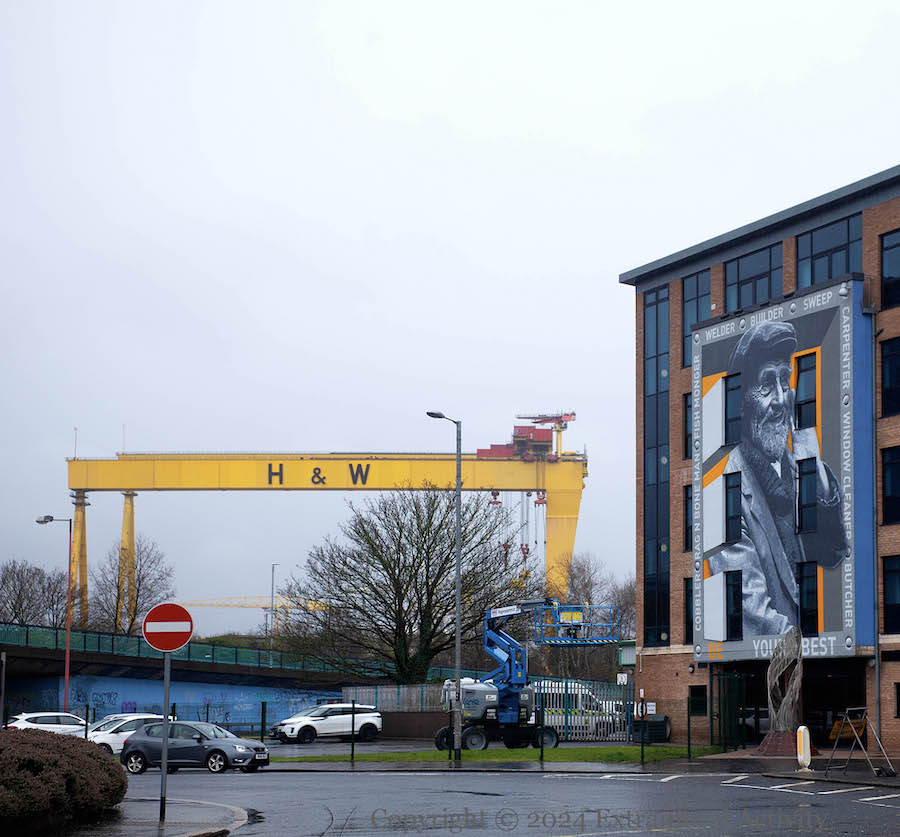
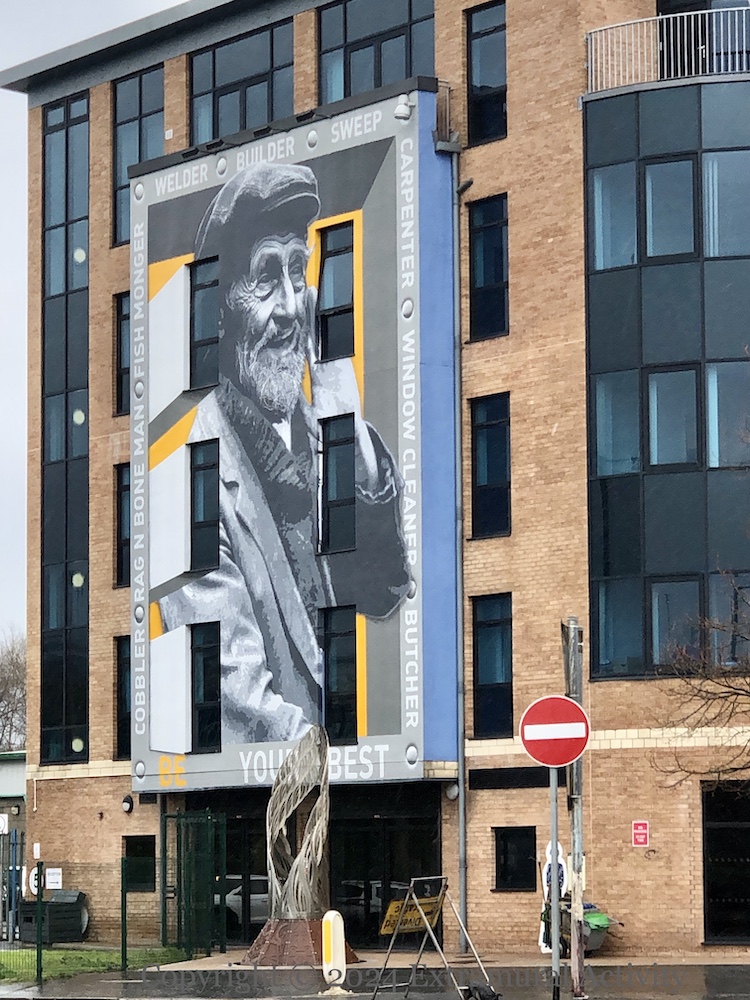
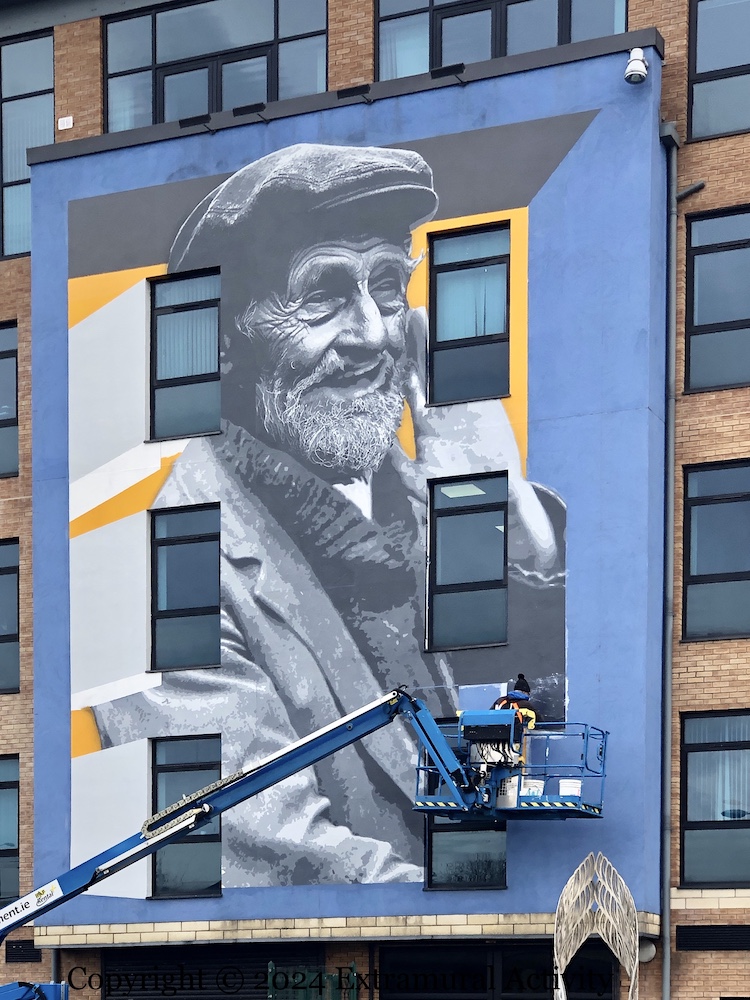
This new three-storey mural by Dee Craig (Fb) is at the city end of Newtownards Road and so serves as a highly-visible introduction to east Belfast. People arriving in the area are now greeted with a vintage image of a smiling bearded man in a cloth cap, surrounded by occupations from the industrial era: “Cobbler, rag’n’bone man, fish monger, welder, builder, sweep, carpenter, window cleaner, butcher”, capped off by an inspirational “Be your best”, with yellow highlights that match the colour of the shipyard cranes Samson and Goliath (see the third image).
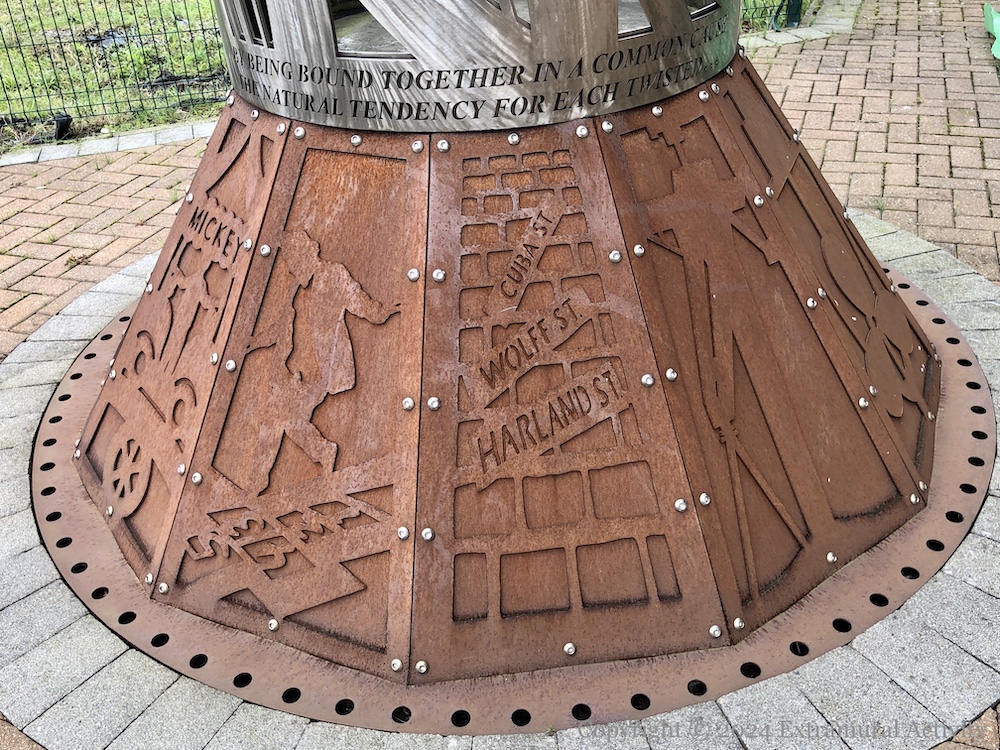
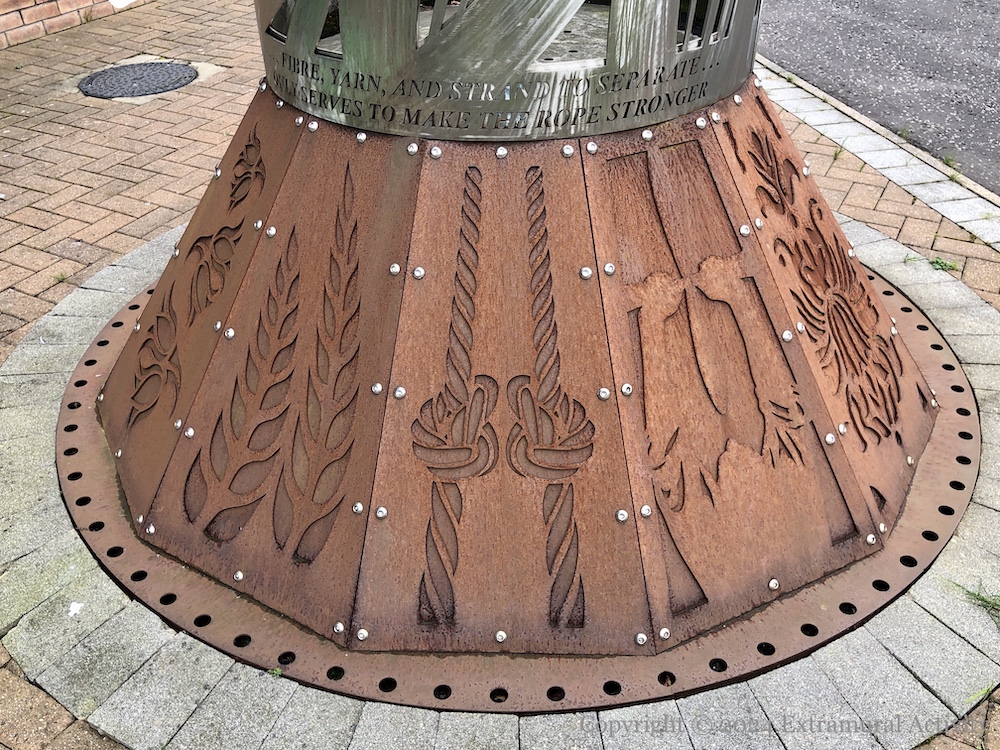
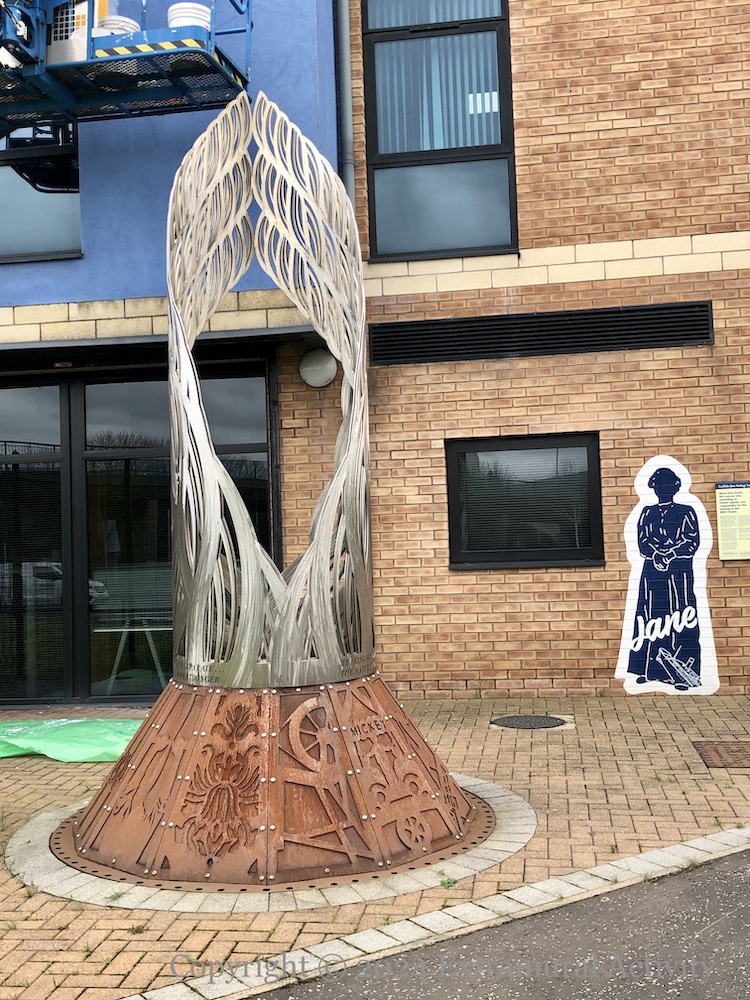
In being overshadowed by the mural, the “Let’s Twist Again” sculpture on the plaza in front of the business centre now becomes a symbol of east Belfast rather than the symbol. It too features east Belfast’s “industrial past” (BelTel), using rope as a metaphor for community: “By being bound together in a common cause, the natural tendency for each twist, fibre, yarn, and strand to separate, only serves to make the rope stronger.”
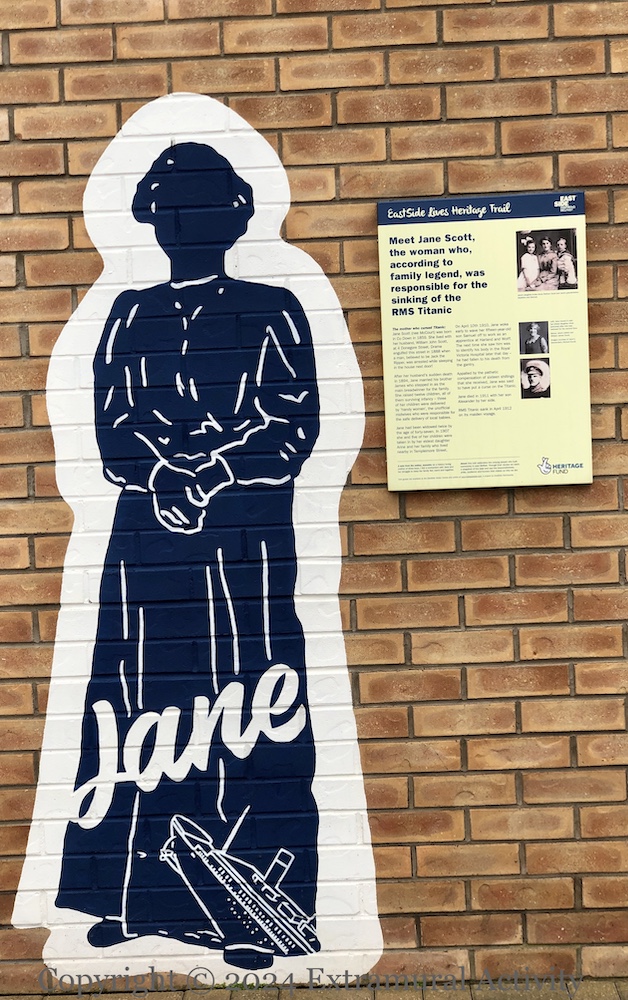
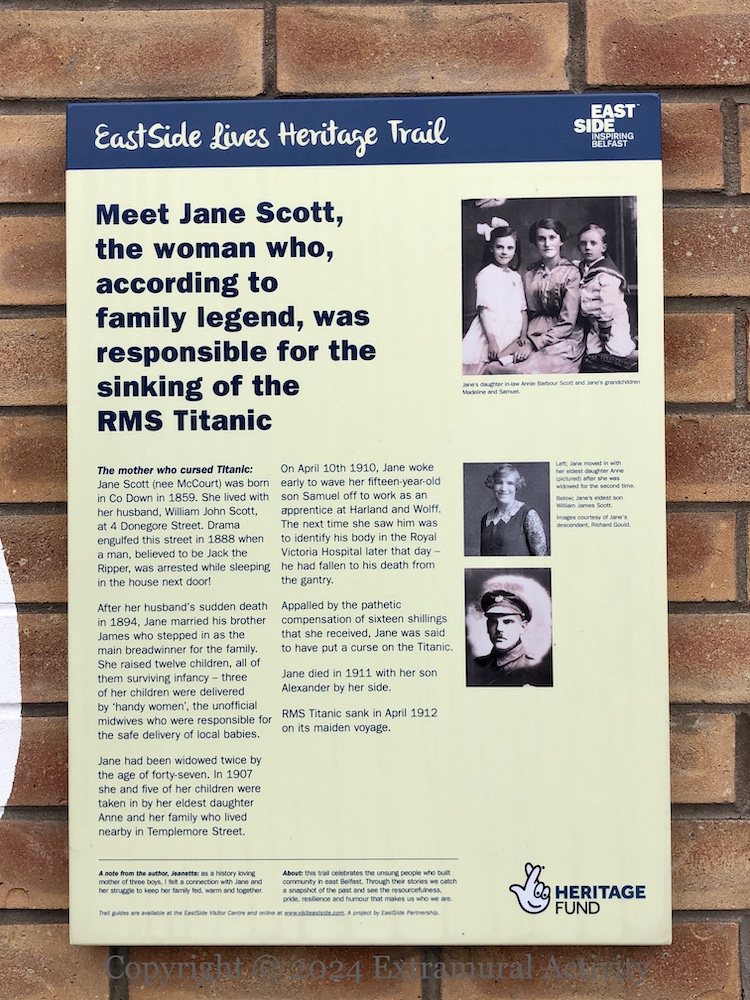
On the wall behind the sculpture and below the mural is one of the Eastside Lives Heritage Trail (pdf) figures, Jane Scott, whose fifteen-year-old son Samuel fell to his death from a ladder while working on the ship in 1910. She supposedly cursed the ship and it sank two years later. (See also Godfather Of Legal Betting and various others.)
 Seosamh Mac Coille Collection