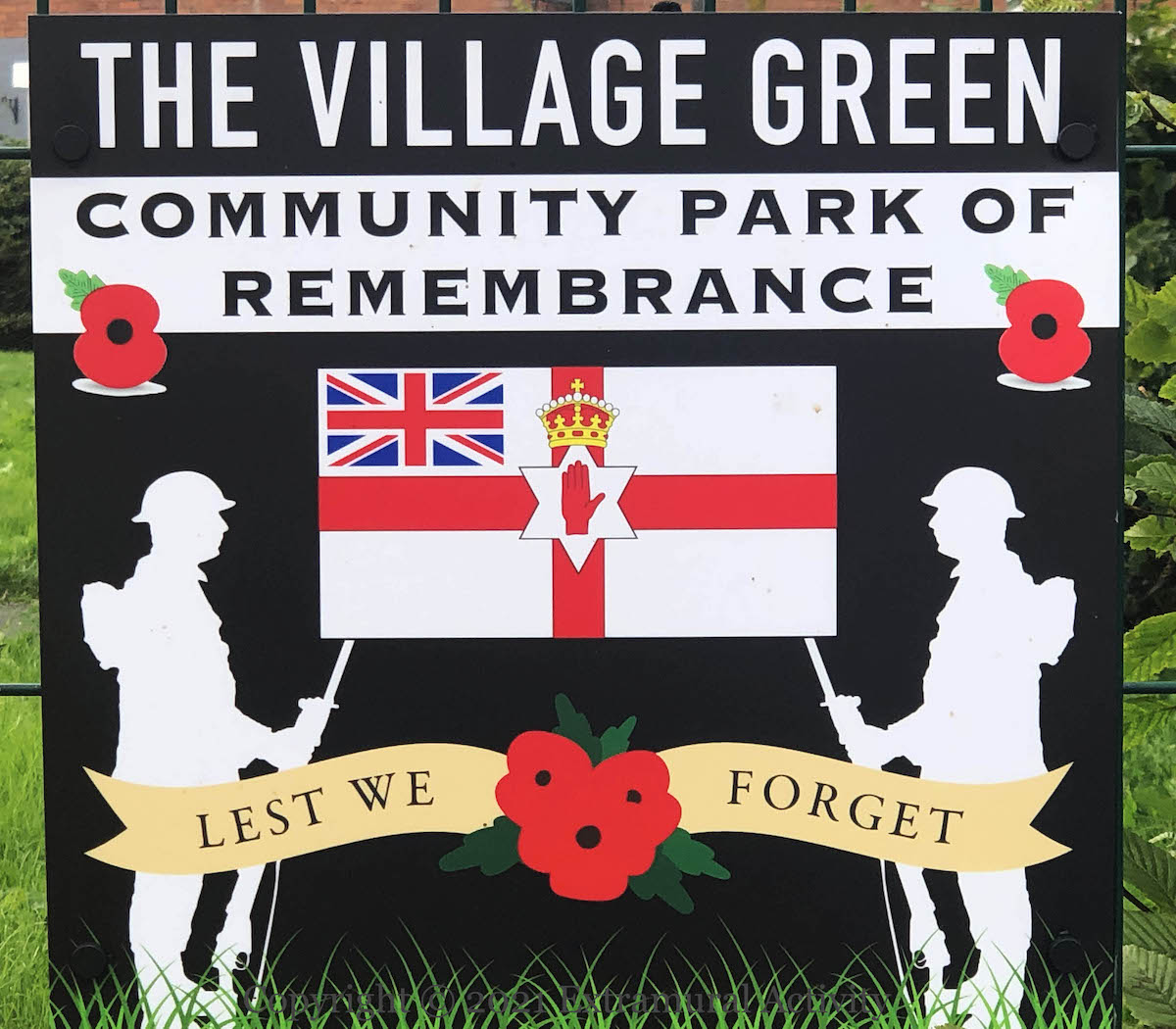
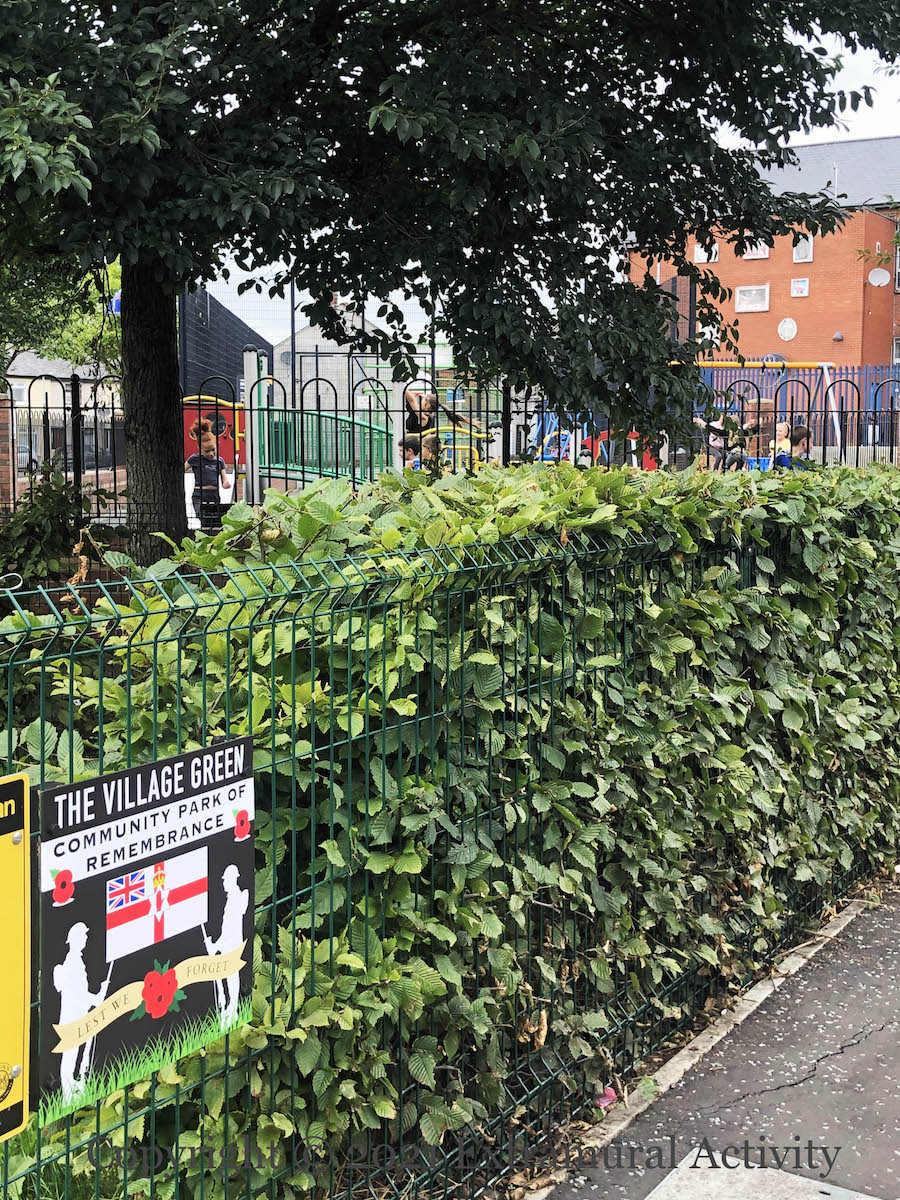
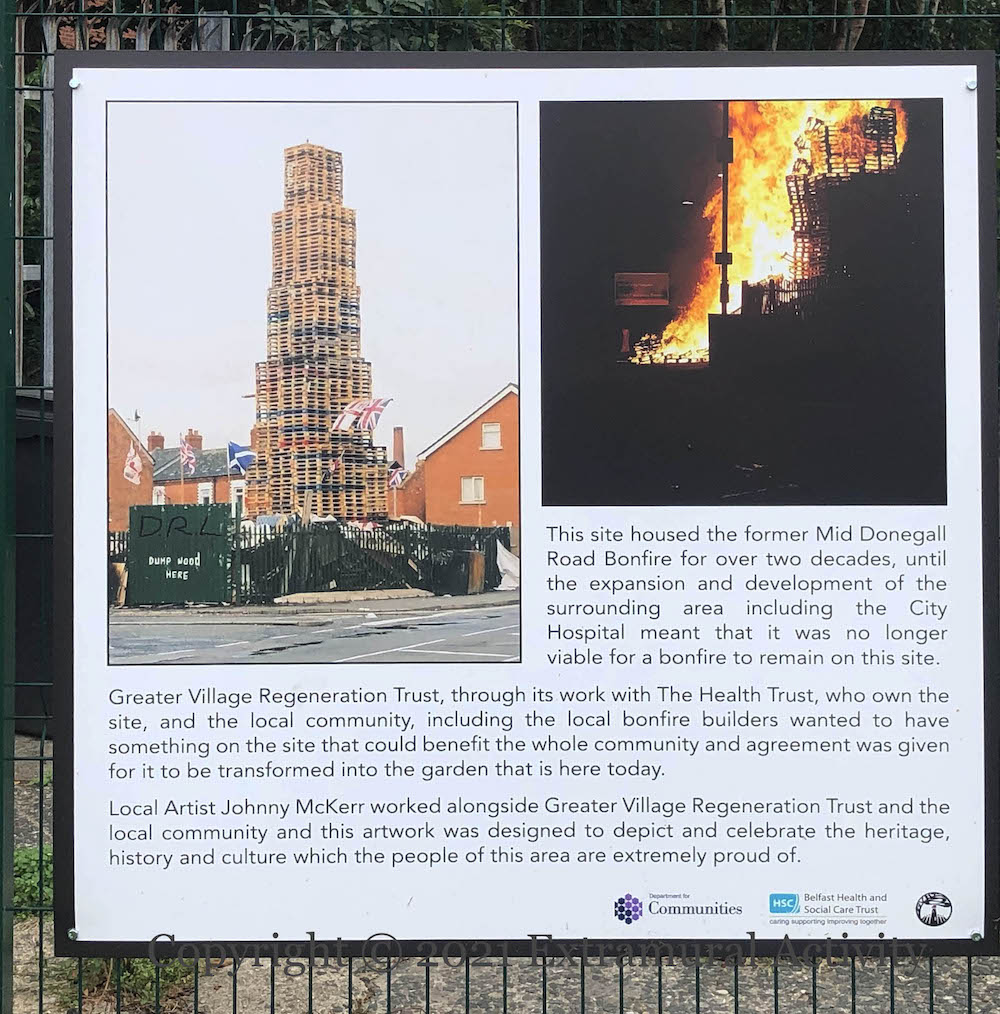
Part of the most recent development of the upper streets in the Village was not to rebuild the two rows on houses on Ebor and Nubia/Moltke streets and in their place construct a park – the Village Green – and playground. This new board on the outside railings make the park a “community park of remembrance” for WWI, showing an Ulster Banner with a Union Flag in the canton. There was formerly on this site an image of Thiepval Tower and a UVF stone.
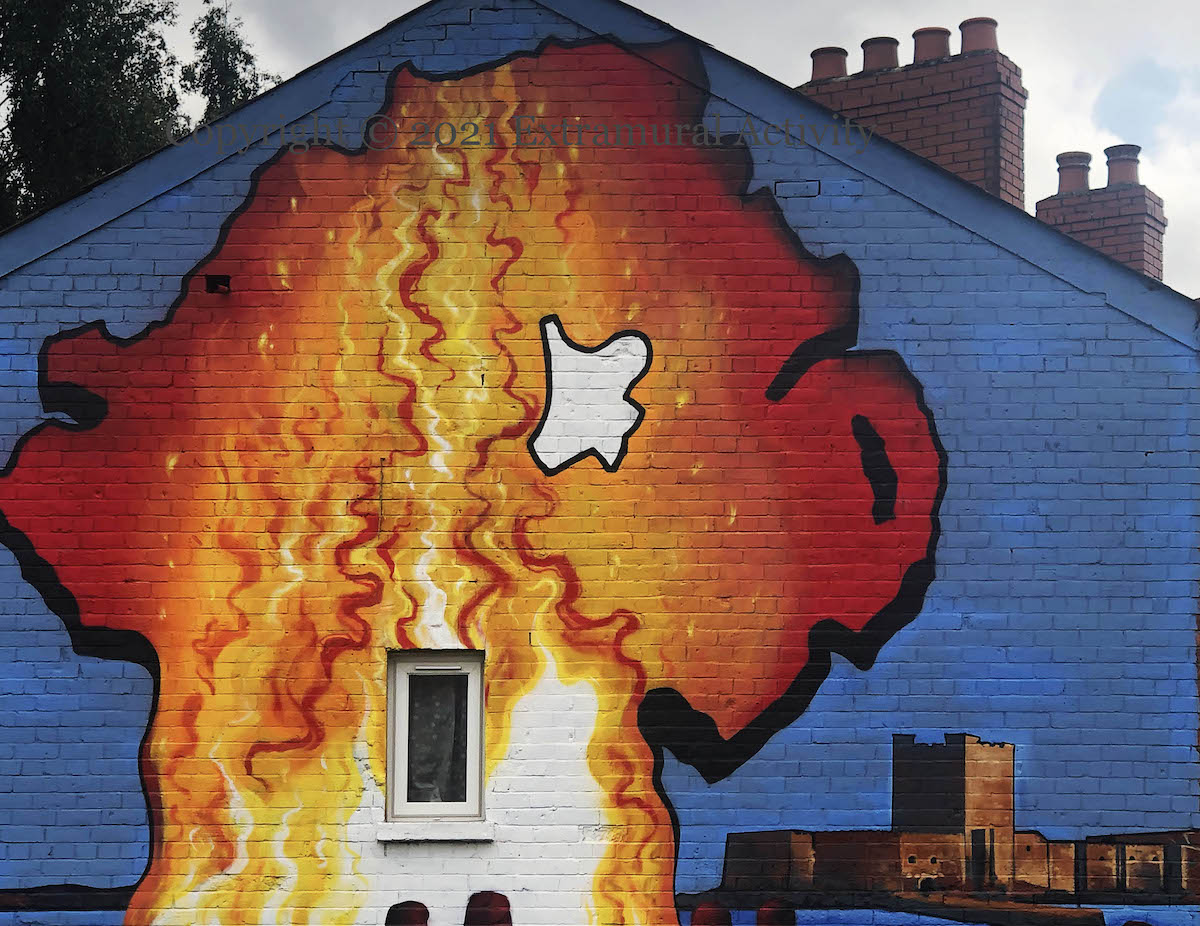
“This site housed the former Mid Donegall Road Bonfire for over two decades, until the expansion and development of the surrounding area including the City Hospital meant that it was no longer viable for a bonfire to remain on this site. Greater Village Regeneration Trust, through its work with The Health Trust, who own the site, and the local community, including the local bonfire builders wanted to have something on the site that could benefit the whole community and agreement was given for it to be transformed into the garden that is here today. Local Artist Johnny [sic] McKerr worked alongside Greater Village Regeneration Trust and the local community and this artwork was designed to depict and celebrate the heritage, history and culture which the people of this area are extremely proud of.”
The info board includes a photograph of the bonfire spilling out towards the car-park for the City. The other image is a photograph from the Peter Moloney Collection, used without permission, and photoshopped to add “DRL” – Donegall Road Loyalists.
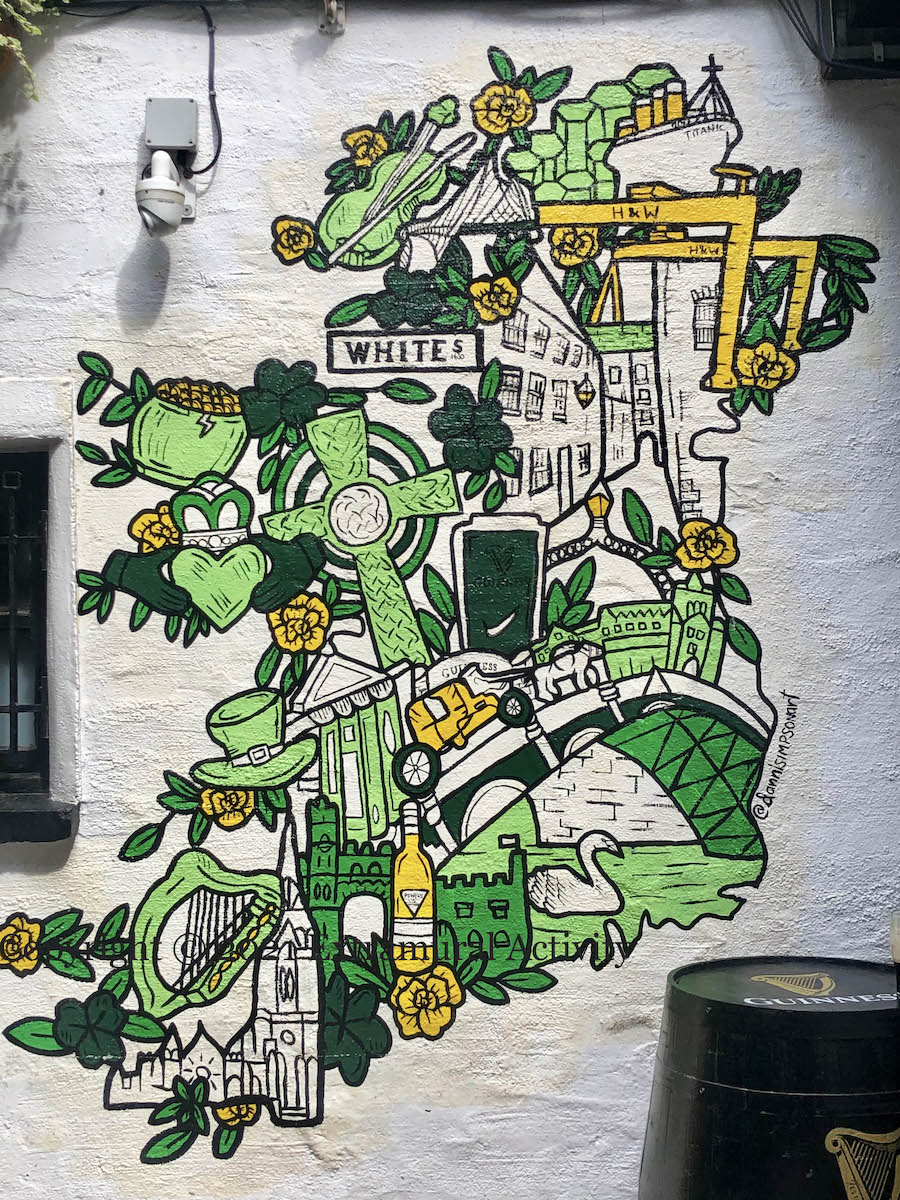
According to Eddie Kelly of the GVRT, Carrickfergus castle is included because “This is where King William landed, and the annual bonfire is a symbol of a beacon lit across the coast to guide him” (Belfast Live).
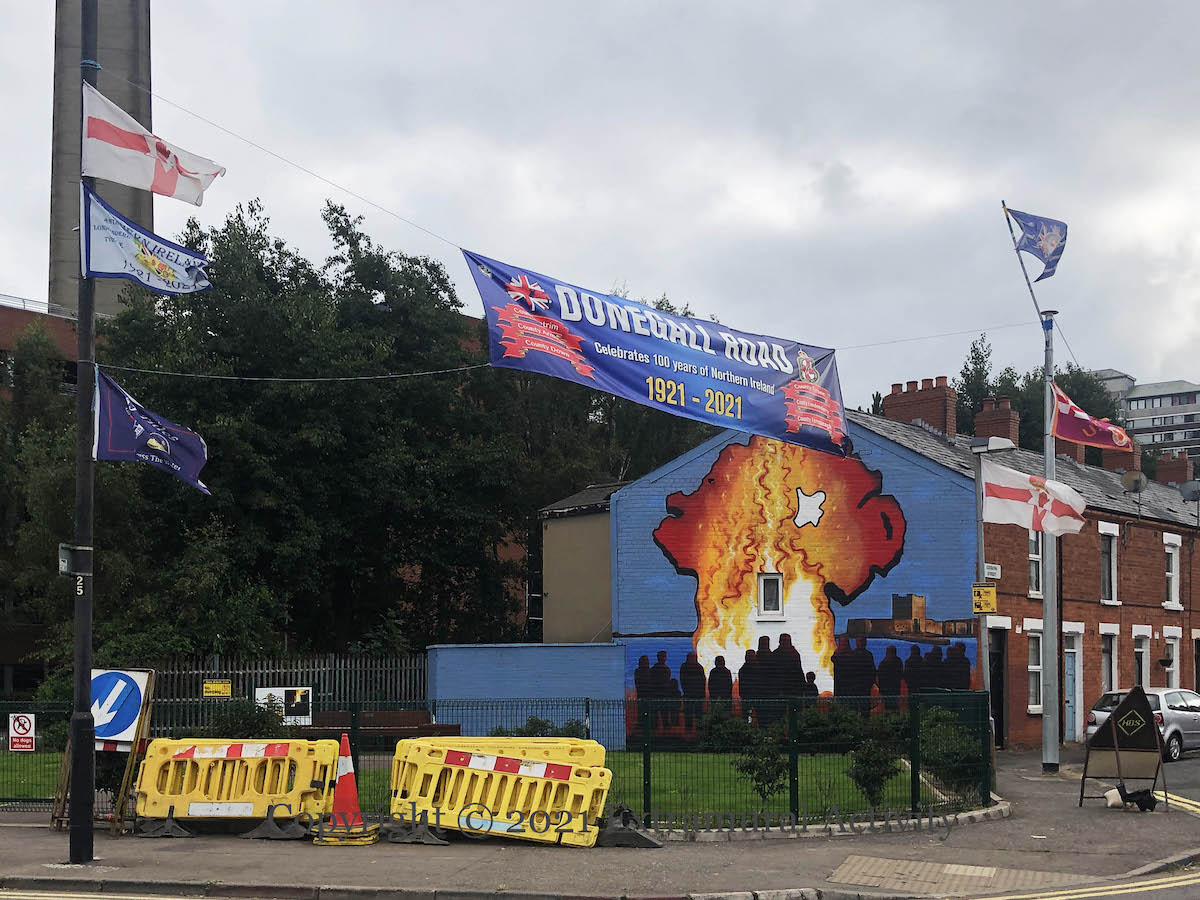
Painted by JMK/Jonny McKerr (tw) at Coolfin St on Donegall Rd.
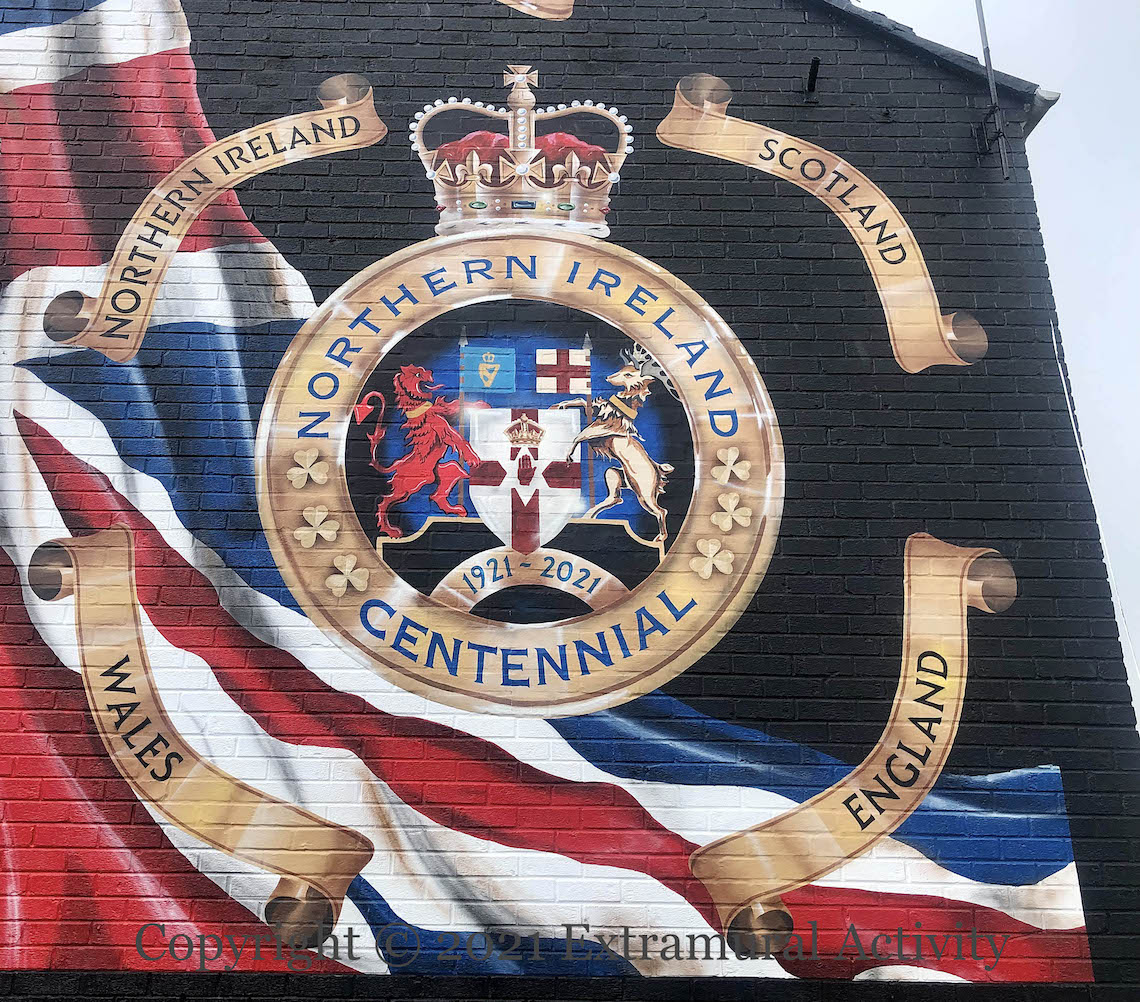
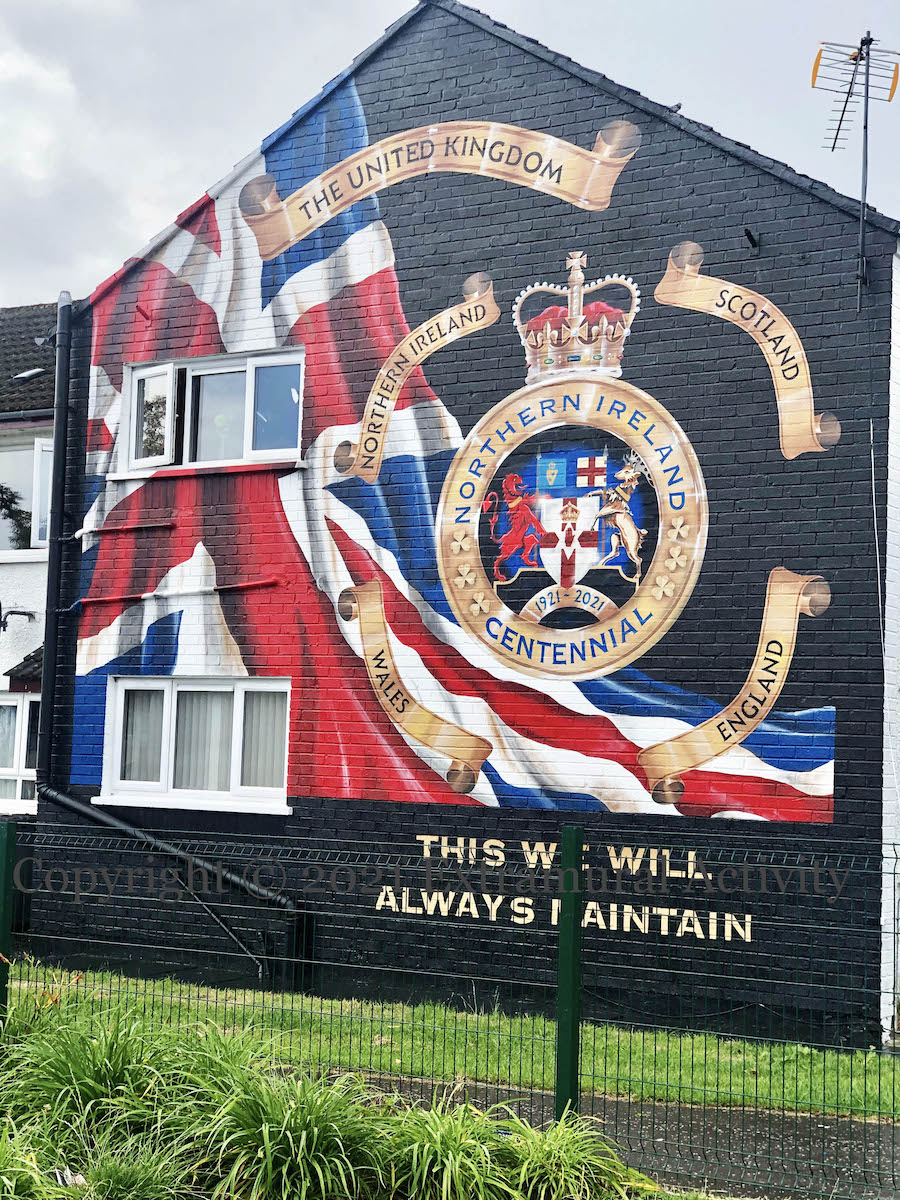
The Northern Ireland government’s coat of arms was approved for use in 1924, three years after the government was established. Its “supporters” – the red lion of Scotland and an Irish elk, carrying (respectively) Irish harp and De Burgh flags, and standing on a grassy mound with flax plants – were added later.
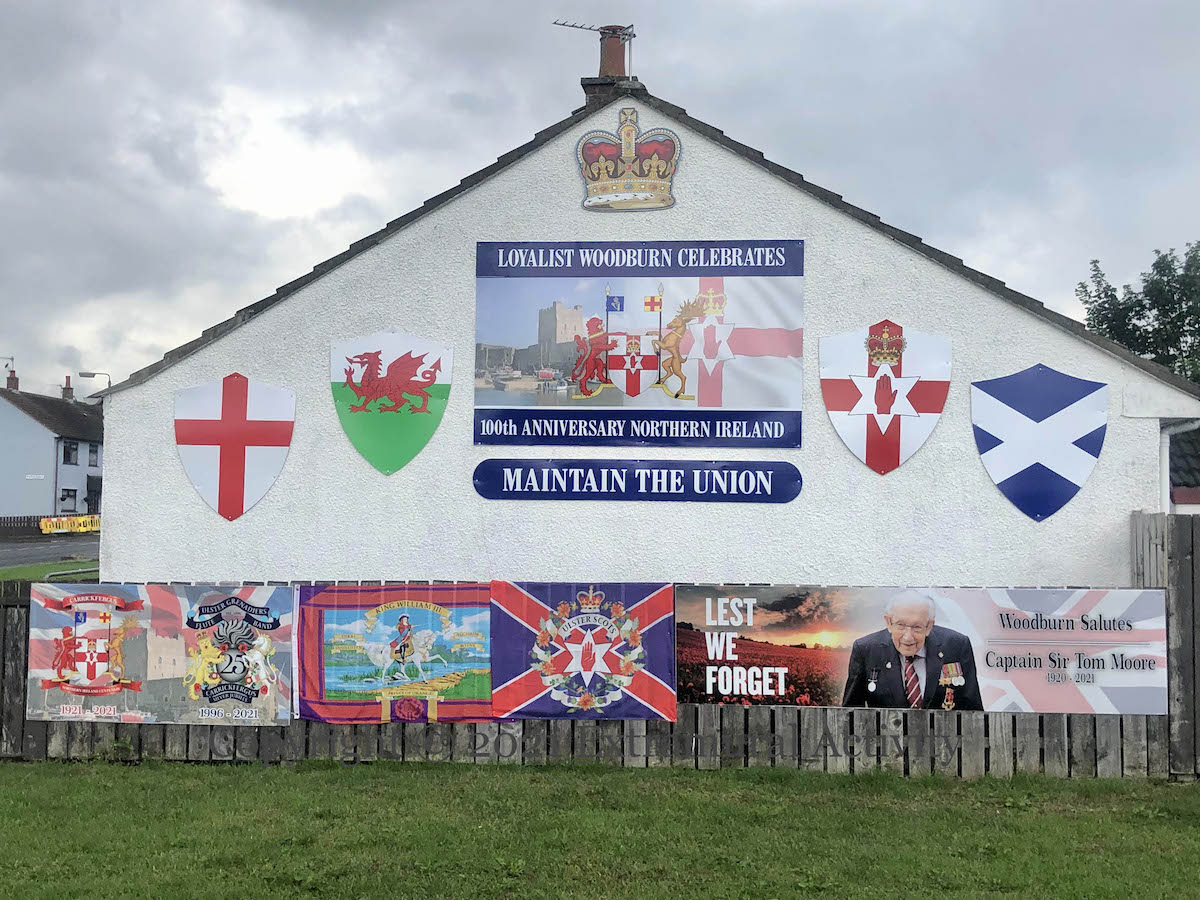
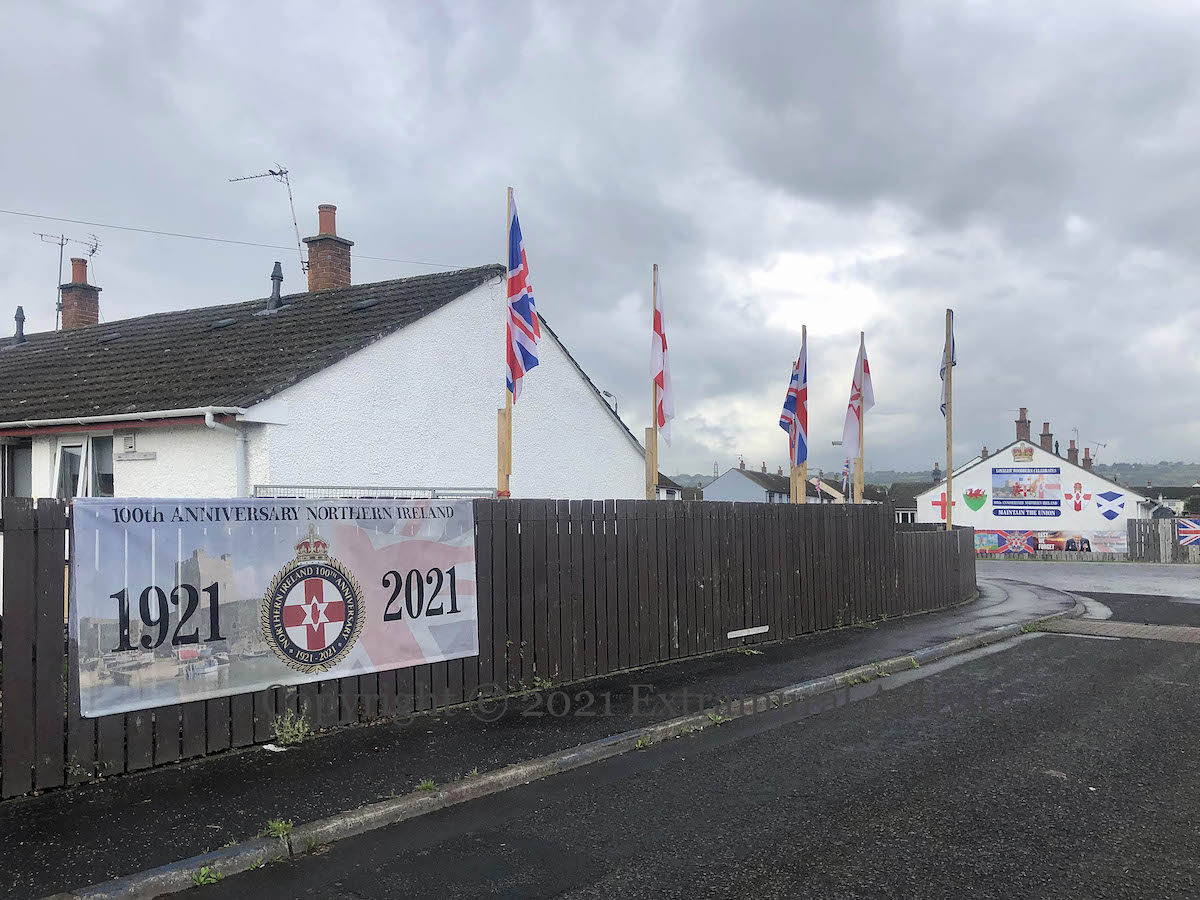
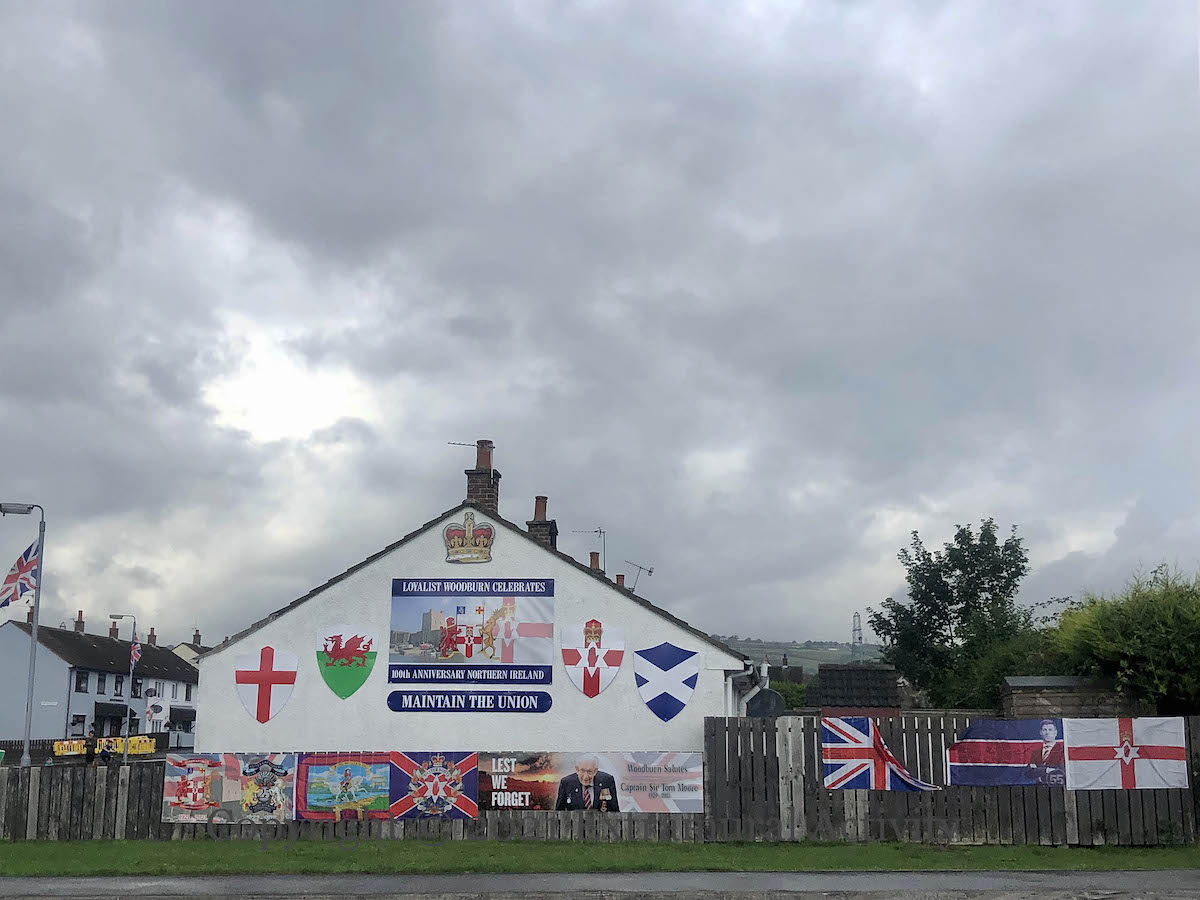
This mural celebrating the centenary of Northern Ireland’s creation, in the Woodburn estate, Carrickfergus, accurately shows the Tudor crown on the arms, as was used at the time of creation and prior to the Edwardian crown (WP).
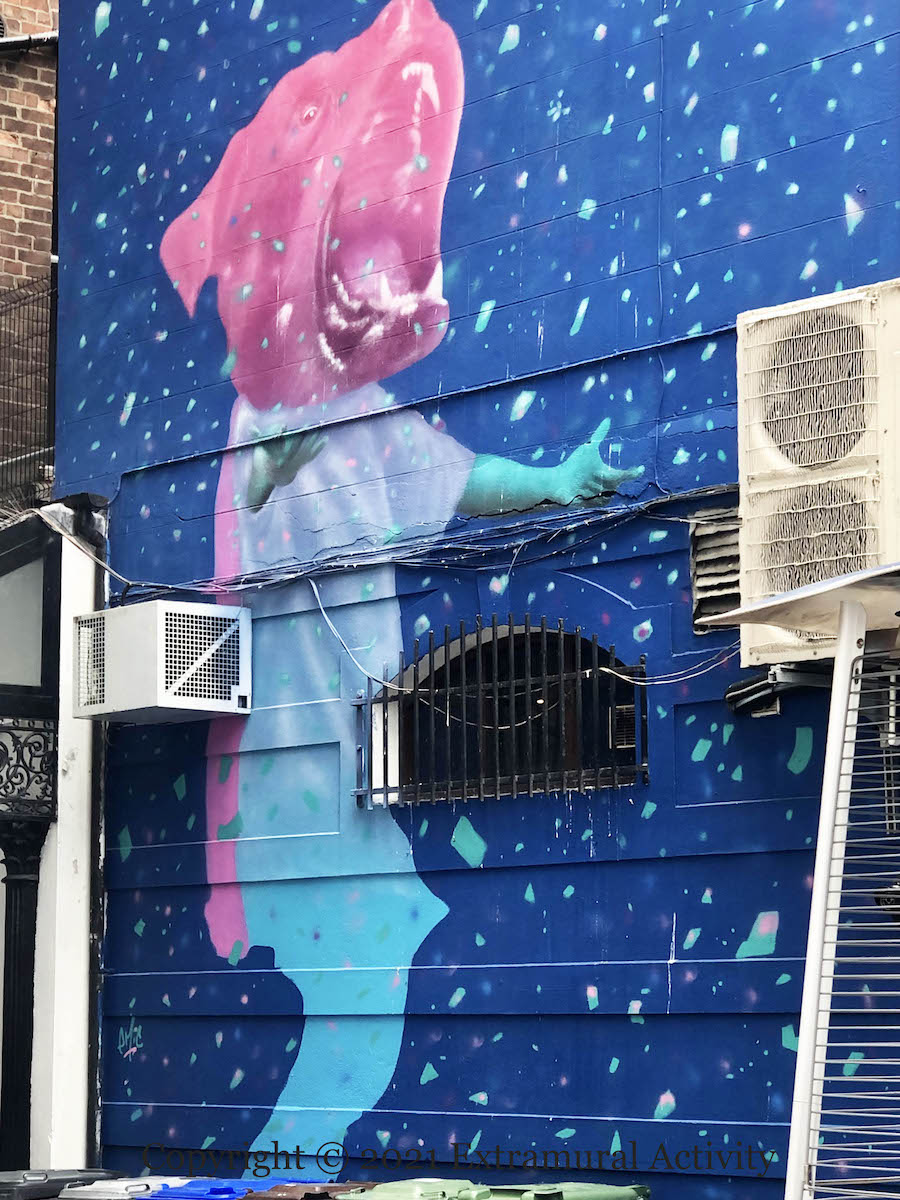
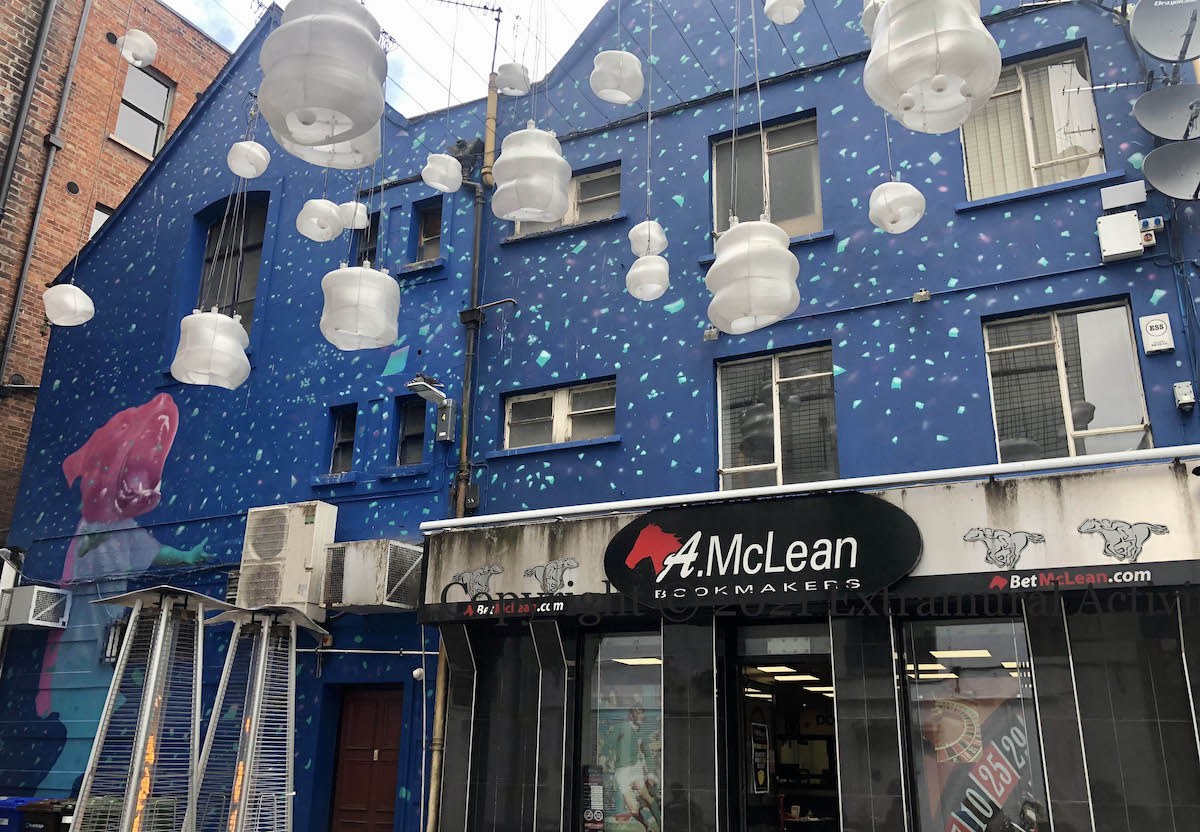
Work by emic (ig) – official title Ffallen [sic] – in Winecellar entry, inspired by Ciaran Carson’s Belfast Confetti, itself inspired by “a public notice from the corporation of Belfast (1678) which highlights a growing problem of Butchers and Tanners mastiff dogs attacking livestock, people, and even young children in the city” (Belfast Walking Tours). The wide shot (below) shows “3D printed floating orbs were created from recycled ocean plastics suspended over the central courtyard” (BCC).
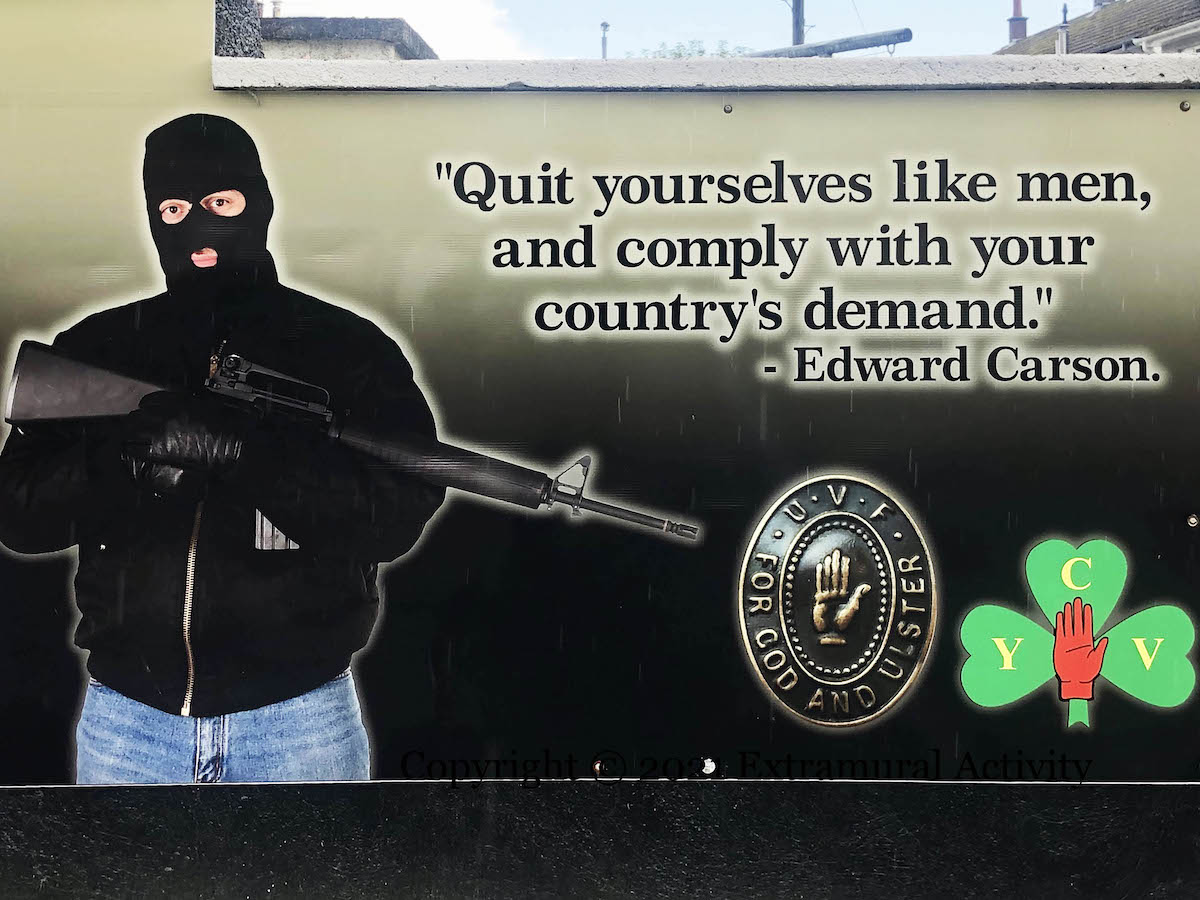
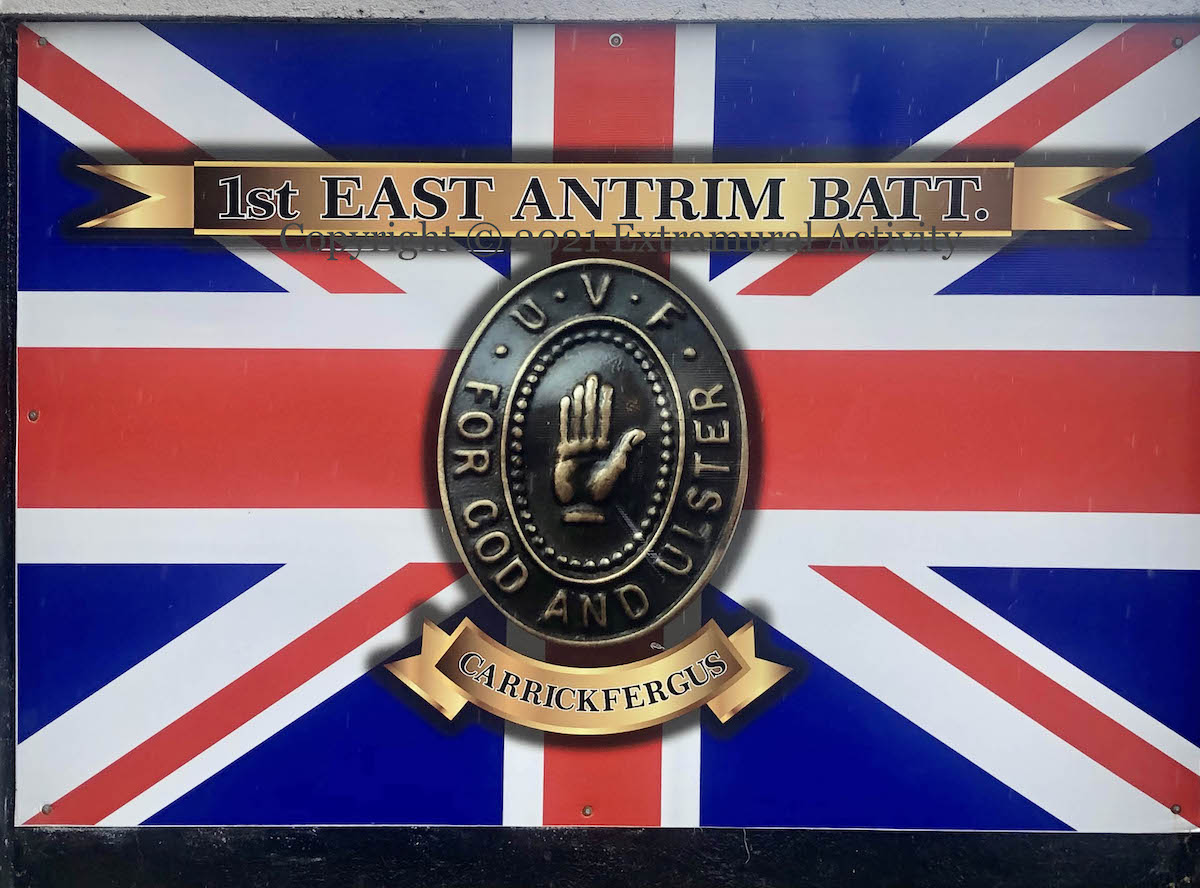
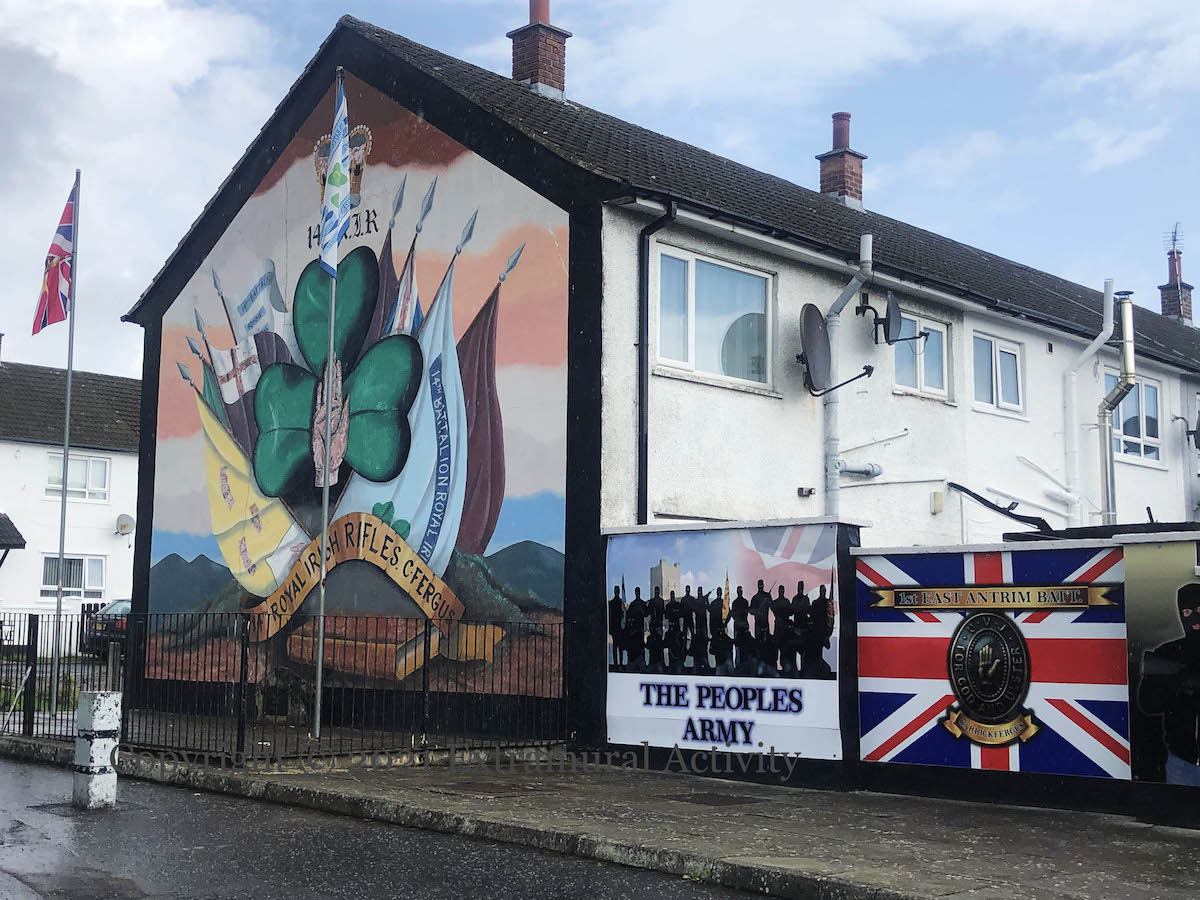
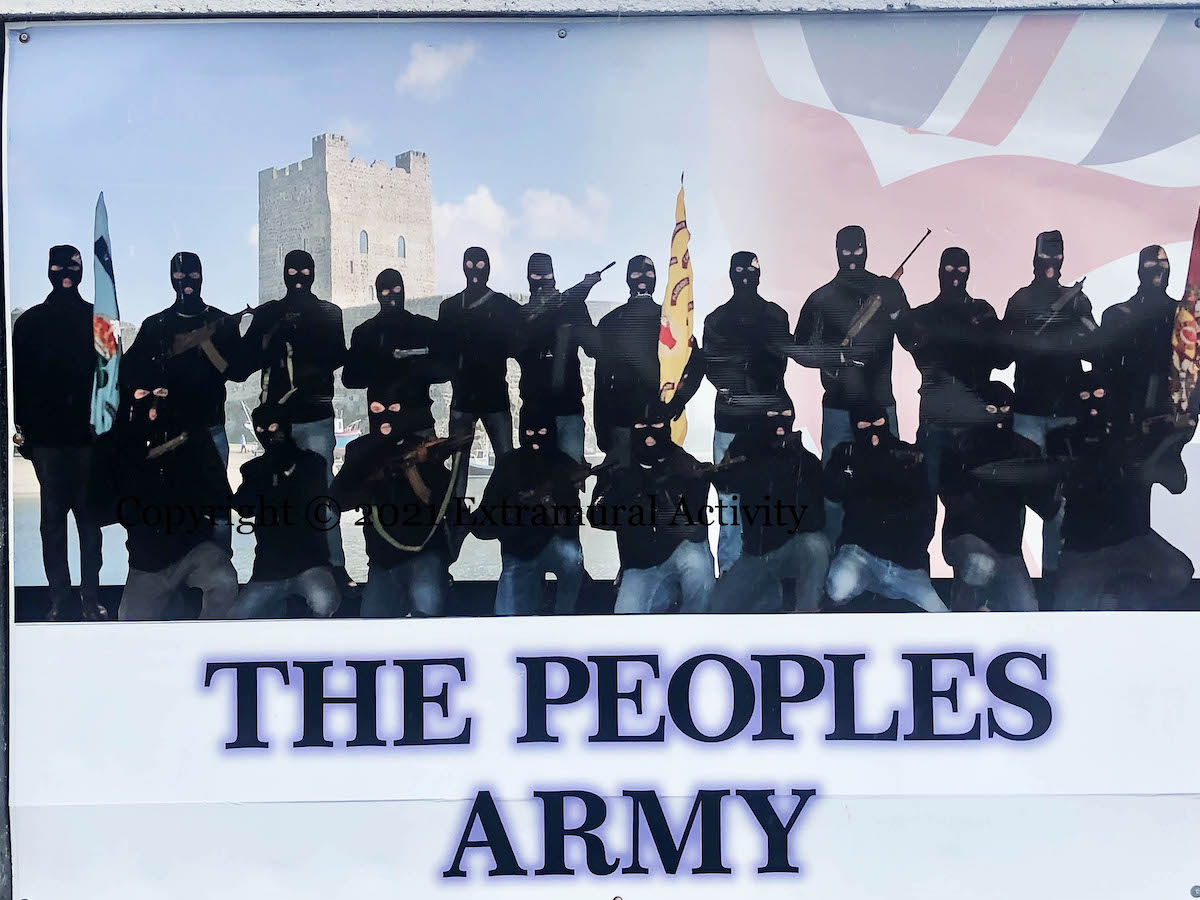
In September, 1914, six weeks after the Great War had begun, Edward Carson wrote to the Ulster Volunteers entreating “those who have not already responded” to “my call for Defenders of the Empire” to “enlist at once for the Ulster Division in Lord Kitchener’s Army”, fighting alongside “our fellow Britishers”: “Quit yourselves like men and comply with your country’s demand”. The impulse for the display of force shown here – two panels of hooded gunmen from the 1st East Antrim battalion of the UVF – is the other, original, motivation for the paramilitary force, which Carson describes as “to defend our citizenship in the United Kingdom” (Strachan & Nally).
For the RIR mural, see For Valour. The new panels shown here re-re-image the VC part of that previous mural in the Larches, Carrickfergus.
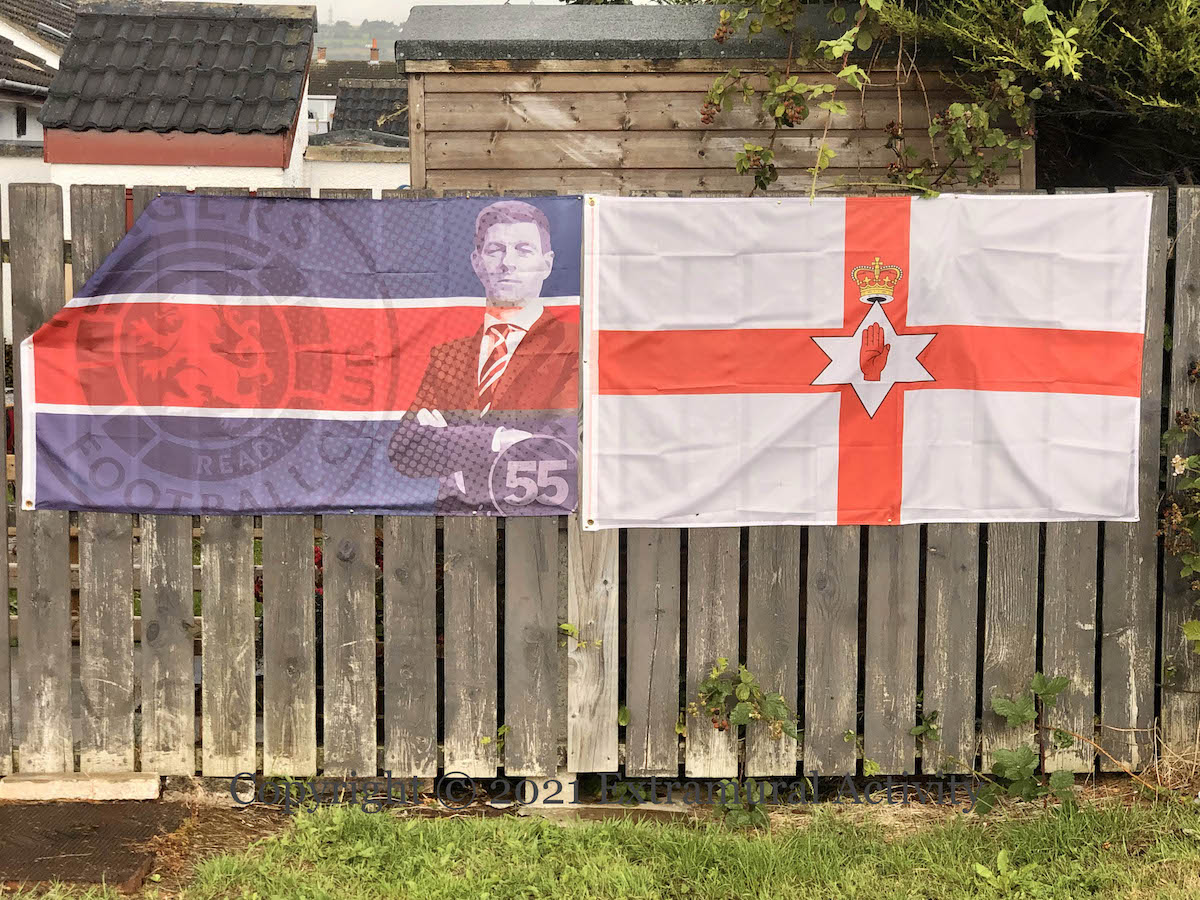
“Loyalist Woodburn celebrates 100th anniversary Northern Ireland”. Maintain the union of (left to right) England (St George’s Cross), Wales (The Red Dragon), Northern Ireland (Ulster Banner), Scotland (St Andrew’s Saltire). Along the fence we have the NI coat of arms, Ulster Grenadiers flute band (Fb) celebrating its 25th anniversary, King Billy at the Boyne, “Ulster Scots” (on an Independent Ulster flag?), Captain Sir Tom Moore, a Union Flag, Rangers 55, an Ulster Banner. The crown sits atop all.
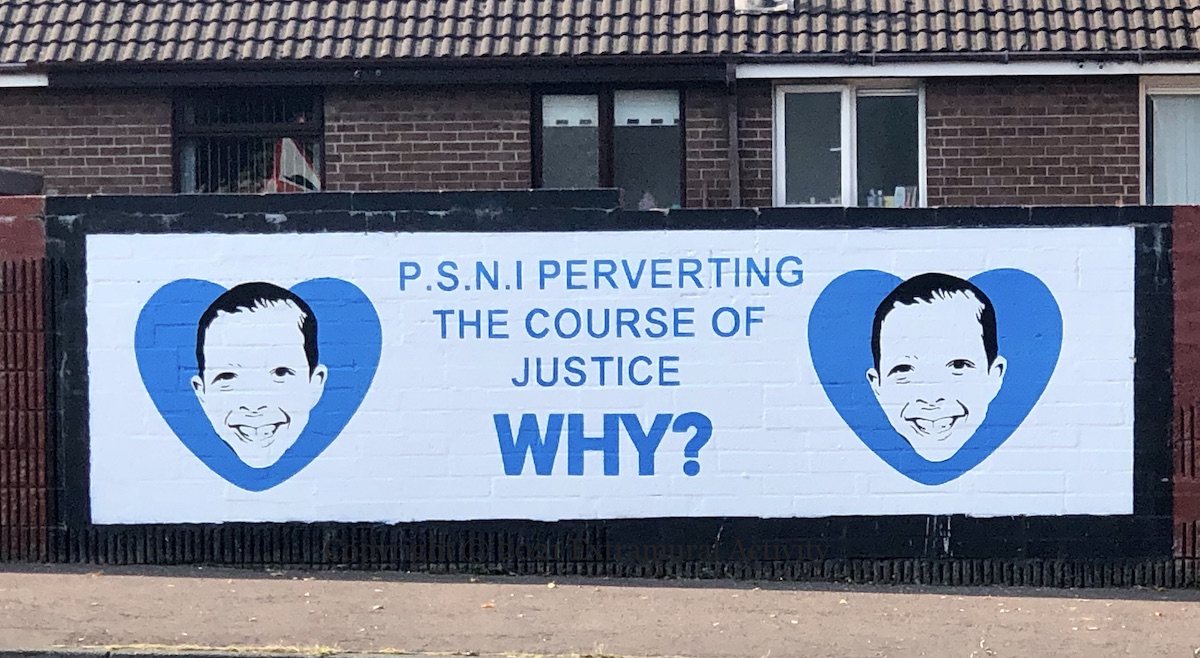
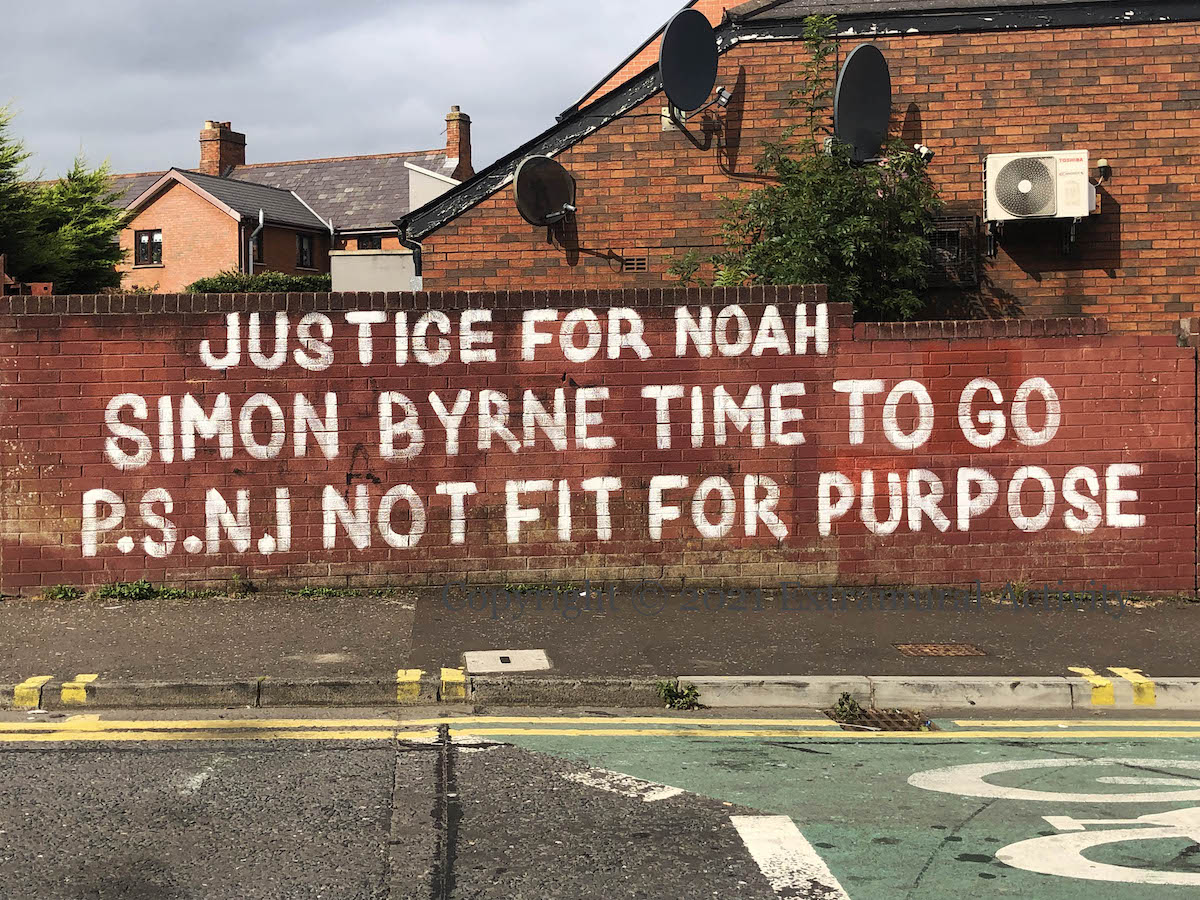
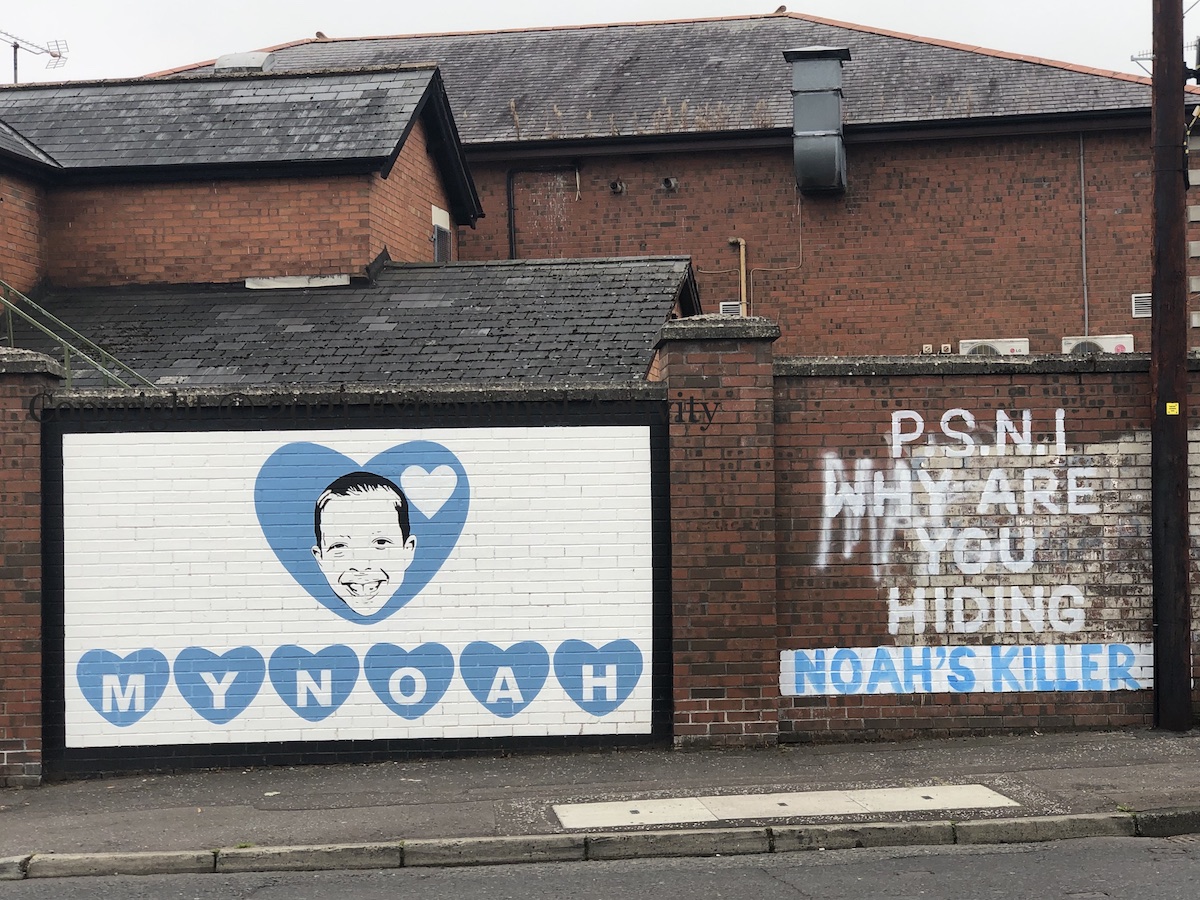
It is now more than a year since teenager Noah Donohoe was found dead in a north Belfast storm drain and the controversy and mystery over his death continues. Police were recently investigating an alleged confession by a prisoner and Noah’s mother Fiona has said that she was told by police of a witness statement that the UDA were called in to dispose of the body (Irish News). She has started a petition calling for Chief Constable Simon Byrne’s resignation. The walls of Belfast have been painted to reflect the persistent dissatisfaction with the investigation. The three shown here are on the Whiterock, Lake Glen, and Springfield roads. For some more examples, see sbear101 on Twitter.
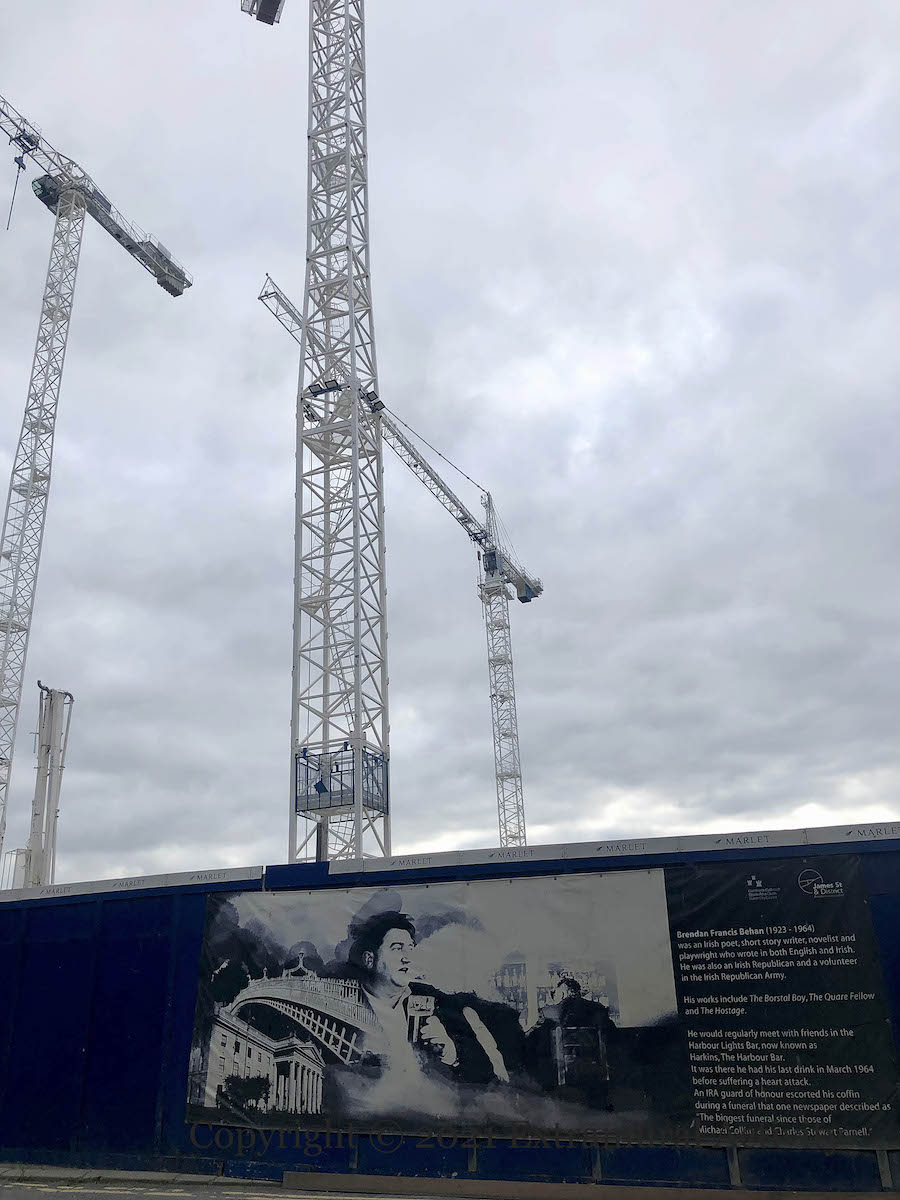
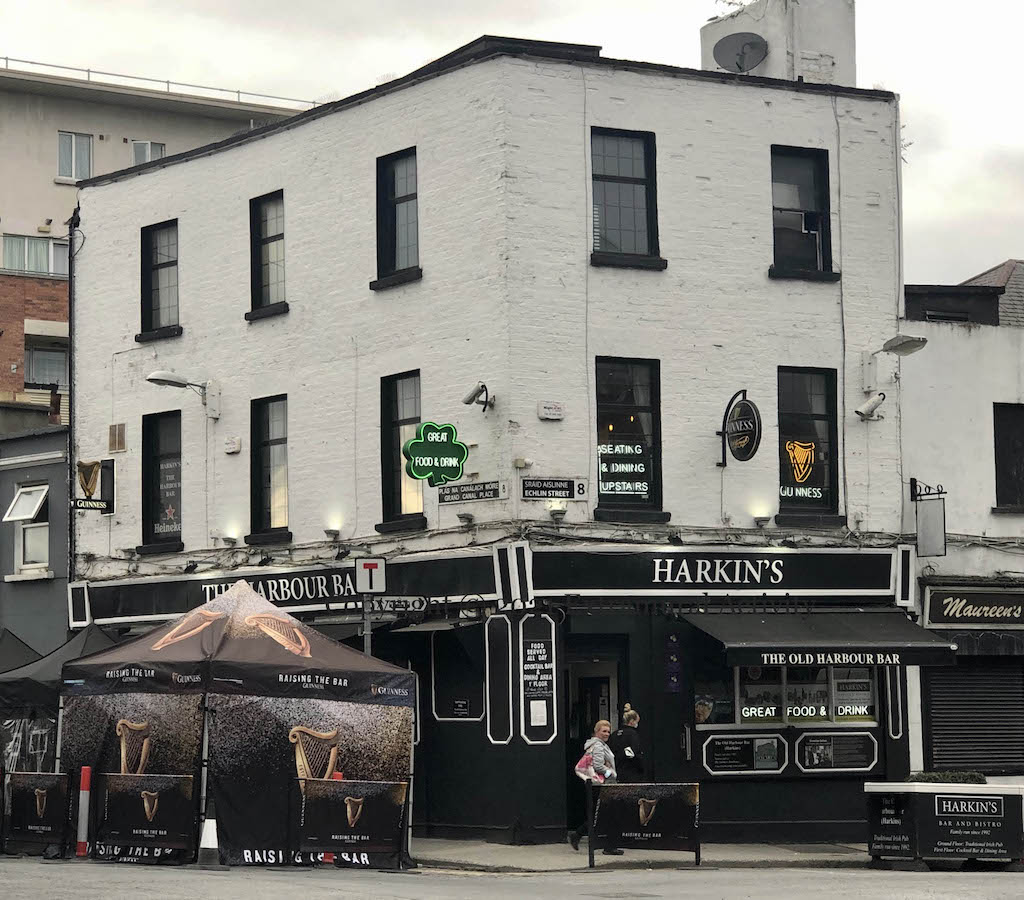
“Brendan Francis Behan (1923-1964) was an Irish poet, story writer, novelist and playwright who wrote in both English and Irish. He was also an Irish Republican and a volunteer in the Irish Republican Army. His works include The Borstal Boy, The Quare Fellow and The Hostage. He would regularly meet with friends in the Harbour Lights Bar, now known as Harkin’s, The Harbour Bar. It was there he had his last drink in March 1964 before suffering a heart attack. An IRA guard of honour escorted his coffin during a funeral that one newspaper described as “The biggest funeral since those of Michael Collins and Charles Stewart Parnell.”
 Seosamh Mac Coille Collection