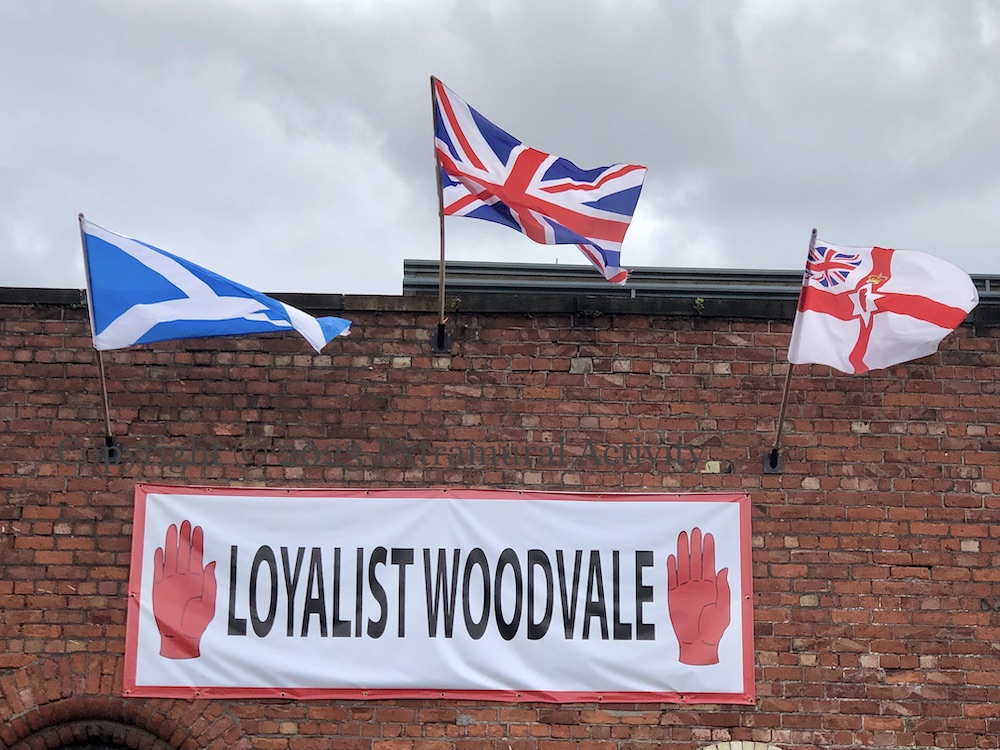
New territorial markings at the top of Cambrai Street, Belfast, next to the “Amy Carmichael” installation.
Click image to enlarge
Copyright © 2023 Seosamh Mac Coılle
X12837
New territorial markings at the top of Cambrai Street, Belfast, next to the “Amy Carmichael” installation.
Click image to enlarge
Copyright © 2023 Seosamh Mac Coılle
X12837
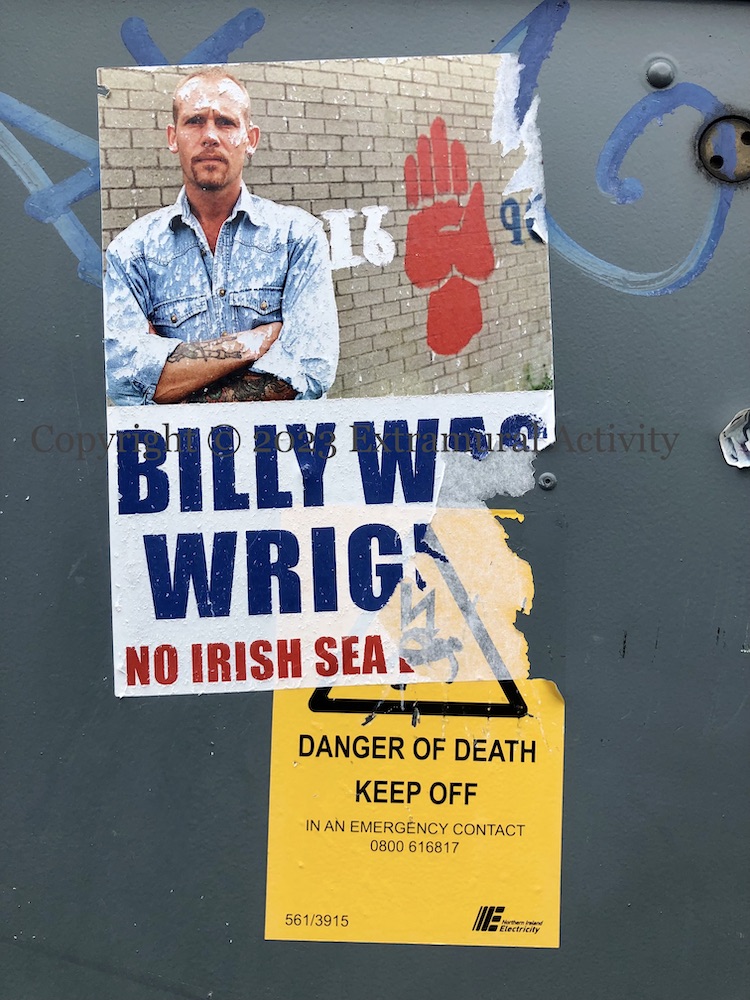
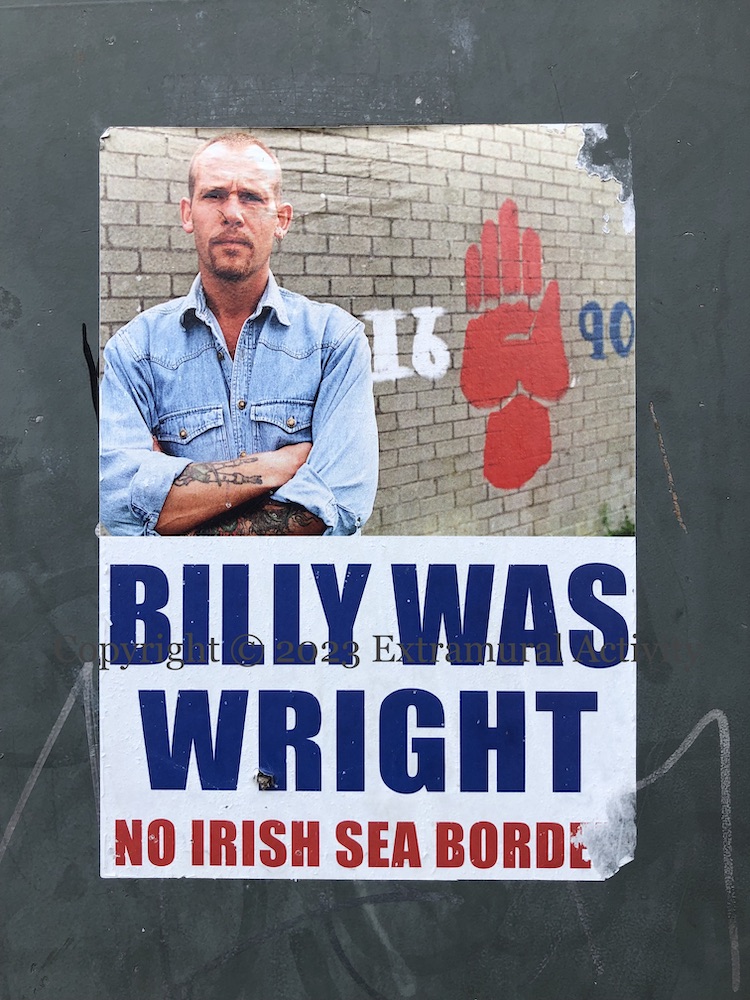
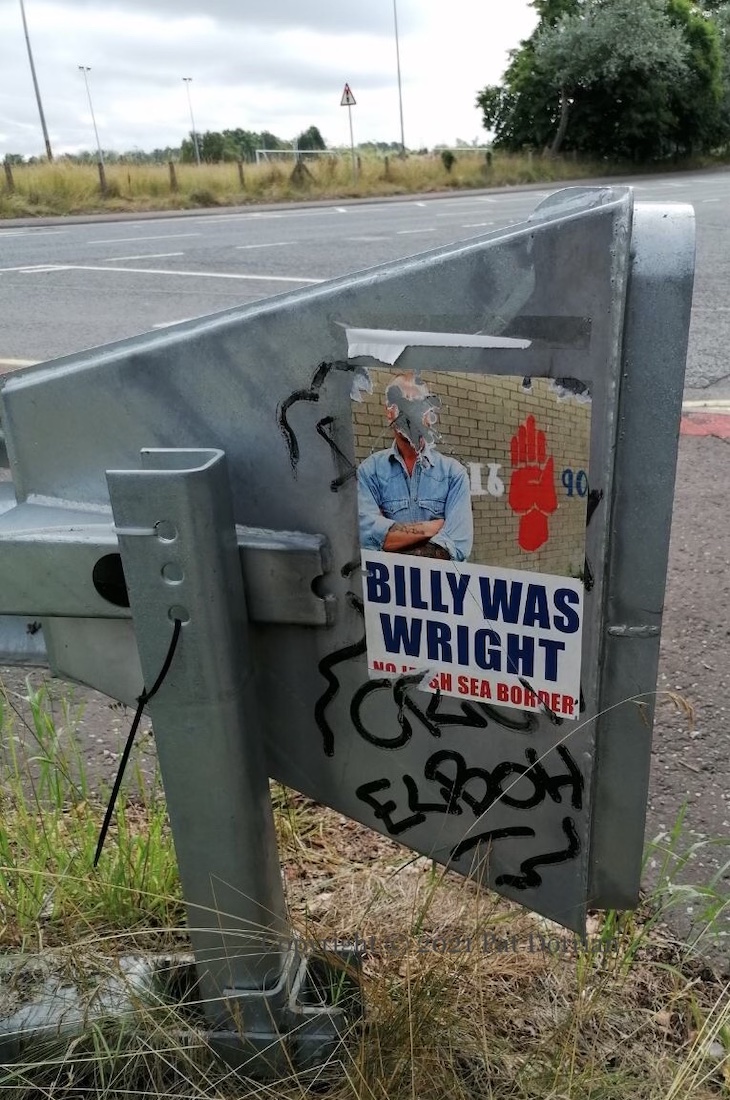
“Billy was Wright – no Irish Sea border.” Billy Wright broke with the UVF in 1996 over loyalist concessions made during the peace-process that ultimately led to the Agreement in 1998. He soon formed the LVF but was killed in prison in 1997 by members of the INLA, which, like the LVF, had not joined the ceasefire.
These posters are in Cambrai Street and Conway Street; attempts to remove them have proven unsuccessful. The Sunday World reports that a similar banner has appeared in Ballymena (Sunday World) and that the same poster was also spotted in the lower Shankill (Sunday World).
Wright is shown standing in front of a small mural in Old Rectory Park, Portadown – see D01068.
Click image to enlarge
Copyright © 2023 Seosamh Mac Coılle
X12835 [X12836] X12851
Copyright © 2021 Pat Dorrian
X15337
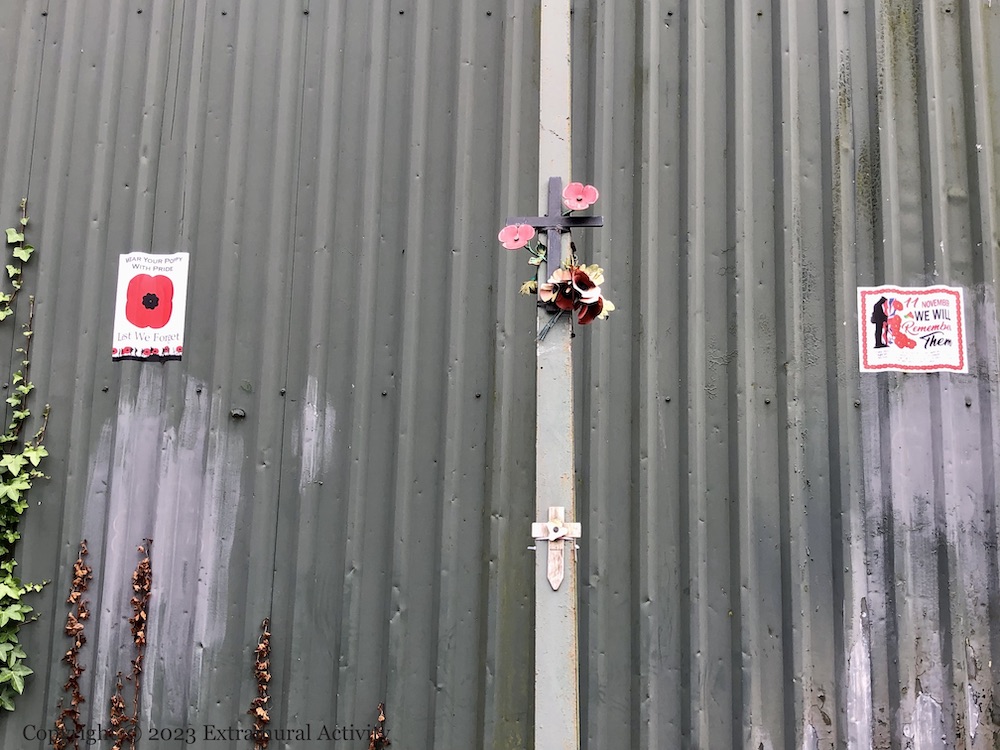
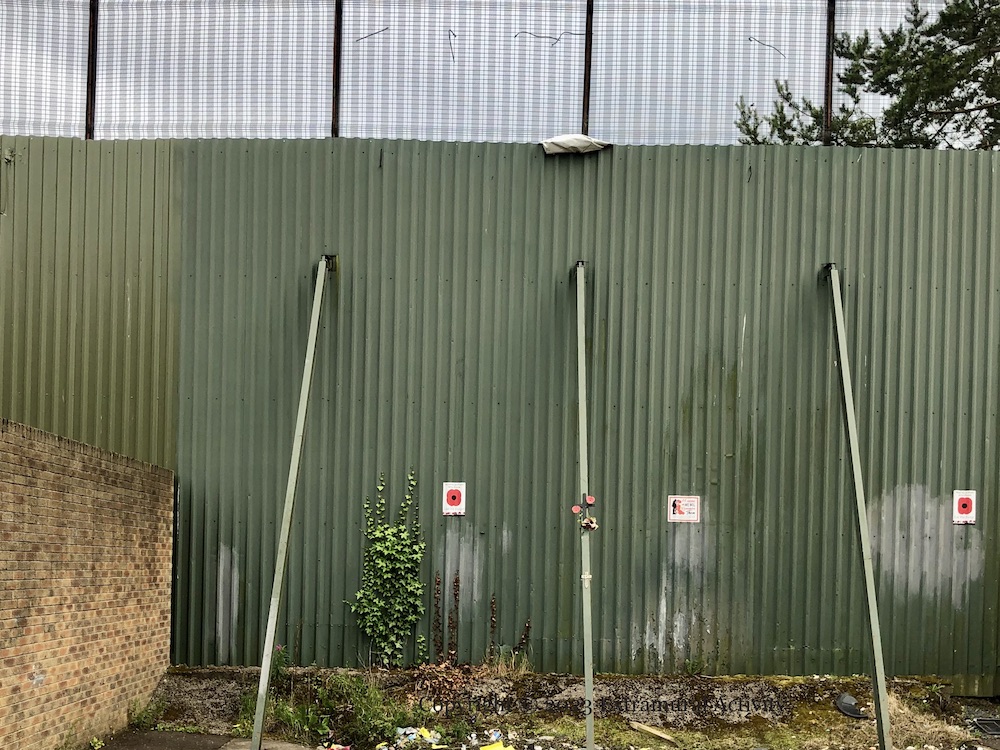
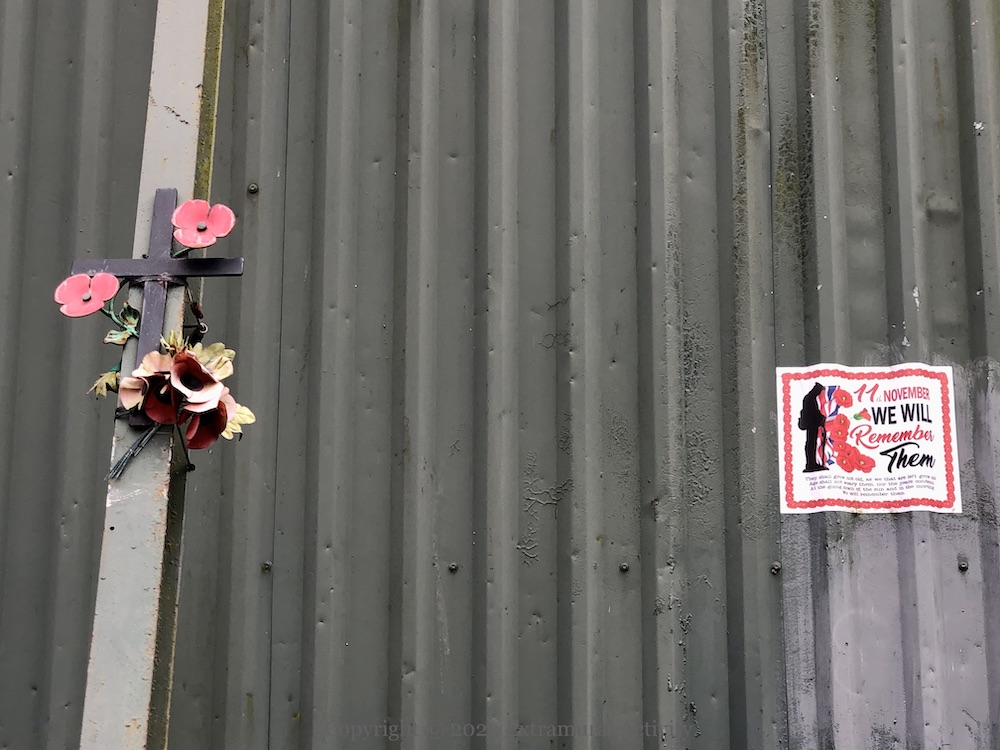
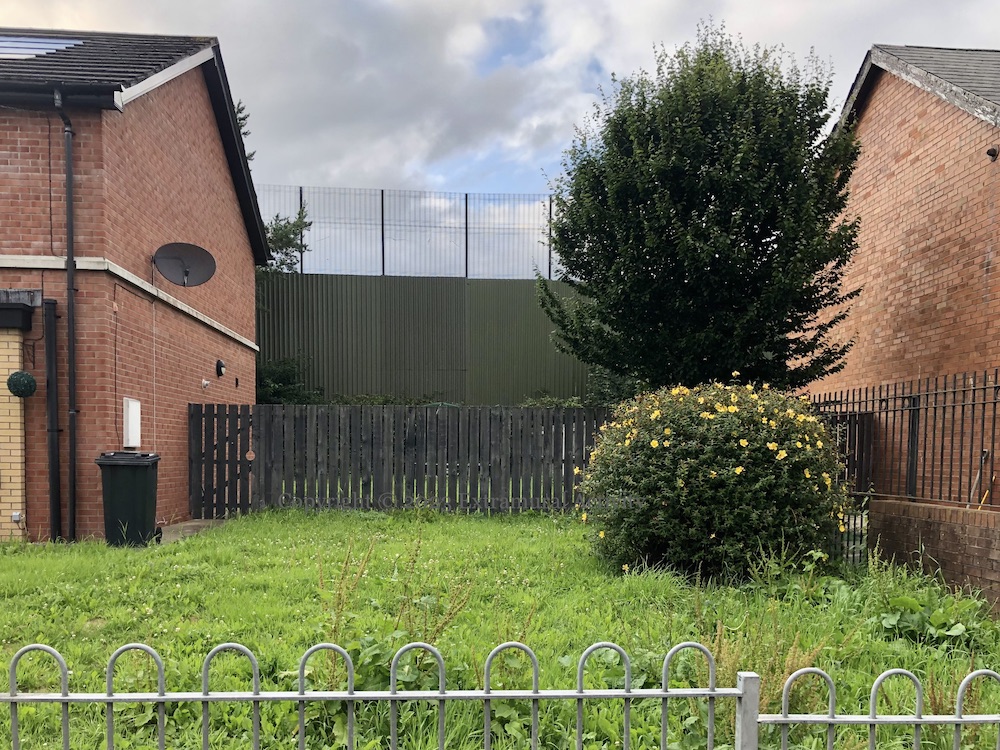
The first “peace” line along Alliance Avenue was a temporary barried constructed by the British Army in 1971 (Heatley at CAIN); parts of it today are nine metrers high (Belfast Interface Project). The central road in Ardoyne, Berwick Road/Paráıd An Ardghleanna was cut off by the line but in the recent redevelopment no house was built in front of the spot where the road ran through. Instead there are now support beams and a small cross in memory of WWI dead.
The final image is of the same spot on the Ardoyne side of the line.
Click image to enlarge
Copyright © 2023 Seosamh Mac Coılle
X12816 X12815 [X12814] [X12817] X12818
X12819 [X12820]
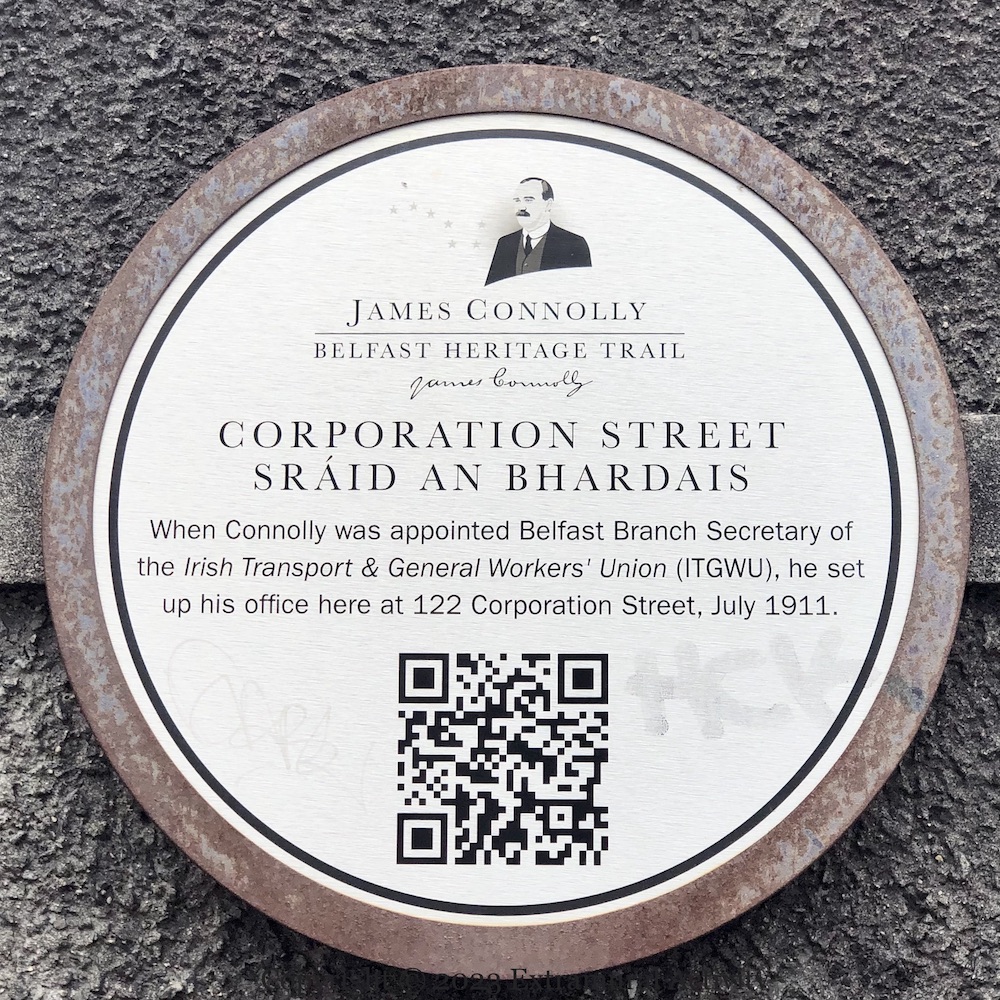
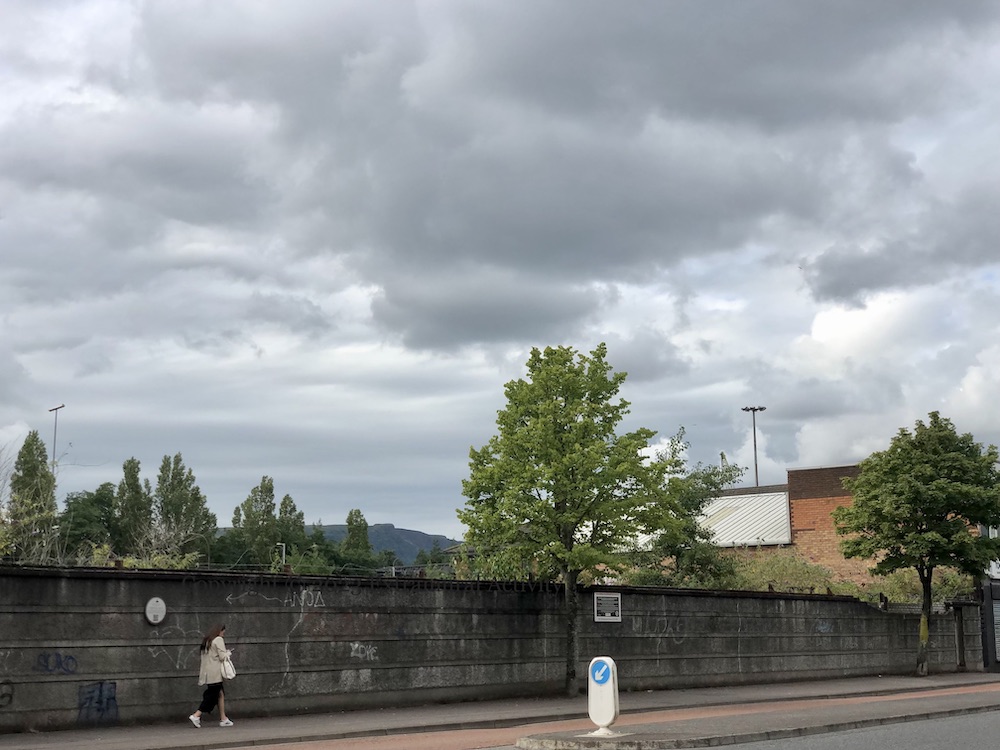
Áras Uí Chonghaile has a “James Connolly Heritage Trail”, with a series of plaques and panels that interested parties can walk as members of a guided tour, or by themselves with the aid of an app (Android | Apple). One of the stops is in Corporation Street, site of the Belfast offices of the ITGWU from 1911-1941.
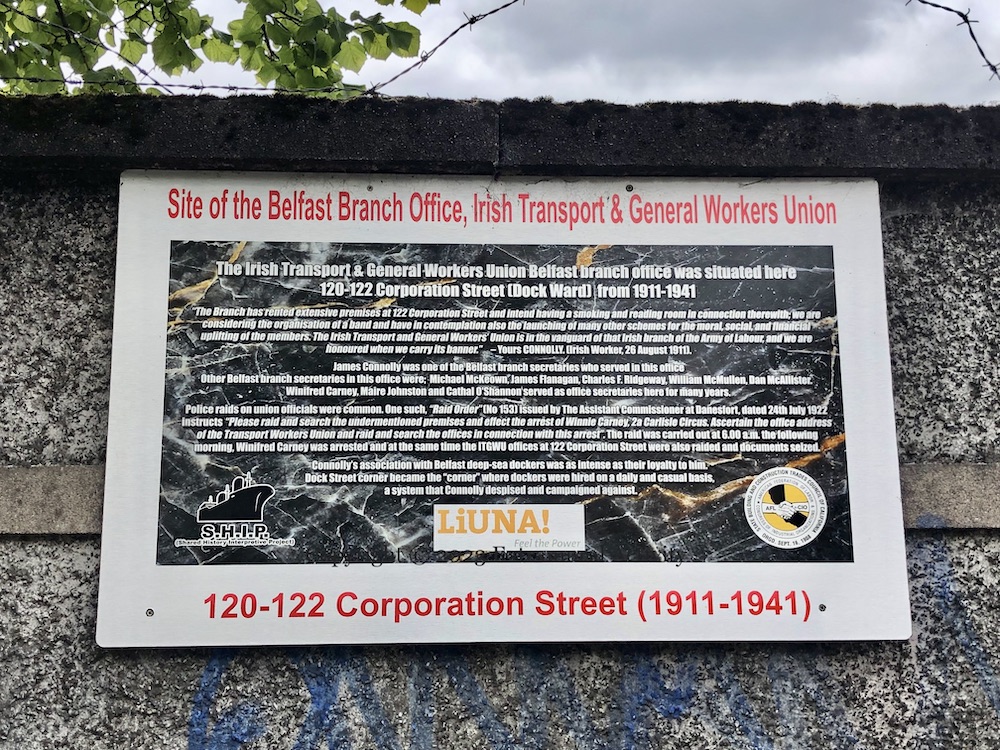
The nearby ITGWU board gives Connolly’s report from 1911: “The Branch has rented extensive premises at 122 Corporation Street and intend having a smoking and reading room in connection therewith; we are considering the organisation of a band and have in contemplation also the launching of many other schemes for the moral, social, and financial uplifting of the members. The Irish Transpost and General Workers’ Union is in the vanguard of that Irish branch of the Army of Labour, and we are honoured when we carry its banner.”
It then goes on to describe the arrest of Winnie Carney and the raiding of the Corporation Street offices in 1922.
For the Connolly centre, see previously: Socialism Is Neither Catholic Nor Protestant | Join The Socialists!
For Winnie Carney’s offices, see Naming Our Streets and for a lead post on Carney, see The Typist With The Webley.
Click image to enlarge
Copyright © 2023 Seosamh Mac Coılle
X12812 X12811 X12813
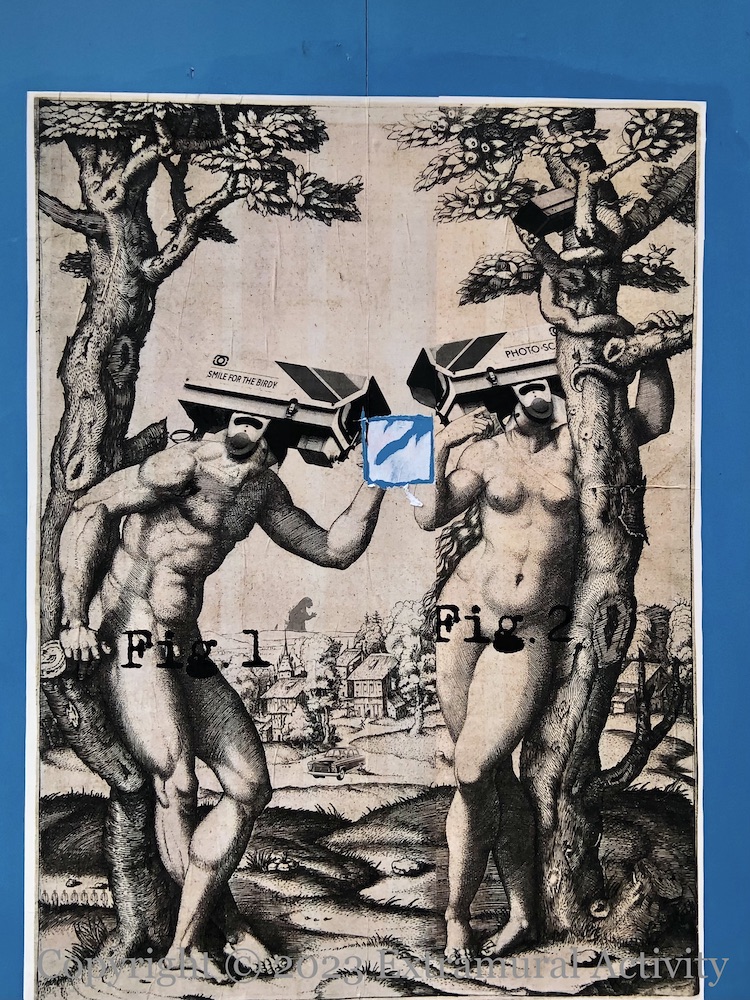
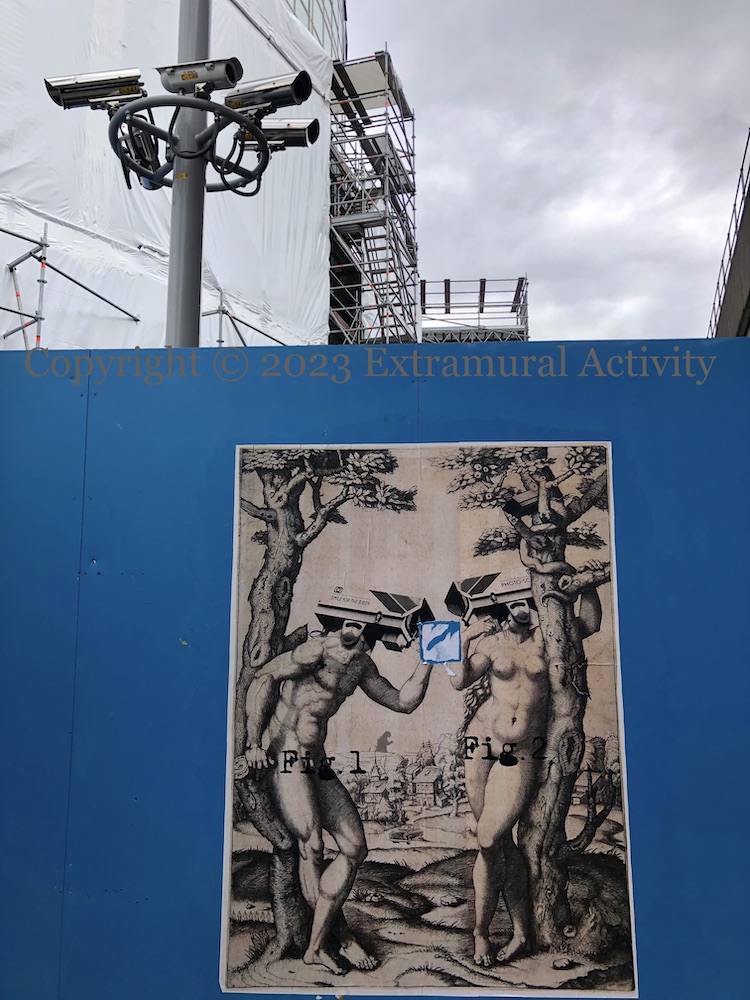
In Raimondi’s Adam And Eve, an engraving from c. 1512, Adam offers Eve two small apples while a human-headed serpent looks on (Met). (The town in the background is from Raimondi, but the car in the middle is Boyd’s.)
In Leo Boyd’s reworking, all the heads have been turned into surveillance cameras – including the snake in the tree, the private parts have been covered by “Fig. 1” and “Fig. 2”, and the forbidden fruit is now a heart emoji, which in this instance has literally been cut out of the print. Our surveillance culture (inlcuding “social” media) perhaps makes emotional connection more difficult and more dangerous than ever – we are ashamed to appear naked.
The paste-up is on the hoarding in Donegall Quay, below a ring of surveillance cameras. Belfast is the 100th-most surveilled city in the world, per capita (CEOWorld).
For information about the production of the piece, and images that include the heart that has been torn out, see Leo Boyd Prints.
Previous posts featuring Boyd’s work.
Click image to enlarge
Copyright © 2023 Seosamh Mac Coılle
X12808 X12807
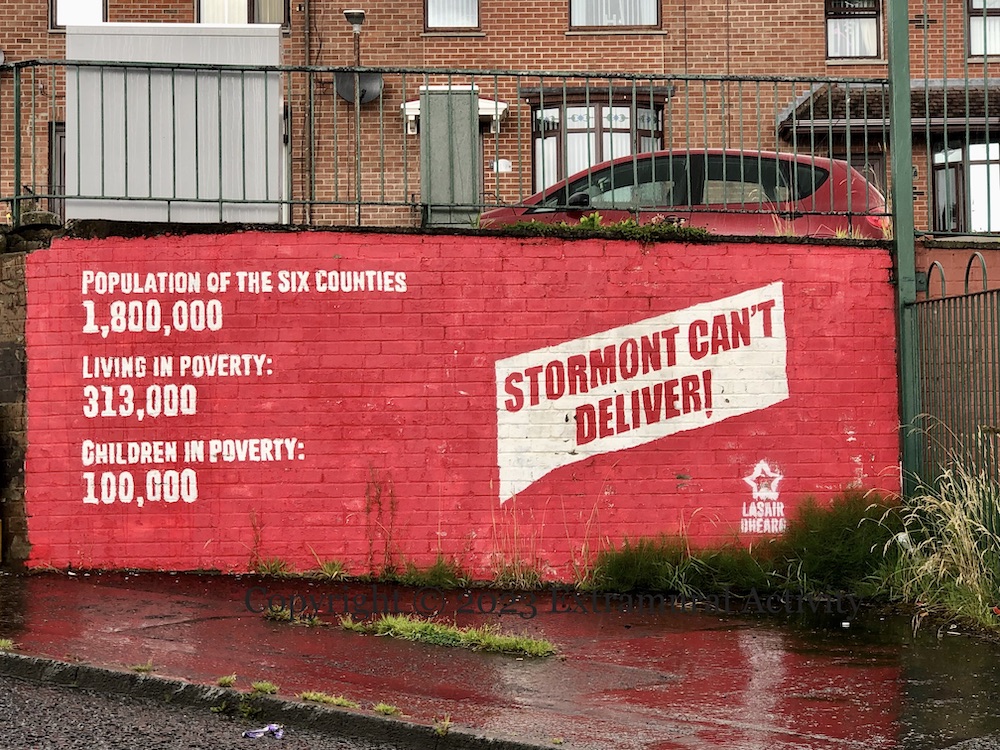
“Population of the Six Counties: 1,800,000. Living in poverty: 313,000. Children in poverty: 100,000.”
The source for the statistics presented might be the Department Of Communites, which gives statistics for 2021-2022; the Rowntree foundation has a report on 2022 poverty levels. No source is given here or on the campaign’s web page at Lasaır Dhearg (web | tw).
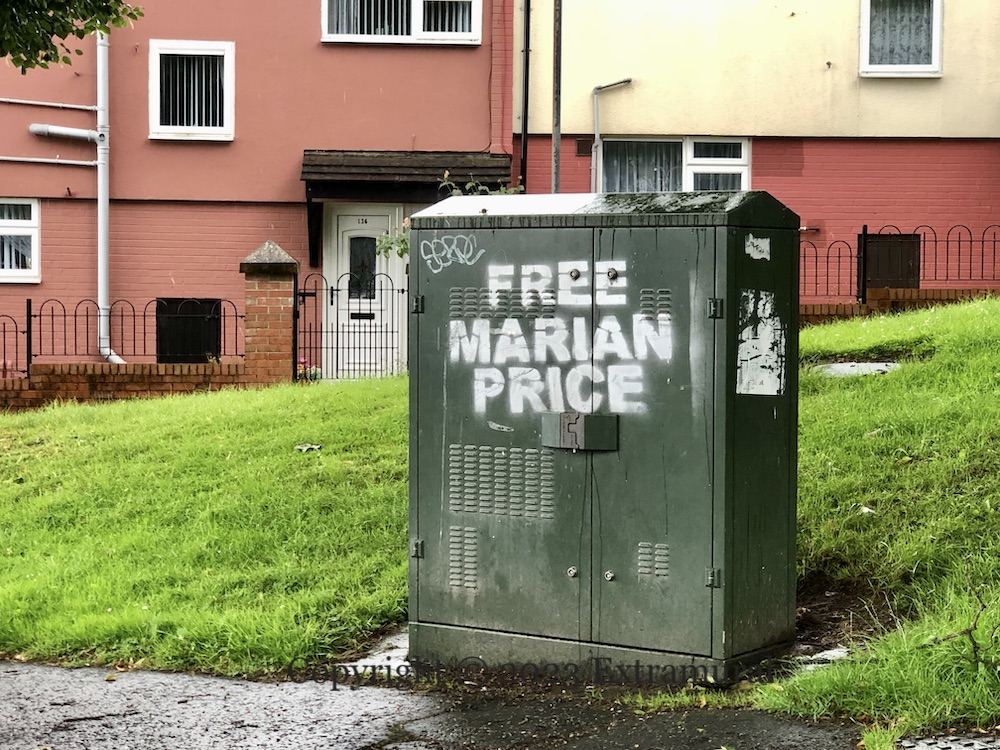
Glenveagh Drive; with a bonus image of on old Marian Price stencil in nearby Carrigart Avenue.
Click image to enlarge
Copyright © 2023 Seosamh Mac Coılle
X12801 X12800
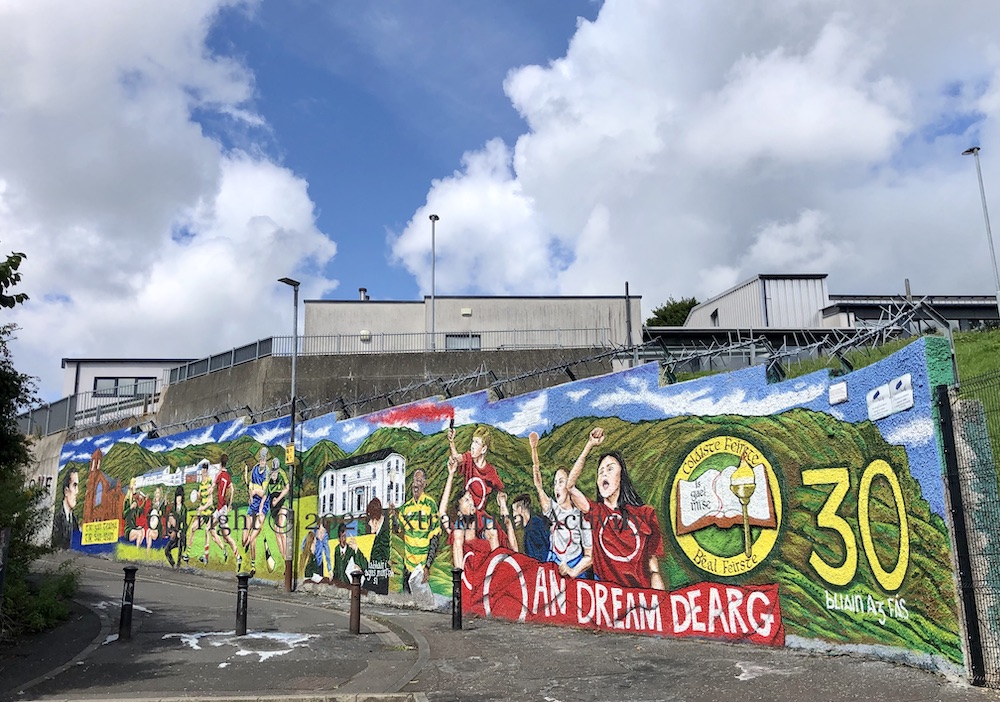
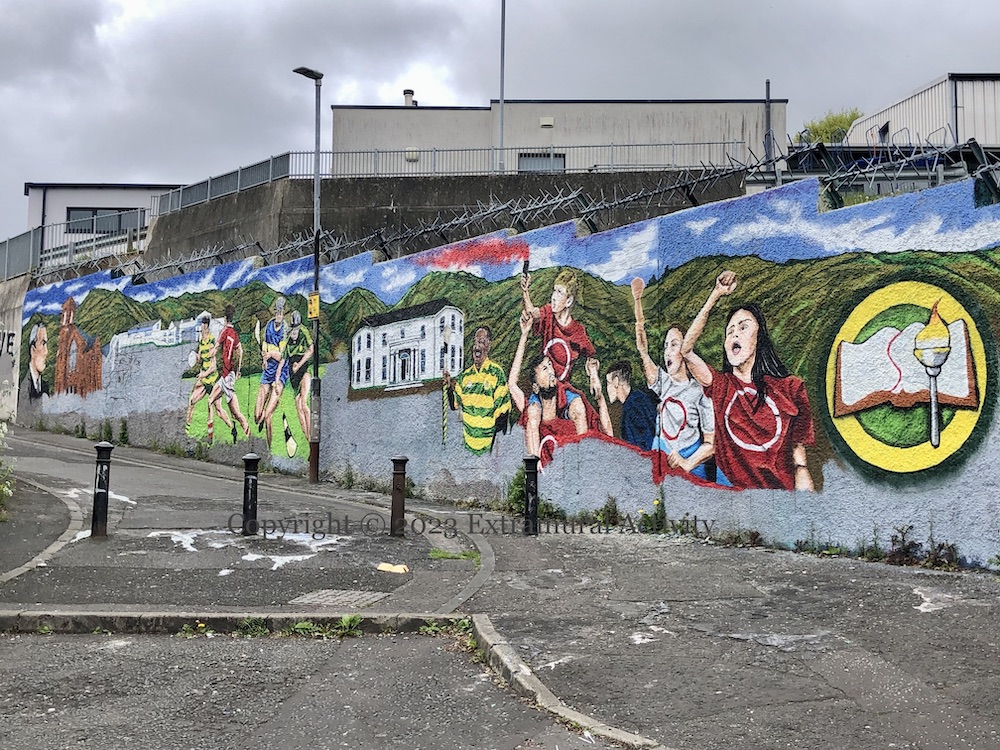
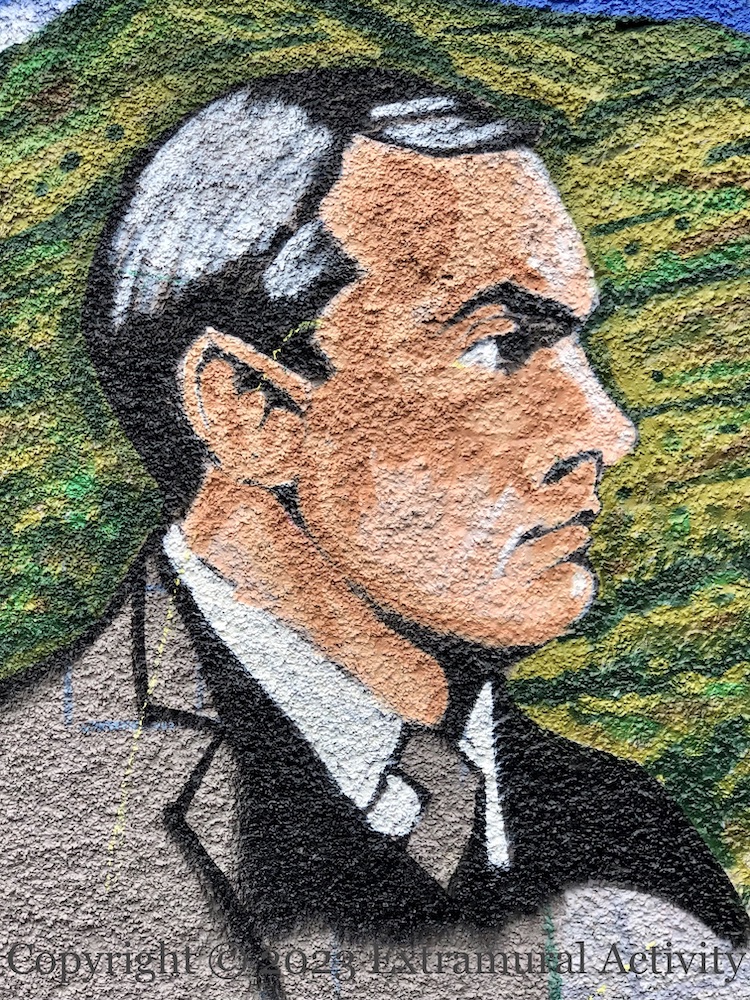
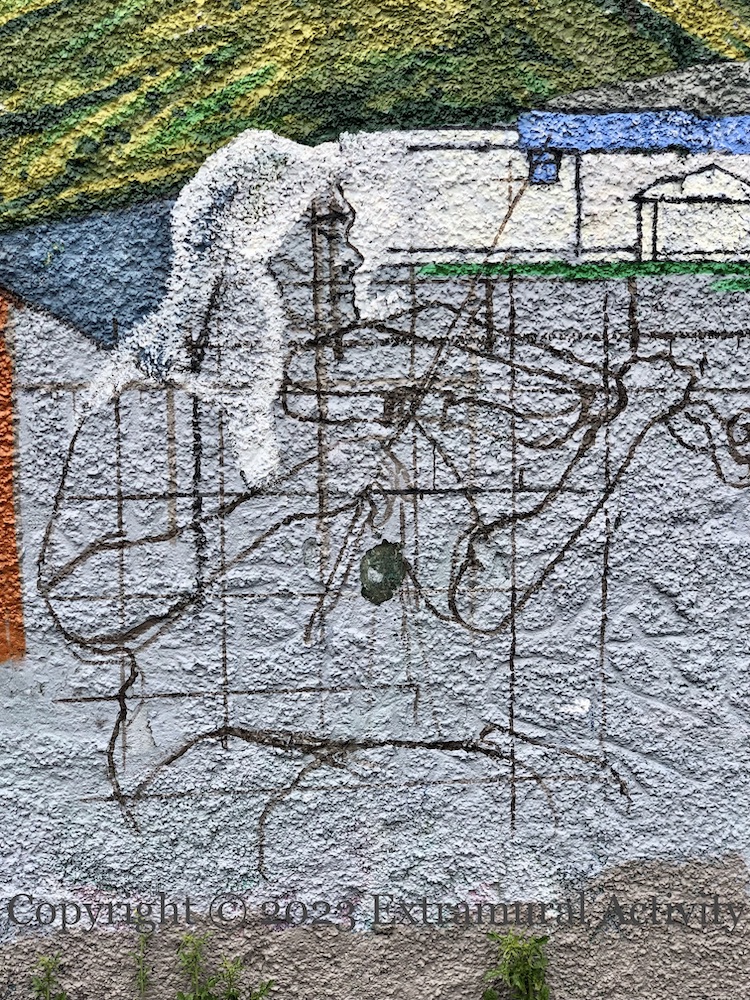
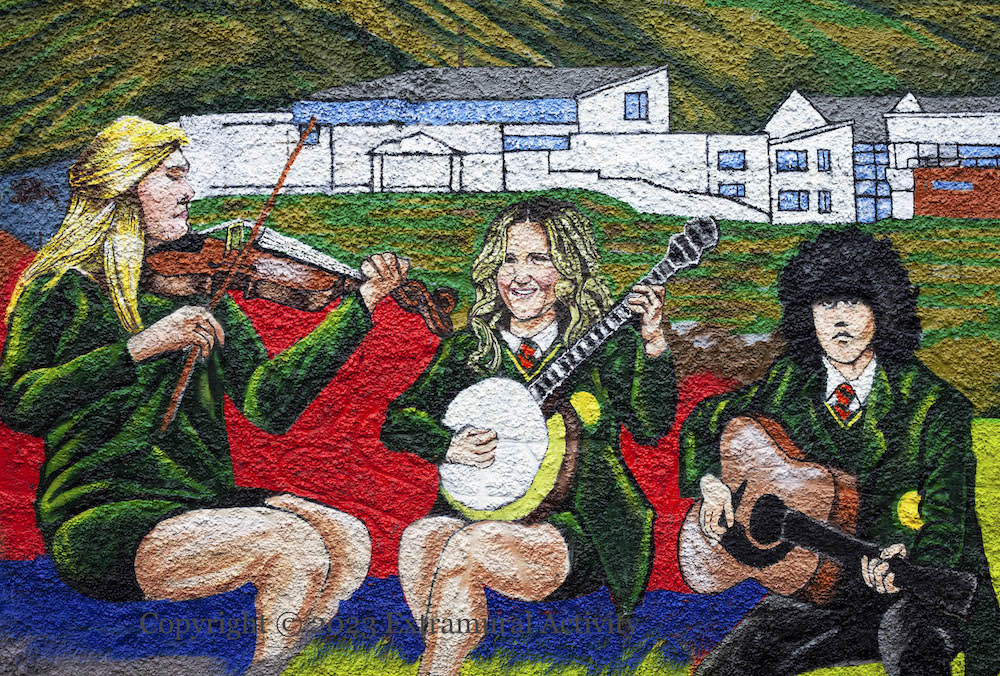
What is now Coláıste Feırste began life as Meánscoıl Feırste in 1991, teaching a group of nine students a curriculum inspired by Patrick Pearse (discussed previously in An Tusa An Chéad Laoch Eıle?) and based in Cultúrlann MacAdam-Ó Fıaıch (Cultúrlann). It moved to Beechmount in 1998 and in 2018 expanded into new buildings that were meant to accommodate 600 pupils (Doherty Architects), which it has now exceeded (BBC) as it enters its thirty-third year in existence.
The theme of preserving and promoting the Irish language occurs in several places in the mural: next to Pearse we see his saying, “Máırtín Ó Chadháın ” [a land without a language [is] a land without a soul], in the classroom scene we have “Labhaır í agus maırfıdh sí” [speak it and it will endure], and finally we see the Dream Dearg protesting for an Irish-Language Act (see previously #AchtAnoıs).
The in-progress images included below among completed detailed shots date from May 6th and 20th.
Giant’s Foot/Beechview Park. Replaces the short-lived mural of Olympians, seen in Sporting Giants.
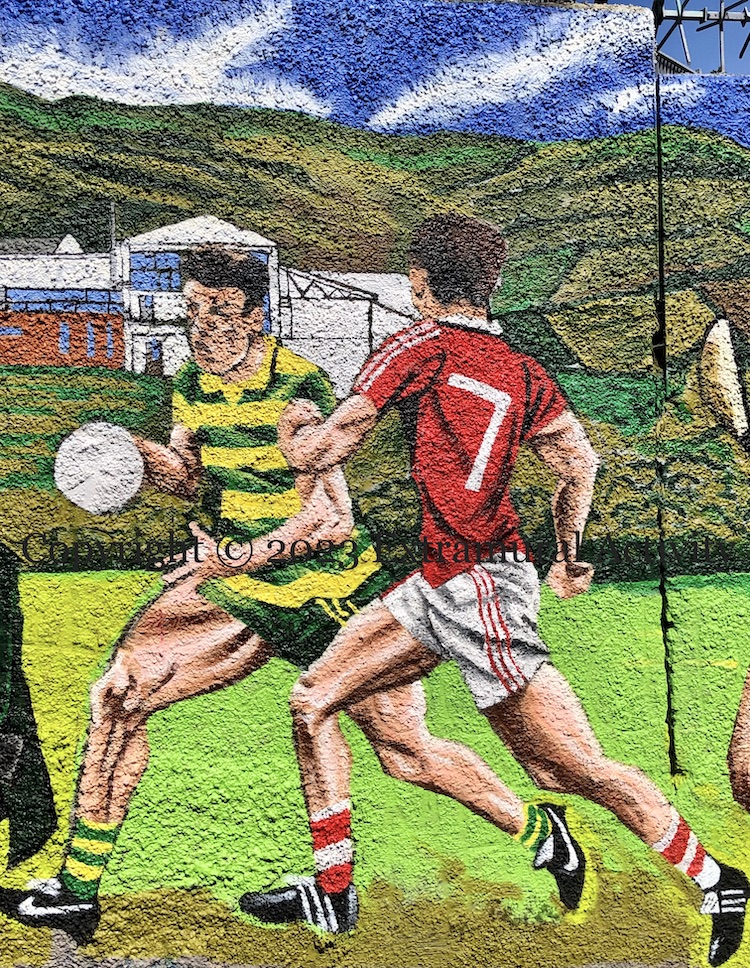
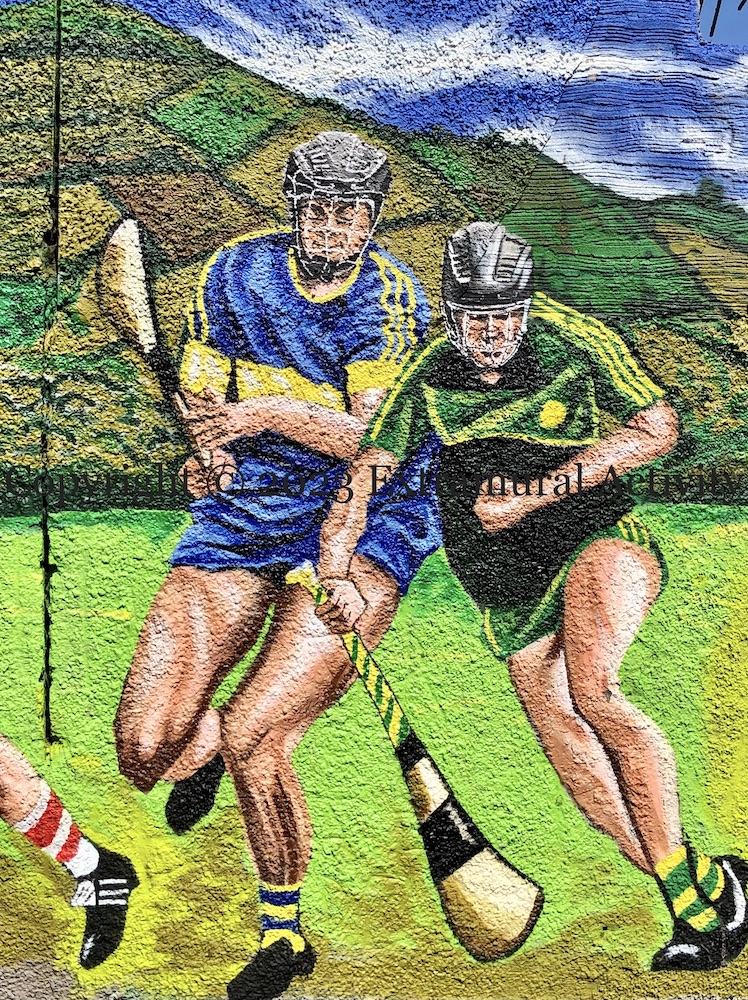
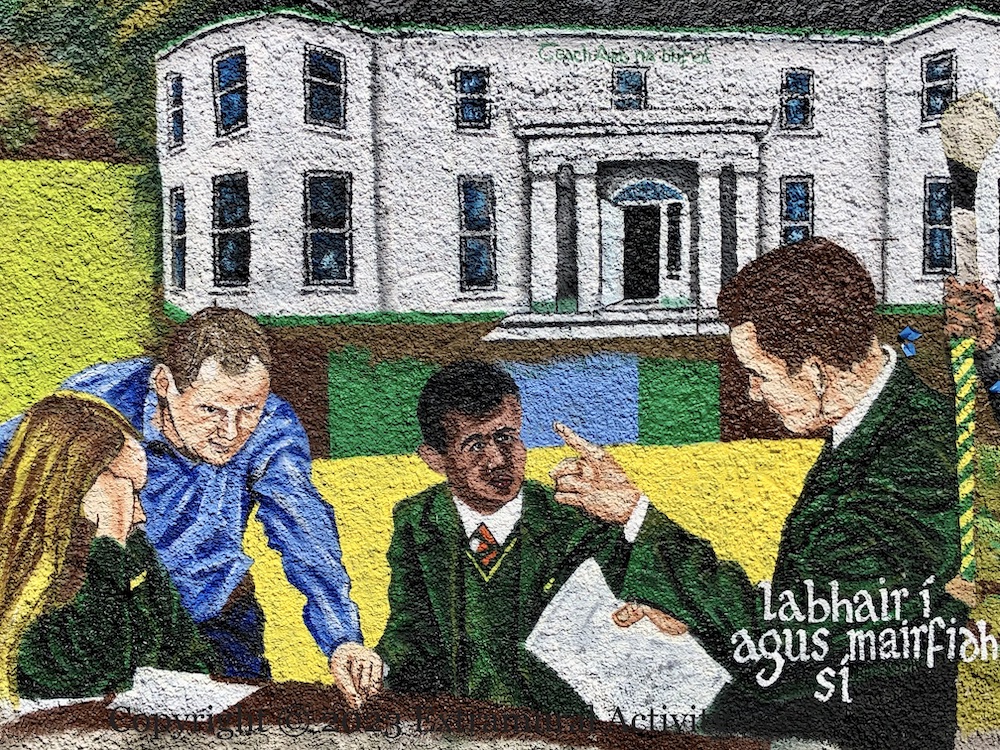
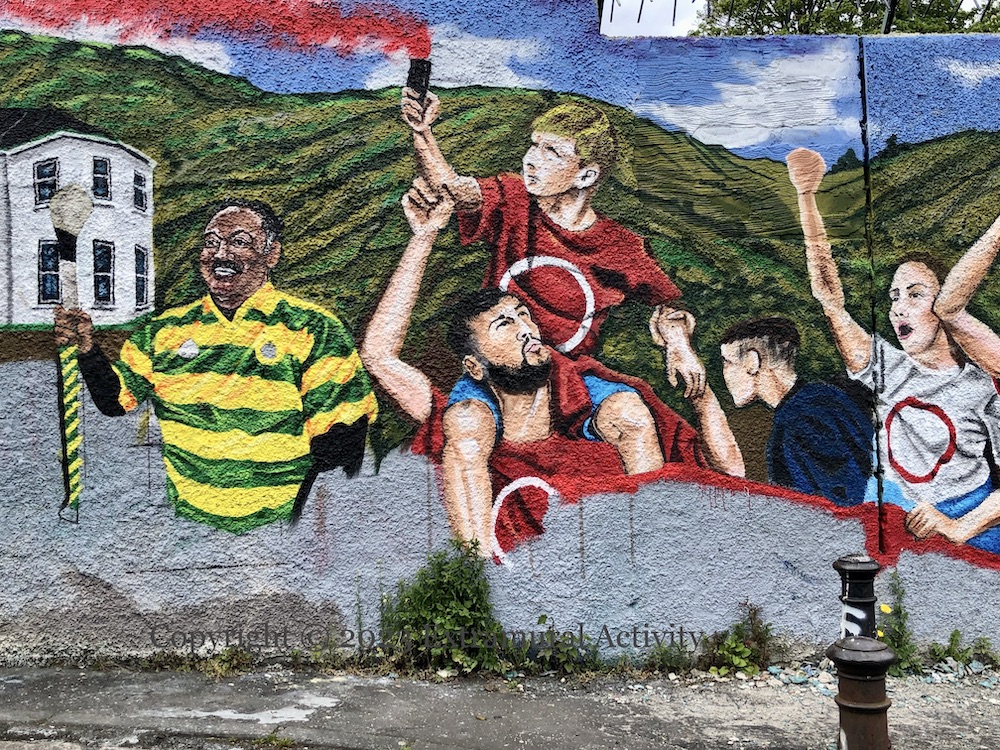
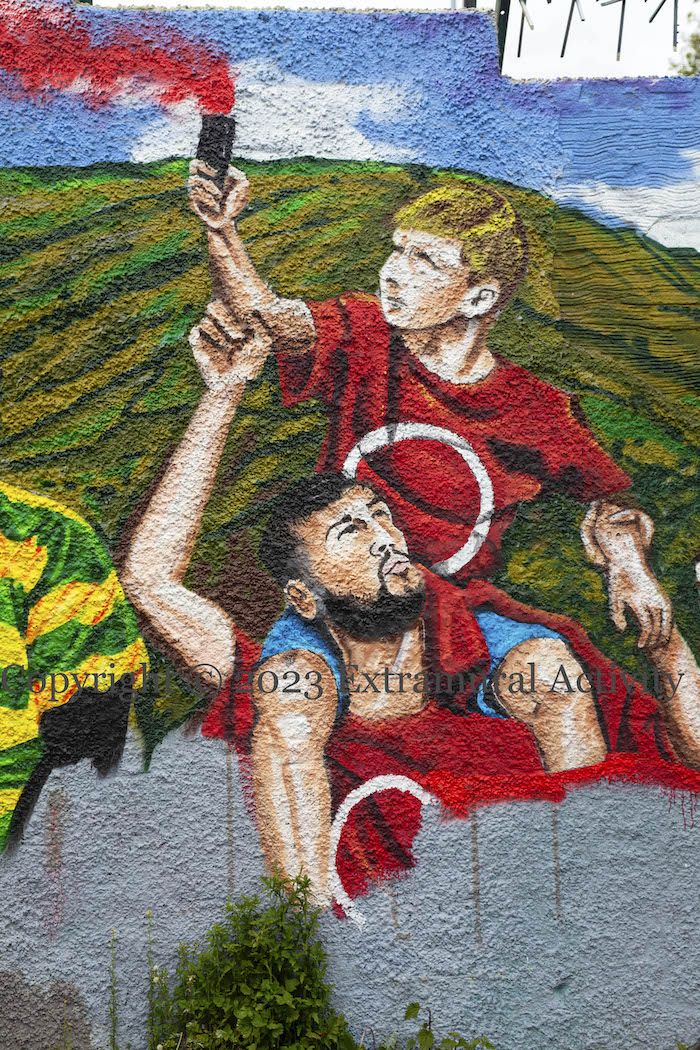
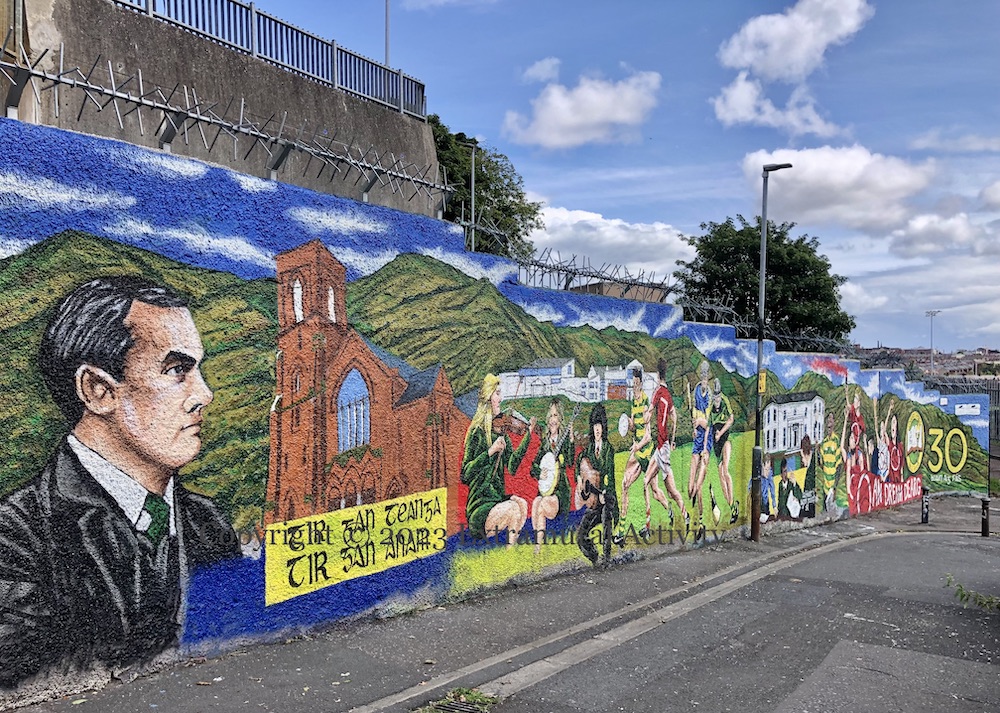
Click image to enlarge
Copyright © 2023 Seosamh Mac Coılle
ar dheıs X12795 [X12393] X12276
Mac Pıaraıs & cultúrlann X12277 [X12278]
ceol X12279 X12392
peıl X12797
ıománaíocht X12798
rang X12799 [X12391] [T02777]
Dream Dearg X12280 X12281
ar clé X12796
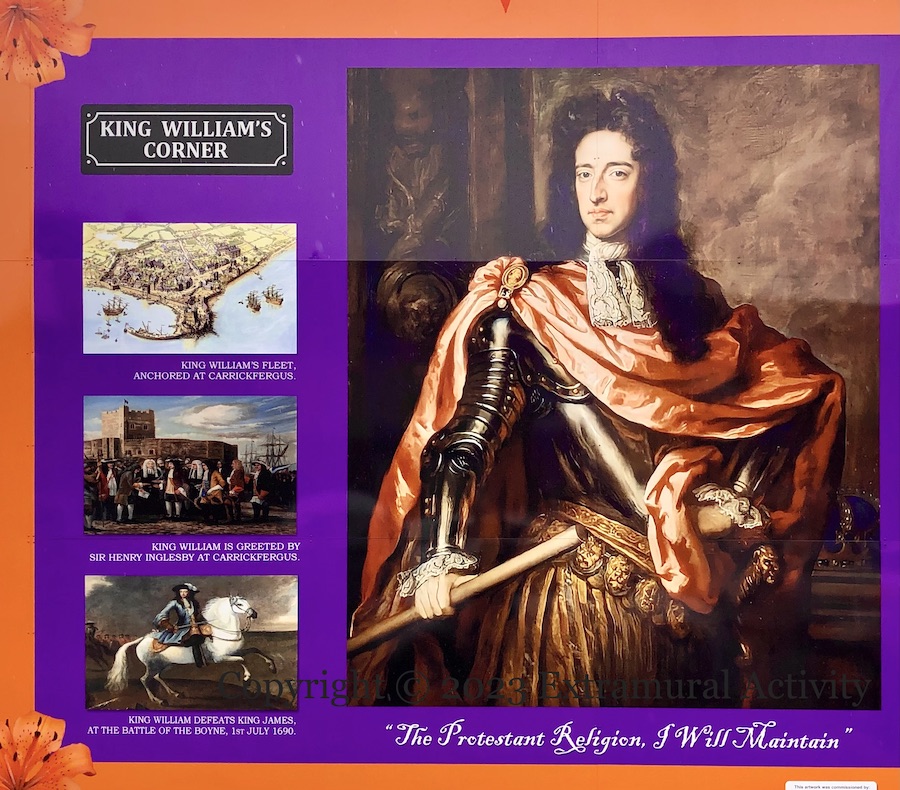
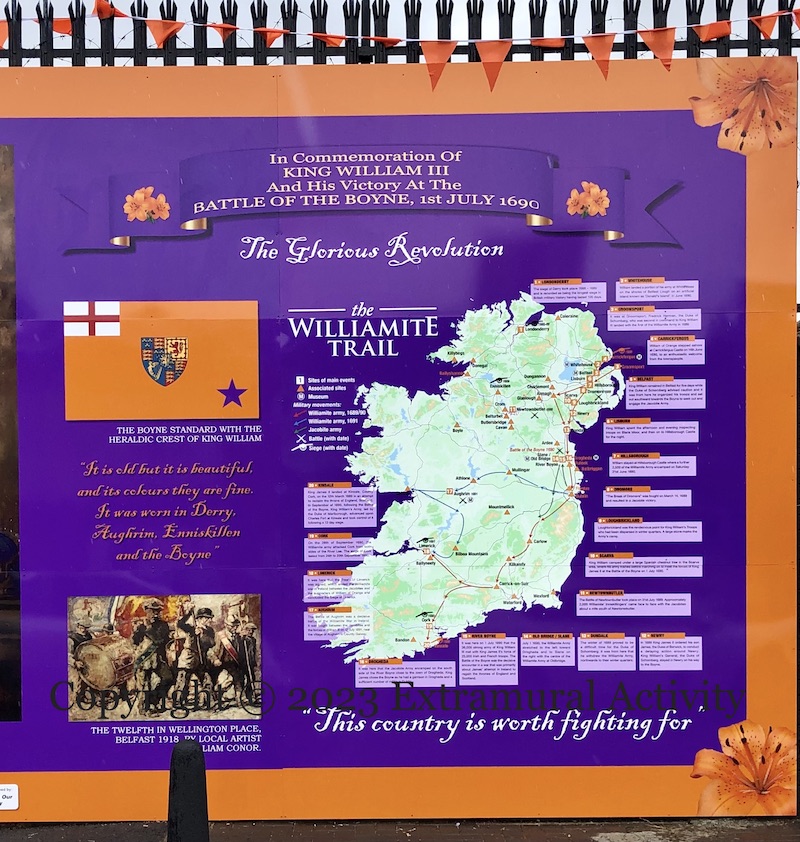
“In commemoration of King William III and his victory at the Battle Of The Boyne, 1st July 1690.” King William and images of Carrickfergus and the Boyne are included on the left of the board: in Ireland, William in person travelled from Carrickfergus to Drogheda and – after the victory at the Boyne – to Dublin, from which he left to pursue the war in Europe; his troops, on the other hand, after landing in Groomsport (1689) and Carrickfergus (1690) and fighting at the Boyne, continued on southward, to Cork and then to Limerick, and westward, to Athlone, Aughrim, and (again) Limerick. The campaign ended in October, 1691, with the signing of the Treaty Of Limerick. The information is available in pdf format from the Schomberg House Museum.
King William’s Corner joins Queen’s Corner and King’s Corner (and first of them all, Conor’s Corner –Conor’s ‘The Twelfth In Wellington Place, Belfast 1918’ is included to the left of the map, under a few lines from The Sash – “It is old but it is beautiful, and its colours they are fine/It was worn at Derry, Aughrim, Enniskillen and the Boyne” – and “The Boyne Standard [a.k.a. the flag of the Orange Order] with the heraldic crest of King William”).
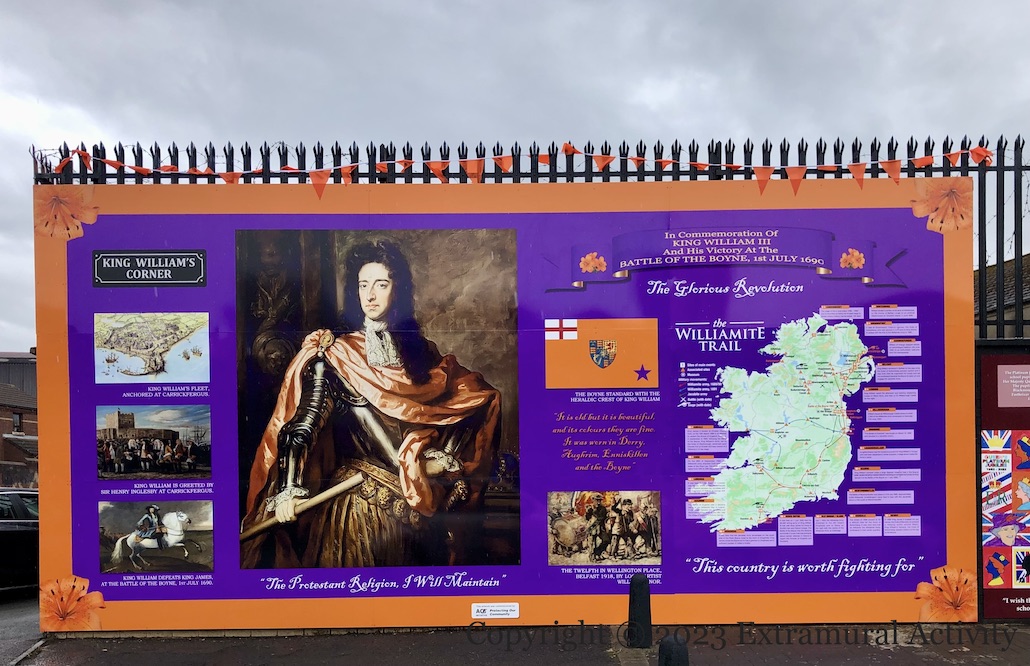
Click image to enlarge
Copyright © 2023 Seosamh Mac Coılle
X12764 [X12763] X12762 [X12761] X12765 “This artwork was commissioned by ACT Initiative [web] – Protecting Our Community.”
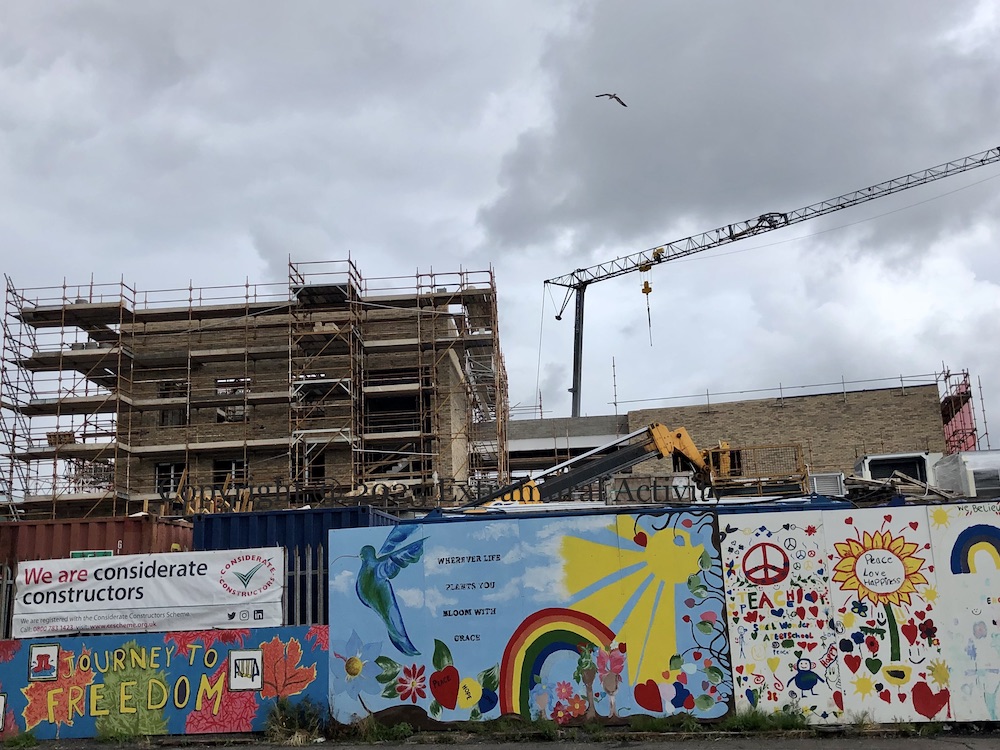
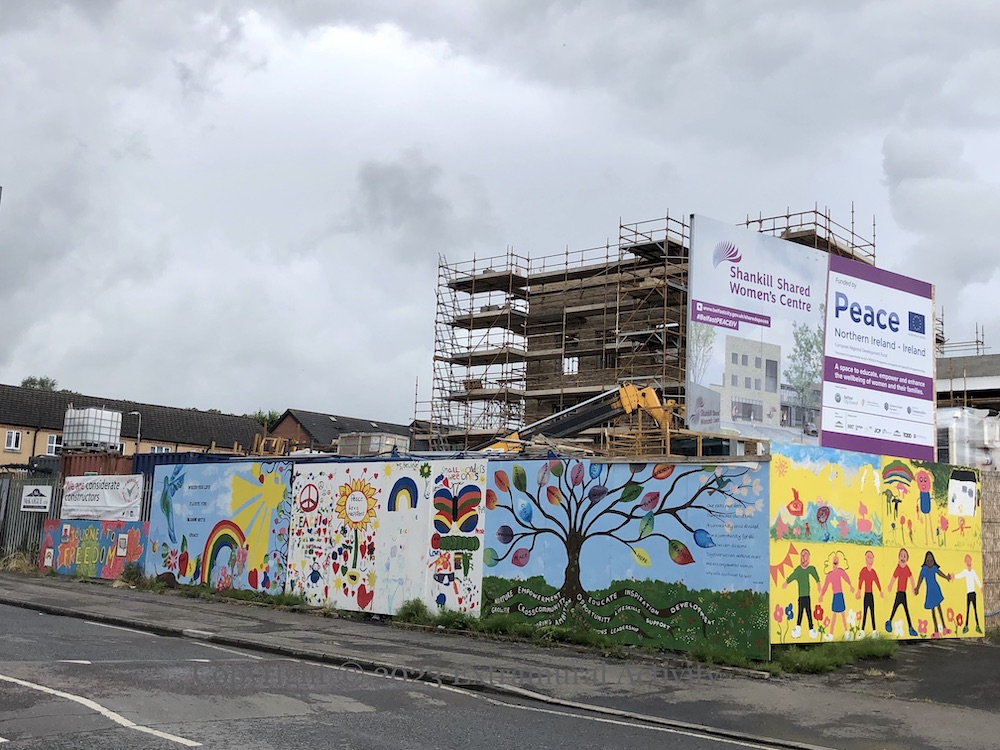
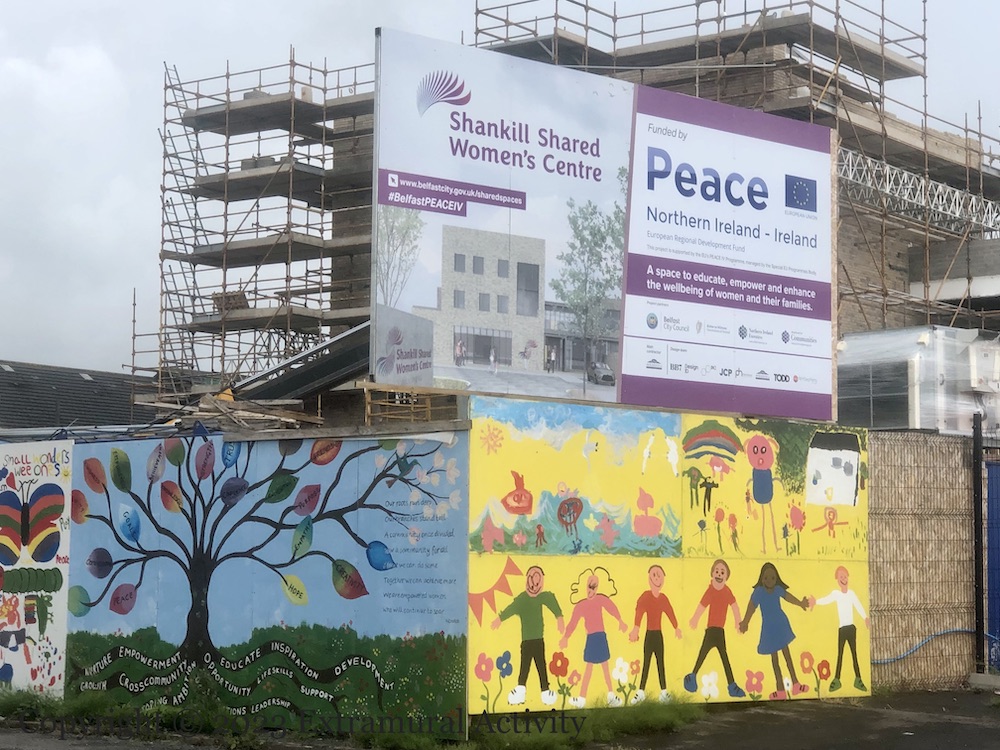
“Wherever life plants you, bloom with grace.” When the Shankill Women’s Centre was first formed, in 1987, it was located in The Hummingbird on the lower Shankill (SWC). (When the Wellbeing Centre was built on that site, the Women’s Centre moved further up the Shankill to its current location in the Hammer.) A hummingbird features in one of the paintings on the hoarding around the construction site of a new “Shankill Shared Women’s Centre” on Lanark Way, a 6.5 million euro project funded by PEACE IV (Belfast CC).
Click image to enlarge
Copyright © 2023 Seosamh Mac Coılle
X12773 X12772 X12774
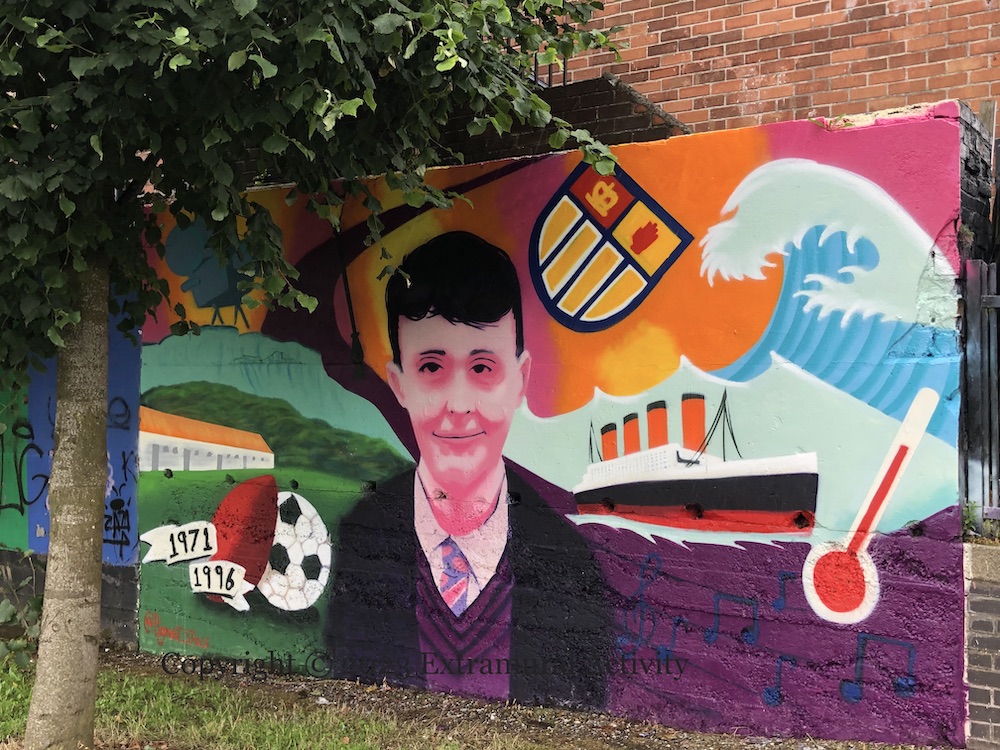
This is a new mural on the Ballysillan Road by MWAK/Pigment Space (ig) close to the Boys’ Model and featuring a student at the centre of symbols of learning – a film camera in the top left; Hokusai’s Great Wave in the top right, for art; Titanic (for engineering?) and a thermometer (for chemistry? or global warming?) on the right; musical notes in the bottom right; sports in the bottom left. The dates on the left are obscure. “1971” is perahps for the year the school won the Schools’ Cup in rugby (News Letter); there is a soccer ball next to “1996” but no similar victory can be found – get in touch if you can supply a meaning.
Replaces the Alternatives mural seen in Our Wee Country and No Alternative.
Click image to enlarge
Copyright © 2023 Seosamh Mac Coılle
X12744
 Seosamh Mac Coille Collection