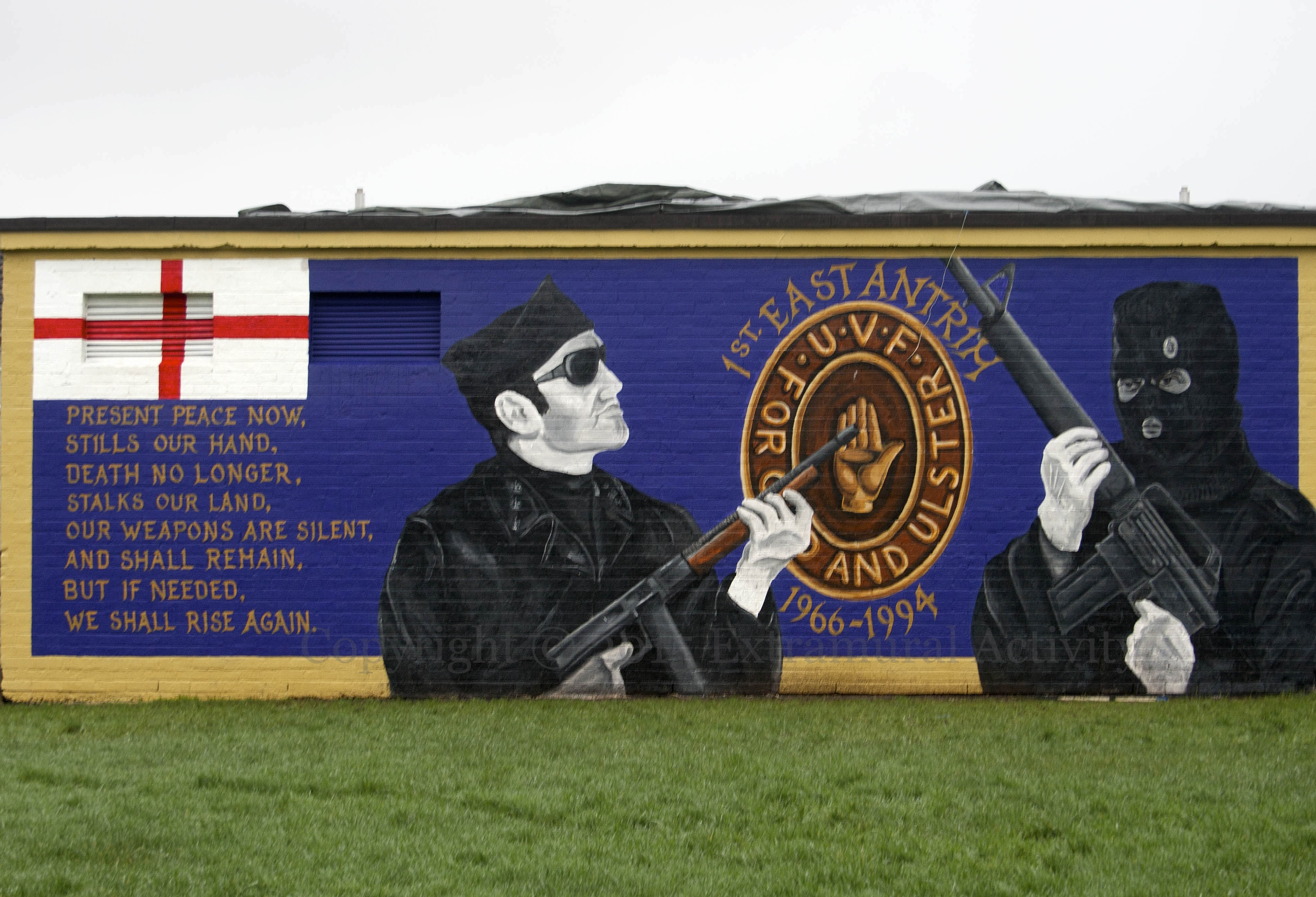
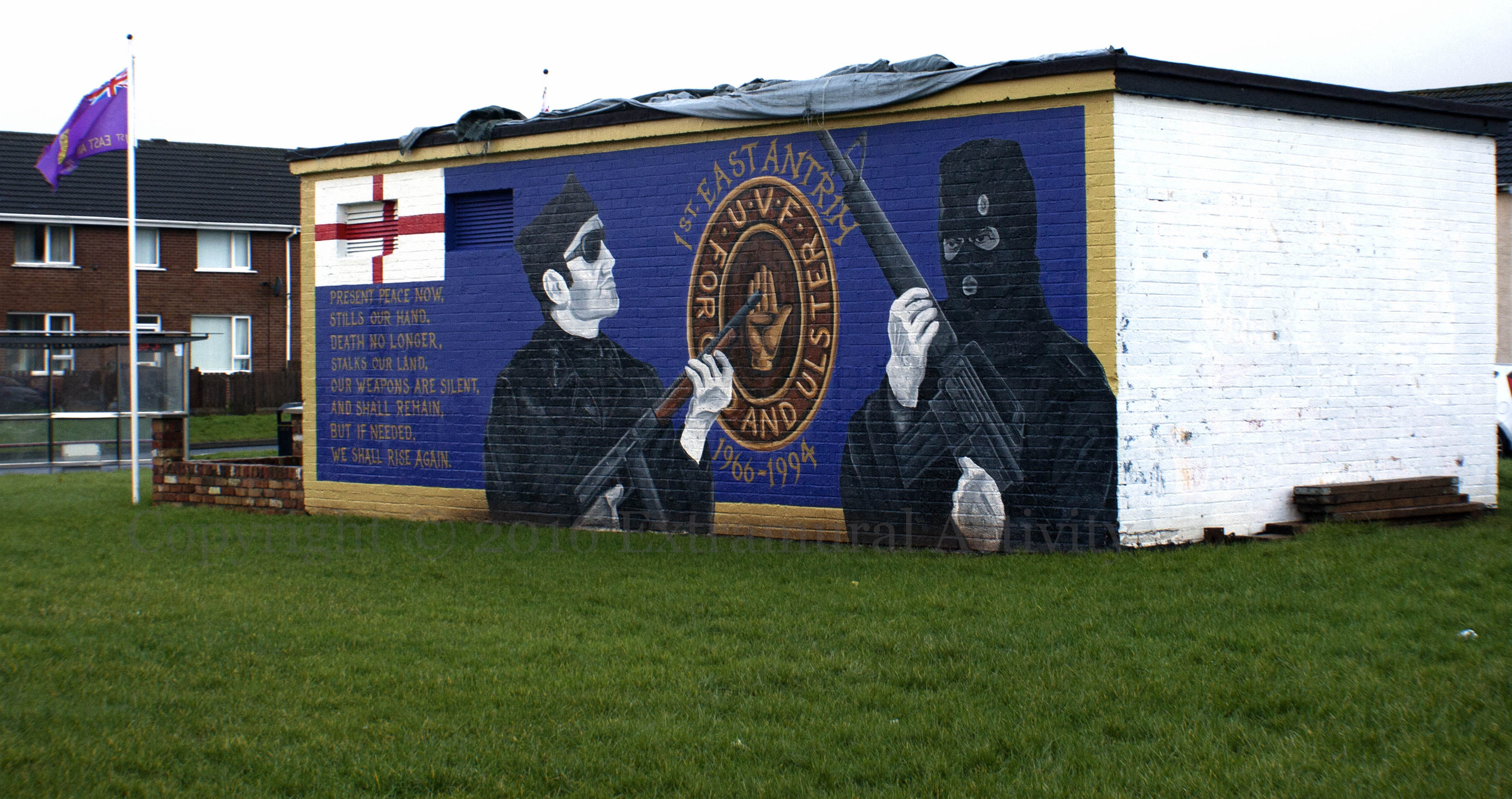
The years of operation of the UVF in this new Ballyduff mural are given as 1966-1994. The main loyalist paramilitaries began what was to be a lasting ceasefire on 13th of October, 1994. The ceasefire was announced by Gusty Spence, who was the organisation’s original leader in 1966.
“Present peace now, stills our hand, death no longer stalks our land, our weapons are silent, and shall remain, but if needed, we shall rise again.”
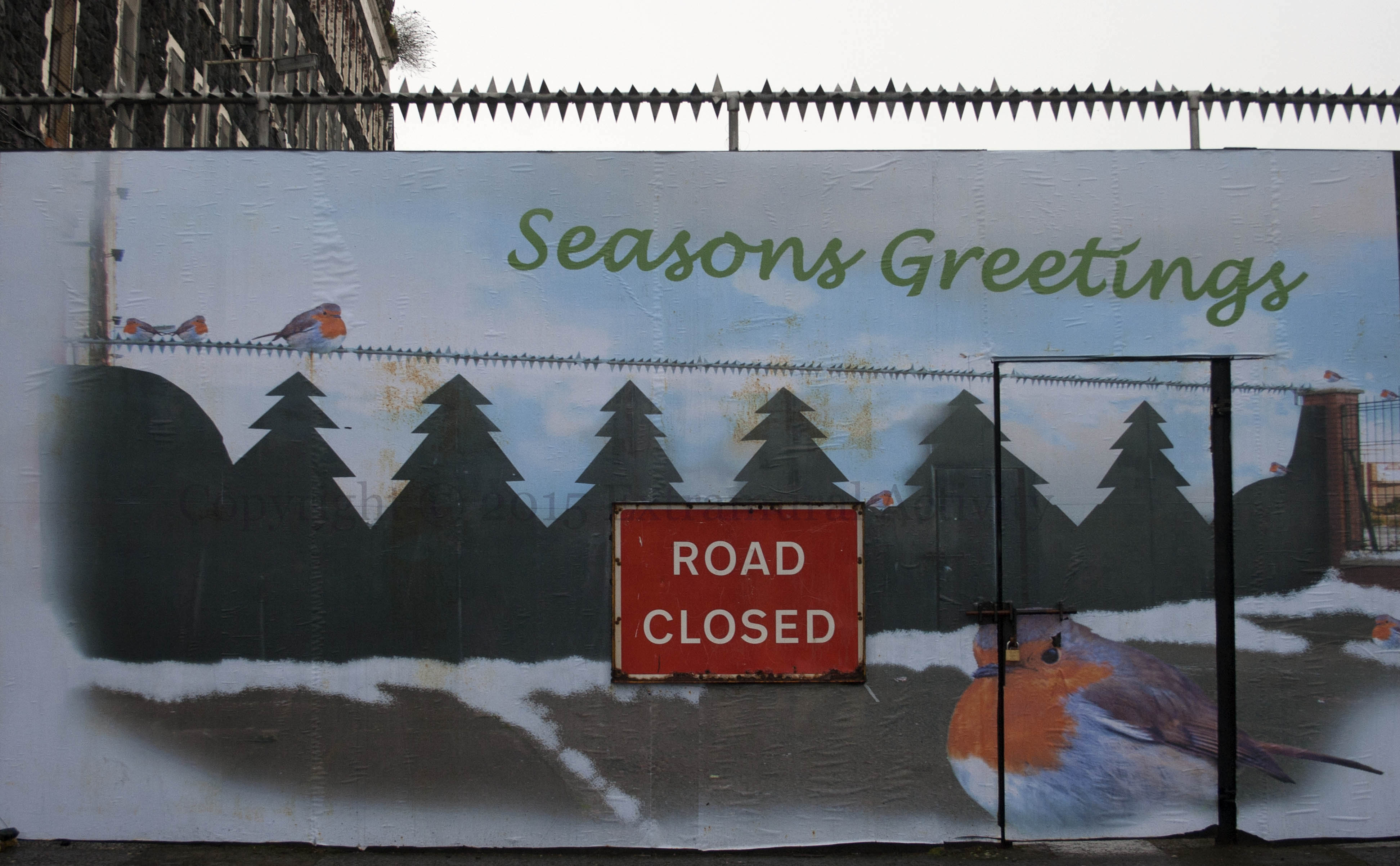
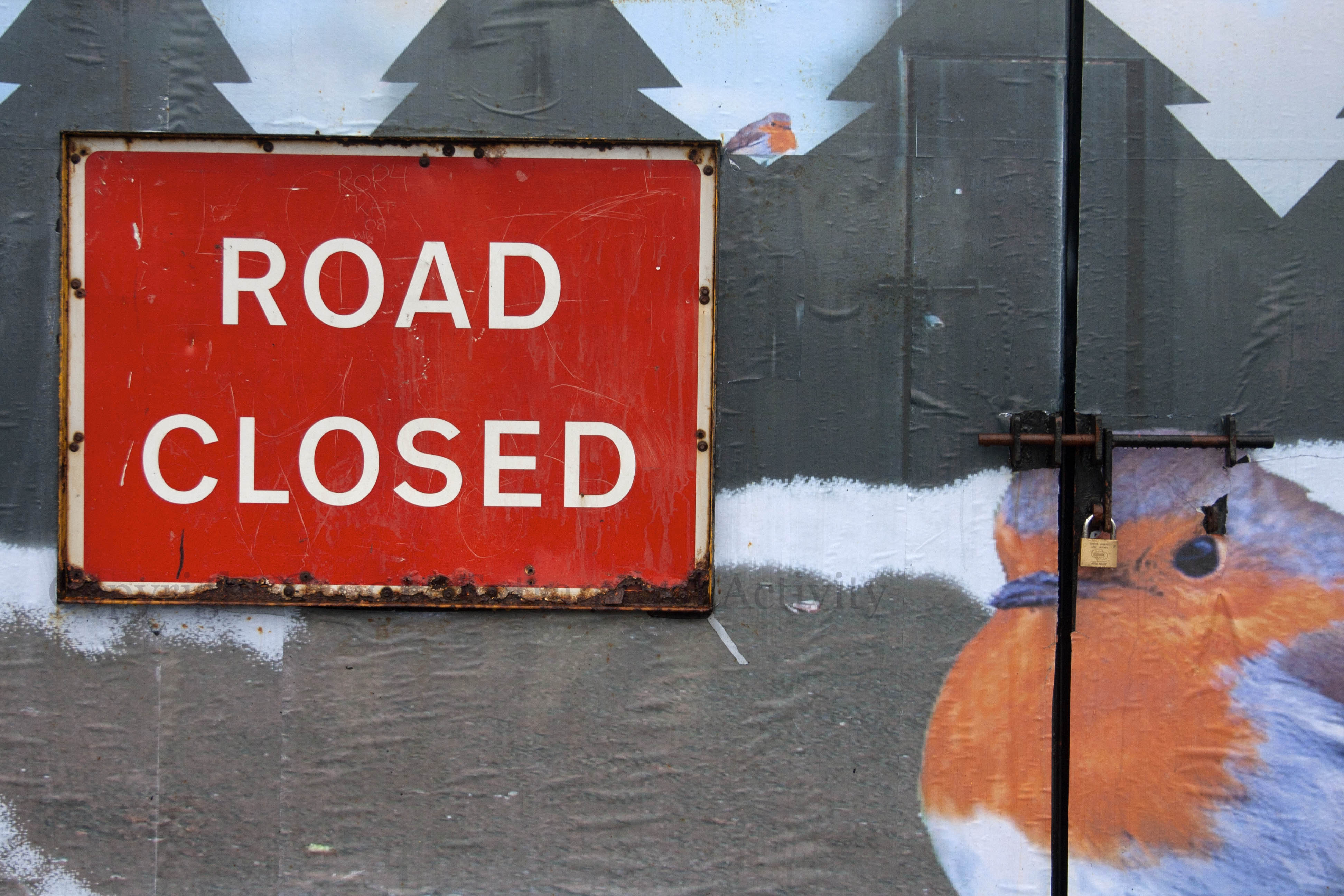
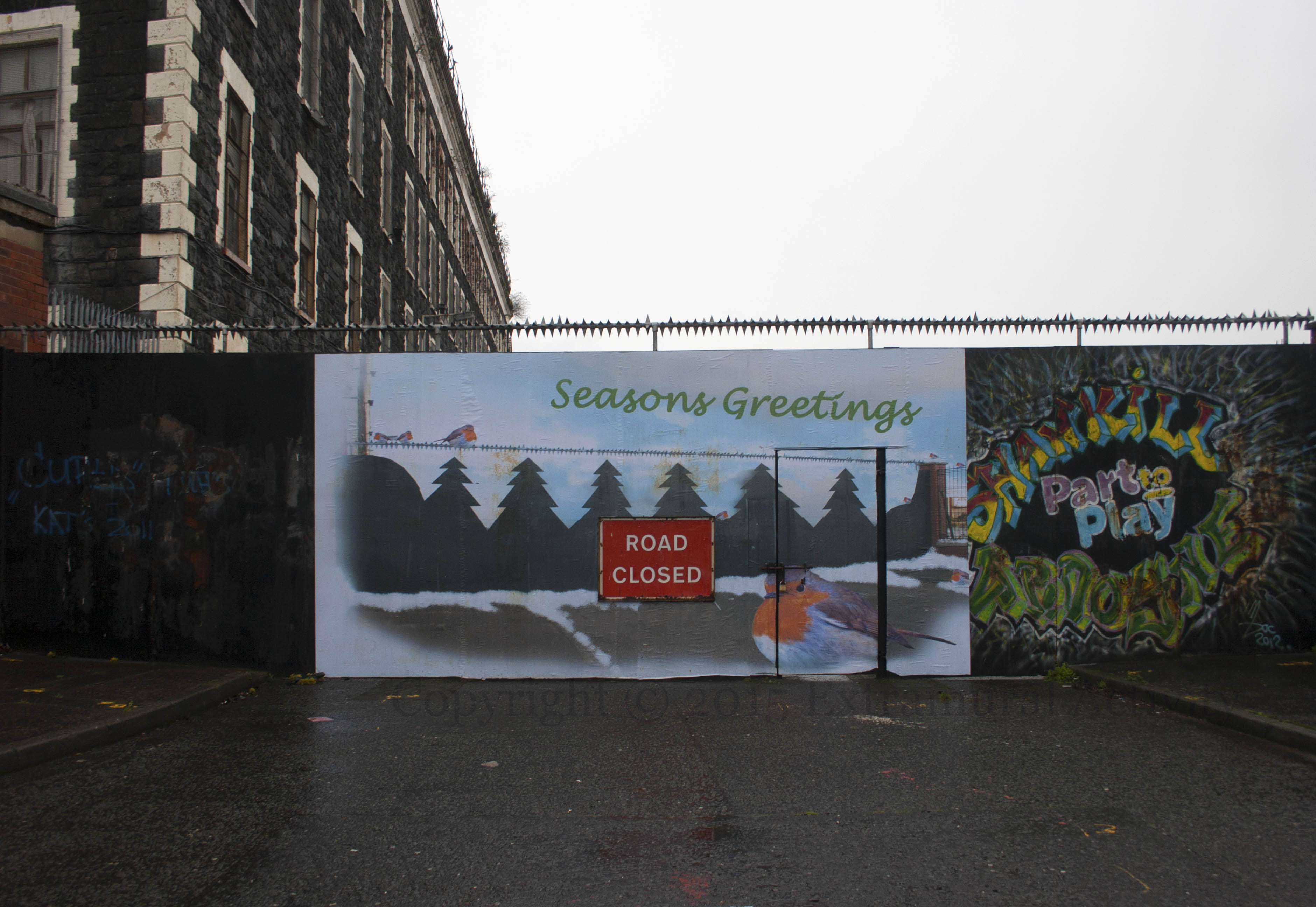
The mural shows a line of fir trees rather than steel gates but the robins on the spiked rail above give away that we’re on the “peace” line separating loyalist west Belfast from nationalist north Belfast and that the road is still closed. “Seasons Greetings” Belfast-style.
UPDATE Jan 3rd: a similar trompe l’oeil piece by Breandán Clarke could be found at this location previously, showing cars parked on the street (via Old Belfast Photographs/Glenravel History).
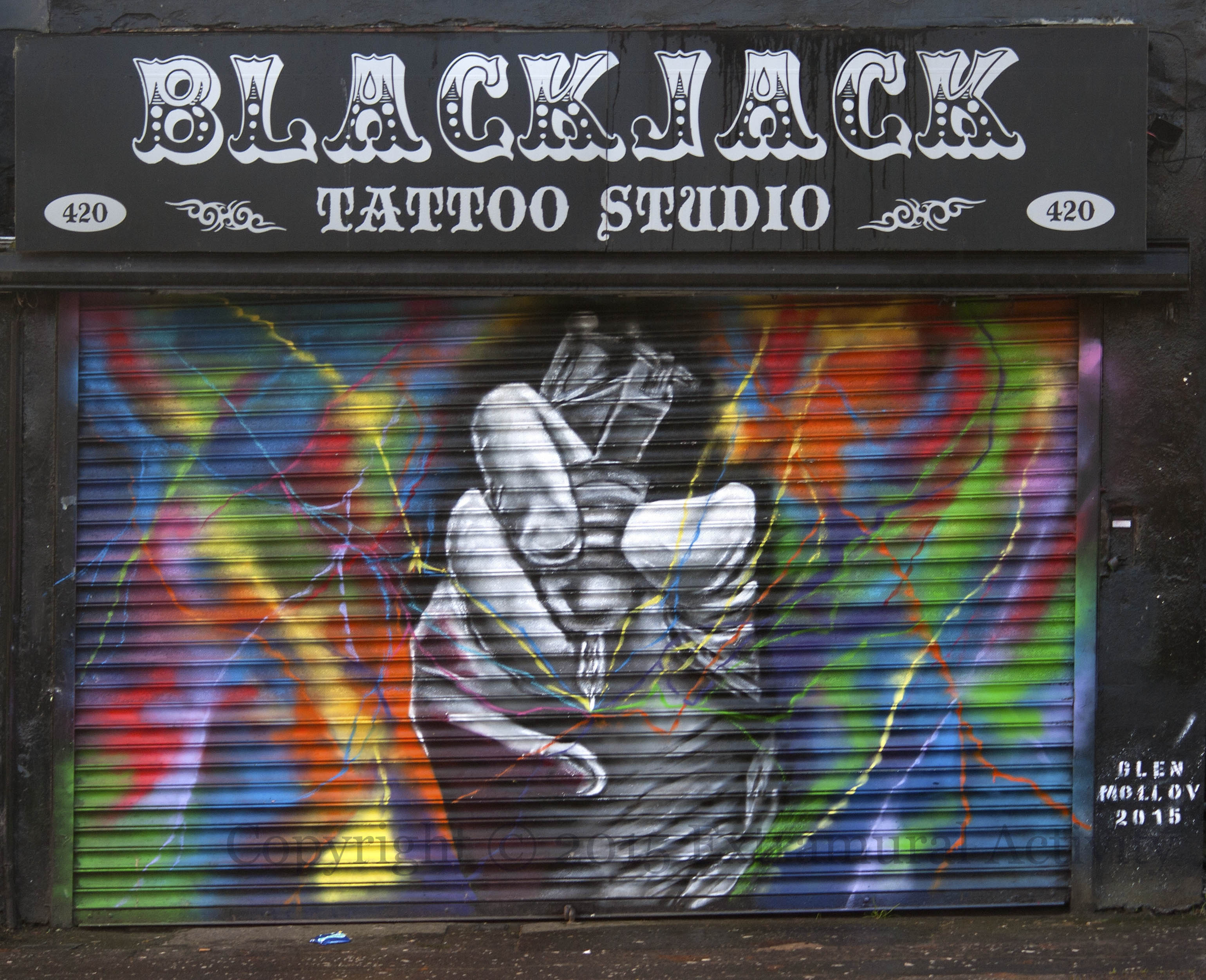
“Like a bird on a wire, like a drunk in a midnight choir, I have tried in my way to be free.” – Leonard Cohen Bird On The Wire
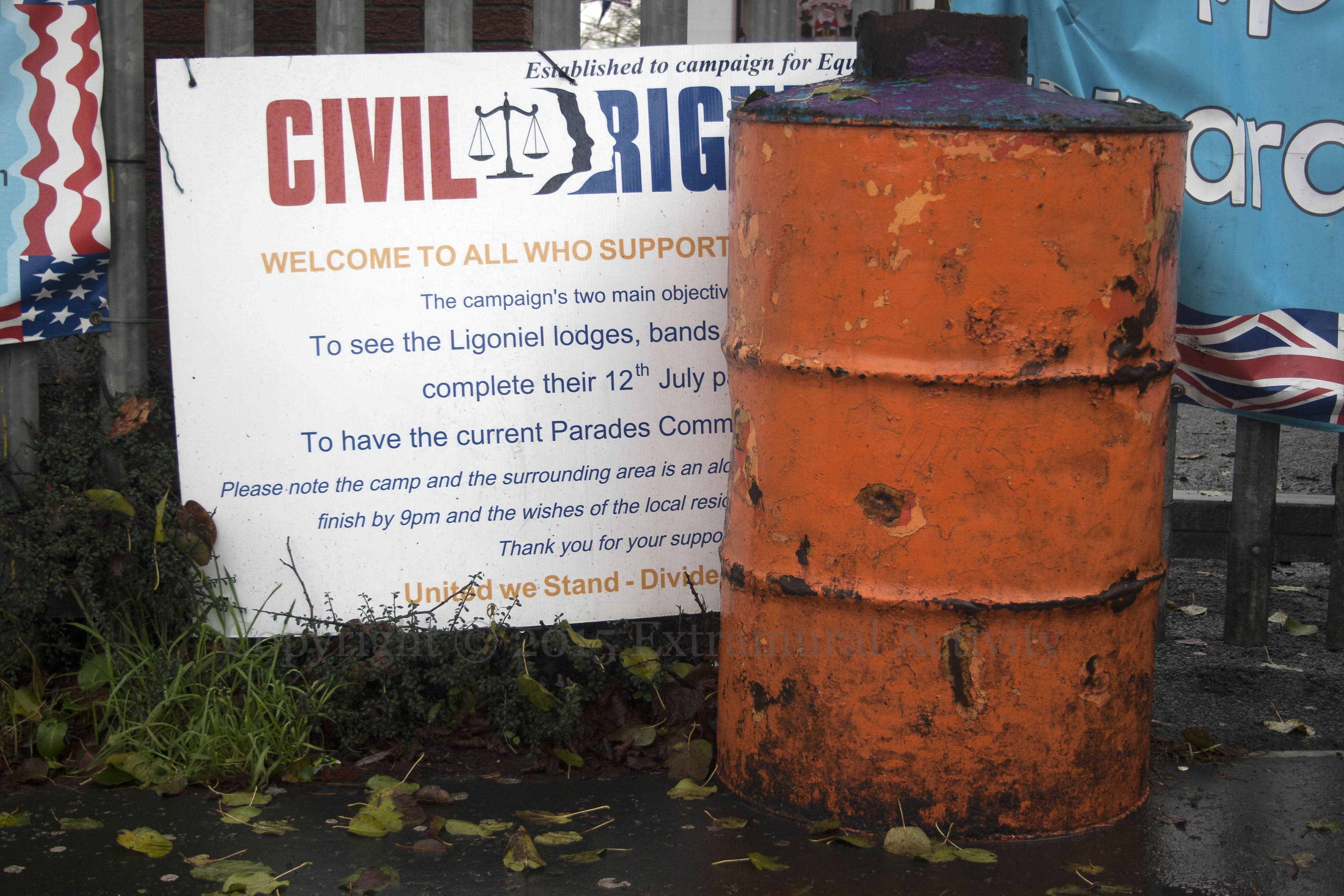
Here is a snapshot from the protest camp at Twaddell Avenue, established in July 2013, which remains in place at the junction with the Crumlin Road. The most recent newspaper mention of the protest appears to be this December 29th report in the Newsletter.
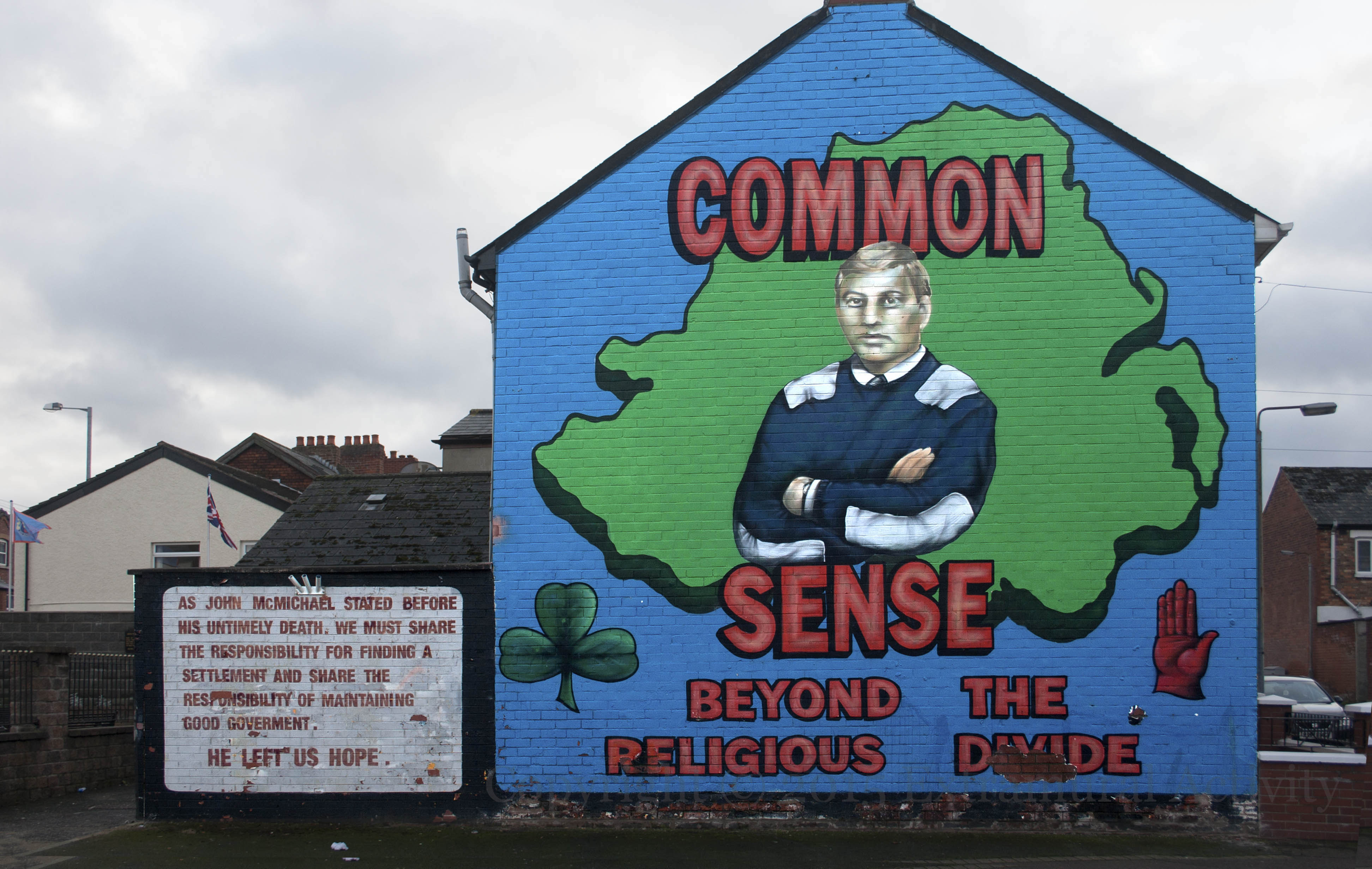
UDA commander John McMichael was also secretary of the New Ulster Political Research Group (NUPRG), a think tank of the UDA/UFF. The group argued for an independent Northern Ireland (based in part on beliefs about a separate Ulster ethnic identity – see the Visual History page on Cú Chulaınn) in two documents, 1979’s Beyond the Religious Divide and 1987’s Common Sense (available at CAIN), promoting the philosophy of ‘Ulster nationalism’, depicted here by the free-floating Northern Ireland. McMichael ran unsuccessfully for the Belfast South seat after the murder of Robert Bradford (see To Bathe The Sharp Sword Of My Word In Heaven).
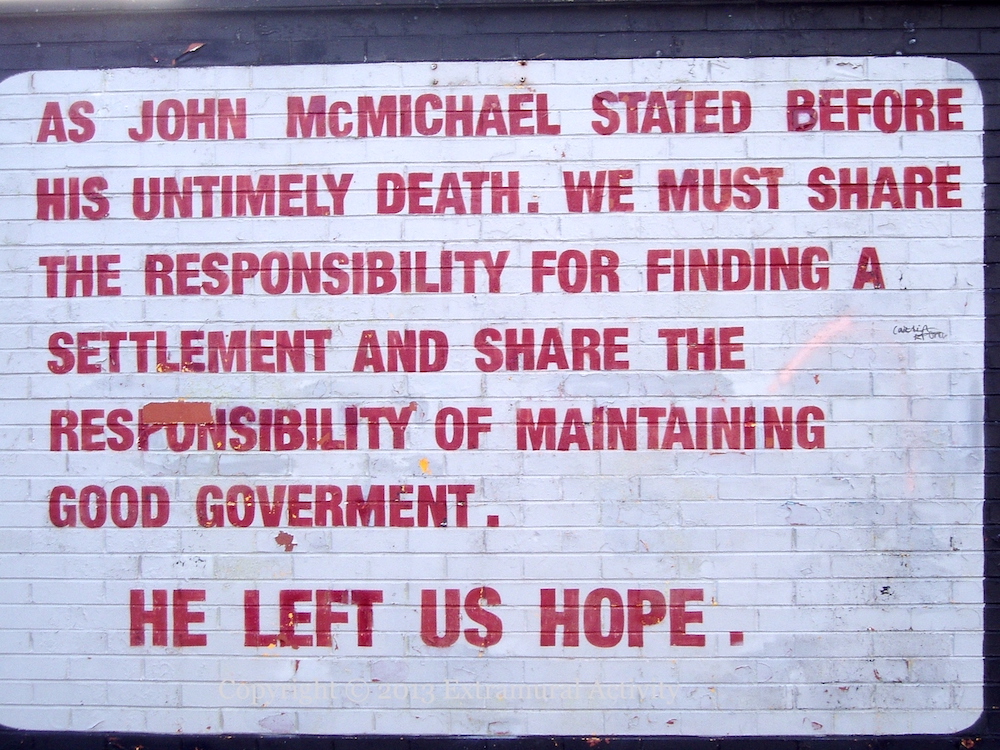
“As John McMichael stated before his untimely death, we must share the responsibility for finding a settlement and share the responsibility of maintaining good government. He left us hope.”
Here’s a link to an image (from @conflictNI on Xitter) of McMichael at the launch of Common Sense in 1987.
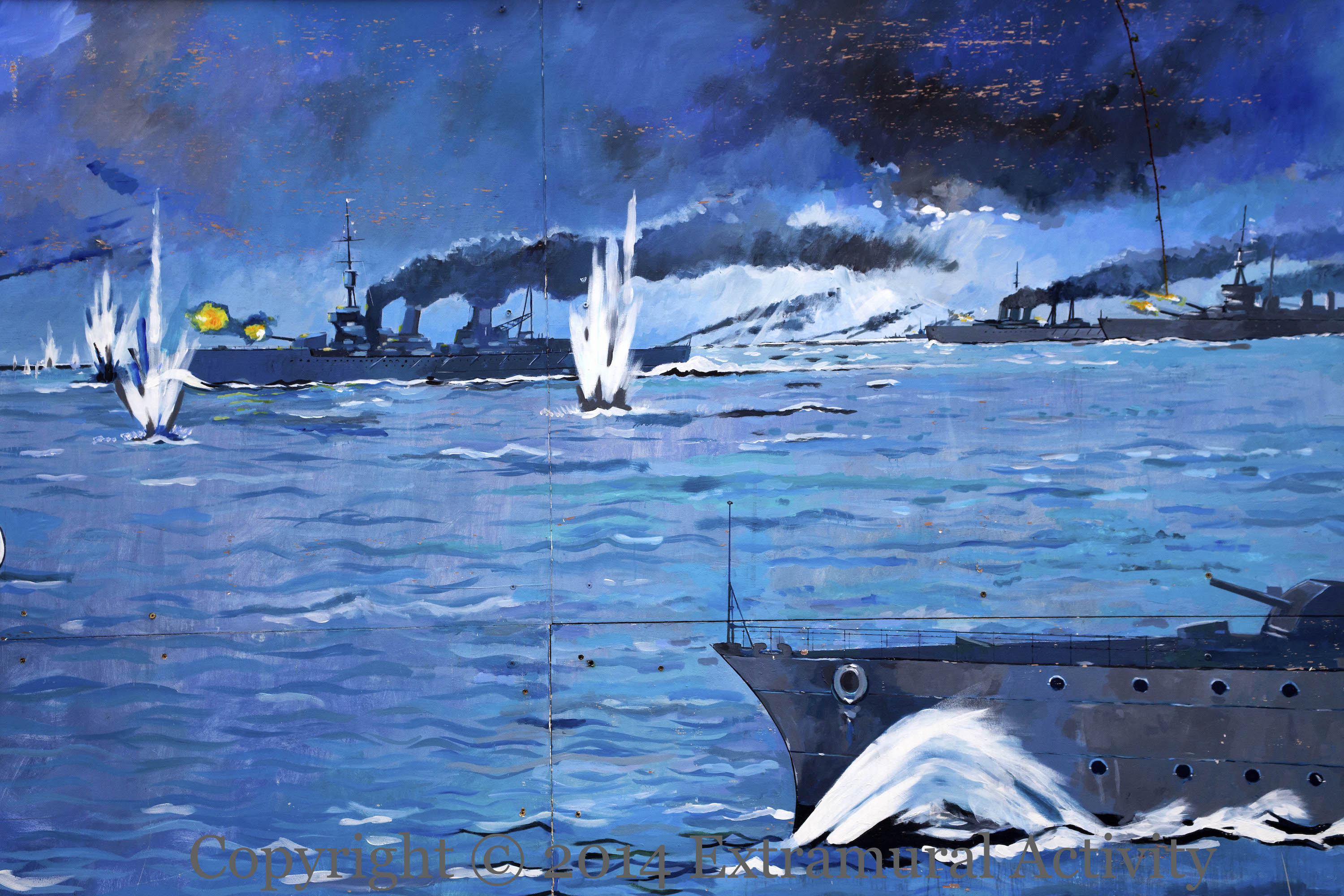
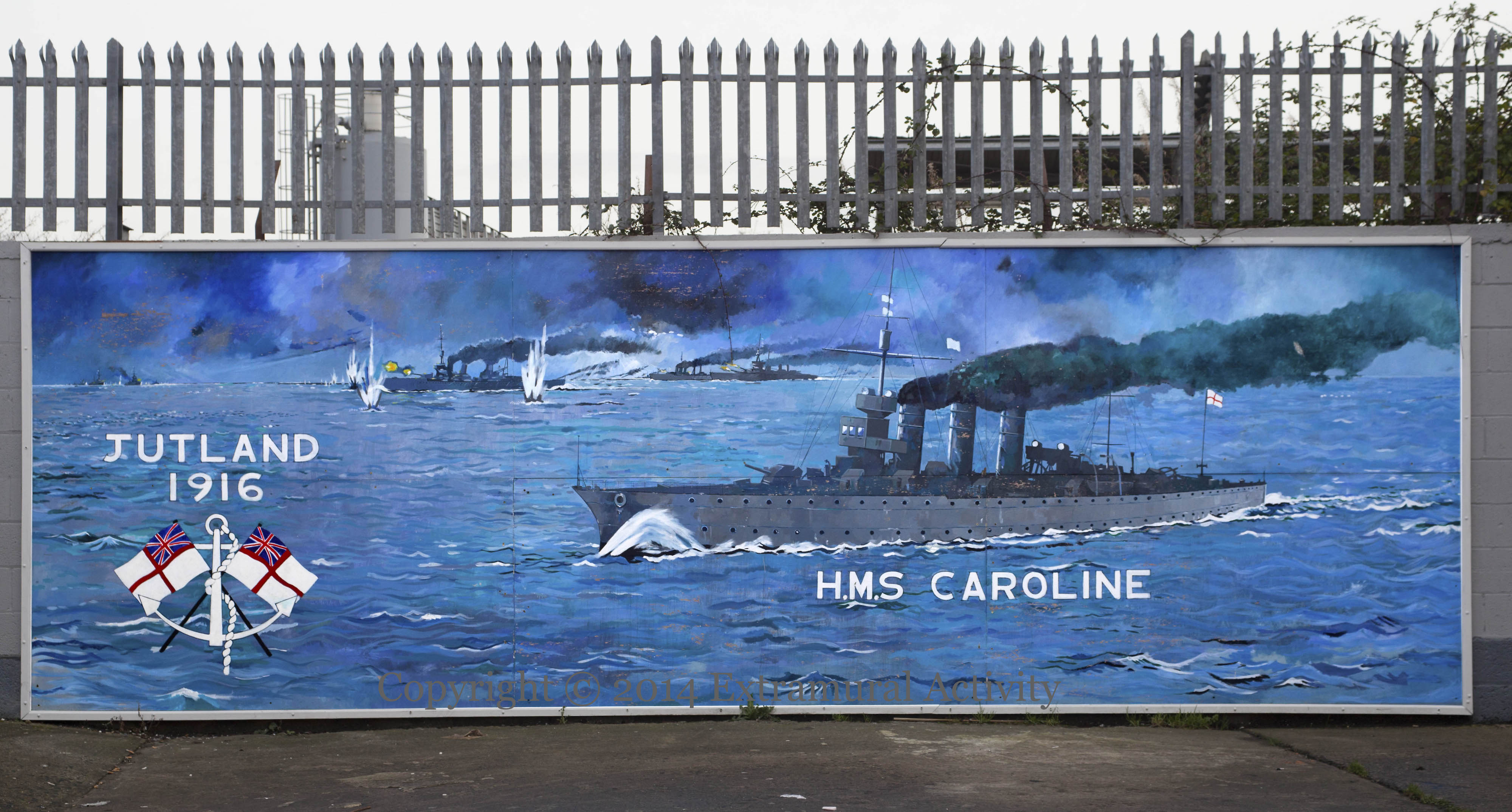
HMS Caroline’s connection to Belfast is that she served as the headquarters for the Royal Naval Reserve in Alexandra Dock. Originally built in 1914, she served in the Grand Fleet and took part in the battle of Jutland on May 31st, 1916, as shown in the images above and below. She was decommissioned in 2011; it is hoped to open her as a museum and visitor attraction by the time of the centenary of the battle (WP). The Daily Mail has a gallery of images of the ship in its current state. Also present at the battle of Jutland, as captain of HMS Nestor, was Commander (later Sir) Edward Bingham.
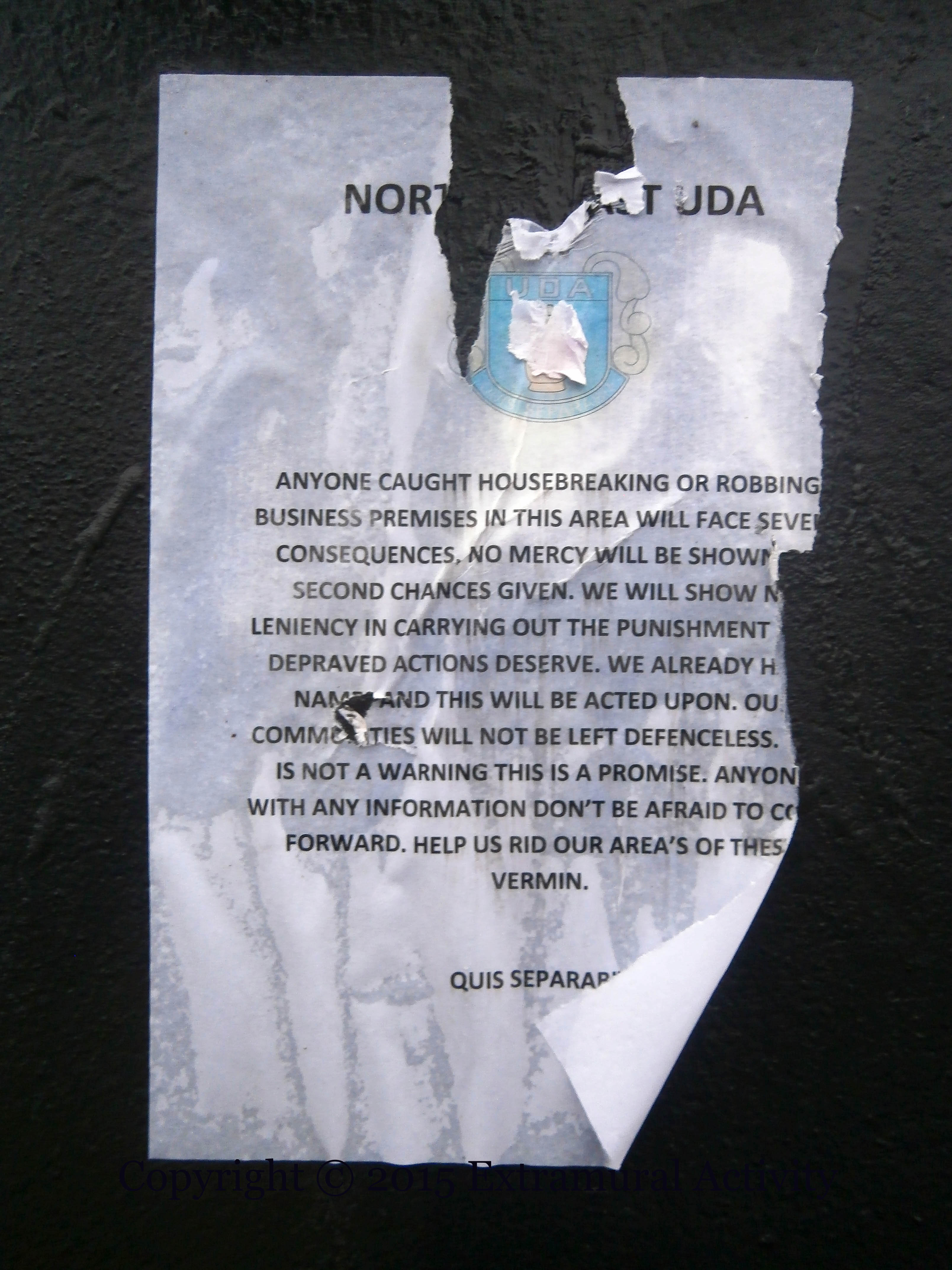
According to this Irish News article (see also Irish Republican News), the flyer above (this one is on the Crumlin Road in the centre of Ligoniel) is the work of a UDA faction that has intimidated people out of their homes in the Glenbryn area. (See also Irish Republican News.)
“North Belfast UDA: Anyone caught housebreaking or robbing business premises in this area will face severe consequences. No mercy will be shown or second chances given. We will show no leniency in carrying out the punishment your depraved actions deserve. We already have names and this will be acted upon. Our communities will not be left defenceless. This is not a warning this is a promise. Anyone with any information don’t be afraid to come forward. Help us rid our area’s of these vermin. Quis separabit.”
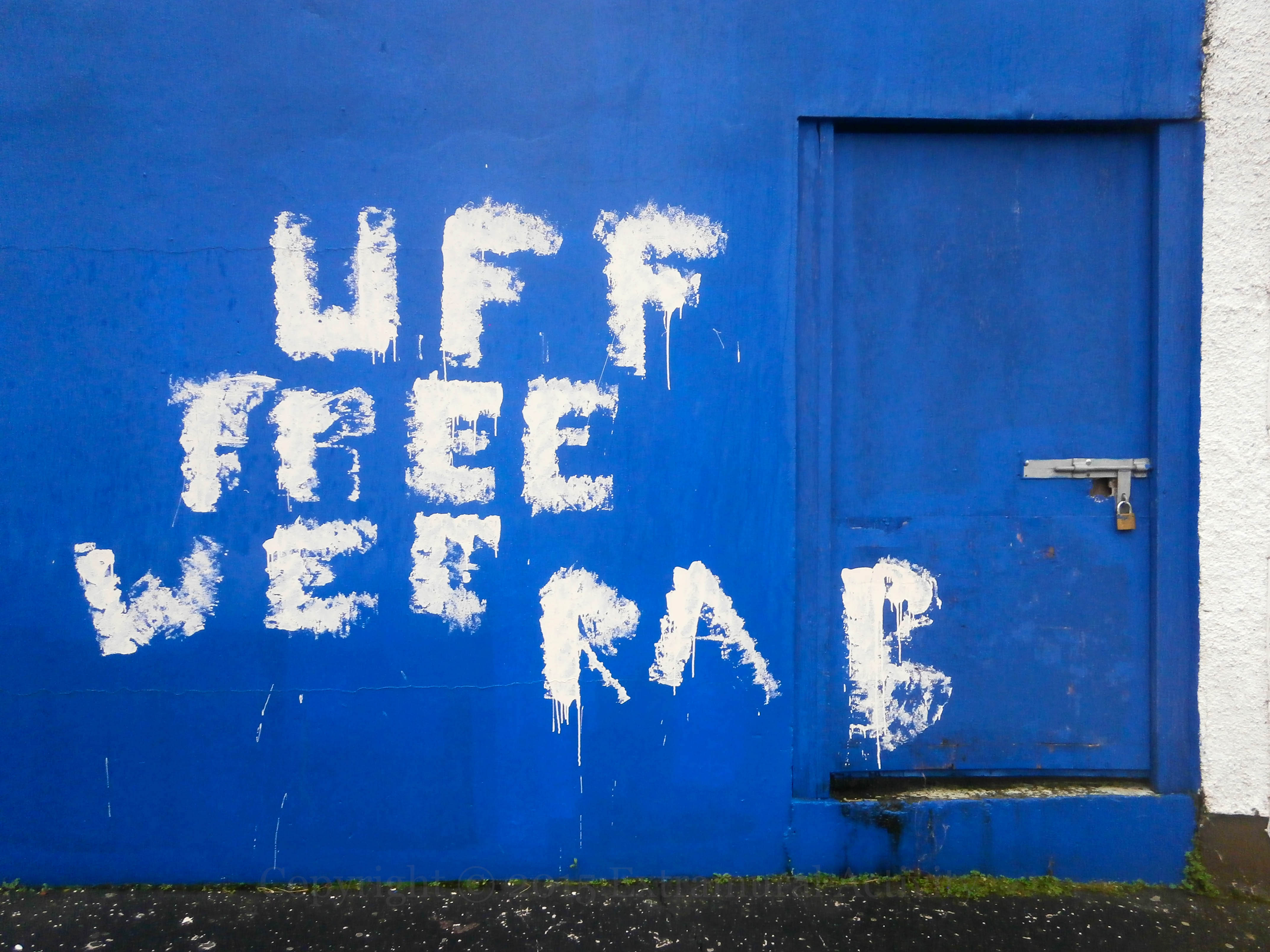
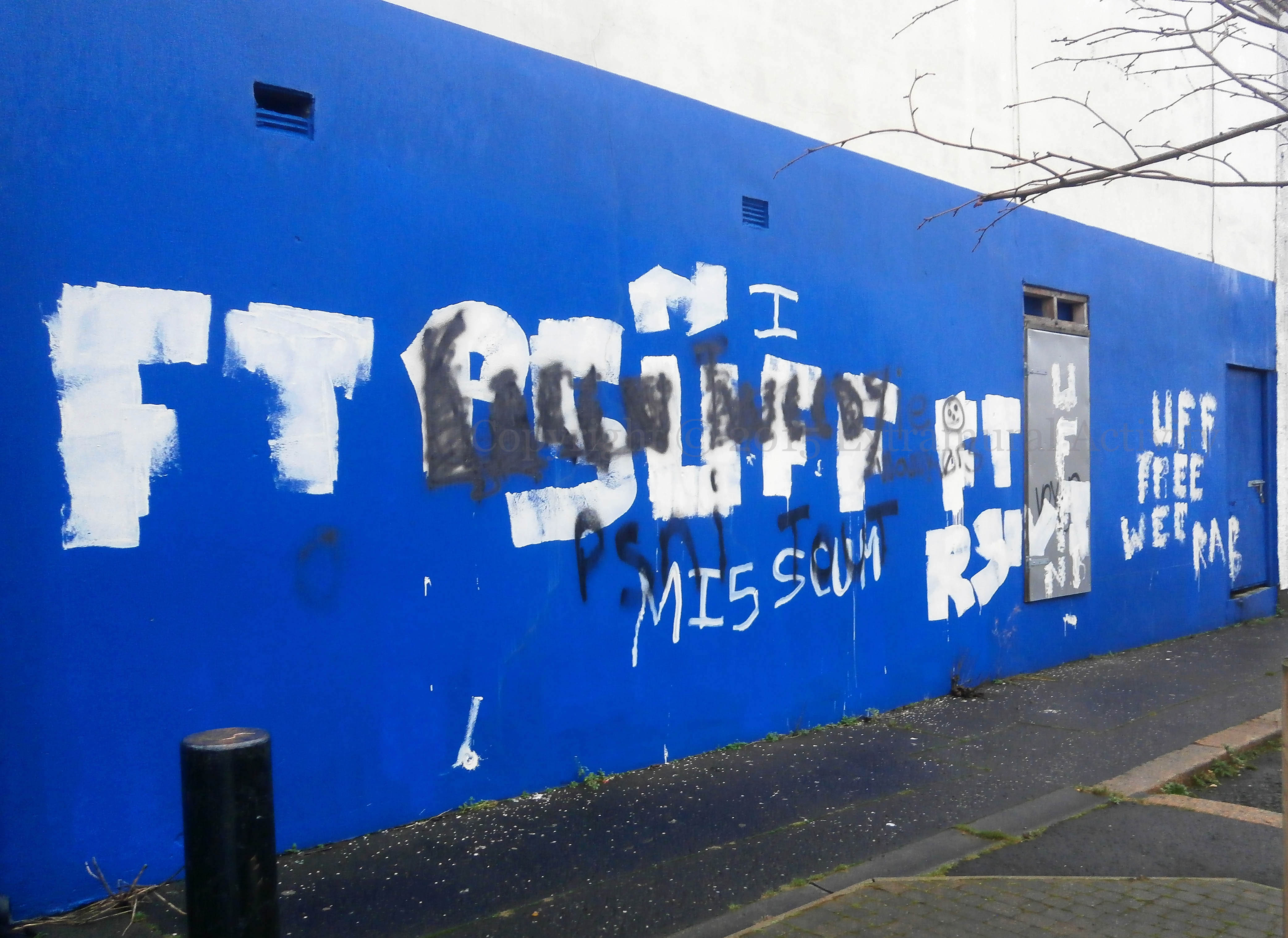
This graffiti is in the Ligoniel area of north Belfast: “UFF – Free Wee Rab”. If you know who Wee Rab is or how he is being constrained, please e-mail or comment!
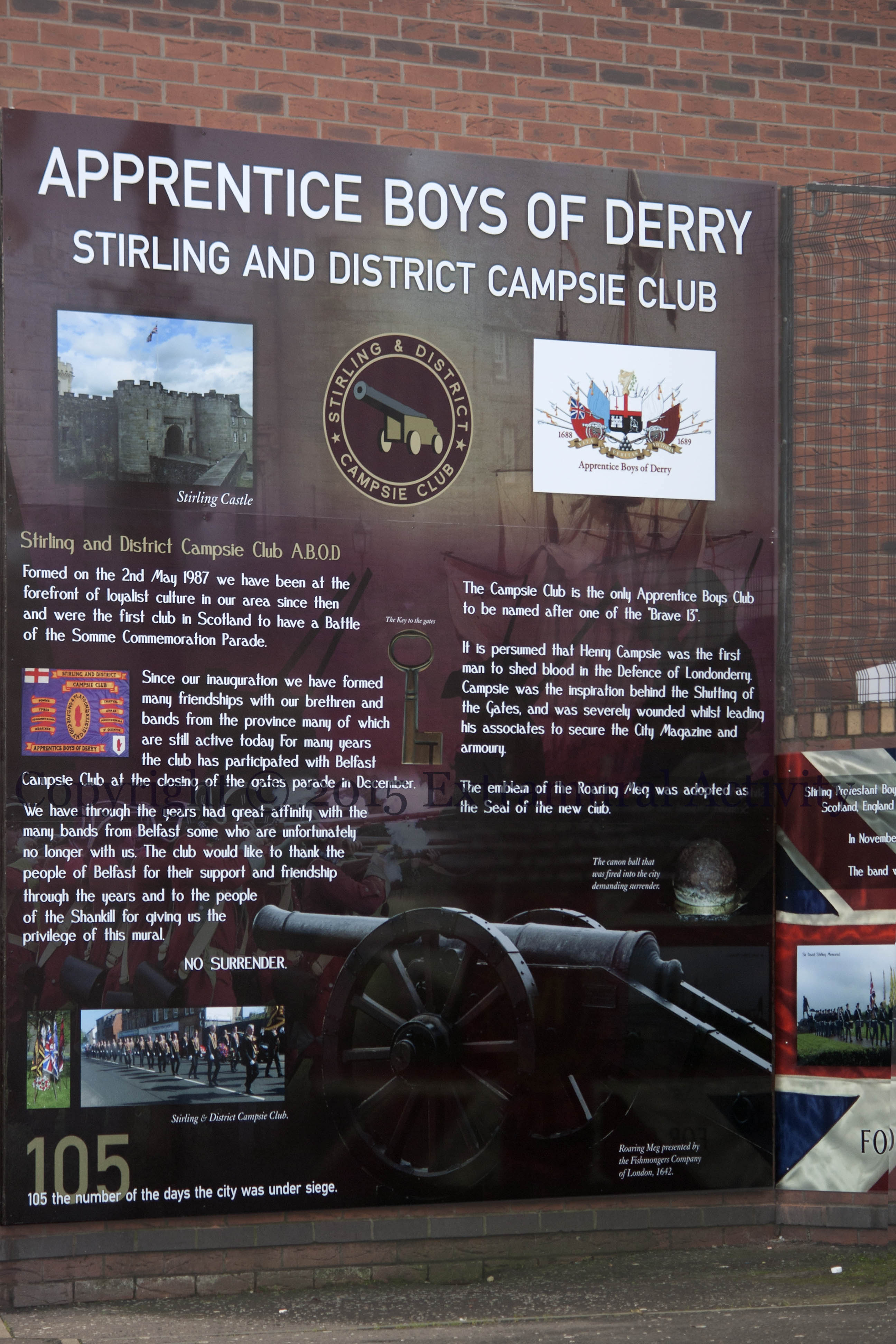
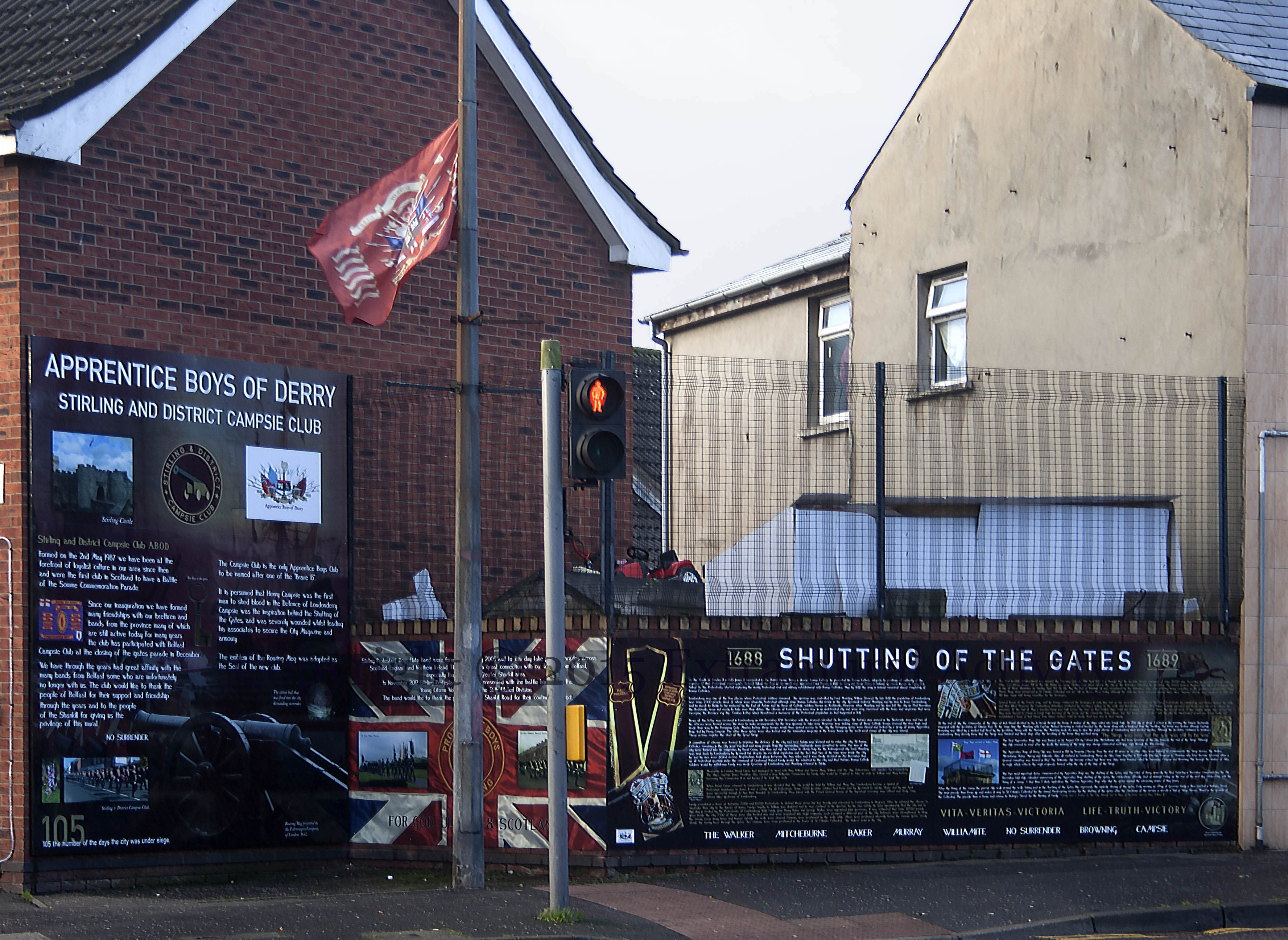
Here is one of three panels from a new three-part installation on the Shankill Road celebrating the ties between Belfast and the Stirling & District Campsie Club, a branch of one of the associated clubs of the Apprentice Boys Of Derry. It features the cannon “Roaring Meg” (“presented by the Fishmongers Company of London 1642″) which is used as the seal for the club, and includes the club’s flag, the key to the gates, and the emblem and coat of arms of the Apprentice Boys.
“Formed on the 2nd May 1987 we have been at the forefront of loyalist culture in our area since then and were the first club in Scotland to have a Battle of the Somme Commemoration Parade. Since our inauguration we have formed many friendships with our brethren and bands from the province many of which are still active today. For many years the club has participated with Belfast Campsie Club at the closing of the gates parade in December. We have through the years had great affinity with the many bands from Belfast some who are unfortunately no longer with us. The club would like to thank the people of Belfast for their support and friendship through the years and to the people of the Shankill for giving us the privilege of this murals.
No surrender.
The Campsie Club is the only Apprentice Boys Club to be named after one of the “Brave 13″. It is persumed presumed that Henry Campsie was the first man to shed blood in the Defence of Londonderry. Campsie was the inspiration behind the Shutting of the Gates and was severely wounded whilst leading his associates to secure the City Magazine and armoury. The emblem of the Roaring Meg was adopted as the Seal of the new club.”
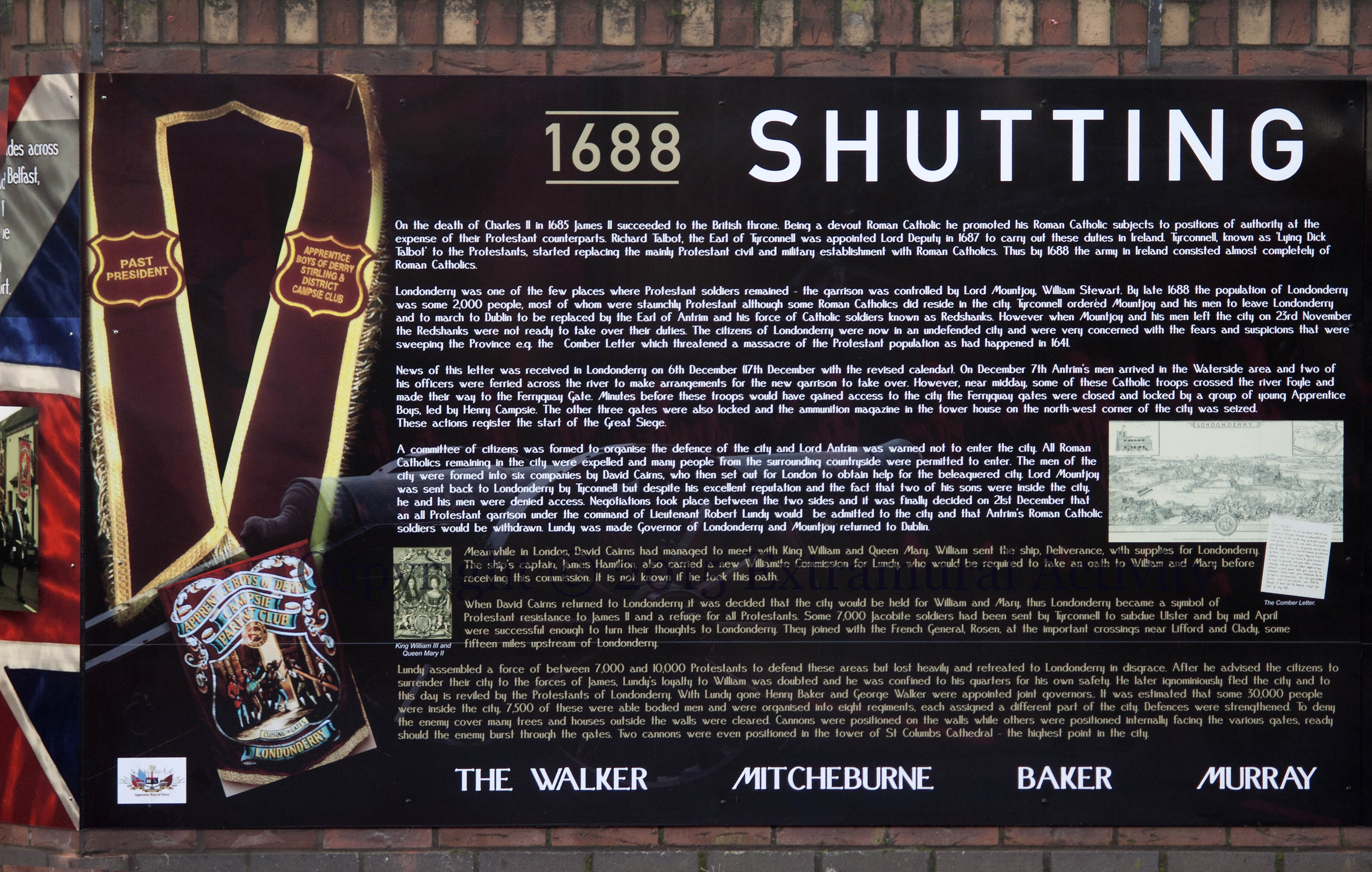
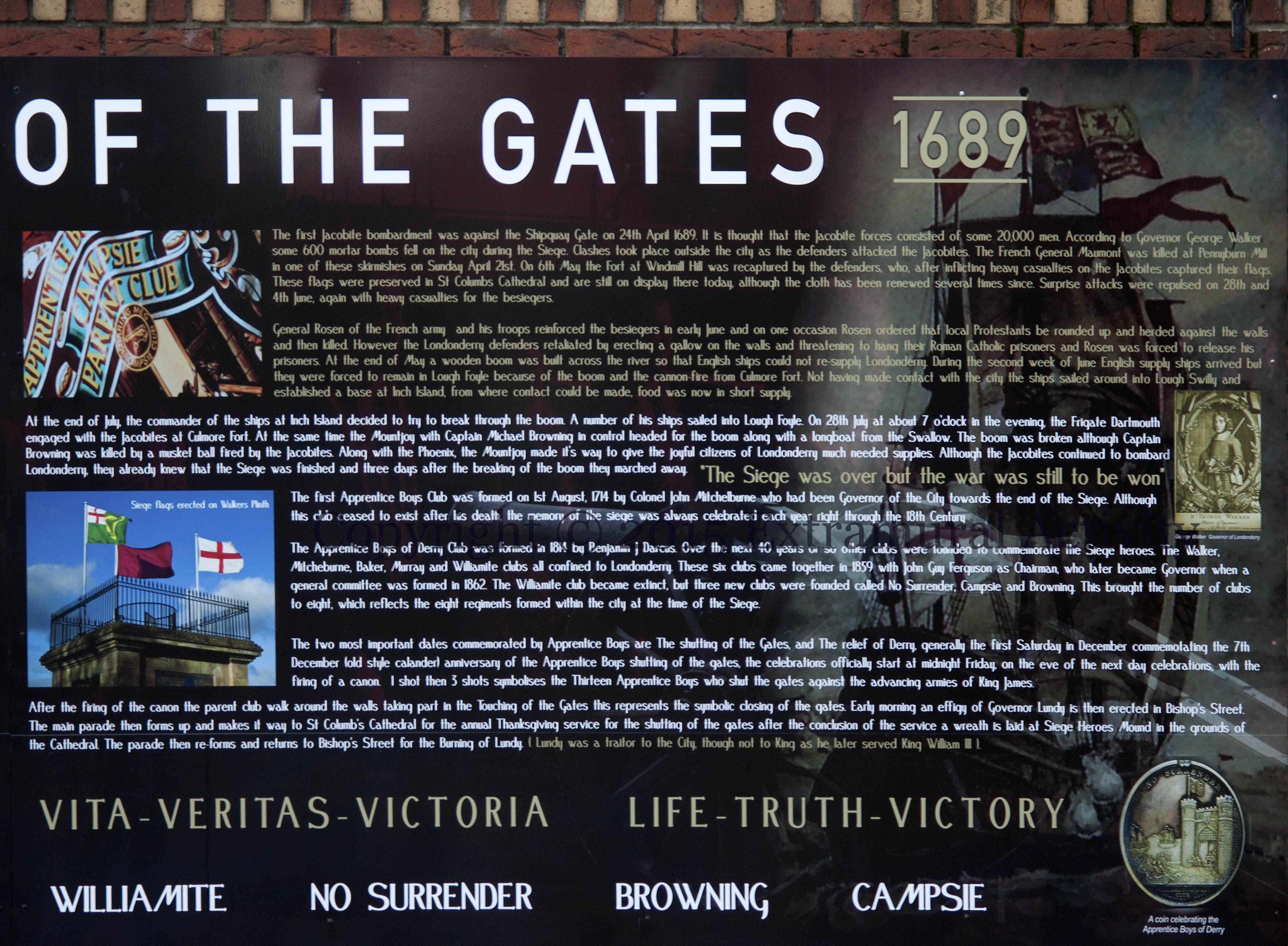
The third of three new panels celebrating the Apprentice Boys contains a long description of the Shutting Of The Gates in December 1688 and the Siege Of Derry, which was ended with the breaking of the boom of the river Foyle in July 1689.