Godfather Of The Israeli Army

2015-05-15 Patterson8+

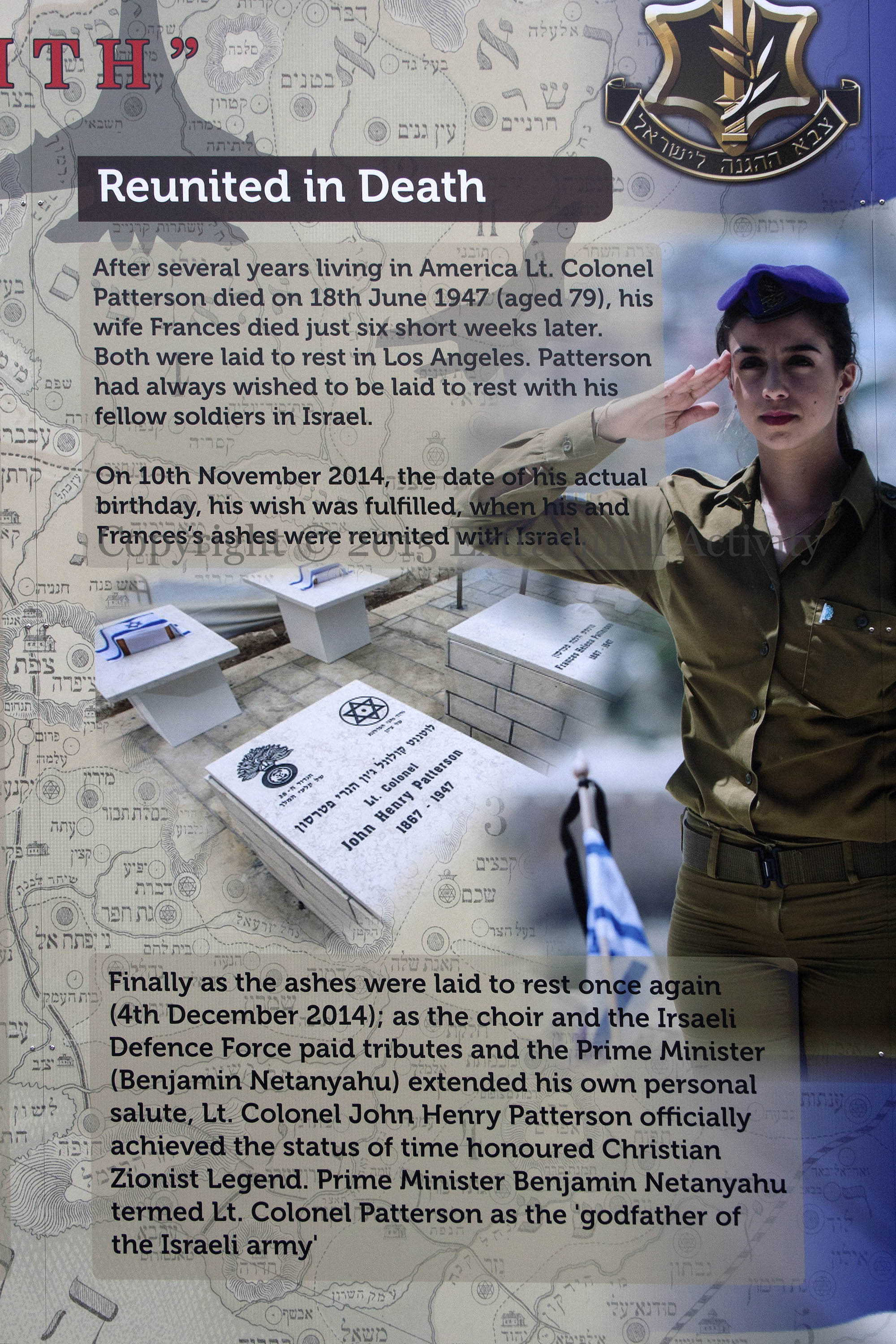
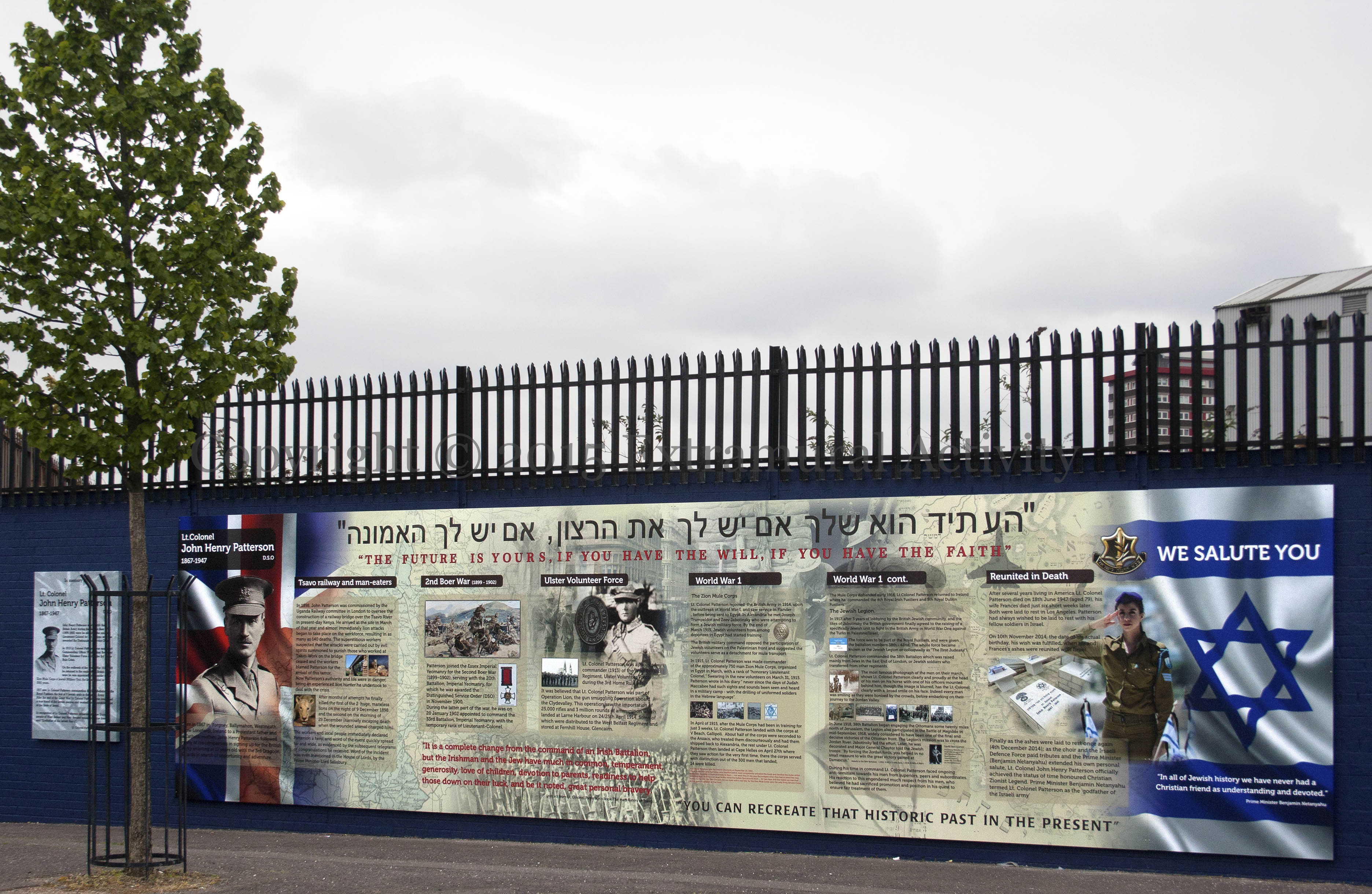
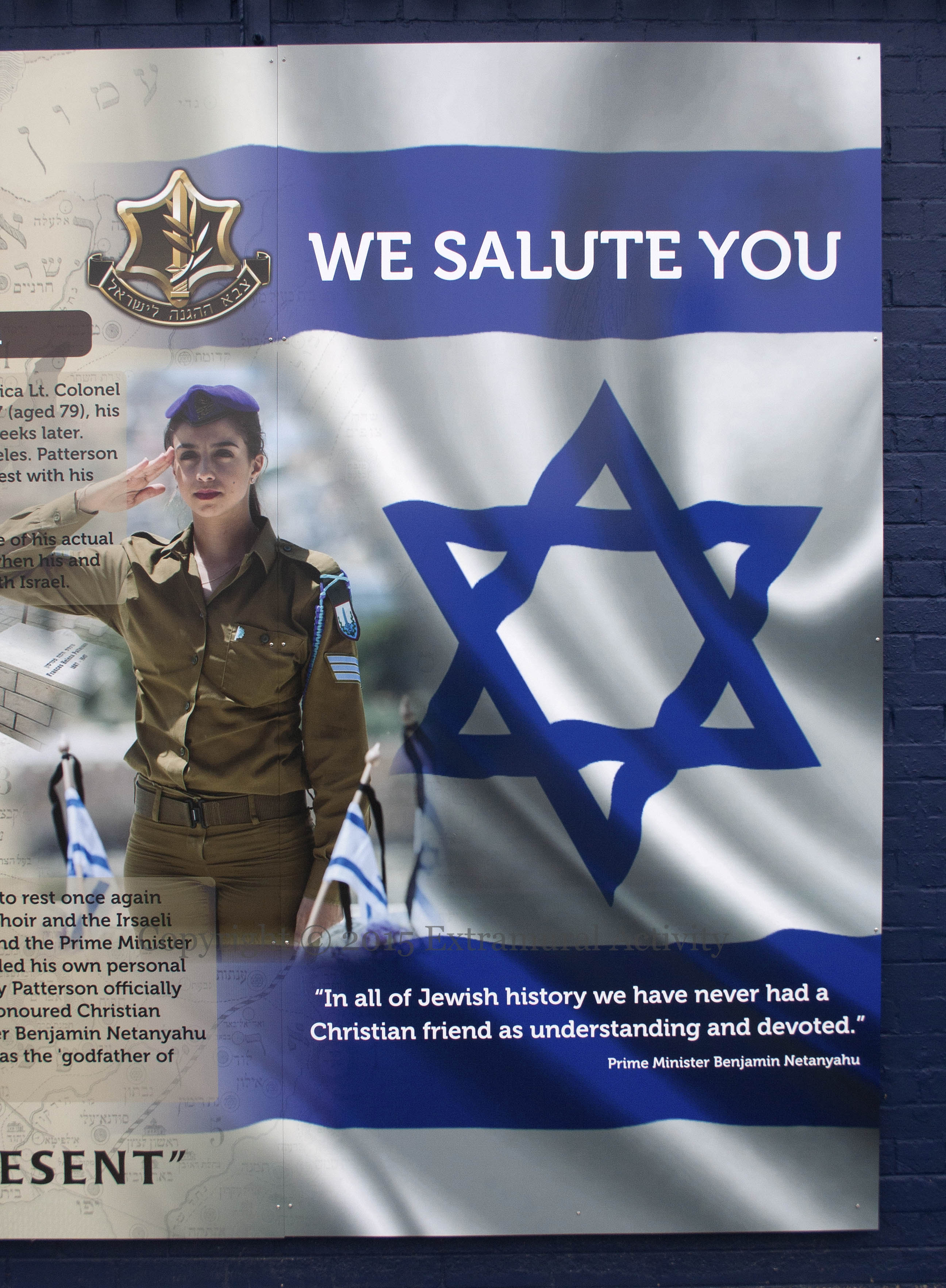
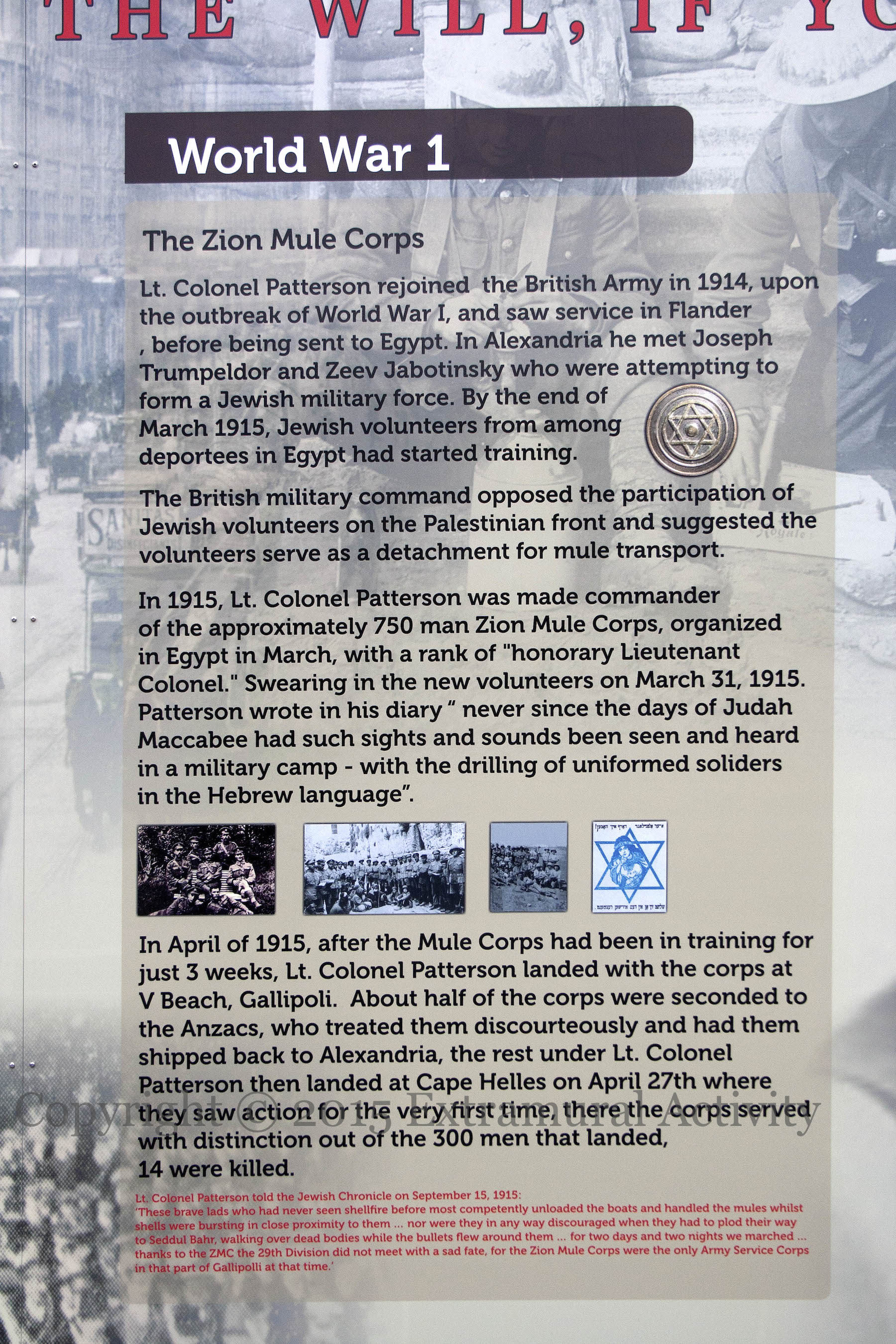
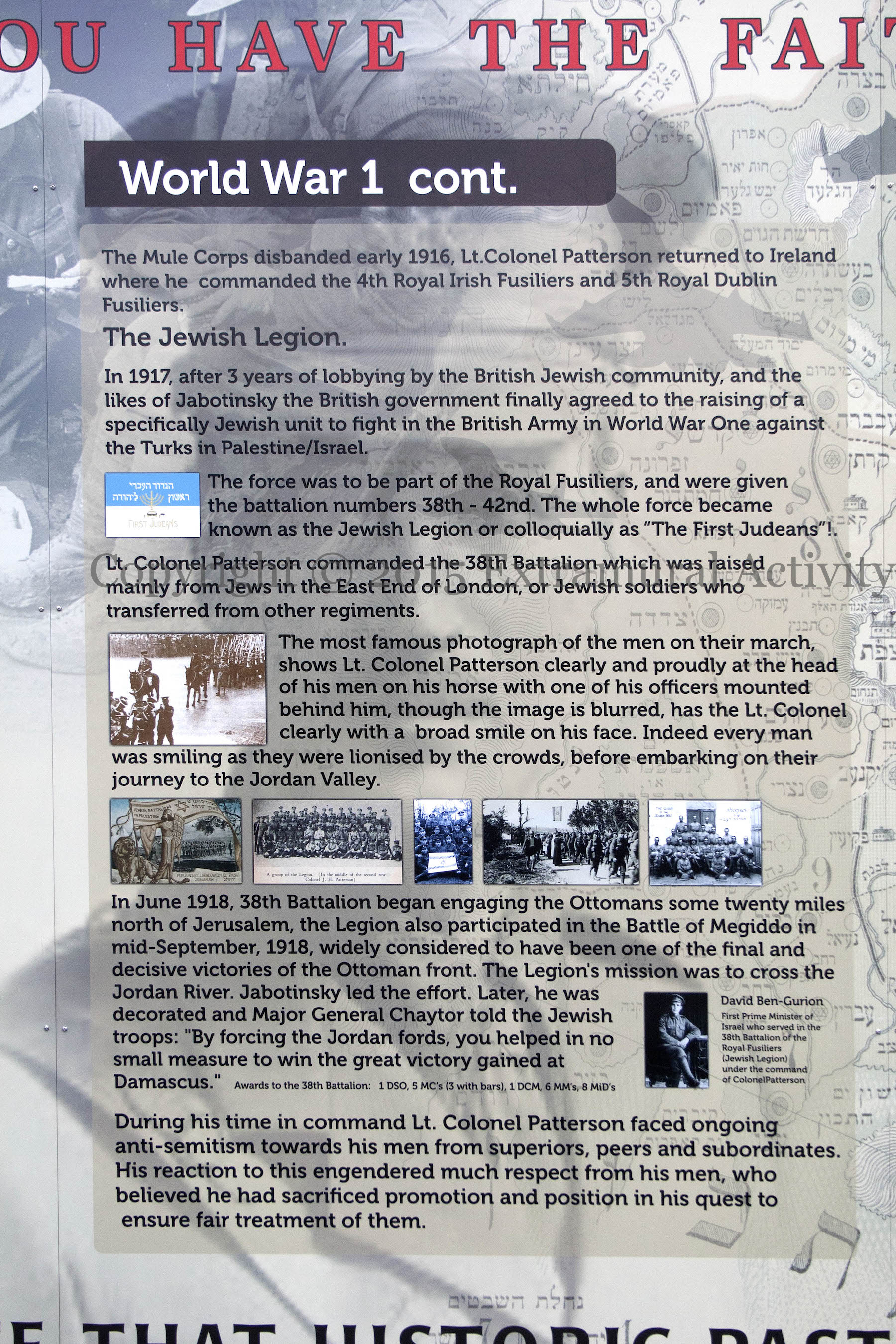
Here are panels 8, 5, 6, and 7 from the Patterson board featured in Operation Lion. The final panel shows the star of David and a quote from Prime Minister Benjamin Netanyahu: “In all of Jewish history we have never had a Christian friend as understanding and devoted.” The interim panels described Patterson’s raising and leading of the Jewish battalions of the Royal Fusiliers in WWI. After dying in obscurity in Los Angeles in 1947, his remains were transported to Israel in December 2014 and re-interred (video). For more, including a recording of Patterson’s voice, see this BBC Magazine article.

Video of the launch:

The plaque to the right asks viewers to “please respect this artwork” but a fire was set below it in 2016; see Where Is The Reconciliation?
2015-05-15 Patterson5+

2015-05-15 Patterson6+

2015-05-15 Patterson7+

2015-05-15 PattersonFull+

X11329 2022-08-06 Patterson WBACS info+

Click image to enlarge
Copyright © 2015 Seosamh Mac Coılle
X02621 X02618 X02619 X02620 X02622
Copyright © 2022 Extramural Activity
X11329
“The Zion Mule Corps. Lt. Colonel Patterson rejoined the British Army in 1914, upon the outbreak of World War I, and saw service in Flander[s] before being sent to Egypt. In Alexandria he met Joseph Trumpeldor and Zeev Jabotinsky who were attempting to form a Jewish military force. By the end March 1915, Jewish volunteers from among deportees in Egypt had started training. The British military command opposed to participation of Jewish volunteers on the Palestinian front and suggested the volunteers serve as a detachment for mule transport. In 1915, Lt. Colonel Patterson was made commander of the approximately 750 man Zion Mule Corps, organized in Egypt in March, with a rank of “honorary Lieutenant Colonel.” Swearing in the new volunteers on March 31, 1915. Patterson wrote in his diary “never since the days of Judah Maccabee had such sights and sounds been seen and heard in a military camp – with the drilling of uniformed soldiers in the Hebrew language”. In April of 1915, after the Mule Corps had been in training for just 3 weeks, Lt. Colonel Patterson  landed with the corps at V Beach, Gallipoli. About half of the corps were seconded to the Anzacs, who treated them discourteously and had them shipped back to Alexandria, the rest under Lt. Colonel Patterson then landed at Cape Helles on April 27th where they saw action for the very first time, there the corps served with distinction out of the 300 men that landed, 14 were killed.” 
“The Mule Corps disbanded in early 1916, Lt. Colonel Patterson returned to Ireland where he commanded the 4th Royal Irish Fusiliers and 5th Royal Dublin Fusiliers. In 1917, after 3 years of lobbying by the British Jewish community, and the likes Jabotinsky the British government finally agreed to the raising of a specifically Jewish unit to fight in the British Army in World War One against the Turks in Palestine/Israel. The force was to be part of the Royal Fusiliers and were given the battalion numbers 38th-42nd. The whole force became known as the Jewish Legion or colloquially as “The First Judeans” The most famous photograph of the men on their march shows Lt. Colonel Patterson clearly and proudly at the head of his men on his horse with one of his offices mounted behind him though the image is blurred has the Lt. Colonel clearly with a broad smile on his face. Indeed every man was smiling as they were lionised by the crowds before embarking on their journey to the Jordan Valley. In June 1918 38th Battalion began engaging the Ottomans some twenty miles north of Jerusalem the Legion also participated in the Battle of Megiddo in mid-September  1918 widely considered to have been one of the final and decisive victories of the Ottoman front. The legion’s mission was to cross the Jordan river. Jabotinsky led the effort. Later he was decorated and Major General Chaytor told the Jewish troops “By forcing the Jordan fords, you helped in no small measure to win the great victory gained at Damascus. During his time in command Lt. Colonel Patterson faced ongoing anti-semitism from superiors, peers and subordinates. His reaction to this engendered much respect from his men, who believed he had sacrificed promotion and position in his quest to ensure fair treatment of them.”
“After several years living in American Lt Colonel Patterson died on 18th June 1947 (aged 79), his wife Frances died just six short weeks later. Both were laid to rest in Los Angeles. Patterson had always wished to be laid to rest with his with fellow soldiers in Israel. On 10th November 2014, the date of his actual birthday, his wish was fulfilled, when his and Frances’s ashes were reunited with Israel. Finally as the ashes were laid to rest once again (4th December 2014); as the choir and the Israeli Defence Force paid tributes and the Prime Minister (Benjamin Netanyahu) extended his own personal salute, Lt. Colonel John Henry Patterson officially achieved the status of time honoured Christian Zionist Legend. Prime Minister Benjamin Netanyahu termed Lt. Colonel Patterson as the ‘godfather of the Israeli army’. 
historic past in the present future is yours if you have the will faith david ben-gurion we salute you
Carving Out A Place In History

2015-05-08 SPBCrest+

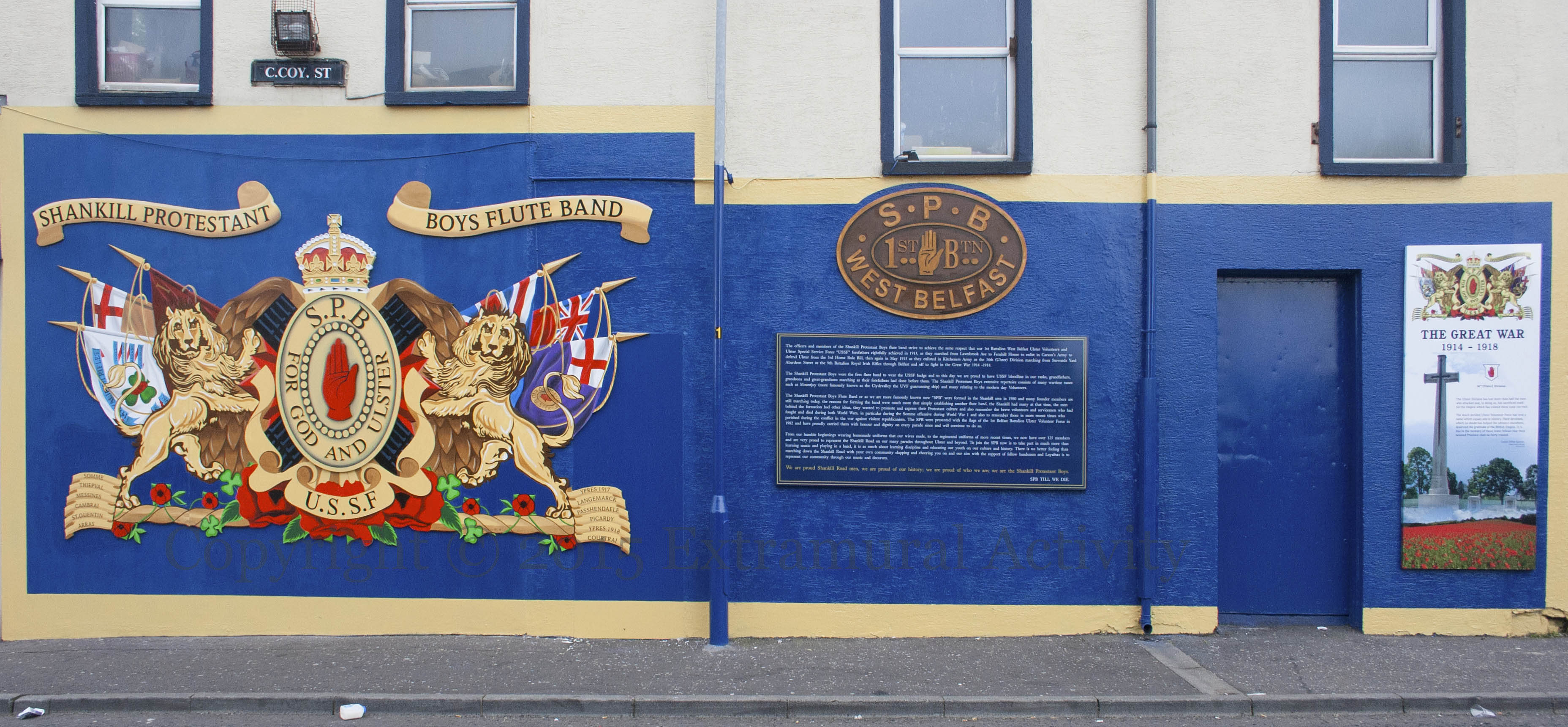
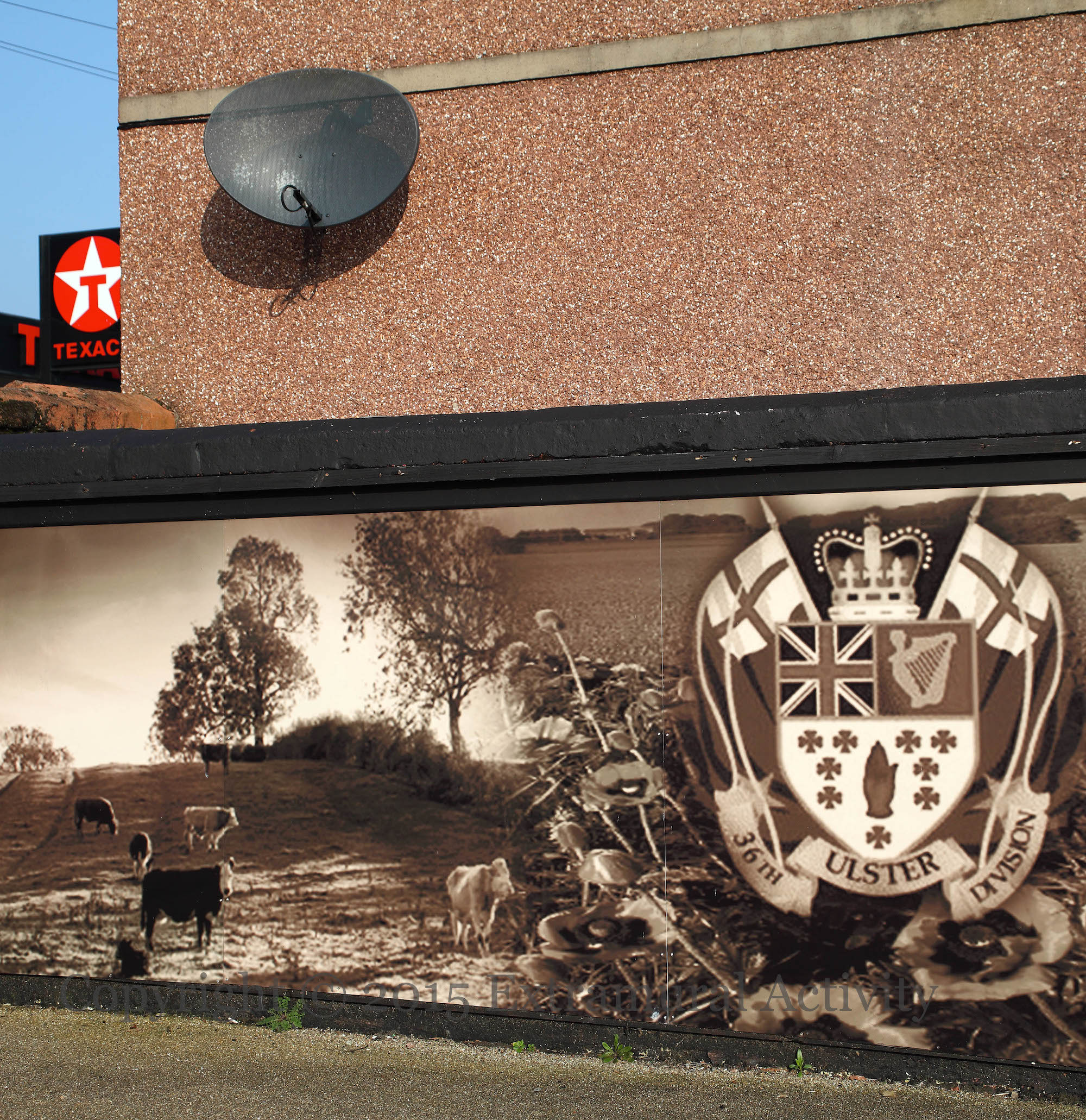
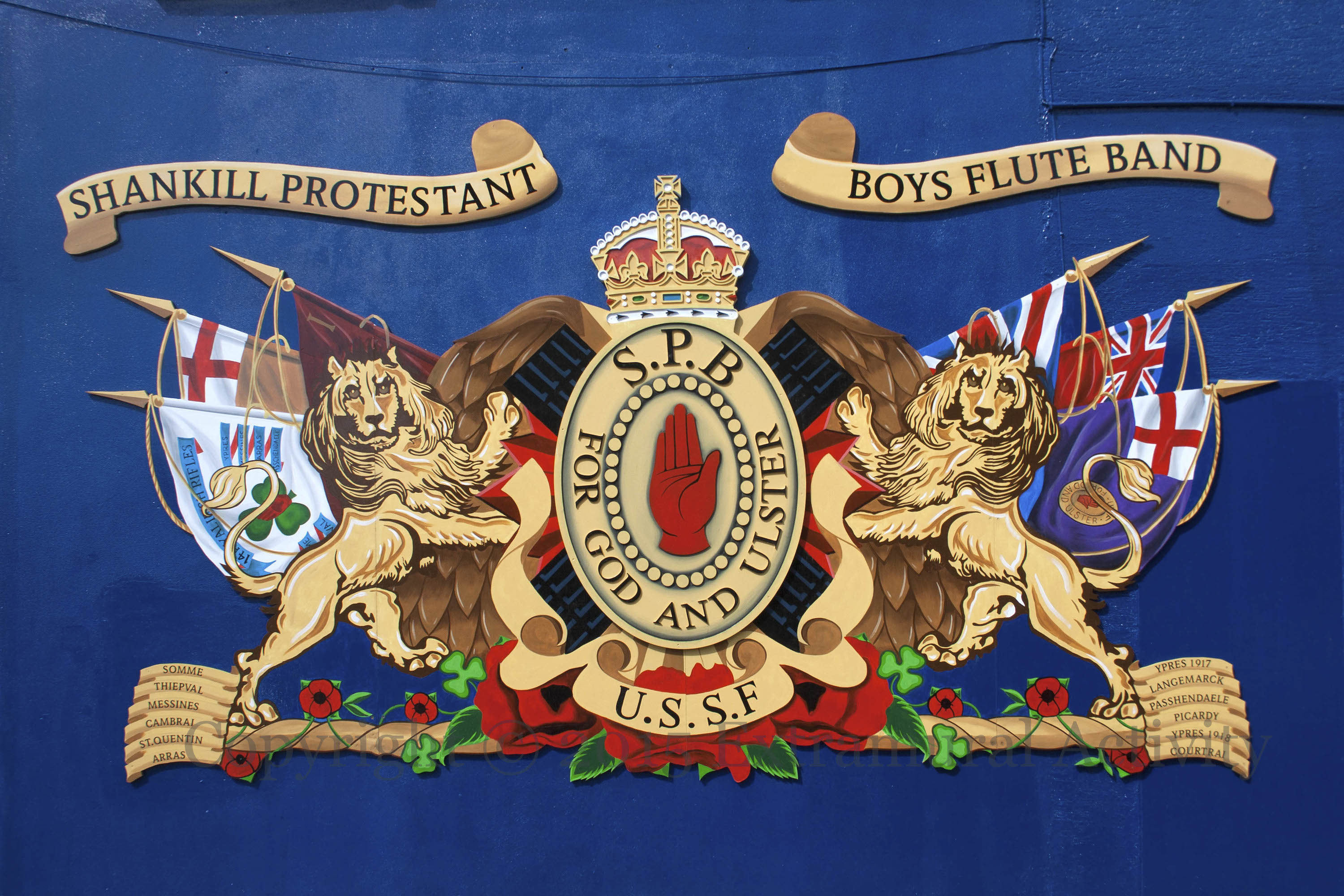
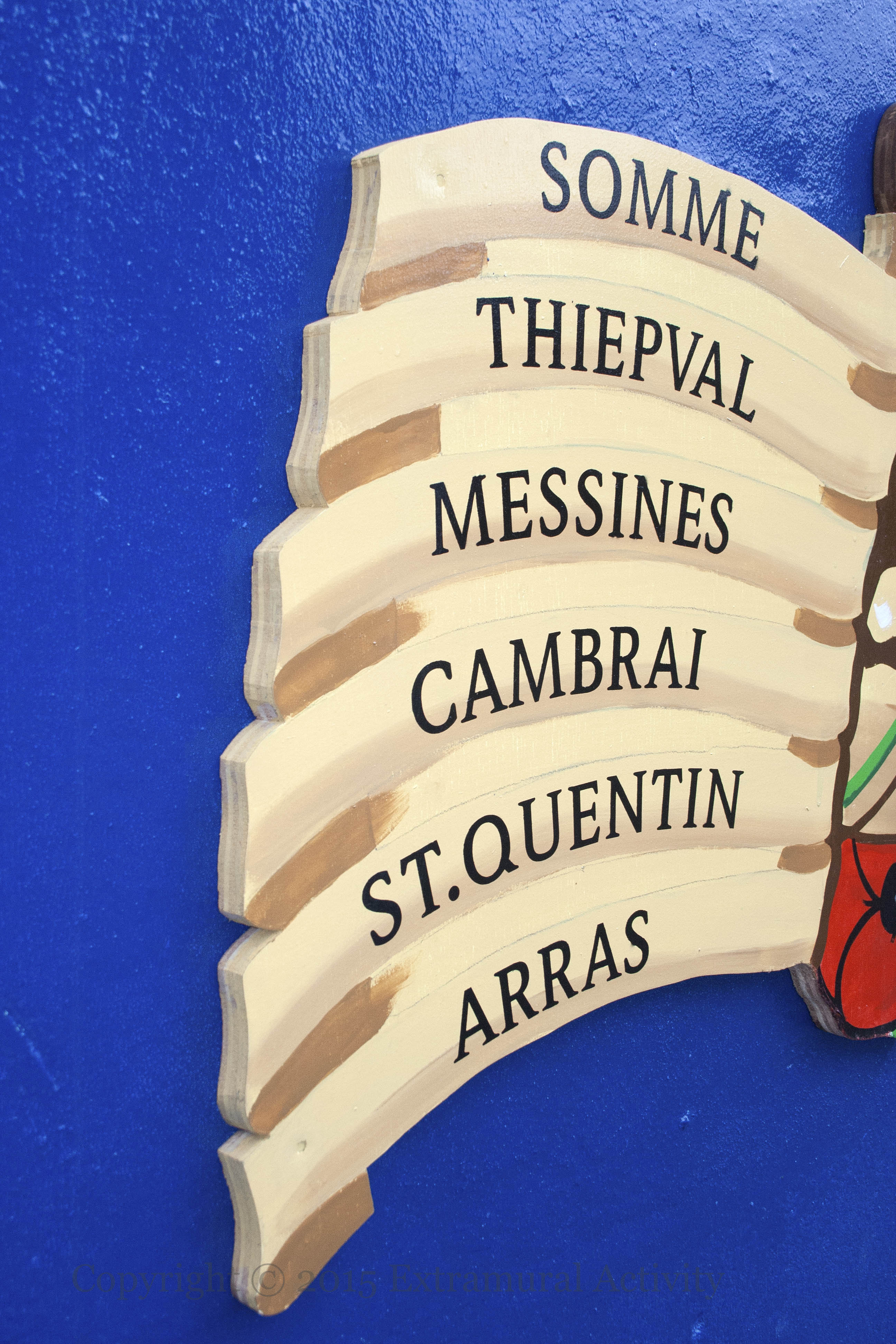
At first glance the piece above looks like a colourful mural but, as the close-up immediately below shows, it is in fact a large painted carving of lions rampant on either side of the emblem of the Shankill Protestant Boys flute band (Fb), named for the Shankill Boys of the original Ulster Volunteers and the Ulster Special Service Force unit within it which was designed to be a unit of “first responders”, ready to react at short notice to action by republicans or British forces anywhere in northern Ireland (historyireland).

2015-05-08 SPBCarving+

2015-05-08 SPBWWI+

2015-05-08 SPBInfo+

2015-05-08 SPBFull+

Click image to enlarge
Copyright © 2015 Seosamh Mac Coılle
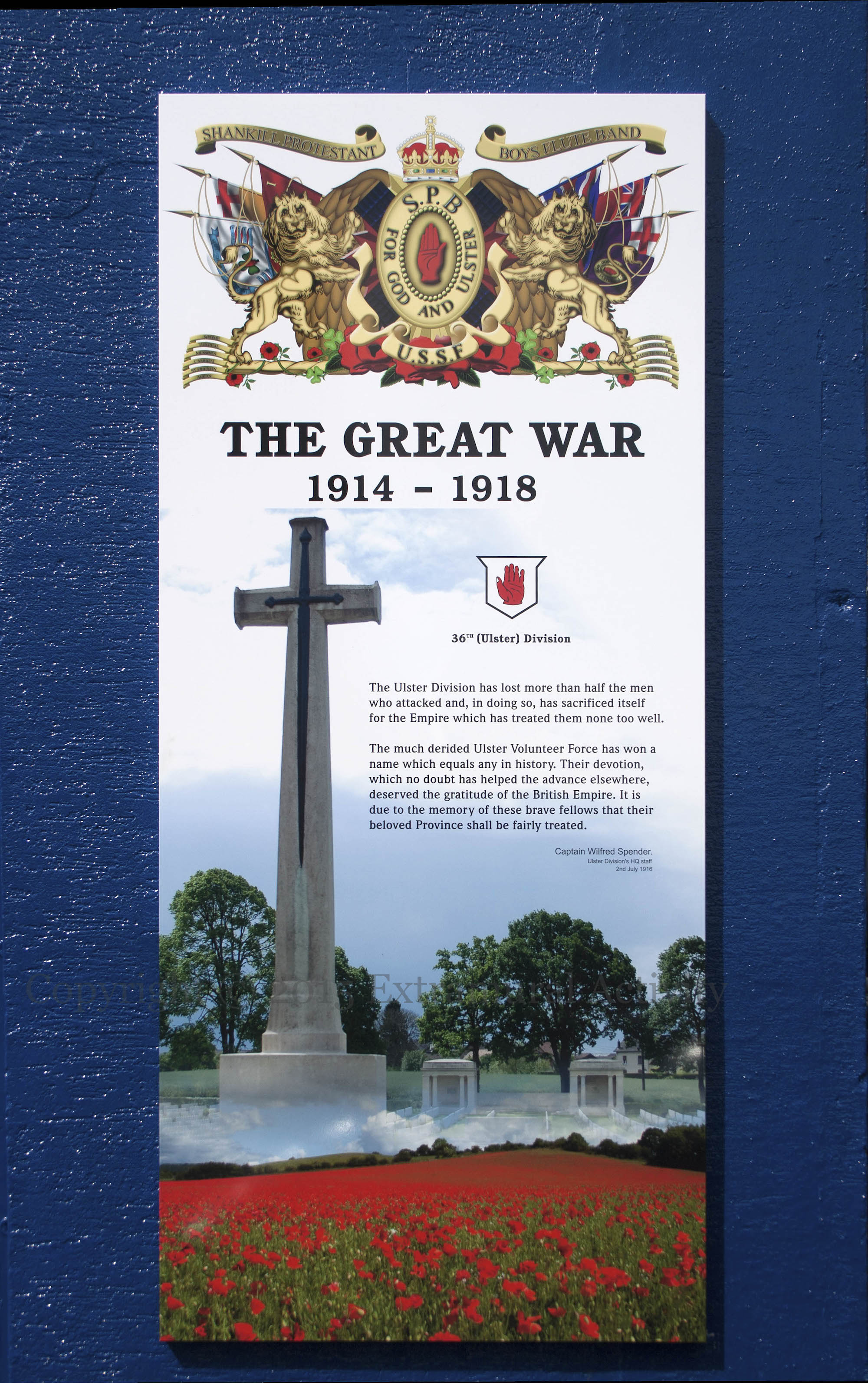
X02602 X02601 X02605 X02604 X02603 the great war 1914-1918 36th “The Ulster Division has lost more than half the men who attacked and in doing so has sacrificed it for the empire which has treated them none too well. The much derided Ulster Volunteer Force has won a name which equals any in history. Their devotion, which no doubt has helped the advance elsewhere, deserved the gratitude of the British Empire. It is due to the memory of these brave fellows that their beloved Province shall be fairly treated.” Captain Wilfred [sic] Spender HQ staff 2nd July 1916

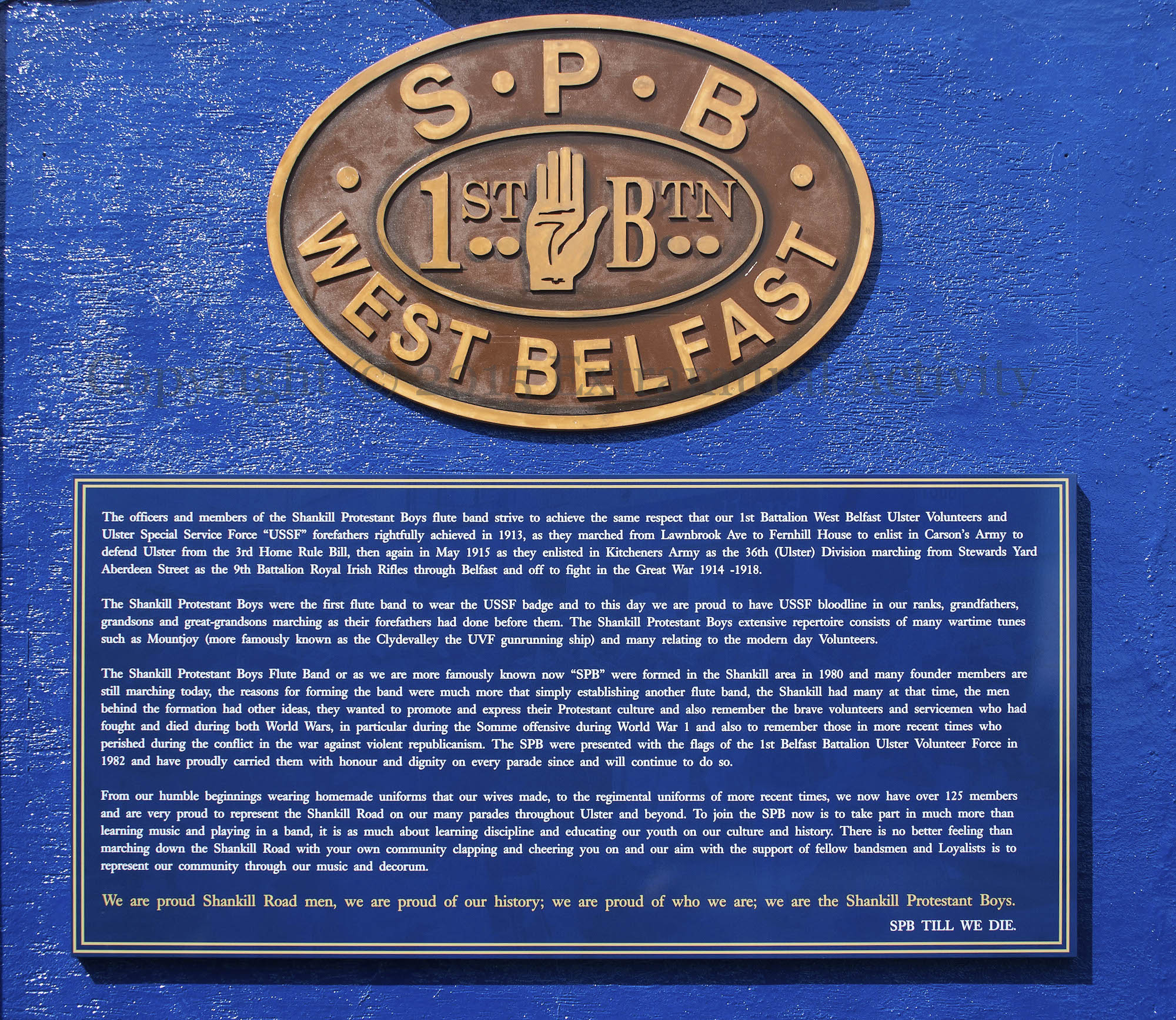
The officers and members of the Shankill Protestant Boys flute band strive to achieve the same respect that our 1st battalion West Belfast Ulster Volunteers and Ulster Special Service Force “USSF” forefathers rightfully achieved in 1913, as they marched from Lawnbrook Ave to Fernhill House to enlist in Carson’s Army to defend Ulster from the 3rd Home Rule Bill, then again in May 1915 as they enlisted in Kitcheners Army as the 36th (Ulster) Division marching from Stewards Yard Aberdeen Street as the 9th Battalion Royal Irish Rifles through Belfast and off to fight in the Great War 1914-1918. wear the USSF badge and to this day we are proud to have USSF bloodline in our ranks, grandfathers grandsons and great-grandsons marching extensive repertoire consists of many wartime tunes such as Mountjoy clydevally the UVF gunrunning ship and many relating to the modern day volunteers SPB were formed in 1980 and many founder members are still marching today the reasons for forming the band were much more simply that establishing another flute band wanted to promote and express culture remember servicemen fought and died during the Somme offensive perished in during the conflict against violent republicanism flags 1982 carried with honour and dignity every parade humble homemade uniforms our wives made regimental uniforms over 125 members join more than learning music discipline educating our youth on our culture and history. no better feeling than marching with your own community clapping and cheering you on fellow bandsmen decorum SPB till we die carnan street c coy thiepval messines cambrai st. quentin arras ypres 1917 langemarck passhendaele passchendaele picary courtrai uvf ycv

Hope, Change, Progress, Obey

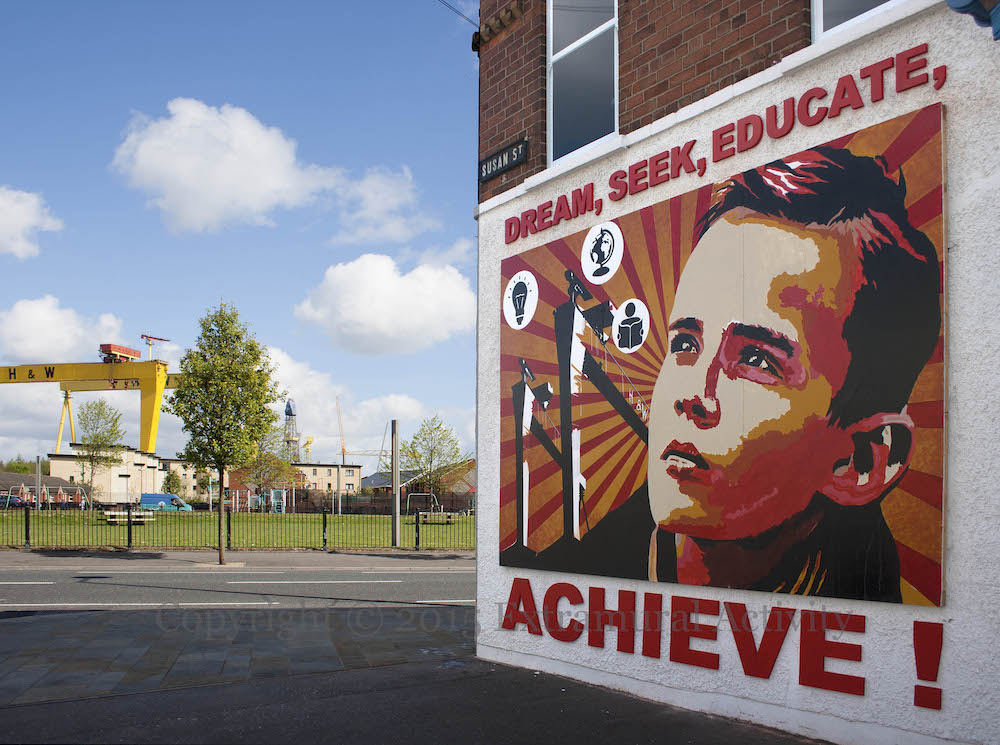
Shepard Fairey used Mannie Garcia’s AP photo of Barack Obama for his ‘Hope’ poster of the 2008 US Presidential election (WP). The three-quarter profile, faraway look and four-tone shading have been repurposed for the board, shown above, in east Belfast: a boy gazes beyond Samson and Goliath, backgrounded by a sunburst: “Dream, Seek, Achieve, Educate, Achieve!”

Click image to enlarge
Copyright © 2015 Seosamh Mac Coılle
X02600 harland wolff cranes susan street Dee Craig

Like A Horse To Water

2015-05-02 BallycarryBilly+

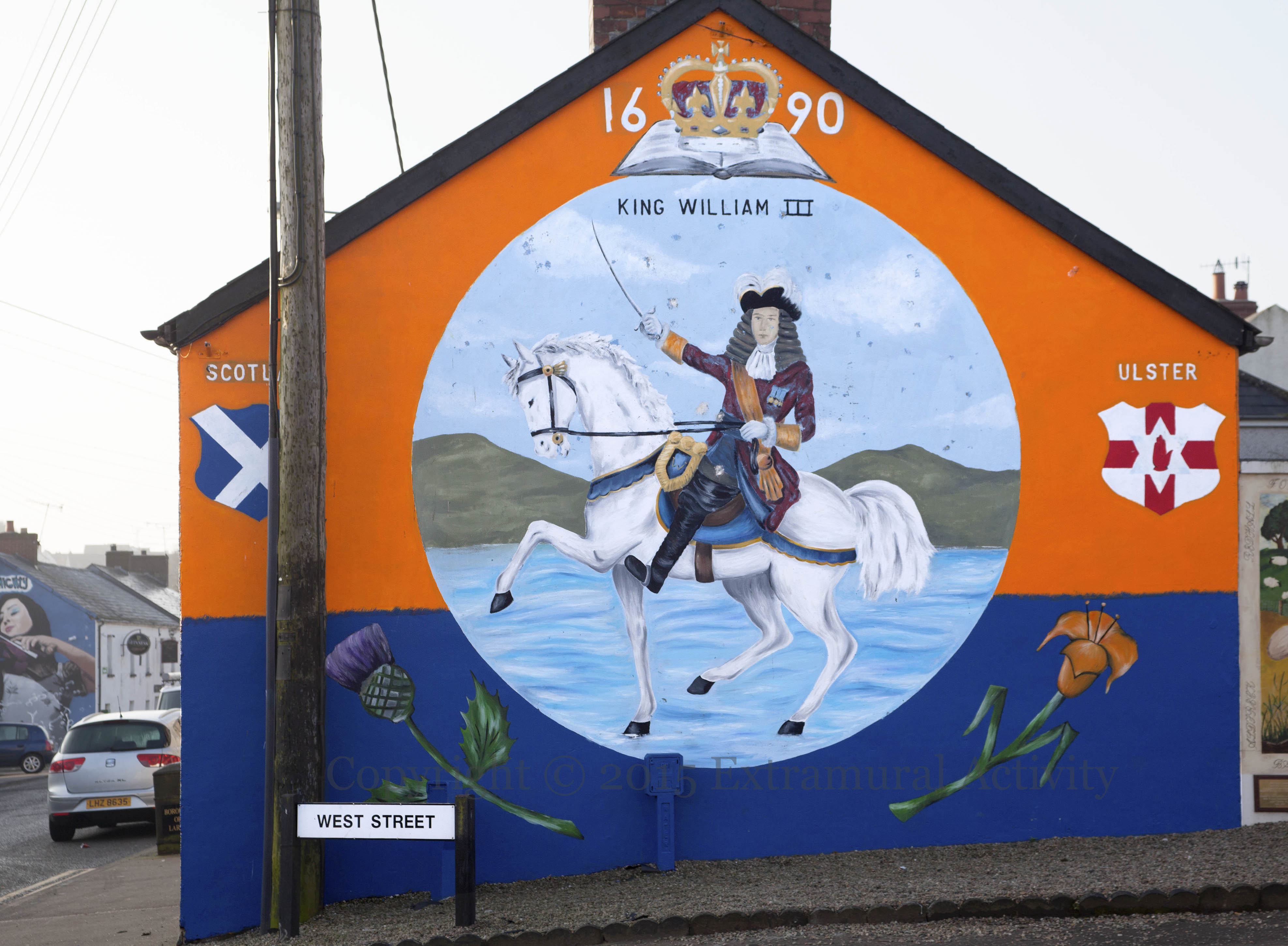
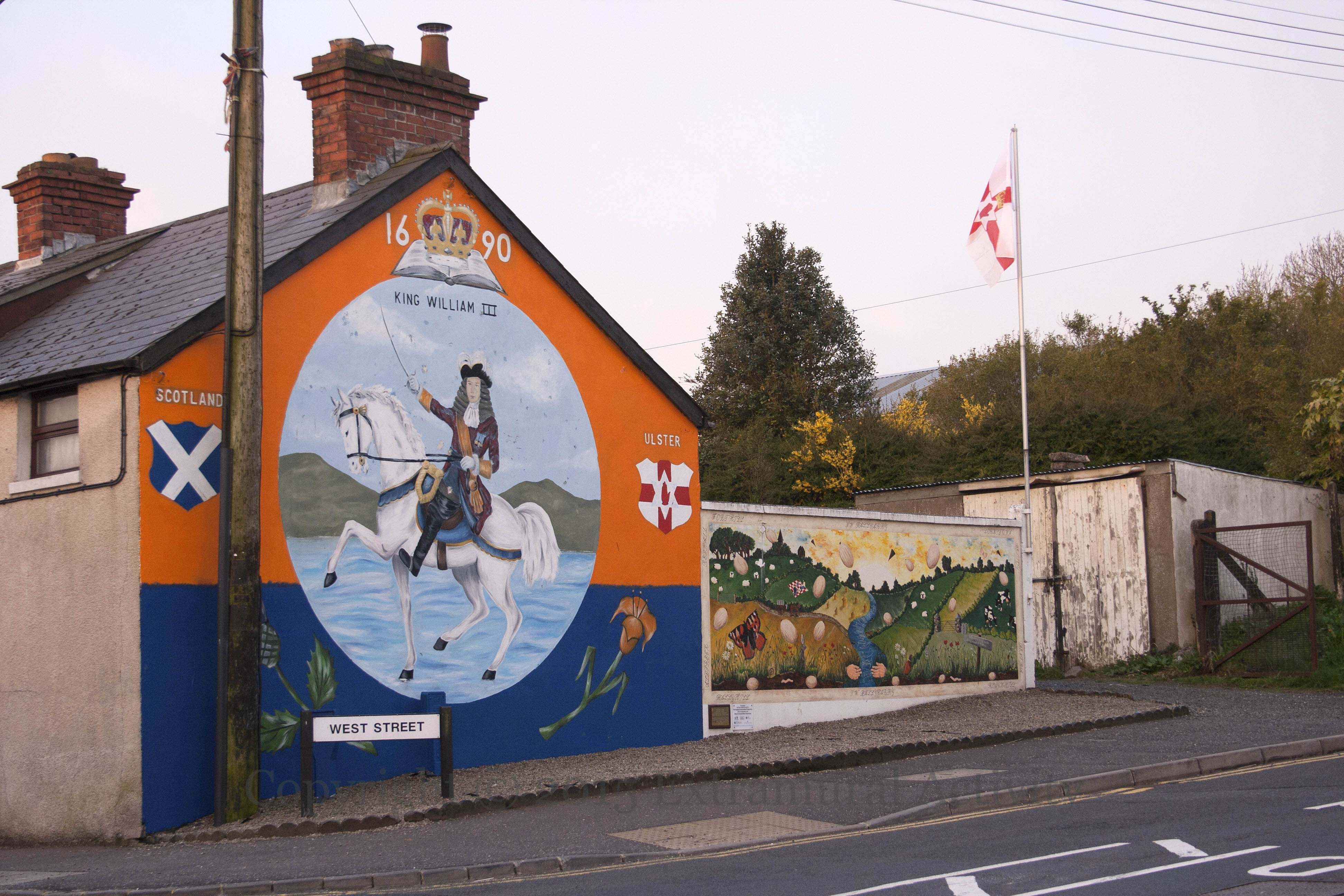
Here’s a PUL mural in classic style, though not seen much of late: King William “Billy” III of Orange crosses the Boyne, sword drawn, on a white steed that walks on water. The crests of Scotland and Northern Ireland (labelled as “Ulster”) and the Scottish thistle and orange lily of the Orange Order fill out the quadrants.

The mural to the right was featured in By The Mutton Burn Stream (and in the wide shot, below) and the one in the distance on the left in The Craic Is Mighty.

2015-04-20 BallycarryBillyWide+

Click image to enlarge
Copyright © 2015 Seosamh Mac Coılle
X02599 X02591 1690 crown bible

Foreign Arrivals

2015-04-20 BallycarryChinese+

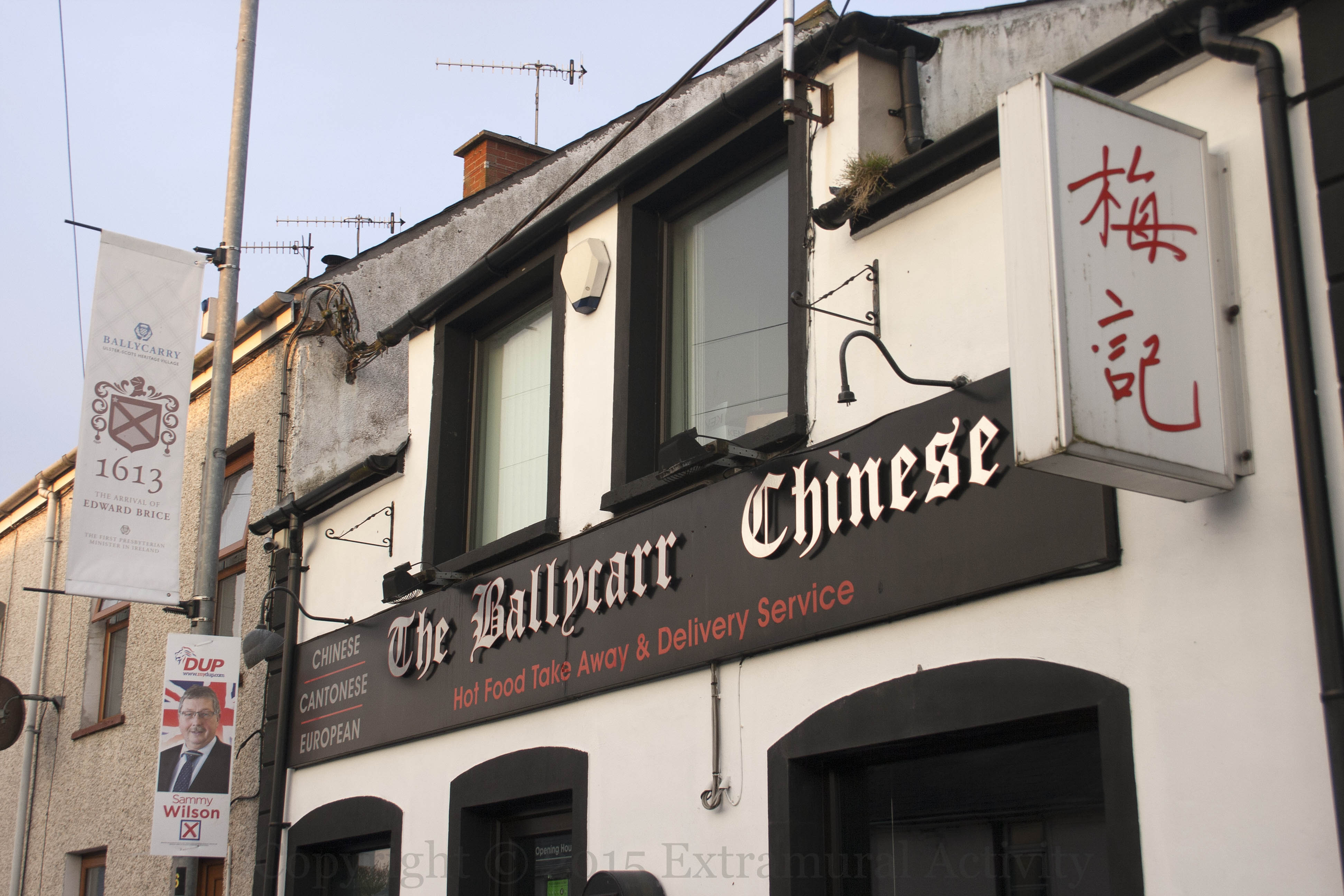
Chinese, Cantonese, European, and Presbyterian. Three signs outside the Chinese take-away in Ballycarry: the Chinese lettering for the restaurant, a DUP poster supporting Sammy Wilson, and an Ulster-Scots heritage banner: “1613 The Arrival of Edward Brice – The first presbyterian minister in Ireland”.

Click image to enlarge
Copyright © 2015 Seosamh Mac Coılle
X02592 village

By The Mutton Burn Stream

2015-04-20 BallycarryVillageDetail2+

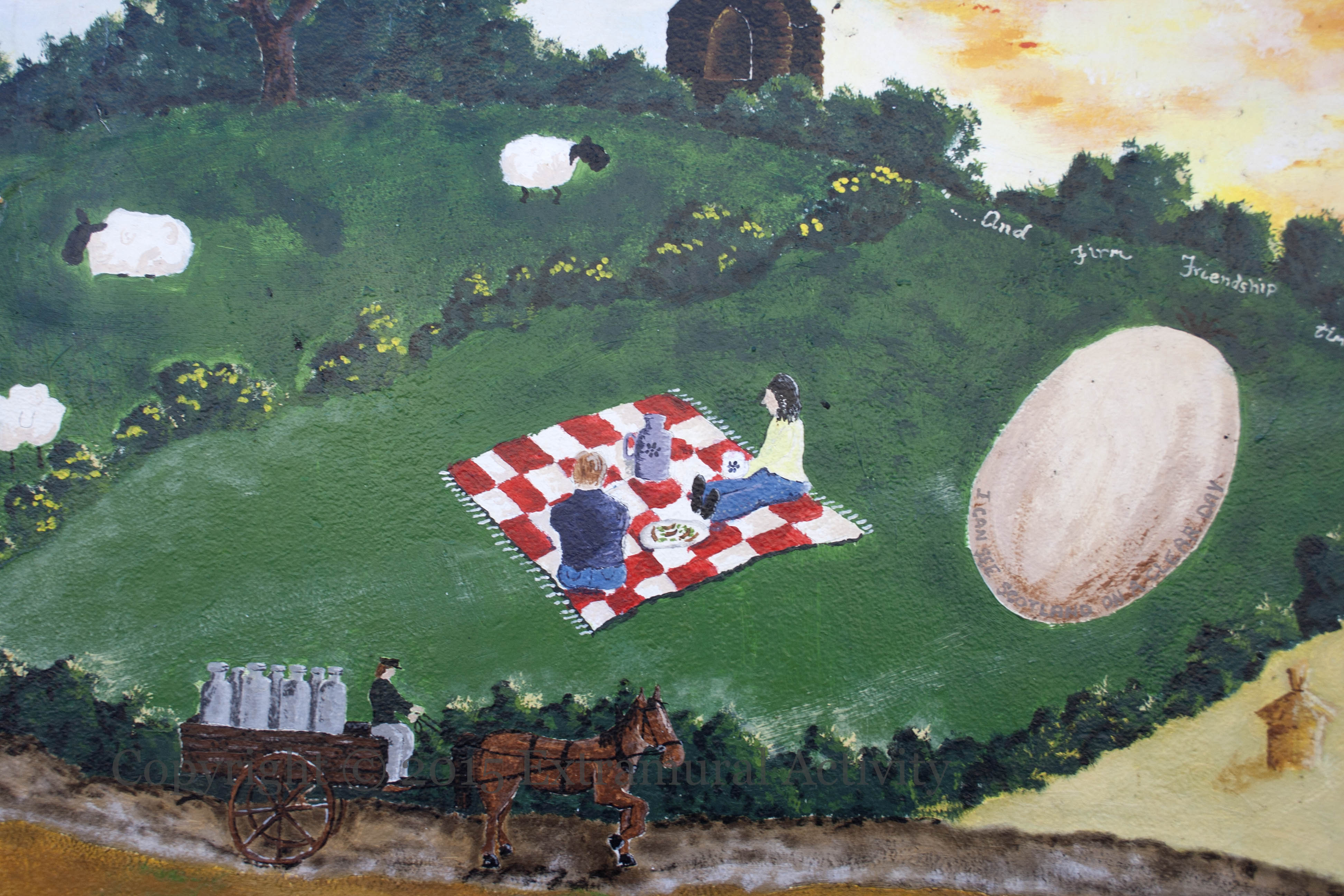
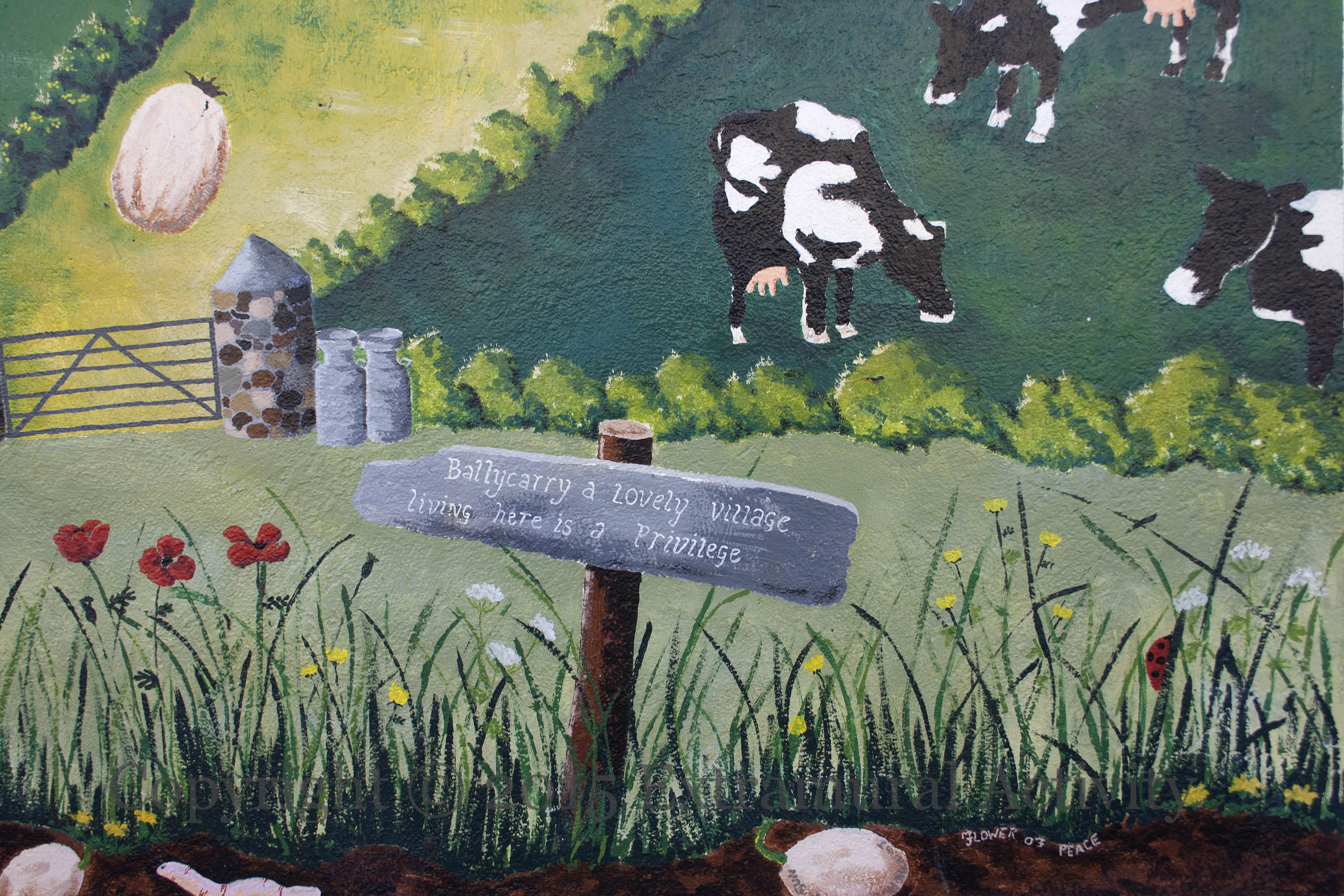
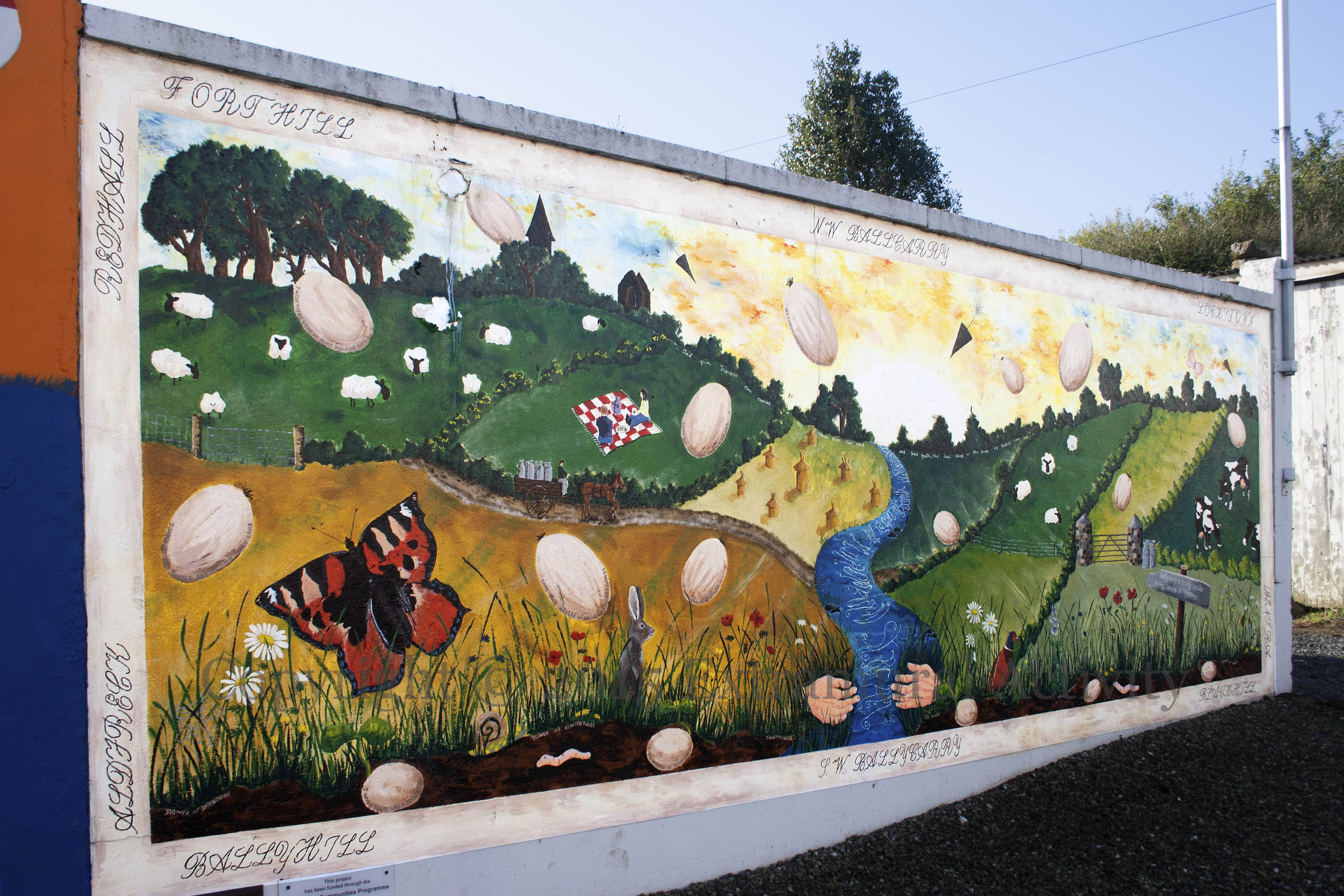
Ballycarry village sits in County Antrim countryside surrounded by the townlands of Ballyhill, Redhall, Forthill, Blackhill, Aldfreck, Lochstown, Beltoy, Bentra. The large pale oval to the right of the picnickers is one of many “seeds” falling from the sky and settling into the earth, which by growing make Ballycarry a pleasant place: “I can see Scotland on a clear day”. The Mutton Burn Stream (lyrics | music from the Ulster-Scots agency) is a song written by Ballycarry resident William Hume (QUB) about the river to the north-west of the village (WP). More about Ballycarry from the BBC’s Ulster-Scots page.

2015-04-20 BallycarryVillageDetail+

2015-04-20 BallycarryVillage+

Click image enlarge
Copyright © 2015 Seosamh Mac Coılle
X02596 X02595 X02594 firm friendship time cannot kill flower of remembrance togetherness fields cows butterfly pheasant horse cart milk sheep snail worm haystacks stream

Hillock Of The Grey Calf

2015-03-19 TullygarleyLeft2+

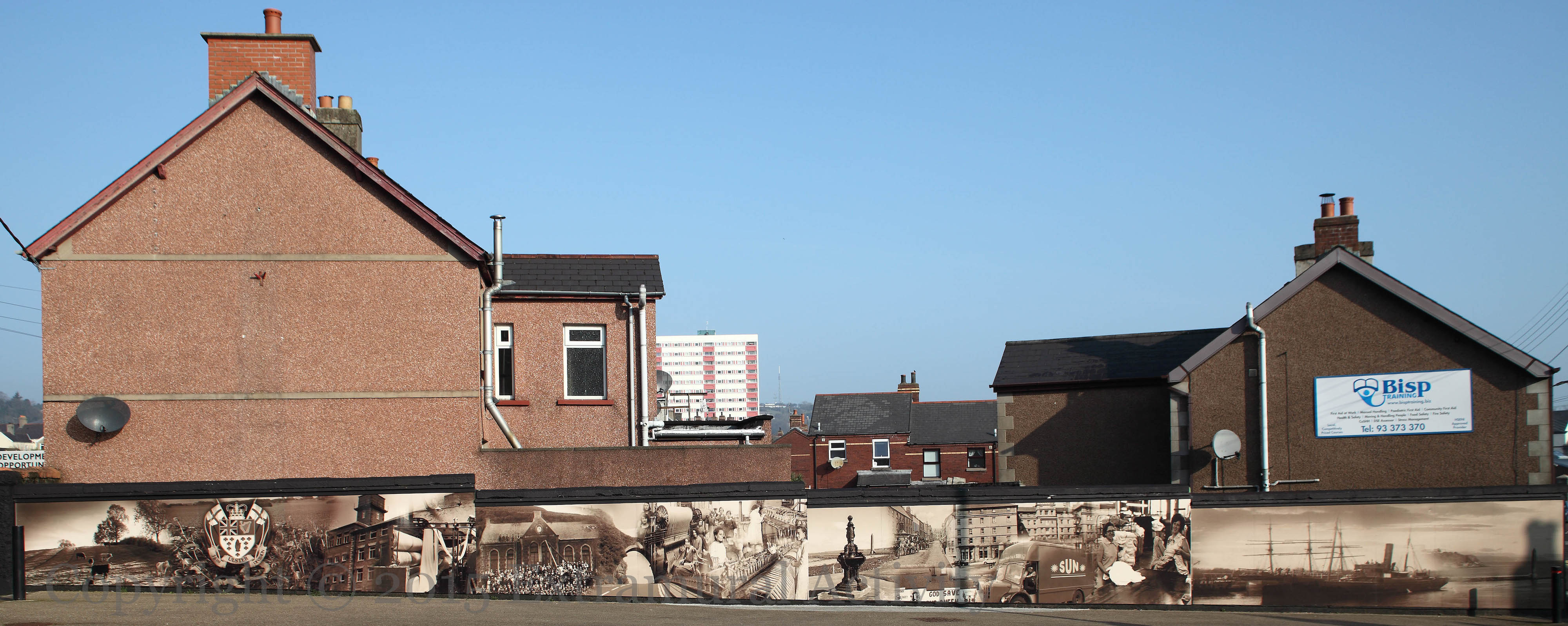
The Tullygarley mural in Larne, originally painted by Caroline Jeffrey, has been replaced with a computer-generated version reproducing most of the images. The bleaching green is gone; the Black Arch has been added, as has part of the mural that was on this site three generations of murals ago: God Save The Queen.

From the info-board for the previous version, included below:

“Tullygarley” means “Hillock of the Grey Calf” – thus the grey calf grazing with the cows.

The 36th Ulster Division – In September 1914 the Ulster Division was formed from the Ulster Volunteer Force which raised thirteen battalions for the three Irish regiments in Ulster.

Bleaching Green – Linen laid out in fields to bleach. The Bleaching Factory interior depicts the Bleaching process. (The building is currently derelict.) Blue Flax Flowers are the national floral emblem of Northern Ireland.

Local Primary School, Inver and Larne, known locally as “the Bridge”, as it looked in the 1930’s with the Inver River running through it. The bridge that the school was named after no longer exists.

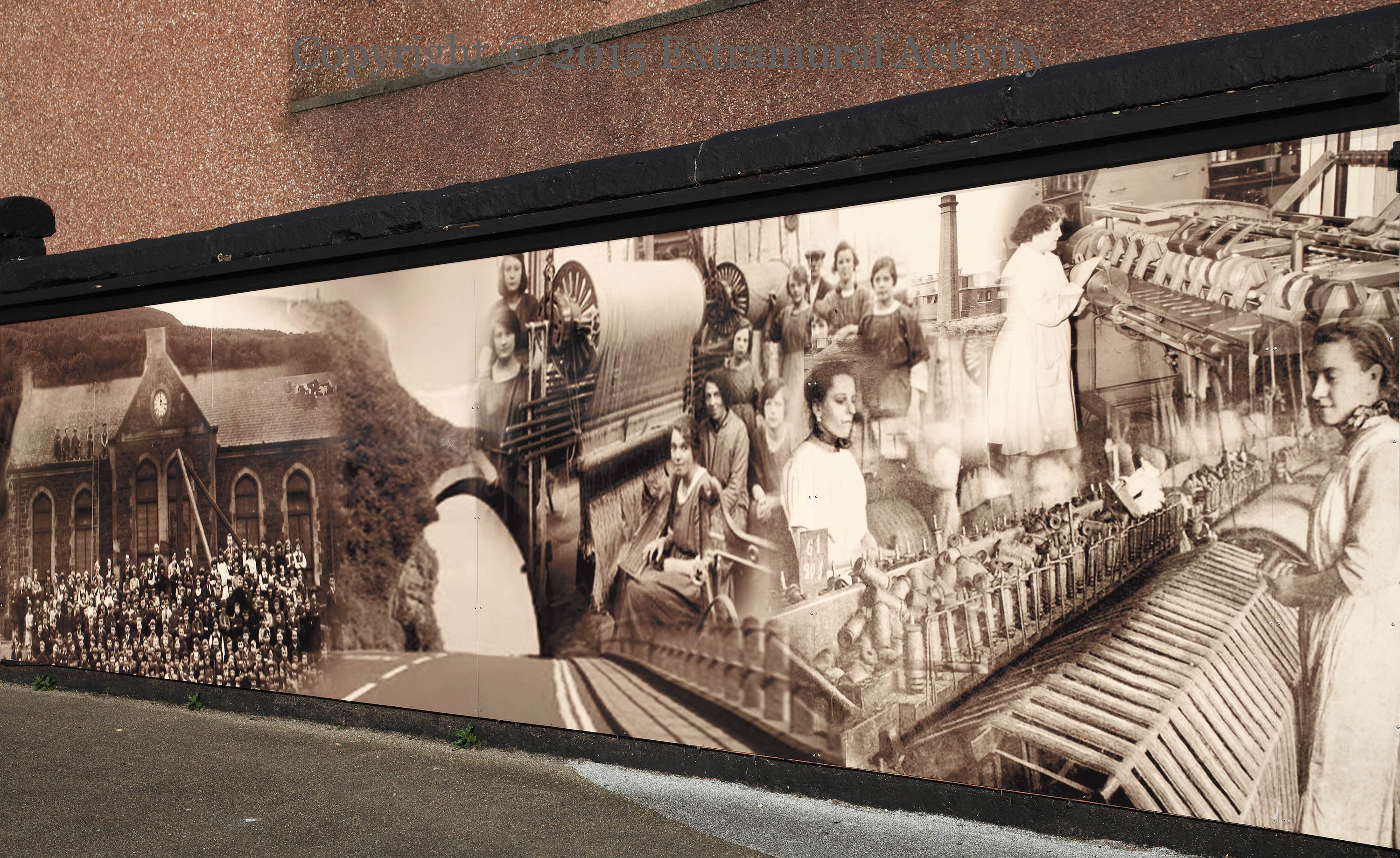
Linen Factory of Glyn [Glynn] Road (no longer exists, site of abandoned garage) with inset depicting workers with weaving machines (circa 1924).

The old Tullygarley playground (mural site) with the Fountain in the foreground, and rows of houses on either side (Glynn Road and South Circular Road).

Sun Laundry Van. Sun Laundry showing people working inside (now Rea’s Furnishings, Bank Road).

Larne Lough – it is an area of special interest, a special protection area and a Ramsar site in order to protect the wetland environment.

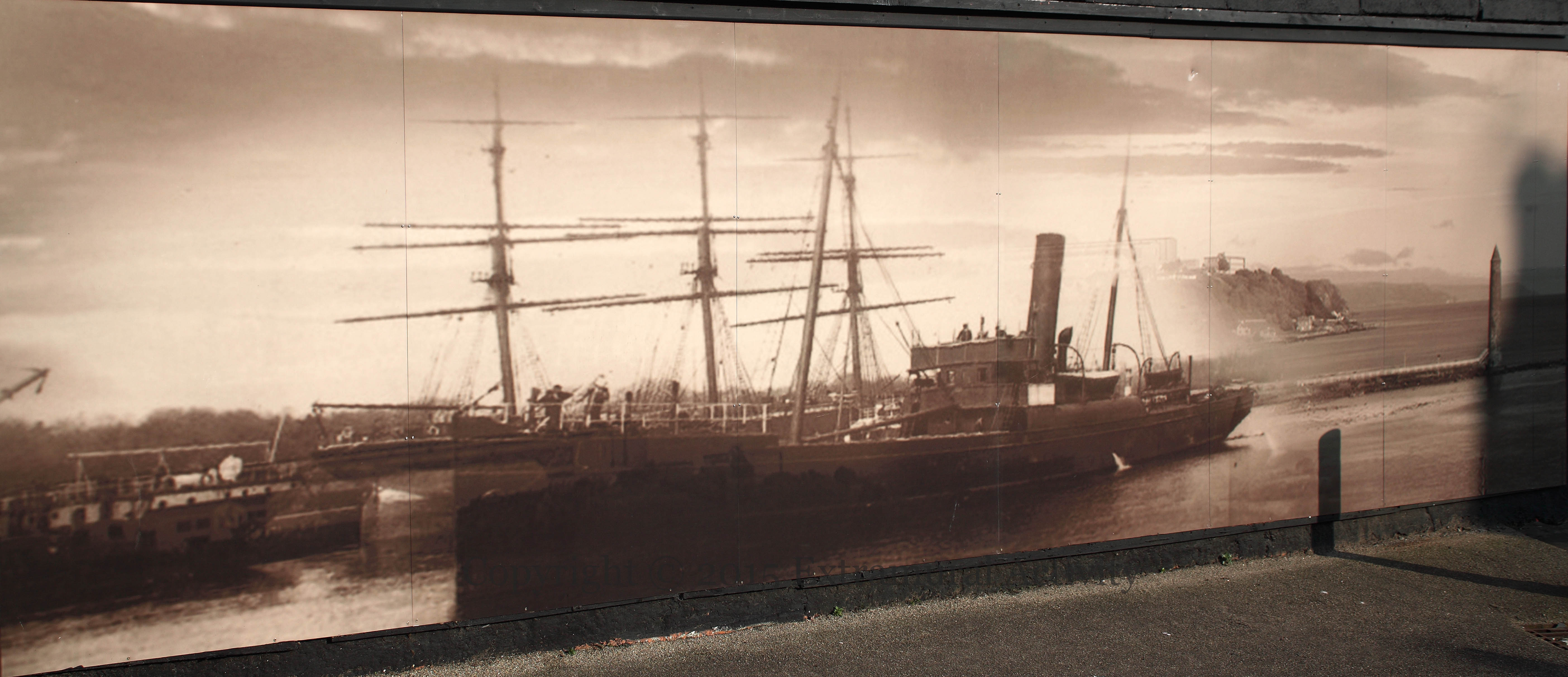
SS Clyde Valley – launched in July 1886. Was used in 1914 to transport arms from Hamburg to Larne.

Roseate Tern – Larne Lough is the only breeding colony in Northern Ireland for the Roseate Tern, one of the UK’s rarest birds.

2015-03-19 TullygarleyMid+

2015-03-19 TullygarleyRight+

2015-03-19 TullygarleyFull+

2015-03-19 TullygarleyInfo+

Click image to enlarge
Copyright © 2015 Seosamh Mac Coılle
X02558 X02559 X02560 X02555 X02556 community on fire builders YMCA first presbyterian re-imaging borough council renewing rebuilding confidence reviving hope restoring pride social development arts council international housing executive groundwork first minister and deputy first minister residents’ association