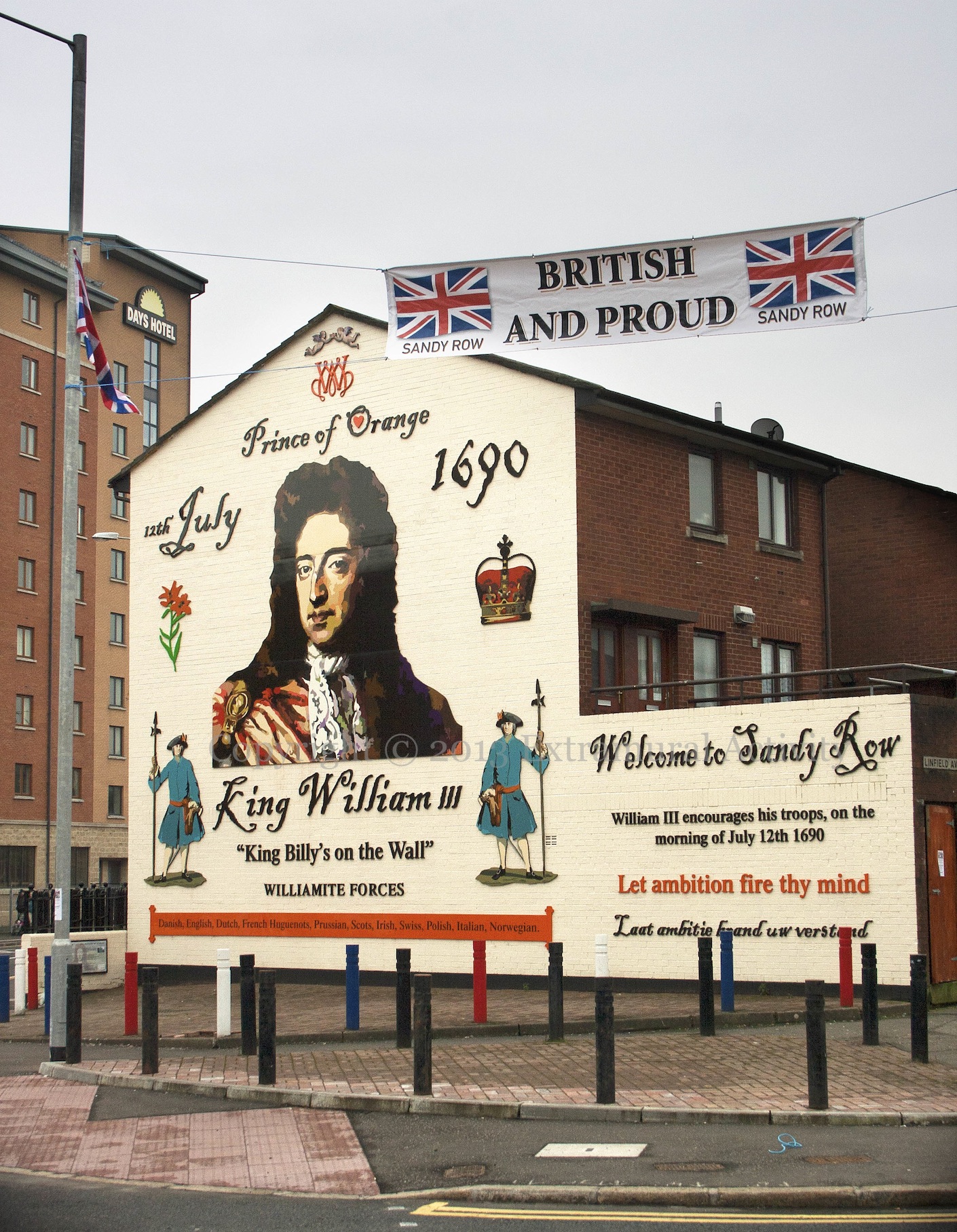
British And Proud

2013-02-12 SandyRowBanner+

A “British And Proud” banner currently flies adjacent to the board at the bottom of Sandy Row celebrating the (Dutch) William of Orange (or “King Billy” as he is more commonly referred to) (WP) and his “Danish, English, Dutch, French Huguenots, Prussian, Scots, Irish, Swiss, Polish, Italian, Norwegian” forces. The mural was launched July 2nd, 2016, and was painted by artist Ross Wilson (Tele). A time-lapse video of the painting-over of the previous mural and the installation of the various pieces is available on Youtube.
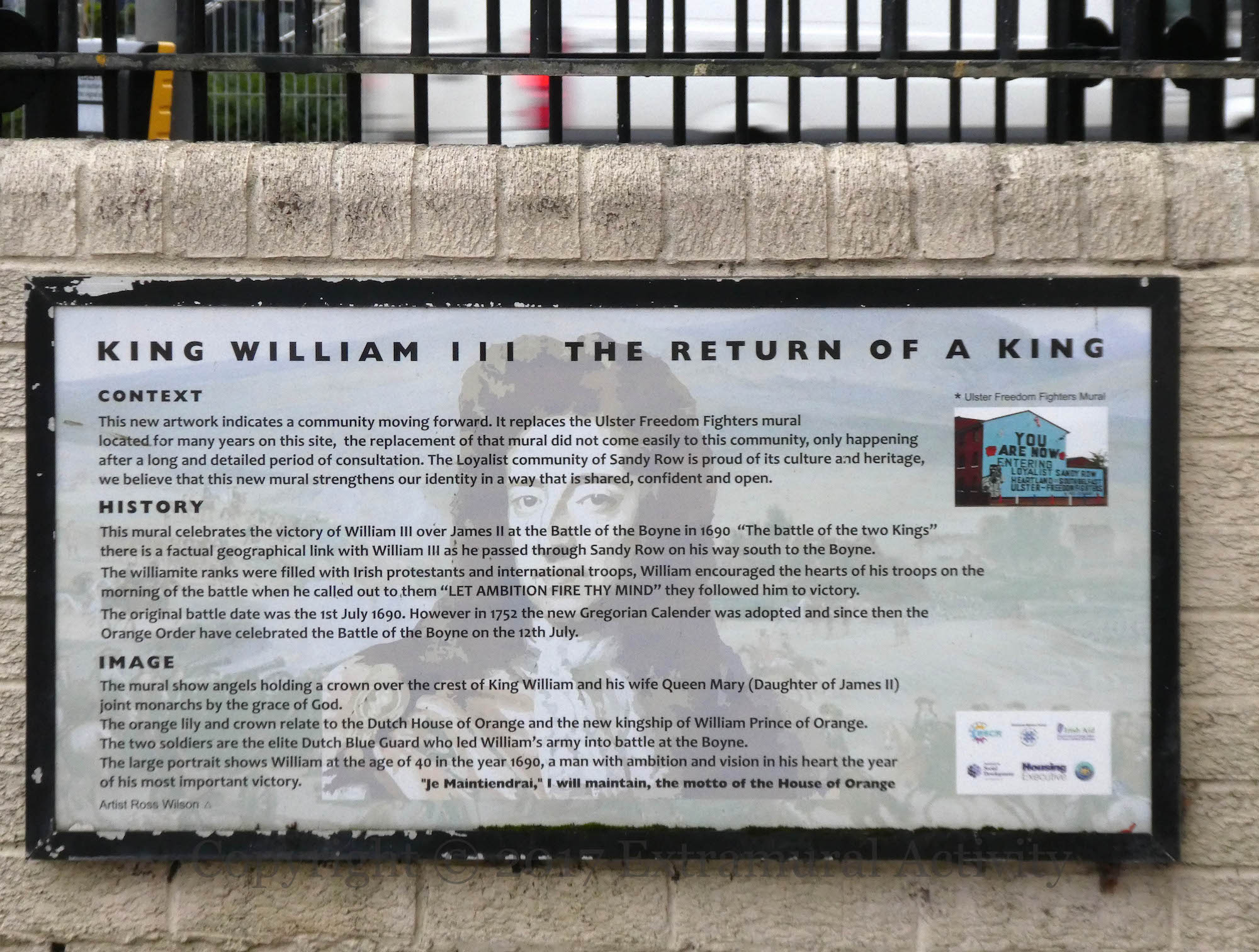
04739 2017-12-24 King William III plaque+.jpg

Click image to enlarge
Copyright © 2013/2017 Seosamh Mac Coılle
X00944 X04739 Prince of orange, king william III, king billy’s on the wall, williamite forces,  welcome to sandy row, william III encourages his troops on the morning of july 12th 1690, let ambition fire thy mind, laat amitie brand uw verstand
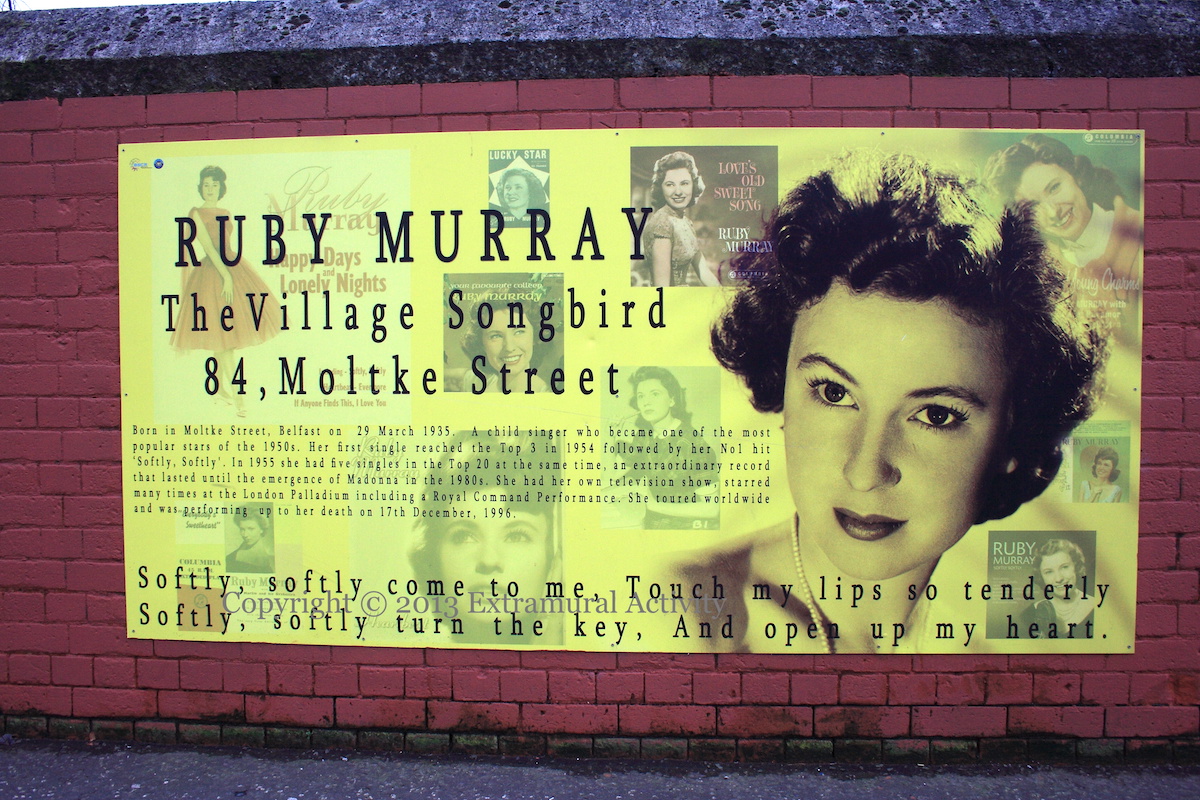
The Village Songbird

“Born in Moltke Street, Belfast, on 29 March 1935. A child singer who became one of the most popular stars in the 1950s. Her first single reached the Top 3 in 1954 followed by her No 1 hit ‘Softly, Softly’. In 1955 she had five singles in the Top 20 at the same time, an extraordinary record that lasted until the emergence of Madonna in the 1980s. She had her own television show, starred many times at the London Palladium including a Royal Command Performance. She toured worldwide and was performing up to her death on 17th December, 1996” ‘Softly, softly, come to me/Touch my lips so tenderly/Softly, softly, turn the key/And open up my heart.’ (youtube).

Maldon Street, south Belfast

Click image to enlarge
Copyright © 2013 Seosamh Mac Coılle
X01555

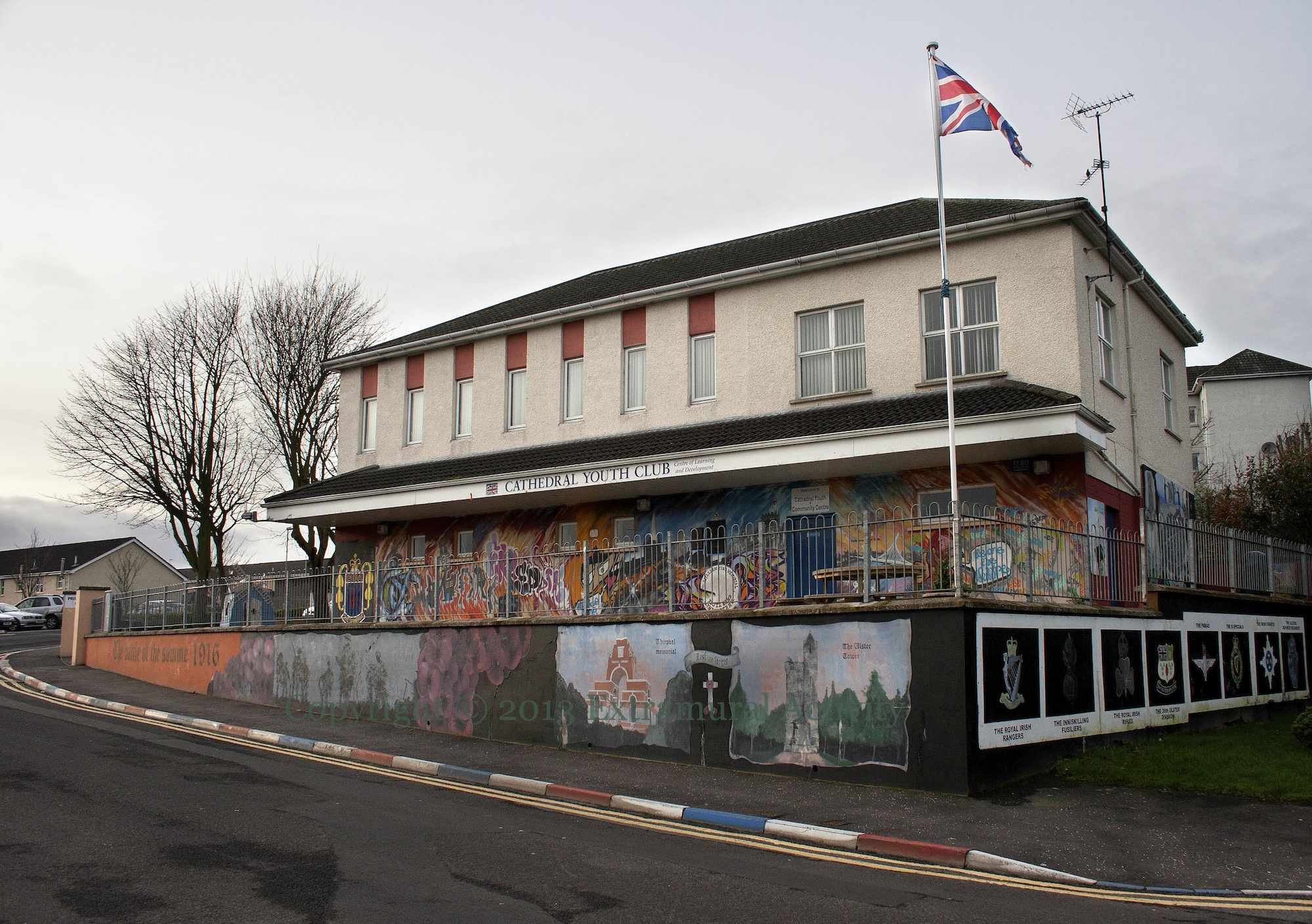
Centre For Learning & Development

2013-02-11 FountainCentre+

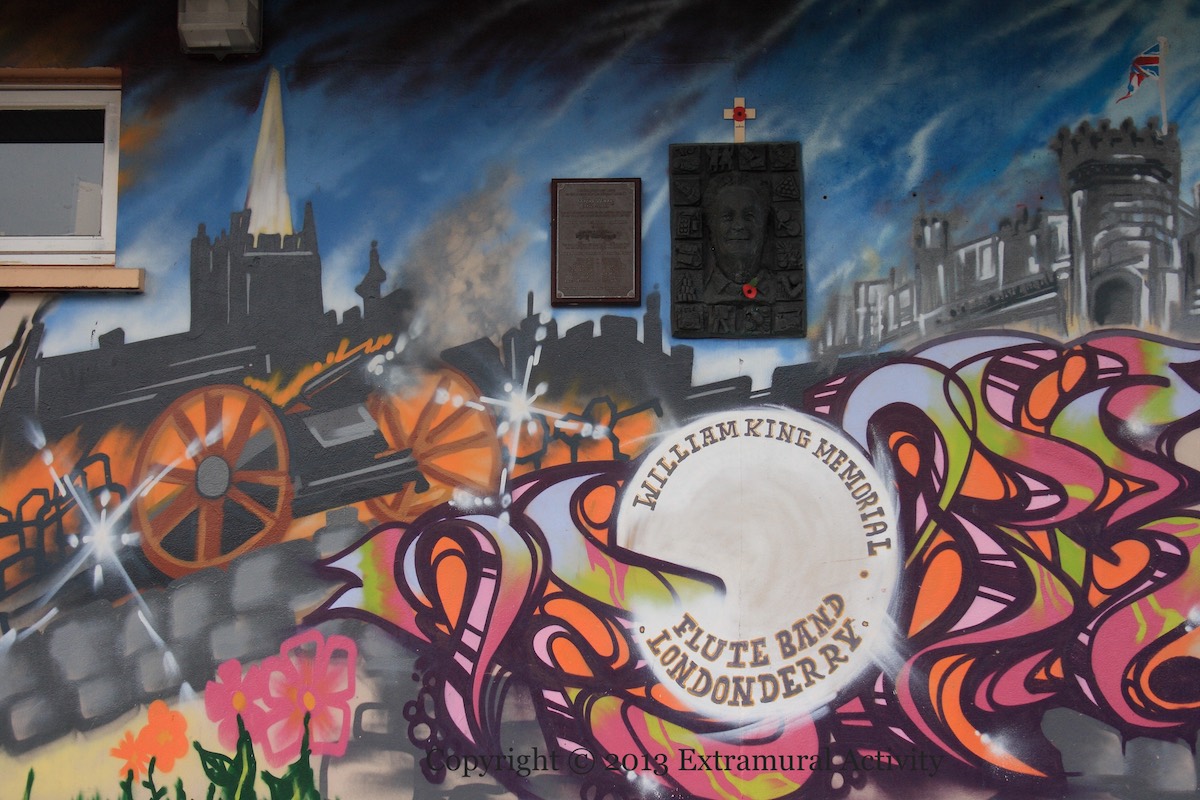
On closer inspection, one can see images relating to WWI, the UDA, the William King Flute Band, and various arms of the military such as the Paras and B Specials adorning the Cathedral Youth & Community Centre/Centre For Learning & Development in The Fountain, London-/Derry/Doire. The close-up below shows a plaque in honour of David Warke, who founded the club in 1972 (Yellow Tom); the profile is perhaps also of Warke.

X05218 2013-02-02 William King FB+

Click image to enlarge
Copyright © 2013 Seosamh Mac Coılle
X00943 X05218

The Relief Of Londonderry

2013-02-09 ReliefOfDerry+

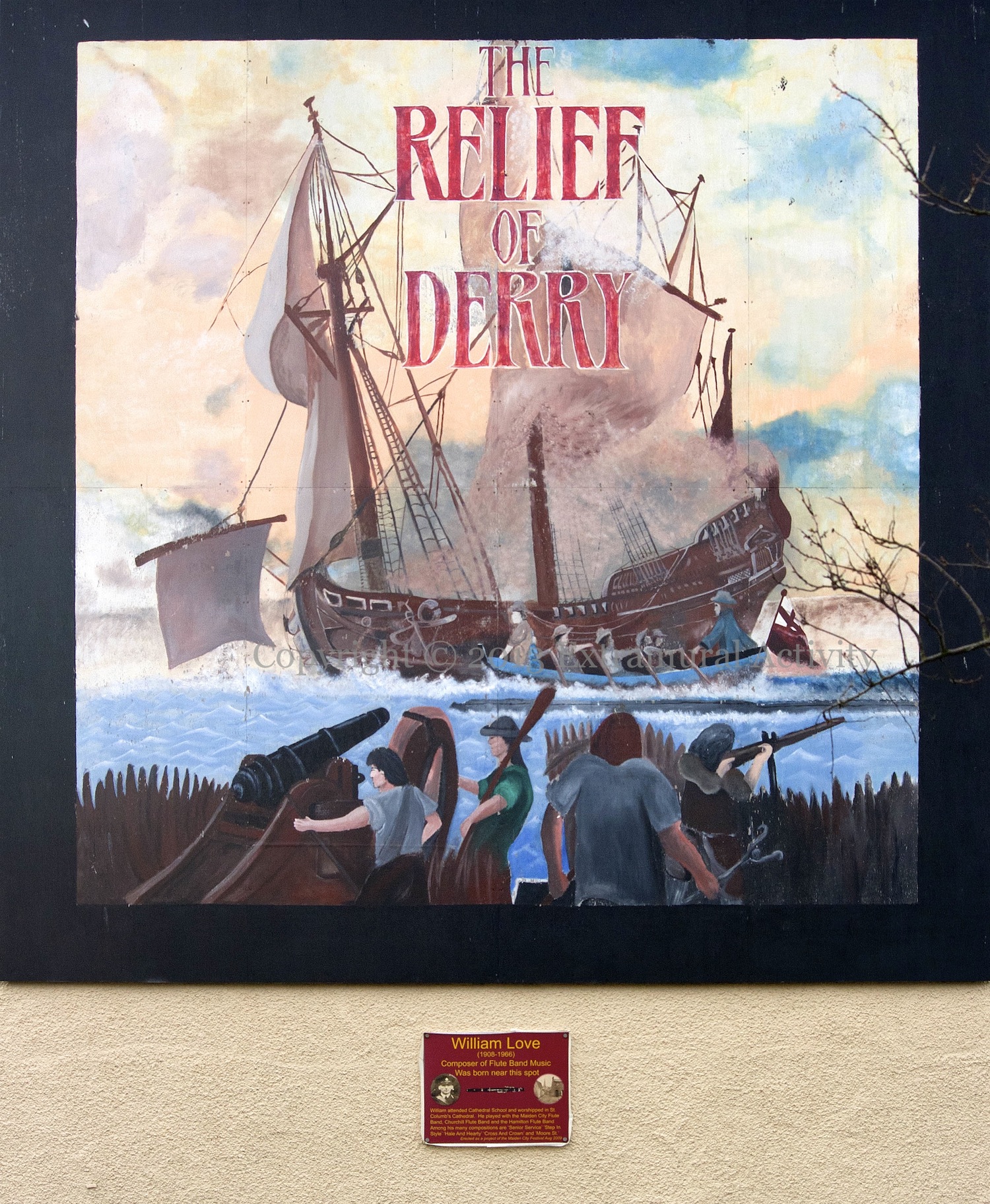
“Derry” became “Londonderry” in 1613, but in 1689 at the time of the siege, as now, it was commonly referred to as “Derry”. The slogan of the defenders was “No Surrender” and the successful resistance to penetration gave rise to the epithet “The Maiden City” (WP).

Pictures of the unveiling of the plaque in 2009, which commemorates William Love, can be seen here.

Click image to enlarge
Copyright © 2013 Seosamh Mac Coılle
X00941 William Love 1908-1966 composer of flute band music was born near this spot; william attended cathedral school and worshipped in St. columb’s cathedral he played with the maiden city flute band churchill flute band and the hamilton flute band among his many compositions are senior service, stop in style, hale and hearty, cross and crown, and moore st. erected as a project of the maiden city festival aug. 2000

True Blue

2013-02-07 RWBKerb+

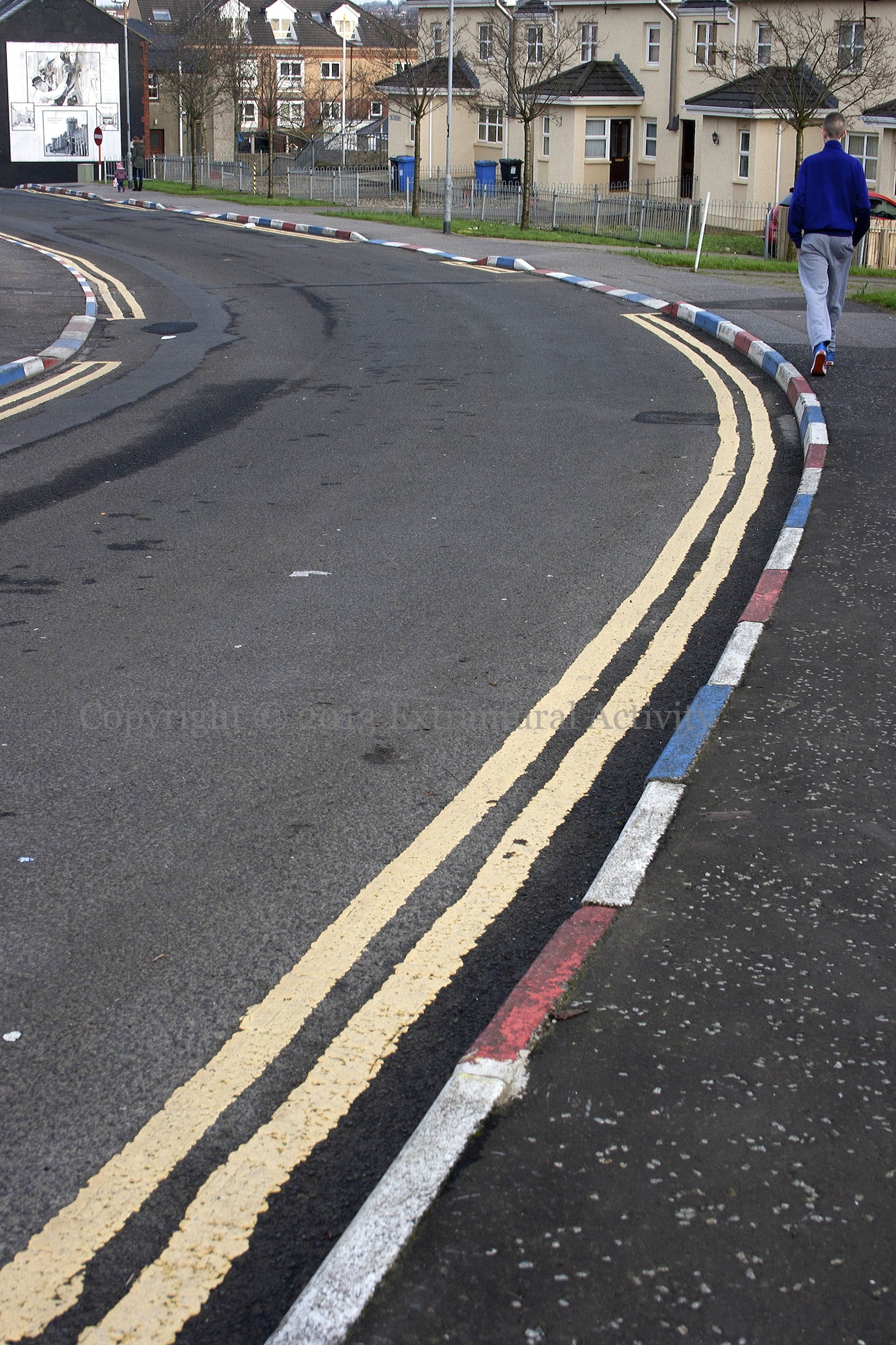
A pedestrian’s gutties (sneakers) and jacket match the red, white and blue of the kerbstones on The Fountain, a street at the heart of the Fountain, a Protestant enclave on the west side of the Foyle in Londonderry

Kerb painting has largely ceased in Belfast (there might have been some kind of unofficial agreement circa the Good Friday agreement (WP) to phase it out through non-renewal of existing painted kerbs – please dis/confirm in the comments if you can) but the ancient practice is still alive and well in The Fountain.

Click image to enlarge
Copyright © 2013 Seosamh Mac Coılle
X00935

Vita, Veritas, Victoria

2013-02-07 VVV+

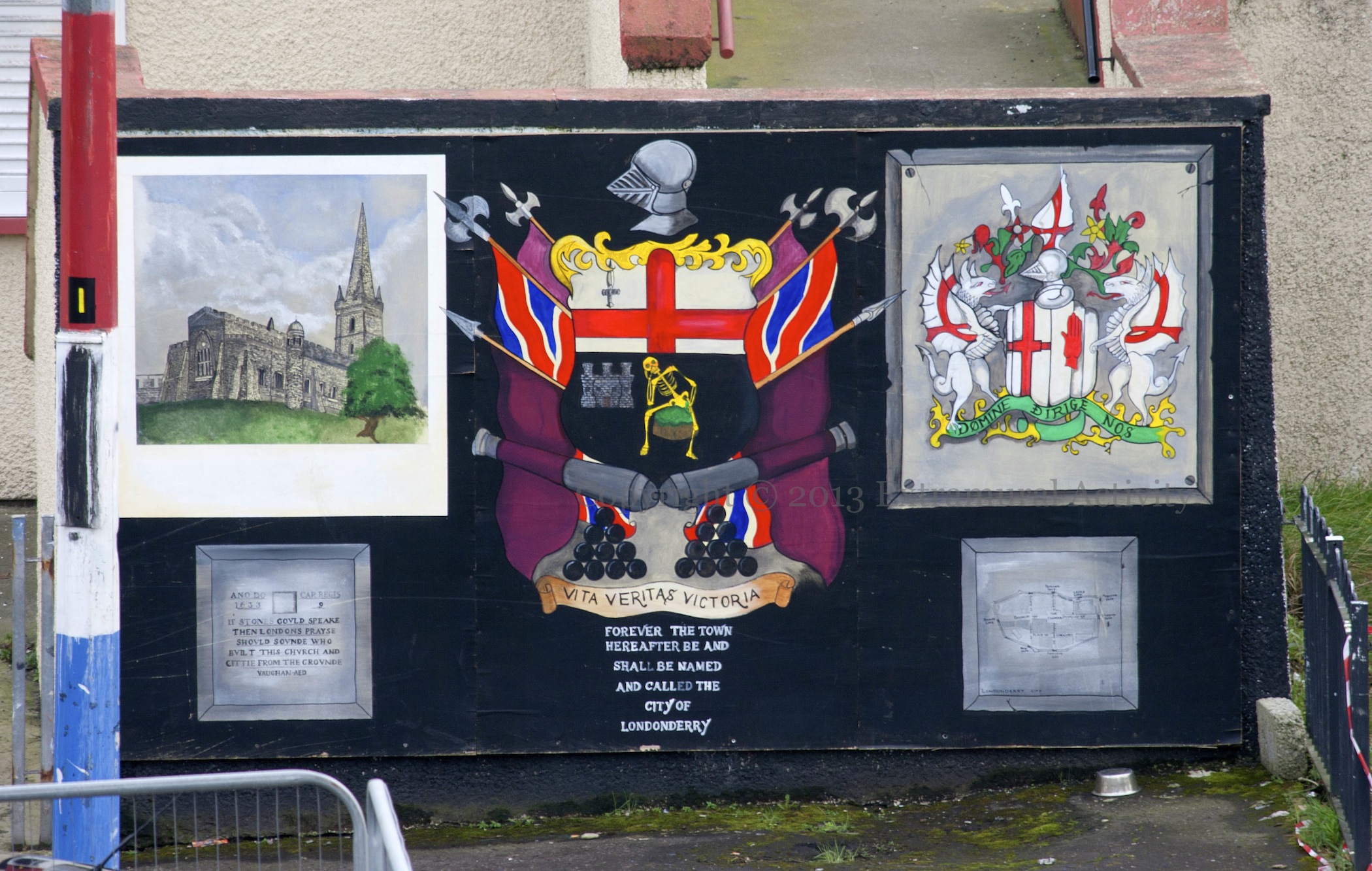
“Life, Truth, Victory.” A new (within the last 12 months) board just outside the walls of Londonderry, in the Fountain area. (The Fountain area is a small Unionist area on the west  bank of the Foyle river; the larger unionist population is in the Waterside on the east side of the river.)

The city’s coat of arms is featured in the centre – there are various interpretations of its elements, including the skeleton (WP). St. Columb’s cathedral (WP) is top left and a map of the wall bottom right. In the top right is the coat of arms of the city of London (whose flag is the top part of the coat of arms) – “Lord, Direct Us.”

Click image to enlarge
Copyright © 2013 Seosamh Mac Coılle
X00939 [X05219] domine dirige nos, ano do 1633 cap regis 9, if stones could speake then londons prayse should sounde, who built this church and cittie from the grounde vaughan – see If Stones Could Speak.

Our Flag Was Still There

2013-02-05 HightownRdFlag+

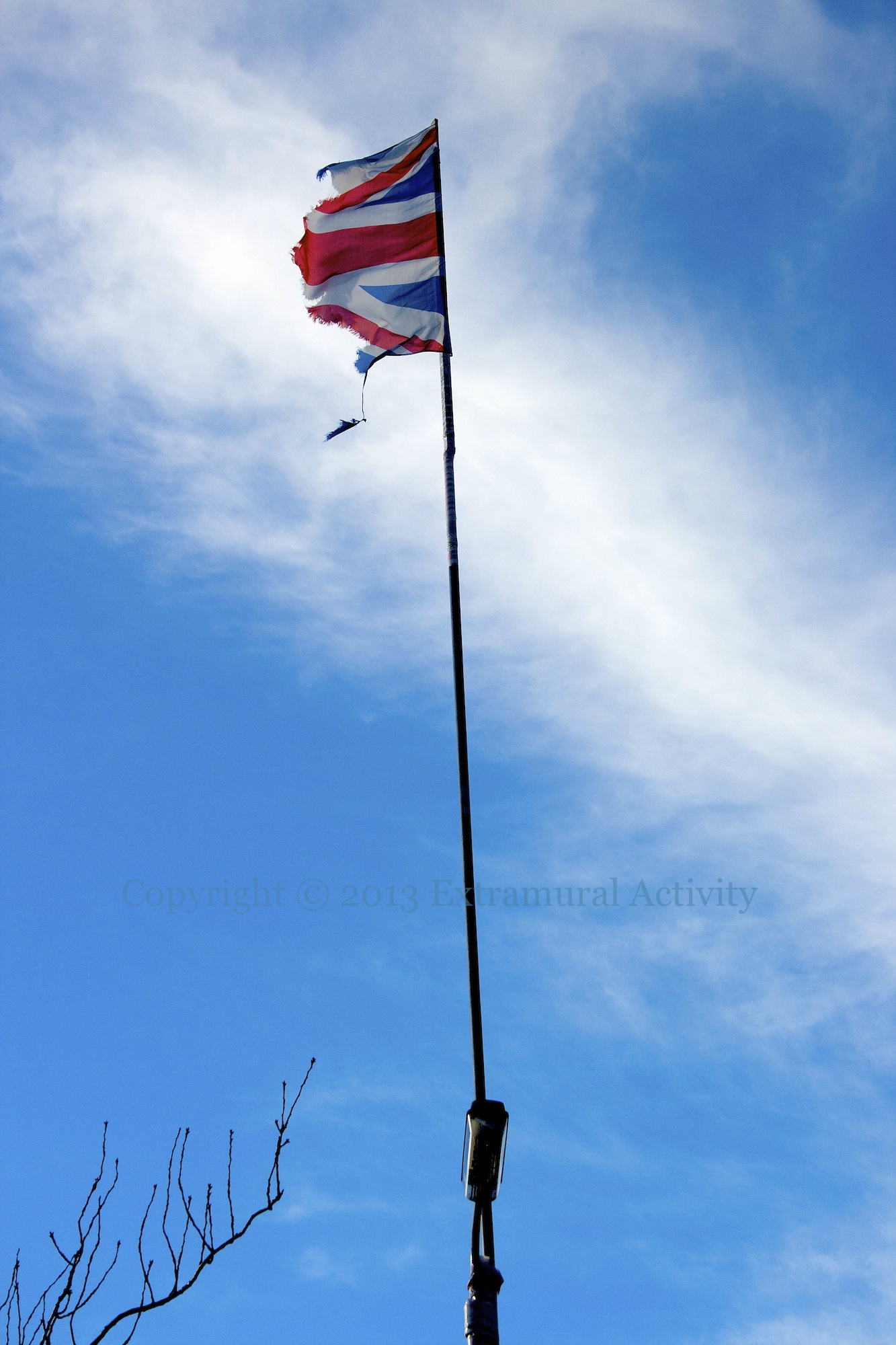
A tattered Union Flag on the Hightown Road/Bóthar Bhaile na hAirde in Glengormley/Gleann Gormliath (just north of Belfast). The title comes from the U.S. anthem “The Star-Spangled Banner”: “the rockets’ red glare, the bombs bursting in air, gave proof through the night that our flag was still there” (WP).

Previously on Extramural Activity: Shankill Rd flag and barbed wire.

Click image to enlarge
Copyright © 2013 Seosamh Mac Coılle
X00931

All Gave Some

2013-02-05 LordStLeft+

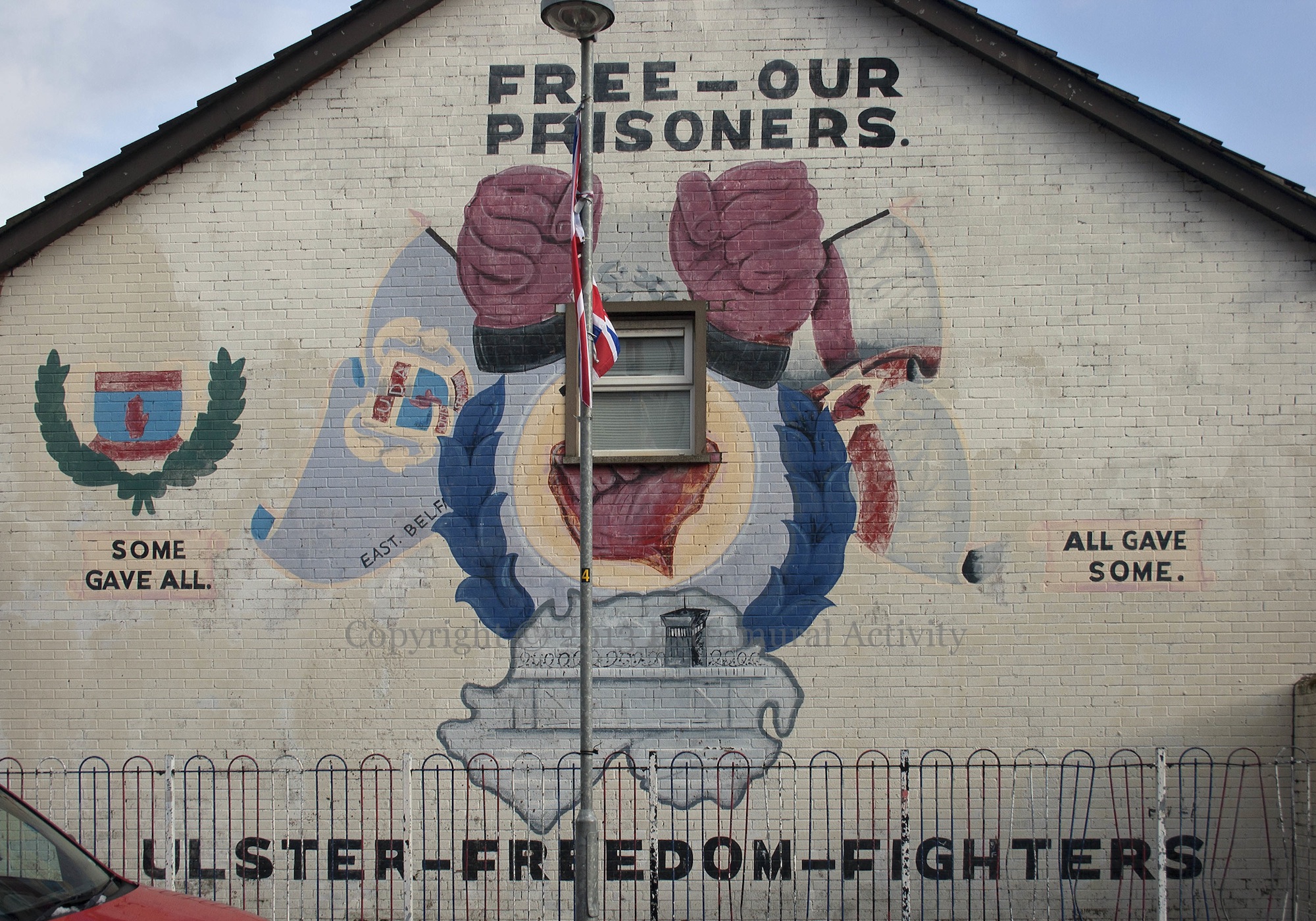
Here is a close-up of the UFF mural which can be seen in the background of the Feriens Tego entry, in Lord St. A pair of red hands are in shackles and the fences of the Maze are superimposed on an outline of Northern Ireland. (Very similar to the ‘For Peace’ mural on the Shankill in 1995.)

Click image to enlarge
Copyright © 2013 Seosamh Mac Coılle
X00932 free our prisoners some gave all all gave some, east belfast, ulster freedom fighters

The Scotch-Irish Of My Native Virginia

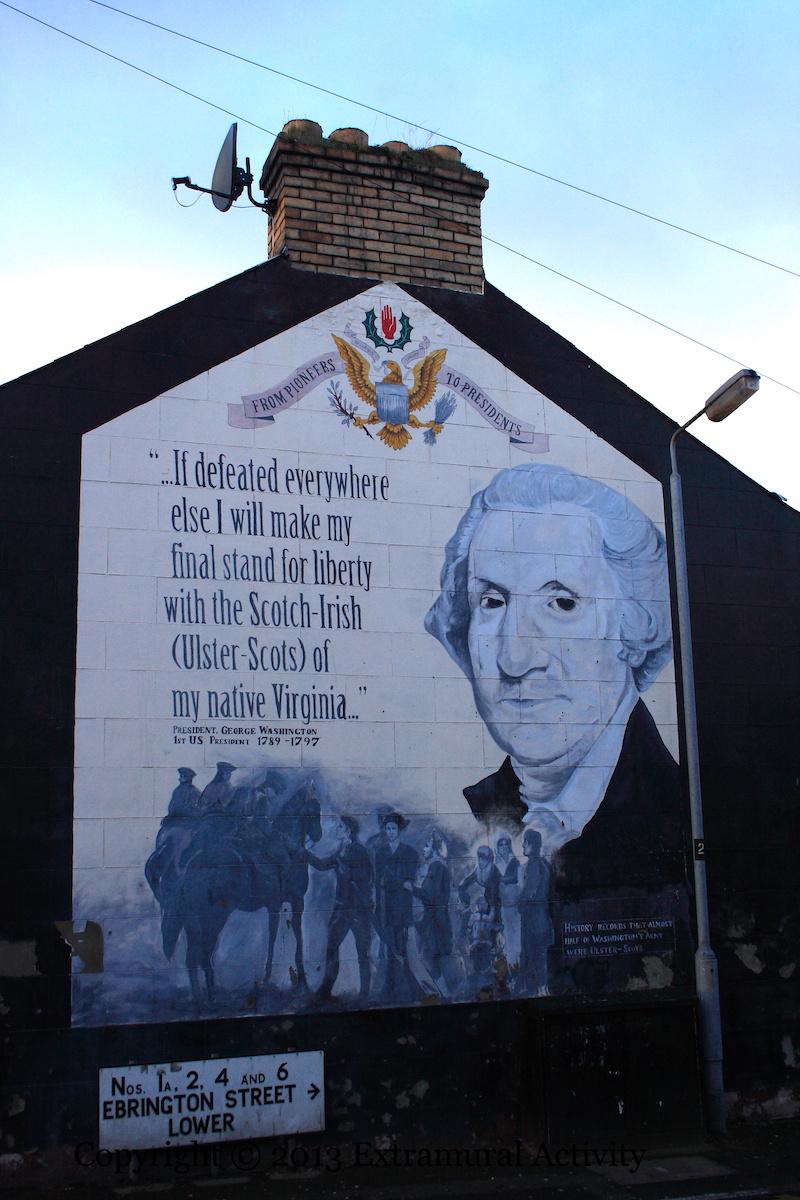
“If defeated everywhere else I will make my final stand for liberty with the Scotch-Irish (Ulster-Scots) of my native Virginia.”

George Washington commanded the Continental Army during the revolution and served as the first president of the United States, beginning in 1789. His ancestry was English and the quote is undocumented, the closest being this statement from McKinley.

The note in the corner reads, “History records that almost half of Washington’s army were Ulster-Scots”; the basis for this claim might be General (Charles?) Lee’s report that “half the rebel Continental Army were from Ireland.” (See Chapter 2 of Bagenal, The American Irish And Their Influence on Irish Politics.)

Ebrington Street Lower, Waterside, Londonderry

Click image to enlarge
Copyright © 2013 Seosamh Mac Coılle
X01548