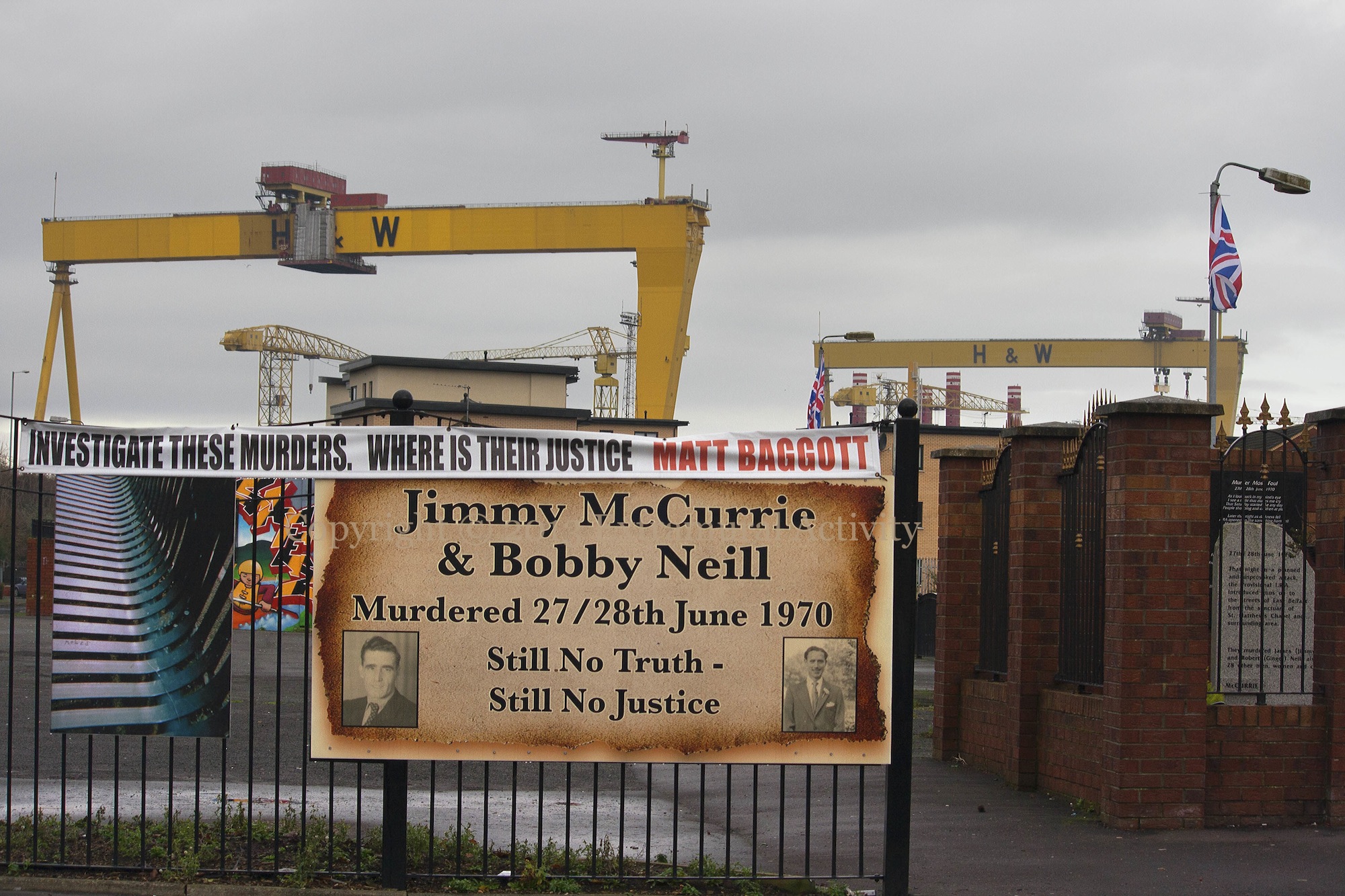
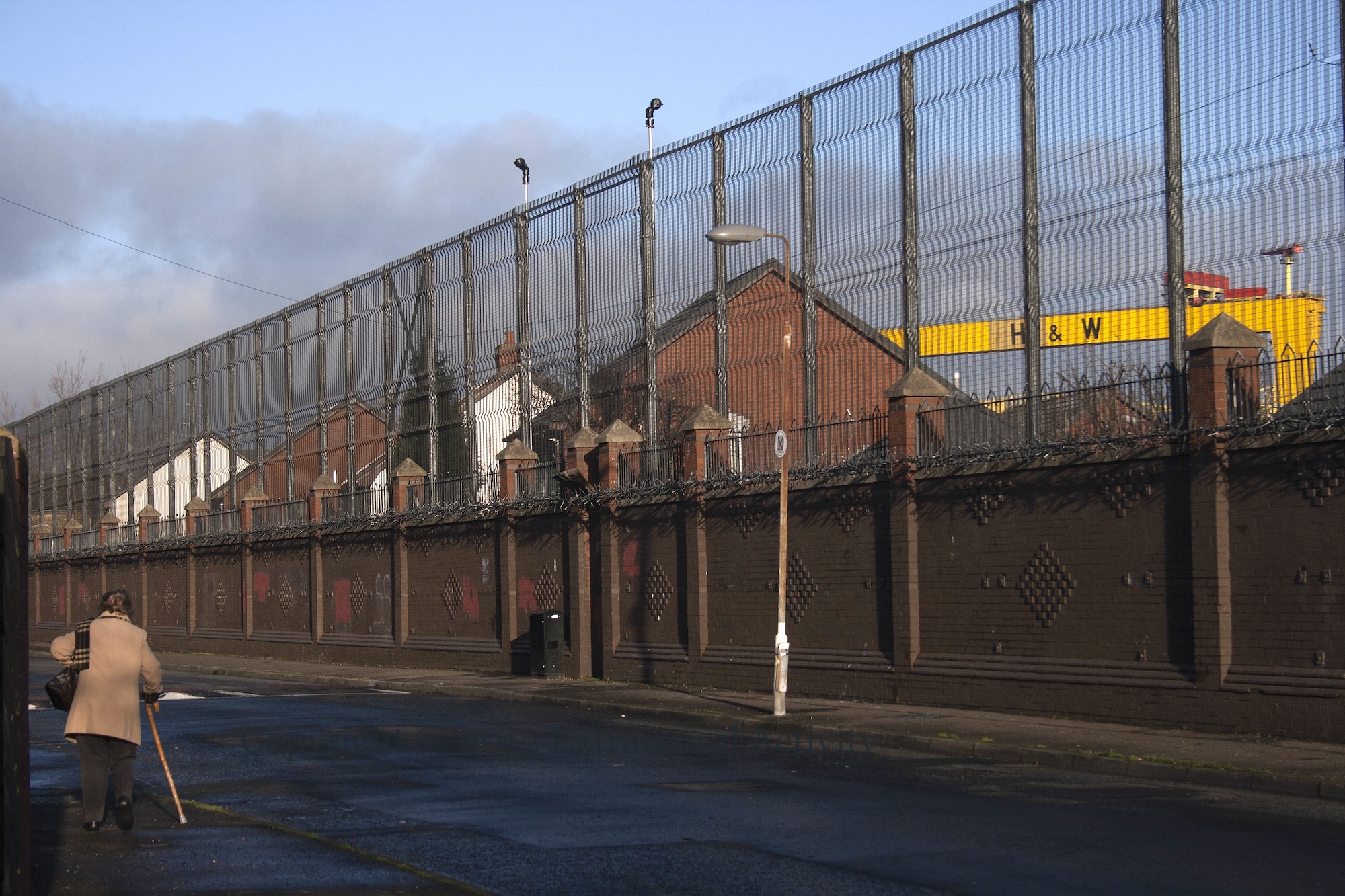
A banner and board reminding people of the deaths of Jimmy McCurrie and Bobby Neill, next to their memorial garden (in the right of the shot) on the Newtownards Road, with the cranes Samson and Goliath in the background. The two civilians died in the course of rioting and a gun battle around St. Matthew’s that was “the first major confrontation to occur in east Belfast during the troubles” (McKittrick et al., p. 50). It is not clear at what time each died. McKittrick (Lost Lives, ISBN 978-1840185041, amazon.co.uk, .com) gives the death of both as the 27th, and puts Neill’s death at 2 a.m. (and so strictly on the 28th??). Matt Baggott is the current Northern Ireland chief of police.
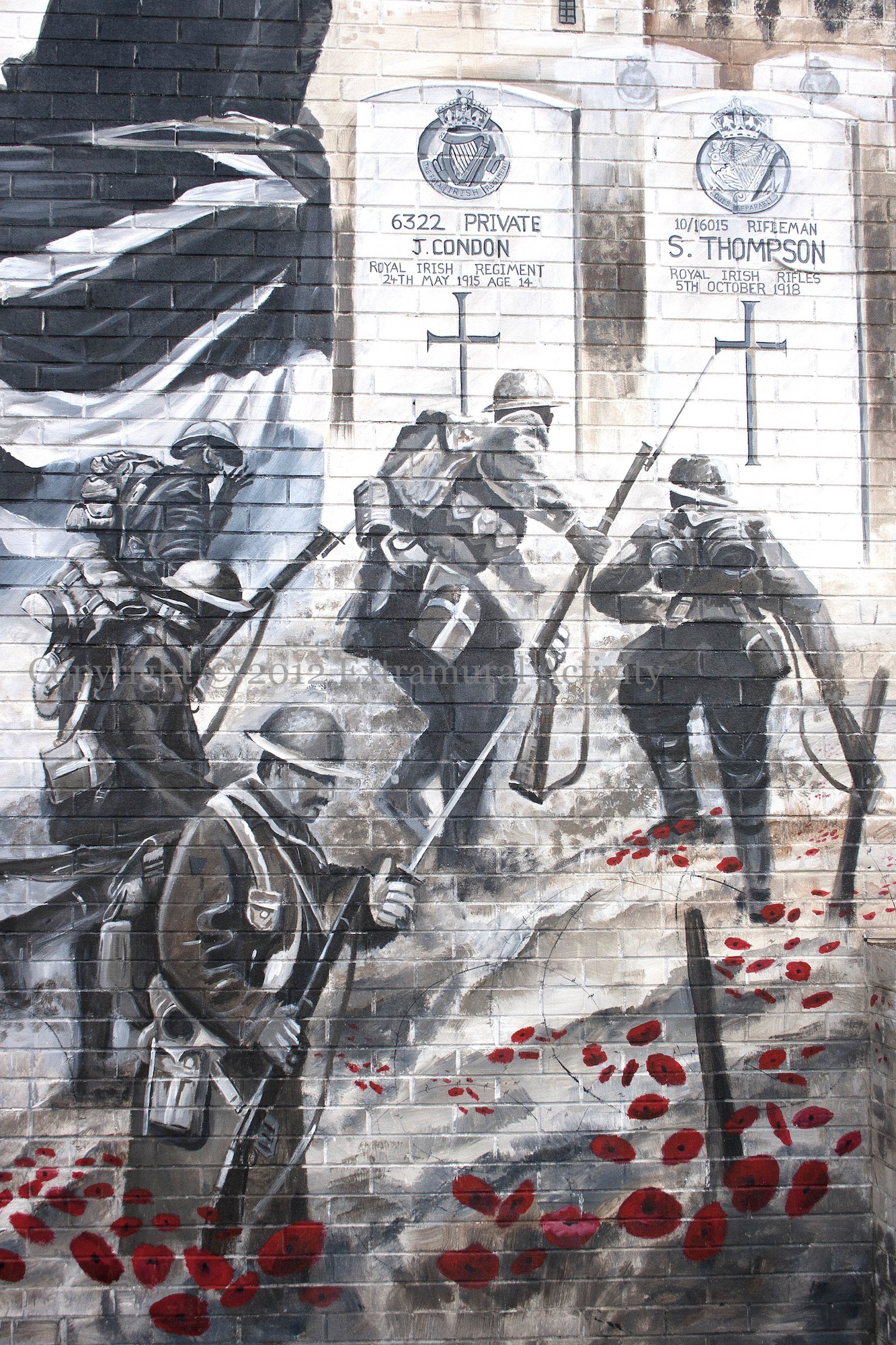
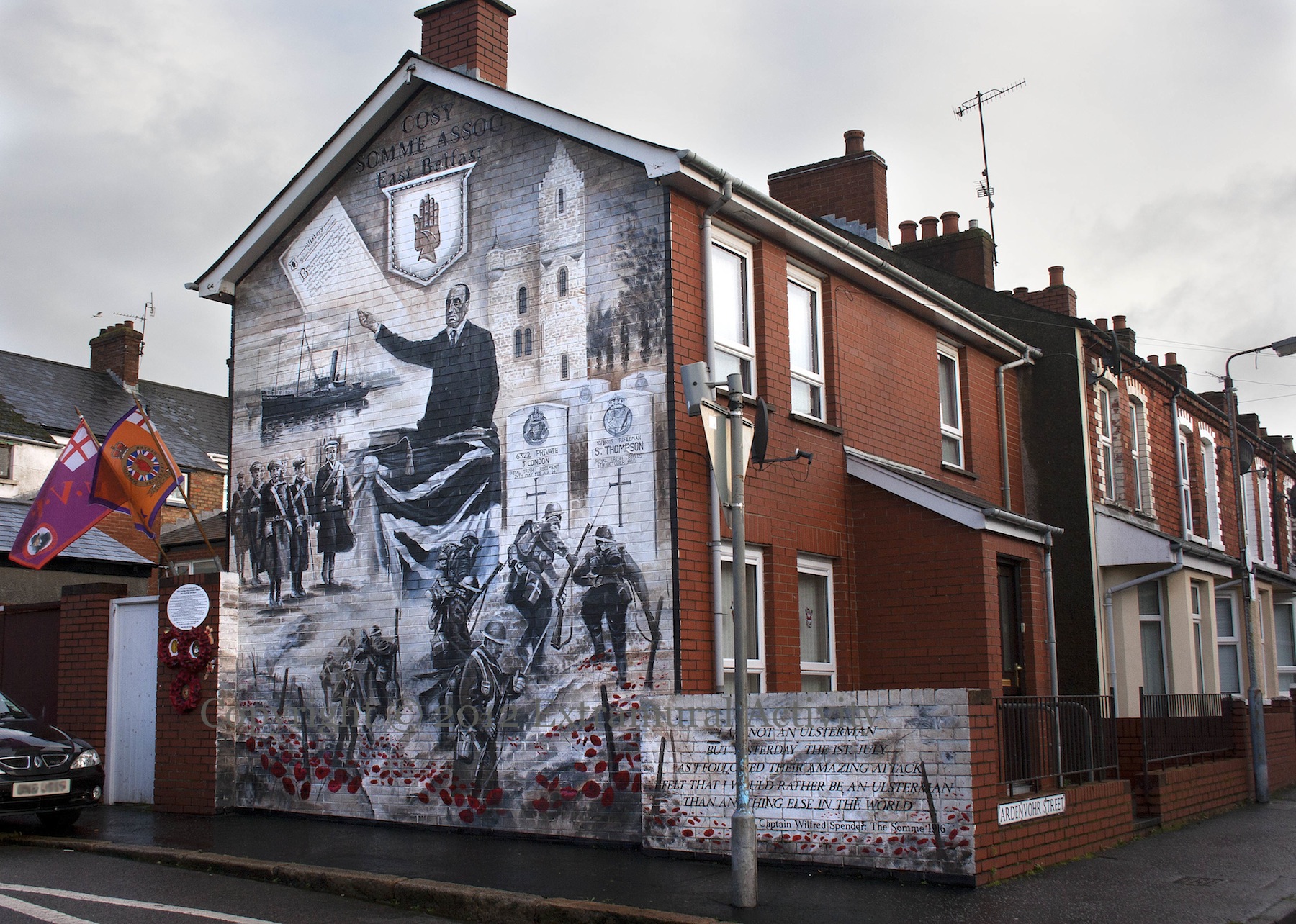
Above is a detail from a mural in Carlingford St, showing gravestones of two deceased locals: “6322 Private J. Condon, Royal Irish Regiment, 24th May, 1915, age 14” and “10/16015 Rifleman S. Thompson Royal Irish Rifles, 5th October, 1918”. Their gravestones are the end-point of a journey that began with the Covenant and the Ulster Volunteers (illustrated by images of Carson, the Covenant, gun-running, and Volunteers drilling).
On the side-wall are the words of Captain Wilfrid Spender, describing the first day of the Battle Of The Somme, 1916: “I am not an Ulsterman but yesterday the First of July, as I followed their amazing attack, I felt that I would rather be an Ulsterman than anything else in the world. [My pen cannot describe adequately the hundreds of heroic acts I witnessed, the Ulster Volunteer Force, from which the Division was made, has won a name that equals any in history. Their devotion deserves the gratitude of The British Empire.]”
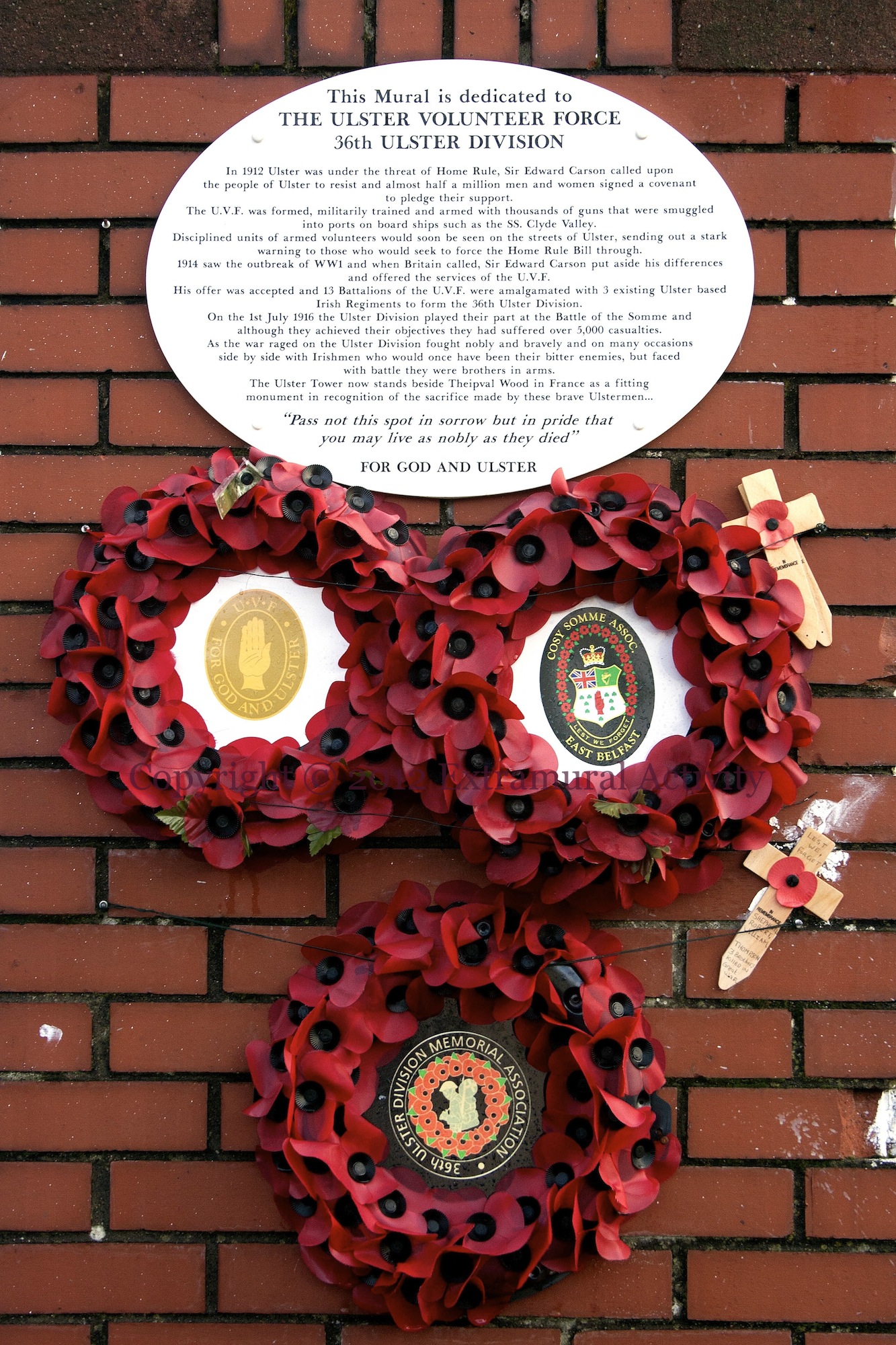
A wide shot of the whole, as well as a close-up of the plaque and wreathes, is below. See also: Attack From Thiepval Wood.
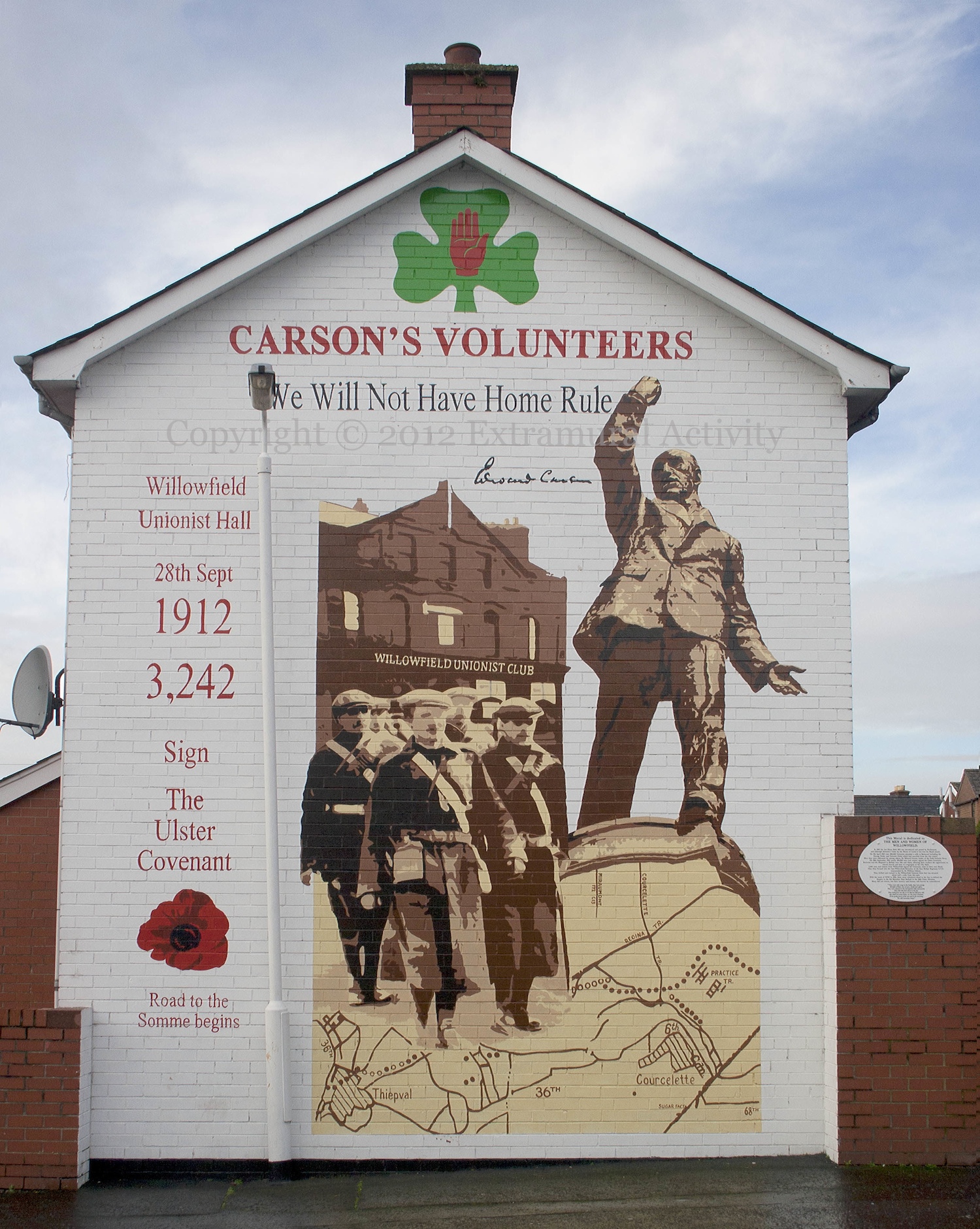
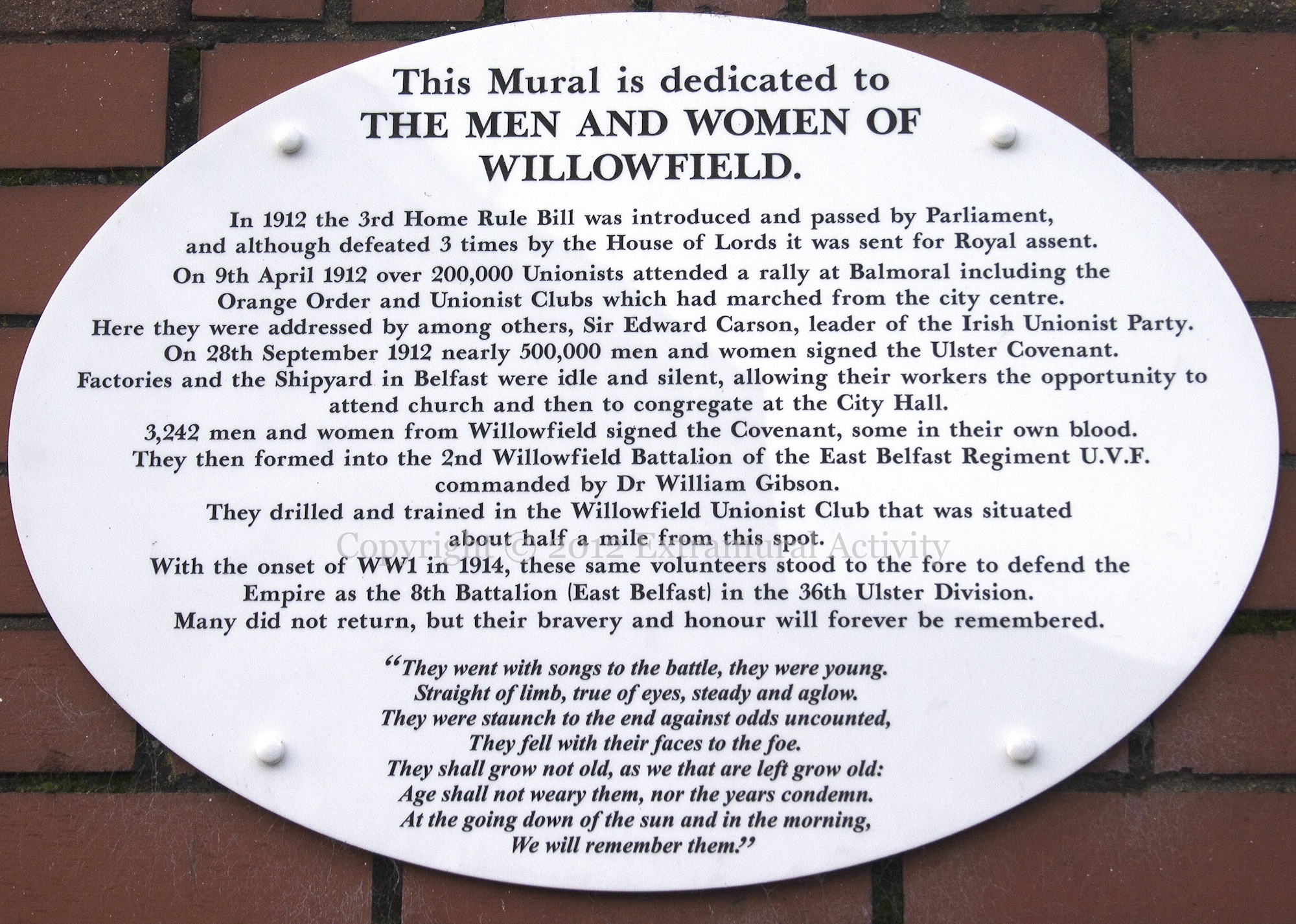
“In 1912 Ulster was under the threat of Home Rule, Sir Edward Carson called upon the people of Ulster to resist and almost half a million men and women signed a covenant to pledge their support. The U.V.F. was formed, militarily trained and armed with thousands of guns that were smuggled into ports on board ships such as the SS. Clyde Valley. Disciplined units of armed volunteers would soon be seen on the streets of Ulster, sending out a stark warning to those who would seek to force the Home Rule bill through. 1914 saw the outbreak of WW1 and when Britain called, Sir Edward Carson put aside his differences and offered the services of the U.V.F. His offer was accepted and 13 battalions of the U.V. F. were amalgamated with 3 existing Ulster based Irish regiments to form the on the 36th (Ulster) Division. On the 1st july the Ulster Division played their part at the Battle of the Somme and although they achieved their objectives they had suffered over 5,000 casualties. As the war raged on the Ulster Division fought nobly and bravely and on many occasions side by side with Irishmen who would once have been their bitter enemies, but faced with battle they were brothers in arms. The Ulster Tower now stands beside Theipval [sic] Wood in France as a fitting monument in recognition of the sacrifice made by these brave Ulstermen … “Pass not this spot in sorrow but in pride that you may live as nobly as they died” For God and Ulster”
Two murals confront each other on Carlingford Street, east Belfast. Here is one, showing a map of the area, a statue of Carson, and a group of volunteers. Detail and close-up of the plaque below.
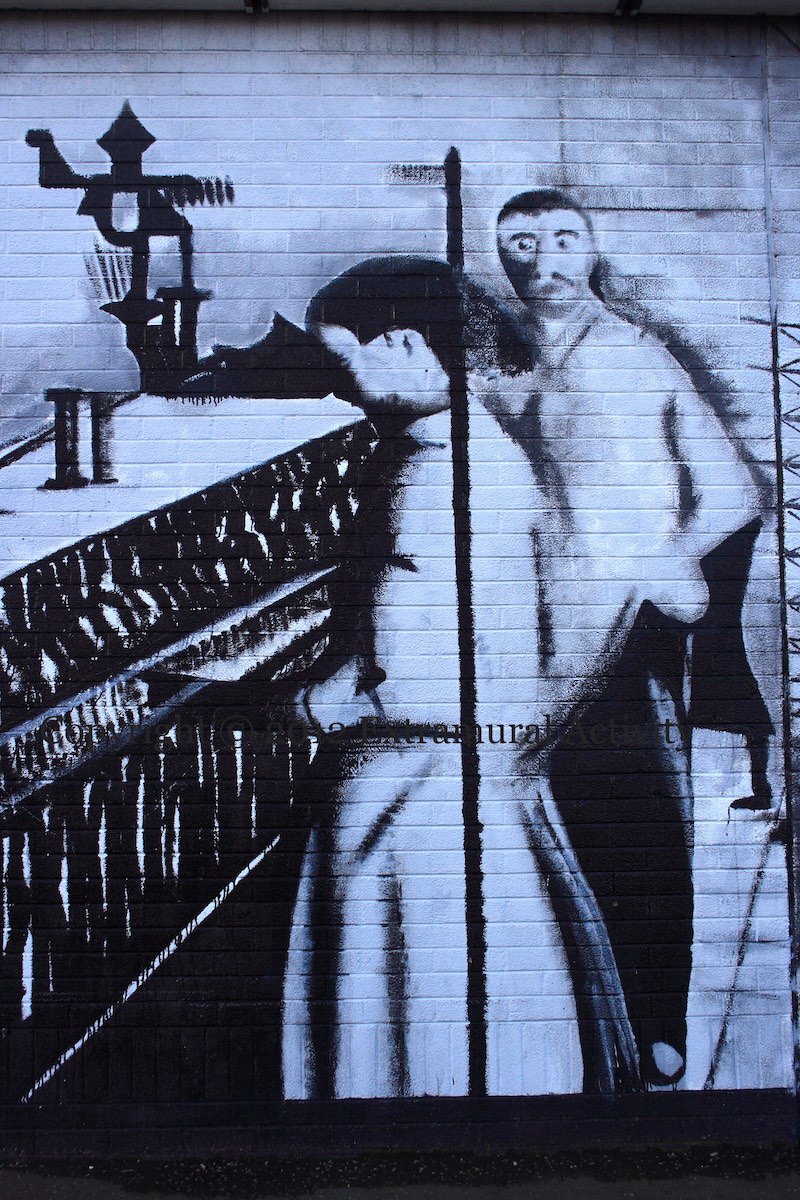
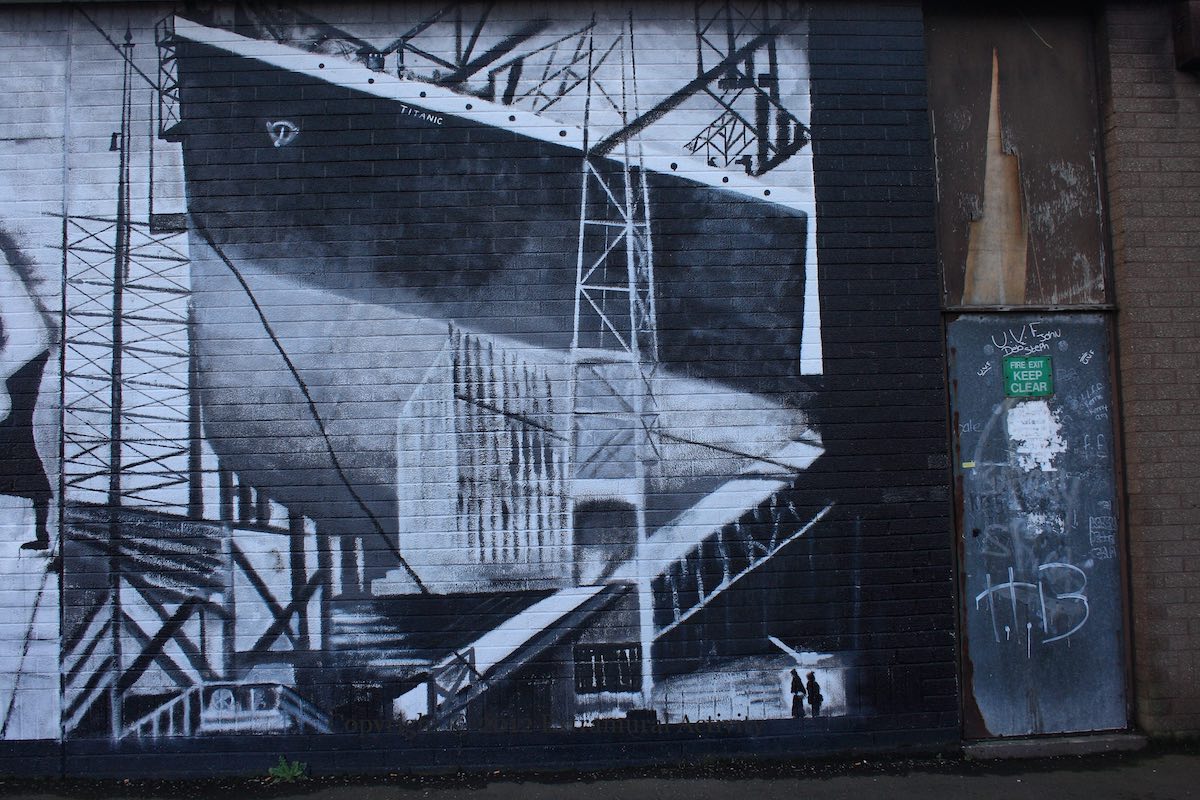
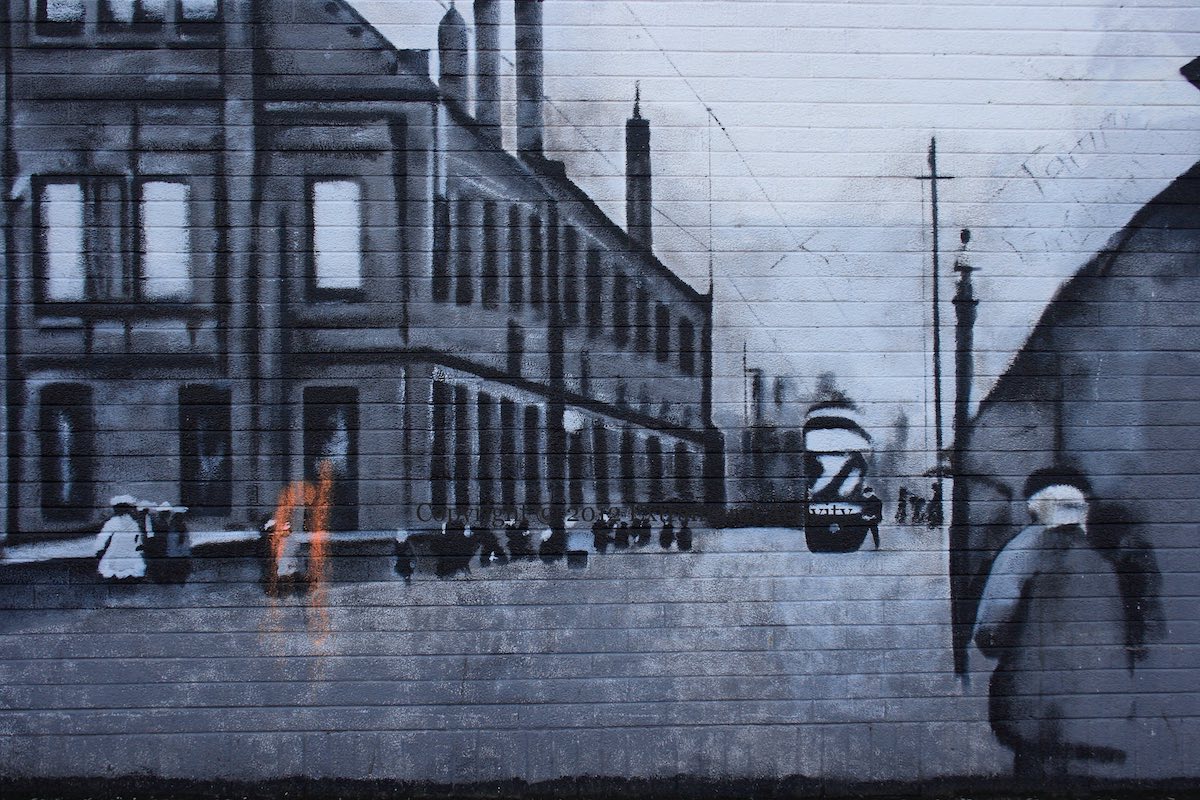
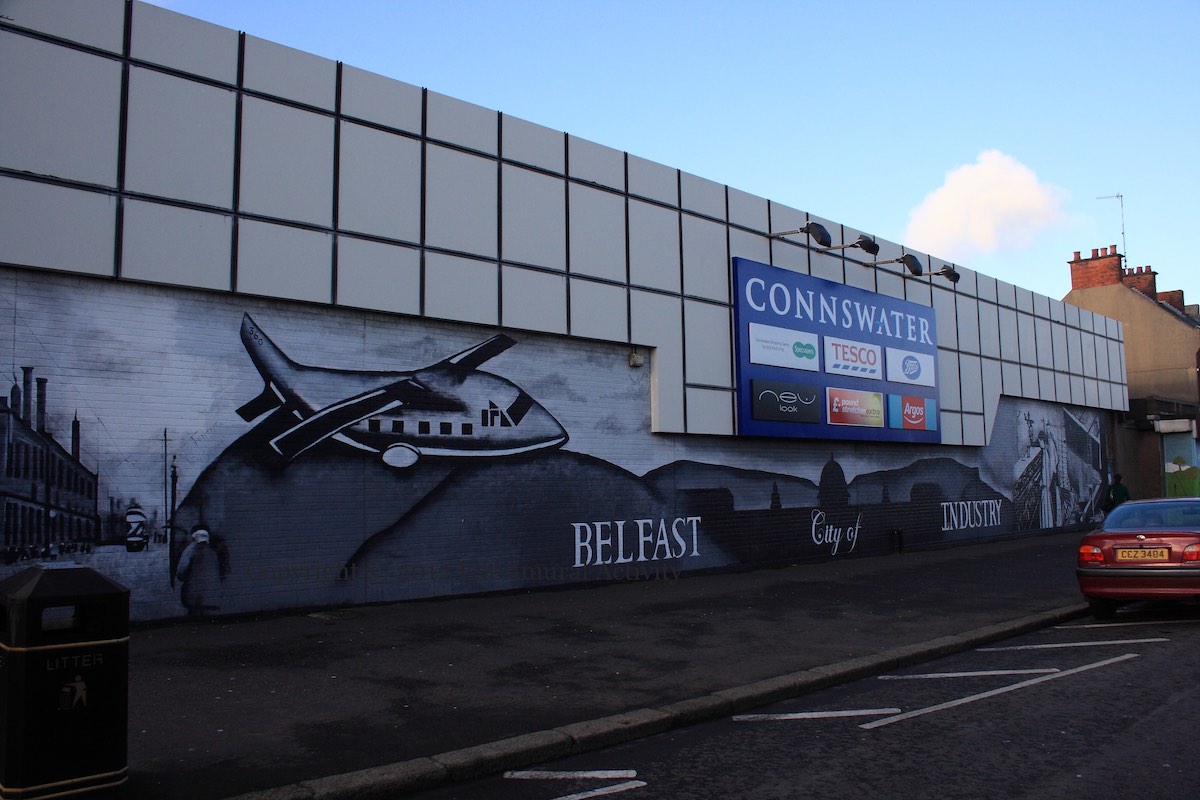
The industrial high-point of Belfast, according to this mural, would seem to be when people travelled on trams, cloth was woven by hand, and Titanic sat in dry dock. Only the Shorts-Bombardier aircraft confuses the nostalgia.
 Seosamh Mac Coille Collection