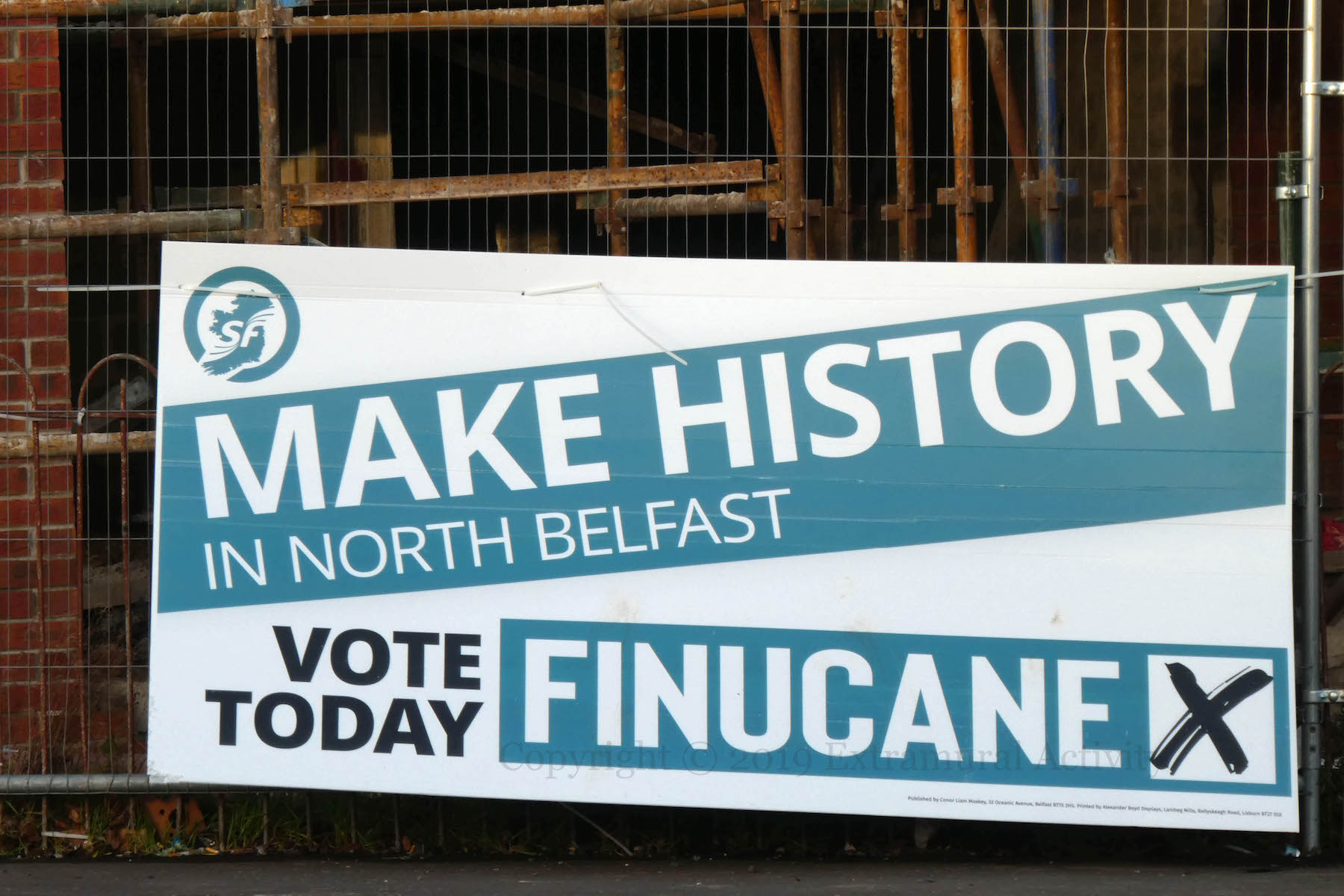
Here is a final image from the election campaign for the December 12th Westminster elections, a plastic board on the fence around the construction site on Alliance Avenue, inviting voters to “make history” by returning a nationalist MP in Belfast North, specifically Sinn Féin’s John Finucane.
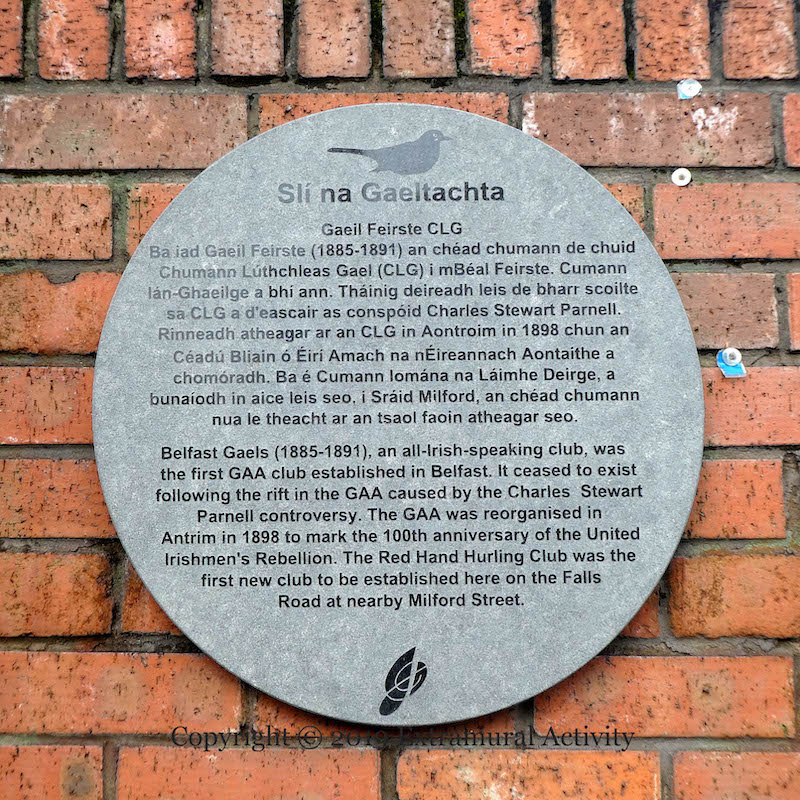
“Gaeıl Feırste CLG. Ba ıad Gaeıl Feırste (1885-1891) an chéad chumann de chuıd Chumann Lúthcleas Gael (CLG) ı mBéal Feırste. Cumann lán-Ghaeılge a bhí ann. Tháınıg deıreadh leıs de bharr scoılte sa CLG a d’eascaır as conspóıd Charles Stewart Parnell. Rınneadh atheagar ar an GLC in Aontroım in 1898 chun an Céadú Blıaın ó Éırí Amach na nÉıreannach Aontaıthe a chomóradh. Ba é Cumann Iomána na Láımhe Deırge, a bunaíodh an aıce leıs seo, i Sráıd Mılford, an chéad chumann nua le theacht ar an tsaol faoın atheagar seo.
Belfast Gaels (1885-1891), an all-Irish-speaking club, was the first GAA club established in Belfast. It ceased to exist following the rift in the GAA caused by the Charles Stewart Parnell controversy. The GAA was re-organised in Antrim in 1898 to mark the 100th anniversary of the United Irishmen’s Rebellion. The Red Hand Hurling Club was the first new club to be established here on the Falls at nearby Milford Street.”
This plaque is on Divis Street at the Northern Bank building; this Antrim GAA history page gives the club’s location as “Stephen’s Street”, probably intending Stephen Street, though this is in Carrick Hill rather than Divis or the Falls
For another Slí Na Gaeltachta plaque, about the Farset river, see H & A. Tours of Slí Na Gaeltachta are available from Forbaırt Feırste.
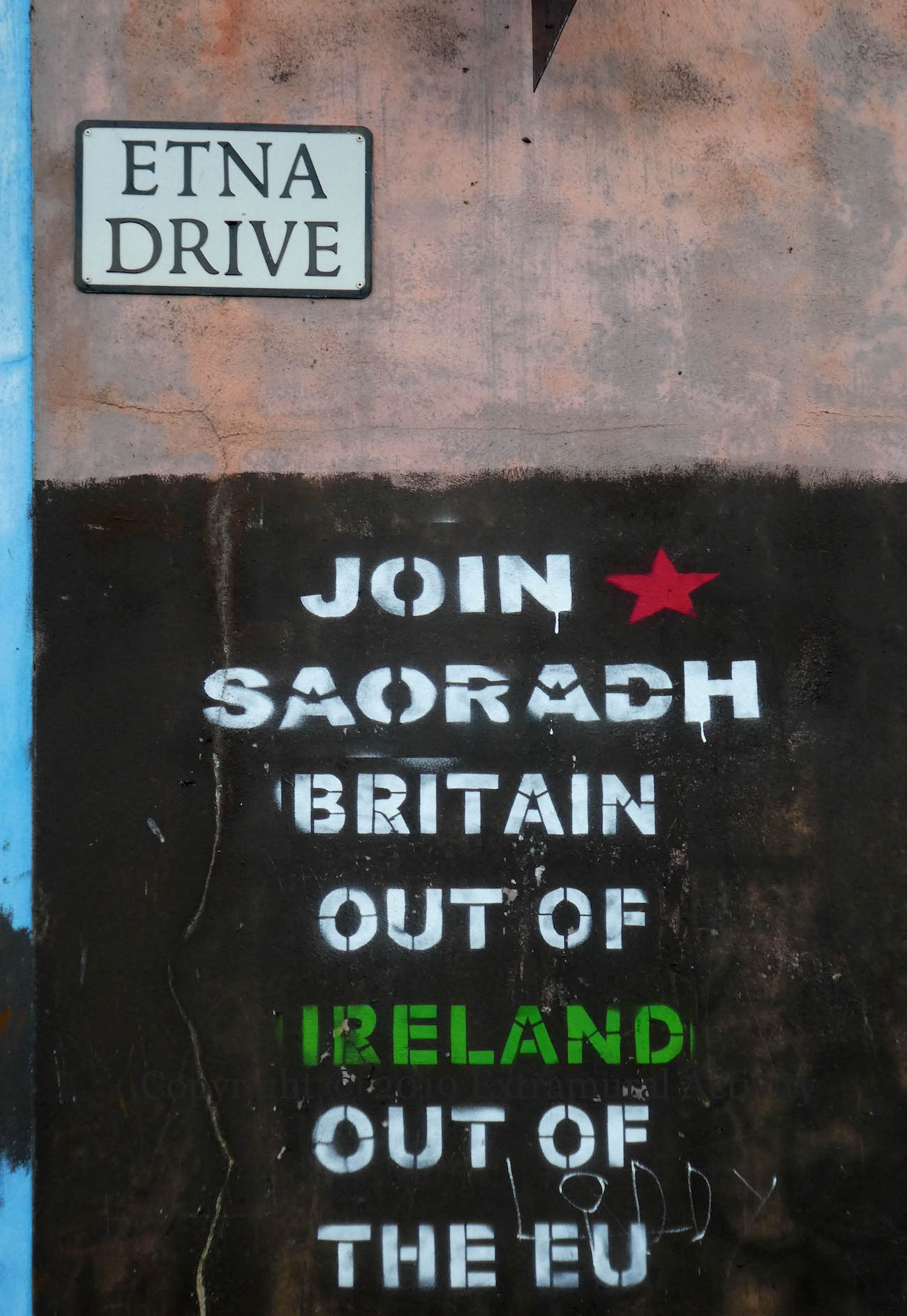
“Britain out of Ireland – Ireland out of the EU.” This Saoradh stencil is in Ardoyne, north Belfast. Saoradh does not stand candidates in elections; it also currently lacks a national on-line presence and is banned from Twitter and Facebook (in the wake of the death of Lyra McKee).
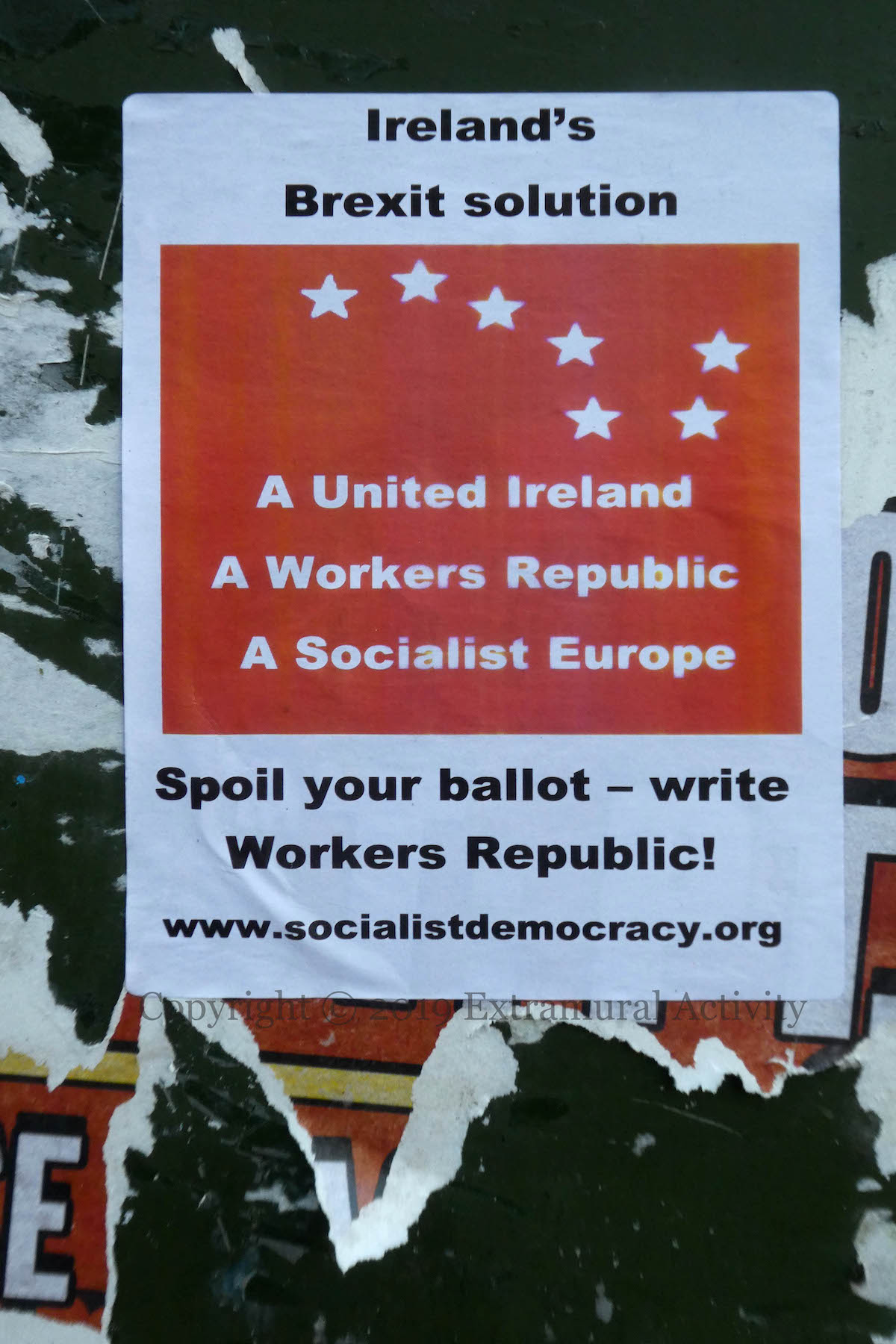
“Ireland’s Brexit solution: a united Ireland, a workers republic, a socialist Europe. Spoil your ballot – write Workers Republic! www.socialistdemocracy.org” Although it’s not clear from the poster above, the desired position is for a federal (“United States of”) Europe rather than EU membership in its current form.
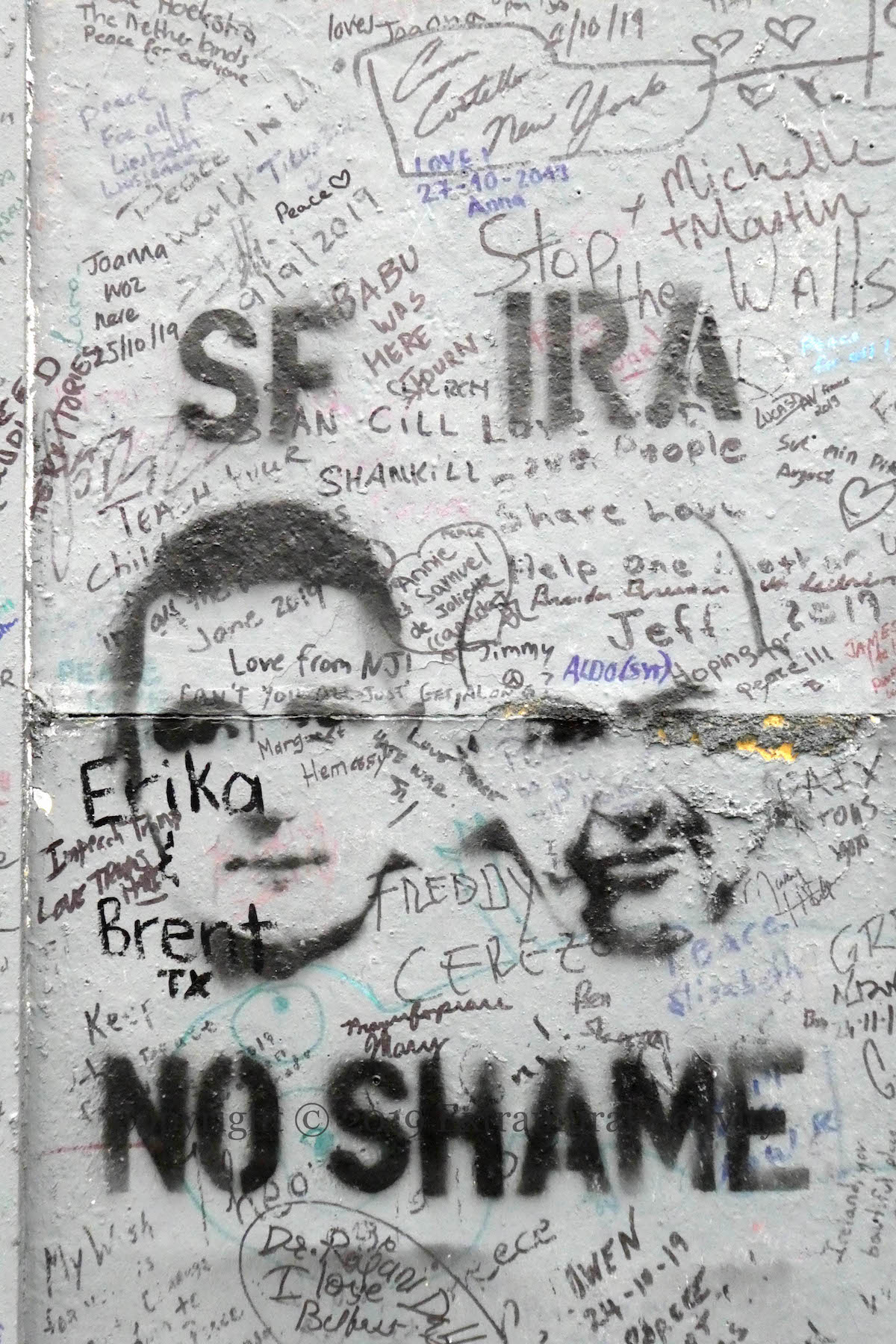
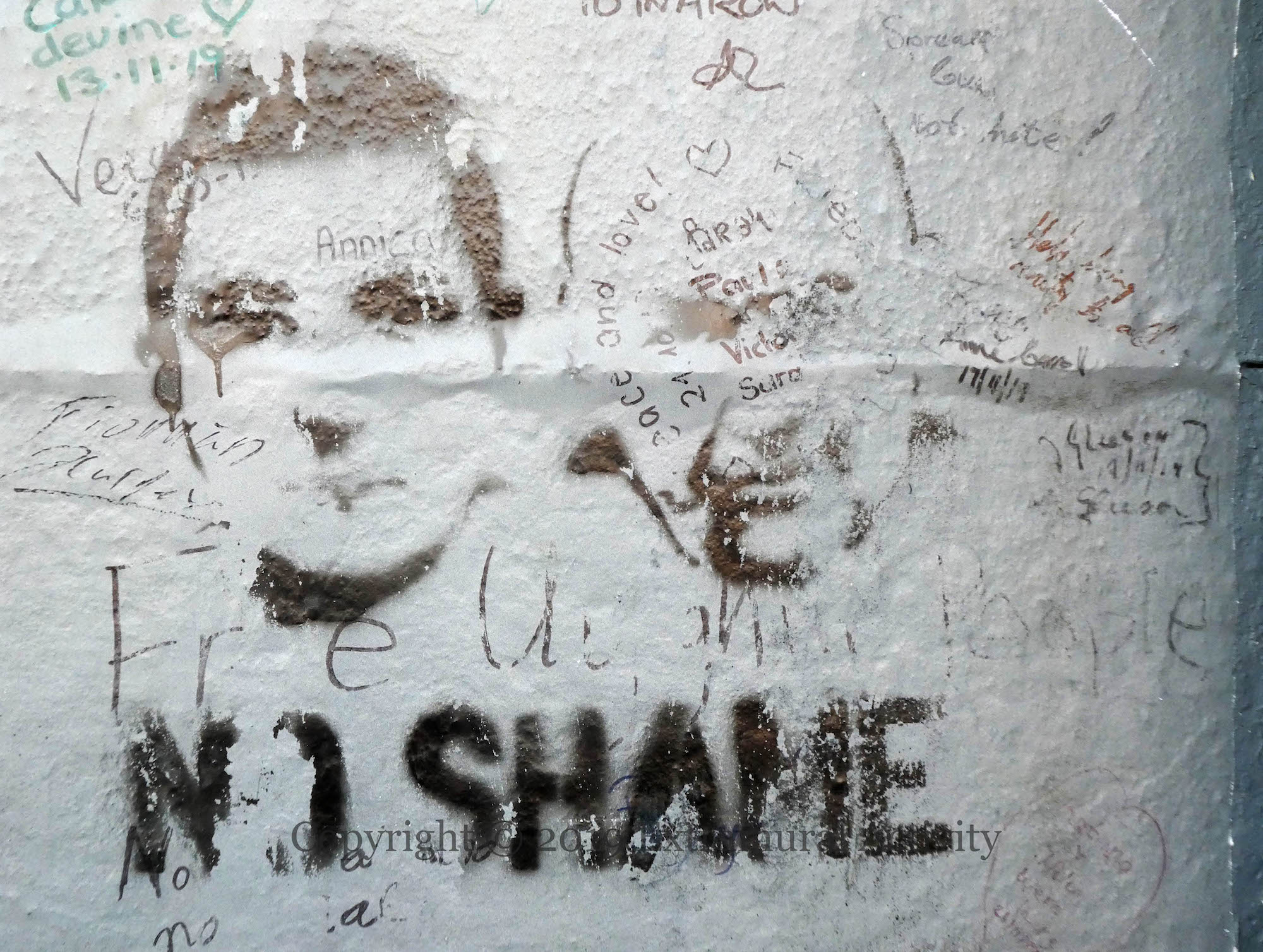
“S[inn] F[éin] IRA – No Shame” in reference to Shankill bomber Sean Kelly (on the right) campaigning for SF Belfast North candidate John Finucane (on the left) on Lanark Way and Cupar Way. See Steeped In Blood for more. Voters go to the polls on Thursday (December 12th).
With “patronising slogans” by tourists from around the world: “Peace for everyone”, “Stop the walls”, “Can’t you all just get along?”, “Share love – help one another”, and “Impeach Trump”.
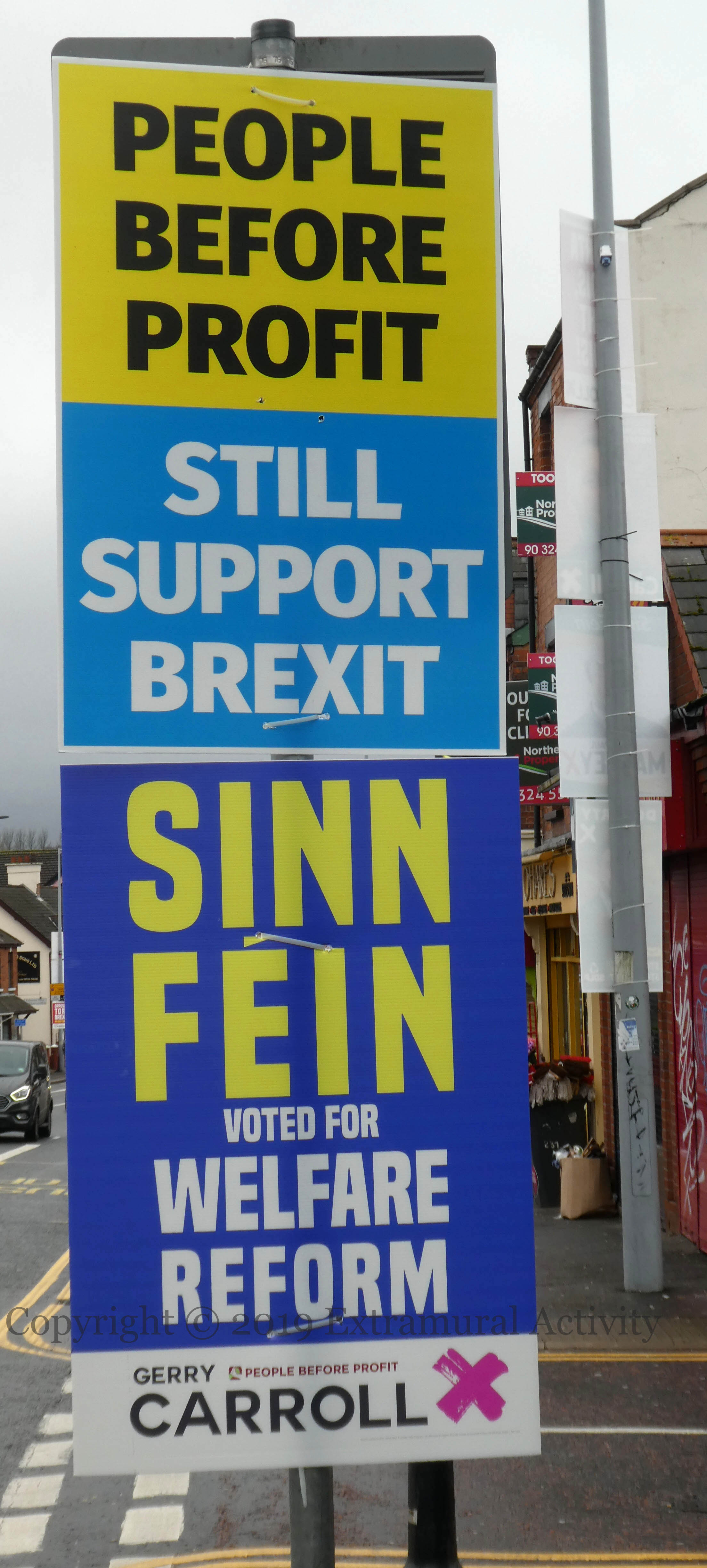
The lower placard comes from left-wing party People Before Profit (web), attacking Sınn Féın for their vote on welfare reform (in 2015 when the Assembly was still functioning – BBC | Guardian). The upper placard has no fine print asserting its provenance, and PBP has alleged that such placards were put up by Sınn Féın (Irish News). “People Before Profit . .. still supports Brexit”.
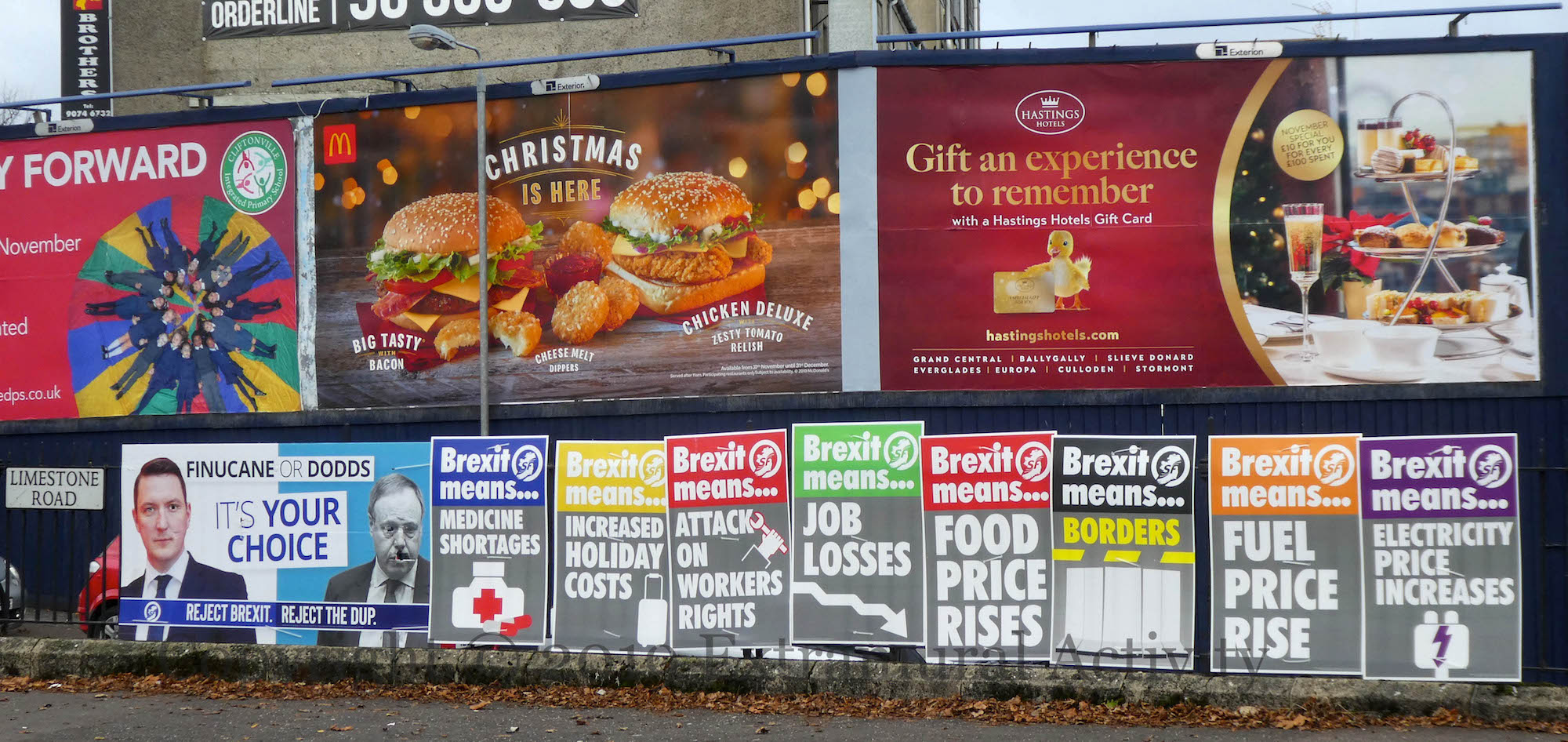
Brexit means … borders, job losses, medicine shortages, and more. It takes all of the colours of the rainbow to set what Sınn Féın believes its consequences would be. The Sınn Féın candidate in Belfast North is John Finucane, in a close contest with the DUP’s Nigel Dodds: see The Anti-Brexit Candidate.
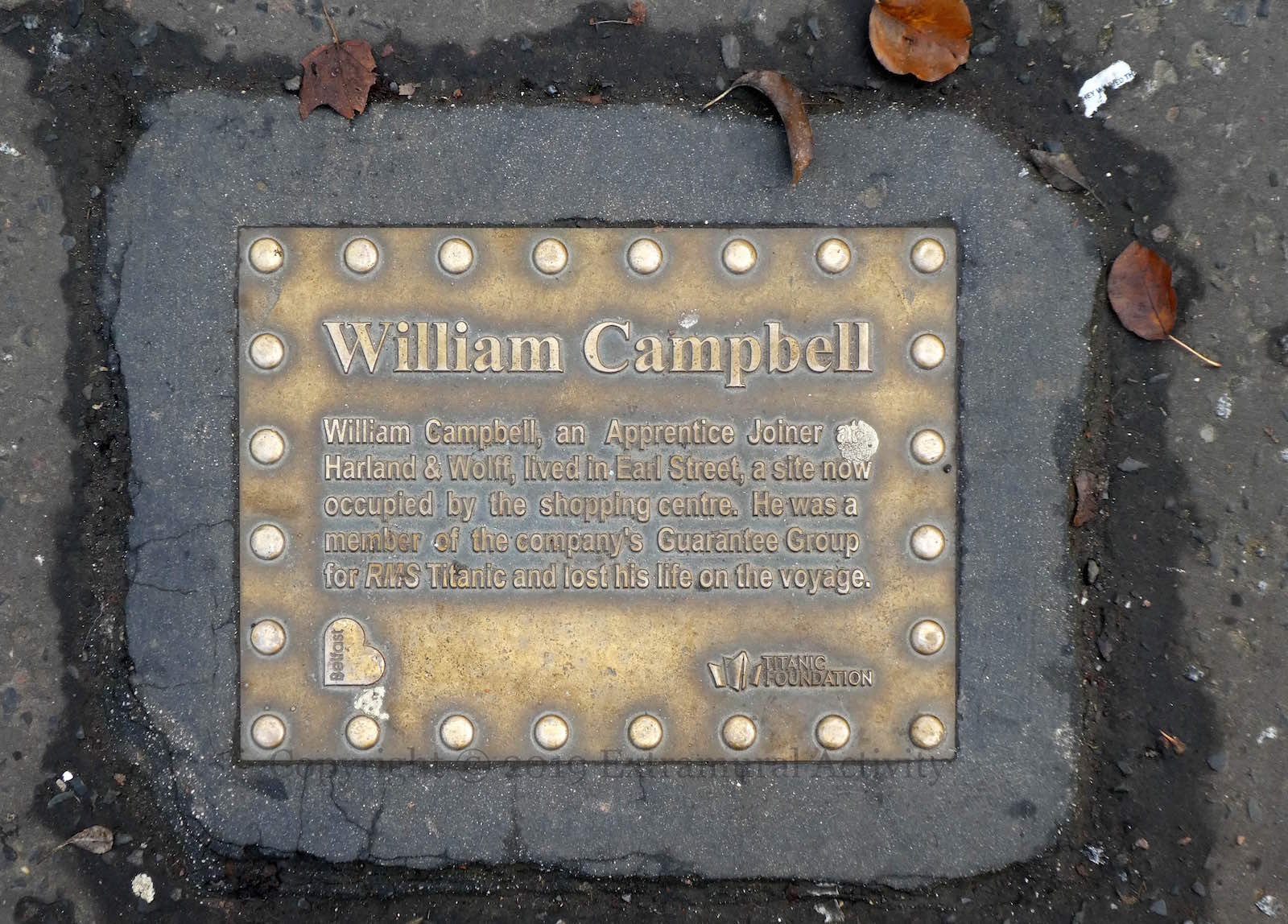
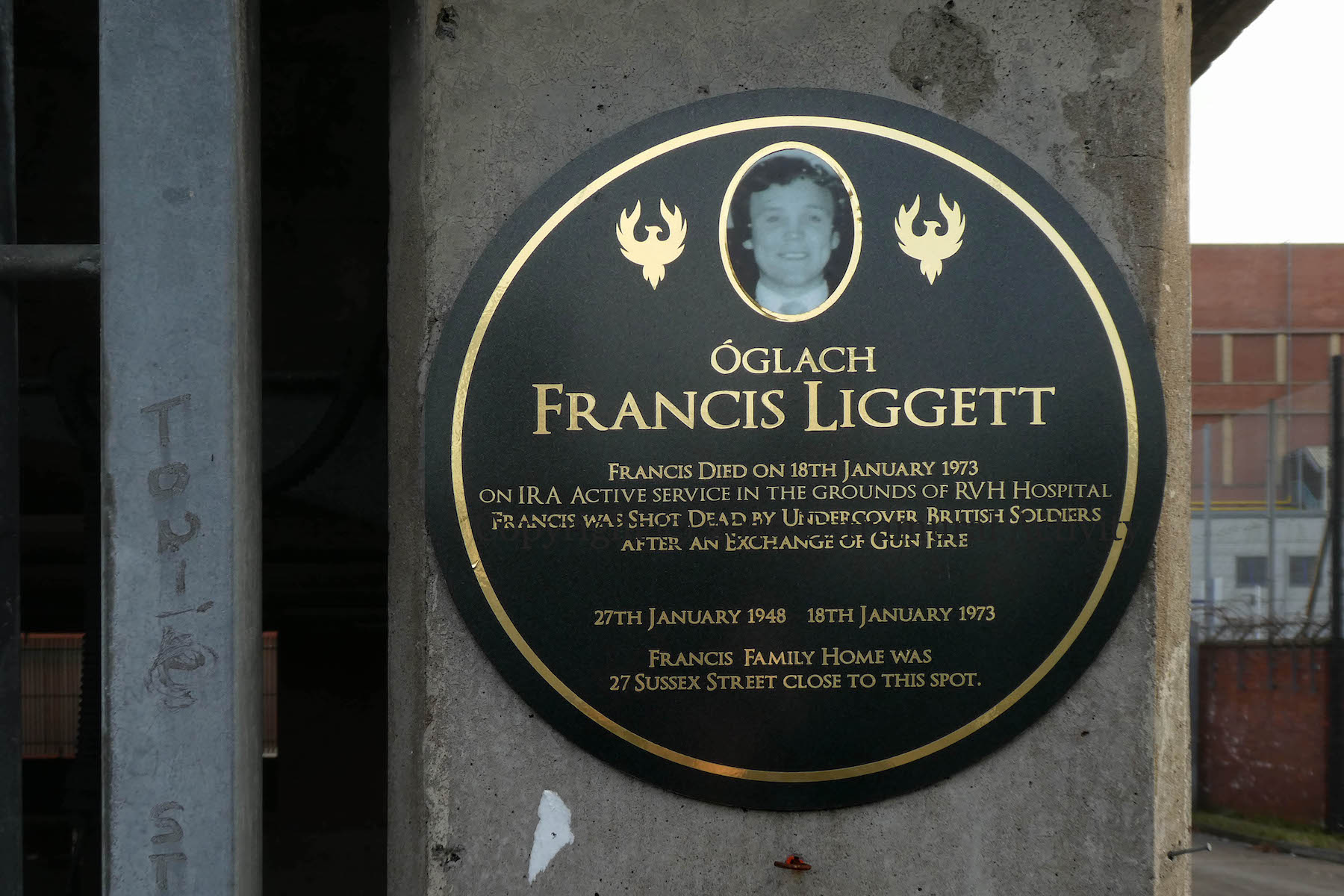
Earl Street and Sussex Street used to be sandwiched between wings of the largest tobacco factory in the world, Gallahers, which took up seven acres between York Street and North Queen Street. The factory was partially demolished in 1990 and became Yorkgate shopping centre and the two streets are roughly now the back and front entrances to the Tesco supermarket. These two plaques (both on North Queen Street) are to former residents. William Campbell, a H&W joiner, might have witnessed the construction of Gallahers (in 1897 – Look Again) before dying on Titanic in 1914. Francis Liggett, an IRA volunteer, was shot and killed by British forces during an attempted robbery of the Royal. (He is also remembered in a mural in St James’s near the site of his death and home – see Liggett & Brady.)
When the negotiators for Israel sat down with counterparts from each of Lebanon, Syria, Jordan, and Egypt after the Arab-Israeli war to draw the ceasefire lines between their countries, they did so in a green ink, after which it got the name “the green line”.
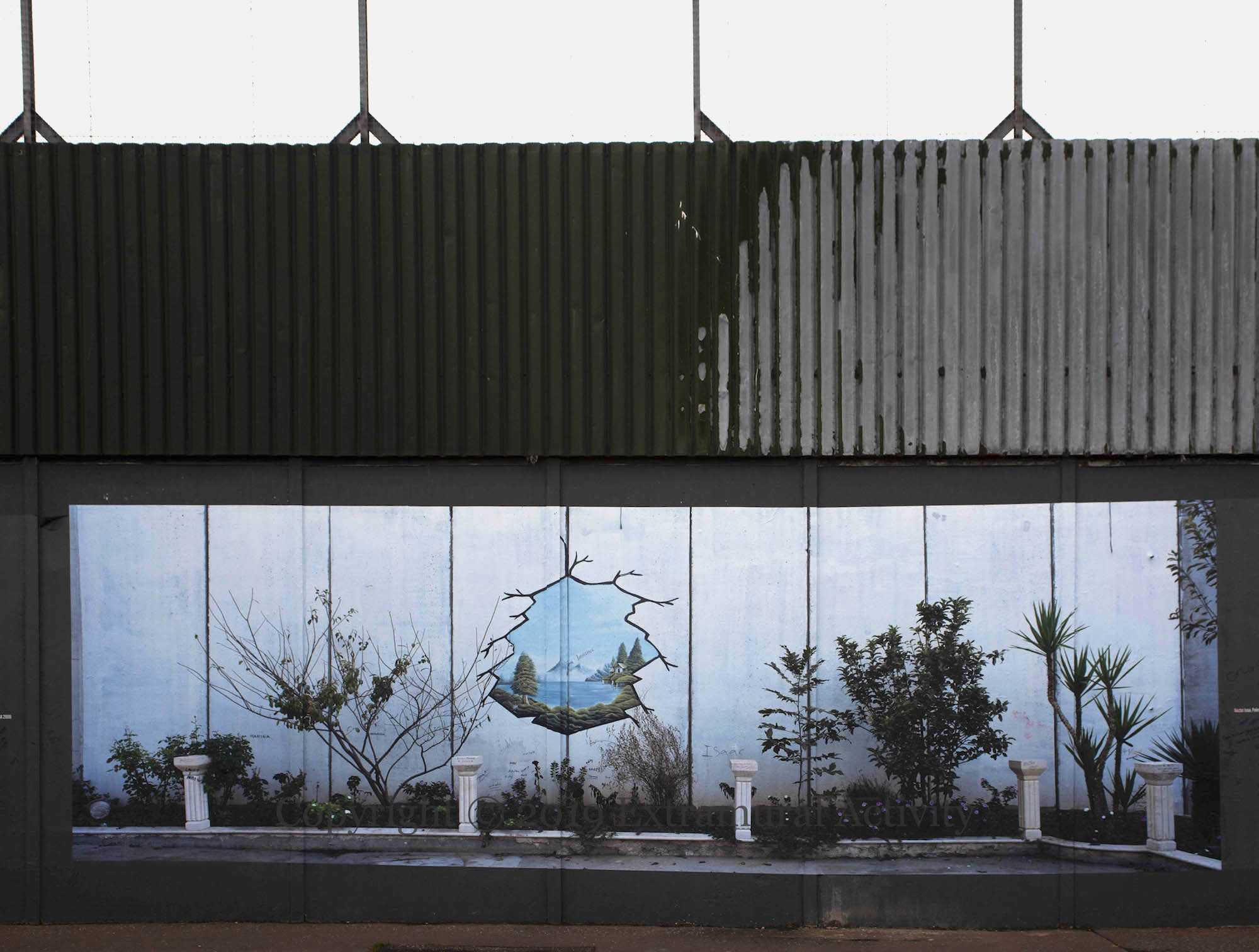
The line ran through the town of Baqa and in 2004 (and still part of the border between the West Bank and Israel) Israel built a wall dividing the community. The image above (from Kai Wiedenhöfer’s Confrontier collection of dividing walls and pasted onto Belfast’s own ‘green line’ in Cupar Way) shows a Palestinian back garden butting up against the wall, with a Banksy-style ‘hole-in-the-wall’ view of the other side providing an alternative (also seen previously on Northumberland Street).
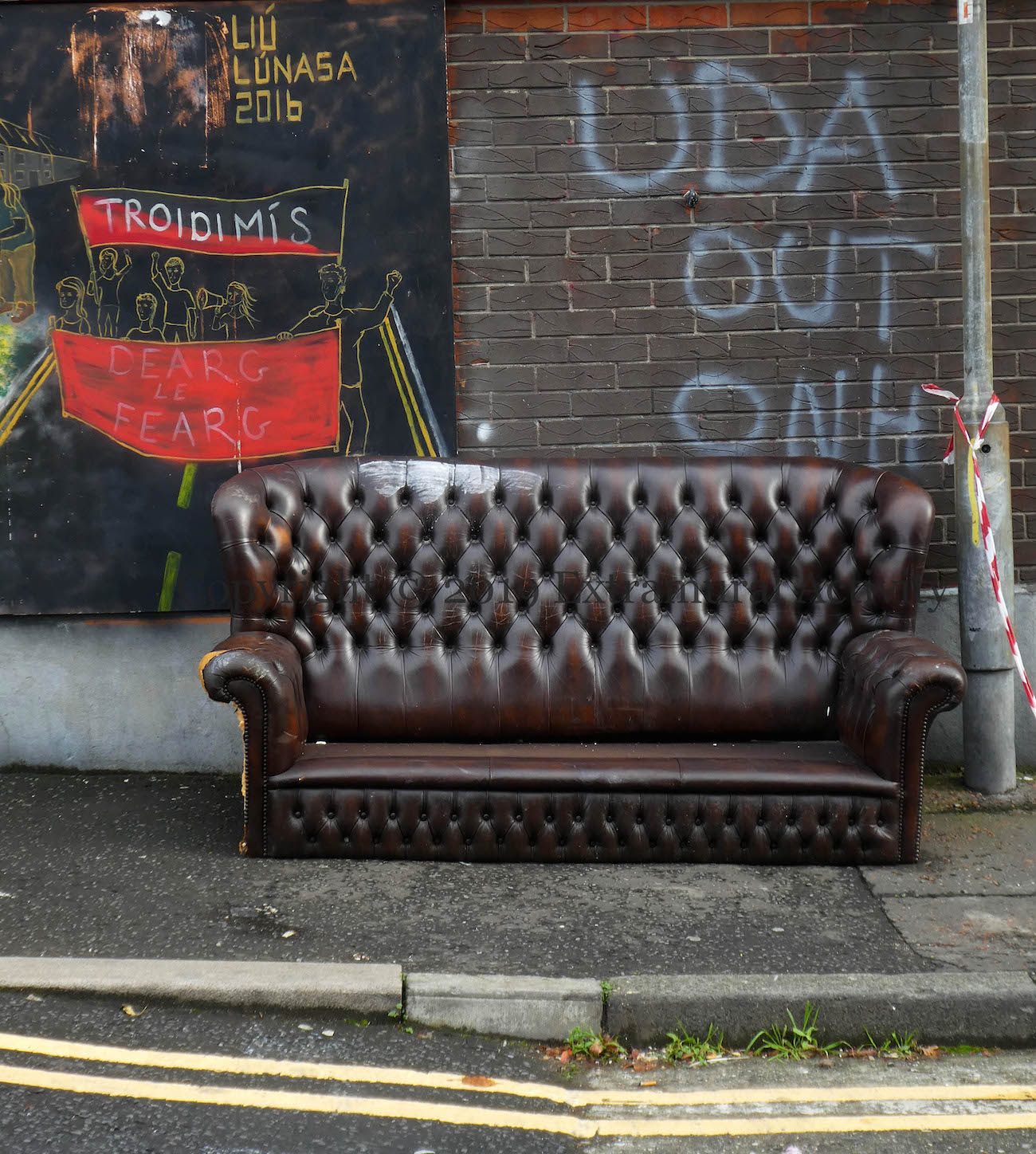
“UDA Out – ONH”. Óglaıgh na hÉıreann called a ceasefire in January, 2018 (BBC-NI) and largely disappeared from public consciousness. This recent graffiti, which is perhaps related to drug dealing (BelTel | BLive | BBC-NI | see previously Little Monsters), is at the top of Broadway.
 Seosamh Mac Coille Collection