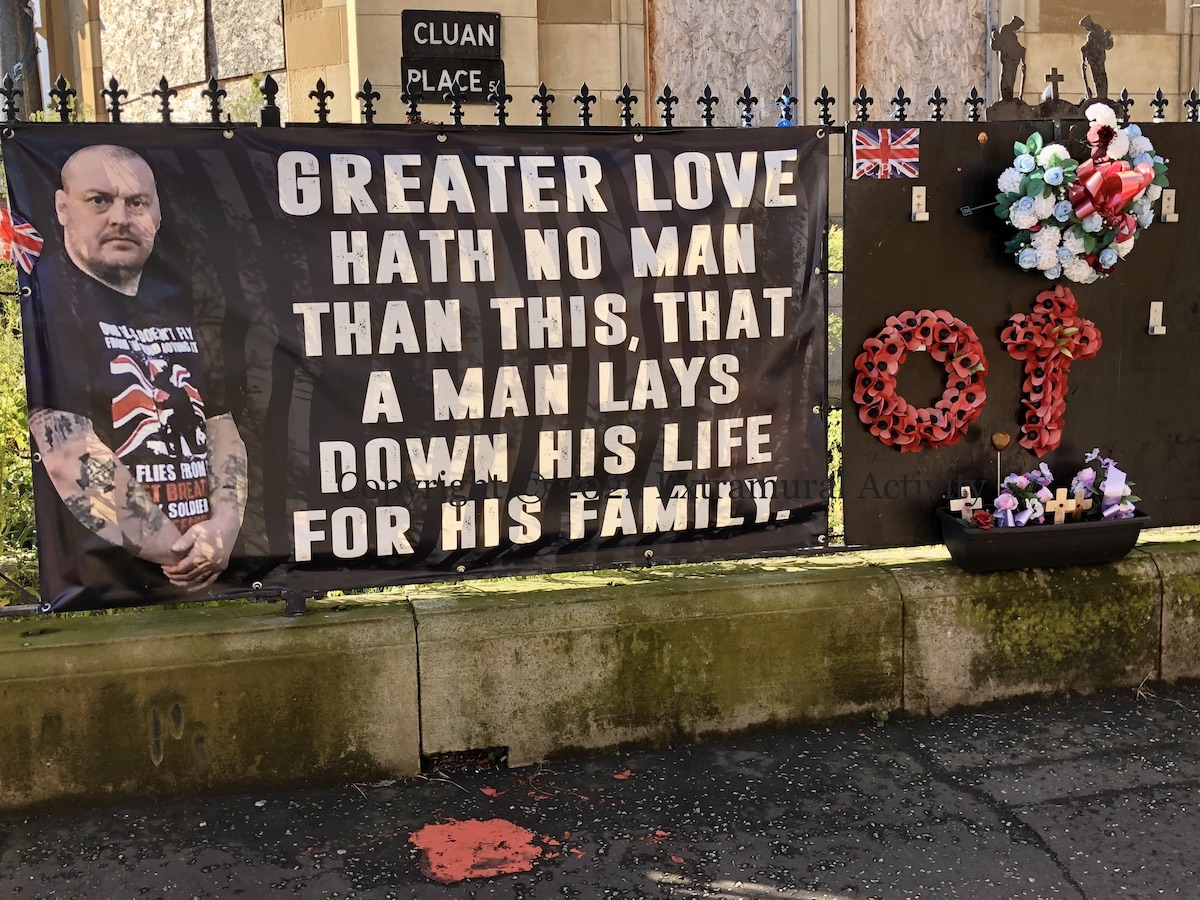
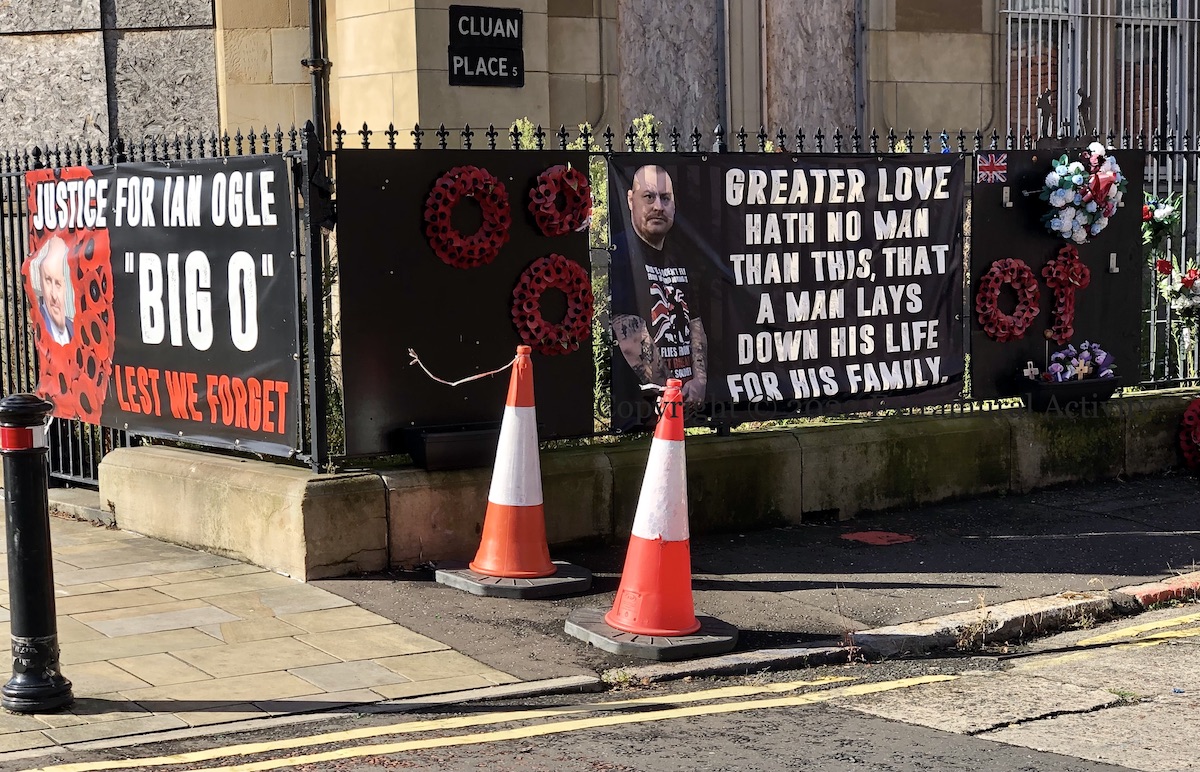
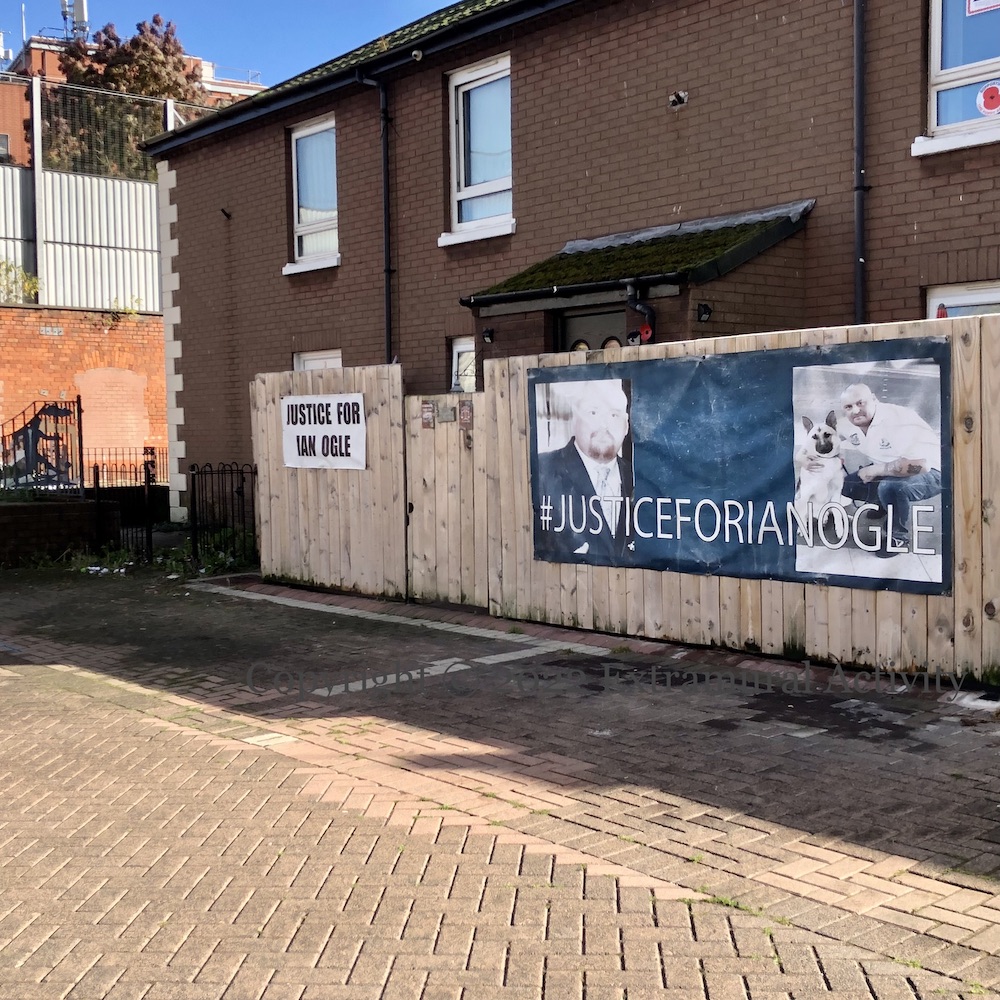
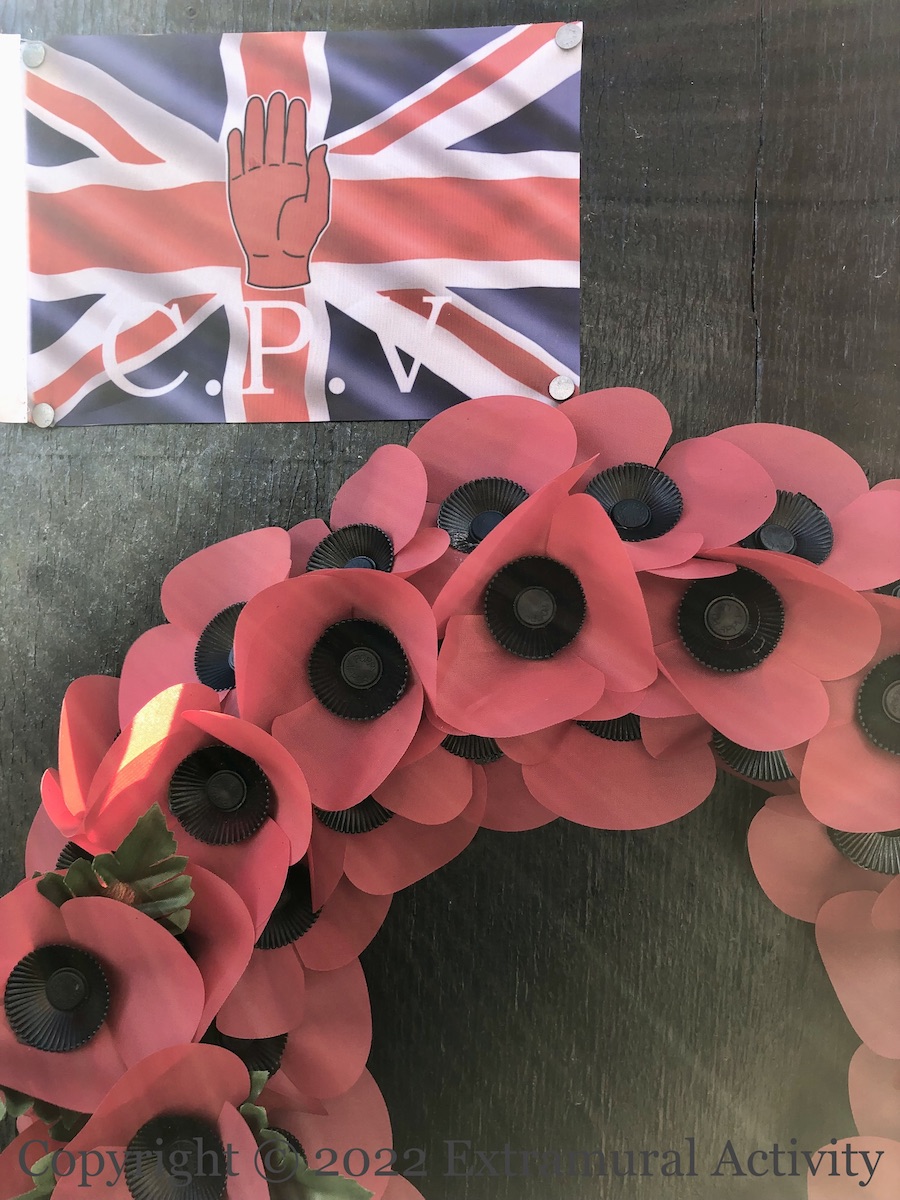
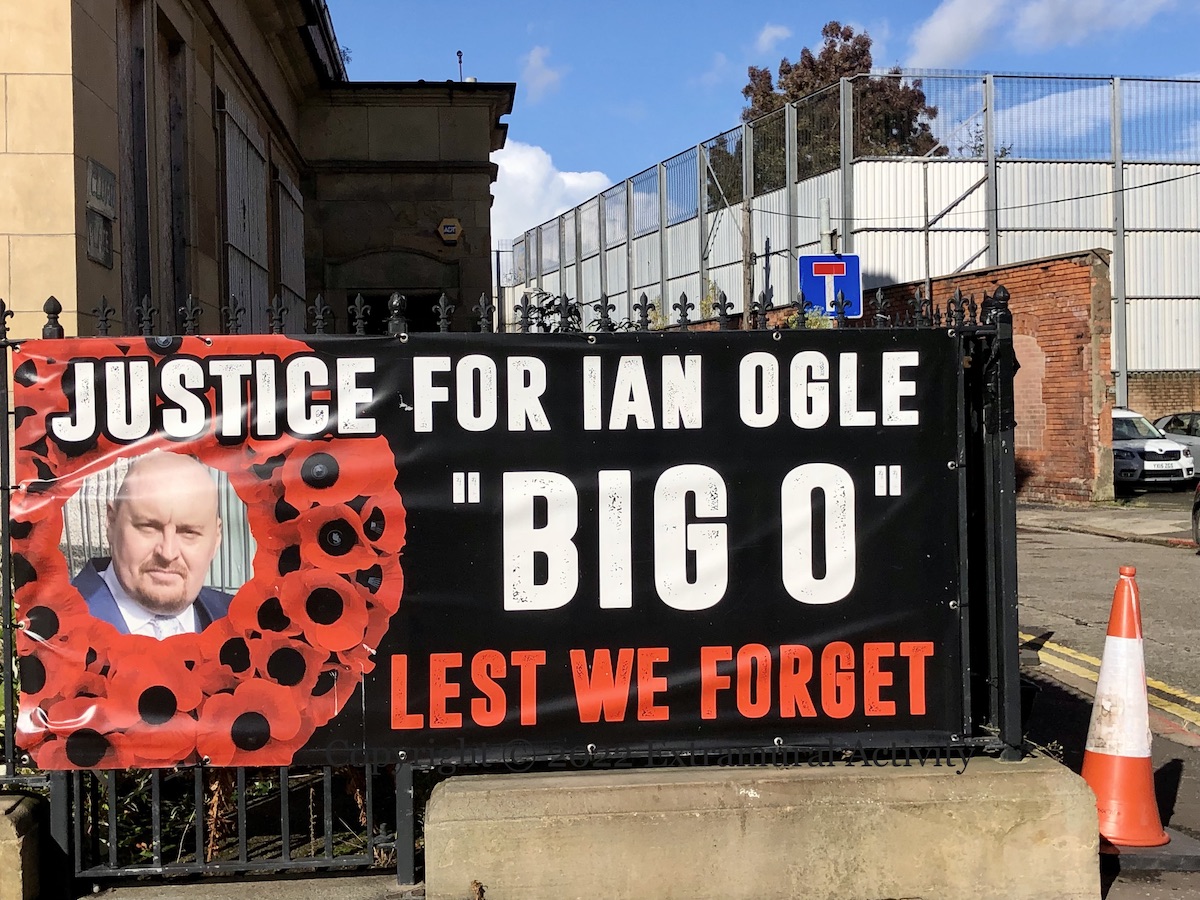
“Greater love hath no man than this, that a man lays down his life for his family.” The words of John 15:13 are modified slightly to pay tribute to Cluan Place resident Ian Ogle, who was stabbed and beaten to death in January, 2019, after several years of intimidation of the family by members of the east Belfast UVF (Sunday World).
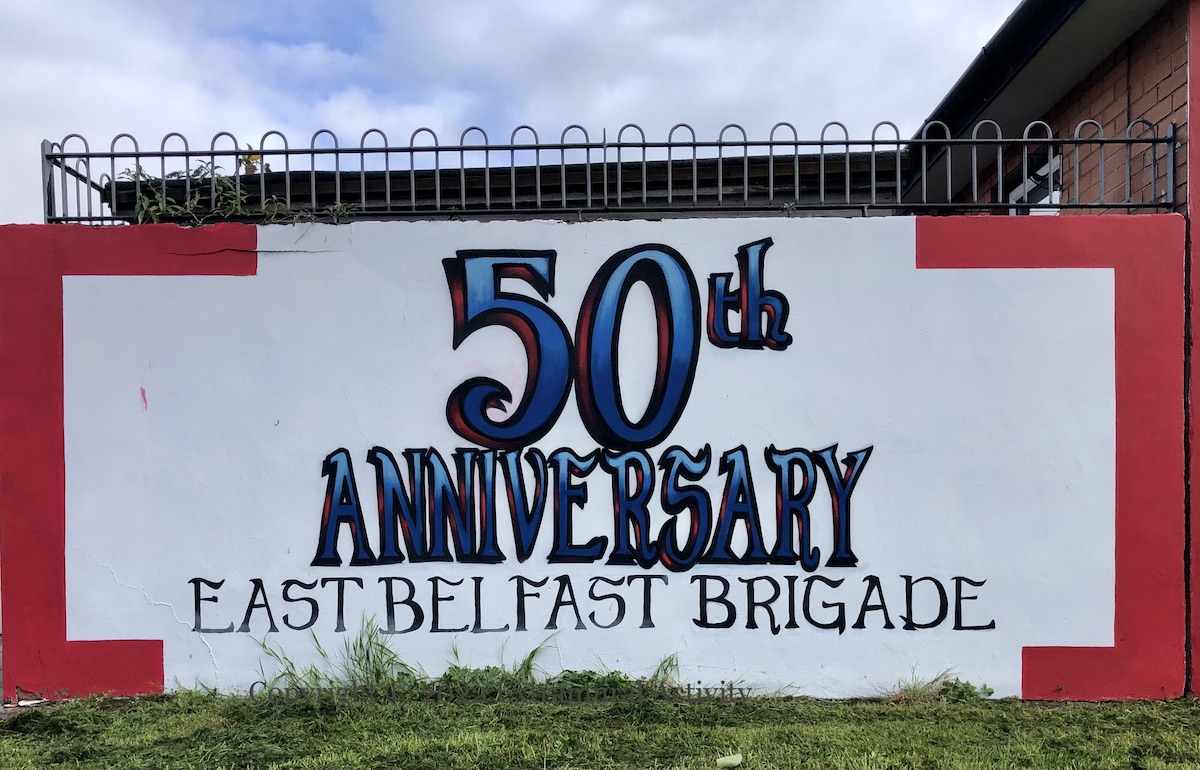
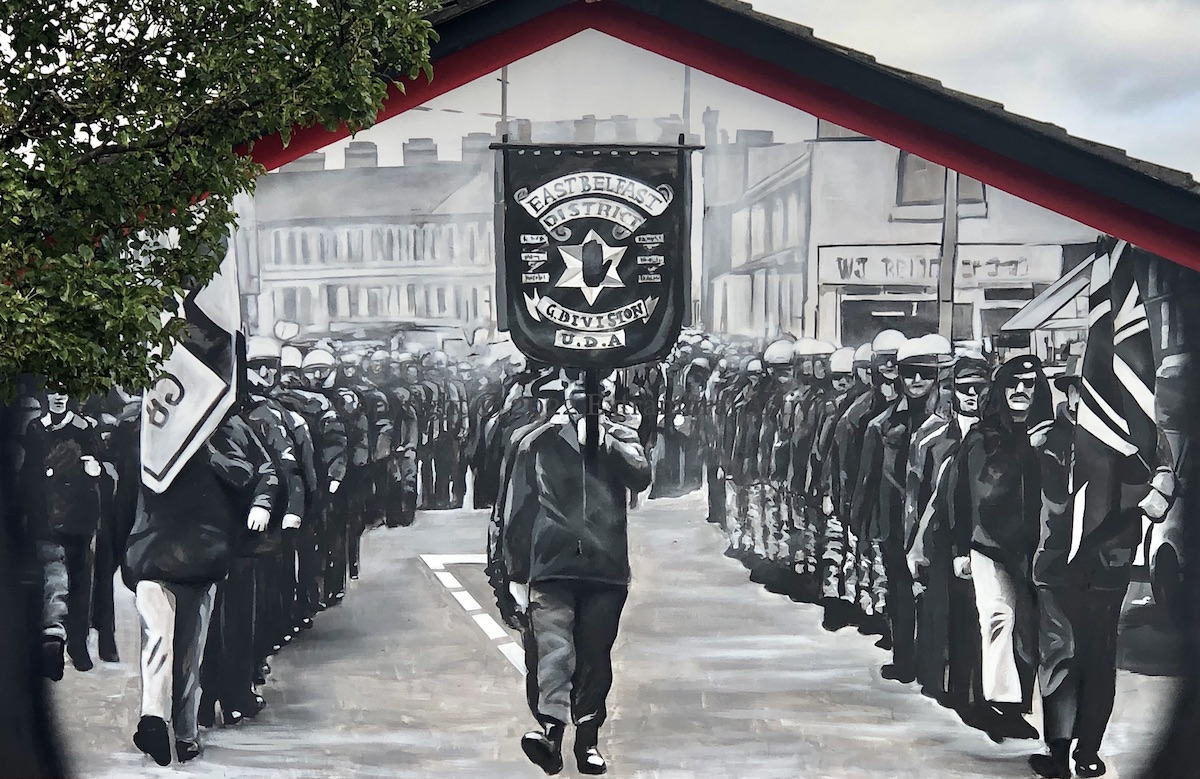
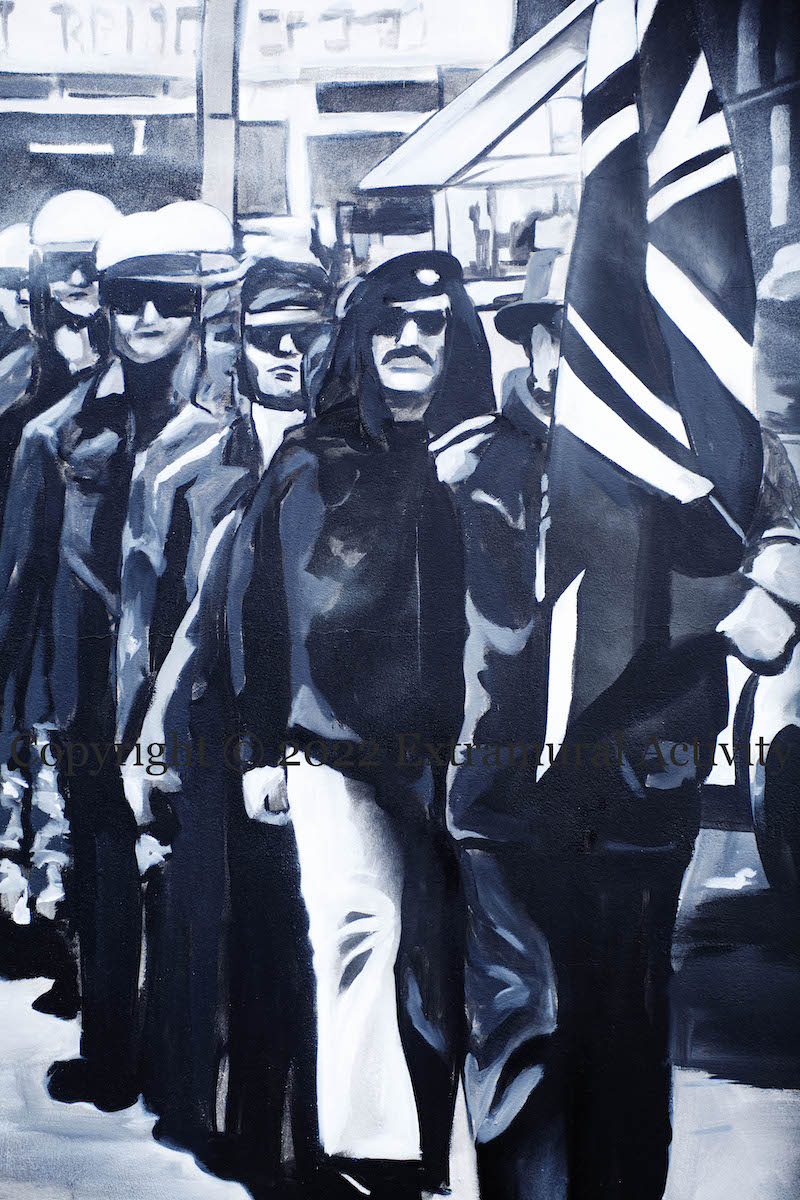
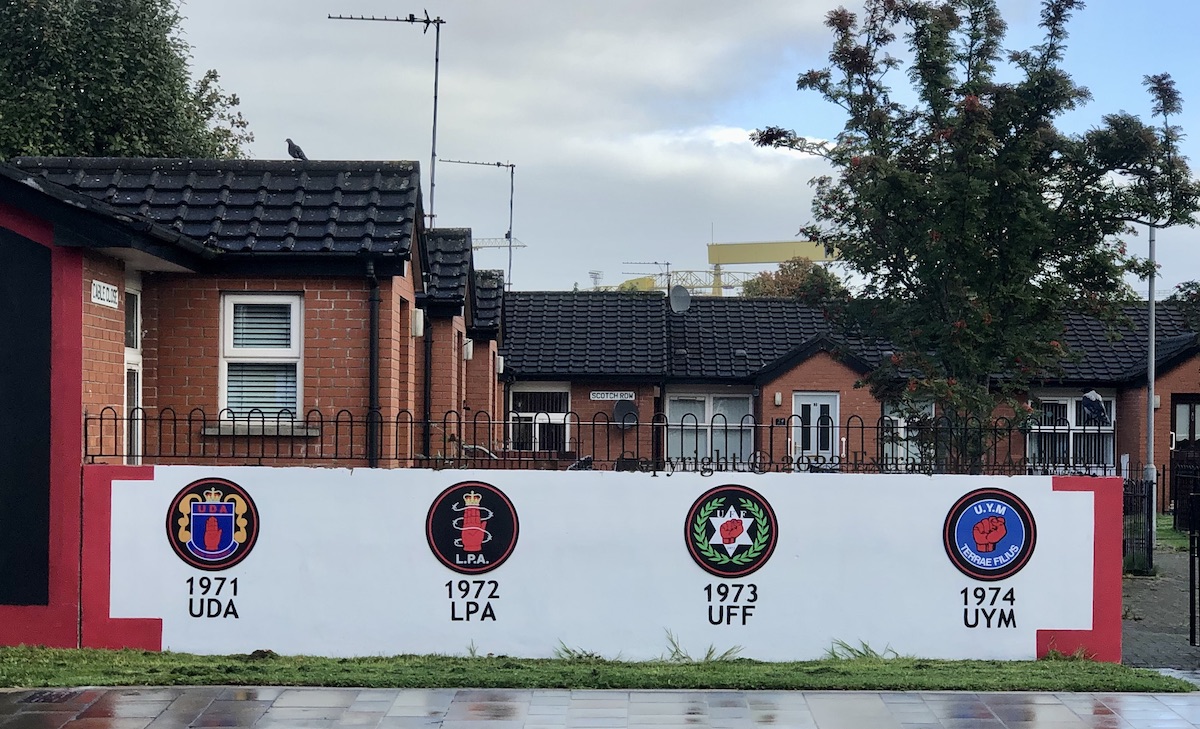
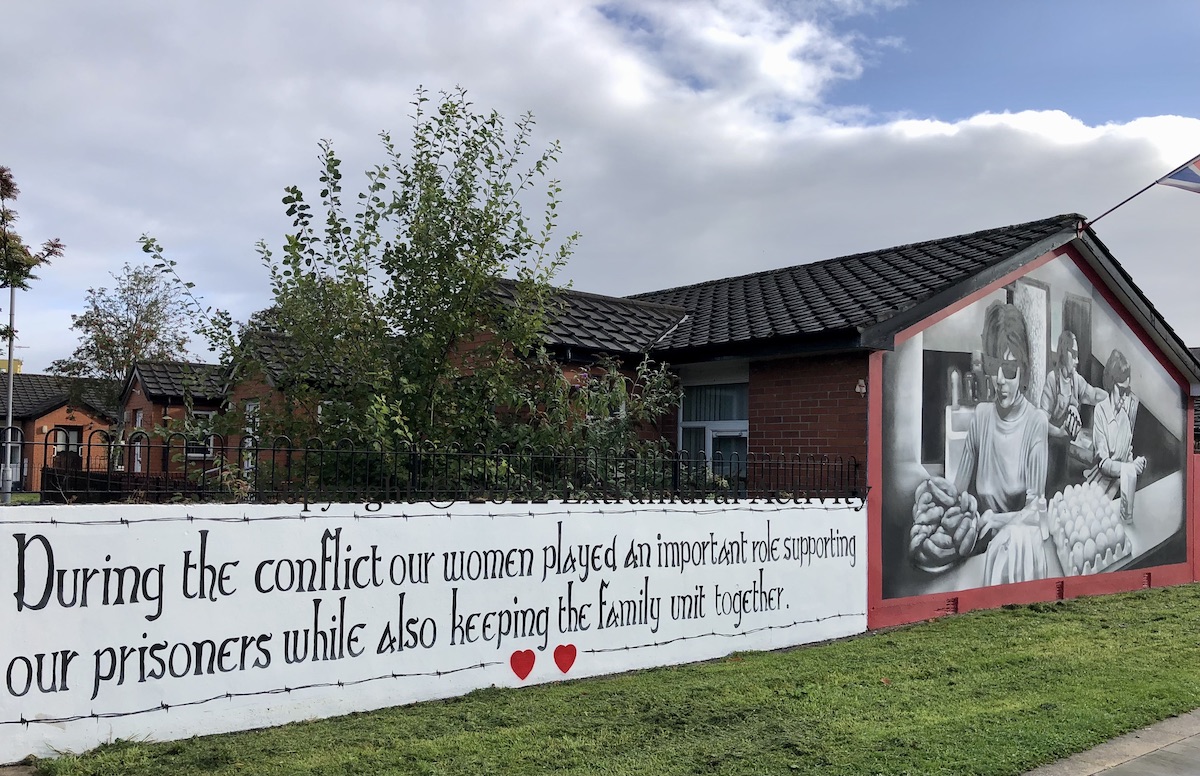
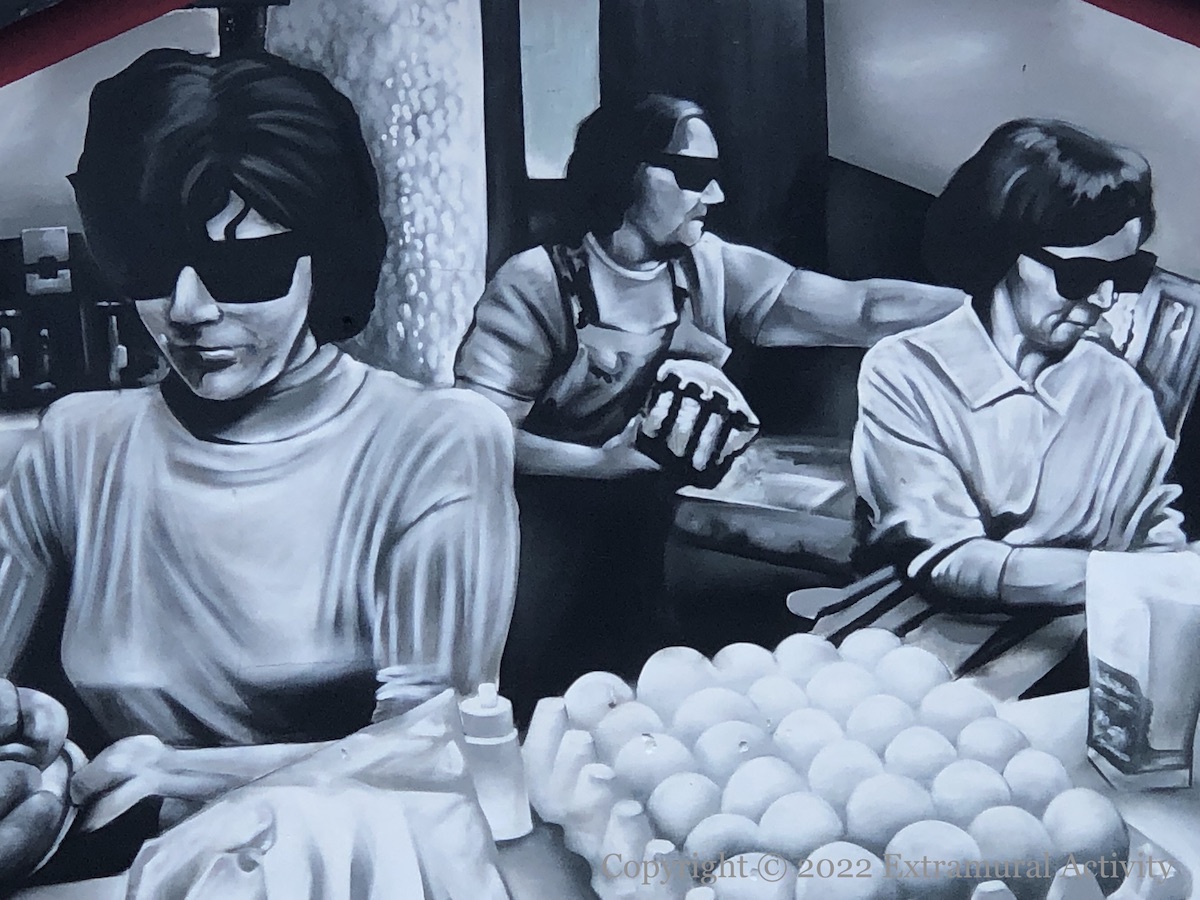
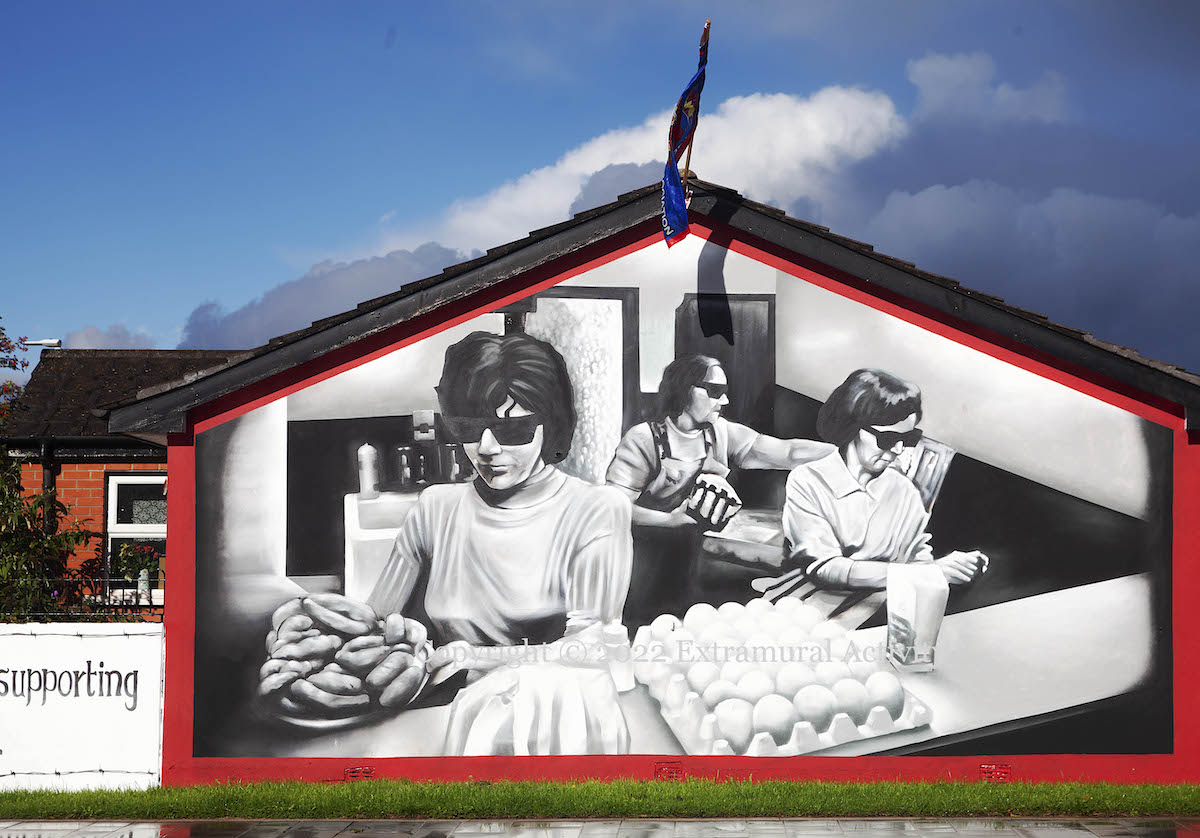
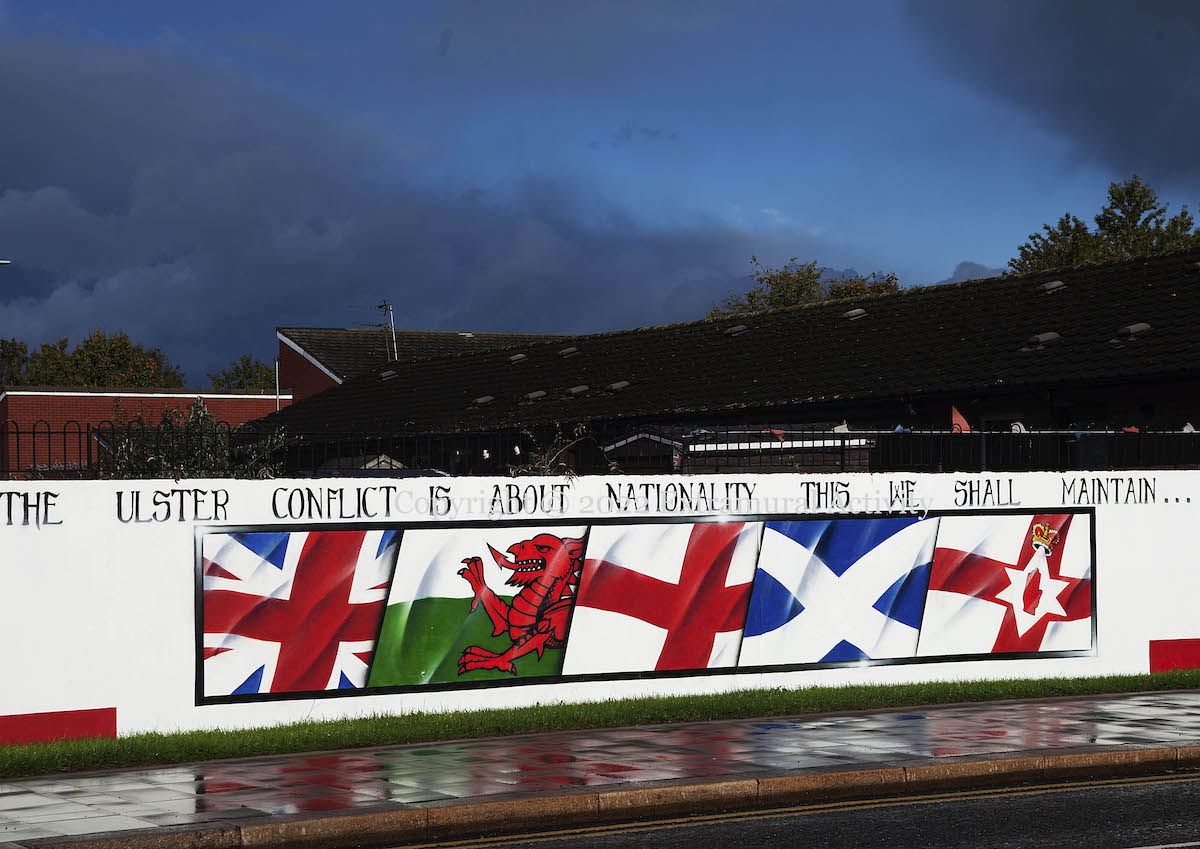
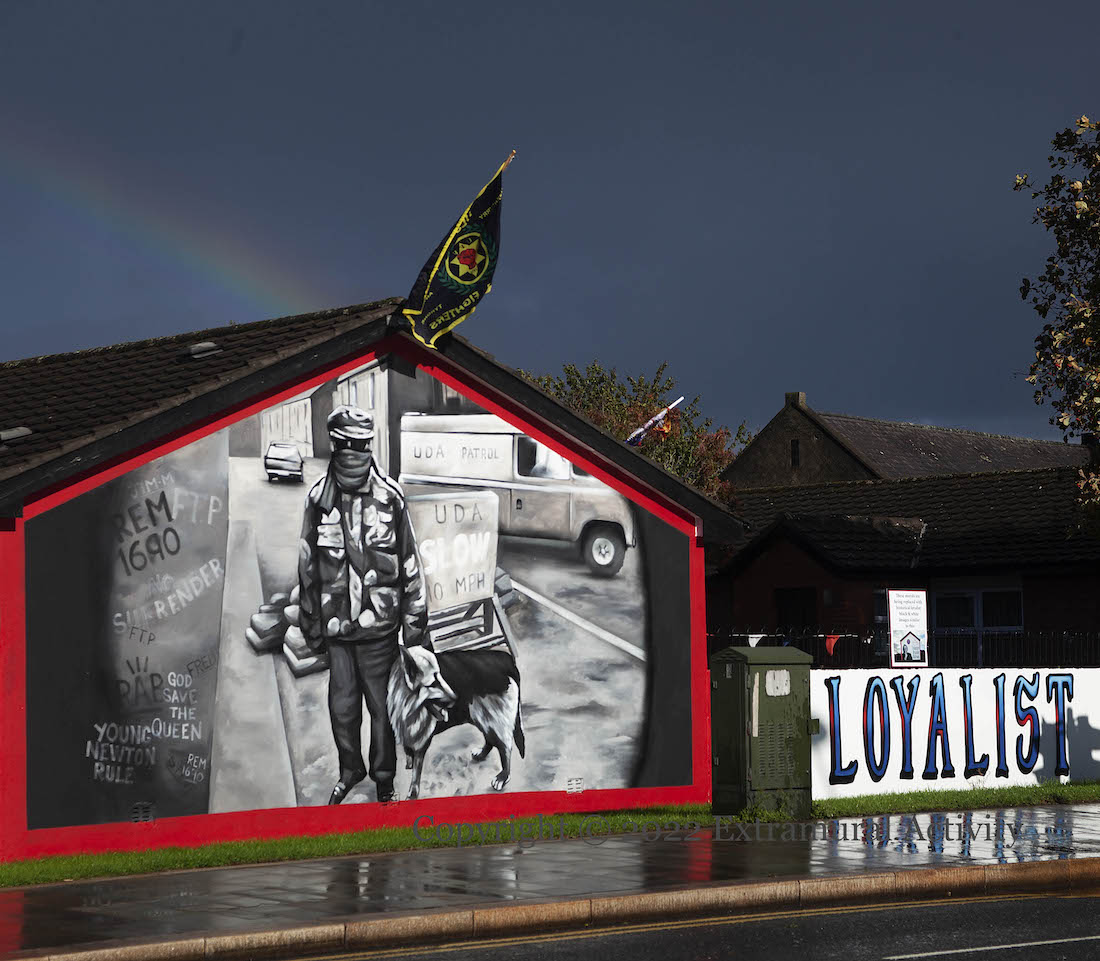
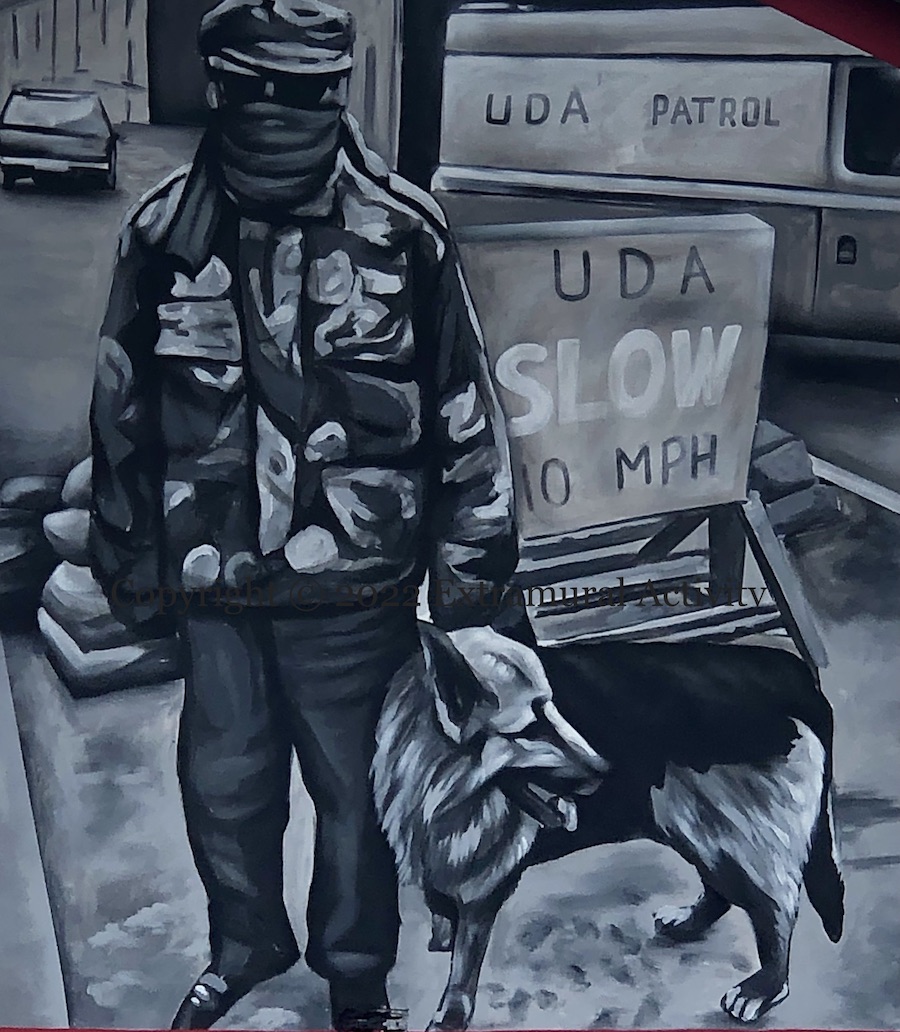
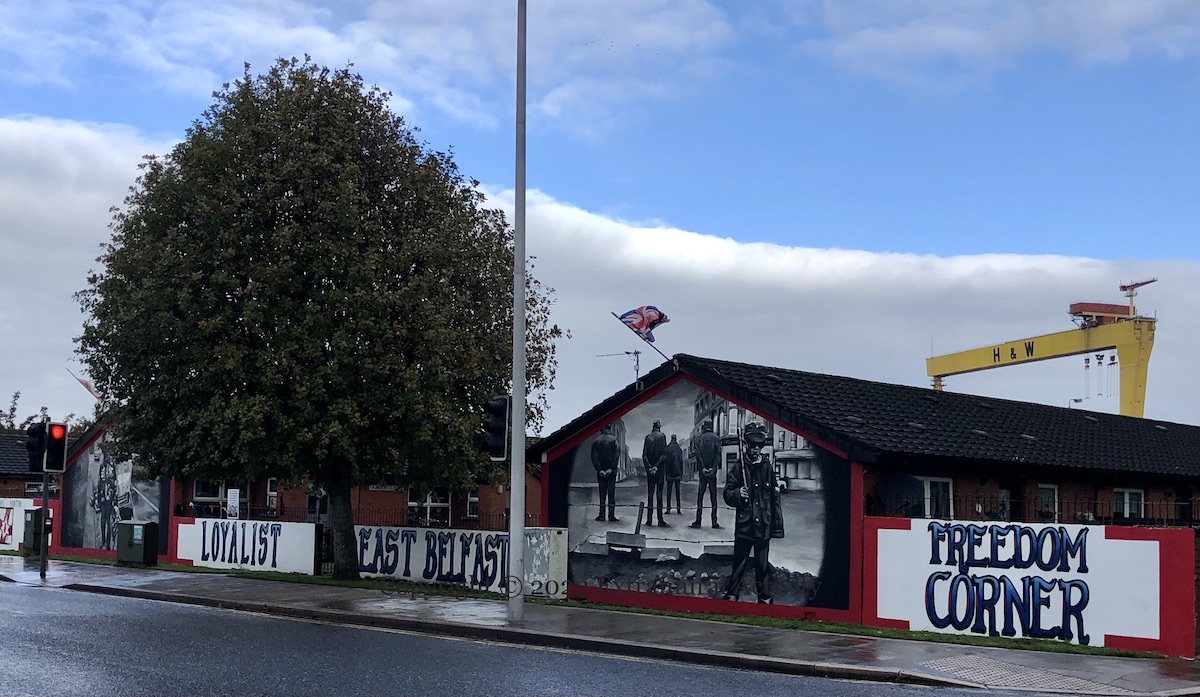
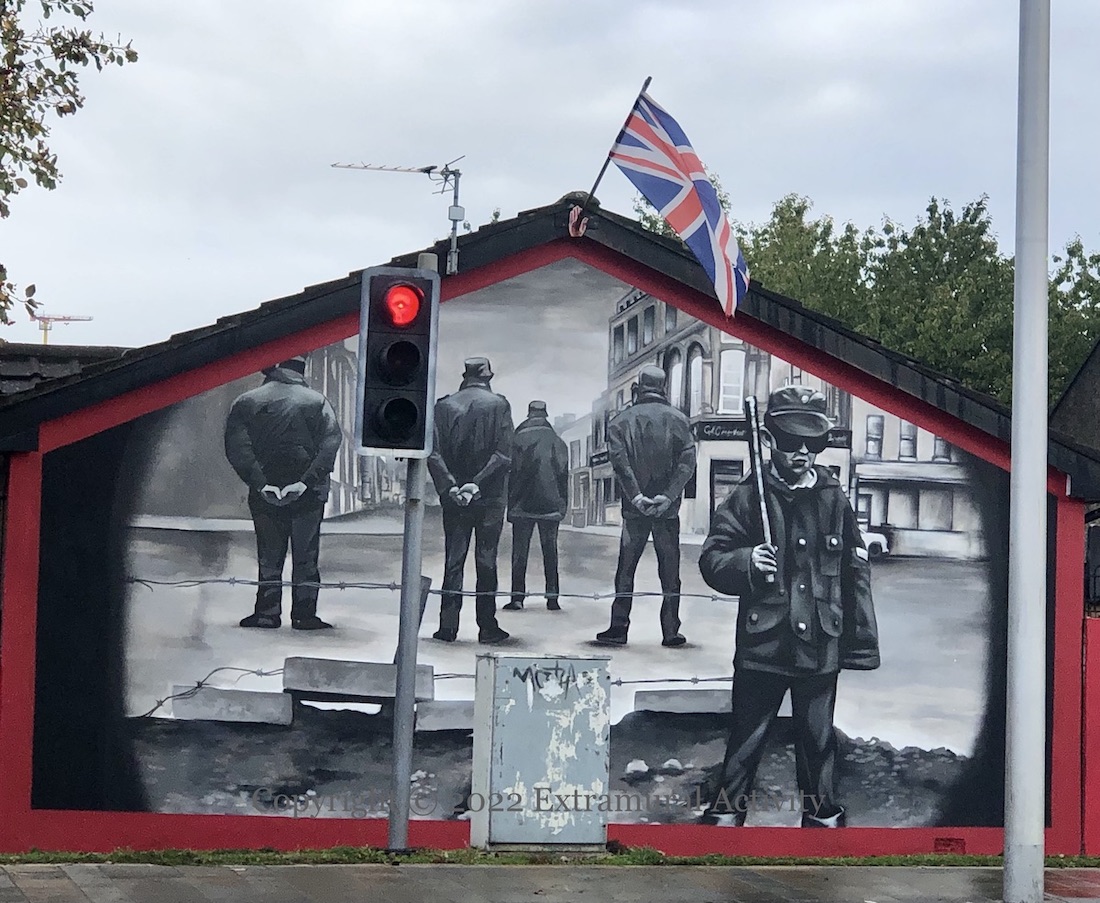
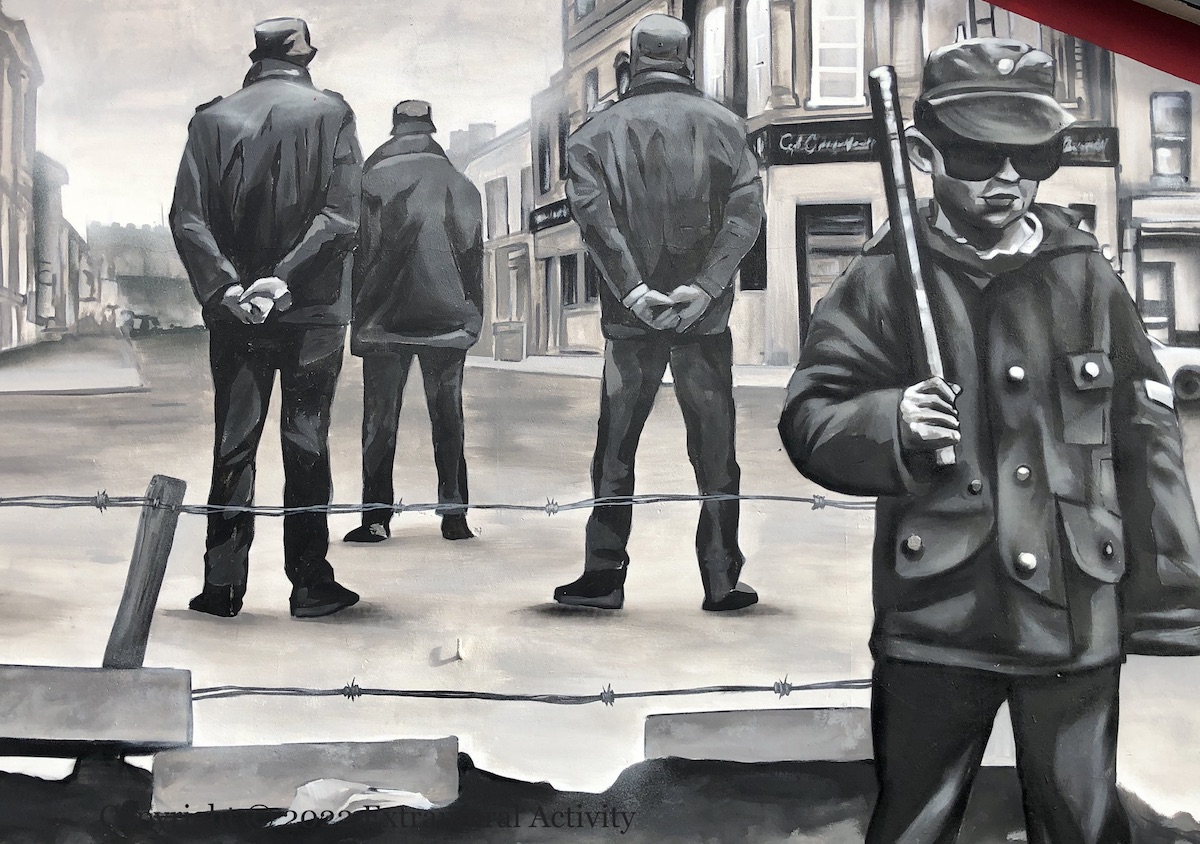
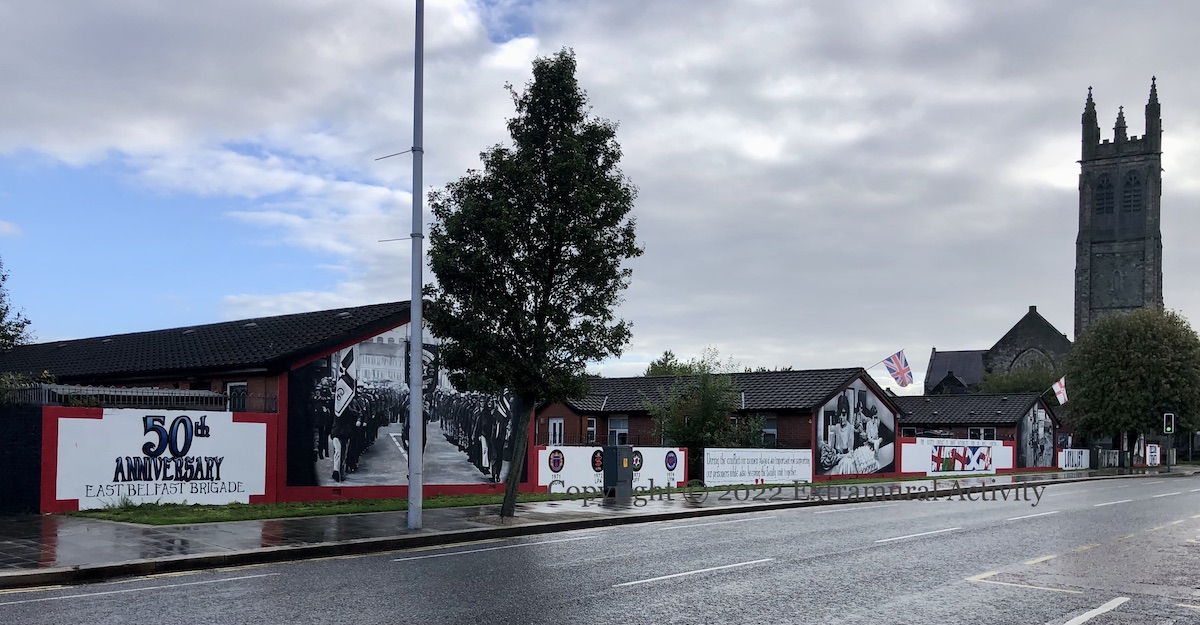
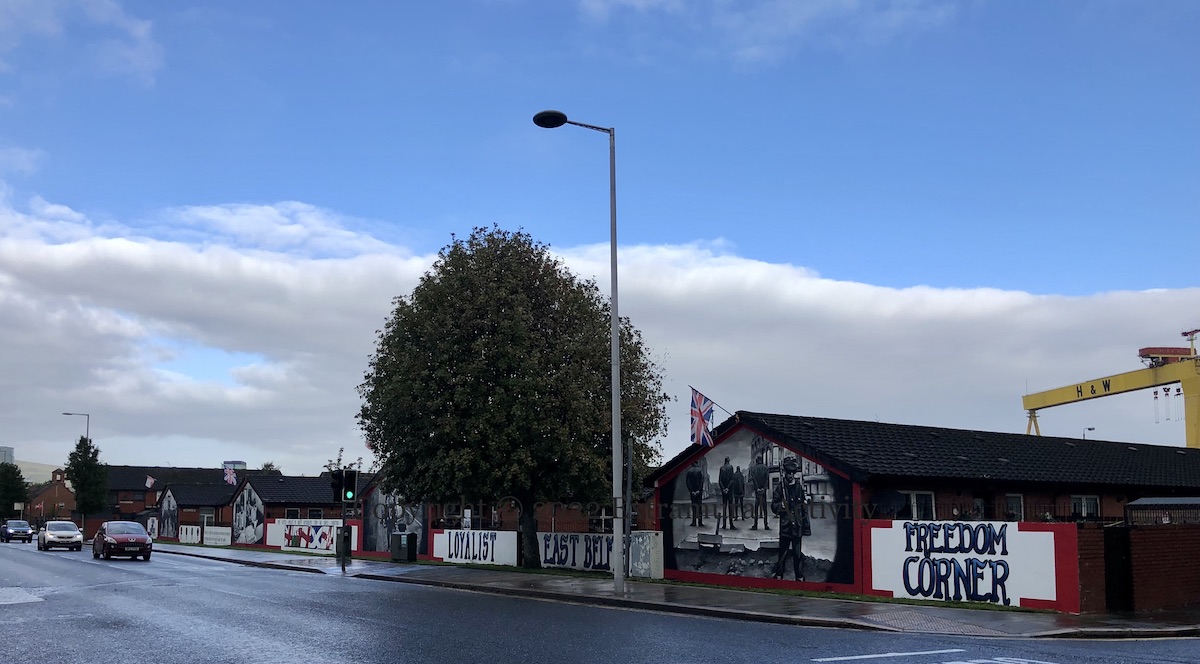
Three months after it was initially whitewashed (mid June, 2022), the repaint of so-called “Freedom Corner” is now complete, with a new mural on each of the 11 panels that make it up. This entry is a gallery of fifteen images from the new wall. The main gables reproduce photographs of the UDA (and more specifically the East Belfast brigade) during the 1970s. The side walls celebrate the formation of the UDA/LPA/UFF/UYM in 1971-1974 and the role of women in supporting prisoners.
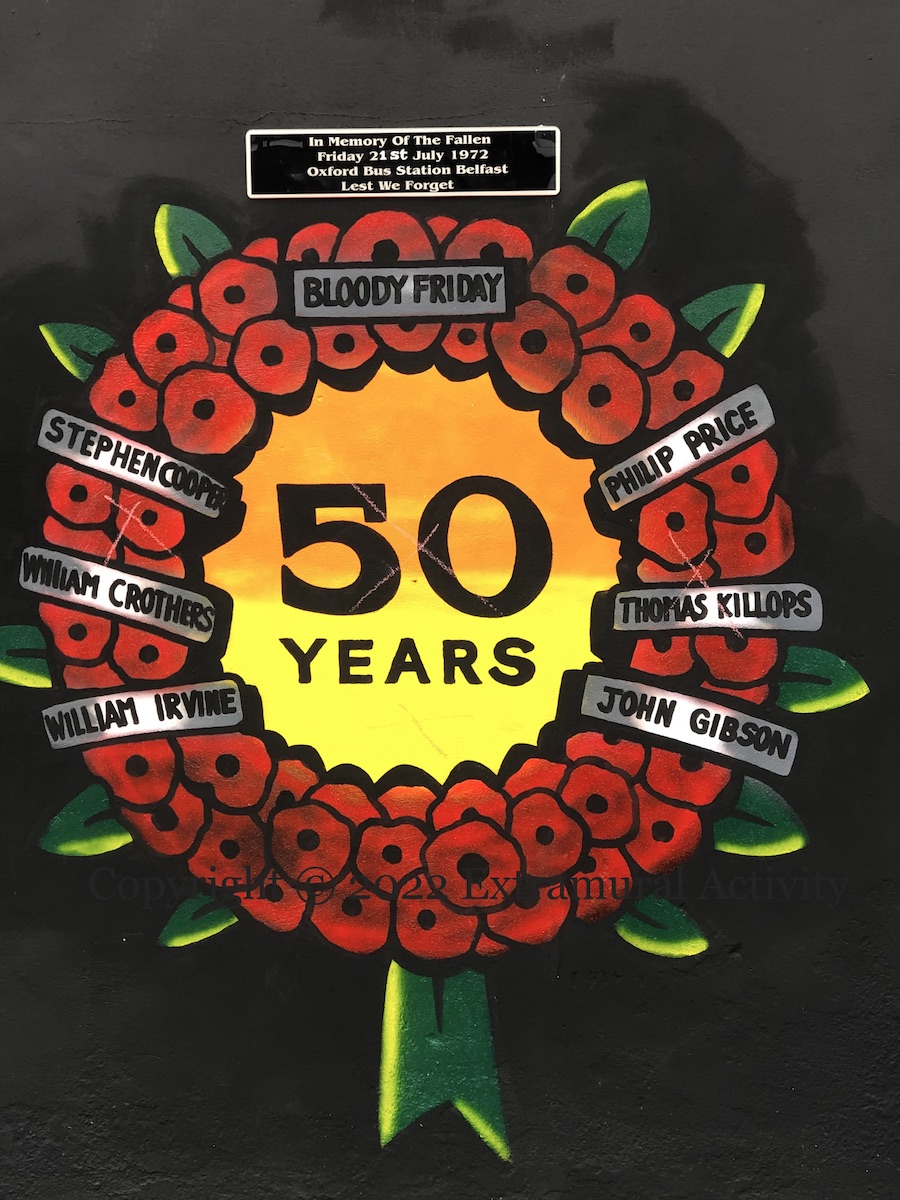
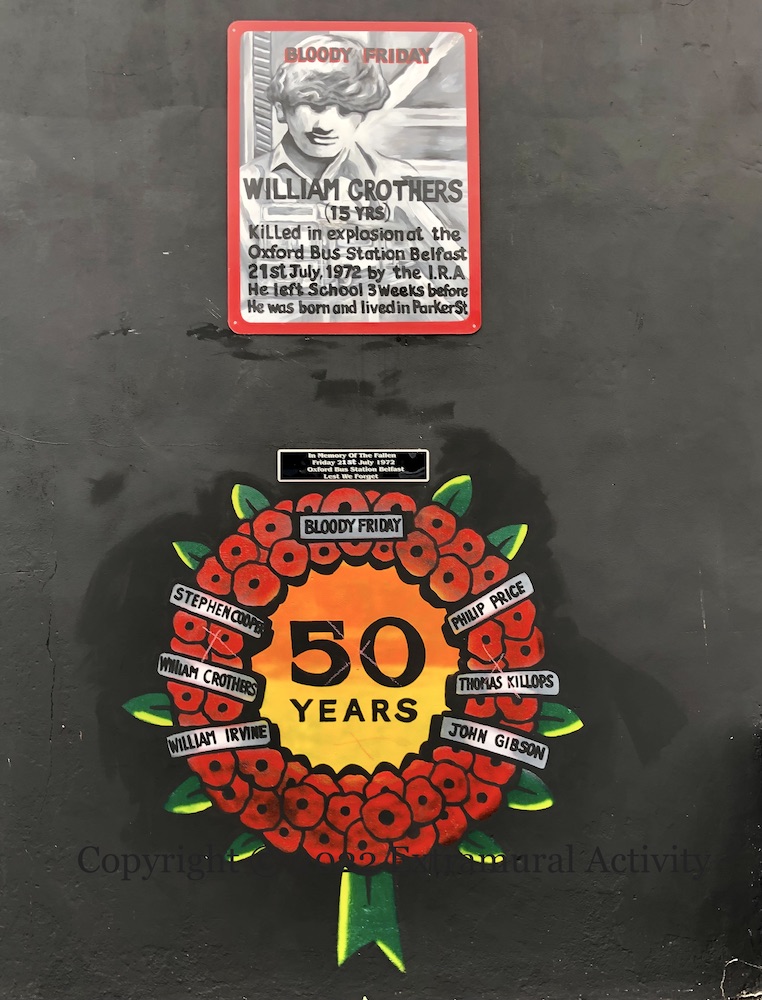
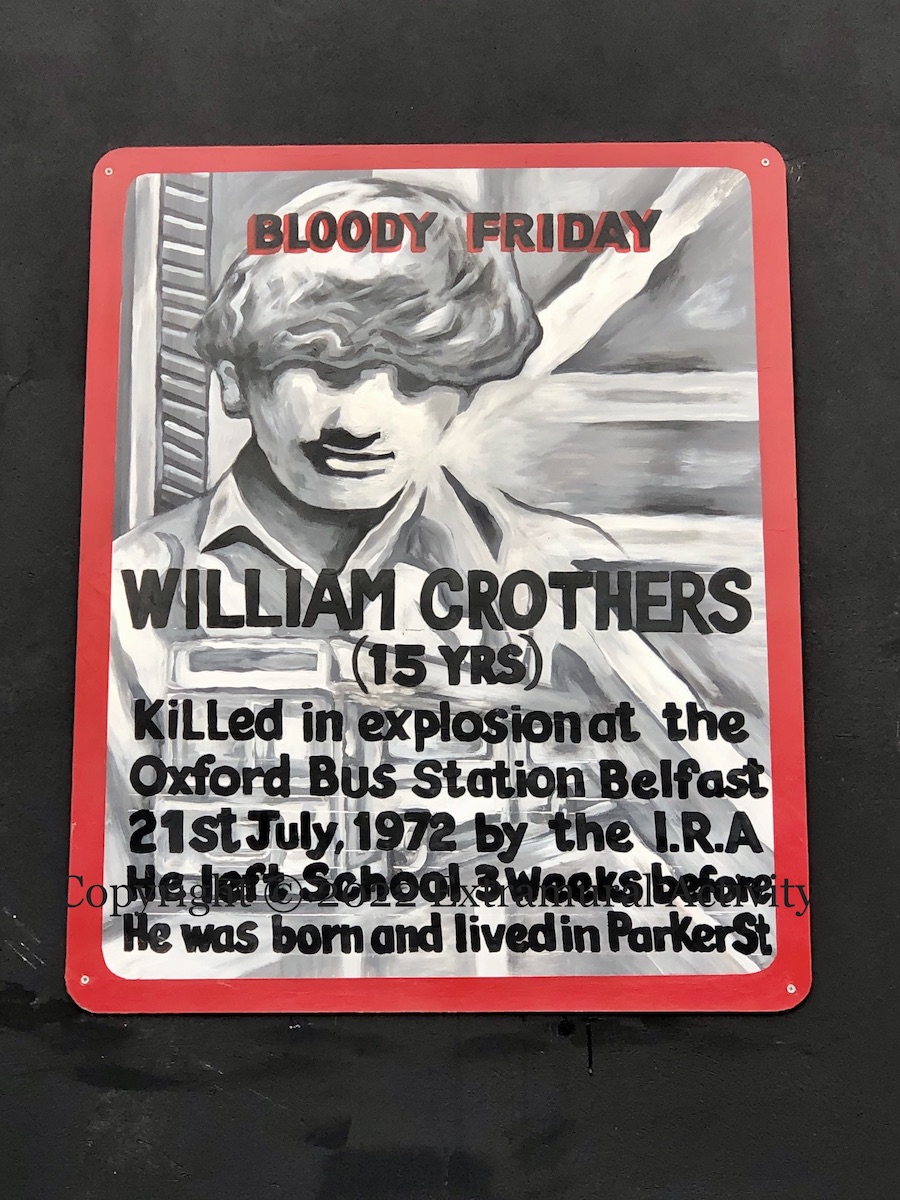
On July 21st, 1972 – Bloody Friday – 19 IRA bombs exploded in the course of an hour, killing 9, six of them at the Oxford Street bus station, including 15-year-old William Crothers from Parker Street in east Belfast who worked for Ulsterbus as a parcel-boy. The others were three more employess – William Irvine, Thomas Killops, and John Gibson – and two British Army soldiers – Stephen Cooper (32 Squadron) and Philip Price (Welsh Guards). (BBC | WP | Paper Trail | BBC documentary)
“In memory of the fallen Friday 21st July 1972 Oxford [Street] Bus Station Belfast. Lest we forget”
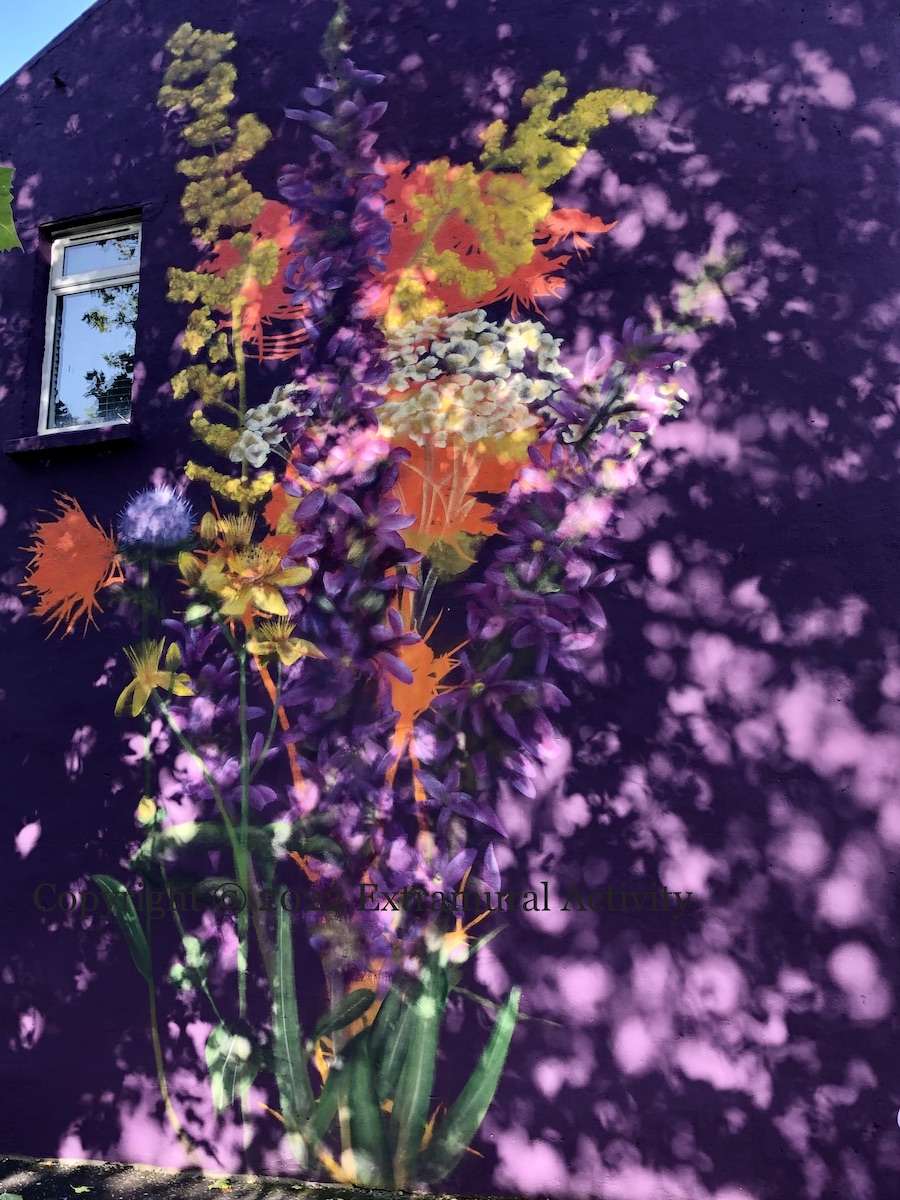
Handy Helpers from Queen’s University help maintain the Wildflower Alley (Fb) between College Park Avenue and University Avenue. To “recognise the joint effort” (LinkedIn) a mural has been painted (by emic (ig)) along the Stanmillis Embankment, featuring flowers grown in the Alley.
Funding from Belfast City Council. Officially launched 2022-09-22 (Belfast Live)
Update: the side wall has been painted with a human head, wearing headphones, behind a sunflower – see the Paddy Duffy collection.
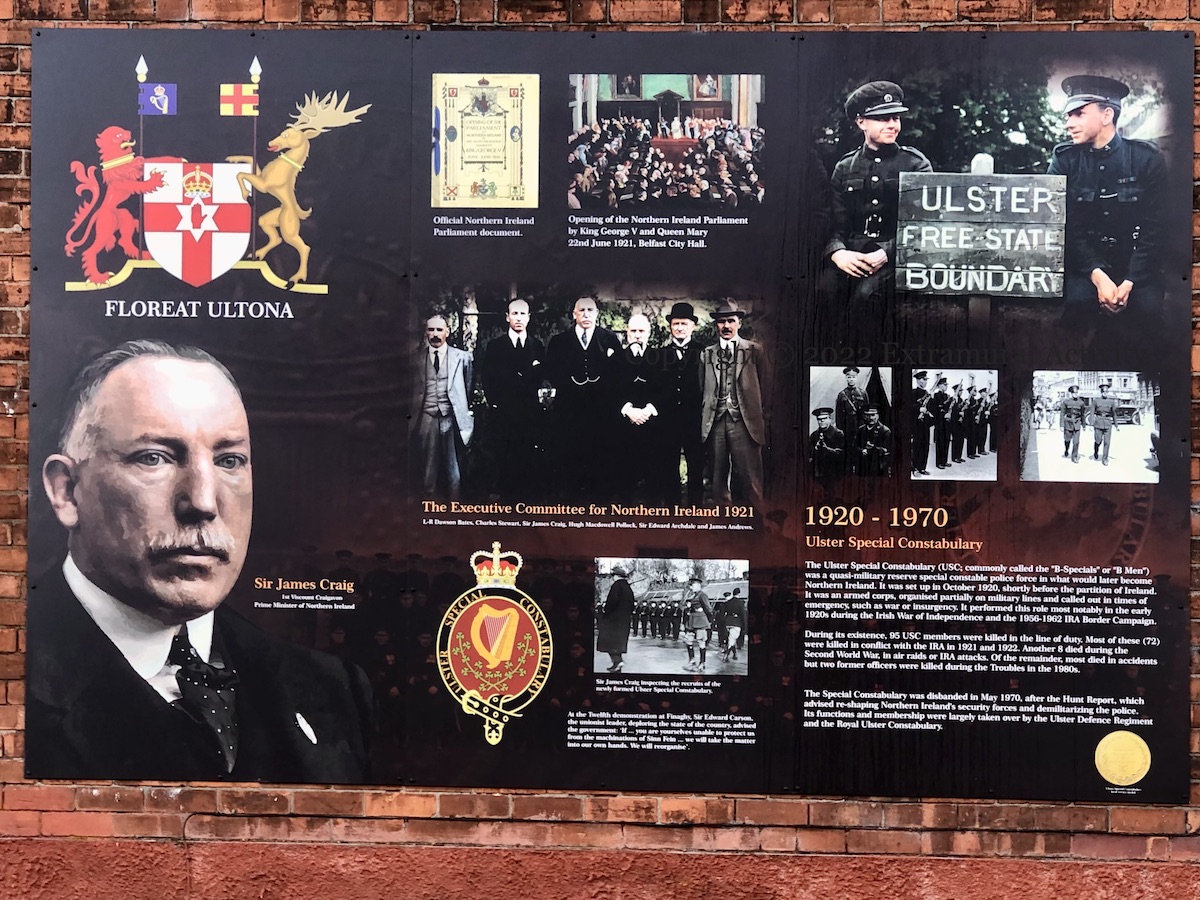
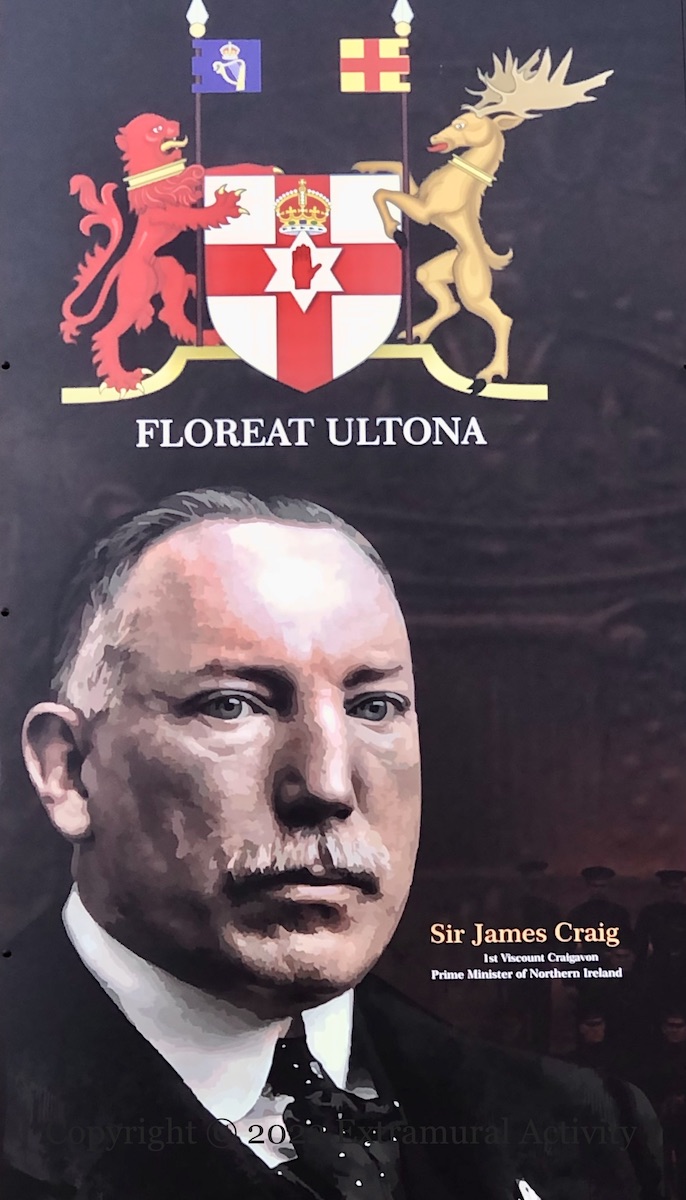
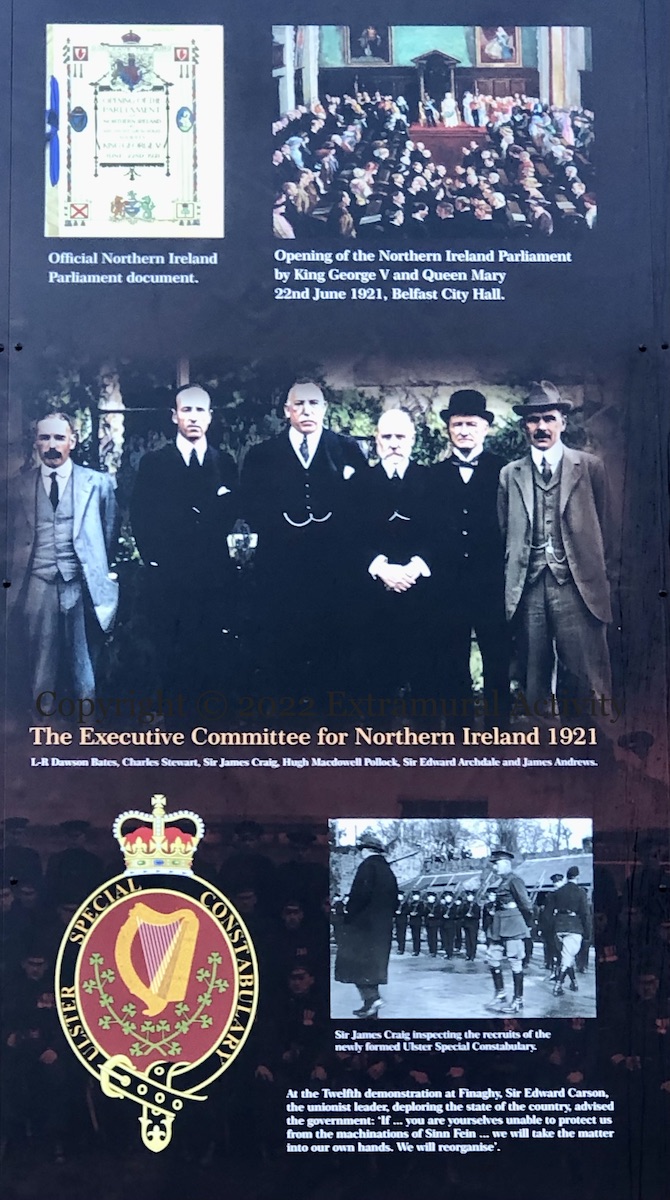
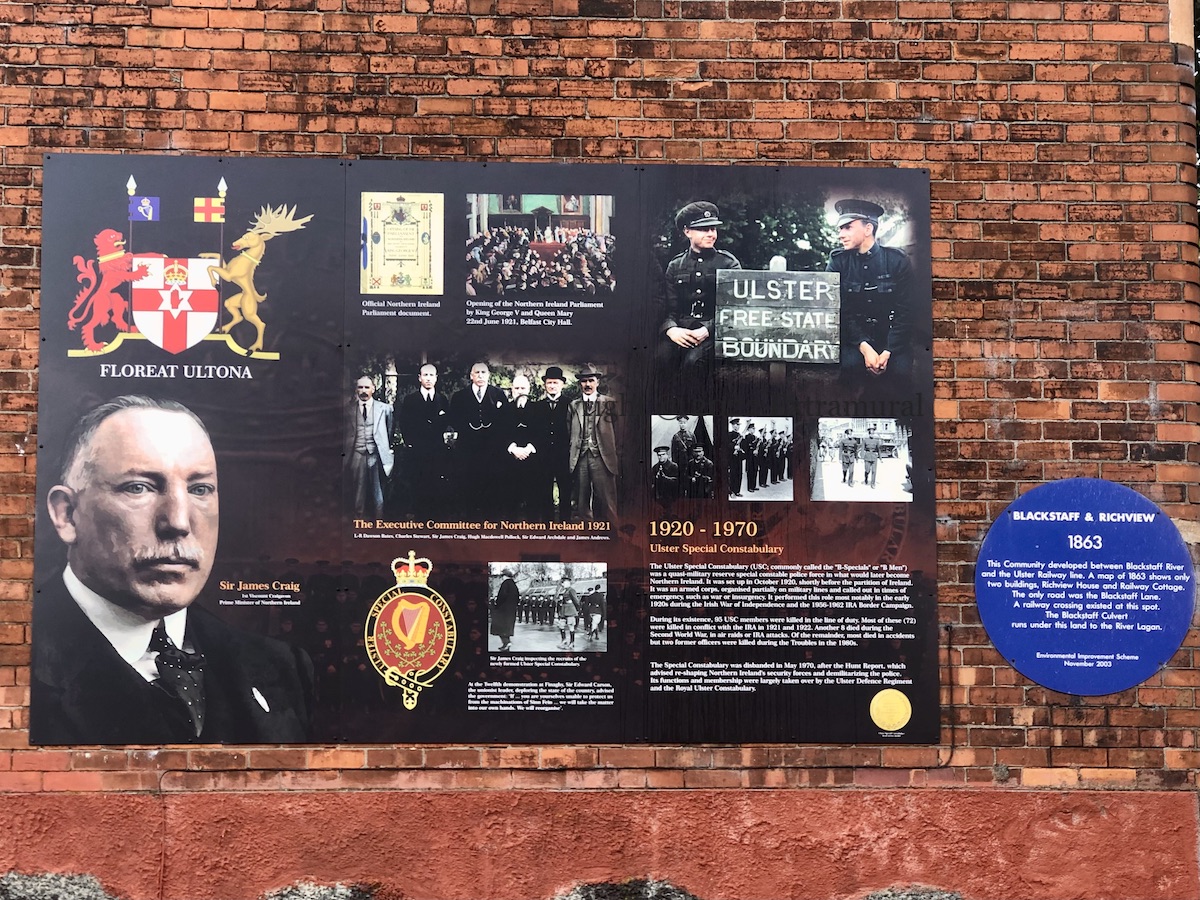
“May Ulster flourish” as the newly created Northern Ireland under “Sir James Craig, 1st Viscount Craigavon, Prime Minister of Northern Ireland”. The Northern Ireland parliament was opened in 1921 and the coat of arms adopted in 1924 (WP); the Special Constabulary (including the B-Specials) had been formed prior to and in preparation for partition – the quote from Carson (also seen in an east Belfast mural) is from July 12th, 1920.
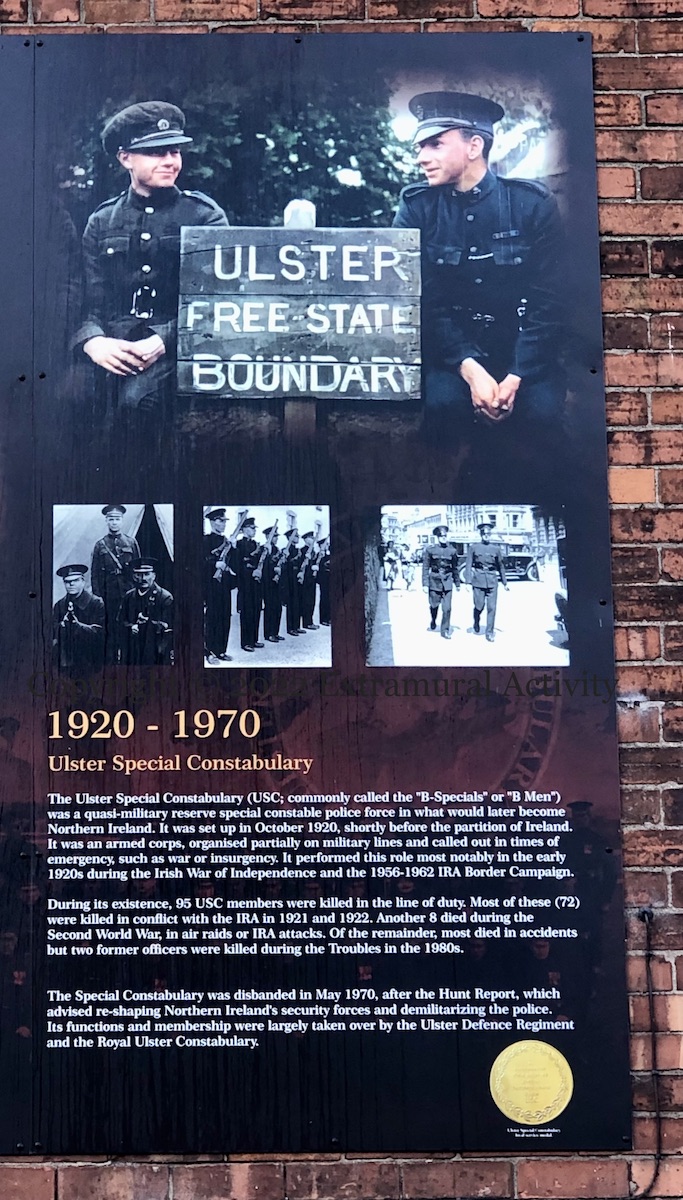
The text on the board is the same as at WP: “The Ulster Special Constabulary (USC; commonly called the “B-Specials” or “B Men”) was a quasi-military reserve special constable police force in what would later become Northern Ireland. It was set up in October 1920, shortly before the partition of Ireland. It was an armed corps, organised partially on military lines and called out in times of emergency, such as war or insurgency. It performed this role most notably in the early 1920s during the Irish War of Independence and the 1956-1962 IRA Border Campaign. During its existence, 95 USC members were killed in the line of duty. Most of these (72) were killed in conflict with the IRA in 1921 and 1922. Another 8 died during the Second World War, in air raids or IRA attacks. Of the remainder, most died in accidents but two former officers were killed during the Troubles in the 1980s. The Special Constabulary was disbanded in May 1970, after the Hunt Report, which advised re-shaping Northern Ireland’s security forces and demilitarizing the police. Its functions and membership were largely taken over by the Ulster Defence Regiment and the Royal Ulster Constabulary.”
This Belfast Live article (which has images from the launch) leads with the headline that this new board replaces a UVF mural, but there hasn’t been anything on this wall since a large “UDA” lettering in 1999. The adjacent wall, which has now been painted over, previously (in 2010) had a UVF flag which had been vandalised with “Jesus Christ Is Lord Of All’ graffiti by 2017.
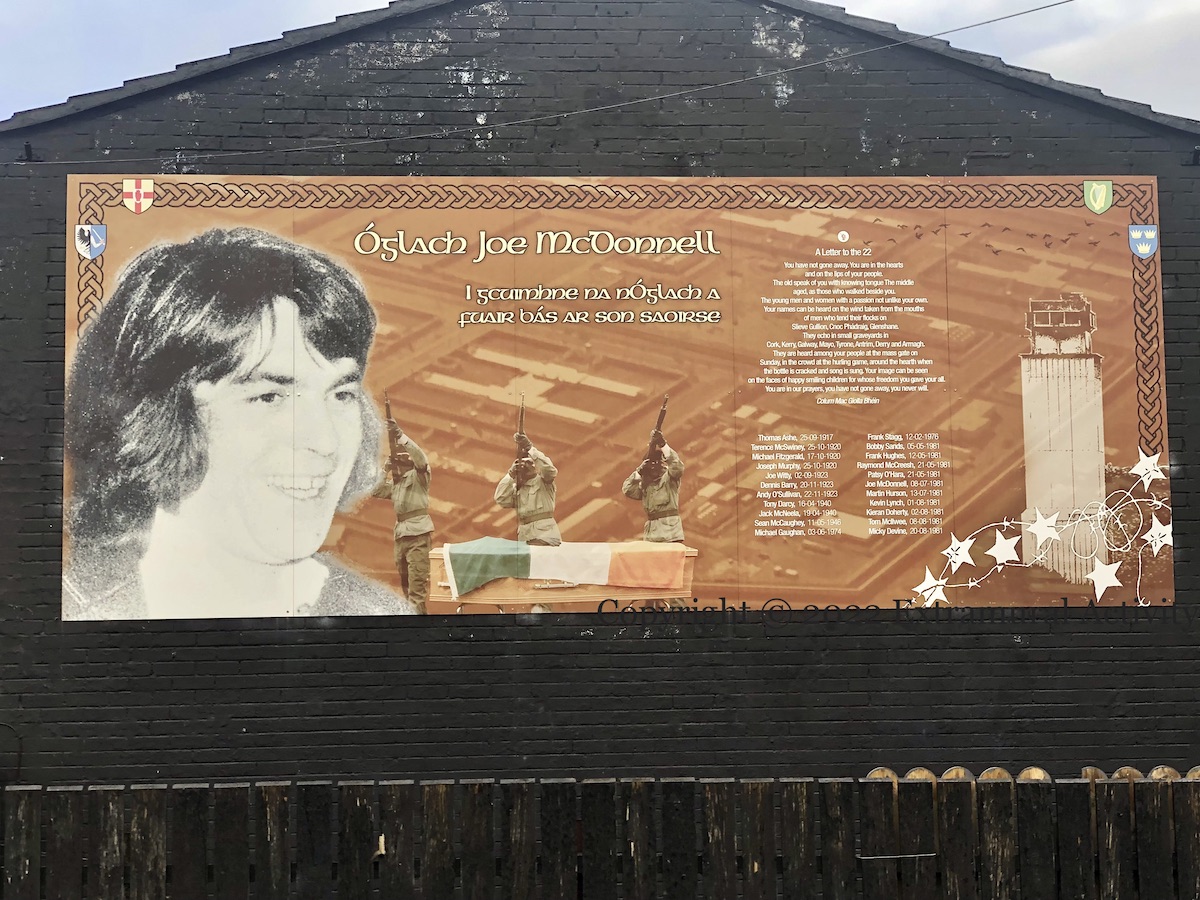
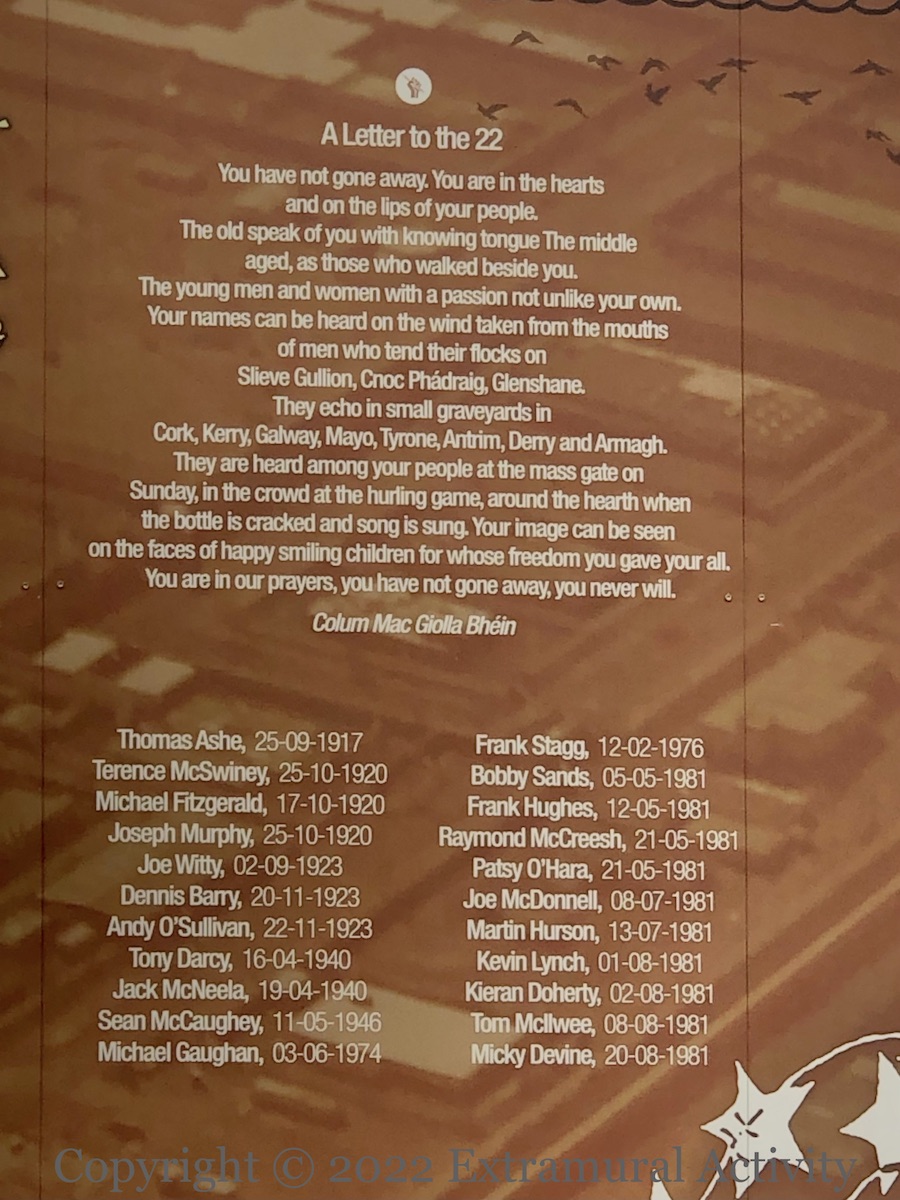
“I gcuımhne na nÓglach a fuaır bás ar son saoırse [in memory of the volunteers who died for freedom].” The “22” are the familiar 12 deceased Troubles-era hunger-strikers, plus 10 from 1917 to 1946: Thomas Ashe, Terence McSwiney, Michael Fitzgerald, Joseph Murphy, Joe Witty, Dennis Barry, Andy O’Sullivan, Tony Darcy, Jack McNeela, Sean McCaughey.
“‘A Letter To The 22: You have not gone away. You are in the hearts/and on the lips of your people./The old speak of you with knowing tongue. The middle/aged, as those who walked beside you./The young men and women with a passion not unlike your own./Your names can be heard on the wind taken from the mouths/of men who tend their flocks on Slieve Gullion, Cnoc Phádraıg, Glenshane./They echo in small graveyards in/Cork, Kerry, Galway, Mayo, Tyrone, Antrim, Derry and Armagh./They are heard among your people at the mass gate on/Sunday, in the crowd at the hurling game, around the hearth when/the bottle is cracked and song in sung. Your image can be seen/on the faces of happy smiling children for whose freedom you gave your all./You are in our prayers, you have not gone away, you never will’ – Colum Mac Gıolla Bhéın“
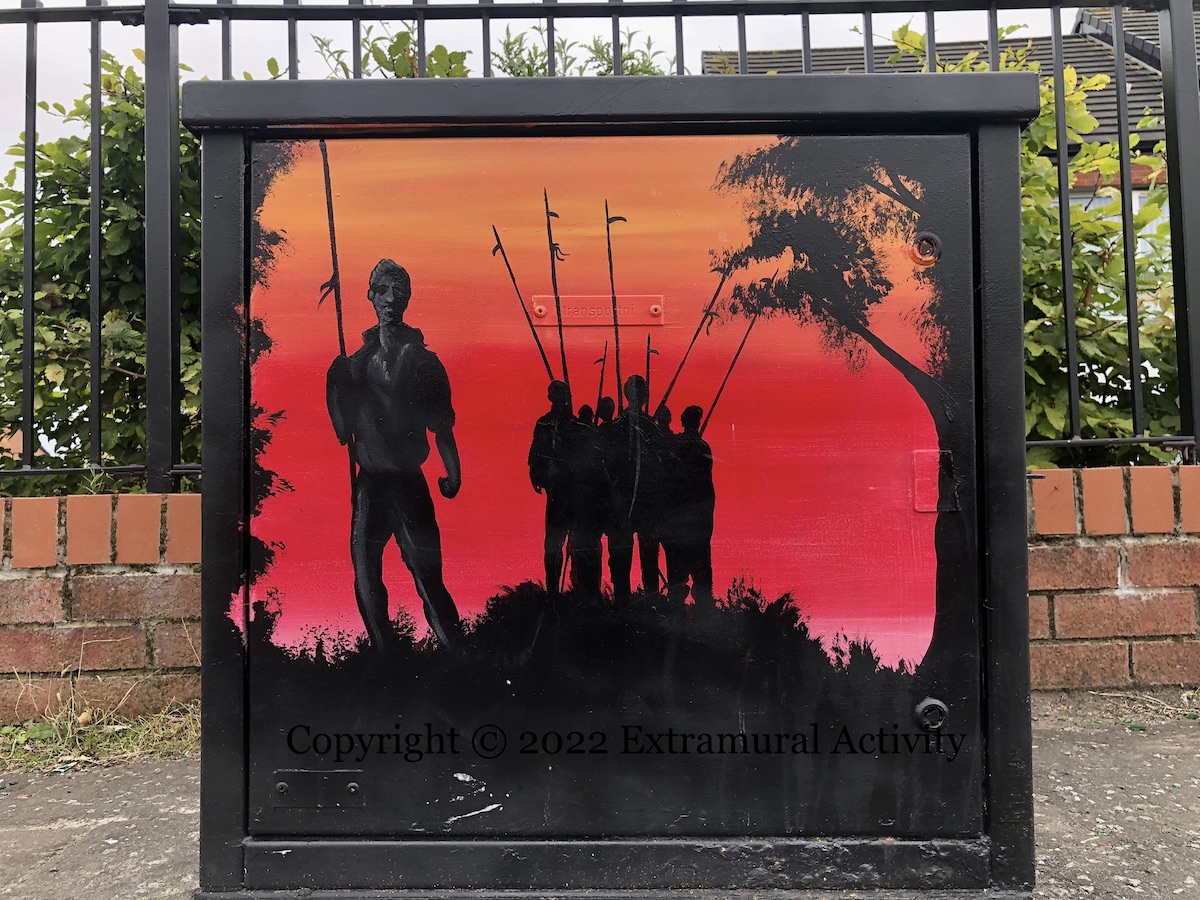
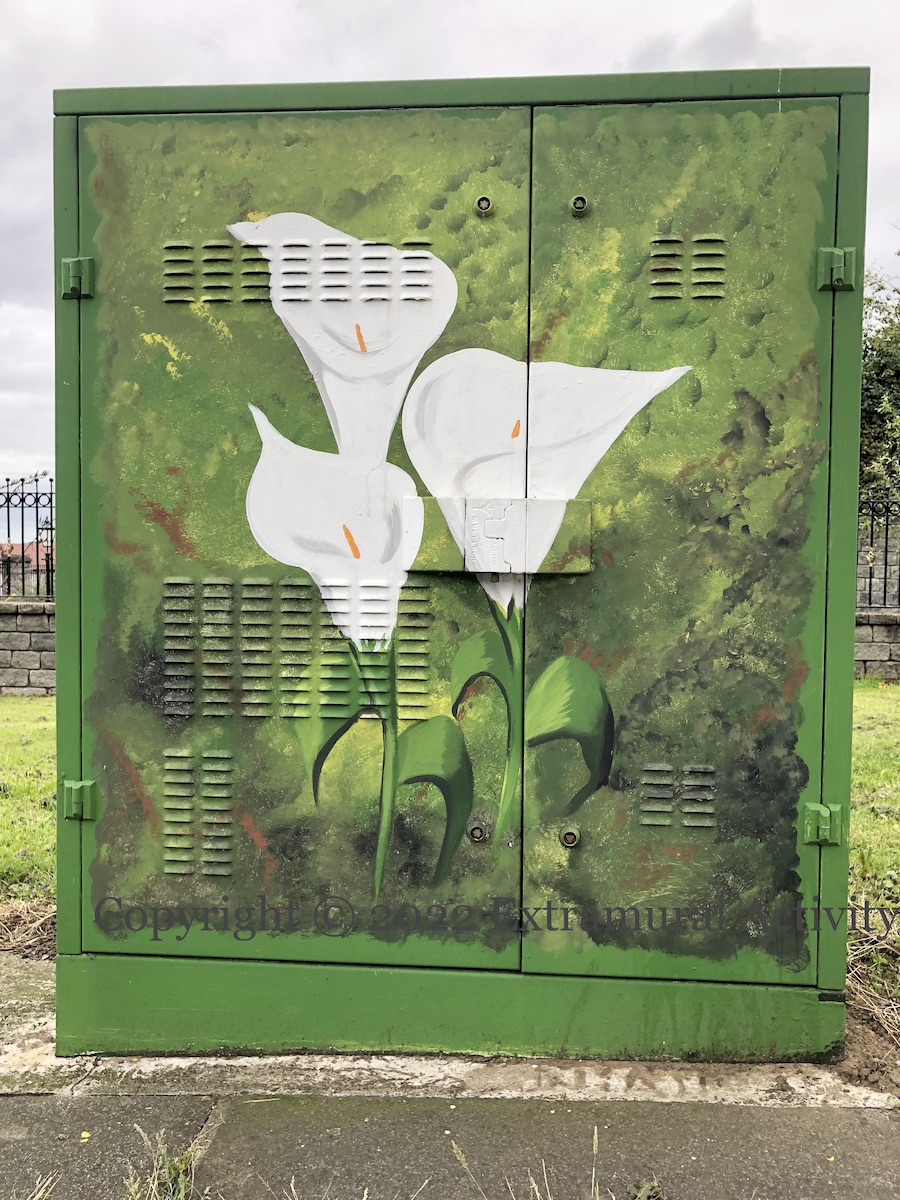
Plants provide symbols of, and metaphors for, rebellion. In America, 1775, Paine wrote of the Liberty Tree which Americans must rise to defend against “Kings, Commons and Lords” and Jefferson would later write (in a 1787 letter) that “The tree of liberty must be refreshed from time to time with the blood of patriots and tyrants.” In Ireland, the tree of liberty was borrowed for the 1798 rebellion (see Where Did The Seeds Fall?“) and although t more familiar symbol of the 1798 Rebellion is the pike, the shamrock is thought to be included as one of the objects in the Wearing Of The Green: Boucicault’s version begins “Oh, Paddy, dear, an’ did you hear the news that’s goin’ round?/The shamrock is forbid by law to grow on Irish ground.” The lily, of course, is a symbol of the 1916 Rising, though it is shown here growing between sunflowers and a rose.
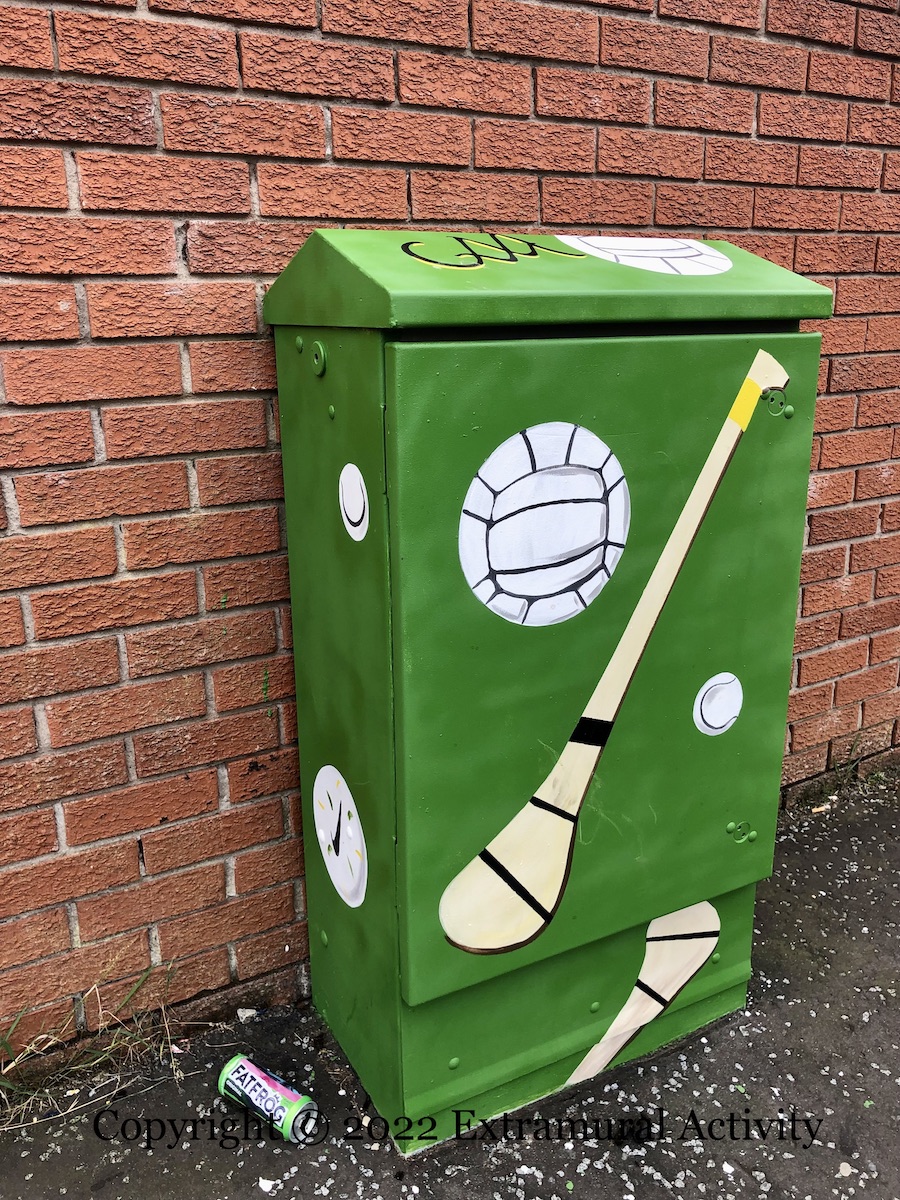
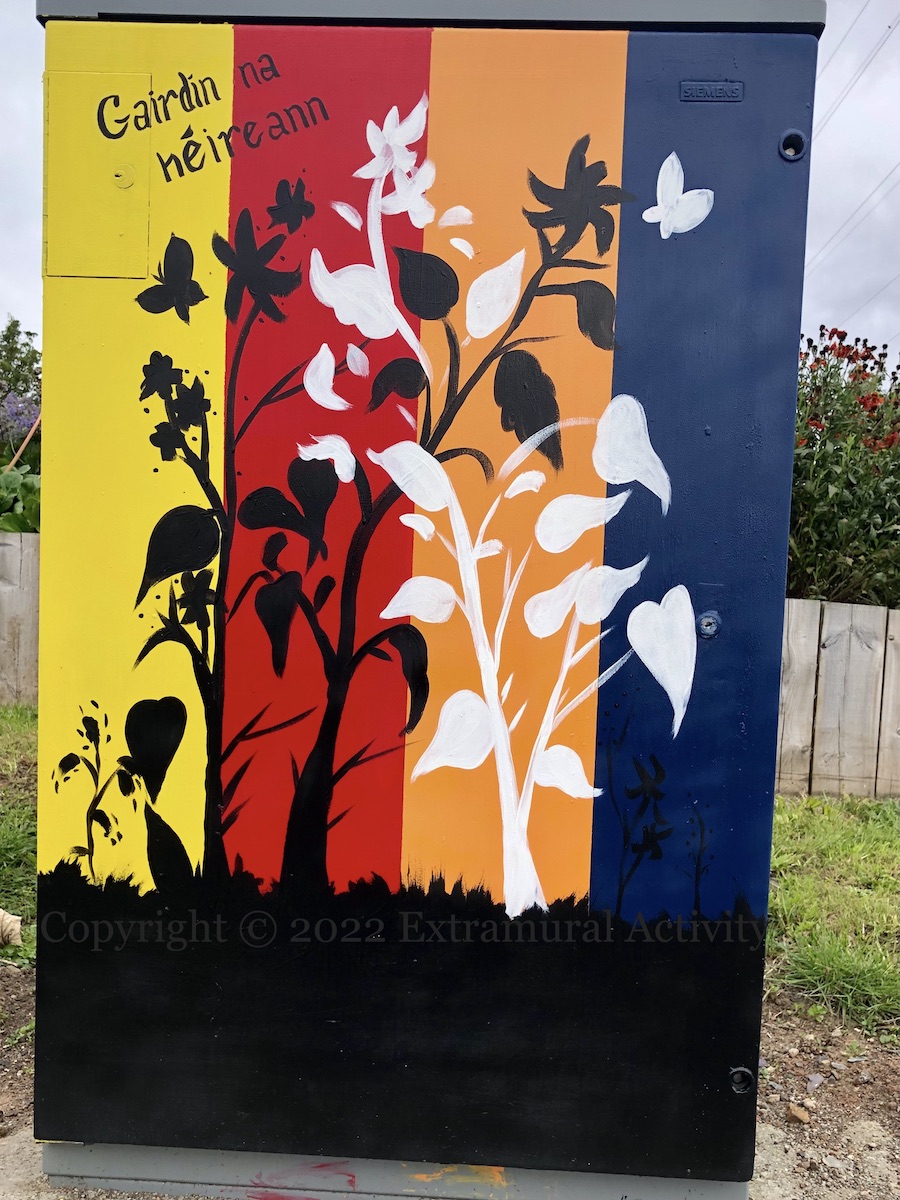
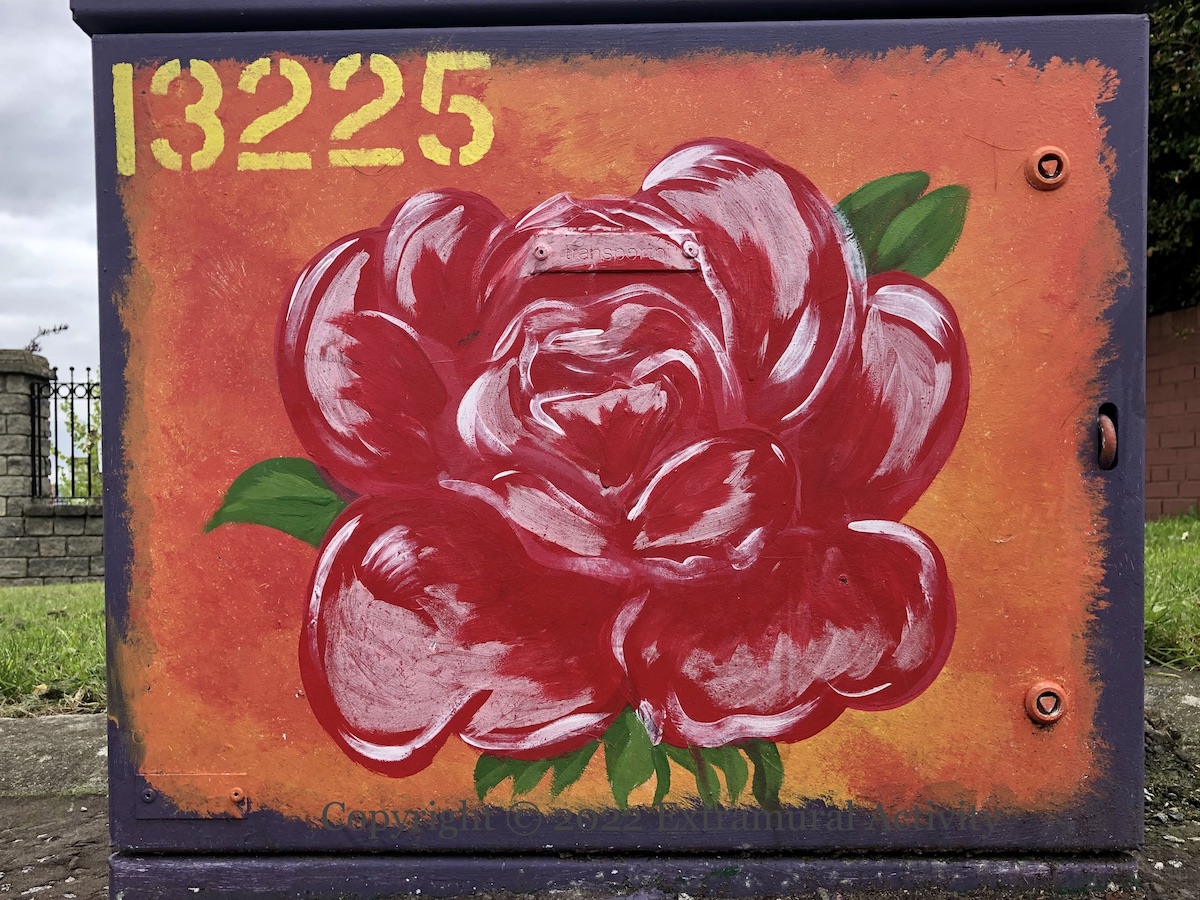
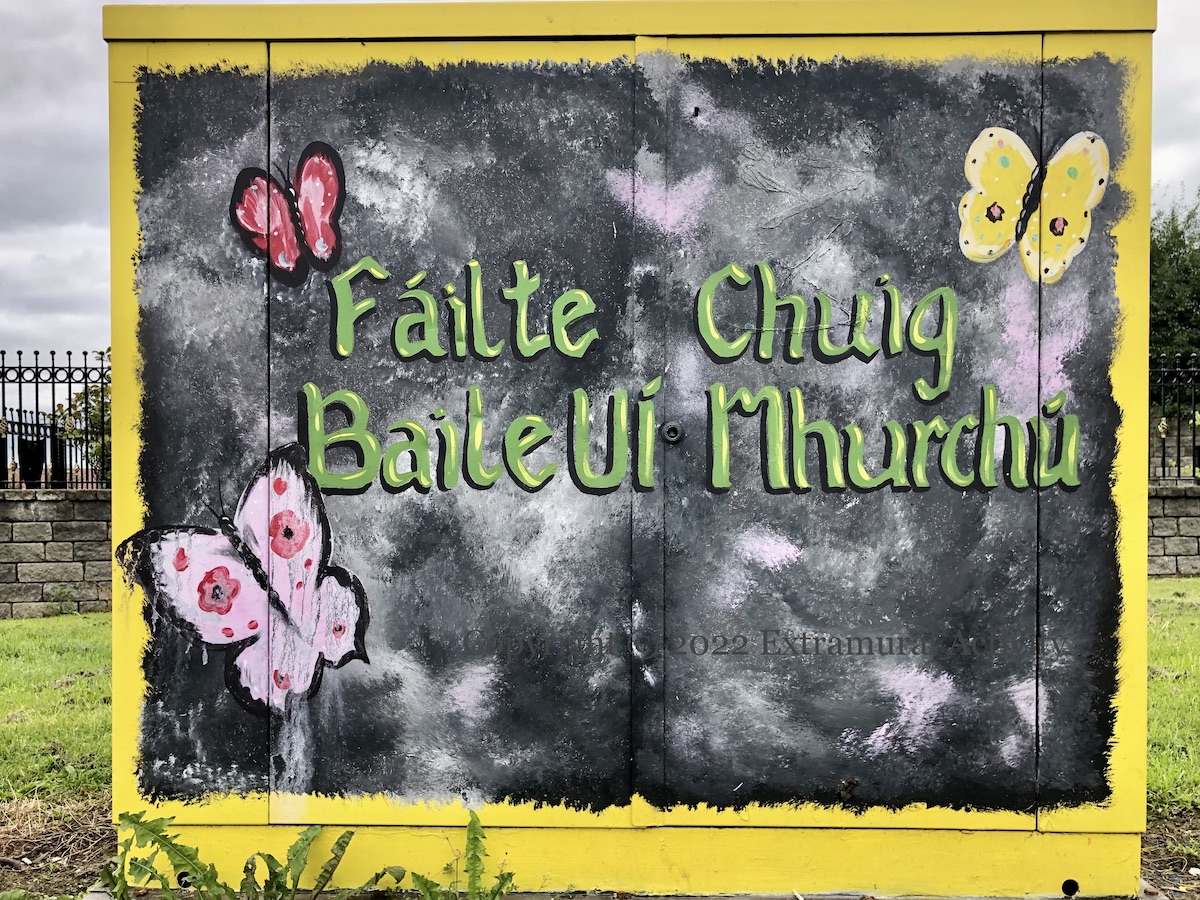
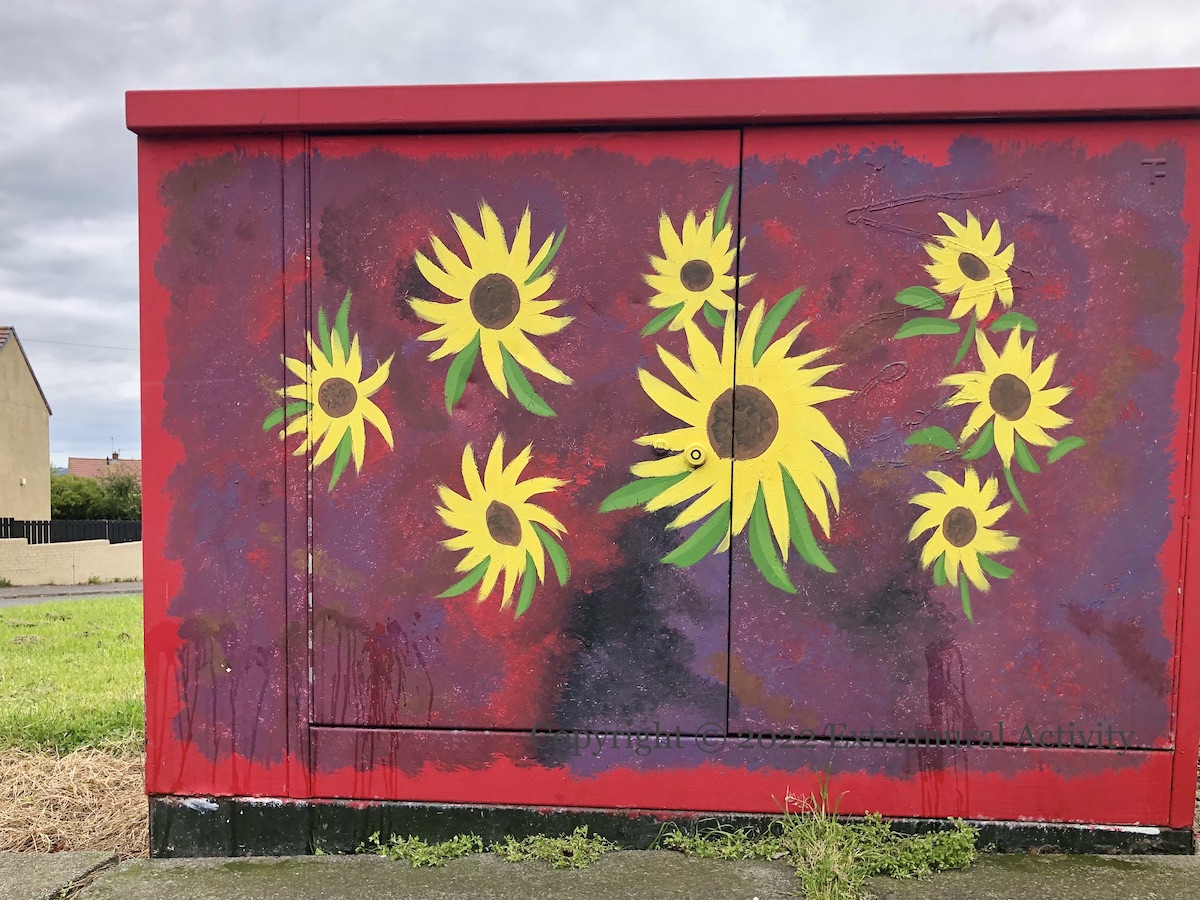
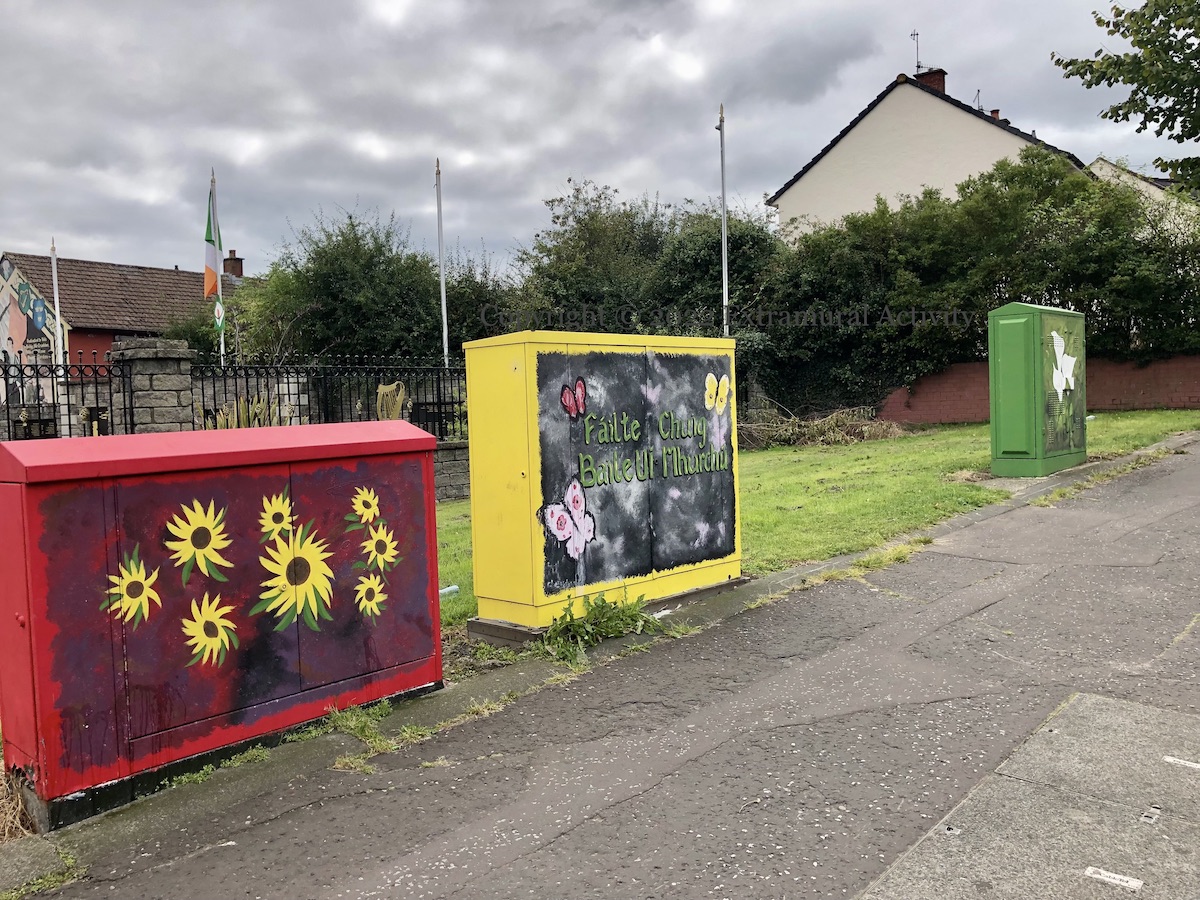
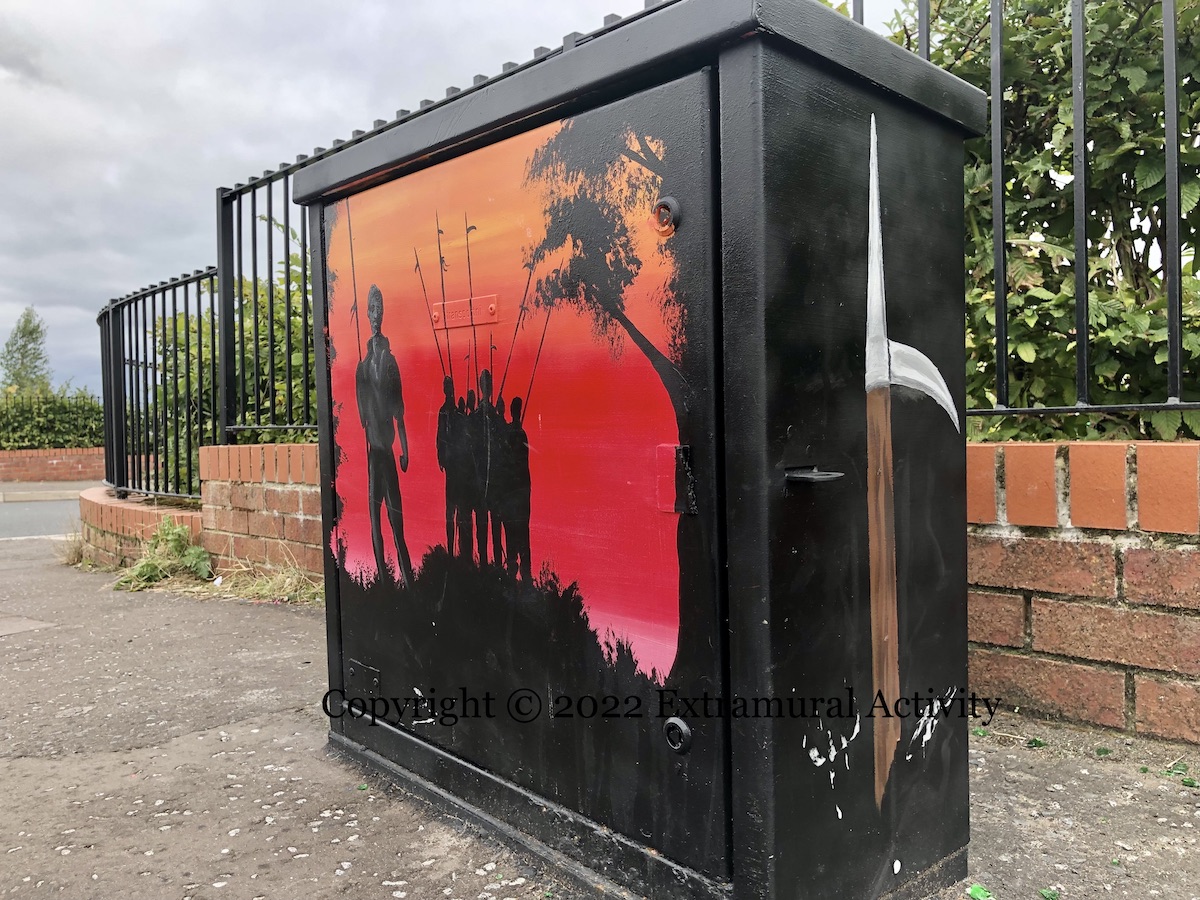
These painted electrical boxes are in Westrock and Ballymurphy (“Fáılte chuıg Baıle Uí Mhurchú”).
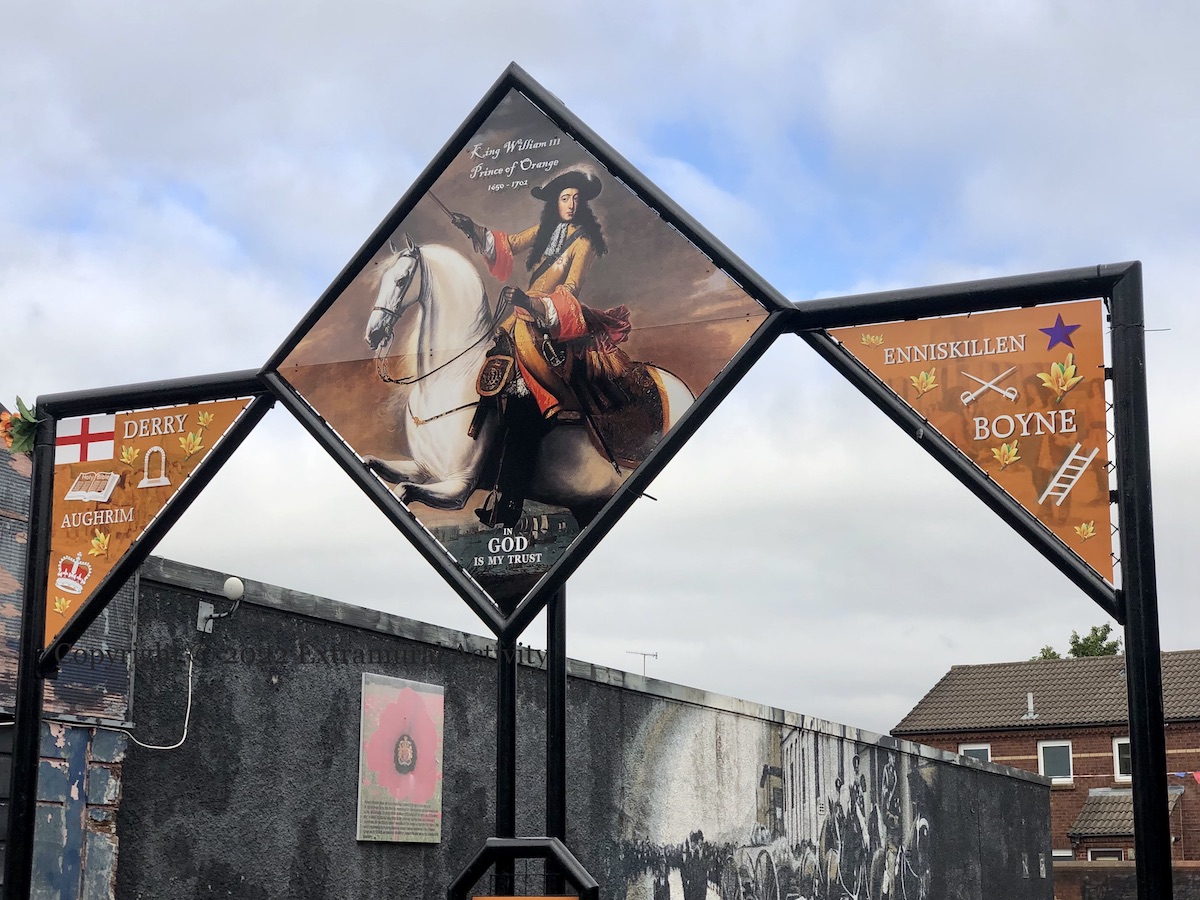
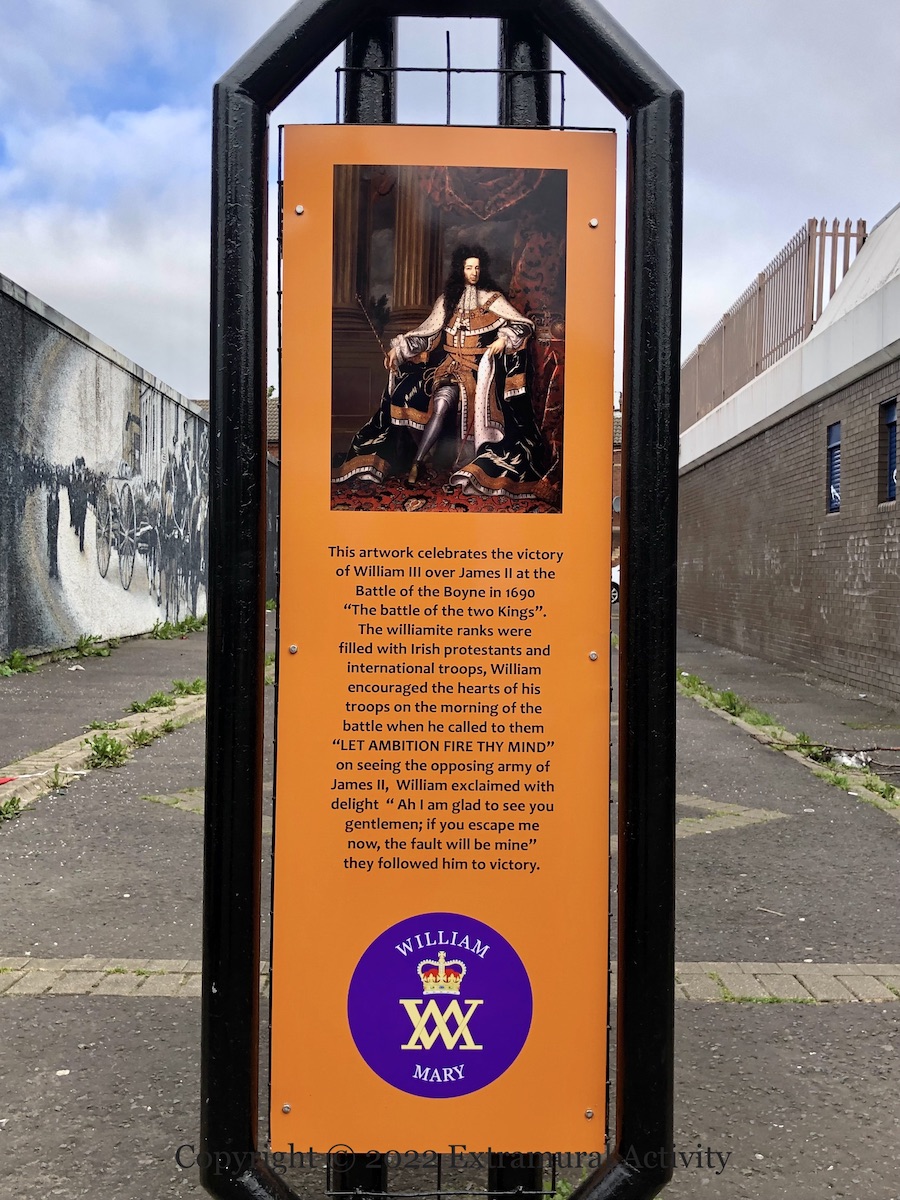
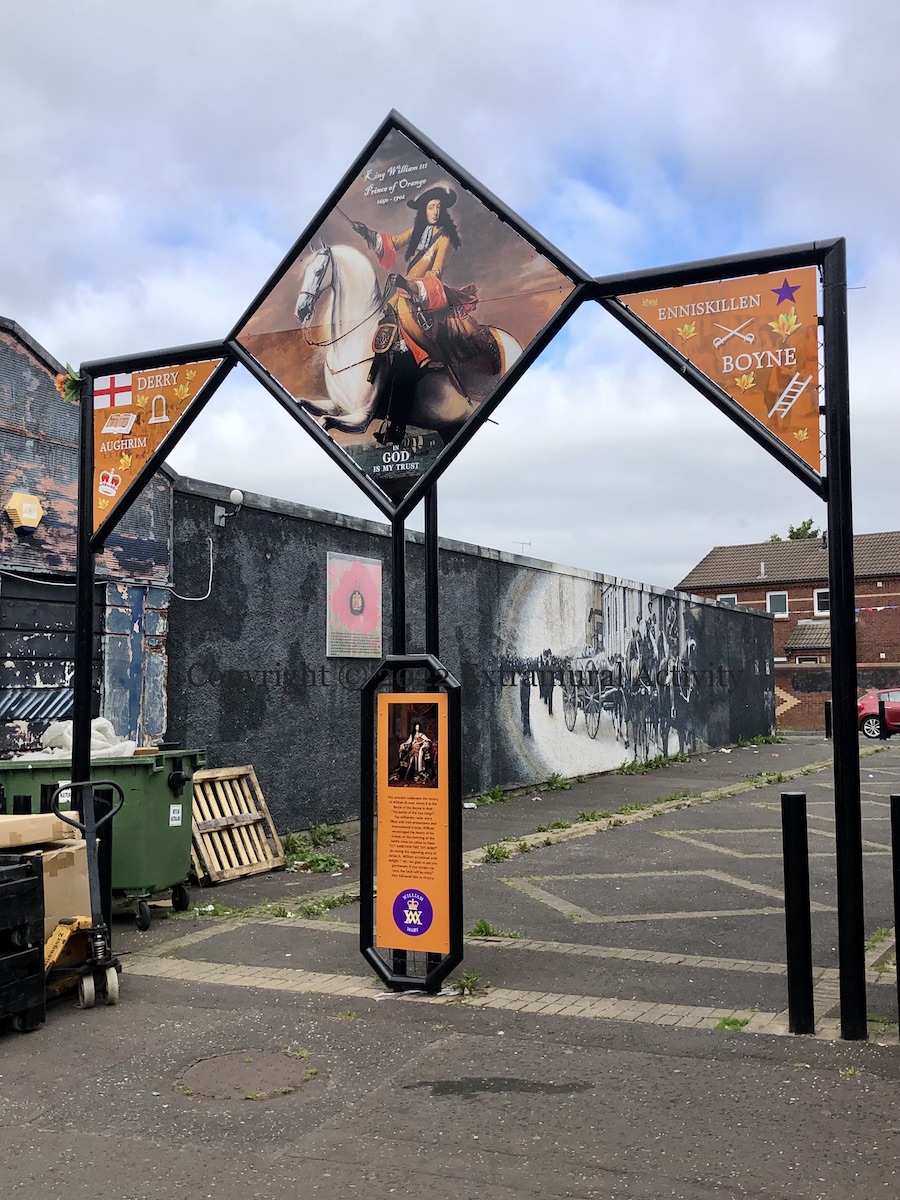
This new Shankill Road installation makes mention of “William and Mary”, Mary being co-monarch with her cousin William from 1689 to 1694, when she died of smallpox. She was raised Anglican, though her parents (including father James II, whom William defeated at the Boyne) had converted to Catholicism in the 1660s. Although the fifteen year-old Mary wept when the marriage was announced, she remained loyal to William and to “Church and State” when James was deposed (WP).
“King William III Prince of Orange 1650-1702. In God is my trust.” “This artwork celebrates the victory of William III over James II at the Battle of the Boyne in 1690 “The battle of the two Kings”. The williamite ranks were filled with Irish protestants and international troops, William encouraged the hearts of his troops on the morning of the battle when he called to them “LET AMBITION FIRE THY MIND” on seeing the opposing army of James II, William exclaimed with delight “Ah I am glad to see you gentlemen; if you escape me now, the fault will be mine” they followed him to victory.”
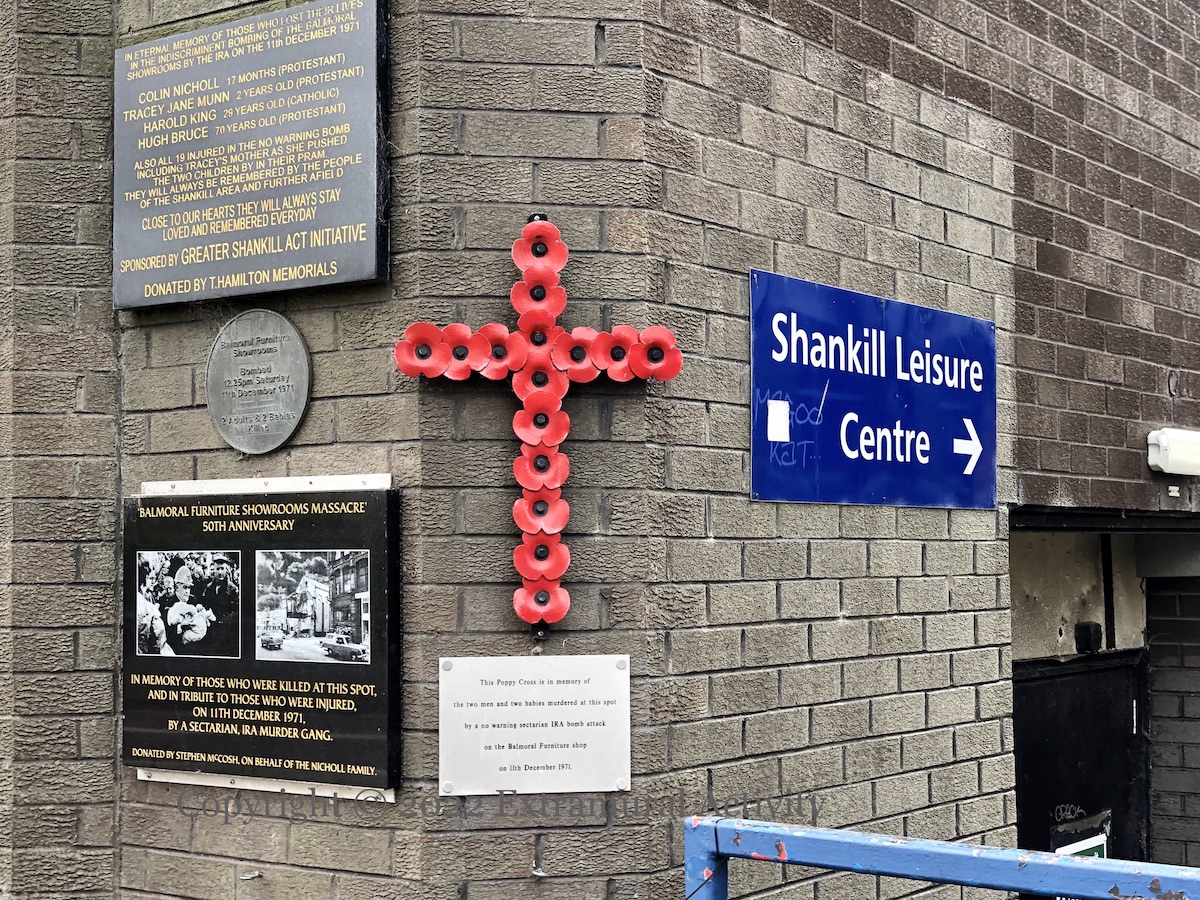
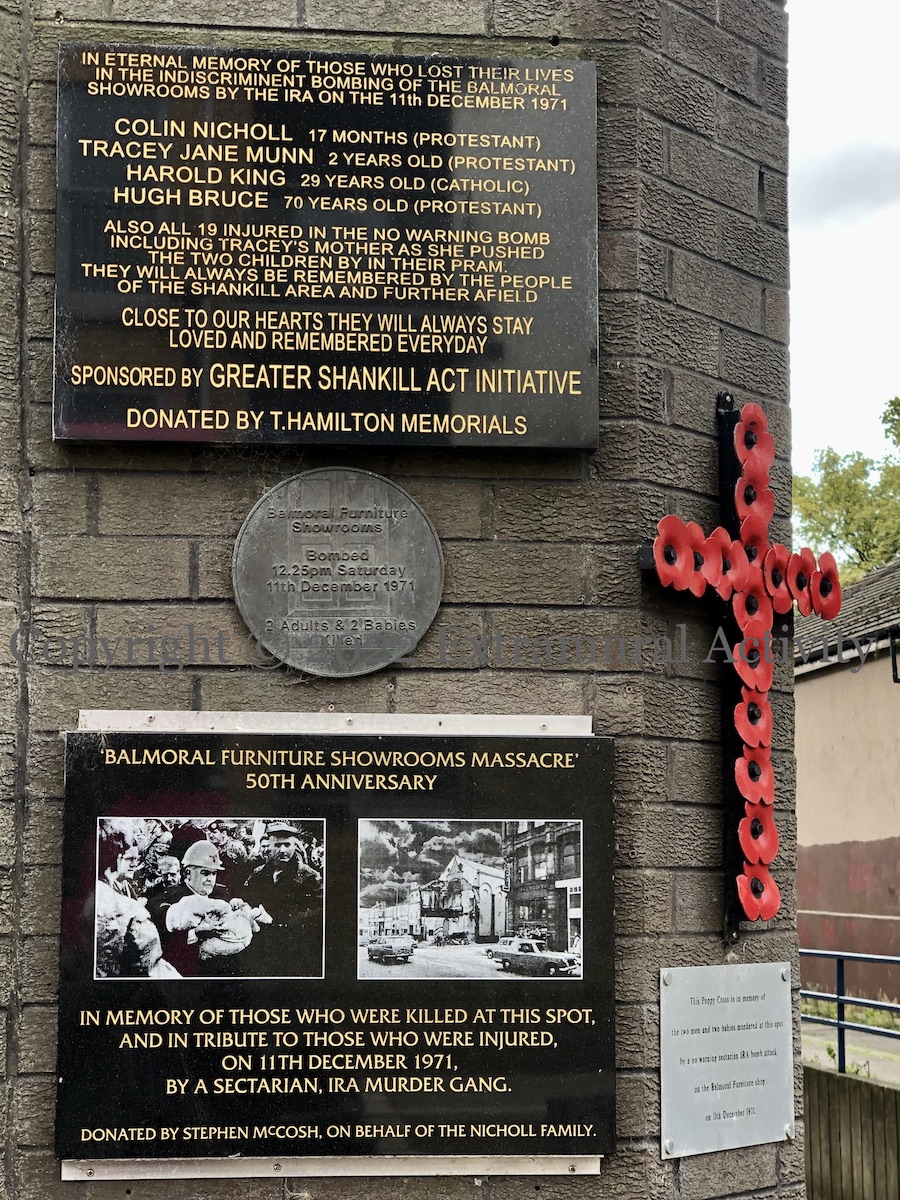
A fourth memorial was added to the side of the Shankill Leisure Centre for the 50th anniversary of the bombing of the Balmoral Furniture Showrooms on the Shankill Road, with two photographs from the aftermath. The one on the left, of a fireman carrying the body of Colin Nichol/Nicholl, was reproduced in the old mural in Bellevue Street and in Dundee Street in successive printed murals (one | two) of the four “Shankill atrocities”.
“In eternal memory of those who lost their lives in the indiscriminate bombing of the Balmoral Showrooms by the IRA on the 11th December 1971. Colin Nicholl 17 months (Protestant), Tracey Jane Munn 2 years old (Protestant), Harold King 29 years old (Catholic), Hugh Bruce 70 years old (Protestant). Also all 19 injured in the no warning bomb including Tracey’s mother as she pushed the two children by in their pram. They will always be remembered by the people of the Shankill area and further afield. Close to our hearts they will always stay/Loved and remembered everyday. Sponsored by Greater Shankill ACT Initiative. Donated by T. Hamilton Memorials.”
“Balmoral Furniture Showrooms massacre, 50th anniversary. In memory of those who were killed at this spot, and in tribute to those who were injured, on 11th December 1971, by a sectarian, IRA murder gang. Donated by Stephen McCosh, on behalf of the Nicholl family.”
“This poppy cross is in memory of the two men and two babies murdered at this spot by a no warning IRA bomb attack on the Balmoral Furniture shop on 11th December 1971.”
 Seosamh Mac Coille Collection