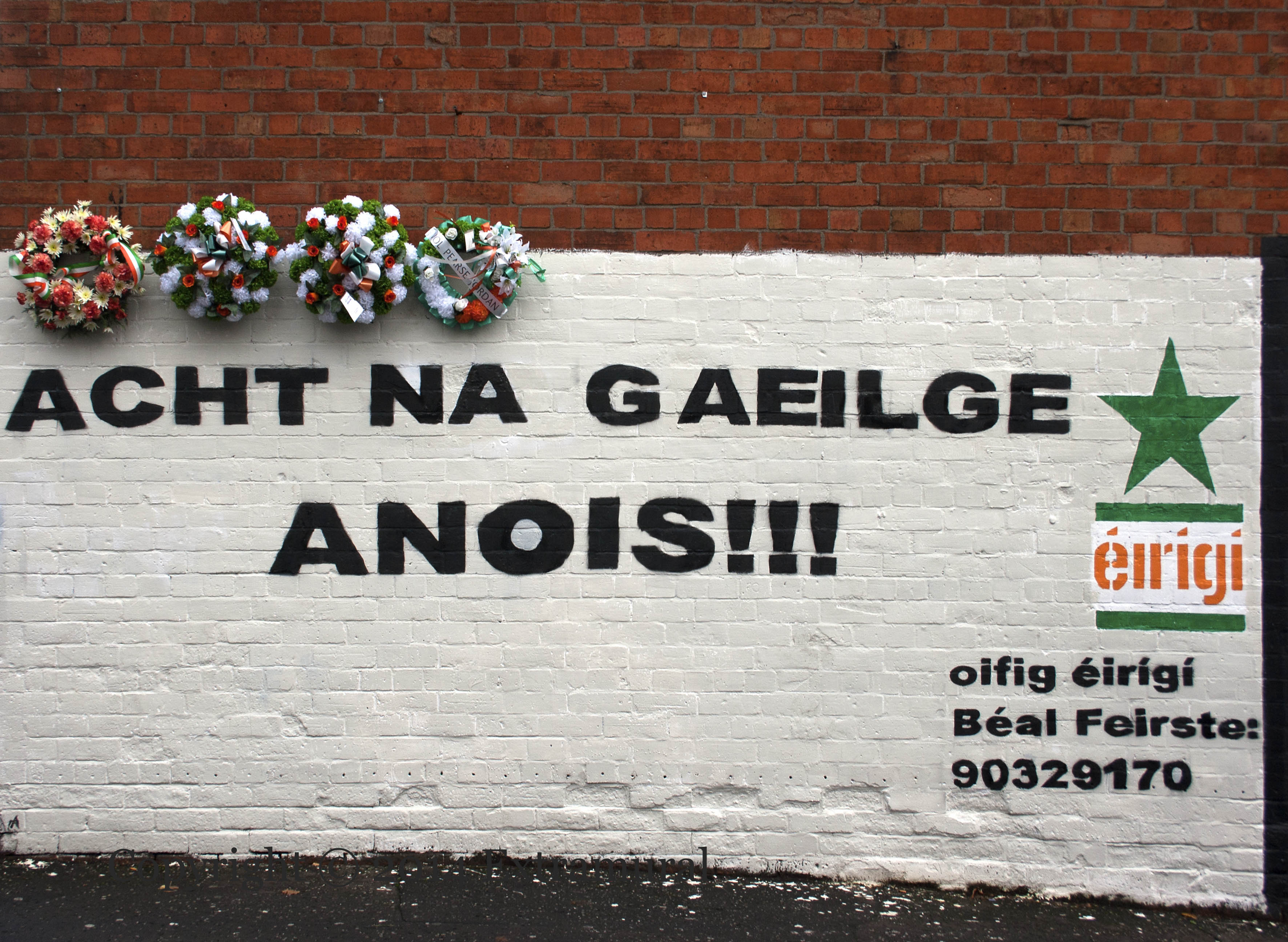
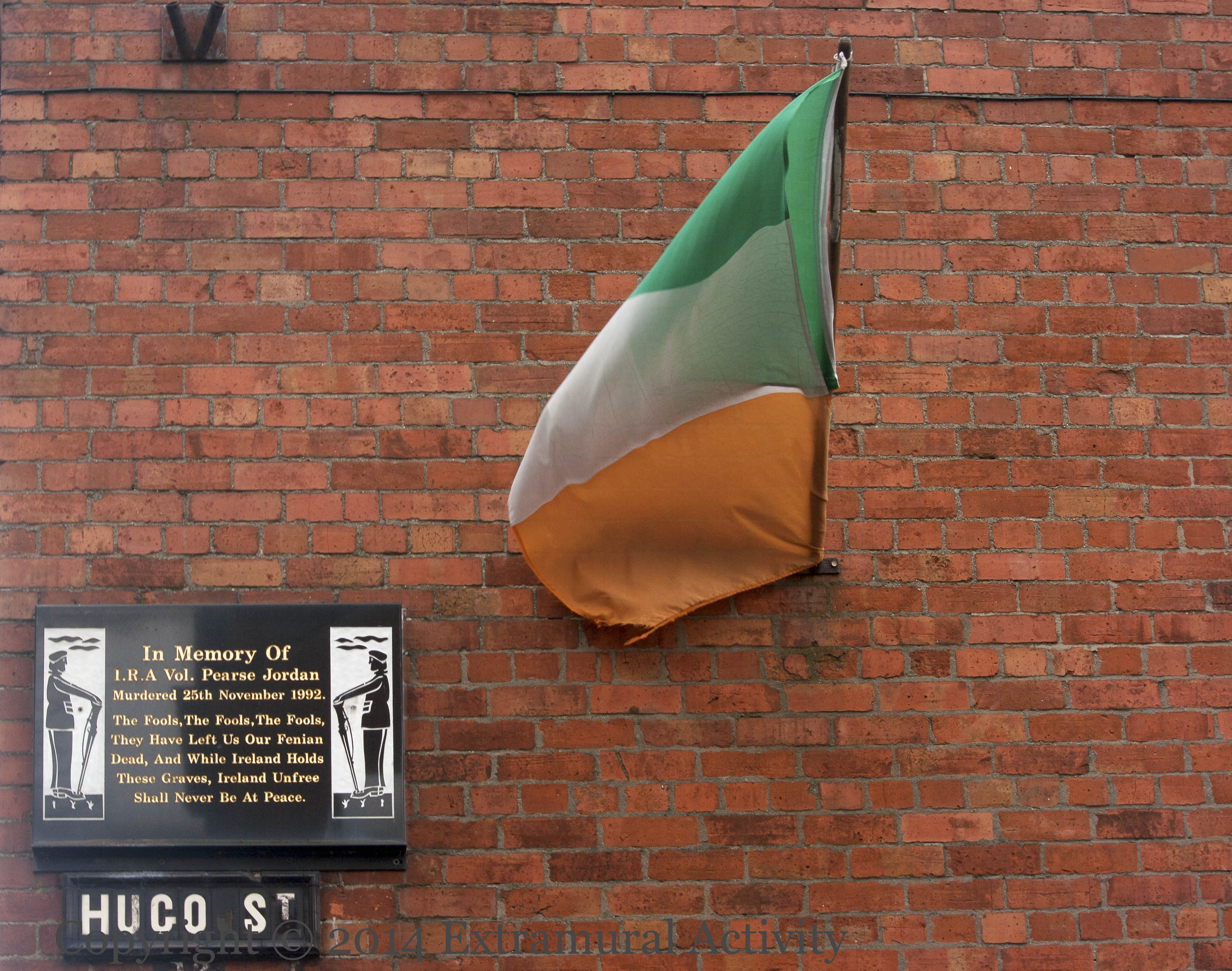
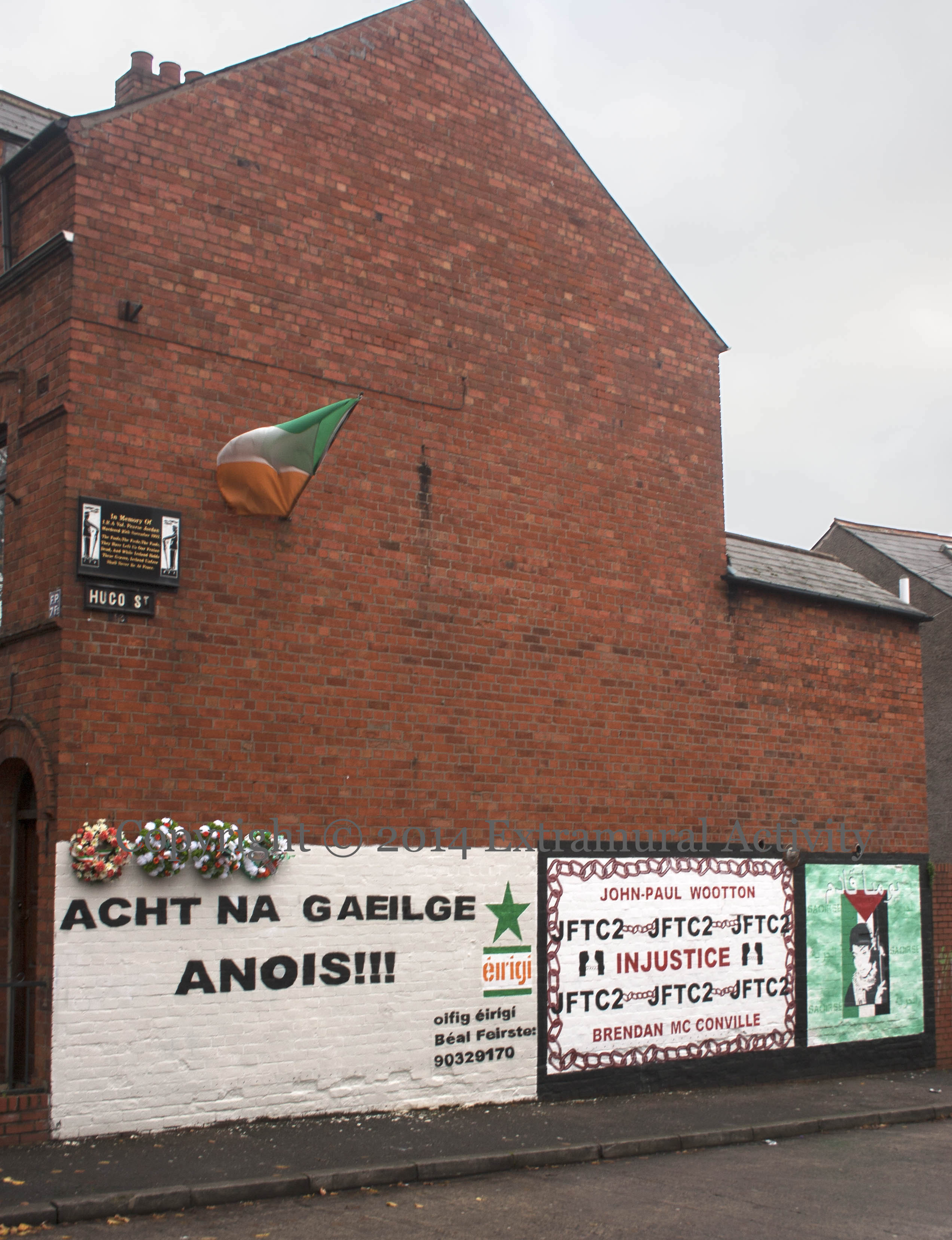
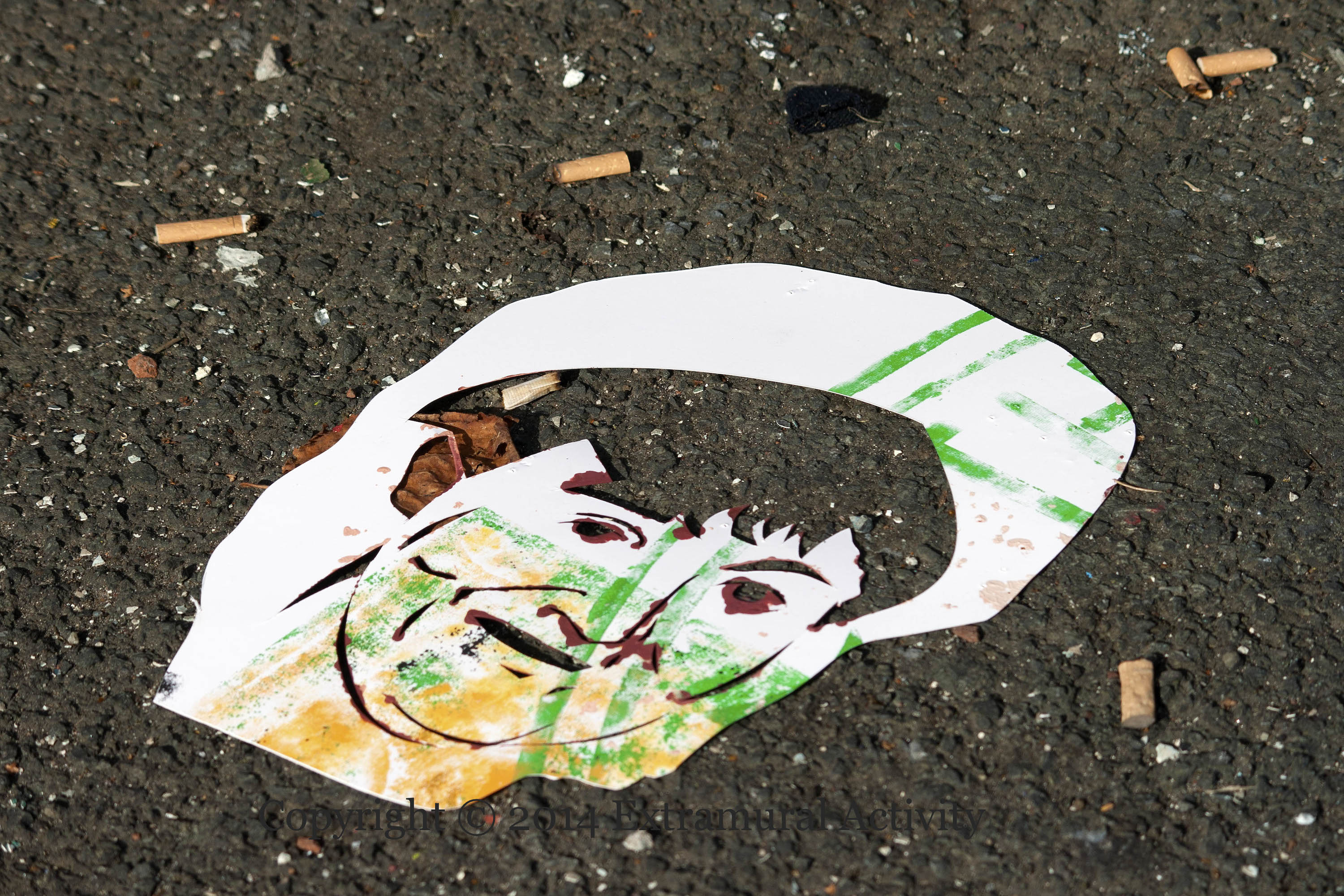
The Belfast Telegraph reports that an Irish language bill will be published in the near future, though the DUP have already rejected such an Act. (For more background and discussion see Brian Walker’s post a few days ago on Slugger.) The éırígí stencil above, calling for “Acht Na Gaeılge Anoıs!!!” – “An Irish Language Act Now!!!”, is in Hugo Street below a tricolour and a plaque in the memory of Pearse Jordan (see the second image, below). The wide shot shows the two other pieces on this side of the street, a ‘Justice For The Craigavon 2’ stencil (featured previously in Justice) and Palestinian skyjacker Leila Khaled.
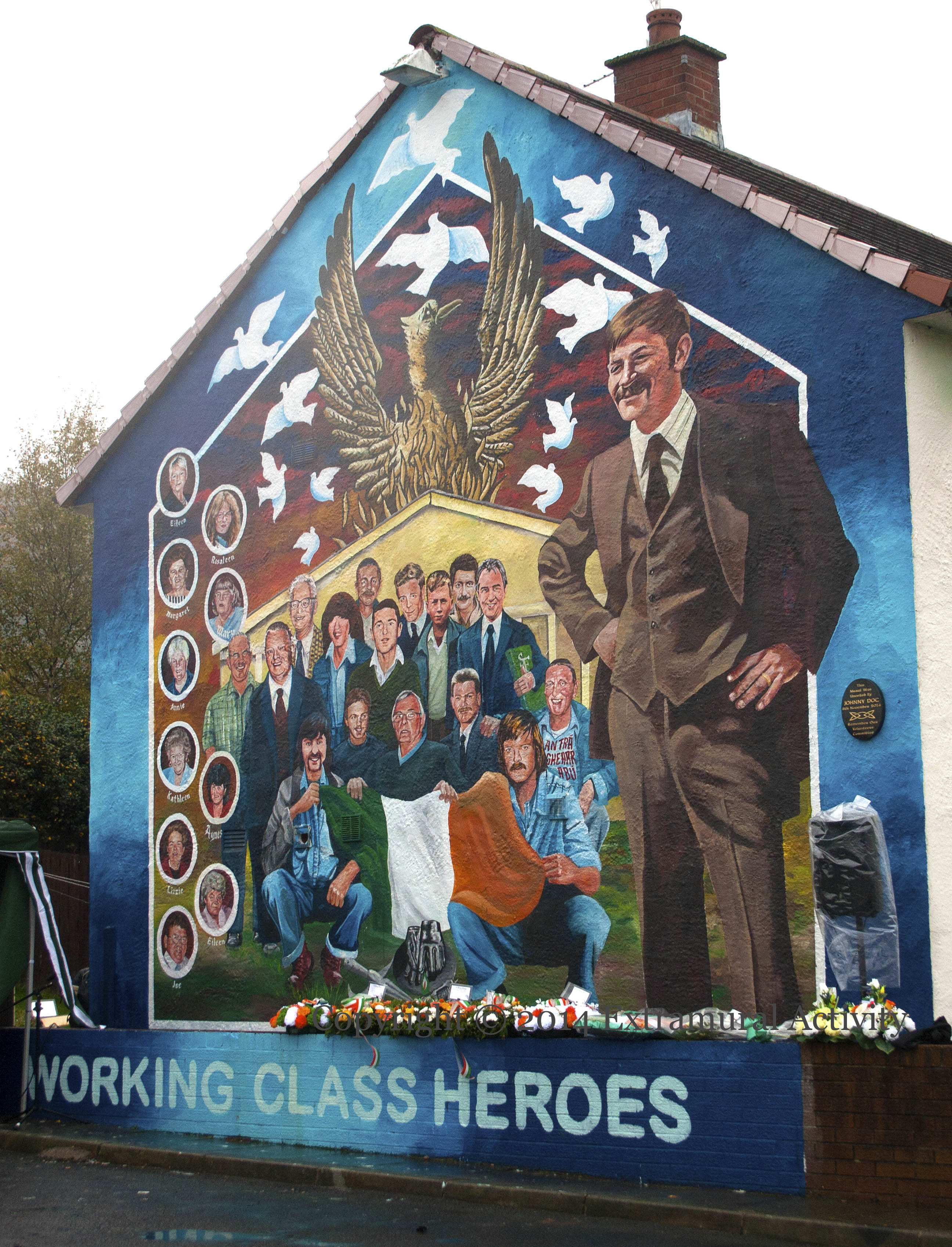
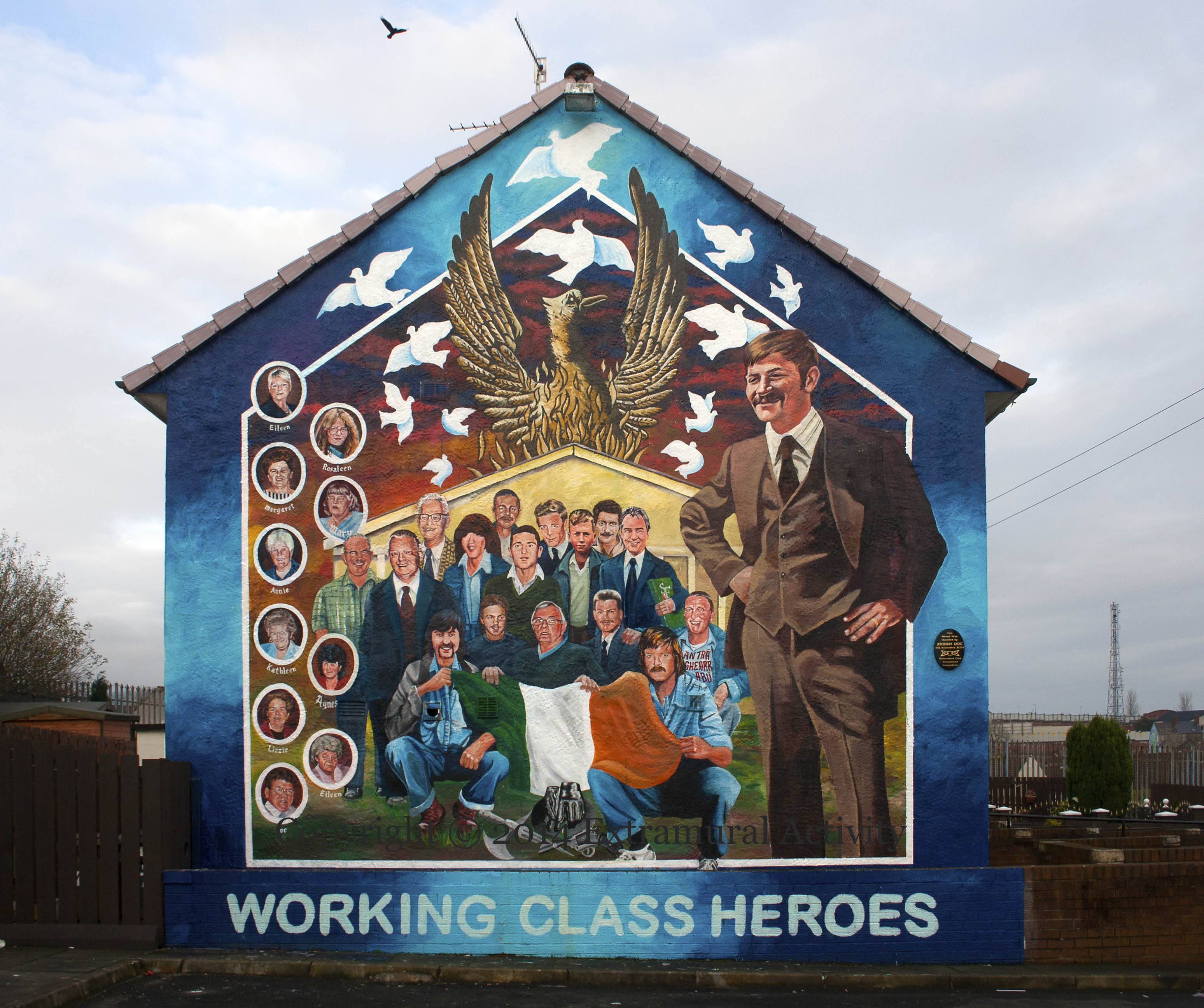
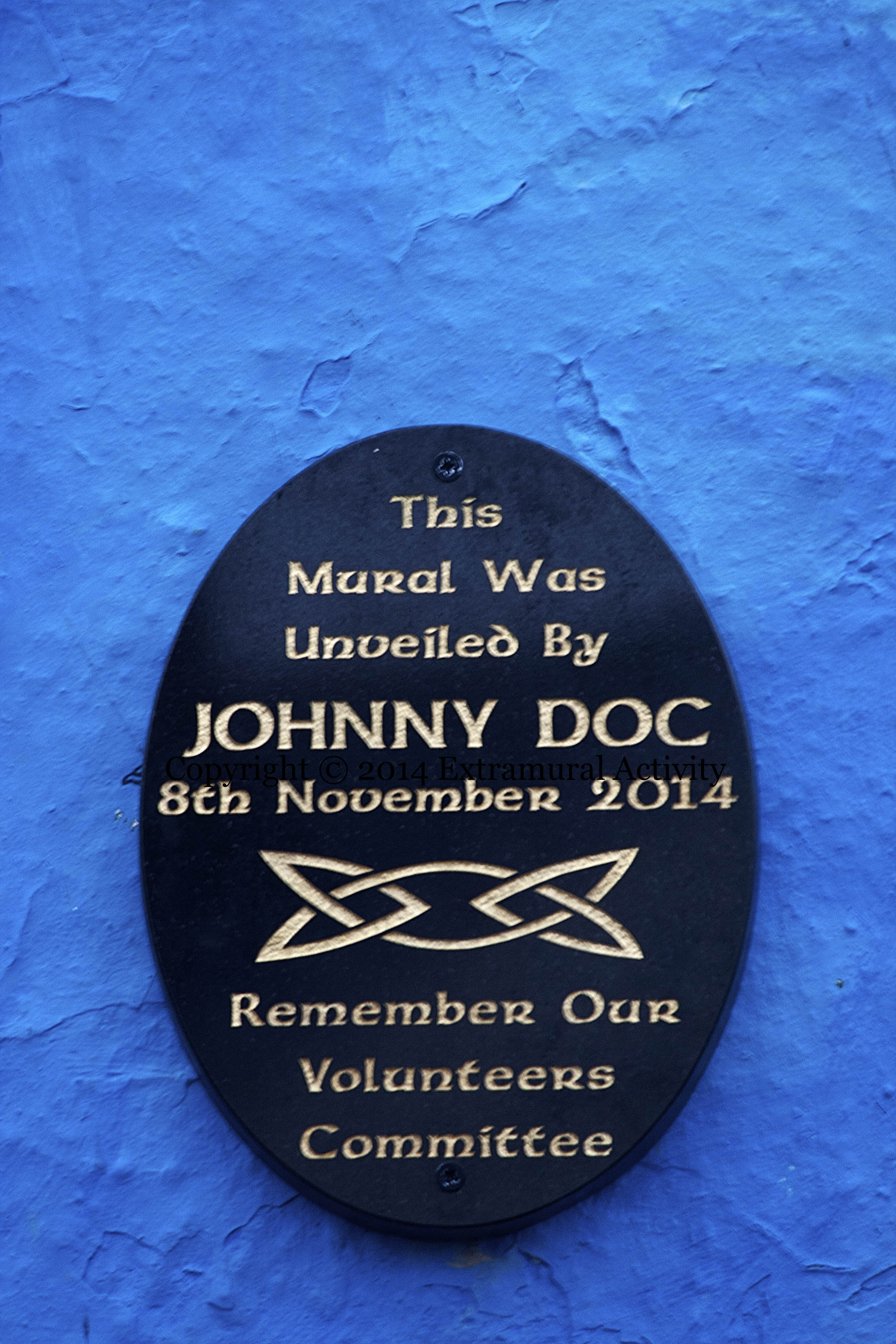
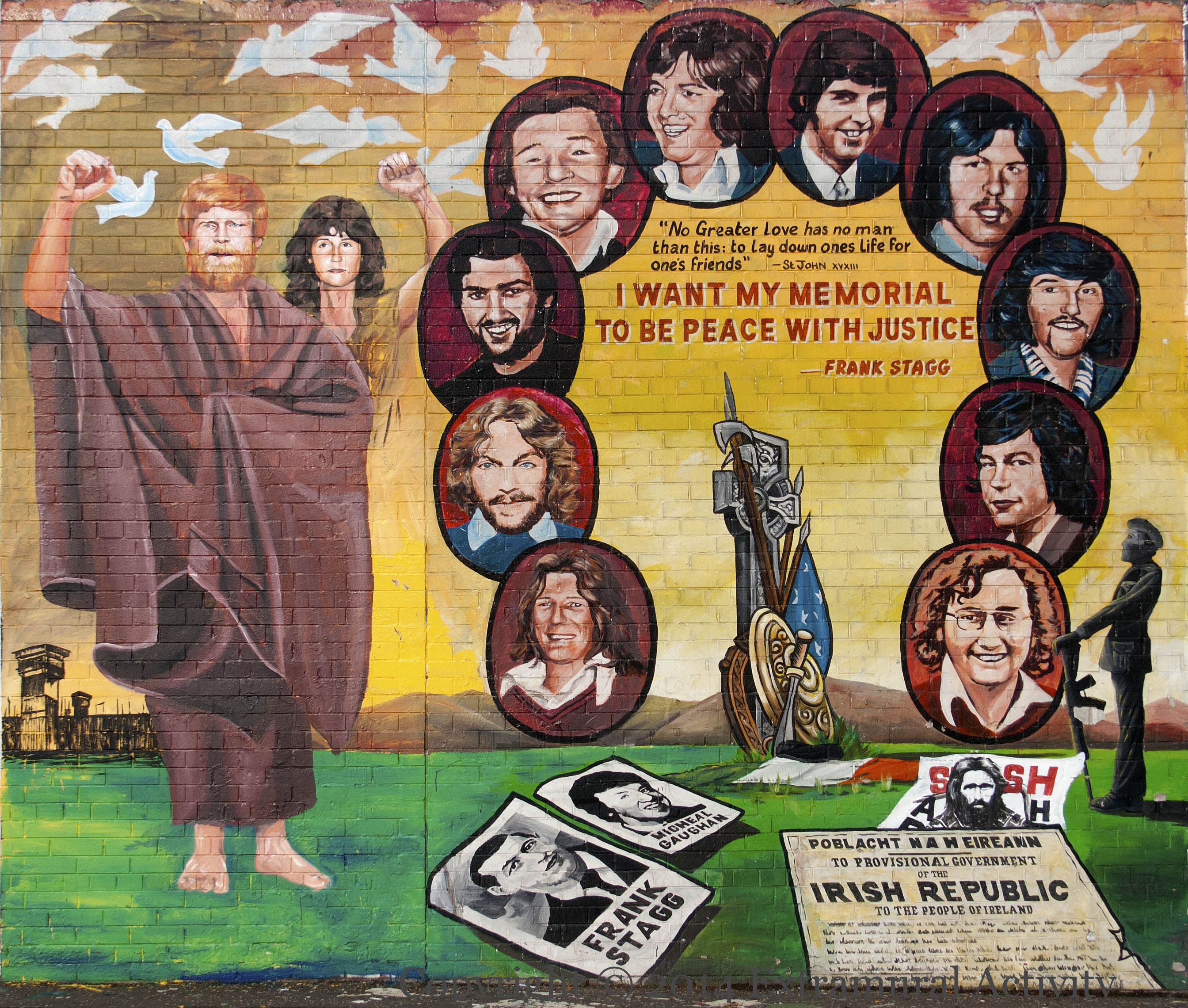
Last Saturday (2014-11-08) saw the launch of a new mural in Ballymurphy Crescent, celebrating local IRA volunteers and community workers.
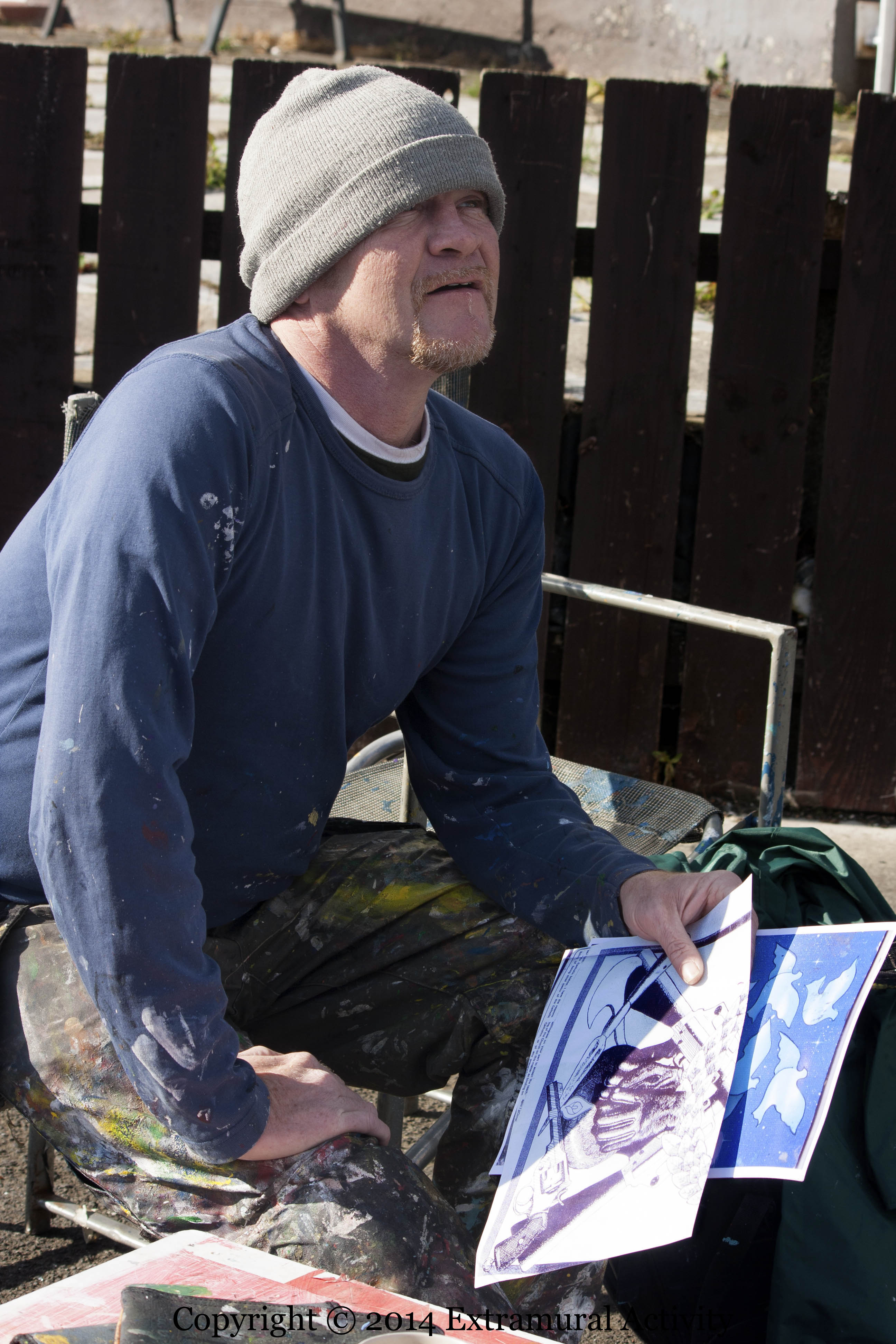
The doves at the top of the mural are in the style of Robert Ballagh’s “Legacy Of The Hunger Strikes” though there are 12 doves here rather than 10. Marty Lyons holds a copy of Ballagh’s piece in an image below, along with an image on which the halberd and pistol around the beret and gloves in the bottom of the mural are based – the rifles of the original are absent. (Possibly by Patrick Magee, the Brighton bomber (WP) – please confirm by e-mail or comment.)
Left-hand portraits (counter-clockwise from top): Eileen Gray, Margaret Campbell, Annie Adams, Kathleen Moore, Lizzie McGivern, Joe Reid, Rosaleen Russell, Mary Armstrong, Agnes Robinson, Eileen Reid.
Standing (l-r): Fra Toner, Gerry Campbell, Liam Mulholland, Paddy Tier, Sean Connolly, Michael Kane, Liam McParland, Sean Doyle, Cllr. Sean Keenan, Pat McGeown.
Squatting/Kneeling (l-r): Jim McGrillen, Francis Toner, Jr., Jimmy Duffy, Tony McAlister, Billy Carson, Cormac McArt.
The main figure is (and remains from the previous mural) Tommy “Toddler” Tolan, who escaped from the Maidstone in 1972 and served time in the cages at Long Kesh. (See Lost Lives entry #1956 and An Phoblacht.) In the original (2001) version of the ‘Safe House’ mural, he was dressed in fatigues (image at CAIN), but this was changed within 18 months to a brown suit (Safe House | CAIN), similar to the way he is portrayed here.
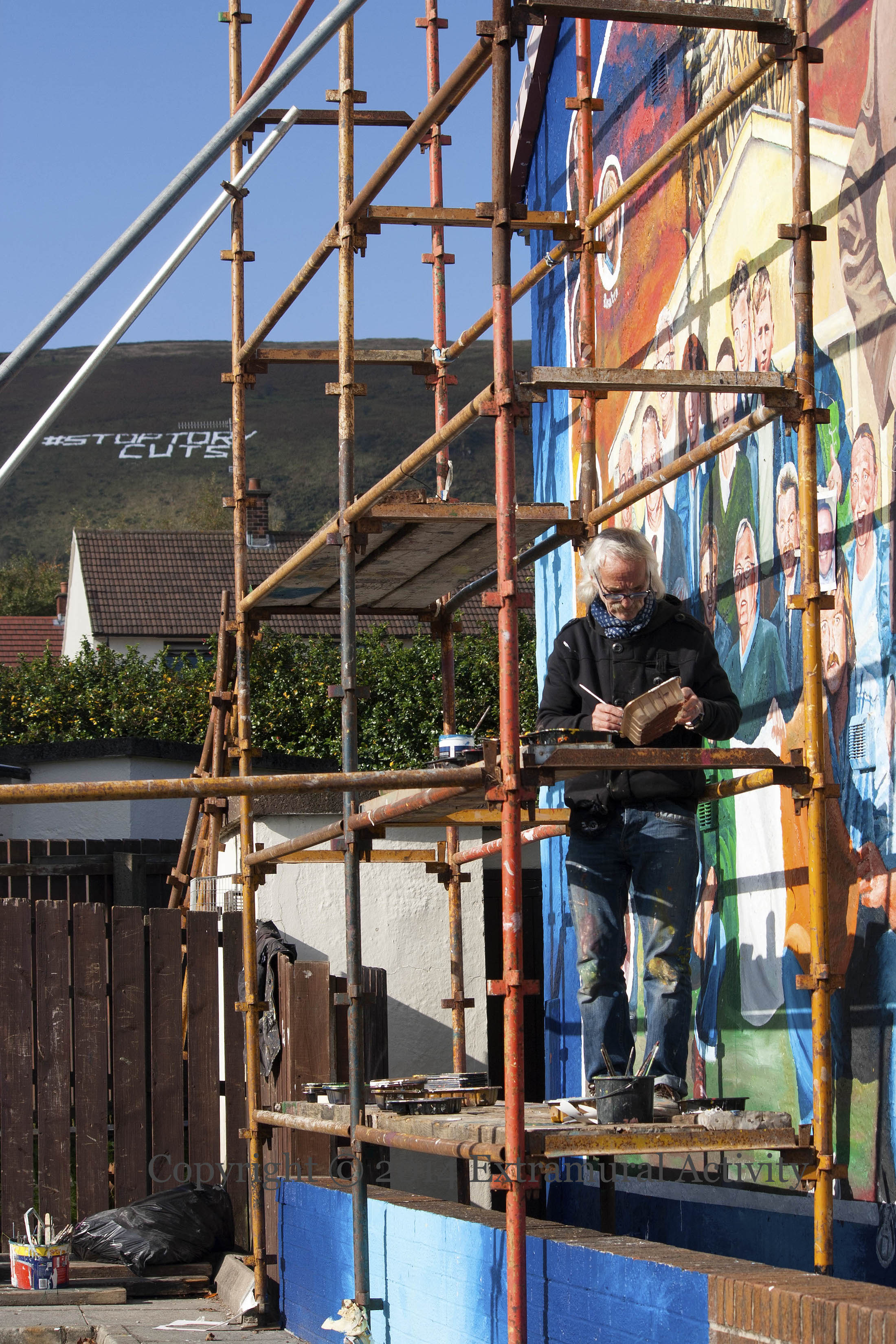
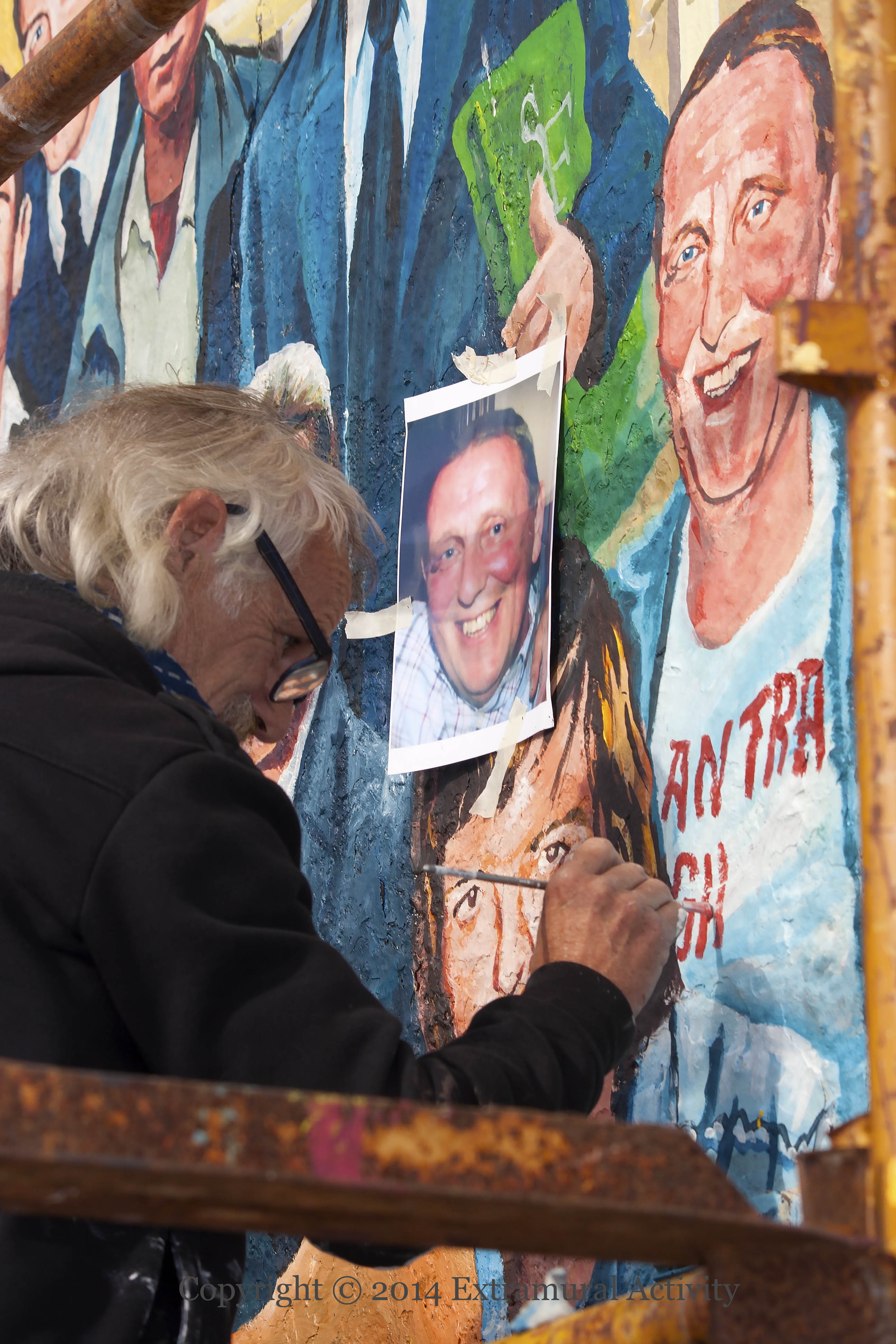
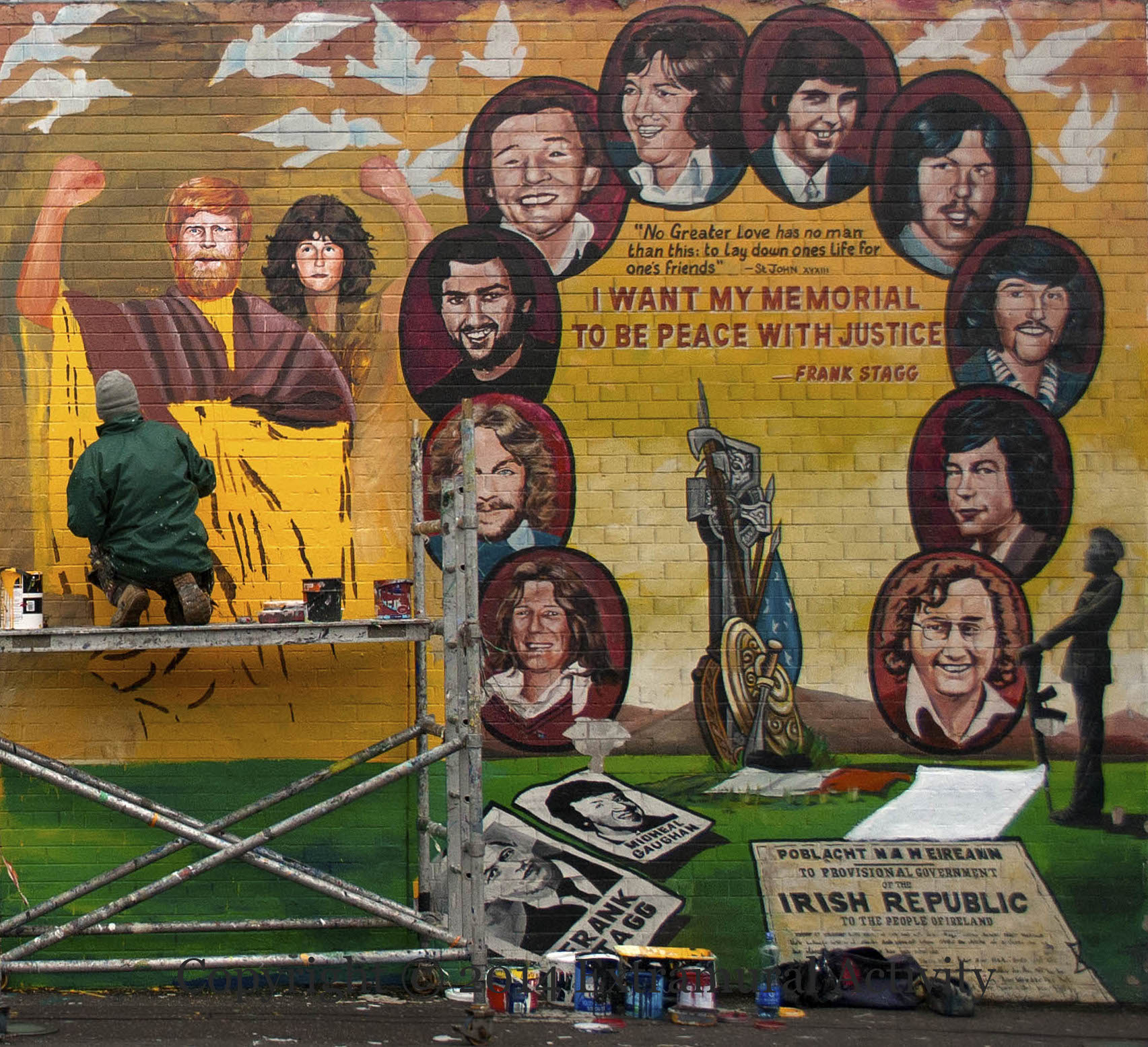
The mural took some time to complete — the fifth image, below, shows one of the artists on a scaffold with #stoptorycuts on Slıabh Dubh in mid-October — partly because more and more figures were added.
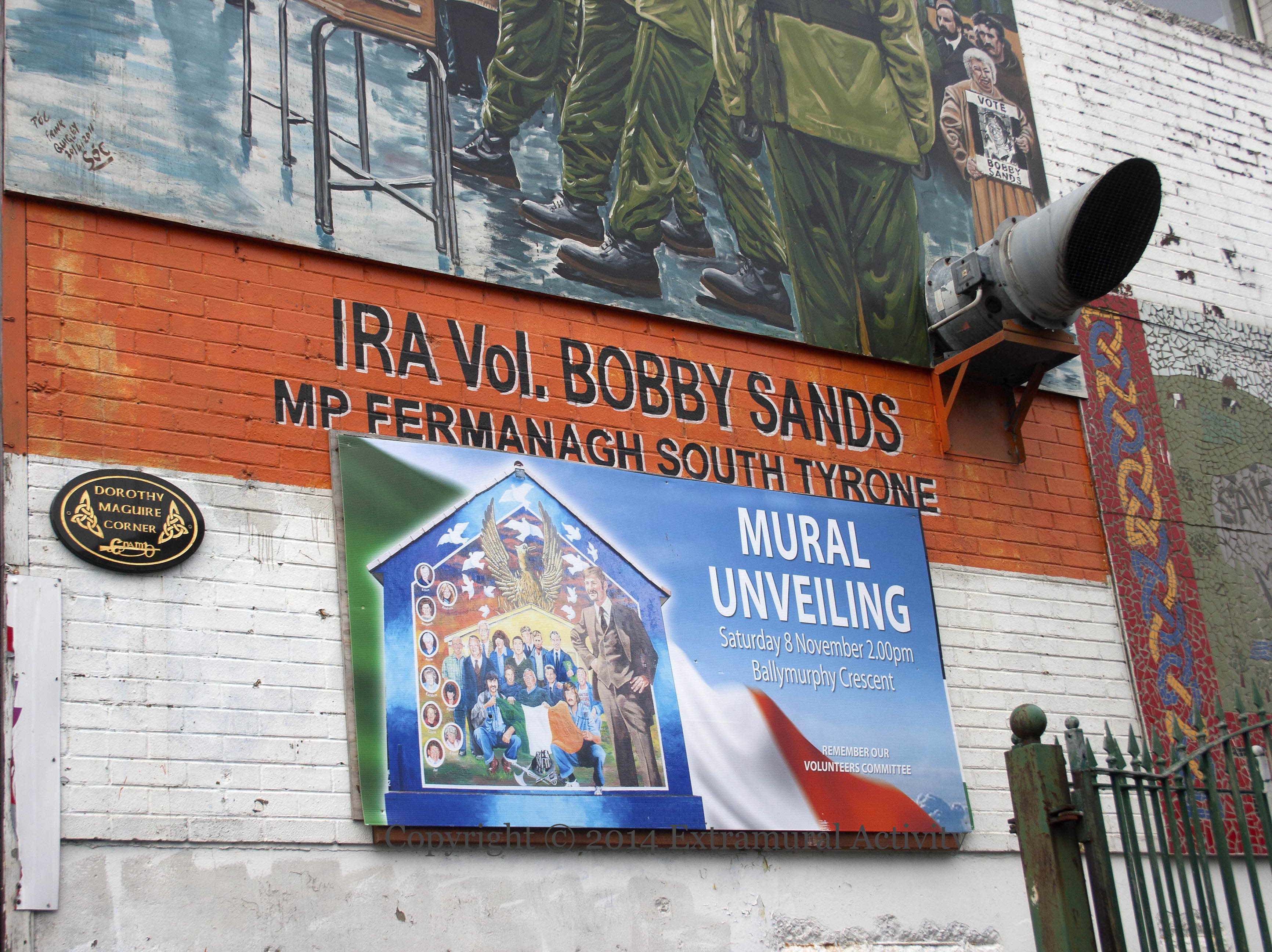
Update 2014-11-26: In an unusual move, the launch of the mural was advertised by a board (rather than flyers), in this case at Dorothy Maguire Corner on the Whiterock Road – see the final image, below.
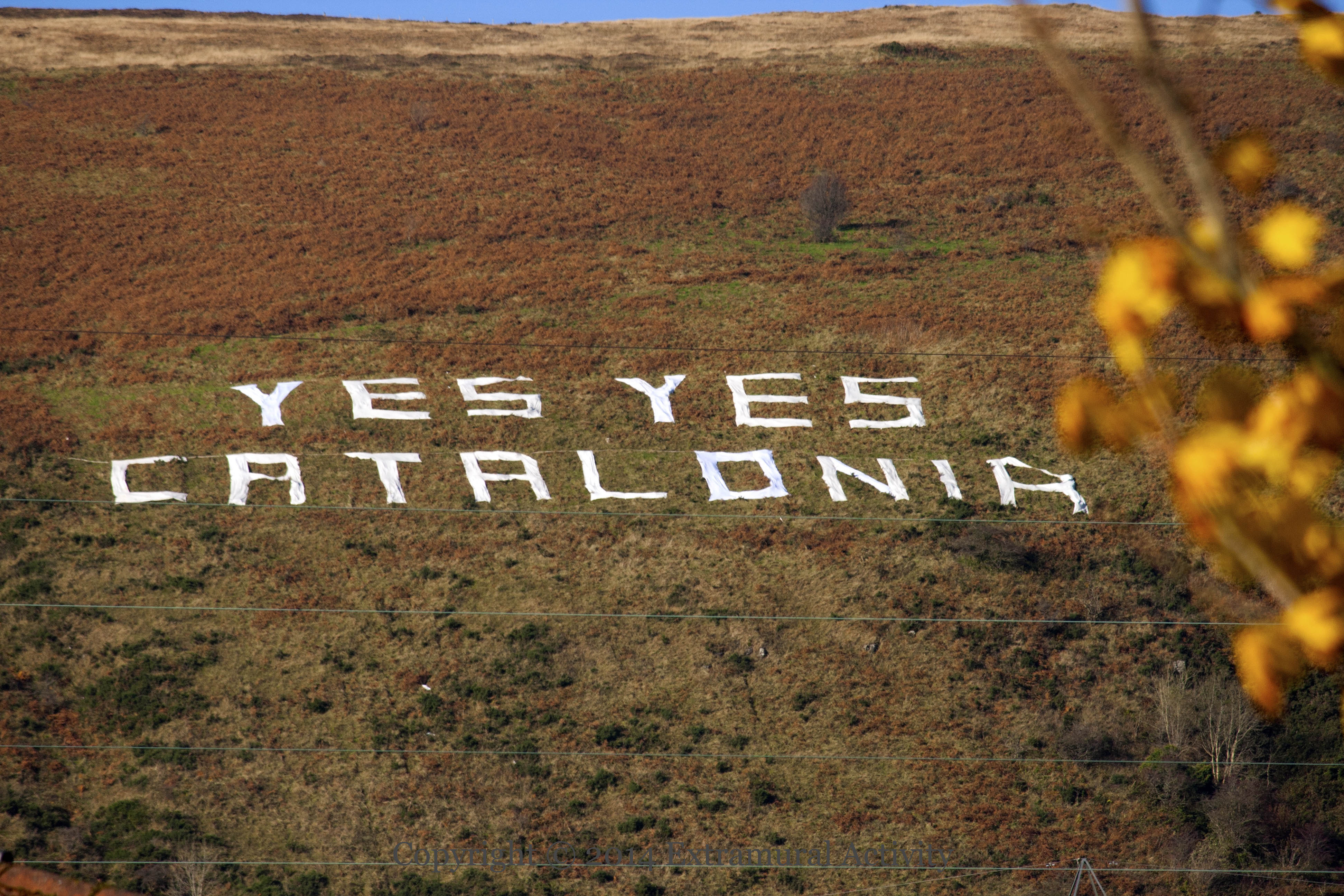
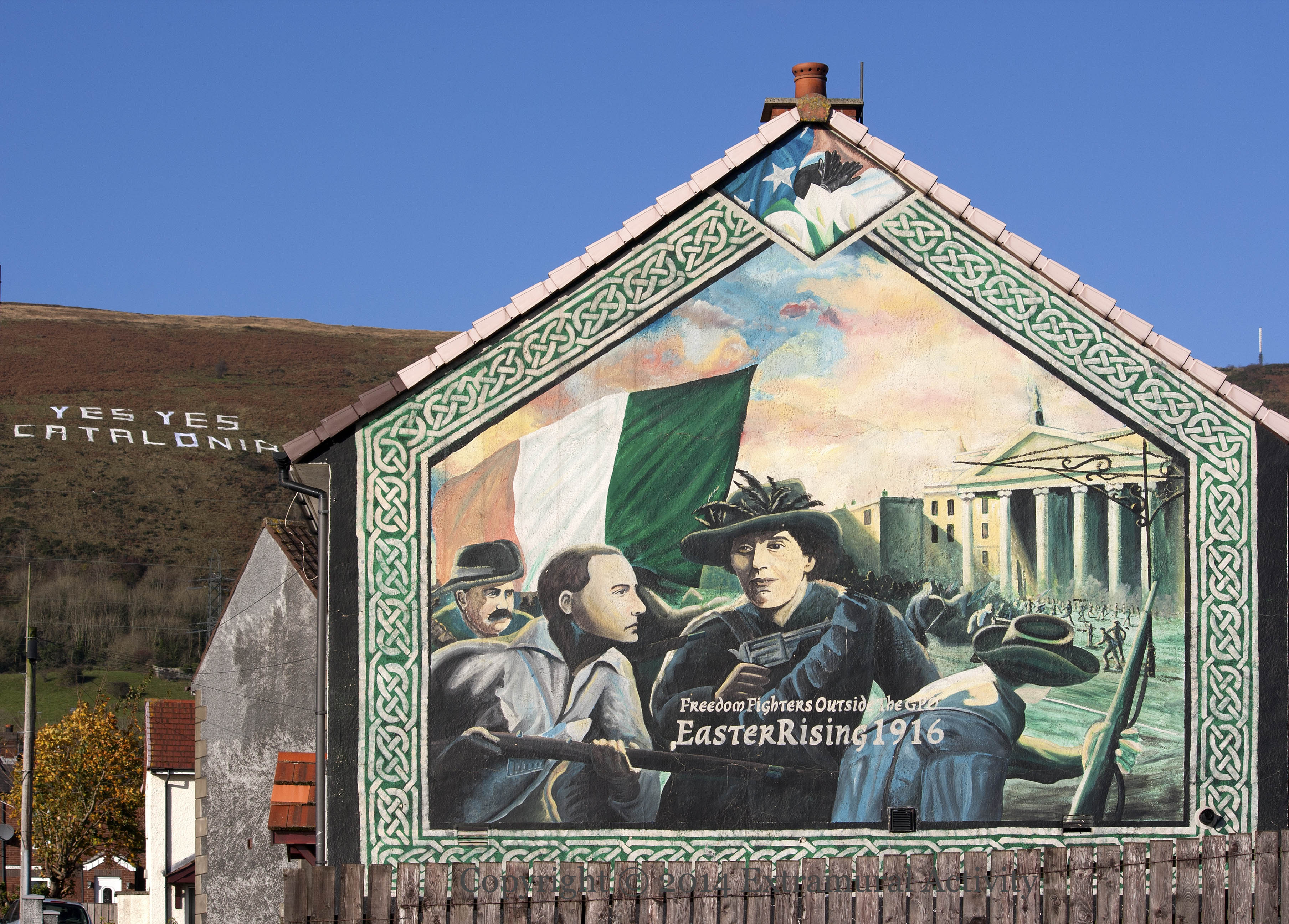
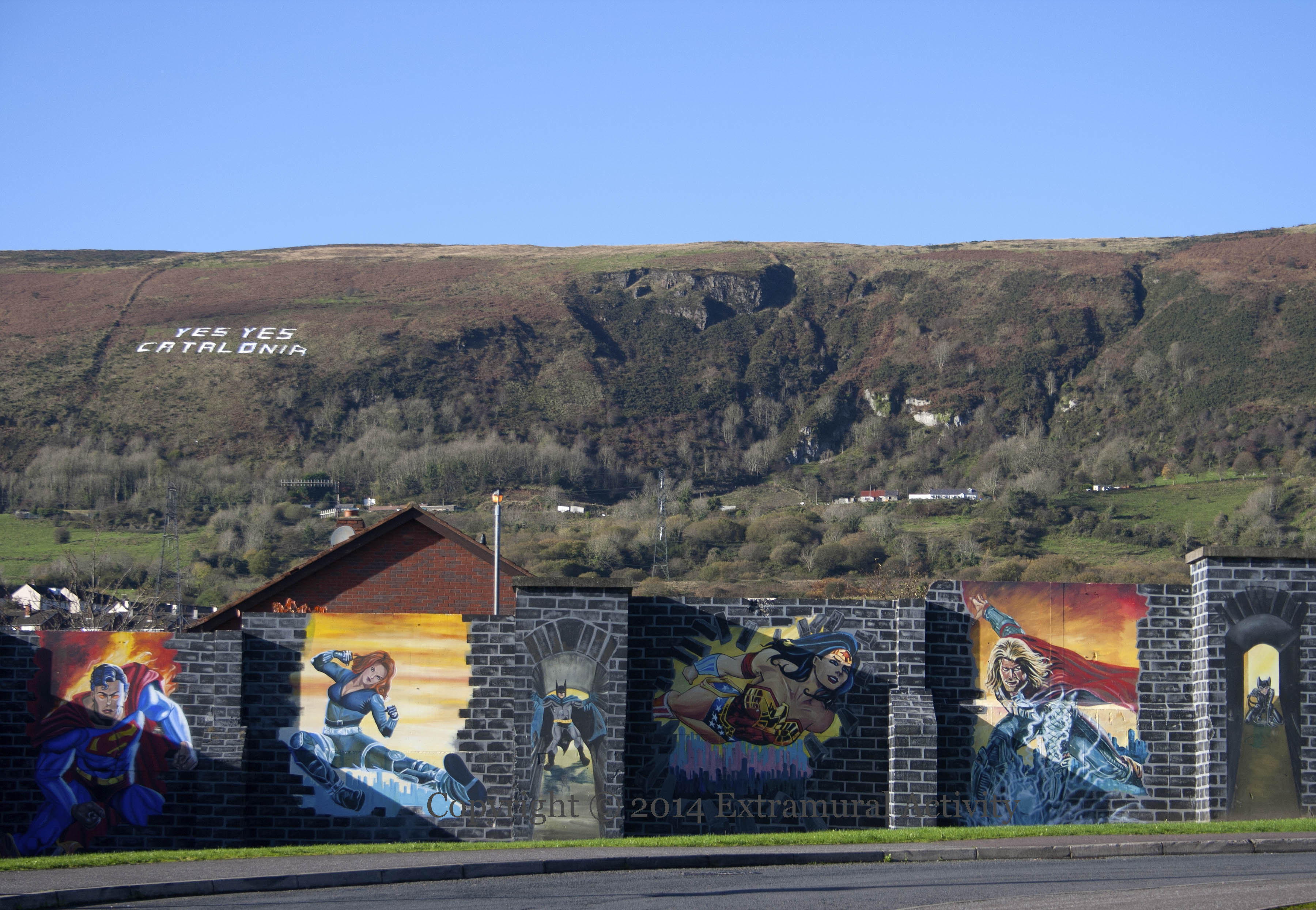
A symbolic vote on Catalonian independence (for more background see Votes About Votes) showed 81% in favour of separation from Spain. Here are three shots of the encouragement on Slıabh Dubh (Black Mountain), the second with the Ballymurphy Easter Rising mural in the foreground, the third with the wall of superheroes in Slıabh Dubh estate (see Wallbusters | The Walls, Unbroken | Red-Eye | Cartoon World).
As reported at the time, after the Nugent/Hughes mural at the corner of Divis and Northumberland Streets (see Belfast’s Infamous Prison) was painted out to make way for a pro-Catalonia vote mural (see Votes About Votes), Kieran Nugent was added to the hunger-strikers mural further down the international wall, along with Mairéad Farrell, who was the second person, after Nugent, to refuse to wear a prison uniform. A blanketed Brendan Hughes has also been added, above the declaration of independence.
Below is a progress shot (previously posted in Votes About Votes); the original version of the hunger-strikers mural is in Peace With Justice.
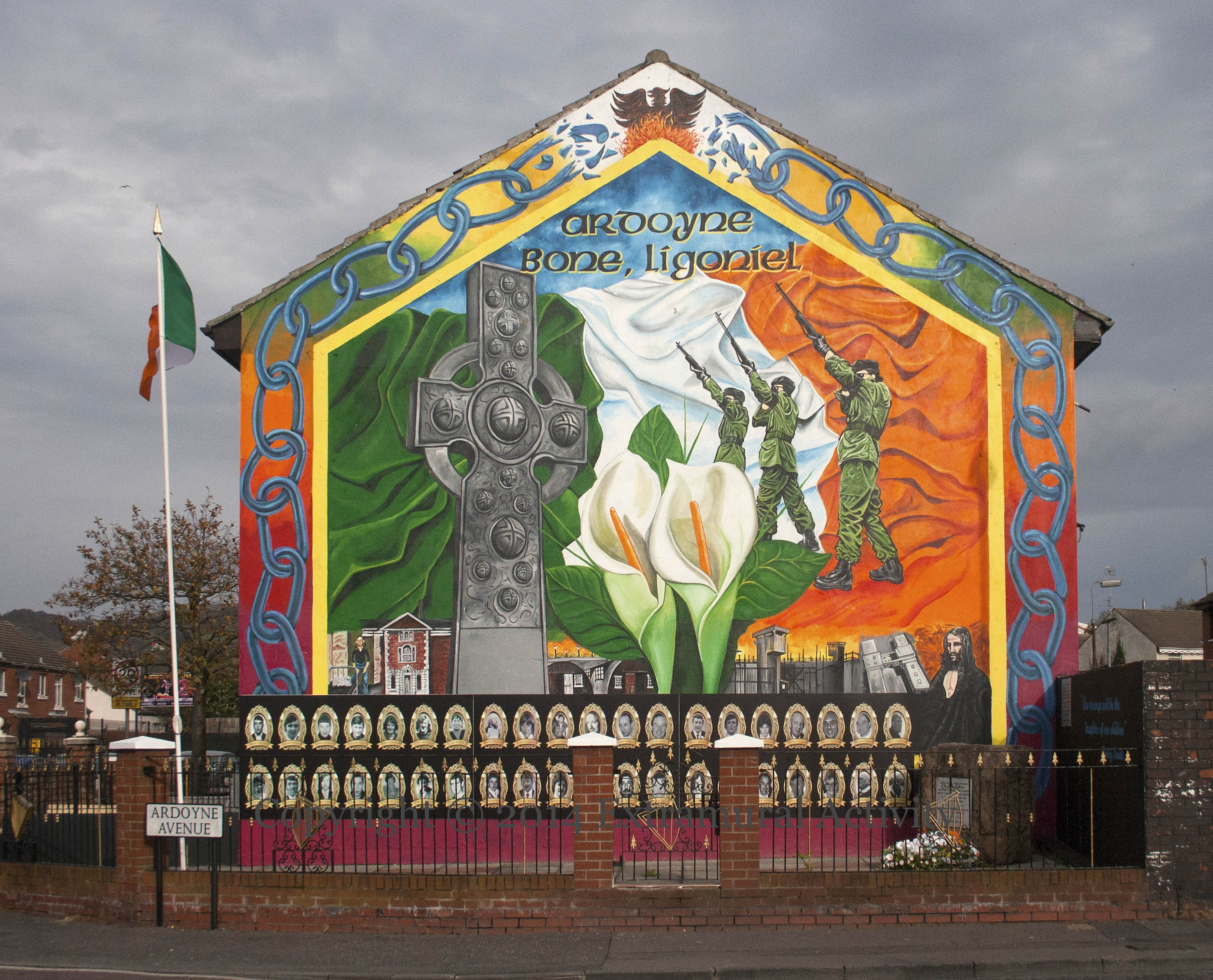
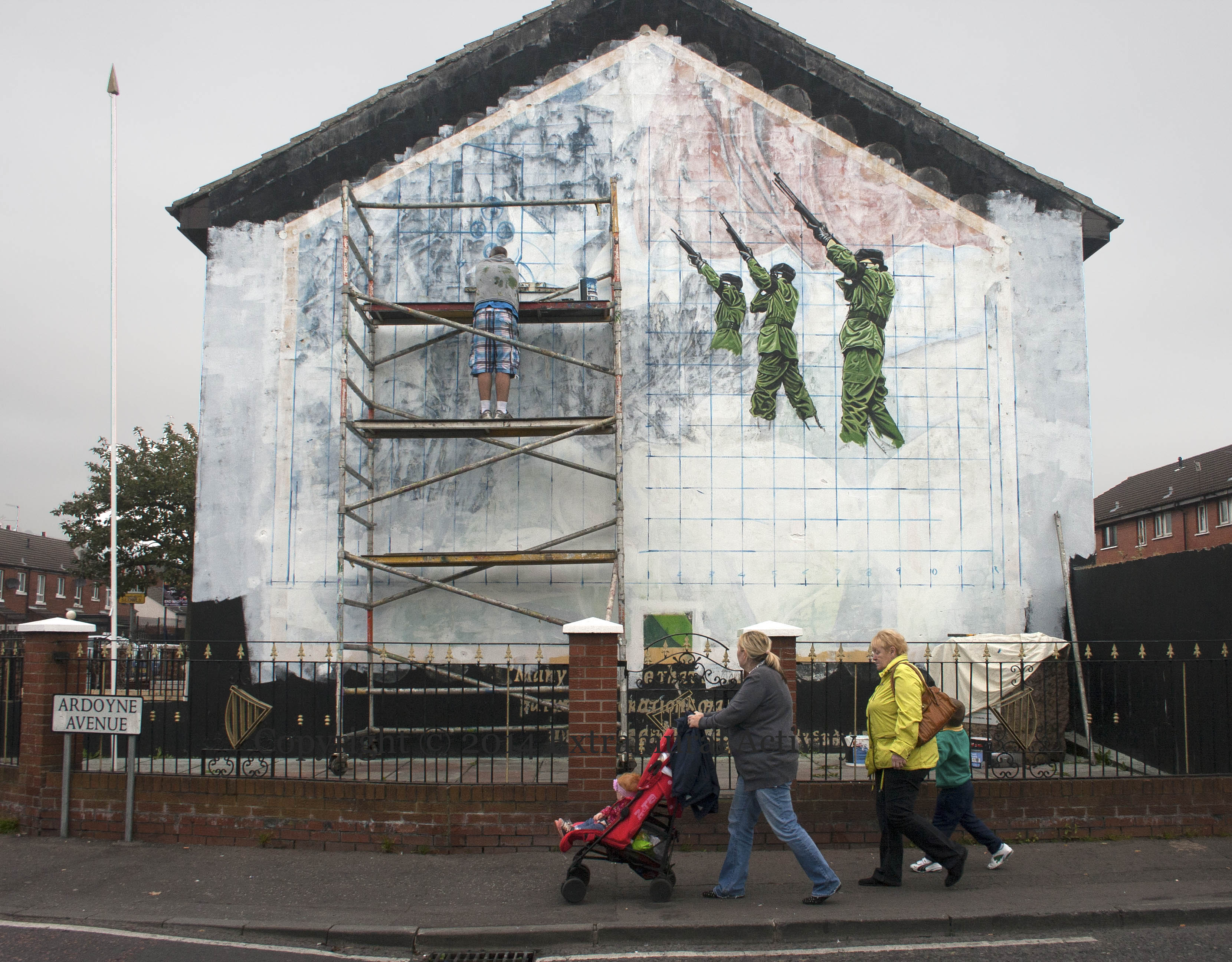
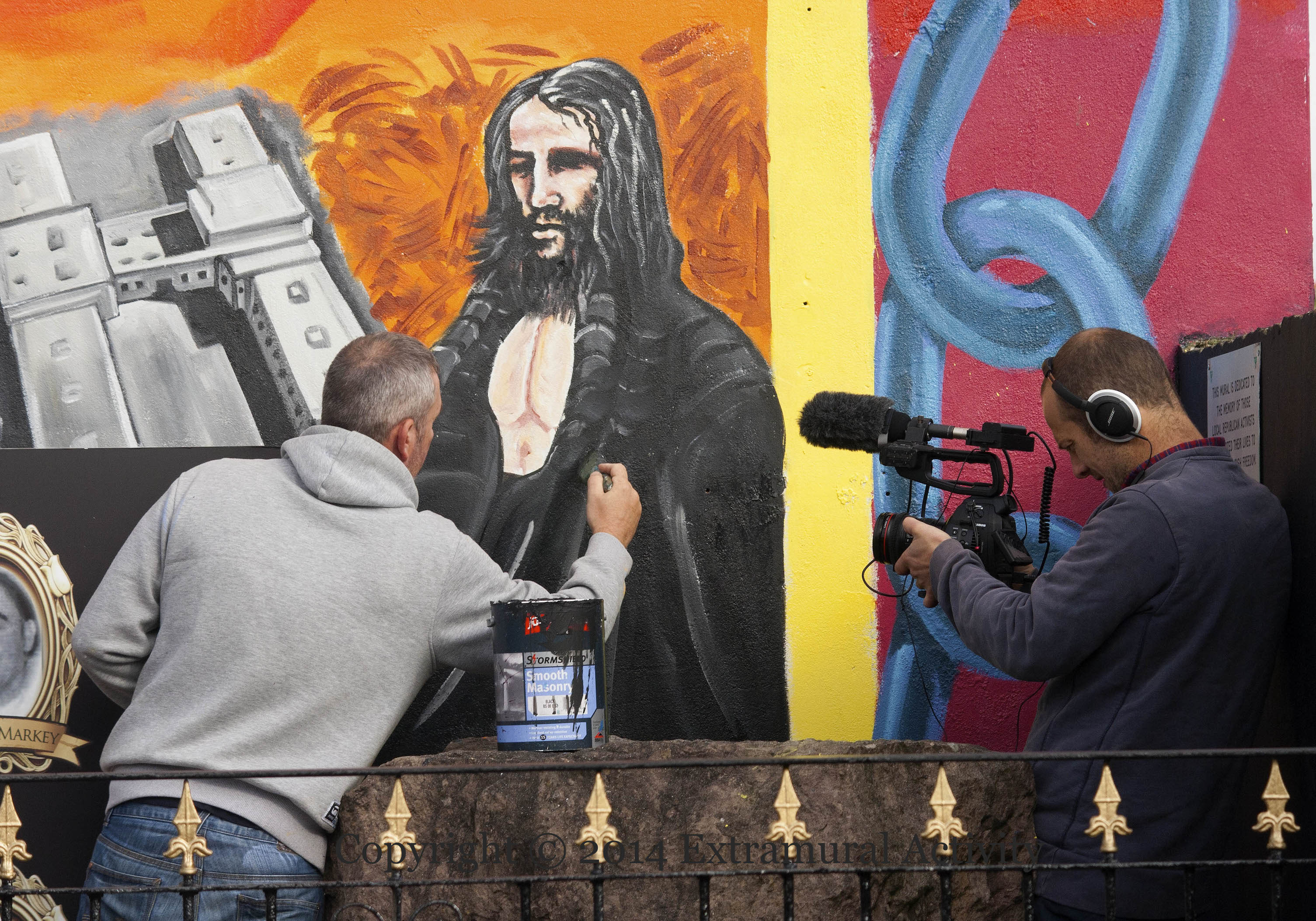
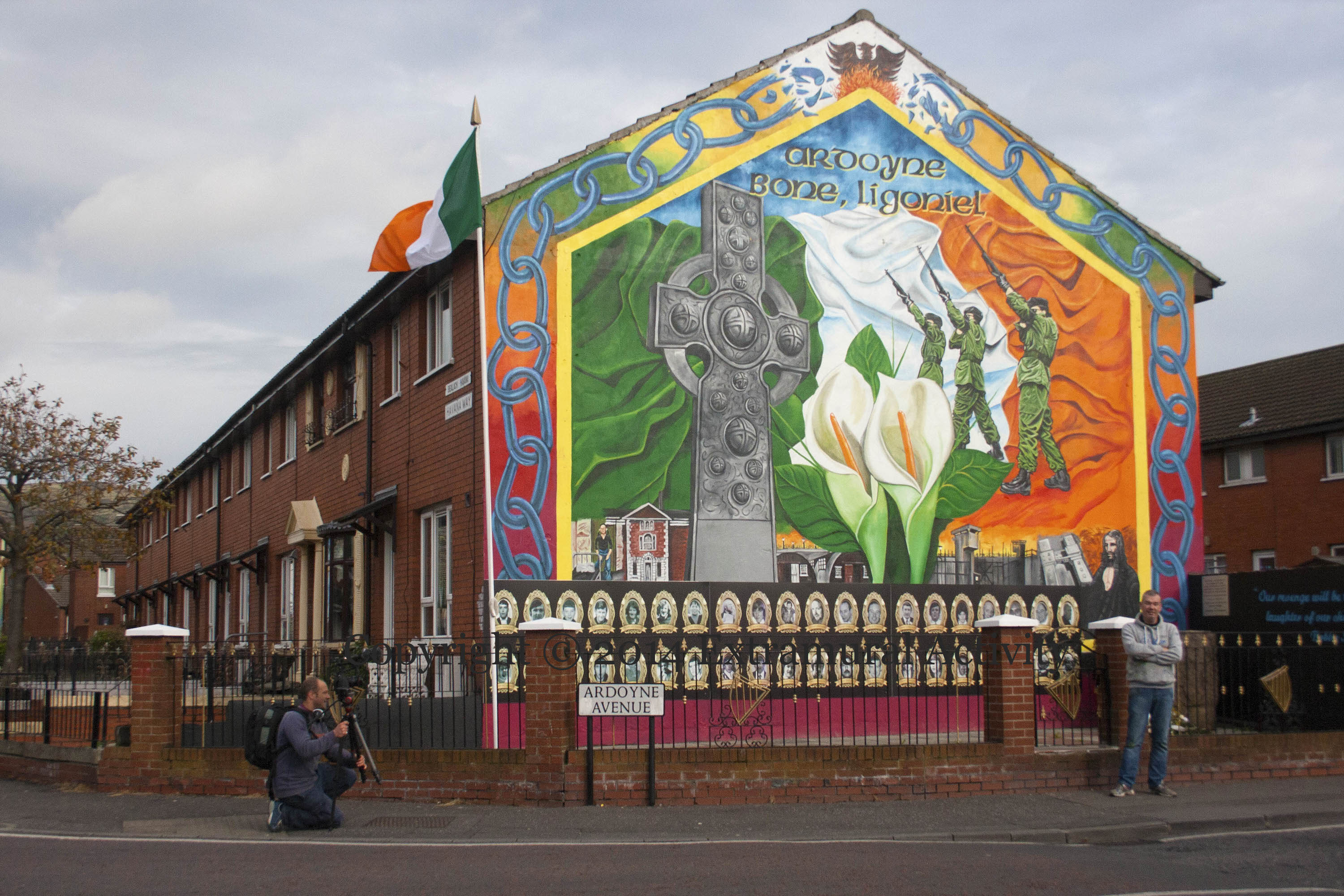
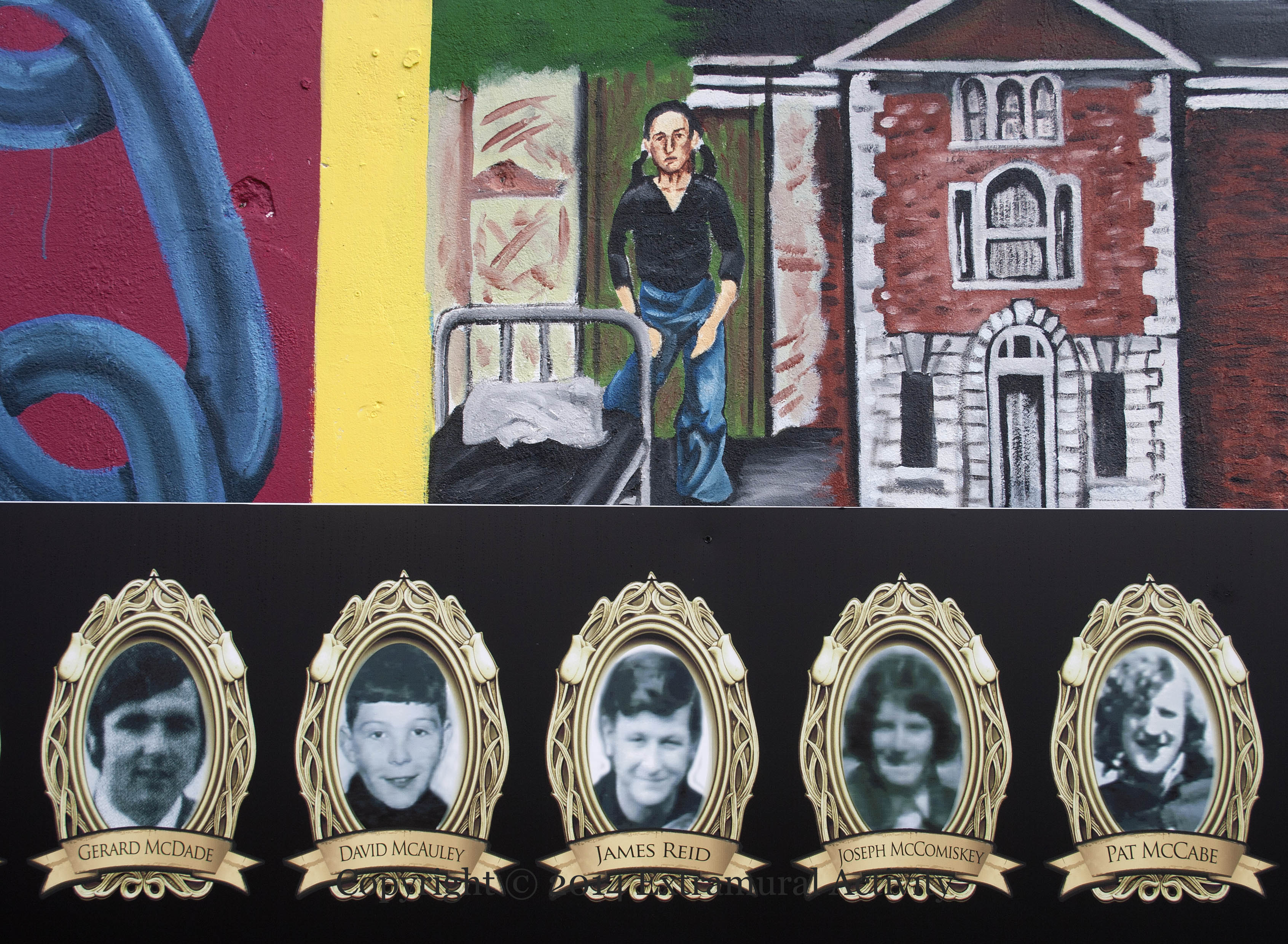
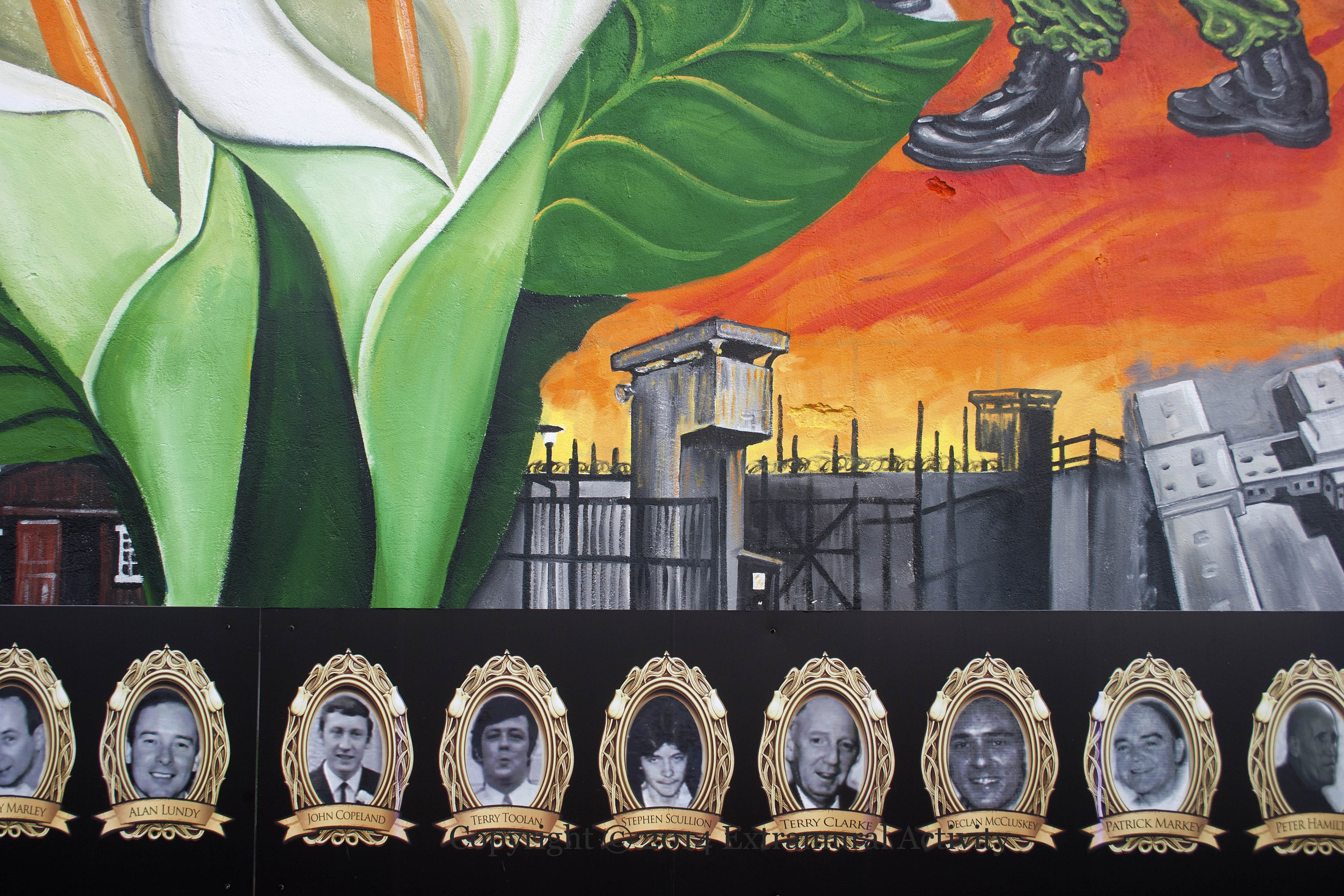
26 volunteers and 14 others from the Ardoyne, Bone, and Ligoniel areas are commemorated in a new (2014-10-05) mural. The images below show artist Mickey Doherty, himself an ex-prisoner, at the start of the process – with the grid-work visible – and shooting an “action” shot for VICE TV.
The previous mural also commemorated local volunteers (34 painted portraits rather than a printed board), but this mural adds a Celtic cross, funeral volley, and images of Armagh women’s prison, the cages at Long Kesh, and the H-blocks, as well as (an inverted image of) blanketman Hugh Rooney – detailed images can be seen in Prison Walls.
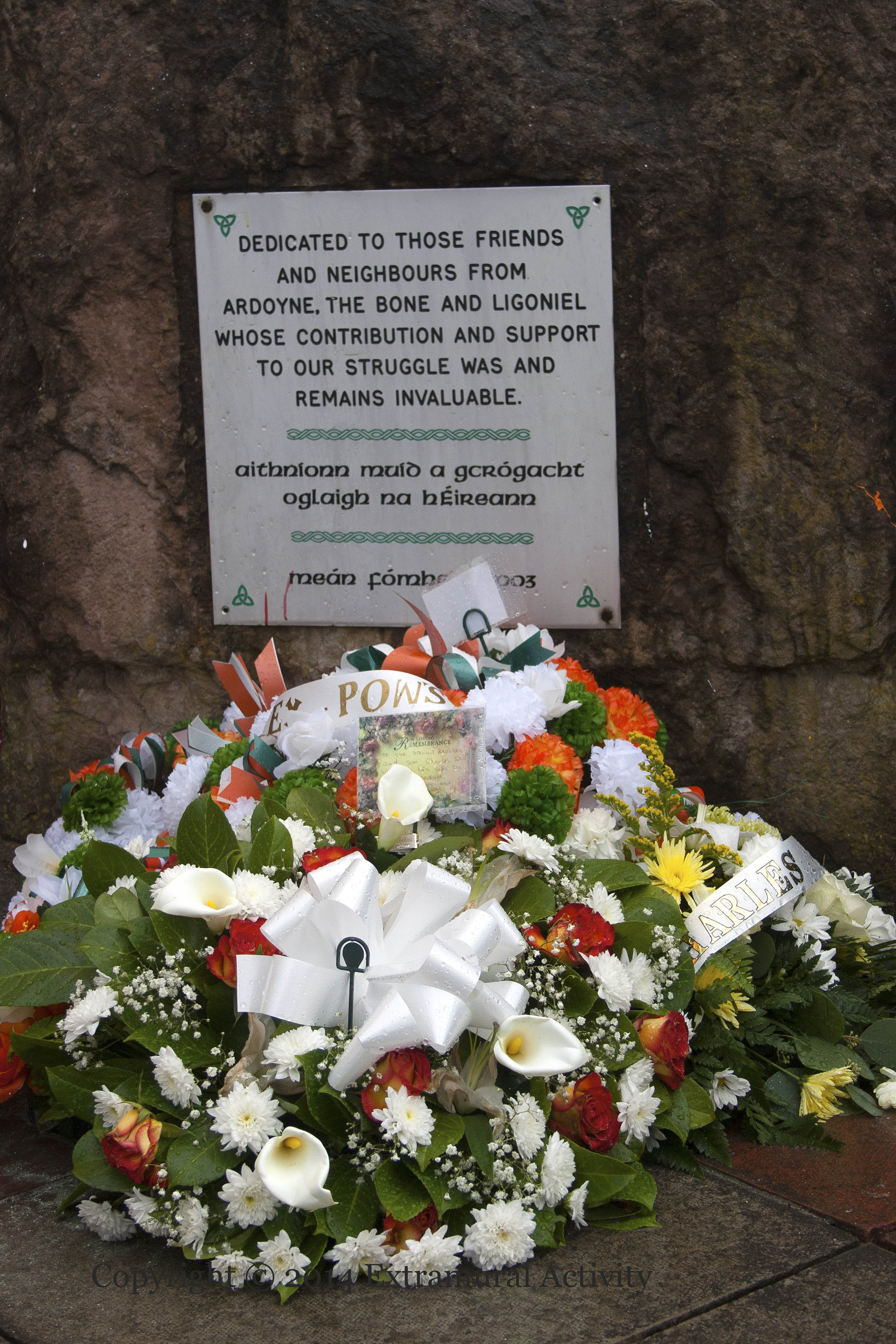
Here are two details from the Ardoyne, Bone, Ligoniel mural presented separately, as well as a shot of bouquets of flowers in front of the plaque on the stone put in place in 2003. The first reproduces a photograph of Maıréad Farrell during the “no-wash” or “dirty” protest in Armagh Women’s Prison. (See the middle of this 1989 Frontline documentary.) The second shows the walls and guard-towers of the H-Blocks (featured previously in You Know Where). The frames and photographs of 40 locals are printed, not painted.
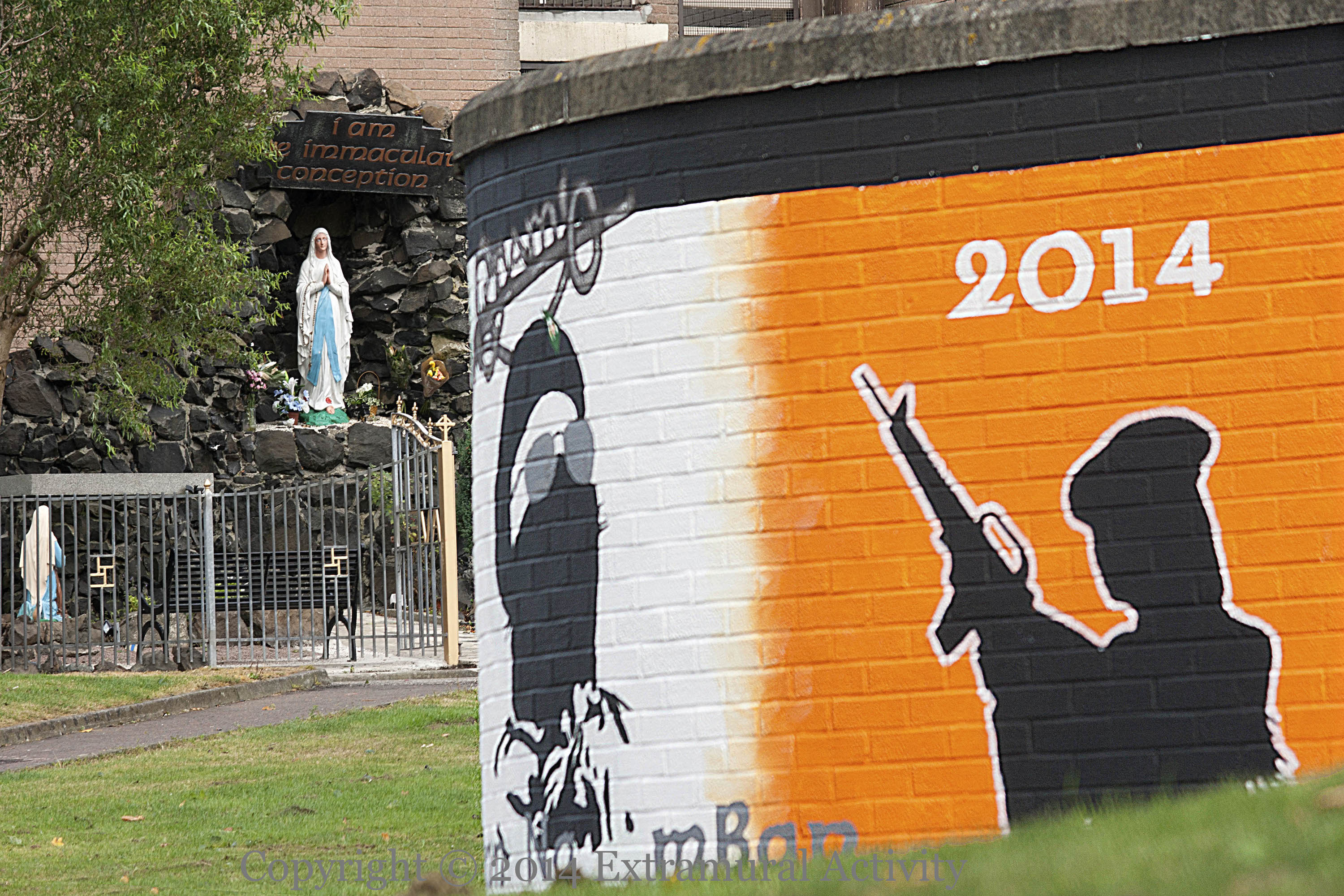
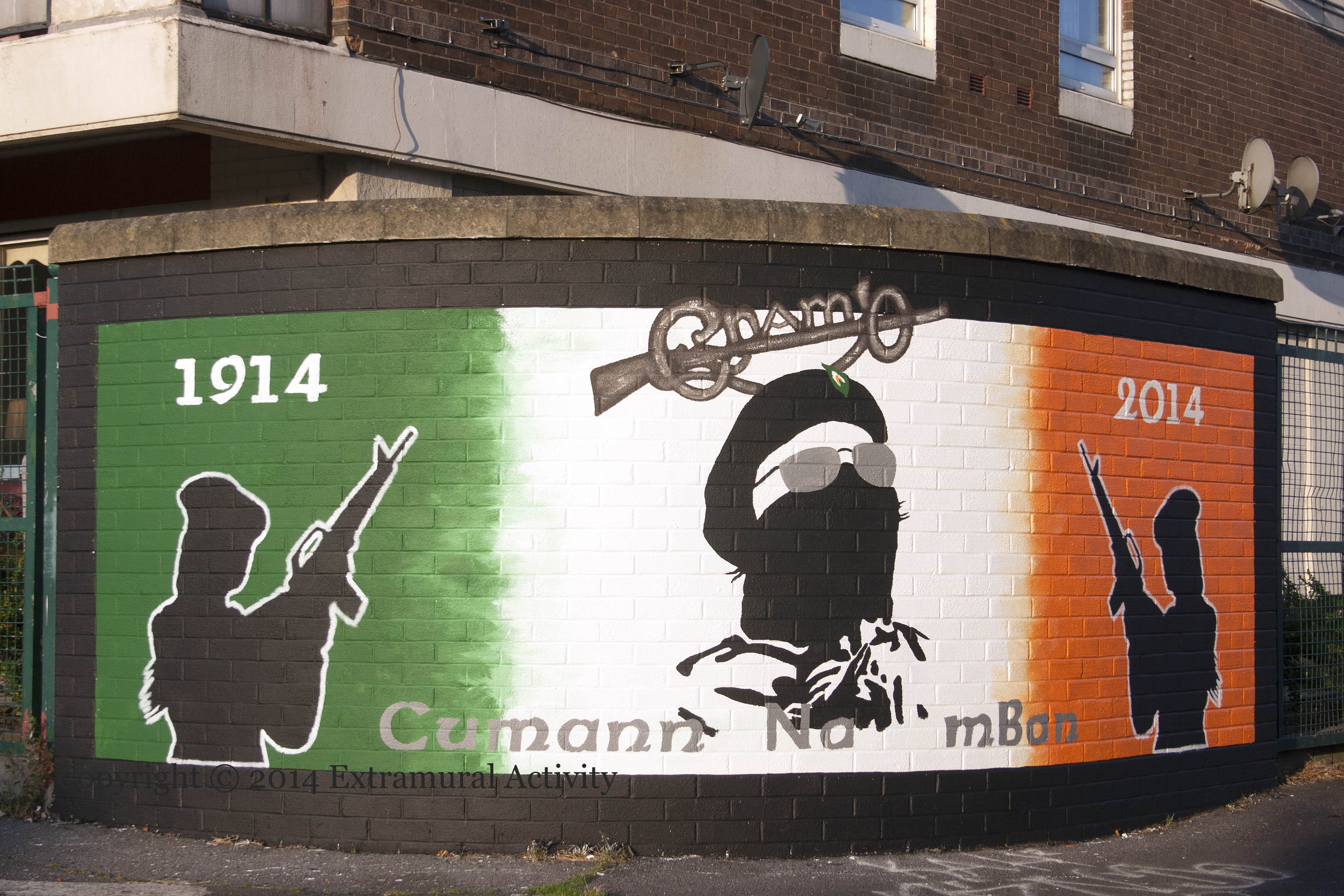
Religion and politics mix in this image of the Blessed Virgin Mary gazing at a recent mural at the bottom of Teach Na bhFıann/Fianna House (formerly Dill House) in the New Lodge. “Cumann Na mBan” in Irish is “the women’s organization/council/society” in English. The organization in question is the republican paramilitary group which was founded on April 2, 1914 and celebrates its 100th anniversary this year.
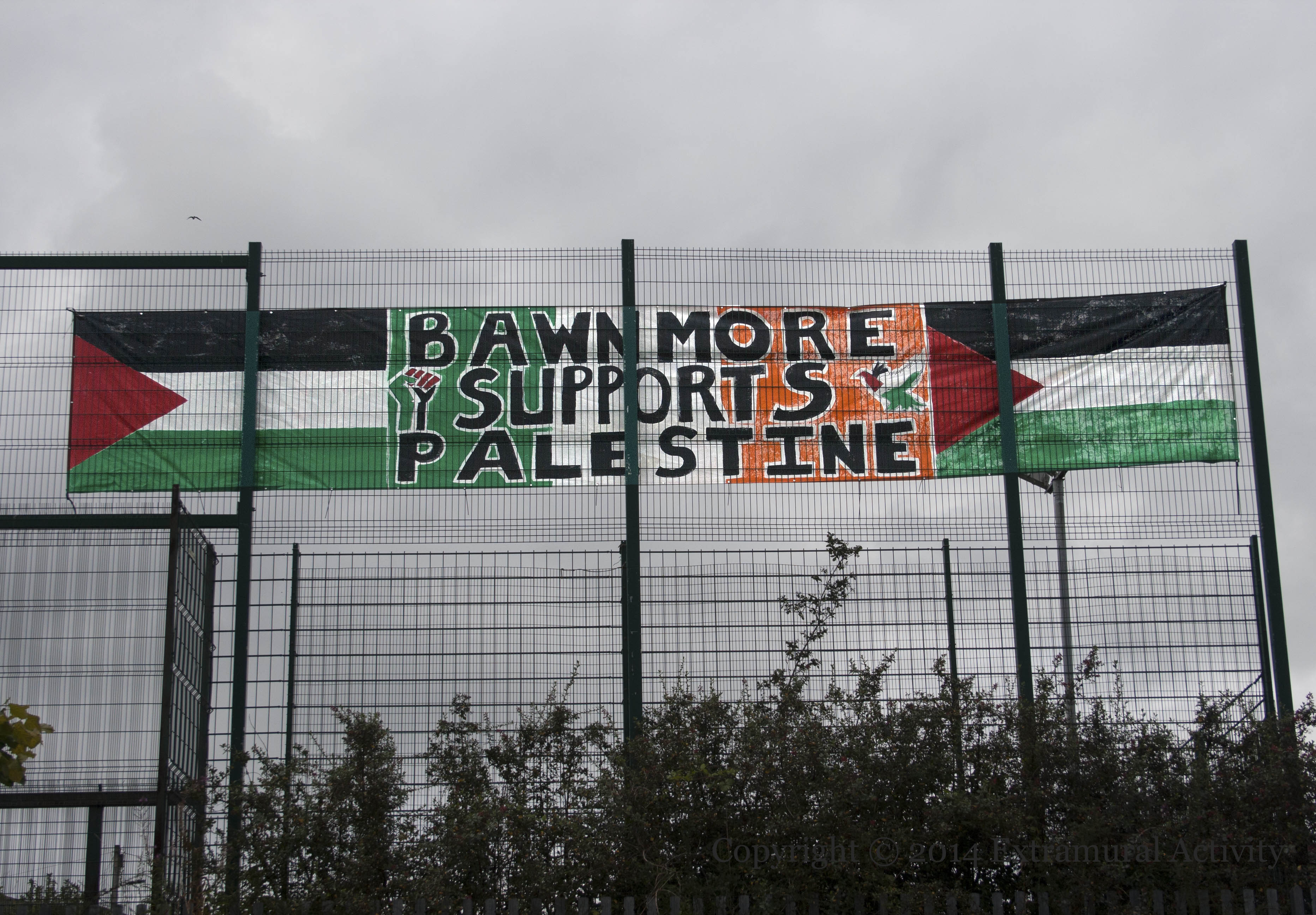
This banner just off the Shore Road includes two Palestinian flags and an Irish tricolour, along with a raised first and the lark of freedom, both in green, black, and red.
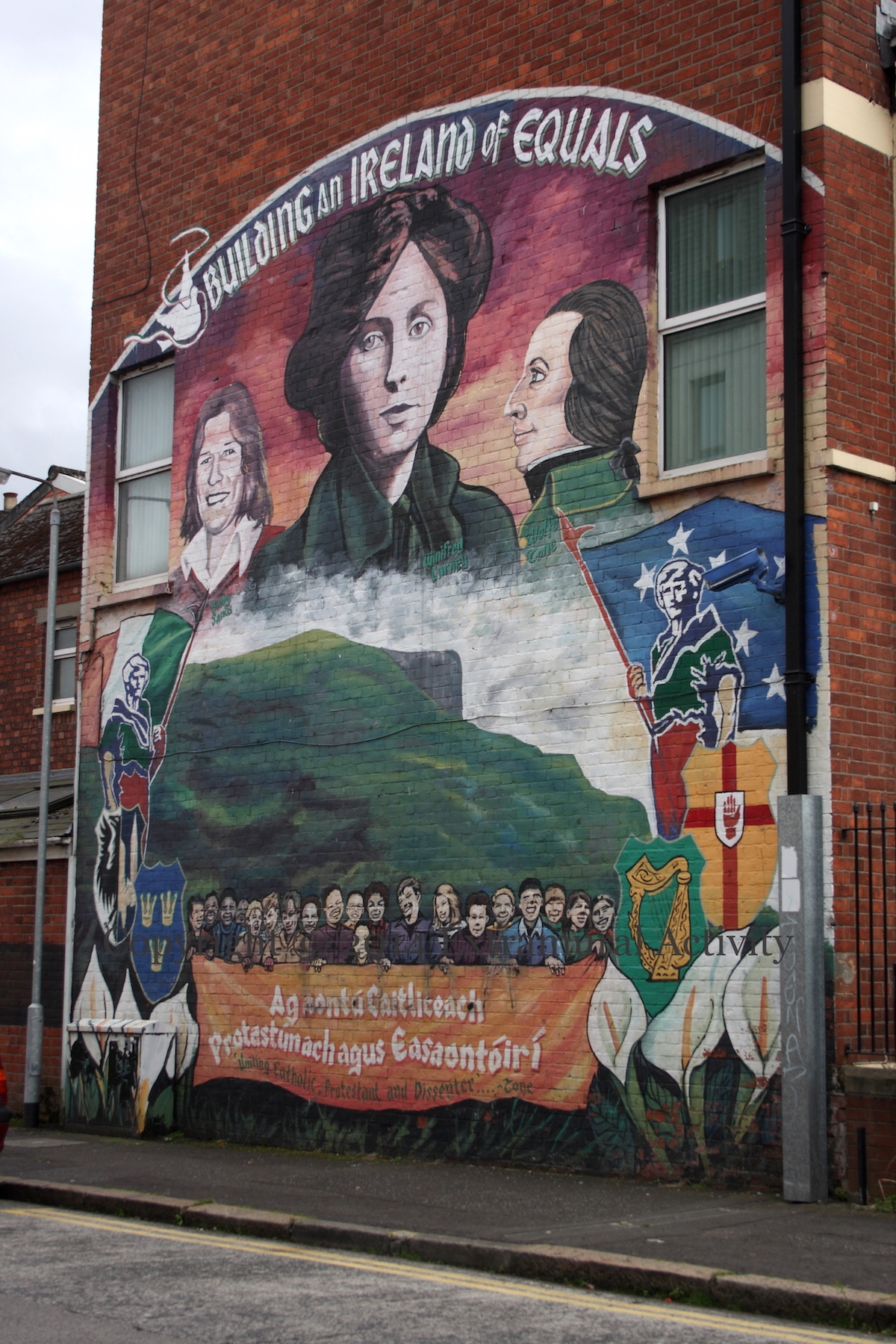
The aspect of Cave Hill commonly known as Napoleon’s Nose is shown sheltering the people of Newington, surrounded by heroes and emblems of the past – Bobby Sands, Wolfe Tone, and in the centre, Winifred Carney. This republican mural is both internally directed (at Newington and the New Lodge) and externally, being on the main Antrim Road (Oceanic avenue, on the side of the Sınn Féın office) which is a main artery between the city and points north.
“Ag aontú Caıtlıceach, Protastúnach agus Easaontóırí.” – “Uniting Catholic, Protestant, and Dissenter.” In An Argument On Behalf Of The Catholics Of Ireland (1791), Wolfe Tone of the United Irishmen wrote, “To subvert the tyranny of our execrable government, to break the connection with England, the never-failing source of all our political evils, and to assert the independence of my country, these were my objects. To unite the whole people of Ireland, to abolish the memory of past dissensions, and to substitute the common name of Irishman, in place of the denominations of Protestant, Catholic and Dissenter, these were my means.”