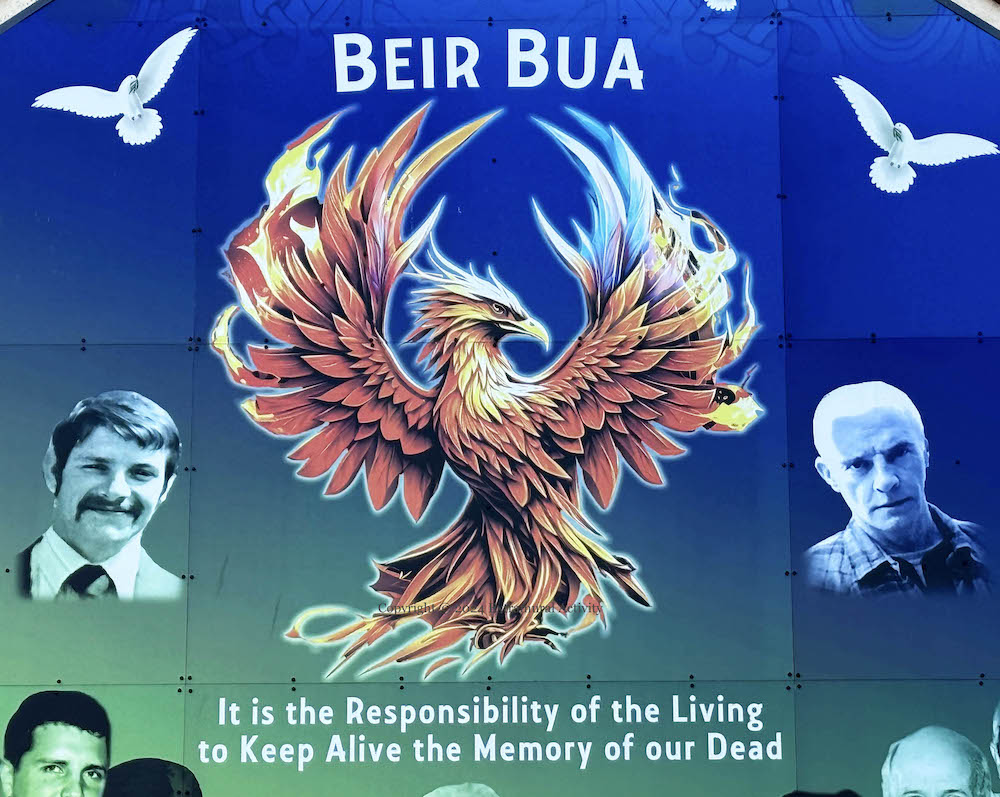
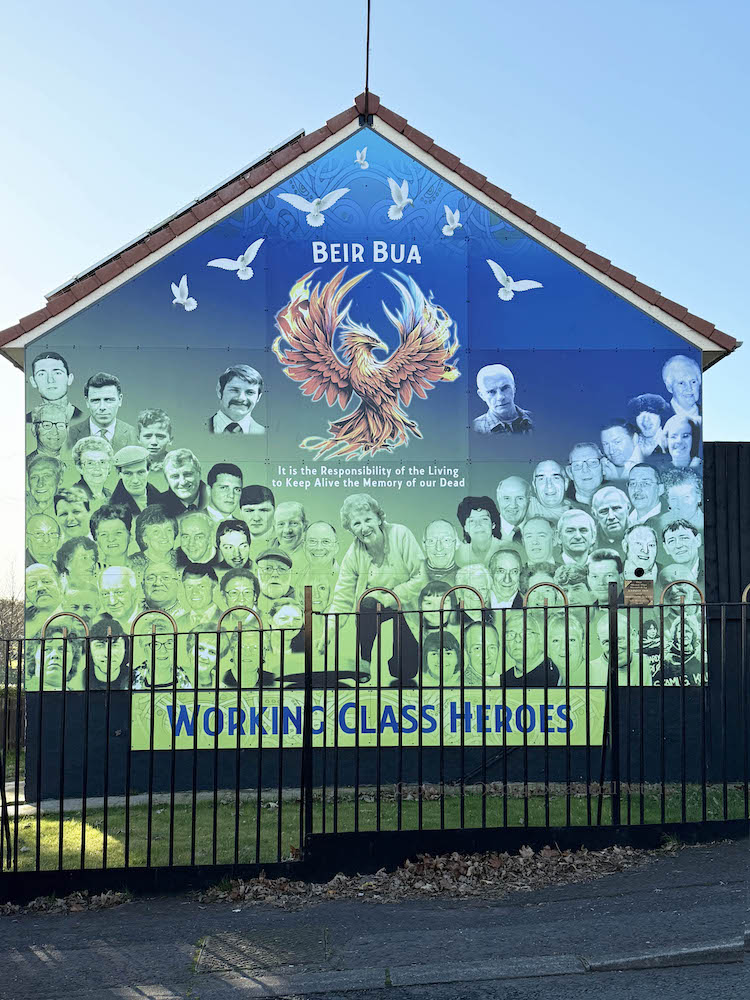
“Beır bua – It is the responsibility of the living to keep alive the memory of the dead.” This is the second ‘Working Class Heroes’ piece in Ballymurphy. The other, from 2014, features Tommy “Toddler” Tolan, who appears here to the left of the phoenix.
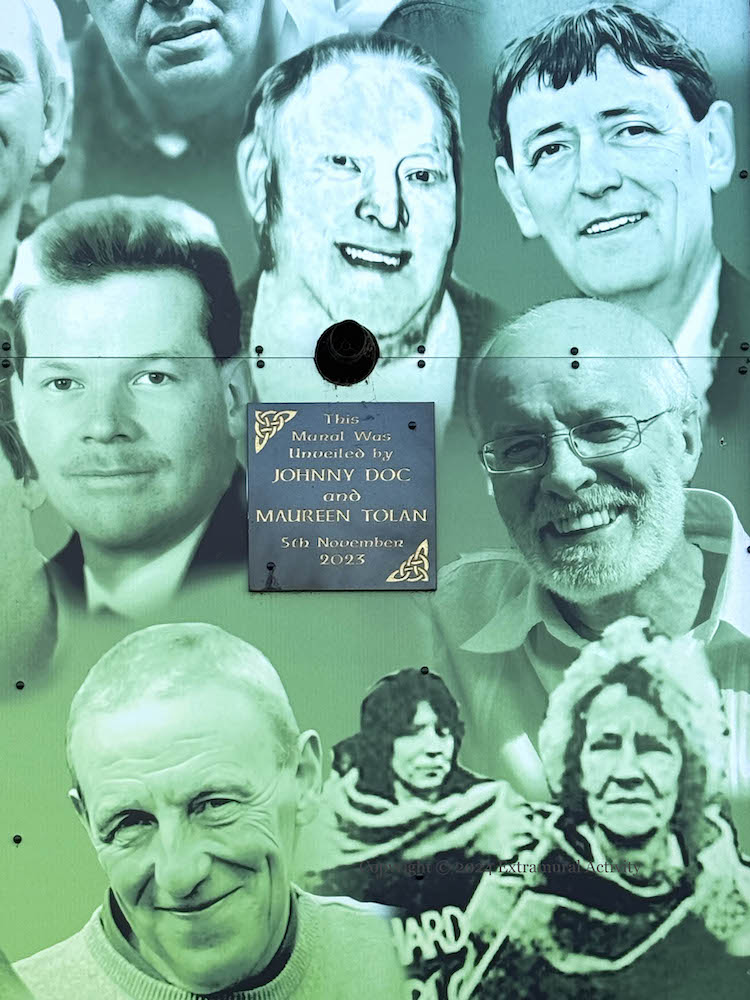
The plaque on the right reads “This mural was unveiled by Johnny Doc and Maureen Tolan, 5th November, 2023.” There is video of the launch on Facebook, which contains a reading of the names of all the people pictured from the 1m 57s mark onwards.
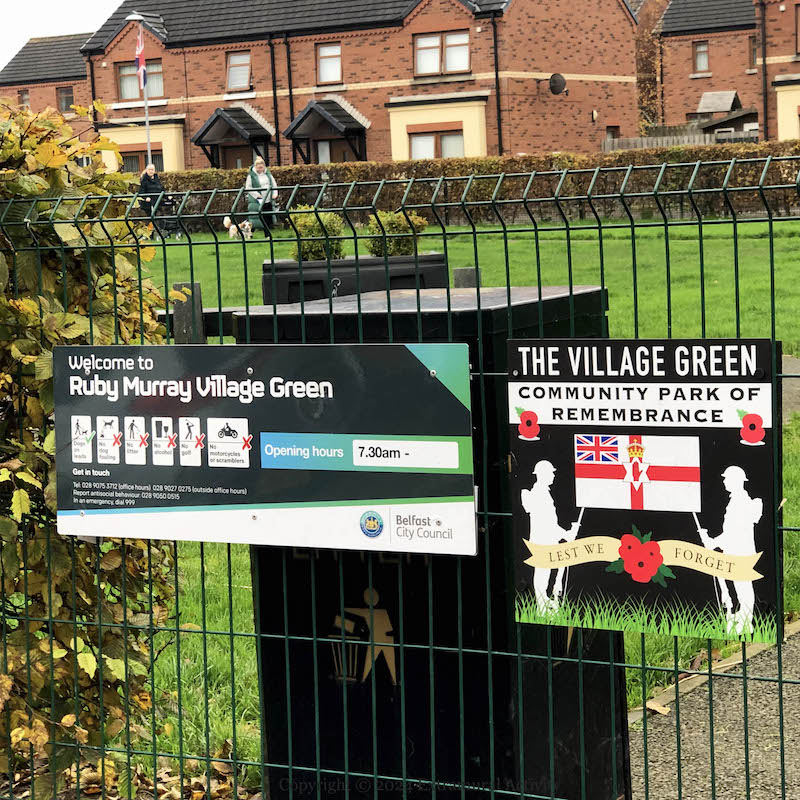
Part of the most recent development of the upper streets in the Village was not to rebuild the two rows of houses on Ebor and Nubia/Moltke streets and in their place construct a park – the Village Green, and now officially the “Ruby Murray Village Green” – and playground. The board on the outside railings make the park a “community park of remembrance” for WWI, showing an Ulster Banner with a Union Flag in the canton. (Seen previously in The Village Green Preservation Society.)
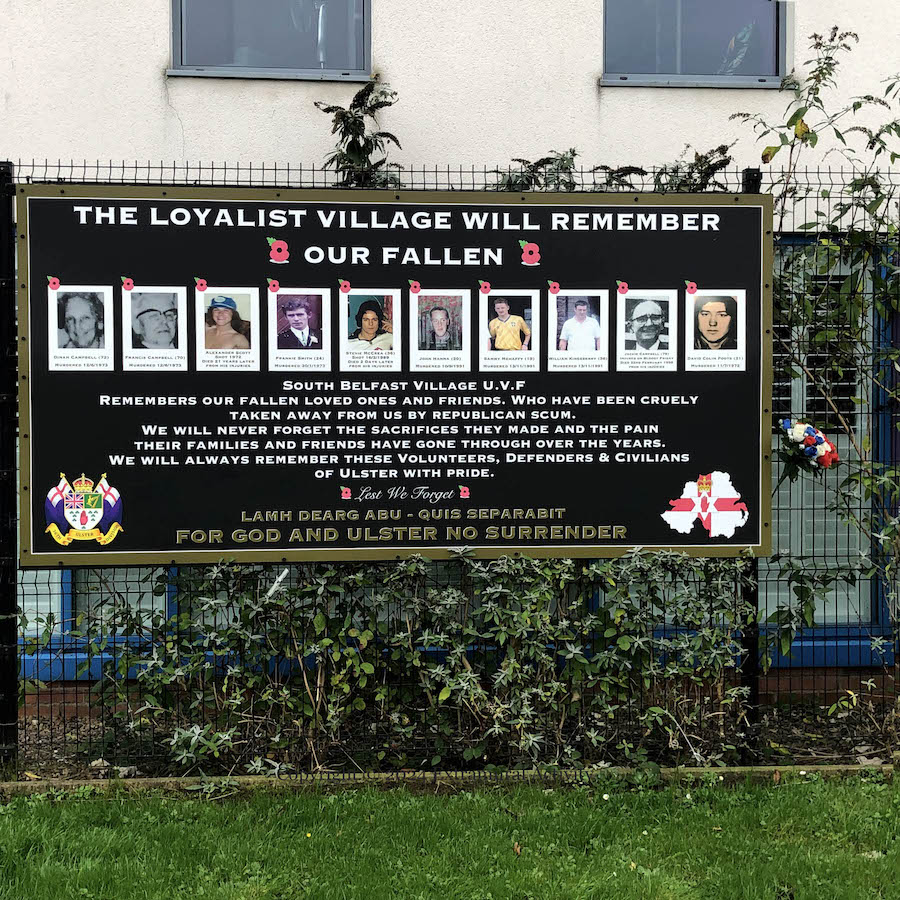
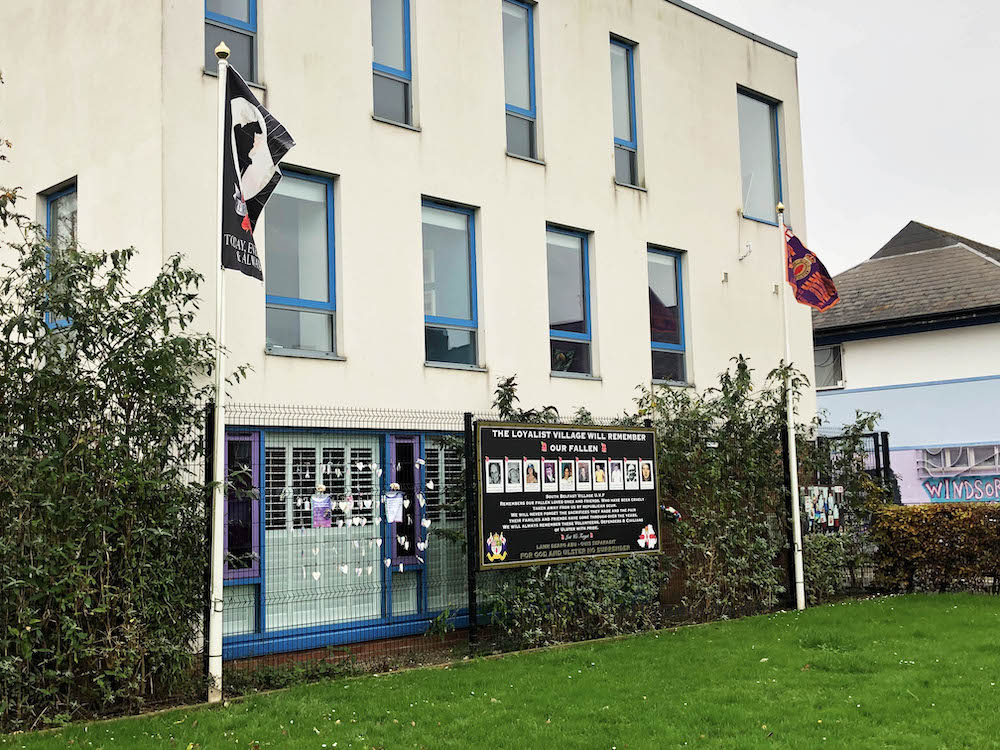
There is also a memorial to “loved ones and friends”, “volunteers, defenders & civilians” of the South Belfast UVF (though there is 36th (Ulster) Division emblem in the corner!) who were “cruely taken away from us by republican scum”: Dinah Campbell, Francis Campbell, Alexander Scott, Frankie Smith, Stevie McCrea, John Hanna, Sammy Mehaffy, William Kingsberry, Jackie Campbell, David Poots.
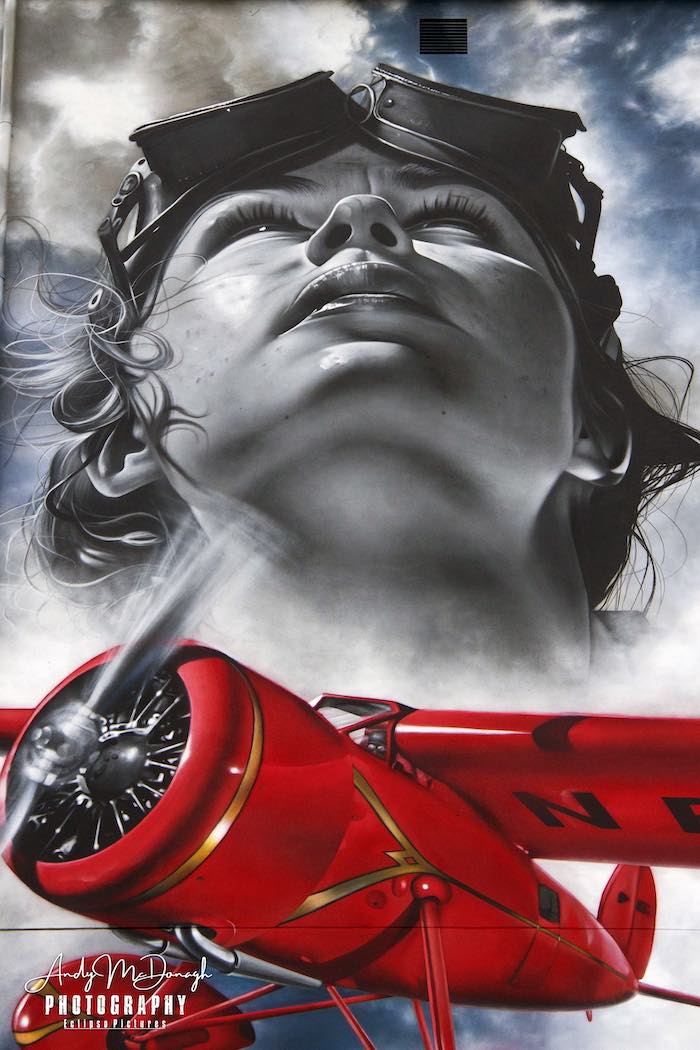
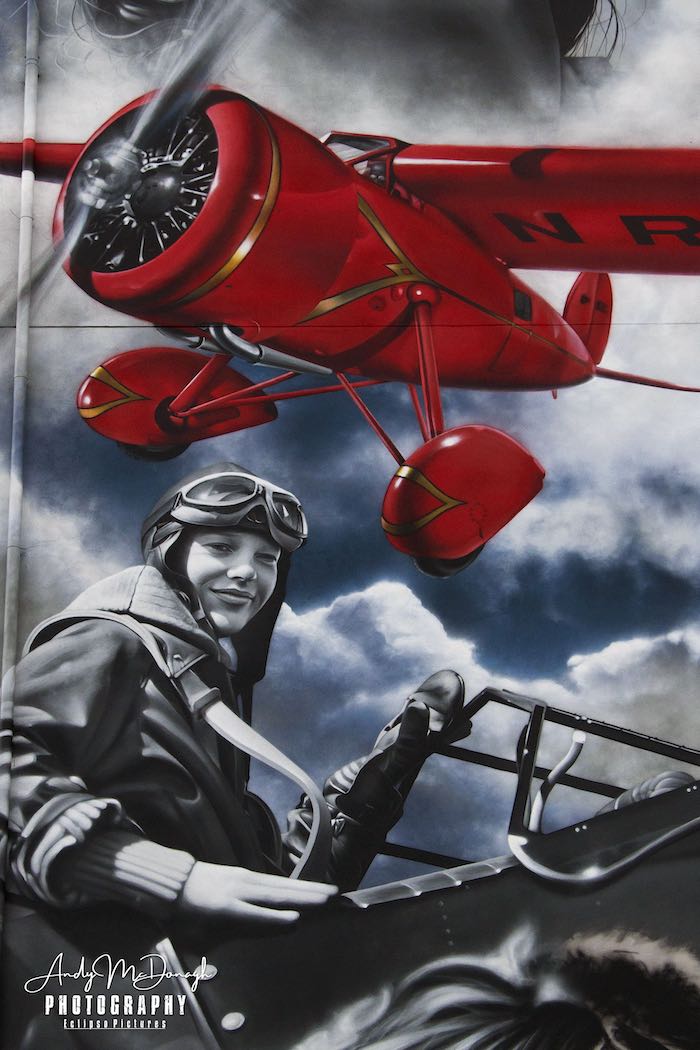
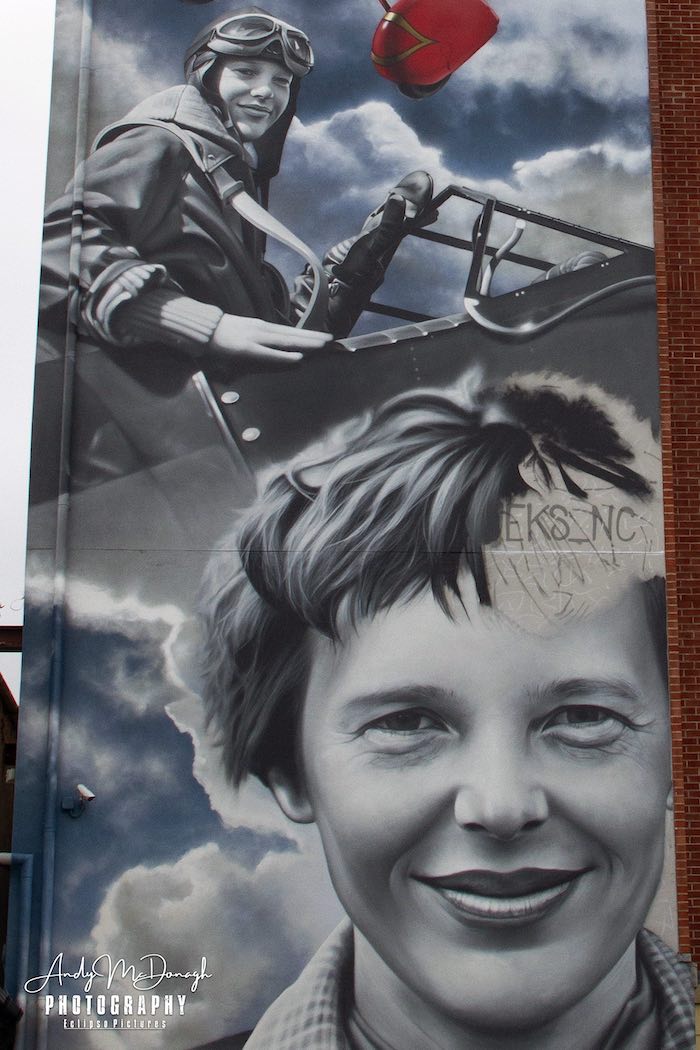
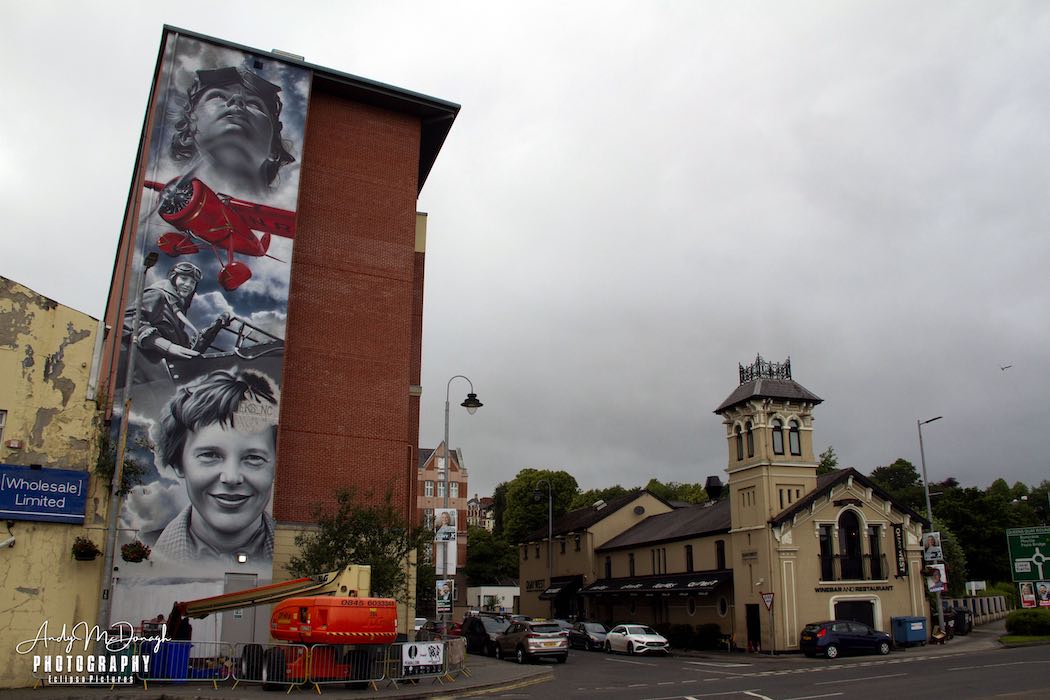
A new painting of Amelia Earhart has been created by JEKS (ig), on the side of the Foyle building, North West Regional College, on Queen’s Quay. A number of sources claim without citation or measurement that it is the tallest piece of street art in the north – both the BBC and the Chamber Of Commerce use the passive “thought to be”. Its closest competitor would be the recent piece by Zabou on the Telegraph Building in Belfast – see Broken Promises.
The Foyle Building has six “levels” (NWRC) while the original Telegraph Building had four storeys (Archiseek). In addition to comparing images of the two paintings, you can also judge by comparing Street View images of the buildings: Derry vs Belfast.
Information about Earhart’s connection to the Maiden City can be found in the entries on the printed board (But What Do Dreams Know Of Boundaries?) and the mosaic (Flying Solo) to Earhart in Derry.
JEKS did eventually fill in the hair (and so cover over his instagram handle) on the lower portrait.
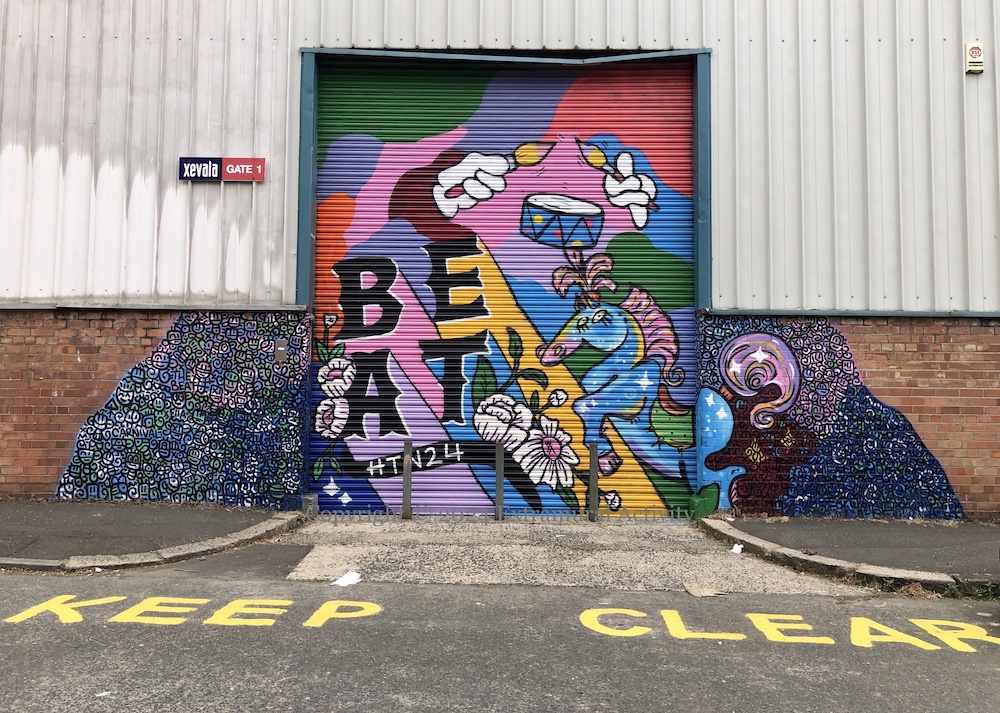
Beat Carnival Belfast (ig | web) puts on celebrations all over town and teaches skills from its base in Millfield/Brown’s Square. Artists Danni Simpson (ig), Codo (ig), Ana Fish (ig), and FGB (ig) worked together to spray this piece on the Gardiner Street door.
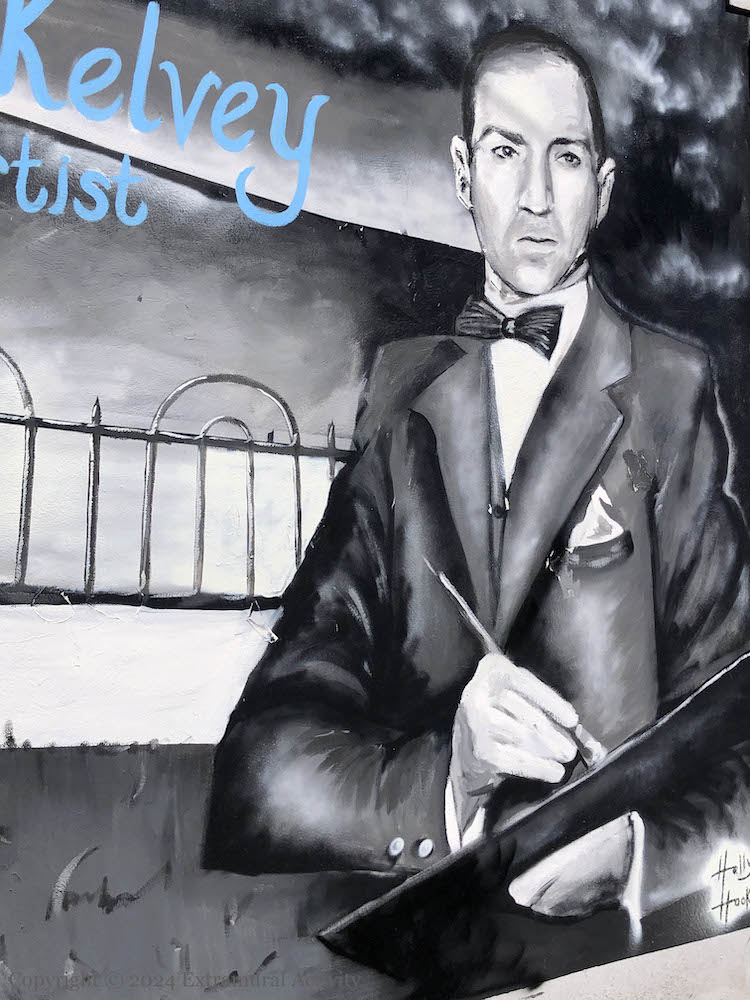
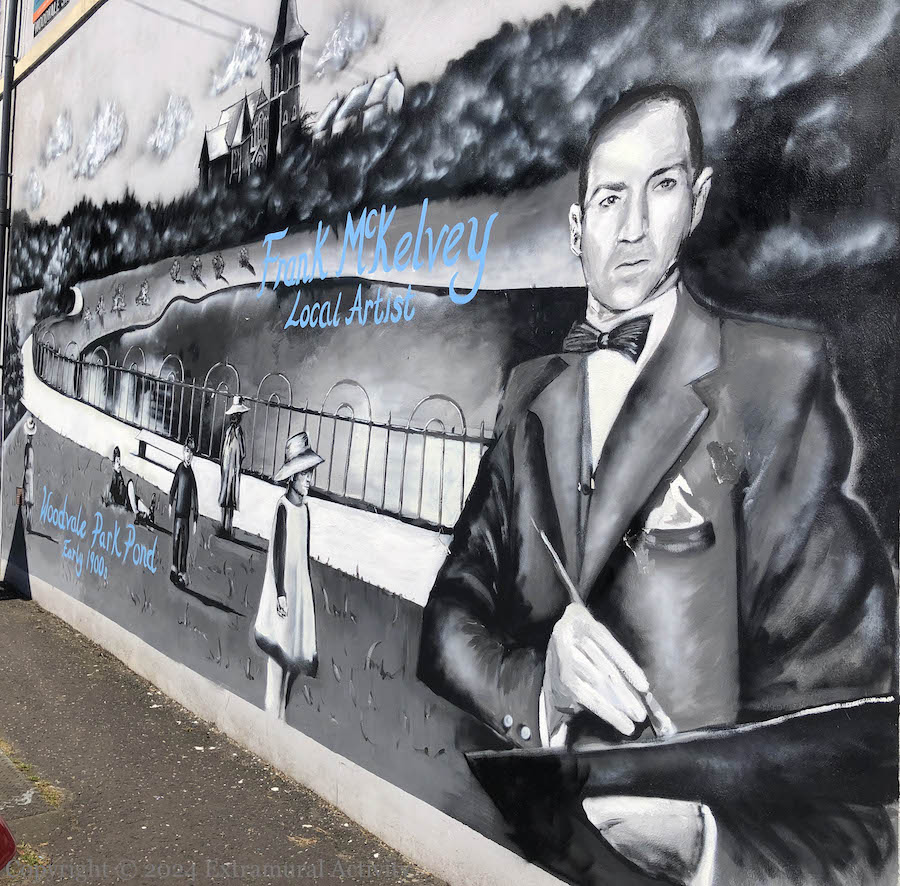
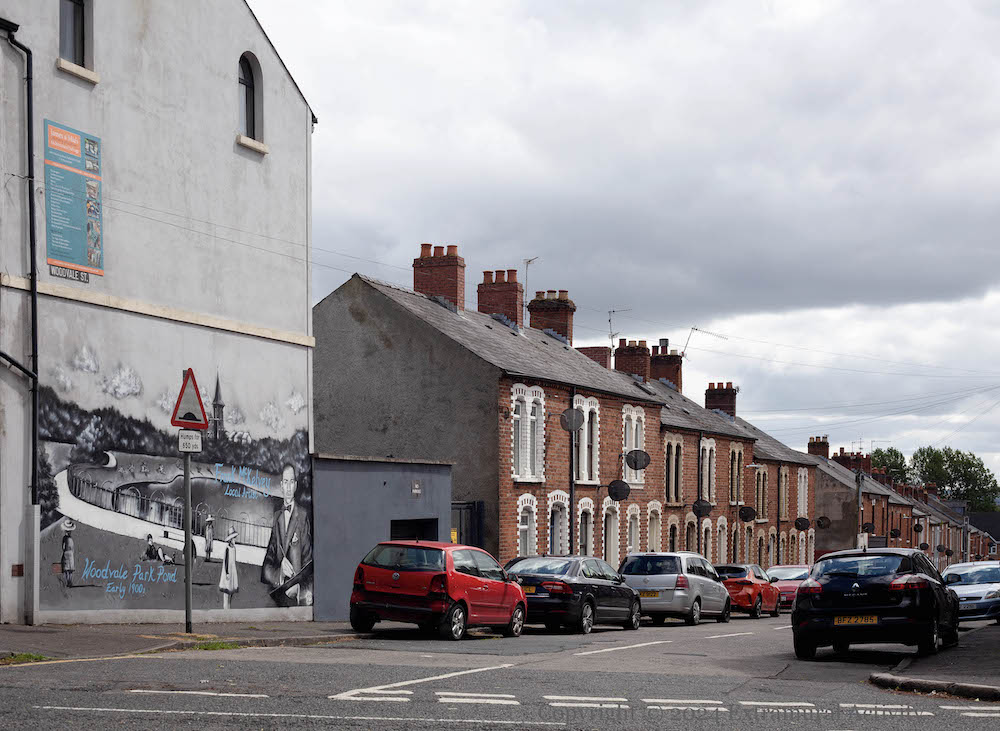
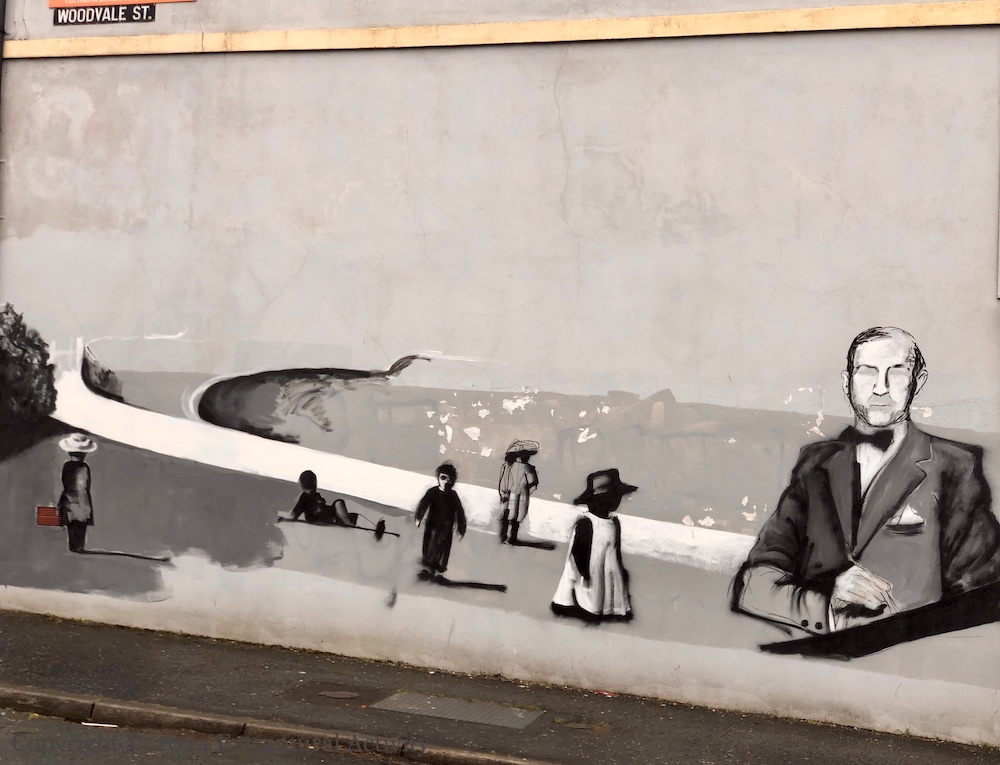
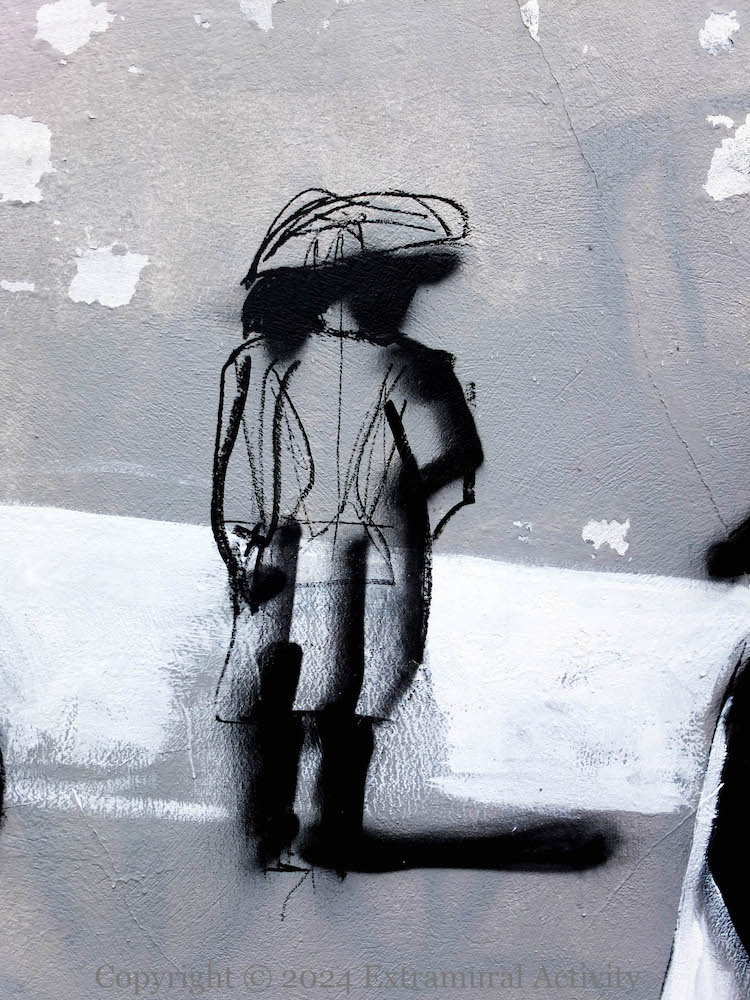
Francis “Frank” McKelvey grew up at 56 Woodvale Road (based on Lennon Wylie and the blue plaque on the wall at this address – Street View). That would put him a stone’s throw from Woodvale Park, which provides the backdrop for this new mural at the end of Woodvale Street. The photograph reproduced, of “Woodvale park pond”, can be seen on the Old Shankill Fb page. The pond was filled in after the second World War (City Council). McKelvey’s ‘A Summer’s Day‘ is perhaps of Woodvale Park pond. He died in 1974 (Ulster History Circle).
By Holly Hooks (ig) in Woodvale Street, west Belfast.
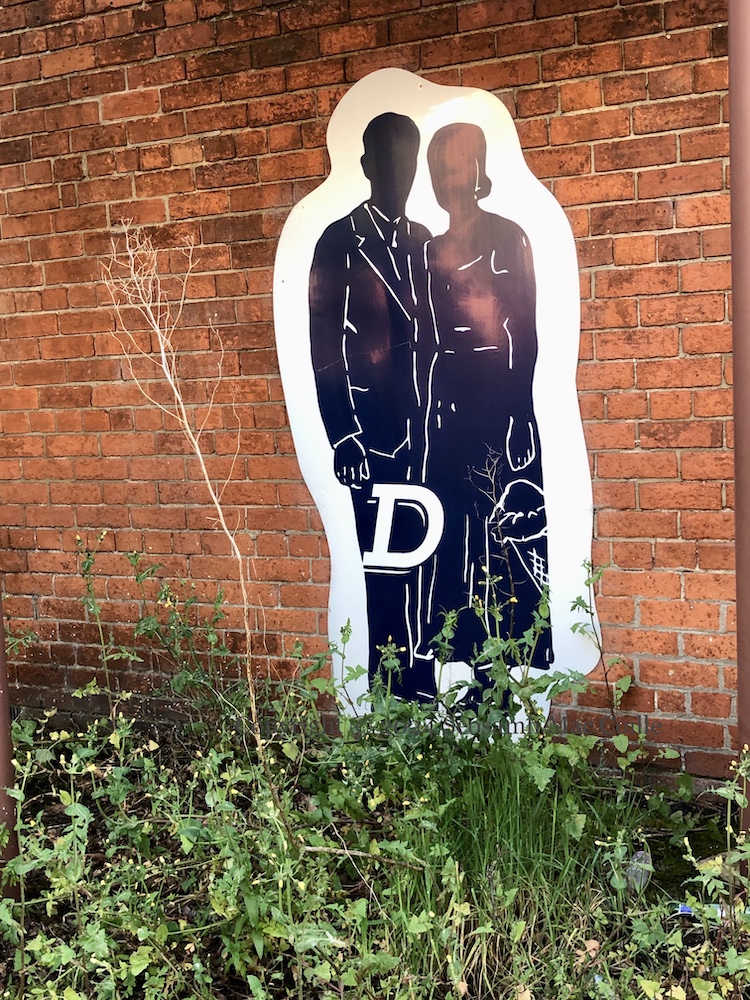
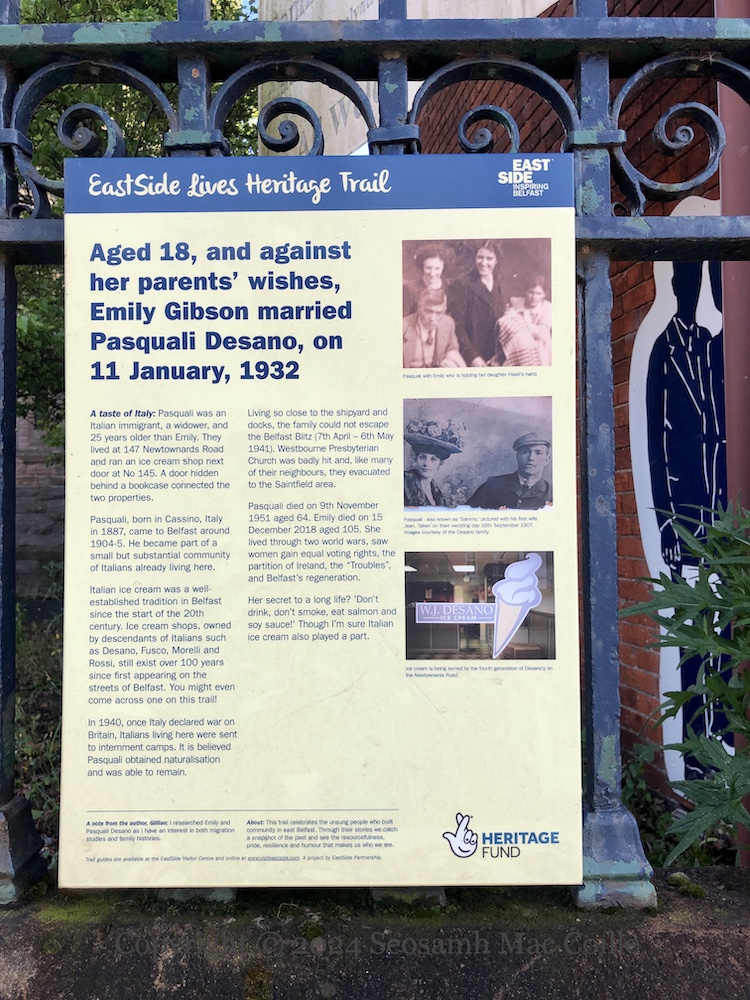
“Aged 18, and against her parents’ wishes, Emily Gibson married Pasquali Desano, on 11 January, 1932. A taste of Italy: Pasquali was an Italian immigrant, a widower, and 25 years older than Emily. They lived at 147 Newtownards Road and ran an ice cream shop next door at No 145. A door hidden behind a bookcase connected the two properties. Pasquali, born in Cassino, Italy in 1887, came to Belfast around 1904-5. He became part of a small but substantial community of Italians already living here. Italian ice cream was a well-established tradition in Belfast since the start of the 20th century. Ice cream shops, owned by descendants of Italians such as Desano, Fusco, Morelli and Rossi, still exist over 100 years since first appearing on the streets of Belfast. You might even come across one on this trail. In 1940, once Italy declared war on Britain, Italians living here were sent to internment camps. It is believed that Pasquali obtained naturalisation and was able to remain. Living so close to the shipyard and docks, the family could not escape the Belfast Blitz (7th April – 6th May 1941). Wesbourne Presbyterian Church was badly hit and, like many of their neighbours, they evacuated to the Saintfield area. Pasquali died on 9th November 1951, aged 64. Emily died on 15 DEcember 2018 aged 105. She lived through two world wars, saw women gain equal voting rights, the partition of Ireland, the ‘Troubles’, and Belfast’s regeneration. Her secret to a long life? ‘Don’t drink, don’t smoke, eat salmon and soy sauce!’ Though I’m sure the Italian ice cream also played a part.”
The info sign is on the railings of Westbourne Presbyterian; the graphic is on a courtyard wall.
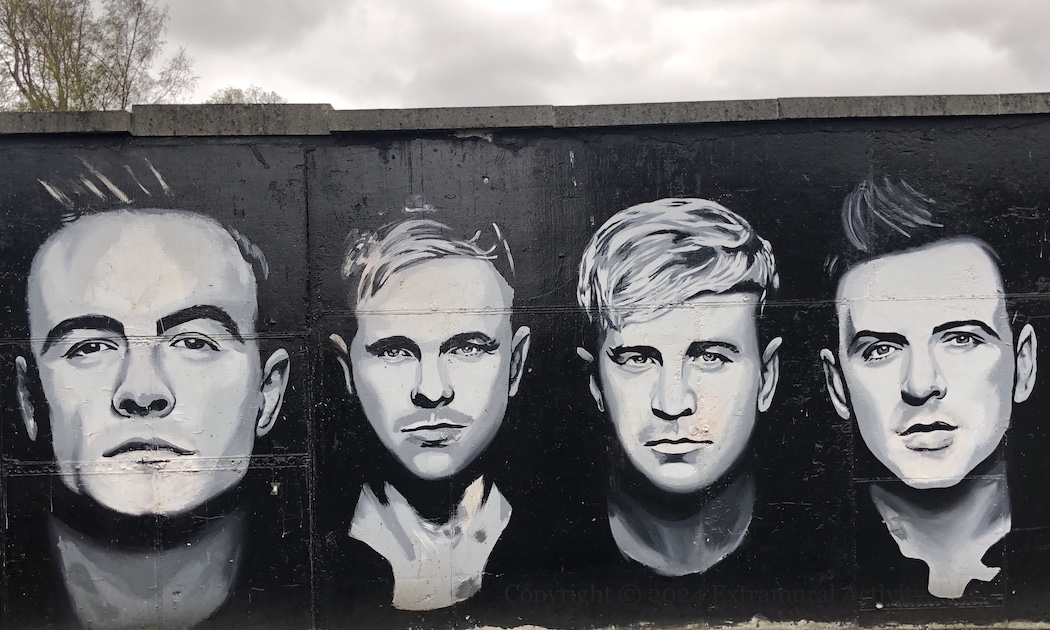
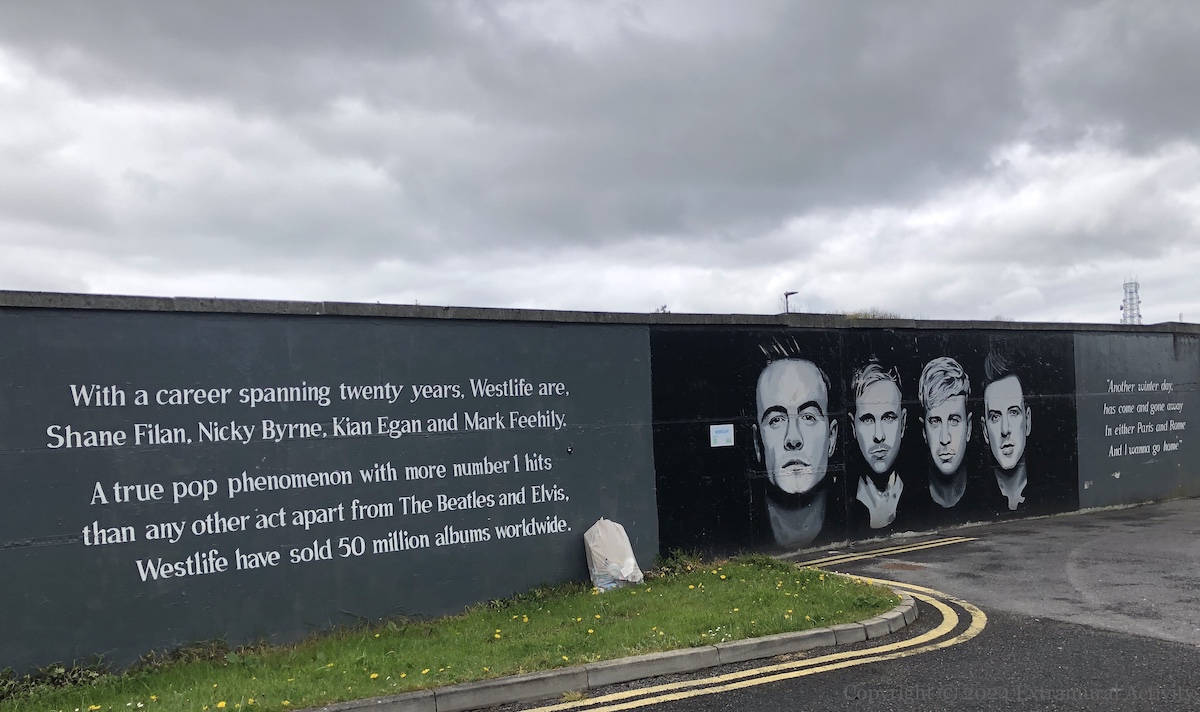
“Another winter day/has come and gone away/In either Paris and [or] Rome/And I wanna go home” – words from the Michael Bublé-penned song ‘Home’ which boy-band Westlife released on its 2007 album, Back Home. For Egan, Feehily, and Filan, home is, or was, Sligo — the three went to Summerhill secondary school and were together in earlier bands; Byrne (and Bryan/Brian McFadden who was a member of the group from 1998 to 2004 but is not included in the mural) is from Dublin (WP).
“With a career spanning twenty years, Westlife are, Shane Filan, Nicky Byrne, Kian Egan and Mark Feehily. A true pop phenomenon with more number 1 hits than any other act apart from The Beatles and Elvis, Westlife have sold 50 million albums worldwide.”
The mural is behind Gilooly Hall, on Temple Street, Sligo. It was painted in 2015 by Kelan Curran (TAPA).
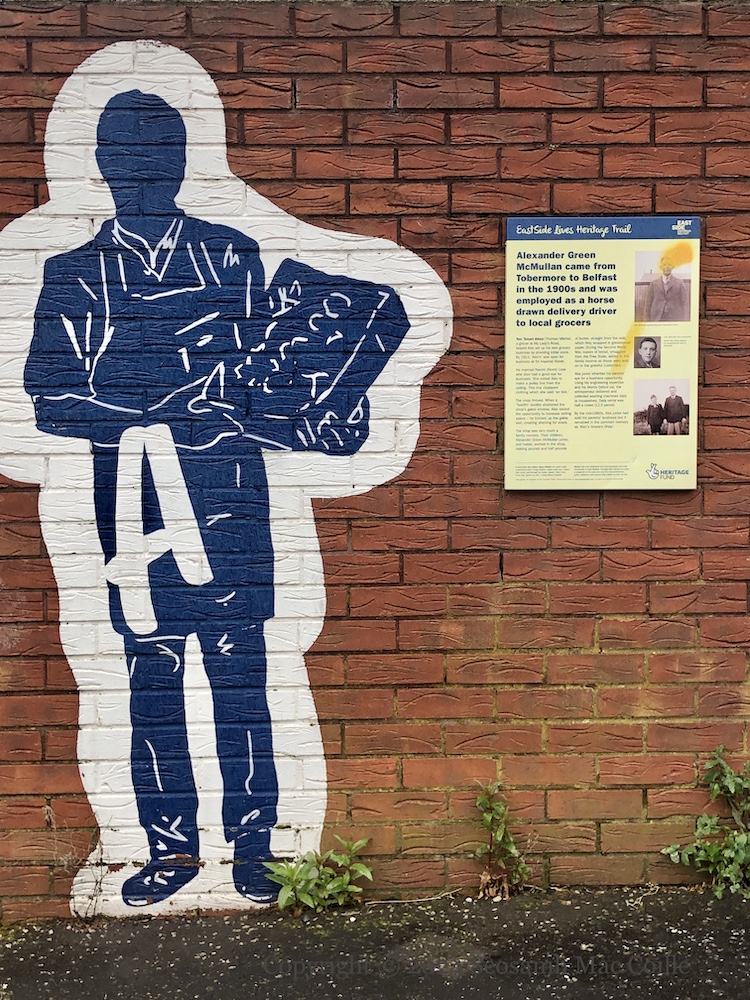
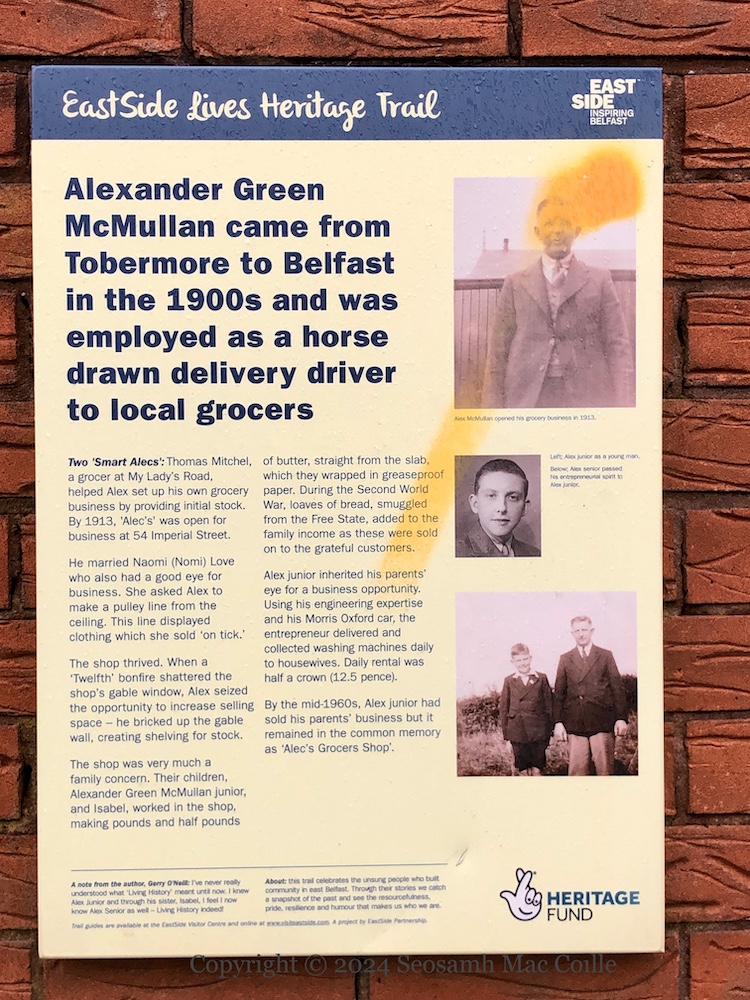
“Alexander Green McMullan came from Tobermore to Belfast in the 1900s and was employed as a horse drawn delivery driver to local grocers. Two ‘Smart Alecs’: Thomas Mitchel, a grocer at My Lady’s Road, helped Alex set up his own grocery business by providing initial stock. By 1913, ‘Alec’s’ was open for business at 54 Imperial Street. He married Naomi (Nomi) Love who also had a good eye for business. She asked Alex to make a pulley line from the ceiling. This line displayed clothing which she sold ‘on tick’. The shop thrived. When a ‘Twelfth’ bonfire shattered the shop’s gable window, Alex seized the opportunity to increase selling space – he bricked up the gable wall, creating shelving for stock. The shop was very much a family concern. Their children, Alexander Green McMullan junior, and Isabel, worked in the shop, making pounds and pounds of butter, straight from the slab, which they wrapped in greaseproof paper. During the Second World War, loaves of bread, smuggled from the Free State, added to the family income as these were sold on to the grateful customers. Alex junior inherited his parents’ eye for a business opportunity. Using his engineering expertise and his Morris Oxford car, the entrepreneur delivered and collected washing machines daily to housewives. Daily rental was half a crown (12.5 pence). By the mid-1960s, Alex junior had sold his parents’ business but it remained in the common memory as ‘Alec’s Grocers Shop’.
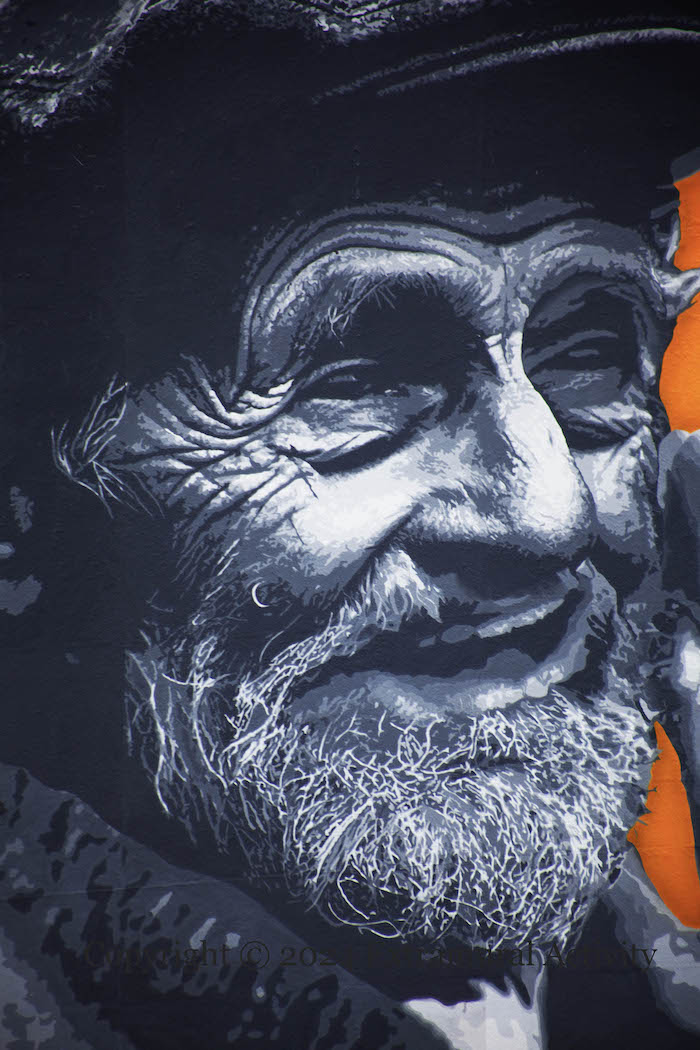
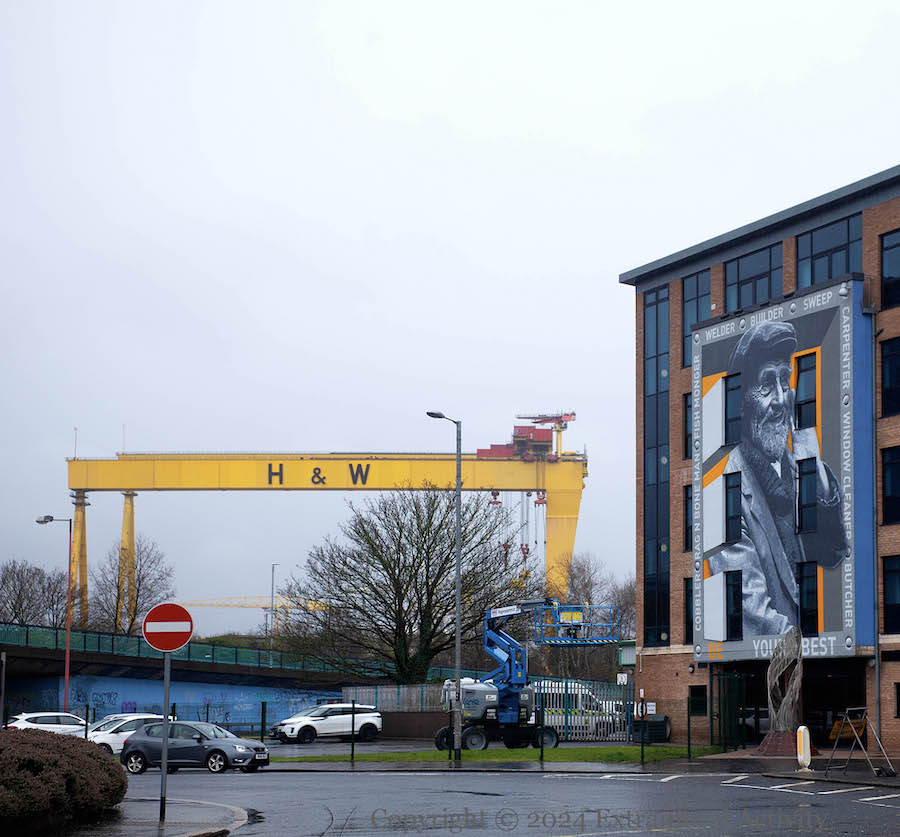
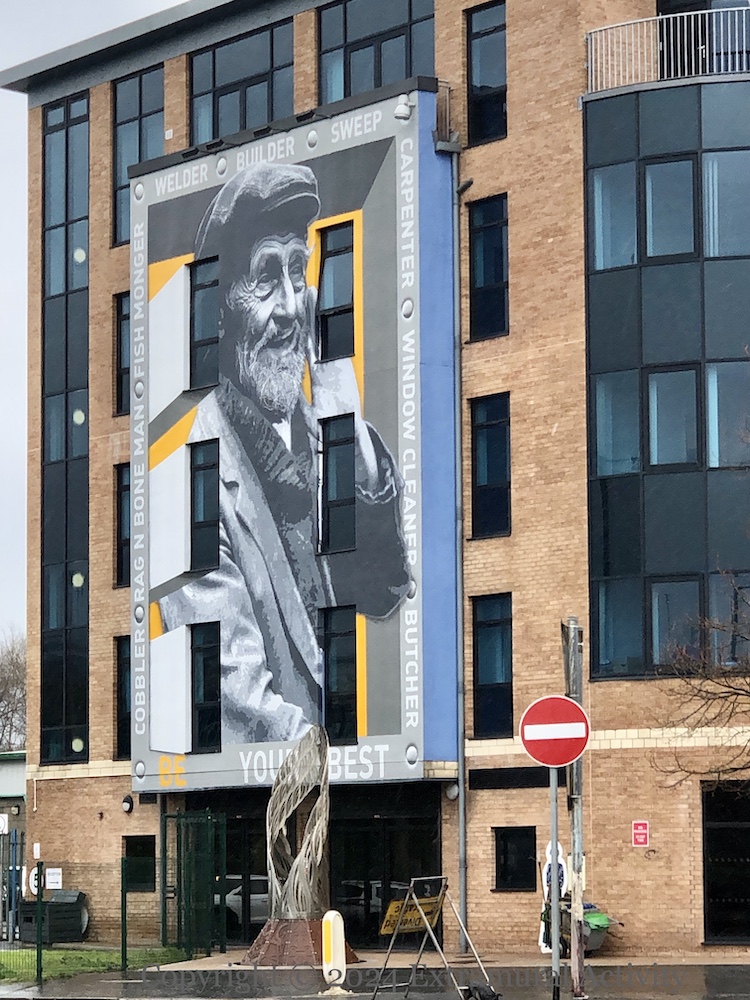
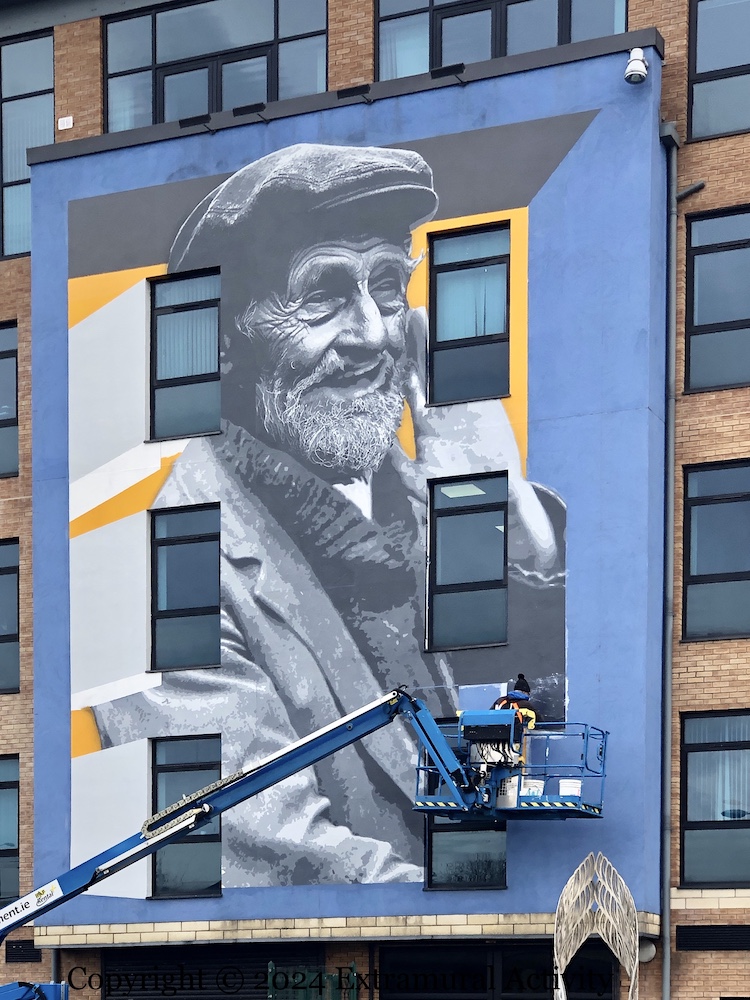
This new three-storey mural by Dee Craig (Fb) is at the city end of Newtownards Road and so serves as a highly-visible introduction to east Belfast. People arriving in the area are now greeted with a vintage image of a smiling bearded man in a cloth cap, surrounded by occupations from the industrial era: “Cobbler, rag’n’bone man, fish monger, welder, builder, sweep, carpenter, window cleaner, butcher”, capped off by an inspirational “Be your best”, with yellow highlights that match the colour of the shipyard cranes Samson and Goliath (see the third image).
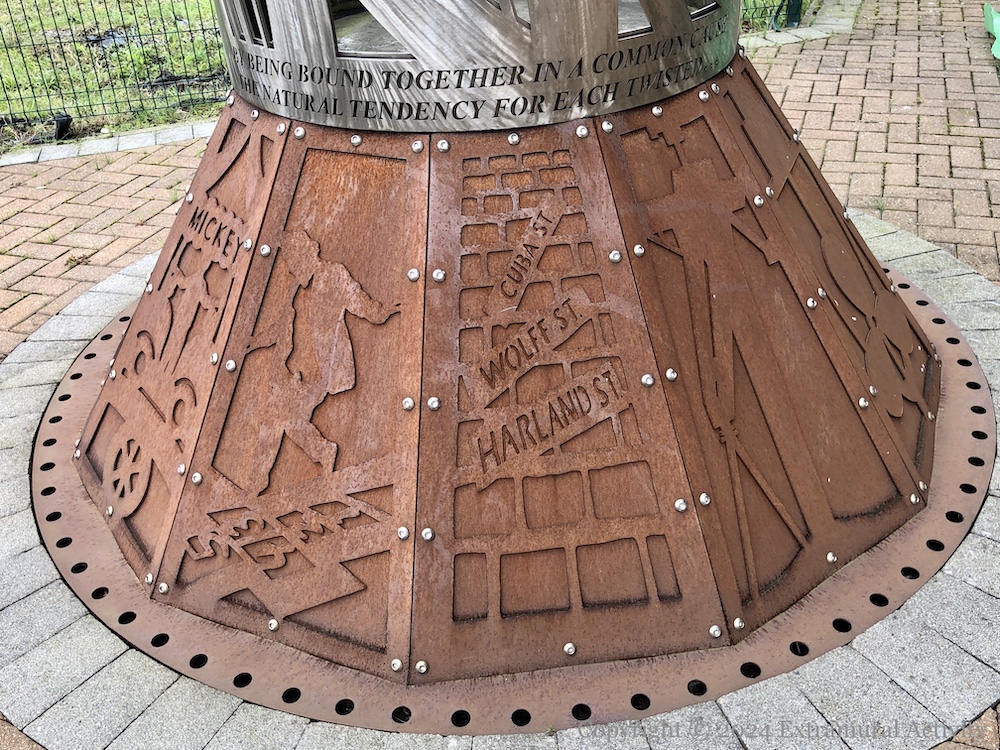
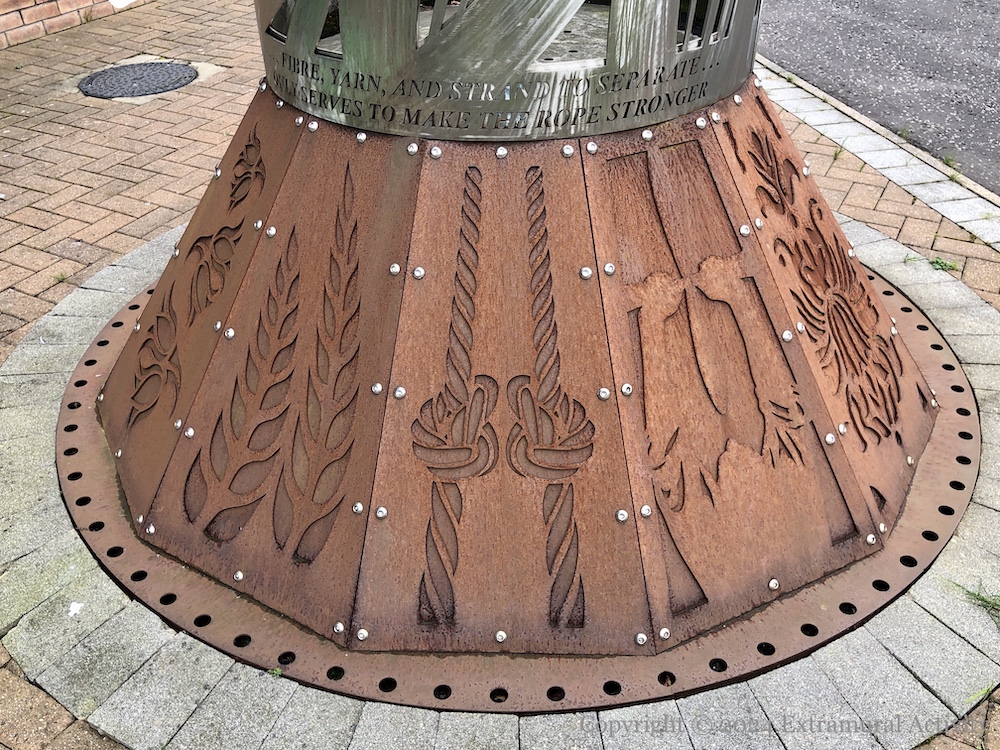
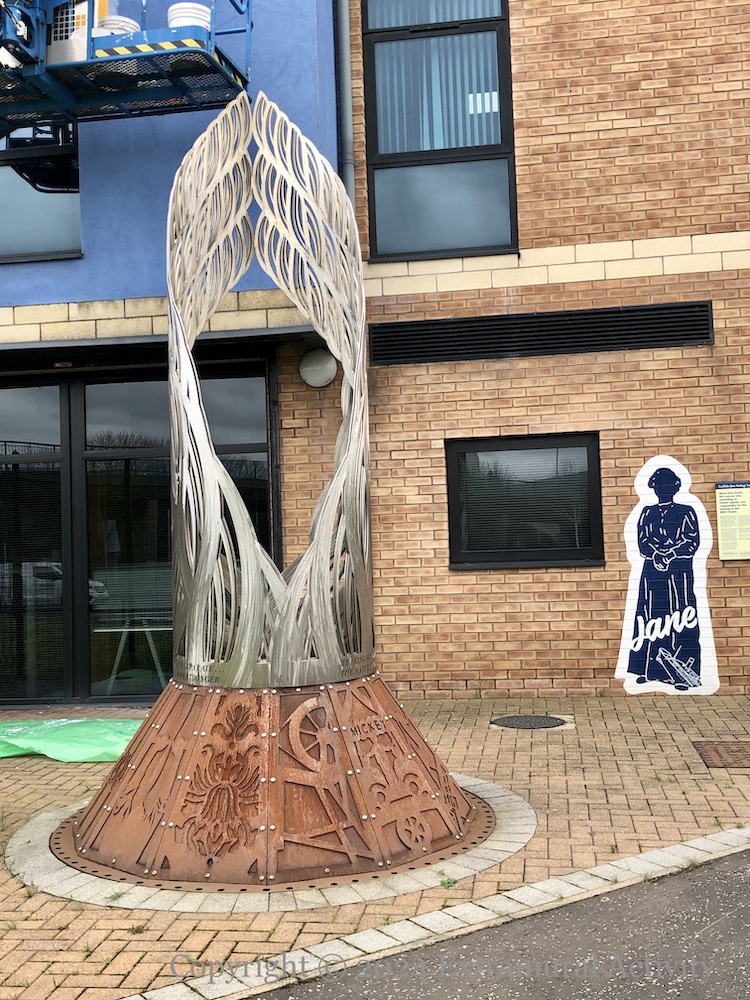
In being overshadowed by the mural, the “Let’s Twist Again” sculpture on the plaza in front of the business centre now becomes a symbol of east Belfast rather than the symbol. It too features east Belfast’s “industrial past” (BelTel), using rope as a metaphor for community: “By being bound together in a common cause, the natural tendency for each twist, fibre, yarn, and strand to separate, only serves to make the rope stronger.”
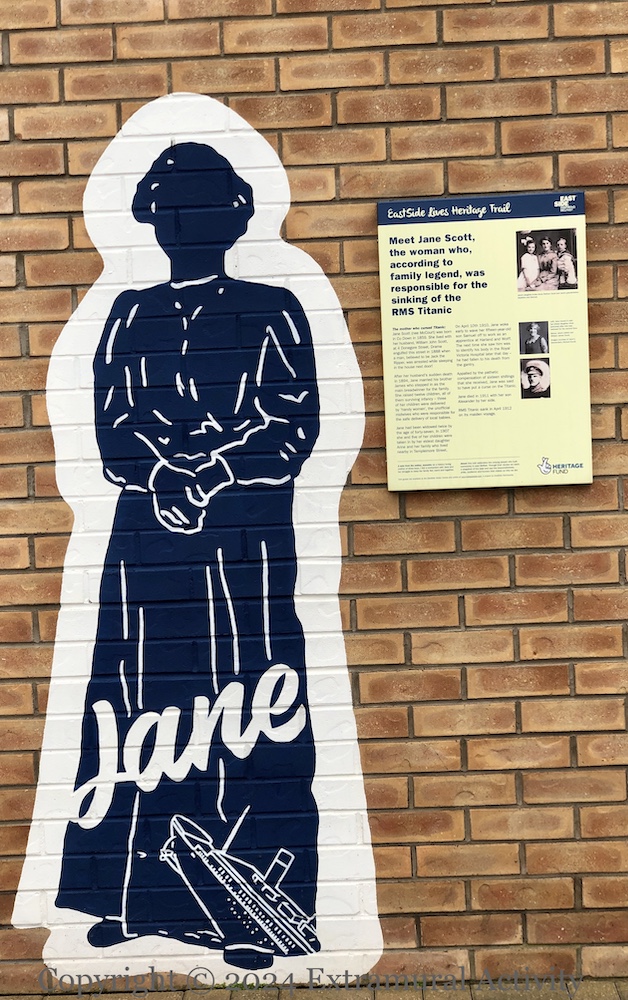
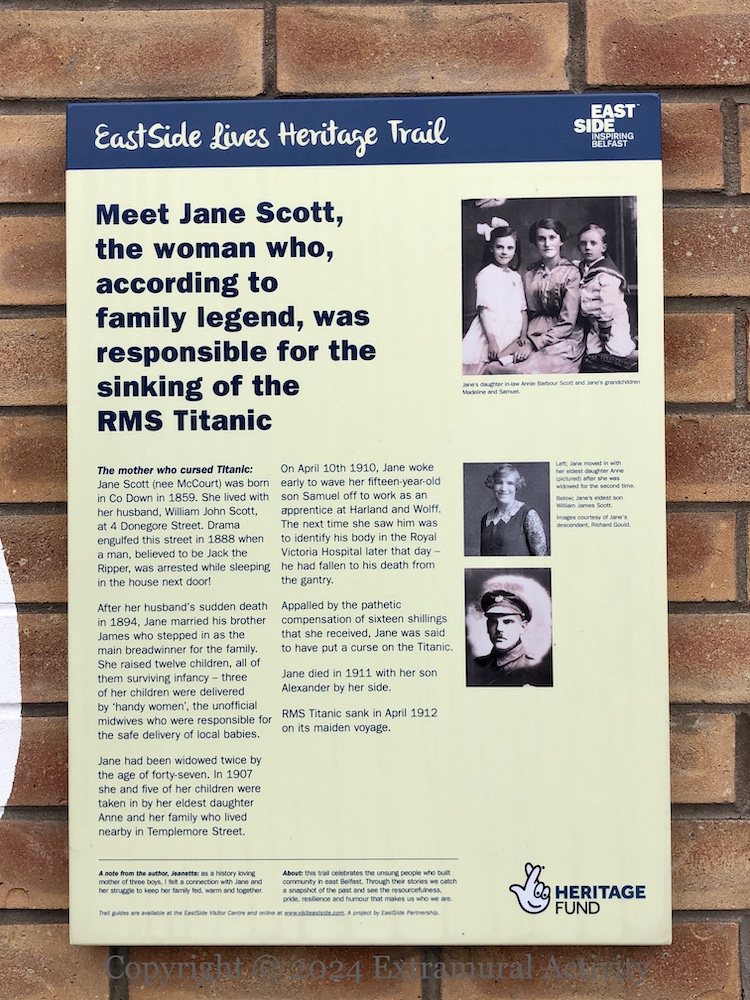
On the wall behind the sculpture and below the mural is one of the Eastside Lives Heritage Trail (pdf) figures, Jane Scott, whose fifteen-year-old son Samuel fell to his death from a ladder while working on the ship in 1910. She supposedly cursed the ship and it sank two years later. (See also Godfather Of Legal Betting and various others.)