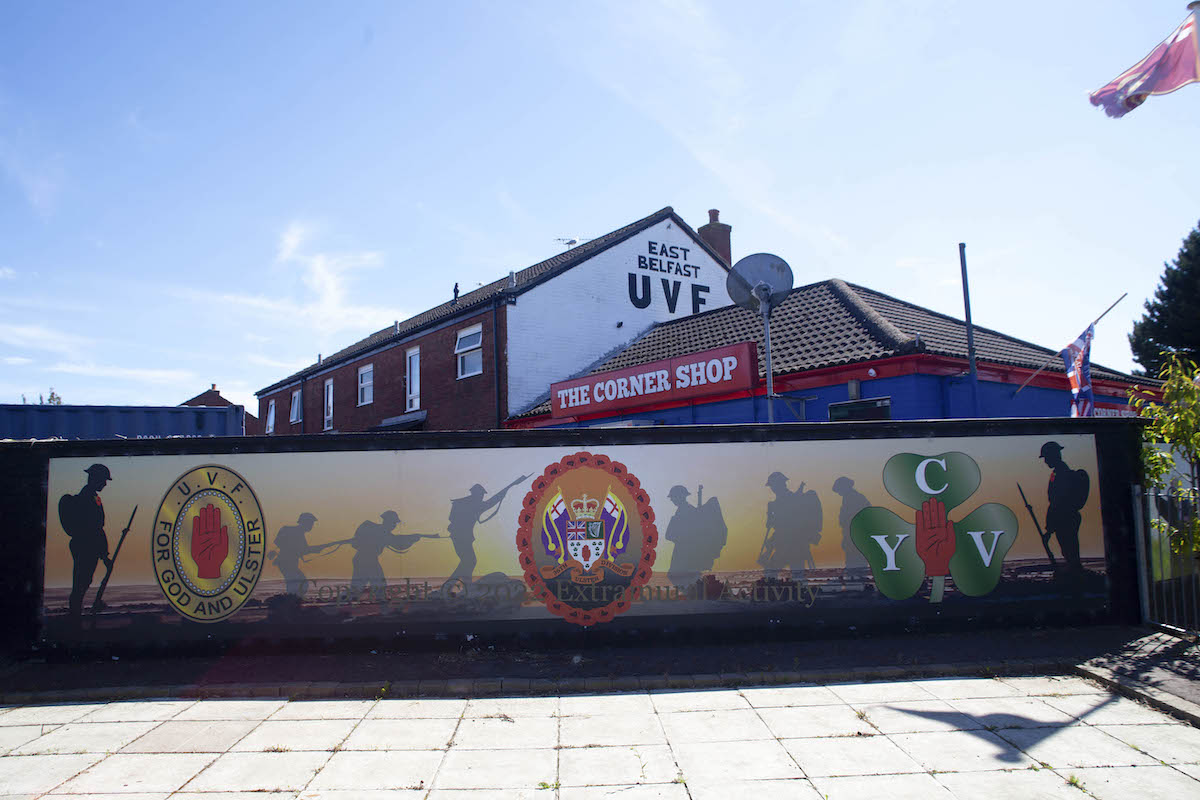
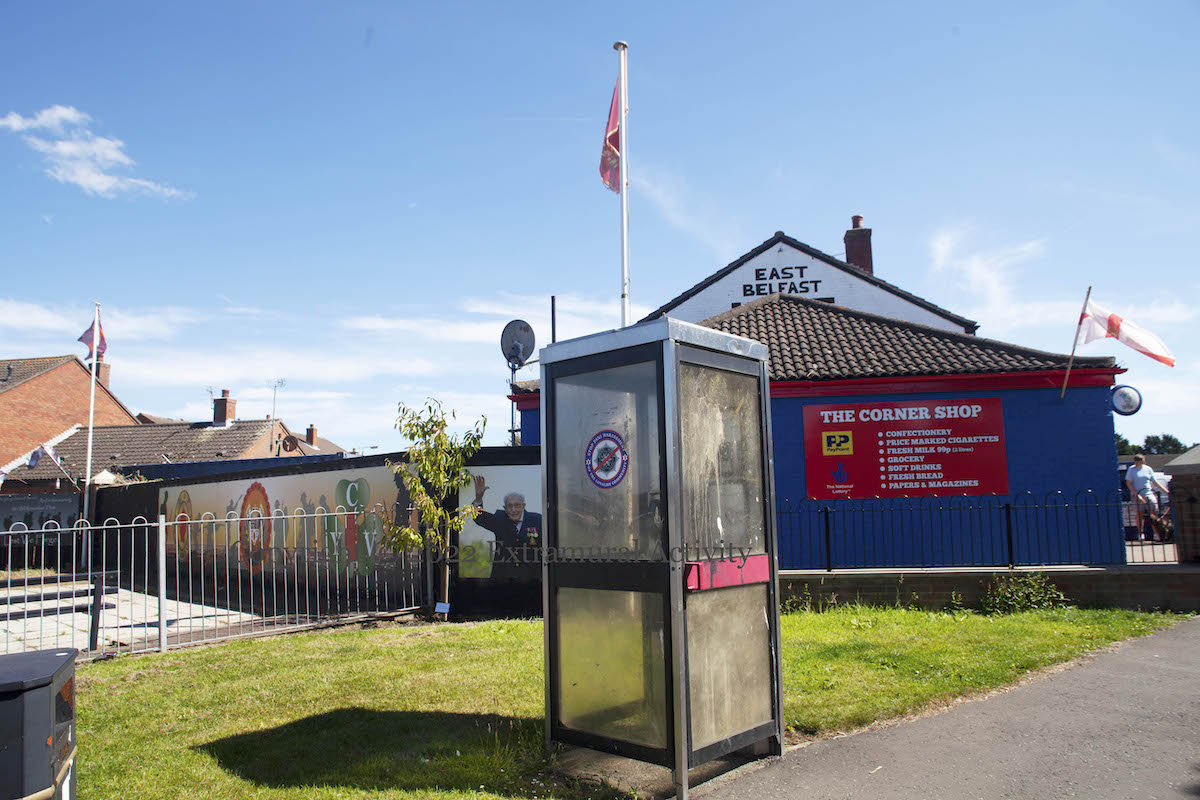
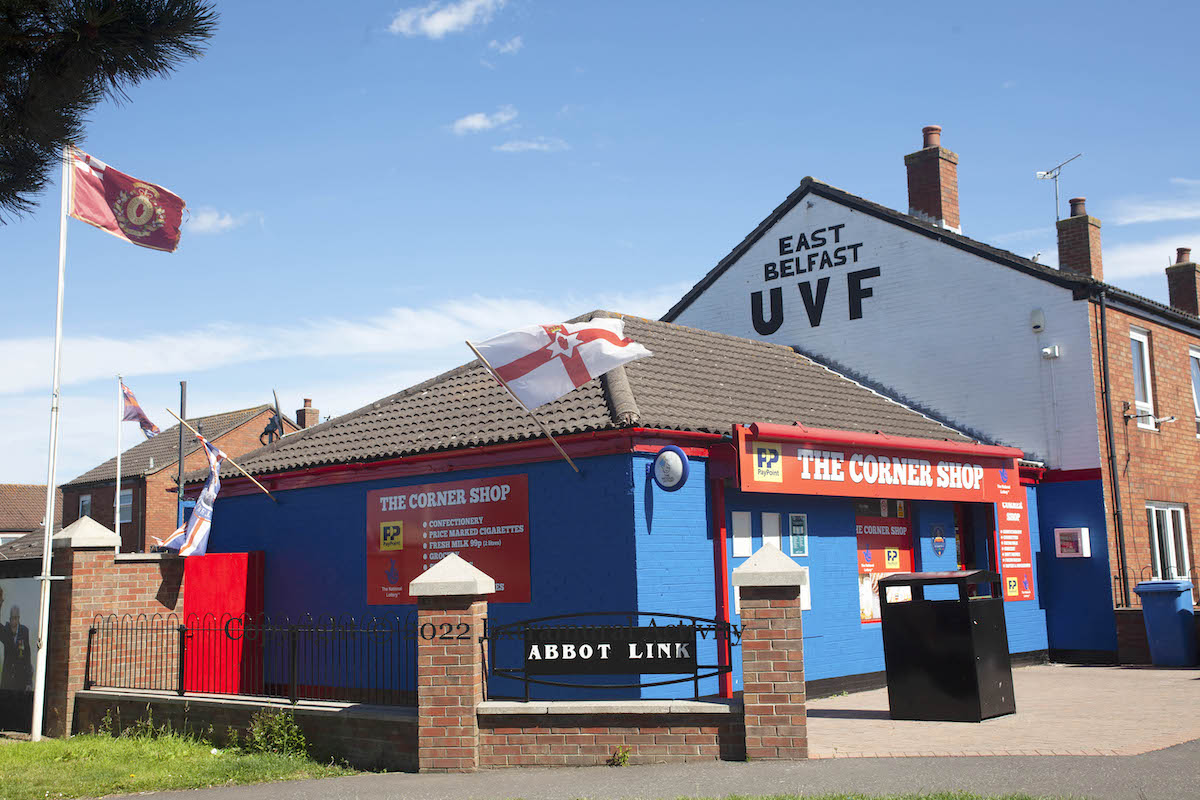
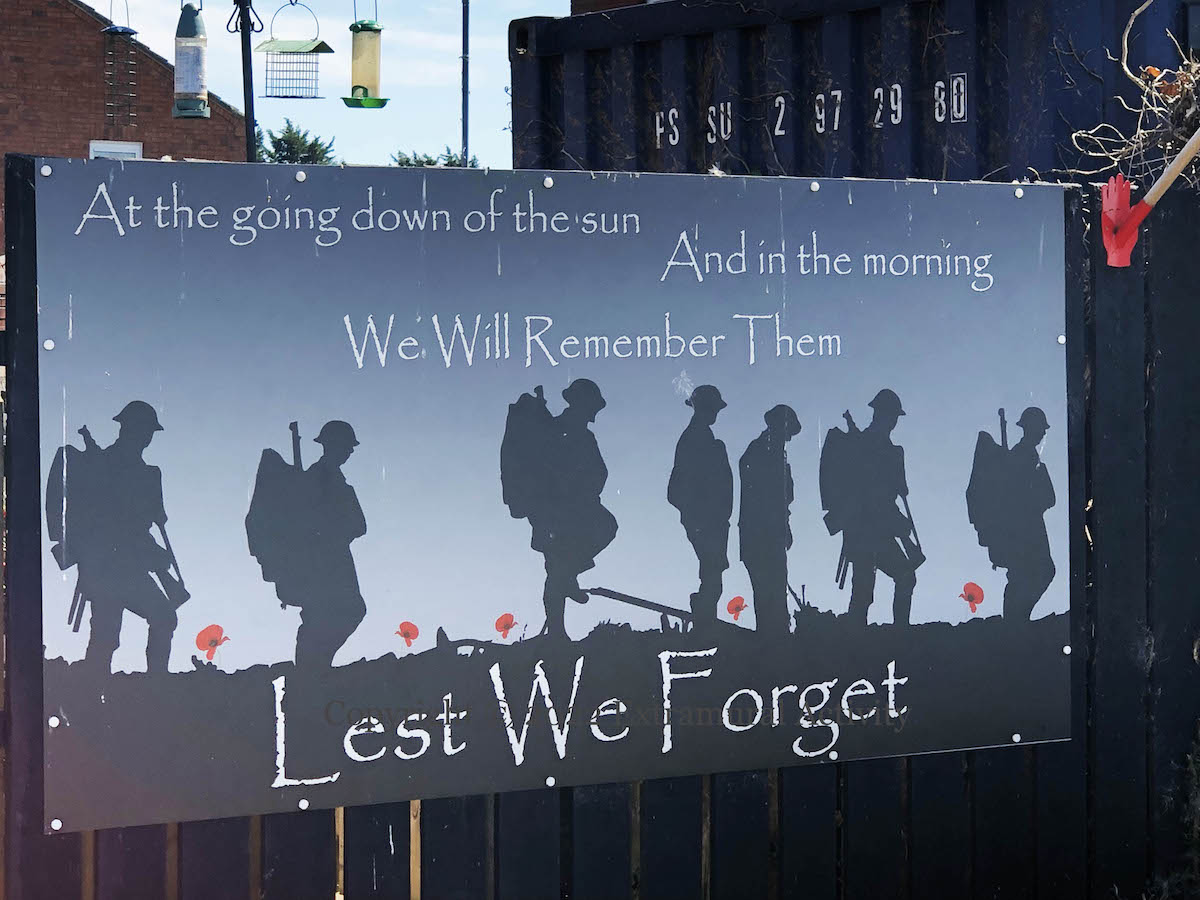
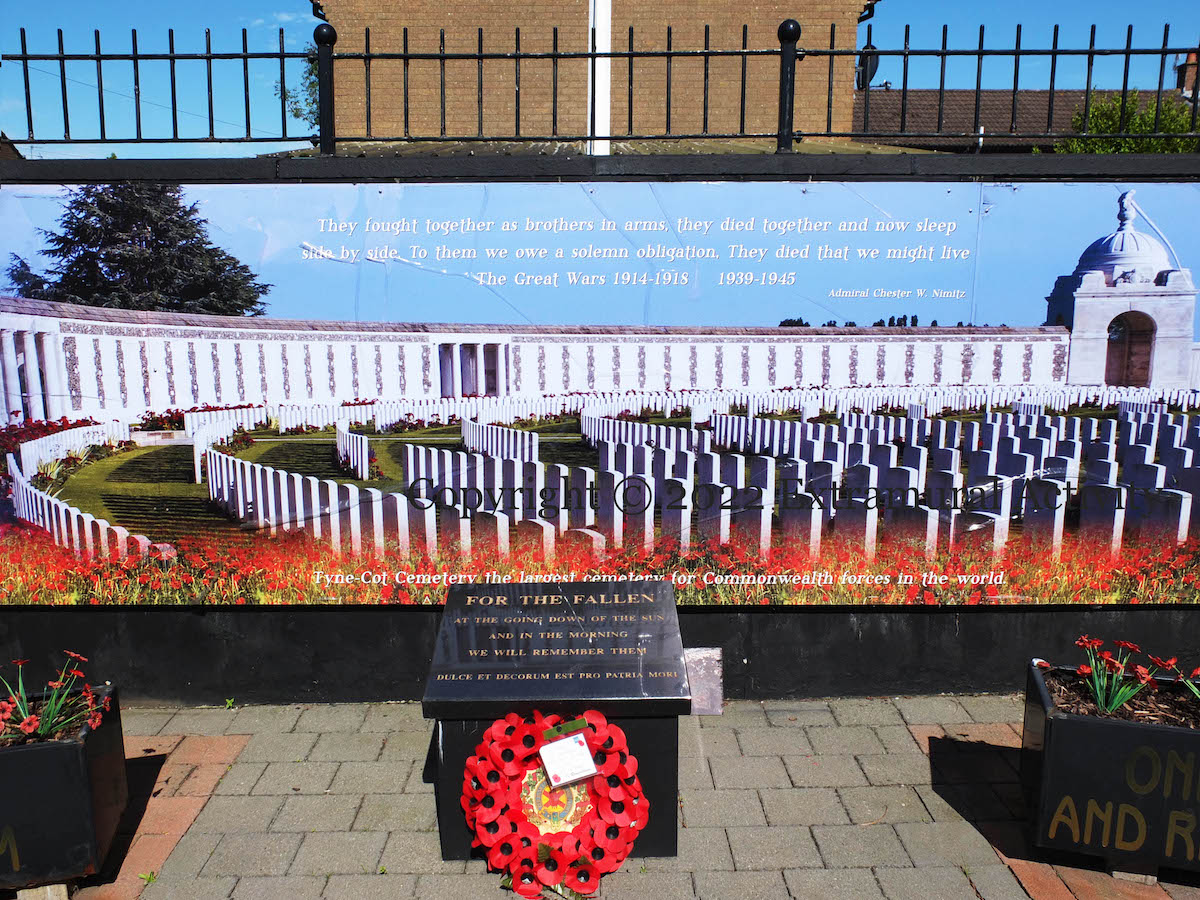
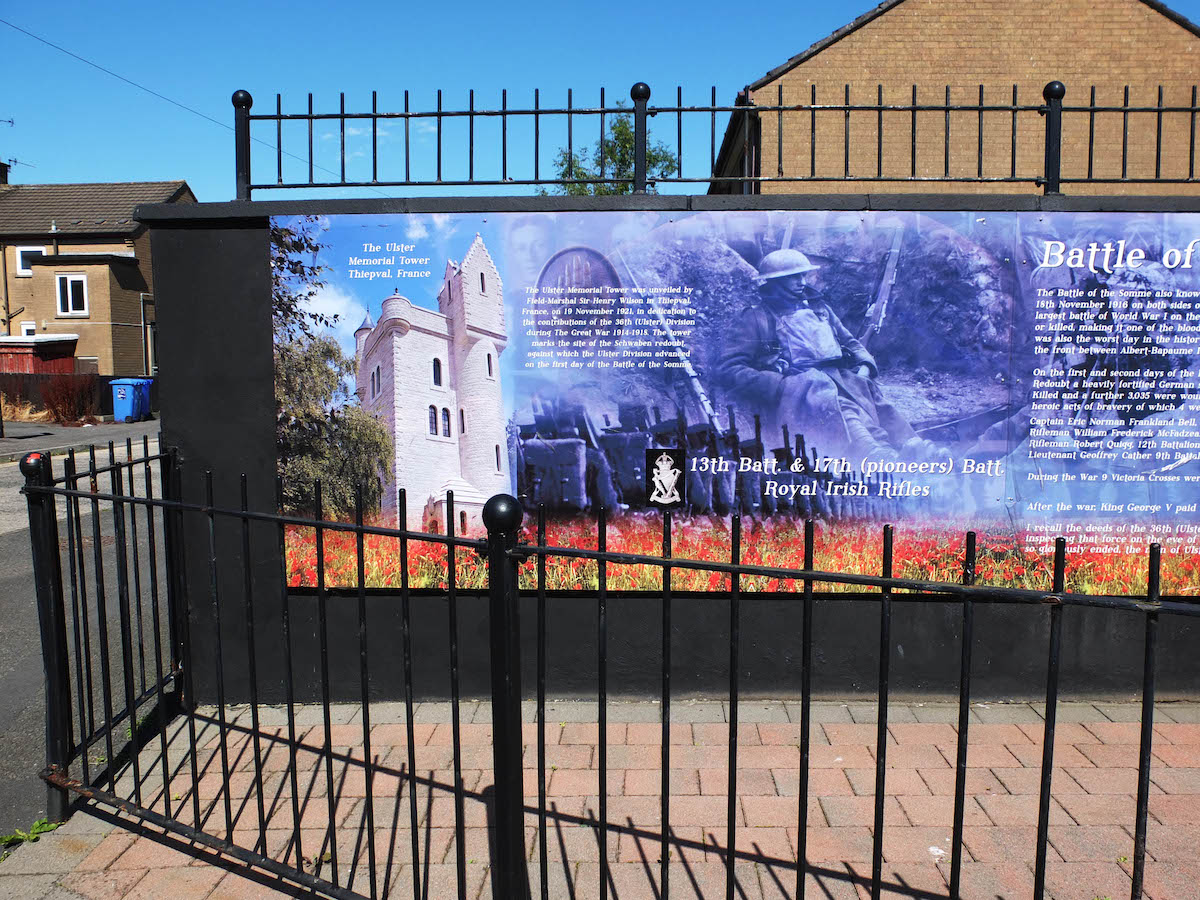
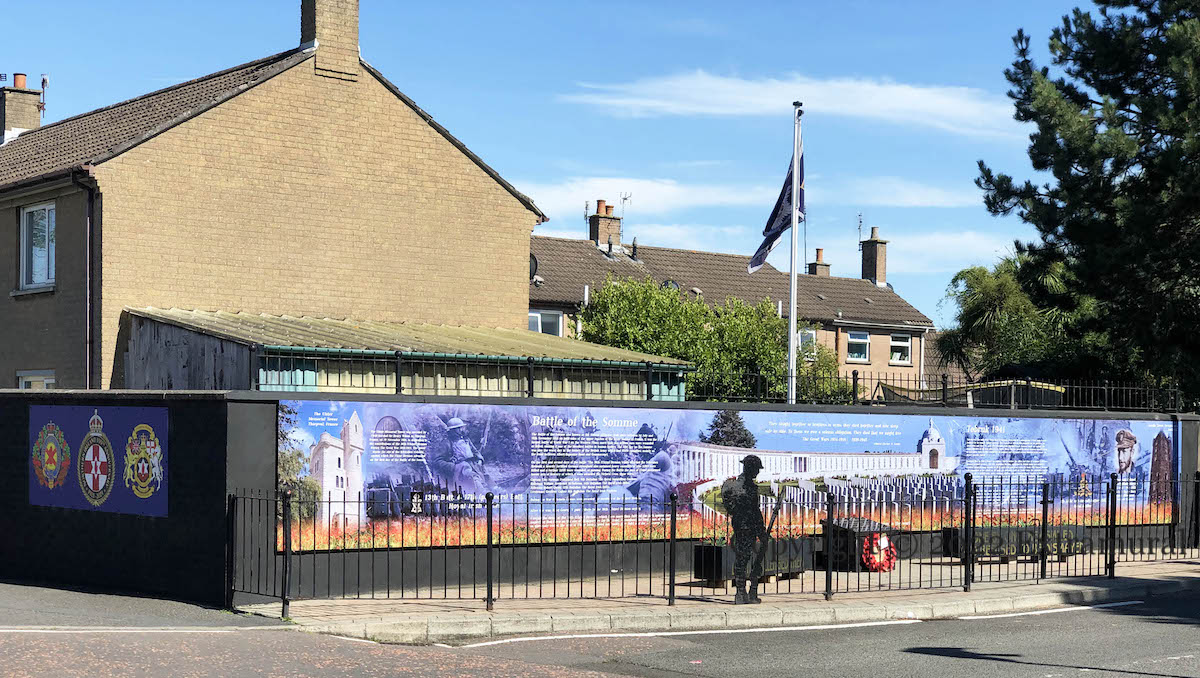
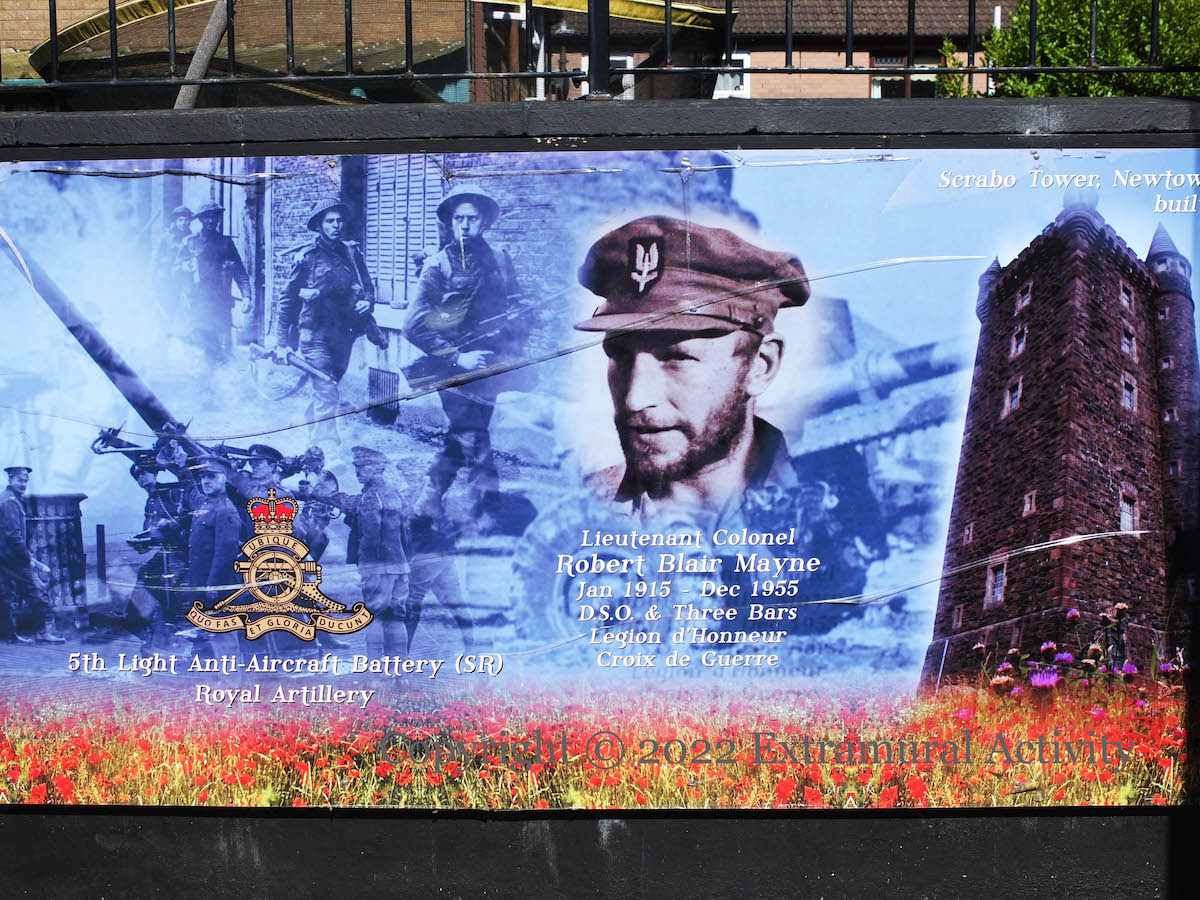
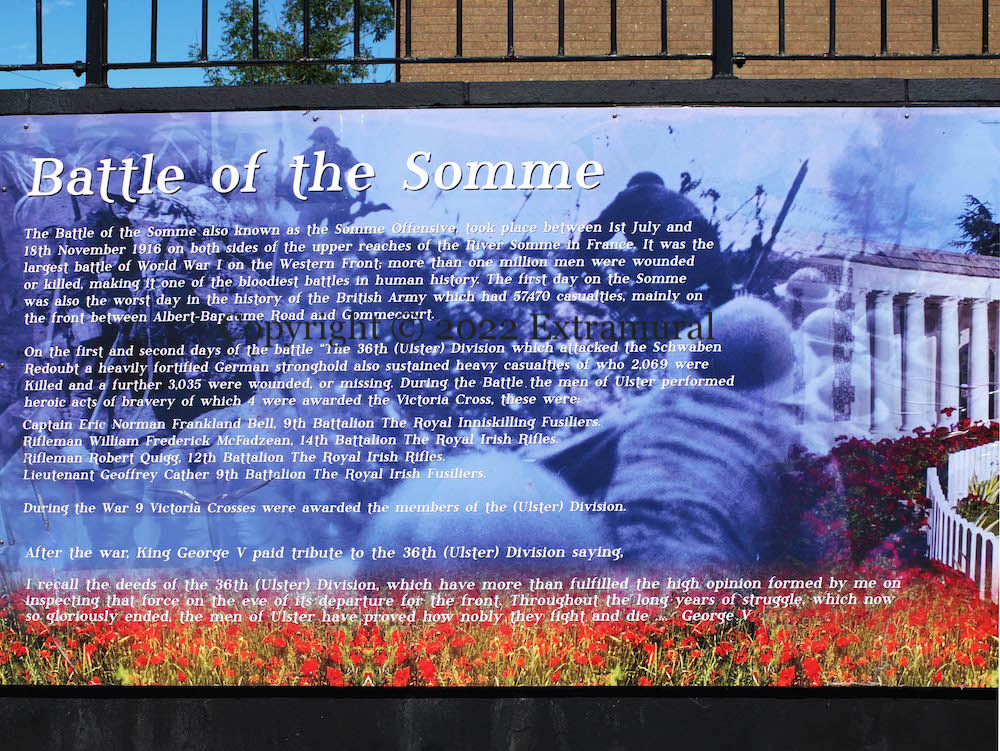
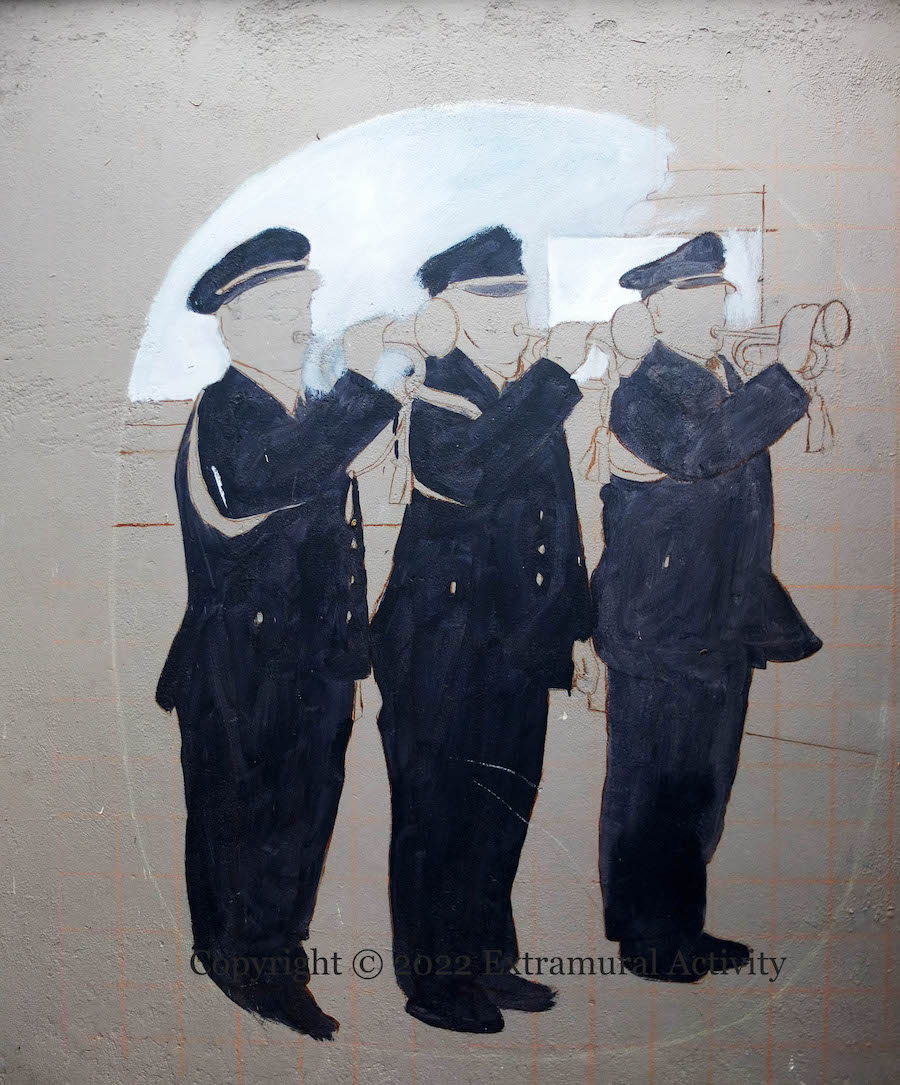
Three-in-a-row at the Bowtown (Newtownards) newsagents: on the left, “Lest we forget” (final image); in the middle, the emblems of the UVF, 36th Division, and YCV against a backdrop of WWI soldiers; on the right-hand, Captain Tom Moore, who raised money for the NHS during lockdown. Above the shop itself can be seen “East Belfast UVF” while the flag is from the North Down UVF. The sticker on the phone box says Stop PSNI Harassment.
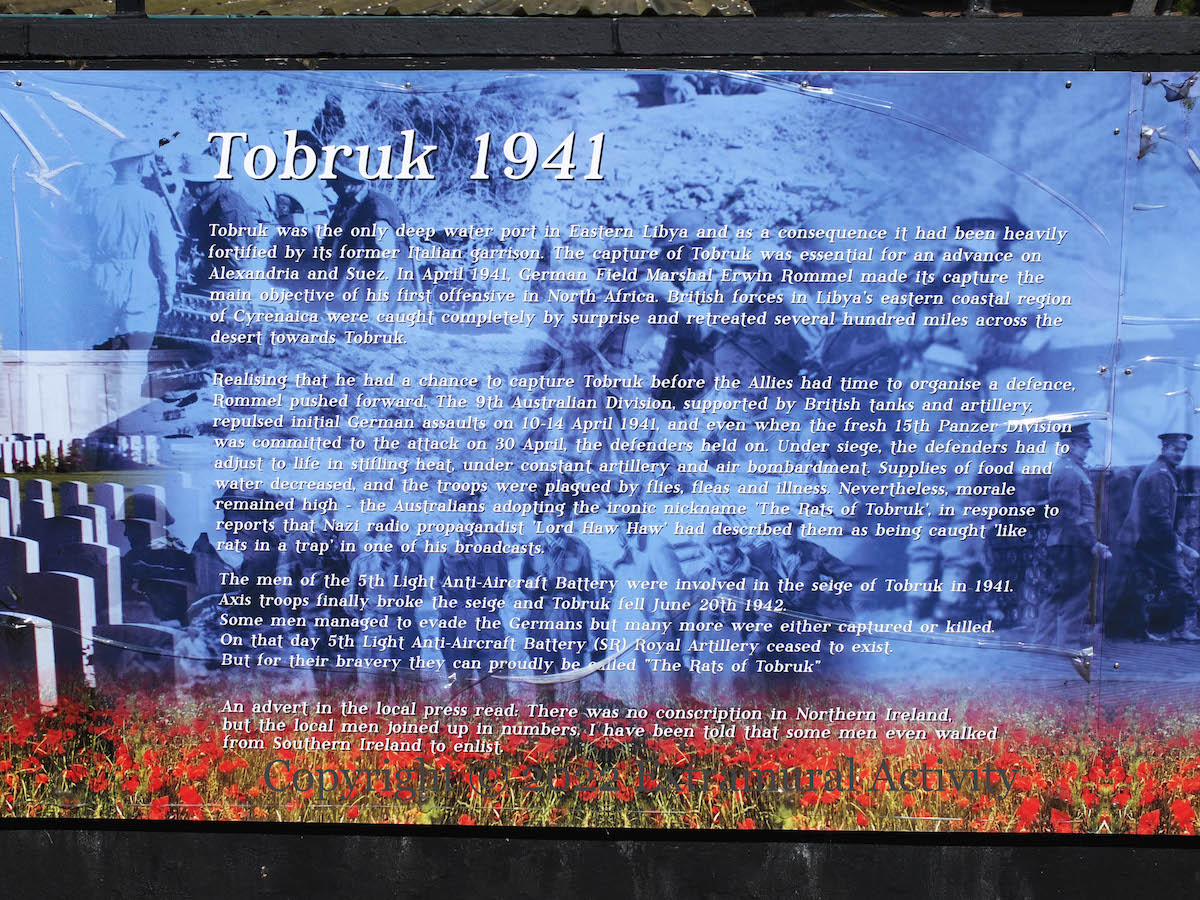
“They fought together as brothers in arms, they died together and now sleep side by side. To them we owe a solemn obligation. They died that we might live. The Great Wars 1914-1918, 1939-1945 – Admiral Chester W Nimitz”. The central image of this Newtownards homage to the men of the 36th (Ulster) Division and the Australian ‘Rats Of Tobruk’ who held that city against Rommel’s forces in north Africa during WWII is the Tyne-Cot cemetery near Passchendaele, Belgium, the biggest Commonwealth cemetery in the world but named ofter the “Tynside cottages” that the German pill-boxes in the area resembled (WP).
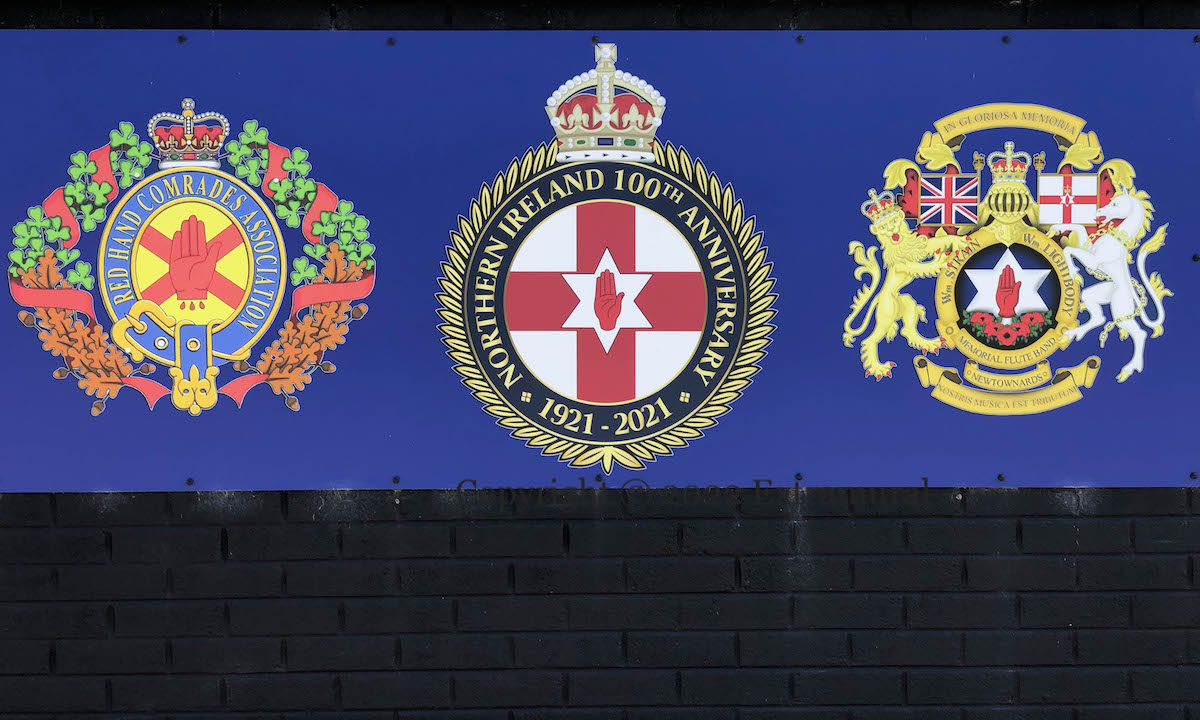
New for the NI centenary are three emblems on the side wall, with (on the left) the Red Hand Comrades Association and (on the right) the Strain-Lightbody Memorial flute band (Fb).
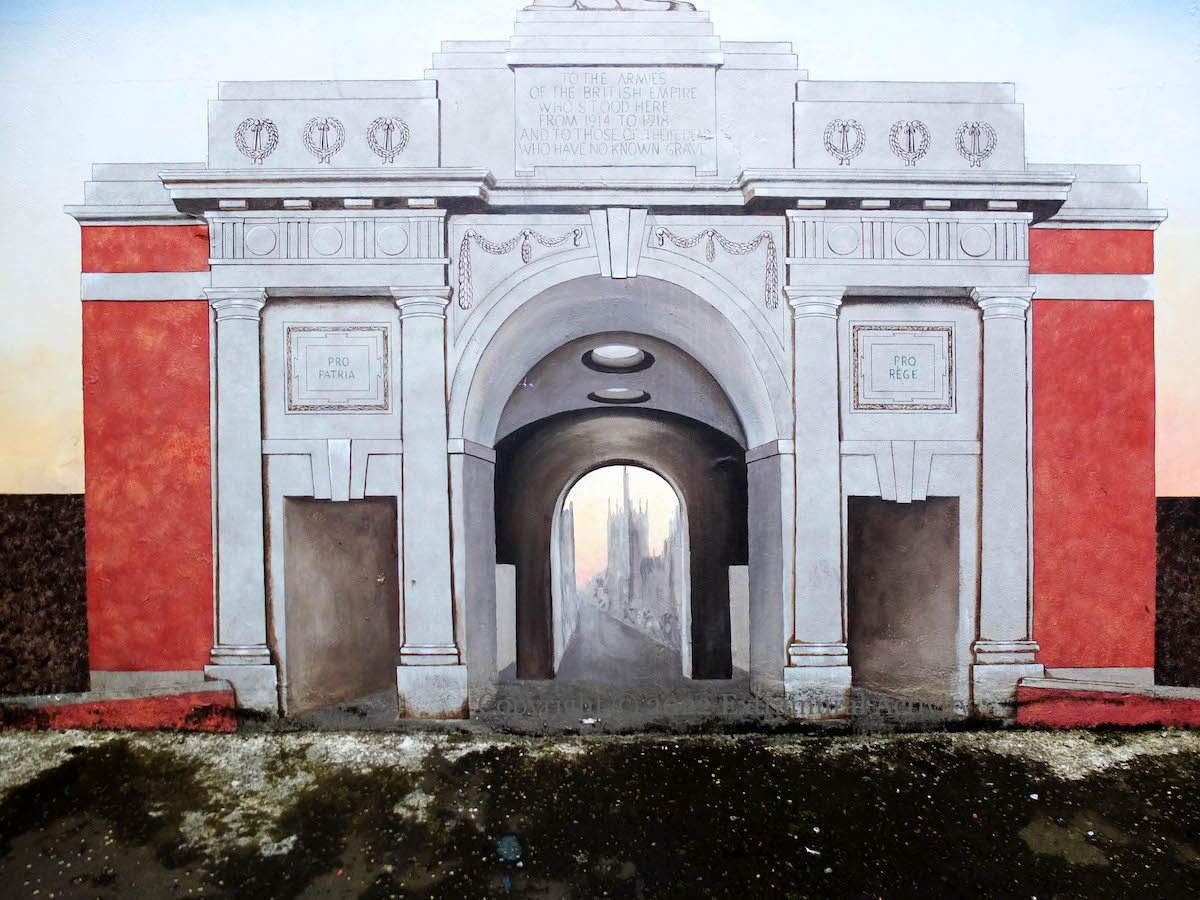
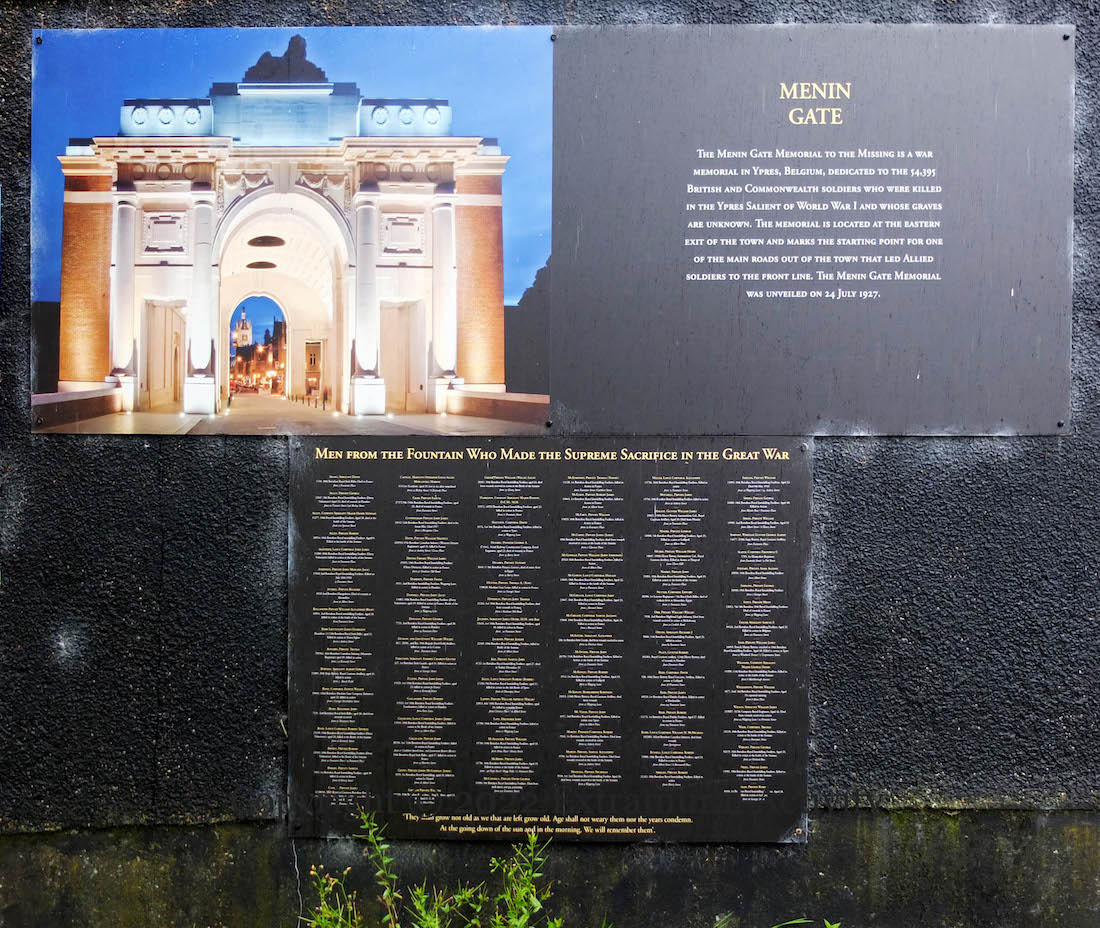
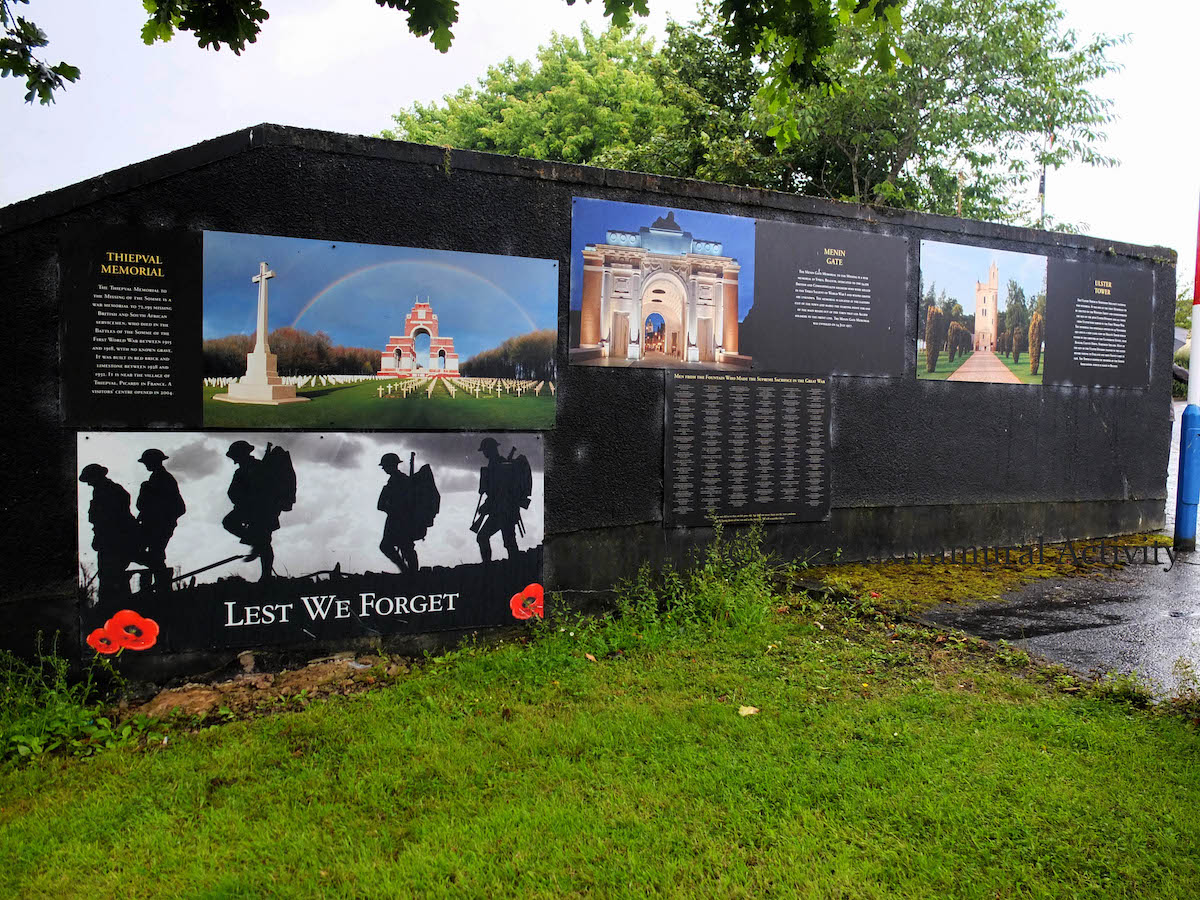
This post updates a 2018 post The Menin Gates with the addition of the side-wall shown above – which is still incomplete – and the two plaques shown in the middle image.
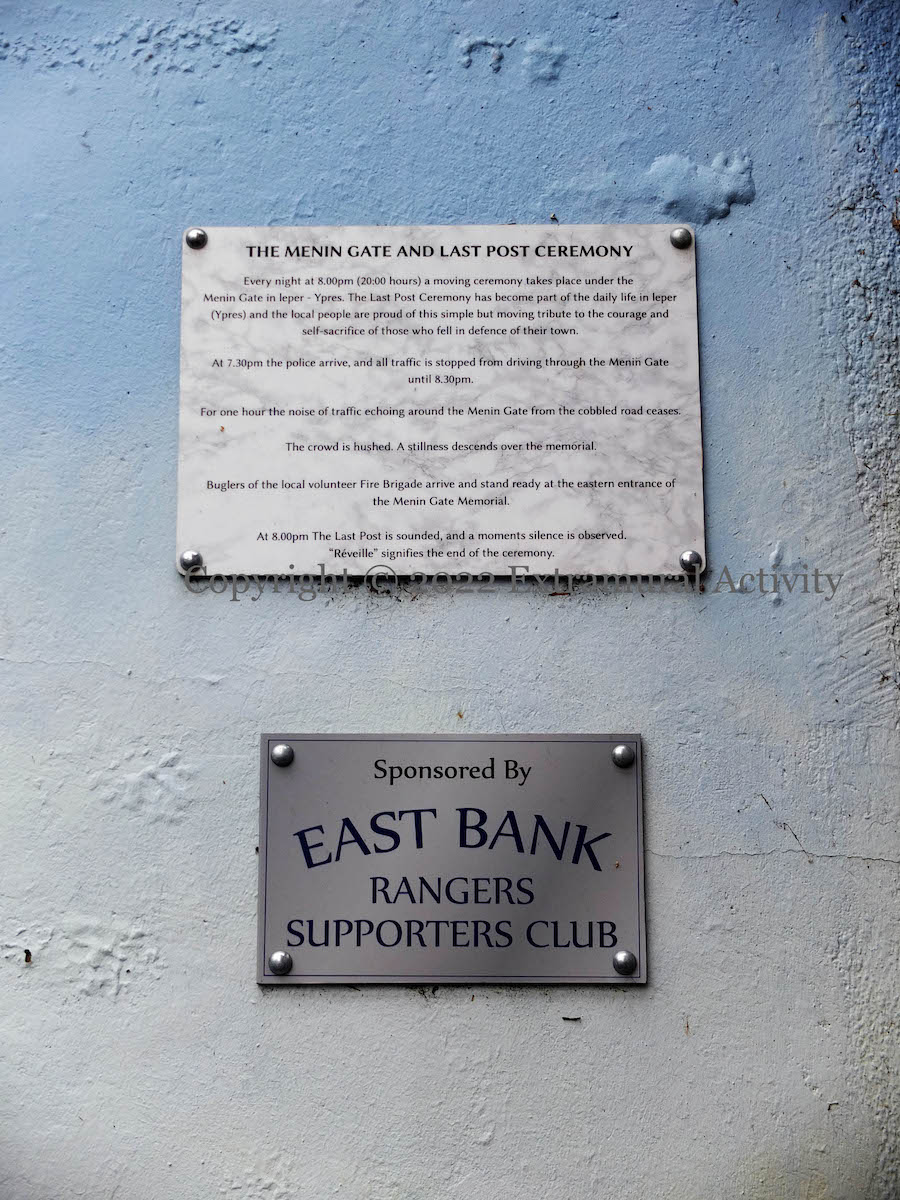
“The Menin Gate And Last Post Ceremony: Every night at 8.00pm (20:00 hours) a moving ceremony takes place under the Menin Gate in Ieper – Ypres. The Last Post Ceremony has become part of the daily life in Ieper (Ypres) and the local people are proud of this simple but moving tribute to the courage and self-sacrifice of those who fell in defence of their town. At 7.30pm the police arrive, and all traffic is stopped from driving through the Menin Gate until 8.30pm. For one hour the noise of traffic echoing around the Menin Gate from the cobbled road ceases. The crowd is hushed. A stillness descends over the memorial. Buglers of the local volunteer Fire Brigade arrive and stand ready at the eastern entrance of the Menin Gate Memorial. At 8.00pm The Last Post is sounded, and a moments [sic] silence is observed. “Réveille” [sic] signifies the end of the ceremony.” “Sponsored by East Bank Rangers Supporters Club“
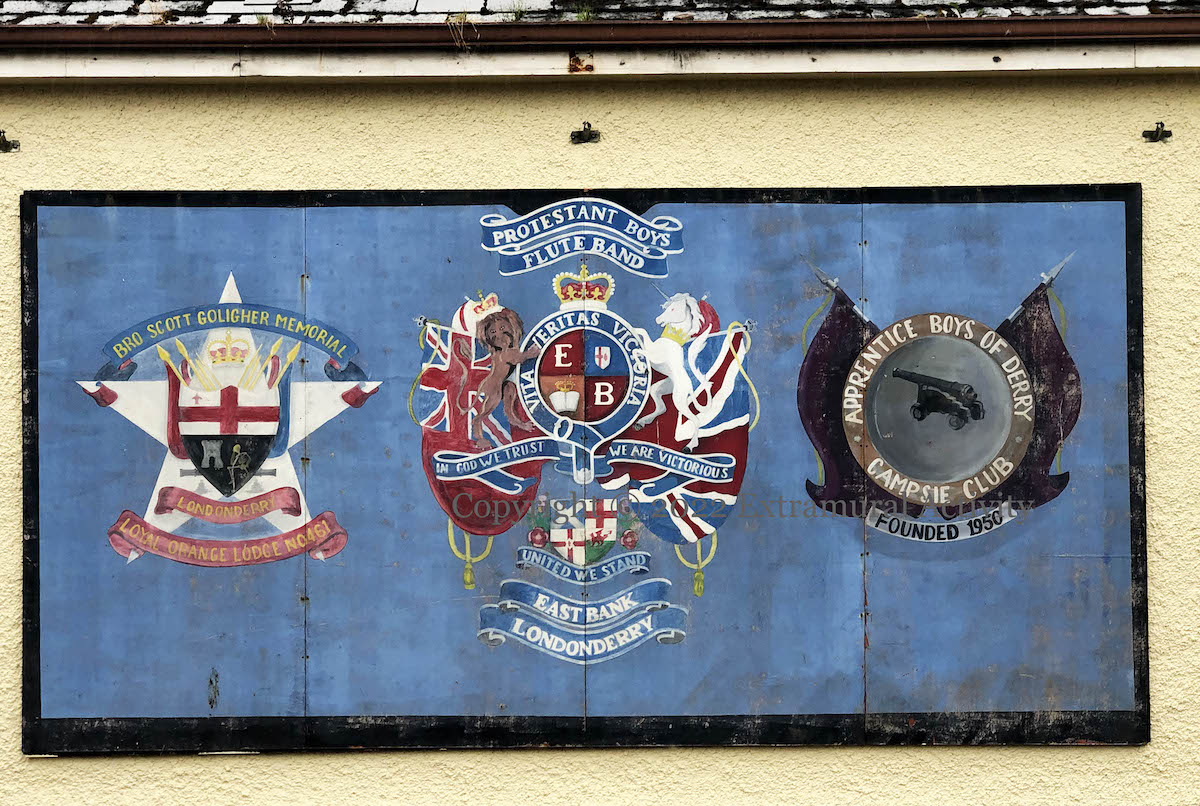
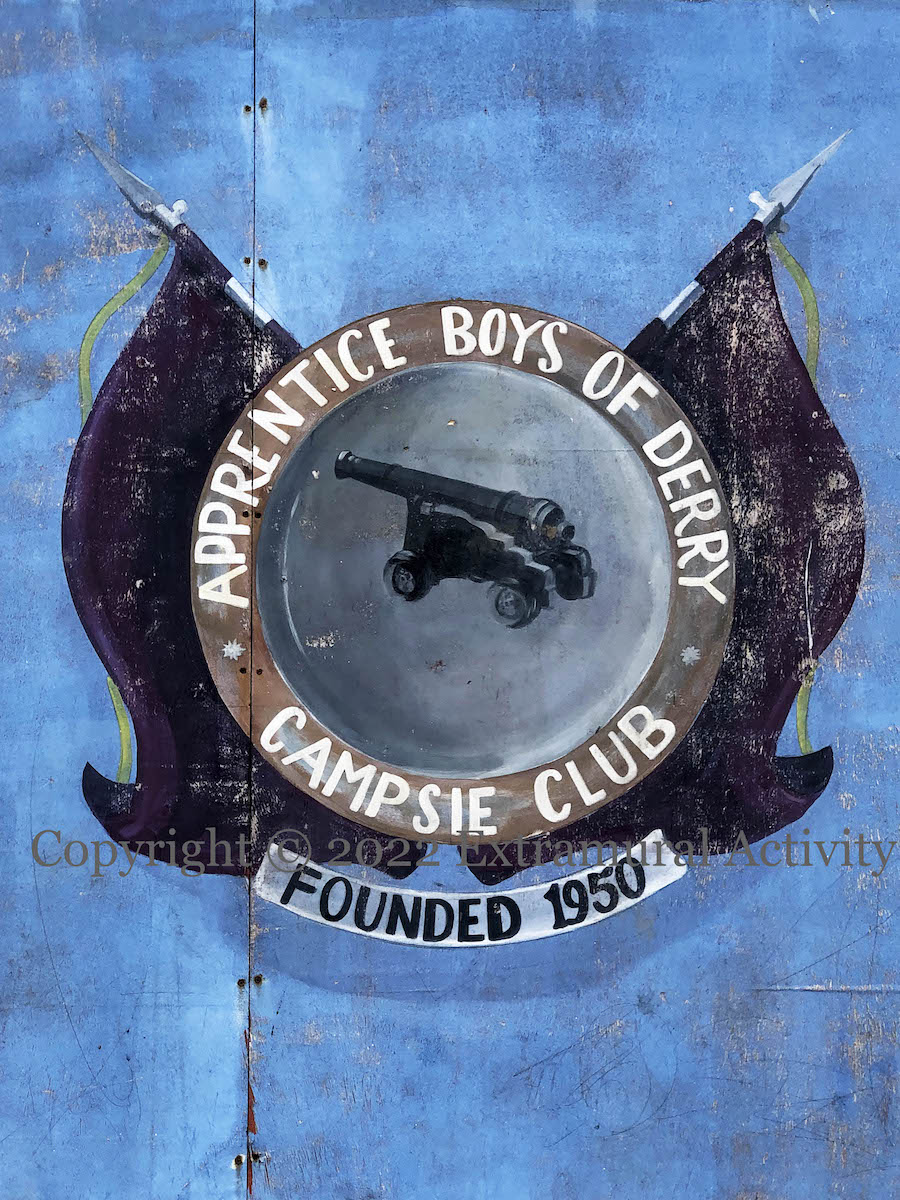
The Campsie Club (of Londonderry) is the youngest of the eight parent clubs of the Apprentice Boys “founded 1950” and is the only one named after one of the apprentice boys who shut the gates against the forces of James II in 1688 – Henry Campsie (web).
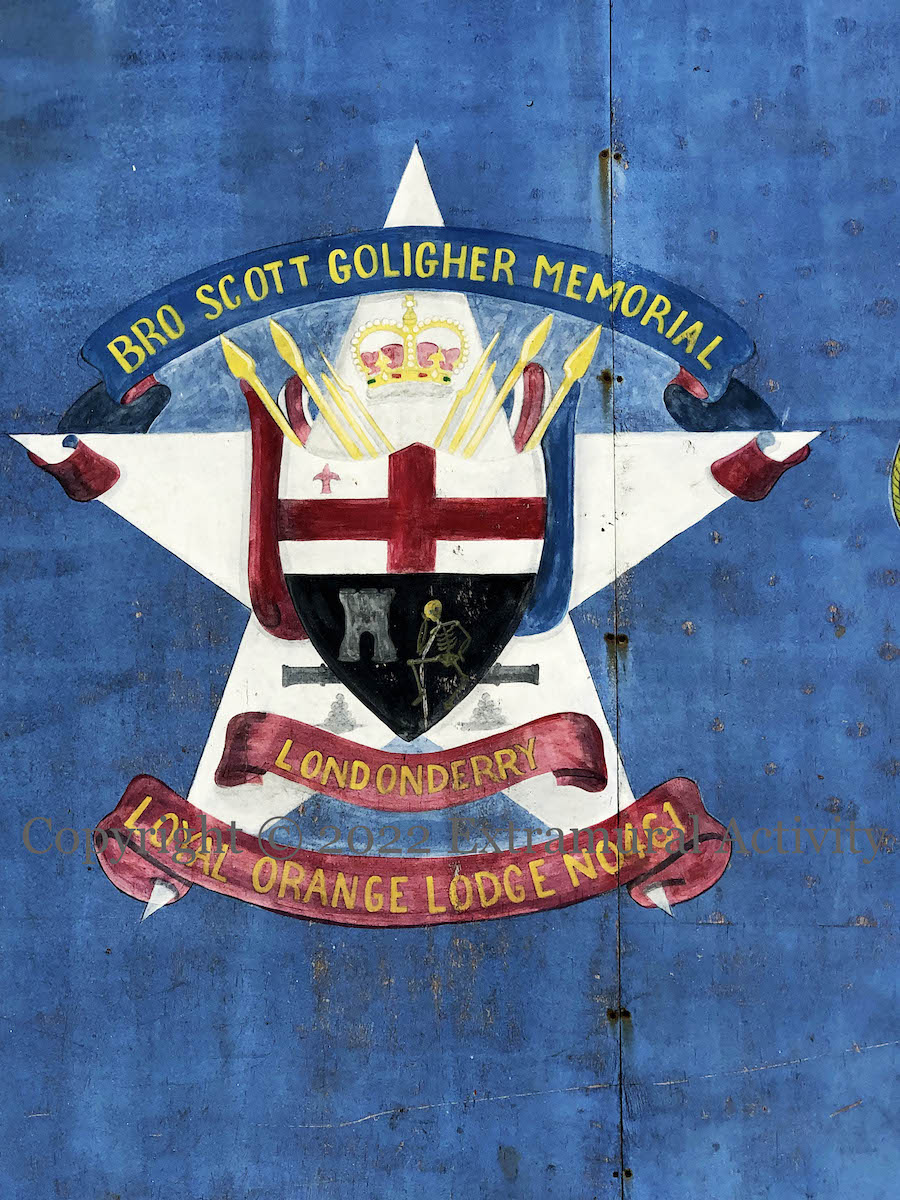
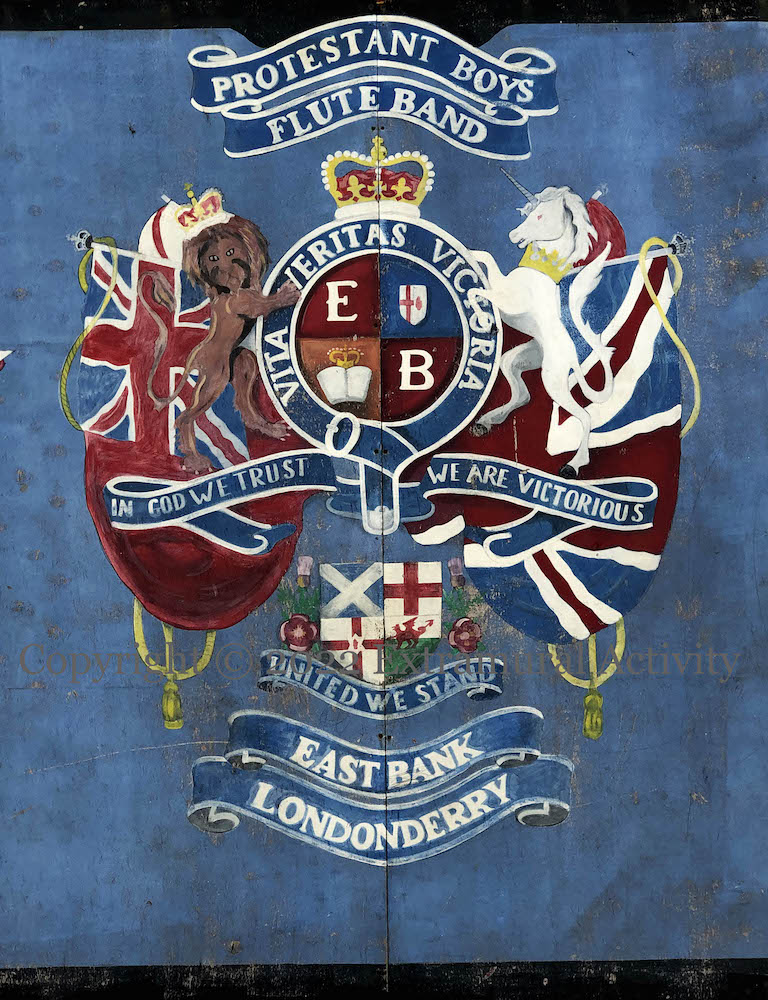
This Irish Street board puts the “Bro. Scott Goligher Memorial, Londonderry, Loyal Orange Lodge No. 461” (history of the lodge at Grand City Lodge) and the Campsie Club on either side of the “Protestant Boys flute band” (Fb).
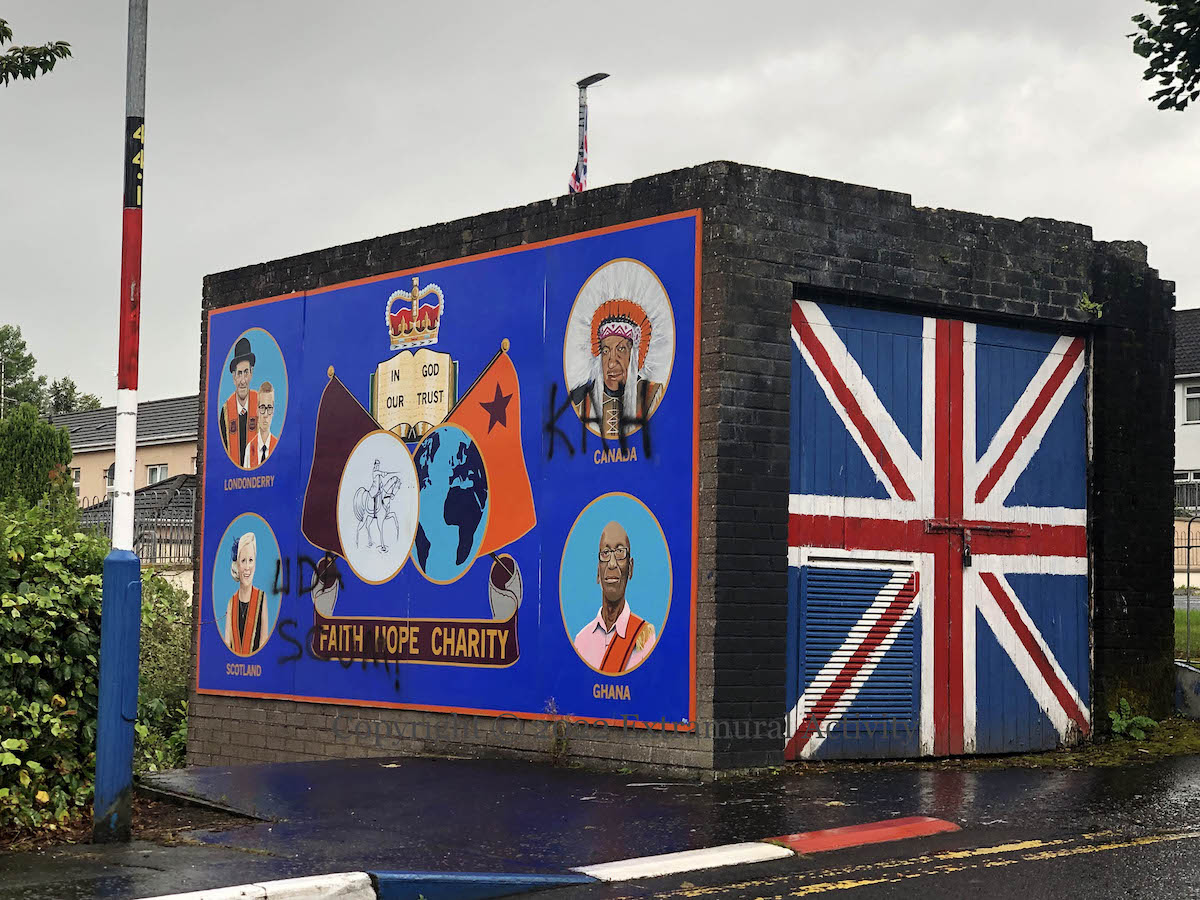
There are Orange Order lodges in Ghana and Togo and there were previously lodges in South Africa and Nigeria (History Ireland | WP). A photo of the Ghanaian representative in the mural – Dennis Tette Tay – is included in this BBC article. The Canadian representative is perhaps from “Mohawk Loyal Orange Lodge No. 99” on the Mohawk Reservation at Desoronto, Ontario, Canada (Fb).
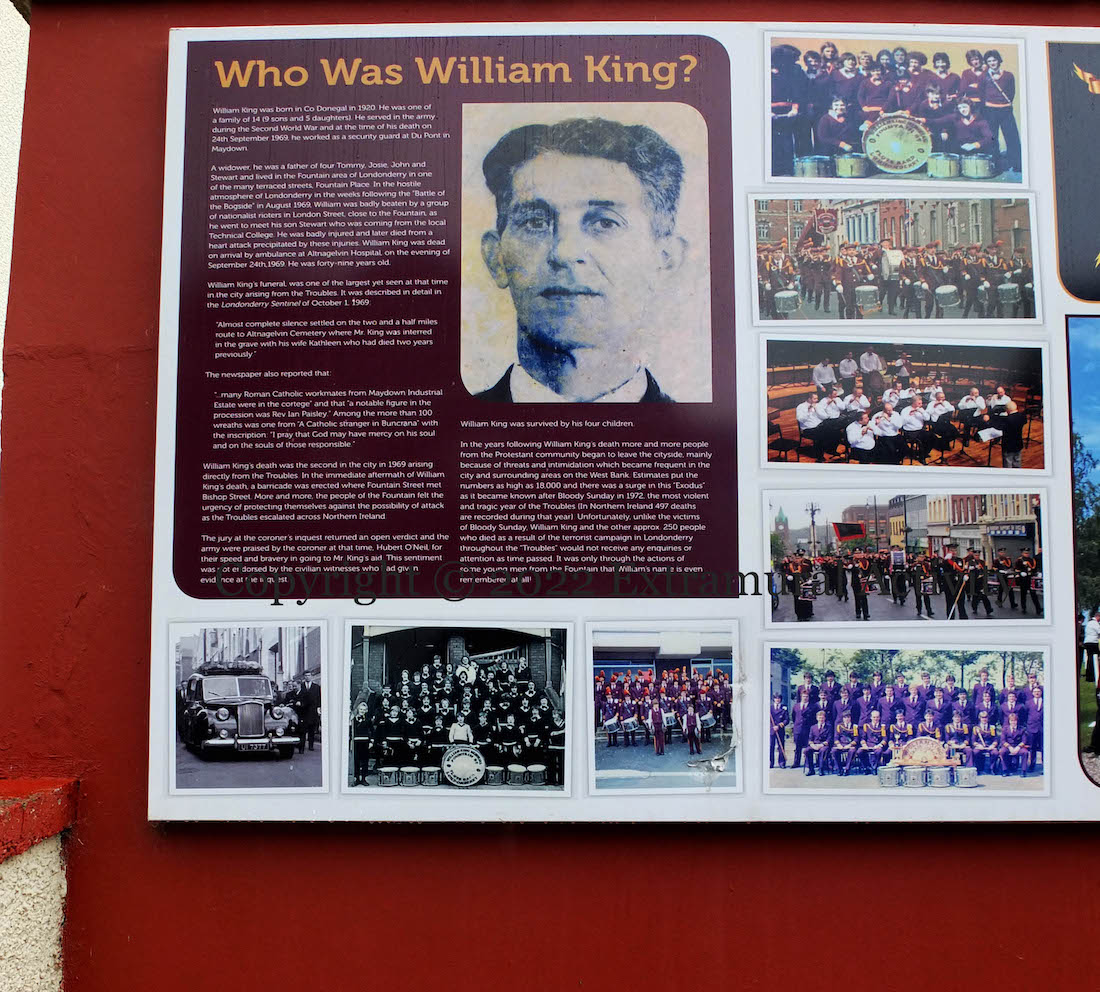
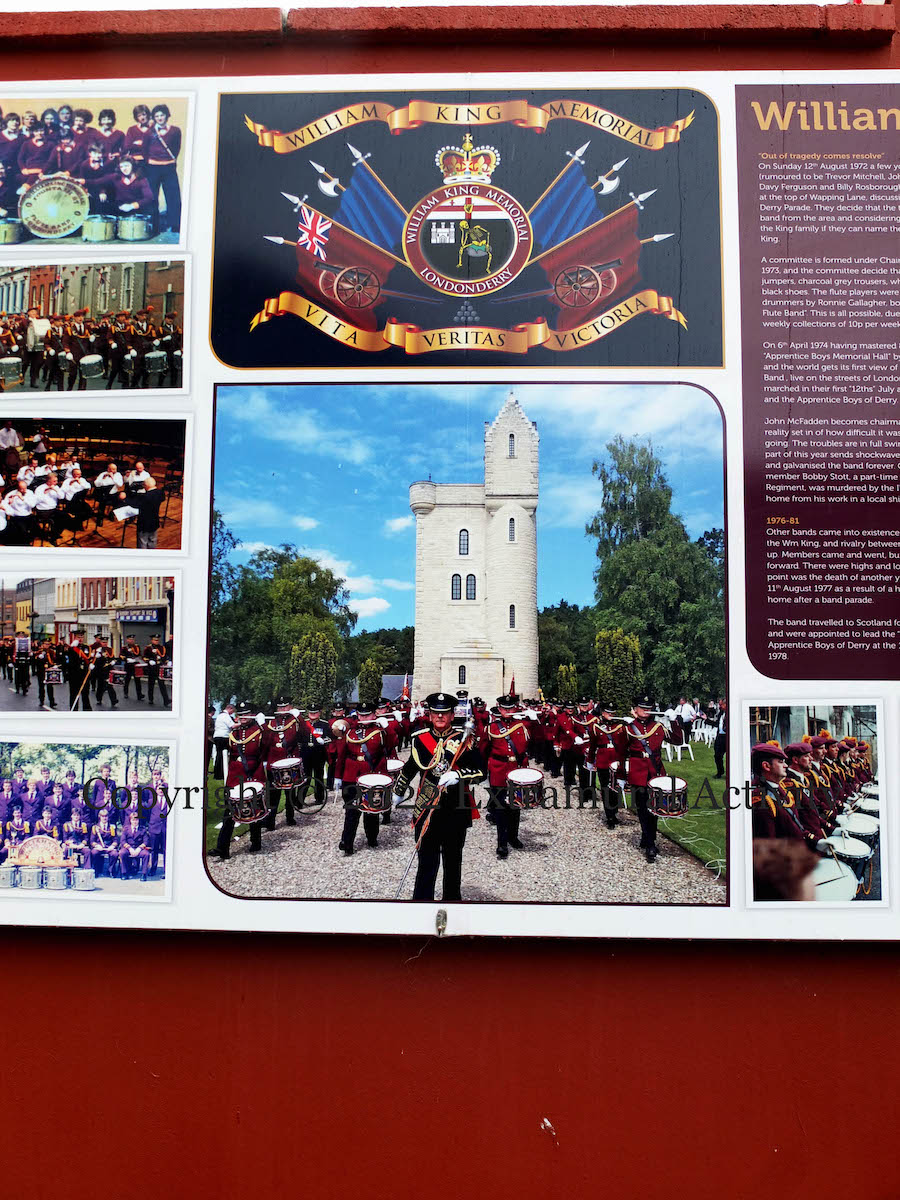
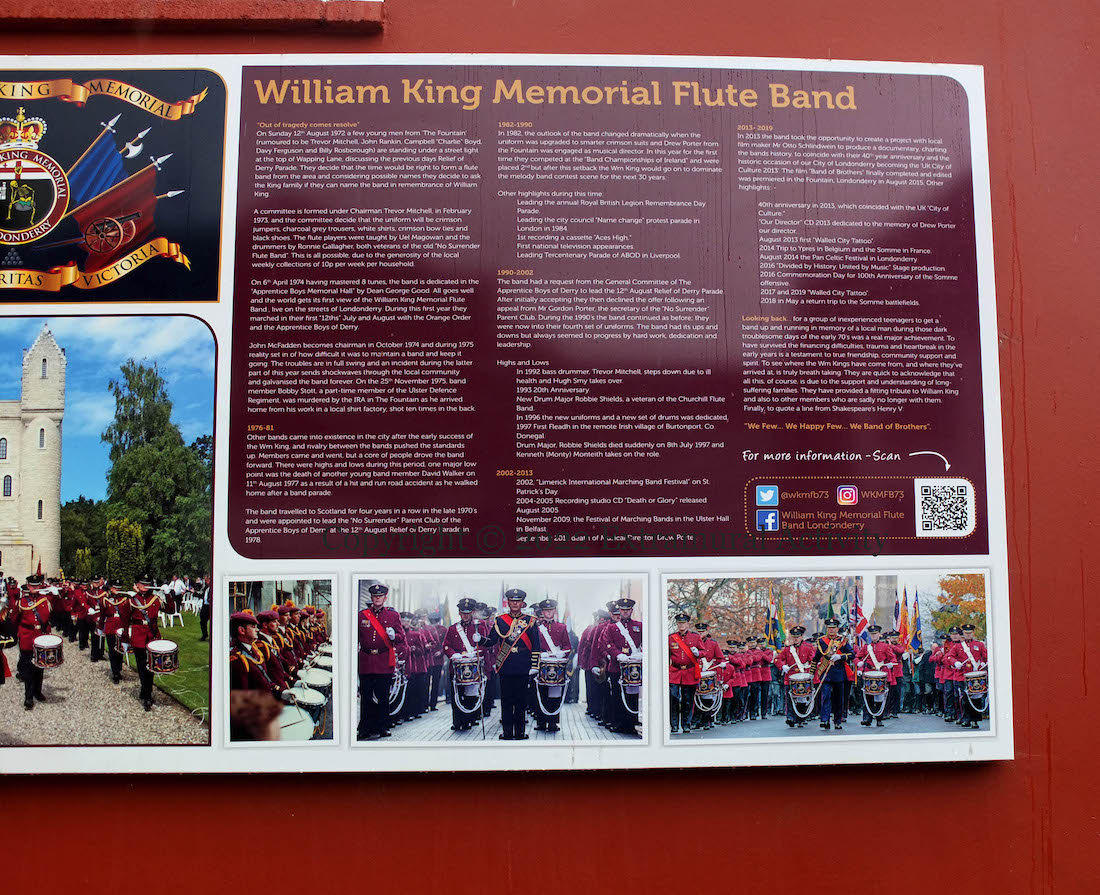
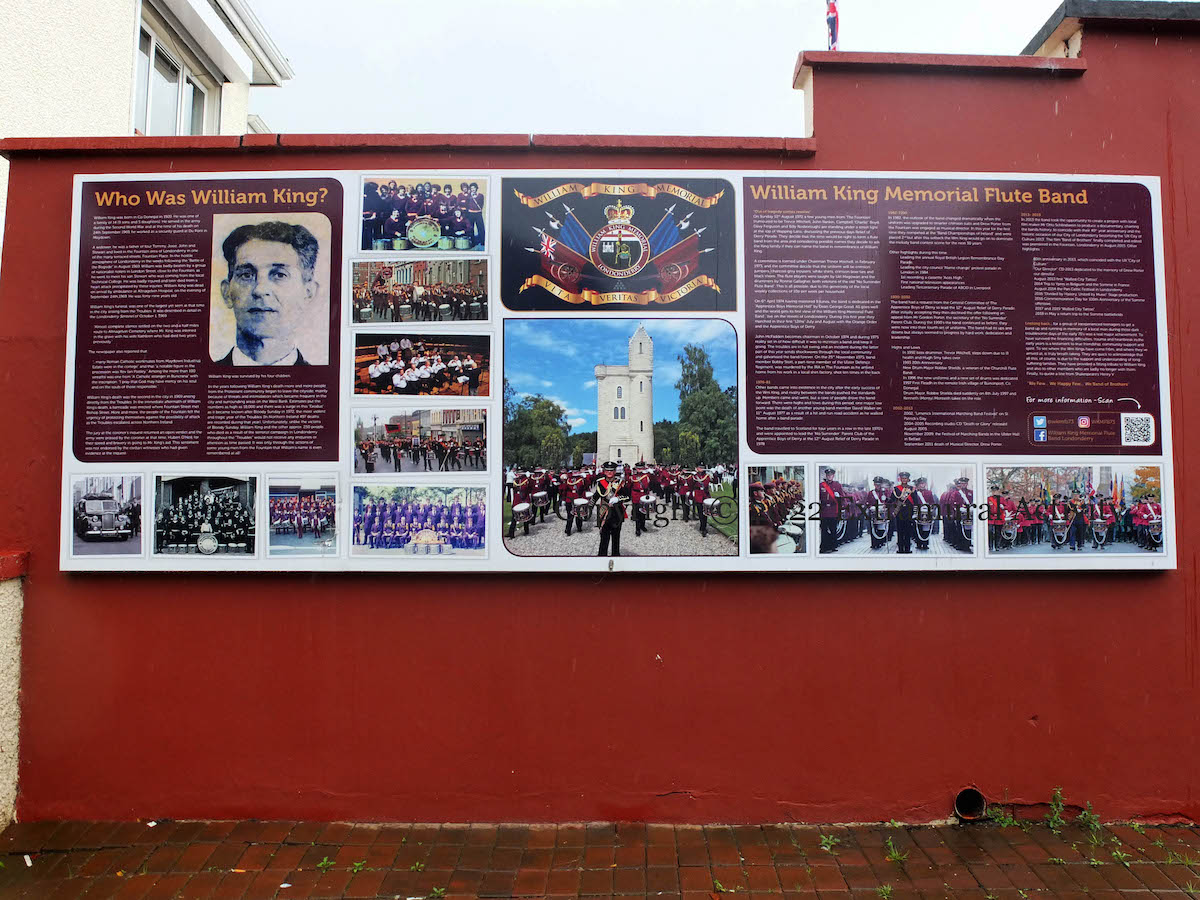
On the left is the story of William King,and on the right, the story of the William King Memorial Flute band (Fb), including the death of Bobby Stott on, forty-seven years ago yesterday. These images were taken during the summer; the board was vandalised two weeks ago (BelTel).
William King “was born in Co Donegal in 1920. He was one of a family of 14 … He served in the army during the Second World War and at the time of his death on 24th September 1969, he worked as a security guard at Du Pont in Maydown. A widower, he was a father of four … and lived in the Fountain area of Londonderry … In the hostile atmosphere of Londonderry in the weeks following the ‘Battle of the Bogside’ in August 1969, William was badly beaten by a group of nationalist rioters in London Street, close to the Fountain … and later died from a heart attack precipitated by these injuries. … unlike the victims of Bloddy Sunday, William King and the other approx. 250 people who died as a result of the terrorist campaign throughout the “Troubles” would not receive any enquiries or attention as time passed.”
“On 6th April 1974 having mastered 8 tunes, the band is dedicated on the “Apprentice Boys Memorial Hall” by Dean George Good … On the 25th November 1975, band member Bobby Stott, a part-time member of the Ulster Defence regiment, was murdered by the IRA in The Fountain … [in 1982] they competed at the “Band Championships of Ireland” and were placed 2nd but after this setback the Wm King would go on to dominate the melody band contest scene for the next 30 years.
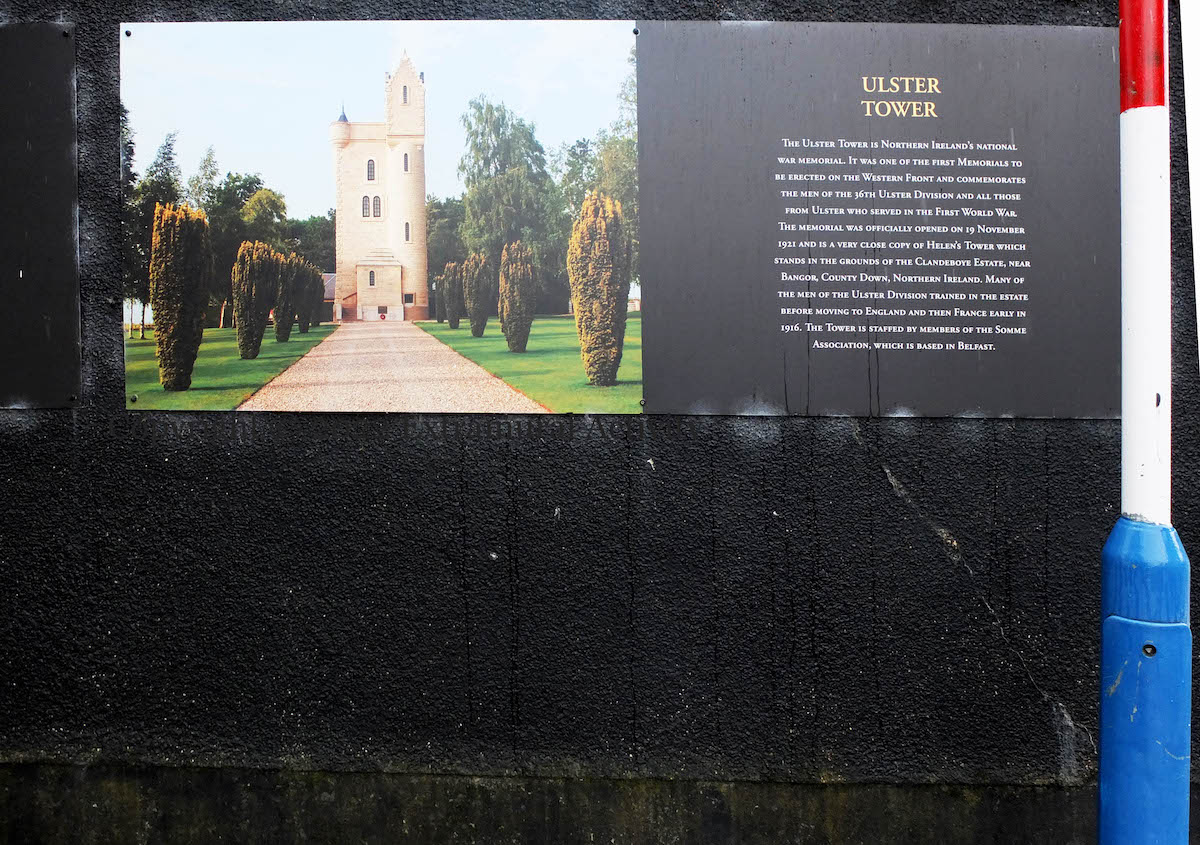
All three major WWI memorials with relevance to Ulster – Thiepval Memorial, Menin Gate, Ulster Tower – are brought together in a gallery in Londonderry’s Fountain as part of a tribute to the “Men from the Fountain who made the supreme sacrifice in the Great War.”
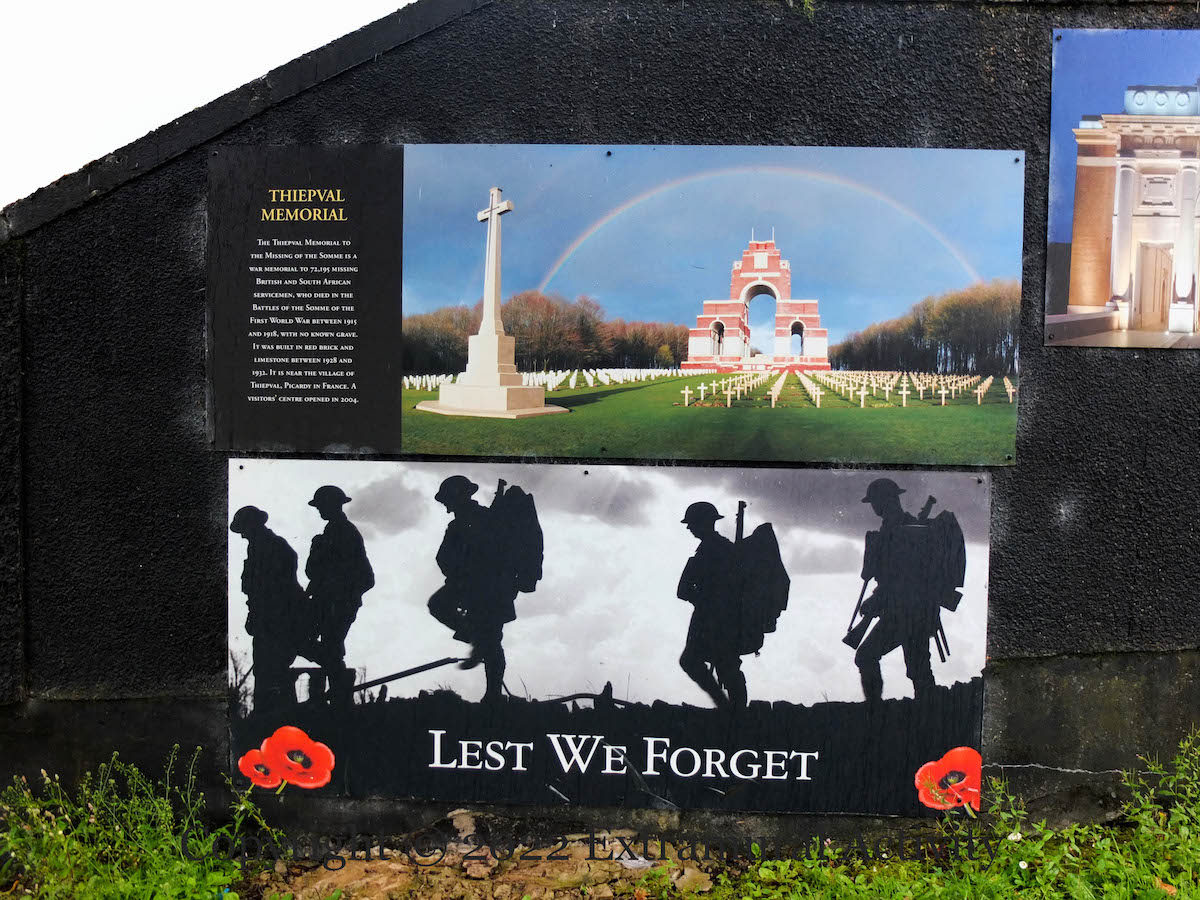
“Thiepval Memorial: The Thiepval Memorial to the missing of the Somme is a war memorial to 72,195 missing British and South African servicemen, who died in the battles of the Somme of the First World War between 1915 and 1918, with no known grave. It was built in red brick and limestone between 1928 and 1932. It is near the village of Thiepval, Picardy in France. A visitors’ centre opened in 2004.”
“Menin Gate: The Menin Gate memorial to the missing is a war memorial in Ypres, Belgium, dedicated to the 54,395 British and Commonwealth soldiers who were killed in the Ypres salient of World War I and whose graves are unknown. The memorial is located at the eastern exit of the town and marks the starting point for one of the main roads out of the town that led Allied soldiers to the front line. The Menin Gate memorial was unveiled on 24 July 1927.”
“Ulster Tower: The Ulster Tower is Northern Ireland’s national war memorial. It was one of the first memorials to be erected on the western front and commemorates the men of the 36th (Ulster) Division and all those from Ulster who served in the First World War. The memorial was officially opened on 19 November 1921 and is a very close copy of Helen’s Tower which stands in the grounds of the Clandeboye estate, near Bangor, County Down, Northern Ireland. Many of the men of the Ulster division trained in the estate before moving to England and then France early in 1916. The Tower is staffed by members of the Somme Association, which is based in Belfast.”
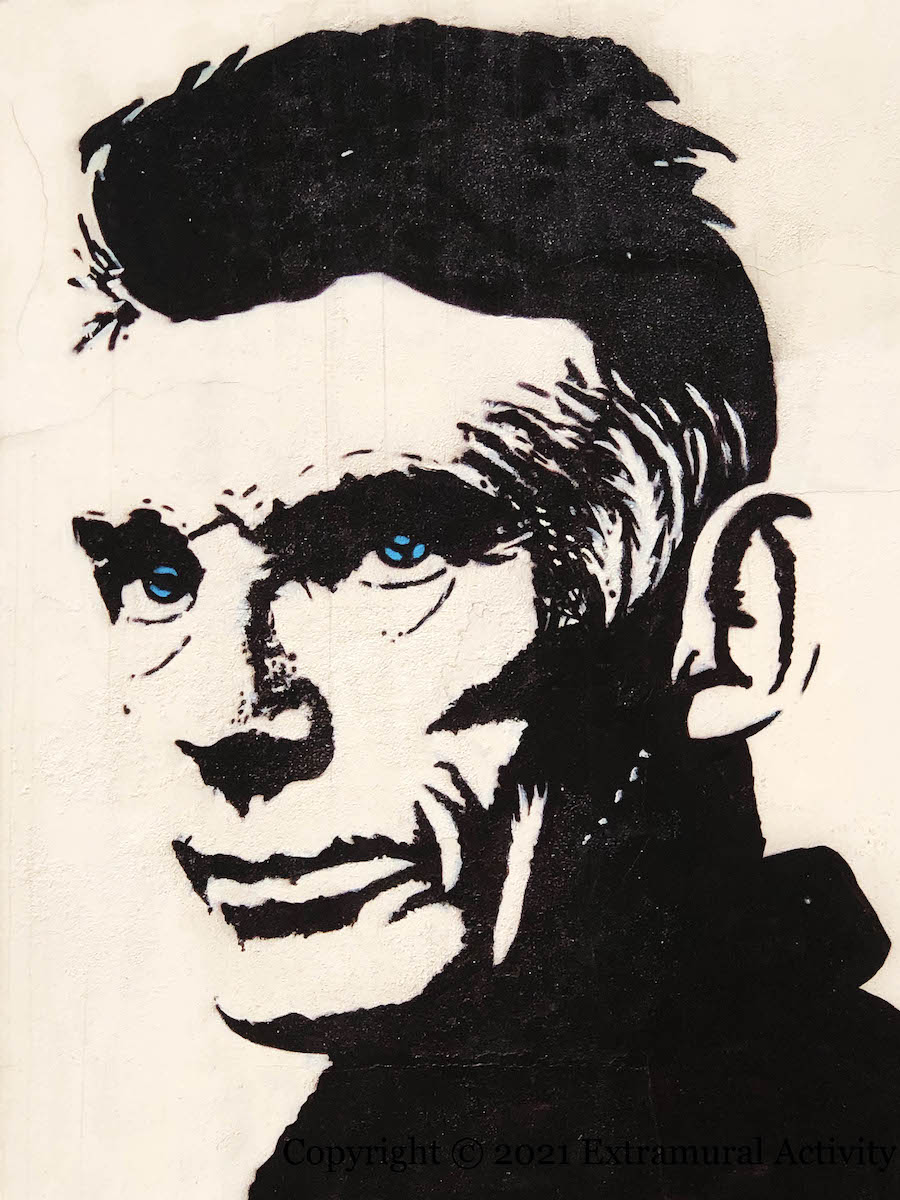
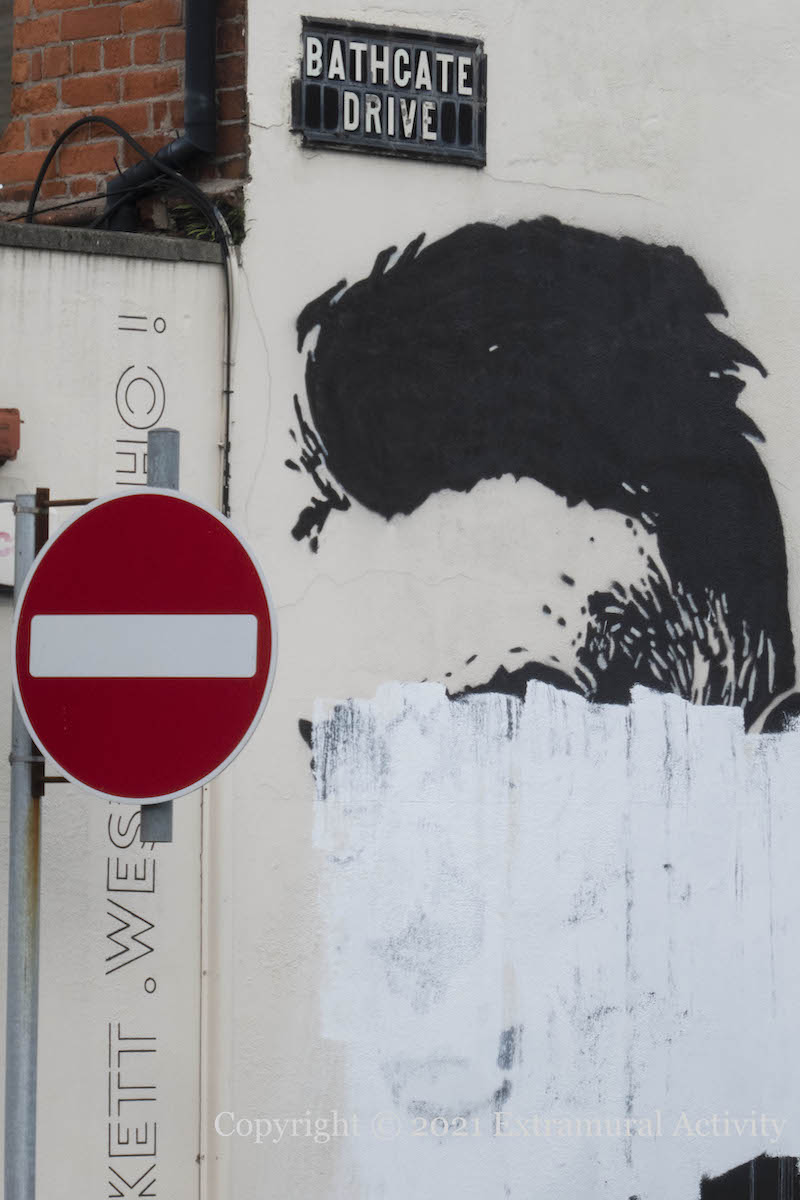
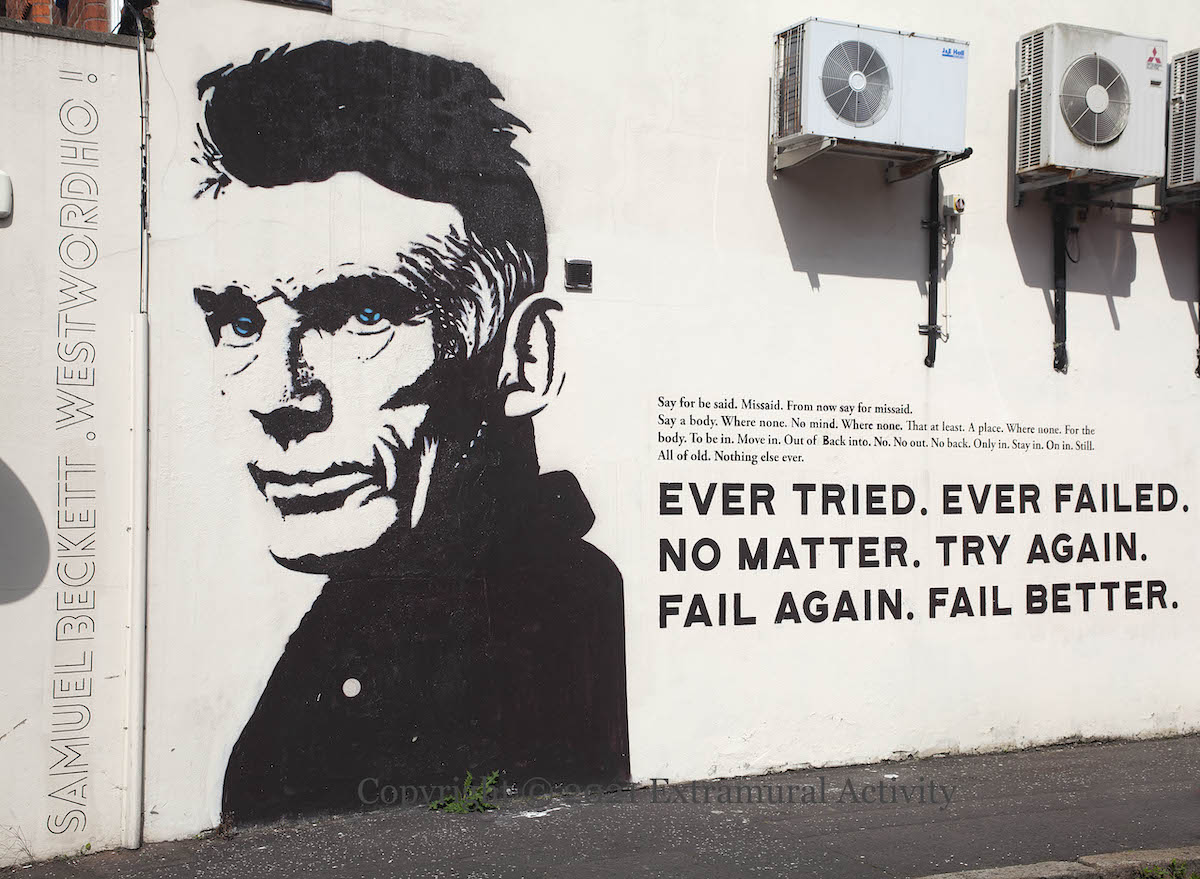
Glen Molloy’s Samuel Beckett mural in the Dundela area of east Belfast was largely whitewashed the day after it was finished – see the second image, below. (This was only a few weeks after the Maya Angelou mural across the street was painted and graffitied.) (Belfast Live) The portrait was restored last year, with blue sparkling blue eyes, and the quotation was added again this summer.
(The Angelou mural was partially repaired at the time, and support for Ukraine added this year – see We May Encounter Many Defeats.)
The quotation is from Worstward Ho! (not “Westword Ho!” as written on the wall): “Say for be said. Missaid. From now say for missaid. Say a body. Where none. No mind. Where none. That at least. A place. Where none. For the body. To be in. Move in. Out of. Back into. No. No out. No back. Only in. Stay in. On in. Still. All of old. Nothing else ever. Ever tried. Ever failed. No matter. Try again. Fail again. Fail better.”
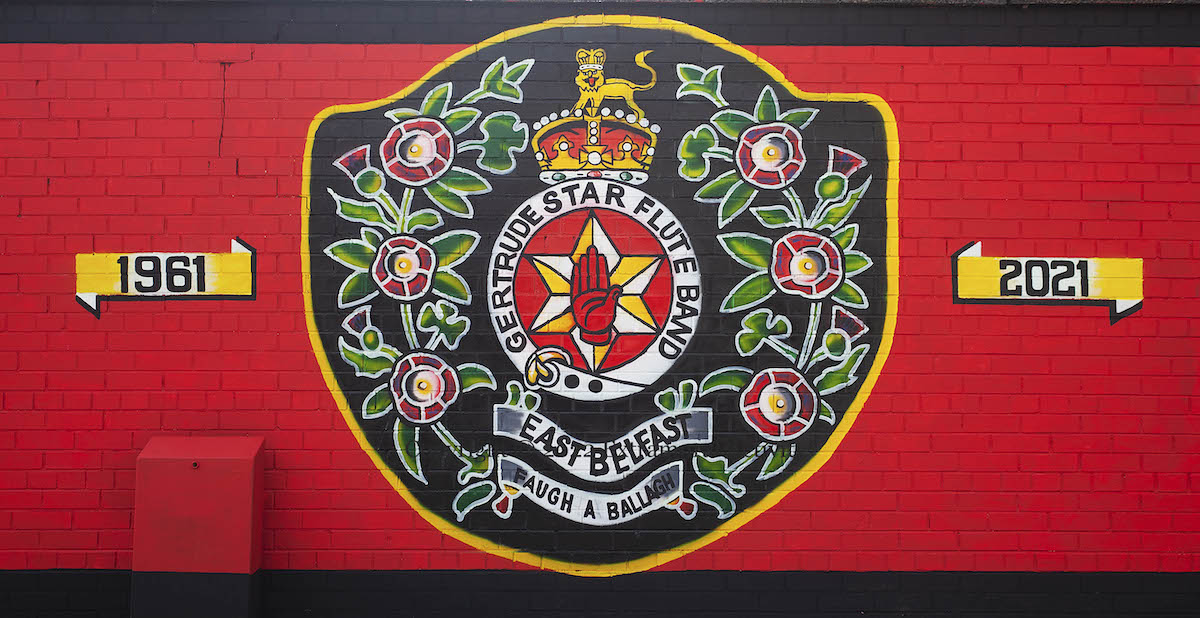
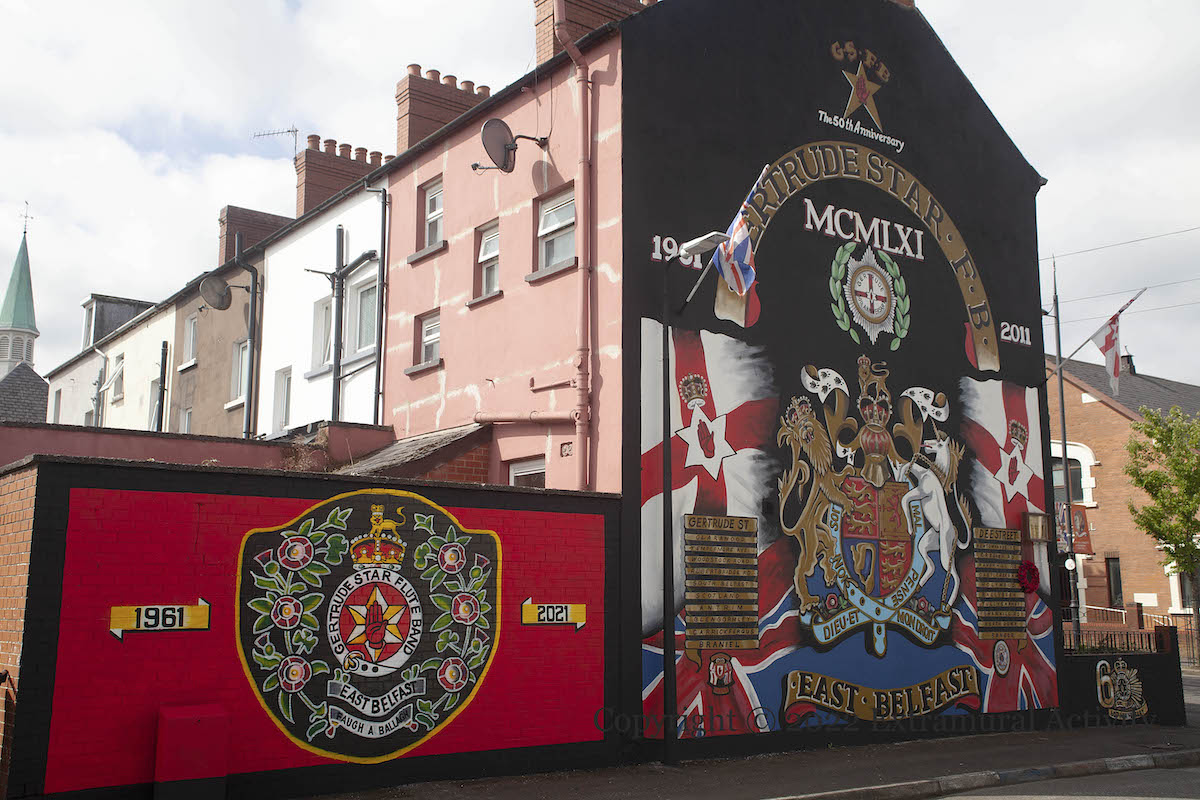
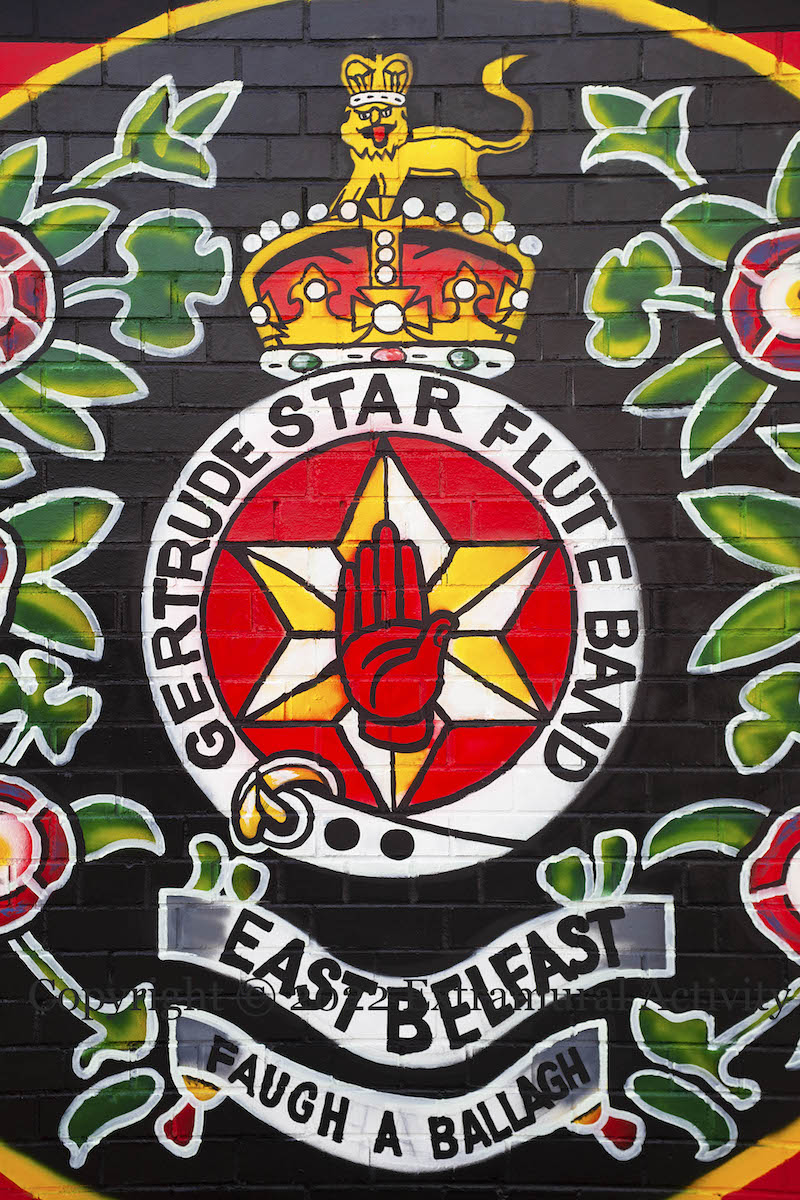
Gertrude Star flute band (Fb) celebrated its 60th anniversary in 2021 and to mark the occasion this (2022) May, the two side-walls were painted with the emblems above and immediately below. For the mural, which was painted for the 50th anniversary in 2011, M08166.