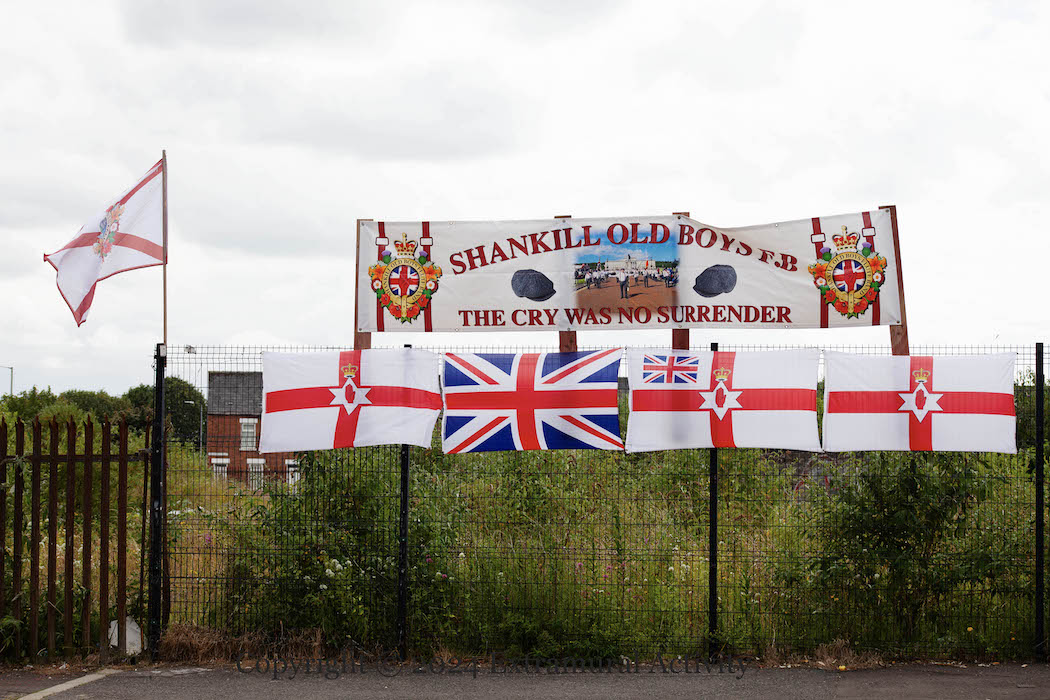
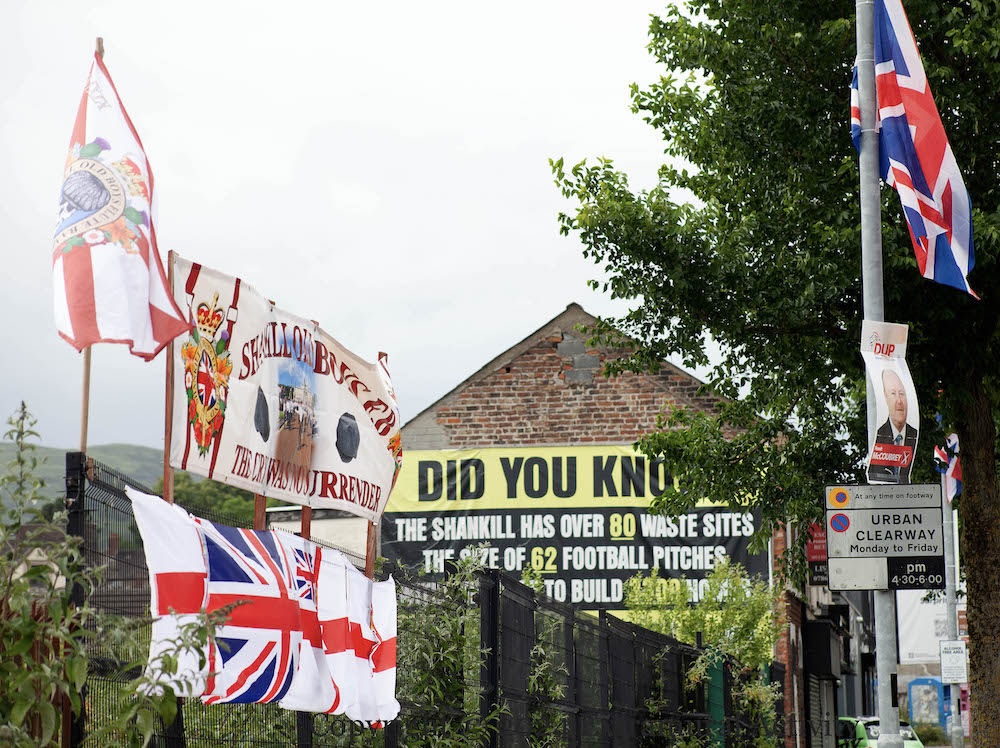
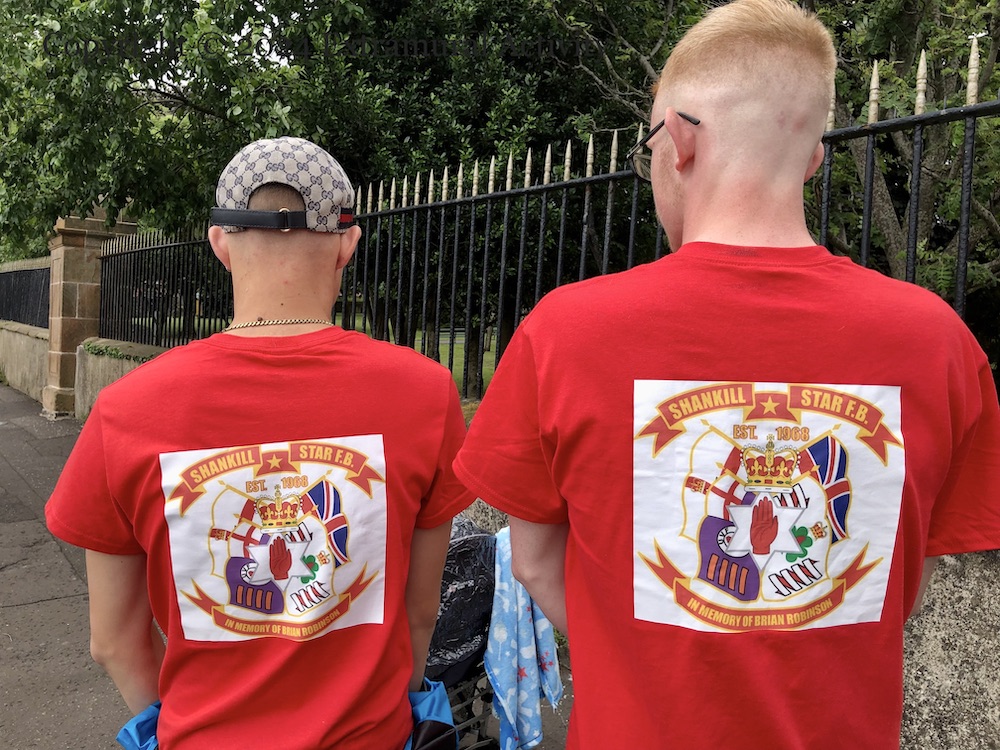
“The cry was no surrender” – in preparation for the Twelfth, Ulster Banners, the Union Flag are posted along a fence in upper Shankill below a Shankill Old Boys (Fb) tarp and a band flag using St Patrick’s Saltire as a background. On the big day, the band paraded (Parades’ Commission) from the Shankill into the city centre (youtube), and back again after the demonstration in Barnett’s Demense (GOLI).
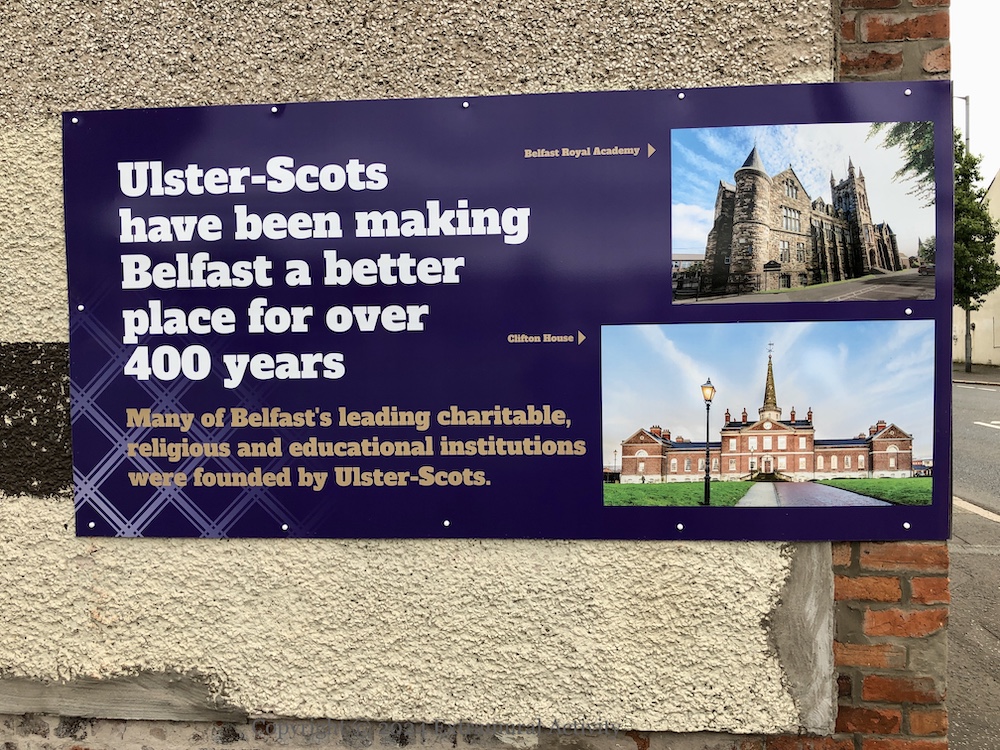
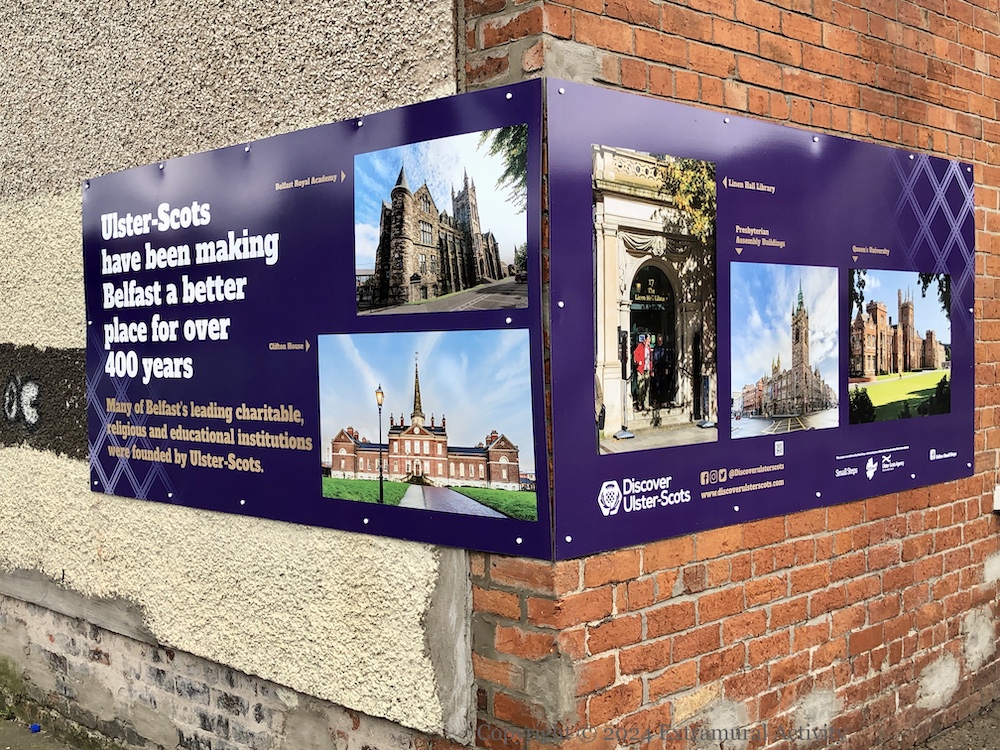
Discover Ulster-Scots (web) has added some more boards in north Belfast, joining the recent gallery of famous figures at Mountcollyer Avenue (see The Scots In Ulster).
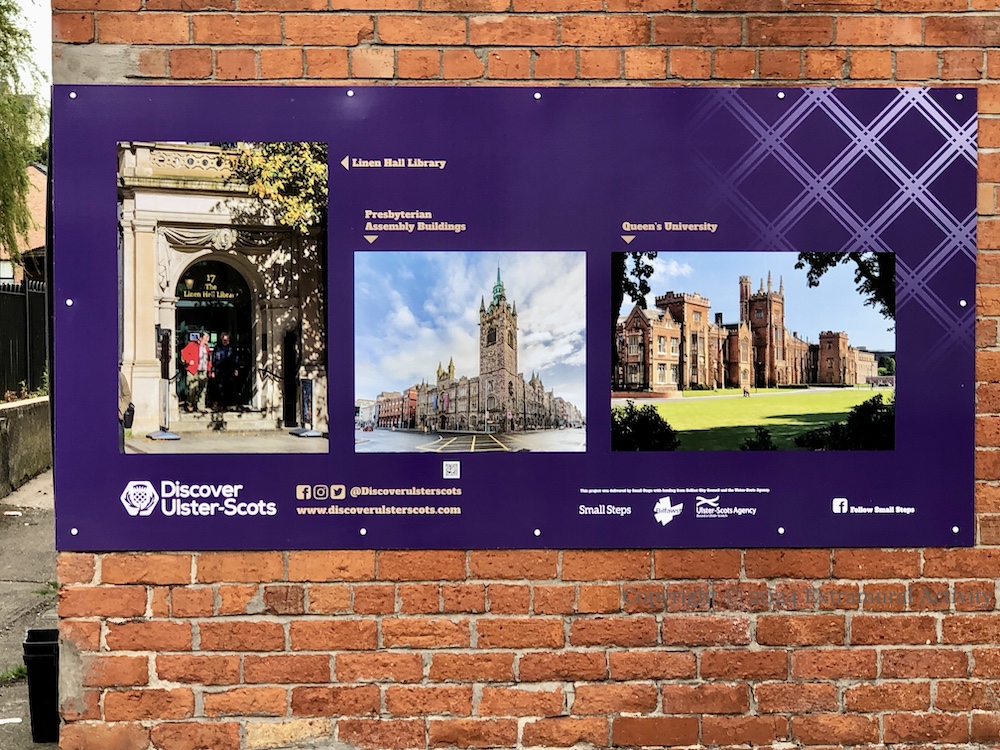
The boards shown here are in North Queen St: “Ulster-Scots have been making Belfast a better place for over 400 years. Many of Belfast’s leading charitable, religious and educational institutions were founded by Ulster-Scots.” with images of BRA (James Crombie), Clifton House (possibly William Tennant is intended), the Linen Hall Library (a list of founders can be found on page 11 of this History), the Assembly buildings (of the Presbyterian church), and Queen’s (John Mowat).
Additional new boards, concerning soda farls and potato bread, and brown lemonade, can be seen in the Paddy Duffy Collection: The Ulster Fry.
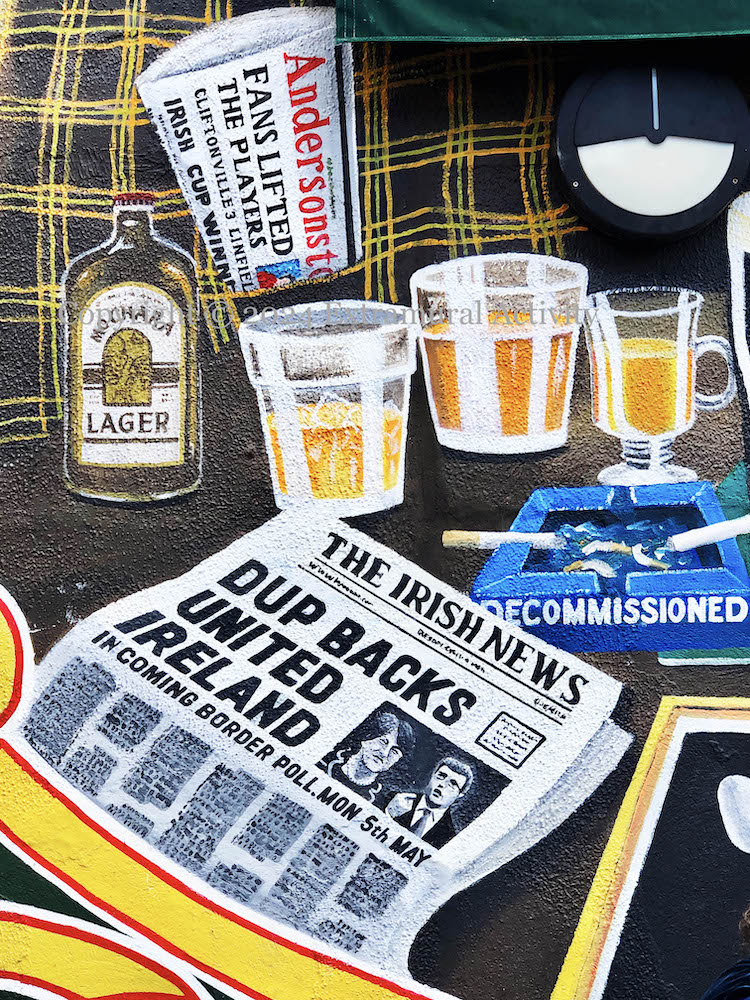
“DUP backs united Ireland in coming border poll, Mon, 5th May”. This image updates one of the images from two weeks ago of the re-painted mural at Madden’s bar in the city centre – see Sásta A Bheıth Anseo. Initially the newspaper showed a headline relating to the prosecution of DUP (now-former) leader Jeffrey Donaldson on charges of rape and sexual assault.
The DUP in January flirted (strategically) with the idea of supporting a border poll (BBC) but their more typical stance is that the conditions for a poll are not close to being met (News Letter).
While elections sometimes fall on the 5th as the first Thursday in May – most recently the 2022 Assembly elections (CAIN) – the date here is probably a nod to the anniversary of Bobby Sands’s death (in 1981).
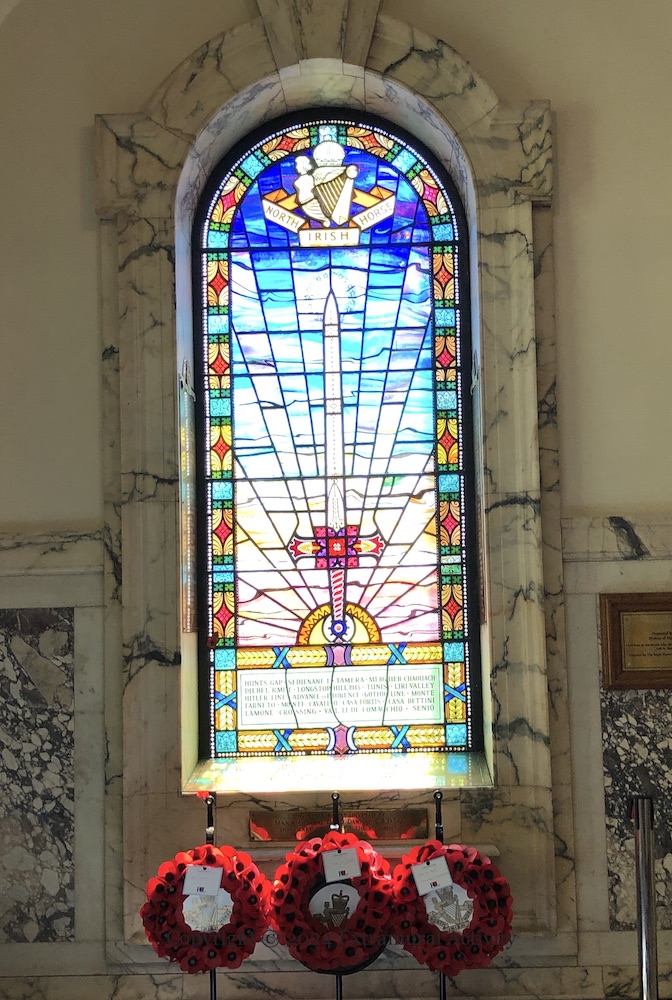
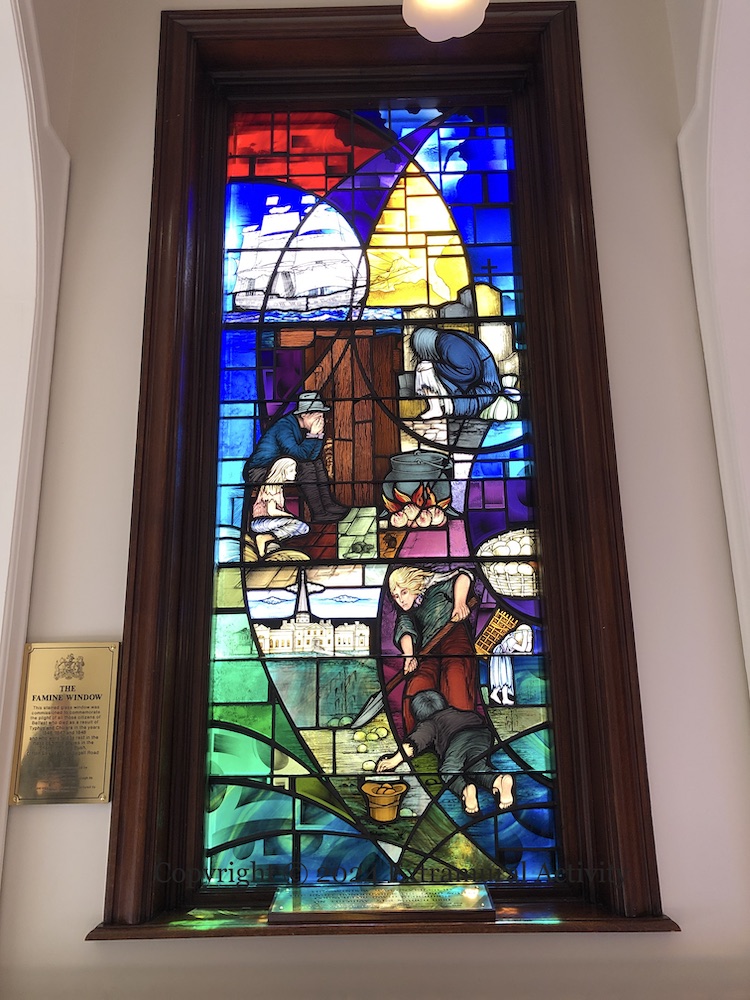
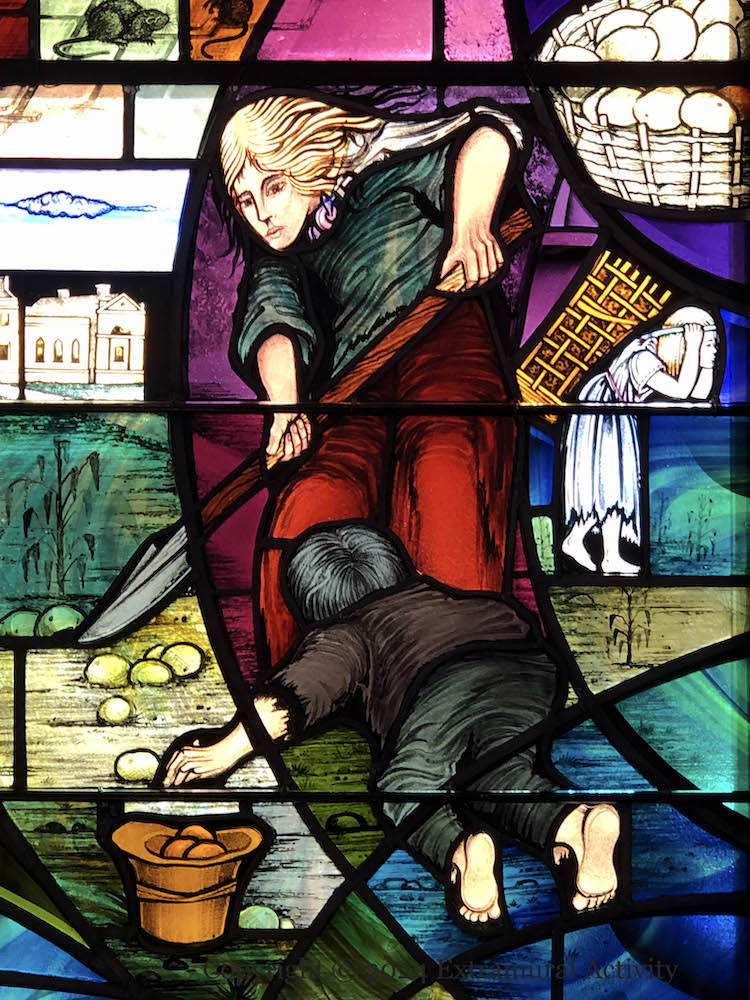
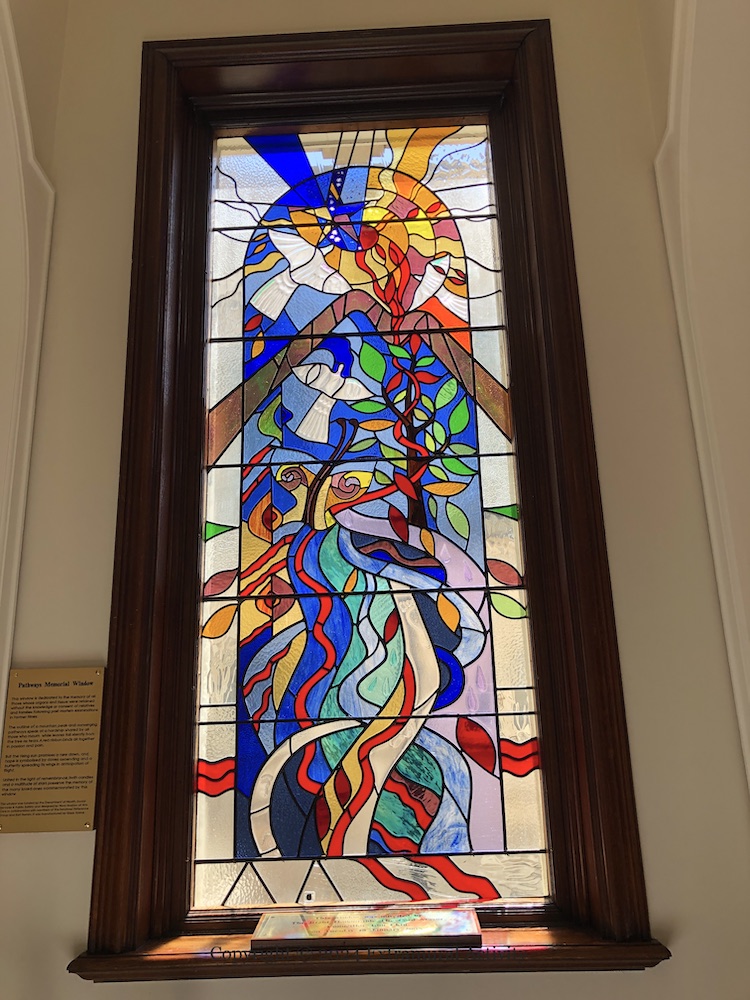
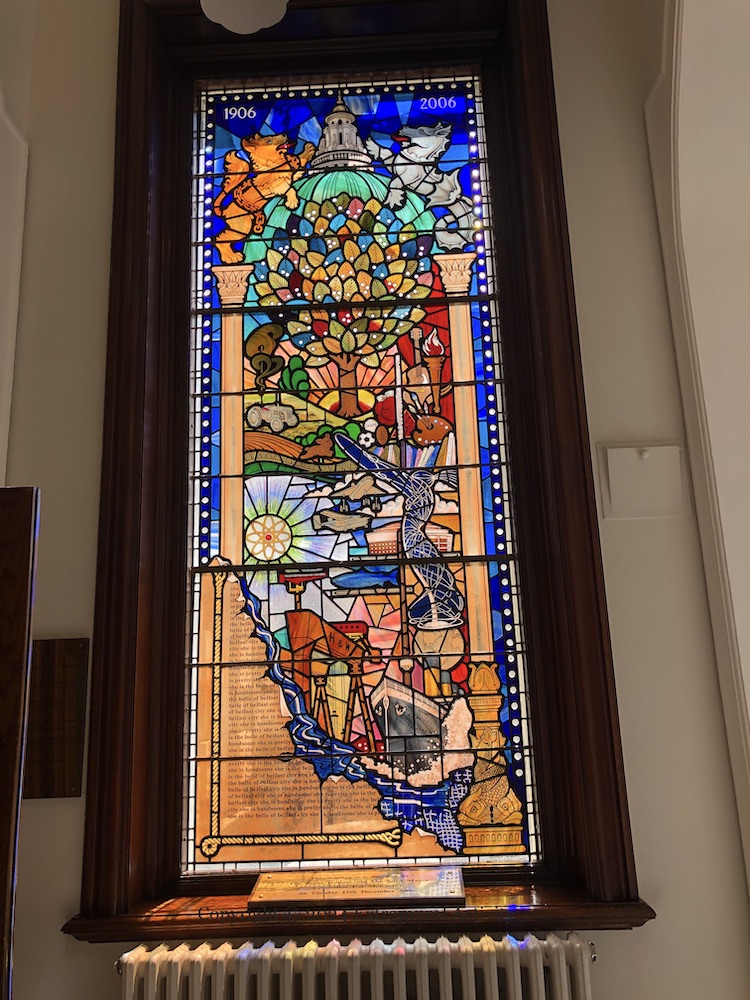
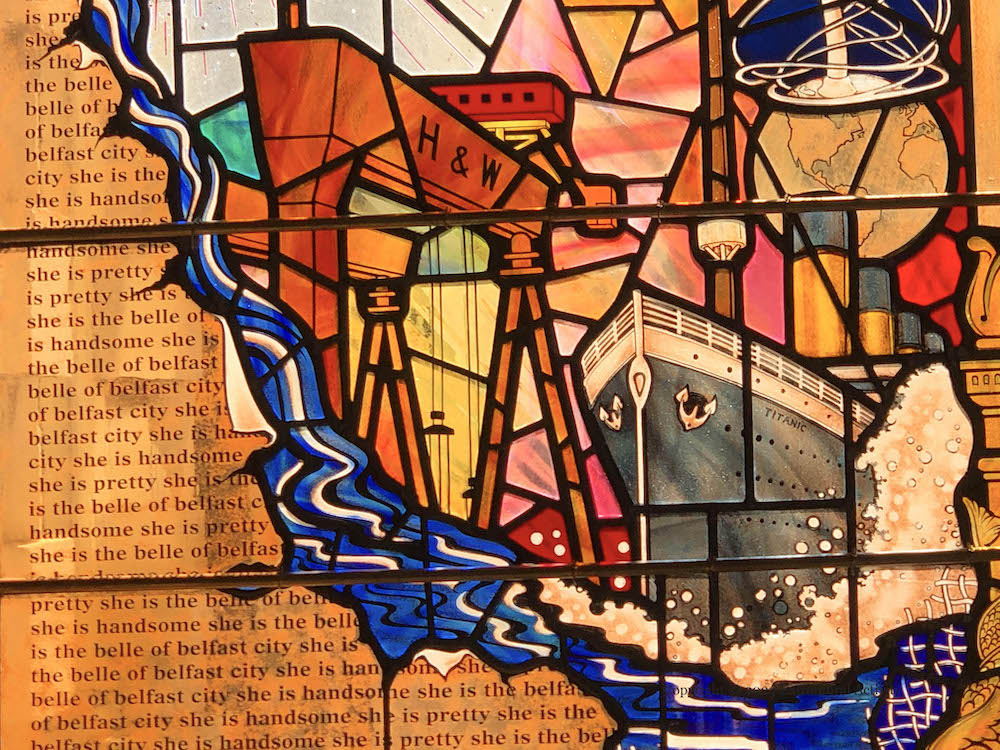
6: The Pathways Window – according to the guide, this window commemorates the pain caused to the relatives of deceased persons from whom organs were taken without consent.
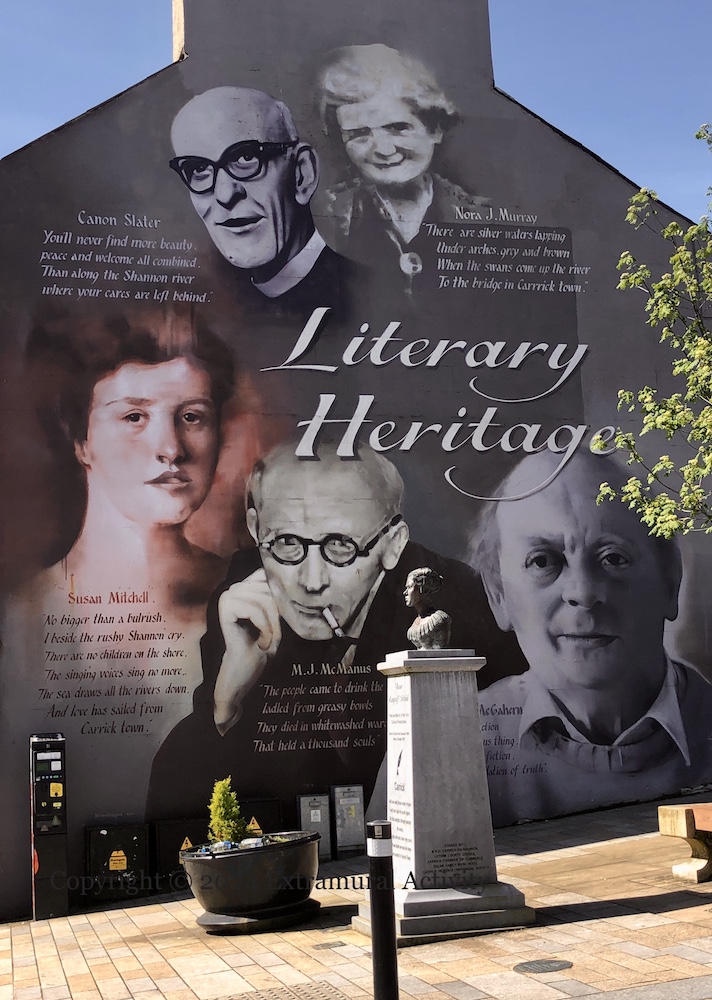
Leitrim’s “literary heritage” is recognised by this large mural by Nik Purdy/Blow Designs (ig) in Main Street, Carrick-On-Shannon. Clockwise from top we see portraits and quotes from …
Canon [William] Slator: “You’ll never find more beauty/Peace and welcome all combined/Than along the Shannon River/where your cares are left behind.”
Nora J Murray: “There are silver waters lapping/Under arches grey and brown/When the swans come up the river/To the bridge in Carrick town”
John McGahern: “I think fiction is a very serious thing, that while it is fiction, it is also a revelation of truth.” (2000 interview)
MJ McManus: “The people came to drink the soup/Ladled from greasy bowls/They died in whitewashed wards that held/A thousand Irish souls” (from the poem ‘Eighteen Forty-Nine’)
Susan Mitchell: “No bigger than a bulrush./I beside the rushy Shannon cry./There are no children on the shore./The singing voices sing no more./The sea draws all the rivers down./And love has sailed from Carrick town.” (from the poem ‘Carrick’ – Google Books)
The monument in front of the mural is also to Mitchell.
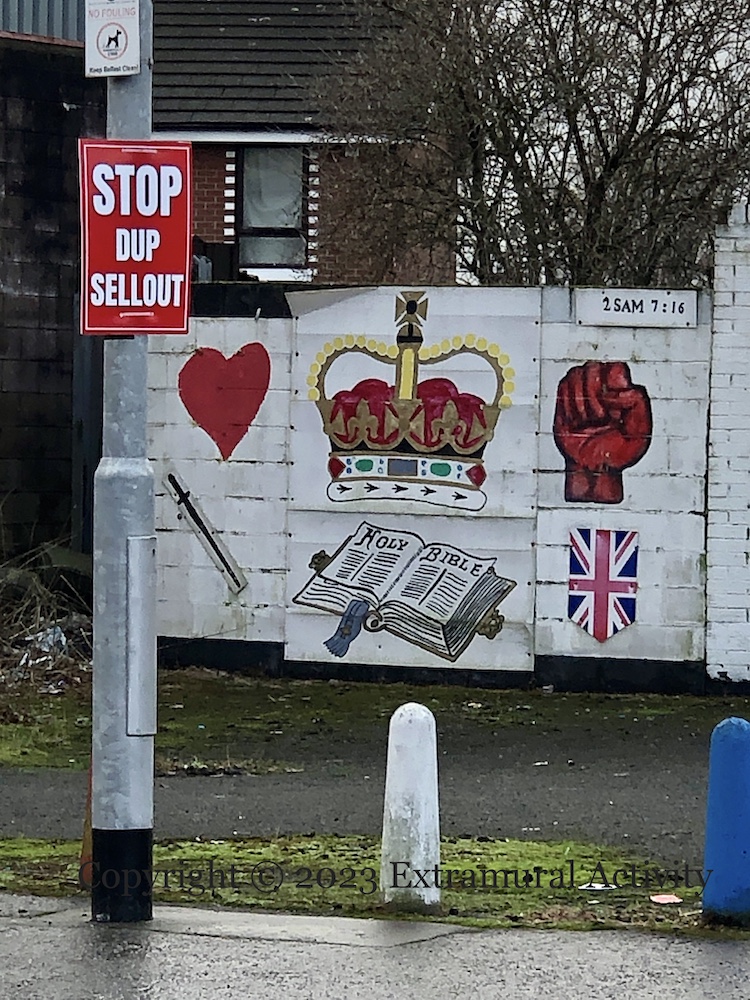
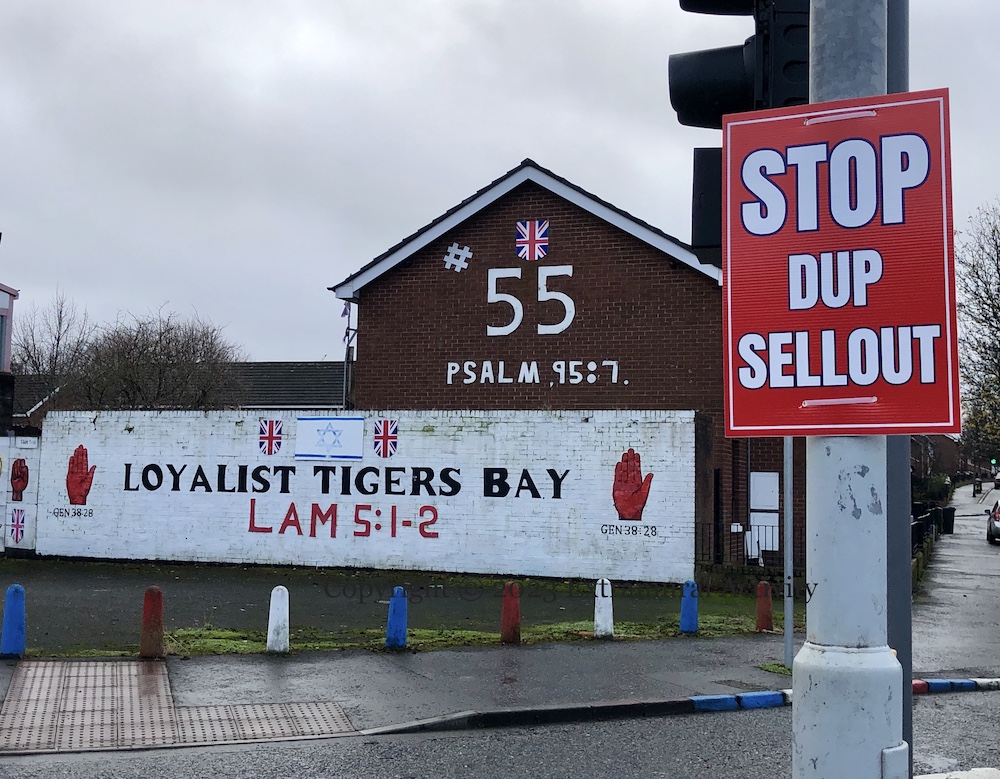
TUV (Traditional Unionist Voice) has put up placards attacking the DUP (Democratic Unionist Party) – including outside the office of DUP leader Jeffrey Donaldson – in response to the possibility that the DUP might re-enter Stormont – which has been defunct now for two years – and implement the NI Protocol (BBC | BelTel).
It hasn’t happened yet, but a combination of public dissatisfaction concerning inaction over strikes by transport workers on December 22 and a general strike planned for January 18 (ITv)) and a financial package for pay awards are keeping the pressure on (Shropshire Star).
The name “Ulster-Scots” refers to the emigrants to North America from Ulster that had previously come from Scotland and the English borders, and most of the Ulster-Scots murals in the 2000s focused on emigration to America and on US Presidents with Scotch-Irish heritage (see the Visual History page of Ulster-Scots murals).
In 2017, a series of boards along York Street focused on industrialists in Northern Ireland with Scottish backgrounds: 13 panels in five posts: one | two | three | four | five. And this new collection of “Ulster-Scots” luminaries (which is 100 paces away) likewise presents figures who are associated with Northern Ireland rather than America. Modern folk such as those portrayed in these new boards presumably have Scottish heritage rather than Scotch-Irish. (The title of this entry – The Scots In Ulster – comes from a Discover Ulster Scots poster about the Scots who came to Ulster in the 1600s, regardless of whether or not they or their descendants later moved to America.)
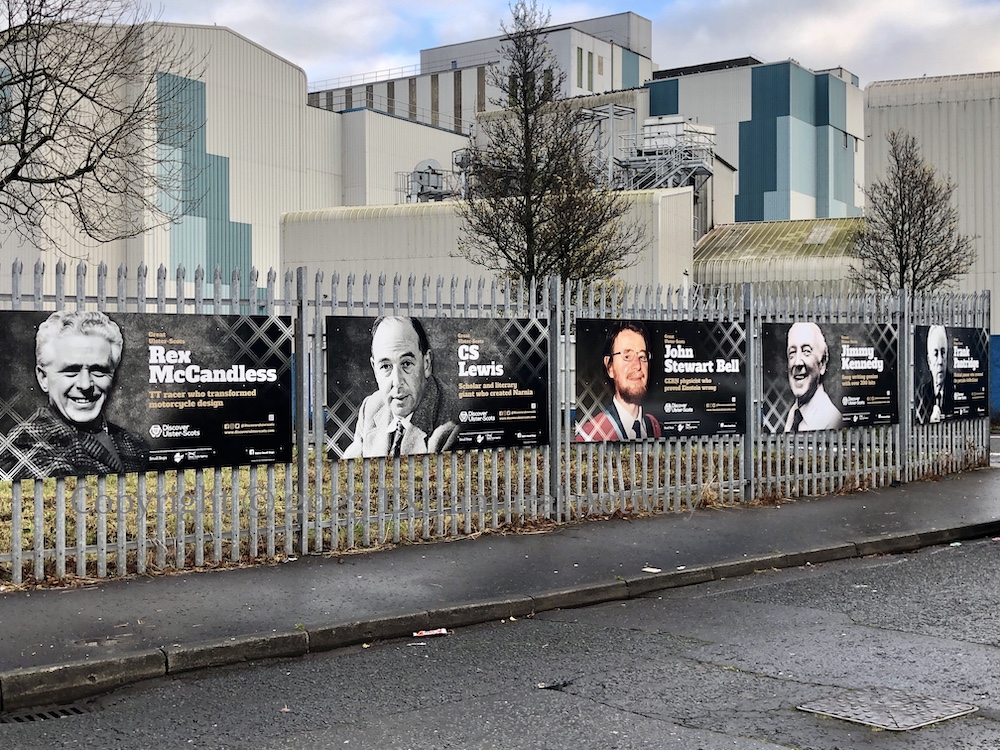
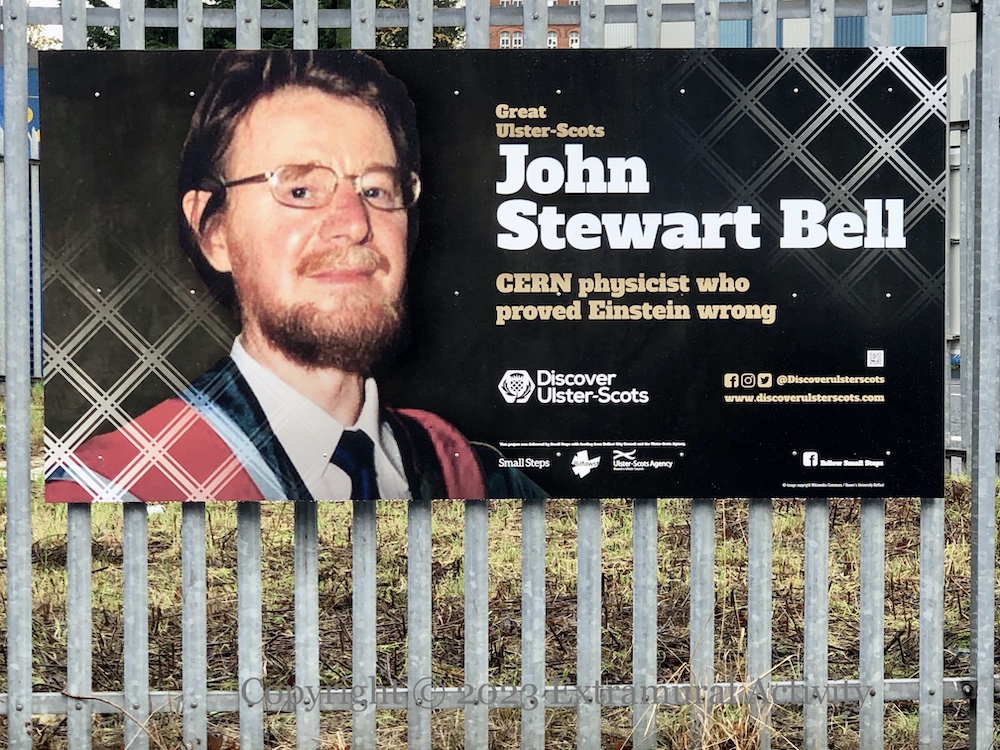
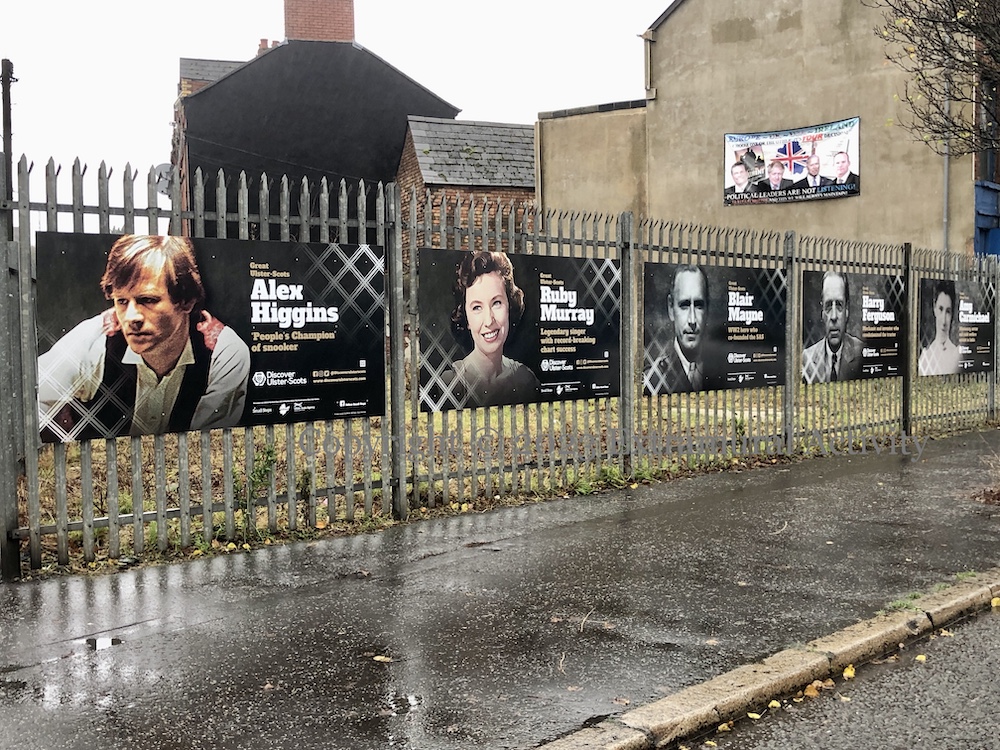
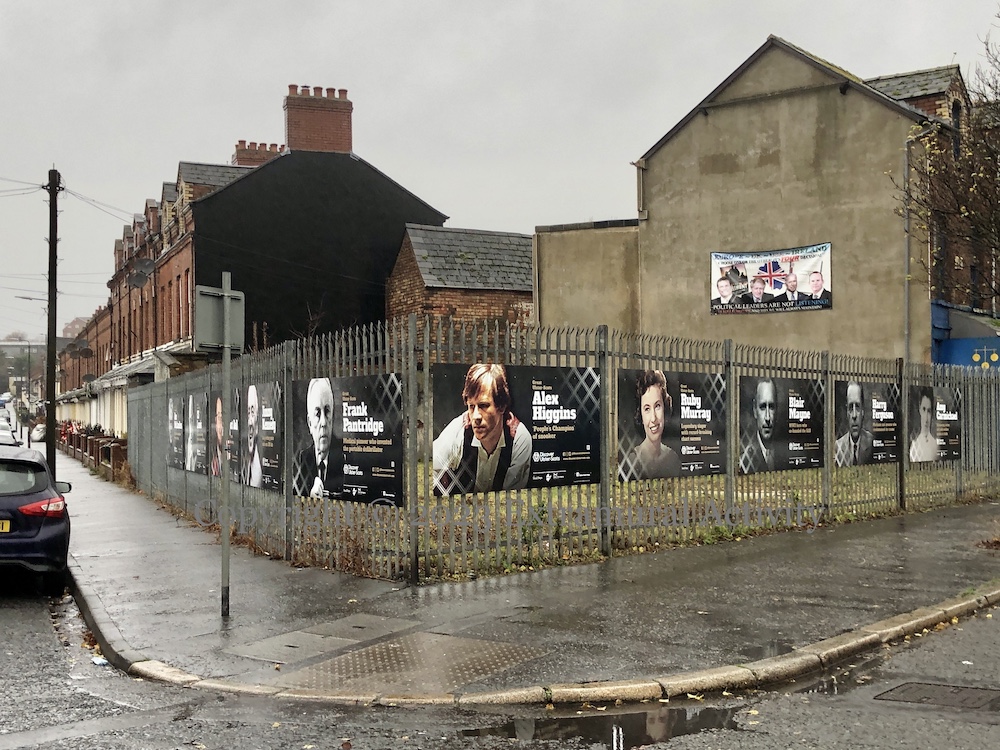
From left to right, the people shown are as follows. (Links are to previous entries in the Extramural collection.)
Mountcollyer: motorcyclist Rex McCandless, author CS Lewis, physicist John Stewart Bell, song-writer Jimmy Kennedy, medical inventor Frank Pantridge
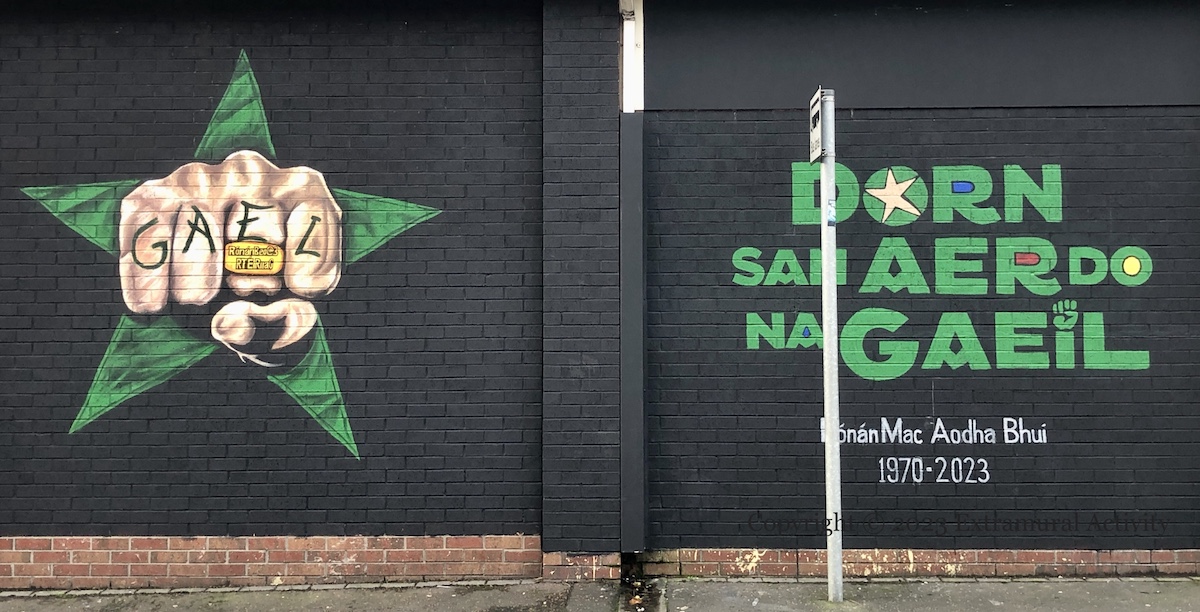
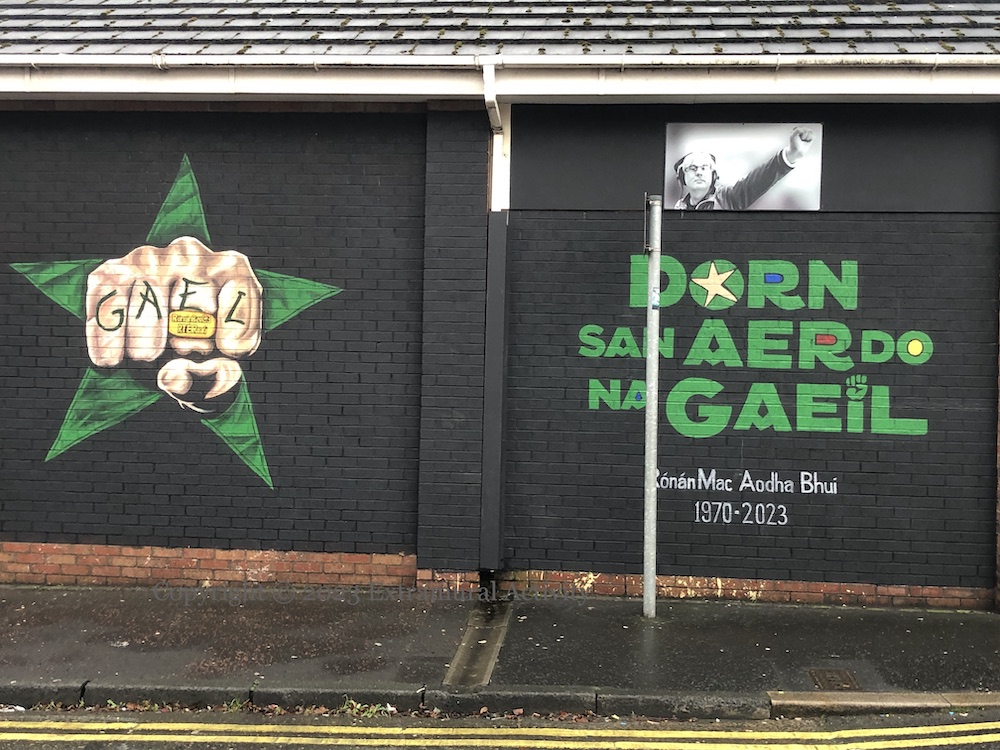
“Dorn san aer do na Gaeıl [a fist in the air for the Irish] Rónán Mac Aodha Bhuí 1970-2023”.
Mac Aodha Bhuí joined Ráıdió Na Gaeltachta in the 1990s but was best known for his Rónán Beo@3 programme (which is inscribed on the ring on the first), which began in 2006. He was a passionate advocate for the Irish language. He died this past September after a four-year battle with cancer. (RTÉ | Irish Times | Donegal Daily)
The official launch of the mural will be at 2 p.m. on Friday (December 1st).
Fallswater Street, west Belfast
Update: by the time of the launch a photograph of Mac Aodha Bhuí was added.
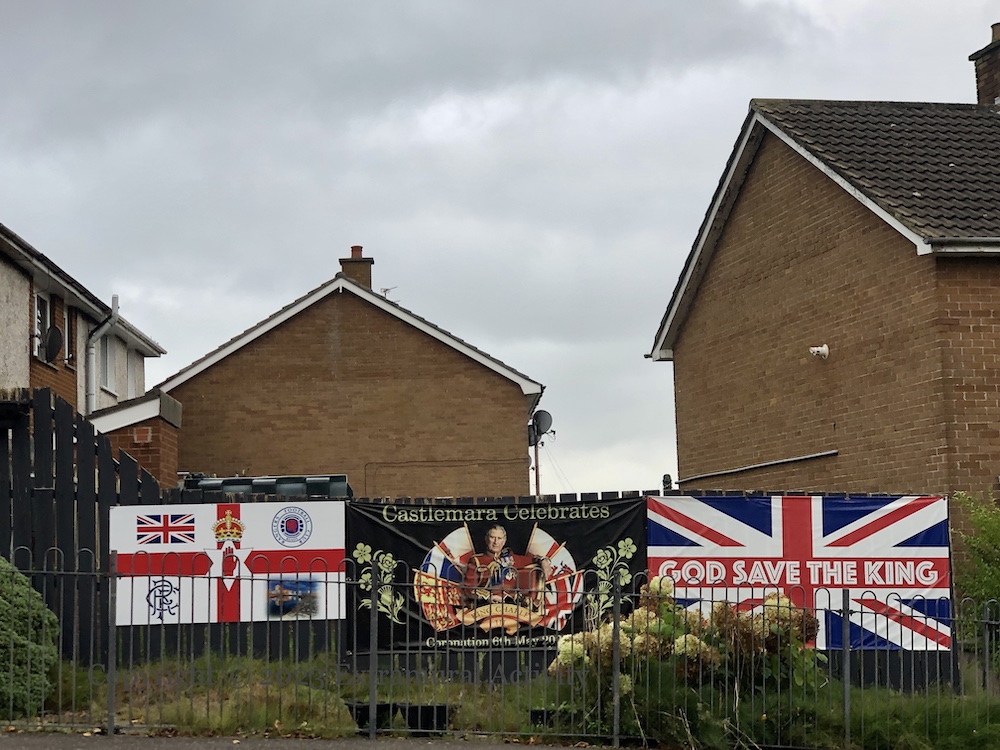
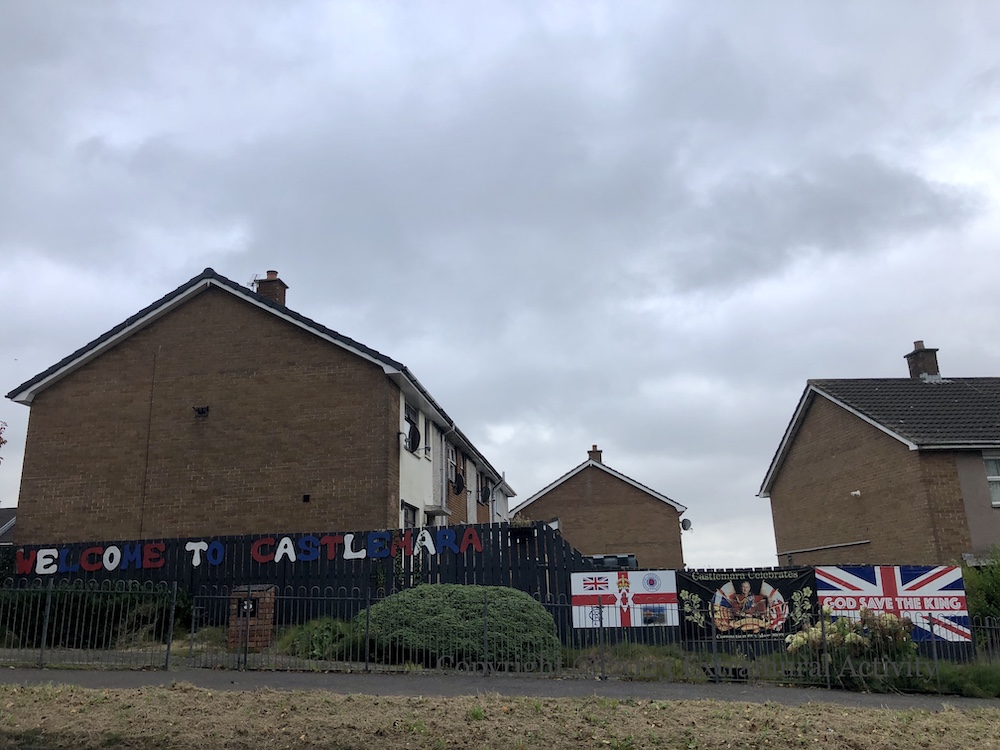
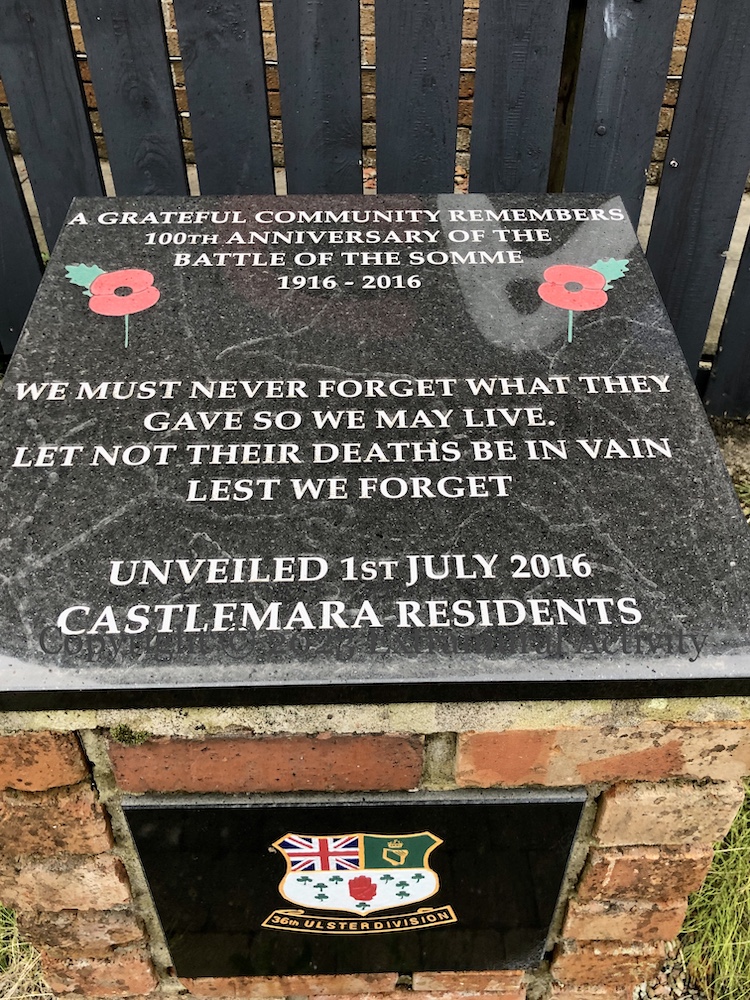
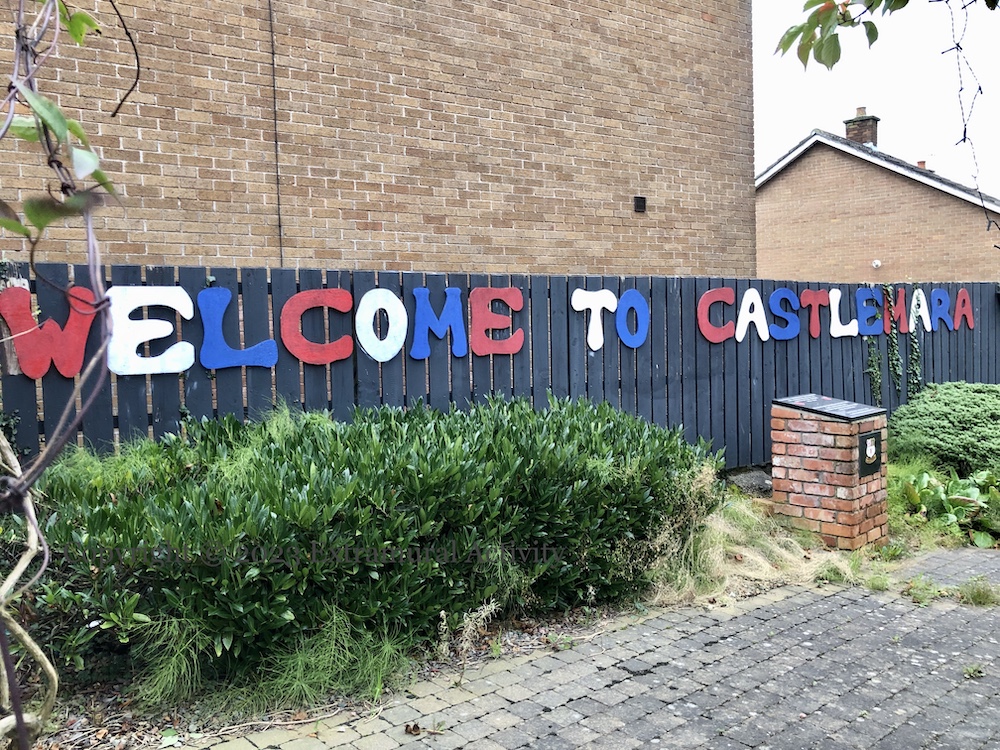
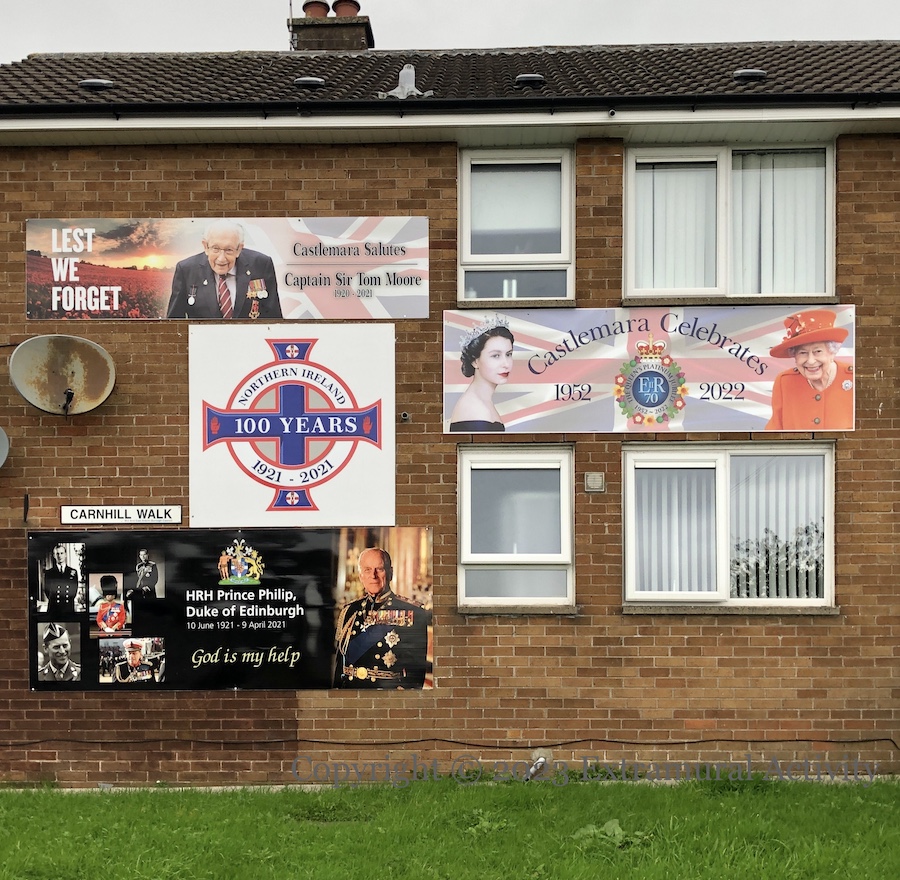
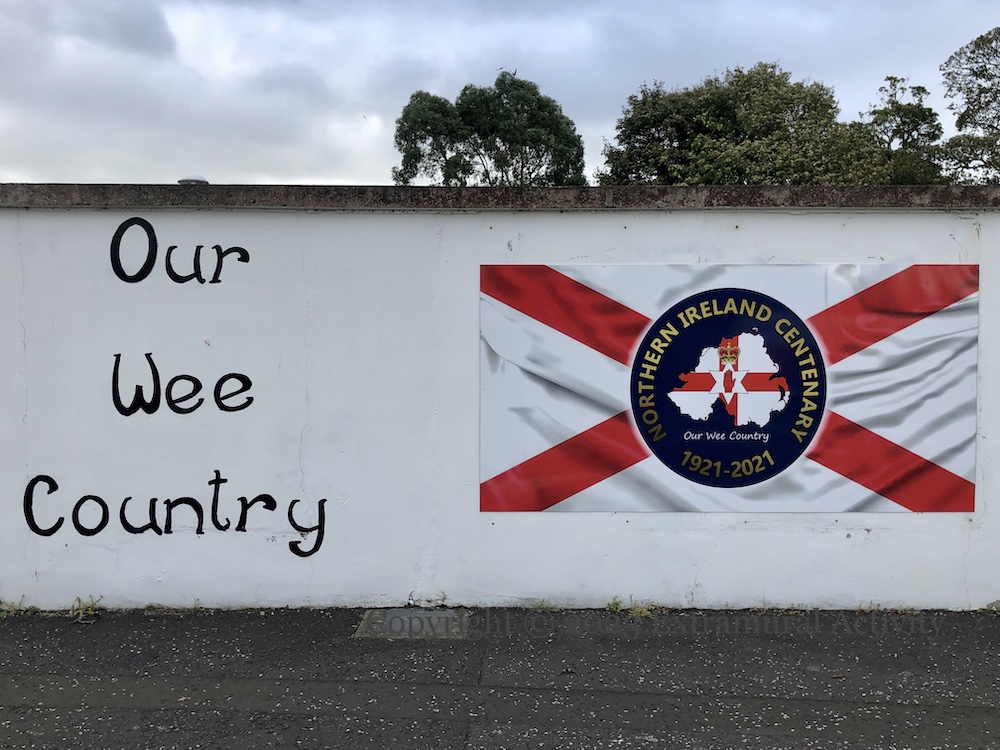
Castlemara residents’ various emotions are on display at the entrace to the estates: celebrating the jubilee of Elizabeth II, the coronation of Charles III, the creation of Northern Ireland in 1921, and Rangers’ 55th league title; saluting Tom Moore; commemorating Prince Philip, 1921-2021; and remembering with gratitude the “100th anniversary of the Battle Of The Somme”: “We must not forget what they gave so we may live. Let not their deaths be in vain. Lest we forget.”
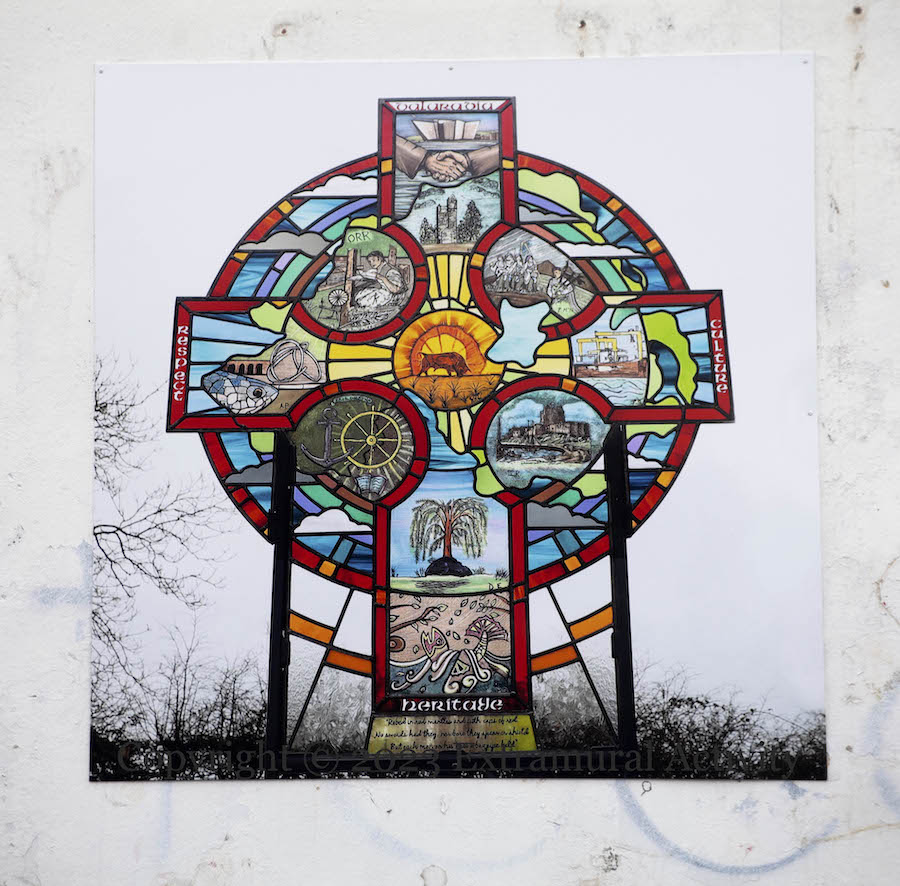
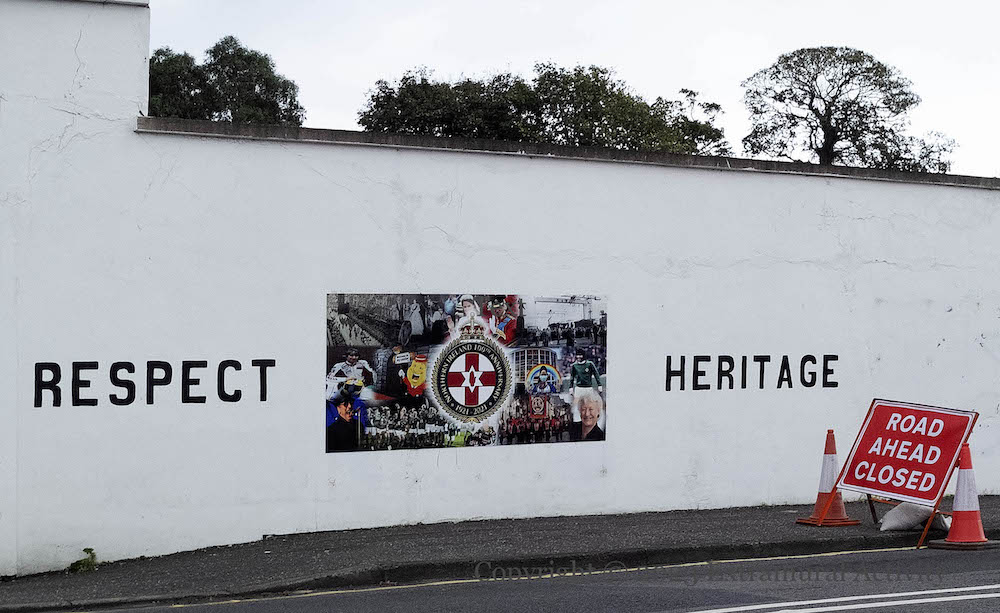
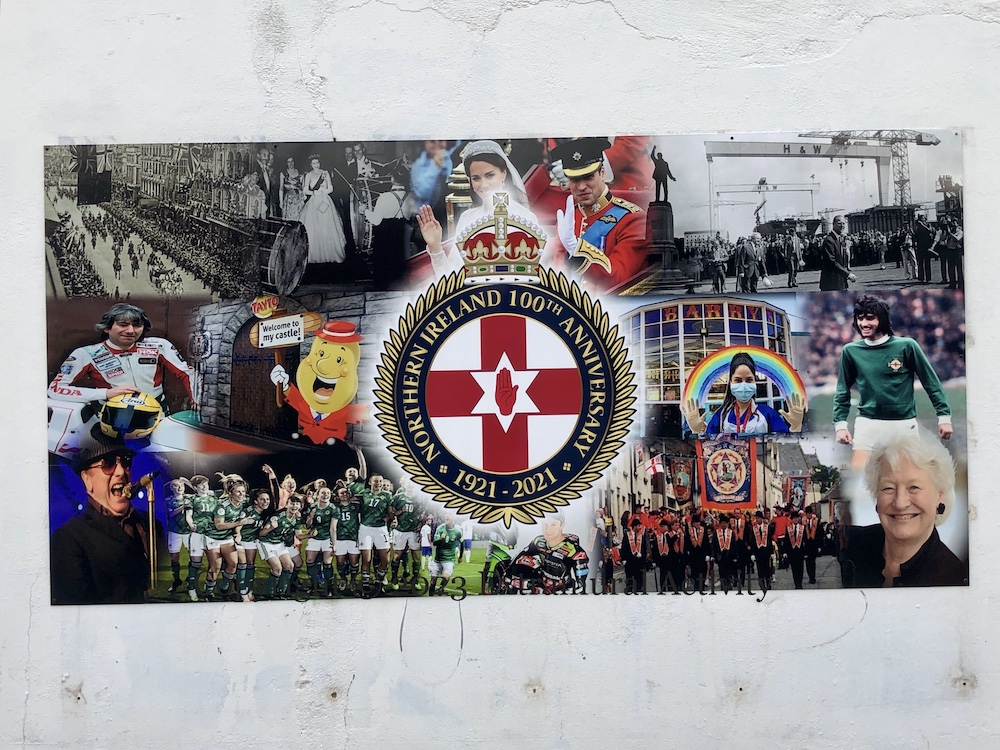
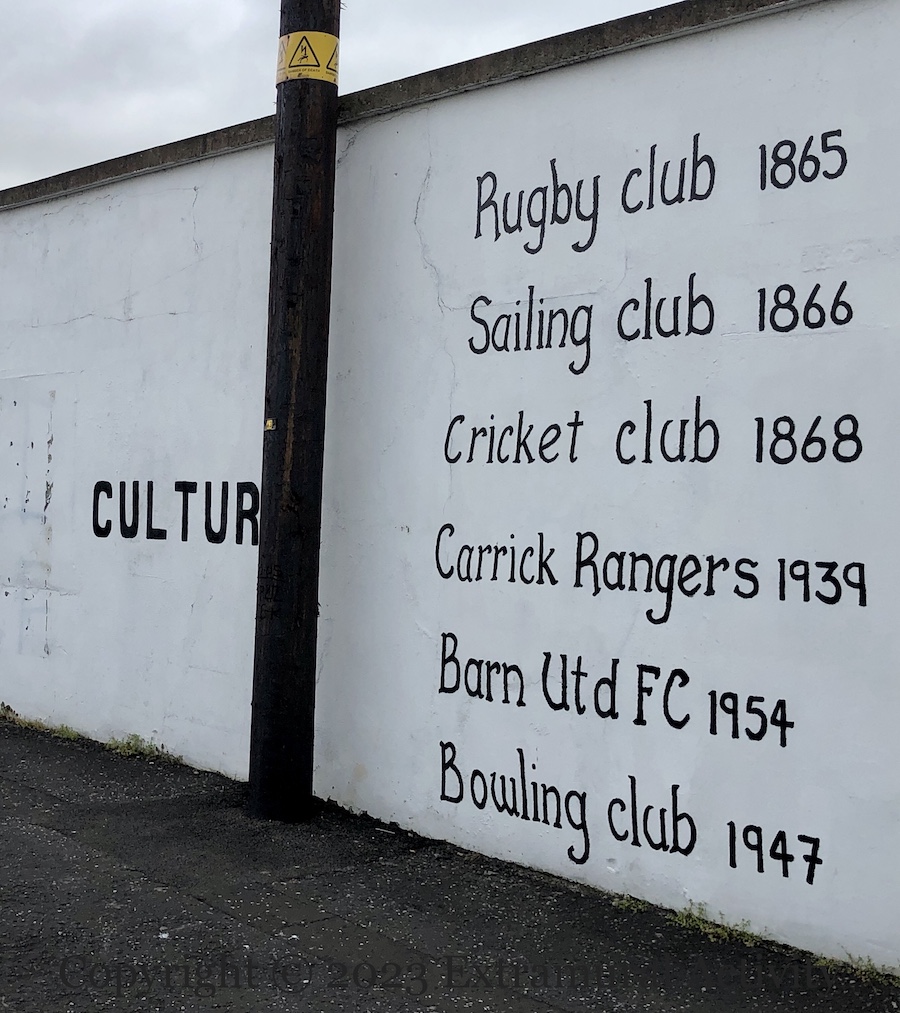
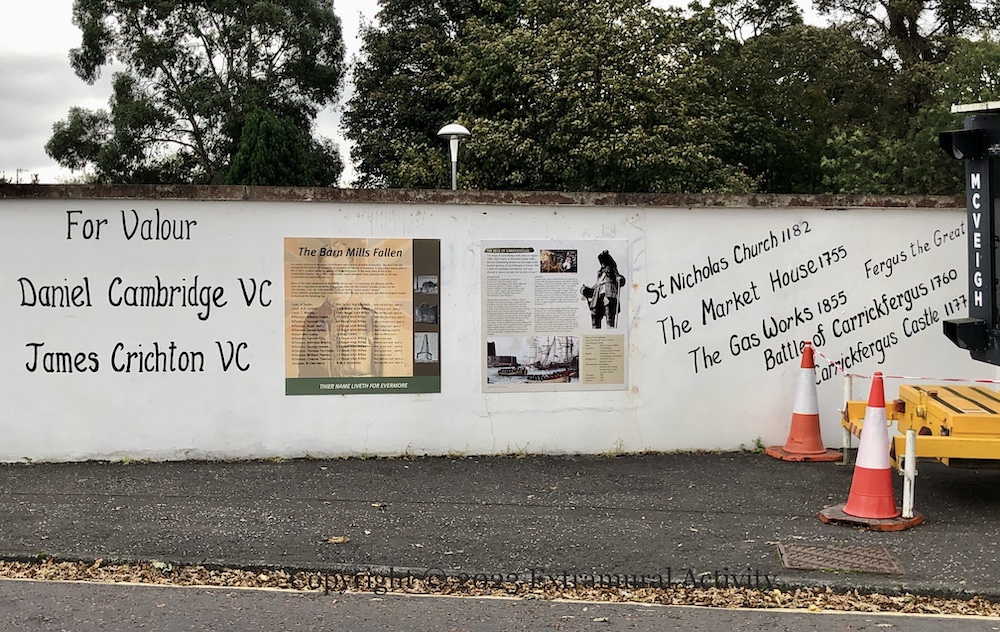
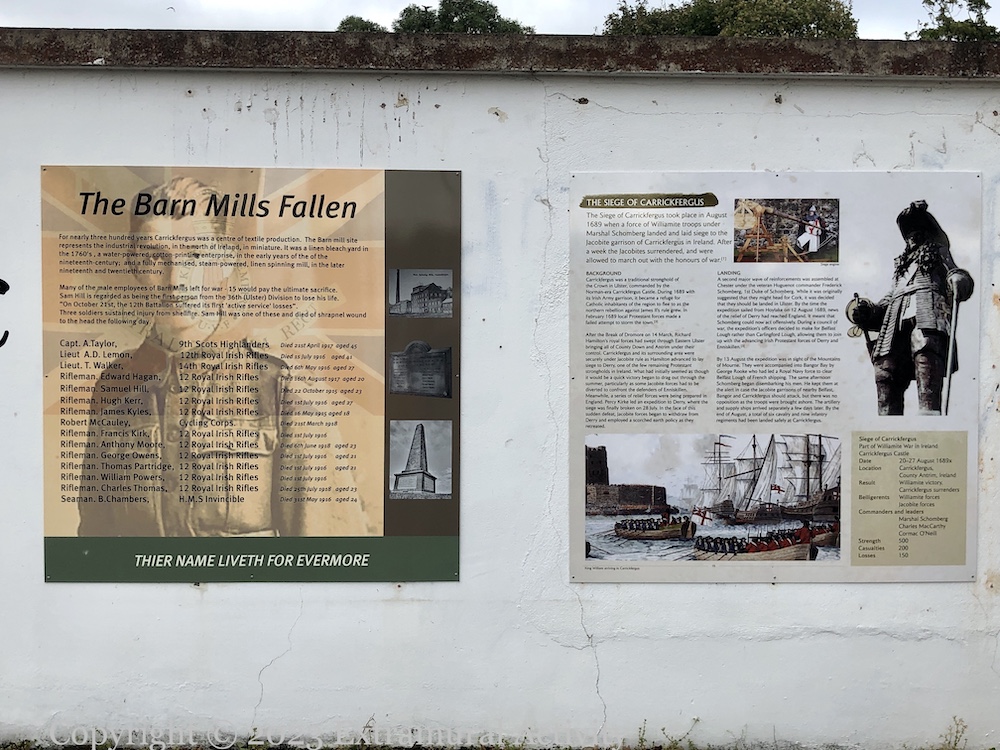
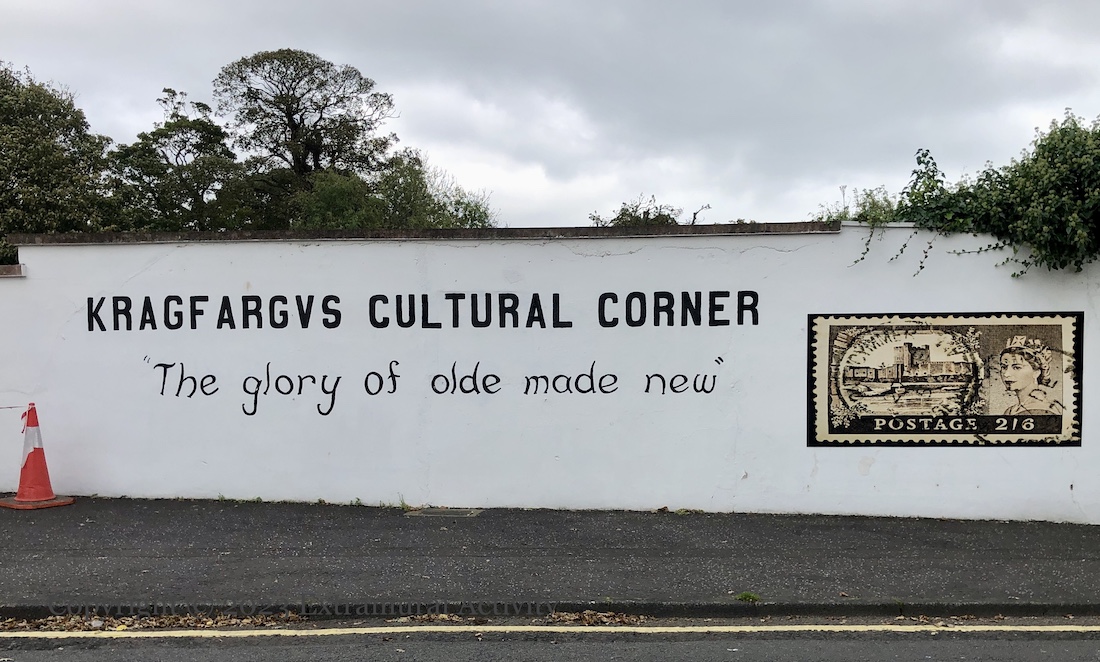
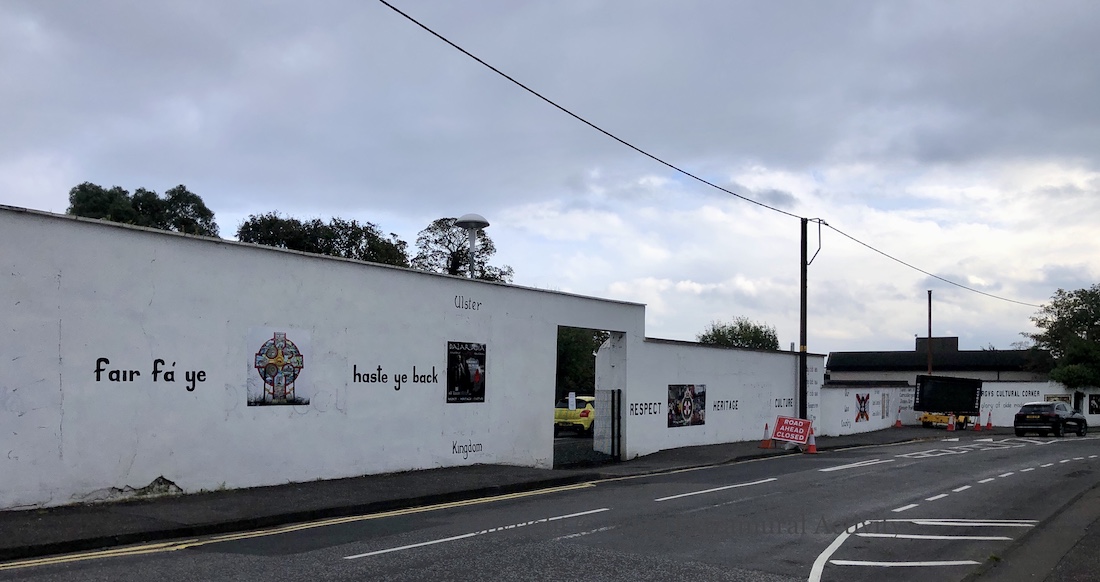
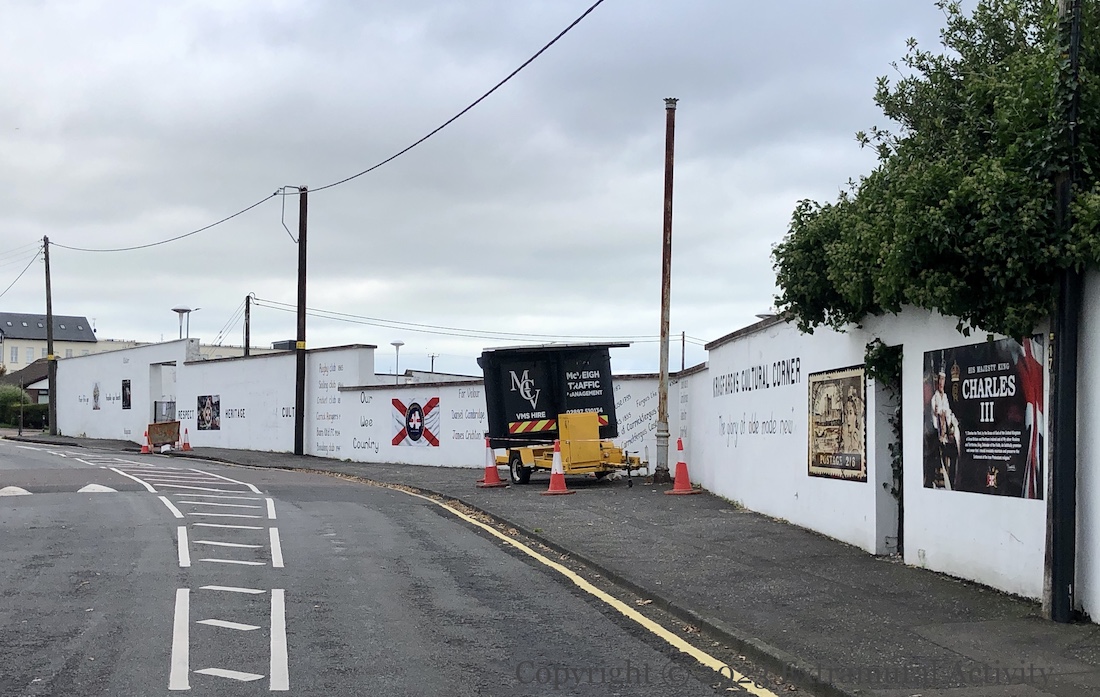
This is the second (at least) iteration of an installation along Taylor’s Avenue, Carrickfergus, showcasing the Ulster-Scots heritage of Carrickfergus and its later contributions to the United Kingdom.
The wall is 60 metres/200 feet in length and can be divided into about ten distinct panels – notes on the different panels are given below, following the order of presentation of images, which show the entire wall moving from left to right.
The original, as seen on Street View, included boards showing the Pretani Isles/British Isles, QEII, and Tom Moore. As seen here, there are now boards to King Charles III, a vintage postage stamp, ‘The Siege Of Carrickfergus’ in 1689, and ‘The Barn Mills Fallen’ of WWI.
James Orr, the ‘Bard Of Ballycarry’, was a contemporary of Robert Burns and a United Irishman. It does not appear that he wrote a poem with the line “I wish I was in Carrickfergus”.
Daniel Cambridge won his VC for service in the Crimean War (WP) and James Crichton for service in WWI (WP).
CarrickfergusHistory includes “the oldest know map of Carrickfergus” from 1560, employing the spelling “Kragfargus”.
The 2/6 postage stamp featuring Carrickfergus Castle was one of four in a “Castle series” in 1955 (WP).