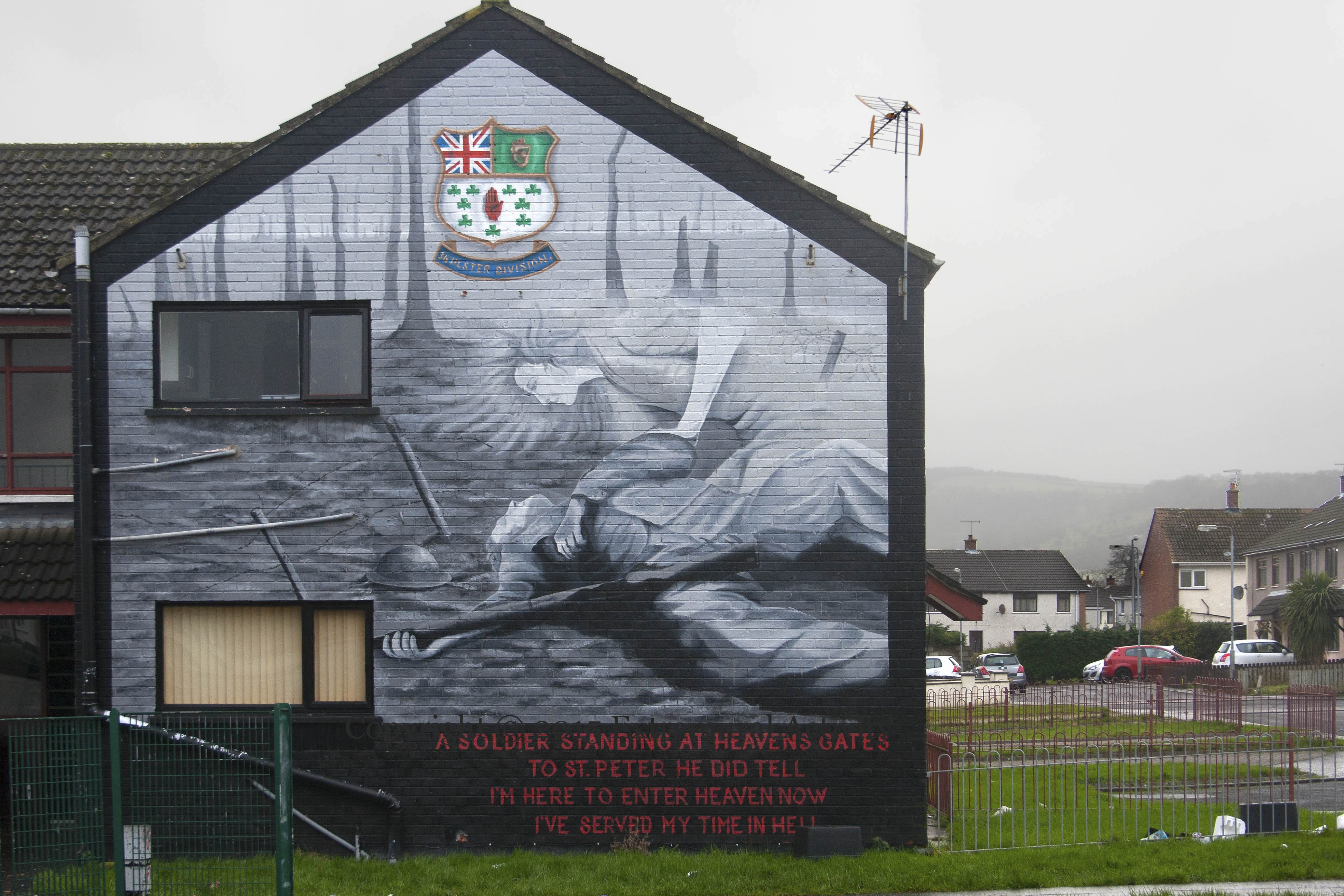
A dead WWI soldier in the scorched Belgian countryside is comforted by an ethereal figure who will convey him to heaven: A soldier standing at heaven’s gate/To St. Peter he did tell/I’m here to enter heaven now/I’ve served my time in hell – a variation on James Donahue’s WWII Soldier’s Poem (WP). The poem was previously used of Republicans in a 1981 mural in Derry (see I Refuse To Change/M00151).
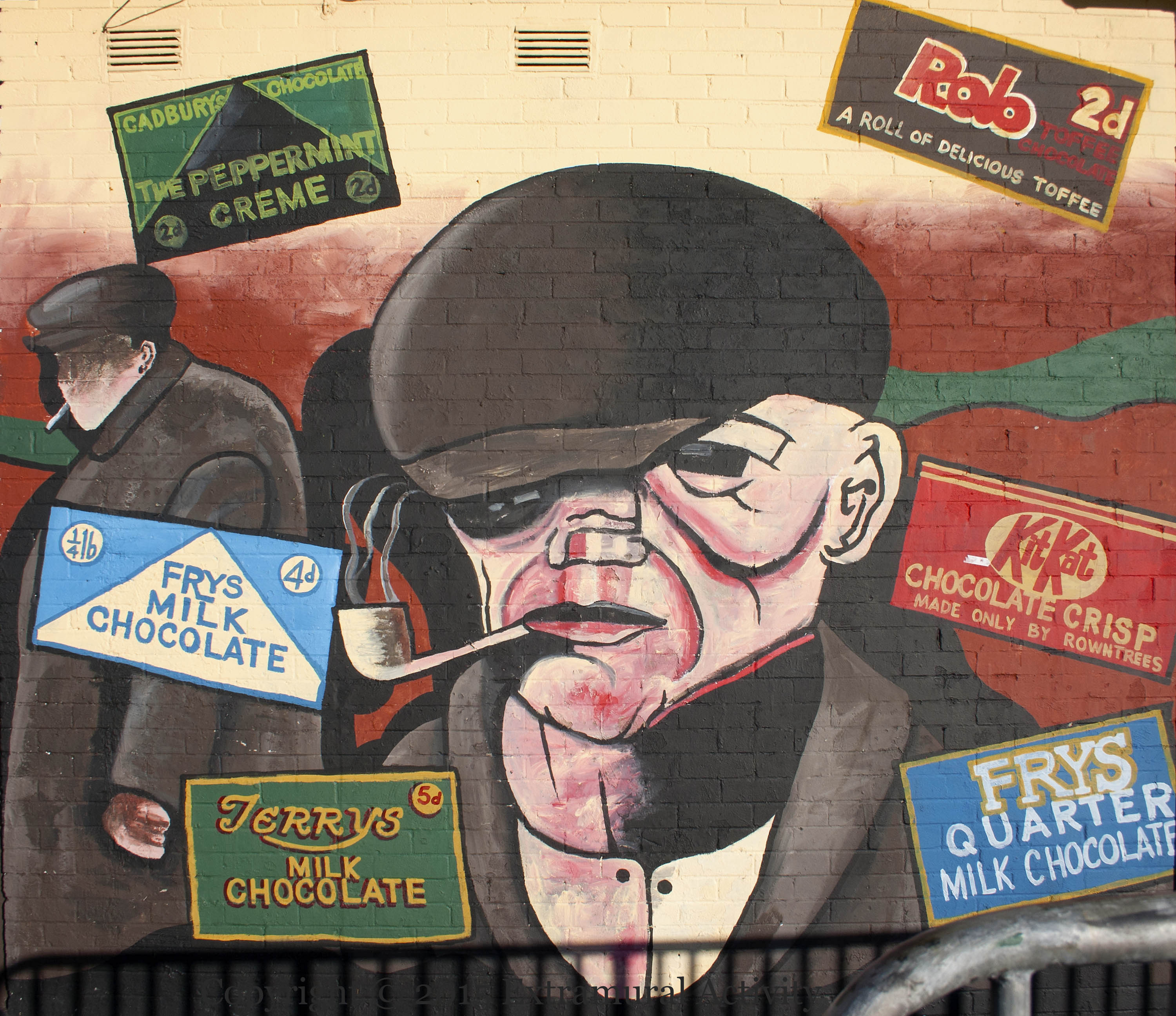
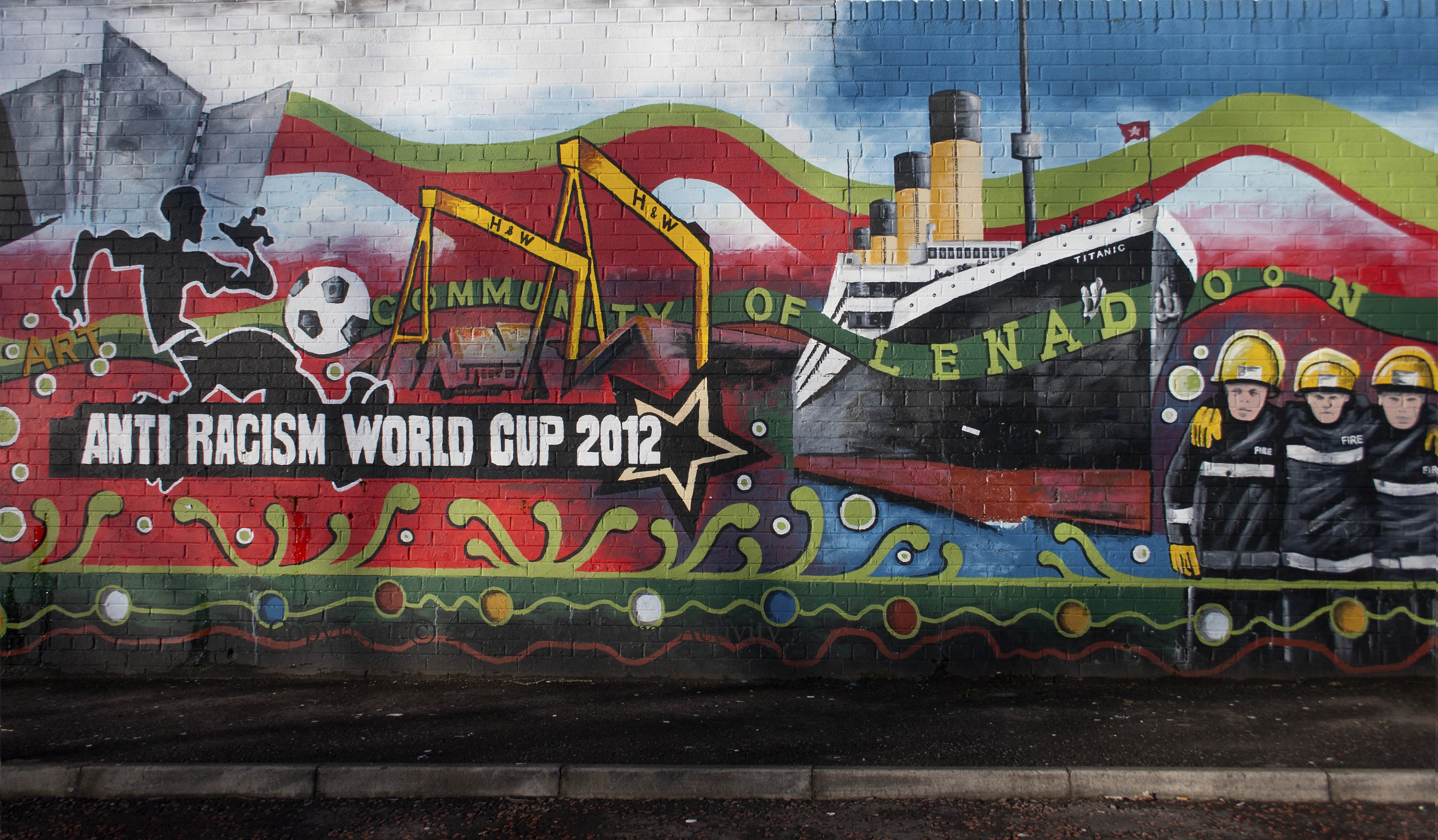
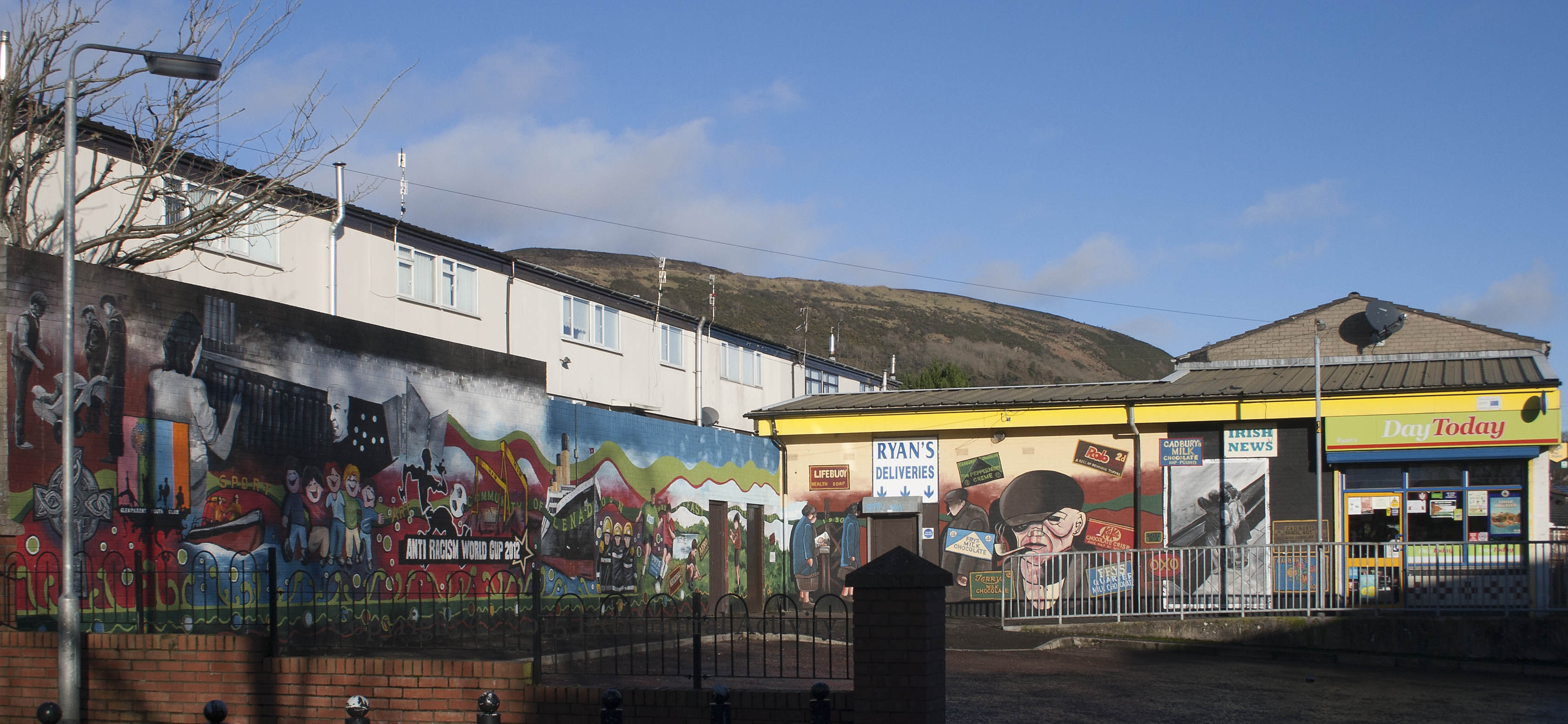
The Anti-Racism World Cup is a seven-a-side soccer tournament held annually at the grounds of Donegal Celtic in west Belfast. East Belfast artist John Stewart painted a mural of east Belfast imagery in 2012, complete with Titanic museum, H & W cranes, Titanic, firemen, and shipyard workers. Being on the side of Ryan’s Newsagents, the mural also features confectionery, vintage brands in old money: Cadbury’s peppermint creme for 2d, 1.4 lb of Fry’s milk chocolate for 4d, Terry’s milk chocolate 5d, Rolos “delicious toffee” for 2d and KitKat chocolate crisp.
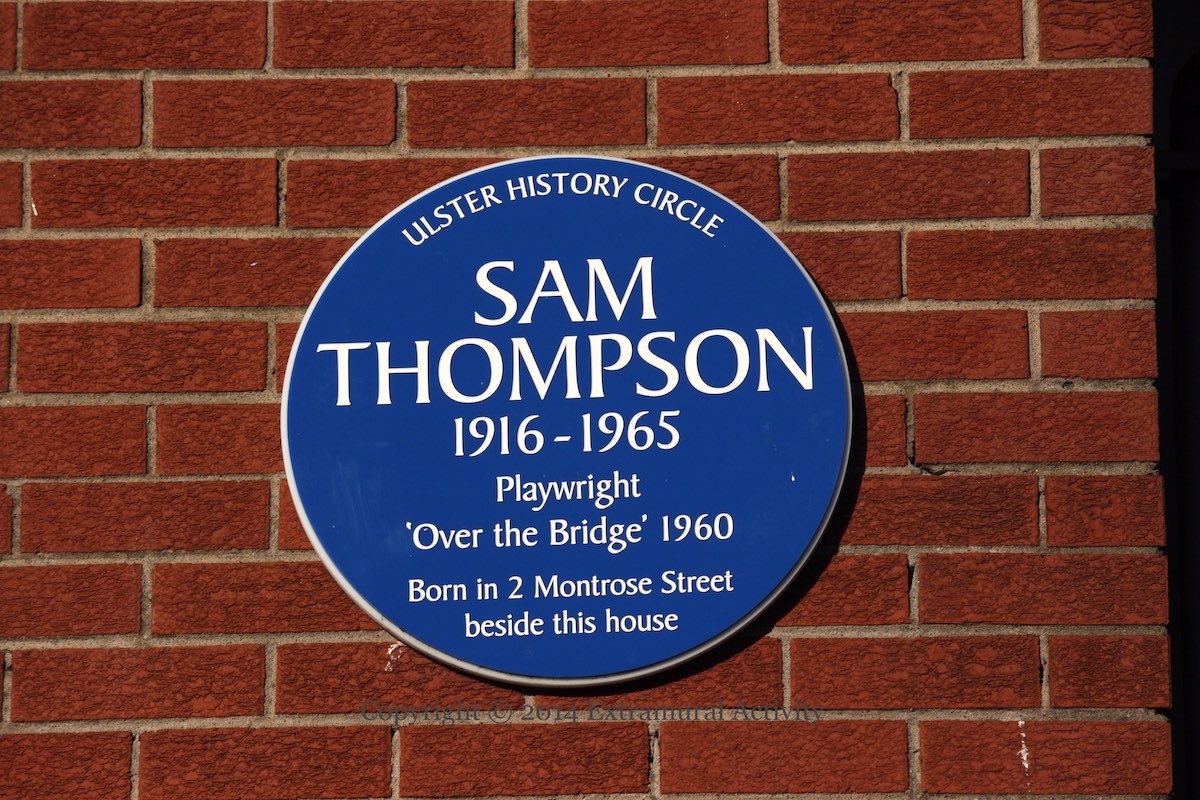
“Sam Thompson 1916-1965 Playwright ‘Over The Bridge’ 1960. Born in 2 Montrose Street beside this house.” In addition to his written works, Thompson was a painter for H&W and the Corporation, a trade unionist and Labour candidate (WP).
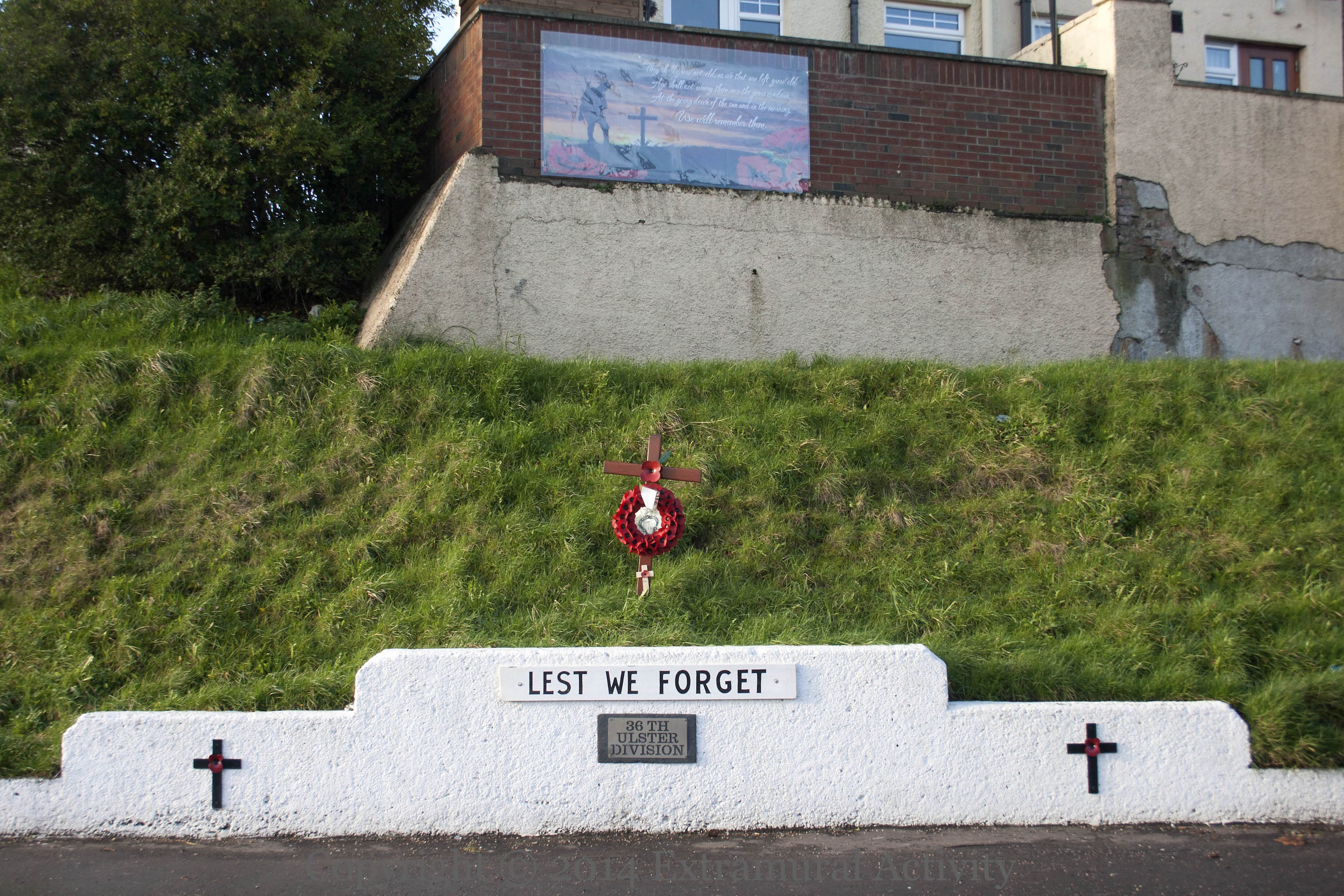
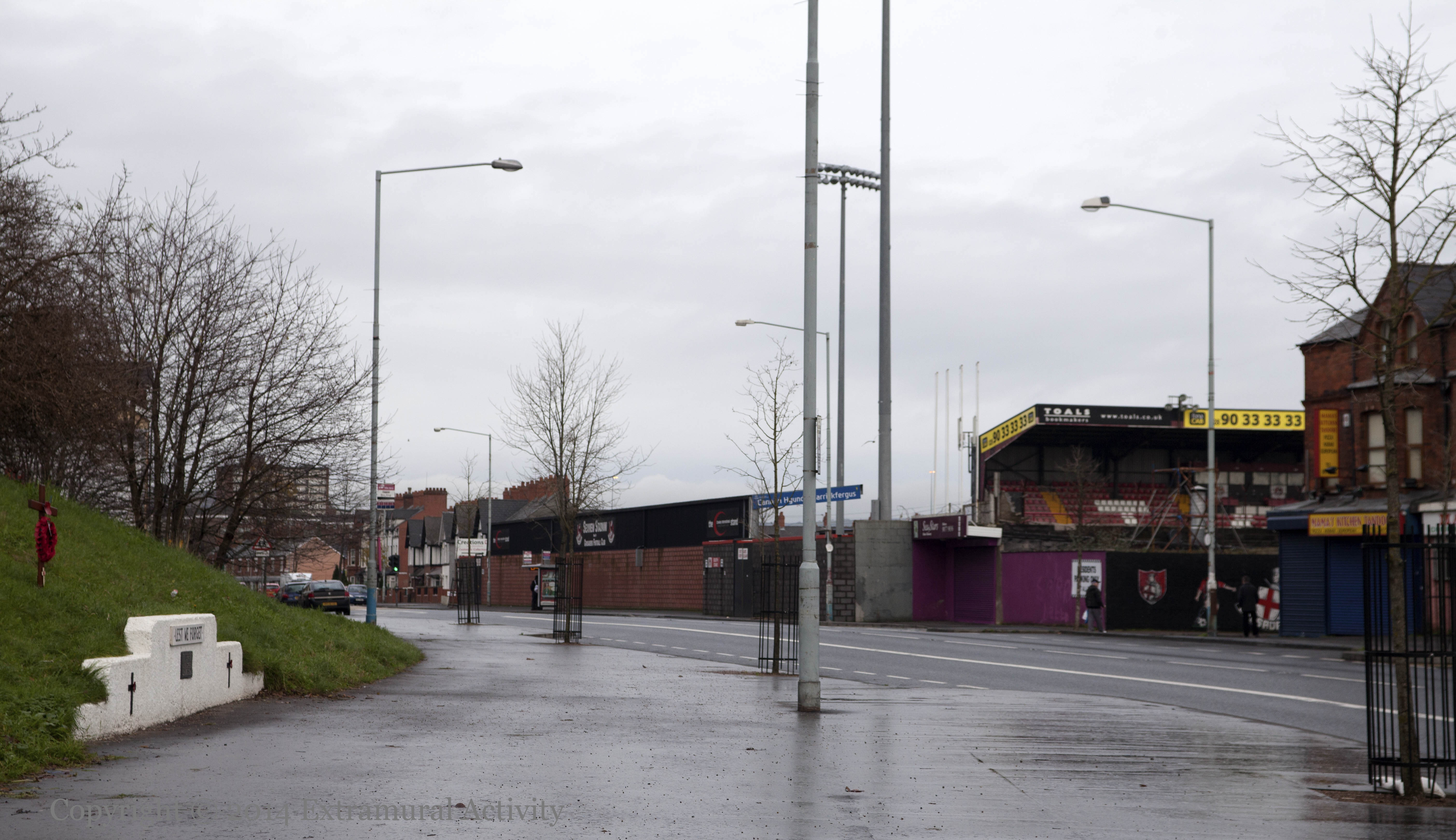
This new roadside memorial to the 36th (Ulster) Division in WWI, of wooden crosses on white stone along with a board on the wall above, has appeared on the Shore Road, across from Seaview, home of Crusaders FC, the Hatchet Men.
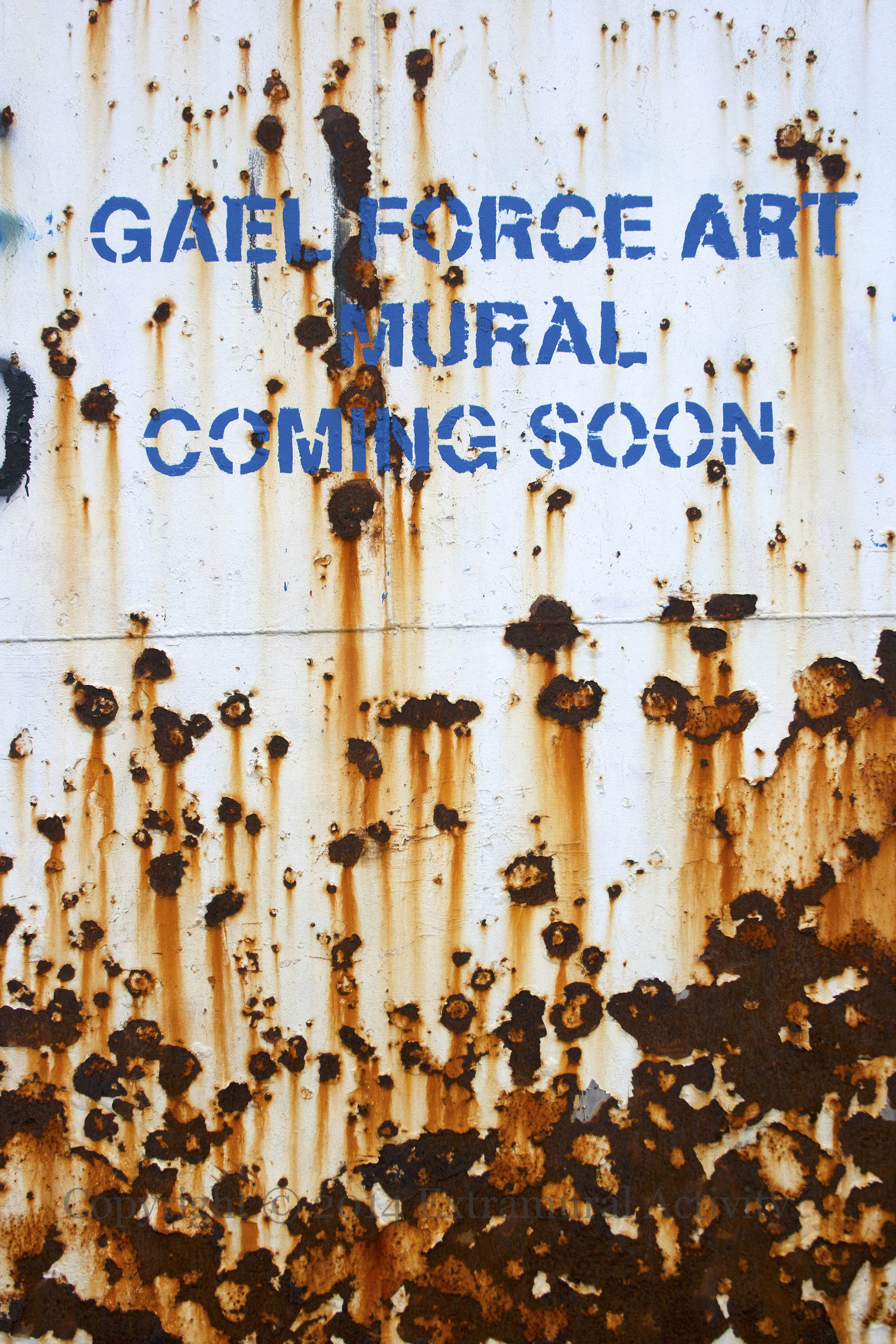
This stencil is at the top of Springhill Avenue, painting grounds of Gerard ‘Mo Chara’ Kelly and Gael Force Art. Mo Chara is in fact currently working on the Falls Road at McQuillan Street, painting a mural of the GPO in flames in 1916.
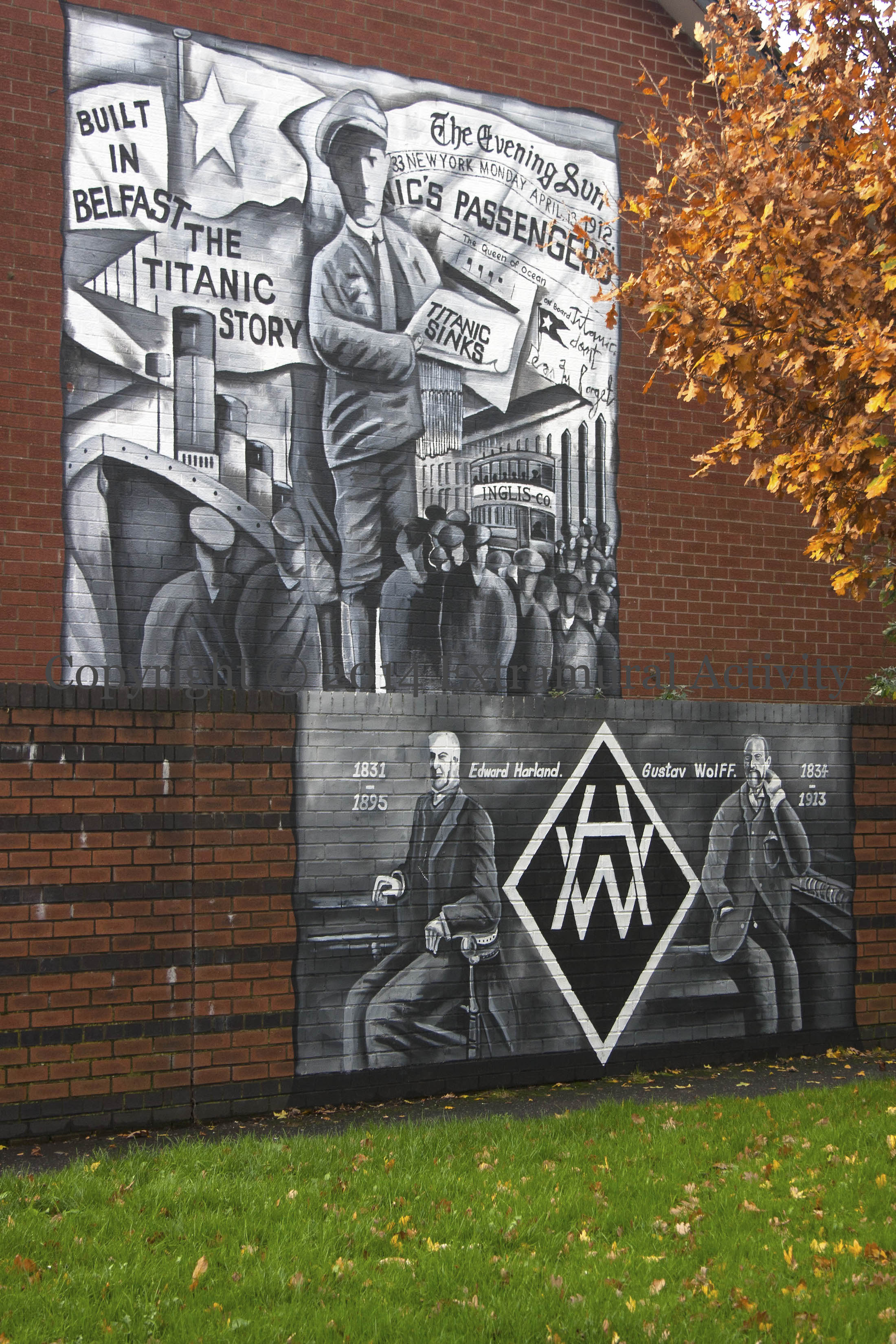
“Titanic Sinks” is the headline of the newspaper in this recent mural in east Belfast. In fact, news was hard to come by in the first few days after the sinking in the early morning of April 15th, 1912, as Titanic sank a thousand miles from New York and wireless was the only means of communication. The Evening Sun’s headline on April 15th (which might be partially reproduced here) announced “All Titanic Passengers Are Safe; Transferred in Lifeboats at Sea” (image at Pratt Library). Here is a NYTimes article about the difficulty in getting reliable news in the days after the sinking. This is new work by John Stewart. (Report on the launch at NIHE.)
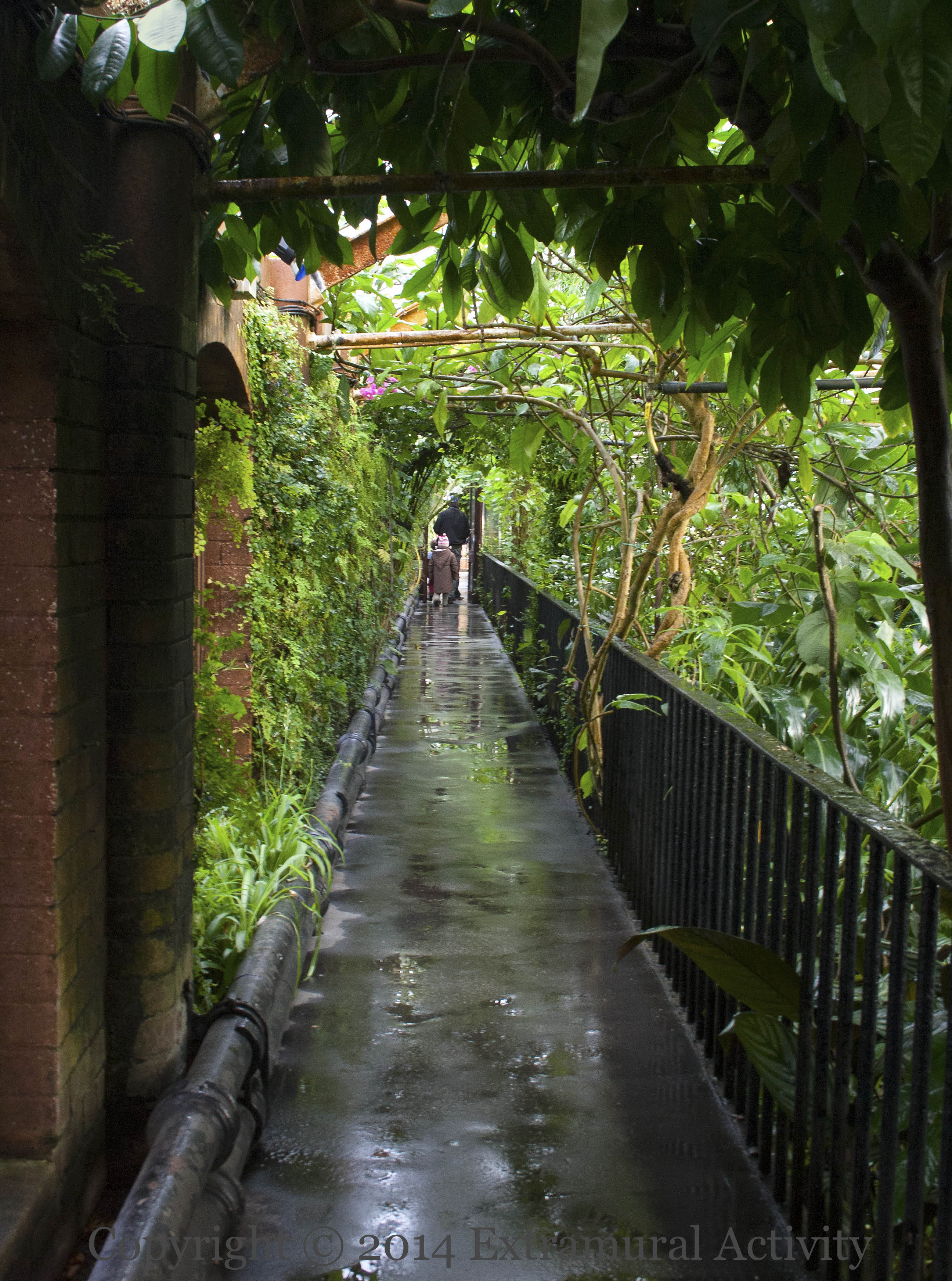
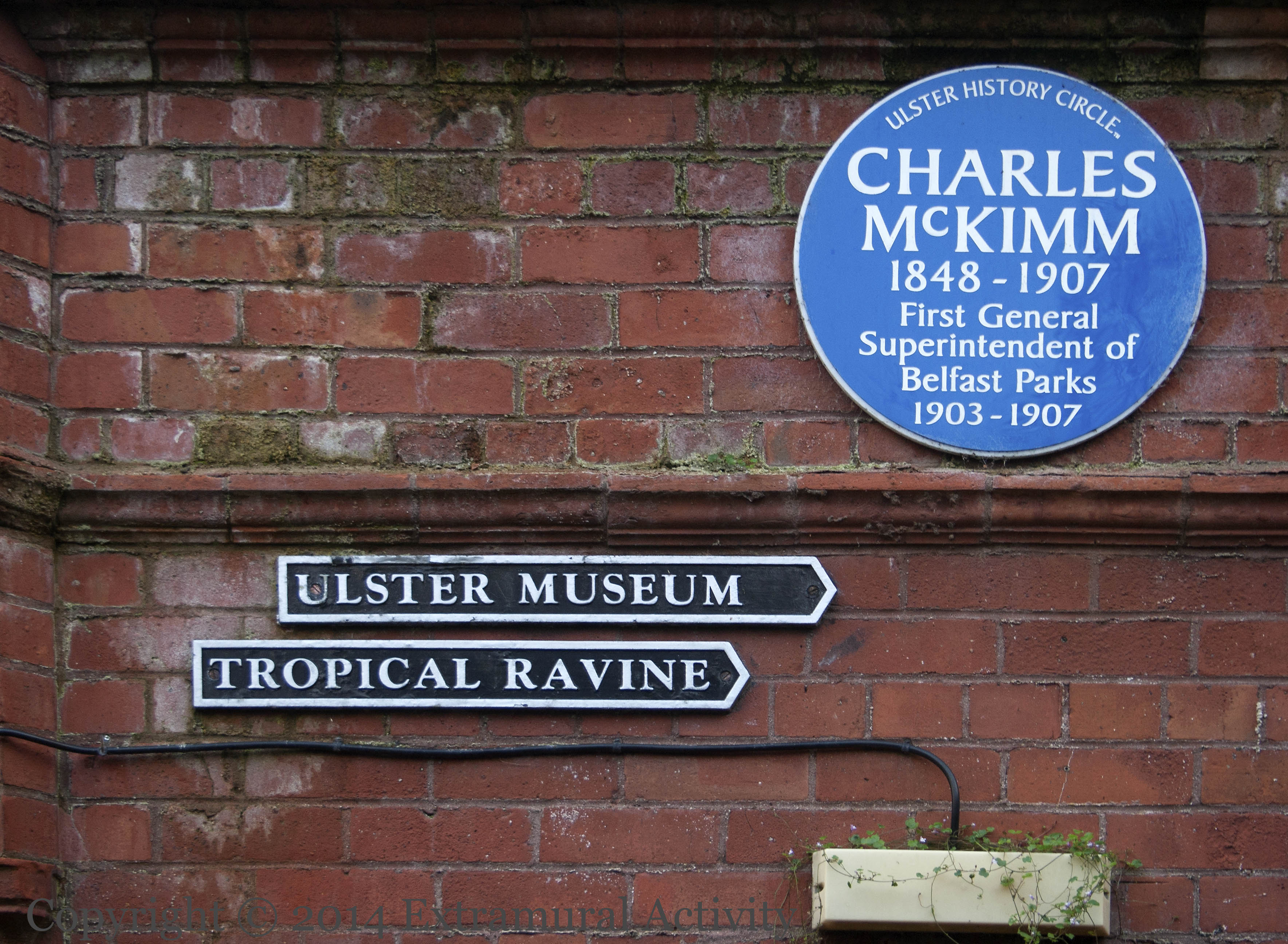
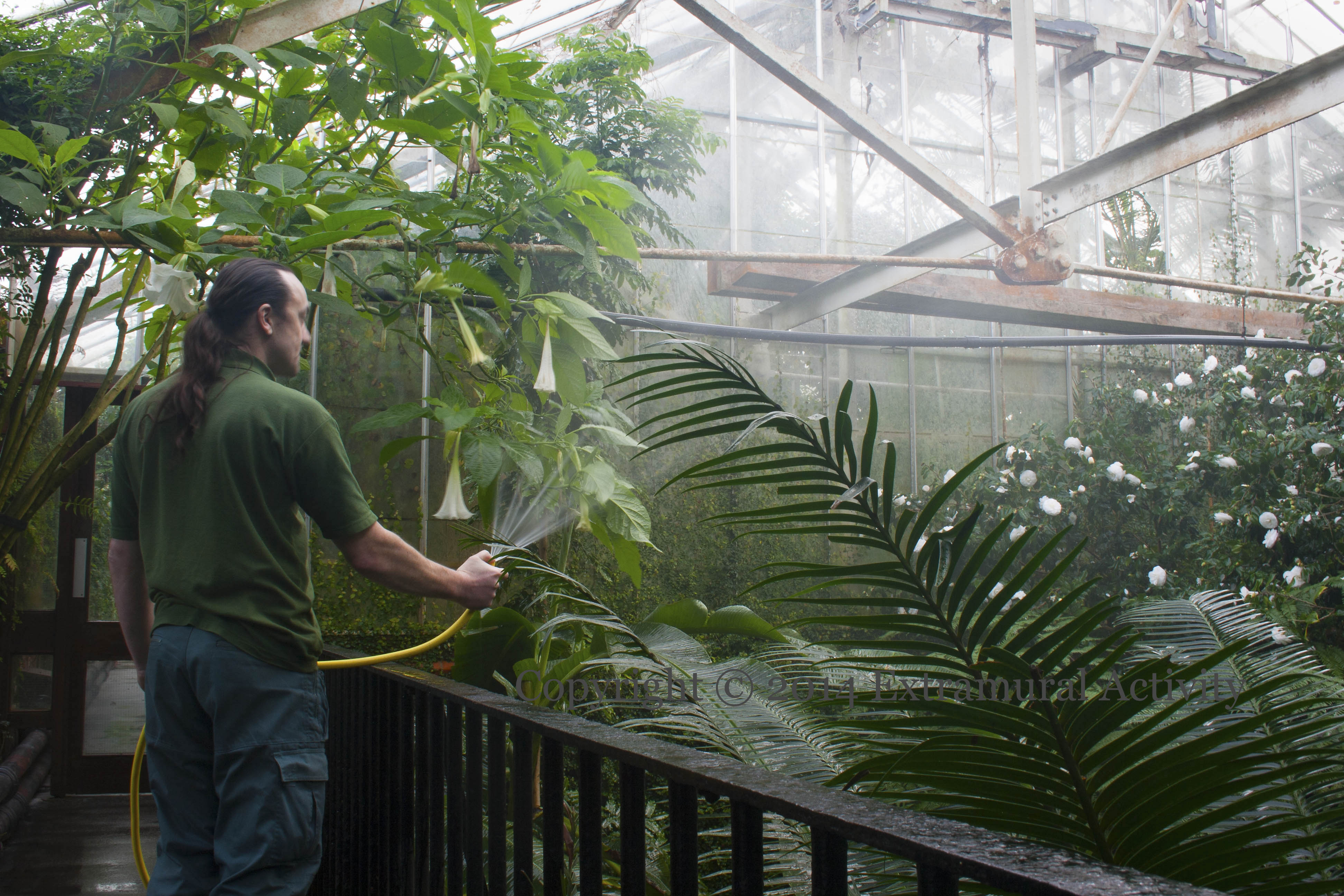
The tropical ravine in the Botanic Gardens is closed for renovation over the winter. The large plants which could not be moved had to be wrapped up as protection against the cold. (Belfast City Council) The ravine – including the elevated interior walkway shown above – was the brain-child of Charles McKimm (Ulster History Circle) whose blue plaque is shown in the second image. The images in this post were taken on the day before closing.
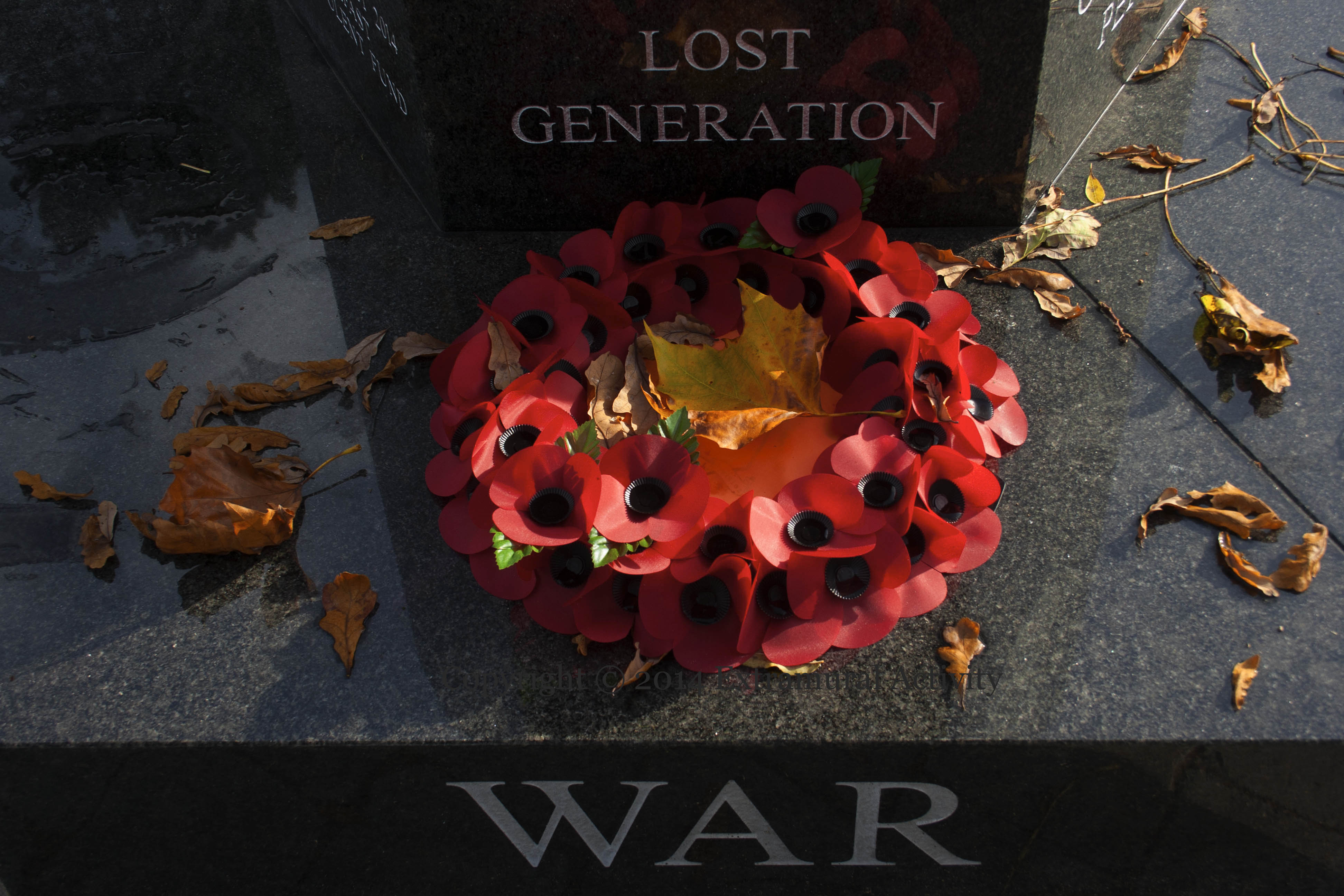
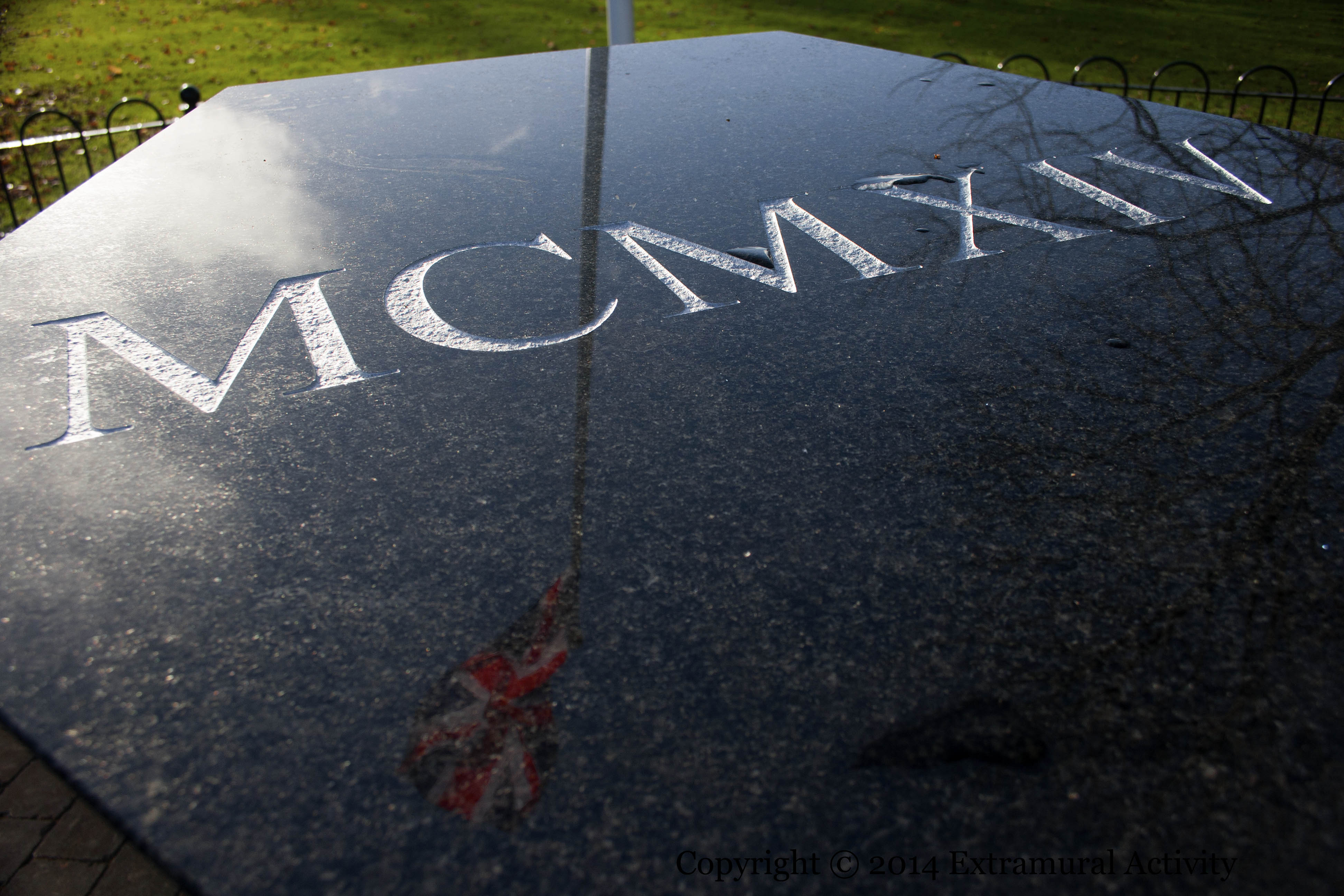
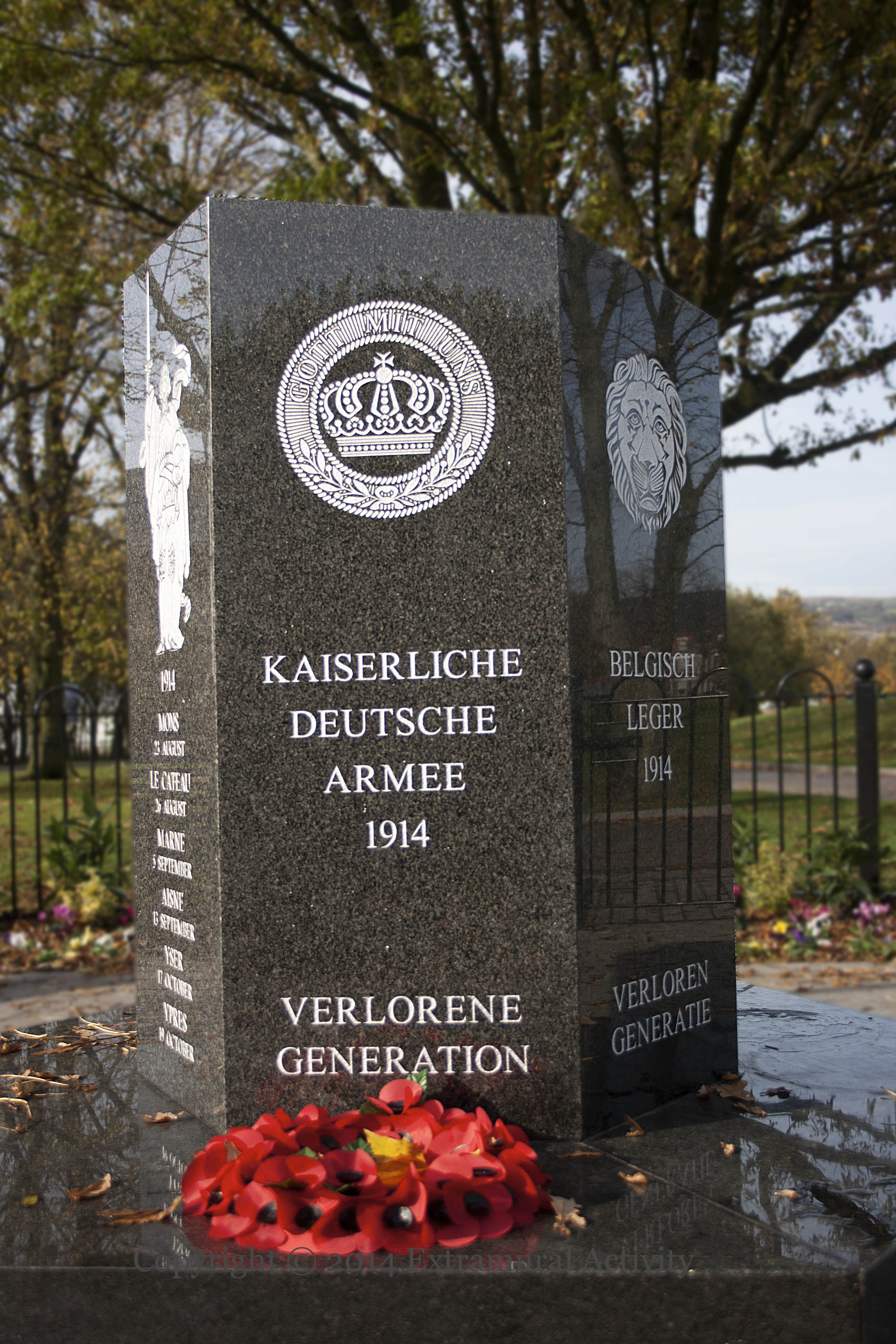
Approximately 10 million military personnel and 7 million civilians died in WWI, with massive losses coming in August-September-October of 1914, as German forces invaded Belgium and northern France, before being stopped at the Marne and entrenching at the Aisne; both sides then attempted to out-flank one another in a “race to the sea” (WP – Invasion | WP – Casualties). The dead of those first months – including German forces (see third image, below) – are commemorated in a new monument, a granite stone with six sides, like a rock from the Giant’s Causeway, in Woodvale Park (BelTel | NewsLetter). A searchable database of 10,000 Irish soldiers who died in Belgium is now available at the In Flanders Fields Project.
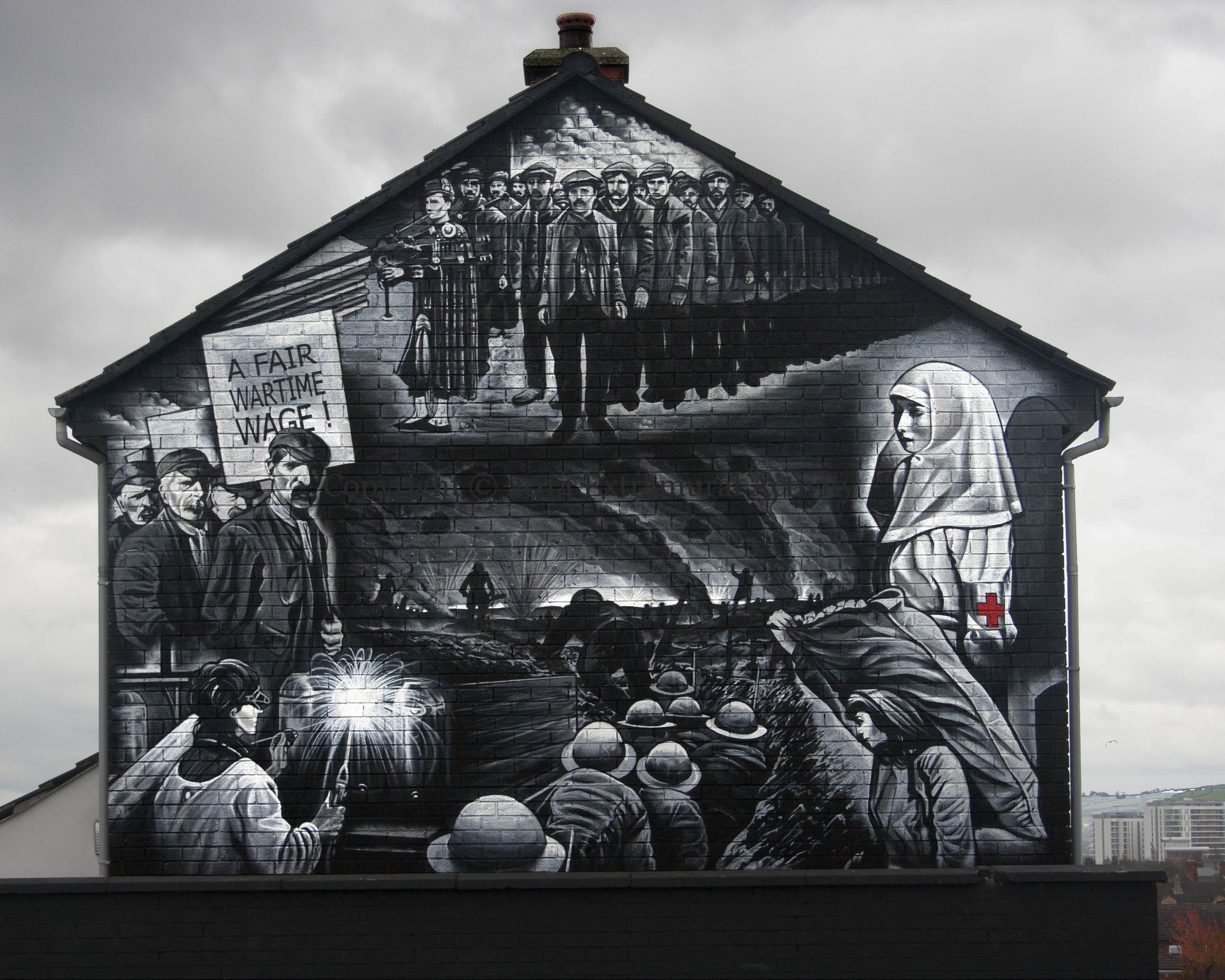
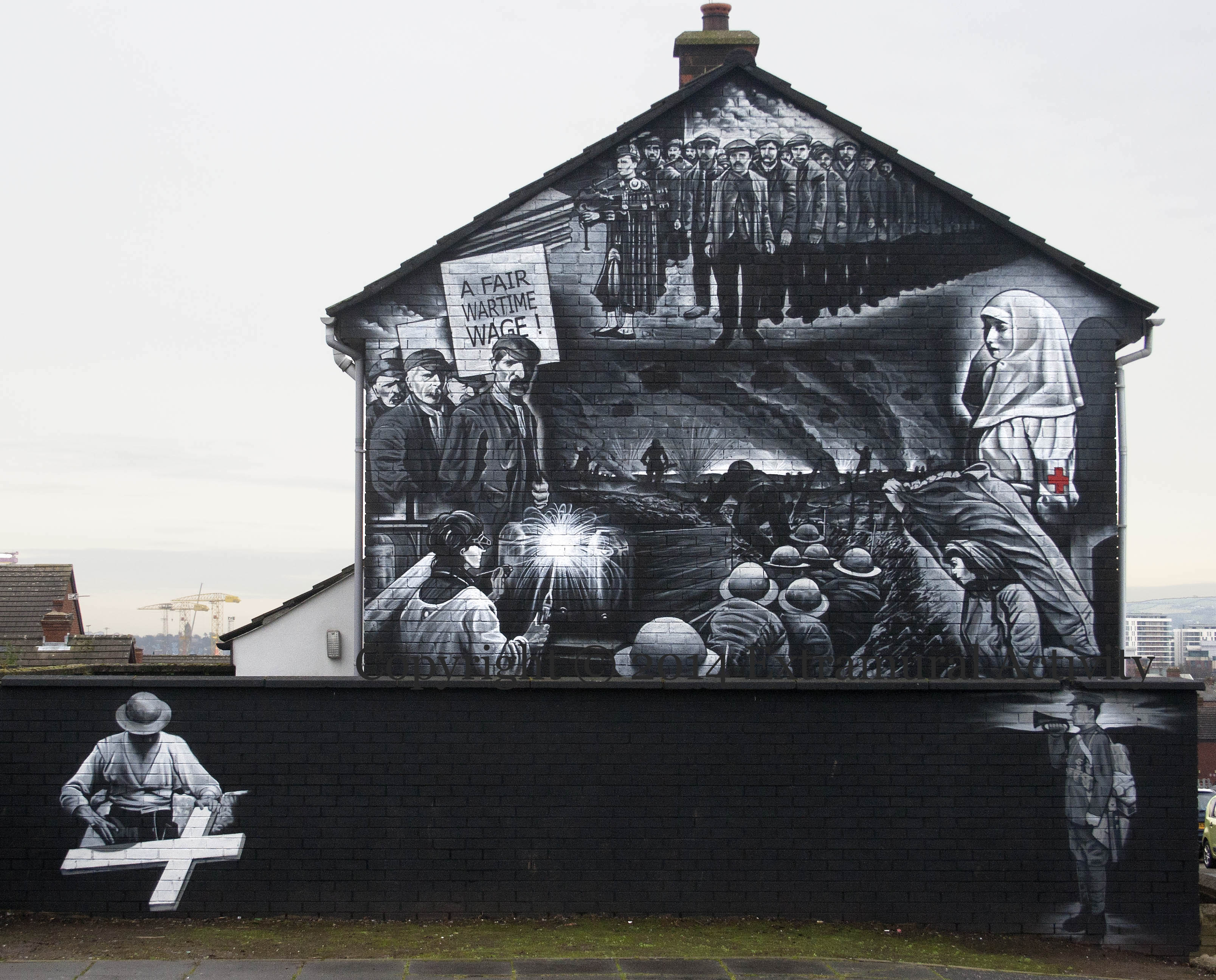
This new piece in Tiger’s Bay illustrates various kinds of ‘Wartime Work’.
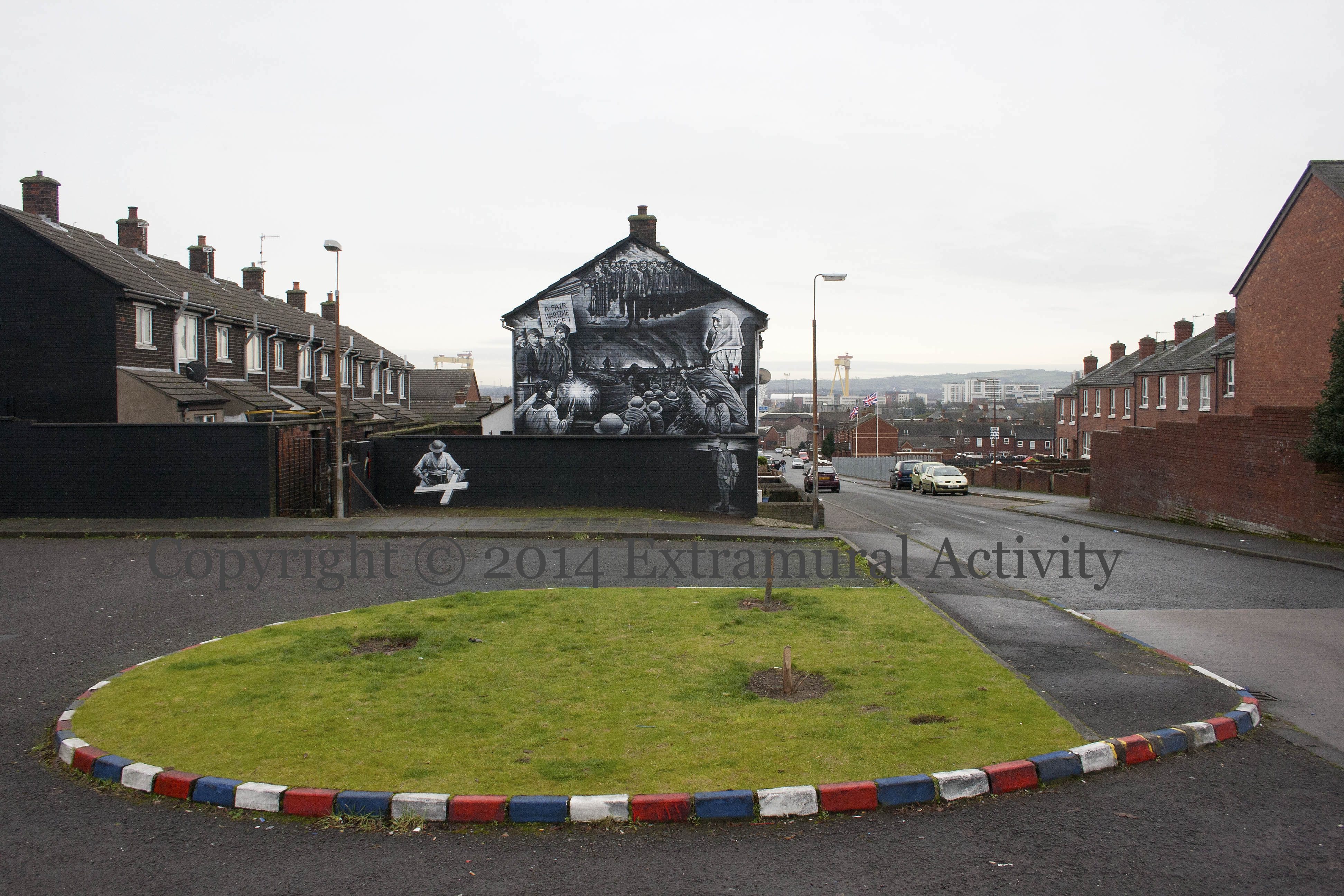
The central image of soldiers at the battle of the Somme is surrounded by images of various occupations: shipyard workers and miners perhaps, along with women welding, carrying coke and nursing. It’s not clear what the “fair wartime wage” refers to: there was a general strike at the shipyards in 1919 (The Great Unrest | Workers’ Liberty). The original Somme photograph is widely known – it was also reproduced in the Bangor mural to Sir Edward Bingham; the nurse is apparently the Grand Duchess Olga Nikolaevna of Russia – WP. The woman carrying a sack of coke is from the Imperial War Museum’s collection.
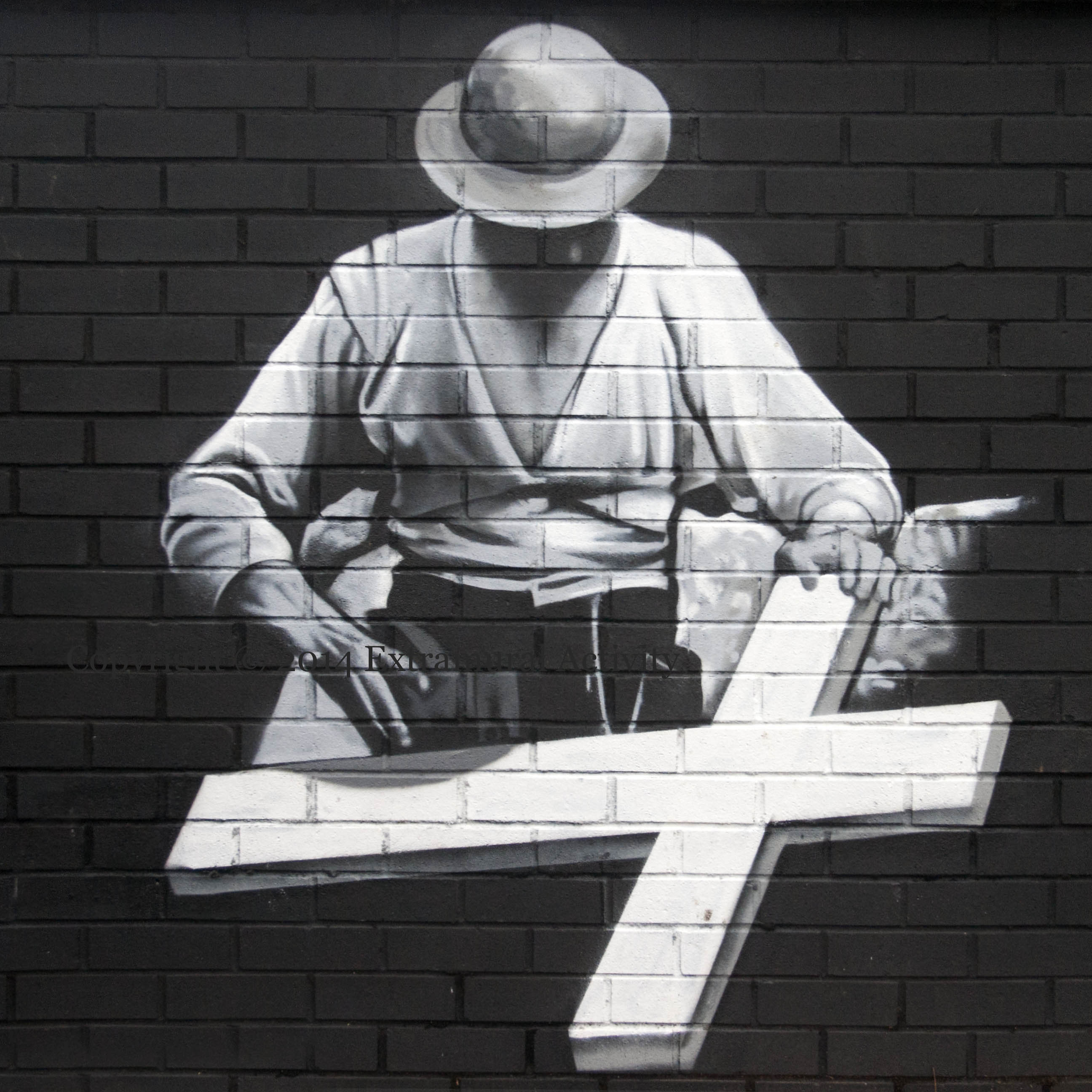
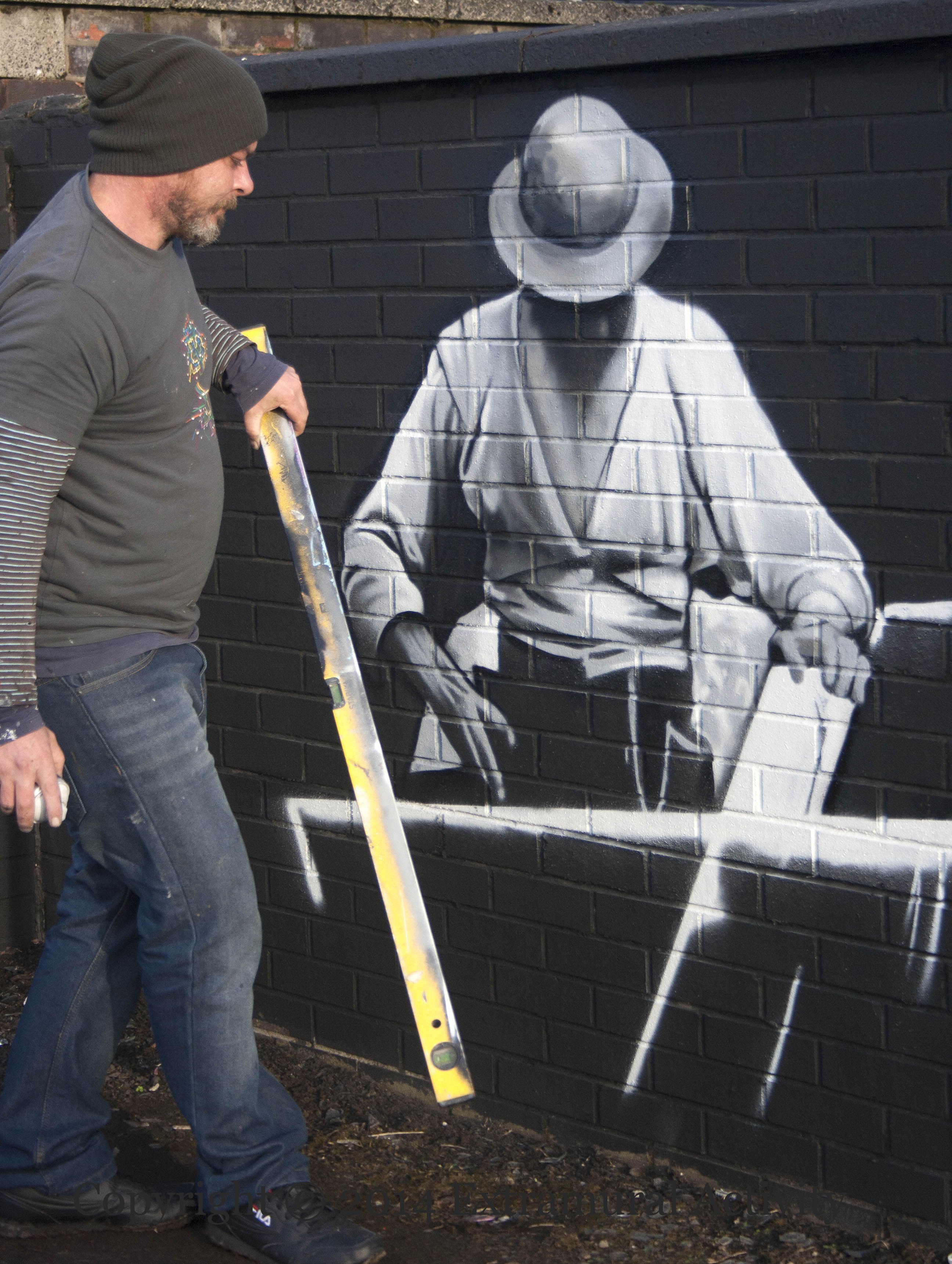
The image above is from after the main wall was completed; the second image, below, shows the lower wall also. The lower wall is intended to be full, but painting has ceased indefinitely. The third image below shows the red, white, and blue kerb-stones, with the H&W cranes in the distance. The artist Jonny McKerr is shown at work. Another in-progress shot can be found at Arts For All. Last year McKerr did a similarly-styled piece on The Belfast Blitz.
Update: The low wall was completed and an information-board added for the official launched on 2015-06-25 – see Aftermath.
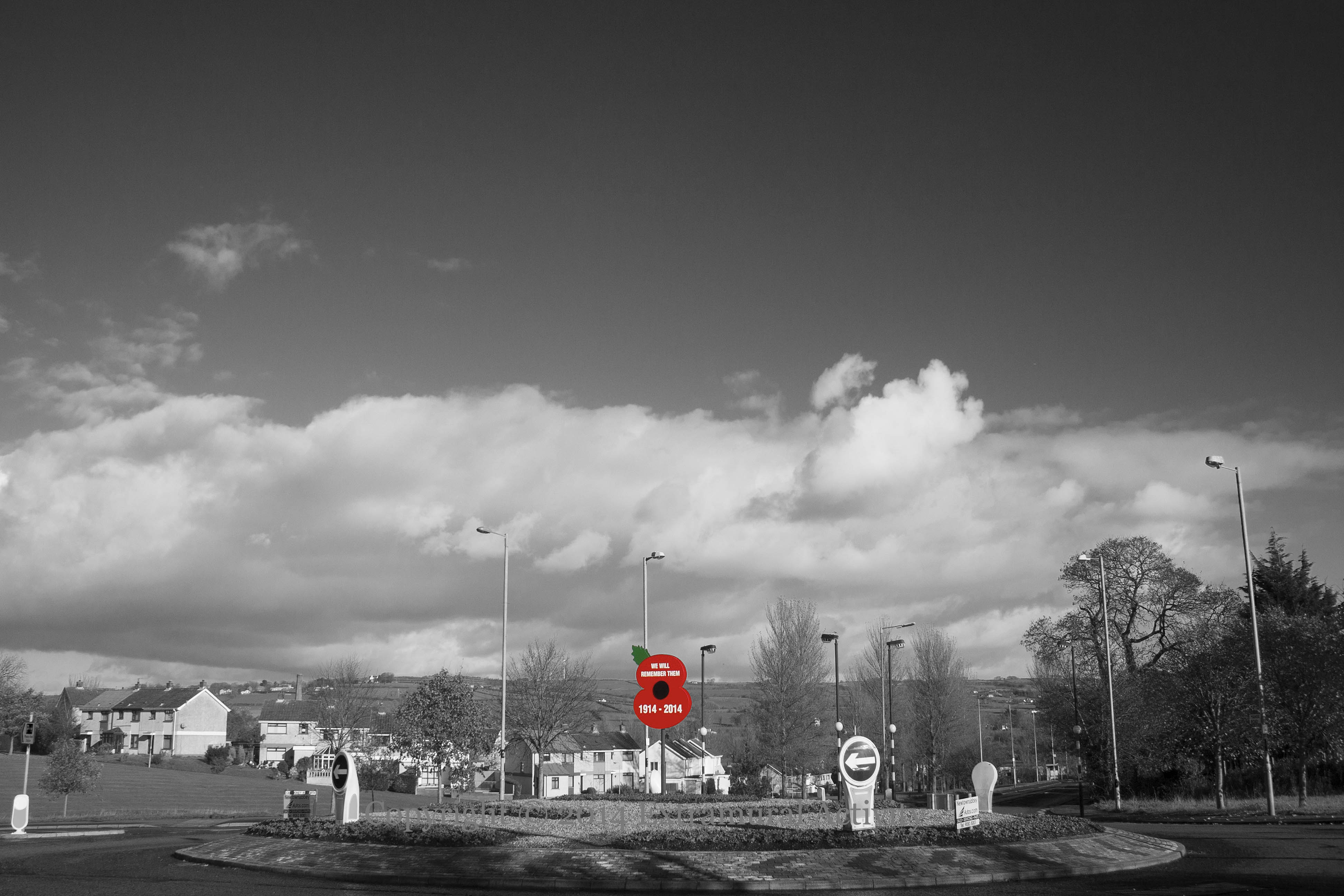
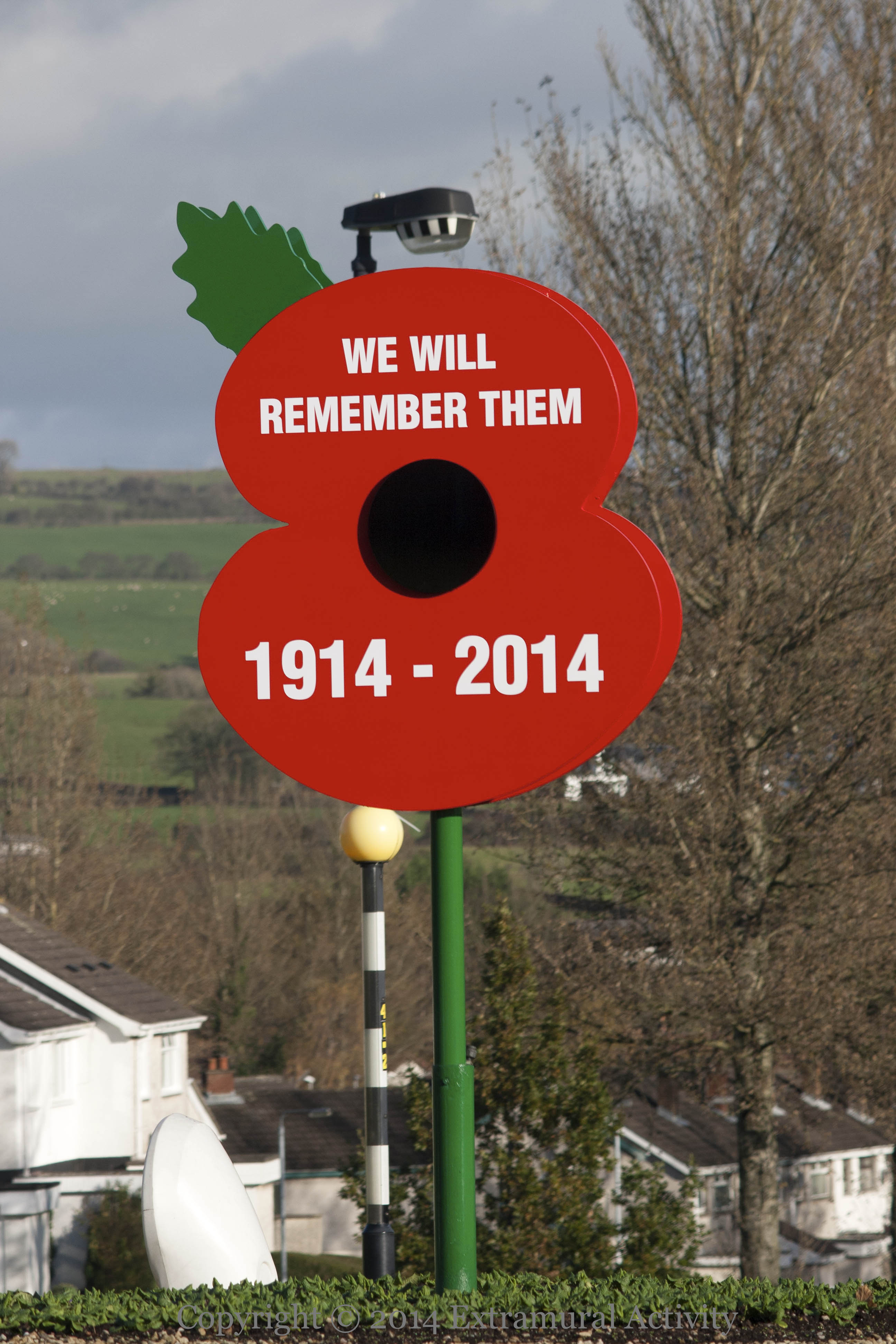
November 11th is Remembrance Day or Armistice day, the anniversary of the cease-fire of the first world war, while 2014 is the centenary year of the beginning of the war in 1914. As part of this year’s commemoration, a very striking giant poppy has sprouted in the middle of the Manse Road roundabout. A close-up is included below: “We will remember them 1914-2014”.
 Seosamh Mac Coille Collection