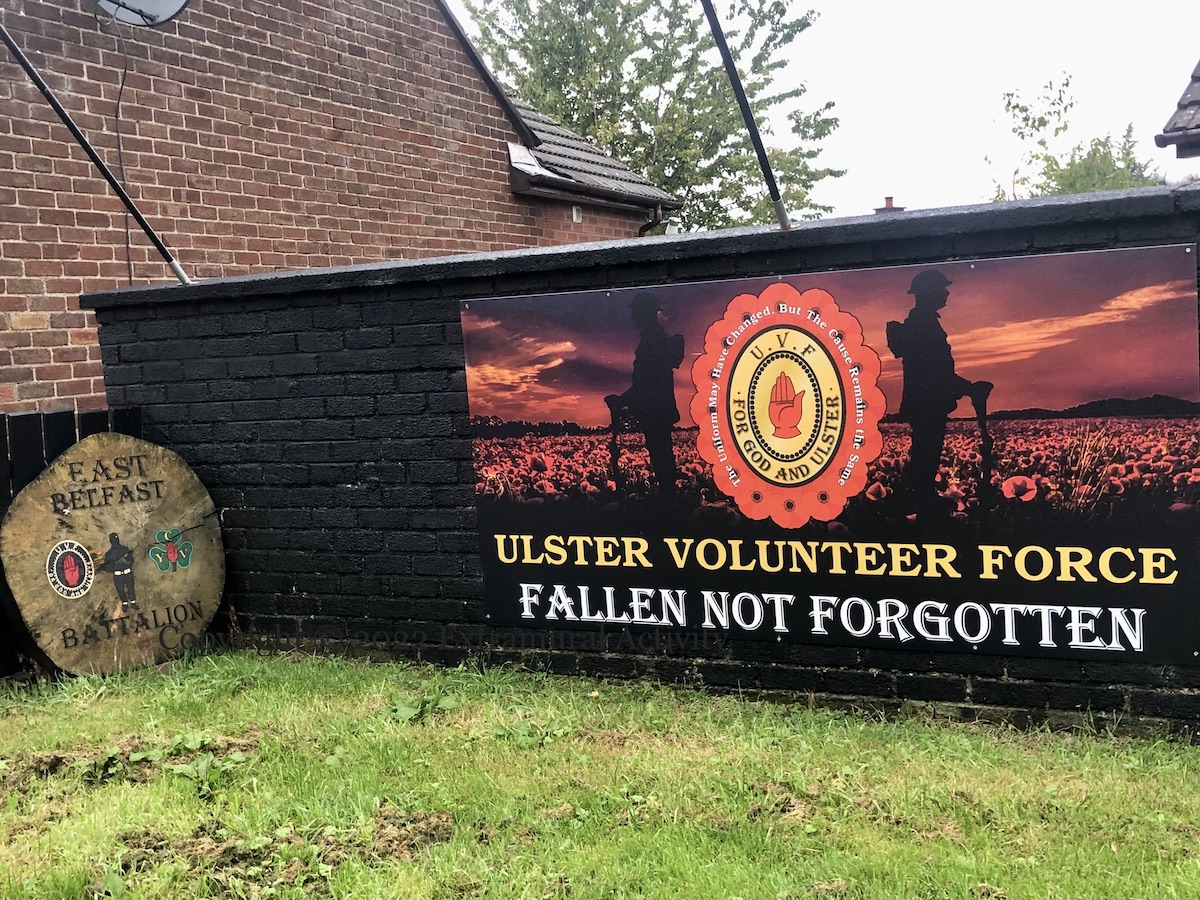
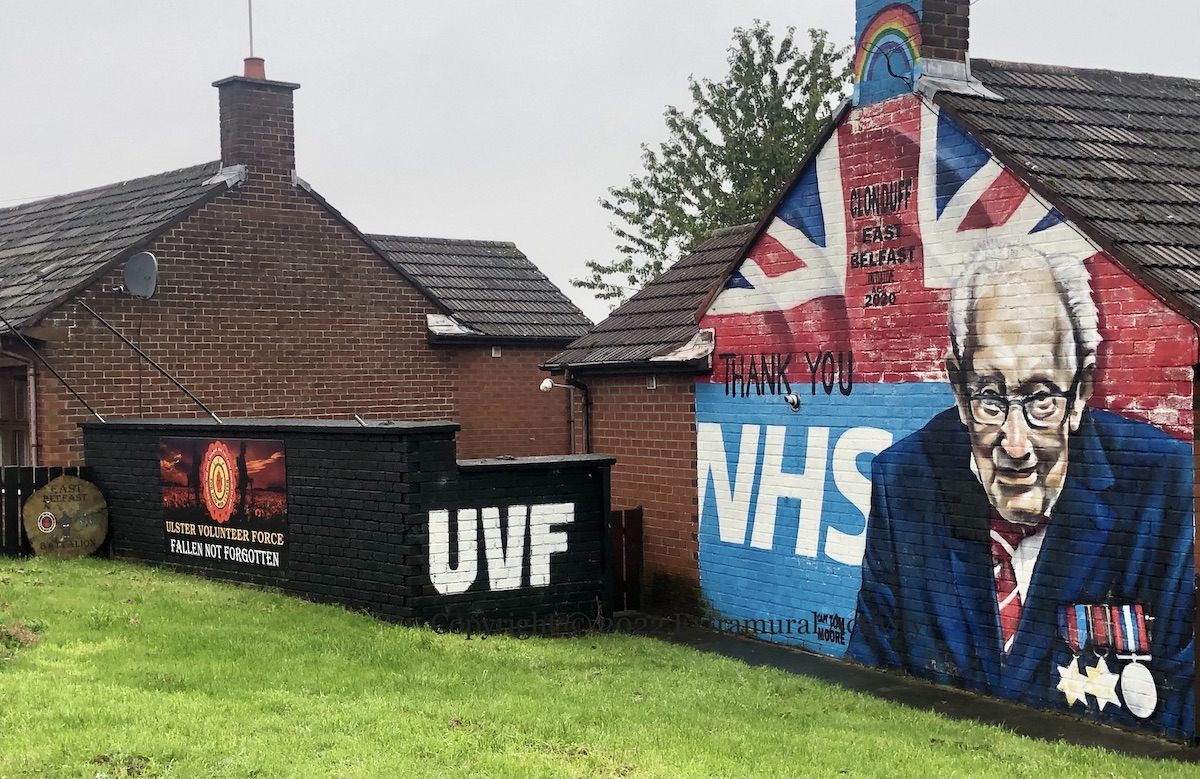
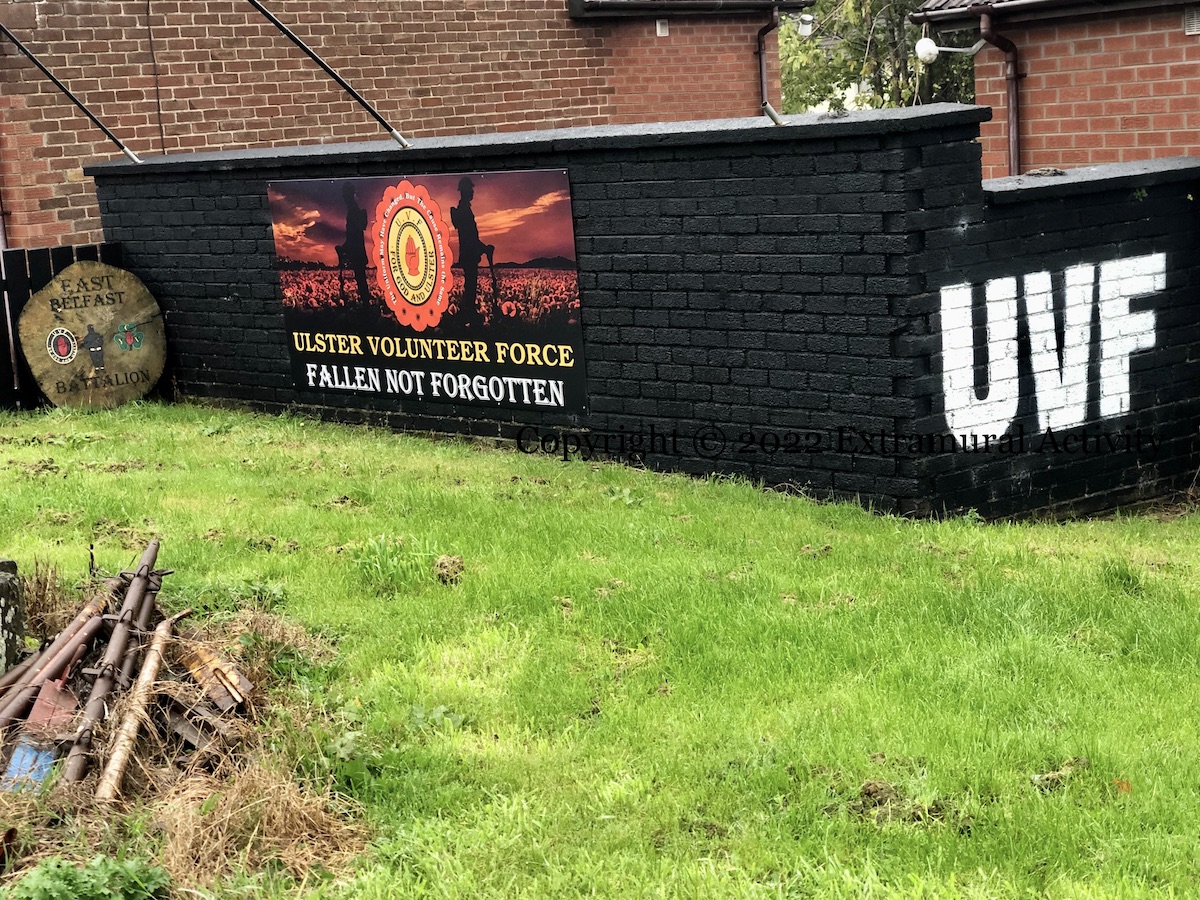
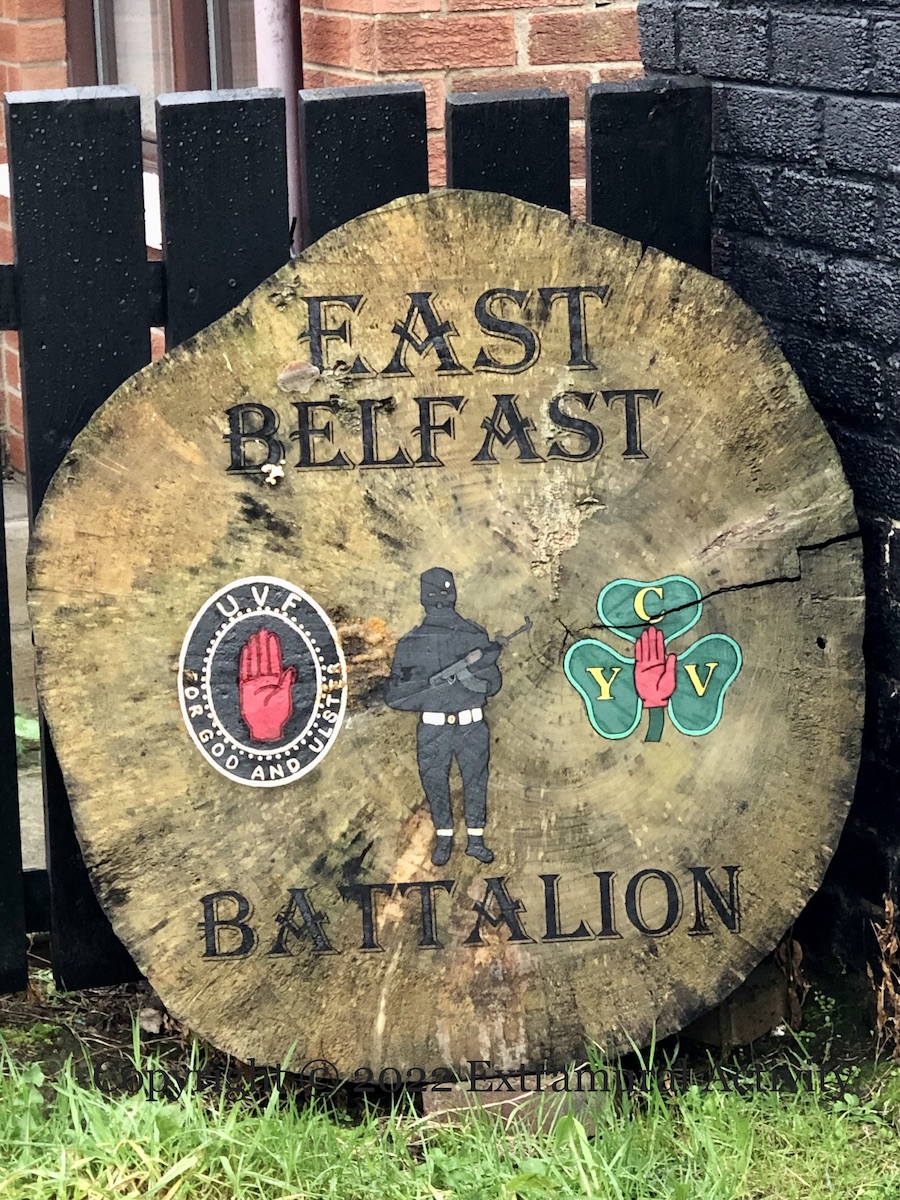
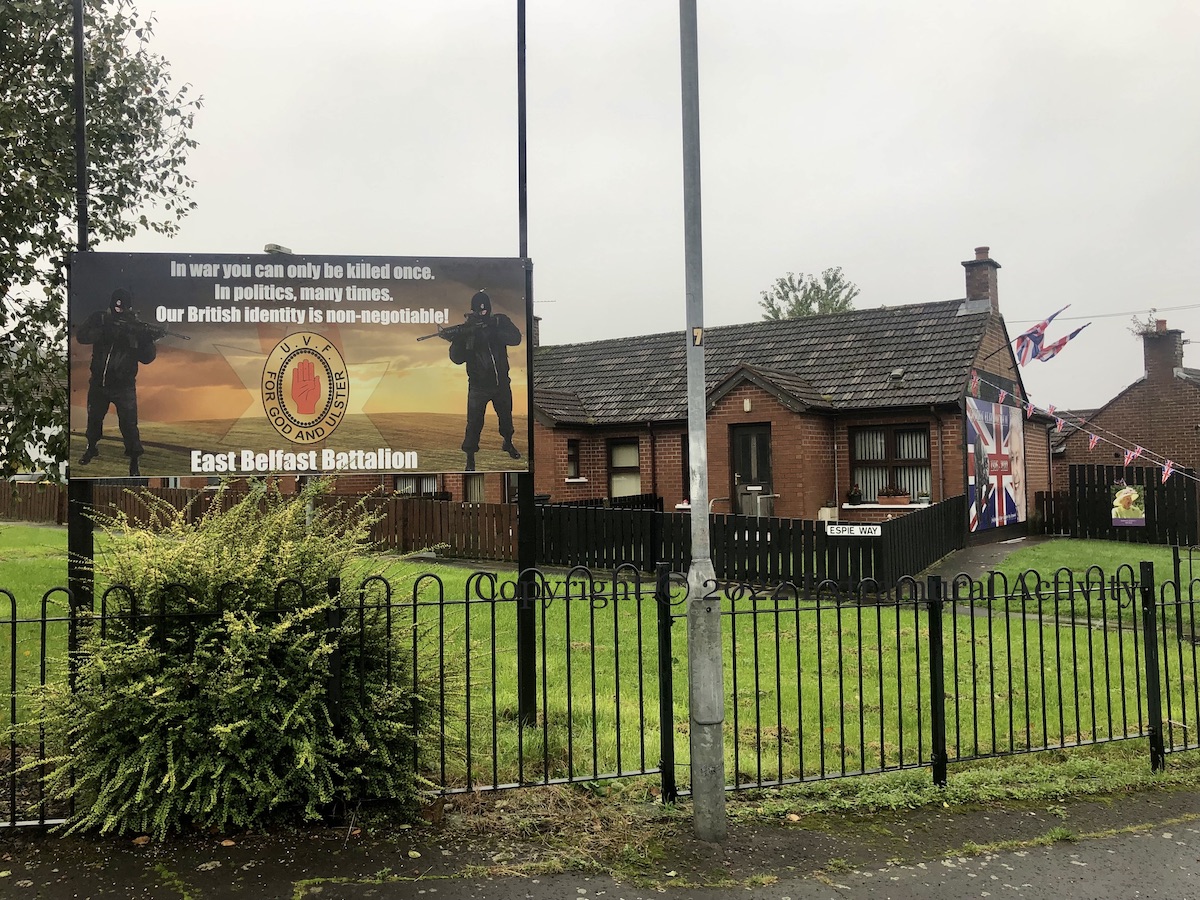
What’s most unusual here is the tree cross-section (or “tree disk”) (on the left) that has been decorated with a hooded gunman and the insignia of the (east Belfast) UVF and YCV – the final image shows a close-up.
“The uniform may have changed but the cause remains the same. Ulster Volunteer Force. Fallen, not forgotten.” There is a very close variant of this wording on a mural in Bowtown (Newtownards).
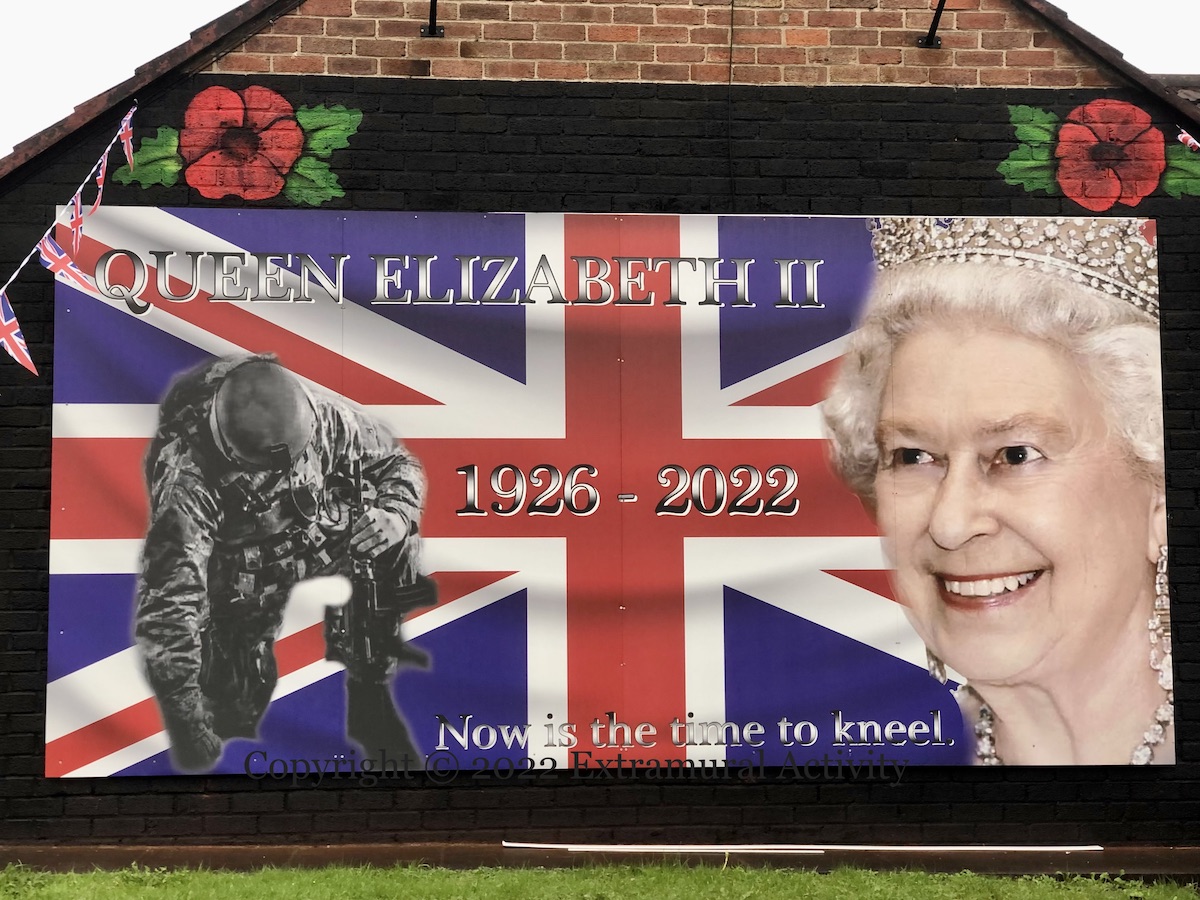
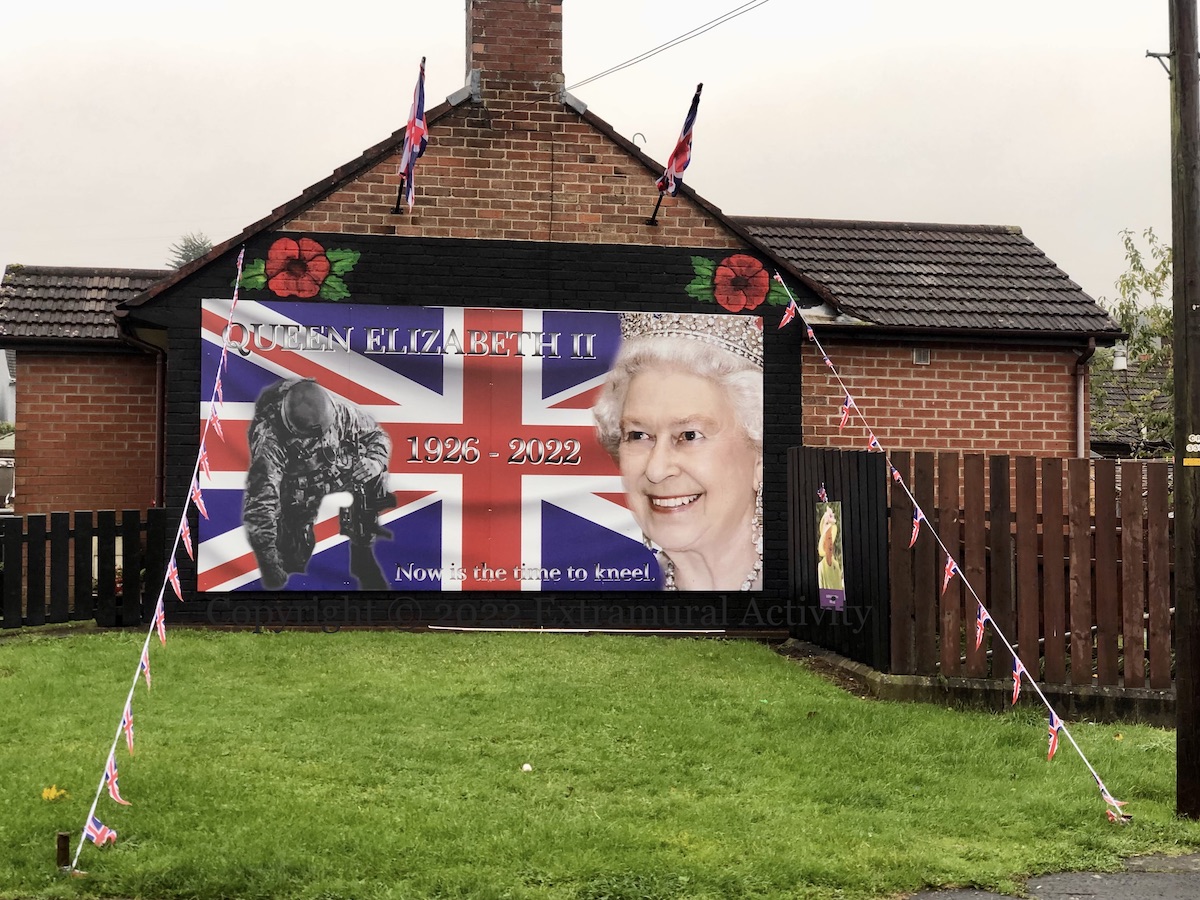
The “now” in “now is the time to kneel” would seem to suggest that there is some inappropriate kneeling going on at some other time, besides as a mark of respect to the patriotic dead (in this case, Queen Elizabeth II, who died on September 8th) – perhaps the kneeling prior to Premier League soccer matches as a protest against racism (World Soccer Talk).
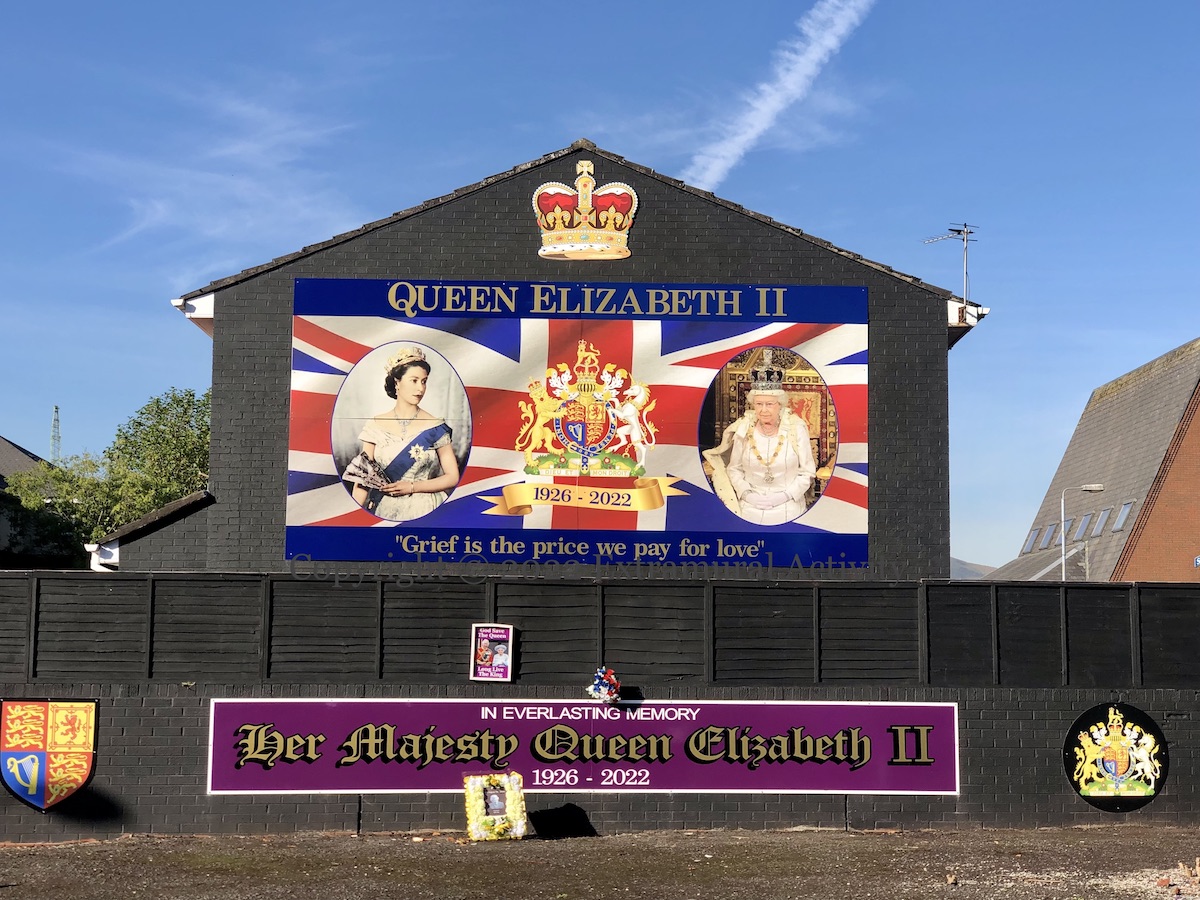
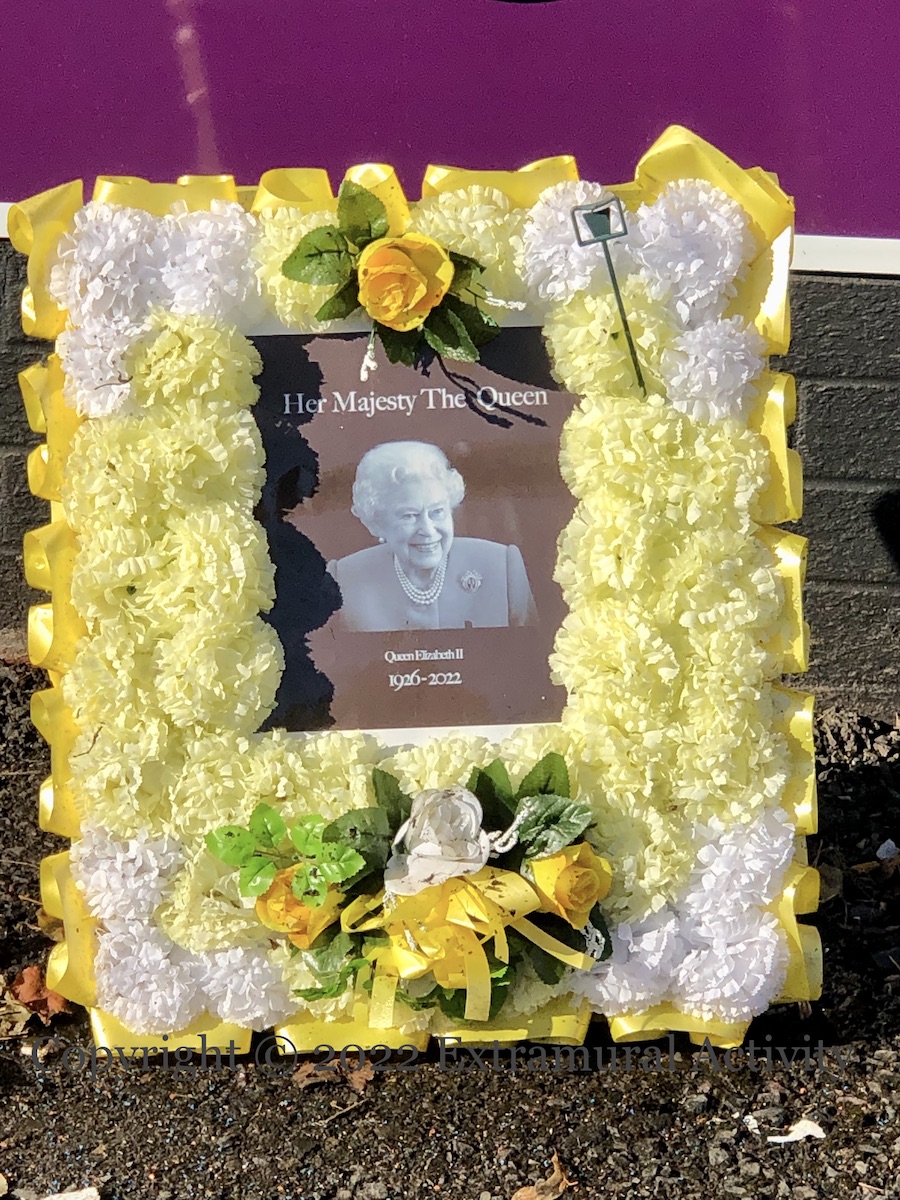
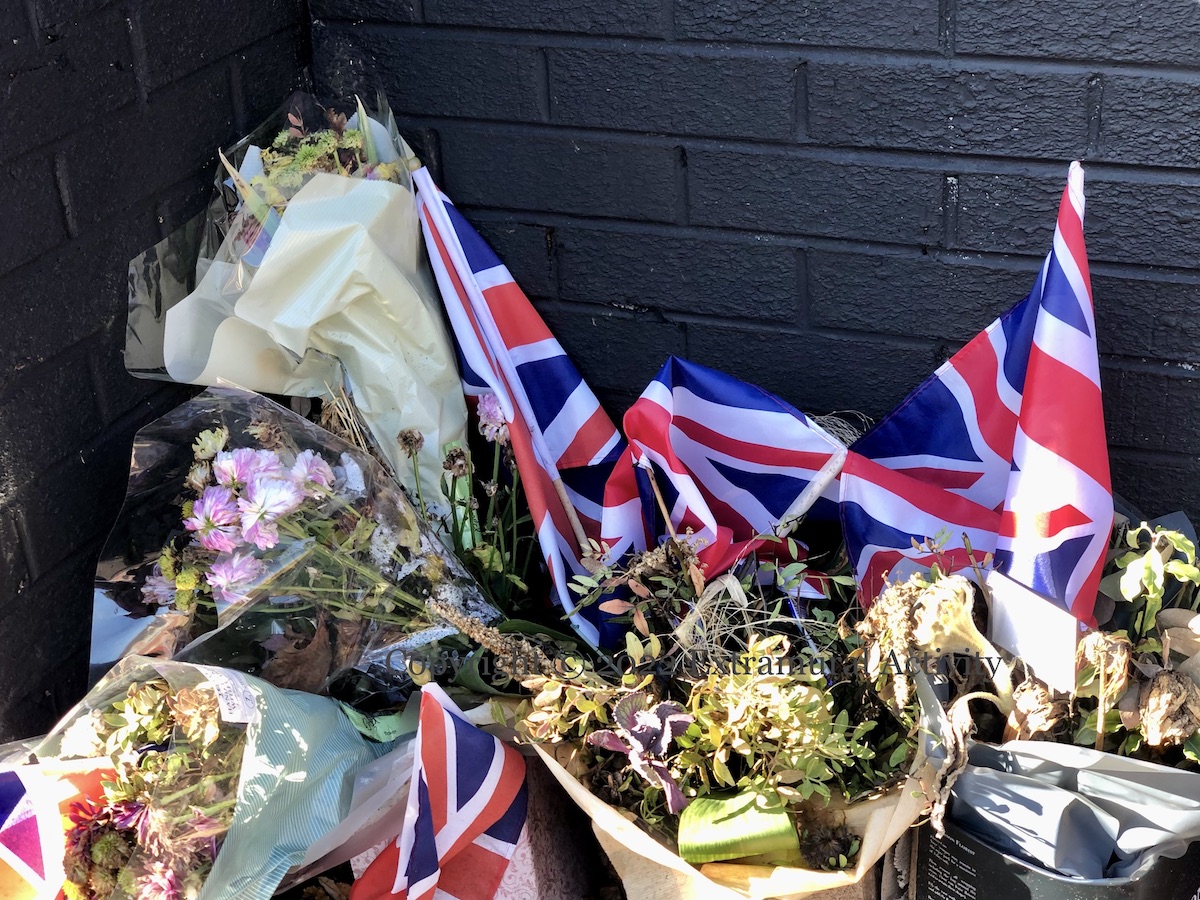
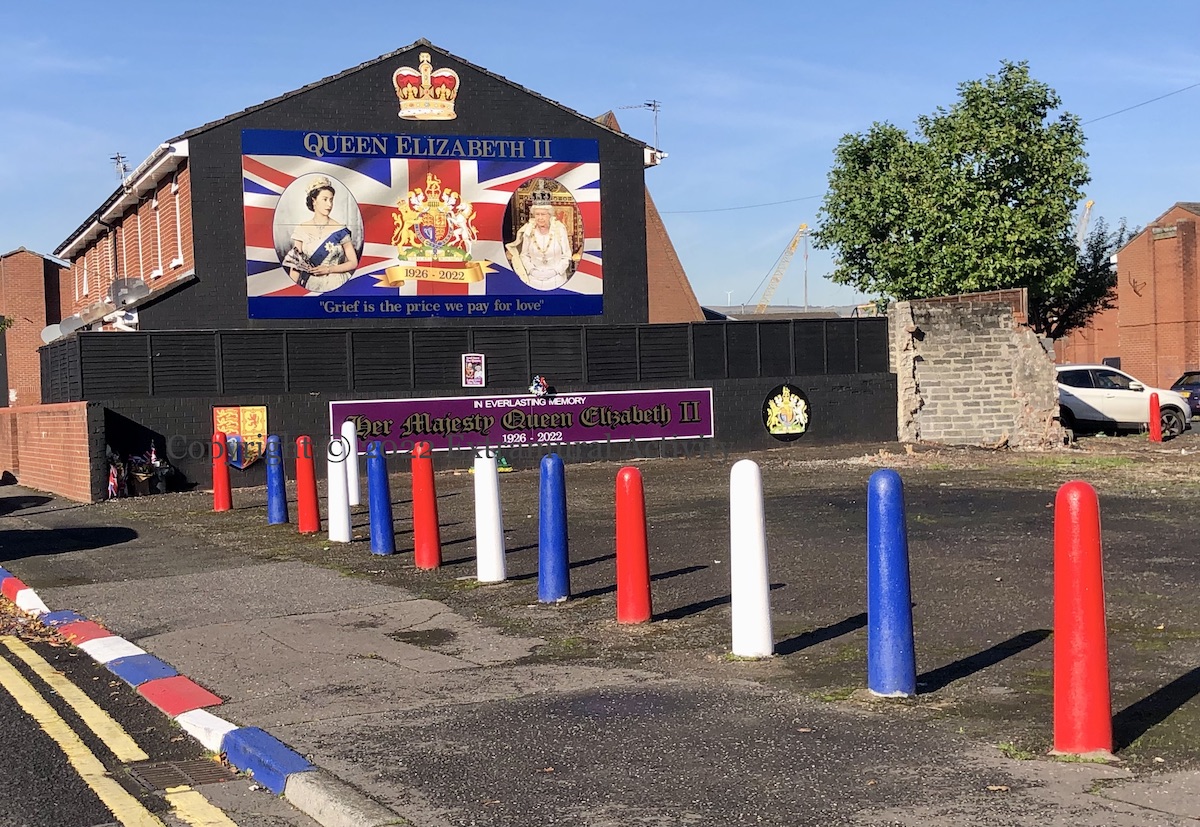
Elizabeth II, queen of the United Kingdom, passed away on September 8th, at the age of 96, in the same year of her platinum jubilee, the 70th anniversary of her accession. The phrase “grief is the price we pay for love” comes from a message from Elizabeth in consolation with the relatives of those killed in the “9-11” attacks in 2001 (text at The Guardian).
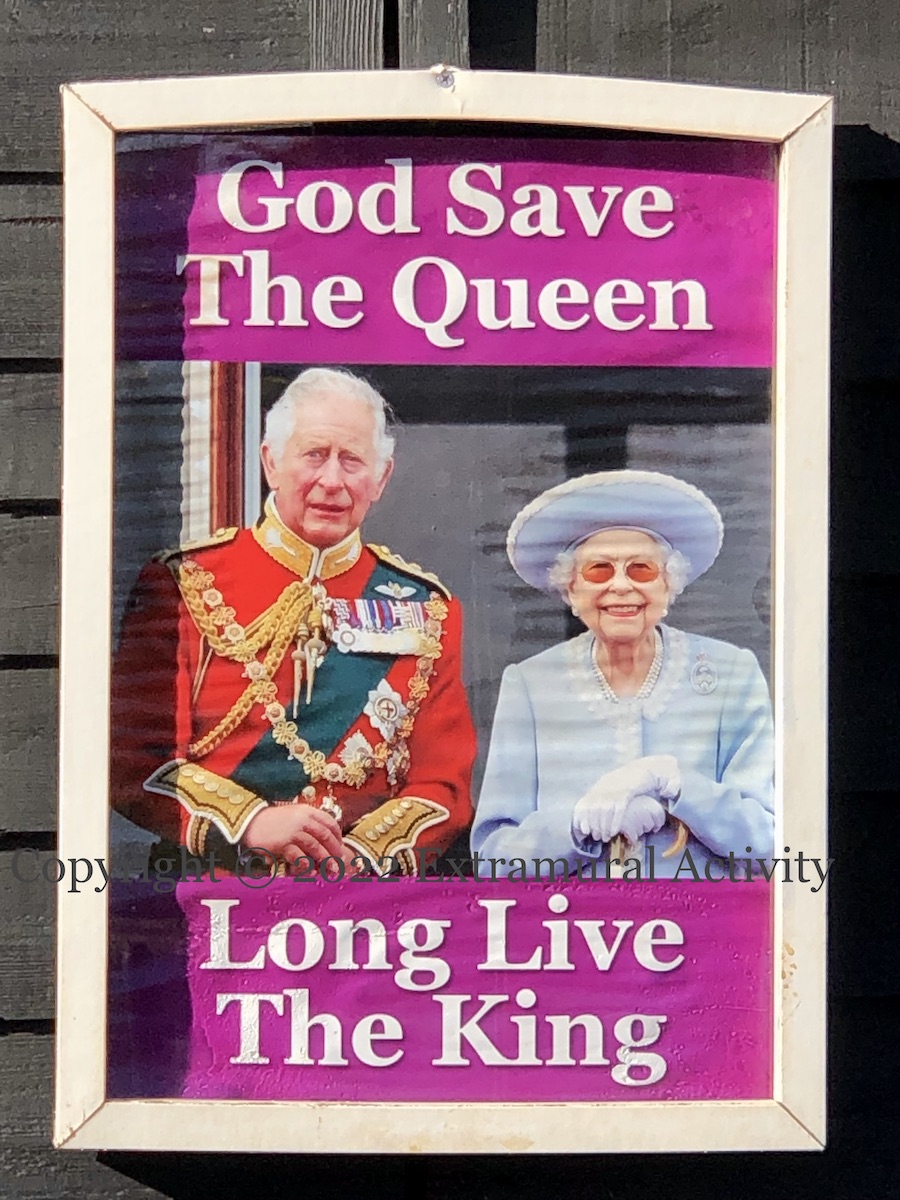
“In everlasting memory – her majesty Queen Elizabeth II – 1926-2022.” “Long live the King”
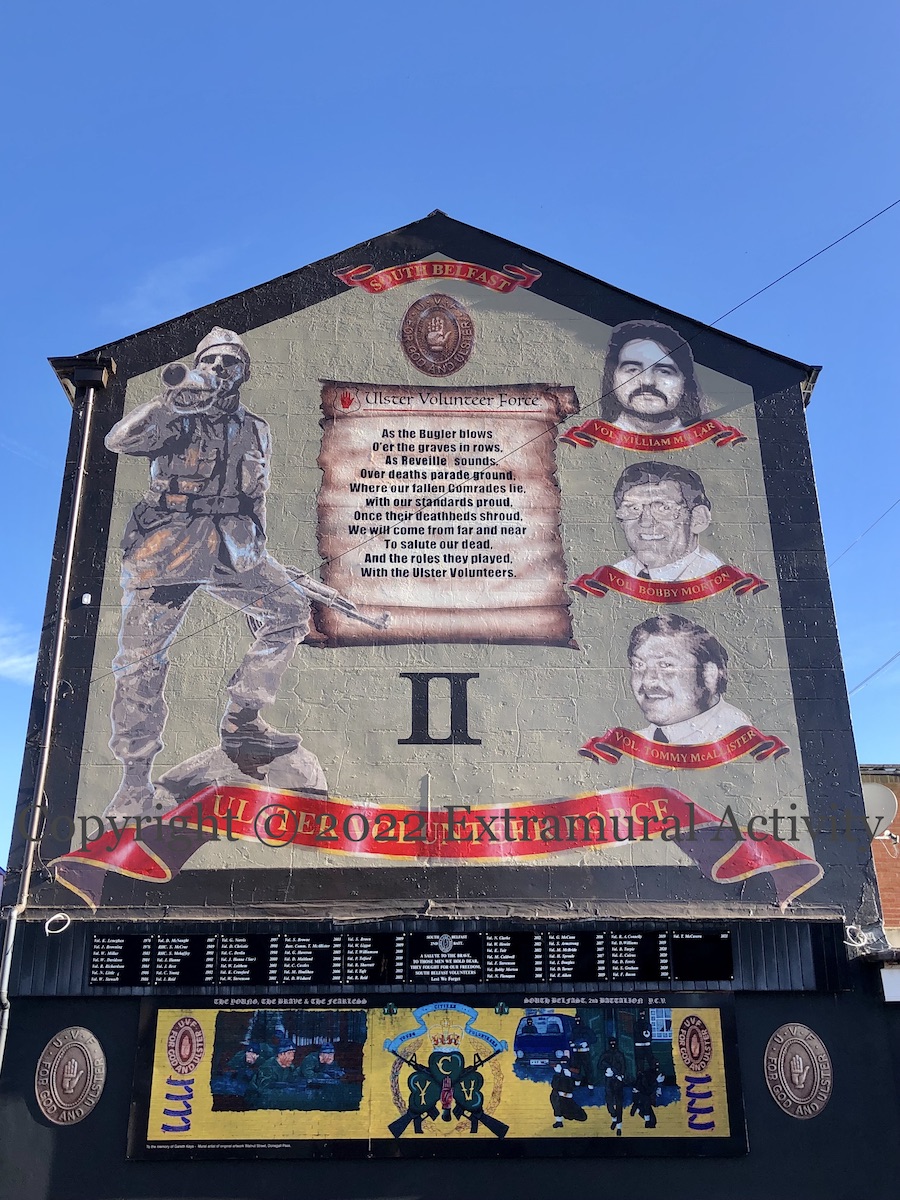
The bugler in period uniform and the language of the poem are reminiscent of WWI but all of the UVF mural, roll of honour, and reproduction of an old YCV mural refer to the modern UVF and in particular to William Millar [sometimes given as “Miller”], Bobby Morton, and Tommy McAllister. Millar and Morton were ambushed by the RUC on the 16th of March 1983 – Millar died and Morton was injured (Long Kesh Inside Out). Millar was included in an old Cregagh mural – see T00243). Morton died in 2016 (Young Conquerors), hence his portrait shows him as an older man. The same is true of McAllister’s portrait, though no information about him is readily available.
“As the bugler blows/O’er the graves in rows/As reveille sounds/Over death[‘]s parade ground/Where our fallen comrades lie/With our standards proud/Once their deathbeds shroud/We will come from far and near/To salute our dead/And the roles they played/With the Ulster Volunteers.”
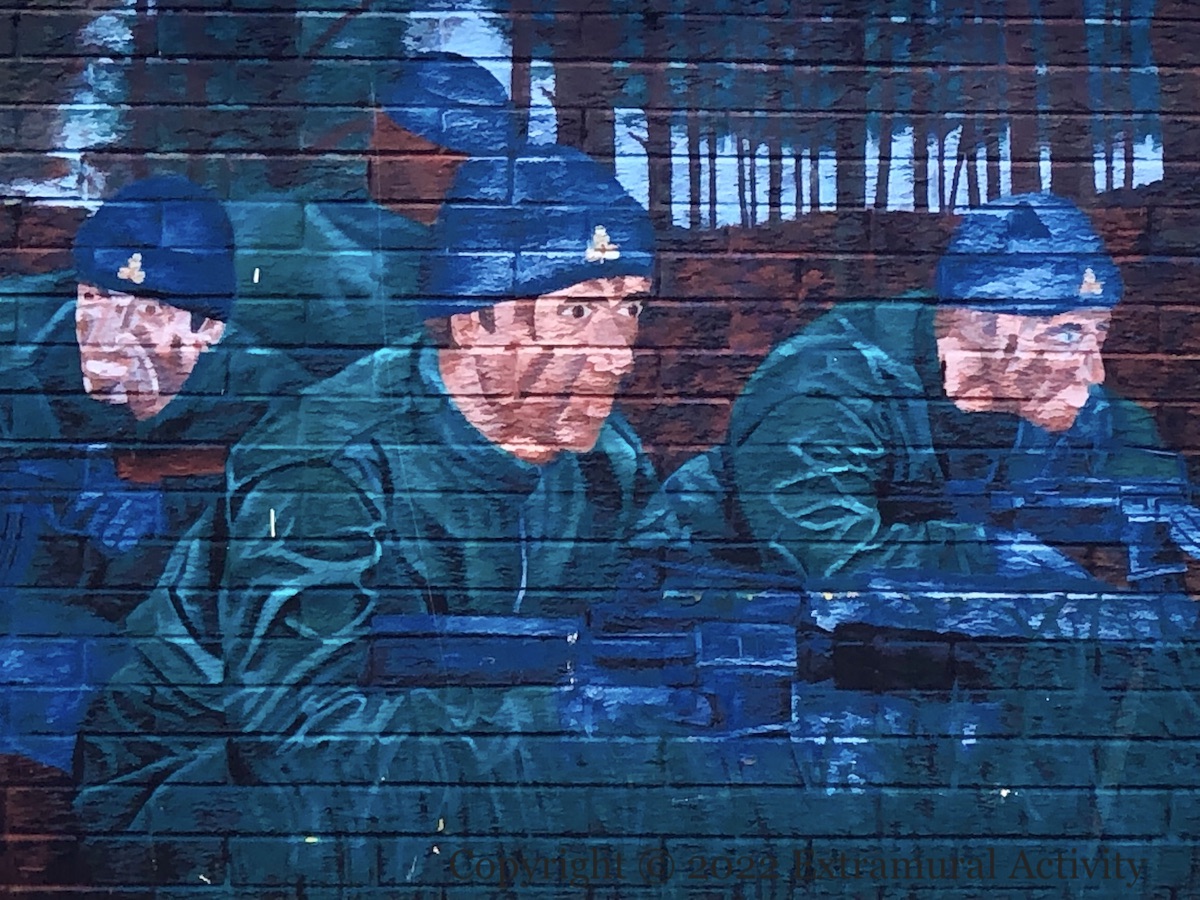
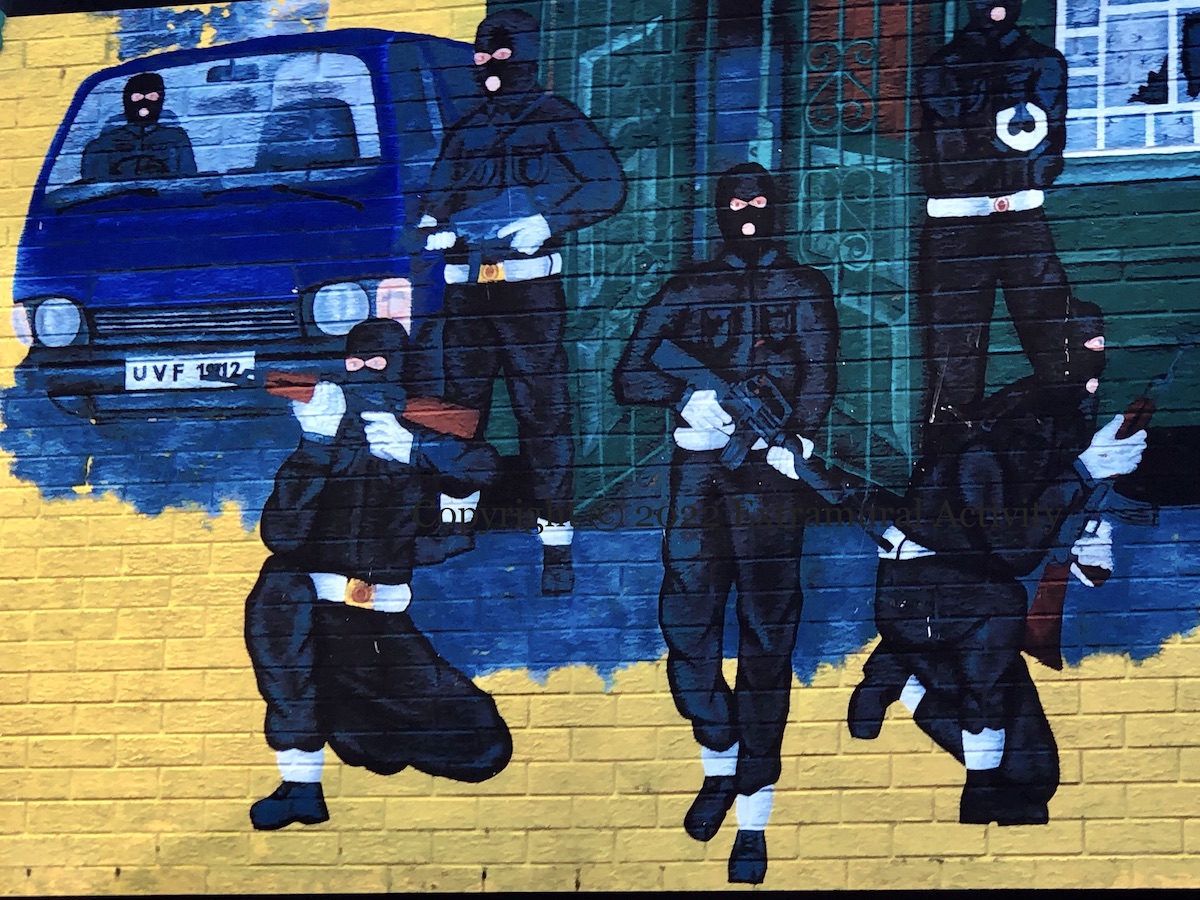
The mural was launched on March 19th (ACT) in Pine St. Below the new mural are a roll of honour and a board reproducing a former mural by Gareth Keys one street over, in Walnut Street – see The Young, The Brave, The Fearless.
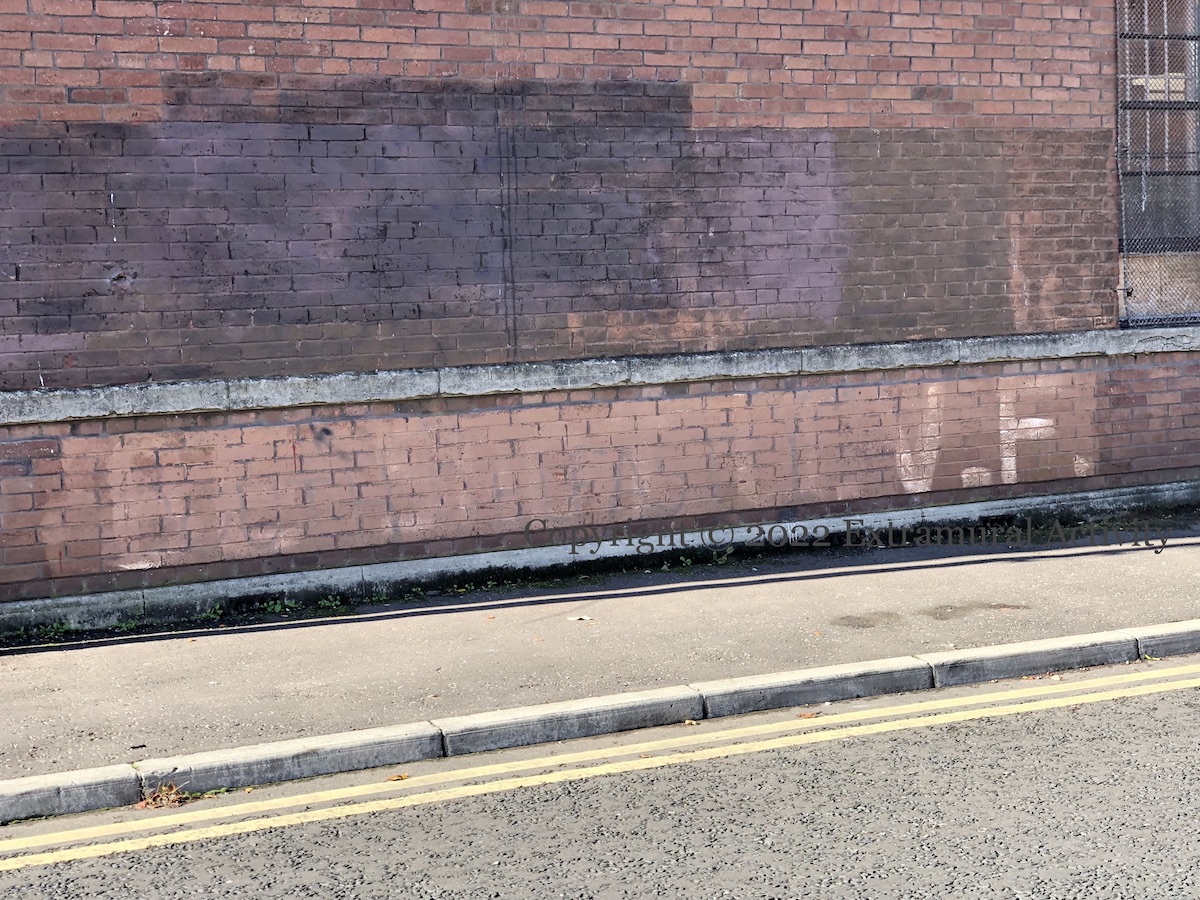
The vintage graffiti (second image) is in Oak Street.
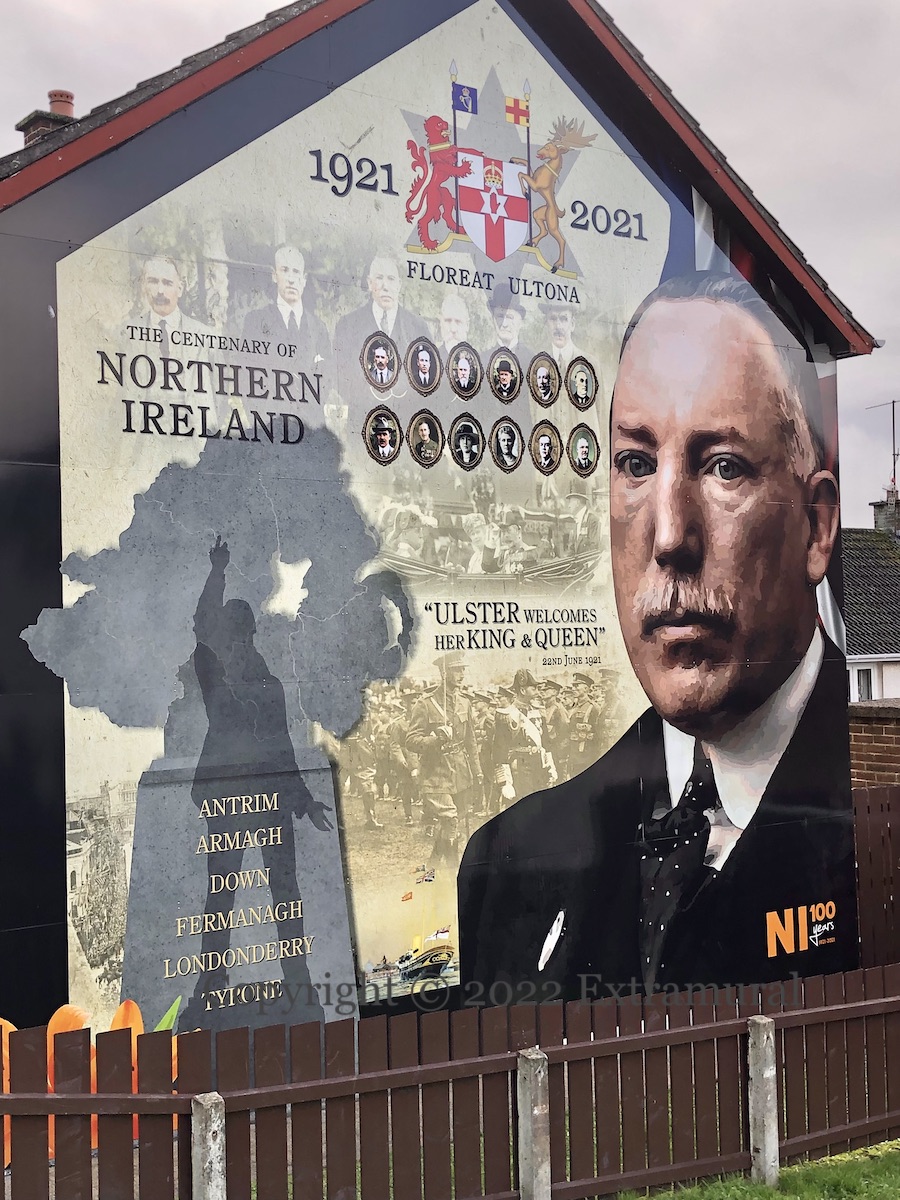
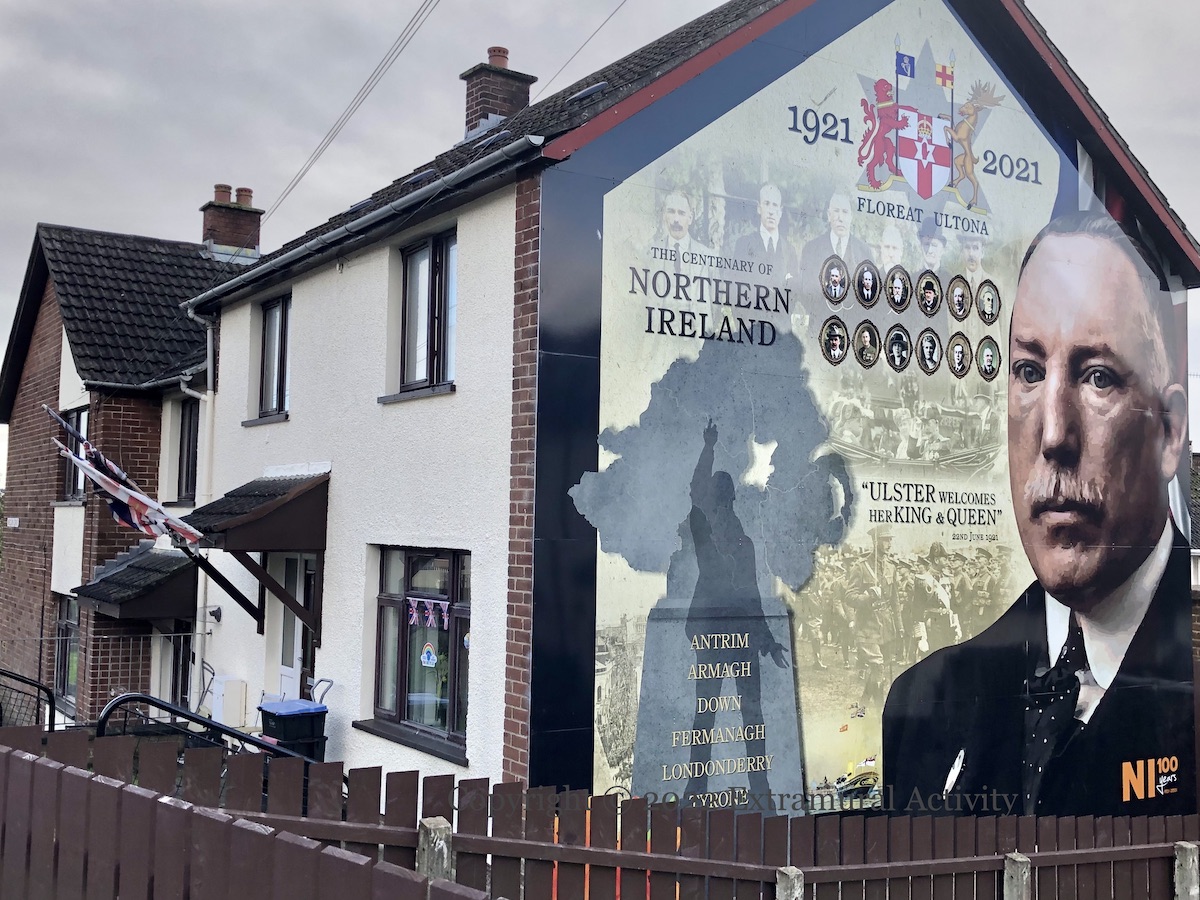
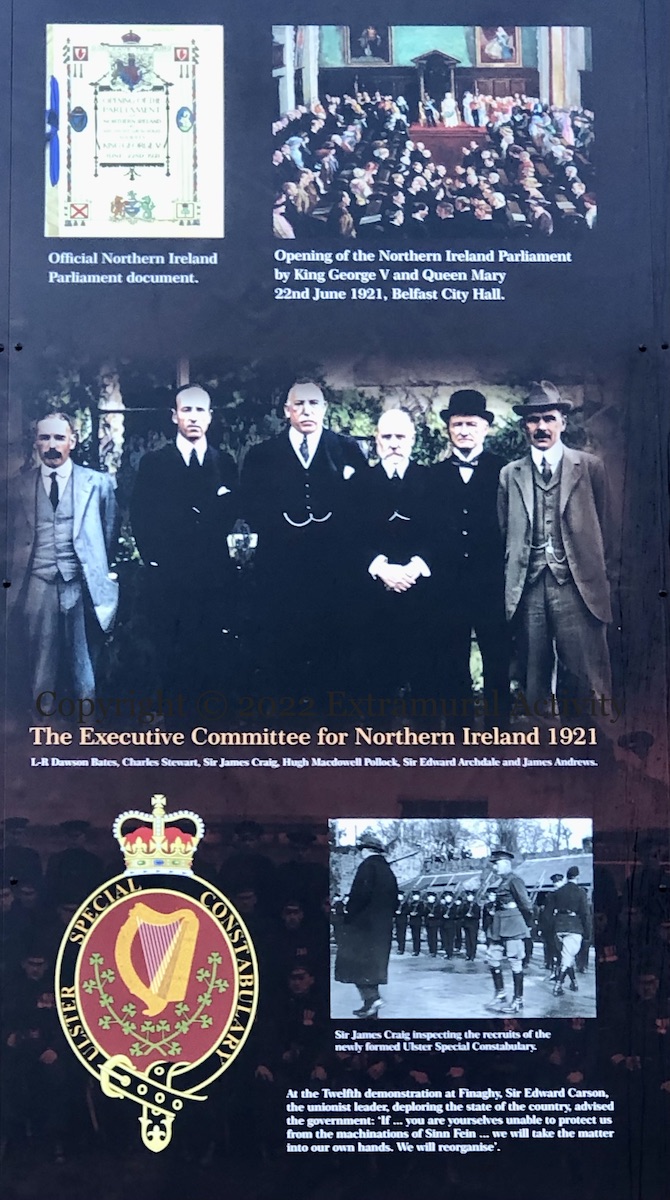
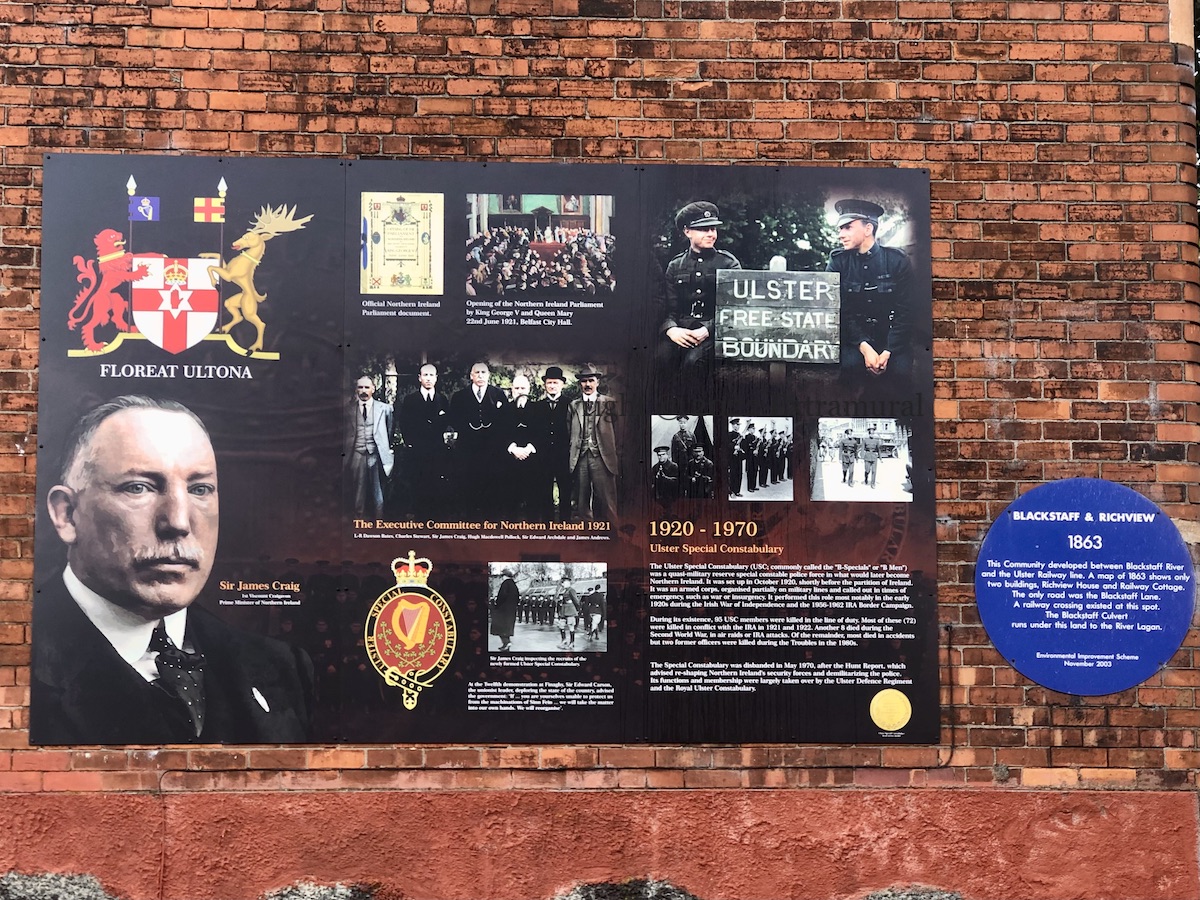
… to the state opening of the first parliament of Northern Ireland – with new prime minister James Craig – at Belfast City Hall on June 22nd, 1921. The monarchs in question are King George V and Queen Mary. Pathé has video of the royal arrival and travel to City Hall. In his speech, George appealed “to all Irishmen to pause, to stretch out the hand of forbearance and conciliation, to forgive and to forget, and to join in making for the land which they love a new era of peace, contentment, and goodwill.”
For the coat of arms, see previously The Lion And The Elk. It is not clear whom the twelve framed portraits depict. The six gentlemen in the background are the members of the original Executive Committee, which served as a cabinet to the Commons and Senate – for a full list, with offices, and the original photograph, see WP. Carson’s statue at the entrance to Stormont is on the left. The photograph of spectators at the parade (on the far left) can be seen in this News Letter article. The photograph of the royals in their carriage can be seen here and of the King inspecting the guard here.
The project was undertaken by Rathcoole Friends of the Somme (Fb), with support from the Housing Executive’s Community Cohesion unit.
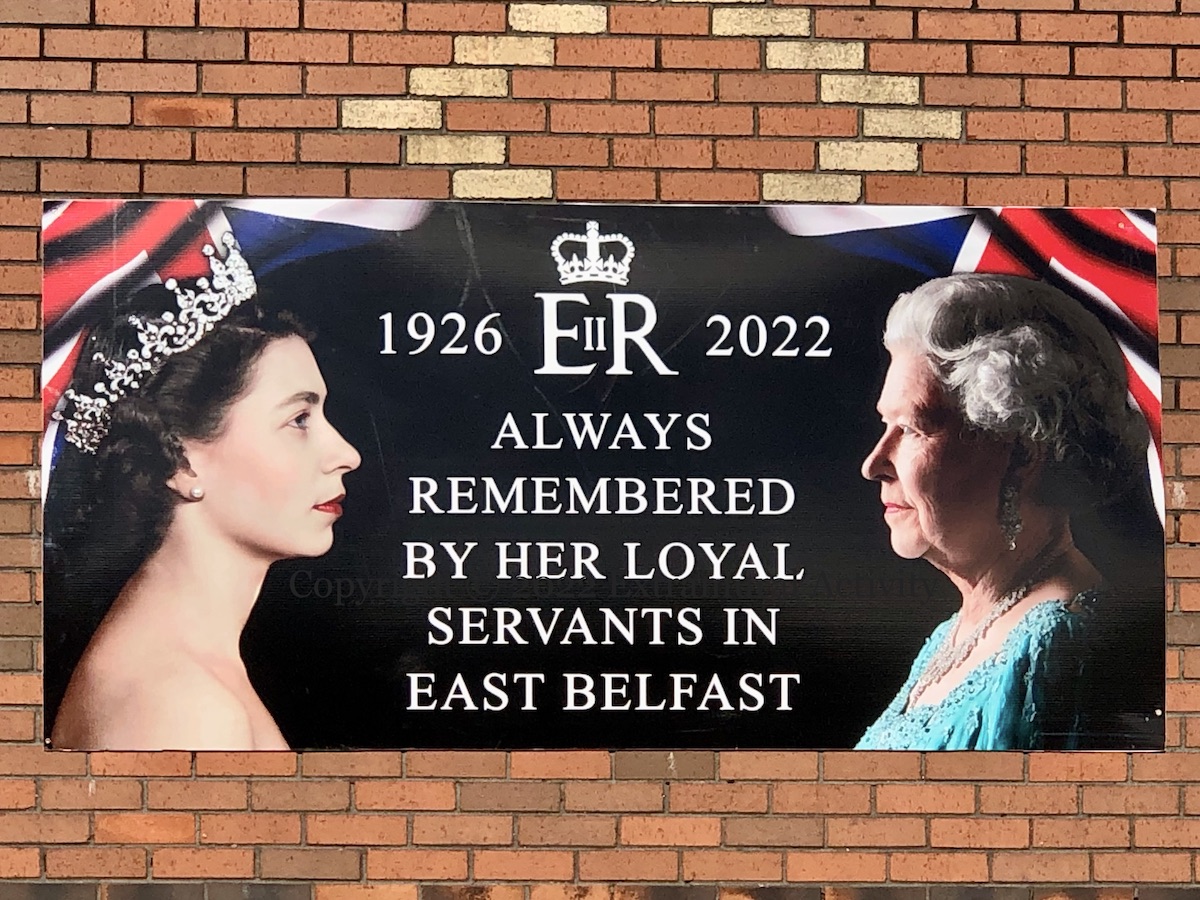
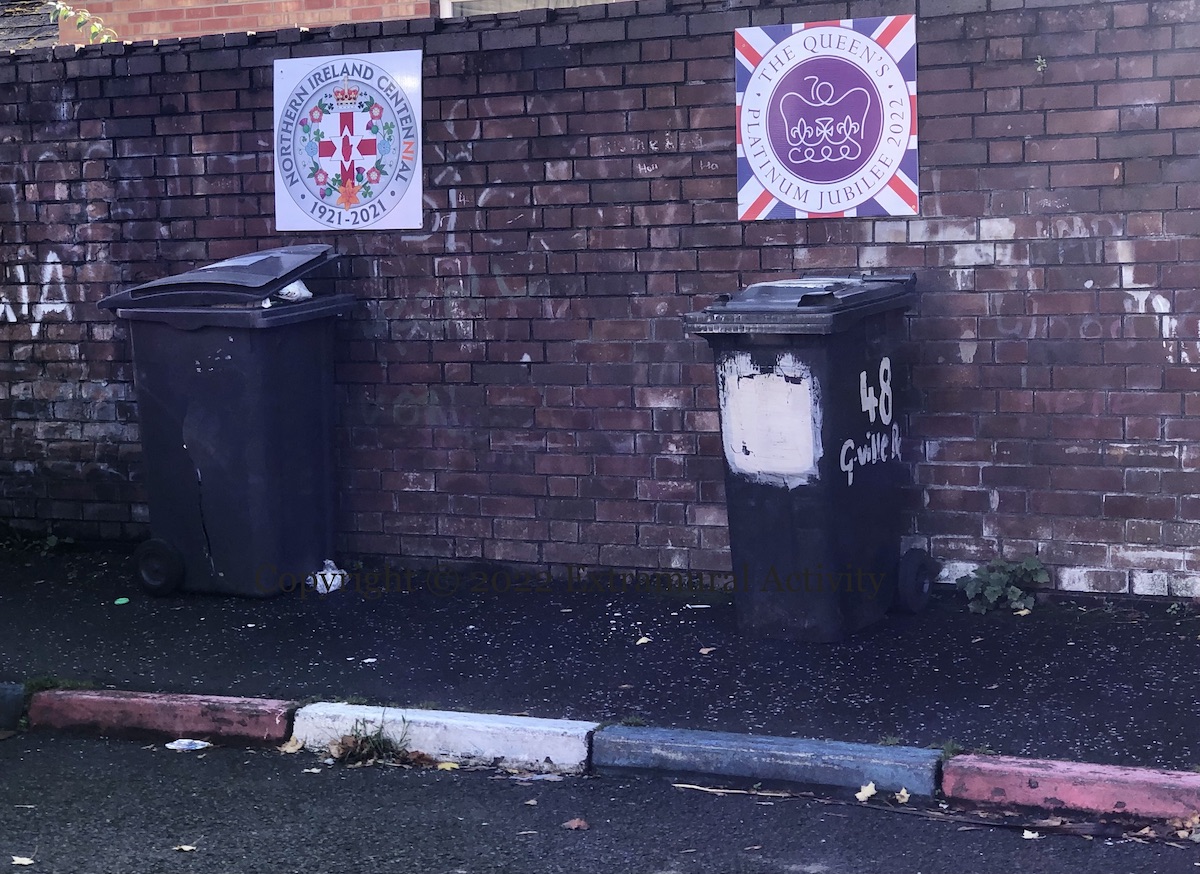
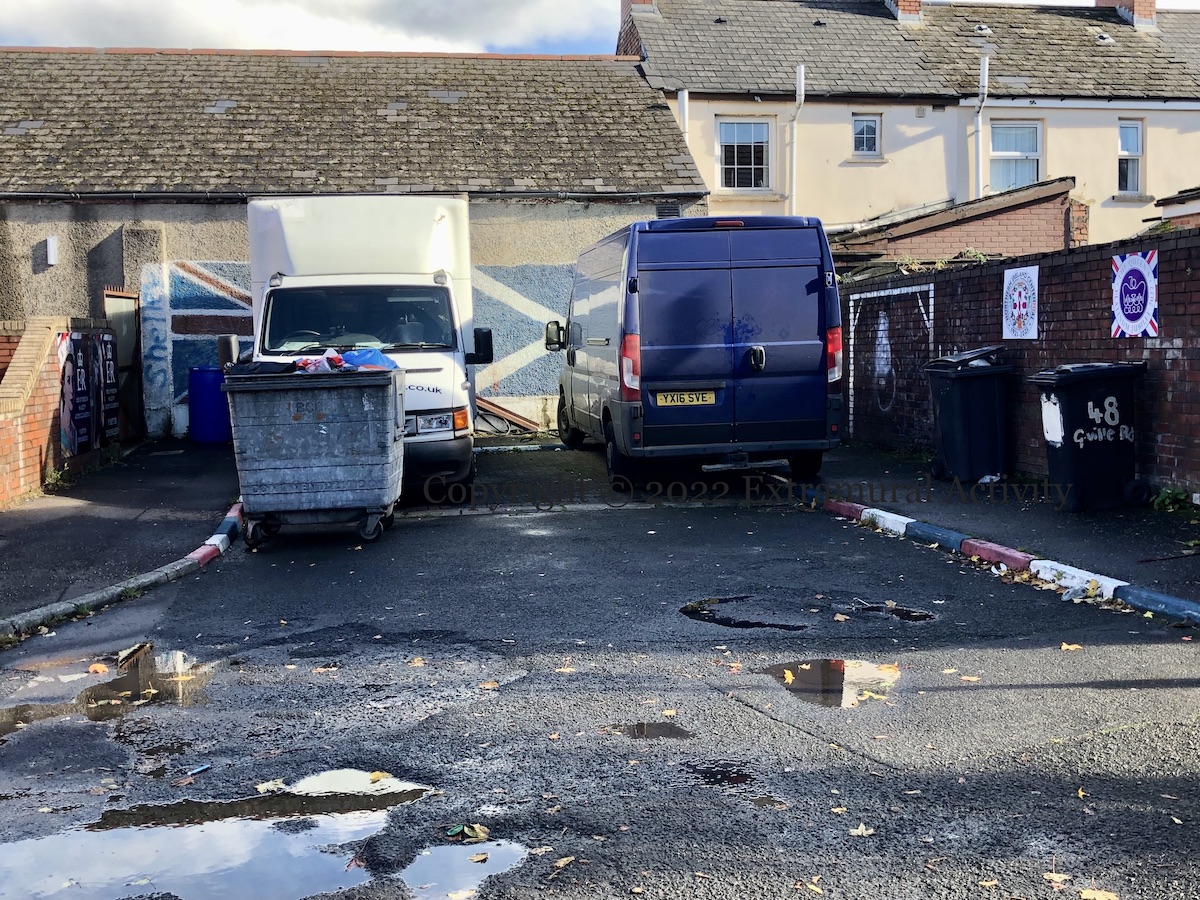
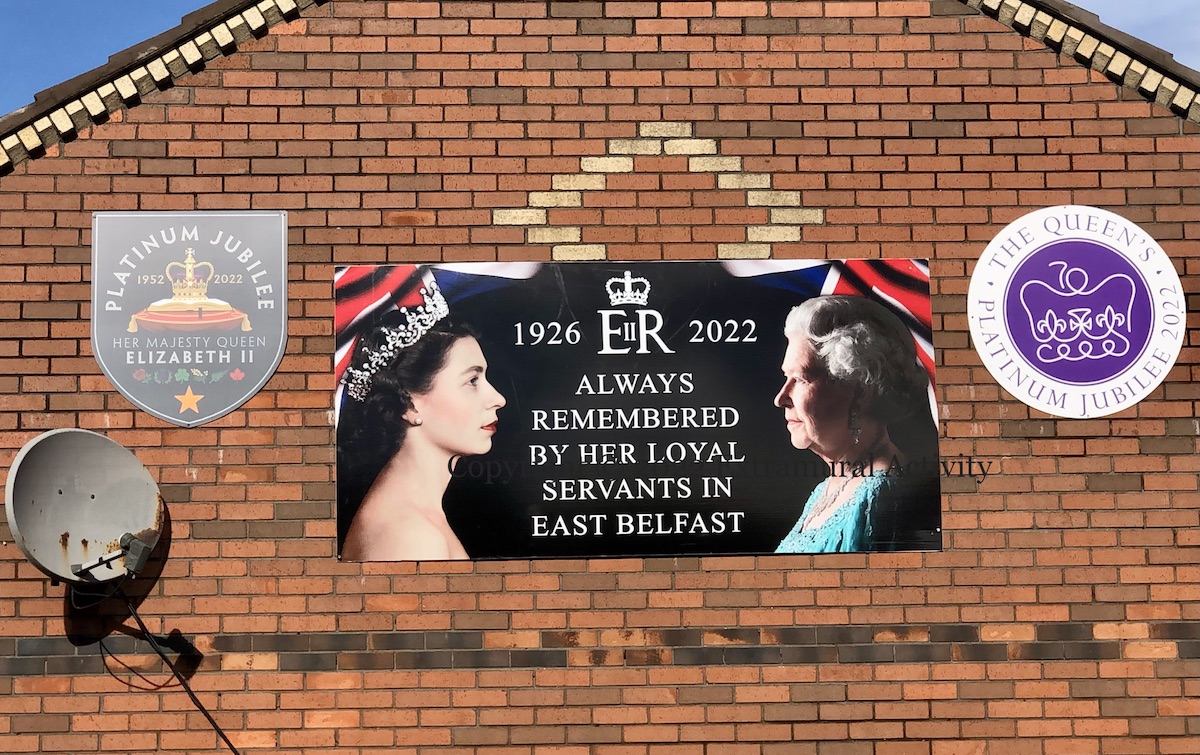
All the emblems of an eventful summer for loyalism: the centenary of Norther Ireland was celebrated on May 3rd, Queen Elizabeths platinum jubilee was celebrated in the first week of June, and then she died on September 8th, at the age of 96. “ERII 1926-2022. Always remembered by her loyal servants in east Belfast.”
For a clear shot of the Union Flag and St Andrew’s Saltire behind the vans, see UK – Scotland.
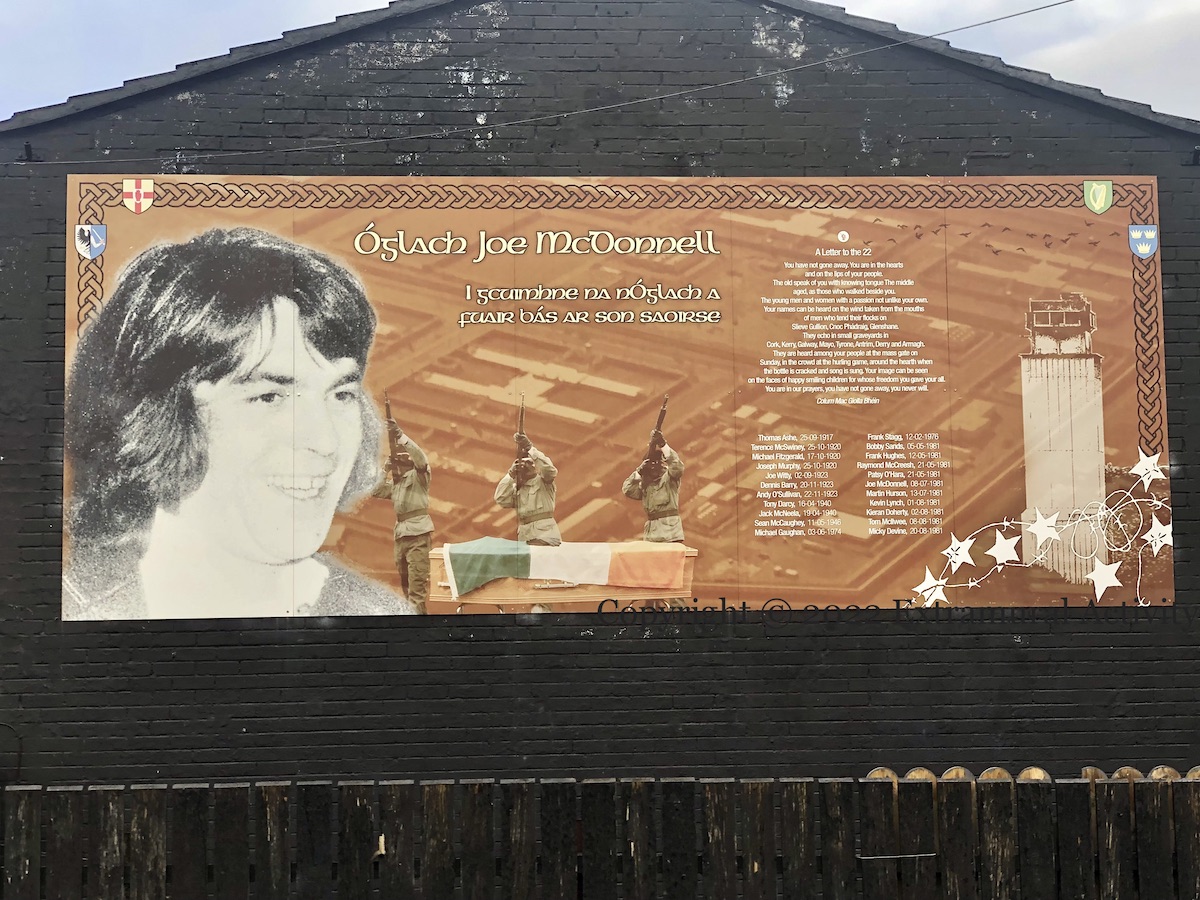
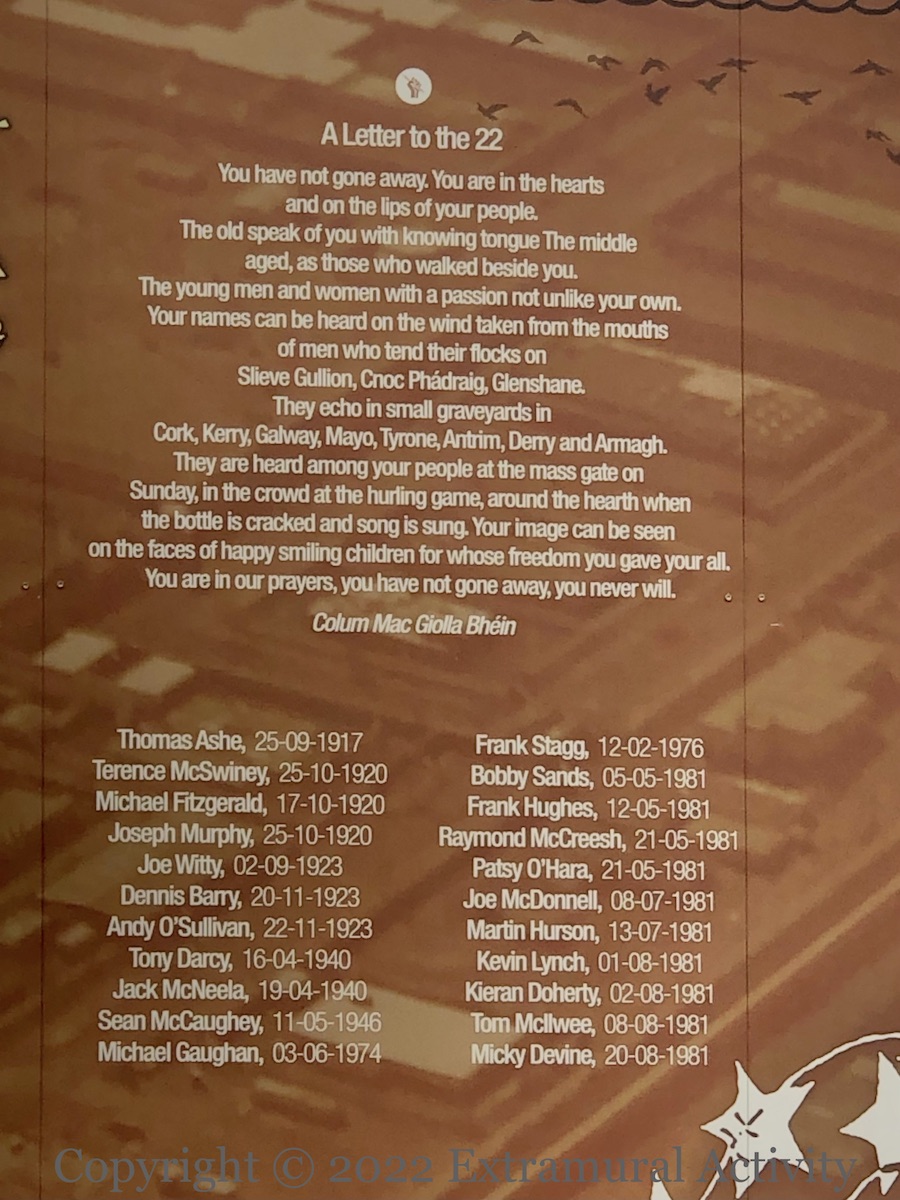
“I gcuımhne na nÓglach a fuaır bás ar son saoırse [in memory of the volunteers who died for freedom].” The “22” are the familiar 12 deceased Troubles-era hunger-strikers, plus 10 from 1917 to 1946: Thomas Ashe, Terence McSwiney, Michael Fitzgerald, Joseph Murphy, Joe Witty, Dennis Barry, Andy O’Sullivan, Tony Darcy, Jack McNeela, Sean McCaughey.
“‘A Letter To The 22: You have not gone away. You are in the hearts/and on the lips of your people./The old speak of you with knowing tongue. The middle/aged, as those who walked beside you./The young men and women with a passion not unlike your own./Your names can be heard on the wind taken from the mouths/of men who tend their flocks on Slieve Gullion, Cnoc Phádraıg, Glenshane./They echo in small graveyards in/Cork, Kerry, Galway, Mayo, Tyrone, Antrim, Derry and Armagh./They are heard among your people at the mass gate on/Sunday, in the crowd at the hurling game, around the hearth when/the bottle is cracked and song in sung. Your image can be seen/on the faces of happy smiling children for whose freedom you gave your all./You are in our prayers, you have not gone away, you never will’ – Colum Mac Gıolla Bhéın“
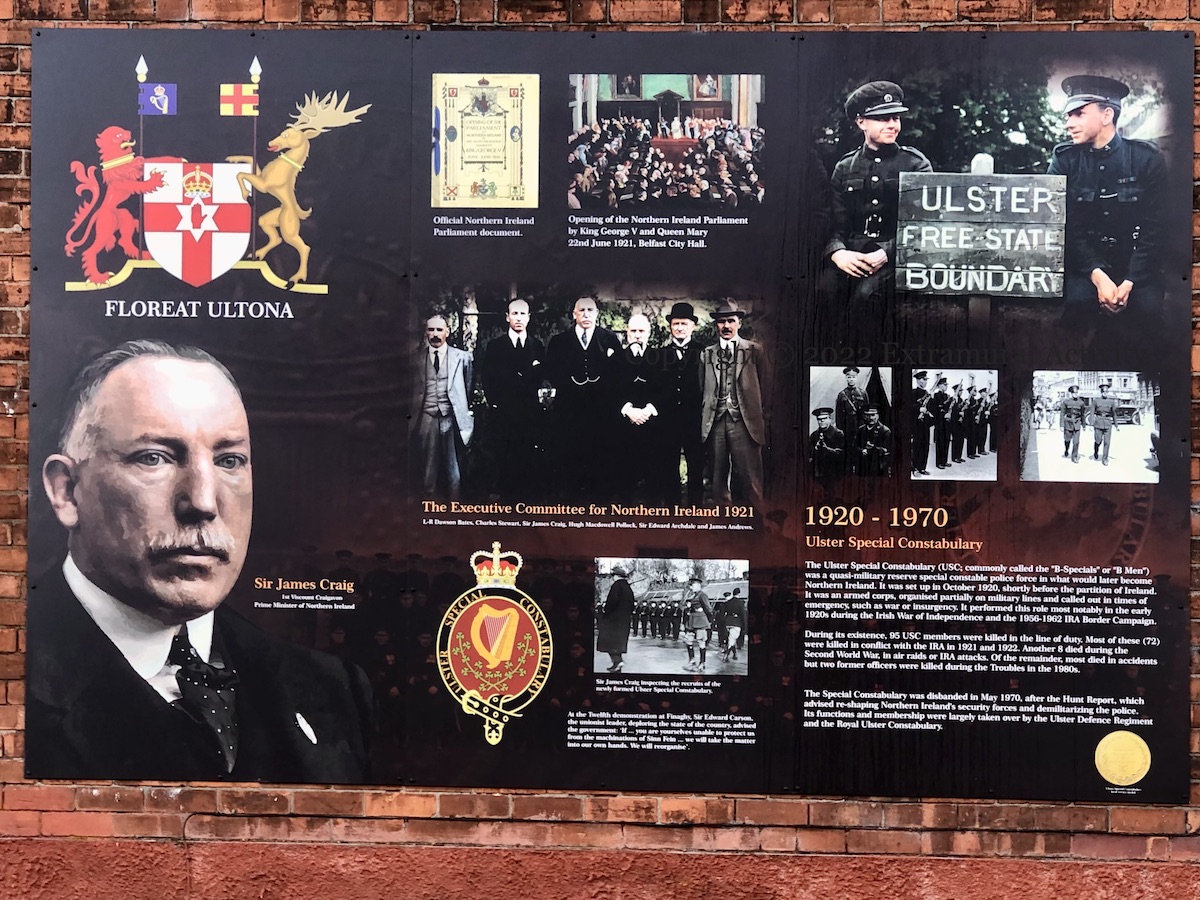
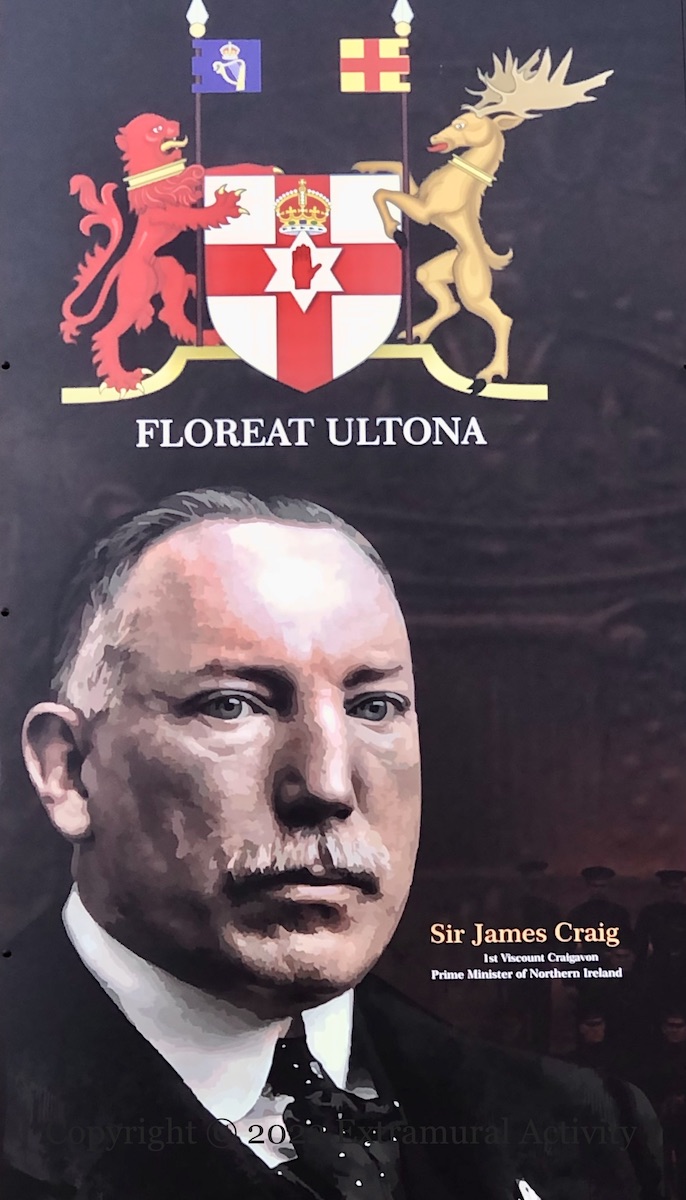
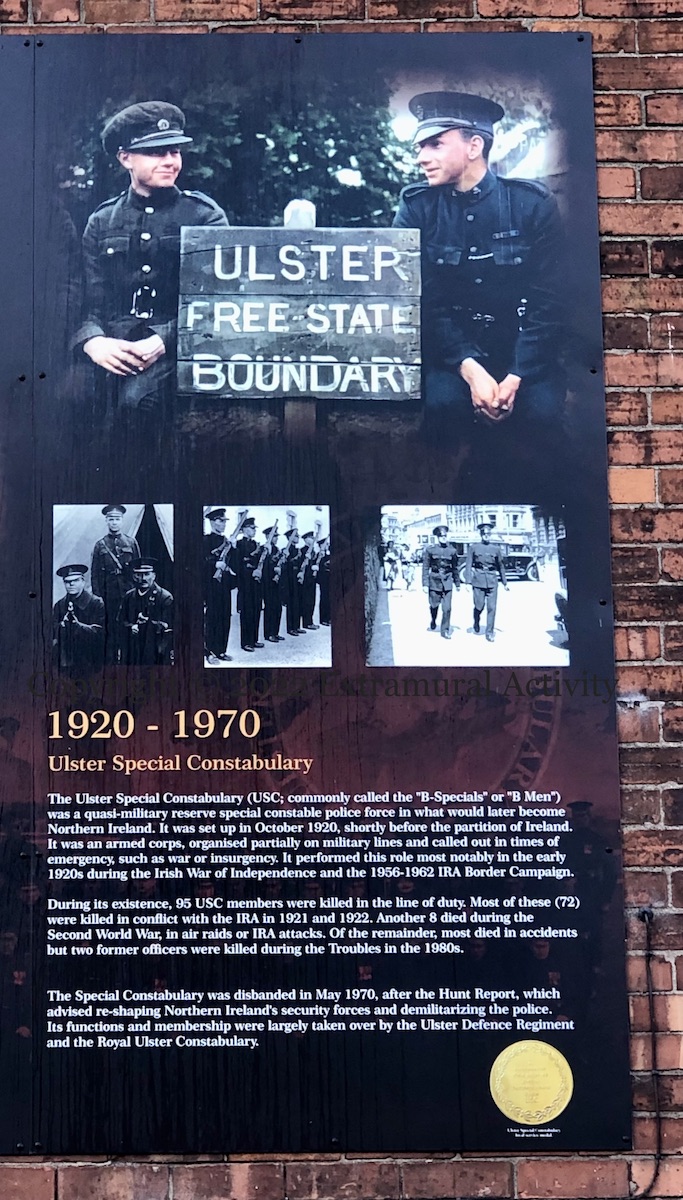
“May Ulster flourish” as the newly created Northern Ireland under “Sir James Craig, 1st Viscount Craigavon, Prime Minister of Northern Ireland”. The Northern Ireland parliament was opened in 1921 and the coat of arms adopted in 1924 (WP); the Special Constabulary (including the B-Specials) had been formed prior to and in preparation for partition – the quote from Carson (also seen in an east Belfast mural) is from July 12th, 1920.
The text on the board is the same as at WP: “The Ulster Special Constabulary (USC; commonly called the “B-Specials” or “B Men”) was a quasi-military reserve special constable police force in what would later become Northern Ireland. It was set up in October 1920, shortly before the partition of Ireland. It was an armed corps, organised partially on military lines and called out in times of emergency, such as war or insurgency. It performed this role most notably in the early 1920s during the Irish War of Independence and the 1956-1962 IRA Border Campaign. During its existence, 95 USC members were killed in the line of duty. Most of these (72) were killed in conflict with the IRA in 1921 and 1922. Another 8 died during the Second World War, in air raids or IRA attacks. Of the remainder, most died in accidents but two former officers were killed during the Troubles in the 1980s. The Special Constabulary was disbanded in May 1970, after the Hunt Report, which advised re-shaping Northern Ireland’s security forces and demilitarizing the police. Its functions and membership were largely taken over by the Ulster Defence Regiment and the Royal Ulster Constabulary.”
This Belfast Live article (which has images from the launch) leads with the headline that this new board replaces a UVF mural, but there hasn’t been anything on this wall since a large “UDA” lettering in 1999. The adjacent wall, which has now been painted over, previously (in 2010) had a UVF flag which had been vandalised with “Jesus Christ Is Lord Of All’ graffiti by 2017.
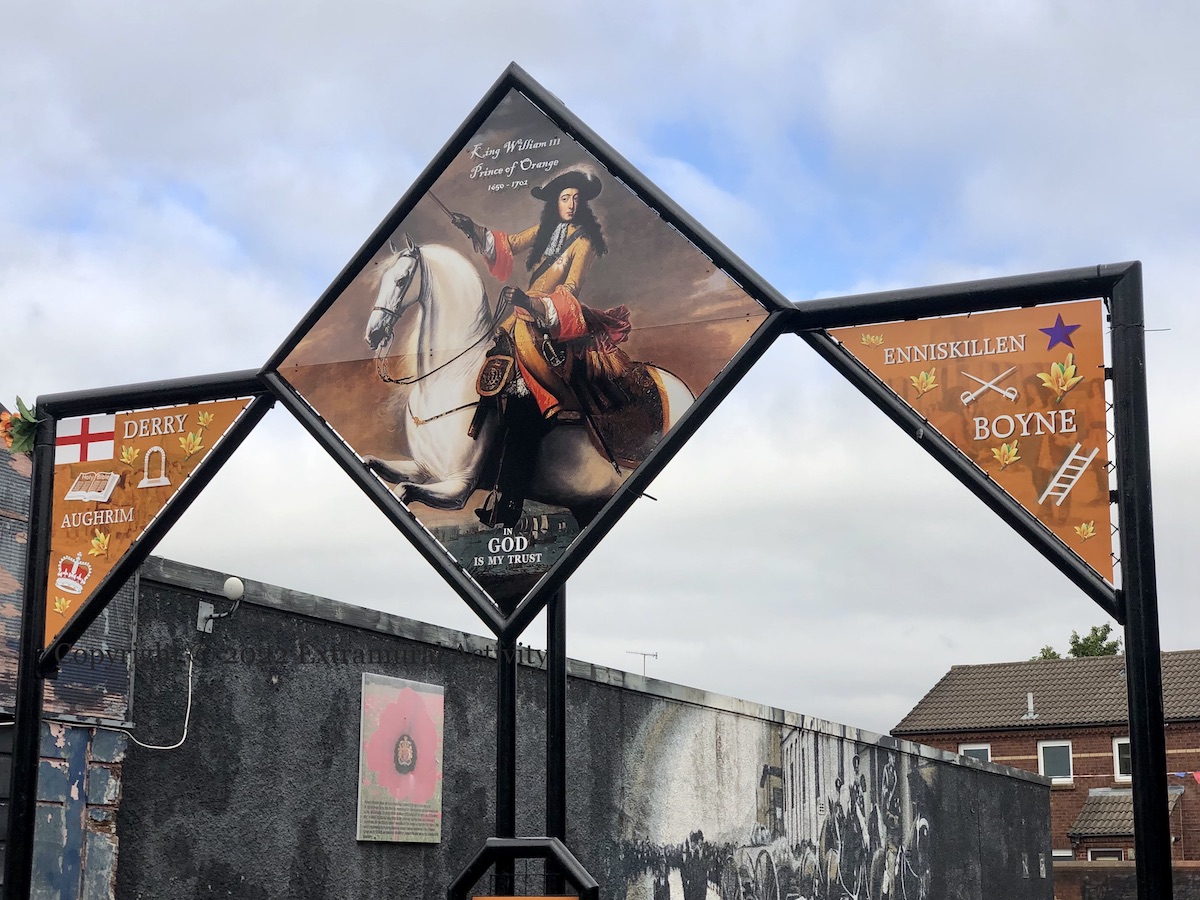
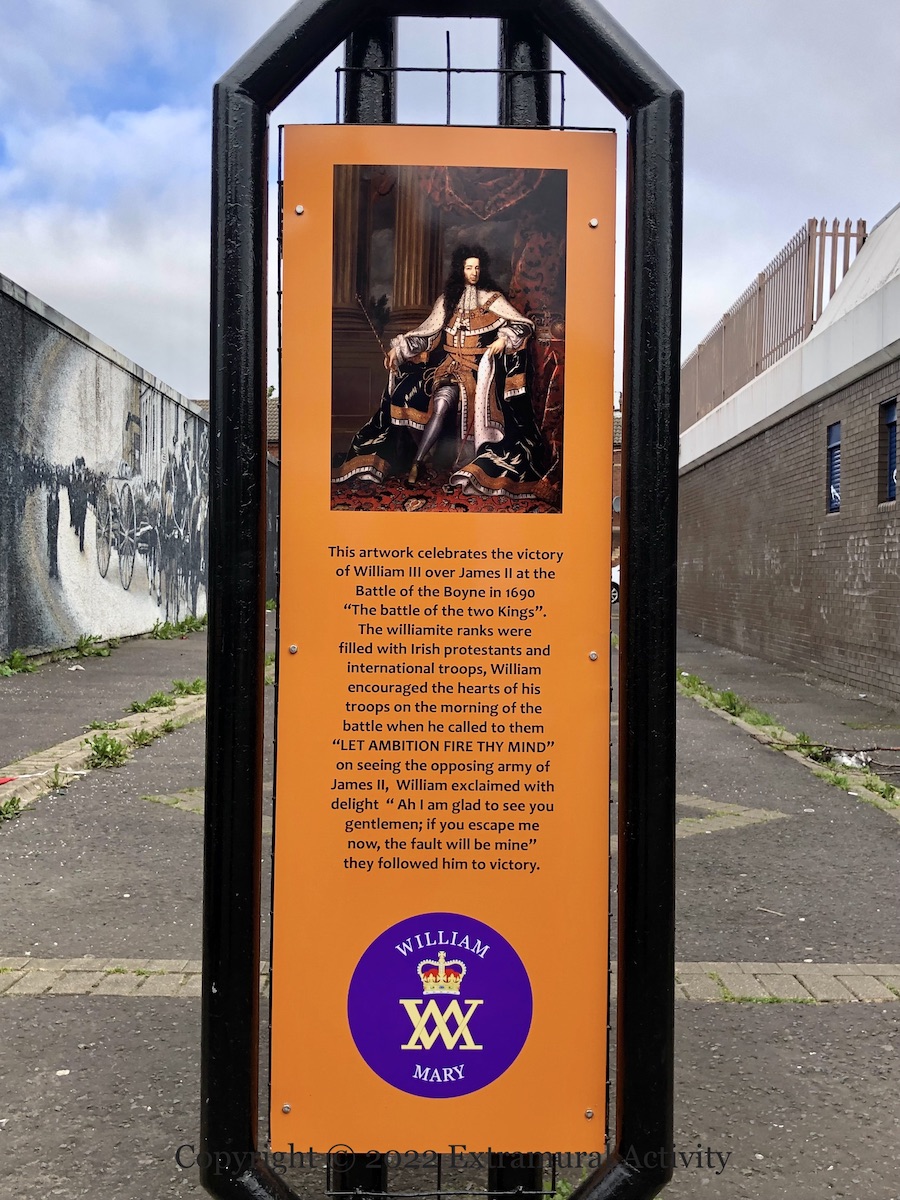
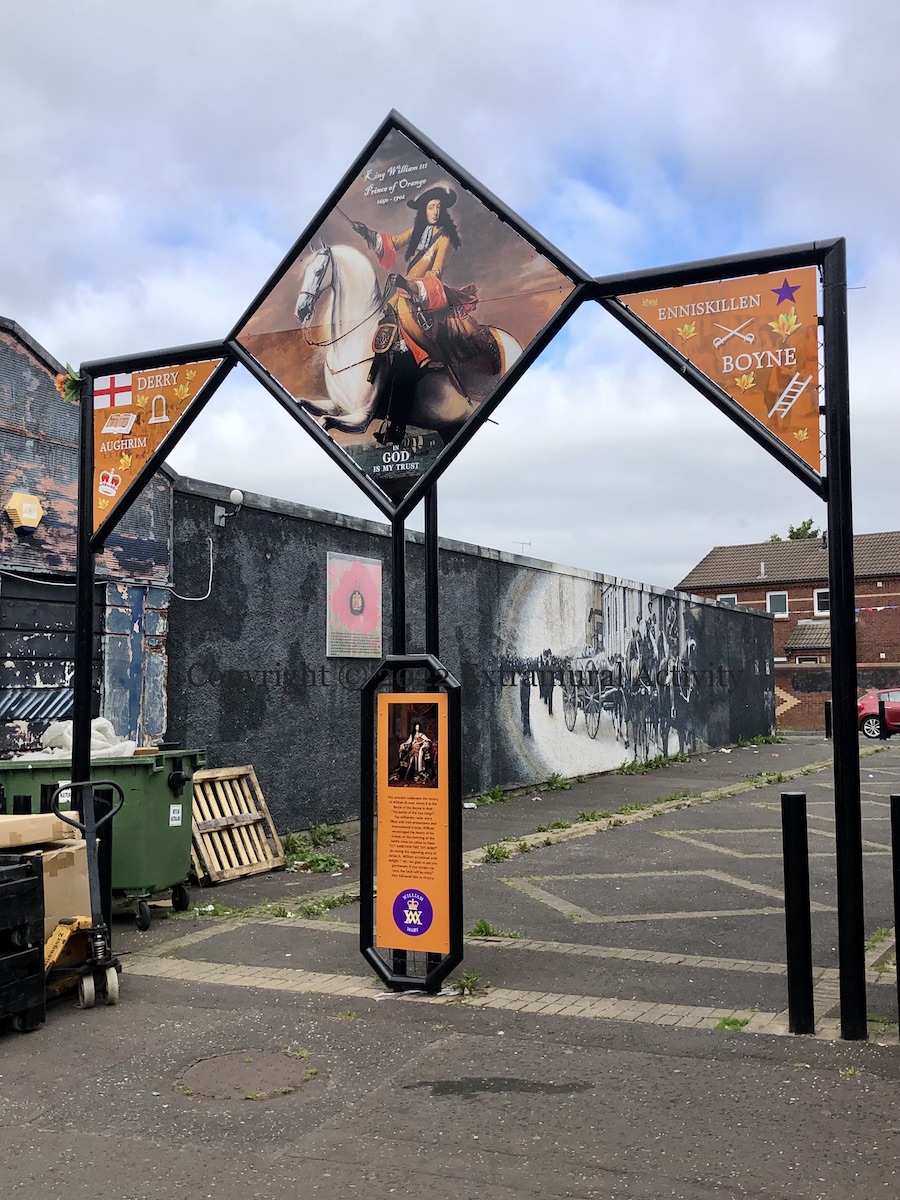
This new Shankill Road installation makes mention of “William and Mary”, Mary being co-monarch with her cousin William from 1689 to 1694, when she died of smallpox. She was raised Anglican, though her parents (including father James II, whom William defeated at the Boyne) had converted to Catholicism in the 1660s. Although the fifteen year-old Mary wept when the marriage was announced, she remained loyal to William and to “Church and State” when James was deposed (WP).
“King William III Prince of Orange 1650-1702. In God is my trust.” “This artwork celebrates the victory of William III over James II at the Battle of the Boyne in 1690 “The battle of the two Kings”. The williamite ranks were filled with Irish protestants and international troops, William encouraged the hearts of his troops on the morning of the battle when he called to them “LET AMBITION FIRE THY MIND” on seeing the opposing army of James II, William exclaimed with delight “Ah I am glad to see you gentlemen; if you escape me now, the fault will be mine” they followed him to victory.”
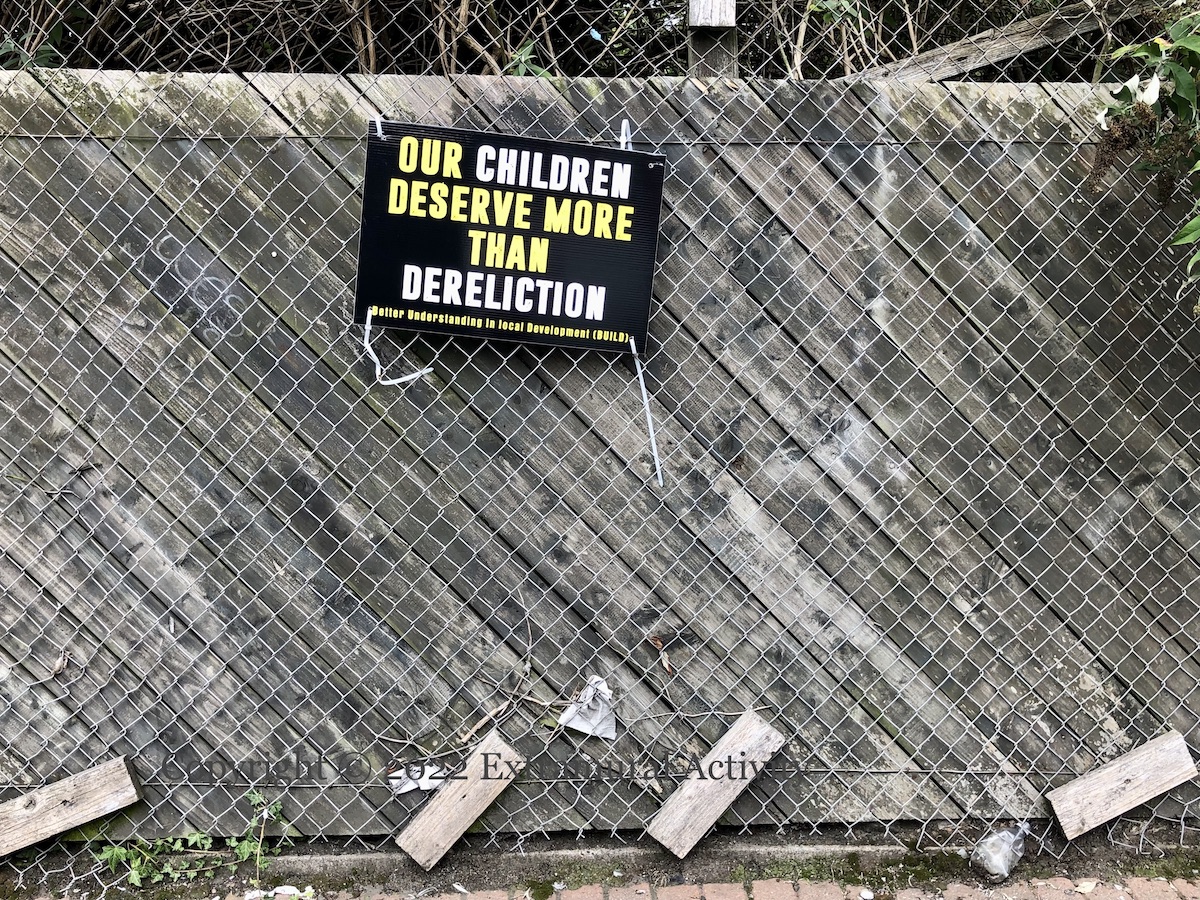
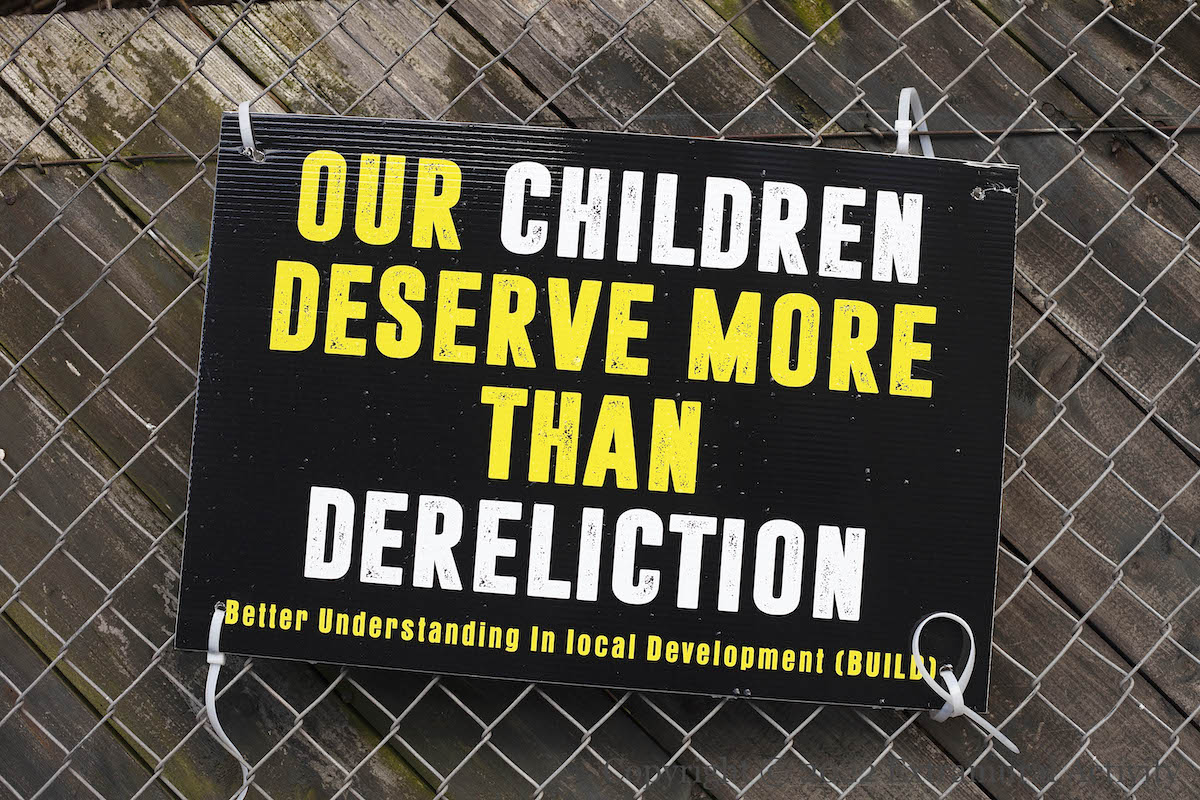
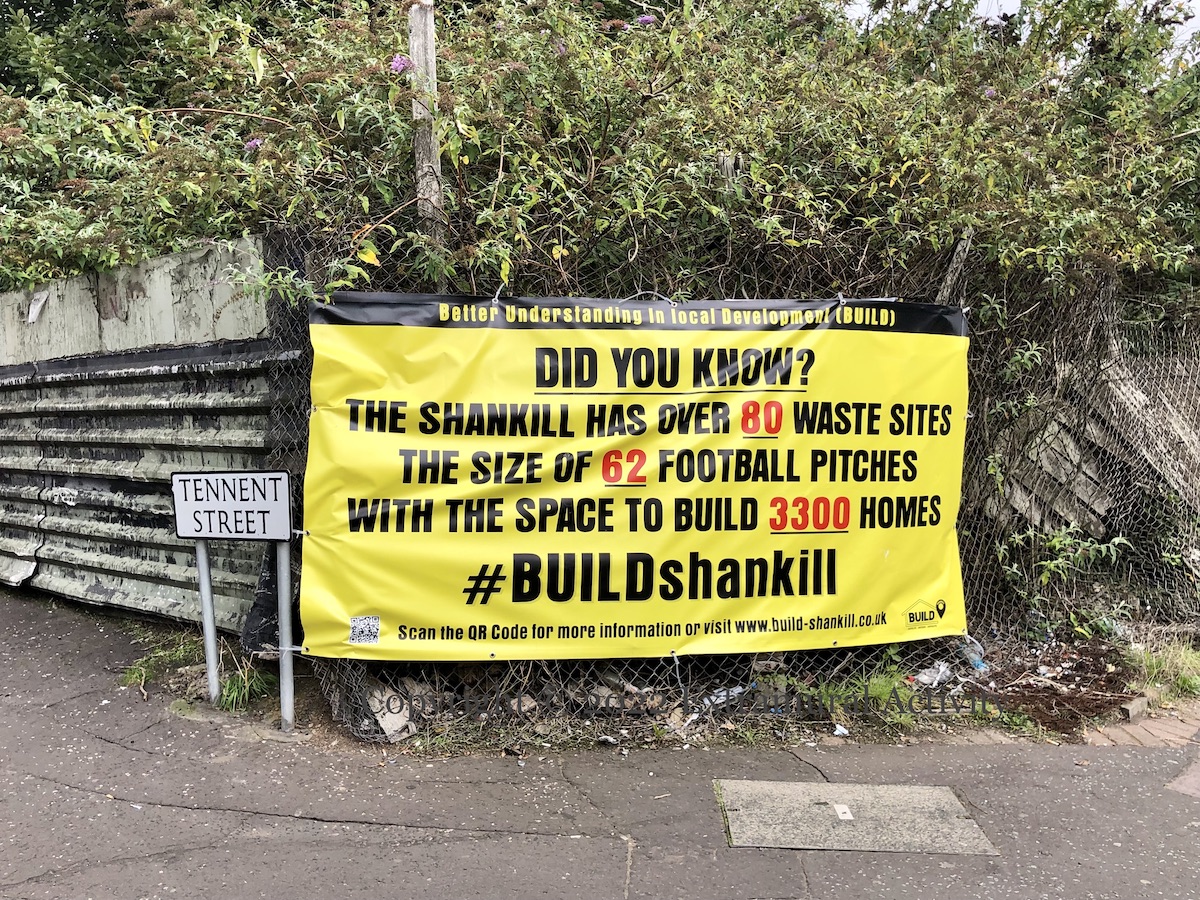
BUILD Shankill now has a website that promises to provide (in the future) “a full inventory of vacant and derelict land in the area”. In the meantime, the campaign to bring attention to housing issues in the area continues with placards and tarps:
“Our children deserve more than dereliction – Better Understanding In Local Development (BUILD)”
“Did you know? The Shankill has over 80 waste sites the size of 62 football pitches with the space to build 3300 homes. #BuildShankill.” For a mural-sized version of this tarp (in the third image) over one of the pieces of waste ground, see #BuildShankill.
 Seosamh Mac Coille Collection