I Want The Ulster Volunteers

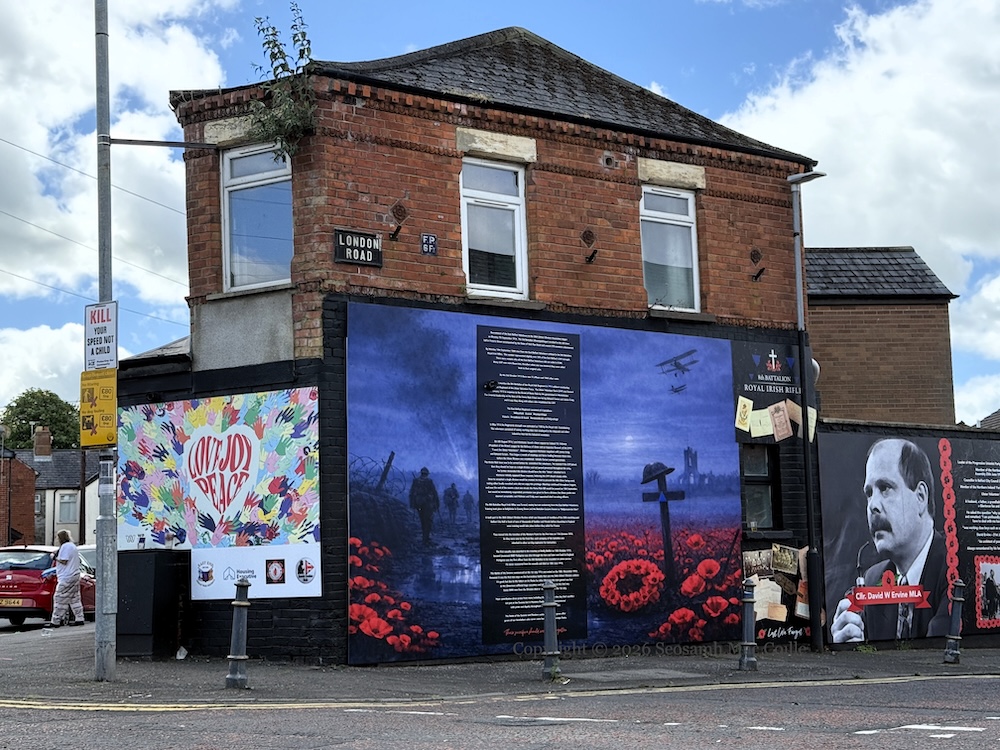
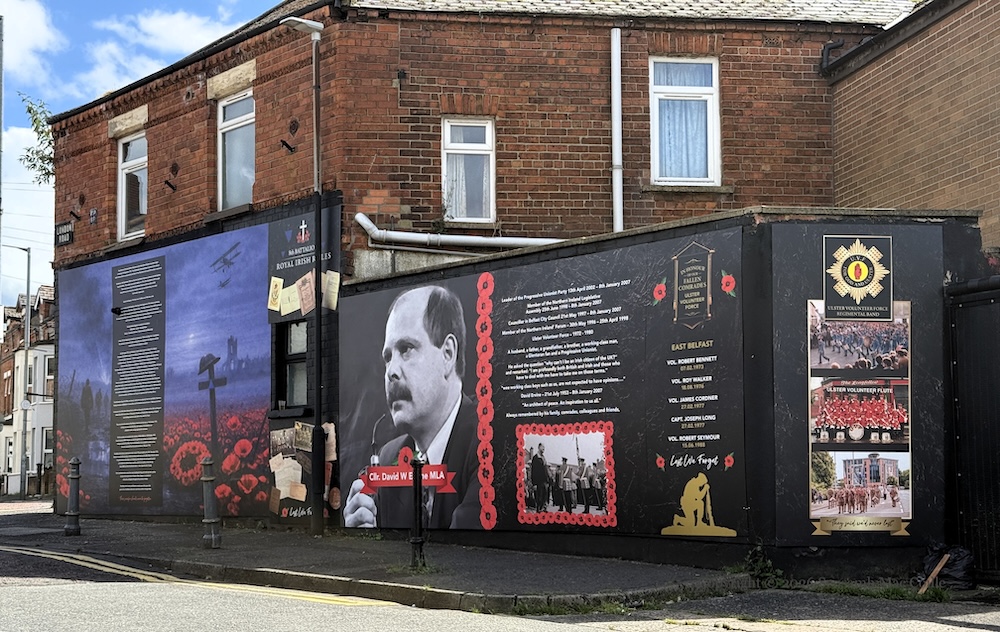
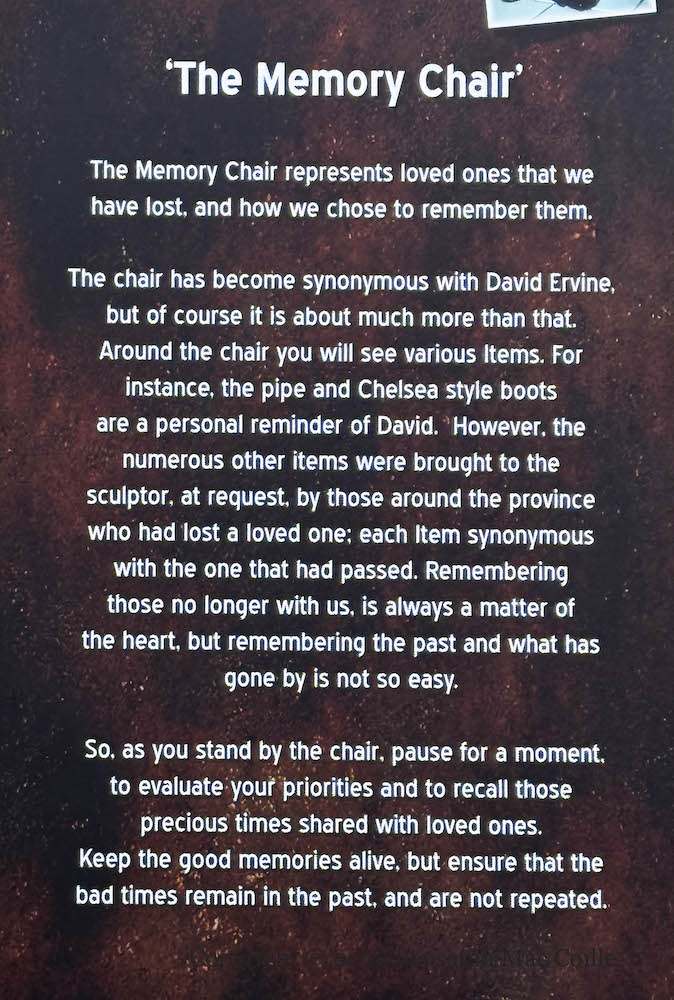
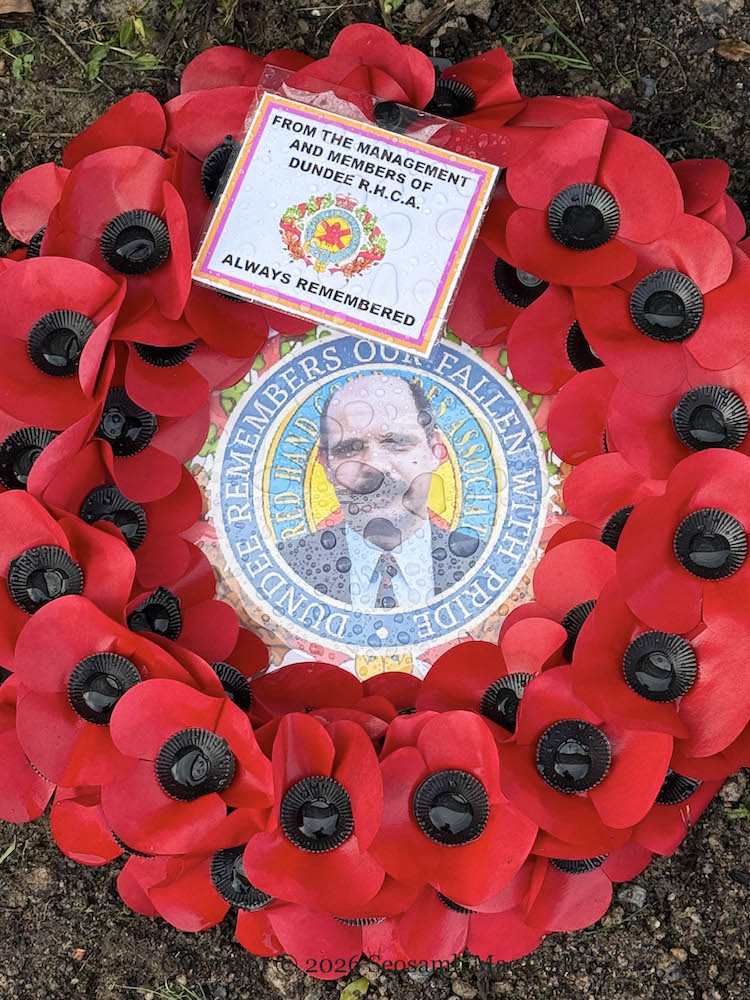
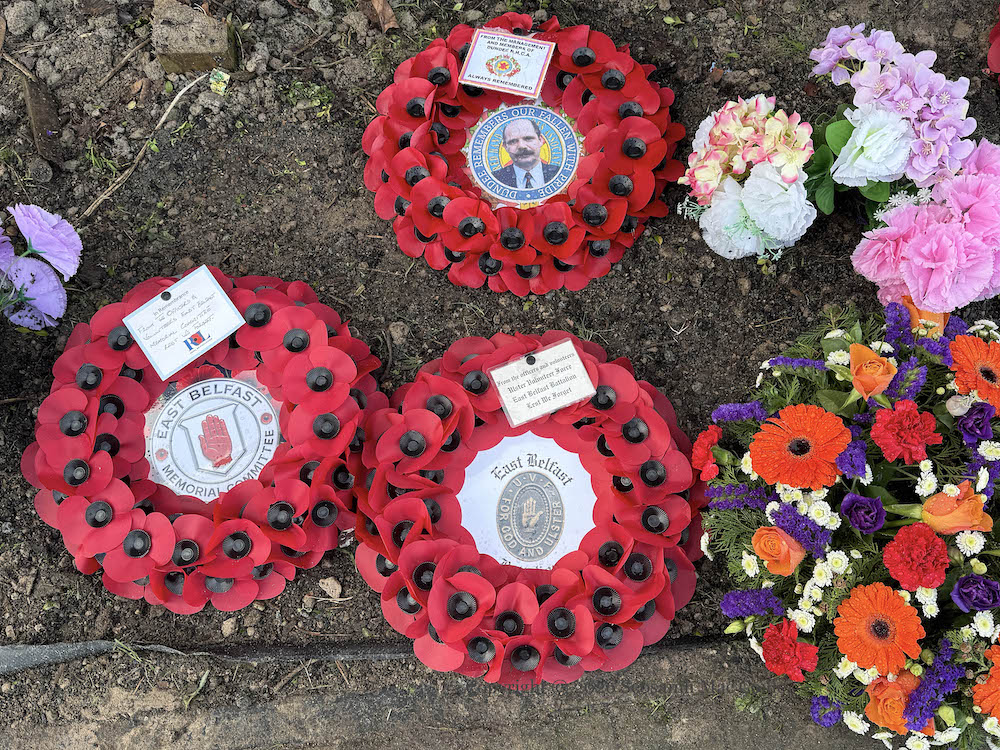
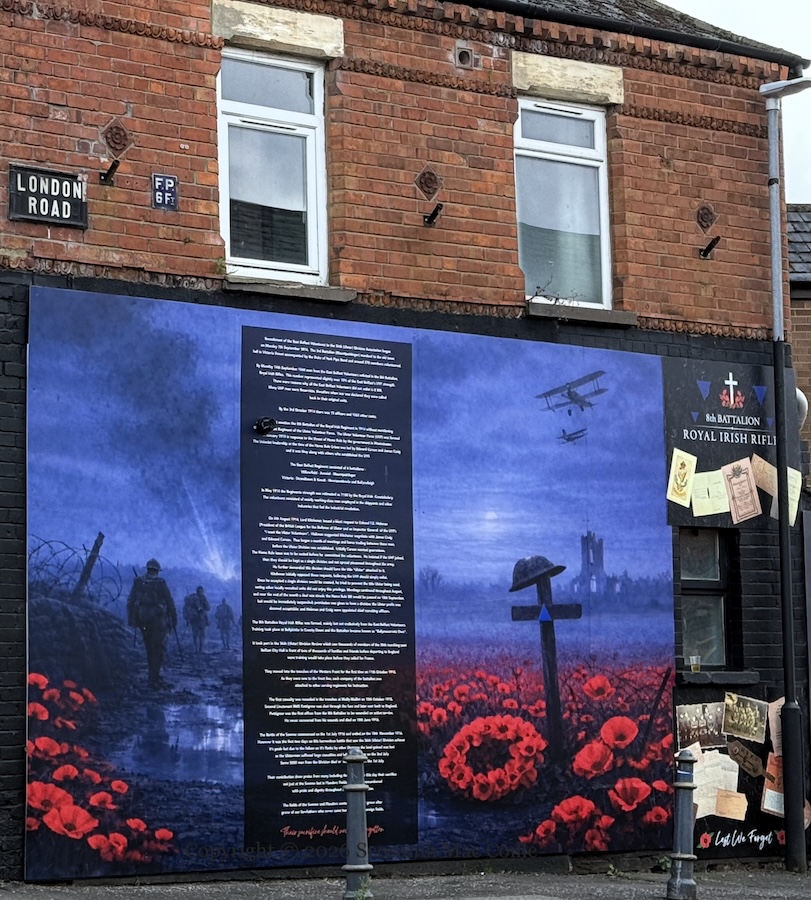
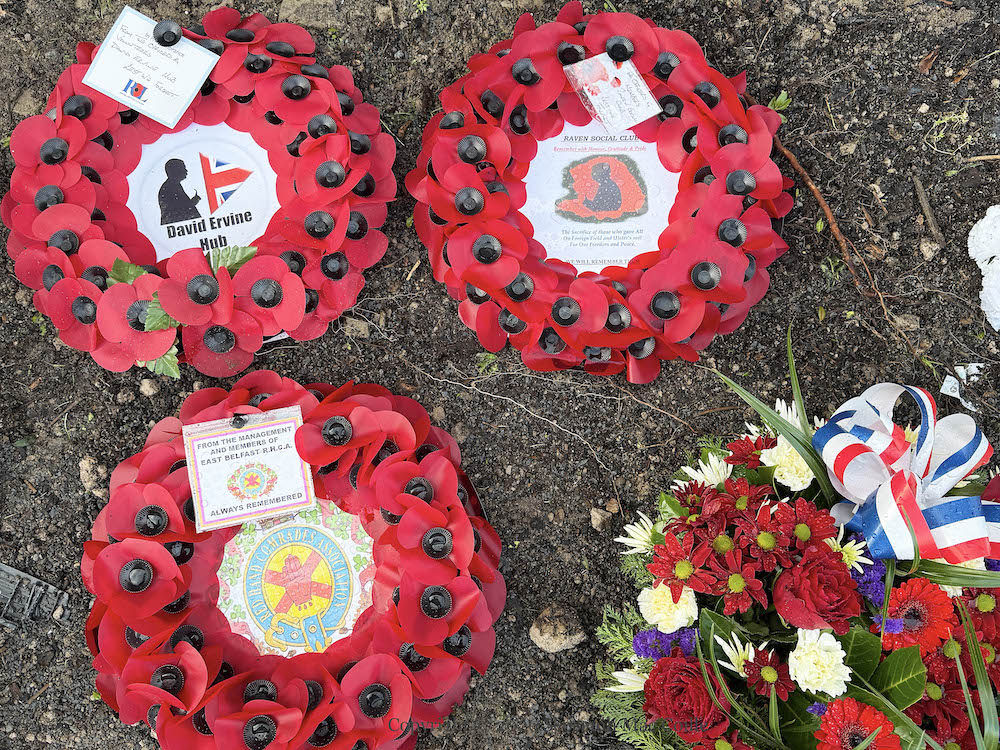
The UVF boards at the junction of London and My Lady’s roads in east Belfast have been completely replaced (compared to 2022). The hooded gunmen on the short side have been replaced by “Joy, peace, love” while a tribute to David Ervine now replaces the lettering reading “East Belfast Ulster Volunteer Force”. (For more about Ervine, and the UVF roll of honour, see the parallel entry in the Paddy Duffy Collection.)

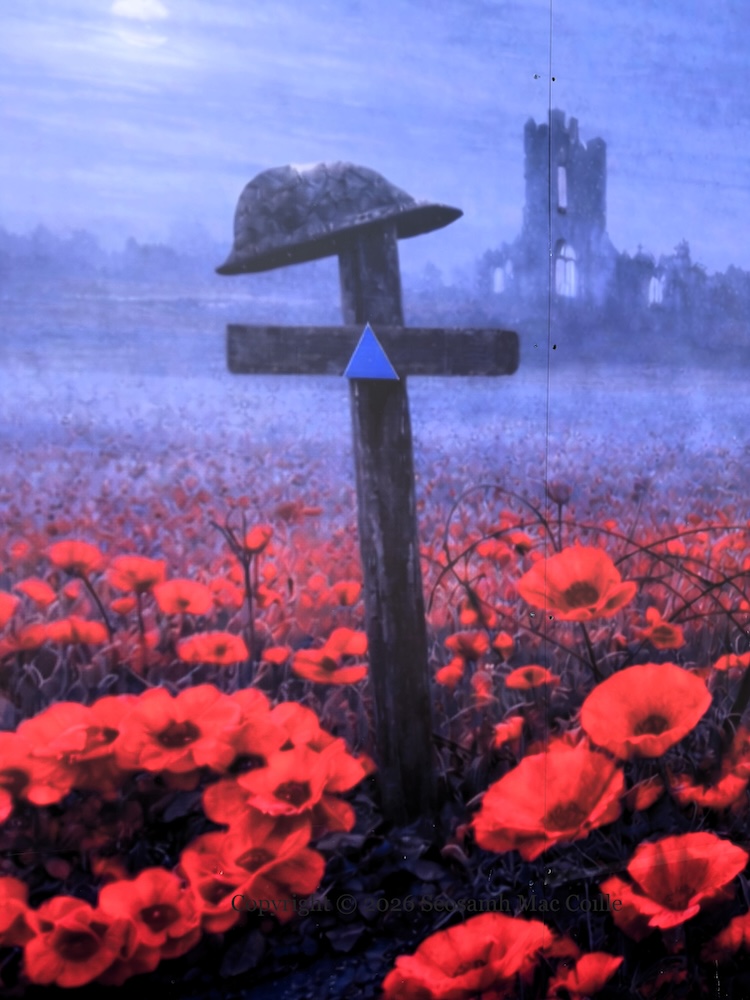
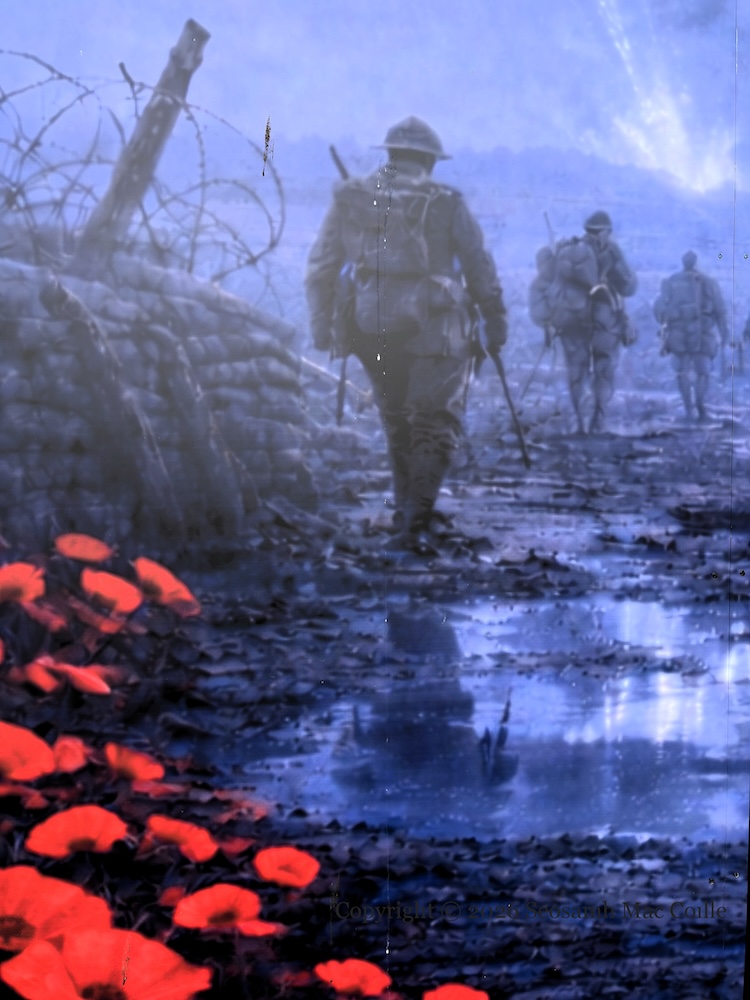
The largest panel remains a tribute to the dead of WWI, specifically now the “3rd battalion (Mountpottinger)” of the East Belfast regiment of the Ulster Volunteers who “marched to the old town hall in Victoria Street accompanied by the Duke Of York Pipe Band and around 270 members volunteered”. The long text explains the negotiation between Kitchener and Craig over the formation of the 36th Division, that the East Belfast volunteers joined the 8th Battalion of the Royal Irish Rifles, and that “training took place at Ballykinlar in County Down and the Battalion became known as “Ballymacarret’s Own”.”

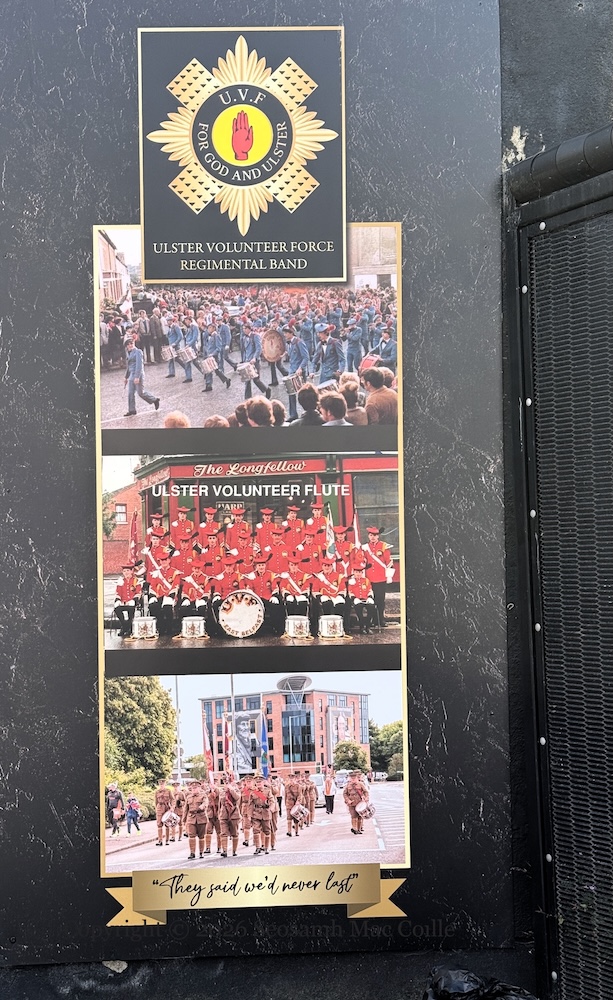
The final image shows the trio of photographs of the UVF flute band. The middle photograph has been changed since the launch, as it was of the band marching past the site of the 1992 Sean Graham bookies massacre to which family-members of the victims objected (Crime World) – again, see the parallel entry in the Paddy Duffy Collection. The photograph now in its place is of the band outside the Longfellow bar, which still stands in My Lady’s Road, facing these boards.

The full (and uncorrected) text of the central information board reads as follows:
“Recruitment of the East Belfast Volunteers to the 36th (Ulster) Division Association began on Monday 7th September 1914. The 3rd Battalion (Mountpottinger) marched to the old town hall in Victoria Street accompanied by the Duke of York Pipe Band and around 270 members volunteered. By Monday 14th September 1044 men from the East Belfast Volunteers enlisted in the 8th Battalion, Royal Irish Rifles. This number represented slightly over 10% of the East Belfast’s UVF strength. There were reasons why all the East Belfast Volunteers did not enlist in 8 RIR. Many UVF men were Reservists, therefore when war was declared they were called back to their original units. By the 3rd October there was 15 officers and 1065 other ranks. [We] cannot mention the 8th Battalion of the Royal Irish Regiment in 1914 without mentioning th[e East] Belfast Regiment of the Ulster Volunteer Force. The Ulster Volunteer Force (UVF) was formed in January 1913 in response to the threat of Home Rule by the government in Westminster. The Unionist leadership at the time of the Home Rule Crises was led by Edward Carson and James Craig and it was they along with others who established the UVF. The East Belfast Regiment consisted of 6 battalions:– Willowfield, Avoniel, Mountpottinger, Victoria, Strandtown & Knock, Newtownbreda and Ballynafeigh. In May 1914 the Regiments strength as 7100 by the Royal Irish Constabulary. The volunteers consisted of mainly working-class men employed in the shipyards and other industries that fed the industrial revolution.
On 6th August 1914, Lord Kitchener, issued a blunt request to Colonel T.E. Hickman (President of the British League for the Defence of Ulster and an Inspector General of the UVF): “I want the Ulster Volunteers”. Hickman suggested Kitchener negotiate with James Craig and Edward Carson. Thus began a month of meetings and horse trading between these men, before the Ulster Division was established. Initially Carson wanted guarantees. The Home Rule issue was to be sorted before he committed the volunteers. He insisted if the UVF joined, then they should be kept as a single division and not spread piecemeal throughout the army. He further demanded this division should have the title “Ulster” attached to it. Kitchener initially opposed these requests, believing the UVF should simply enlist. Once he accepted a single division would be created, he tried to prevent the title Ulster being used, noting other locally recruited units did not enjoy this privilege. Meetings continued throughout August, and near the end of the month a deal was struck: the Home Rule Bill would be passed on 18th September, but would be immediately suspended; permission was given to form a division; the Ulster prefix was deemed acceptable; and Hickman and Craig were appointed chief recruiting officers.
The 8th Battalion Royal Irish Rifled was formed, mainly but not exclusively from the East Belfast Volunteers. Training took place at Ballykinlar in County Down and the Battalion became know as “Ballymacarrets Own”. It took part in the 36th (Ulster) Division Review which saw thousands of members of the 36th marching past Belfast City Hall in front of tens of thousands of families and friends before departing to England were training would take place before they sailed for France. They moved into the trenches of the Western Front for the first time on 11 October 1915. As they were new to the fron line, each company of the battalion was attached to other serving regiments for instruction. The first casualty was recorded in the trenches at Mailly-Maillet on 15th October 1915. Second Lieutenant RME Pettigrew was shot through the face later sent back to England. Pettigrew was the first officer from the 8th Battalion to be wounded on active service. He never recovered from his wounds and died on 10th June 1916. The Battle of the Somme commenced on the 1st July 1916 and ended on the 18th November 1916. However it was the first two days on the horrendous battle that saw the 36th (Ulster) Division achieve it’s goals but due to the failure on it’s flanks by other Divisions the land gained was lost as the Ulstermen suffered huge casualties and left the frontline on the 2nd July. Some 5000 men from the Division died or where injured on the 1st July. Their contribution drew priase from many including the King and to this day their sacrifice not just at the Somme but in Flanders Fields, Belgium is remembered with pride and dignity throughout the province of Ulster. The fields of the Somme and Flanders contain grave after grave after grave of our forefathers who never came home and lie in foreign fields. Their sacrifice should never be forgotten.”

London Road and My Lady’s Road, east Belfast
Click image to enlarge
Copyright © 2026 Seosamh Mac Coılle
X16212c
X16210 X16211
X16213 X16214
X16215 [X16216]
Times Bar Bombing

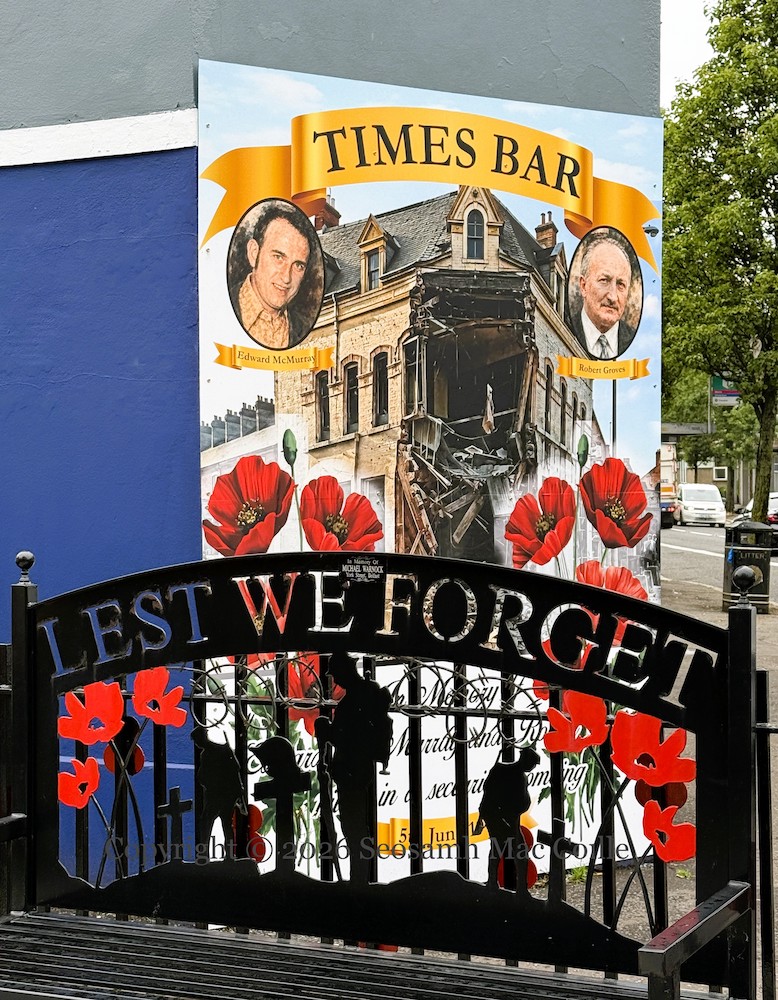
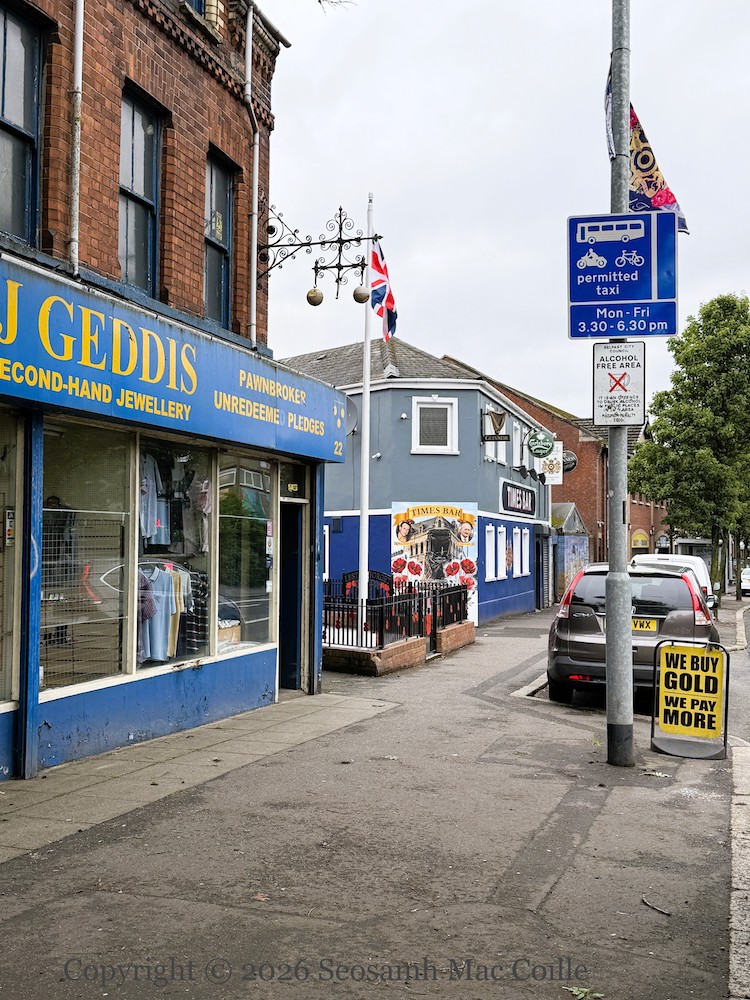
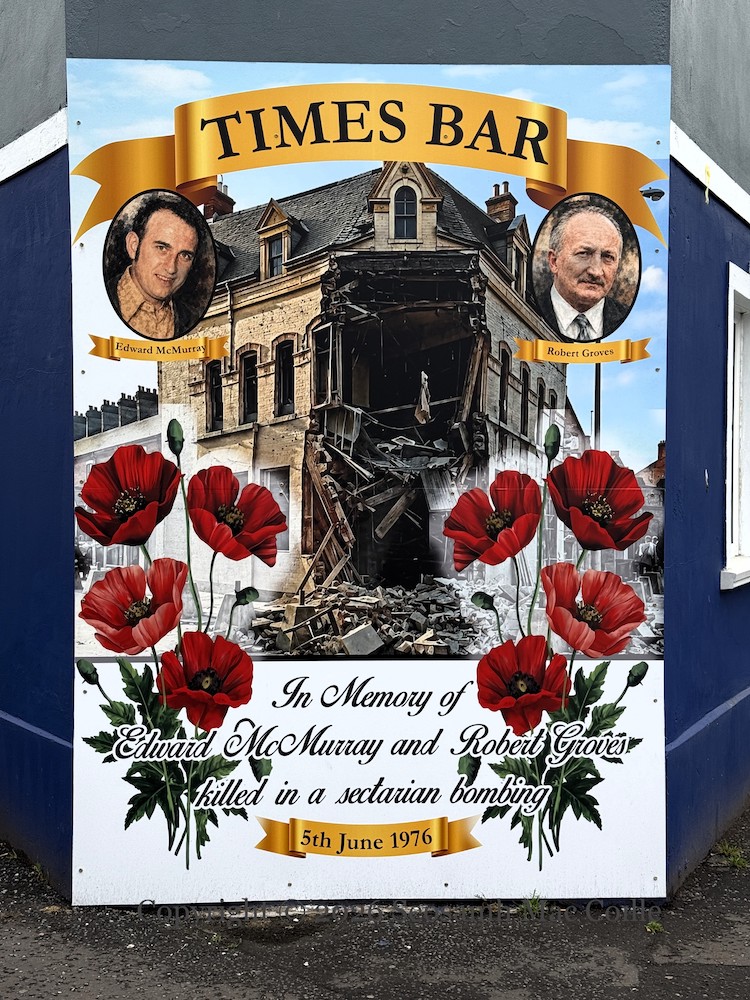
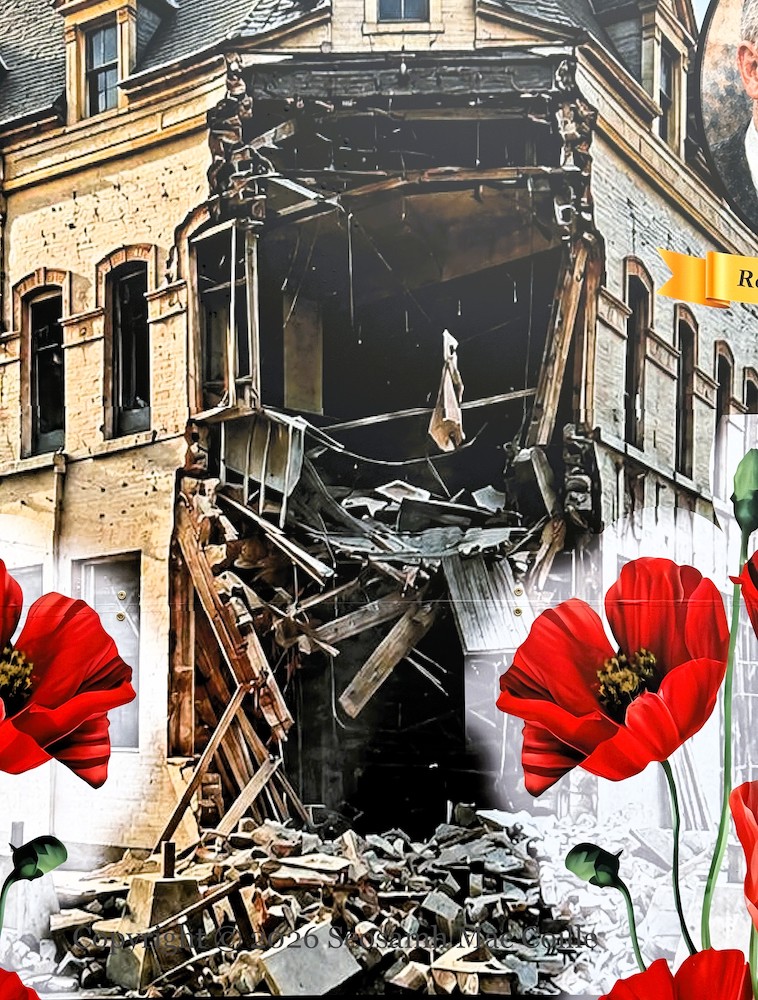
A memorial service was held at the Times Bar on Friday June 5th (News Letter) to mark the fiftieth anniversary of the attack on the Times Bar in 1976, in which Edward McMurray and Robert Groves were killed by a republican bomb. (An image of the bombed bar can be found on Xitter.)

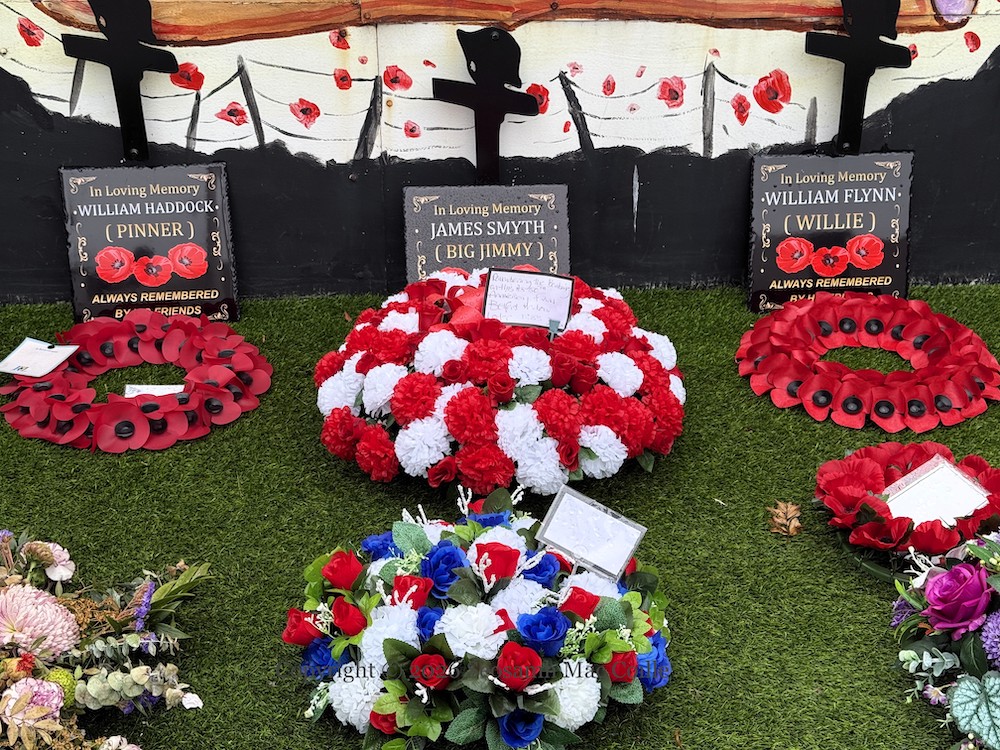
Three plaques were added to the memorial garden where the service took place, to William Haddock, James Smyth, and William Flynn. (Compare to 2019.)

As the images from May 10th in the Paddy Duffy Collection show, a painted mural was originally planned for the spot.

Click image to enlarge
Copyright © 2026 Seosamh Mac Coılle
X15987 X15988 X15989 X15990 X15991 X15992

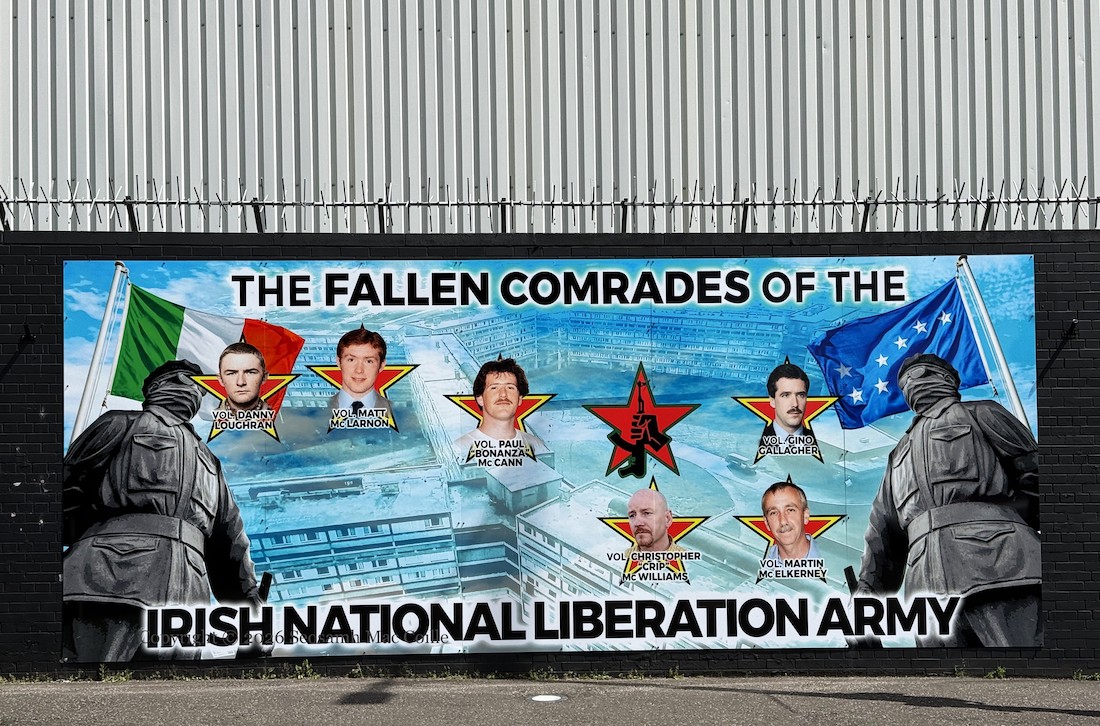
The Fallen Comrades Of The INLA

Christopher “Crip” McWilliams has been added this new version of the INLA memorial on Northumberland Street (Visual History). McWilliams was a long-time member of the IPLO and was present at the Lenadoon shout-out with the RUC in Lenadoon in which Bonanza McCann died. He joined the INLA while in prison for the 1991 killing of a snooker-hall manager (Independent) and in 1987 was the gunman in a team of three that killed the LVF’s Billy Wright in the H-Blocks (IRSN | Cory Report (pdf) | MacLean Report (pdf)).

The info board in the final image was originally mounted in 2014 to accompany the version painted on a board which featured Loughran, McLarnon, McCann, and Gallagher, and updated in 2019 for the printed version which added McElkerney.

For images and video from the launch on May 17th, see El Norte De Irlanda.

Click image to enlarge
Copyright © 2026 Seosamh Mac Coılle
X15975

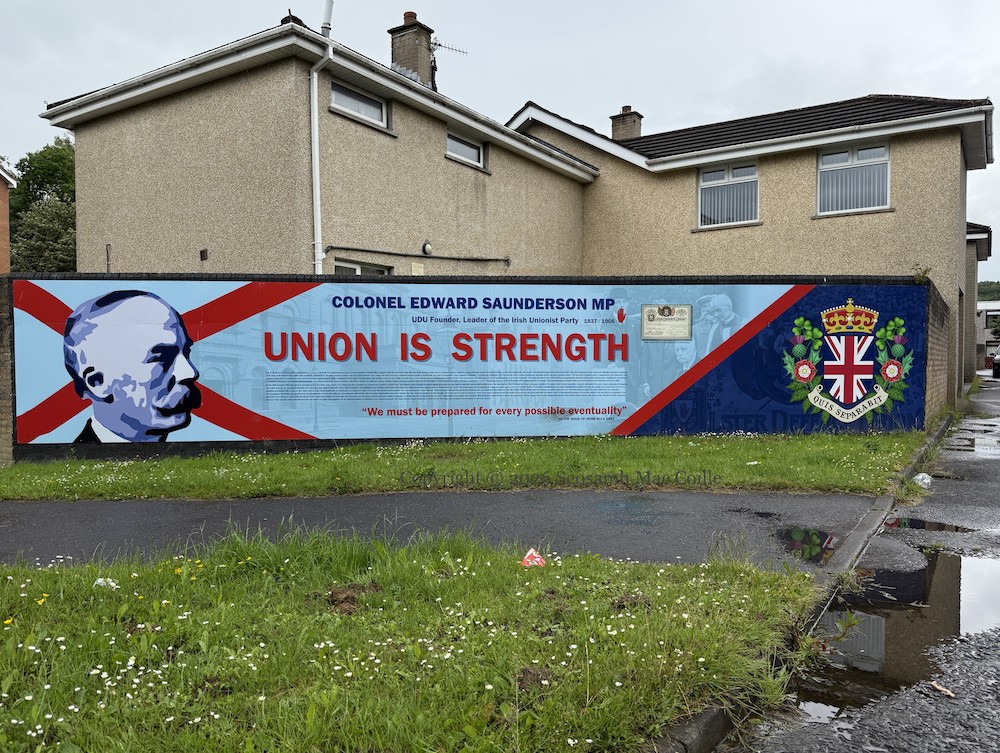
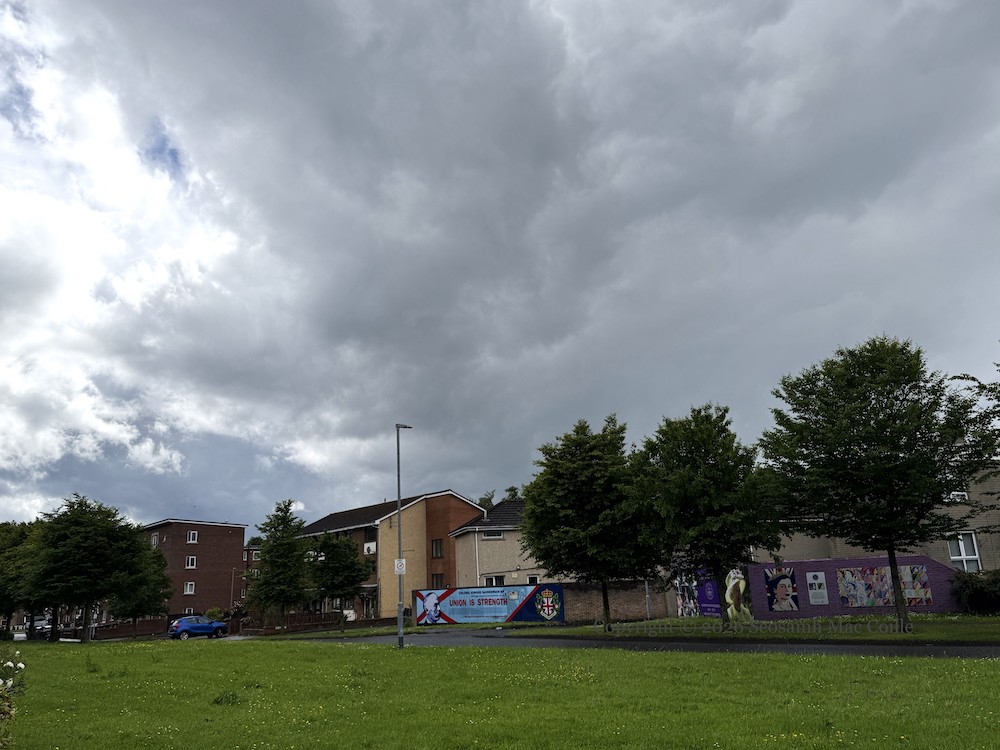
Union Is Strength

“Colonel Edward Saunderson MP, UDU founder, leader of the Irish Unionist Party. 1837-1906. Union is strength. ‘We must be prepared for every possible eventuality’ – on the issue of Home Rule 1893.”

The dates given are the span of Saunderson’s life, not his political career, which began in 1865 as MP for his home county of Cavan.

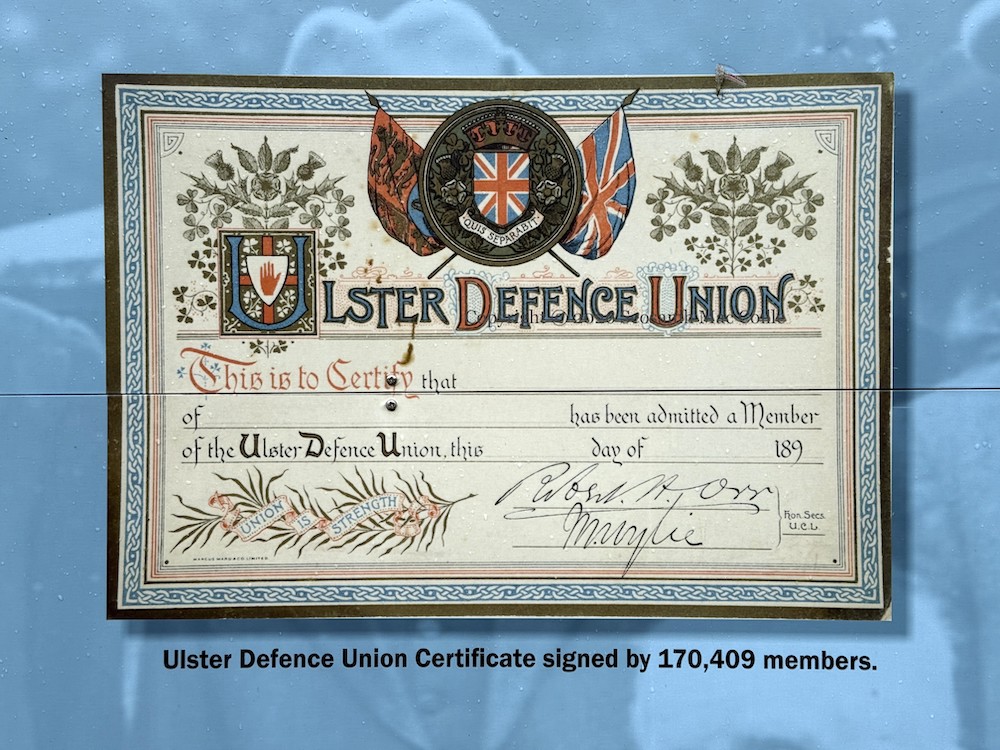
The bill under consideration in 1893 was the second Home Rule bill, which the UDU was formed to resist. The UDU initially met in Belfast in March; the manifesto of the meeting can be read on page 5 of the [Sydney] Freeman’s for 1893-04-29.
On June 8th, 1893, the Westminster government asked the police for a report on the Union, fearing its goal was armed resistance to Home Rule, and considering declaring it an illegal organisation ([Sydney] Daily Telegraph, 1893-06-10 page 5).

In September, the bill was passed in the Commons but defeated in the Lords. An account of the October meeting quotes Saunderson saying that the organisation should maintain itself by “if the necessity arose” “proving – not by words, but by deeds – that they meant what they said.” (Gympie Times & Mary River Mining Gazette, 1893-12-07 page 3).

Saunderson at the time was (also) leader of the Irish Unionist Alliance (here called the “Irish Unionist Party”) and he went on to be the first leader of the Ulster Unionist Party, from 1905 to 1906 (WP), when he died of pneumonia (WP).

The Ulster Defence Union is employed as an origin-story by the Troubles-era UDA as the UDU formed an ‘Ulster Defence Association’ – see UDU-UFF-UDA and UDU-WDA-UDA-UFF – and the name is used by the post-Agreement UDA – see Daffodil Days.

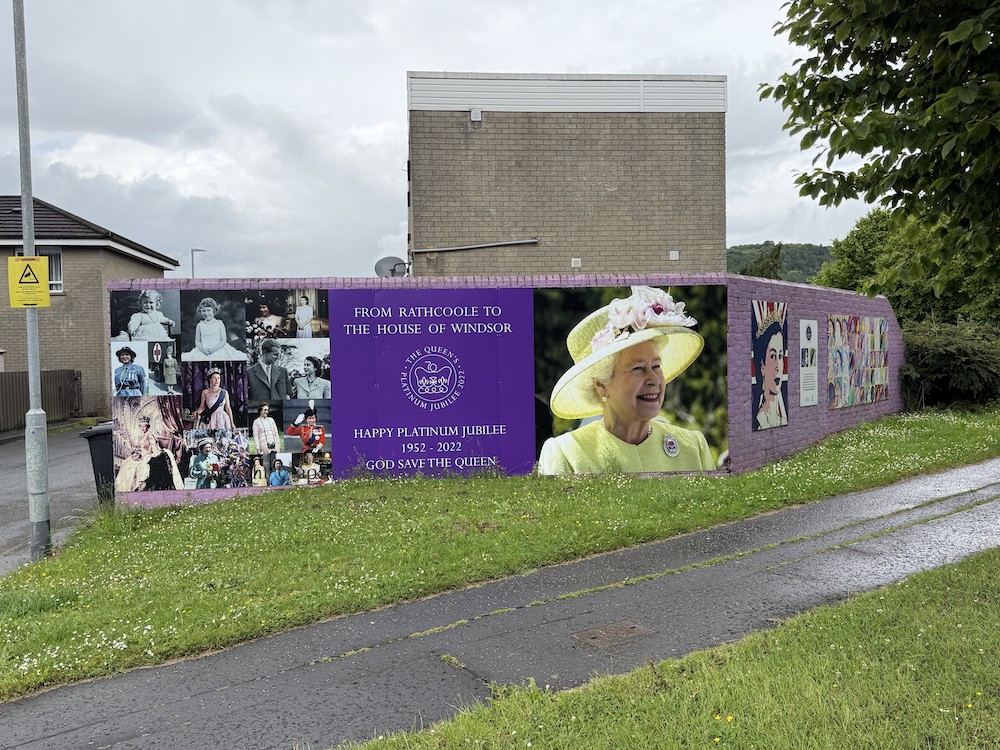
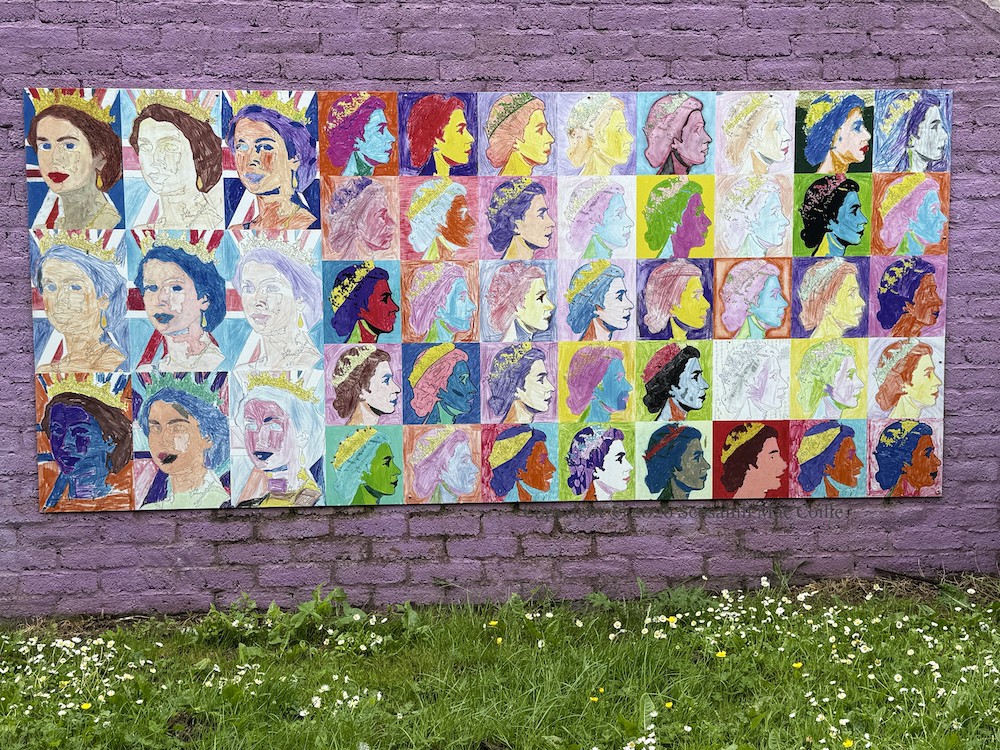
Next to Saunderson are boards mounted to celebrate the seventieth (platinum) jubilee of Queen Elizabeth in June 2022. Similar paintings were produced by schoolchildren in west Belfast – see The People’s Monarch.

“This artwork was designed and created by pupils from Abbots Cross Primary School in partnership with the local children from Rathcoole Community Hub to commemorate the platinum jubilee of Her Majesty Queen Elizabeth II.”

“From Rathcoole to the house of Windsor – happy platinum jubilee 1952-2022. God save the Queen.”

Owenreagh Drive, Newtownabbey

Click image to enlarge
Copyright © 2026 Seosamh Mac Coılle
X15957 X15958 X15959
X15956 X15955
X15961

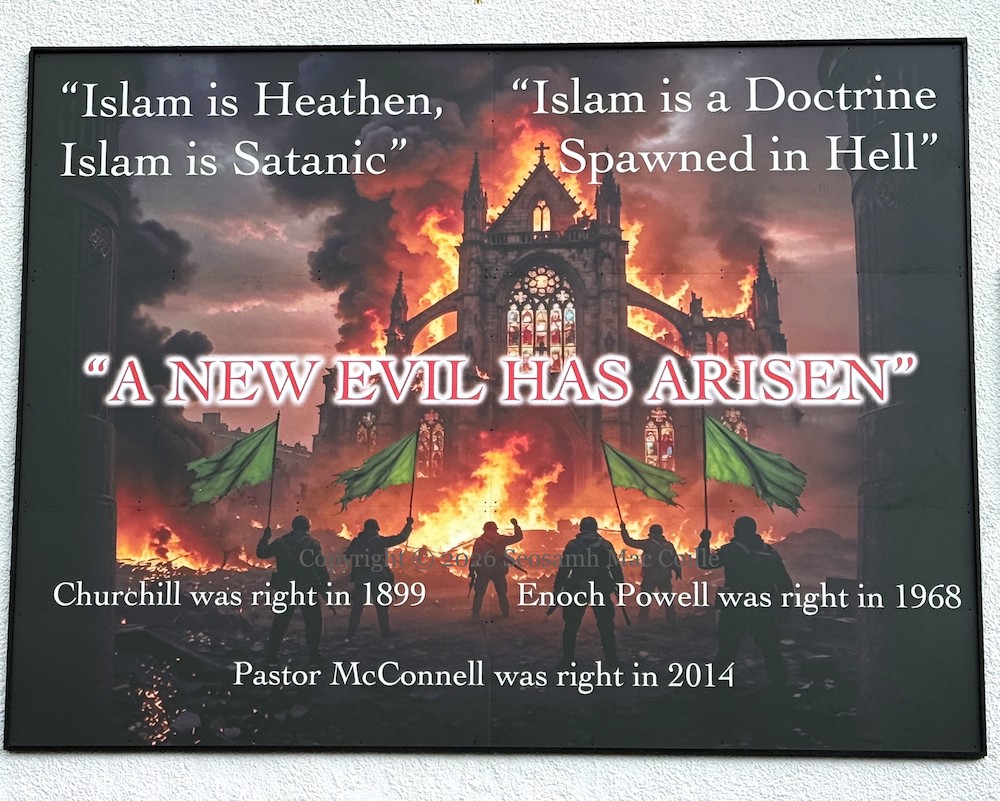
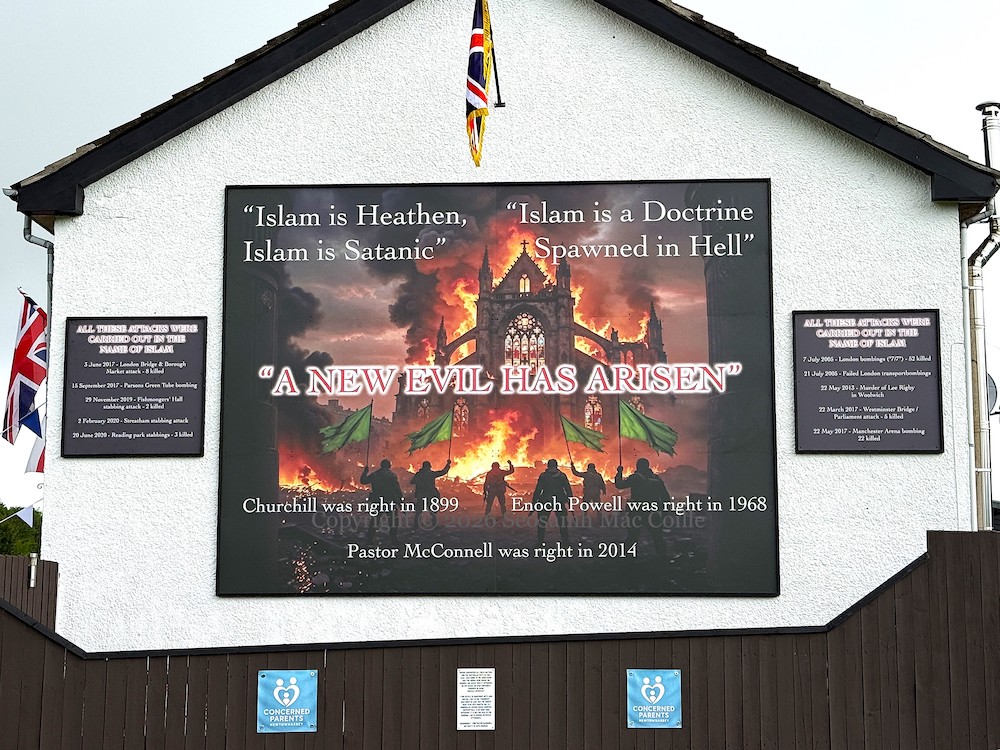
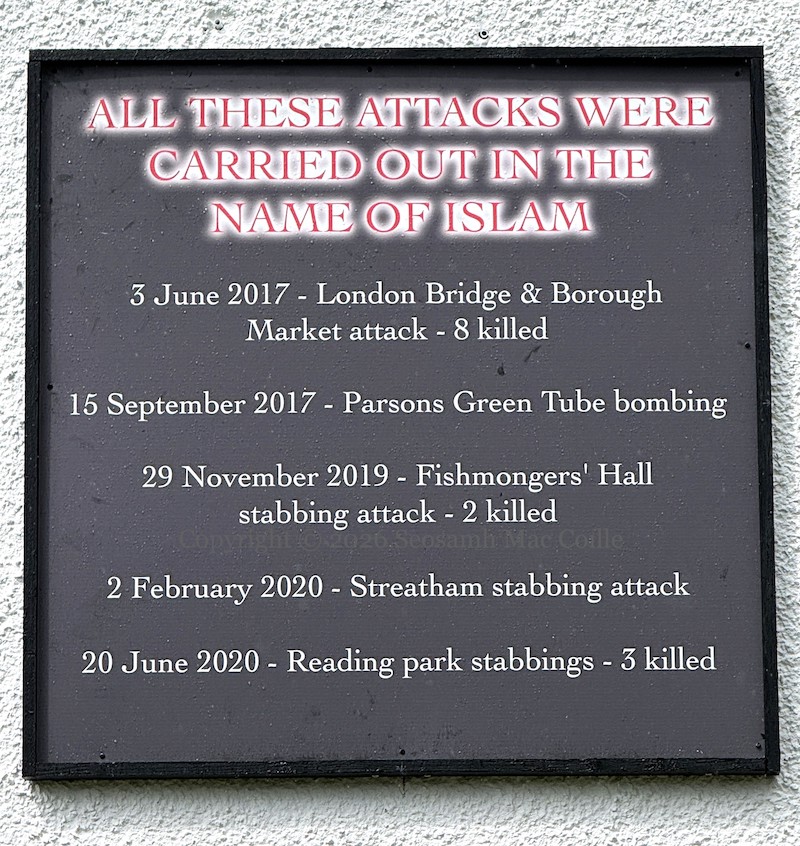
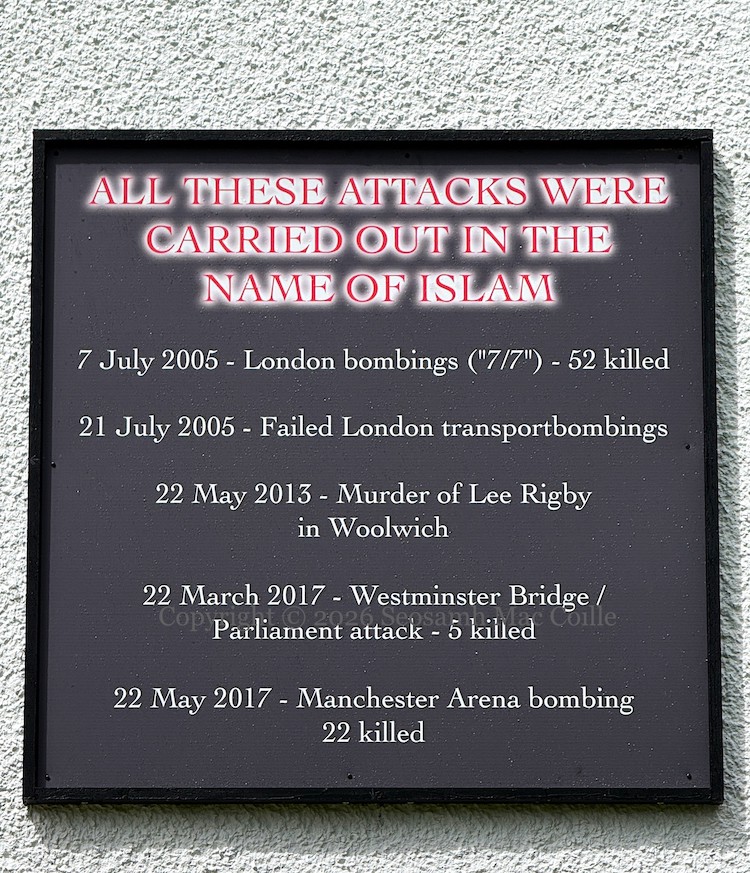
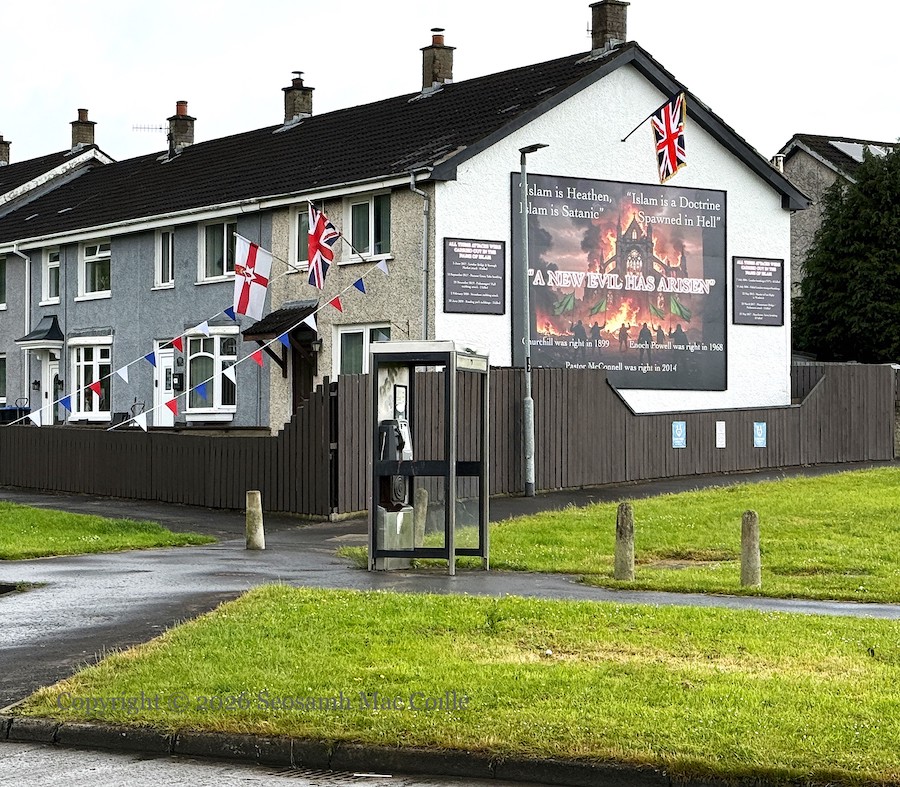
A New Evil

“”Islam is heathen, Islam is satanic”, “Islam is a doctrine spawned in hell”, “A new evil has arisen”. Churchill was right in 1899, Enoch Powell was right in 1968, Pastor McConnell was right in 2014.”

The quotations above the AI-generated image come from a sermon by Pastor James McConnell in May, 2014, at the Whitewell Metropolitan Tabernacle on the Shore Road. The sermon was alleged to be “grossly offensive” and McConnell was charged. The key portion of the sermon read, “Today we see powerful evidence that more and more Moslems are putting the Koran’s hatred of Christians and Jews alike into practice. Now, people say there are good Moslems in Britain; that may be so but I don’t trust them, Enoch Powell was right and he lost his career because of it; Enoch Powell was a prophet and he told us that blood would flow in the streets and it has happened. … Islam’s ideas about God about humanity, about salvation, are vastly different from the teaching of the Holy Scriptures. Islam is heathen, Islam is satanic, Islam is a doctrine spawned in hell.”

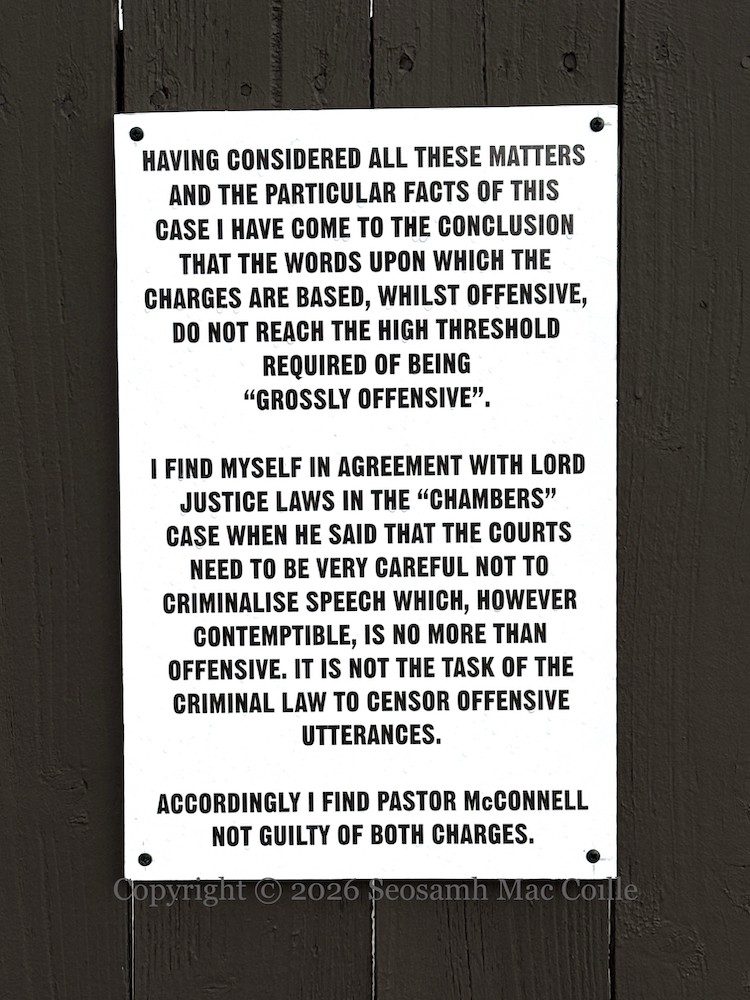
In the penultimate paragraph of the ruling (pdf), Judge McNally concluded, “Having considered all these matters and the particular facts of this case I have come to the conclusion that the words upon which the charges are based, whilst offensive, do not reach the high threshold required of being “grossly offensive”. I find myself in agreement with Lord Justice Laws in the “Chambers” case when he said that the courts need to be very careful not to criminalise speech which, however contemptible, is no more than offensive. It is not the task of the criminal law to censor offensive utterances. Accordingly I find Pastor McConnell not guilty of both charges.” (In the ultimate paragraph, the judge cited the poet Rumi: “Silence is the language of God; all else is poor translation”.) A small board on the fence below presents this judgment.

The reference to “Churchill in 1899” is probably to volume 2 of The River War, in which Churchill wrote, “Individual Moslems may show splendid qualities. Thousands become the brave and loyal soldiers of the Queen – all know how to die – but the influence of the religion paralyses the social development of those who follow it. No stronger retrograde force exists in the world.

The reference to “Powell in 1968” is to Powell’s infamous “Rivers of blood” speech (pdf) against immigration to the UK from the Commonwealth. As McConnell notes, Powell was dismissed from Ted Heath’s shadow cabinet the following day.

The PSNI is investigating the display as a “hate incident” rather than a “hate crime”, as there is no underlying crime if the home-owner agrees to the board being mounted. The relevant statute deems it a crime “to use, or to display in writing, words that are threatening, abusive or insulting, where the intention or likely effect is to stir up hatred or arouse fear”. (Slugger) 

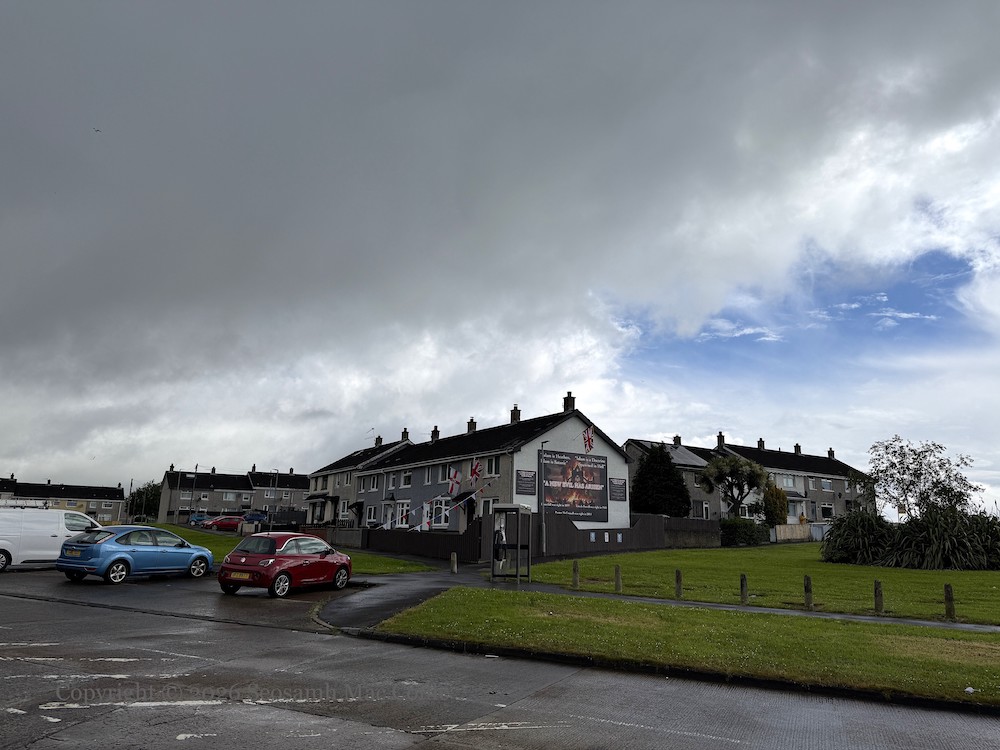
The piece is at the highly-visible junction of O’Neill Road and Knocknenagh Avenue, Rathfern, Newtownabbey, and part of the fence has been cut away in order to afford a better view.

Click image to enlarge
Copyright © 2026 Seosamh Mac Coılle
X15948 X15947 X15949 X15950 X15951 X15952 X15953

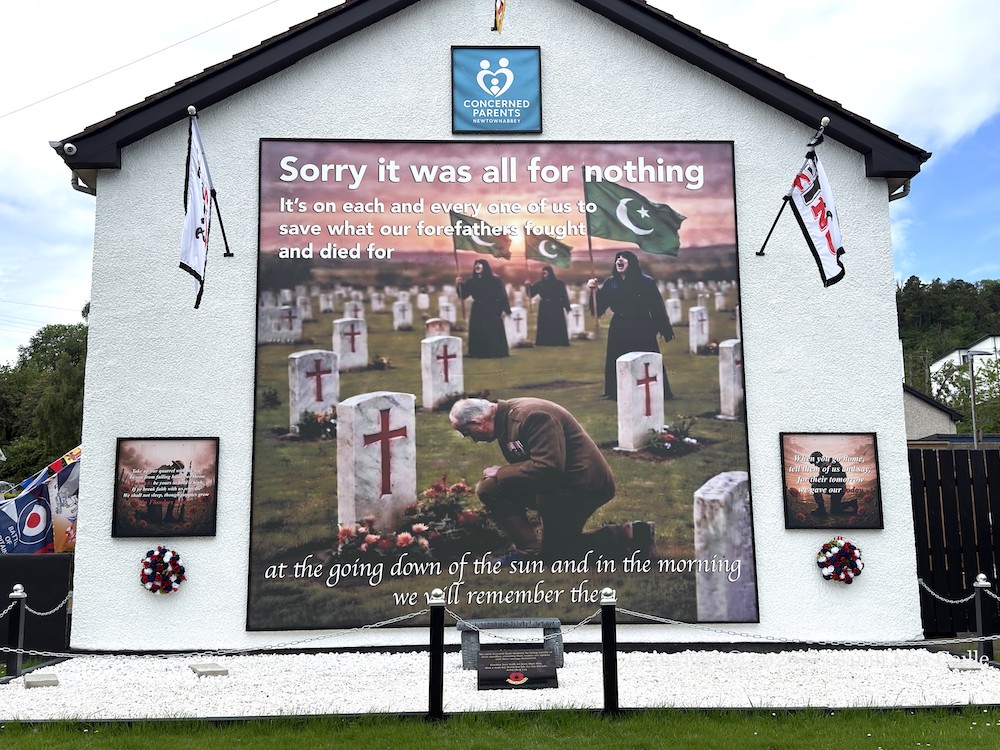
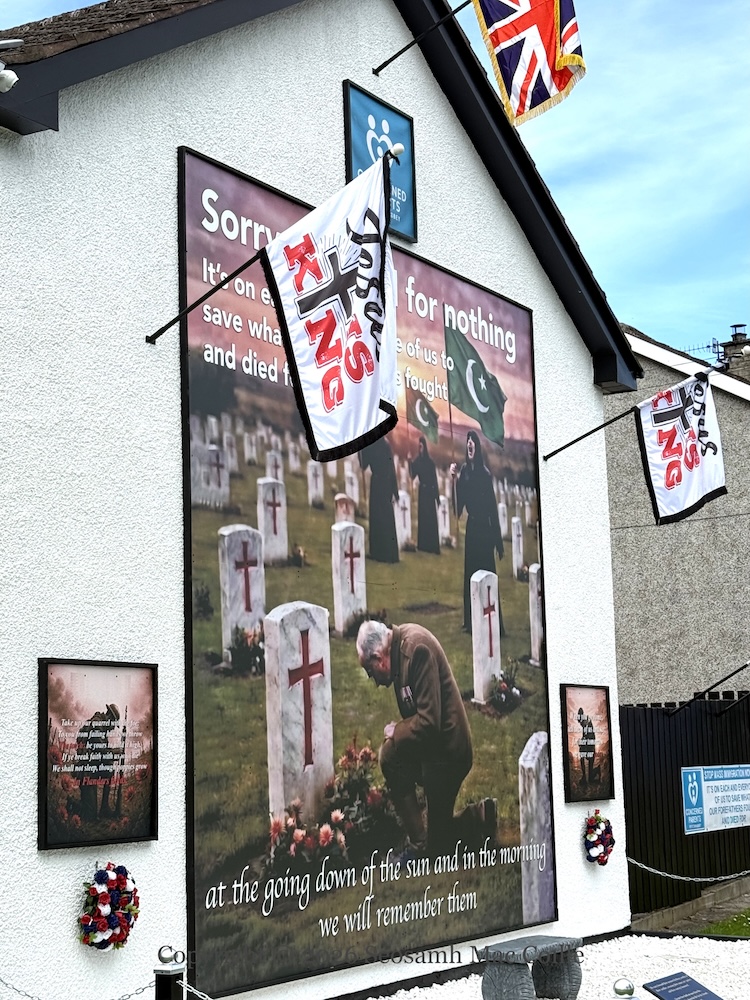
Sorry It Was All For Nothing

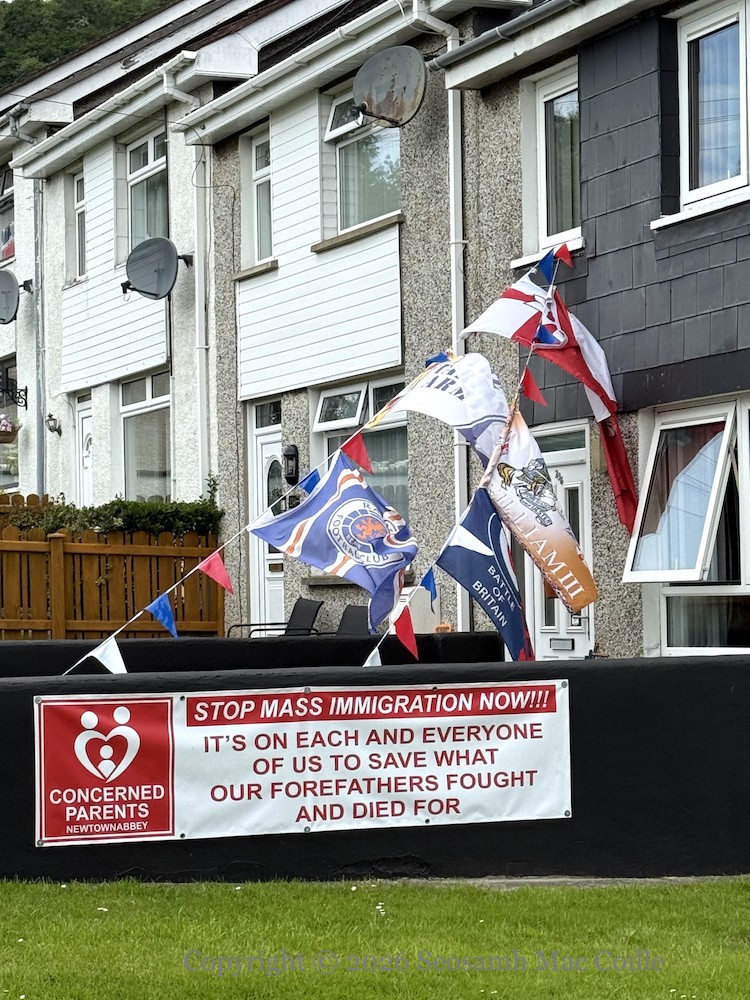
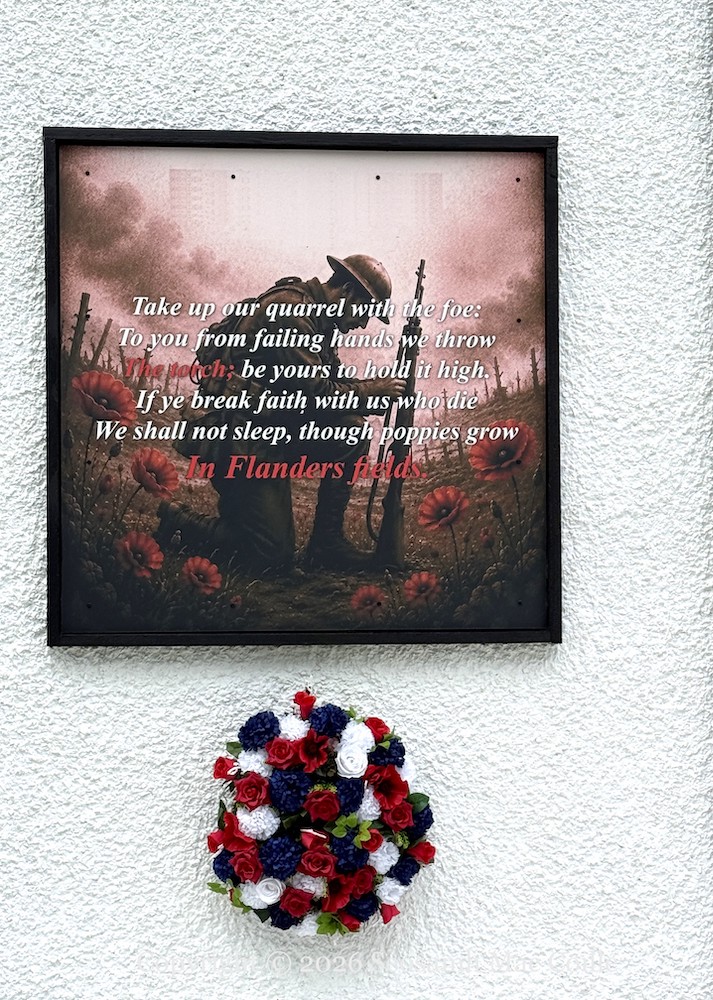
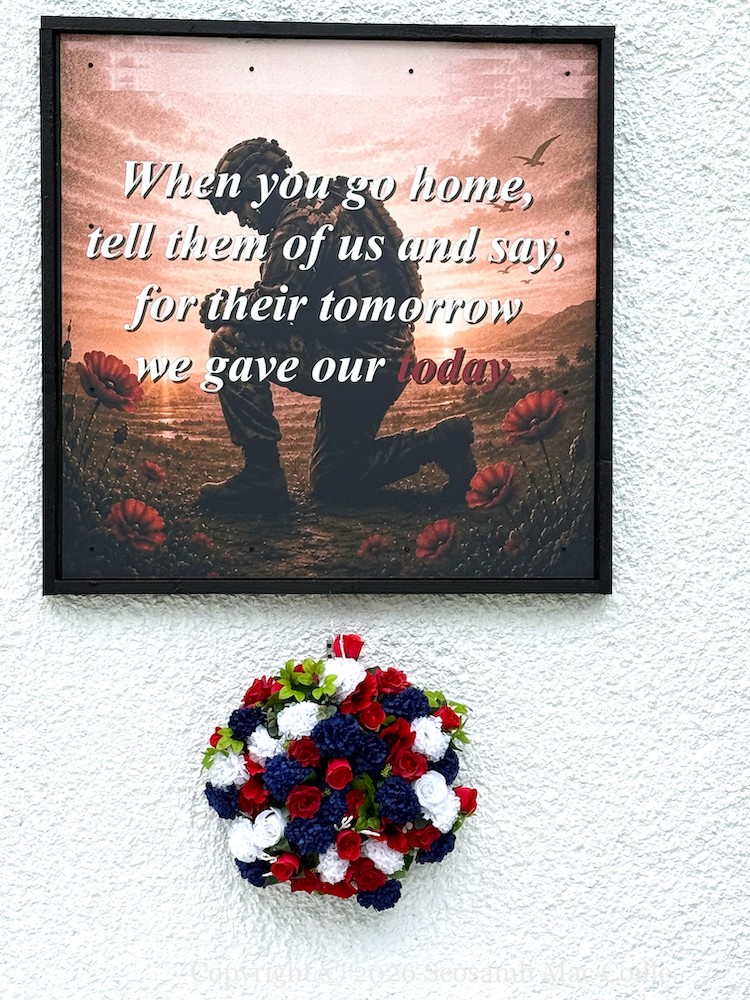
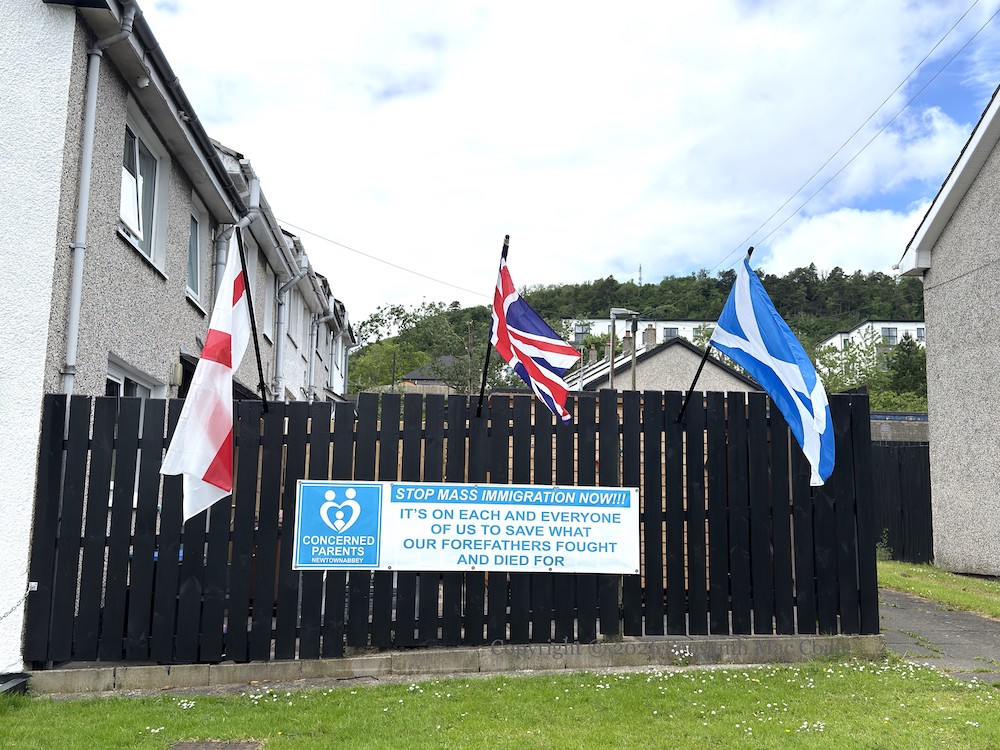
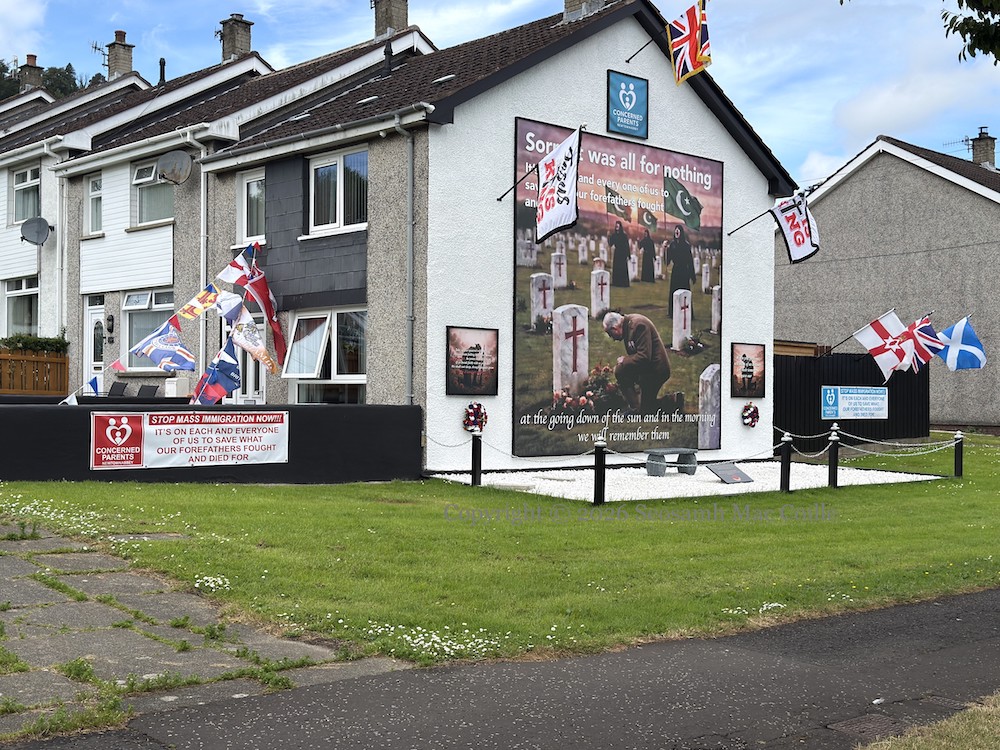
“Sorry it was all for nothing – It’s on each and every one of us to save what our forefathers fought and died for.”

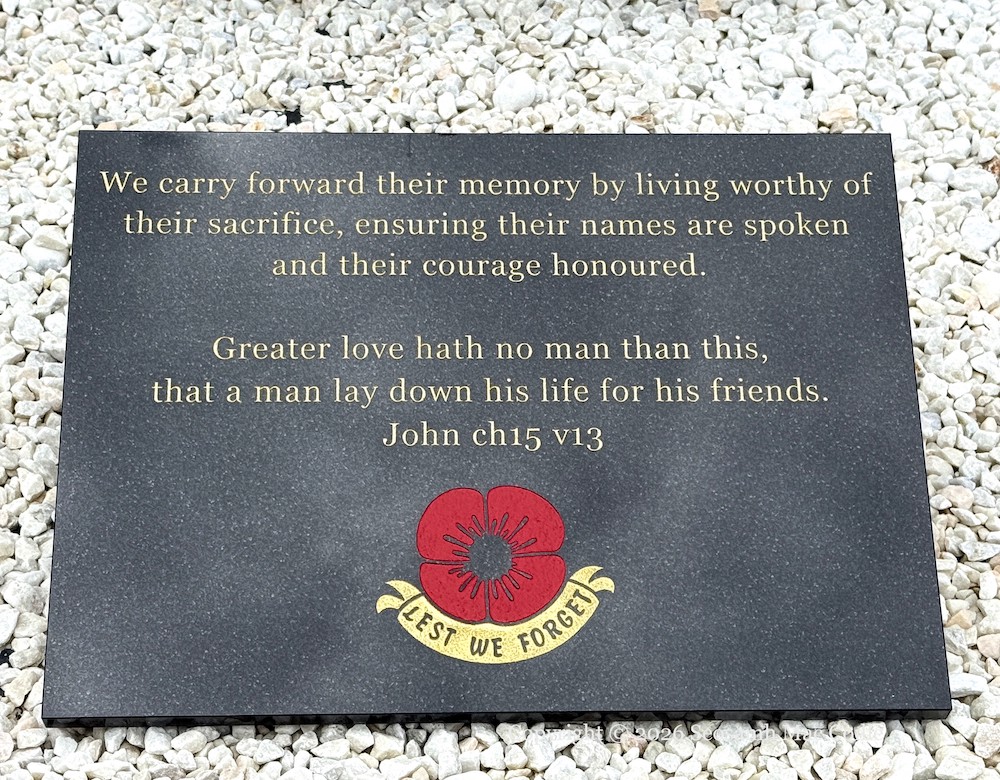
According to this Facebook post, the perceived threat being warned against here is “Communistic Islamification”. The “Islamification” is represented by a partial flag of Pakistan (an Islamic republic) being carried by yelling Caucasian figures in long black robes, advancing through a graveyard, in which an elderly man – perhaps King Charles – kneels in front of a headstone bearing a red Christian cross. That the cemetery is a military one is indicated by the medals on the mourner’s chest and the line from Binyon’s ‘For The Fallen’, which provides a referent for the apology and the word “forefathers”.

How the “communistic” threat is conveyed is less clear.

For the “Jesus is king” flags, see What Would Jesus Do?

Two men were cautioned by the police for displaying offensive material (Sunday Life). The Cloughfern Young Conquerors declined to play at the launch and family fun-day (Sunday Life), but the event went ahead (on May 8th) (youtube).

Doagh Road, Cloughfern, Newtownabbey

Update: the board was paint-bombed; Concerned Parents accused “3 coloured immigrants in a silver Fiat 500 hatchback with tinted windows” of attacking the “war memorial” (Fb) but Lasaır Dhearg claimed responsibility (ig). The board was repaired.

Click image to enlarge
Copyright © 2026 Seosamh Mac Coılle
X15916 X15915 X15917 X15921 [X15922] X15918 X15919 X15920
X15914 [X15913]
X16099

Remembering Is Not So Easy

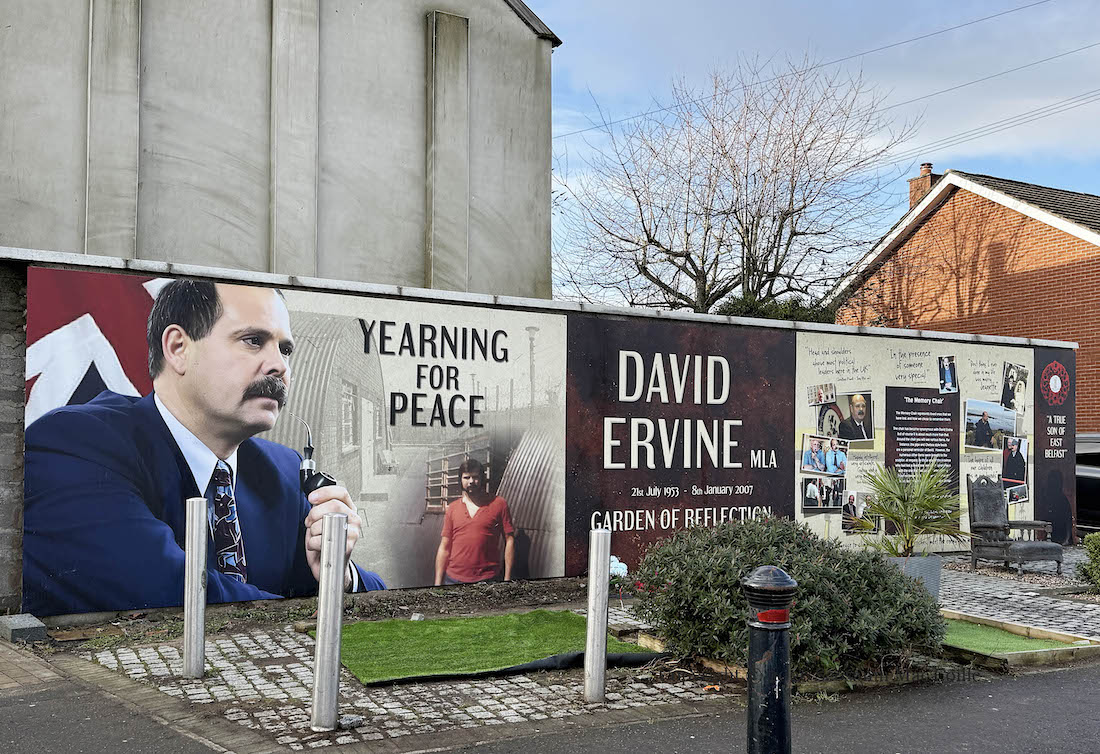
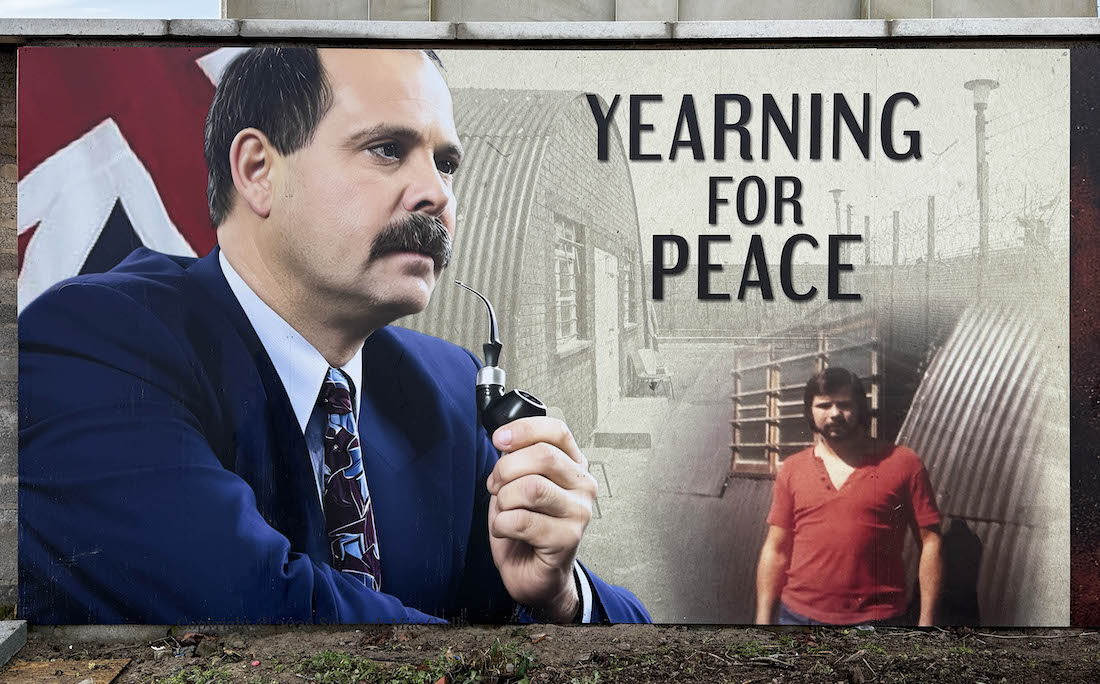
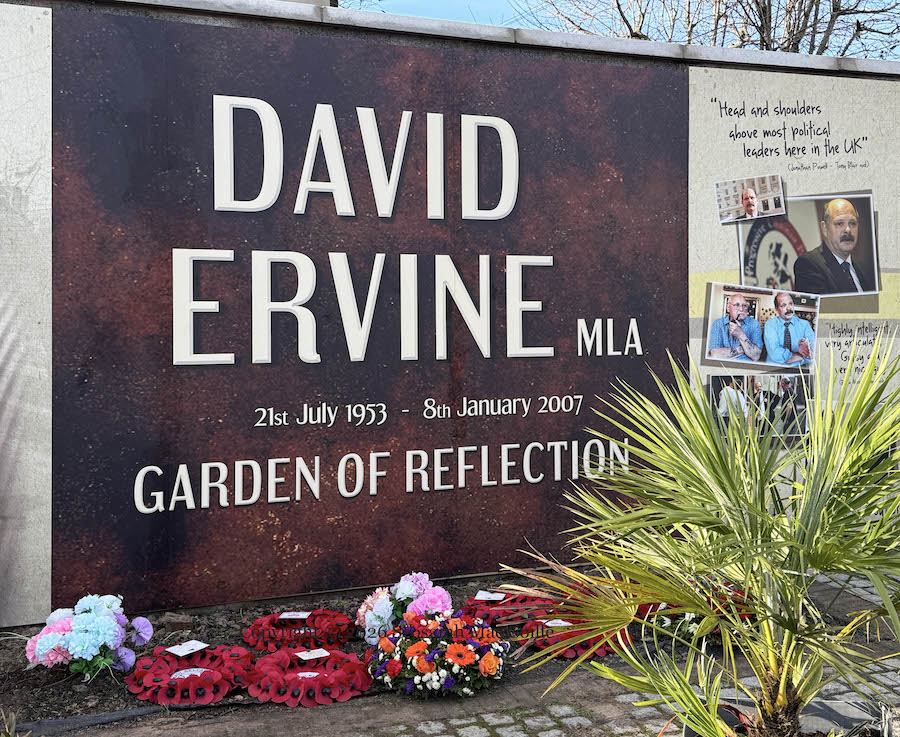
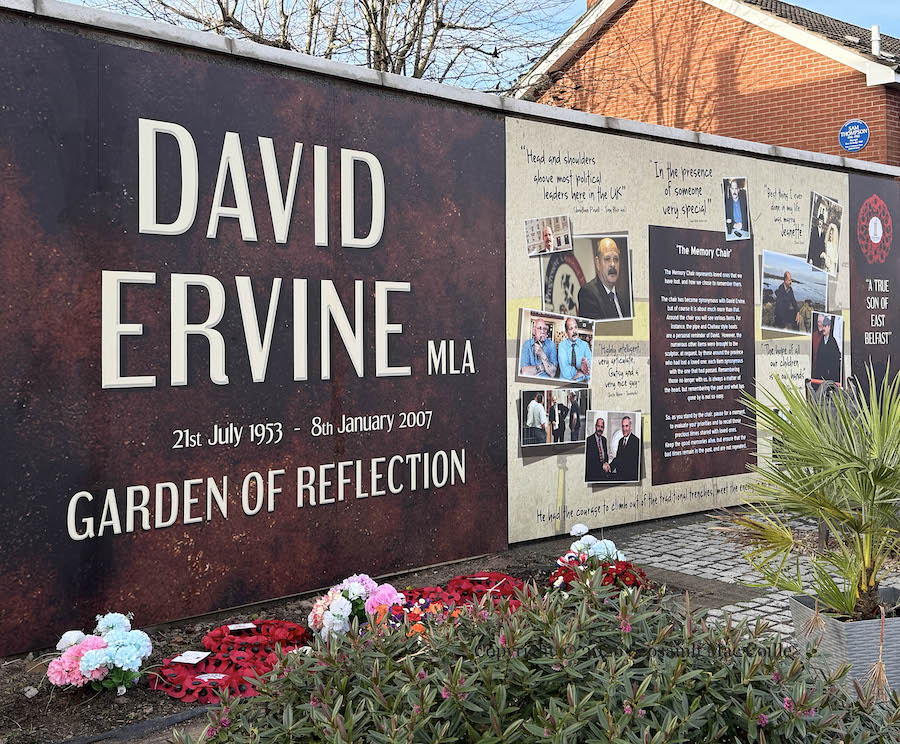
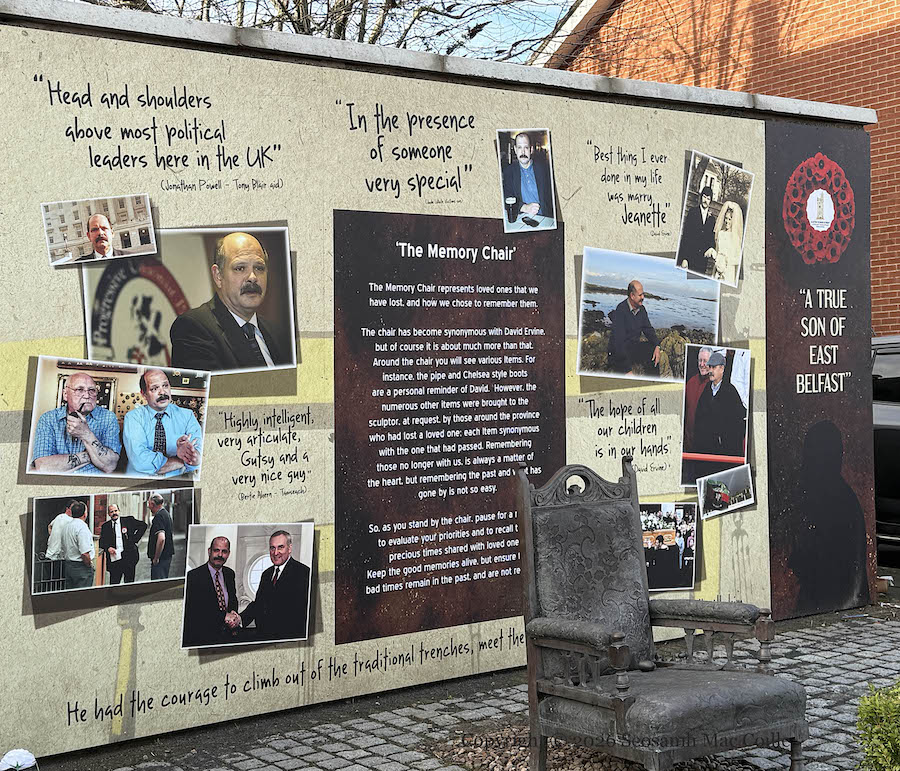
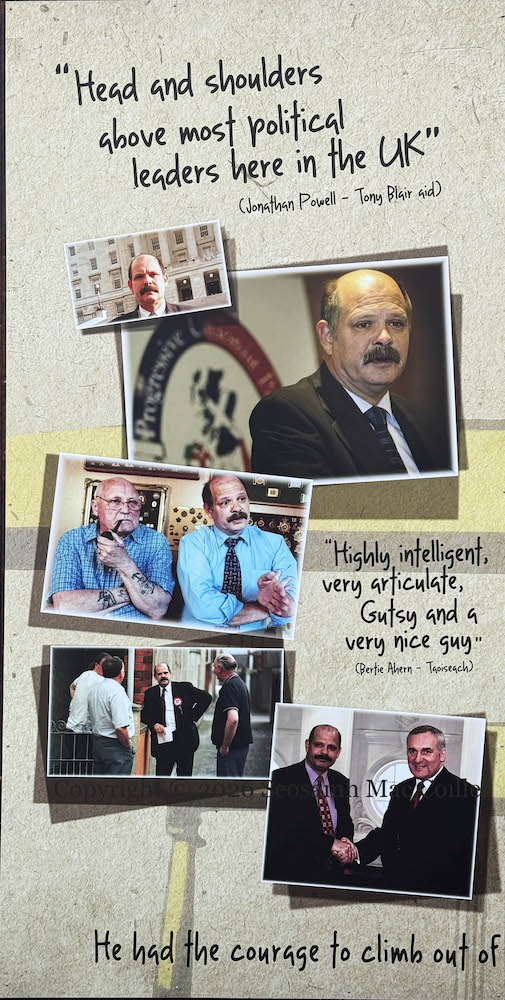
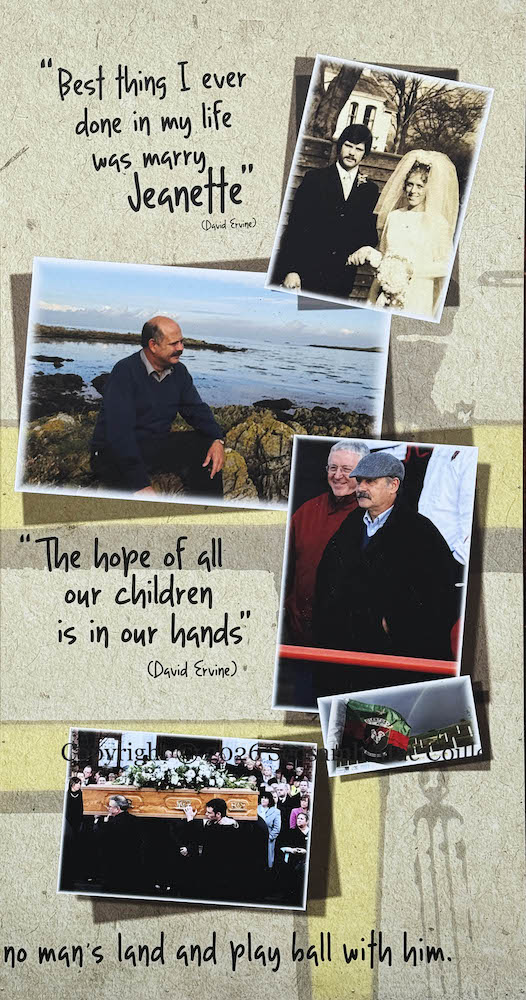
On the anniversary of David Ervine’s death, January 8th, a new board was launched in his memory, with images of Ervine “yearning for peace” in the cages of Long Kesh, where he met Gusty Spence (the pair can be seen together in the middle of the first column of photographs).

After his release, Ervine turned to politics, running unsuccessfully as a PUP candidate for Pottinger in the Belfast City Council elections of 1985 (WP); he would eventually be successful in 1997. In 1998 he was returned by Belfast East in the Assembly election (ARK). He helped bring about the loyalist ceasefire in 1994 – which was read aloud by Spence (youtube) – and was pro-Agreement in 1998 (DIB | Guardian | Slugger).

The information about the Memory Chair sculpture makes mention of Ervine’s boots but it seems they have not survived the mothballing of the sculpture which was last seen on site – boots included – in 2014.

Montrose Street South, replacing the various pieces seen in late 2024’s Today, Everyday, And Always.

Click image to enlarge
Copyright © 2026 Seosamh Mac Coılle
X15876 X15877 X15878 X15879 X15880 X15881 X15882 X15883 X15884 X15885 X15886 [X15887 .mov]

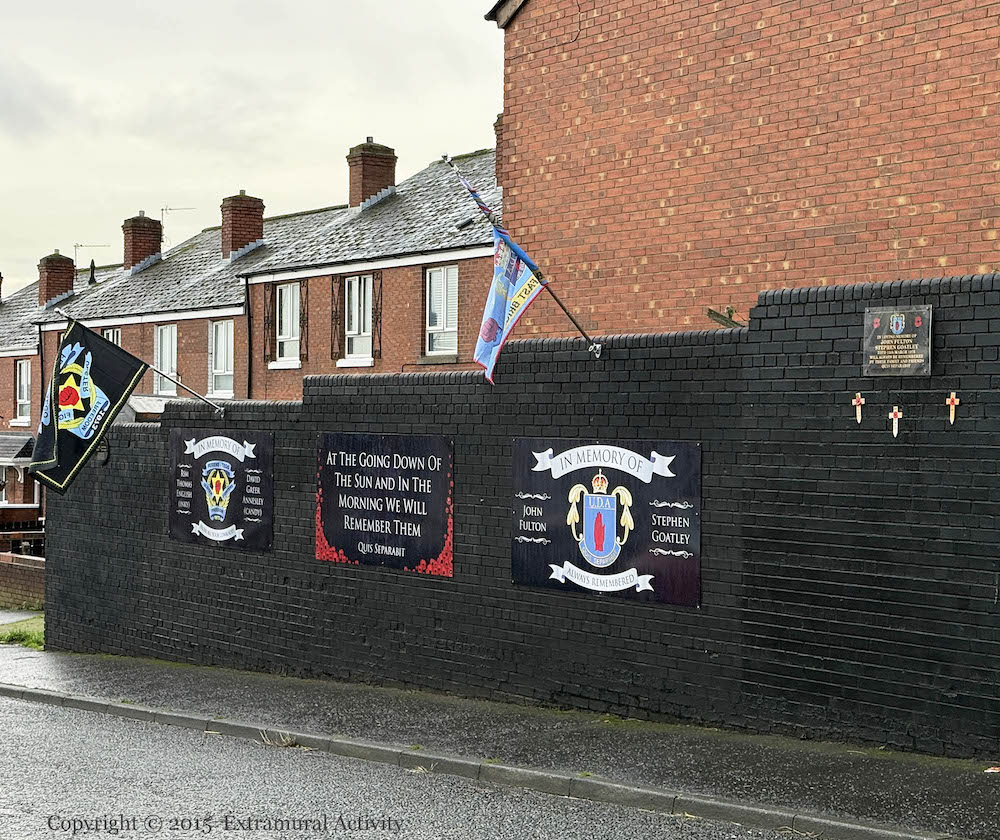
Fulton & Goatley

“In loving memory of John Fulton [and] Stephen Goatley, died 15th March 1975. Will always be remembered by their family and friends. Quis separabit.” UDA members John Fulton and were Stephen Goatley were killed together in the Alexandra Bar on York Road (close to the Mervue Street location of this memorial) in revenge for the stabbing of the UVF’s Joe Shaw in the North Star Bar by the UVF as part of the UDA-UVF feud in 1975.

The two men named on the other board were also killed in a feud between the UDA and UVF, in 2000 – see Inky & Candy. “In loving memory Thomas (Inky) English & David (Candy) Greer Annesley. Together in the same old way/would be our dearest wish today./Silent memories true and tender/just to show we still remember.”

Mervue Street, Tiger’s Bay, north Belfast. The small plaque was previously seen in 2017.

Click image to enlarge
Copyright © 2025 Seosamh Mac Coılle
X15852

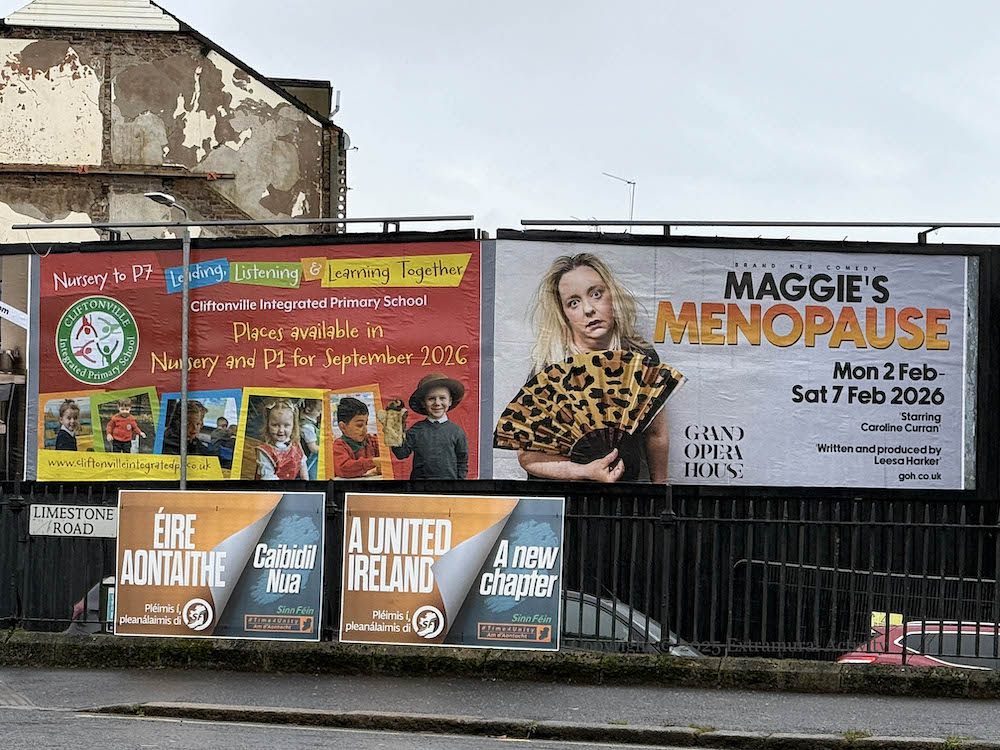
Caıbıdıl Nua/A New Chapter

Here are three pieces together at the top of the Limestone Road in north Belfast, each one looking ahead to a notable transition:

Above left: Cliftonville Integrated primary (web) has nursery and P1 students space for September 2026

Above right: the play ‘Maggie’s Menopause’ (web) plays in the Opera House in February 2026

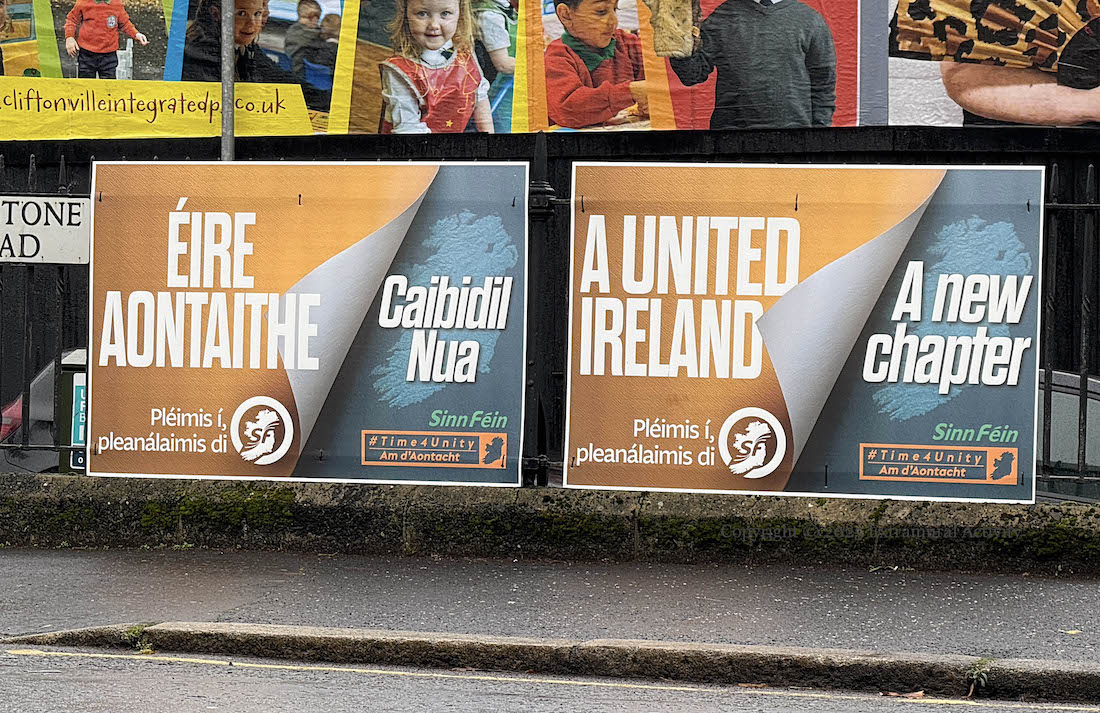
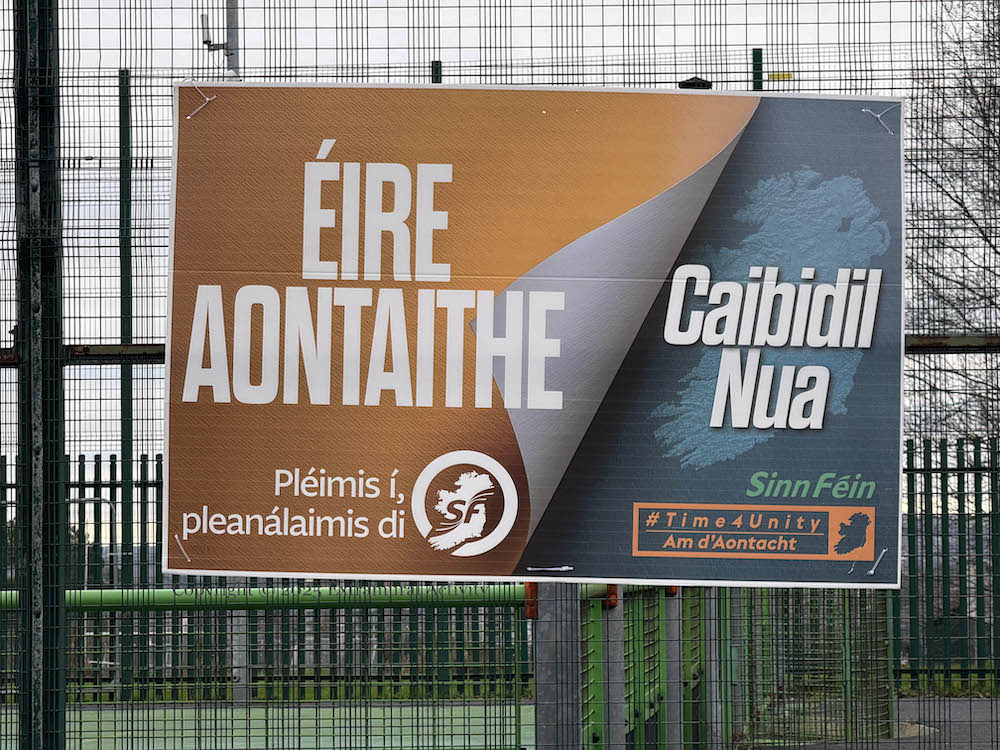
On the railings in the foreground: Sınn Féın (web) placards suggesting “a united Ireland”/”Éıre aontaıthe” as “a new chapter”/”caıbıdıl nua” for Ireland – date undetermined.

The close-up of the placard is from the Whiterock Road.

Click image to enlarge
Copyright © 2025 Seosamh Mac Coılle
X15850 X15851
X15867

Feriens Tego

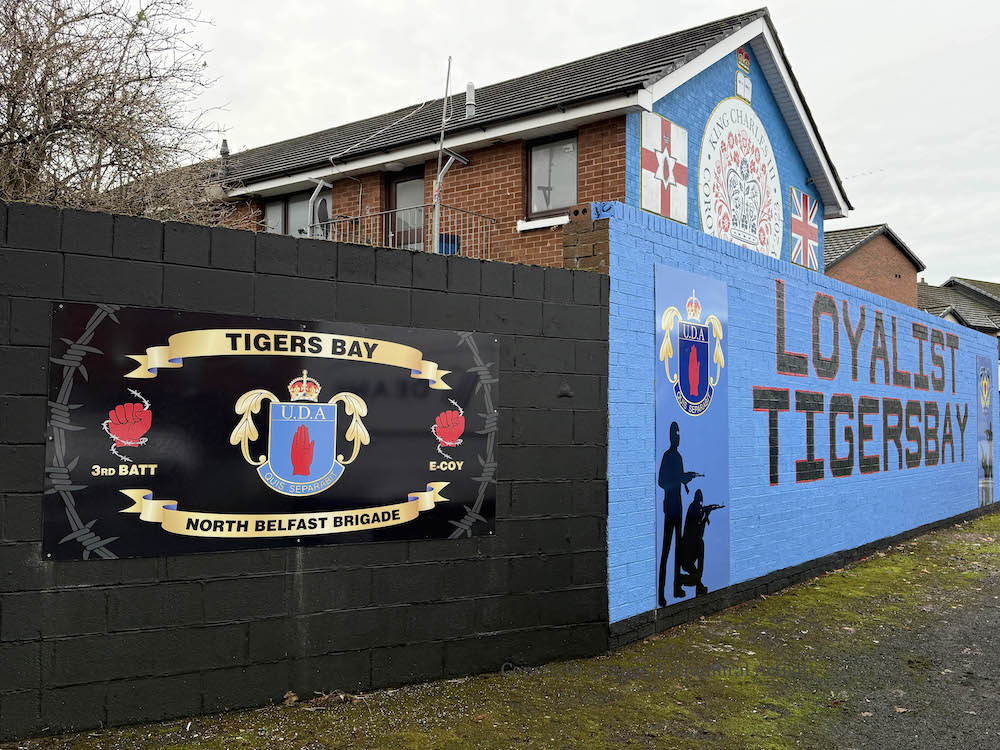
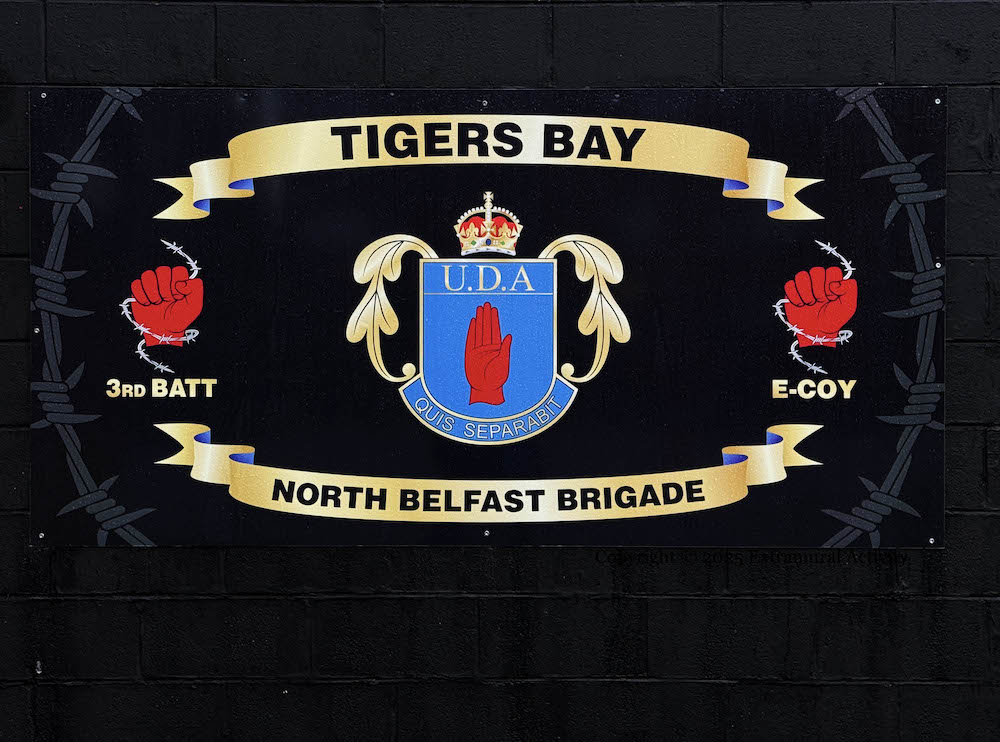
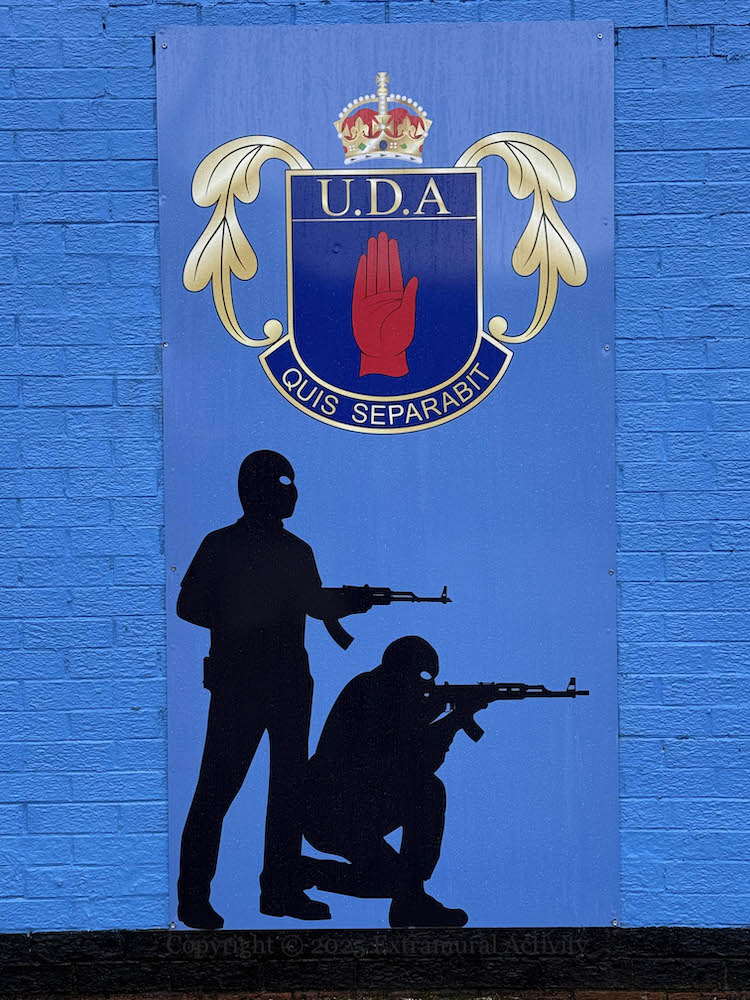
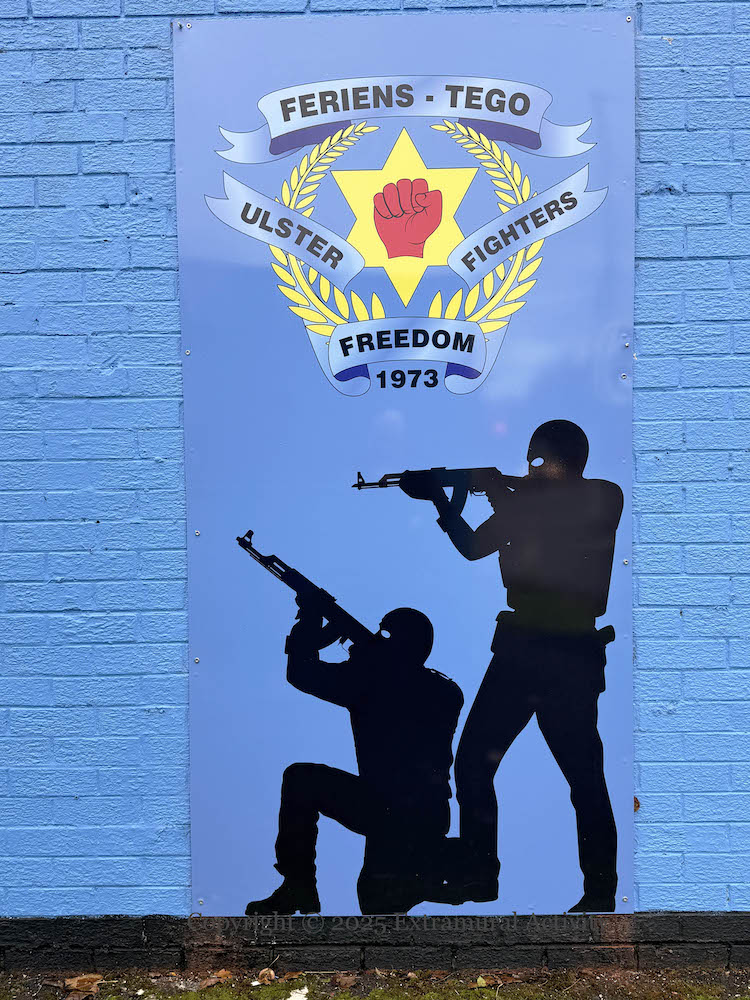
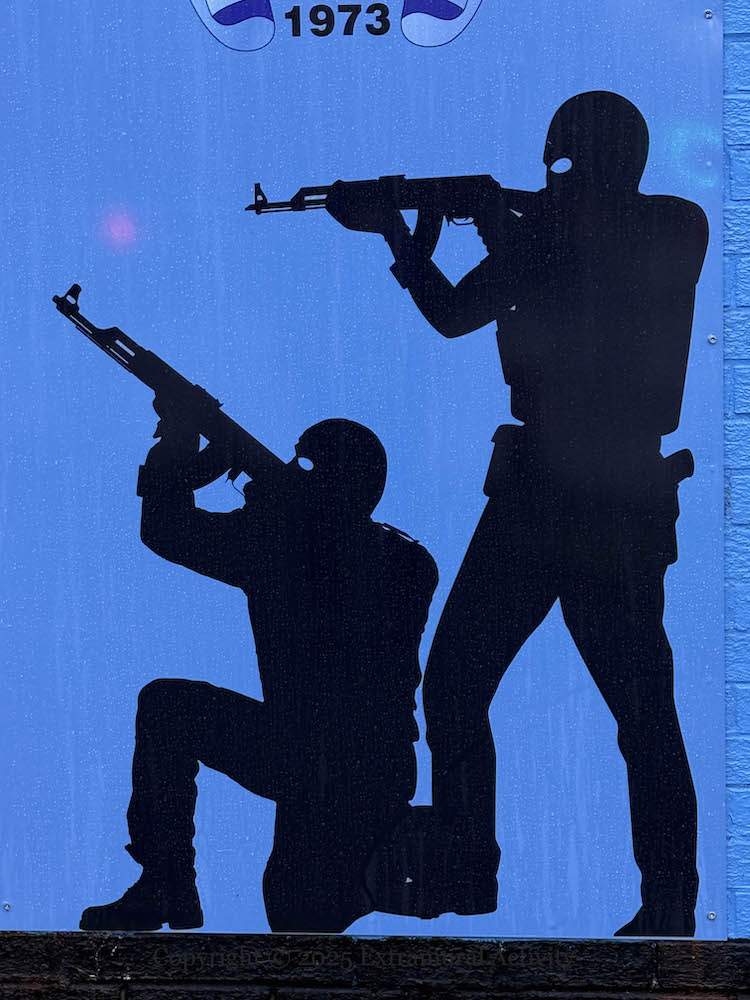
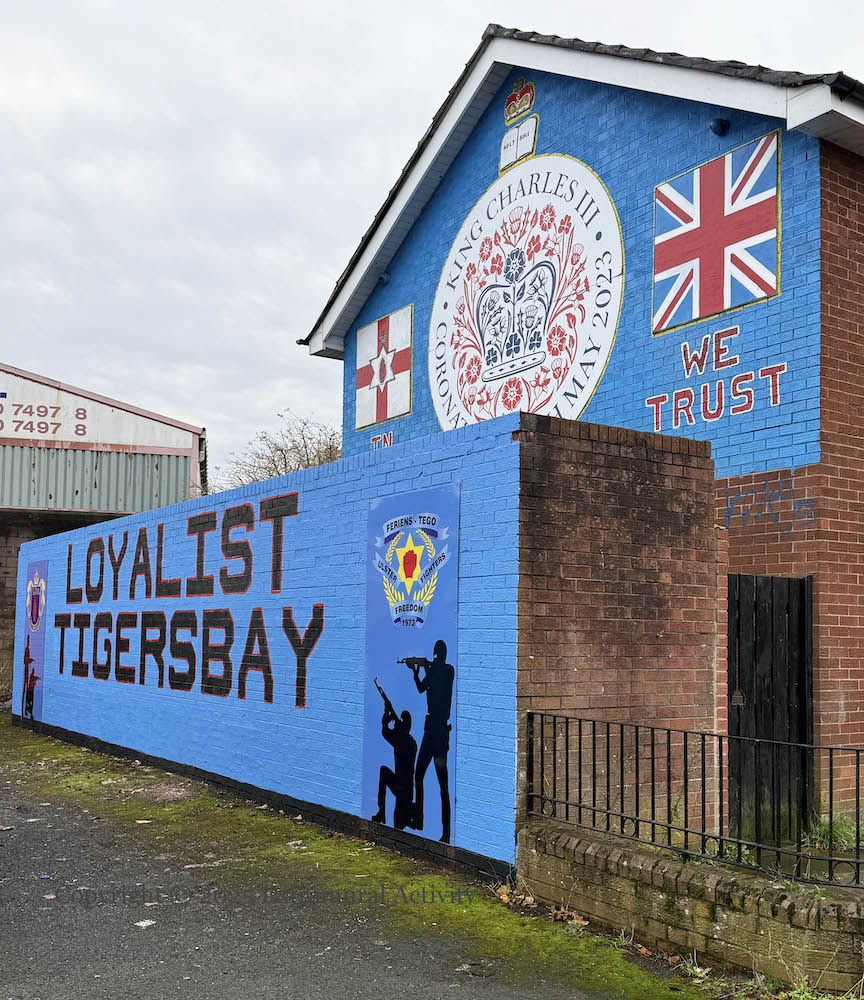
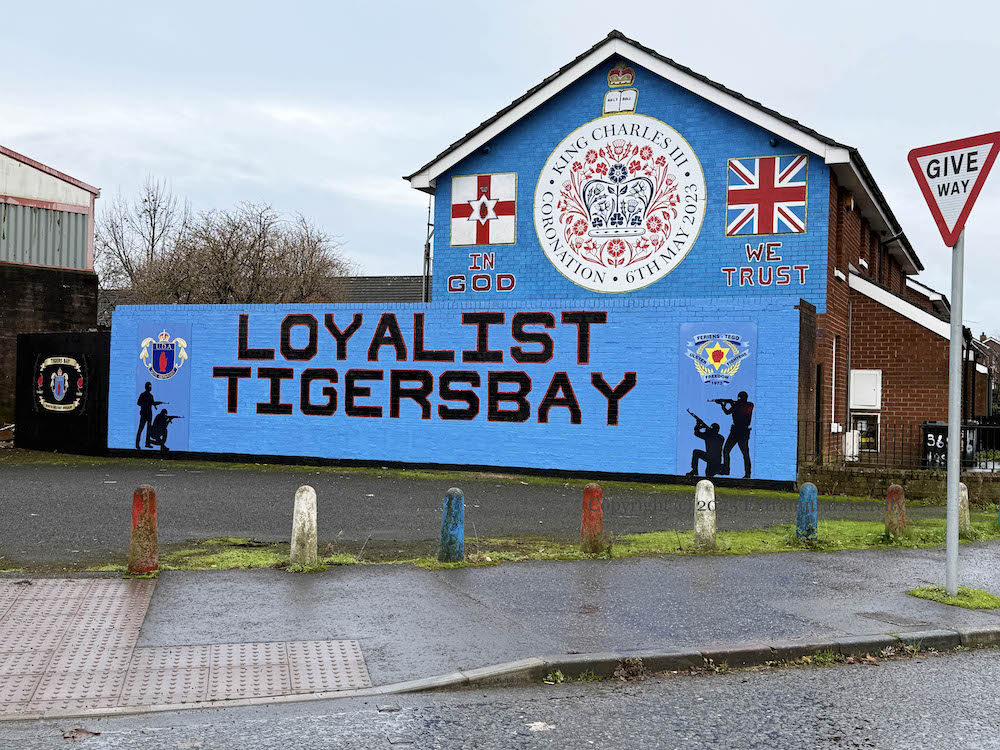
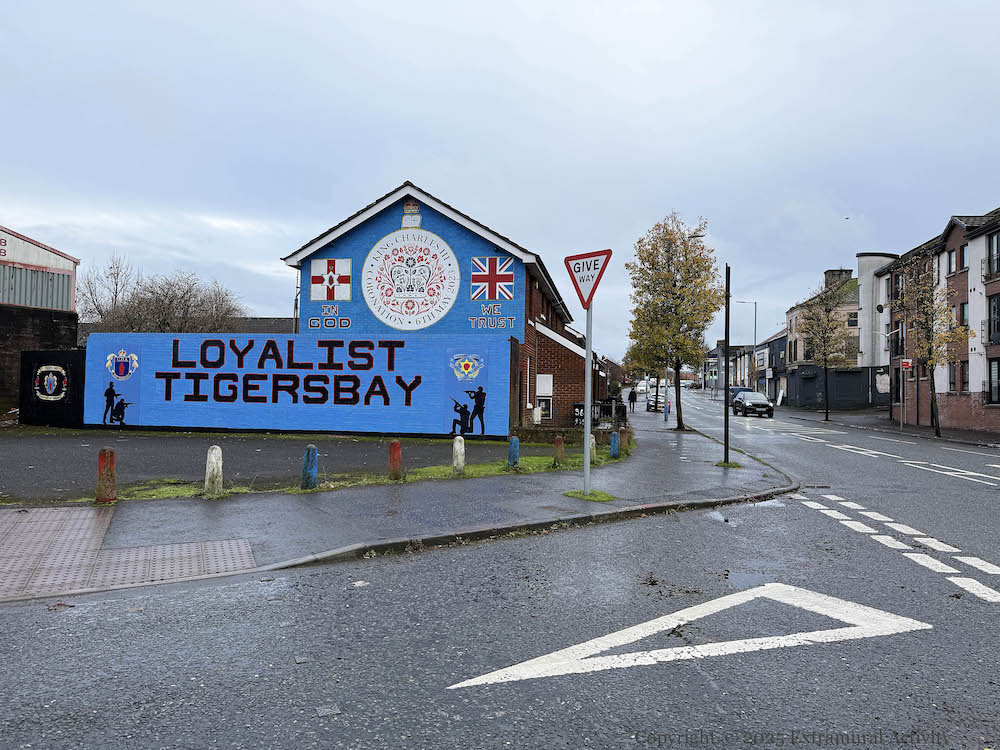
Stop The Boats has been painted out below the large “Loyalist Tiger’s Bay” and the entire wall painted in solid blue and book-ended by UDA and UFF boards showing silhouetted gunmen in active poses.

The side-wall, home to painted Orange Order symbols since 2017, has been painted black and a board (above) added to E company from Tiger’s Bay. (It’s possible “North Belfast brigade” and “3rd battalion” are the same thing.)

For the KCIII board above, see I Here Present Unto You Your Undoubted King.

Limestone Road and North Queen Street, Tiger’s Bay, north Belfast

Click image to enlarge
Copyright © 2025 Seosamh Mac Coılle
X15796
X15858 X15859 X15797 [X15860] X15861
X15798 X15857 X15856