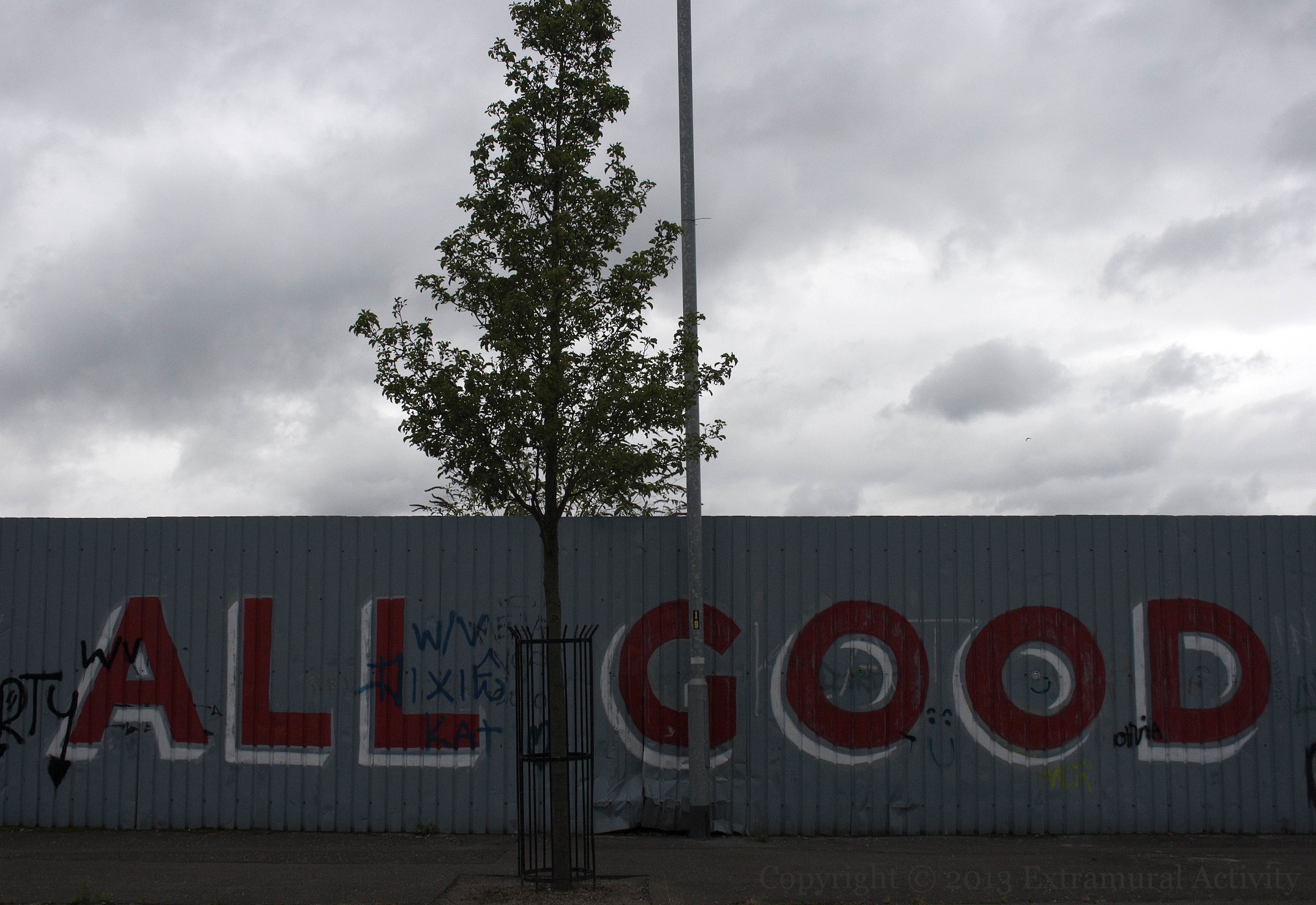
“(It’s) All Good” on the north side of Cupar Way, near the Howard Street gate. Painted by Dublin street artist Maser (web).
Click image to enlarge|
Copyright © 2013 Seosamh Mac Coılle
X01276
“(It’s) All Good” on the north side of Cupar Way, near the Howard Street gate. Painted by Dublin street artist Maser (web).
Click image to enlarge|
Copyright © 2013 Seosamh Mac Coılle
X01276
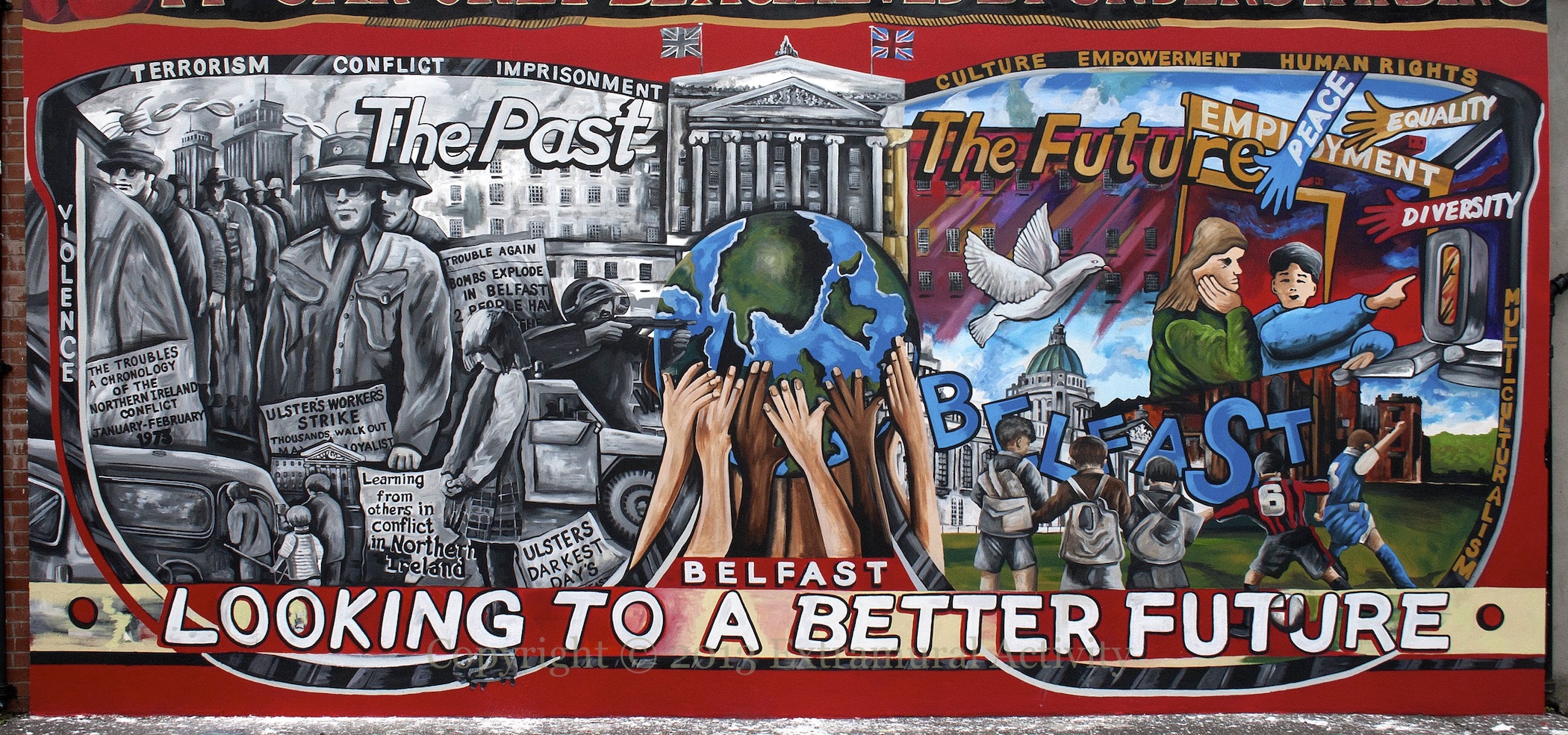
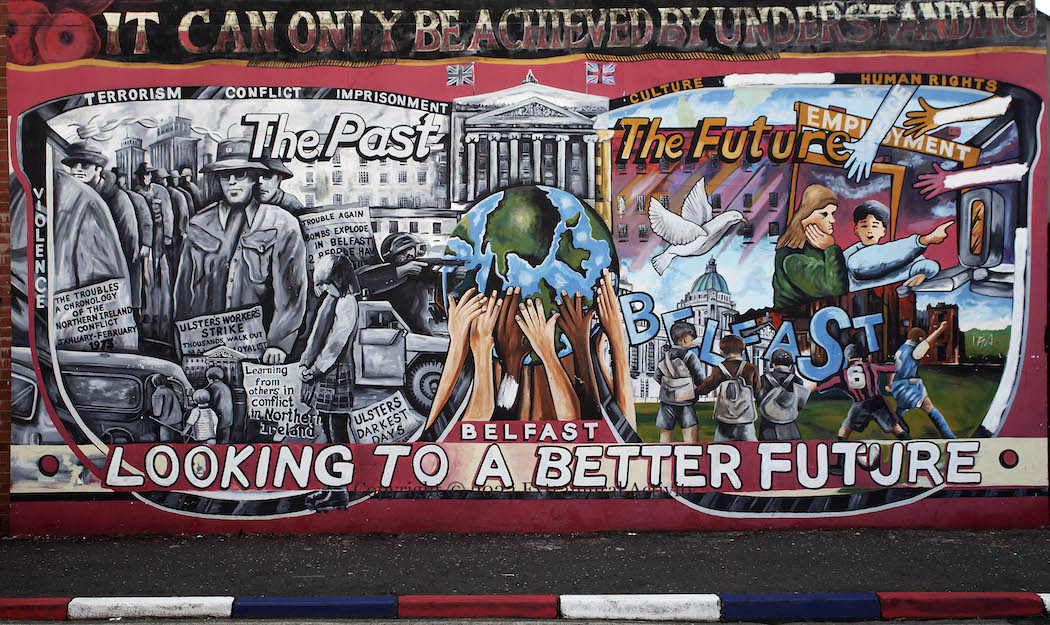
In this new east Belfast mural, we move from a part of “violence – terrorism – conflict – imprisonment’ to a future of ‘culture – empowerment – human rights – multiculturalism’. The mural is black-and-white on one side and colour on the other. On the left we have watchtowers and paramilitaries in hats and sunglasses; on the right schoolchildren in front of city hall, working on a computer and playing football.
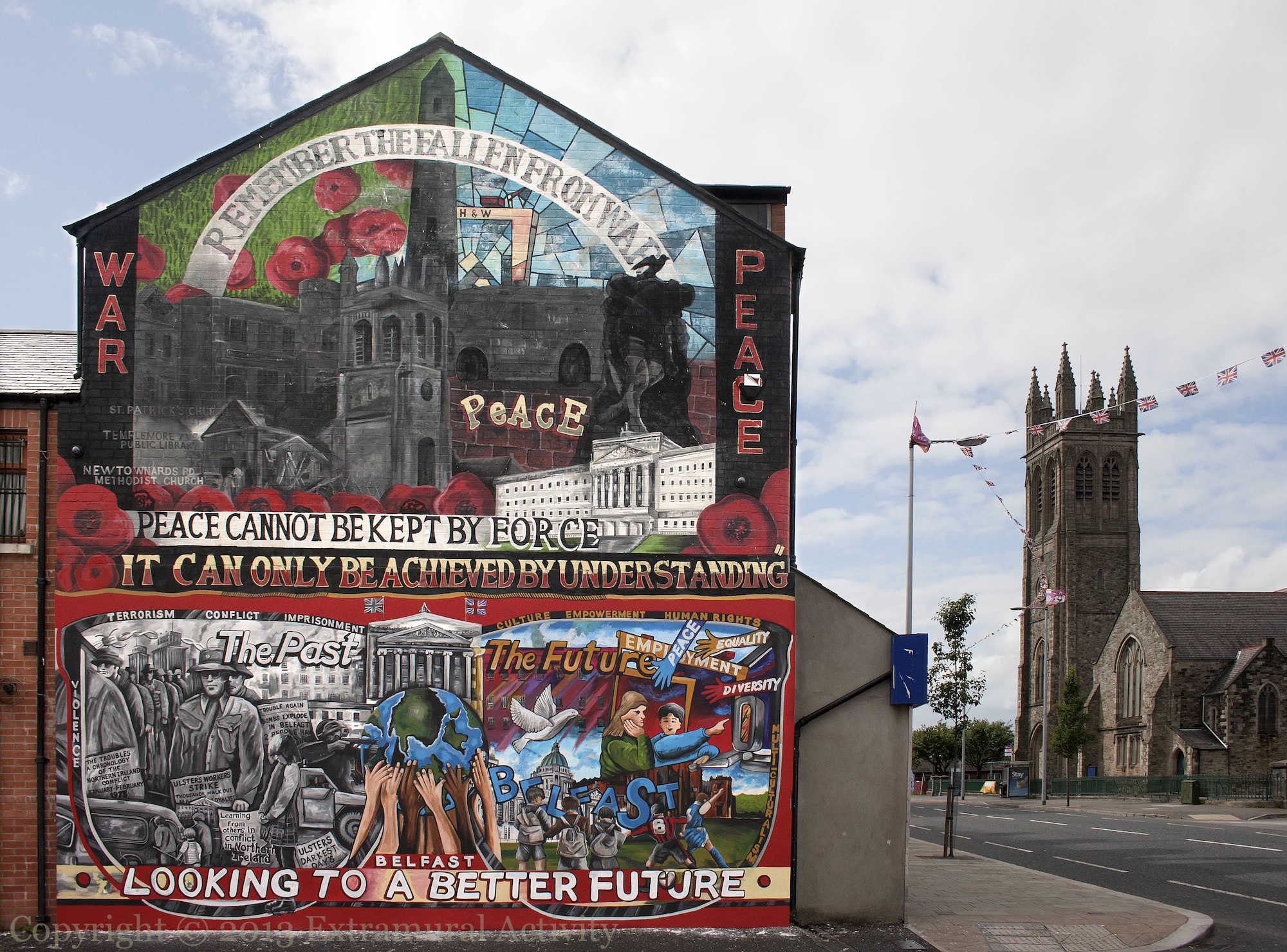
The mural was defaced immediately after it was finished (roughly the end of July), indicating dissatisfaction with the current direction of ‘the future’, but quickly repaired. There is a mural directly above this one. A wide shot of them both can be found below.
Update: Spring 2022 – some of the words on the colourful ‘future’ side of the mural have been painted over: “empowerment”, “equality”, “diversity”, “multiculturalism”. There is also a streak of white paint on the arm of a black person in the centre of the mural. See the final two images.
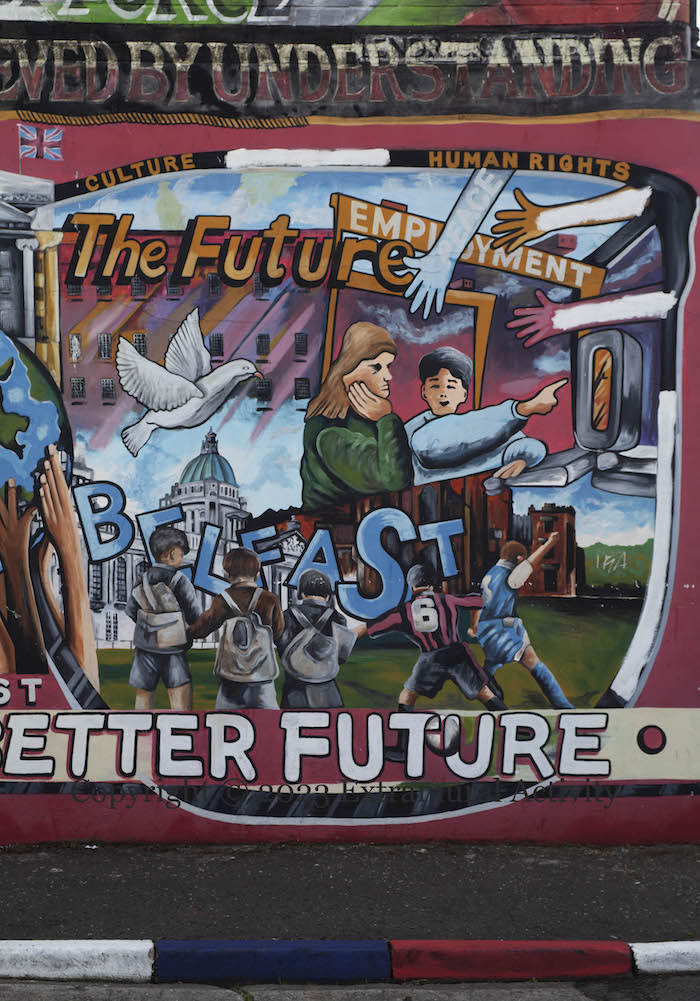
Click image to enlarge
Copyright © 2013/2022 Seosamh Mac Coılle
X01278 X01277 X14079 X14078 looking to a better future, learning from others in conflict in northern ireland ulsters darkest day’s days trouble again bombs explode the troubles a chronology of the northern ireland conflict january-february 1973 stormont earth globe john stewart BCC press release
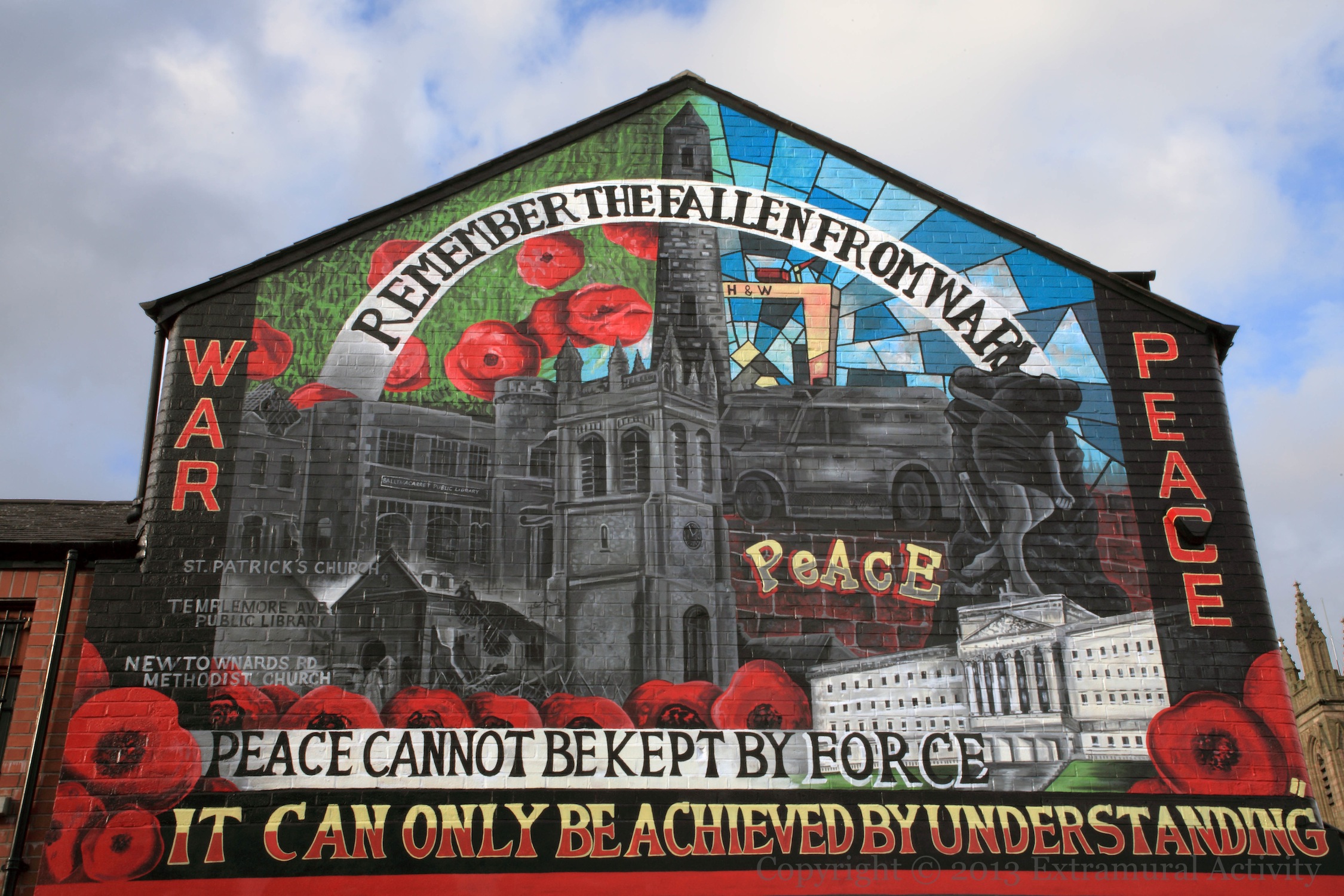
The mural above is on the Newtownards Road at Lendrick Street and shows a bombed-out Ballymacarrett library, St. Patrick’s church (the church itself is visible in the lower right-hand corner) – both were hit by the blitz in 1942 – a police land rover (perhaps representing the “fallen” during the Troubles), and Cuchulainn (perhaps representing the IRA, though Cuchulainn is also a UDA icon – see the bottom of the Visual History page on Cú Chulaınn), and Stormont (representing … peace???). Poppies in a field and a H&W crane against stained glass provide a background.
We are supposed to remember the dead because (perhaps) their deaths were unnecessary and misguided as means to peace, at least according to the saying along the bottom (sometimes attributed to Einstein): “Peace cannot be kept by force; it can only be achieved by understanding” – understanding of the Nazis during the blitz, it seems, and of loyalists and republicans during the Troubles. (If you have a better interpretation, please leave a comment.)
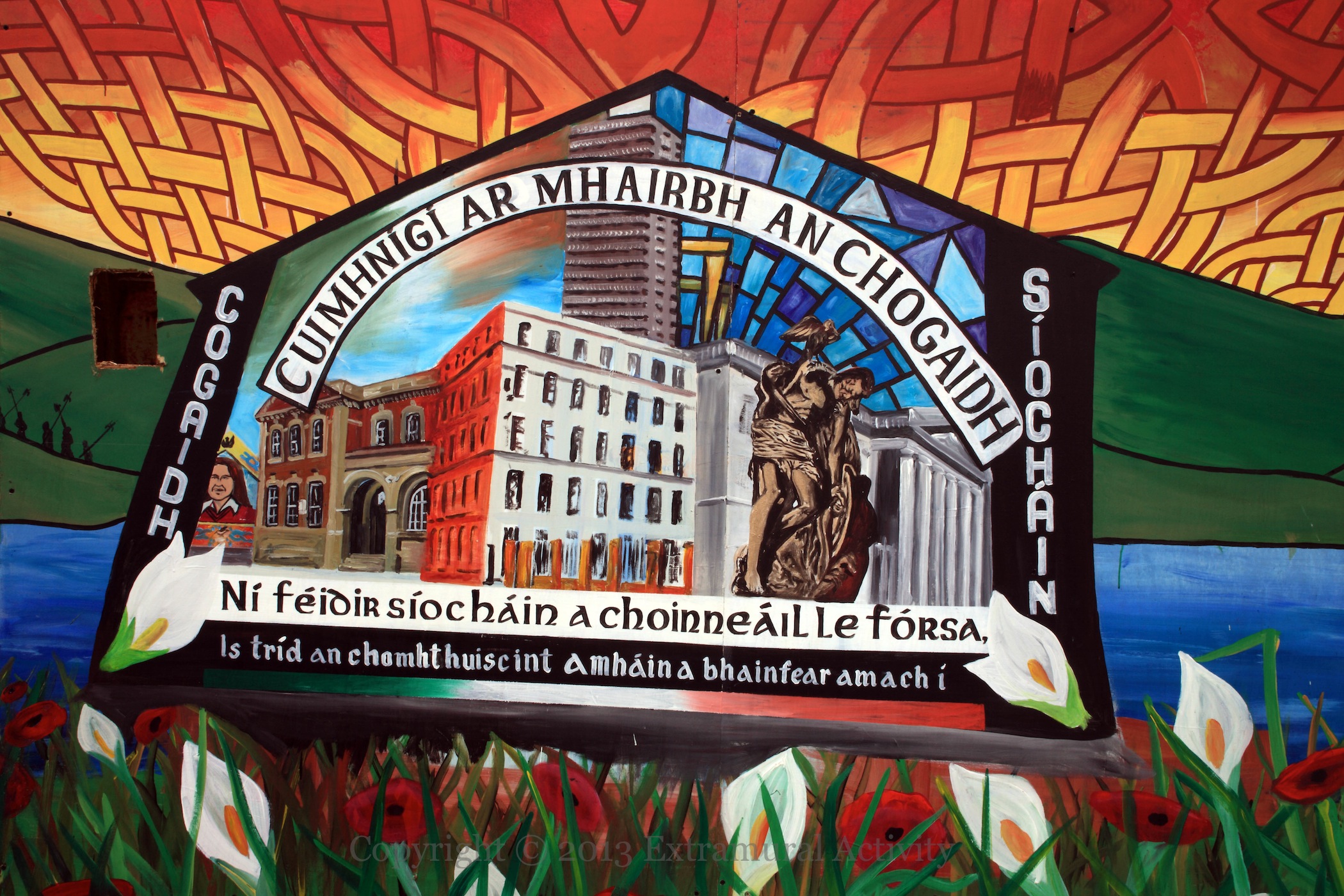
The mural was imitated on the hoarding around An Chultúrlann on the Falls Road during its renovation (shown below): the left hand side of the side was replaced with images of the Falls library and Bobby Sands mural and Divis tower, and Cú Chulaınn on the right was placed in front of the GPO, and the poppies were joined by lilies, and the words translated into Irish. The message here seems clearer, lamenting the CNR dead and calling for understanding of the CNR community (sc. by Britain and the Orange state) though the poppies below include the dead of WWI.
Click image to enlarge
Copyright © 2013 Seosamh Mac Coılle
X01280 X01279 war cogaıdh, peace síocháın, remember the fallen from war cuimhnígí ar mhairbh an chogaidh, peace cannot be kept by force ní féidır síocháın a choınneáıl le fórsa, it can only be achieved by understanding is tríd an chomhthuıscınt amháın a bhaınfear amach í
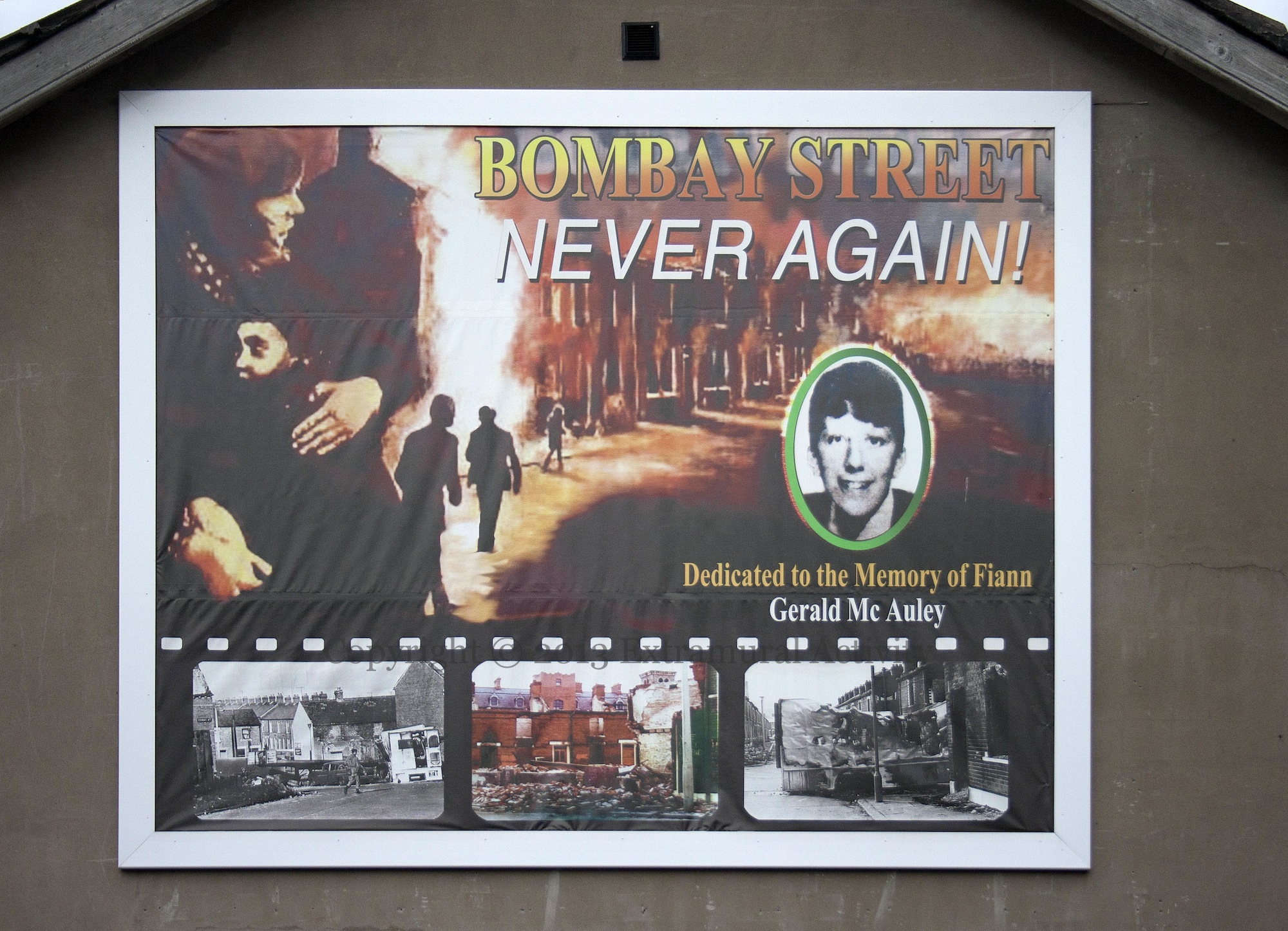
Printed and framed tarp in Bombay Street, commemorating the burning of Bombay Street during the August 1969 Belfast riots and the death Gerald McAuley, a young IRA member (Fian, not “Fiann” as written here) killed by a sniper during the trouble. Three photographs from the street at the time are reproduced in the bottom third of the board.
Ten years ago, an earlier incarnation of this board could be found on the other side of the street, connected to the issue of the day: No (Decom)mission.
RTÉ archival footage of the aftermath and other clips detailing the events in both Belfast and Derry.
Click image to enlarge
Copyright © 2013 Seosamh Mac Coılle
X01272
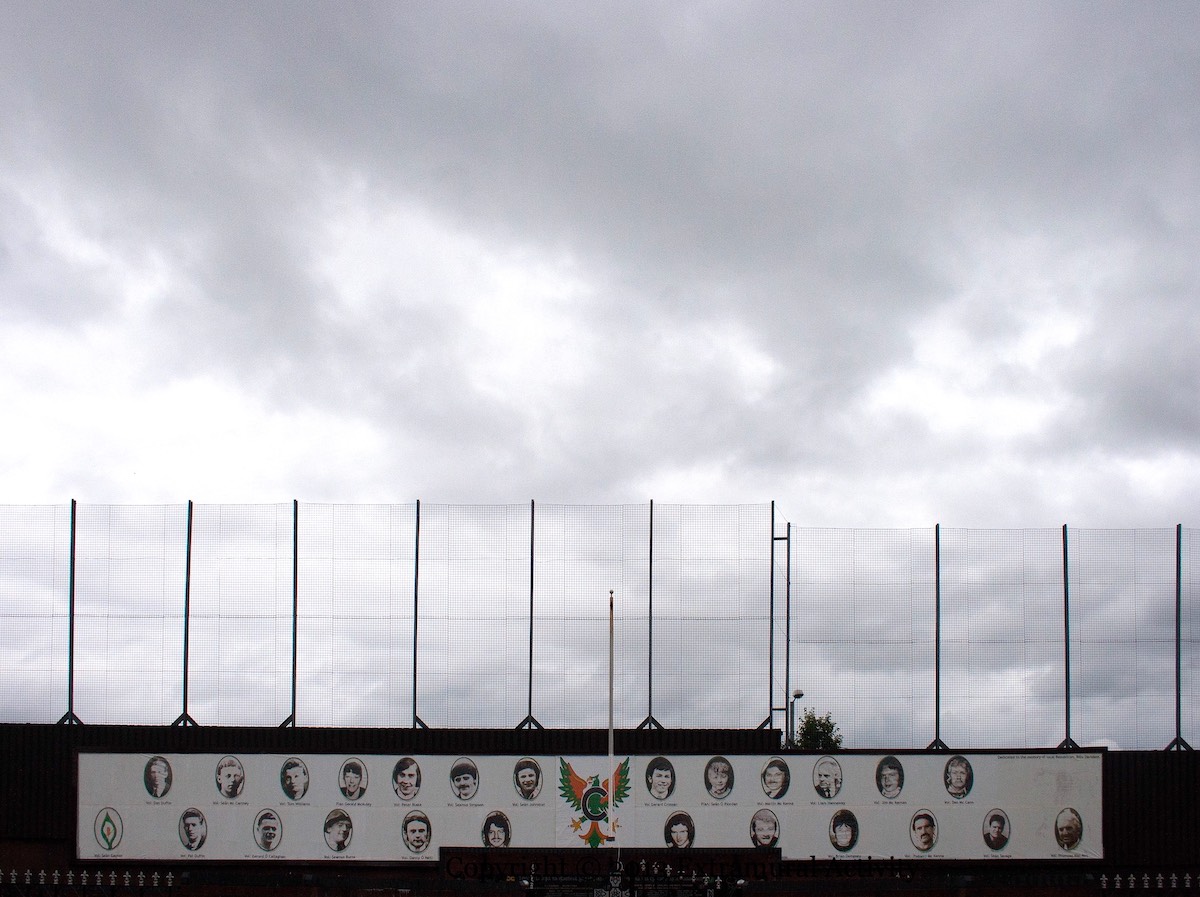
The back wall of Clonard Martyrs Memorial Garden – that is, the so-called “peace” line or (better) “war wall” – is decorated with portraits of twenty-five local óglaıgh and fıanna who died from 1920 to 1992 (though an Easter lily takes the place of Sean Gaynor on the far left).
Left: Dan Duffin, Seán McCartney, Tom Williams, Gerard McAuley, Peter Blake, Seamus Simpson, Seán Johnston, Seán Gaynor, Pat Duffin, Gerard Ó Callaghan, Seamus Burns, Danny Ó Neill, Tom McCann.
Right: Gerard Crossan, Seán Ó Riordan, Martin McKenna, Liam Hannaway, Jim McKernan, Dan McCann, “dedicated to the memory of local republican, Billy Davidson”, Tony Lewis, Joe McKenna, Brian Dempsey, Finbarr McKenna, Seán Savage, Prionsais Mac Áirt.
They are also listed on one of the plaques inside the garden – see the second images in Clonard Martyrs.
Click image to enlarge
Copyright © 2013 Seosamh Mac Coılle
X05290
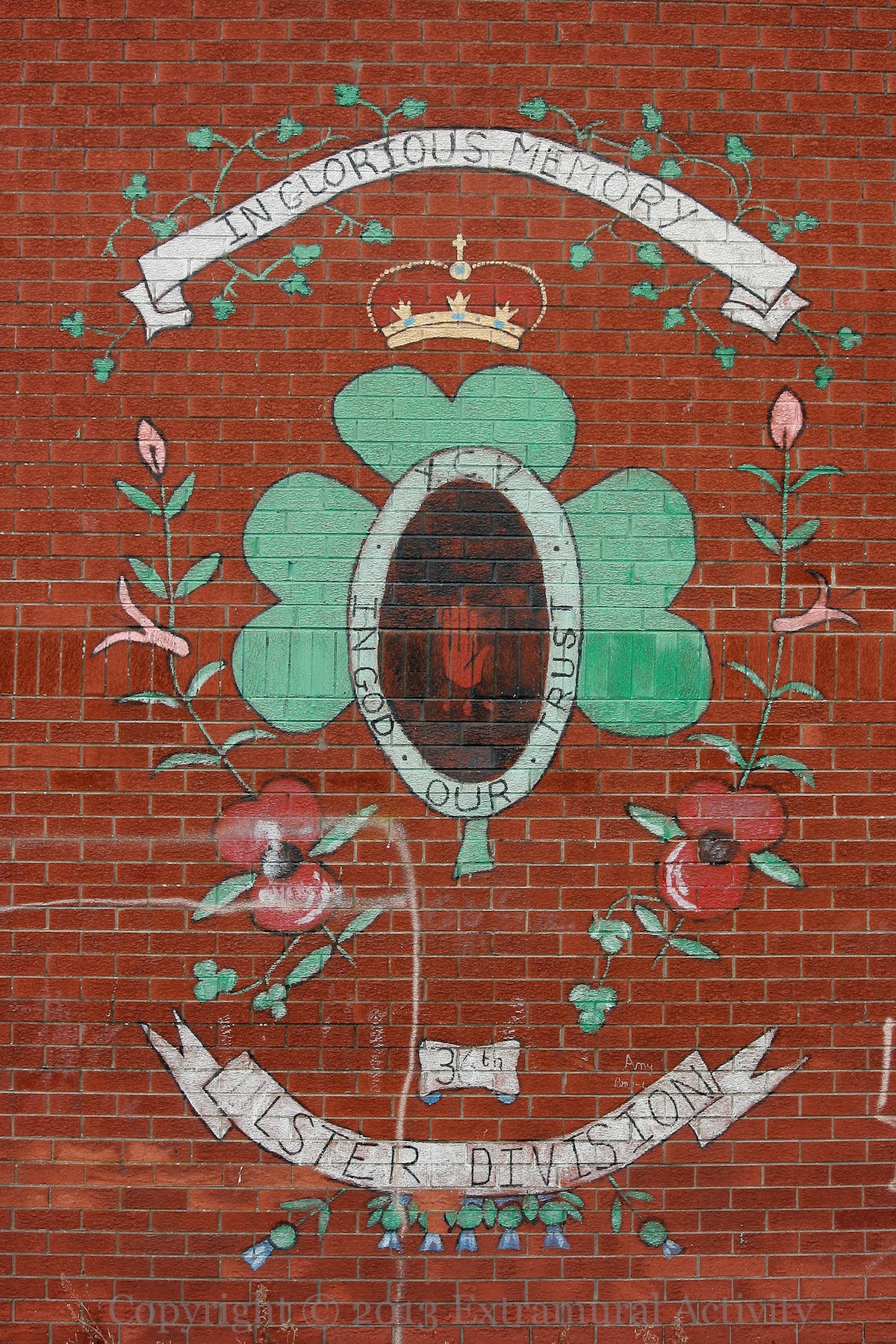
Vintage mural in Linfield Avenue, flanking the Sandy Row Methodist church, with the 1690-1990 piece on the other side. ‘In glorious memory, 36th Ulster division. YCV – In God our trust.’
Click image to enlarge
Copyright © 2013 Seosamh Mac Coılle
X01270
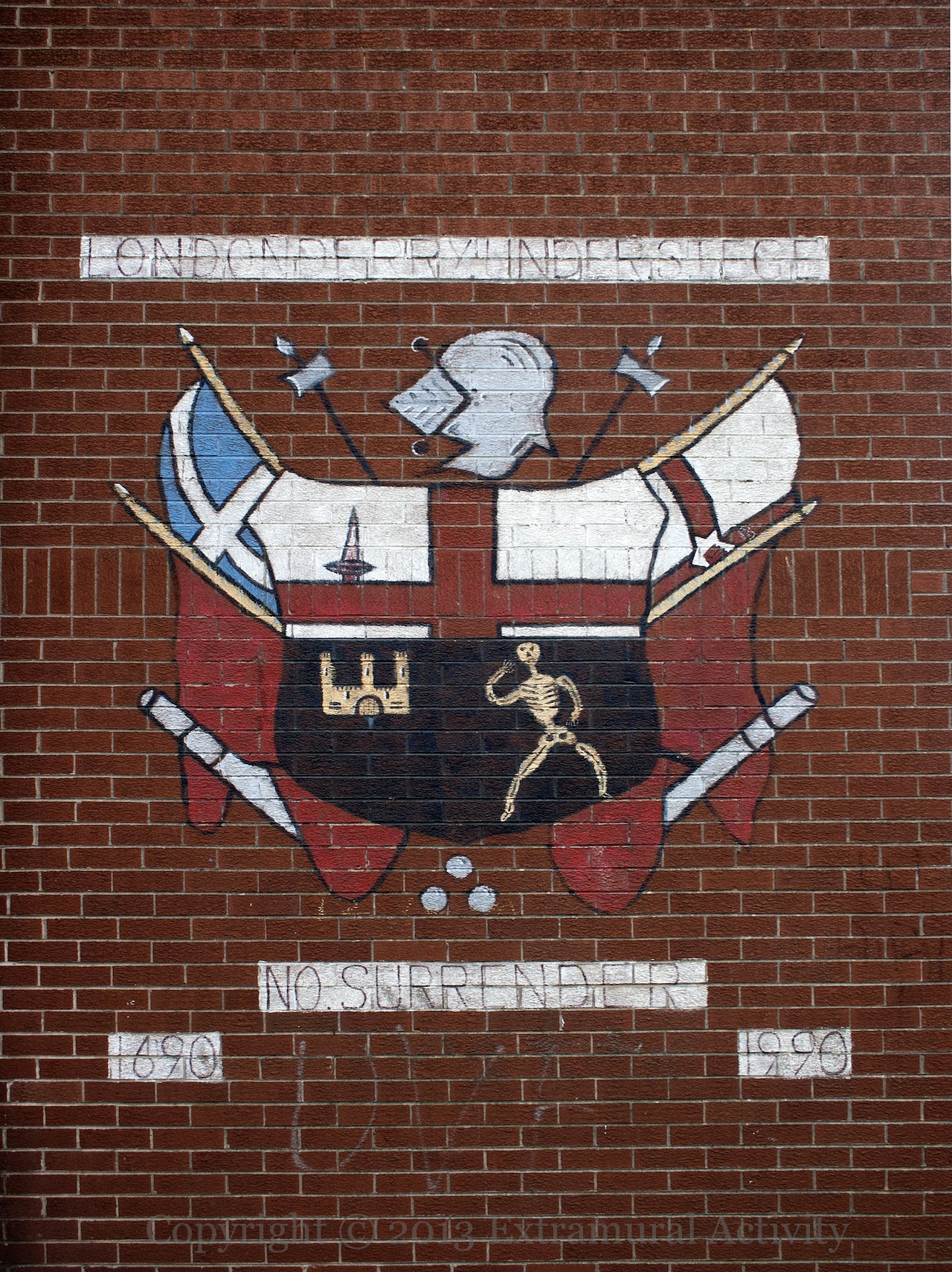
This Sandy Row mural commemorating the siege of Derry is in pretty good shape, despite being more than 20 years old. It features the coat of arms of Londonderry – see Vita, Veritas, Victoria for some background.
For more on the siege, and relief, of Derry, see Breaking The Boom. The siege ended in 1689; the battle of the Boyne was in 1690. It is in Linfield Avenue and is visible from Rowland Way, off Sandy Row.
Click image to enlarge
Copyright © 2013 Seosamh Mac Coılle
X01271 londonderry under siege no surrender
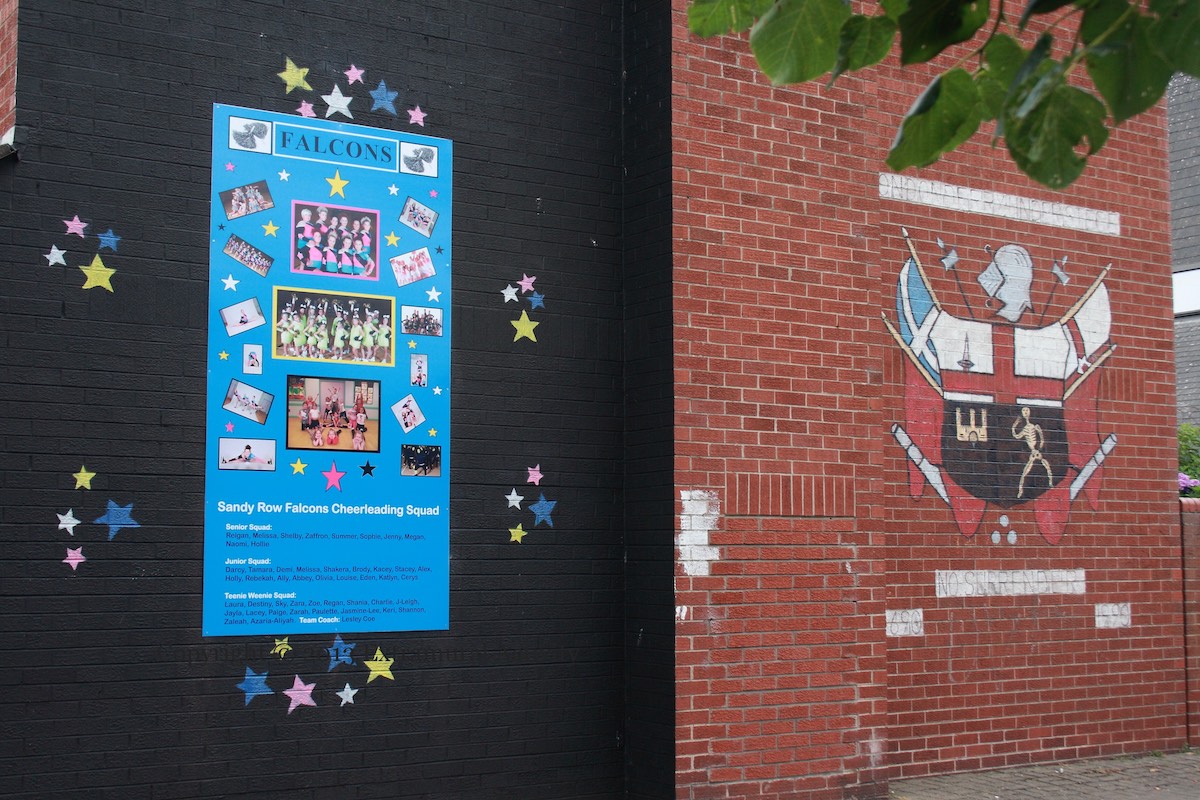
The Sandy Row Falcons (cheerleading) (Fb) take the place of King Billy in Linfield Avenue; the Siege Of Derry mural remains.
The Falcons are also included in Each One Teach One.
Click image to enlarge
Copyright © 2013 Seosamh Mac Coılle
X05289
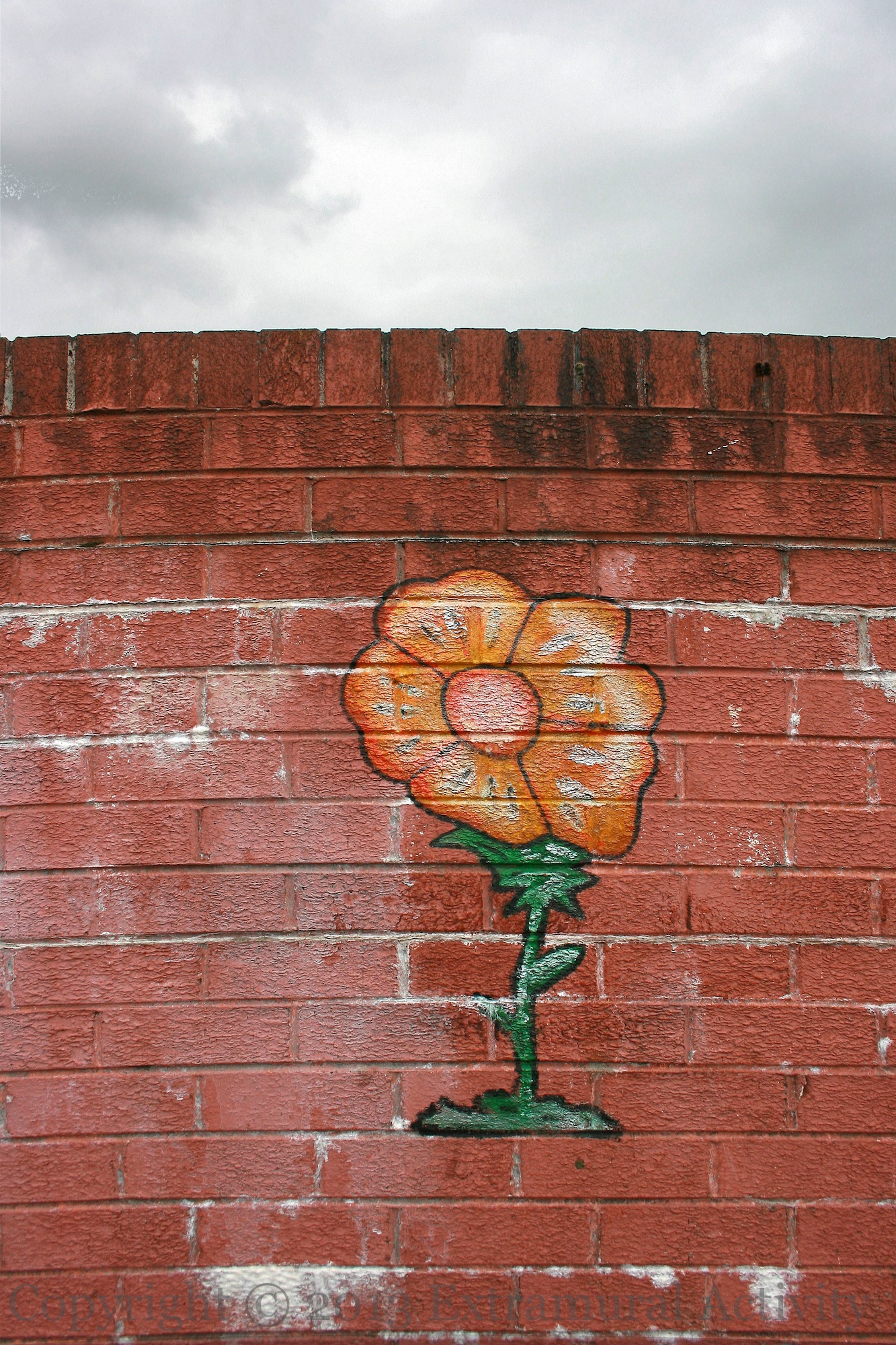
The Linfield area of south Belfast is named for the flax plant, genus Linum (presumably – there doesn’t seem to be a history of the area on-line), though that plant is blue (see this image), while this one – in Linfield Gardens – is orange.
Click image to enlarge
Copyright © 2013 Seosamh Mac Coılle
X01263
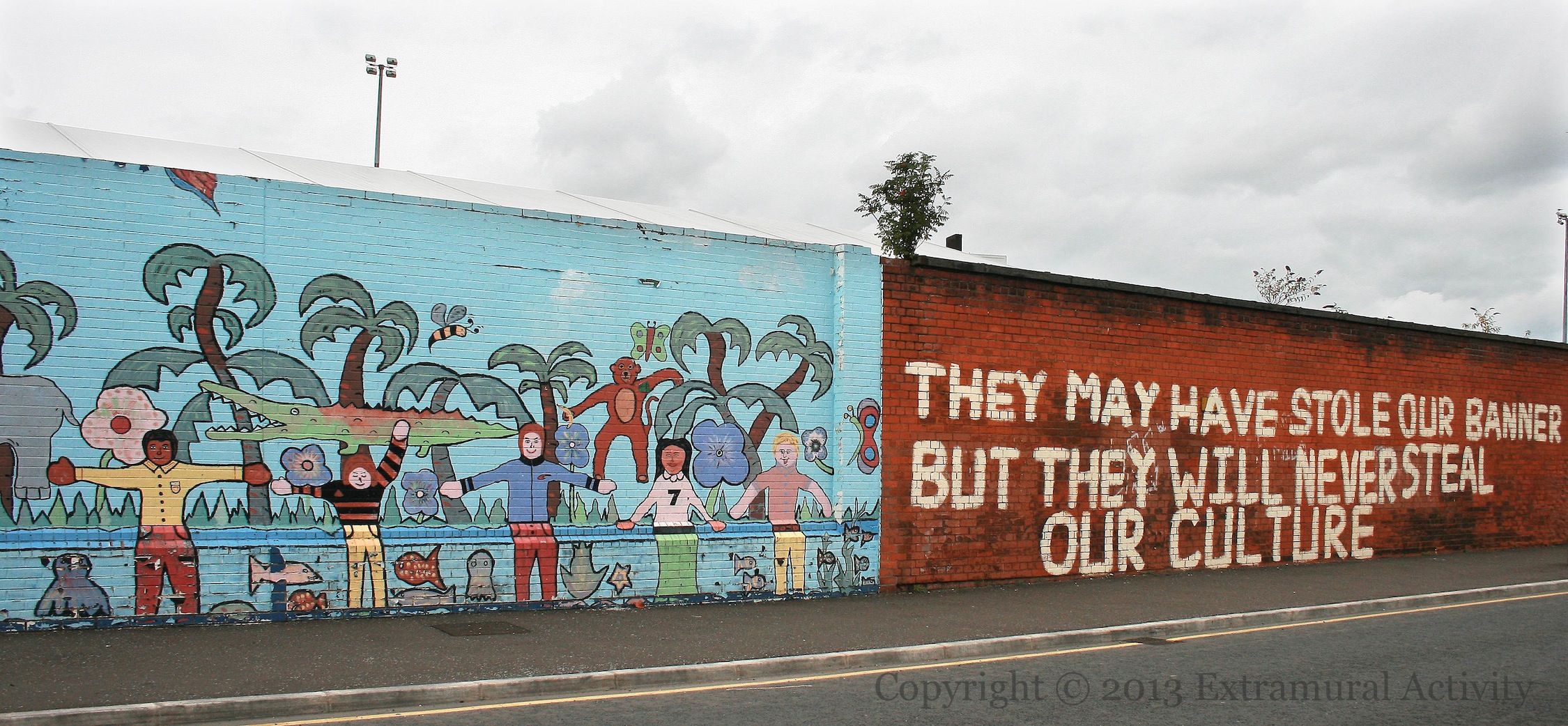
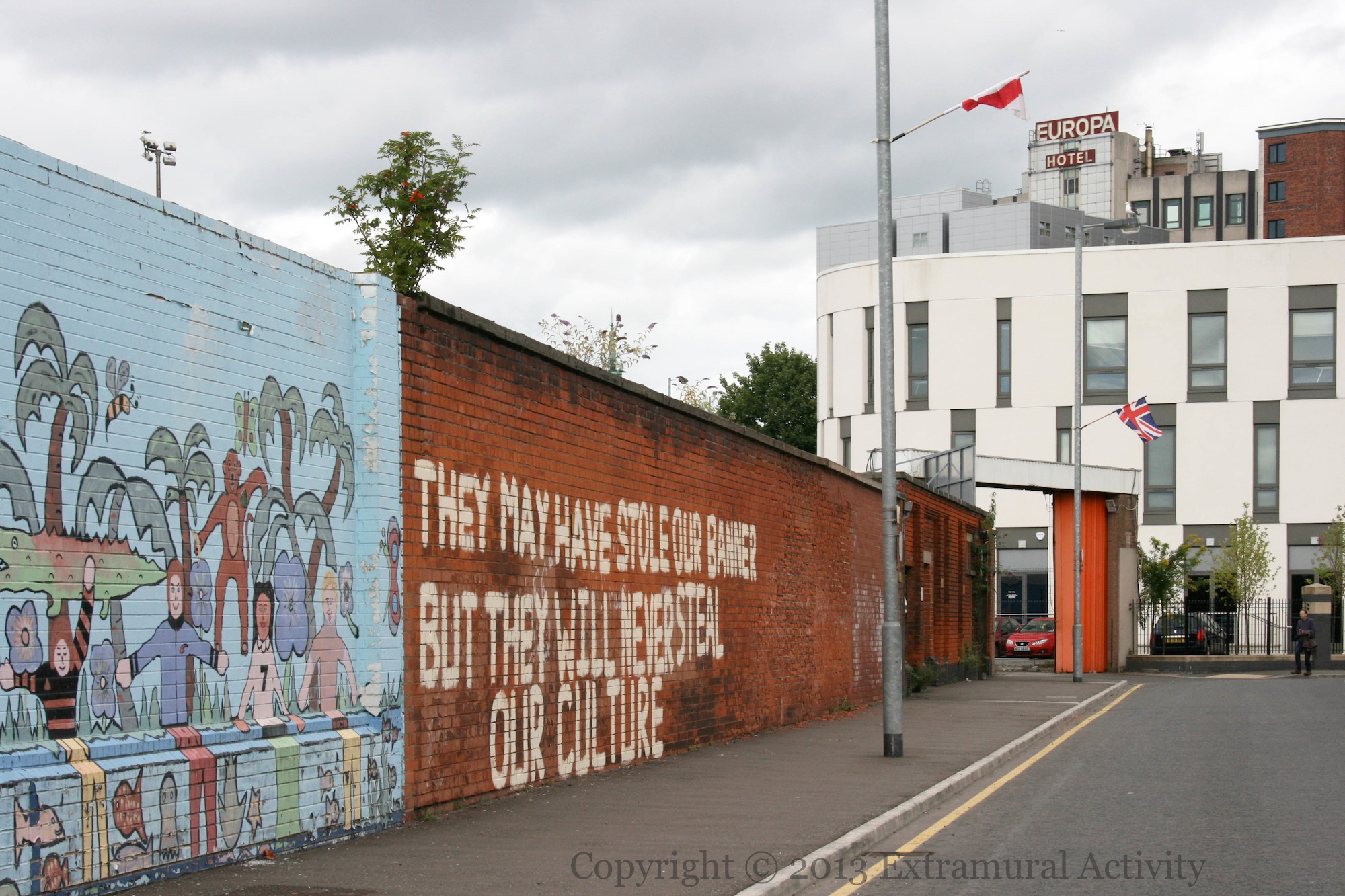
Graffiti in Linfield Gardens (off Sandy Row) making reference to the banner shown in this entry (on a bonfire) and on-going disputes over the routes established by the Parades Commission for Orange Order marches: They may have stole[n] our banner but they will never steal our culture.
Click image to enlarge
Copyright © 2013 Seosamh Mac Coılle
X01267 X01268

