Fermanagh Crannóg

2013-02-17 CrannogWide+

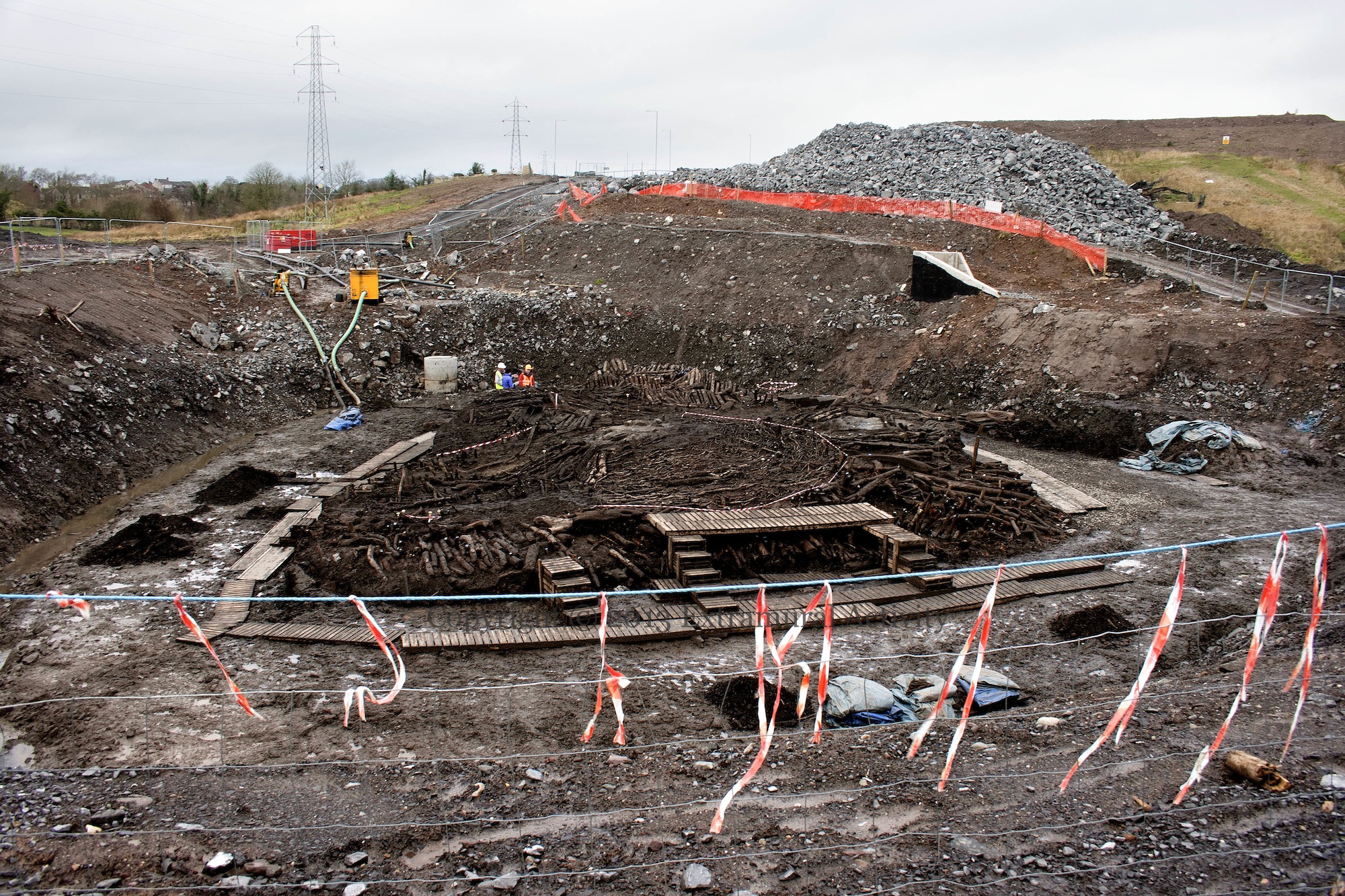
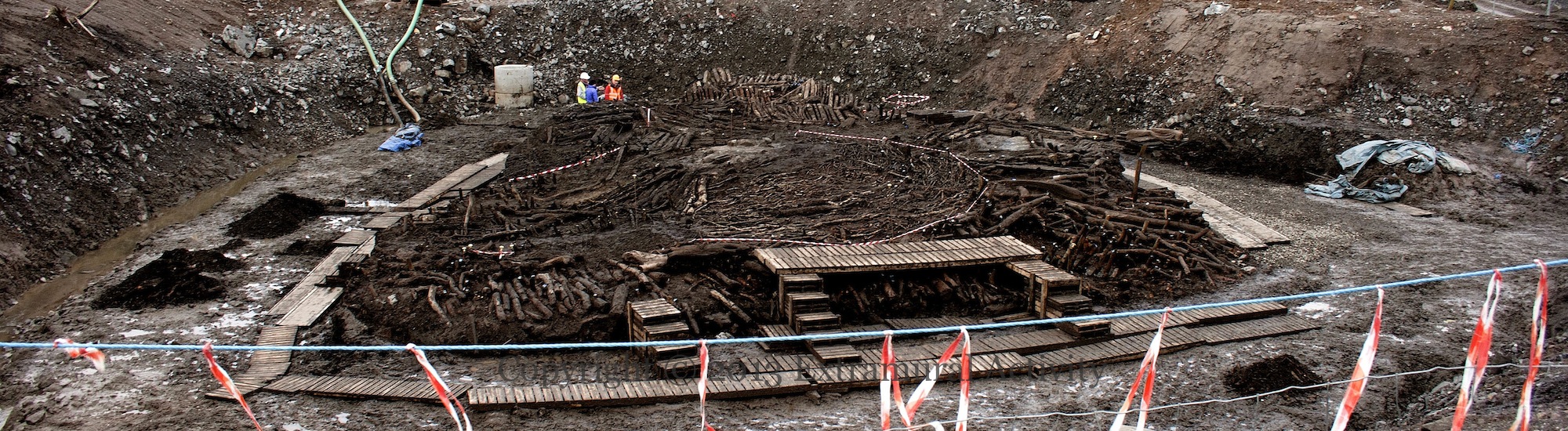
This might not look like much, but these crannóg remains in Drumclay outside Enniskillen/Inıs Ceıthleann (according to the BBC) “may be the largest house structure of the period ever to be discovered” and archaeologists have said that “their discoveries will re-write the history books of ancient Irish life.” The crannog (a compound – in this case of 30+ houses – on stilts, forming an artificial island) was brought to the public eye last (2012) summer and archaeologists have until the end of this month (March, 2013) to complete their investigations – the find is holding up construction of a road needed for the G8 summit in June. (Previously on Extramural Activity: Putting On The Ritz.)

For more details of the find and efforts to gain more time for excavation, see Robert Chapple’s blog.

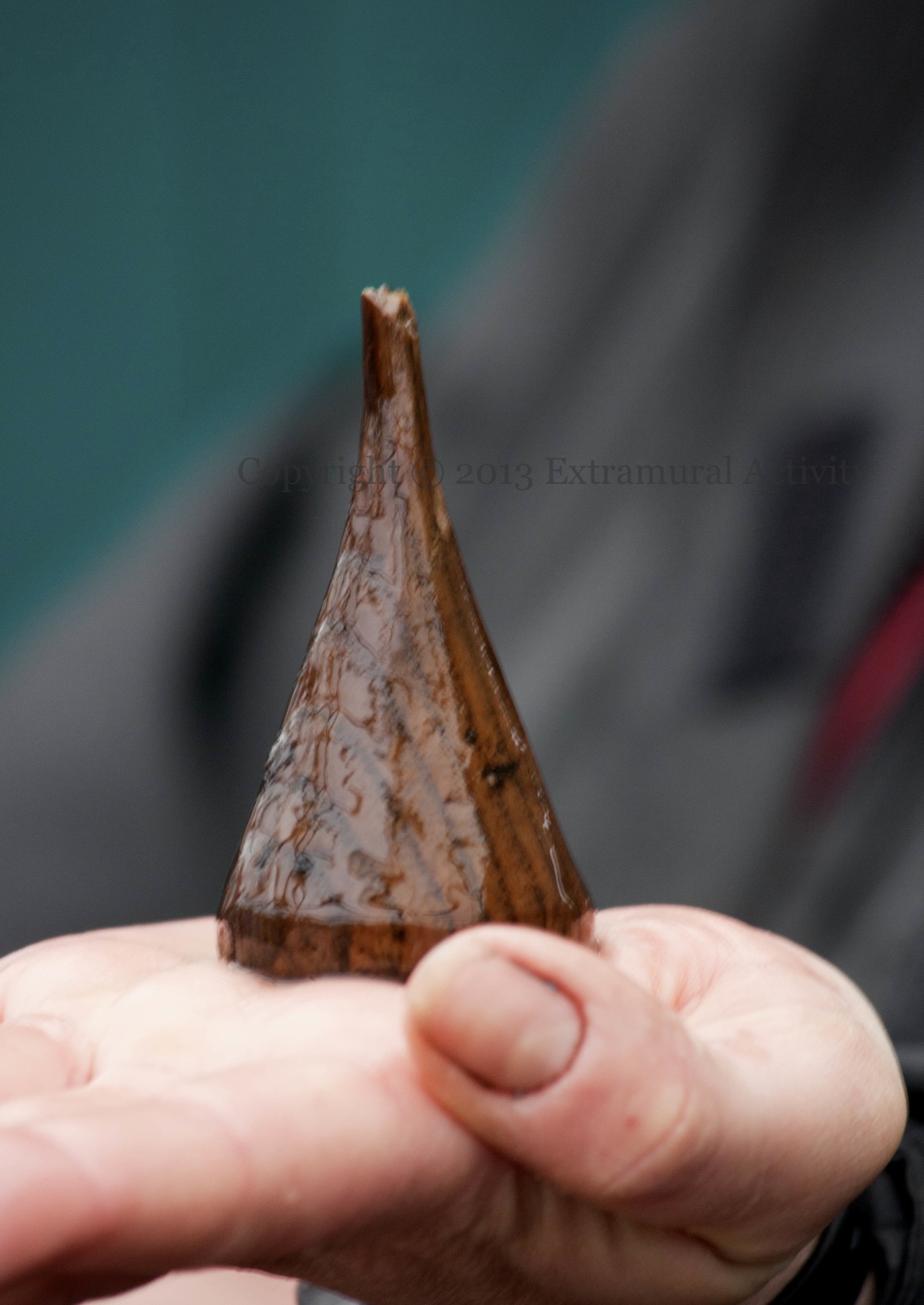
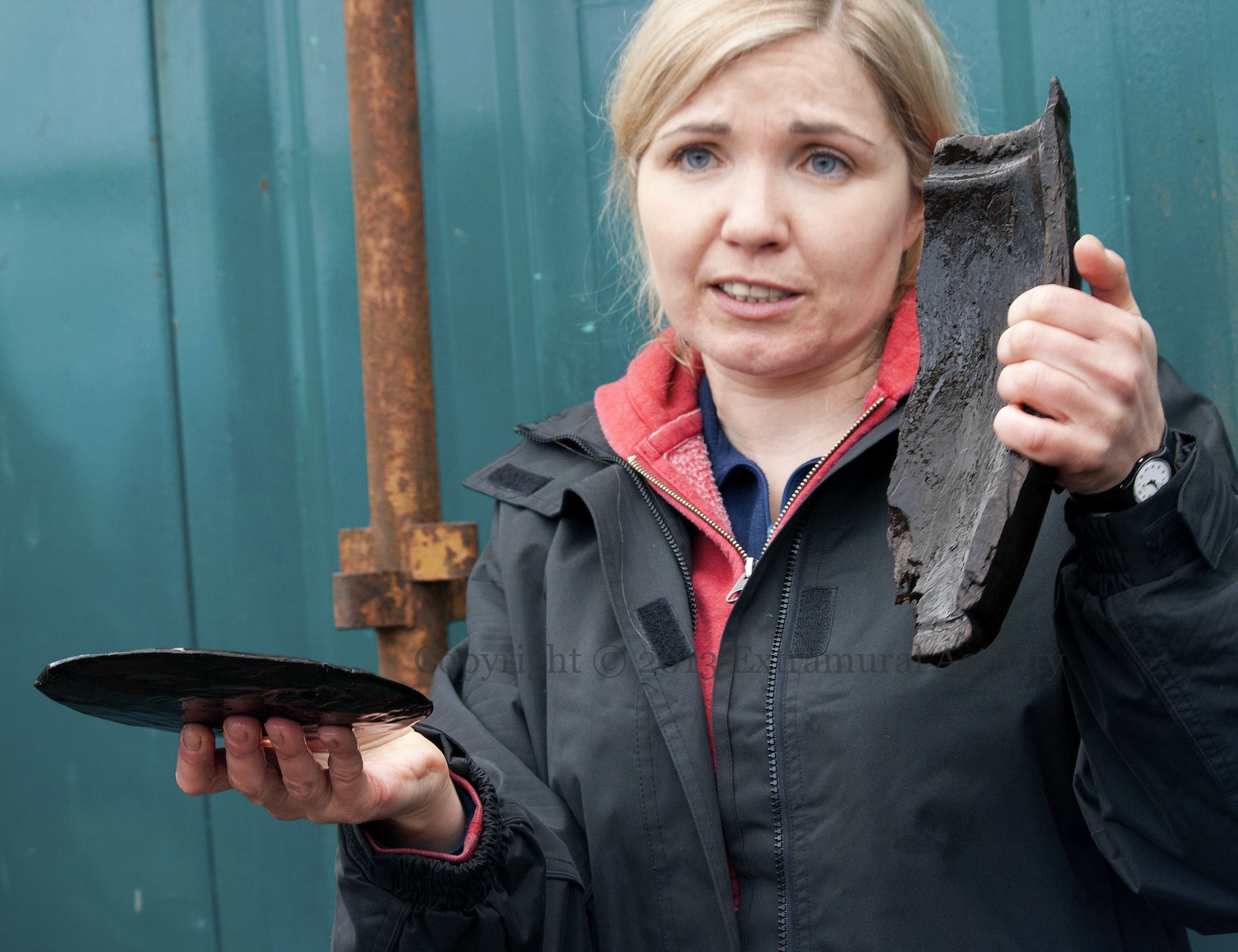
Below are images of (first) what is believed to be a game piece and (second) an archaeologist (Cathy Moore) holding up part of a vat/barrel, with an incised rim, and a disc. U.tv has a gallery of some of the more than 4,000 finds from the crannog, including combs, a shoe and shears.
2013-02-17 CrannogGame+

2013-02-17 CrannogShard+

Detail of the top picture, blown up in size … in the centre, the red circle of tape indicates the location of a house, the square lighter area is a hearth.
2013-02-17 CrannogWideFlat+

Click image to enlarge
Copyright © 2013 Seosamh Mac Coılle
X00955 X00956 X00957
Past The Gaol

2013-02-08 FountainBoard+

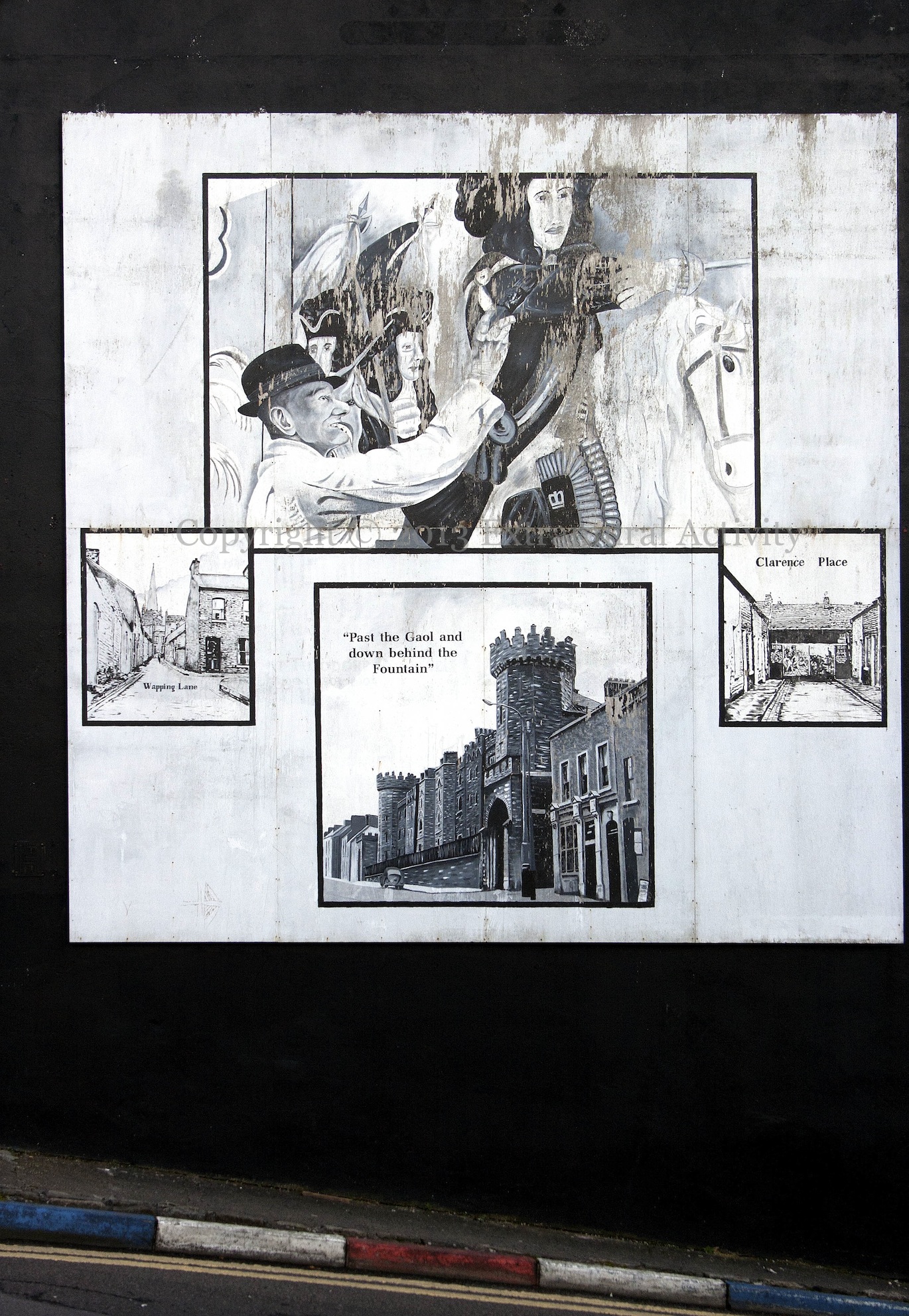
This is the board in The Fountain, Londonderry visible in the distance in True Blue. The panels feature local spots from days-gone-by.

A piece of the old Gaol still stands, between Bishop Street and The Fountain.

Wapping Lane still exists. One can view census records for Clarence Place and Wapping Lane from 1901 at the National Archives.

It would seem that the mural being painted in the top panel was in Clarence Place? (Inferred from this first-person account of life in The Fountain from the Londonderry Sentinel. (Add a comment if you can confirm/refute this.)

Click image to enlarge
Copyright © 2013 Seosamh Mac Coılle
X00940 past the gaol and down behind the fountain wapping lane clarence place

Thousands Are Sailing

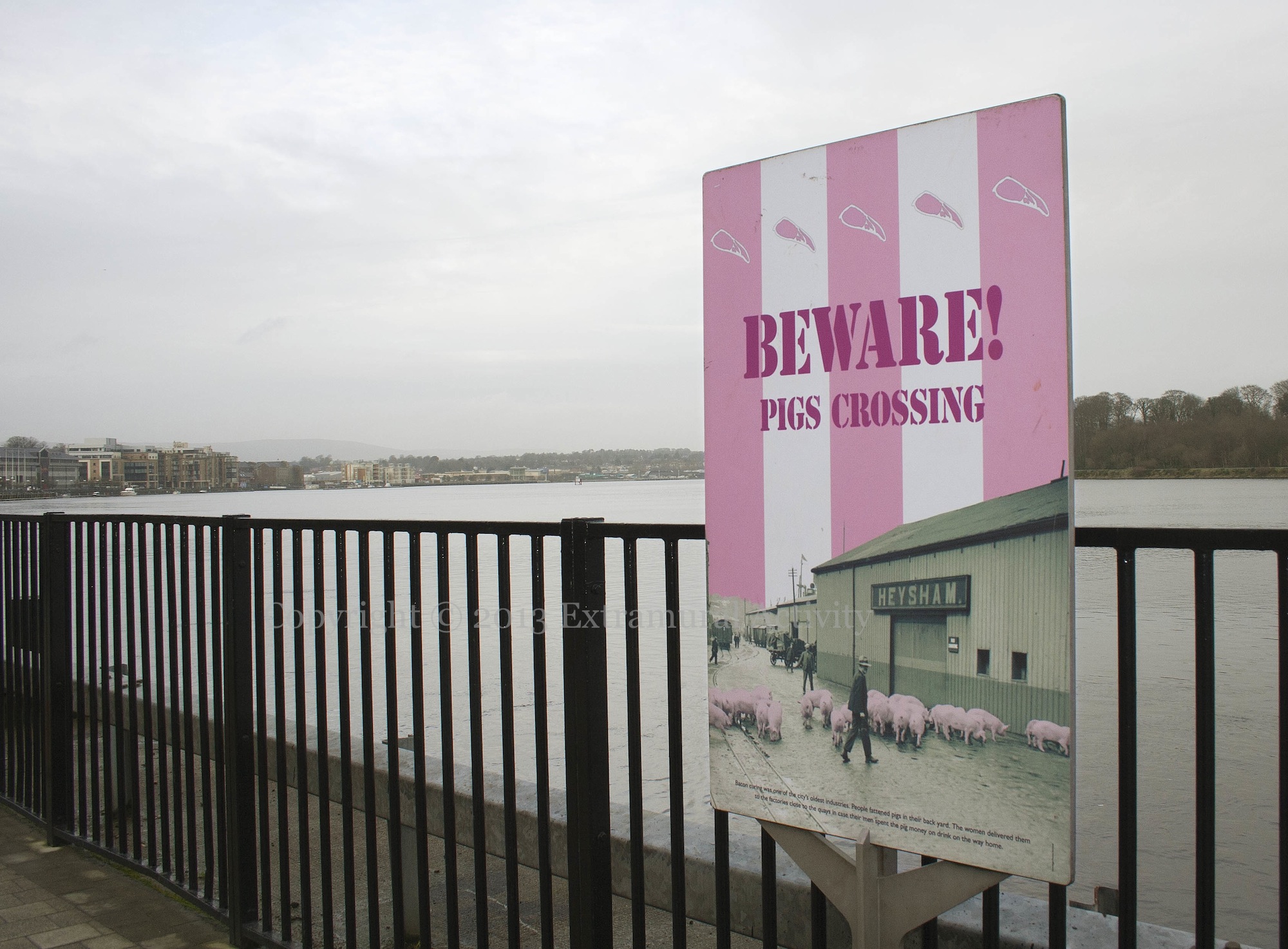
2013-02-13 PigsCrossingWide+

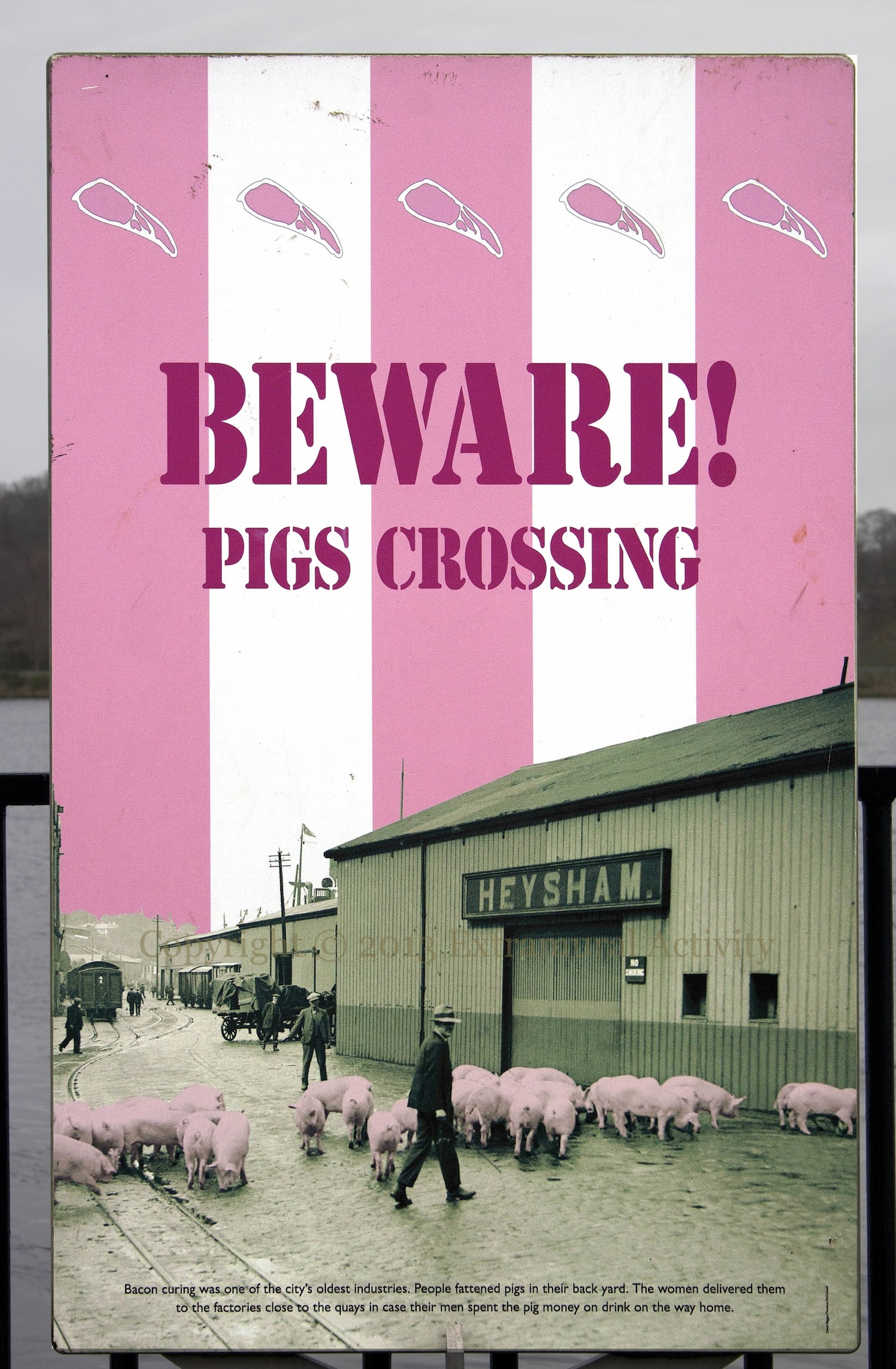
The Irish went to America, the pigs went to England. “Beware! Pigs Crossing. Bacon curing was one of the city’s oldest industries. People fattened pigs in their back yard. The women delivered them to the factories close to the quays in case their men spent the pig money on drink on the way home.”

Straight-on shot below …

2013-02-13 PigsCrossing+

Click image to enlarge
Copyright © 2013 Seosamh Mac Coılle
X00951 X00950

The Trooper

2013-02-13 TheTrooper+

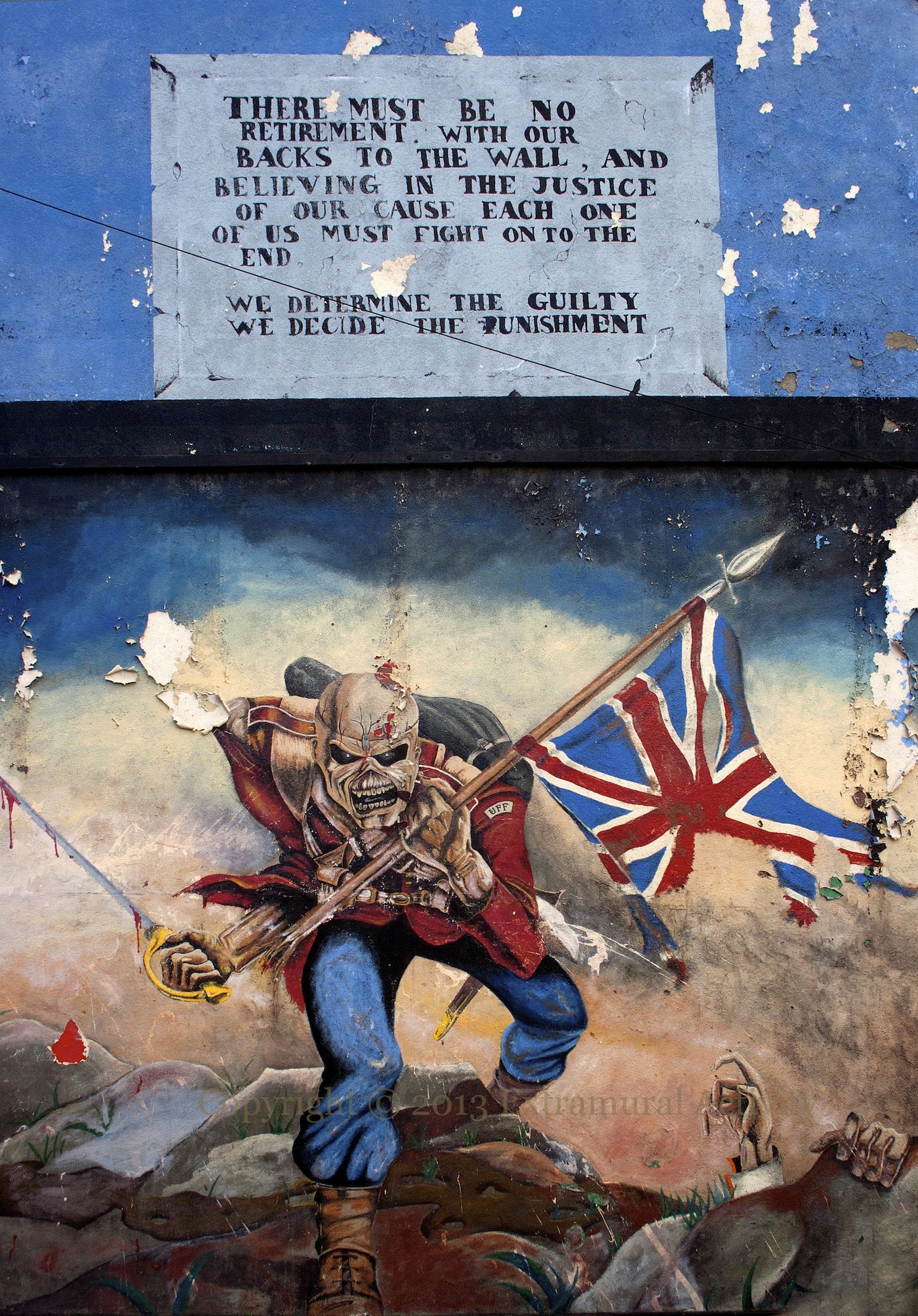
One of loyalism’s most famous muraling icons – paradoxically of the peace-time era – is Eddie The Trooper. This one is in the Waterside’s Ebrington Terrace, Londonderry. For others in other locations, see Eddie’s Visual History page.

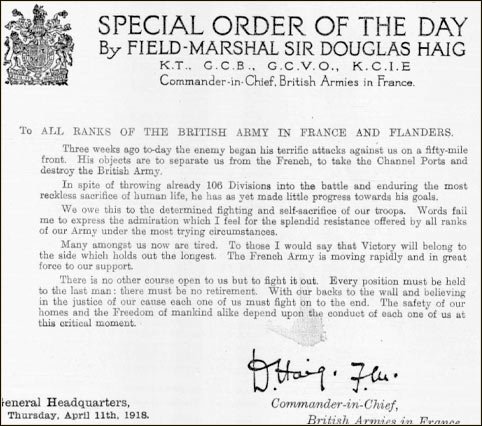
The first part of the words above the board come from the last paragraph of this WWI order: “There must be no retirement. With our backs to the wall and believing in the justice of our cause each one of us must fight on to the end”.

HaigBacksToTheWall

Source: http://www.firstworldwar.com/source/backstothewall.htm

The last sentence of Haig’s order is not included; instead we here have “We determine the guilty. We decide the punishment.” which appears to be the motto of a “fantasy tabletop war game” Warhammer 40,000.

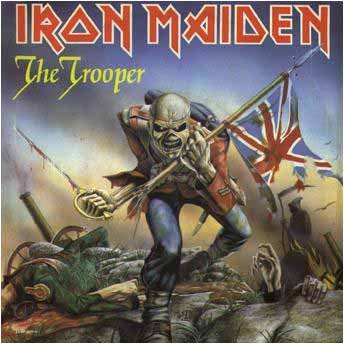
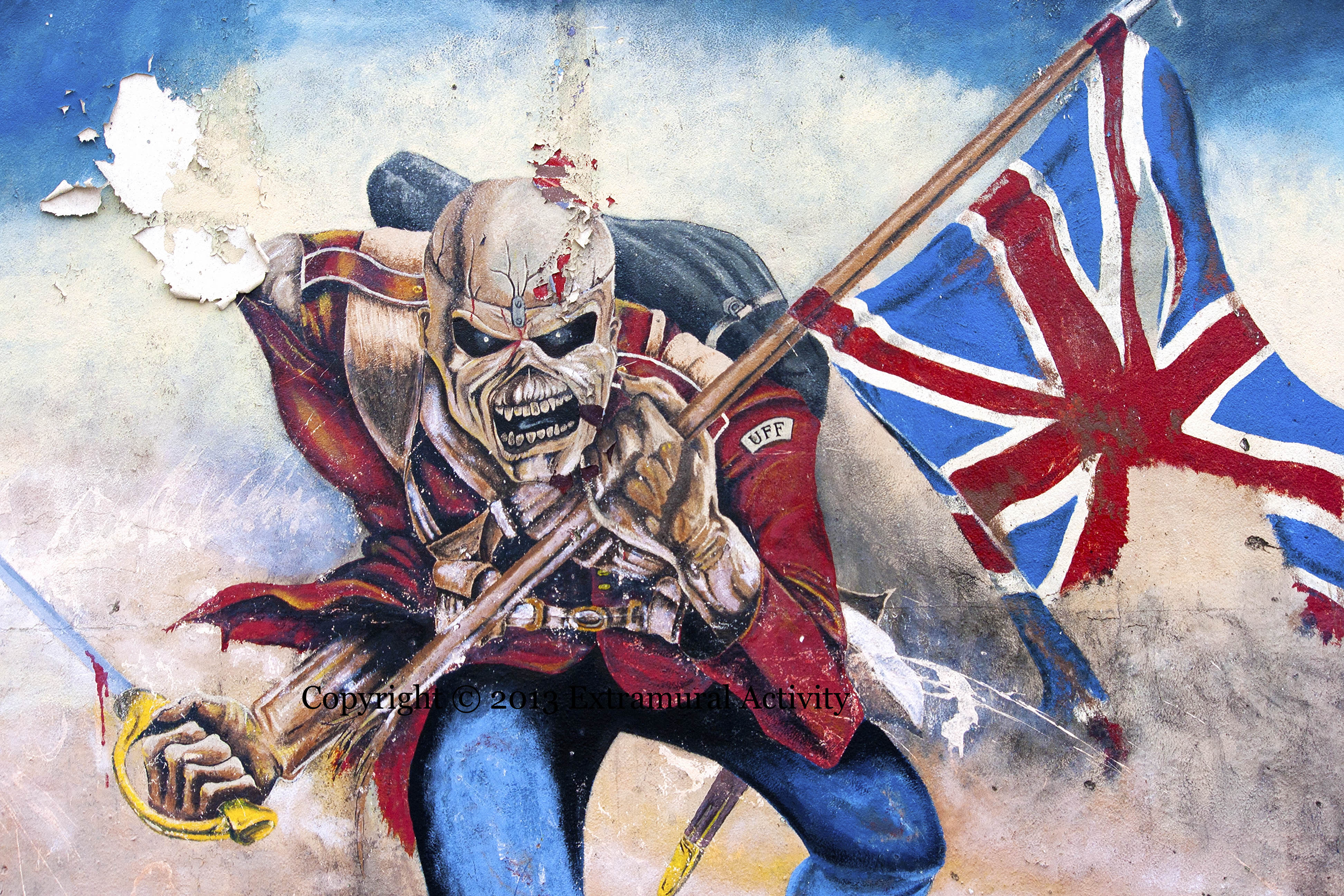
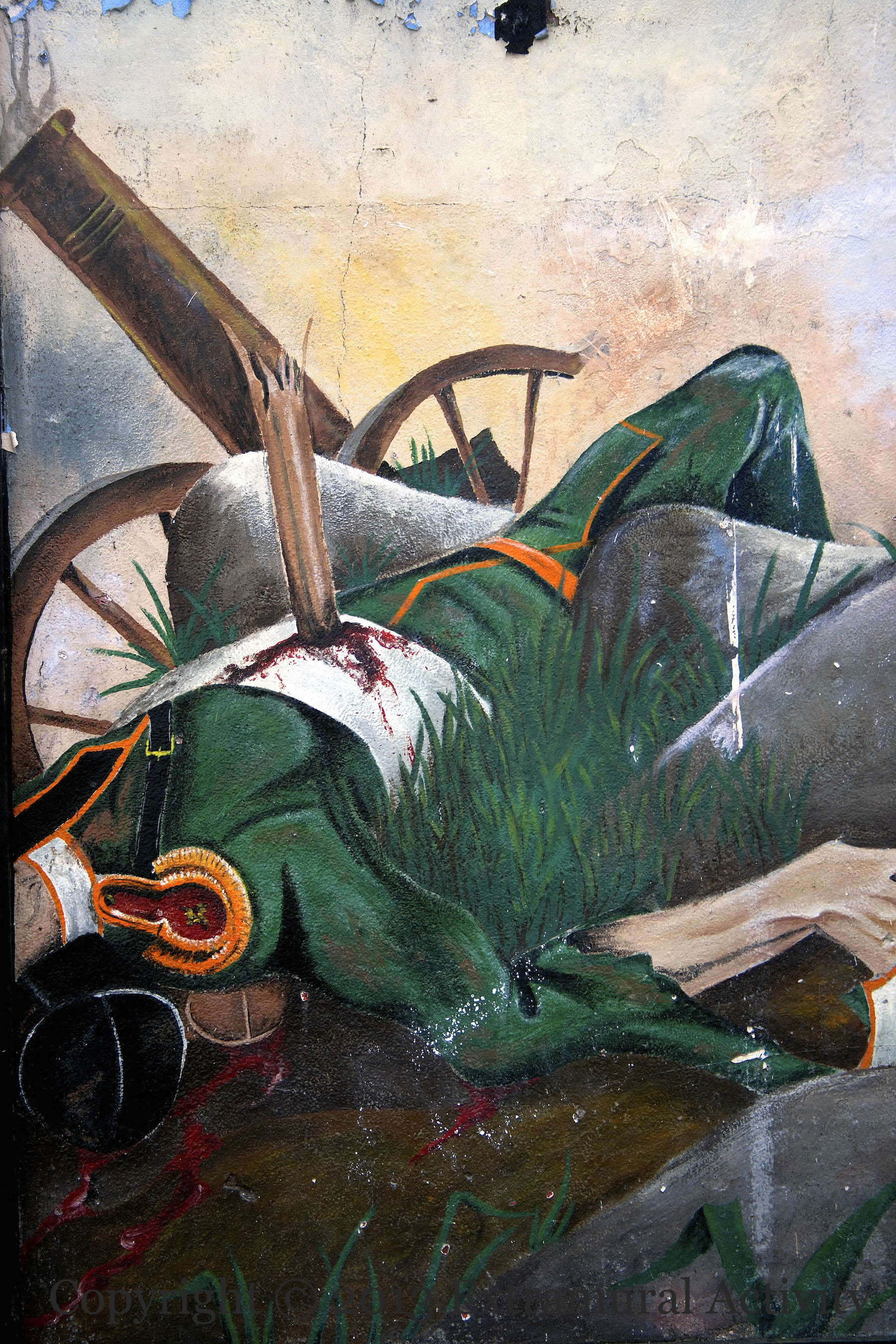
The image is a 1997 (according to Peter Moloney) replica, with additions, of a 1983 Iron Maiden cover (WP). This character, “Eddie”, was featured in much of Iron Maiden’s artwork. The two images below show a close-up of Eddie, now sporting a UFF badge on his shoulder, and of the victim on the left, now wearing a distinctively gold coloured epaulette to go with his green uniform and white sash.

6508

The board was painted by a group called ‘Attitude Artwork’, made up of Dee Logan, Mark Logan, and Marty Edwards (CAIN). In an interview with the BBC, Marty Edwards said, “I work for Attitude Mural Artists. We’re based in the Waterside, Londonderry and we paint predominantly Protestant paintings. We would usually paint paramilitary paintings for UDA people, UVF people in their own estates. You know, sort of to mark their territory bounds like, you know, stuff like that. Usually we’re left to our own devices, to come up with something that’s really intimidating, will antagonise Catholics. But this project I’ve been involved with two groups from both sides of the community, four schools. … ” (BBC)

2013-03-08 TrooperCentre+

2013-03-08 TrooperLeft+

Click image to enlarge
Copyright © 2013 Seosamh Mac Coılle
X00952 X01003 X01004

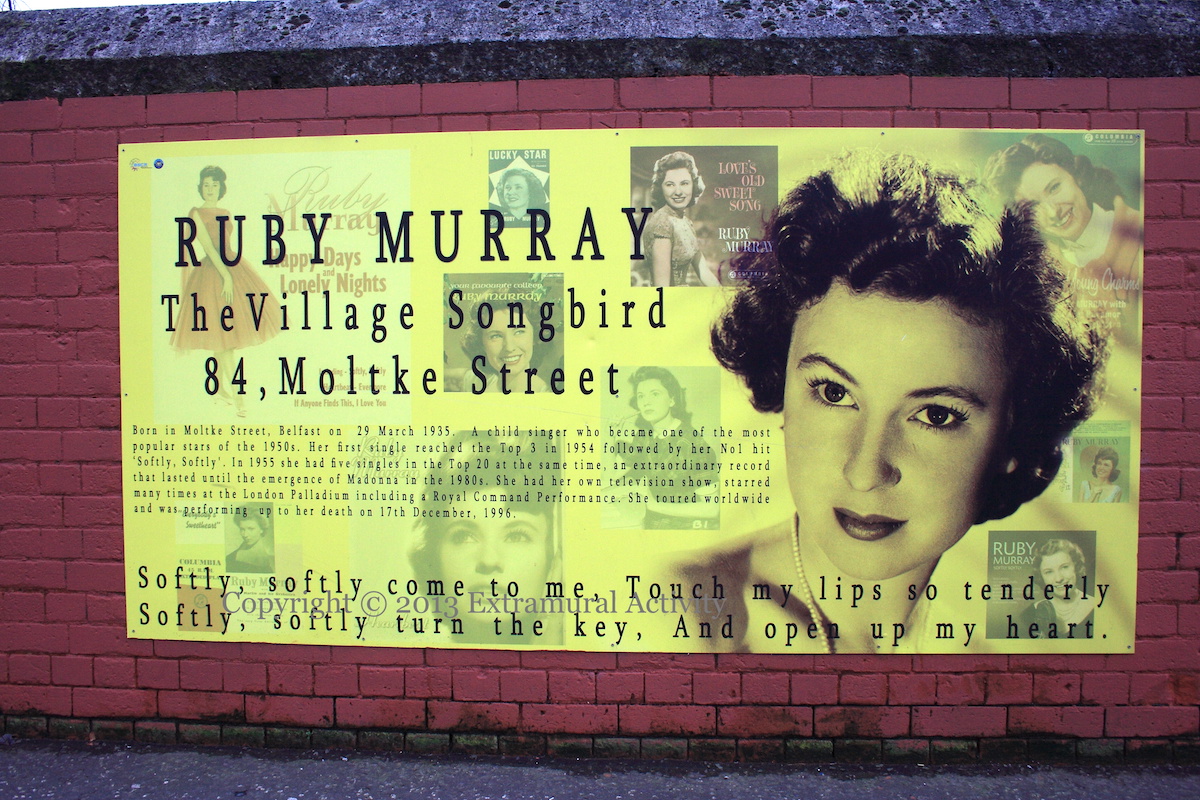
The Village Songbird

“Born in Moltke Street, Belfast, on 29 March 1935. A child singer who became one of the most popular stars in the 1950s. Her first single reached the Top 3 in 1954 followed by her No 1 hit ‘Softly, Softly’. In 1955 she had five singles in the Top 20 at the same time, an extraordinary record that lasted until the emergence of Madonna in the 1980s. She had her own television show, starred many times at the London Palladium including a Royal Command Performance. She toured worldwide and was performing up to her death on 17th December, 1996” ‘Softly, softly, come to me/Touch my lips so tenderly/Softly, softly, turn the key/And open up my heart.’ (youtube).

Maldon Street, south Belfast

Click image to enlarge
Copyright © 2013 Seosamh Mac Coılle
X01555