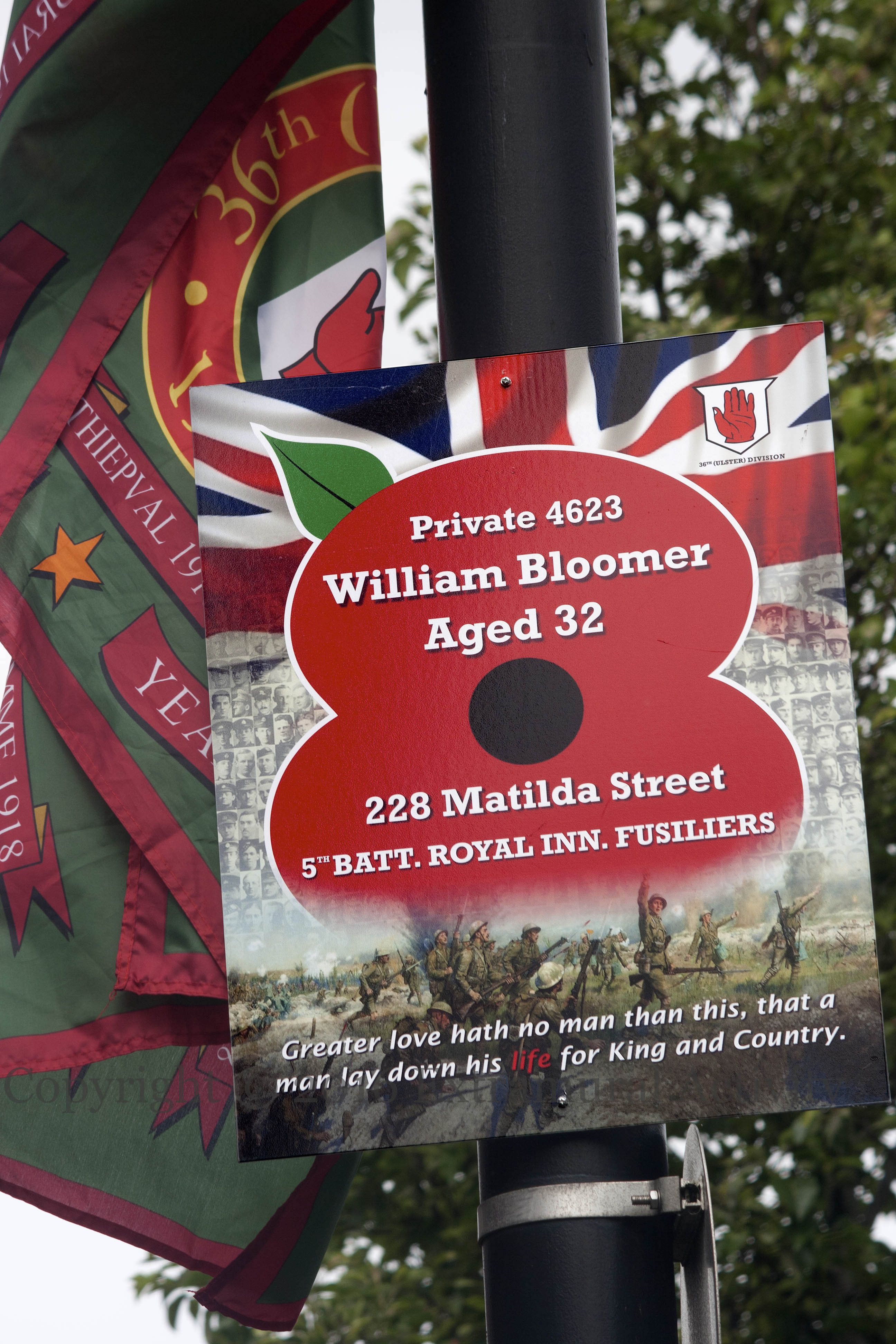
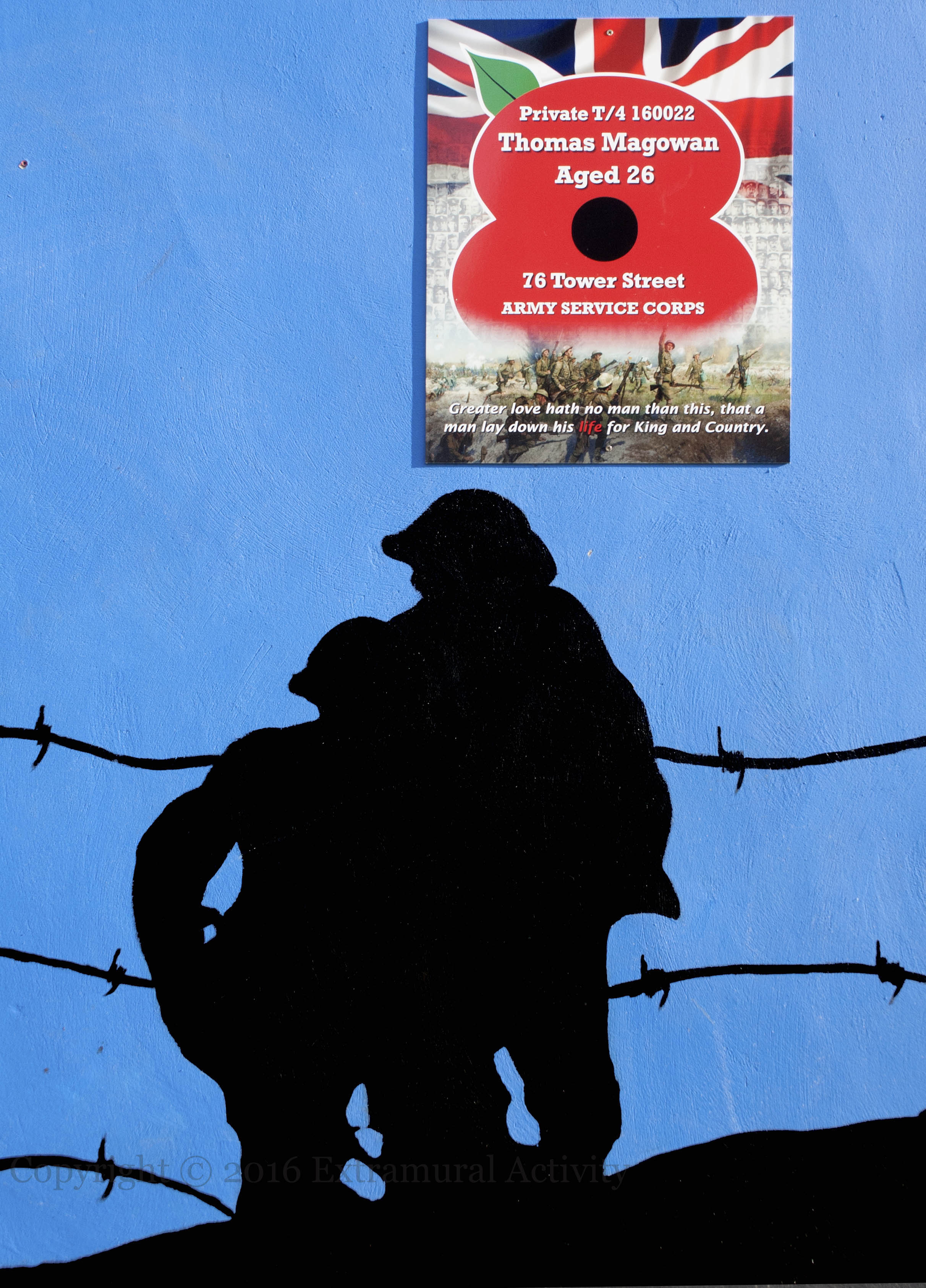
As part of the Poppy Trail, boards bearing the names, ages, addresses, and service units of Belfast casualties during WWI have been erected on walls and lampposts near their homes. Above: William Bloomer from Matilda Street in south Belfast. Below: Thomas Magowan from Tower Street in east Belfast.
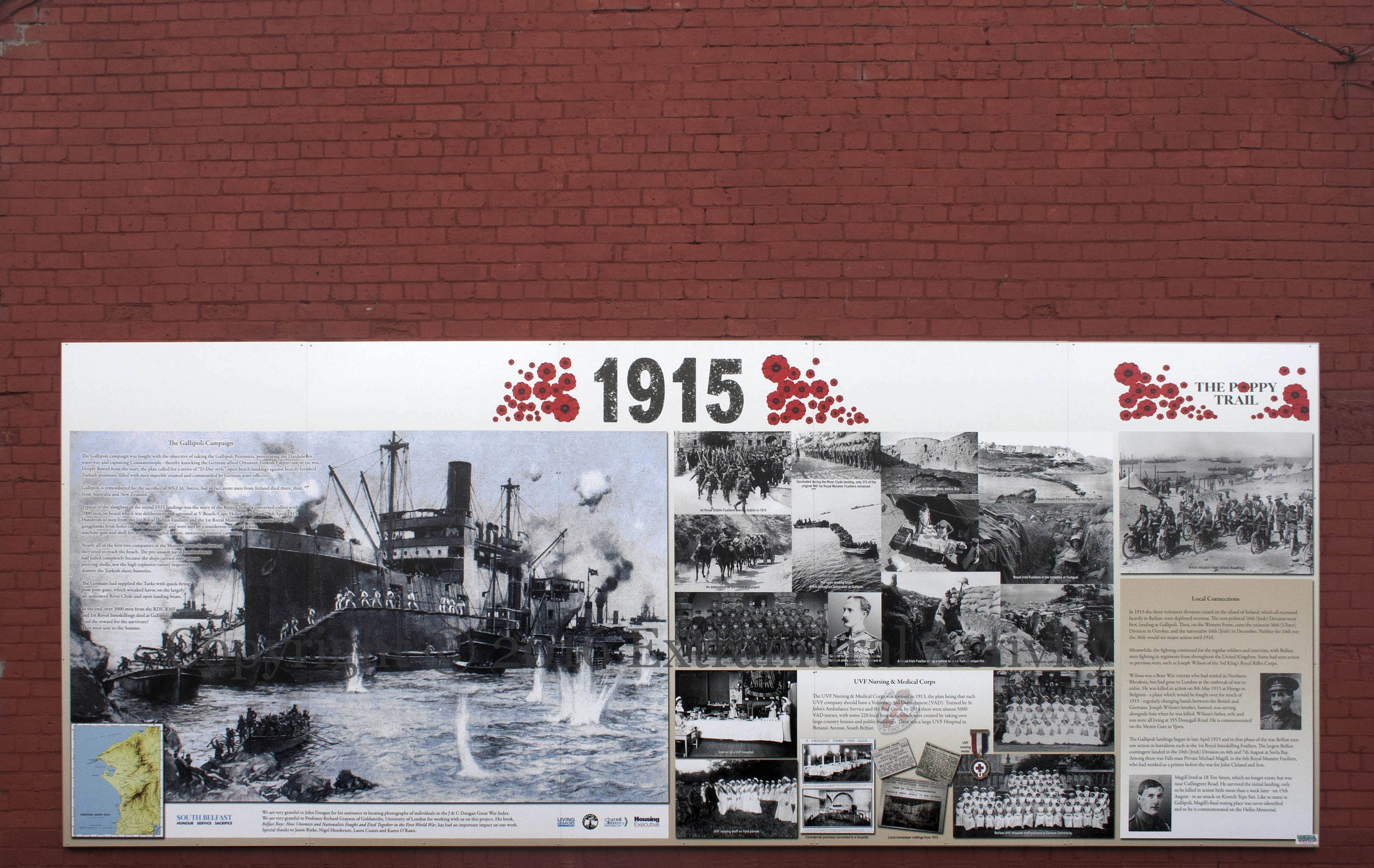
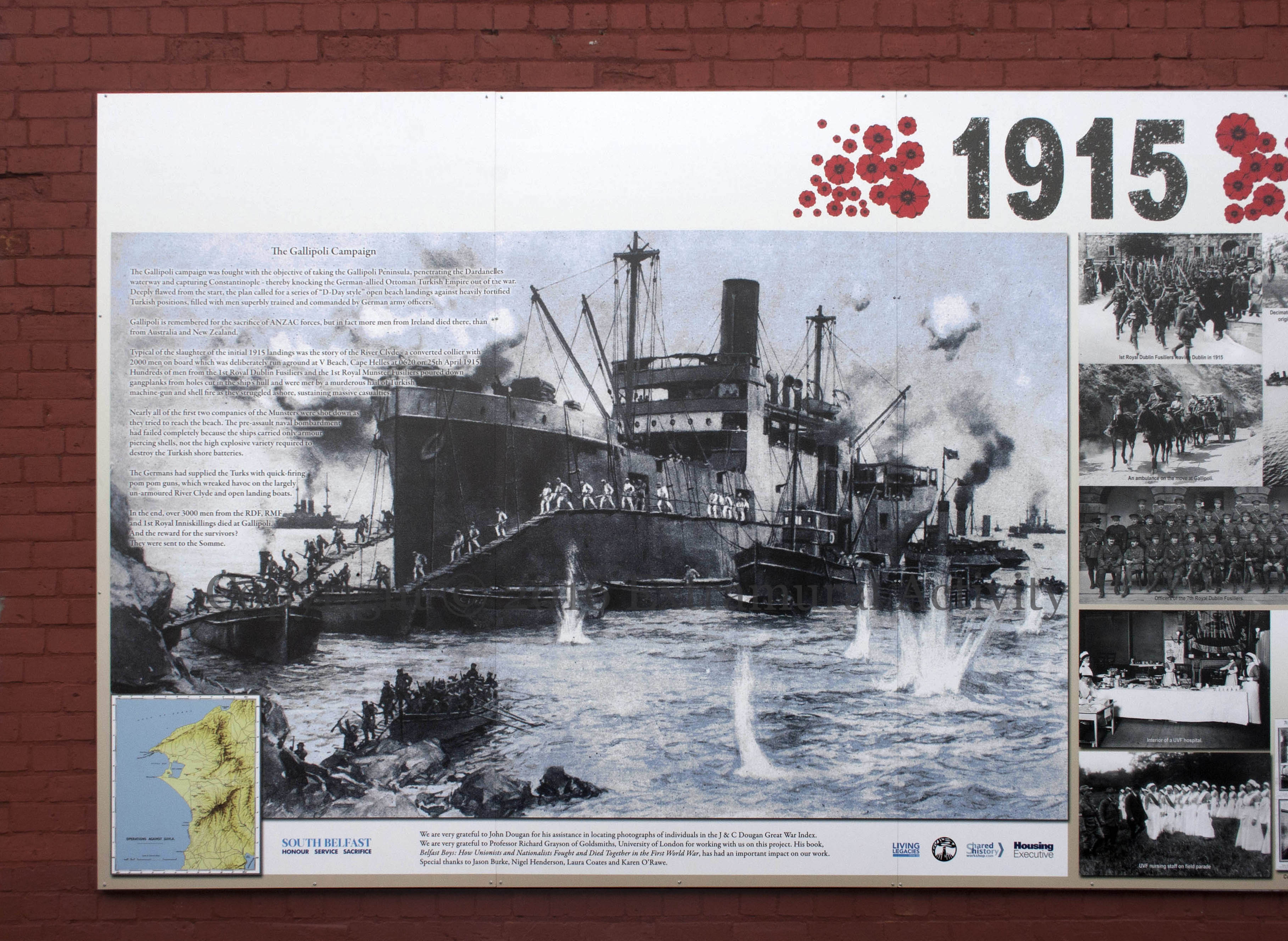
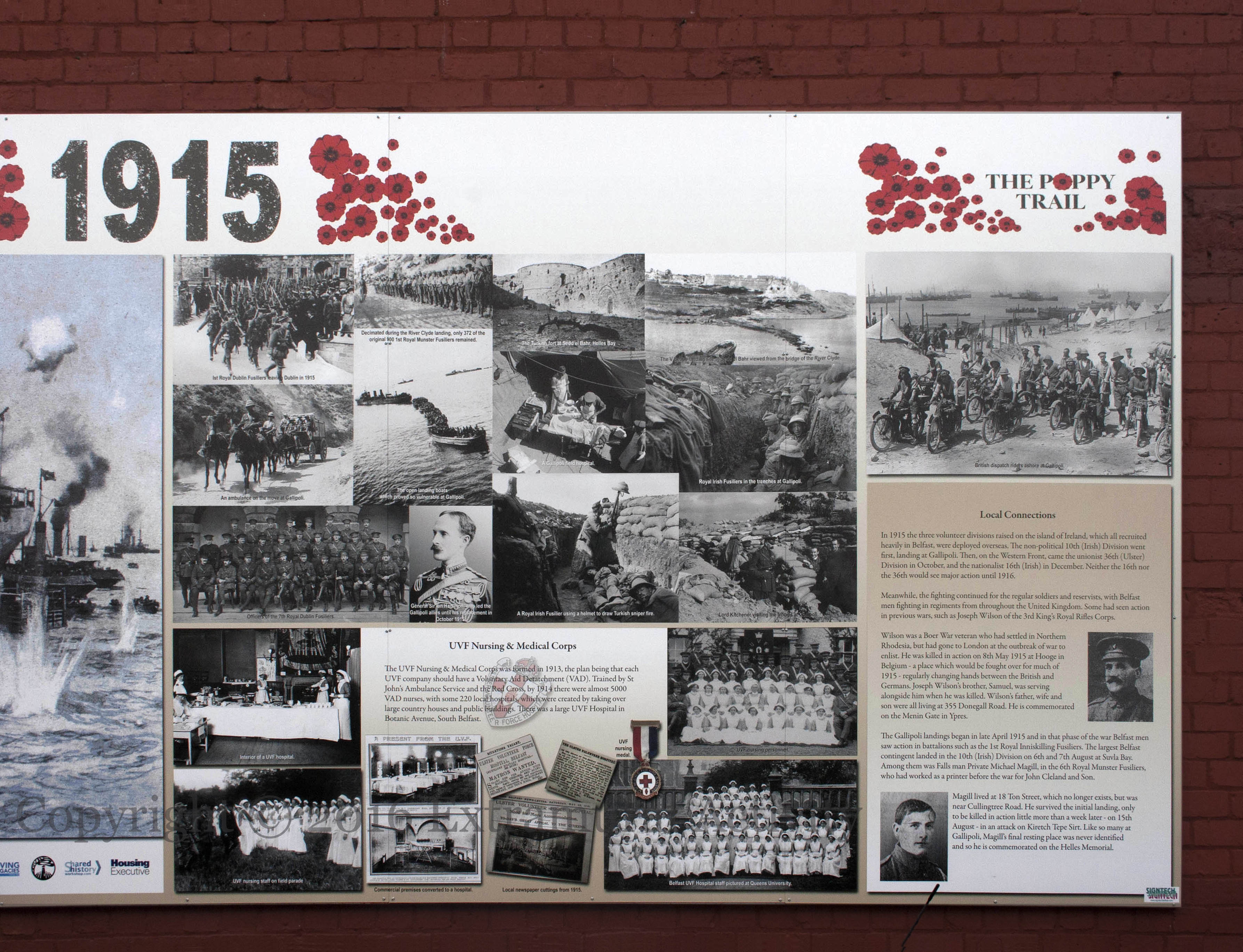
The 1915 board in the ‘Poppy Trail’ series in south Belfast focuses on the Gallipoli campaign, claiming that “more men from Ireland died there than from Australia and New Zealand.” The ship on the left-hand side is the River Clyde, a converted collier, carrying men from the 1st Royal Dublin and 1st Royal Munster Fusiliers, who were decimated as they tried to reach shore — “only 372 of the original 900 1st Royal Munster Fusiliers remained”.
As with the 1914 board, the 1915 board includes the stories of men from both south and west Belfast, in this case, Joseph Wilson, who hailed from Donegall Road and died in Belgium, and Michael Magill, from the Divis area, who died at Gallipoli.
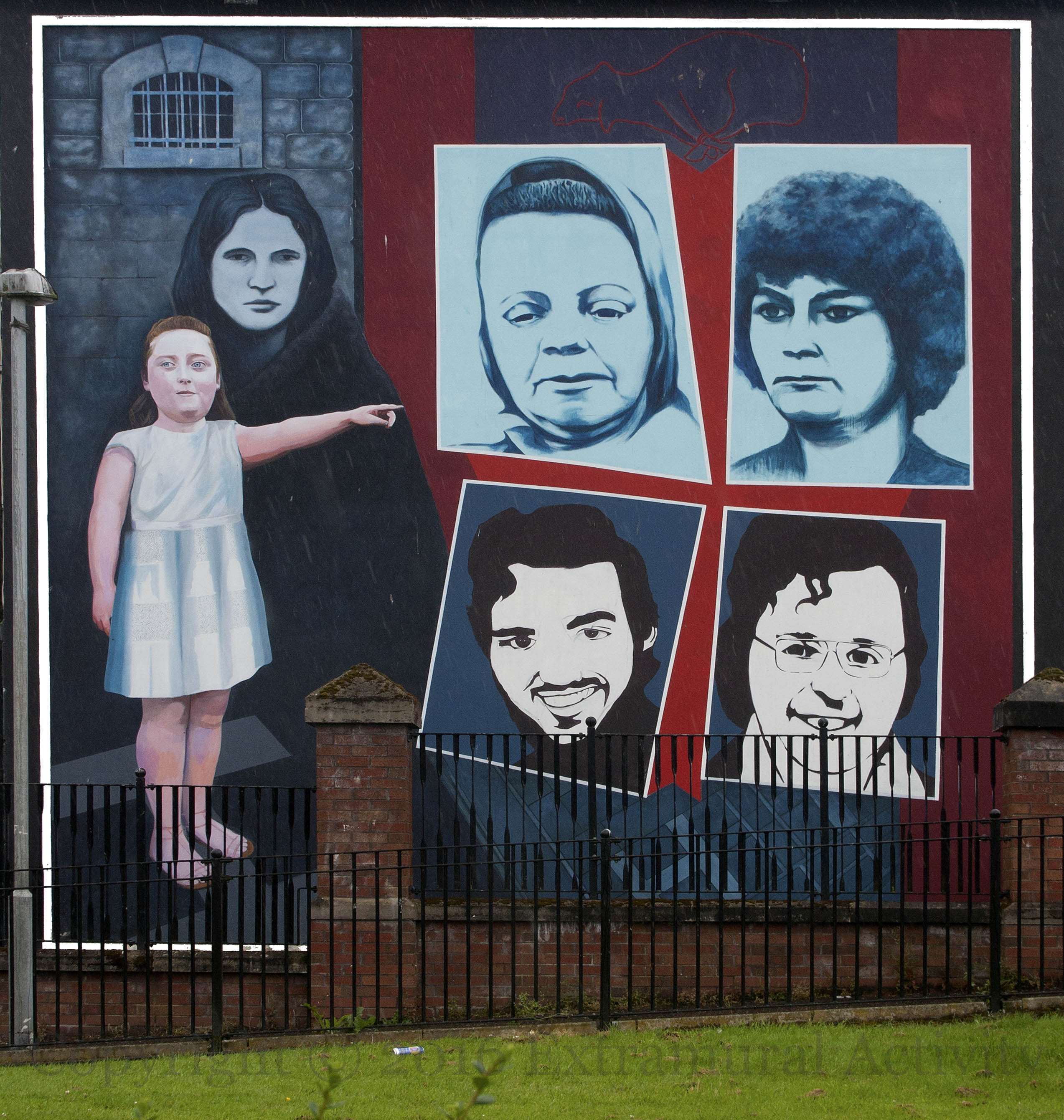
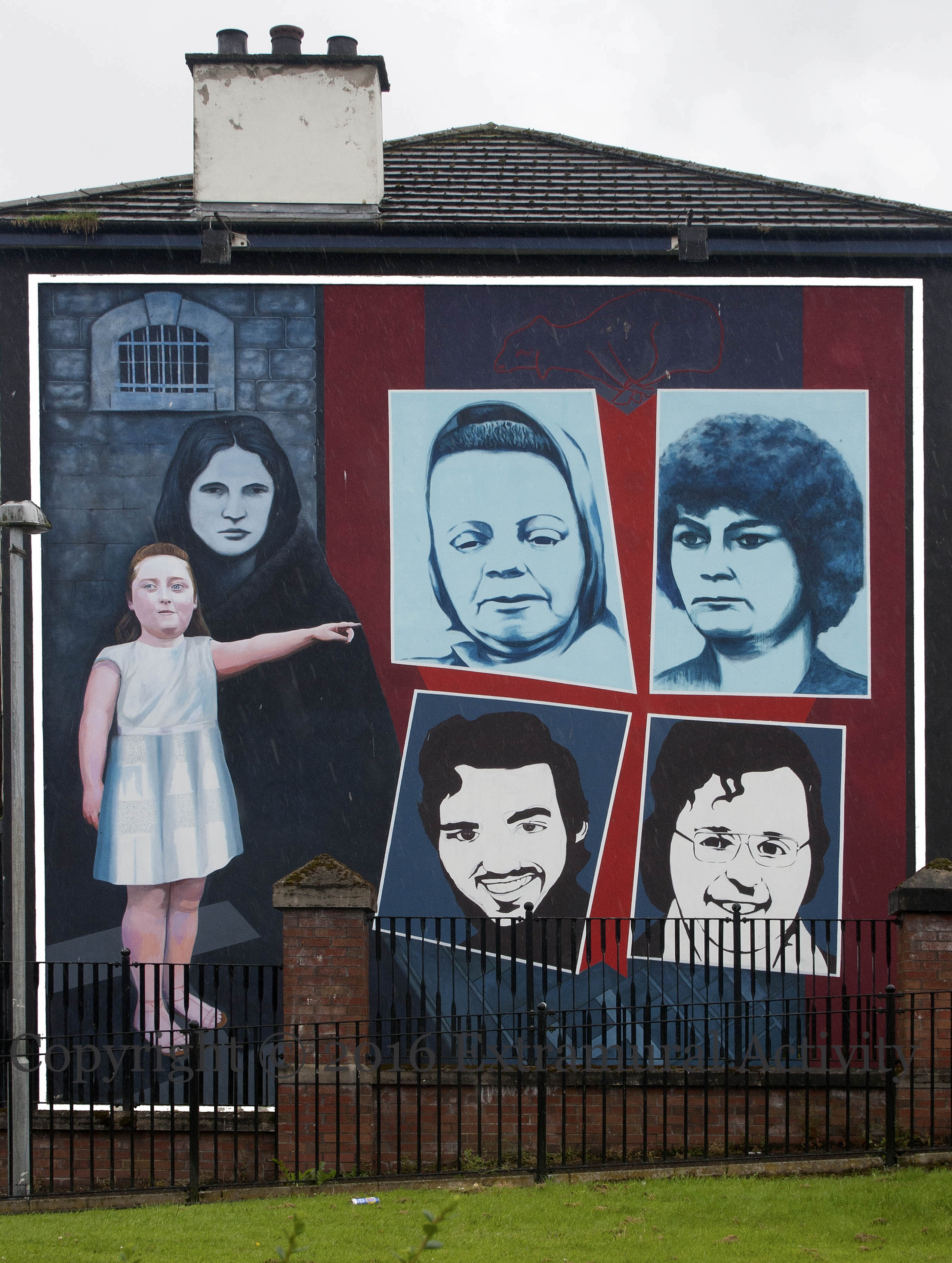
The figure in the centre of the mural above is Peggy O’Hara, mother of INLA hunger striker Patsy O’Hara, who remained active in socialist and republican circles and stood in the assembly elections in 2007 as an independent. She died in 2015 and was given a paramilitary funeral, including a volley of shots fired over the coffin. (For a description, and video, see this Derry Journal article.) The female above Mickey Devine (in the bottom right) is his sister Margaret, from whose house his coffin processed after his death in 1981. (See the plaque in Waked & Buried.) The girl on the left is pointing towards another mural, a dove of peace. (See Network.)
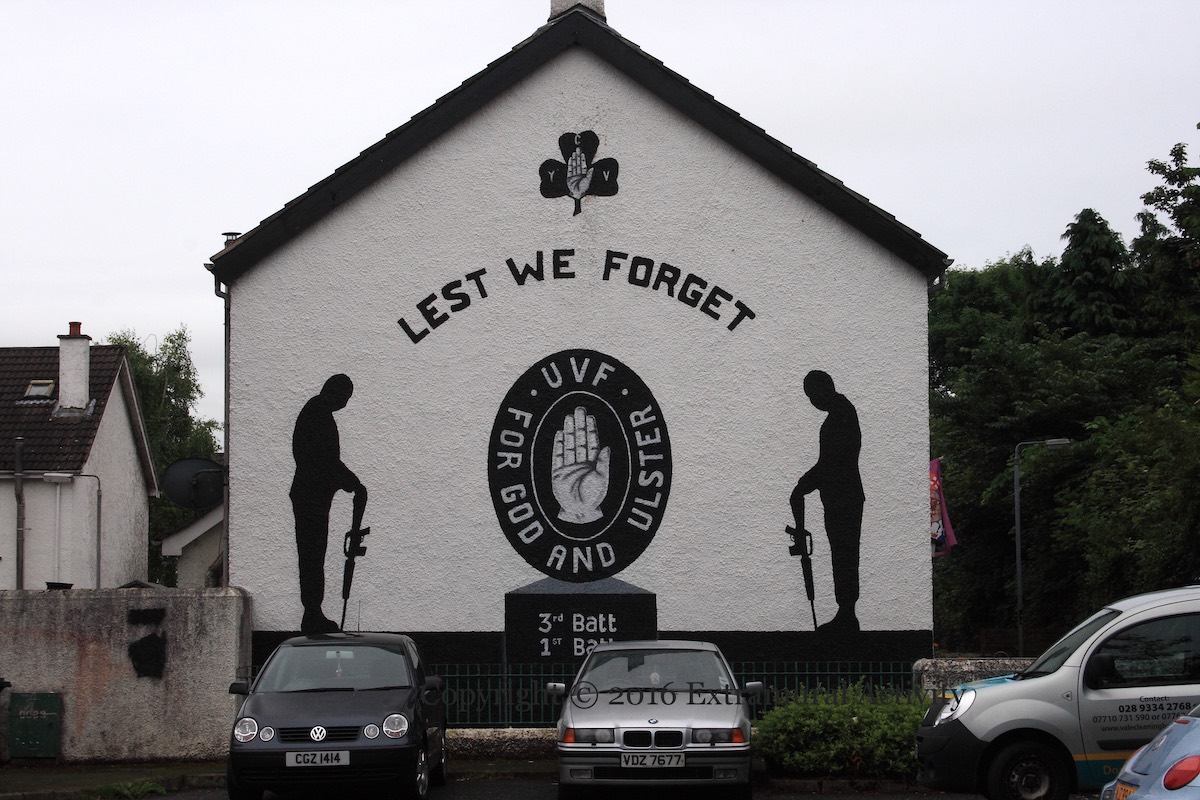
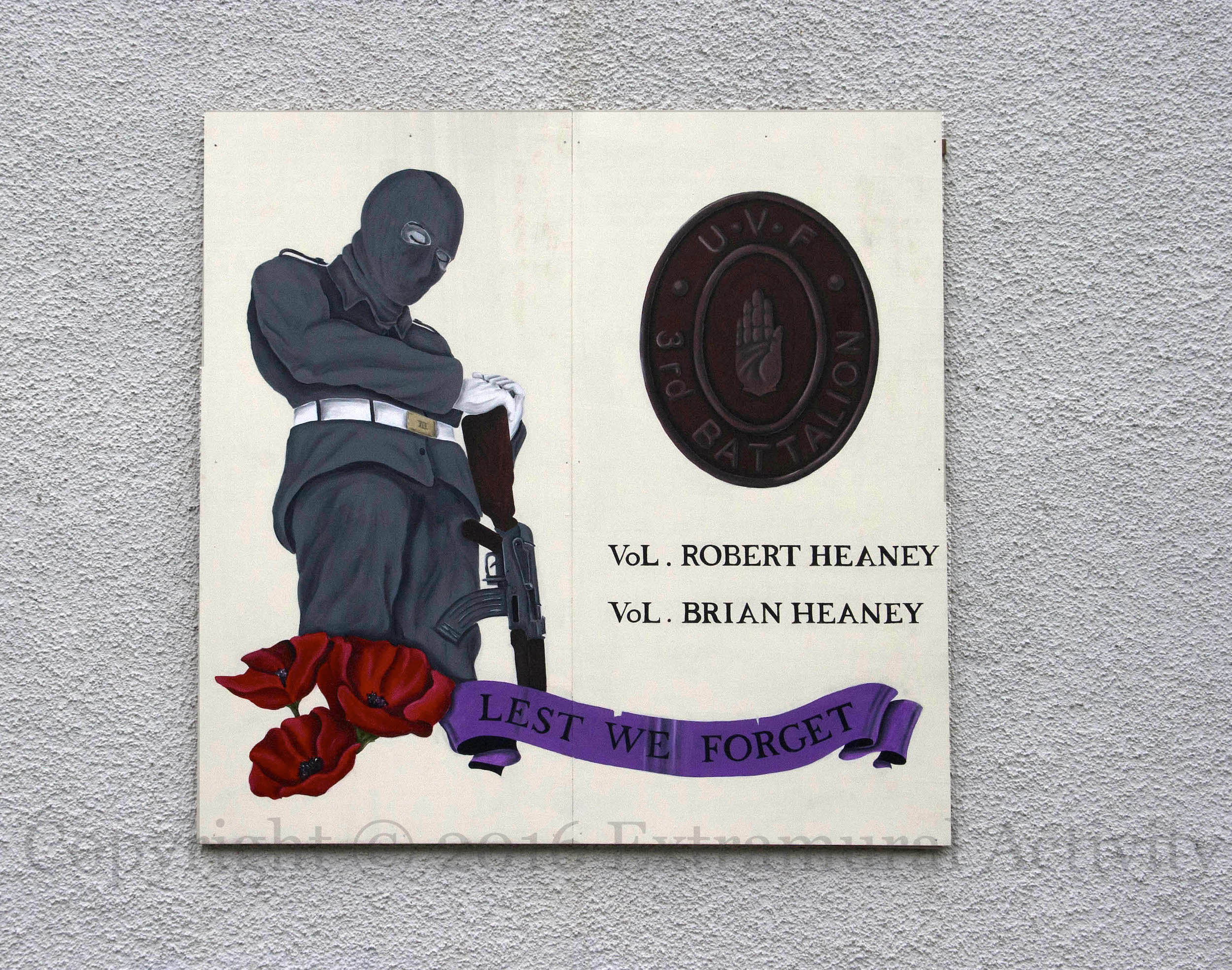
UVF 3rd Battalion [East Antrim? North Belfast?] board in Ballyclare to Vol. Robert Heaney and Vol. Brian Heaney. There doesn’t seem to be any information about these two in the usual places – please get in touch if you know anything about them.
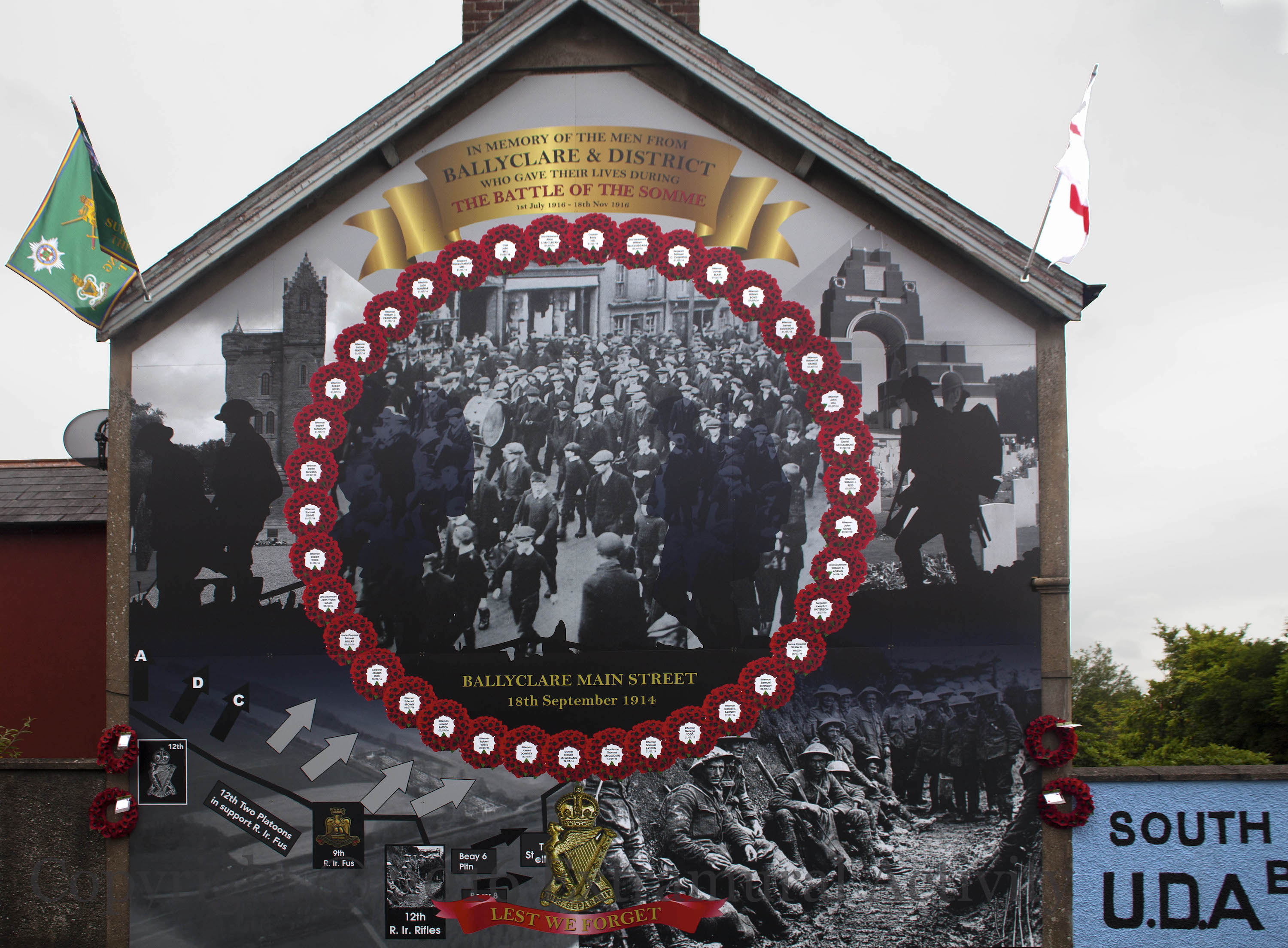
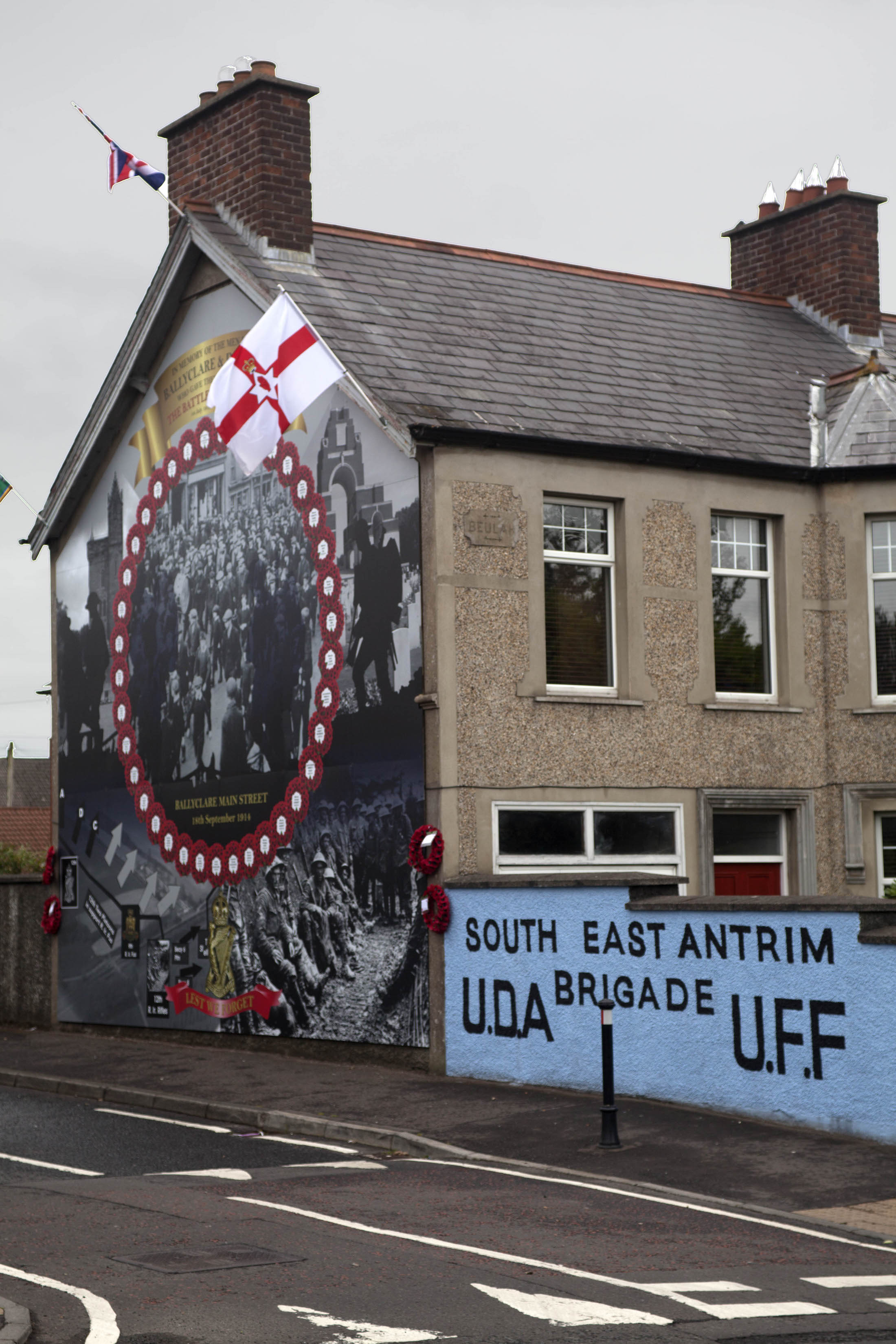
Garlands of poppies, one for each of 38 local men “who gave their lives during the Battle of the Somme 1st July 1916 – 18th Nov 1916”, form a circle around a photograph of “Ballyclare Main Streeet 18th September 1914” as the men go off to war. For information about 17 of the men, see this Love Ballyclare page.
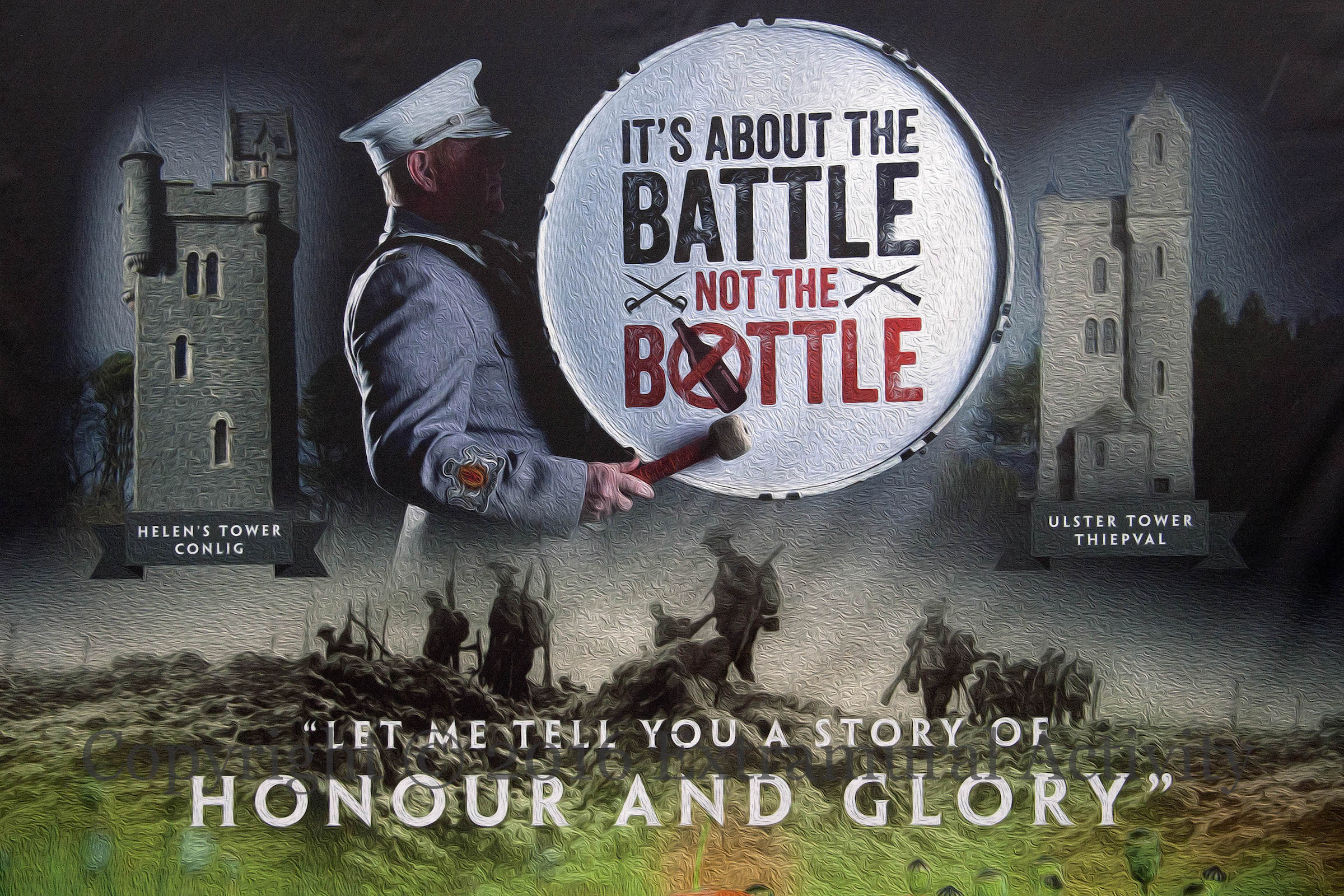
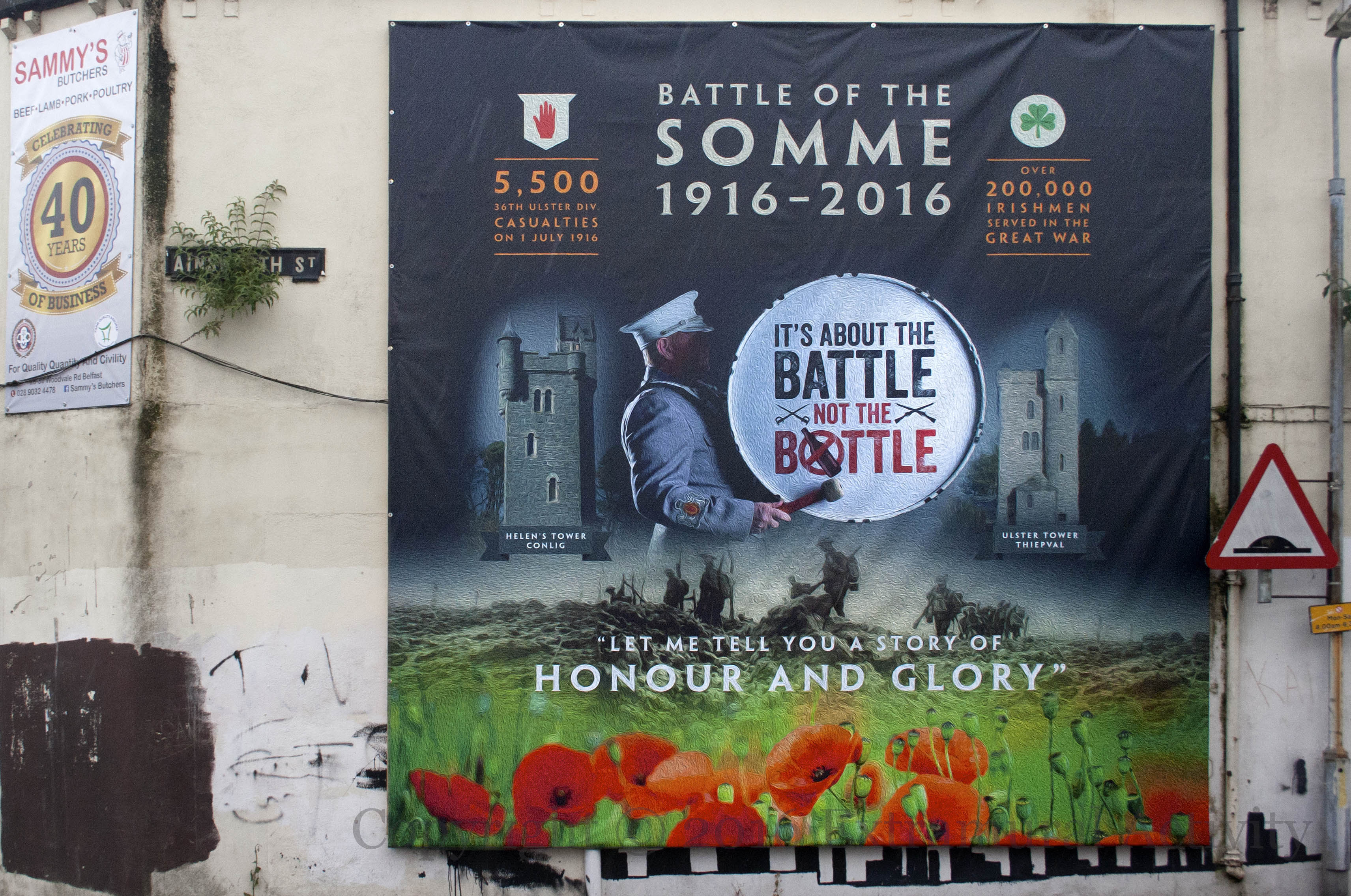
A 2012 Belfast Telegraph opinion piece asked “Is it Orangefest or vodka and Orangefest?” This year sees a campaign to curb alcohol consumption during marching season (including both the centenary of the Somme on July 1st and the traditional Twelfth celebration of the Battle of the Boyne) using the slogan “It’s about the battle not the bottle” and the hashtag #battlenotbottle. Here is a NewsLetter article on the campaign, which includes 25,000 beermats bearing the message.
It also contains (as shown in the wide shot, below) figures for both the number of casualties suffered by the 36th (Ulster) Division on July 1 at the Battle of the Somme (5,500) and the number of Irishmen who served in the Great War (200,000).
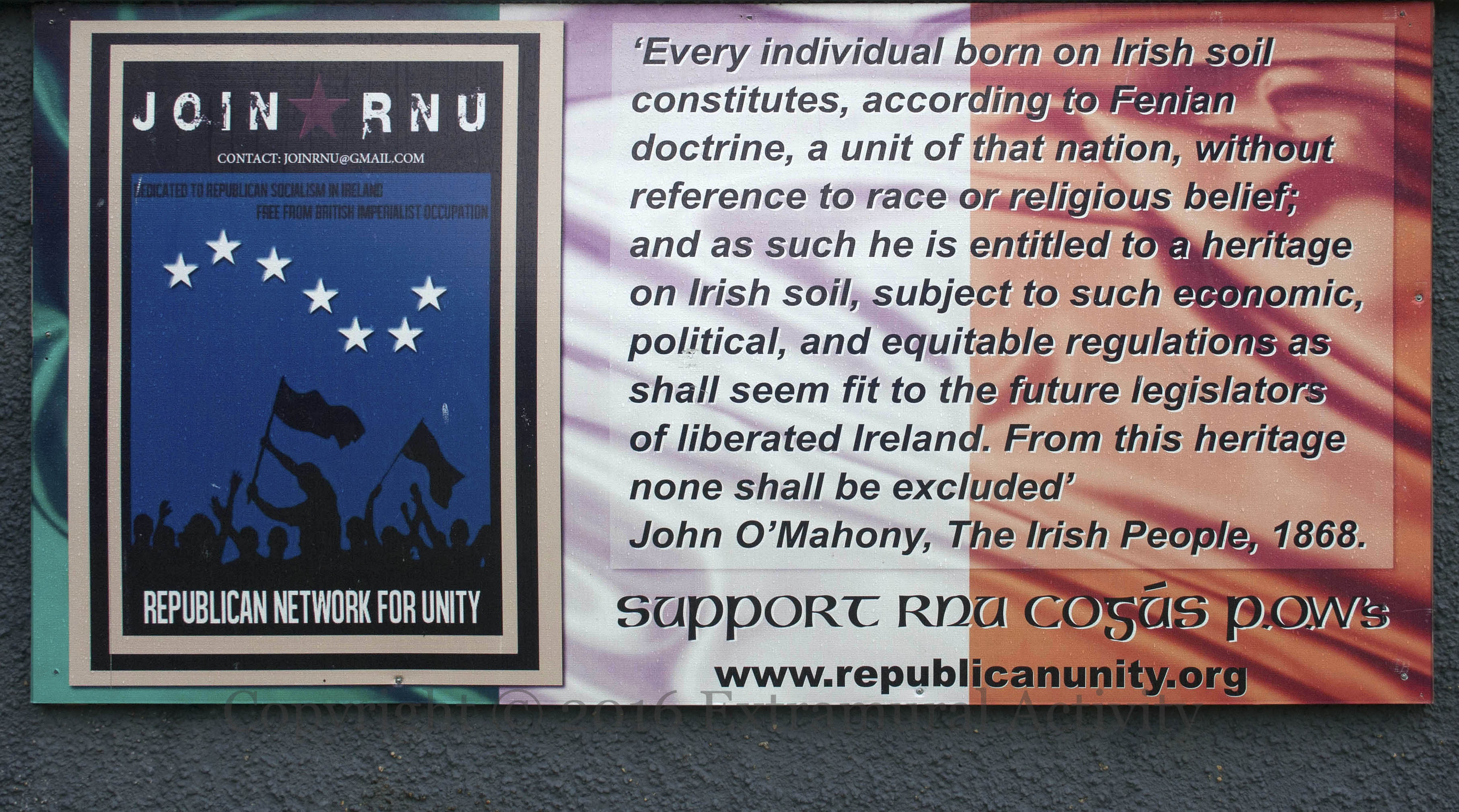
John O’Mahony was an Irish-born but American-based republican who founded the Fenian Brotherhood, whose goal was to send arms and financial support to the Irish Republican Brotherhood in Ireland (Brittanica).
His words from the IRB newspaper The Irish People are used in this RNU [“www.republicanunity.org“] board in Derry: “Every individual born on Irish soil constitutes, according to Fenian doctrine, a unit of that nation, without reference to race or religious belief; and as such he is entitled to a heritage on Irish soil, subject to such economic, political and equitable regulations as shall seem fit to the future legislators of liberated Ireland. From this heritage none shall be excluded.”
The date given is 1868, but the paper closed in 1865 when its offices were raided and its executives, including manager O’Donovan Rossa, were arrested.
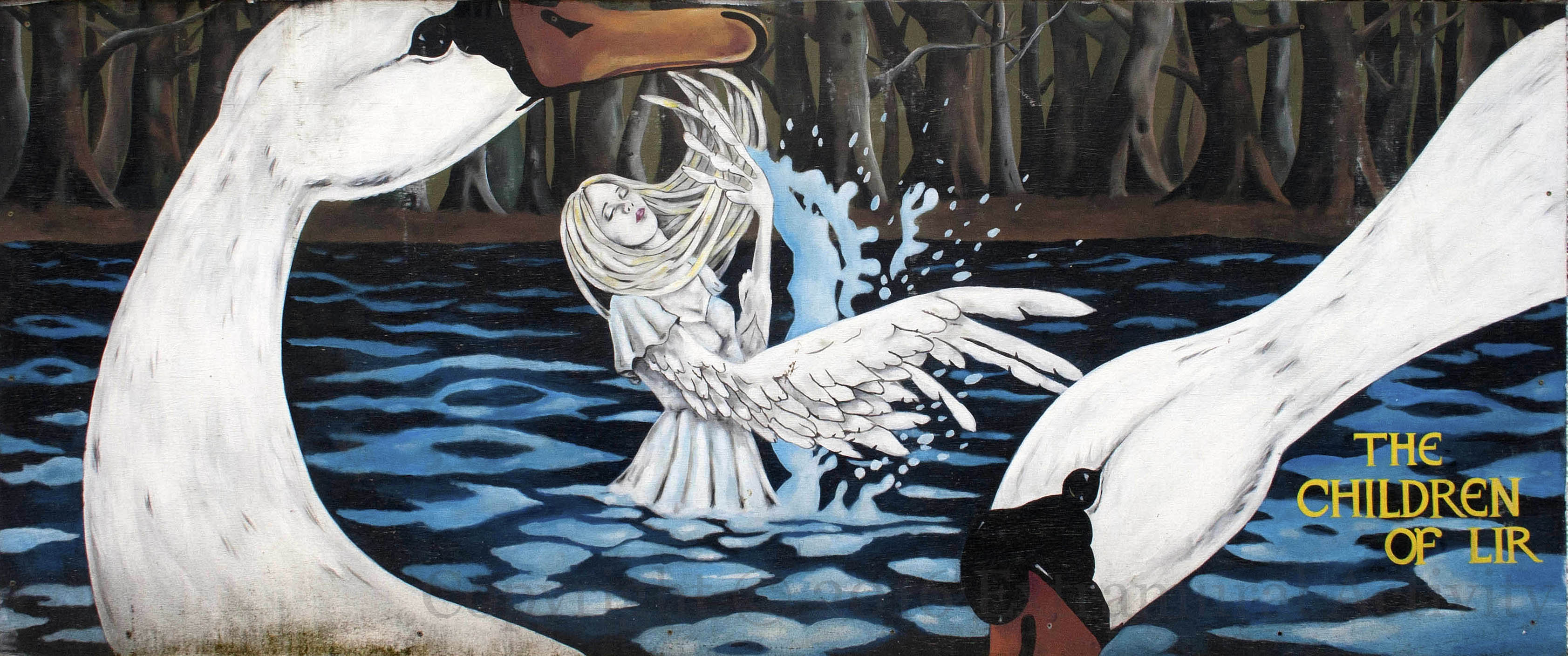
Step-mother Aoıfe resents the bonds between her husband Lear and his children and their love for their lost mother and turns them into singing swans for 900 years, by the end of which time Christianity had come to Ireland. A monk heard their song and recognised them. At his touch, they are restored to human form. Being 900 years old, they die immediately but not before being baptised.
For another ‘baptised before death’ story, see the story of the mermaid Lí Ban in Sea-Born.
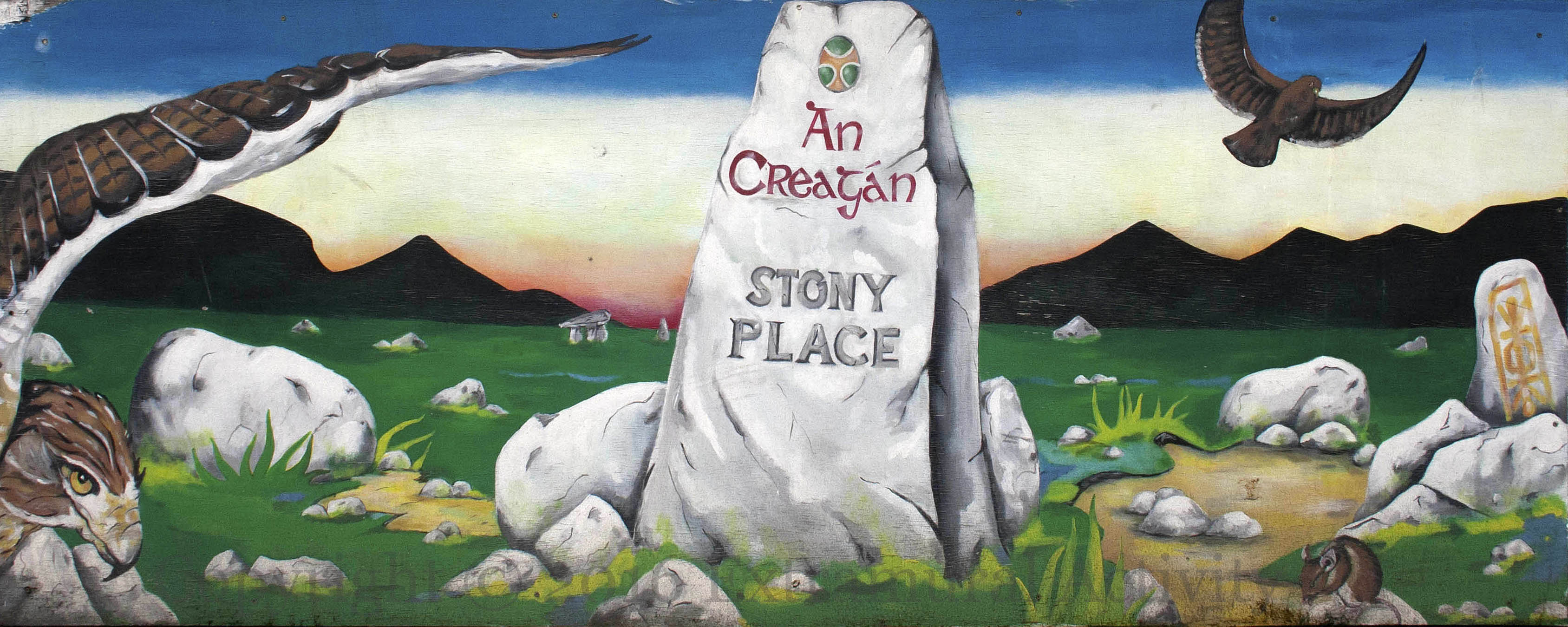
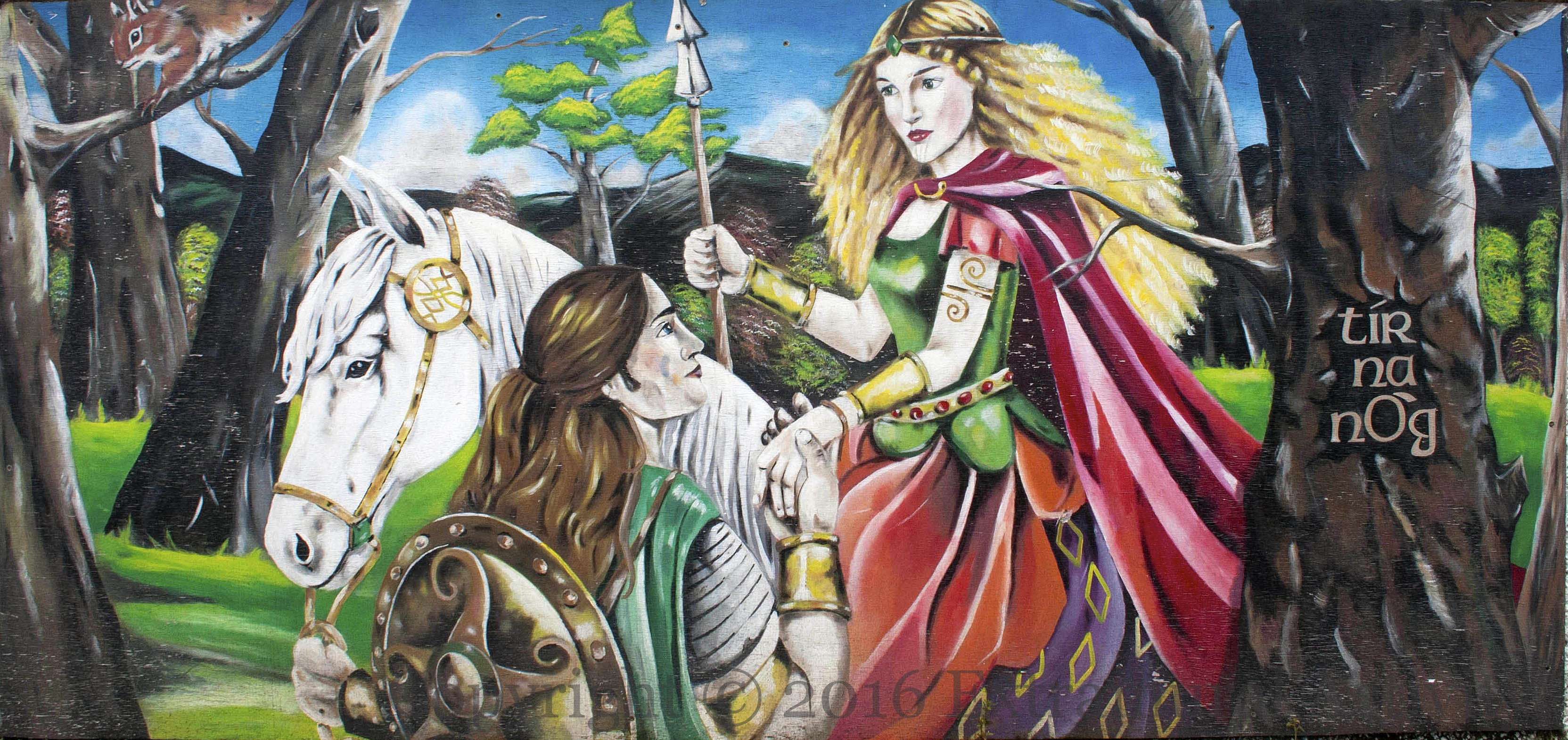
This is the third of three Celtic mythology boards in Creggan/An Creagán, Derry. See previously: Tír Na nÓg and Cú Chulaınn.
In the myths of the Tuatha Dé Danann, the Fıan Oısín falls in love with Nıamh from the Land Of Youth, but after three years — which is 300 human years — he yearns to return to Ireland. She gives him a magic horse that will preserve his youth while he remains on it. But he falls from it and dies of old age.
 Seosamh Mac Coille Collection